Birth of an Icon
Summary
Setting the Scene
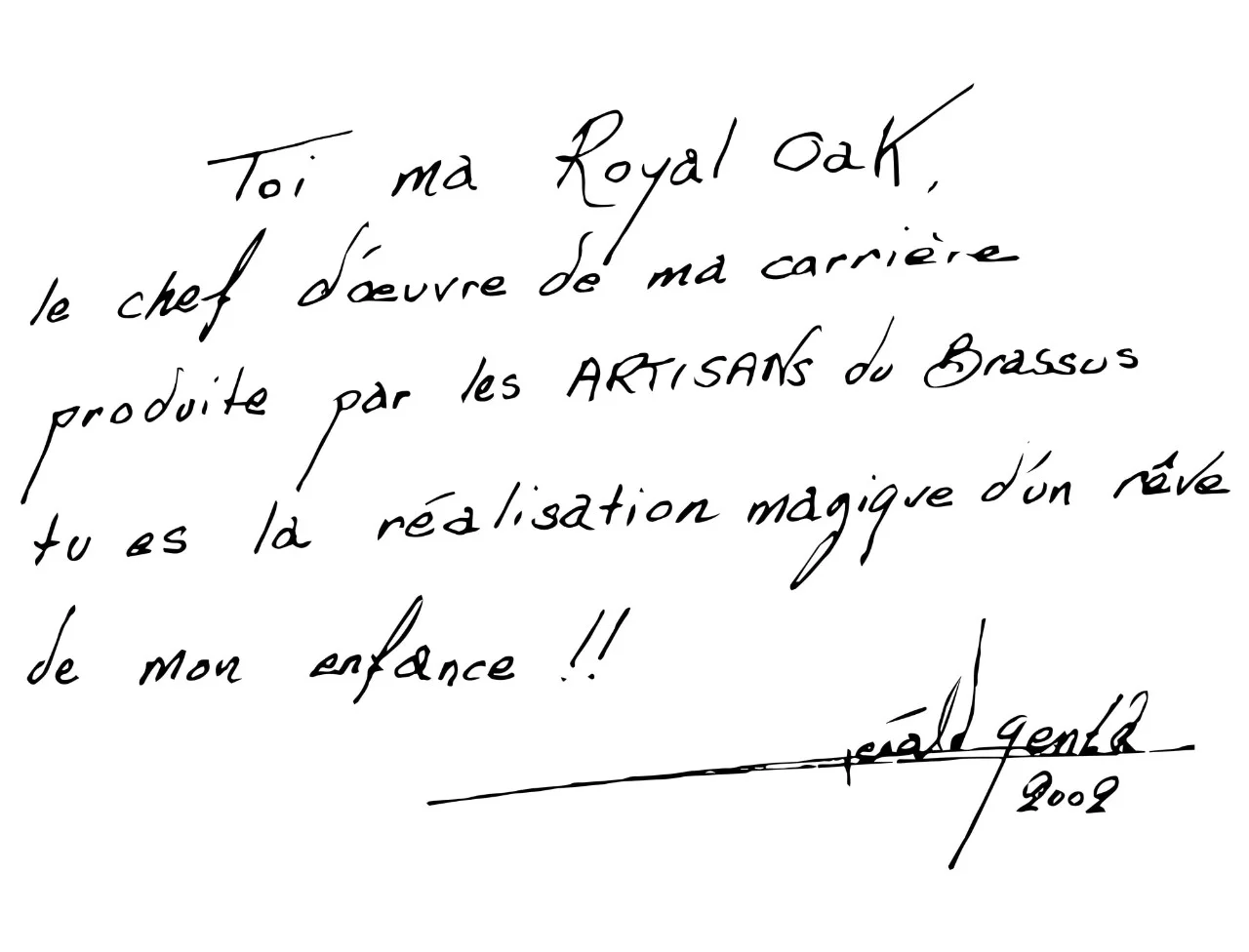
The process of artistic creation is an eminently personal phenomenon rarely documented in company archives, which mainly preserve orders, drawings, minutes of meetings and accounts, etc. For the Royal Oak, we are fortunate to have the designer’s original testimony. A few months before his death, at the age of 80, Gérald Genta (1931–2011) granted a long recorded interview to Audemars Piguet that provided the backbone for the beginning of the story we are exploring here. Admittedly, in 41 years, recollections can become somewhat hazy and certain dates or facts do not stand up to cross-referencing, while others are somewhat romanticised. Nevertheless, the heart of the story remains intact, because strong emotions make for engraved memories. In 1970, the designer already had a premonition of creating the masterpiece of his career.
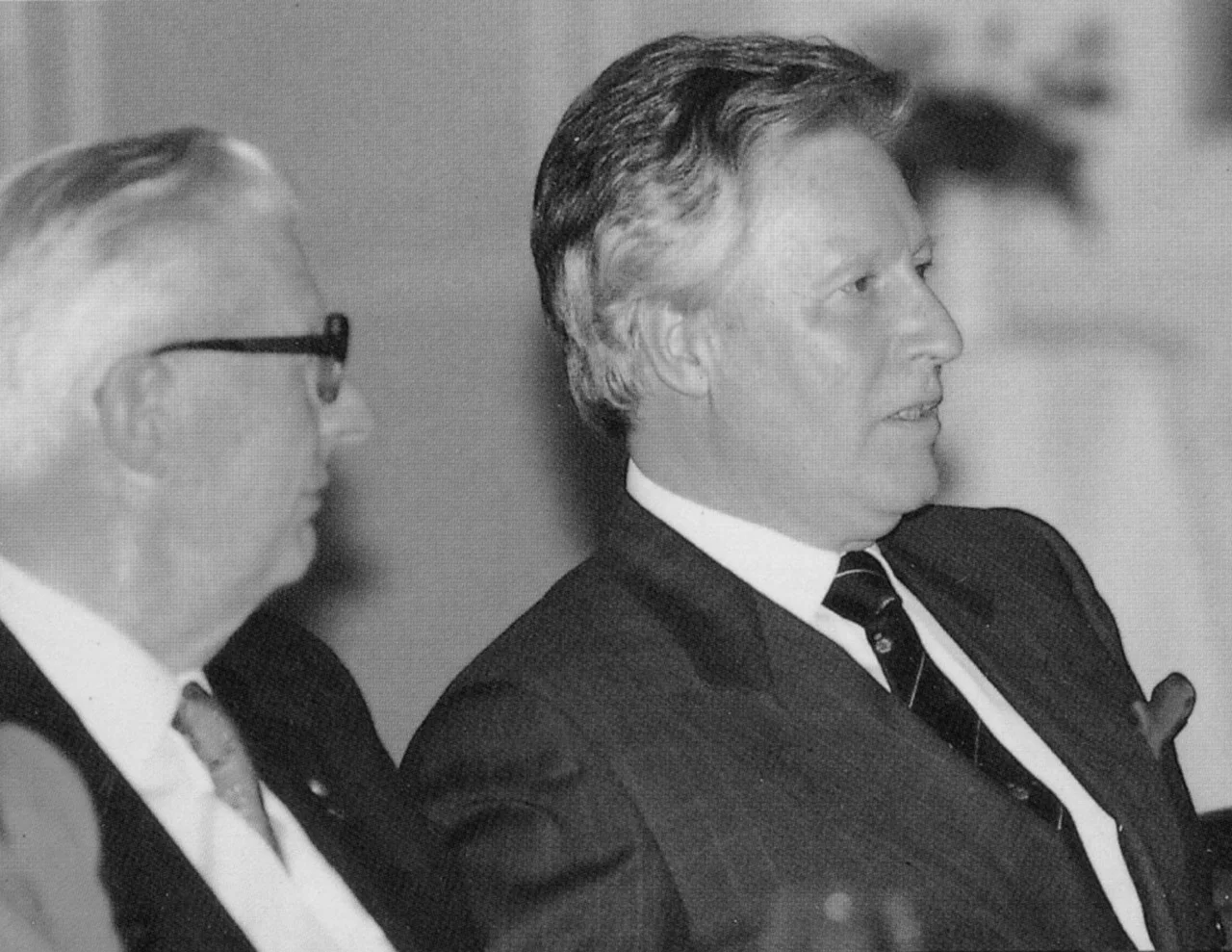
At that time, Audemars Piguet had just experienced the strongest 20 years of growth in its almost century-long history as it benefitted from the post-war economic boom. In two decades, it had gone from 35 to 84 employees – of whom 67 were active at the workbench – and had increased its production tenfold to 5,500 watches per year. Its turnover had followed the same progression and was nearing 10 million Swiss francs. Audemars Piguet was by then in the hands of the founding families’ second and third generations, represented by Paul Edward Piguet (1890–1979) and Jacques-Louis Audemars (1910–2002), and had been run by Georges Golay (1921–1987) for the previous three years. The latter was a visionary entrepreneur, the son of a farmer and a native of the Vallée de Joux, who had participated in modernising the brand since his arrival in 1945.
After World War II, Audemars Piguet established a close working relationship with LeCoultre & Cie, which supplied the majority of its "ébauches" (unfinished movements), including Calibres 2120 and 2003, the world's thinnest in their categories. While complication watches remained an Audemars Piguet speciality, ultra-thin watches, often made with women in mind, accounted for over half of the production. Even though the notion of "watch models" was introduced in 1951, they were produced in very small series rarely exceeding 10 identical timepieces that were often one-of-a-kind.
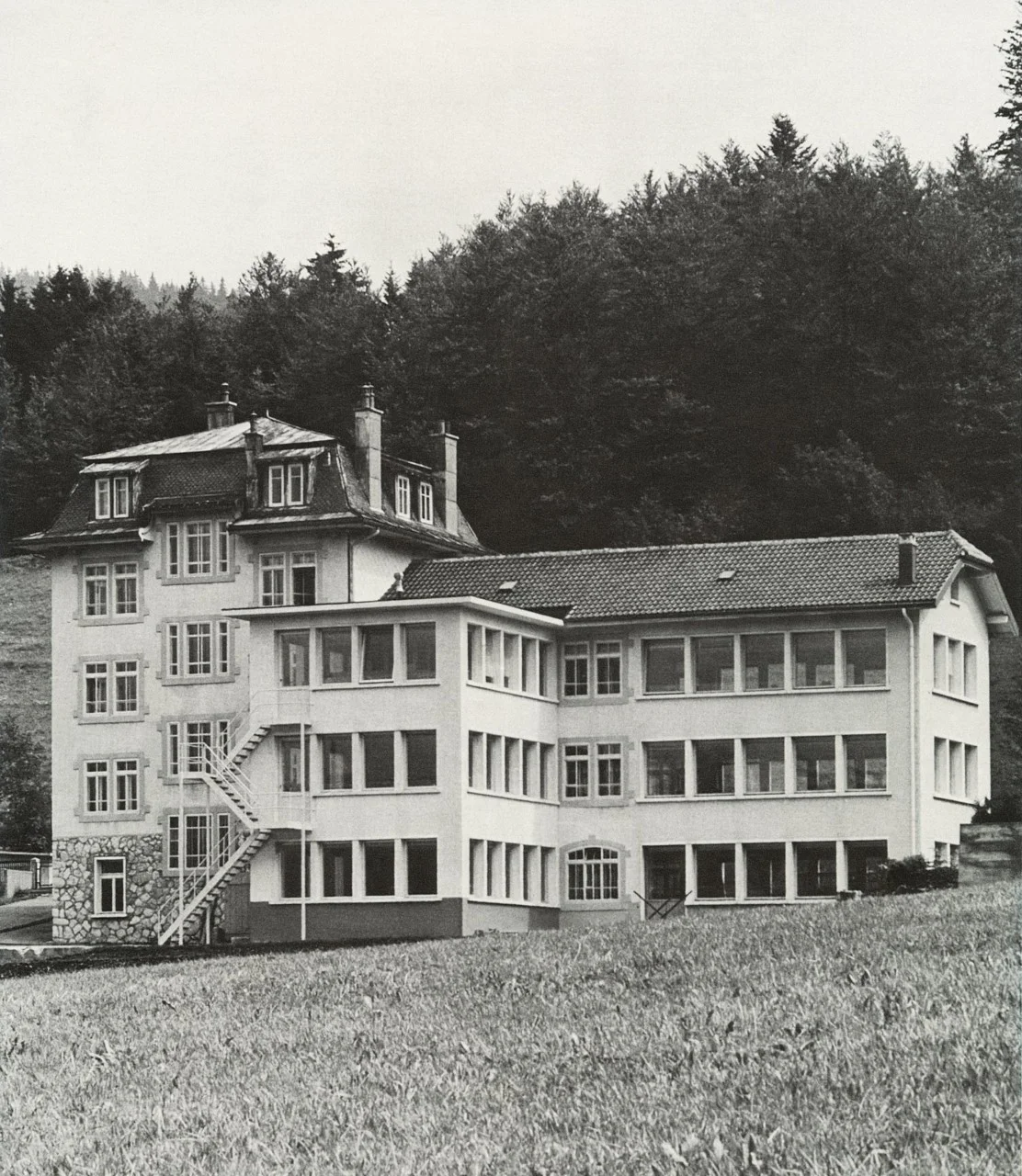
1969. Audemars Piguet buildings in Le Brassus. In 1969, Audemars Piguet employed 79 people, including 65 artisans. Inaugurated the previous year, the latest extension housed the brand-new After Sales Service. Audemars Piguet Archives.
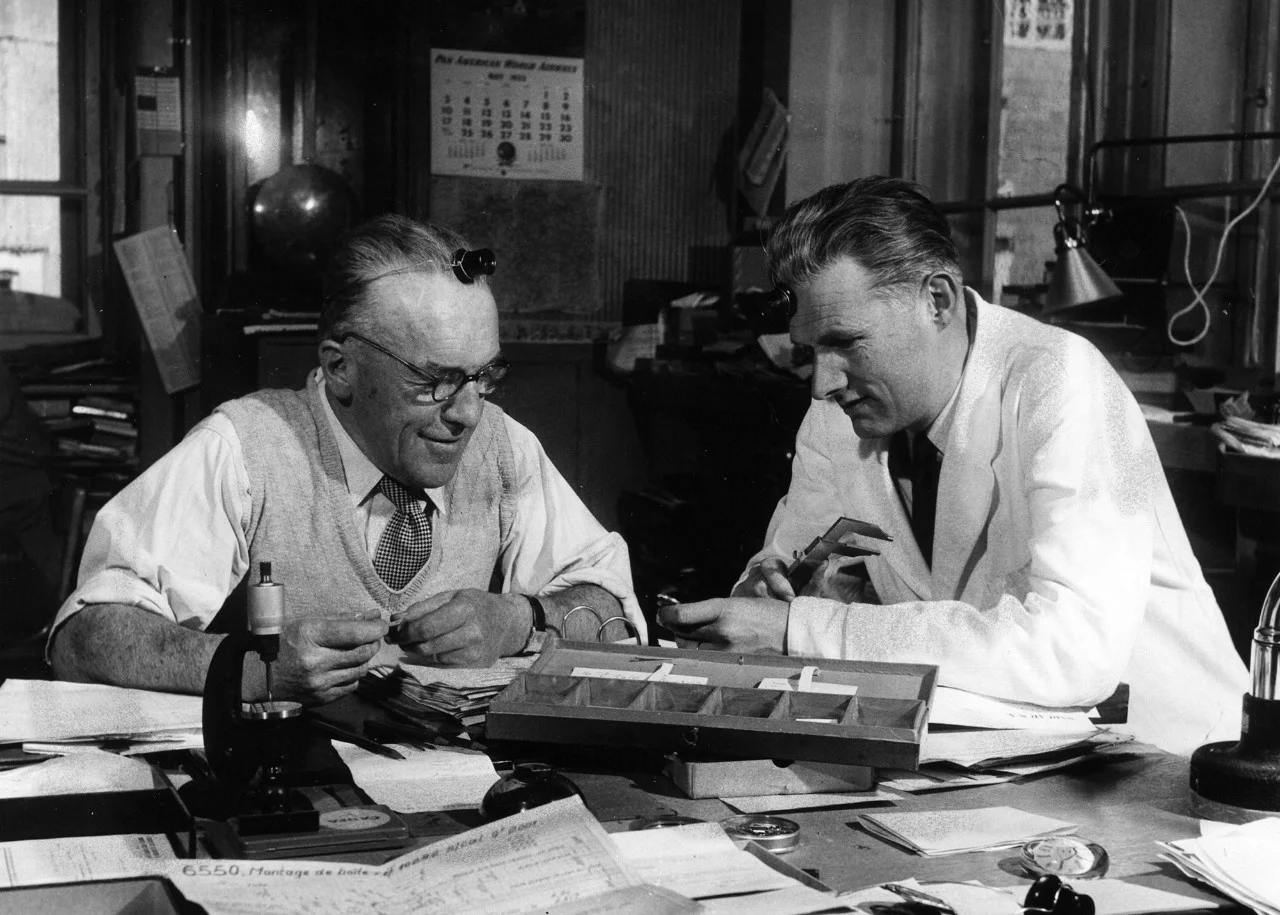
Paul Edward Piguet (1890–1979) et Jacques-Louis Audemars (1910–2002). The second and third generations of the Audemars and Piguet families perpetuated and expanded the family business founded in 1875. Audemars Piguet Archives.
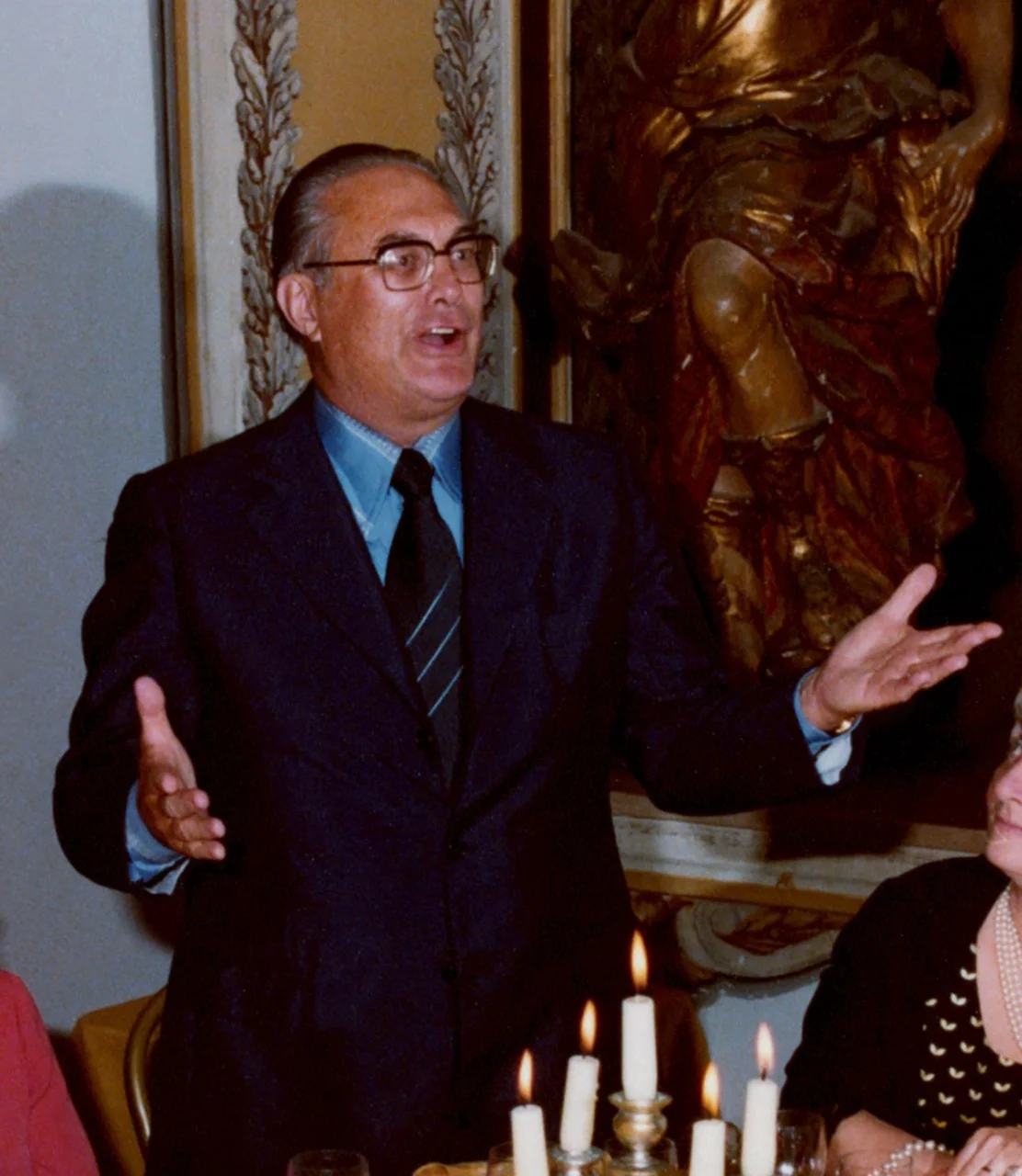
1979. Georges Golay (1921–1987). Georges Golay joined Audemars Piguet in 1945 and played an active role in its modernisation. He was appointed Managing Director in 1967. Photograph taken at an event in Rome in 1979. Audemars Piguet Archives.
Agreement with the SSIH
The increase in production required a rethink of distribution, a tricky issue for a company like Audemars Piguet that was still modestly sized at the time and whose location in a small mountain village was not conducive to reaching an international clientele. To resolve this delicate equation, Georges Golay decided to think big. He had just signed a partnership with Swiss watchmaking giant, the Société Suisse pour l'Industrie Horlogère SSIH (not to be confused with the SIHH, the watch fair founded in Geneva in 1991). As the leading Swiss watch manufacturer and third in the world with 4.6 million watches in 1970, the SSIH employed nearly 7,000 people and controlled 20 brands, whose watches it distributed through 160 agents and 15,000 retailers.
In the late 1960s, the SSIH was looking to expand its range by offering very high-end watches in addition to its flagship Omega timepieces. Audemars Piguet, on the other hand, needed to expand its distribution network. The agreement between AP and the SSIH was signed on February 5, 1969, after a year of negotiations. Audemars Piguet retained its complete independence in terms of both capital and manufacturing, but the brand from Le Brassus could now use SSIH general agents to distribute its watches. What Audemars Piguet had not foreseen was the proposal subsequently put forward by some of these agents, who included strong personalities, in particular Carlo de Marchi (Italomega, Turin, Italy), Charles Bauty (Gameo, Lausanne, Switzerland) and Charles Dorot (Brandt Frères, Paris, France). According to Martin K. Wehrli, who joined Audemars Piguet in 1971 and served as sales manager and then Director of the Museum until 2012, these three agents were long nicknamed “the three musketeers”. More on that later.
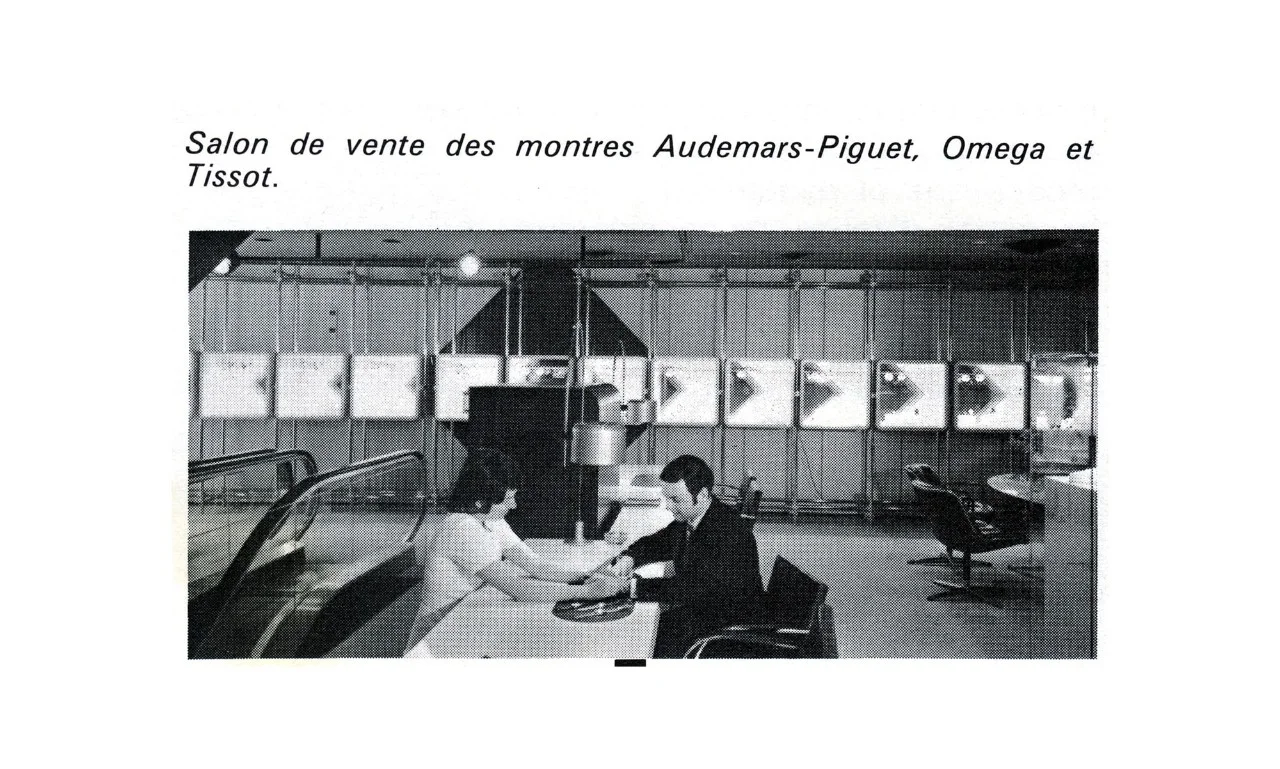
1971. Ambassadeurs Boutique in Zurich Following the distribution agreement signed between SSIH and Audemars Piguet, the Le Brassus watches were notably distributed at Les Ambassadeurs on Bahnhoffstrasse 64 in Zurich, a futuristic seven-storey watchmaking shop imagined by Charles Bauty, Director of Gameo and one of the initiators behind the Royal Oak. Journal suisse d'horlogerie, 1971, p. 655. © Musée International d’Horlogerie de La Chaux-de-Fonds Collection.
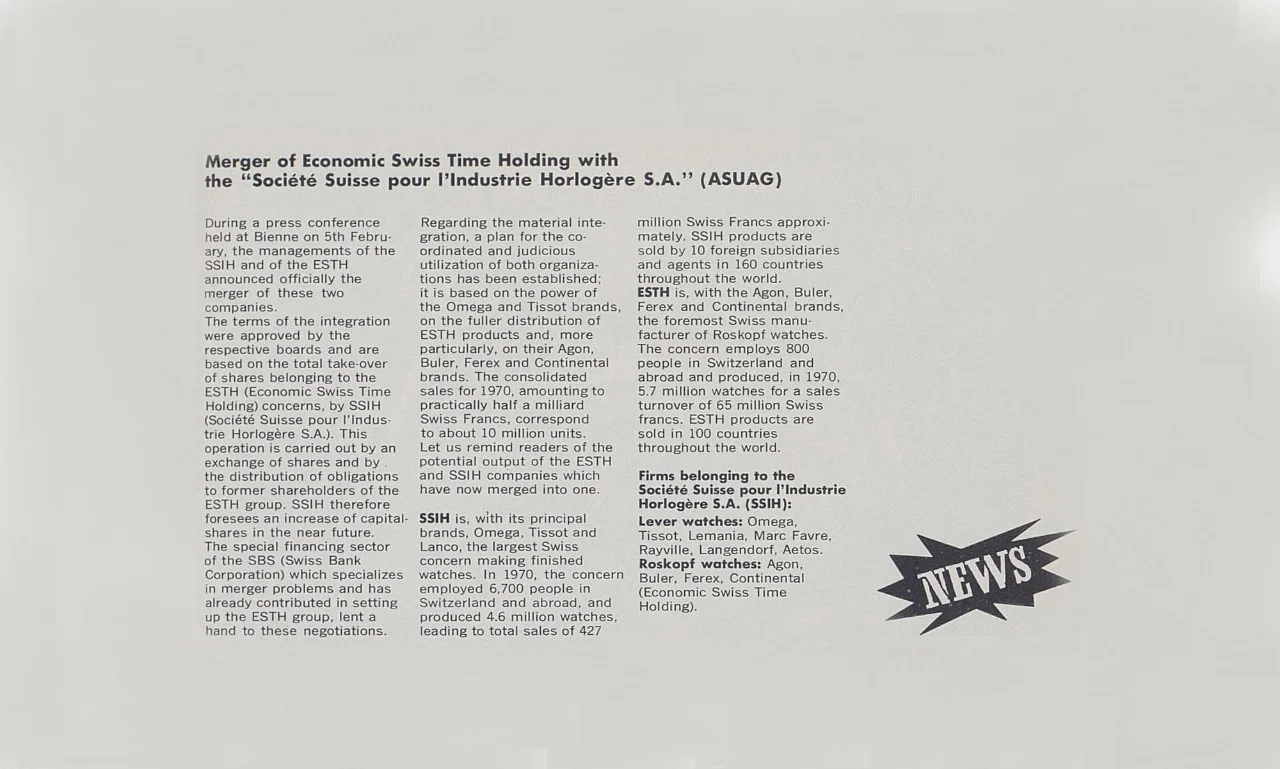
1971. Press article dedicated to the fusion of SSIH and ESTH The Europa Star magazine annonces the fusion of the two Swiss watchmaking giants: SSIH (Société suisse pour l'industrie horlogère) and ESTH (Economic Swiss Time Holding). © Europa Star 1971, no 67, p. 43.
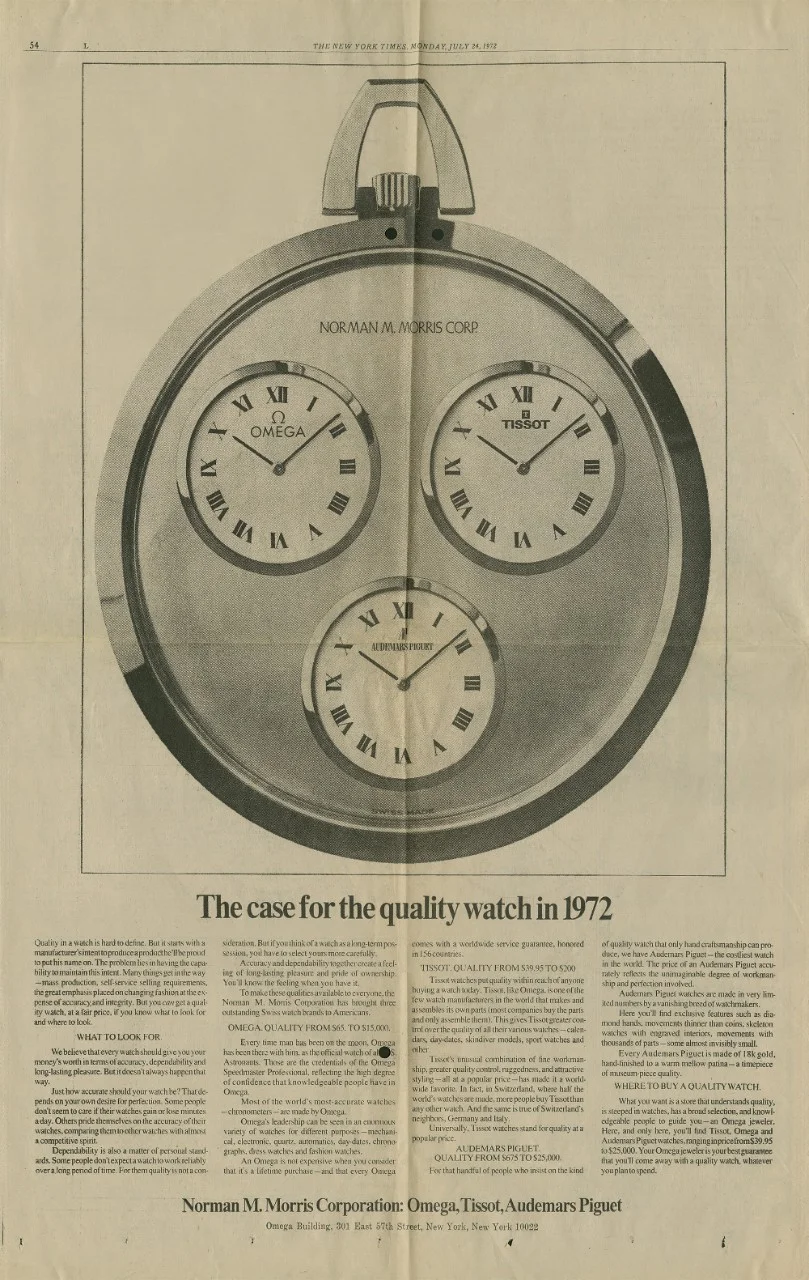
1972. Multibrand advertisement. In 1972, the US-based SSIH agent Norman Morris published promotional ads linking Audemars Piguet, Omega and Tissot. Audemars Piguet Archives.
April 10, 1970, the Day before the Basel Fair
The birth of the Royal Oak is closely linked to the Basel Fair, held annually in April, which at the time was the watch industry meeting place. Brands, agents and distributors from around the world converged there for ten days to discover new products, share their opinions, talk about the future, explore new horizons and cultivate friendships over cigars and good wine. Above all, distributors placed orders for the coming year, thus enabling manufacturers to establish or fine-tune their production plans.
In 1970, the fair officially opened on April 11, but many distributors arrived in the city before the opening. Some of them took advantage of the opportunity to make a side-trip to Milan, the international capital of fashion, to take in the latest trends.
On April 10, 1970, Georges Golay met his new SSIH agents Carlo de Marchi, Charles Bauty and Charles Dorot. Verbal sources agree that it was then that the “three musketeers” challenged the Managing Director of Audemars Piguet to create what would become the Royal Oak. We do not know the exact content of the dialogue, but in an interview from February 1982, Georges Golay explained: “The Royal Oak was conceived in 1970, at the suggestion of general agents who had reservations about the marketing value of gold alone for the promotion of high-prestige timepieces – a view which I believe is no longer valid. They did ask us to design a stainless steel wristwatch more in tune with the way we live today. We had to invent a model both sporty and stylish in spirit, suitable for evening wear and for the daily activities of today’s man of taste.” What the Managing Director might have added was that the powerful agents also needed a watch that was produced in sufficient quantities to supply their most prestigious outlets.

1940s. Carlo de Marchi. Italian SSIH agent and director of Italomega, Carlo de Marchi was one of the initiators behind the Royal Oak, the name of which he is said to have suggested. © Omega Archives.
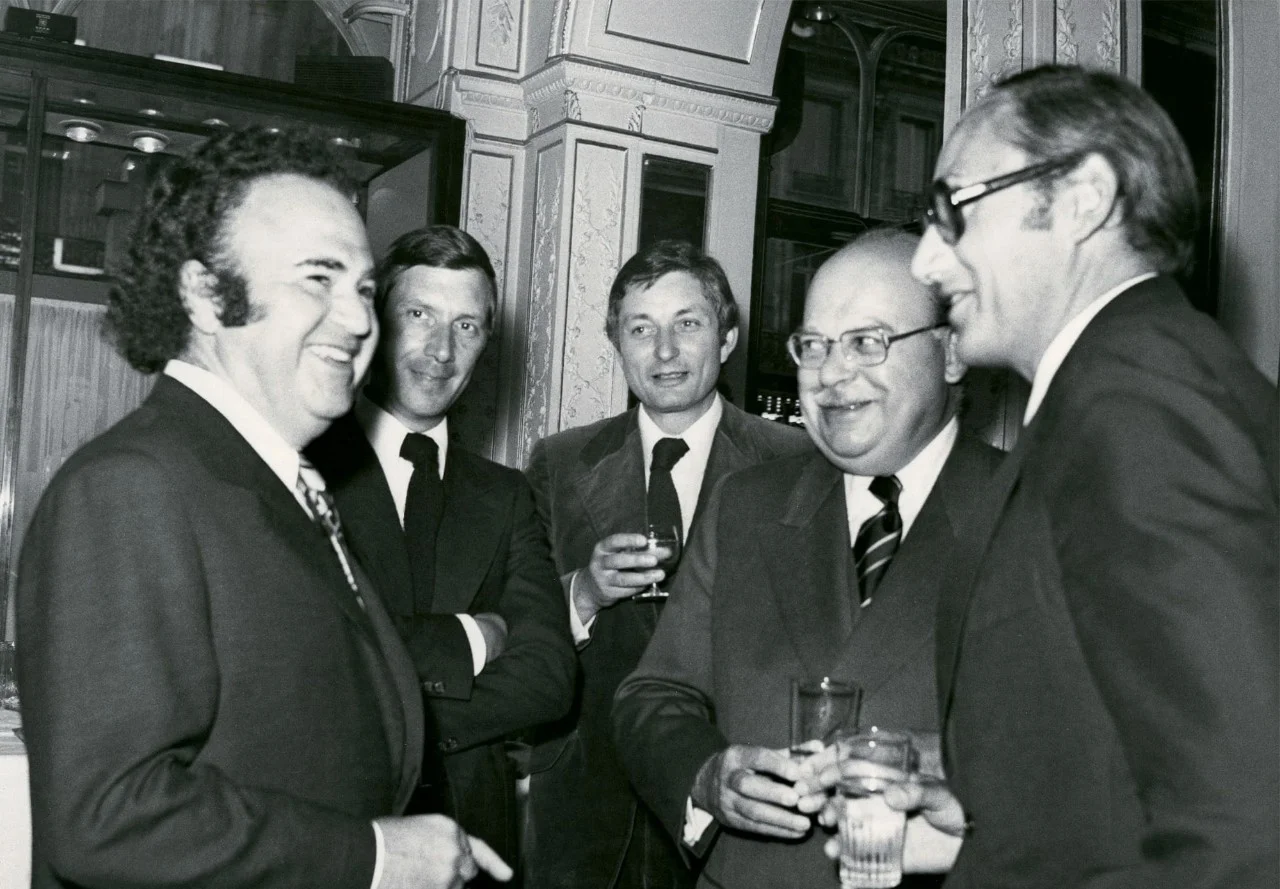
1976. Launch in Paris of the first feminine Royal Oak watch. The launch of the 8638 model at Fred's in Paris brought together several personalities, including SSIH general agent Charles Bauty (right), owner of Gameo and one of the initiators of the Royal Oak. Audemars Piguet Archives.
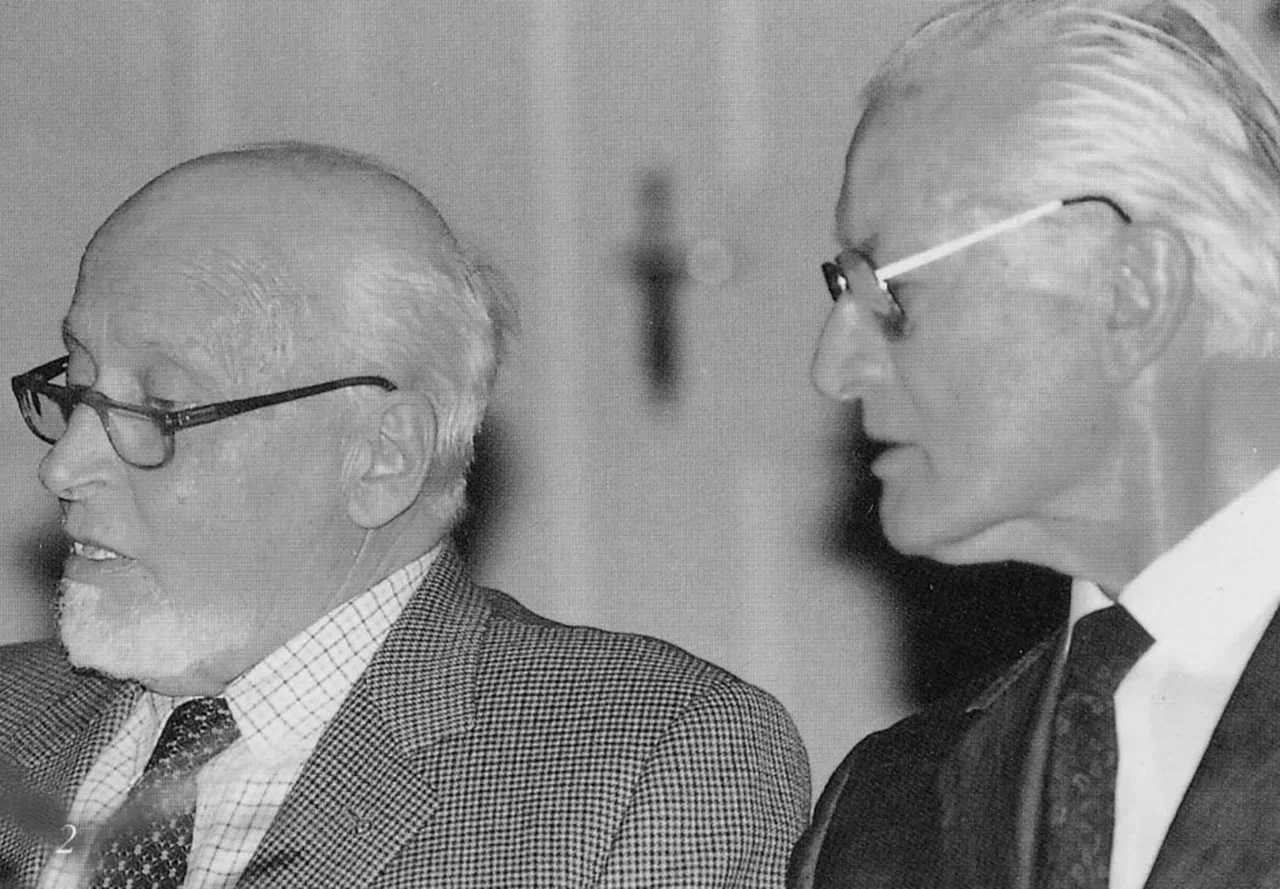
1992. Carlo de Marchi and Charles Bauty. On the occasion of the Royal Oak 20th anniversary, Audemars Piguet reunited several of the instigators of the project, in particular the Italian and Swiss general agents who had asked Georges Golay in 1970 to create a never before seen steel watch. AP News 1992. Audemars Piguet Archives.
Georges Golay's Challenge
Georges Golay has every reason to sidestep the issue. He could have argued that Audemars Piguet was doing better than ever, that the collections were increasingly successful and that the refinement of the often out-of-the-ordinary design and the perfection of the finishes was incompatible with large-scale production. He might well have added that the quality of these finishes was unsuitable for the impacts and friction involved in sporting activities and that they would almost be impossible to achieve on a steel case (why would one sip a great vintage from a plastic cup?!). He could also have pointed out that these decorations would simply not make sense because their cost would dramatically increase the watch’s price. It would be commercially suicidal to sell a steel watch at the price of a gold watch, especially as the market for steel sports watches was already saturated with successful models such as the Omega Seamaster, the Tag Heuer Monaco, the Jaeger-LeCoultre Polaris and the Rolex Oyster. Finally, Georges Golay might have argued that if, by some miracle, a steel AP sports model were to be successful, Audemars Piguet’s identity could risk being distorted.
Nonetheless, against all odds, Georges Golay followed his instincts. A man with considerable experience in the field and an outstanding salesman, he knew that the world was in the midst of a socio-cultural and financial upheaval: the United States had just suspended the dollar convertibility to gold. The Swiss watchmaking world was emerging from the state cartel-based regime and was wondering how to react to the arrival of a promising new technology that was foreign to the industry. Some people saw the quartz watch as the future of luxury watchmaking and others as the death knell of mechanical watchmaking. The cards were being reshuffled and many people rightly sensed that a major earthquake was imminent. Within such a context, it was worth taking a gamble. Georges Golay was a clever strategist who found himself in a position to reduce the financial risk by convincing his powerful distributors to buy the watches even before they were produced. More importantly, he had a secret asset: his collaboration with independent designer Gérald Genta ensured the presence of a talented partner capable of achieving the apparently impossible.
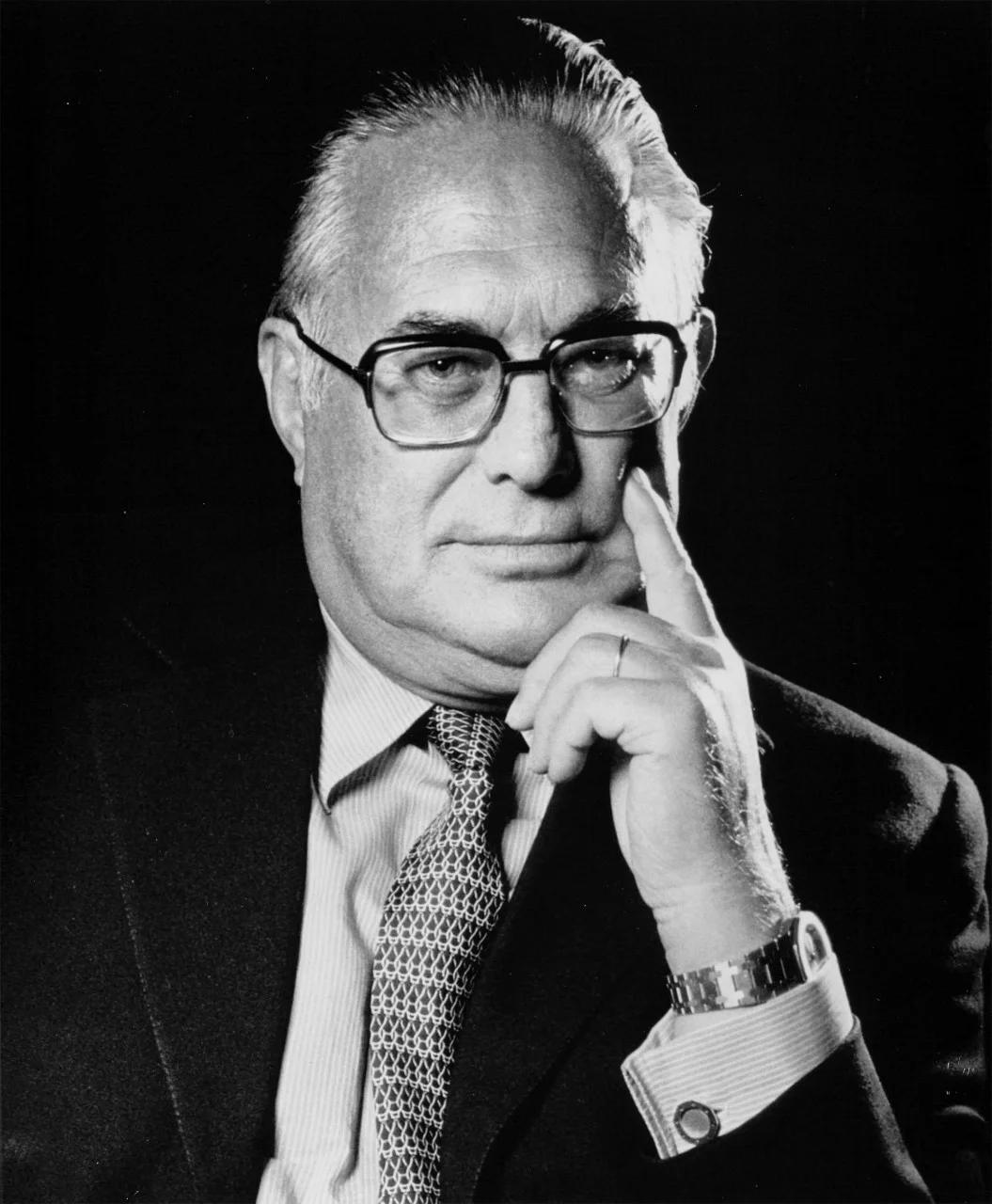
Circa 1980. Georges Golay (1921–1987). Georges Golay participated in the modernisation of Audemars Piguet from the moment he joined the company in 1945. In 1967, he became the first Managing Director not belonging to the founding families. He held this position until his death in 1987. Audemars Piguet Archives.
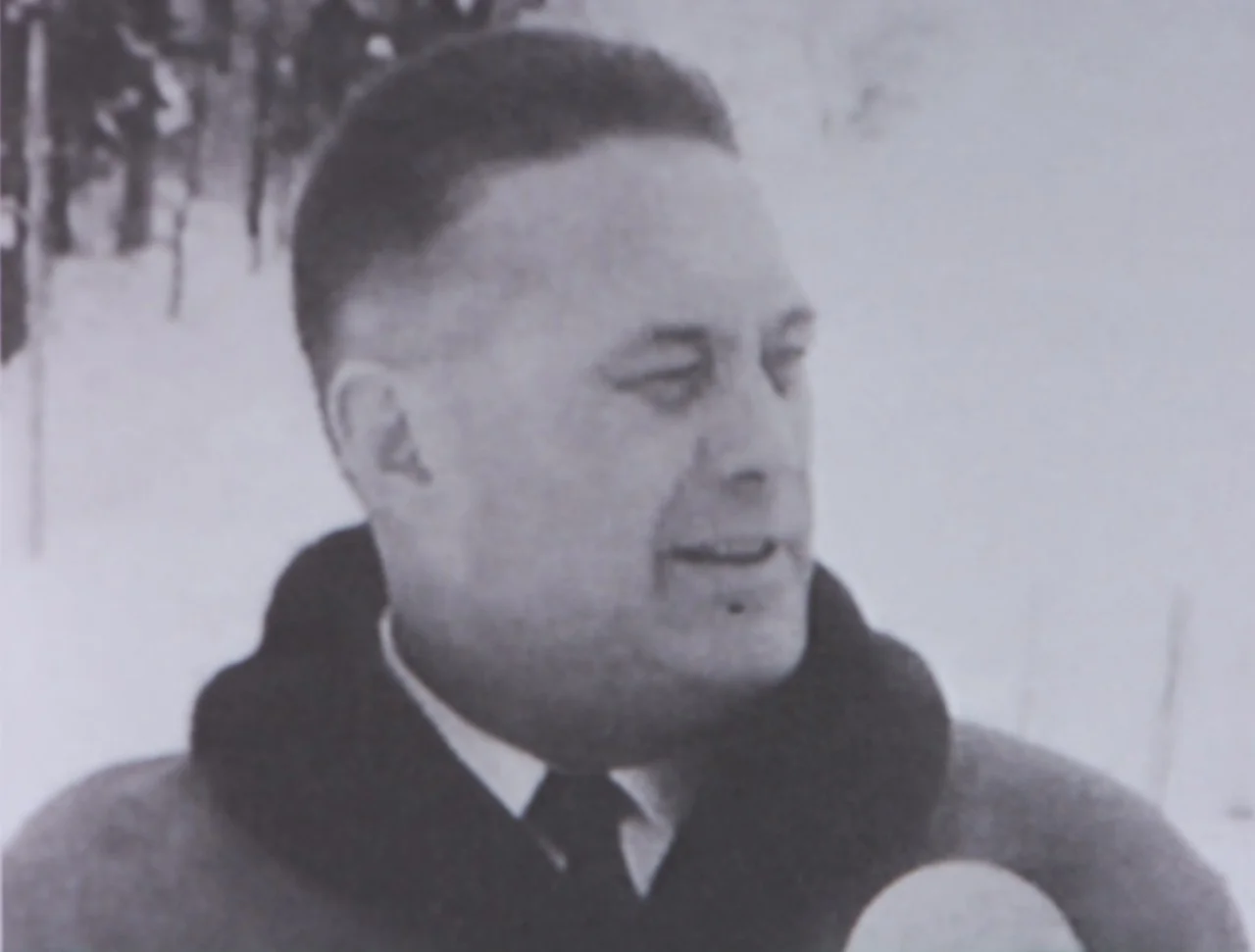
1966. Georges Golay In addition to playing a fundamental role in Audemars Piguet's development, Georges Golay contributed to making the Vallée de Joux shine. In particular, he presided over the international Nordic skiing competitions in Le Brassus. Picture taken from the book © Épreuves internationales de ski Le Brassus, Vallée de Joux, published by Jacques Piguet in 2017, p. 101.
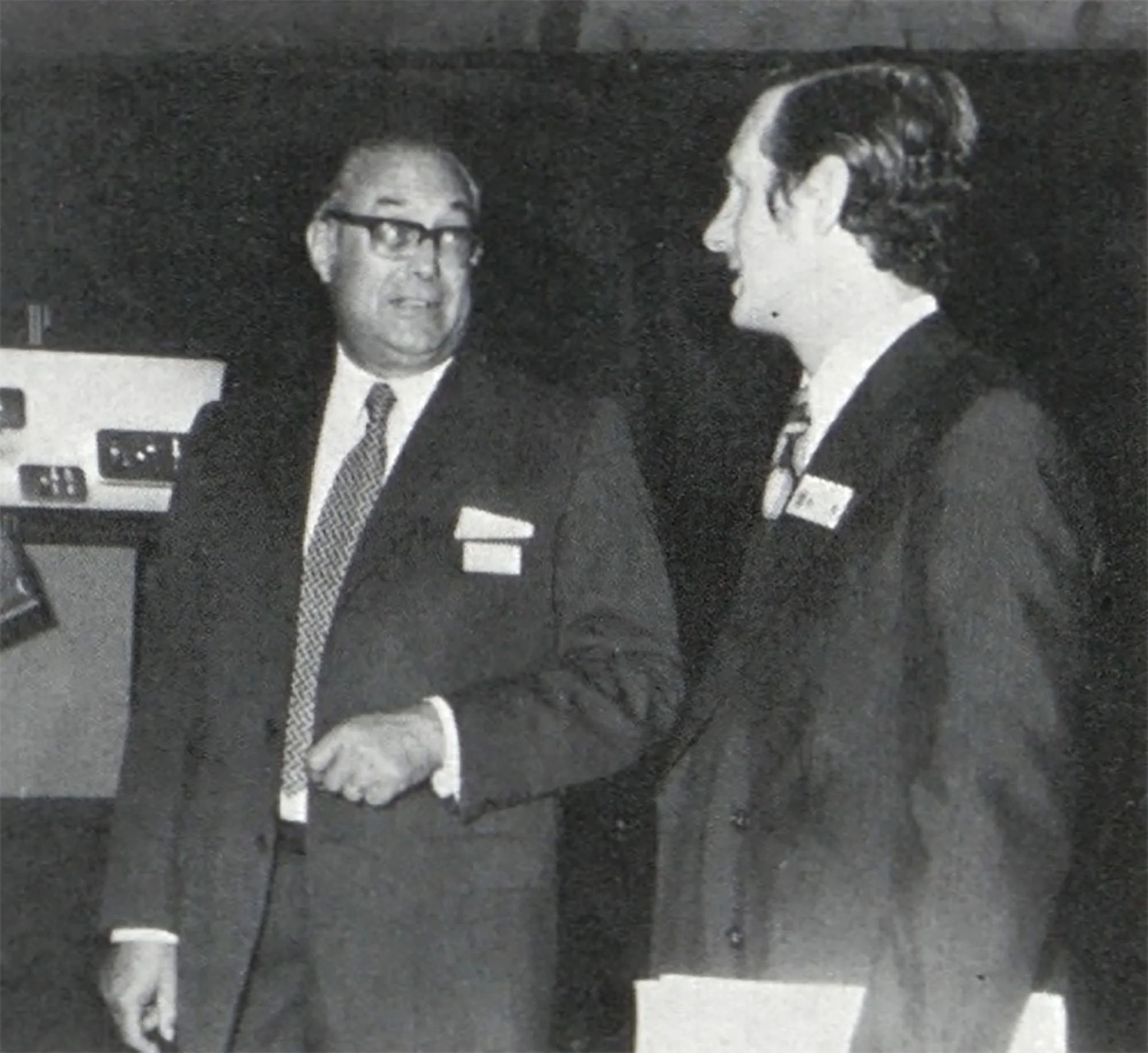
1972. Georges Golay and Armin Steiner Georges Golay (on the left), Audemars Piguet's Managing Director, and Armin Steiner (on the right), in charge of Audemars Piguet's sales between 1955 and 1974, are talking during a SSIH conference taking place nearby Geneva. © Europastar 1972, no 77, 5/6, p. 23.
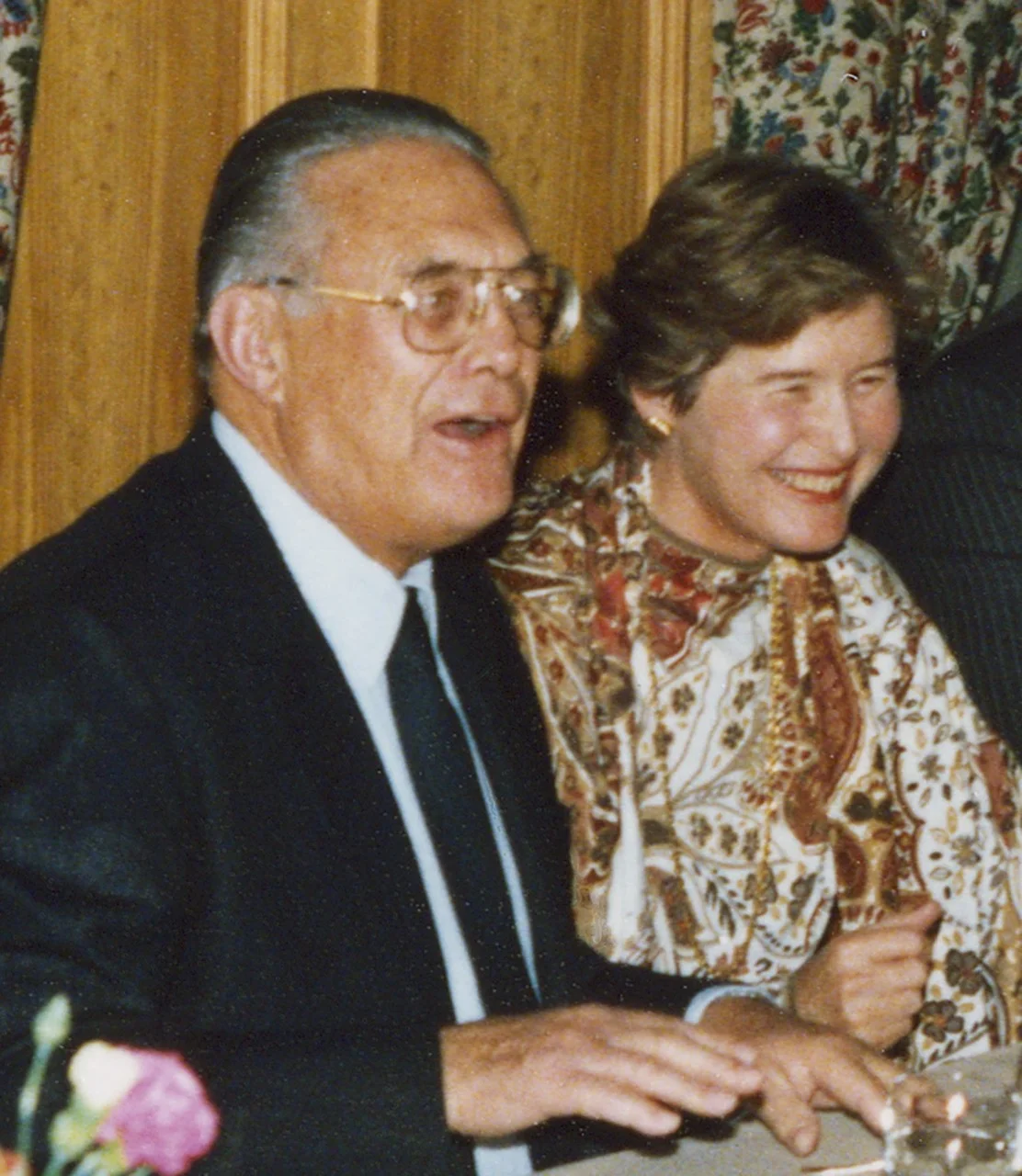
1987. Georges Golay and Elisabeth Kopp. In 1987, Georges Golay welcomed Elisabeth Kopp to Audemars Piguet, the first woman to be appointed to the Federal Council, the executive body of the Swiss government. Audemars Piguet Archives.
Gérald Genta, an Emerging Figure in a New Profession
In April 1970, Italian-born designer Gérald Genta was 38 years old. This trained jeweller had a strong personality and was no stranger to the watchmaking world, but he had not yet achieved the fame that would later earn him the “Picasso of Watches” nickname. He had not yet designed Patek Phillipe’s Nautilus (1976), revisited IWC’s Ingenieur (1976) or created the Bulgari Bulgari (1977). He had however sold hundreds of watch designs to numerous brands since the 1950s, including designing Universal’s Pole Router (1954) and revisiting Omega’s Constellation (1959). But before becoming more closely acquainted with Gérald Genta and his pioneering role, it is worth recalling the context in which the watch design profession arose.
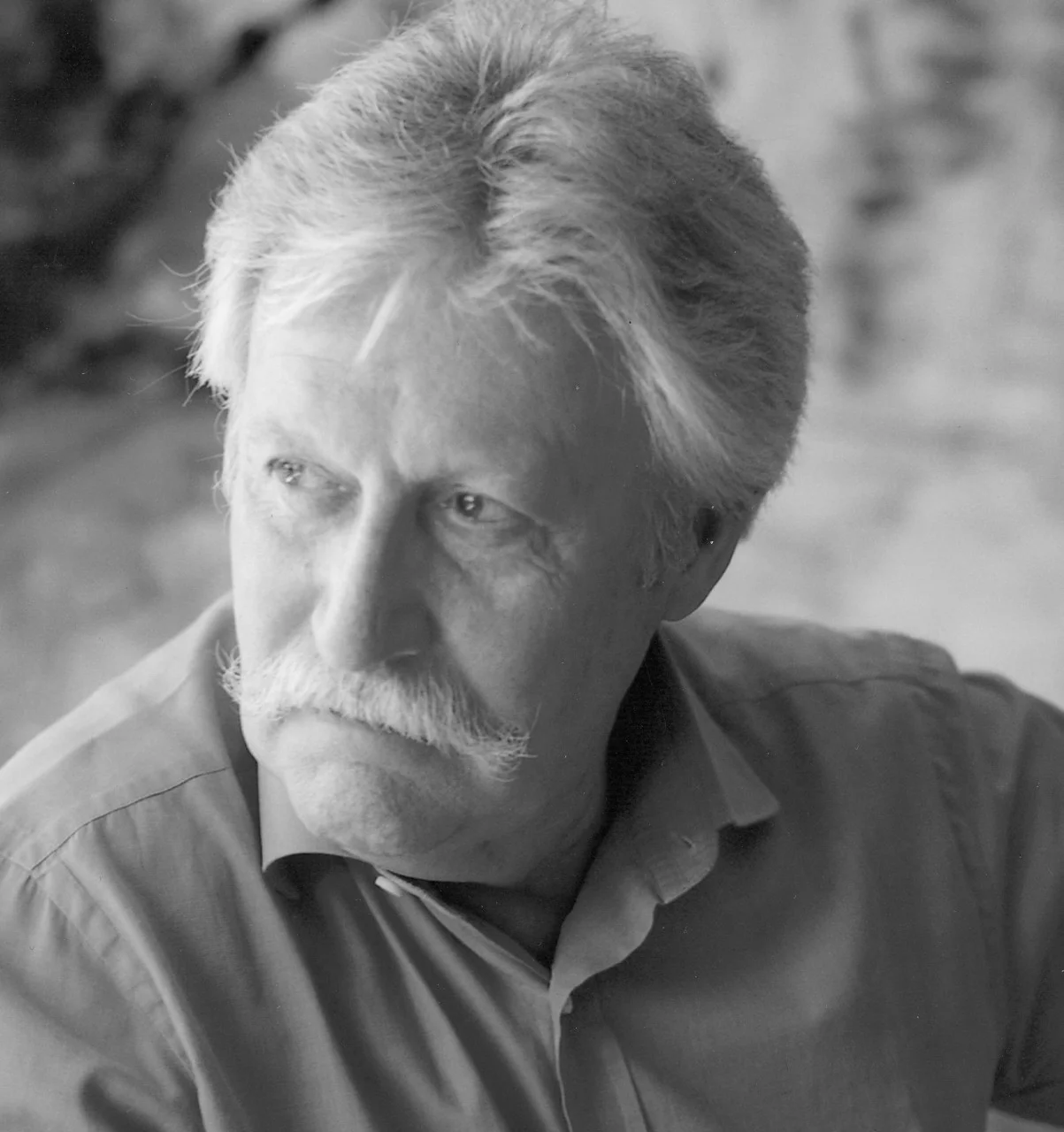
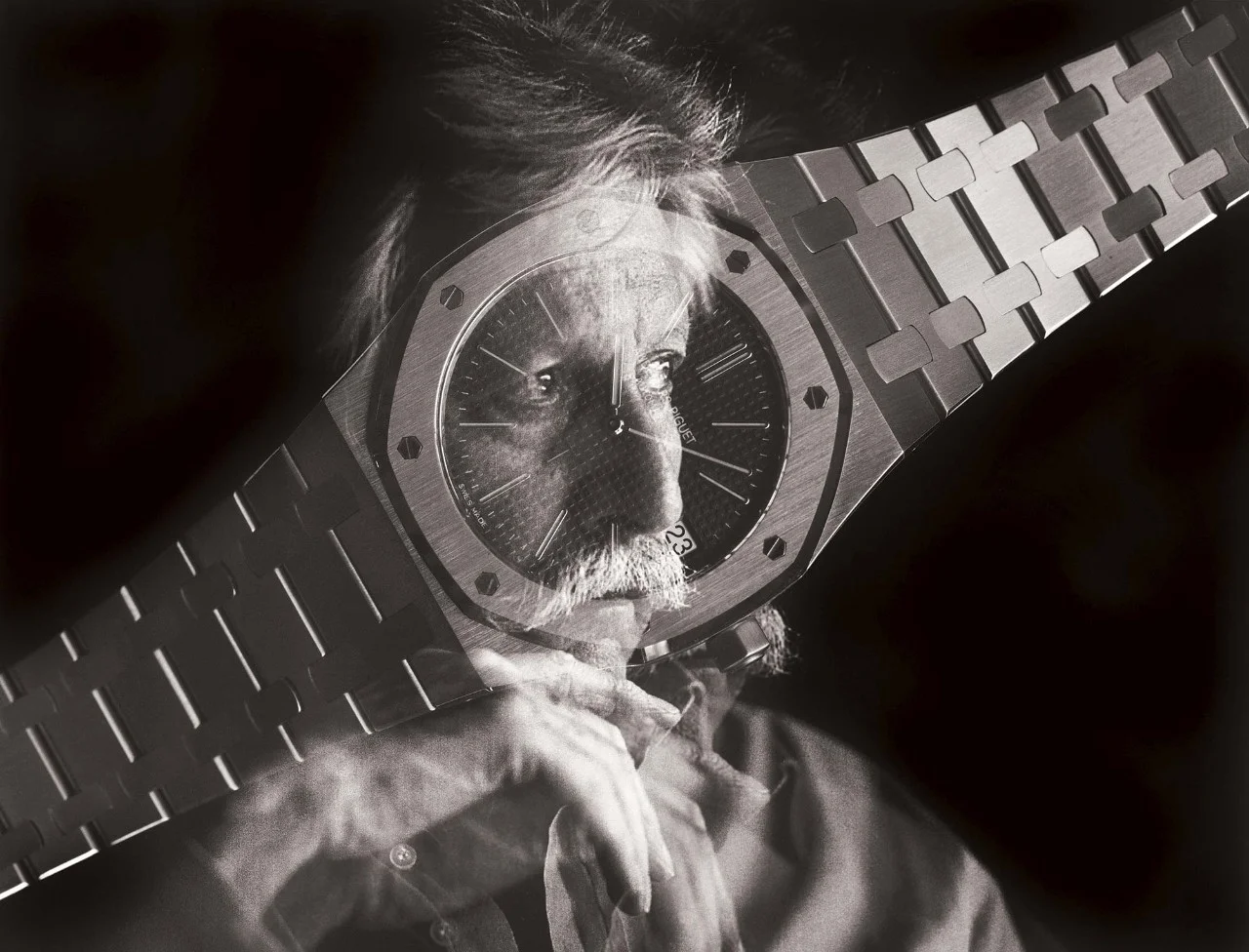
Gérald Genta (1931–2011) An ingenious designer and founder of the eponymous brand, Gérald Genta designed numerous models that are now legendary, including Audemars Piguet's Royal Oak (1972), Patek Philippe's Nautilus (1976) or even the Bulgari Bulgari (1977). Photograph taken in the 2000s. © Gérald Genta Heritage Association.
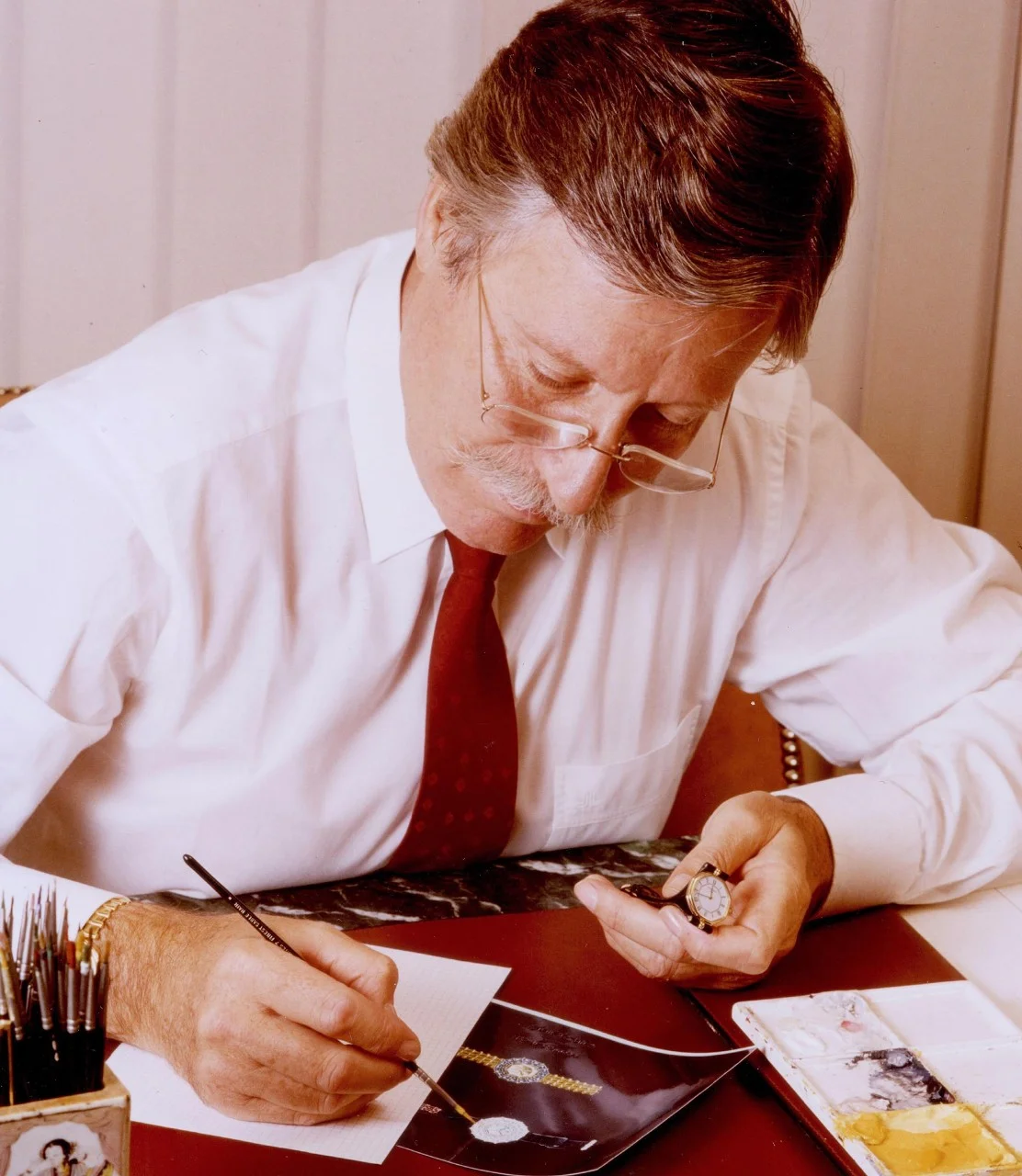
Circa 1990. Gérald Genta From the 1950s onwards, Gérald Genta (1931–2011) designed thousands of watches. He always realised his sketches on cardboard paper, with gouache or with pencil. Photograph taken in the 1990s. © Gérald Genta Heritage Association.
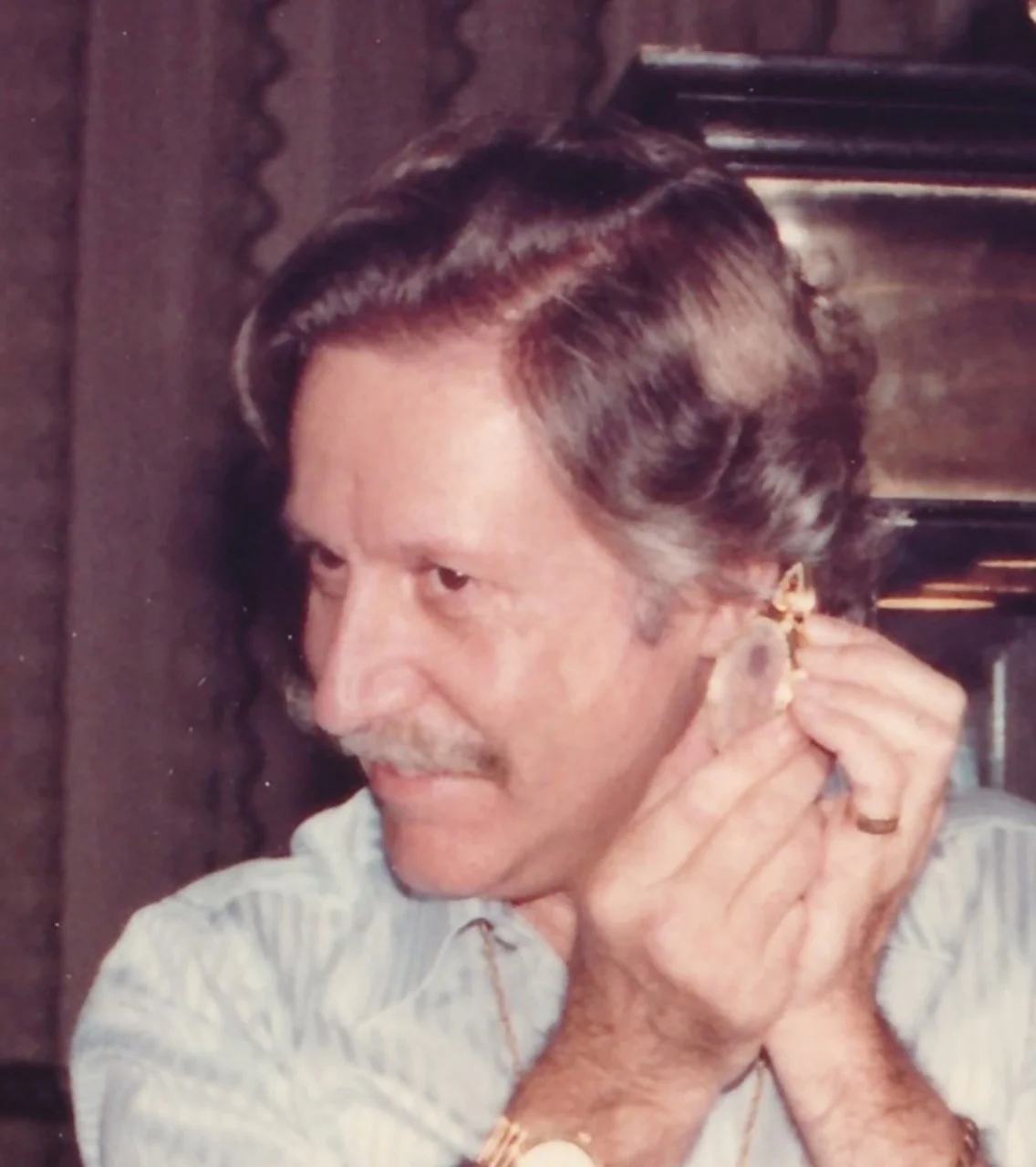
Circa 1985. Gérald Genta Designer Gérald Genta participated in the renewal of complicated watches in the aftermath of the quartz crisis. He is here listening to the melody of a minute repeater pocket watch from the Genta brand. Photograph taken in the 1990s. © Gérald Genta Heritage Association.
Invention of the Watch Designer
In the 1960s, the “watch designer” profession simply did not exist. Only a few “stylists” or “model makers” designed watches, among other everyday objects: chairs, cars, utensils, etc. The first to devote themselves solely to watchmaking and to make a name for themselves – such as Gérald Genta, Jean-Claude Gueit (Piaget) and Jean-Daniel Rubi (Patek Philippe), who paved the way for Jörg Hysek, Emmanuel Gueit, Claude Emmenegger, etc. – were at the start of their careers and still working in the background. Nonetheless, attitudes were beginning to change under the international influence of fashion, design and contemporary art. The Journal Suisse d’Horlogerie, for example, devoted articles to “creative art”, echoing the groundswell of design competitions, which led to the founding of the Académie des Créateurs Indépendants in the 1980s.
At Audemars Piguet, the process of creating new models is rather poorly documented before the 1970s, despite the extraordinary creativity deployed since the 1920s–30s. In a small company employing a few dozen people and producing one-off watches or tiny series, projects were born of personal, often informal collaborations, nurtured by friendships between watchmakers and case-makers. The latter, principally based in Geneva (Wenger, Eggly), La Chaux-de-Fonds (Favre-Perret, etc.), Italy (Brera, Ponti, Villa, etc.) or Paris (Jaeger), often created entire case or dial designs for different brands. It was therefore common to find similar watch designs from one brand to another. Some models also stemmed from collaboration with international brands, retailers or jewellers – such as Tiffany, Van Cleef, Bulgari, Gübelin, Cartier and Oscar Heyman – who often signed or co-signed watches. Audemars Piguet sometimes also worked with independent designers, such as the German Gebhard Duve, who created the so-called “Discovolante” 5093 models in the 1950s.
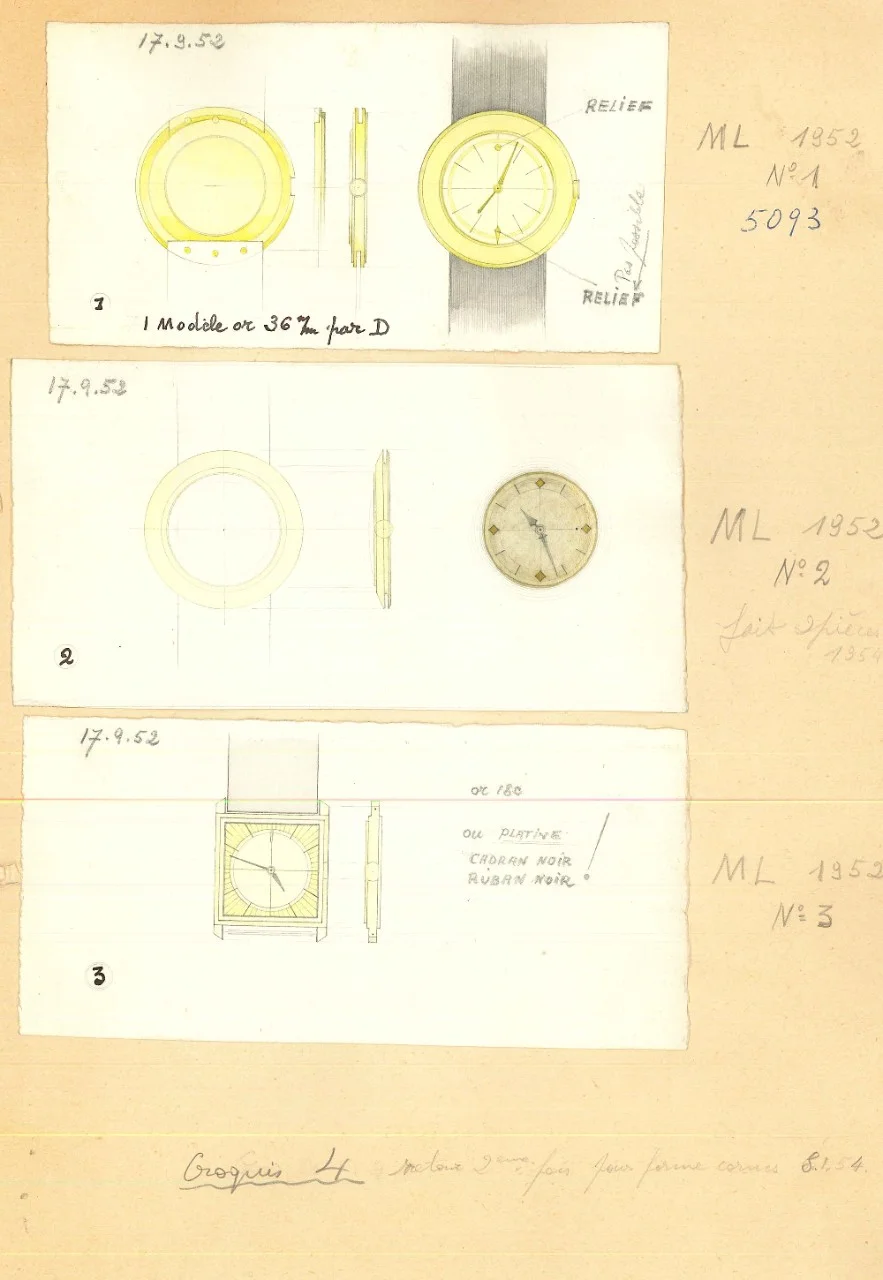
1952. Sketches. The German designer Gebhard Duve (1899–1977) proposed his drawings to Jacques Louis Audemars, grandson of one of the founders of Audemars Piguet, who was in charge of the creative department at the time. One of the sketches led to Model 5093, nicknamed "discovolante". Audemars Piguet Archives.
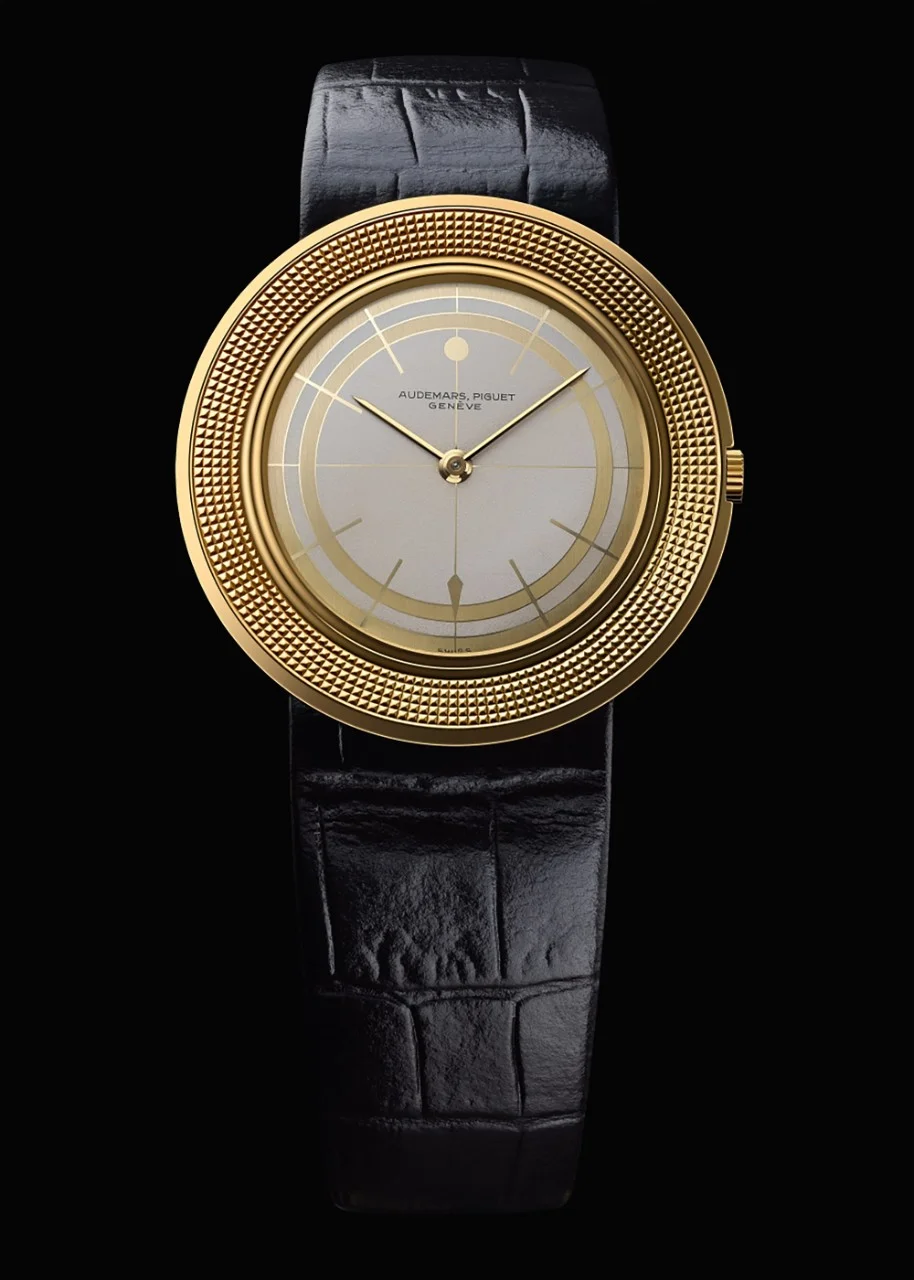
1959. “Discovolante” wristwatch. Two-tone dial, guilloché hobnail Clous de Parisbezel. Calibre 2003. Movement 71245. Case 14717, 35 mm. 18-carat yellow gold. Audemars Piguet Heritage, inv. 1801.
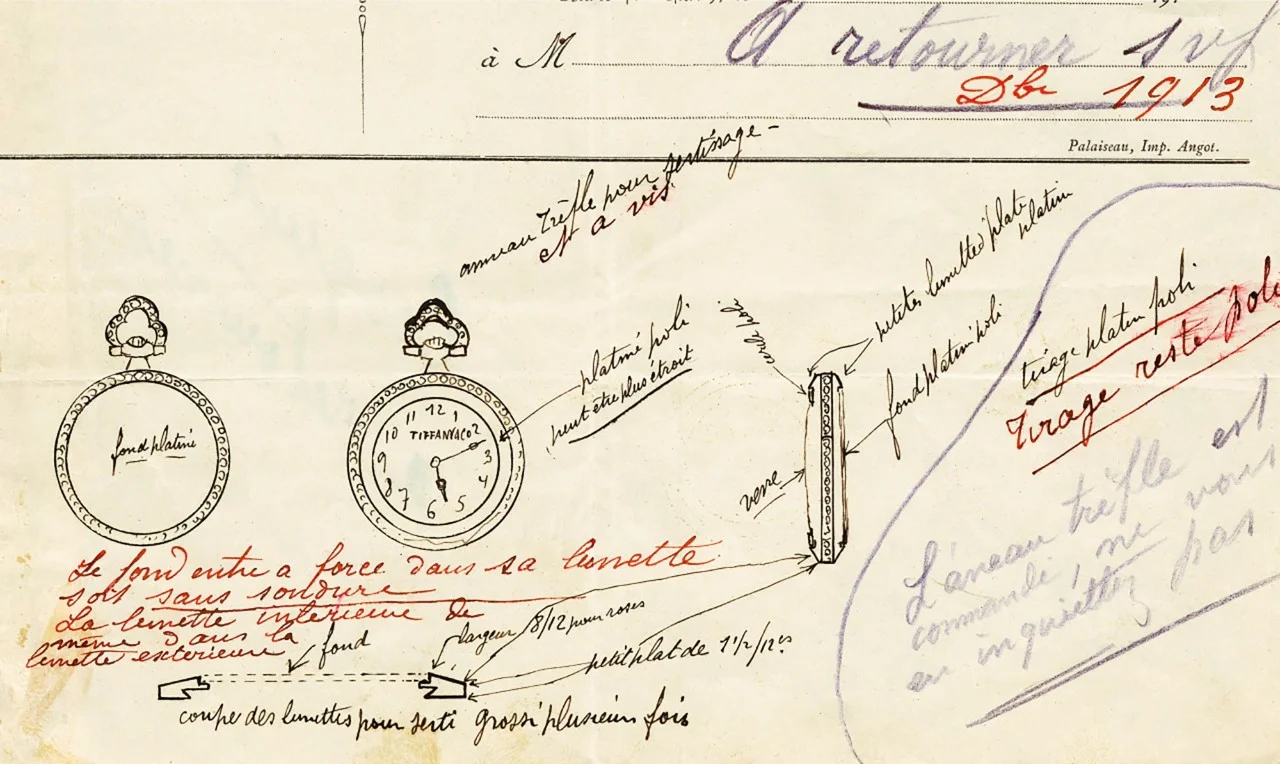
1913. Sketch of a brooch watch. The aesthetics of the watch were jointly developed by Audemars Piguet and Tiffany. Audemars Piguet Archives.
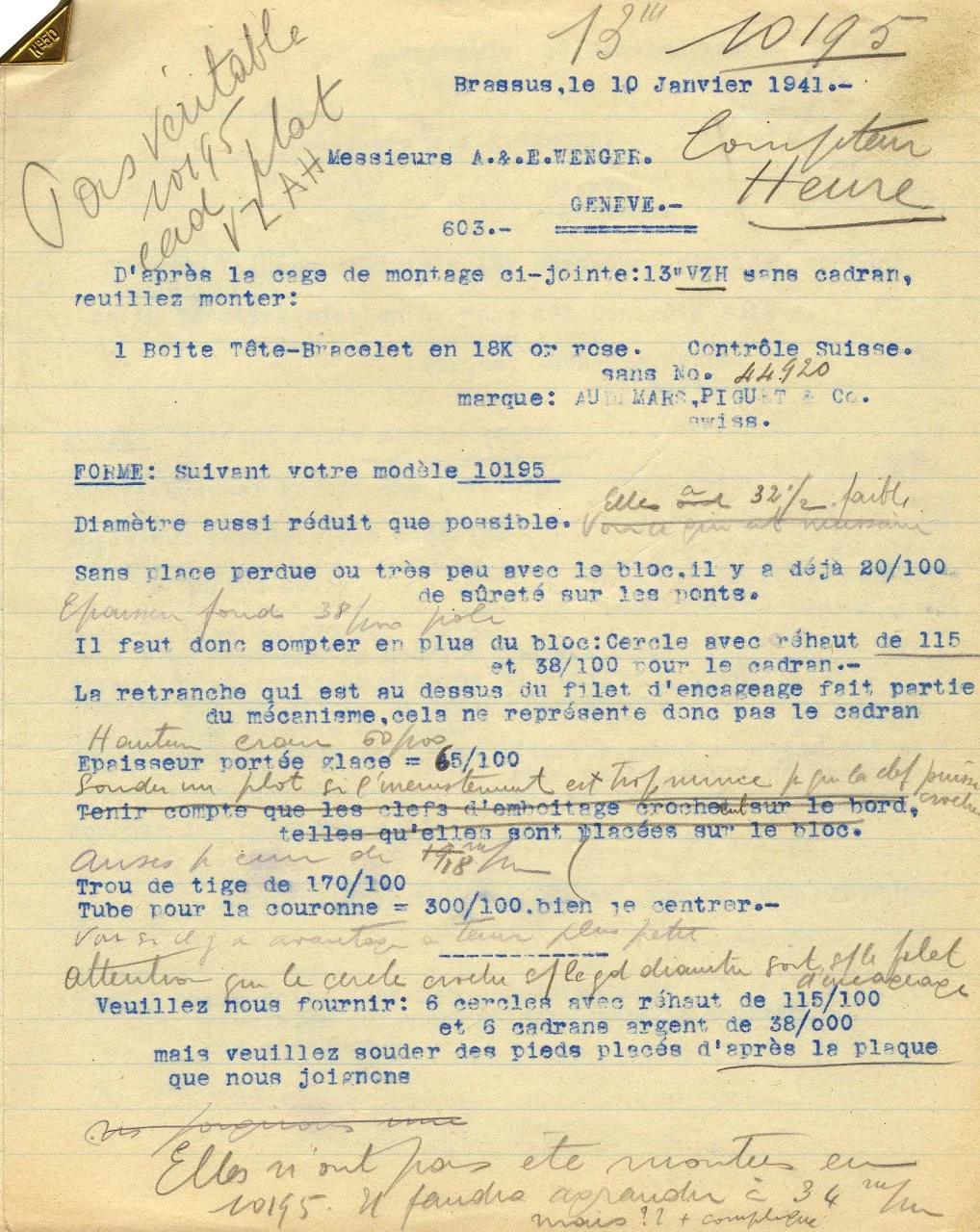
1941. Correspondence between Audemars Piguet and Wenger. This letter attests to the central role played by watch case manufacturers in the creation process for certain models. Audemars Piguet Archives.
Collaboration between Audemars Piguet and Genta
Gérald Genta mentioned having sold his first designs to Audemars Piguet in the 1950s. The designer’s name appears in the brand’s archives in 1960, alongside several models combining geometrical shapes in a refined manner, such as Model 5179, the asymmetrical 5182 and the 5199, which plays on textures and shapes.
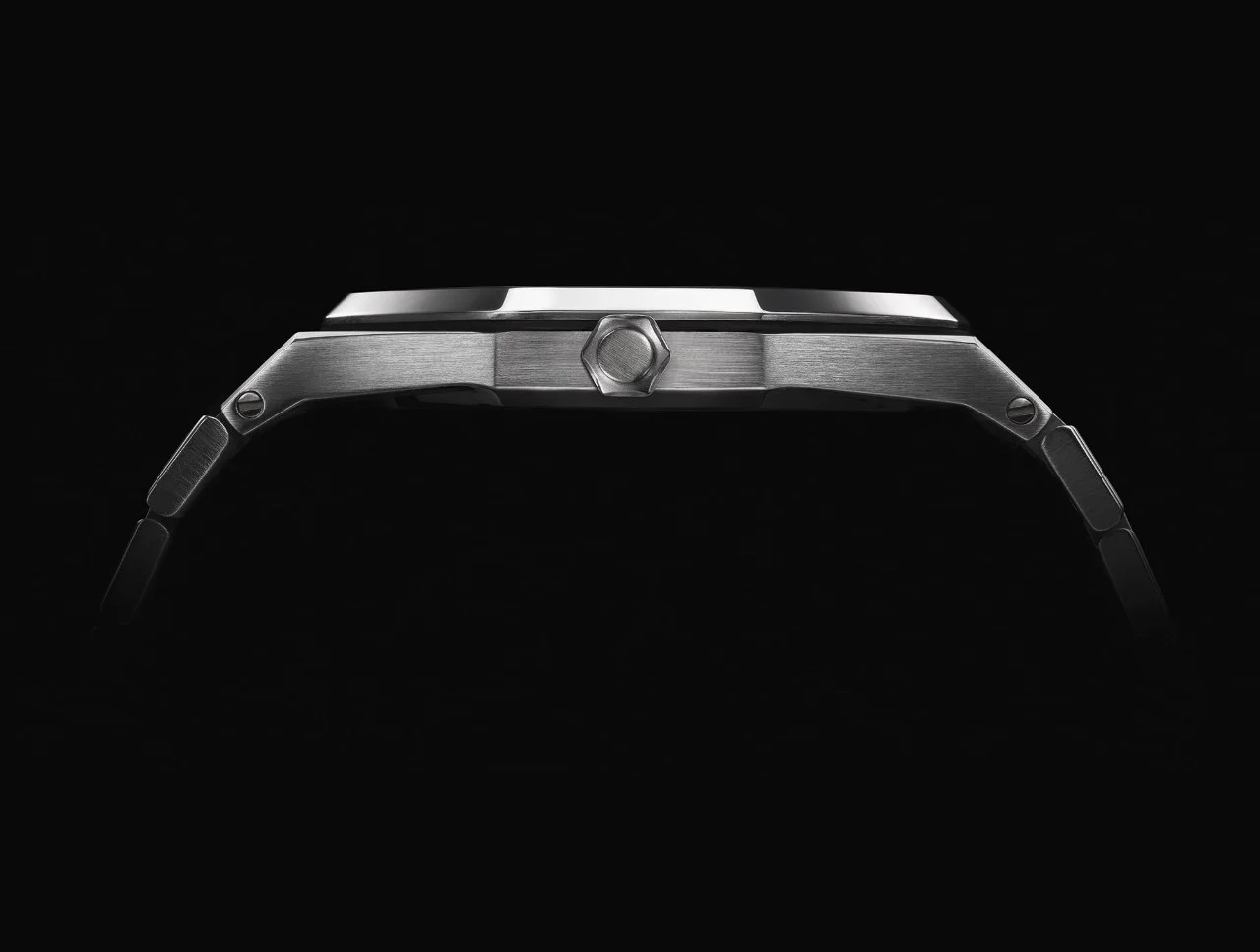
Over the course of the 1960s, the relationship between Genta and Audemars Piguet grew stronger, based on shared values and sensibilities. In his 2011 interview, the designer said: “Everyone has their own taste, their own ‘vibrations’. Those I acquired at Audemars Piguet led me to develop a law of aesthetics and architecture corresponding to something intensely physical. The watch must adapt to the wrist and it has to fit smoothly under a shirt cuff.” He added, “We were like a tandem, Georges Golay and me. If he was in agreement about something and I wasn’t, we didn't make the model... We were in complete symbiosis.” So much so that the two men wore the same watch: Model 5233, featuring a design inspired by an almost completely dissolved bar of soap, the perfect aerodynamic shape.
It was between 1967 and 1971 that the relationship reached its highest level of intensity. In 1967, Genta was awarded an honourable mention at the “Prix de Genève” competition for an Audemars Piguet handbag watch. In 1969, 1970 and 1971, Audemars Piguet commissioned Genta to travel to the Basel Fair. Genta said that in addition to welcoming clients on the small AP booth to introduce them to the new products, he was responsible for installing the watches in the display cases and dismantling the latter at the end of the show. Thus, when Georges Golay phoned Gérald Genta on April 10, 1970, they may well have been staying in nearby hotels.
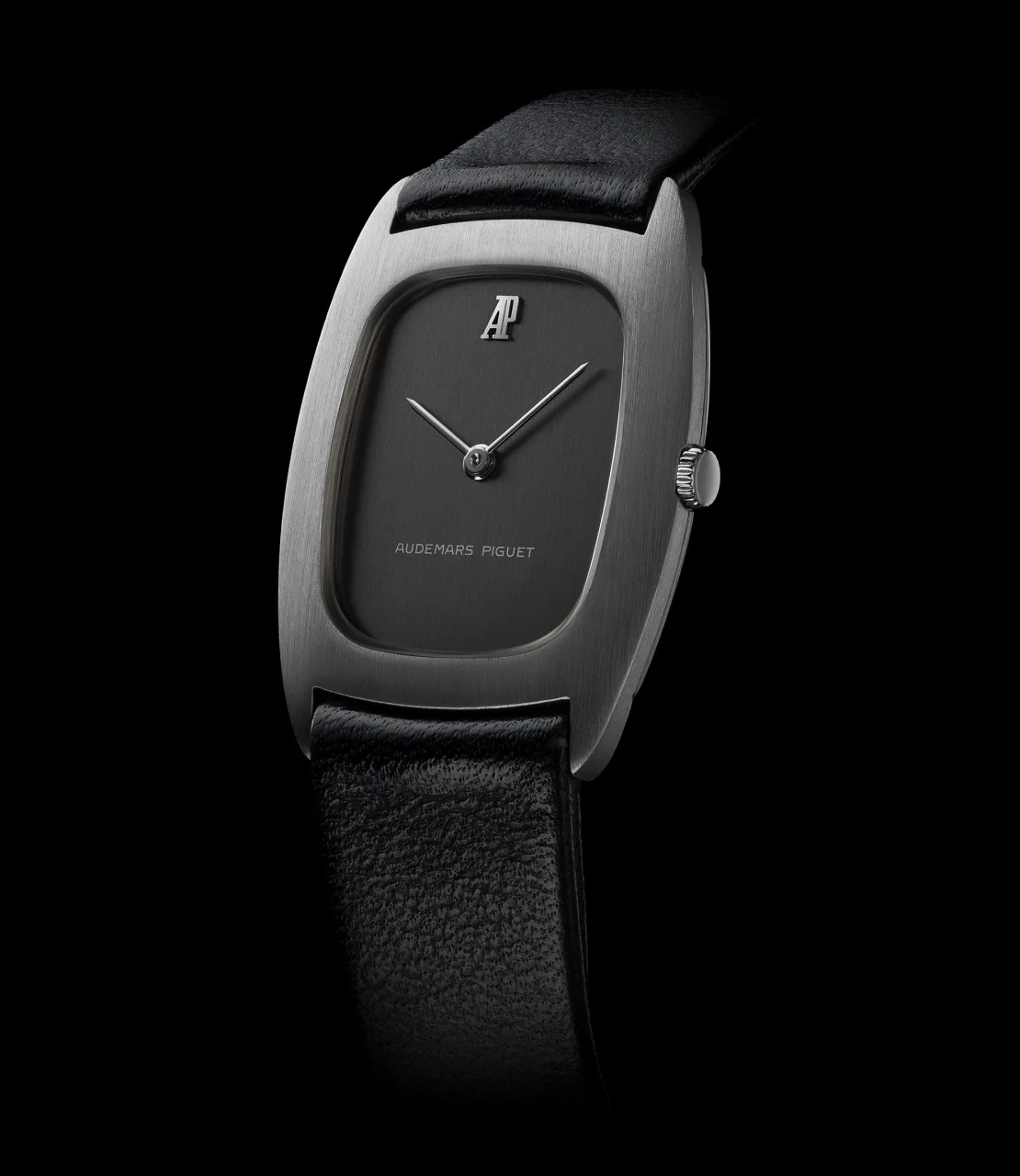
1974. Ultra-thin Reference 5233BC wristwatch. Oral sources indicate that in the early 1970s, Gérald Genta and Georges Golay wore this same Model 5233. Calibre 2003. Case 92642, movement 155162. 18-carat white gold. Sold to Gameo (Swiss market) in 1974. Audemars Piguet Heritage, inv. 1930.
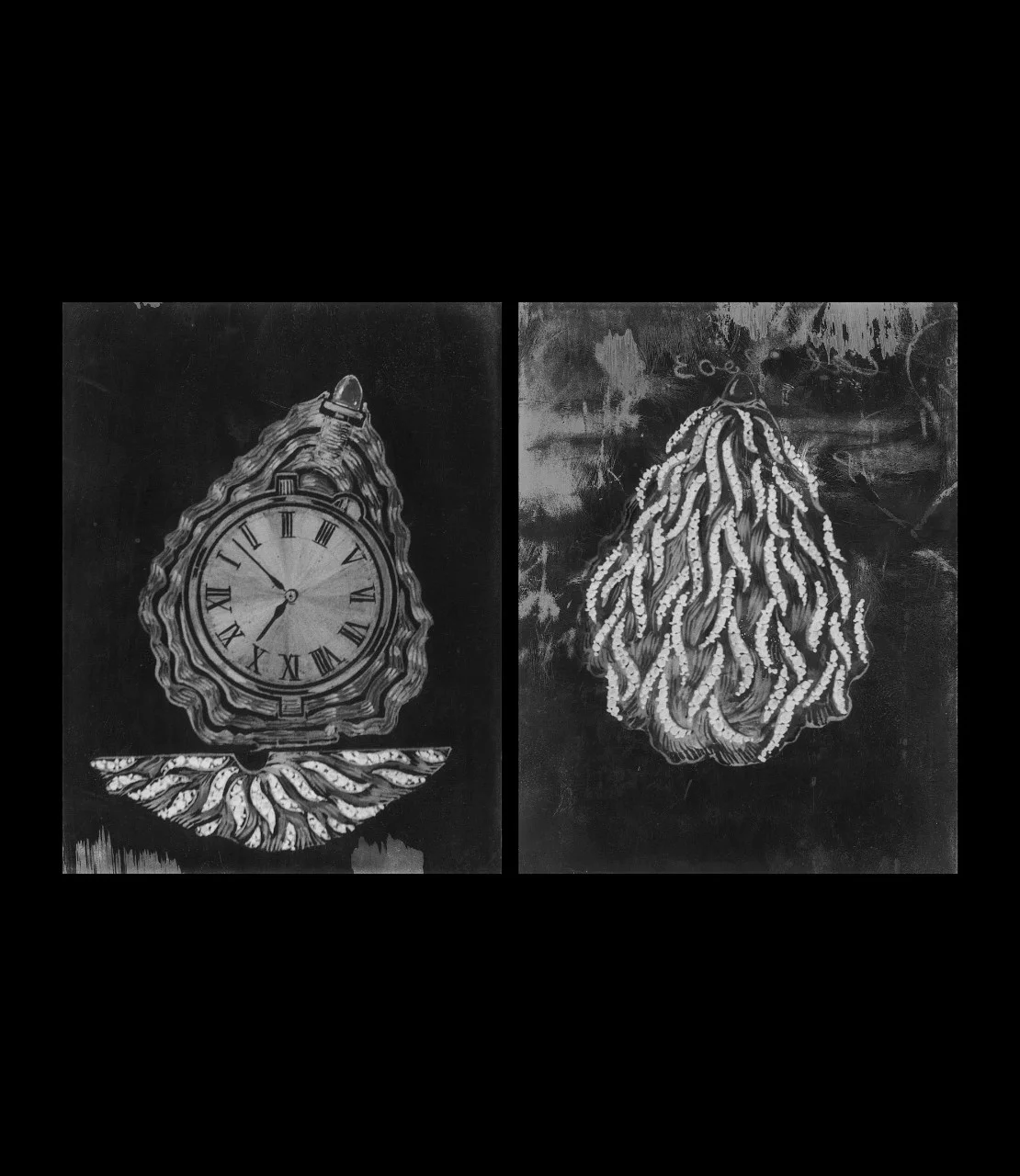
1967. Bag watch, Model 8311. In 1967, Gérald Genta and Audemars Piguet received an honourable mention at the Prix de la Ville de Genève for the bag watch created from this sketch. Audemars Piguet Archives.
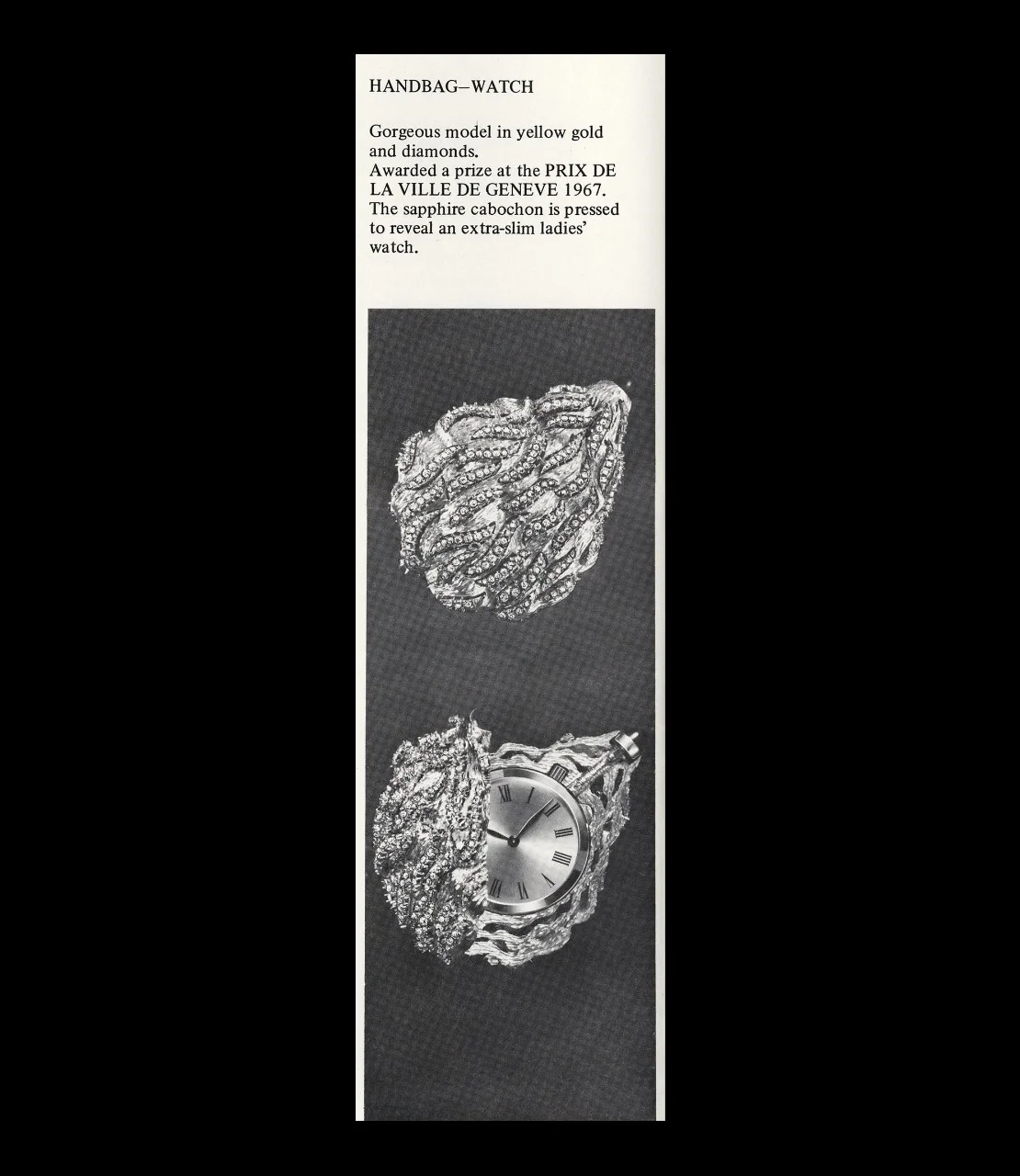
Circa 1966. Sketch of Model 8311. In 1967, Gérald Genta and Audemars Piguet won an honourable mention in the Prix de la Ville de Genève competition for the bag watch produced on the basis of this sketch. Audemars Piguet Archives.
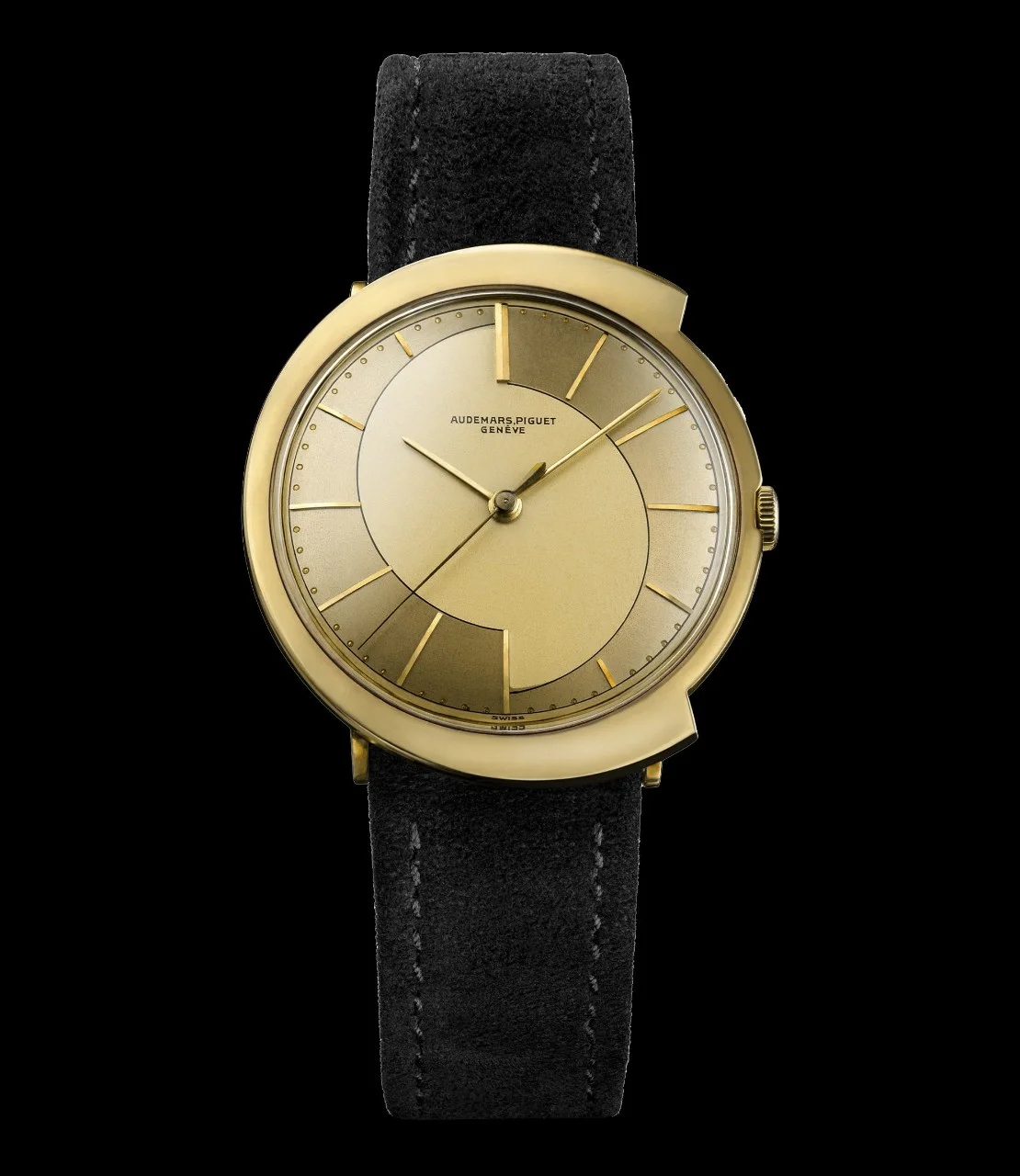
1962. Model 5182. In the early 1960s, Audemars Piguet presented a series of asymmetrical wristwatches. The archives mention that they were probably designed by Gérald Genta. Audemars Piguet Archives.
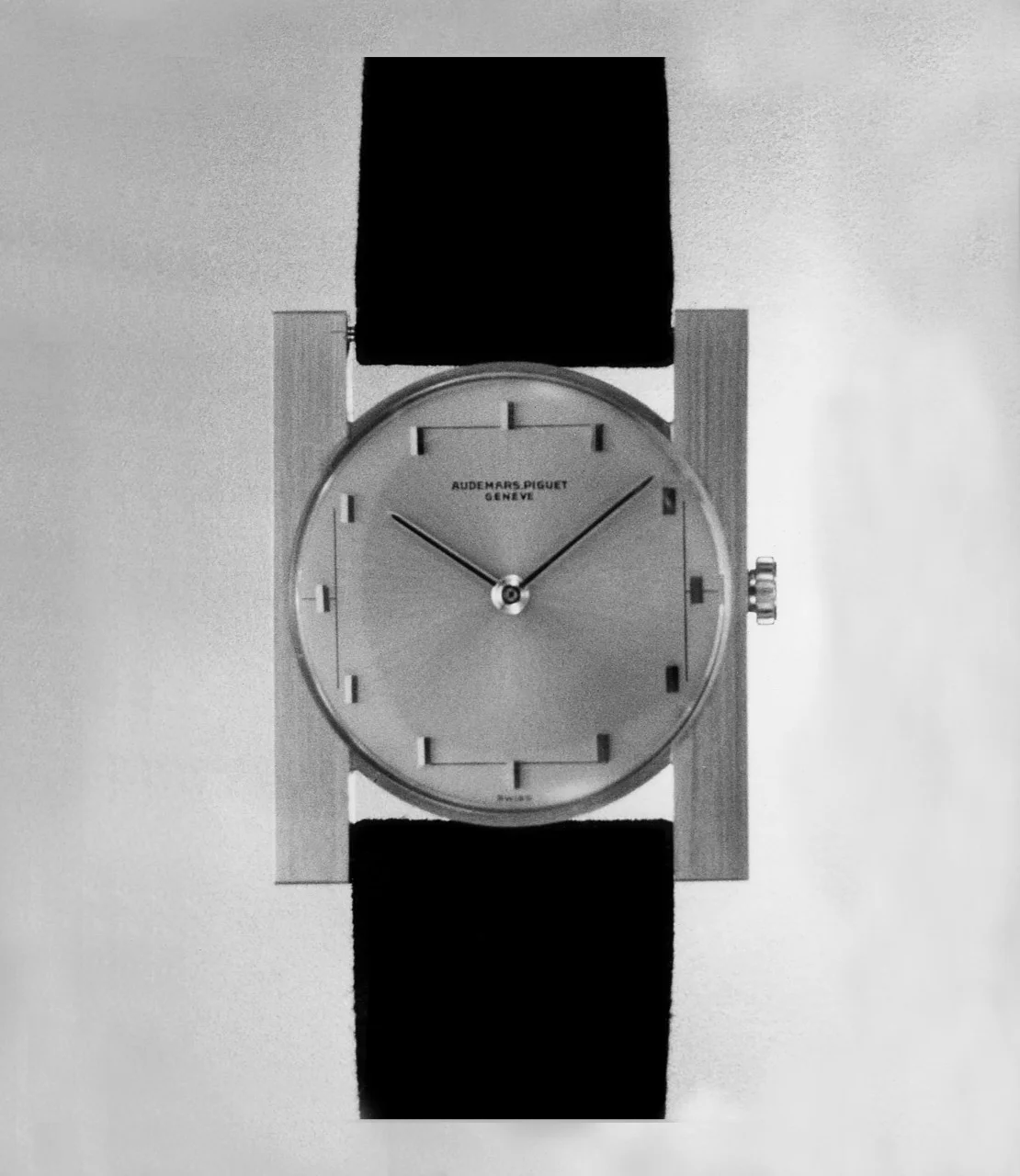
Combining the round, the square and the rectangle, Model 5179 was probably designed by Gérald Genta for Audemars Piguet. Audemars Piguet Archives.
“A Steel Sports Watch that Has Never Been Done Before”
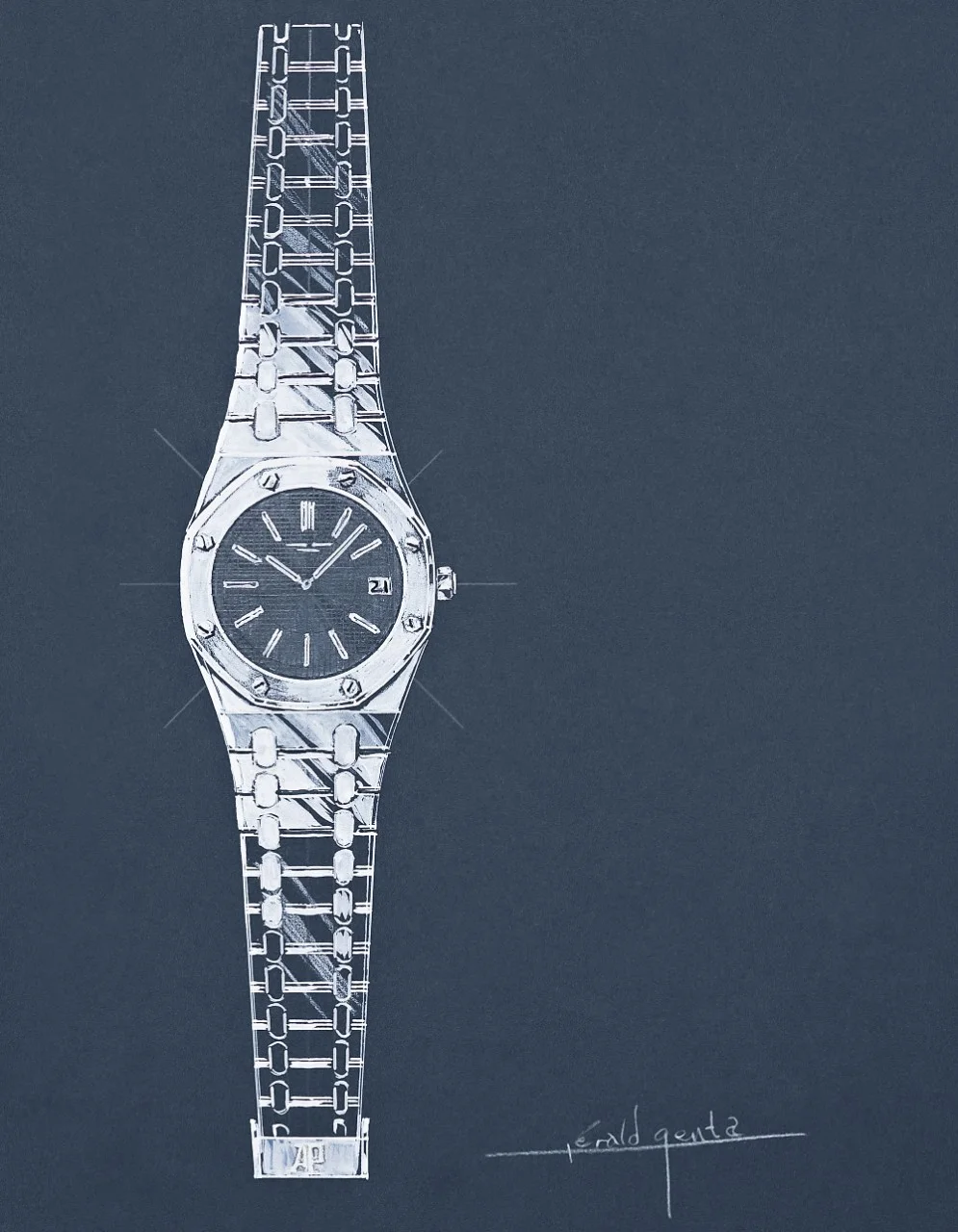
Genta was to remember the “4 pm” call from Georges Golay for the rest of his life. He quoted the Managing Director of AP who – with all his powerful intonation, natural authority and beautiful accent from the Vallée de Joux – said: “Mr. Genta, we have a distribution company that has asked us for a steel sports watch that has never been done before – and I need the design sketch for tomorrow morning.”
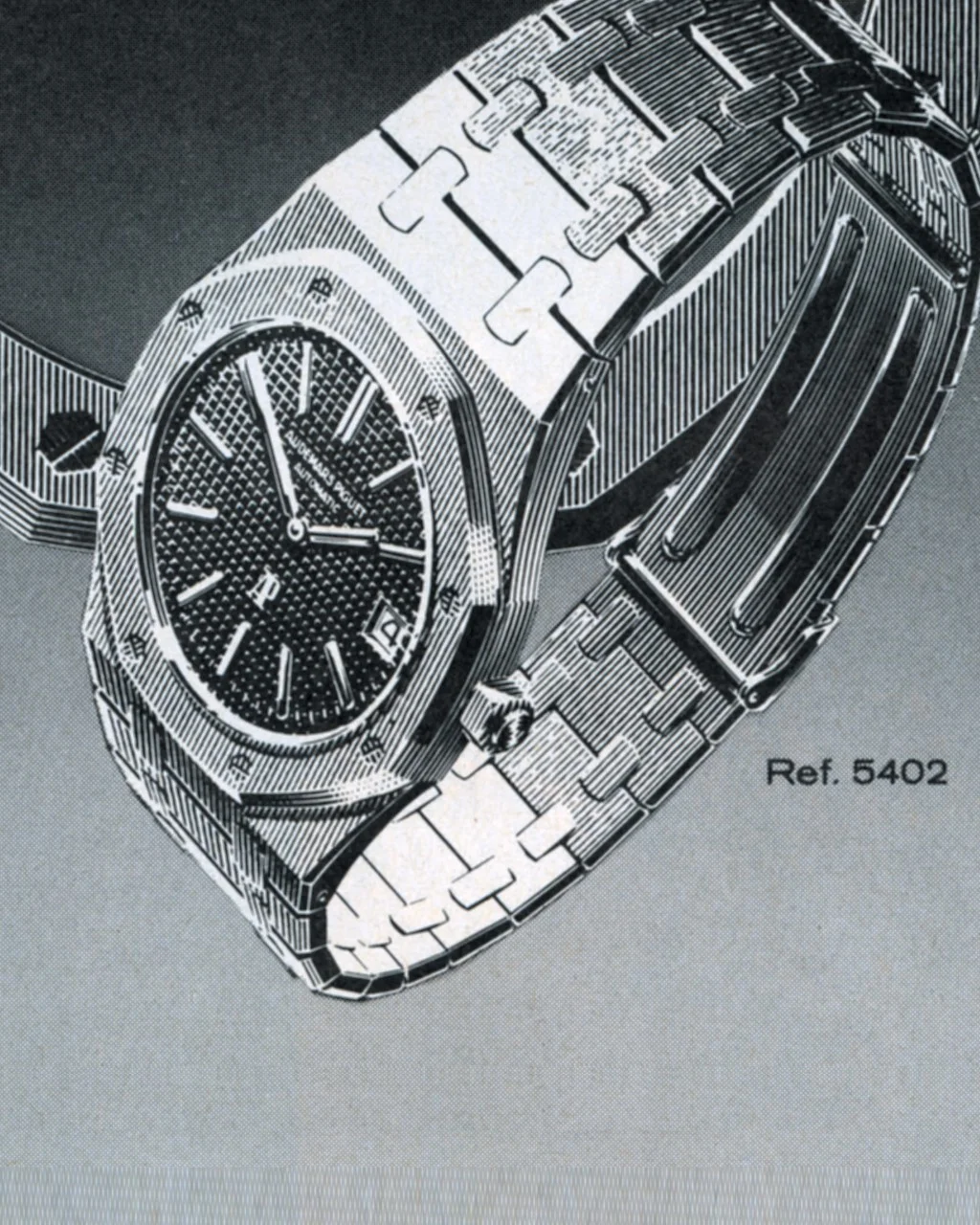
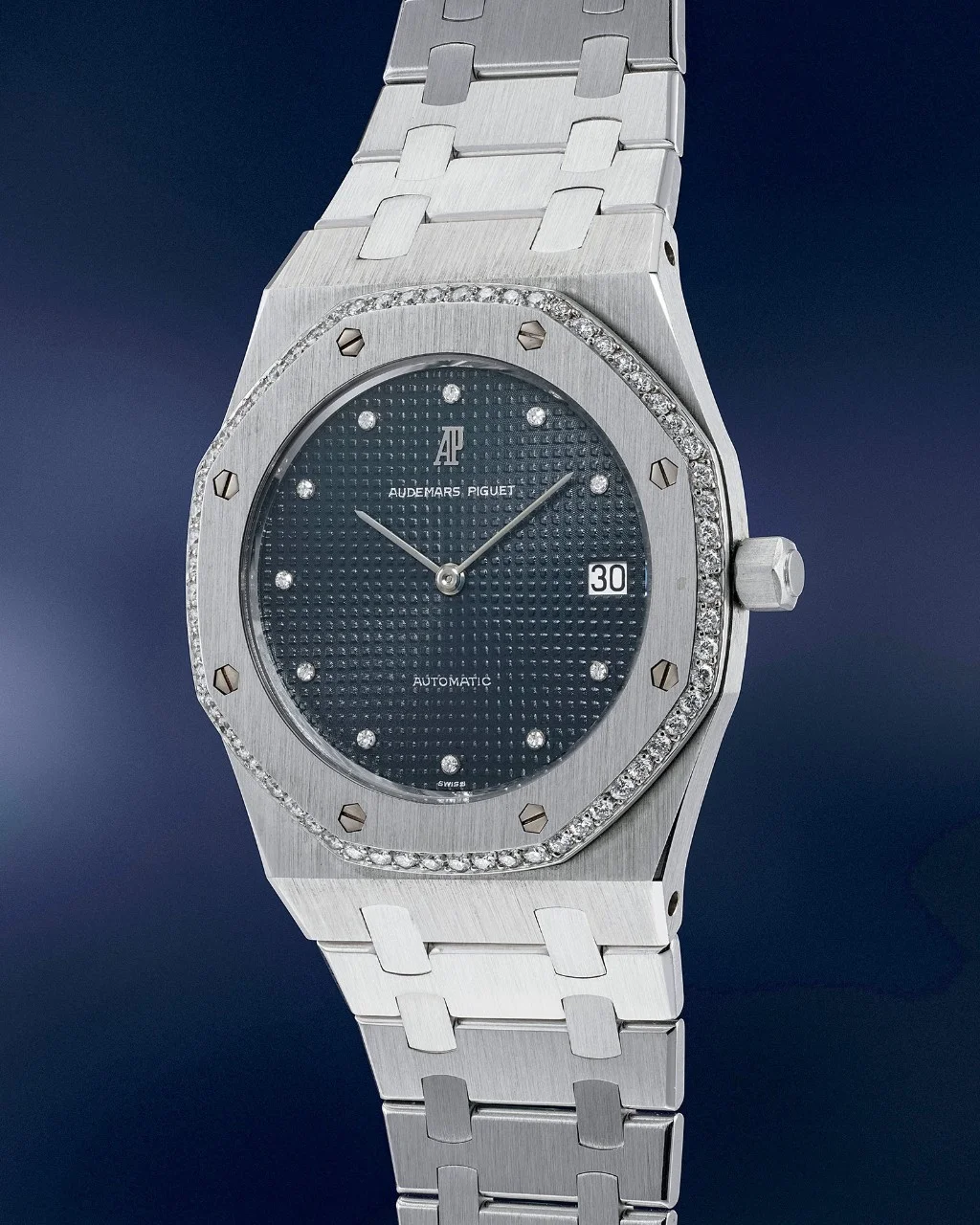
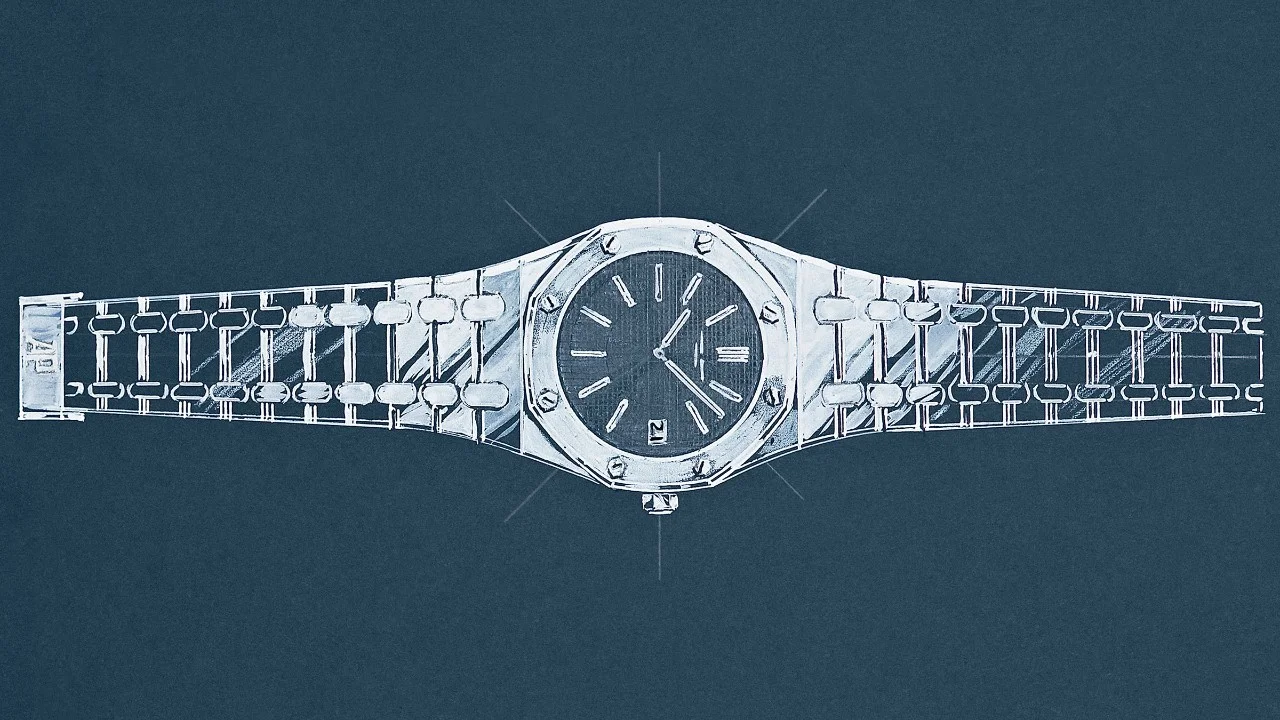
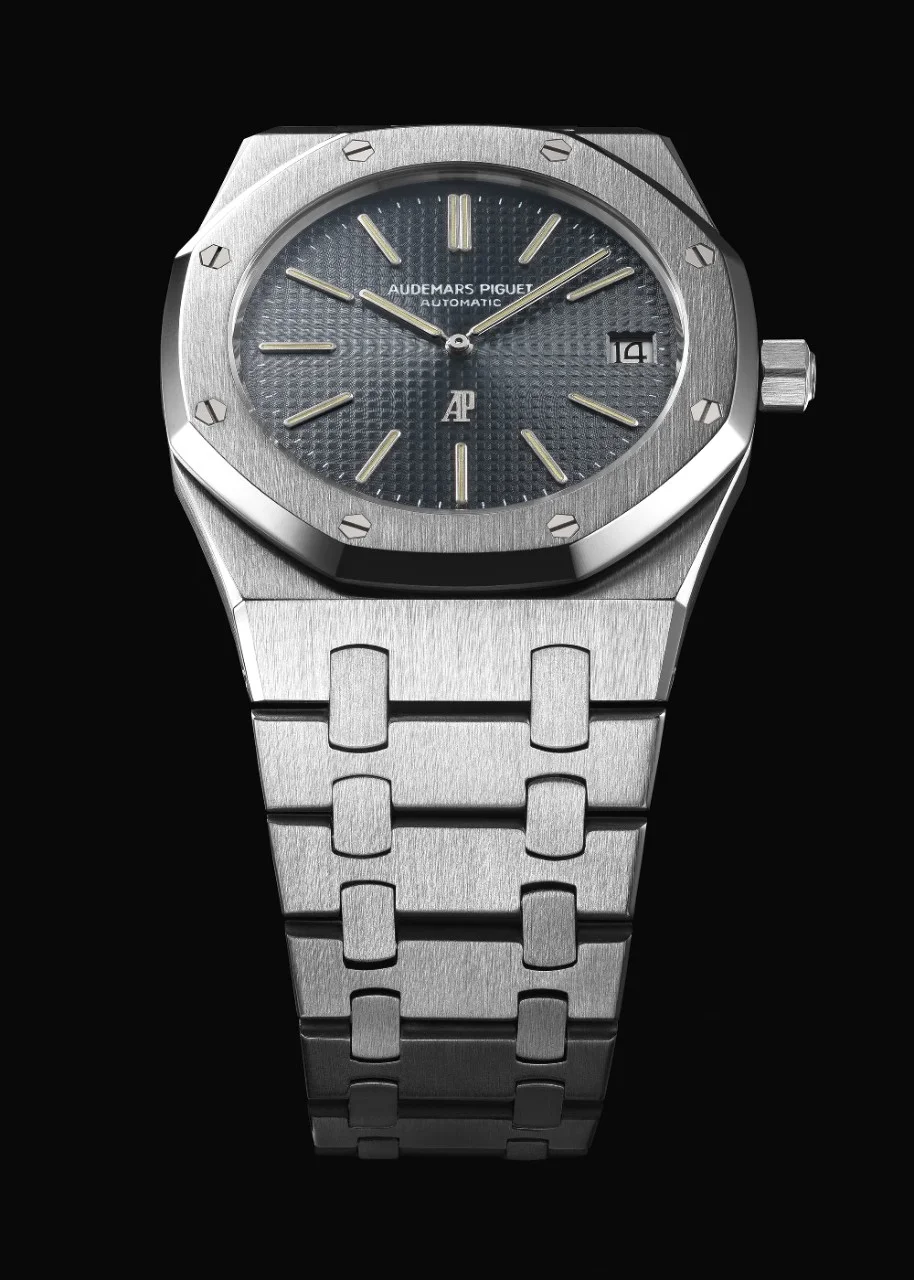
The designer immediately set to work on his drawing board. He explained: “I incorrectly understood him to have said ‘whose water-resistance has never been done before’… I remembered as a child having seen a diver being fitted with a helmet on Geneva’s Pont de la Machine. I was very impressed when I saw the eight bolts and the rubber seal designed to protect a person’s life under water. I was tempted to fit a highly prestigious movement inside a case entirely recalling the diver’s helmet. Furthermore, I designed the integrated bracelet which was unprecedented, with tapering intermediate links that made it extremely hard to produce; the dial with hands and hour-markers delicately inlaid with luminous material; the sunburst cobalt blue dial base adorned with Clous de Paris guilloché pattern, complete with a smoky effect as the shade would otherwise have been slightly commonplace.”
“All that was already laid out on the first sketch! The octagonal shape was obviously due to the fitting of the eight screws, because I had to find the space in the bezel to place them all. It is essential to point out that this new seal was an extremely substantial lip-type seal, located between the bezel and the monocoque (monohull) case. The latter already existed but only in very cheap products.”
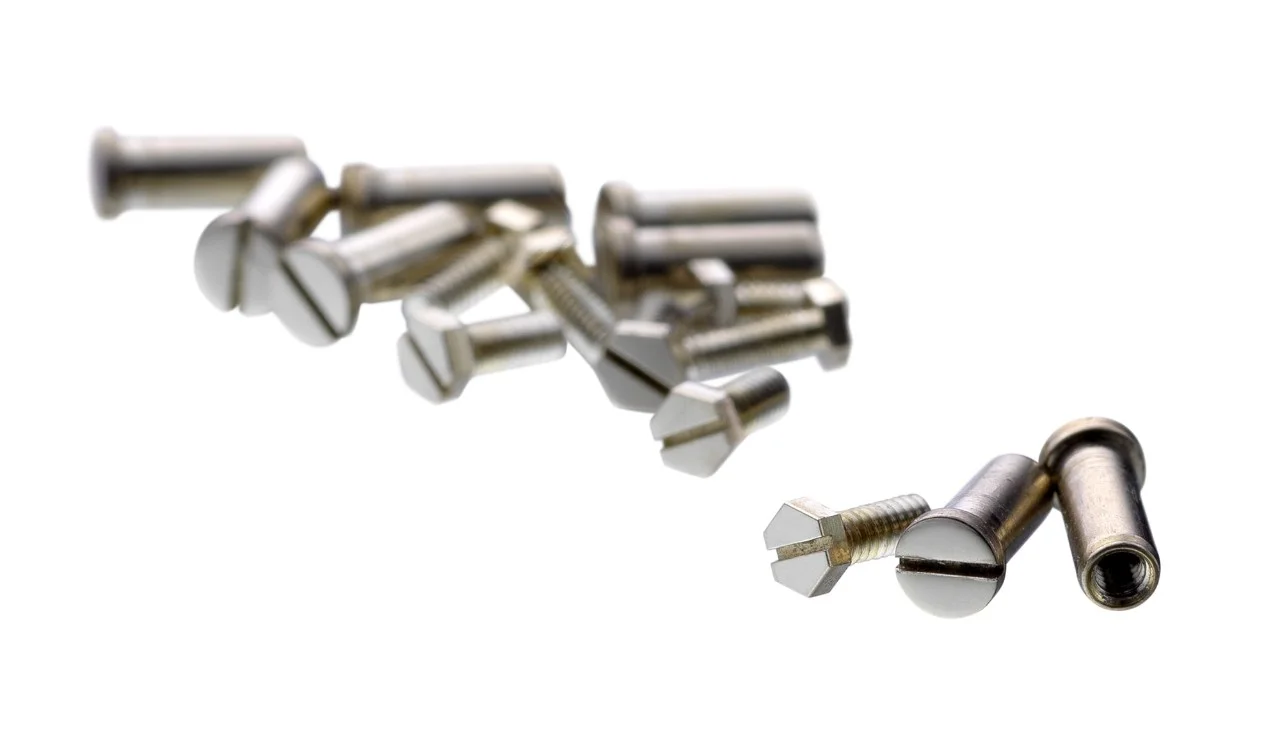
"The screws were hexagonal because the screw heads were embedded in the bezel, so that they would not turn when locking from beneath. I had to come up with all that in one night! It was a crazy thing, personally I don’t know by what magic it was possible to create such a thing in one night, it was quite amazing!”
Inspiration, between Myths and Legends
Before retracing the stages in the Royal Oak’s creation, let’s take a look at its sources of inspiration and the myths and legends to which it has given rise. The Royal Oak’s aesthetics were nourished by numerous influences. It followed on naturally from the Audemars Piguet watches of the 1930s to 1960s with their extraordinary design and drew on the developments in contemporary architecture of the 1960s to 1970s. It was part of a cultural groundswell that was sweeping the world of contemporary art, architecture and music.
Many hypotheses have been put forward regarding the symbolic meaning of the Royal Oak, often based on parallels drawn with existing objects. One of the most popular is that the shape of the bezel and its eight screws reinterprets the gunports of some of the British fleet’s ‘Royal Oak’ warships. Nonetheless, the latter were in fact never octagonal or secured by eight screws. Not to mention the fact that the name Royal Oak was chosen more than a year and a half after the watch was first designed. More on this later.
We have just seen that Gérald Genta claimed to have been inspired by a diving helmet he saw during his childhood. While the link with water-resistance is undeniable, the octagonal shape definitely stems from another source (was there ever such a thing as an eight-bolt diving helmet?). In this respect, Martin K. Wehrli, former Director of the Audemars Piguet Museum, and other witnesses from the same period noted the existence of an innocuous object found in the small Audemars Piguet offices at No. 2 Rue Vallin in Geneva: a parcel-weighing machine with octagonal form. Should we view this as a potential indirect influence? Perhaps.
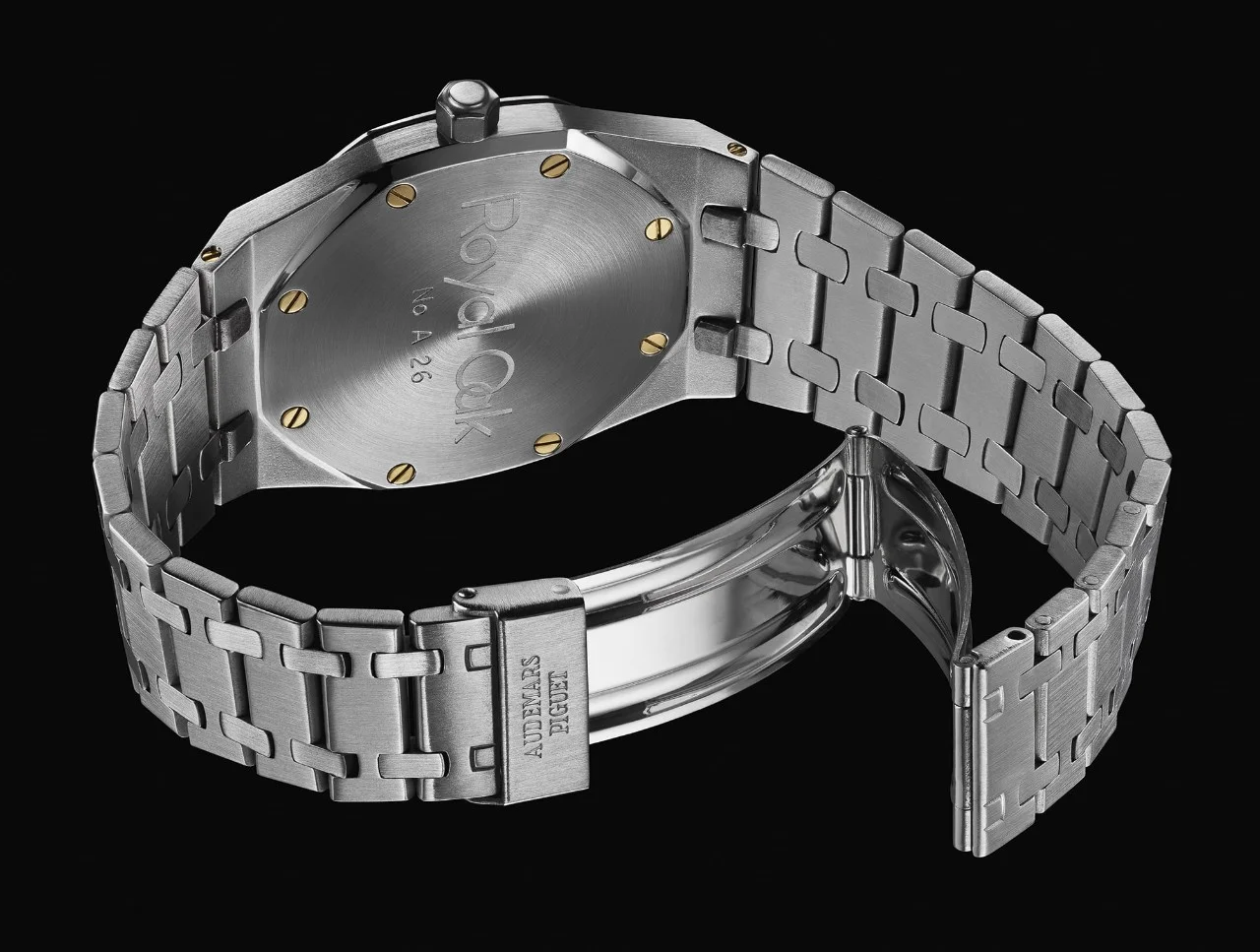
Olivier Audemars, Vice-Chairman of Audemars Piguet’s Board of Directors and representing the fourth generation of the founding families, explains that the visible screws are a powerful symbol. He recalls that displaying them was a disruptive act in 1972, a manifesto expressing mechanical resistance, technicality and solidity. Opening the case is indeed a mystery worthy of a safe, since it is impossible to turn an embedded hexagonal screw! The metaphor of the safe (in the land of banks) is all the more relevant in that the ultra-resistant steel case housed a partially gold movement. By protecting a mechanical and traditional treasure in an era when quartz technology was threatening the entire industry, the Royal Oak became a watchmaking hero.
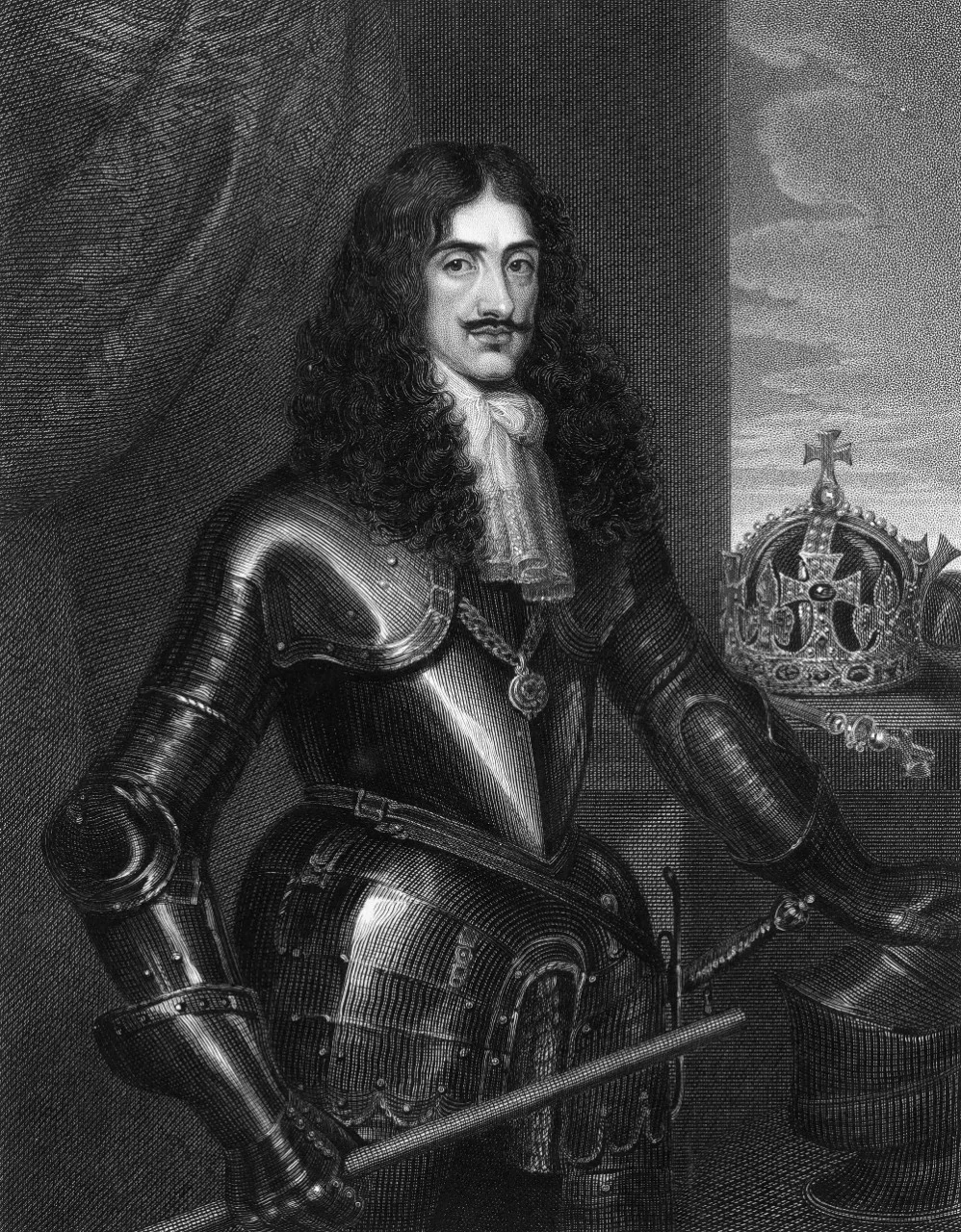
A related interpretation is found in the theme of the ennoblement of steel. The finest artisans did indeed dignify the commonplace metal of a watch, raising it to a higher status. This act recalls another that took place 400 years earlier: Charles II of England ennobled the oak tree that saved his life in battle against Cromwell. The echo makes all the more sense in that the watch was named after the tree! In the same vein, some texts associate the steel of the watch with that of the English Royal Oak battleships...


2008. Royal Oak and Boscobel House, Shropshire View with a dramatic sky. Boscobel House, a 17th-century former hunting lodge, is famous as the place where Charles II hid in a nearby oak tree following his defeat at the Battle of Worcester in 1651. Artist Boris Baggs. © Photo by English Heritage/Heritage Images/ Getty Images. 2008. Royal Oak and Boscobel House, Shropshire View with a dramatic sky. Boscobel House, a 17th-century former hunting lodge, is famous as the place where Charles II hid in a nearby oak tree following his defeat at the Battle of Worcester in 1651. Artist Boris Baggs. © Photo by English Heritage/Heritage Images/ Getty Images.
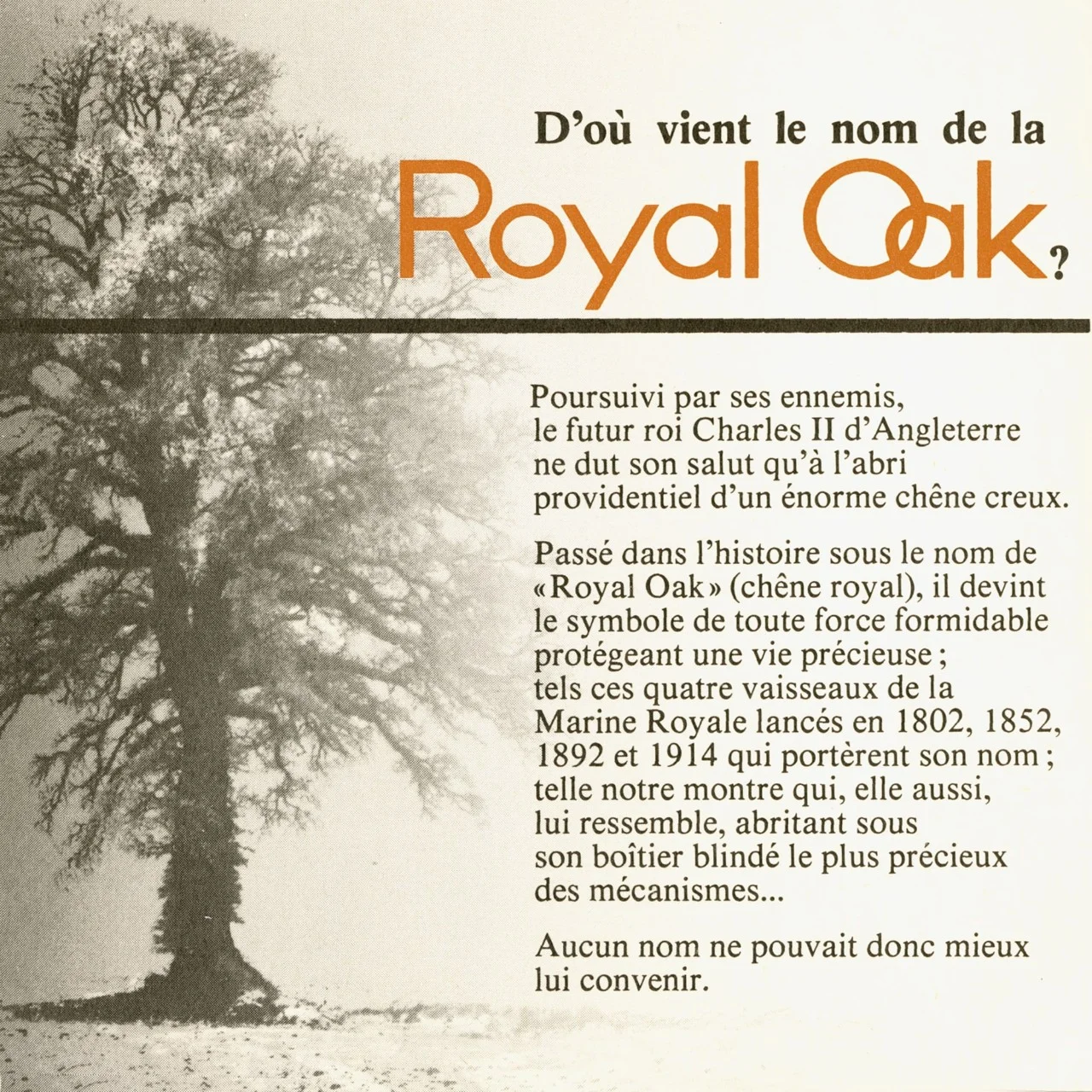
1973. The royal oak tree. One year after the Royal Oak's launch, Audemars Piguet published a brochure which explained the link between the watch, the life-saving oak ennobled by King Charles II of England in the 17th century and the naval vessels named after it. Royal Oak brochure, 1978, p. 8. Audemars Piguet Archives.
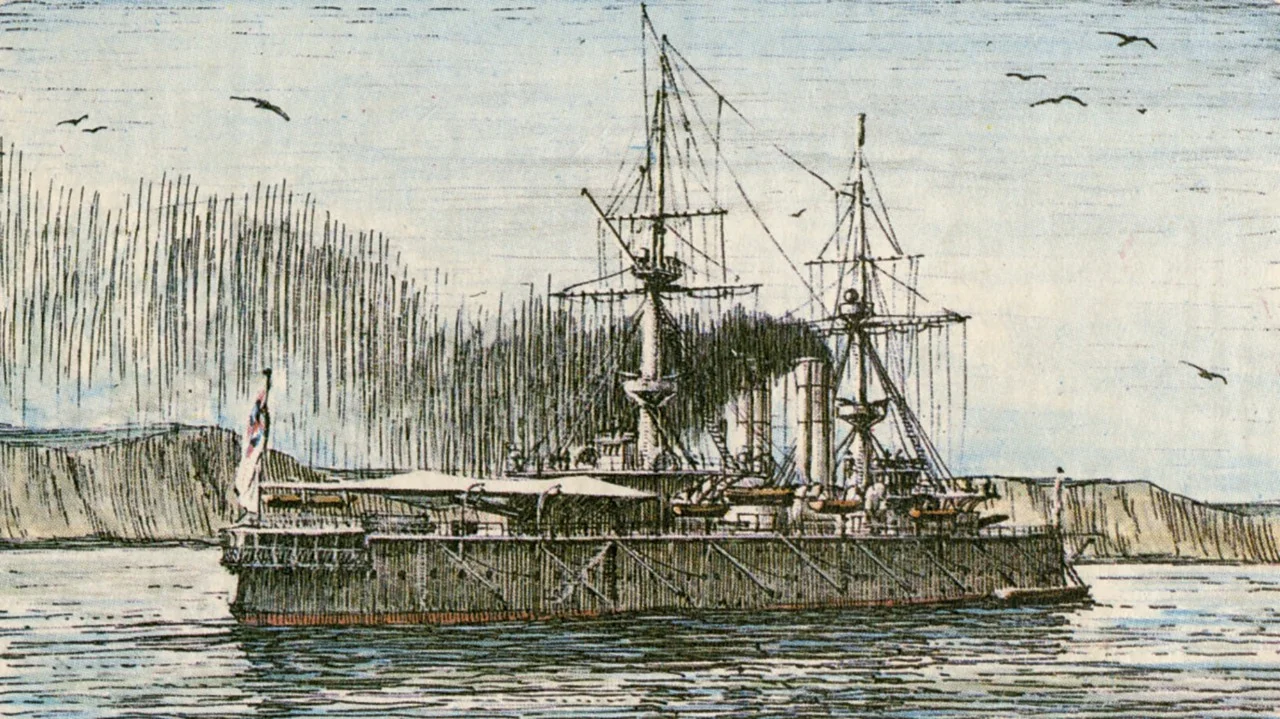
1892. HMS Royal Oak battleship. Published in 1973 by Audemars Piguet with the agreement of London's National Maritime Museum, this illustration was featured on the cover of a promotional brochure evoking the parallels between the Royal Oak watch and the eponymous English Royal Navy vessels. Audemars Piguet Archives.
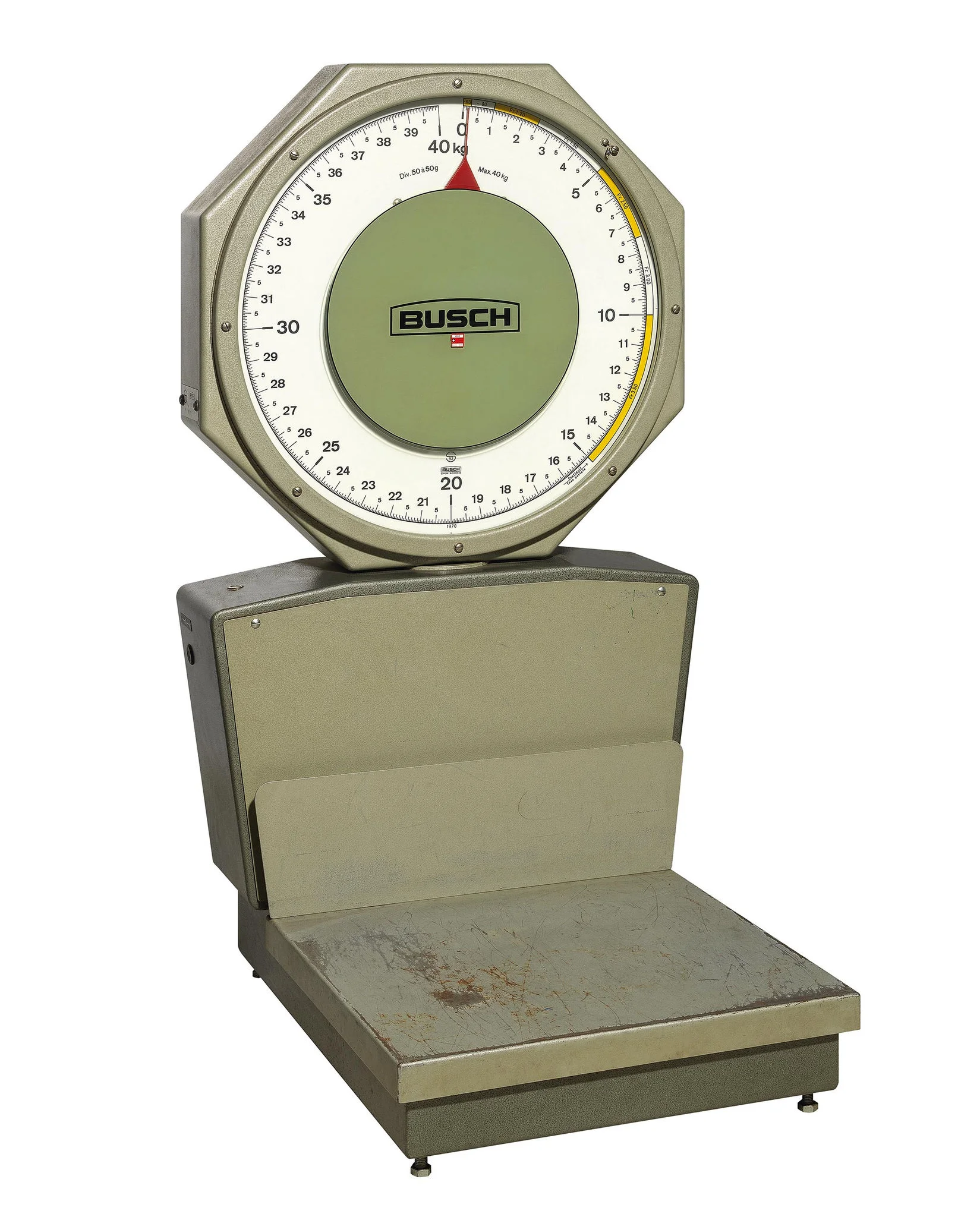
Parcel-weighing machine found in Audemars Piguet’s Geneva offices in the 1960s and 1970s. As Gérald Genta was a frequent visitor to the building, this object may have inspired him in designing the shape of the Royal Oak. Audemars Piguet Heritage.
From Observation to Contestation
Nonetheless, a careful look at the Royal Oak indicates that the octagonal shape purely reflects the pursuit of aesthetic refinement. Genta said that the eight hexagonal screws imposed a wide bezel. To trim it down, the designer reduced the width between each screw, creating the eight faces. But why eight? Probably so that the two lateral sides would fit perfectly into the tonneau-shaped case – and also in order for the upper and lower parts to surround the dial in a harmonious way, ensuring their screws were aligned with the bracelet studs. It was certainly also to refine the aesthetics of the watch that Genta bevelled a third of the bezel surface. Genta was first and foremost a jeweller and some see the light effects created by the instantly recognisable facets of the case and bracelet, mirror-polished and satin-finished by hand, as an evocation of the facets of a diamond.
Each person has made the Royal Oak their own according to their own sensibility and aspirations. When asked about his sources of inspiration, Gérald Genta explained: “Creative design is first of all an unconscious observation of everything around you. Your brain stores this data and, by force of circumstance, creation is a contestation since it involves making something that does not exist. It is thus both an observation and a contestation.”
From Idea to Case Prototype
On April 11, 1970, while Gérald Genta was installing the watches in the windows of the tiny Audemars Piguet booth at the Basel Fair, George Golay presented his sketches. Carlo de Marchi and his companions were won over.
When the Managing Director told Genta the good news, the latter made an unusual request: "This is so special that I would like to monitor the making of the prototype. Please tell me which company I will need to visit.” He later explained: “I had a very precise idea in my head and I knew what I wanted to do.” The approach was unusual in that Jacques-Louis Audemars – grandson of the co-founder of Audemars Piguet and Chairman of the Board of Directors at the time – was not only in charge of production but also personally managed all new developments.
Genta first went to the small watchmaking town of La Chaux-de-Fonds to discuss the project with watch case manufacturer Favre & Perret. This company founded in 1865 and bought up by the Swatch Group in 1999 was specialised in gold watch cases and jewellery. It had never worked with steel. While the fact that Georges Golay had imposed such a partner surprised the designer, this choice was entirely judicious, since fine workmanship, top-of-the-range decorations and craftsmanship were the core values of this traditional firm. There were two remaining challenges: convincing the Favre-Perret craftspeople to move out of their comfort zone and work steel with the same meticulous care as gold; and developing an unprecedented water-resistant monocoque case architecture.
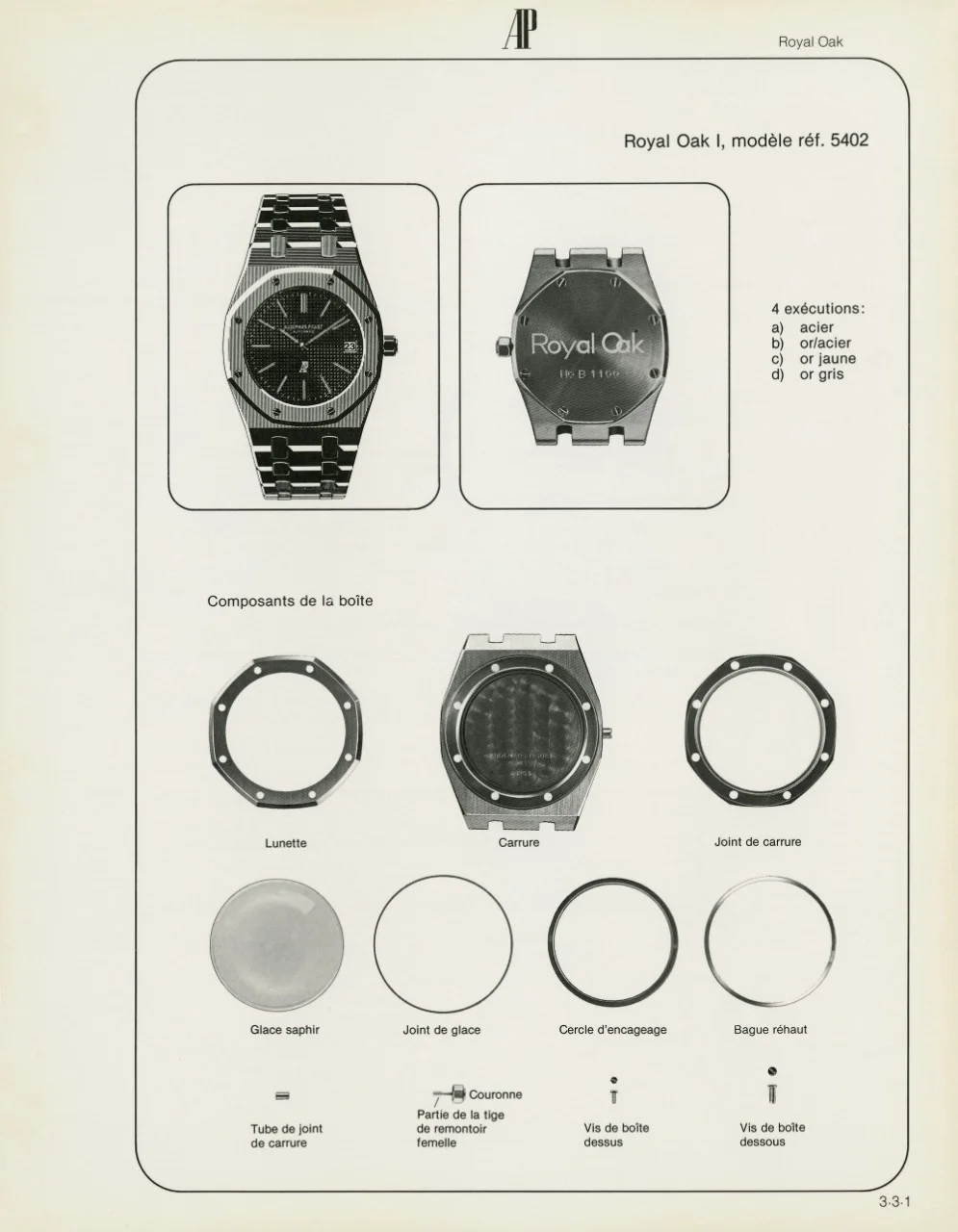
Gérald Genta was apparently told: “Sir, it won’t work.” Warming to the subject, the designer insisted: “It was a revolution! It was something incredible!” He went on to explain the design in more detail: “The rubber seal must obviously have a circular rim on top with two raised ramps… The bezel was quite wide, there had to be room for the screw heads and to ensure the body of the screw did not impinge on this water-resistance gasket.” The structure of the monocoque case was so innovative and special that the decision was quickly taken to make the prototypes in white gold.
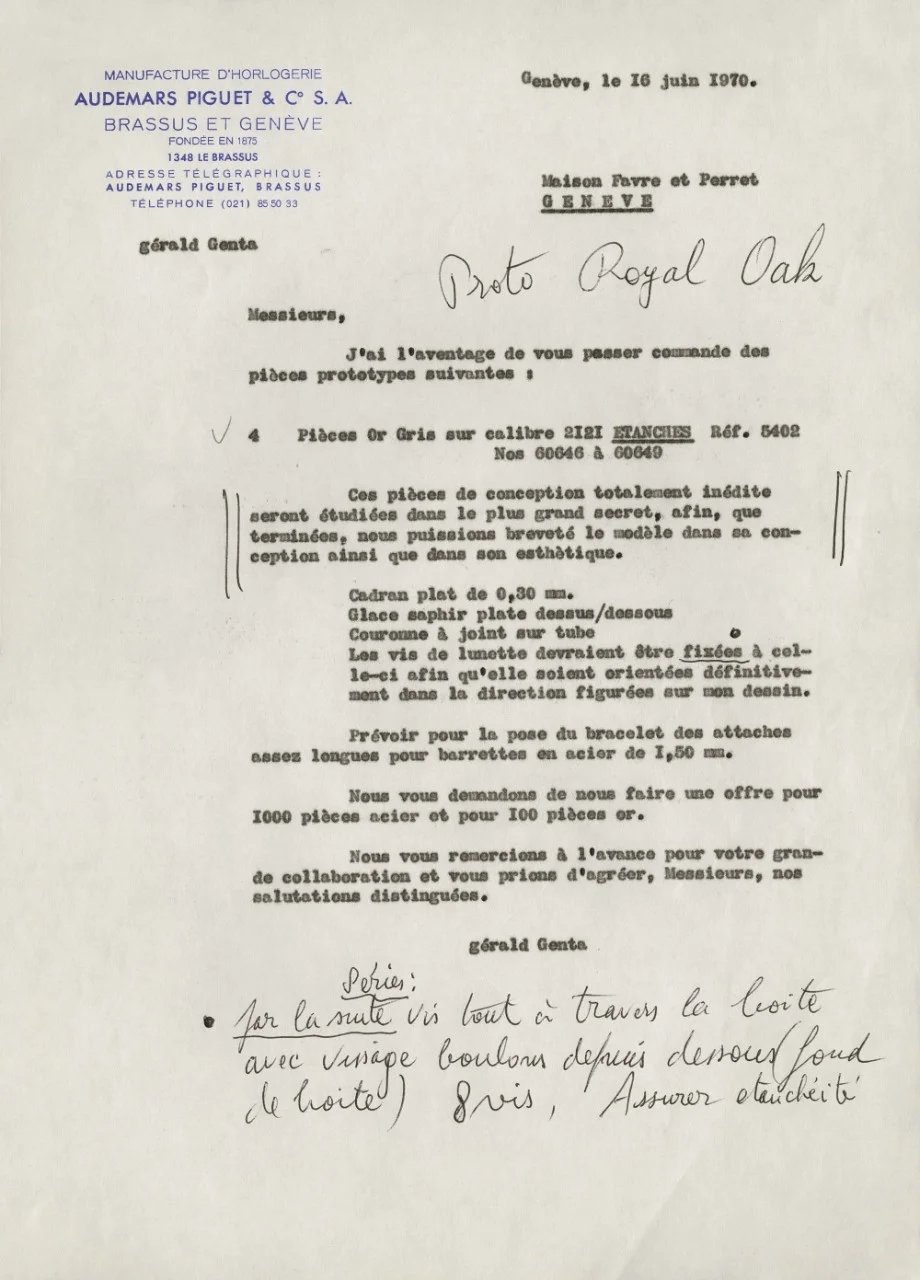
On June 16, 1970, four prototypes were ordered from Favre-Perret in a letter that interestingly – and in a rare occurrence – bore the letterhead of Audemars Piguet but was signed by Gérald Genta, despite the fact that he was never an Audemars Piguet employee and always proclaimed his independence. Moreover, the letter requests an offer for 1,000 watches in steel and 100 in gold. These were quantities unheard of at Audemars Piguet (Genta explained that 1,000 units was a minimum to make a steel watch profitable), but also proof that gold was still an option.
Creation of the Dial
While the Tapisserie dial is one of the most important aesthetic codes of the Royal Oak, it would not have seen the light of day without a surprising conjunction of circumstances. Helmut Crott, a renowned collector, entrepreneur and founder of the eponymous auction house, told this story in his book The Dial. The Face of the Wristwatch in the 20th Century, published in 2020.
It all began when, around 1970, a Geneva-based company called La Nationale lost its only employee capable of operating seven old machines that were about to fall into disuse. These engraving machines, or more precisely "guilloché copying" machines, had been used for decades to reproduce geometric or floral tapisserie patterns on gold lighters, pens or cigarette boxes in silver, gold, etc. Wishing to dispose of these tools, La Nationale handed them over to its neighbour, the dial-maker Stern Frères, on condition that they fulfil an existing order. Stern was nothing less than the most prestigious dial manufacturer of the 20th century. It supplied the greatest watch brands, including Patek Phillippe (which the Stern family bought in 1932), Vacheron Constantin and Audemars Piguet.
Roland Tille was the Stern Frères head of design at the time. He understood the potential of these old tools, despite the great difficulty involved in using them. When Gérald Genta visited him to talk about the future Royal Oak, Tille showed him not only the machines, but also the 300 templates that came with them, each featuring a different design. The two men chose 13 designs to make prototypes, including one called T21, standing for “Tapisserie 21”. That was the one chosen for the Royal Oak. Now renamed Petite Tapisserie, this pattern is composed of hundreds of small truncated pyramids, punctuated by tens of thousands of small diamond-shaped holes, enabling subtle and unique light effects.
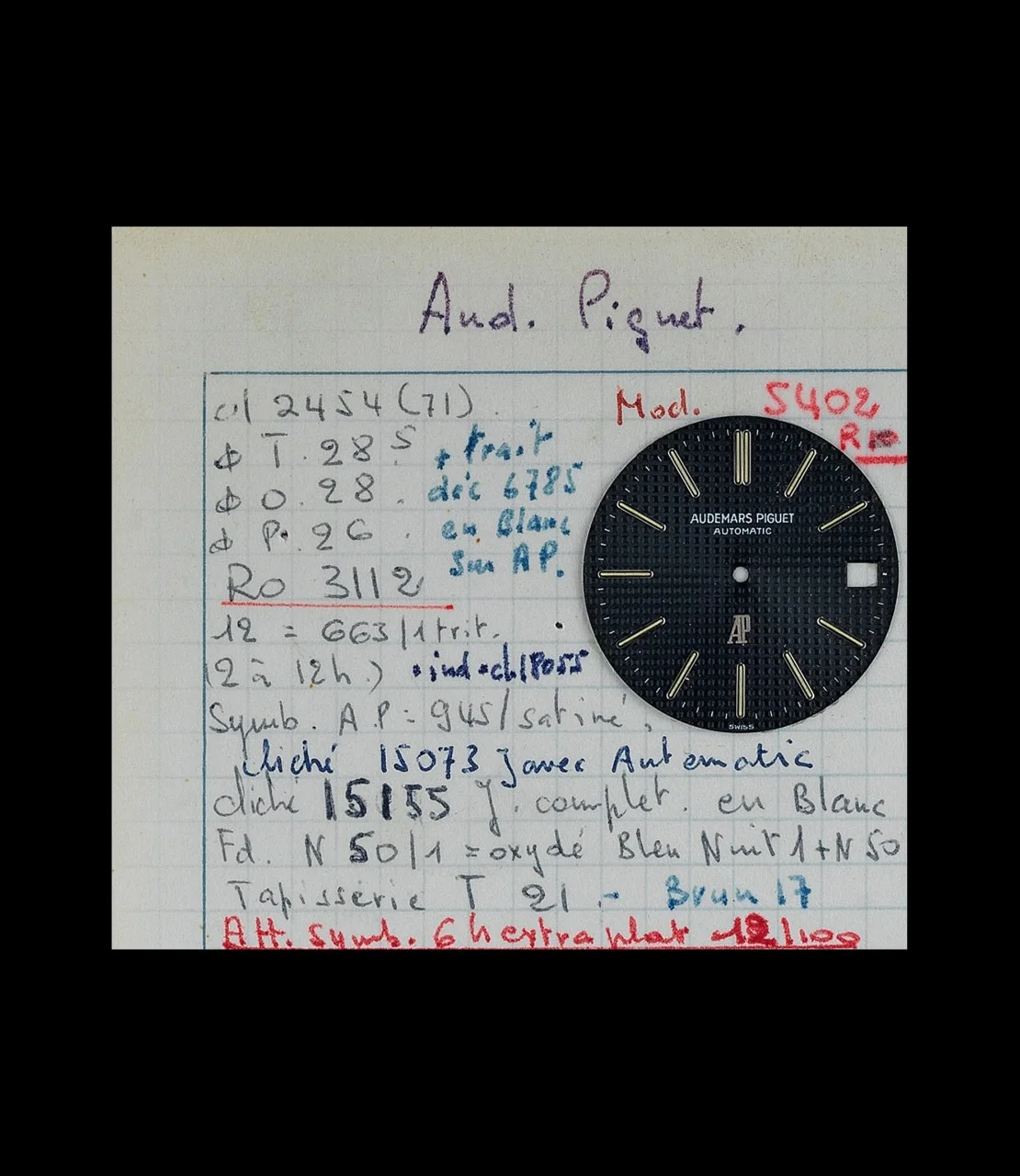
Circa 1971. Stern's technical sheet for the first 5402 dial. The original dial is glued to a cardboard paper which details its technical characteristics. The name Bleu Nuit ("night blue") as well as "N50" standing for Nuage 50 ("cloud 50") are specified. The term T21 Tapisserie refers to the guilloché motif. Audemars Piguet Archives.
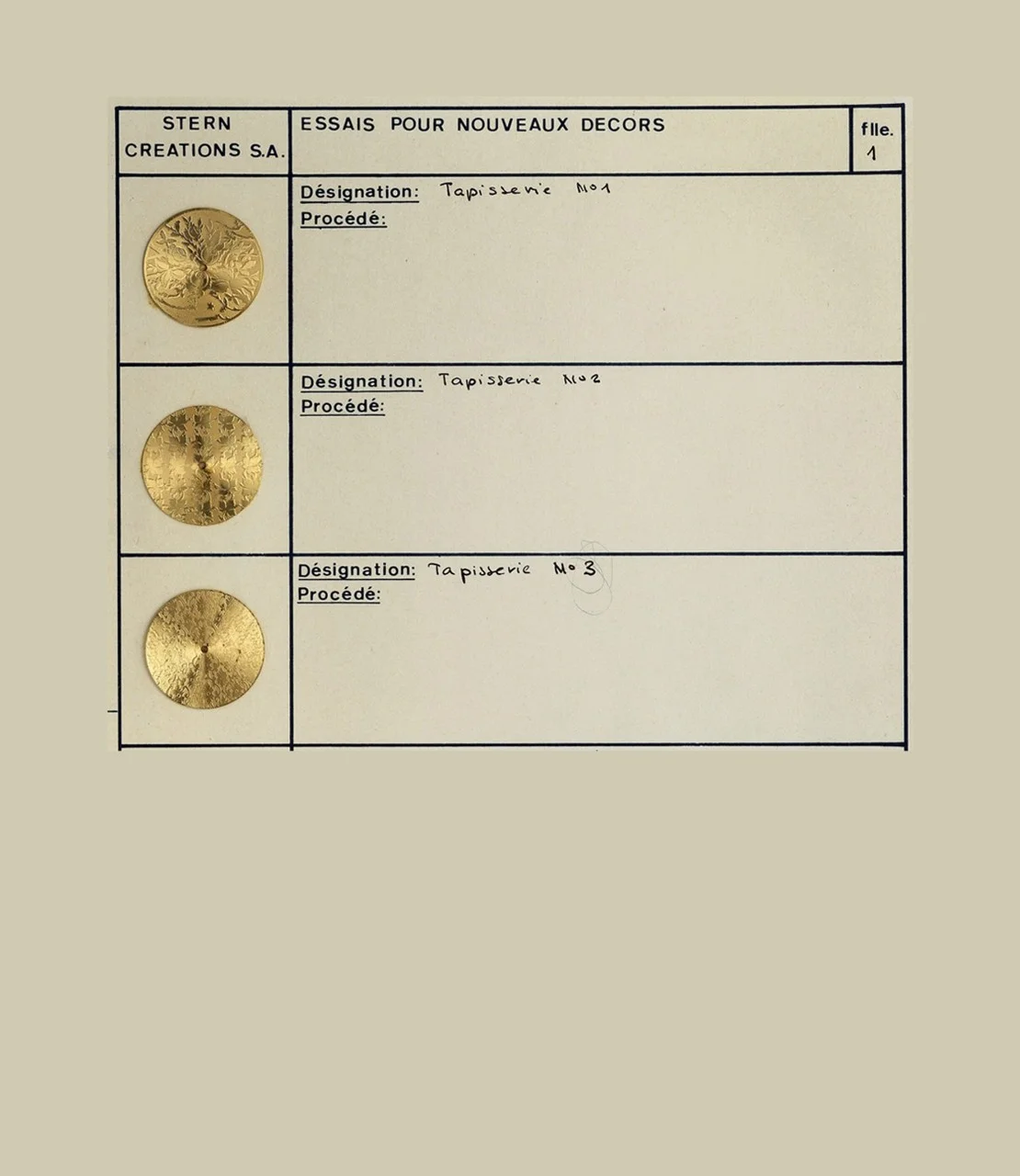
Circa 1981. Different Tapisserie tests. The denomination Tapisserie refers to the engraving technique (or guilloché-work) used for the dials, and not to the reproduced motif. It gave rise to numerous patterns. Test sheet realised by Stern Créations SA. Archives Audemars Piguet.
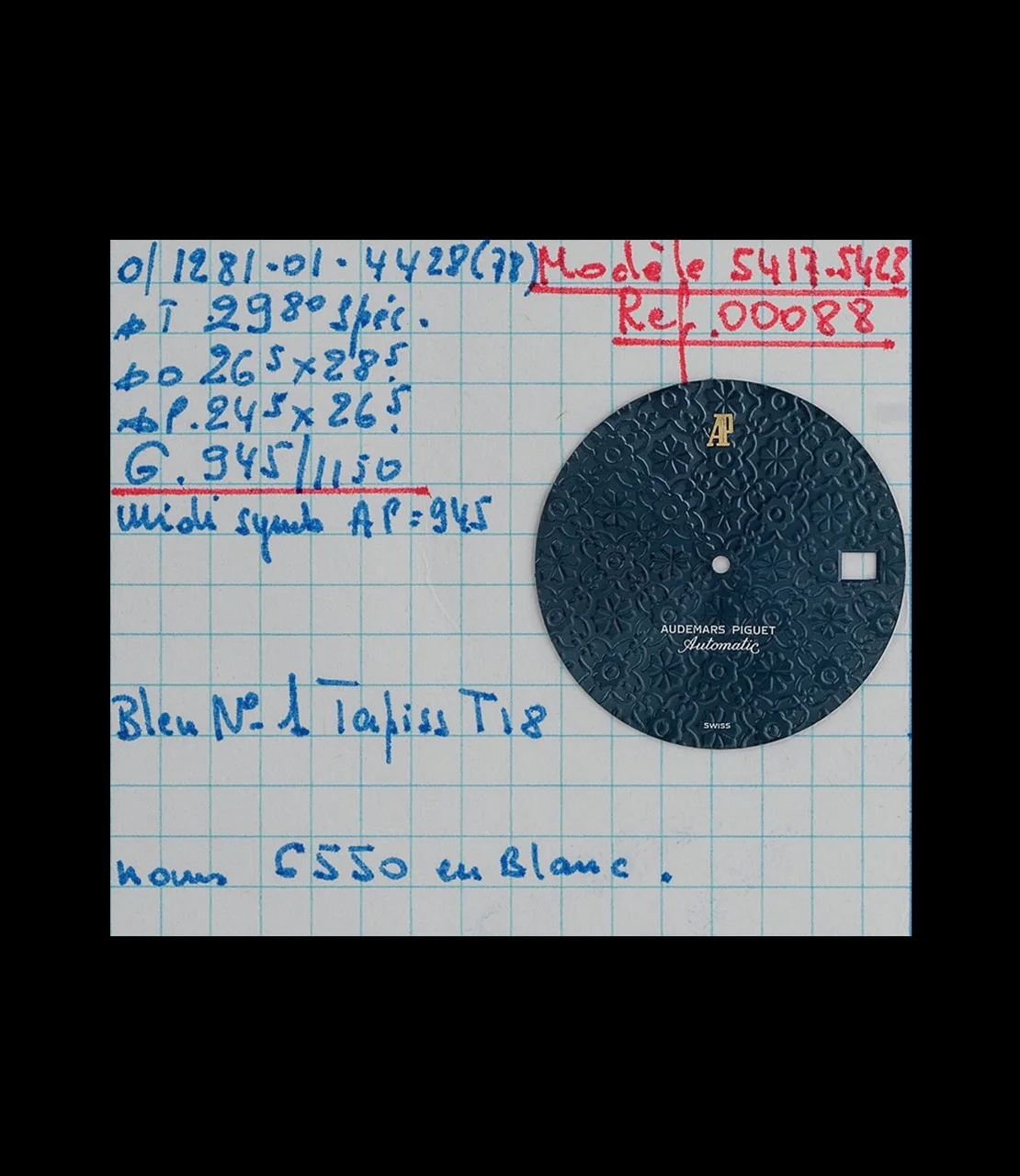
Circa 1975. T18 Tapisserie dial. Made for the Models 5417 and 5423, this dial uses the Tapisserie technique to create floral motifs. Audemars Piguet Archives.
Bleu Nuit, Nuage 50
In contrast to the guilloché pattern, the colour was already defined on Gérald Genta’s original design. Colouring a surface as complex as the Petite Tapisserie represented a major technical challenge, as the colour must neither detract from its innumerable tiny details, nor excessively dim the light effects. Painting would have blocked the tiny diamond-shaped holes. The natural choice was the electroplating technique that involved applying an extremely thin layer of colour to the dial. The artisans at Stern were nonetheless well aware that blue was the most difficult colour to obtain consistently using this process. Even if the duration of the baths is controlled to the nearest second, the mixtures to the nearest drop and the temperatures to the nearest degree, it is impossible to guarantee an identical colour for each dial series. The first Royal Oak dials were handcrafted and may vary slightly in colour, as may the guilloché work.
After galvanic treatment, each dial must be protected against oxidation by means of an almost transparent lacquer, often called zapon by craftspeople. In the Stern archives, the dial of Model 5402 (the first Royal Oak) is described as “Bleu Nuit 1 + N50”. The N50 indication meant Nuage 50 (cloud 50), the cloud being produced by the small amount of black colour poured into the liquid lacquer before it was applied to the blue dial.
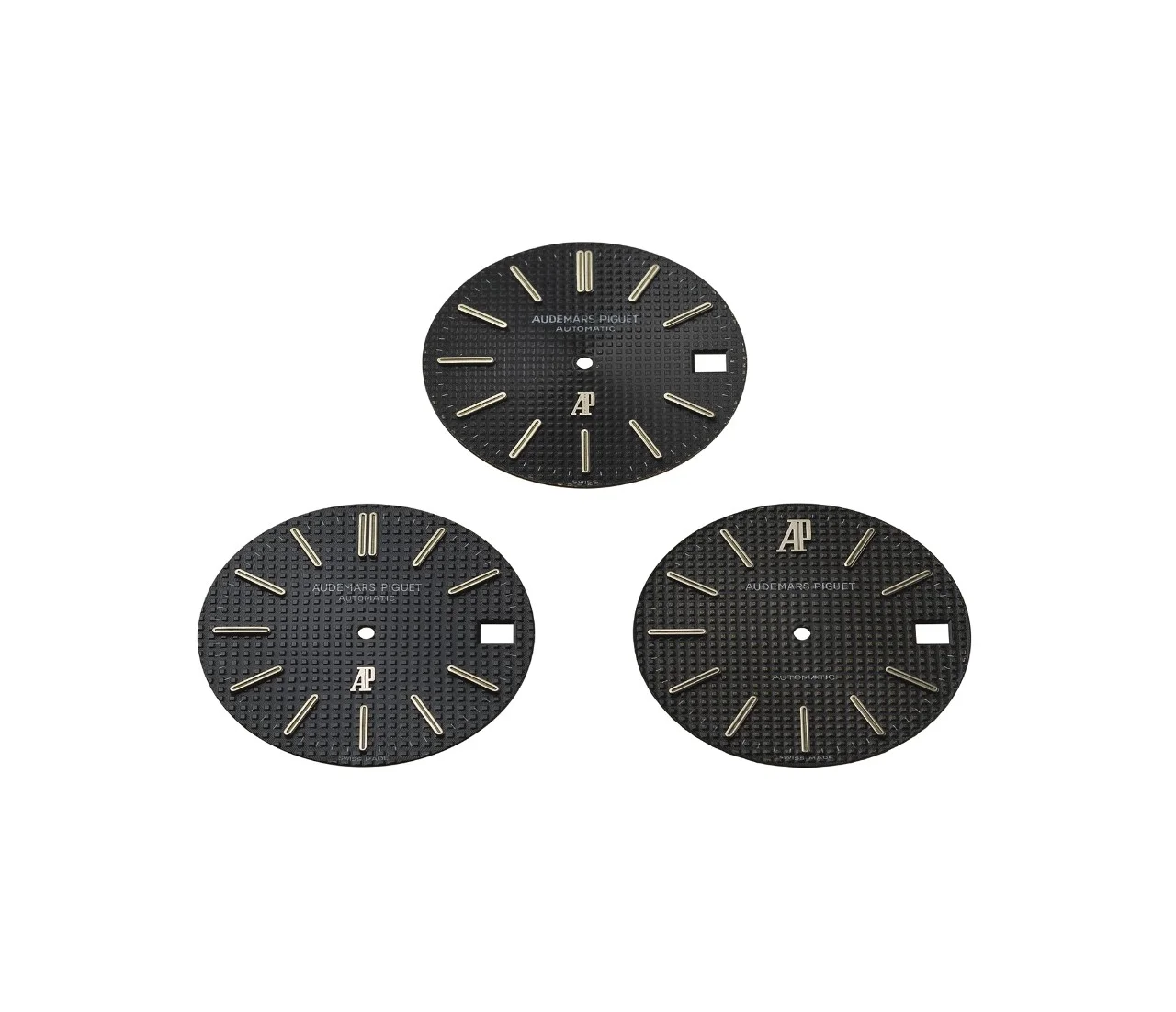
1970–1980. Three 5402ST dials. Destined to adorn Model 5402ST, these three dials present small colour variations due to the manufacturing techniques used at the time and to their different light exposure during the creation process. Audemars Piguet Archives.
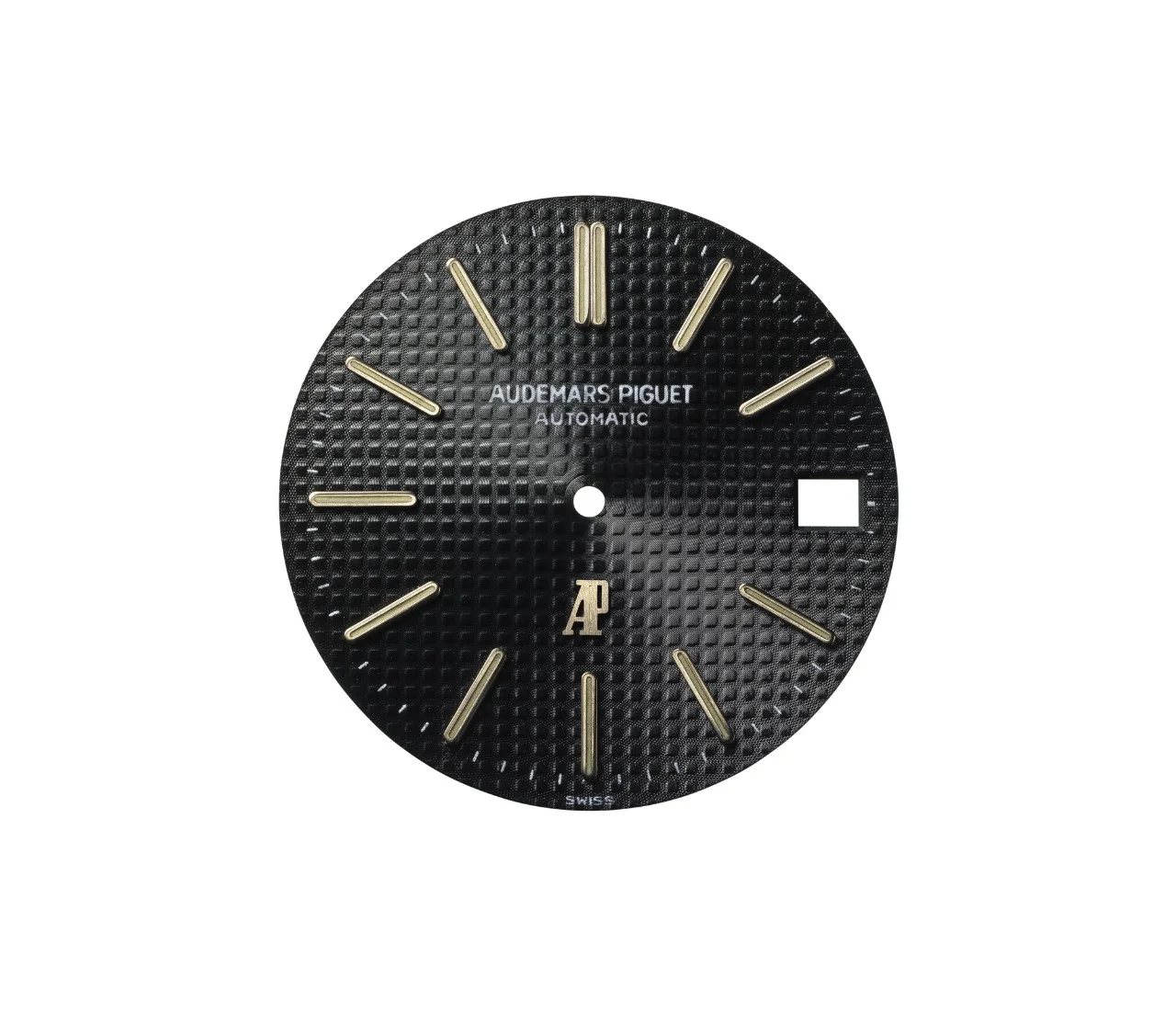
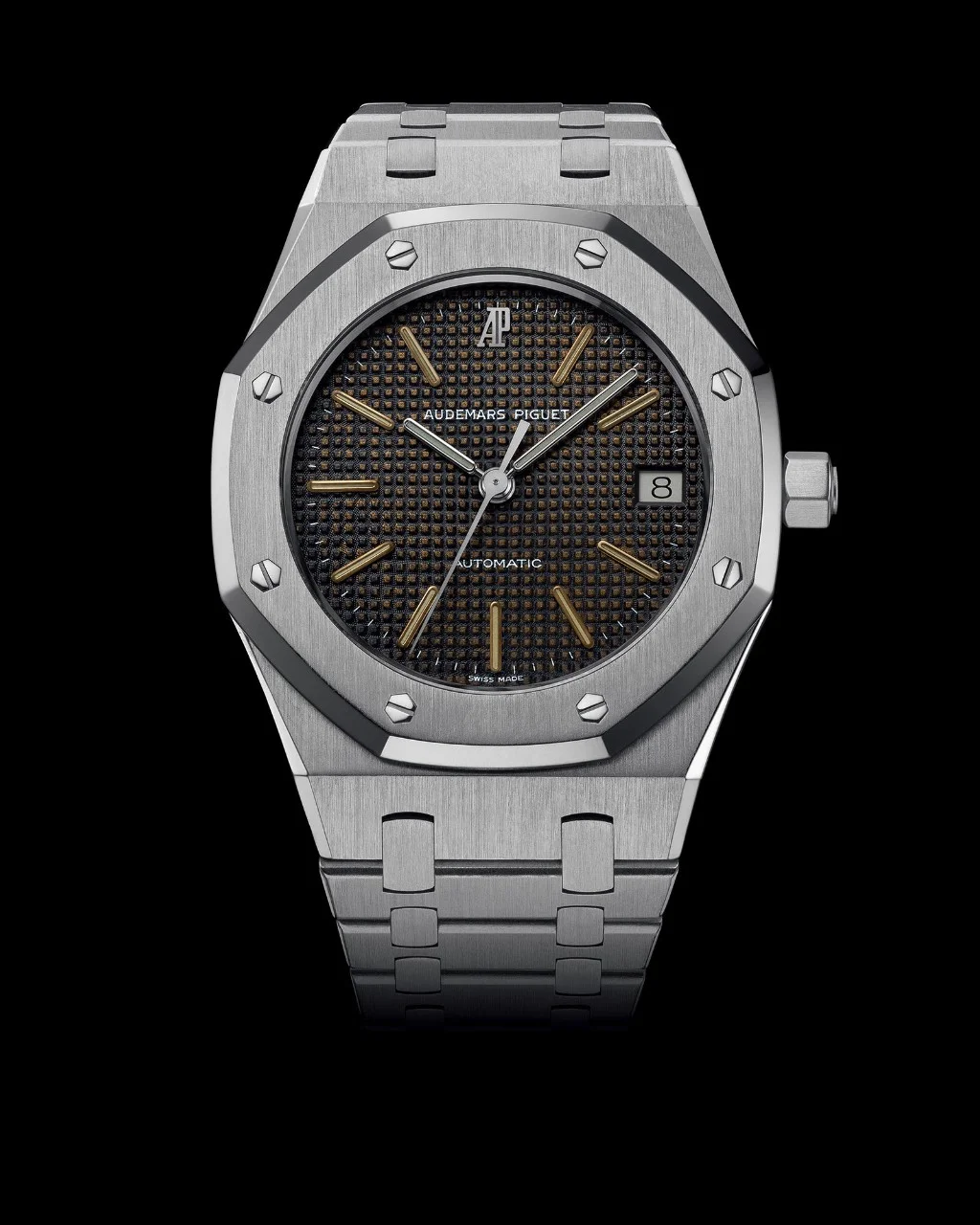
1972. Royal Oak 5402 dial. This dial adorns the Royal Oak 5402ST A26 series, case 67026, movement 127059, delivered by Audemars Piguet to the Swiss market (Gameo Lausanne) on June 16, 1972. Audemars Piguet Heritage, inv. 365.
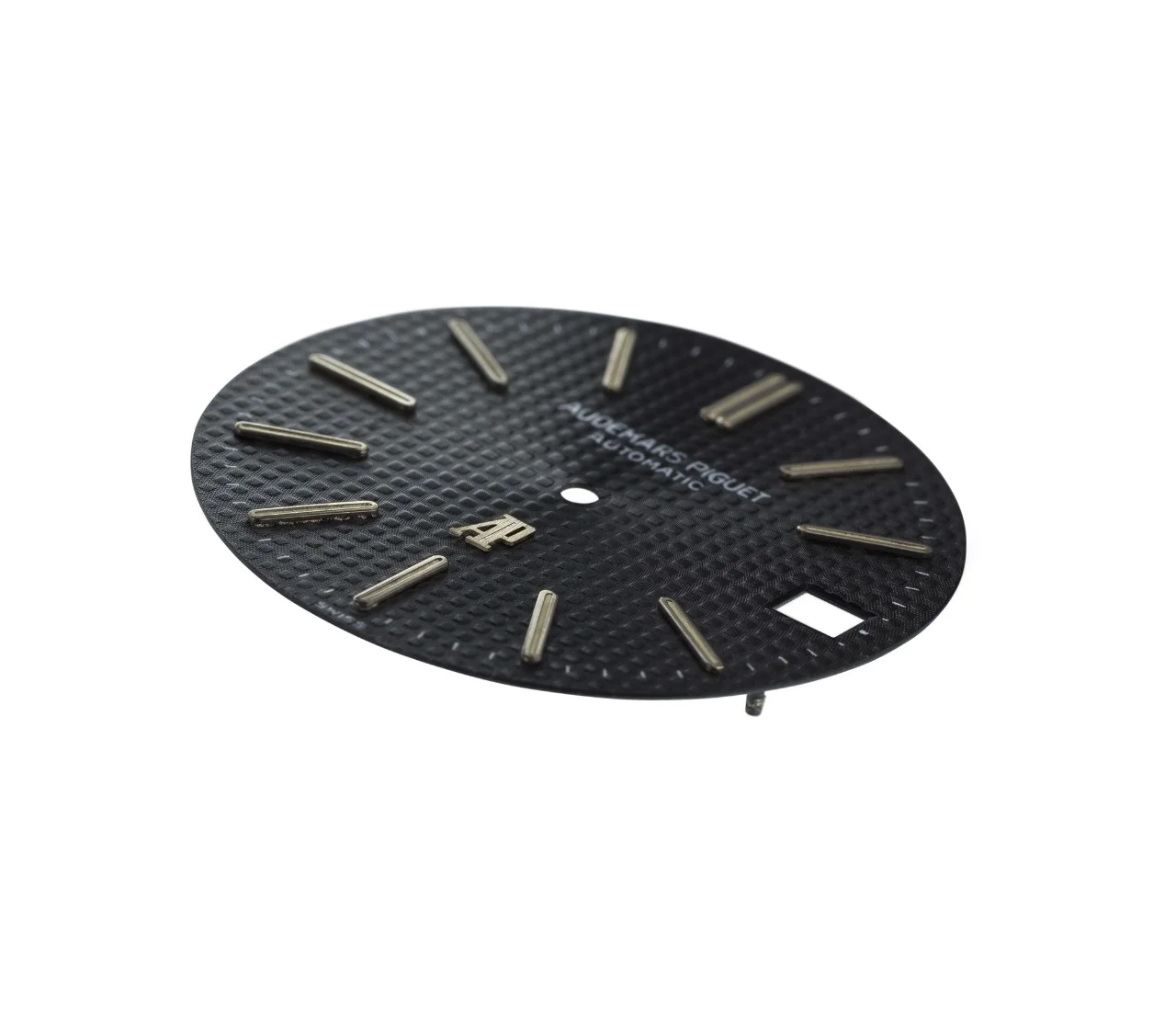
1972. Royal Oak 5402 dial This dial adorns the Royal Oak 5402ST A26 series, case 67026, movement 127059, delivered by Audemars Piguet to the Swiss market (Gameo Lausanne) on June 16, 1972. Audemars Piguet Heritage, inv. 365.
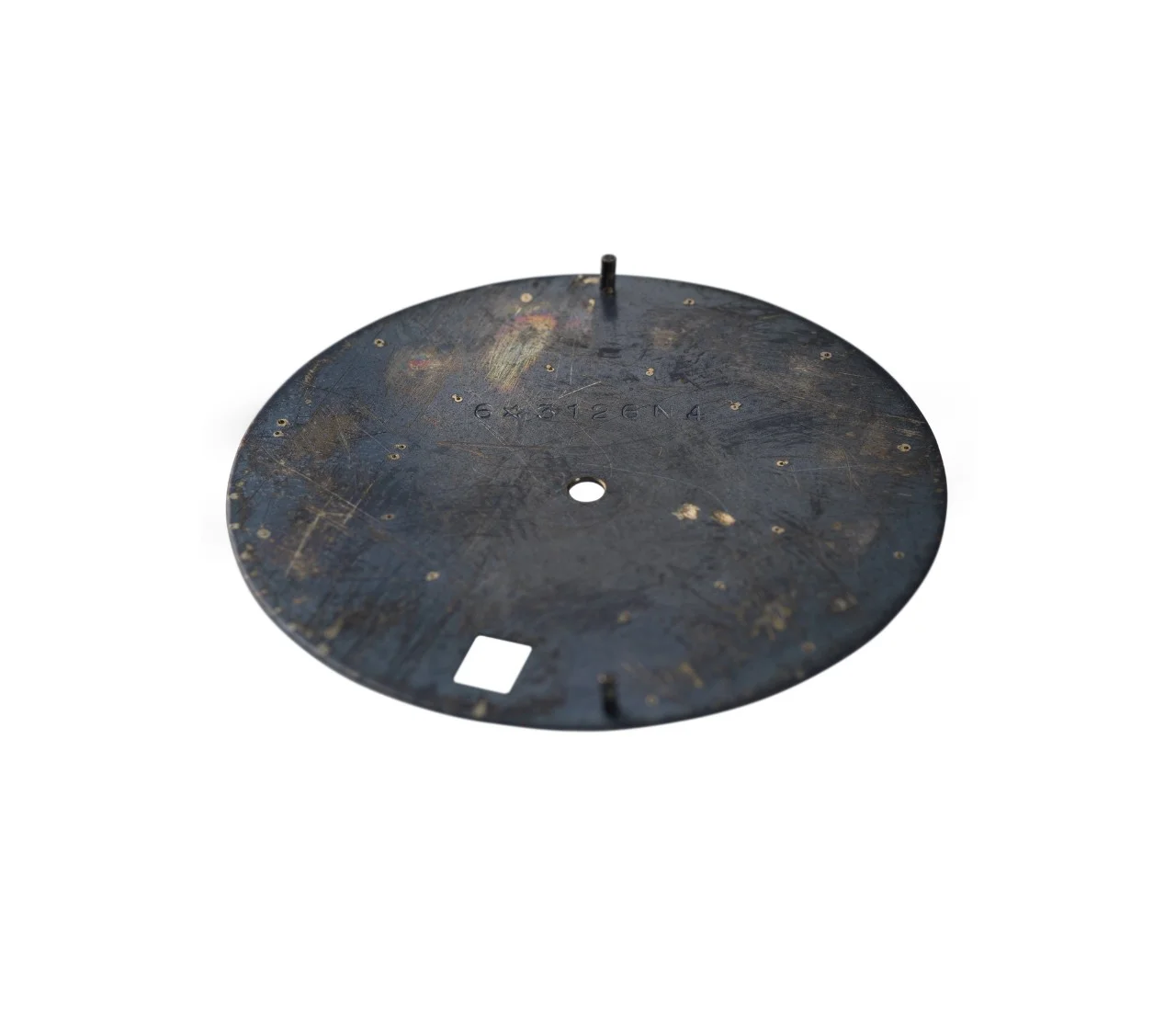
1972. Backside of the Royal Oak 5402 dial. This dial adorns the Royal Oak 5402ST A26 series, case 67026, movement 127059, delivered by Audemars Piguet to the Swiss market (Gameo Lausanne) on June 16, 1972. Protected from light, the back of the watch has retained its original bluish hue. Audemars Piguet Heritage, inv. 365.
Calibre 2121
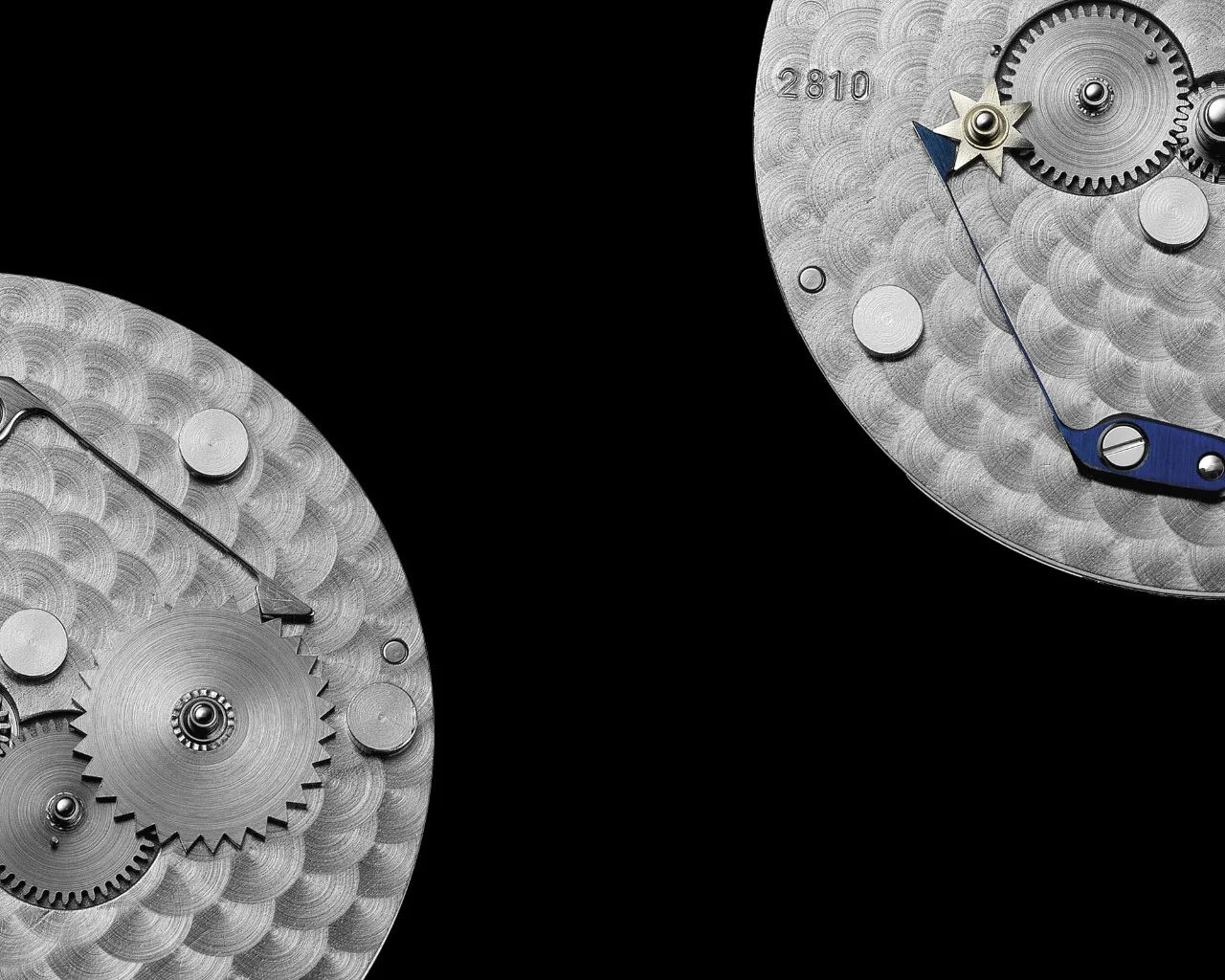
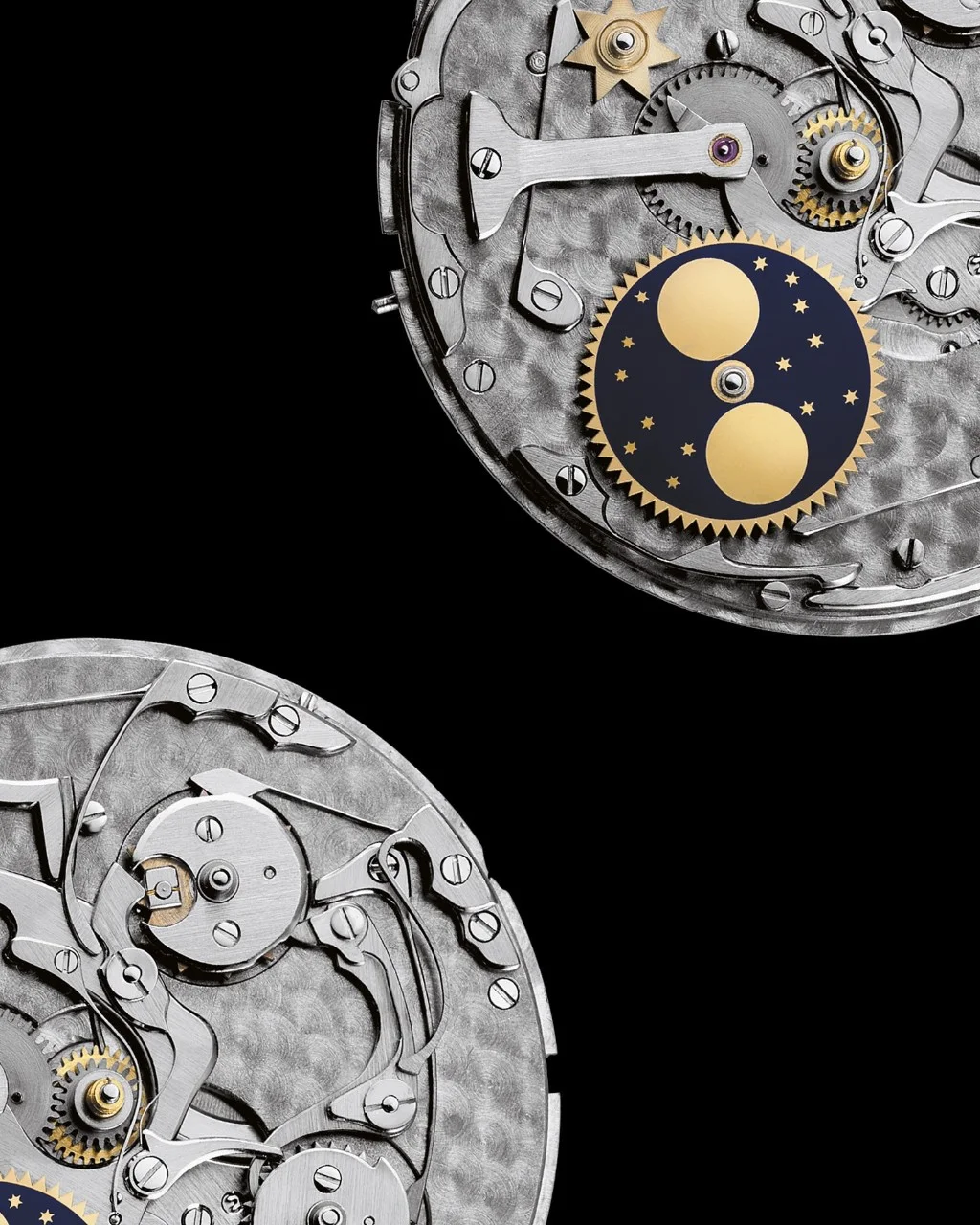
To equip the future Royal Oak, Audemars Piguet and Gérald Genta chose the world's thinnest mechanical selfwinding movement with date: the famous Calibre 2121 derived from the 2120. At 3.05 mm thick and 12½ lignes (28 mm) in diameter, this now legendary calibre corresponds to what watchmakers colloquially call a tracteur (tractor), in that it combined power with reliability and resistance, despite its extreme thinness.
Calibre 2120 was born in 1967 from the collaboration of three renowned companies, which by then had forged close links in terms of both production and distribution: LeCoultre & Cie, Audemars Piguet and Vacheron Constantin. A letter dated June 9, 1964, sent by Audemars Piguet to its main supplier of "ébauches", LeCoultre & Cie, informs us of the importance of the issue but also of the difficulties of realisation: “For three or four years now, we have been making our customers wait, as they are less and less able to understand why the specialists in extra-thin and luxury watches are still offering automatic watches that are among the thickest.” Coordination meetings were held at the highest levels of the three companies. On August 19, 1966, for example, Jacques-Louis Audemars, Chairman of the Board of Directors and Creative Director of Audemars Piguet, met at the LeCoultre Manufacture with André Goy, Deputy General Manager of Vacheron Constantin, Jean Lebet, Technical Director of LeCoultre & Cie, and Maurice Audemars, who is generally credited with the creation of Calibres 2003 and 2120.
In 1967, the Audemars Piguet 5271 Model was the first to be equipped with Calibre 2120. Its central weight on rollers (patented system) was signed “Audemars-Piguet” and its total thickness was 2.45 mm. Designed by Genta, it was followed by more than 10 models the same year. From then on, this calibre played a major role in Audemars Piguet production, equipping more than 650 watches as of 1967. Launched in 1970, its derivative 2121 added the date function, which slightly increased its thickness to 3.05 mm. It equipped all Royal Oak “Jumbo” watches until the end of 2021.
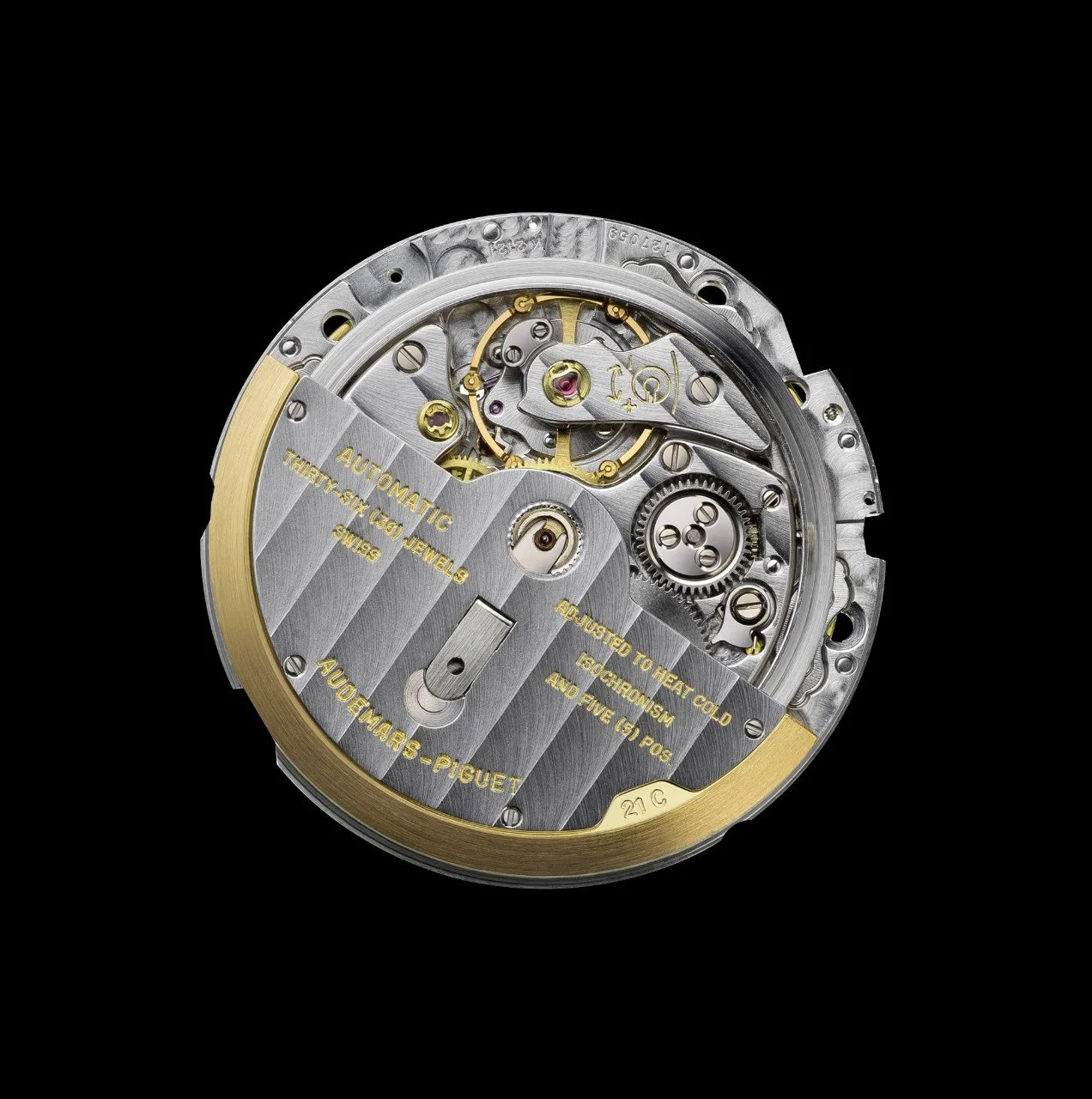
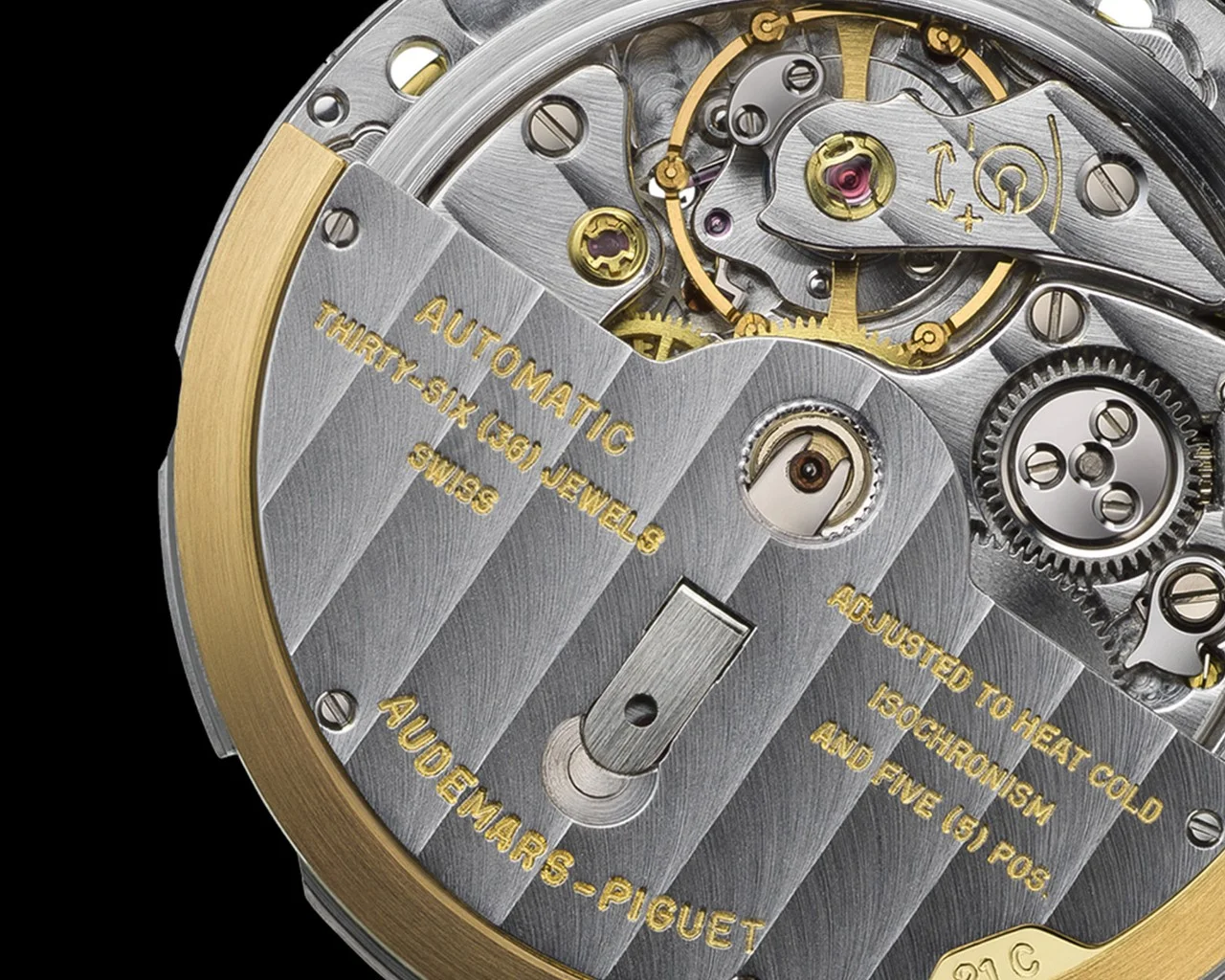
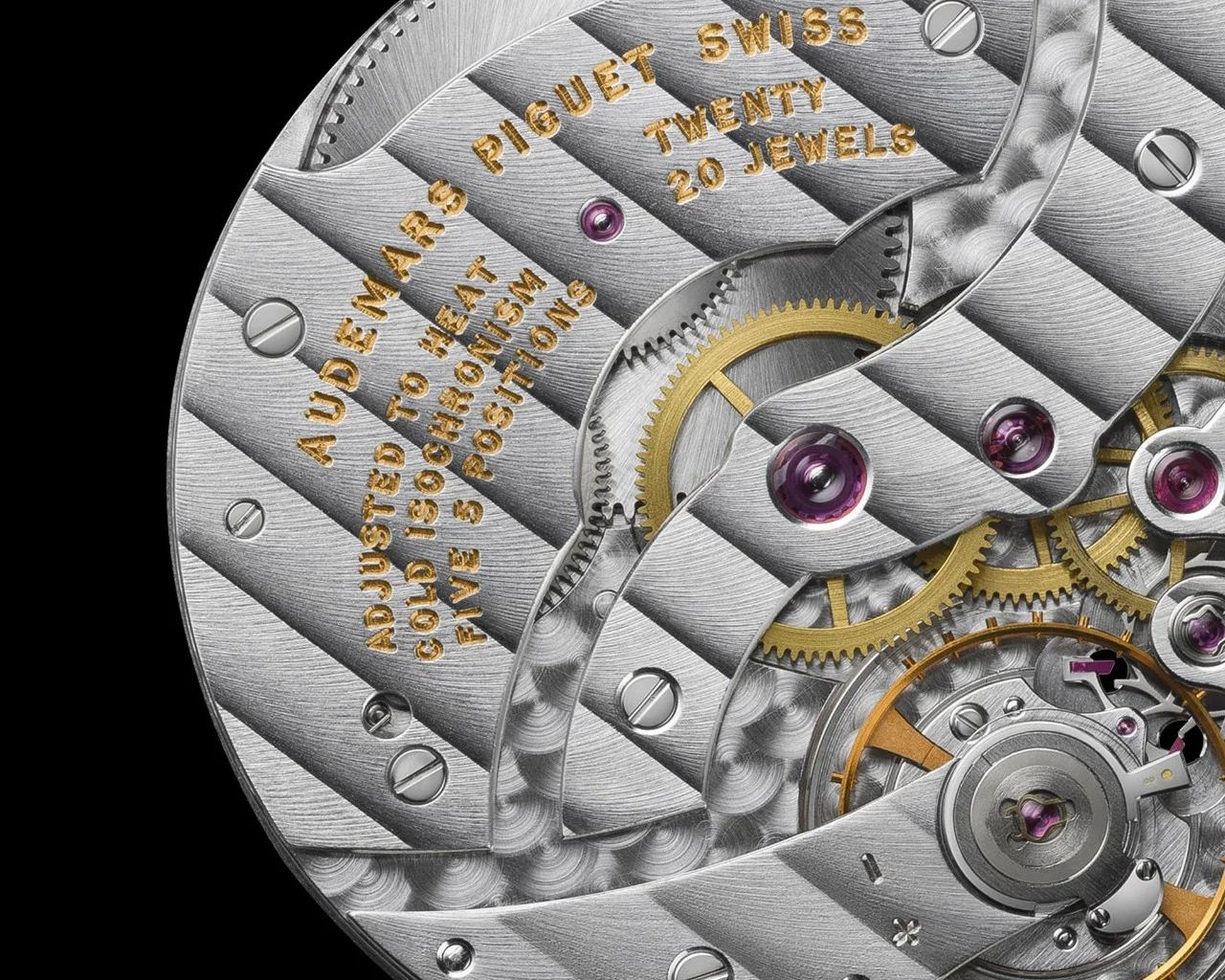
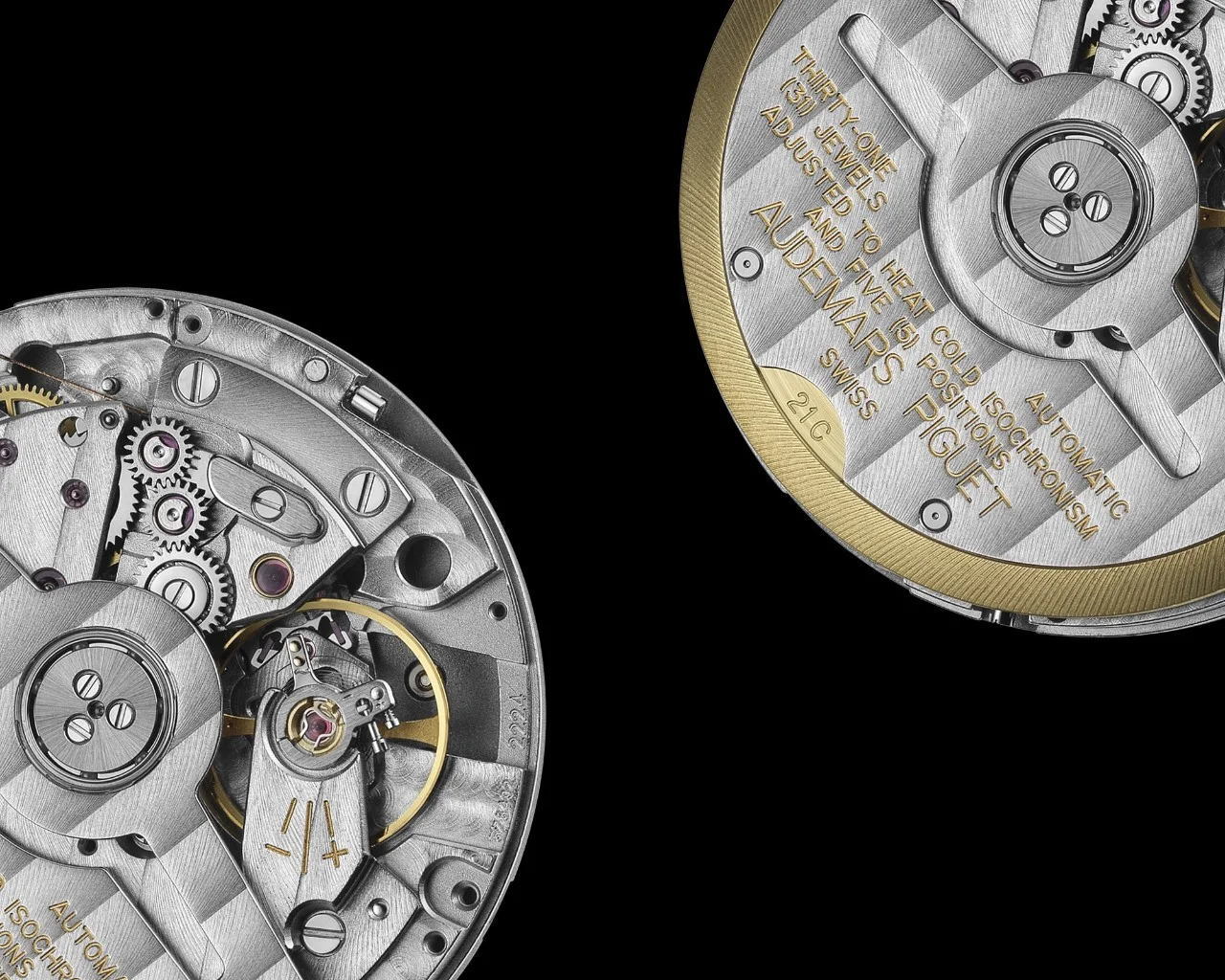
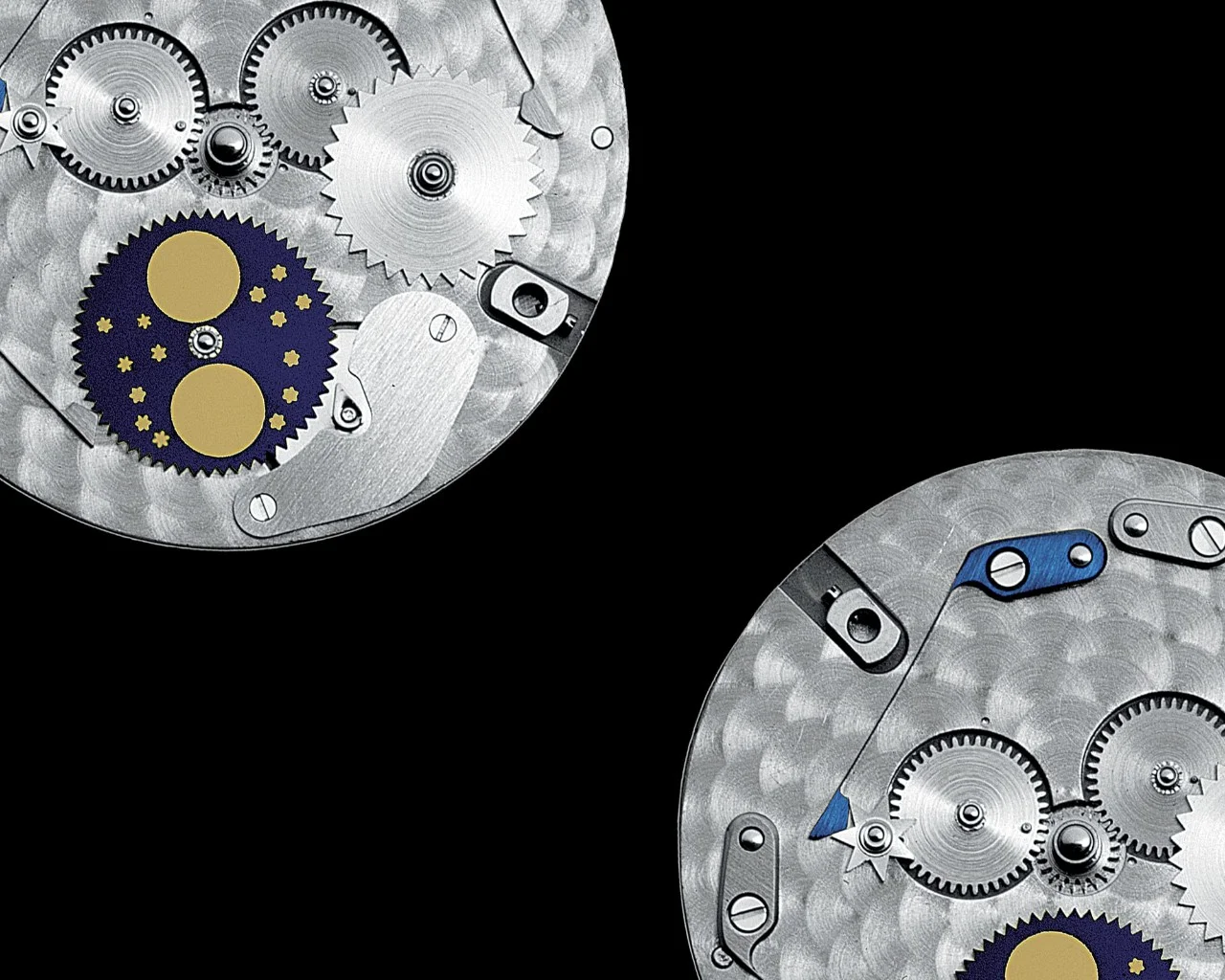
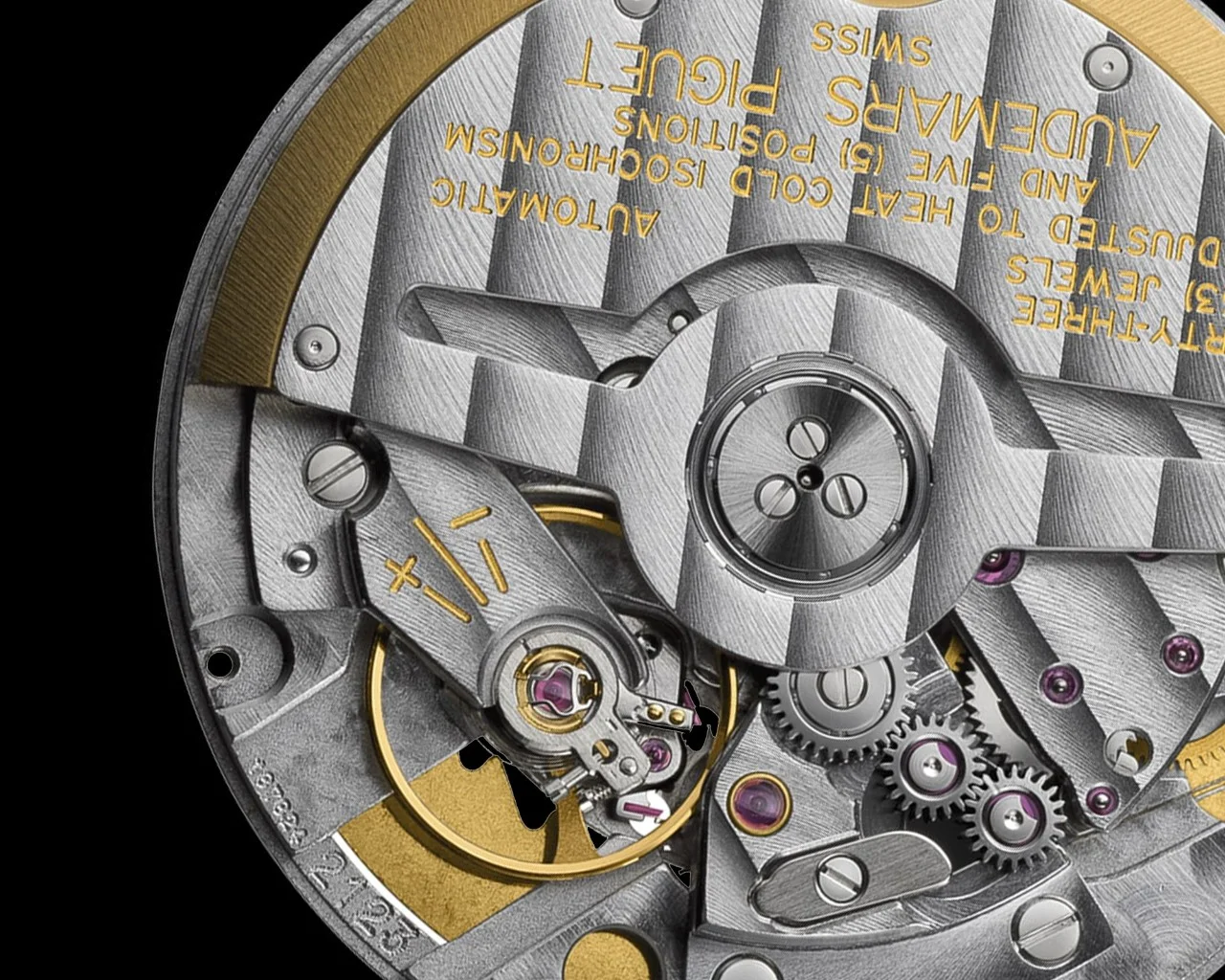
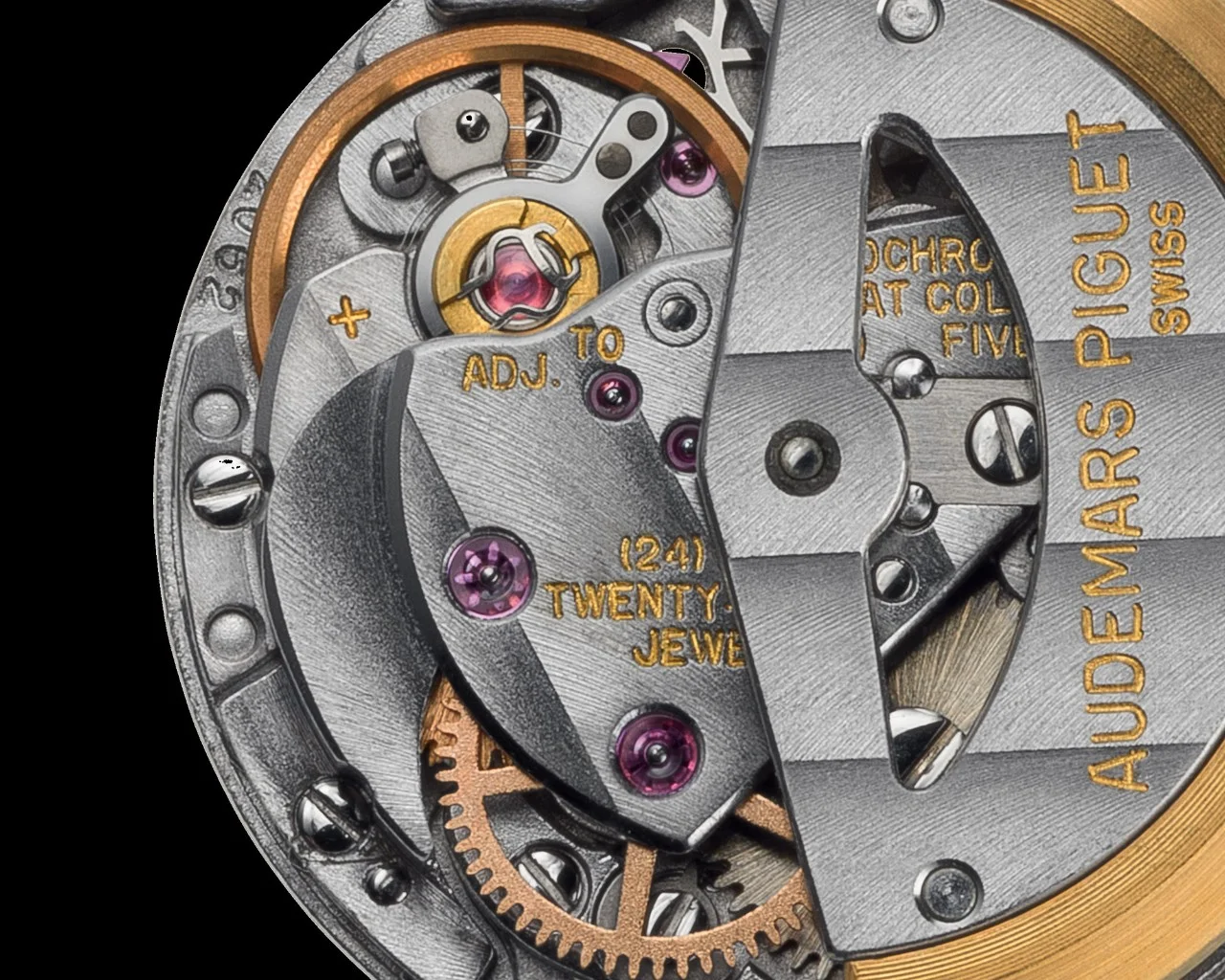
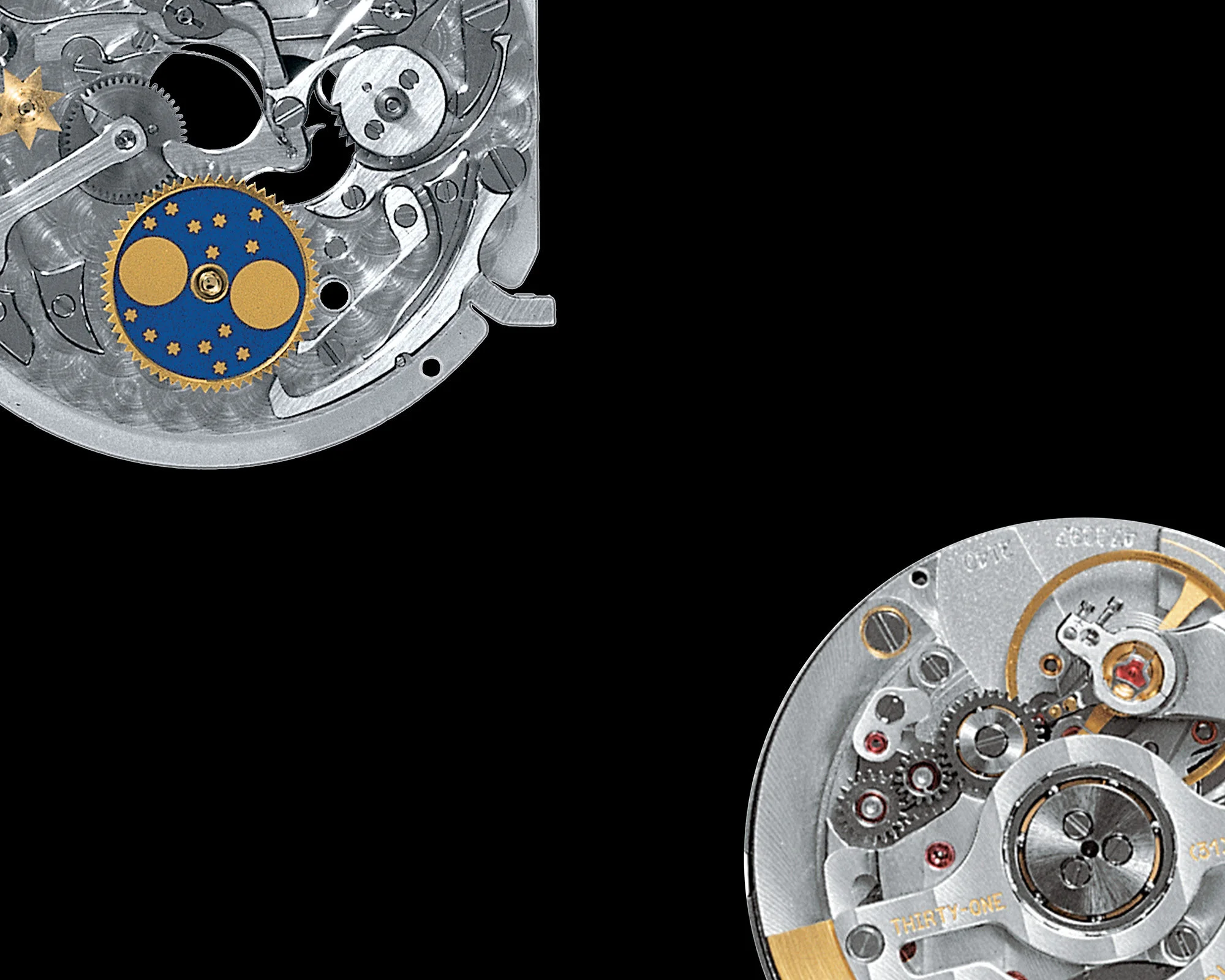
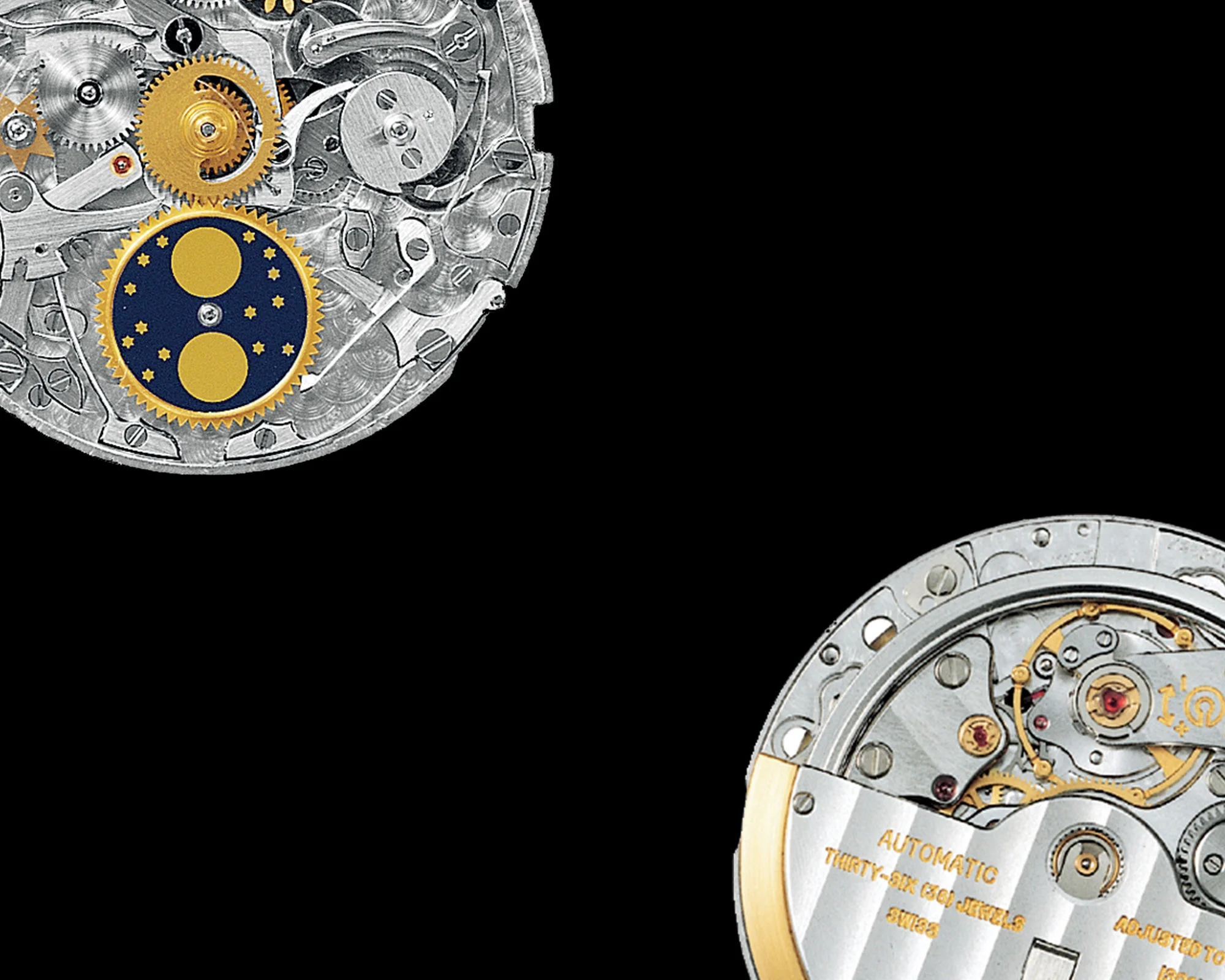
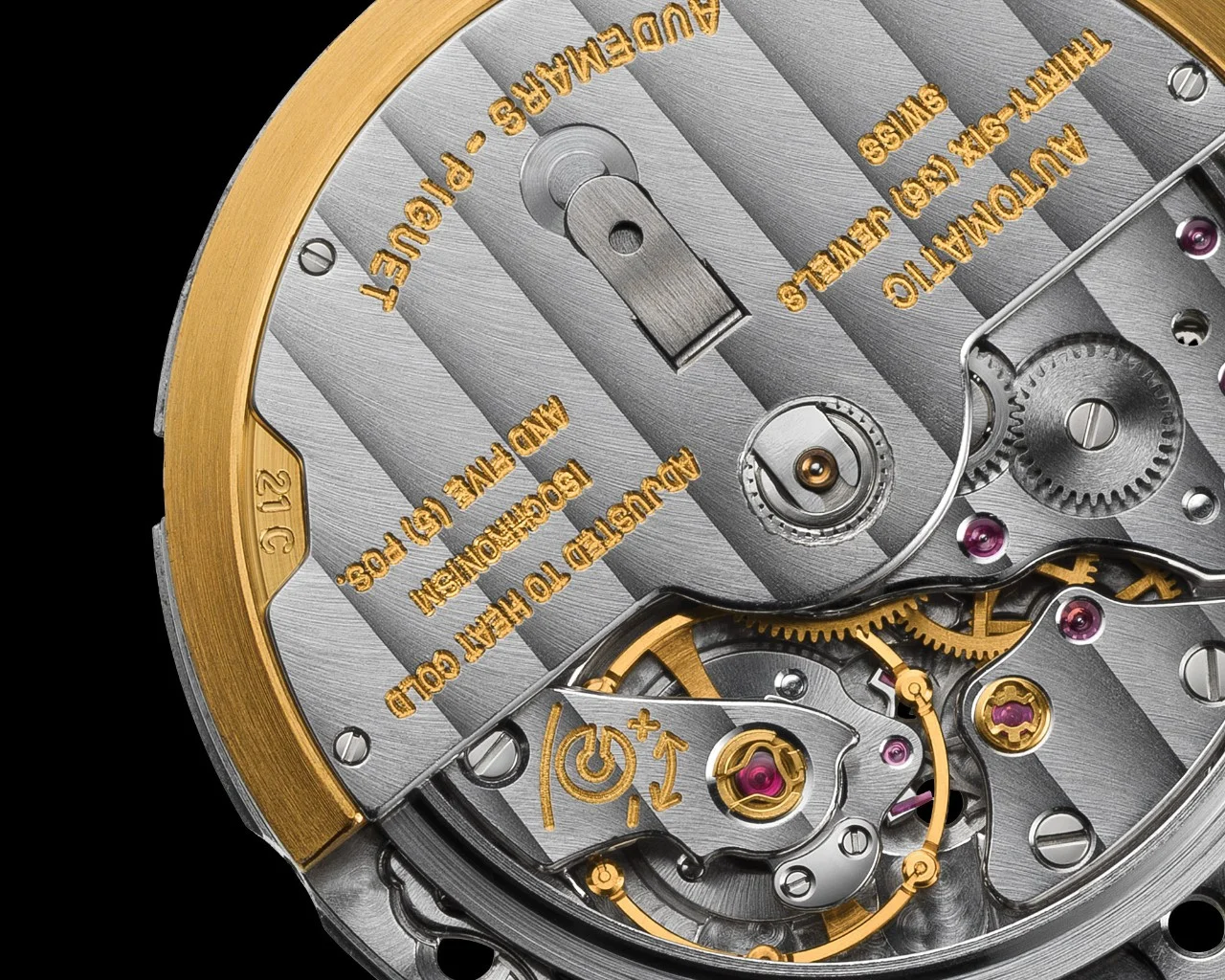
1967–2011. Calibres 2120 and 2121, caseback side. Extra-thin selfwinding calibres. Diameter of 28 mm (12½ lignes). The aesthetic on the caseback side is similar for Calibre 2120 (between 1967 and 2006) and Calibre 2121 (between 1970 and circa 2011). Movement 127053 produced in 1970. Audemars Piguet Heritage, inv. 365.
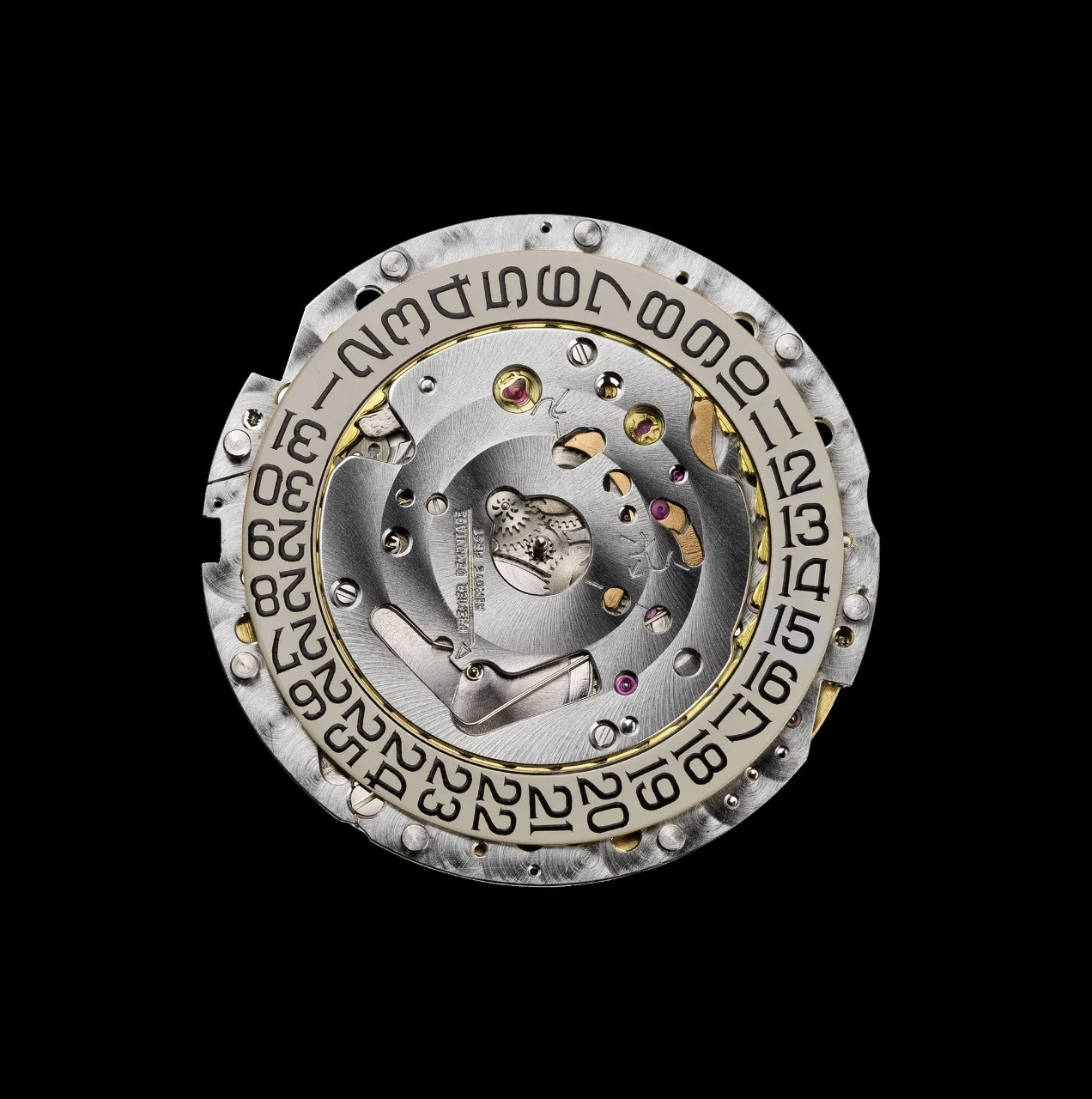
1971. Calibre 2121, dial side. Thinnest selfwinding calibre with central rotor and date indication of its time (3.05 mm). Rotor supported by ruby rollers oscillating on a circular rail. Diameter of 28 mm (12½ lignes). 247 parts, 19,800 vph. Derived from Calibre 2120 (1967). Movement 127053. Audemars Piguet Heritage.
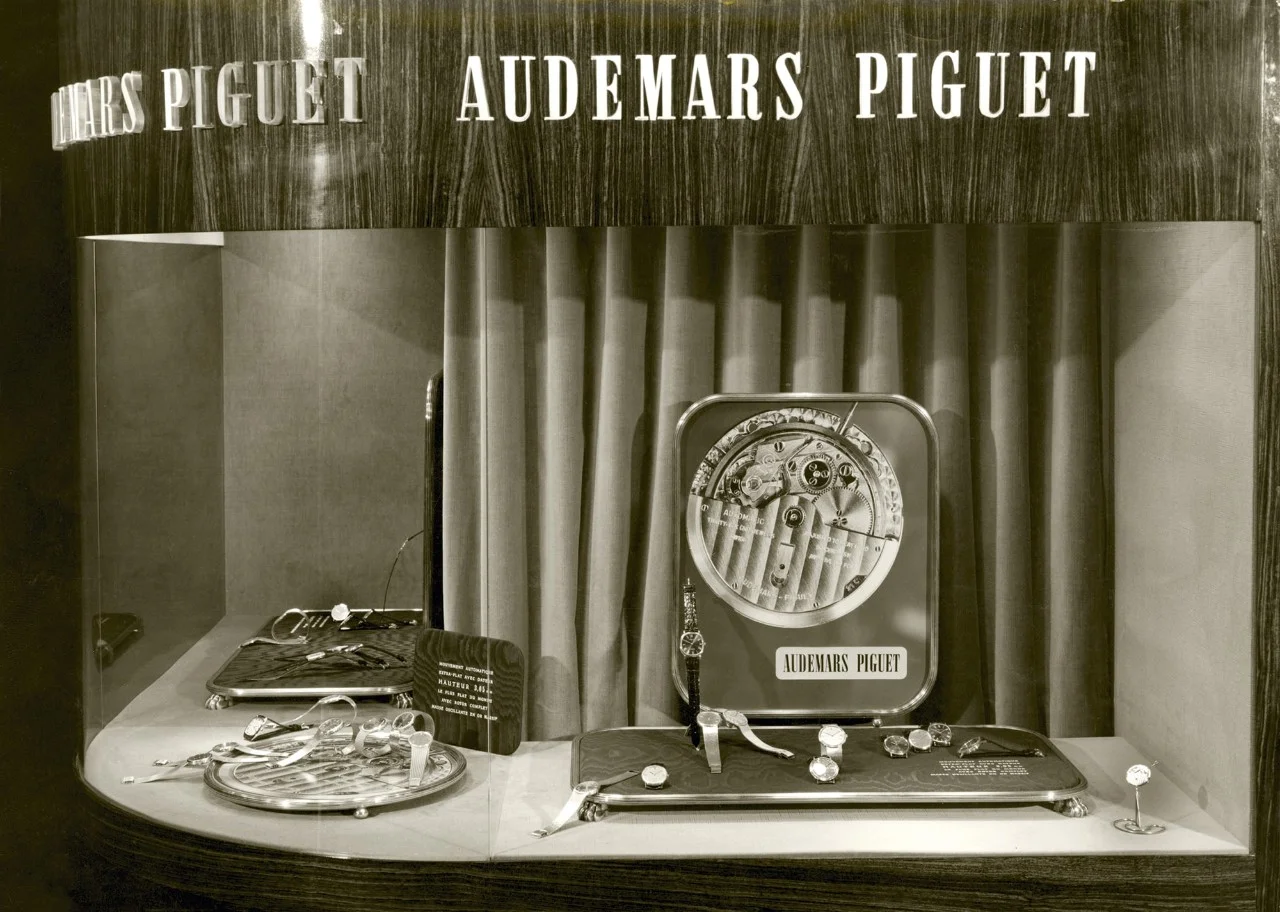
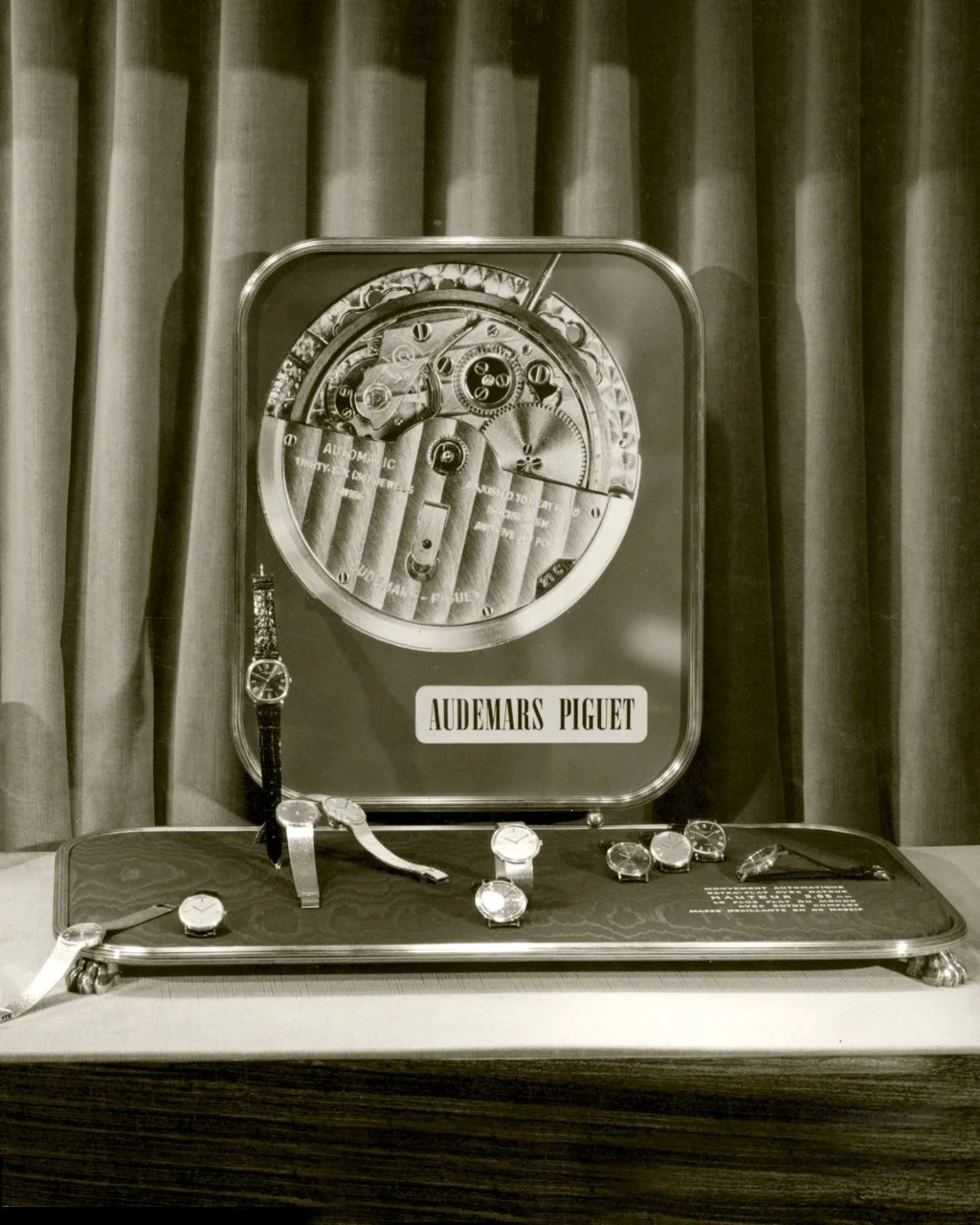
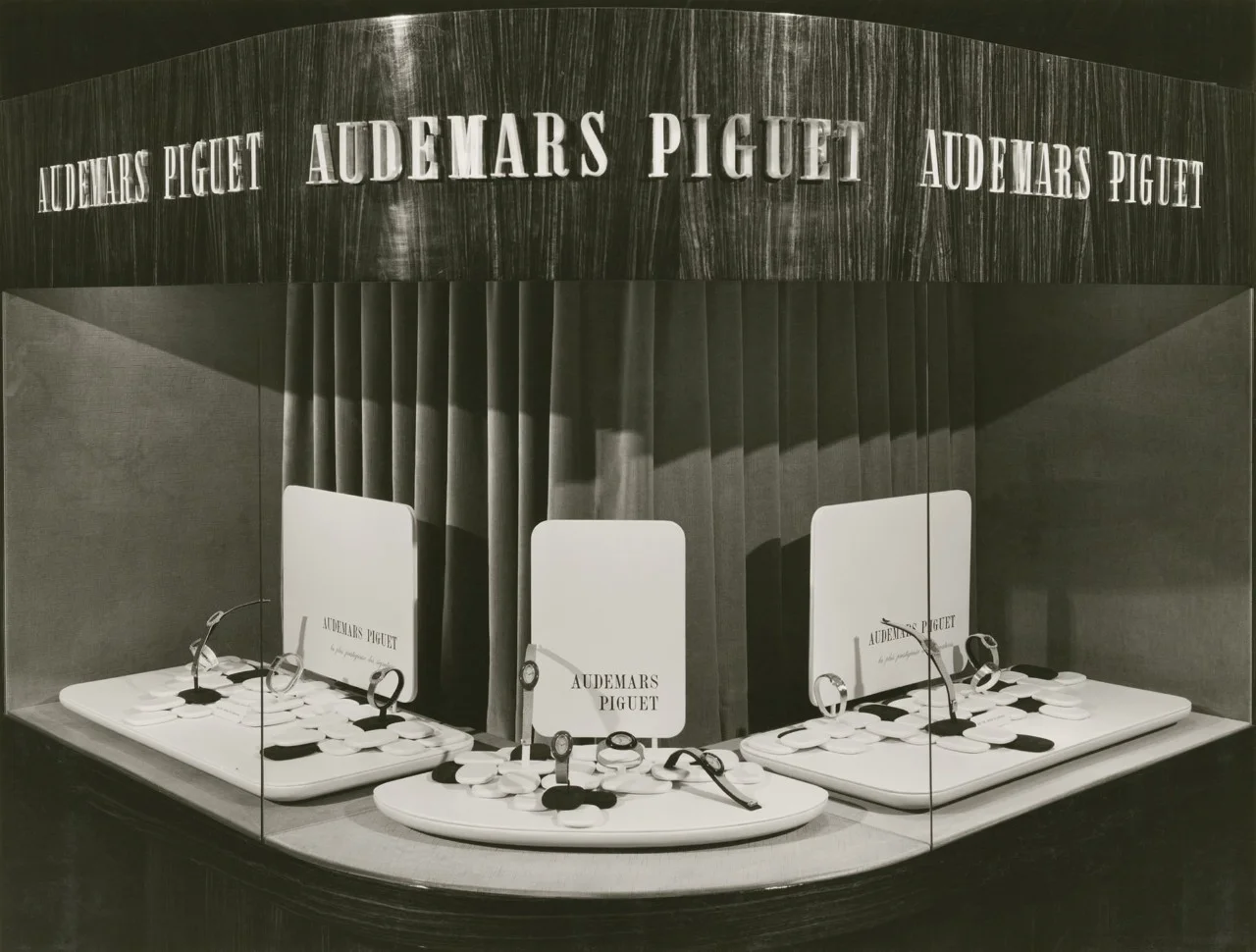
1970. Audemars Piguet Showcase at the Basel Fair. Since the 1950s, Audemars Piguet has been recognised as one of the main experts in ultra-thin watches. In 1970, this status was confirmed by the launch of Calibre 2121, the thinnest in its category, which came to equip the Royal Oak two years later. Audemars Piguet Archives.
First Bracelets Made by Gay Frères
The Royal Oak bracelet designed by Genta was far from the first integrated steel bracelet. It was however the most complex ever made from this material and featured 154 components, among which 34 were of different sizes. Its aesthetics and technicality enabled it to unite two previously separate worlds: craftsmanship, stemming from the history of jewellery, in which Audemars Piguet had excelled for several decades; and steel sports bracelets, stemming from collections of water-resistant watches produced in very large series by companies such as Omega or Rolex. The aim was to manufacture the first ever sports bracelet in accordance with the rules of artistic craftsmanship.
To make such an achievement possible, Audemars Piguet turned to one of the greatest specialists: the Geneva-based company Gay Frères. Founded in 1835 by Jean-Pierre Gay and Gaspar Tissot, this company initially specialised in chains but reconverted to watch bracelets in the 20th century. It made a name for itself by cooperating with Rolex (which bought it up in 1998), for which it notably manufactured the Oyster bracelet, as well as with the main Swiss watch firms, including Patek Philippe (for its rice grain bracelet) and Chopard. In the 1970s, Gay Frères was the undisputed master of steel bracelets. Its Geneva workshops employed more than 500 people, five times more than Audemars Piguet.
Despite their experience and the quality of their tools, the Gay Frères artisans were never able to attain the level of Audemars Piguet’s finishing requirements. Thus, like the cases produced by Favre-Perret, each bracelet had to be reworked manually by the Le Brassus watchmakers during the casing-up process. Even after the 1972 launch, several improvements had to be made to achieve the expected degree of quality and ergonomics, in particular to ensure the perfect tapering of the links attached to the case. As the Royal Oak collection grew, several other firms took on this ambitious and delicate production, including Fontana, Lascor, GTF and then Centror, which is currently the Audemars Piguet Meyrin subsidiary.
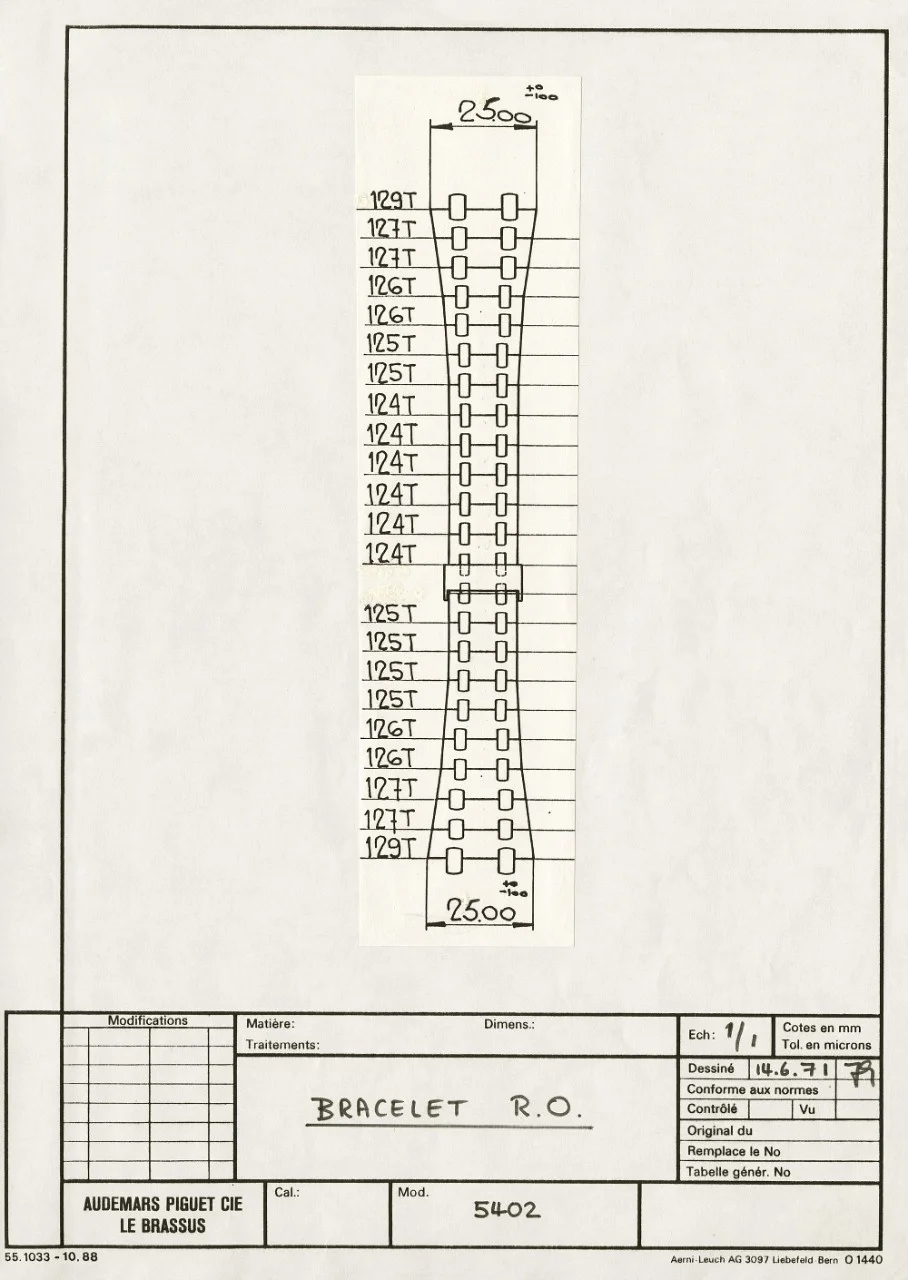
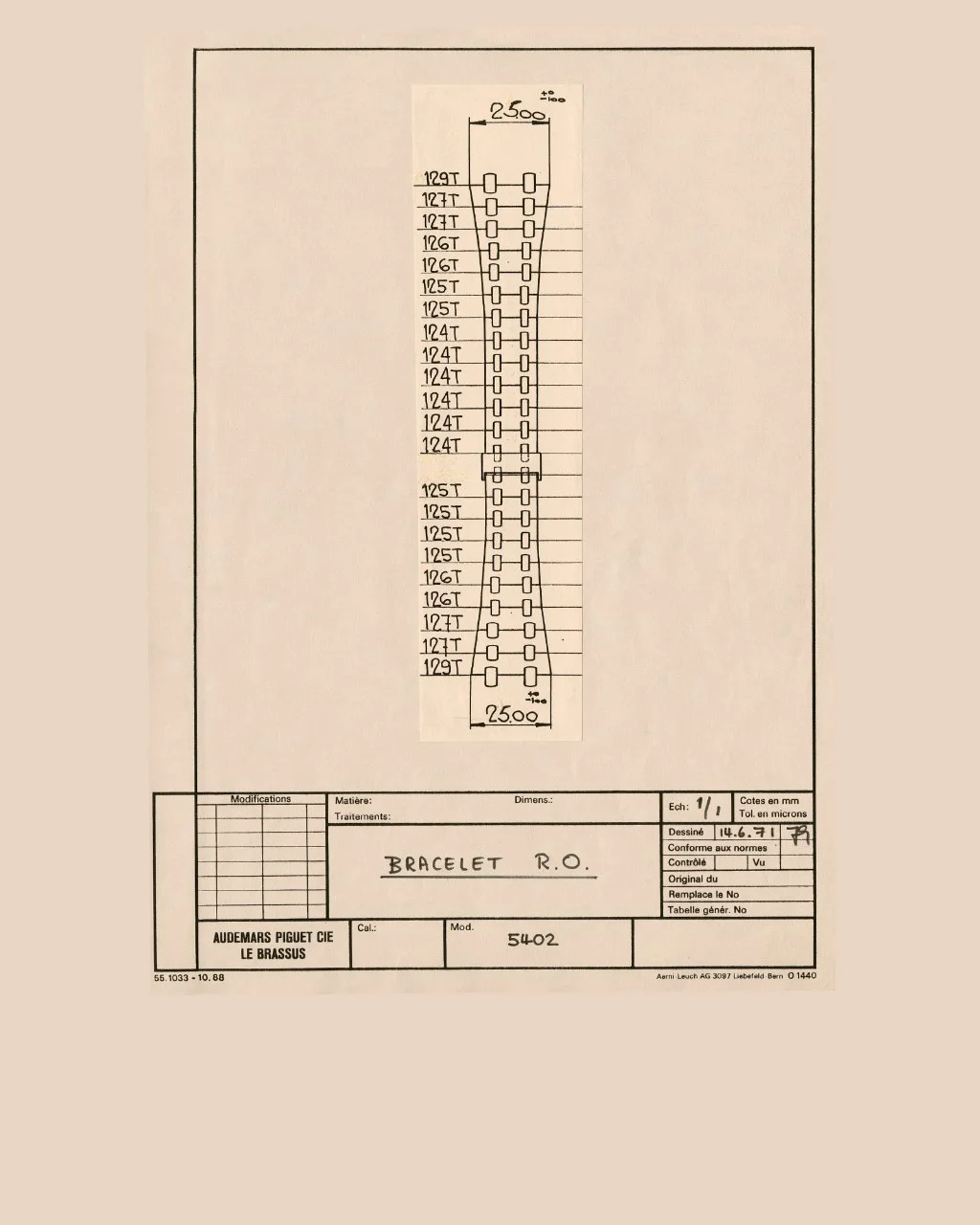
1971. Sketch of the studs on the first Royal Oak bracelet. This drawing highlights the fact that the studs that attach the tapered links are themselves of different sizes. Audemars Piguet Archives.
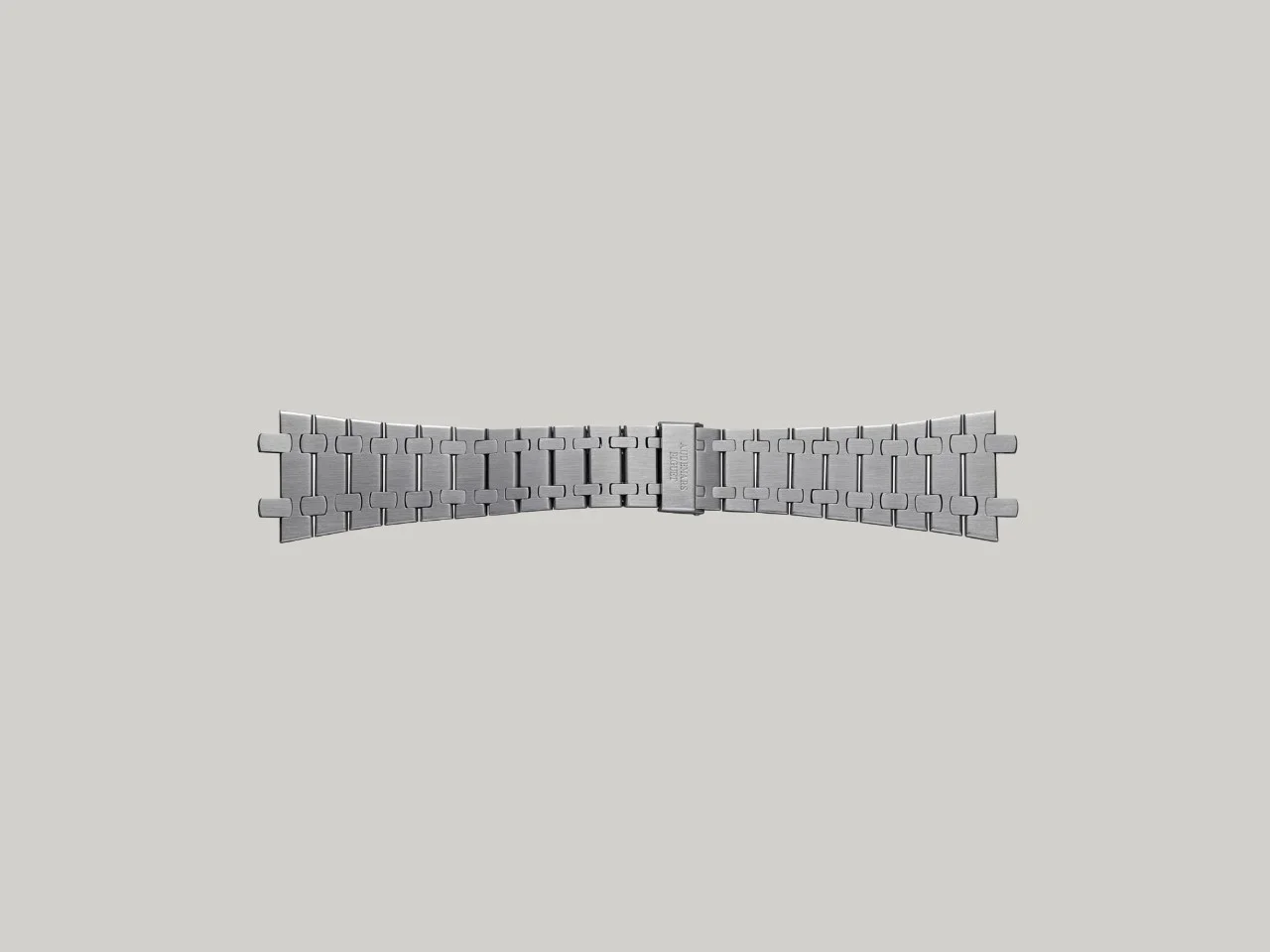
1972. First Royal Oak bracelet This bracelet 344 adorns the Royal Oak 5402ST A26 series, case 67026, movement 127059, delivered by Audemars Piguet to the Swiss market (Gameo Lausanne) on June 16, 1972. Audemars Piguet Heritage, inv. 365.
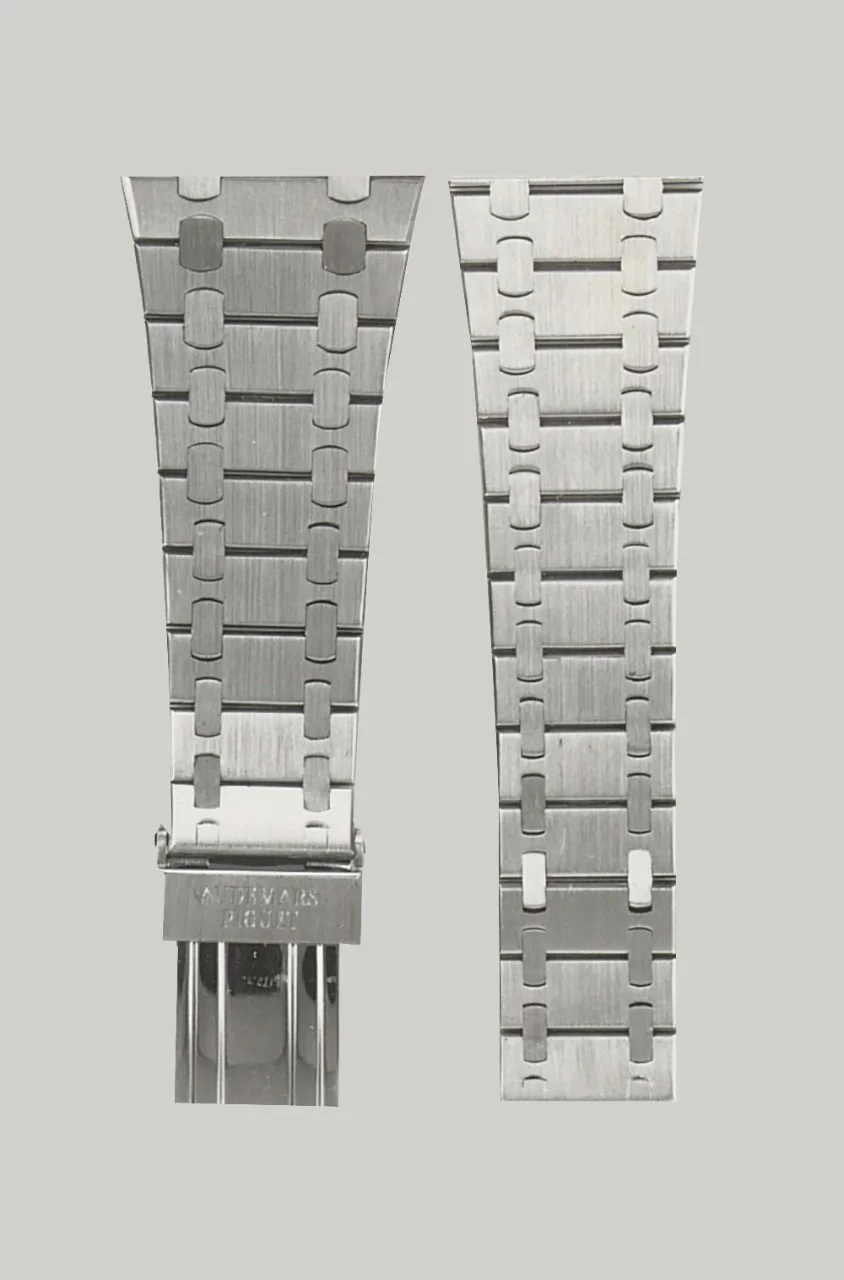
1972. Bracelet 344. Manufactured by the Geneva-based firm Gay Frères, bracelet no. 344 was used on the first-generation Royal Oak 39mm ultra-thin watches. From the end of the 1980s, it was gradually replaced by bracelet no. 944. Bracelet directory. Audemars Piguet Archives.
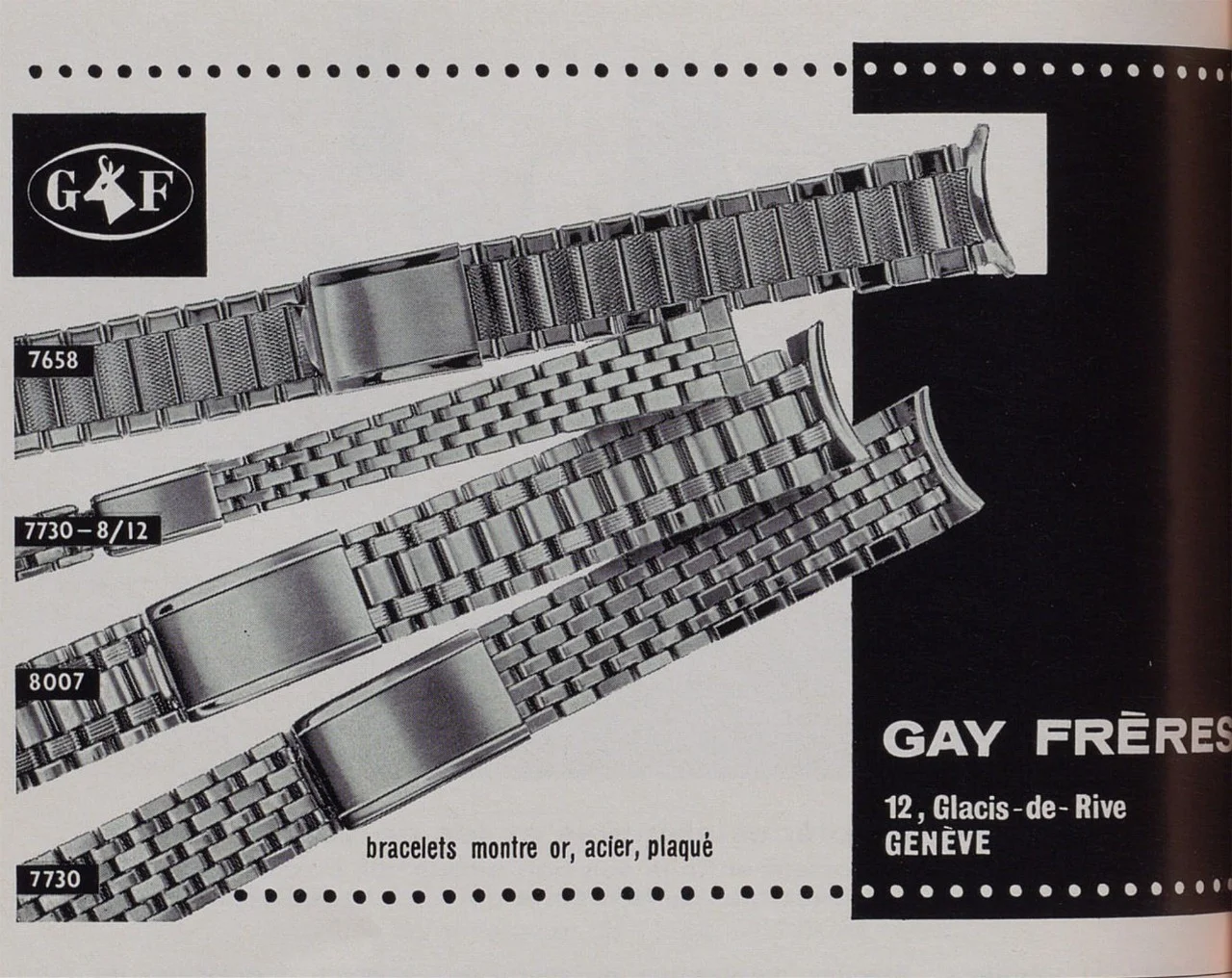
1970. Gay Frères Advertisement Before the Royal Oak, the metal bracelets manufactured by Gay Frères were rarely tapering. Their folding clasp was covering. © Europa Star 1970, Trade Bulletin, 687, 11/12, p. 14.
Presentation of the First Prototype in Basel and... Genta’s Departure
By April 1971, a full year had passed since Genta’s first sketch. As the Basel Fair was about to open, Georges Golay took advantage of the presence of the “three musketeers” to discreetly introduce them to the future Royal Oak’s white gold prototype. It was immediately clear that Audemars Piguet had something which would create a stir! Carlo de Marchi and Charles Bauty each agreed to buy 400 units, making a total of 800 watches. Georges Golay decided to produce a first series of 1,000 in steel, assuming that it would be easy to distribute the 200 additional examples to the rest of the world. The development took another year and was done without Gérald Genta.
An entrepreneur at heart, Genta had long wanted to step out of the shadows and create his own brand. In 1969, he had already taken a first step in this direction: “I had already secretly prepared my collection and on December 25, 1969 I arranged a meeting with the Fred company which placed an order for 120 watches.
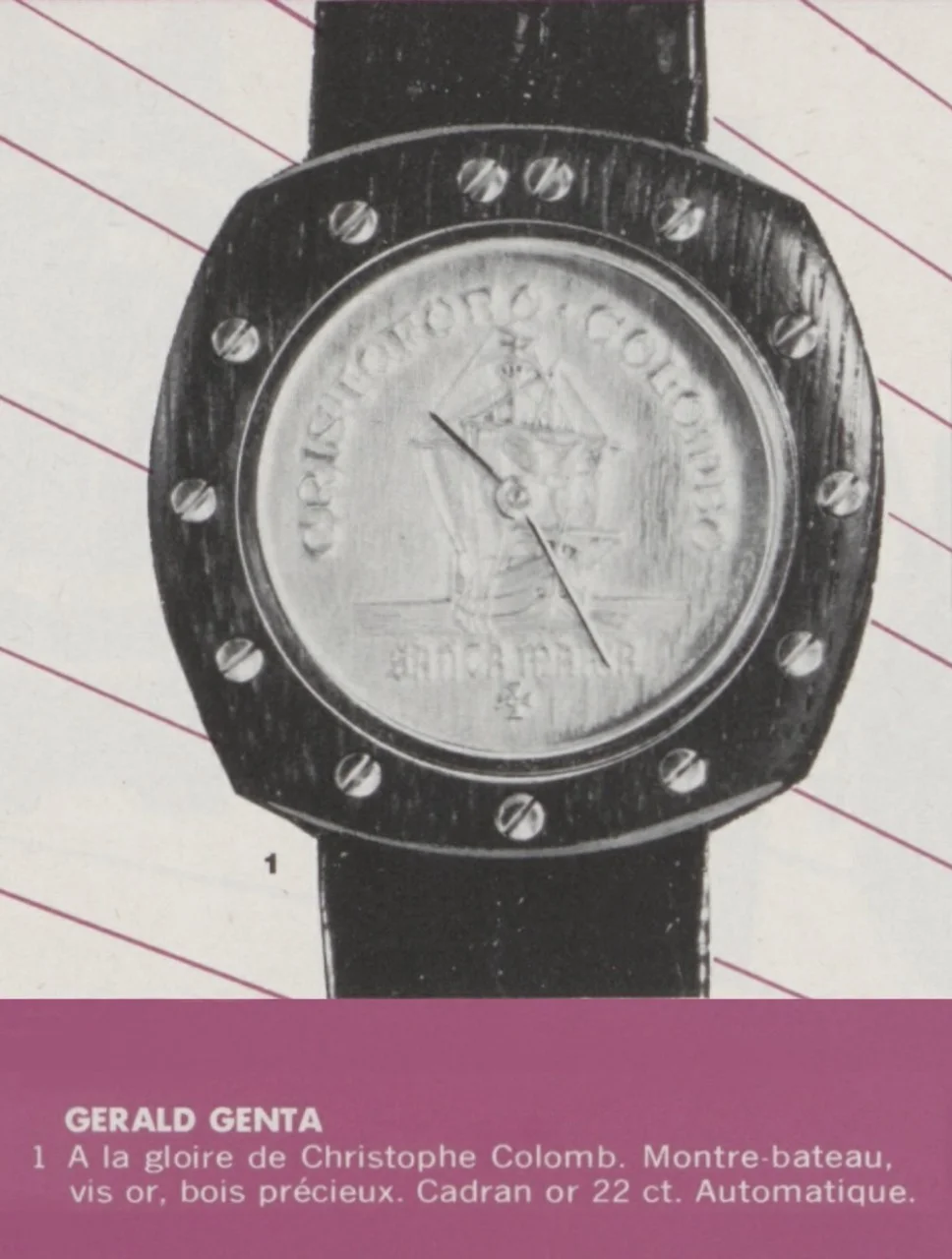
Relations with Audemars Piguet ended in 1972 when Gérald Genta presented in Basel the first model from his brand: a wooden watch with a bezel punctuated by 13 gold screws.
A Limited Edition of 1,000?
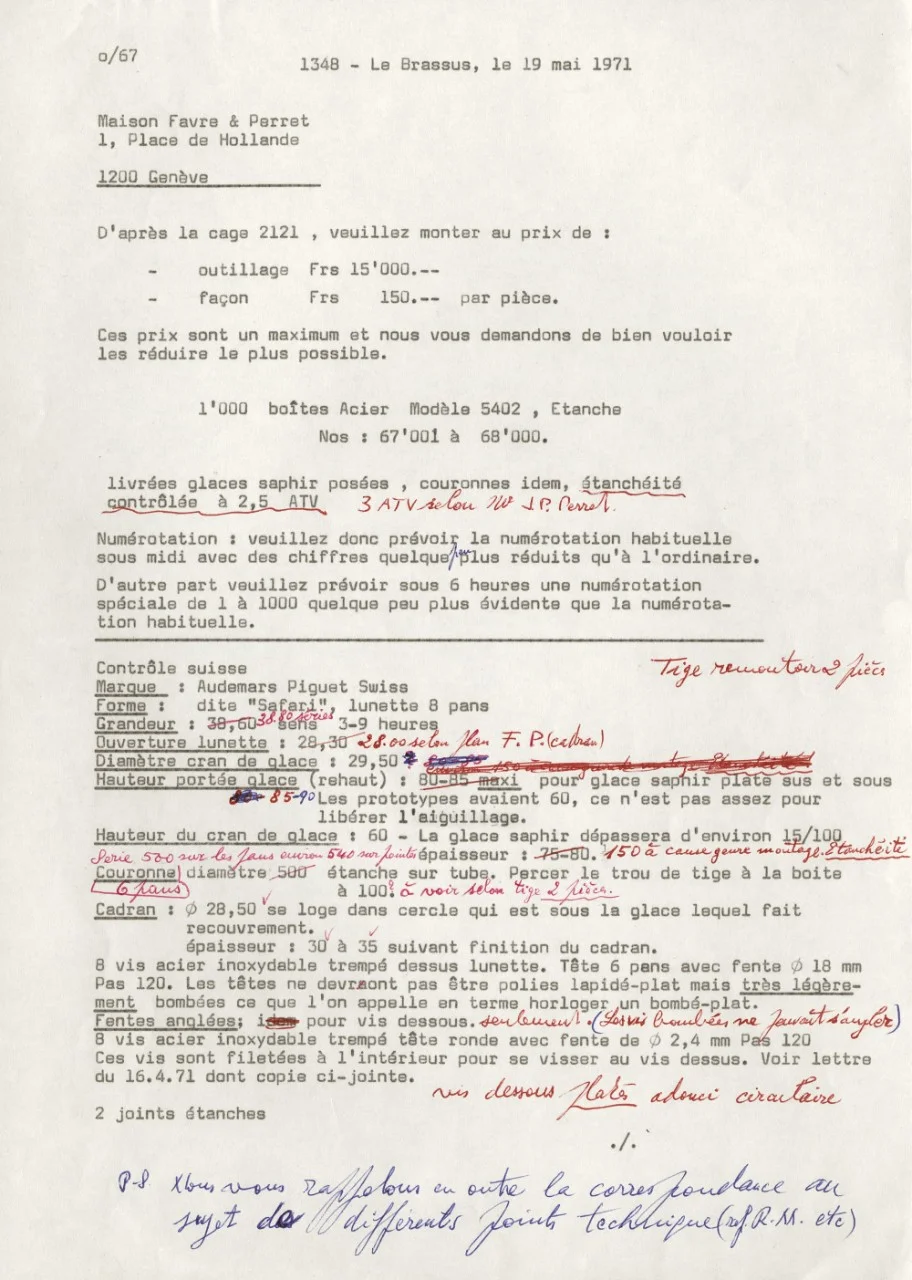
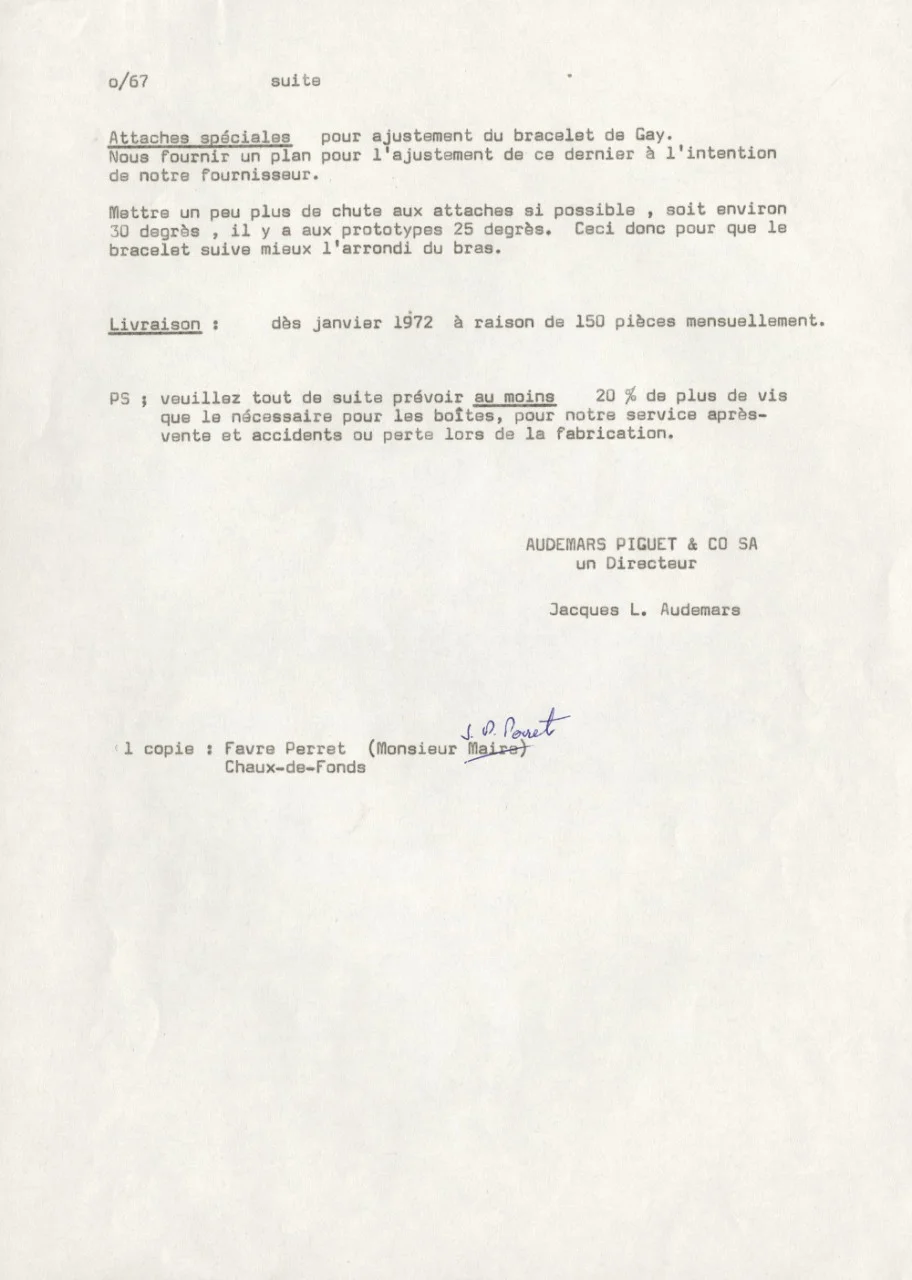
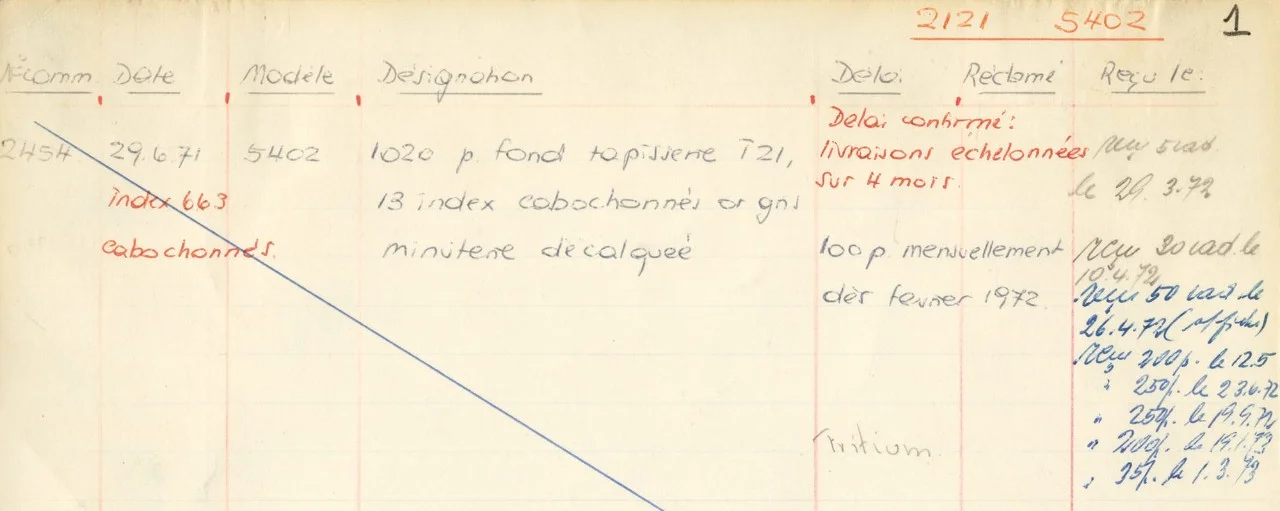
On May 19, 1971, Jacques-Louis Audemars signed an order for 1,000 steel cases from Favre-Perret. This was the largest quantity of a single model ever ordered by Audemars Piguet. To better understand what such a figure represents, one should recall that in 1971, the 6,217 watches sold by AP were available in 237 very different models and that each model was itself interpreted in a multitude of different dials and materials. Only 23 models were produced in quantities of more than 100, while 145 models had less than 10 units each, 55 of which were one-offs.
We now know that the first Royal Oak, Model 5402, was produced in a run of over 6,000 watches. However, back in 1971, the idea of making even 1,000 of them was perceived as excessive and even shocking by certain craftspeople in Le Brassus, and doubtless also by some of the brand’s traditional customers.
Several sources, including Gérald Genta and Martin K. Wehrli, former Director of the Audemars Piguet Museum, claim that Georges Golay had initially planned to limit the total production of Model 5402 to 1,000 units, which would have made the Royal Oak Audemars Piguet’s first limited edition. According to Genta, the success of the watch forced Georges Golay to betray his word by subsequently increasing production: “Golay was sick of continuing to produce Royal Oak watches, because it made him a liar. He was a man of exceptional quality.”
What do the archives say? The first case order clearly states that each watch should have a special engraving on the caseback: “Please provide a special numbering from 1 to 1,000 below 6 o’clock.” It is interesting to note that Audemars Piguet modified the numbering system of the watches as soon as the Royal Oak was created, adding the “small number”, a consecutive number starting with 1 and intended for a single model. This subject is developed in another article dedicated to the Royal Oak’s numbering system.
But Georges Golay did not limit production to 1,000. Without abandoning the idea of a limited series, he elegantly freed himself from the constraints of this concept. An advertising text from 1972 is enlightening in this respect: “Chaque exemplaire des séries limitées de Royal Oak est numéroté” (Each watch in Royal Oak limited series is numbered). On the one hand, the copy indicates that the production is limited, but does not provide a definite number. Moreover, the French term séries limitées is in the plural and that accounts for how the A, B, C and D series of Model 5402 came into being.
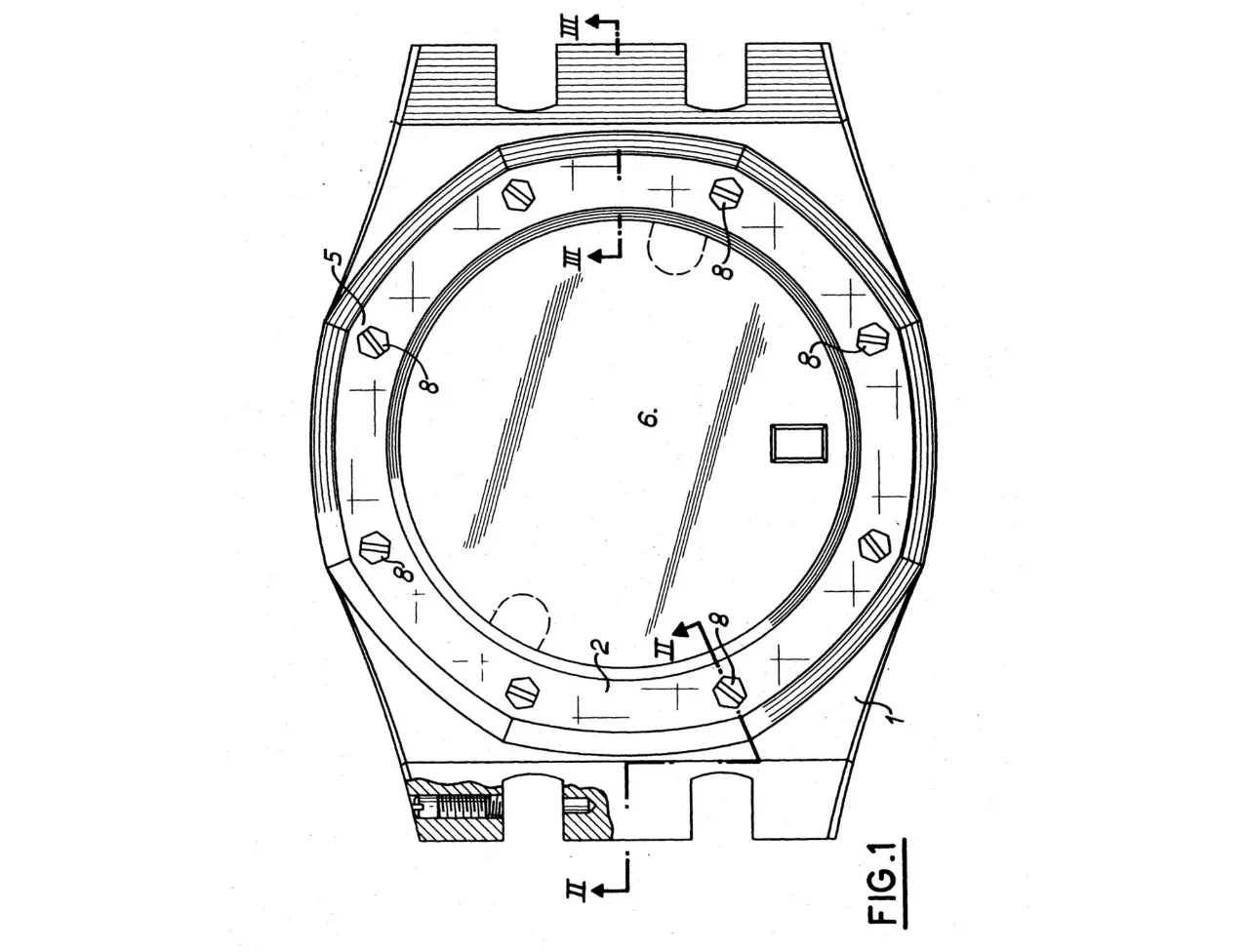
The Patent
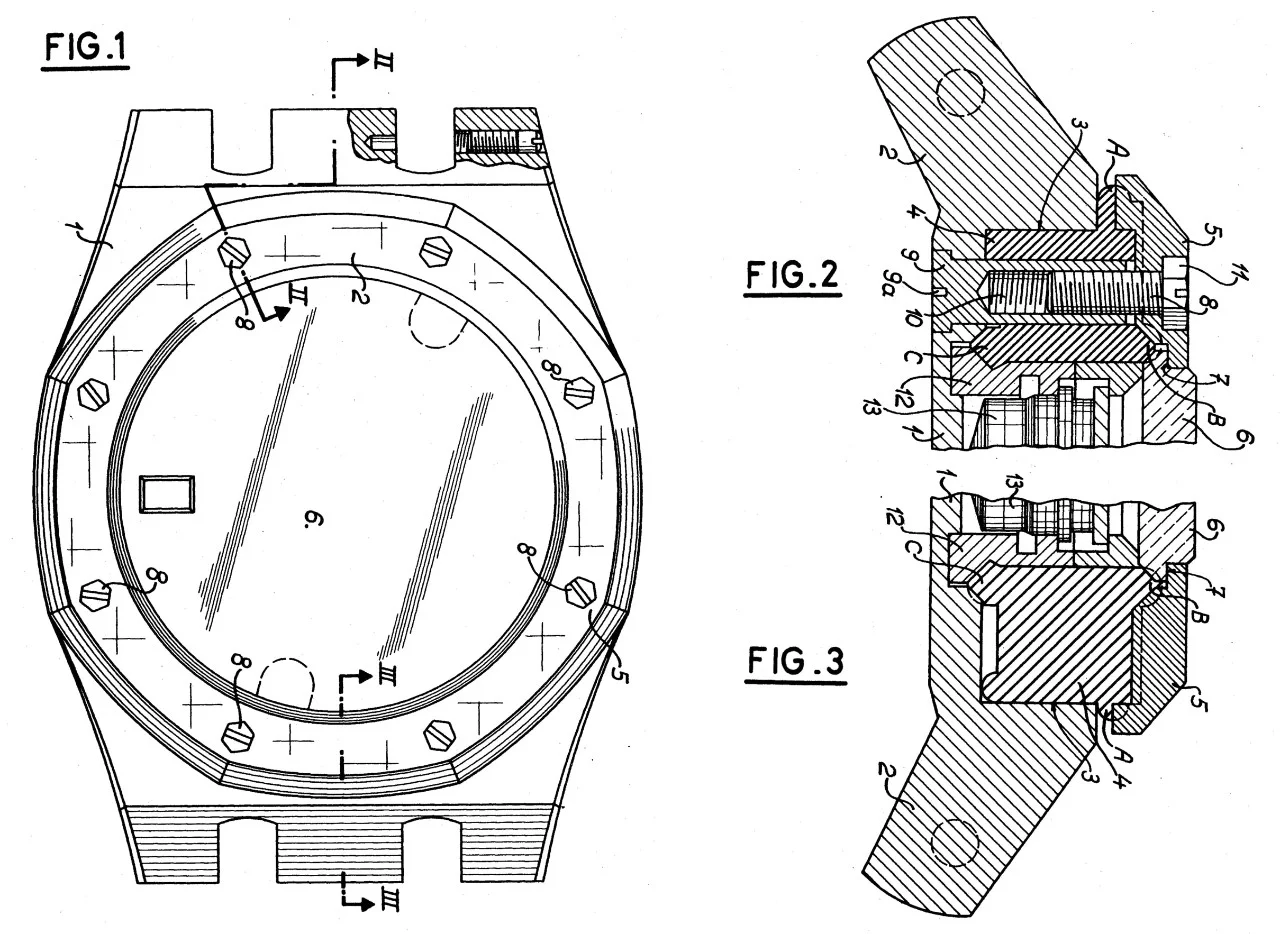
On December 6, 1971, almost a year and a half after the first design, Audemars Piguet officially filed patent application 17724/71 with the Swiss Federal Office of Intellectual Property. Gérald Genta was listed as the inventor.
The patent, entitled “Water-resistant watch case,” was published in September 1974 and granted in January 1975. It protected “a water-resistant watch case based on a particularly simple and efficient construction and featuring a new aesthetic appearance.” The text mentions the risks of water infiltration around the screws, but it does not yet indicate that the latter would be made of gold to avoid oxidation.
First AP Watch with a Name
Naming a new watch is always a tricky process. The name must convey values, evoke a history, a character, a rich and relevant semantic universe, yet it must also be memorable and pronounceable throughout the world. For Audemars Piguet in 1971, the search for a name was further complexified by the fact that the brand had never done this for any previous series-made watch. Until then, the only element of recognition was the model reference number or the nickname given by collectors.
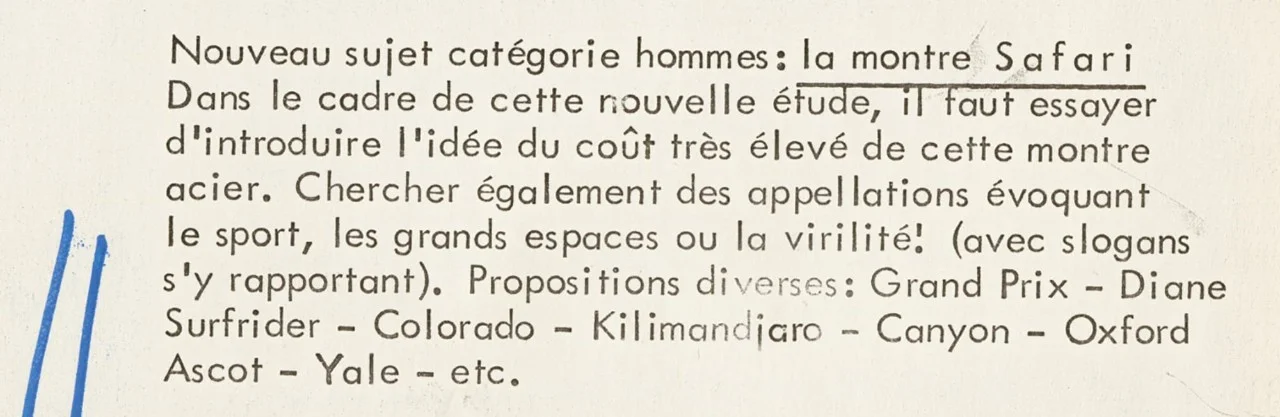
In May 1971, Audemars Piguet’s new octagonal watch was given a working name that evoked lion-hunting. In his case order, Jacques-Louis Audemars used the term “Safari”. Denys Capt, the watchmaker who helped develop the model, remembers that the name “Excalibur” was also mentioned. As for Genta, he would have liked to refer to the diving suit that had inspired him and was at the origin of the water-resistance patent (he would succeed a few years later with the Nautilus). But this idea came up against several limits. Firstly, the world of diving watches entered its first golden age in the 1960s, opening up a new sports segment. A diver’s watch must meet a standard technical definition, only partially met by the future Royal Oak despite its water resistance to 100 metres. Secondly and far more importantly, the watch – with its complex aesthetics, extreme finesse, as well as hand decoration including numerous satin-finished and polished facets and guilloché dial – was much more than a diving watch, much more than a sports watch!
On September 13, 1971, the question of the name was still far from resolved, as indicated in a meeting report: “The Safari watch:... look for names evoking sport, wide open spaces or virility (with related slogans). Various suggestions: Grand Prix – Diane – Surfrider – Colorado – Kilimanjaro – Canyon – Oxford – Ascot – Yale – etc.” It was not until December 2, 1971 that the name Royal Oak appeared in the brand’s archives.
All the witnesses of the time agree that the Italian agent Carlo de Marchi came up with the name which referred to the Royal Oak ships of the Royal Navy, the most recent of which were armoured in metal. It was also a nod to the story of Charles II, King of England, who owed his life to an oak tree that had sheltered him from Cromwell’s troops and which he subsequently ennobled. “Royal Oak” opens the door to countless interpretations, carrying connotations of equestrian and naval battles, the conquest of the oceans, treasures hidden in safes, kings in peril, noble armour and life-saving trees: a name open to the world and brimming with stories.
Looking for an Advertising Partner
To support the launch of the Royal Oak, Audemars Piguet decided to create a dedicated campaign. Here again, the approach was unprecedented. Until then advertising campaigns had been brand-based and usually featured multiple products.
In the early 1970s, the brand image was not yet unified. On the one hand, in the main markets, the agents and the most important retailers created their own advertising campaigns. In the French market, for example, Audemars Piguet’s advertising was managed by De Trevars / Vacheron Constantin. These campaigns were deployed locally, meaning that the brand identity often varied from one market to another. In parallel, Audemars Piguet tasked advertising agencies in Switzerland with creating international campaigns. There were not yet any marketing teams in Le Brassus, even in embryonic form. Promotion was handled directly by Georges Golay, who managed the advertising agencies and even corresponded with the newspapers carrying adverts!
During the 1960s, Audemars Piguet actively cooperated with the Lausanne-based agency TRIO Advertising, a pioneer in watch advertising and marketing in Switzerland and publisher of the Journal Suisse d’Horlogerie, the official press organ of the Basel Fair. But at the end of that decade, Georges Golay had to change partners. The archives do not explain this change of heart, but the context allows us to suggest a hypothesis. TRIO was very close to the powerful SSIH. However, after the 1969 distribution agreement between AP and SSIH (see above), it is likely that Georges Golay decided to change advertising partners in order to retain more room for manoeuvre, i.e. not to put all his eggs in one basket. Like many others, the decision was probably taken during a game of cards between friends. One could easily imagine that the participants included a certain Gilbert Maillard, an advertising executive running the Hugo Buchser agency that promoted the ski jumping championships in Le Brassus, of which Georges Golay was the president and one of the major promoters.
Hugo Buchser
At the time, the family company founded in 1927 and known today as Europa Star HBM S.A., still bore the name of its ebullient founder Hugo Buchser (1896–1961). This extraordinary entrepreneur, founder of the Transmarine watch brand, publisher, merchant and tireless traveller notably launched numerous watch magazines in South America, Asia, Africa, Spain, Switzerland, as well as Middle-East and Portugal. After his death in 1961, the company was managed by his son-in-law Gilbert Maillard who, in addition to being a friend of Georges Golay, was a former schoolmate of Gérald Genta.
While Hugo Buchser was primarily a publishing house, part of its team offered advertising agency services: photographs, slogans, graphic design, advertisements, distribution strategy, etc. This activity was to grow to such an extent that in 1975, Gilbert Maillard and Heinz Heimann divided it up to found an independent advertising agency that was to promote Audemars Piguet until 1998. But let’s get back to the late 1960s.
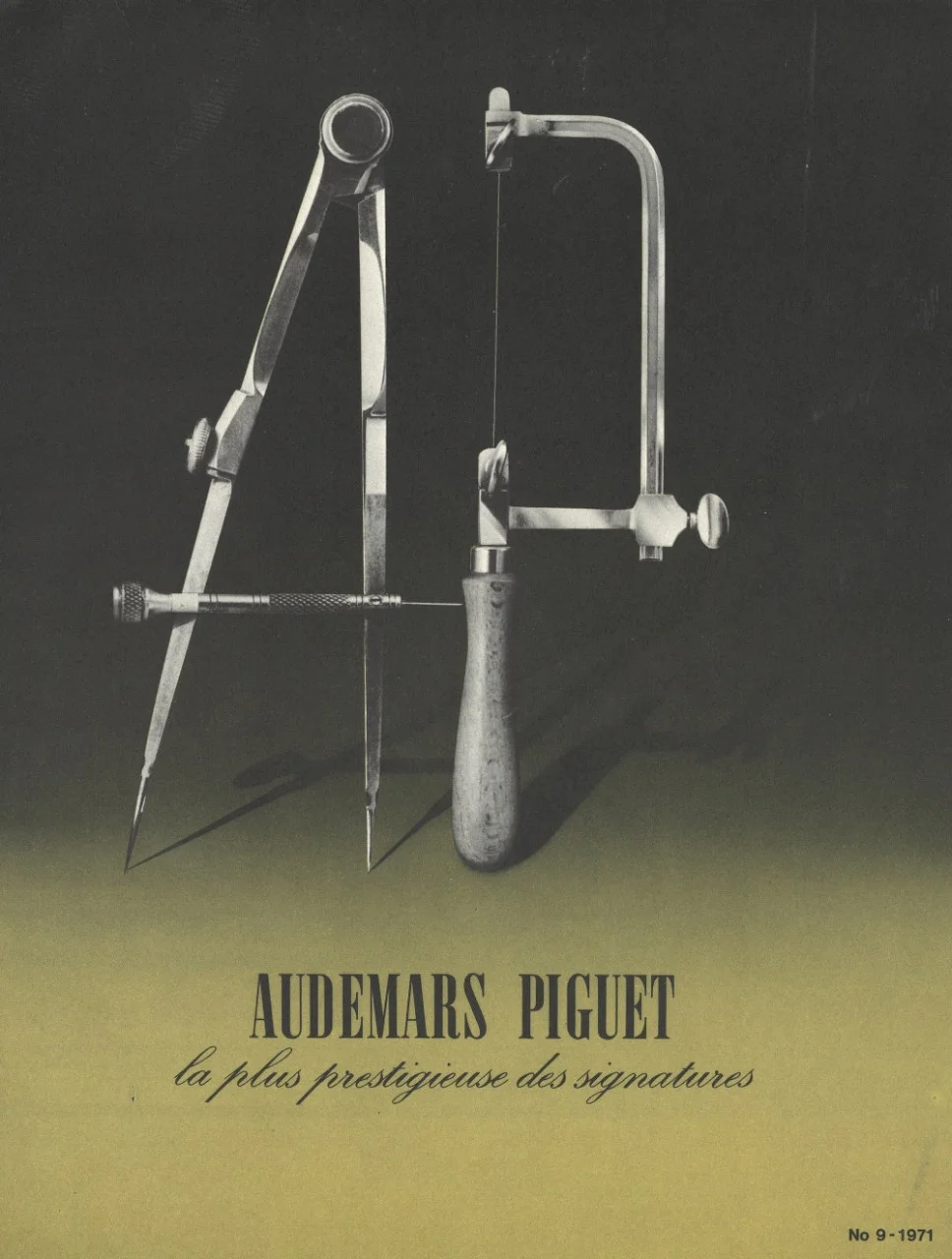
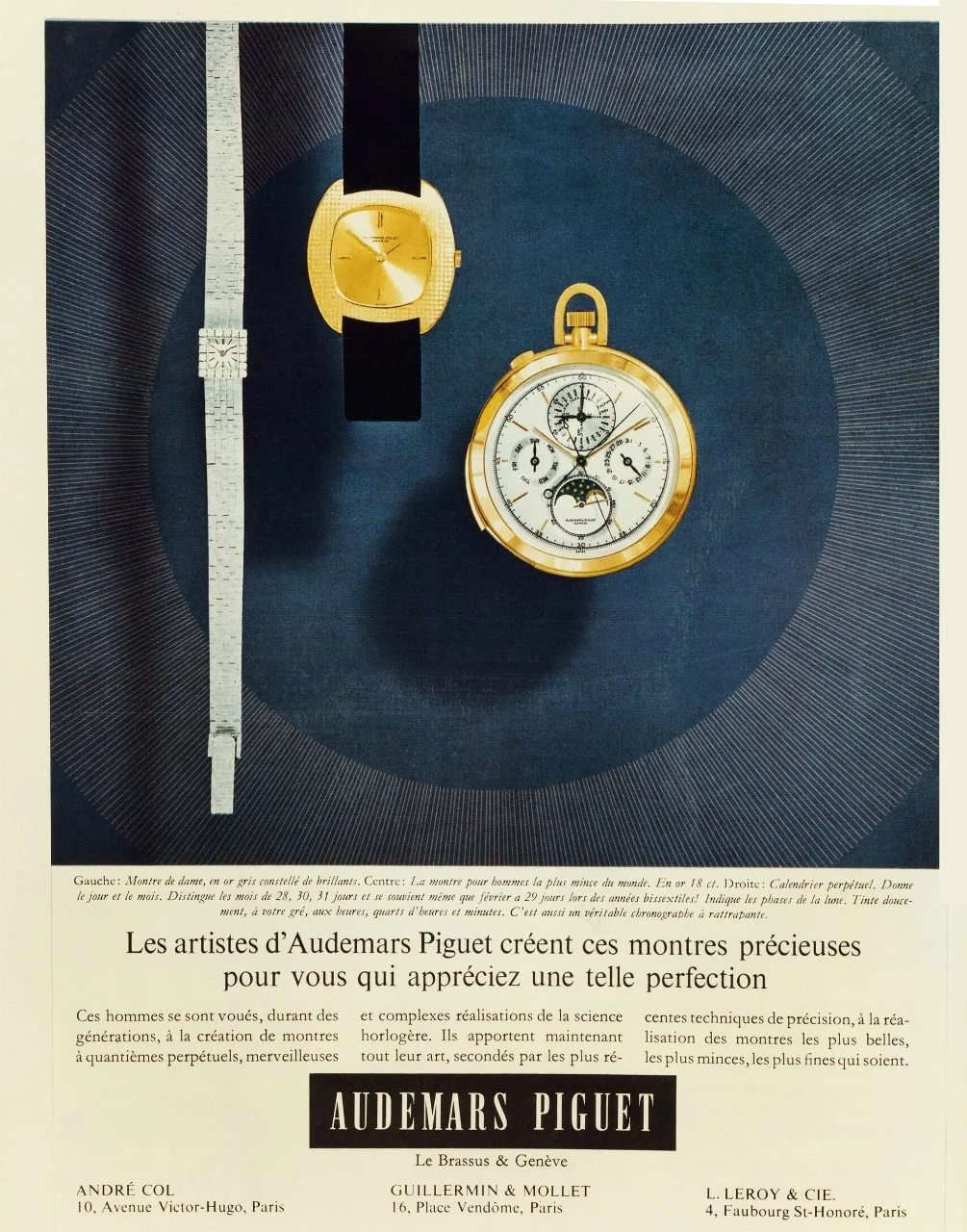
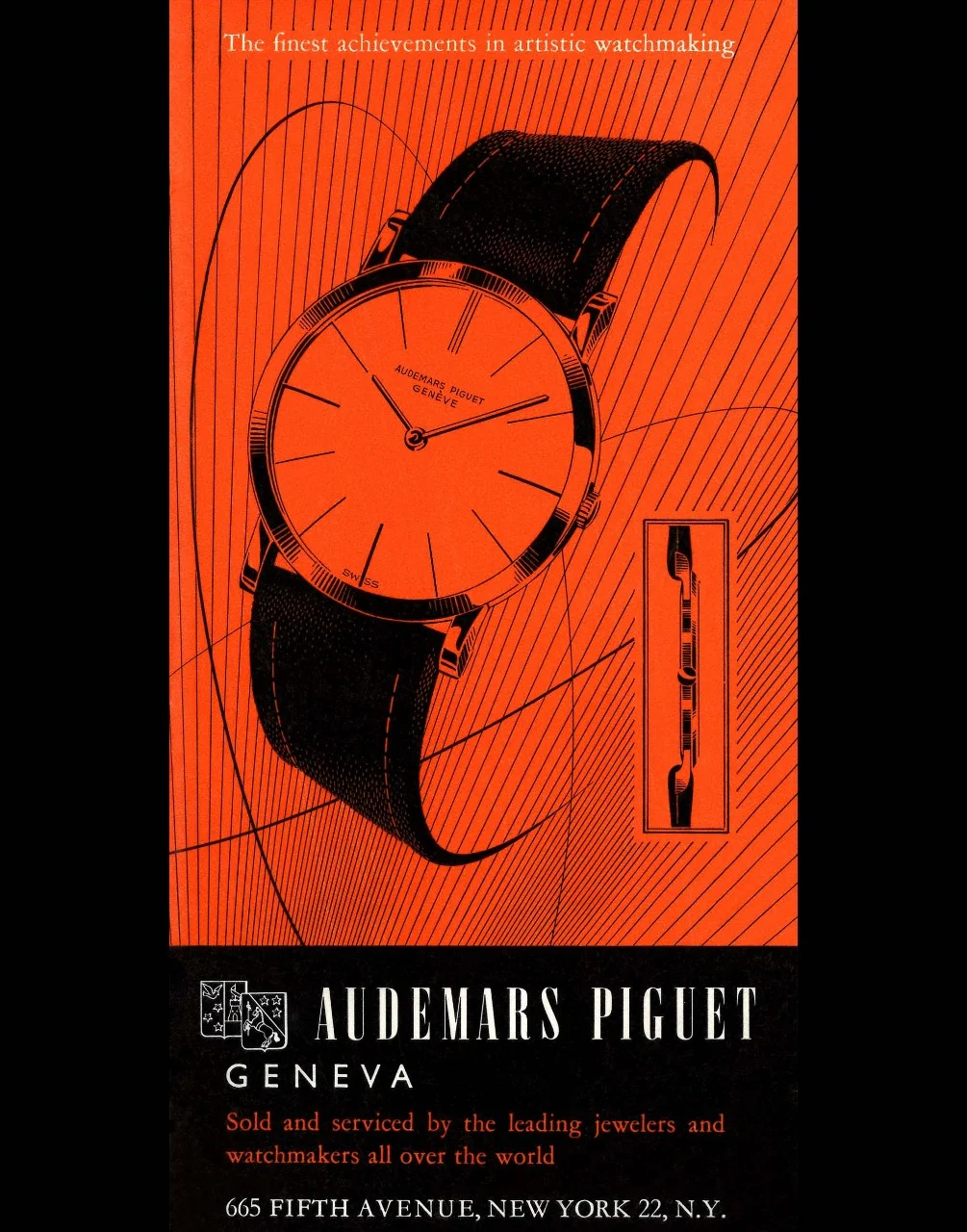
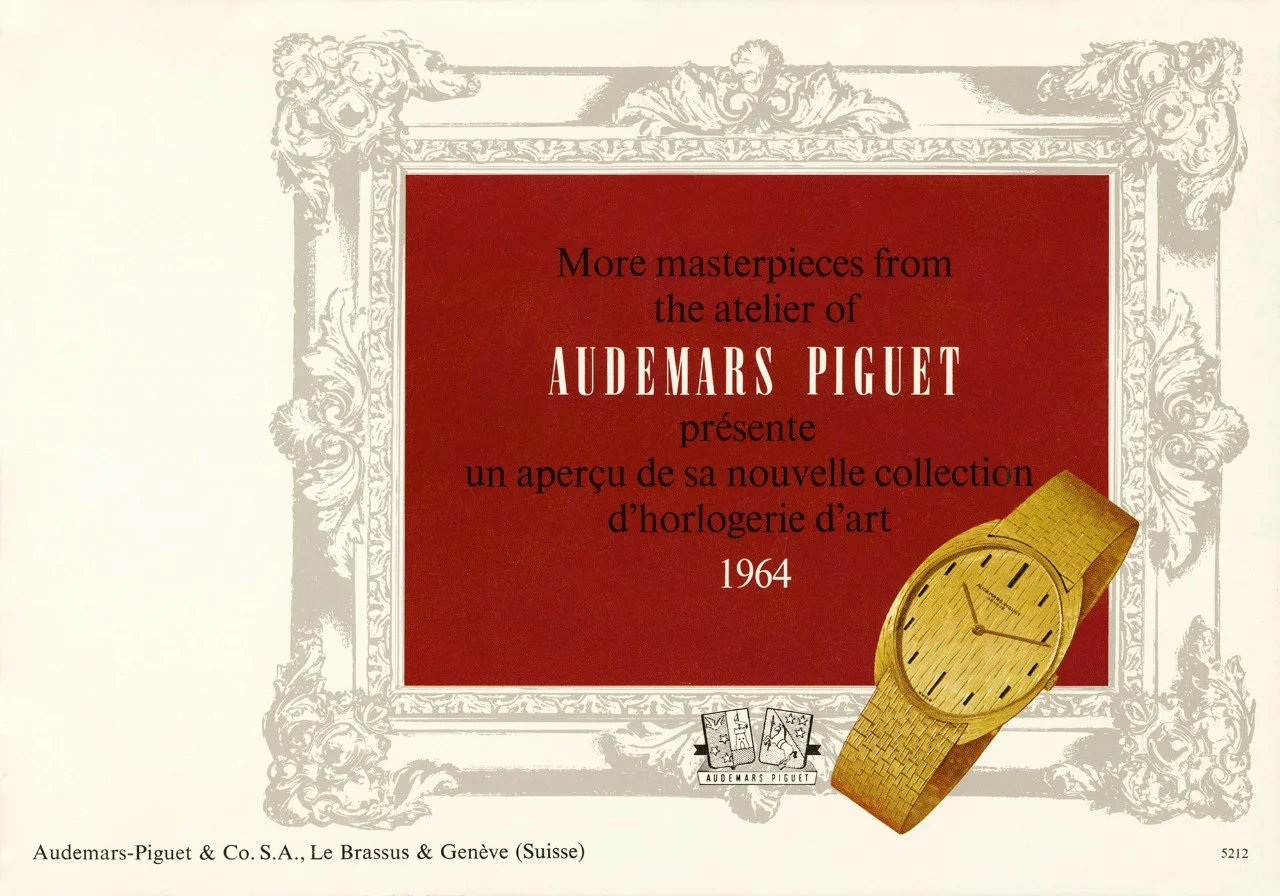
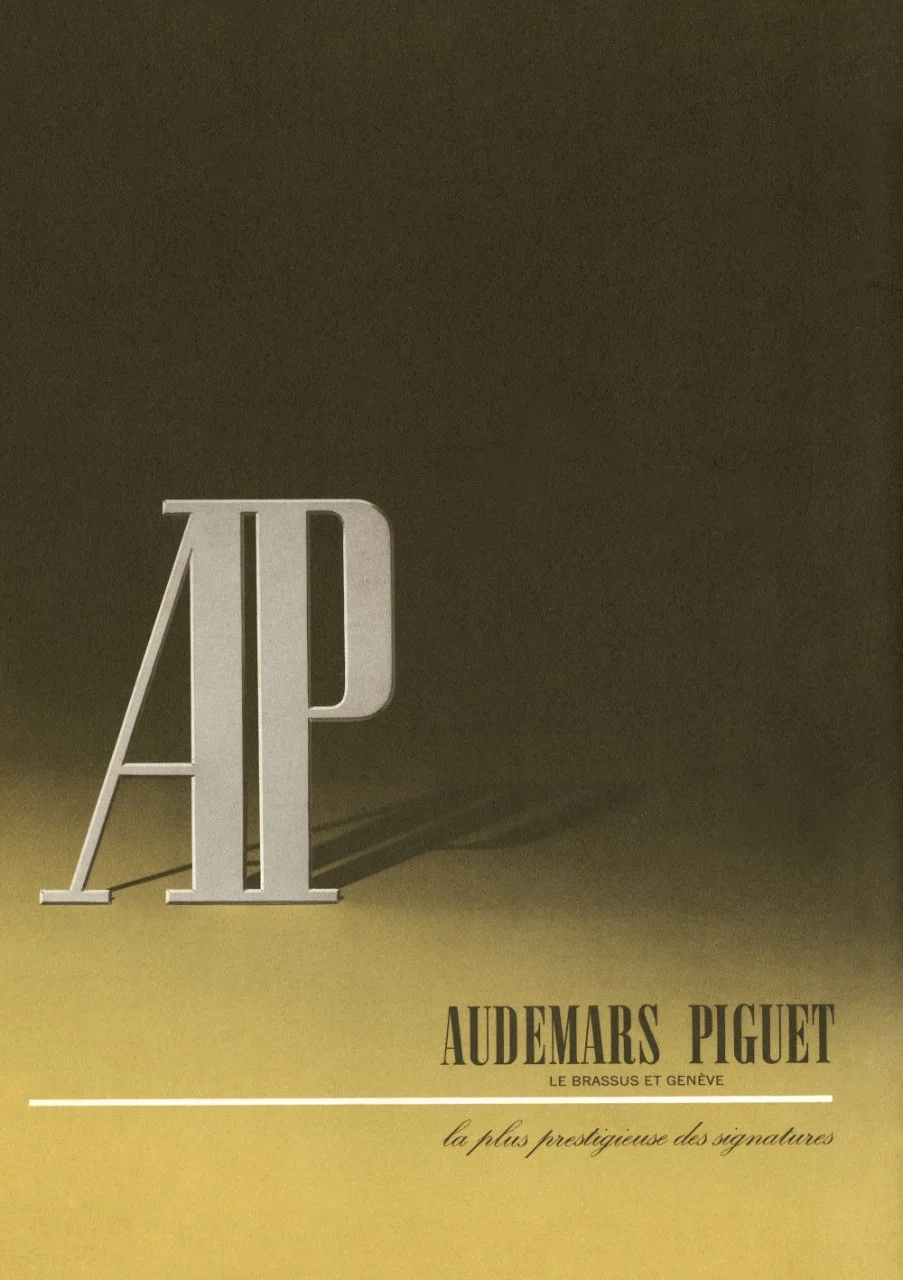
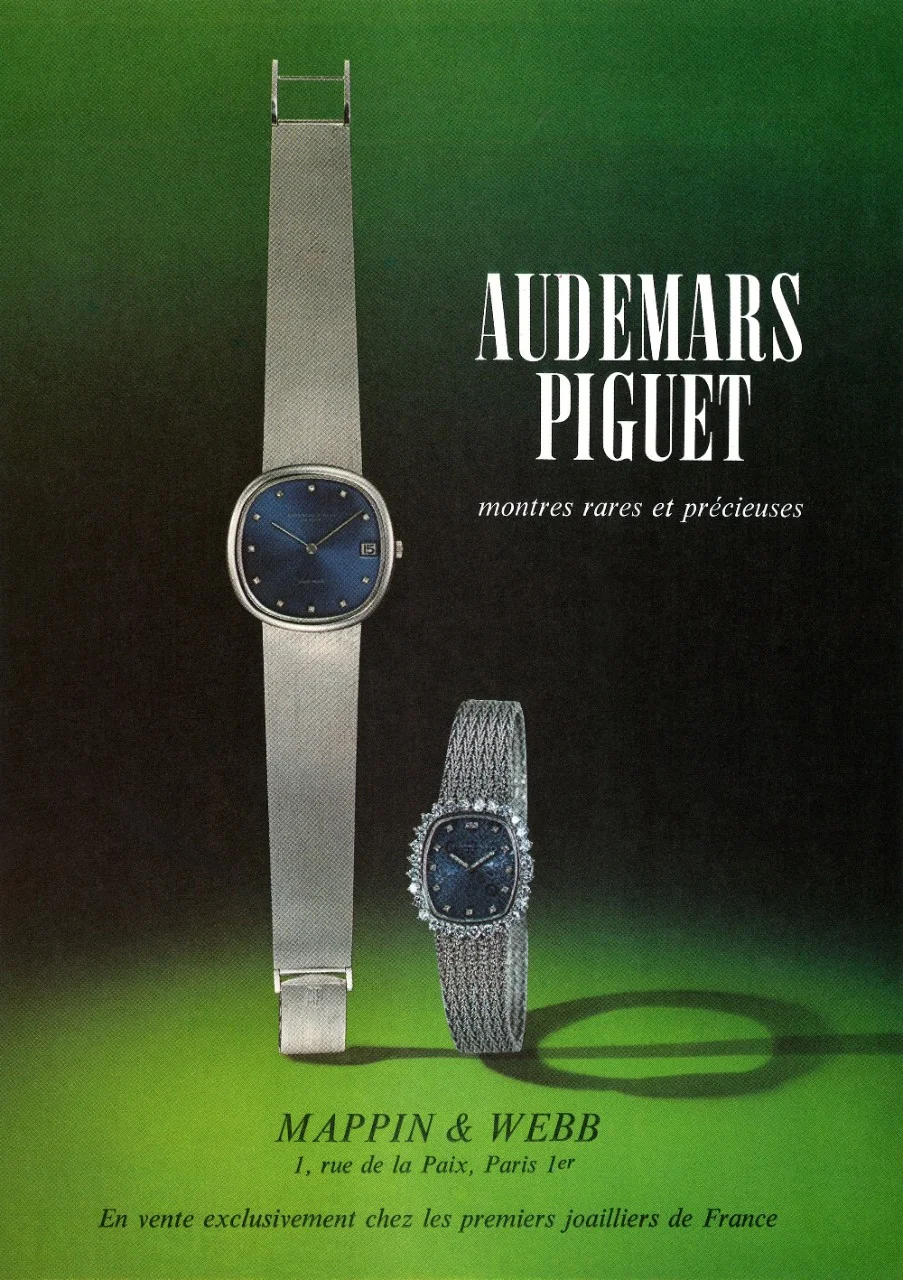
From 1969 to1971, Hugo Buchser’s campaigns clarified and reinvigorated Audemars Piguet’s image, giving pride of place to the oversized AP logo, bright colours – green, gold, blue – and products. From this period onwards and for 20 years, the predominant slogan was “La plus prestigieuse des signatures” (“The most prestigious of signatures”).

Preparation of the Royal Oak Campaign
A concept as strong as the Royal Oak is a rare treat for an advertising agency! The Royal Oak logo was probably refined in Buchser’s offices. The team then began to work on the texts. In February 1972, the message was already clearly taking shape: “Demanding men of action are no longer satisfied with standard sports watches. They are always on the move and demand more: a perfect watch, in complete harmony with the multiple activities of their exciting lives. For this elite, AUDEMARS PIGUET’s artist-watchmakers have created the ROYAL OAK, a tribute to steel, the metal of the cathedrals of our time, more resistant to tools than fine gold and rendered infinitely precious by the unparalleled quality of its workmanship.”
Until April 1972, fine-tuning continued on the texts, photographs, leaflets and advertisements, emphasising the qualities of the ultra-thin movement, the octagonal shape, the hexagonal screws, etc. Yet the two elements dominating the messages of the advertising campaign were, on the one hand, the “tribute to steel” and, on the other hand, the capacity of the watch to unite the worlds of design, sport, know-how, innovation... This represented a metaphor for the modern world and the personality of the customers for whom the watch was intended. It is worth recalling that the Range Rover had just made a similar mark on the automotive world of the time. It was not until early 1973 that messages telling the story of Charles II, the Royal Oak, Cromwell and the naval vessels of the Royal Navy were themed in a dedicated booklet.
According to a document dated September 13, 1972, Audemars Piguet’s overall advertising budget for 1972 amounted to CHF 950,000, more than half of which was for press advertisements. The document does not specify the share dedicated to the Royal Oak, but it definitely greatly exceeded the 6-7% of production and turnover generated by this watch in 1972. The document highlights another significant fact about the organisational system prevailing back then: “it would be worth knowing the amounts devoted to advertising by AP customers worldwide.” The customers here are importers, agents and retailers.
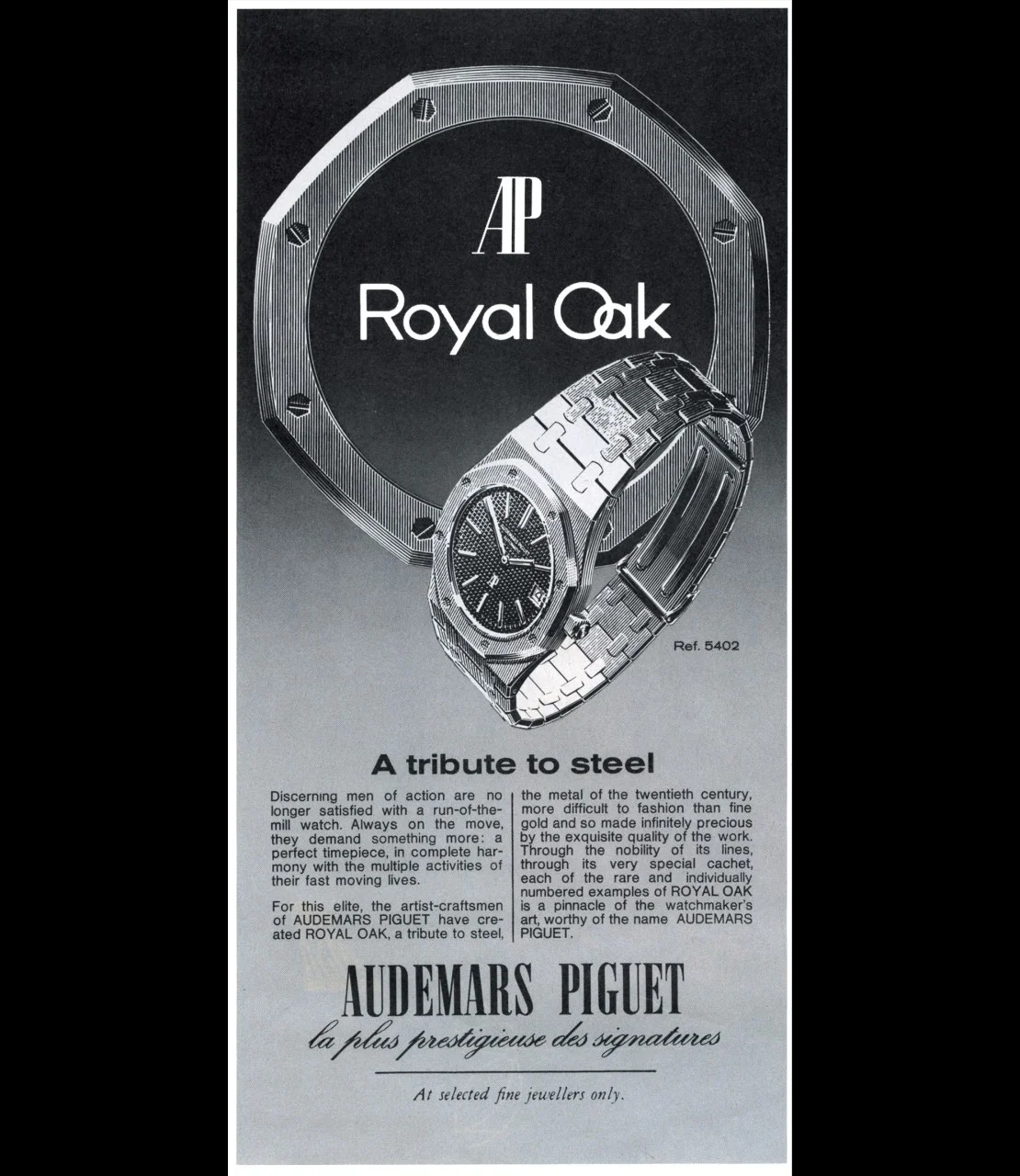
1972. Royal Oak advertisement. The argument is built around the theme of steel, in an echo to the ad's graphical construction which sheds light onto the octagonal shape of the bezel. Audemars Piguet Archives.
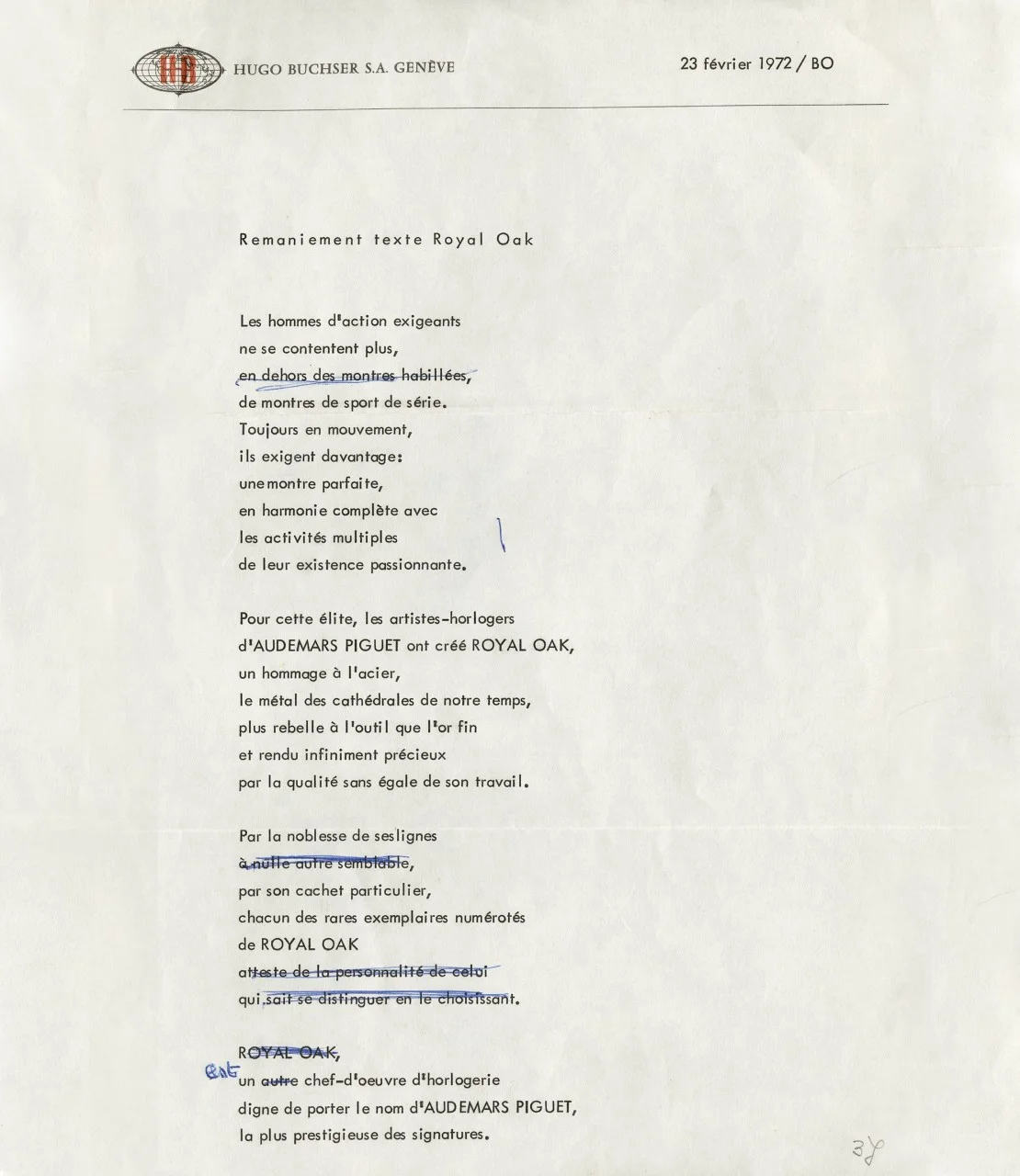
1971. First Royal Oak arguments, draft. Created by the Hugo Buchser agency with the direct participation of Georges Golay, the arguments link the watch's quality to the expectations of clients busy "with multiple activities." Audemars Piguet Archives.
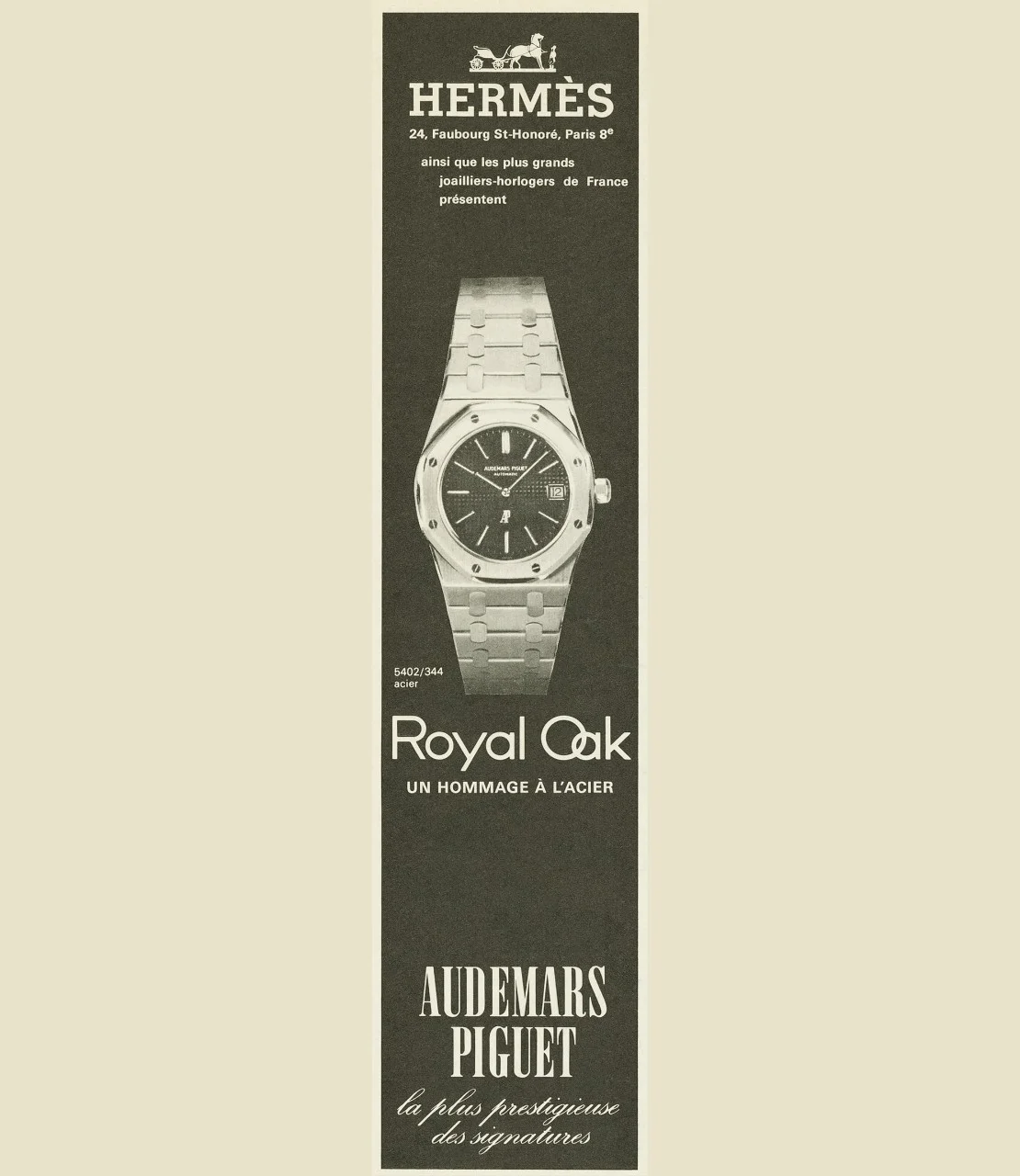
1973. Royal Oak advertisement in collaboration with Hermès. Since the 19th century, Audemars Piguet has often worked with other prestigious brands to distribute its watches. Audemars Piguet Archives.
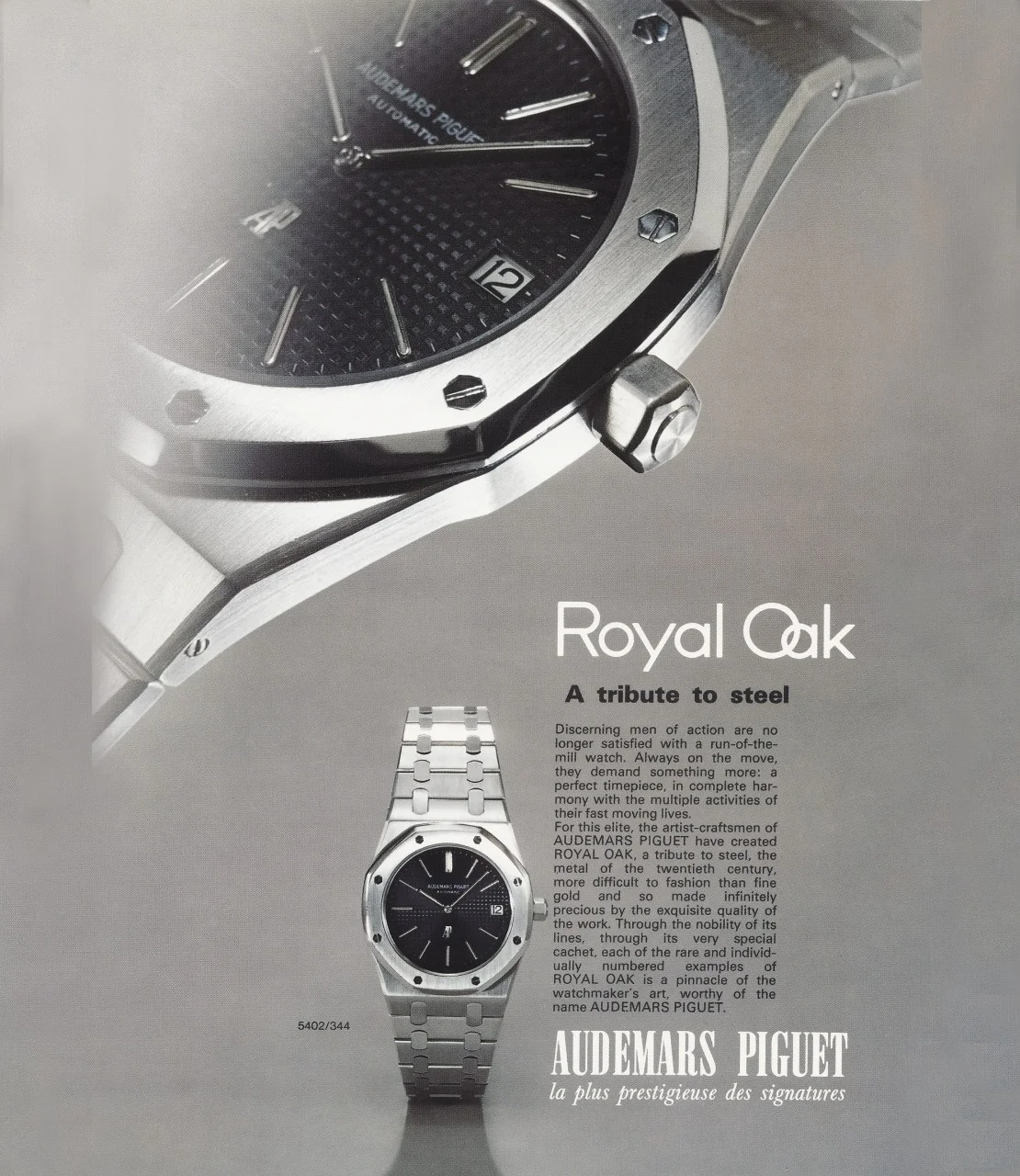
1972. Royal Oak advertisement On top of the watch's front shot, a close-up highlights the finishing on the case, the bezel's octagonal shape as well as the refined dial. Audemars Piguet Archives.
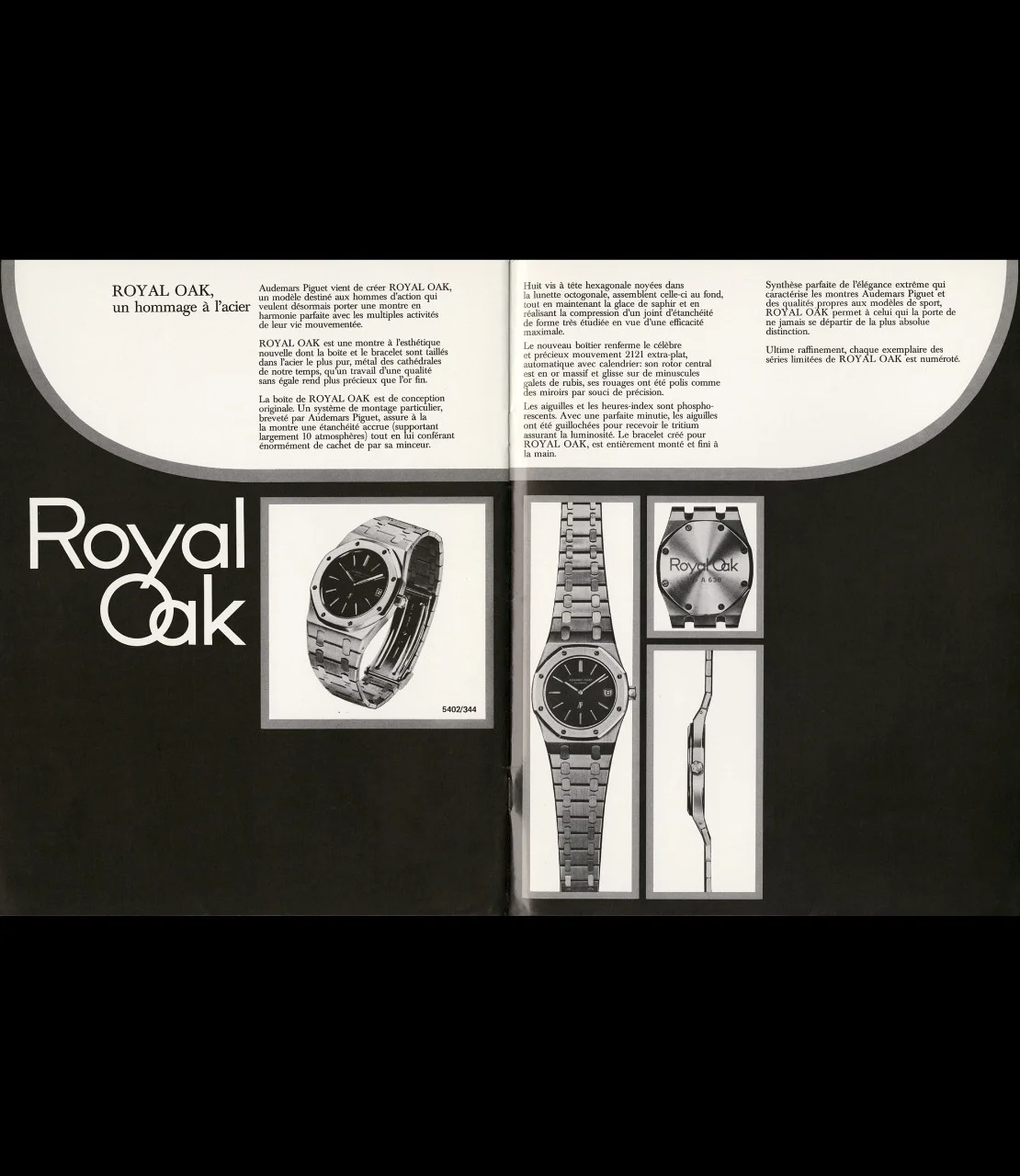
1972. First Royal Oak leaflet. The black and white graphic design highlights the aesthetic qualities of the watch. The detailled text is destined to distributors. Audemars Piguet Archives.
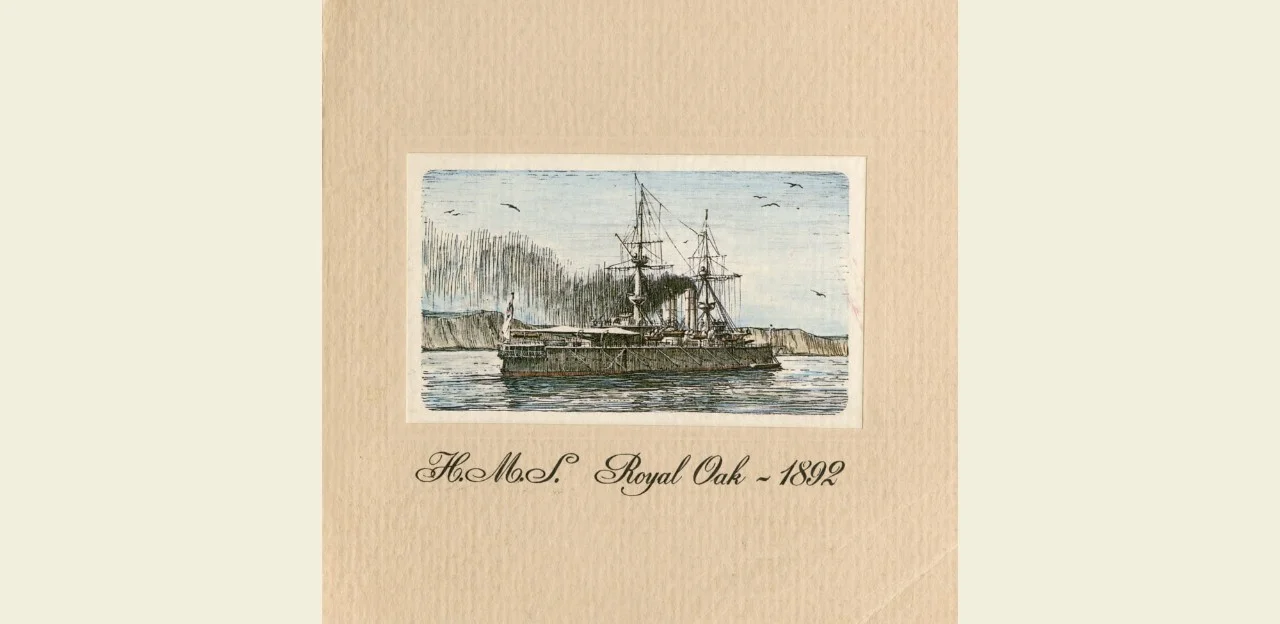
1973. Royal Oak brochure (cover). One year after the launch of Model 5402, this brochure explained the watch's design, its resistance, the structure of its external parts, as well as the origin of its name. Audemars Piguet Archives.
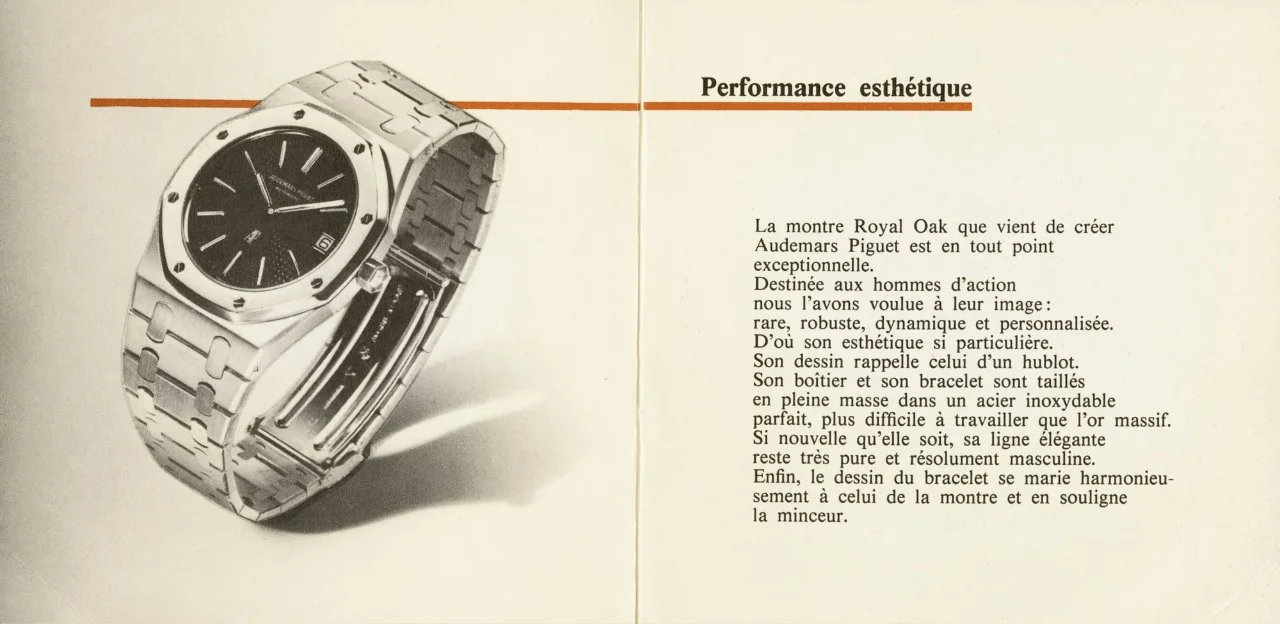
1973. Royal Oak brochure (first double-page). One year after the launch of Model 5402, this brochure explained the watch's design, its resistance, the structure of its external parts, as well as the origin of its name. Audemars Piguet Archives.
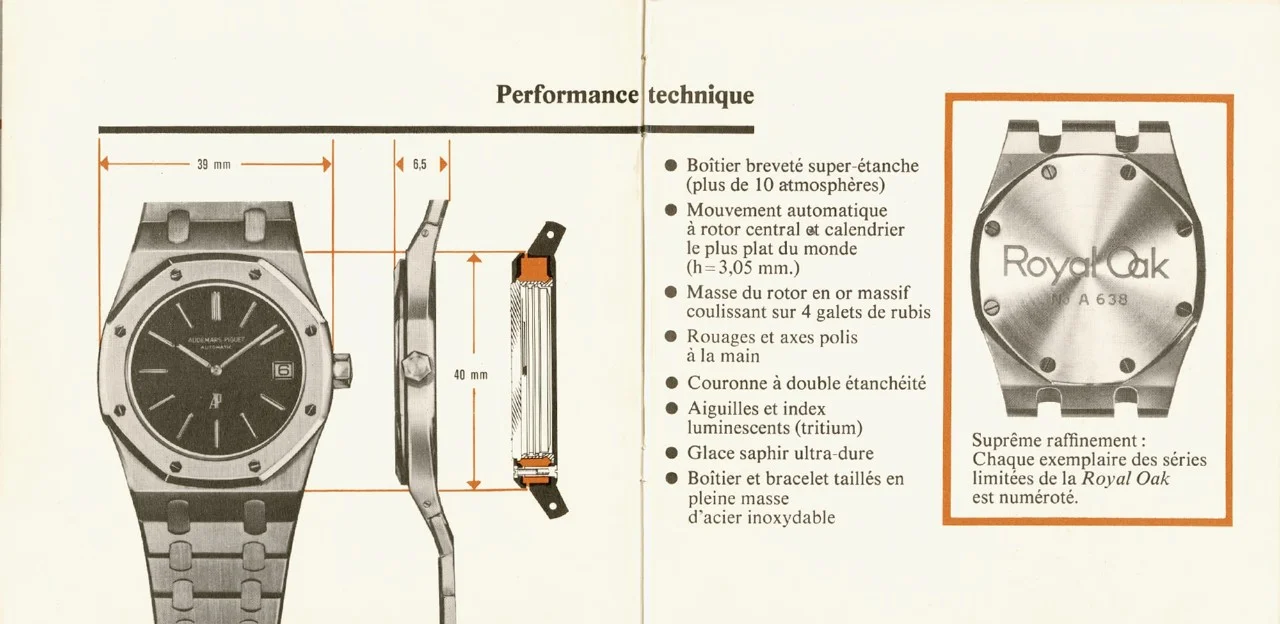
1973. Royal Oak brochure (second double-page). One year after the launch of Model 5402, this brochure explained the watch's design, its resistance, the structure of its external parts, as well as the origin of its name. Audemars Piguet Archives.
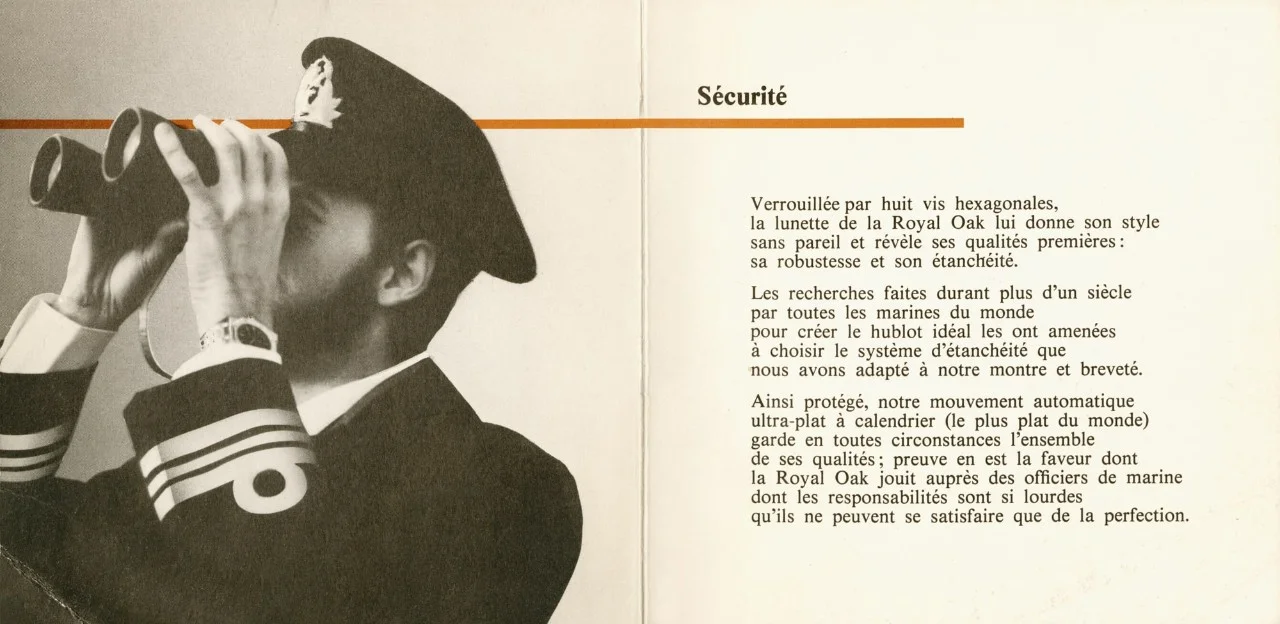
1973. Royal Oak brochure (third double-page). One year after the launch of Model 5402, this brochure explained the watch's design, its resistance, the structure of its external parts, as well as the origin of its name. Audemars Piguet Archives.
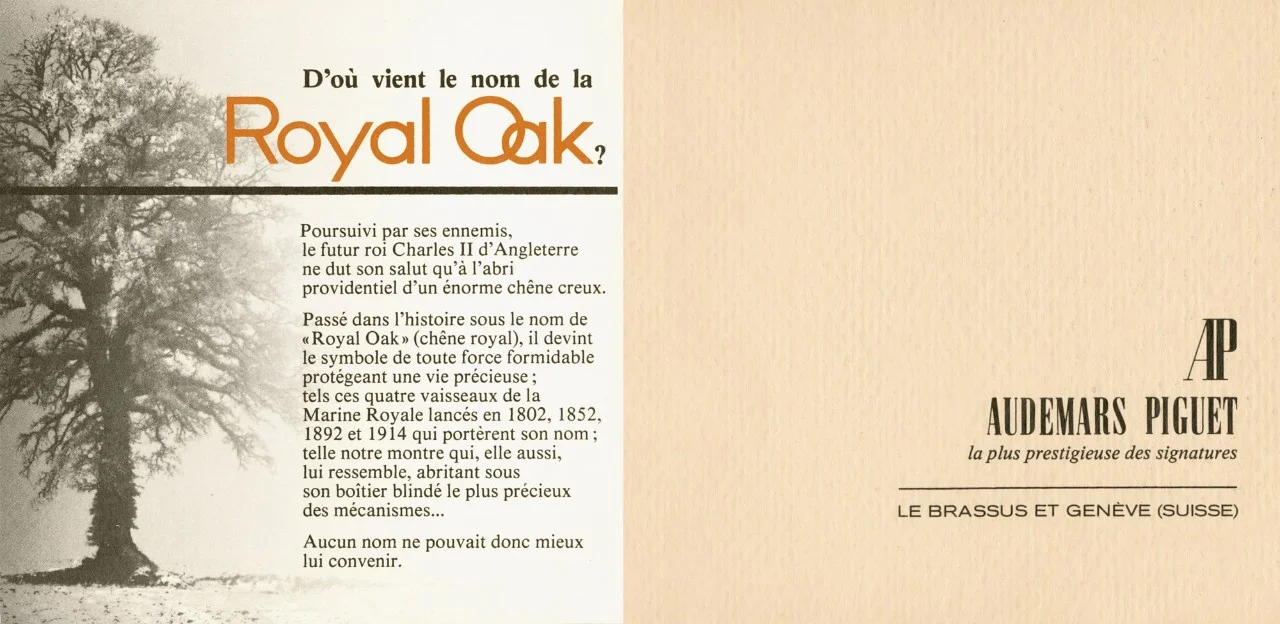
1973. Royal Oak brochure (fourth double-page). One year after the launch of Model 5402, this brochure explained the watch's design, its resistance, the structure of its external parts, as well as the origin of its name. Audemars Piguet Archives.
Final Touches before the Baptism of Fire
The development of the Royal Oak continued well beyond its launch, but the last few months before Basel 1972 were memorable. The tension was palpable, as was a certain feverishness, even to the point of bad temper. Wilfred Berney recounts in a document written in 2020 that the watch was perceived then as “a monster... bearing no relation to what we did and knew how to do”, namely miniaturisation and openworking. The feeling was: “what does this big steel timepiece have to do with our collection? According to our executives, it is the Italian market that is asking for a different watch, sporty and in steel. If, on top of all the rest it’s the Italians calling the shots now... we are losing all control!”
Watchmaker Fredy Capt, who took part in this adventure, says he assembled the first steel prototypes "without any real plan, guided by instinct.” He recalls that the first hexagonal screws were made of stainless steel, “not so stainless after all given that they often rusted, making it impossible to dismantle the case. As for the angles, they were so clean-cut that they became downright sharp: “the watchmakers had to soften the angles by hand, with a burnisher.” It was not uncommon for him and his colleagues to take a few more parts and components home in the evenings to be “tweaked”...
Fredy Capt’s workshop was next to the offices of Jacques-Louis Audemars and Georges Golay. He recalls that the latter, a keen cigar enthusiast, arrived one morning with a gloomy expression on his face: “I think we’re crazy. We will never sell steel watches at this price!”, adding: “If we don’t sell them, we’ll recover the movements and scrap the cases and bracelets.”
In a company employing a total of 84 people, the presence of a homologation laboratory was not on the agenda. To test the watch’s water resistance, Fredy Capt remembers that Jacques-Louis Audemars placed a jar on his windowsill with a label stating “salt water corresponding to the saltiest seas in the world”, and that a Royal Oak watch hung inside.
By April 12, 1972 in Le Brassus, the Basel Fair was due to open three days later. Paul Heizmann, head of the casing-up workshop, personally took charge of casing-up the first 20 Royal Oak watches, nos. 67001 to 67020. The even numbers were destined for Italomega, the odd numbers for Gameo. Four of them travelled to Basel.
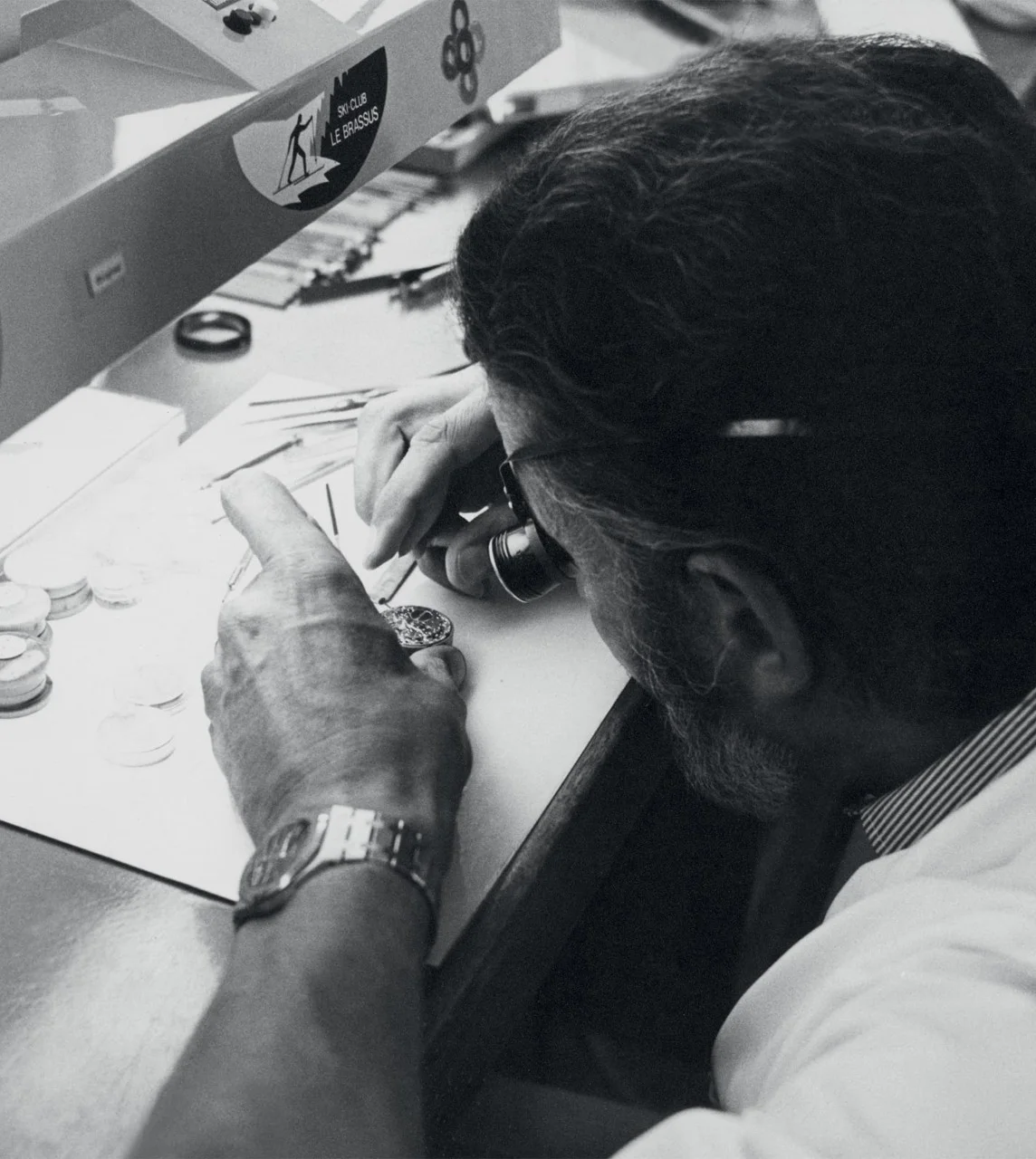
Circa 1972. Watchmaker at the bench. This watchmaker assembling a Calibre 2121 is wearing one of the very first Royal Oak watches on his wrist. Audemars Piguet Archives.
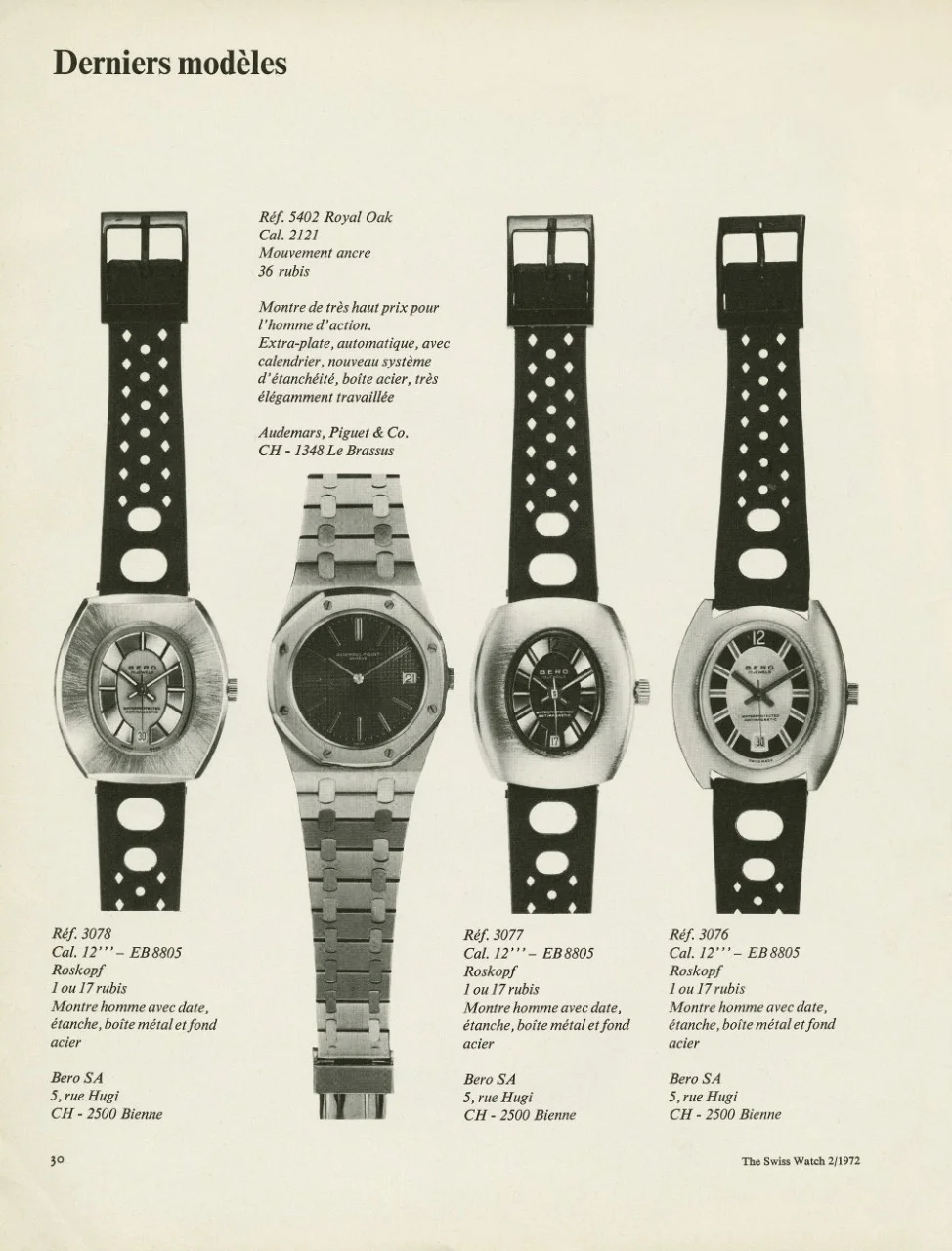
February 1972. First Royal Oak publication. The Royal Oak appeared for the first time in a modest review, two months before its official launch, aside other cheaper Bero watches. This context has for mission to guarantee legal posteriority. Prototype 60647 in white gold. Bezel screws not aligned. © The Swiss Watch, 2/72.
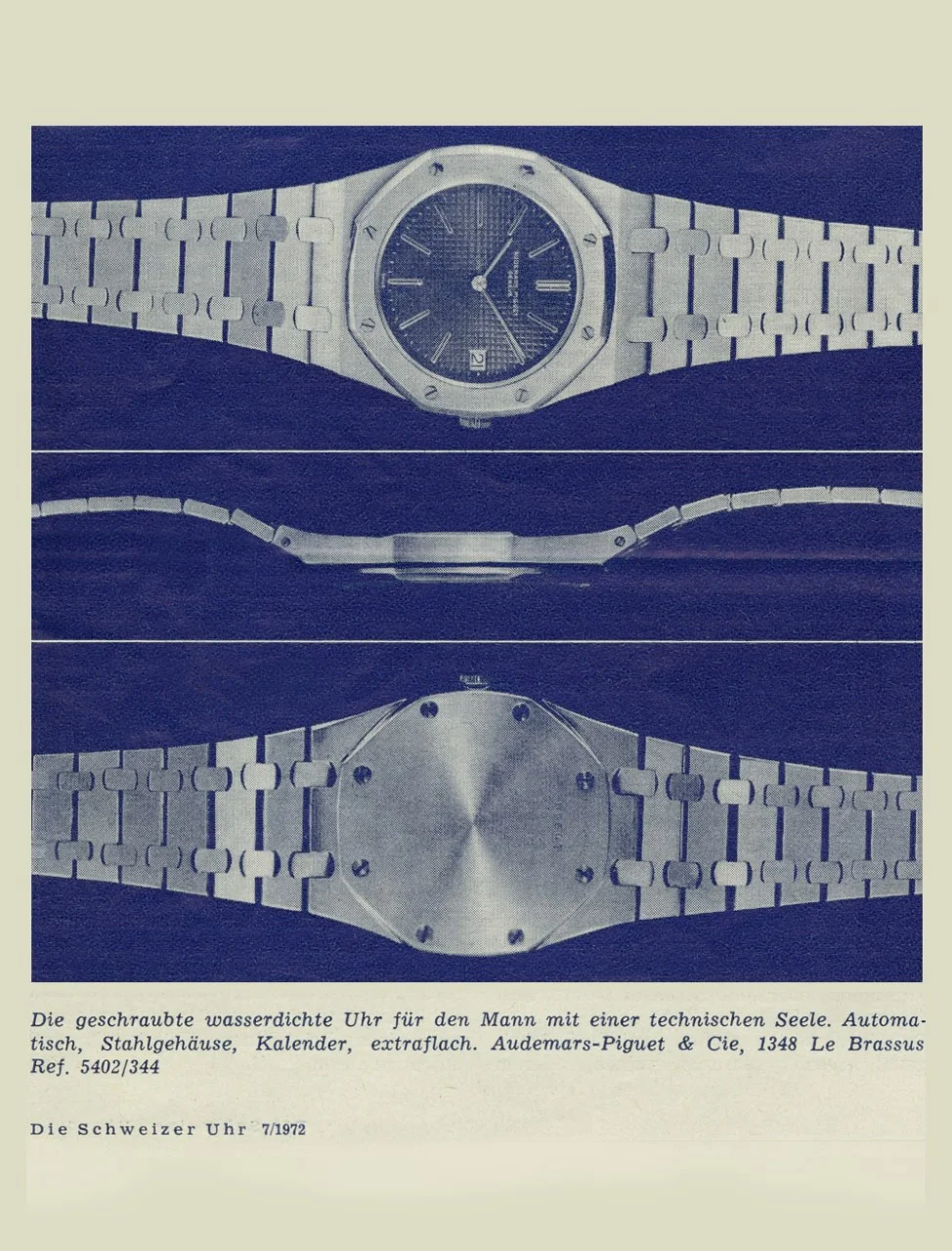
March 1972. Second publication on the Royal Oak. A few weeks before the Basel Fair, the professional magazine Die Schweizer Uhr presented the Royal Oak in exclusivity. The image illustrates prototype 60647 crafted in white gold. The caseback does not feature the Royal Oak logo yet. Similarly, the hexagonal screws are not yet aligned on the bezel. This prototype, which was probably destined to the Shah of Iran, was completed and sold in July 1972. Die Schweizer Uhr, March 30, 1972.
Screws as the Achilles’ Heel
In a document dating from 2020, watchmaker Wilfred Berney recalls the major difficulties encountered in the early years, notably with the clasps that were perceived as too large, the tapering shape of the bracelets which had to be compensated for by adding studs and the scarcity of additional links. But above all, he says that the 8 screws were originally made of steel. However, the seawater seeped in, “coating the screws with its saline content” which attacked, corroded and ended up sticking to the case: “Genta’s famous diving helmet is blocked. Nobody inside, fortunately!” A solution was found to replace the steel screws with gold ones, which are insensitive to corrosion. It was implemented as early as 1972 on parts leaving production. For customer returns, it took all the ingenuity of the watchmakers, who occasionally created new tools and managed to restore the watches to their original condition. Wilfred Berney explains that, although water found its way around the screws, it very rarely reached the movement, which was protected by an oversized seal that ensures a water tightness of 100 metres. A study of the casing-up records confirms this quality. Out of the first 100 Royal Oak watches sold in 1972, only four came back until 1982 for water-resistance problems. The few teething problems of the Royal Oak were thus resolved fairly quickly, allowing the collection to flourish.
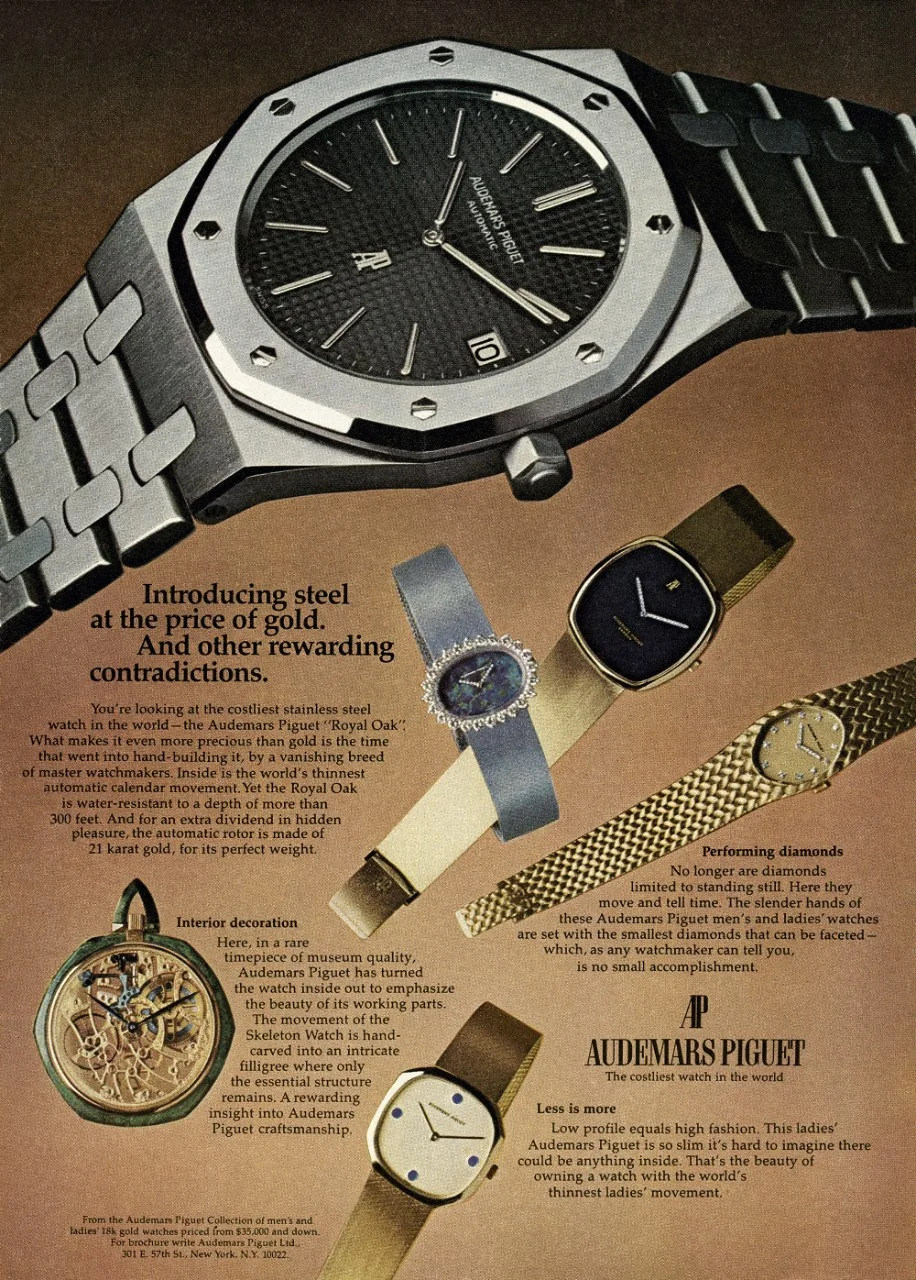
“The Costliest Stainless Steel Watch in the World”
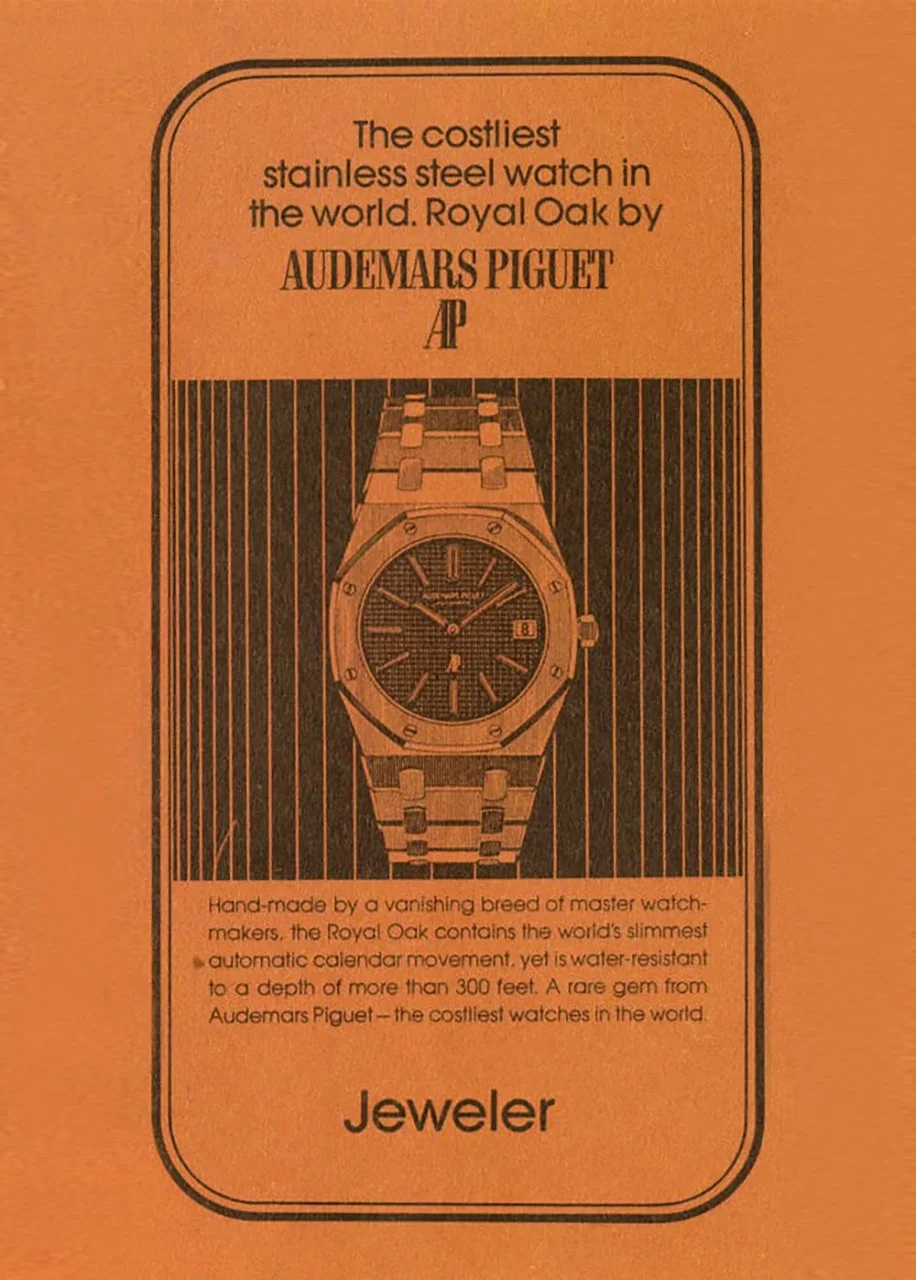
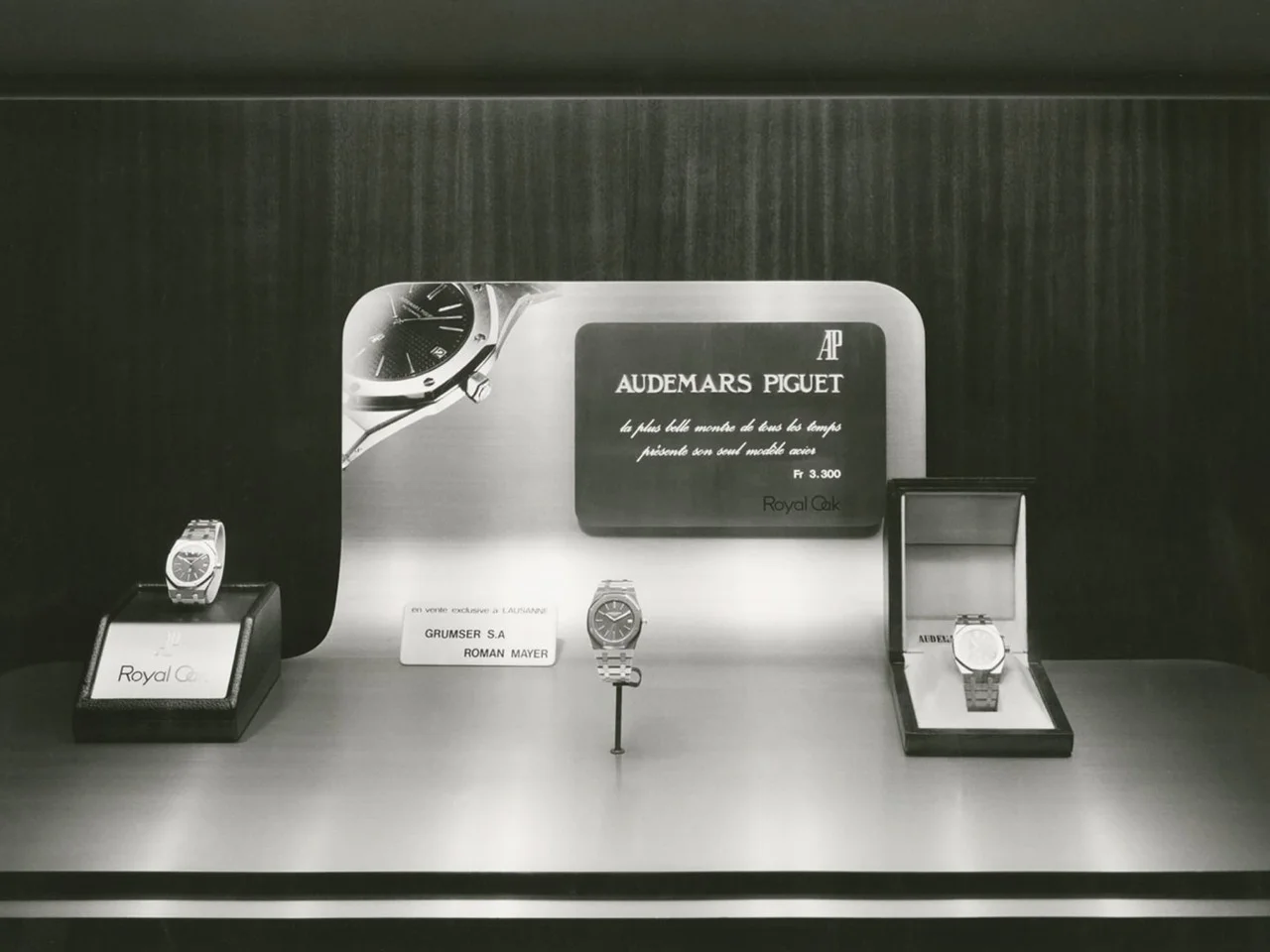
Before moving on to the launch of the watch, let’s take a moment to focus on its price positioning. This is the aspect that most shocked the watch industry, perhaps because the price of the Royal Oak was sometimes published in the advertisements of the era. In 1972, the Royal Oak sold CHF 3,300. Over time and according to the titles, the amount varied a little, hovering between CHF 3,650 and 3,750 (1975), GBP 756 (1974) and GBP 1,100 (1976) and USD 1,950 (1976).
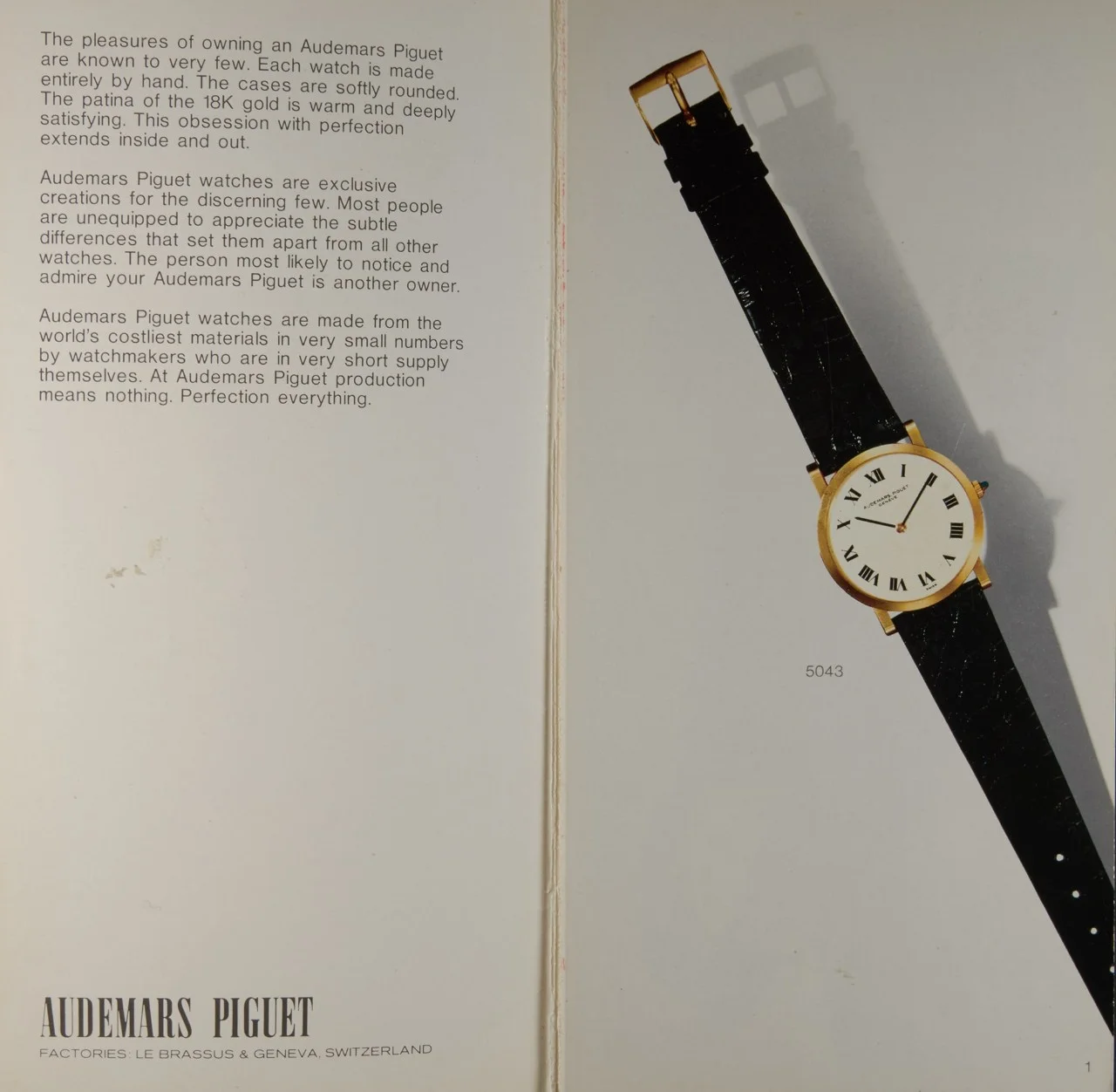
If we compare these amounts to the price of contemporary steel watches, the contrast is striking. In the absence of primary sources, we will resort to testimony from those involved at the time and collectors. In his Royal Oak guide published in July 2016, Marco Stanghellini wrote: “In Italy, the Rolex Submariner was less than a third of this price, and the IWC Ingenieur less than a quarter.” In an interview with Constantin Stikas in 2009, Gérald Genta said: “The most expensive steel watch at the time cost CHF 850.” In actual fact, despite its steel case, the Royal Oak was as expensive as some gold watches. Or even more. In the Audemars Piguet 1972 catalogue, for example, the yellow gold Model 5043, equipped with ultra-thin Calibre 2003 was listed at CHF 2,990.
Rather than ignore it, the Hugo Buchser agency decided to use the Royal Oak’s very high price as a hook for a strong message. Some of the ads challenged readers: “What makes steel more valuable than gold?”; “Would you buy a Rembrandt for its canvas”; “Steel at the price of gold”; “The costliest steel watch in the world”. The copy went on to explain that the price of the Royal Oak stemmed from the extreme complexity involved in producing its case and its ultra-thin selfwinding Calibre 2121, a masterpiece of miniaturisation. The texts highlight the work of the artisans, the rarity and delicacy of traditional skills. “Steel has been given its letters of nobility from the hands of Audemars Piguet designers.”
The message was understood and appreciated. So much so that in 1974, a brochure for retailers was entitled “Why is Audemars Piguet the costliest watch in the world?” While its content went far beyond the Royal Oak, the same argument was used to celebrate craftspeople’s work.
These arguments are echoed by Patek Philippe in 1976 when the Geneva-based watchmaker presented its Nautilus watch as “One of the most expensive watches in the world is made of steel", highlighting “the skilled hands of master craftsmen” and the versatility of a “formal or festive” watch sold for GBP 1,400.
Official Launch and First Reactions
In 1972, the Basel Watch Fair inaugurated its fifth hall and now covered 20,000 m2. For the first time, it welcomed French, German, English and Italian brands, which led it to be renamed “European Watch and Jewellery Fair” the following year.
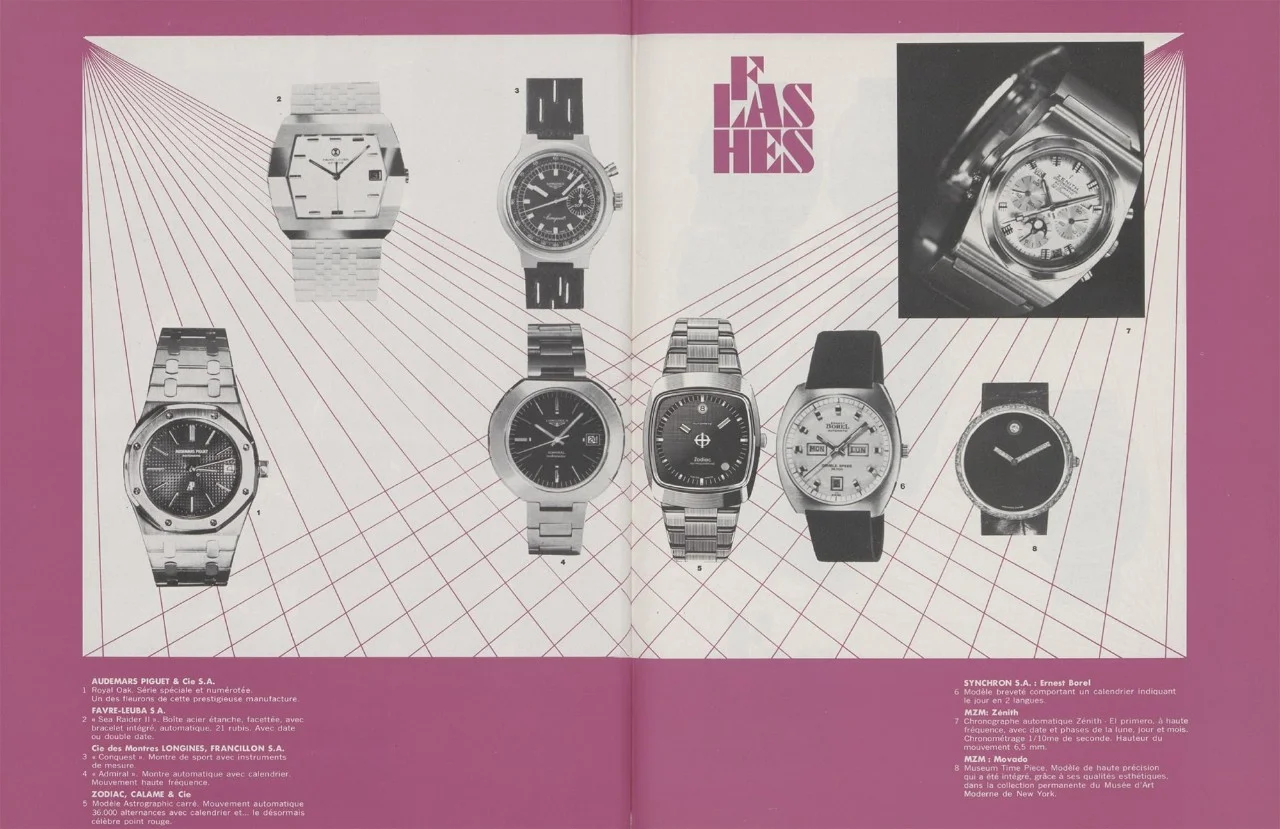
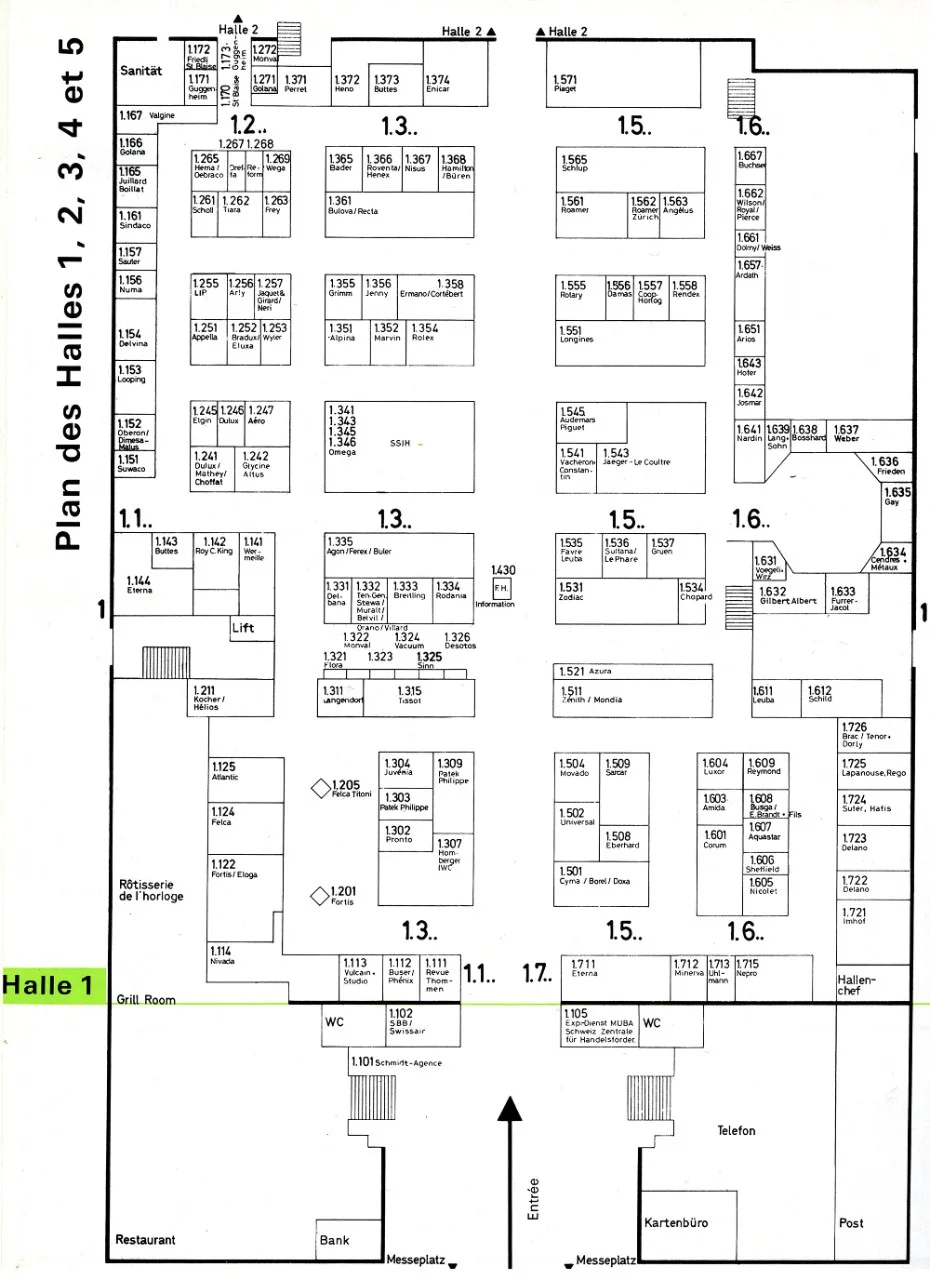
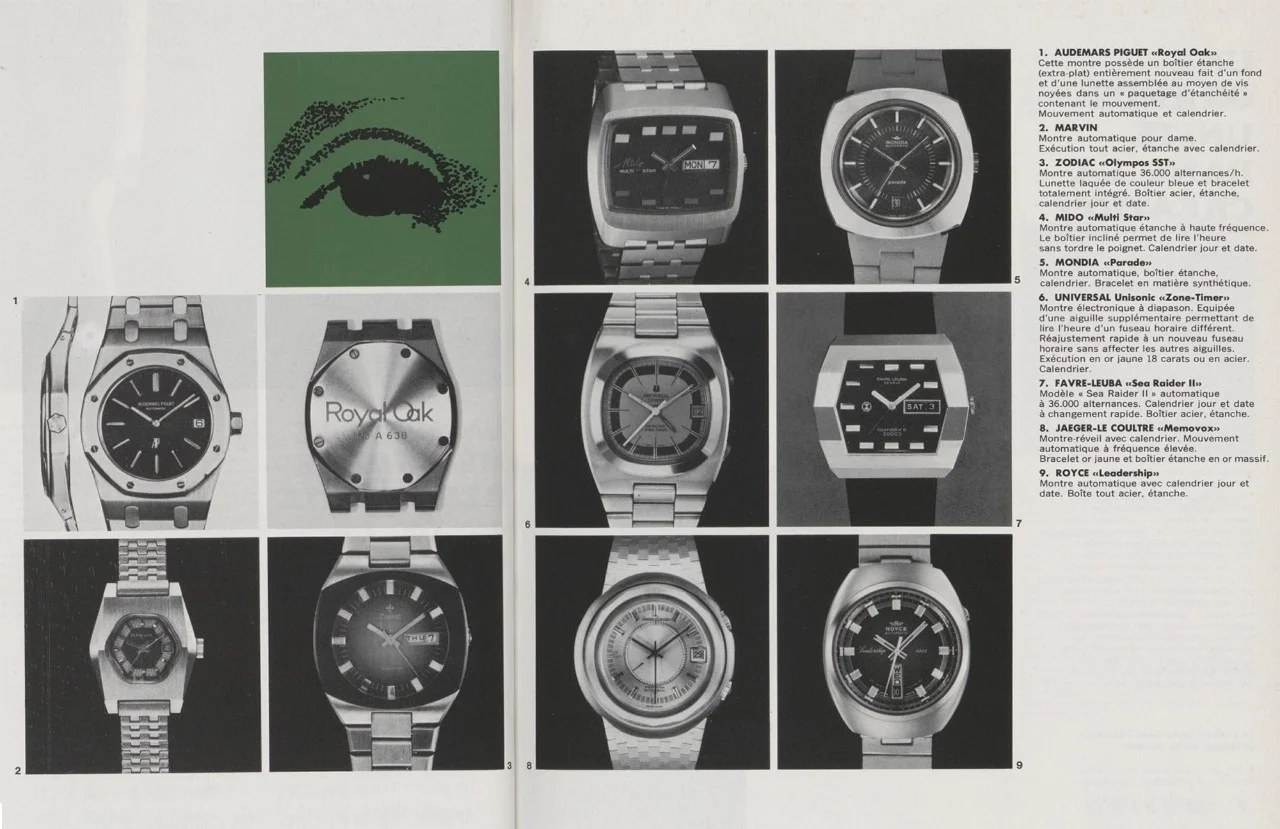
Located in Hall 1, Audemars Piguet’s booth No. 545 spanned barely 60 m2, like that of Rolex. It was located opposite the Longines booth, which was twice as large, and the SSIH stand, which was four times bigger. Alongside Vacheron Constantin and Jaeger-LeCoultre, the watchmaker from Le Brassus was in good company. The Audemars Piguet archives show that the four Royal Oak models presented to the professional watchmaking world and to the public at the time bore case numbers 67002 to 67004, small numbers 2 to 4. On the other hand, these records do not contain any reports on the exhibition, nor any orders or direct testimony relating to the Royal Oak, nor even a photograph of the booth or the display cases. Entirely absent from the Journal Suisse d’Horlogerie, the Royal Oak landed just two captioned photos in Europa Star. Even more surprisingly, when Georges Golay wrote his 1972 annual report to the Audemars Piguet Board of Directors on May 3, 1973, he ignored the newcomer: “As far as products were concerned, nothing much changed in 1972.” The silence was apparently deafening.
Nonetheless, several witnesses from the time recall that the watch caused a sensation. In 2006, Jacqueline Dimier, who created most of the AP models between 1975 and 1999, remembers: “That spring, many of us from all walks of life crowded into the Audemars Piguet showcases at the Basel Fair. Surprised and stunned, we realised without any clear explanation that a step was being taken that was at last connecting traditional watchmaking to an industrial aesthetic of the future.” Gérald Genta recounted that Pierre-Alain Blum, then head of Ebel, came to see him: “I would like to congratulate you because I have just come from Audemars Piguet, where I have ordered the Royal Oak for my friend Perrin.” At that time, Blum was making the entire must-have collection for Cartier, a company run by Alain Dominique Perrin. Above and beyond the watchmaking microcosm, the Royal Oak had already won over one of the greatest collectors of his era: the Shah of Iran, Mohammad Reza Pahlavi, who had seen a preview of the prototype and just ordered the first model in white gold, as well as many others in steel for his entourage.
Not all reviews were glowing. While critics left no written trace – since social media did not yet exist – those involved back in the day sometimes drop a hint that the watch created a scandal in the hushed world of Haute Horlogerie. When Georges Golay addressed the Swiss market in March 1973, he discreetly recalled that “this watch has people talking about Audemars Piguet”, and mentioned “the scepticism of certain clients.” In 1992, Martin K. Wehrli stated in the Audemars Piguet monograph: “The professional world reacted with scepticism to the Manufacture’s announcement of the market launch of this stainless steel wristwatch at a price of 3,650 Swiss francs.” Gérald Genta also said that “It was not a demonstration of success...”. In a 2013 interview, Jasmine Audemars confirmed that “At the beginning, the Royal Oak attracted a lot of criticism”, as it “stepped outside the codes of the time.”

First Deliveries
In an unpublished memoir written by Martin K. Wehrli in 2017, who in 1972 was responsible for sales, recounts that the first buyer of the watch was “Ron Smith, acting on behalf of Garrard in London.” This supplier by appointment to Her Majesty is said to have confined himself to this laconic comment: "”Royal Oak is a pub name here.” The same document states that “Number one was not delivered until July 8, 1974 to a director of Harry Winston; the watch bore the case number 67001 and the movement number 127006.”
The first few months were rather chaotic. Large production was a major challenge, a real baptism of fire. Not only were component deliveries running late, but each assembly required endless rework. Of the 20 timepieces completed in April, the first five were delivered to the Italian market on May 2, but only 10 watches were cased-up throughout the entire month. June proved more productive, with 95 units, but this figure fell to eight watches in July.
Little by little, the craftspeople overcame the difficulties and from August onwards, the rate of delivery increased significantly. So much so that by the end of 1972, the workshops had produced an impressive total of 565 Royal Oak watches, 490 of which had been delivered! Thus, in barely eight months after its launch, Model 5402 had already broken the record for the number of identical units of a model sold in one year. Had the gamble paid off? All that remained was for retailers to sell the watches to end customers... before ordering new ones from Le Brassus.
Commercial Success or Failure?
Since the 2010s, the original commercial failure of the Royal Oak has become a widespread misconception, albeit belied by historical facts. In their book published for the Royal Oak’s 40th anniversary, Martin K. Wehrli and Heinz Heimann recalled: “It even took the two main markets a full three years to sell their quotas of 400... Then one day, in 1974, Giovanni Agnelli, industrial magnate and the boss of FIAT appeared in public with a Royal Oak on his wrist. From one day to the next, the watch began to enjoy unprecedented success, and the amazing story truly began.”
Other sources tell a different story. In March 1973, Georges Golay described the Royal Oak as a “best seller”. In May 1973, he wrote: “The Royal Oak has proved that the purchasing motivations of part of our clientele have changed.” On August 22, he increased the advertising budget by 50%. At the same time, he hired an engineer to create the Technical Department and launched the expansion of the Manufacture. Audemars Piguet’s turnover rose from 13 million in 1973 to 18 million the following year, then to 25 million in 1975. In an interview dated February 6, 1982, George Golay said of the Royal Oak: “It was an instant success.” As for the Audemars Piguet book published by Flammarion in 2011, it speaks of a “very great commercial success” which forced the company to “change scale and renew its traditional processes.”
What do the figures say? After coming close in 1972, the Royal Oak passed the 500 mark in 1973. It reached 618 units the following year and stabilised slightly below 600 until 1976, before increasing with the arrival of the gold versions, to reach 820 watches in 1978. While these figures may seem modest 50 years on, they were remarkable for the period.
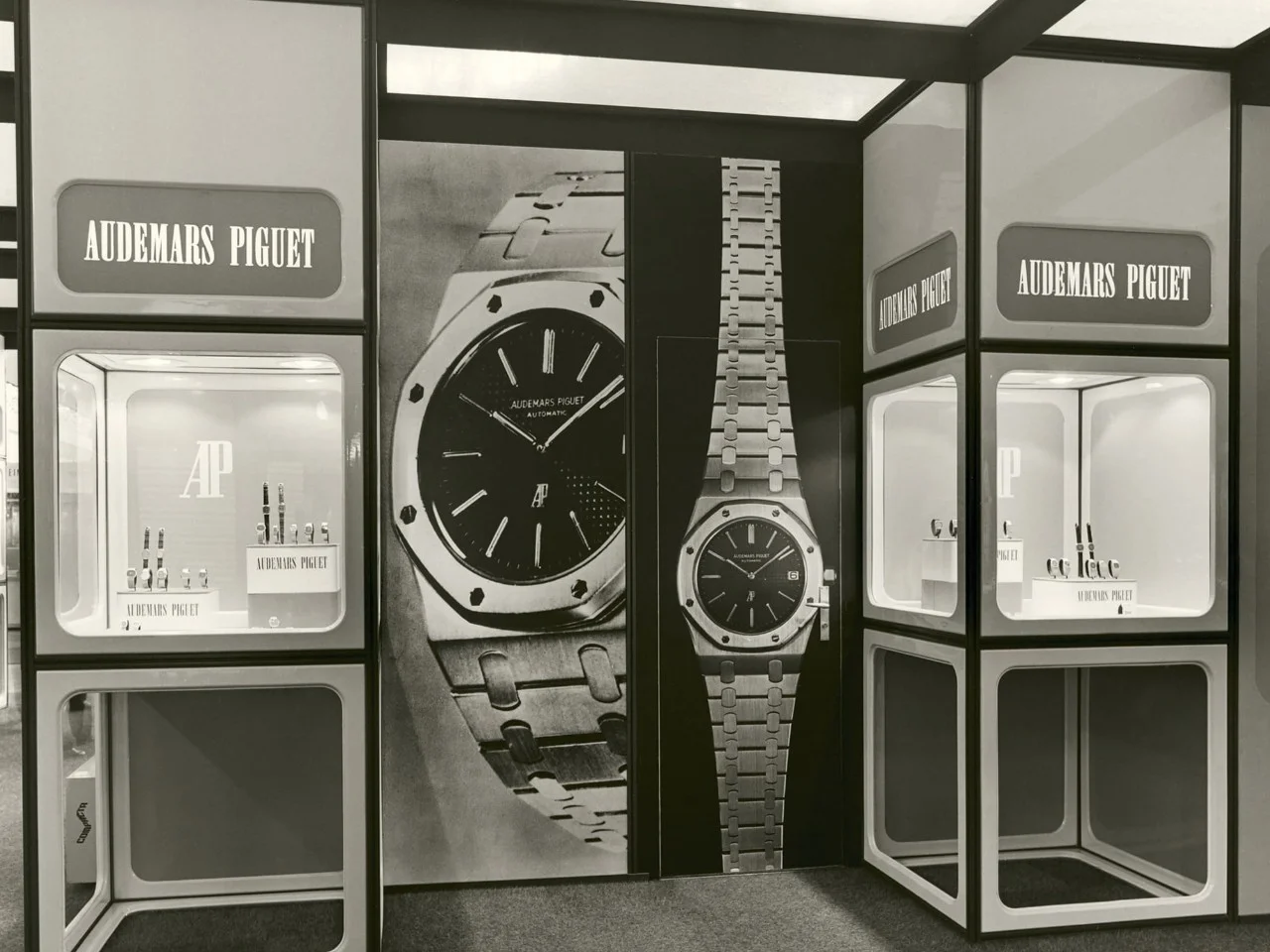
The Beginning of a Story
From the launch of the watch in 1972 and during the first years of its commercialisation, the Swiss market absorbed between 150 and 200 watches per year, as did Asia. The Royal Oak found an audience in Germany. While it enjoyed modest yet growing success in France, the surprise came from Italy. Carlo de Marchi, one of the key minds behind the Royal Oak, struggled to distribute it, confirming Genta’s testimony. In 1972, 89 watches were delivered to Italomega. This figure dropped to 35 in 1973, then barely 31 the following year, painfully rising to 36 and 44 watches in 1975 and 1976. According to the Audemars Piguet commercial archives, the Italian market only sold just over half of the 400 timepieces ordered in 1971. Was there a “Gianni Agnelli effect”? While it definitely made its mark on people’s memories, the commercial impact is less likely. There is however still one unknown factor, since it is not impossible that certain Italian retailers came to buy watches directly in Switzerland... Whatever the case, the Royal Oak conquered the Italian market from 1976 to 1977 in its gold or two-tone smaller 29 and 35 mm versions (Models 8638, 4100 and variations).
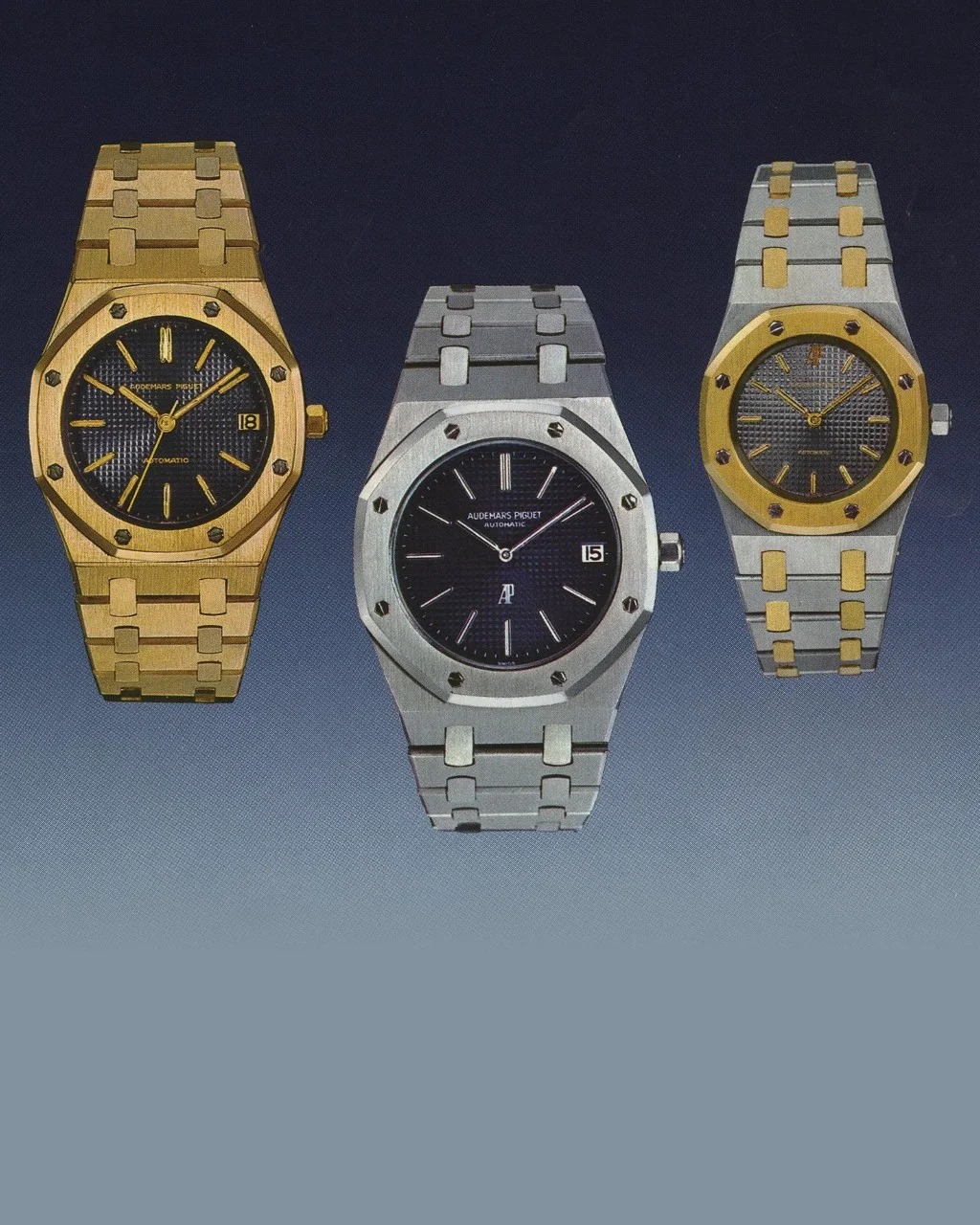
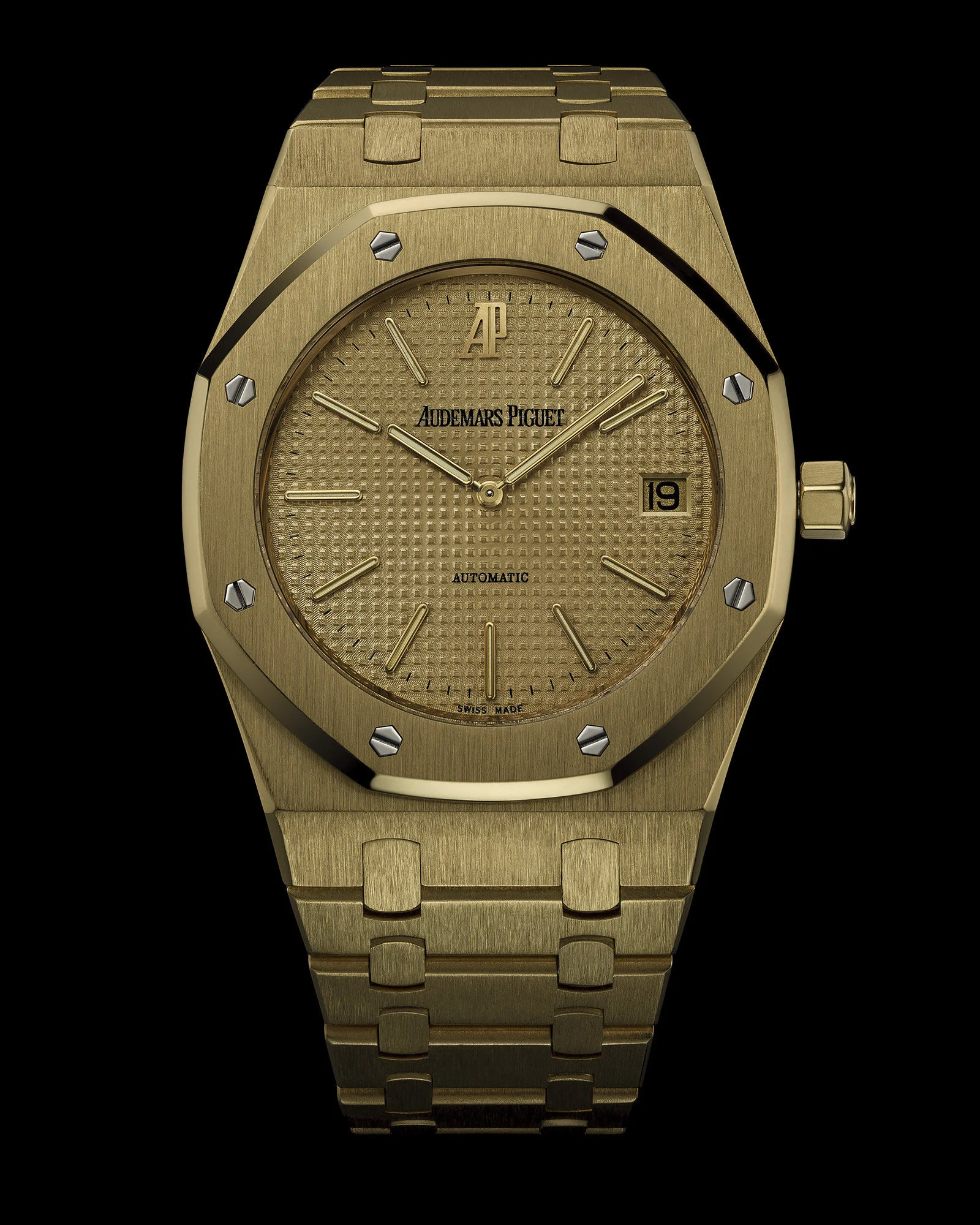
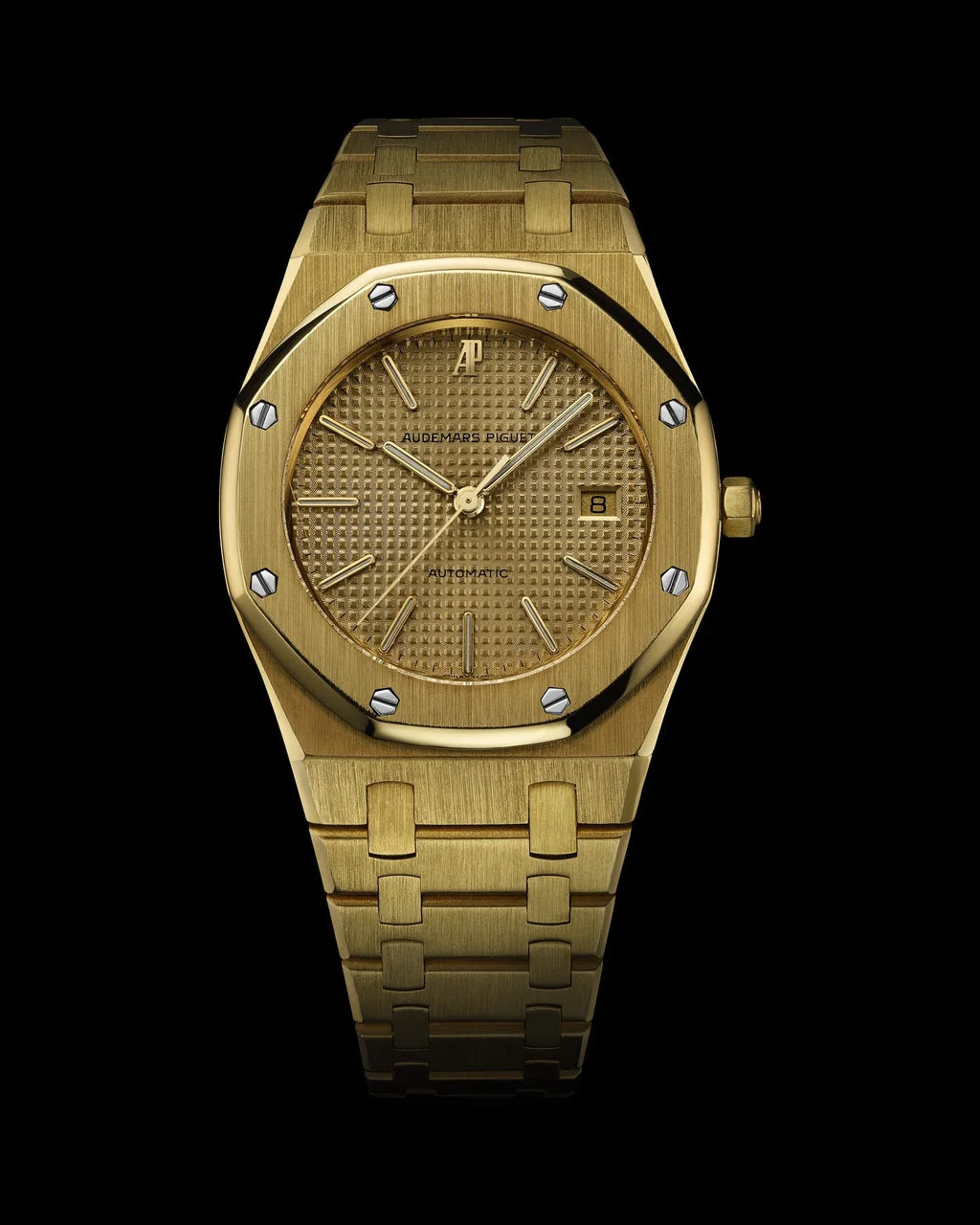
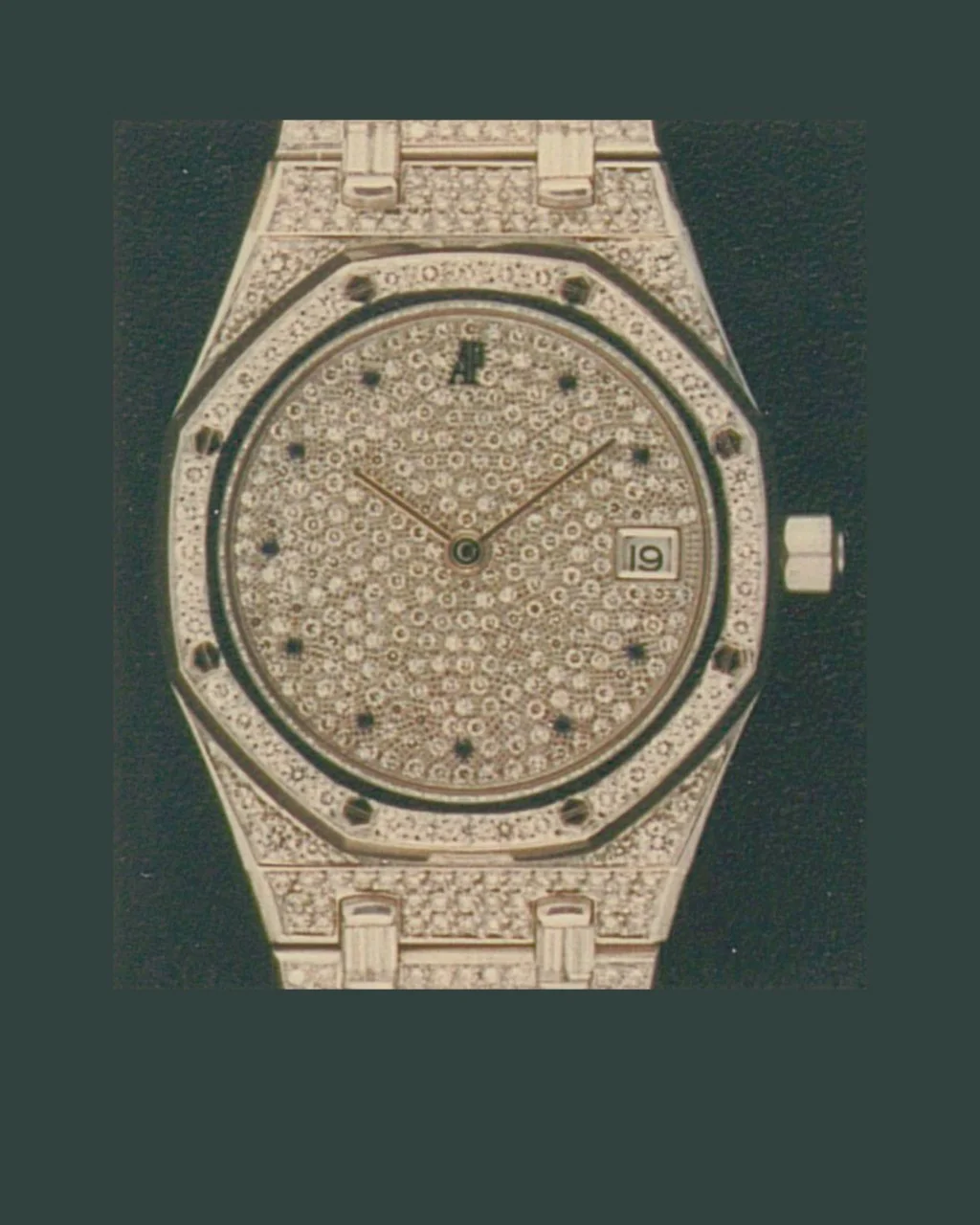
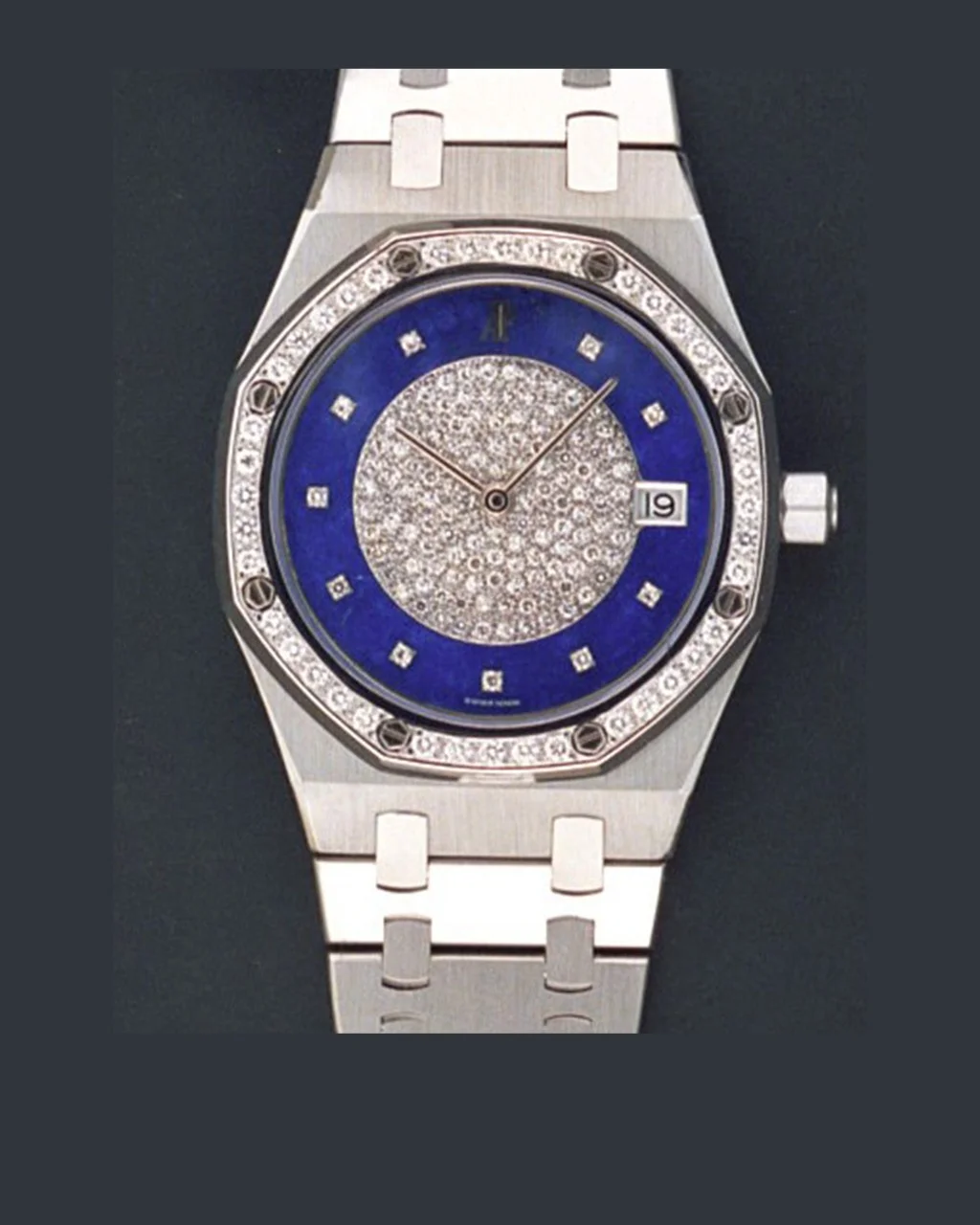
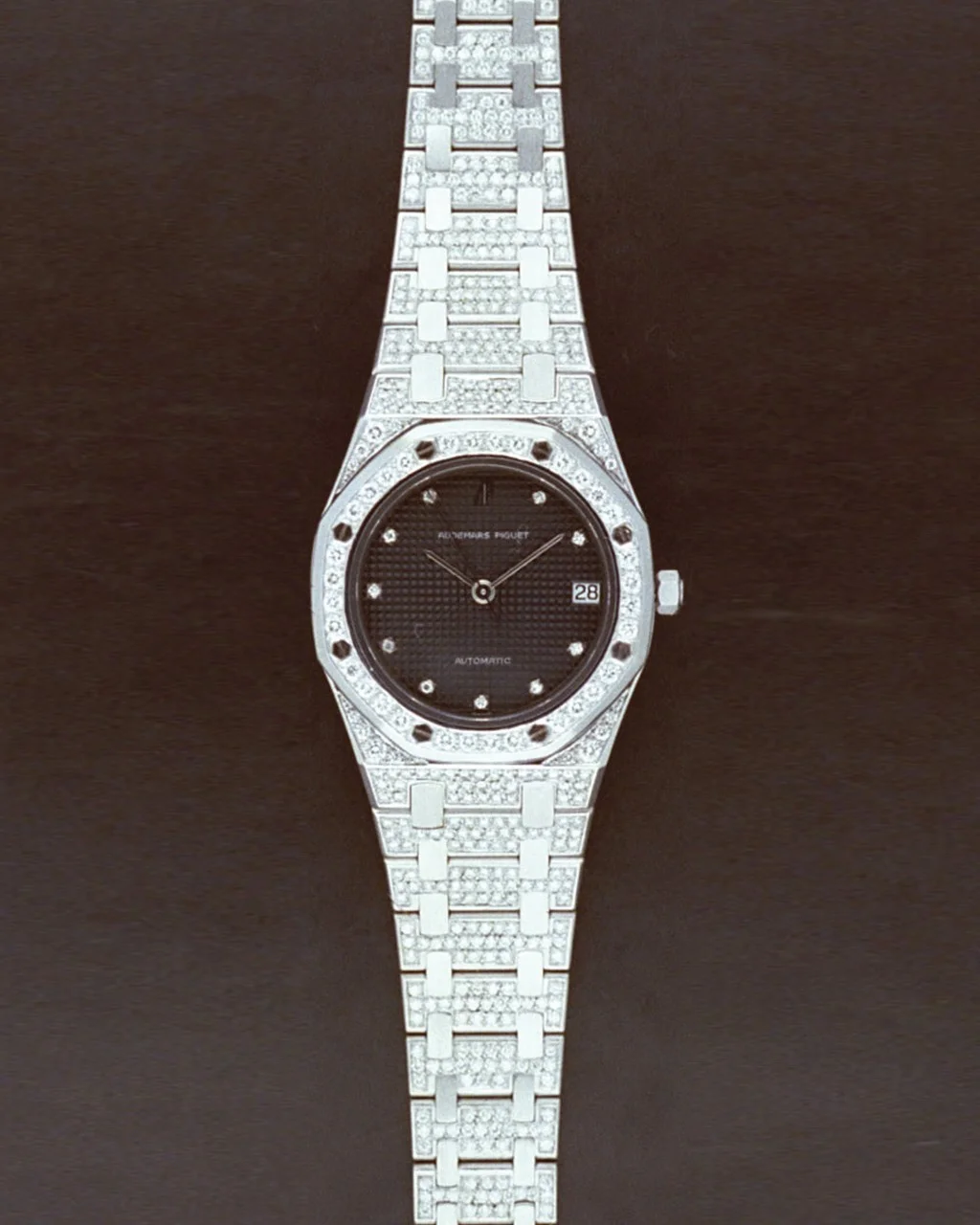
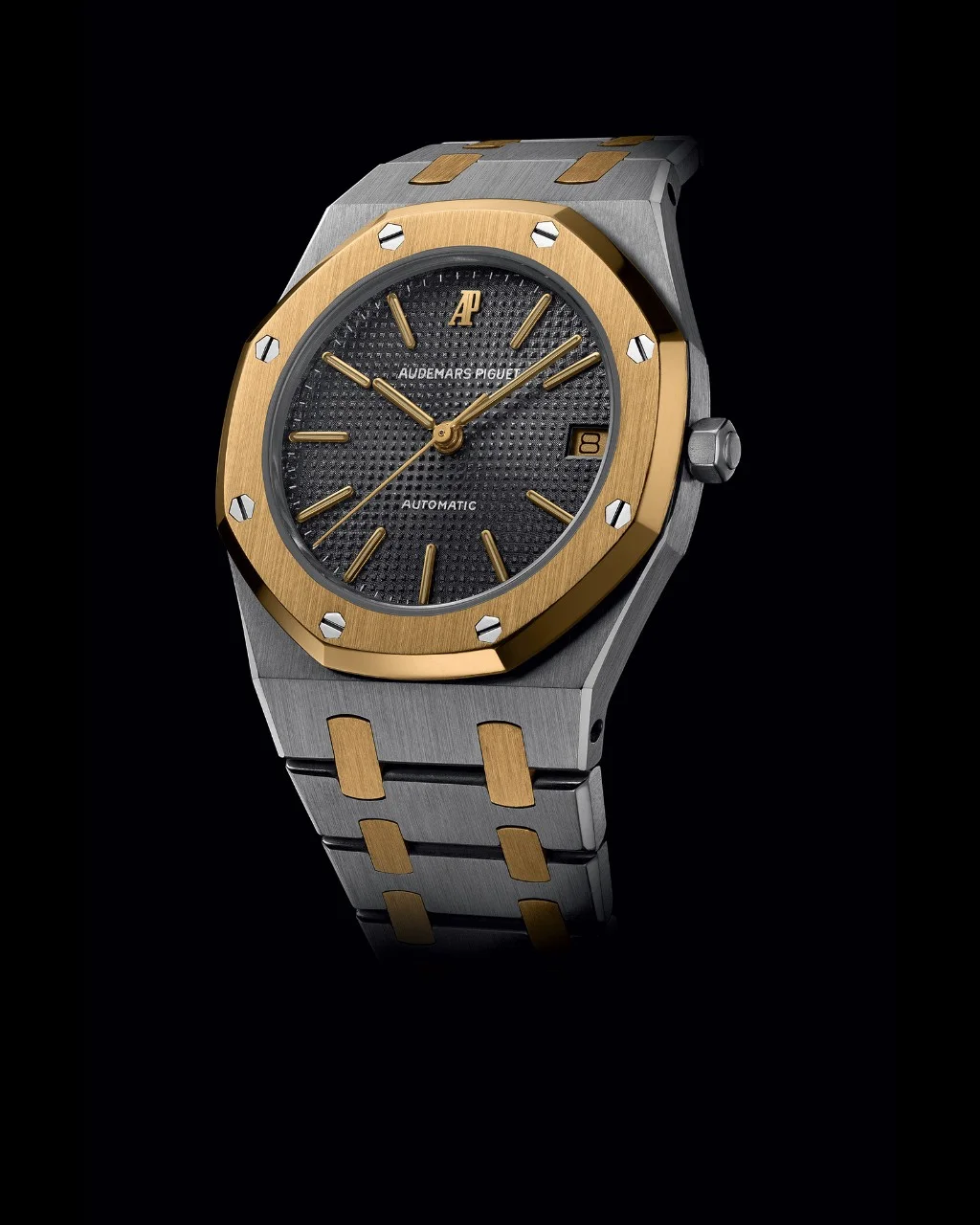
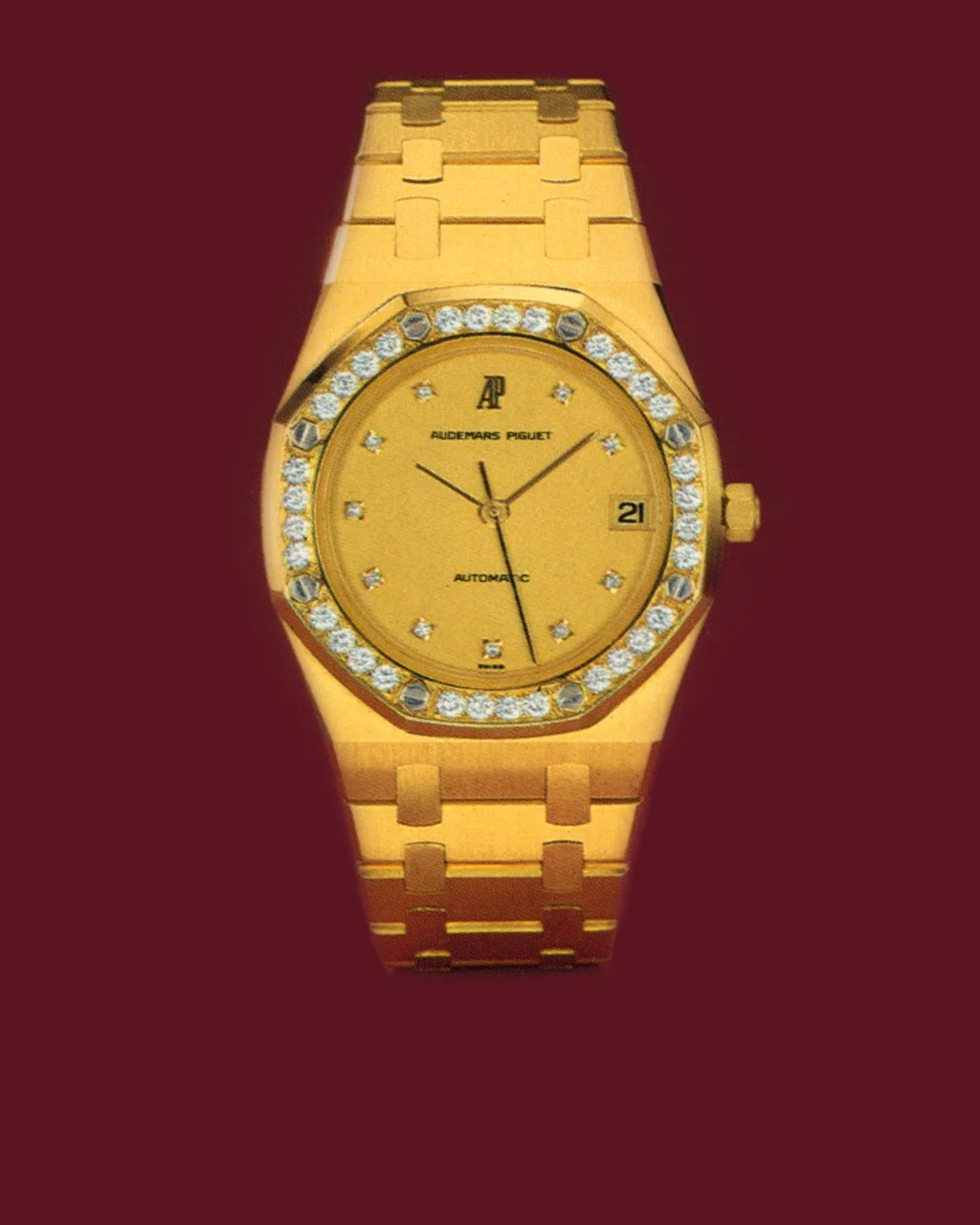
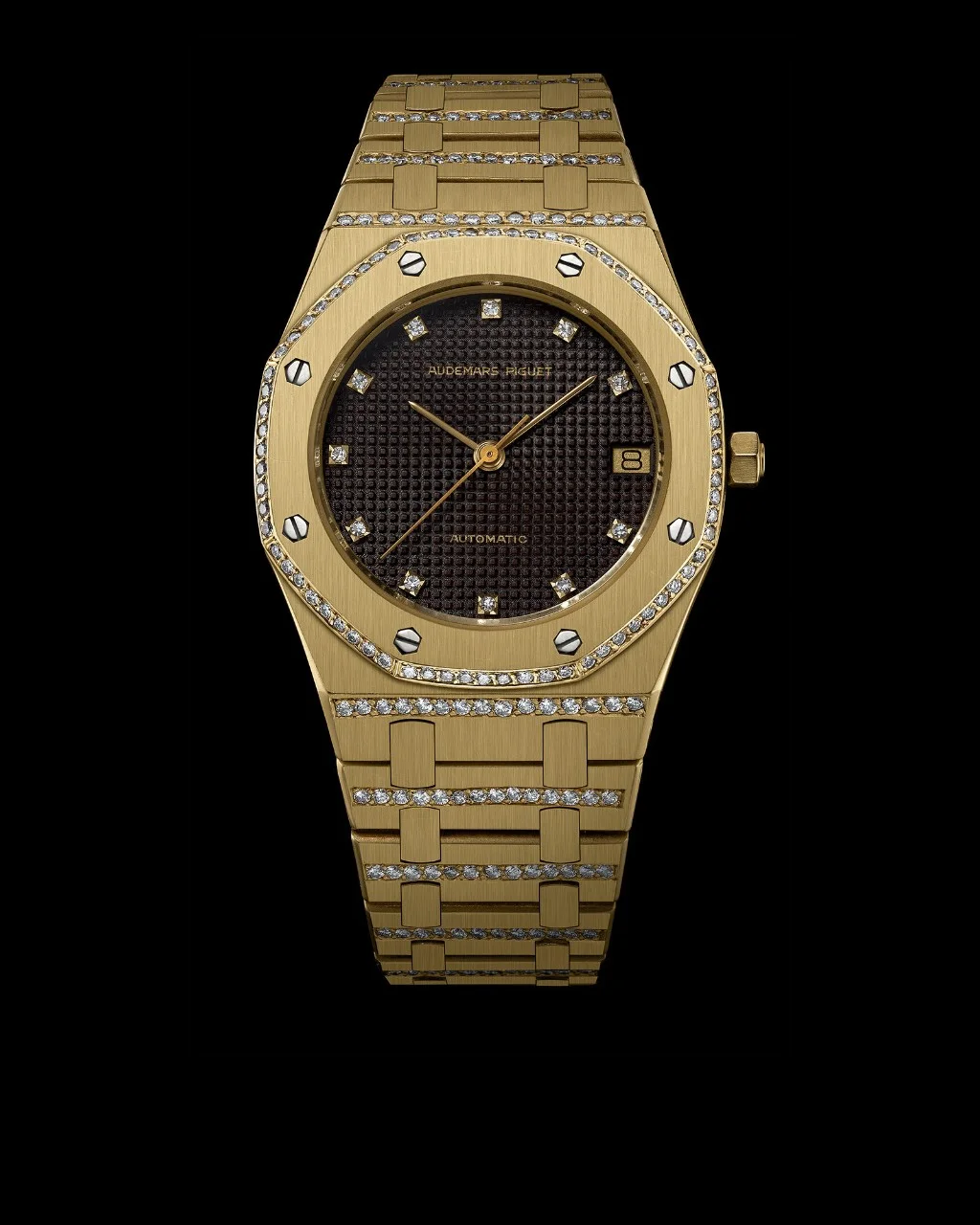
Thus, despite the criticism, but also thanks to the debates it sparked, the Royal Oak was an undeniable commercial success from the outset. So much so that the A series, which was to be limited to 1,000 units, was eventually extended to 2,000. In 1975, Audemars Piguet launched the B series, followed the next year by the C series and finally the D series in December 1978. A total of 6,050 Model 5402 watches were sold, including 4,288 in steel, 876 in two-tone gold and steel, 736 in yellow gold, and 150 in white gold. More importantly, the Royal Oak was enriched in 1976 with a version for women, Model 8638 designed by Jacqueline Dimier, followed by Model 4100 endowed with a smaller diameter and a central seconds hand. Dozens of variations in materials, dimensions and levels of complications followed as the Royal Oak collection took shape.
In the wake of the new icon, numerous models inspired by the Royal Oak spirit were created throughout the Swiss watch industry. Genta recounted that a few years later, he was commissioned by Patek Philippe to design another steel watch, the Nautilus. In the same spirit, the Genevan designer revisited the IWC Ingenieur in 1976 and other designers were inspired by the Royal Oak to evolve watchmaking. One example is the Overseas 222 model designed by Jörg Hysek, launched by Vacheron Constantin in 1977.
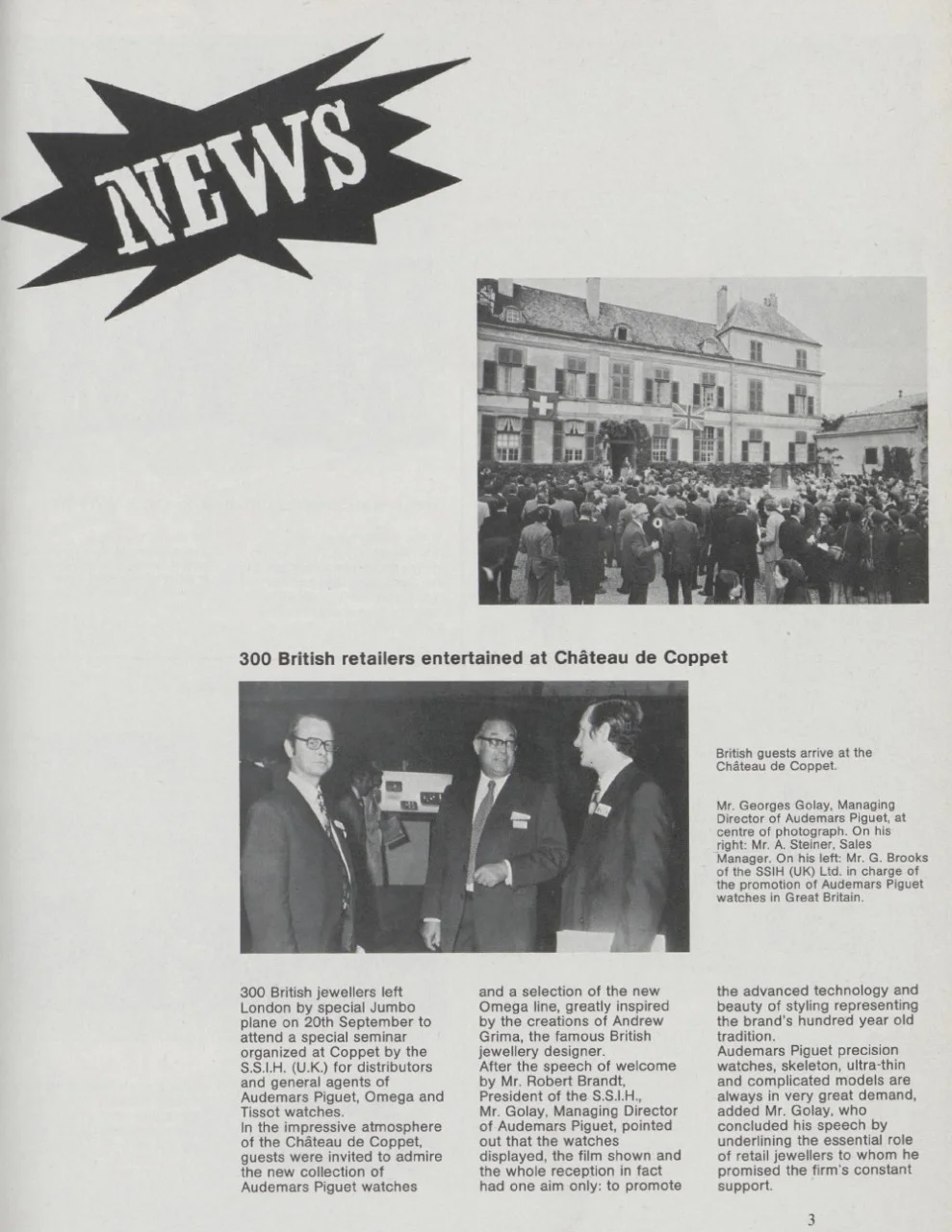
20 September 1972. SSIH training workshop A Jumbo plane was specifically charted to bring 300 English retailers to Geneva for a SSIH sales workshop. For the occasion, Georges Golay presented the Audemars Piguet collection including the first Royal Oak. © Europa Star 1972, no 77, 5/6, p. 23.
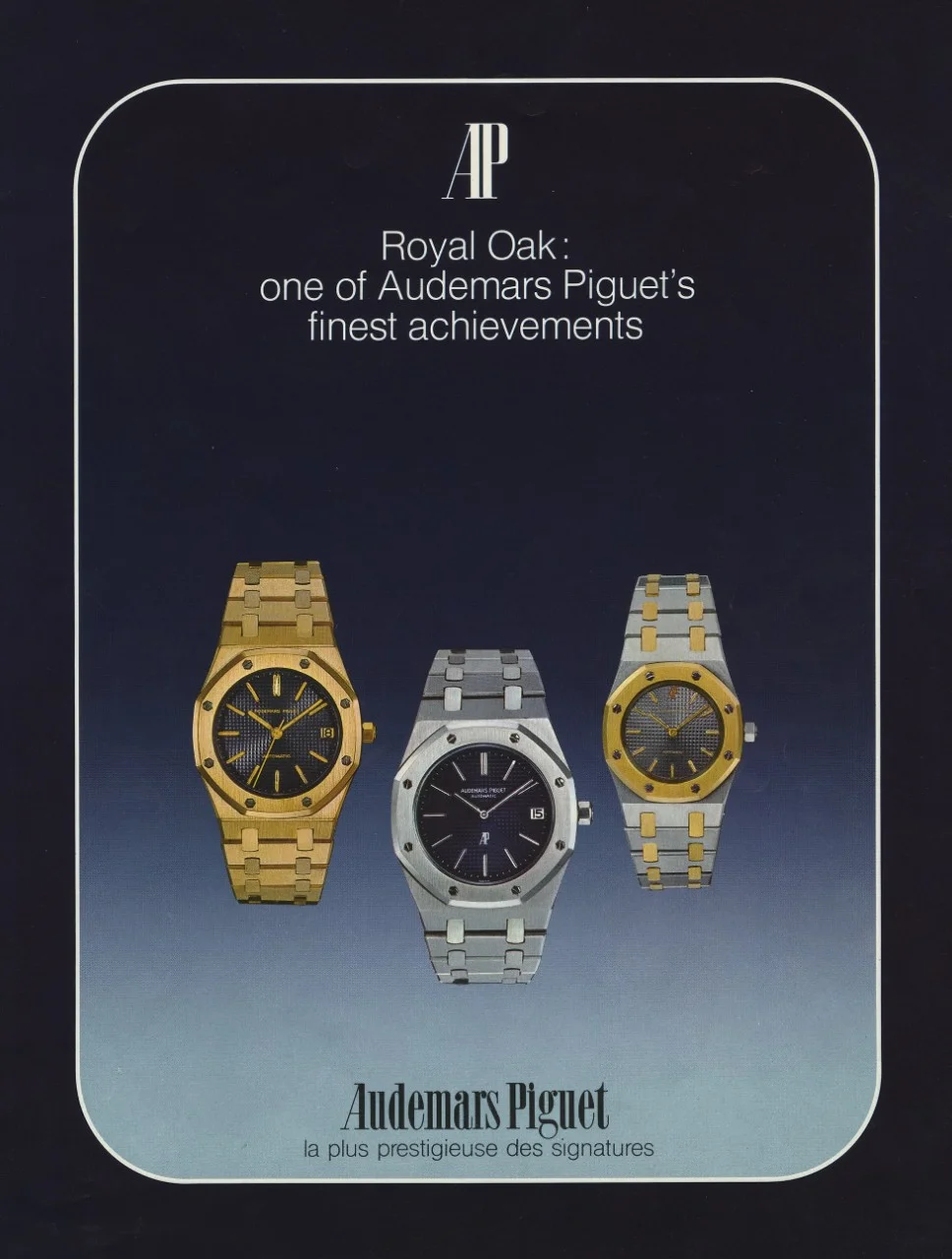
1977. Royal Oak Advertisement. Five years after its launch, the Royal Oak came for the first time in precious materials and in three different sizes. From left to right: 4100BA (35 mm), 5402ST (39 mm) and 8638SA (29 mm). Audemars Piguet Archives.
Series |
5402ST A Series |
5402ST No small number |
5402ST B Series |
5402ST C Series |
5402ST D Series |
5402ST No letter |
TOTAL STEEL |
5402SA | 5402BA | 5402BC | TOTAL GOLD |
TOTAL 5402 |
|---|---|---|---|---|---|---|---|---|---|---|---|---|
| TOTAL | 1937 | 129 | 845 | 952 | 404 | 21 | 4288 | 876 | 736 | 150 | 1762 | 6050 |
| 1972 | 490 | 490 | 1 | 1 | 491 | |||||||
| 1973 | 543 | 543 | 543 | |||||||||
| 1974 | 614 | 2 | 616 | 616 | ||||||||
| 1975 | 243 | 120 | 228 | 591 | 591 | |||||||
| 1976 | 7 | 569 | 10 | 586 | 586 | |||||||
| 1977 | 13 | 5 | 23 | 459 | 500 | 92 | 95 | 1 | 188 | 688 | ||
| 1978 | 4 | 3 | 234 | 1 | 242 | 299 | 231 | 50 | 580 | 822 | ||
| 1979 | 6 | 7 | 223 | 15 | 251 | 180 | 122 | 45 | 347 | 598 | ||
| 1980 | 10 | 7 | 15 | 129 | 161 | 92 | 135 | 37 | 264 | 425 | ||
| 1981 | 2 | 4 | 5 | 87 | 98 | 126 | 51 | 5 | 182 | 280 | ||
| 1982 | 2 | 4 | 70 | 76 | 39 | 22 | 3 | 64 | 140 | |||
| 1983 | 1 | 53 | 54 | 9 | 19 | 2 | 30 | 84 | ||||
| 1984 | 1 | 1 | 20 | 22 | 6 | 23 | 29 | 51 | ||||
| 1985 | 10 | 10 | 6 | 9 | 2 | 17 | 27 | |||||
| 1986 | 1 | 6 | 7 | 6 | 13 | 19 | 26 | |||||
| 1987 | 1 | 1 | 5 | 7 | 10 | 3 | 13 | 20 | ||||
| 1988 | 7 | 5 | 12 | 2 | 8 | 2 | 12 | 24 | ||||
| 1989 | 1 | 1 | 1 | 10 | 13 | 4 | 3 | 1 | 8 | 21 | ||
| 1990 | 6 | 6 | 3 | 2 | 5 | 11 | ||||||
| 1991 | 1 | 1 | 1 | |||||||||
| 1992 | 1 | 1 | 1 | |||||||||
| 1993 | 1 | 1 | 1 | 1 | 2 | |||||||
| 1994 | 1 | 1 | 1 | |||||||||
| 2002 | 1 | 1 | 1 |
In Conclusion
More than a watch, the Royal Oak is an object of design and culture, a symbol of its time. In 1972, it reinvented the codes of luxury watchmaking. Born at the heart of a profound cultural and artistic revolution, at the dawn of the worst crisis in the Swiss watch industry, exacerbated by the financial and oil crises, it was nurtured by multiple influences. Each actor involved in its genesis enriched it: the SSIH agents perceived clients’ new sensitivities and challenged Audemars Piguet to respond. Georges Golay was able to inspire each actor in the creative process. Gérald Genta designed his masterpiece in one night. The best dial-makers, watchmakers, case-makers and advertisers enriched, refined, fleshed out and fine-tuned the Royal Oak, contributing their talents, know-how and passion to create an extraordinary watch, rich in tradition but looking to the future.
In 1982, George Golay summed up the reasons behind its success: “I think it is beautiful, elegant and sporty in appearance, whereas watches up until now were either very elegant or very sporty.” In other words, the Royal Oak is probably the watch industry’s first example of sporting chic.
Editorial board: Audemars Piguet Heritage team, Le Brassus
First publication: 24 January 2022
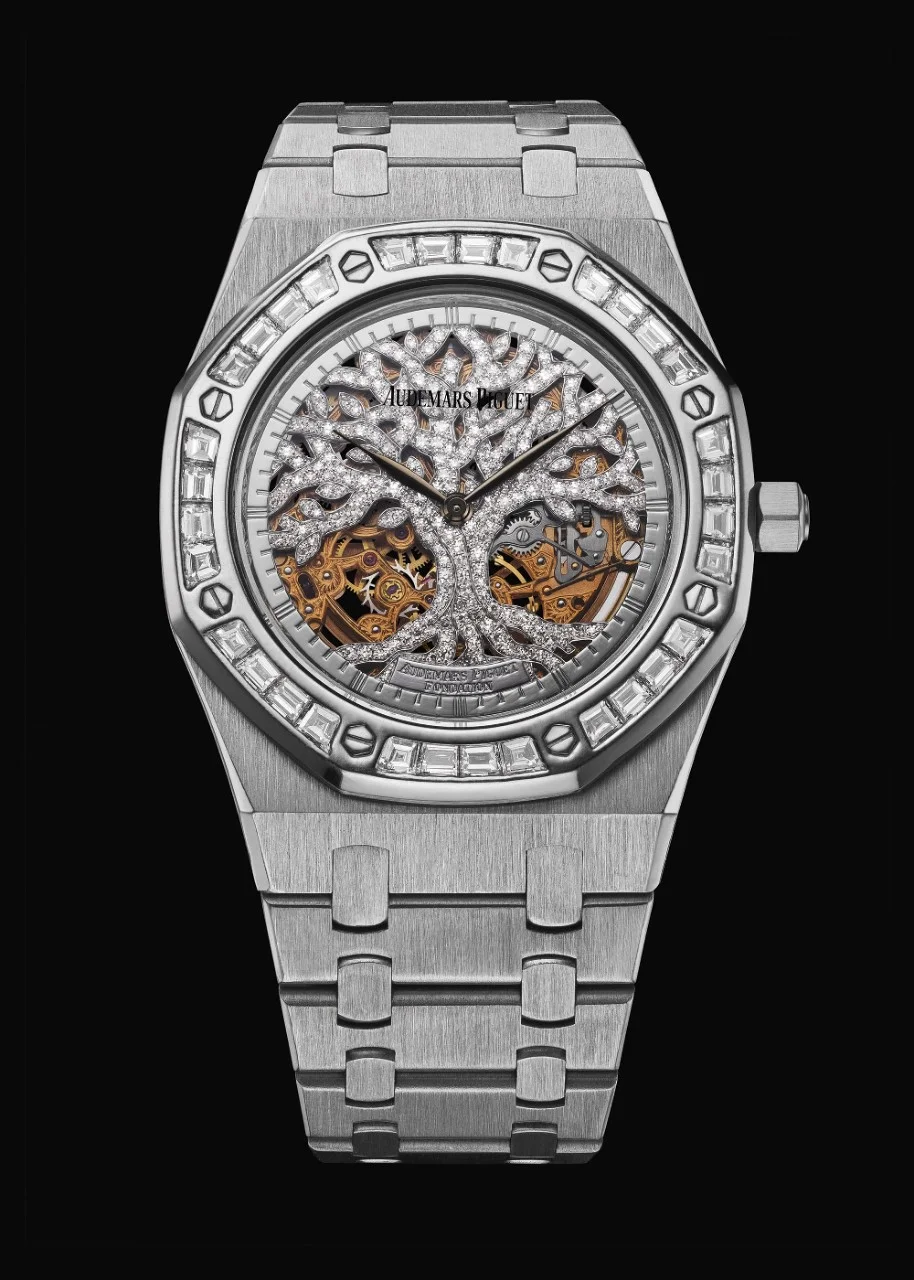
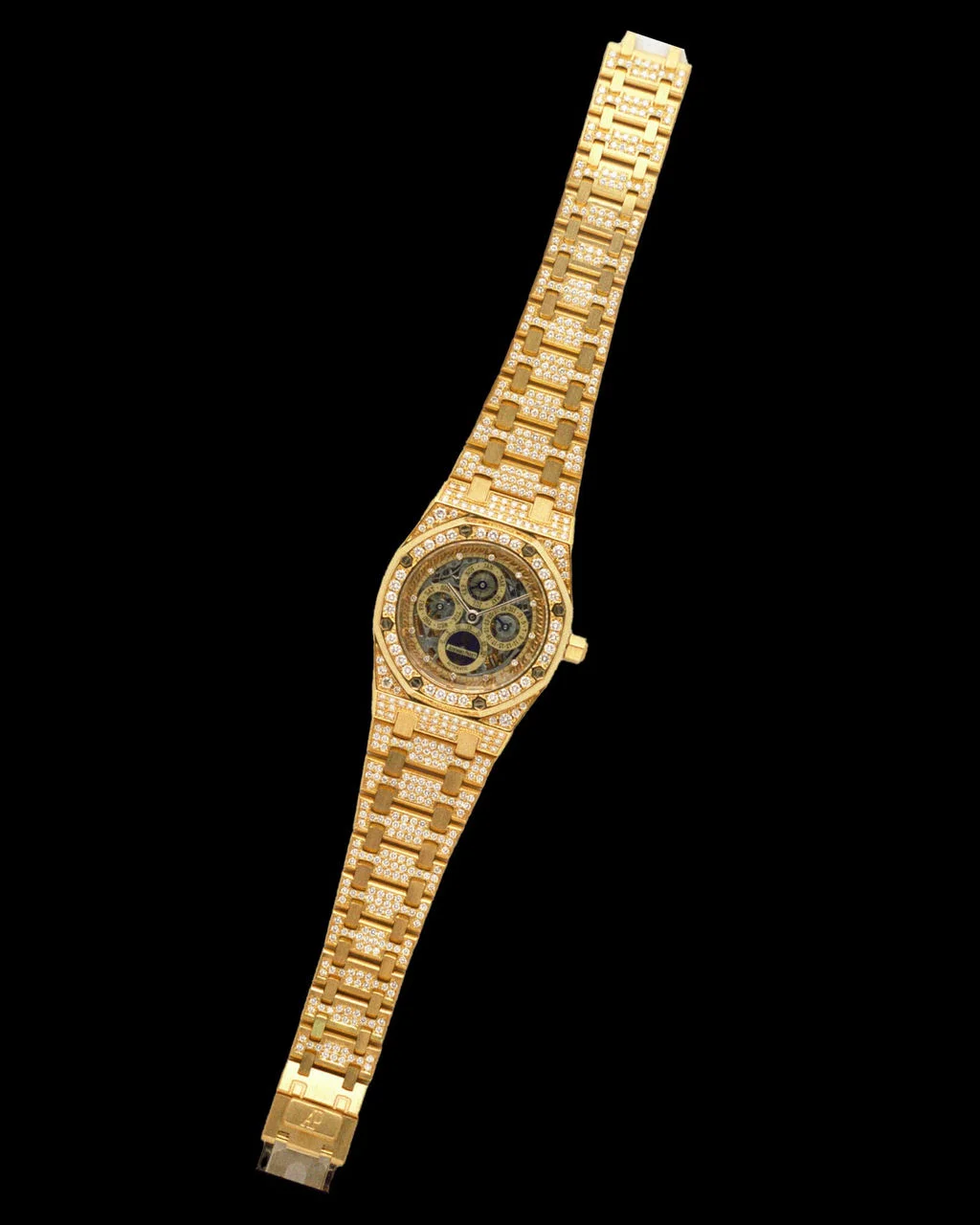
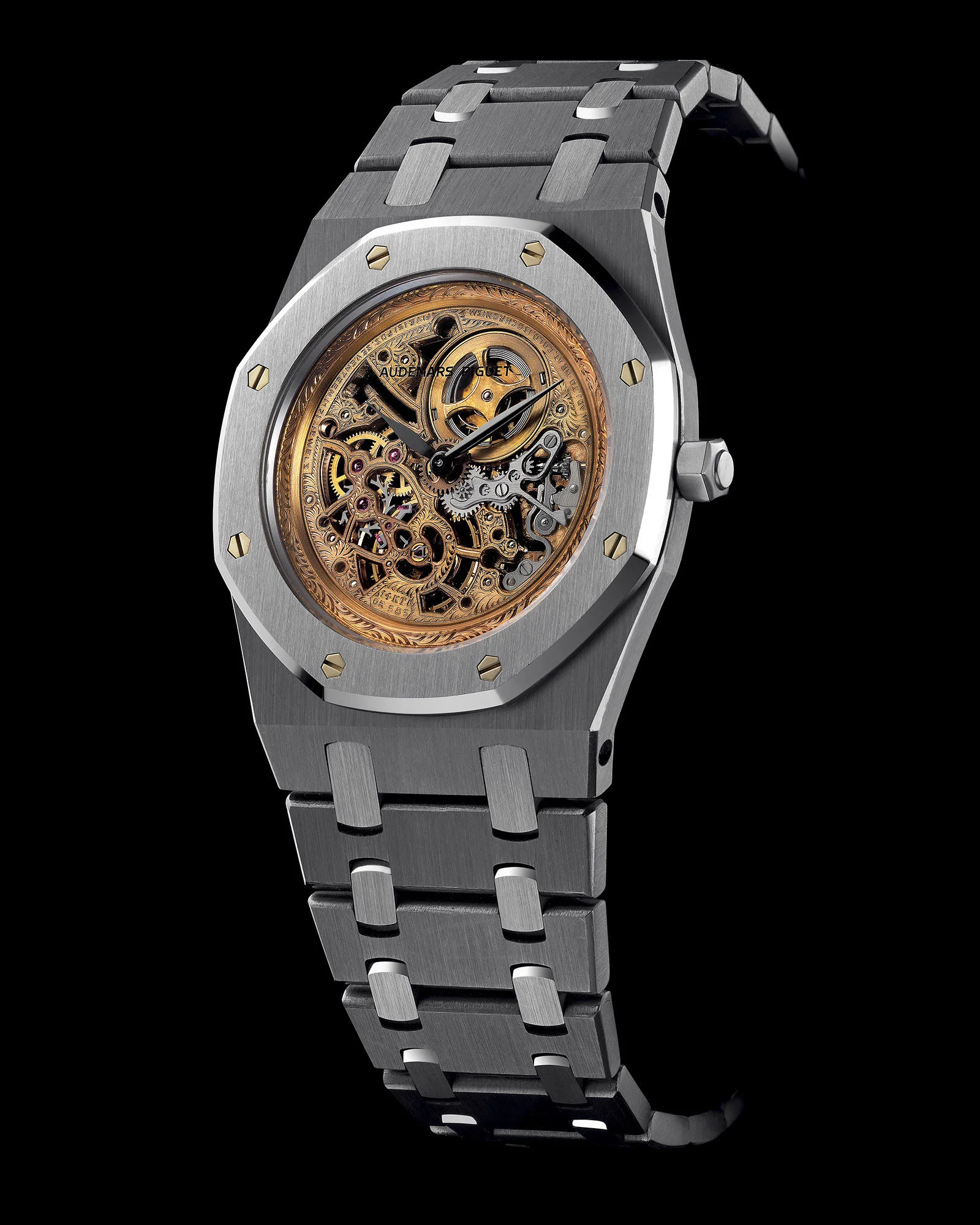
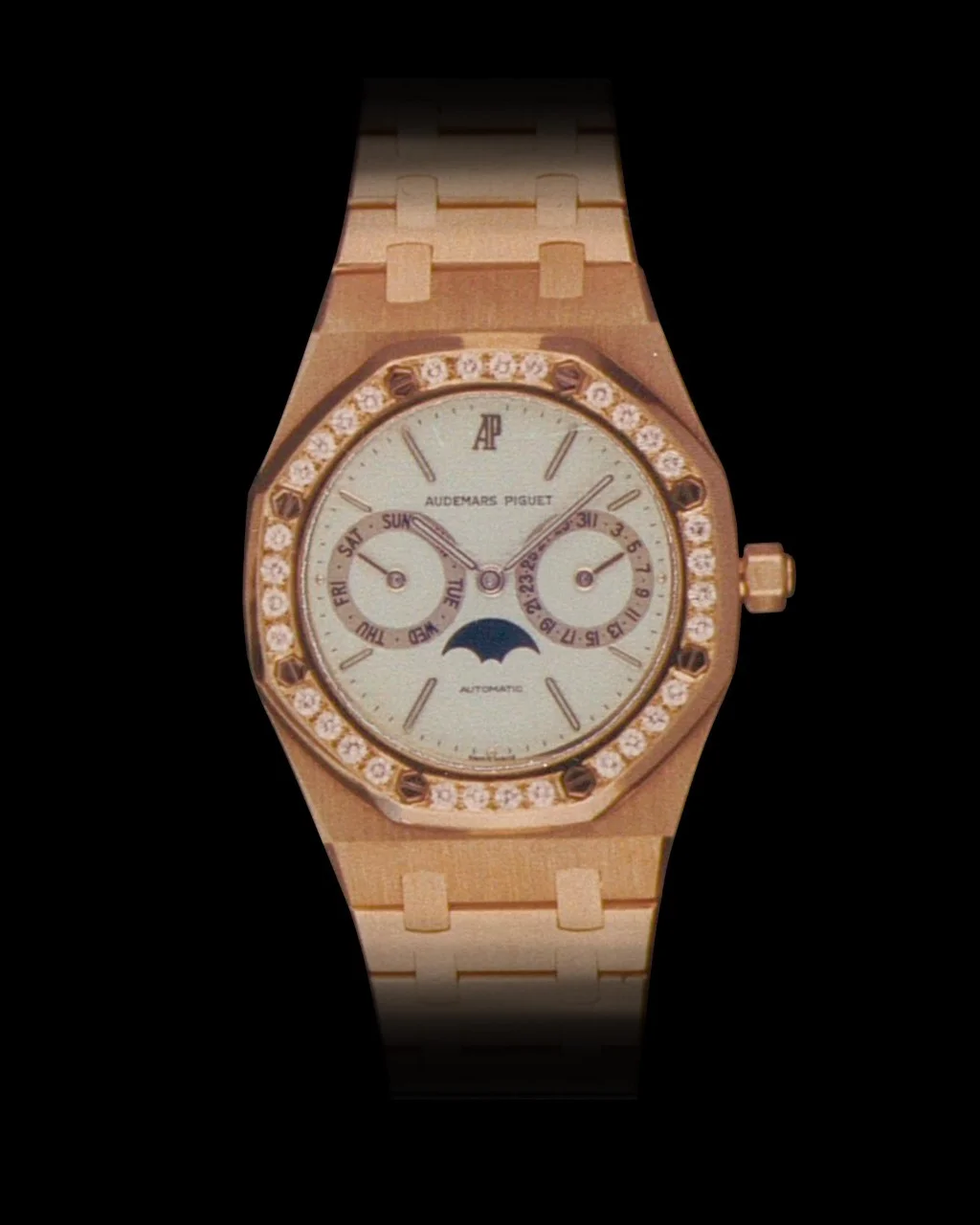
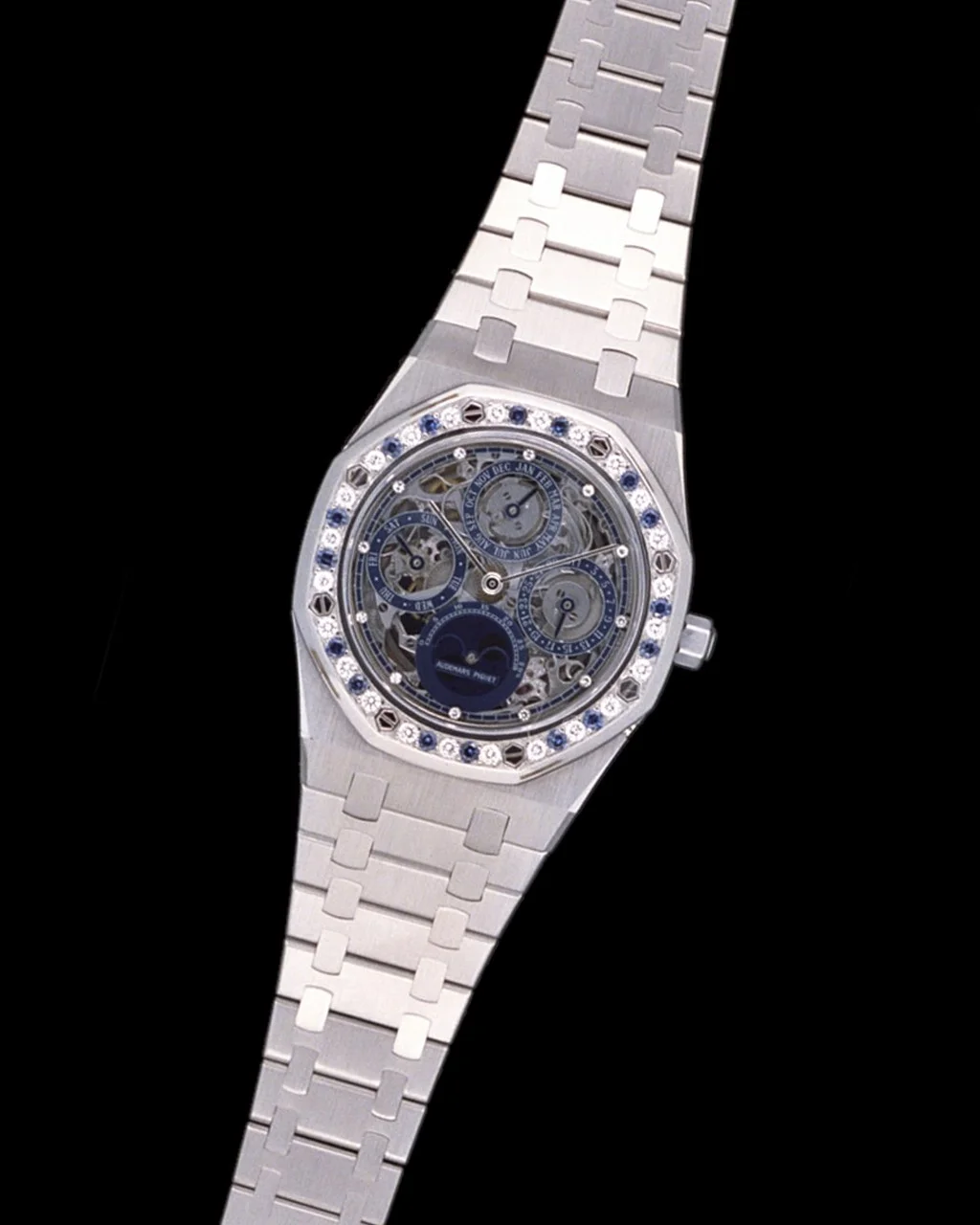
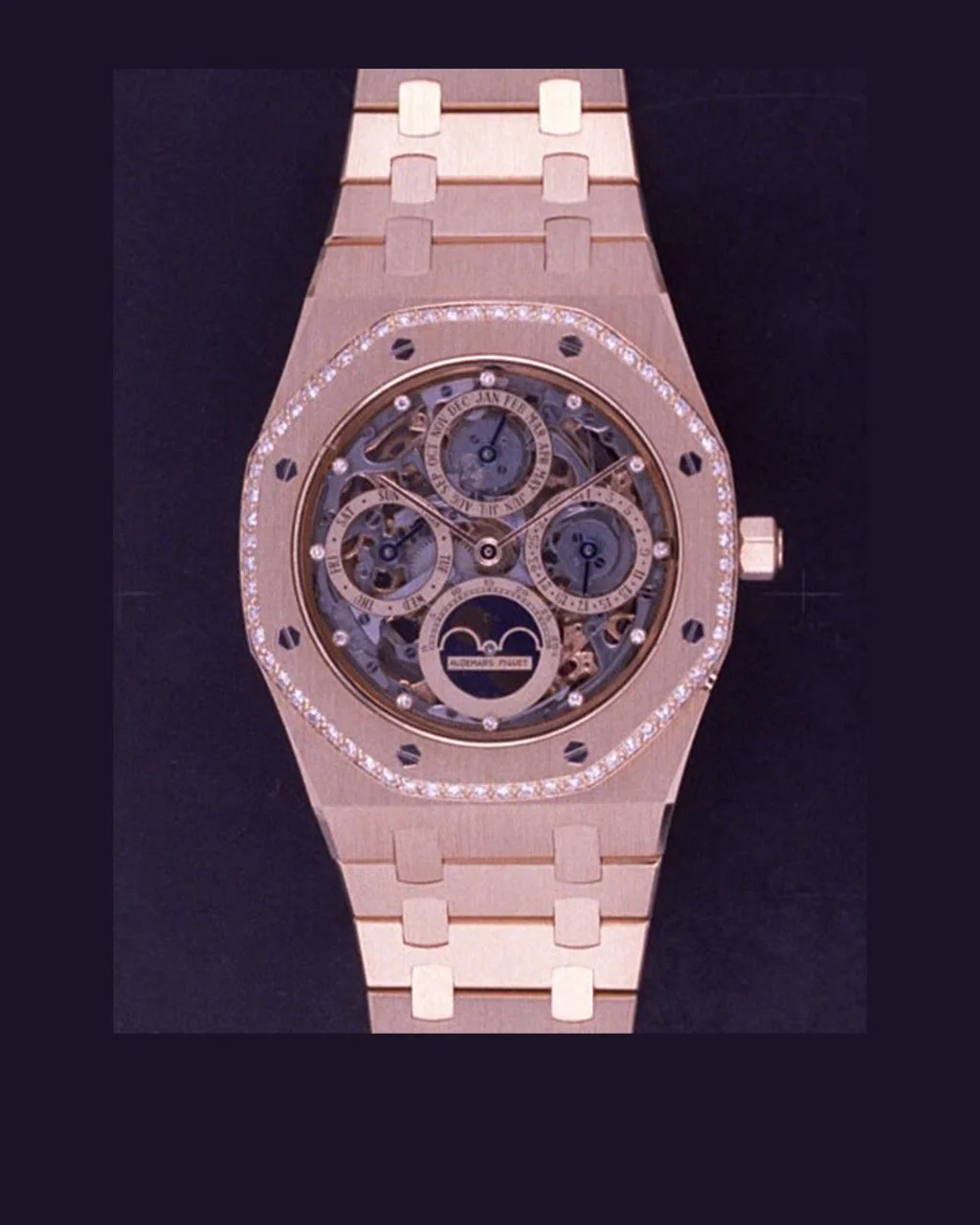
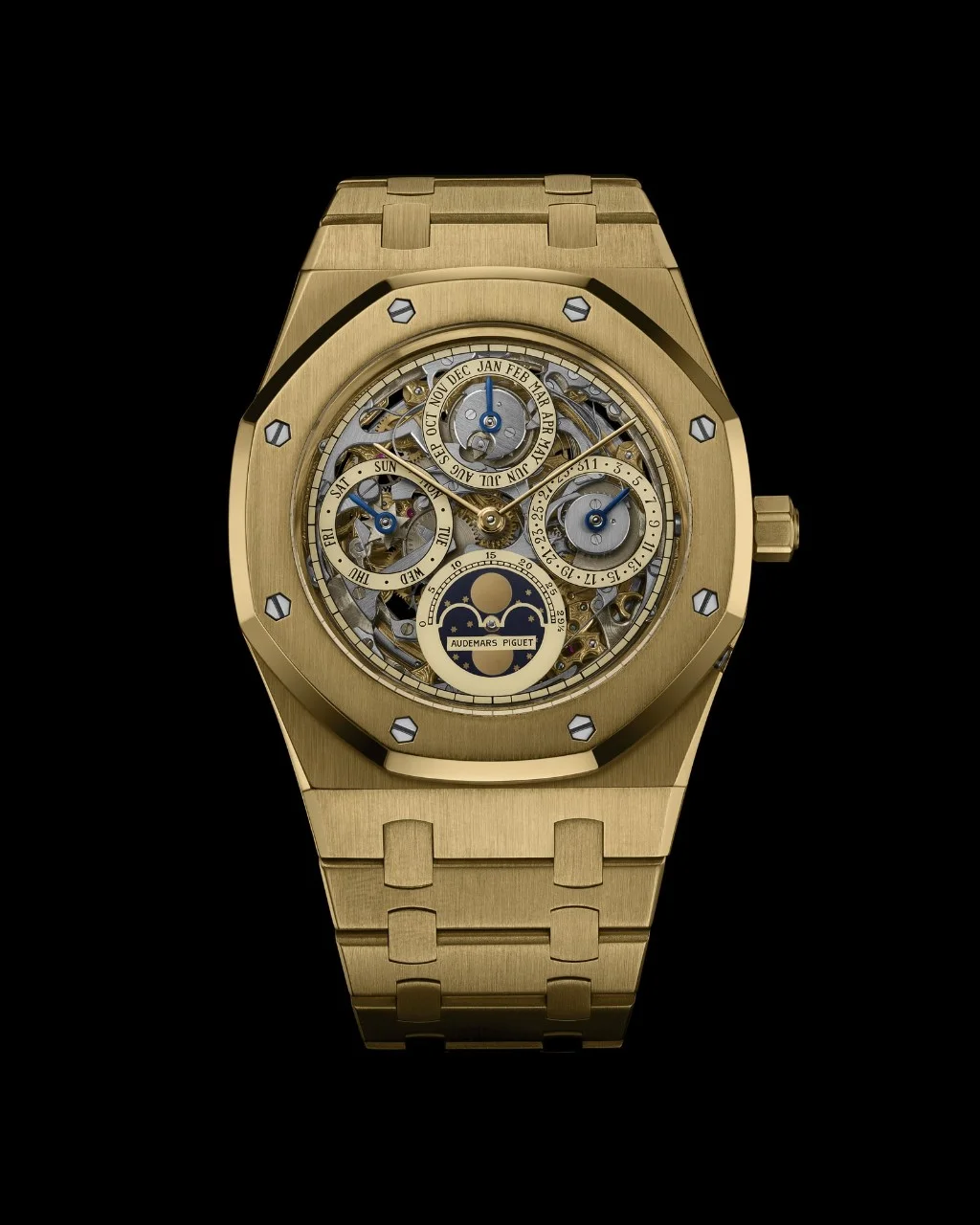
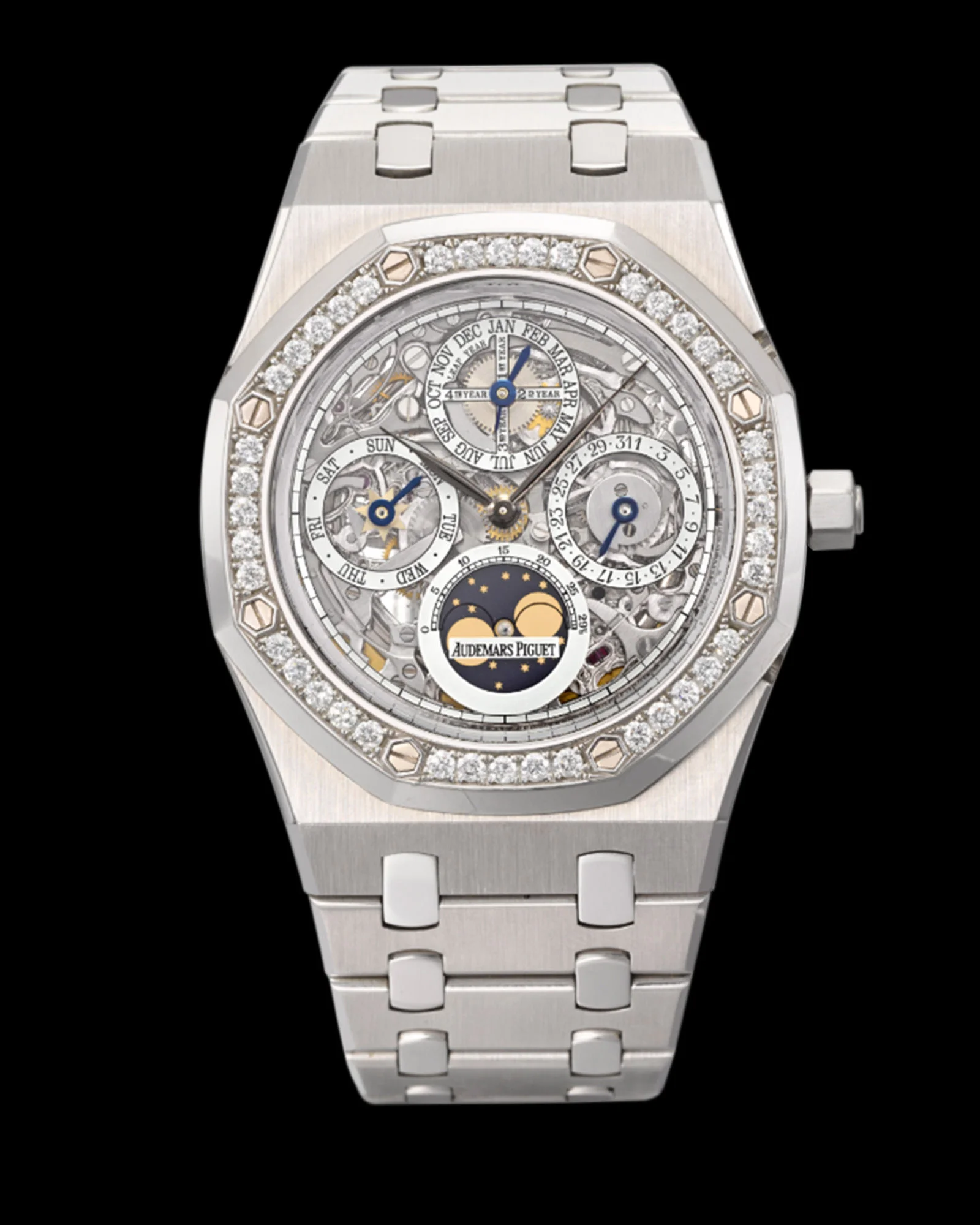
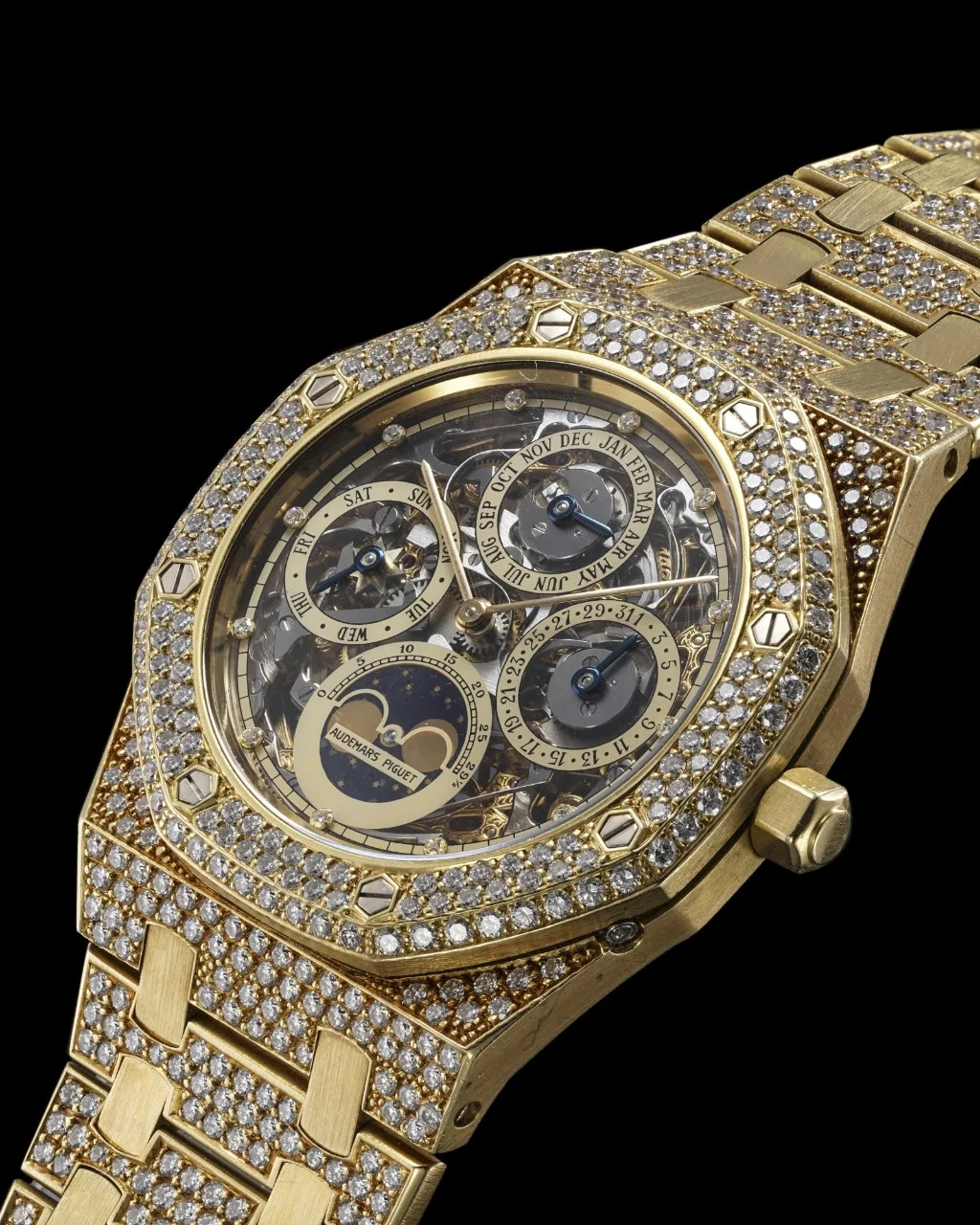
2000. Royal Oak 12517BC. Calibre 2120SQ. Openworked movement 399622 and dial. Brilliant-cut and baguette-cut diamonds. Case E9919, 39 mm. 18-carat white gold. One-of-a-kind model created for Audemars Piguet's 125th anniversary, sold in Singapore in December 2000. © Pygmalion collection.
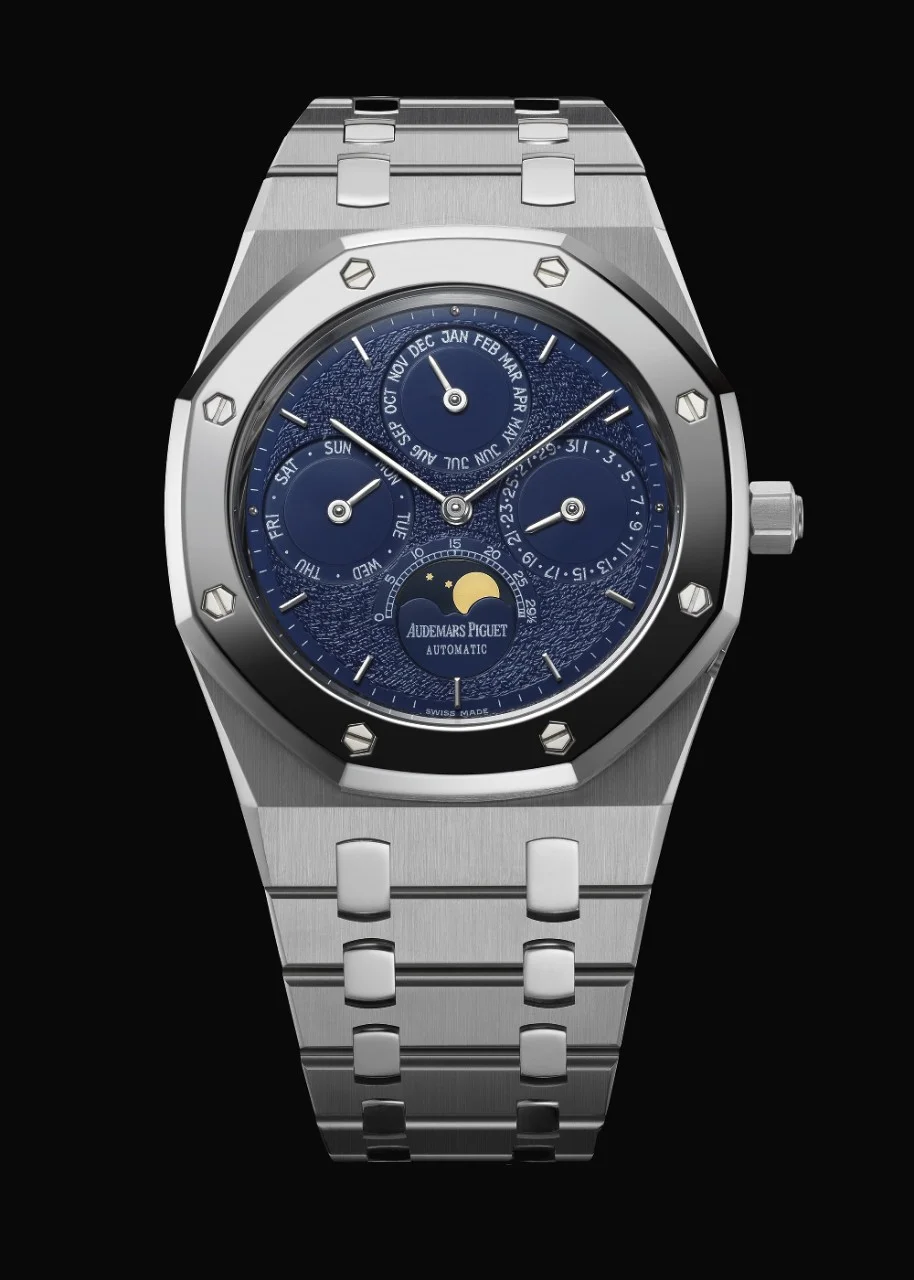
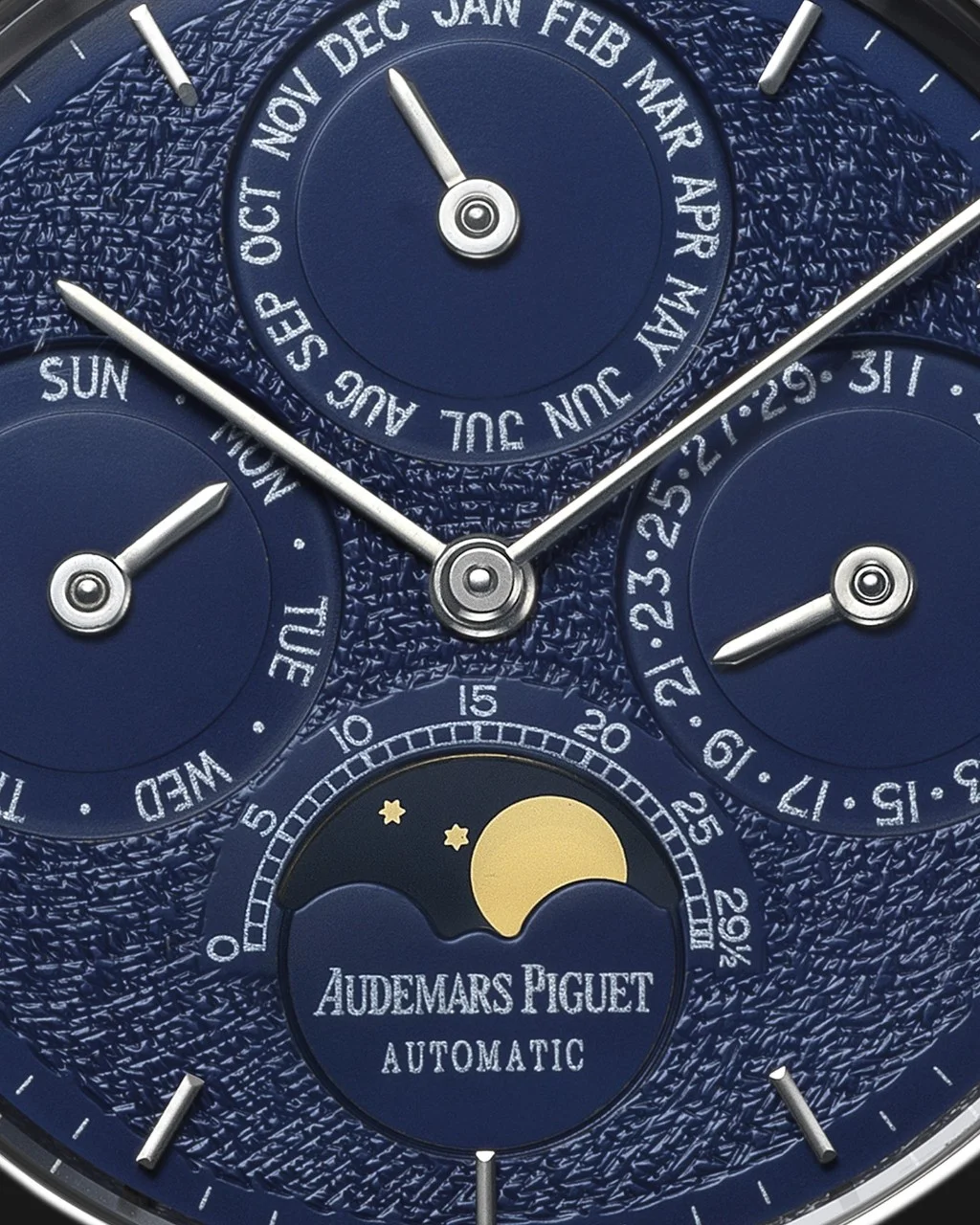
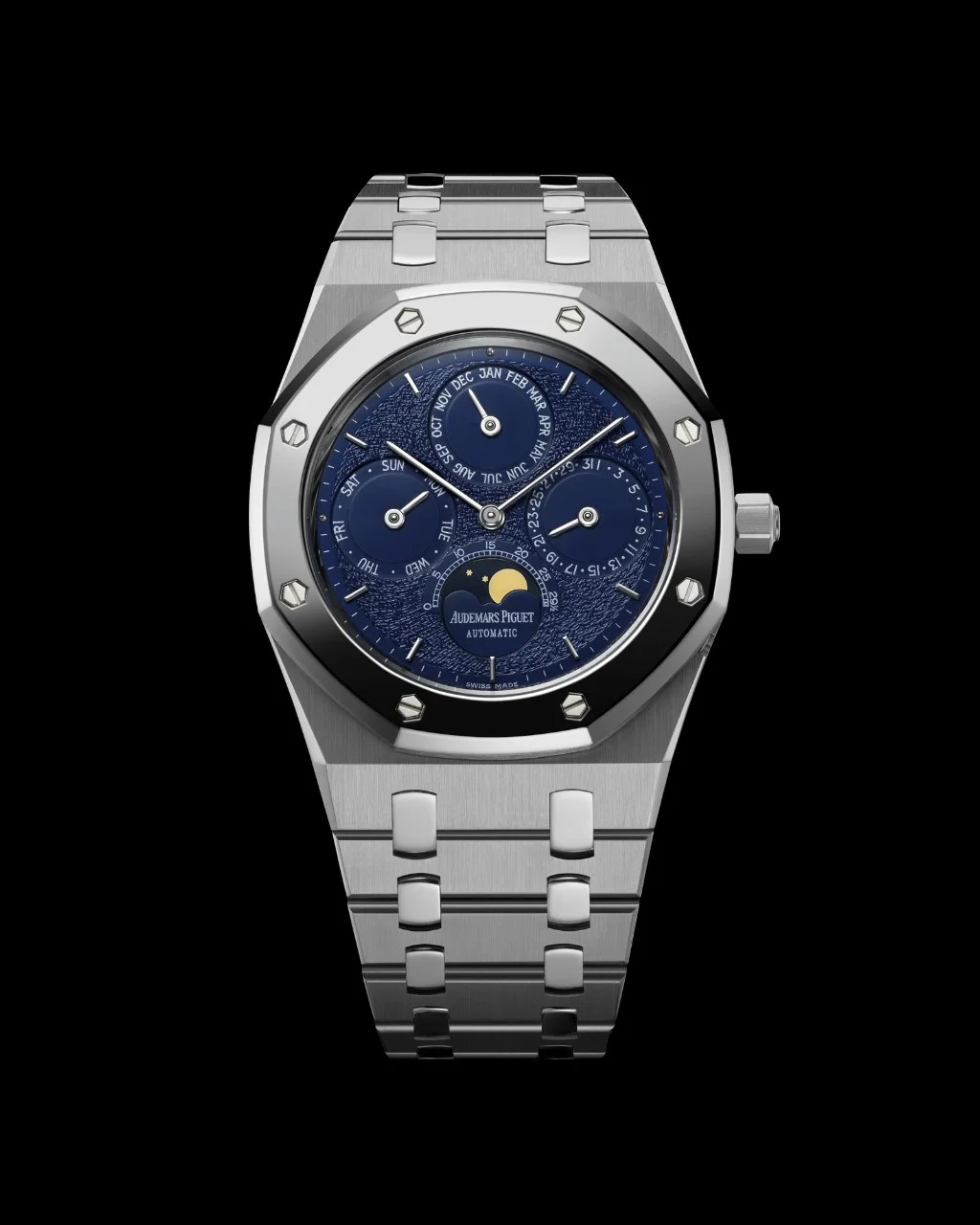
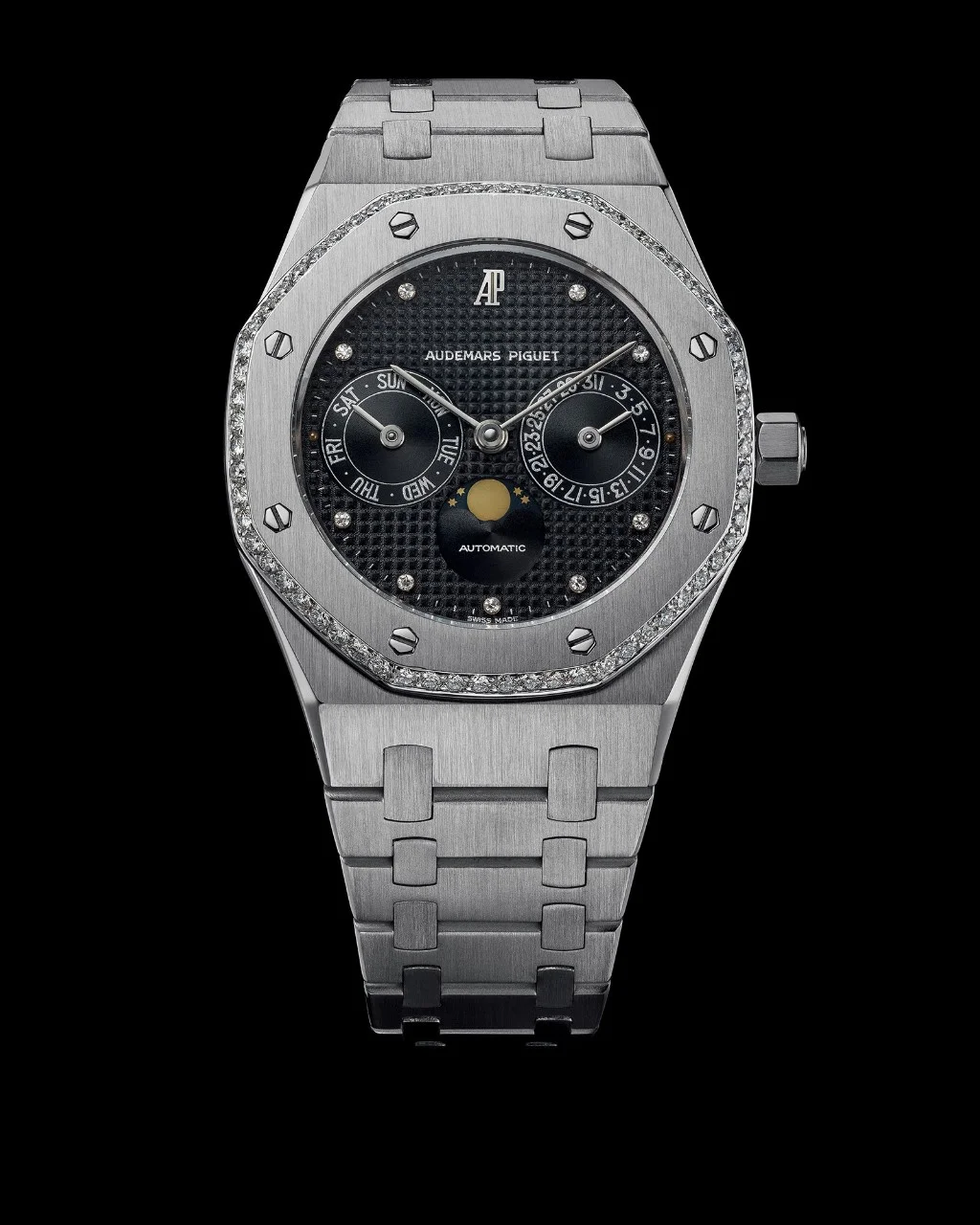
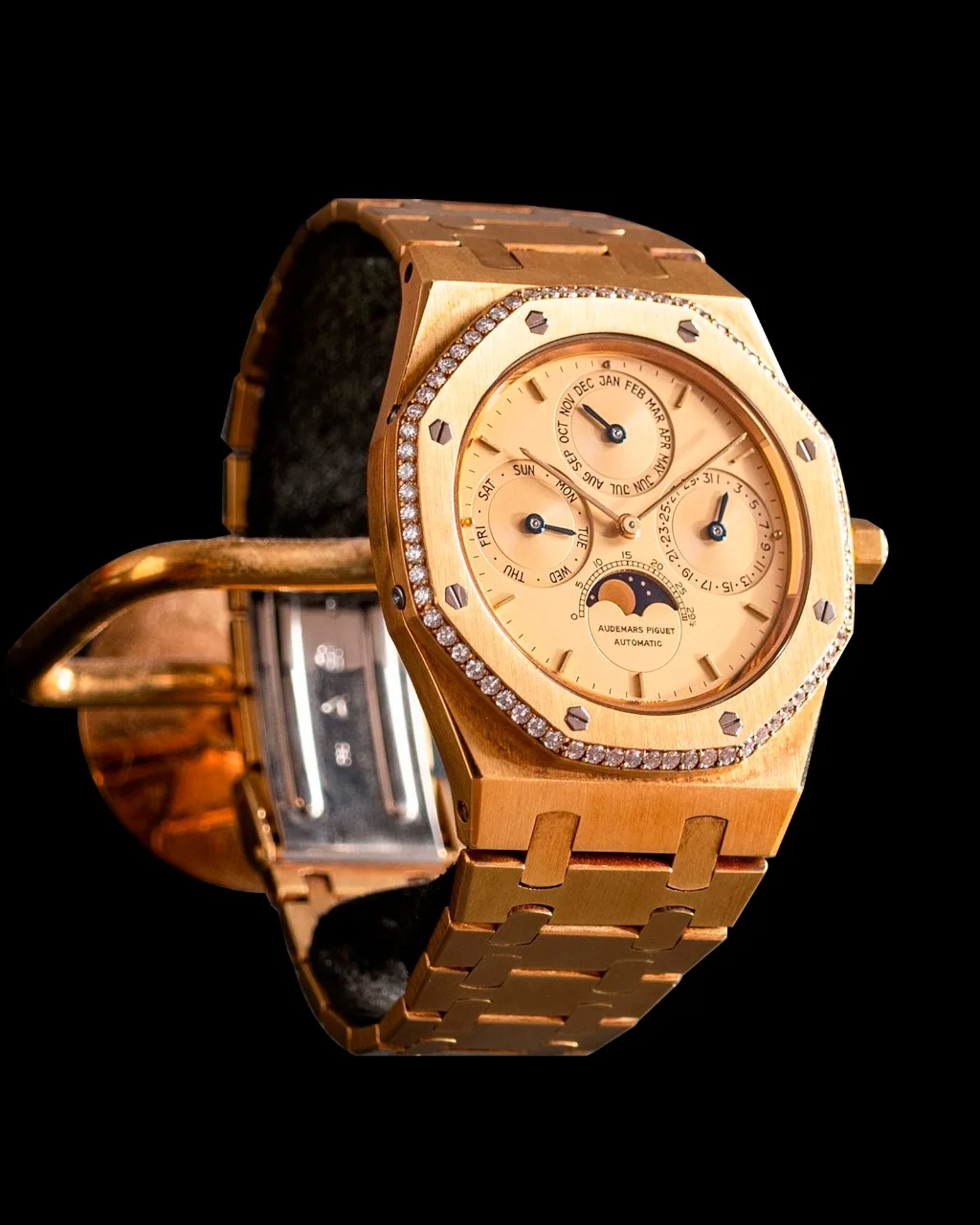
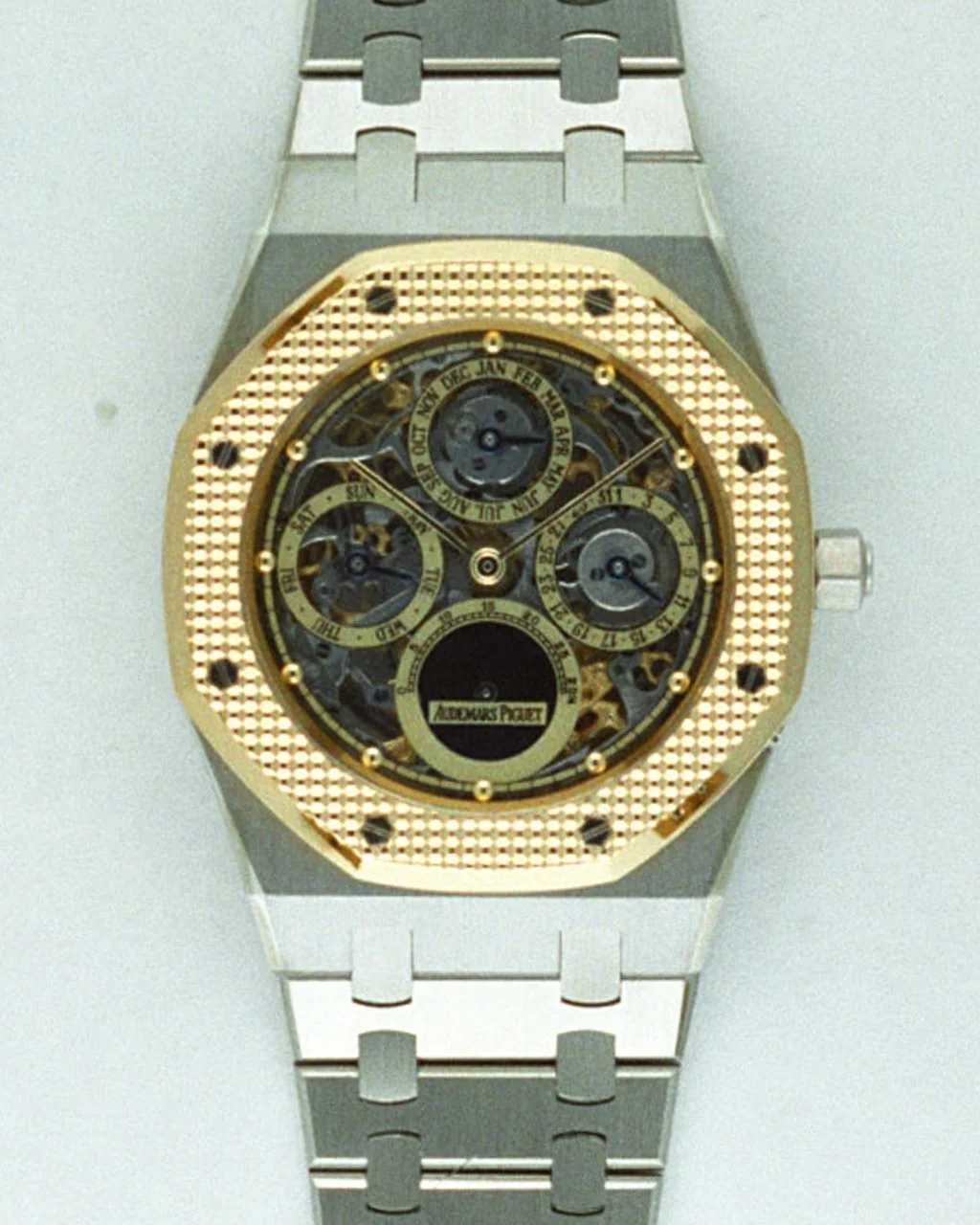
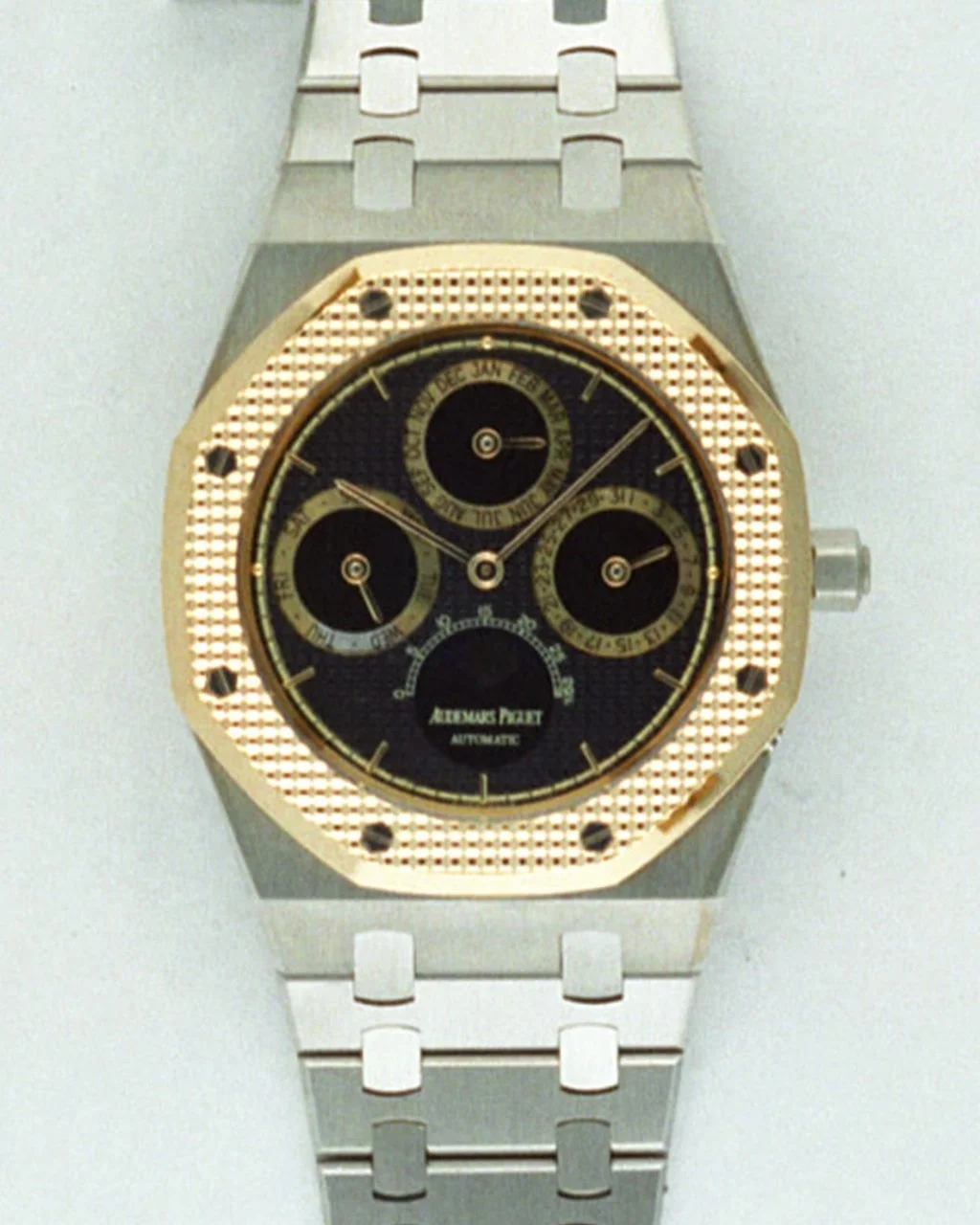
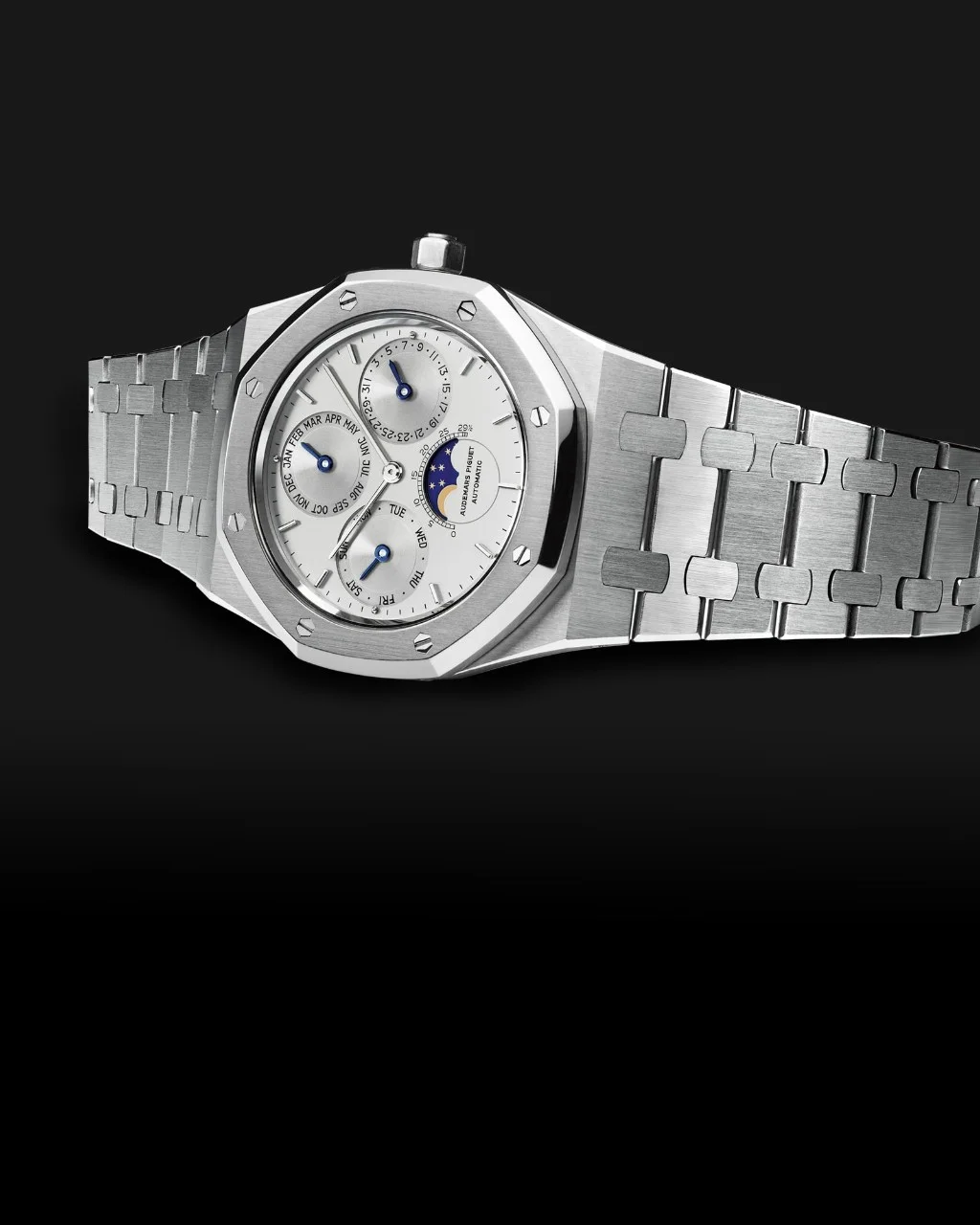
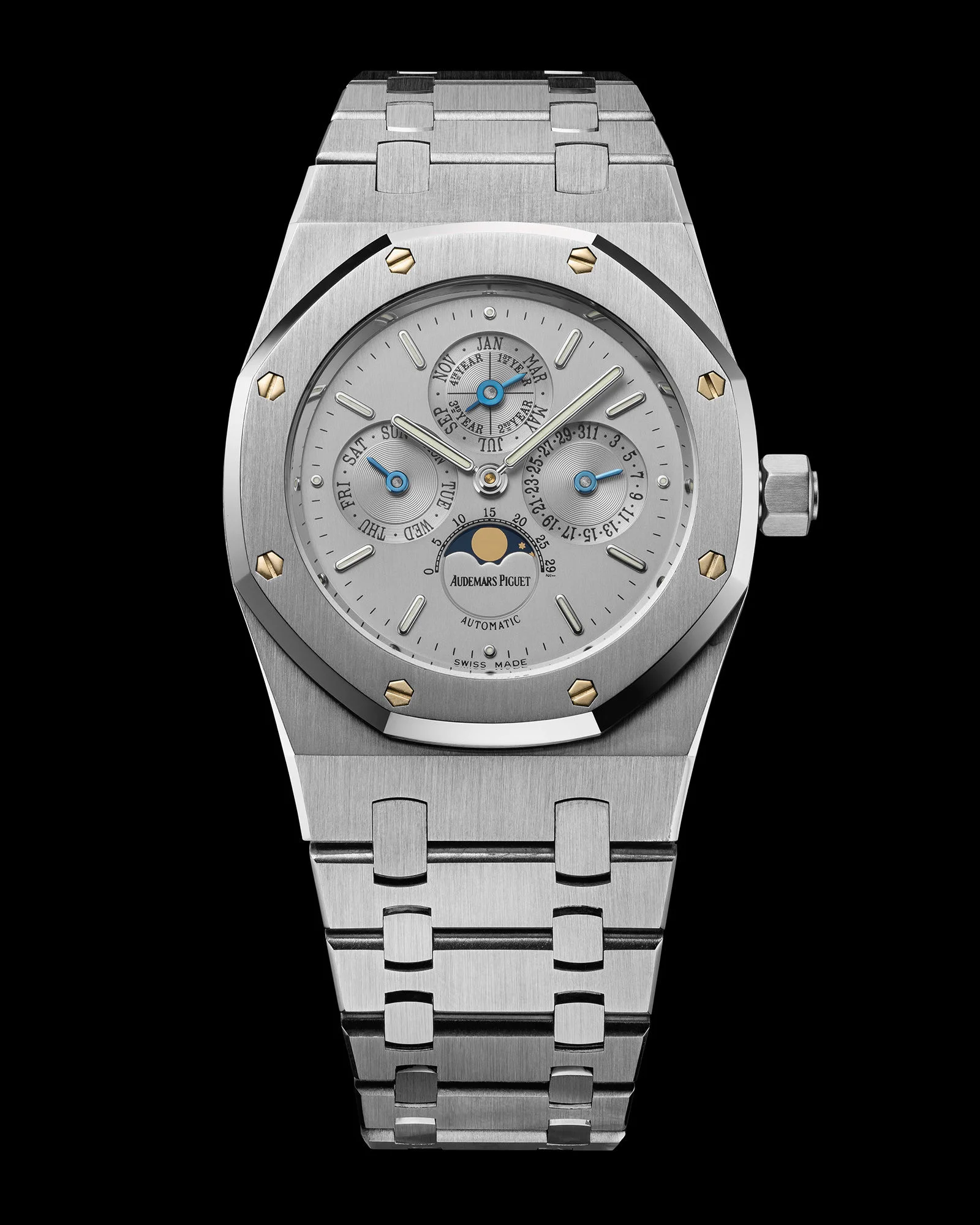
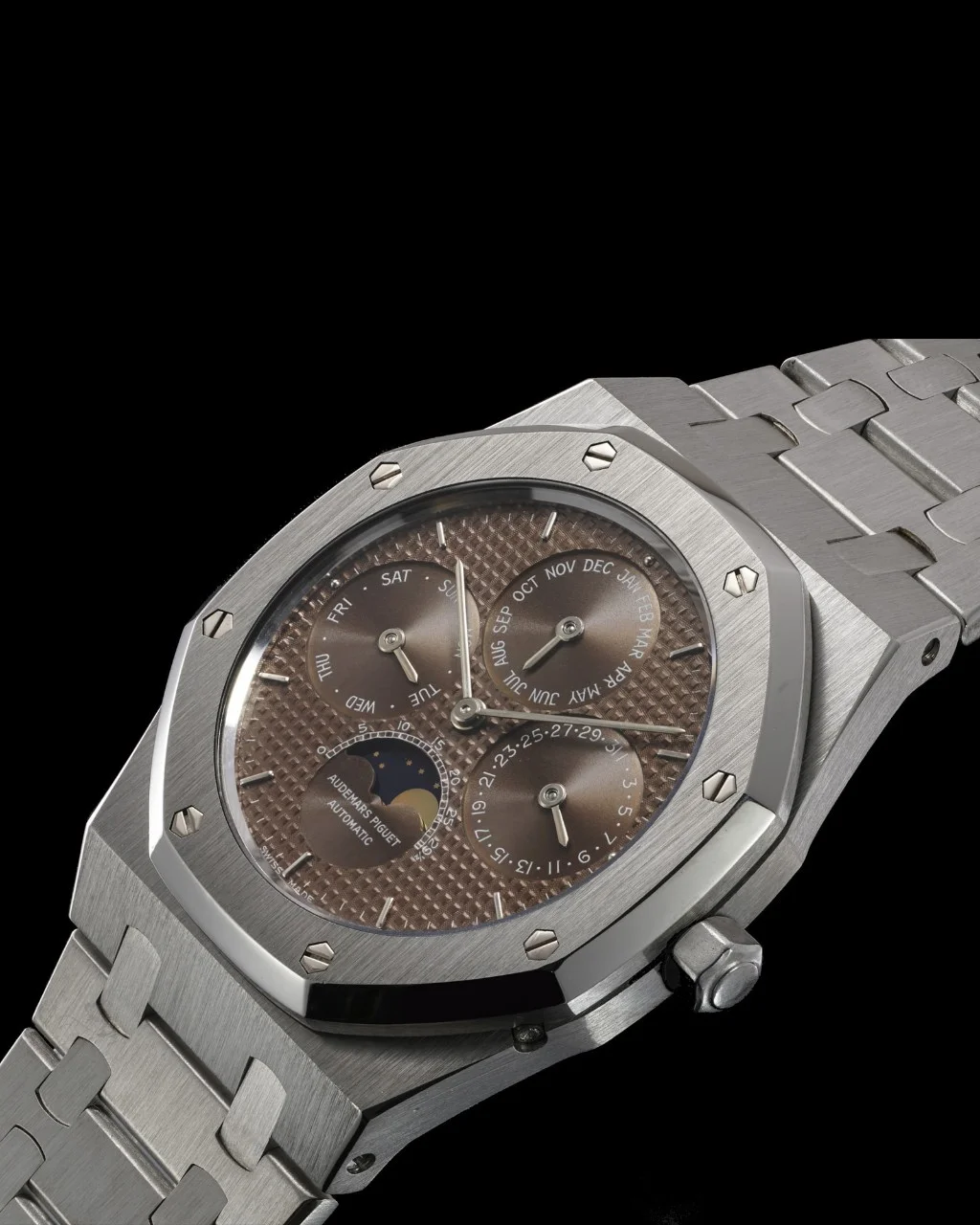
Perpetual calendar: day, date, month, moon phase. Calibre 2120/2800 ultra-thin (3.95 mm). Movement 374056. Bracelet 944. Case D41976, 39 mm, limited edition 6/25. Steel and platinum. Audemars Piguet Heritage, inv. 1046.
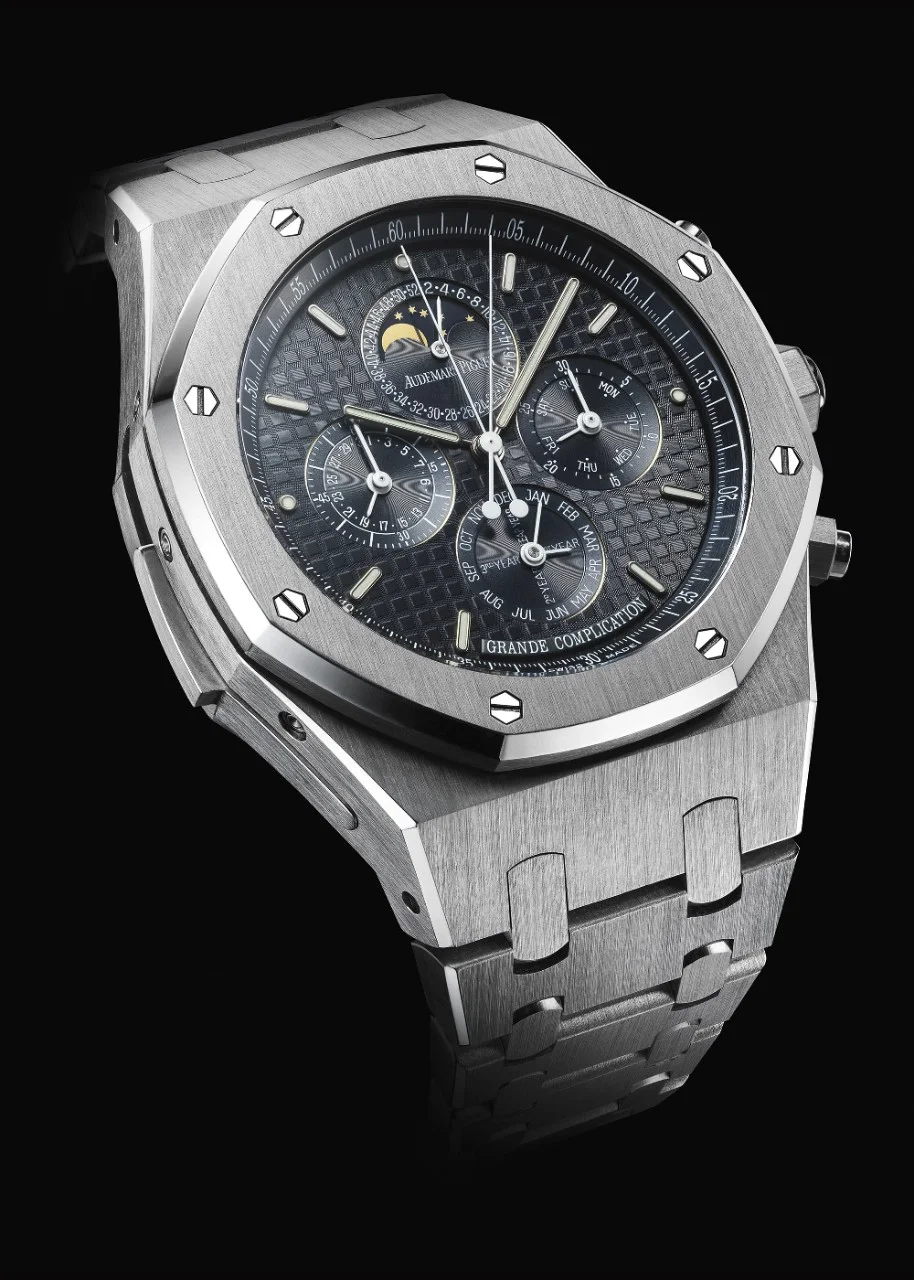
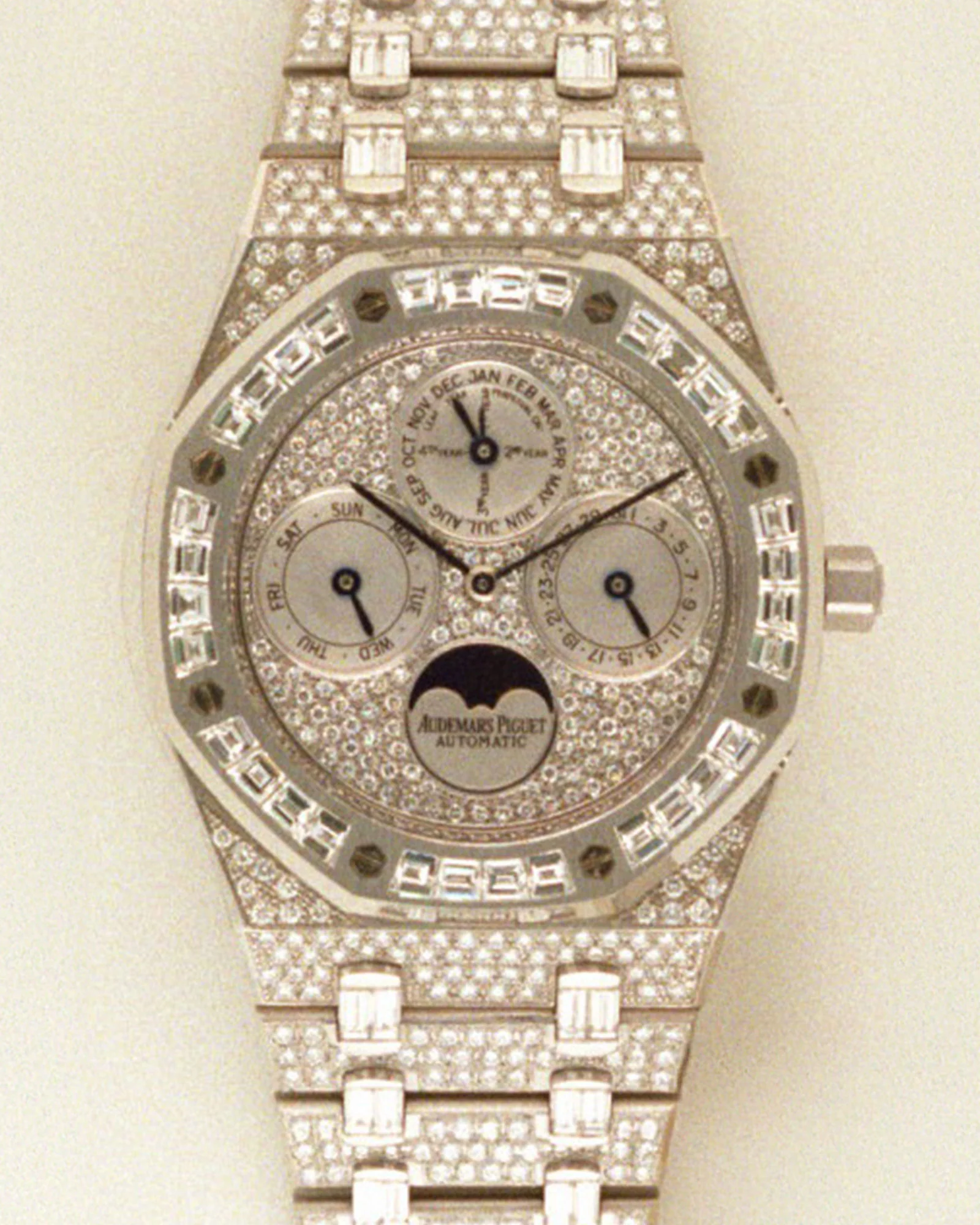
1997. Royal Oak Grande Complication 25865ST. Perpetual calendar: day, date, month, moon phase, minute repeater, split-seconds chronograph. Calibre 2885. Bracelet 1105. Petite Tapisserie dial. Steel case, prototype P00039, 44 mm. Presented at the SIHH (Salon International de la Haute Horlogerie, Geneva) when the model was launched. Audemars Piguet Heritage, inv. 617.
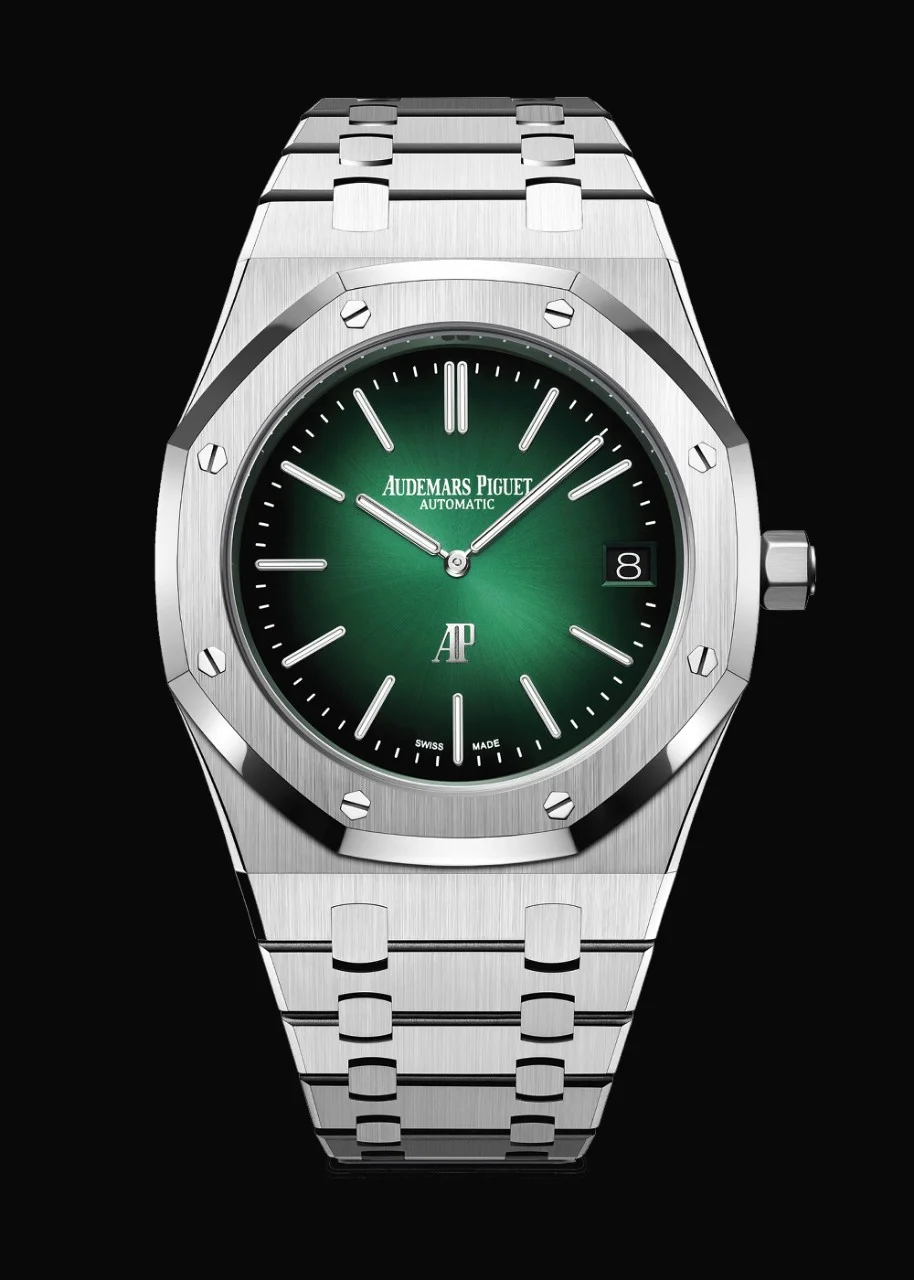
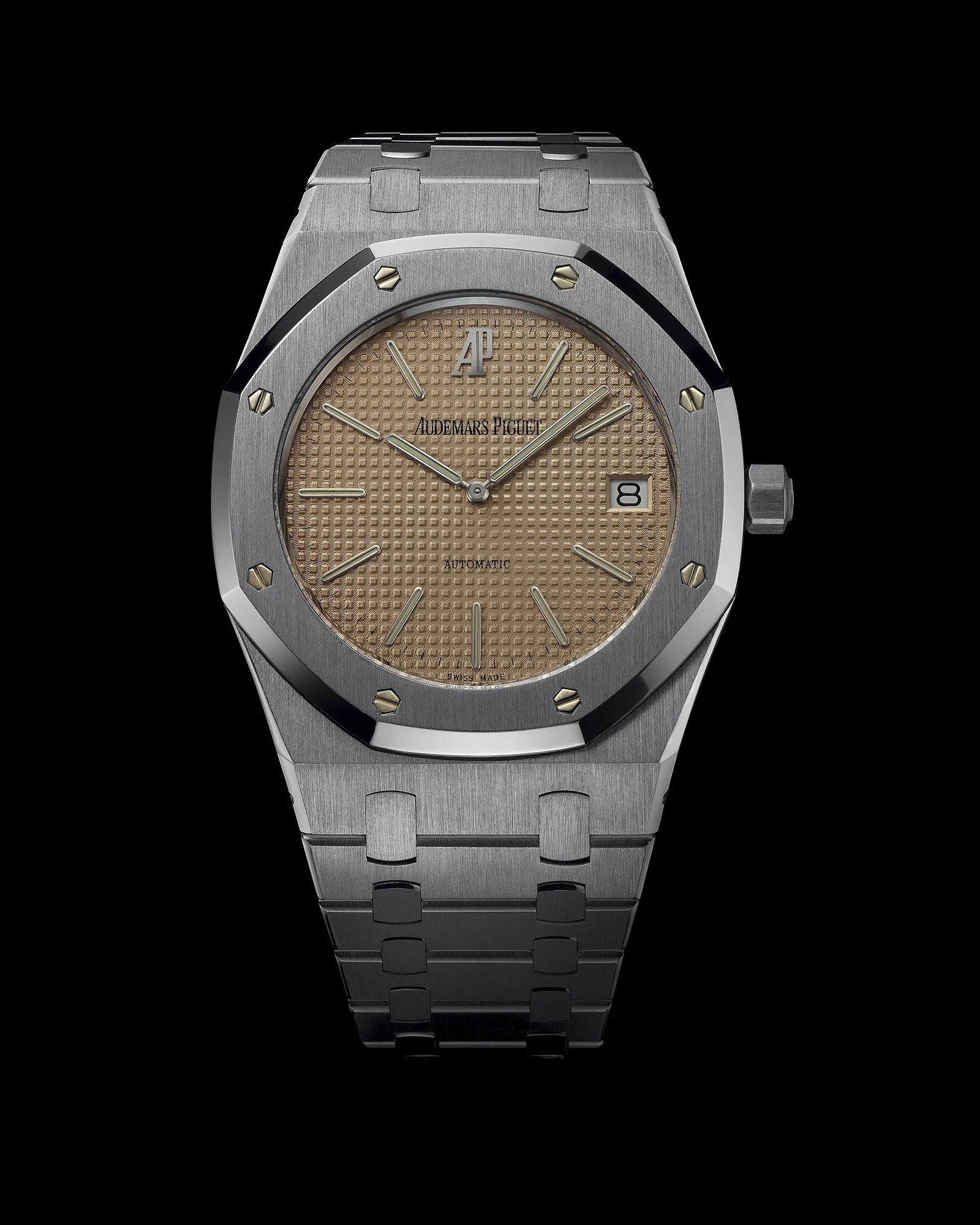
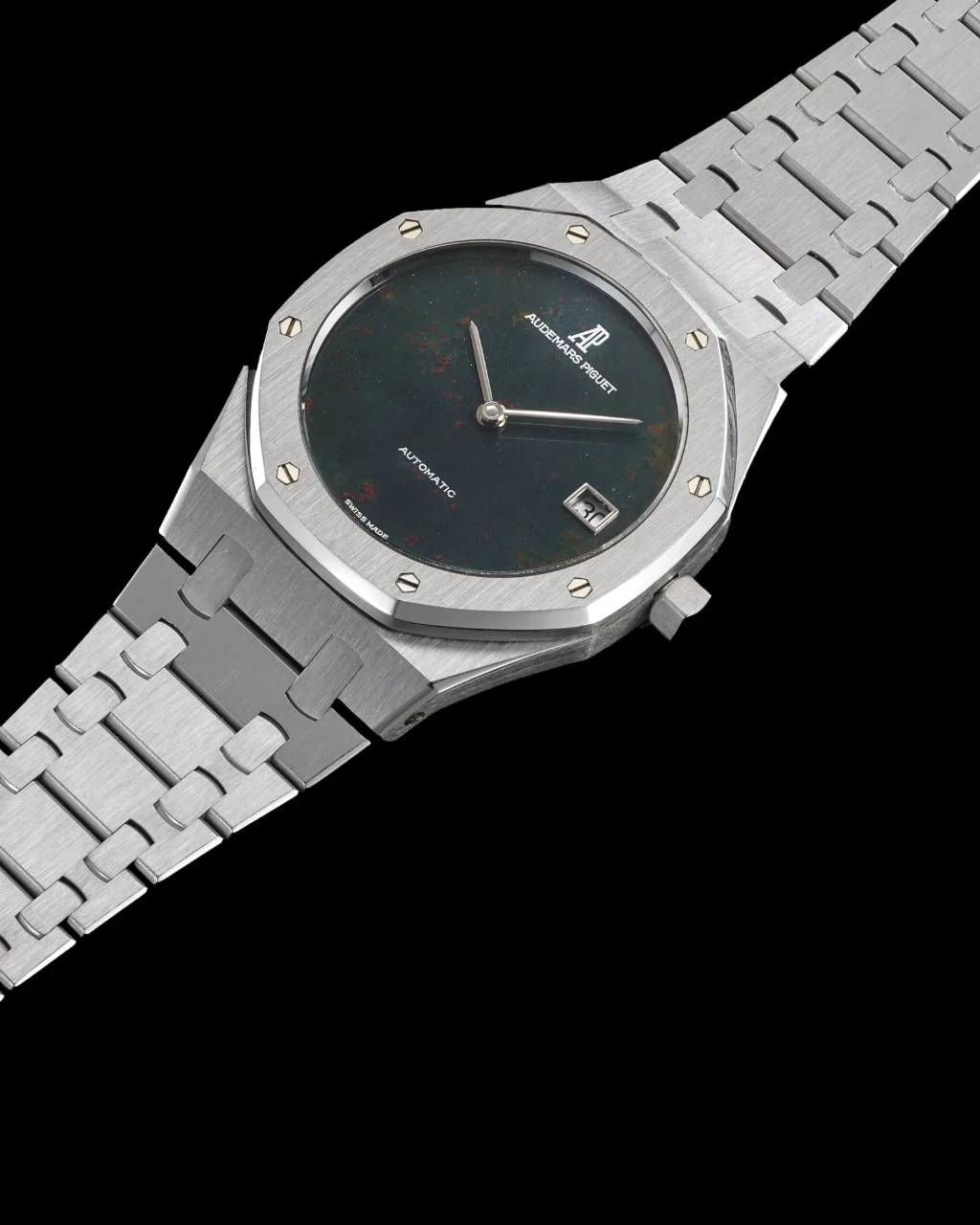
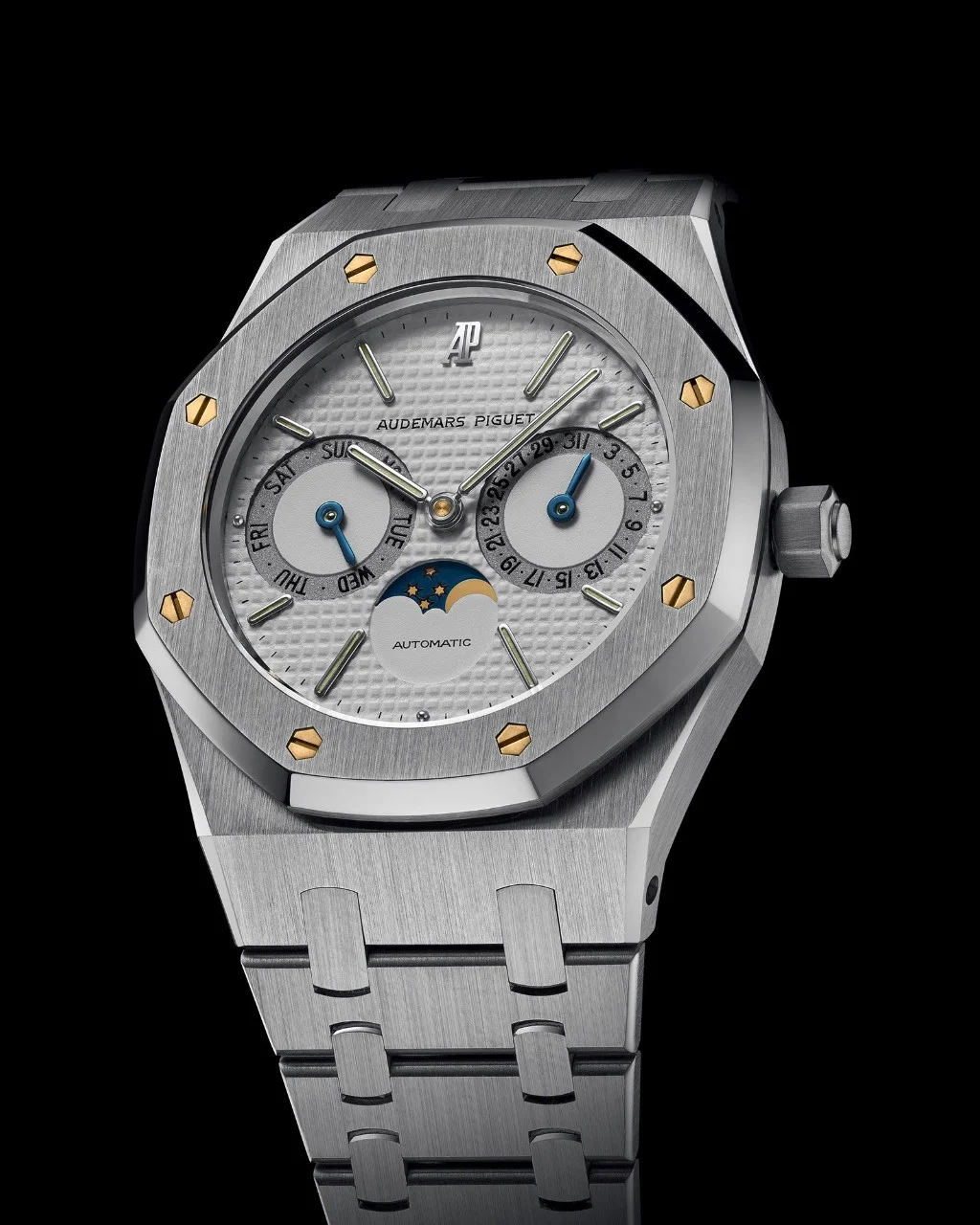
2021. Royal Oak 15202PT. Date. Calibre 2121. Smooth smoked green sunburst dial. One of the very rare non-limited platinum Royal Oak "Jumbo" models. 39 mm case. Picture taken at the launch of the watch. Audemars Piguet Archives.