THE FIRST ROYAL OAK CASES
Summary
TRADITIONAL CASE STRUCTURES
The case of the Royal Oak 5402 is sometimes described as a monocoque. What does that mean? Published by Albert Berner in 1961, The Illustrated Professional Dictionary of Horology explains that a watch case has two functions. The first is to protect the precious and fragile mechanical watch movement against dust, damp and shocks. The second is to “give the watch as attractive an appearance as possible, subject to fashion and the taste of the public.”
The author then explains that the case of a wristwatch is usually composed of three main superimposed elements: the caseback, the case middle and the bezel. Rubber seals fitted between each of these levels ensure water resistance. This structure is known as a "three-piece" case. While Albert Berner did not define the monocoque case, he introduced a category that prefigured it: the "two-piece" wristwatch-case in which the lugs and case middle merge to form a single component. This structure reduces the risk of moisture penetration, makes the case more rigid and sometimes allows it to be slimmed down while maintaining access to the movement through the back of the watch.
At Audemars Piguet, “two-part” wristwatches appeared as early as the 1920s. They are notably found in many Art Deco rectangular watches, several of which are detailed in the book Audemars Piguet’s 20th Century Complicated Wristwatches. In Pre-Model 182 (pictured) introduced in 1982, the bezel blends into the case middle for aesthetic reasons and the back opens on a hinge. Thirty years later, the bezel of Model 5115 seems to be detached from the case middle, but is an integral part of it for water-resistance reasons.
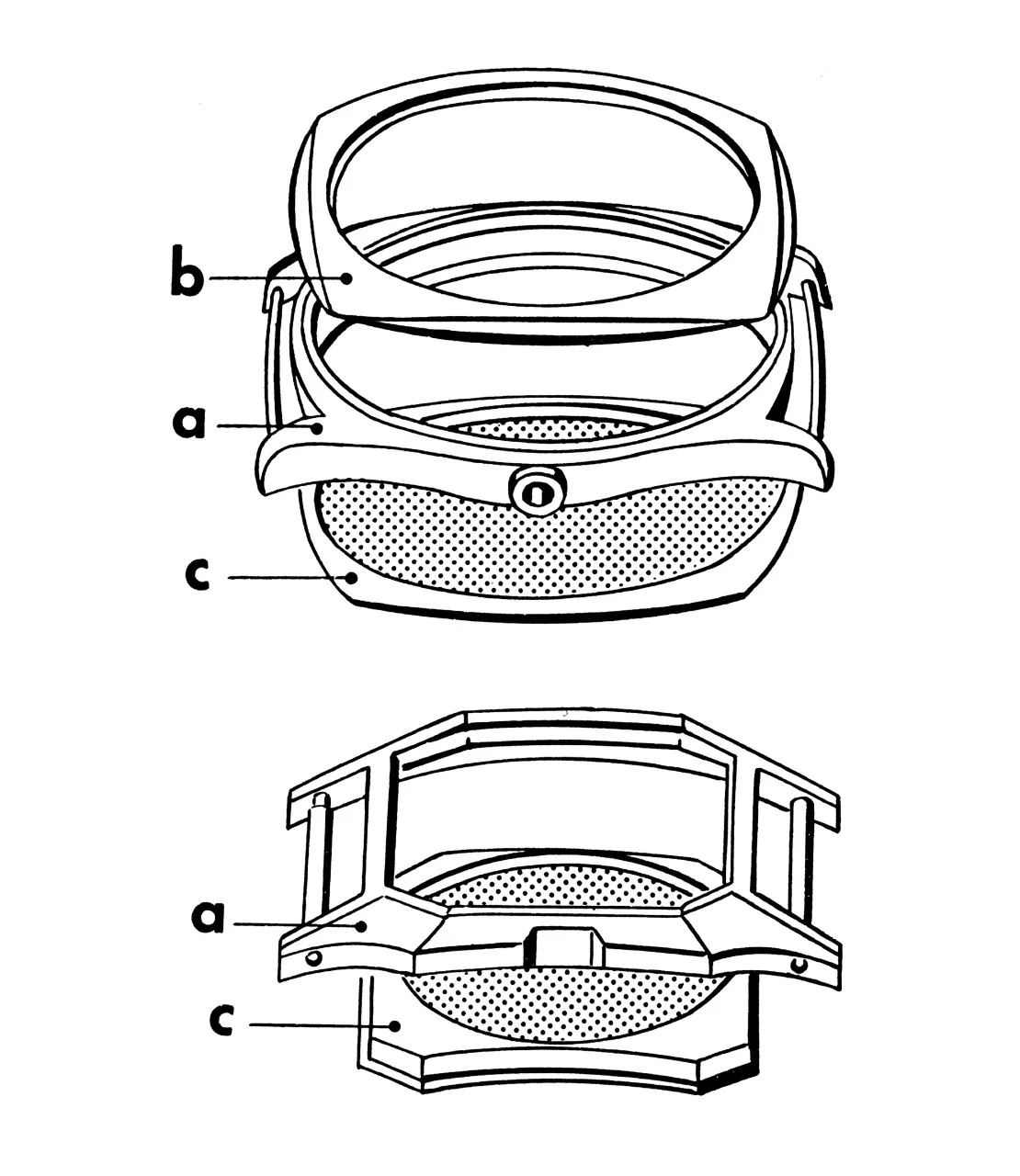
1961. Two and three-part cases. Written by G.A. Berner and re-edited and updated since then, the Illustrated Professional Dictionary of Horology presents the two main case categories. © Federation of the Swiss Watch Industry, FH.
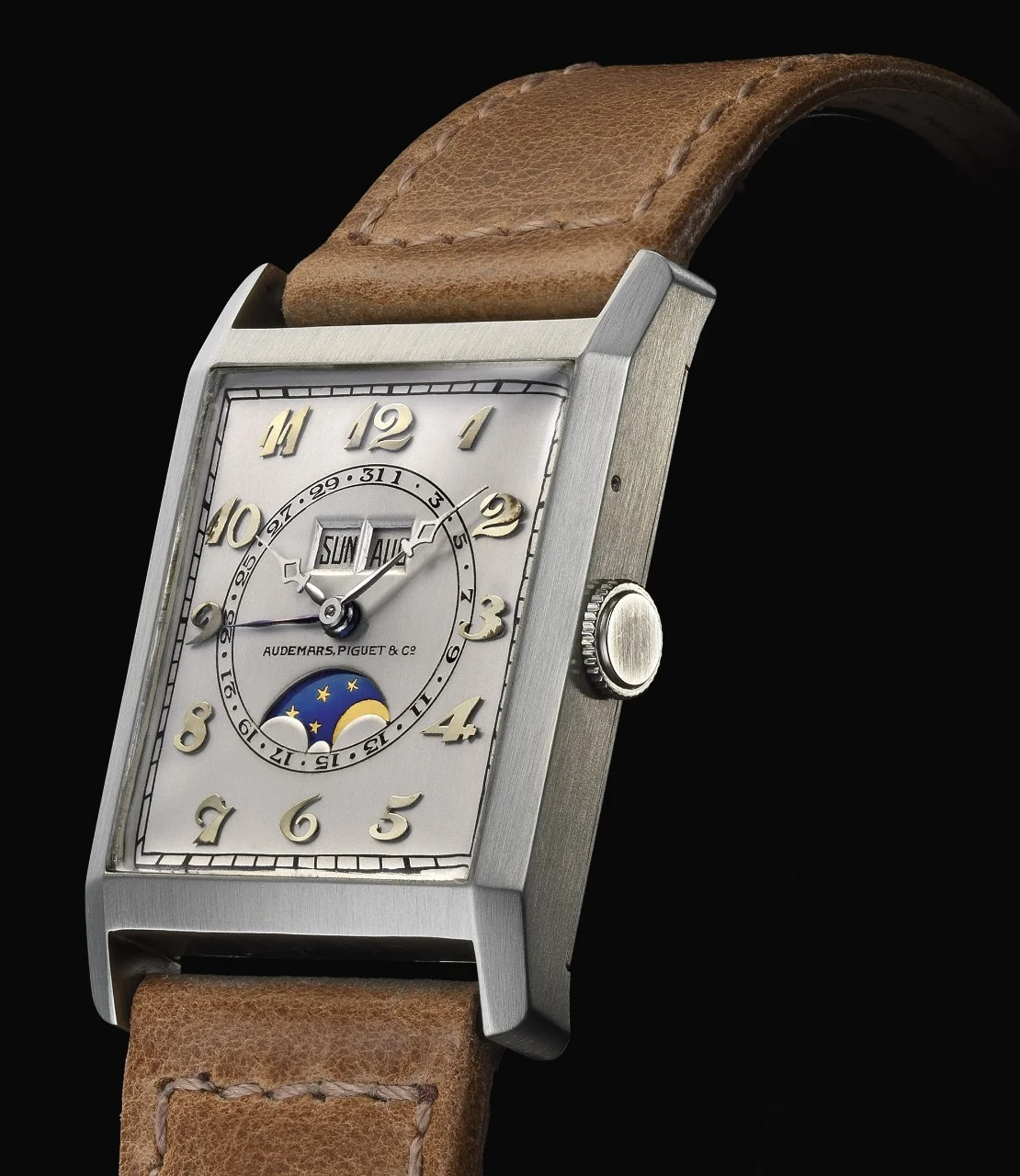
1929. Triple calendar wristwatch. Triple calendar: day, month with window, date with hand, moon phases. Calibre 10GHSM, movement 37887 ("ébauche" 1927). Two-part case 37887 (hinged opening) in 18-carat white gold. Pre-model 182. Delivered to Schwob (Lausanne) in 1929, recovered and sold to Clarté SH (Switzerland) in March 1933. Audemars Piguet Heritage, inv. 1778.
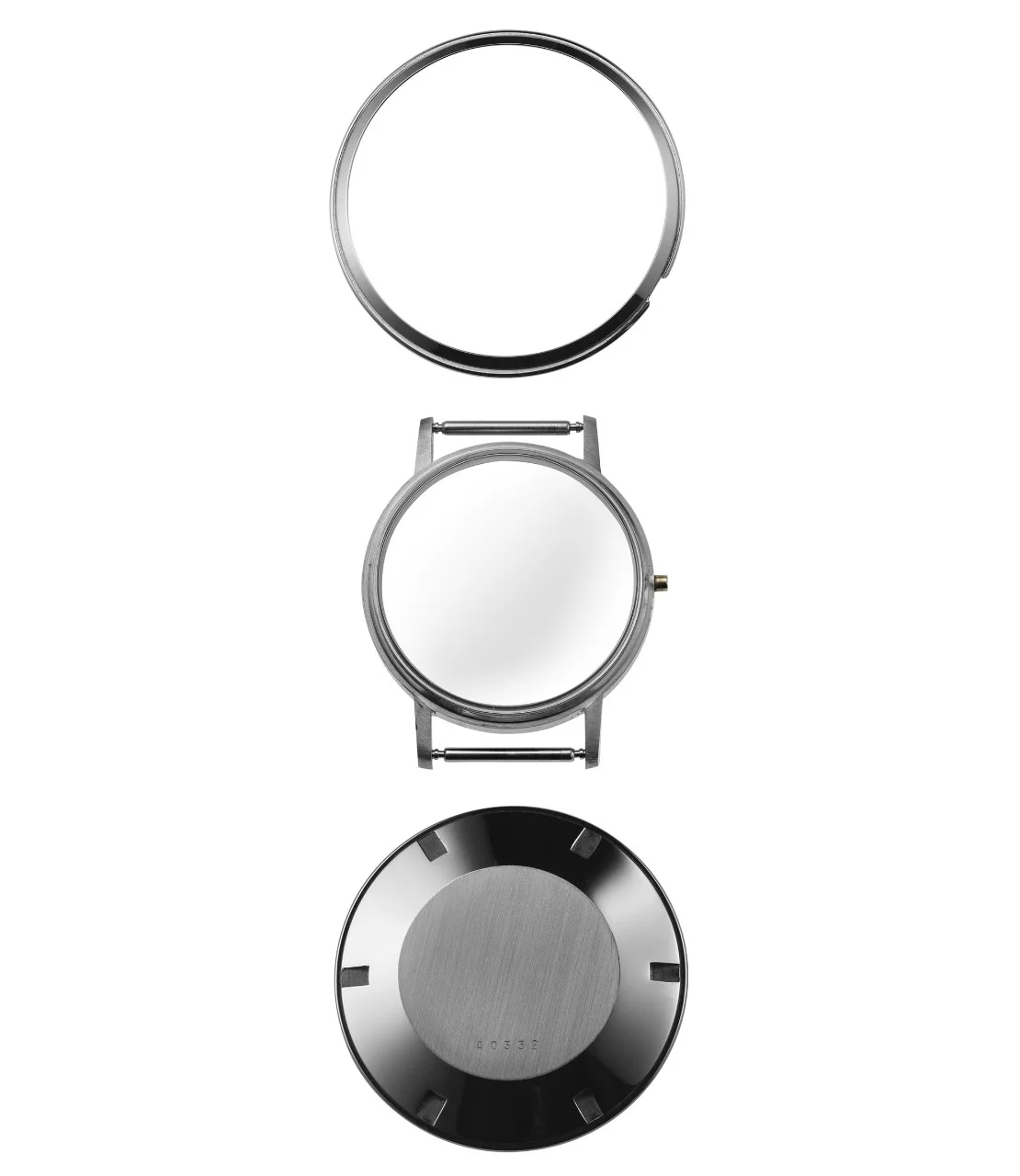
Circa 1962. Three-part case components, Model 5281ST. The bezel is fixed onto the case middle, under which the waterproof caseback is screwed to protect Calibre 2072. Audemars Piguet Heritage, inv. 1864.
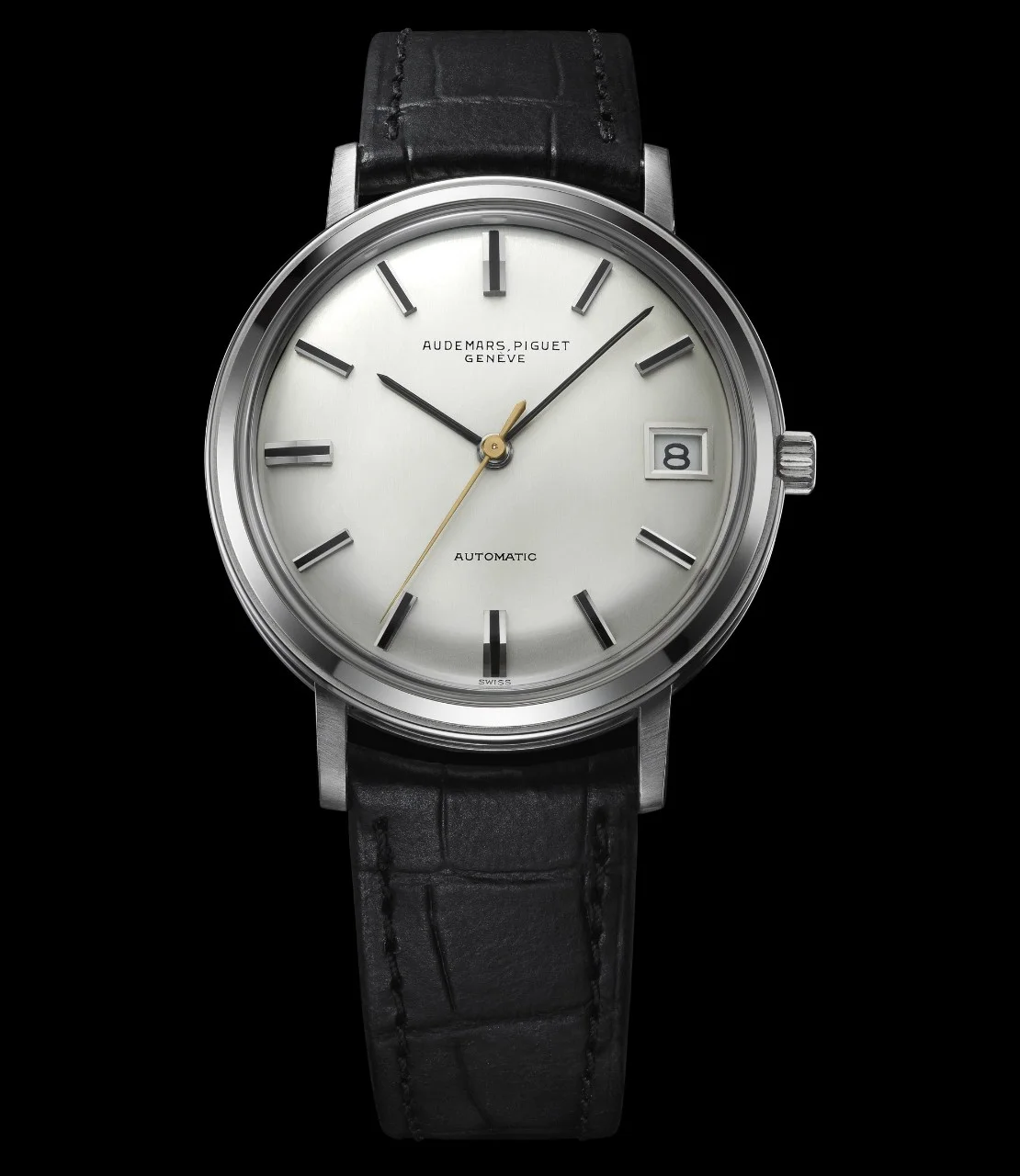
Circa 1962. Selfwinding wristwatch 5281. Date. Calibre 2072, movement no. 96156. Three-part case no. 40265 in steel. Screw-down water-resistant caseback. Audemars Piguet Heritage, inv. 1864.
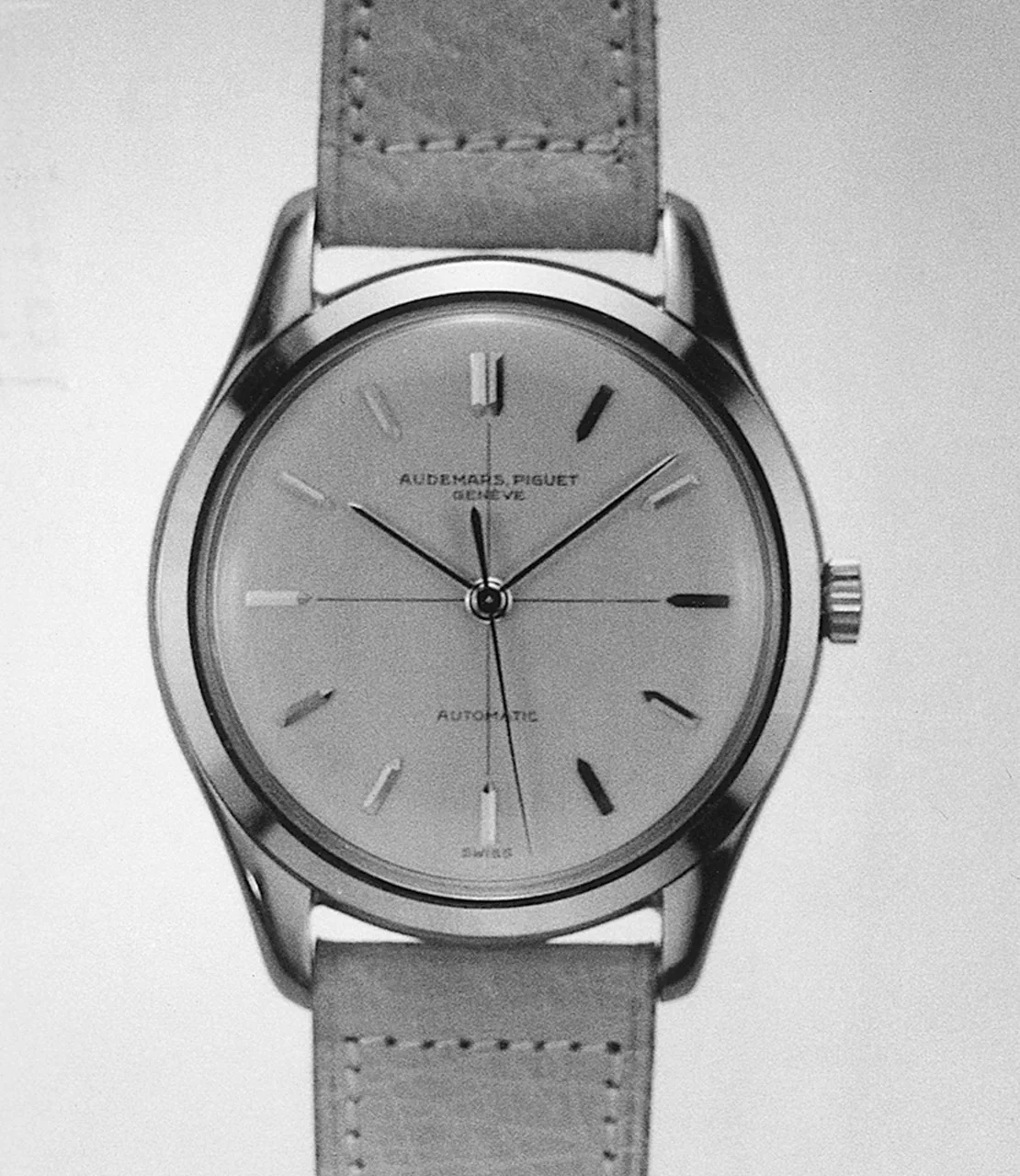
Circa 1960. Model 5115 with two-part case. Although the bezel seems independent, it is an integrant part of the case middle to improve the watch's water-resistance. Audemars Piguet Archives.
Is it Really Monocoque?
Etymologically, monocoque (often translated in English as “monohull” of even “one-piece”) means "a single shell or hull". Strictly speaking, this implies that the watch is closed, rather like the shell of an egg or a hazelnut, or the hull of a boat. Published in 1998, The Theory of Horology, used to train watchmaking students at Swiss technical schools, provides a definition of monocoque cases: "the bezel, the case band and the back cover are all one.” The consequences are significant for watchmakers at the bench. As the caseback cannot be removed, the movement cannot be accessed from the back and has to be extracted from the dial side. And as there is no bezel, it is the glass that has to be taken off, implying that it must be flexible, made of Plexiglas. On the other hand, the watchmaker must be able to detach the crown before dismantling the movement, so "the winding stem is in two pieces. The first section is part of the movement. The second, on to which the winding button is screwed, is fitted elastically on to the first, once the movement is in place.” By pulling hard on the crown, the watchmaker disengages it from the stem on which it is “snapped”, so that it can be removed.
The watchmaking community attributes the term monocoque to the cases of many diving watches, notably by Seiko, Mido, Omega, etc. However, almost all of them have an external rotating bezel. The addition of this bezel should exclude these watches from the monocoque category. It is in fact the definition that should be widened, since in its broadest sense the term means that only the caseback and case middle are merged into a single component.
Therefore, according to this extended definition, the structure of the first Royal Oak is indeed similar to monocoque cases, as the caseback and case middle form a single component. The former director of the Audemars Piguet Museum Martin K. Wehrli addressed this issue in a monograph published in 2012 for the Royal Oak’s 40th anniversary. In the chapter entitled "The Monohull Case", he acknowledges that it only partially meets the definition: "Is it an authentic monohull case? Not really, since the glass is not driven into the case, and the bezel is separate.” We could add that the glass is in in fact a sapphire crystal. Despite these reservations, we will follow the practice of collectors and watchmakers, using the term monocoque here for the Royal Oak cases that merge the case middle and the caseback.
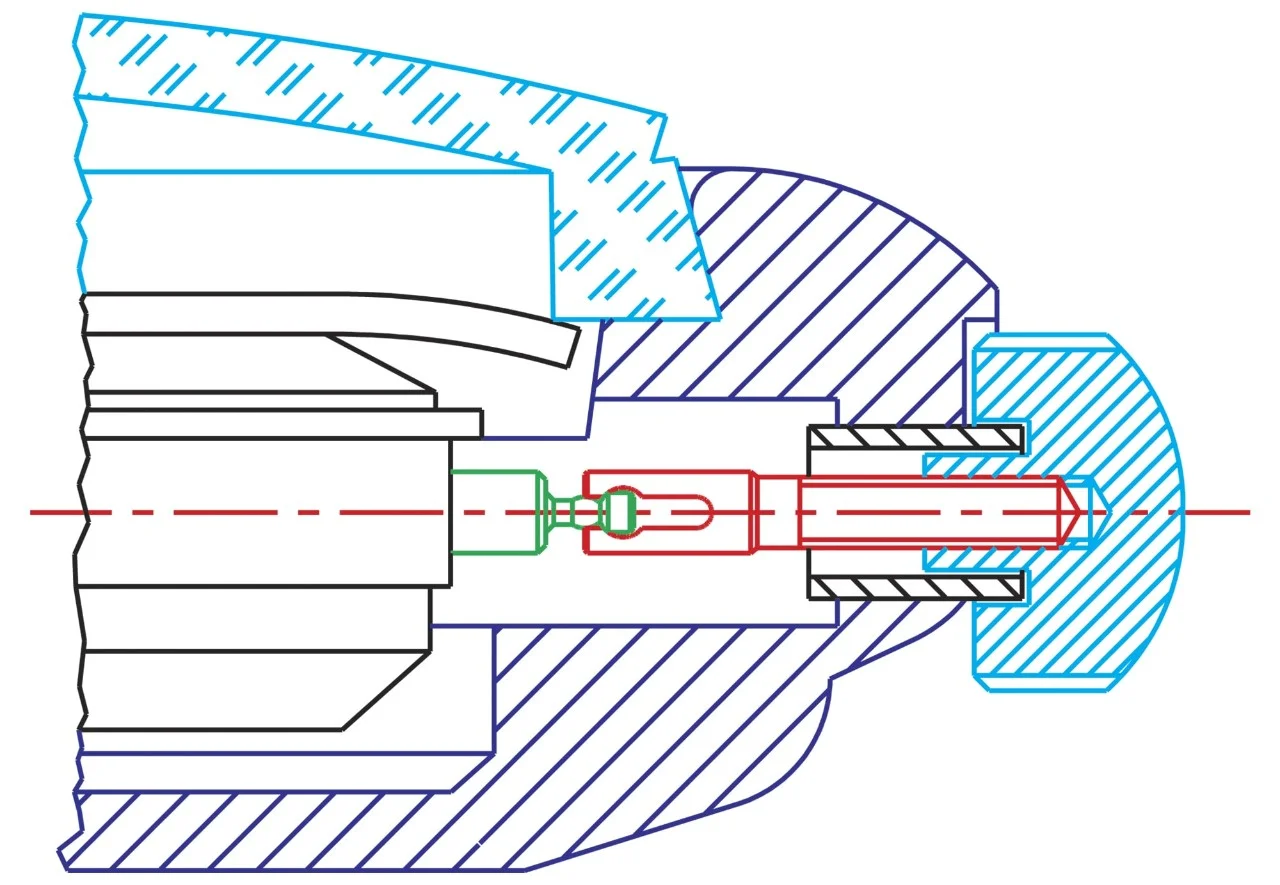
Outline of a monocoque case. The caseback, the case middle and the bezel form together a unique element. To access the movement, the watchmaker needs to remove the crystal by distorting it. © Coll. Théorie d'Horlogerie, Édition de la Fédération des Écoles Techniques, 1998, p. 261.
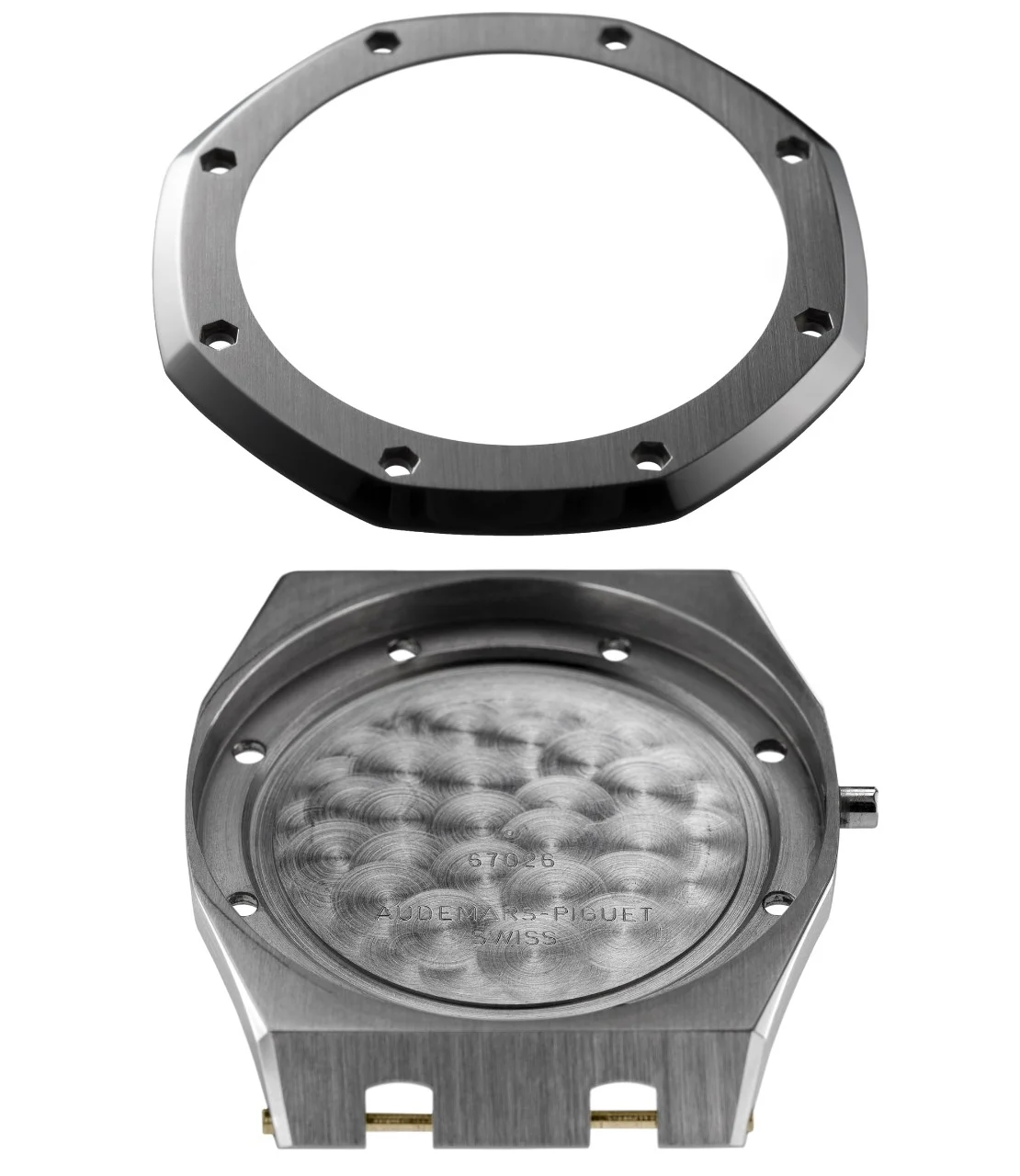
Main components of the 5402 monocoque case. The primary structure of the Royal Oak is composed of two elements: the bezel and the fused caseback and case middle. The latter also includes the lugs and even the first bracelet links. Audemars Piguet Heritage, inv. 365.
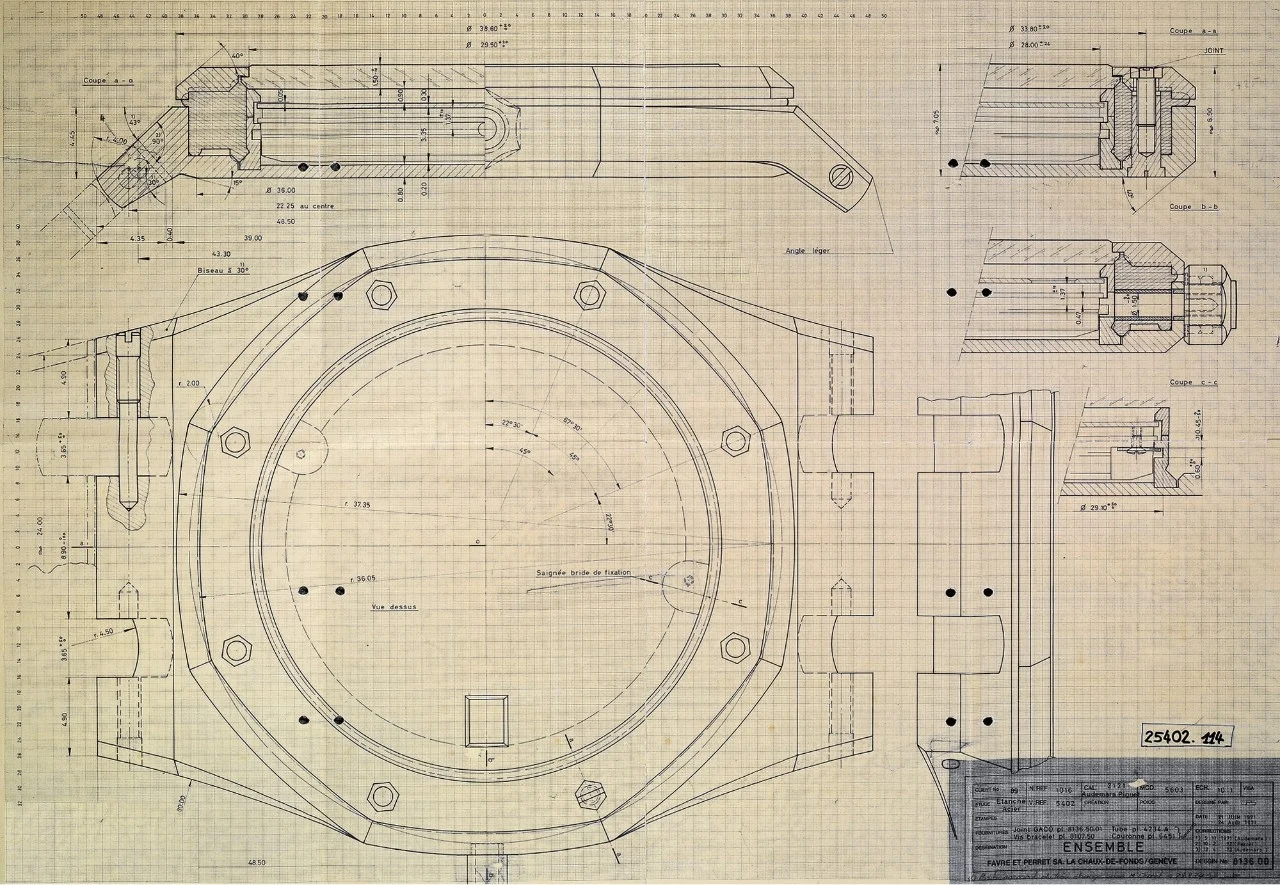
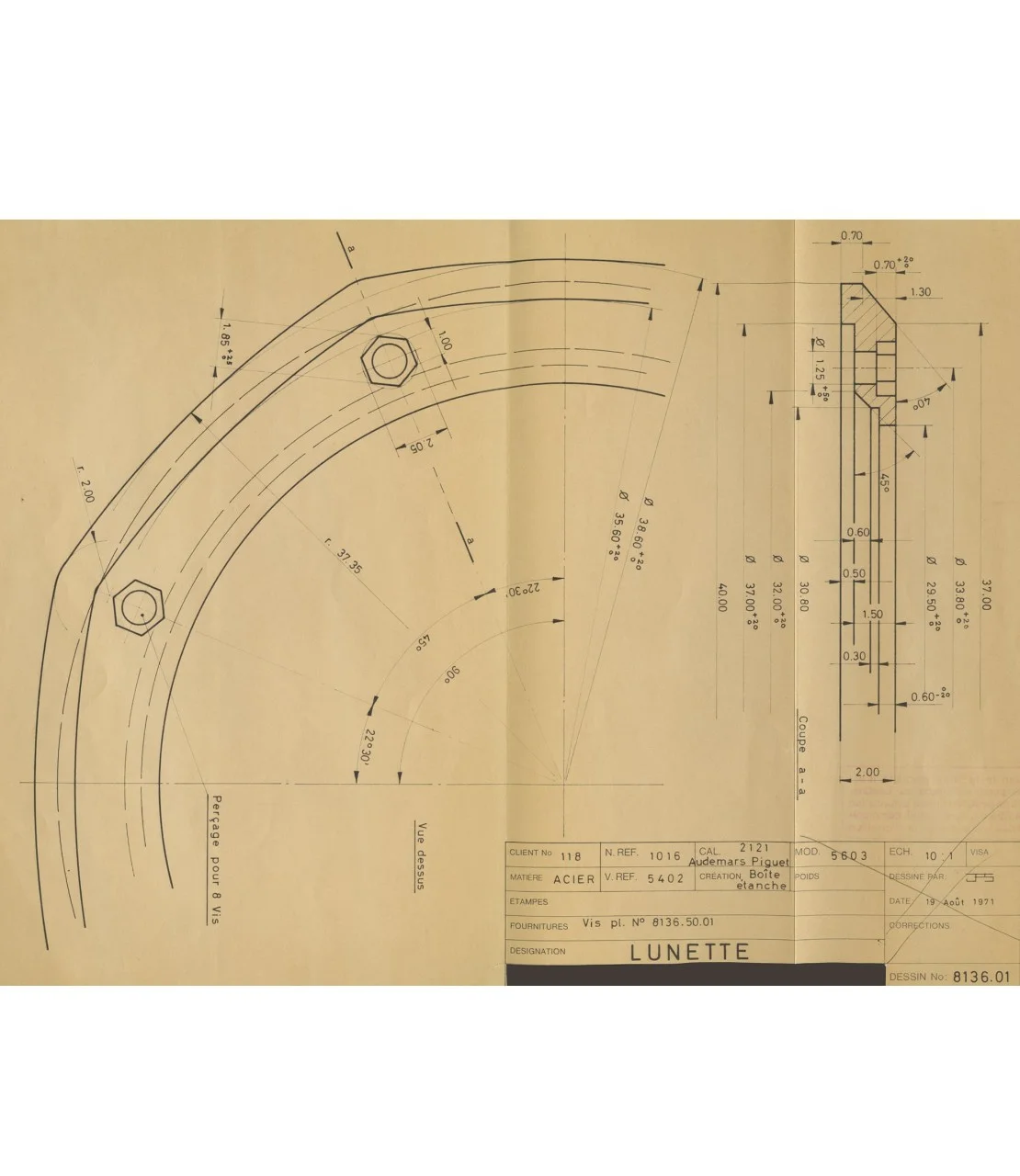
1971. Plan of the case for Model 5402. The plan of the first Royal Oak reveals an original architecture resulting from an unusual sealing system. Compressed by means of eight through screws, an oversized gasket completely encircles the Calibre 2121. Plan Favre-Perret 813600. Audemars Piguet Archives.
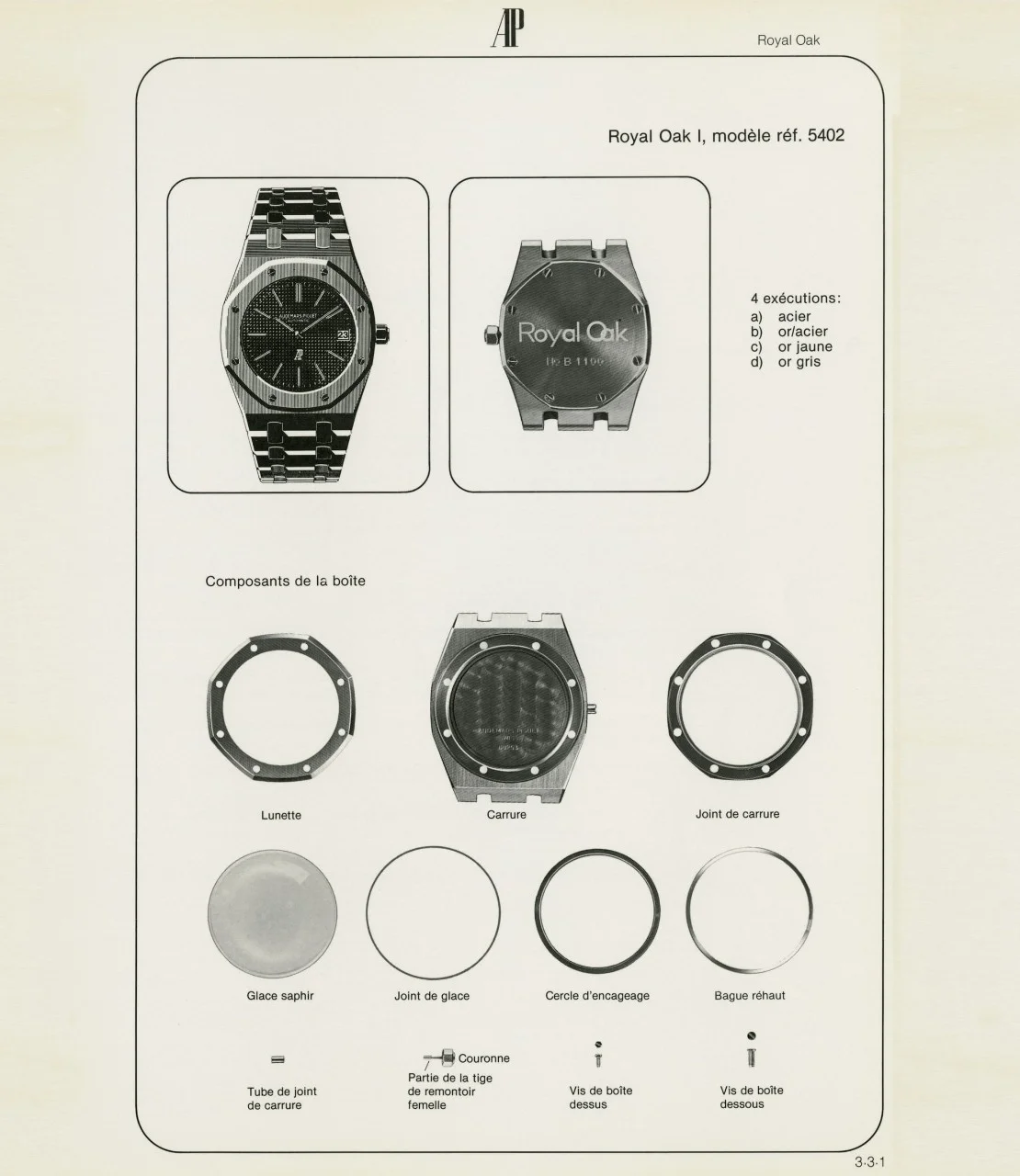
Repair sheet. This document, drawn up in the 1990s by the Audemars Piguet Customer Service department, presents the main case components of the first Royal Oak, Model 5402. Audemars Piguet Archives.
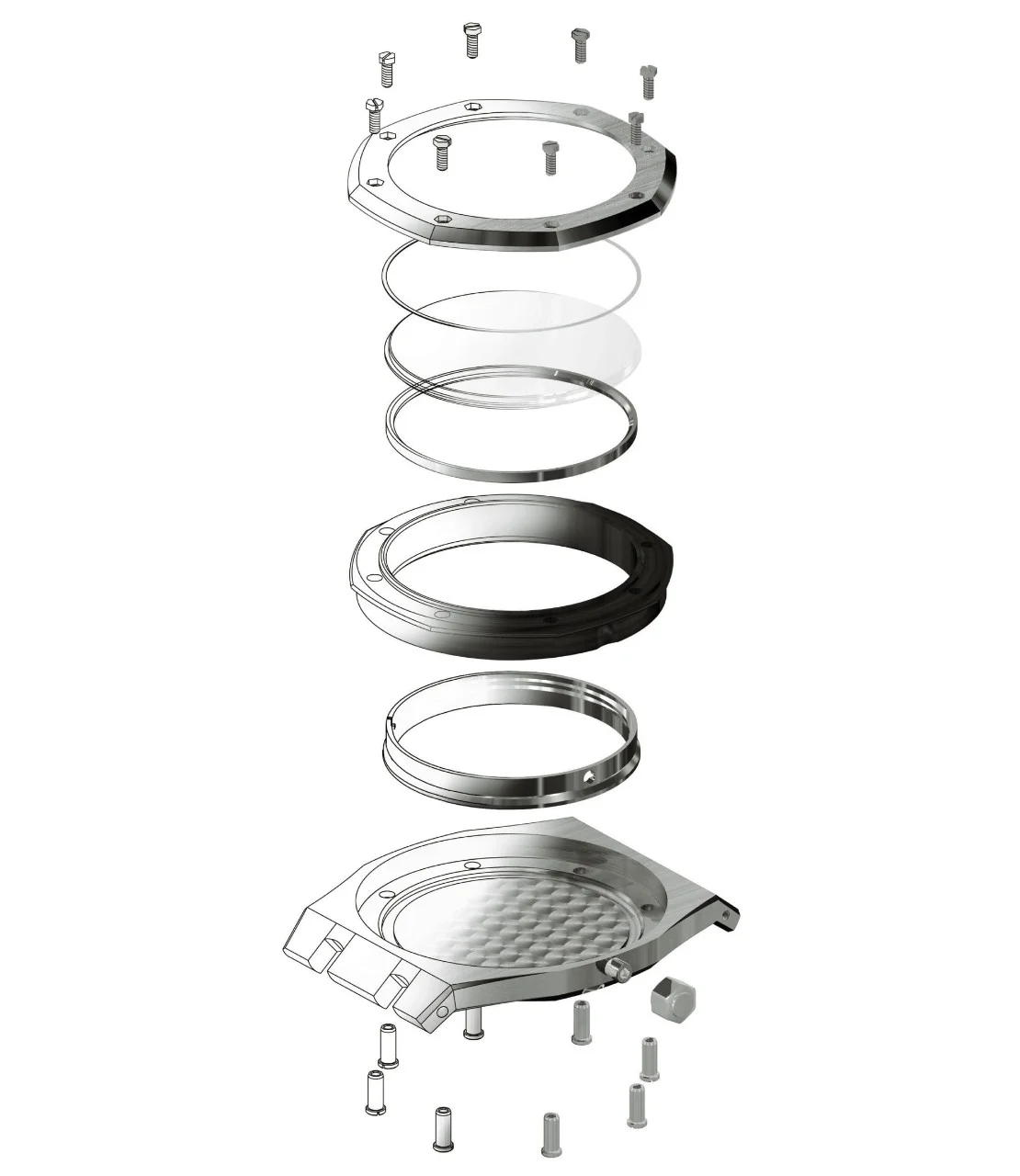
Exploded view of case 5402. The components are fixed by eight through-screws that cross the case so as to guarantee water-resistance to 100 metres. Drawing realised in 2007. Audemars Piguet Archives.
“Never Done Before” Water Resistance
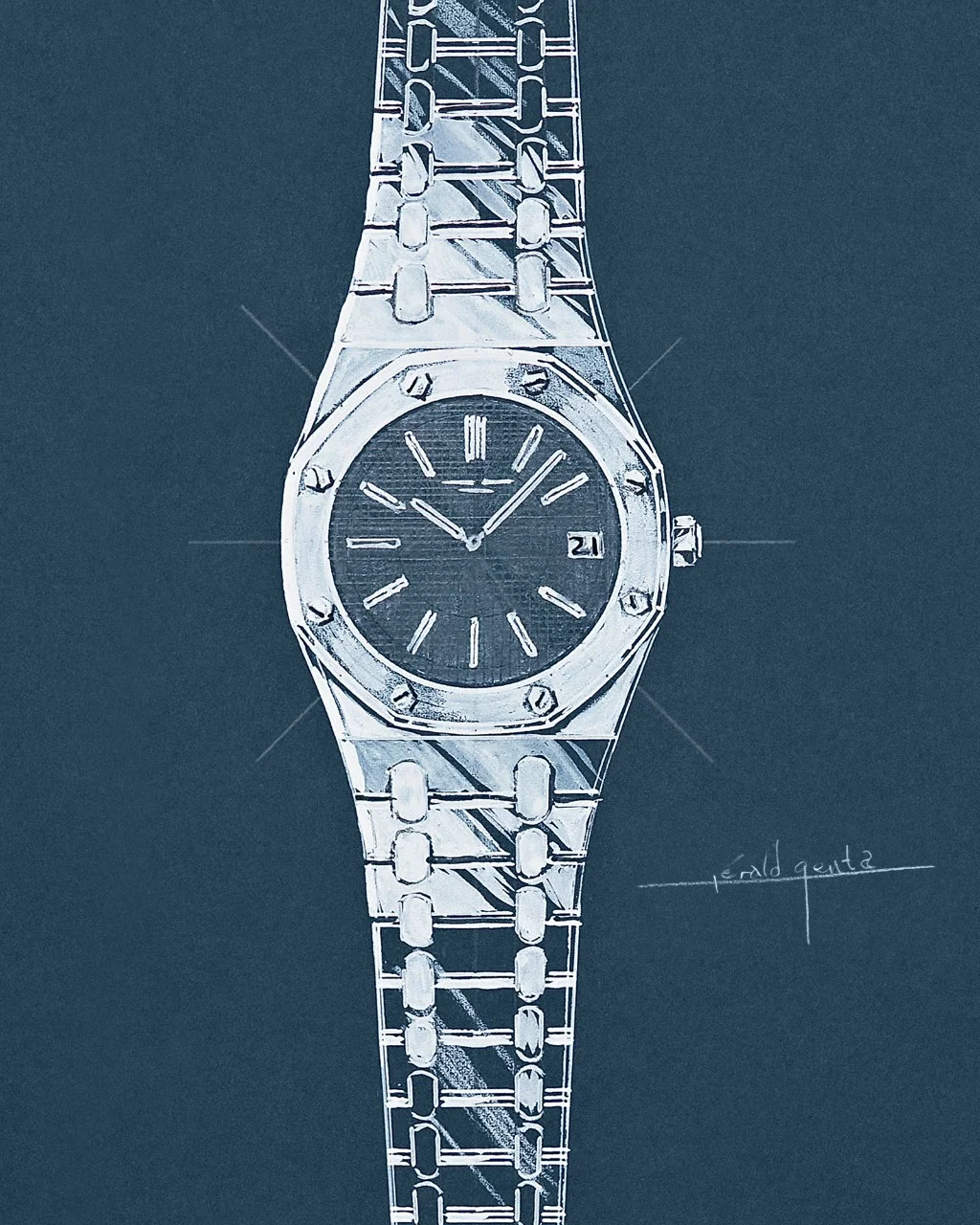
The article dedicated to the birth of the Royal Oak goes into detail on Gérald Genta’s sources of inspiration. Inspired by a childhood memory, the designer had applied himself to creating a watch "whose water-resistance had never been done before. I remembered as a child having seen a diver being fitted with a helmet on Geneva’s Pont de la Machine. I was very impressed when I saw the eight bolts and the rubber seal designed to protect a person's life under water. I was tempted to fit a highly prestigious movement inside a case entirely recalling the diver's helmet.” In the above-mentioned article, the reader will find the story of the development of the 100-metre water-resistant Royal Oak case, in collaboration with the Favre-Perret company from La Chaux-de-Fonds. After prototypes were produced in gold, a malleable material, the series-produced cases were made of steel, yet adorned with decorations worthy of noble metals. As a complement to this story, we look here in more detail at the main components of the case: bezel, screws, seal, crown...
Let's start with the most complex one, to which the Royal Oak owes its monocoque description: the caseback.

All-in-One Case Middle and Caseback
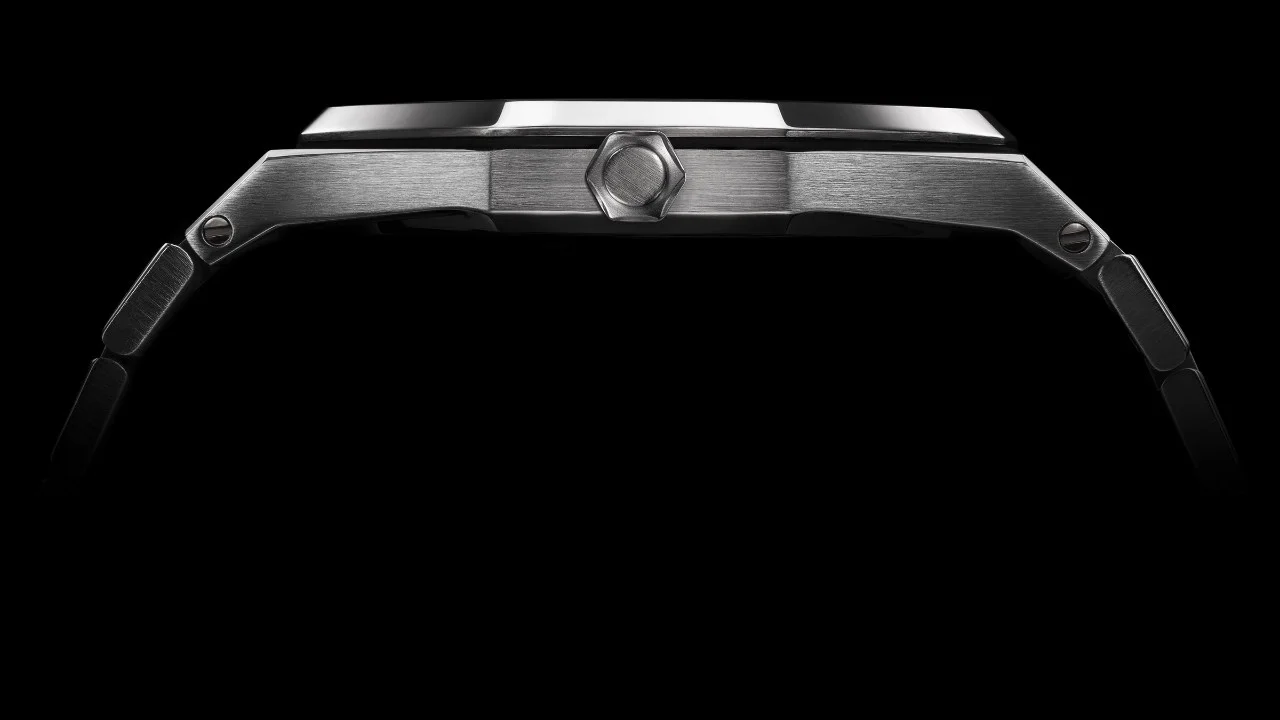
The Royal Oak’s monocoque case merges the case middle, caseback and lugs in one component, carved from a single block of steel. Some say it even includes the first two links of the bracelet. From the front, the caseback combines a slightly faceted tonneau shape with a circle. From the back, the circle disappears to make way for a rounded octagon, echoing the bezel, sculpted as if it were a caseback, and which becomes flatter as it nears the bracelet. A side view reveals the full refinement of this extraordinary component. The case middle is slightly curved to match the shape of the wrist and to prepare for the bracelet taper. On the dial side, the effect is highlighted by a progressive bevel leading towards the lugs.
A 2012 article in a brochure celebrating the Royal Oak’s 40th anniversary provides details of the steps involved in producing this component of Model 15202: "This means that after the initial blanking operations, the 44 successive turning, milling, trimming and engraving operations must be isolated. All contribute to preparing the monohull case for manual polishing. When the surfaces are pierced in order to house the case and movement fastening screws, and the inscriptions are engraved, it’s time to apply the finishing. The case, sides and lugs are satin-brushed along different axes and in several stages.”
In 1972, the machining steps were longer and more complex, as the watch industry had not yet adopted computer-controlled machines (CNC). On the other hand, manual finishing has not changed in 50 years. The Product Sheet for the first Royal Oak, Model 5402, specifies the types of decoration: "Case middle: satin-finished top and sides, horizontal satin-finished edge, polished bevels, circular satin-finished underside, sandblasted retranche [Editor’s Note: non-circular area of the underside]". It should be noted that the circular graining on the inside of the case middle was only visible when the watchmaker entirely uncased the watch. Martin K. Wehrli liked to point out that this traditional decoration is probably a legacy of non-water-resistant watches, as the interior decoration had to trap micro-dust so that it would not fall into the mechanism.
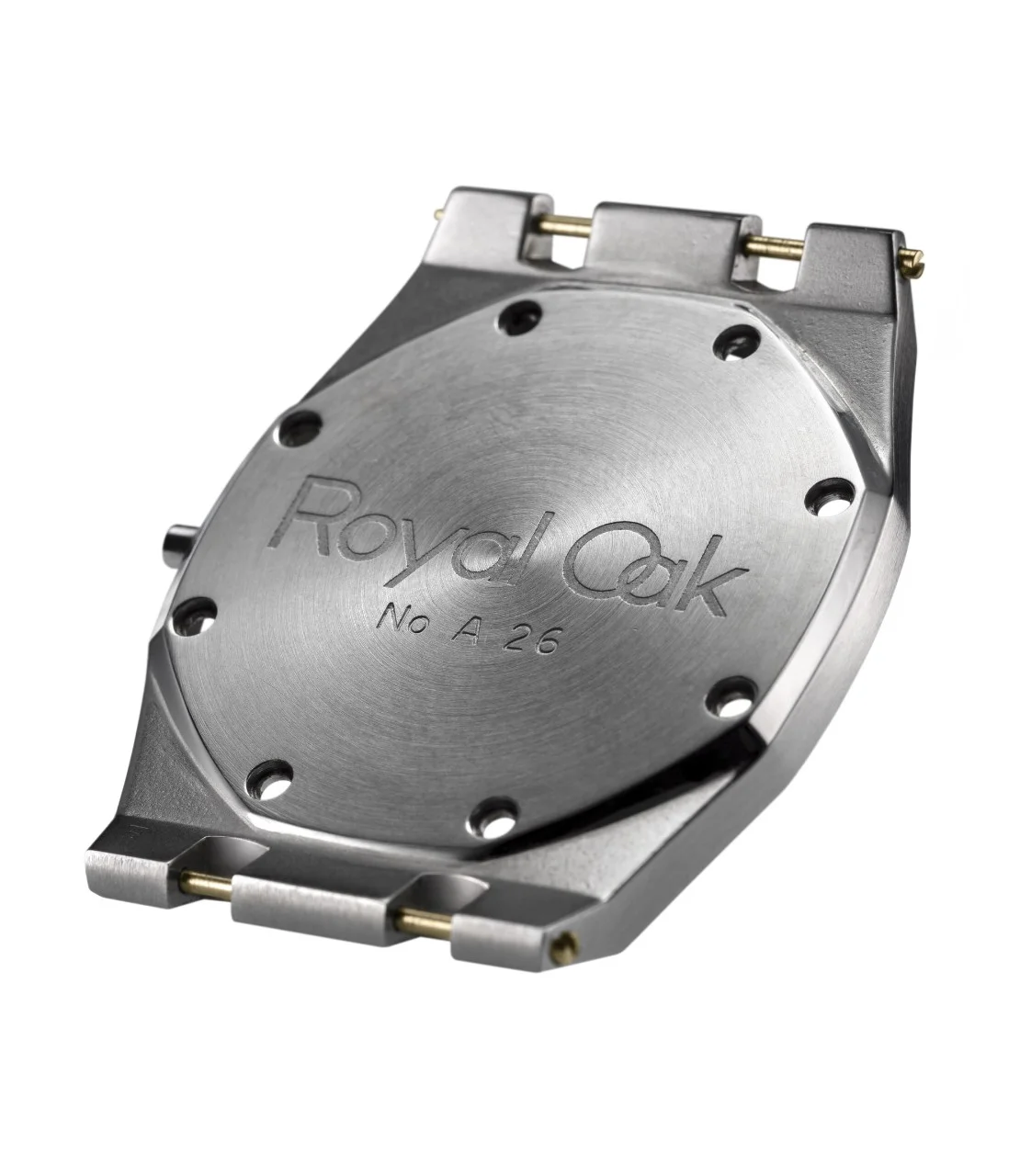
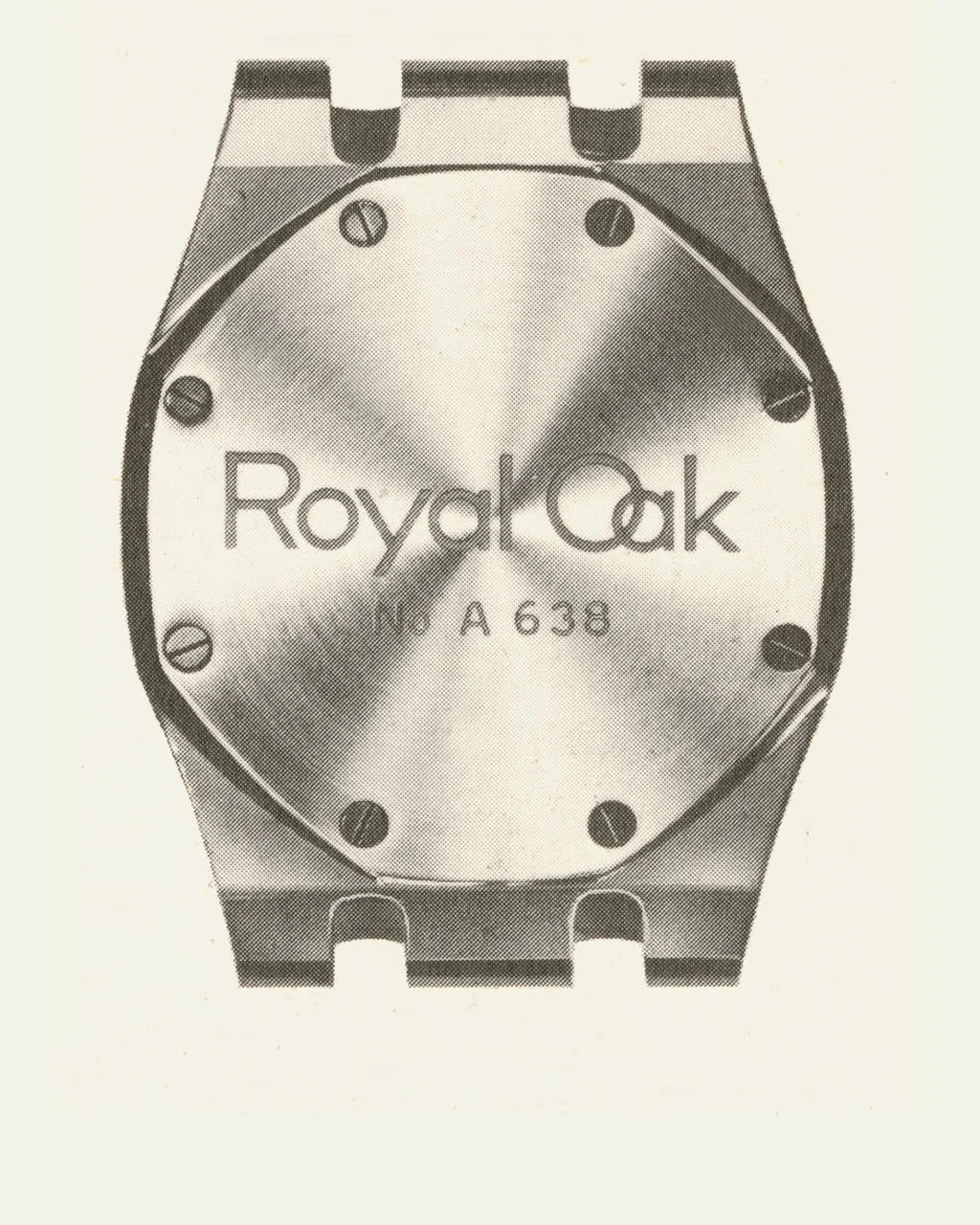
5402 fused monocoque caseback and case middle, back side view. Punctuated by 8 holes, the caseback's octagonal shape echoes that of the bezel. The tonneau-shaped case middle is curved to express the finesse of the watch and prepare for the tapering bracelet. Audemars Piguet Heritage, inv. 365.
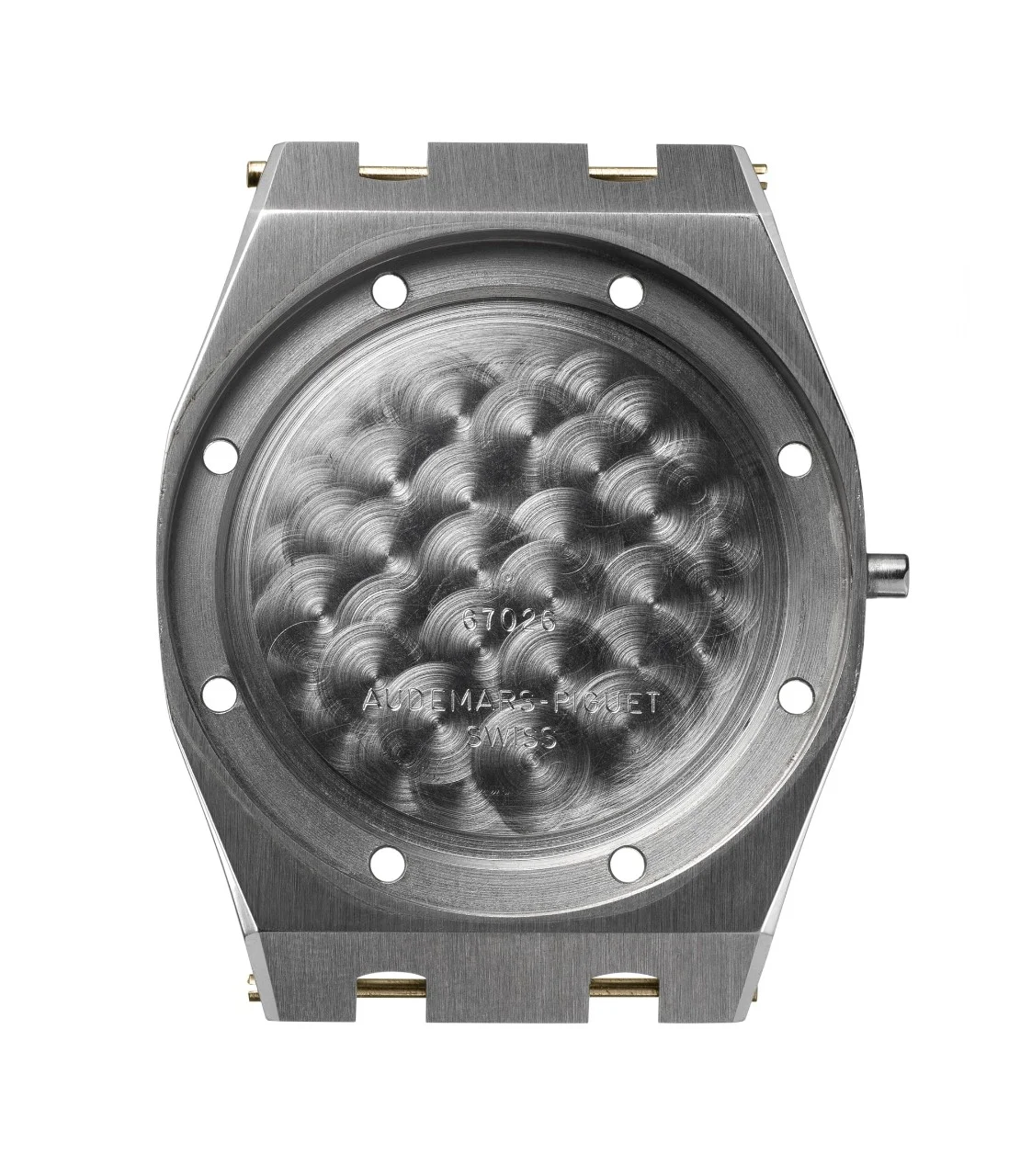
5402 fused monocoque caseback and case middle, front view. The circular grained surface will welcome Calibre 2121. The circle puncutated by 8 holes is reserved for the oversize gasket. The tonneau-shaped case seamlessly blends with the bracelet aesthetic. Audemars Piguet Heritage, inv. 365.
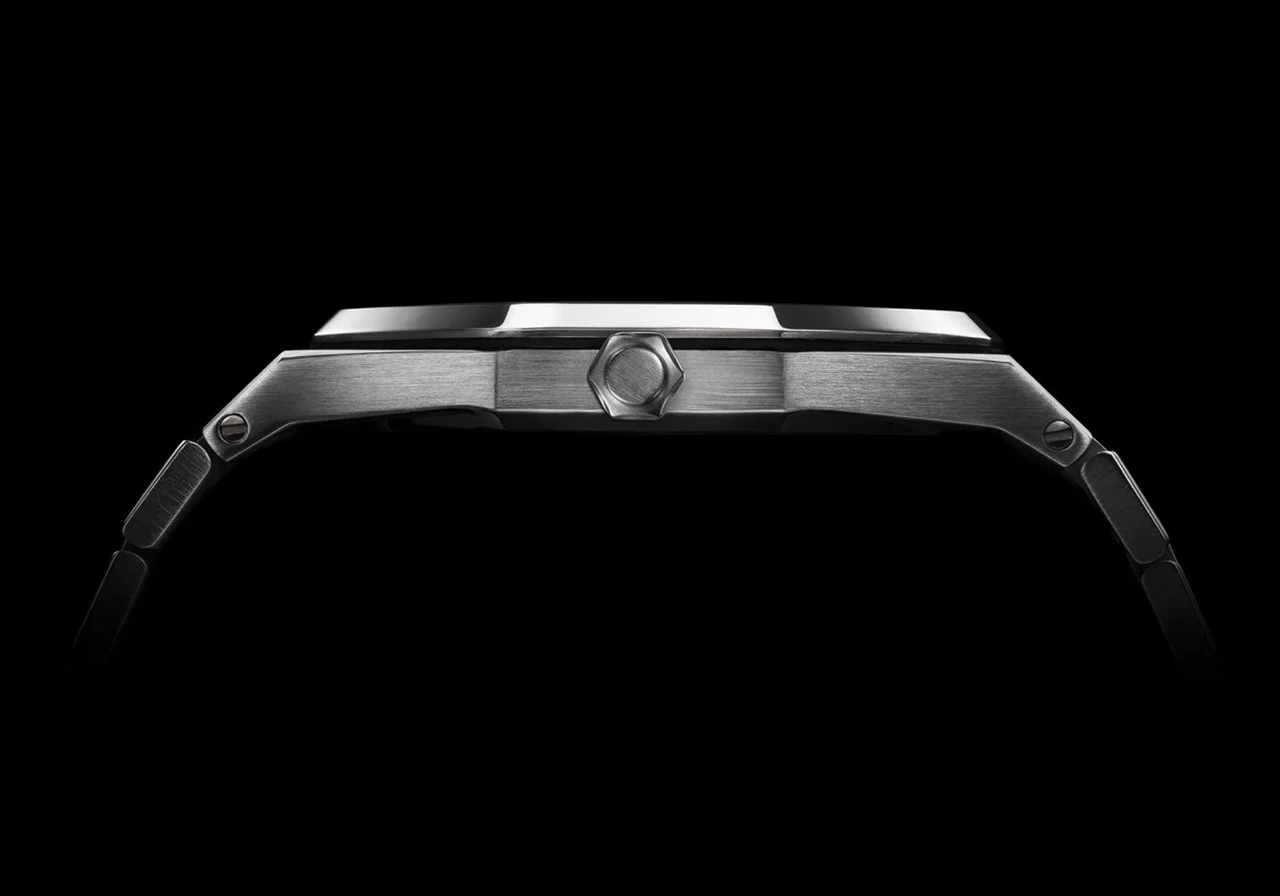
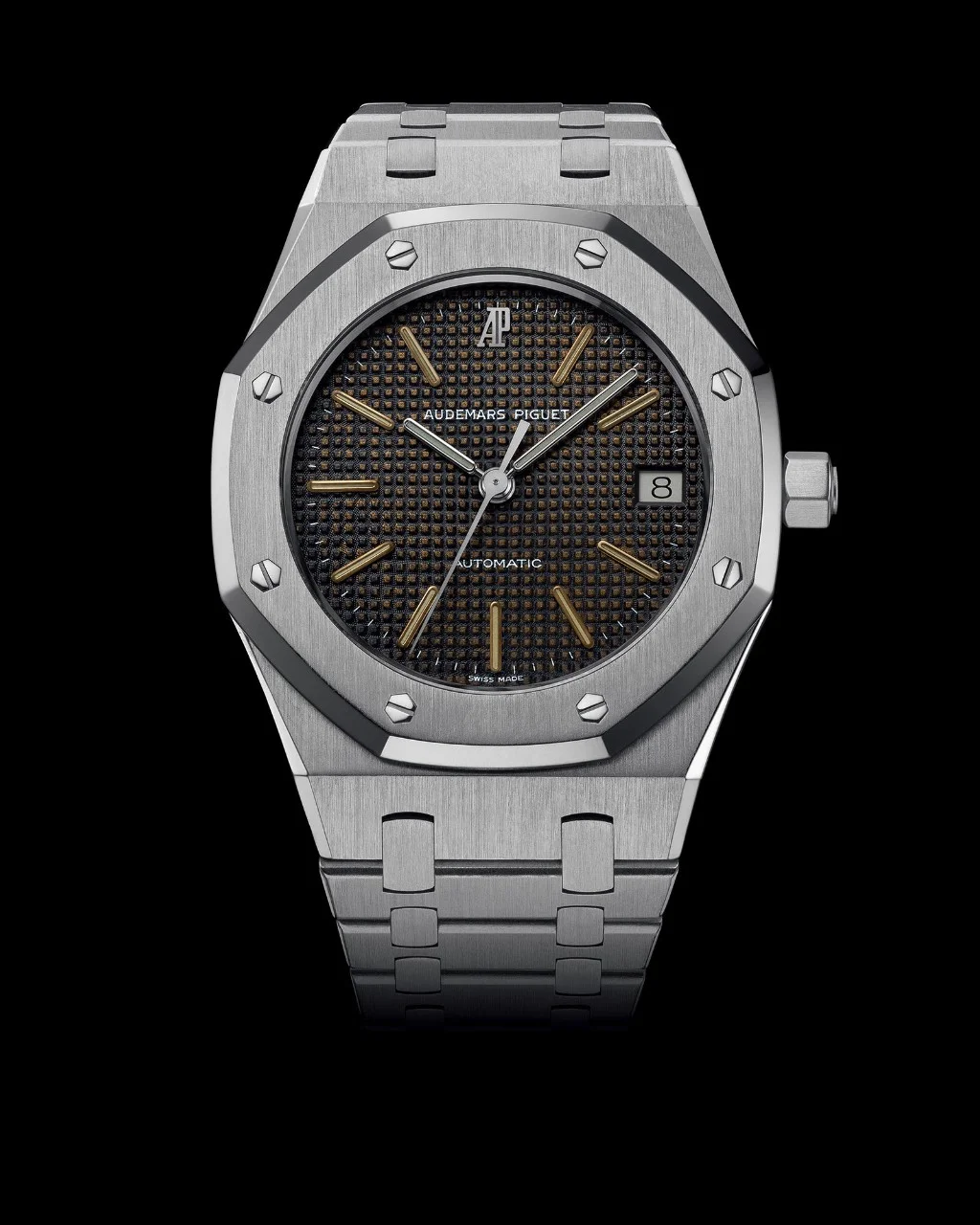
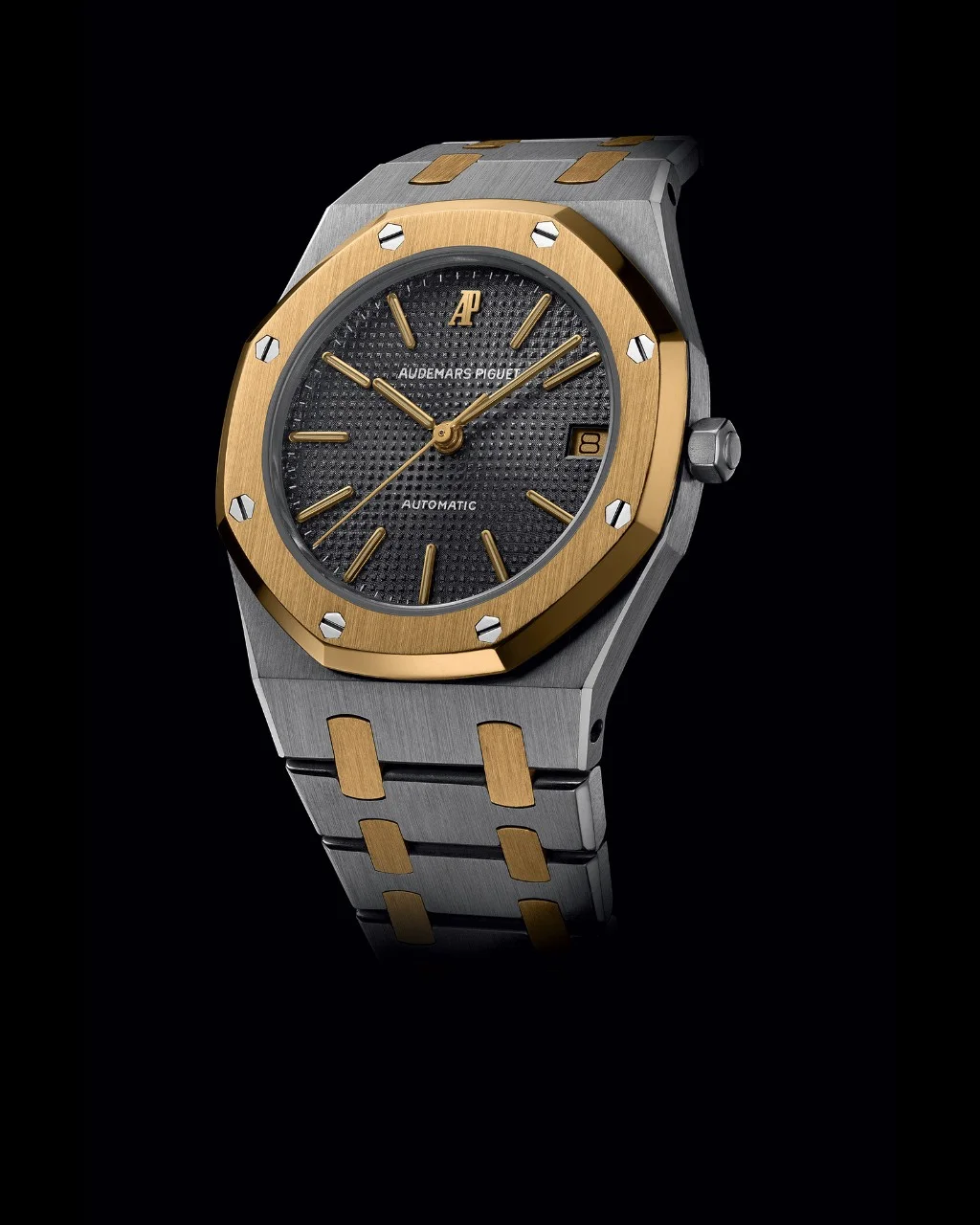
1972. Royal Oak 5402ST No. A26, side view. Calibre 2121, movement 127059. Bracelet 344, T21 Tapisseriedial. Case 67026, 39 mm. Steel. Sold to Gameo in 1972. Audemars Piguet Heritage, inv. 365.
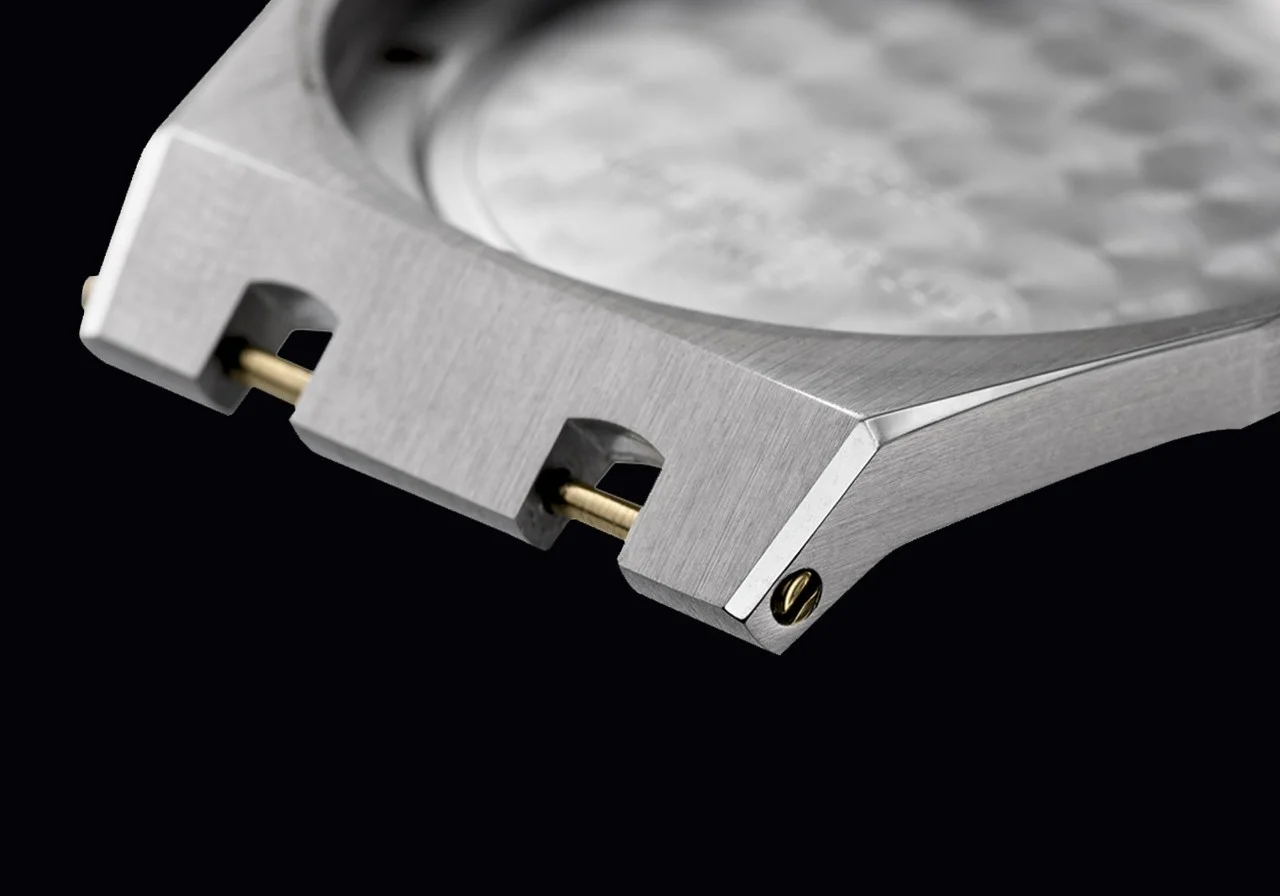
1972. Large bezel on the lower side of the fused caseback and case middle of Model 5402ST. Structurally speaking, the two large lower and upper bevels of the case belongs to the fused caseback and case middle. Aesthetically speaking, they are already part of the bracelet, of which they constitute the lugs, as well as the first link. Audemars Piguet Heritage, inv. 365.
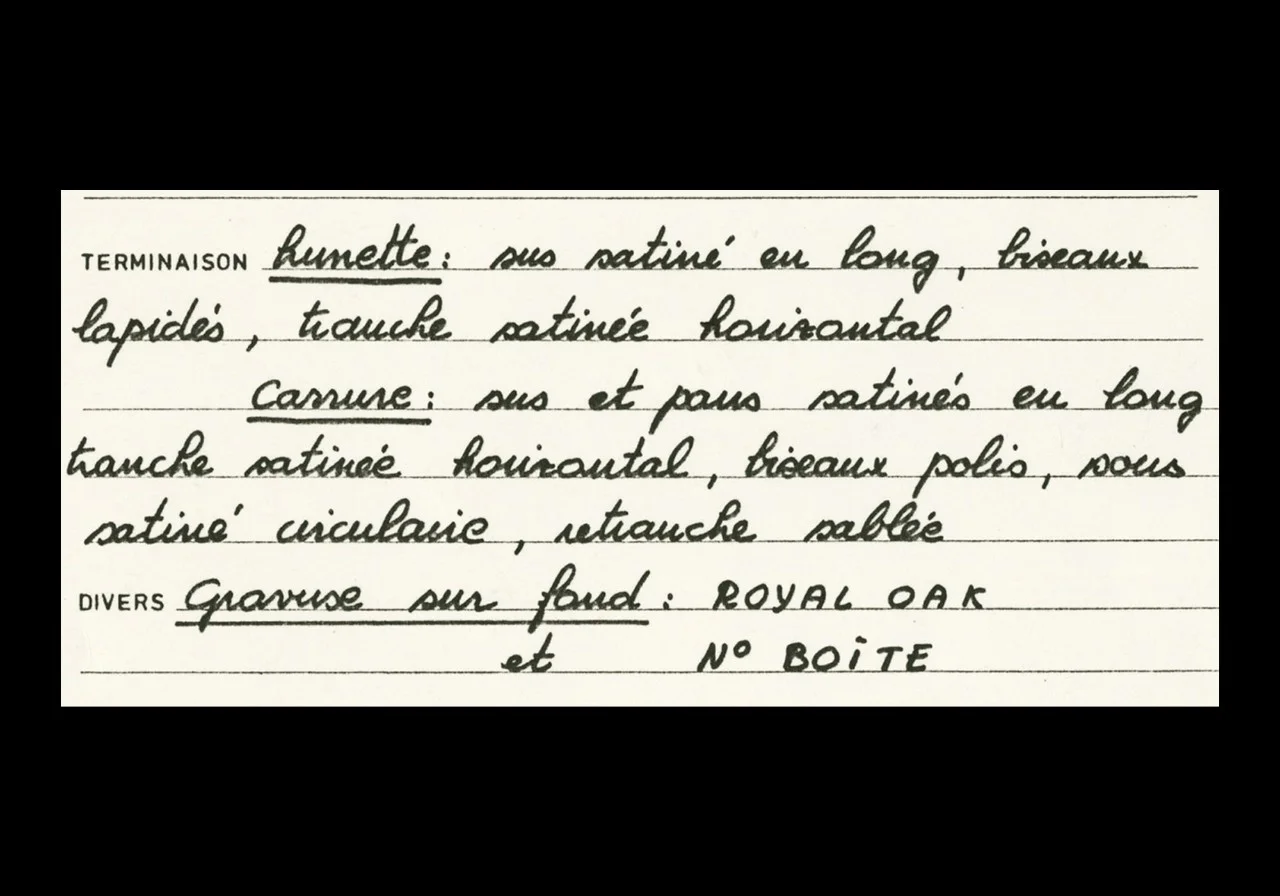
1972. 5402ST case's finishing techniques. This document lists the types of finishing techniques used on the main elements of the first Royal Oak's steel case. Case 5402 technical sheet. Audemars Piguet Archives.
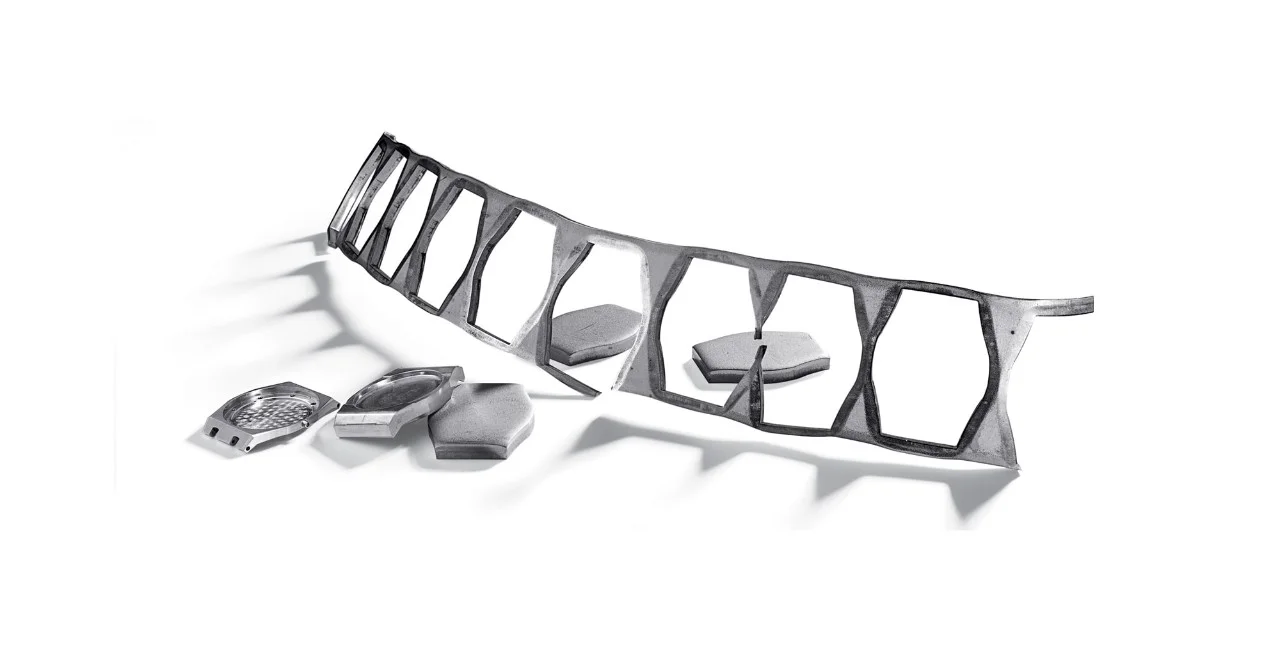
Circa 2011. Manufacturing steps for Model 15202's fused "monocoque" case middle and caseback. After the initial stamping, 44 operations are necessary to give the 15202 monocoque case its final shape. The complex component is then finished by hand. Audemars Piguet Archives.
The Octagonal Bezel and its Sapphire Crystal
While the Royal Oak’s bezel is often described as octagonal, it is far more than that. Its centre is a circle, while its periphery is a rounded octagon, vertically satin-finished and strongly bevelled. The 40-degree bevel perfectly follows the bezel’s octagonal-rounded shape and results in a thin satin-finished edge. A lapping machine helps create a mirror-polished surface highlighting the traditional technique of bevelling (chamfering). Seen from the front, it takes up almost a quarter of the bezel's surface and links the moiré reflections of the Tapisserie dial to the facets of the tapered bracelet.
At each corner of the eight curved facets that punctuate the bezel, a hexagonal hole is made to accommodate a screw. Until then, in the watchmaking tradition, watch bezels had sometimes featured hour-markers, either at 12, 3, 6 and 9 o'clock, or at each hour. In the same tradition, the screws securing cases were always hidden. Gérald Genta departed from these two practices and structured the circumference of the bezel in eight elements independent of the dial since it was impossible to follow the hours graduation. Further freeing himself from the shackles of convention, he punctuated the bezel with visible fastening screws. Note as well that for aesthetic reasons, he decided not to put a screw in the classic 12 o’clock position. In short, Genta designed a bezel driven by its own dynamics and aesthetic rhythms, independent of those on the dial yet echoing the case and bracelet’s design and sensitivity to light.
With a maximum thickness of two millimetres, the inside of the Royal Oak “Jumbo” bezel is partially hollowed out to make room for the water-resistance seal. A small undercut is made for the heel of the sapphire crystal to rest on. Water-resistance is ensured when the case is closed and the seals are pressurised.
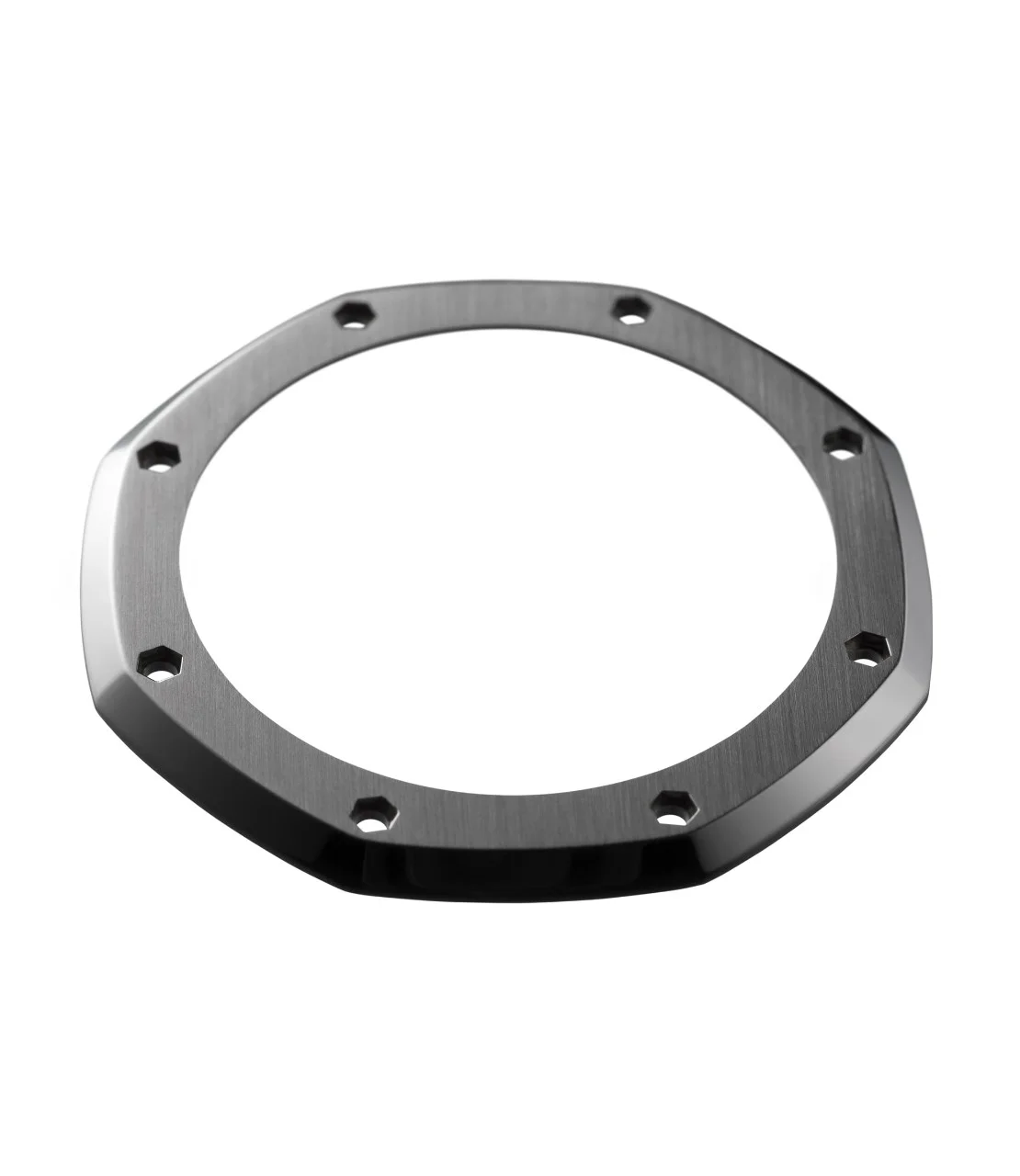
1972. Royal Oak 5402ST bezel, front view. Gérald Genta transformed the bezel's external circle into an octagon to make it lighter aesthetically while maintaining enough space for the 8 holes. He refined this shape by designing 8 large polished bevels. The side of the bezel measures no more than 0.7 mm. Audemars Piguet Heritage, inv. 365.
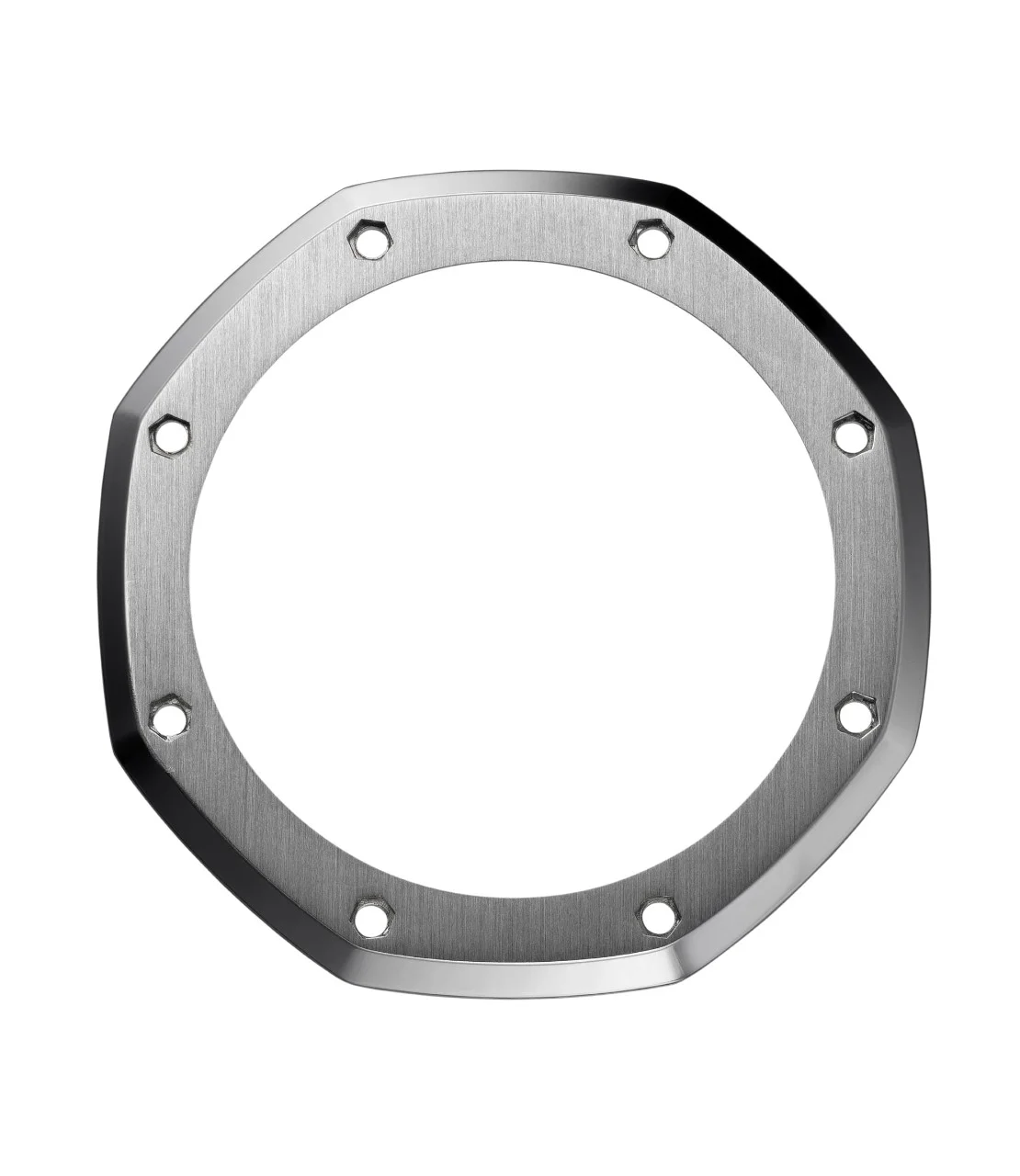
1972. Royal Oak 5402ST bezel, front view. Combining a circle with a rounded octagon, the bezel is punctuated by 8 hexagonal holes. The top surface is finished with vertical satin-brushing while the facets are polished. Audemars Piguet Heritage, inv. 365.
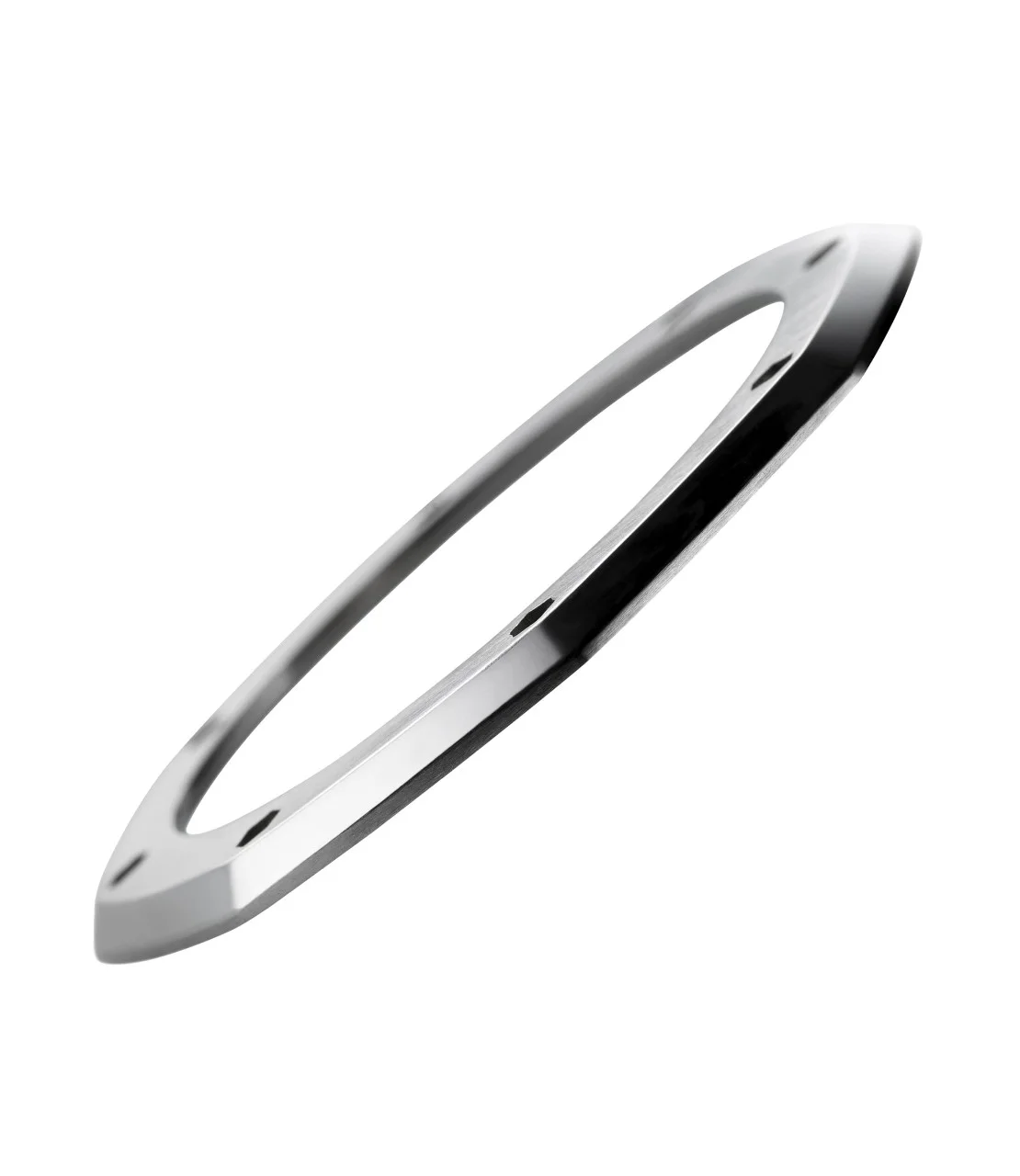
1972. Royal Oak 5402ST bezel, side view. Measuring 2 mm in high, the bezel of the first Royal Oak contains 8 curved faces, bevelled at 40 degrees and mirror polished. Audemars Piguet Heritage, inv. 365.
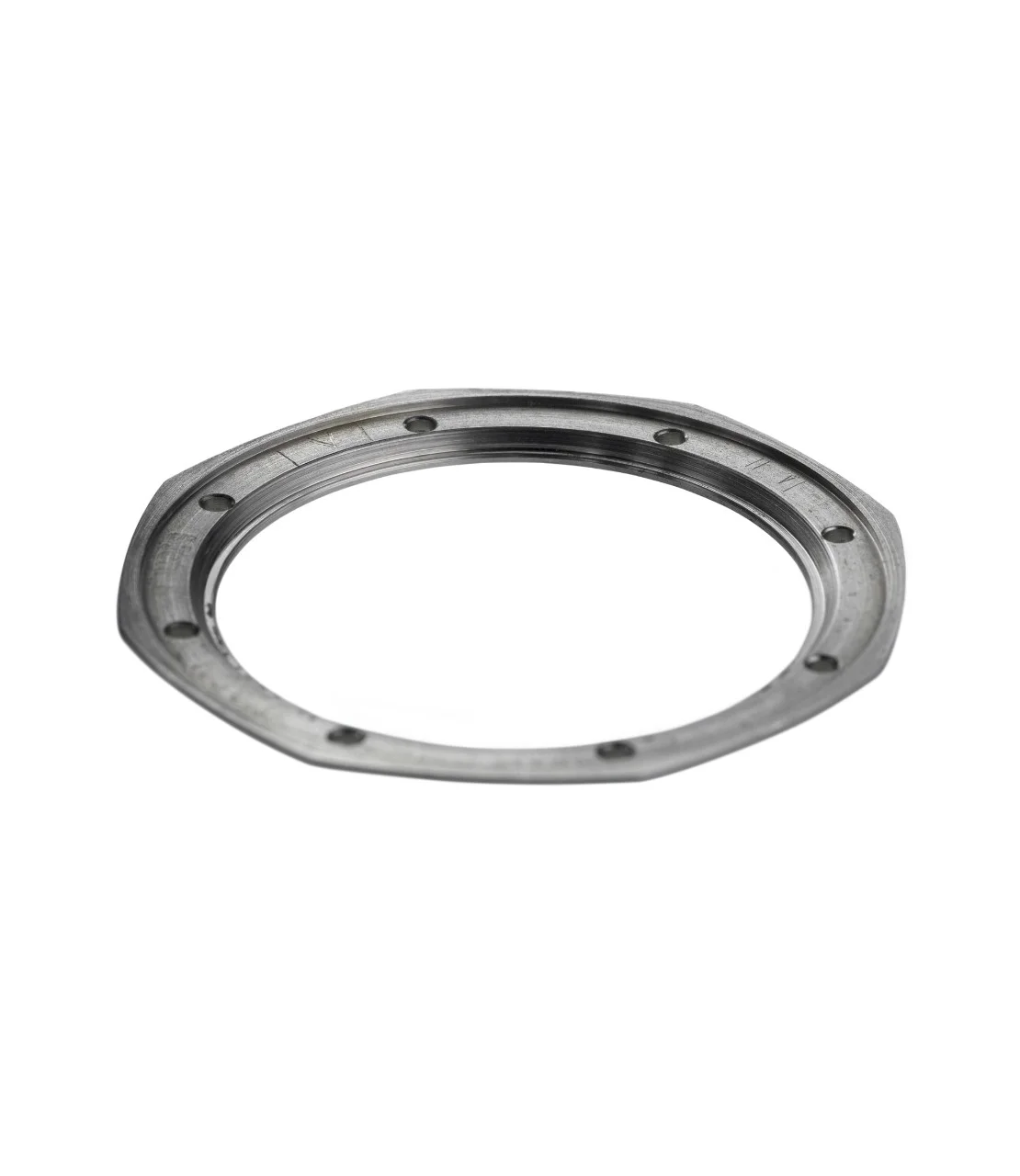
1972. Royal Oak 5402ST bezel, underneath. The bottom of the bezel is partially emptied out to welcome the oversize gasket. The first bezels were so thin that it was impossible to gemset them on top. It was thus the bevels that welcomed the first diamonds. Audemars Piguet Heritage, inv. 365.
1972. Royal Oak 5402ST bezel, profile view. Measuring 2 mm in height, the bezel of the first Royal Oak is composed of 8 curved faces that are bevelled at 40 degrees and mirror polished. Audemars Piguet Heritage, inv. 365.
The Water-Resistance Seal and its Casing Ring
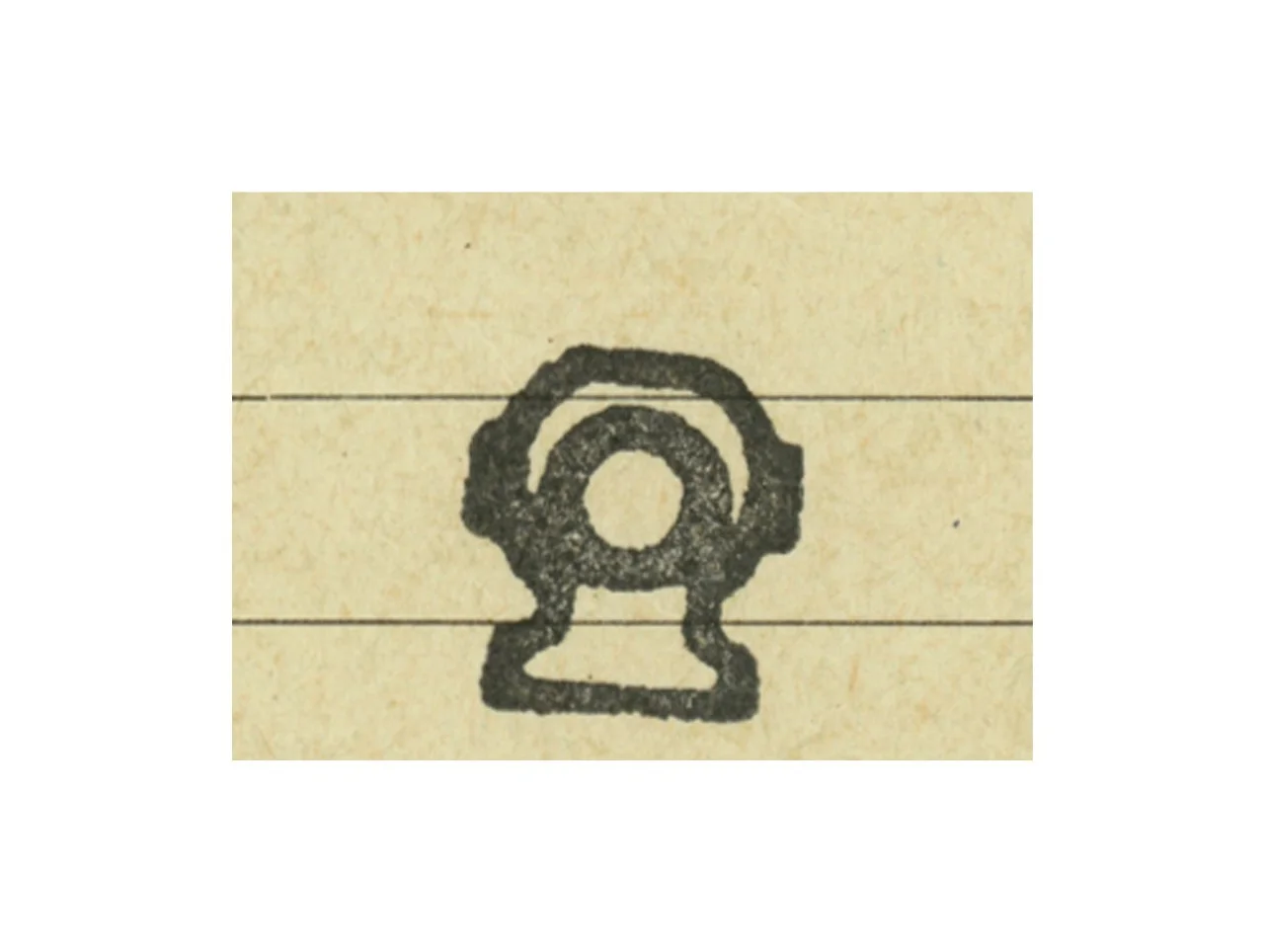
In traditional watchmaking, seals are small rubber elements discreetly placed in the grooves between the three main components of the case, and which disappear from view once the case is assembled. The seal designed by Audemars Piguet for the first Royal Oak is of a different nature. On the one hand, it reveals a thin black line around the edge of the bezel, but above all, its internal measurements are anything but ordinary. With a thickness of 5.59 mm (uncompressed), a width of more than 4 mm, a complex moulded shape combining round and octagonal shapes, punctuated by 9 holes with an almost 2 mm diameter (8 for the through screws and 1 for the winding stem), it is the keystone of the water-resistance system.
The seal is squeezed between the bezel, the caseback, a thin casing ring which separates it from the movement and a narrow inner bezel ring (flange) which separates it from the dial. The seal is compressed by the pressure exerted by the eight hexagonal screws that ensure the rigidity of the entire case.
This component has of course evolved over time. Various examples of Model 5402 were equipped with two variants: one in black rubber and the other in translucent silicon. The more rigid rubber option (pictured) had a disadvantage in that the material could not be entirely controlled. Certain seals tended to liquify, taking on a honey-like appearance, whereas others diffused gases which damaged the oils of the mechanism... The translucent silicon variant was more stable but also more flexible and it sometimes remained stuck to the case middle and bezel.
Some occurrences feature an unsigned seal, but most bear the AUDEMARS PIGUET indication, the SWISS MADE provenance and identification numbers. As we shall see below, later models gave rise to an increasing number of variants, in particular because the quality of the first seals proved difficult to control.
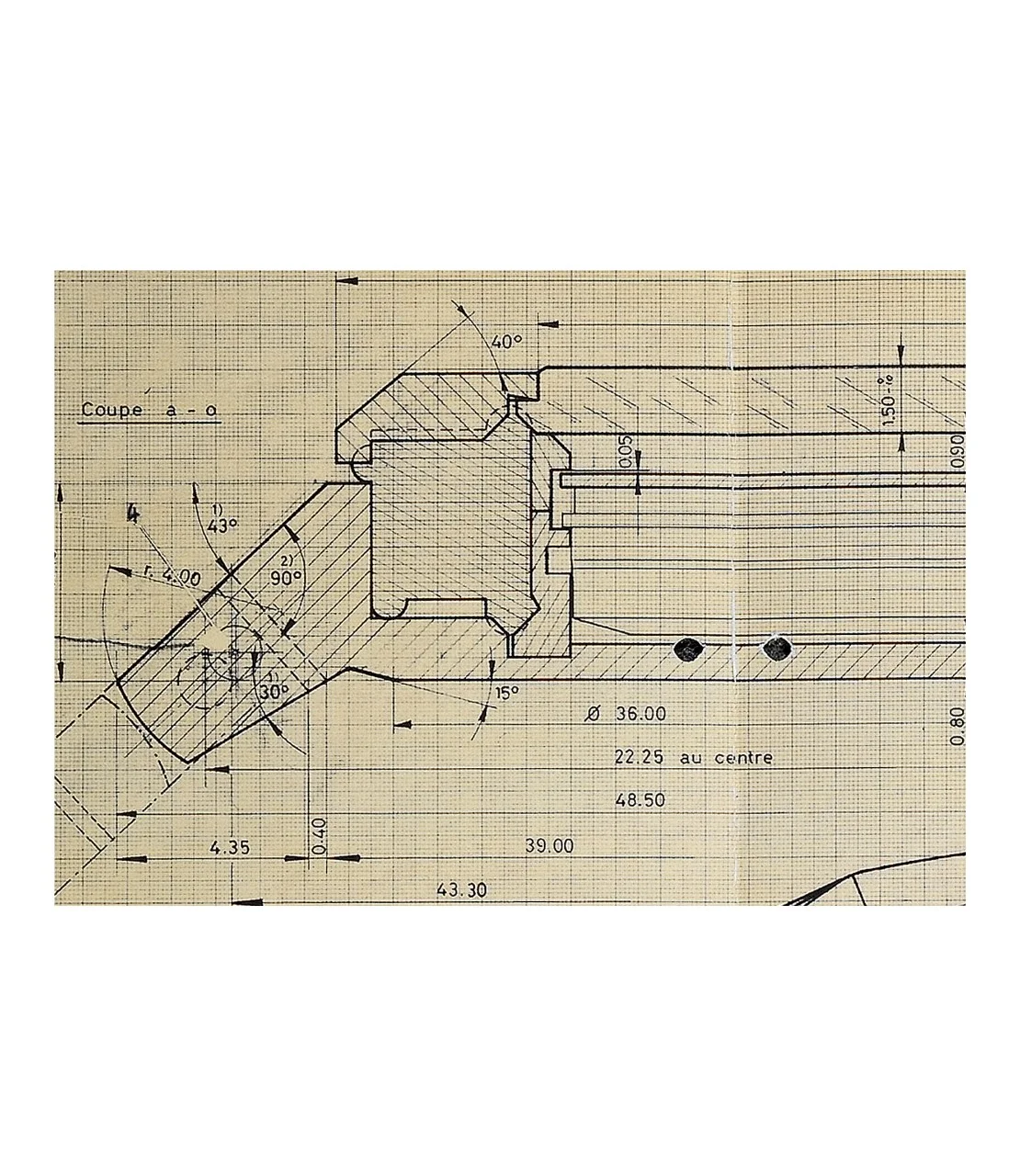
1971. Cut of case 5402. The oversized gasket is compressed between the bezel and the fused caseback and case middle. Slightly larger than the bezel, the gasket appears as a thin black line under the bezel. Plan Favre-Perret 813600. Audemars Piguet Archives.
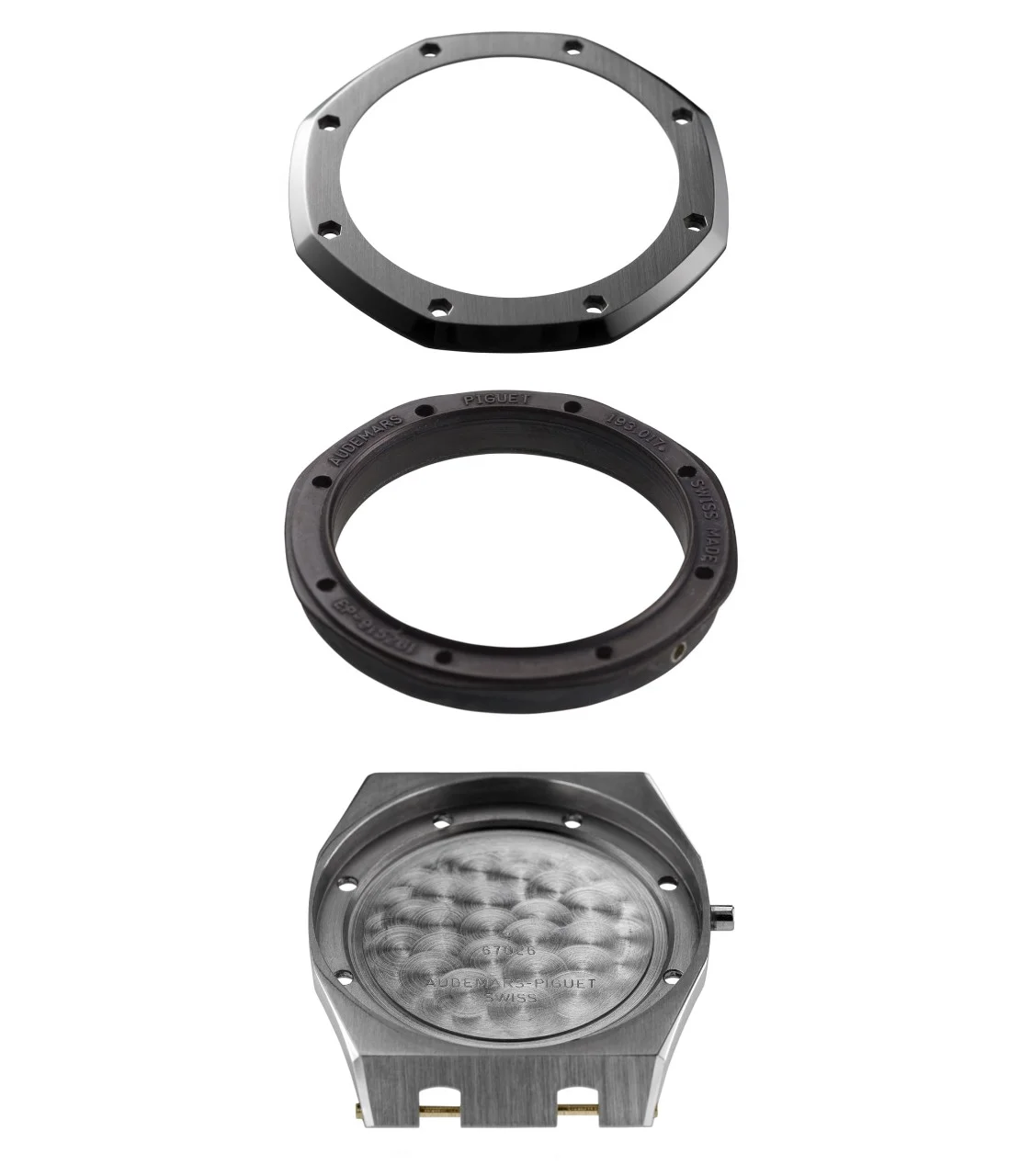
Bezel, gasket, fused caseback and case middle of Model 5402. An oversize gasket is positioned between the octagonal bezel and the fused monocoque caseback and case middle. It is compressed with 8 crossing screws that go through the whole. Audemars Piguet Heritage, inv. 365.
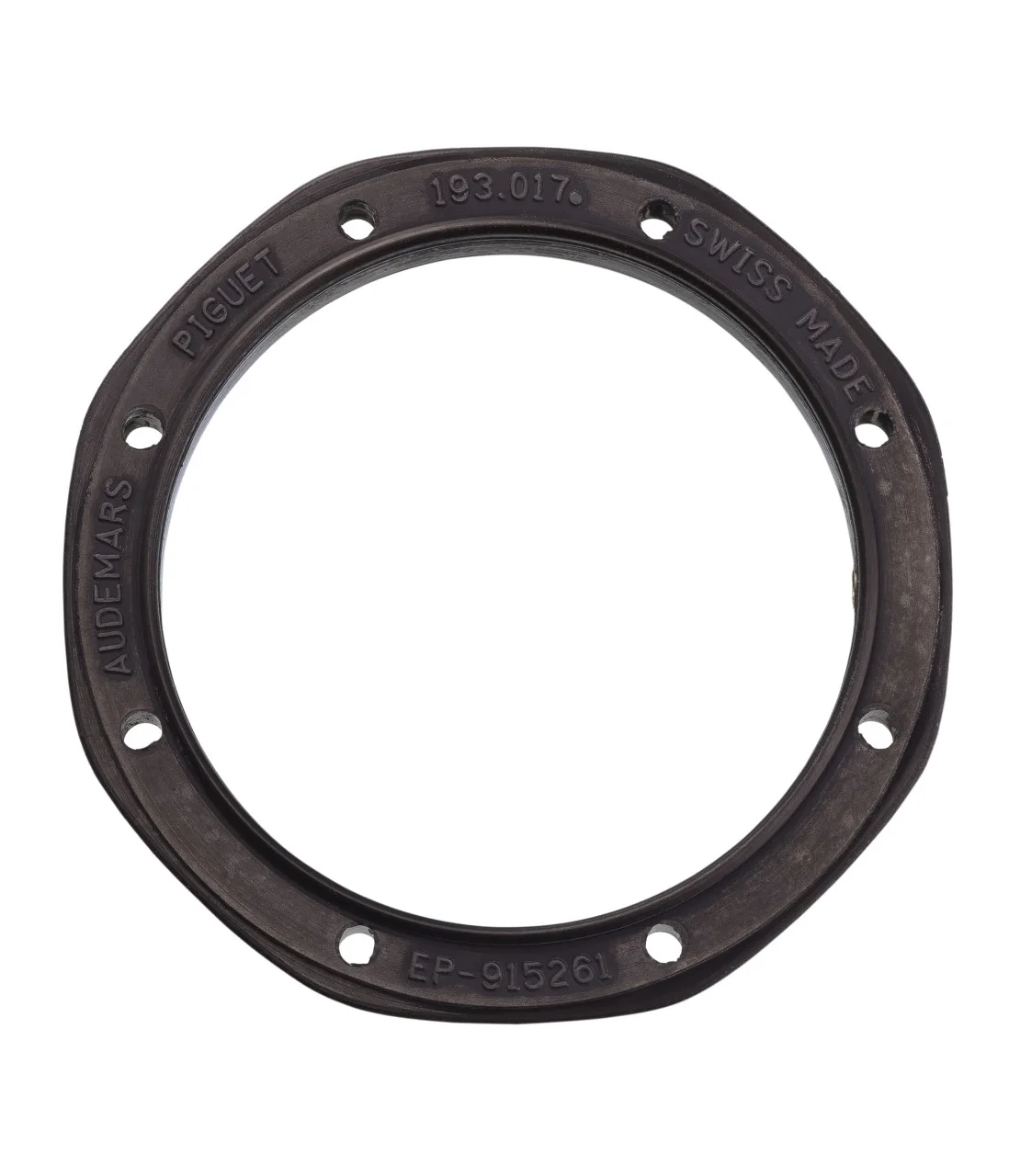
5402 oversize gasket. Calibre 2121 is positioned inside the circle of the gasket, which prevents water and moisture infiltration. Audemars Piguet Heritage, inv. 365.
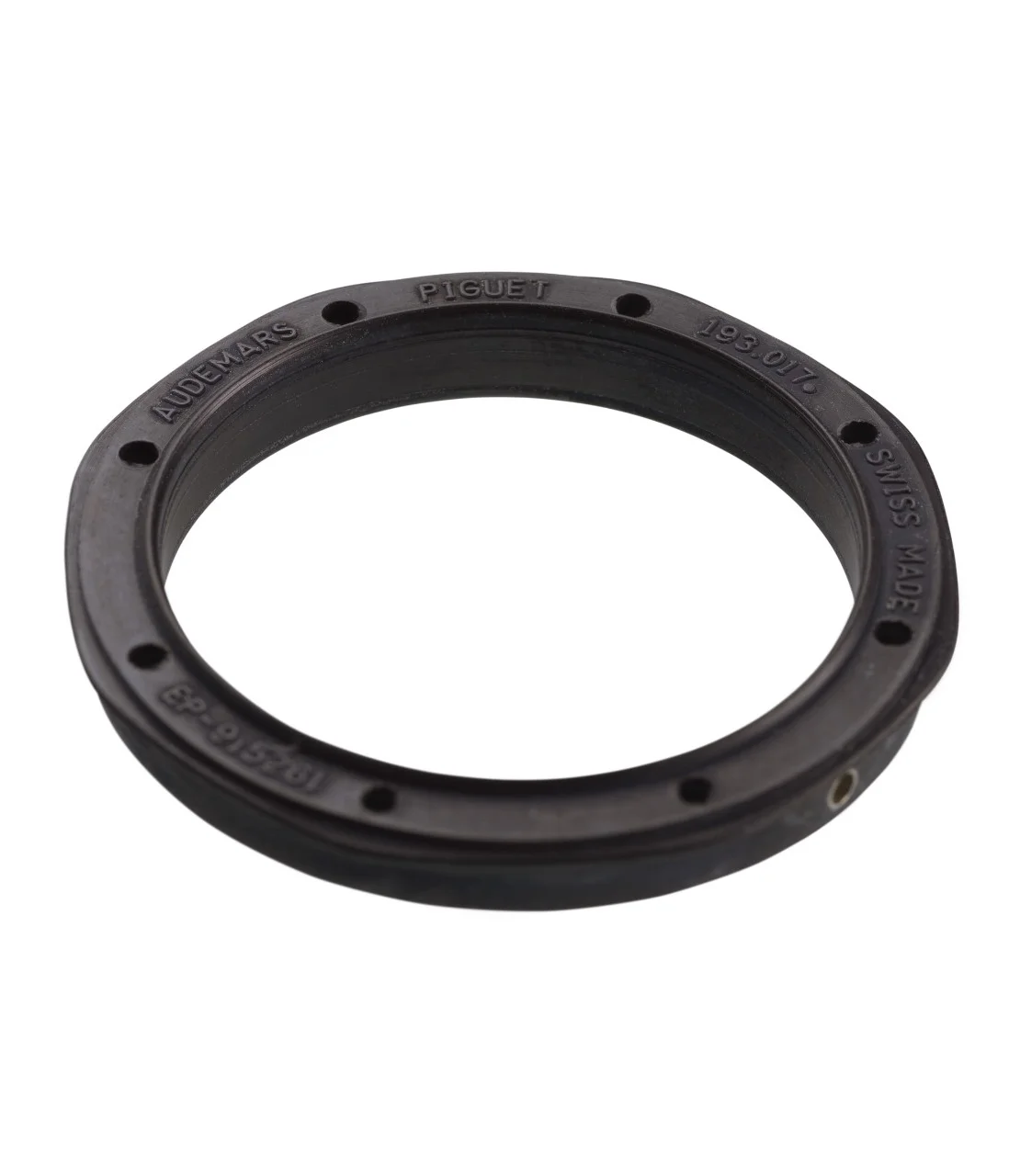
5402 oversize gasket. The rubber gasket is pierced with 8 vertical holes for the case's crossing screws. A ninth hole will welcome the crown stem. Audemars Piguet Heritage, inv. 365.
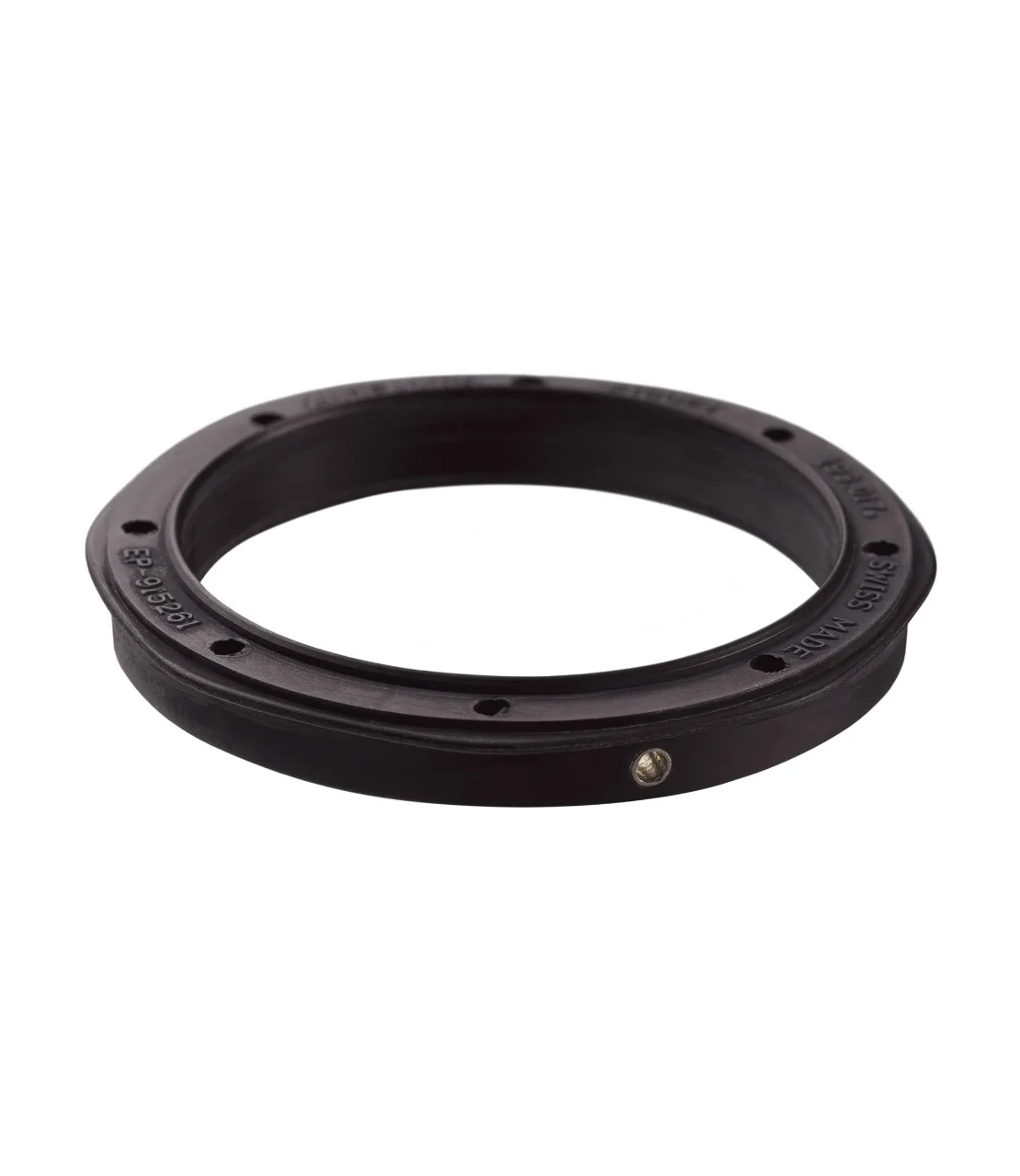
5402 oversize gasket. 5402 oversize gasket. An octagonal-shaped lip seamlessly integrates the shape of the bezel, so as to let appear a very thin black line on its periphery. Audemars Piguet Heritage, inv. 365.
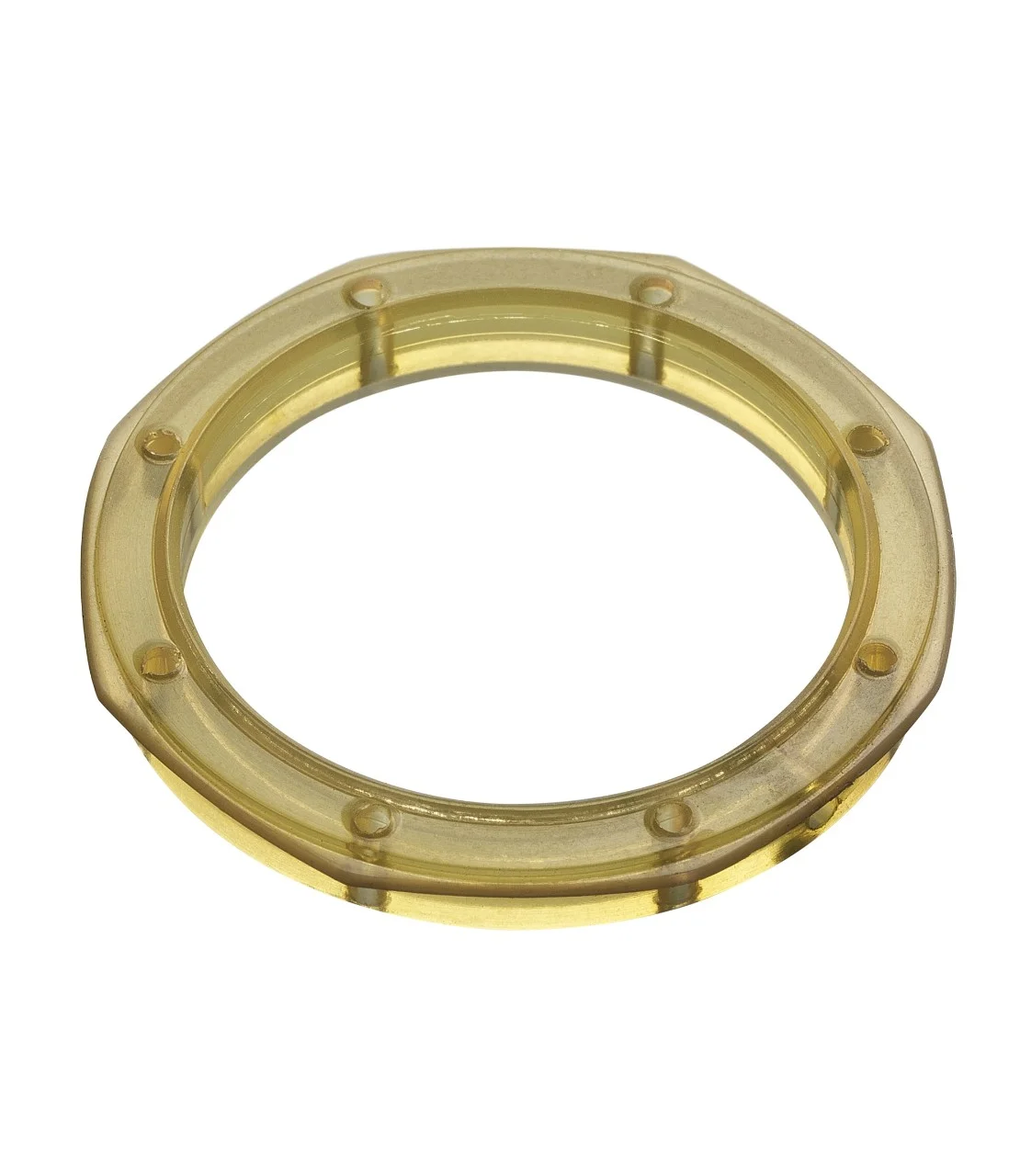
5402 silicone gasket. Some Royal Oak 5402 watches were equipped with a translucent gasket that was more flexible and more stable than rubber gaskets. Audemars Piguet collection.
The Eight Hexagonal Screws
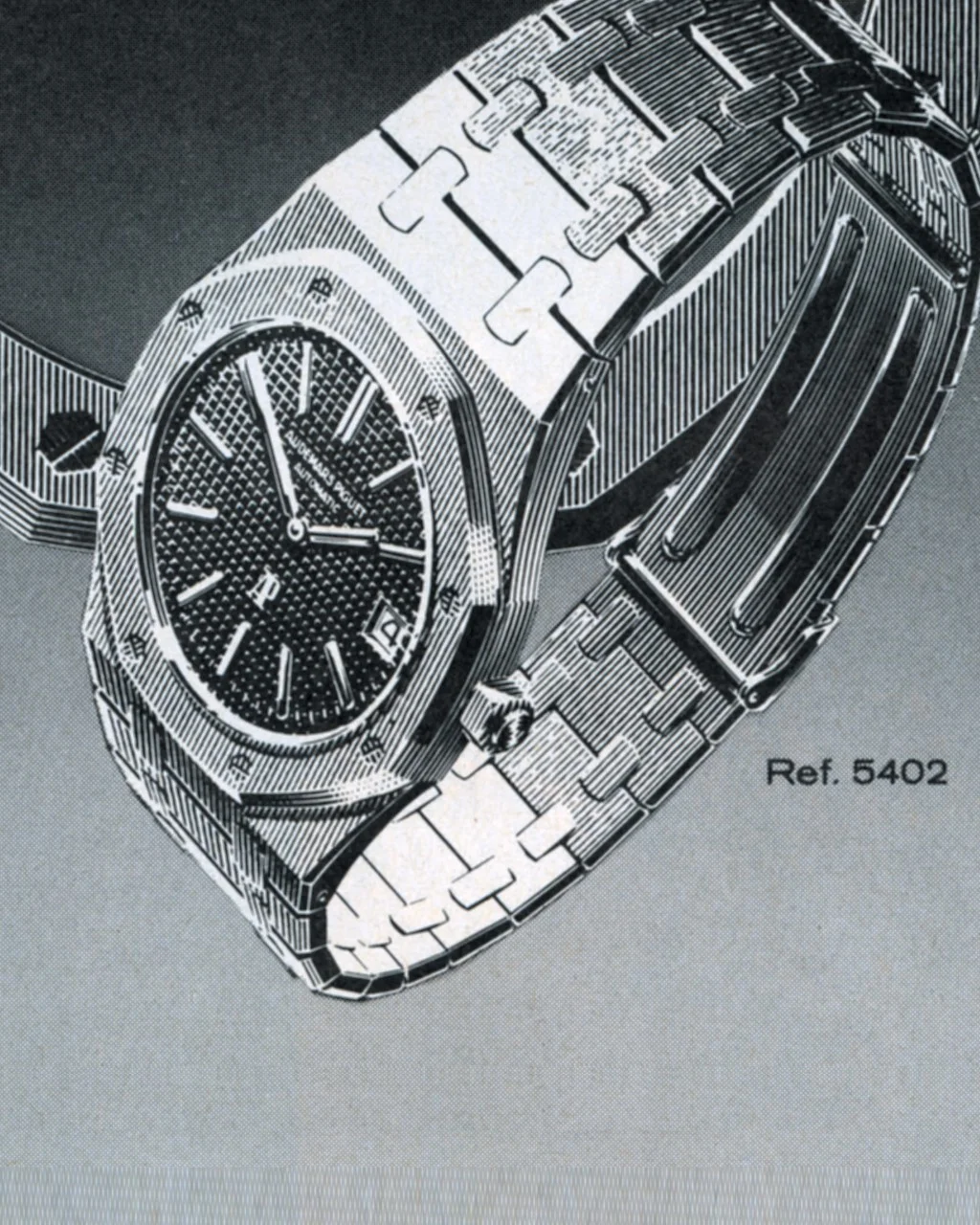
The eight hexagonal screws punctuating the octagonal bezel were perhaps the most disruptive element of the 1972 Royal Oak. The advertisers of the 1970s and 1980s were well aware of this, humorously using this non-conformity as an argument for differentiation: “A price like that, he teased, and they don’t conceal the screws?”
The slot of the screw heads suggests that they can be turned with a screwdriver, whereas their shape indicates the opposite. Indeed, the fact that they are embedded in the hexagonal openings of the bezel means they are unable to rotate – in other words, these are screws that do not even turn! Some have seen in them the symbol of the case’s resistance, making it a kind of inviolable safe containing a mechanical treasure: Calibre 2121.
The secret of this system lies in the fact that the hexagonal screws are fitted with round nuts introduced from the back of the watch and which serve to close it.
Nonetheless, although this system protected the movement perfectly, it did not prevent water from seeping down the screws and nuts. Wilfred Berney, founder of the Audemars Piguet Customer Service department, lived through the early years of the Royal Oak. He says that the screws of the first 300 Royal Oak watches were made of steel. Seawater would trickle in along the screws and deposit its salt, "attacking and corroding indiscriminately. The result was appalling and Genta's famous ‘diving helmet’ was blocked... Penetrating oils and other such products could be used to help remove the case screws, but that did not work at all for the bracelet screws. The only way to resolve the situation was to produce special drill bits and a whole set of tools to drill these screws, to reach the part where the bracelet pivots and then make it drop off using ultrasound technology.” These incidents led to Royal Oak screws being made in white gold.
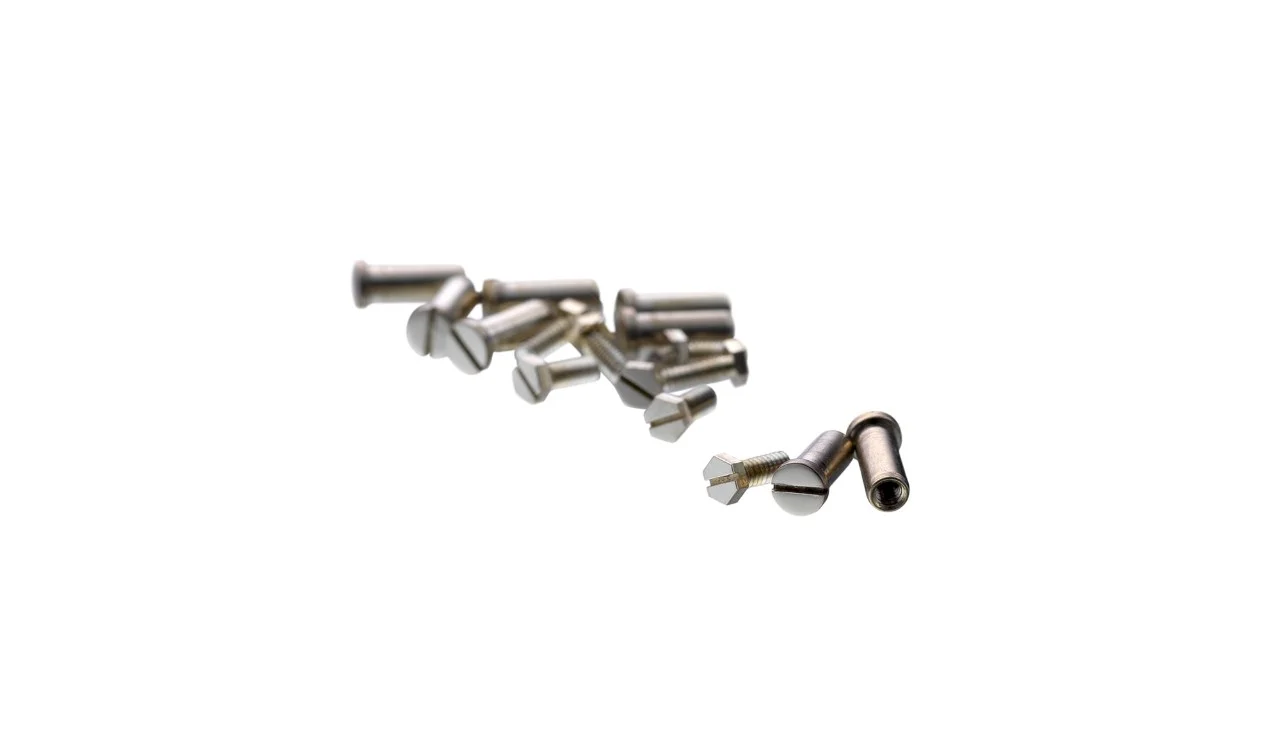
Model 5402's through screws. The eight hexagonal screws are inserted in the 8 holes of the same shape pierced through the bezel. They are tightened up from the caseback thanks to 8 nuts so as to compress the gasket.
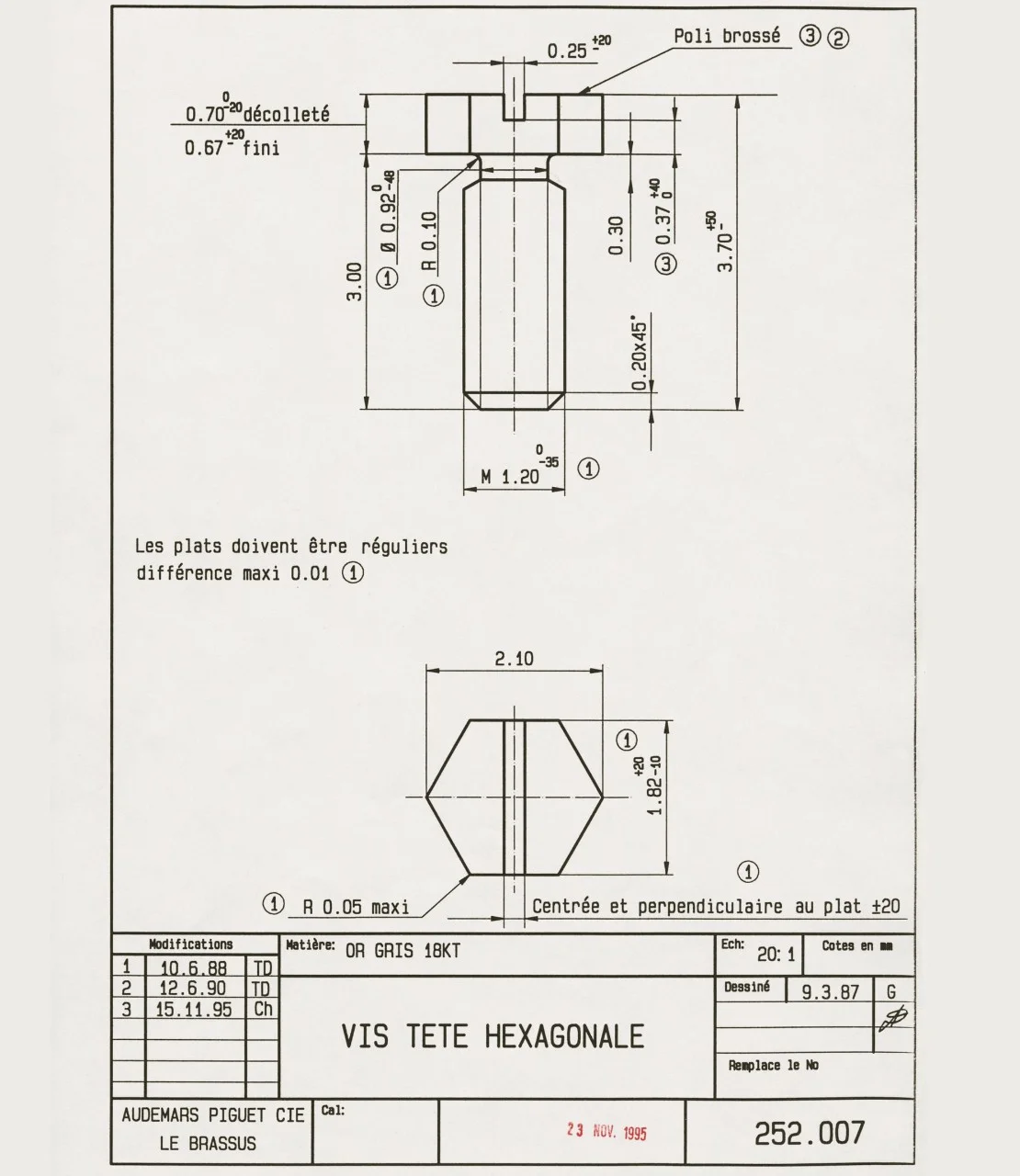
Plan No. 252007 of a hexagonal Royal Oak screw. The watchmaker inserts the screw in the Royal Oak's bezel, making sure to orient to align the groove with the bezel. S/he then screws a nut from the watch's caseback side to guarantee the case's water resistance. Plan drawn in 1987, last updated in 1995. Audemars Piguet Archives.
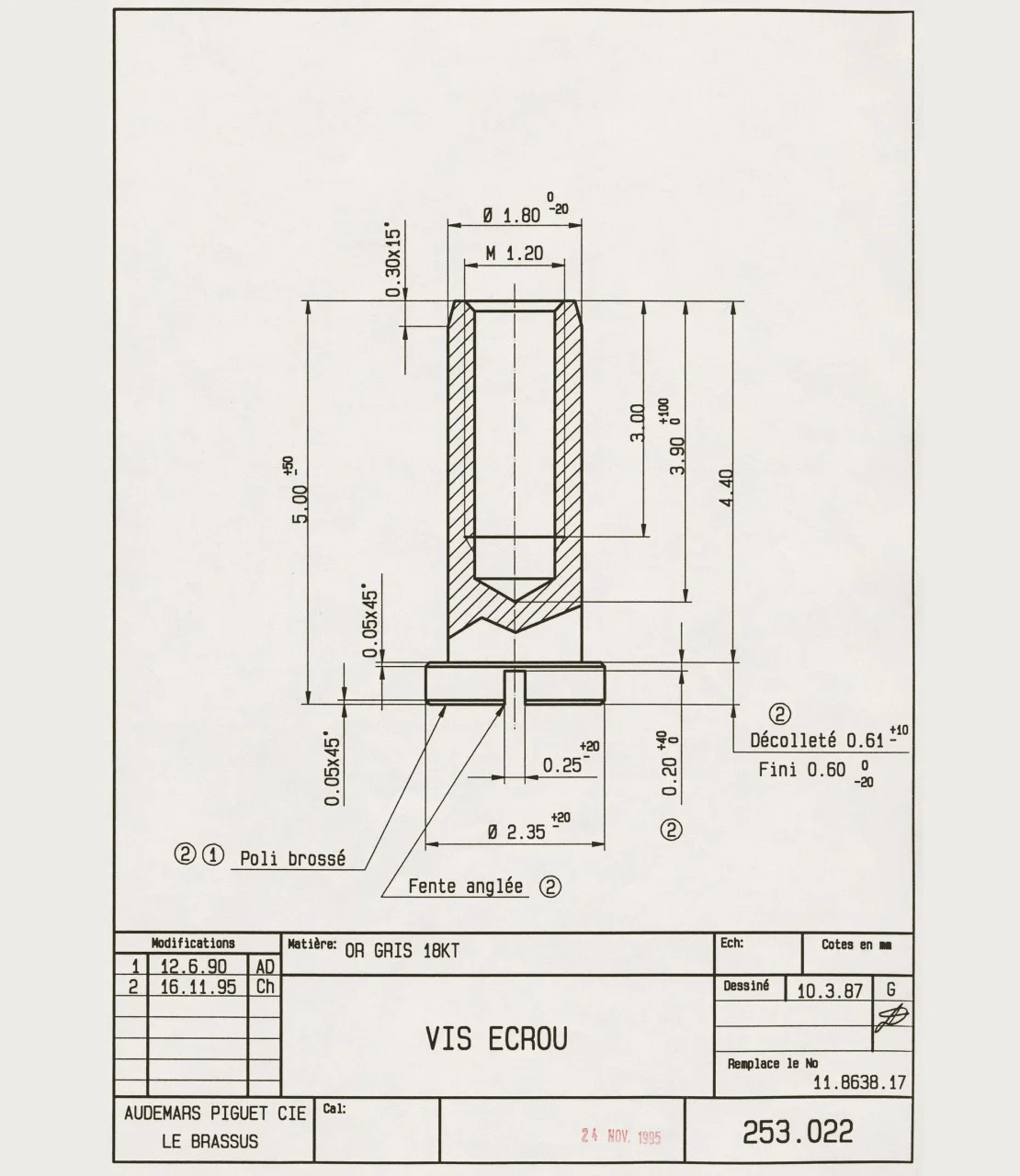
Plan No. 253022 of a through screw Royal Oak. The watchmaker turns the nut from the Royal Oak's caseback side to fix it to the hexagonal screw which is visible on the bezel side. Plan drawn in 1987, last updated in 1995. Audemars Piguet Archives.
The Crown
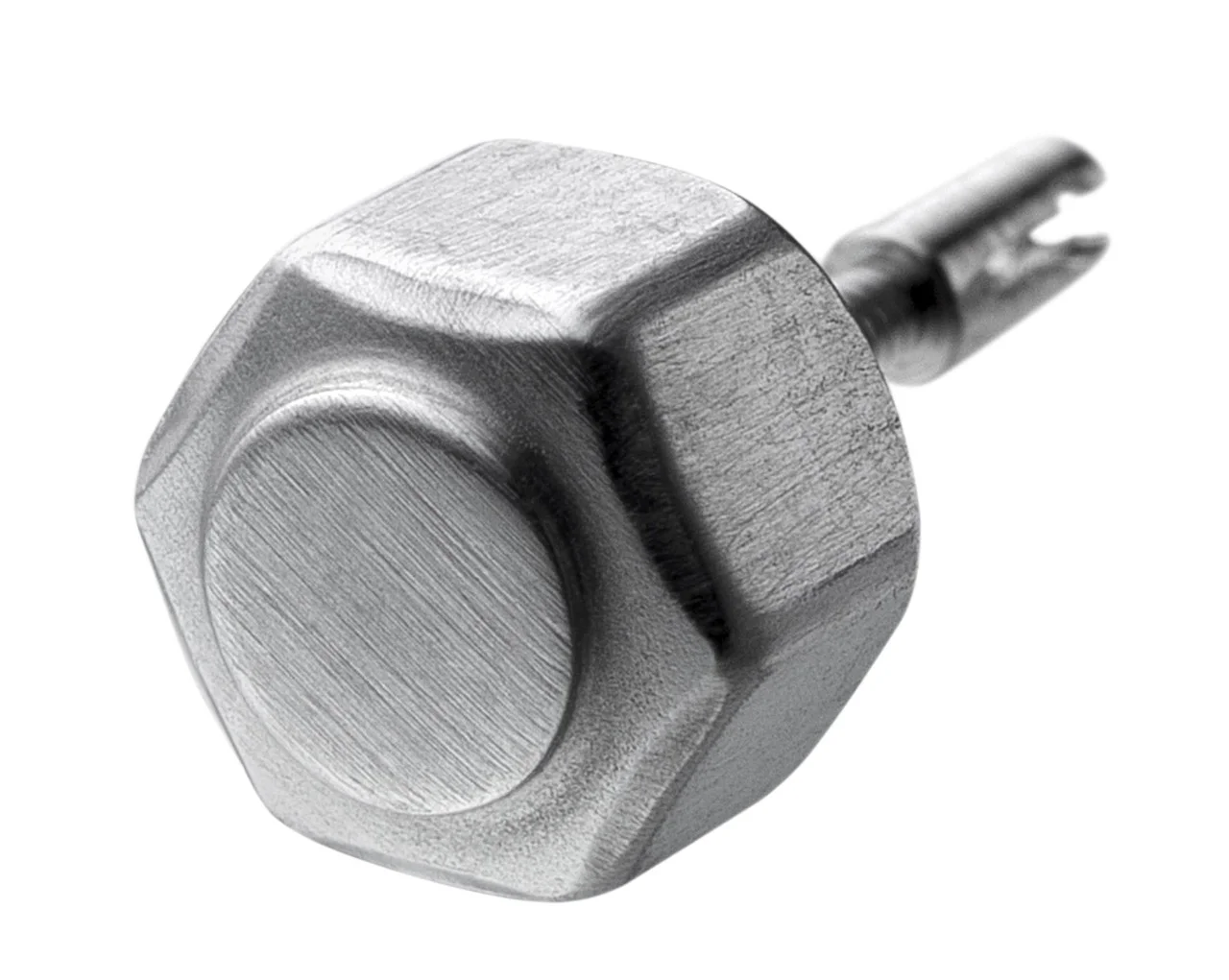
Like the caseback and bezel, the crown of the first Royal Oak watches combines different geometric shapes. Its perimeter is a hexagon, which facilitates manual gripping. Its head is highlighted by a circle. The winding stem is structured in two parts, so that the crown can be removed by a strong tug when the watch is dismantled (see the section dedicated to the monocoque case).
In any watch, the crown is one of the most vulnerable points because it is directly connected to the fragile watch mechanism. By pulling or turning the crown, the user operates the delicate gear wheels protected by the case. In a watch that is water-resistant to 100m, as the first Royal Oak watches were, the crown was an even more sensitive point, as any handling under water ran the risk of allowing water to penetrate the movement. To guarantee optimal water-resistance, the crown of Model 5402 was partially hollowed out and fitted with two rubber O-rings. The lifespan of these seals varied according to the conditions of use of the watch, its exposure to heat, humidity, etc., but the crown had to be replaced at each service.
Minor Technical Developments after Model 5402
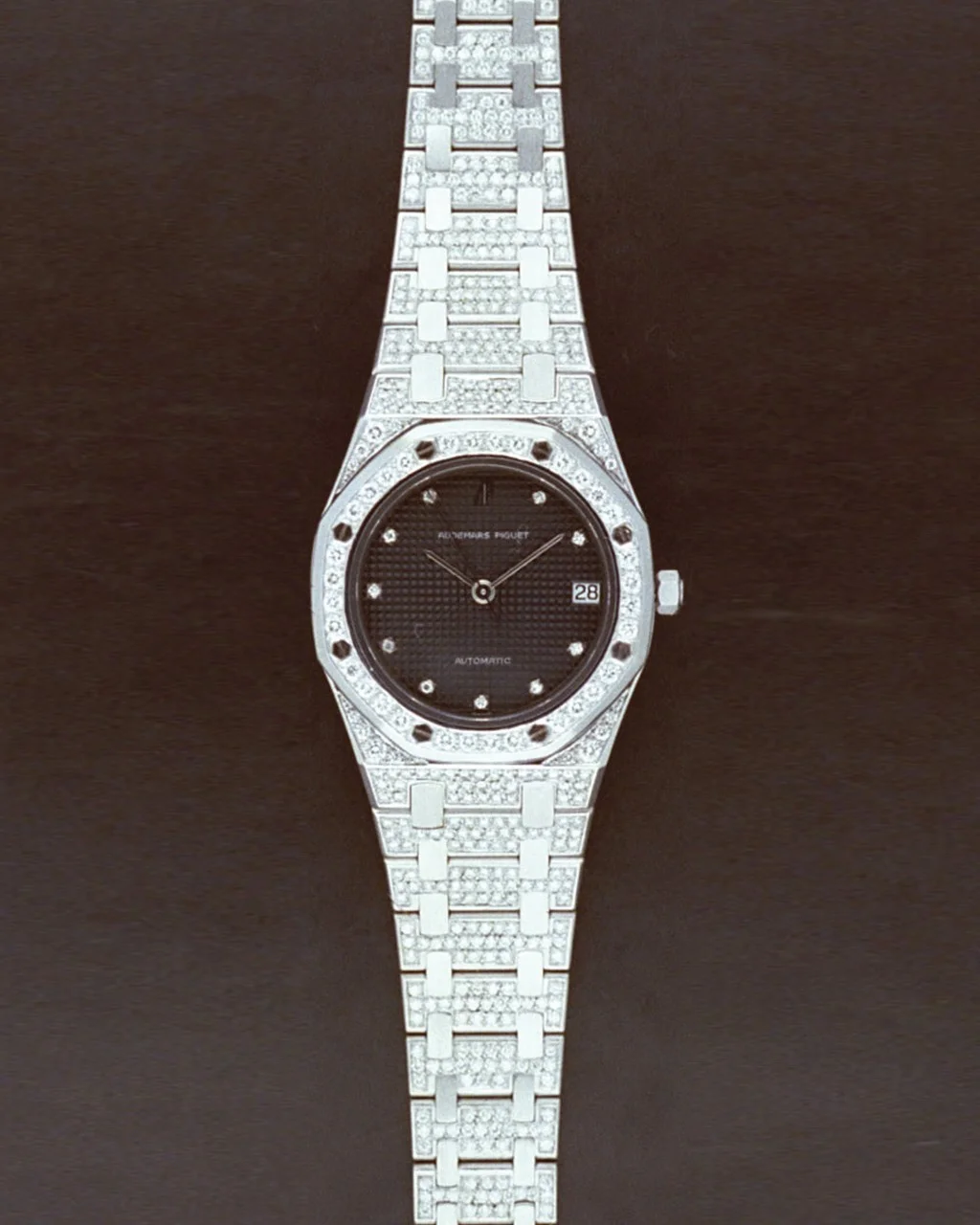
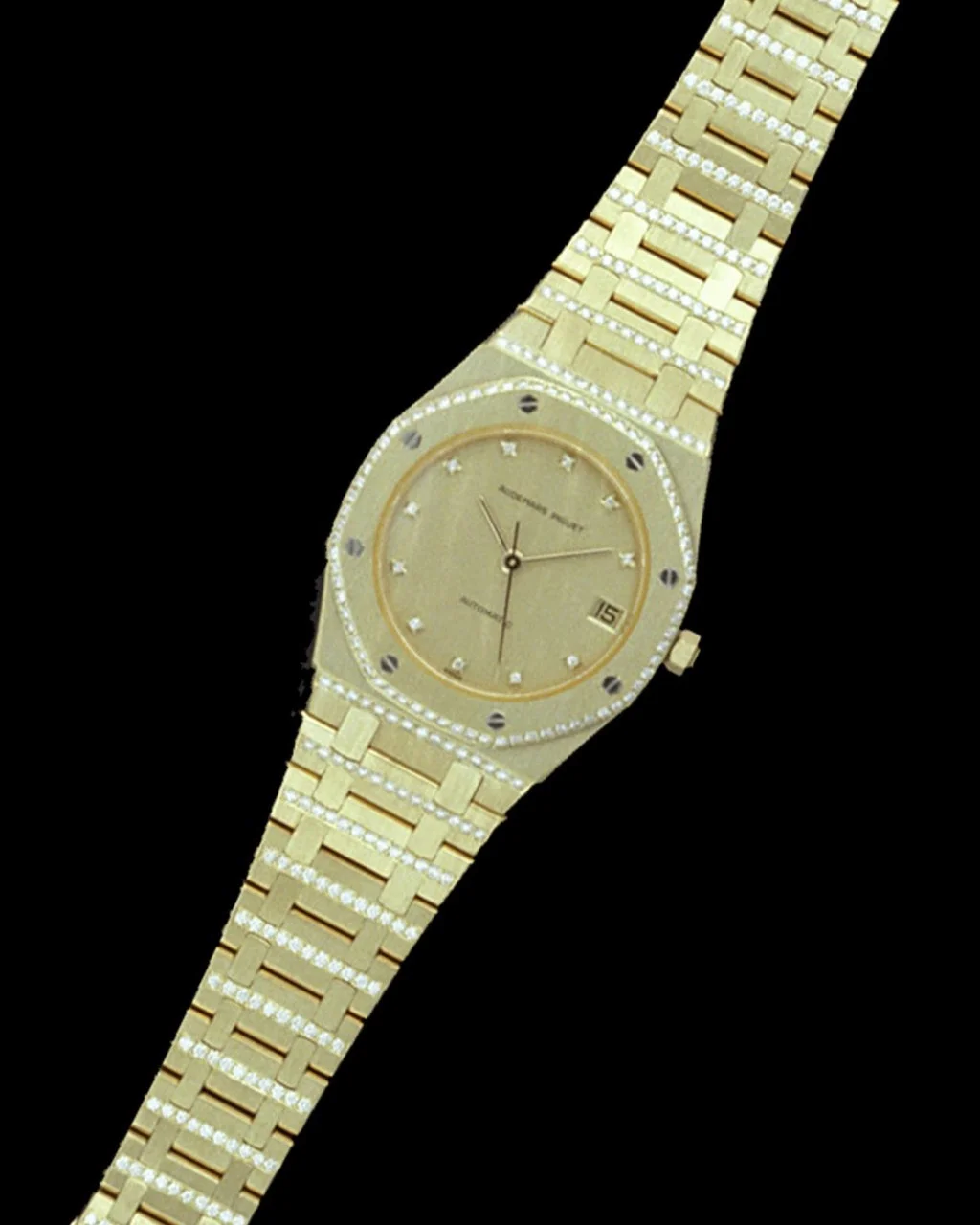
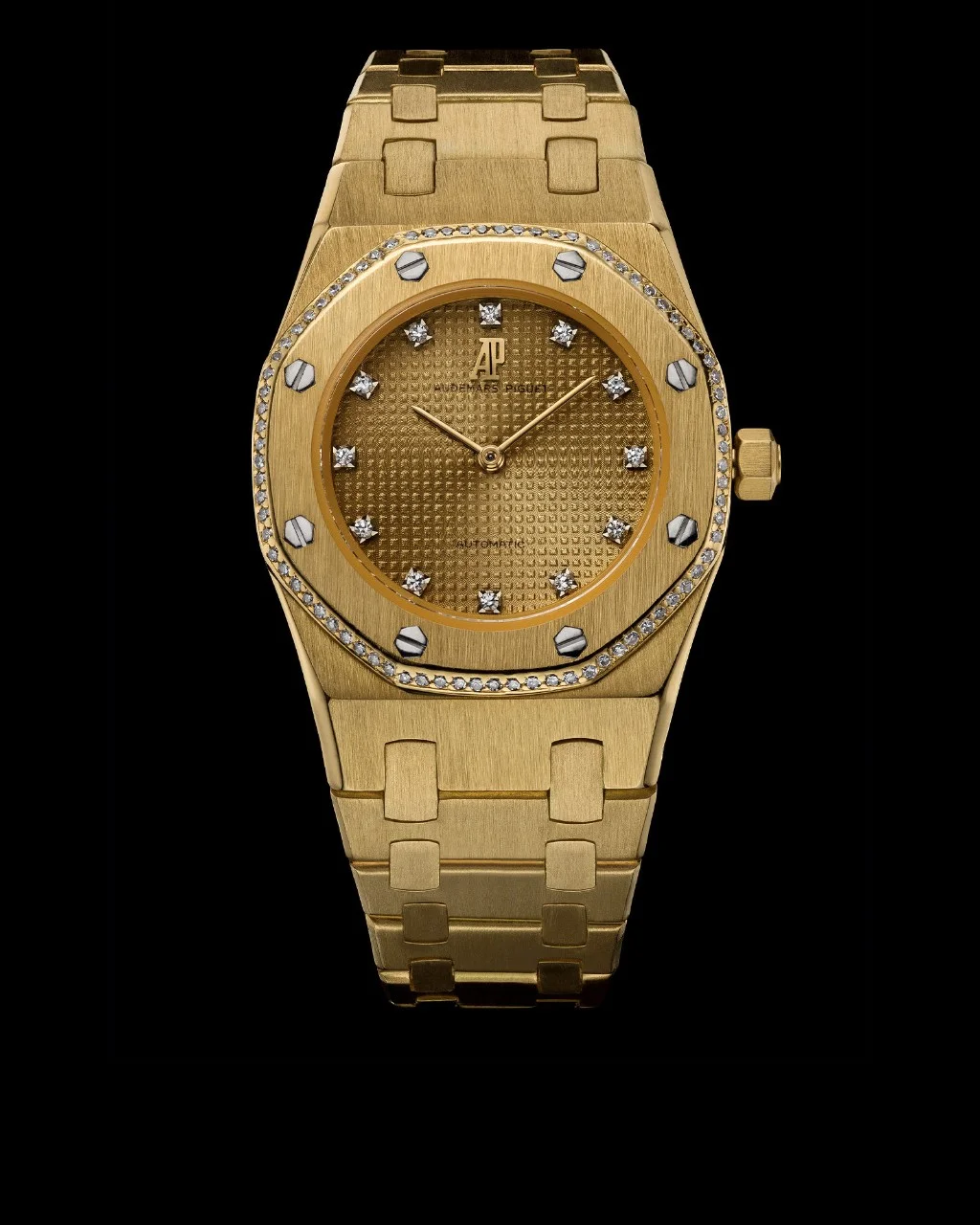
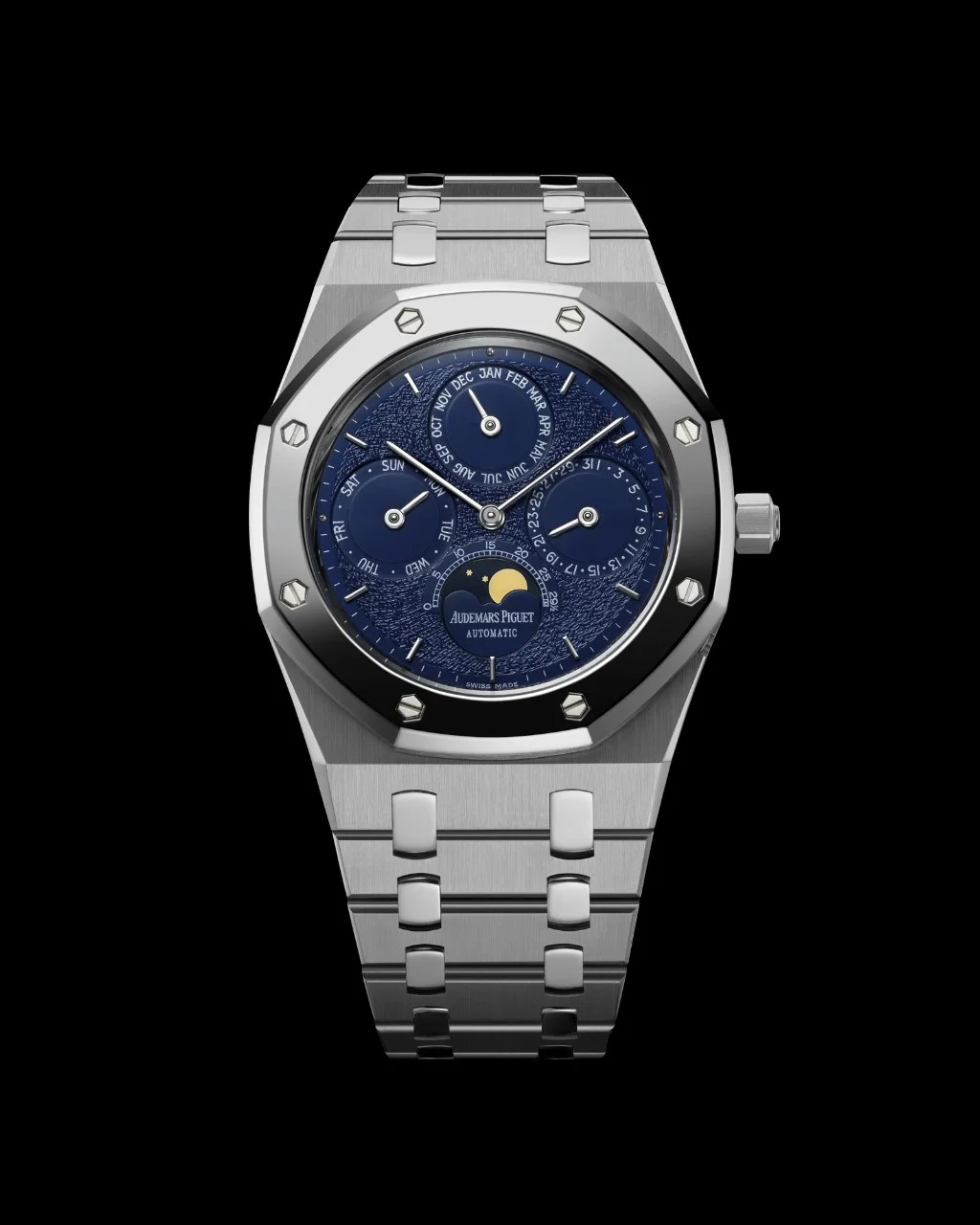
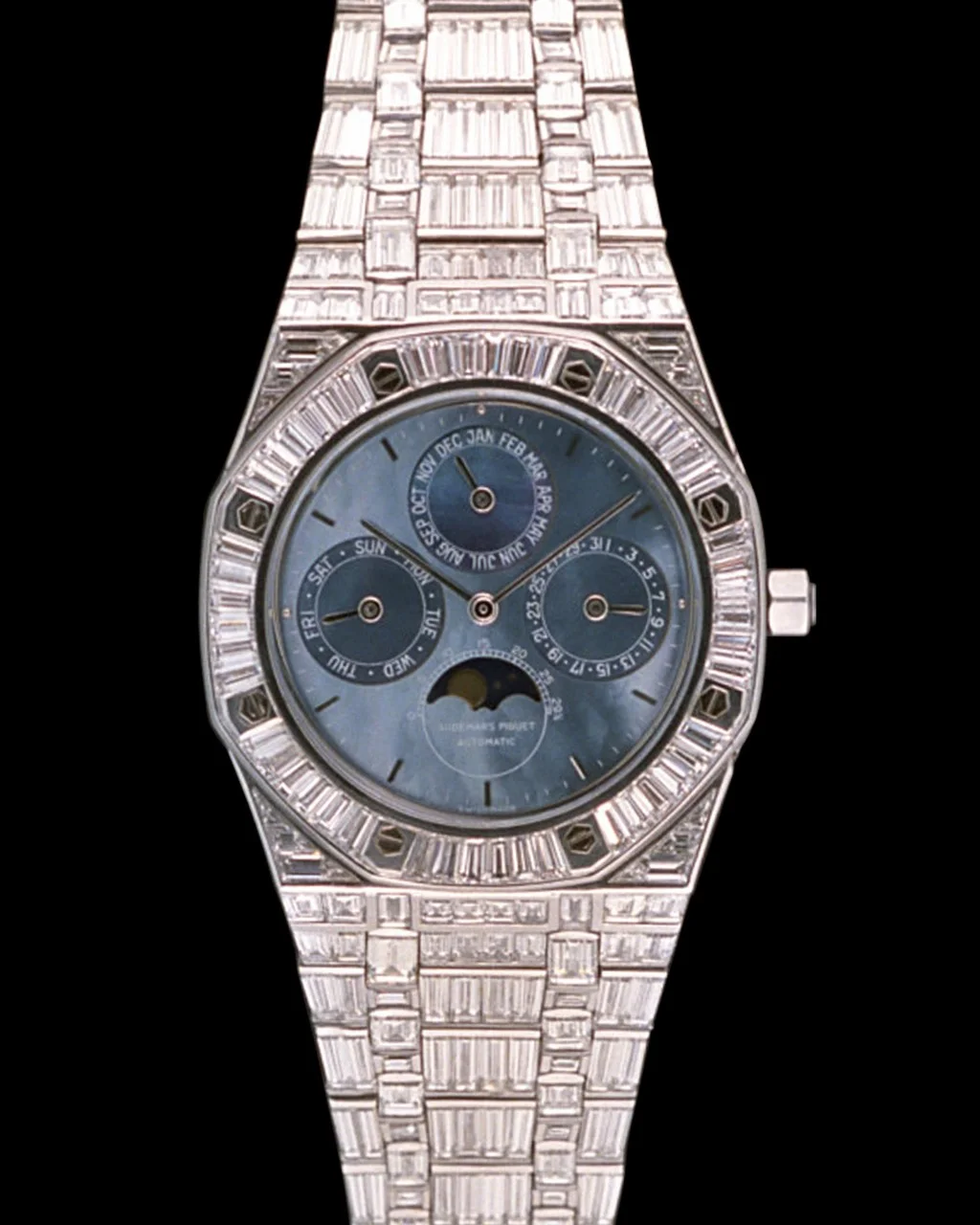
Since 1972, while remaining true to itself, the Royal Oak has been perpetually renewed. It has been interpreted in more than 550 models. Its diameter has varied from 20 to 44 mm and its thickness from 6.3 to 15 mm. It has been clothed in steel, gold, tantalum, ceramic, titanium and platinum, and even covered in diamonds. It has been fitted with all the classic horological complications, from the perpetual calendar to the chronograph, including the tourbillon, the minute repeater and the Grand Complication.
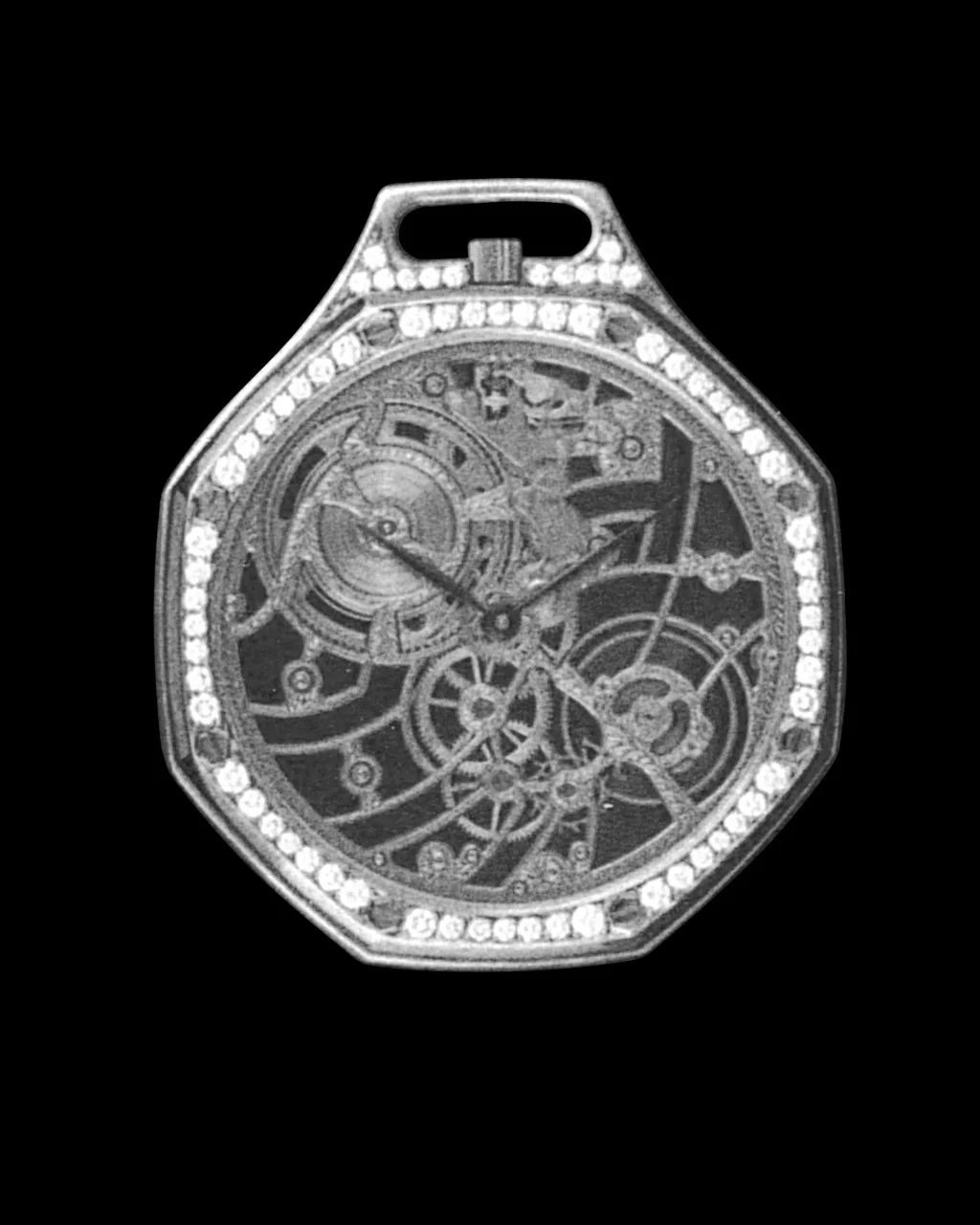
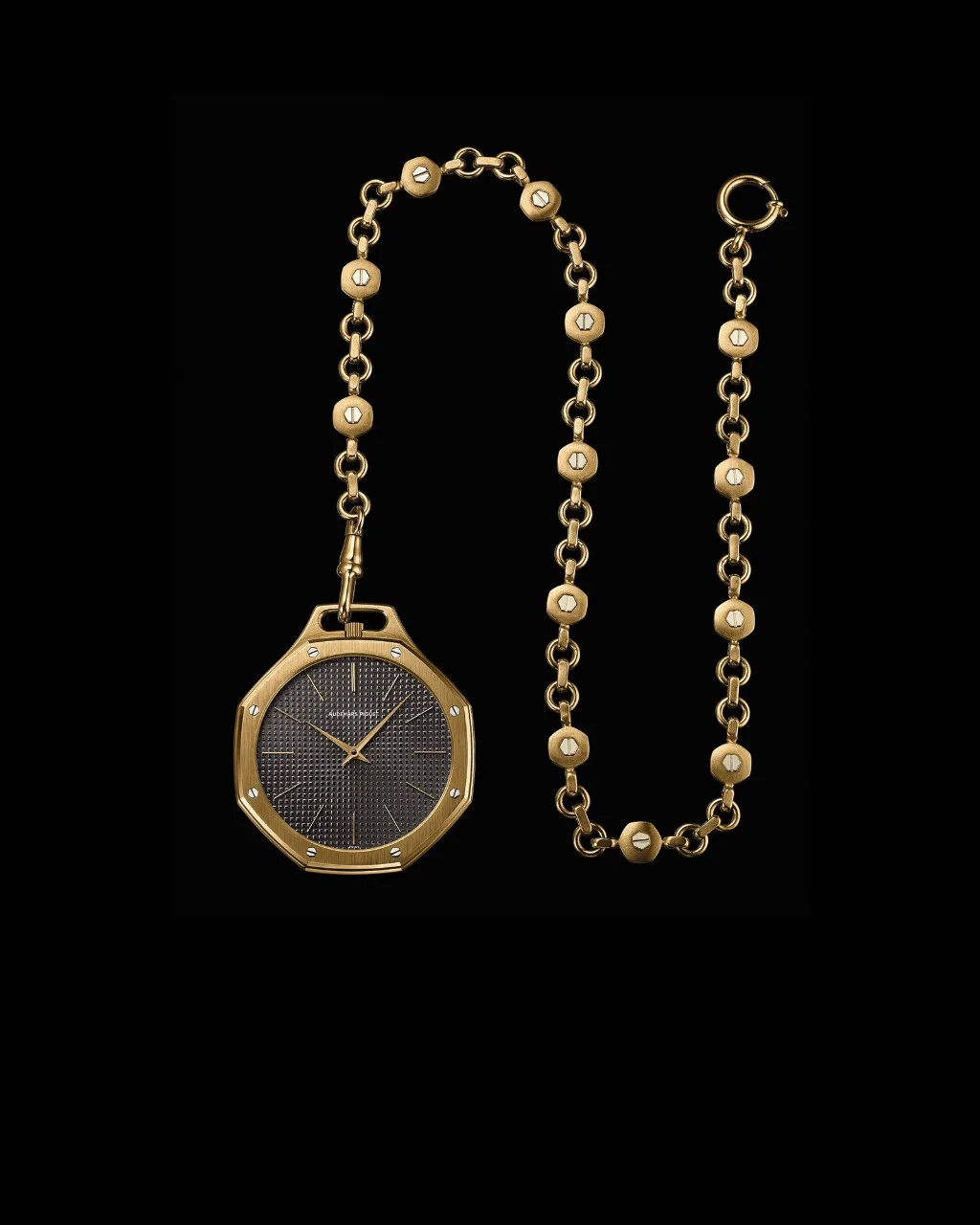
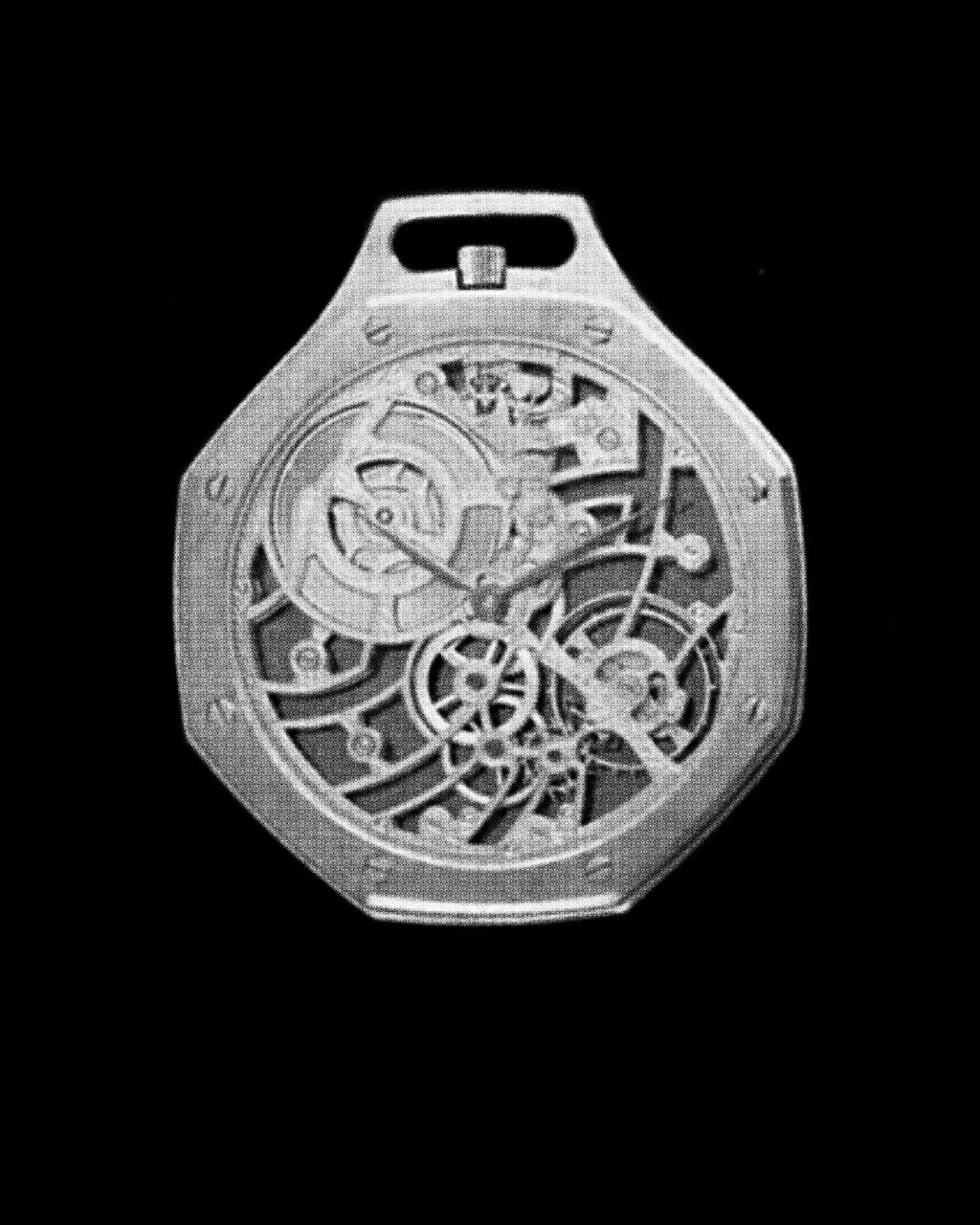
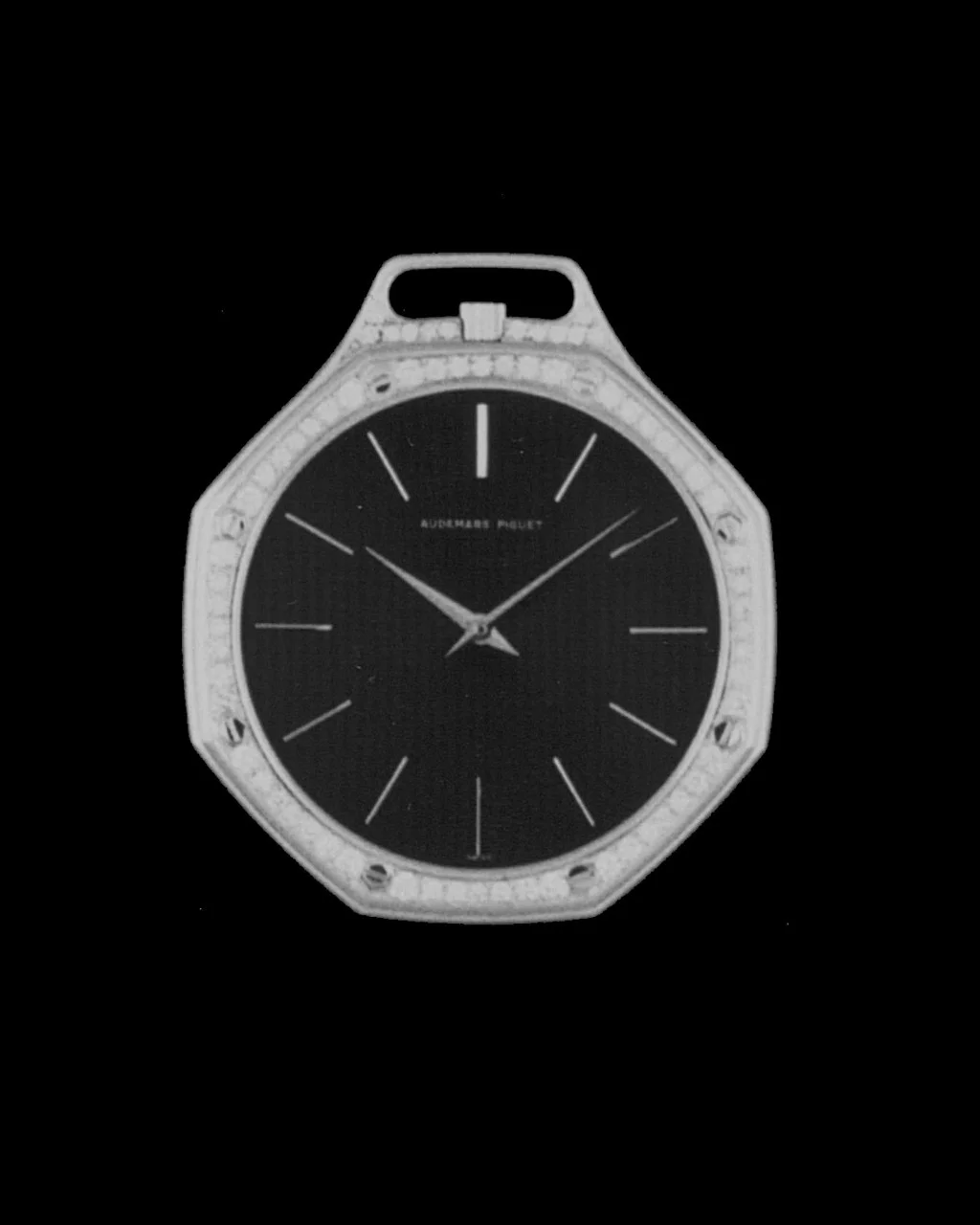
These transformations have been accompanied by countless technical developments. The watch exterior components have been rethought, redesigned and improved countless times. Among those that have changed the least are the eight hexagonal screws. They have always remained through-type screws, with a few exceptions (e.g. the pocket watch variant 5691, certain examples of Models 5554, 25729 or 25860), while the hexagonal upper part has always played the role of a nut, except on rare occasions when they have a simple decorative role (e.g. model 15300). Above all, they have remained in white gold, even if the improvement in the quality of the steel would undoubtedly have made it possible to use this material as had been imagined in 1972.
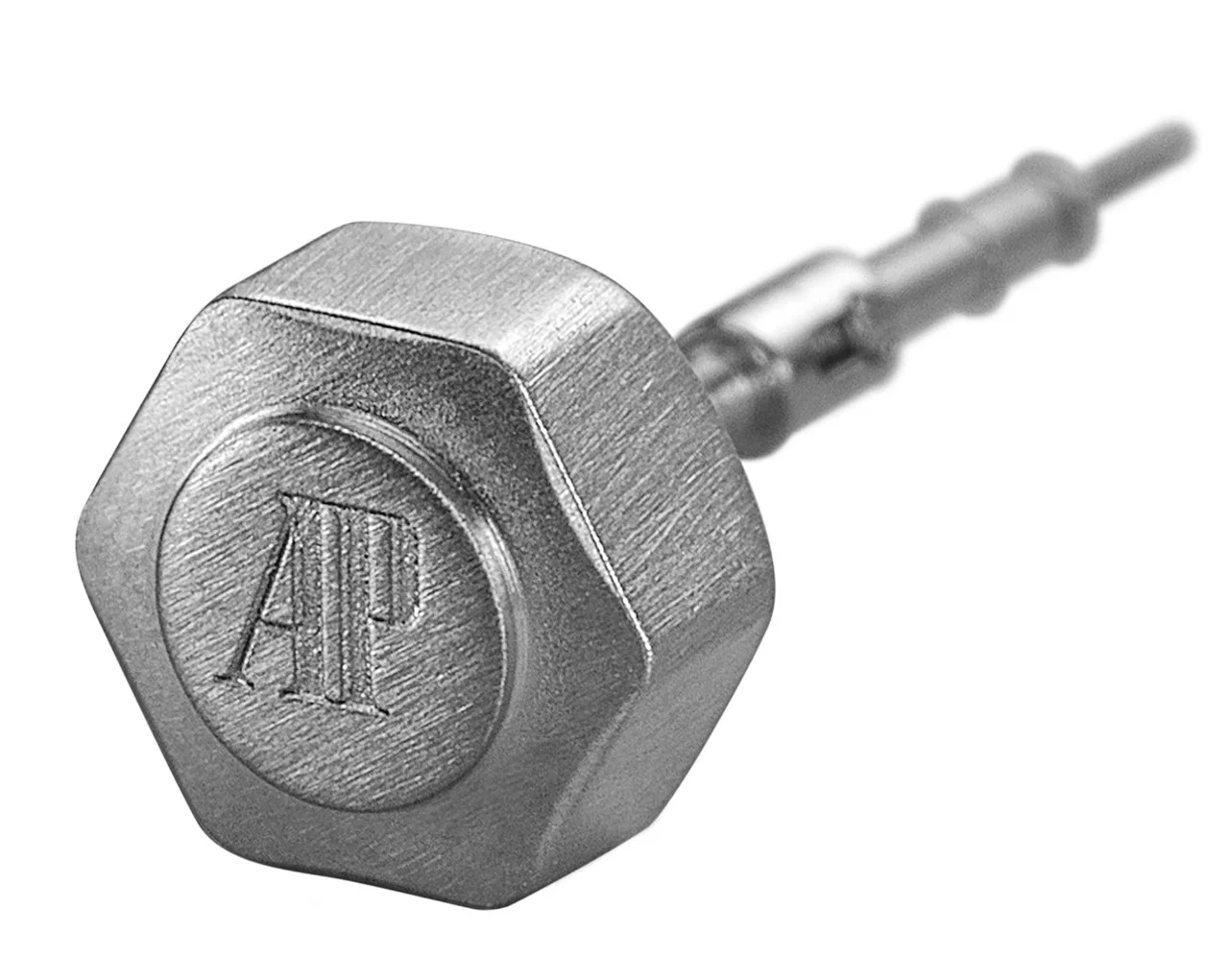
The crown has also retained its hexagonal shape. Its main aesthetic evolution is due to the addition of an AP engraving, which was introduced at the end of the 1990s and became the norm in the 2000s. On the other hand, the screw-lock crown was adopted in the early 1980s because it reduced the risk of mishandling, particularly when immersed in water. It appeared in 1983 in Models 4332, 5572, 5584, 5658. In 1990, it was added to the 14700 family of models, followed by its direct descendants 15300 (from 2005), 15400 (from 2012), and 15500 (from 2019). In this system, the main seals are fixed to the case, so that they can be replaced independently of the crown. Despite their significant advantages, screw-lock crowns have not been fitted to all Royal Oak watches. They proved to be incompatible with certain calibres (e.g. 2121, 2120, 2835, etc.) and sometimes affected the winding system. This has meant that no ultra-thin Royal Oak 39 mm watches have ever been fitted with them.
In Search of Perfect Interior Architecture
Few connoisseurs are aware of the extent to which the interior architecture of the Royal Oak's case has been modified during its history for various reasons – sometimes difficult to pinpoint. These modifications stem from the need to correct defects, but above all from the desire to improve performance and find new technical solutions. Above all, they express the fertile imagination of case construction engineers.
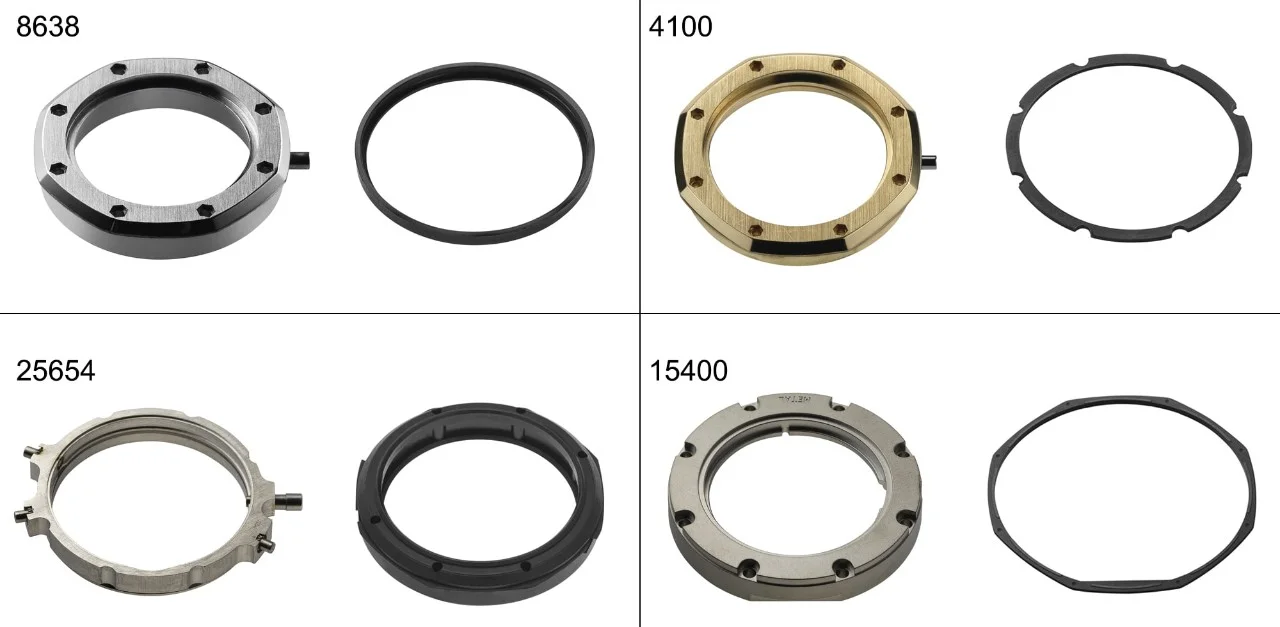
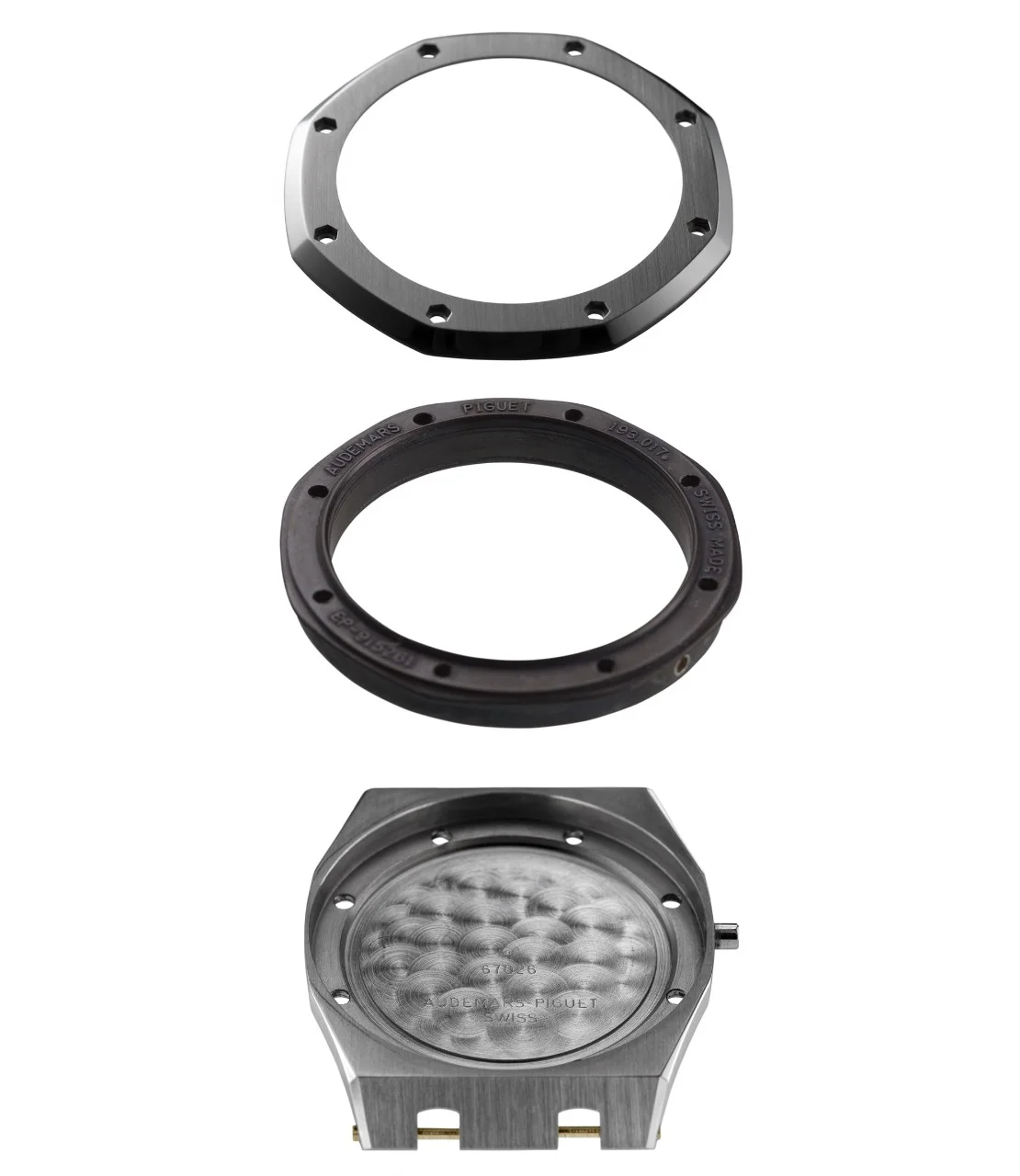
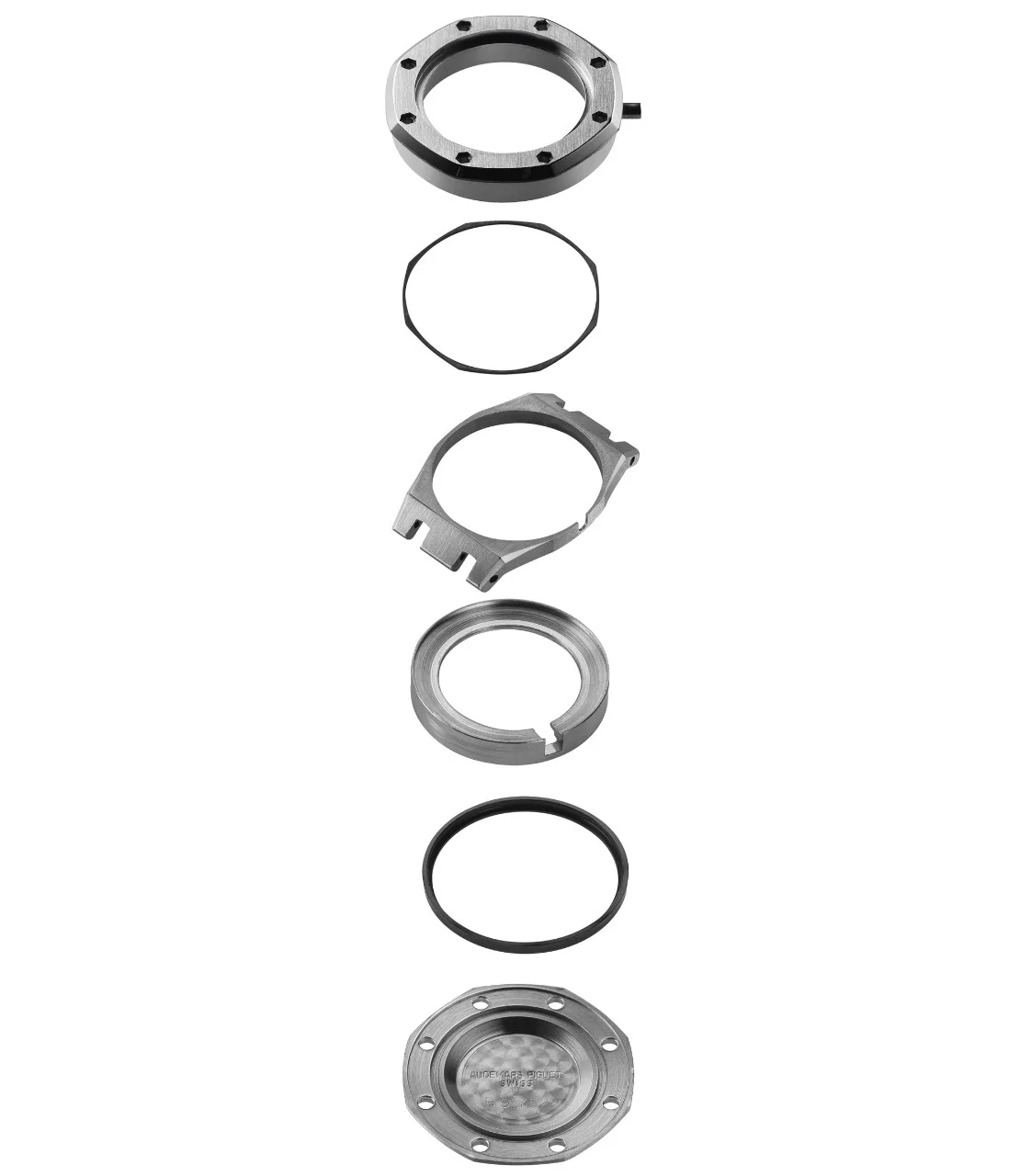
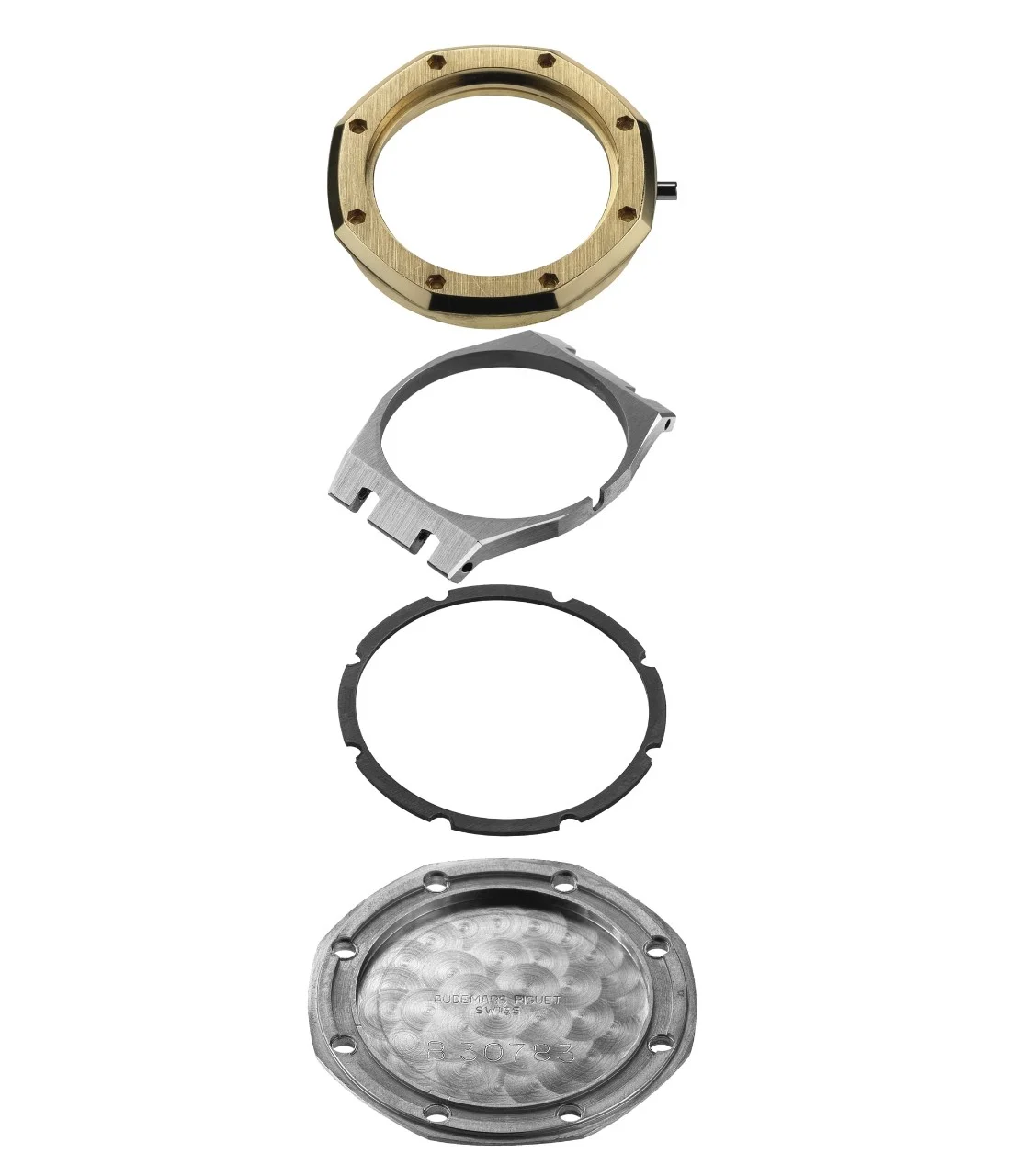
The first major change occurred in 1976 and 1977, no doubt at the request of watchmakers. Models 8638 and 4100 gave up the monocoque case and adopted the classic "three-part" structure, enabling easier access to the movement for touch-ups. The water-resistance system was also revised at the same time and the huge black seal was replaced by small flat traditional ones. To fill the space, the bezel was redesigned and extended beneath its visible part: its thickness was increased to 5.3 mm in Model 4100! This system brought rigidity to the case and saved space, thus enabling the Royal Oak 4100 (35 mm) to gain an additional 4 mm in diameter compared to Model 5402 (39 mm), even though it houses a movement that is only 2 mm smaller than the latter.
Nevertheless, this change did not solve all the problems. In 1983, Model 4332 (36 mm) returned to the monocoque and revived the oversized seal, of which the quality had been improved. Incidentally, some seals in the 1980s were transparent, e.g. that of Model 14486. In 1990, Model 14700 retained the monocoque structure but significantly reduced the width of the seal, while increasing the width of the casing ring. Two years later, Model 14790 reintroduced proportions close to those of the original.
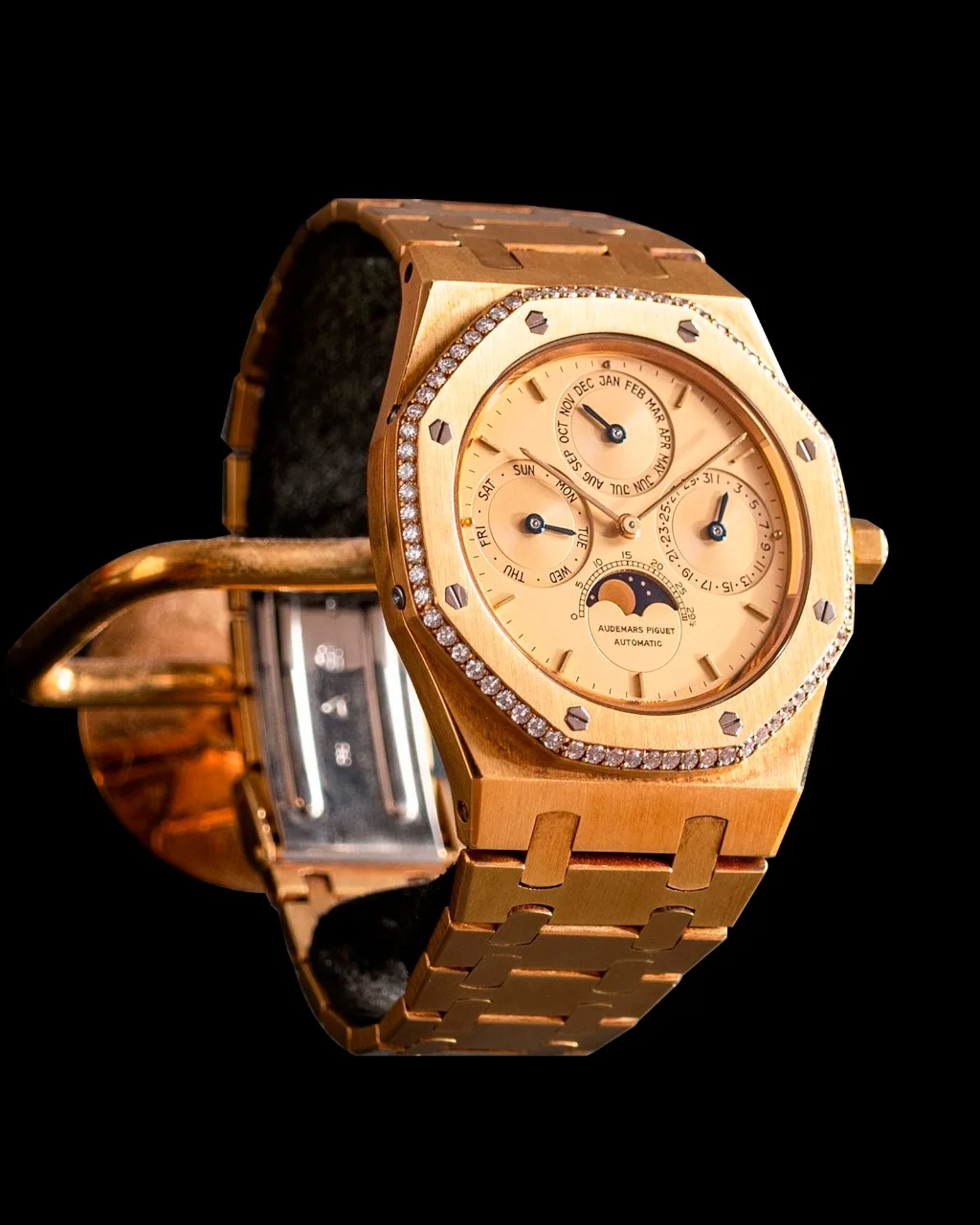
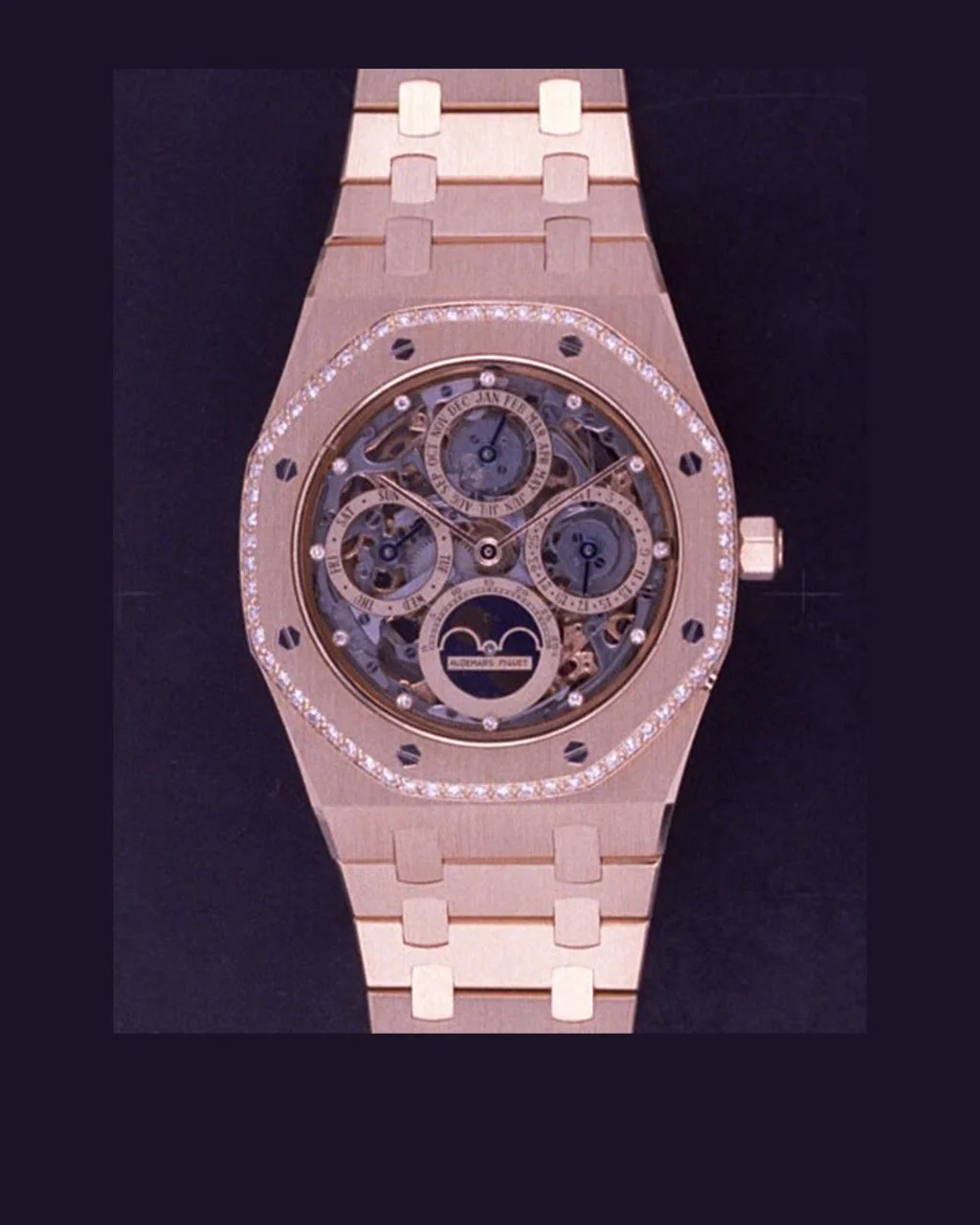
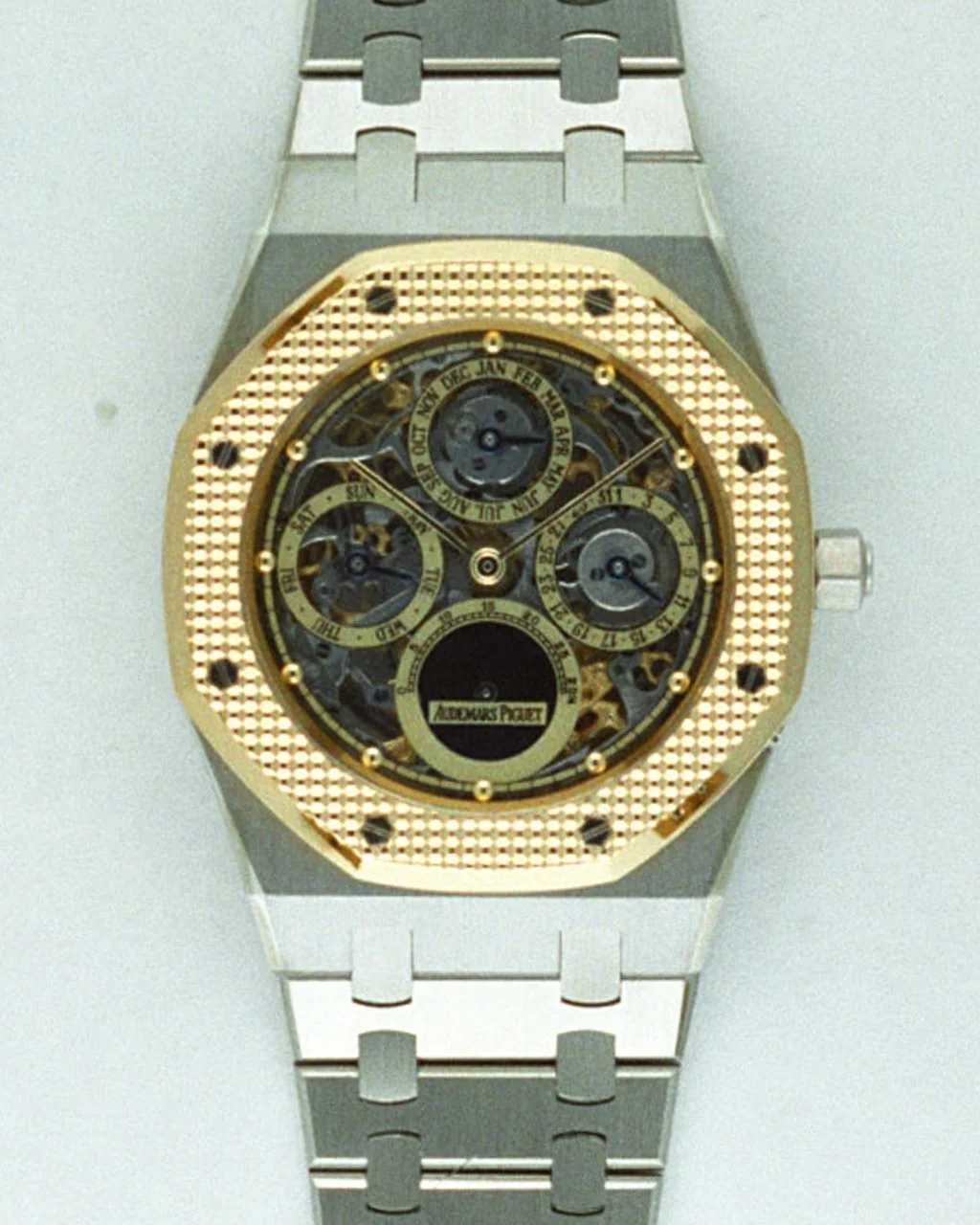
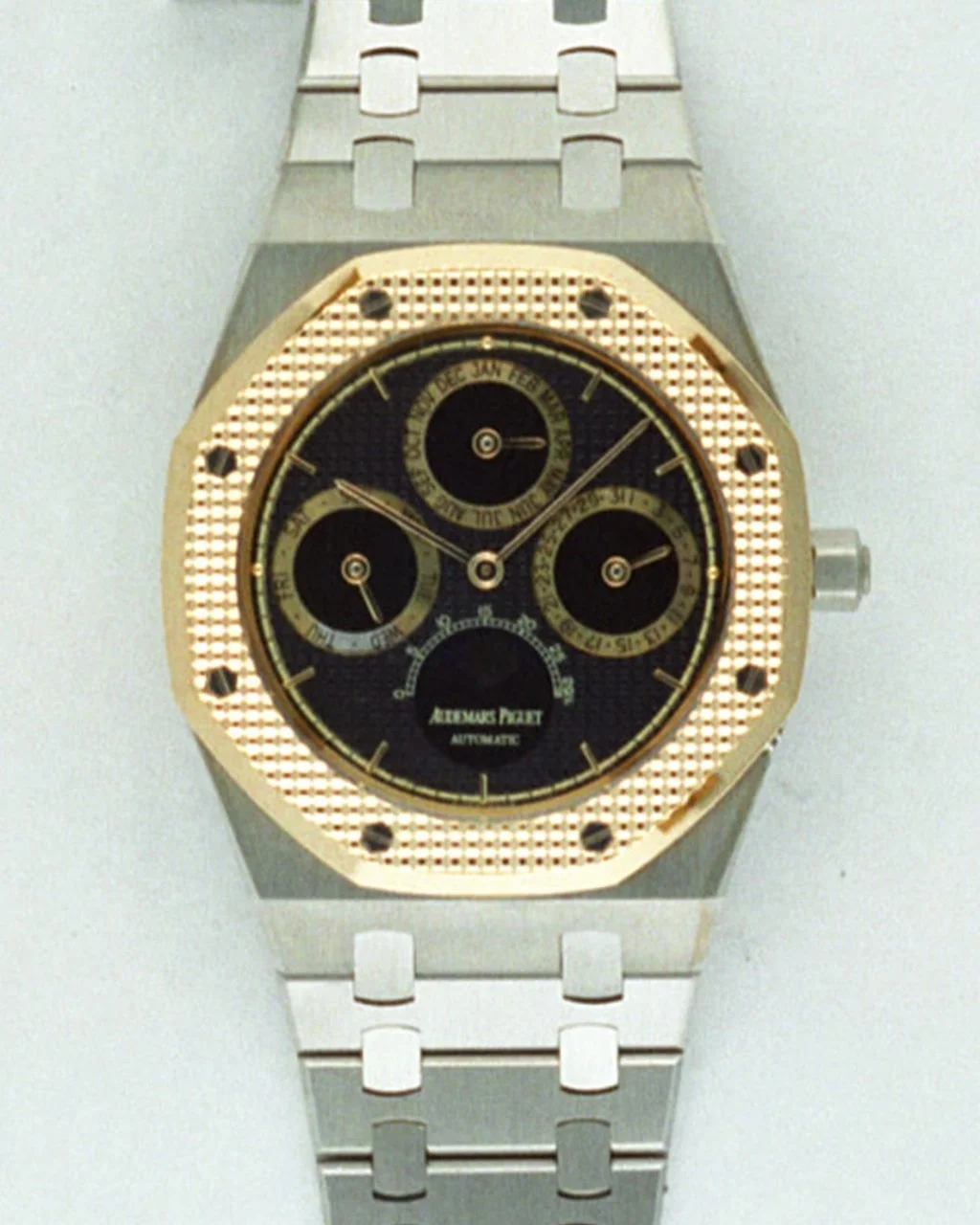
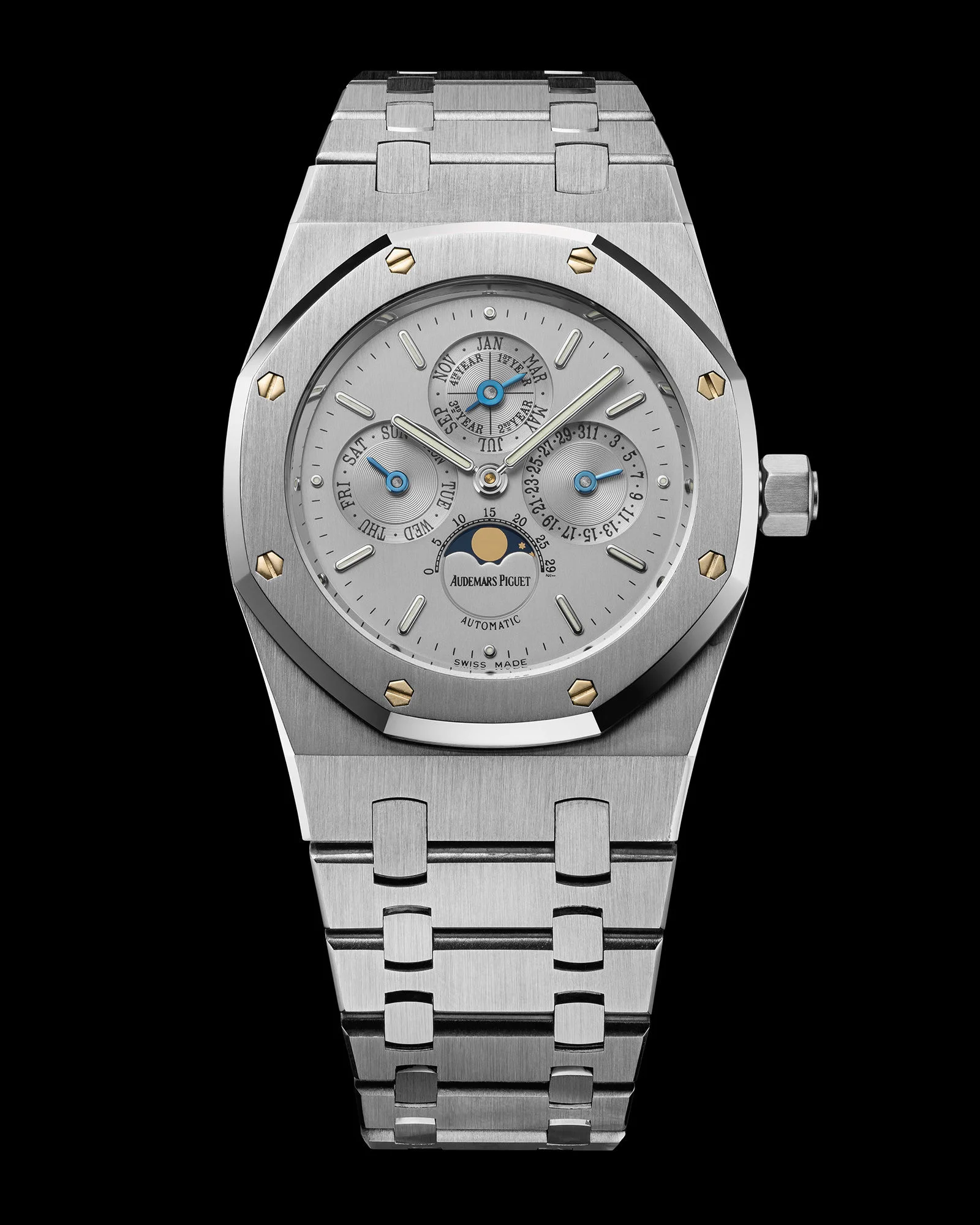
In 1984, another solution was invented. The first Royal Oak Perpetual Calendar, Model 5554, replaced the oversized rubber seal with a very large metal casing ring, independent of the bezel. The idea was quickly abandoned as it jeopardised the watch’s water-resistance (an optimised version of this system was adopted 28 years later on Model 15400). The Customer Service department then created a procedure to correct the 5554 casing rings. At the same time, Audemars Piguet introduced the Royal Oak 5654, aesthetically identical to the 5554, but with a radically different case structure. The solution chosen was different from all the previous ones: the casing ring was the same width as the seal and the screws passed between these two components in half cylinders. It was retained on Model 25636 watches (and their derivatives) from 1993.
By Way of Conclusion
We could go on and on with the list of case redesigns. We will simply conclude by adding that the "three-part" model became established in the 2000s, having been notably reintroduced in the Royal Oak Grand Complication 25865 in 1997 and in the first Royal Oak Chronograph 25860. Since then, this case has been fitted to the vast majority of models, including the classic Models 15300, 15400 and 15500, as well as the 15202 and the Royal Oak 16202 launched in 2022.
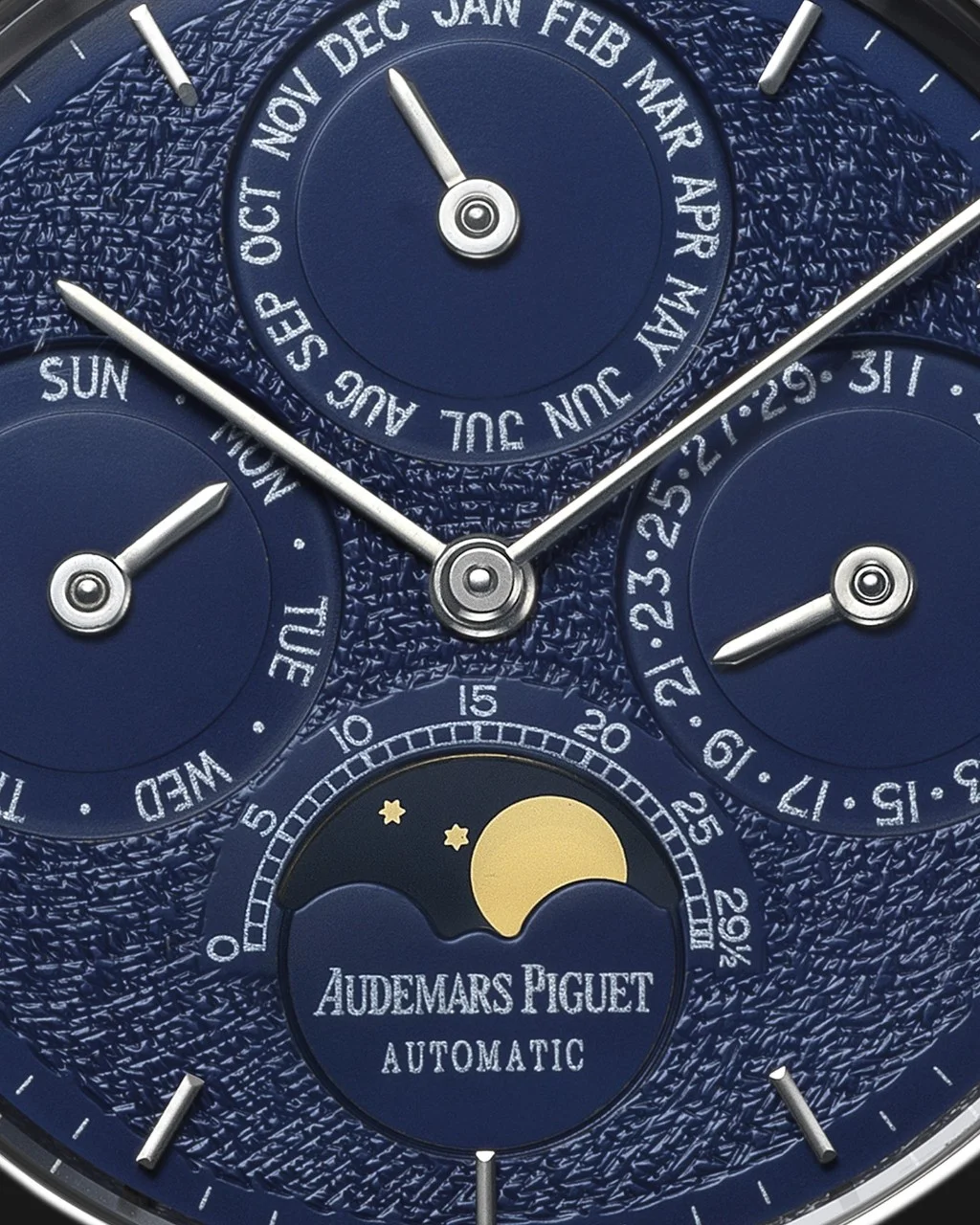
This overview of the few transformations of the Royal Oak case sheds light on the complexity of its case and the challenges it has constantly posed. It shows the extent to which an iconic watch – sometimes thought to have remained unchanged and timeless – is in fact the object of constant research. Among the latest innovations, one need only mention the Royal Oak Selfwinding Perpetual Calendar Ultra-Thin 26586 (2019), which uses the dial as an upper movement bridge, or the architectural design of the Royal Oak Minute Repeater 26591 (2021), whose Supersonnerie case amplifies sound by means of a purpose-built “soundboard”.
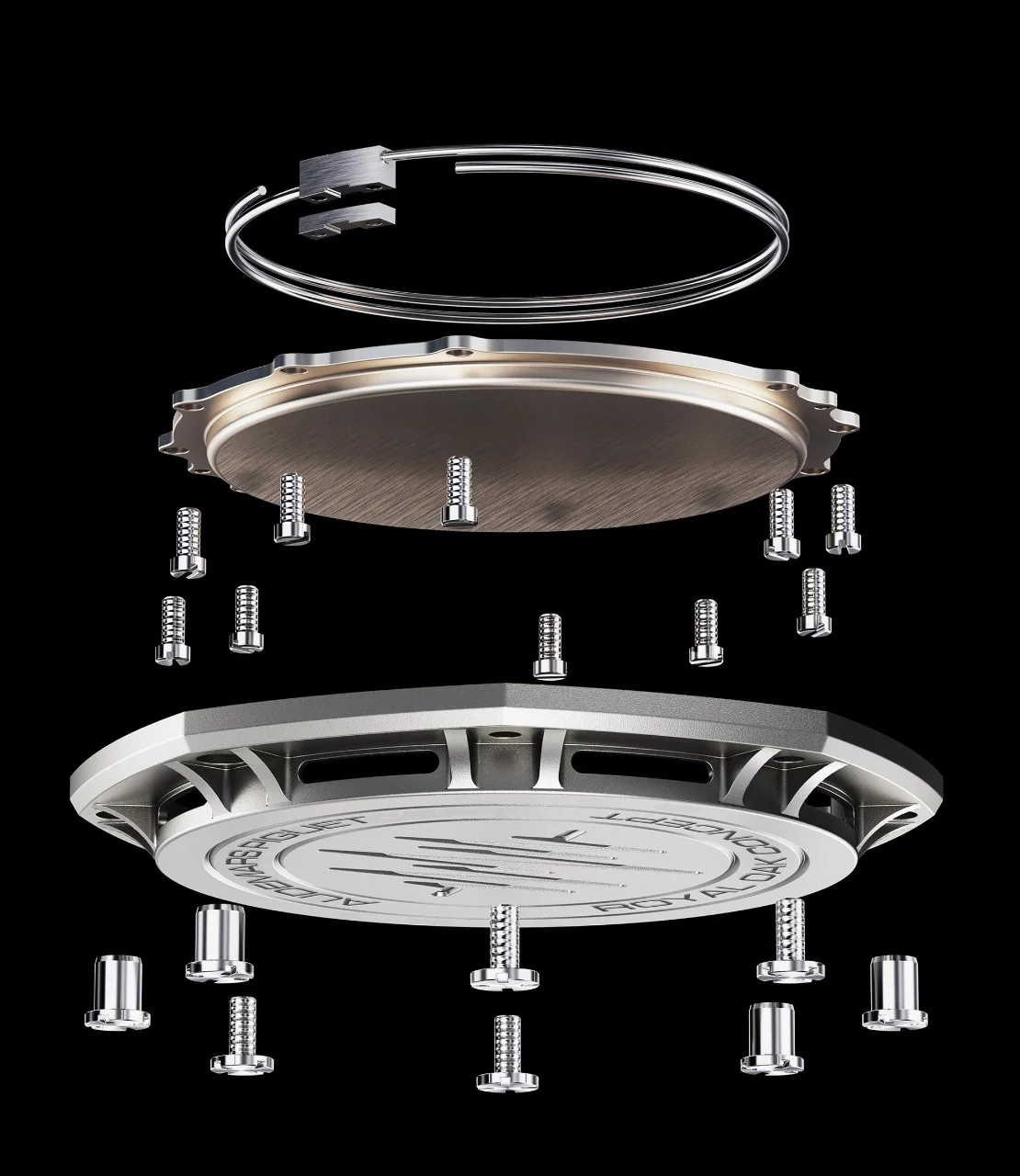
2015. Exploded view of the Supersonnerie system. Presented in 2015 with the Royal Oak Concept RD#2, the acoustic Supersonnerie system has equipped the Royal Oak collection since 2020 (26591). Linked to the gongs, a soundboard amplifies and embellishes the sound. 3D imagine realised in the context of the Model 26577's launch. Audemars Piguet Archives.
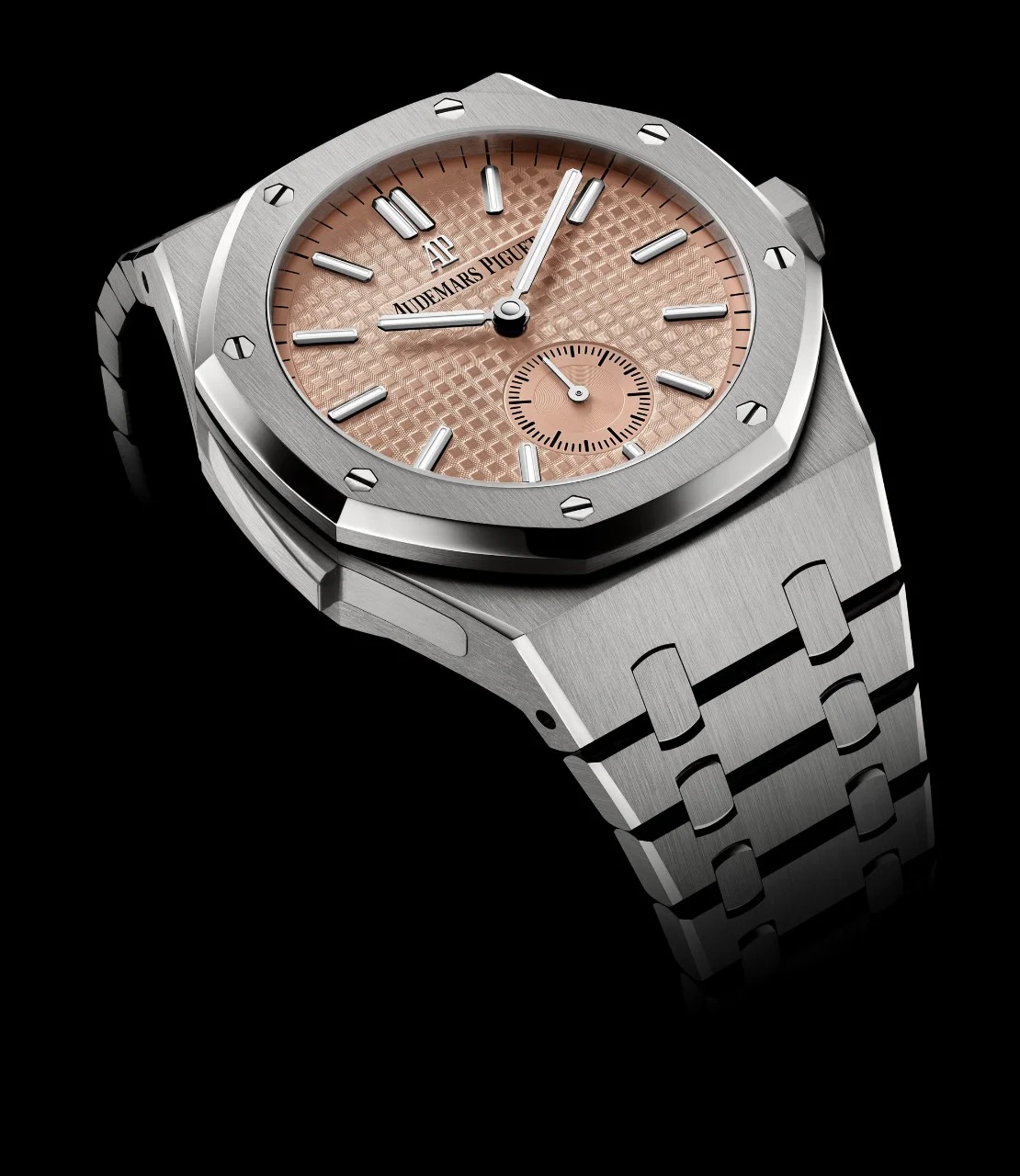
2020. Royal Oak Supersonnerie 26591TI. First minute repeater Royal Oak with a ""Supersonnerie"" sound amplification system. Small seconds. Calibre 2953. Salmon Grande Tapisserie dial. Titanium. Picture taken during the presentation of the model in 2020.
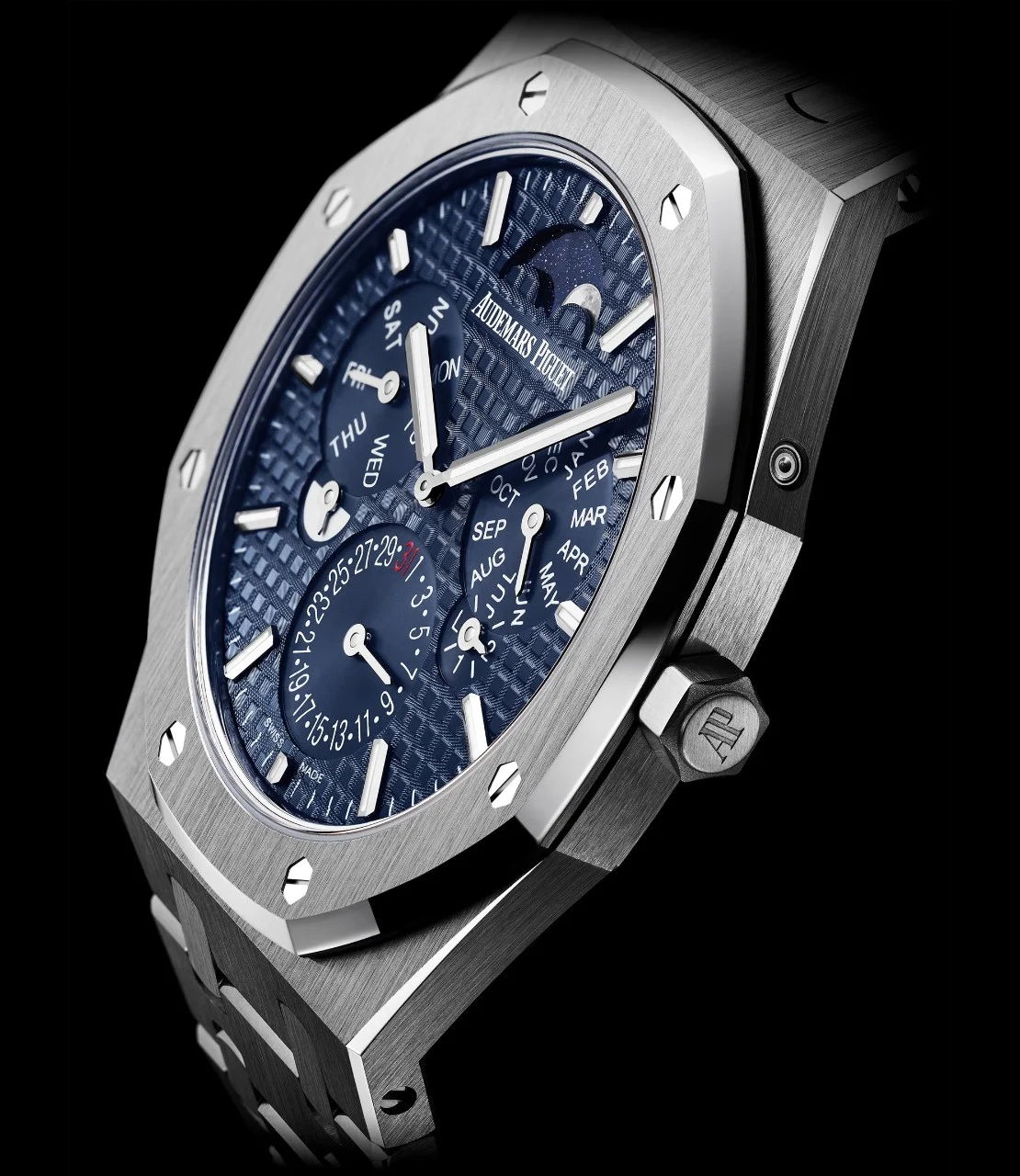
2018. Royal Oak RD#2. World's thinnest Royal Oak selfwinding perpetual calendar upon release (6.3 mm). Ultra-thin Calibre 5133 (2.89 mm). Platinum. Picture of the prototype presented at SIHH (Salon International de la Haute Horlogerie) in January 2018.
Editorial board: Audemars Piguet Heritage team, Le Brassus
First publication: 14 April 2022