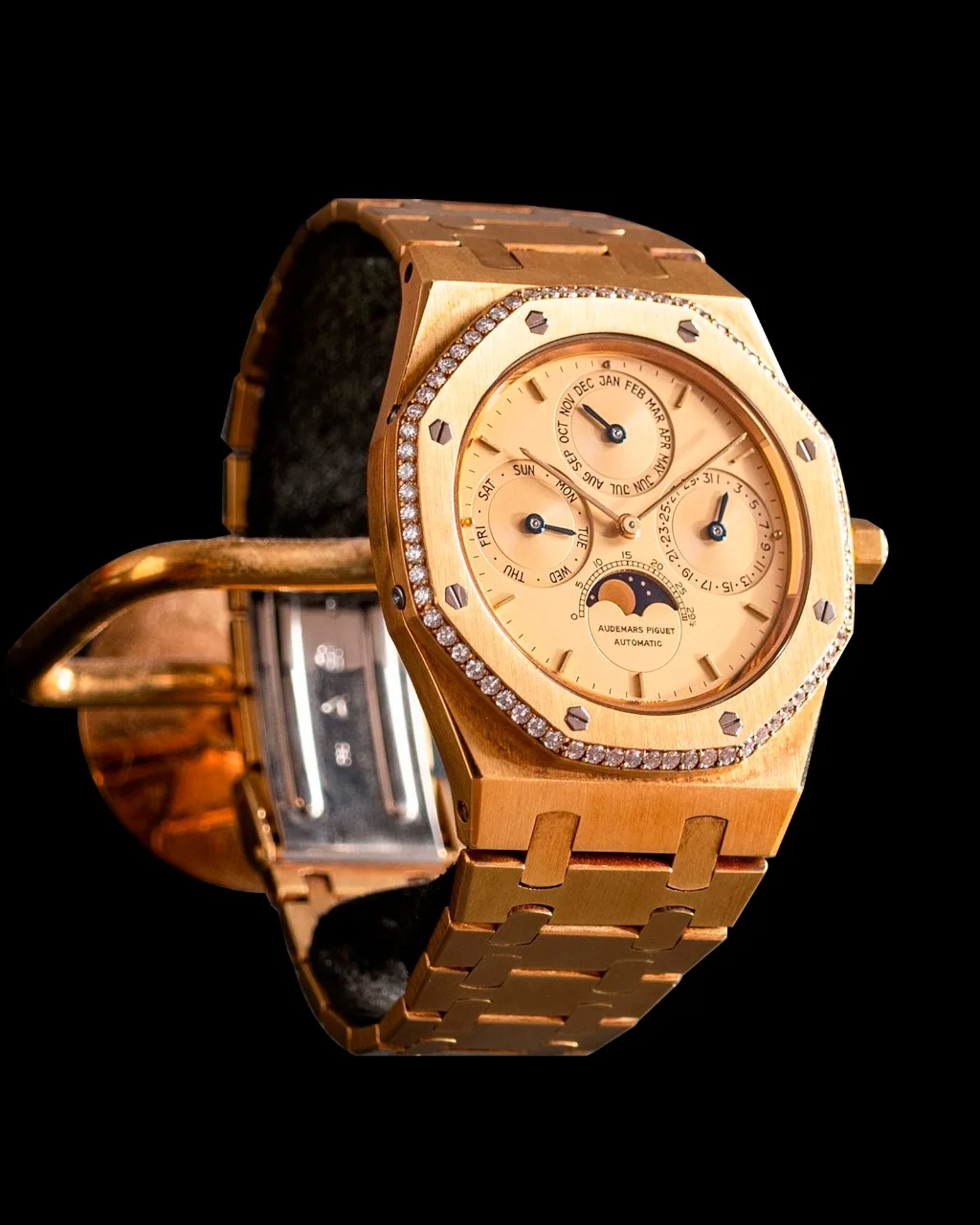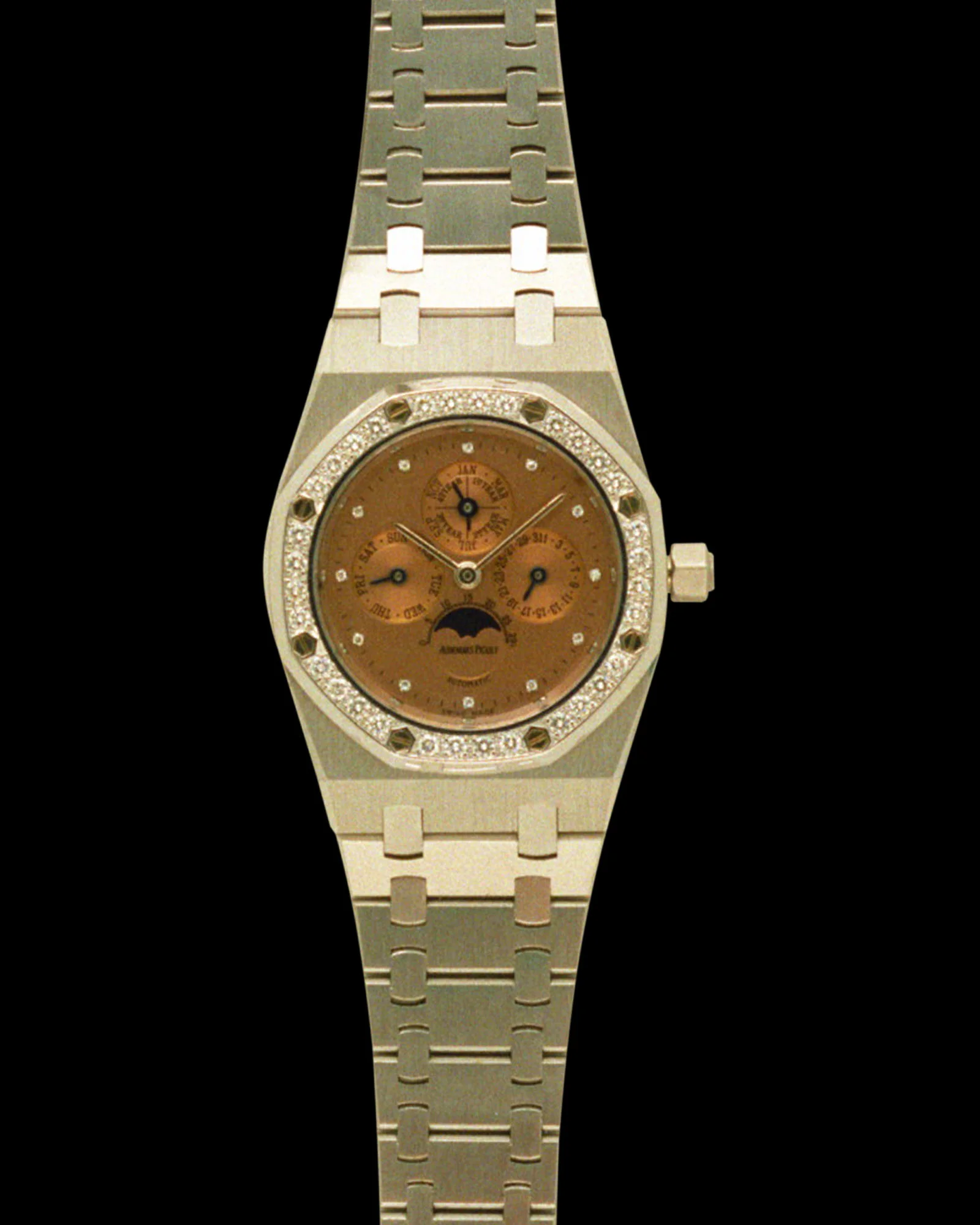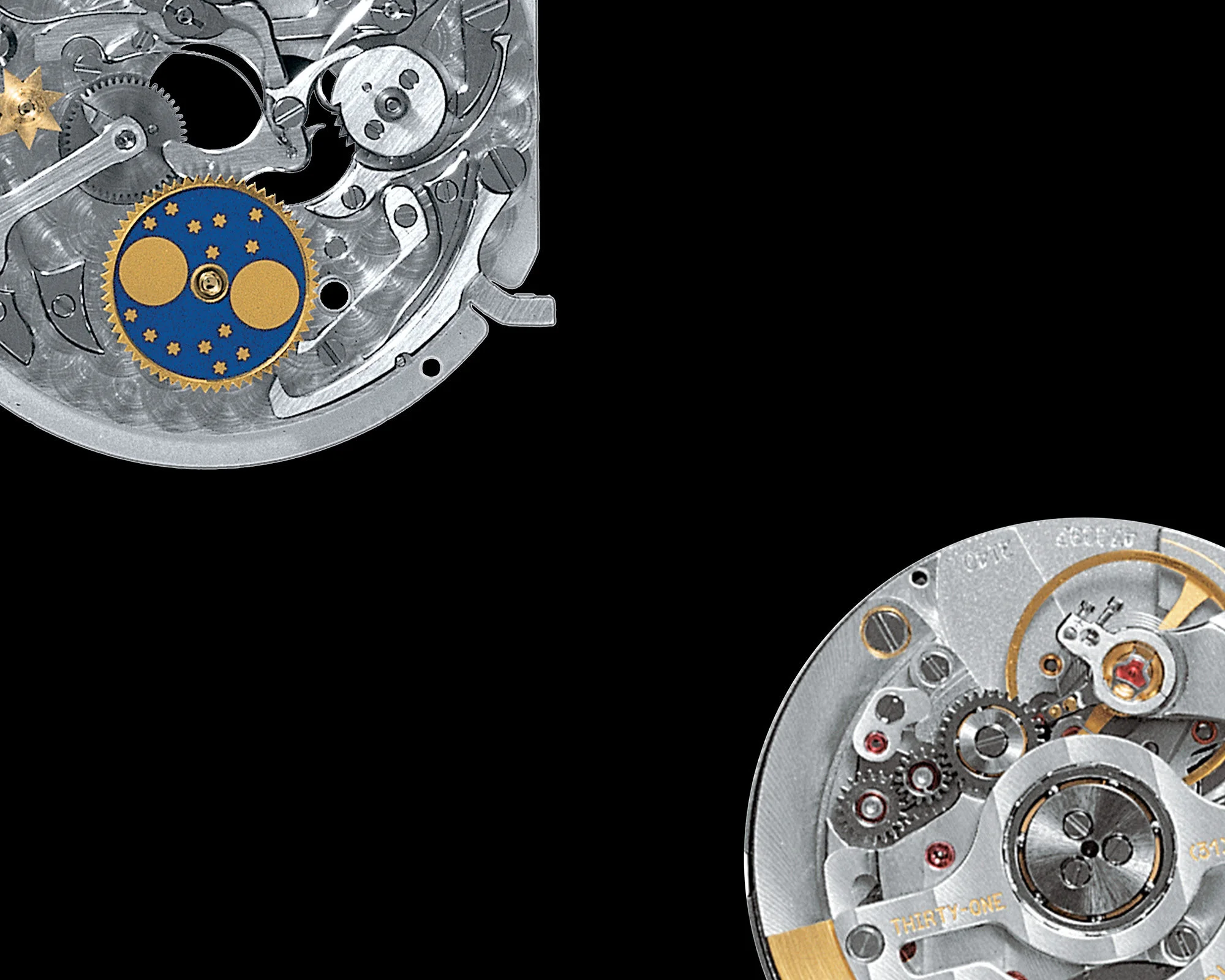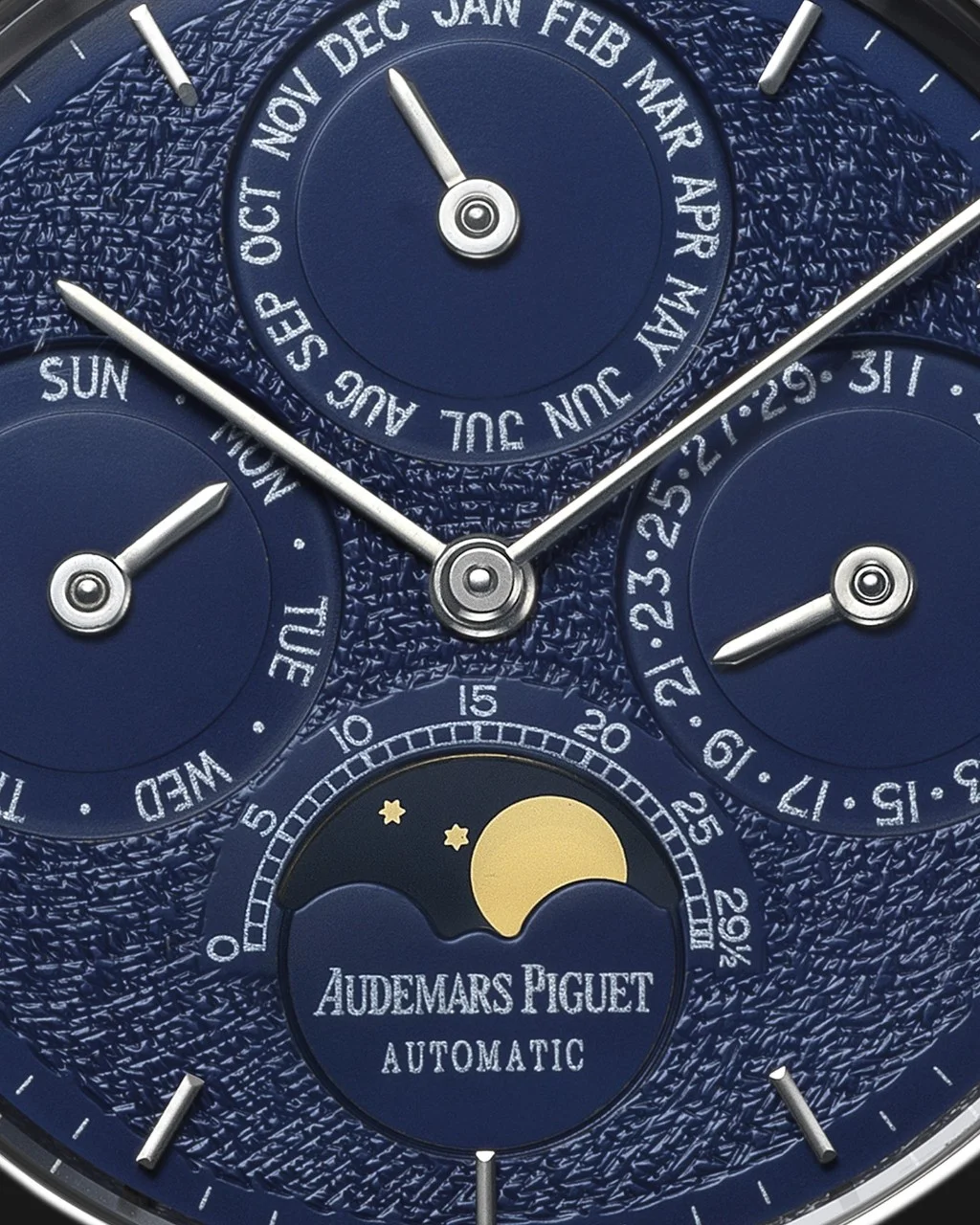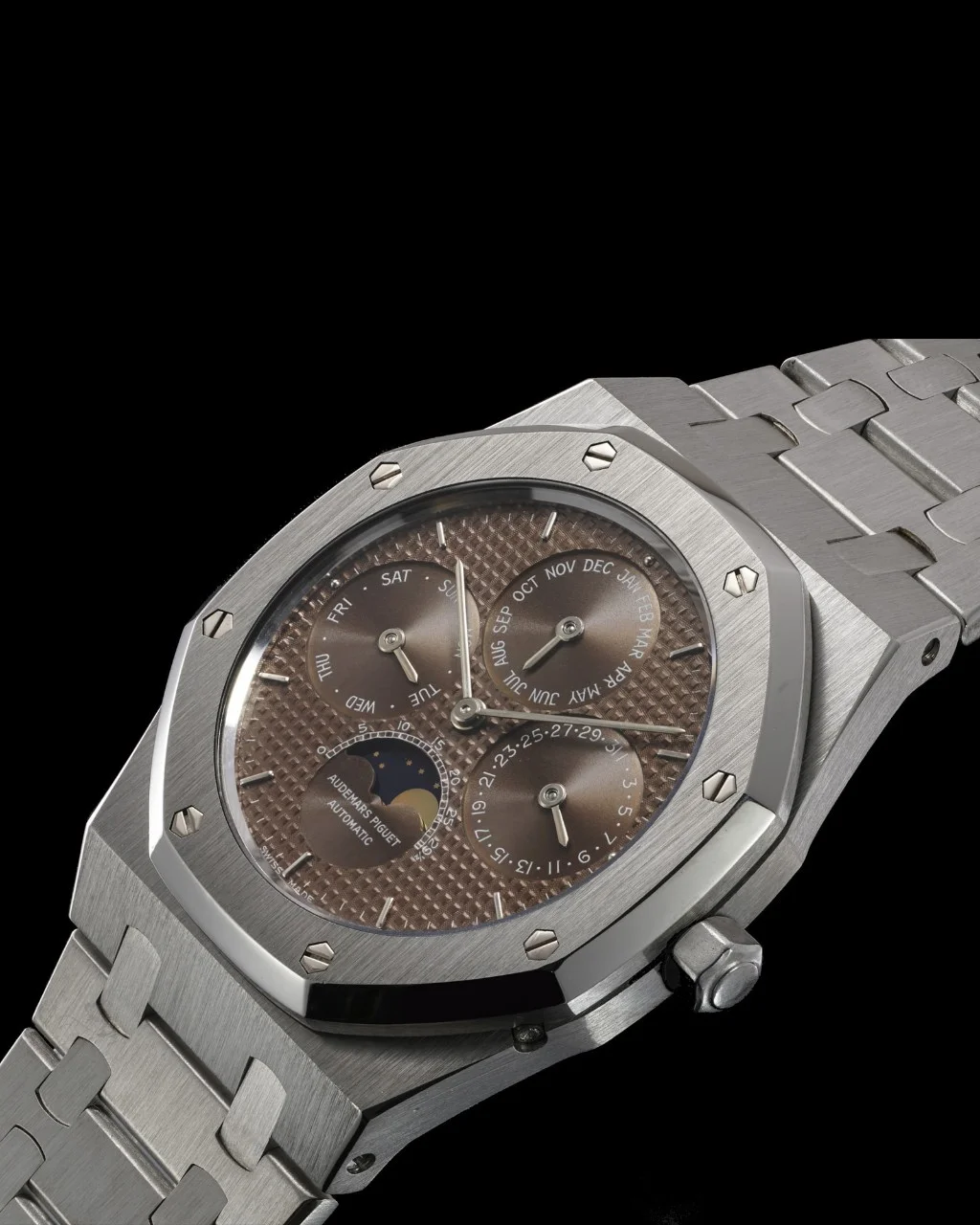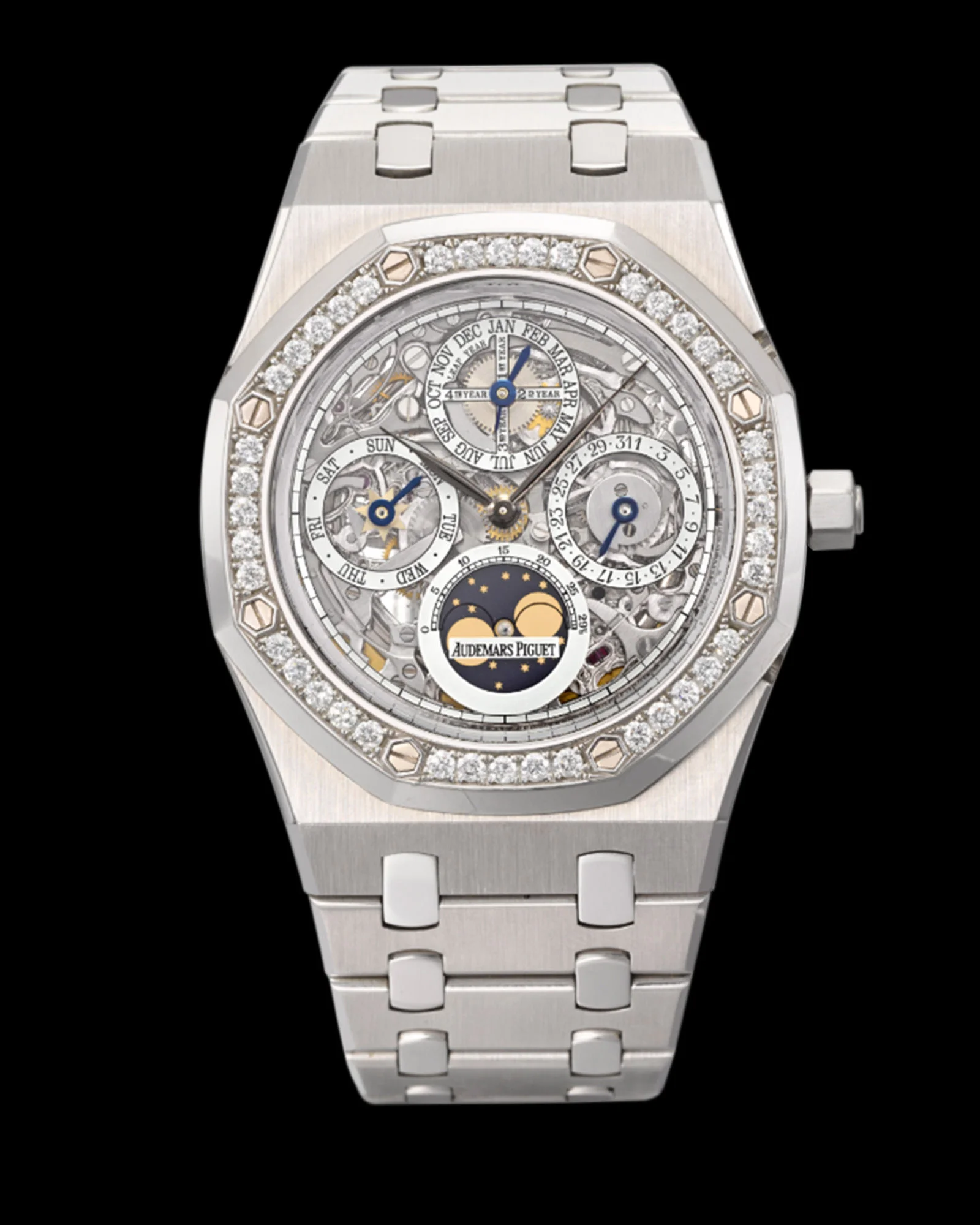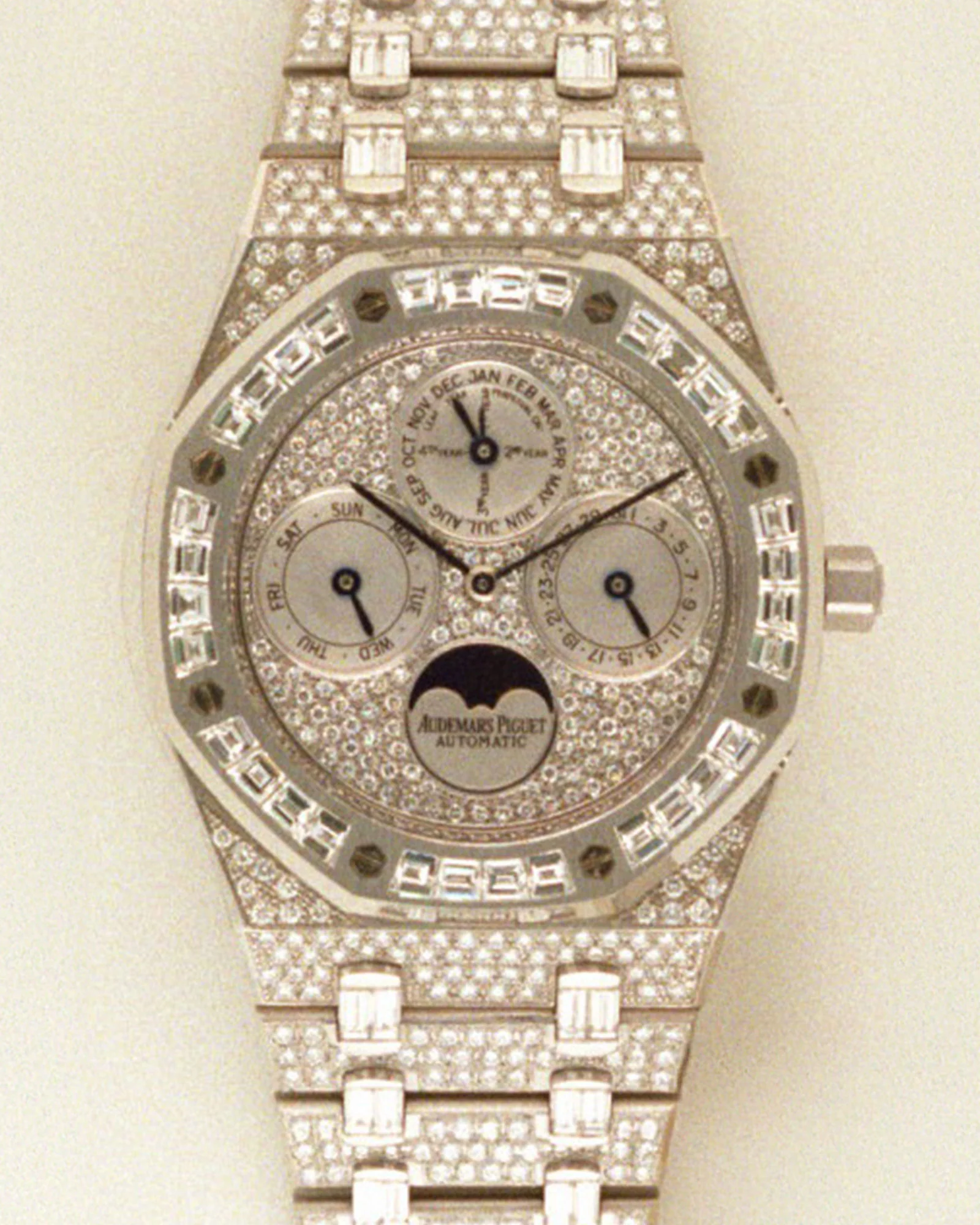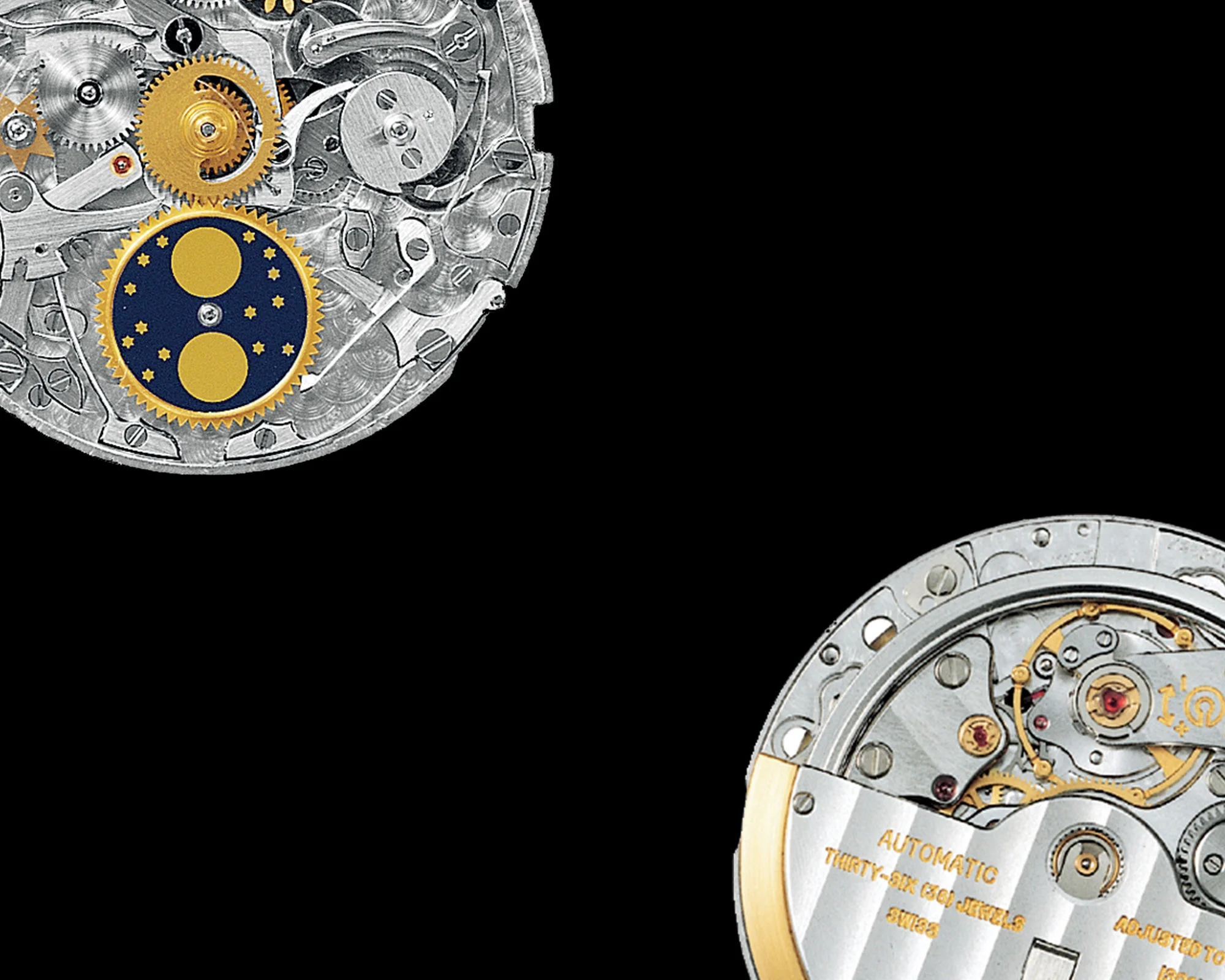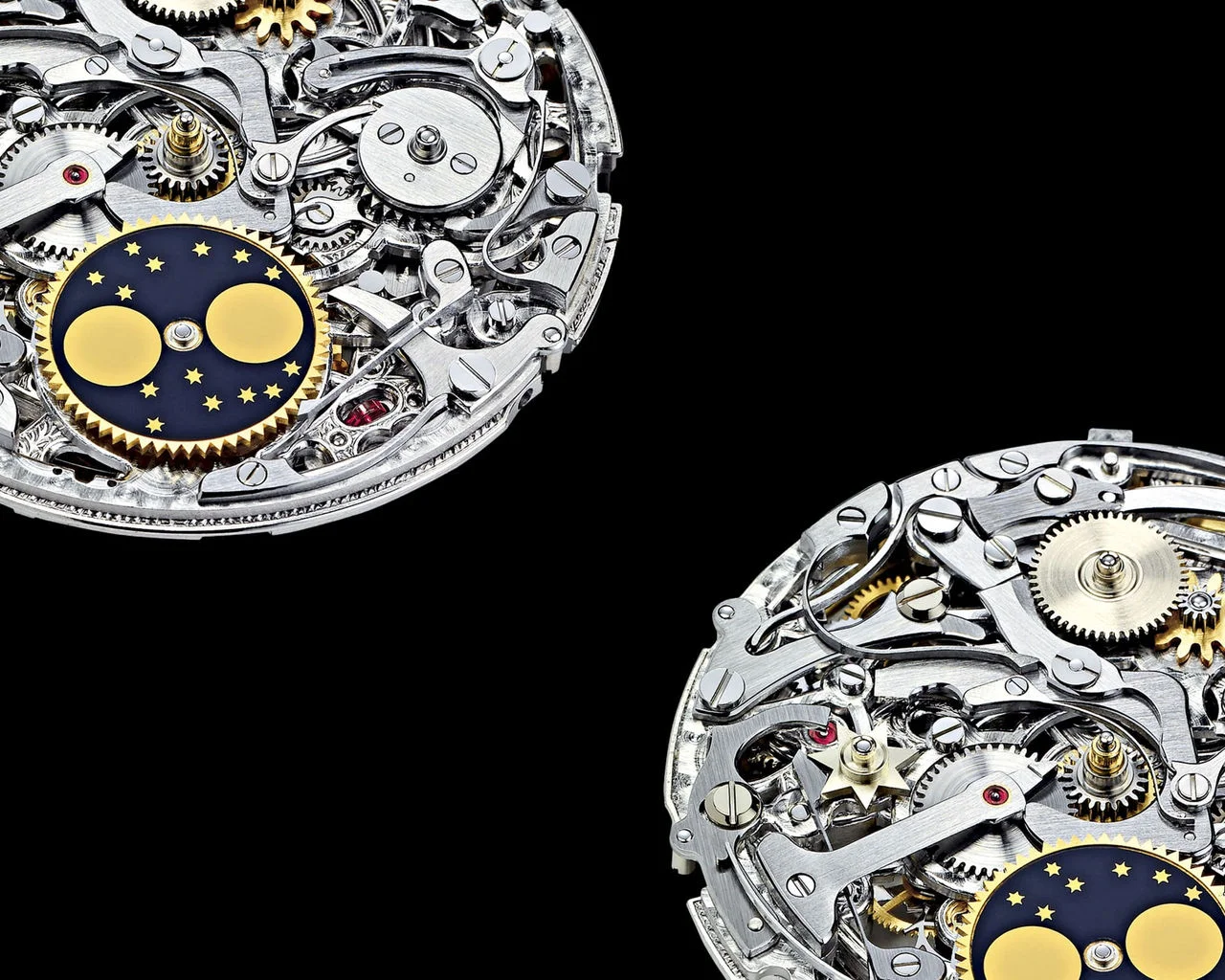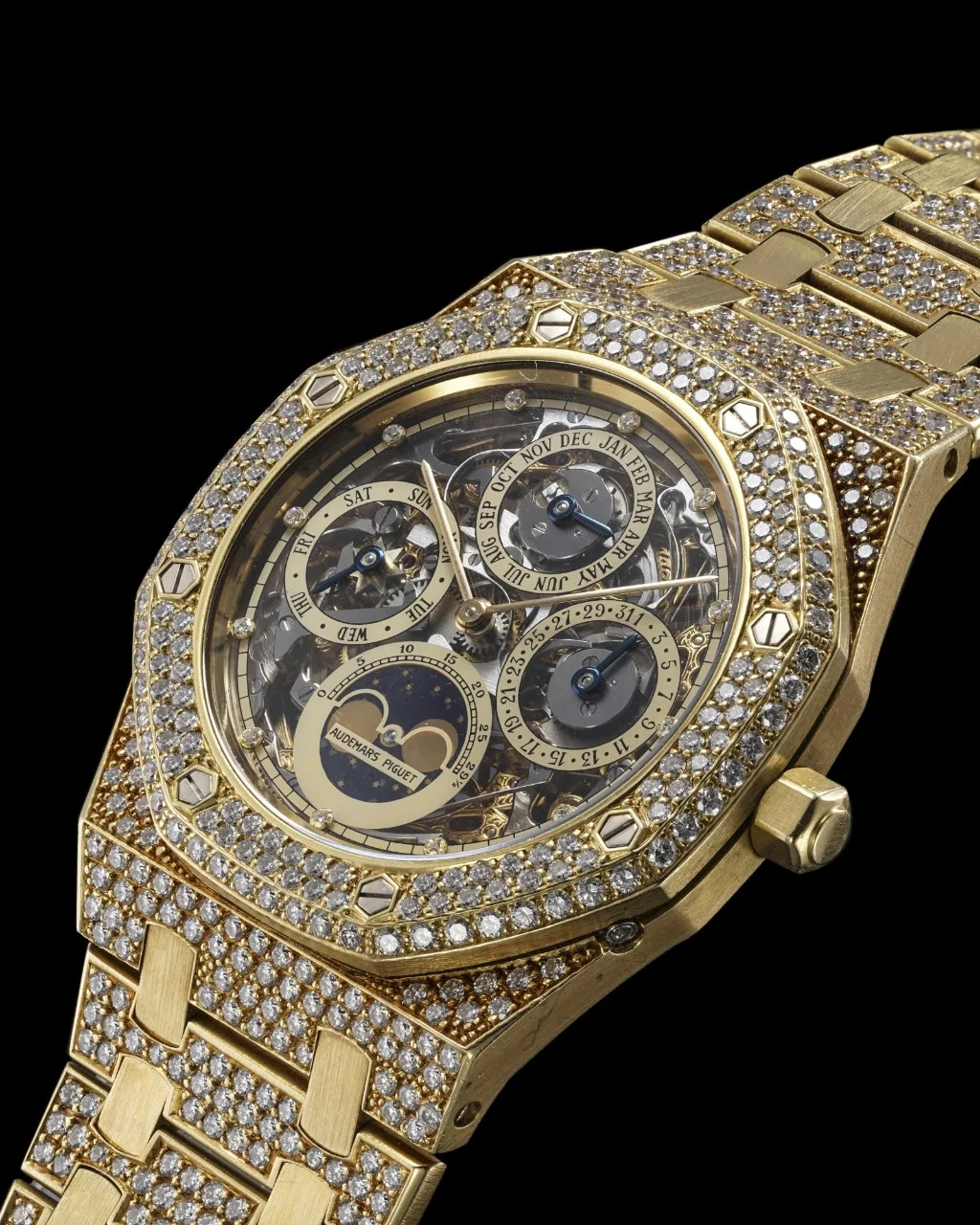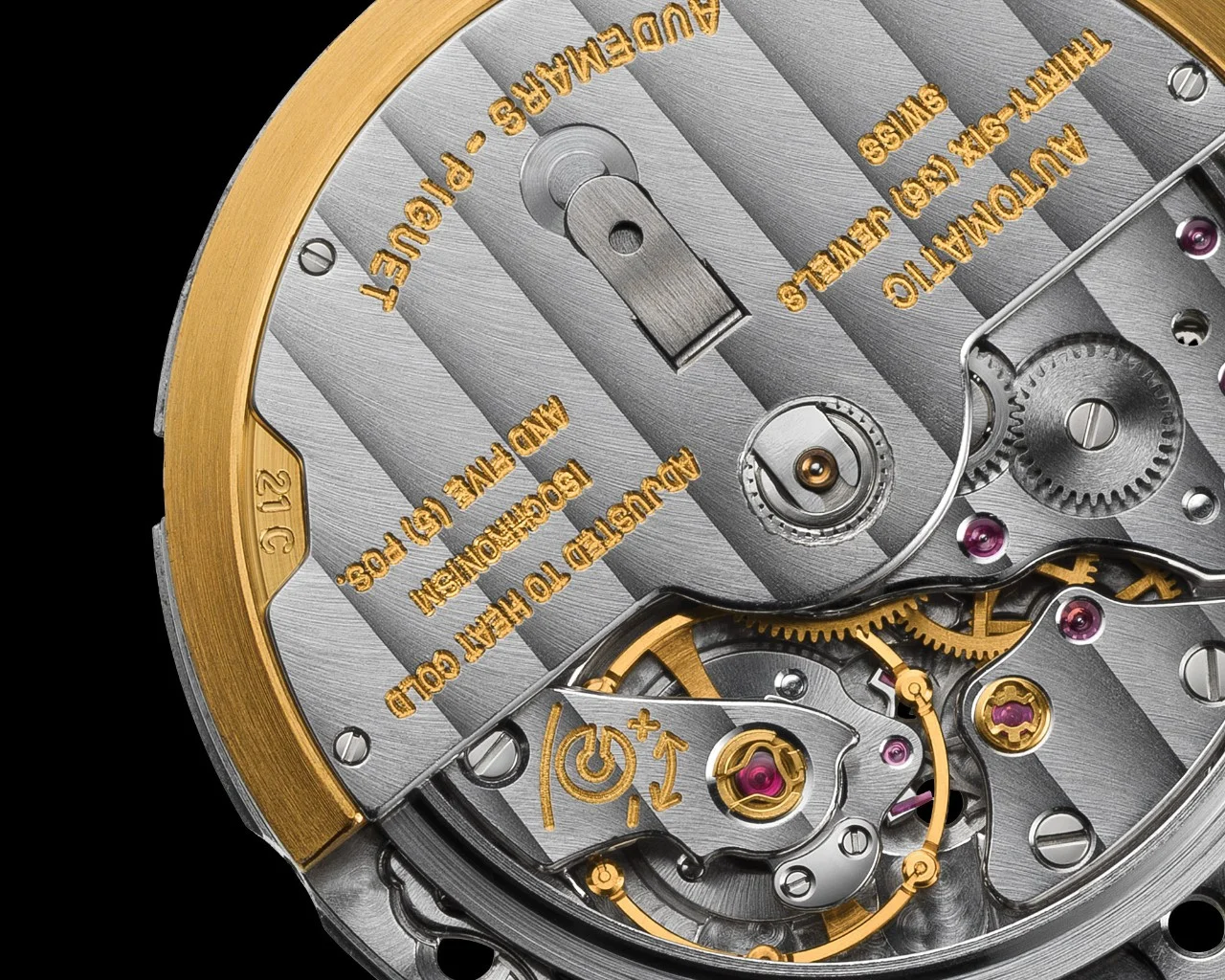
25686, Royal Oak Perpetual Calendar, sapphire caseback

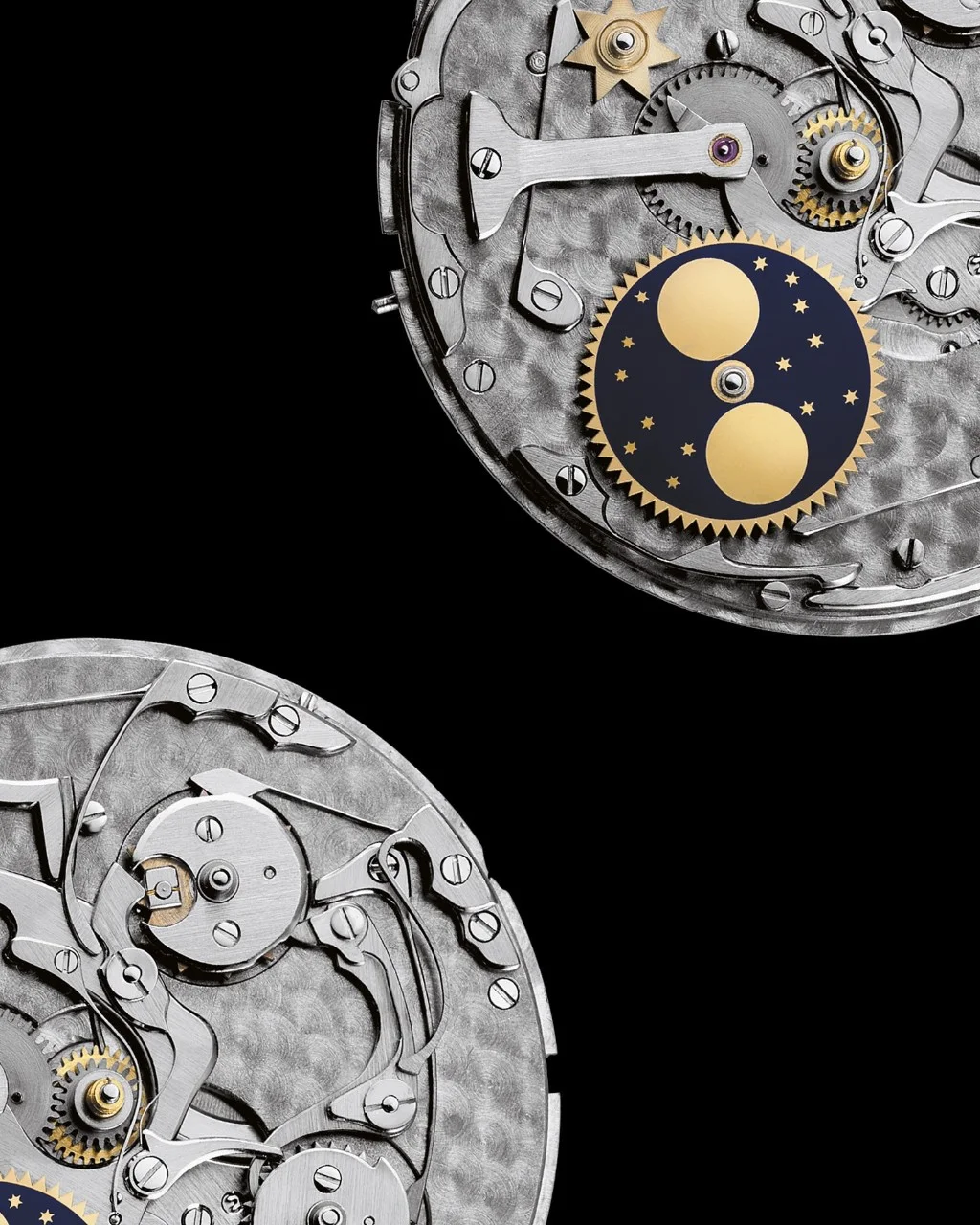
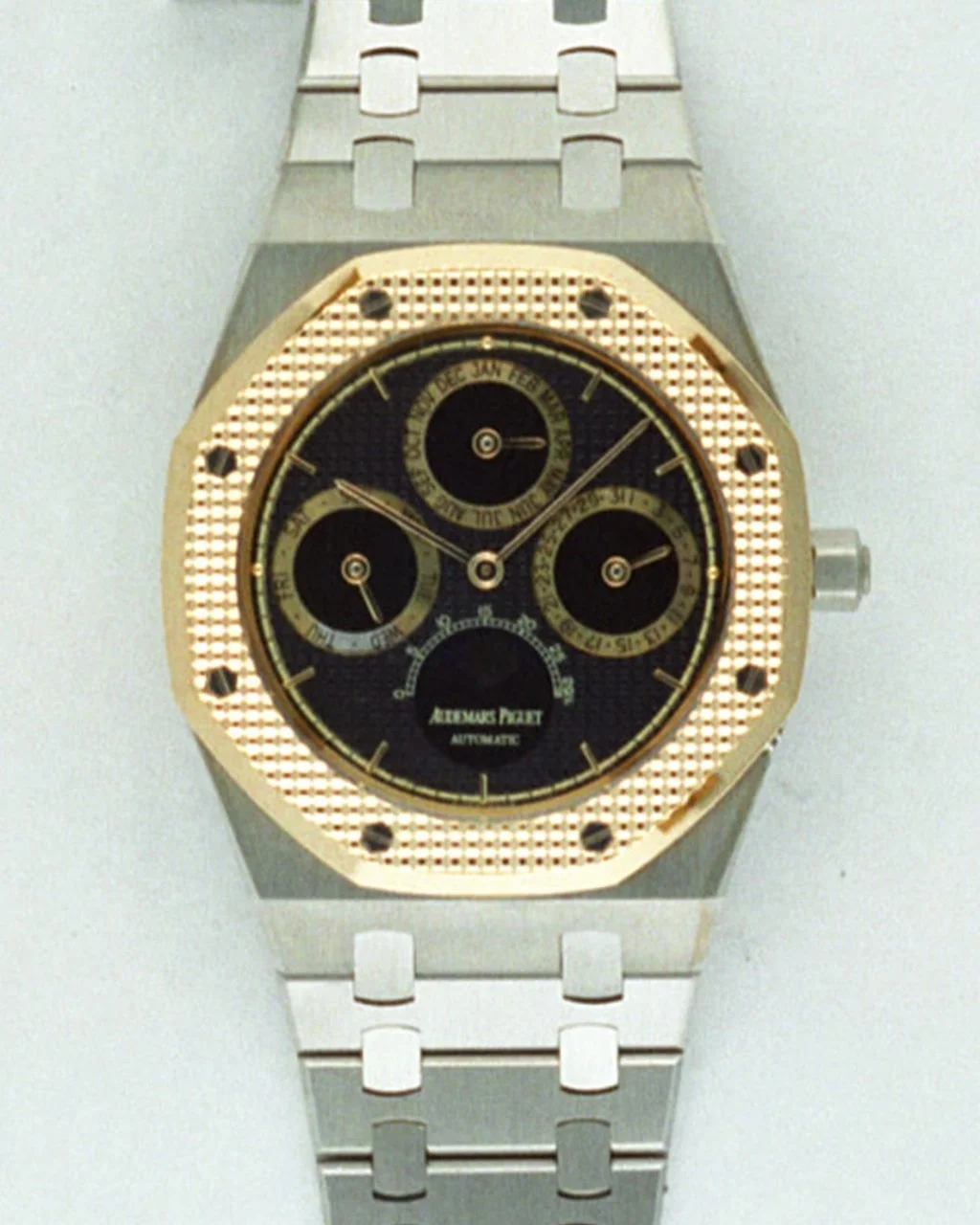
1994. Royal Oak Perpetual Calendar Model 25686OR N° 12, caseback side. Perpetual calendar: day, date, month, phase and age of the moon. Extra-thin selfwinding Calibre 2120/2800 (3.95 mm), movement 405396. Bracelet 944. Creamy white painted dial with Petite Tapisserie pattern. 39 mm case D34421 in 18-carat pink gold. Sold in August 1994. Auctioned by Phillips in Geneva on 6 May 2022, lot 36. © Phillips.

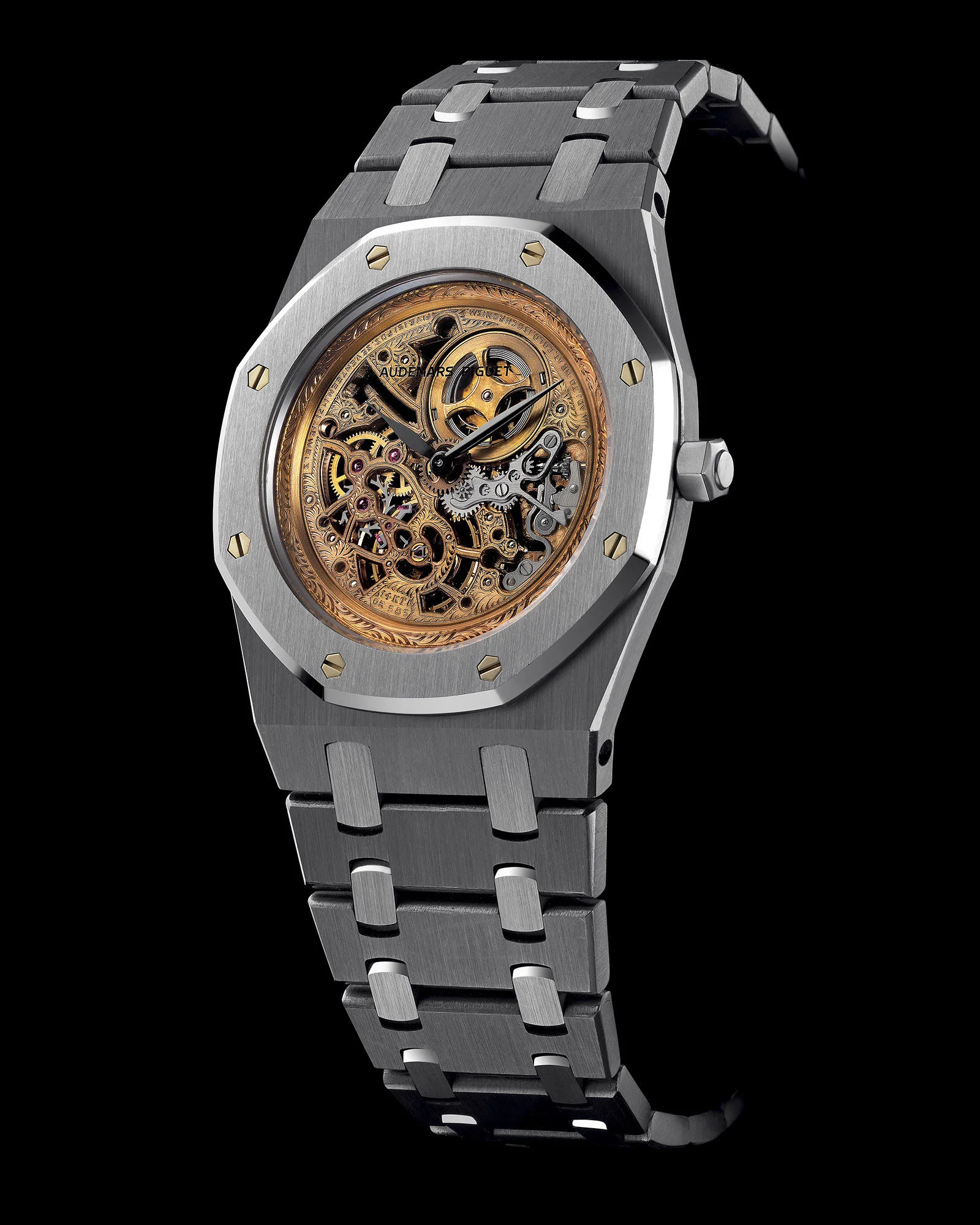
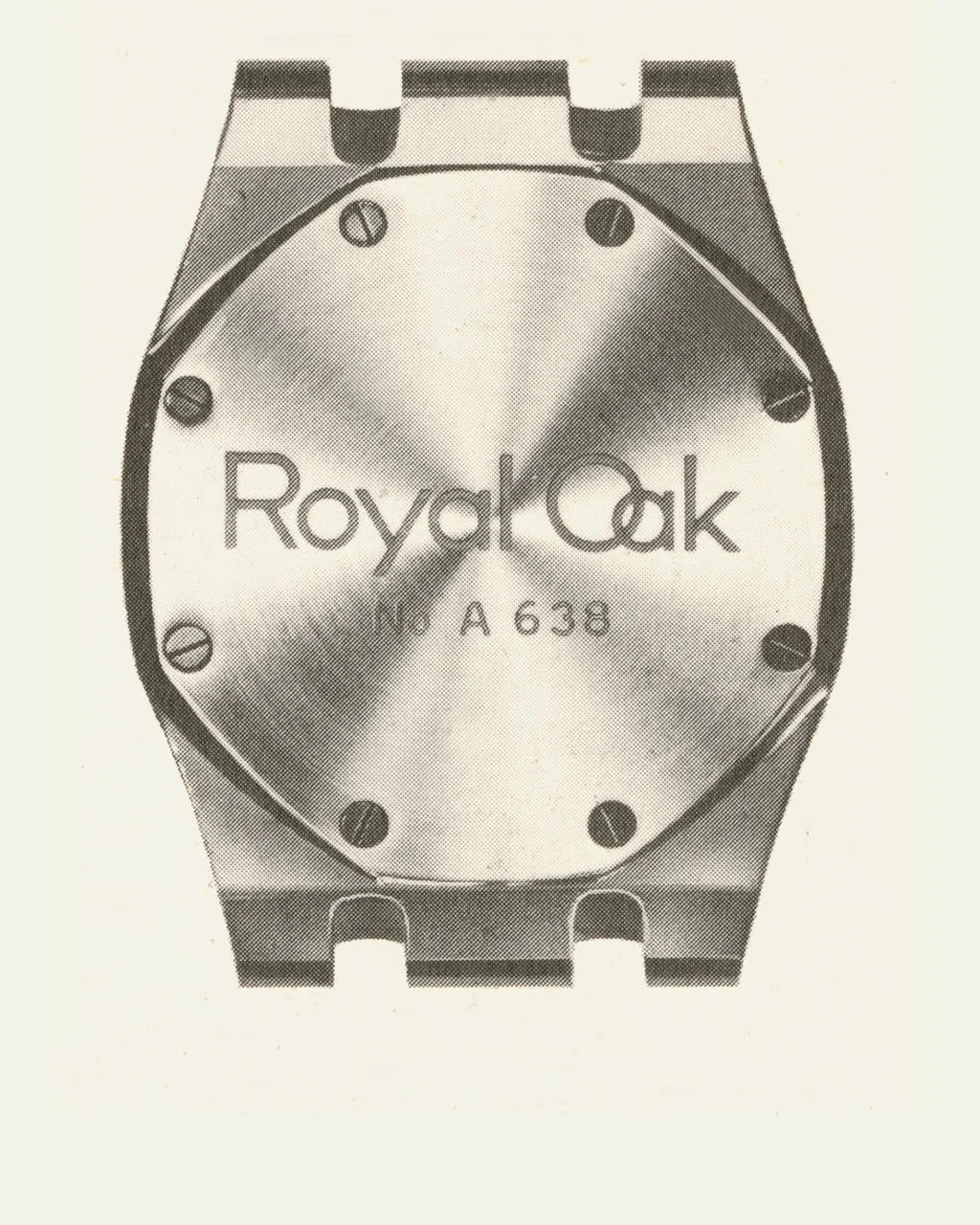
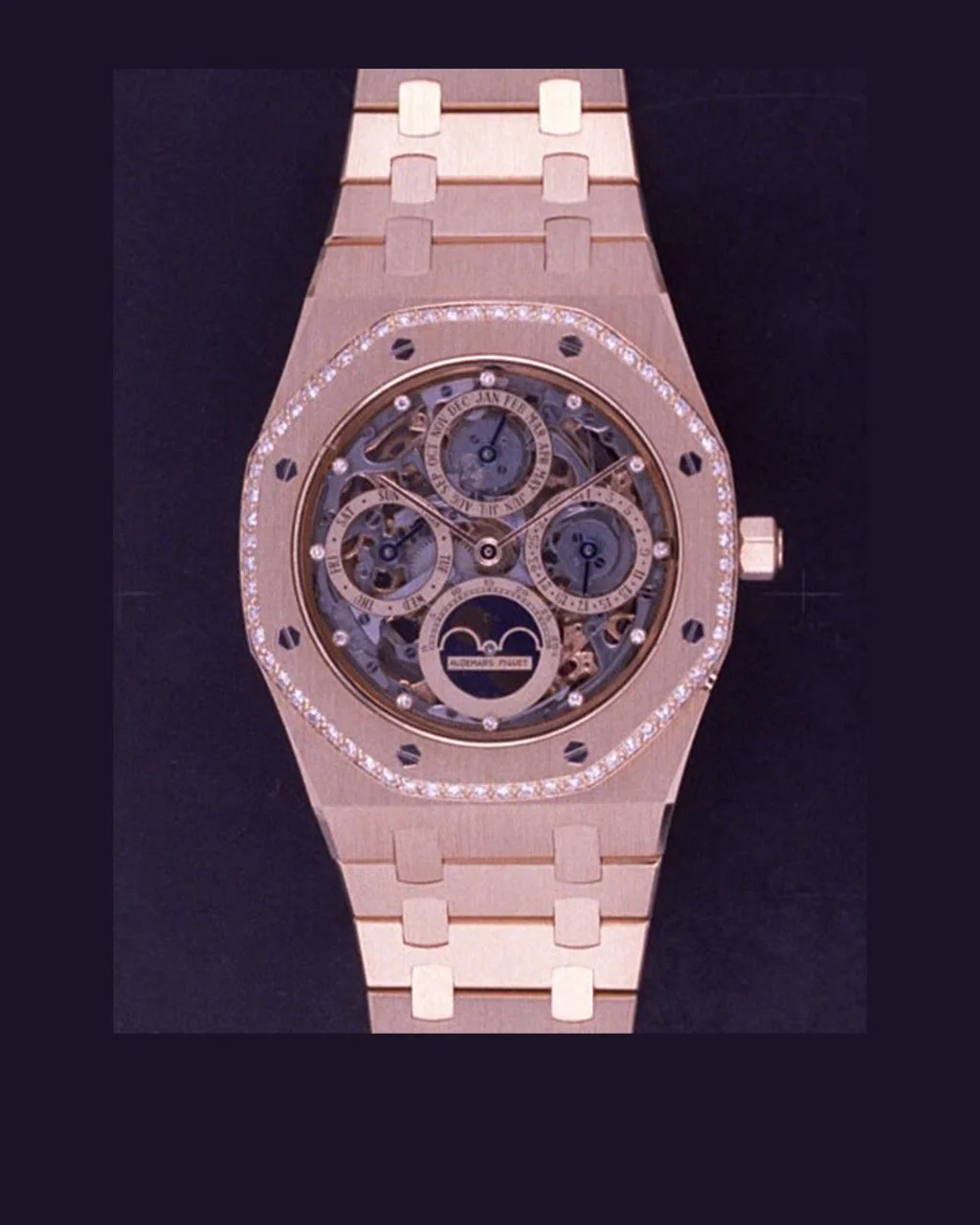
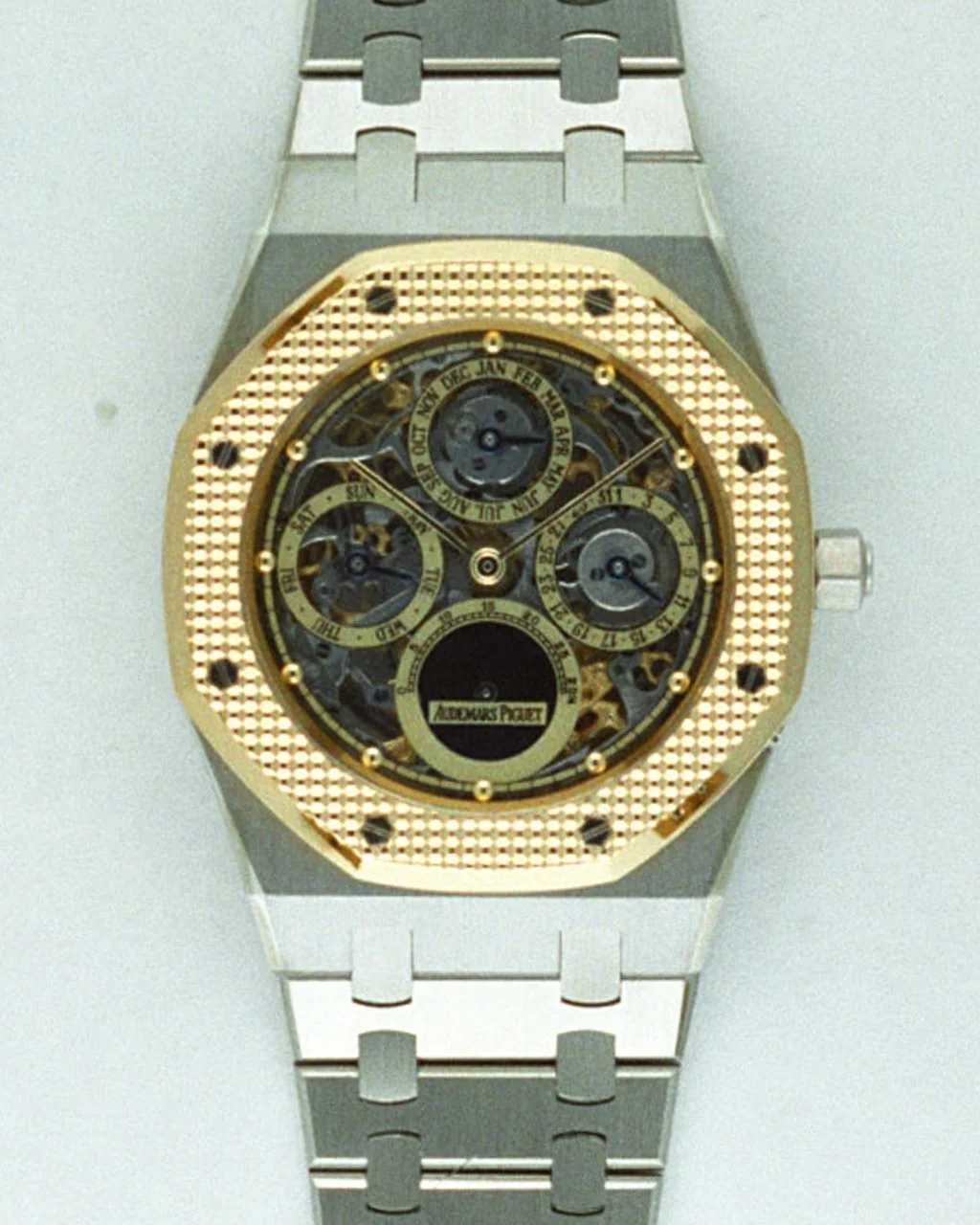
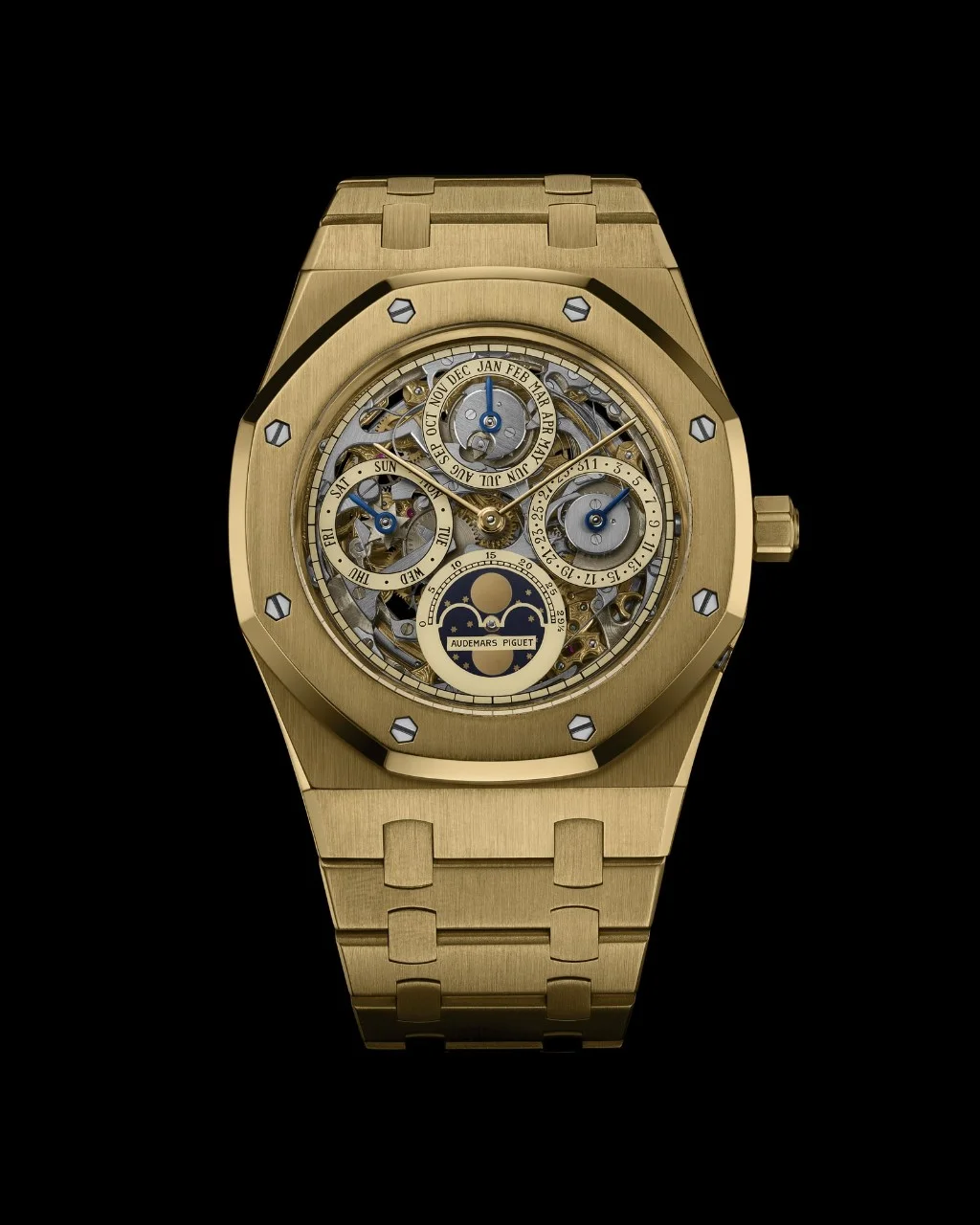
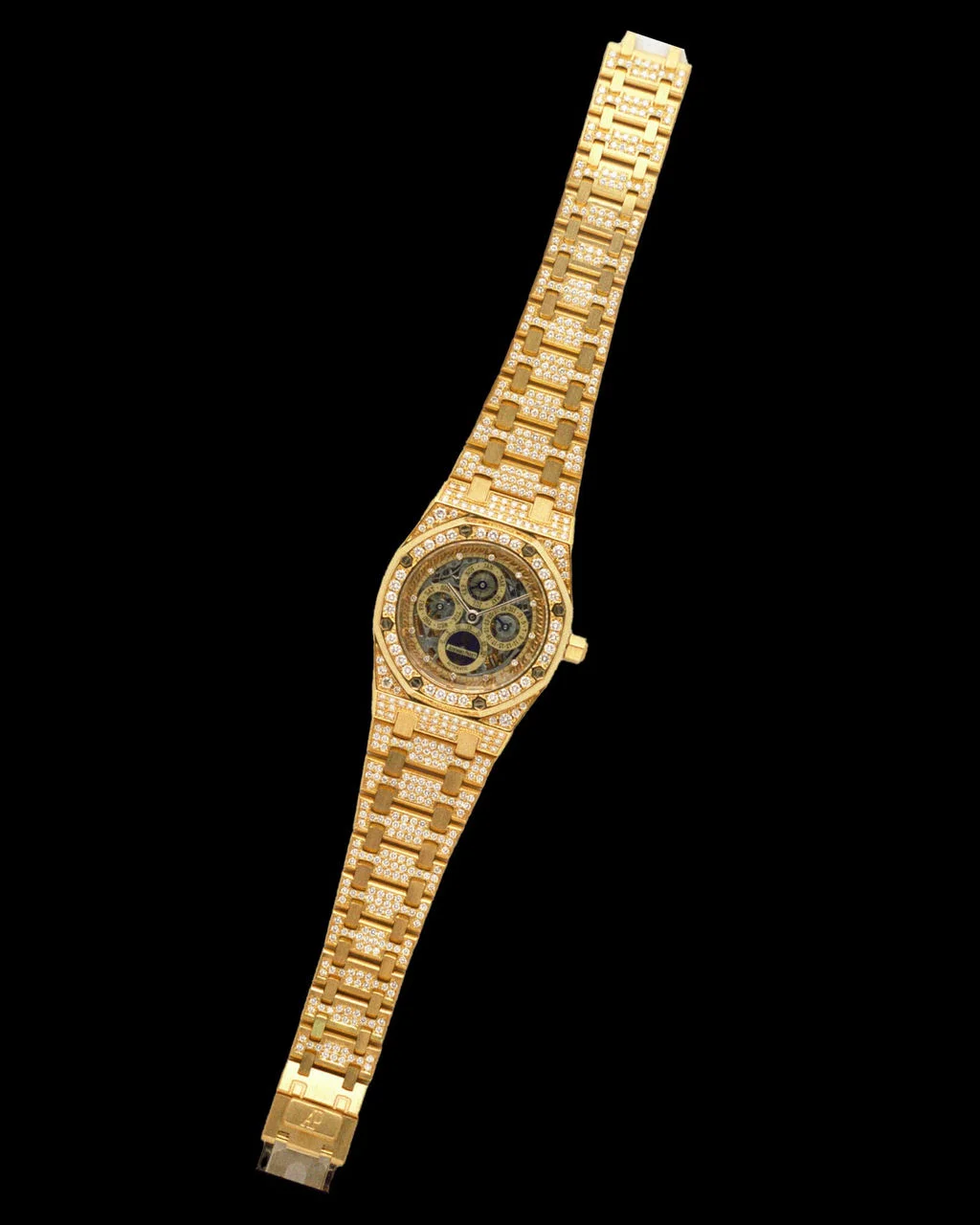
1994. Royal Oak Models 25636 and 25686. In 1986, Model 25636 introduced openworking and a sapphire caseback to the Royal Oak collection. Three years later, Model 25686 retained the exhibition back, but only the weight remained openworked. Promotional brochure. Audemars Piguet Archives.

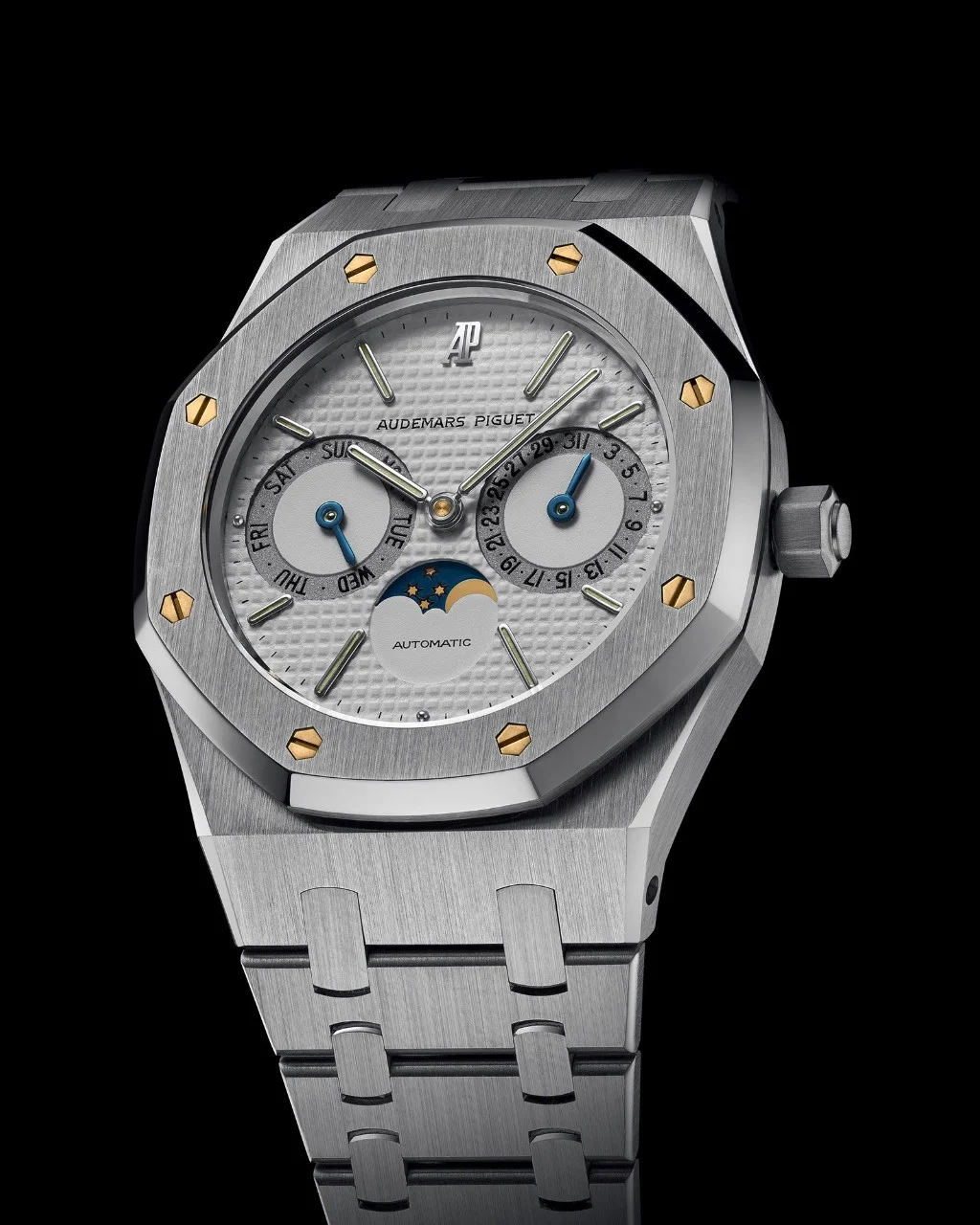
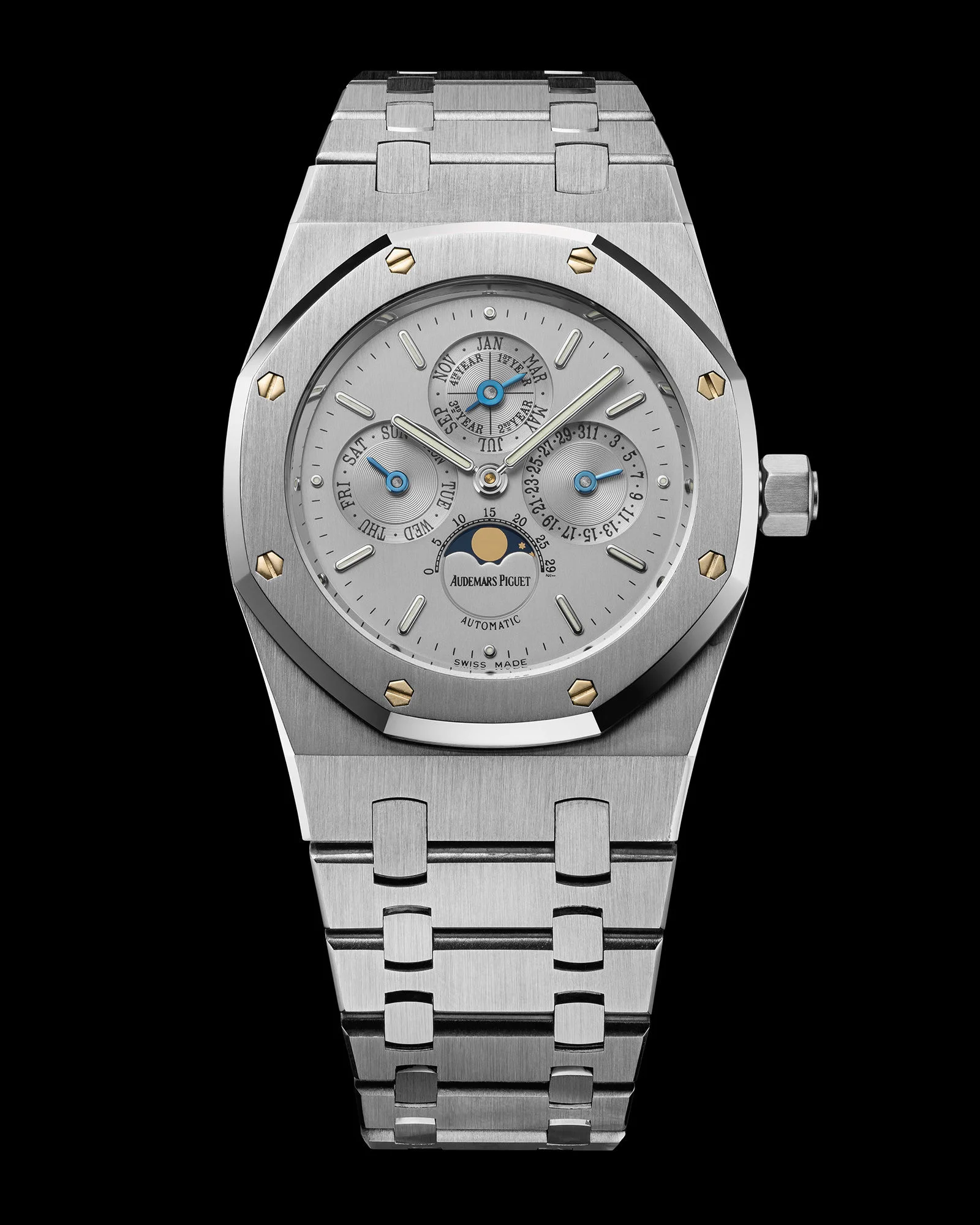
1995. Royal Oak Perpetual Calendar 25686ST N° 65. Perpetual calendar: day, date, month, phase and age of the moon. Extra-thin selfwinding Calibre 2120/2800 (3.95mm), movement 374192. Bracelet 944. Petite Tapisserie dial. 39 mm case D42082 in steel. Sold in New York in March 1995. Auctioned by Sotheby's in New York on June 15, 2022, lot 21. © Sotheby's.
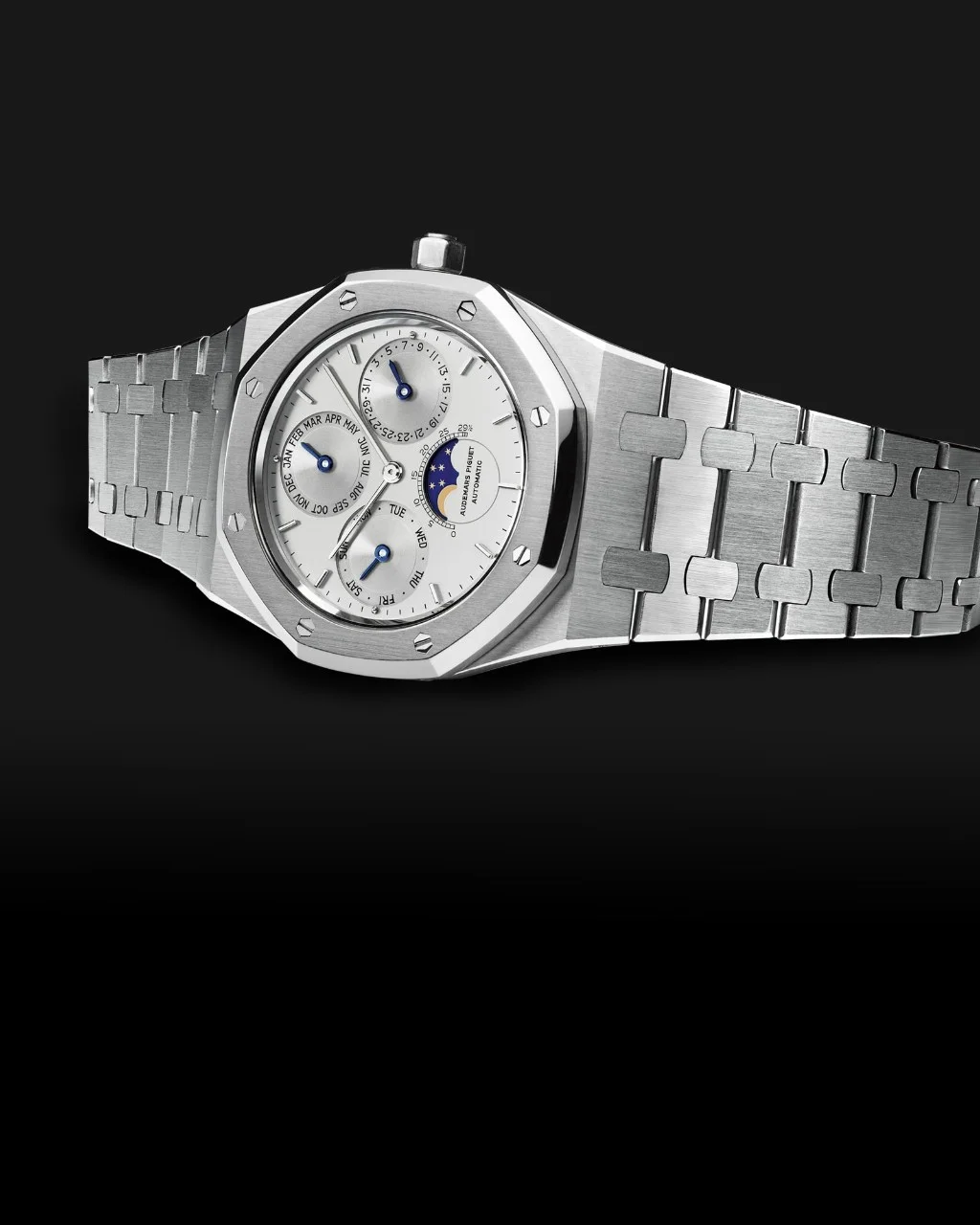
Model 25686 marks an important stage in the history of the Royal Oak Perpetual Calendar. For the first time, the watch reveals through the caseback the beauty of its mechanism without being fitted with an entirely openworked movement.
Distributed between 1989 and 1998, this model features a wide range of dial interpretations. It plays on their colour (gold, blue, salmon, pink, etc.) and varies their finish. In particular, this was the timepiece who introduced the guilloché pattern known as T21 Tapisserie into the world of the Royal Oak Perpetual Calendar, as well as the finely engraved "Tuscany blue“ dial and the mother-of-pearl dials.
Moreover, never before had a Royal Oak Perpetual Calendar been made in so many different materials. In 1989, the first models were delivered in yellow gold (BA) and platinum (PT). Steel (ST) was introduced the following year. In 1991, a first model (PR) combined pink gold (case middle and links) and platinum (bezel and studs). Two years later, a new variant was made entirely of pink gold (OR), followed in 1994 by a stunning combination of steel and mirror-polished platinum (SP). Finally, in 1997, the seventh and last variation again combined pink gold and platinum, but with the components reversed (PR).
From 1996, Model 25686 was replaced by Model 25820, which added the leap-year cycle indication.
Sales from 1989 to 1998: a total of 299 units, of which 2 (1989), 20 (1990), 33 (1991), 20 (1992), 34 (1993), 66 (1994), 24 (1995), 66 (1996), 33 (1997) and 1 (1998).
Model derived from 25636 (1986), replaced by 25820 as of 1996.
Model 25686 marks an important stage in the history of the Royal Oak Perpetual Calendar. For the first time, the watch reveals through the caseback the beauty of its mechanism without being fitted with an entirely openworked movement.
Distributed between 1989 and 1998, this model features a wide range of dial interpretations. It plays on their colour (gold, blue, salmon, pink, etc.) and varies their finish. In particular, this was the timepiece who introduced the guilloché pattern known as T21 Tapisserie into the world of the Royal Oak Perpetual Calendar, as well as the finely engraved "Tuscany blue“ dial and the mother-of-pearl dials.
Moreover, never before had a Royal Oak Perpetual Calendar been made in so many different materials. In 1989, the first models were delivered in yellow gold (BA) and platinum (PT). Steel (ST) was introduced the following year. In 1991, a first model (PR) combined pink gold (case middle and links) and platinum (bezel and studs). Two years later, a new variant was made entirely of pink gold (OR), followed in 1994 by a stunning combination of steel and mirror-polished platinum (SP). Finally, in 1997, the seventh and last variation again combined pink gold and platinum, but with the components reversed (PR).
From 1996, Model 25686 was replaced by Model 25820, which added the leap-year cycle indication.
Sales from 1989 to 1998: a total of 299 units, of which 2 (1989), 20 (1990), 33 (1991), 20 (1992), 34 (1993), 66 (1994), 24 (1995), 66 (1996), 33 (1997) and 1 (1998).
Model derived from 25636 (1986), replaced by 25820 as of 1996.

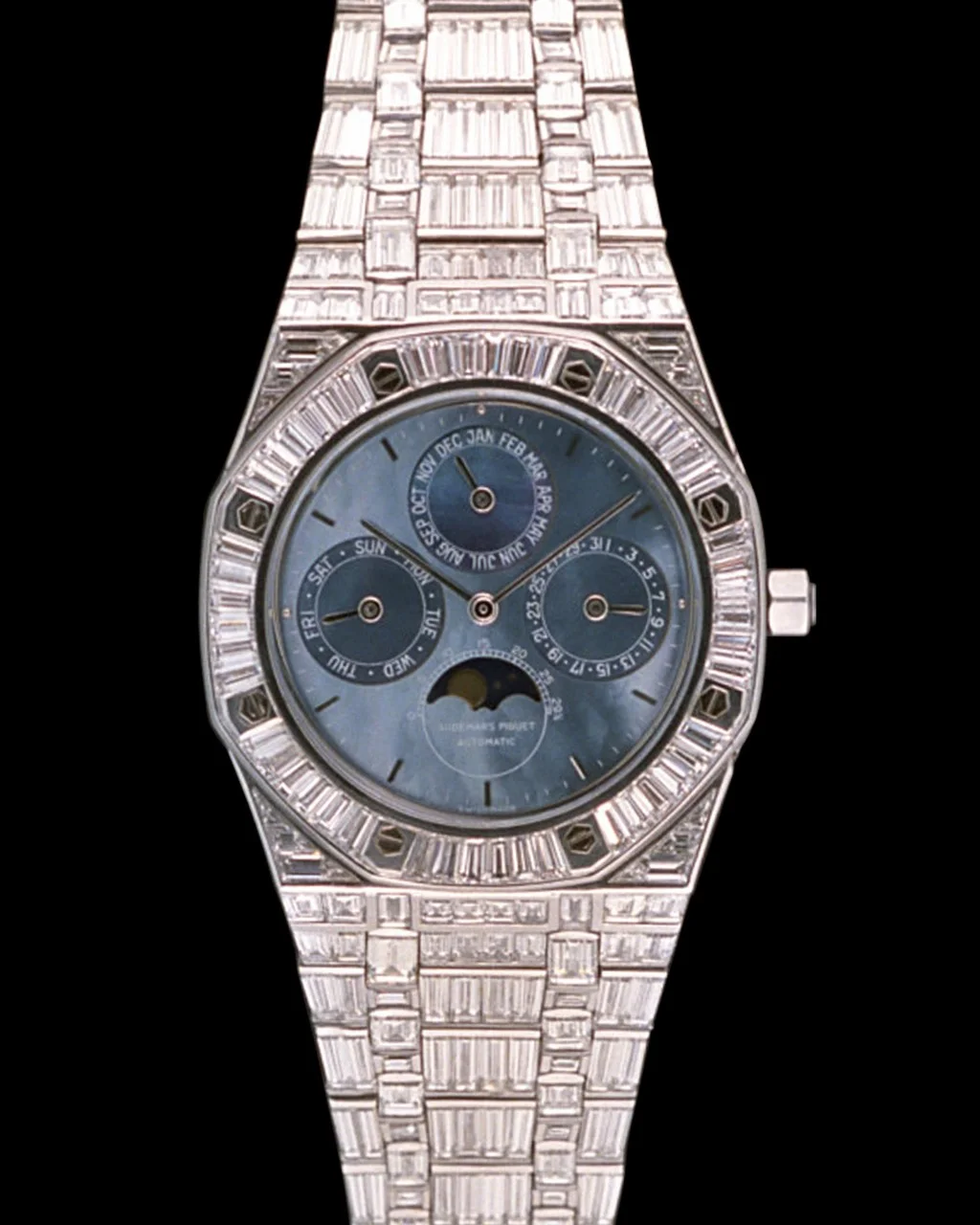
1992. Royal Oak Perpetual Calendar 25686PT N° 20, dial side. Perpetual calendar: day, date, month, phase and age of the moon. Extra-thin selfwiding Calibre 2120/2800 (3.95 mm), movement 374104. Bracelet 344. 39 mm case D34720 in platinum. Blue mother-of-pearl dial. Sold in Thailand in August 1994. Auctioned by Phillips in Geneva on 6 May 2022, lot 17. © Phillips.

1992. Royal Oak Perpetual Calendar 25686PT N° 20, caseback side. Perpetual calendar: day, date, month, phase and age of the moon. Extra-thin selfwinding Calibre 2120/2800 (3.95 mm), movement 374104. Bracelet 344. 39 mm case D34720 in platinum. Blue mother-of-pearl dial. Sold in Thailand in August 1994. Auctioned by Phillips in Geneva on 6 May 2022, lot 17. © Phillips

1993–1994. Royal Oak Perpetual Calendar, sapphire caseback, Model 25686. 1993–94 Audemars Piguet Catalogue. Audemars Piguet Archives.

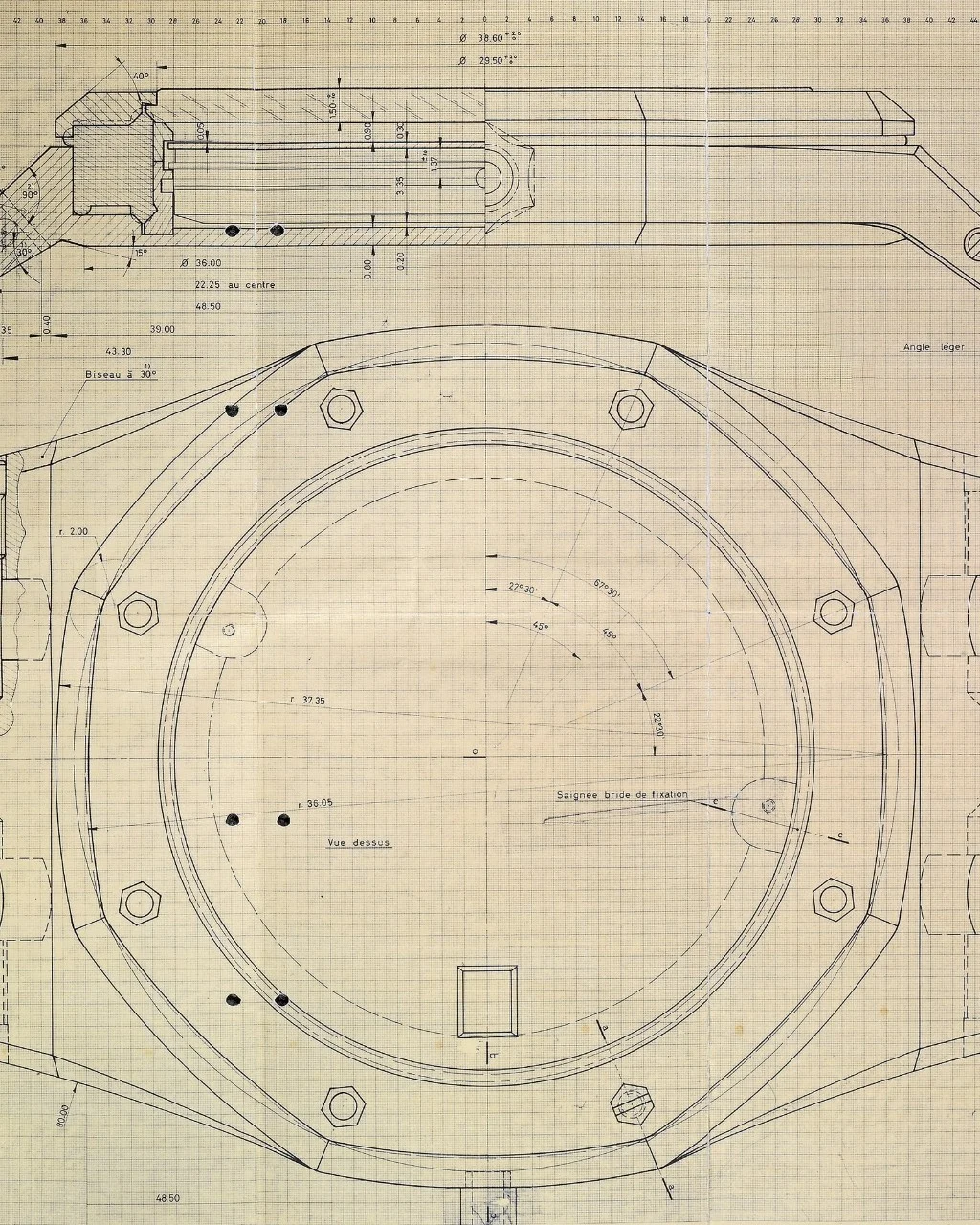
Circa 1989. Technical data for the the Royal Oak Perpetual Calendar Model 25686PT. Audemars Piguet Archives.

Circa 1989. Identification image of the Royal Oak Perpetual Calendar 25686PT. Audemars Piguet Archives.
With the exception of the clasp and the hexagonal screws on the bezel, which are made of white gold, the case of this variant is made of platinum. This material, which is three times denser and half as hard as steel, was particularly popular during the Art Deco period. It almost entirely disappeared from Audemars Piguet men's watch collections after World War II.
It was not until 1986 that this material made its appearance in the Royal Oak collection. The discretion of its appearance was matched only by its exclusivity. In 1986, the first and only platinum Royal Oak of the year was delivered to Germany. It was to remain the only example of Model 25554 in this material. The following year, only two Royal Oak watches in platinum were marketed, one in the 14470PT variant, the other as 25636PT, followed in 1988 by the first 25654PT watch.
But when the Royal Oak Perpetual Calendar 25686 made its first appearance on 13 July 1989, it was in platinum. The next 30 models were delivered between 1991 and 1997. The model appeared in the Audemars Piguet Catalogue in 1993, with a blue mother-of-pearl dial.
Sales from 1989 to 1997: a total of 31 units, of which 1 (1989), 10 (1991), 10 (1992), 1 (1993), 4 (1994), 4 (1995) and 1 (1997).
With the exception of the clasp and the hexagonal screws on the bezel, which are made of white gold, the case of this variant is made of platinum. This material, which is three times denser and half as hard as steel, was particularly popular during the Art Deco period. It almost entirely disappeared from Audemars Piguet men's watch collections after World War II.
It was not until 1986 that this material made its appearance in the Royal Oak collection. The discretion of its appearance was matched only by its exclusivity. In 1986, the first and only platinum Royal Oak of the year was delivered to Germany. It was to remain the only example of Model 25554 in this material. The following year, only two Royal Oak watches in platinum were marketed, one in the 14470PT variant, the other as 25636PT, followed in 1988 by the first 25654PT watch.
But when the Royal Oak Perpetual Calendar 25686 made its first appearance on 13 July 1989, it was in platinum. The next 30 models were delivered between 1991 and 1997. The model appeared in the Audemars Piguet Catalogue in 1993, with a blue mother-of-pearl dial.
Sales from 1989 to 1997: a total of 31 units, of which 1 (1989), 10 (1991), 10 (1992), 1 (1993), 4 (1994), 4 (1995) and 1 (1997).

Circa 1989. Technical data for Model 25686BA. Audemars Piguet Archives.

Circa 1989. Identification image of Model 25686. Audemars Piguet Archives.

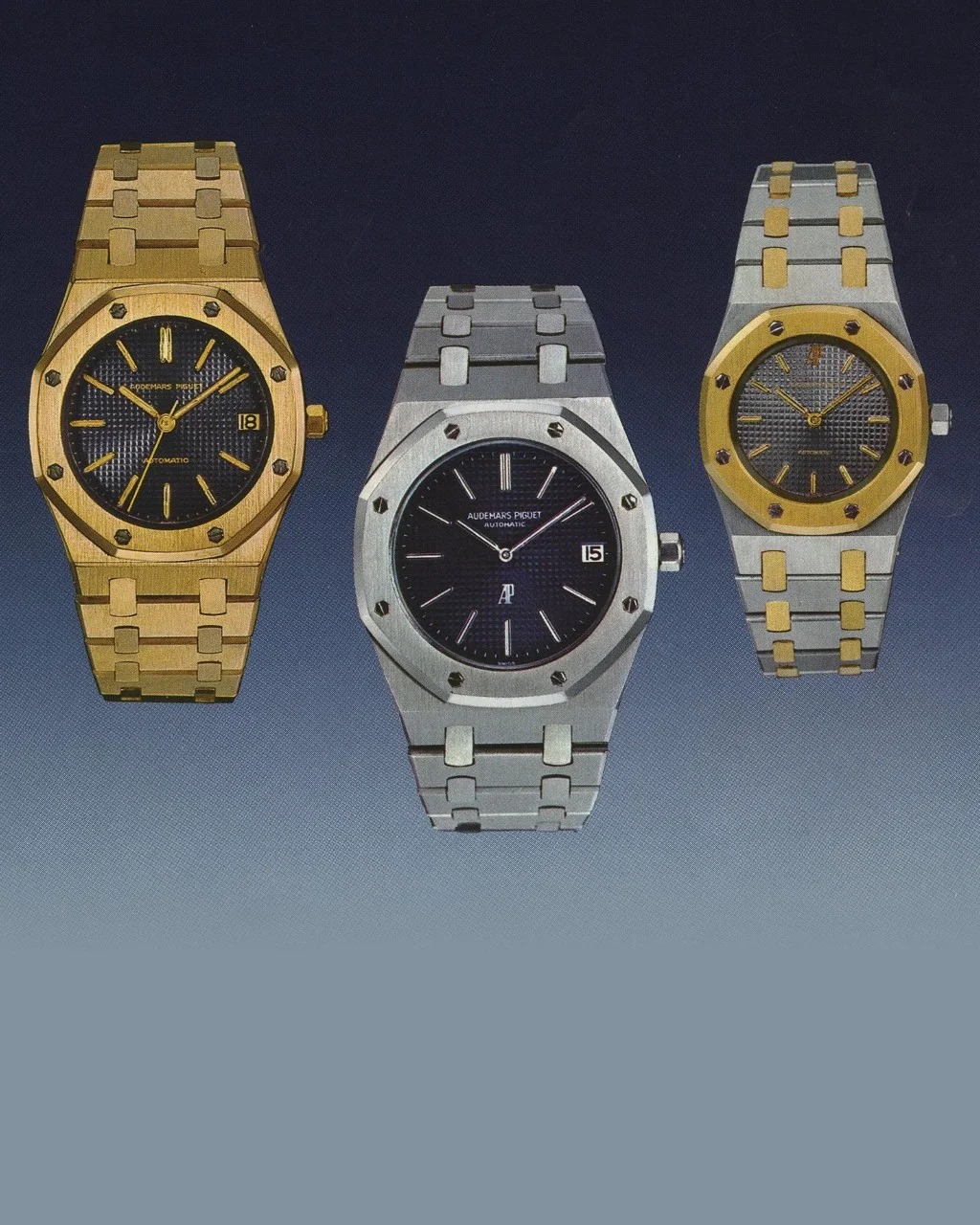
1980s–1990s. Perpetual calendar watches with a yellow gold-toned opaline dial. The same dial could be used on several different models. From left to right: Models 25554BA (dial also used in 25654BA and 25686BA), 25550BA and 25557BA. Audemars Piguet Archives.
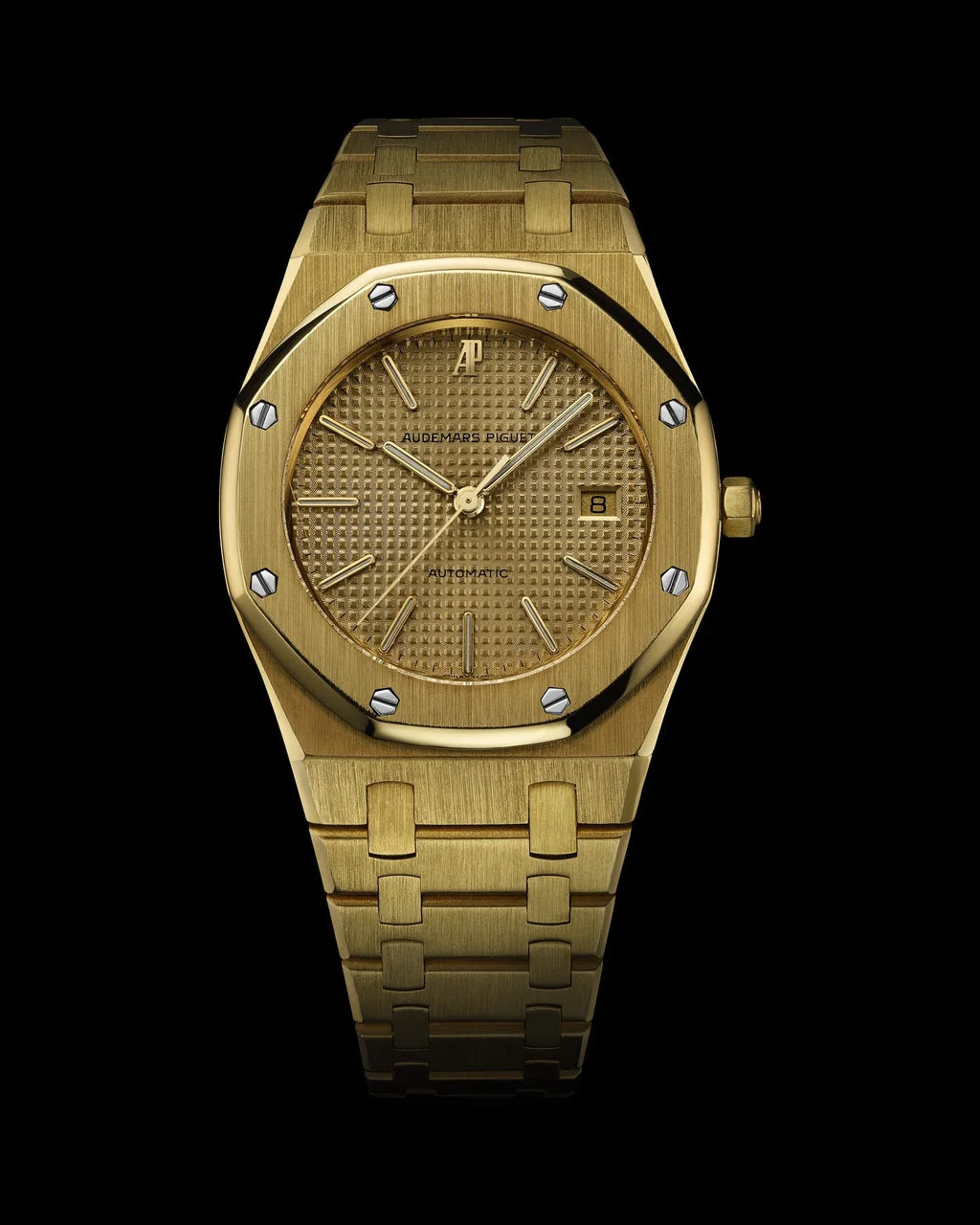
The first 25686BA example in yellow gold was sold in November 1989. It would take another seven years to manufacture and distribute the next 69 or so pieces.
The Technical Data presents a watch with a “doré, opalin” (yellow gold-toned, opaline) Stern dial, "beige" subdials highlighted with “rail noir” (black railtrack). This dial is exactly the same as the ones in the Royal Oak 25654BA (1986) and 25554BA (1984) Technical Data. It has also been used in other collections of round watches (e.g. 25550BA) or differently shaped watches (e.g. 25557BA).
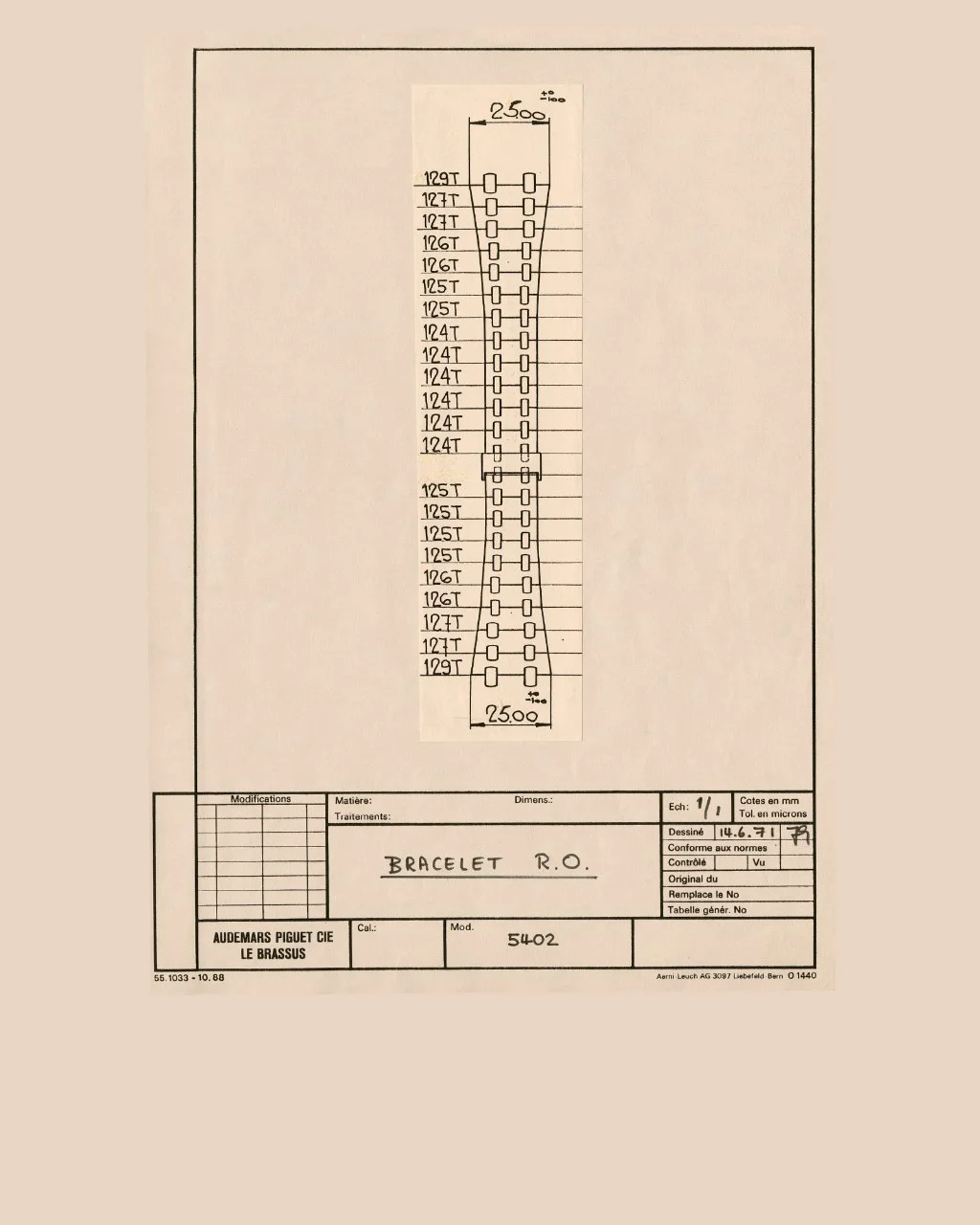
The first 25686BA models were each fitted with an 18-carat yellow gold Bracelet no. 344 produced by Gay Frères (see article dedicated to Royal Oak bracelets), identical to the bracelets fitted to the Royal Oak 5402BA since 1977. The last models are fitted with a Bracelet 944 produced by Werthanor and equipped with a second-generation clasp.
Sales from 1989 to 1996: a total of 70 units, of which 1 (1989), 17 (1990), 17 (1991), 10 (1992), 12 (1993), 3 (1994) and 10 (1996).
The first 25686BA example in yellow gold was sold in November 1989. It would take another seven years to manufacture and distribute the next 69 or so pieces.
The Technical Data presents a watch with a “doré, opalin” (yellow gold-toned, opaline) Stern dial, "beige" subdials highlighted with “rail noir” (black railtrack). This dial is exactly the same as the ones in the Royal Oak 25654BA (1986) and 25554BA (1984) Technical Data. It has also been used in other collections of round watches (e.g. 25550BA) or differently shaped watches (e.g. 25557BA).
The first 25686BA models were each fitted with an 18-carat yellow gold Bracelet no. 344 produced by Gay Frères (see article dedicated to Royal Oak bracelets), identical to the bracelets fitted to the Royal Oak 5402BA since 1977. The last models are fitted with a Bracelet 944 produced by Werthanor and equipped with a second-generation clasp.
Sales from 1989 to 1996: a total of 70 units, of which 1 (1989), 17 (1990), 17 (1991), 10 (1992), 12 (1993), 3 (1994) and 10 (1996).

1995. Royal Oak Perpetual Calendar 25686ST N° 65. Perpetual calendar: day, date, month, phase and age of the moon. Extra-thin selfwinding Calibre 2120/2800 (3.95 mm), movement 374192. Bracelet 944. Dial with Petite Tapisserie pattern. 38 mm case D42082 in steel. Sold in New York in March 1995. Auctioned by Sotheby's in New York on June 15, 2022, lot 21. © Sotheby’s.

Circa 1990. Identification image of Model 25686ST. Audemars Piguet Archives.

Circa1990. Technical data for the Royal Oak Perpetual Calendar Model 25686ST. Audemars Piguet Archives.
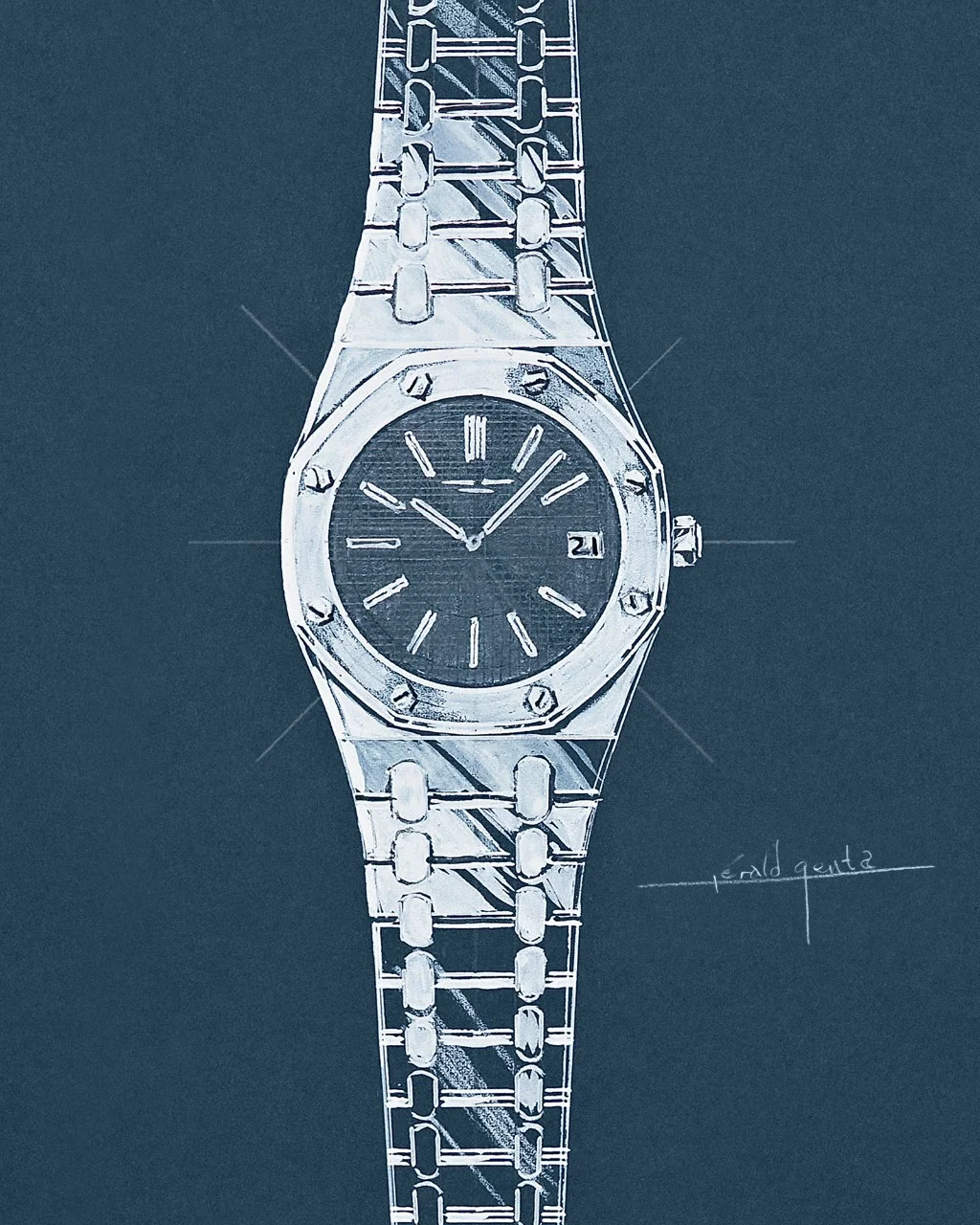
In 1972, the first Royal Oak, Model 5402, made headlines because of its price tag. Valued at CHF 3,300 at the time of its launch, it was the most expensive steel watch in the world. Two decades later, Model 25686ST continued this tradition. The case remained in steel, but the addition of an extra-thin selfwinding perpetual calendar movement significantly increased its value, so that in 1993 the watch was offered at CHF 35,500.
This variant goes back to the roots of the Royal Oak as it is the first variant with a perpetual calendar to feature a T21 Tapisserie dial, as well as openworked hands and hour-markers coated with tritium (a luminescent material). The Technical Data indicates that this variant is graced with a dark blue dial, adorned with nine applied hour-markers and punctuated by three white gold beads.
Sales from 1990 to 1997: a total of 92 units, of which 3 (1990), 5 (1991), 9 (1993), 7 (1994), 15 (1995), 46 (1996) and 7 (1997).
In 1972, the first Royal Oak, Model 5402, made headlines because of its price tag. Valued at CHF 3,300 at the time of its launch, it was the most expensive steel watch in the world. Two decades later, Model 25686ST continued this tradition. The case remained in steel, but the addition of an extra-thin selfwinding perpetual calendar movement significantly increased its value, so that in 1993 the watch was offered at CHF 35,500.
This variant goes back to the roots of the Royal Oak as it is the first variant with a perpetual calendar to feature a T21 Tapisserie dial, as well as openworked hands and hour-markers coated with tritium (a luminescent material). The Technical Data indicates that this variant is graced with a dark blue dial, adorned with nine applied hour-markers and punctuated by three white gold beads.
Sales from 1990 to 1997: a total of 92 units, of which 3 (1990), 5 (1991), 9 (1993), 7 (1994), 15 (1995), 46 (1996) and 7 (1997).

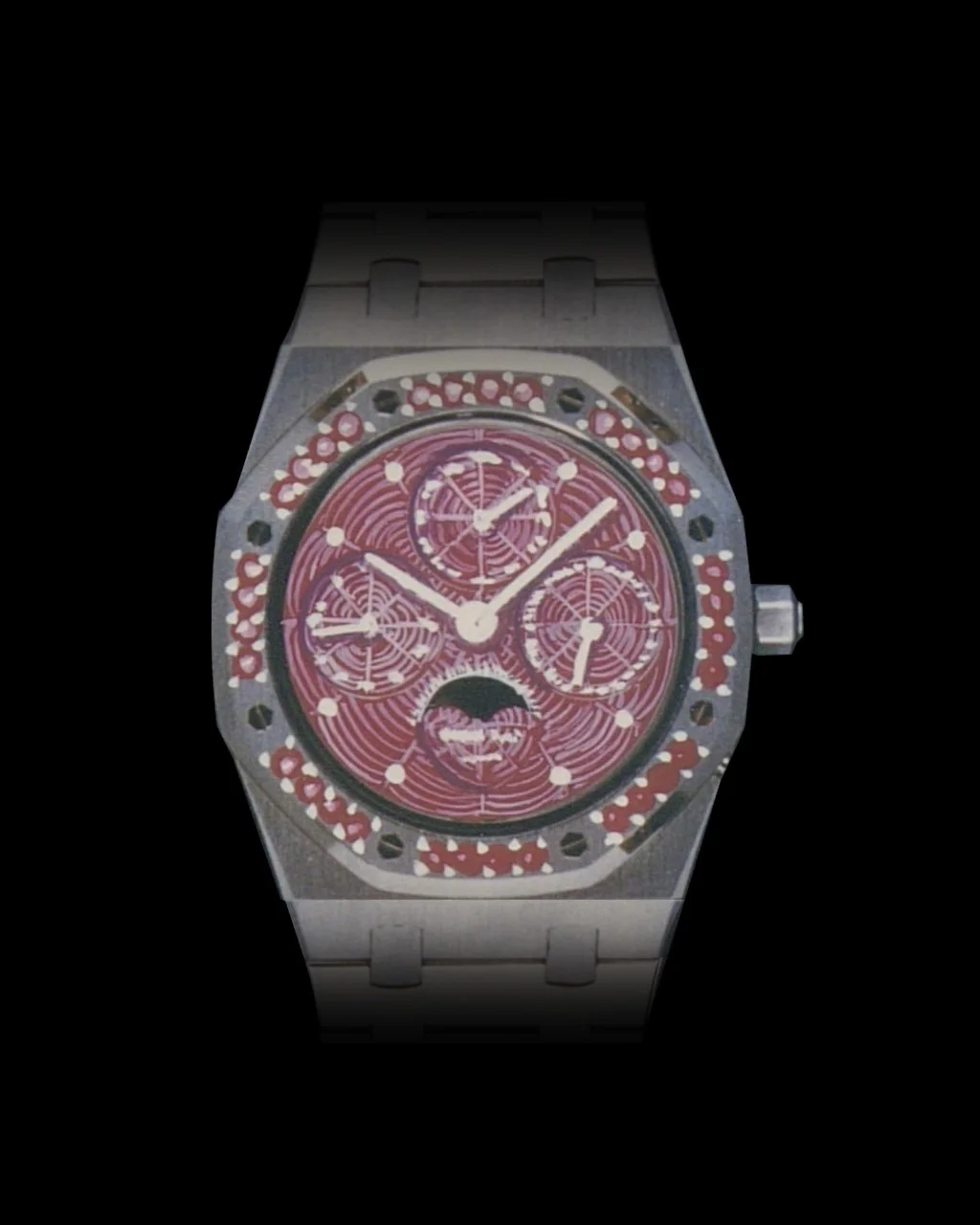
1994. Royal Oak Perpetual Calendar 25686PR N° 03, dial side. Perpetual calendar: day, date, month, phase and age of the moon. Extra-thin selfwinding Calibre 2120/2800 (3.95 mm), Movement 405388. Bracelet 944. 39 mm case D41913 in 18-carat pink gold and platinum. Gemset pink mother-of-pearl dial. Sold in New York in June 1994. Date counter replaced during subsequent restoration work. Audemars Piguet Heritage, inv. 550
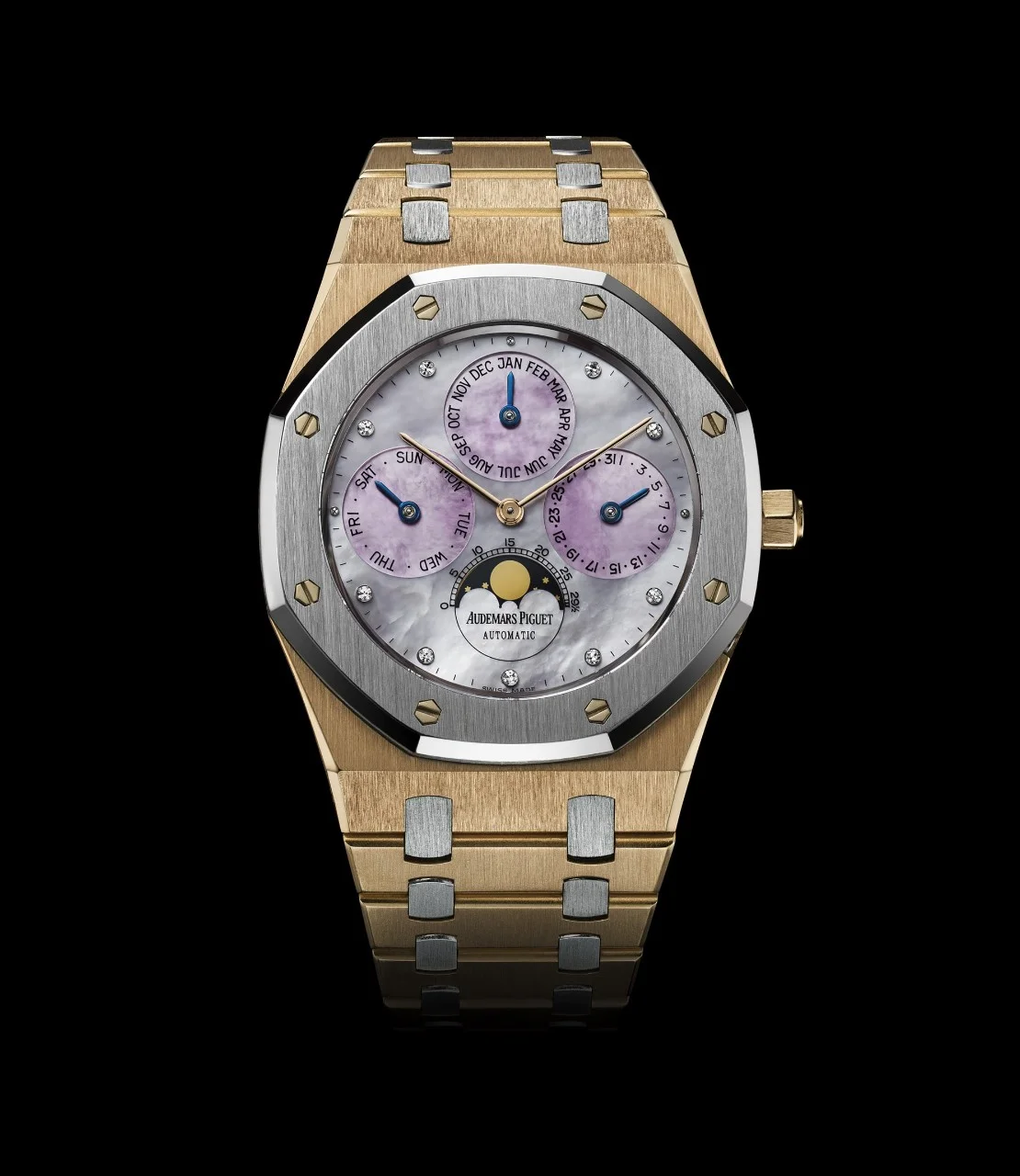
1994. Royal Oak Perpetual Calendar 25686PR N° 03, caseback side. Perpetual calendar: day, date, month, phase and age of the moon. Extra-thin selfwinding Calibre 2120/2800 (3.95 mm), movement 405388. Bracelet 944. 39 mm case D41913 in 18-carat pink gold and platinum. Gemset pink mother-of-pearl dial. Sold in New York in June 1994. Date counter replaced during subsequent restoration work. Audemars Piguet Heritage, inv. 550.

Circa 1991. Technical data for the Royal Oak Perpetual Calendar Model 25686RP. Audemars Piguet Archives.

Circa 1991. Identification image of the Royal Oak Perpetual Calendar Model 25686RP. Audemars Piguet Archives.

Circa 1991. Identification image of the Royal Oak Perpetual Calendar 25686RP. Audemars Piguet Archives.
The initials "RP" are a contraction of "OR" (pink gold) and PT (platinum). In this variant, the bezel and studs are made of platinum, while the case middle and links are made of 18-carat pink gold.
The Technical Data for Model 25686RP indicates that the dial is in pink mother-of-pearl. The expert appraisal of no. 03 of this model, exhibited since 2020 in the Musée Atelier Audemars Piguet, showed that the pink colour was obtained by colouring the back of the dial in red. The counters being slightly thinner than the rest of the dial, they are more translucent and their colour more intense.
The hour-markers are replaced by brilliant-cut diamonds set in small white gold sockets secured to the mother-of-pearl.
Sales from 1991 to 1998: a total of 37 units, of which 1 (1991), 3 (1993), 26 (1994), 3 (1995), 3 (1996) and 1 (1998).
The initials "RP" are a contraction of "OR" (pink gold) and PT (platinum). In this variant, the bezel and studs are made of platinum, while the case middle and links are made of 18-carat pink gold.
The Technical Data for Model 25686RP indicates that the dial is in pink mother-of-pearl. The expert appraisal of no. 03 of this model, exhibited since 2020 in the Musée Atelier Audemars Piguet, showed that the pink colour was obtained by colouring the back of the dial in red. The counters being slightly thinner than the rest of the dial, they are more translucent and their colour more intense.
The hour-markers are replaced by brilliant-cut diamonds set in small white gold sockets secured to the mother-of-pearl.
Sales from 1991 to 1998: a total of 37 units, of which 1 (1991), 3 (1993), 26 (1994), 3 (1995), 3 (1996) and 1 (1998).
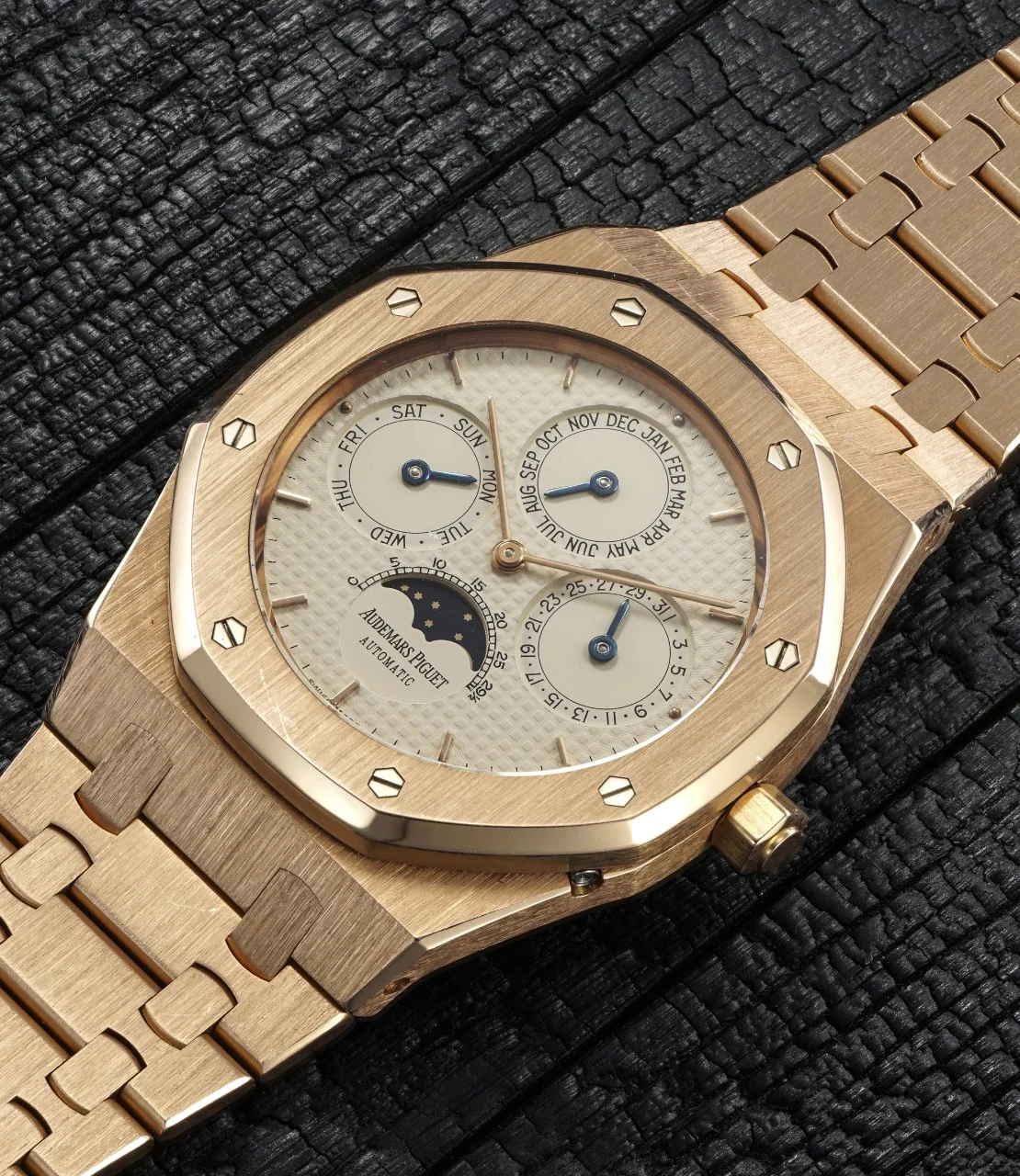
1994. Royal Oak Perpetual Calendar 25686OR N° 12, dial side. Perpetual calendar: day, date, month, phase and age of the moon. Extra-thin selfwinding Calibre 2120/2800 (3.95 mm), movement 405396. Bracelet 944. Creamy white painted dial with Petite Tapisserie pattern. 39 mm case D34421 in 18-carat pink gold. Sold in August 1994. Auctioned by Phillips in Geneva on 6 May 2022, lot 36. © Phillips.

1994. Royal Oak Perpetual Calendar Model 25686OR N° 12, caseback side. Perpetual calendar: day, date, month, phase and age of the moon. Extra-thin selfwinding Calibre 2120/2800 (3.95 mm), movement 405396. Bracelet 944. Creamy white painted dial with Petite Tapisserie pattern. 39 mm case D34421 in 18-carat pink gold. Sold in August 1994. Auctioned by Phillips in Geneva on 6 May 2022, lot 36. © Phillips.

Circa 1993. Identification image of the Royal Oak Perpetual Calendar Model 25686OR. Audemars Piguet Archives.

Circa 1993. Technical data for the Royal Oak Perpetual Calendar Model 25686OR. Audemars Piguet Archives.
The 18 pink gold 25686OR watches were all delivered between 1993 and 1996. Visible from the back of the watch, the movement's plate is gilded in pink gold to match the colour of the case and the pink gold oscillating weight. The latter, like the other variations of this model, is finely openworked and engraved with the AP monogram, standing for Audemars Piguet. On request, these initials could be replaced by motifs personalised for customers: other initials, emblems or any other element that could be realised on this scale.
The variant illustrated in the Technical Data has a creamy white painted Tapisserie dial. The same source mentions the existence of another variant with a pink mother-of-pearl dial.
Sales from 1993 to 1996: a total of 18 units, of which 9 (1993), 6 (1994), 1 (1995) and 2 (1996).
The 18 pink gold 25686OR watches were all delivered between 1993 and 1996. Visible from the back of the watch, the movement's plate is gilded in pink gold to match the colour of the case and the pink gold oscillating weight. The latter, like the other variations of this model, is finely openworked and engraved with the AP monogram, standing for Audemars Piguet. On request, these initials could be replaced by motifs personalised for customers: other initials, emblems or any other element that could be realised on this scale.
The variant illustrated in the Technical Data has a creamy white painted Tapisserie dial. The same source mentions the existence of another variant with a pink mother-of-pearl dial.
Sales from 1993 to 1996: a total of 18 units, of which 9 (1993), 6 (1994), 1 (1995) and 2 (1996).
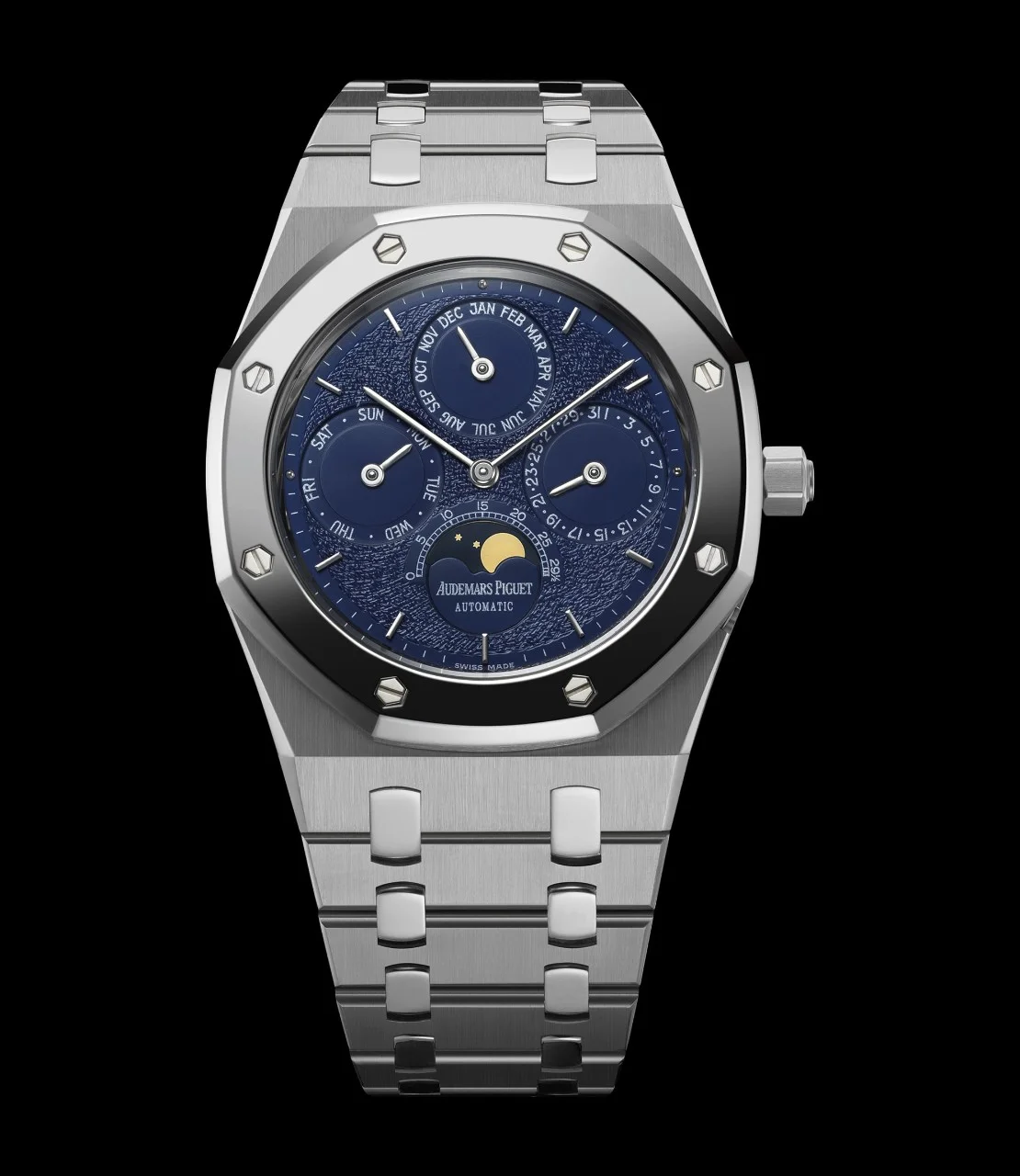
1994. Royal Oak Perpetual Calendar 25686SP N° 06/25, dial side. Perpetual calendar: day, date, month, phase and age of the moon. Extra-thin selfwinding Calibre 2120/2800 (3.95 mm), movement 374056. Bracelet 944. Finely chased “Tuscany blue" dial. 39 mm case D41976 in steel and platinum. Sold in Belgium in September 1994. Audemars Piguet Heritage, inv. 1046.

1994. Royal Oak Perpetual Calendar Model 25686SP N° 06/25. Perpetual calendar: day, date, month, phase and age of the moon. Extra-thin selfwinding Calibre 2120/2800 (3.95 mm), movement 374056. Bracelet 944. Finely chased “Tuscany blue" dial. 39 mm case D41976 in steel and platinum. Sold in Belgium in September 1994. Audemars Piguet Heritage, inv. 1046.

Circa 1994. Identification image of the Royal Oak Perpetual Calendar Model 25686SP. Audemars Piguet Archives.

Circa 1994. Technical data for the Royal Oak Perpetual Calendar Model 25686SP. Audemars Piguet Archives.

1994. Finely chased “Tuscany blue” dial The chasing is done by hand using several different tools, creating a highly irregular yet homogeneous surface. Detail of the Royal Oak 25686SP no. 06/25. Audemars Piguet Heritage, inv. 1046.

1985. Perpetual Calendar Models 5561 and 5568. Documented in 1981 and 1982, the 5561 and 5568 models are the first Audemars Piguet models with chased "Tuscany blue" dials. Audemars Piguet catalogue 1985. Audemars Piguet Archives.

February 1982. Chased “Tuscany blue” dial blank N° 63. This variant was delivered in 1982 and was to have diamonds as hour-markers. Hand-chased dial. Dial maker Stern's file. Audemars Piguet Archives.

Circa 1982. Chased “Tuscany blue” dial N° 208. Intended for the 4285 model (Technical Data in 1982), this dial is entirely chased by hand and then coloured "Tuscany blue", or "Blue N. 7". Dial maker Stern's file. Audemars Piguet Archives.
The "SP" variant, a contraction of ST (steel) and PT (platinum), first appeared in the Royal Oak collection in 1994. It is found simultaneously in Model 25636 model and its openworked variant 25686. Later, Model 25820 and its openworked version Model 25829 were to adopt this same combination. To emphasise the difference in materials, the platinum bezel and studs are mirror-polished, while the steel case middle and links are delicately satin-brushed.
The Technical Data indicates that the dial colour is "Tuscany blue". The term "Tuscany” or “Tuscan” blue which evokes the colour of the sea in Tuscany, has no precise definition, but is found in several fields such as ceramics, leather goods and botany. At Audemars Piguet, the name "Tuscany blue" dial is originally associated not only with a colour, but also with a type of manual engraving known as chasing.
To achieve this decoration, the engraver digs and pushes the material using several tools, in particular scorpers and matt chisels. The difficulty lies in finding the right balance between a very irregular, even chaotic relief and a homogeneous whole that plays with the light.
The oldest Audemars Piguet "Tuscany blue" dials were made for the 5561PT (from 1981) and 5568 (from 1982) round perpetual calendar watches, as well as for Model 4285 (from 1982). After equipping the Royal Oak 25654PT (at least from 1991) and 25686SP (1994), this type of finely chased dial can notably be found on the platinum variant of the Royal Oak Jubilee 14802 (1995), as well as on a one-of-a-kind pocket watch 12501PT from the year 2000. The "Tuscany blue" colour is then used on certain non-chased dials, in particular on Jules Audemars Model 26000PT (2008) and Model 26353PT (2009).
Sales from 1994 to 1996: a total of 26 units, of which 20 (1994), 1 (1995) and 5 (1996).
The "SP" variant, a contraction of ST (steel) and PT (platinum), first appeared in the Royal Oak collection in 1994. It is found simultaneously in Model 25636 model and its openworked variant 25686. Later, Model 25820 and its openworked version Model 25829 were to adopt this same combination. To emphasise the difference in materials, the platinum bezel and studs are mirror-polished, while the steel case middle and links are delicately satin-brushed.
The Technical Data indicates that the dial colour is "Tuscany blue". The term "Tuscany” or “Tuscan” blue which evokes the colour of the sea in Tuscany, has no precise definition, but is found in several fields such as ceramics, leather goods and botany. At Audemars Piguet, the name "Tuscany blue" dial is originally associated not only with a colour, but also with a type of manual engraving known as chasing.
To achieve this decoration, the engraver digs and pushes the material using several tools, in particular scorpers and matt chisels. The difficulty lies in finding the right balance between a very irregular, even chaotic relief and a homogeneous whole that plays with the light.
The oldest Audemars Piguet "Tuscany blue" dials were made for the 5561PT (from 1981) and 5568 (from 1982) round perpetual calendar watches, as well as for Model 4285 (from 1982). After equipping the Royal Oak 25654PT (at least from 1991) and 25686SP (1994), this type of finely chased dial can notably be found on the platinum variant of the Royal Oak Jubilee 14802 (1995), as well as on a one-of-a-kind pocket watch 12501PT from the year 2000. The "Tuscany blue" colour is then used on certain non-chased dials, in particular on Jules Audemars Model 26000PT (2008) and Model 26353PT (2009).
Sales from 1994 to 1996: a total of 26 units, of which 20 (1994), 1 (1995) and 5 (1996).

Circa 1997. Identification image of the Royal Oak Perpetual Calendar Model 25686PR. Audemars Piguet Archives.

Circa 1997. Technical data for the Royal Oak Perpetual Calendar Model 25686PR. Audemars Piguet Archives.

Circa 1997. Identification image of the Royal Oak Perpetual Calendar Model 25686PR. Audemars Piguet Archives.

1997. Royal Oak Perpetual Calendar Model 25686PR N° 08. Perpetual calendar: day, date, month, phase and age of the moon. Extra-thin selfwinding Calibre 2120/2800 (4 mm), movement 396968. Bracelet 944. 39 mm case D44065. 18-carat pink gold and platinum. Sold in the UK in February 1997. Auctioned by Antiquorum in Geneva on March 15, 2015, lot 286. Dial not documented. © Antiquorum.
This variant combines the same materials as the RP model (see above), but in reverse: the bezel and studs are in pink gold while the case middle and links are in platinum. The clasp is in white gold because platinum would have been too soft for such a component.
The Technical Data features illustrations of two metal dial variants, one of which is two-tone (opaline rhodium and black) and the other white with Roman numerals. It is probable that other dials were fitted to this model, but the archives do not enable confirmation of this.
Sales in 1997: a total of 25 units.
This variant combines the same materials as the RP model (see above), but in reverse: the bezel and studs are in pink gold while the case middle and links are in platinum. The clasp is in white gold because platinum would have been too soft for such a component.
The Technical Data features illustrations of two metal dial variants, one of which is two-tone (opaline rhodium and black) and the other white with Roman numerals. It is probable that other dials were fitted to this model, but the archives do not enable confirmation of this.
Sales in 1997: a total of 25 units.