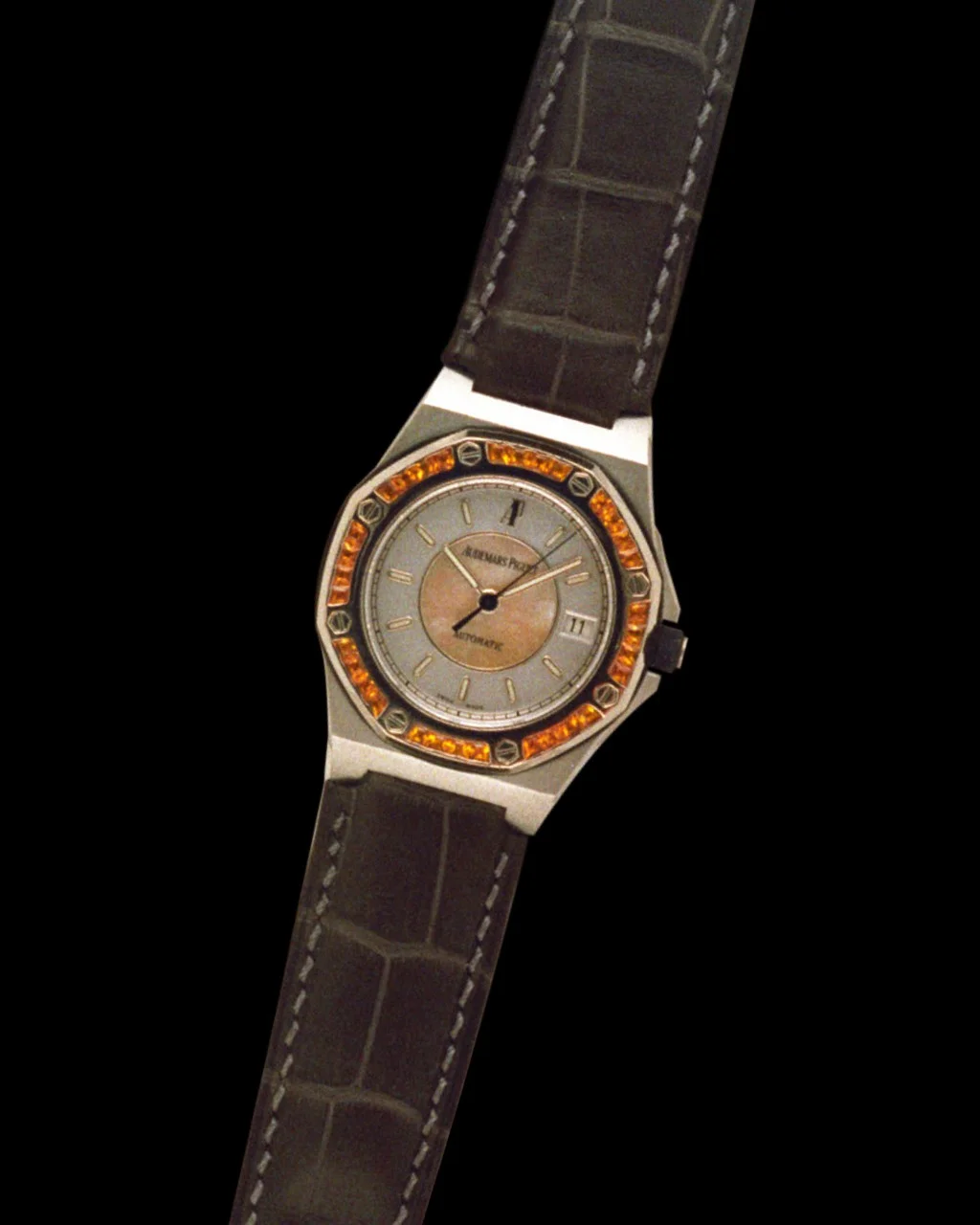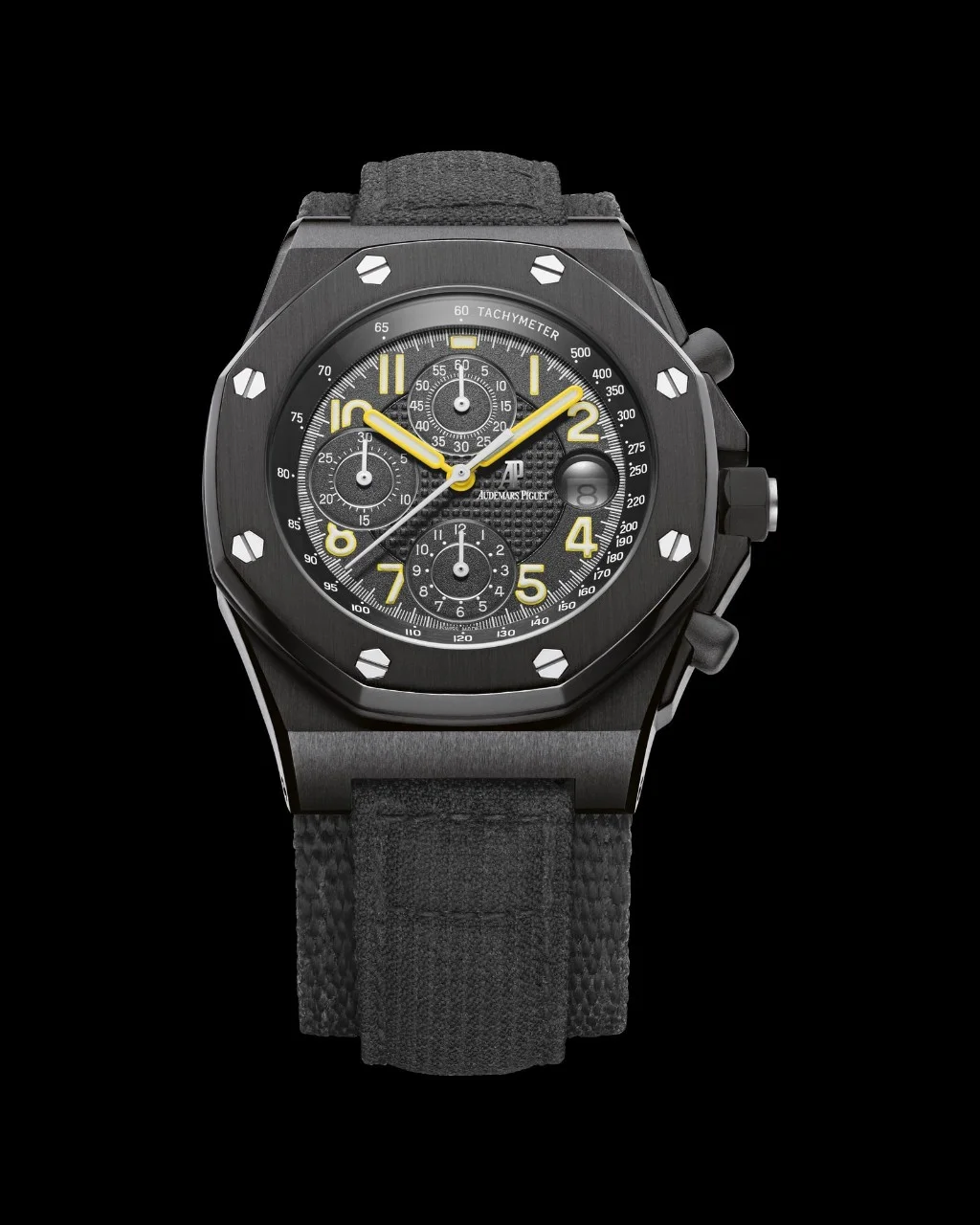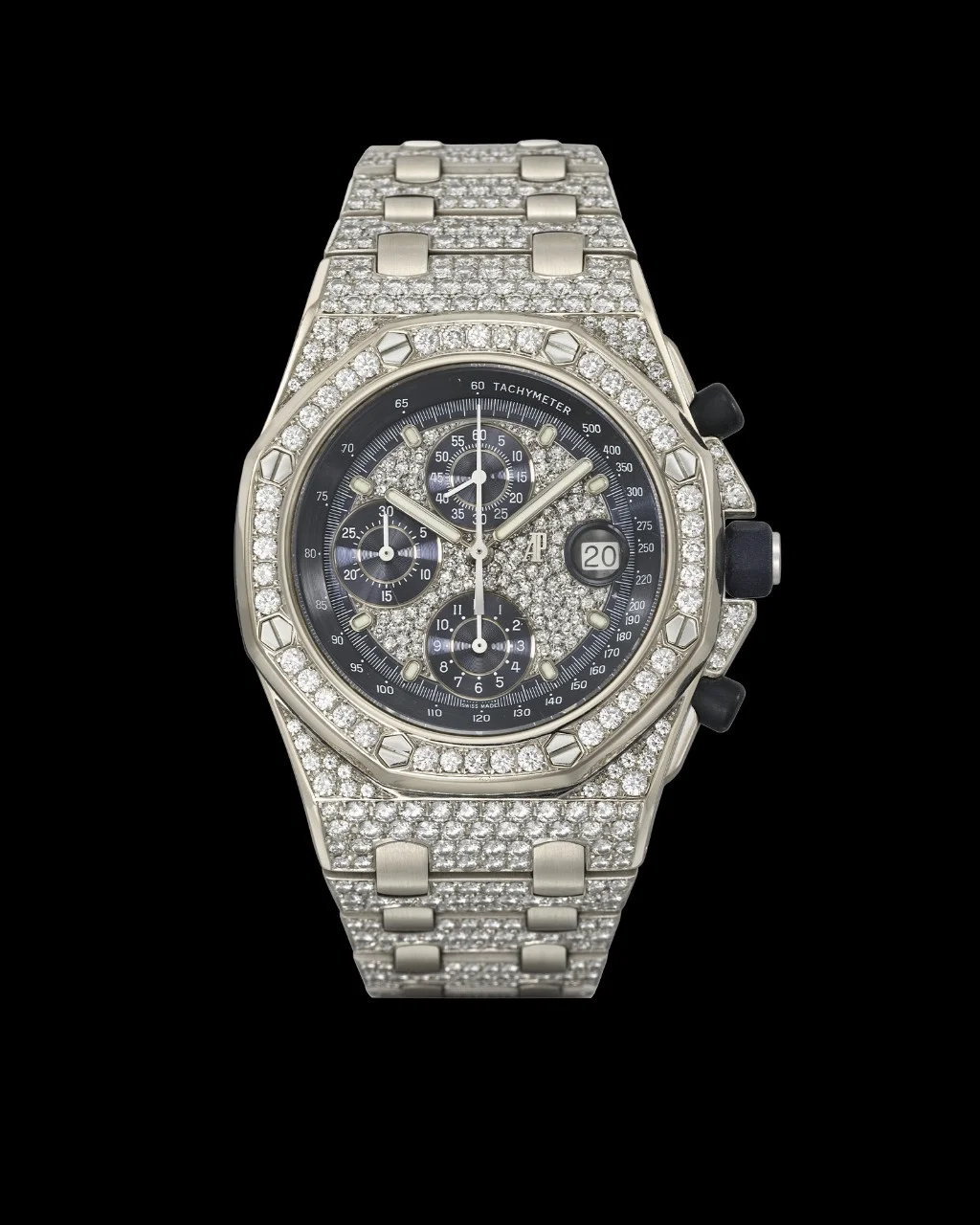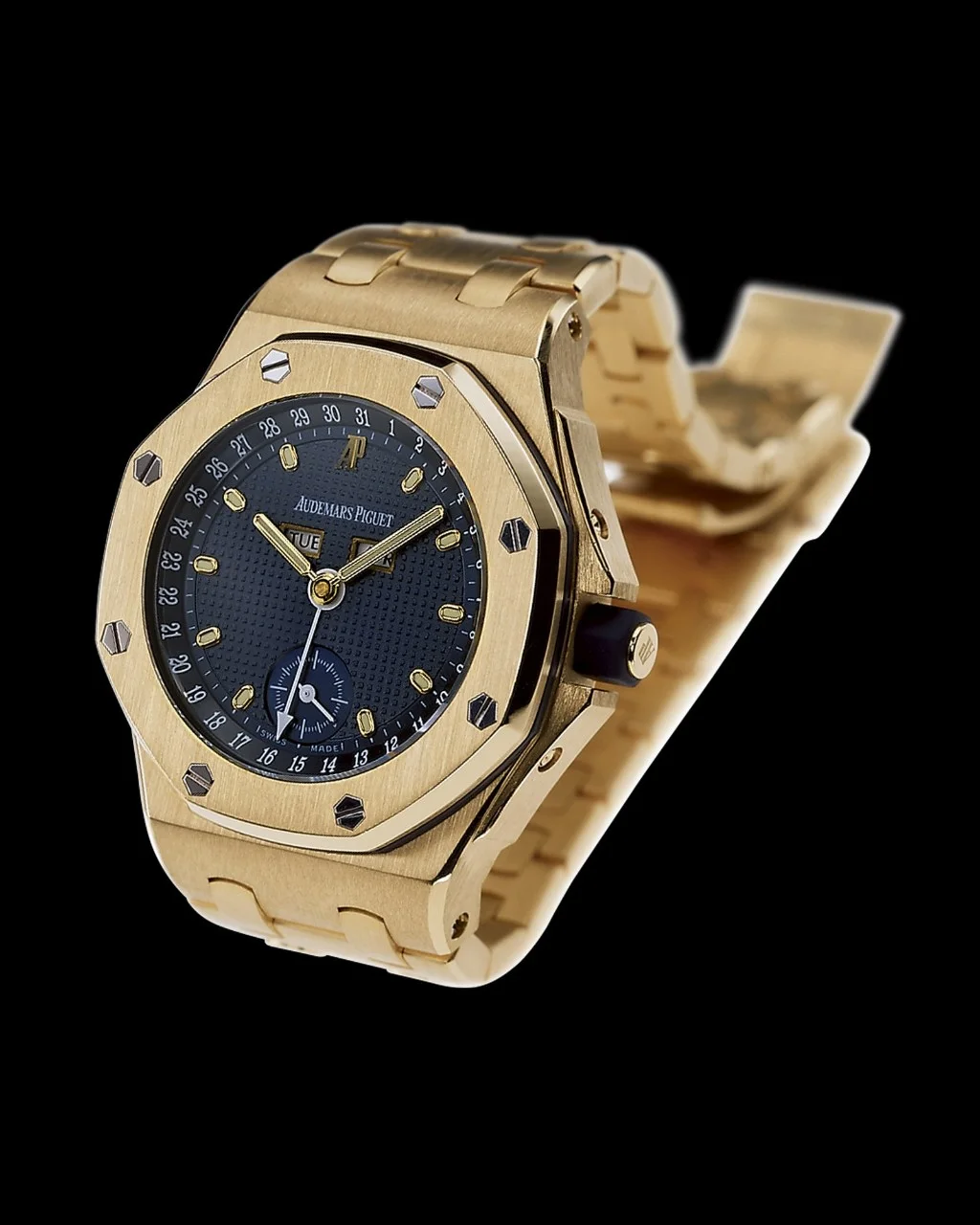
Birth Of The Offshore
Summary
The 1980s
Born in 1993, the Royal Oak Offshore was inspired by the 1980s, a decade marked by the return of economic growth after repeated oil and currency crises. A a time when policies implemented by Reagan and Thatcher were accelerating deregulation and globalisation, geopolitical tensions were subsiding thanks to the Soviet government’s introduction of glasnost (openness).
Grooving to hits from Madonna, Sting and Michael Jackson and dressed in bright, even fluorescent colours, the 1980s generation aspired to hedonism, freedom and success. If one were to choose a term to characterise this decade, it would perhaps be individualism – or better still, a carefree attitude.
Things were also finally looking up for Swiss watchmaking. After ten years of economic and industrial disaster, the industry was gradually recovering from having lost two-thirds of its workforce due to the ravages of the quartz crisis. While the Swatch launched in 1982 proved that modernity, design and inexpensive watchmaking were in fact compatible, it was Haute Horlogerie that would spearhead the revival. After a century of falling average prices for Swiss watches, the trend was being reversed and value would from then on take precedence over volumes.
Audemars Piguet played a central role in this renewal. Its strategic choices during the crisis enabled it to continue growing even during the darkest years. With Georges Golay (1921–1987) at the helm, under the watchful eye of the founding families, the brand launched the Royal Oak in 1972. Alongside the introduction of the first quartz models, Audemars Piguet opted to focus on openworking craftsmanship and very small series. It revived perpetual calendars in 1978, chronographs in 1980 and created the first-ever selfwinding tourbillon wristwatch in 1986.
Despite the context, Audemars Piguet thus pursued its expansion and by the mid-1980s had passed the annual production mark of 11,000 watches, achieved a CHF 60 million turnover and had more than 200 employees, the overwhelming majority of whom still live in the Vallée de Joux. Markets were increasingly structured and active, initiating sporting partnerships and playing a crucial role in launching new ideas.

The 1980s. Portable radio and cassette player. Emblematic of the 1980s, oversized radio and cassette players/recorders accompanied the development of pop music. ©Adobe Stock
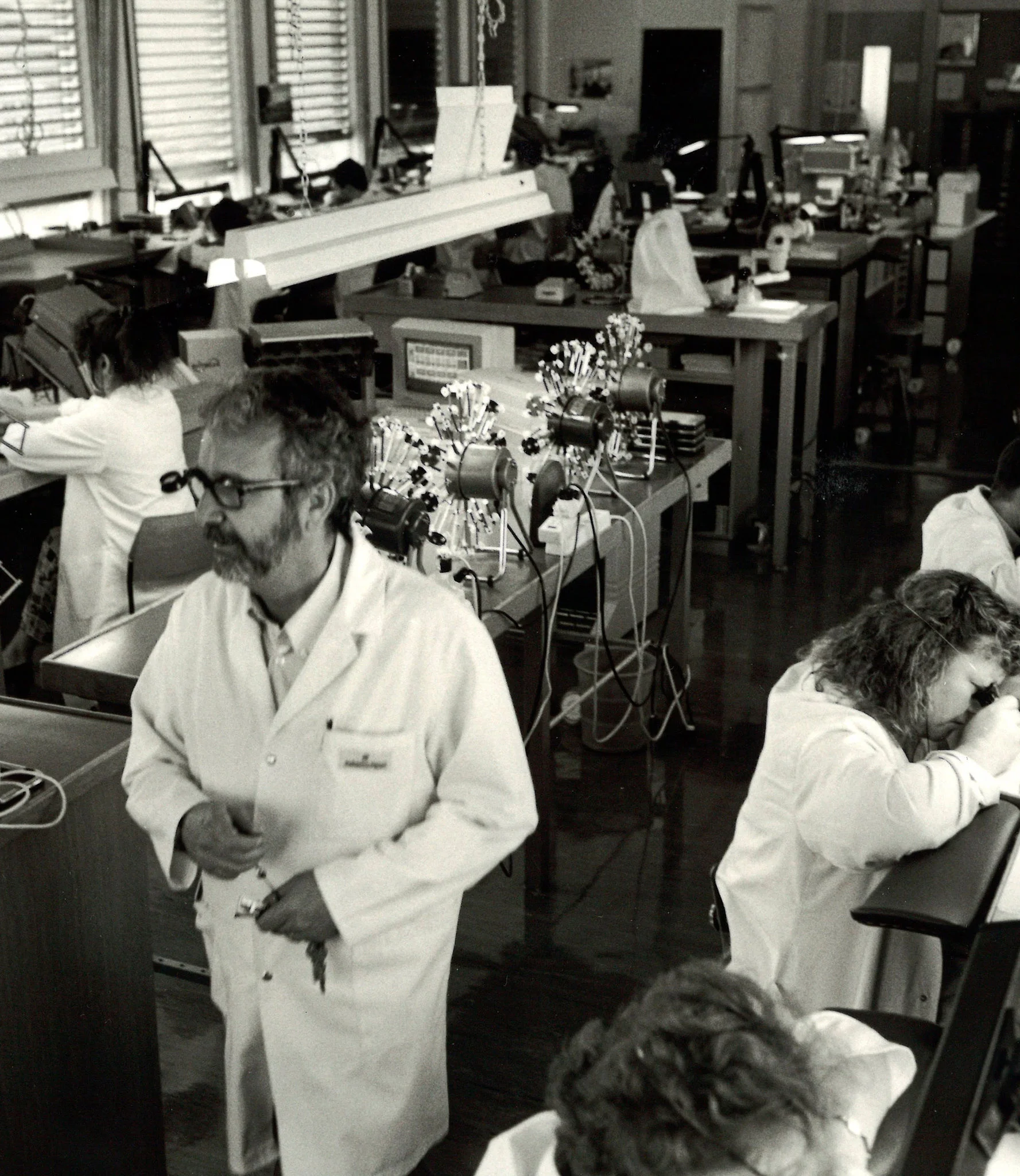
Circa 1980. Assembly workshop. In the early 1980s, Audemars Piguet passed the 200-employee mark. Audemars Piguet Archives.
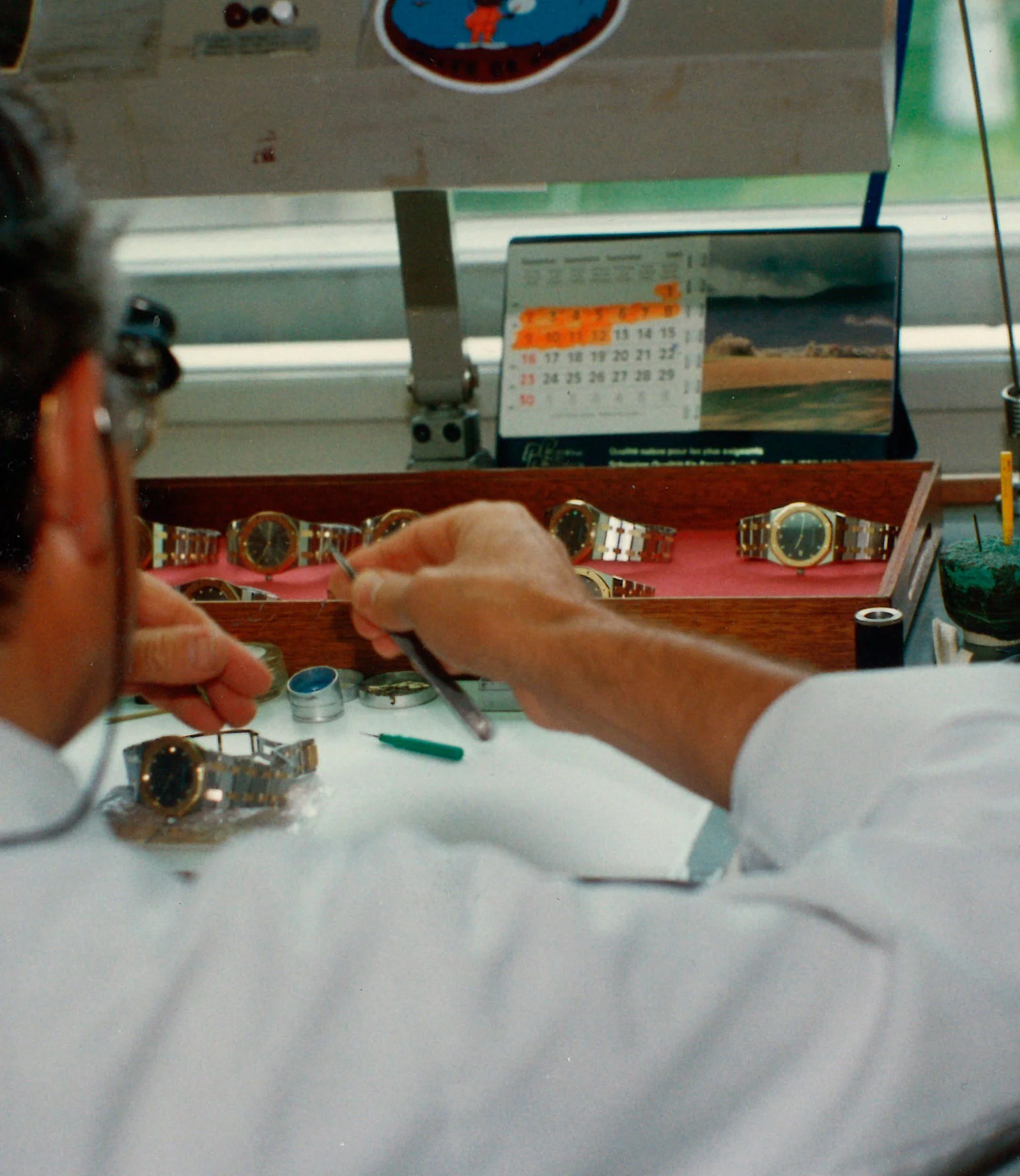
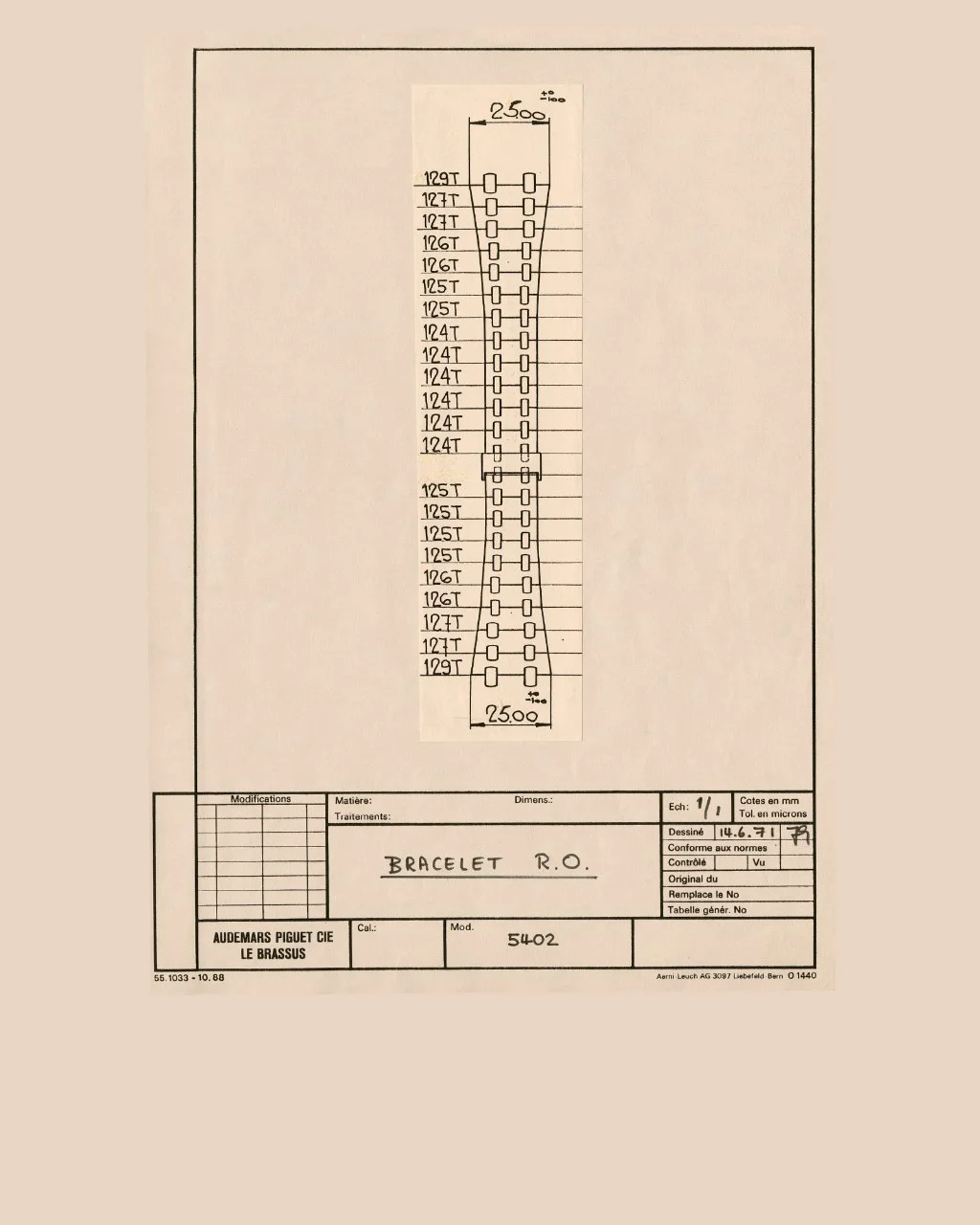
Circa 1980. Adjusting Royal Oak bracelets. In the early 1980s, the Royal Oak Collection was an important part of Audemars Piguet production. Audemars Piguet Archives.
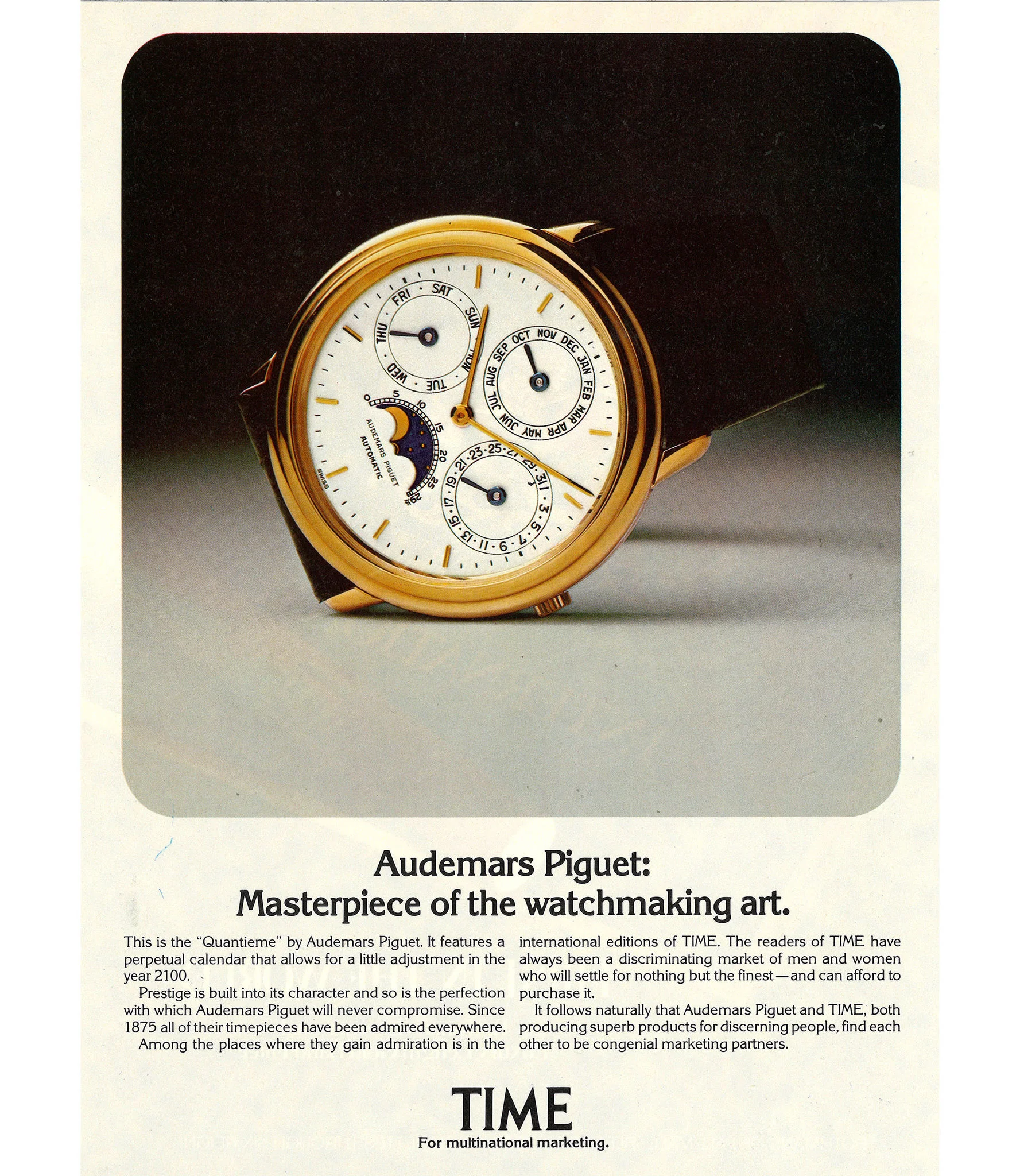
1981. Perpetual Calendar advertisement. Equipped with Calibre 2120/2800, Model 5448 played a leading role in the revival of traditional watchmaking during and after the quartz crisis. Audemars Piguet Archives.
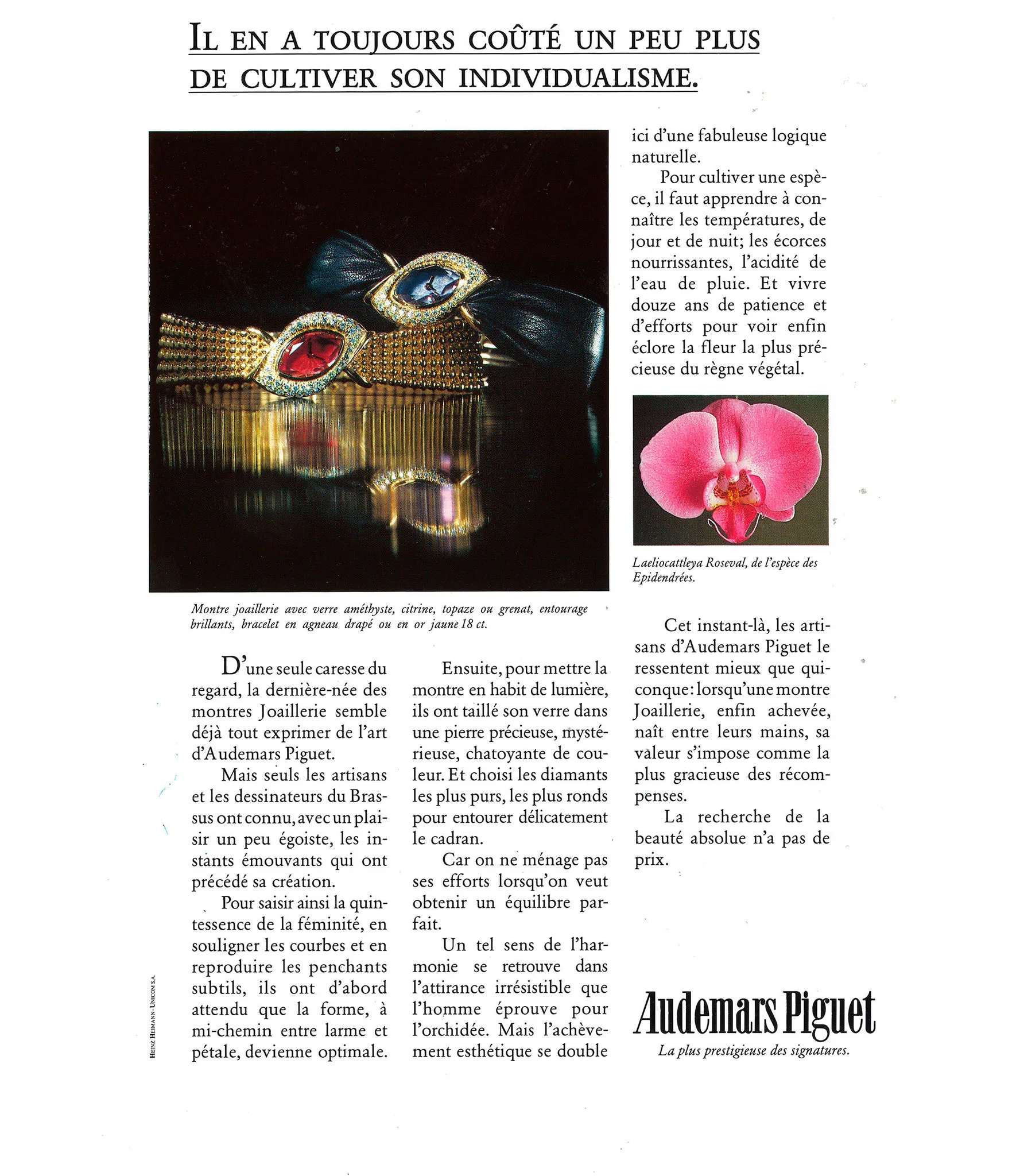
Circa 1986. “Baroque” advertisement. The colourful Baroque collection replaced the conventional watch glass with precious stones: topaz, citrine or amethyst. Audemars Piguet Archives.
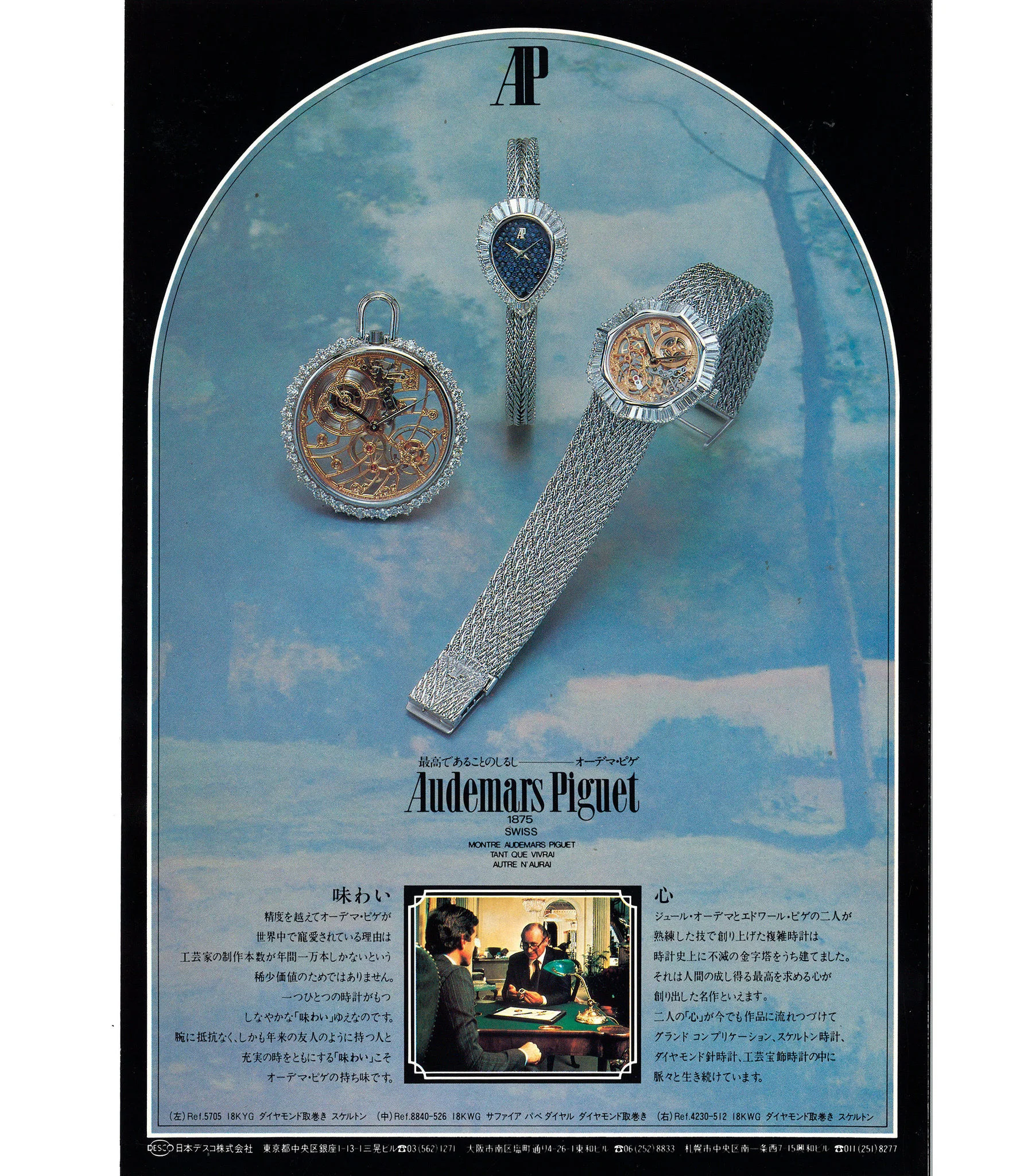
Circa 1980. Audemars Piguet advertisement. Artisans played a central role in the revival of Haute Horlogerie during and after the quartz crisis. Audemars Piguet Archives.
An idea from Germany
The Royal Oak Offshore is one of the most famous collections in recent watchmaking history. Its birth has been recounted countless times, notably by Martin K. Wehrli, former director of the Audemars Piguet Museum. Writing in the Royal Oak anniversary book published in 2012, he stated: “Contrary to its predecessor, the Royal Oak Offshore was not a response to any particular request or expectation expressed by any particular market.” It was thought to have been born from the commercial instincts of the then co-CEO, Stephen Urquhart (who signed Steve), which led him to entrust a young designer with the project of masculinising and rejuvenating the Royal Oak, which was about to celebrate its 20th anniversary.
However, while preparing this article, the Audemars Piguet Heritage team discovered a nugget that had remained in the archives for more than 30 years and which adds to our knowledge. It is an internal memo dated February 2, 1989. In it, Steve Urquhart explains: "In my discussions with Mr Wettengel, he got back to me regarding a leading piece for the 1990s, which he thought should be inspired by the whole 'cigarette/offshore' idea that is becoming increasingly important.”
First, let’s take a look at Dierk Wettengel. Already in charge of the German market for 20 years at the time, he was in a way the counterpart of the Italian Carlo de Marchi, who was one of the initiators of the first Royal Oak. Wettengel had indeed also participated in that initial development, since it was he who commissioned graphic designer Olaf Leu to create the Royal Oak logo in 1972. After managing the UHG (Uhren Handels Gesellschaft, SSIH group) company serving as the brand’s exclusive distributor in Germany since 1982, Dierk Wettengel founded the Audemars Piguet Uhren GmbH distribution firm that took over these prerogatives from 1991 to 2000, when an Audemars Piguet subsidiary was set up in the country. A great promoter of the 2120/2800 perpetual calendar wristwatches, he made Germany a key market for Audemars Piguet complications in the 1980s.
In his note dated February 2, 1989, Steve Urquhart refers to Dierk Wettengel's insistence on creating a "leading piece for the 1990s". But what was he referring to when he used the phrase “the whole 'cigarette /offshore' idea”?

1989. First internal memo on the Offshore project (Excerpt). On February 2, 1989, Steve Urquhart shared German distributor Dierk Wettengel’s recommendation to leverage the "Offshore" concept to create a leading watch for the 1990s. Audemars Piguet Archives.
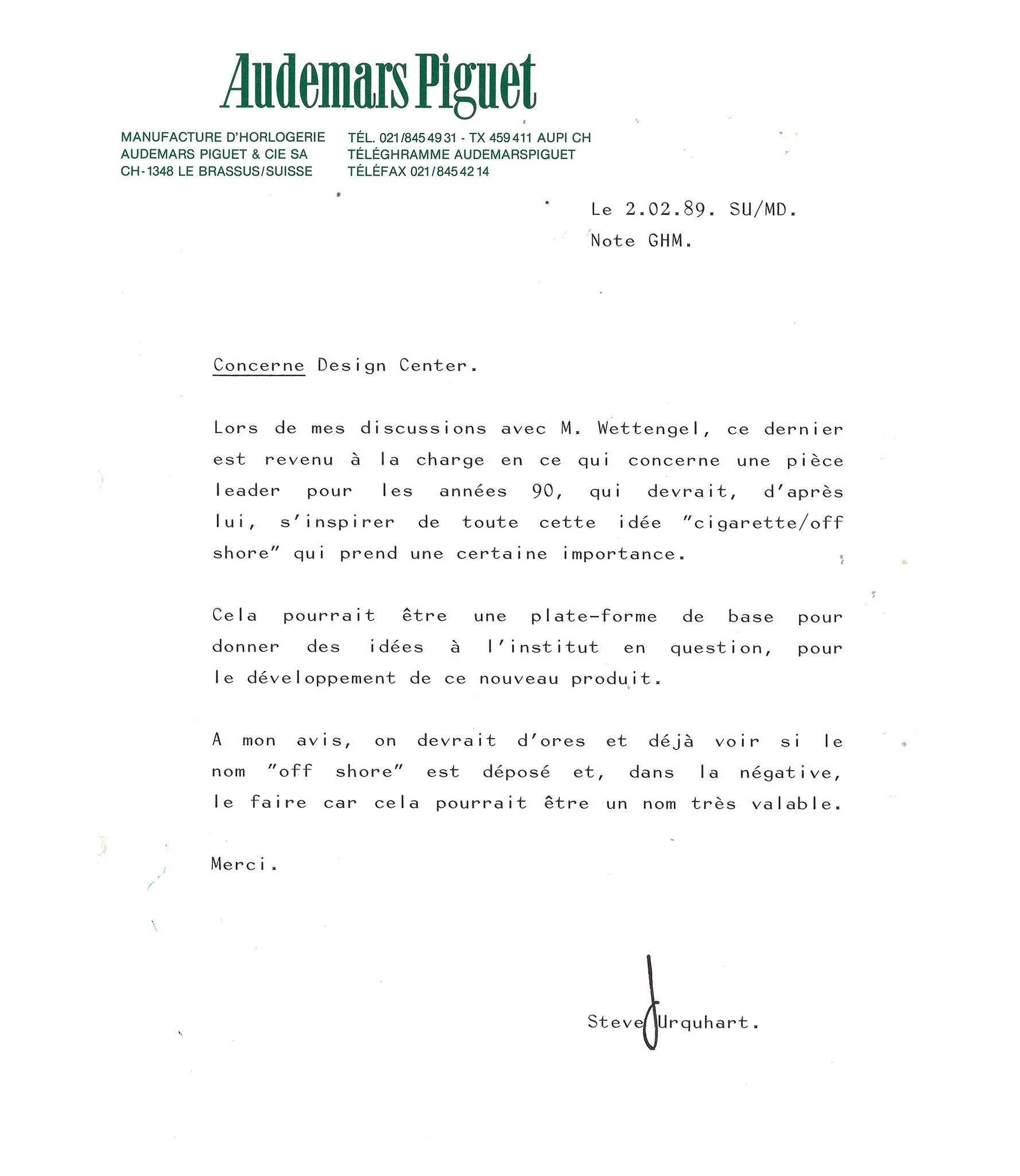
1989. First internal memo on the Offshore project. On February 2, 1989, Steve Urquhart shared German distributor Dierk Wettengel’s recommendation to leverage the "Offshore" concept to create a leading watch for the 1990s. Audemars Piguet Archives.
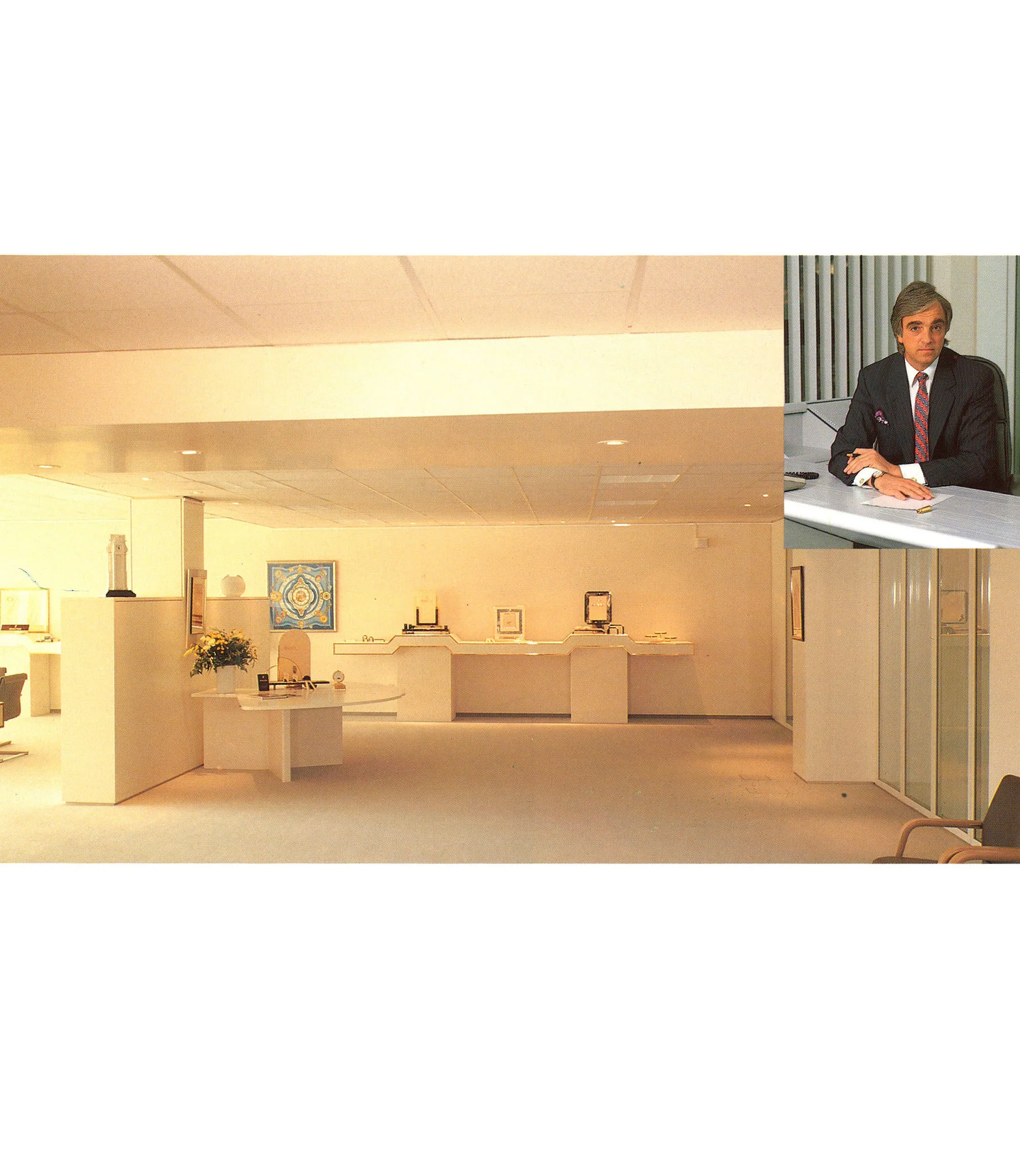
1988. Dierk Wettengel in the Audemars Piguet Uhren GmbH office in Bad Soden. As Managing Director of the German distribution company, Dierk Wettengel played a major role in the development of the Audemars Piguet brand in Germany from 1969 to the late 1990s. AP News 7/1988. Audemars Piguet Archives.
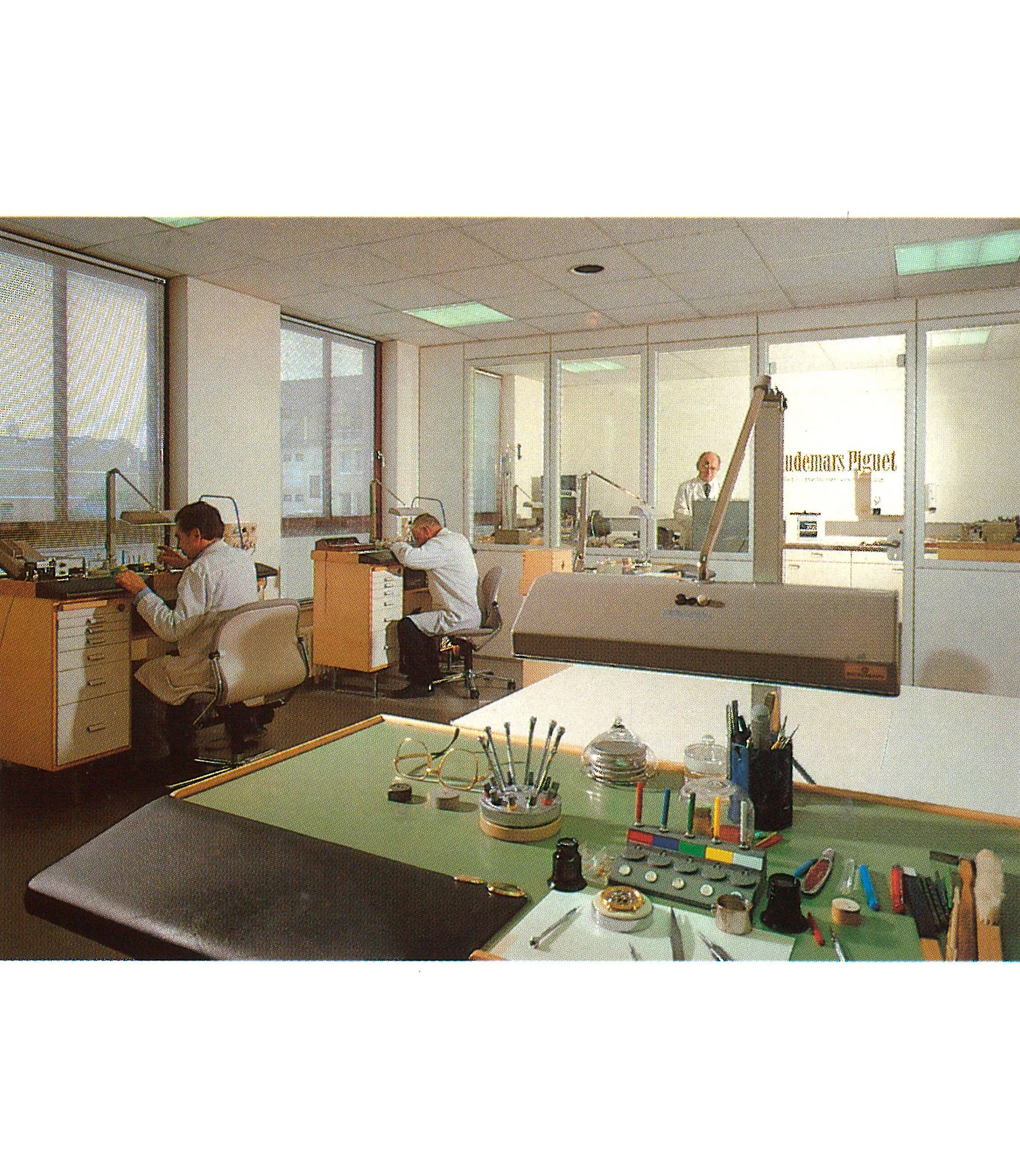
1998. Audemars Piguet After-Sales Service workshops located in Bad Soden, Germany. AP News 7/1988. Audemars Piguet Archives.
Offshore: speed, power and comfort
The note is accompanied by a clipping from a glossy German magazine, promoting the Bullet 31 model from American motorboat brand Cigarette.
Founded in 1969 in New York by businessman and powerboat racer Don Aronow, the Cigarette Racing Team was on the rise at the time. Its sleek boats combined the extreme power of offshore racing boats with the comfort of luxurious interiors. Symbols of the 1980s, they appeared in the cult series Miami Vice (1984–1990).
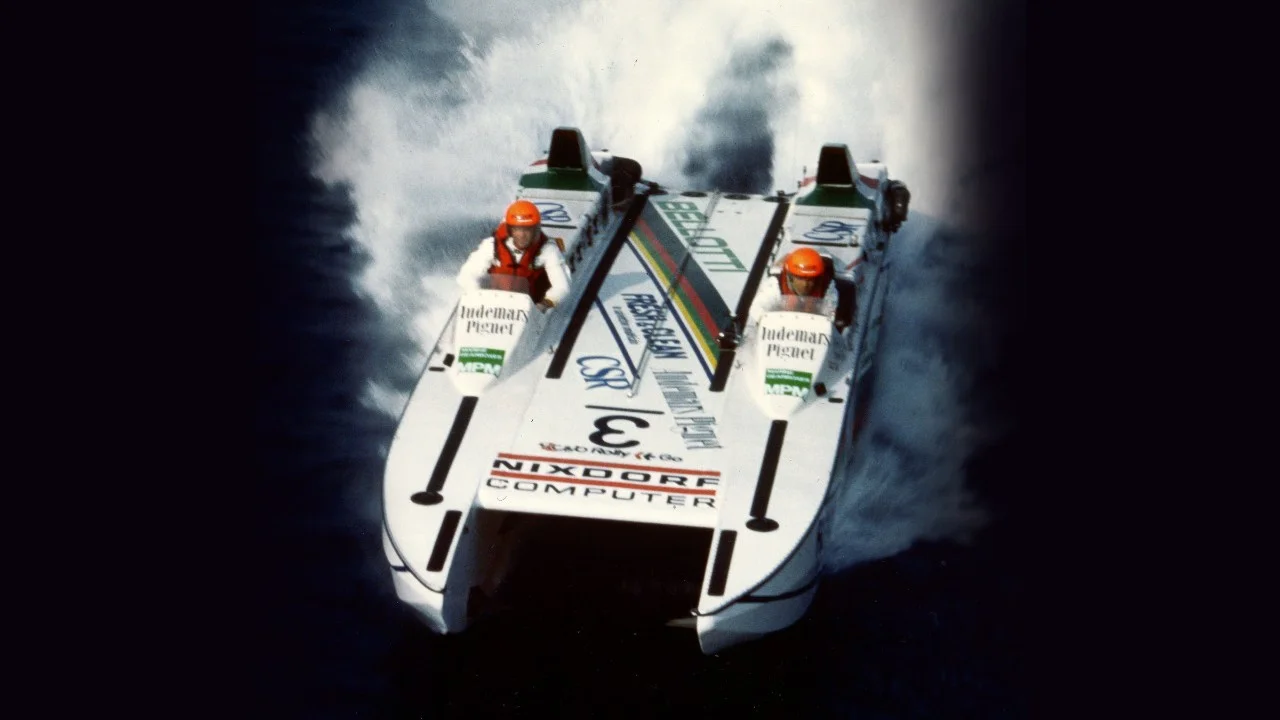
Motorboat racing was booming and Audemars Piguet was very much involved. In 1986, the Audemars Piguet Offshore team consisted of two drivers, Alberto Di Luca and Alessandro Zocchi, who sailed a 10.5-metre resin and Kevlar® catamaran powered by two 150HP engines. On September 6, 1986, the team won the World Offshore Racing Championship in Italy in the 6-litre category. This victory earned the team the titles of World Vice-Champion and European Champion as well as speed record holder.
That same year, the Brand sponsored the "Audemars Piguet Trophy", a prestigious powerboat race from Monaco to Saint-Tropez that was reported on by the press, which spoke of the incredible atmosphere at the race start as the “pack” composed of 35 “monsters” launched with an “infernal roar". Honour to whom honour is due, Prince Albert II of Monaco took first place and was triumphantly awarded the prize at the legendary Club 55 in Saint-Tropez. For the record, Audemars Piguet went on three weeks later to organise a “most handsome guy” competition – the masculine equivalent of a women’s beauty contest – in the same location and the first prize was none other than an Audemars Piguet watch. It should also be noted that a few weeks earlier, in a somewhat different vein, Swiss sailor Pierre Fehlmann triumphed in the Whitbread Round The World race. Officially christened by Prince Albert II of Monaco, his yacht featured a Royal Oak on its spinnaker.
Powerboats boasting absolute comfort, along with hedonism, carefree living and beach parties: it was this emblematic 1980s atmosphere that gave rise to the Royal Oak Offshore.
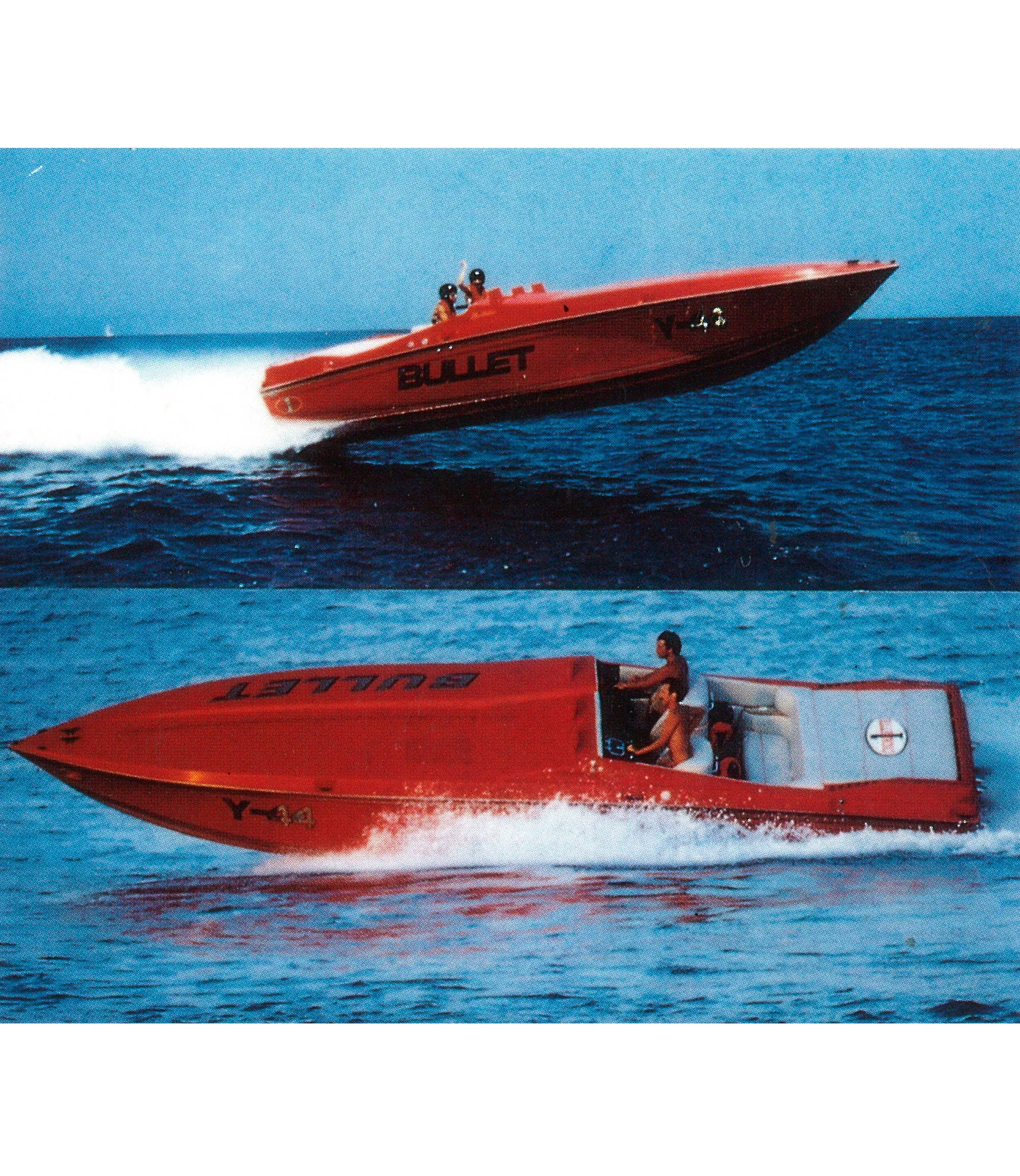
Circa 1989. Cigarette advertisement. This magazine clipping accompanied the memo dated February 2, 1989 in which Steve Urquhart launched the Offshore watch project, at the request of Dierk Wettengel, then in charge of the German market. Audemars Piguet Archives.
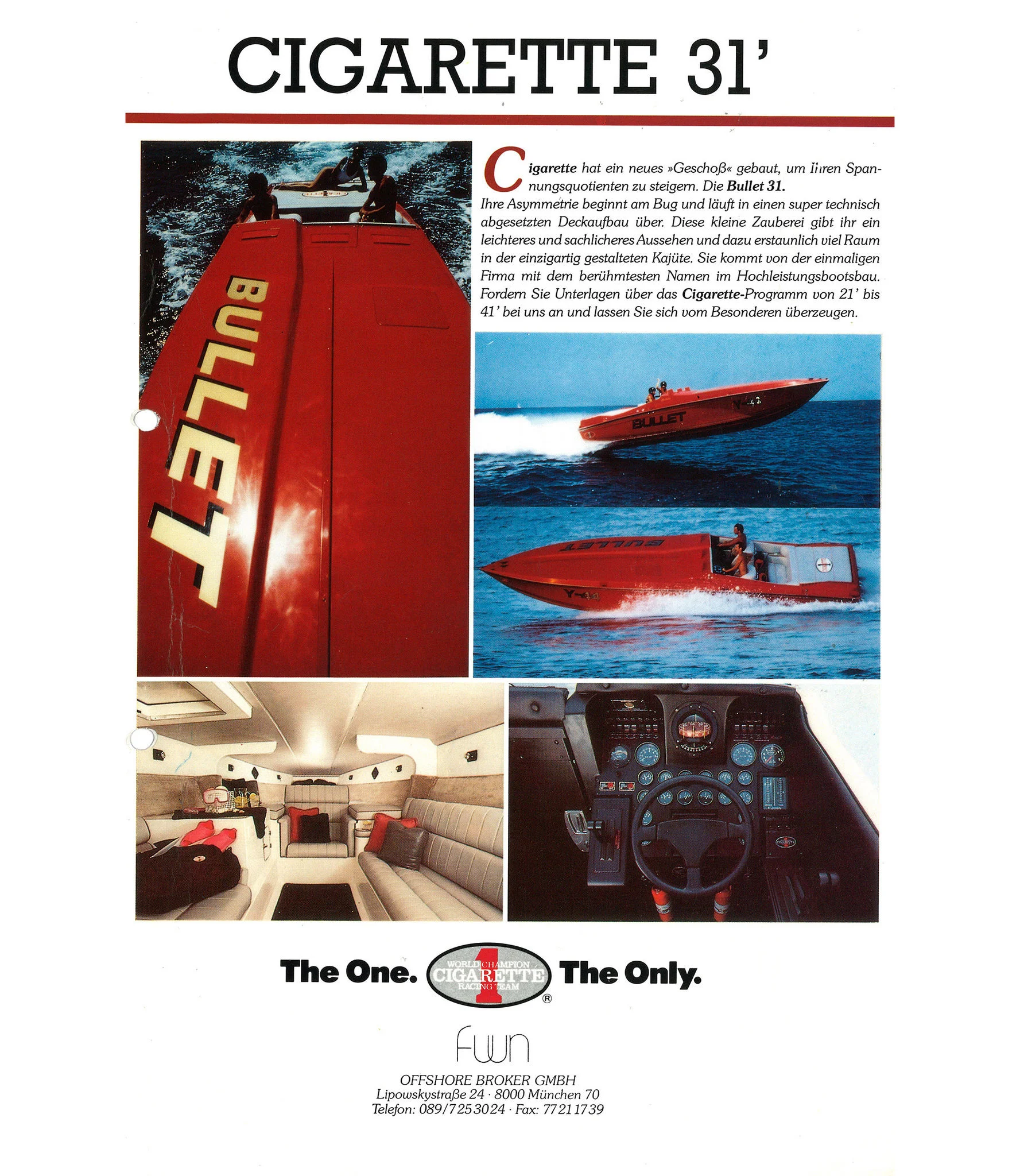
Circa 1989. Cigarette advertising. This magazine clipping accompanied the memo dated February 2, 1989 in which Steve Urquhart launched the Offshore watch project, at the request of Dierk Wettengel, then in charge of the German market. Audemars Piguet Archives.
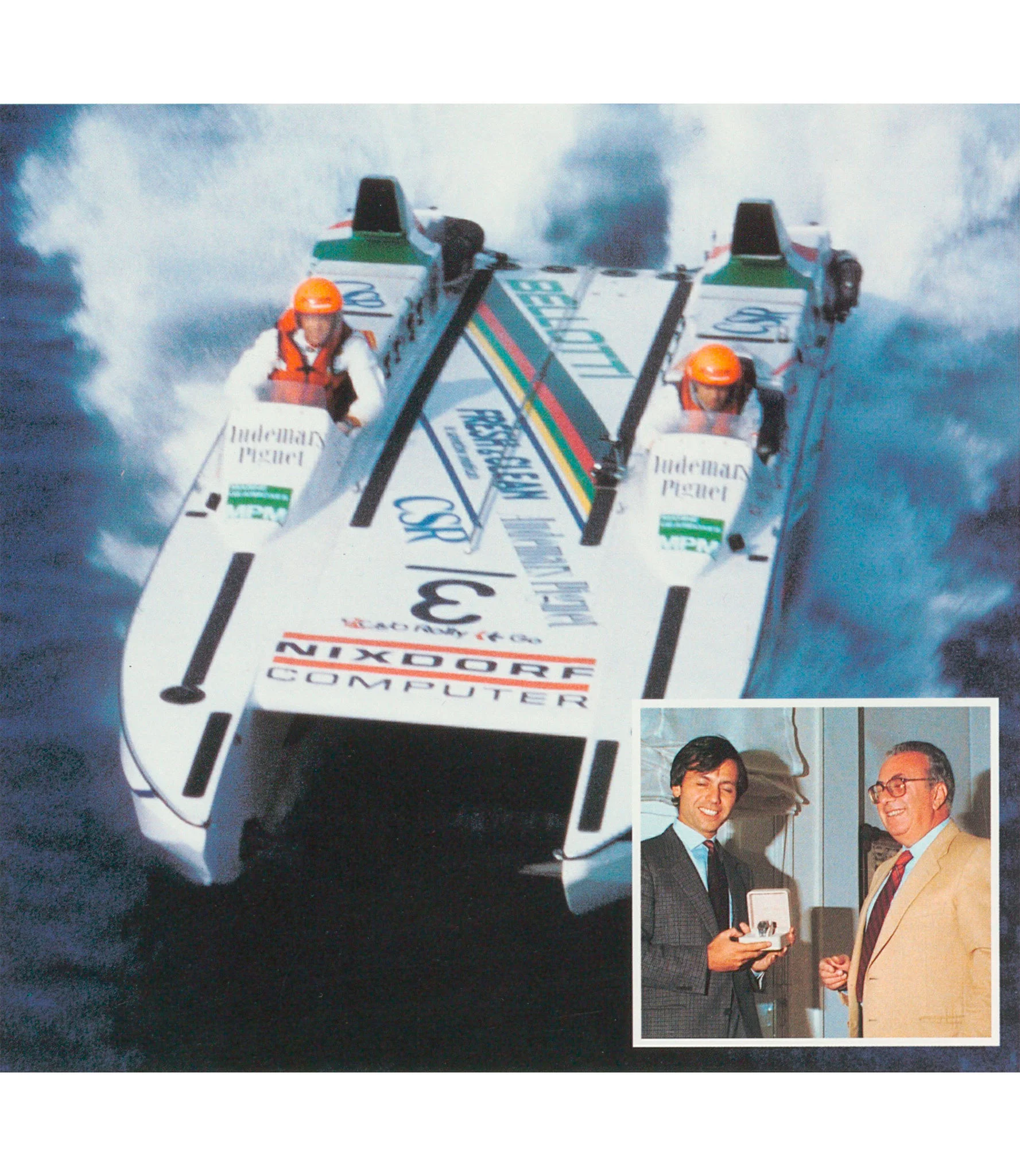
1986. Audemars Piguet Offshore team. In the mid-1980s, Italian drivers Alberto Di Luca and Alessandro Zocchi won numerous races under Audemars Piguet’s colours. APNews 4/1986, Audemars Piguet Archives.

1986. Presentation of the Audemars Piguet trophy to Prince Albert II of Monaco pictured receiving the Audemars Piguet trophy from the hands of the French market director at the time, François Aubert. Audemars Piguet Archives.
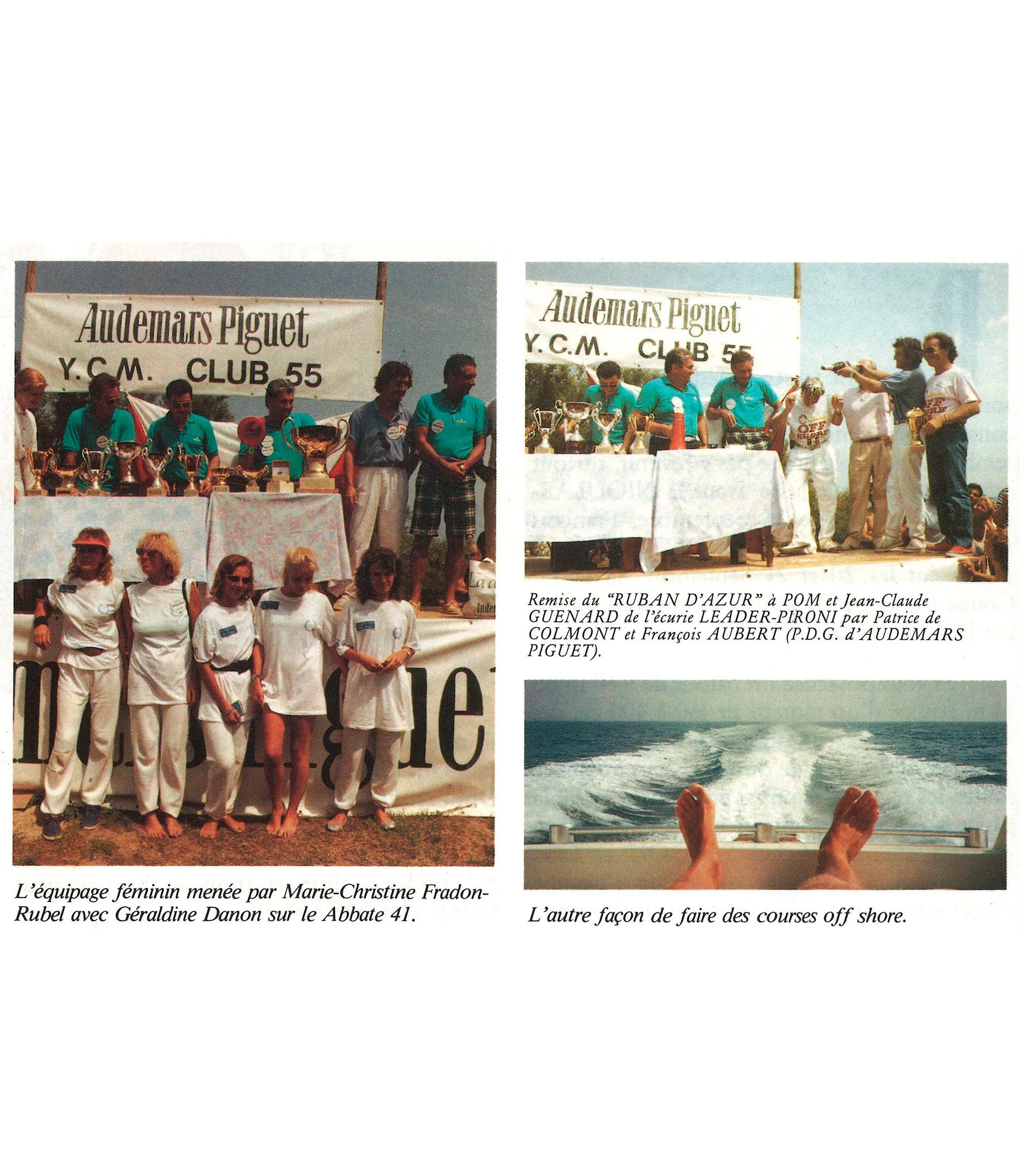
1986. Audemars Piguet Offshore Trophy. The best male and female crews competed in the Monaco to Saint-Tropez race. Above and beyond the sporting challenge, the Offshore spirit reflects an art of living all about parties, beaches, sunshine and farniente. Audemars Piguet Archives.
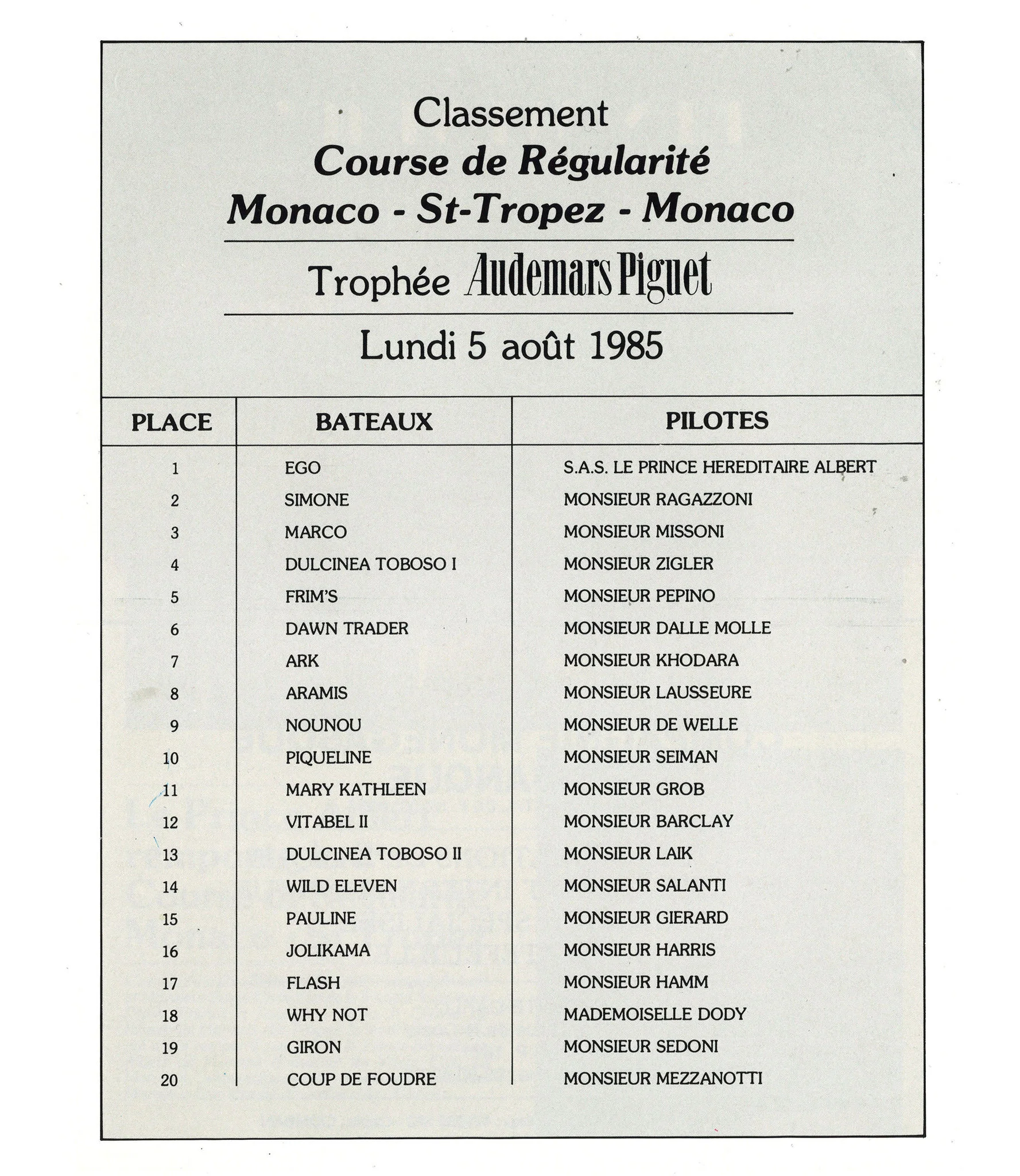
1985. Audemars Piguet Trophy ranking. Audemars Piguet Archives.
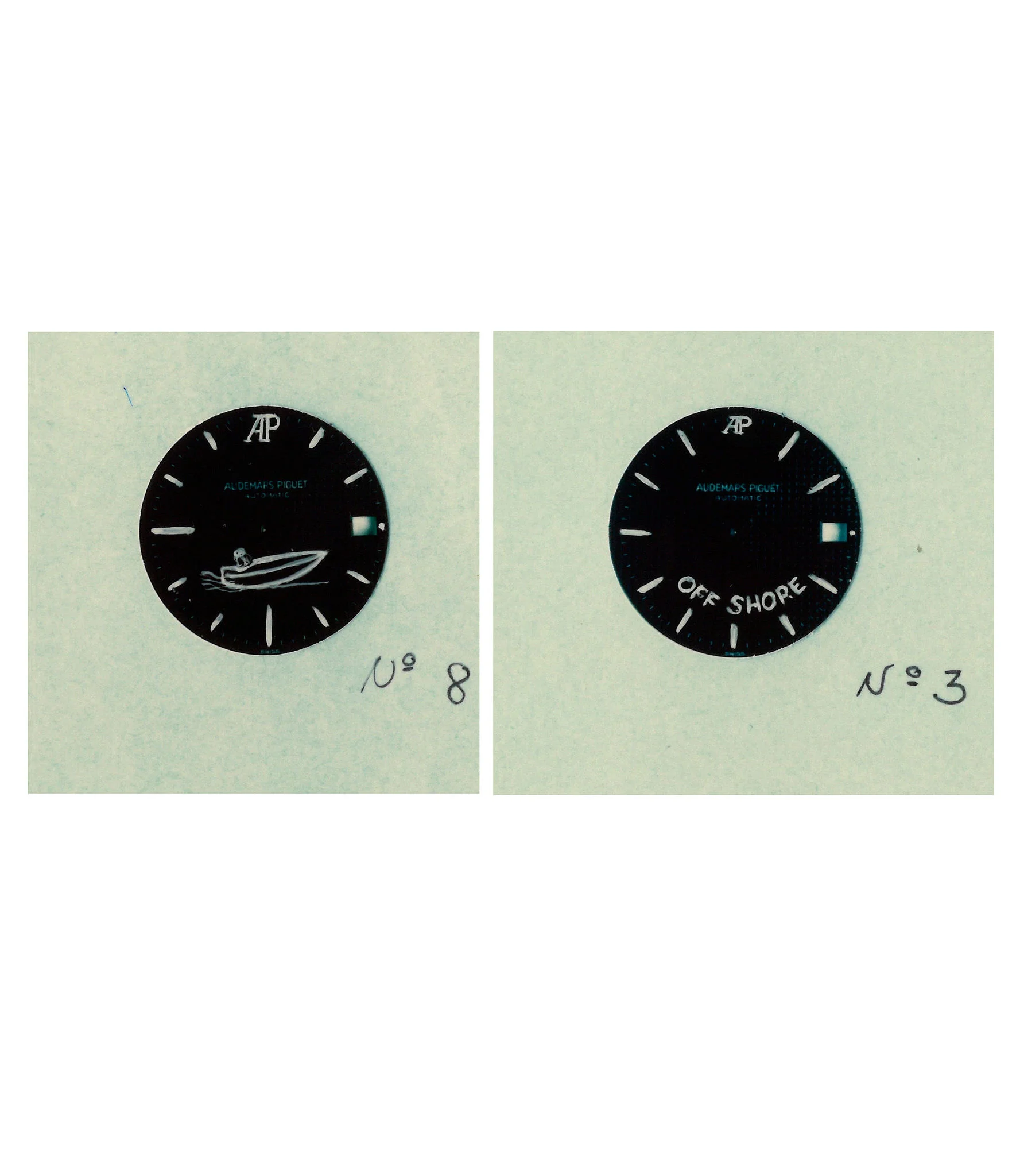
Circa April 1989. Sketches of Offshore dials. A yacht inspired by the Cigarette brand adorns one of the first dials sketched during the emergence of the Offshore idea. Unsigned, undated drawings, probably by Emmanuel Gueit. Audemars Piguet Archives.
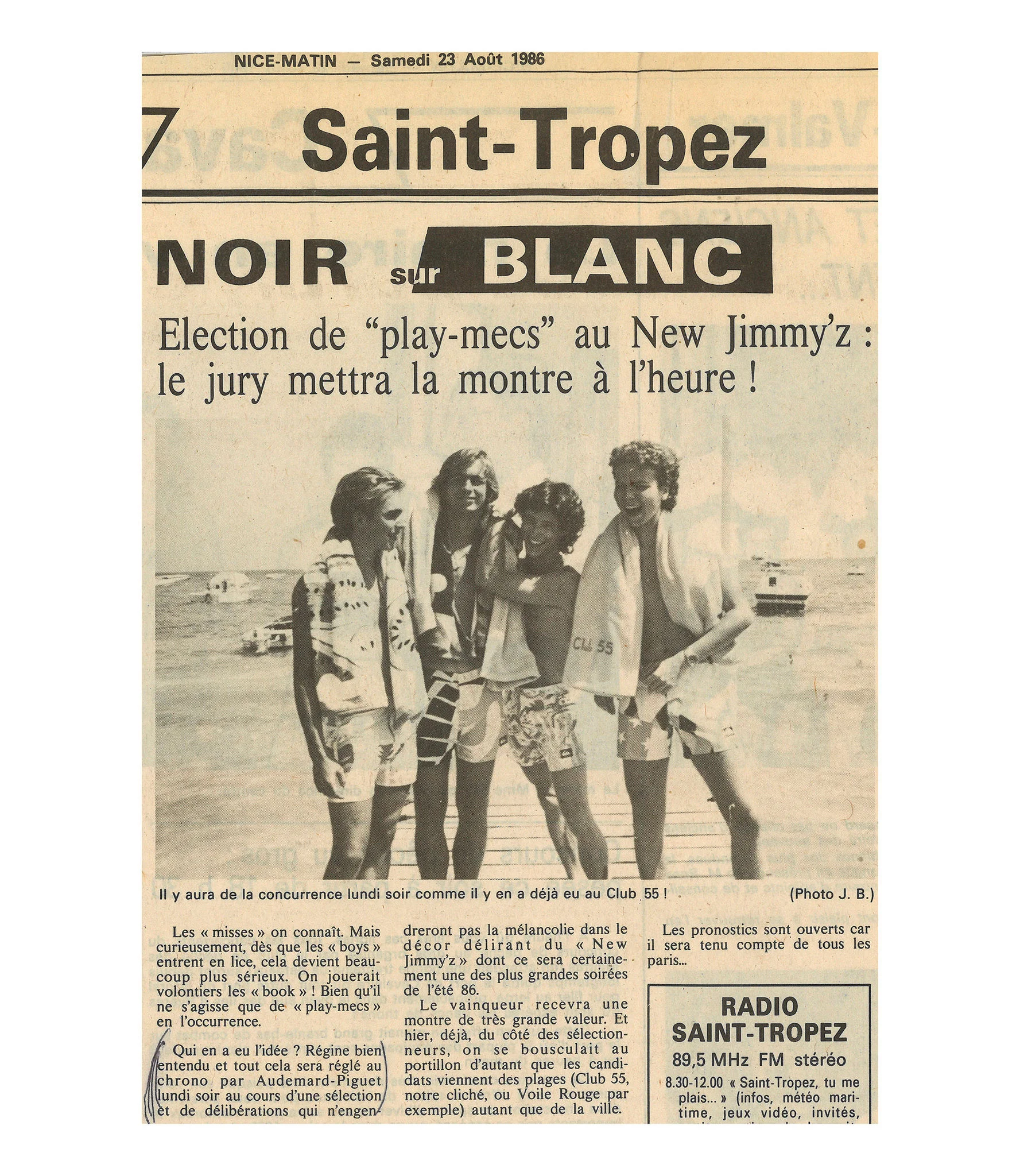
1986. The most handsome guy Hosted by Audemars Piguet, the election of the most handsome guy on the beach at Saint-Tropez echoes feminine beauty contests and reflects the festive spirit of the 1980s. Press clipping (with no place or date) preserved in the Audemars Piguet Archives.
It all began with a name
In a very rare occurrence for Audemars Piguet, the story of the Offshore collection does not begin with a watch design or the invention of a watch function, but instead with the registration of a name.
In his memo, Steve Urquhart took a stand on this issue: "In my opinion, we should already see if the name 'offshore' is registered; and if not, proceed to do so ourselves, as it would be an extremely suitable name." Four days later, Audemars Piguet commissioned a specialised company to register the trademark, which it duly did on February 22, 1989.
At the time, there was no indication that the "Offshore" concept would be applied to the Royal Oak. The name was registered on its own and perhaps the idea was to create from scratch a collection endowed with sporty, super-powered and luxurious attributes.

1989. Application for registration of the Offshore sub-brand. The history of the collection begins with the registration of a trademark, even before the first sketch of the watch. Audemars Piguet Archives.
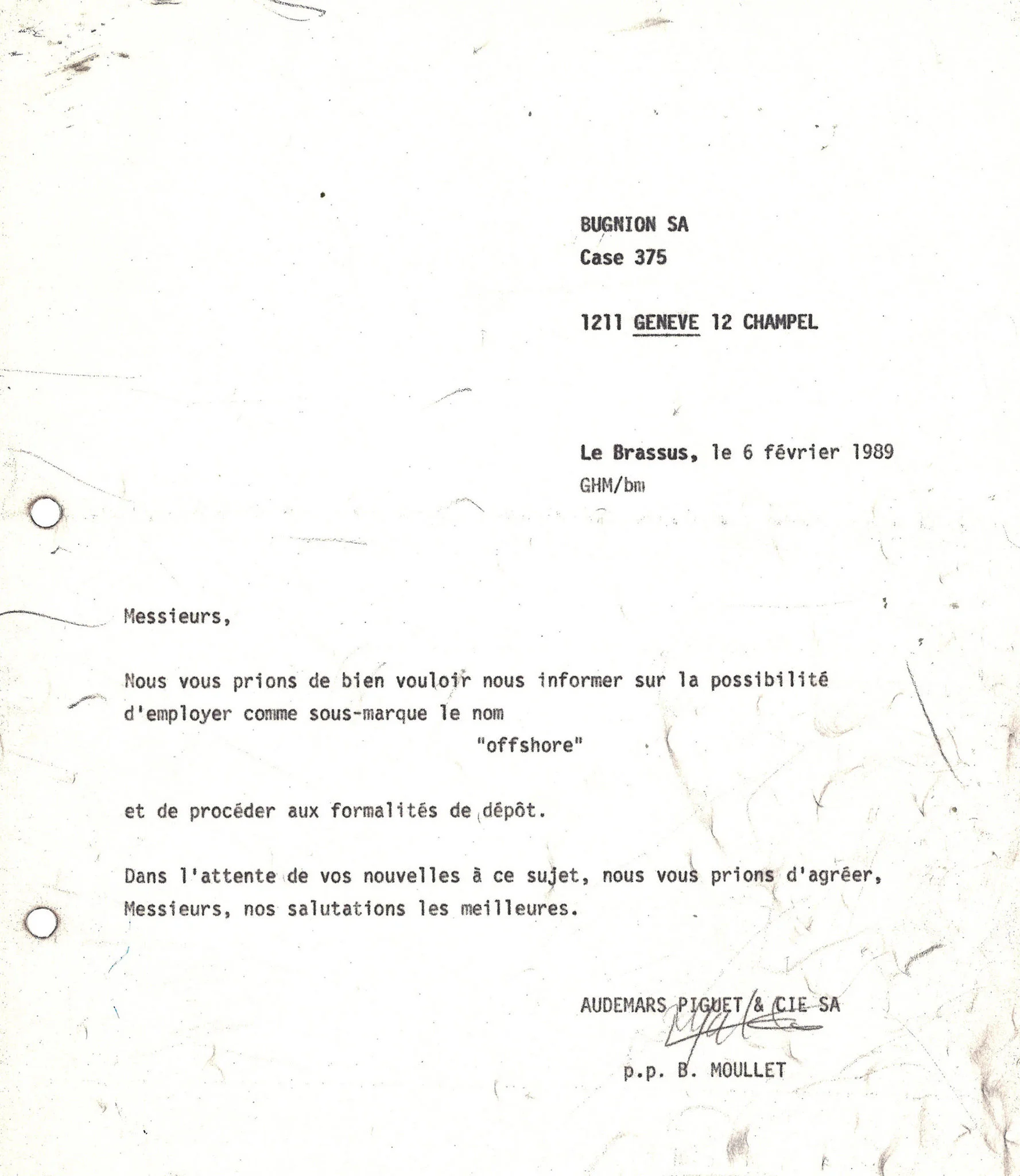
1989. Application for registration of the Offshore sub-brand. The history of the collection begins with the registration of a trademark, even before the first sketch of the watch. Audemars Piguet Archives.
Why not revamp the Royal Oak?
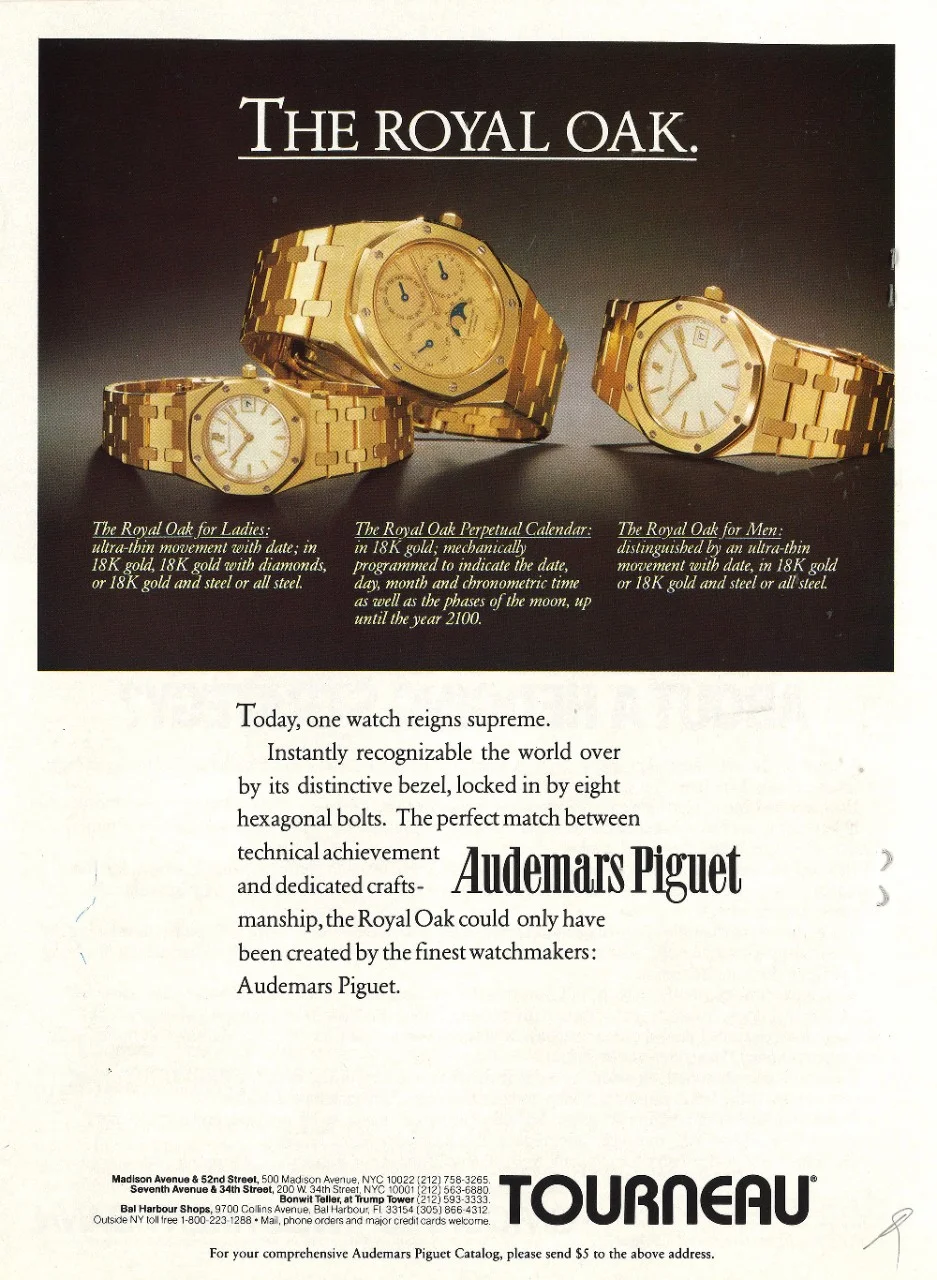
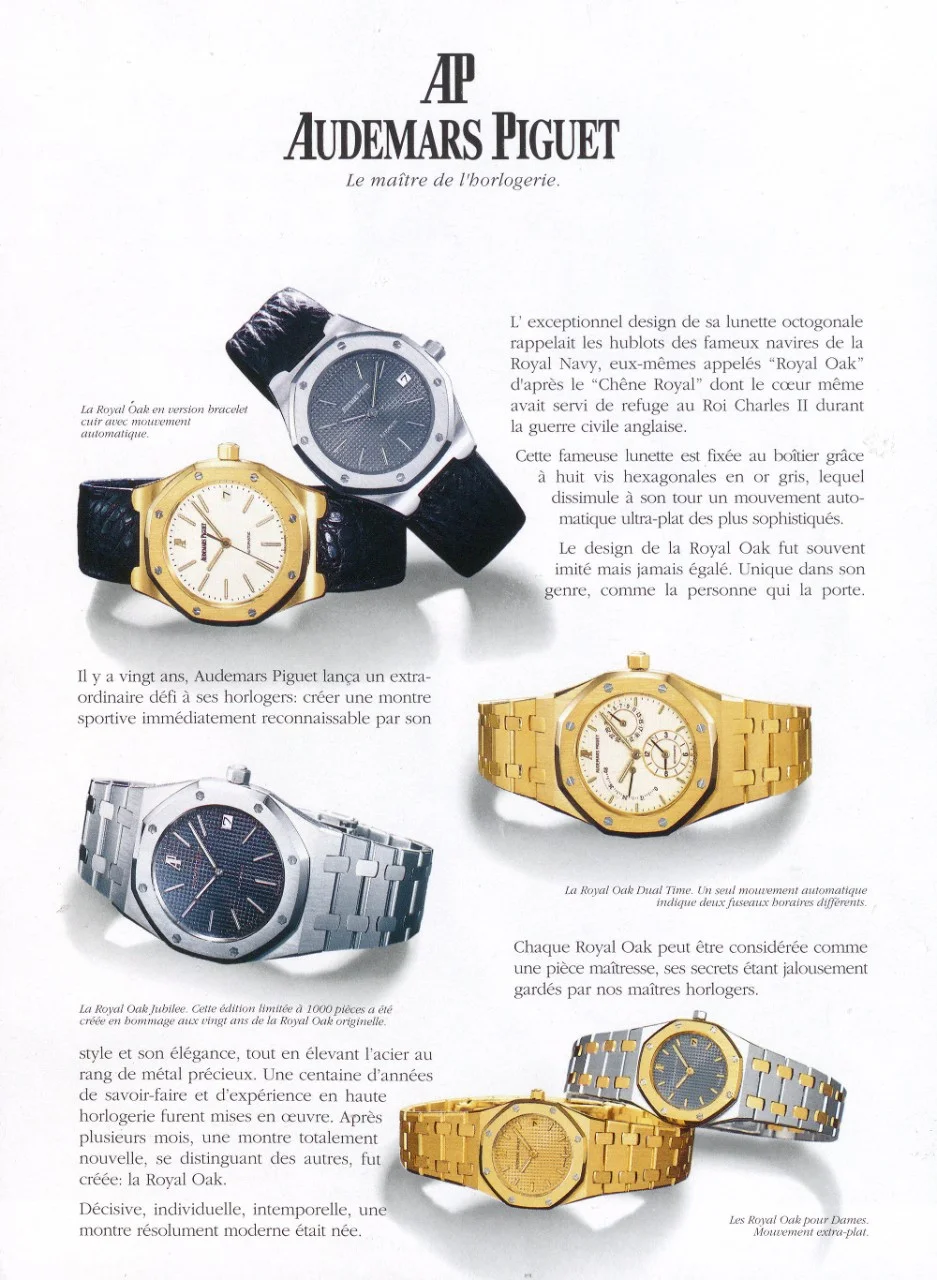
In 1972, the Royal Oak represented a minor revolution in the subdued world of Haute Horlogerie (click here to read the article dedicated to its origins). The watch industry’s enfant terrible and the world’s most expensive steel watch, Model 5402 could have remained exactly as it was at the time of its birth: a horological UFO. However, a first variation was created in 1976 for women and the collection gradually expanded from there. Its size was reduced; it was enriched with noble metals, diamonds and subsequently horological complications: in 1989, the family already included 129 different models, 86 of which were equipped with quartz calibres.
On a broader level, the Royal Oak created the new category of "sport-chic" watches. It inspired many companies, including Patek Philippe and Vacheron Constantin, who followed suit with models that have become legendary, such as the Nautilus and the Overseas. Thus, in the late 1980s, as the Royal Oak was getting ready to celebrate its 20th anniversary, it had become an icon, a classic. Does that mean it had fallen into line?
While the Royal Oak still harboured its pioneering and subversive character, the hint of scandal surrounding it had vanished. Could the "Offshore" vibe prove an opportunity to give it a youthful boost?
Emmanuel Gueit, the spirit of the 1980s
Steve Urquhart knew exactly who to turn to when it came to revamping the Royal Oak, as a particularly gifted designer had joined Jacqueline Dimier in Audemars Piguet’s creative department two years previously.
Emmanuel Gueit was 22 at the time. A native of Geneva, he had been immersed in watch design since his earliest childhood. His father Jean-Claude was one of the greatest designers of his time, inventor of the rainbow setting and creator of the Polo collection by Piaget as well as the Riviera from Baume & Mercier. In an interview given in 2018, Emmanuel Gueit tells of having designed numerous watches while he was still a student, simply as a means of killing time during classes... One of his bracelets is even said to have been used in Audemars Piguet’s “Huitième“ collection.
In 1986, he met Audemars Piguet’s Managing Director Georges Golay to sell him some drawings, the idea being to fund a trip to England. The response was: "Go to England and we'll have a job waiting for you when you return.” He joined Audemars Piguet on June 1, 1987, a few months before the sudden death of the Managing Director, whose successor, Steve Urquhart, introduced him to the brand universe by taking him along to visit markets and meet clients.
The Design Department was located in Geneva at the time. Under the guidance of Jacqueline Dimier, with whom he formed a tandem, he was in constant contact with the Technical Department in Le Brassus and the prototype makers. He thereby discovered an extraordinary ‘playground’. In 2015, during an interview with the Heritage team in Le Brassus, he recalled that at the time there was neither a product manager nor a marketing department. "We did everything. We rushed around meeting suppliers, we went to choose the leather for the straps, we visited the dial makers.” In the wake of the quartz crisis, the horizons were limitless: "We were each designing two to three hundred timepieces a year... We came to Steve Urquhart with new ideas every month. He knew the markets very well. He would say: ‘This can become a collection, this would be for Asia in a limited series of ten, 20 or 50; we'll show the designs to Margulies…’ He was the one taking the decisions and there was incredible creativity in the air.”
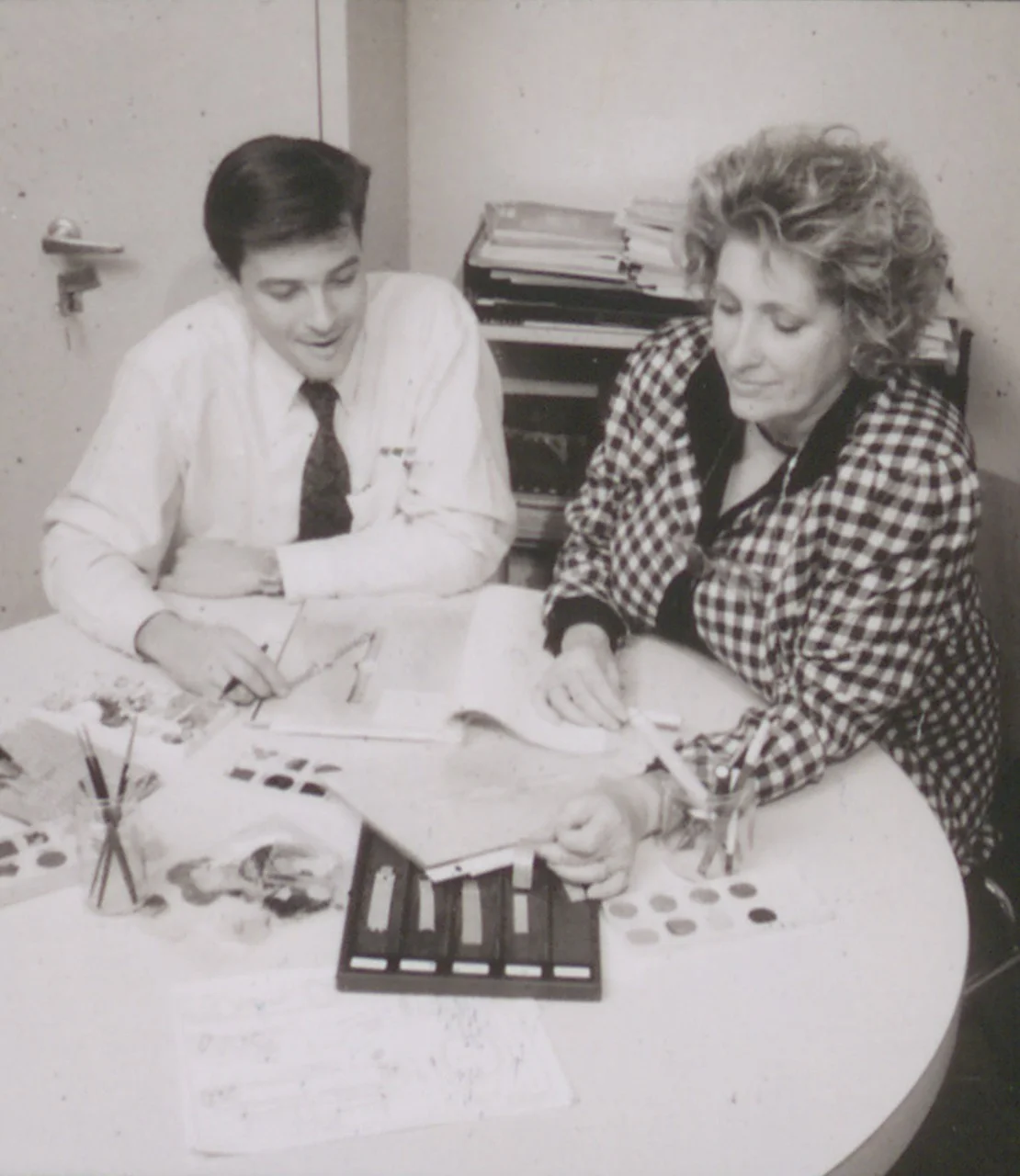
Circa 1990. Emmanuel Gueit and Jacqueline Dimier. The design tandem invented hundreds of models for Audemars Piguet between 1987 and 1997. Audemars Piguet Archives.
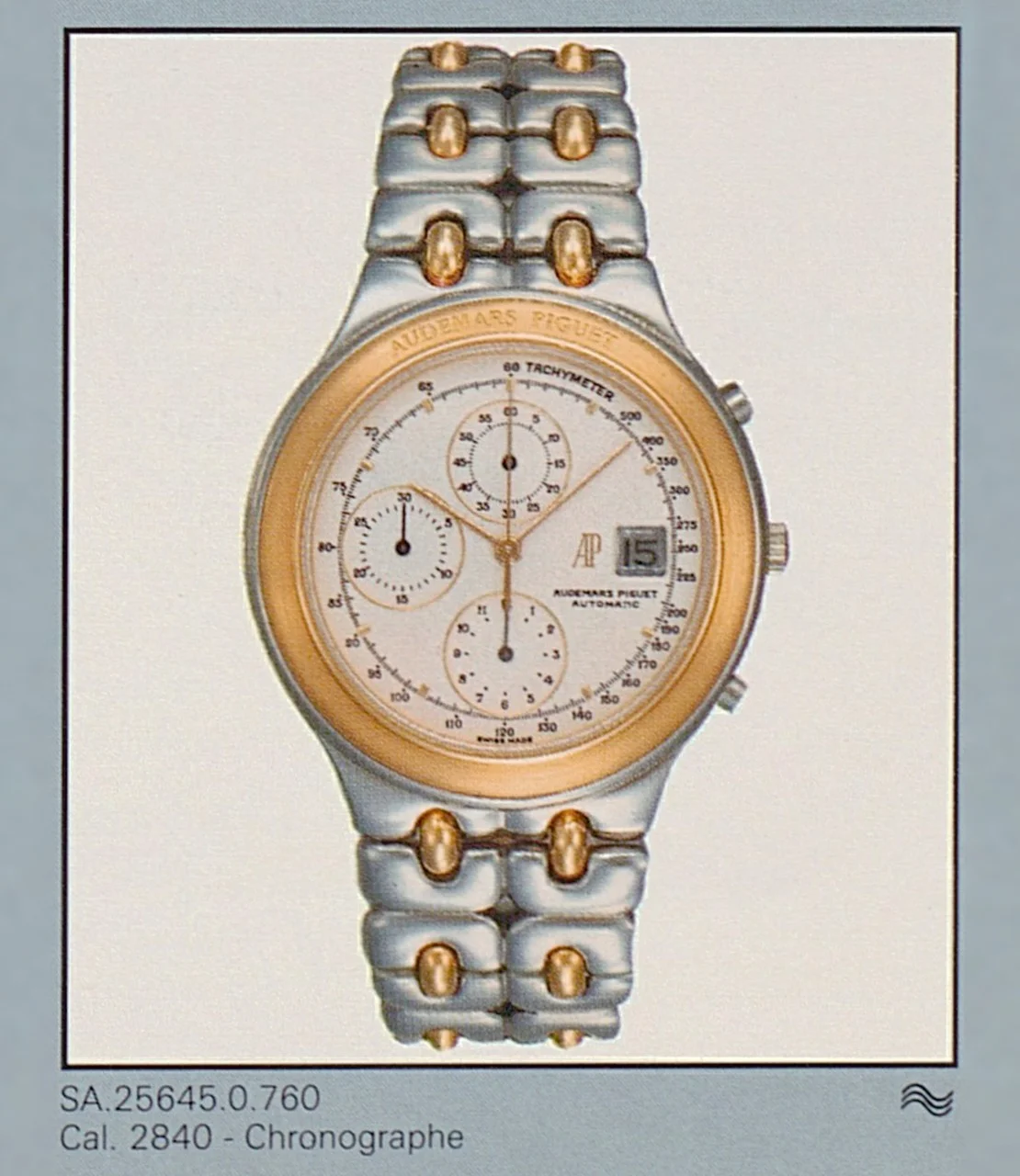
1987. “Huitième" Model 25645 (40 mm). The bracelet of this variant of the Huitième chronograph is said to have been sketched around 1985 by Emmanuel Gueit during his classes, while he was still a student. 1987–88 Audemars Piguet Catalogue. Audemars Piguet Archives.
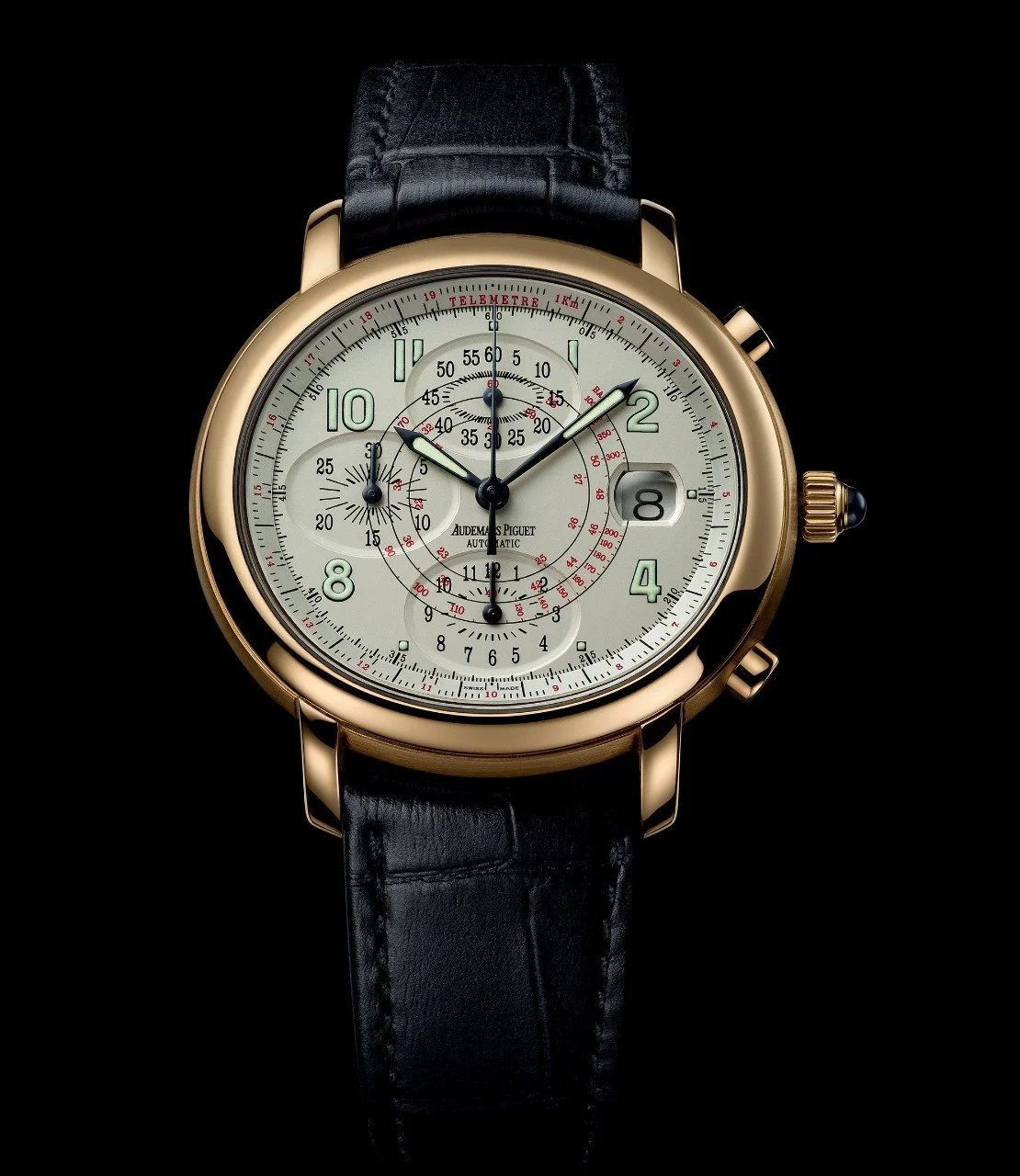
1998. Millenary Chronograph. Designed by Emmanuel Gueit in 1995, the Millenary collection developed over more than two decades. Model 25822, Calibre 2329/2846, pink gold. Audemars Piguet Heritage, inv. 1815.

1996. Emmanuel Gueit and the Millenary. The designer of the Millenary pictured wearing six variations of this collection launched a year earlier. AP News 13/1996. Audemars Piguet Archives.
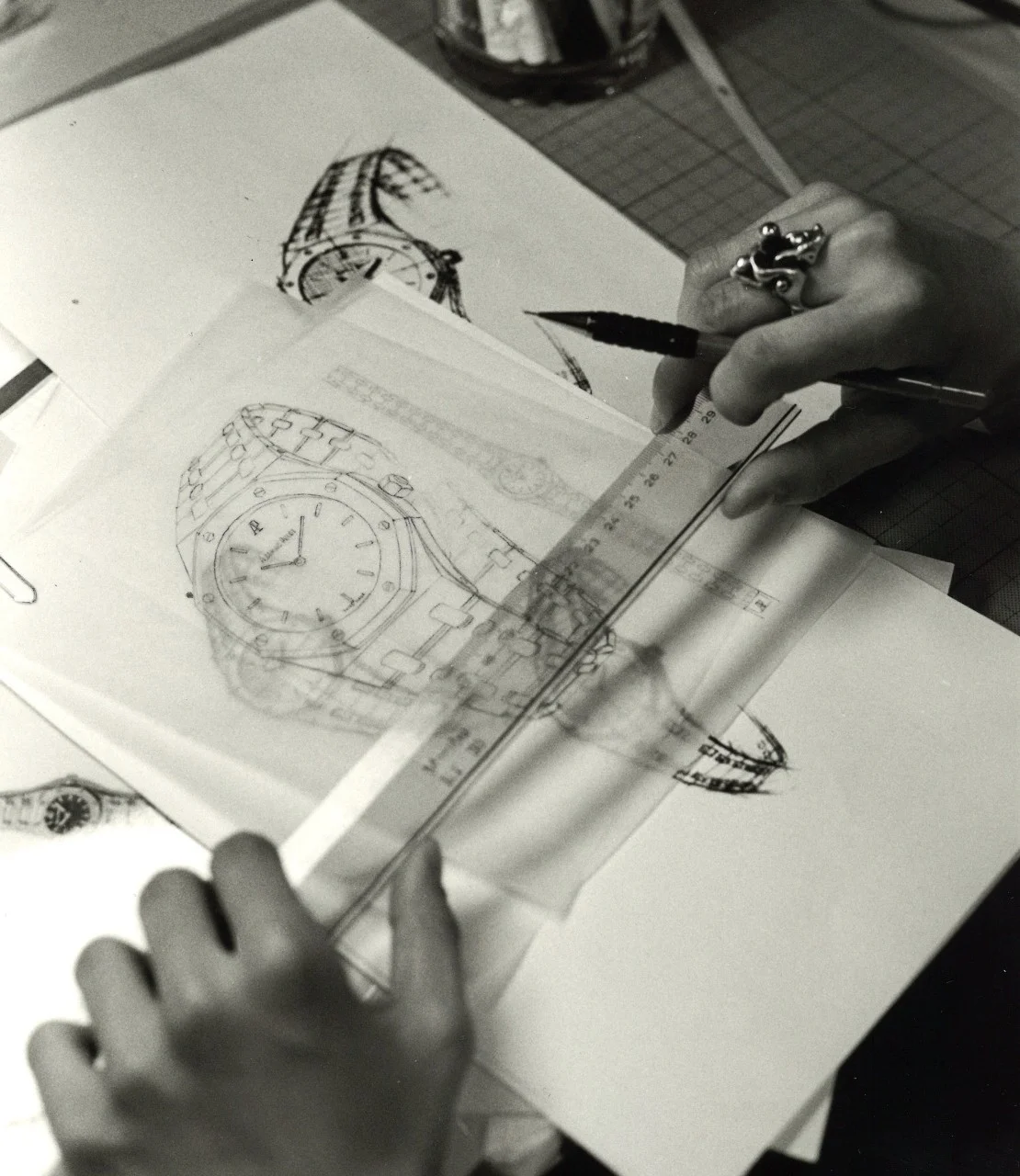
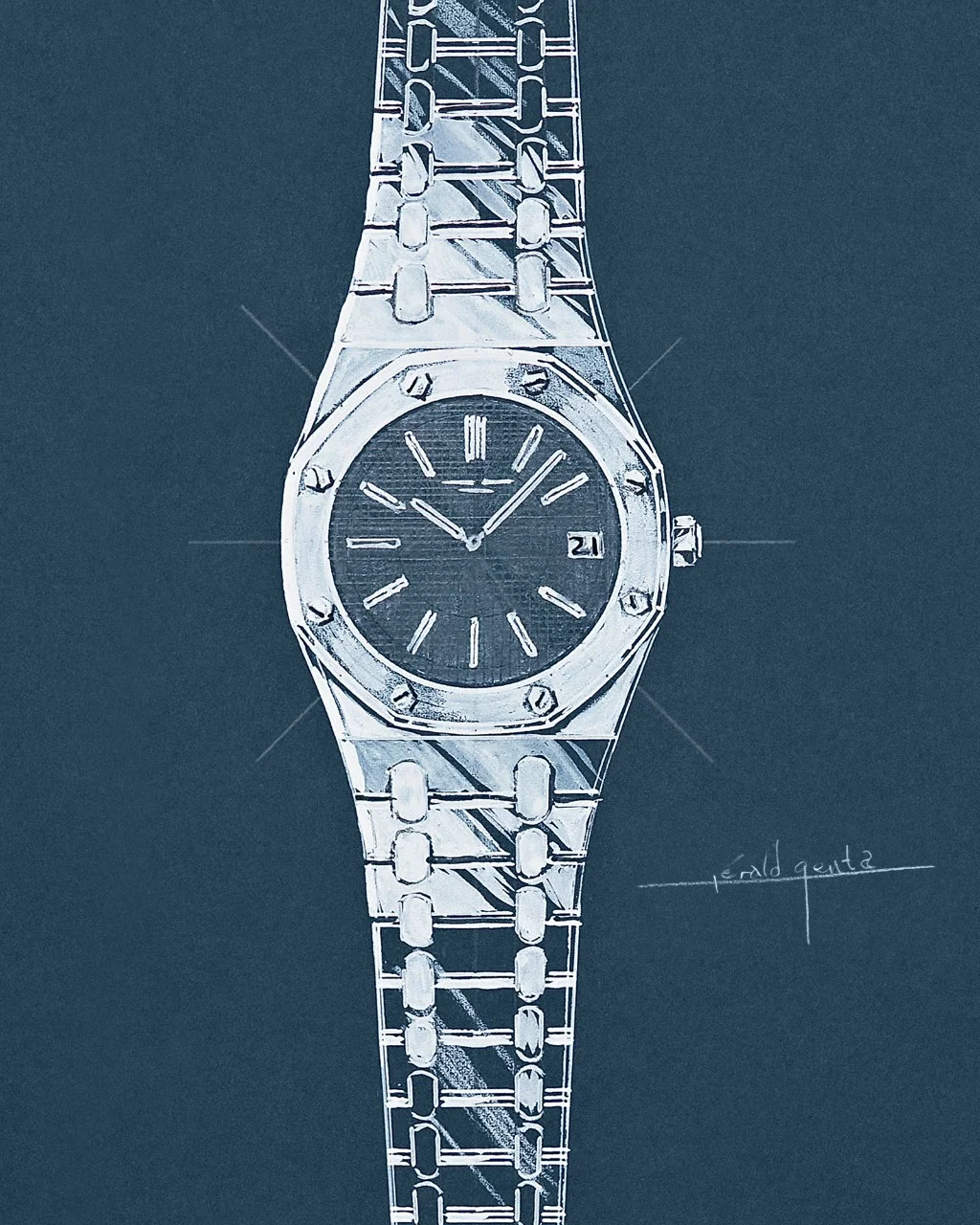
Circa 1985. Sketch of the Royal Oak. Circa 1985. Sketch of the Royal Oak. The new models were hand-drawn by designers Jacqueline Dimier and Emmanuel Gueit before translated into technical plans.
Early drawings: from compass to chronograph
The first six drawings of Royal Oak Offshore are dated April 19, 1989, the last day of the Basel Fair. Joint CEOs Georges-Henri Meylan and Steve Urquhart undoubtedly took advantage of the show to gauge the market's opinion of the Offshore project...
The gouache paintings by Emmanuel Gueit already feature the main attributes of the future collection: oversized cases (42 mm in diameter, 16 mm thick), extraordinarily thick gaskets, crowns covered with blue, green, yellow or pink coloured rubber, rounded links and studs. The watch was then often equipped with a compass that is visible on several dial design studies. The crystals are further enhanced by a large magnifying glass – that can be seen on the profile sketches – and that probably served to enlarge the date. One variant is made of unconventional materials and was referred to in a note written in July of that year by Georges-Henri Meylan in which he mentions introducing "new materials such as ceramics, graphite and carbon fibre".
The idea caught on in the Vallée de Joux, a mountain region where friendships often complement professional relationships. In September 1989, Georges-Henri Meylan met Jacques Piguet, owner and director of Frédéric Piguet (formerly Louis Elisée Piguet), which had been supplying movement "ébauches" to Audemars Piguet since the 19th century and would subsequently be renamed Manufacture Blancpain in 2010. Jacques Piguet had a brilliant idea. He suggested endowing the future "Offshore" with a chronograph. No Royal Oak had ever been equipped with a sporty-oriented complication and indeed none was as sporty as the future Offshore! Emmanuel Gueit then sketched a first variant based on the plans for Calibre FP 1185 and this watch even had a split-seconds hand!
The compass was thus deemed incidental and abandoned in favour of a classic watchmaking function: the chronograph. While everything seemed to be in place for the watch to be released in 1992 on the occasion of the Royal Oak’s 20th anniversary, this was not to be.
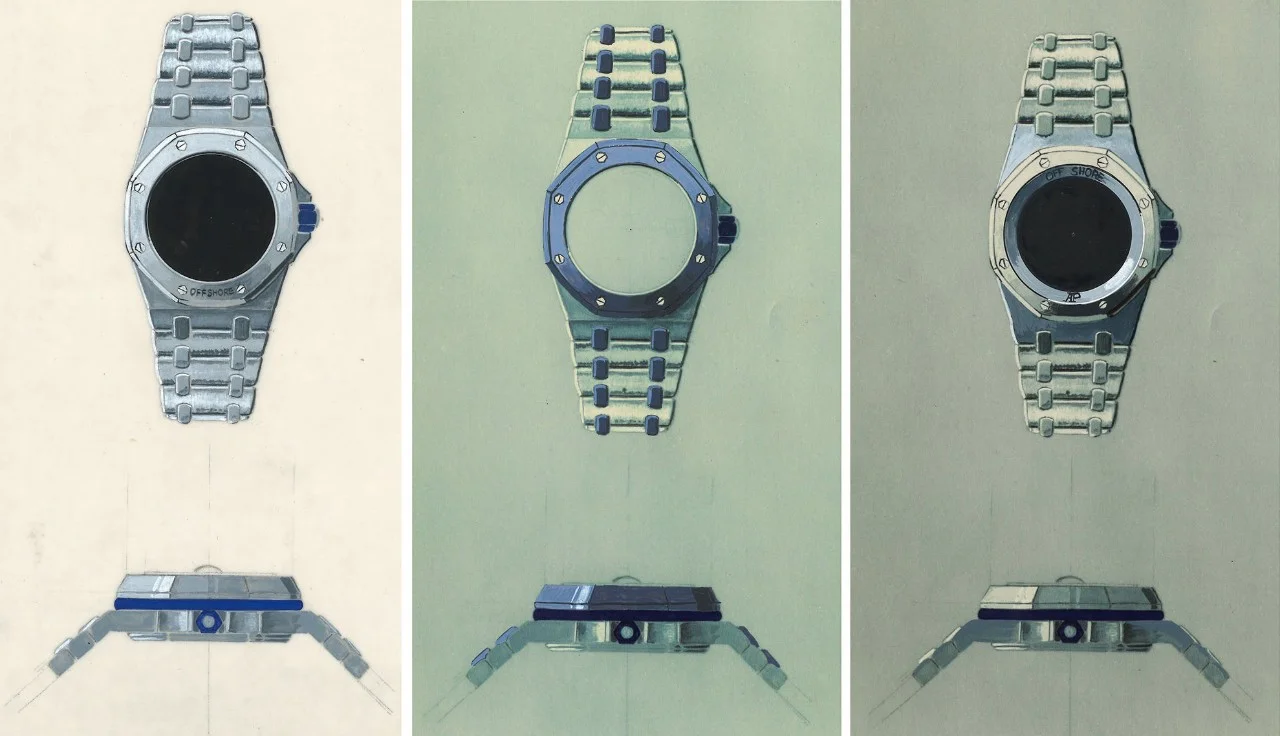
1989. Royal Oak Offshore sketch. On April 19, 1989, Emmanuel Gueit drew the first study sketches for the Royal Oak Offshore. The oversized diameter (42 mm), visible rubber gaskets and imposing thickness were retained. The compass was replaced in the autumn of 1989 by a chronograph. Audemars Piguet Archives.
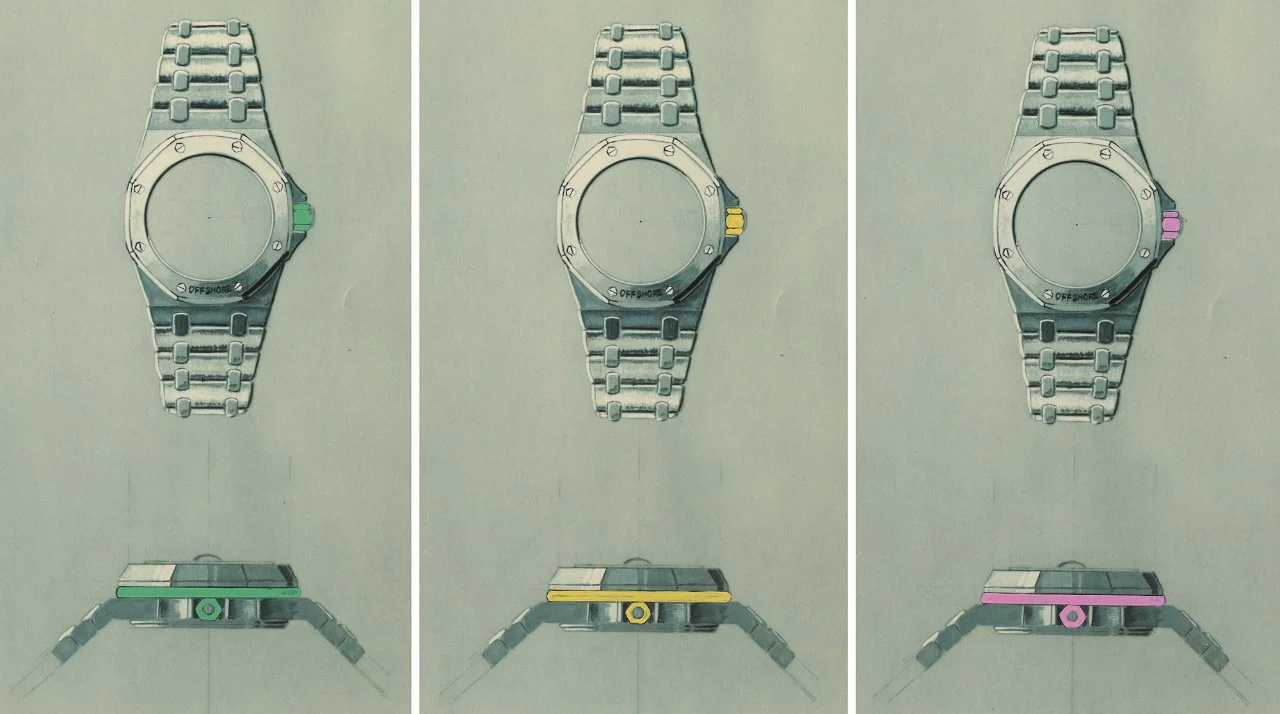
1989. Royal Oak Offshore sketch. On April 19, 1989, Emmanuel Gueit drew the first study sketches for the Royal Oak Offshore. The oversized diameter (42 mm), visible rubber gaskets and imposing thickness were retained. The compass was replaced in the autumn of 1989 by a chronograph. Audemars Piguet Archives.
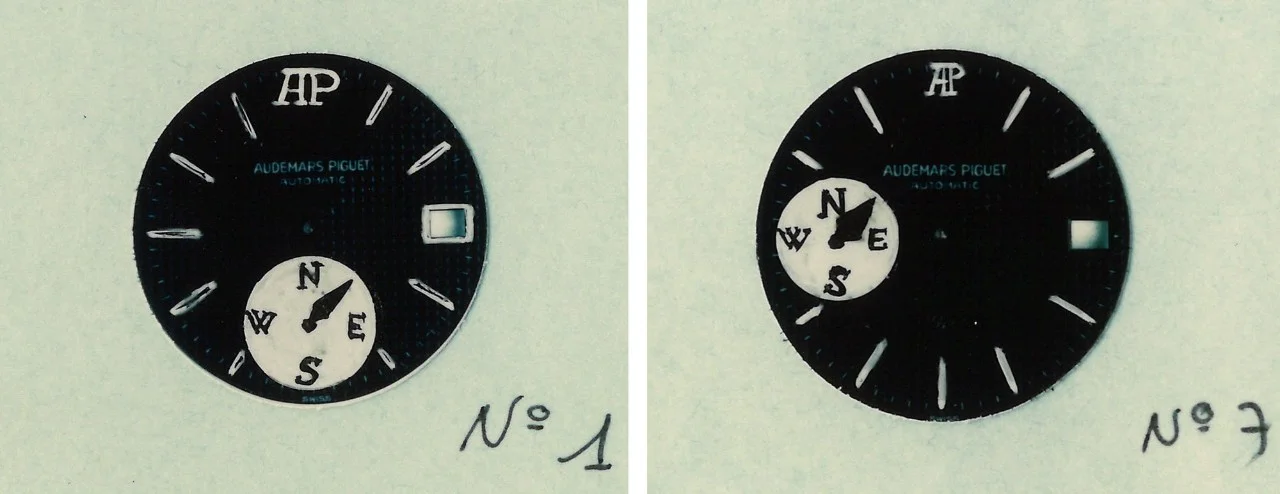
Circa 1989. Dial sketches. Produced in parallel with the first designs of the Royal Oak Offshore, these dials feature a compass. Audemars Piguet Archives.
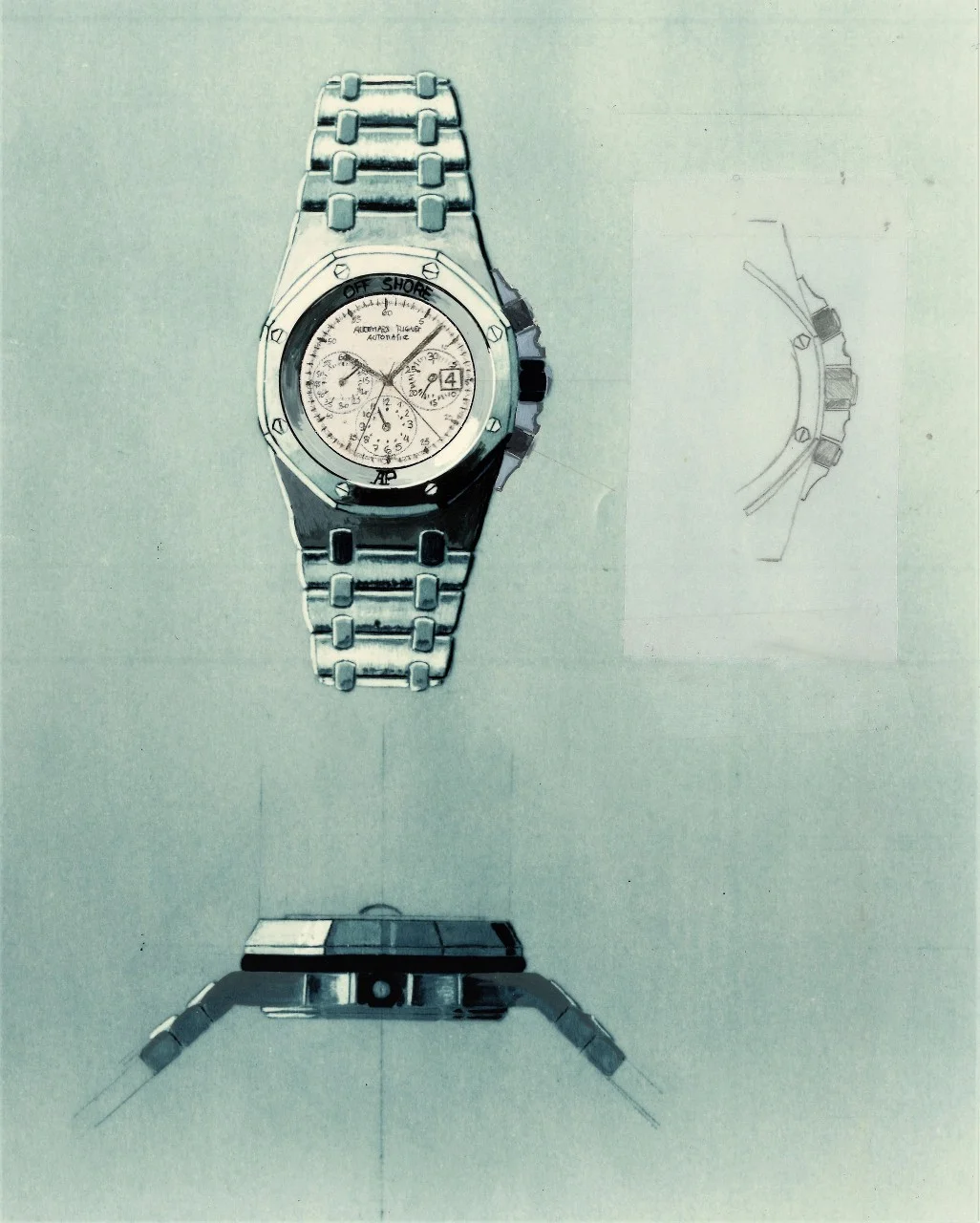
1989. Royal Oak Offshore Chronograph sketch. This undated drawing was probably made in September 1989, following the suggestion from the Frédéric Piguet company to equip the Royal Oak Offshore with the 1185 chronograph calibre. Audemars Piguet Archives.
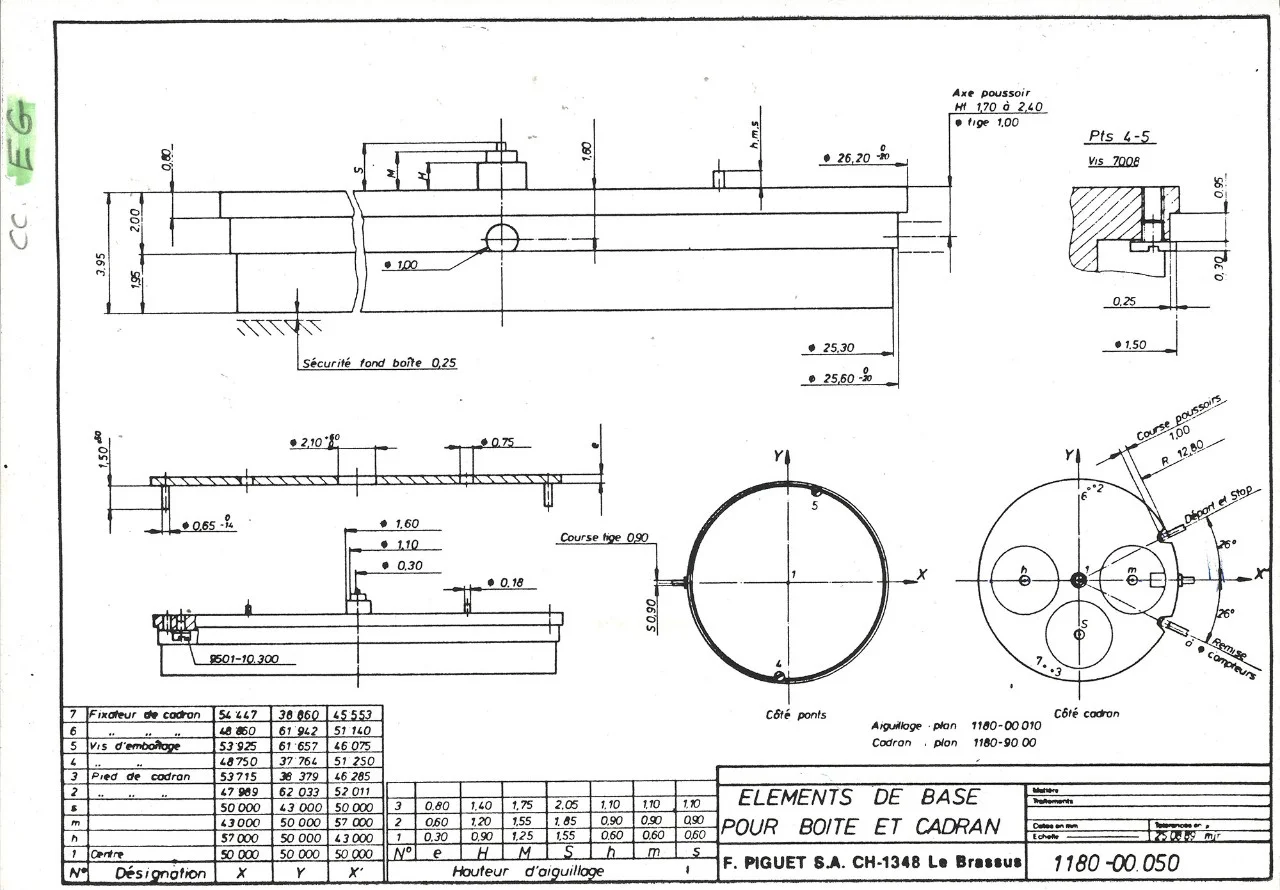
1989. Watch exterior plan Drawn up in July 1989 by Frédéric Piguet, this plan was used by Emmanuel Gueit to lay out the functions on the first sketch of the Royal Oak Offshore Chronograph (25.6 mm in diameter). Audemars Piguet Archives.
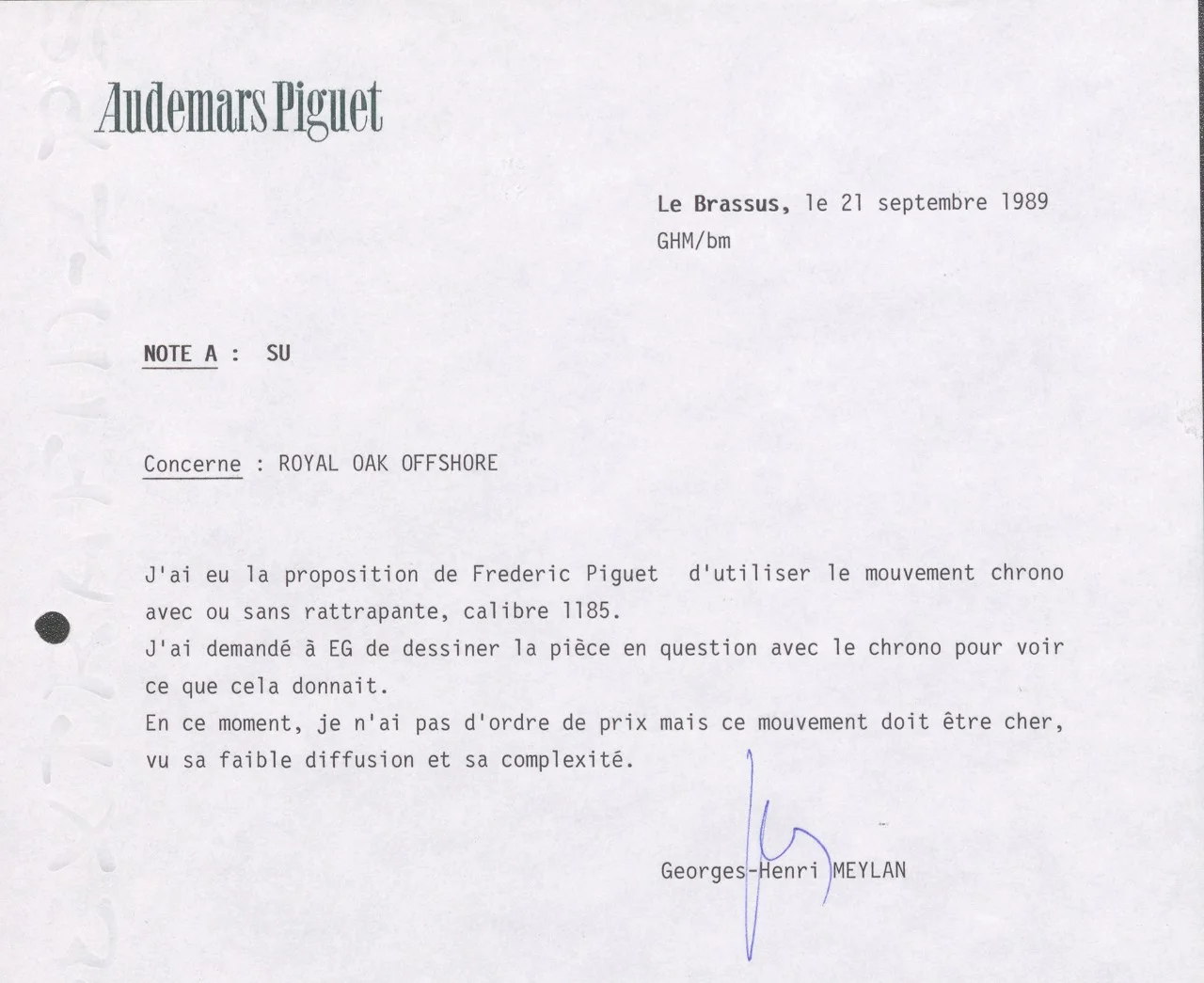
21.09.1989. Internal memo. In this document, Georges-Henri Meylan, joint CEO of Audemars Piguet, informs Steve Urquhart of Frédéric Piguet's proposal to equip the Royal Oak Offshore with a chronograph. Audemars Piguet Archives.
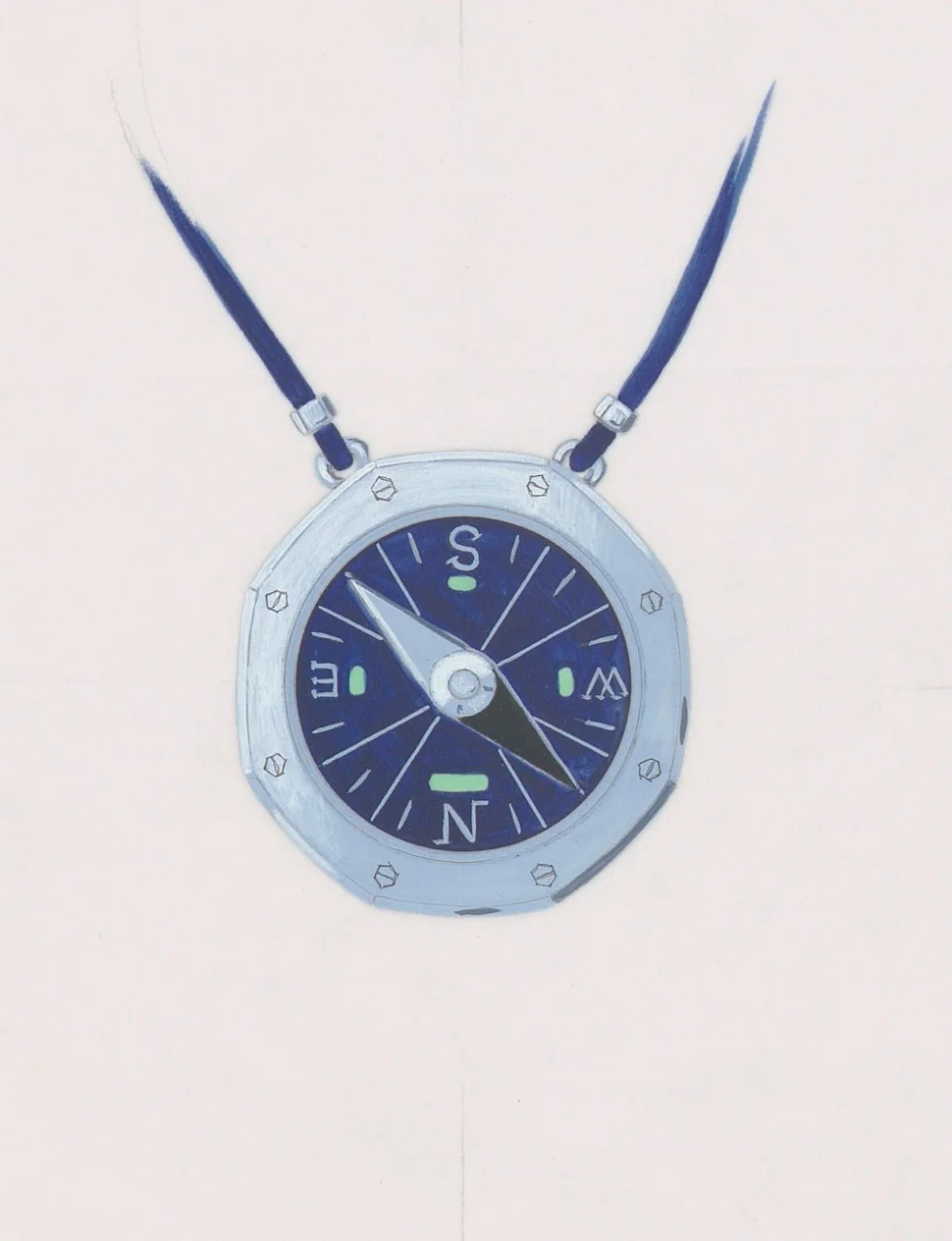
1991. Design study. In 1991, Emmanuel Gueit took up the idea of combining the Royal Oak and the compass on a pendant, but it did not go beyond the study stage. Audemars Piguet Archives.
Wow, that's big!
In a 2016 interview with Le Point magazine, Emmanuel Gueit said: "When I was at Audemars Piguet, Steve Urquhart asked me to design the Royal Oak Offshore. He wanted to produce a masculine, assertive watch for young people. My idea was to make it large and thick. At the time, women were starting to buy more and more men's watches. I thought, ‘They're taking over our jewellery; we have to make something they can't wear.’ So I enlarged the Royal Oak, magnified the details and made it ultra-virile."
At the time, the largest Royal Oak for men was just 36 mm in diameter and 7.7 mm thick (Model 14700). Suddenly increasing it to 42 mm and 14.05 mm thick meant multiplying its volume by 2.5! You might as well wear a pocket watch on your wrist! Even Steve Urquhart is said to have exclaimed: "Wow, that's big!" when he saw the first sketches.
Since its founding in the 19th century, Audemars Piguet had made a habit of shaking up luxury watchmaking codes, but this was really going too far. How could a watchmaker so deeply rooted in tradition, nestled in a small mountain village, create a watch that was so excessive, outrageous, ostentatious and implausible? Interviewed in 2011, Jacqueline Dimier recalled that the watch scared certain brand stakeholders. While the 1972 Royal Oak had caused teeth-gnashing in the workshops, its descendant on steroids was met with a downright outcry. Spurred on by his fiery young designer, yet somewhat put off by internal feedback, Steve Urquhart wanted to believe in the project, yet felt torn.
In 2013, Emmanuel Gueit told WorldTempus: "Every six months I was asked to stop it, but I was so convinced that I secretly kept on developing the concept." On September 19, 1991, he designed three new variations of the Royal Oak Offshore with metal bracelets, complemented in November by a variant with a leather strap. Finally, and perhaps despite himself, Steve Urquhart announced: "OK, we'll do it to make you happy".
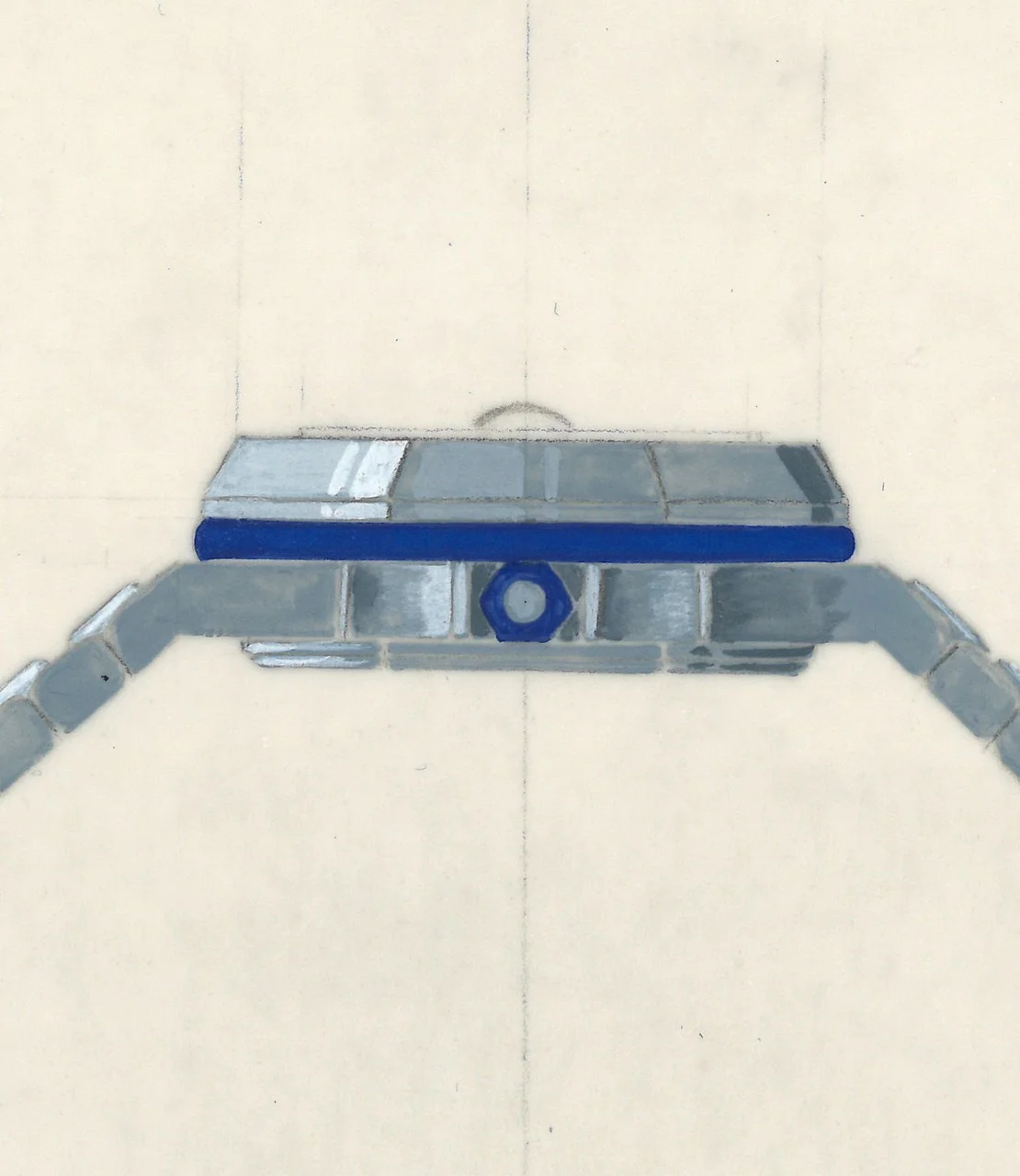
1989. Detail from a Royal Oak Offshore sketch. On April 19, 1989, Emmanuel Gueit drew the first Royal Oak Offshore studies. Audemars Piguet Archives.
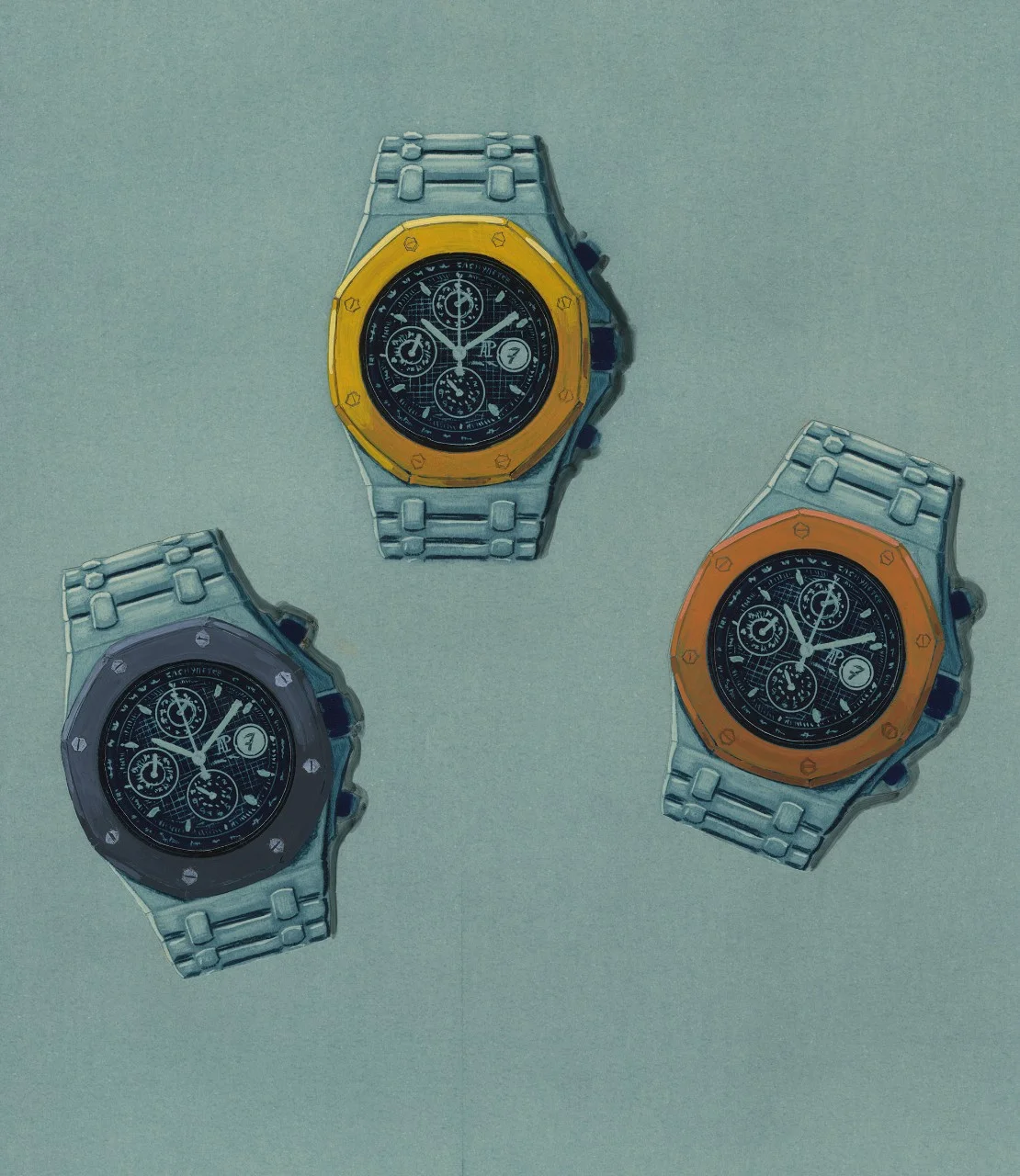
1991. Royal Oak Offshore sketch. These three drawings by Emmanuel Gueit revived the project in September 1991. Audemars Piguet Archives.
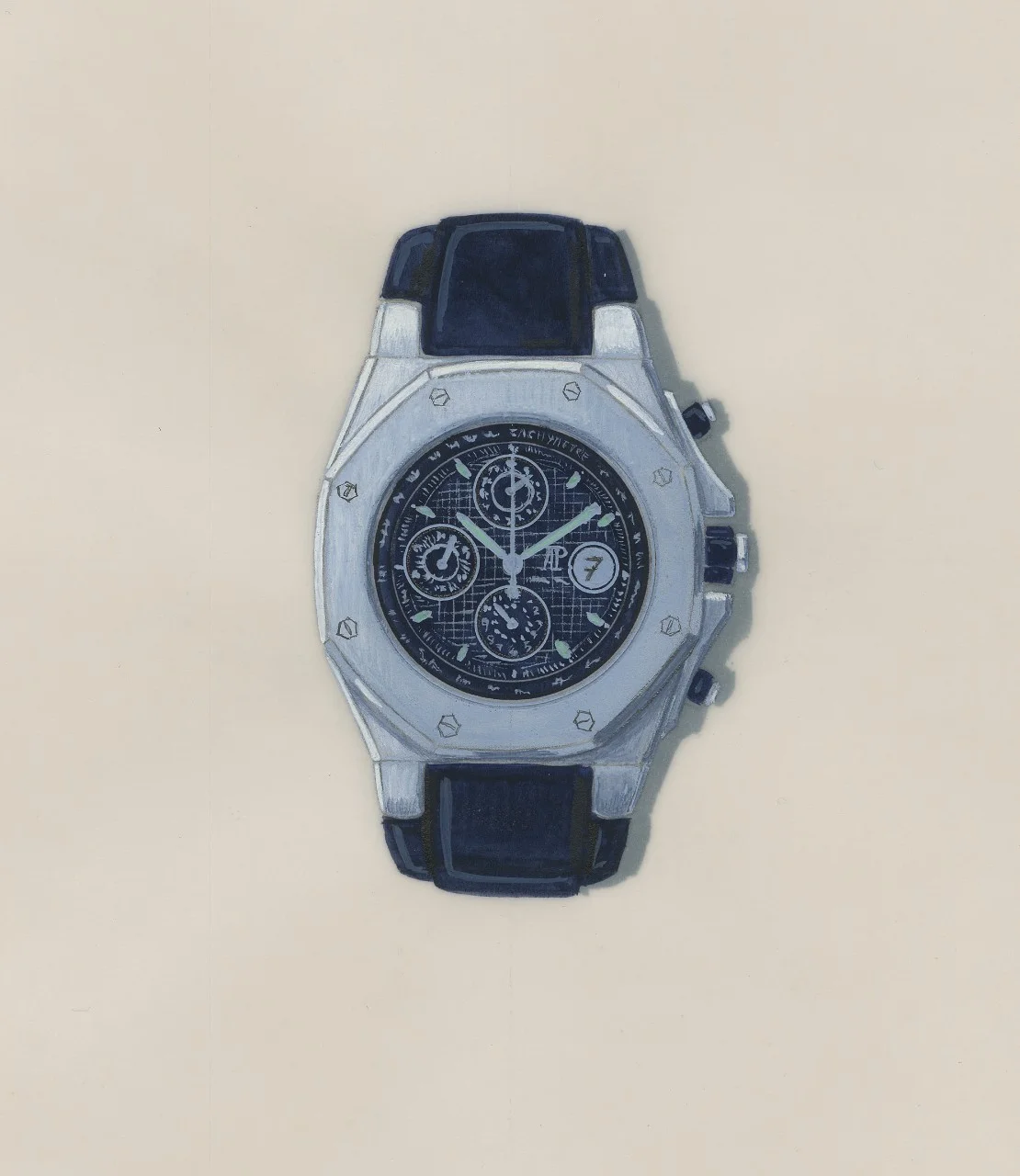
1991. Royal Oak Offshore sketch. Variation drawn in November 1991 by Emmanuel Gueit. Audemars Piguet Archives.
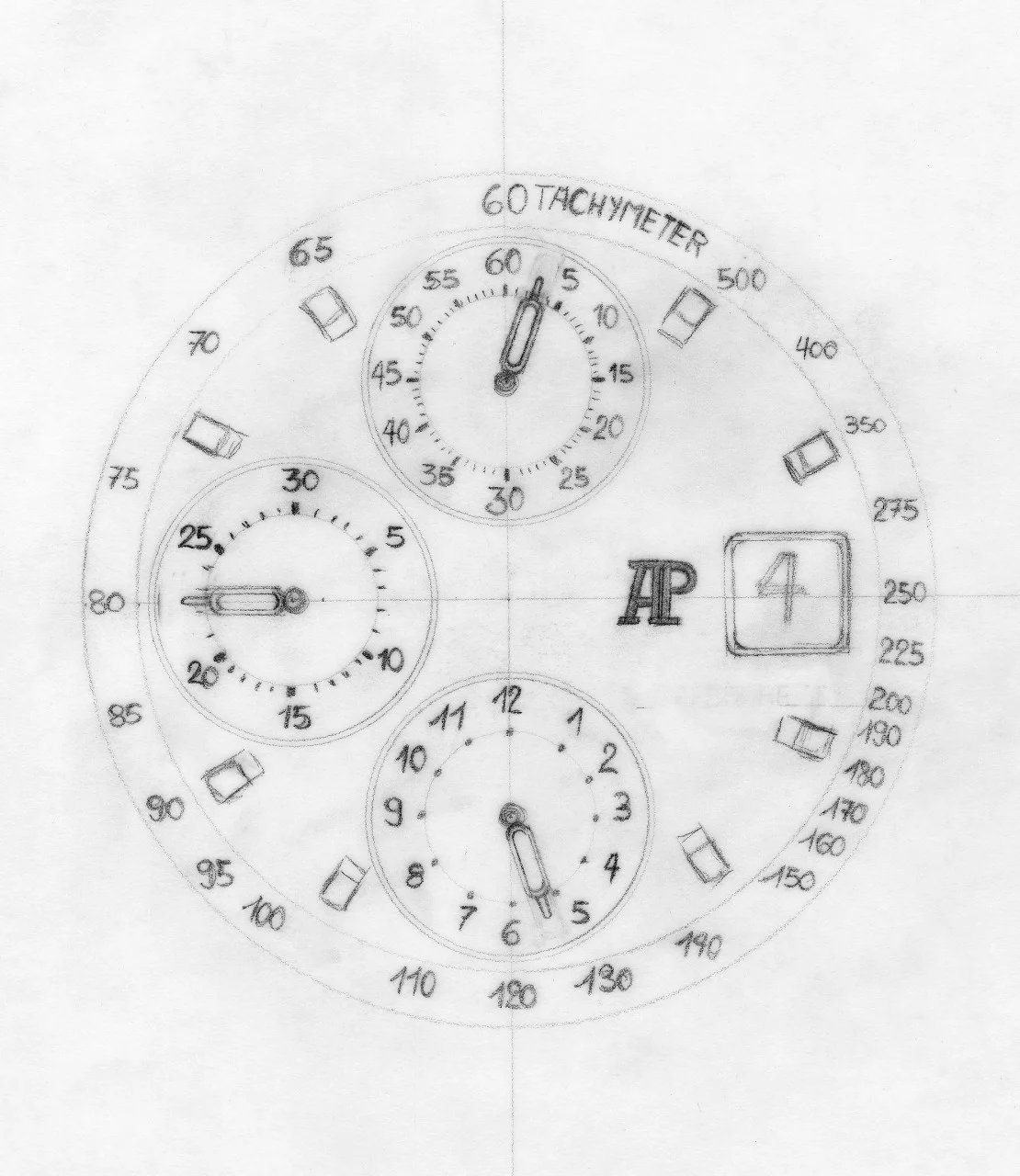
1991. Royal Oak Offshore dial sketch. Study probably done by Emmanuel Gueit in September 1991. The dial layout corresponds to Calibre 2126/2840. Audemars Piguet Archives.
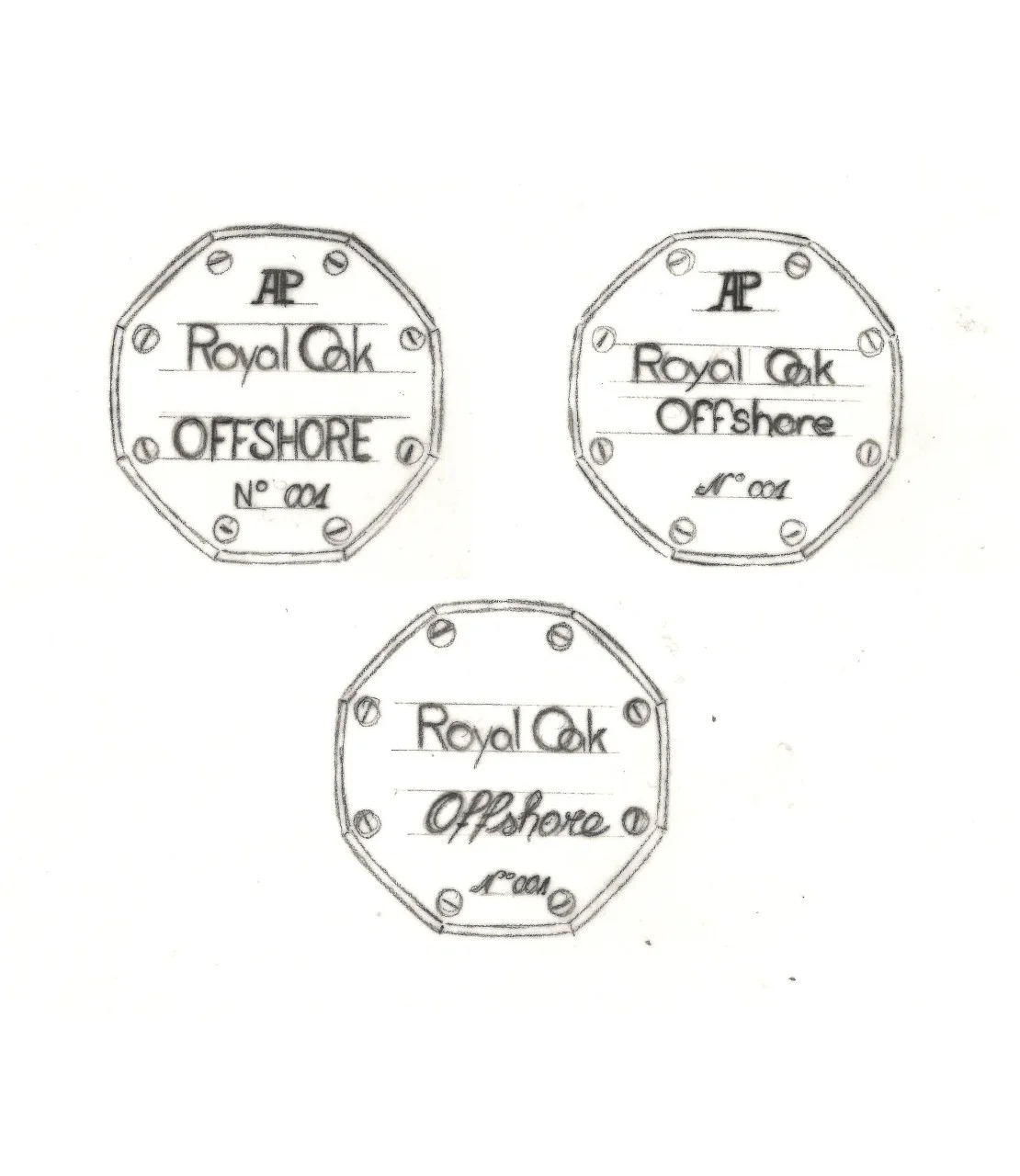
Circa 1991. Royal Oak Offshore engraving study. Study probably done by Emmanuel Gueit in autumn 1991. Undated document. Audemars Piguet Archives.
Not so simple...
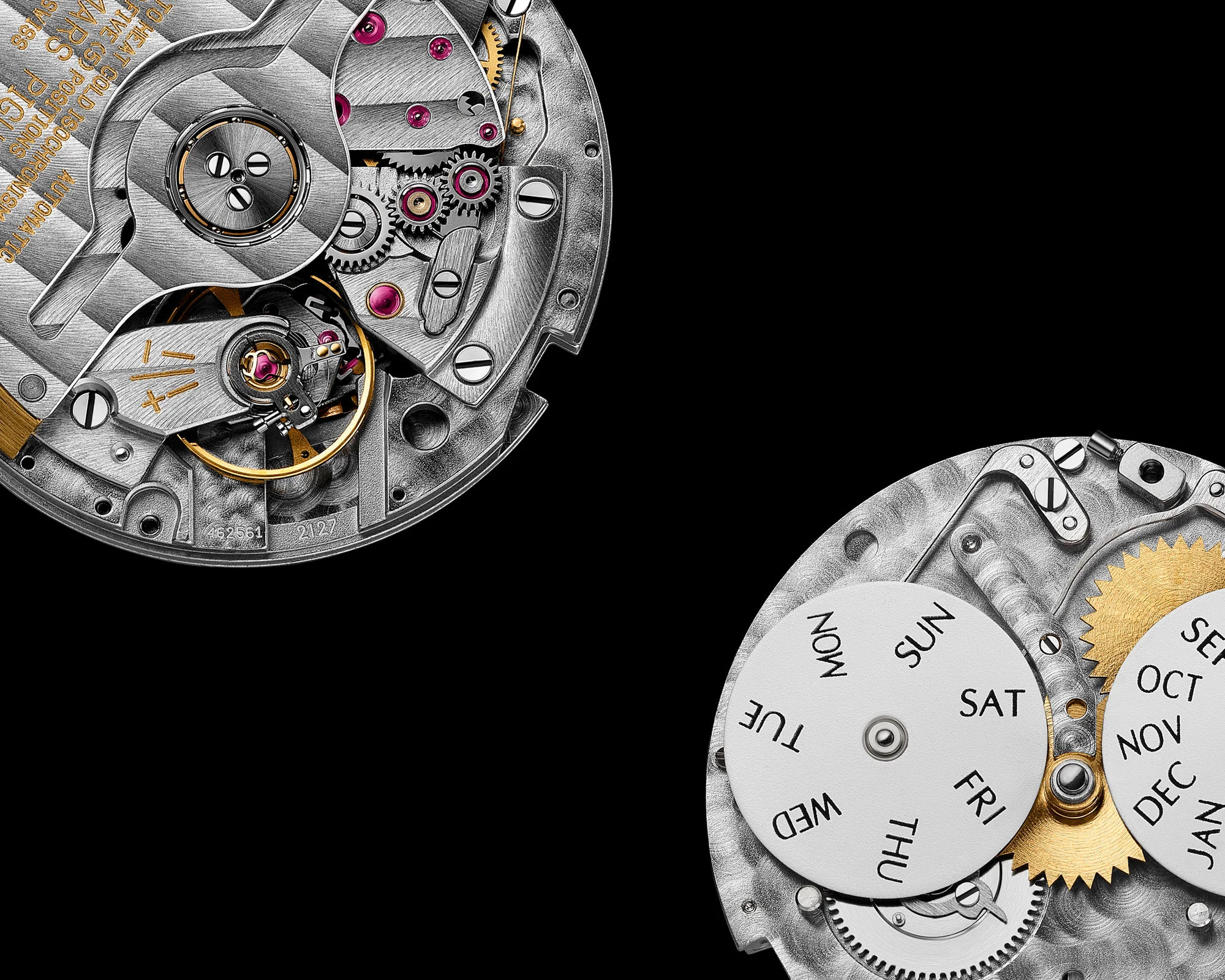
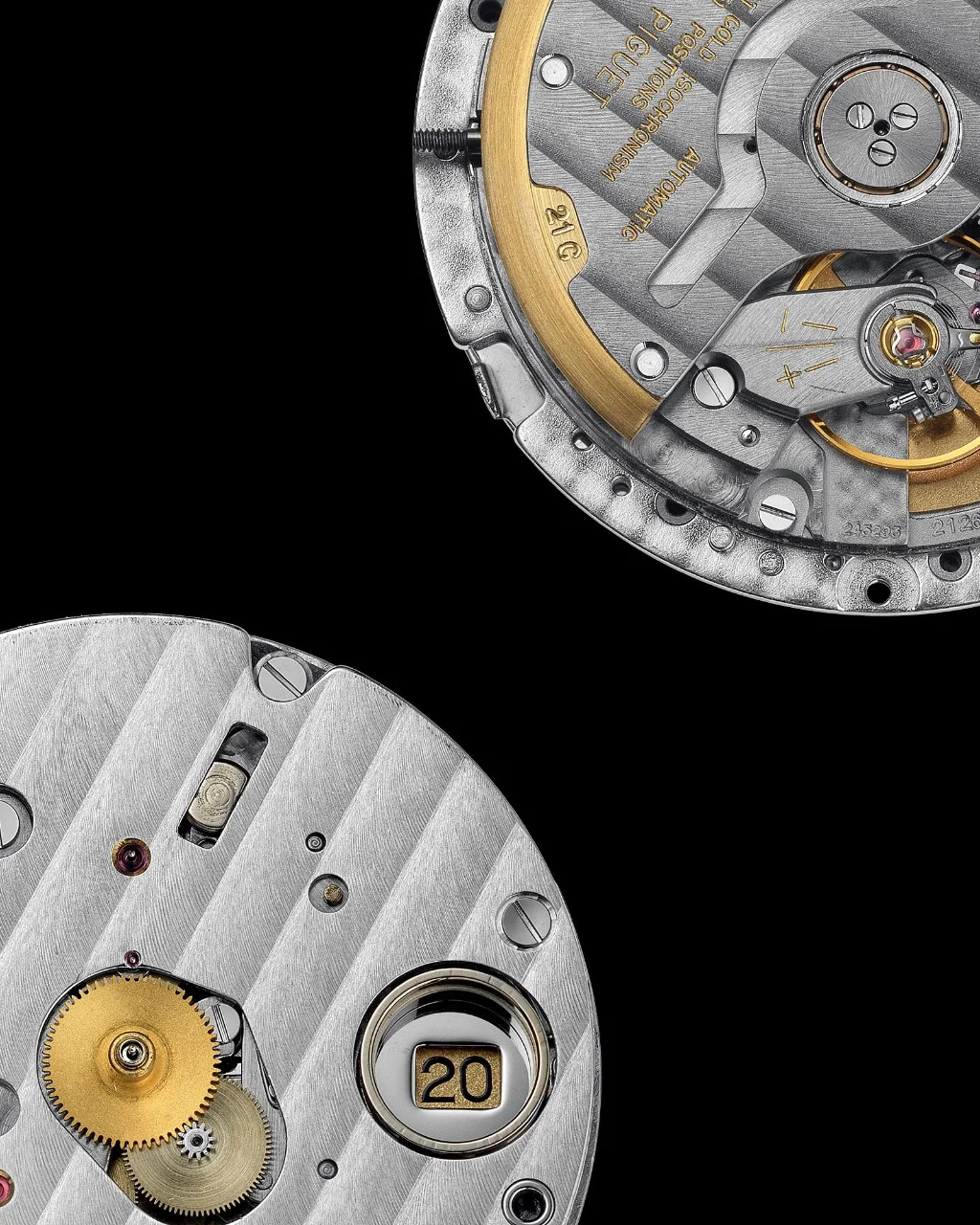
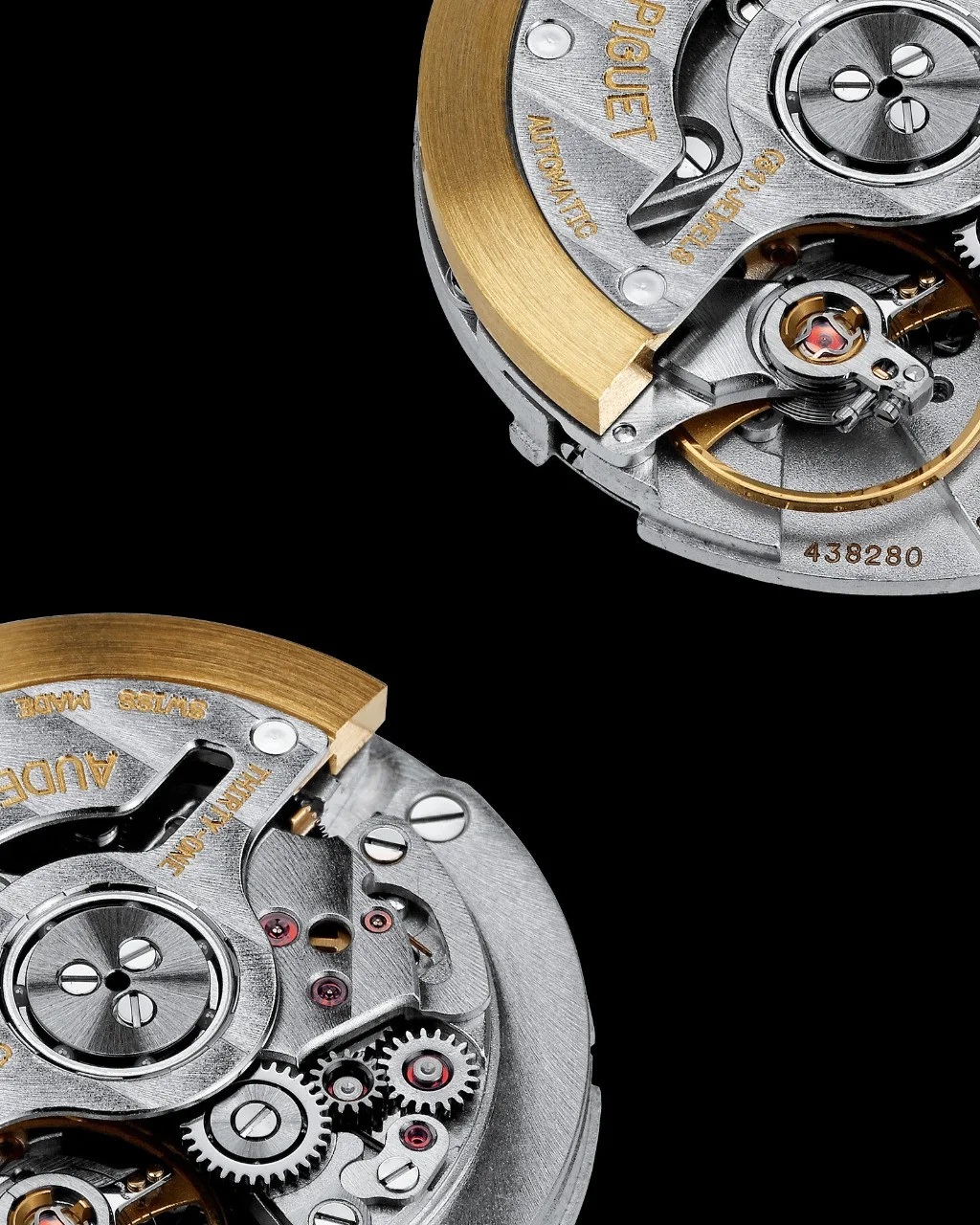
To equip the Royal Oak Offshore, Audemars Piguet opted to rely on a tried and tested mechanism. The selfwinding Calibre 2126/2840 (6.15 mm thick) has equipped the "Huitième" collection since 1986. Manufactured by LeCoultre & Cie., its base movement belonged to the large family of 26 mm, 11½-ligne 889 calibres, classified under Reference 889 at LeCoultre and 2123, 2125, 2225 at Audemars Piguet. Its history began in the 1970s and lasted through to the 2010s. The chronograph under-dial work was produced by the workshops of Dubois Dépraz, located a stone's throw from Lake Joux. This choice is notably explained by the 30 mm diameter of the chronograph plate that was better suited to the oversized Offshore case. Meanwhile, the thinner and smaller (25.6 mm x 5.5 mm) calibre proposed by the Frédéric Piguet company would be integrated into the Royal Oak Chronograph from 1997 onwards.
In July 1991, the watch was still slated for presentation at the 1992 Basel Fair to mark the Royal Oak’s 20th anniversary. There were even plans for a porthole-shaped showcase to display it! However, case development proved more complex than anticipated and the launch had to be postponed.
In May 1990, Audemars Piguet had in fact already begun the first attempts to protect the push-pieces and crown by coating them with synthetic material, working with Jura-based company Pibor. In July 1993, i.e. after the official launch of the watch, the development was still not complete. The bracelet also proved to be extremely sophisticated. It was not until March 1993 that, following the production of the prototypes, its manufacturer Gay Frères ventured to begin drawing up the final plans. As for the cases, produced by the Geneva manufacturer Centror (renamed Audemars Piguet Meyrin in 2021), the first five to pass water-resistance tests did so as late as September 1993.
The development took a long time because the characteristics of the watch were unusual.
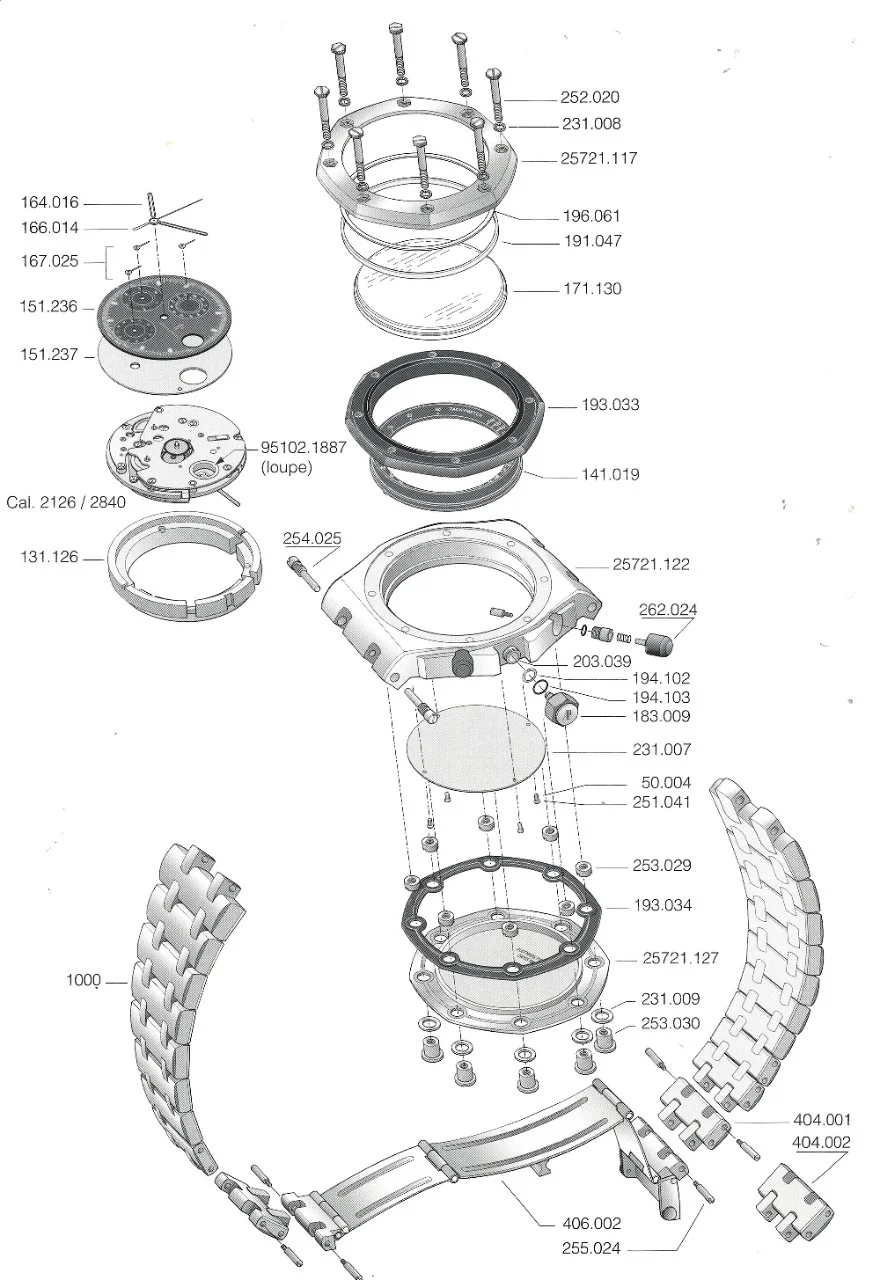
1993. Exploded view of the Royal Oak Offshore 25721. Audemars Piguet Archives.
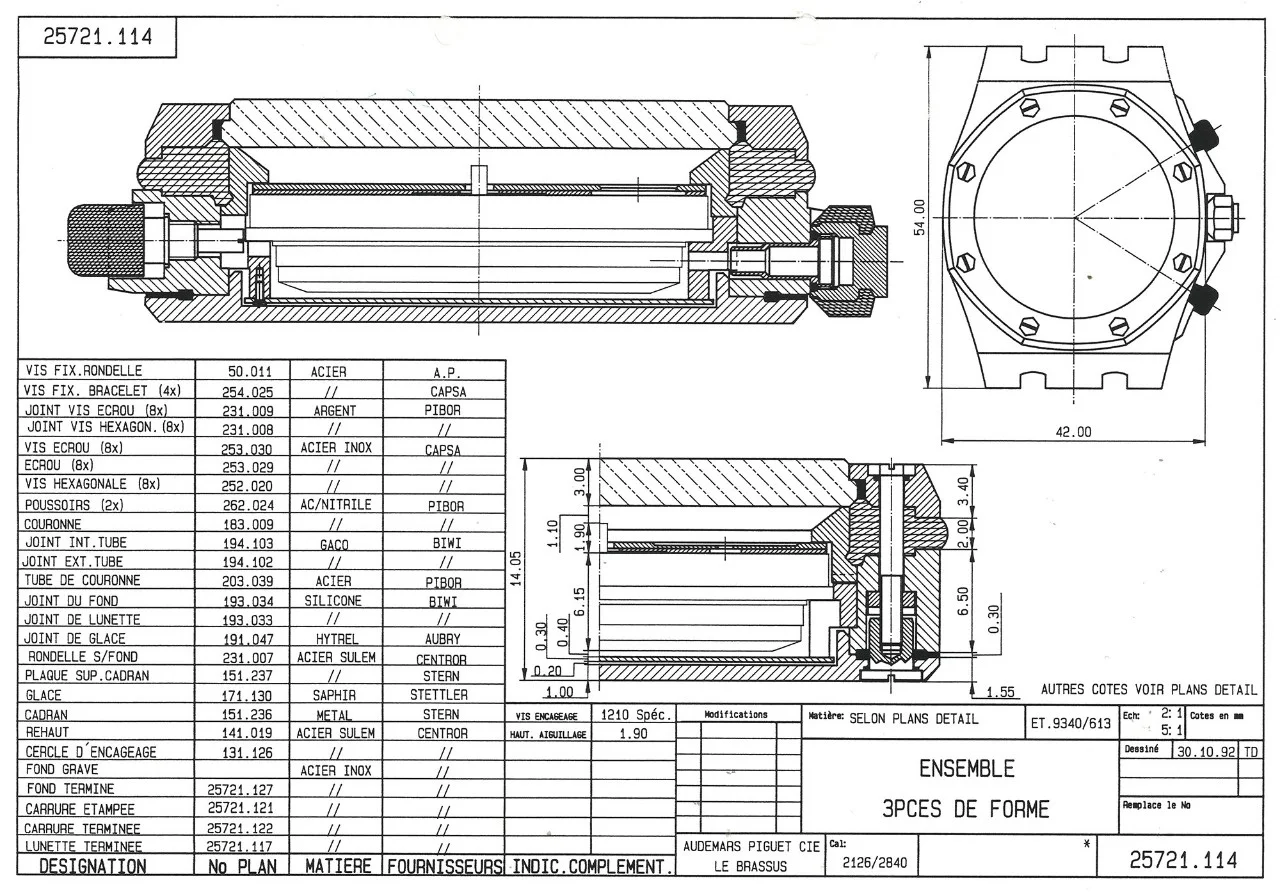
30.10.1992. Plans for the Royal Oak Offshore 25721. The cross-section view shows the extreme sturdiness of its 14 mm-thick case, its oversized water-resistance seal and its anti-magnetic cage. Audemars Piguet Archives.
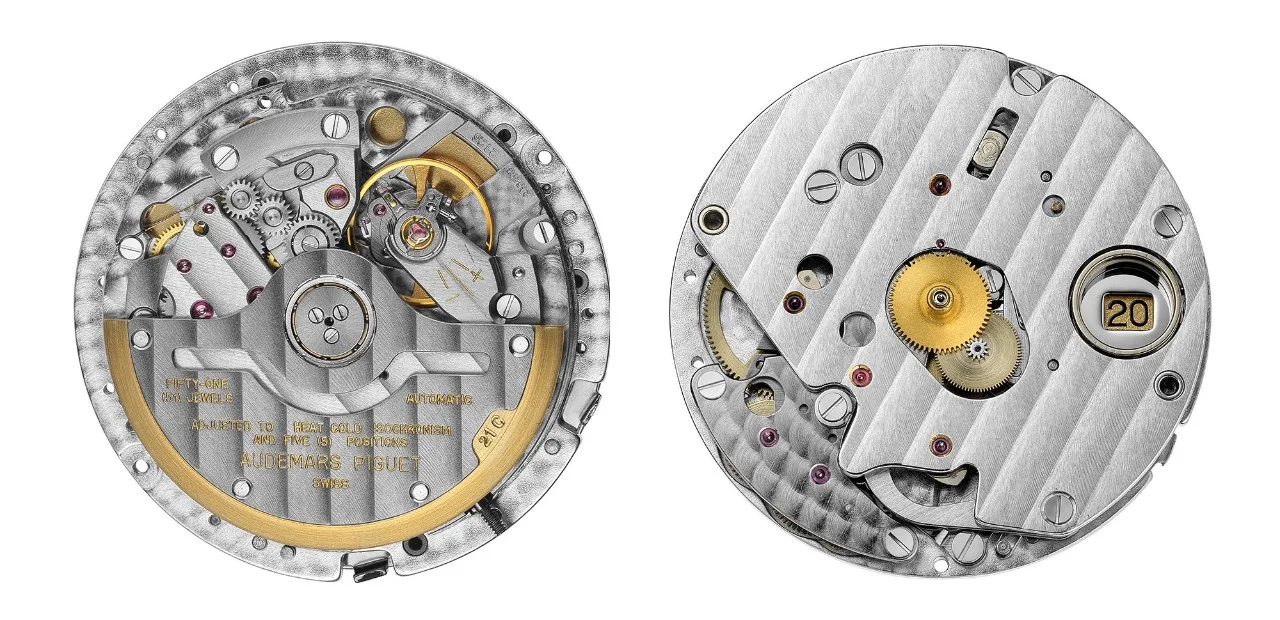
1986. Calibre 2126/2840. Movement "ébauche" 2126 Jaeger-LeCoultre (26 mm); Dubois Dépraz chronograph under-dial work (30 mm). 6.15 mm thick. Hours, minutes, small seconds in the centre, selfwinding. Movement 295243 produced in 1988. Audemars Piguet Heritage.
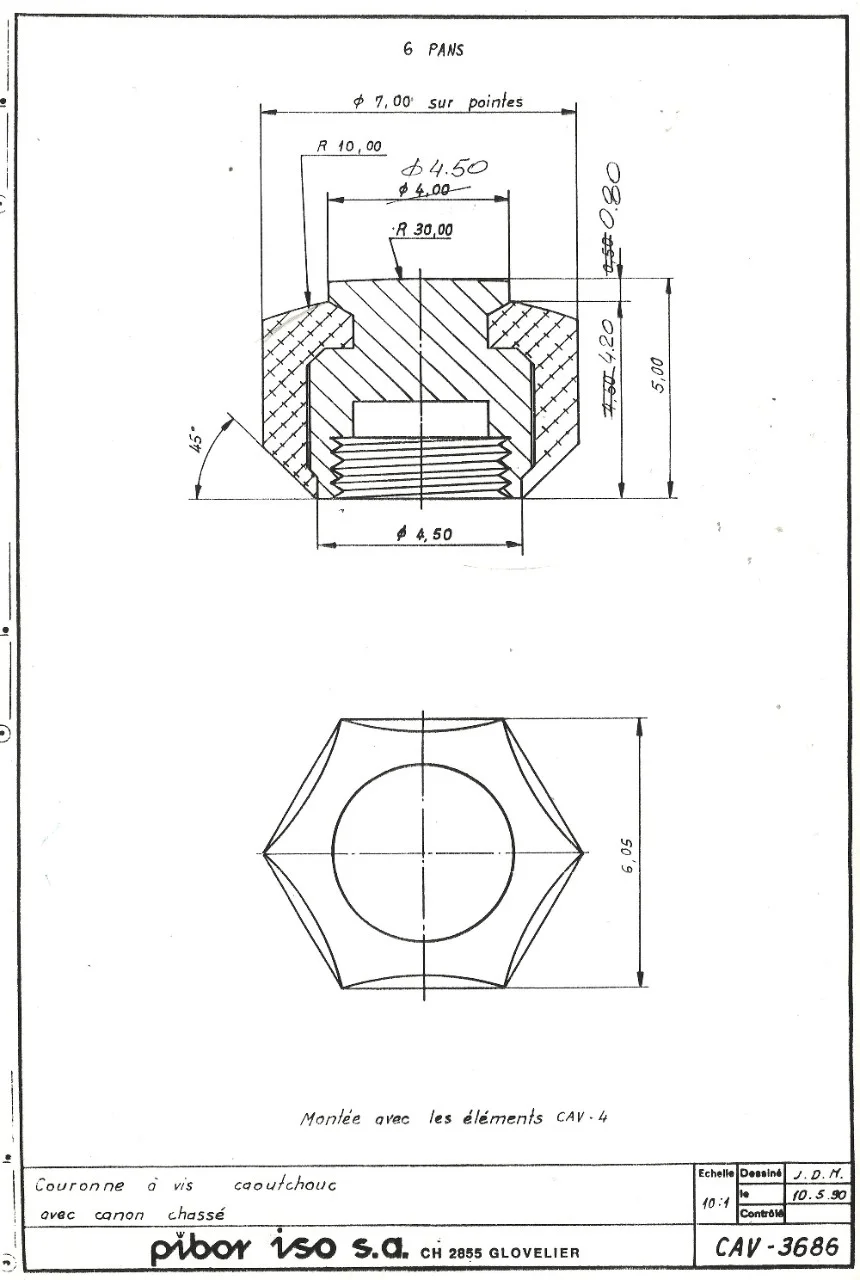
1990. Plan of Crown 25721. In 1990, the Pibor company began to examine ways of protecting the crown by partially coating it with rubber. Audemars Piguet Archives.
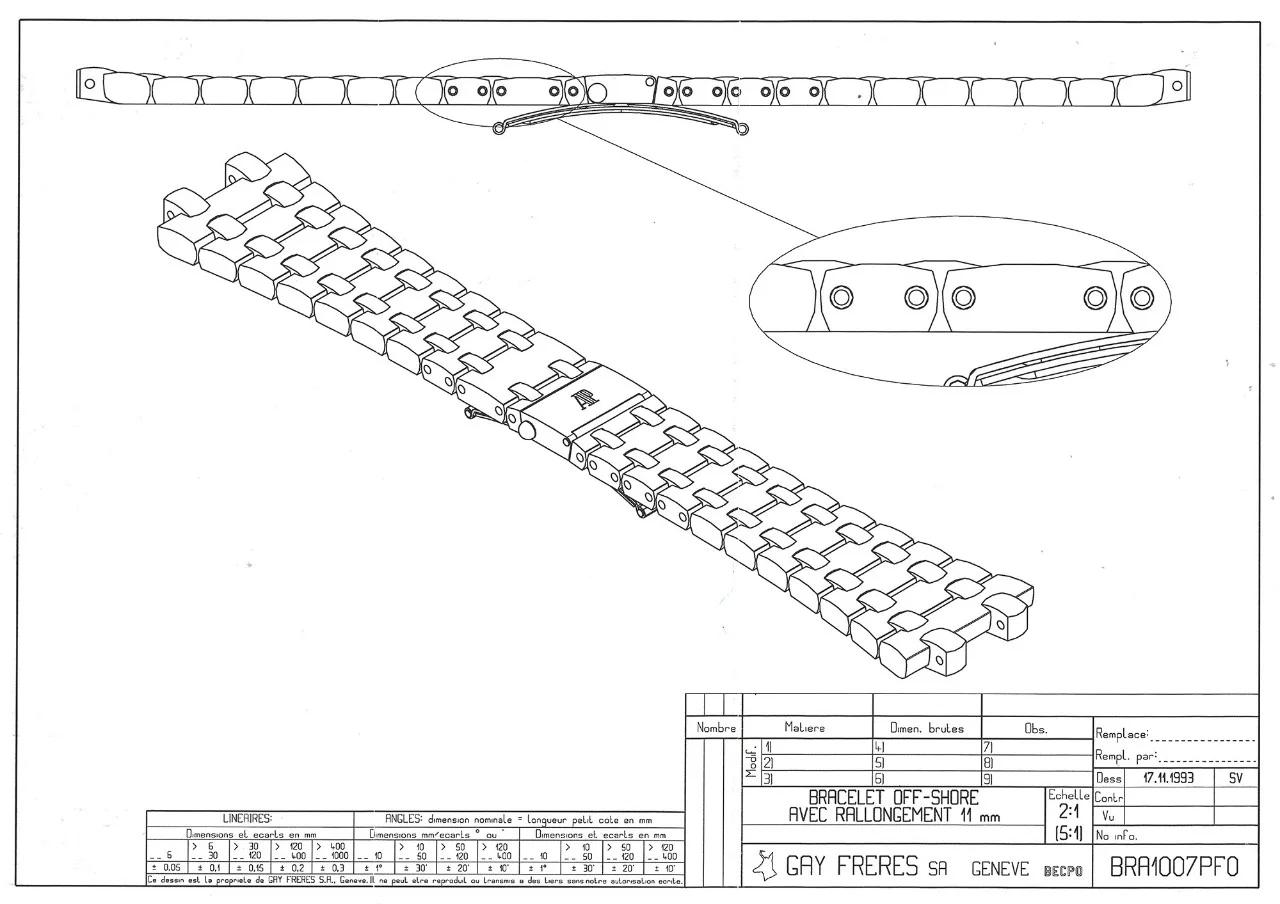
1993. Plan of Bracelet 25721. The rounded surface of the links and studs further increases the complexity of the Offshore bracelets compared to those of the Royal Oak. This version dated 17.11.1993 includes the extension links. Plan by Gay Frères. Audemars Piguet Archives.
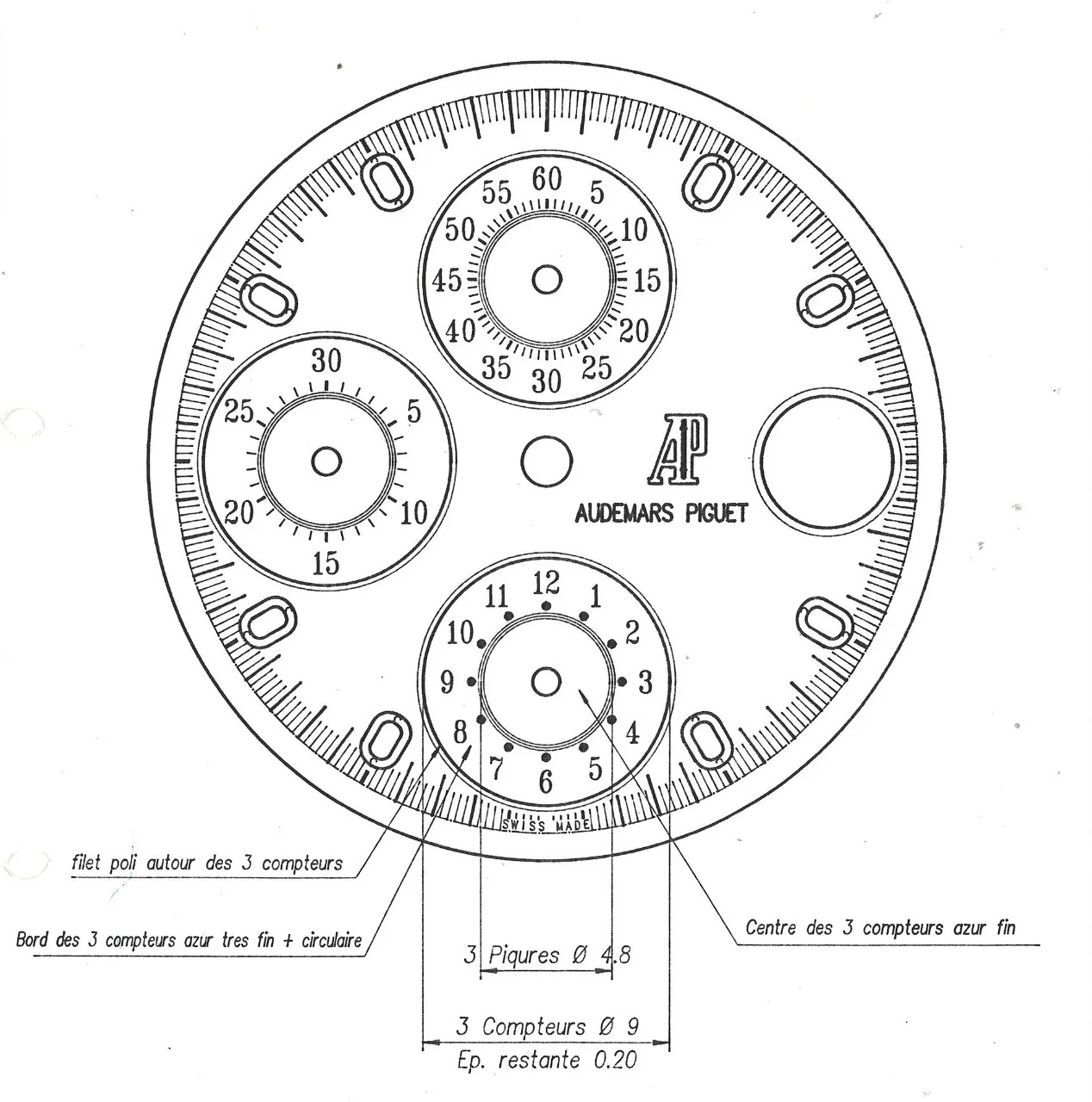
1991. Plan for Dial 25721. The dial designed in October 1991 by famous Geneva-based dial-maker Stern Créations confirms that the choice of Calibre 2126/2840 was already made by then. Audemars Piguet Archives.
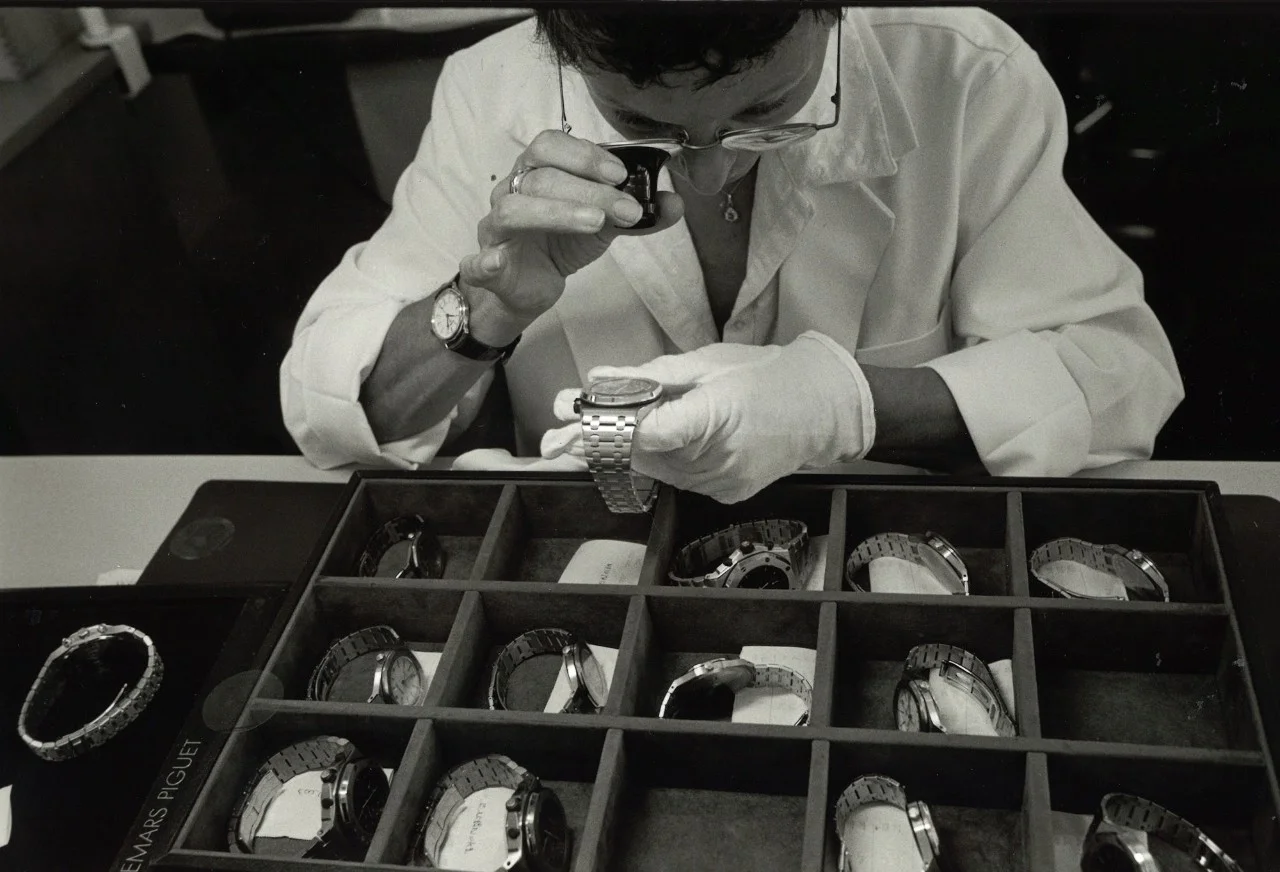
Circa 1995. Checking Model 25721. In addition to the various workshop tests (water resistance, precision, power reserve…), each watch is examined in great detail before leaving Le Brassus. Audemars Piguet Archives.
Luxury and sturdiness
Like all Audemars Piguet watches, the Royal Oak Offshore 25721 was treated to finishes reflecting the highest traditional watchmaking standards. Taking a few examples, each curved bracelet link was hand satin-brushed, the dial bore a guilloché Petite Tapisserie motif, the case alternated between satin-brushing and polishing, not to mention the movement decorations.... Its case was nonetheless designed to withstand intensive sports activities.
Model 15721 was one of the very few chronographs on the market offering water resistance to 100 metres. This performance was made possible by an oversized gasket, compressed between the bezel and the case middle for both aesthetic and functional reasons, and complemented by silver gaskets associated with the eight hexagonal screws running right through the case.
The first Royal Oak Offshore was also resistant to magnetic fields. The generous space inside the case enabled the addition of a soft iron cage to protect the movement. While the 1993 press release failed to mention this significant characteristic, a January 1994 report indicated that the watch was resistant to 300 Oe in terms of coerceive force, five times the ISO standard! The two chronograph push-pieces and the crown were protected by a Therban® coating, a type of rubber that is ultra-resistant to temperature, abrasion, steam and gas.
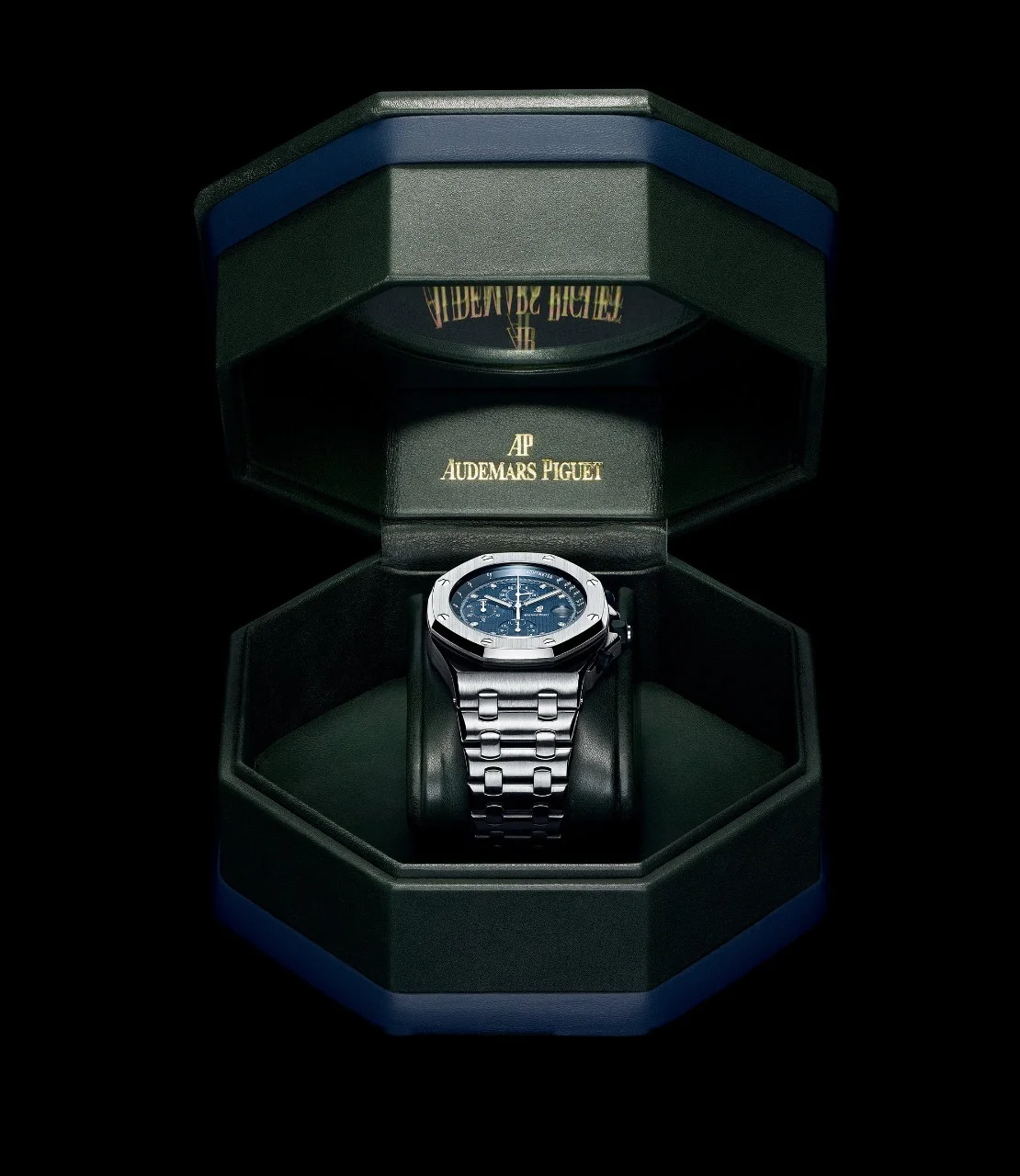
To symbolise sturdiness and evoke the new watch’s nautical inspiration, a special octagonal presentation box was created with a lid featuring a porthole enabling the watch to be seen even when the box was closed.
Power, virility, resistance, outrageous design: above and beyond the powerboats that first inspired the Royal Oak Offshore, it is tempting to see in Model 25721ST the watchmaking equivalent of the Hummer SUV in the world of cars. It should be noted that the latter military-inspired all-terrain vehicle was created in 1992, meaning that the parallels drawn by some observers between the 1972 Royal Oak and the 1969 Range Rover could once again be applied to this watch-car tandem, albeit on an even large, more off-road scale…
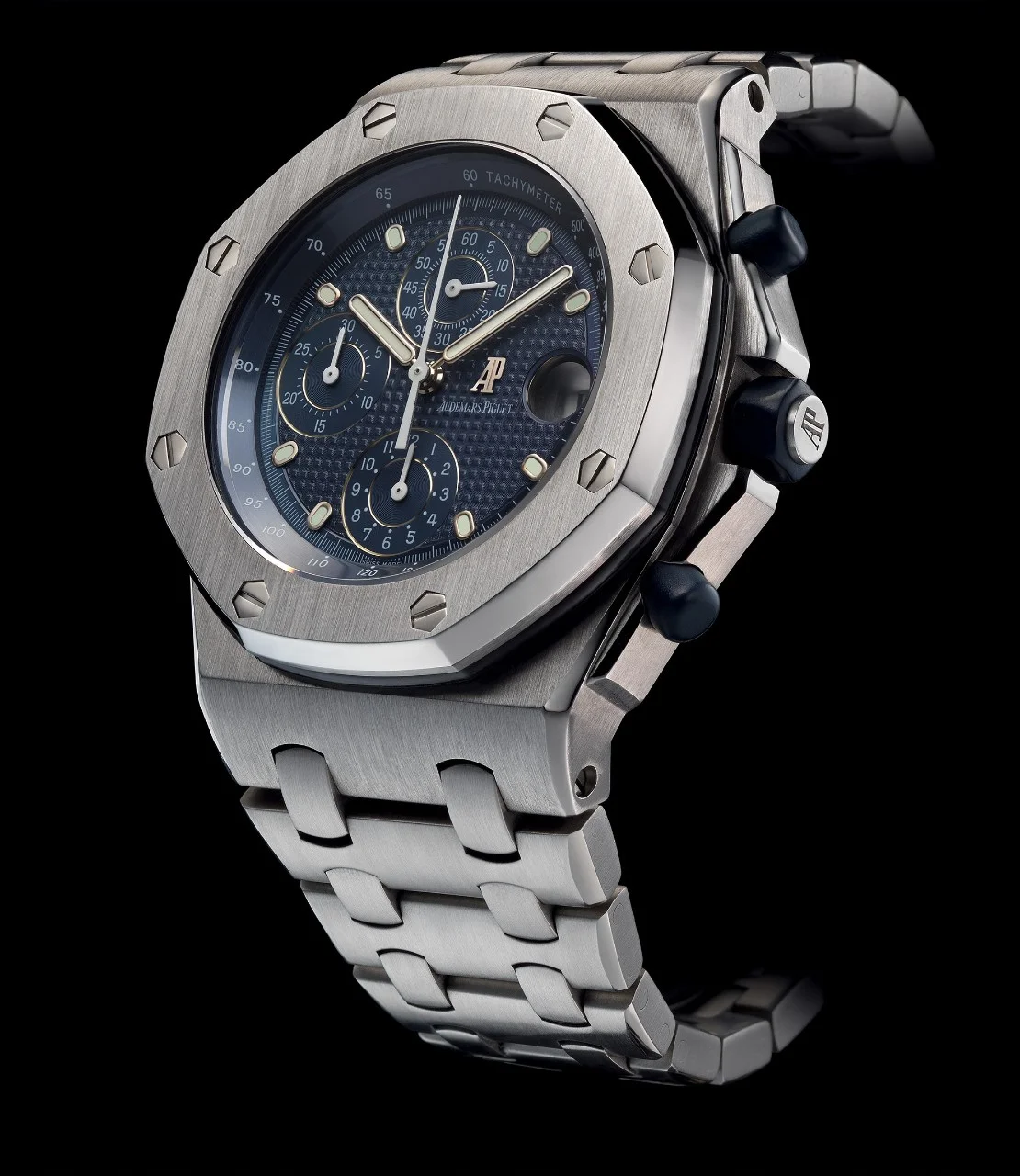
1993. Royal Oak Offshore 25721, No. 32. Chronograph, selfwinding, blue Petite Tapisserie dial. Like the first hundred 25721 watches, this one has a Royal Oak engraving on the caseback, with no indication of the word Offshore. Calibre 2126/2840, movement no. 369368. 42 mm x 14.05 mm steel case No. D23775. Sold in Italy on December 13, 1993. Audemars Piguet Heritage, inv. 1382.
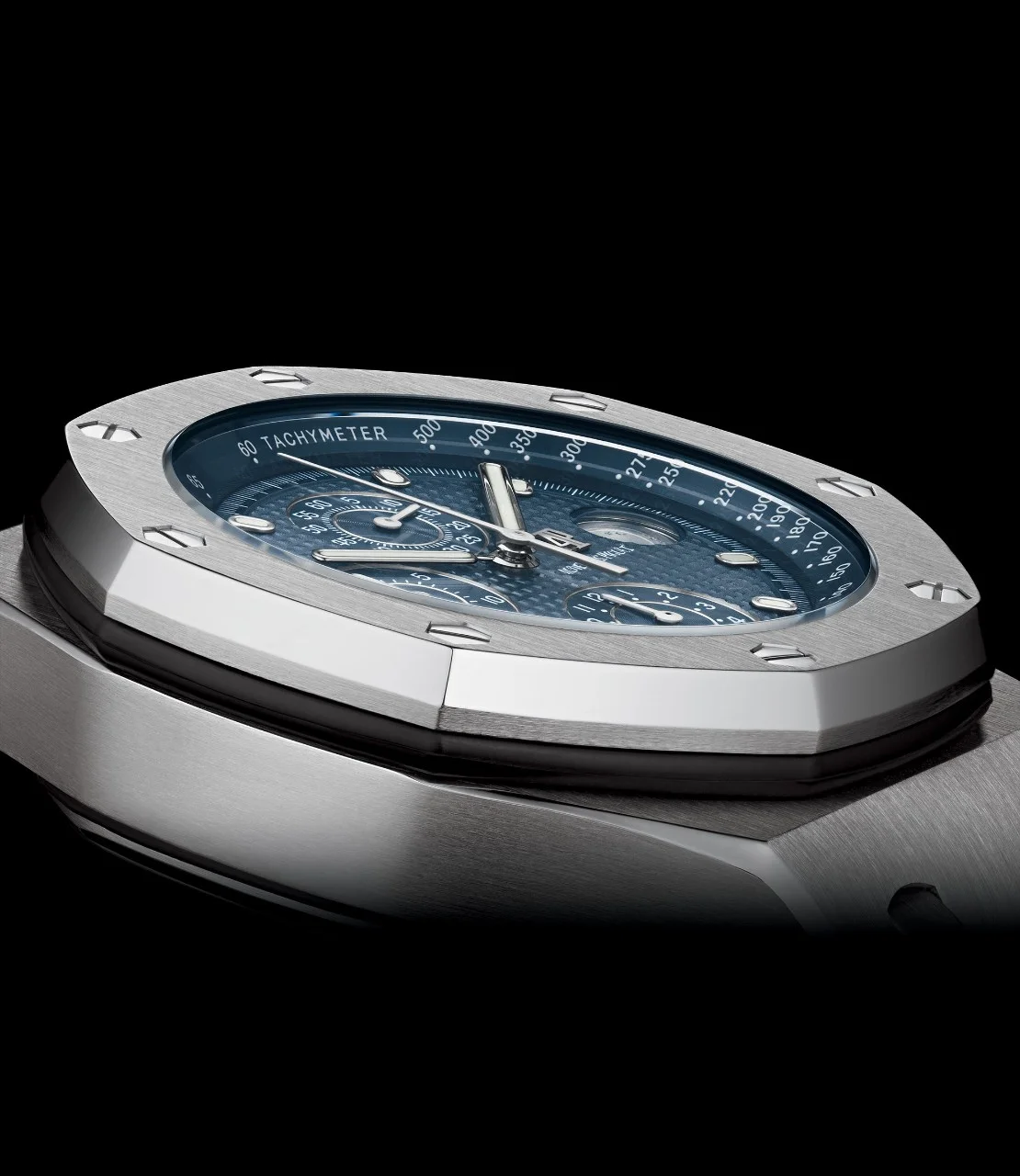
1993. Royal Oak Offshore 25721, No. 32. Chronograph, selfwinding, blue Petite Tapisserie dial. Like the first hundred 25721 watches, this one features a Royal Oak engraving on the caseback, with no indication of the word Offshore. Calibre 2126/2840, movement No. 369368. 42 mm x 14.05 mm steel case No. D23775. Sold in Italy on December 13, 1993. Audemars Piguet Heritage, inv. 1382.

1993. Royal Oak Offshore 25721, No. 32. Chronograph, selfwinding, blue Petite Tapisserie dial. Like the first hundred 25721 watches, this one has a Royal Oak engraving on the caseback, with no indication of the word Offshore. Calibre 2126/2840, movement No. 369368. 42 mm x 14.05 mm steel case No. D23775. Sold in Italy on December 13, 1993. Audemars Piguet Heritage, inv. 1382.
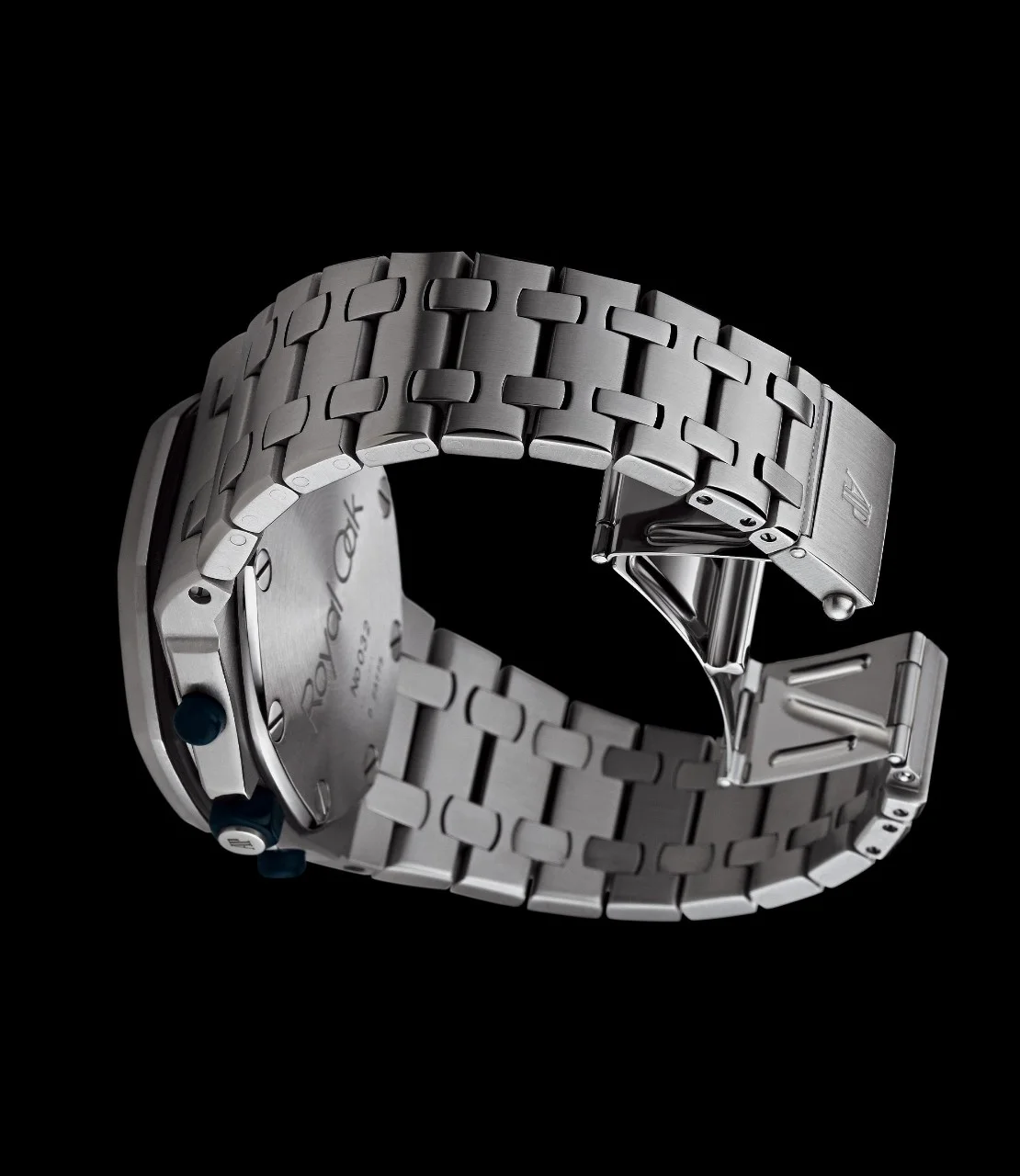
1993. Royal Oak Offshore 25721, No. 32. To secure the watch on the wrist despite its considerable weight, the first Royal Oak Offshore was fitted with a special folding clasp. Audemars Piguet Heritage, inv. 1382.
1993. Royal Oak Offshore 25721, No. 32. To secure the watch on the wrist despite its considerable weight, the first Royal Oak Offshore was fitted with a special folding clasp. Audemars Piguet Heritage, inv. 1382.
The scandal
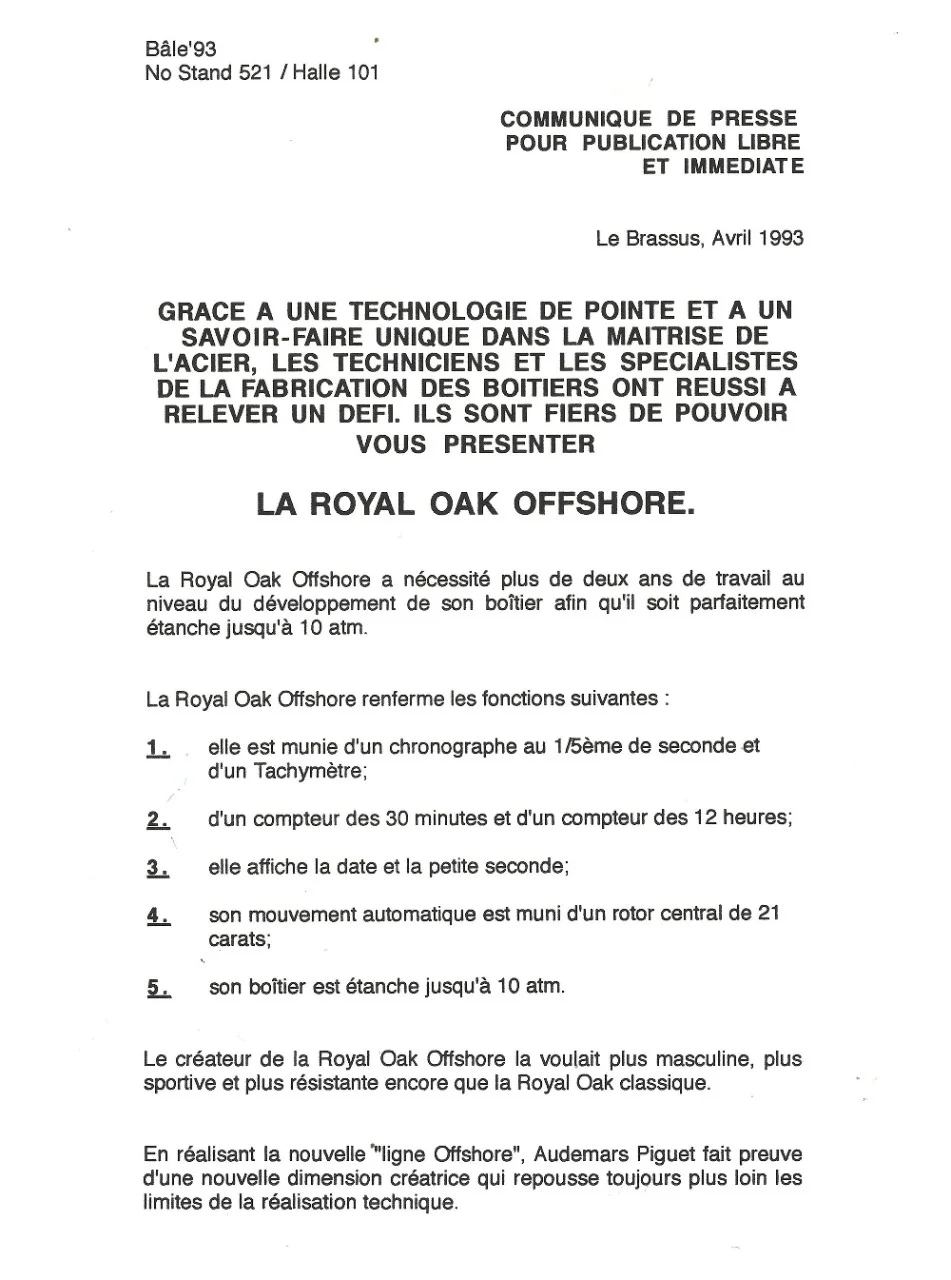
Audemars Piguet sales representatives unveiled the three prototypes of the Royal Oak Offshore at the Basel Fair held from April 22 to 29, 1993 in an extremely tentative, almost under the radar manner. Despite this caution, the watch created a shock wave. Reactions to it left such a strong impression that 30 years later, in the Audemars Piguet workshops, everyone still has their own version passed on by one of those involved at the time, or from a client, colleague or friend. The story has been transformed to the point of almost becoming a myth.
The more toned-down variants hold that when traditional agents and retailers discovered the watch, they either expressed outrage or bemoaned the fact that the brand was being ignored: it was at best a faux pas, at worst a sacrilege! Measuring 42 mm in diameter and 14,05 mm thick, it carried a CHF 16,600 price tag, twice that of a steel Royal Oak 14790. However, when the same protagonists were accompanied by their sons, they apparently had a diametrically opposite reaction along the lines of: “At last, a cool, young, unabashed luxury watch that doesn't look like those of the previous generation!”
Nicknames began popping up and the watch industry notably dubbed it “The Beast". In a 2015 interview, Emmanuel Gueit tells how Gérald Genta burst onto the brand booth, complaining: "You have spoilt my watch, you're a murderer!” A devotee of slenderness and ergonomics, the most famous watch designer of them all confirmed his opinion in a 2011 interview: "When I saw the first Offshore, I was hopping mad about such a crazy move!” The watch that he described as a “sea elephant” was an absolute heresy!
There was no doubt that the Offshore spelled a return to the Royal Oak’s transgressive vocation. But would this translate into immediate commercial success, as it had done 20 years earlier?


A flop?
The first 100 examples of Model 25721 bore a "Royal Oak" engraving on their back, without the "Offshore" indication. Some people secretly hoped the monster would get such an icy reception that the project would be nipped in the bud, thereby leaving the field free to use the ”offshore" idea in another context... However, the enthusiasm shown by the 1980s generation turned the tide in a different direction, and the model began bearing a full logo from number 100 (or 101) onwards.
Commercial success was nonetheless a long time coming, with only 61 of these watches sold in 1993, although admittedly the lengthy development process meant the first ones were not delivered until November 25... Sales for 1994 amounted to 330 units, followed by a total of 325 watches in 1995. All of which was nothing much to boast about, as over those three years only 716 Royal Oak Offshore 25721 had thus left Le Brassus, corresponding to 1.6% of Audemars Piguet’s overall watch sales. In comparing this figure with the 1,652 Royal Oak 5402 watches delivered between 1972 and 1974, one is tempted to speak of a flop. While production difficulties may explain these poor results, it is important to remember the extent to which this watch was ahead of its time and even more shocking than the first Royal Oak. In this respect, the pioneering spirit of certain markets must be commended.
Italy was once again the driving force. Franco Ziviani – who had been working for years with Alessandro Villa on watch distribution in the country (see the article on Royal Oak Perpetual Calendar watches) and shortly thereafter bought up the company – took Emmanuel Gueit with him on a tour of retailers. In Rome, when someone told him: “You're crazy, it's huge!", he retorted: “You'll see, when a guy at the wheel of his Ferrari sticks his arm out of the window, it'll make all the difference.” The argument hit home and over the first three years almost a quarter of these watches were sold in Italy, which indeed soon began suffering from a shortage of Offshore watches – to the point where an advertisement appealing for customers to be patient was published in March 1994! This Italian momentum increased from 1997 onwards, driven by the ski star Alberto Tomba. Little by little, Switzerland, the United States and then Germany followed Italy's lead.
These countries blazed the trail and the idea gradually made its way into people’s minds. While Model 25721 remained in the Audemars Piguet catalogue for 15 years, the progress in attitudes was also due to the expansion of the collection from 1996 onwards.
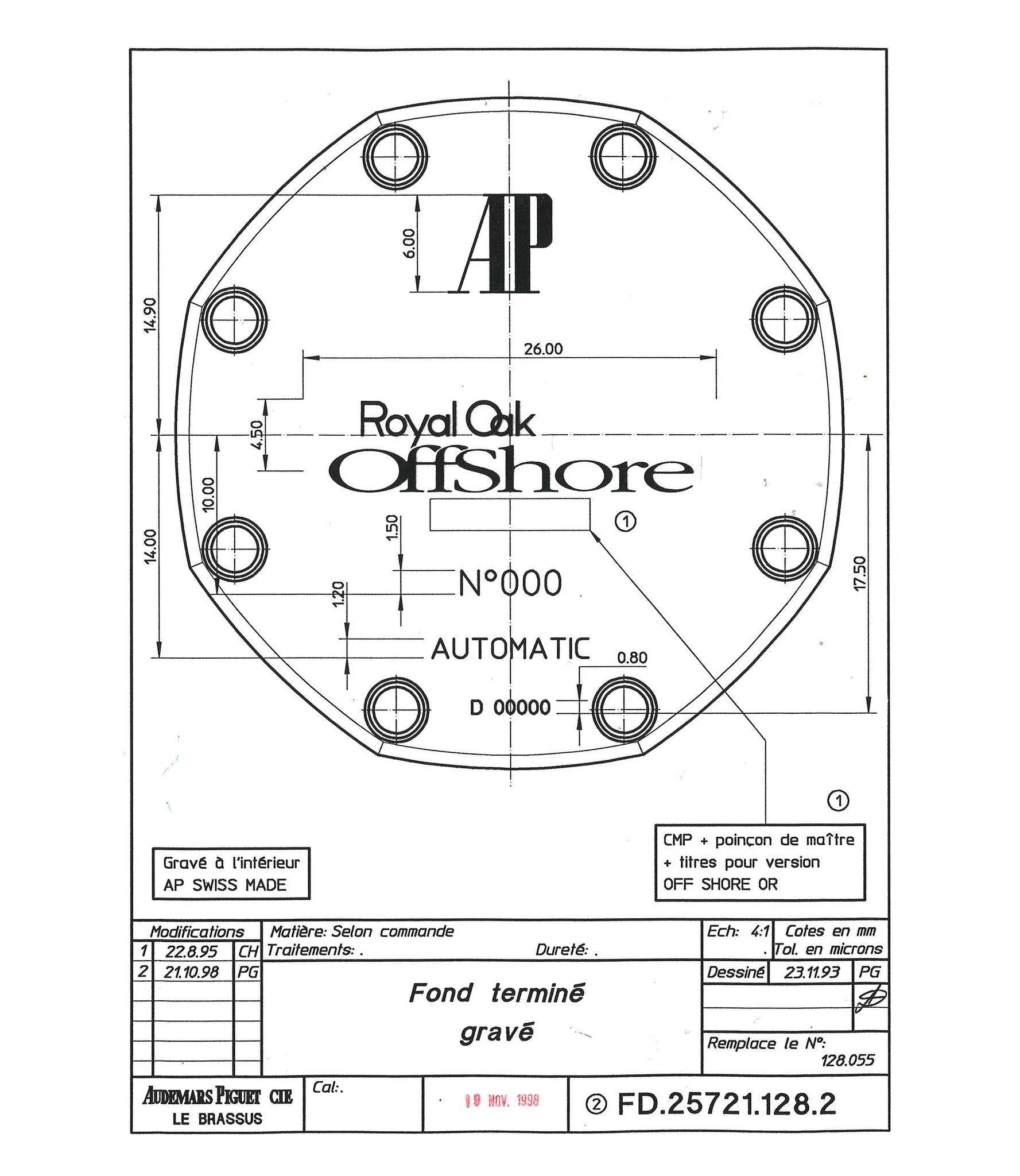
23.11.1993. Caseback engraving plans. In November 1993, the caseback design was modified to add the word "Offshore" after Royal Oak, as well as the AP logo. While the first 100 timepieces bore only the Royal Oak signature, the following ones were marketed from January 1994 with the collection’s full signature. Audemars Piguet Archives.
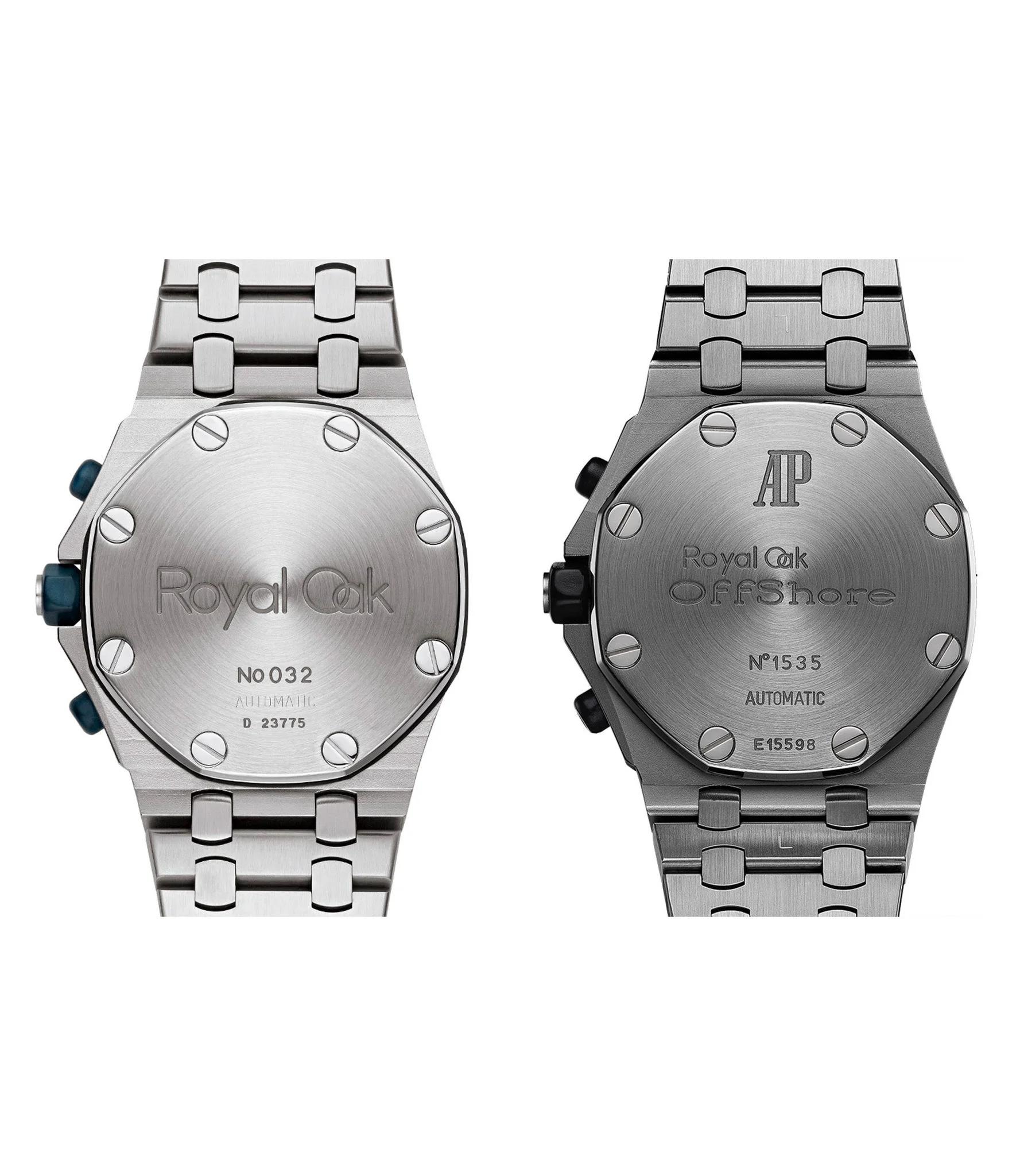
1993 and 1994. Engravings on the Royal Oak Offshore 25721. The first hundred 25721 watches did not have the word Offshore engraved on the caseback. Left, No. 32 sold in Italy on December 13, 1993, inv. 1382. Right, No. 208 sold in Spain on June 29, 1994, inv. 1879. Audemars Piguet Heritage.
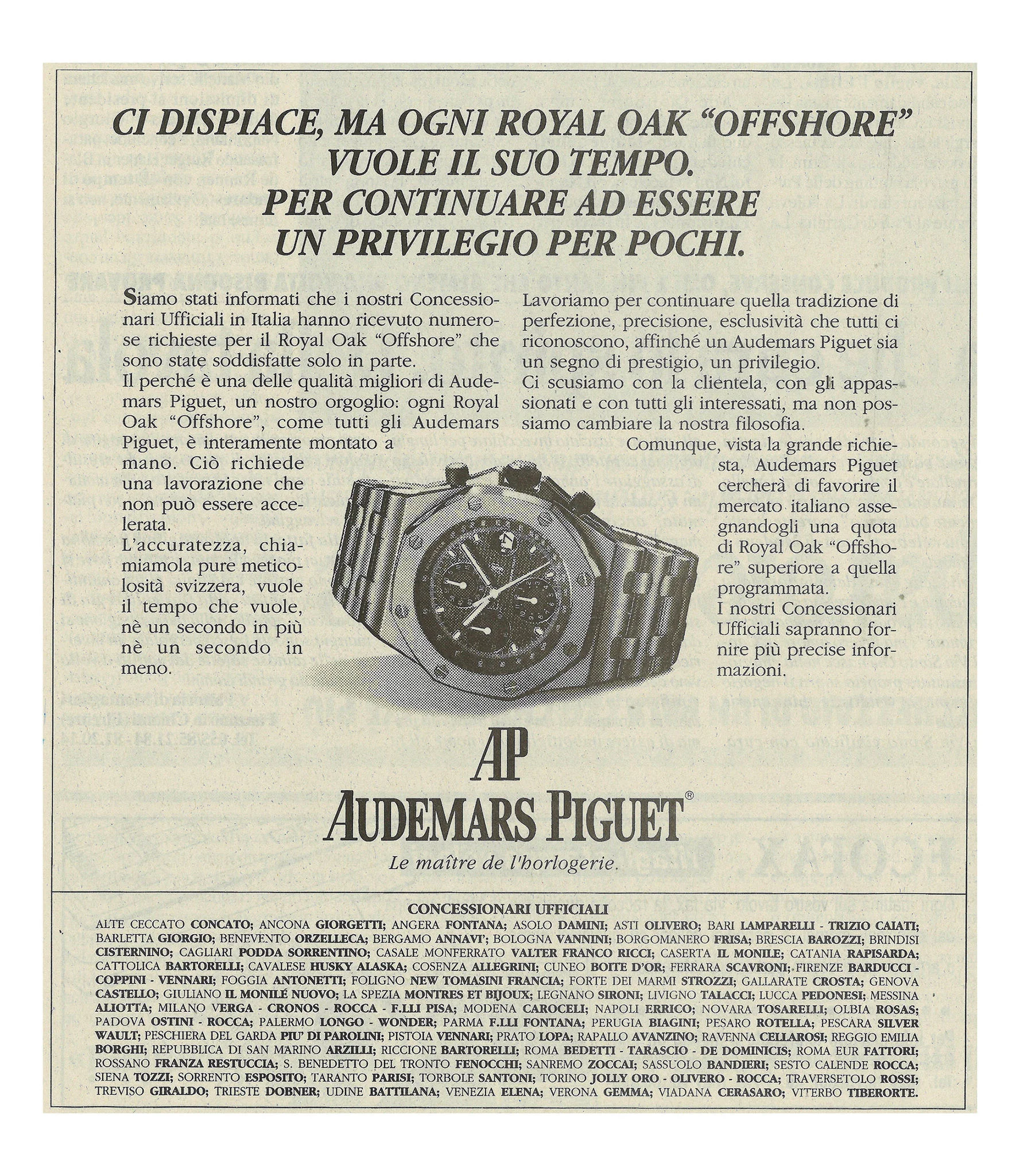
1994. Royal Oak Offshore advertisement. Published in March 1994, the advertisement explains to customers that the rarity of the watch is due to the complexity of its production. At the time, only 45 of these watches had been delivered in Italy, whereas the advert lists more than 150 official dealers for that country. Audemars Piguet Archives.
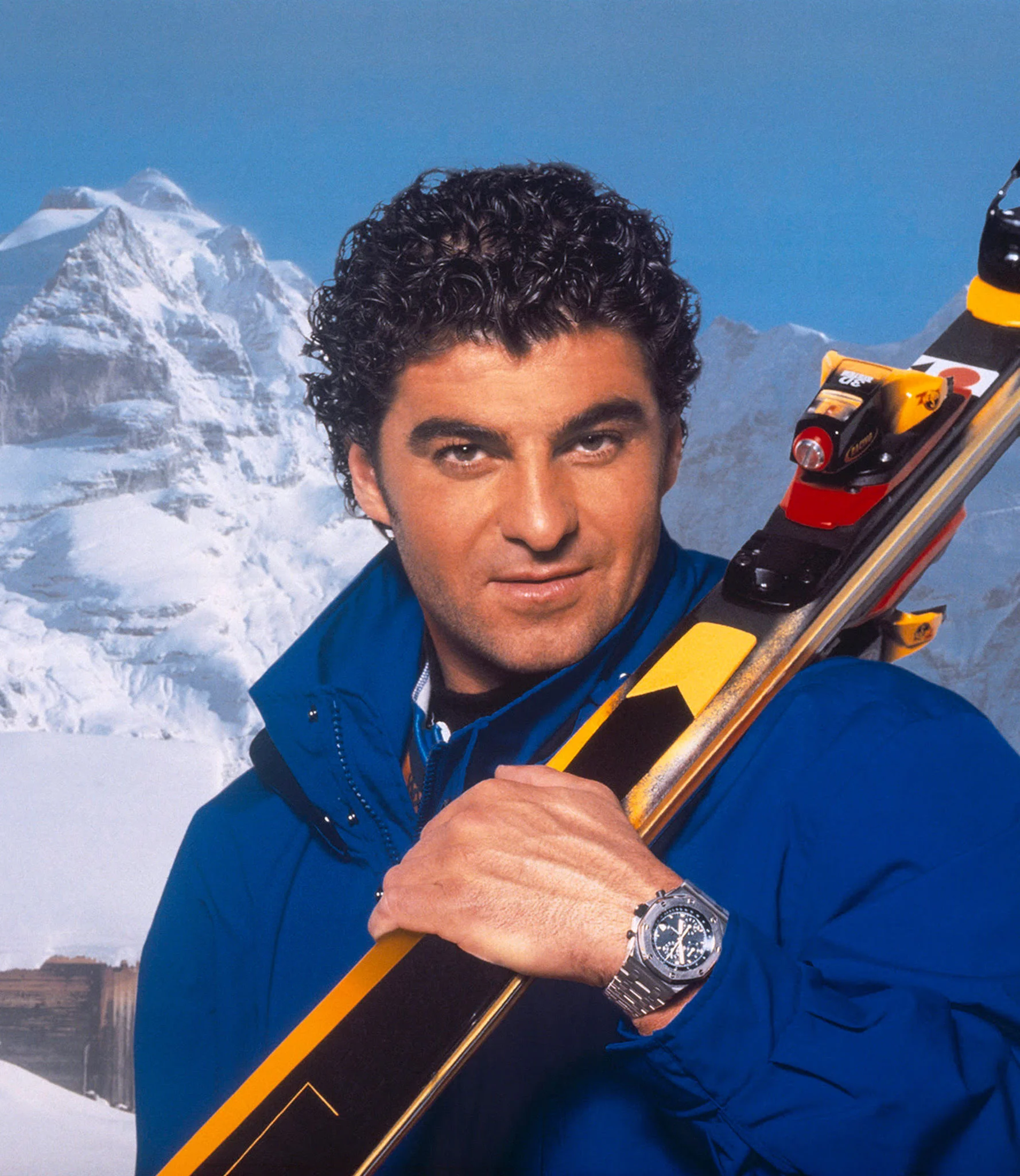
Circa 1997. Alberto Tomba. Nicknamed ‘Tomba la Bomba’ due to his powerful skiing style and larger-than-life personality, from 1997 onwards the Italian champion Alberto Tomba became one of the key drivers of the Royal Oak Offshore’s sucess, notably in Italy. Audemars Piguet Archives.
1993-1995. Total Royal Oak Offshore sales during the first three years of the collection
|
1993 |
1994 |
1995 |
TOTAL |
Italy |
24 |
86 |
59 |
169 |
Switzerland |
15 |
47 |
52 |
114 |
USA |
1 |
44 |
46 |
91 |
Germany |
7 |
29 |
41 |
77 |
France |
0 |
32 |
18 |
50 |
Japan |
1 |
9 |
23 |
33 |
Hong Kong |
2 |
17 |
10 |
29 |
UK |
6 |
17 |
6 |
29 |
Spain |
0 |
9 |
12 |
21 |
Belgium |
1 |
6 |
10 |
17 |
Mexico |
0 |
4 |
9 |
13 |
Singapore |
2 |
3 |
5 |
10 |
Other |
2 |
27 |
34 |
63 |
TOTAL |
61 |
330 |
325 |
716 |
The Beast and its offspring
The Royal Oak Offshore remained unchanged for three years, apart from the addition of a few gold models in 1995 (14 models 25721 in yellow gold and 27 in two-tone versions) and the introduction of a triple folding clasp. It was in 1996 that six new models were introduced, marking the true birth of the collection as such. The first of these iterations was a 42 mm Royal Oak Offshore with a leather strap, Model 25770.
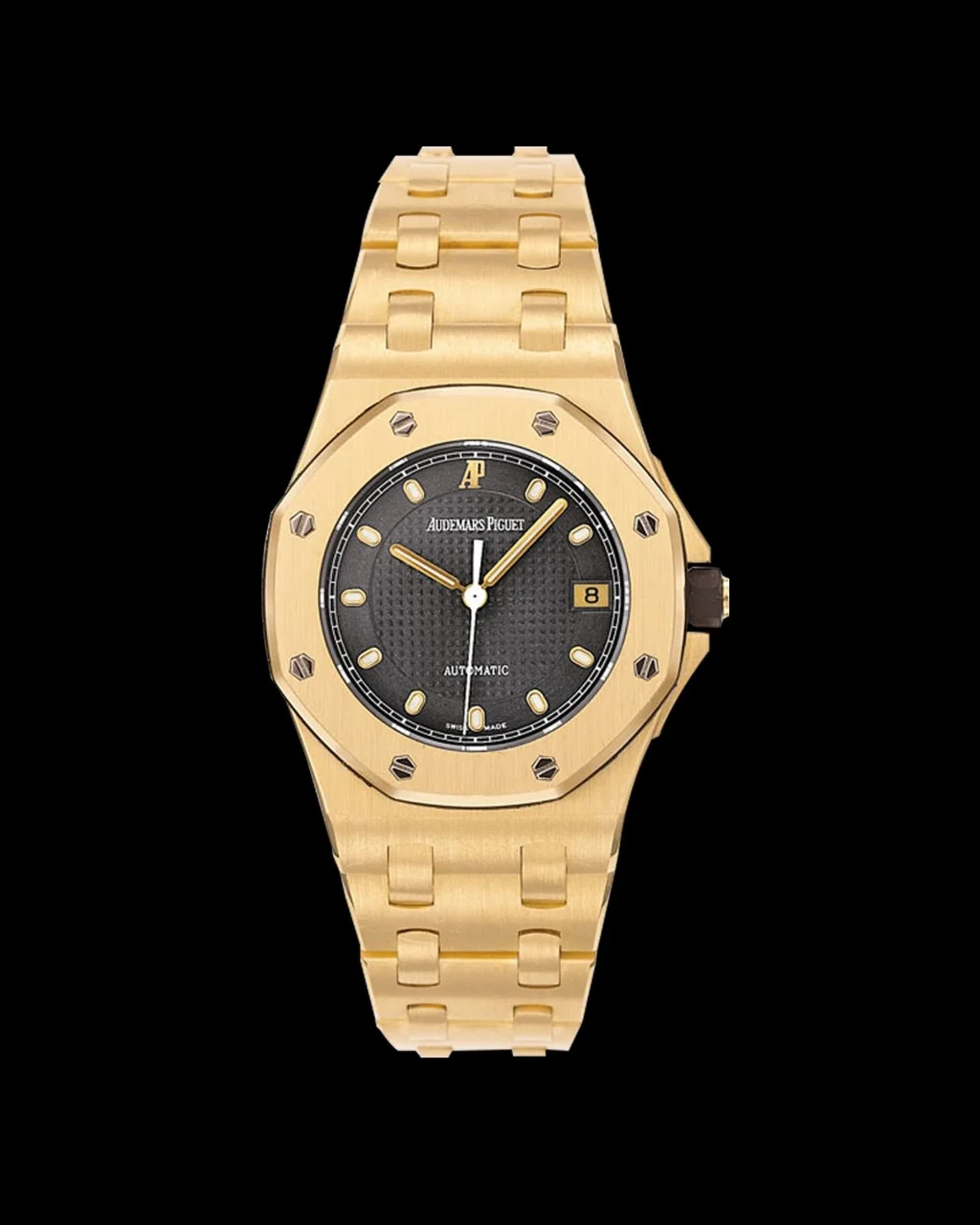
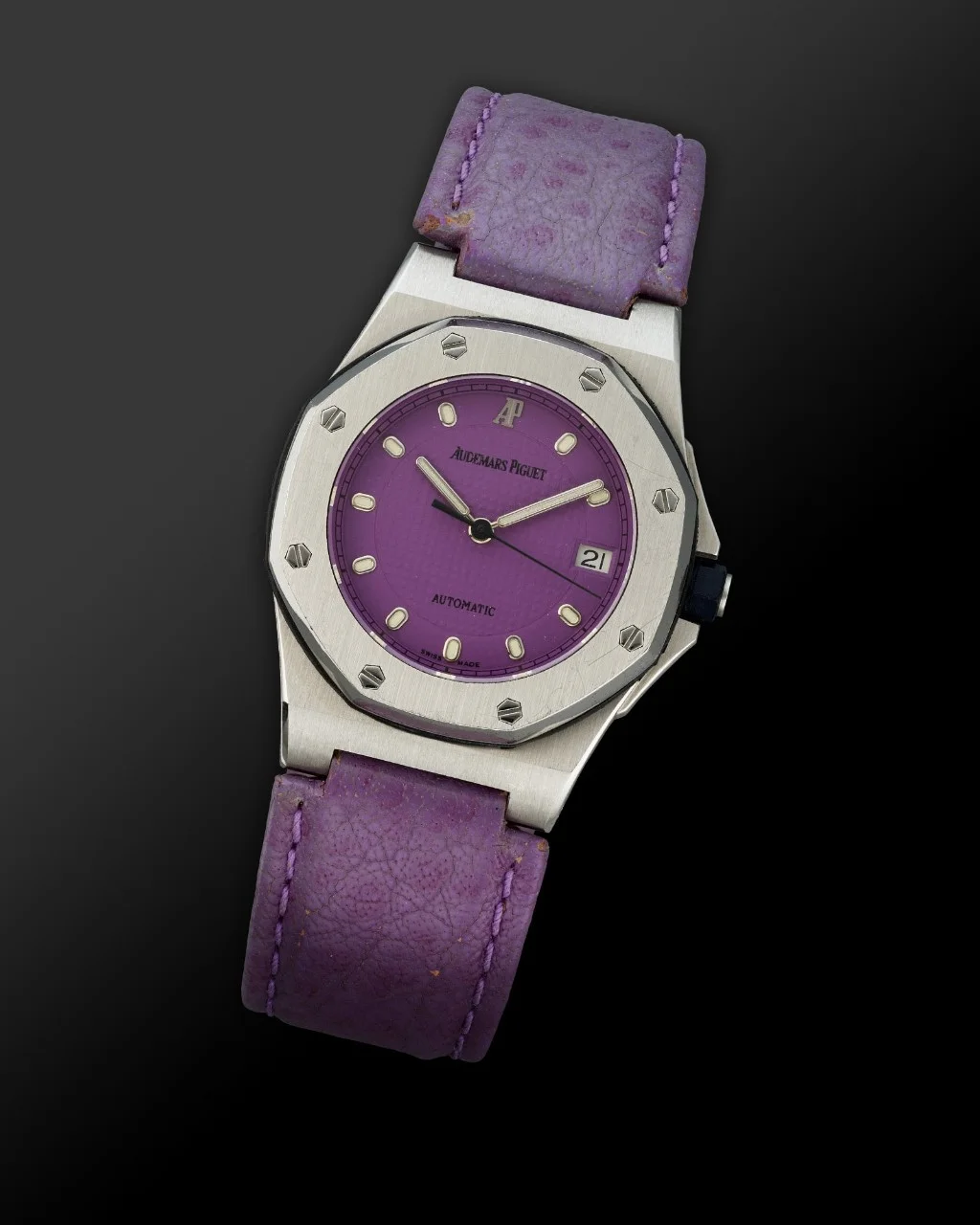
While one may recall that Emmanuel Gueit had intended the Royal Oak Offshore exclusively for men, 1996 saw the introduction of two variations for women (Models 79290 and 77151 with a leather strap). Measuring 30 mm in diameter, powered by selfwinding Calibre 2140 (20 mm), dressed in steel and adorned with a Tapisserie dial, the Royal Oak Offshore Lady was a response to strong demand, as stated in the press release for the 1996 Basel Fair: “A large number of Audemars Piguet customers have expressed the desire to see a ladies' version produced."
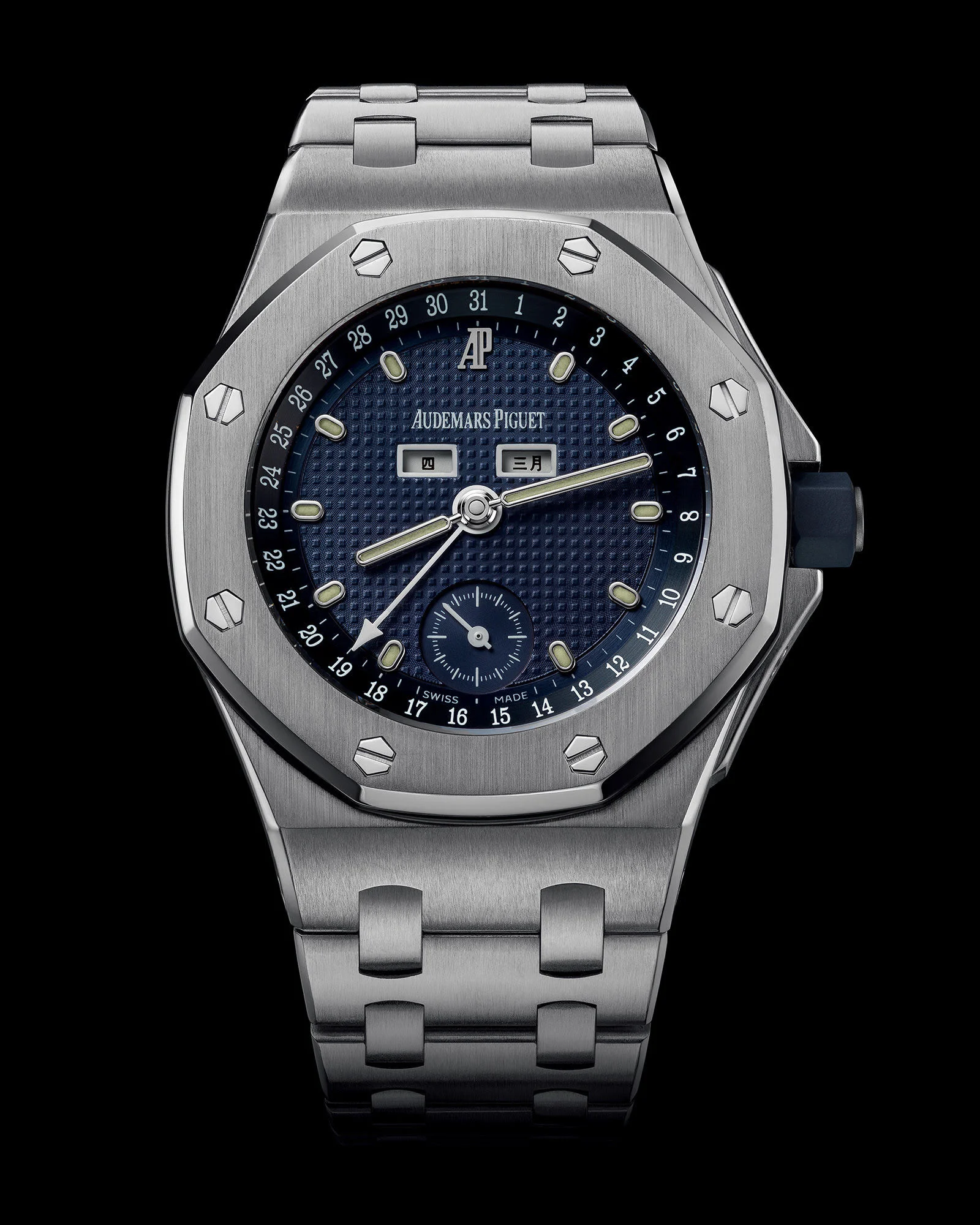
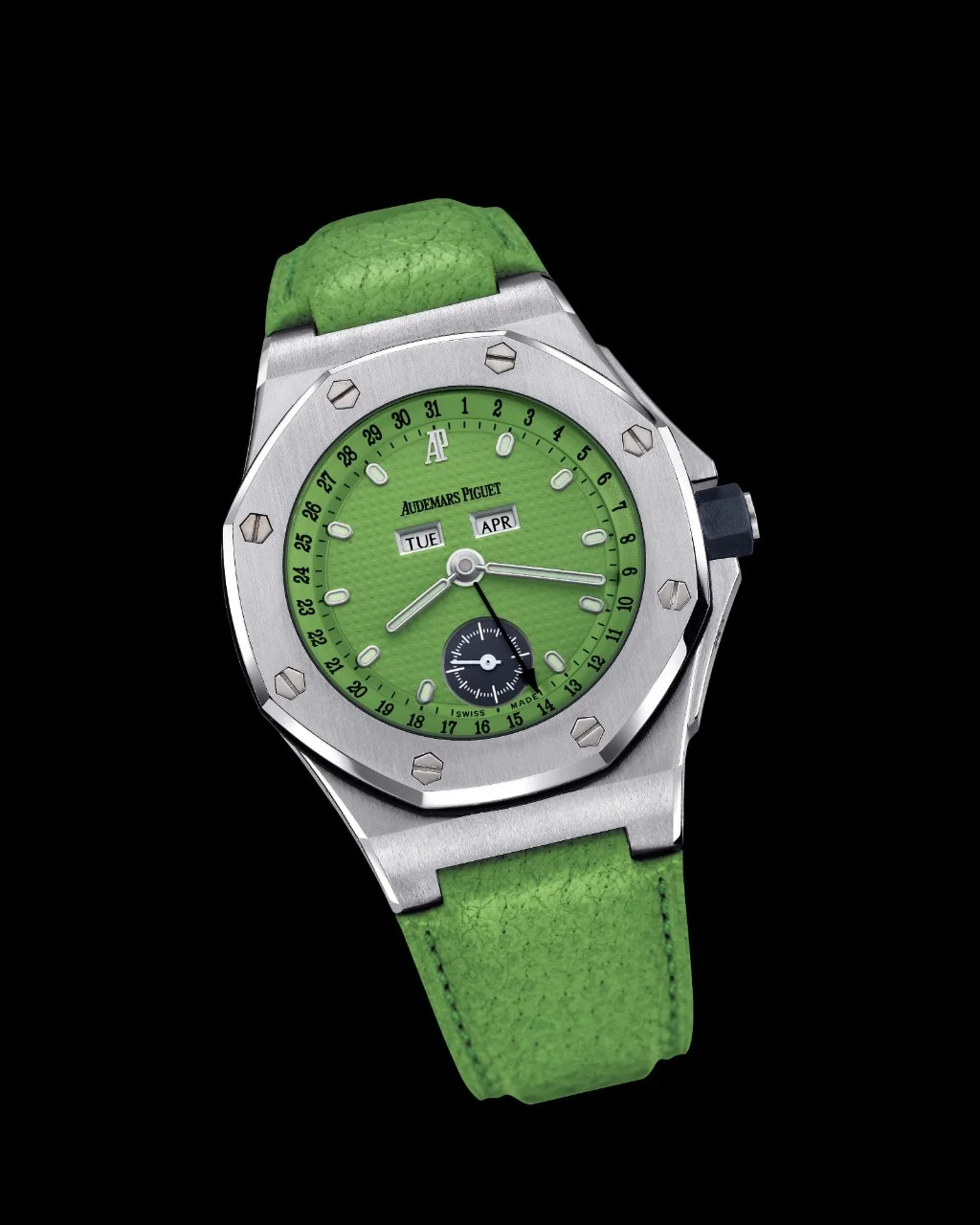
The three other references were available in a medium size, i.e. 38 mm. All were equipped with Calibre 2127/2827 (26 mm) and enriched the collection with a complete calendar featuring aperture-type day and month displays as well as a pointer-type peripheral date indication. More than 1,116 examples of Model 25807 were produced between 1996 and 2004, supplemented by its leather-strap variant Model 25808. The Royal Oak Offshore 25852 limited edition of 19 in pink gold and 96 in steel was created to mark Hong Kong’s transfer of sovereignty to China. It paved the way for special series.
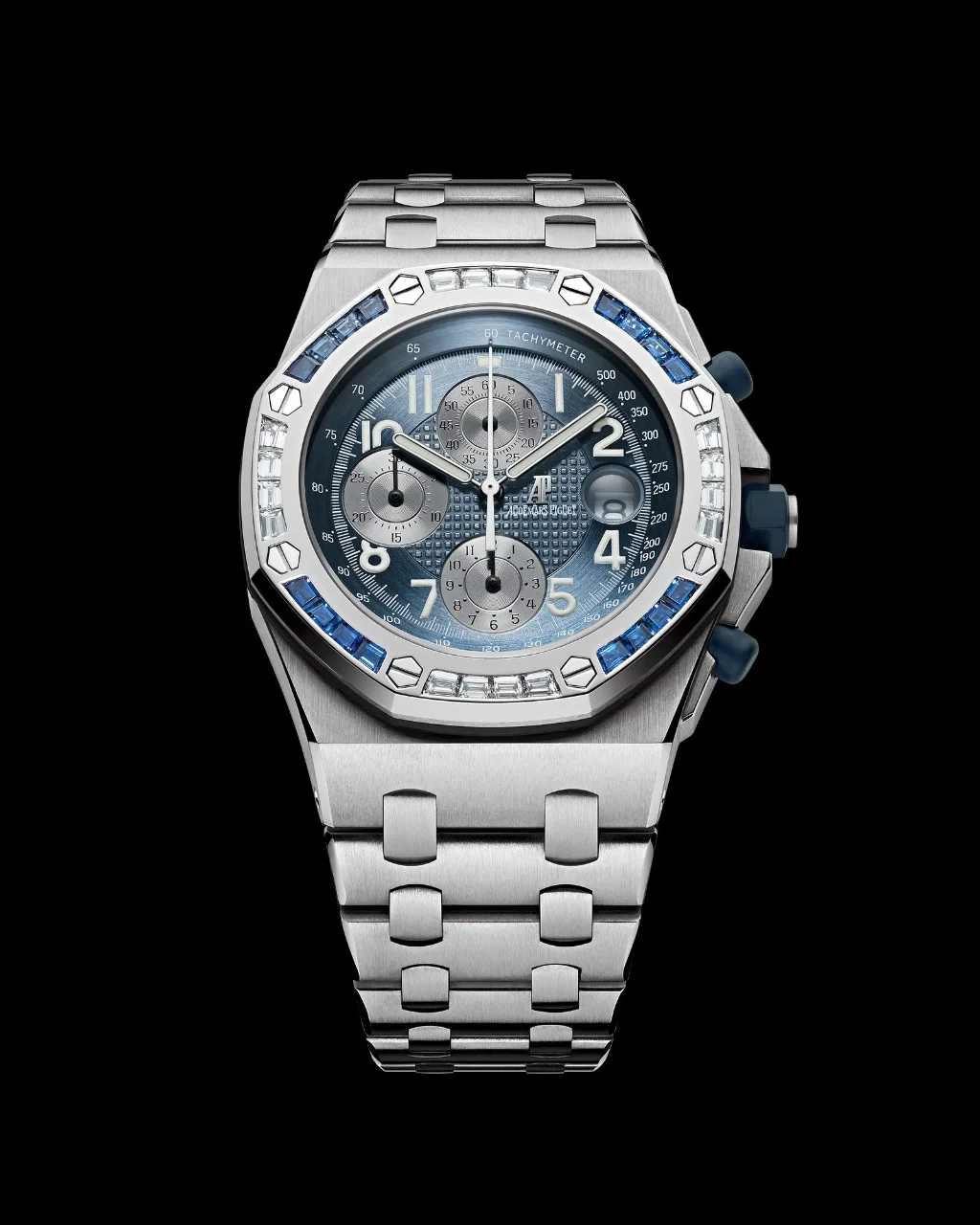
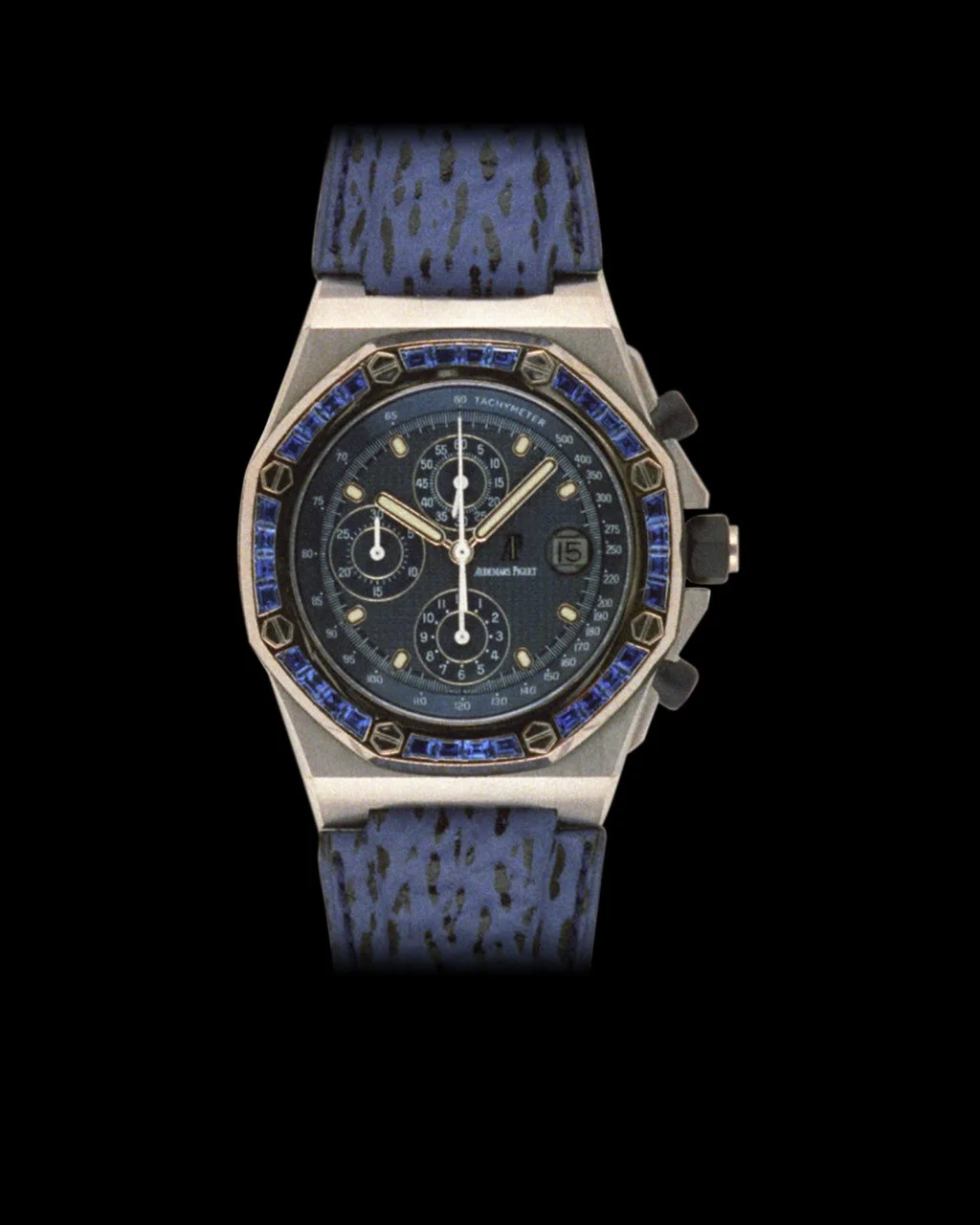
While collectors are well aware that 1997 was a high point in the history of the Royal Oak – with the introduction of the chronograph, the tourbillon and the Grande Complication – the extent to which this was also a pivotal year for the Royal Oak Offshore is often overlooked. The perpetual calendar made its appearance (25854), as did time zones (25970, 25971 and 25972) and gemsetting (25844). To celebrate the 25th anniversary of the Royal Oak, Emmanuel Gueit designed bright and cheerful colour variations: canary yellow, apple green, orange, red, garnet, brown, sky blue, etc.
This impressive flurry of models caused the collection to take off: in 1997, sales topped the 1,000 mark for the first time and the introduction of titanium the following year confirmed this momentum.
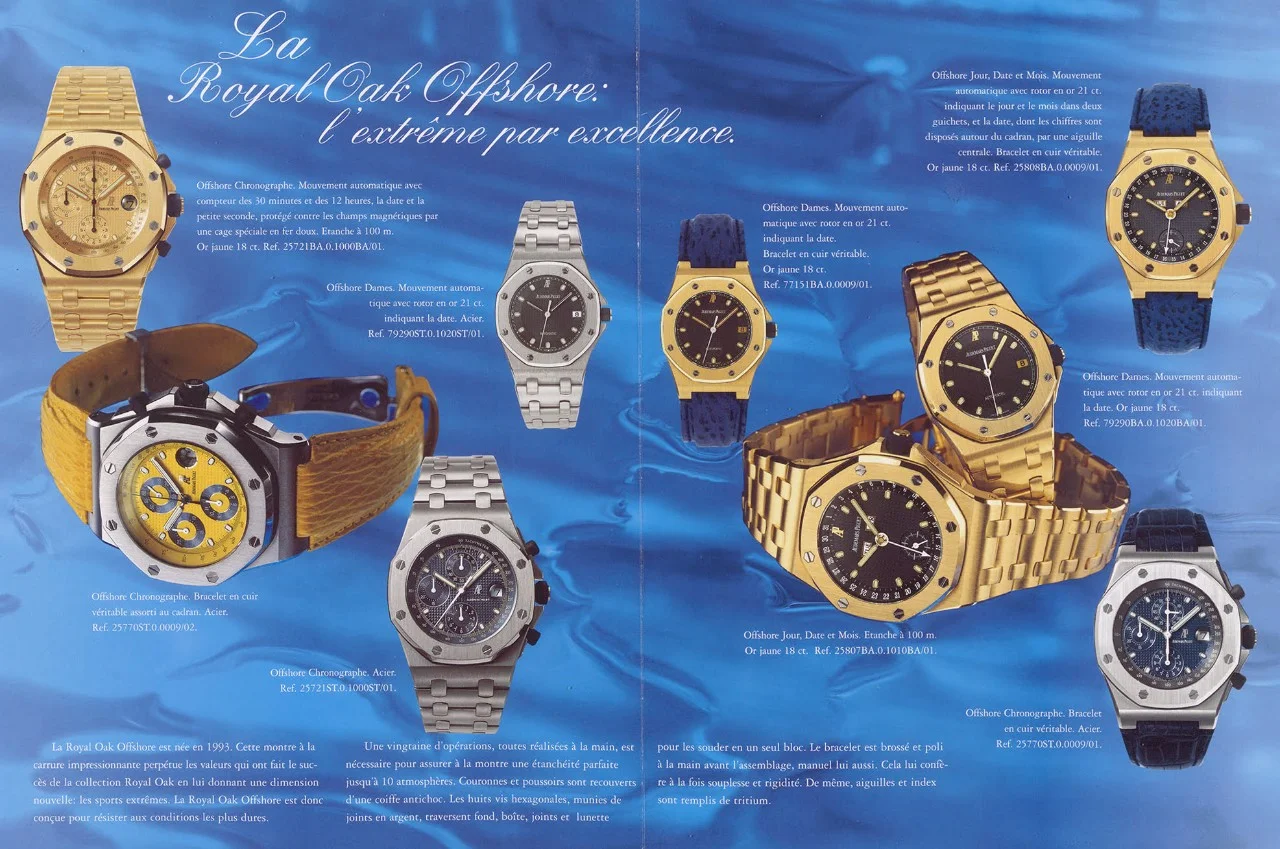
1997. Royal Oak Offshore brochure. Four years after its launch, the Royal Oak Offshore already had many variations: versions on metal bracelets or leather straps; diameters of 30 mm, 38 mm and 42 mm; models equipped with chronograph, full calendar or date only displays; cases steel or yellow gold; dials in blue, gold-toned or yellow colours, etc. Audemars Piguet Archives.
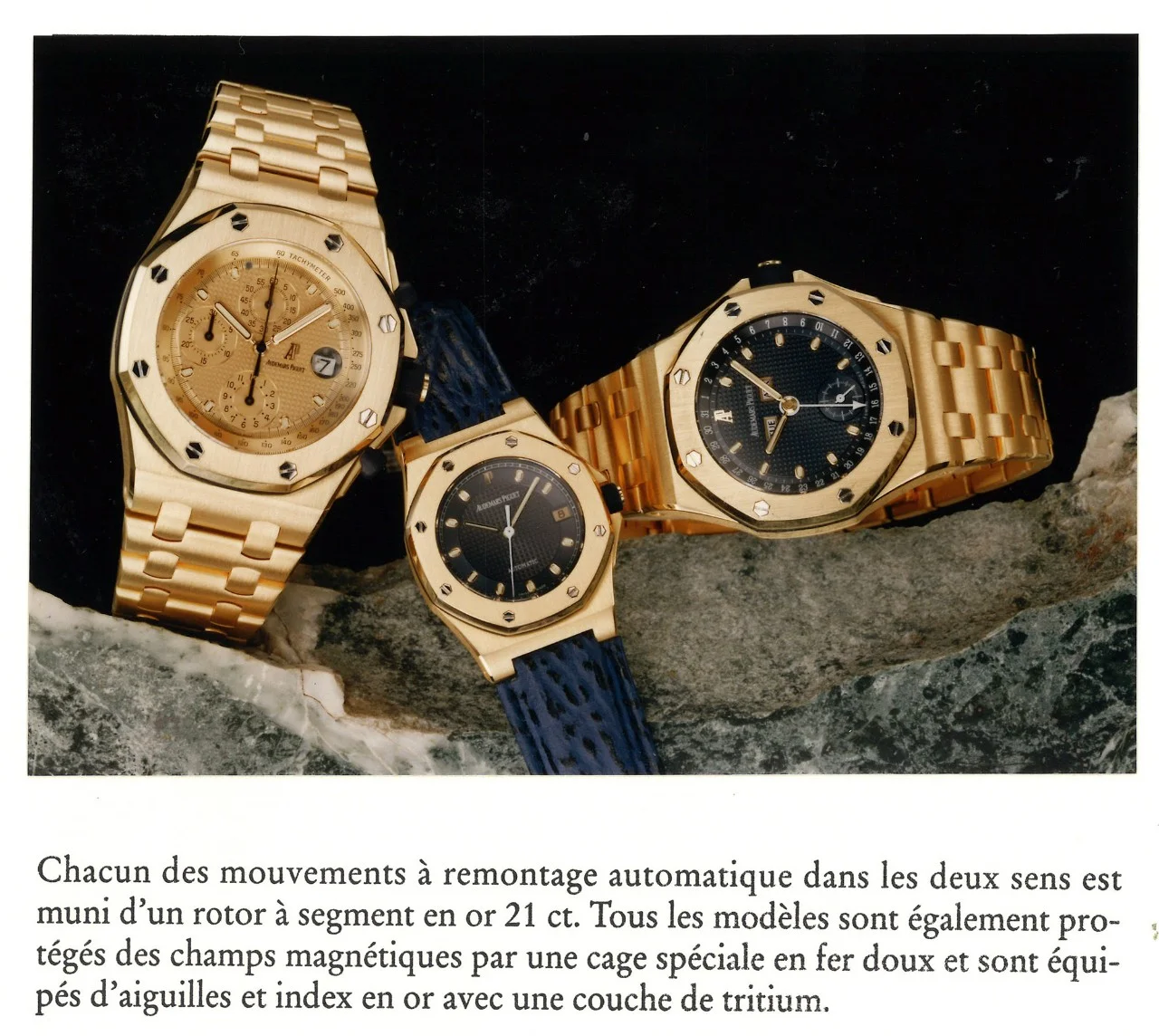
1997. Photograph of Royal Oak Offshore Models 25721BA (42 mm), 77151BA (30 mm) and 25807BA (37 mm). The text highlights the bidirectional selfwinding mechanism, the protection against magnetic fields and the luminescence of the tritium hands and dials. Advertising leaflet. Audemars Piguet archives.
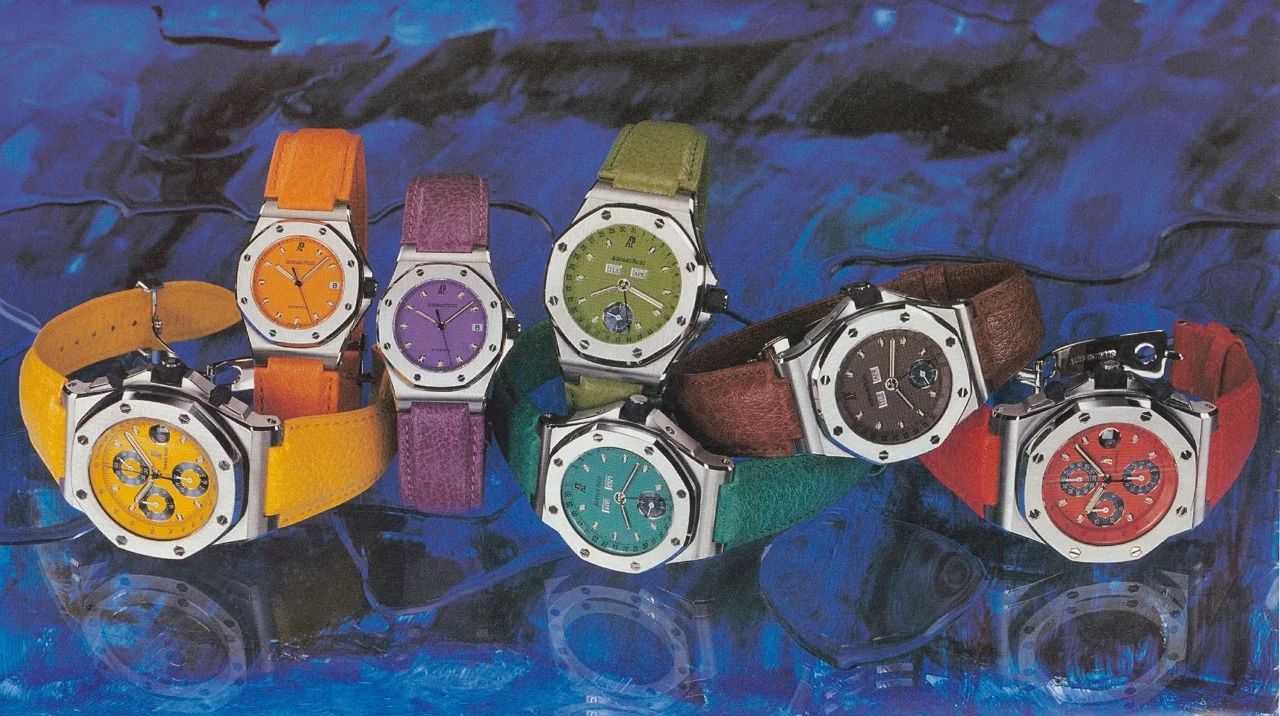
1997. Royal Oak Offshore brochure. To celebrate the 25th anniversary of the Royal Oak, Emmanuel Gueit designed a multicoloured Offshore collection for an anniversary showcase. Enthusiasm was such that the watches were put into series production. Audemars Piguet Archives.
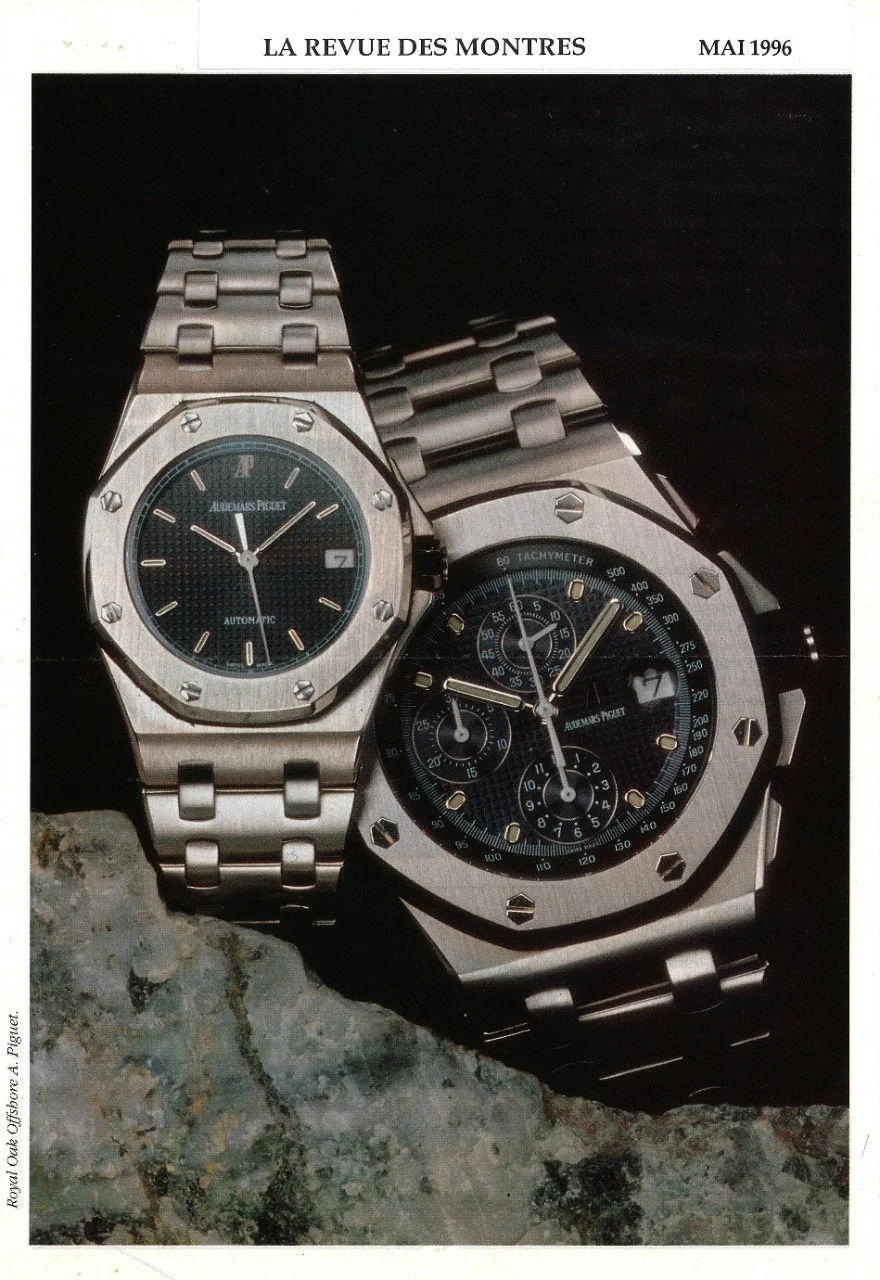
1996. Royal Oak Offshore 25721 and 79290. One of the first variations of the original Royal Oak Offshore 25721 was made in 1996 for women, in a 30 mm diameter. Image from a promotional brochure published in 1996. Audemars Piguet Archives.

1997. Royal Oak Offshore Perpetual Calendar 25854ST (42 mm), No. 27. Double complication: chronograph and perpetual calendar. Calibre 2226/2839. Case E8105. Prototype probably presented at the 1997 Basel Fair. Audemars Piguet Heritage, inv. 630.
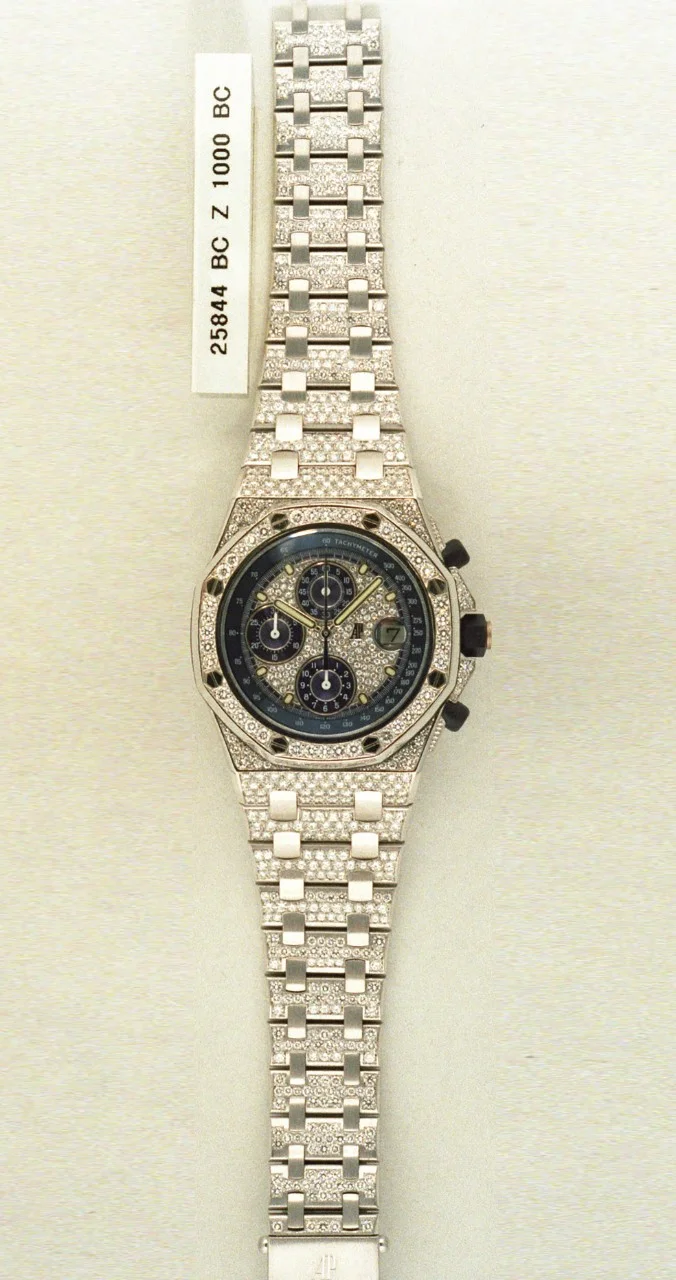
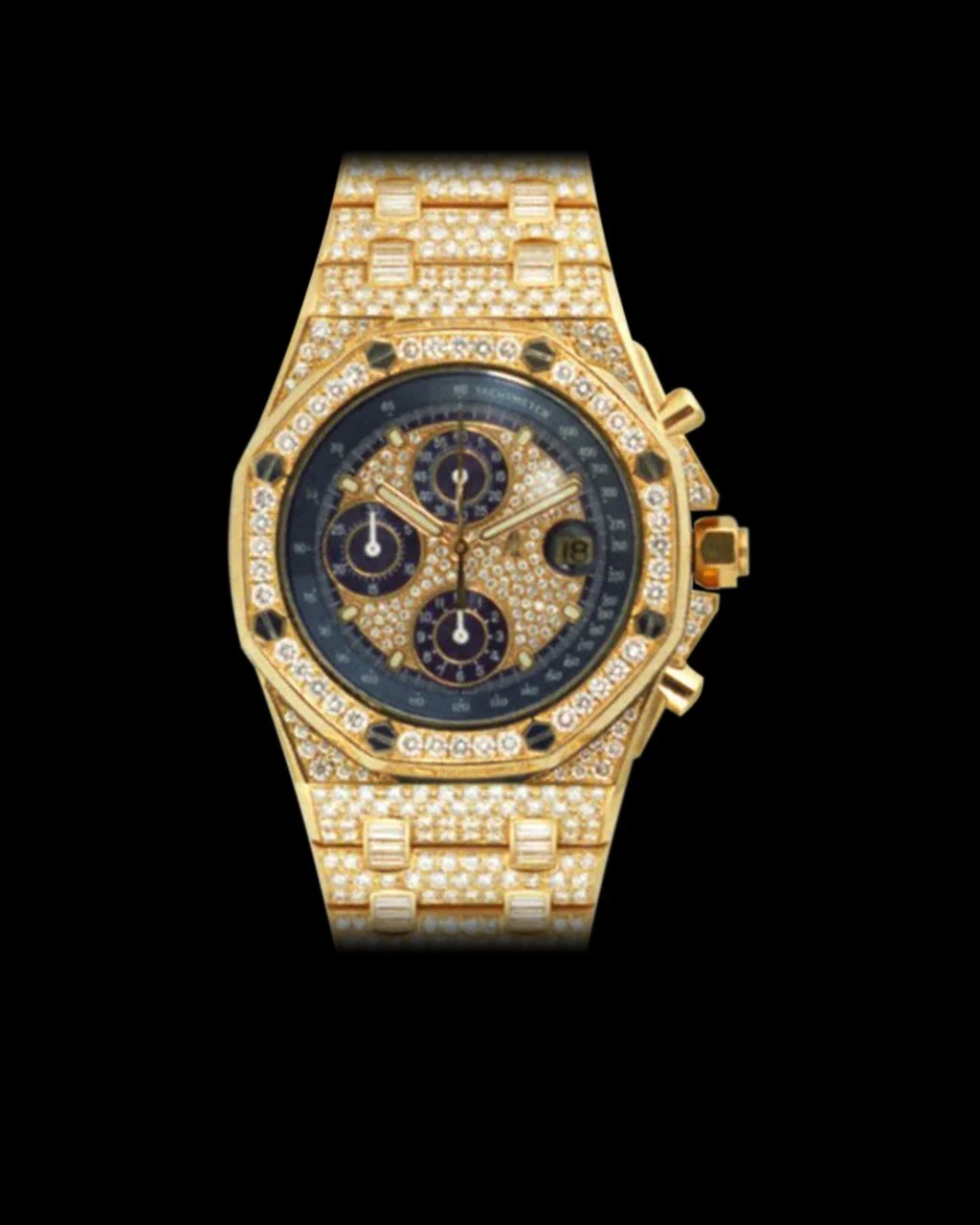
Circa 1997. Identification photograph of Model 25844BC. The first gemset Royal Oak Offshore. Audemars Piguet Archives.
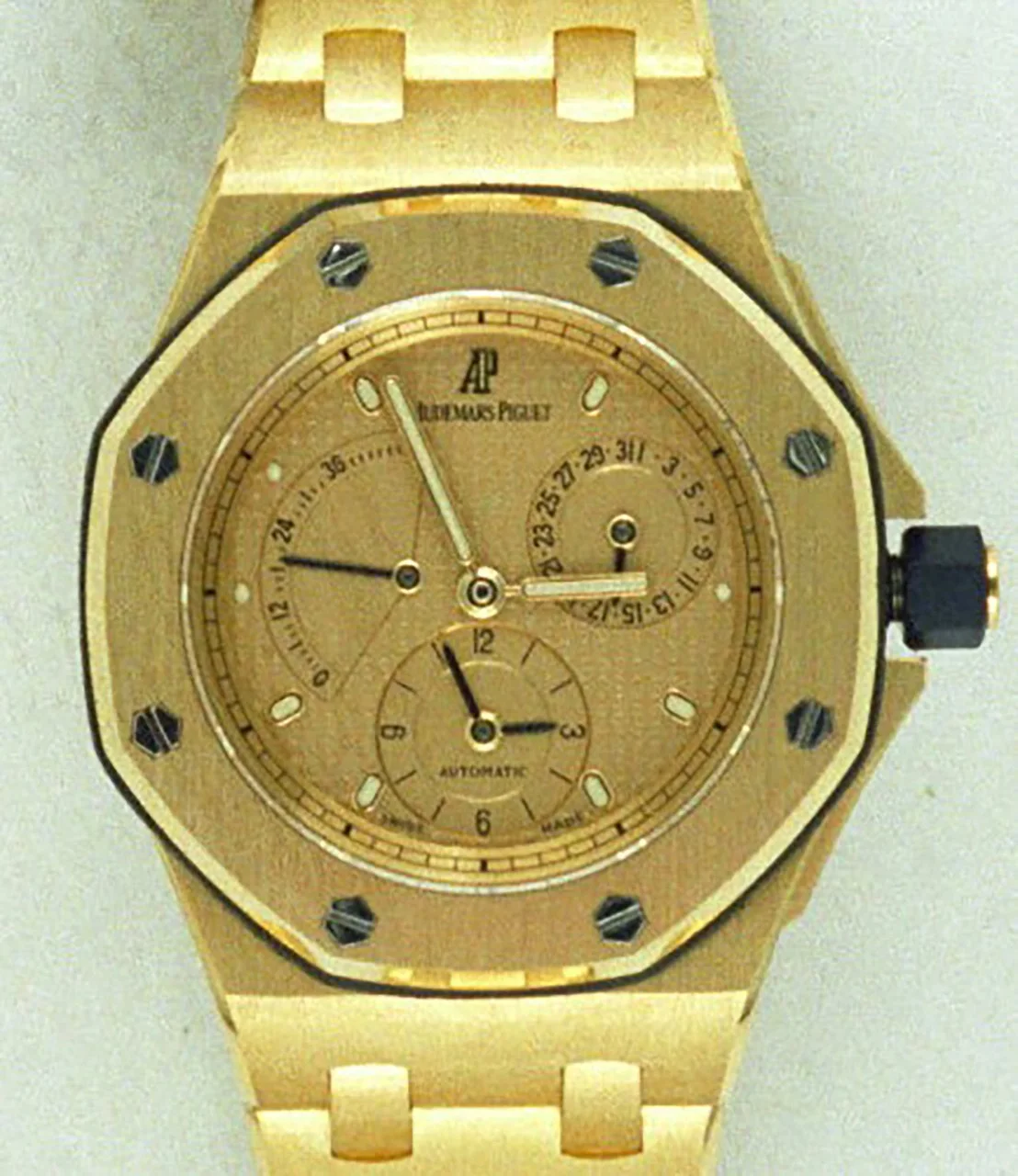
Circa 1997. Identification photograph of Model 25970BA. First Royal Oak Offshore with time zones. Audemars Piguet Archives.
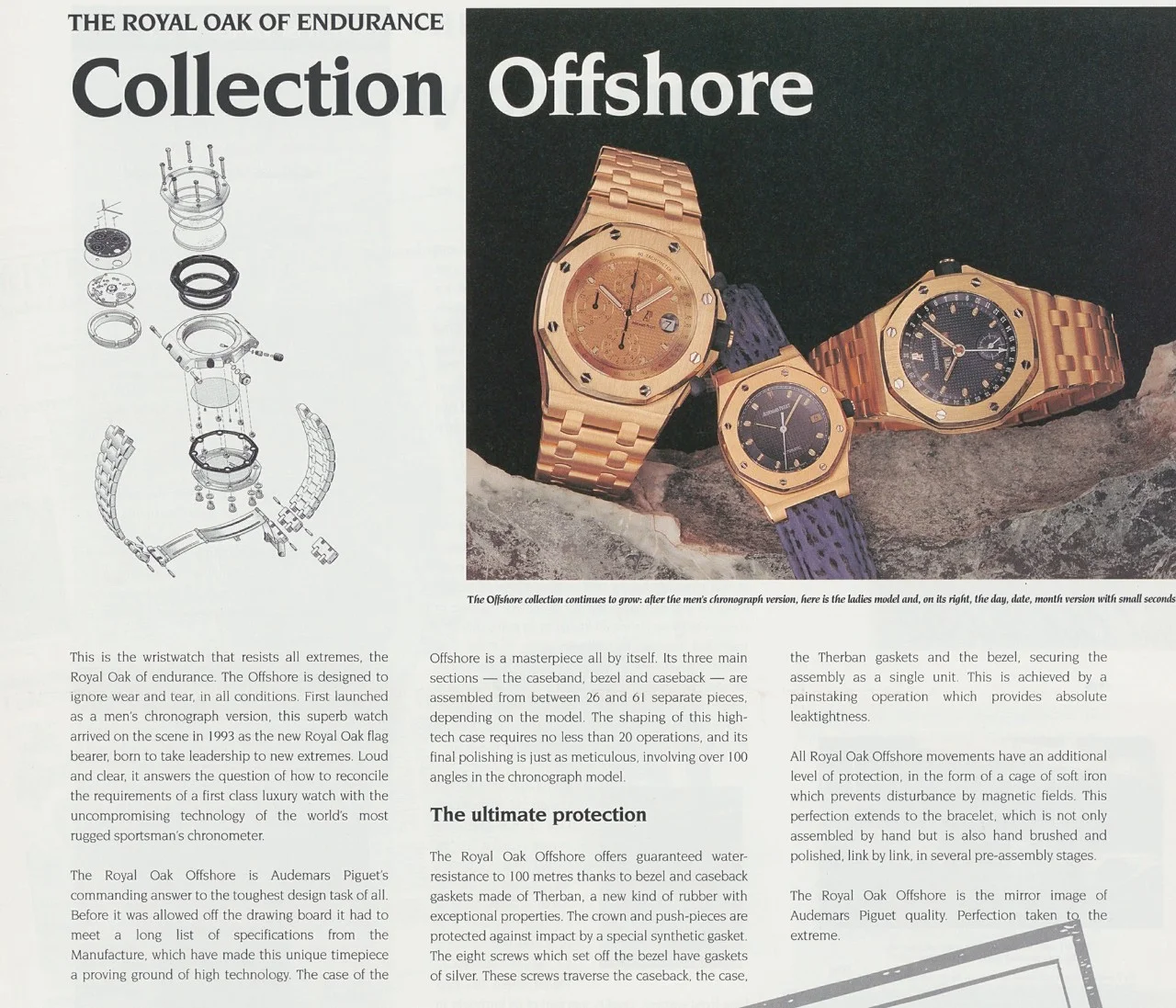
1996. Collection Royal Oak Offshore. The creation of the Model 77151 (30 mm) for women and day-date Model 25807 (38 mm), in addition to the 42 mm Model 25721, marked the birth of the Offshore collection. APNews 12, Audemars Piguet Archives.
First limited editions
In the autumn of 1997, American superstar Arnold Schwarzenegger paid a visit to the watchmakers in Le Brassus. A young salesman by the name of François-Henry Bennahmias showed him around the brand's museum. The actor admired the pocket watches, of which he himself was a collector, but above all he sensed keen affinities with the Offshore spirit, having acquired his first such watch two years earlier in Vienna.
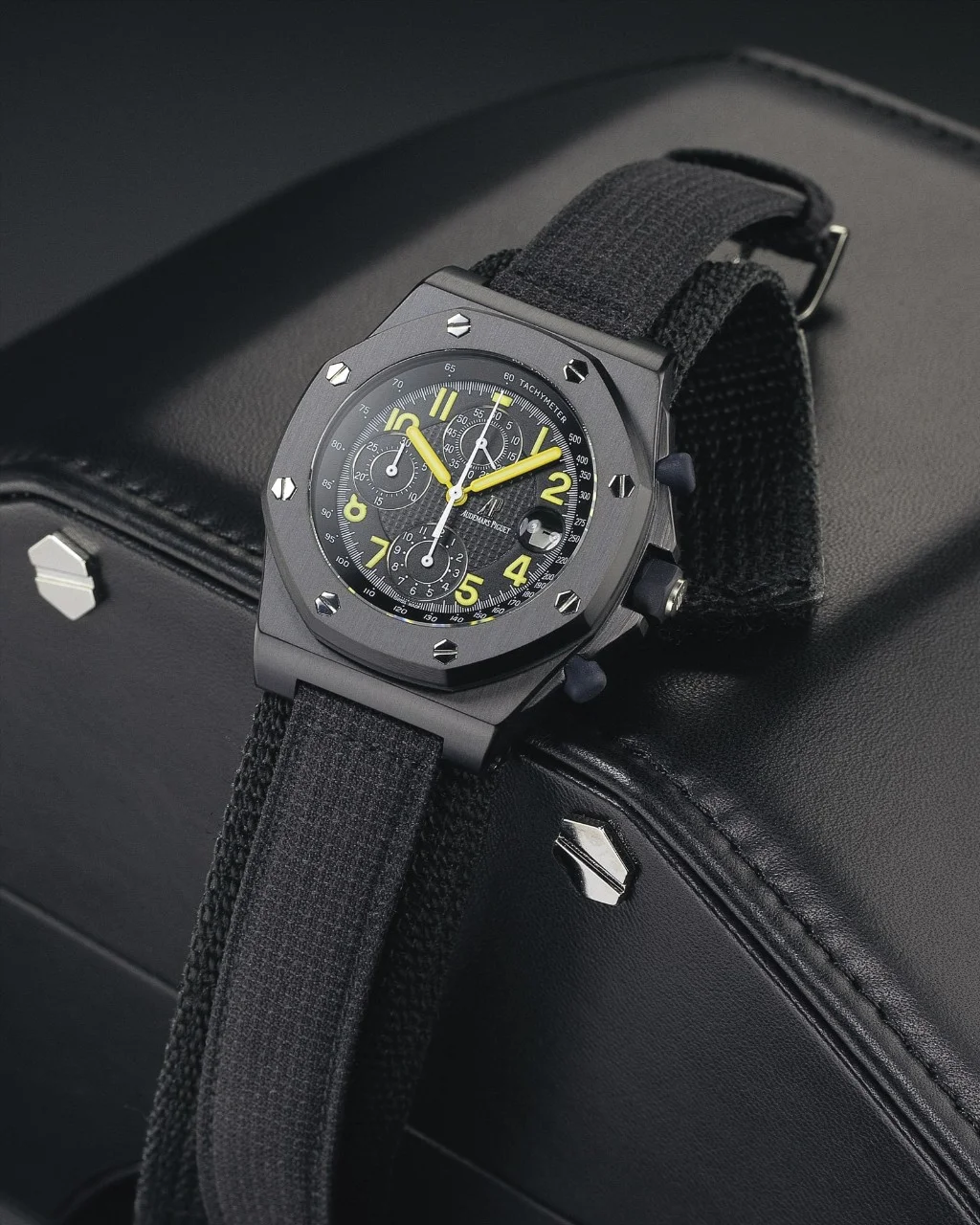
A few months later, it was the turn of the actor to welcome François-Henry Bennahmias to his Schatzi on Main restaurant in Santa Monica. The two men decided to create a watch together. On a corner of the table, they began sketching out the future Royal Oak Offshore End of Days, Model 25770SN. The ideas flowed: why not clothe it in black? A Kevlar® strap on velcro could symbolise sport and high technology! One thing was for sure: proceeds from sales of the watch were to help fund the Inner City Games Foundation – an association established in 12 American cities – offering underprivileged youth a range of sports and educational programmes.
To raise the profile of the operation, the decision was taken that Arnold Schwarzenegger would wear the watch in his upcoming film: a Hollywood blockbuster called End of Days. This thriller directed by Peter Hyams is about the end of the world in the year 2000. When released on November 24, 1999, the film was snubbed by critics and despite attracting something over two million spectators, its commercial success was rather mixed.
Paradoxically, End of Days heralded a new era for the Royal Oak Offshore by Audemars Piguet, notably marked by a number of Royal Oak Offshore limited editions such as the T3 (26029), All-Star (26158), Legacy (26378), etc., all of which were destined to support the actor and politician's charitable work.
The brand went on to establish multiple partnerships, exploring fields that were then far removed from the world of luxury, such as hip-hop music, basketball and pop culture. Meanwhile, François-Henry Bennahmias took over the management of the American market in 1999 and was to preside over the global destiny of the brand from 2012 onwards.

1999. Arnold Schwarzenegger and François-Henry Bennahmias. Following the premiere of the film End of Days, Arnold Schwarzenegger and François-Henry Bennahmias are pictured here auctioning off several examples of the Royal Oak End of Days 25770SN on behalf of the actor's Inner City Games Foundation. Audemars Piguet Archives.
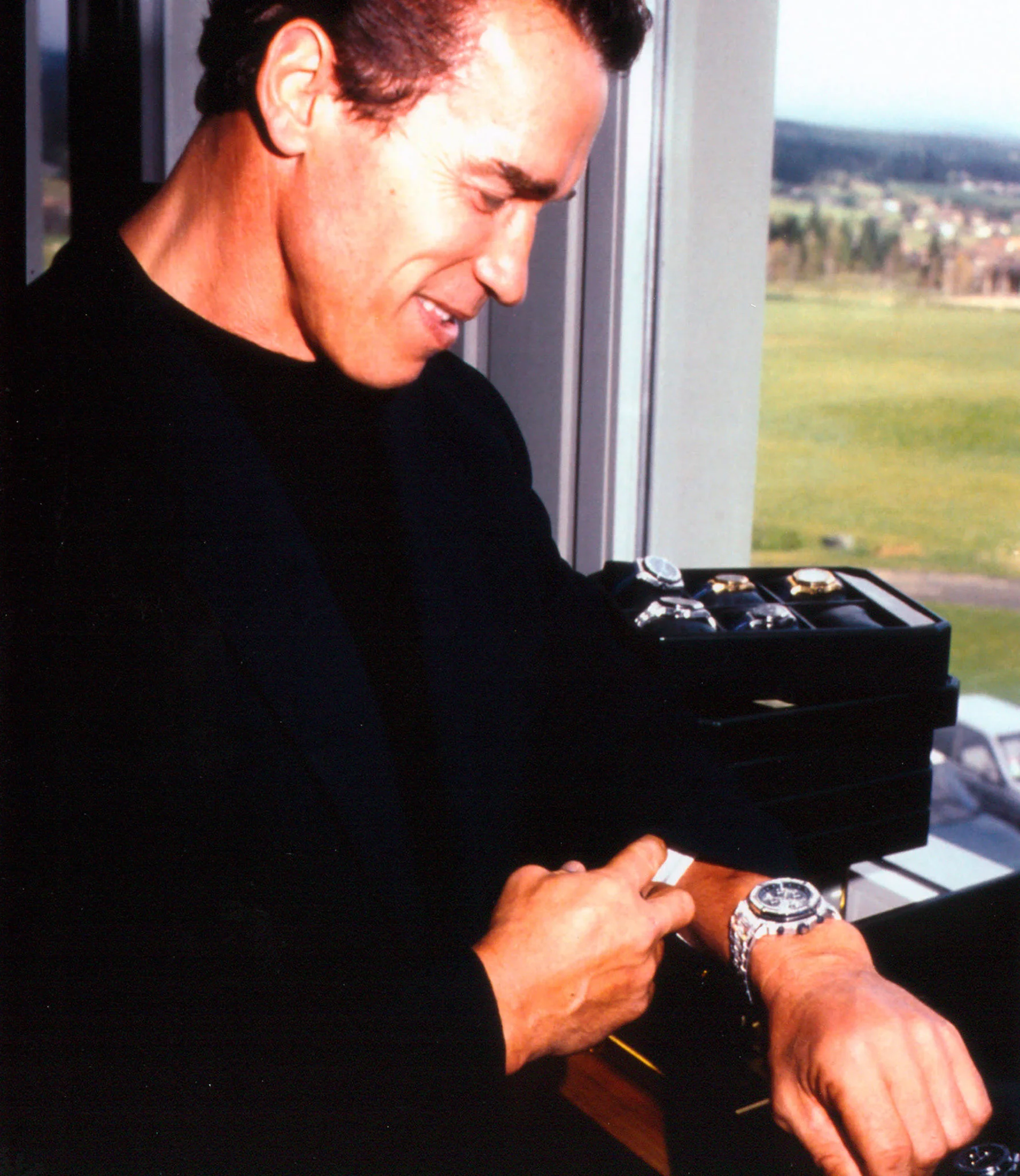
1997. Arnold Schwarzenegger. When he visited the Manufacture Audemars Piguet in a private capacity, the American superstar discovered the Royal Oak Offshore, with which he shared the values of performance, power and excellence. Audemars Piguet Archives.
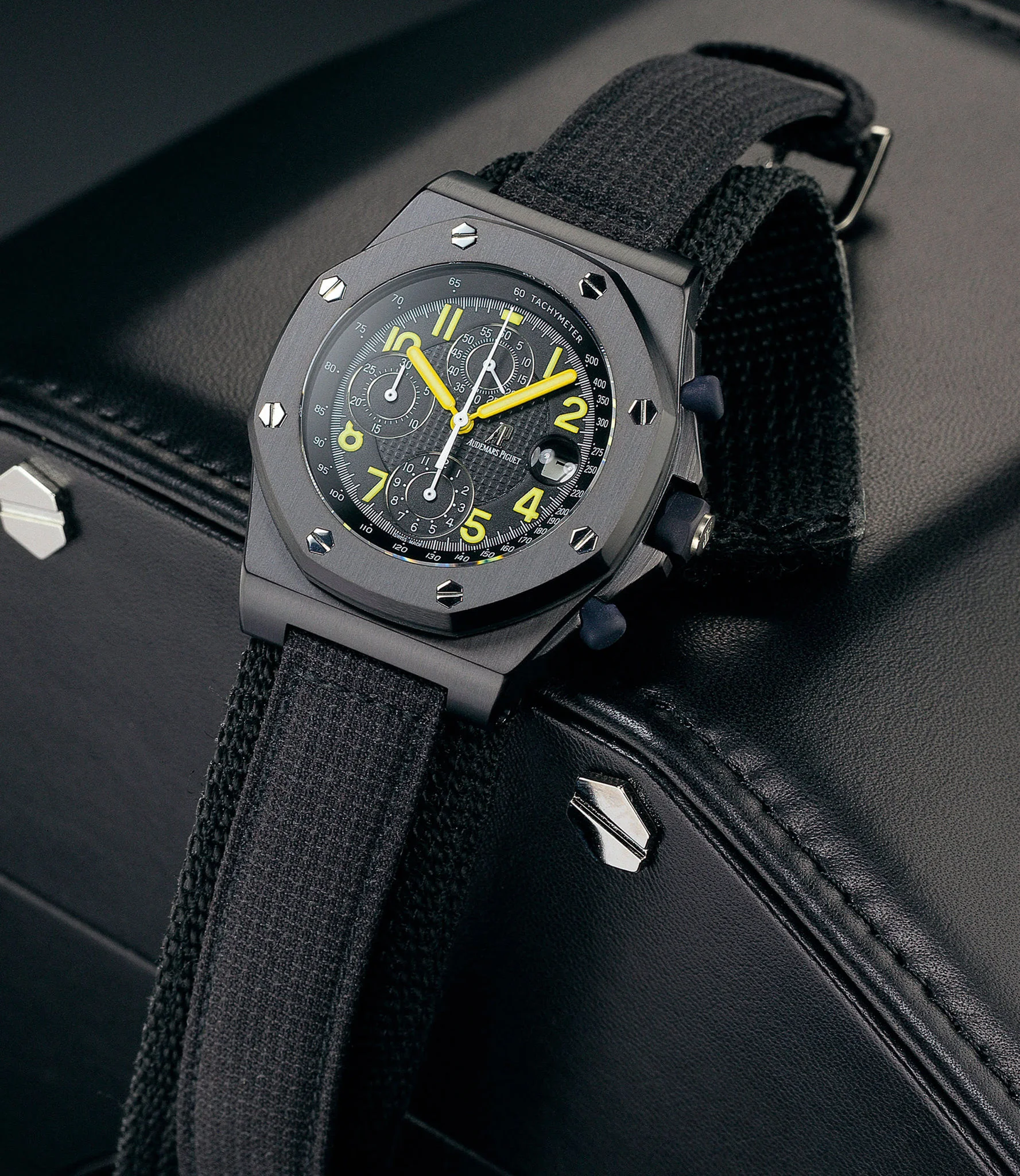
1999. Royal Oak Offshore End of Days 25770SN resting on its presentation box. Created in collaboration with Arnold Schwarzenegger for the film End of Days, Model 25770SN ushered in the era of Offshore Limited Editions. Picture from the 1999 press release. Audemars Piguet Archives.
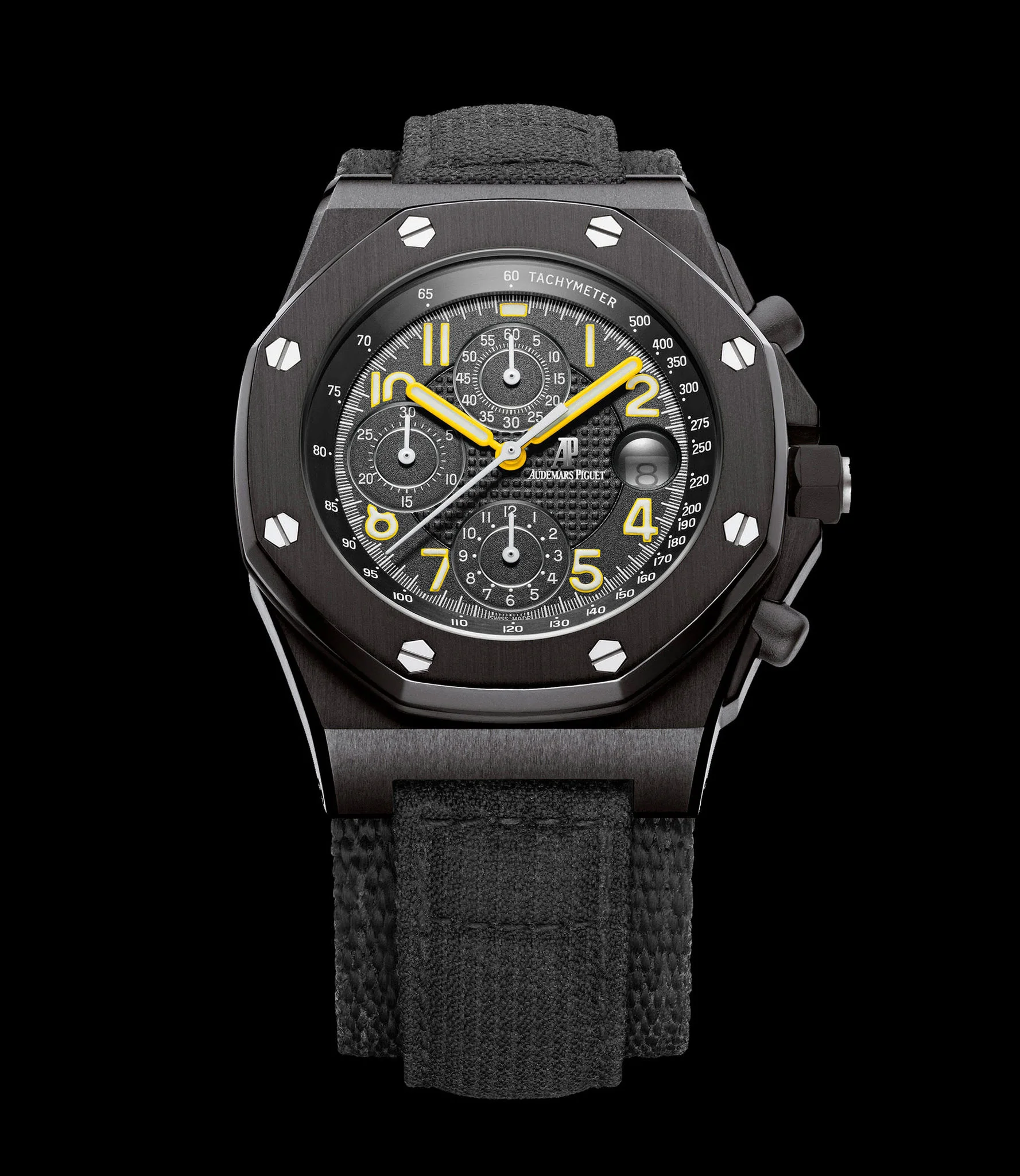
1999. Royal Oak Offshore End of Days 25770SN 114/500. Selfwinding chronograph. Calibre 2126/1840, movement 482070. PVD blackened steel case, no. E21648. 500-piece limited editoin created in partnership with Arnold Schwarzenegger for the launch of the film End of Days. Audemars Piguet Heritage, inv. 1338.
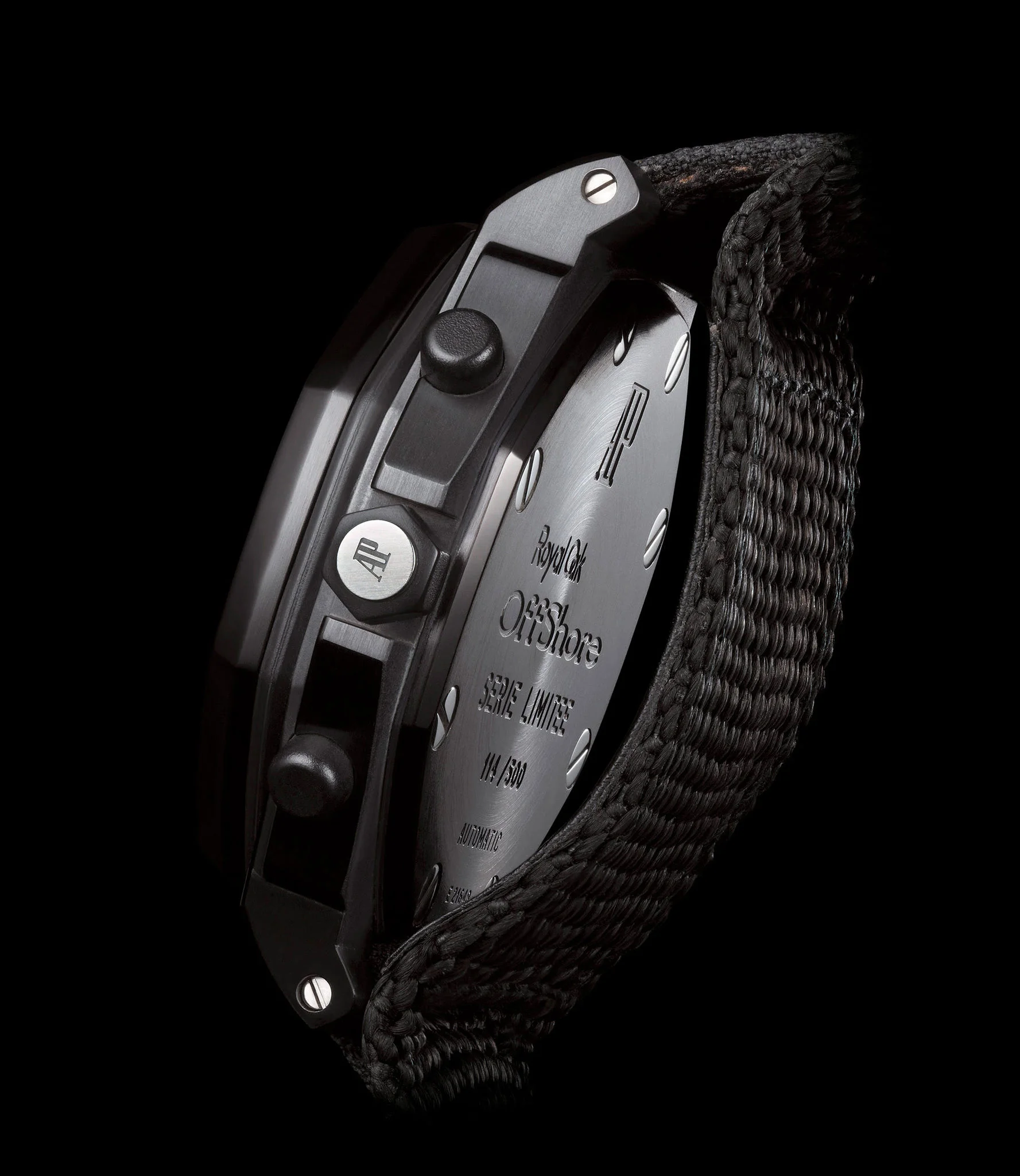
Selfwinding chronograph. Calibre 2126/1840, Movement 482070. blackened PVD-treated steel case, No. E21648. 500-piece limited edition created in partnership with Arnold Schwarzenegger for the launch of the film End of Days. Audemars Piguet Heritage, inv. 1338. 1999. Royal Oak Offshore End of Days 25770SN 114/500.
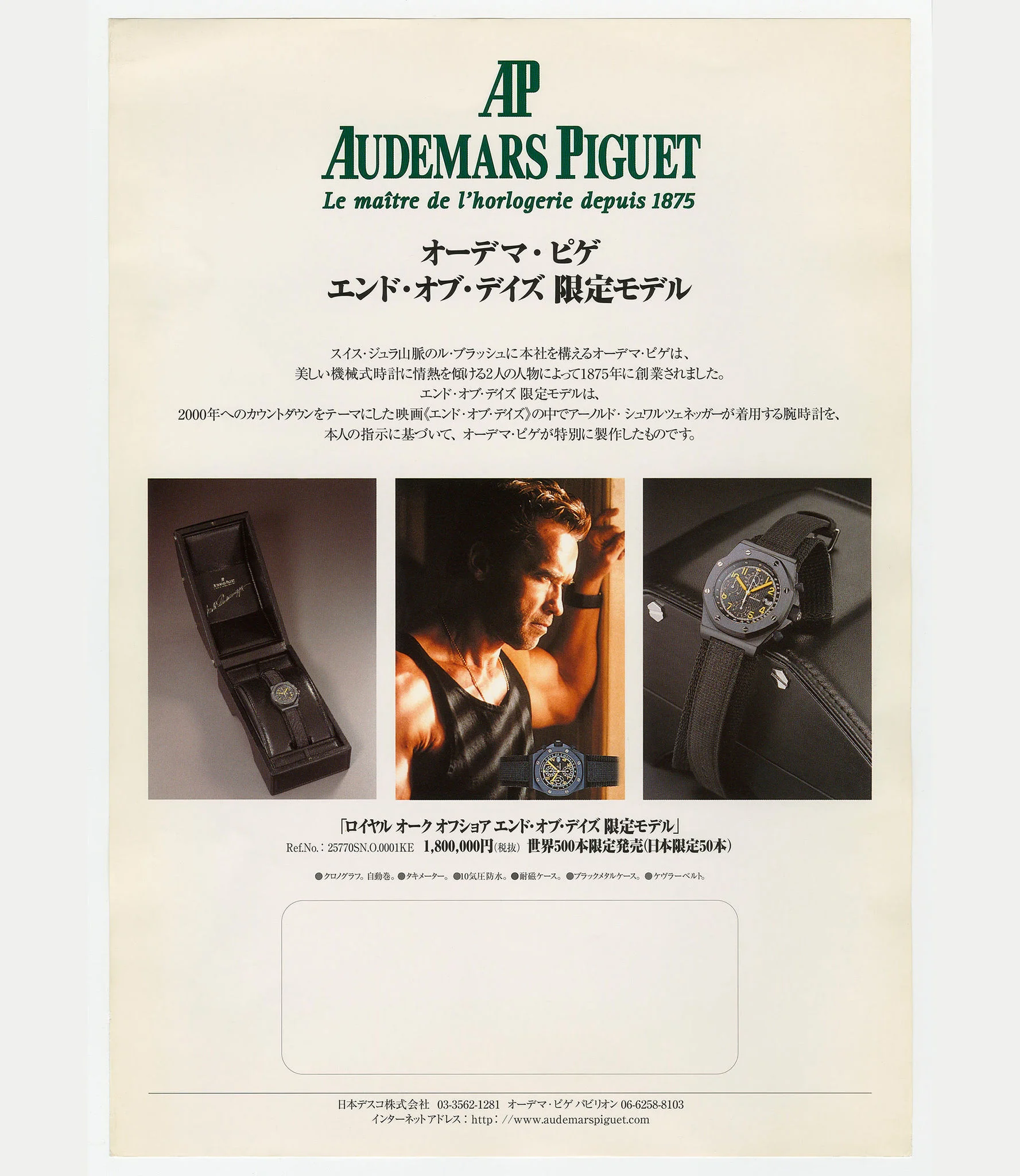
1999. Advertisement for the Royal Oak Offshore End of Days. Press release for the launch of Model 25770SN. Audemars Piguet Archives.
First Golden Age
The history of the Royal Oak Offshore in the 21st century is so packed with details that it will be covered in a separate article. Before wrapping up, however, herewith a brief mention of the 2000s, a decade during which the collection experienced spectacular growth. Whereas barely 1,339 units (excluding ladies’ models) were delivered in 2000, ten years later, 14,011 watches were sold, a figure considerably exceeding that of the Royal Oak (8,081 units). No less than 20 models were created in the 1990s, compared with 135 between 2000 and 2010!
Launched in 2001, the Royal Oak Offshore 25940SK (42mm) shattered all existing records – with its Méga Tapisserie dial, but above all its rubber bezel and strap –, establishing itself as the new core of the collection.
Following on from the Schwarzenegger limited editions, dozens of variations were created in partnership with sports stars such as Juan Pablo Montoya in 2004, Rubens Barrichello the following year, then Shaquille O'Neal, Sachin Tendulkar and Michael Schumacher... The collection celebrated sports teams such as Alinghi and Ladycat, as well as paying tribute to the brand's customers by adding editions dedicated to their cities (such as Tokyo, Milan, New York, etc.) or their countries (in the "Pride of" series dedicated to nations including Mexico, Argentina, Germany and Thailand).
For the first time in 2005, the Royal Oak Offshore made a connection between Haute Horlogerie and the non-conformist, often controversial world of hip hop. Born of the friendship between musician Jay-Z and François-Henry Bennahmias, the Royal Oak Offshore 26055 celebrated the artist’s 10th career anniversary. Although the lyrics of the songs were not engraved on the watch itself, it came with an iPod containing all the songs of the singer and entrepreneur.
The Royal Oak Offshore became an extraordinary playground for unconventional colours, designs and materials. Titanium was introduced in 1997, followed by rubber in 2001, carbon in 2004 and ceramic in 2008. From 2007 onwards, 44 mm and even 48 mm variations pushed the limits of oversizing.
A true socio-cultural phenomenon, the Royal Oak Offshore embodies all-conquering, spirited and uninhibited youthfulness. The collection led the entire watch industry into the oversized watch market. One need only mention Hublot, taken over by Jean-Claude Biver who earned his stripes with Audemars Piguet; Panerai which based its growth on oversized diving watches; or Jaeger-LeCoultre which created the Reverso Squadra, a version of its Art Deco icon on steroids.
The groundswell was so powerful that the average size of watches increased significantly across the entire industry. Even within Audemars Piguet itself, the core Royal Oak collection began to grow in size. In 2003, Model 14790 (36 mm) gave way to Model 15300 (39 mm), in turn surpassed in 2012 by Model 15400 (41 mm).

2001. Royal Oak Offshore 25940SK. The model introduces the rubber-covered bezel, the rubber strap and the Méga Tapisserie. It was an immediate success, with 692 units in the first year and already 2,416 in 2007. Picture shot for the launch of the model. Audemars Piguet archives.

2004. Royal Oak Offshore Juan Pablo Montoya 26030RO. Selfwinding chronograph, tachymeter scale. Carbon fibre bezel and push-piece guards. 18-carat pink gold. Calibre 2226/2840. 500-piece limited edition in partnership with racing driver Juan Pablo Montoya. Prototype P00241 presented at the model launch. Audemars Piguet Heritage, inv. 648.

2005. Royal Oak Offshore Jay-Z 10th Anniversary 26055. 42 mm Limited editions created for Jay-Z’s 10th career anniversary: 50 in steel, 30 in pink gold and 20 in platinum. The watches came with a signed iPod containing all of Jay-Z's songs. Picture shot for the launch in 2005. Audemars Piguet Archives.

2007. Royal Oak Offshore Alinghi Flyback for regattas. Selfwinding, Calibre 2326/2848. Forged carbon. Model 26062 (601/1300). Ø 44 mm Audemars Piguet Heritage, inv. 1379.

2008. Royal Oak Offshore Rubens Barrichello 26284RO. Selfwinding chronograph with tachymeter scale. Pink gold, ceramic and titanium. Automotive-inspired design. Calibre 2226/2840. 257-piece limited edition in collaboration with Rubens Barrichello. Prototype 000/000 presented at the model launch. Audemars Piguet Heritage, inv. 1322.
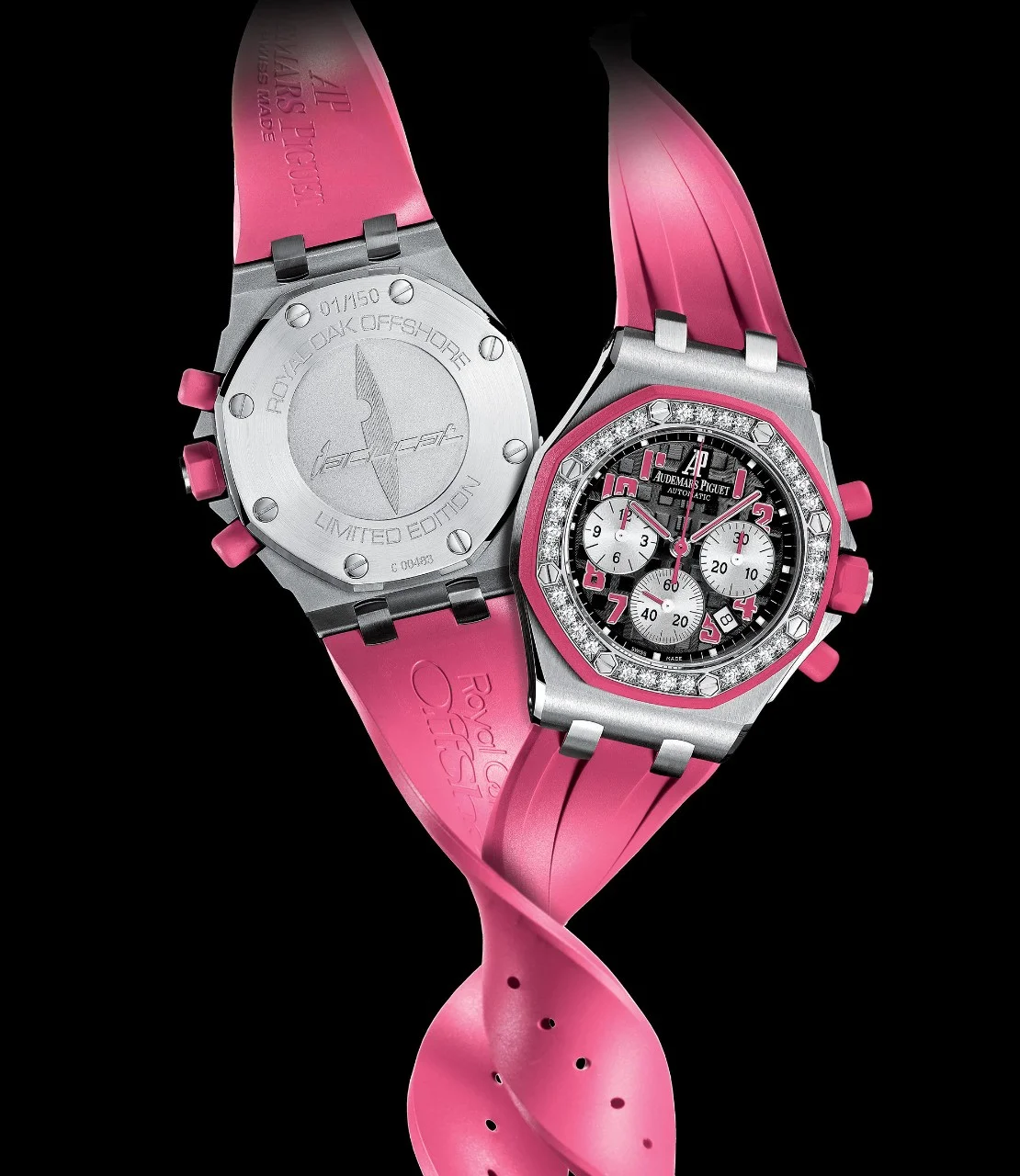
2008. Royal Oak Offshore Ladycat 26266SK. Equipped with selfwinding chronograph Calibre 2385, this 37 mm 150-piece limited series celebrates the all-female Ladycat sailing team. The fuchsia pink colour of the numerals, strap and push-pieces is inspired by the Ladycat catamaran. Audemars Piguet Archives.
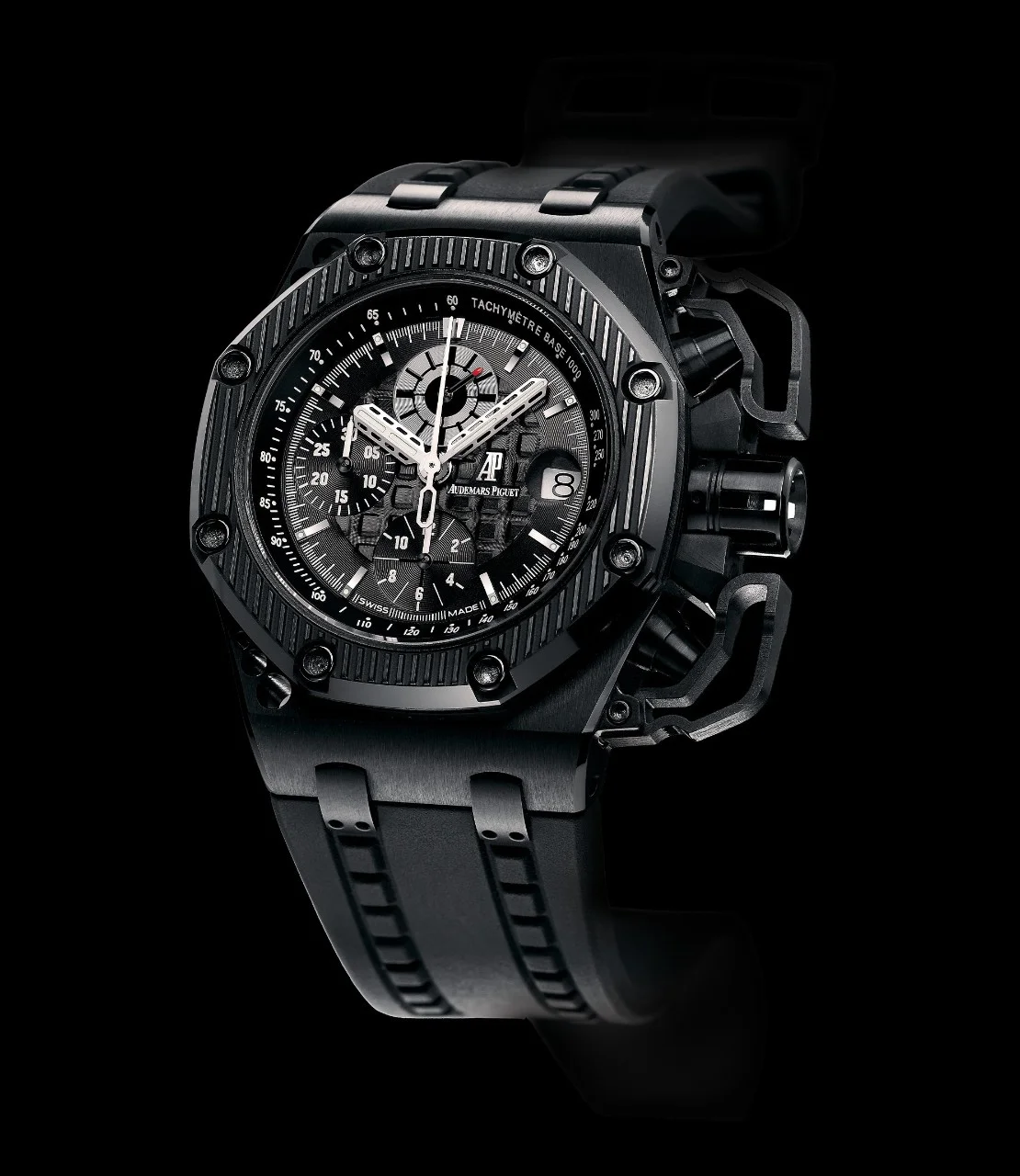
2008. Royal Oak Offshore Survivor 26165IO No.383. Selfwinding chronograph, tachymeter scale. Calibre 3126/3840, Movement 688217. Pivoting oversized push-piece guards. Case G46348 in titanium and ceramic. 1,000-piece limited edition. Audemars Piguet Heritage, inv. 1380
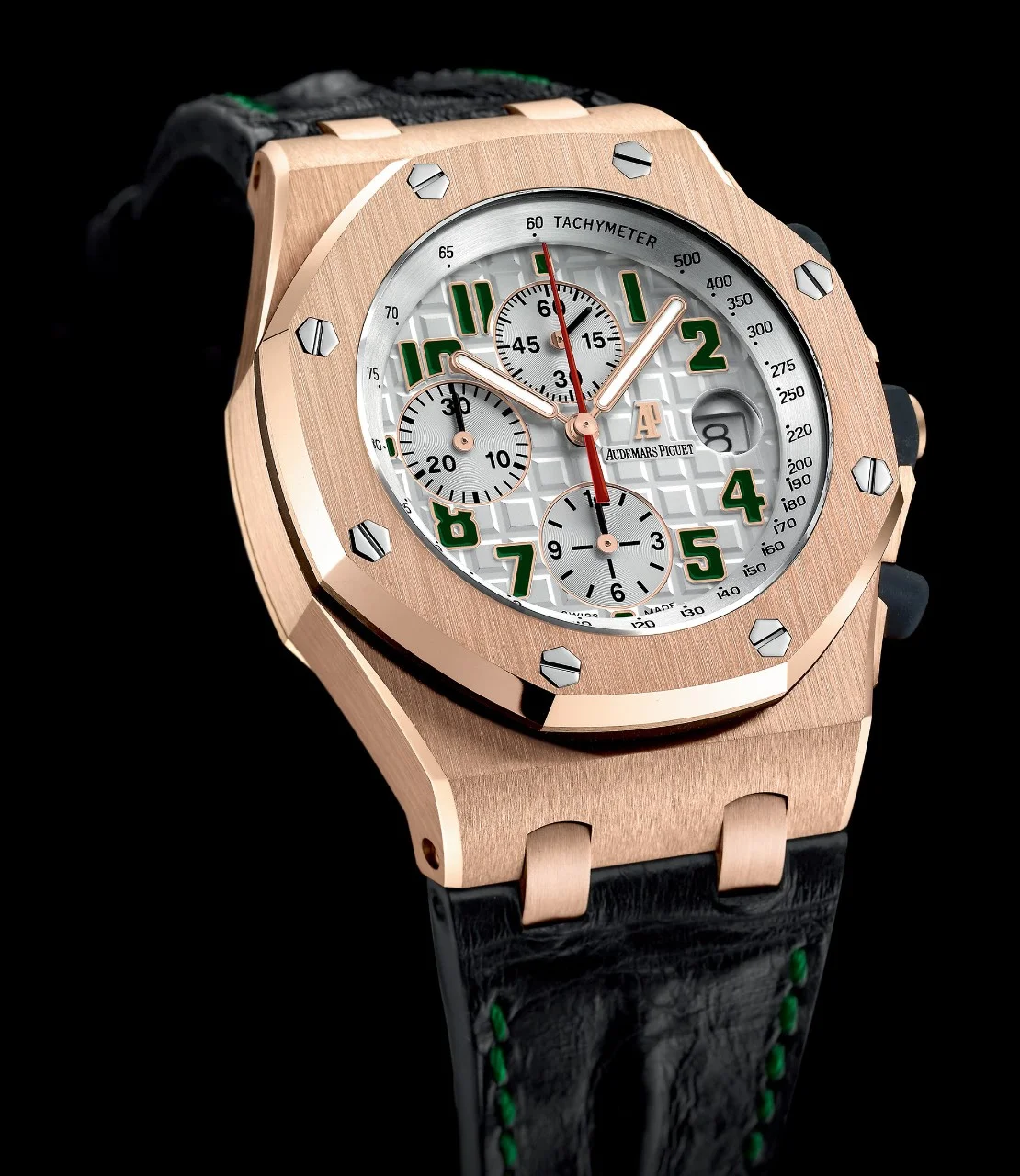
2010. Royal Oak Offshore Pride of Mexico. Selfwinding chronograph, tachymeter scale. 100-piece limited edition engraved with the inscription “1810 Pride of Mexico 2010”. Calibre 2326/2840. 42 mm Case P00565 in 18-carat pink gold. Prototype presented at the time of the watch launch. Audemars Piguet Heritage, inv. 1143.
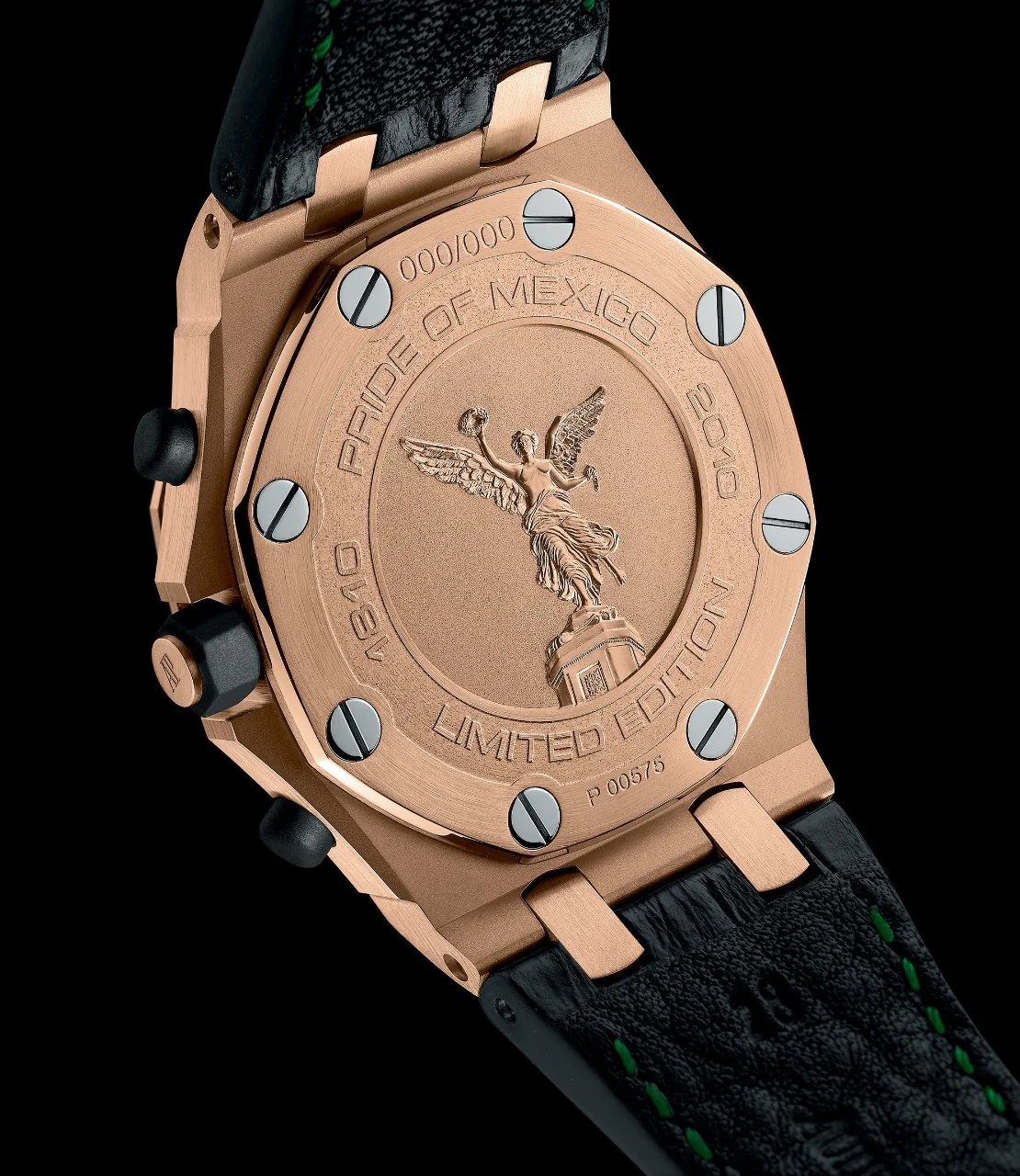
2010. Royal Oak Offshore Pride of Mexico. Selfwinding chronograph, tachymeter scale. 100-piece limited edition engraved with the inscription “1810 Pride of Mexico 2010”. Calibre 2326/2840. 42 mm Case P00565 in 18-carat pink gold. Prototype presented at the time of the watch launch. Audemars Piguet Heritage, inv. 1143.
Intertwined destinies
In many ways, the development of the first Royal Oak in 1972 appears to be inversely symmetrical to its 1993 Offshore descendant.
The former was named just a few months ahead of its launch, while the latter was born from a name registered before the first sketch. The former was an instant commercial success everywhere apart from Italy; while the latter began its history to very mixed reviews, except in Italy. A single sketch of the first Royal Oak was made on the first day of the 1970 Basel Fair; while numerous studies of the Offshore were made on the last day of the 1989 Basel Fair. And the list could go on…
They nonetheless share more similarities than differences. Both were born from market demand. Both were nurtured by many contributors: designers, suppliers, watchmakers, etc. Both were regarded as enfants terribles when they were born and were interpreted during their early years in one model, one material, one dial and with one calibre.
Both created a new category of watches in the watchmaking world from scratch. The Royal Oak gave rise to the "sport-chic" category of luxury steel watches, while the Royal Oak Offshore paved the way for oversized luxury watches. Both drove classic watchmaking towards a certain worldview geared towards action, fun, casualness, pop culture, etc. Both shocked the watch industry but won over an international audience.
Both have become icons and their story is only just beginning.
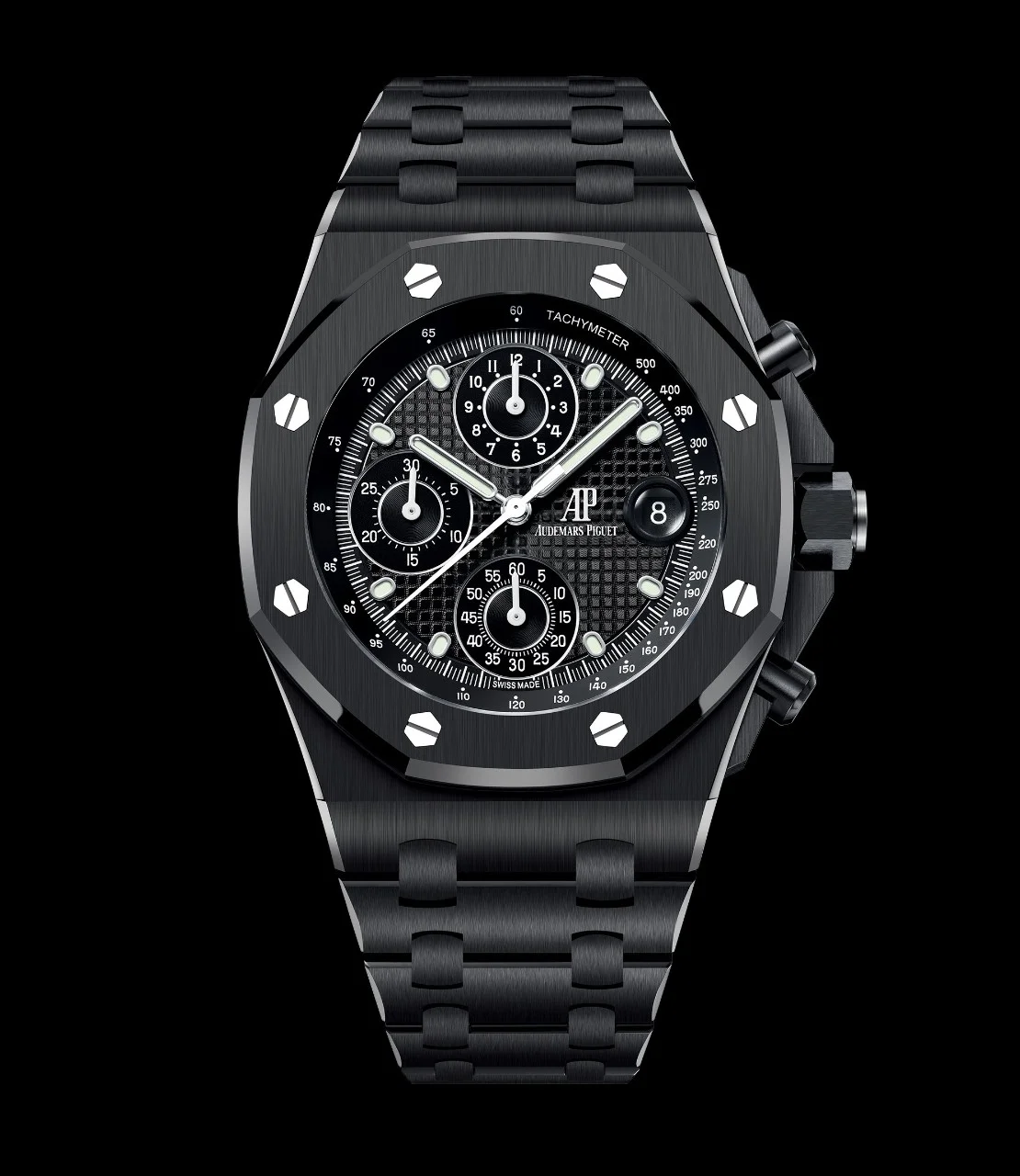
2023. Royal Oak Offshore Chronograph 26238CE. For its 30th anniversary, the Royal Oak Offshore collection hosted its first all-ceramic model. Selfwinding Calibre 4404. Petite Tapisserie dial. 42 mm black ceramic case. Picture shot for the launch of the watch in February 2023. Audemars Piguet Archives.
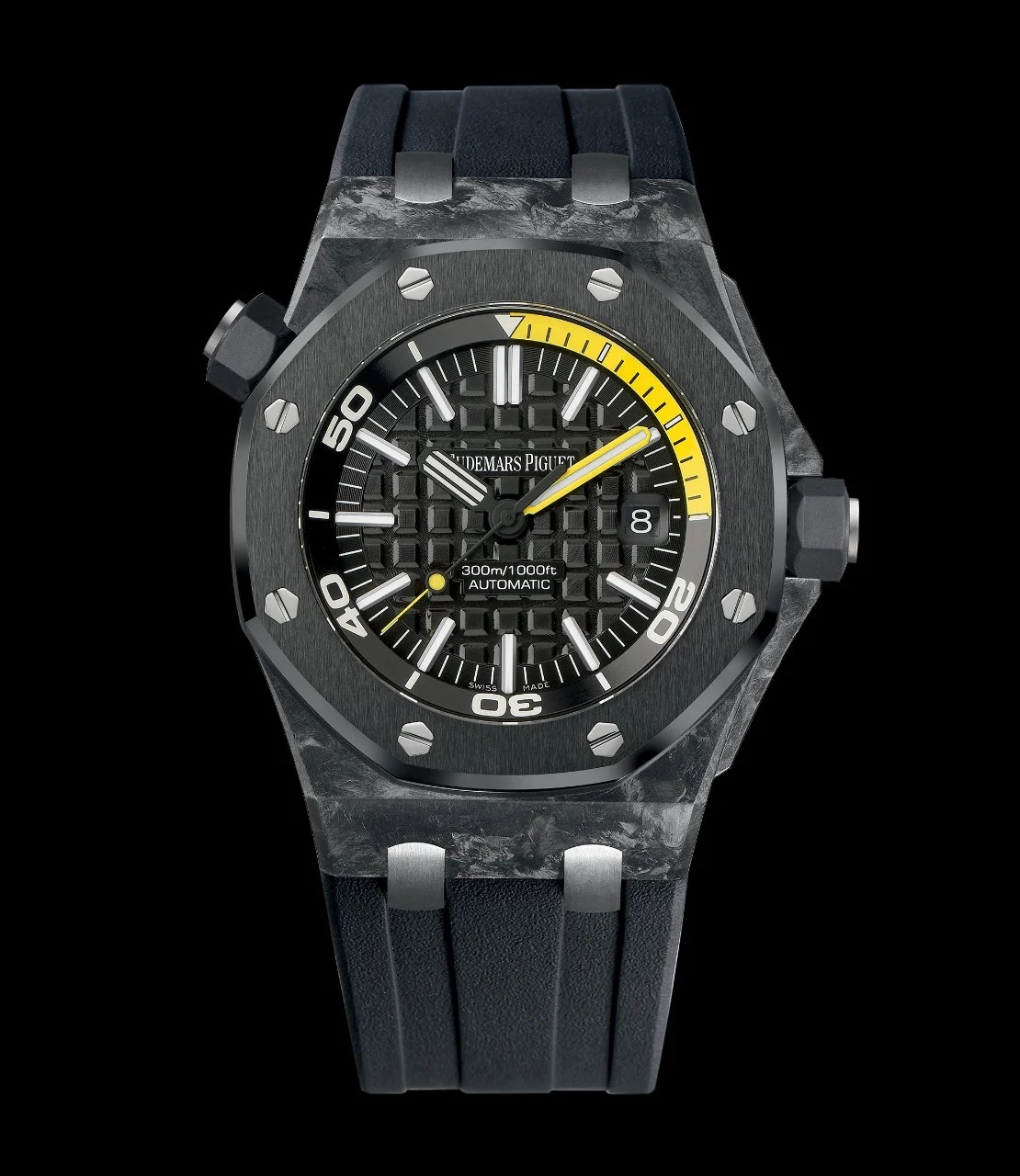
2012. Royal Oak Offshore Diver 15706AU, no 12. Rotating inner bezel indicating the dive time. Total weight 110 grams. Selfwinding Calibre 3120, Movement 813487. 42mm Case H55139 in forged carbon and ceramic. Audemars Piguet Heritage, inv. 1301.

2014. Royal Oak Offshore Tourbillon Chronograph 26388PO No. 19. The partially openworked dial reveals an Haute Horlogerie mechanism. Calibre 2933, 10-day power reserve, Movement 816681. 44mm Case I32795 in platinum and ceramic. Audemars Piguet Heritage, inv. 1839.
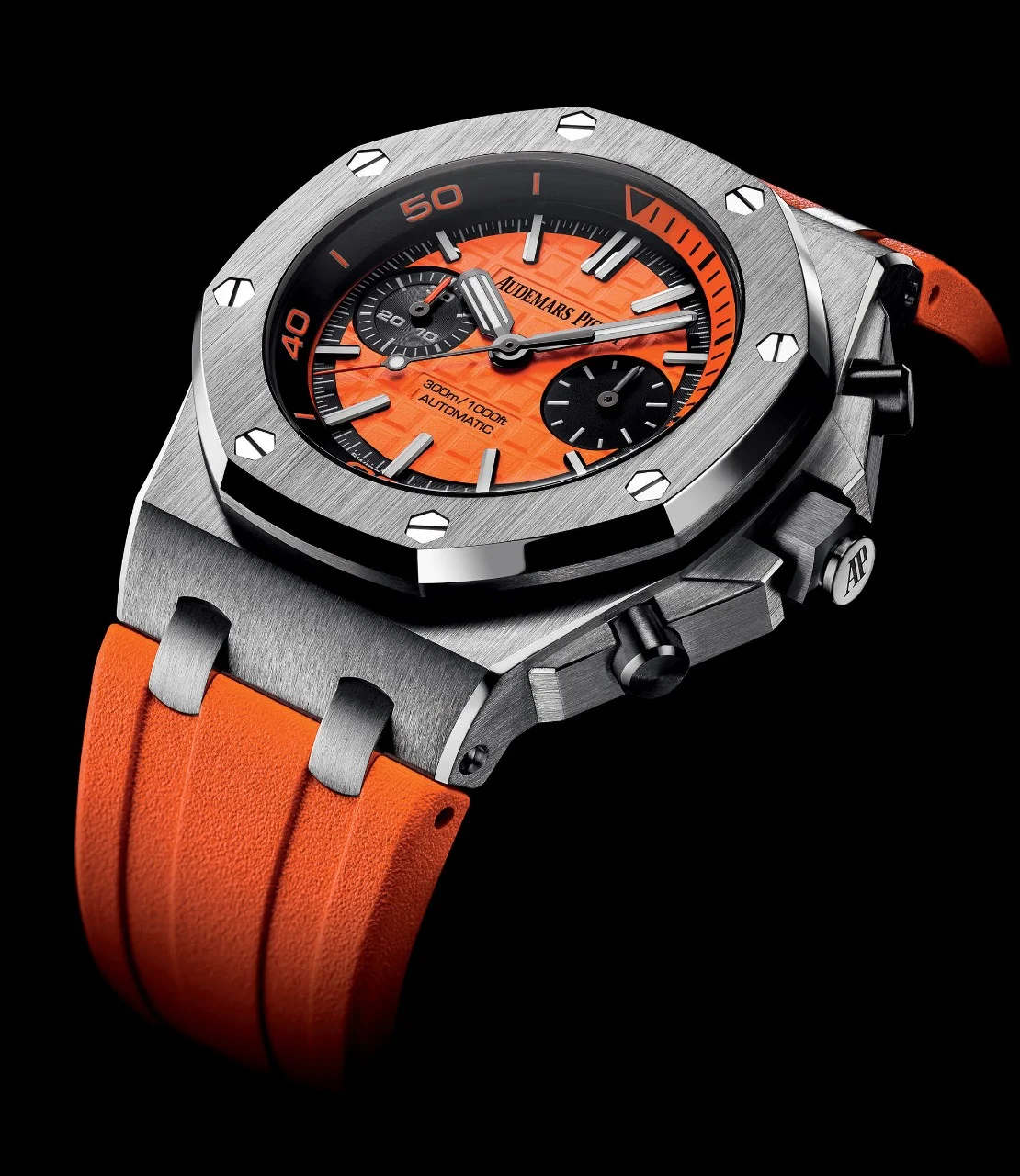
2016. Royal Oak Offshore Diver 26703ST. Chronograph, rotating inner bezel indicating the dive time. Orange dial and strap. Selfwinding Calibre 3124/3841, Movement 946368. 42mm steel Case J03108. Audemars Piguet Heritage, inv. 1942.

2018. Royal Oak Offshore Grande Complication 26582CB. Perpetual calendar: day, date, weeks months, moon phases and leap cycle. Selfwinding openworked Calibre 2885. 44mm white ceramic case. Picture shot for the presentation of the watch. Audemars Piguet Archives.
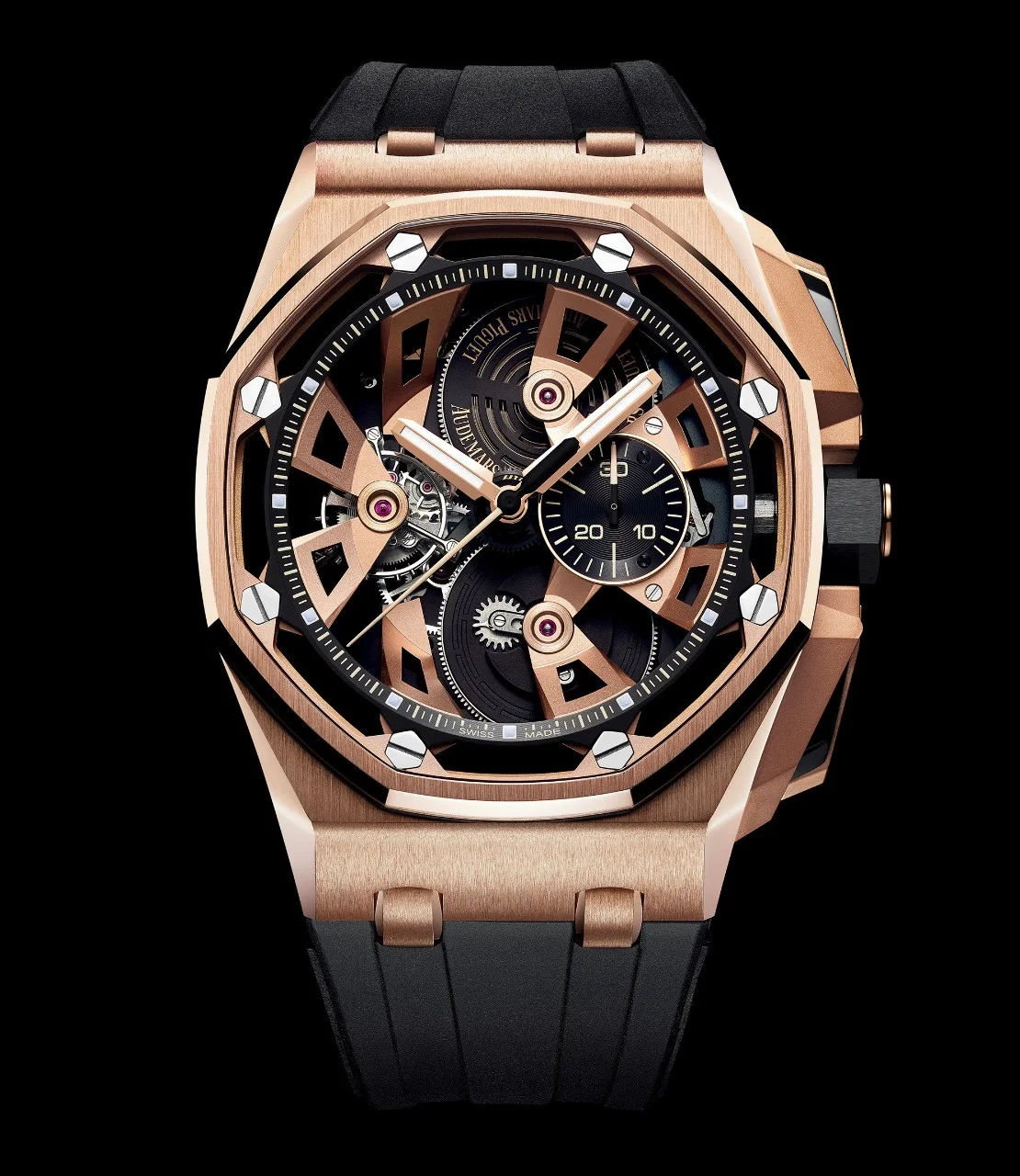
2018. Royal Oak Offshore 25th Anniversary 26421OR. Limited 50-piece edition celebrating the 25th anniversary of the Royal Oak Offshore collection. Openworked bezel giving the impression that the architectural mechanism is suspended. Tourbillon, chronograph. Calibre 2947. 45mm Case J95544 in 18-carat pink gold. Prototype presented at the SIHH during the model's launch. Audemars Piguet Heritage, inv. 1972.

2021. Royal Oak Offshore Chronograph 26420IO. In 2021, the Méga Tapisserie pattern is more complex and the bezel curved. Developed and produced in-house, selfwinding Calibre 4401 features a flyback function for the first time. 43mm titanium and ceramic case. Picture shot for the presentation of the model. Audemars Piguet Archives.
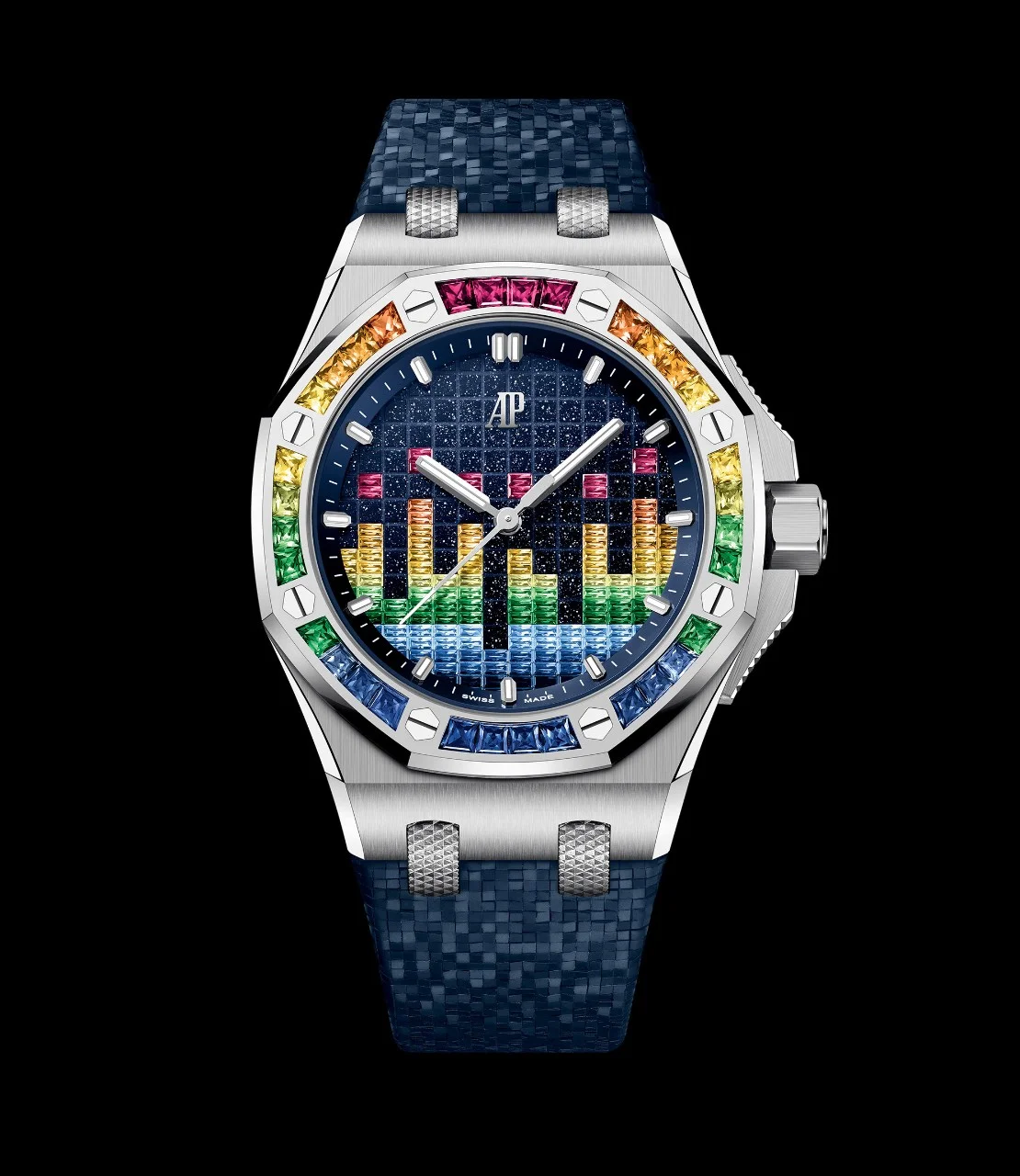
2022. Royal Oak Offshore "Music Edition” 77601BC. The "VU-meter" pattern gemsetting on the aventurine dial evokes the relationship between Audemars Piguet and the world of music. Selfwinding Calibre 5909. 37mm case with rainbow setting featuring baguette-cut gems. Picture shot for the presentation of the model. Audemars Piguet Archives.