The journey of mastering materials
Daily survival
Right from the design stage, the materials used in a watch case must be chosen to ensure that it will last for decades, if not centuries, strapped to our wrists and thus exposed to scratches, humidity, heat, oxidation as well as impacts. Materials’ physical and chemical properties are therefore essential.
Among these, hardness is a key criterion: the harder the case material, the less likely the watch will be damaged by scratches or impacts – yet the more difficult it will be to manufacture.
Ductility is also crucial. This is the ability of a material to bend without breaking, referred to in everyday language as flexibility or malleability. Gold, for example, is very ductile, making it the perfect material for jewellery and watches.
Elasticity is a little different. It’s the ability of a deformed material to return to its original shape and size. The original technical term is resilience. While elasticity is essential in certain movement components, it can also play a role in watch cases, particularly those made from Bulk Metallic Glass (BMG), a material that resists scratches and shocks with astonishing resilience.
Finally, there is weight, or more precisely density: a kilo of feathers weighs the same as a kilo of lead. While lightness was long regarded as the absence of value, perceptions are currently shifting in this respect.
Other key criteria are corrosion resistance and biocompatibility. A watch must not rust, oxidise or cause skin allergies.
| Material | Vickers hardness (HV) | Density (g/cm3) | Elasticity (Young's modulus GPa) | Scratch resistance | Melting point (°C) |
| Gold (18ct) | 140-230 | 15-16 | 90-110 | Good | 890-1150 |
| Silver | 60-80 | 10-11 | 80-90 | Average | 820-890 |
| Platinum | 90-140 | 19-21 | 170-190 | Average | 1800-1900 |
| Tantalum | 90 | 16,6 | 175-190 | Average | >3000 |
| 316L stainless steel | 200-350 | 7,9 | 190-250 | Good | 1300-1500 |
| Titanium (grade 5) | 300-380 | 4,5 | 105-120 | Very good | 1600-1700 |
| Forged carbon | >50 | 1,9 | 40-150 | Average | N/A |
| Ceramics | >1200 | 5,6-6 | 200-250 | Excellent | >2500 |
| Brass | 90-170 | 8,4 | 80-130 | Average | 880-900 |
| Alacrite | 385 | 8,4 | 210-220 | Very good | 1300 |
| Cermet | >1500 | 5-10 | depends on the formulation | Excellent | depends on the formulation |
| Tungsten | >2000 | 18-20 | 360-410 | Excellent | >3000 |
| Rubber | N/A | 0,9-1,1 | 2-5 | Excellent | N/A |
| BMG | 500 | 9,3 | 80 | Excellent | 550 |
| Diamond | MAX = 10 Mohs) | 3,5 | >1000 | Excellent | >3000 |
| Turquoise | 6 Mohs | 2,6-2,9 | N/A | Excellent | N/A |
This table shows the main properties of the different materials. Knowledge of these properties is essential in the development and production of a watch. The choice of material is crucial, as it will affect the object’s entire life. A watch has to make its way through decades or even centuries and is put to a severe test on a daily basis.
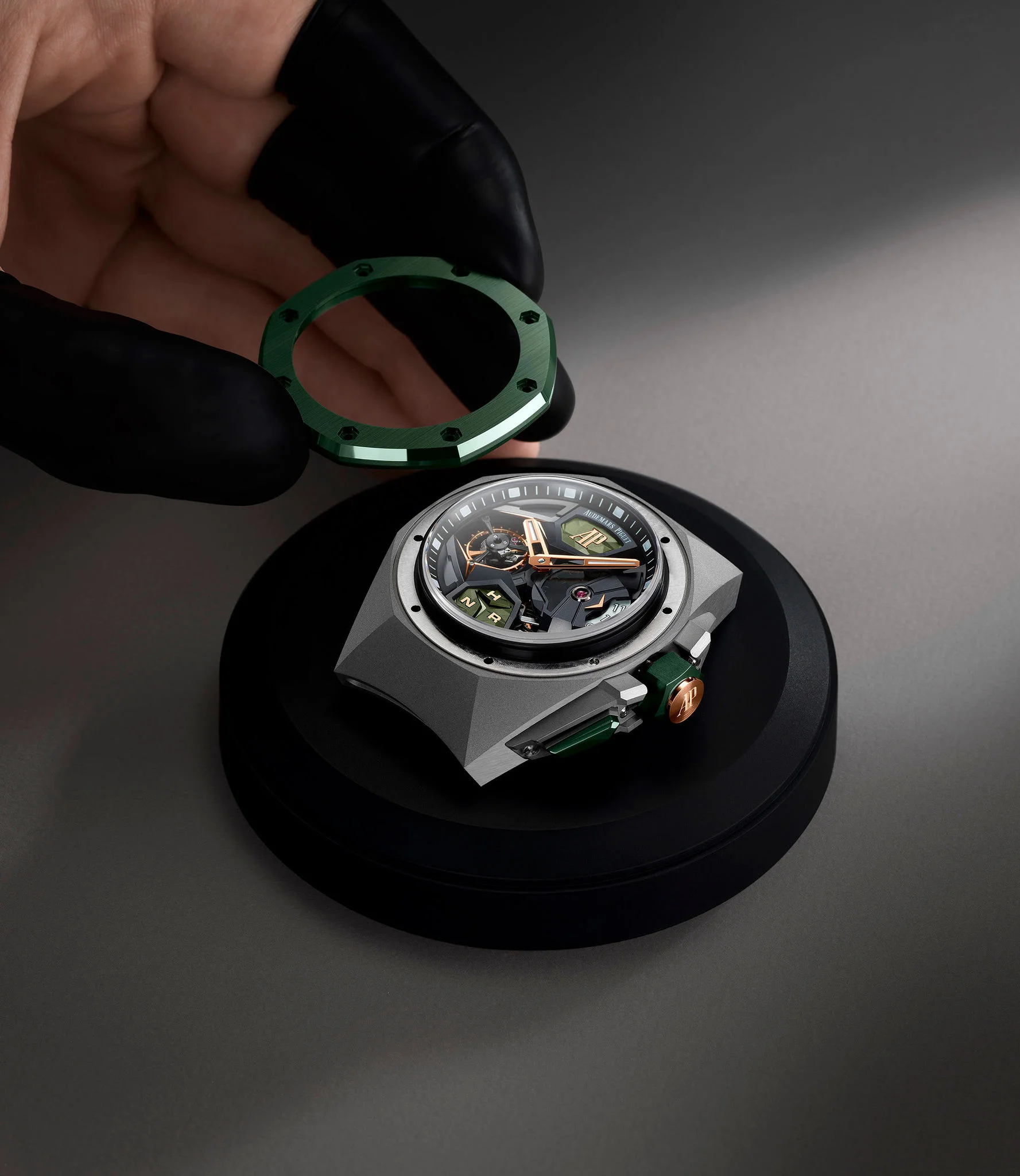
The titanium case and green ceramic bezel combine lightness and hardness. Only the side of the crown is in pink gold. Royal Oak Concept 26589IO, 2022.
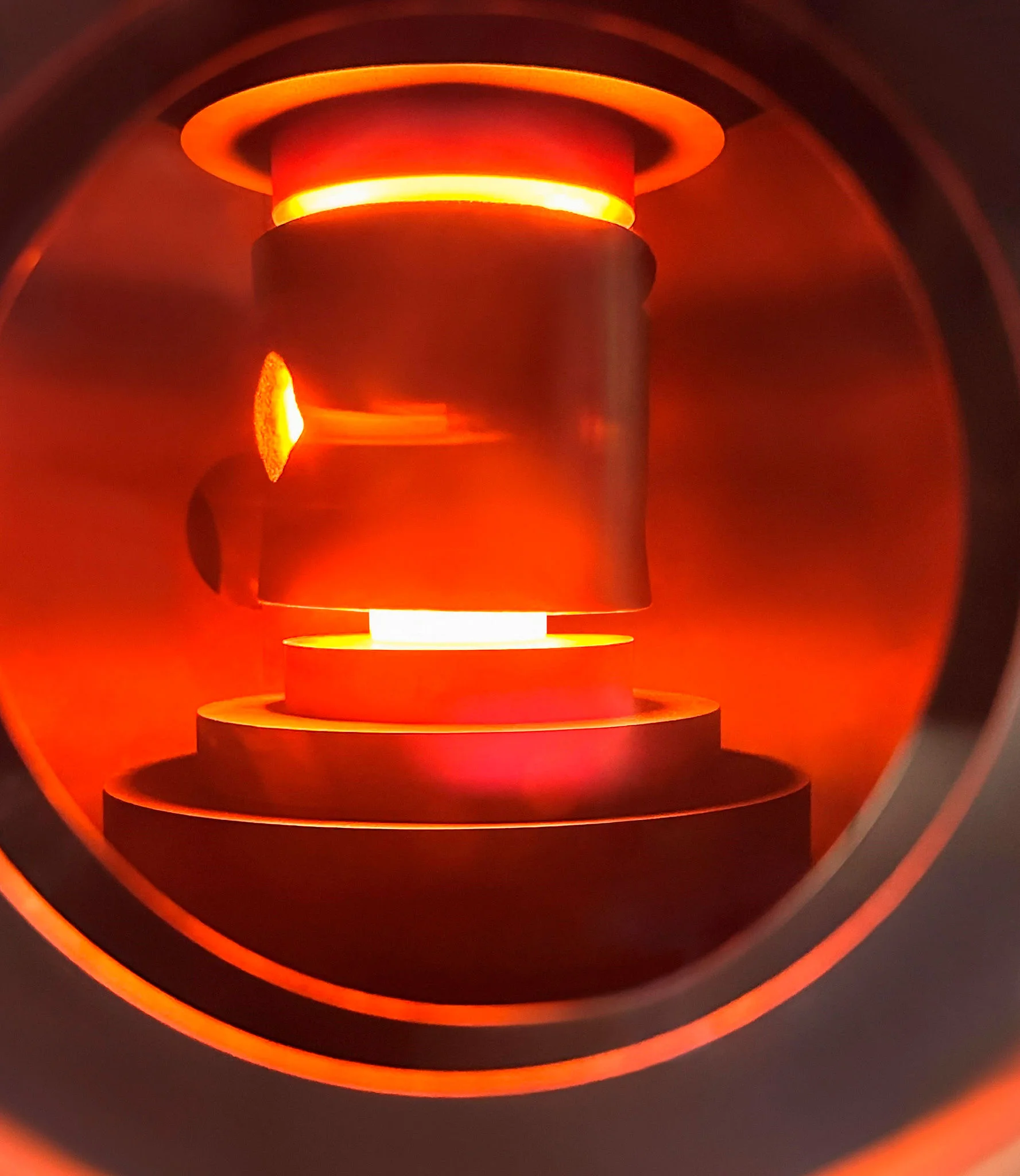
During the manufacturing process, the ceramic is heated to a very high temperature so that the grains soften and stick together to form a hard, homogeneous material once cooled.
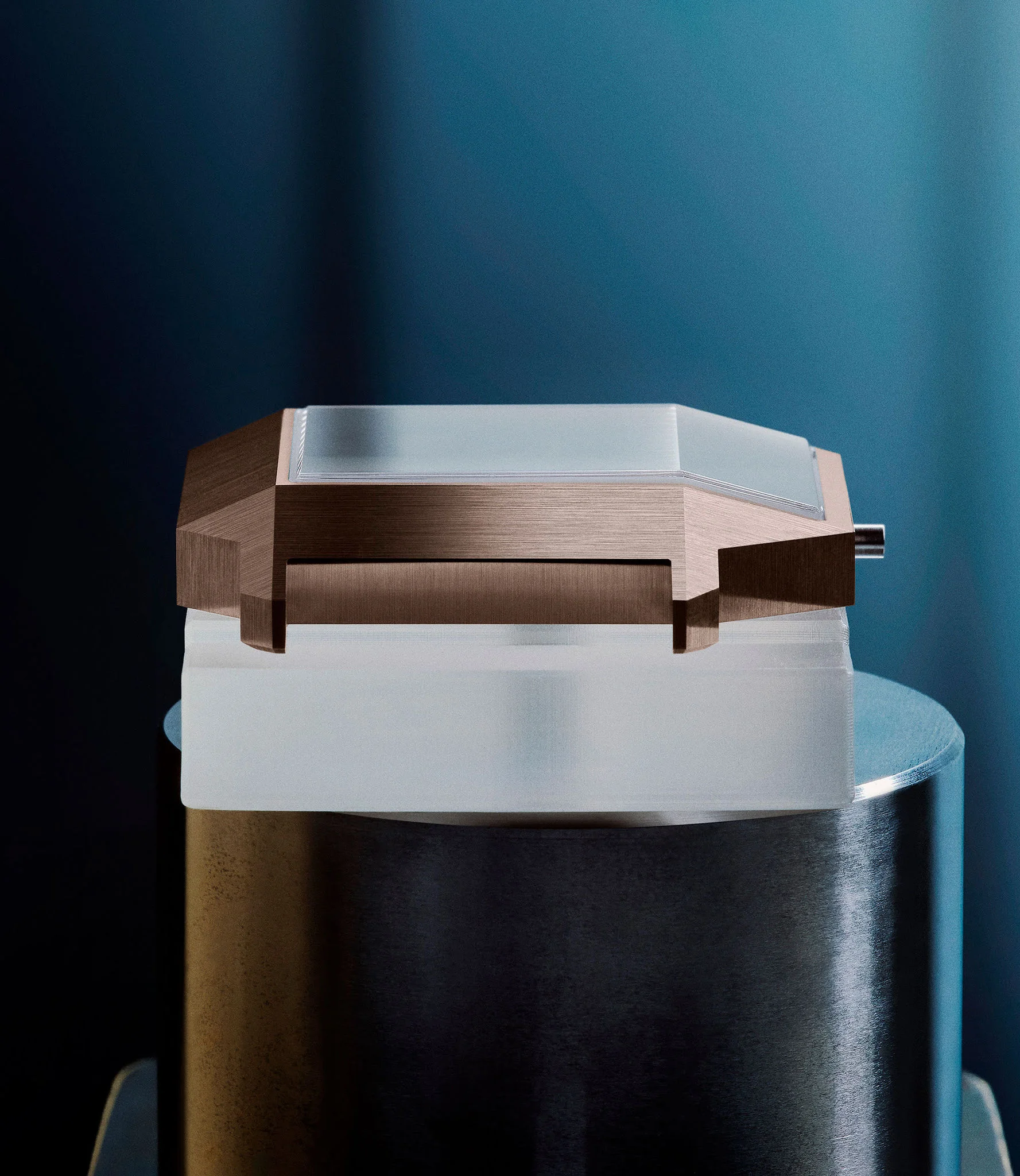
Introduced in 2024, the asymmetrical case of the [RE]Master02 combines a new gold alloy called sand gold with a bevelled sapphire crystal.
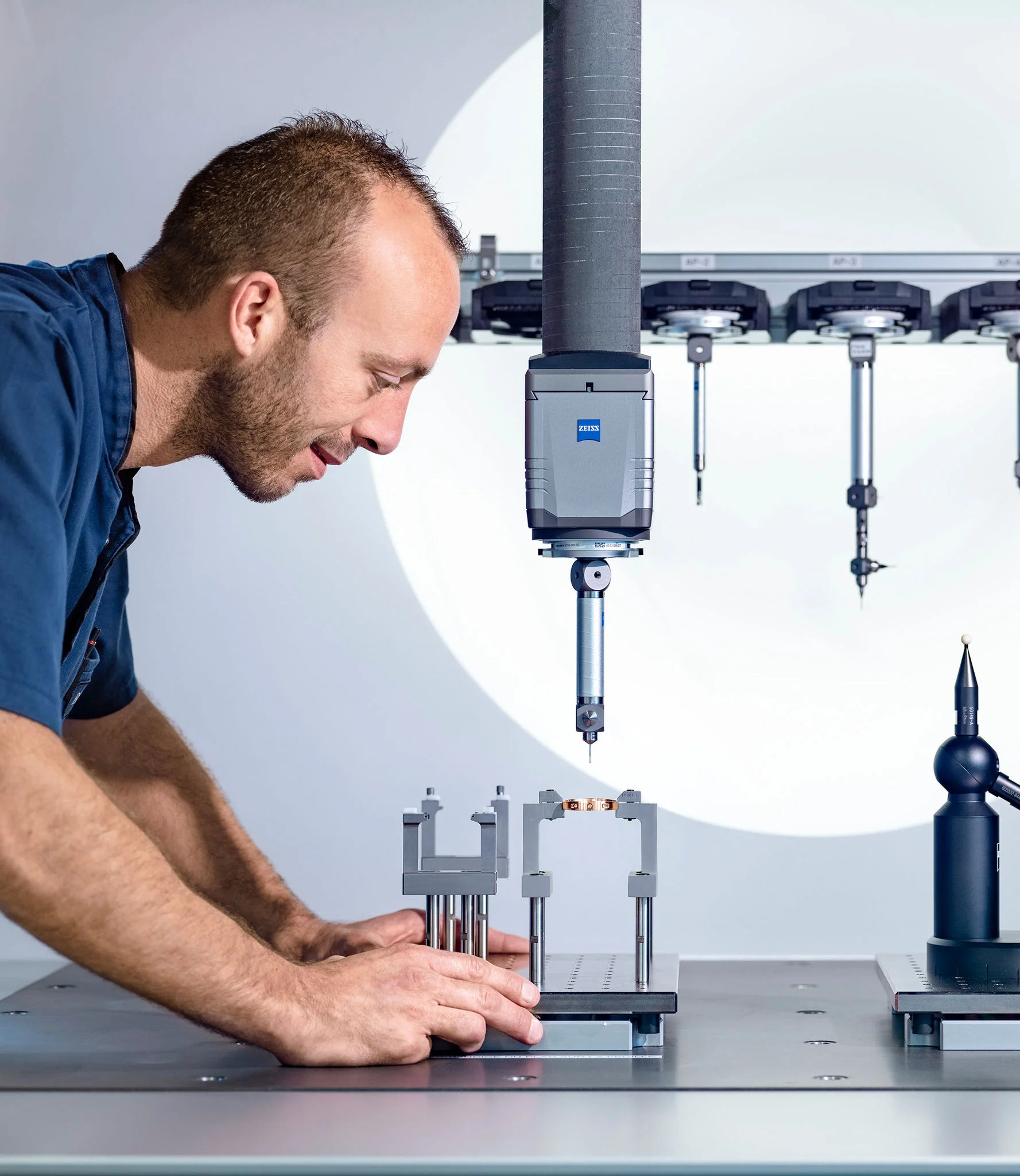
The production process involves a number of precision controls. Case workshop, Audemars Piguet Meyrin. Laser-probing measuring instrument.
A story in three acts
The idea that precious materials have always been used for Haute Horlogerie watches is a common misconception. Before industrialisation, however, a watch was inherently luxurious, whatever its material. While gold and platinum reigned supreme in luxury watchmaking from the 1800s onwards, high-tech materials made their entry in the 1970s and began progressively conquering more and more territory.
Act I. From Stone Age to Brass Age (14th – 19th centuries)
The very first clocks were made of iron, clad in the stone composing the bell tower. Wall clocks were subsequently fitted with cabinets often made of wood, brass or bronze and sometimes covered in tortoiseshell... However, as soon as the time came to consider moving timepieces around and later transporting them – whether table clocks, carriages or pocket watches – watchmakers almost invariably decided to attire them in metal that was rarely of the precious kind.
Act II. The era of noble materials (19th century – 1970s)
Pocket watches from the 17th and 18th centuries were often made of brass. To enhance their value, watchmakers sometimes embellished them with enamel, silver or fine stones. Gold made a modest appearance in the 17th century on the bezels of some enamelled watches. It was not until the mid-18th century that cases made entirely of gold gradually became the norm. From the Industrial Revolution onwards, gold was adopted as the undisputed token of prestige in Haute Horlogerie, in contrast to other watches that were then becoming more widely available.
Act III. New diversity (from the 1970s onwards)
Gold lost its monopoly on luxury in the 1970s. Audemars Piguet ennobled steel in 1972. Profoundly shaken by the quartz crisis, traditional watchmaking reinvented itself by introducing high-tech materials like titanium, ceramics, carbon and bulk metallic glass (BMG), as well as reinterpreting materials hitherto little used in watchmaking, such as granite, plastic, rubber and even wood.
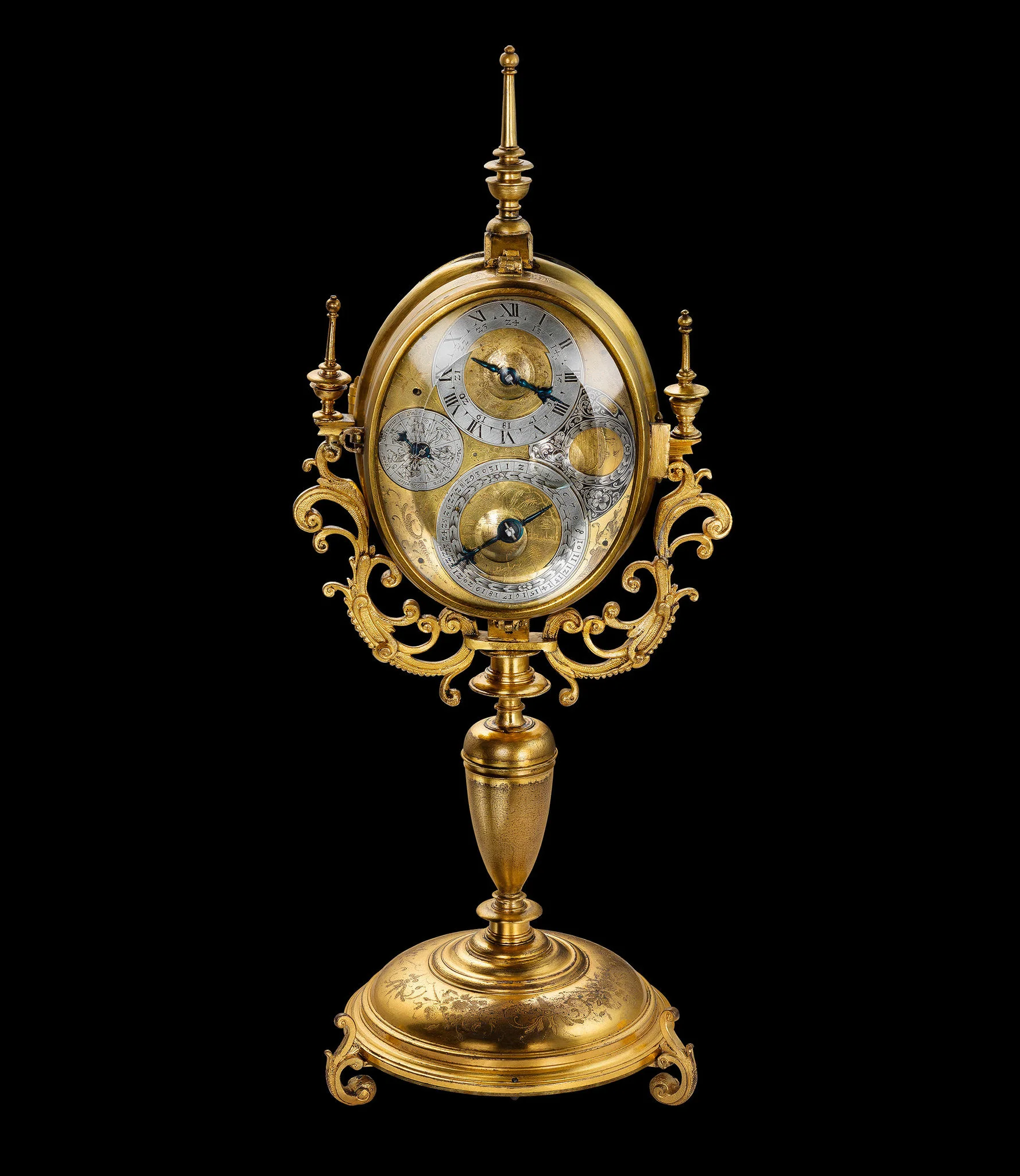
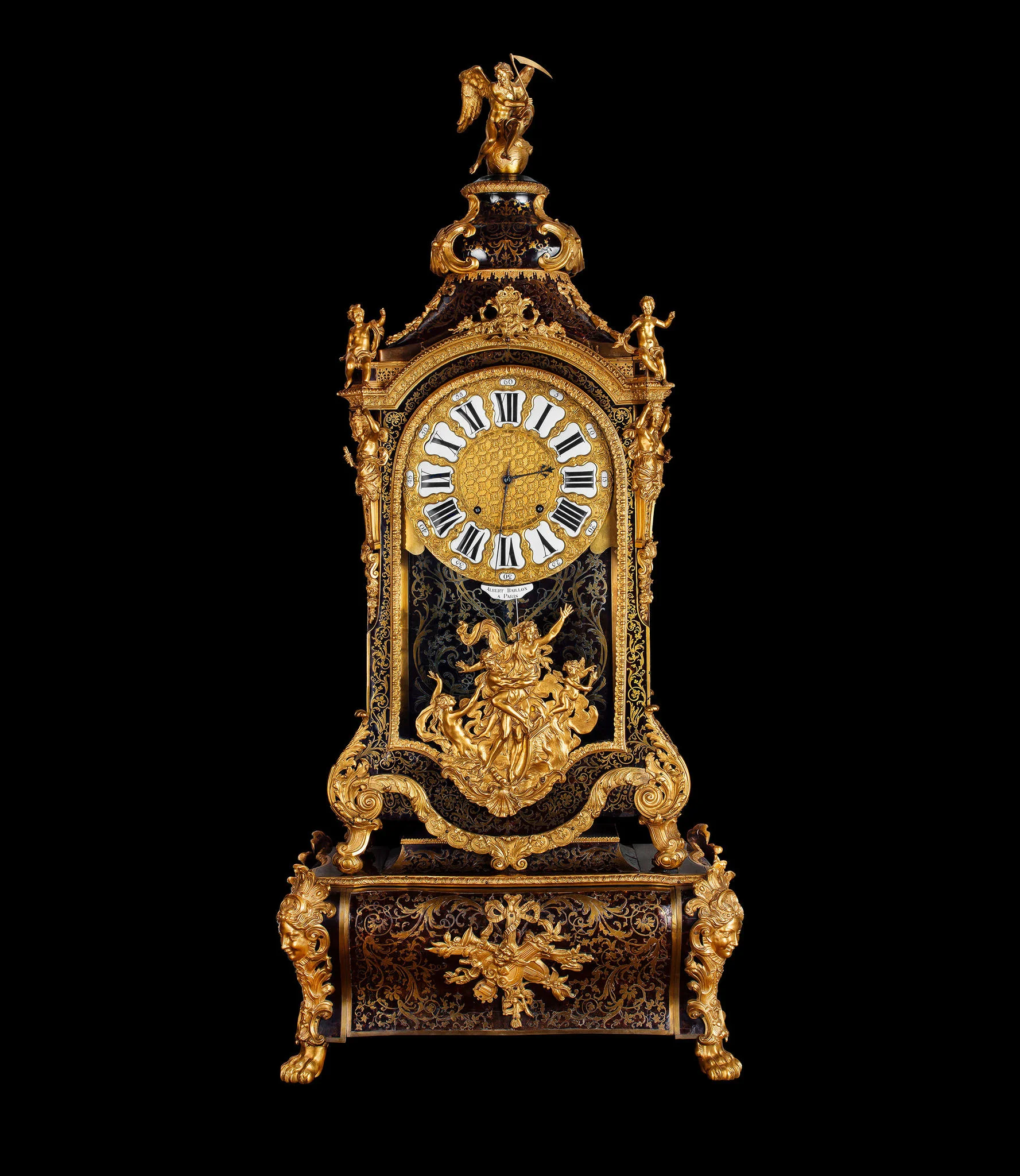
About 1690. Table clock with astronomical indications, E Kreitmayr. Many brass table clocks from the 17th and 18th centuries can be found in the watch collections of major museums. MIH collection, I-154.
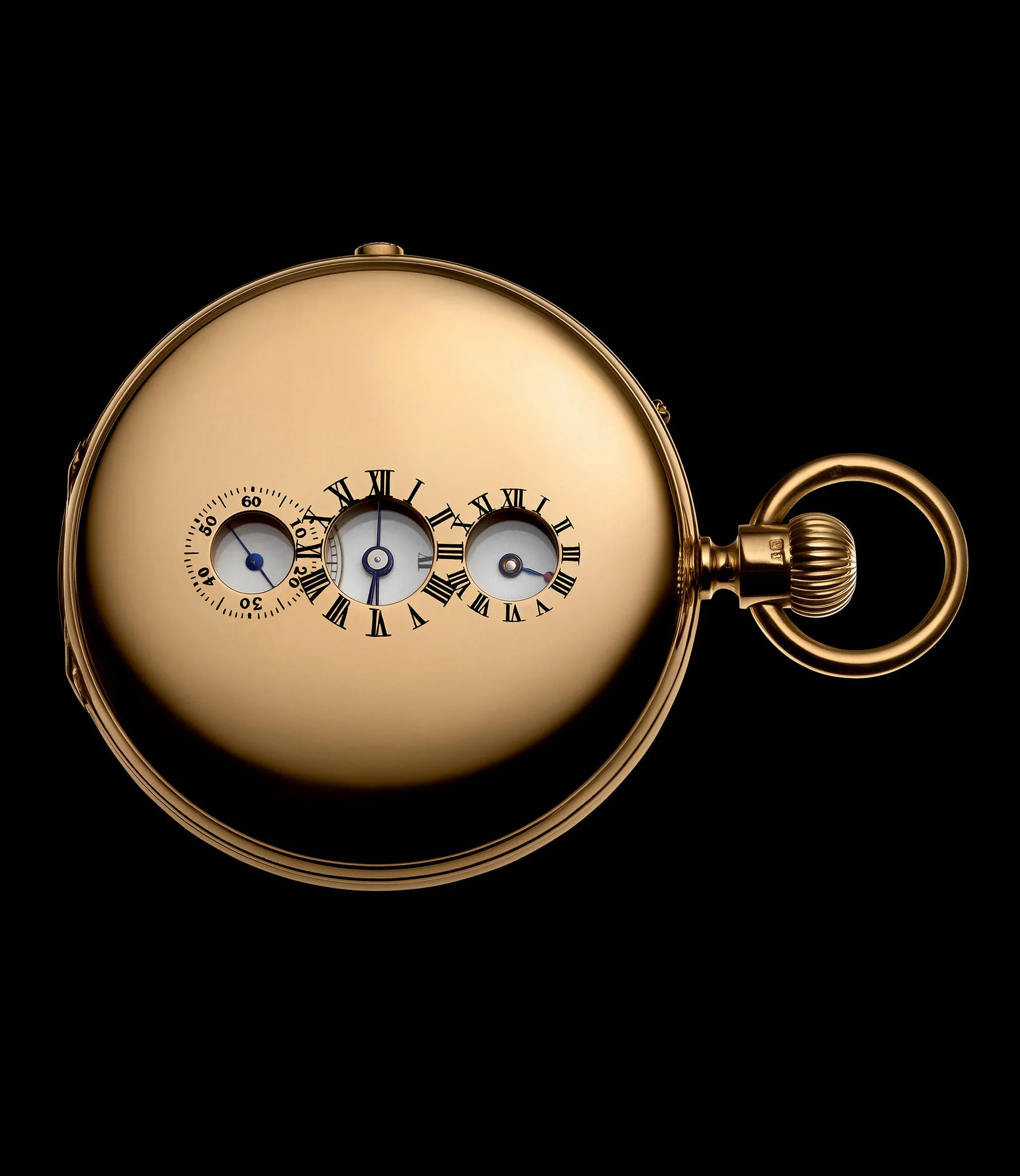
Circa 1874. Chronograph watch with hunter-type case bearing the signature Nicole et Capt in London and in the Vallée de Joux. in London and in the Vallée de Joux. Case in 18-carat gold with three apertures. Audemars Piguet Heritage, inv. 1858.
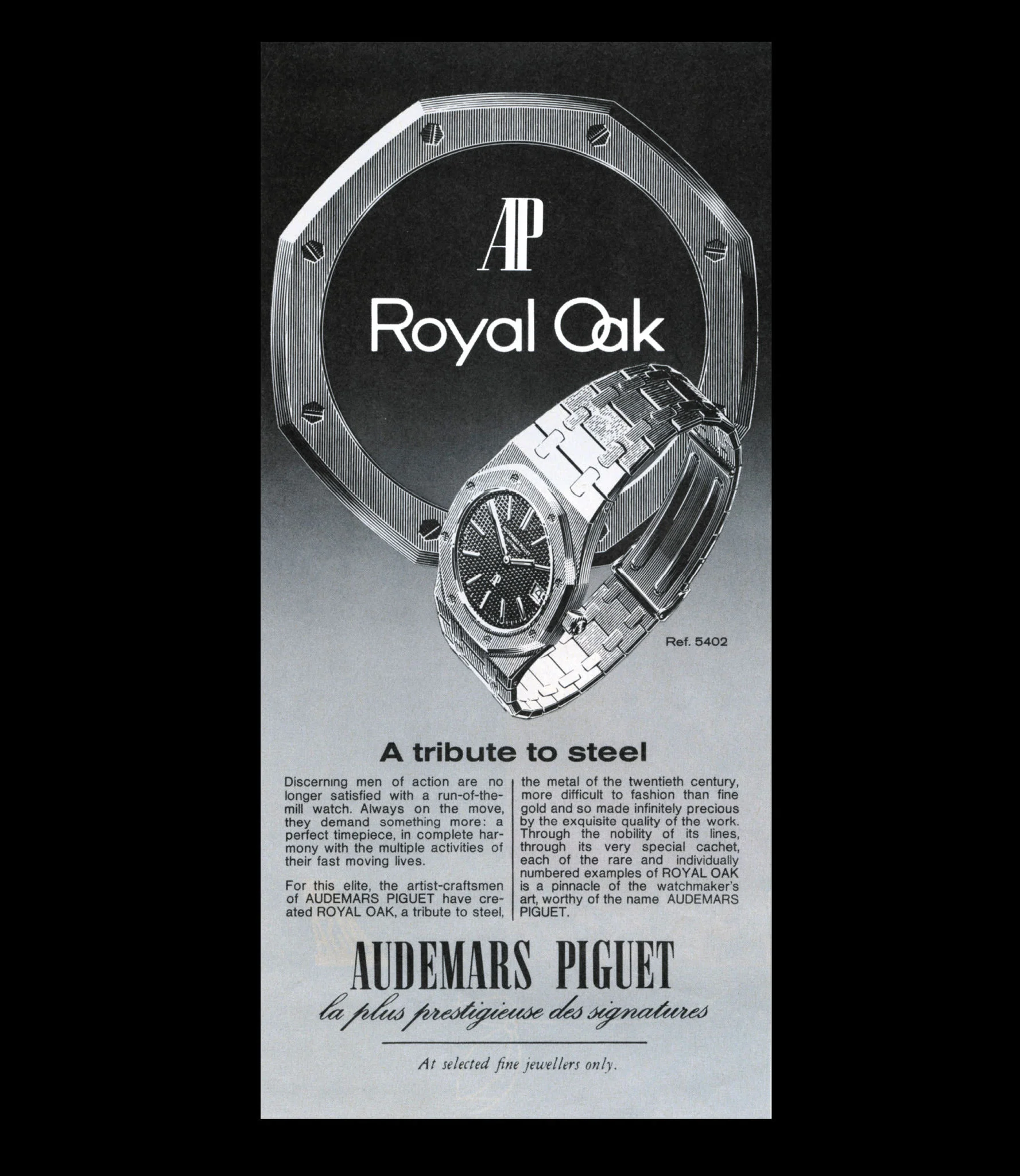
1972. Royal Oak advertisement. The sales argument is built around the hand-finished all-steel exterior at a price putting the watch on a par with gold watches. Audemars Piguet Archives.
Natural stone cases
Every culture and every period has associated symbolic values with stones, based on their rarity, their myths, their brilliance and their colours.
From the Renaissance onwards, when artisans sought to enhance their timepieces with precious materials, they often chose rock crystal, jasper, agate or sapphire.
Common in the 17th and 18th centuries, watches with partial stone exteriors subsequently became rarer. They reappeared during the Art Deco period and again in the 1960s and 1970s. In the early 21st century, Audemars Piguet went so far as to produce watch baseplates in natural stone.
While small natural inclusions make stone watches beautiful, they also render them fragile. To shape a stone without splitting or breaking it, artisans use special grinding wheels and lathes keeping vibrations to a minimum. Despite this, a significant proportion of watch cases still break before they are finished.
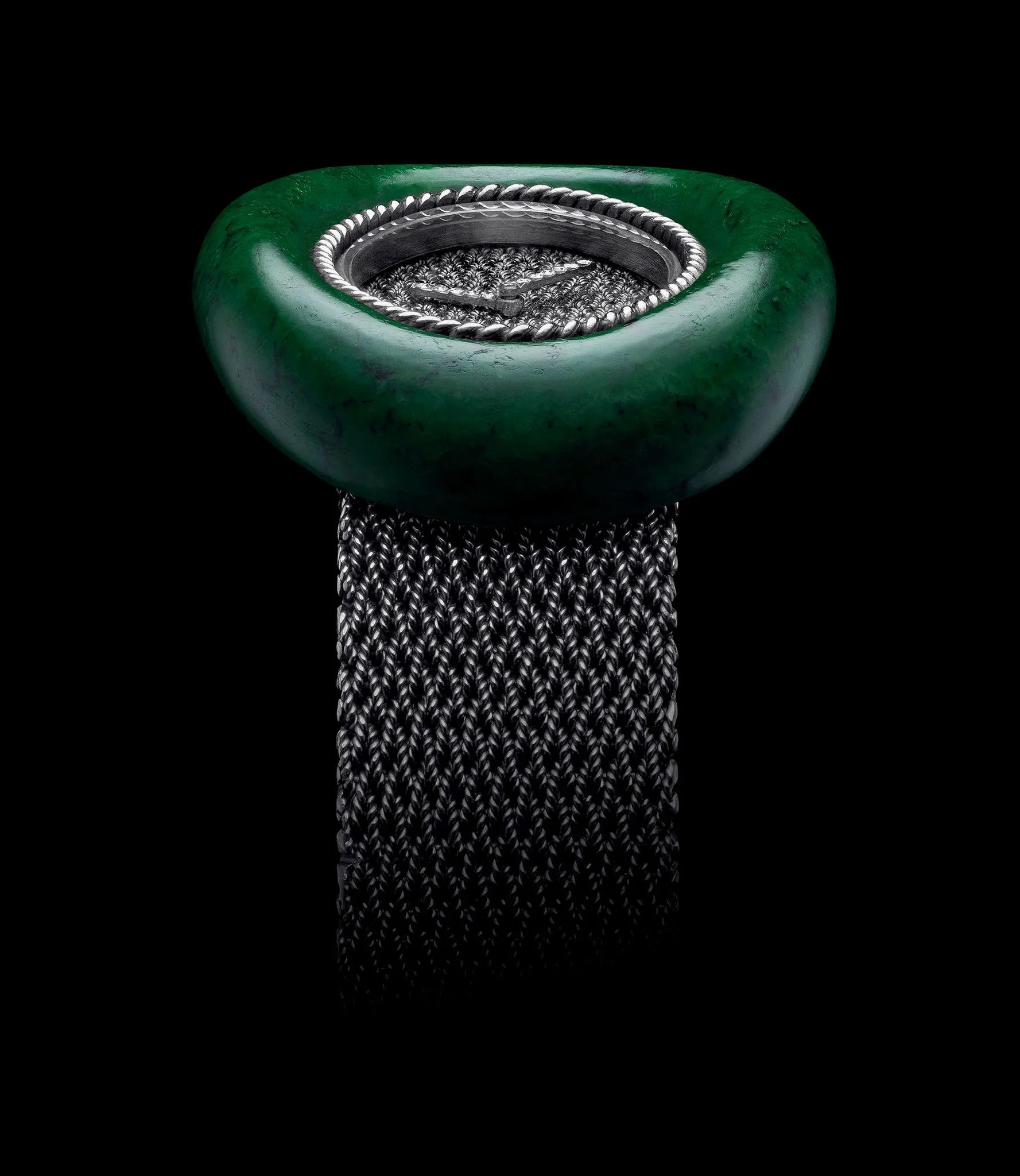
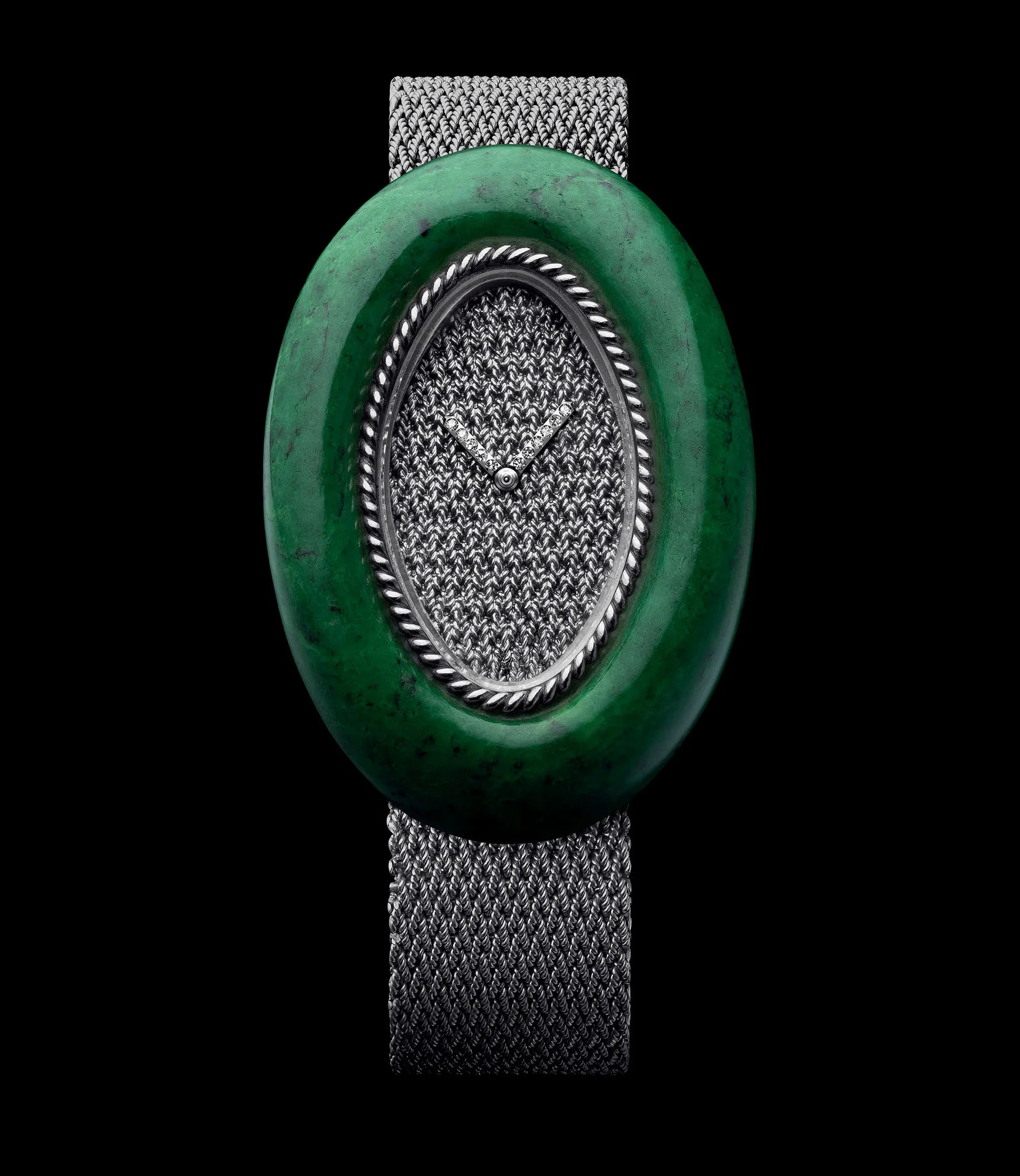
1971. 8455BC wristwatch in grossular garnet. Calibre 2430 with winding mechanism positioned on the underside, movement 116441. Case no. 63771 in white gold and natural stone. Gemset hands. Bracelet in braided white gold, twisted strands, Polish mesh links. Audemars Piguet Heritage, inv. 1050.
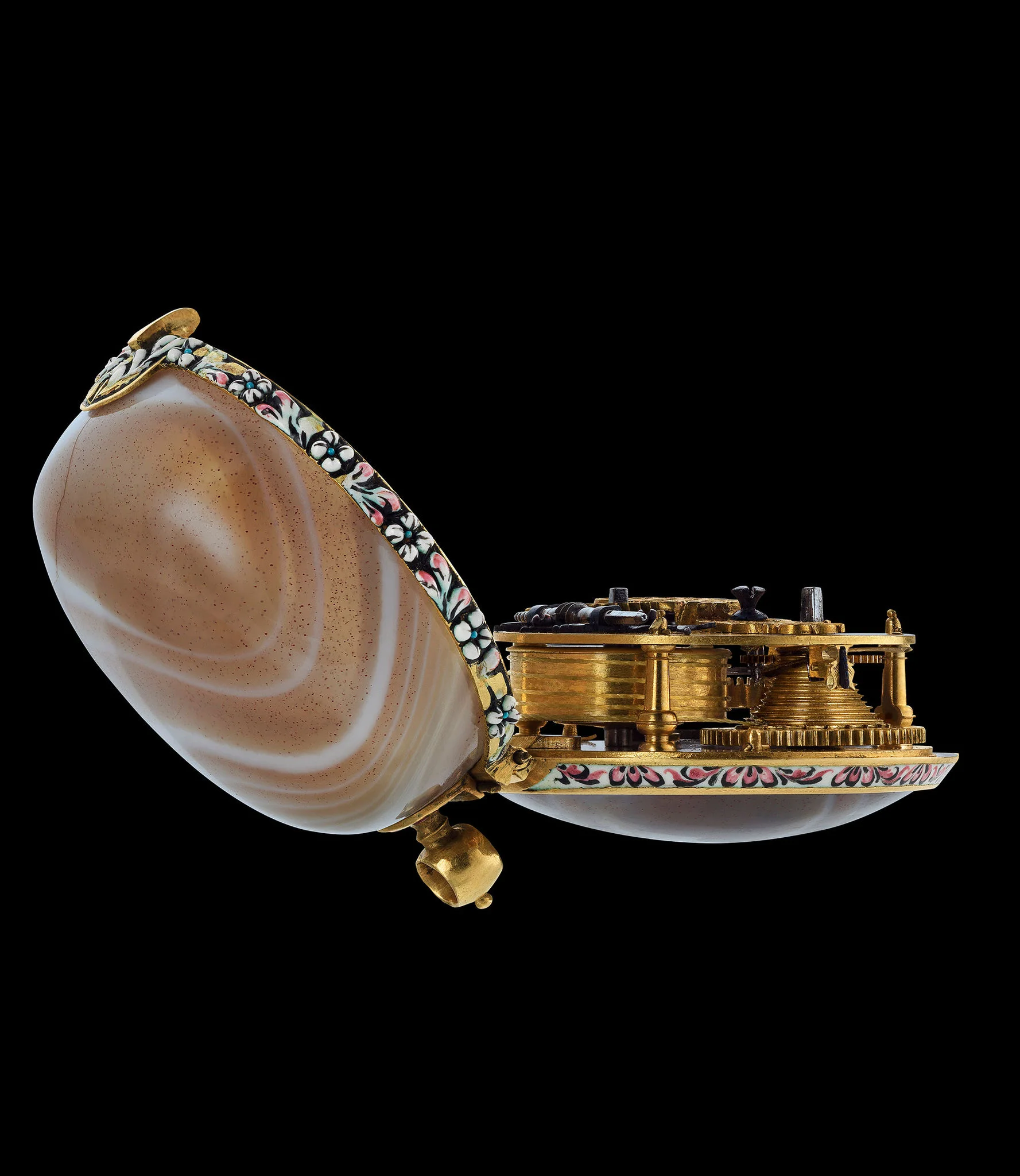
The case of this pendant-watch, created circa 1650, was carved from an agate. It is so fine that the light shines through the stone. Enamelled 20-carat gold. Watch attributed to Etienne Angely in Montpellier. Audemars Piguet Heritage, inv. 2195.
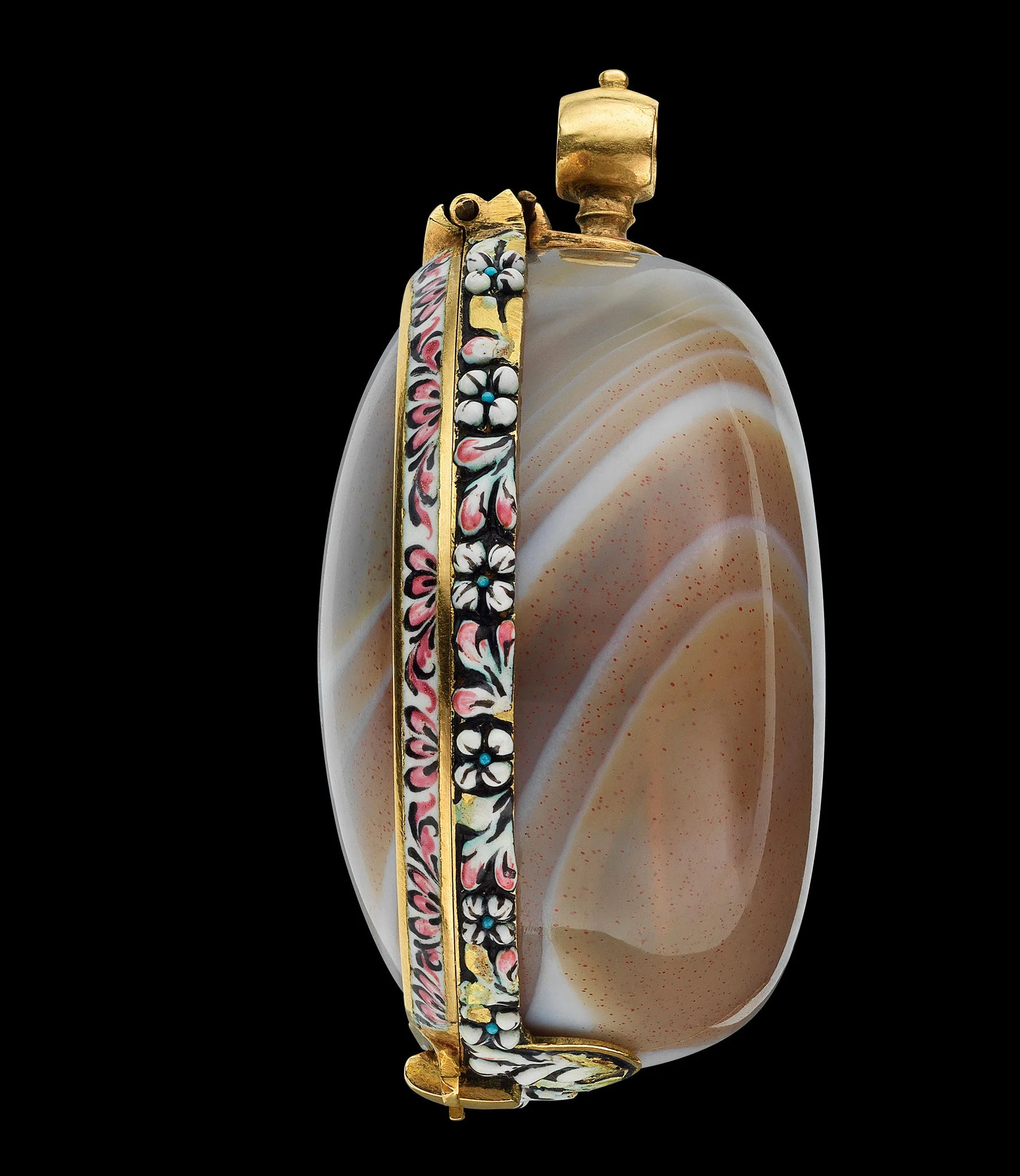
The case of this pendant-watch, created circa 1650, was carved from an agate. It is so fine that the light shines through the stone. Enamelled 20-carat gold. Watch attributed to Etienne Angely in Montpellier. Audemars Piguet Heritage, inv. 2195.
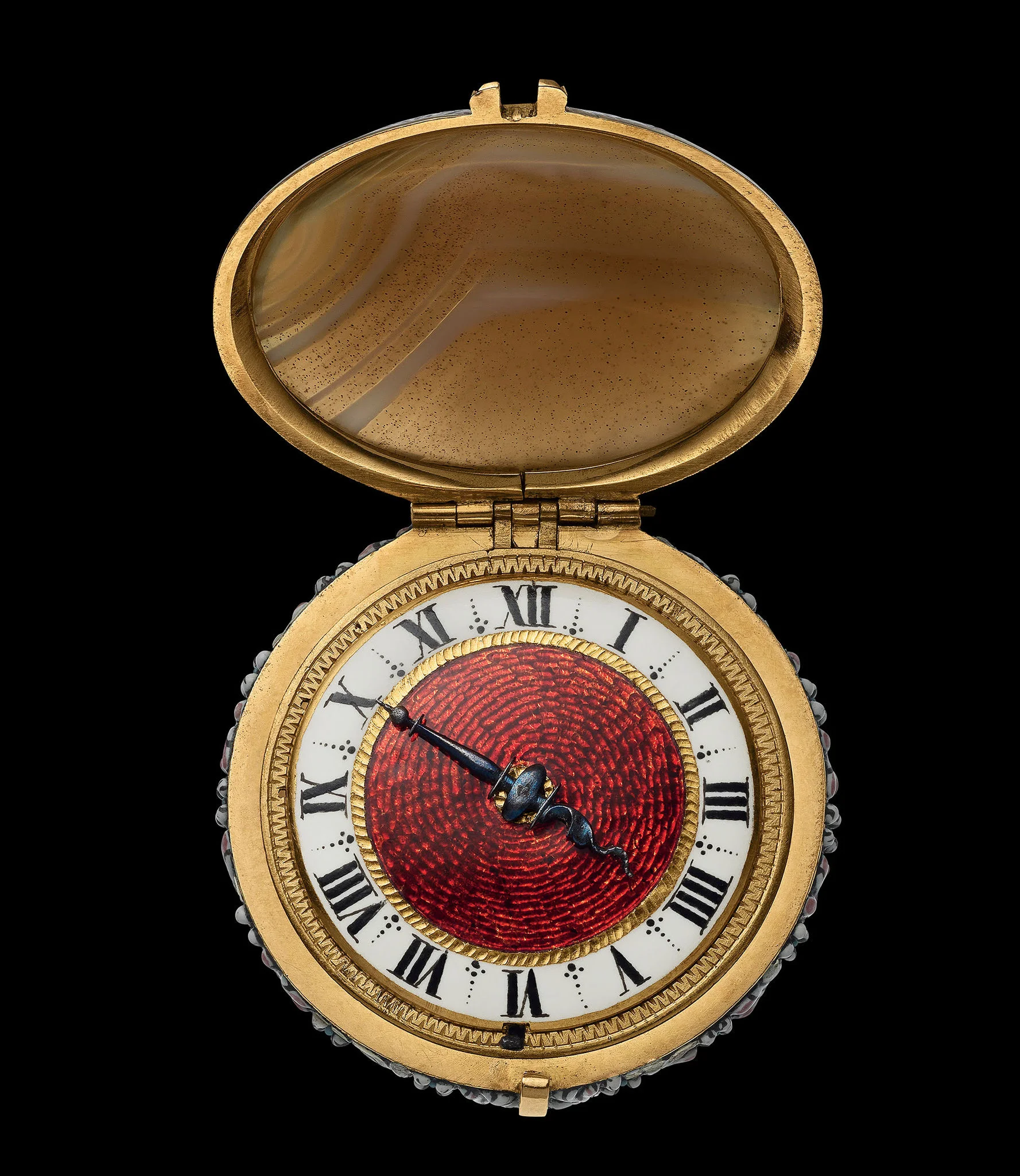
The case of this pendant-watch, created circa 1650, was carved from an agate. It is so fine that the light shines through the stone. Enamelled 20-carat gold. Watch attributed to Etienne Angely in Montpellier. Audemars Piguet Heritage, inv. 2195.
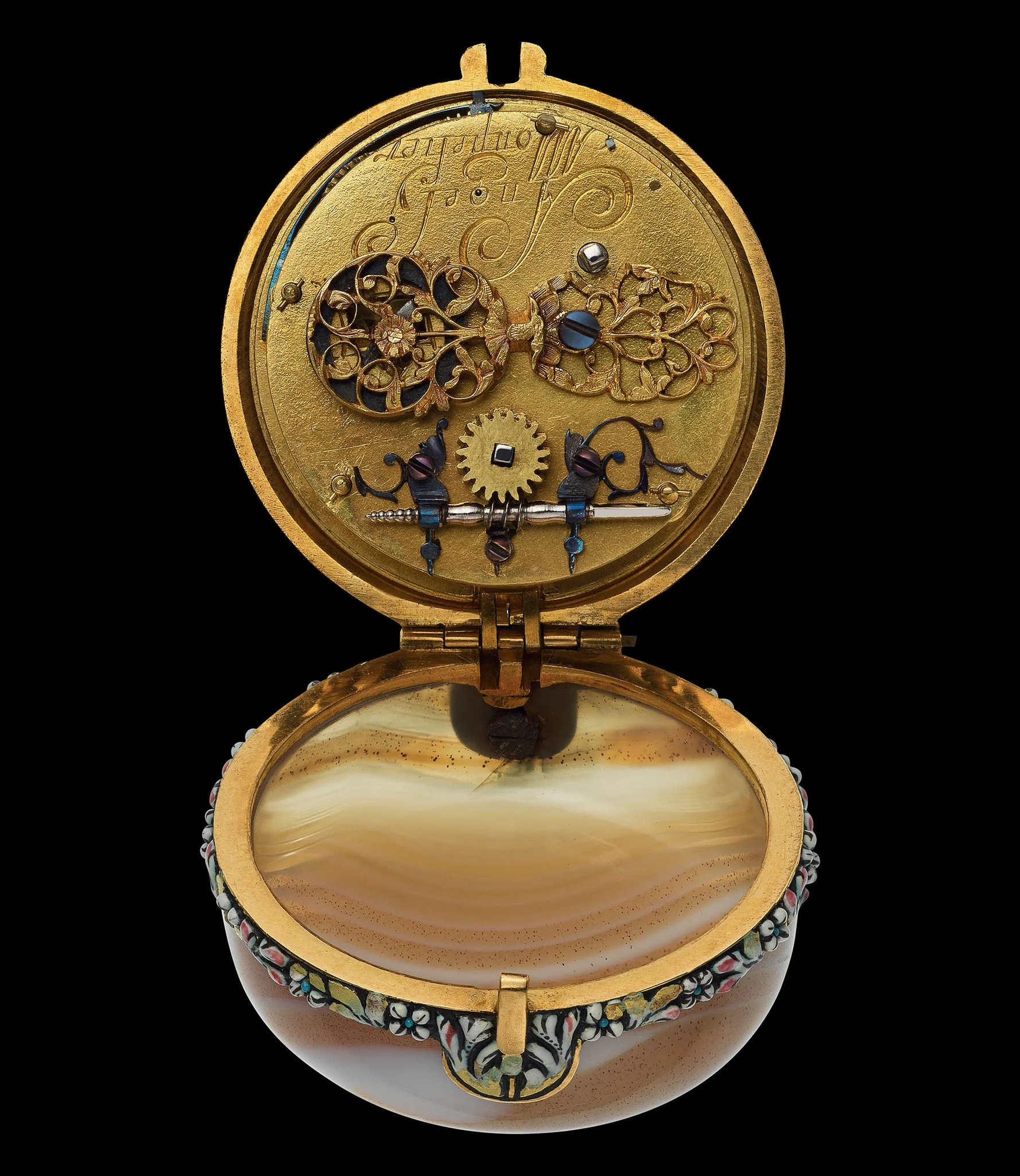
The case of this pendant-watch, created circa 1650, was carved from an agate. It is so fine that the light shines through the stone. Enamelled 20-carat gold. Watch attributed to Etienne Angely in Montpellier. Audemars Piguet Heritage, inv. 2195.
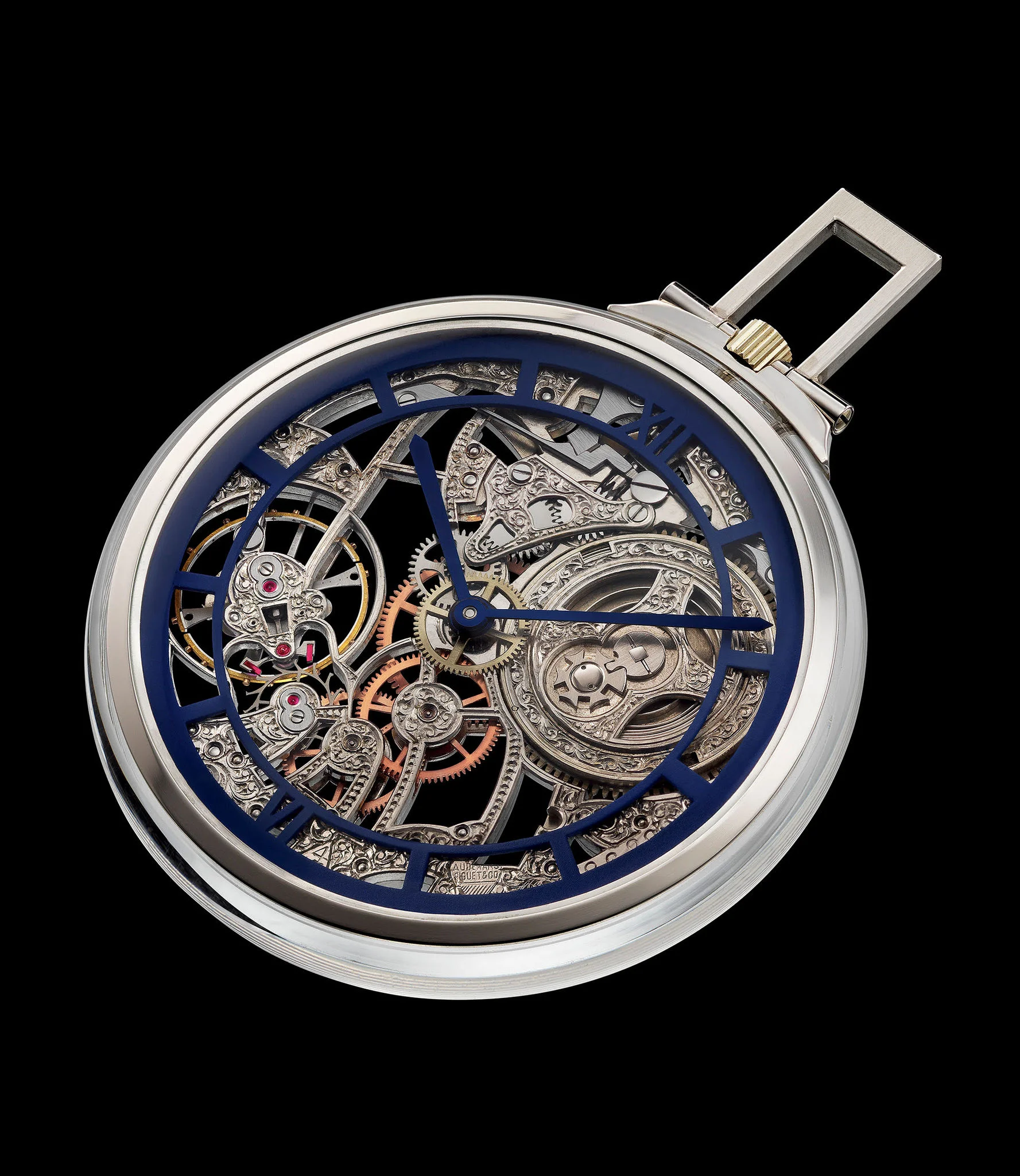
This rock crystal case ‘vanishes’ so as to highlight the work of the artisans who openworked and engraved the ultra-thin movement in 1936. Calibre 16½ SVF#3 Movement 3868. Audemars Piguet Pre-Model 622. Private Collection.
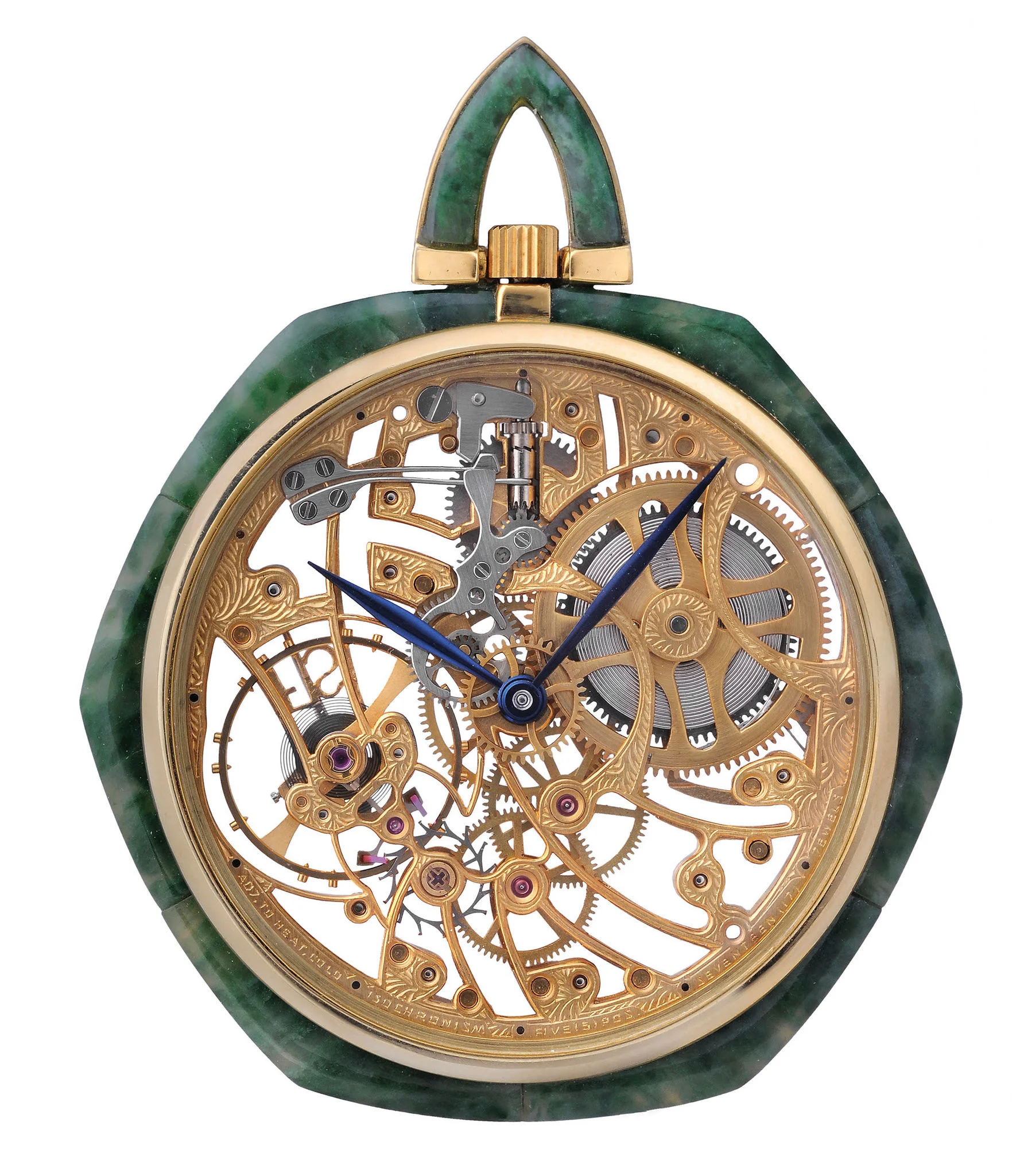
1975. Pocket watch 5666. The case middle and pendant are embellished with grossular garnet. Calibre 5017SQ, Movement 175401. Case no. B34603 in yellow gold. Audemars Piguet Heritage, inv. 660.
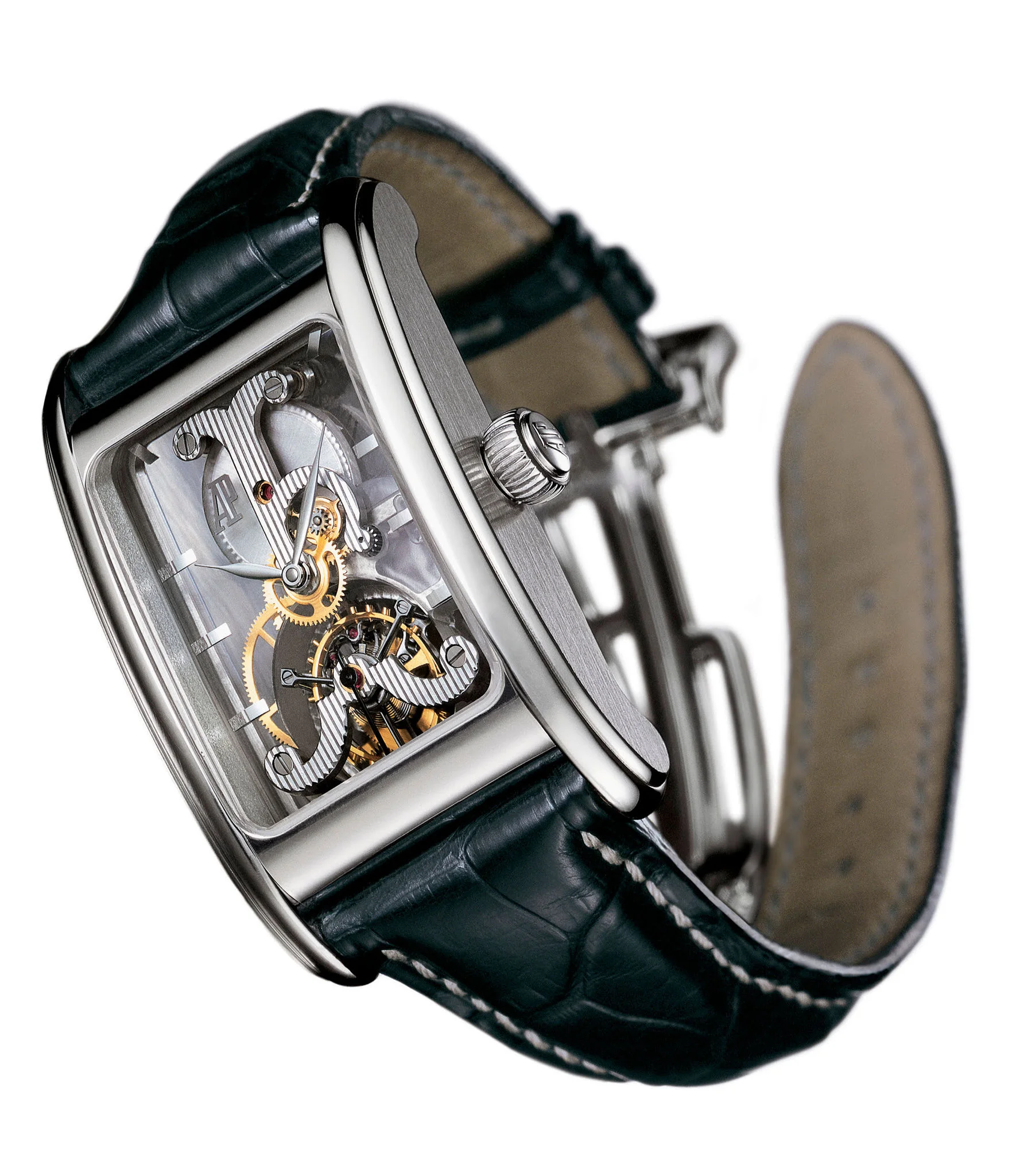
2007. Edward Piguet Tourbillon 25924. The mechanisms’s mainplate is made from a rutile quartz stone. Tourbillon. Calibre 2888, movement 555877. Case no. F10256 in platinum. Audemars Piguet Heritage, inv. 1314.
Silver, the forerunner of noble metals
Both lighter and more supple than gold yet more sensitive to oxidation, silver was historically the first precious metal to conquer the world of Haute Horlogerie. From the 16th to the 19th centuries, it appeared in finely engraved versions. Artisans often chose to use it for dials and more rarely for cases.
Silver gave way to gold in the high-end segment, meaning that by the 1900s, it occupied the niche mid-way between chrome-plated metal watches and those made of precious metals. It was the introduction of stainless steel that dealt the final blow in the 1930s.
Nonetheless, thanks to its more affordable price than gold, silver long remained the preferred material for apprentice watchmakers when it came to adorning the "school watch" representing the culmination of their training. It is thus no coincidence that back in 1769, Joseph Piguet, great-grandfather of Audemars Piguet’s co-founder, chose it for the watch he made to earn the “Maîtrise” (master-watchmaker title).
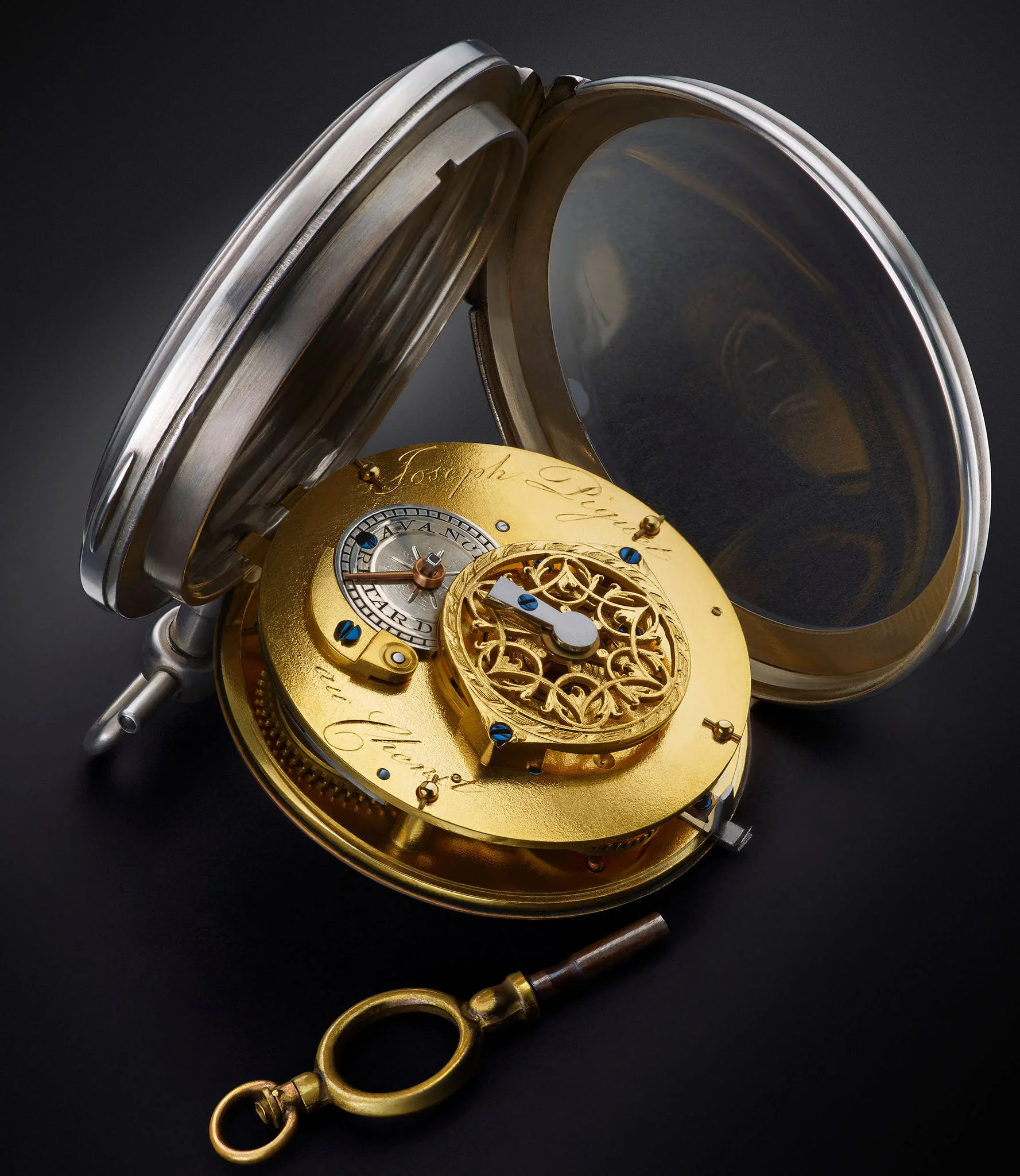
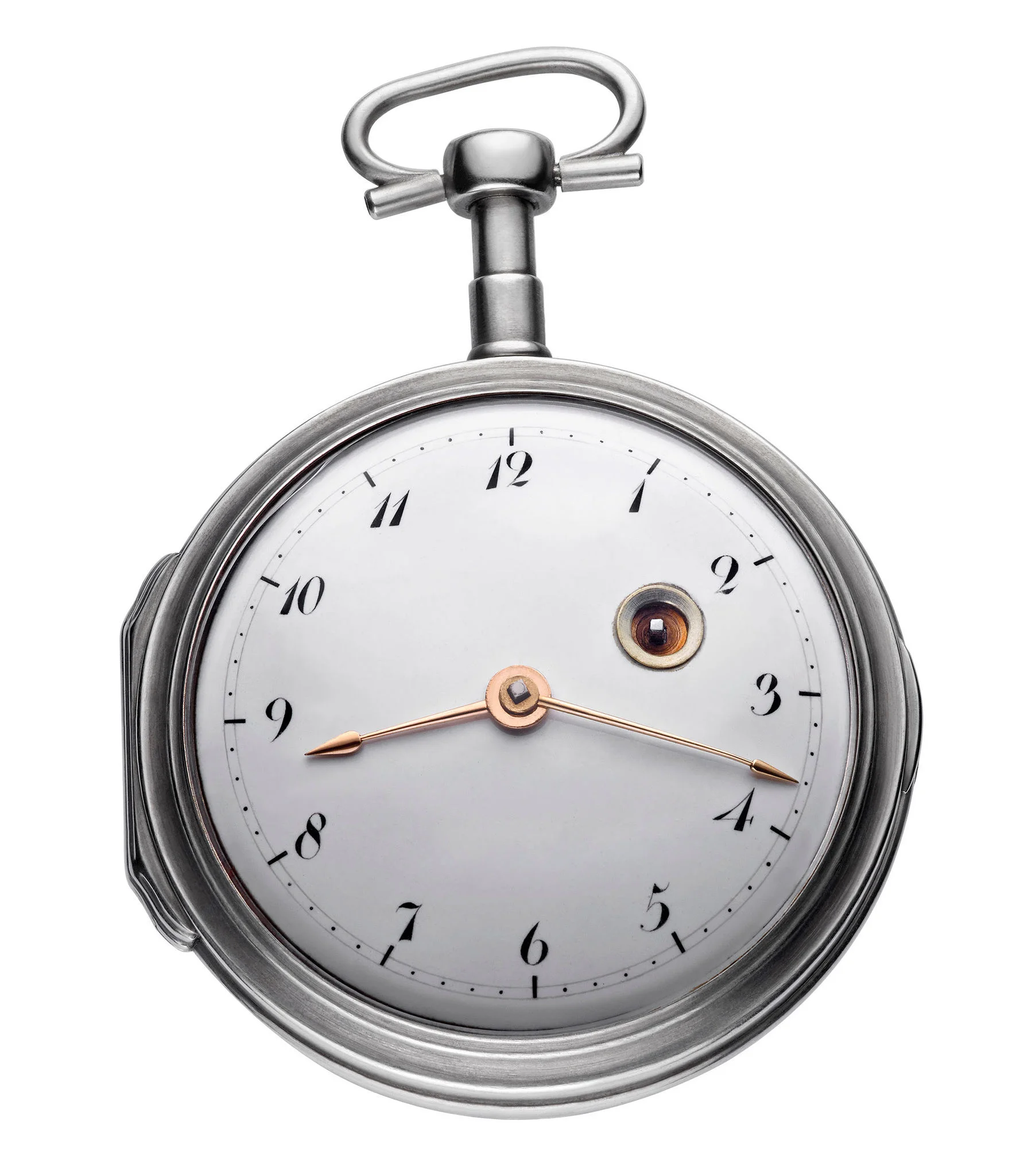
Circa 1769. Watch made by Joseph Piguet to achieve the “Maîtrise” (master-watchmaker) qualification title. When he completed his apprenticeship masterpiece to enter the Corporation of Watchmakers, Joseph Piguet attired his watch in silver. Private collection.
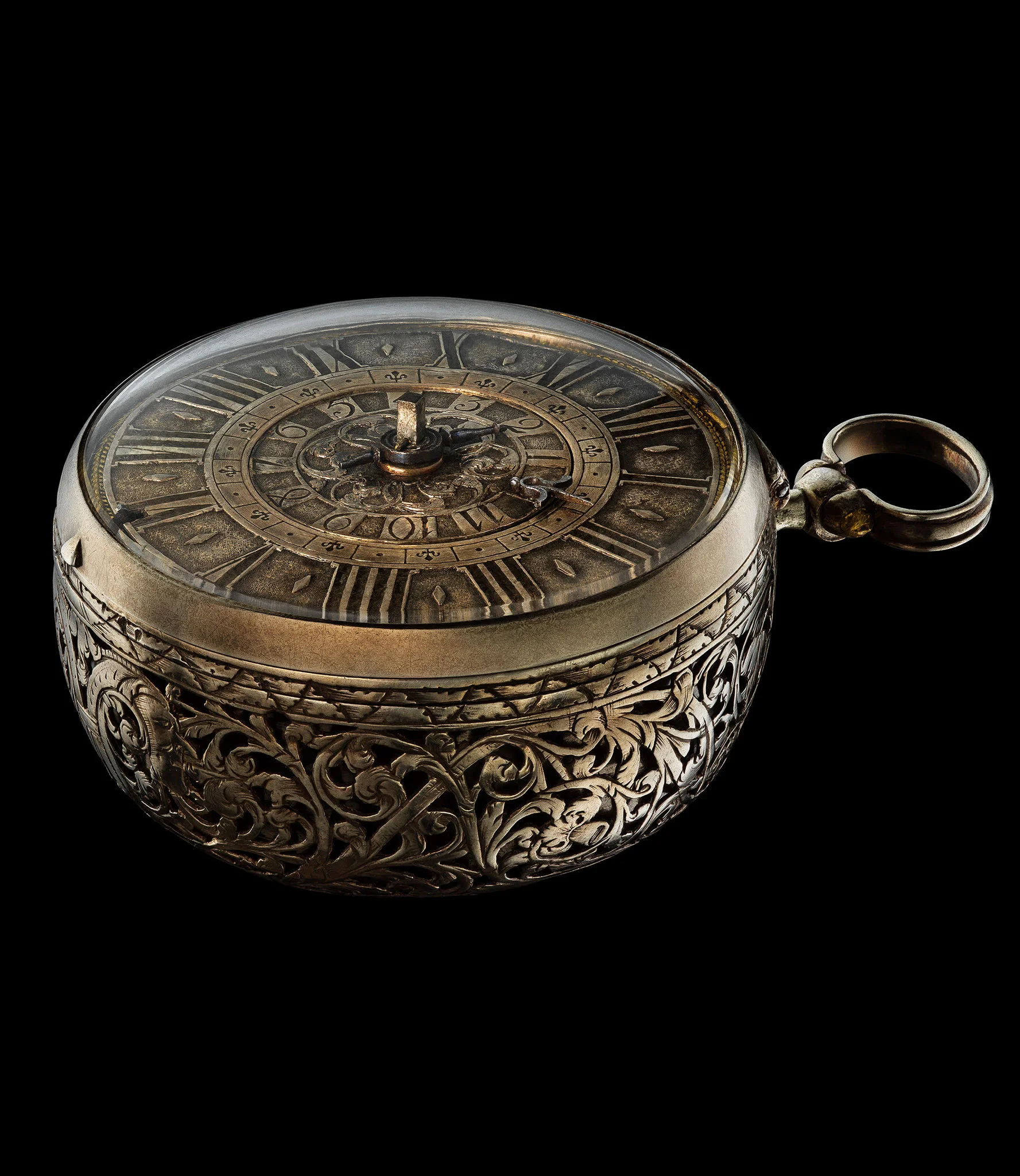
Circa 1690. Alarm watch striking a silver bell, by Quare of London. Daniel Quare (1649–1724) is famous for having introduced the minutes hand in the centre of the watch. Audemars Piguet Heritage, inv. 545.
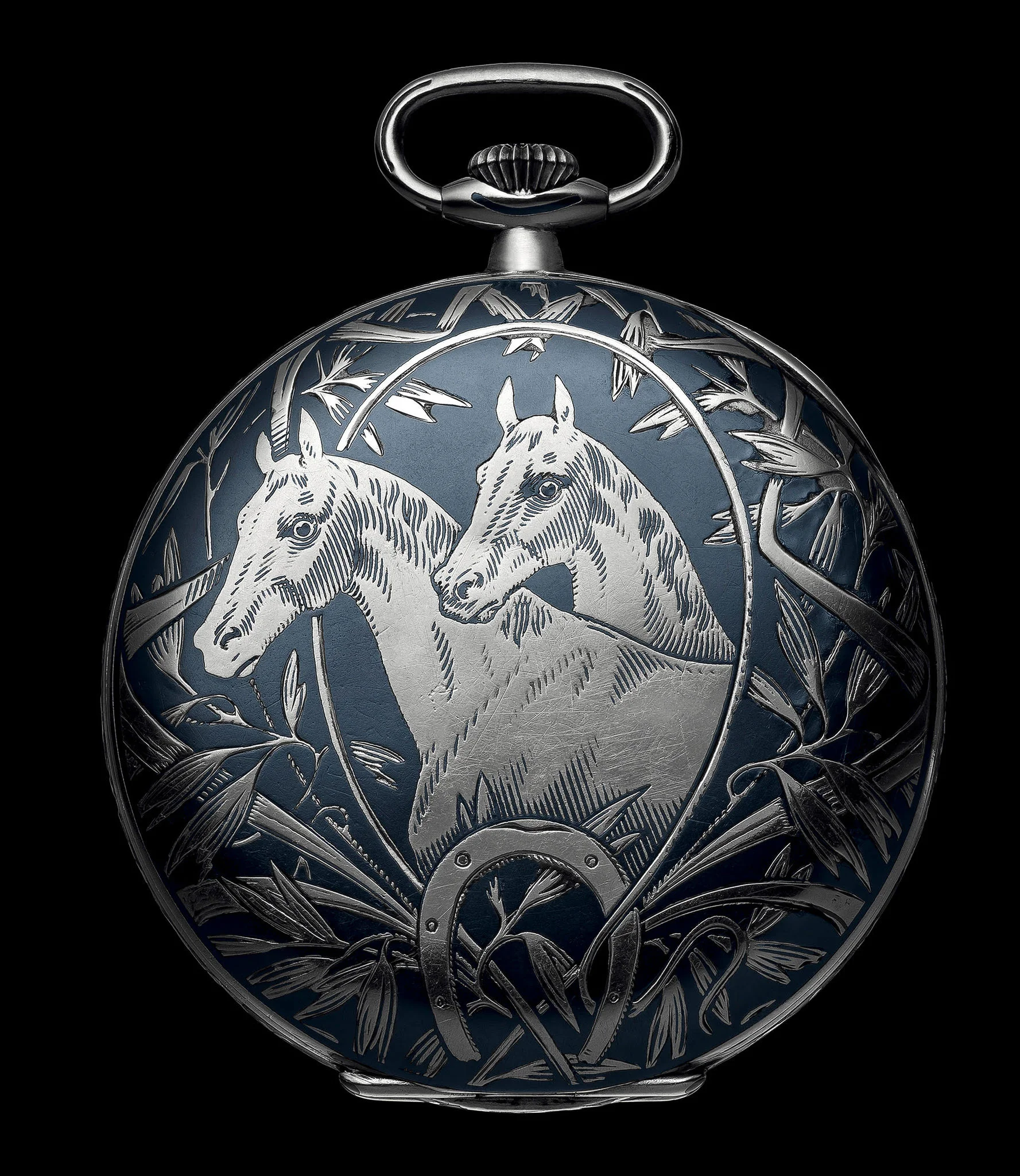
Circa 1920, Paul Rochat completed his apprenticeship at the Ecole d'Horlogerie de la Vallée de Joux and made this watch in niello silver. AP Heritage, inv. 721.
Gold, the king of metals
A quintessentially noble metal, gold has been at the heart of civilisations since Antiquity. A repository of value and a standard for trade exchanges, it was used to make coins and prestigious objects. Rare, shiny, stainless, biocompatible, heavy, stable and easy to work with, it is the embodiment of wealth, success and sunshine.
Pure (24-carat) gold is too malleable to be used in watchmaking. Watch cases are therefore often made of 18-carat gold, meaning they contain 75% gold. While the United States and Nordic countries have long appreciated 14-carat gold which contains 58.5% of the precious material, 9-carat gold with a maximum content of 37.5 % is also available.
These proportions must be authenticated by hallmarks. On the other hand, the additional metals used may vary according to the period and the brand, as well as naturally depending on the desired colour. Obtaining white gold involves adding silver, palladium or previously nickel; while gold, copper and silver are used to make pink gold. This means that when a gold watch case becomes a little oxidised, that’s simply because of the silver or copper it contains...
From the mid-20th century onwards, alloys were standardised so as to always obtain the same colours, codenamed 2N, 3N, etc. However, since the 2000s the watch industry has once again sought diversity, introducing new formulae for obtaining different shades. Examples include Rolex's "Everose", Omega's "Sedna" and "Moonshine", and Hublot's "Magic Gold". In 2024, Audemars Piguet introduced "sand gold", whose reflections vary according to the light, ranging from pink to grey, with shades of blue and even brown.
| Metal | Yellow gold (BA) | Pink gold (OR) | White gold (BC) | Sand gold (SG) |
| Gold (Au) | 750 | 750 | 750 | 750 |
| Copper (Cu) | 125 | 205 | 95 | 190 |
| Silver (Ag) | 125 | 45 | 30 | 0 |
| Palladium (Pd) | 0 | 0 | 125 | 60 |
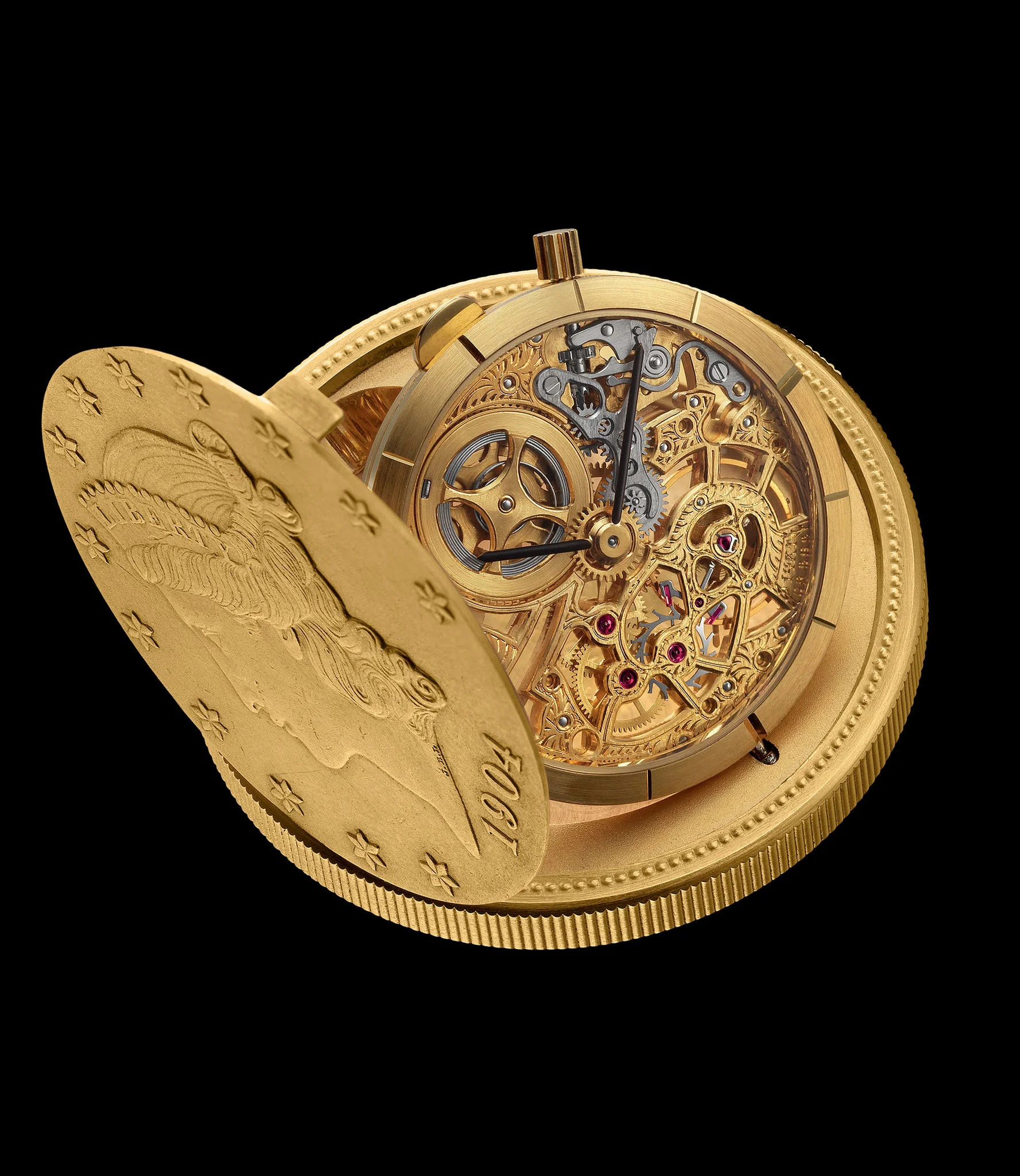
1994. Coin watch 35677. This 20-dollar gold coin dating from 1904 has been cut and hollowed out to accommodate ultra-thin openworked gold Calibre 2003SQ. Movement no. 390920. Case no. D12690, Audemars Piguet Heritage Collection, inv. 935.
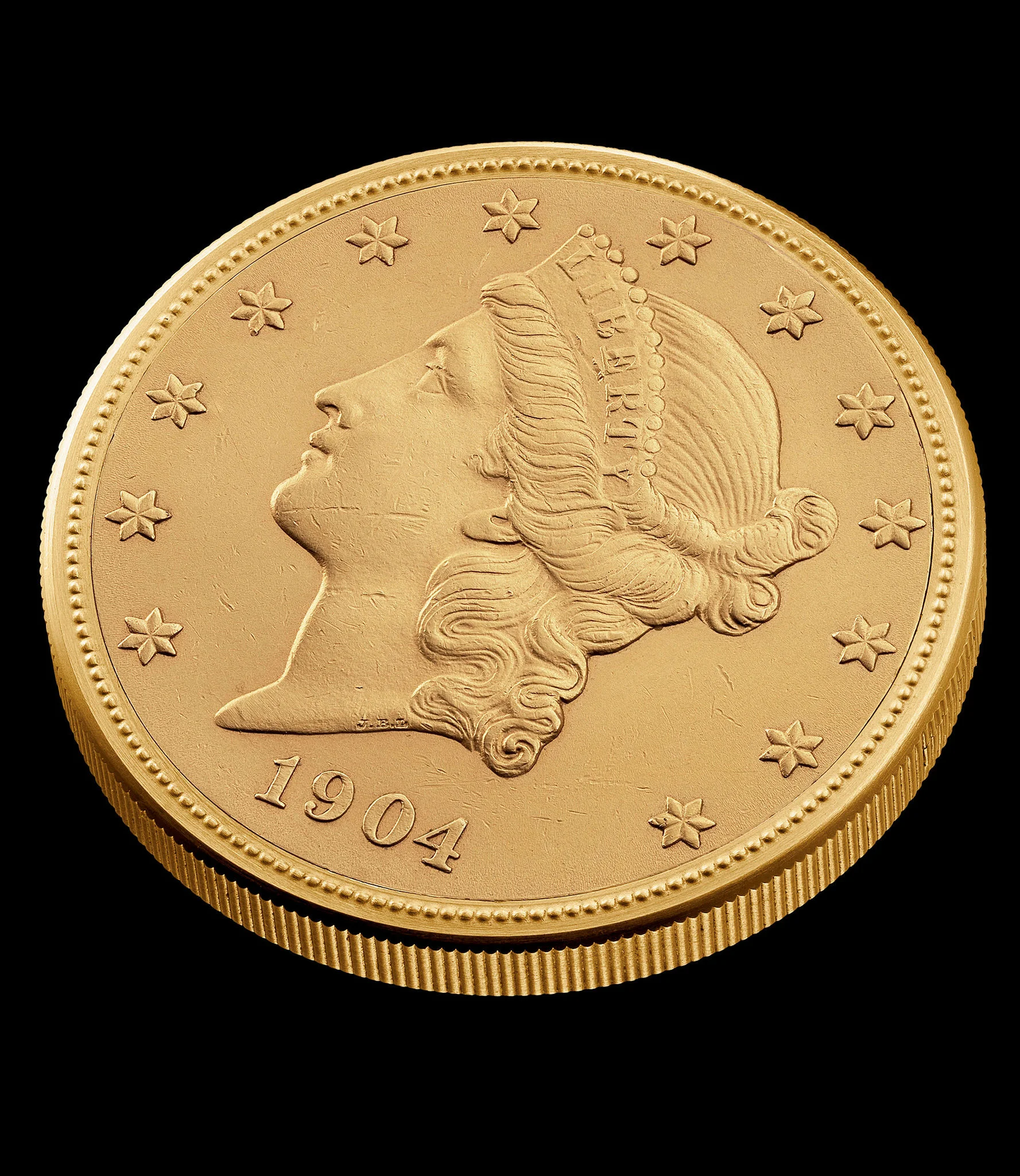
1994. Coin watch 35677. This 20-dollar gold coin dating from 1904 has been cut and hollowed out to accommodate ultra-thin openworked gold Calibre 2003SQ. Movement no. 390920. Case no. D12690, Audemars Piguet Heritage Collection, inv. 935.
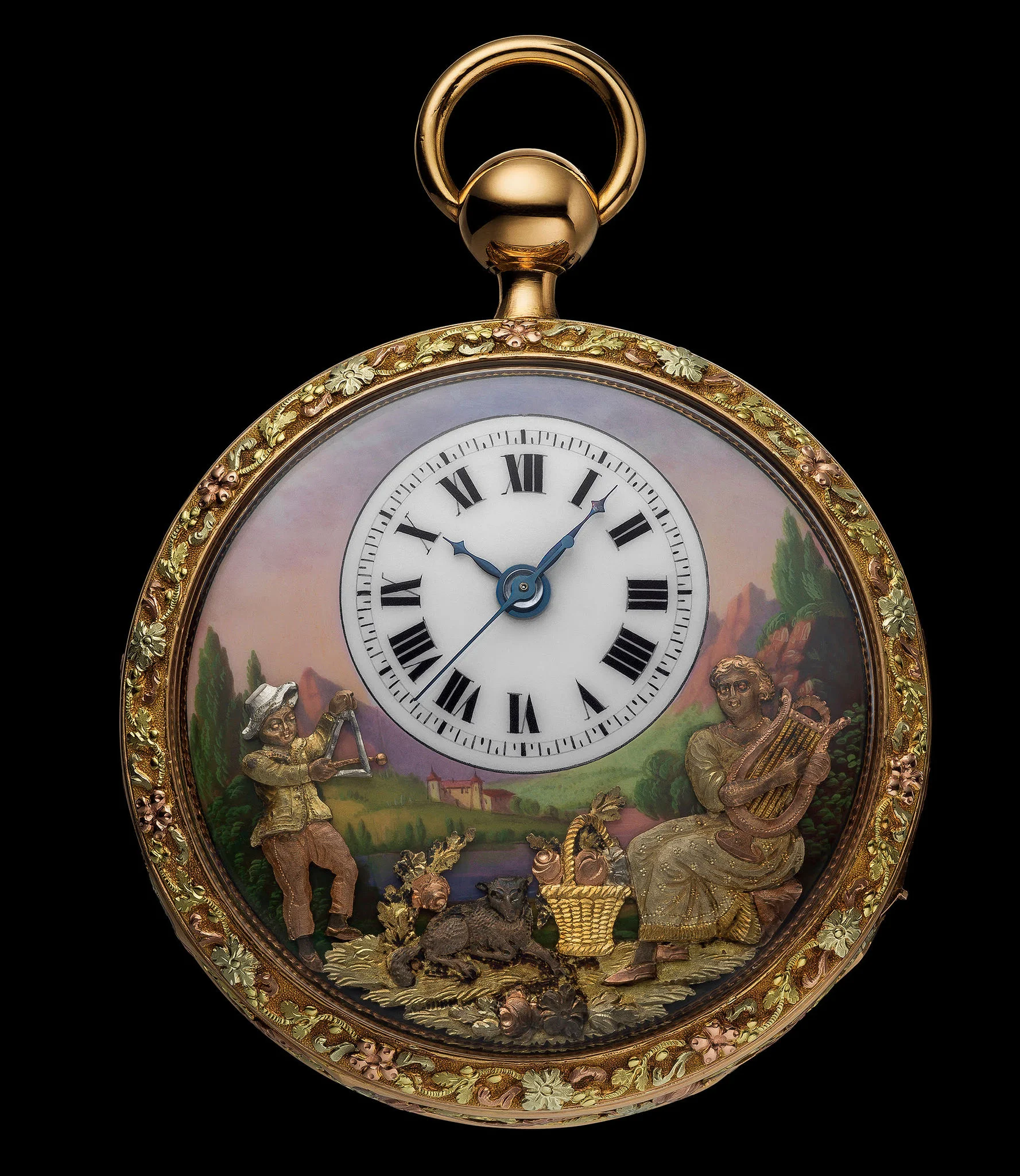
Circa 1840. Piguet Meylan pocket watch. The case combines four gold colours: yellow, grey, pink and green. The musical mechanism plays the melody of God Save the King on request or upon the passage to each new hour, while its characters come to life. Audemars Piguet Heritage, inv. 53.
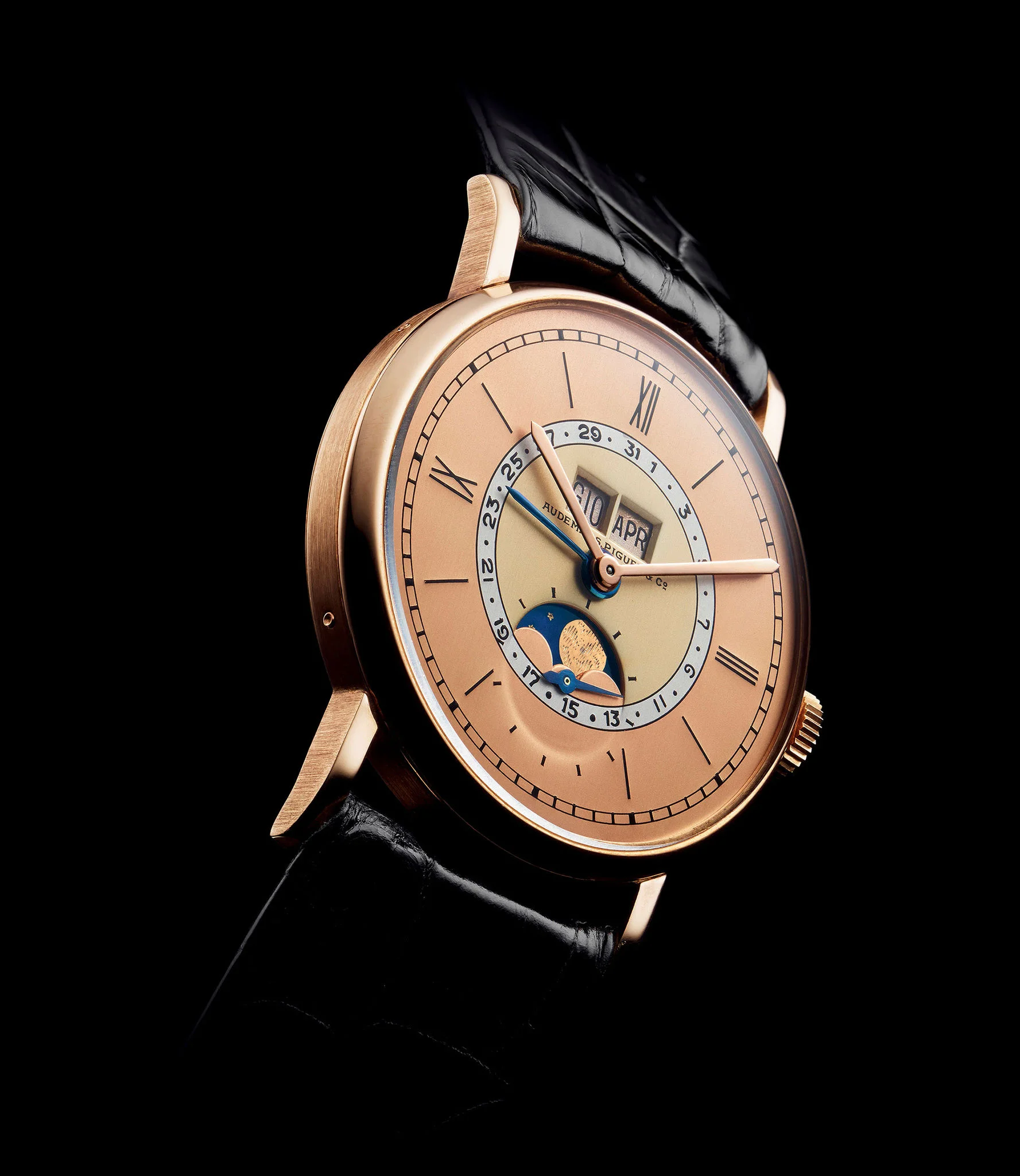
1942. Complete calendar. The peripheral part of the three-tone dial is in harmony with the 18-carat pink gold case. Calibre 10GHSM. Case of 31 mm in diameter, movement no. 41745. Pre-Model 811. Audemars Piguet Heritage, inv. 212.
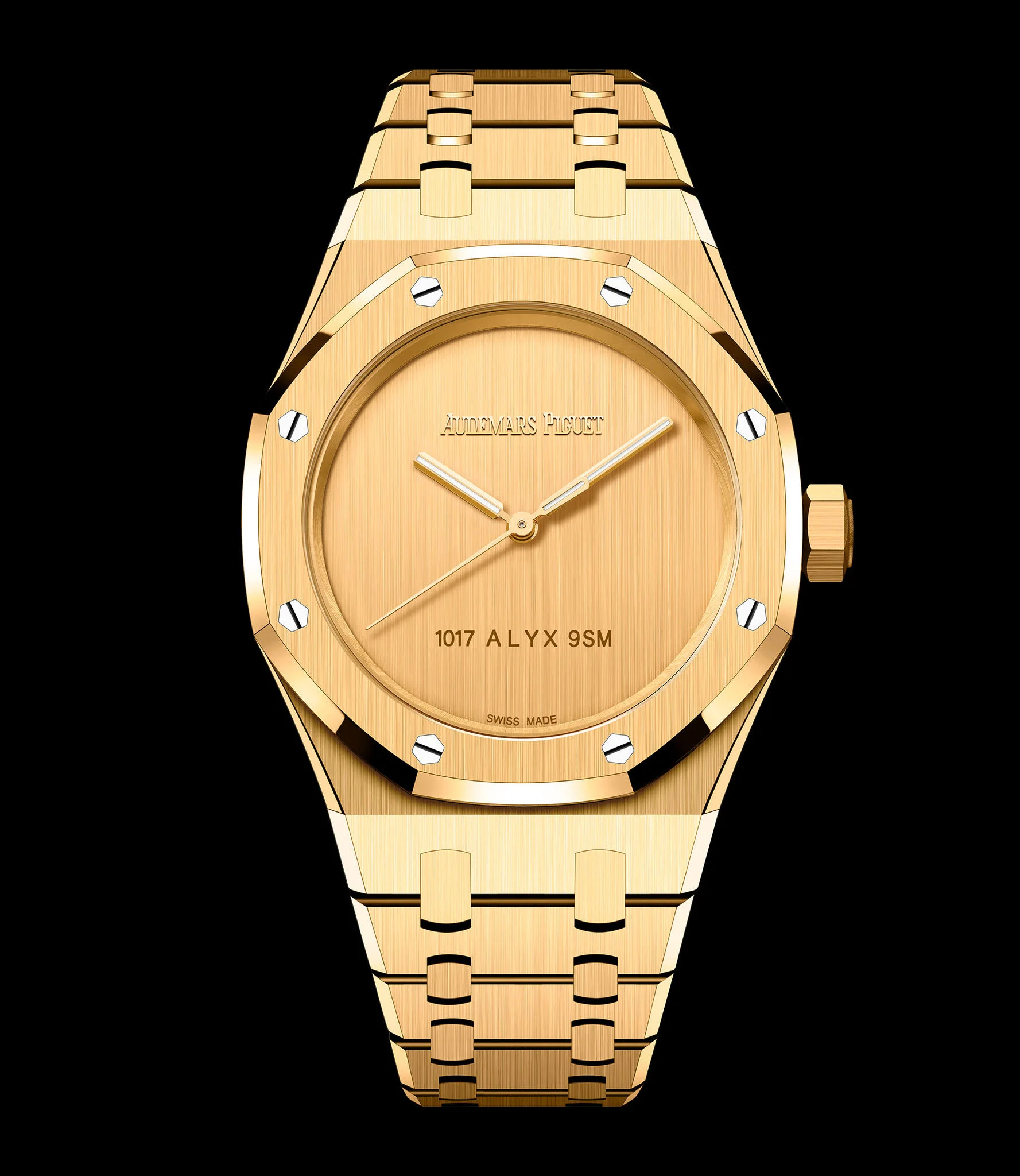
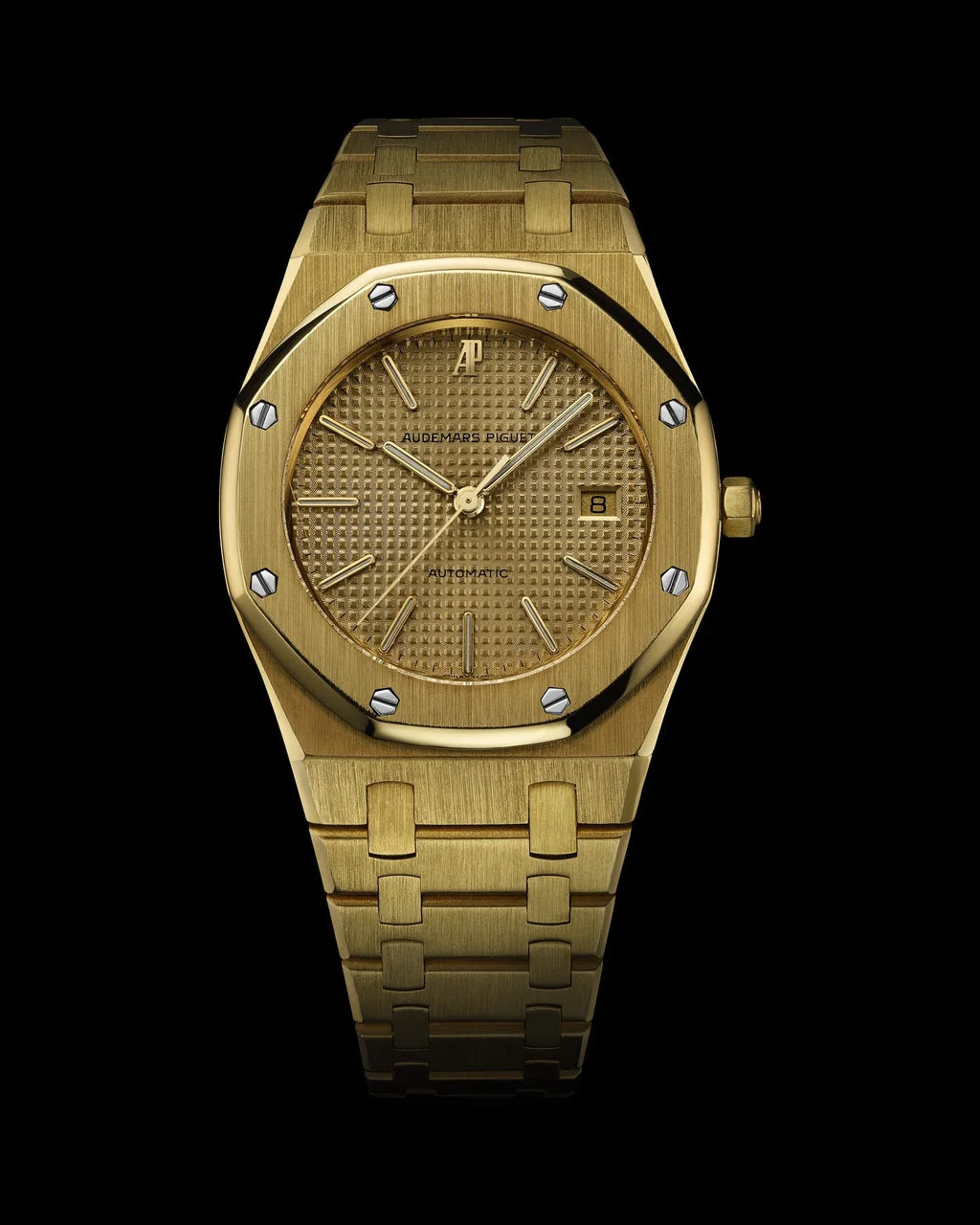
2023. Royal Oak 15550, in vertical satin-brushed yellow gold. Double signature with "Audemars Piguet" and "1017 ALYX 9SM", the trademark of American designer Matthew Williams. Calibre 4407. 37 mm case in 18-carat yellow gold. Picture taken at the watch launch. Audemars Piguet Archives.
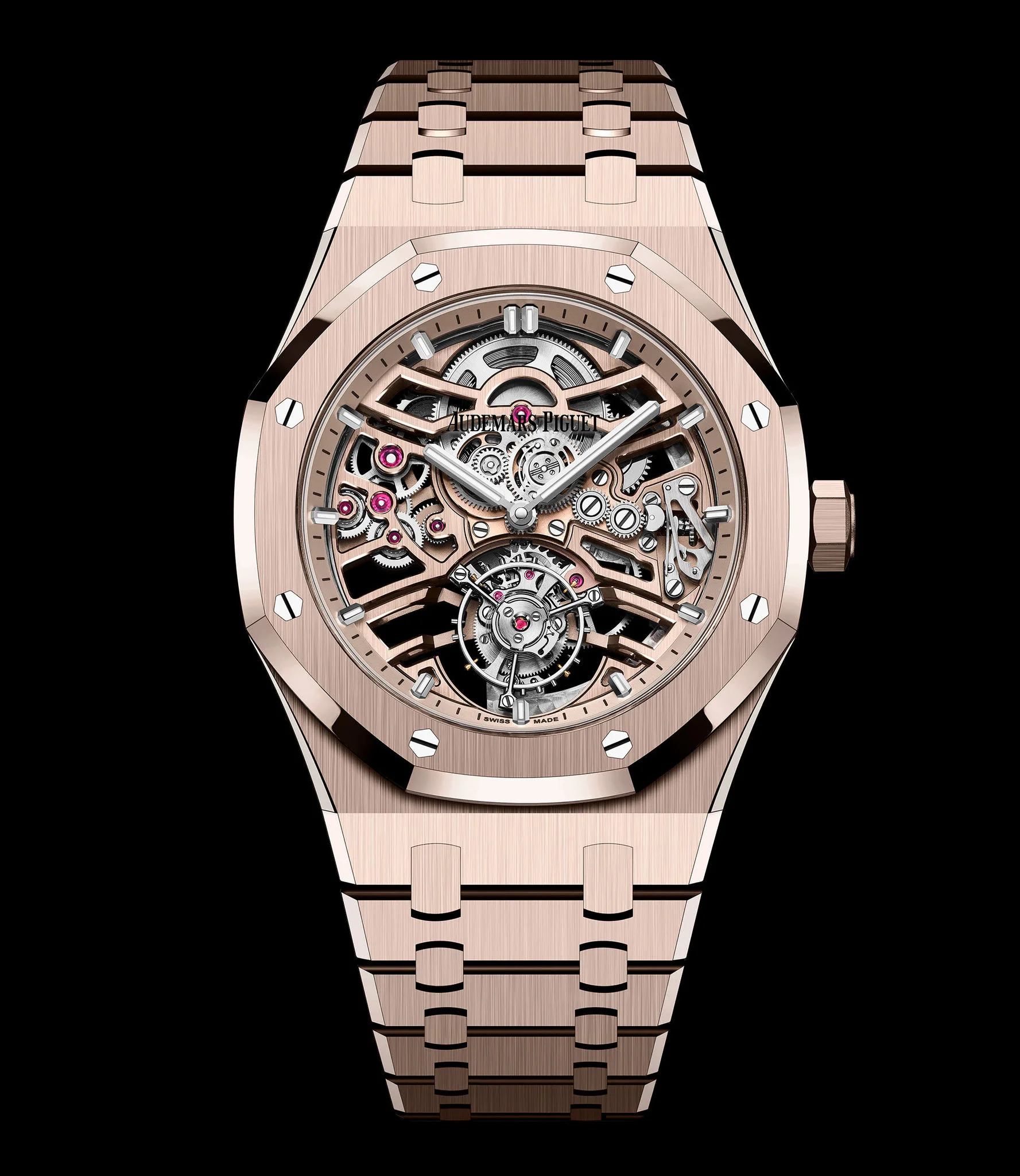
2024. Royal Oak Selfwinding Flying Tourbillon Openworked 26735SG. The first model to be finished in sand gold, an alloy that changes colour from grey to pink, with blue and brown reflections, depending on the light. Calibre 2972. 41 mm case. Picture taken at the watch launch.
Platinum, a powerful argument
Discovered in Colombia in the 18th century, platinum is the heaviest non-radioactive metal. A diminutive of the Spanish word plata (silver), its name means "little silver". It is said that Colombian gold miners originally considered it so worthless that they threw the nuggets back into the river, thinking they were gold that had not yet matured.
Platinum's physical properties made it ideally suited to the industrial world. Corrosion-resistant, hypoallergenic and highly malleable, it only melts at around 1800°C (compared with 1000°C for gold). It came to be used in chemistry, medicine and the electronics industry.
In watchmaking as a whole and particularly for Audemars Piguet, platinum experienced its first phase of popularity during the Art Deco period. Watchmakers and jewellers created small masterpieces – miniature wristwatches, ring-watches, brooches and pendants – often embellished with rubies and diamonds.
Platinum also made its mark on the 1980s. It can be found in Audemars Piguet watches with complications, including tourbillons and double complications. When a limited edition comes in several materials, one can be pretty sure that the rarest iteration is the one in platinum!
At first glance, when polished, platinum looks like steel or silver. It is however rarer than gold and features a unique gleam. Jewellers have adopted it because it lends itself well to gemsetting, while its colour and brilliance make a good match with those of diamonds. The most notable difference is its weight: by way of example, the 1997 Royal Oak Offshore 25721PT weighs almost half a kilo!
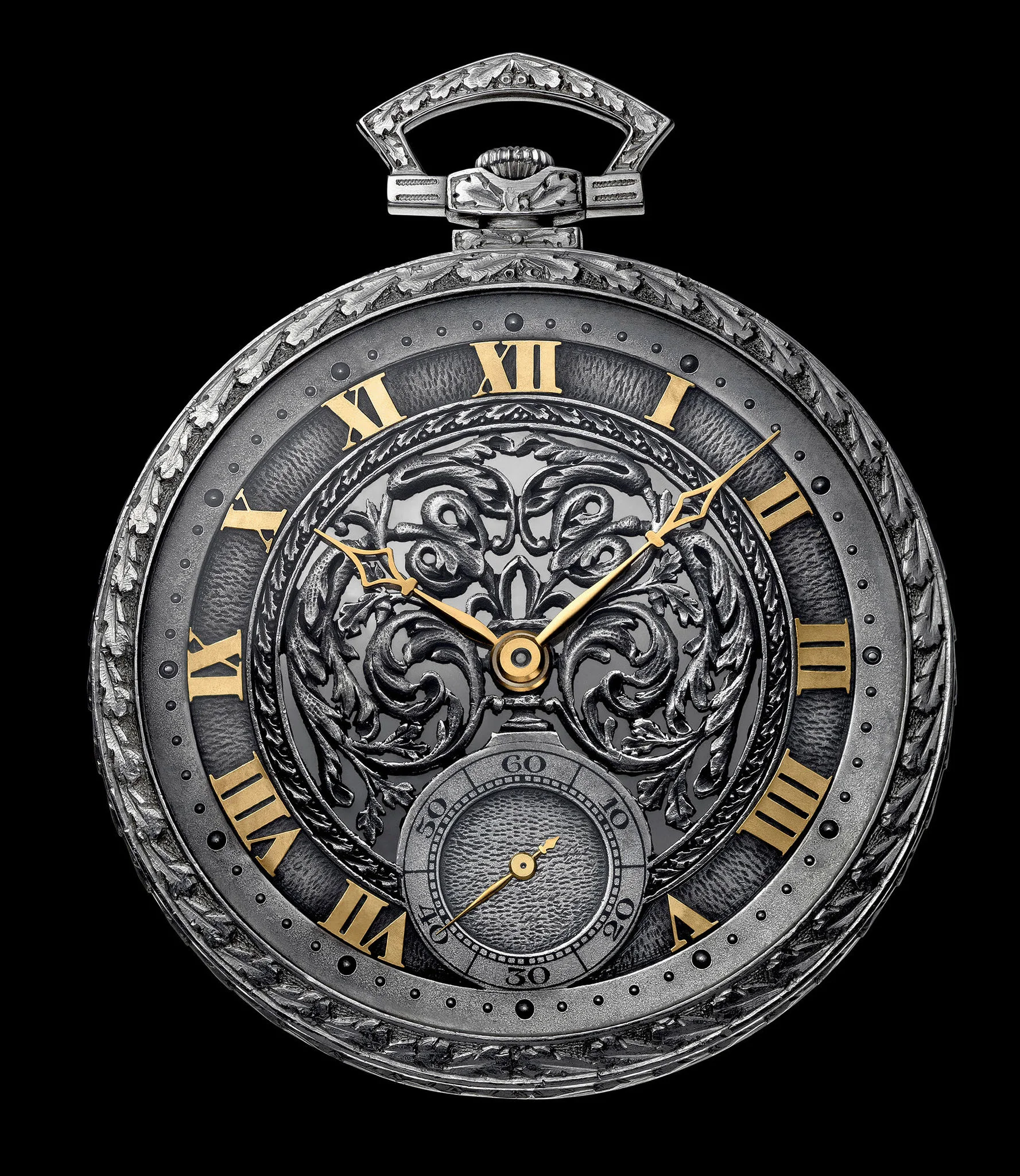
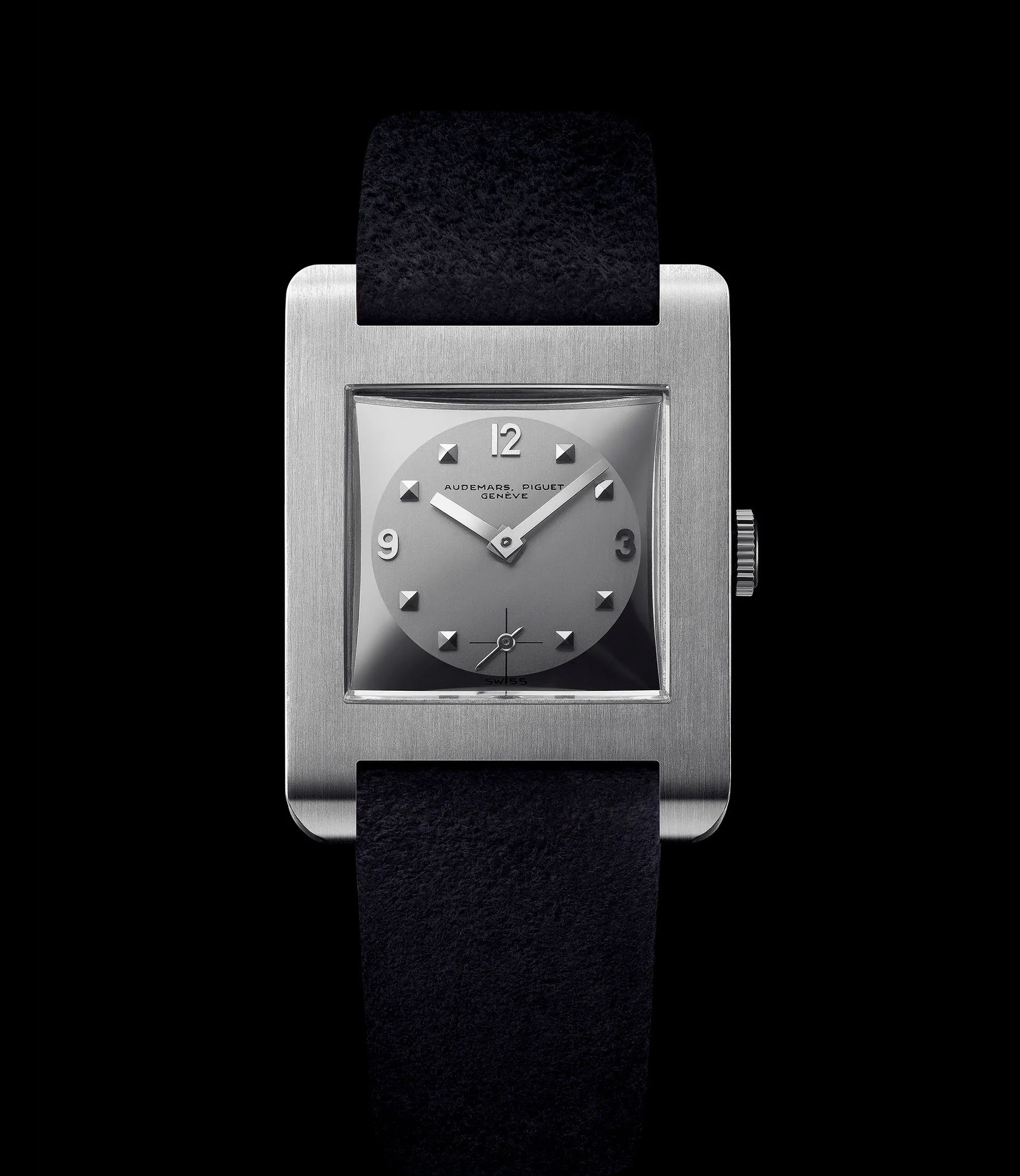
1951. Wristwatch Model 5008. The platinum case matches the colour of the dial, hour-markers, applied numerals and hands. Calibre 9½RS. Case and movement no. 54520. Audemars Piguet Heritage, inv. 1808.
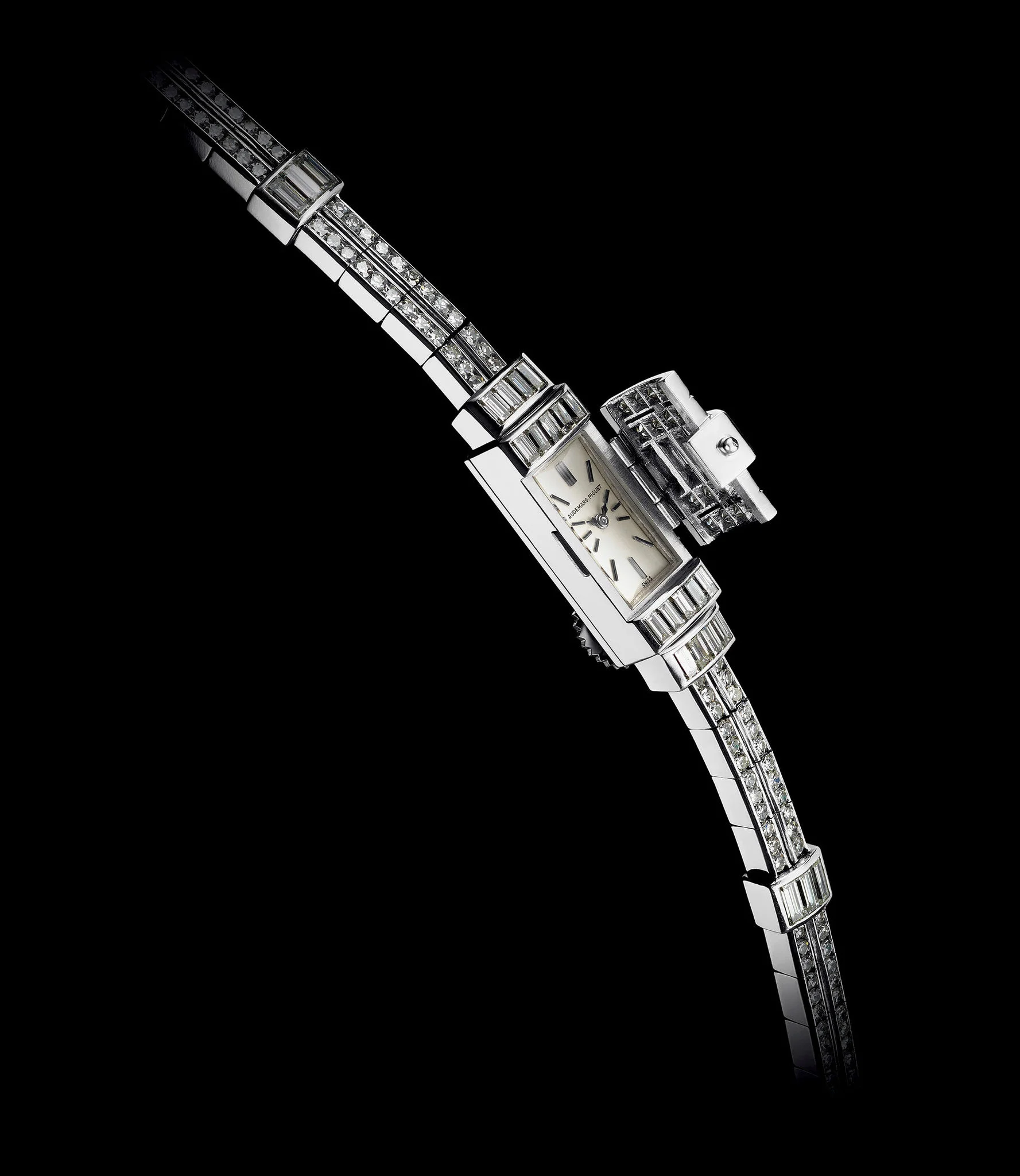
1962. Secret watch. Platinum perfectly complements the brilliance of the diamonds. Baguette-type Calibre 2005 with winding mechanism on the underside. Movement no. 78970. Case no. 5740 entirely set with baguette-cut and brilliant-cut diamonds. Audemars Piguet Heritage, inv. 1196.
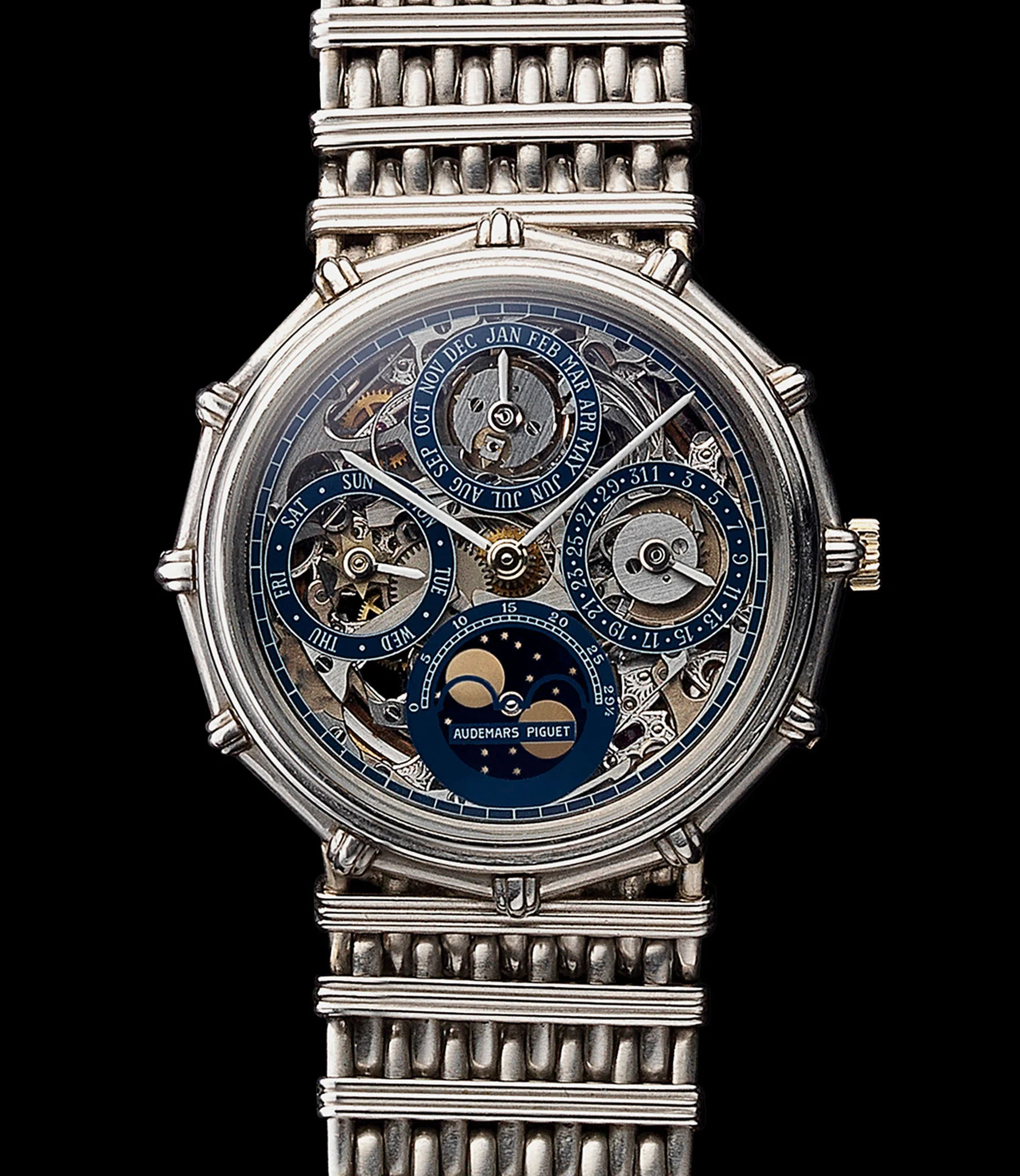
1985. Model 5564 openworked perpetual calendar. The hour-markers stand out around the edge of the platinum case. Selfwinding Calibre 2120/2800, movement no. 227069. Case no. C21234. Platinum bracelet. Audemars Piguet Heritage, inv. 1130.
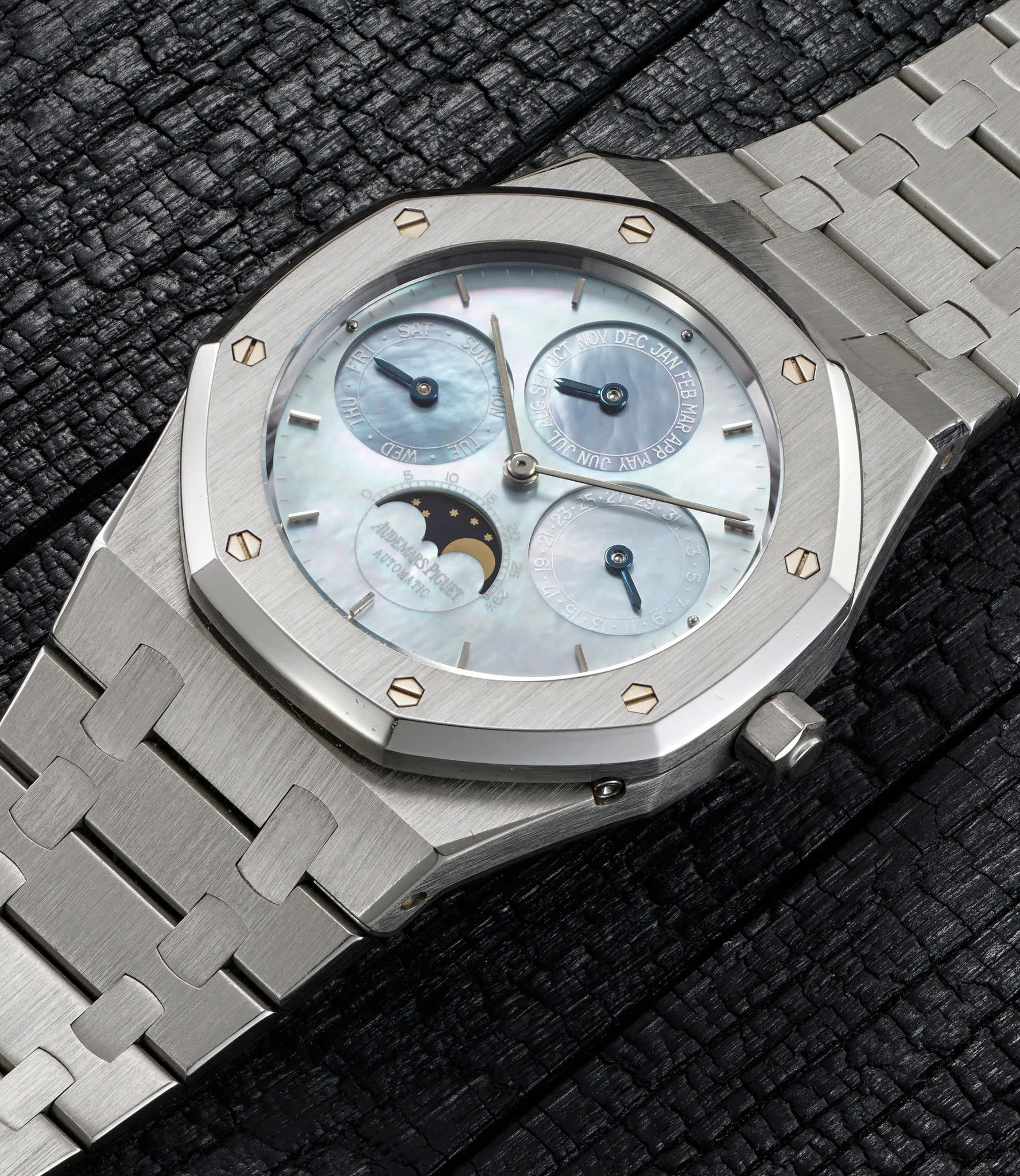
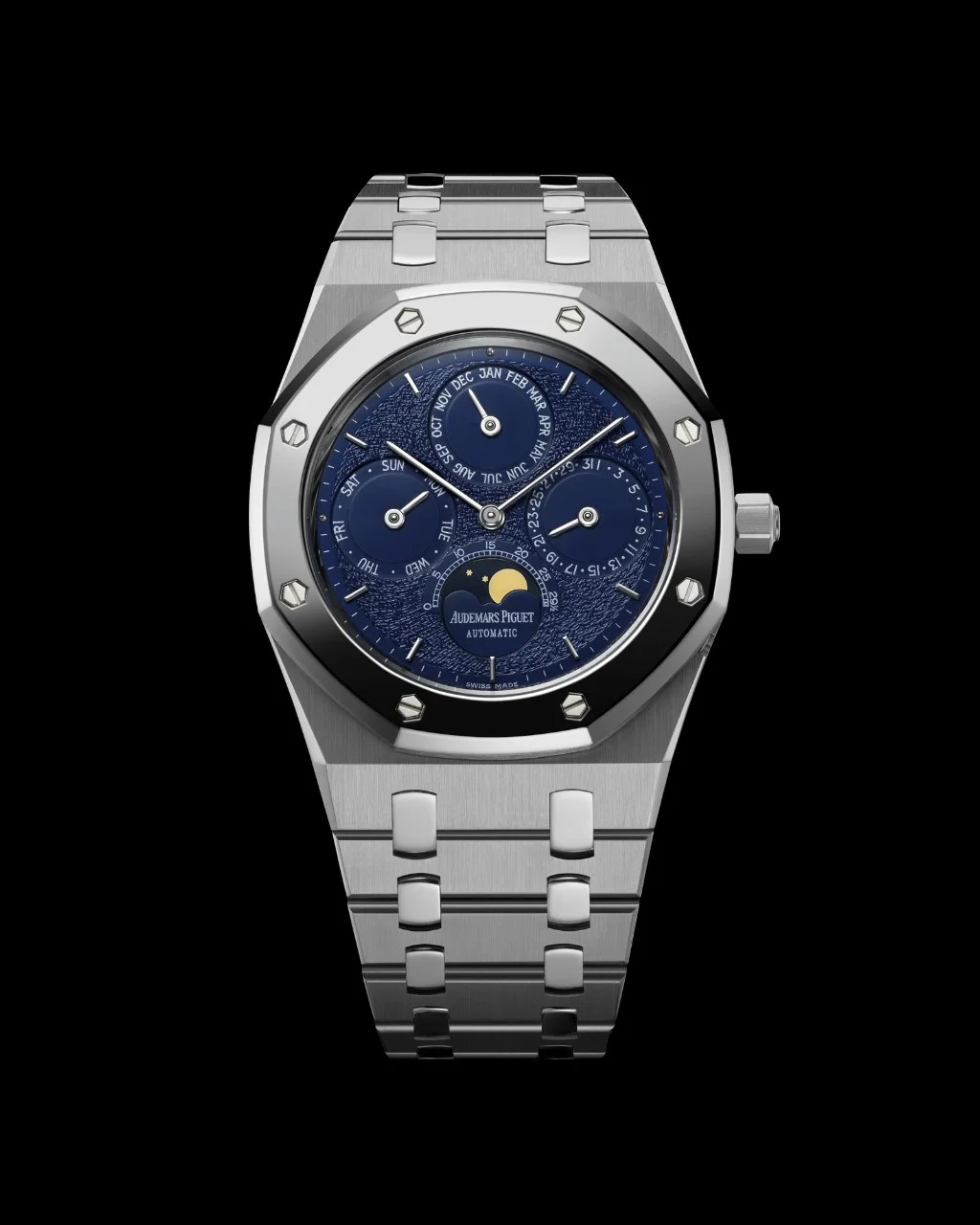
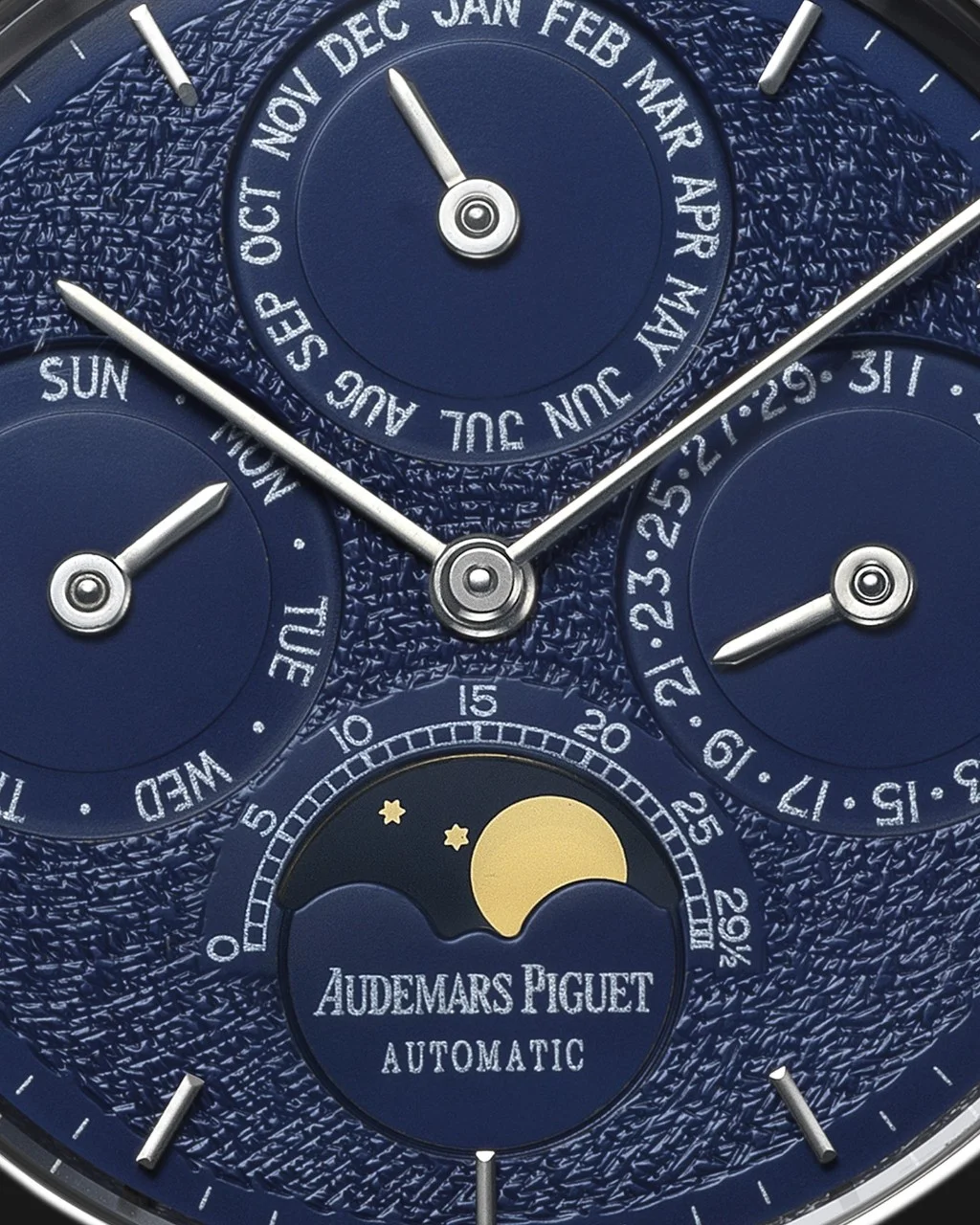
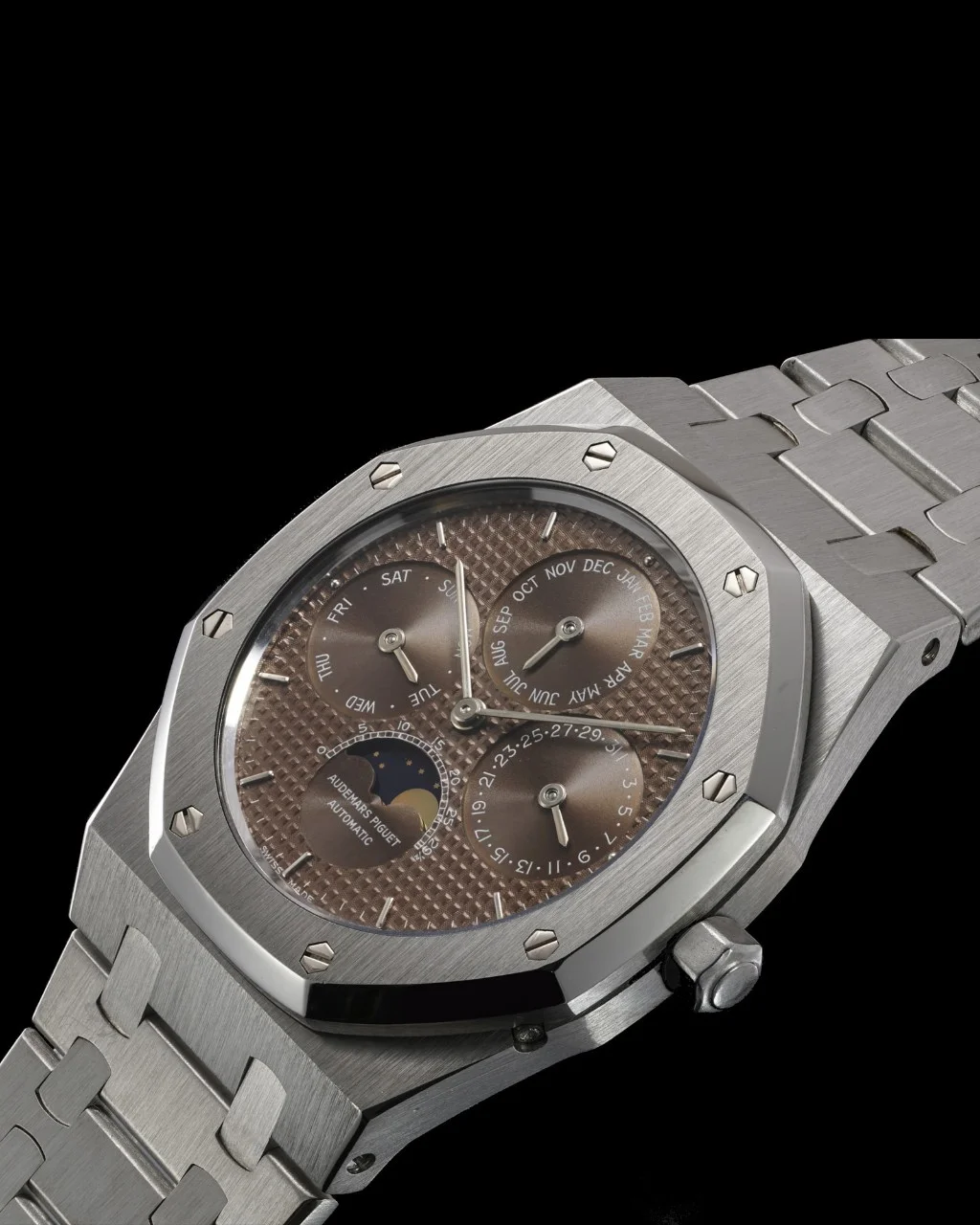
1992. Royal Oak Perpetual Calendar 25686PT No. 20, dial side. Perpetual calendar: day, date, month, phase and age of the moon. Ultra-thin selfwinding Calibre 2120/2800 (3.95 mm), movement no. 374104. Bracelet 344. Case no. D34720 in platinum, measuring 39 mm in diameter. Blue mother-of-pearl dial. Sold in Thailand in August 1994. Auctioned by Phillips in Geneva on May 6, 2022, lot 17. © Phillips.
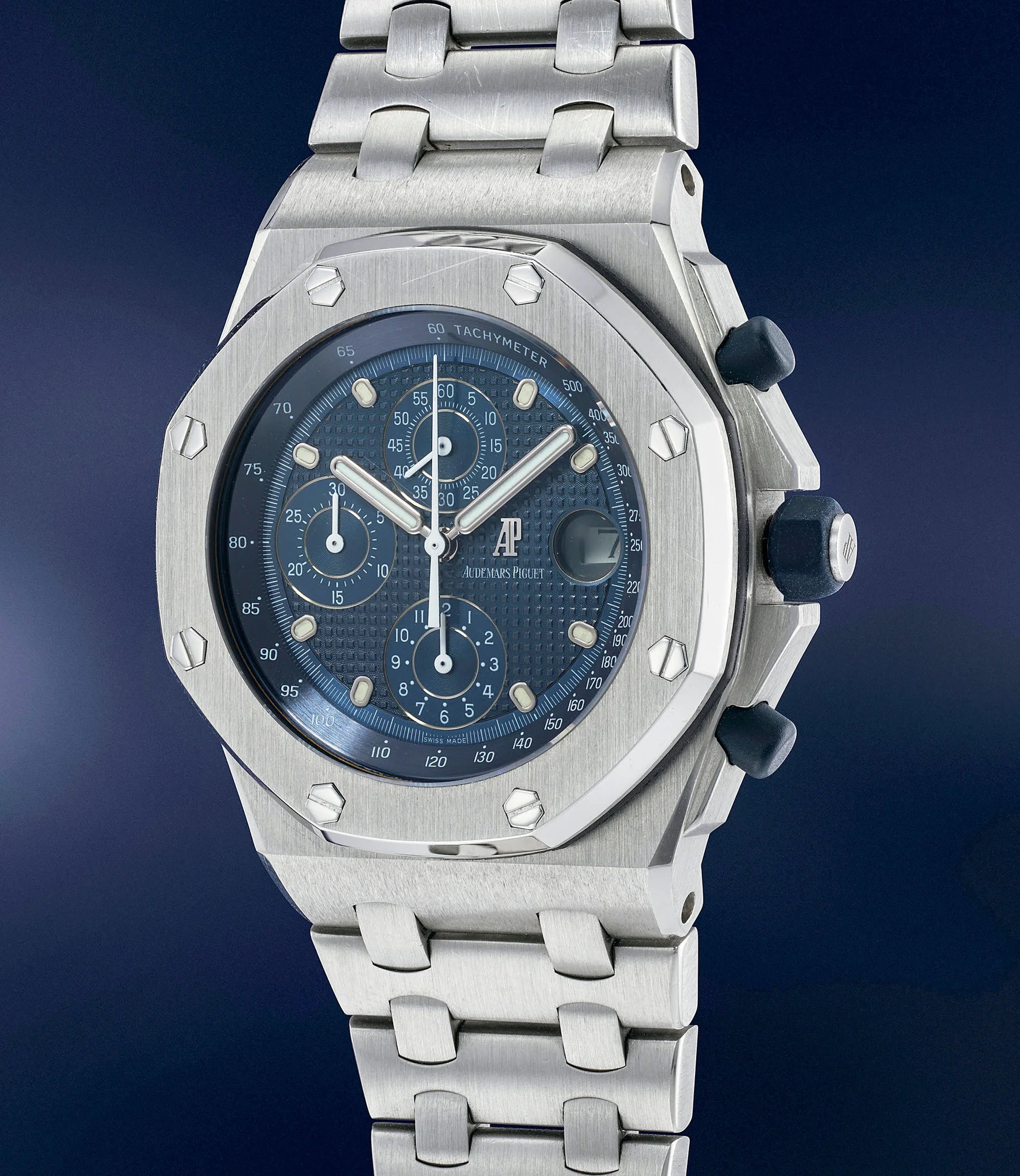
1997. Royal Oak Offshore 25721PT. This oversized platinum Royal Oak Offshore is also excessively heavy, weighing in at 429 grams. Calibre 2226/2840,m ovement no. 449745. Case no. D95704 in 42 mm. Auctioned by Phillips Genève on November 6, 2020. © Phillips.
1930–1970, steel blurs the lines
Steel has been around for thousands of years and has now supplanted iron. We nonetheless sometimes forget just how recent this change is. Although humankind began to master steel in the 18th century, iron long remained the symbol of the Industrial Revolution. While Brooklyn Bridge (1869) and the Eiffel Tower (1889) are made of iron, the frame of the Empire State Building (1930) is made of steel.
Whereas watchmakers long reserved iron and steel for certain movement components, everything changed with the Industrial Revolution. To reduce the price of watch cases, several ferrous alloys were introduced, such as argentan and chromium-plated brass, followed in the 1870s by burnished steel, also known as "gun metal” and whose black oxidation forms a protective layer.
In the 1910s, British and German steelmakers discovered that adding chromium rendered steel stainless. Within a few decades, stainless steel replaced silver and chromium-plated metal in the mid-range market, becoming the metal of choice for sports watches.
Steel nonetheless remained rare in the field of Haute Horlogerie. Between 1934 and 1962, for example, Audemars Piguet produced 82 chronograph wristwatches in steel, with a few selfwinding models as of 1956. The turning point came in 1972.
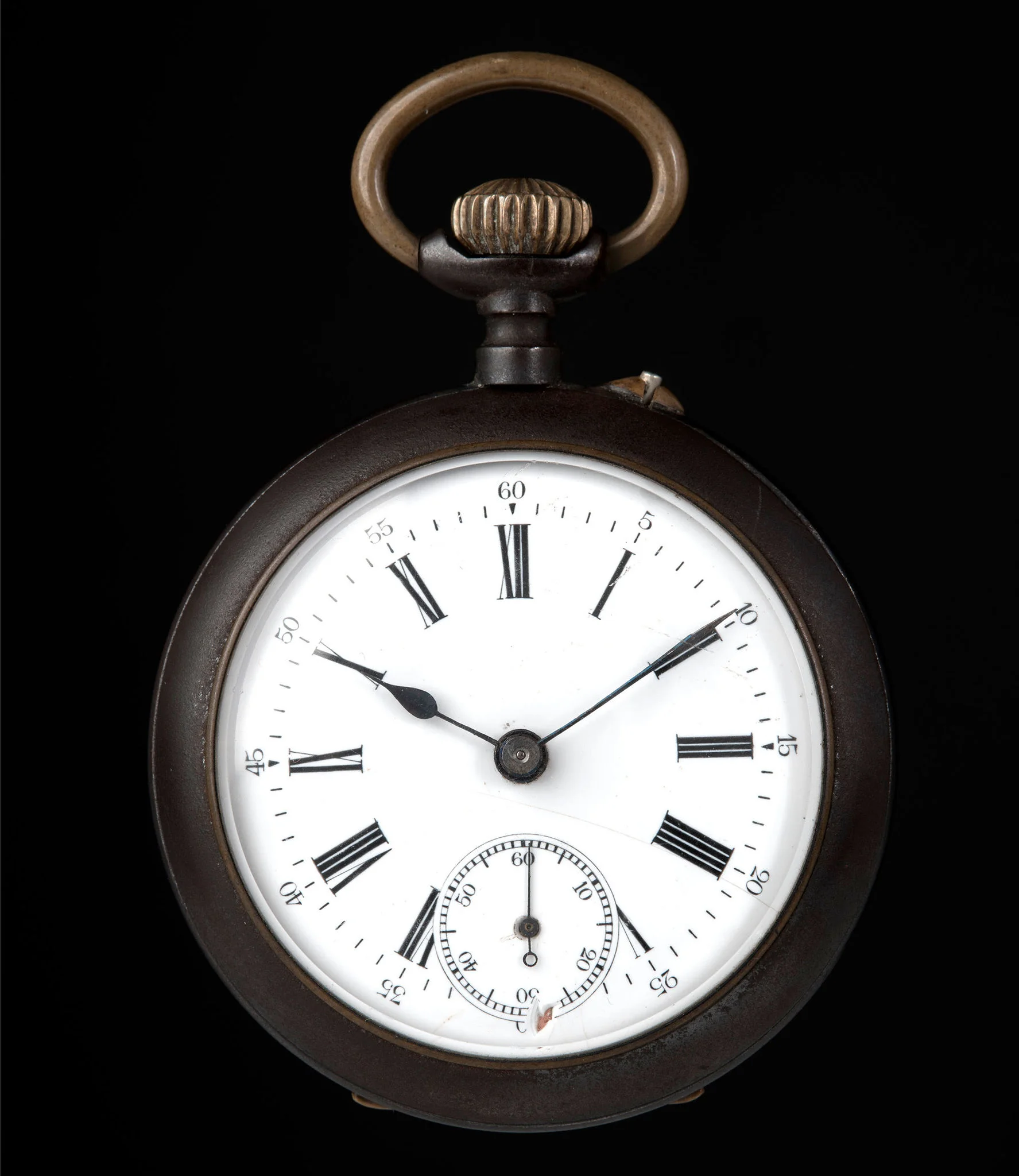
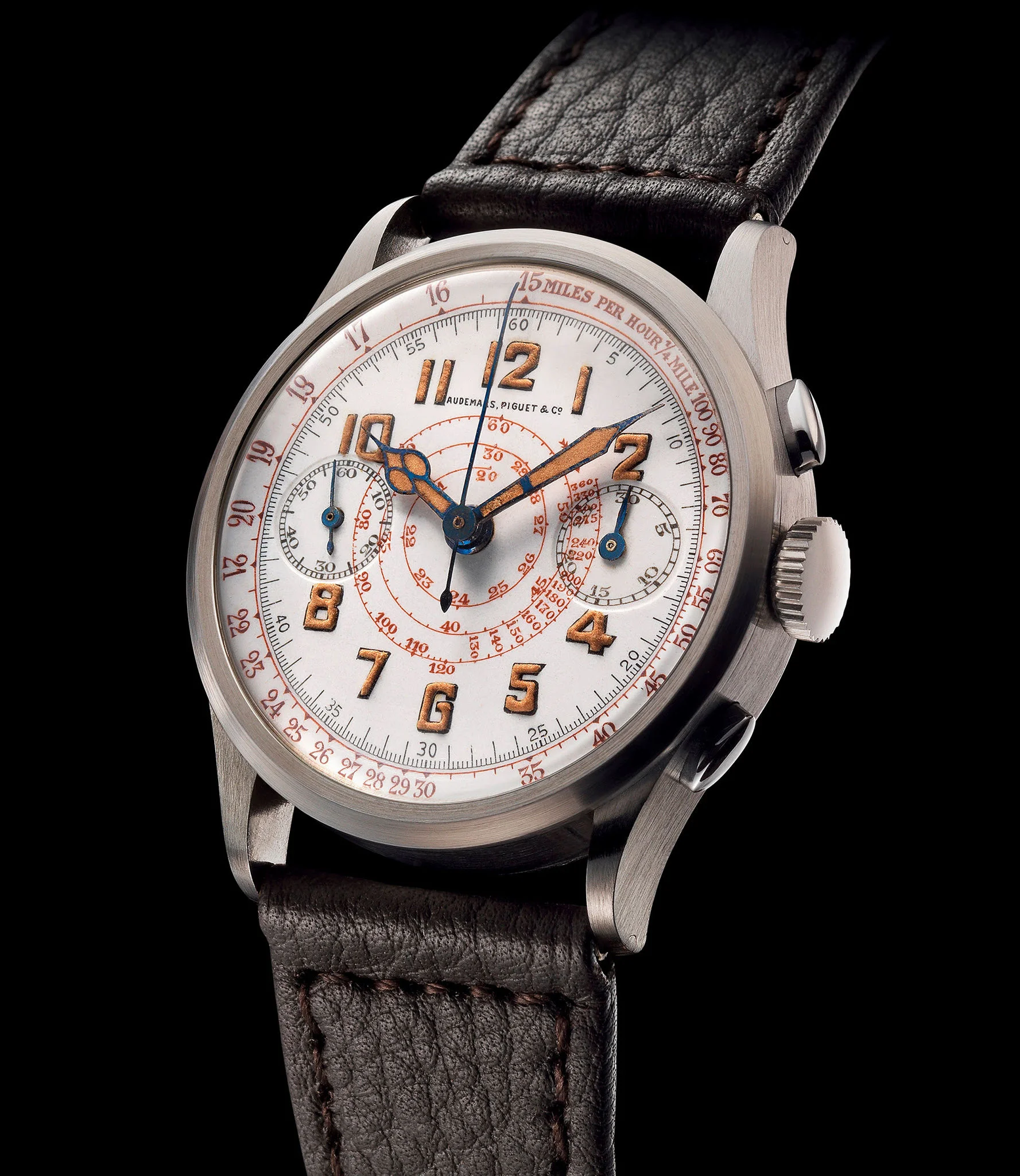
Sold in 1937, this Staybrite® steel chronograph features an enamel dial with radium numerals and hands. Calibre 13CHRO CPT, movement no. 42875. Steel case. Audemars Piguet Heritage, inv. 1746.
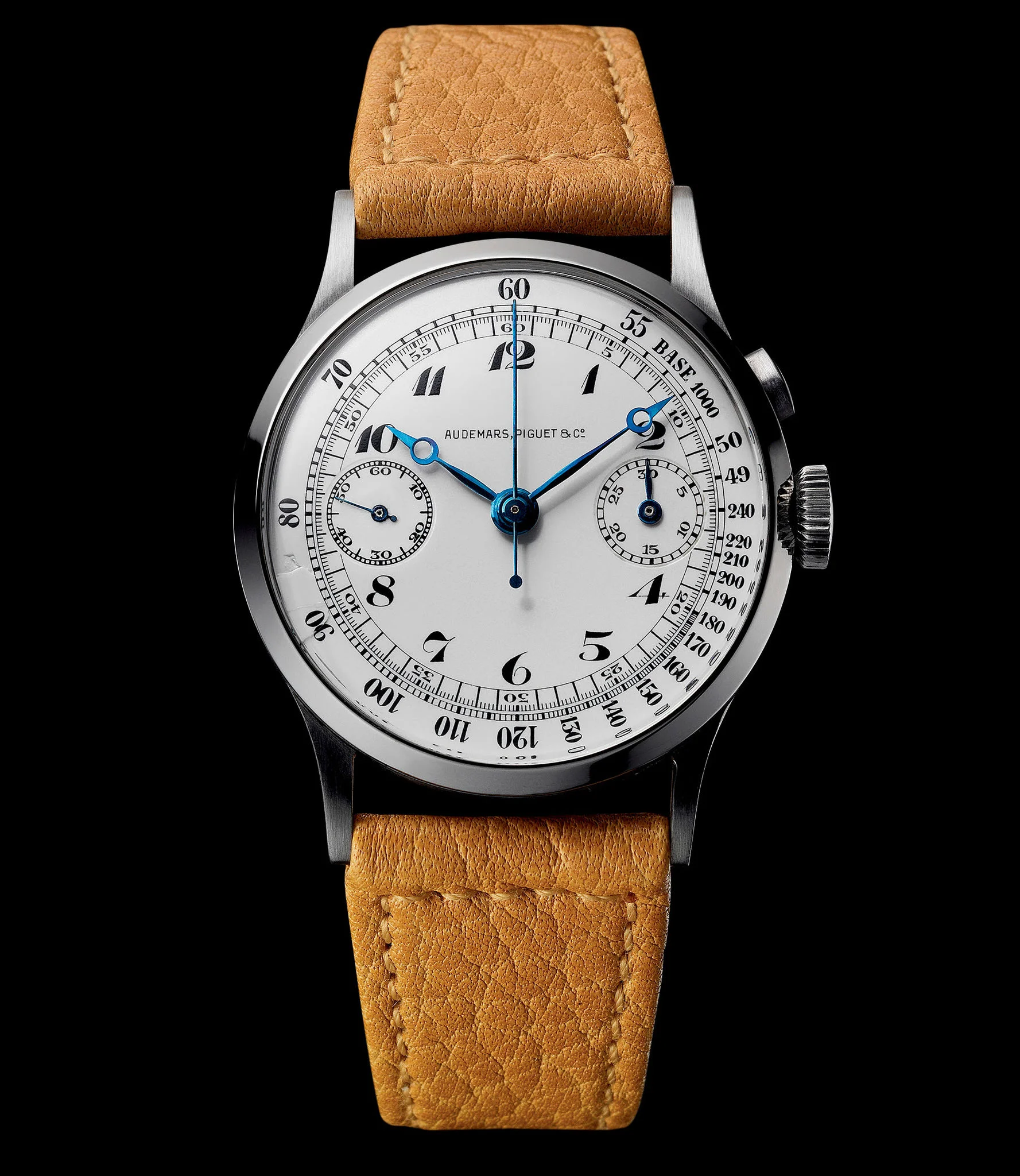
1936. Single-pusher chronograph. In the 1930s, the very few steel watches marketed by Audemars Piguet almost all featured a chronograph. Calibre 13CHRO CPT. Steel case and movement no. 42635. Audemars Piguet Heritage, inv. 217.
The world’s most expensive steel watch
In the 1970s, steel was par of the brief when Audemars Piguet's Italian, Swiss and French agents asked then head of the company Georges Golay to create an unprecedented watch that was at once sporty and luxurious, elegant and casual, equally suitable for chairing a Board of Directors as when sailing. It was the material of sports watches. The question was: how could it be made as precious as gold?
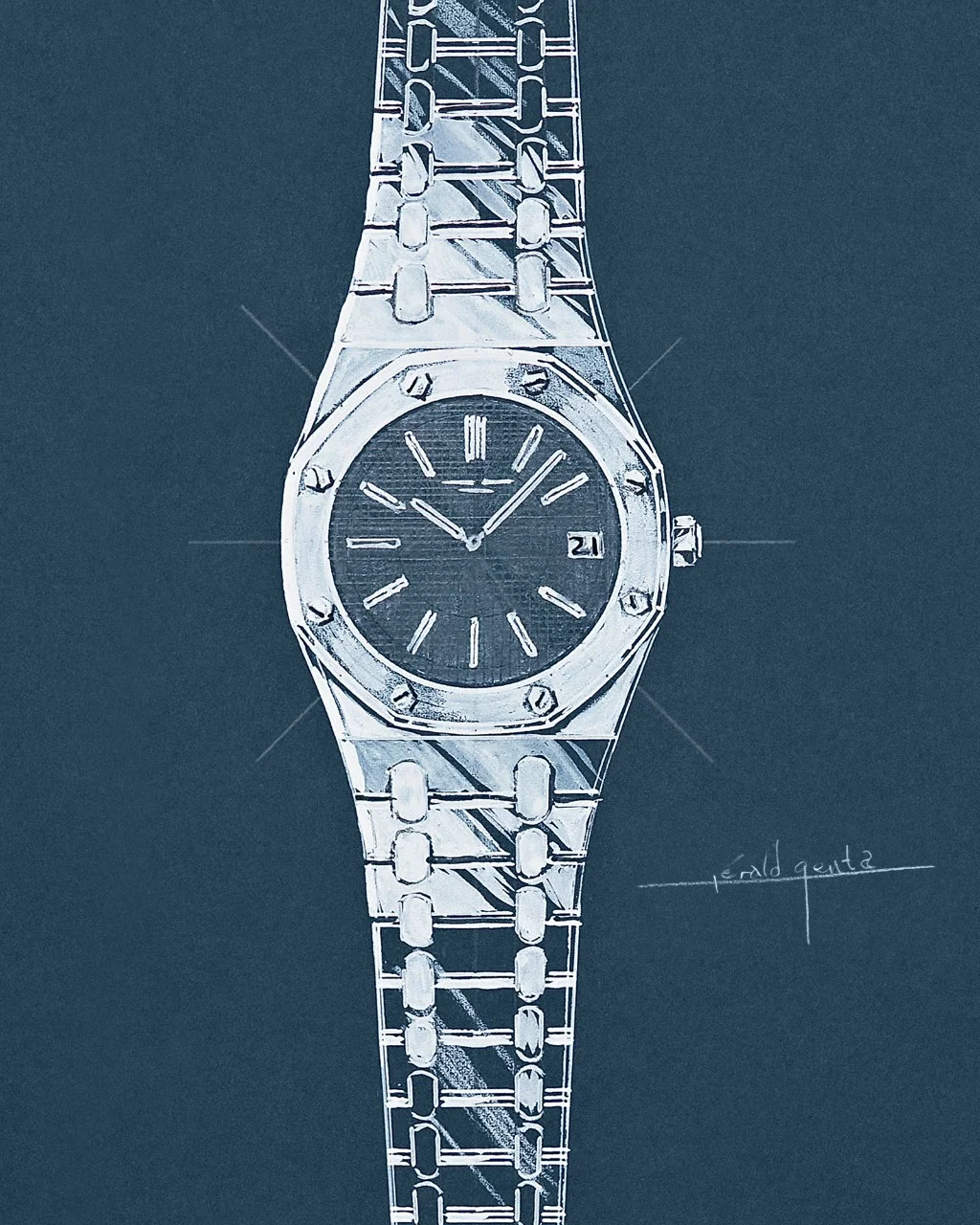
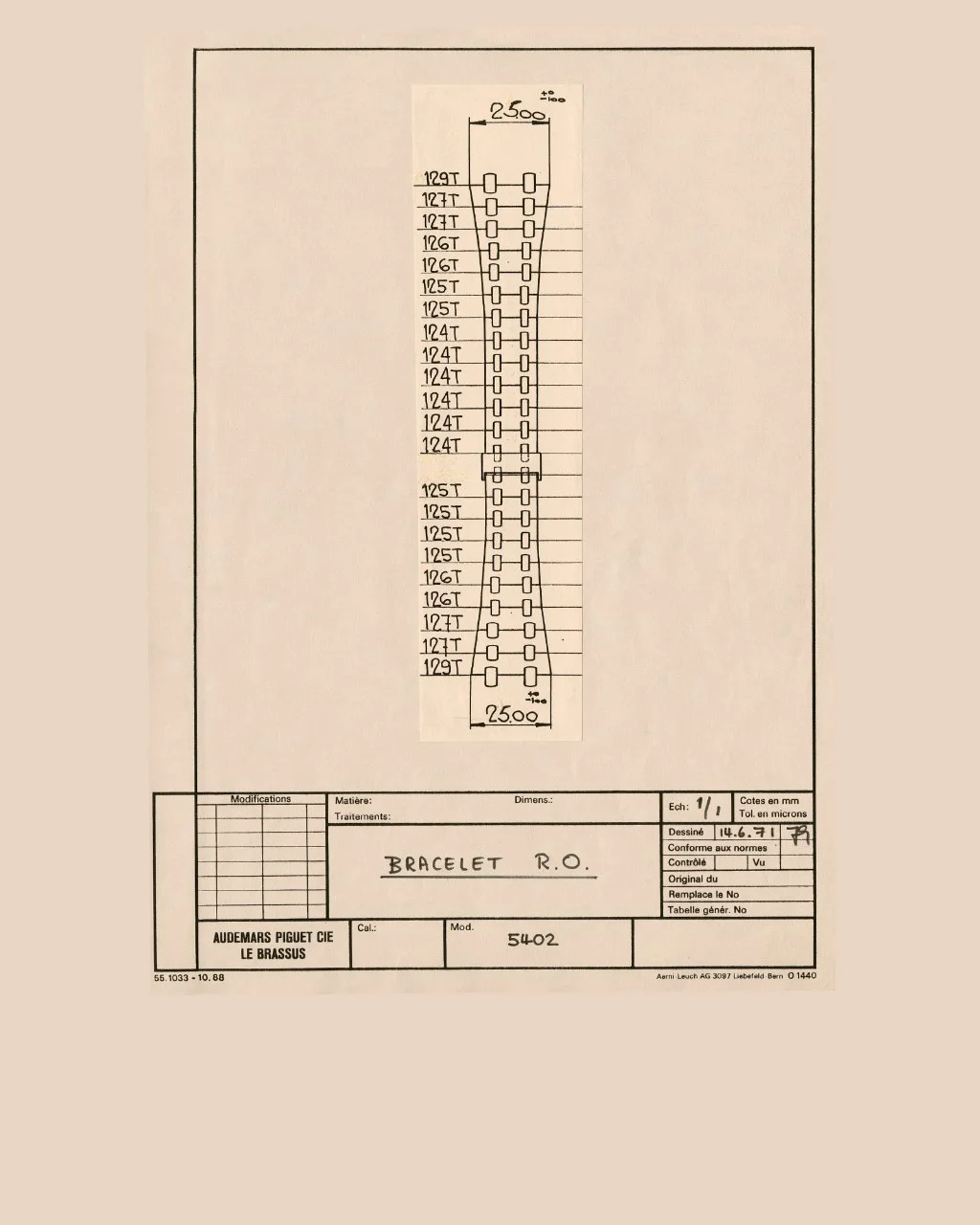
The answer lays in one word: complexity. The Royal Oak designed by Gérald Genta is packed with countless geometric details and finishes. Polished 45-degree bevels on the bezel, curved facets, gradual chamfering of the case middle, satin-brushed curves on the sides, a tapering bracelet... Never had so much care been devoted to steel, to the point where it almost became a noble material.
One of the first advertisements produced by Audemars Piguet's agency at the time, Hugo Buchser, referred to stainless steel as "the noble metal of modern cathedrals". The public response was swift: despite being more expensive than some gold watches, the Royal Oak was a huge success. Find out more here.
This innovation would not go unnoticed, as in the years that followed, other prestigious watch industry names including Patek Phillipe and IWC perceived the value of steel in the top-of-the-range segment and also embarked on the adventure.
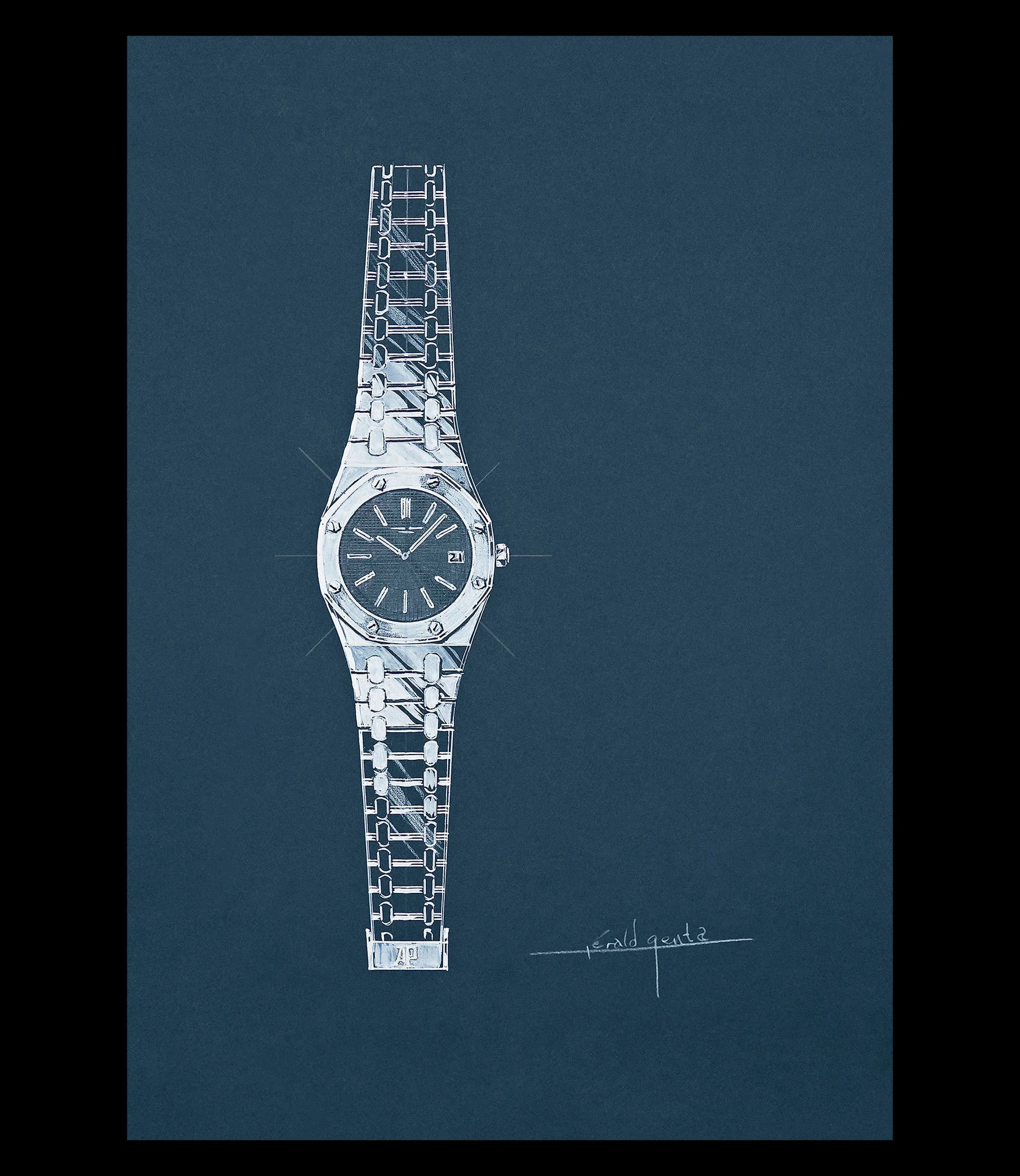
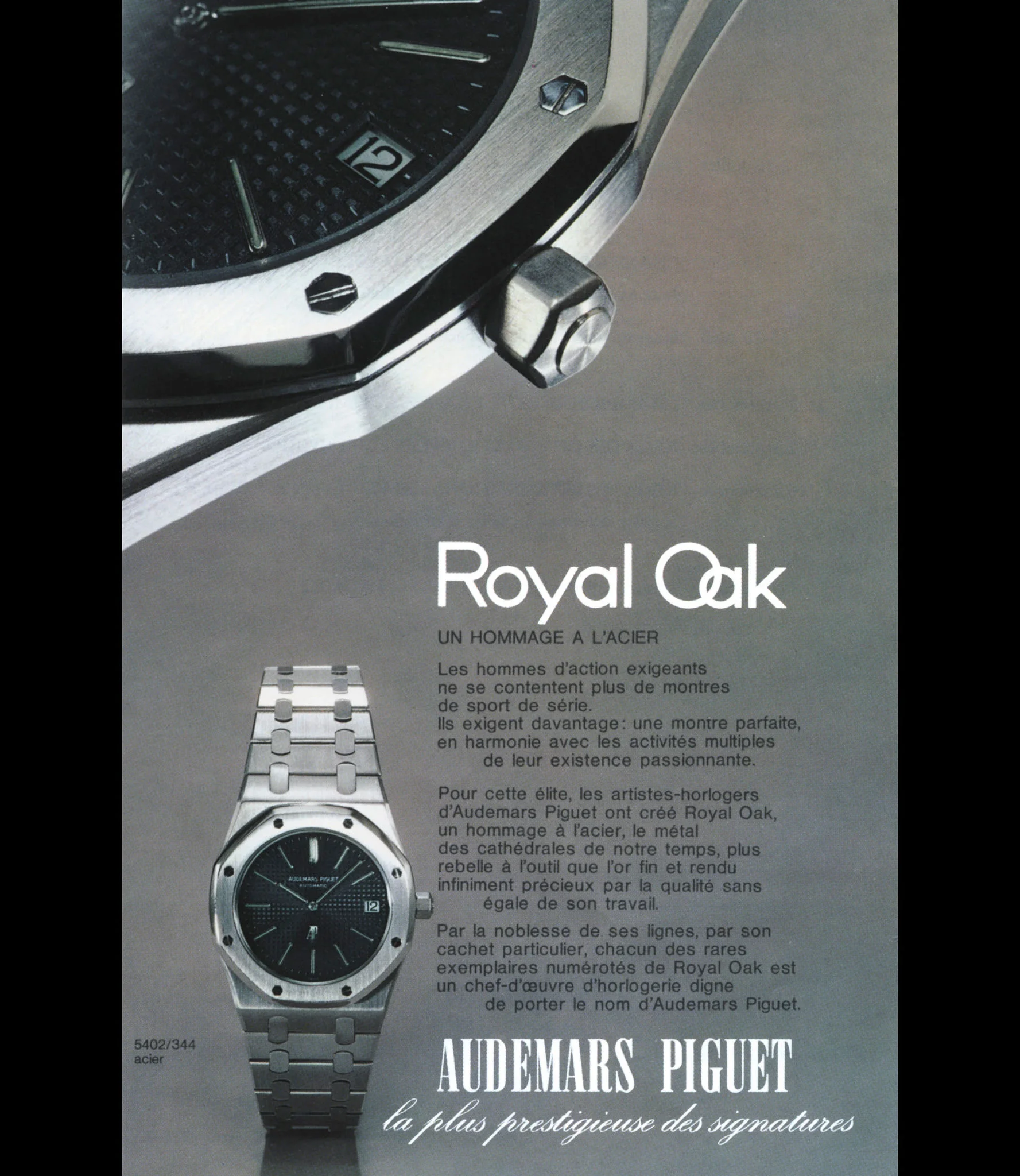
"A tribute to steel". This 1972 advertisement focuses on steel. On the one hand, it explains the added value represented by the artisans’ work. On the other, it underlines the extent to which steel is the metal of modernity and dynamism. Audemars Piguet Archives.
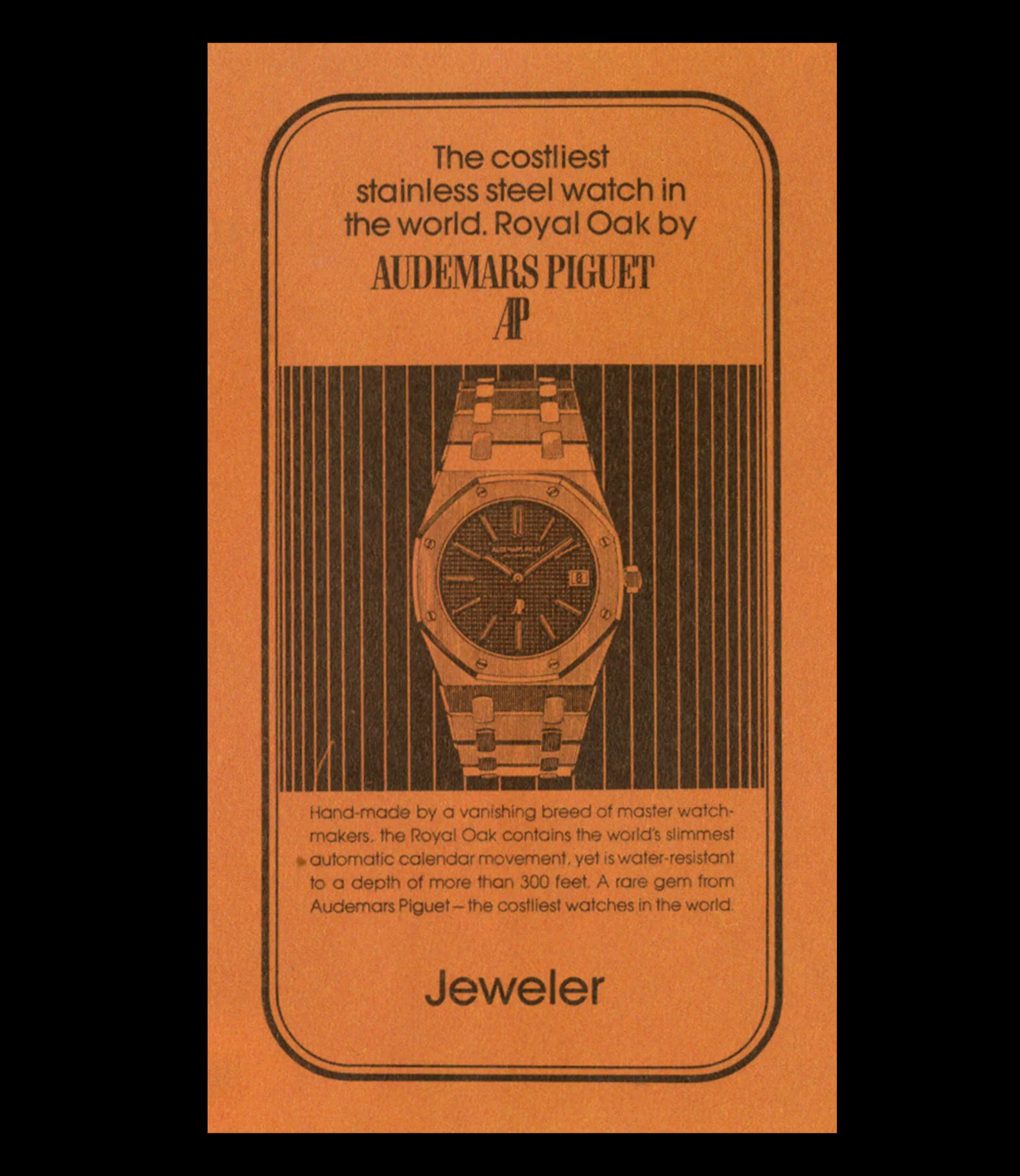
1974. Royal Oak advertisement. Produced for the United States, this advertisement highlights the price of the Royal Oak, before explaining that the watch derives its value from the watchmakers’ craftsmanship and from its movement, the world's thinnest in its category. Audemars Piguet Archives.
Four decades of new materials
From the mid-1970s onwards, the tidal wave of electronic watches threatened the very existence of Swiss watchmaking. In order to reinvent itself, the industry developed new shapes, new functions and new materials, with Audemars Piguet, Omega, Tissot and Zenith at the forefront. Before looking at the main materials in the following chapters, here is a list of key dates from 1970 to 2010:
-1970. Titanium is introduced by Omega (Seamaster) and Citizen (X8 Titanium)
-1972. Steel is given a new status by Audemars Piguet (Royal Oak)
-1977. Steel and yellow gold two-tone combination, by Audemars Piguet (Royal Oak),
-1980. Rubber straps, by MDM (Hublot)
-1981. Gold-plated steel, by Audemars Piguet (Pyjamas)
-1982. Ceramic, first by Zenith and later popularised by Rado from 1986 onwards
-1983. Plastic, by Swatch (Swatch)
-1985. Granite, by Tissot (Rockwatch)
-1986. Meteorite dial, by Corum
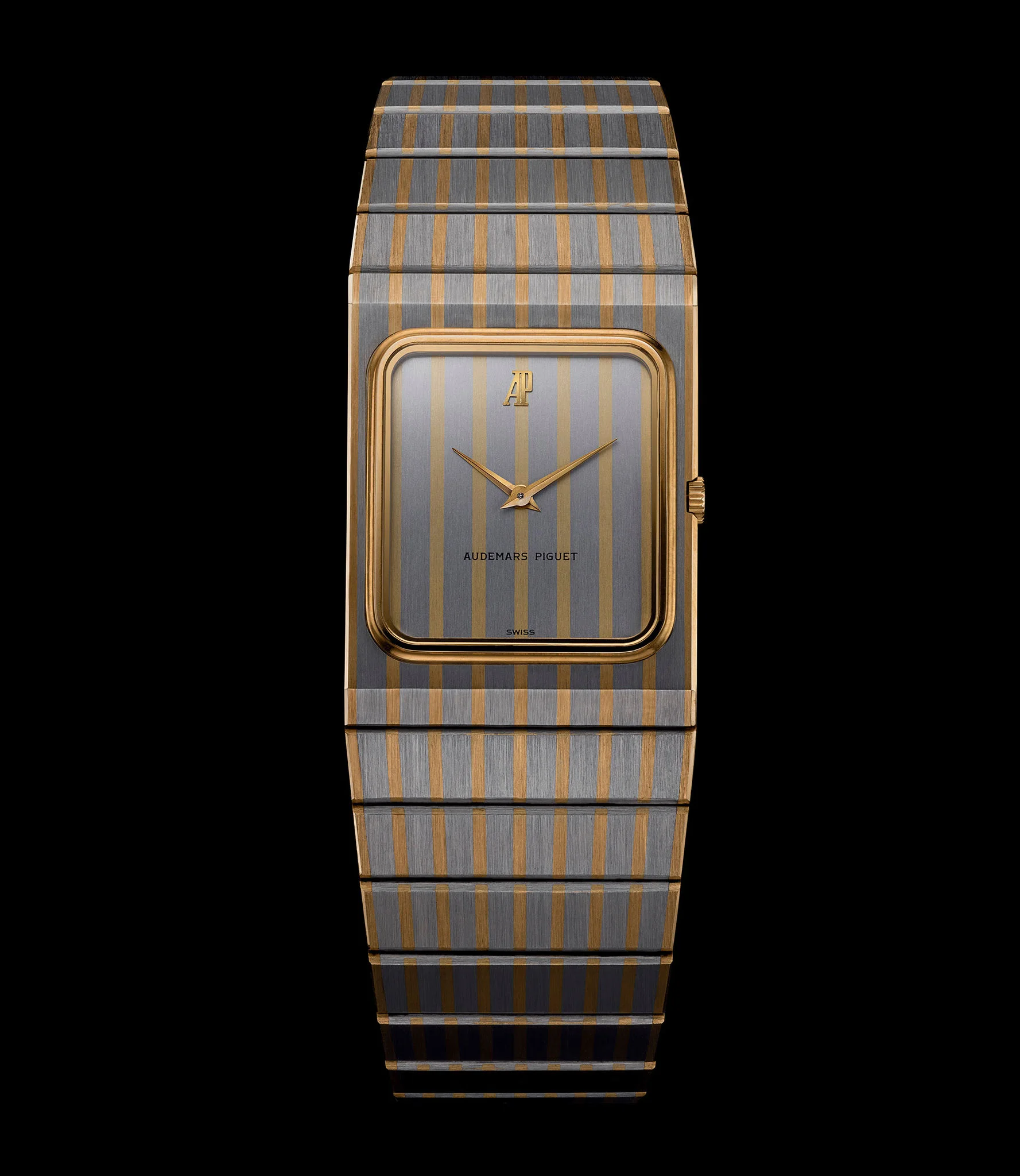
-1988. Tantalum, by Audemars Piguet (Royal Oak and Huitième)
-1989. Wood, by Tissot (Woodwatch)
-1990. Fine stone crystal, by Audemars Piguet (Baroque)
-1993. Rubber-coated metal, by Audemars Piguet (Royal Oak Offshore)
-2002. Alacrite, by Audemars Piguet (Royal Oak Concept)
-2007. Forged carbon, by Audemars Piguet (Royal Oak Offshore)
-2010. Cermet, by Audemars Piguet
-2010. BMG, by Omega under the name "liquidmetal ©".
Titanium, as light as it is hard
Featuring a hardness comparable to that of tempered steel, titanium is almost twice as light and not susceptible to scratching, while also resistant to corrosion. Discovered in the 18th century, it made a modest and discreet watch industry debut during the 1930s in a balance-spring alloy named Durinval. It was subsequently used to colour synthetic sapphires, but above all to harden cutting tools.
In gained prestige in the 1960s however, equipping the Apollo rockets and forming the hull of the American Lockheed ST-71 Blackbird stealth aircraft. In 1970, Omega and Citizen simultaneously presented the first titanium watches. In 1986, Audemars Piguet decided to introduce titanium into the very heart of the watch movement. Both light and robust, it formed the carriage of the first-ever selfwinding tourbillon, Model 25643.
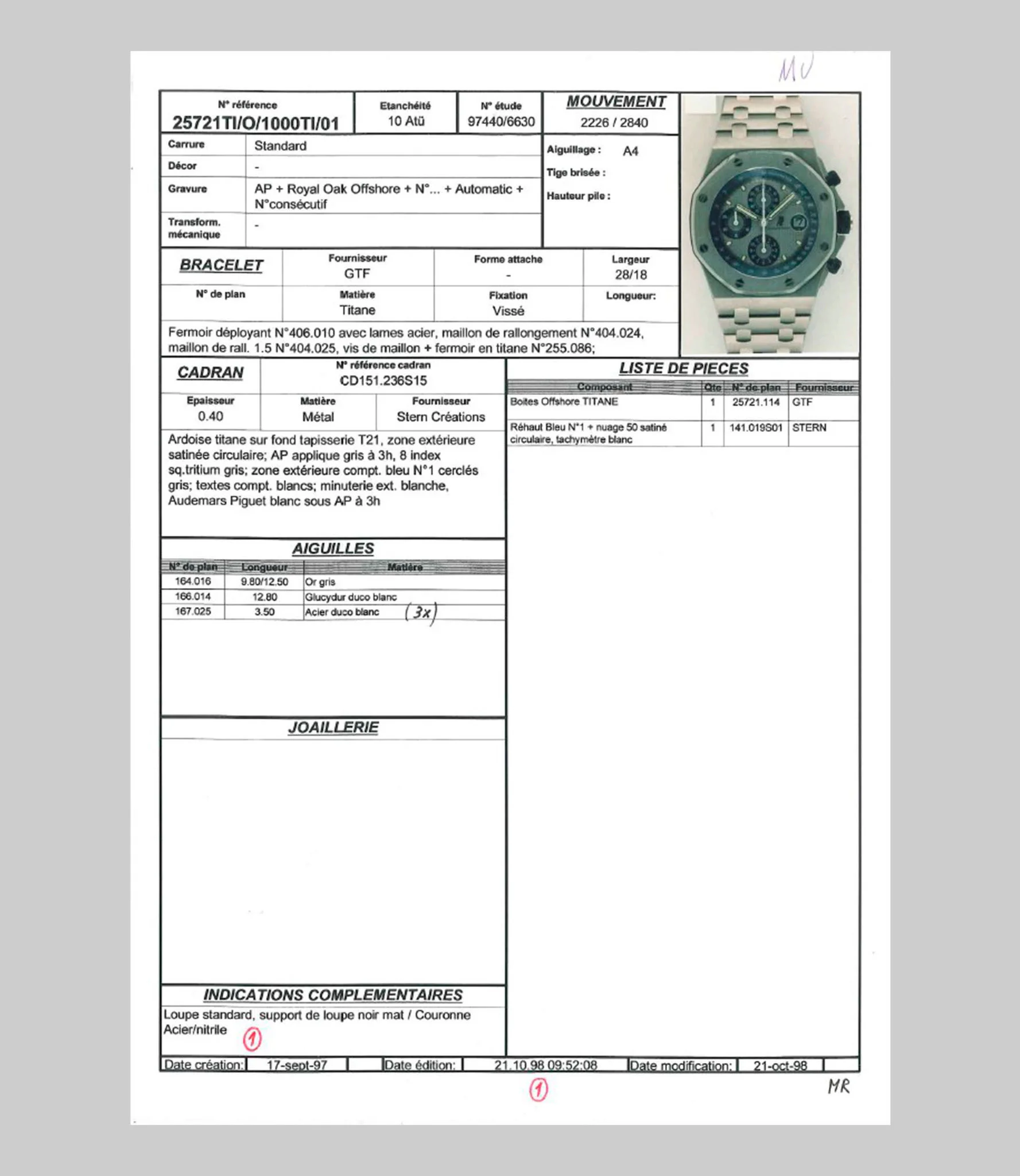
In 1998, the Royal Oak Offshore 25721 was made in titanium for the first time. The aim was to offer a lightweight version of this oversized watch weighing 220 grams in its steel version and 410 grams in gold. Titanium reduced the case weight to a mere 150 grams. It was an immediate success, with nearly 3,000 sold between 1998 and 2014.
The production of titanium cases implied adapting expertise, as this metal catches fire at relatively low temperatures. The first experiments in the workshops left some searing memories! Since the early 2000s, titanium has been a consistent part of the Audemars Piguet catalogue.
The watch industry mainly uses titanium grades 1 to 5 (according to the ASTM standard). Each has its own qualities and flaws. The most common is titanium grade 2, which is light and corrosion-resistant. The one used by Audemars Piguet is an alloy called "grade 5", or TA6V, featuring a good balance between hardness, density and weldability.
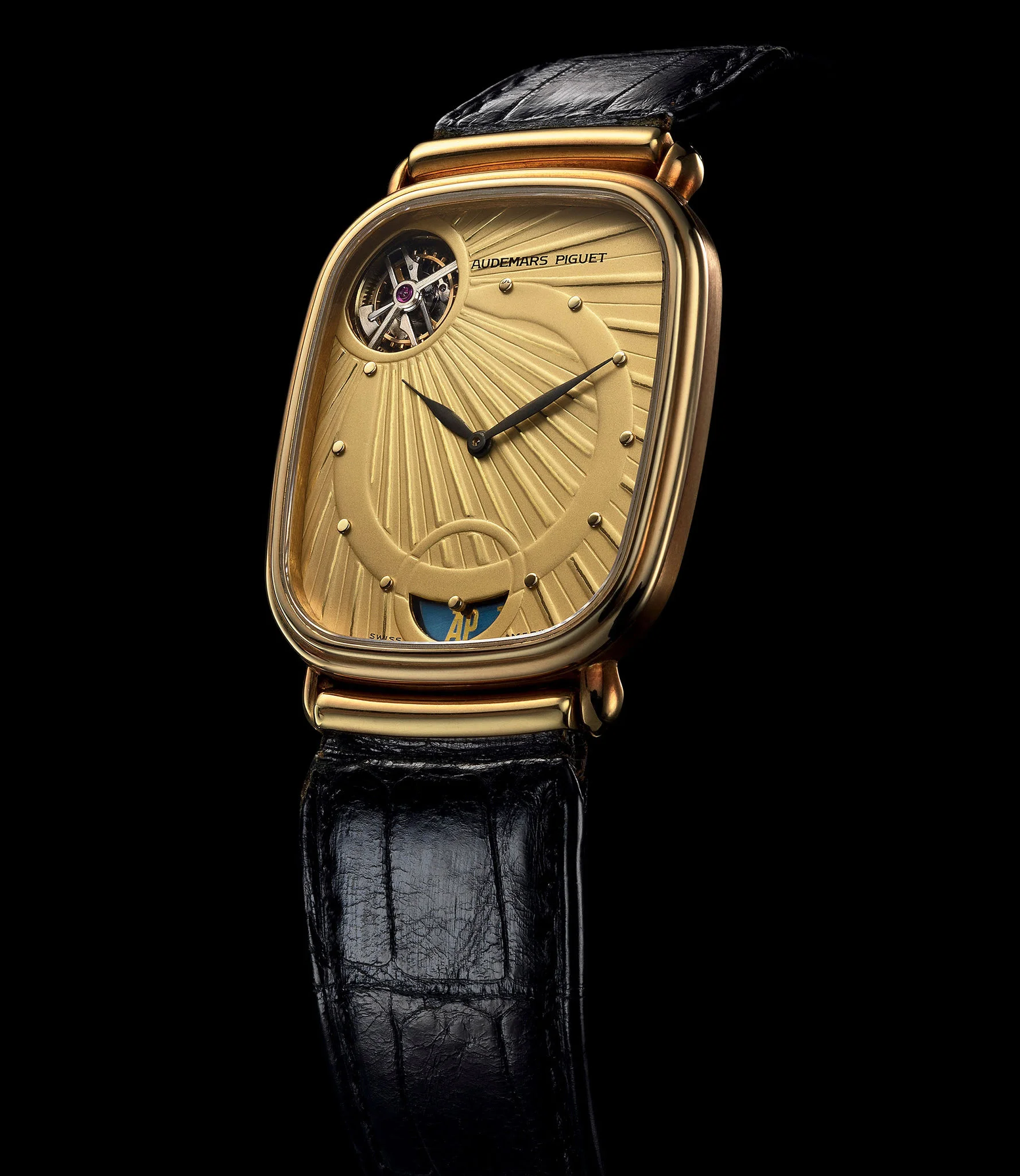
1986. First selfwinding tourbillon wristwatch, Model 25643. The tourbillon carriage is made of titanium, making it lighter than usual. Selfwinding hammer-type Calibre 2870. Case no. 296, 18-carat yellow gold. Sold in 1990. Audemars Piguet Heritage, inv. 1050.
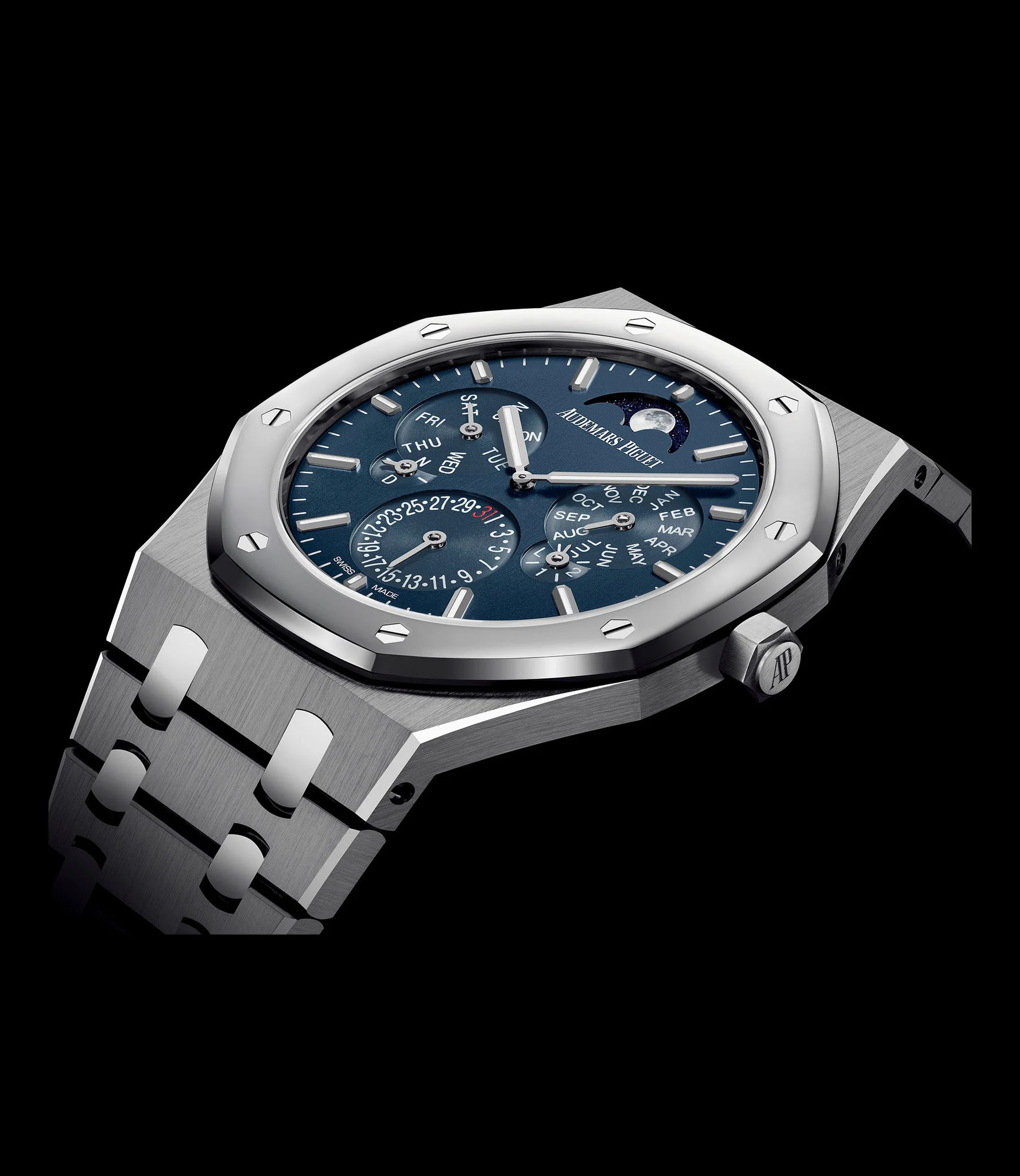
Royal Oak Ultra-Thin Perpetual Calendar 26586IP. The case of one of the world’s thinnest perpetual calendar watches combines the heaviest metal (platinum) with one of the lightest, titanium. Calibre 5133. Model 26586IP, launched in 2017. Picture taken at model launch.
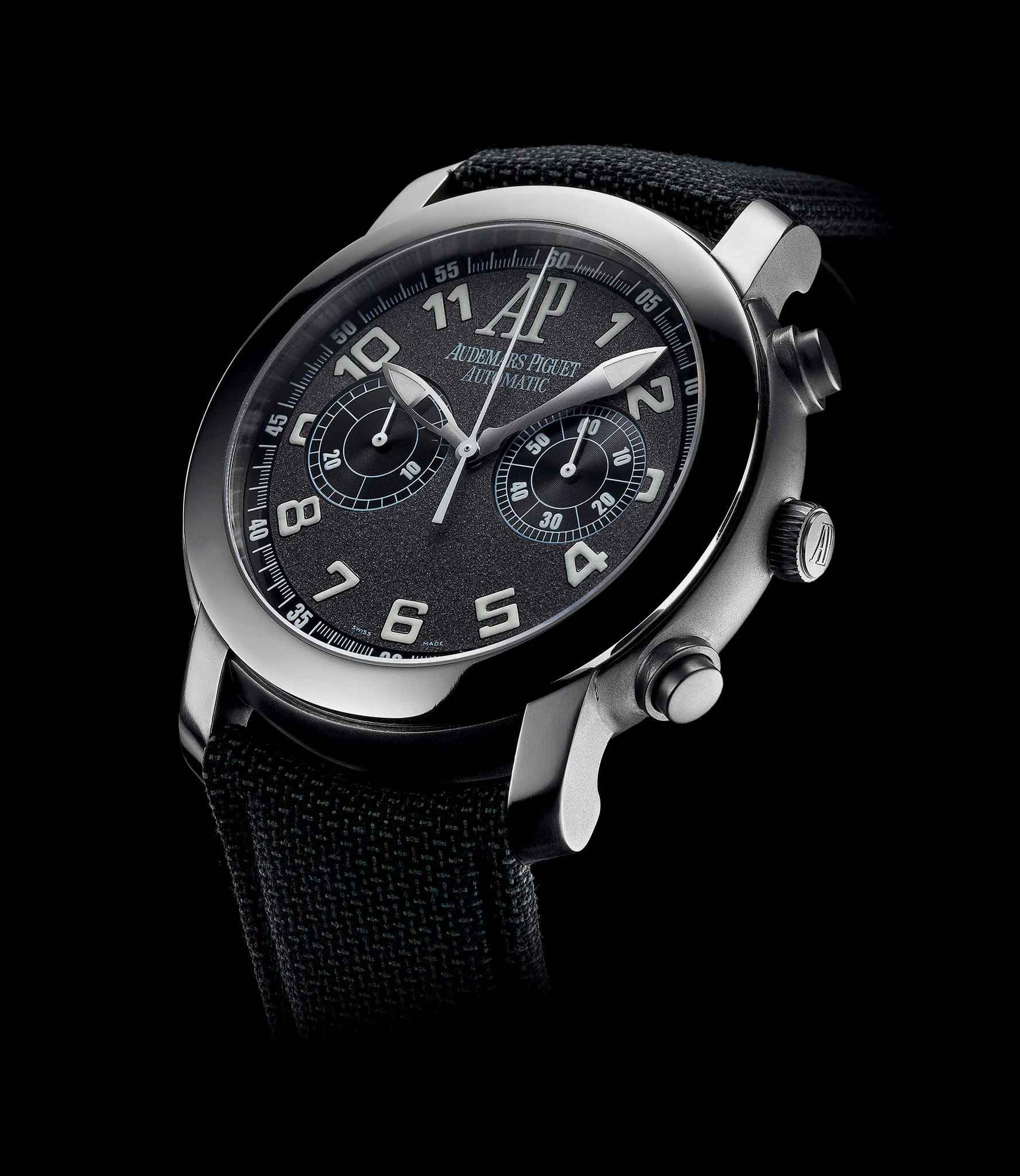
2000. Jules Audemars Chronograph 25949TI. Created in partnership with Arnold Schwarzenegger, this watch combines an oversized 48 mm diameter with a material that is both light and hard. Calibre 2226/2841. Case no. E39165 in titanium. Prototype. Audemars Piguet Heritage, inv. 501.
Tantalus: dark, heavy and rare
Almost as hard as steel and almost as heavy as gold, tantalum is ductile, ultra-resistant to acids, biocompatible as well as a good conductor of heat and electricity. It is notably found in surgical instruments, implants, electronics, etc.
Tantalum quietly entered the watchmaking world in the 1930s via cutting tools and mainspring alloys, then spread to quartz watches in the form of capacitors.
In the 1970s and 1980s, several celebrities reportedly expressed the wish to wear a black Royal Oak. Karl Lagerfeld himself had his Royal Oak 5402 blackened, probably using a technique known as cataphoresis. The kings of Greece and Spain entrusted their London armourer with the task of colouring their Royal Oak so that, like their firearms, it would no longer reflect the sun's rays while they were hunting.
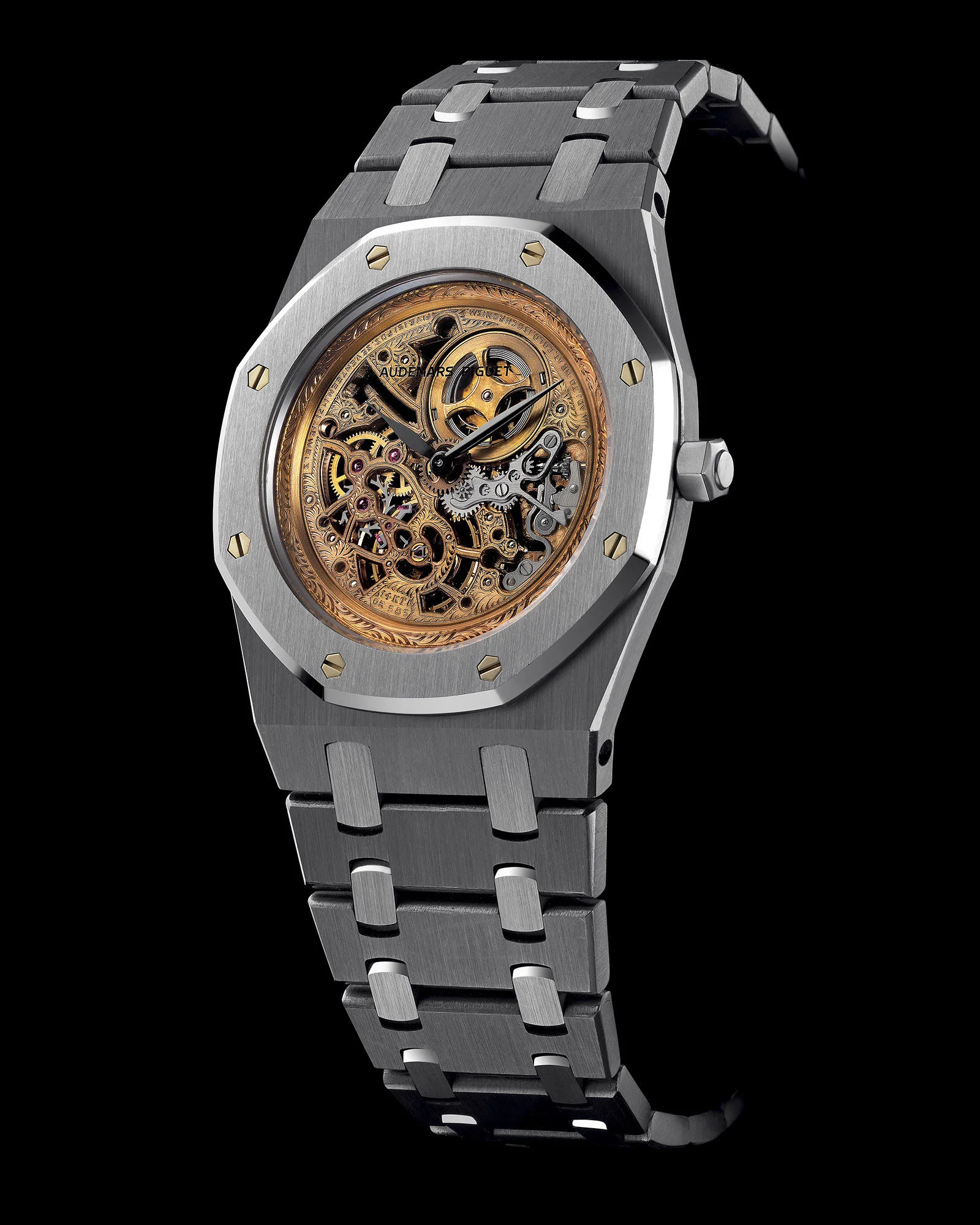
Before the introduction of PVD treatments, blackening techniques were unable to achieve the finishing qualities demanded by Audemars Piguet. With its bluish anthracite colour embedded in the metal, tantalum offered an attractive aesthetic alternative. But where could it be found? This metal was not only difficult to source, but also to work with in terms of production.
In 1988, Audemars Piguet introduced tantalum in the cases of several models, including a Royal Oak created with golfer Nick Faldo (14486) and a chronograph named "Eighth". The adventure reached a climax in 2012, with three Royal Oak limited editions in partnership with Lionel Messi (26325), combining tantalum with pink gold, steel and platinum. By this time, PVD blackening had been fully mastered and black ceramic components were in full swing. Not particularly scratch-resistant, difficult to polish and listed as a conflict mineral in 2021, tantalum is no longer used by Audemars Piguet.
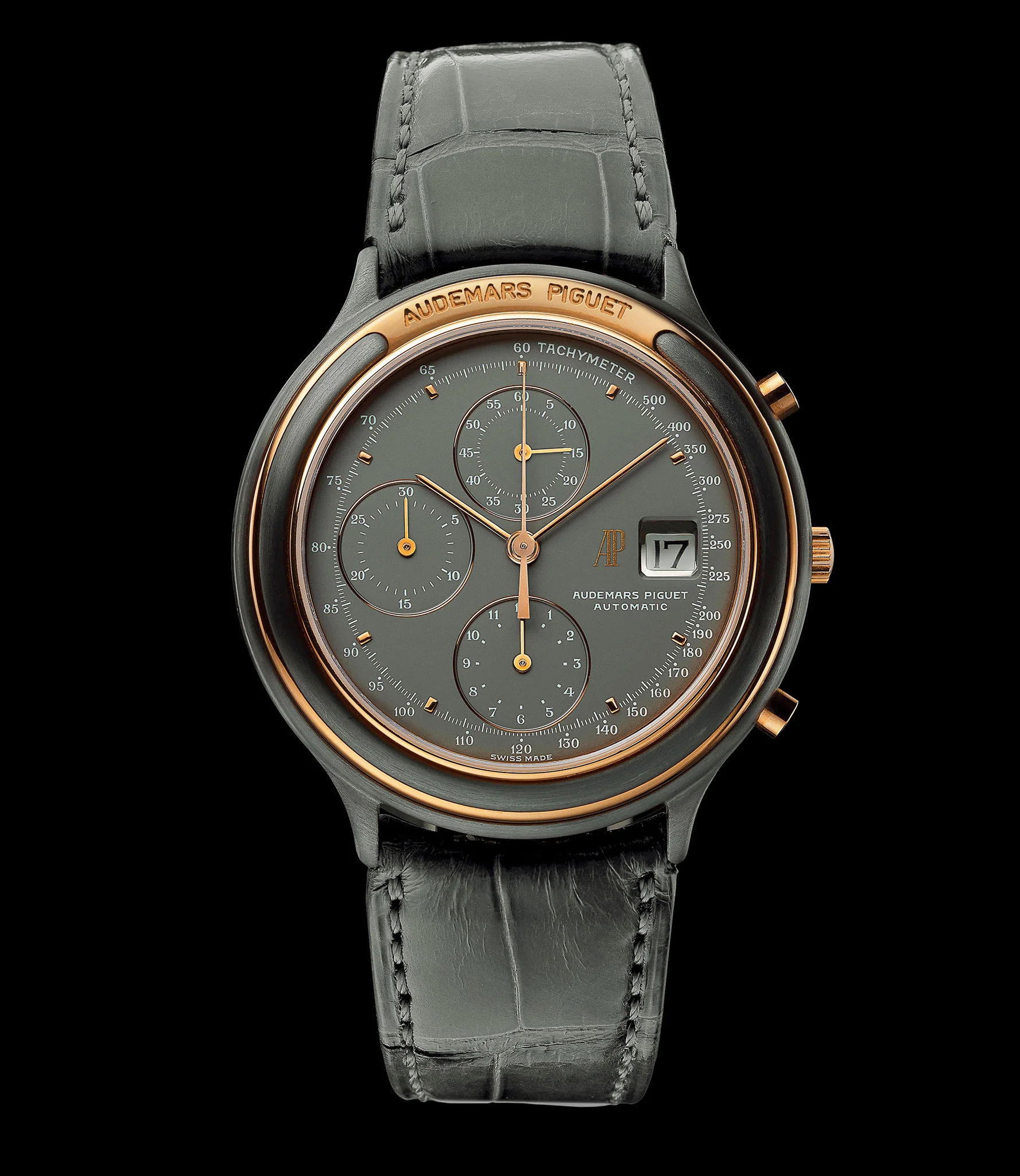
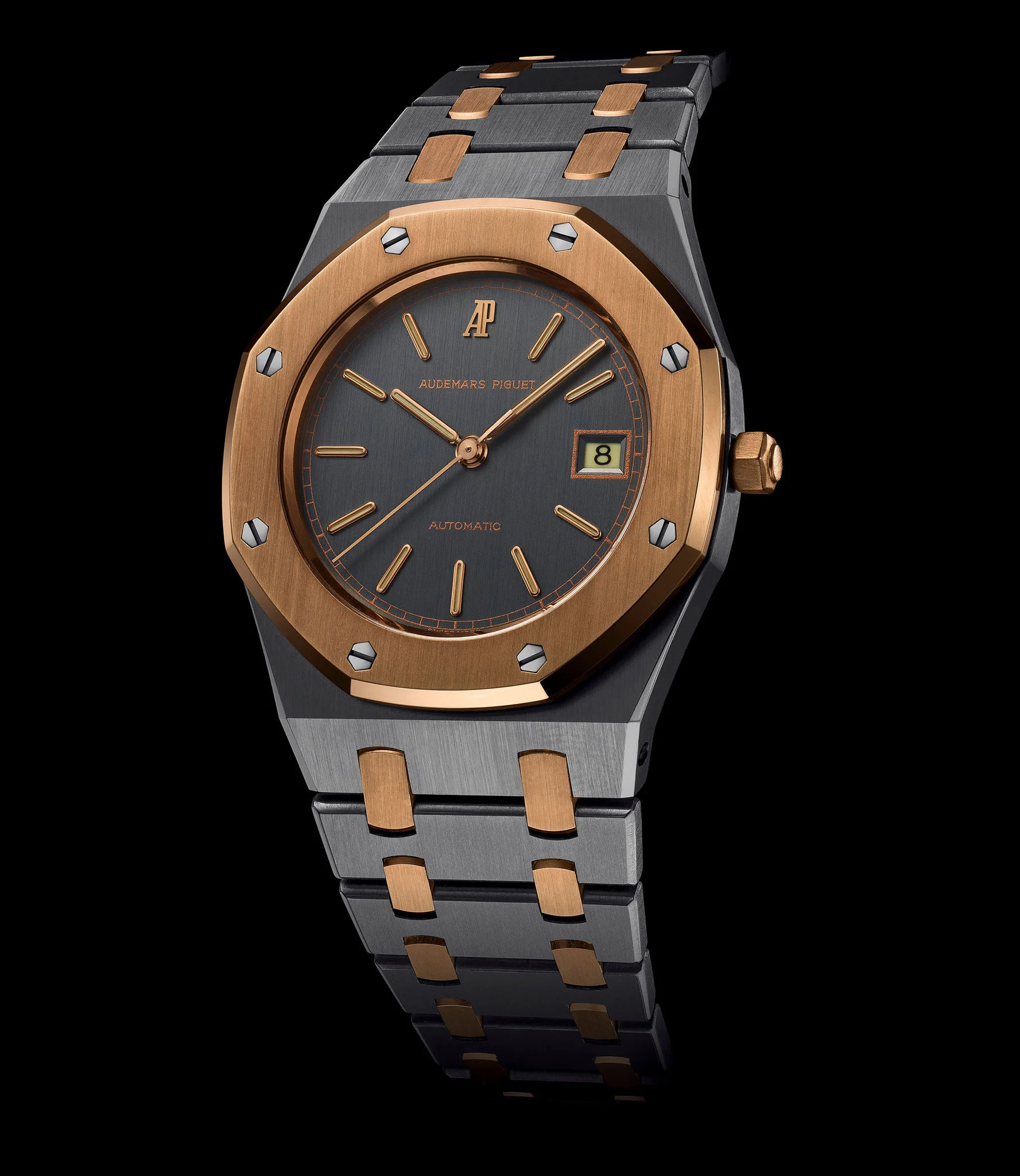
1988. Royal Oak made in partnership with Nick Faldo 14486TR. Date. Vertical Dacron tantalum dial. Calibre 2130, 35 mm case no. C41993. Tantalum and 18-carat pink gold. Prototype without a movement, probably presented at the model's launch in 1988. Audemars Piguet Heritage, inv. 1675.
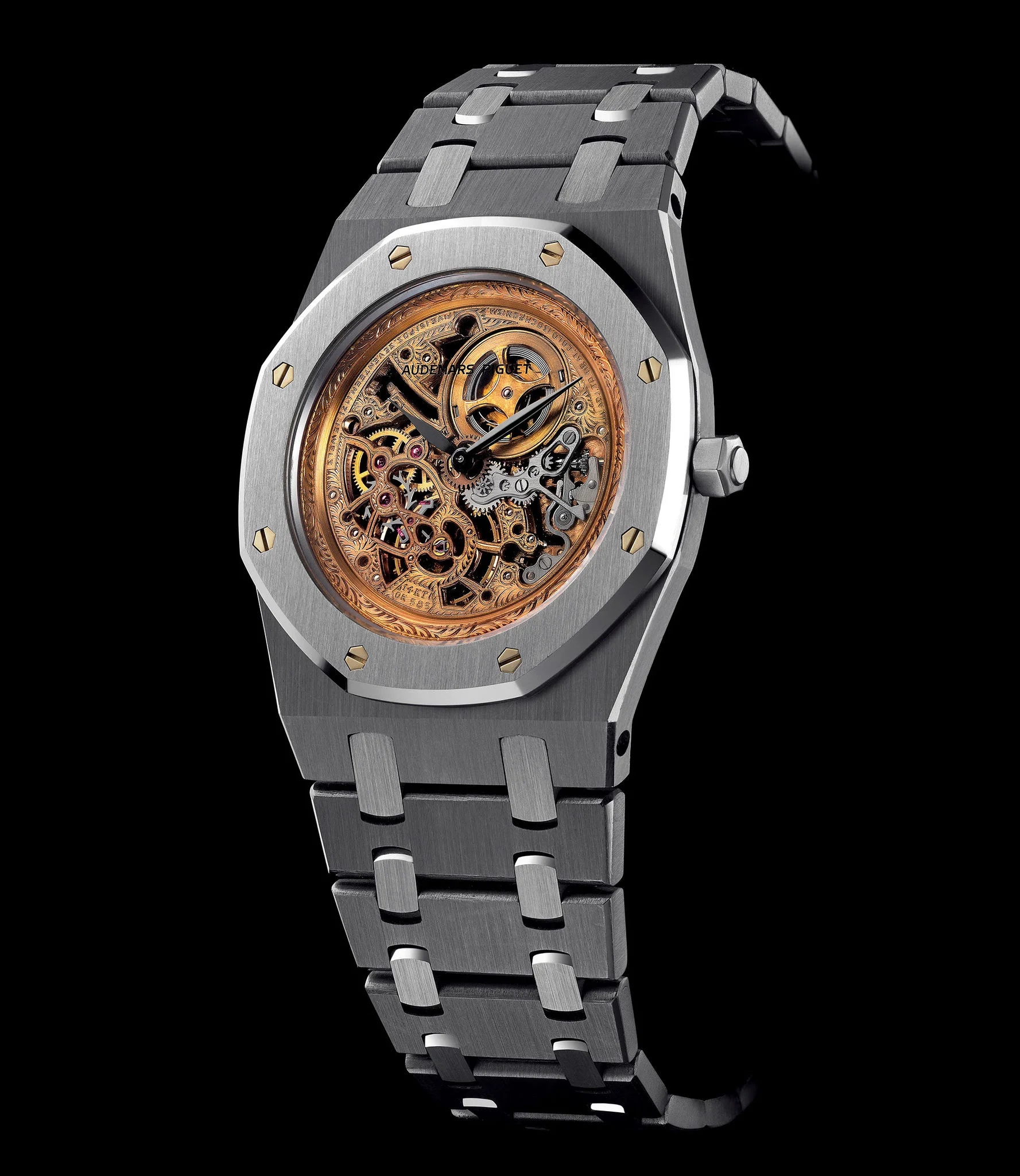
1994. Royal Oak 14882TT No. 5. Ultra-thin (1.64 mm) Calibre 2003SQ in 14-carat pink gold, openworked and engraved by hand, movement 390905. Steel and tantalum 33 mm Case no. D46534. Audemars Piguet Heritage, inv. 825.
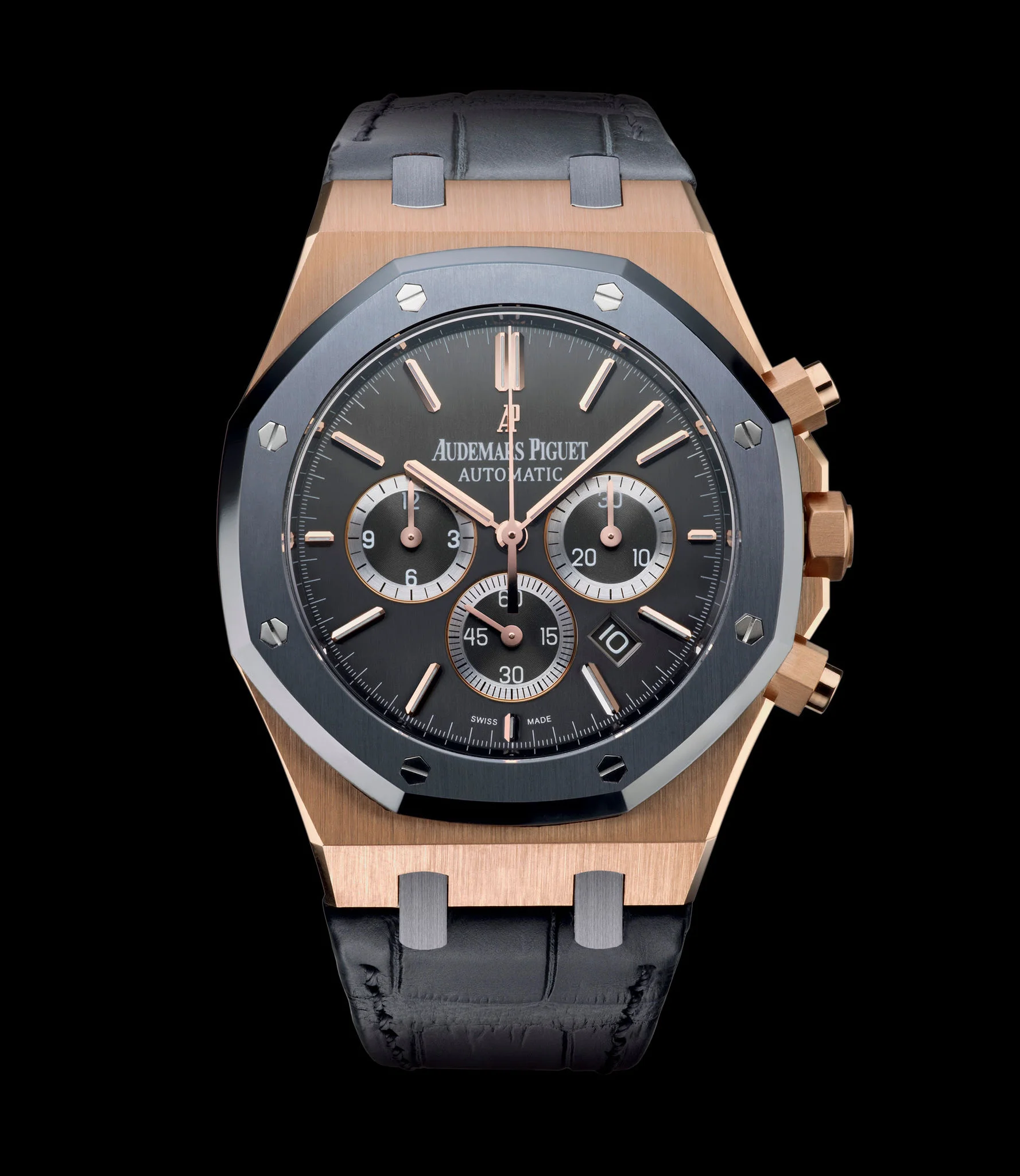
The Royal Oak bezel and studs are in tantalum, while the case middle is in 18-carat pink gold. Chronograph, date. Calibre 2385. Model 26325 a 400-piece limited edition issued in 2012 in partnership with Lionel Messi.
Rubber is no luxury
Since its introduction by Hublot in 1980, rubber has primarily been used for sports watch straps. This is hardly surprising, given that it is waterproof, flexible, comfortable and can be coloured and shaped as desired.
Its use on cases is much rarer. The story begins in 1990, when a suggestion was made for the Royal Oak Offshore that was still in the development phase at the time: namely protecting its pushers and crown by covering them with rubber. The story is told here. While the idea was simple, putting it into practice proved so difficult that the launch of the watch initially slated for 1992 had to be postponed until the following year. The Jura-based company Pibor (BIWI), which developed this technology, explored uncharted territory by guaranteeing perfect adhesion between metal and rubber, shape retention, as well as enduring resistance to wear, water and temperature changes.
In 2001, Audemars Piguet went one step further by rubber-coating the bezel. While the latter is indeed the component that endures the most scratches and knocks, when gold is completely concealed under a layer of rubber, the principle is way more than merely functional! The idea may well have seemed crazy, yet the success of Model 25940OK exceeded all expectations.
By the end of the 2000s, ceramic bezels had won the day over rubber, offering superior decorative possibilities while remaining virtually scratch-proof.
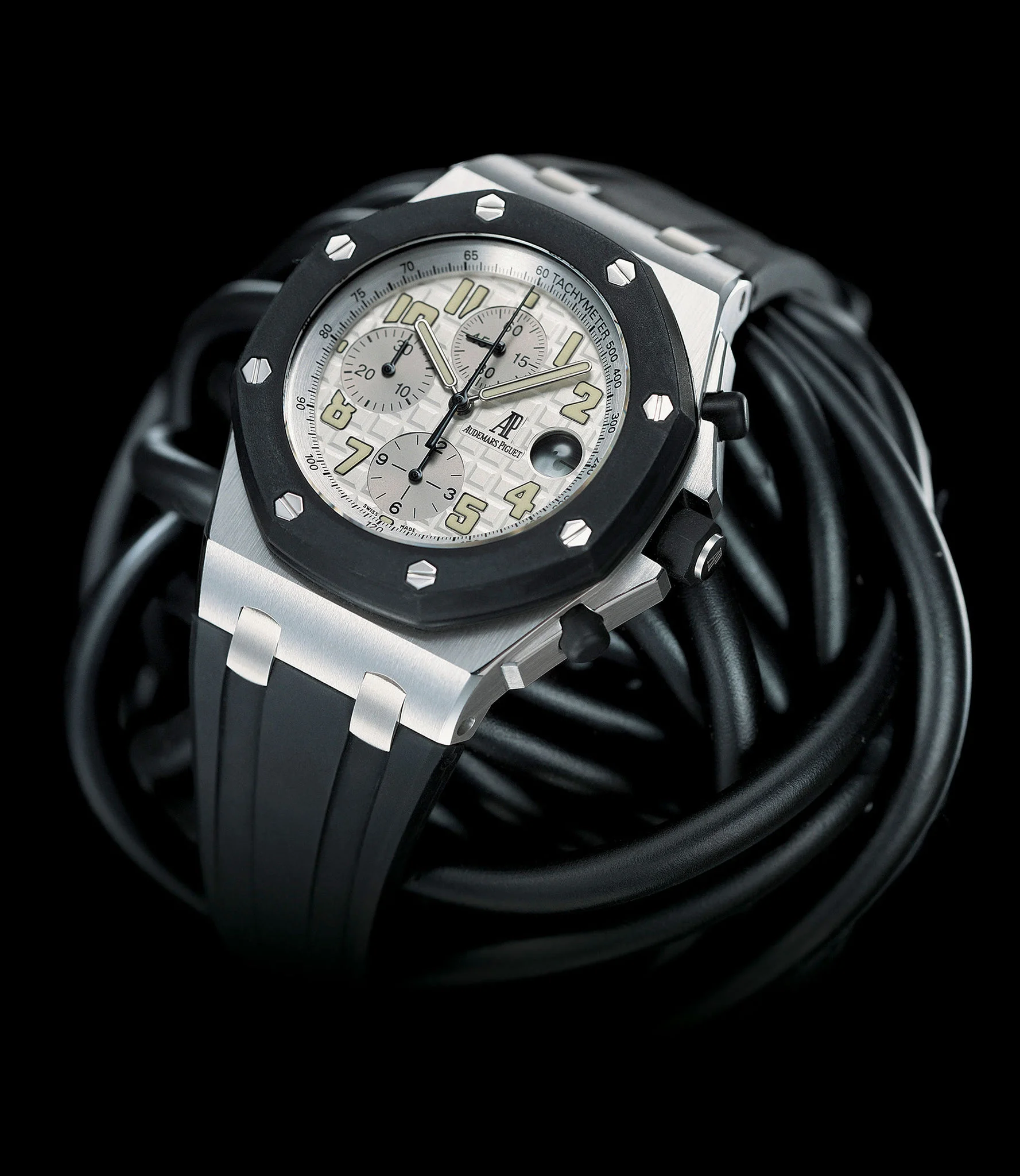
2001. Royal Oak Offshore 25940SK. This model introduced the rubber-covered bezel, the rubber strap and the Méga Tapisserie pattern. It was an immediate success, with 692 units sold in its first year and 2,416 by 2007. Picture taken at the model launch. Audemars Piguet Archives.
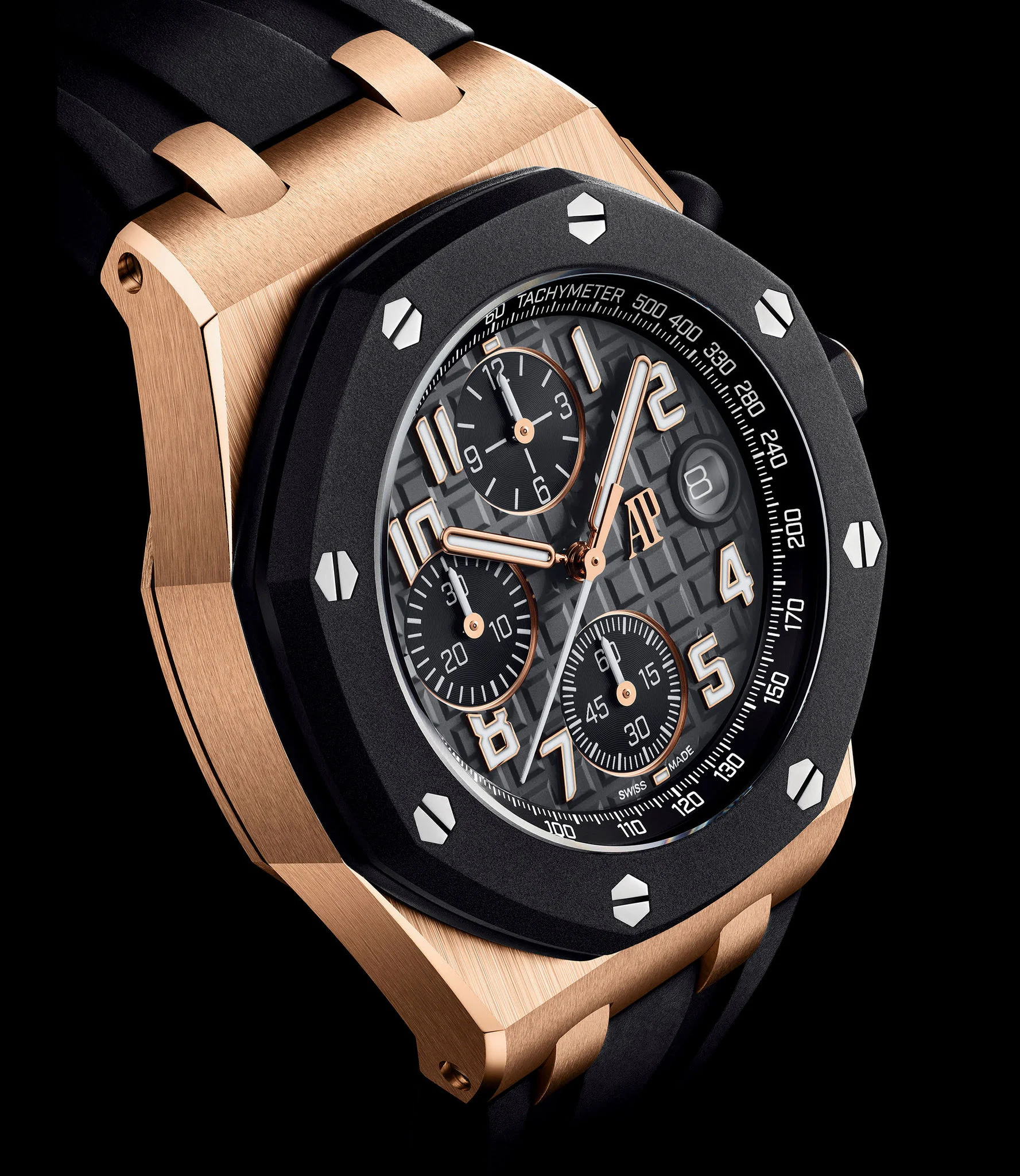
2015. Royal Oak Offshore 26238OK. The solid gold bezel is rubber-coated, as are the crown and pushers. Selfwinding Calibre 4404. 42 mm case in 18-carat pink gold. Archive picture taken in 2015.
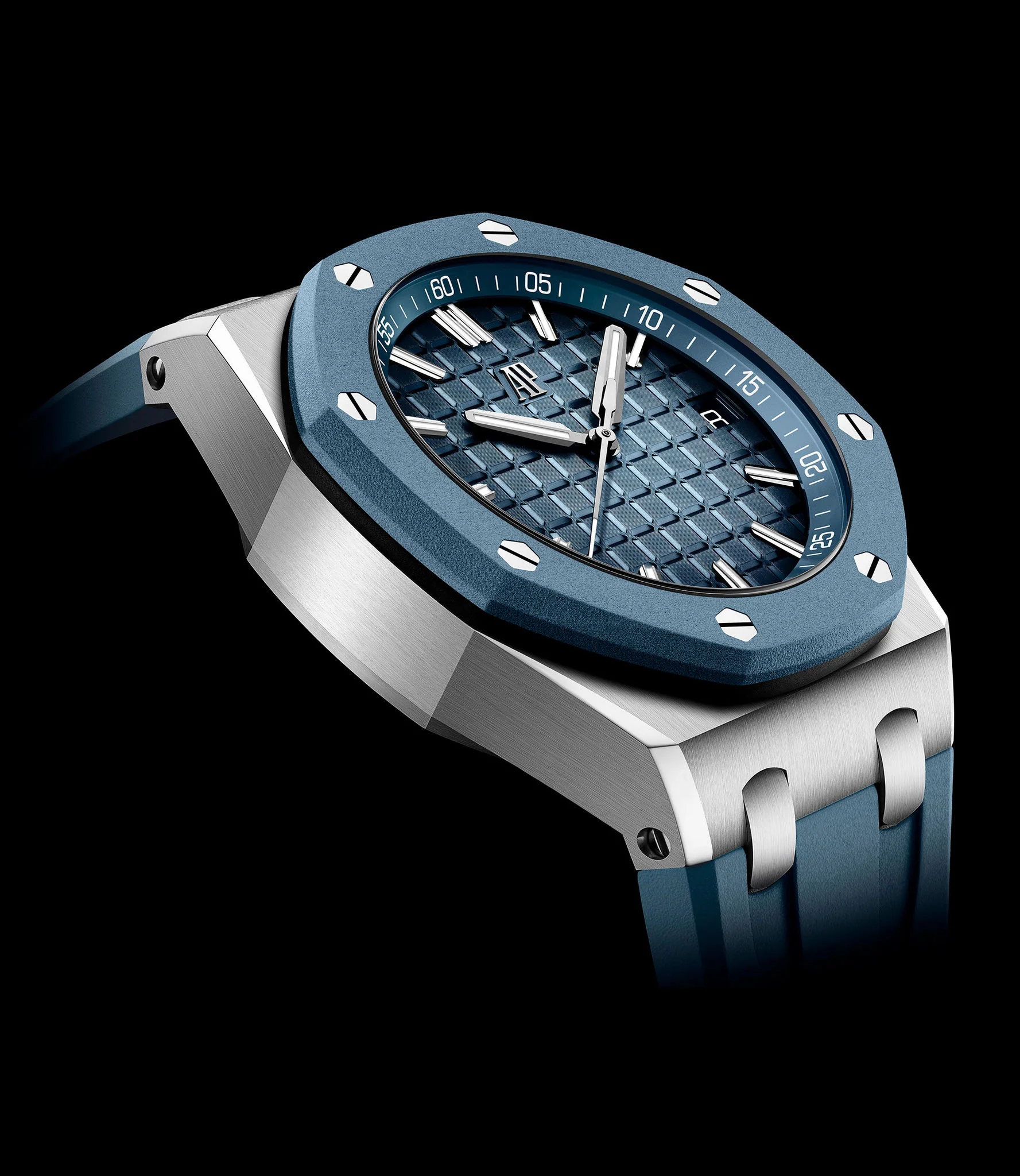
2024. Royal Oak Offshore 15605SK. This 43 mm Royal Oak Offshore is one of the few without a chronograph. The same shade of blue adorns the rubber strap, rubber bezel and smoked dial. Selfwinding Calibre 4302. Date display. Steel and rubber case in 43 mm. Picture presented at the watch launch.
Ceramics
Hypoallergenic, colourfast, lighter and harder than steel, ceramics seems to have it all.
This material first appeared in the field of horology during the 18th century, notably on French clocks embellished with Meissen porcelain. It was used again in the 1960s, when German, English and then Taiwanese wall clocks made their way into our kitchens.
Although it bears the same name, high-tech ceramics is quite different, involving perfectly calibrated, homogeneous grains of Zirconium Oxide. Harder and more efficient, it entered the watch industry through movement components: prototype balance springs in the 1960s, electronic watch capacitors and then ball bearings. In 1982, Zenith created the first ceramic watch case, a material popularised by Rado in 1986.
Traditionally, ceramics is hot-moulded, yet deemed too hard to be cut. Audemars Piguet introduced it in the Royal Oak Offshore Barichello in 2006. With its partner Bangerter, the brand developed techniques for machining ceramics and producing top-of-the-range finishes: brushing, chamfering and diamond-finishing. A decade of development resulted in the first all-ceramic Royal Oak. The 26579CE model was a huge success, paving the way for white, then coloured blue, brown and even polychrome ceramics...
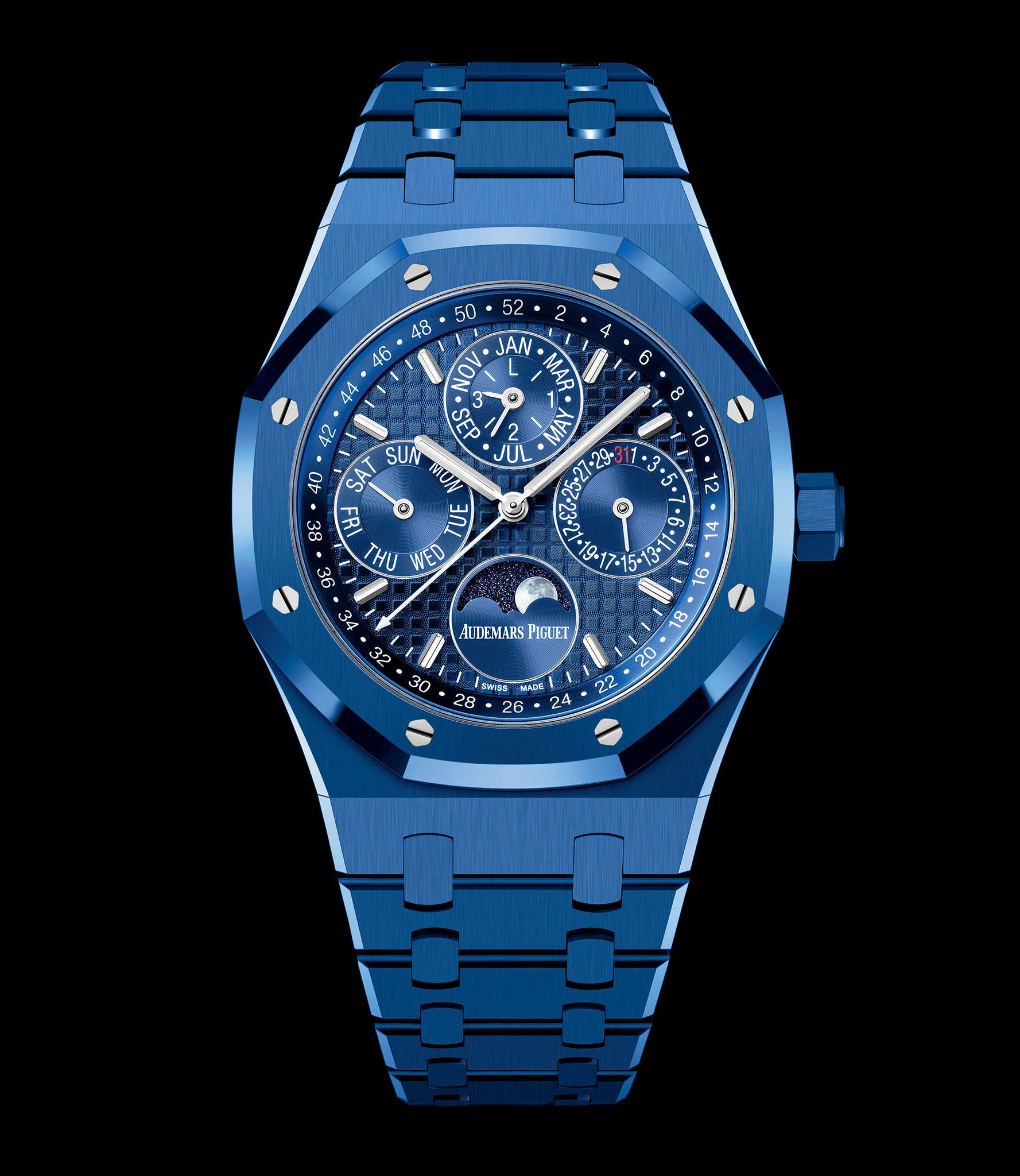
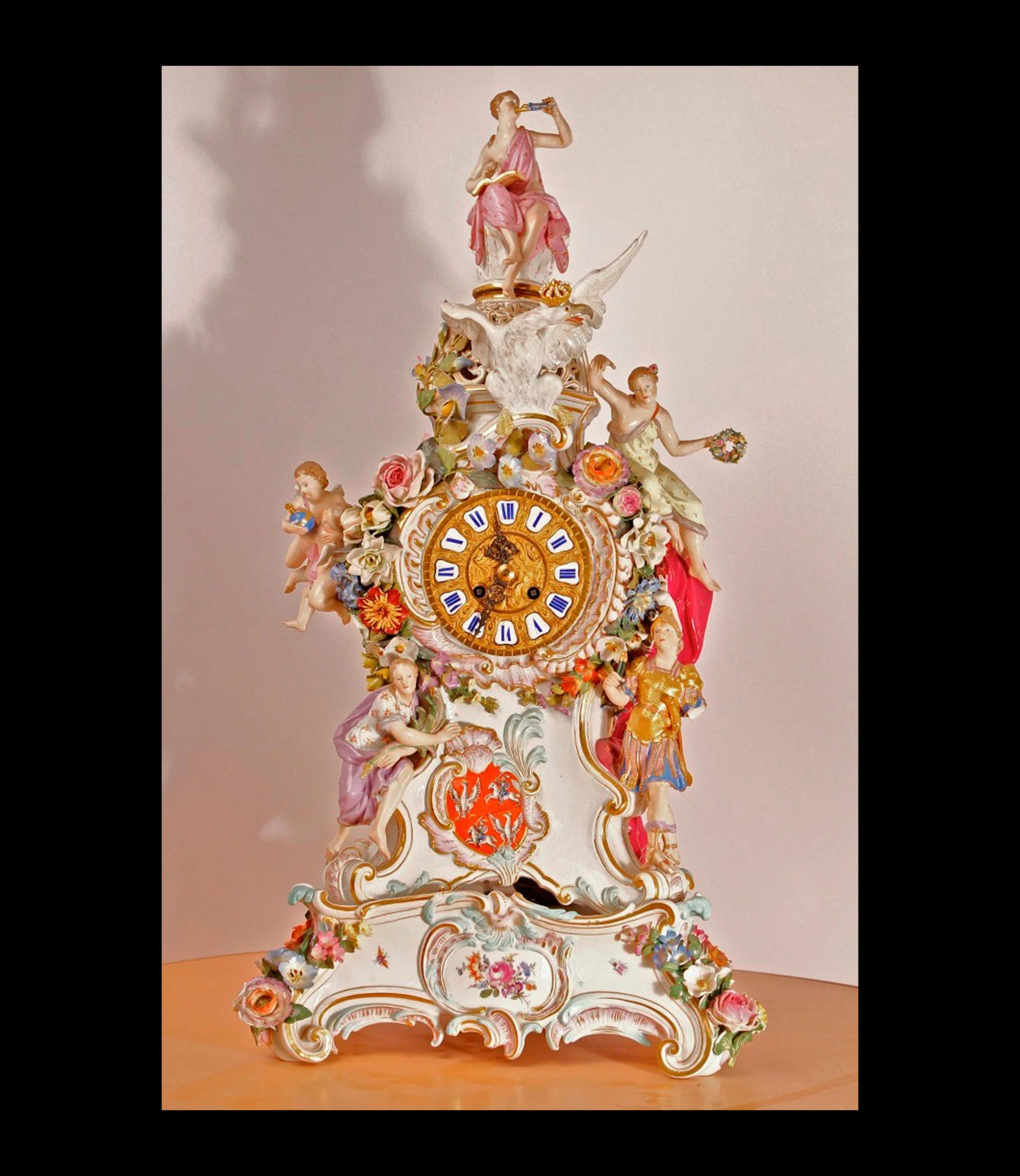
Circa 1810. Ceramic clock made in Meissen (Germany). Chiming mechanism, probably made in Paris. The clock is decorated with figures on the sides, an eagle above the dial and a woman playing the horn on the capital (allegory of music). It is fitted with a cabinet under the dial. Espace Horloger de la Vallée de Joux (EHVJ), Gideon Collection.
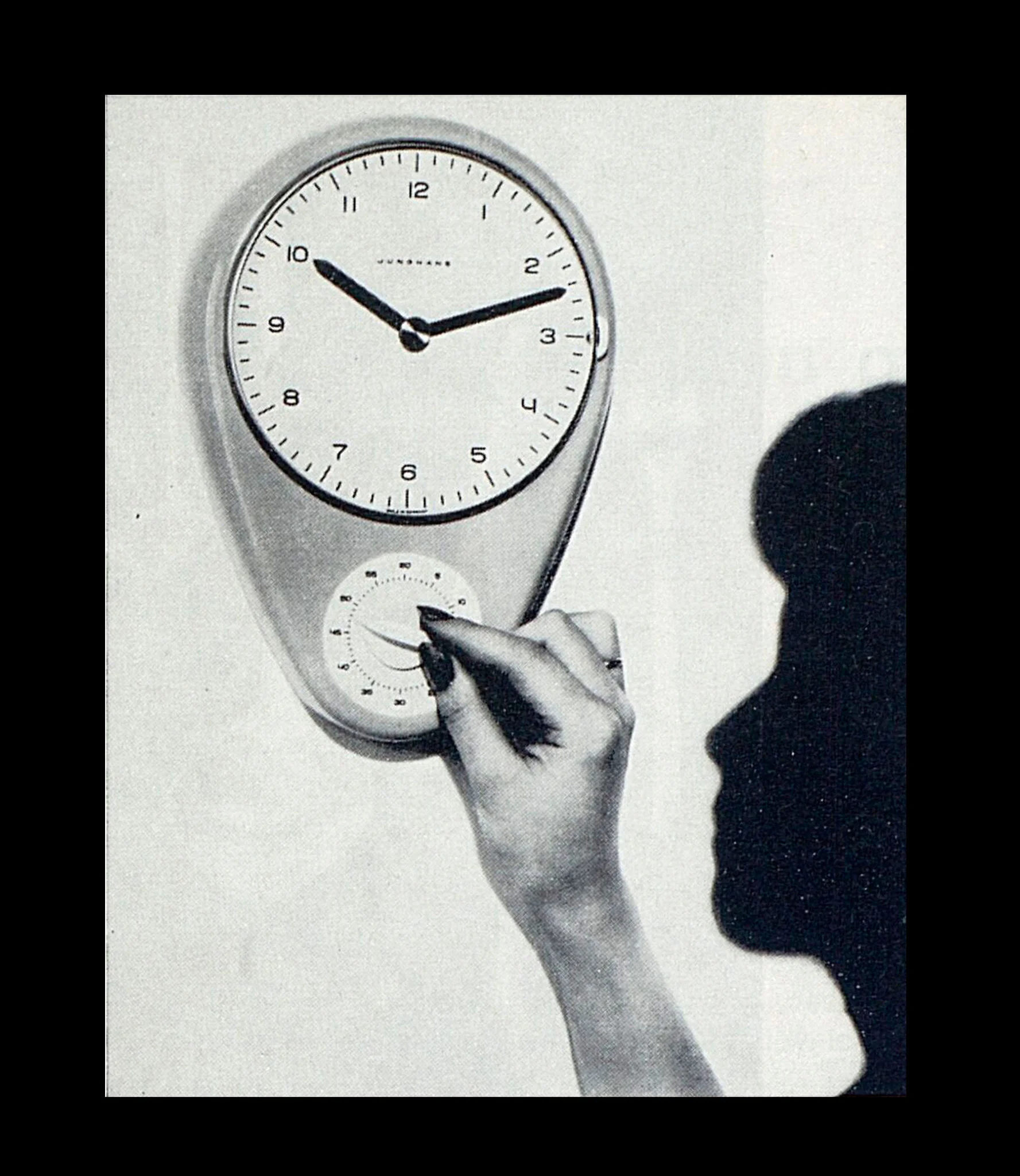
1956. Junghans ceramic clock advertisement. Model probably designed by Max Bill. Archive credit @The Watch Library – Europa Star.
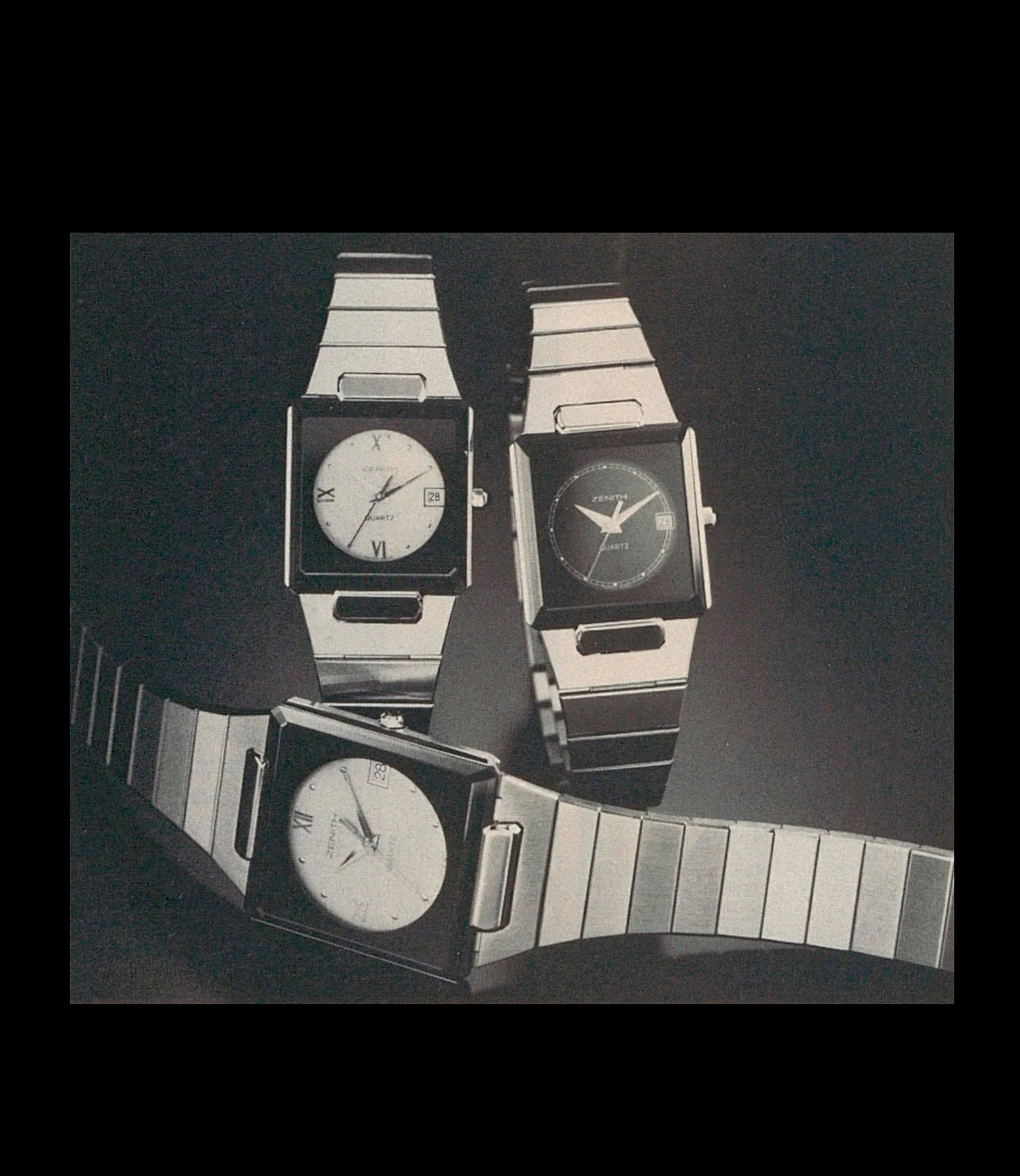
In 1982, Zenith presented the first watch with an "industrial" ceramic case. Europa Star No. 133, 1982, p. 39. © Europa Star.
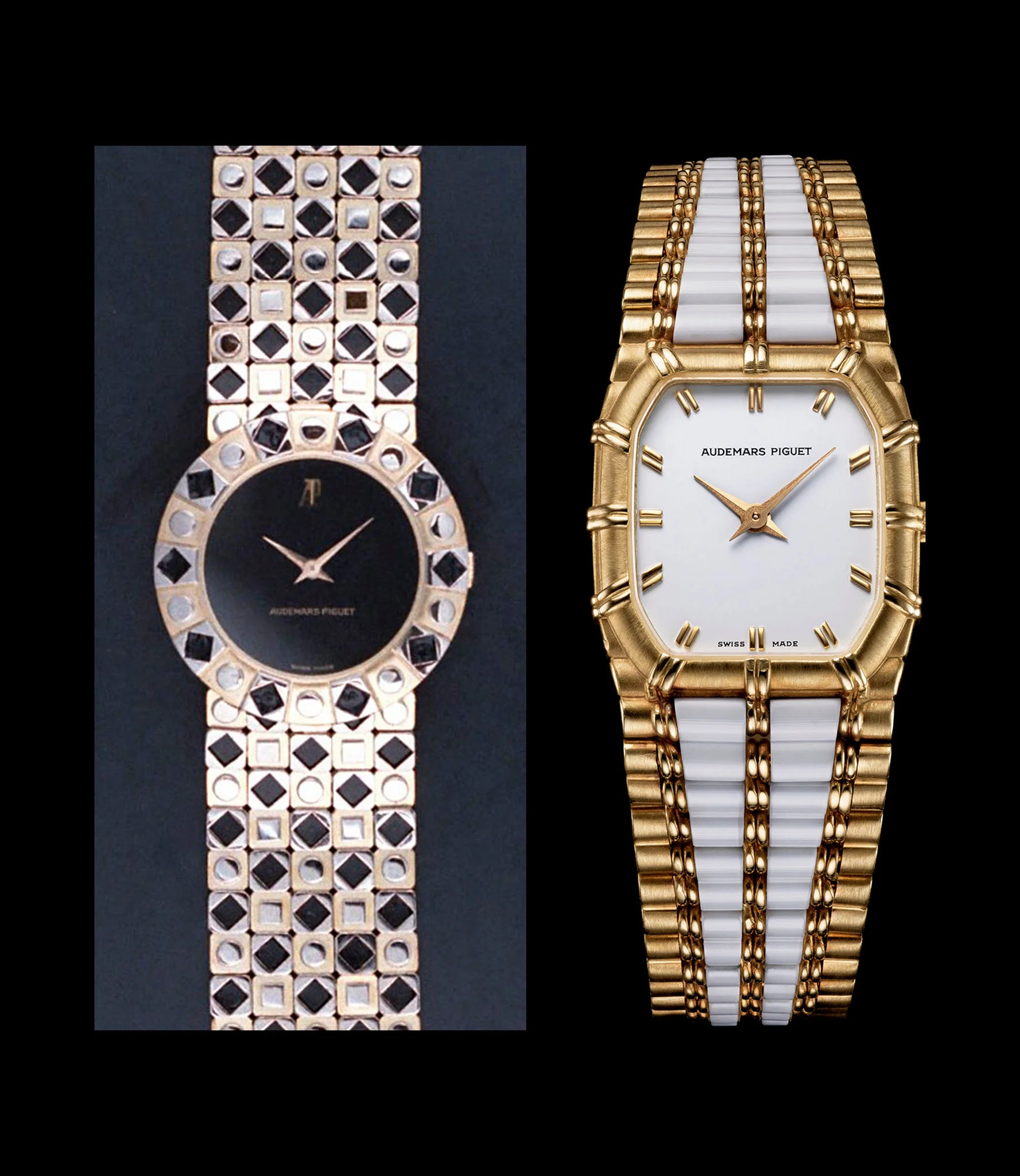
In 1986, Audemars Piguet adorned several models with small ceramic elements. Audemars Piguet Archives.
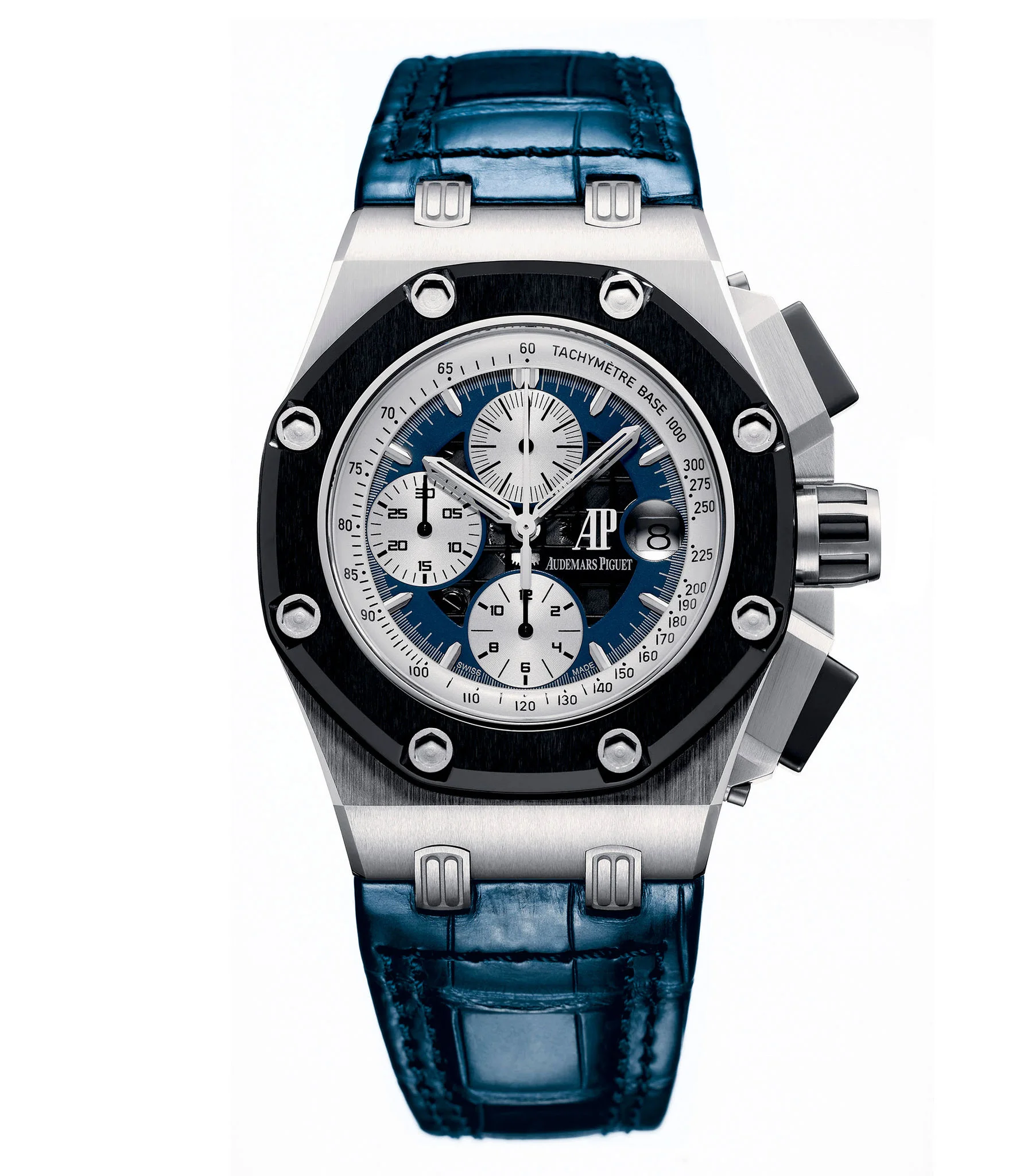
2006. Royal Oak Offshore Barichello 26078. It reintroduced ceramics at Audemars Piguet after a first wave in the 1980s. Chronograph, date. Selfwinding Calibre 2326/2840. 42 mm platinum case with ceramic bezel and pushers. 150-piece limited edition dedicated to Rubens Barichello. Prototype. Audemars Piguet Heritage, inv. 852.
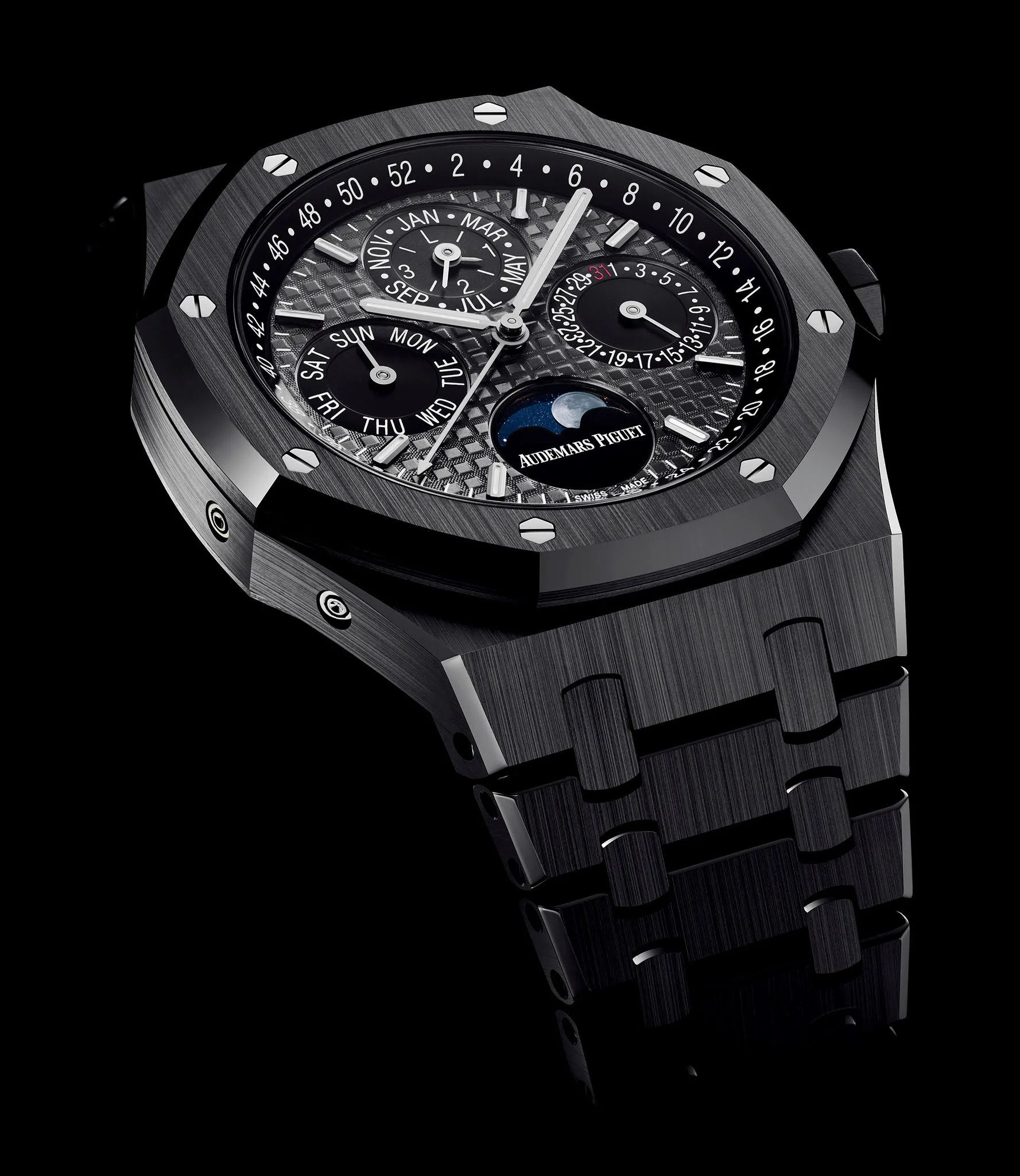
2016. Royal Oak Perpetual Calendar 26579CE. The first Royal Oak entirely in ceramic, including the bracelet. Selfwinding Calibre 5134, movement 961120. Case no. J37062, 41 mm. Audemars Piguet Heritage, inv. 1913.
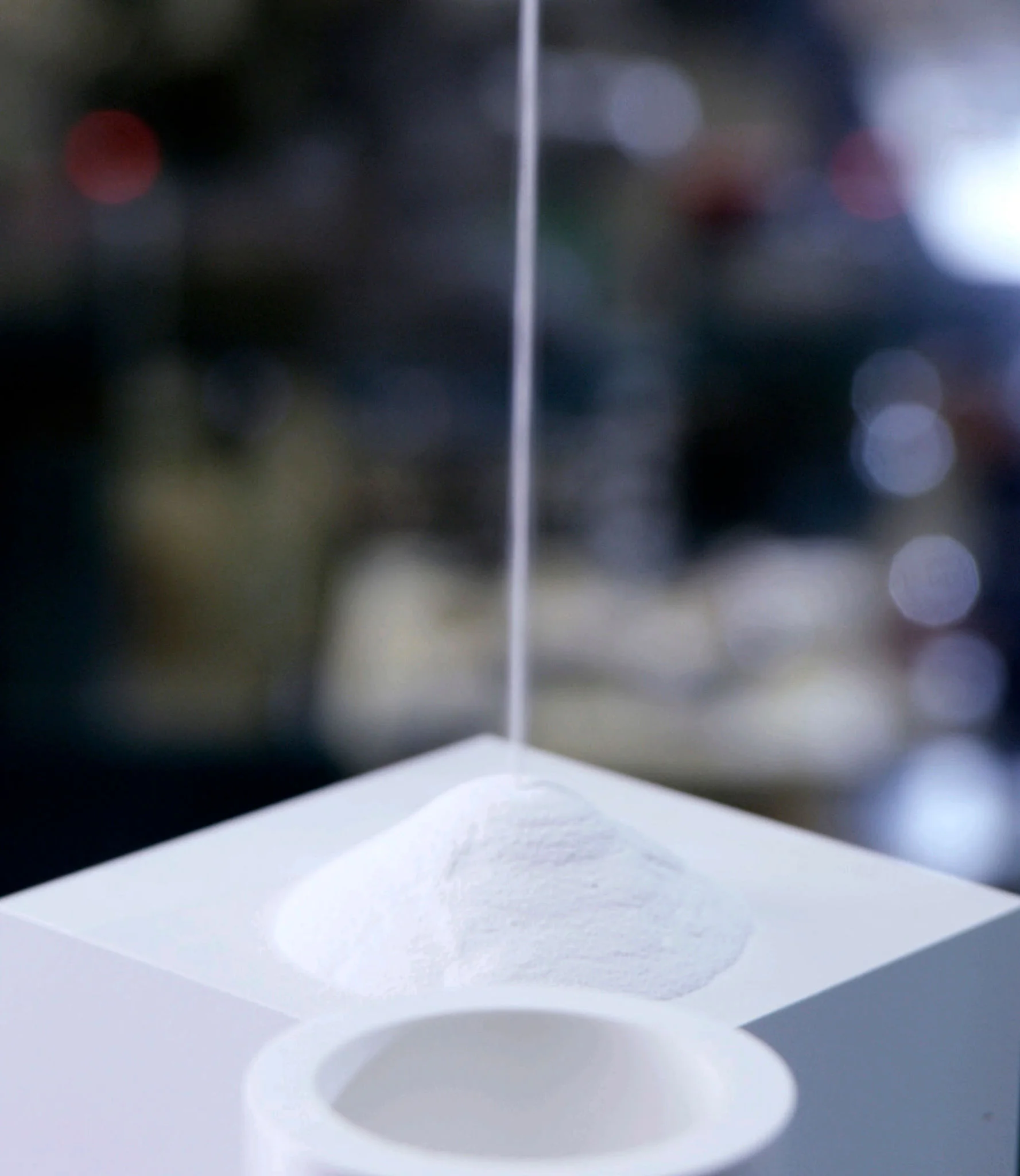
The white ceramic used by Audemars Piguet is a mixture of Zirconium Oxide and alumina. This powder, with an average diameter of around one hundred nanometres, is heated to around 1300° C. The grains agglomerate to create a material with a hardness of 1,350 Vickers, six times harder than steel.
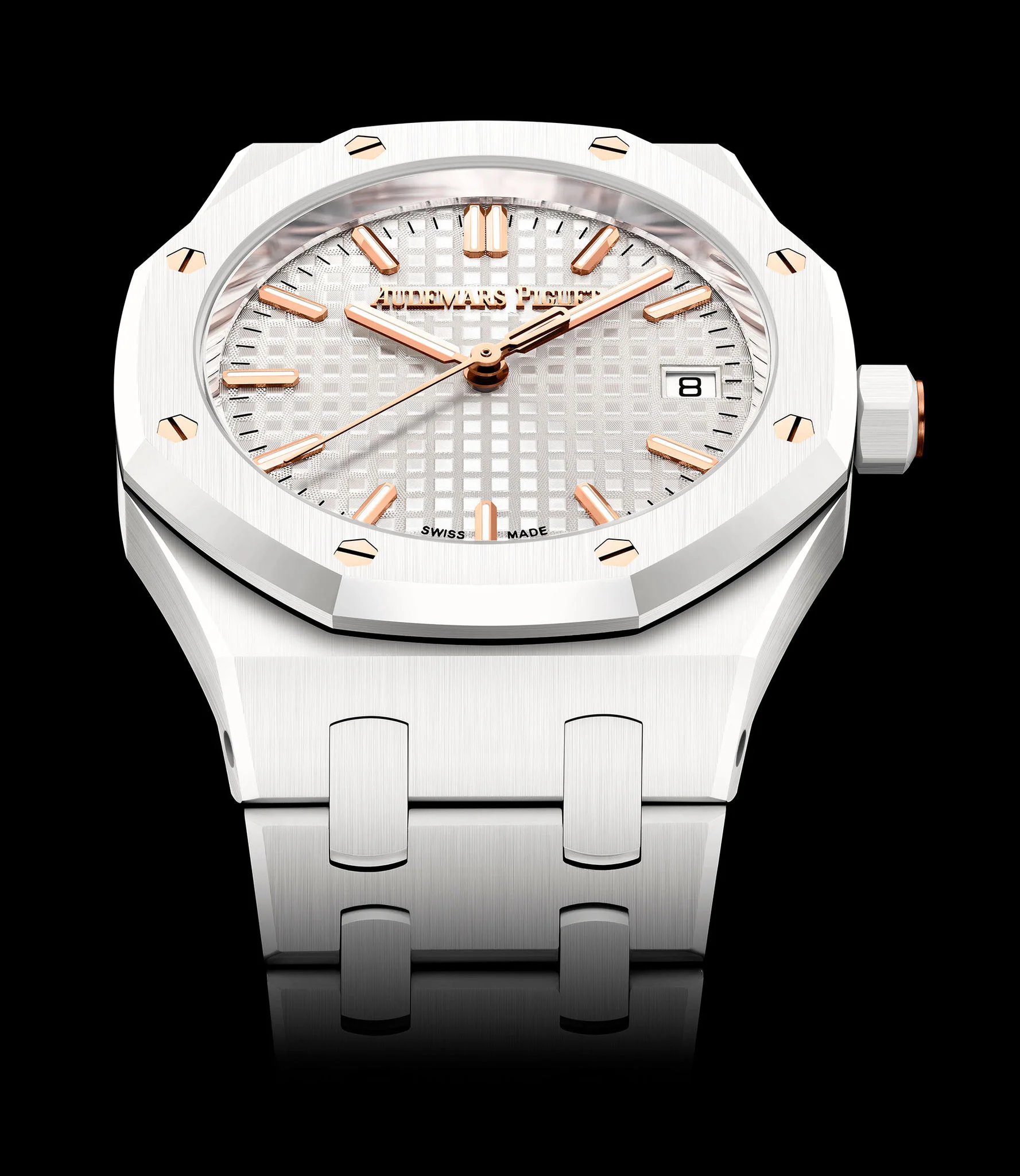
2023. Royal Oak 77350CB. Only the pink gold components stand out on this all-white watch launched in 2023. Selfwinding Calibre 5800. Date. White ceramic 34 mm case and bracelet. Picture taken at the model launch.
Cermet, the best of both worlds
While metal alloys have been known since the dawn of time, mixing metal with ceramics remains atypical. Cermet combines CERamic and METal. The aim? To offer the hardness of ceramics, its resistance to abrasion, corrosion and extreme temperatures, while retaining metal’s flexibility (ductility) and shock-resistance.
Discovered in 1923, cermet has been interpreted in many variants. It is found in gas turbines and in the heat shields of space shuttles. In the watch industry, cermets appeared during the 1960s, not in watches, but rather in the machines used to make them. As a cutting tool, they were unrivalled.
In 2010, Audemars Piguet set about creating cermet watch exteriors. They were so hard that they were almost impossible to scratch... So hard that they had to be moulded and could not be brushed. Watchmakers therefore chose to confine this metal to Royal Oak bezels, as they are the parts most exposed to scratches. Between 2010 and 2012, a handful of limited editions were created, including two in partnership with racing drivers Jarno Trulli and Michael Schumacher, as well as a one-of-a-kind model intended for a charity auction.
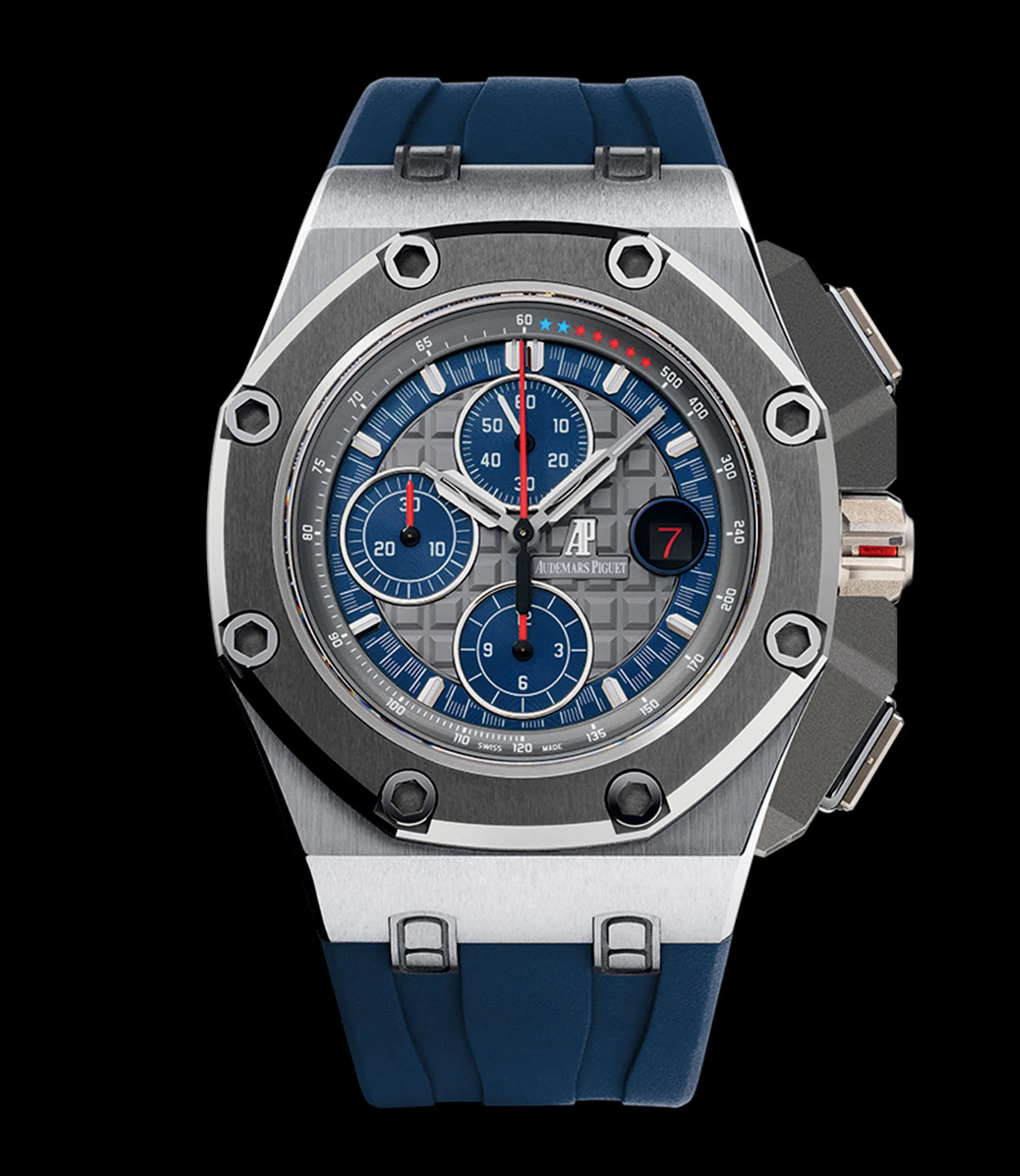
2012. Royal Oak Offshore Chronograph Michael Schumacher 26568. Its cermet bezel is 13 times harder than its 950 platinum case middle. Chronograph, date. Selfwinding Calibre 3126/3840. Titanium and cermet 41 mm case. Limited edition of 100 pieces. Prototype. Audemars Piguet Heritage, inv. 1592.
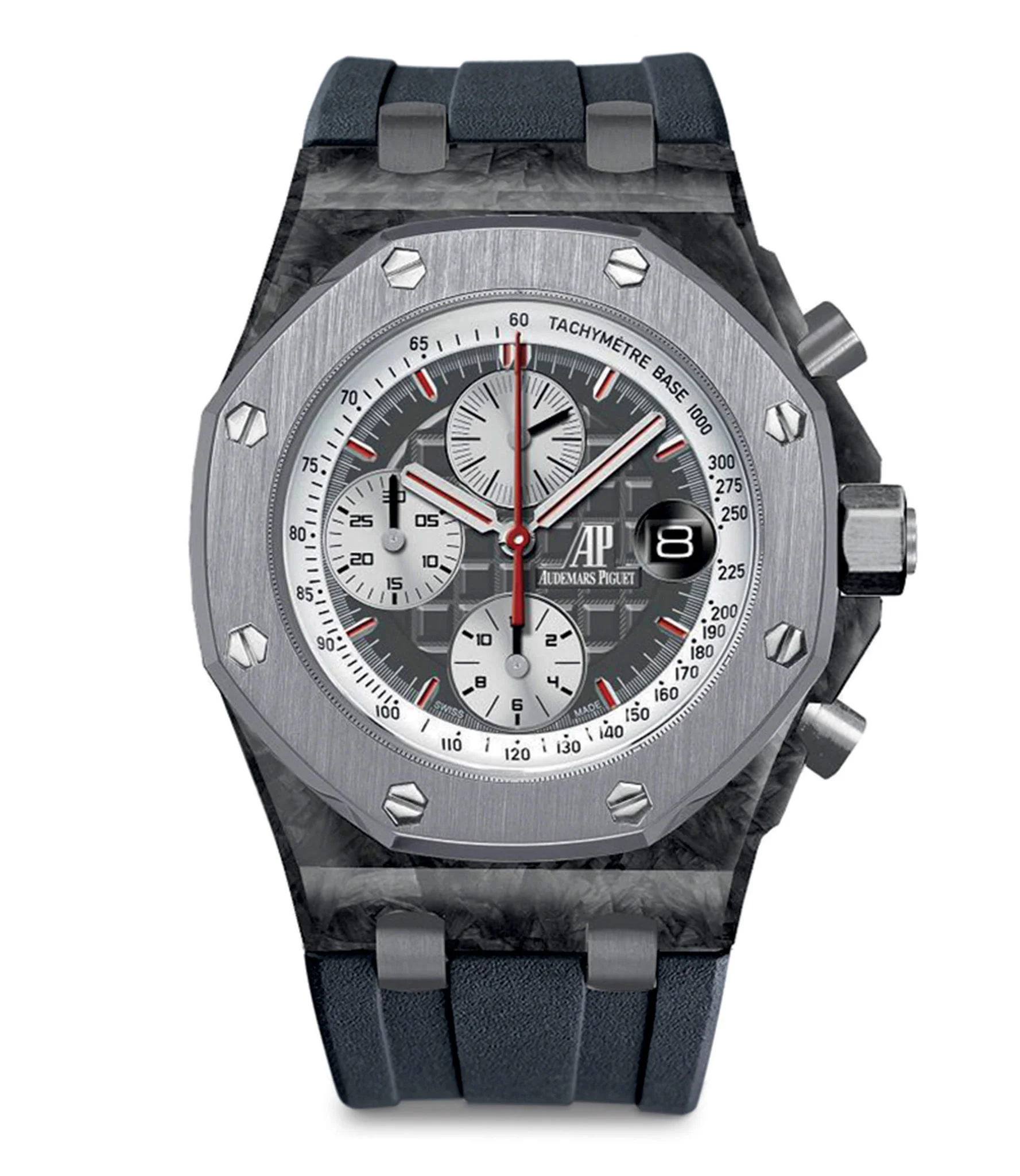
2010. Royal Oak Jarno Trulli 26202AU. Chronograph, date. Selfwinding Calibre 3126/3840, movement 770261. Forged carbon 41 mm case. Cermet bezel. Limited edition of 500 pieces. Prototype. Audemars Piguet Heritage, inv. 1304.
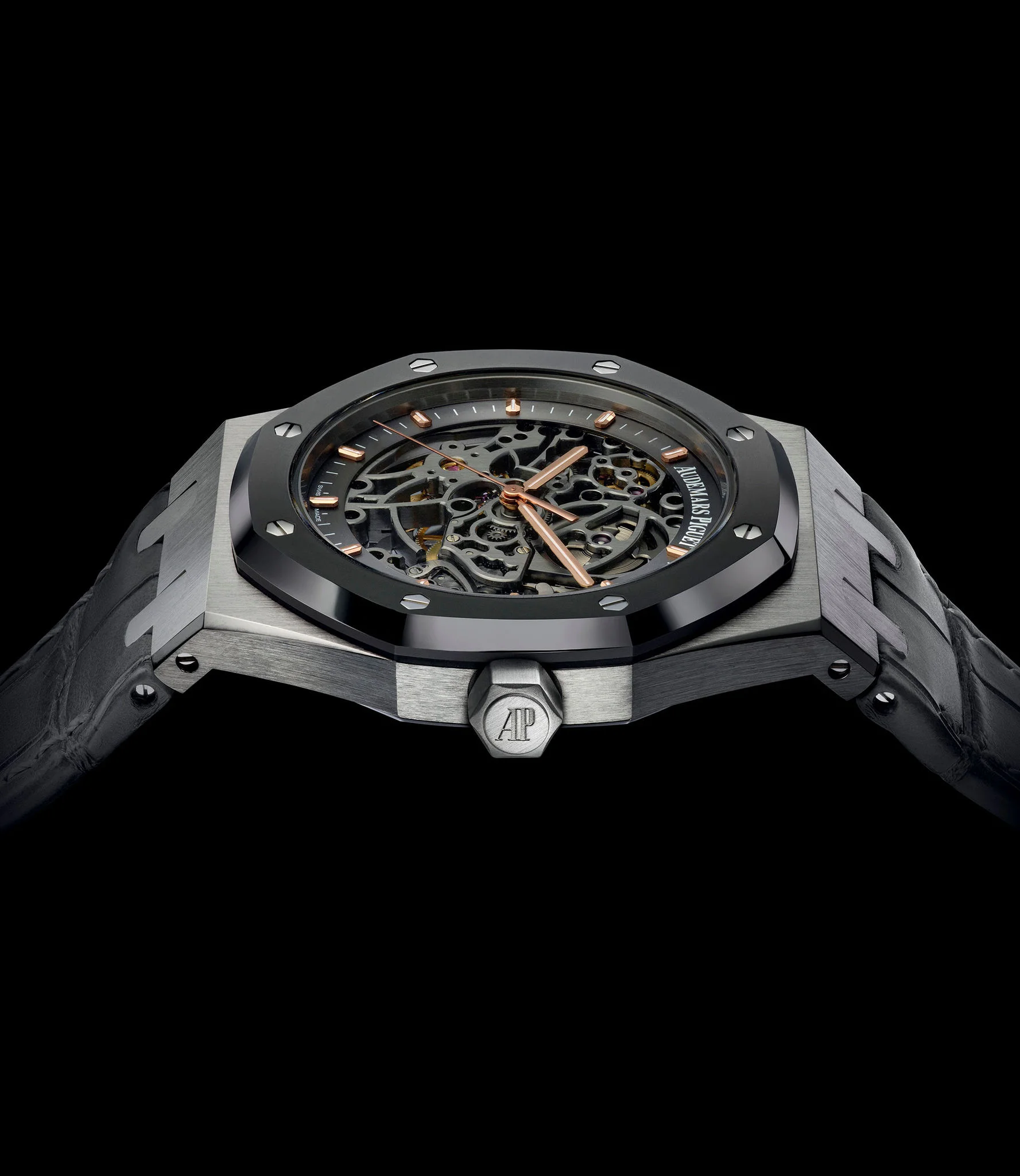
2012. Royal Oak Openworked 15406IM. Blackened PVD-treated openworked Calibre 3129. 41 mm titanium case, cermet bezel. A one-of-a-kind model sold at auction in Singapore as part of the collection’s 40th anniversary celebrations. Picture taken during the watch presentation.
Carbon, forged or woven?
Watchmakers use carbon in two different ways. The most classic is woven carbon fibre. Very long strands of carbon are woven together to form an easily recognisable fabric. This technique borrowed from the automotive world made its first foray into watchmaking in 1998, on the dial of a TAG Heuer watch and on the case of Candino's Carbon Watch.
The second method is called forged carbon. Here, the carbon strands are much shorter and arranged randomly in a resin, so that resistance to torsion is optimal in all directions. Initially used in the aerospace industry, forged carbon was introduced by Audemars Piguet in 2007 on the Royal Oak Offshore Alinghi Team chronograph.
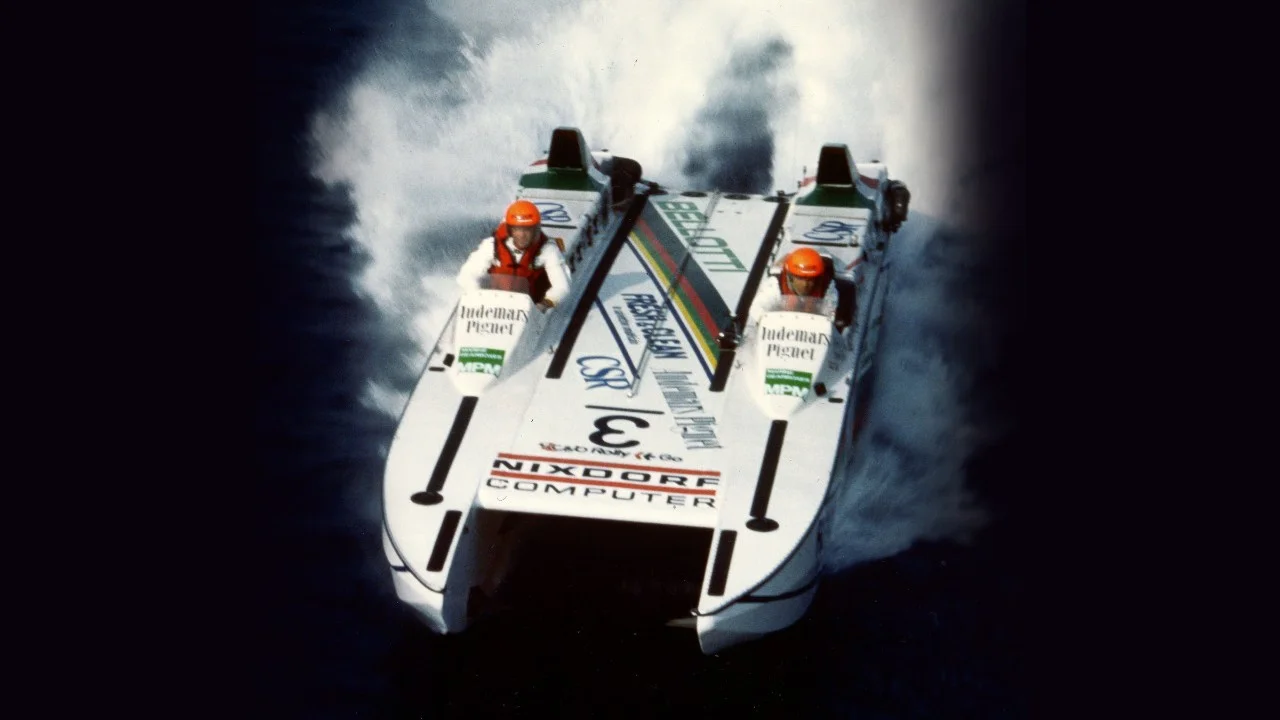
This watch made for the crew of the Swiss boat Alinghi is particularly light and easy to read. The team won the America's Cup, one of the world's most important sailing competitions, giving an extraordinary boost to the brand as well as to forged carbon. Numerous models followed, including the Millenary Carbone One, weighing less than 70 grams.
Forged carbon set a precedent and Richard Mille took the idea a step further in 2010 by creating the world's lightest wristwatch in collaboration with Audemars Piguet Renaud Papi. The RM027 combining carbon with layers of quartz (glass fibres) and worn by tennis player Rafael Nadal weighed a mere 20 grams (without the strap). In just over a decade, dozens of carbon watch variants were developed by Hublot, Panerai, Roger Dubuis, Zenith, Breitling, Girard Perregaux Oris, IWC, Bulgari...
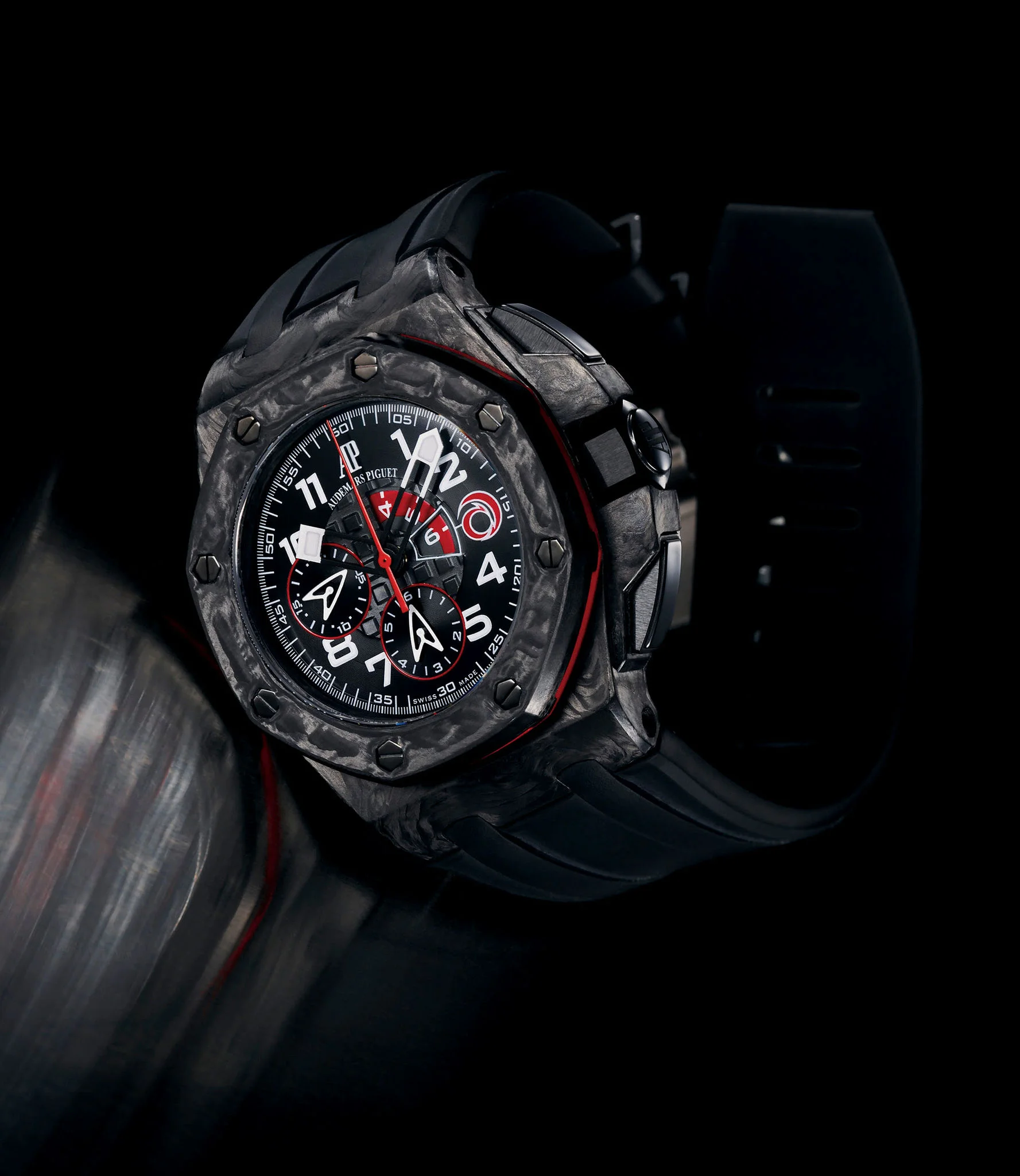
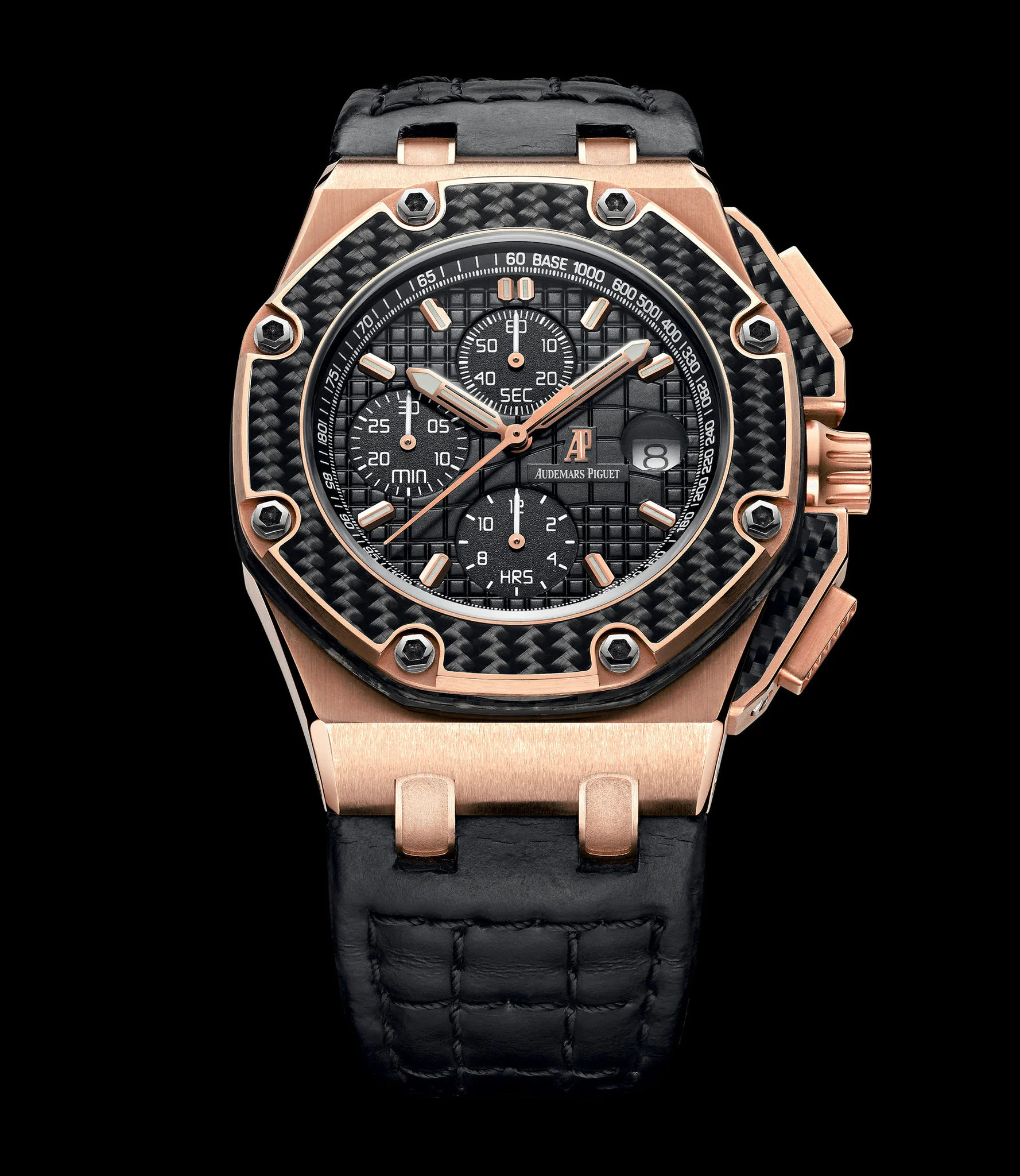
2004. Royal Oak Offshore Juan Pablo Montoya 26030RO. Chronograph, date. Selfwinding Calibre 2226/2840. Platinum 42 mm case, bezel and crown guard covered with woven carbon fibre. Limited edition of 500 pink gold pieces. Prototype. Audemars Piguet Heritage, inv. 648.
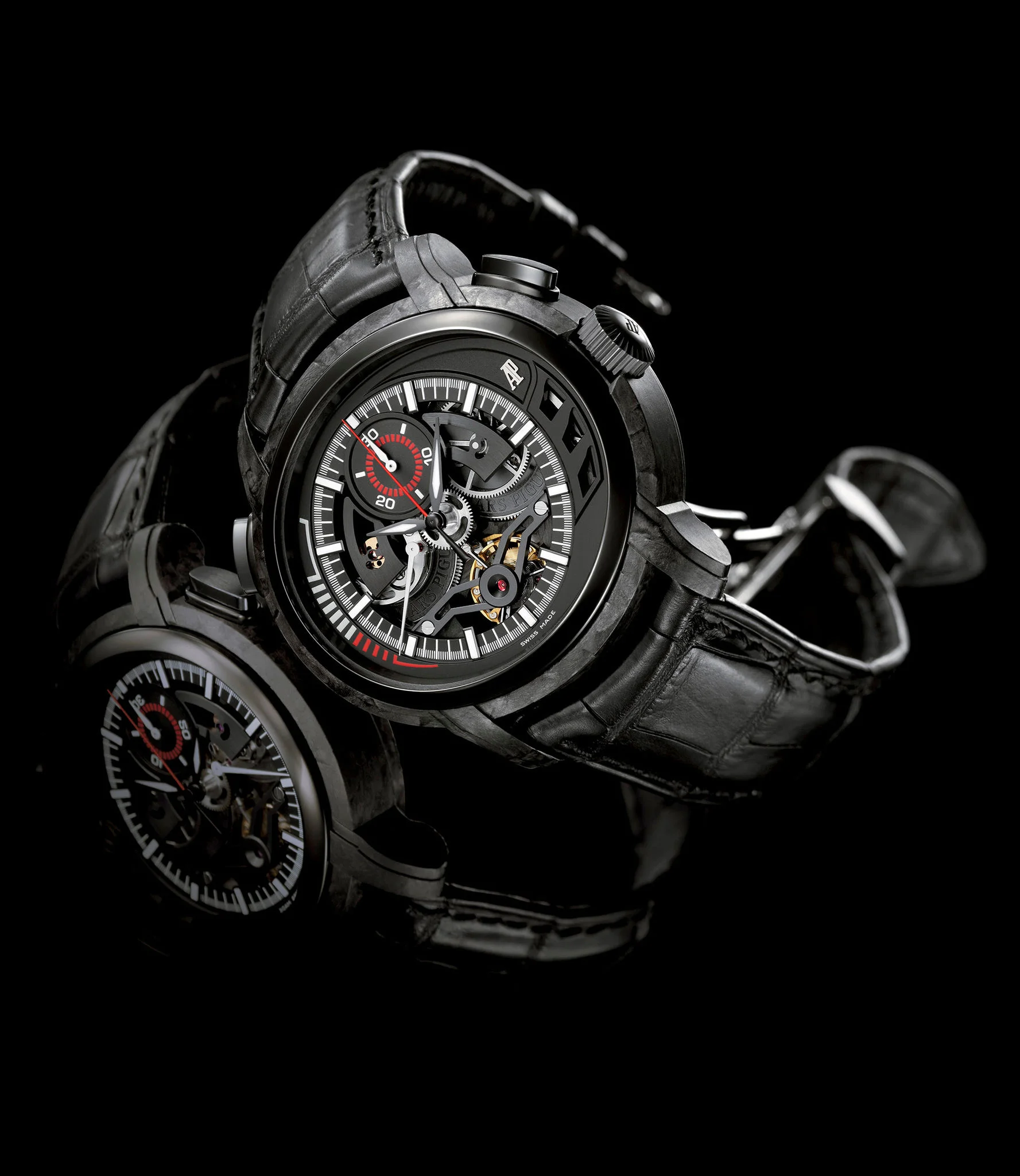
2009. Millenary Carbon One 26152AU. Tourbillon, chronograph, 10-day power reserve. Calibre 2884, carbon baseplate and aluminium bridges. Case in forged carbon and titanium. Limited edition of 120 pieces. Prototype. Audemars Piguet Heritage, inv. 1484.
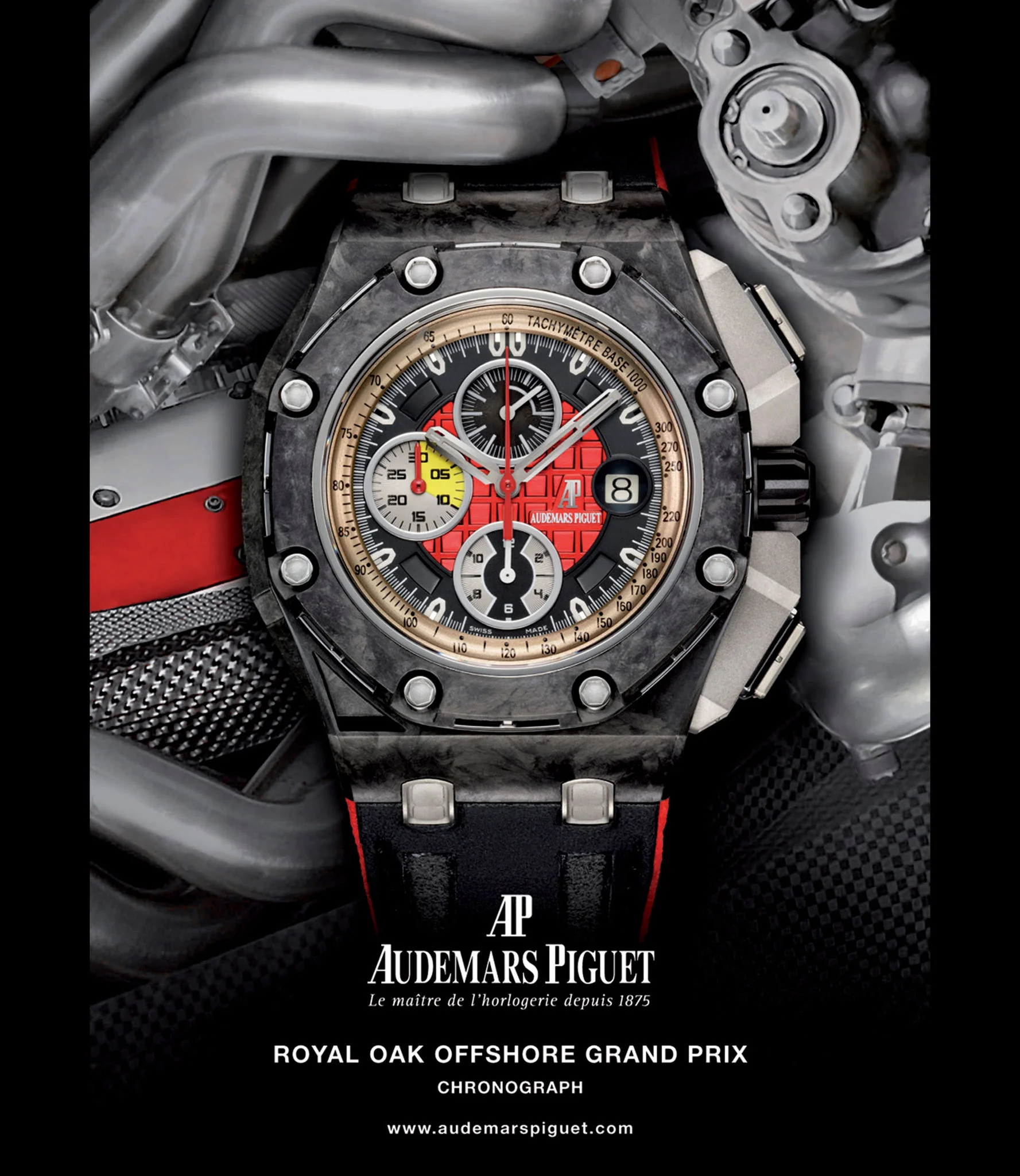
2010. Royal Oak Offshore Grand Prix. Chronograph, date. Selfwinding Calibre 3126/3840. Case in forged carbon, titanium and ceramic, 44 mm. Promotional picture taken in 2010. Audemars Piguet Archives.
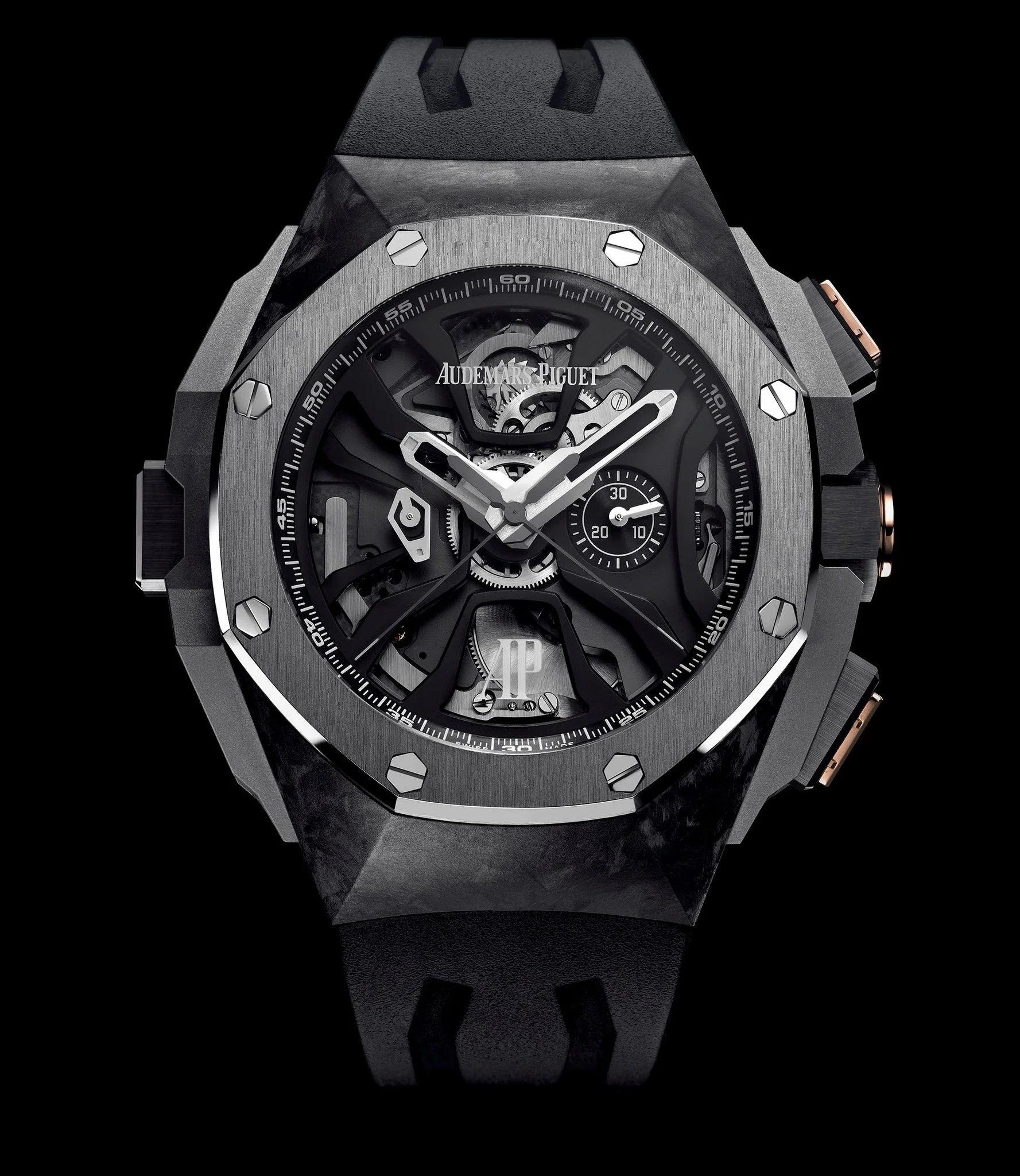
2015. Royal Oak Concept Laptimer 26221FT. Tourbillon, chronograph with measurement of successive laps. Calibre 2923, movement 881688. 44 mm case in forged carbon, titanium, ceramic and pink gold. 221-piece limited edition in partnership with Michael Schumacher, Prototype. Audemars Piguet Heritage, inv. 1842.
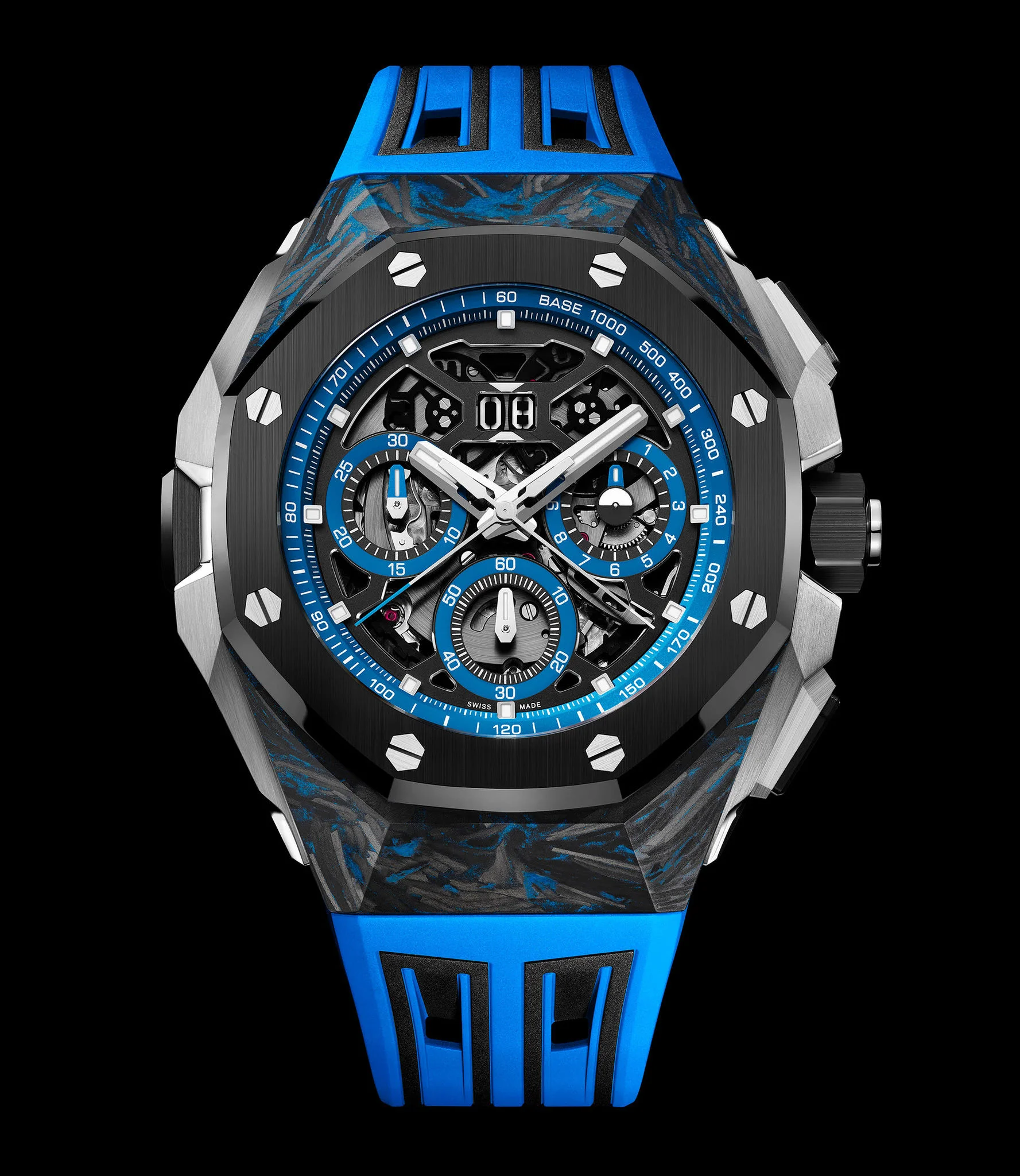
2024. Royal Oak Concept 26650. First model in CFT (chroma forged technology) carbon in black and luminescent blue. Split-seconds flyback chronograph, large date, GMT. Chroma Forged Technology (CFT) case in 43 mm. Selfwinding Calibre 4407.
BMG, metal with a bounce
Metallic glass – or BMG for Bulk Metallic Glass – is a metal that is both very hard and elastic, while also particularly popular in the fields of micromechanics and top-level sports.
There are several types of BMG, because the alloy itself is less important than the manufacturing process when it comes to obtaining this astonishing metal. In the 1960s, researchers discovered that when a metal heated to a liquid state was cooled very suddenly, its structure did not have time to reconstitute itself normally. The molecules freeze so quickly that they retain the disorder of their liquid state – which is very similar to the crystalline structure of glass. BMG is therefore a metal with a glass-like structure.
BMG is greatly valued in the watch industry because the metal obtained is so hard that it is almost scratch-proof. Moreover, if the case sustains a small impact, its elasticity enables an instant return to its original shape.
Introduced by Omega in 2010 and adopted by Panerai, BMG can take different forms. The alloy used by Audemars Piguet since 2021 is the first to be based on precious metals. Palladium gives it high resistance to wear and corrosion, as well as enhanced brilliance. While at first glance, it resembles platinum, BMG is both lighter and stronger.
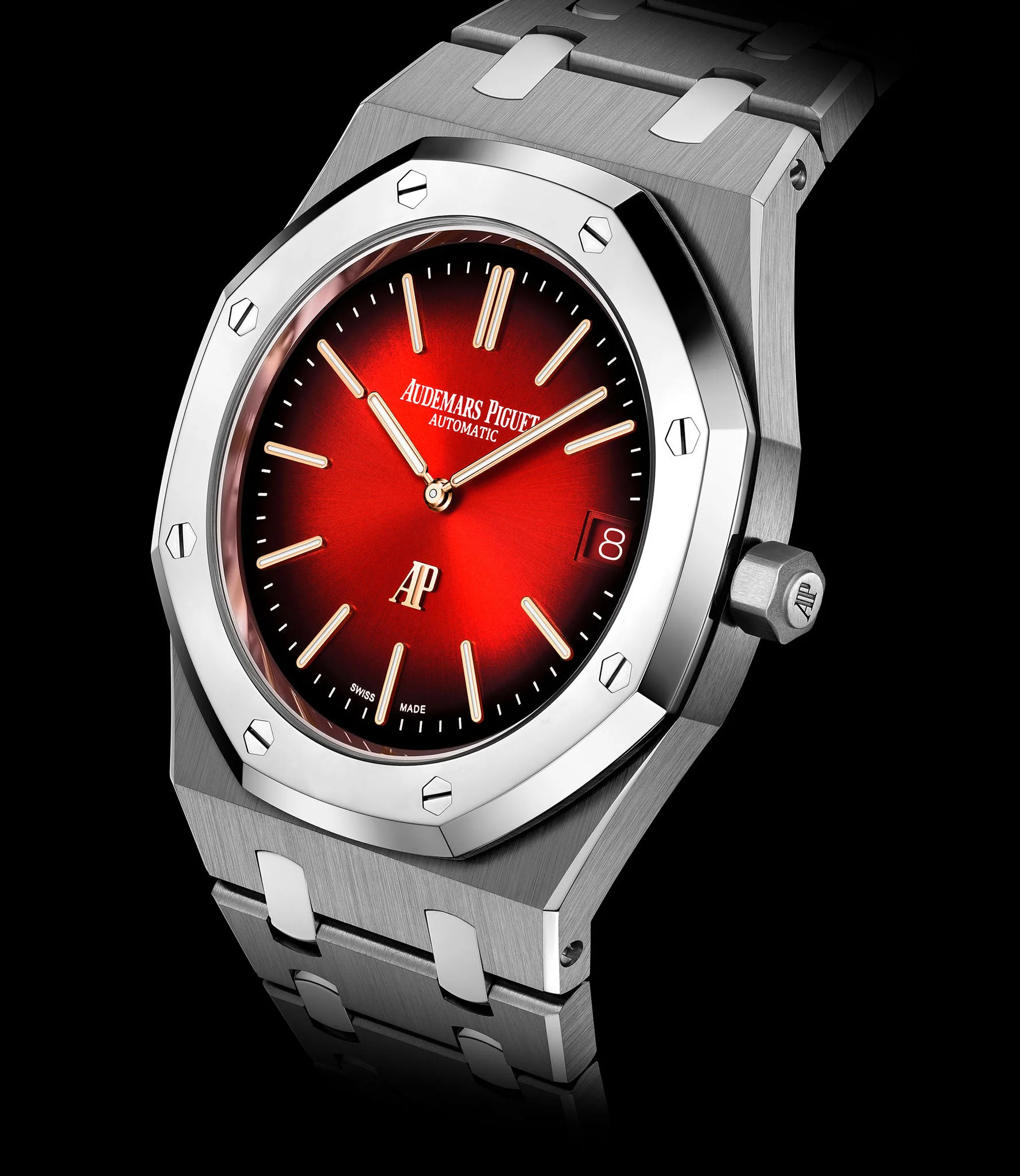
2023. Royal Oak "Jumbo" 16202XT. The first series-produced model to incorporate palladium-based metallic glass. Date. Selfwinding Calibre 7121. Case in titanium and BMG, 39 mm. Picture taken at the model launch.
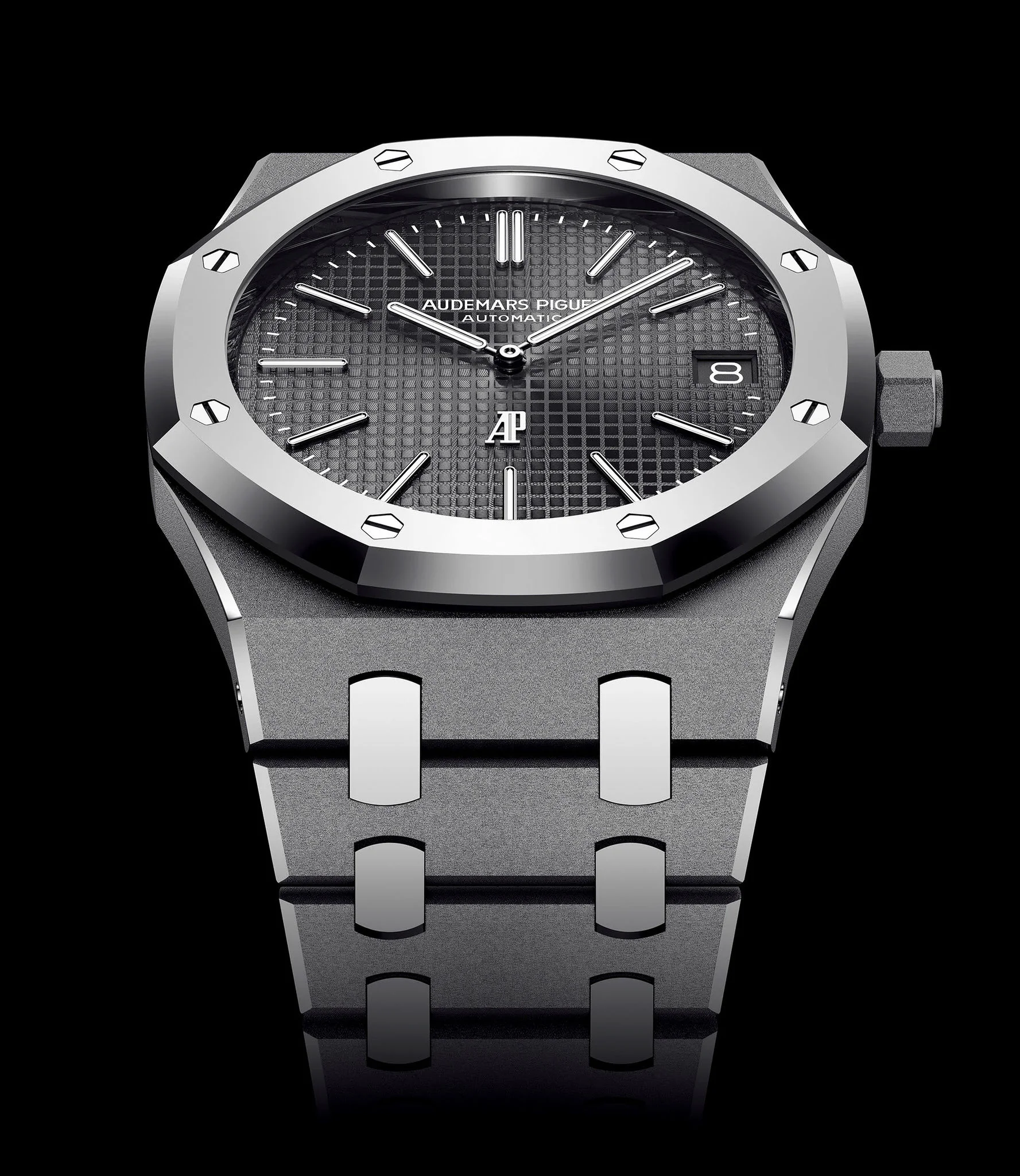
2021. Royal Oak "Jumbo" 15202XT. The first Audemars Piguet watch to feature BMG in its exterior components. Marked Pd500 by the Swiss Precious Metals Control office, the alloy contains at least 50% palladium. Date. Calibre 2121. Case in sandblasted titanium and polished BMG, 39 mm. One-of-a-kind model donated by Audemars Piguet for the Only Watch charity auction. Picture taken at the watch presentation.
Chroma, or the marriage of colours
The same material may have several different colours. Ceramics, for example, can be blue, green or black... However, until now, each component had a single uniform colour, because each one begins by being formed at such a high temperature that it melts and all the elements it contains blend together before hardening as it cools. This is somewhat like a syrup that hardens as it freezes. The traditional method of combining them afterwards is to weld or glue the components together.
In 2019, Audemars Piguet's materials engineers took on the chroma project. The aim was to create components juxtaposing several colours, or even several materials, while remaining perfectly homogeneous. The method is called "SPS", for Spark Plasma Sintering. Notably used in the aerospace industry, SPS technology bonds materials so intimately that they become totally inseparable, while remaining visually and physically distinct.
In 2024, Audemars Piguet presented the first results of this research, including the first polychrome ceramic prototype, as well as watch prototypes combining different-coloured golds. This heralds a new chapter in the history of materials, opening up whole new realms of possibility.
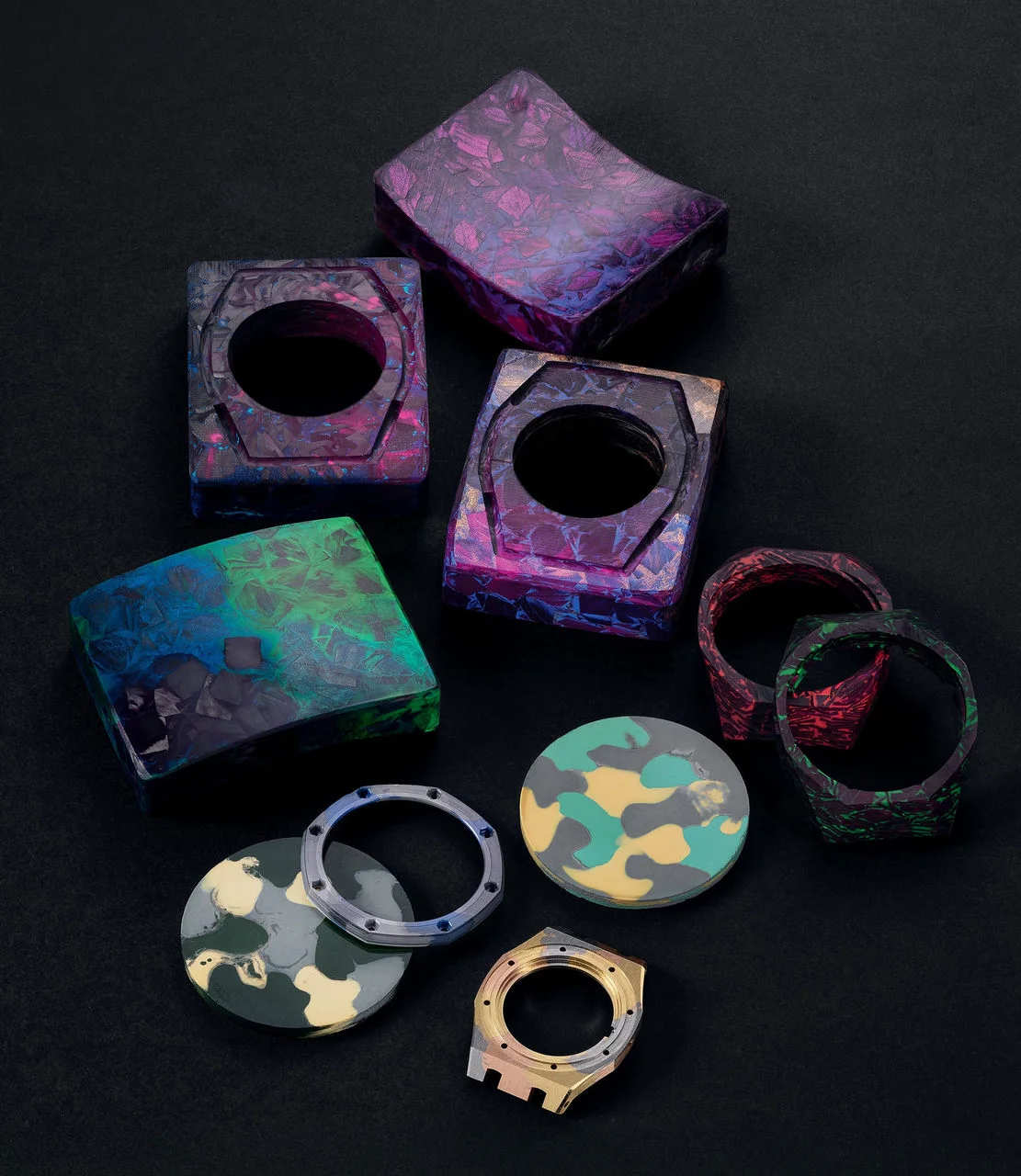
2024. Prototypes. As part of the Chroma project, the materials laboratory carried out dozens of tests on combinations of materials, including carbon, ceramics and gold.
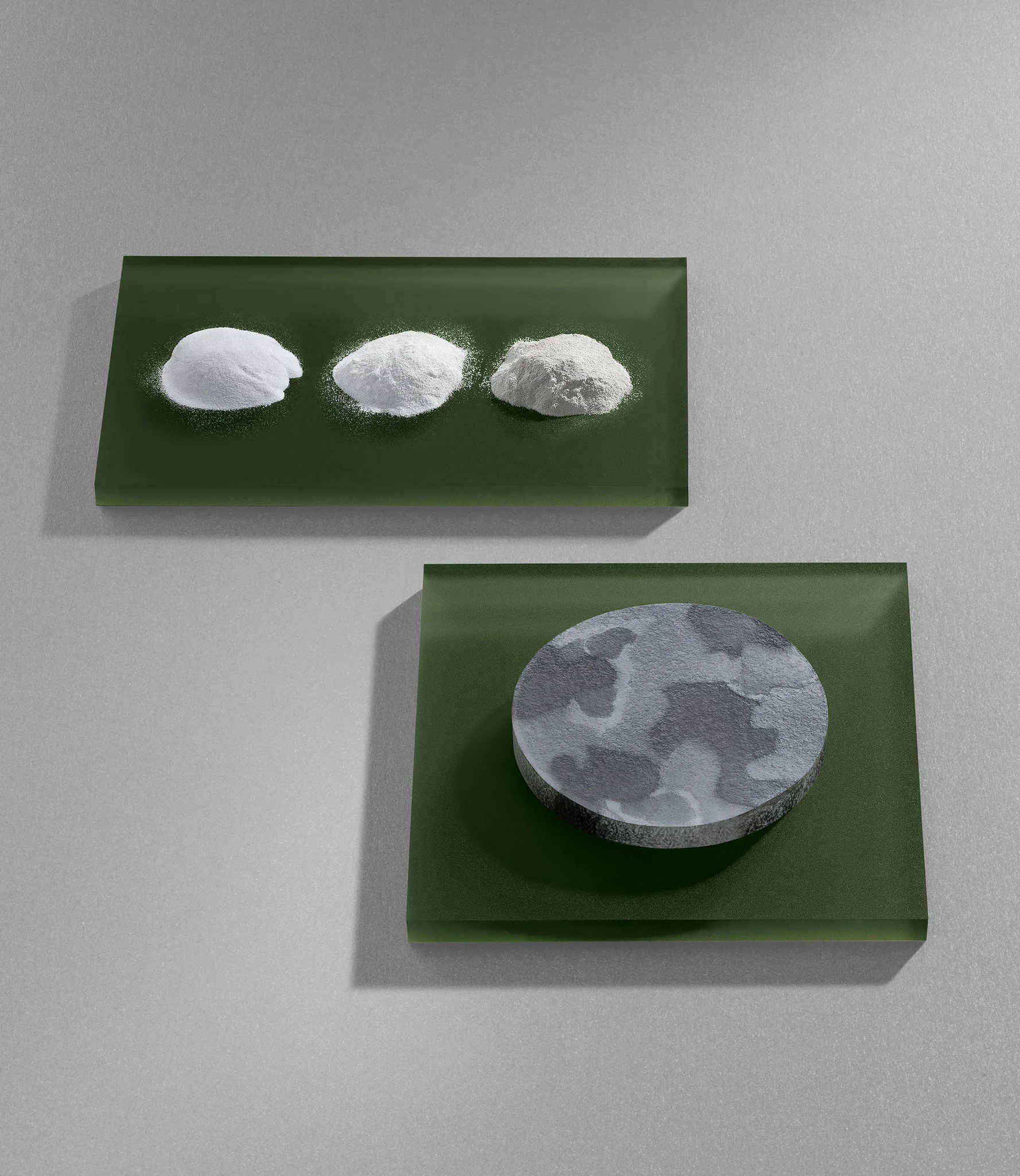
2024. Chroma ceramics This ceramic is composed of powders (top) placed in graphite moulds, heated at very high speed by an electric current to enable rapid sintering under pressure that does not mix the colours. Despite the variations in colour (as shown in the lower picture), the disc is physically perfectly homogeneous.
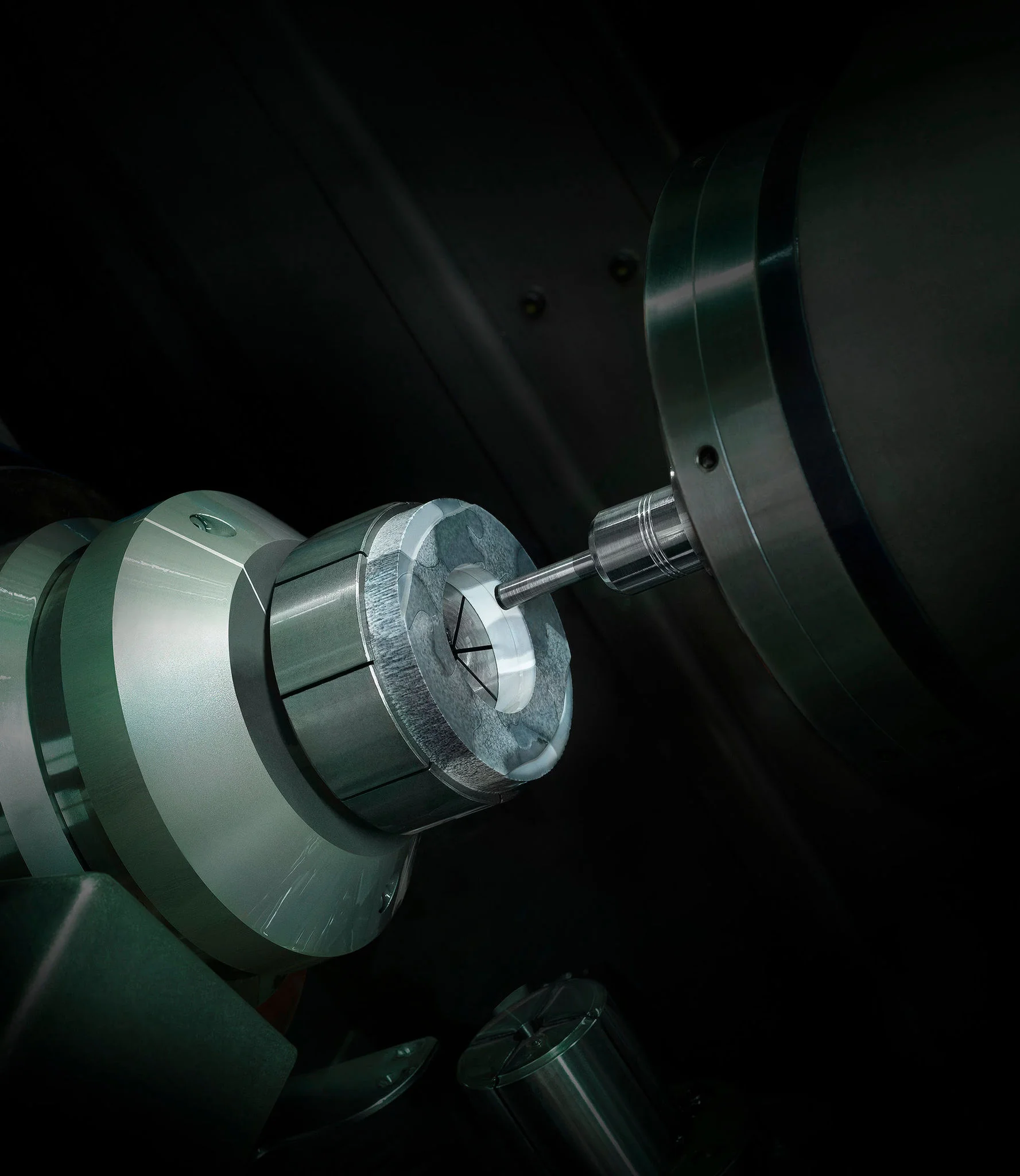
2024. Machining of polychrome ceramic, known as “chroma”
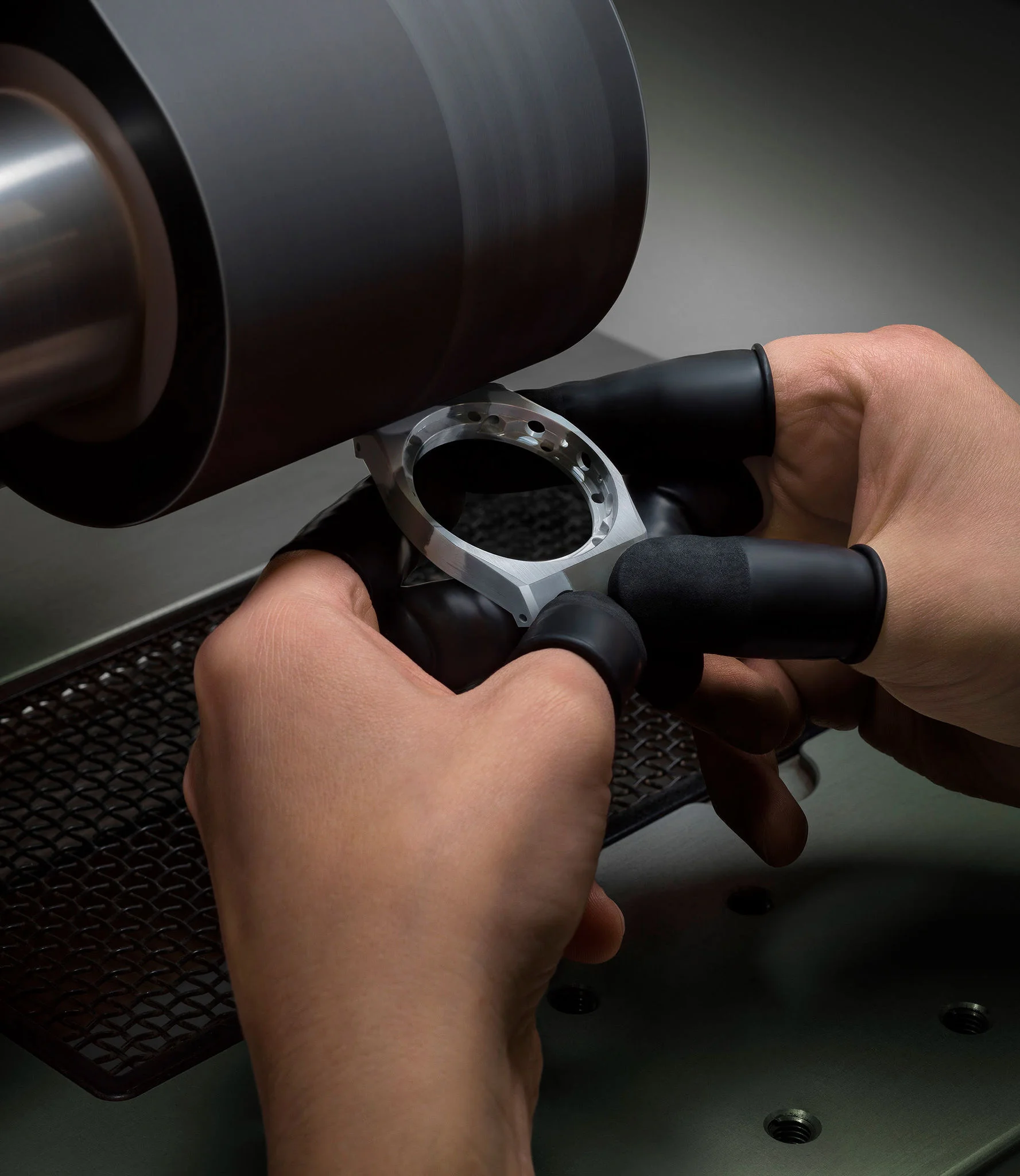
2024. Satin brushing of the polychrome ceramic, known as “chroma”
Audemars Piguet Heritage Team, May 2024