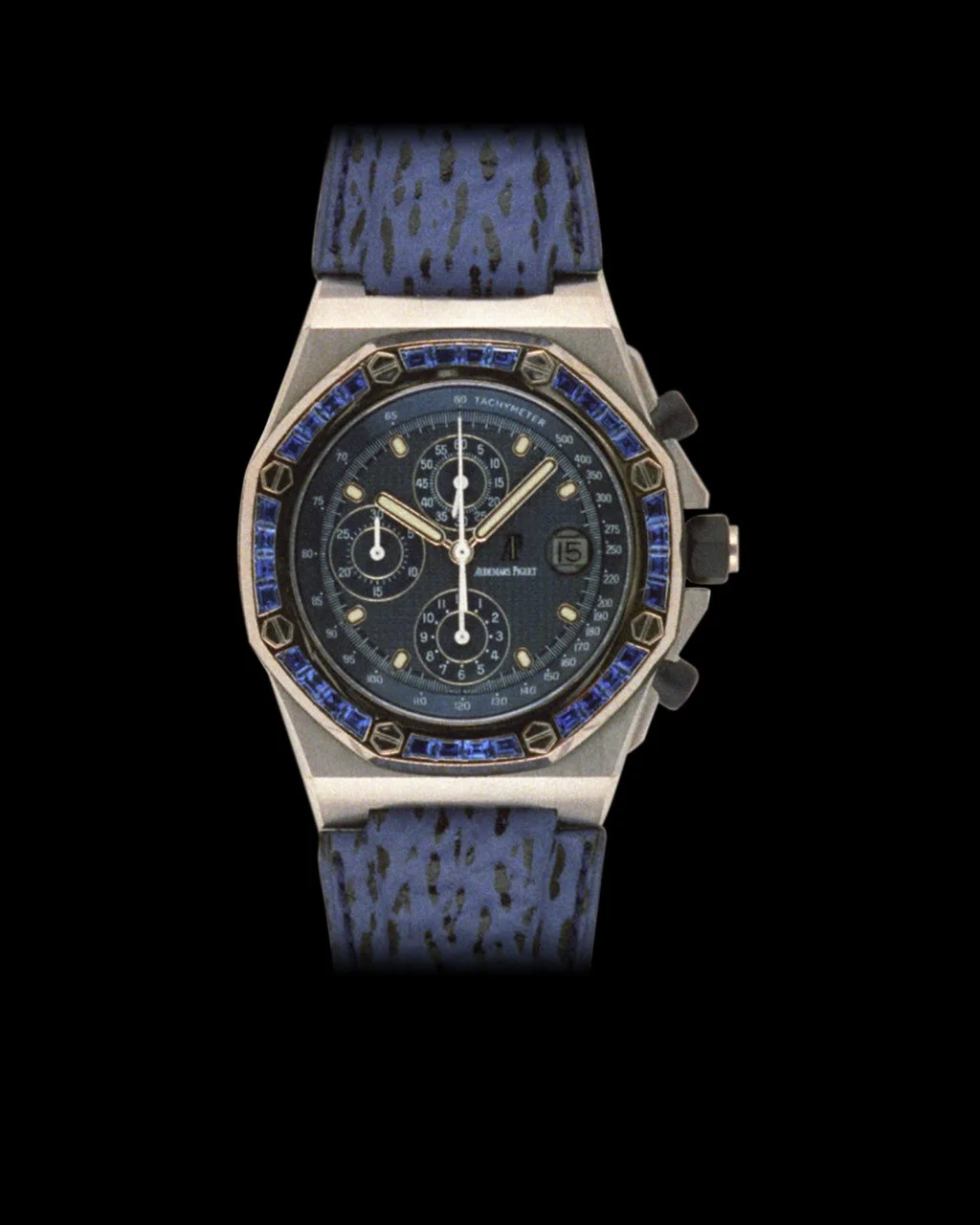
25721, FIRST ROYAL OAK OFFSHORE

1993. Press Release 25721. Photograph illustrating the press release issued on the occasion of the 1993 Basel Fair to support the launch of the first Royal Oak Offshore. Audemars Piguet Archives

1993. Press Release 25721. Press release issued on the occasion of the 1993 Basel Fair to support the launch of the first Royal Oak Offshore. Audemars Piguet Archives

1993. Exploded view of the Royal Oak Offshore 25721. Audemars Piguet Archives

1994. Royal Oak Offshore advertisement for Italy. Audemars Piguet Archives
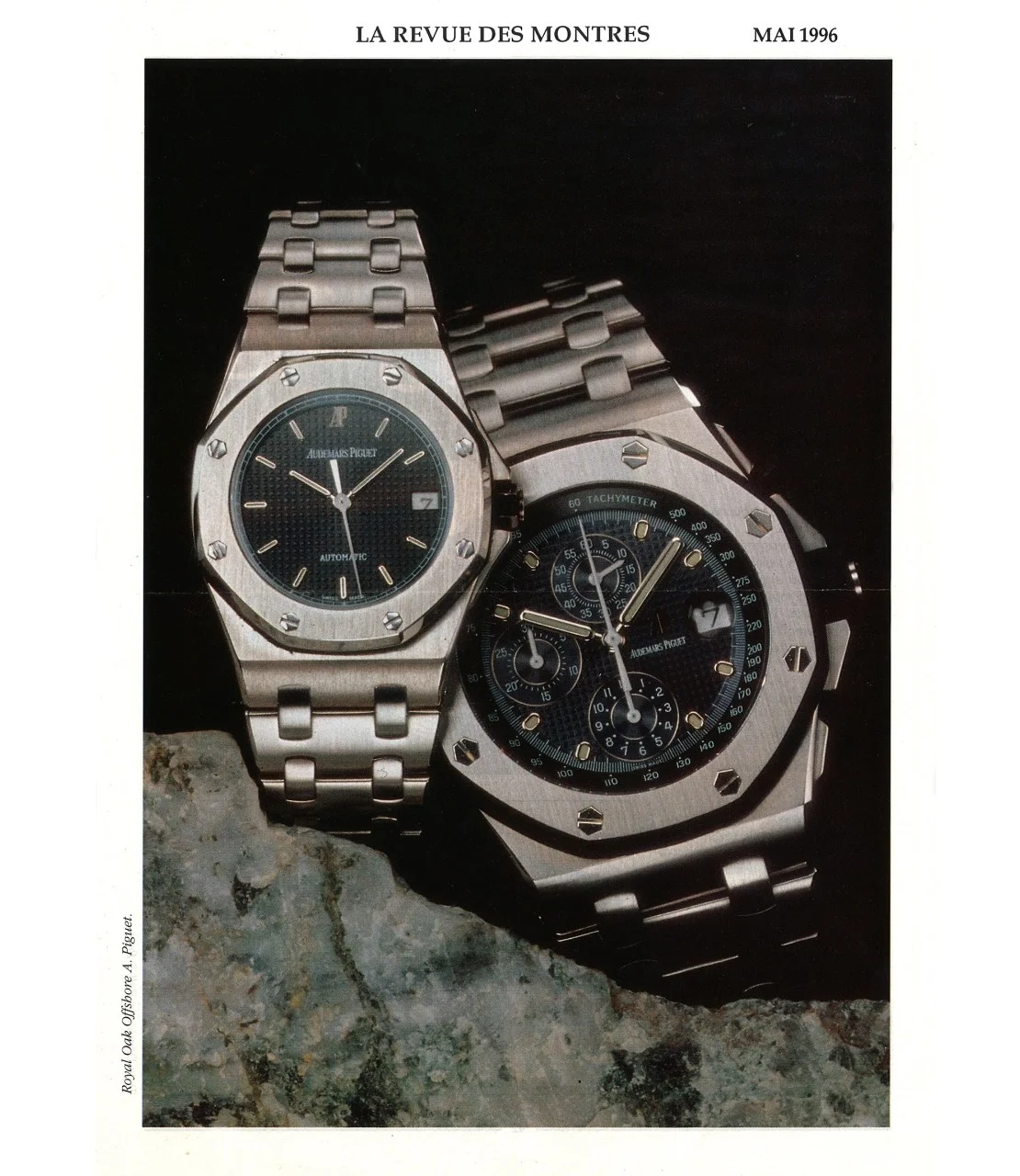
1996. Royal Oak Offshore advertisements 25721 and 79290. Advertisement published in La Revue des montres in May 1996. Audemars Piguet Archives

1993. Royal Oak Offshore 25721 in its presentation box. The first presentation box of the Royal Oak Offshore was octagonal-shaped and its lid featured a glass pane creating a porthole effect. Audemars Piguet Heritage, inv. 1382.

2001. Advertisement for Model 25721 Hobart Yacht Race. Audemars Piguet Archives.
Born from the demand of the German market for a watch imbued with the "Offshore spirit", as well as the desire to rejuvenate the Royal Oak collection, Model 25721 created a scandal when it was launched at the Basel Fair in April 1993 (this story is told in detail here). At that time, the average size of men's watches was around 36 mm in diameter. With its 42 mm diameter and 14.05 mm thickness, the first Royal Oak Offshore was considered outrageous. Not to mention the huge water-resistance gasket protruding from its bezel. Its price is also shocking because its price tag was CHF 16,600, i.e. twice that of a classic Royal Oak. This was due on the one hand to the extreme complexity of its case water-resistant to 100 metres; and on the other to its selfwinding chronograph mechanism, a first in the Royal Oak family.
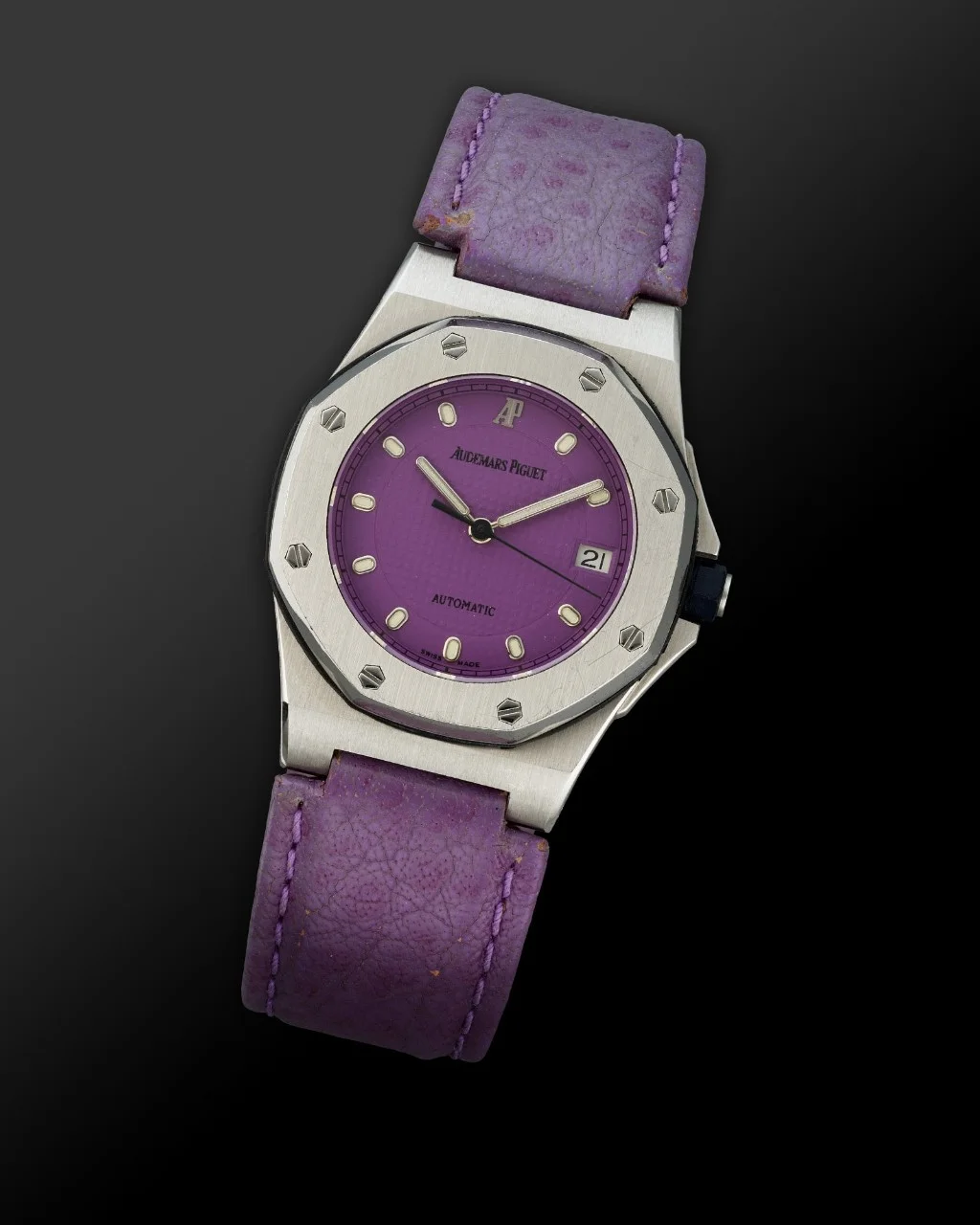
During its first three years, it won over only a very limited circle of customers – most of them young and notably based in Italy – who paved the way for its spectacular and unexpected success. From 1995, it was available in precious materials. The following year, it was enriched with women's models (30 mm), medium-sized models (38 mm) and leather strap variants, soon followed by rubber strap versions and limited editions. In the 2000s, the collection became so important that sales outnumbered those of the Royal Oak. It gradually led the entire watch industry to join the bandwagon of oversized watches, a segment for which it effectively blazed the trail.
Model 25721 was marketed for over 20 years, in a run of 10,896 watches. Equipped with multiple dials, it was interpreted in eight material variants, mainly in steel (7,308 units) and titanium (2,914 units from 1998 onwards), but also in yellow gold (589), complemented by a few very rare variants: two-tone (64 in steel/yellow gold; one in steel/pink gold), white gold (21), platinum (10) and one in blackened steel.
Part of the Audemars Piguet Catalogue for 19 years, Model 25721 disappeared in 2011, giving way to the Royal Oak Offshore 26170, which differs from it in that it replaced Calibre 2326/2840 (and its predecessors 2126/2840 and 2226/2840) – which teamed a Jaeger-LeCoultre movement "ébauche" with a Dubois Dépraz under-dial work – with Calibre 3126/2840, of which the base movement was developed and produced by Audemars Piguet.
10,896 units were delivered between 1993 and 2016, of which 61 (1993), 333 (1994), 323 (1995), 206 (1996), 293 (1997), 538 (1998), 702 (1999), 709 (2000), 539 (2001), 607 (2002), 720 (2003), 1071 (2004), 1091 (2005), 1487 (2006), 1086 (2007), 504 (2008), 547 (2009), 49 (2010) 6 (2011), 5 (2012), 2 (2013), 15 (2014) and 2 (2016).
Born from the demand of the German market for a watch imbued with the "Offshore spirit", as well as the desire to rejuvenate the Royal Oak collection, Model 25721 created a scandal when it was launched at the Basel Fair in April 1993 (this story is told in detail here). At that time, the average size of men's watches was around 36 mm in diameter. With its 42 mm diameter and 14.05 mm thickness, the first Royal Oak Offshore was considered outrageous. Not to mention the huge water-resistance gasket protruding from its bezel. Its price is also shocking because its price tag was CHF 16,600, i.e. twice that of a classic Royal Oak. This was due on the one hand to the extreme complexity of its case water-resistant to 100 metres; and on the other to its selfwinding chronograph mechanism, a first in the Royal Oak family.
During its first three years, it won over only a very limited circle of customers – most of them young and notably based in Italy – who paved the way for its spectacular and unexpected success. From 1995, it was available in precious materials. The following year, it was enriched with women's models (30 mm), medium-sized models (38 mm) and leather strap variants, soon followed by rubber strap versions and limited editions. In the 2000s, the collection became so important that sales outnumbered those of the Royal Oak. It gradually led the entire watch industry to join the bandwagon of oversized watches, a segment for which it effectively blazed the trail.
Model 25721 was marketed for over 20 years, in a run of 10,896 watches. Equipped with multiple dials, it was interpreted in eight material variants, mainly in steel (7,308 units) and titanium (2,914 units from 1998 onwards), but also in yellow gold (589), complemented by a few very rare variants: two-tone (64 in steel/yellow gold; one in steel/pink gold), white gold (21), platinum (10) and one in blackened steel.
Part of the Audemars Piguet Catalogue for 19 years, Model 25721 disappeared in 2011, giving way to the Royal Oak Offshore 26170, which differs from it in that it replaced Calibre 2326/2840 (and its predecessors 2126/2840 and 2226/2840) – which teamed a Jaeger-LeCoultre movement "ébauche" with a Dubois Dépraz under-dial work – with Calibre 3126/2840, of which the base movement was developed and produced by Audemars Piguet.
10,896 units were delivered between 1993 and 2016, of which 61 (1993), 333 (1994), 323 (1995), 206 (1996), 293 (1997), 538 (1998), 702 (1999), 709 (2000), 539 (2001), 607 (2002), 720 (2003), 1071 (2004), 1091 (2005), 1487 (2006), 1086 (2007), 504 (2008), 547 (2009), 49 (2010) 6 (2011), 5 (2012), 2 (2013), 15 (2014) and 2 (2016).
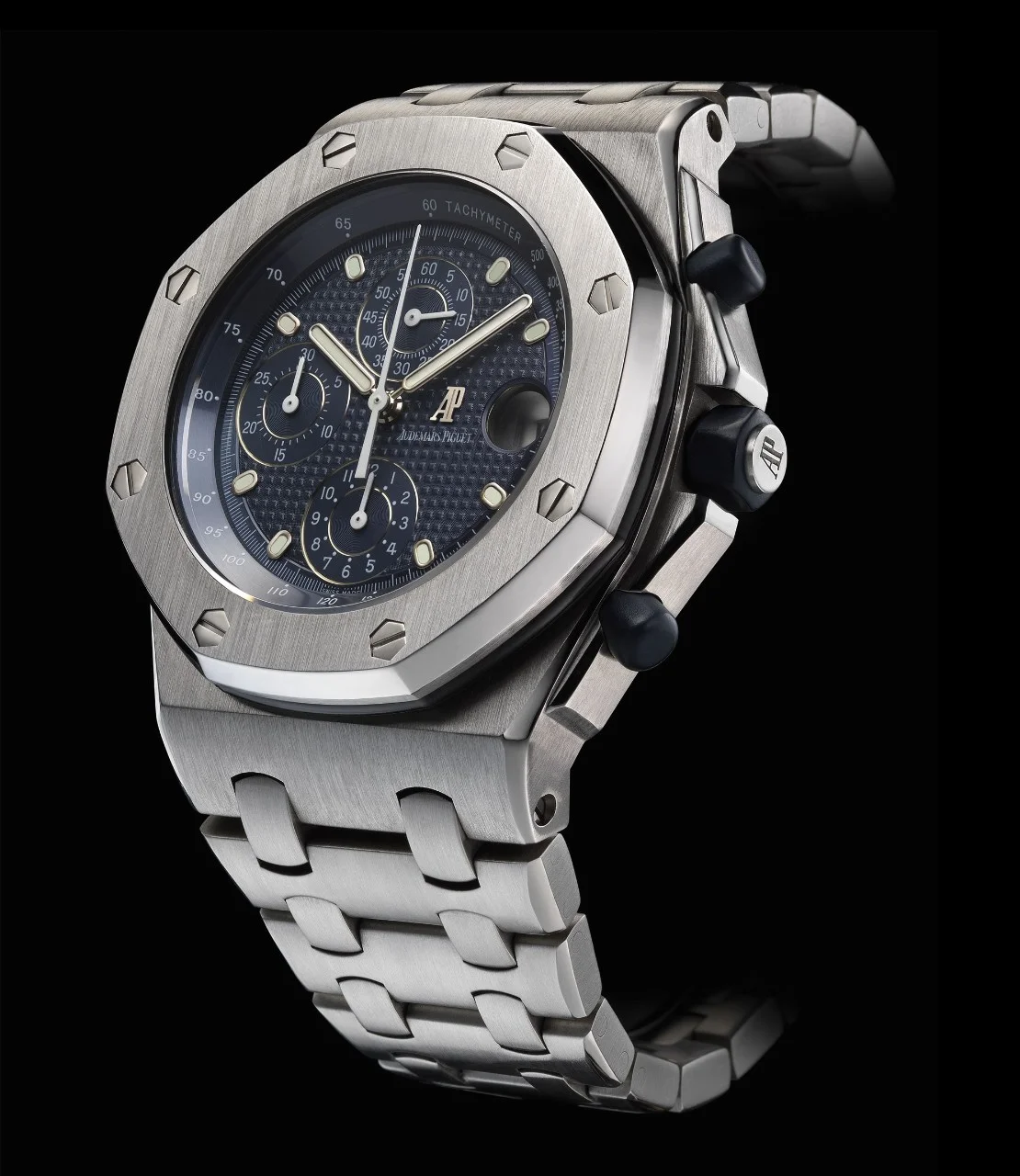
1993. Royal Oak Offshore 25721 No. 32. Chronograph, selfwinding, PetiteTapisserie dial. Like the first 100 examples of Model 25721, this watch has a Royal Oak engraving on the caseback, with no indication of the word Offshore. Calibre 2126/2840, Movement No. 369368. 42mm x 14.05mm steel Case No. D23775. Sold in Italy on December 13, 1993. Audemars Piguet Heritage, inv. 1382.

1993. Royal Oak Offshore 25721 No. 32. To secure the watch firmly to the wrist despite its considerable weight, the first Royal Oak Offshore was fitted with a special double folding clasp. Audemars Piguet Heritage, inv. 1382.
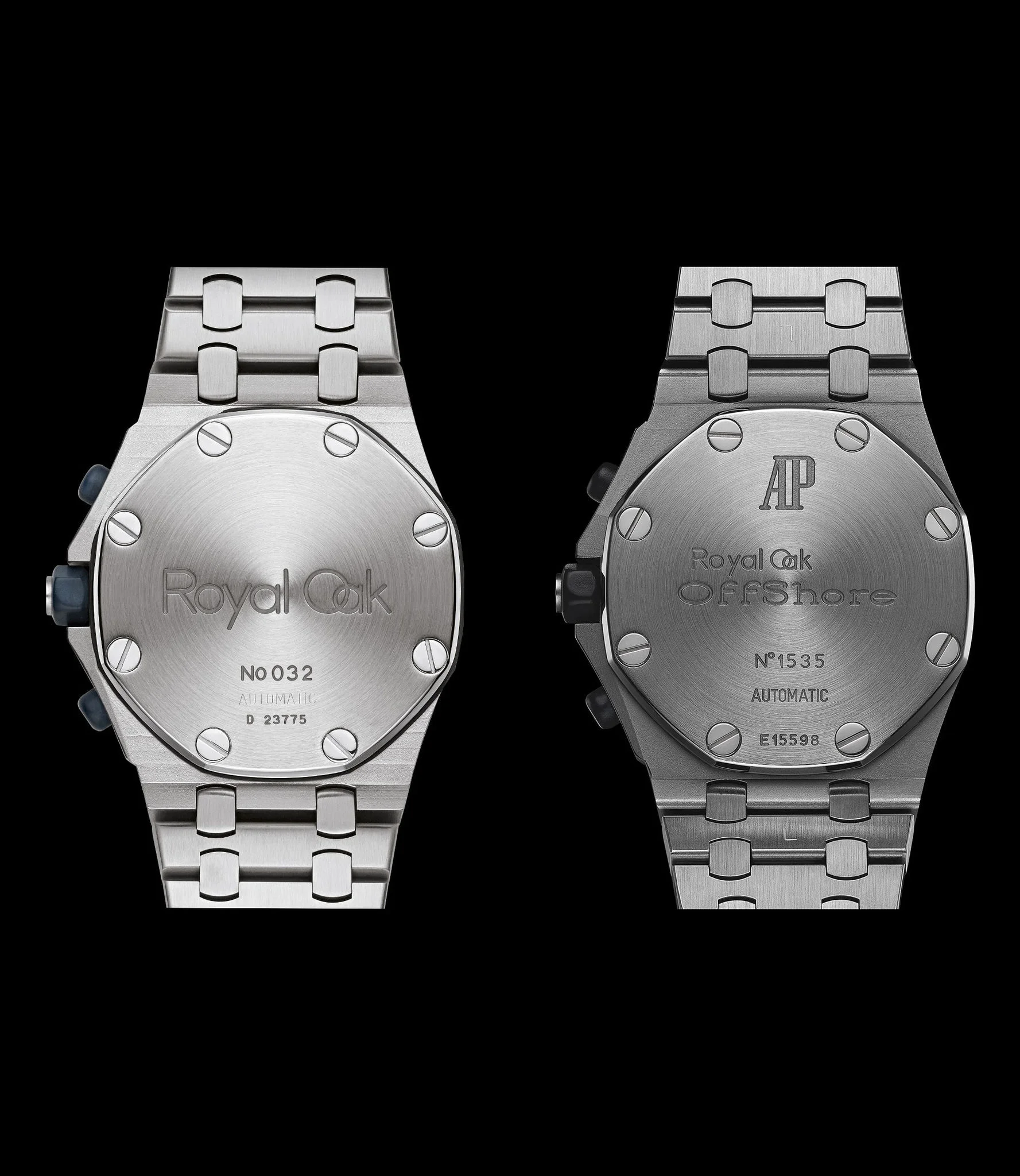
1993 and 1994. Royal Oak Offshore 25721 engravings. The first 100 examples of Model 25721 do not have the word Offshore engraved on the back. Left, No. 32 sold in Italy on December 12, 1993, Inv. 1382. Right, No. 208 sold on June 29, 1994 in Spain, Inv. 1879. Audemars Piguet Heritage.
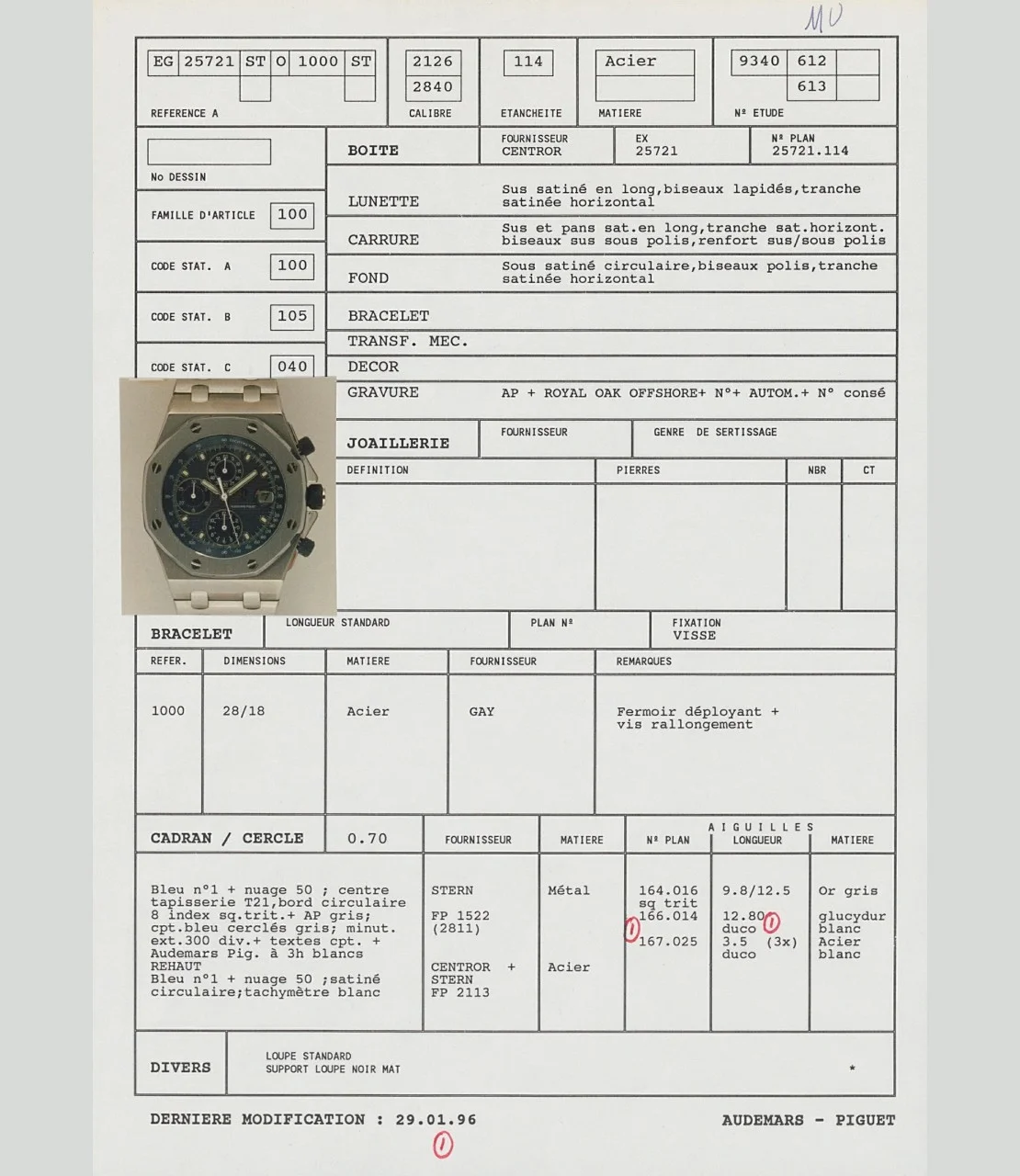
Circa 1993. Technical data for Model 25721ST. Audemars Piguet Archives
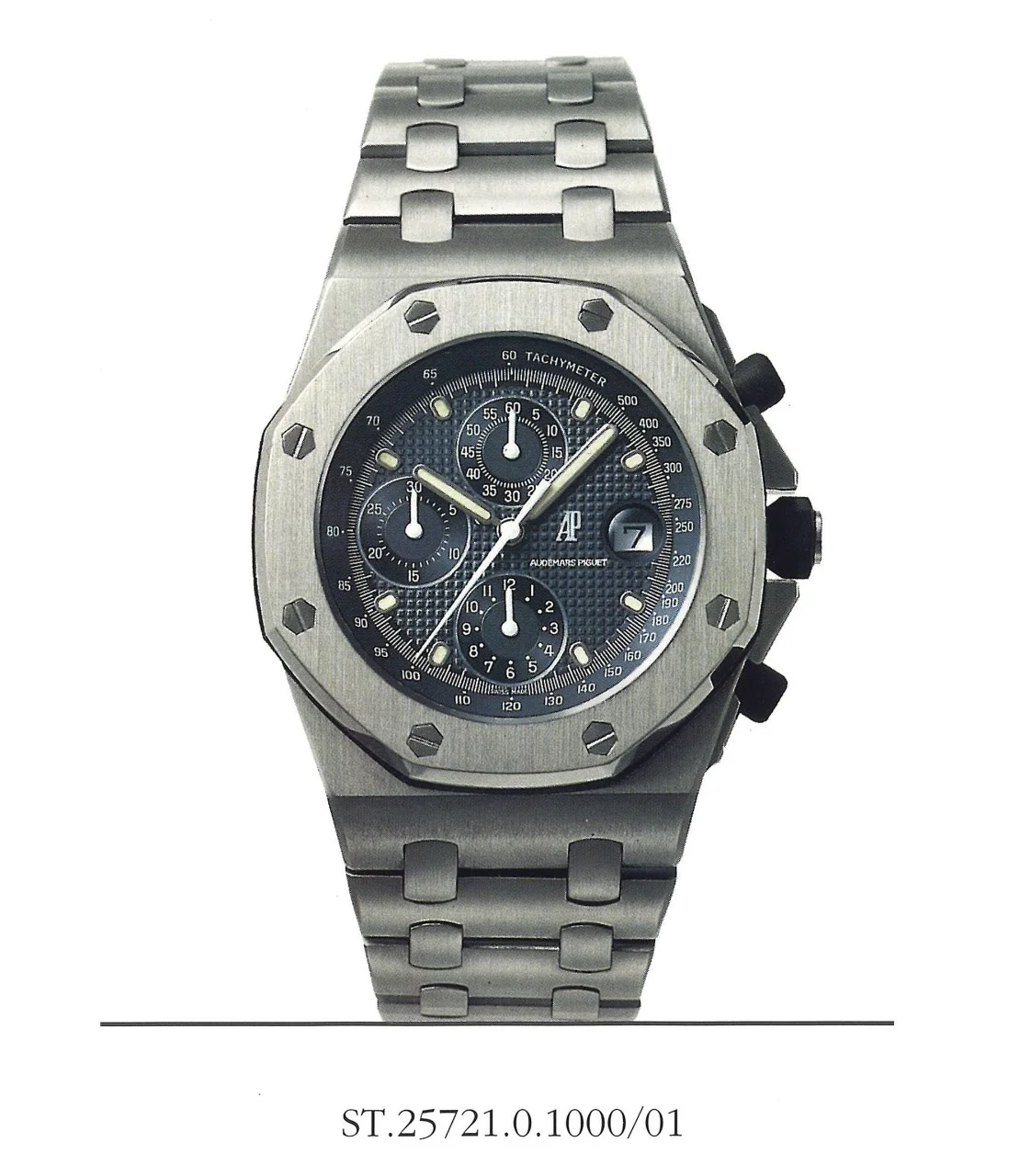
1994, Royal Oak Offshore Chronograph 25721ST. The first variant of the model remained in the Audemars Piguet catalogue from 1996 to 2004. Dial 01. Advertising brochure 1994. Audemars Piguet Archives

Circa 1993. Identification images of Model 25721ST. Dial variations. Audemars Piguet Archives.
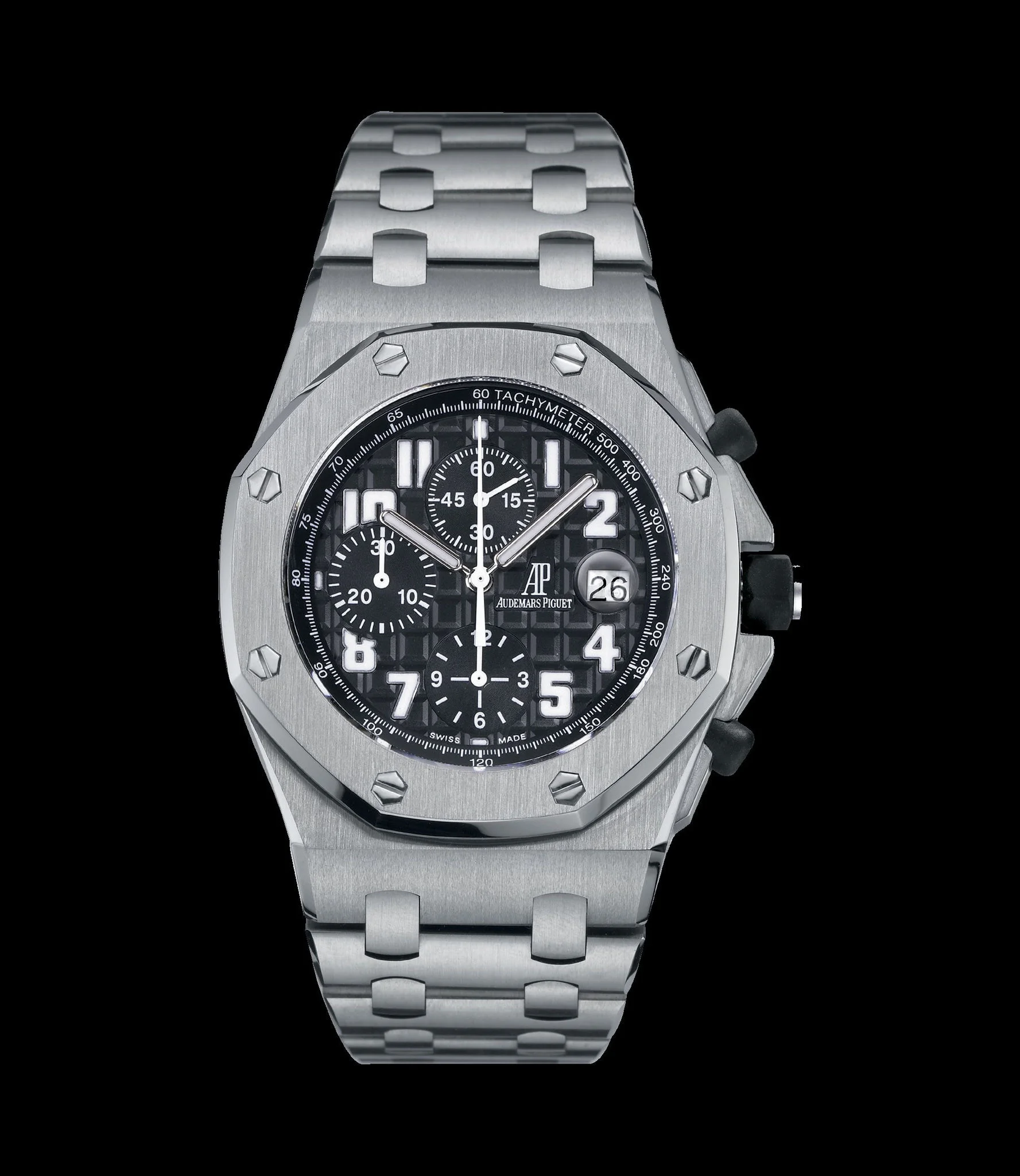
2002. Royal Oak Offshore Chronograph 25721ST. Variant published in the Audemars Piguet Catalogue from 2002 to 2004. Dial 05. Audemars Piguet Archives.
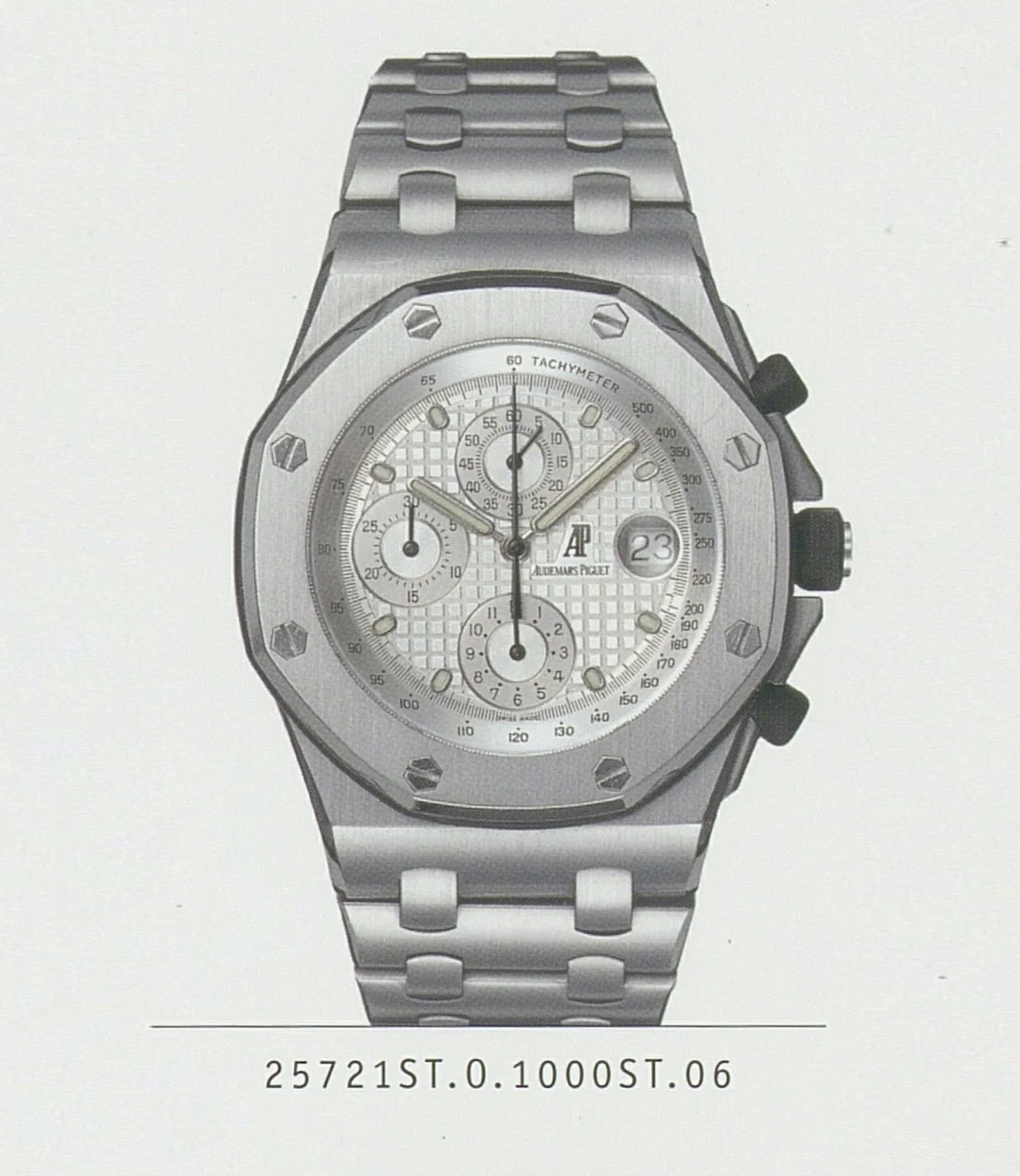
2002. Royal Oak Offshore Chronograph 25721ST. Grande Tapisserie dial. Variant published in the Audemars Piguet catalogue from 2002 to 2004. Dial 06. Audemars Piguet Archives.
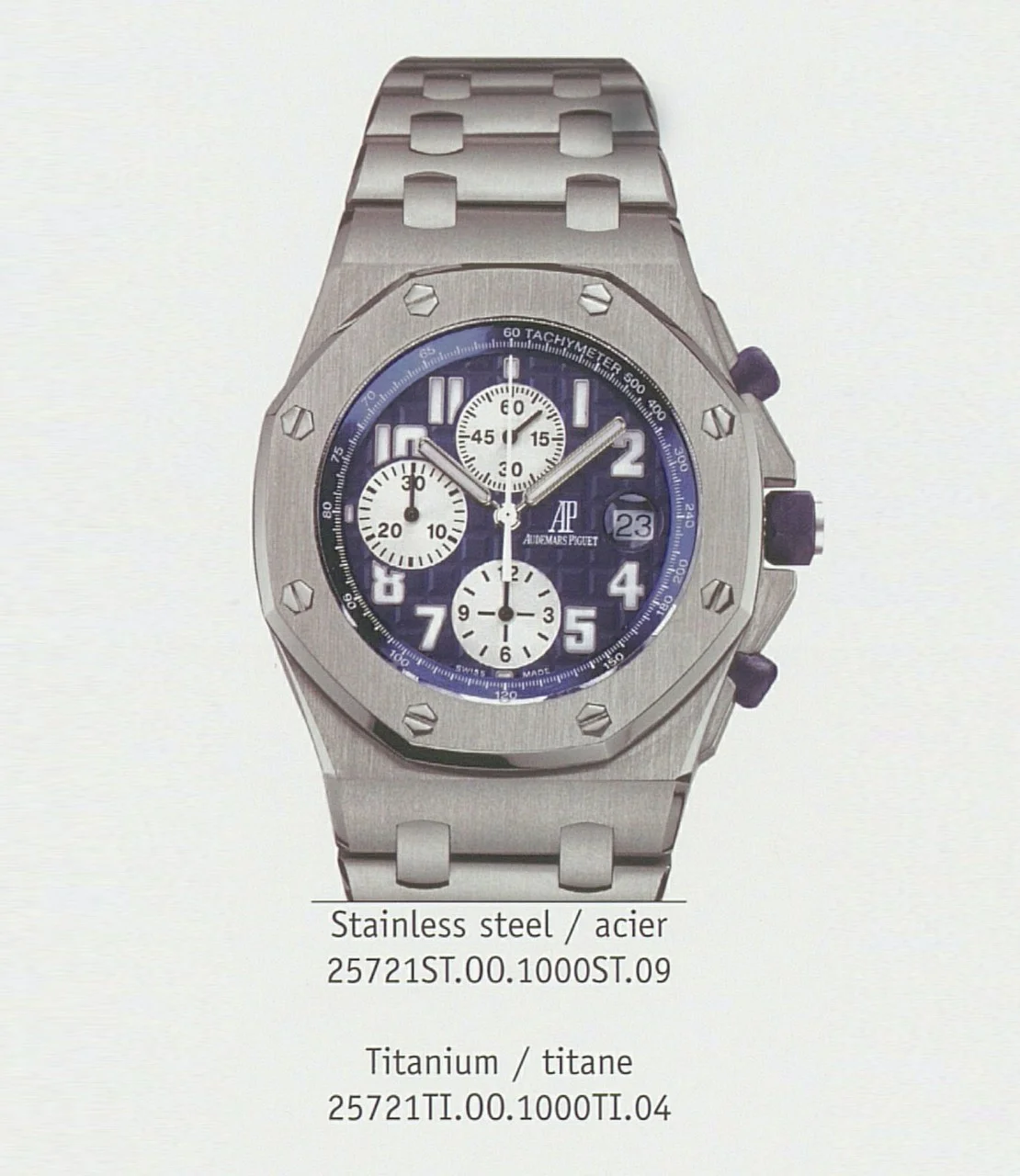
2004. Royal Oak Offshore Chronograph 25721ST and TI. Méga Tapisserie dial. This photograph illustrates the steel and titanium variants in the AP Catalogues from 2004 to 2010. Dials 09 and 04. Audemars Piguet Archives.
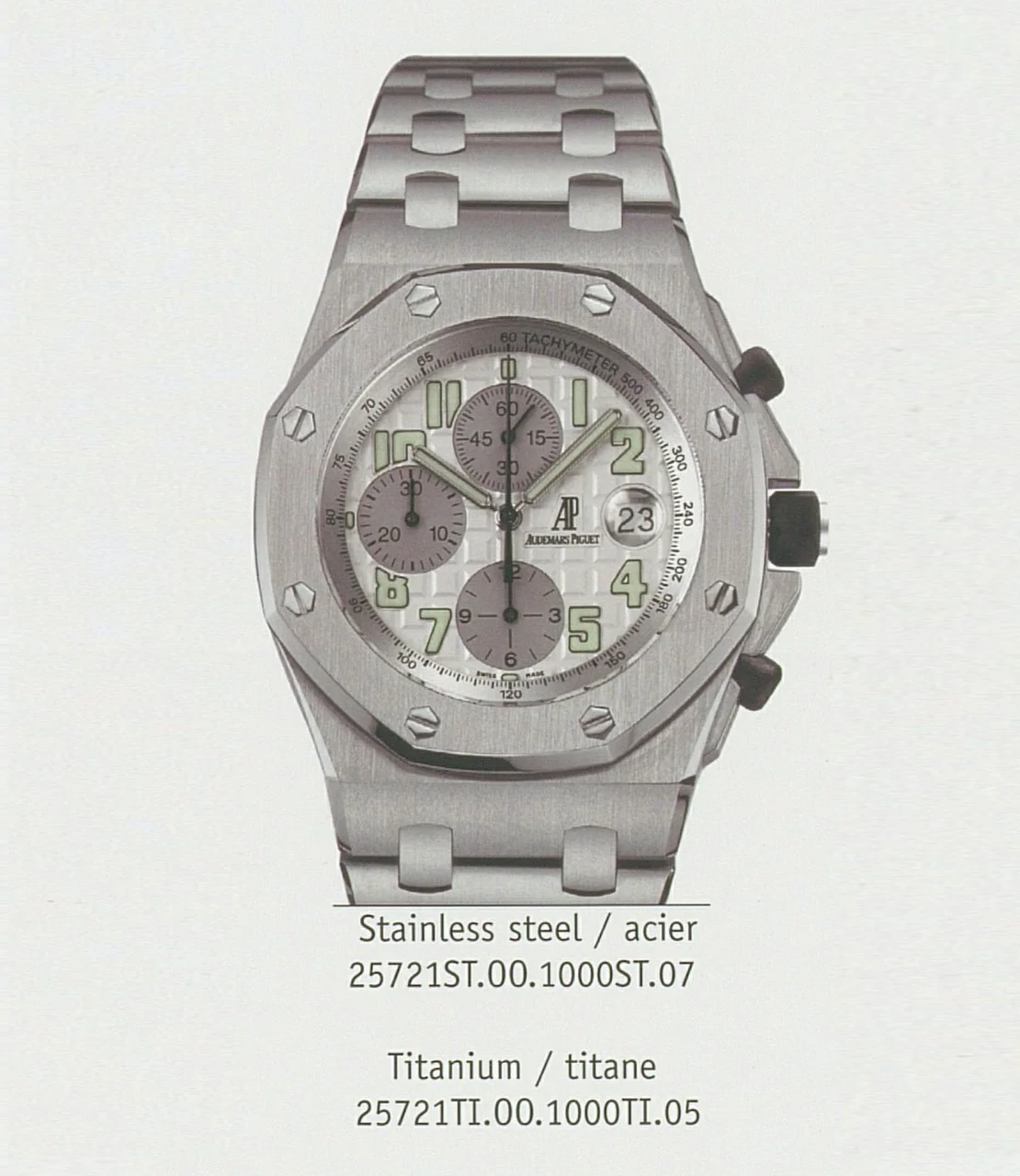
2004. Royal Oak Offshore Chronograph 25721ST and TI. Méga Tapisserie dial. This photograph illustrates the steel and titanium variants in the AP Catalogues from 2004 to 2010. Dials 07and 05. Audemars Piguet Archives.

2004. Royal Oak Offshore Chronograph 25721ST and TI. Méga Tapisserie dial. This photograph illustrates the steel and titanium variants in the AP Catalogues from 2004 to 2010. Dials 08 and 06. Audemars Piguet Archives.
The origins of the steel Model 25721 are recounted in a dedicated article. We notably learn there that the first 100 examples in steel did not have the Offshore engraving on the caseback, contrary to the later watches. This was probably to protect the "Offshore" trademark registered by Audemars Piguet in 1989, in case of commercial failure of this non-conformist model. Popular with the younger generation, Model 25721ST received its first engravings from Case No. 100 onwards.
The pioneering Model 25721ST enjoyed mixed fortunes. While it took five years to sell the first 1,000, the 400-unit annual mark was passed in 1999 and the figure reached almost 1,000 in 2006. Finally, the original model of the Royal Oak Offshore collection was marketed for 23 years and 7,308 were sold, with many different dials. In this respect, it broke the record of 6,050 units set by the Royal Oak 5402 of 1972.
Sales from 1993 to 2016: a total of 7308 units, of which 61 (1993), 333 (1994), 281 (1995), 159 (1996), 252 (1997), 272 (1998), 439 (1999 ), 436 (2000), 324 (2001), 108 (2002), 470 (2003), 629 (2004) ), 744 (2005), 969 (2006) ), 770 (2007), 416 (2008), 371 (2009) ), 31 (2010), 6 (2011) ), 5 (2012), 2 (2013), 12 (214) and 2 (2016).
The origins of the steel Model 25721 are recounted in a dedicated article. We notably learn there that the first 100 examples in steel did not have the Offshore engraving on the caseback, contrary to the later watches. This was probably to protect the "Offshore" trademark registered by Audemars Piguet in 1989, in case of commercial failure of this non-conformist model. Popular with the younger generation, Model 25721ST received its first engravings from Case No. 100 onwards.
The pioneering Model 25721ST enjoyed mixed fortunes. While it took five years to sell the first 1,000, the 400-unit annual mark was passed in 1999 and the figure reached almost 1,000 in 2006. Finally, the original model of the Royal Oak Offshore collection was marketed for 23 years and 7,308 were sold, with many different dials. In this respect, it broke the record of 6,050 units set by the Royal Oak 5402 of 1972.
Sales from 1993 to 2016: a total of 7308 units, of which 61 (1993), 333 (1994), 281 (1995), 159 (1996), 252 (1997), 272 (1998), 439 (1999 ), 436 (2000), 324 (2001), 108 (2002), 470 (2003), 629 (2004) ), 744 (2005), 969 (2006) ), 770 (2007), 416 (2008), 371 (2009) ), 31 (2010), 6 (2011) ), 5 (2012), 2 (2013), 12 (214) and 2 (2016).
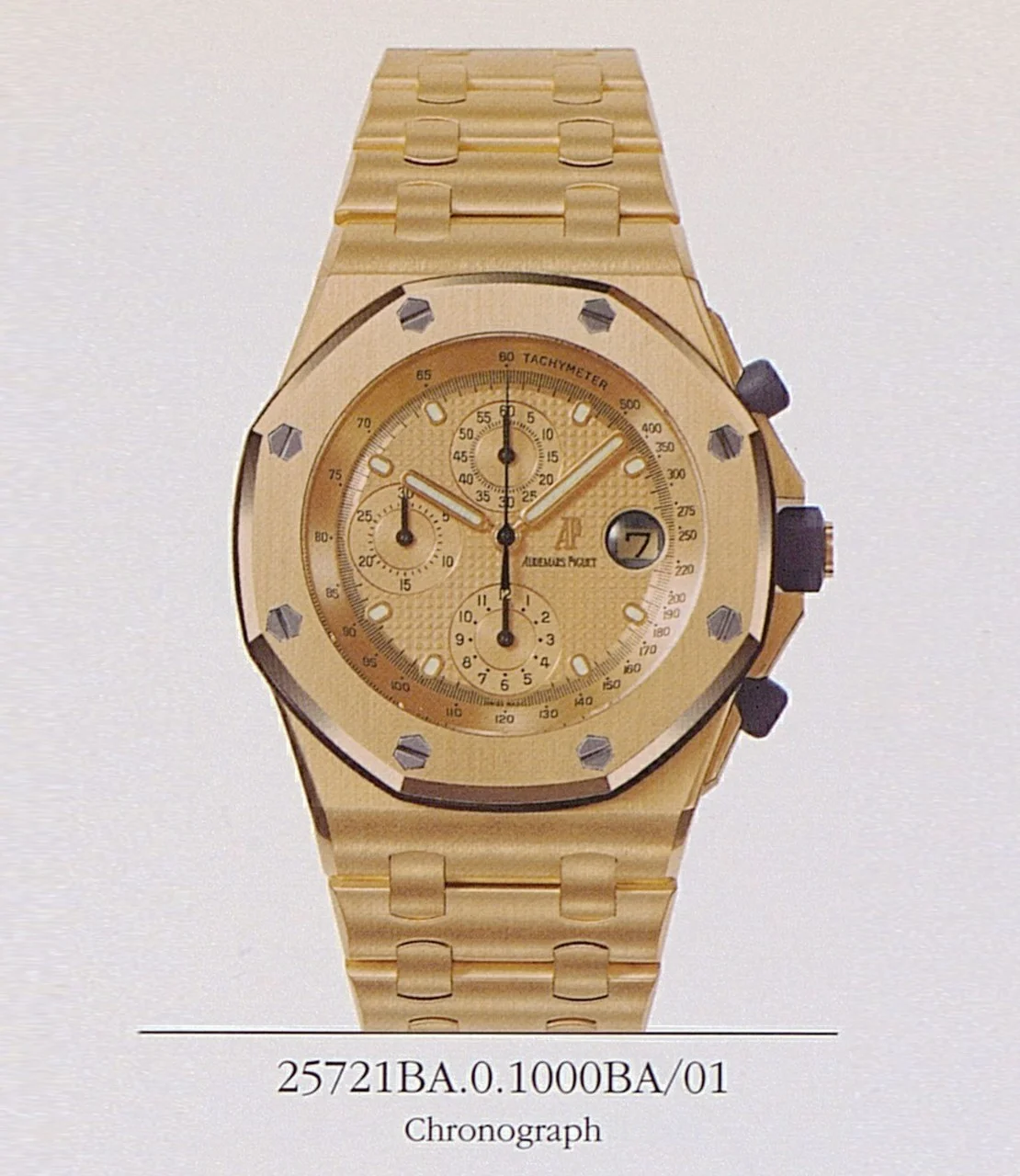
1996. Royal Oak Offshore Chronograph 25721BA. Variant published in the AP catalogues from 1996 to 2004. Dial 01. Audemars Piguet Archives
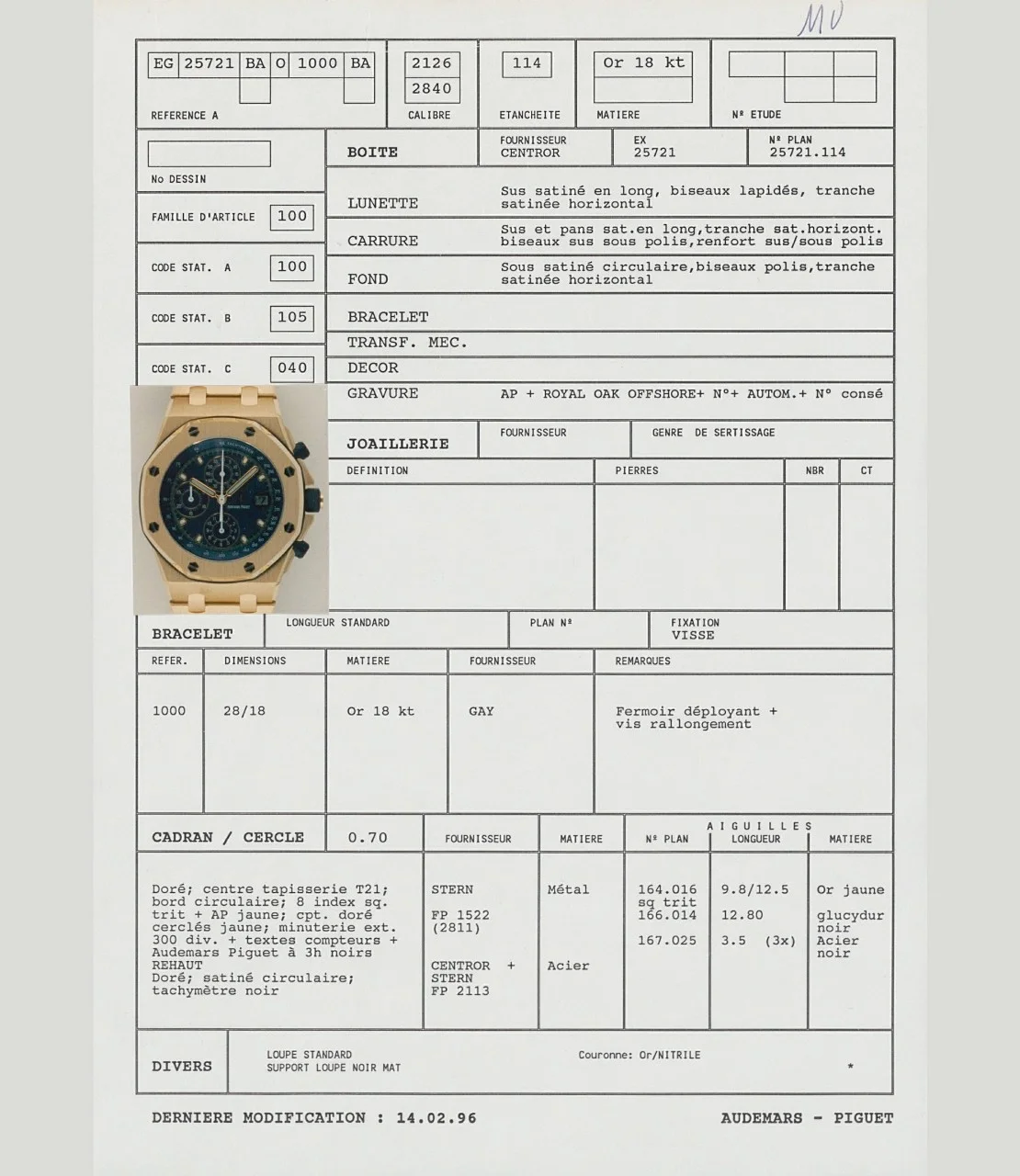
Circa 1995. Technical data of the model 25721BA. Audemars Piguet Archives

2000. Royal Oak Offshore Chronograph 25721BA. Variant published in the AP Catalogues from 2000 to 2004. Dial 02. Audemars Piguet Archives
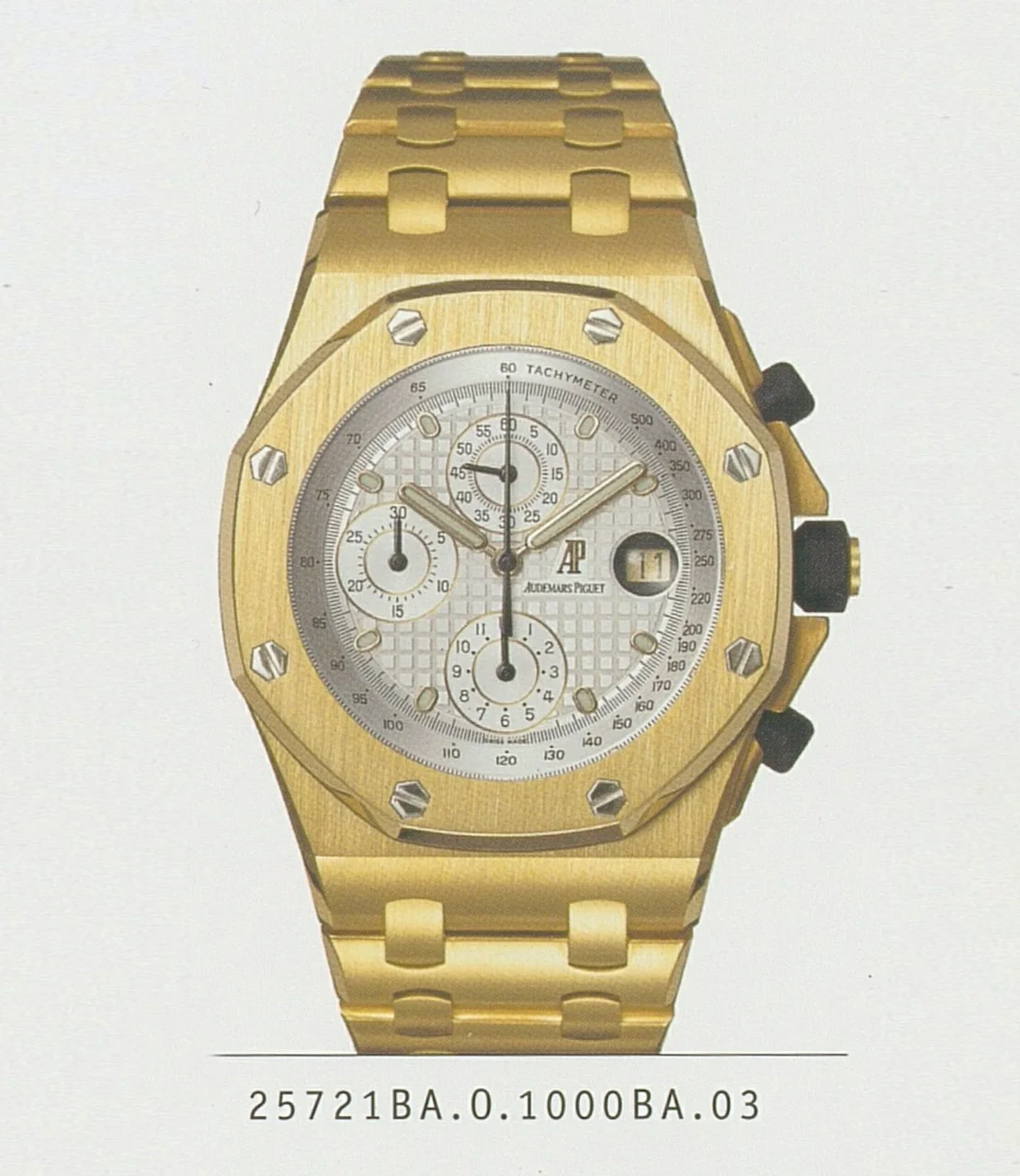
2002. Royal Oak Offshore Chronograph 25721BA. Variant published in the AP catalogues from 2002 to 2010. Dial 03. Audemars Piguet Archives

Circa 2002. Technical data for Model 25721BA. Audemars Piguet Archives

1996. Photograph of the Royal Oak Offshore 25721BA (42 mm), 77151BA (30 mm) and 25807BA (37 mm). Audemars Piguet Archives
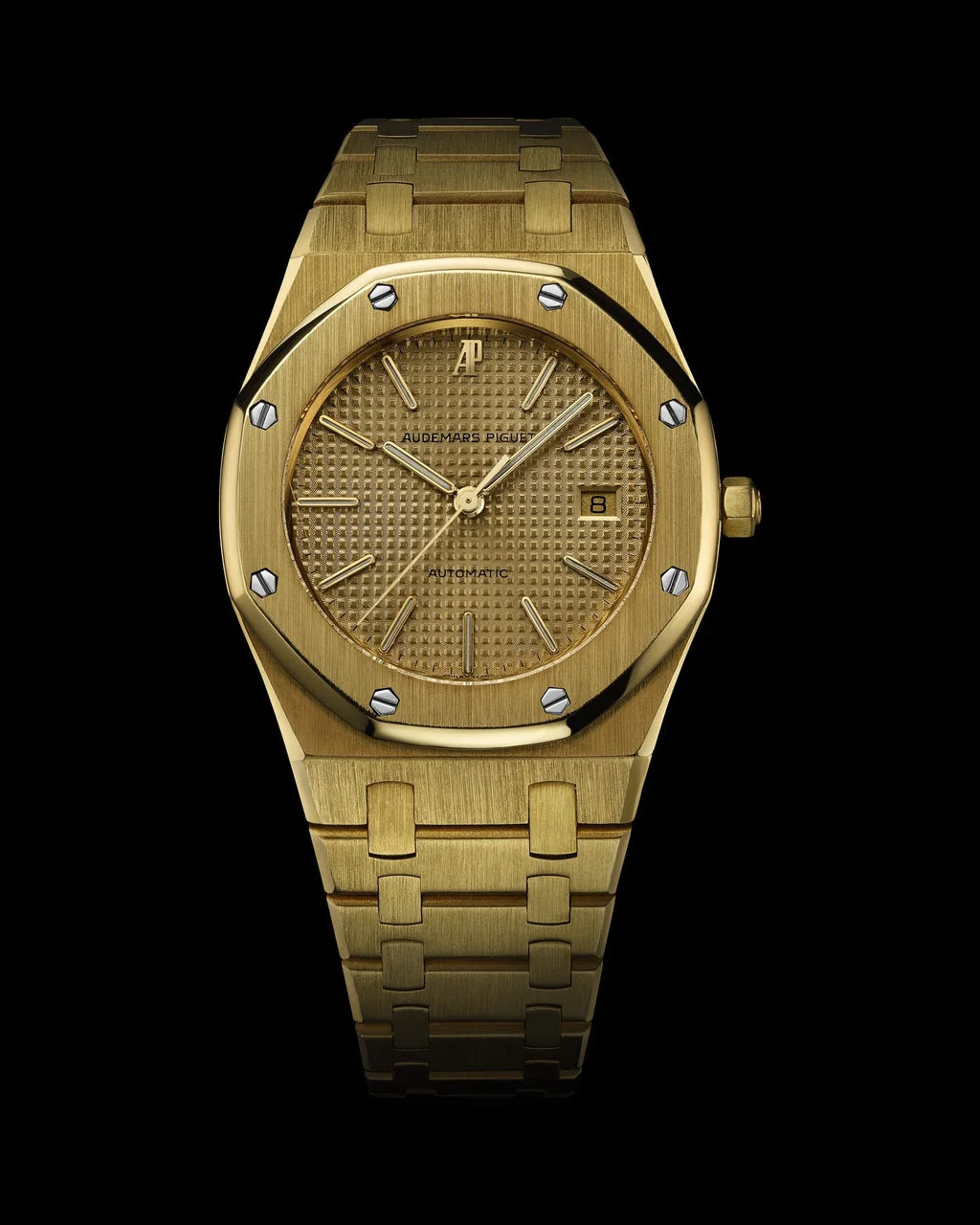
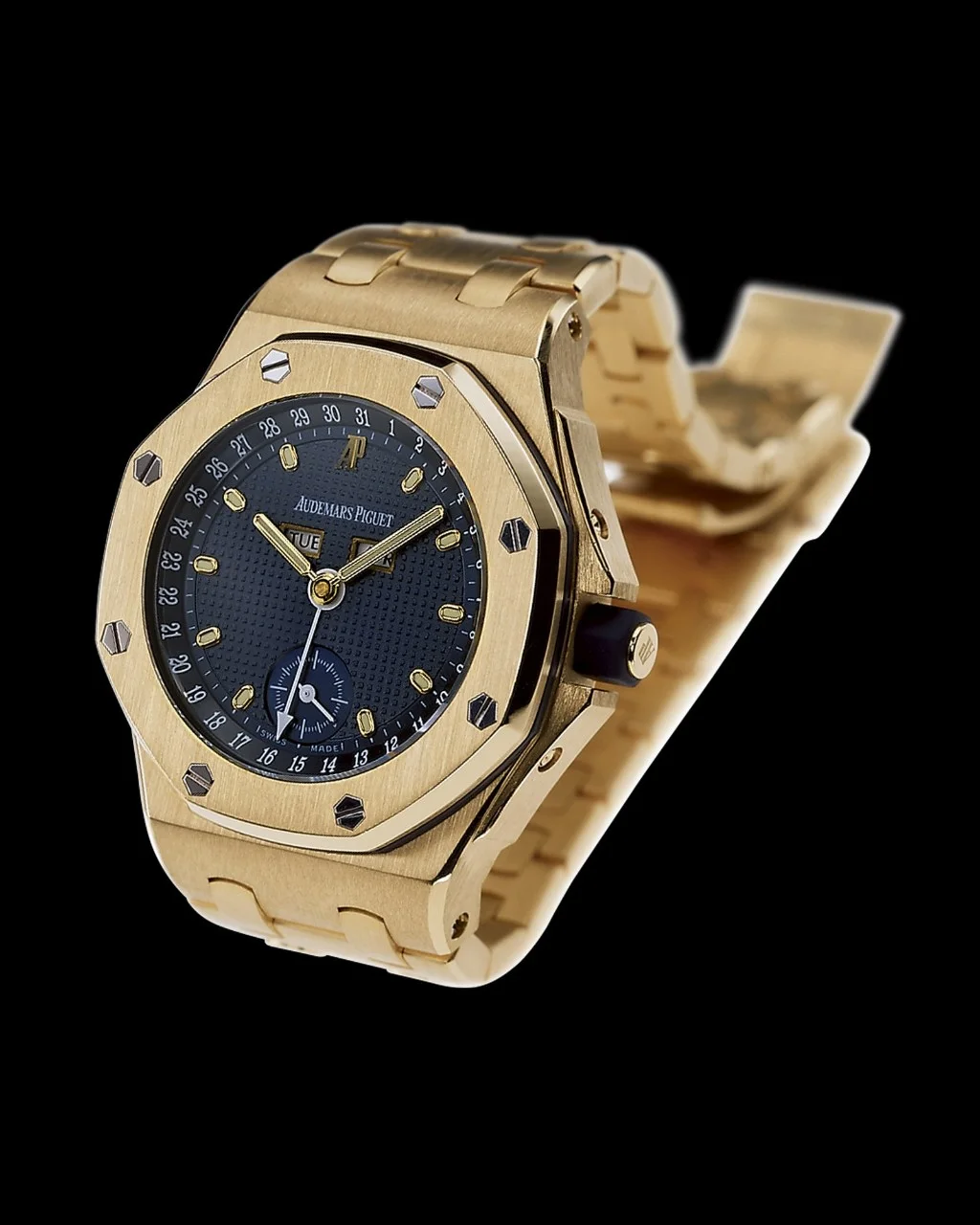
The first Royal Oak Offshore in precious materials is excessive in many respects. Its monochromatic version expresses the powerful symbolism of yellow gold. The solid bracelet is made of 18-carat gold, as are the case middle and bezel. Punctuated with gold appliques, the dial is gilded, as is the flange. Meanwhile, the watch weighed almost 400 grams, a record that earned it the nickname "pounder" in the United States, but which was broken the following year by the platinum version weighing 429 grams!
Three dials are documented in the Audemars Piguet Archives: the first is gold-toned (from 1995 onwards), the second dark blue (from 2000) and the third is silver-toned with a Grande Tapisserie motif (from 2002).
Sales from 1995 to 2014: a total of 589 units, of which 14 (1995), 27 (1996), 15 (1997), 17 (1998), 41 (1999), 26 (2000), 31 (2001), 29 (2002), 66 (2003), 58 (2004), 39 (2005), 70 (2006), 37 (2007), 56 (2008), 48 (2009), 14 (2010) and 1 (2014)
The first Royal Oak Offshore in precious materials is excessive in many respects. Its monochromatic version expresses the powerful symbolism of yellow gold. The solid bracelet is made of 18-carat gold, as are the case middle and bezel. Punctuated with gold appliques, the dial is gilded, as is the flange. Meanwhile, the watch weighed almost 400 grams, a record that earned it the nickname "pounder" in the United States, but which was broken the following year by the platinum version weighing 429 grams!
Three dials are documented in the Audemars Piguet Archives: the first is gold-toned (from 1995 onwards), the second dark blue (from 2000) and the third is silver-toned with a Grande Tapisserie motif (from 2002).
Sales from 1995 to 2014: a total of 589 units, of which 14 (1995), 27 (1996), 15 (1997), 17 (1998), 41 (1999), 26 (2000), 31 (2001), 29 (2002), 66 (2003), 58 (2004), 39 (2005), 70 (2006), 37 (2007), 56 (2008), 48 (2009), 14 (2010) and 1 (2014)
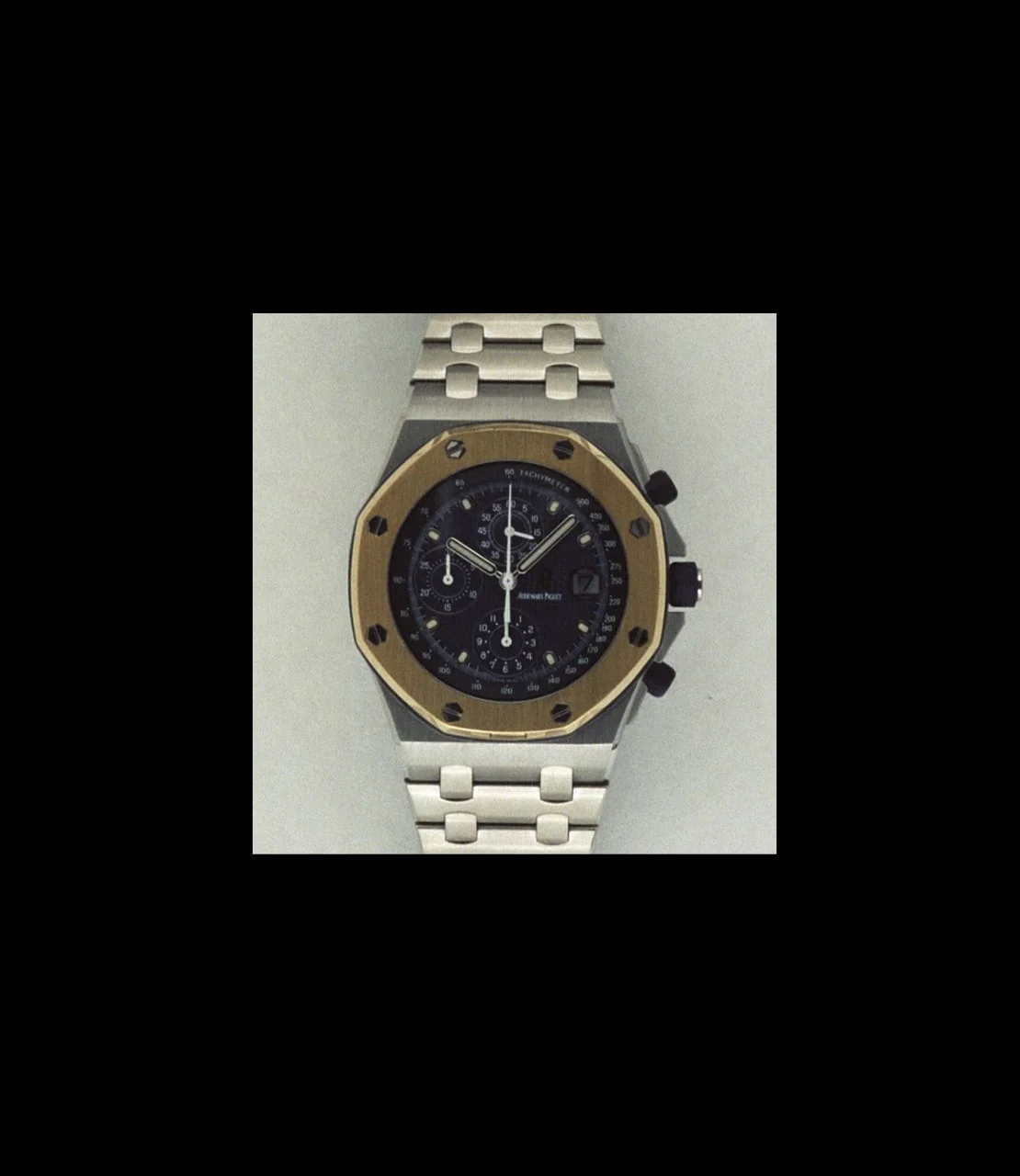
Circa 1995. Identification image of Model 25721SA. Audemars Piguet Archives.
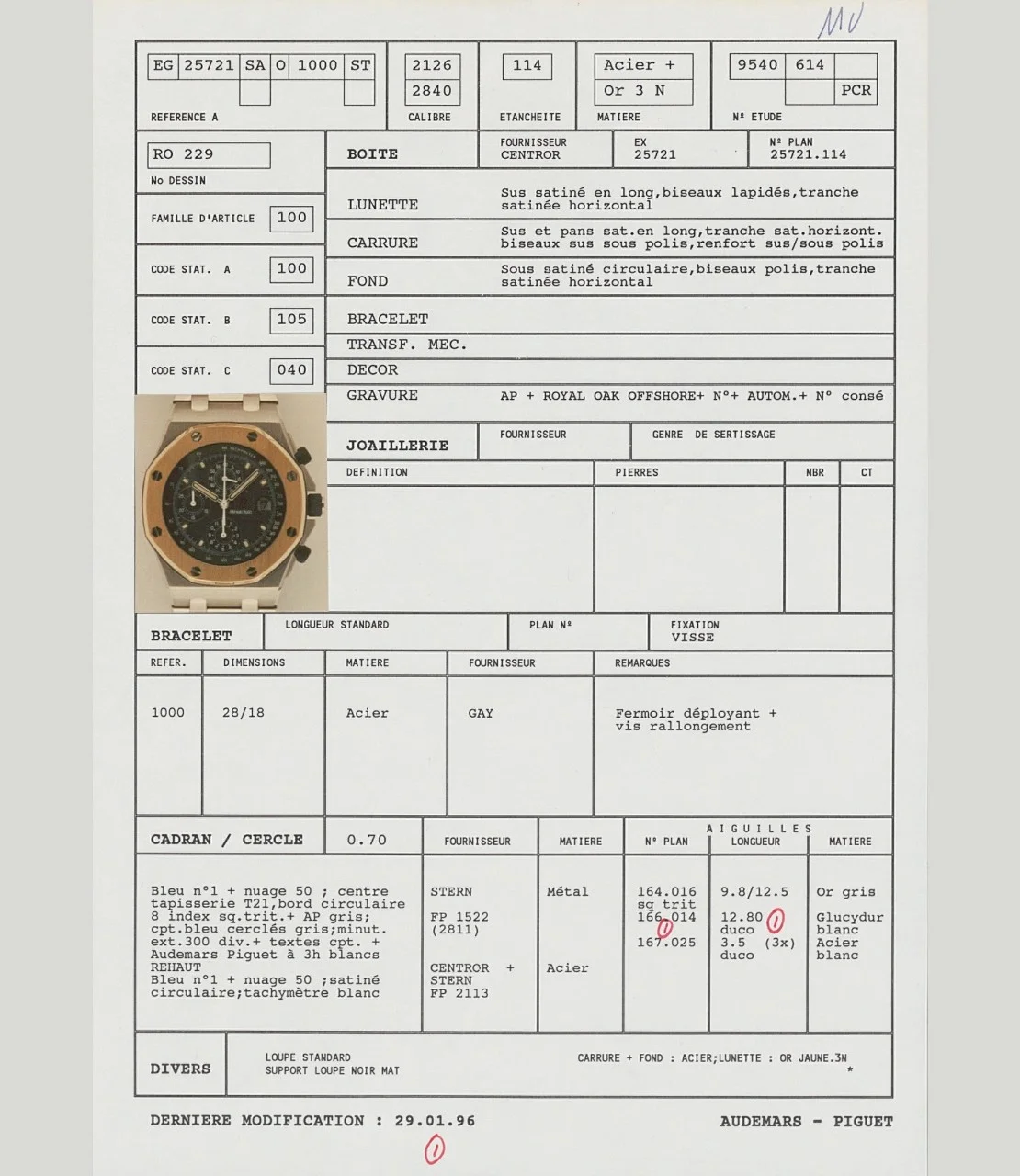
Circa 1995. Technical data for Model 25721SA. Audemars Piguet Archives
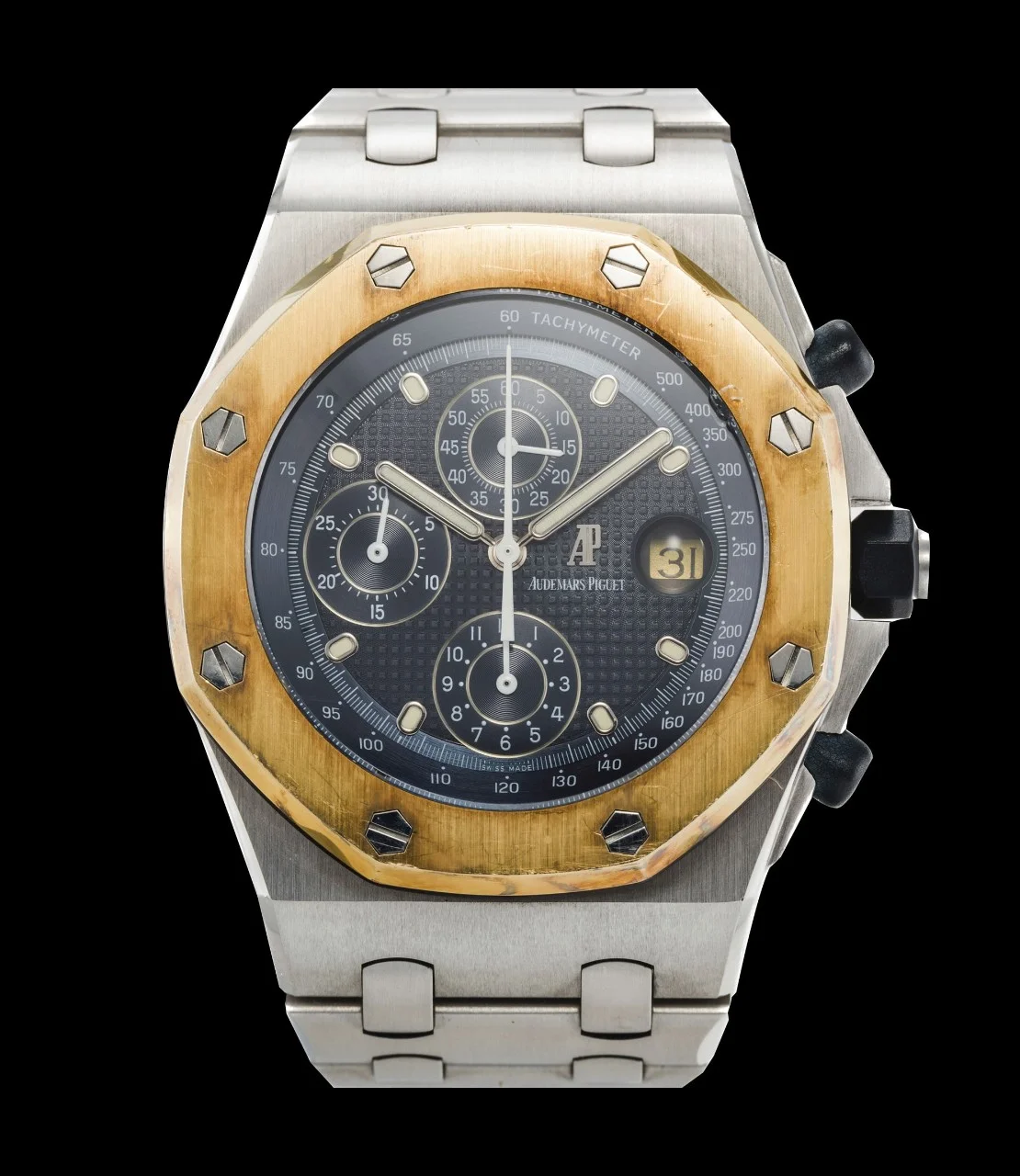
1998. Royal Oak Offshore Chronograph 25721SA No. 66. Calibre 2226/2840, Movement 449878. 42 mm steel and yellow Case D91743. Sold in Greece in January 1998. Auctioned by Sotheby's New York on June 15, 2022. ©Sotheby's
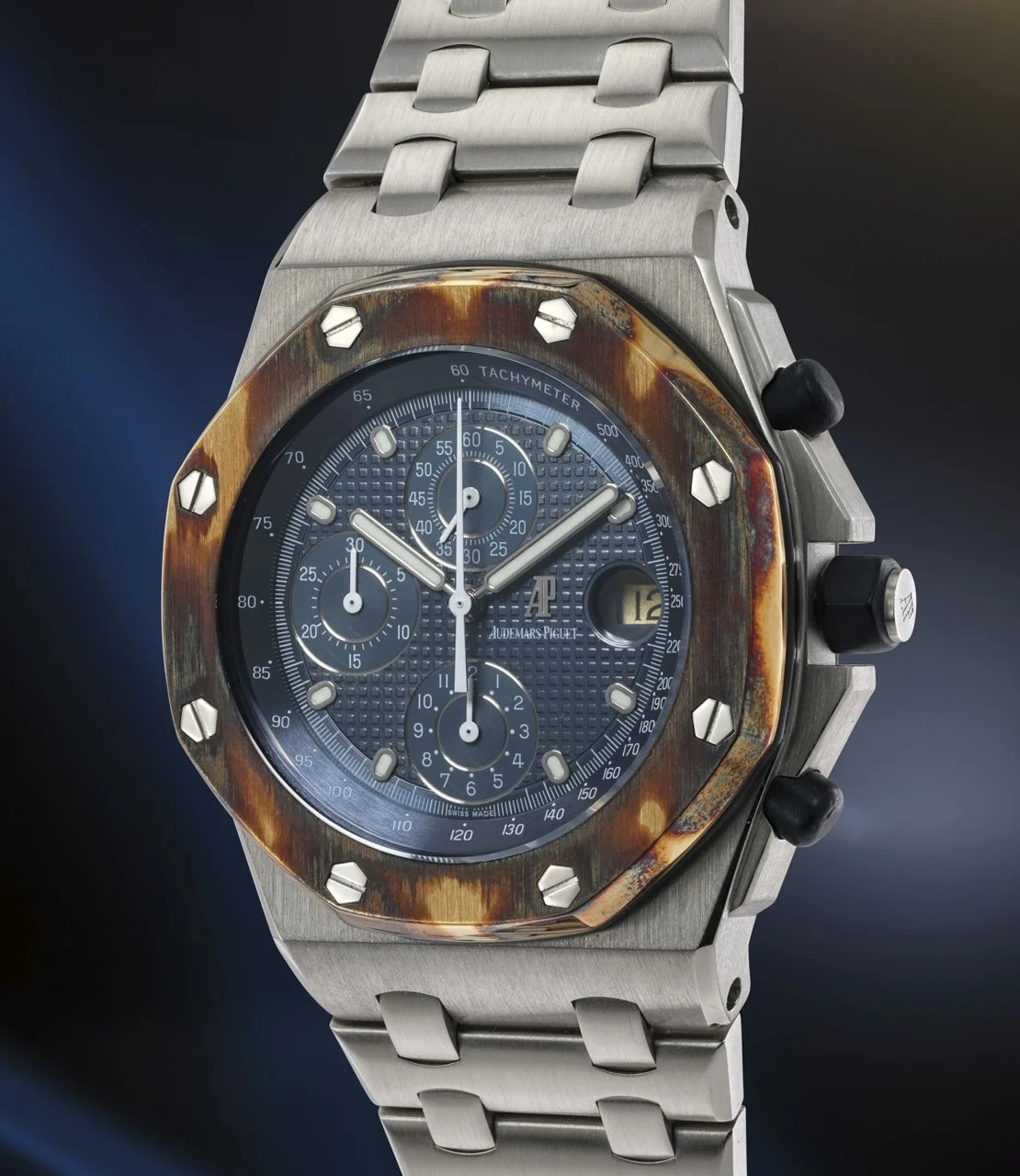
1998. Royal Oak Offshore Chronograph 25721SA No. 64. Calibre 2226/2840, Movement 449876. 42 mm steel and yellow gold Case D91741. Sold in the United Kingdom in January 1998. Auctioned by Phillips Geneva on May 8, 2022. © Phillips
The 25721SA variant is both rare and different from traditional Audemars Piguet practice. Usually, the Royal Oak "SA" watches, which combine yellow gold and steel, feature yellow gold studs, as well as hands and hour-markers in the same material. In the Royal Oak Offshore 25721SA, only the bezel is in yellow gold. The studs are made of steel, and the appliques and hands of white gold.
Another surprising element is that the archives do not specify the carat weight of the gold used for the bezel, but it is possibly not the usual 18 carats, as seems to be confirmed by the significant oxidation on the bezels of the two examples auctioned in 2022 by Phillips in Geneva (May 8, 2022, lot 248) and at Sotheby's in New York (June 15 2022, lot 11).
Sales from 1995 to 1999: a total of 64 units, of which 28 (1995), 11 (1996), 13 (1997, 10 (1998), 2 (1999).
The 25721SA variant is both rare and different from traditional Audemars Piguet practice. Usually, the Royal Oak "SA" watches, which combine yellow gold and steel, feature yellow gold studs, as well as hands and hour-markers in the same material. In the Royal Oak Offshore 25721SA, only the bezel is in yellow gold. The studs are made of steel, and the appliques and hands of white gold.
Another surprising element is that the archives do not specify the carat weight of the gold used for the bezel, but it is possibly not the usual 18 carats, as seems to be confirmed by the significant oxidation on the bezels of the two examples auctioned in 2022 by Phillips in Geneva (May 8, 2022, lot 248) and at Sotheby's in New York (June 15 2022, lot 11).
Sales from 1995 to 1999: a total of 64 units, of which 28 (1995), 11 (1996), 13 (1997, 10 (1998), 2 (1999).
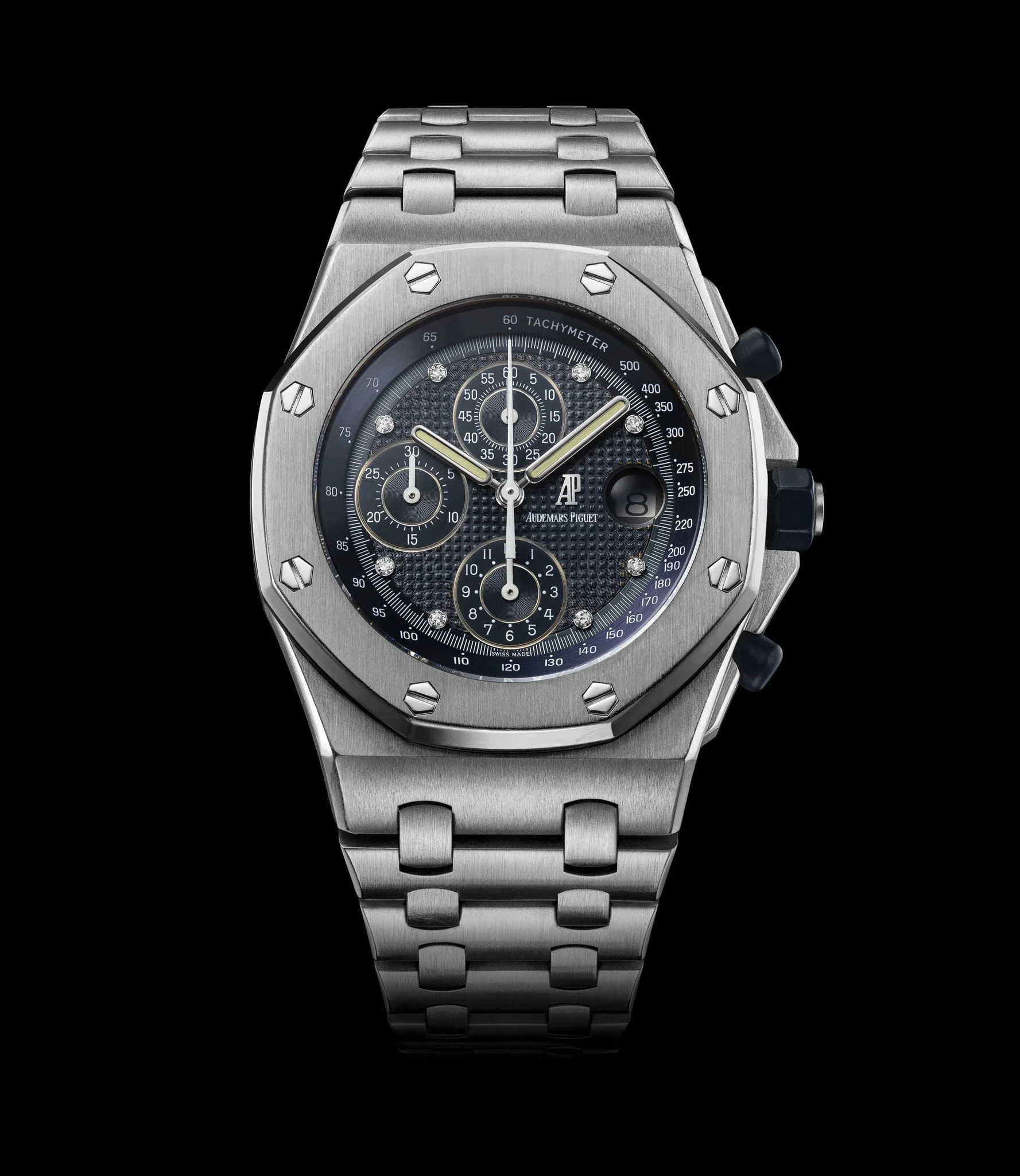
1999. Royal Oak Offshore Chronograph 25721BC, No. 9. Diamond hour-markers. Selfwinding Calibre. 2126/2840, Movement 429039. 42 mm 18-carat white gold Case D80870. Sold in France in 1999. Audemars Piguet Heritage, inv. 2164

Circa 1996. Technical data for Model 25721BC. Audemars Piguet Archives

Circa 1996 Identification image of Model 25721BC. Audemars Piguet Archives
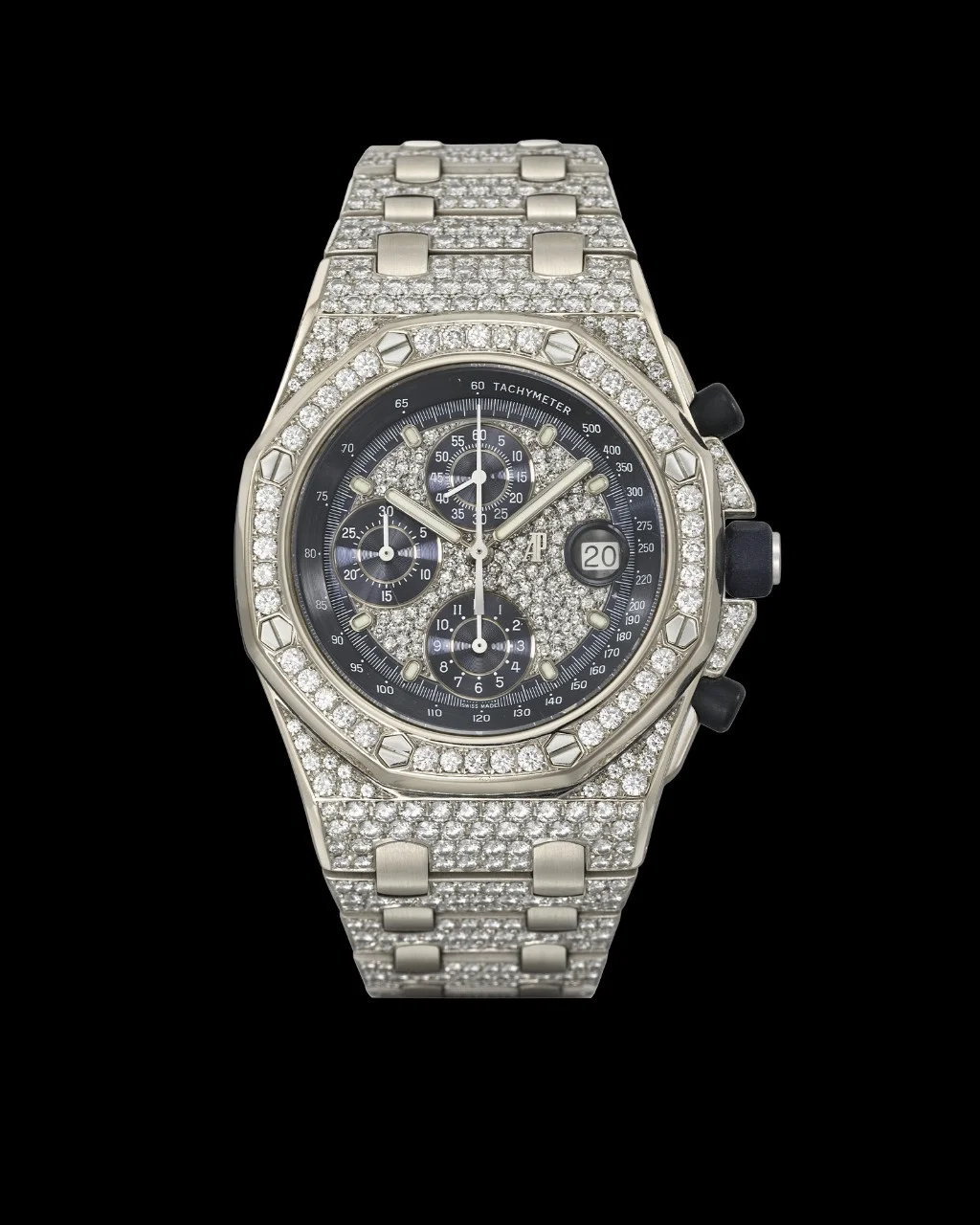
Only 21 examples of the Royal Oak Offshore in white gold were sold between 1996 and 2003.
At first glance, the watch differs from the steel version only by the eight diamonds replacing the hour-markers and by the slightly more luminous gleam of the metal. The watch is however significantly different once on the wrist, as it weighs in at 410 grams – almost twice as much as the steel version (about 220 grams).
Sales from 1996 to 2003: a total of 21 units, of which 9 (1996), 3 (1997), 2 (1998), 4 (1999), 2 (2001) and 1 (2003).
Only 21 examples of the Royal Oak Offshore in white gold were sold between 1996 and 2003.
At first glance, the watch differs from the steel version only by the eight diamonds replacing the hour-markers and by the slightly more luminous gleam of the metal. The watch is however significantly different once on the wrist, as it weighs in at 410 grams – almost twice as much as the steel version (about 220 grams).
Sales from 1996 to 2003: a total of 21 units, of which 9 (1996), 3 (1997), 2 (1998), 4 (1999), 2 (2001) and 1 (2003).
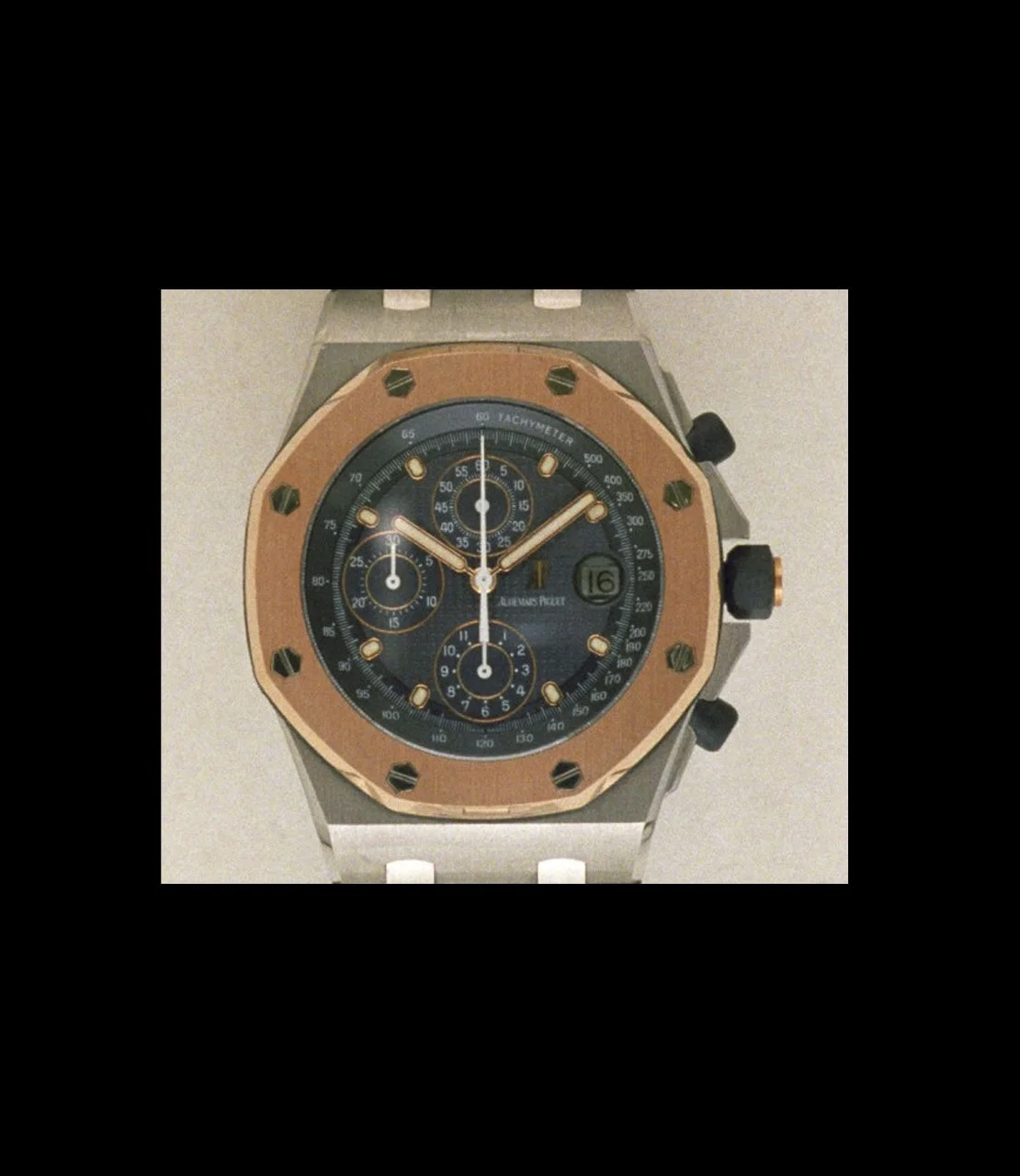
Circa 1997. Identification image of Model 25721SR. Audemars Piguet Archives

Circa 1997. Technical data for Model 25721SR. Audemars Piguet Archives
Two years after the "SA" variant combining steel and yellow gold, a one-off version replaced yellow gold with pink gold. On this model, the hands, hour-markers and applied AP logo are made of the same material.
Sold in Germany in December 1997, the only watch documented in the archives bears the number 001.
Two years after the "SA" variant combining steel and yellow gold, a one-off version replaced yellow gold with pink gold. On this model, the hands, hour-markers and applied AP logo are made of the same material.
Sold in Germany in December 1997, the only watch documented in the archives bears the number 001.
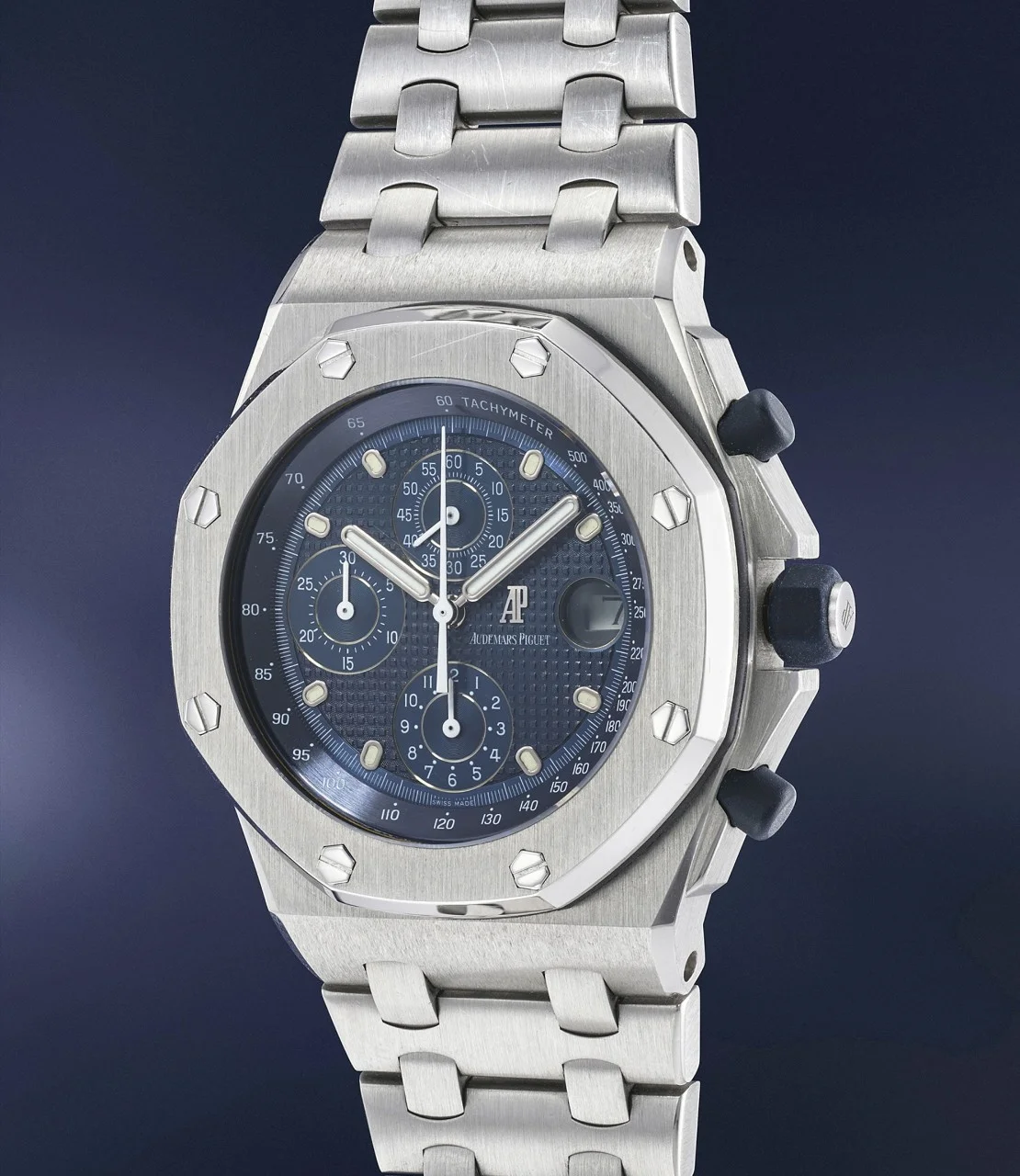
1997. Royal Oak Offshore Chronograph 25721PT, No. 7. Calibre 2226/2840, Movement 449745. 42 mm platinum Case D95704 (429 grams). Sold in Nigeria in 1997. Sold at auction by Phillips in Geneva on November 6, 2020 for CHF 422,100. Copyright Phillips
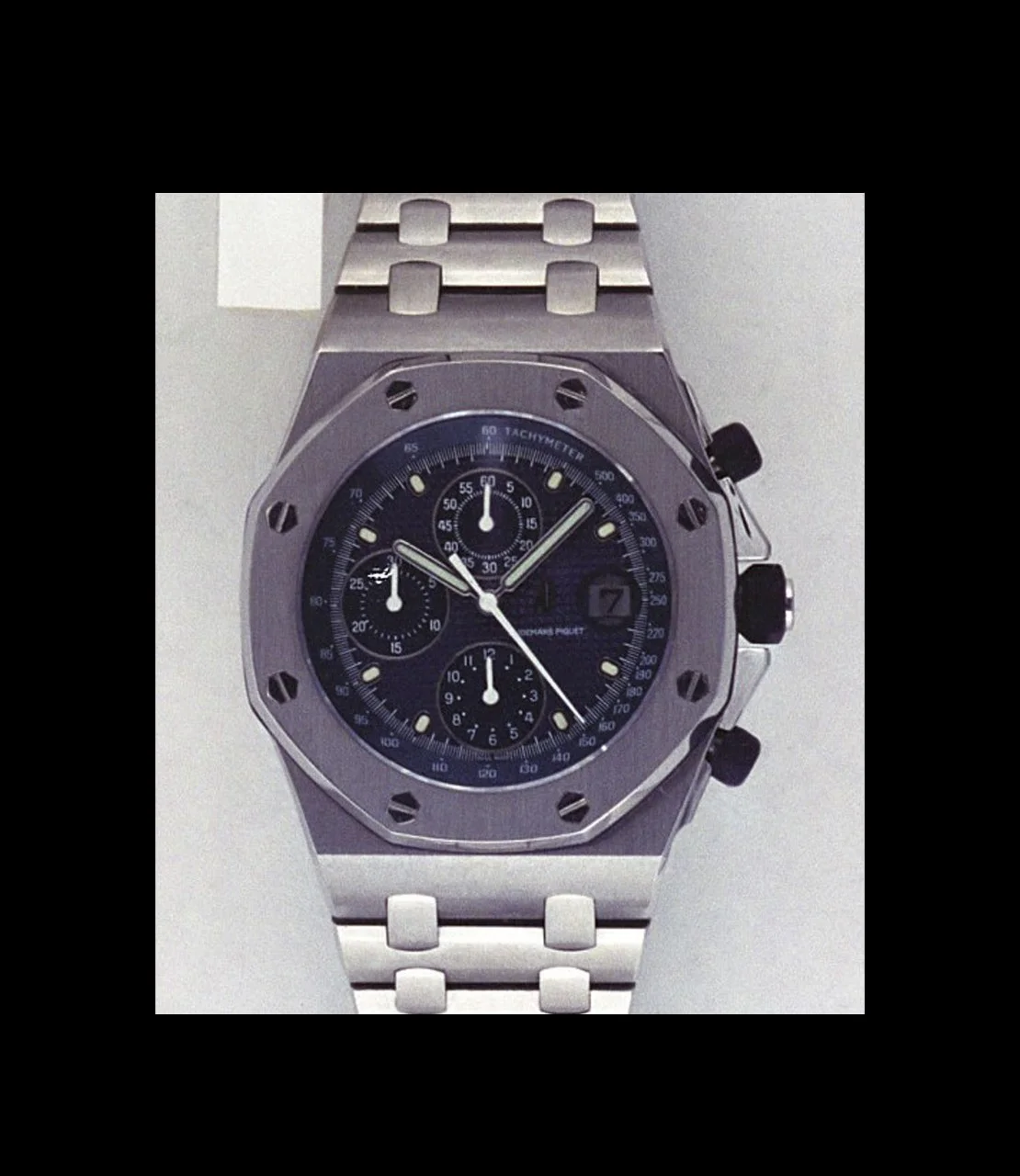
Circa 1997. Identification image of Model 25721PT. Audemars Piguet Archives

Circa 1997. Technical data for Model 25721PT. Audemars Piguet Archives
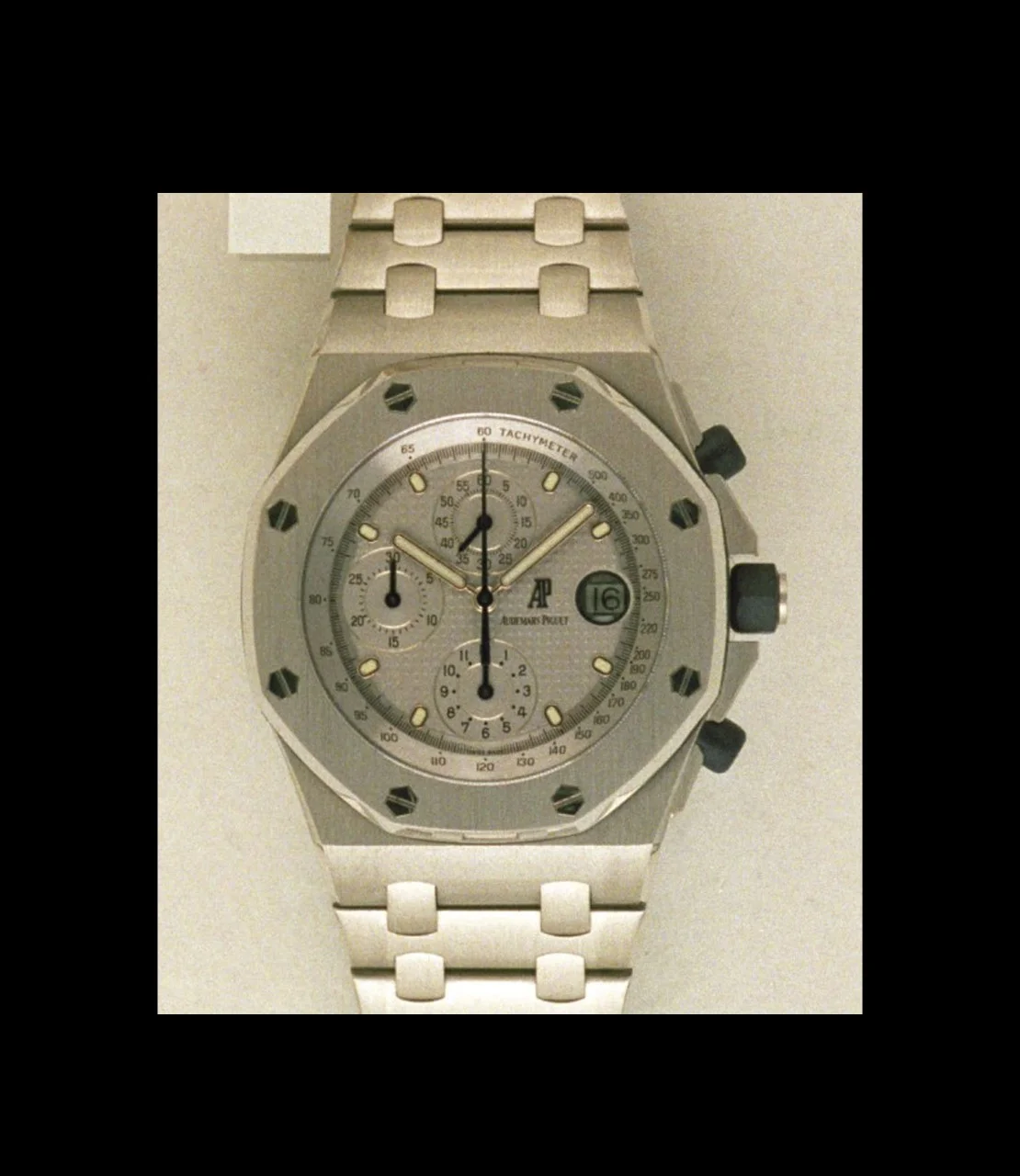
Circa 1997. Identification image of Model 25721PT. Audemars Piguet Archives.
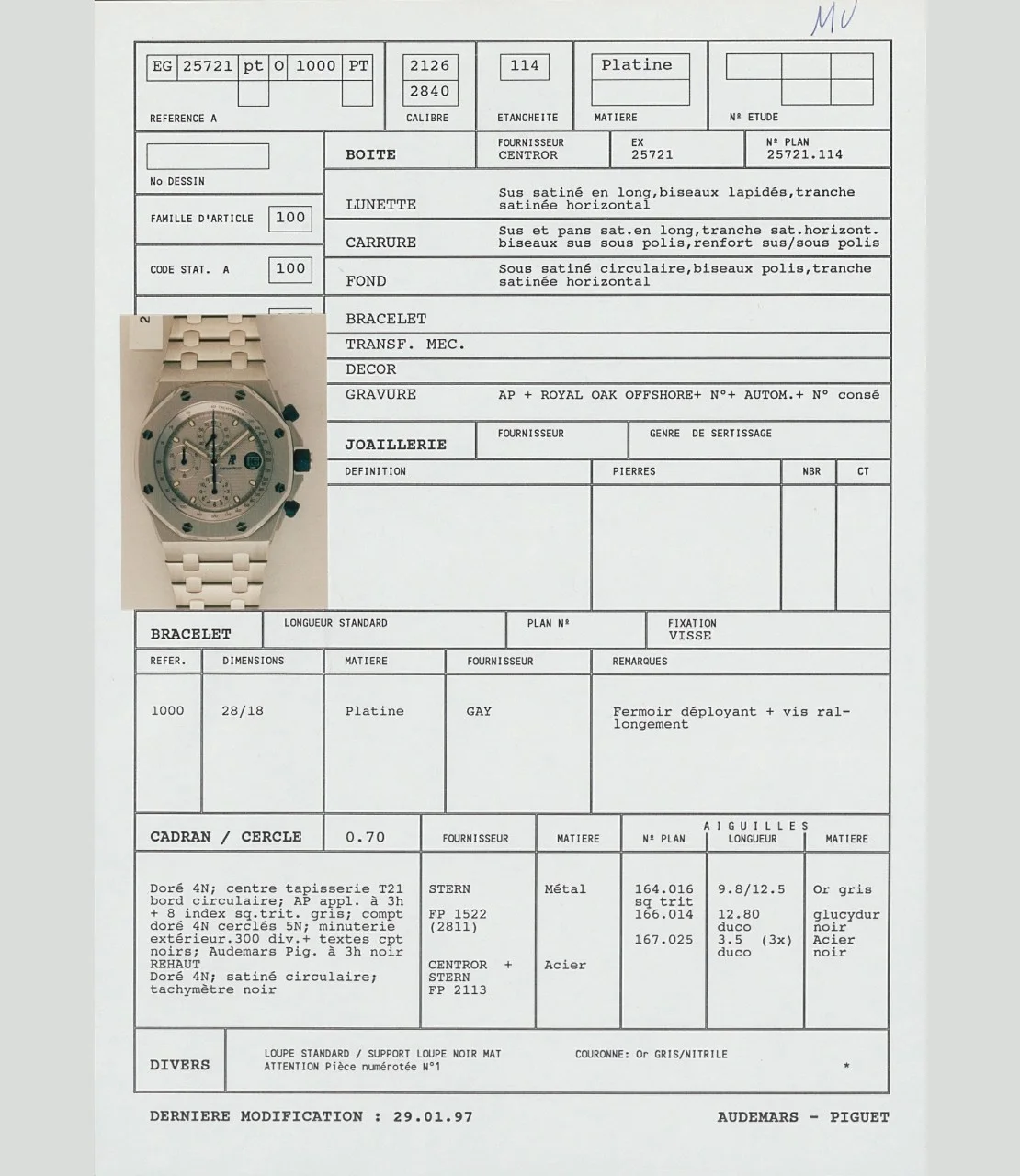
Circa 1997. Technical data for Model 25721PT. Audemars Piguet Archives
While the dimensions of the Royal Oak Offshore 25721 were deemed extreme as early as 1993, the platinum variant further upped the ante by shattering the record for the heaviest wristwatch ever created by Audemars Piguet and perhaps in the world, at 429 grams!
The archives document two dial variants: one opaline blue, the other silver grey. Four of the ten examples were sold in Germany. No. 7 was auctioned by Phillips Geneva in 2020 for CHF 422,100.
Sales from 1997 to 1998: a total of 10 units, of which 9 (1997) and 1 (1998).
While the dimensions of the Royal Oak Offshore 25721 were deemed extreme as early as 1993, the platinum variant further upped the ante by shattering the record for the heaviest wristwatch ever created by Audemars Piguet and perhaps in the world, at 429 grams!
The archives document two dial variants: one opaline blue, the other silver grey. Four of the ten examples were sold in Germany. No. 7 was auctioned by Phillips Geneva in 2020 for CHF 422,100.
Sales from 1997 to 1998: a total of 10 units, of which 9 (1997) and 1 (1998).
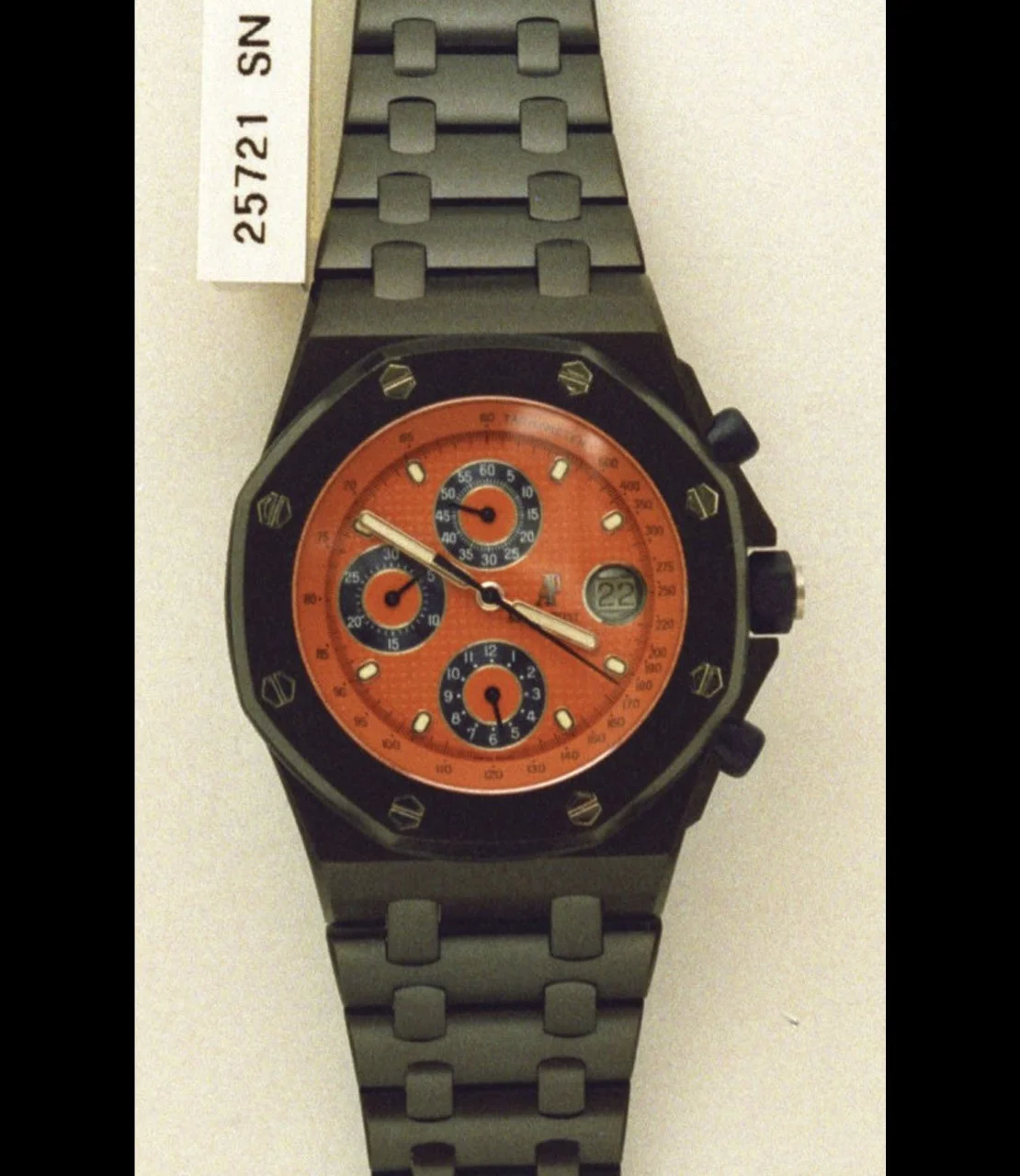
Circa 1998. Identification image of Model 25721SN. Audemars Piguet Archives
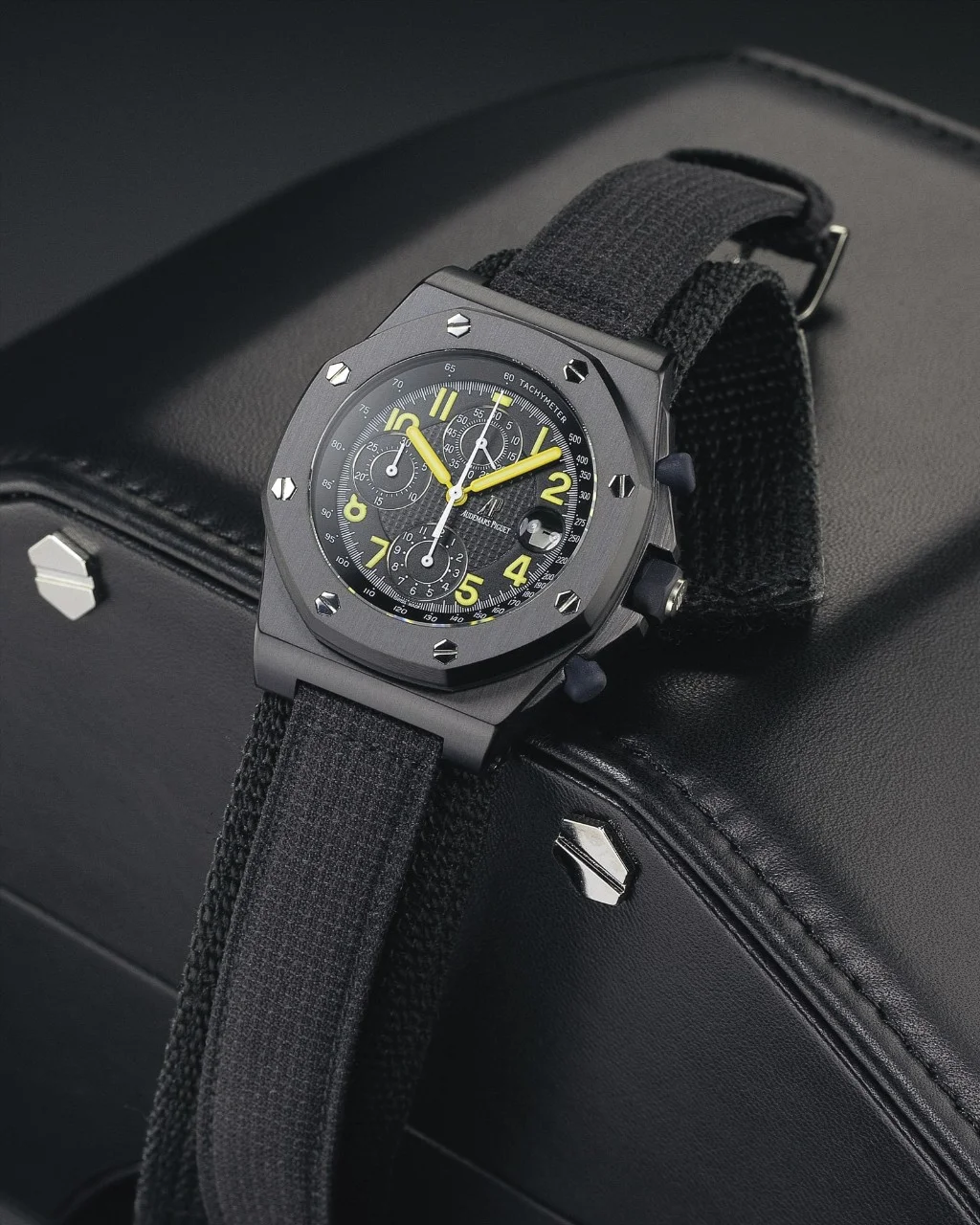
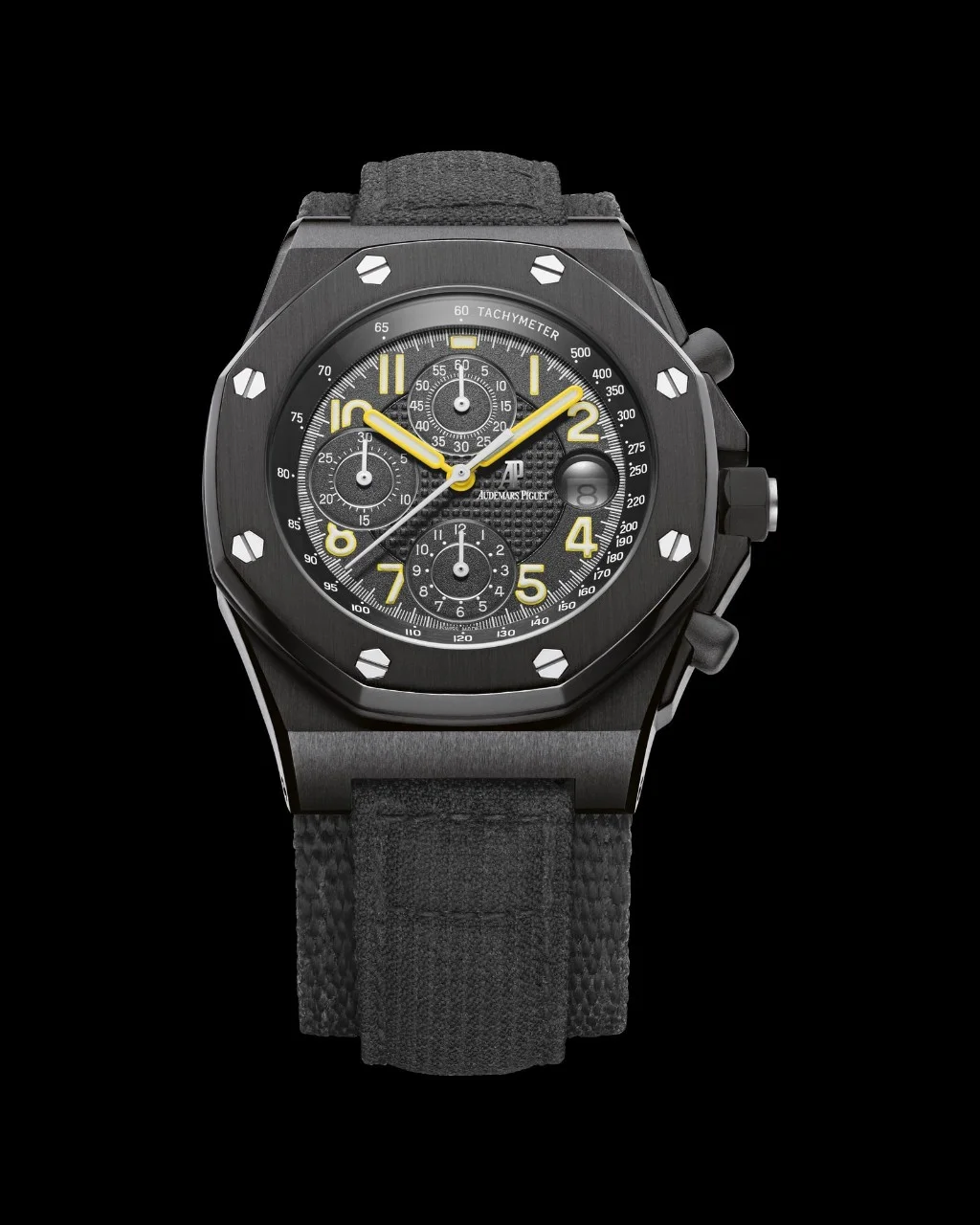
The archives contain only one trace of a model bearing the initials "SN", i.e. blackened steel.
This watch was probably made as part of the preparation of the 25770SN End of Days limited edition. Records indicate that it was worn by a watchmaker during a trial period, probably to check the durability of the black colour on the steel. It was integrated into the Audemars Piguet Museum in 2000, but was stolen 10 years later and has not been seen since.
The archives contain only one trace of a model bearing the initials "SN", i.e. blackened steel.
This watch was probably made as part of the preparation of the 25770SN End of Days limited edition. Records indicate that it was worn by a watchmaker during a trial period, probably to check the durability of the black colour on the steel. It was integrated into the Audemars Piguet Museum in 2000, but was stolen 10 years later and has not been seen since.
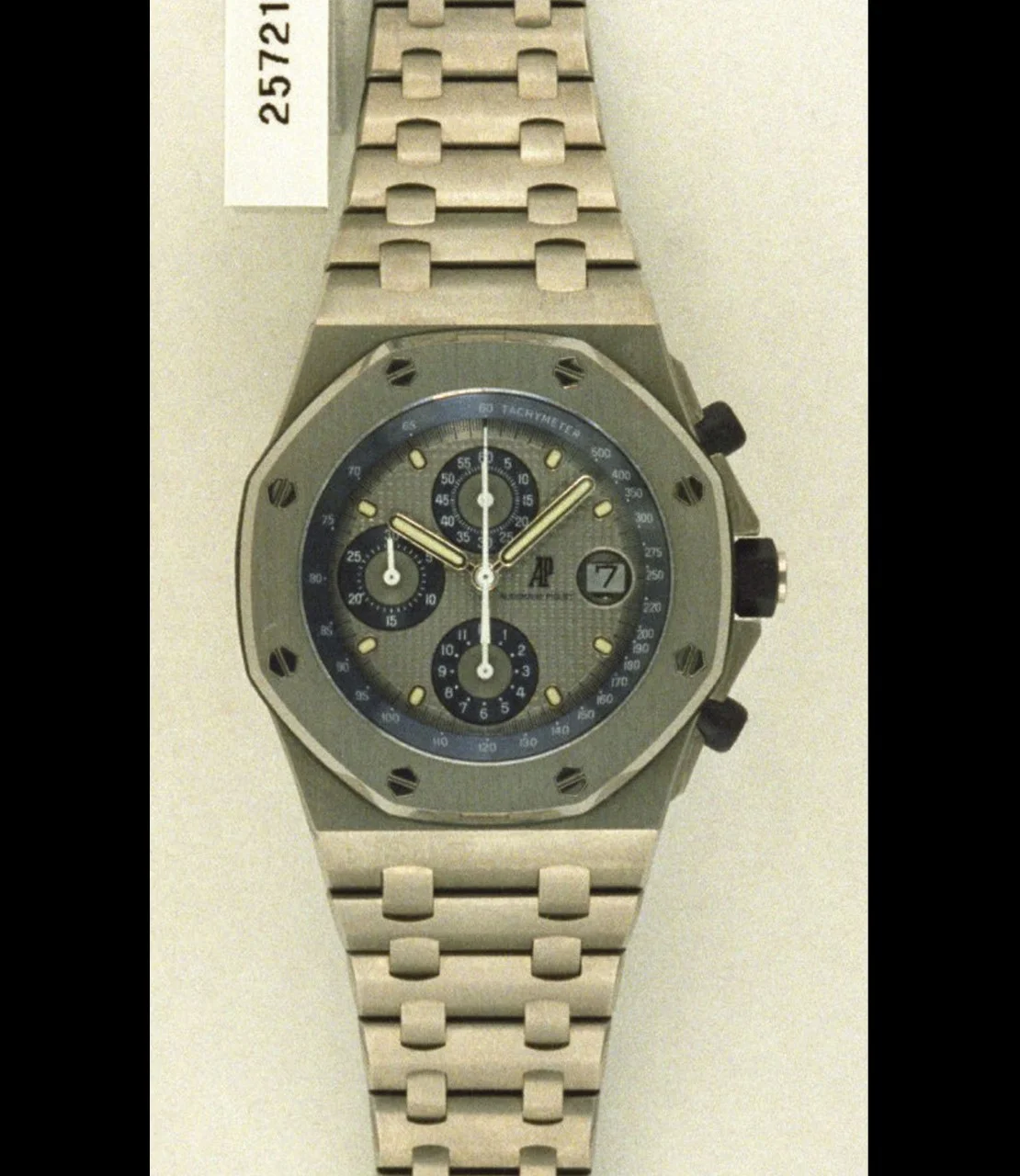
1998. Royal Oak Offshore 25721TI No. 824. Chronograph, selfwinding, blue Petite Tapisserie dial. Calibre 2226/2840. 42 mm titanium Case E54634. Titanium bracelet. Prototype without movement, presented at the launch of the model at the SIHH in 1998. Audemars Piguet Heritage, inv. 790.

1997. Technical data for Model 25721TI. Audemars Piguet Archives
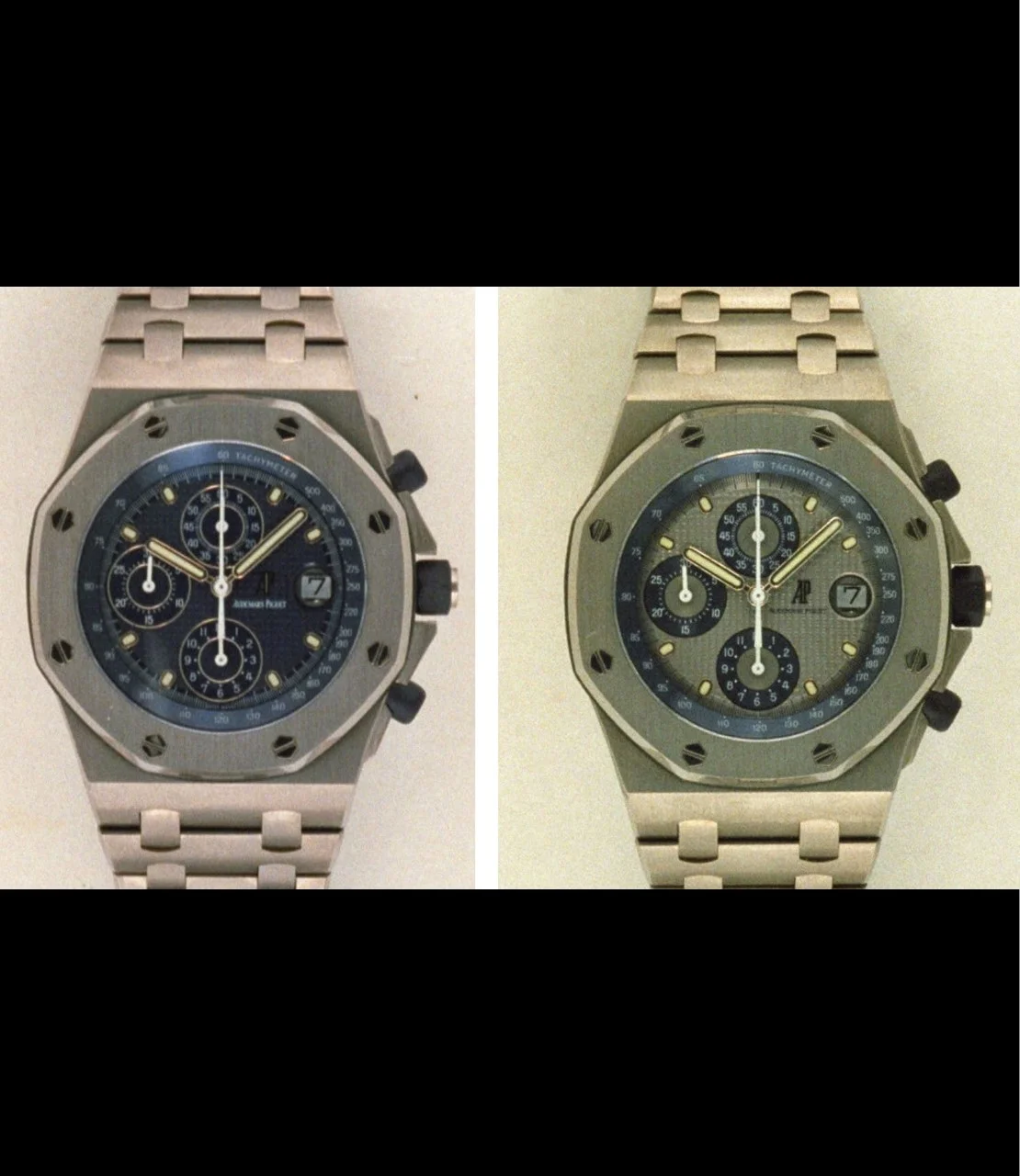
Circa 1998. Identification photographs of Model 25721TI. Dial variants. Audemars Piguet Archives
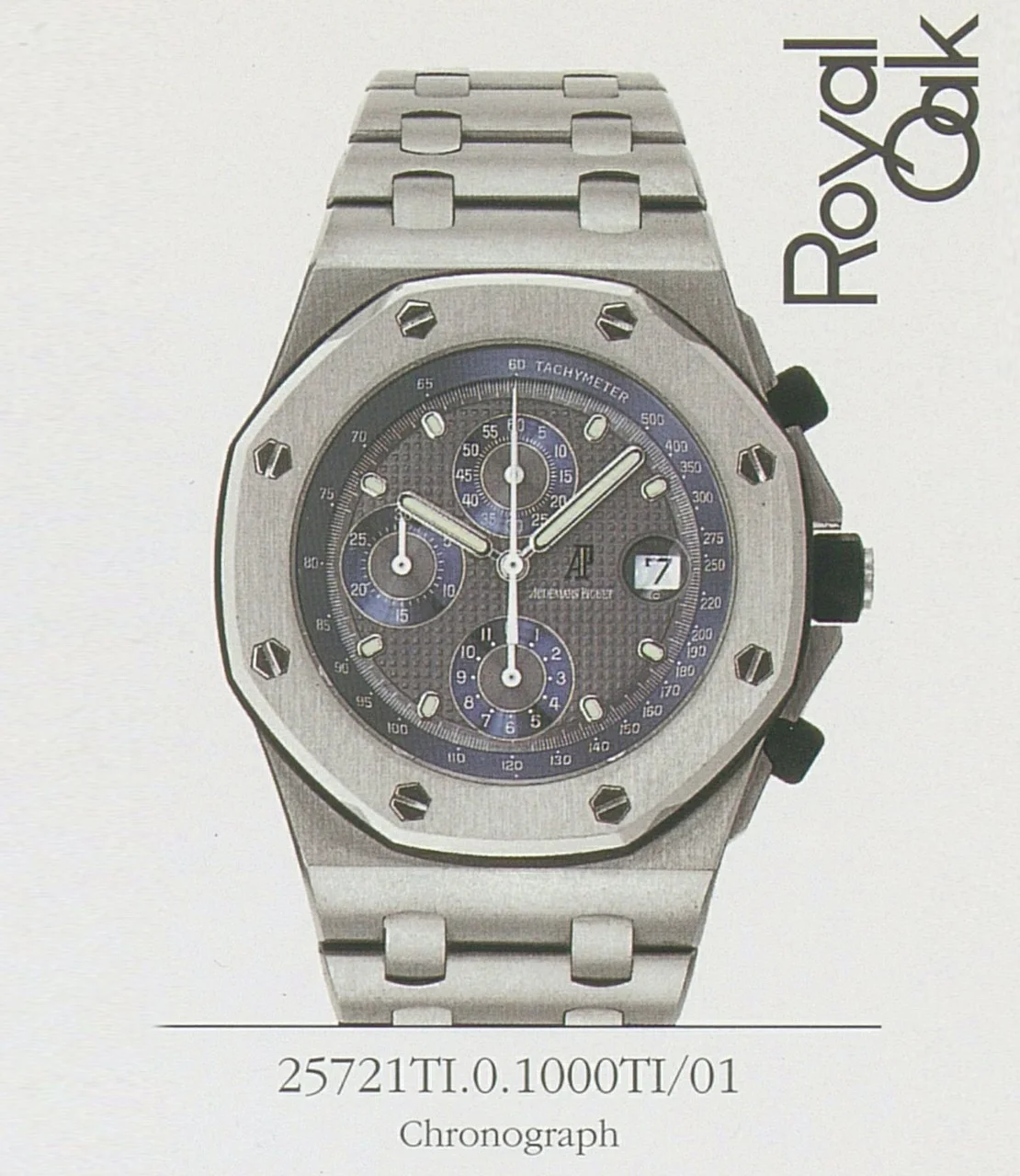
1998. Royal Oak Offshore Chronograph 25721TI. Variant published in the AP Catalogues from 1998 to 2004. Dial 01. Audemars Piguet Archives.
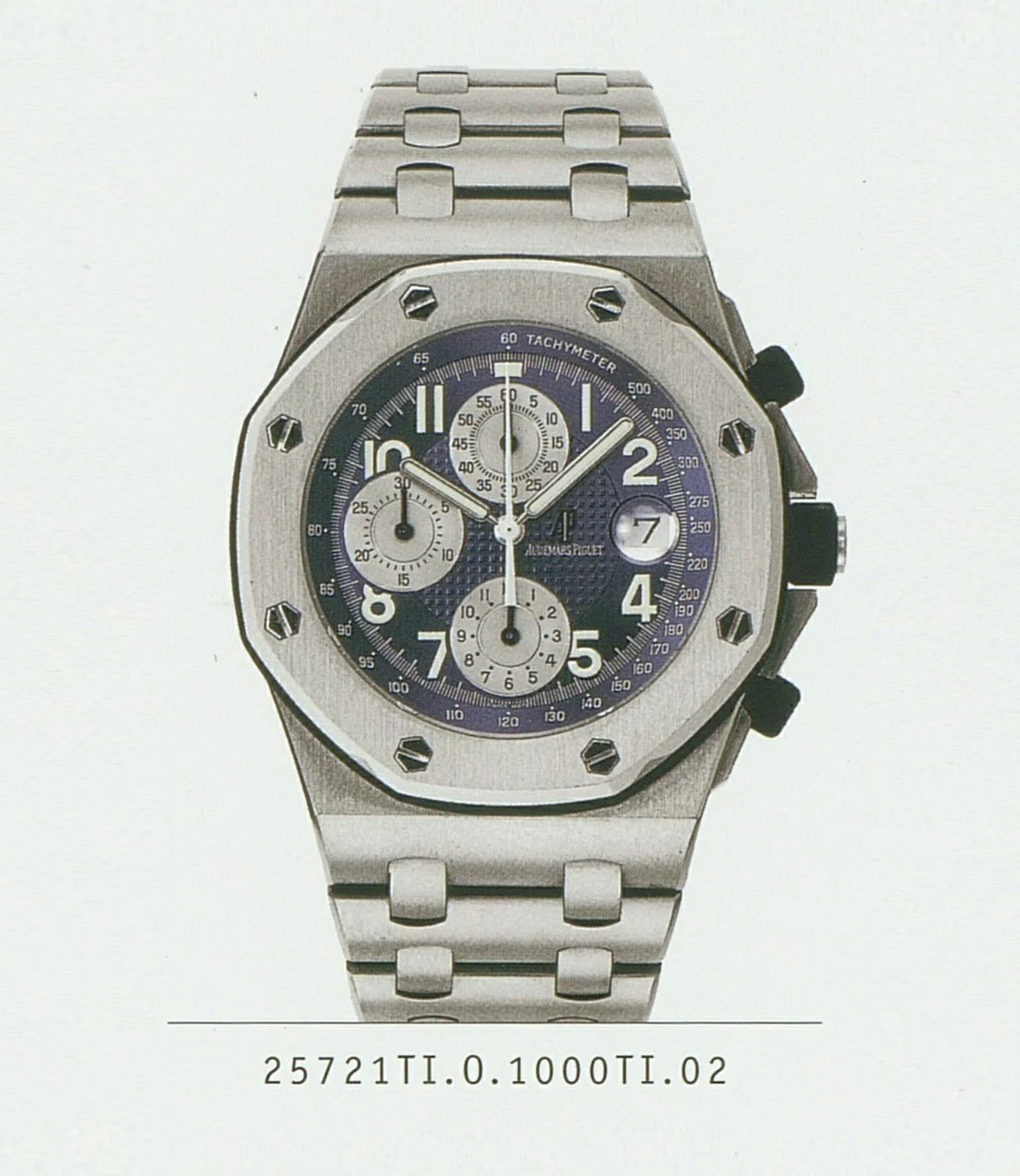
2002. Royal Oak Offshore Chronograph 25721TI. Variant published in the AP Catalogues from 2002 to 2004. Dial 02. Audemars Piguet Archives.

2002. Royal Oak Offshore Chronograph 25721TI. Grande Tapissesrie dial. Variant published in the AP Catalogues from 2002 to 2004. Dial 03. Audemars Piguet Archives.

2003. Technical data for Model 25721TI model. Audemars Piguet

2004. Royal Oak Offshore Chronograph 25721ST and TI. Méga Tapisserie dial. This photograph illustrates the steel and titanium variants in the AP Catalogues from 2004 to 2010. Dials 09 and 04. Audemars Piguet Archives.
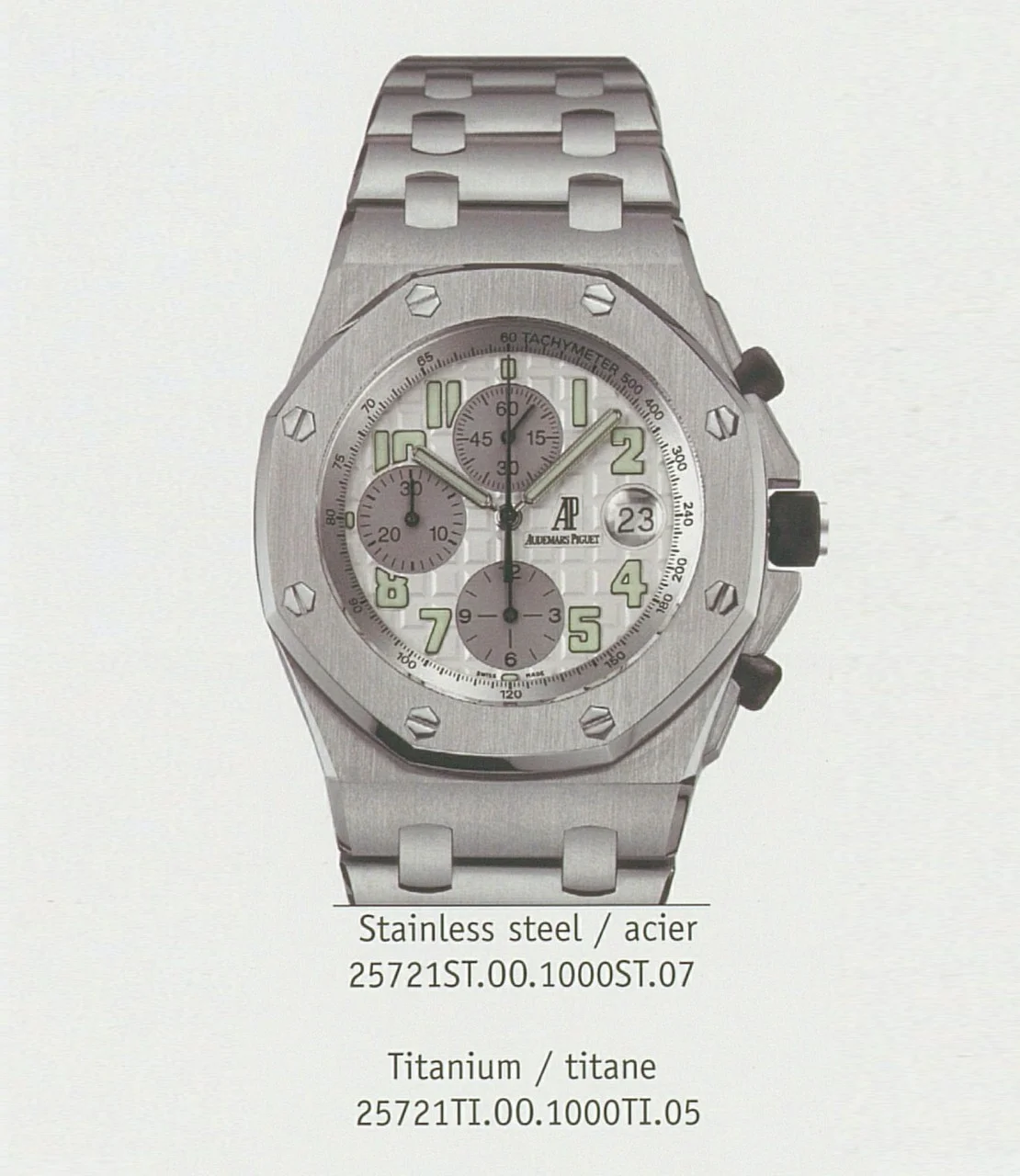
2004. Royal Oak Offshore Chronograph 25721ST and TI. Méga Tapisserie dial. This photograph illustrates the steel and titanium variants in the AP Catalogues from 2004 to 2010. Dials 07 and 05. Audemars Piguet Archives.

2004. Royal Oak Offshore Chronograph 25721ST and TI. Méga Tapisserie dial. This photograph illustrates the steel and titanium variants in the AP Catalogues from 2004 to 2010. Dials 08 and 06. Audemars Piguet Archives.
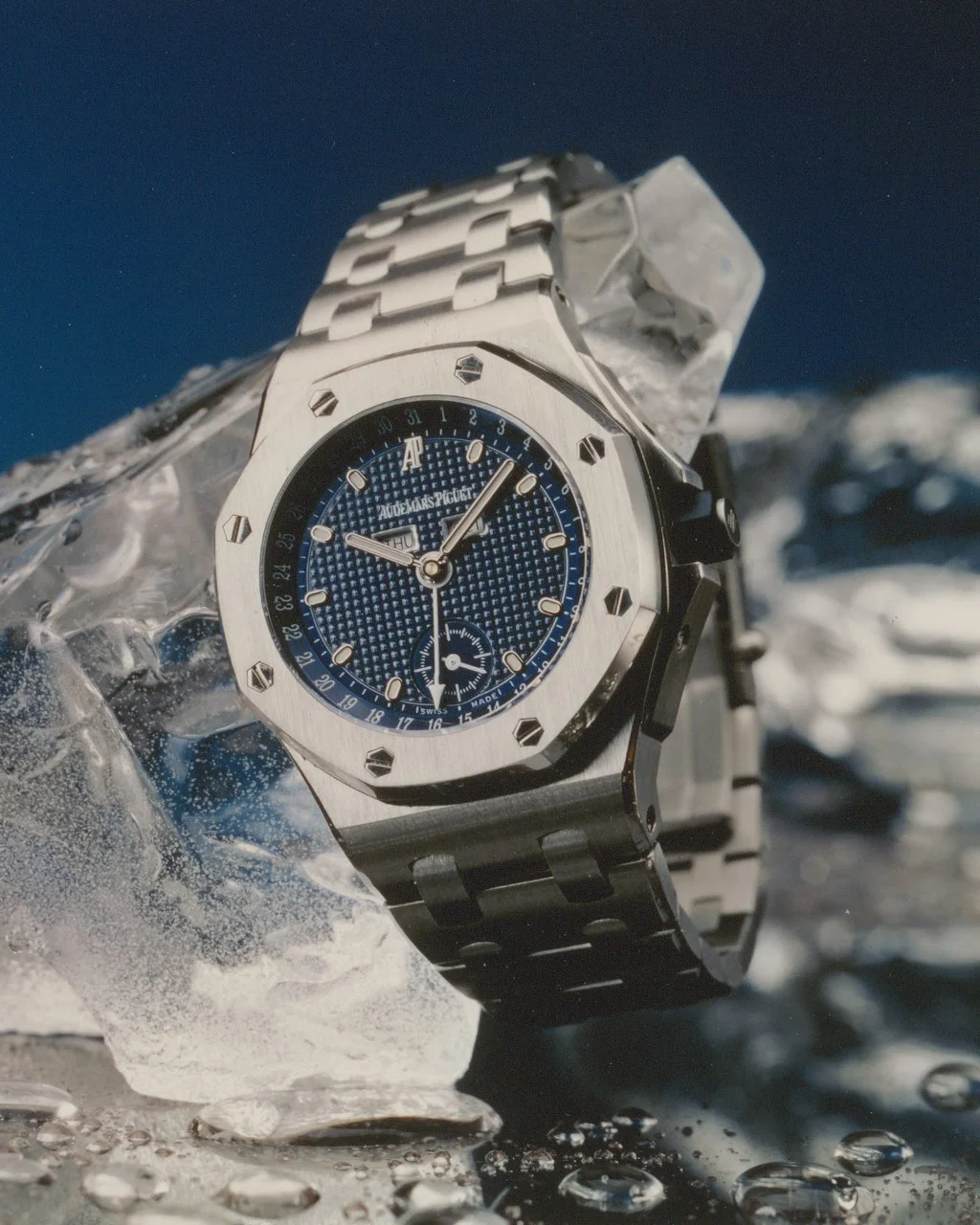
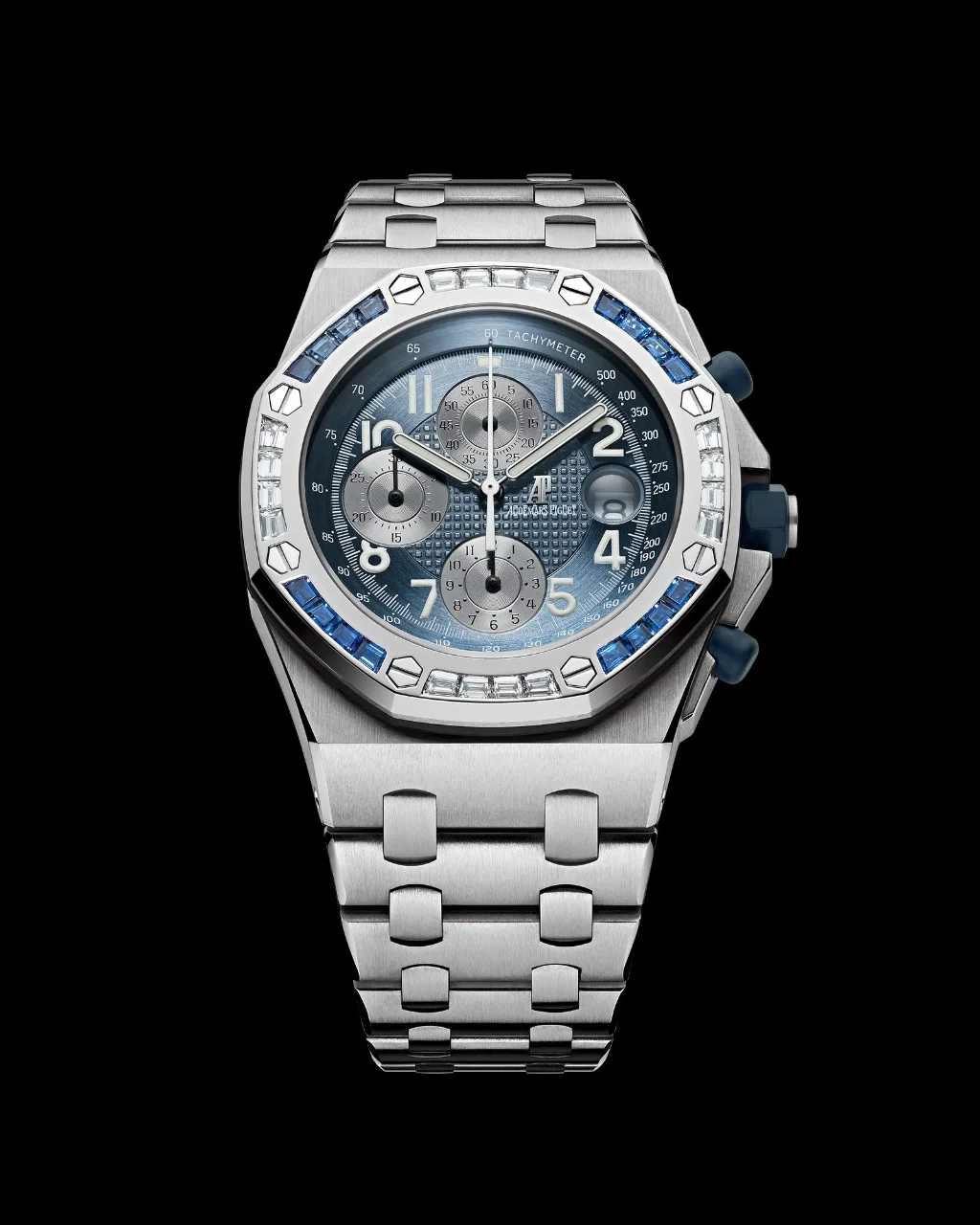
In 1998, the Royal Oak Offshore 25721TI introduced a material that was then little used in watchmaking: titanium.
Audemars Piguet had launched research on this material at the LRSH (Laboratoire Suisse de Recherches Horlogères) in the 1970s. In 1986, this material was used in the tourbillon carriage of Model 25643. In 1997, the Jules Audemars Grande Sonnerie Models 25750IS and IR were fitted with a titanium case, but it was not until the Royal Oak Offshore that titanium was used for the entire exterior of an Audemars Piguet watch, including the bracelet.
The development of this variant was in response to customer demand for a Royal Oak Offshore 42 mm watch with a metal bracelet (unlike Model 25770), but featuring a relatively light weight. The titanium variant weighs 150 grams, a third less than the steel (approx. 220 grams).
The model was a great success, as nearly 3000 were produced over a period of fifteen years.
Sales from 1998 to 2014: a total of 2,902 units, of which 235 (1998), 216 (1999), 247 (2000), 182 (2001), 254 (2002), 183 (2003), 384 (2004), 308 (2005), 448 (2006), 279 (2007), 32 (2008), 128 (2009), 4 (2010) and 2 (2014)
In 1998, the Royal Oak Offshore 25721TI introduced a material that was then little used in watchmaking: titanium.
Audemars Piguet had launched research on this material at the LRSH (Laboratoire Suisse de Recherches Horlogères) in the 1970s. In 1986, this material was used in the tourbillon carriage of Model 25643. In 1997, the Jules Audemars Grande Sonnerie Models 25750IS and IR were fitted with a titanium case, but it was not until the Royal Oak Offshore that titanium was used for the entire exterior of an Audemars Piguet watch, including the bracelet.
The development of this variant was in response to customer demand for a Royal Oak Offshore 42 mm watch with a metal bracelet (unlike Model 25770), but featuring a relatively light weight. The titanium variant weighs 150 grams, a third less than the steel (approx. 220 grams).
The model was a great success, as nearly 3000 were produced over a period of fifteen years.
Sales from 1998 to 2014: a total of 2,902 units, of which 235 (1998), 216 (1999), 247 (2000), 182 (2001), 254 (2002), 183 (2003), 384 (2004), 308 (2005), 448 (2006), 279 (2007), 32 (2008), 128 (2009), 4 (2010) and 2 (2014)