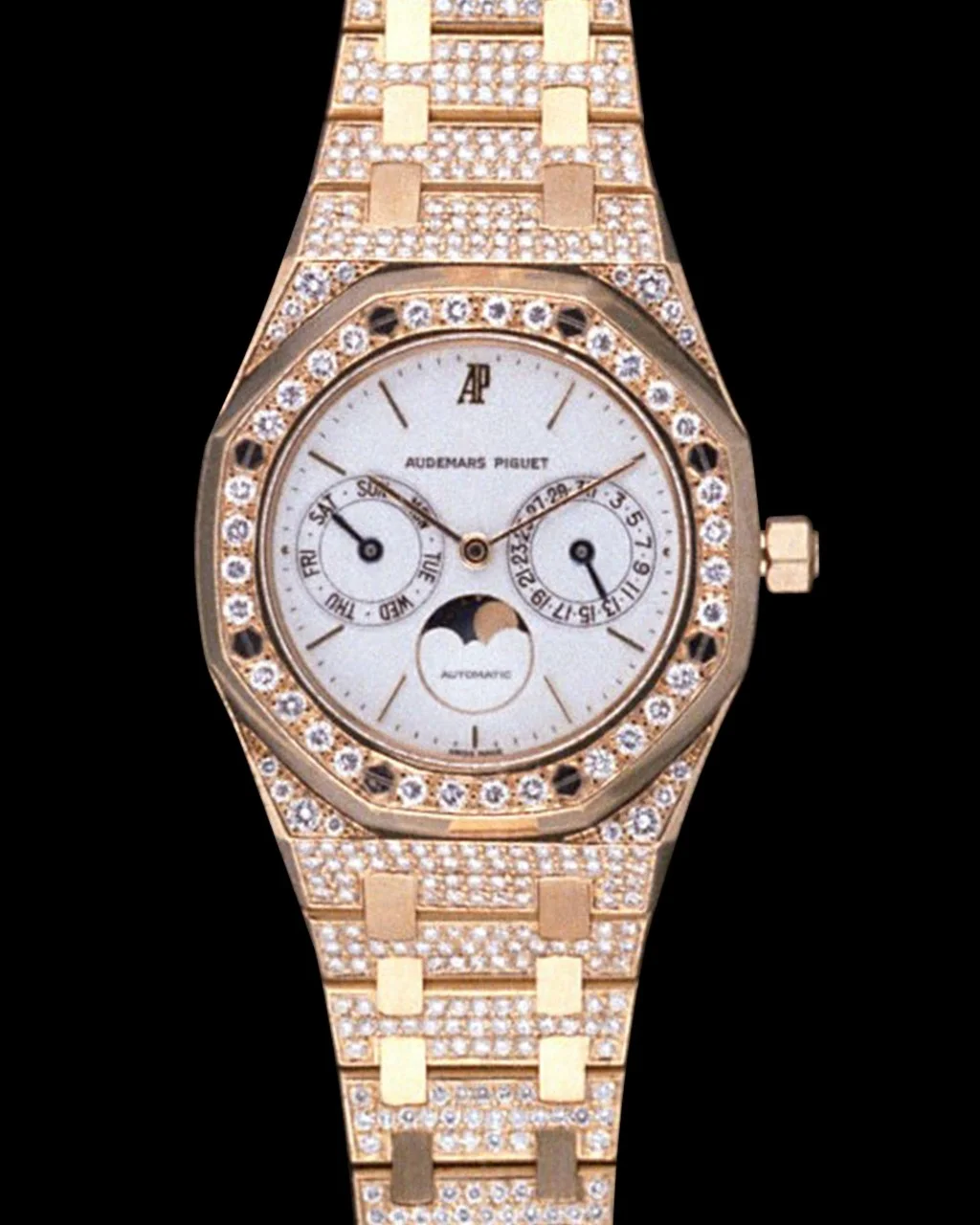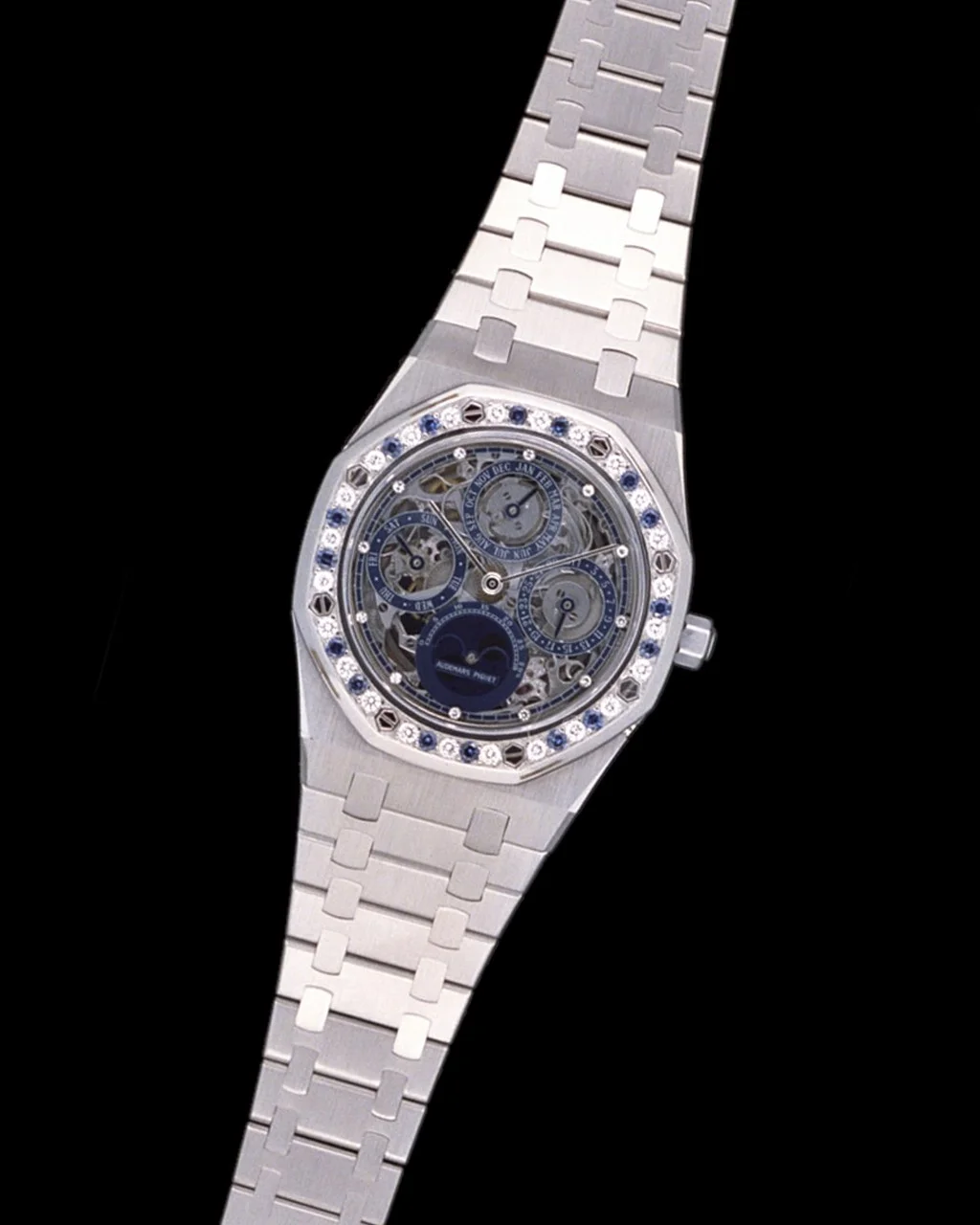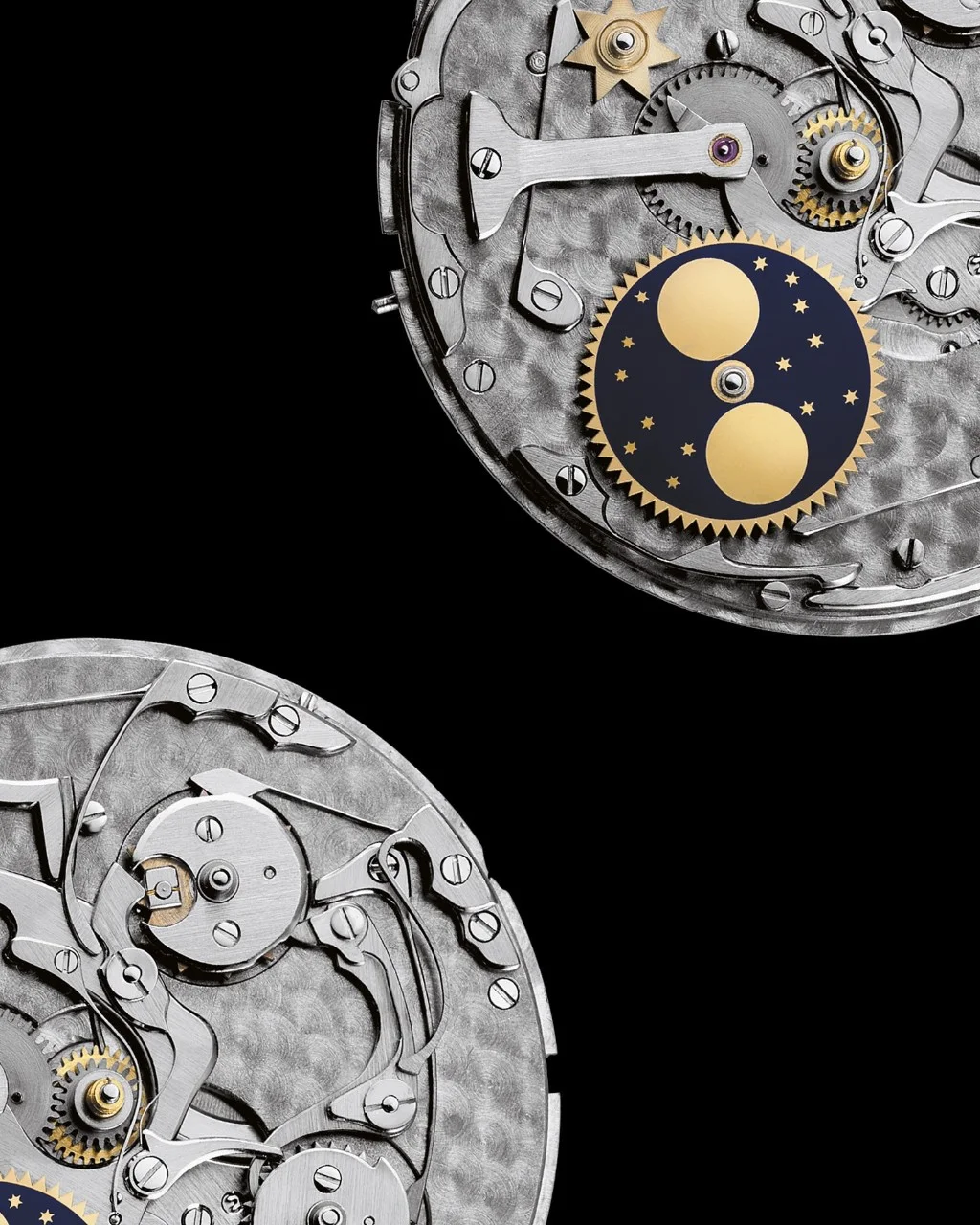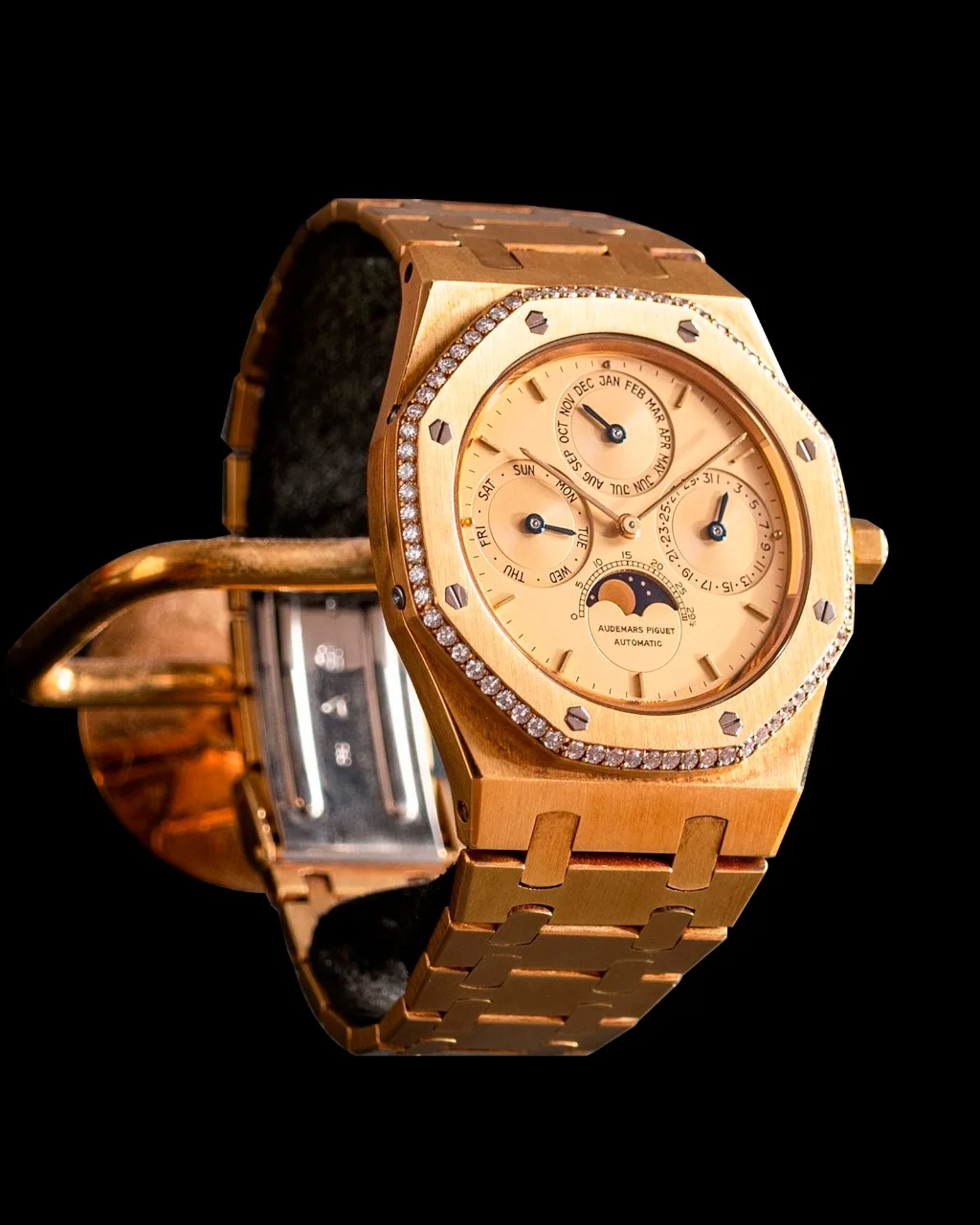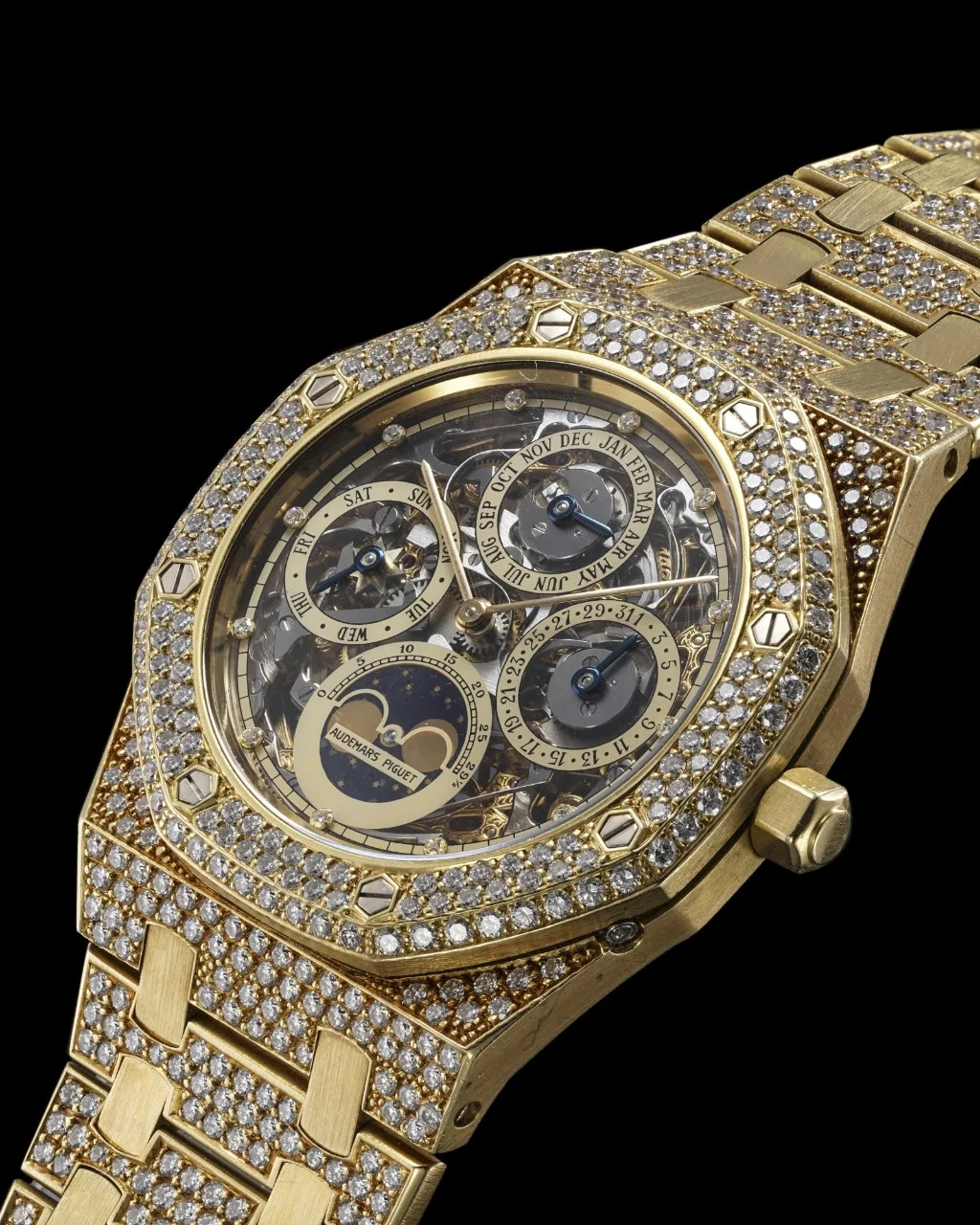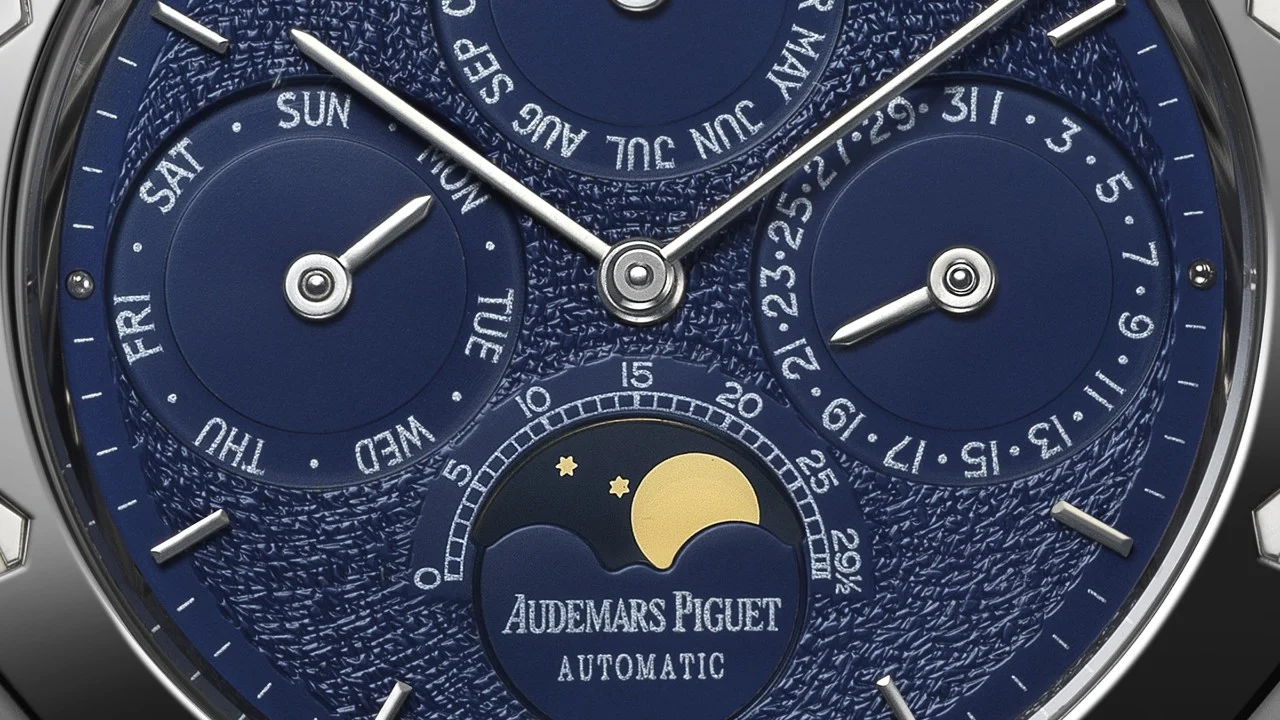
ROYAL OAK CALENDAR WATCHES 1983–1996
Summary
At the roots of every civilisation
How could we organise our lives if we had no calendars? If we were unable to get our temporal bearings, it would be difficult to plan a meeting even a few days away. Without a calendar, we would not even know our age. How can we build the history of our societies without chronological reference points? That is why each emerging civilisation, once numbering several thousand people, has had to devise its own calendar system.
Calendars are all based on natural cycles, resulting from the observation of the sky. Their elaboration has proved extremely difficult because the cycles of the Earth-Moon-Sun system are not synchronised with each other in complete units. To put it in simpler terms, the Earth makes a complete circle around the Sun in one year. However, during this same rotation, it spins on its axis 365.2422 times. What should be done with the extra 0.2422? To make matters worse, during the same period the Moon revolves around the Earth 12.368 times. After one year, it is therefore in a very different position from its starting point. How should one deal with these shifts?
Each calendar has chosen a different solution: some based on the lunar cycle, others on the solar cycle, and still others combining the two. The Gregorian calendar, established in the 16th century, has gradually become a widely used benchmark. Its system alternates between months of 30 and 31 days. The month of February plays a regulatory role. While it usually has 28 days, a February 29 is added every four years, marking the leap year. However, for the sake of precision, February 29 is omitted once every 100 years – i.e. for the years 2100, 2200, 2300... (leap year) – but is maintained every 400 years, meaning 1600, 2000, 2400, etc. While this solution is ingenious, it does not prevent a residual three-day discrepancy in 10,000 years. Let us trust that our successors will have found a solution by then...
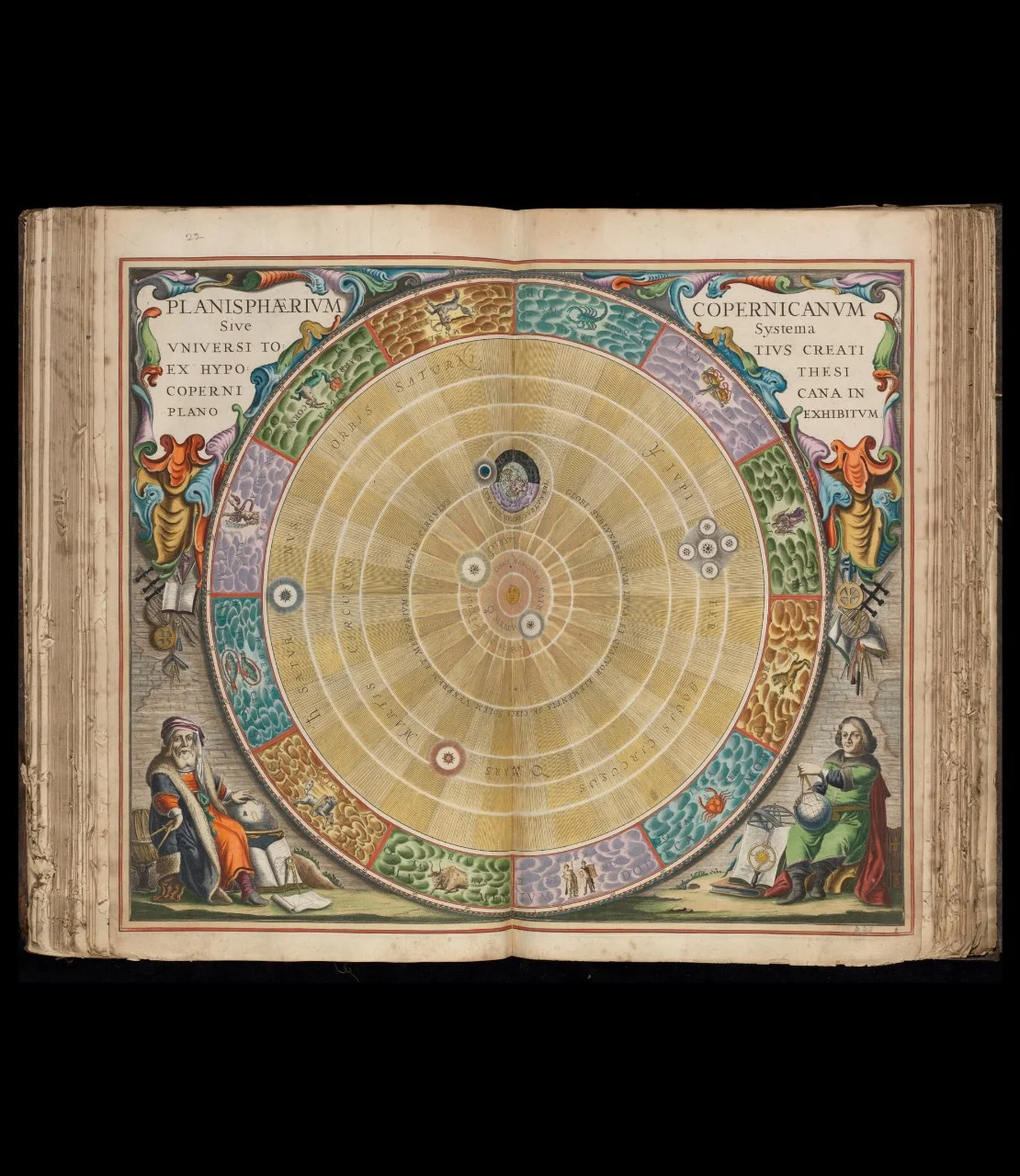
1661. Representation of the solar system. In the 15th century, Nicolaus Copernicus suggested a representation that placed the Sun at the centre of the universe. Andrea Cellarius, Harmonia Macrocosmica. Amsterdam, 1661. Chester Beatty Library Rare Books: AI788, plate 22.
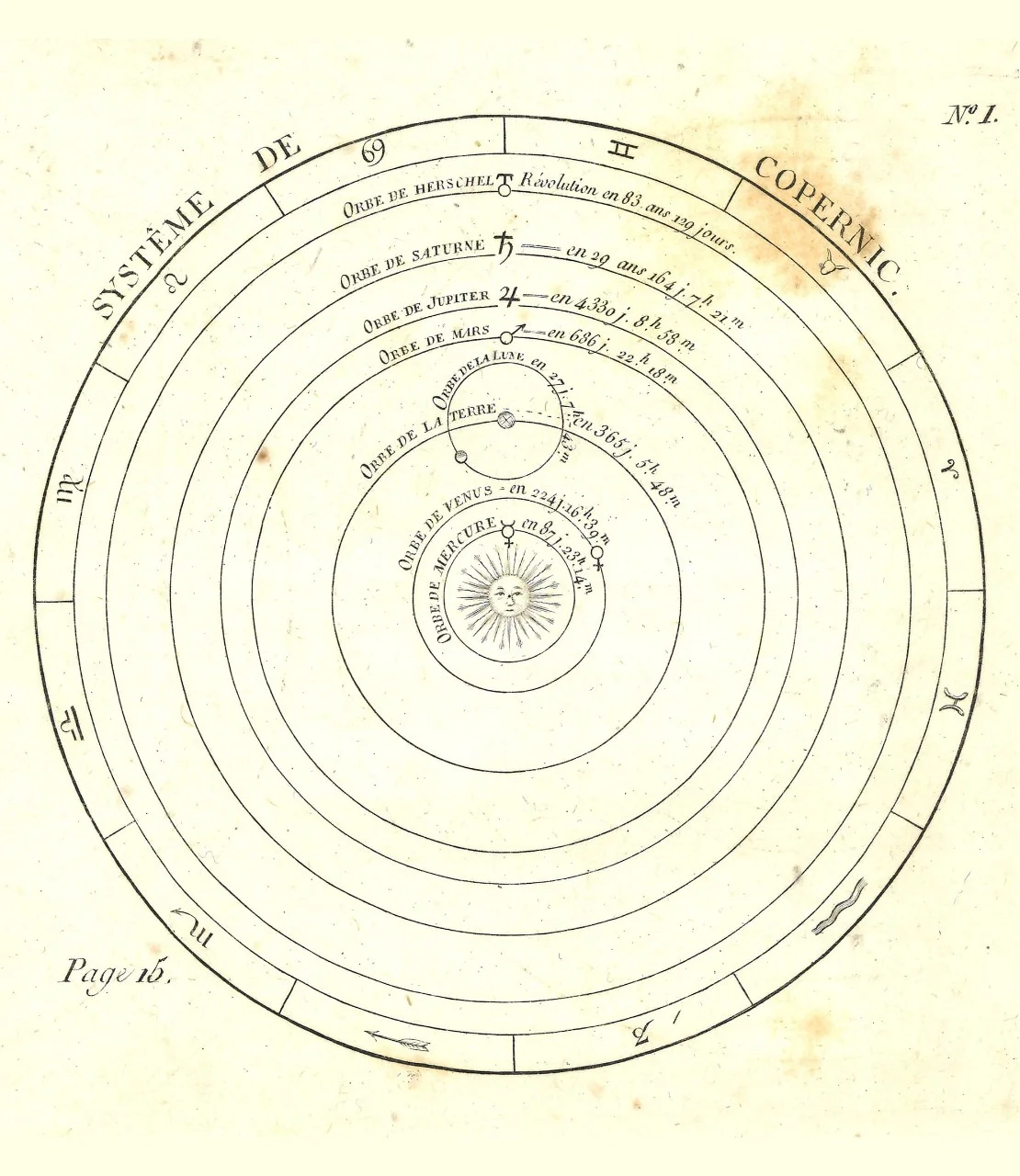
1821. Representation of the solar system. In the 15th century, Nicolaus Copernicus proposed a representation that placed the Sun at the centre of the universe. François Delamarche. Les Usages de la Sphère et des Globes précédé d’un Abrégé sur les différents systèmes du monde. Paris, 1821. Plate n° 1, page 15. Audemars Piguet Library.
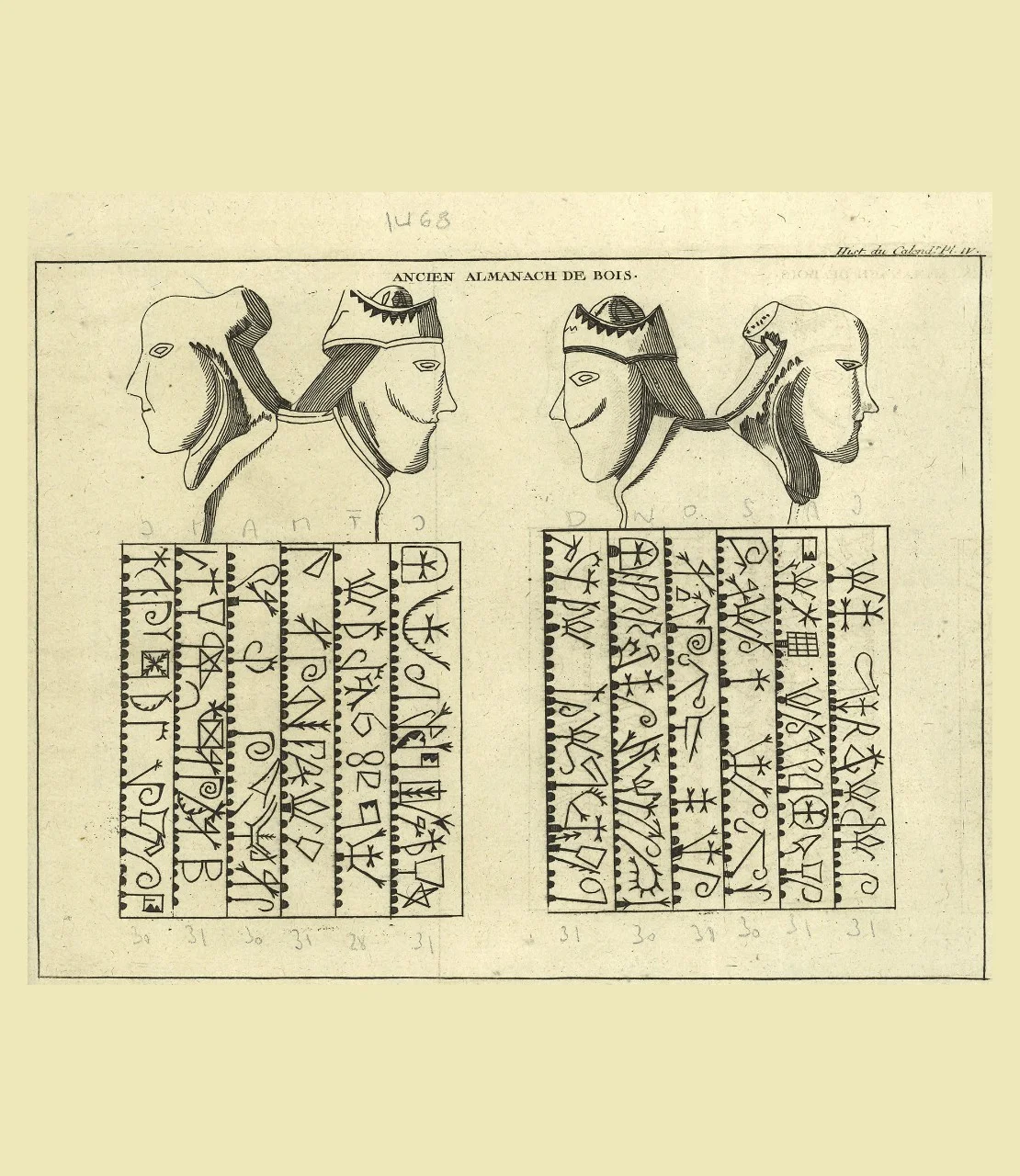
1776. Etching depicting an ancient wooden almanach. Probably done by a Franciscan in the 15th century. Court de Gebelin, Histoire Civile et Allégorique du Calendrier ou Almanach. Plate IV. Paris, 1776. Plate n° 1, page 15. Audemars Piguet Library.
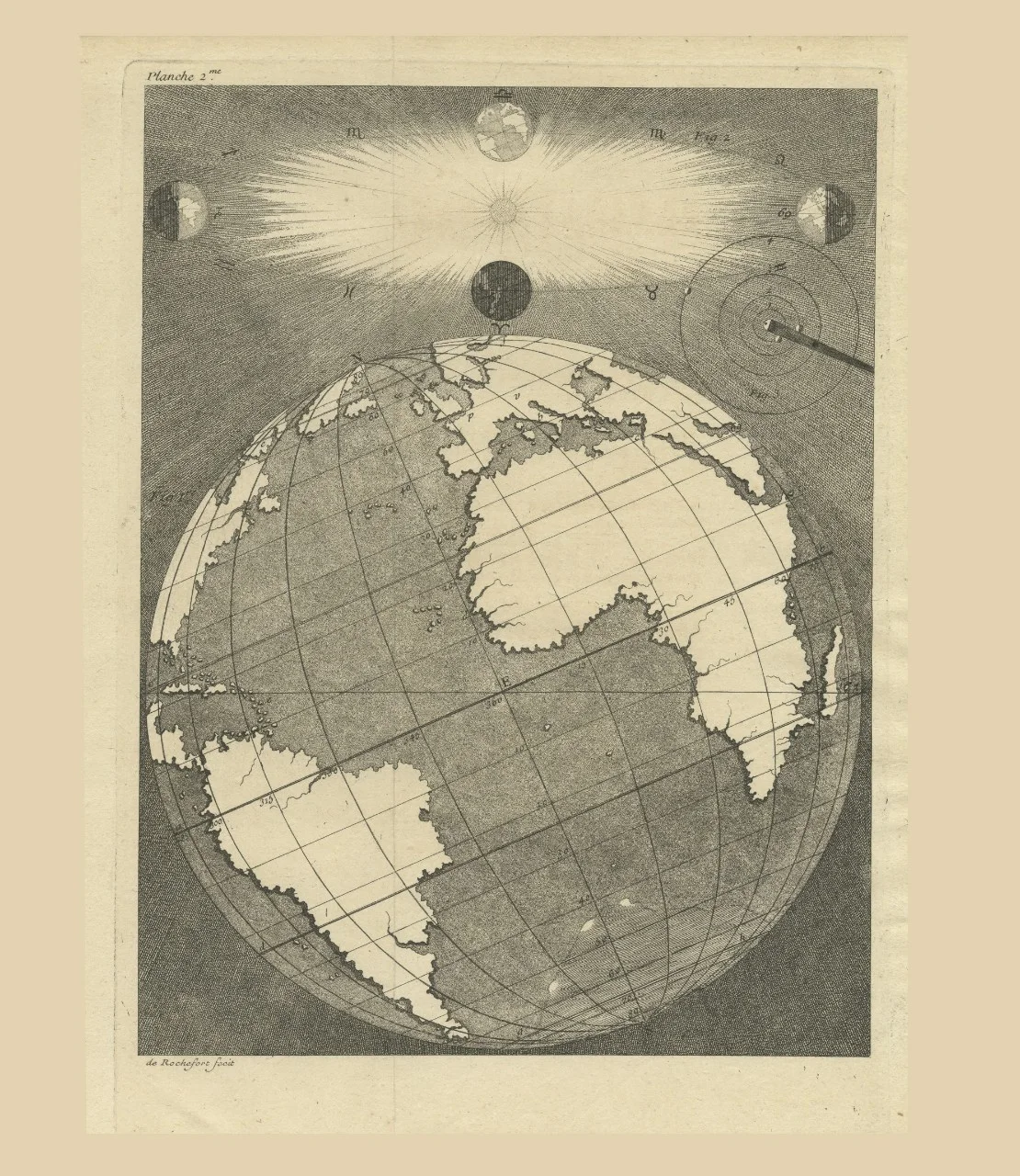
1726. Representation of the Earth-Sun system. Establishing longitudes links the notions of time and space. Henry Sully, Dissertation sur la nature des tentatives pour la Découverte des Longitudes. Paris 1726. Audemars Piguet Library.
Celestial and terrestrial mechanics
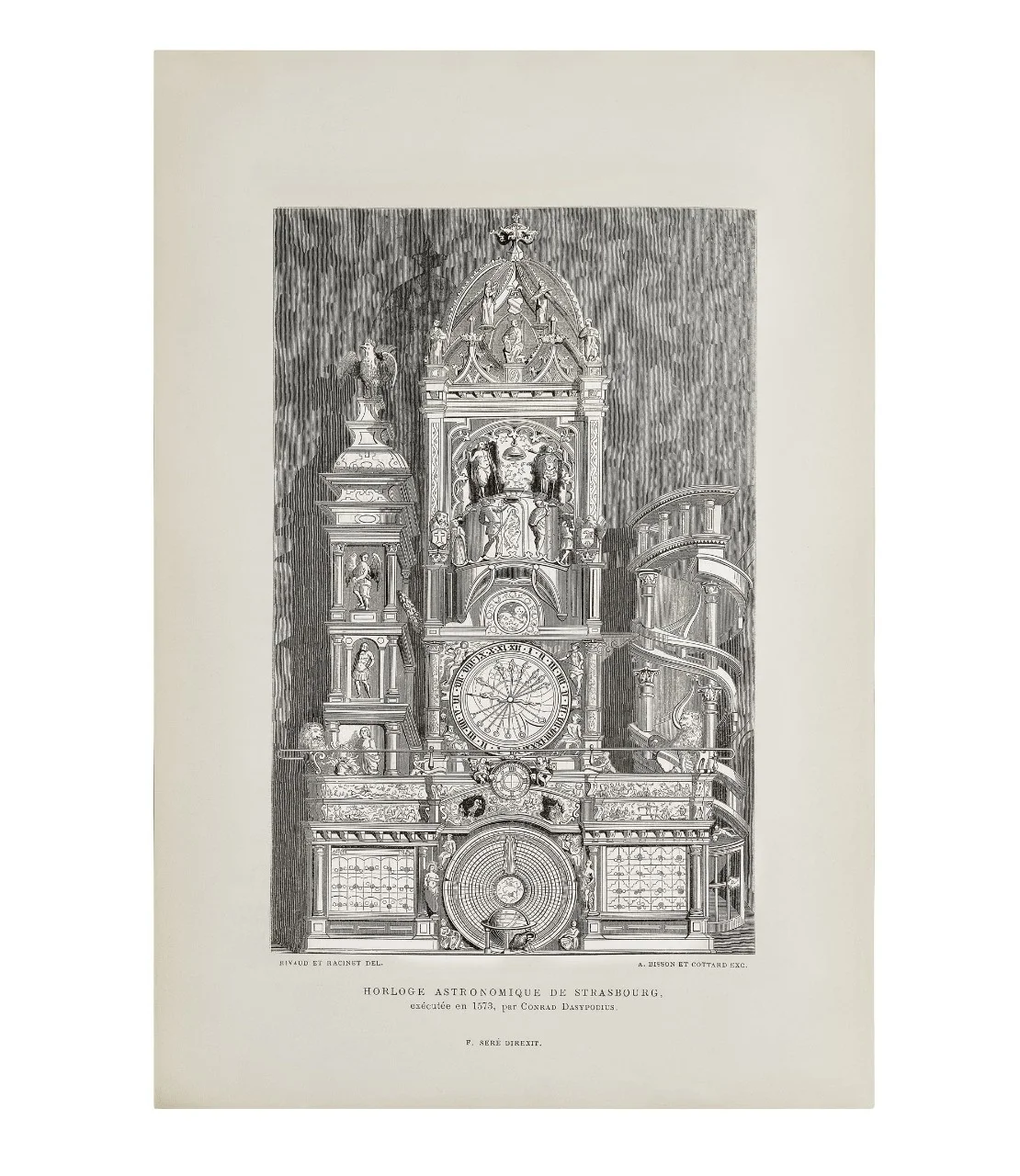
Astronomical indications appeared right from the very first mechanical timepieces. One need only mention the fabulous Antikythera mechanism created in Greece around 140 BCE, which according to some reconstructions was capable of displaying not only the date of the Egyptian calendar, but also the Greek Olympiads and their correspondence with the calendar years. Other examples include the extraordinary water clock invented by Chinese polymath Su Sung in the 11th century and the Prague astronomical clock, which has been admired since 1410.
The history of so-called "astronomical" complications encompasses countless creations and specialities, including sunrise and sunset times, the equation of time (solar time), and even Easter date indication. However, since the 19th century, the most classic calendar complication in watchmaking is the perpetual calendar. This additional mechanism (or dial) indicates the day, date, month and often the moon phase across a four-year cycle. The mechanism must be set once a century, i.e. in 2100, 2200, 2300, etc.
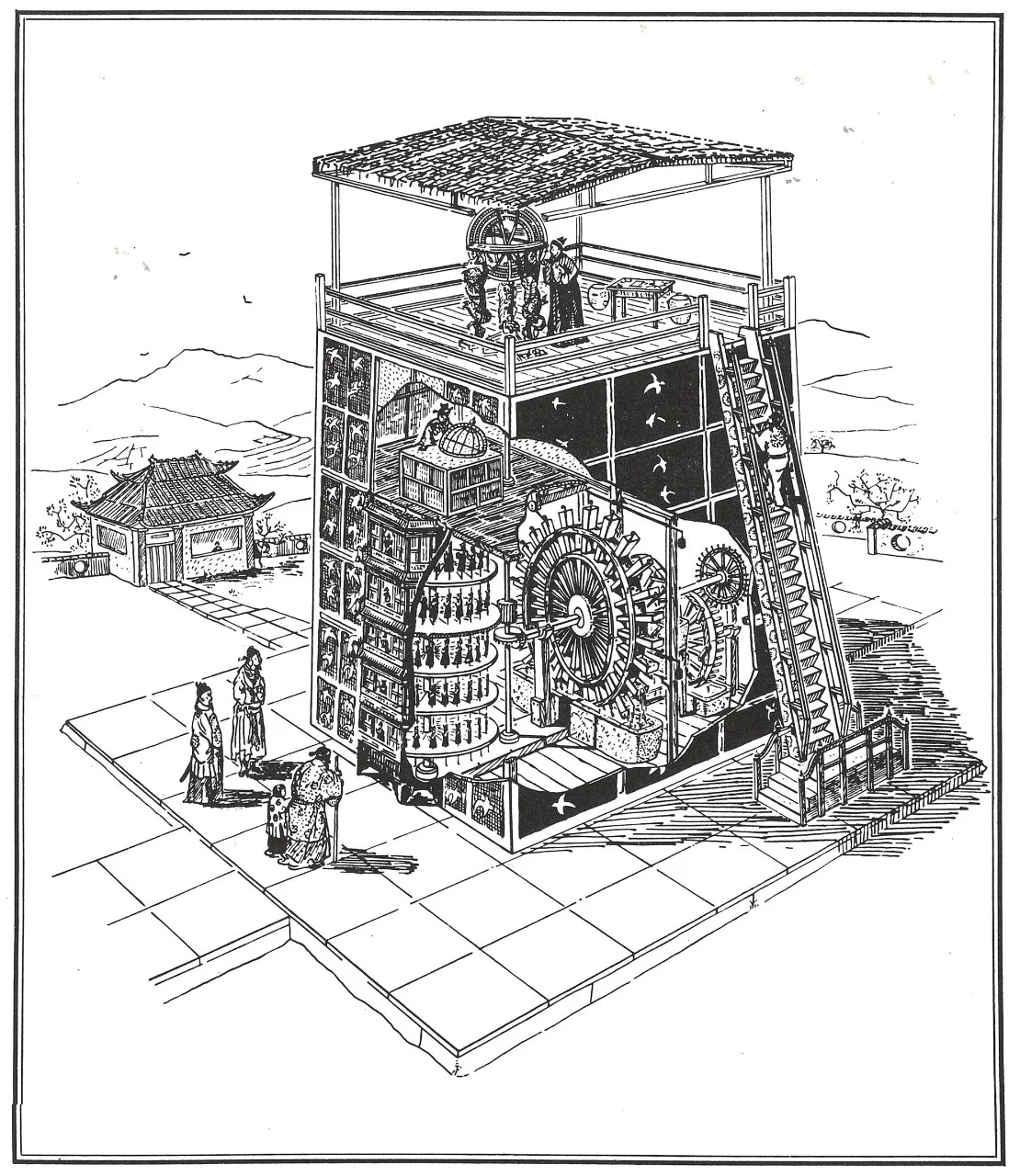
~1086. Sketch of the water clock by Su Song. Comissioned by the Chinese emperor, this giant clepsydra reproduced the orbits of the moon, the sun and certain stars. © Cambridge University Press.
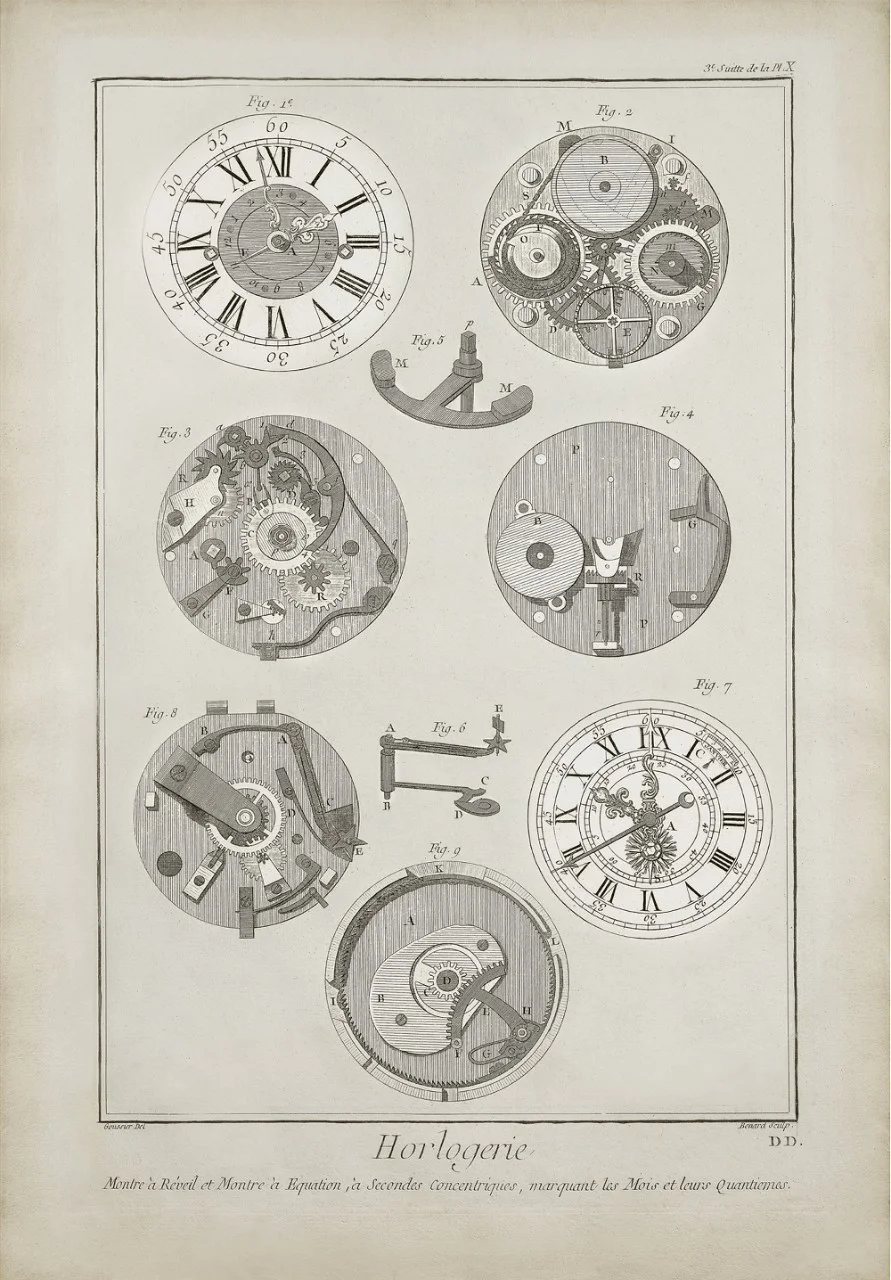
1765. Plate showing a calendar watch mechanism. Equation of time, month and date. Recueil de planches, sur les sciences, les arts libéraux, et les arts méchaniques, avec leur explication. Excerpt from the Encyclopaedia of Diderot and d'Alembert, Paris, 1765. Audemars Piguet Library.
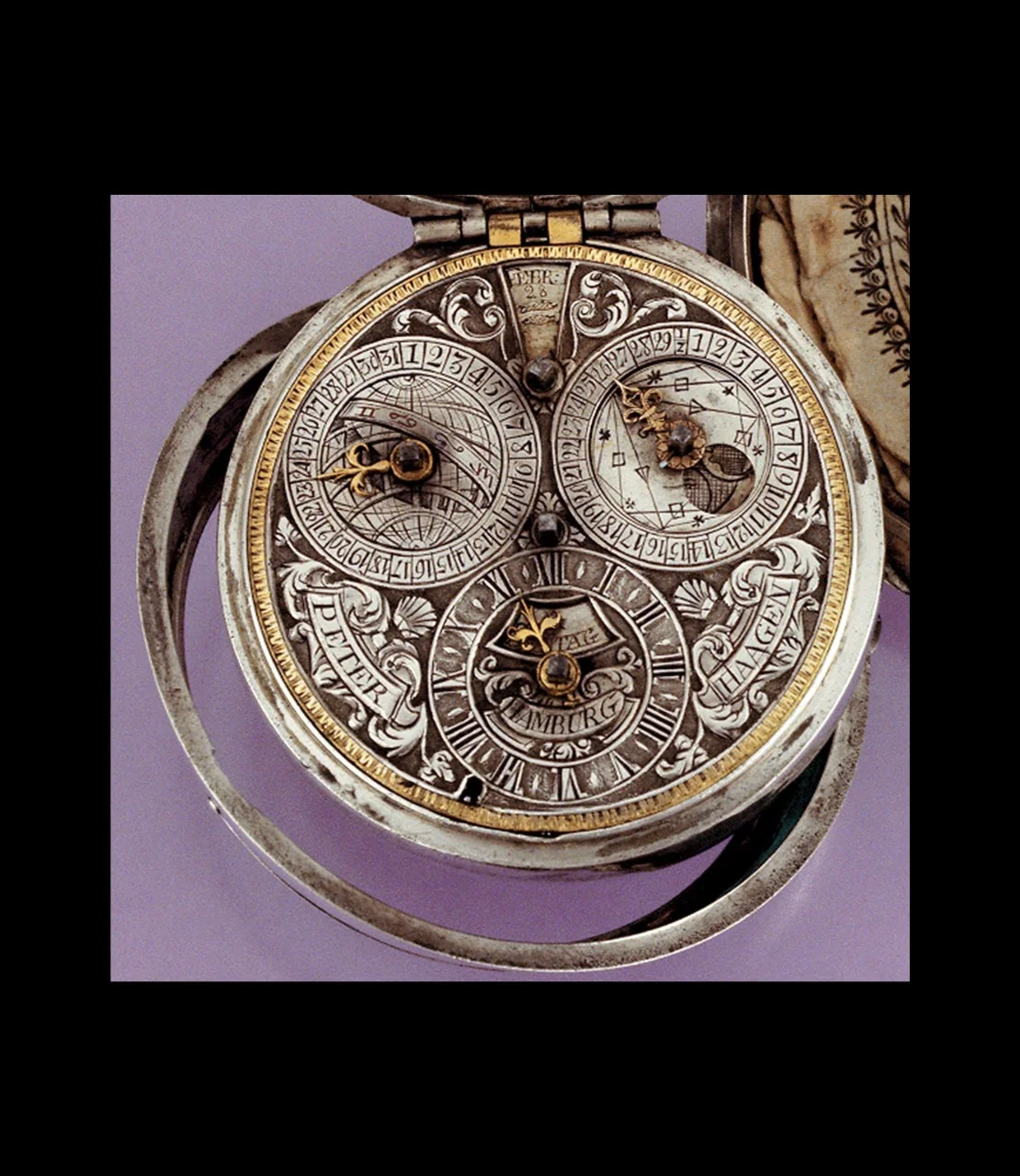
~1700. Astronomical clock signed by Peter Octavius Haagen, Hambourg. Indication of the months and their duration as well as zodiac signs, date, moon phase, age of the moon, day of the week and its planetary sign. Double case in polished and engraved silver © Musée International d'Horlogerie in La Chaux-de-Fonds, inv. I-1221.
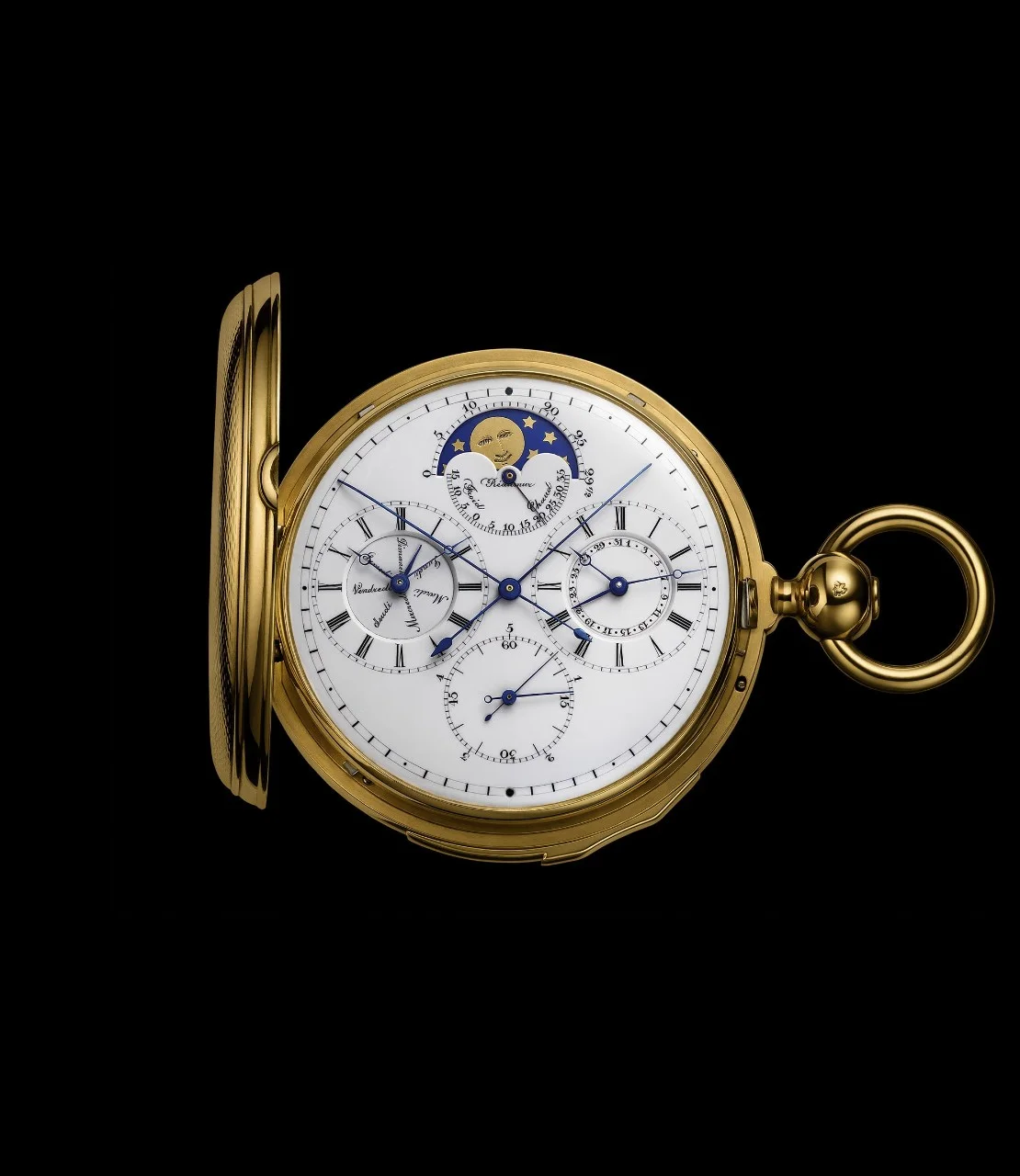
~1858. Louis Audemars complicated watch, signed Leroy. Moon phase at 12 o'clock, date and day. Jumping chronograph, deadbeat seconds, split-seconds. Thermometer. 18-carat yellow gold case engraved with the inscription: "Beadsman. Winner of the Derby at Epsom 1858. The property of and bred by Sir Joseph Hawley Bart. Audemars Piguet Heritage, inv. 50.
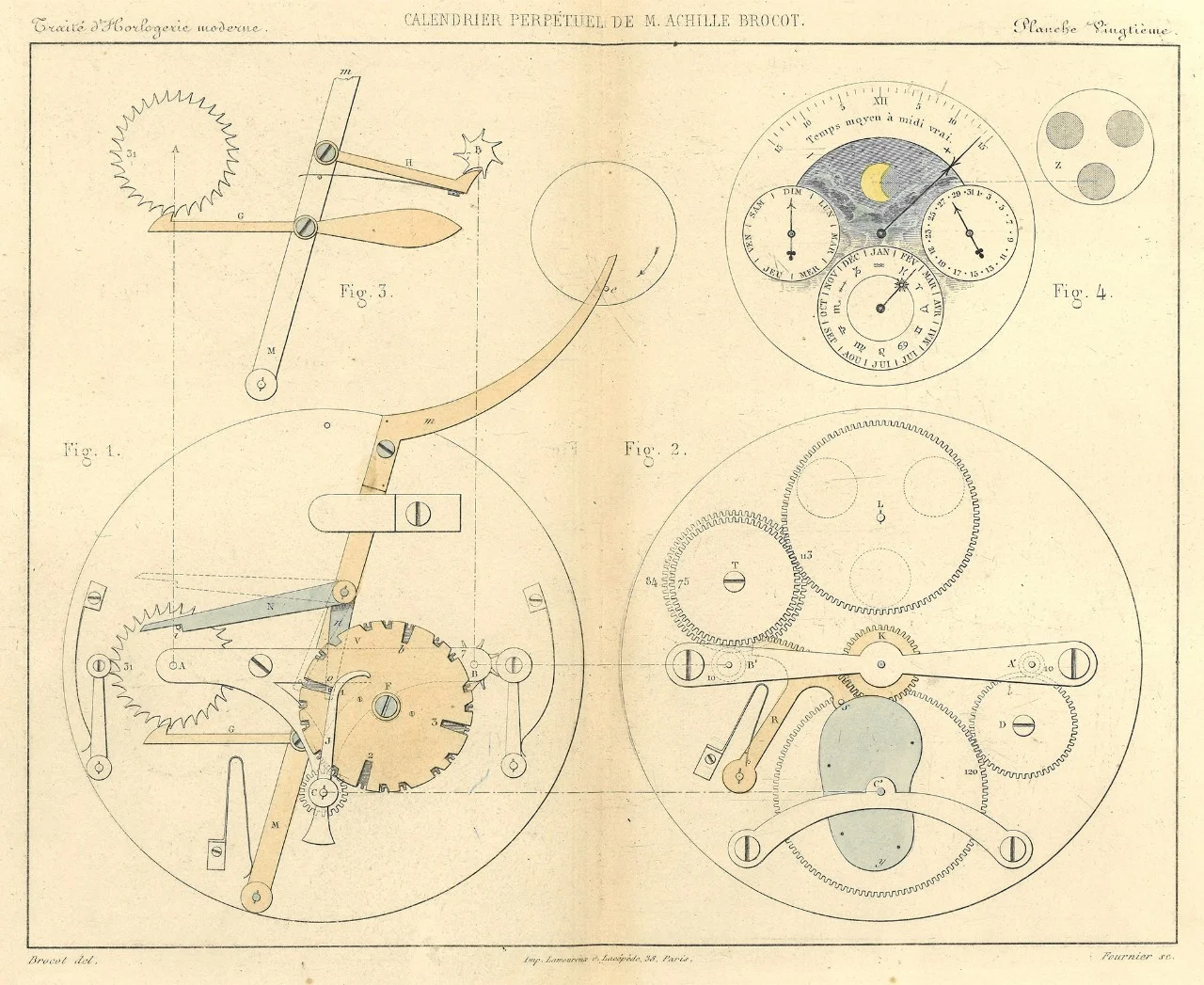
1887. Technical drawings of a perpetual calendar mechanism. In his famous Traité d'Horlogerie Moderne, Claudius Saunier illustrates the mechanism of a perpetual calendar. Paris, 1887. Plate XX. Audemars Piguet Library.
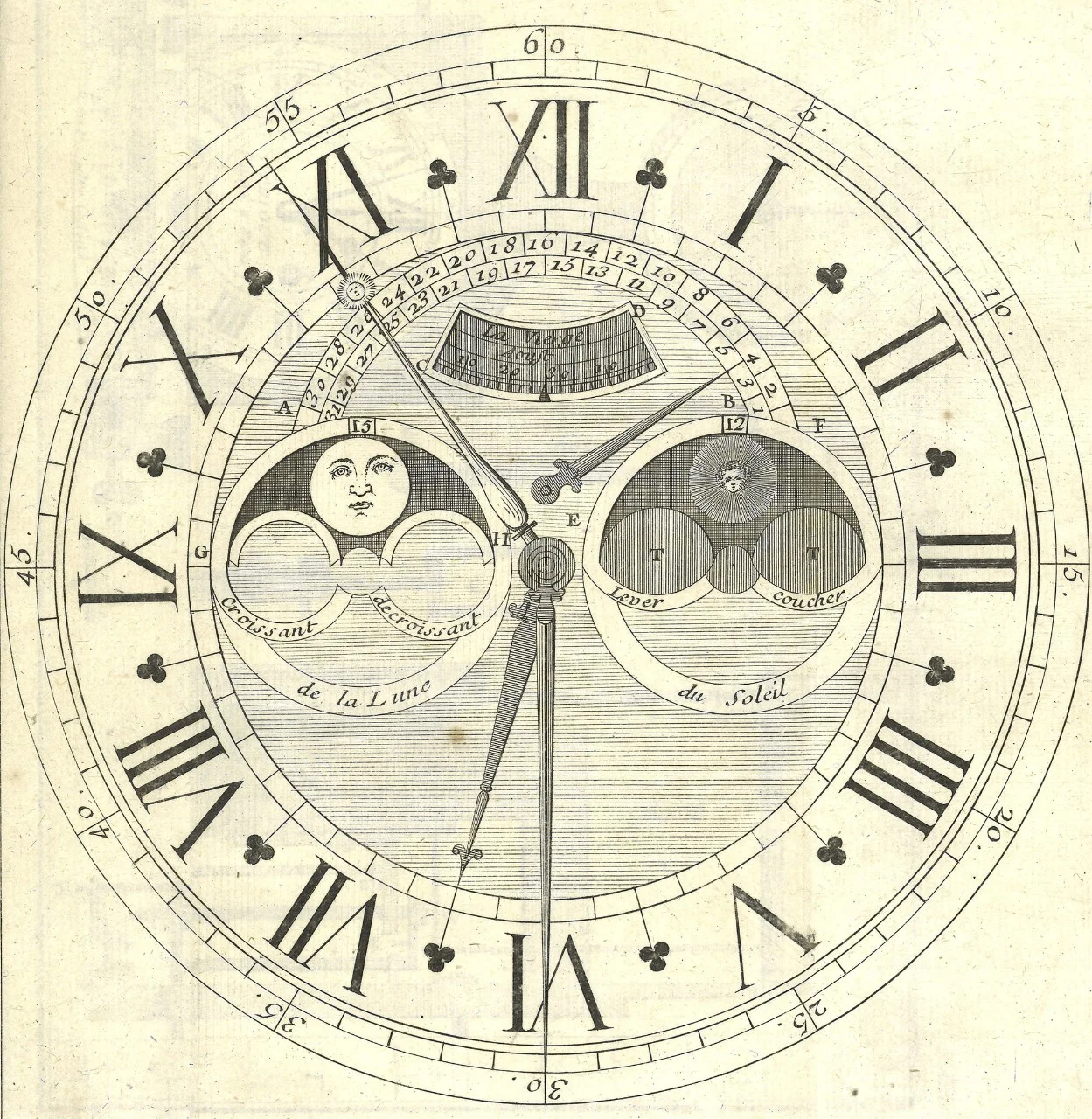
1767. Sketch of an astronomical timepiece. Paris, 1767. Plate 26, detail. The dial shows the date, month, moon, sunrise and sunset times, the equation of time and the signs of the zodiac. Antoine Thiout, Traité de l'Horlogerie Méchanique et Pratique. Audemars Piguet Library.
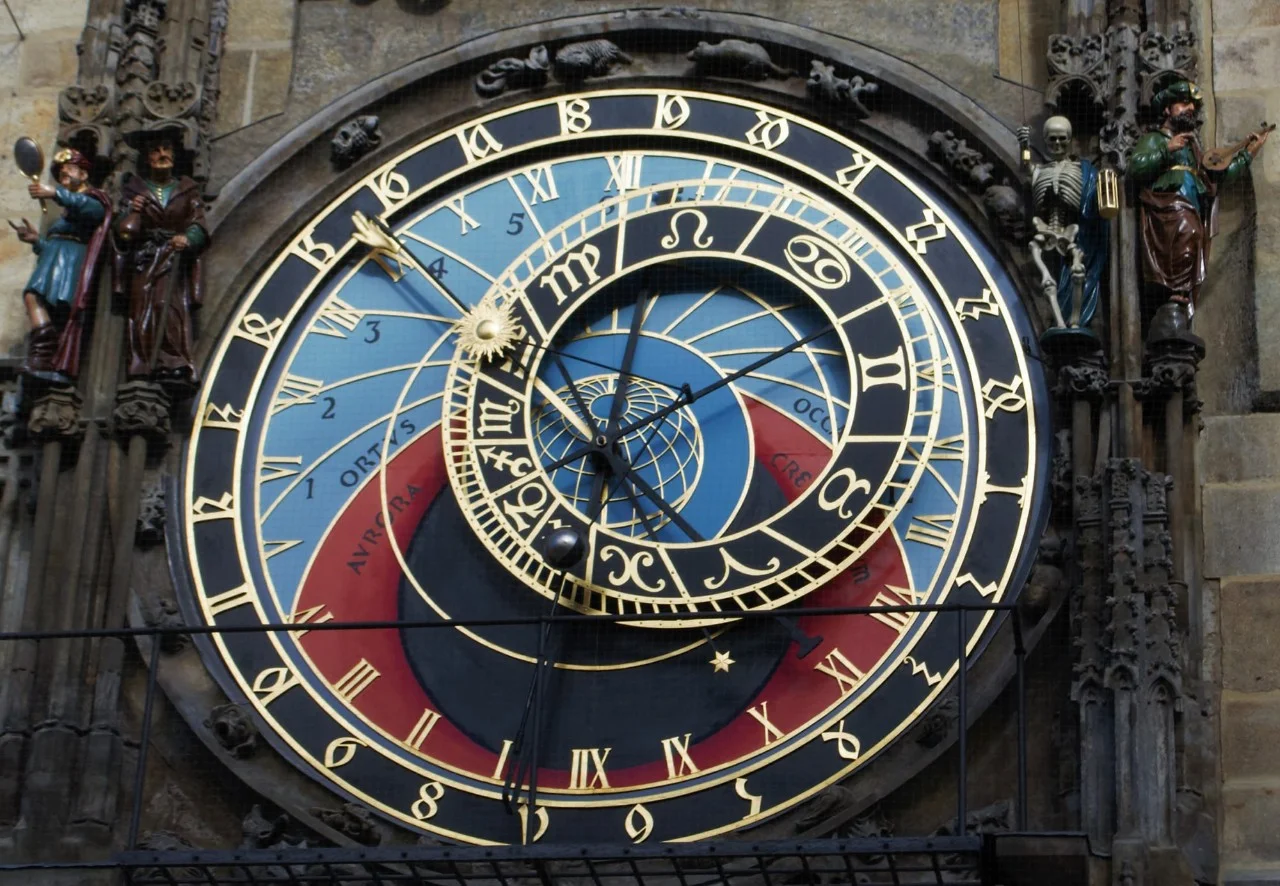
1410. Prague astronomical clock. Built by the master clockmaker Hanus in 1410 and perfected by Jan Tabosky in the 16th century, it notably indicates the months and zodiac signs, the positions of the Moon and Sun in the sky, the saint corresponding to that particular day and sidereal time. It also marks off time with several automaton animations.
The perpetual calendar as seen by Audemars Piguet
The perpetual calendar is one of the earliest complications to appear at Audemars Piguet. Even before the company's first workshop was established in 1875, the two co-founders Jules Louis Audemars and Edward Auguste Piguet had equipped their apprenticeship masterpieces with astronomical complications.
Ever since, Audemars Piguet has never stopped producing perpetual calendar watches, although for more than a century, this function remained the almost exclusive preserve of pocket watches. Indeed, of the 208 calendar wristwatches delivered between 1924 and 1969, only 12 were equipped with a perpetual calendar – all of them produced in 1955 and 1957 for the legendary Model 5516, the first-ever wristwatch to indicate the leap-year cycle.
The situation changed dramatically from 1978 onwards.
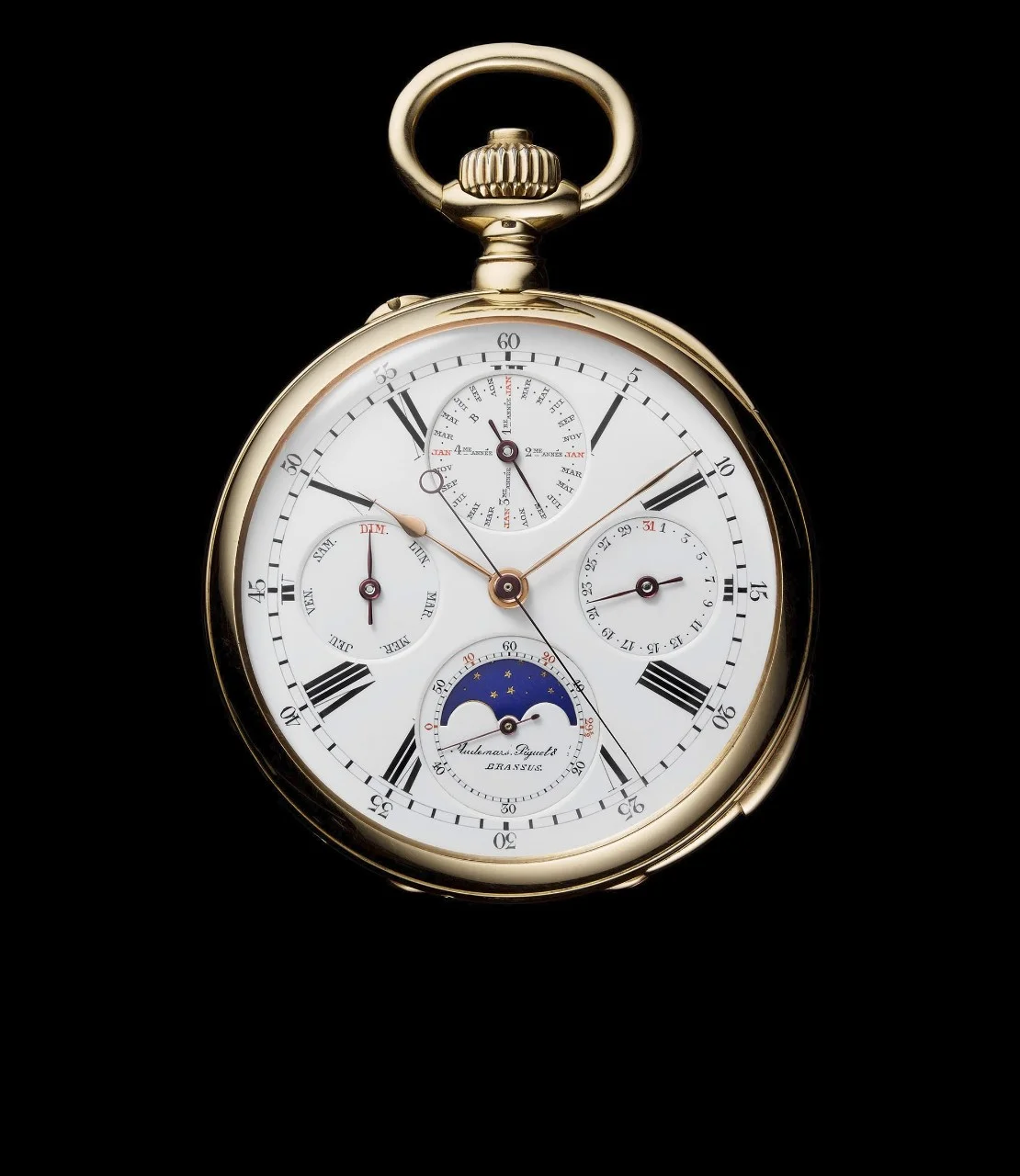
~1875. Apprenticeship masterpiece by Jules Louis Audemars. Perpetual calendar, quarter repeater, deadbeat seconds, double barrel. 20-ligne calibre. 18-carat pink gold. Transformed by Audemars Piguet in 1882, 1887 and 1903. Audemars Piguet Heritage, inv. 8.
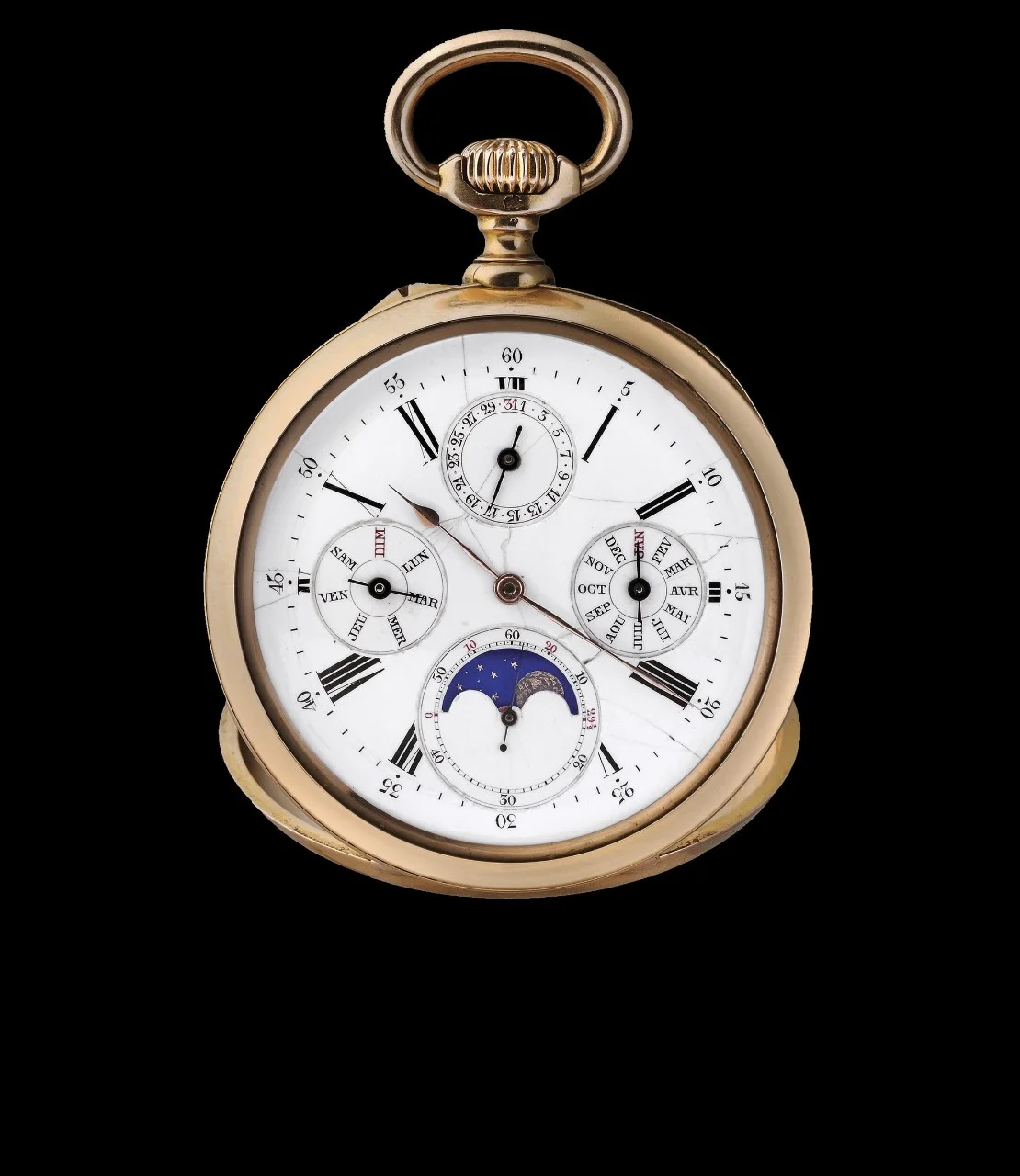
~1875. Apprenticeship masterpiece by Edward Auguste Piguet. Complete calendar: day, date, month, phase and age of the moon, small seconds, chronometer (compensated balance, overcoil balance spring). 19-ligne calibre. 18-carat pink gold. Private collection.
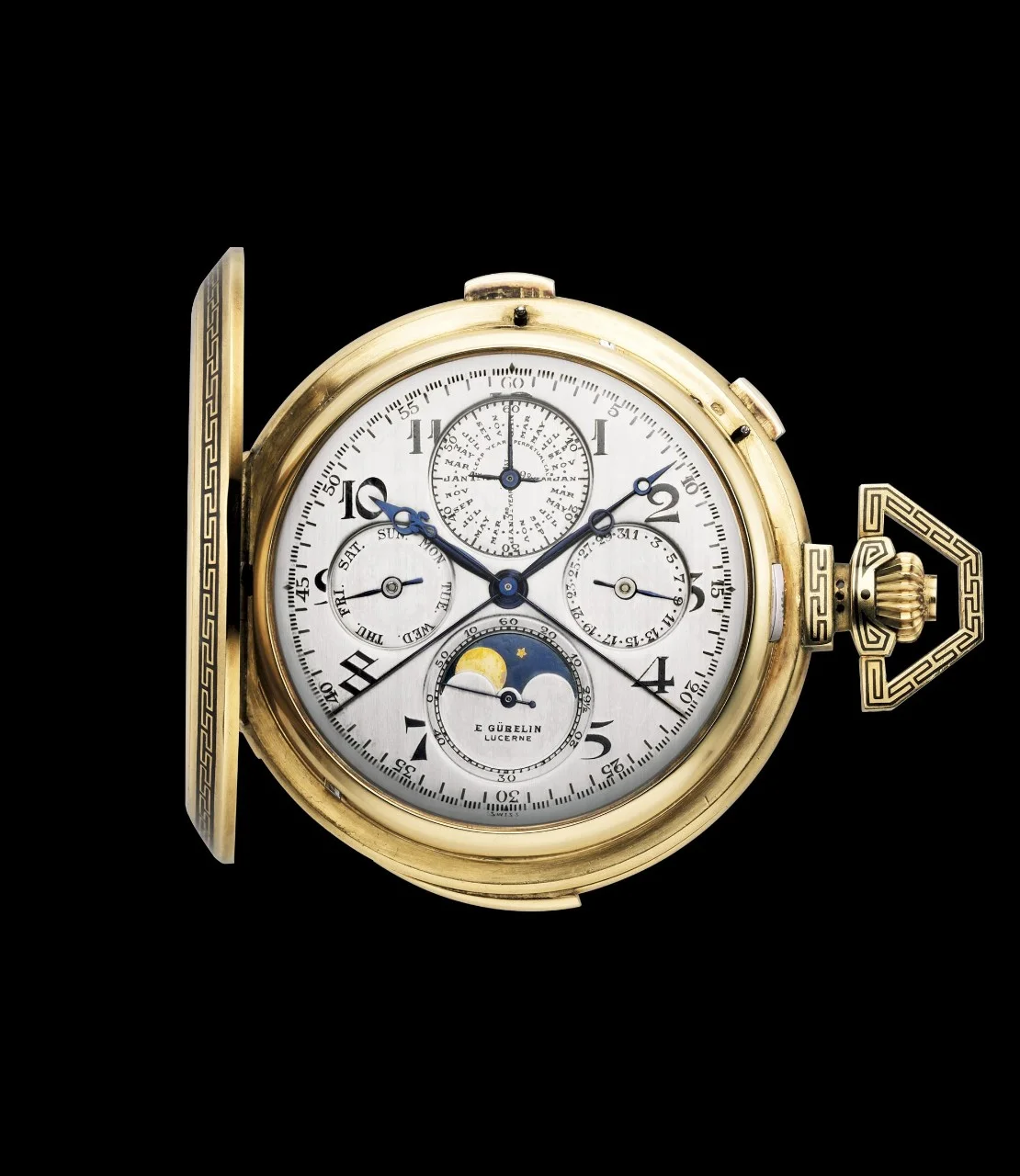
1922. Audemars Piguet Grand Complication pocket watch. Perpetual calendar: day, date, month, leap-year cycle, phase and age of the moon. Minute repeater. Split-seconds chronograph. Movement 14828, Calibre 17MCRQV. 18-carat yellow gold, "Murat" decoration. Movement "ébauche" made in 1908, watch delivered to E. Gübelin Lucerne in March 1922. Audemars Piguet Heritage, inv. 84.
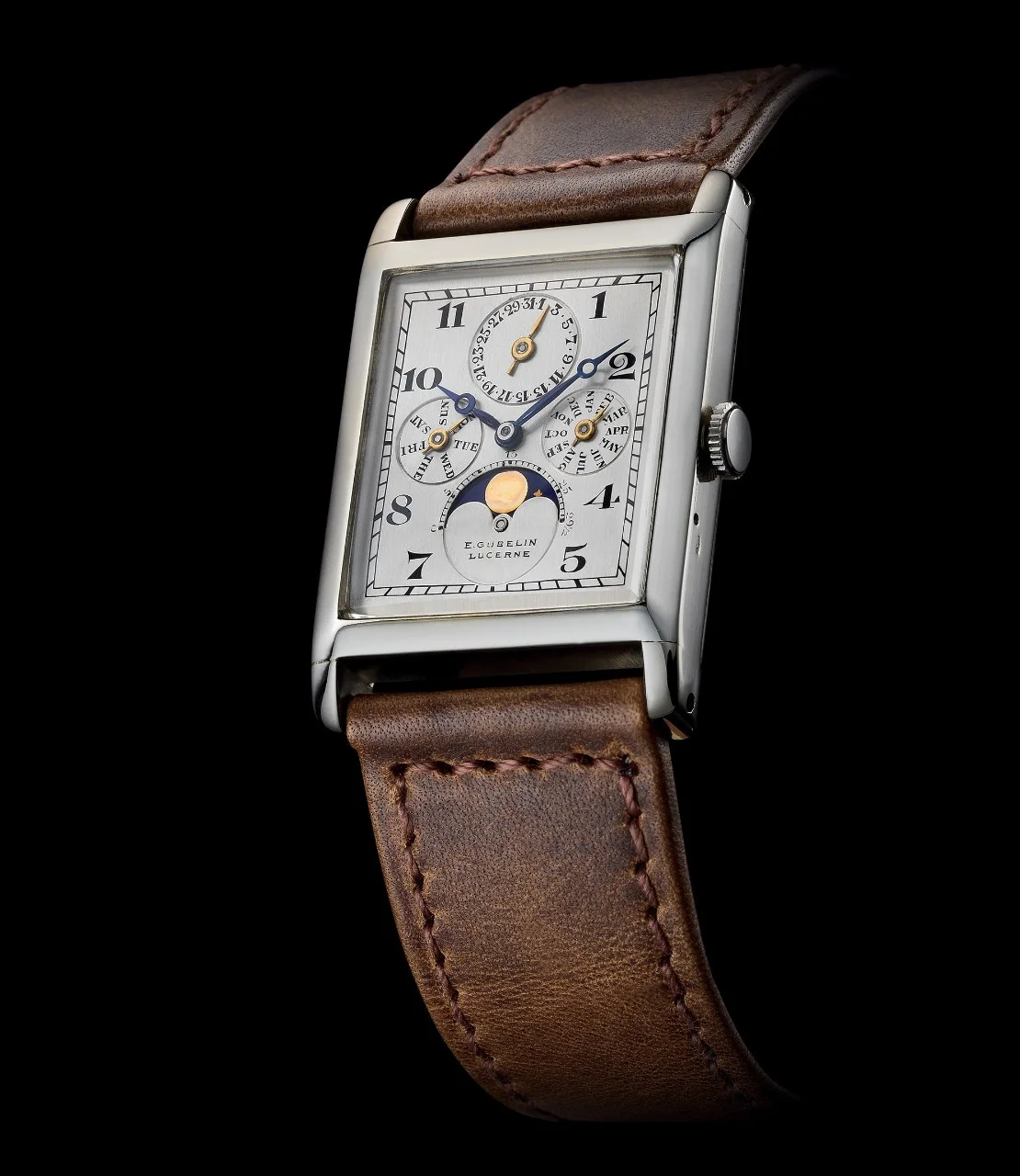
1924. First Audemars Piguet calendar watch. Movement and case no. 27819. Calibre 10HPVM. Case in 18-carat white gold, dial in 14-carat white gold. Engraved inscription: "L. Steward Barr USA 1924. This is the first calendar wristwatch ever made by us and I believe it to be the only one in existence. E. Gübelin. Lucerne 1924. Switzerland". Movement manufactured in 1921, watch sold in 1924 to Gübelin Lucerne. Audemars Piguet Heritage, inv. 1768.
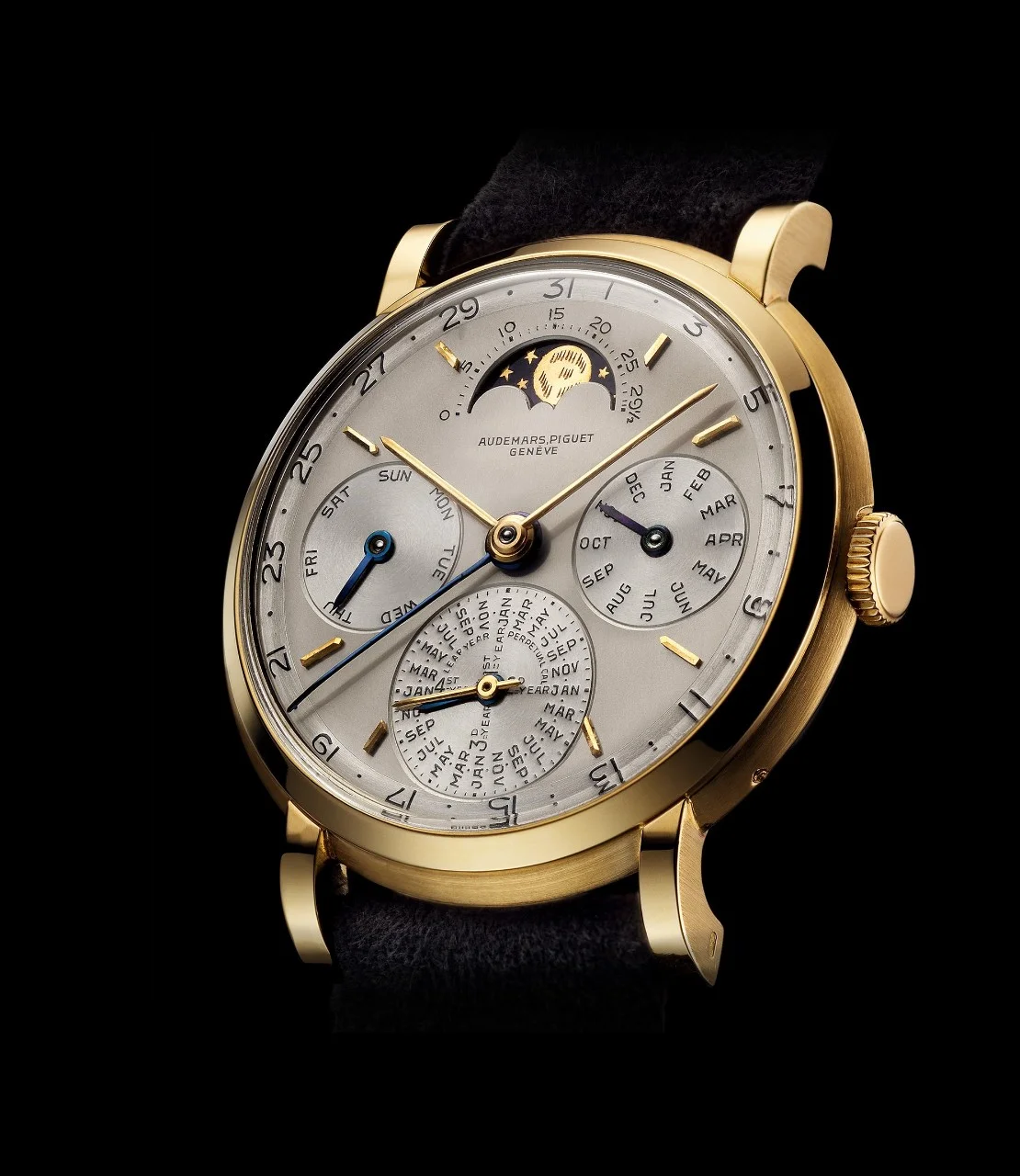
1955 Perpetual calendar wristwatch, Model 5516. First wristwatch model with leap-year cycle indication. Perpetual calendar: day, date, 12 months, 48 months (4 years), phase and age of the moon. Movement 66136, Calibre 13VZSSQP. Case 11151 in 18-carat yellow gold. Gold dial. Movement "ébauche" made in 1955, sold in 1959 to Vacheron Constantin. Audemars Piguet Heritage, inv. 1732.
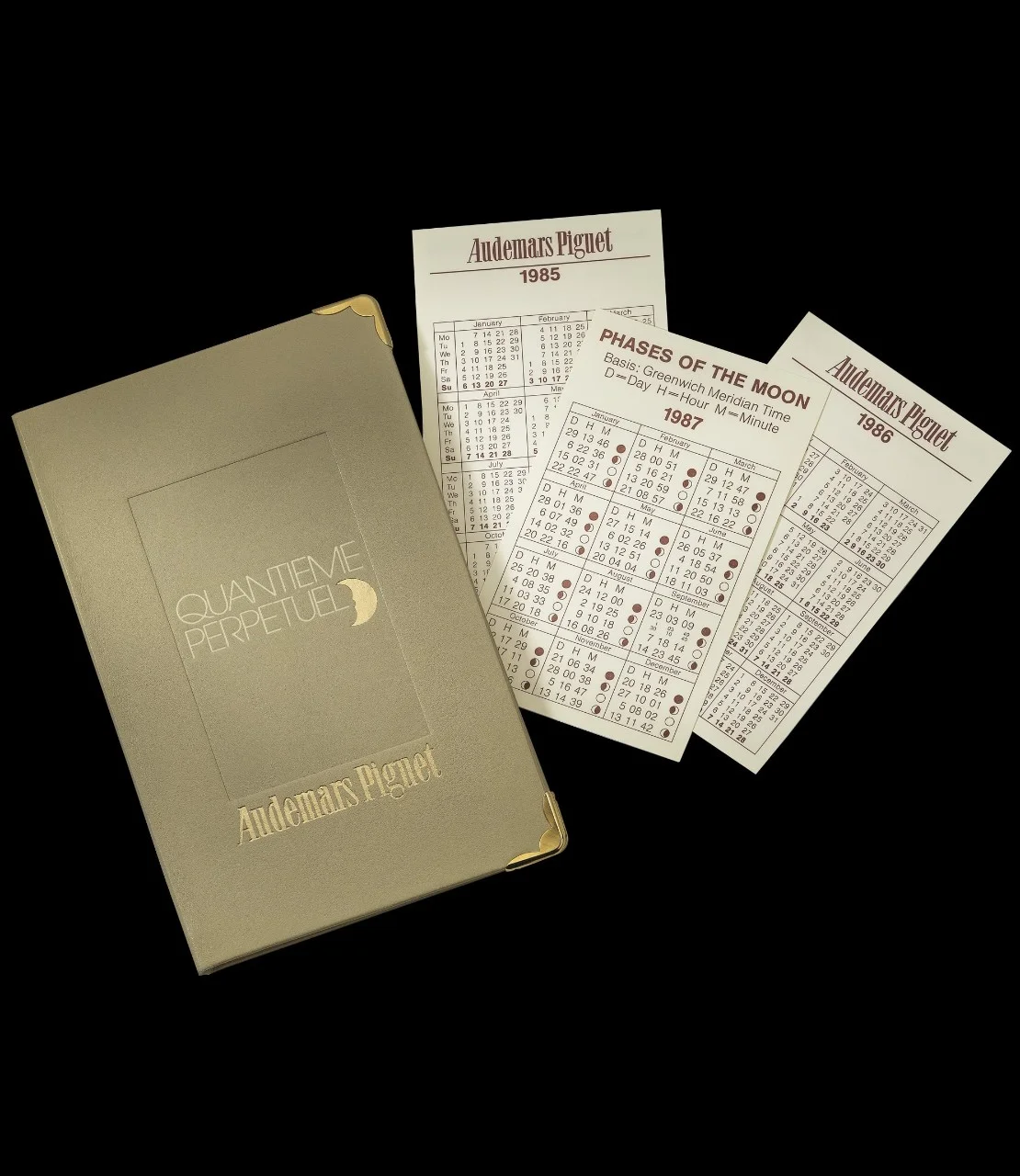
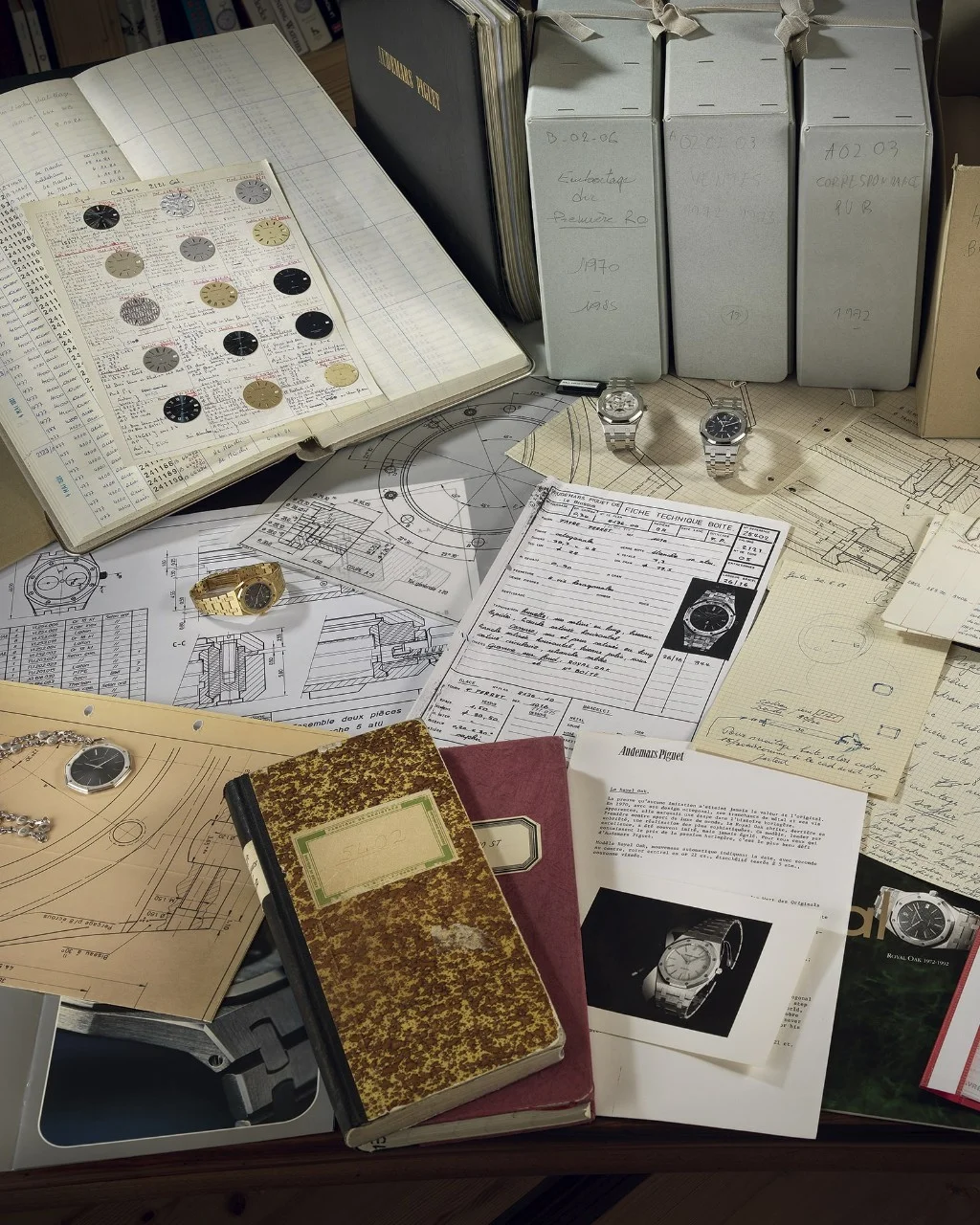
~1985. User manual. The user manual for perpetual calendar watches equipped with Calibre 2120/2800 comes with an annual calendar indicating the moon phases. Audemars Piguet Archives.
Calibre 2120/2800: birth of a legend
In the mid-1970s, three young watchmakers employed by Audemars Piguet – Michel Rochat, a complications watchmaker; Wilfred Berney, founder of the After-Sales Service; and Jean-Daniel Golay, founder of the Technical Office – got together secretly to launch an ambitious project. Concerned by the quartz crisis that was crushing the Swiss watch industry, they suggested reinventing the perpetual calendar to incorporate it within contemporary wristwatches. After months of research, they presented their project to Georges Golay, then General Manager of Audemars Piguet. Surprised, impressed and convinced, he asked for 159 of these timepieces to be produced even before the model was launched, a figure unheard of for an Audemars Piguet complication.
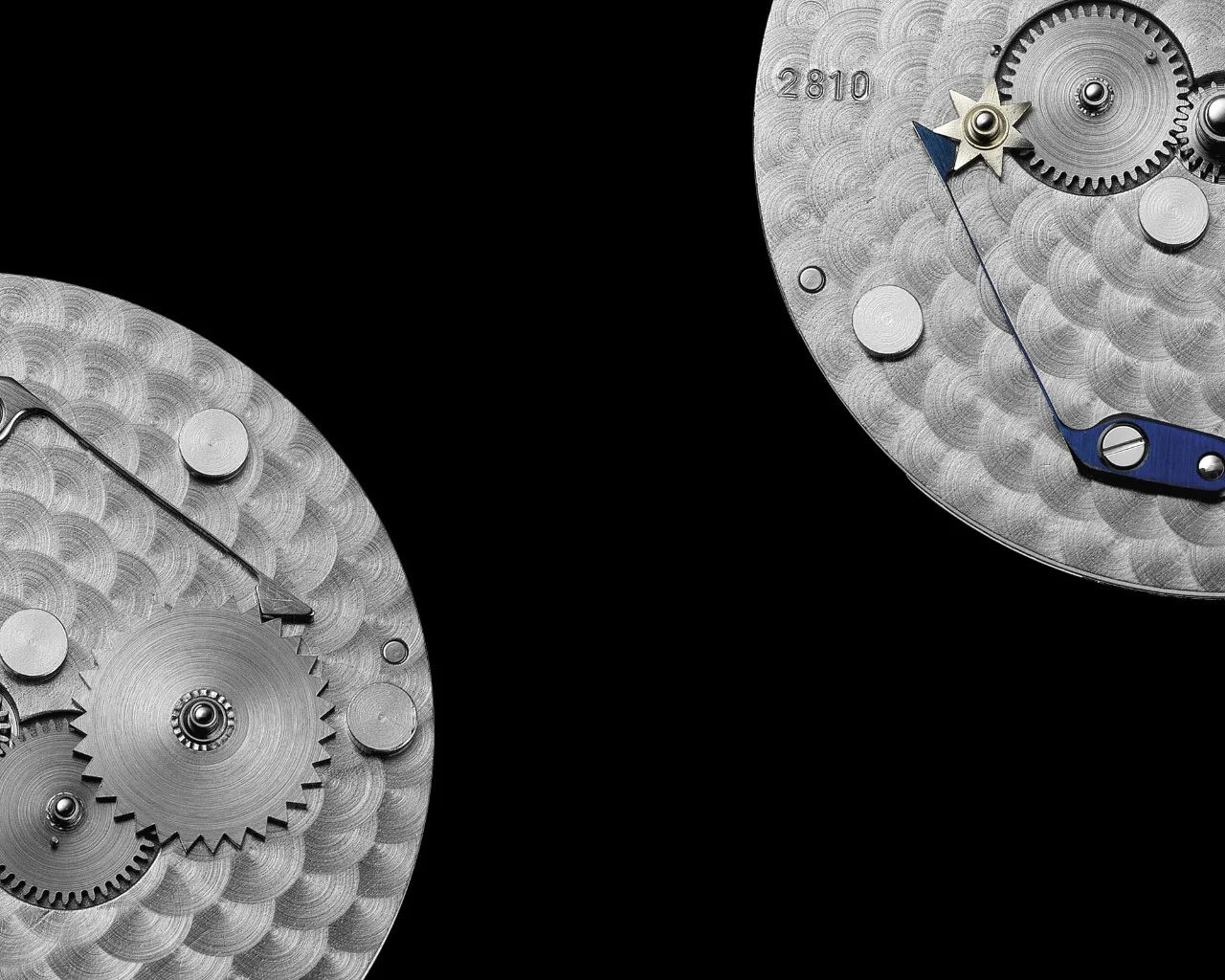
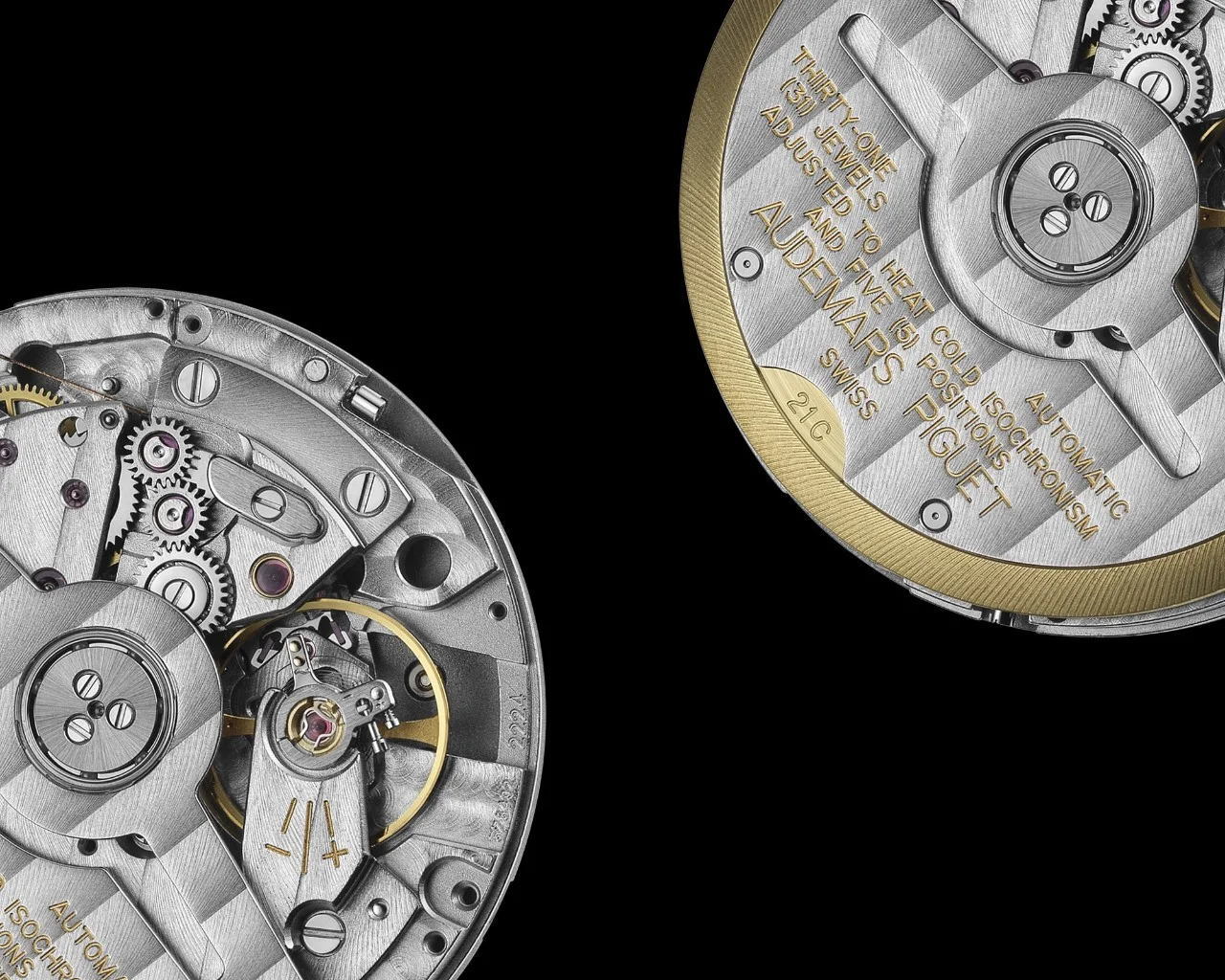
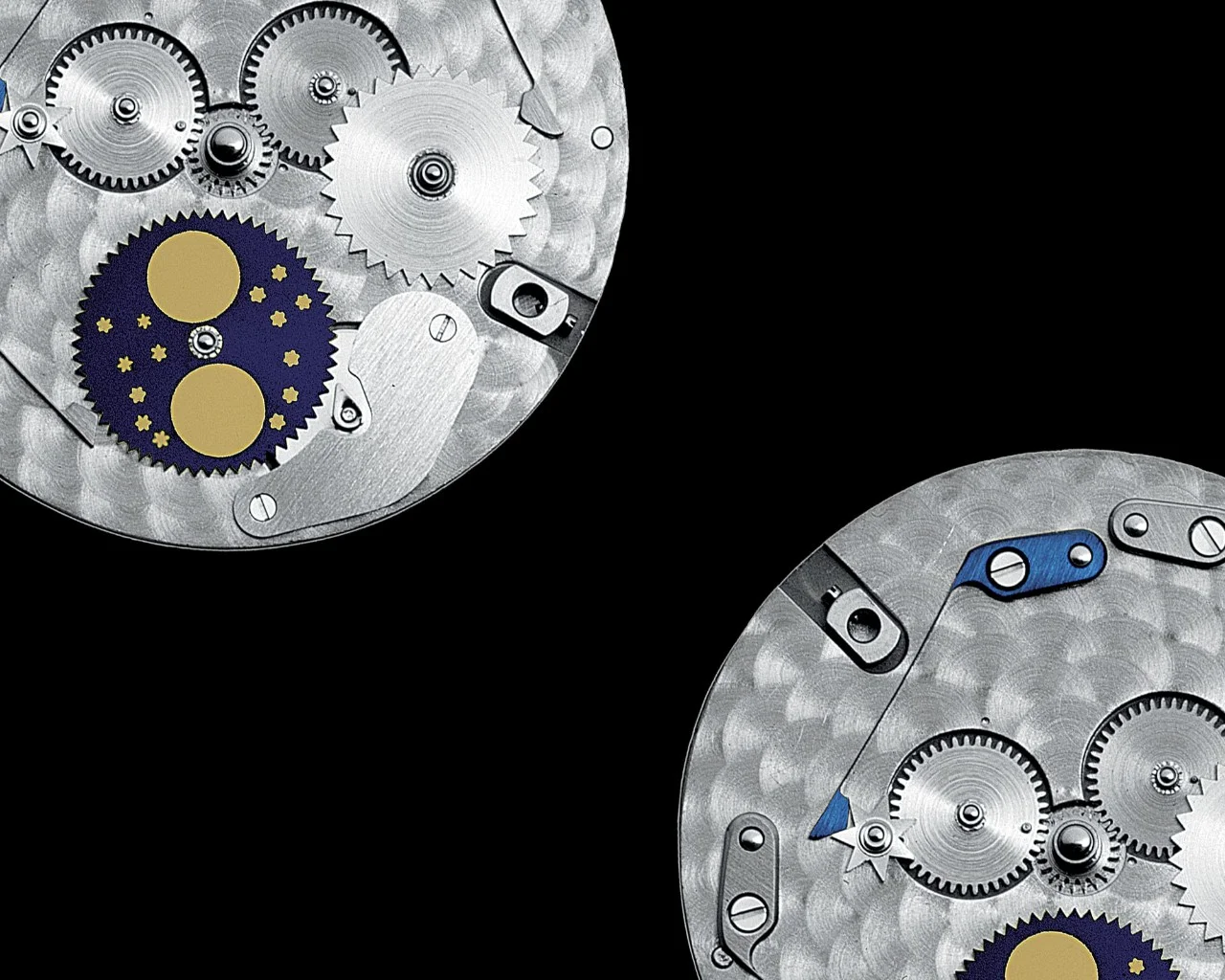
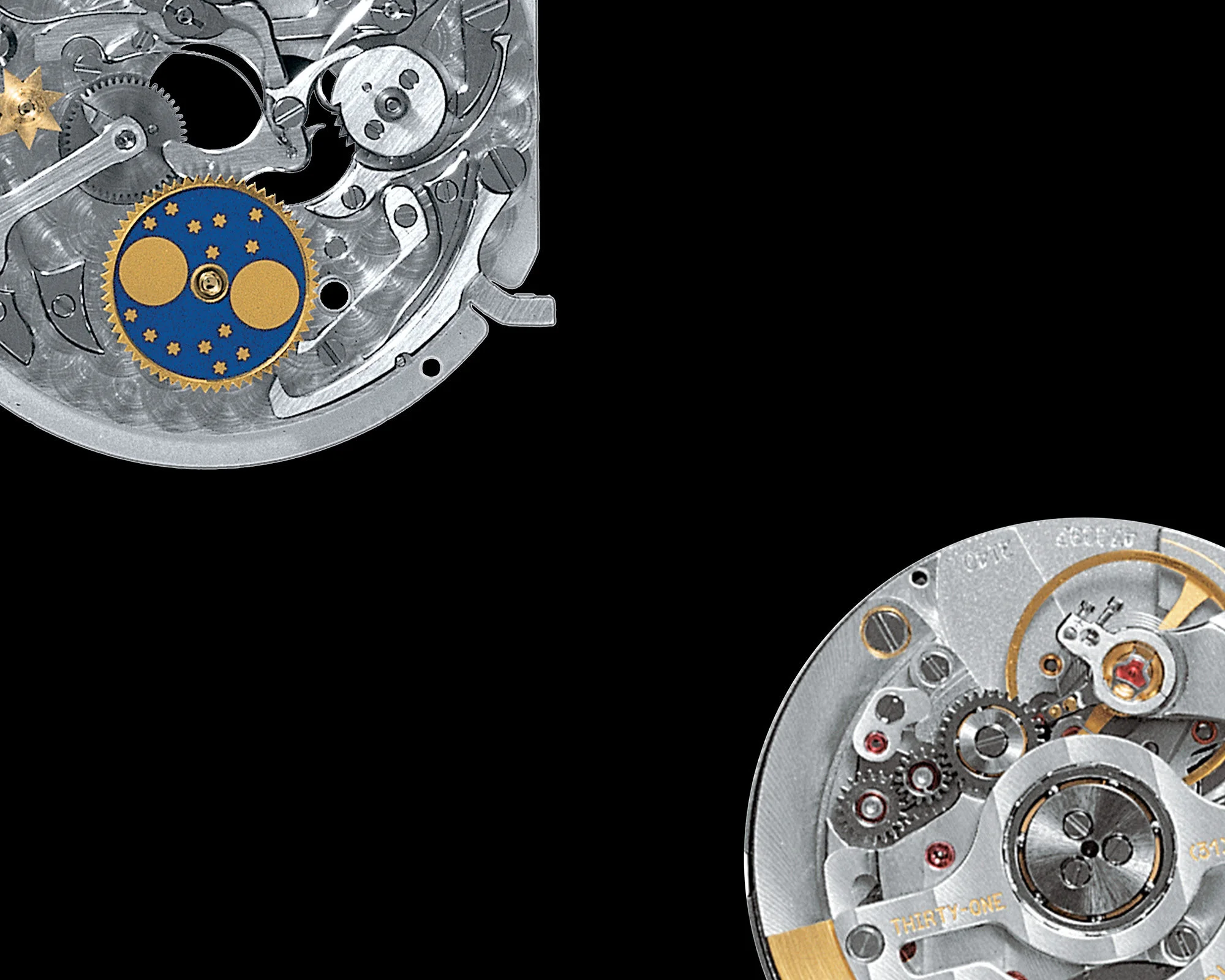
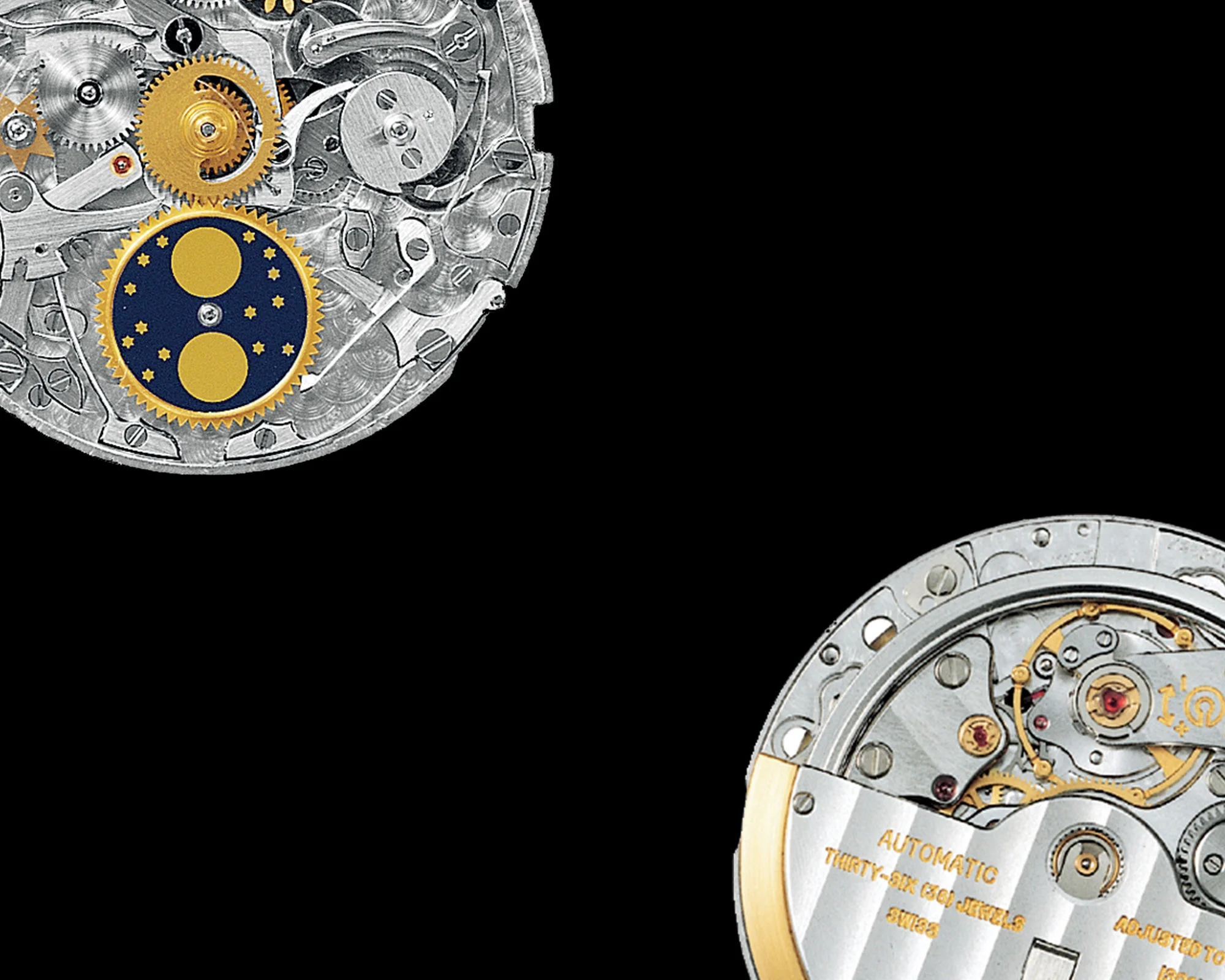
Launched in 1978, Model 5548 is equipped with Calibre 2120/2800, the world's thinnest selfwinding perpetual calendar at the time (3.95 mm). The mechanism consists of two main parts: the 2120 base movement (2.45 mm), whose history is told in a dedicated article, and the 2800 perpetual calendar underdial work (1.5 mm). Designed to be concealed beneath the watch face, this additional mechanism is hand-decorated: brushed and bevelled steel parts, circular-grained baseplate, along with gilded and enamelled moon.
The success exceeded all expectations (see table below). In 15 years, Calibre 2120/2800 was to equip more than 7,000 Audemars Piguet watches, available in more than 110 different models. Nearly 800 of them were even openworked! In its own way, this calibre paved the way for the revival of traditional complications throughout the Swiss watch industry.
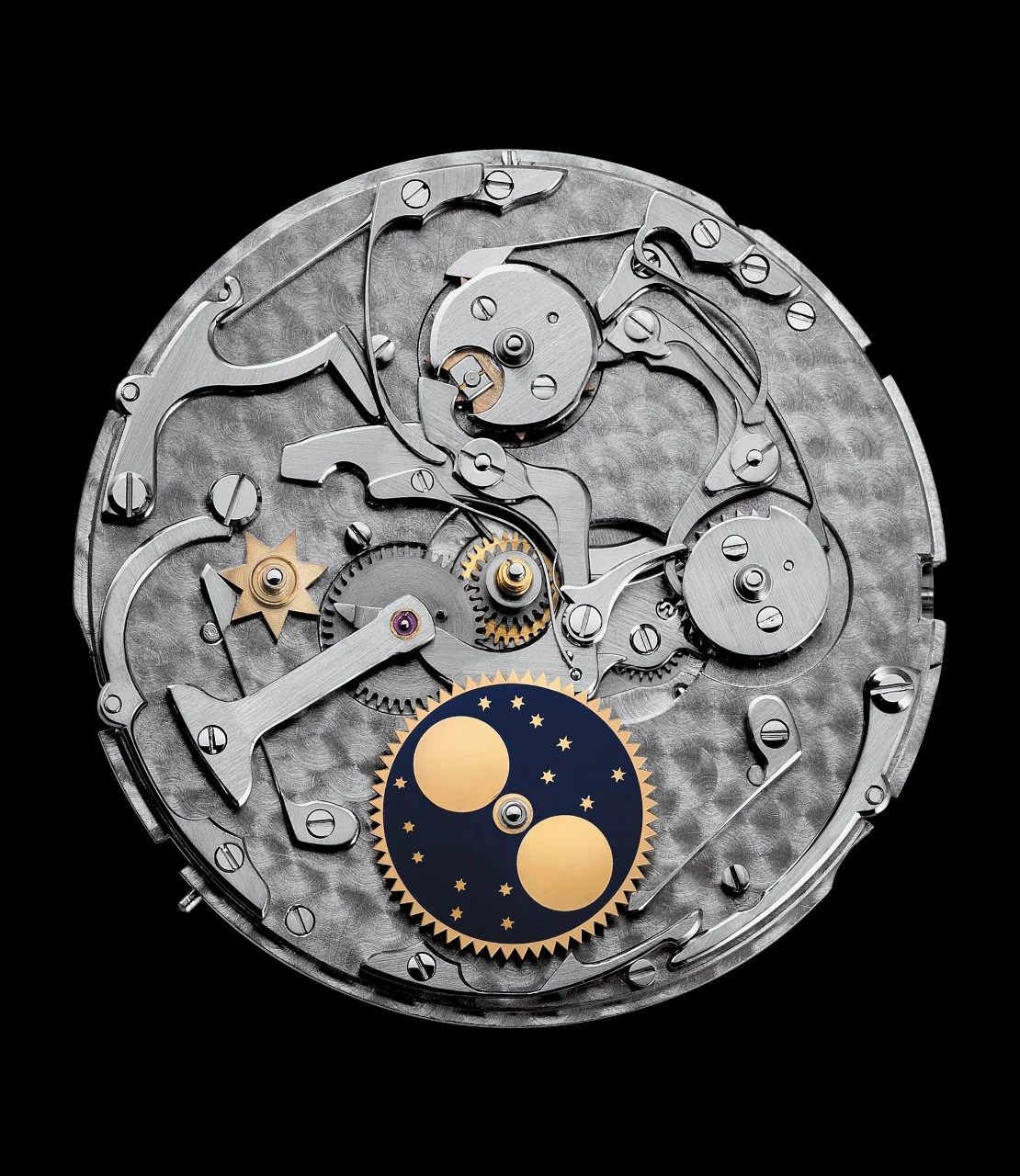
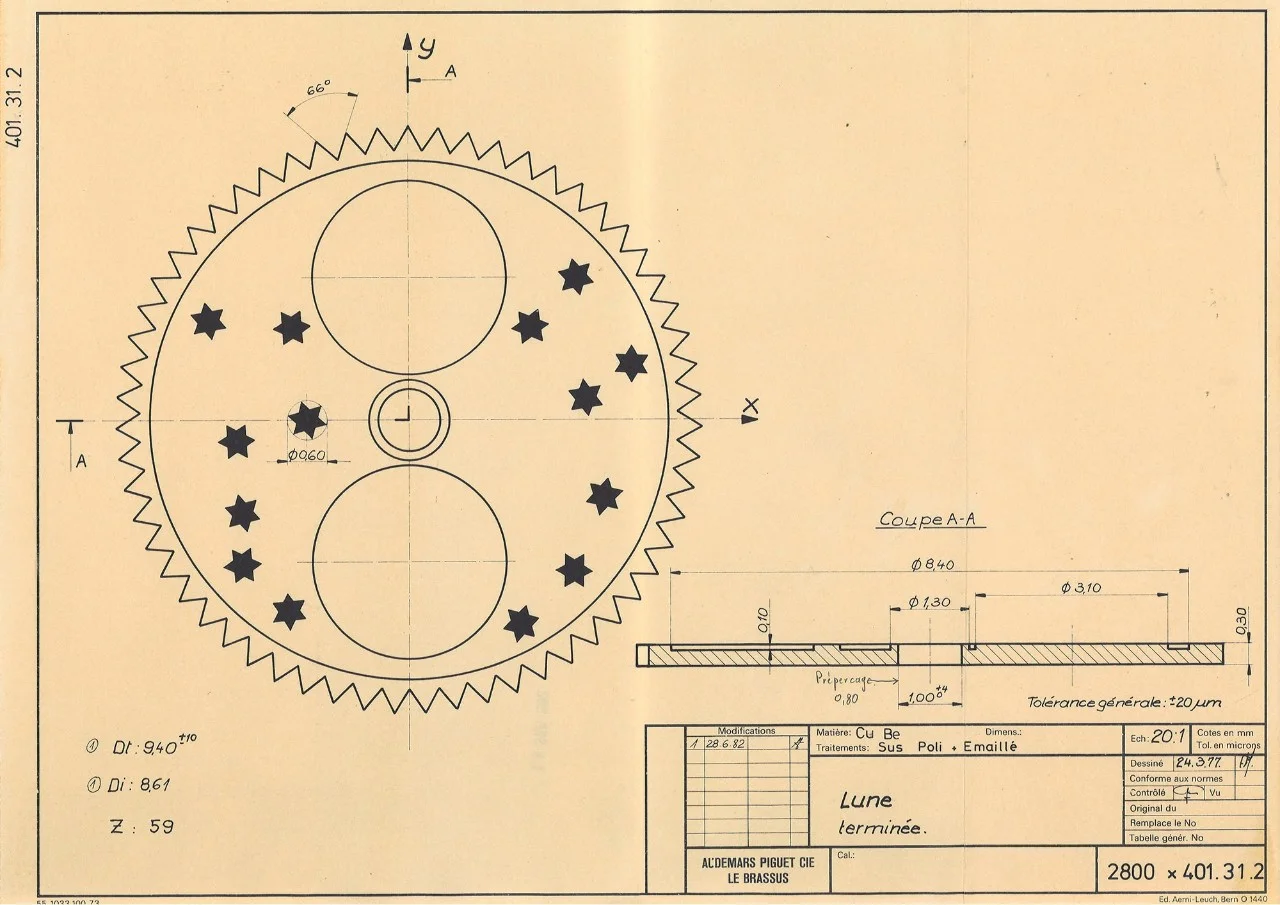
24 mars 1977. Technical drawing of the moon disc for Calibre 2120/2800. Polished and enamelled copper-beryllium. Audemars Piguet Archives.
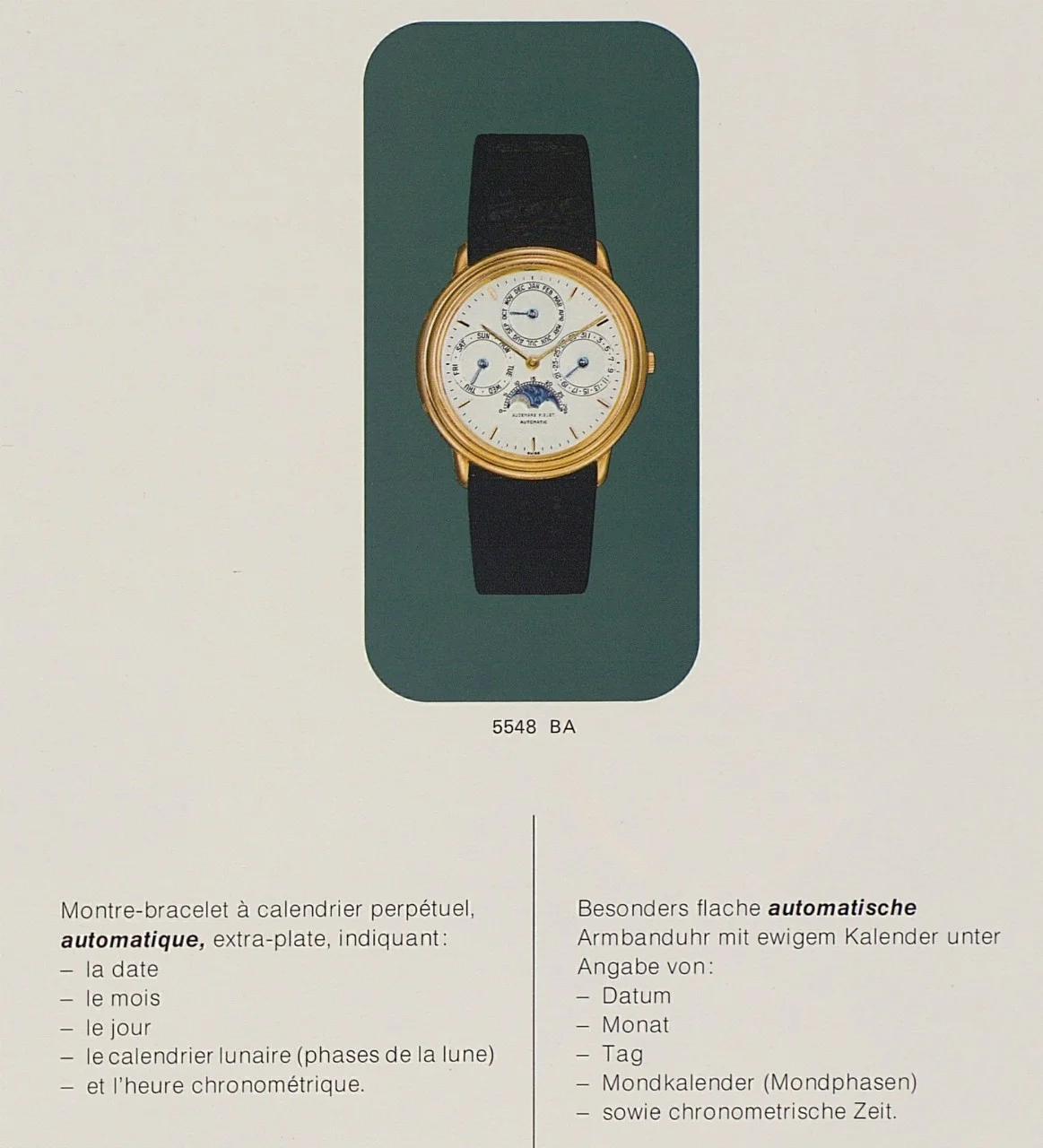
1978. First occurrence of Model 5548 equipped with Calibre 2120/2800. 1978–79 Audemars Piguet Catalogue. Audemars Piguet Archives.
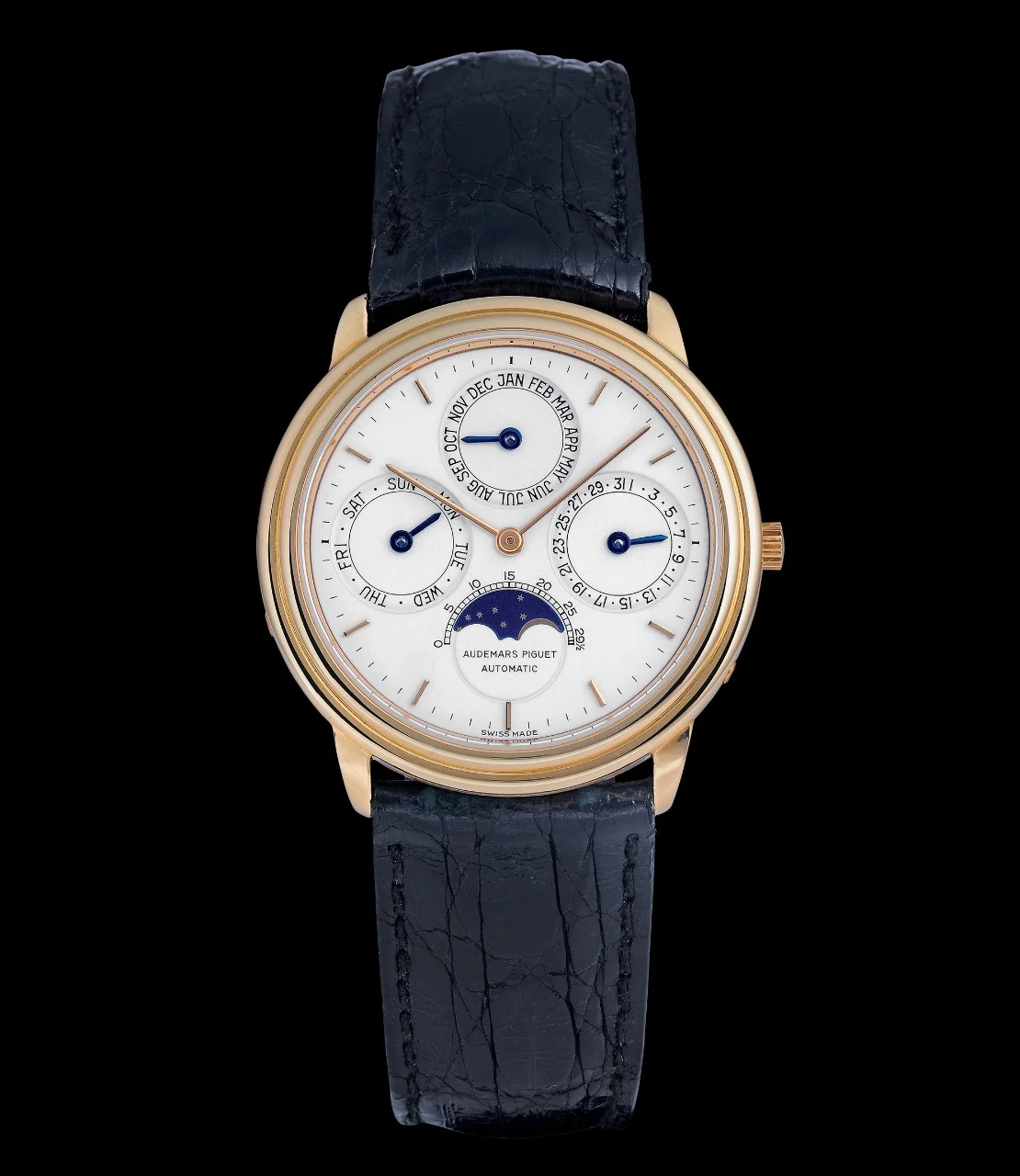
1978. Perpetual calendar wristwatch, Model 5548BA. Day, date, month, phase and age of the moon. Movement No. 274319, Selfwinding Calibre 2120/2800, the thinnest of its time (3.95 mm). Case in 18-carat yellow gold no. C21525 and no. 2156. Model 5548BA launched in 1978. Movement manufactured in 1985, watch sold in Italy in May 1986. Audemars Piguet Heritage, inv. 1445.
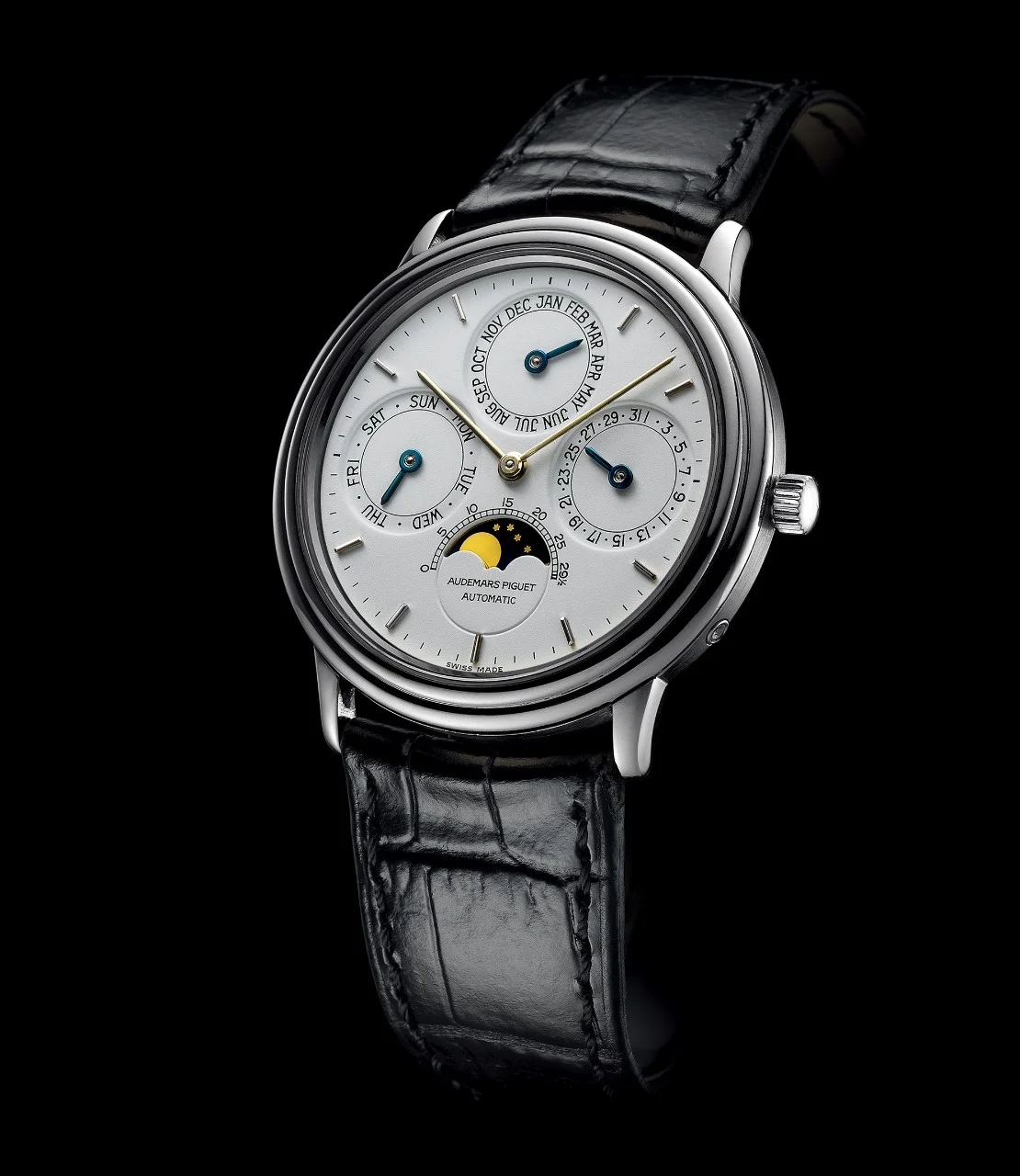
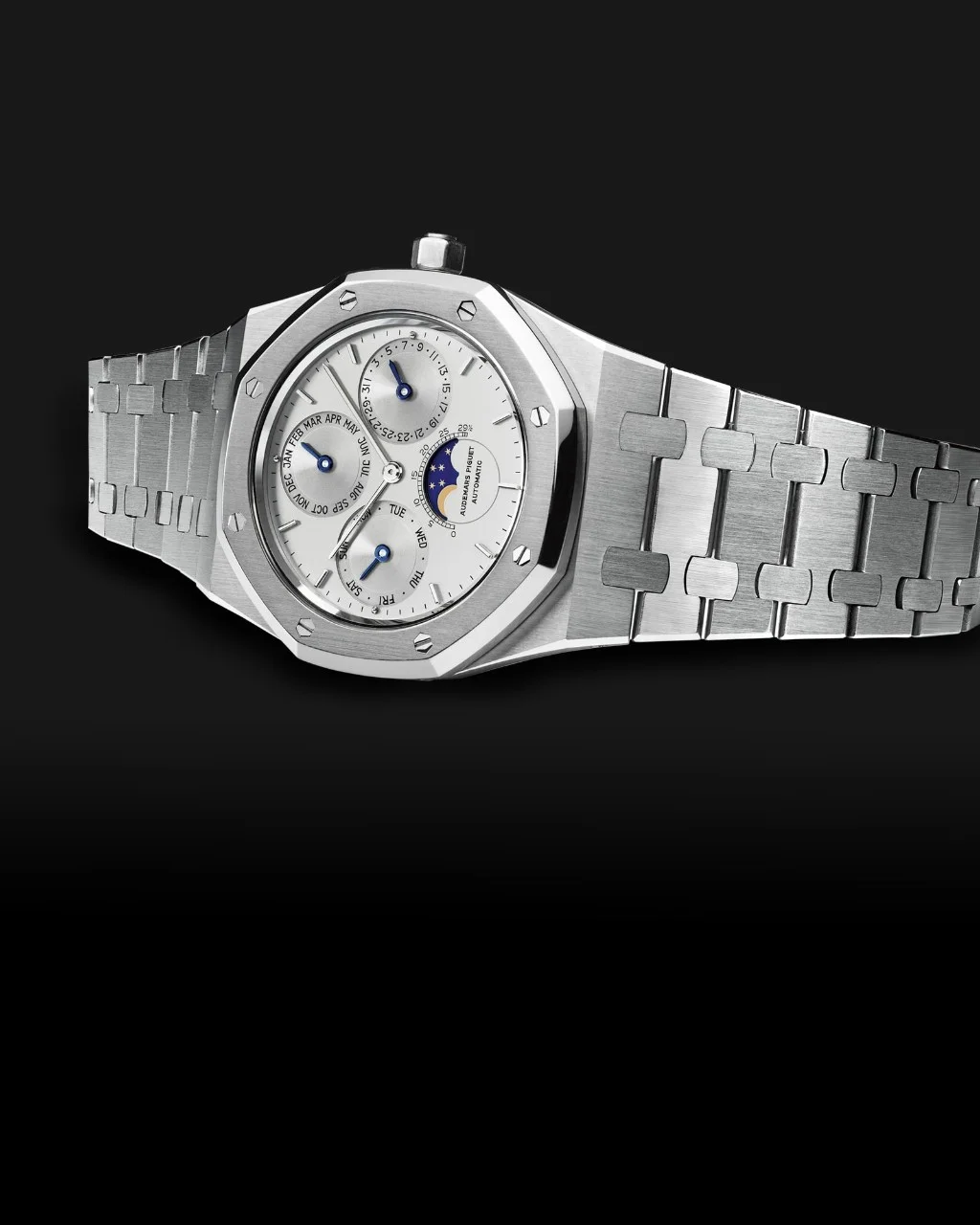
1987. Perpetual calendar wristwatch, Model 25548BC. Day, date, month, phase and age of the moon. Movement no. 286311, selfwinding Calibre 2120/2800, the thinnest of its time (3.95 mm). Case in 18-carat white gold no. C32094 and no. 2593. Model 5548 launched in 1978, renamed 25548 in 1984–85. Movement manufactured in 1985, watch sold in Switzerland in 1987. Audemars Piguet Heritage, inv. 1584.
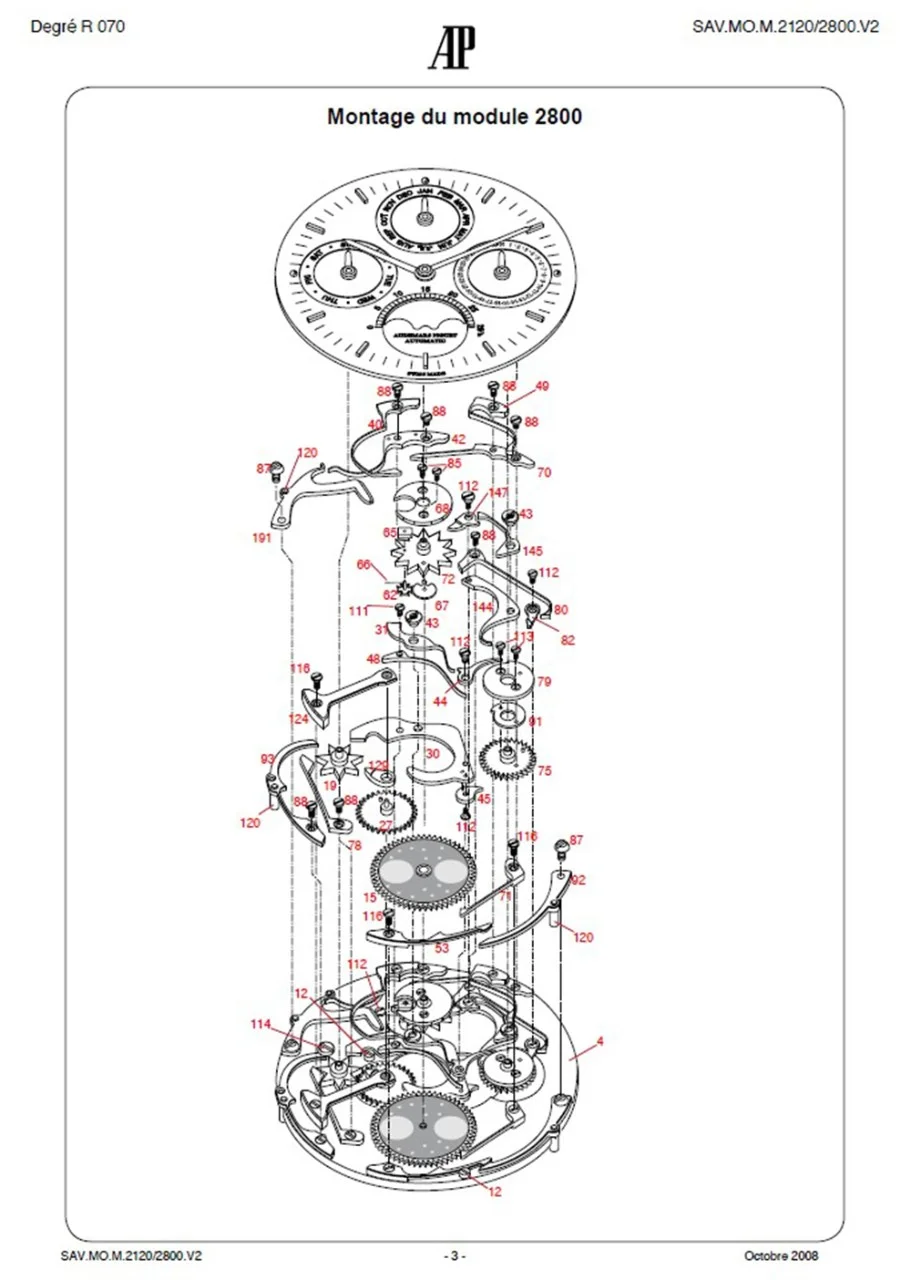
2008. Technical instructions drawn up by the Audemars Piguet After-Sales Service department in 2008, relating to the maintenance of Calibre 2120/2800 (1978–1996). Excerpt from the Audemars Piguet Archives.
| 2120/2800 | 2120/2800SQ | TOTAL | |
| 1978 | 4 | 4 | |
| 1979 | 113 | 113 | |
| 1980 | 154 | 154 | |
| 1981 | 238 | 238 | |
| 1982 | 278 | 21 | 299 |
| 1983 | 431 | 33 | 464 |
| 1984 | 441 | 42 | 483 |
| 1985 | 550 | 35 | 585 |
| 1986 | 588 | 37 | 625 |
| 1987 | 543 | 85 | 628 |
| 1988 | 605 | 67 | 672 |
| 1989 | 561 | 60 | 621 |
| 1990 | 550 | 59 | 609 |
| 1991 | 435 | 56 | 491 |
| 1992 | 354 | 50 | 404 |
| 1993 | 294 | 73 | 367 |
| 1994 | 227 | 88 | 315 |
| 1995 | 124 | 68 | 192 |
| 1996 | 18 | 17 | 35 |
| TOTAL | 6'508 | 791 | 7'299 |
It all began with an owl
The collectors’ community and historians agree that Audemars Piguet's two most significant achievements in the 1970s were the Royal Oak (1972) and perpetual calendar Calibre 2120/2800 (1978). From then on, an encounter between the two seemed inevitable and yet one must be wary of things that appear self-evident. First of all, at the beginning of the 1980s, the Royal Oak 39 mm experienced a slowdown, replaced by smaller models (35 mm then 36 mm). The last 75 examples of Model 5402 were manufactured between 1983 and 1986. However, Calibre 2120/2800 required a 39 mm case. Moreover, because of its steel body and its water-resistance, the Royal Oak is perceived as a sporty watch, a status that would tend to incite watchmakers to equip it with a chronograph...
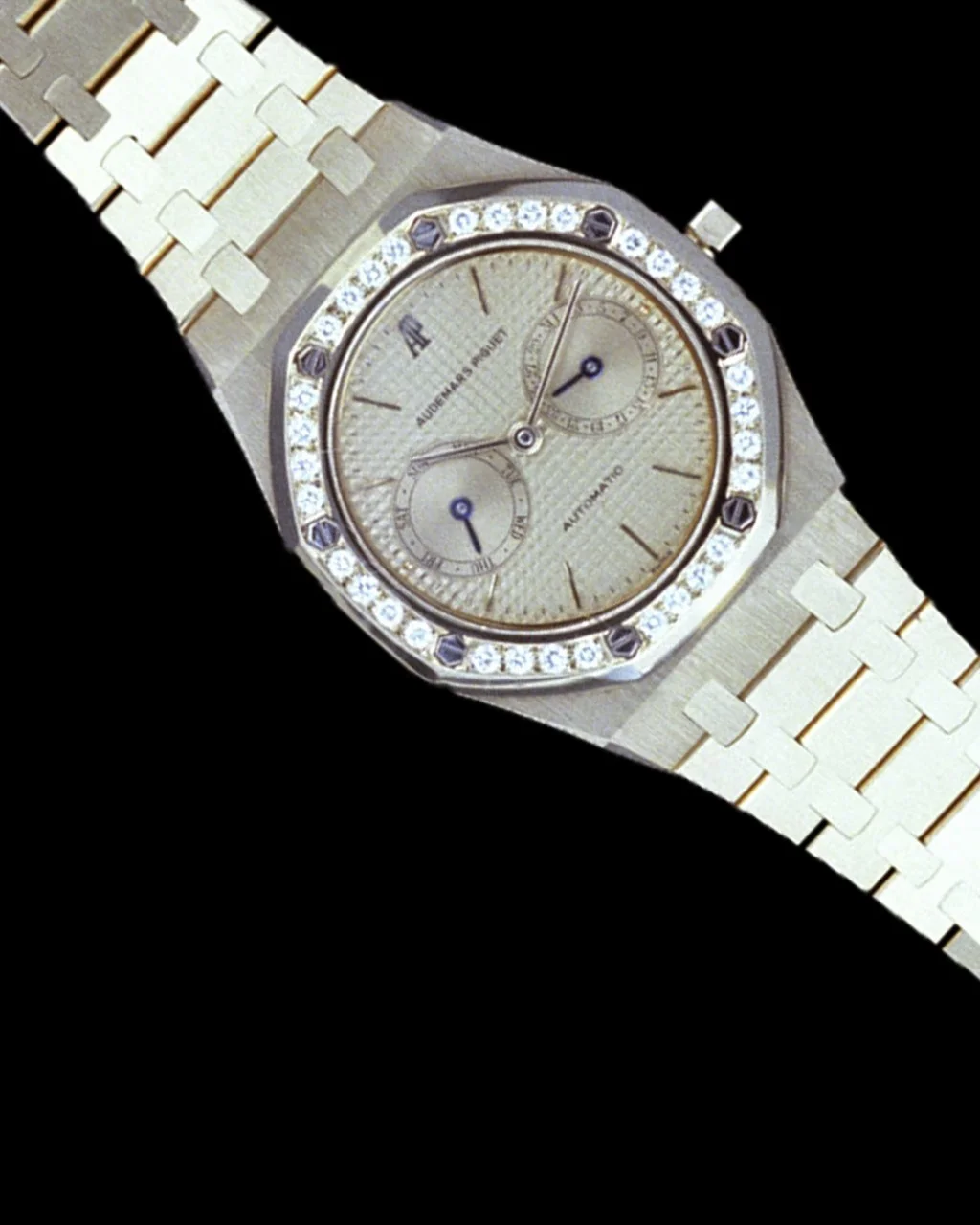
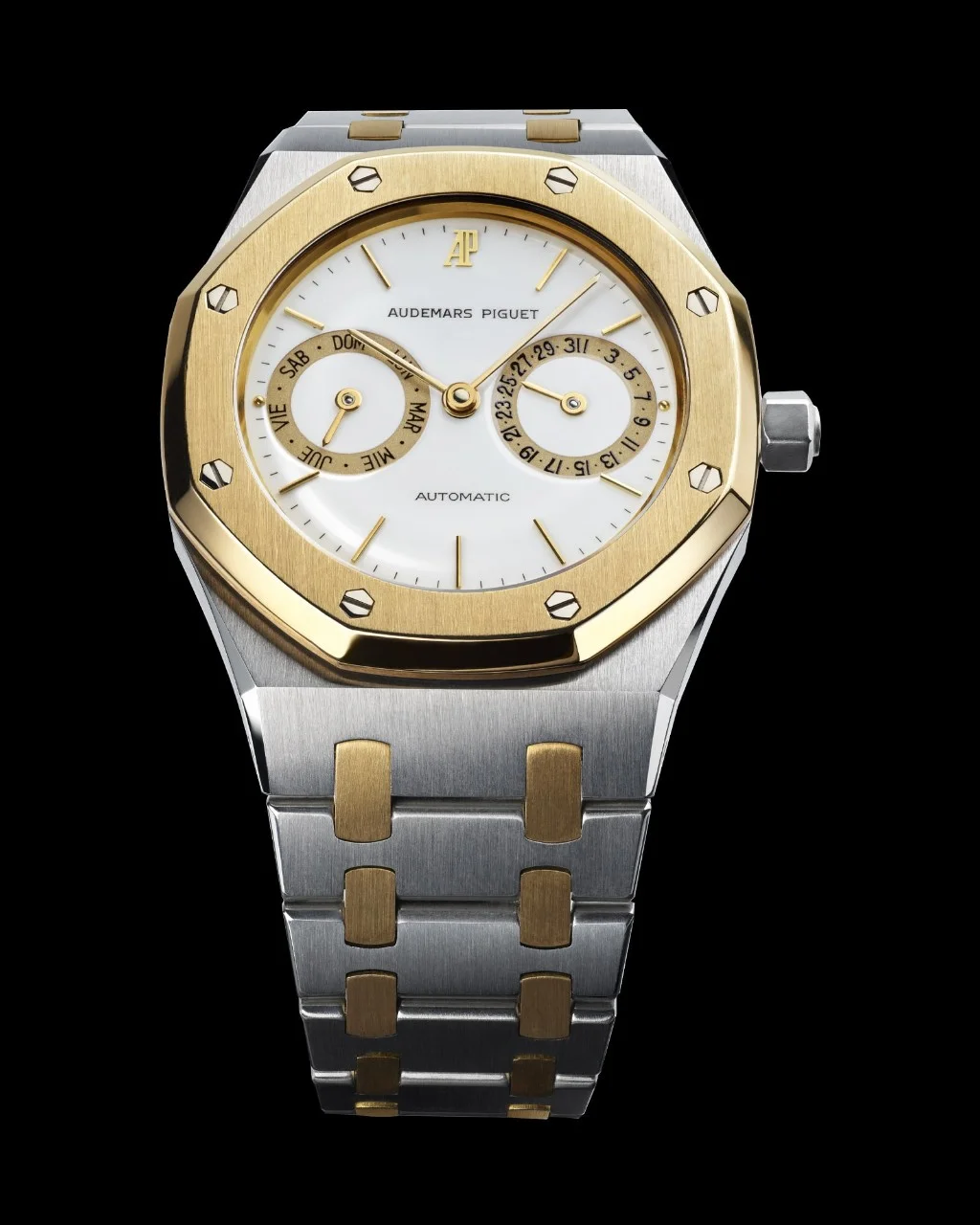
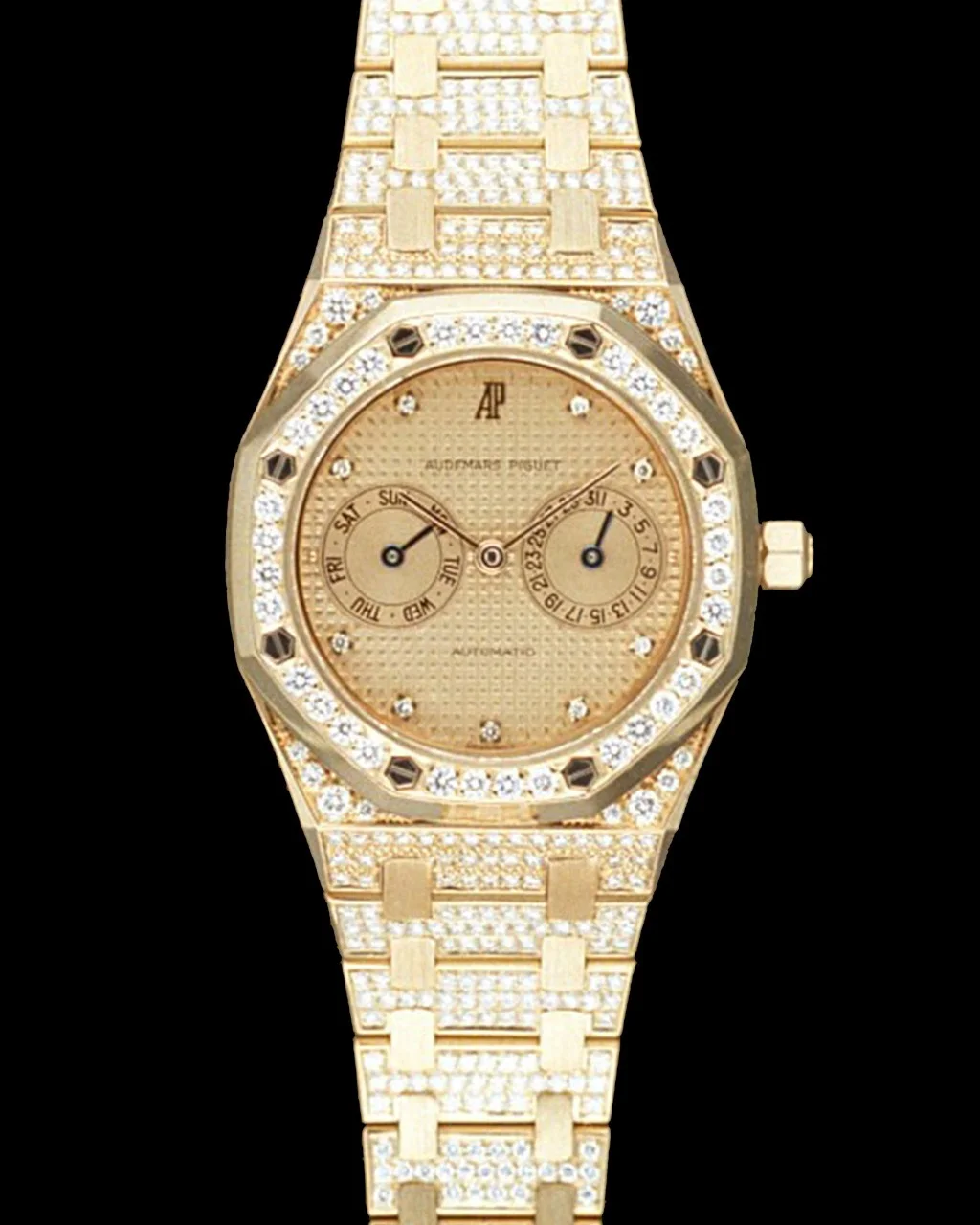
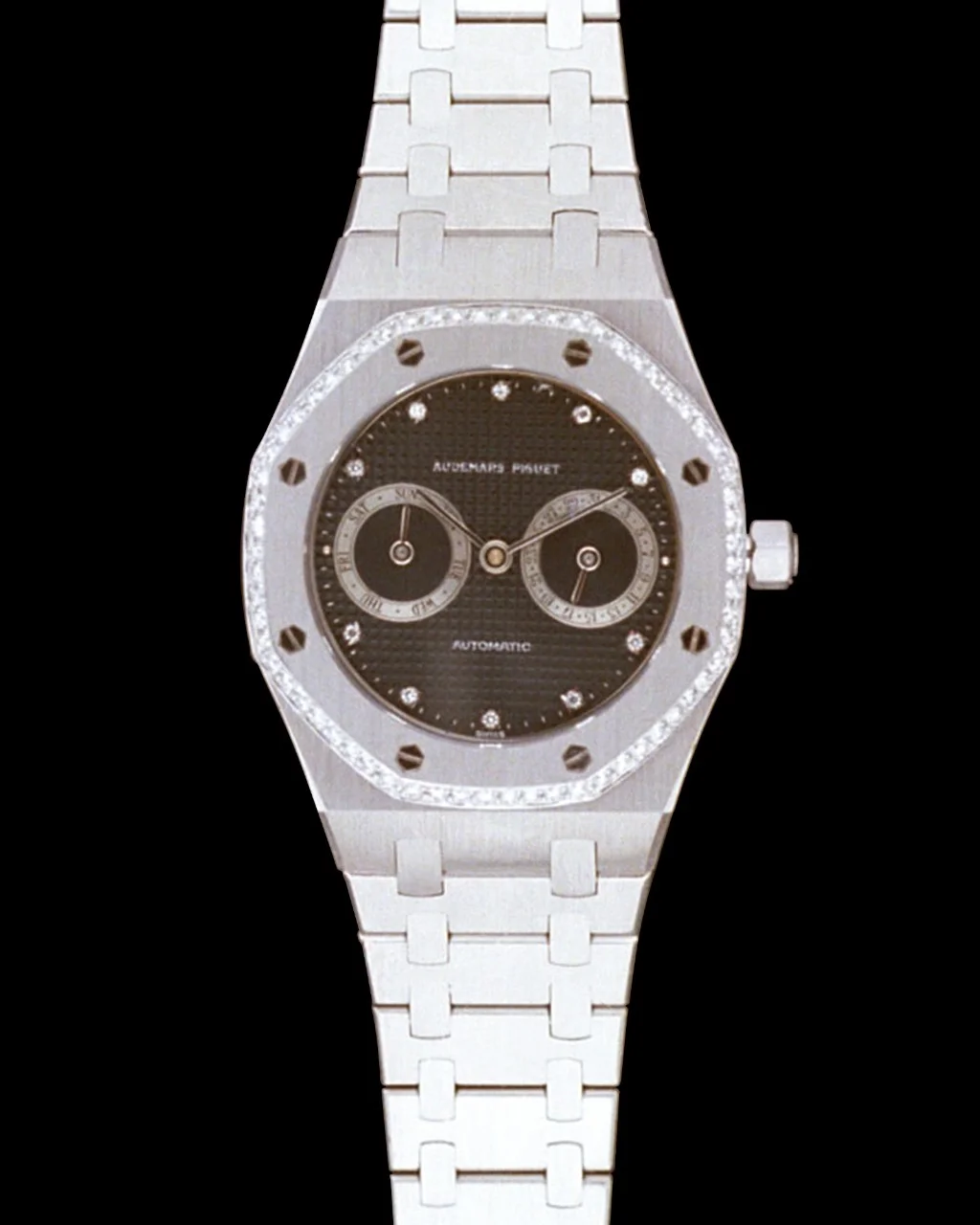
Entirely unexpectedly however, the first complicated Royal Oak timepiece featured neither a chronograph nor a perpetual calendar. Presented in 1983, the 36 mm-diameter Model 5572 includes what is commonly known as a "small complication". Two counters indicate the day and the date with a hand. They are so large and so surprising that collectors have nicknamed the model "the owl” because they evoke the two enormous eyes of the nocturnal bird of prey.
The Royal Oak Day-Date 5572 is equipped with the 11½-ligne (26 mm) selfwinding Calibre 2124/2810, a LeCoultre & Cie "ébauche", whose family was introduced in 1977 in the Royal Oak 4100 (35 mm, Calibre 2123) that was to enjoy a long life and numerous descendants. Judging by the fact that in 1983, one year before its first publication in the Audemars Piguet general catalogue, more than 600 of these watches had already been delivered, one may safely assume that it corresponded to extremely strong market demand. From the very first year, several variants were offered in steel, yellow gold, two-tone (steel and yellow gold) and even white gold with white, black, guilloché or smooth dials.
The following year, the Royal Oak Day-Date Moon Phase 25594 added a moon window to the day and date indications. This 36 mm model remained in the catalogue and at the heart of the collections for more than 20 years, an absolute record in the history of the Royal Oak.
But what about the perpetual calendar?
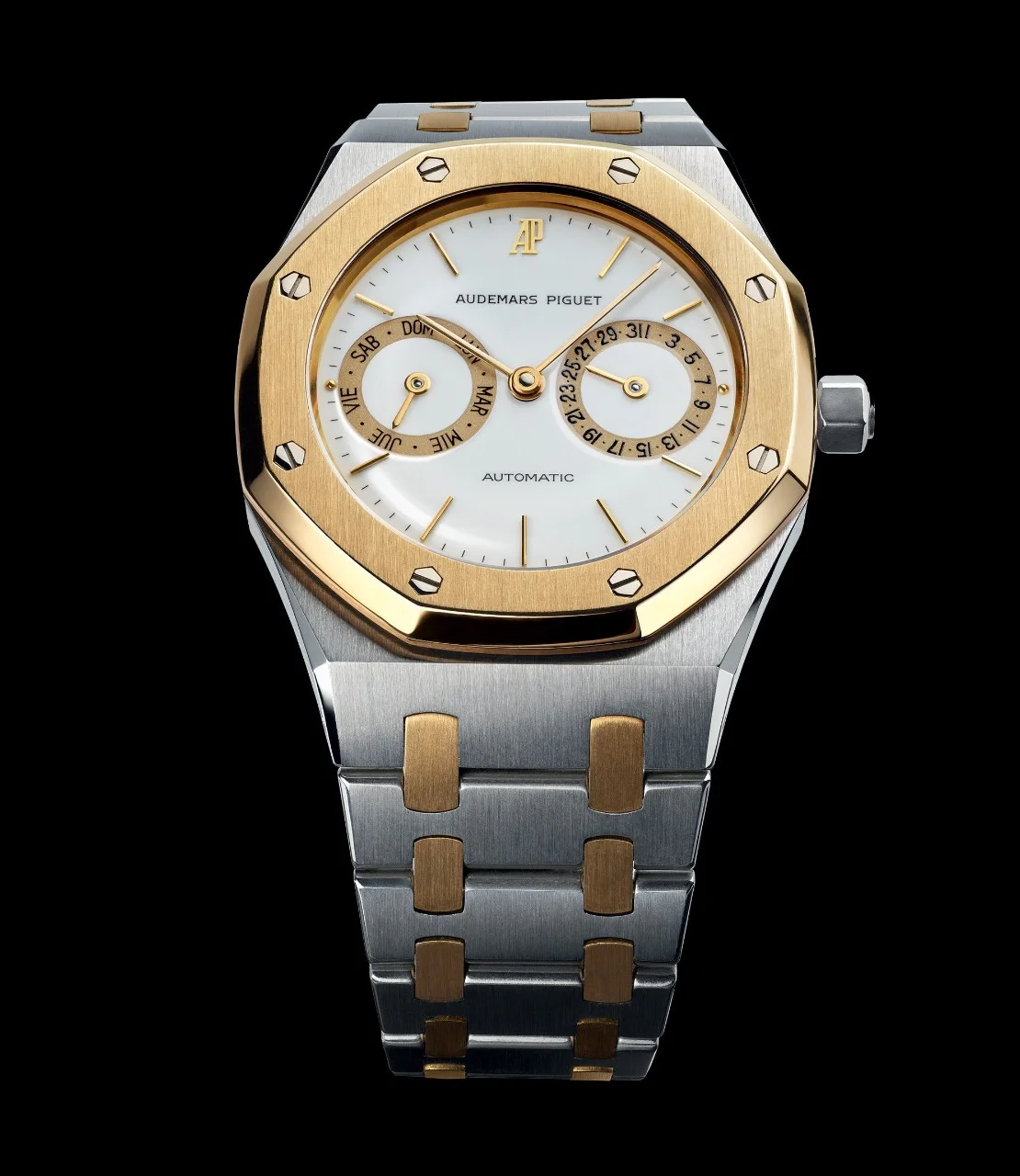
1983. Royal Oak Day Date 5572SA, N° 88 Pointer-type day-date display. Calibre 2124/2810, movement 267558. Bracelet 477. White enamel dial. 36 mm case, B87959. Steel and 18-carat yellow gold. Sold to Darcal in August 1983. Audemars Piguet Heritage, inv. 391.
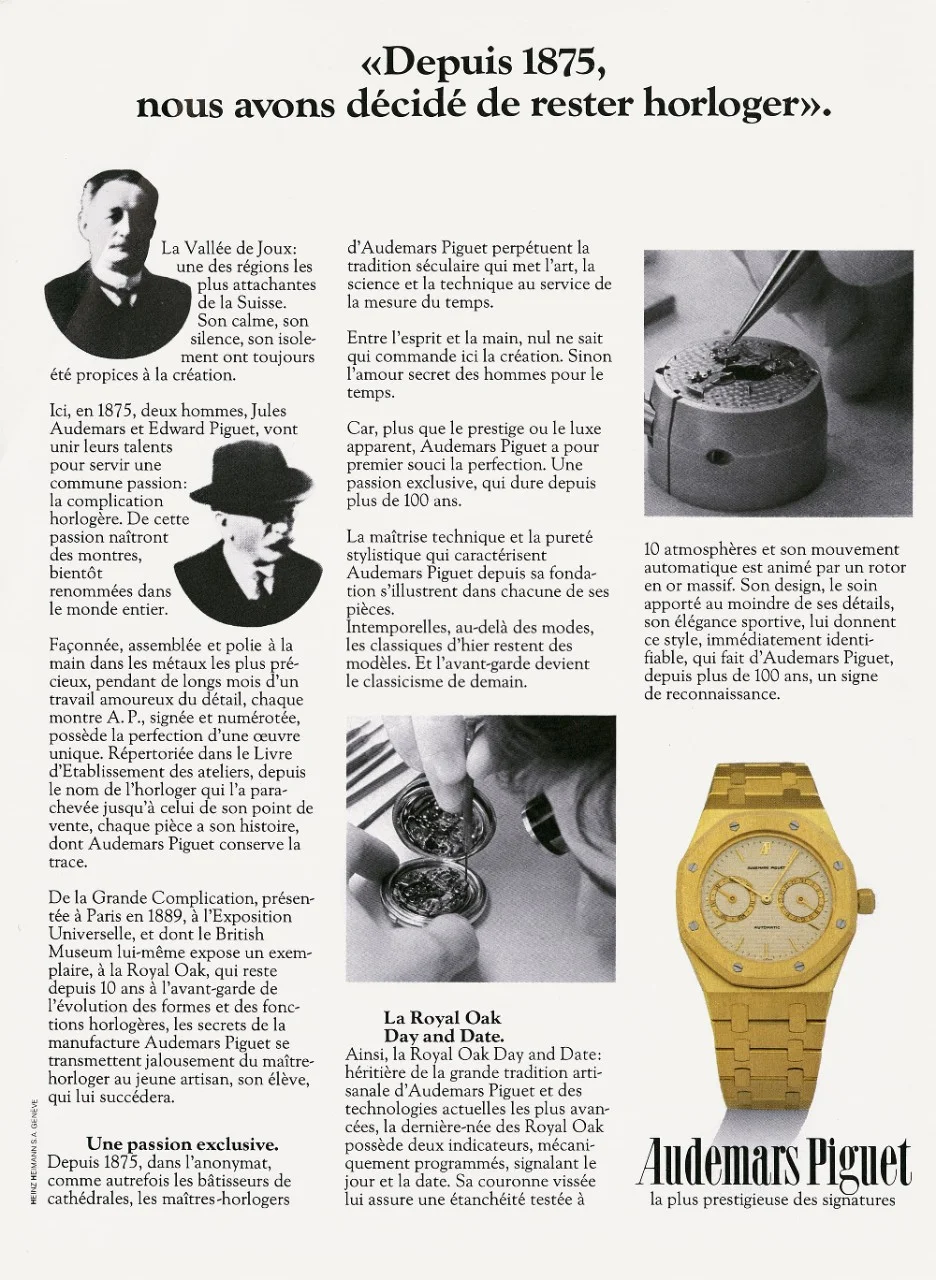
1984. Royal Oak advert The advert tells the story of Audemars Piguet, its natural surroundings in the Vallée de Joux and the age-old expertise of the watchmakers, before introducing the first Royal Oak with additional functions, Model 25572. Audemars Piguet Archives.
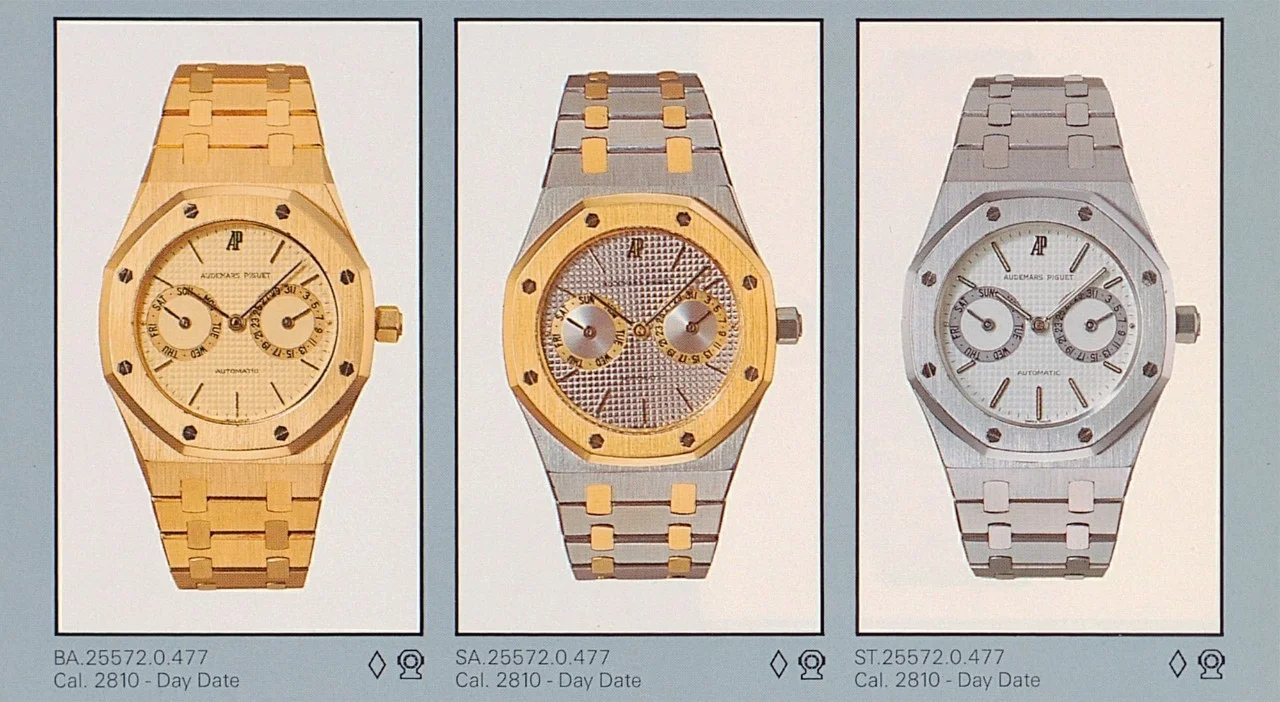
1986-87. Variants of Model 5572 (36 mm) Royal Oak Day Date presented in the Audemars Piguet catalogues between 1986-87 and 1987–1988. Audemars Piguet Archives.
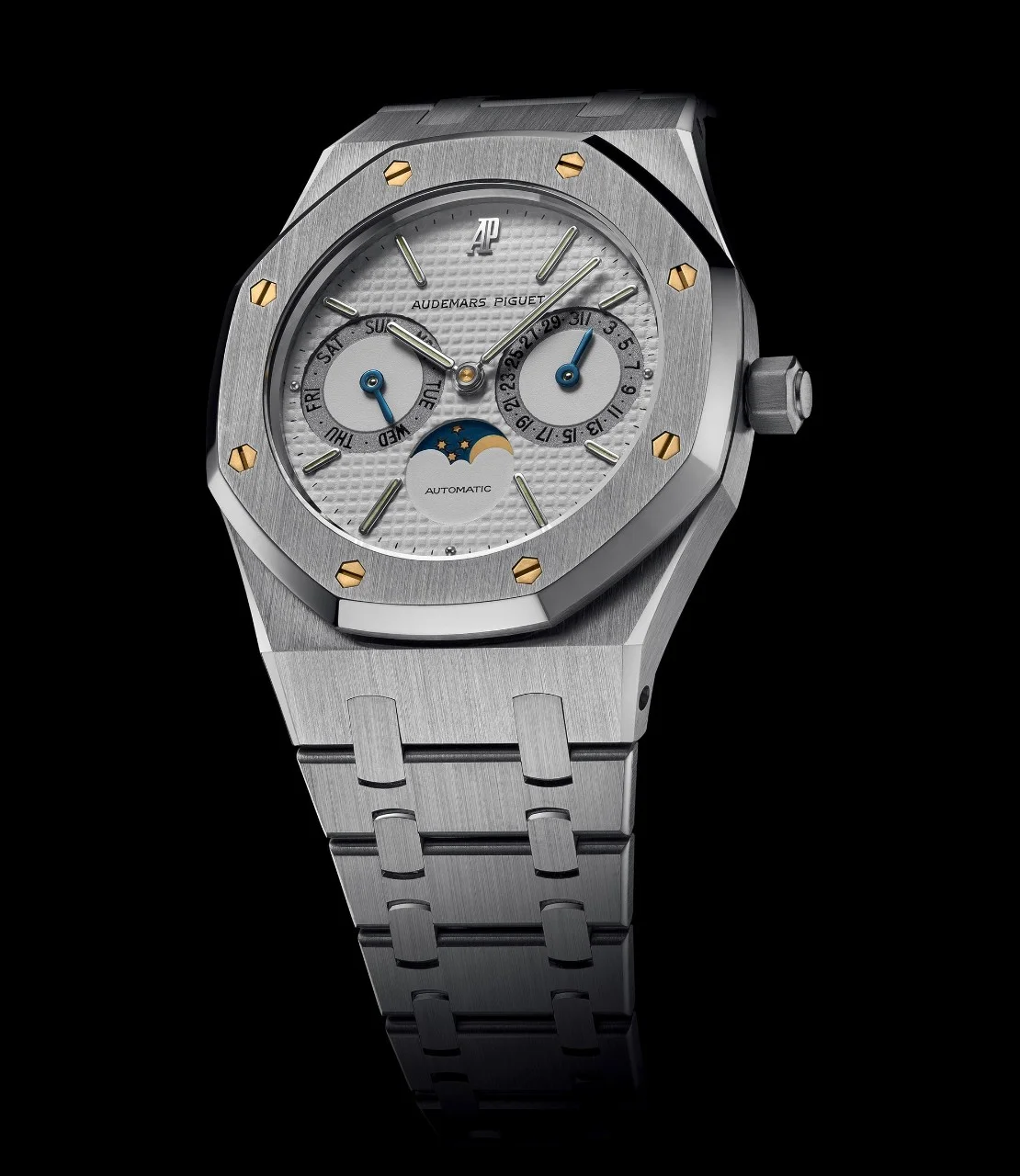
Circa 1984. Royal Oak Day Date Moon Phase 25594ST no. 1302. Pointer-type day-date display. Moon phases. Calibre 2124/2825. Silver-toned dial with Petite Tapisserie motif. 36 mm steel case no. D33257. Prototype presented at the launch of the model. Audemars Piguet Heritage, inv. 463.
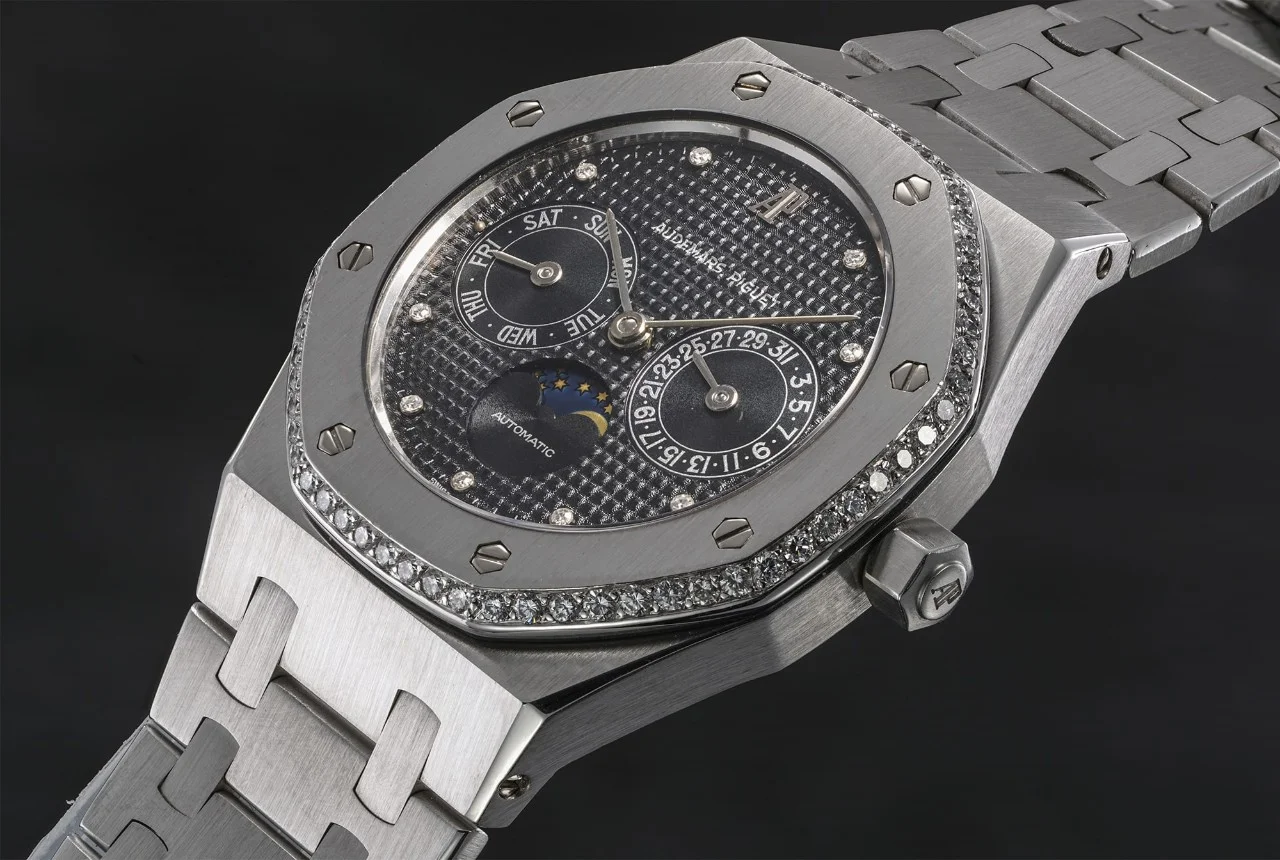
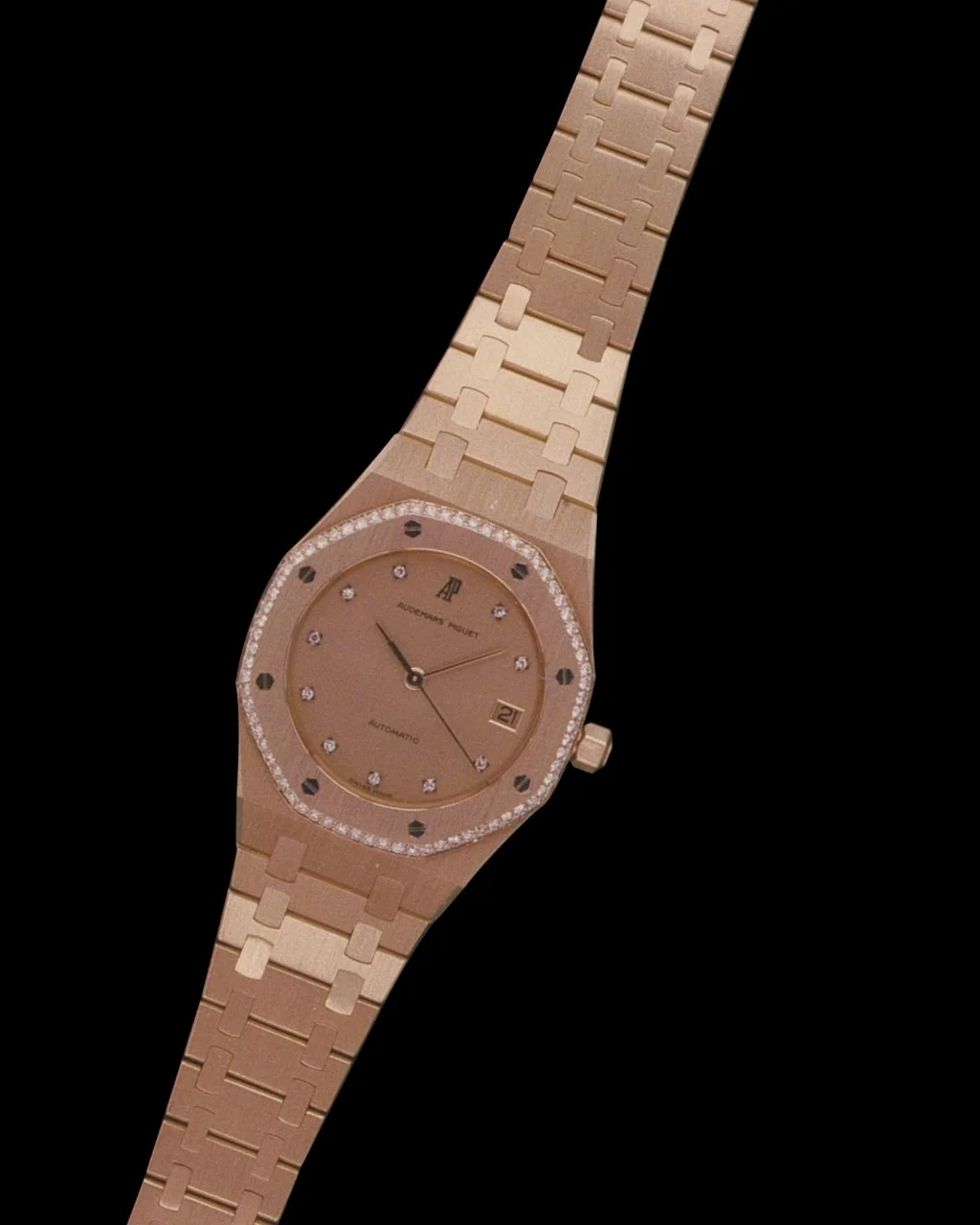
1986. Royal Oak Day Date Moon Phase 25595BC, N° 22. Pointer-type day-date display. Moon phase. Calibre 2124/2825, Movement 269655. Bracelet 477. Gemset outer bezel rim. Dial adorned with T21 Tapisserie pattern. 36 mm case no. B87868 in 18-carat white gold. Sold to a client in Singapore in January 1986. Auctioned by Phillips Geneva on May 6, 2022, lot 25. Audemars Piguet Heritage inv. 2126.
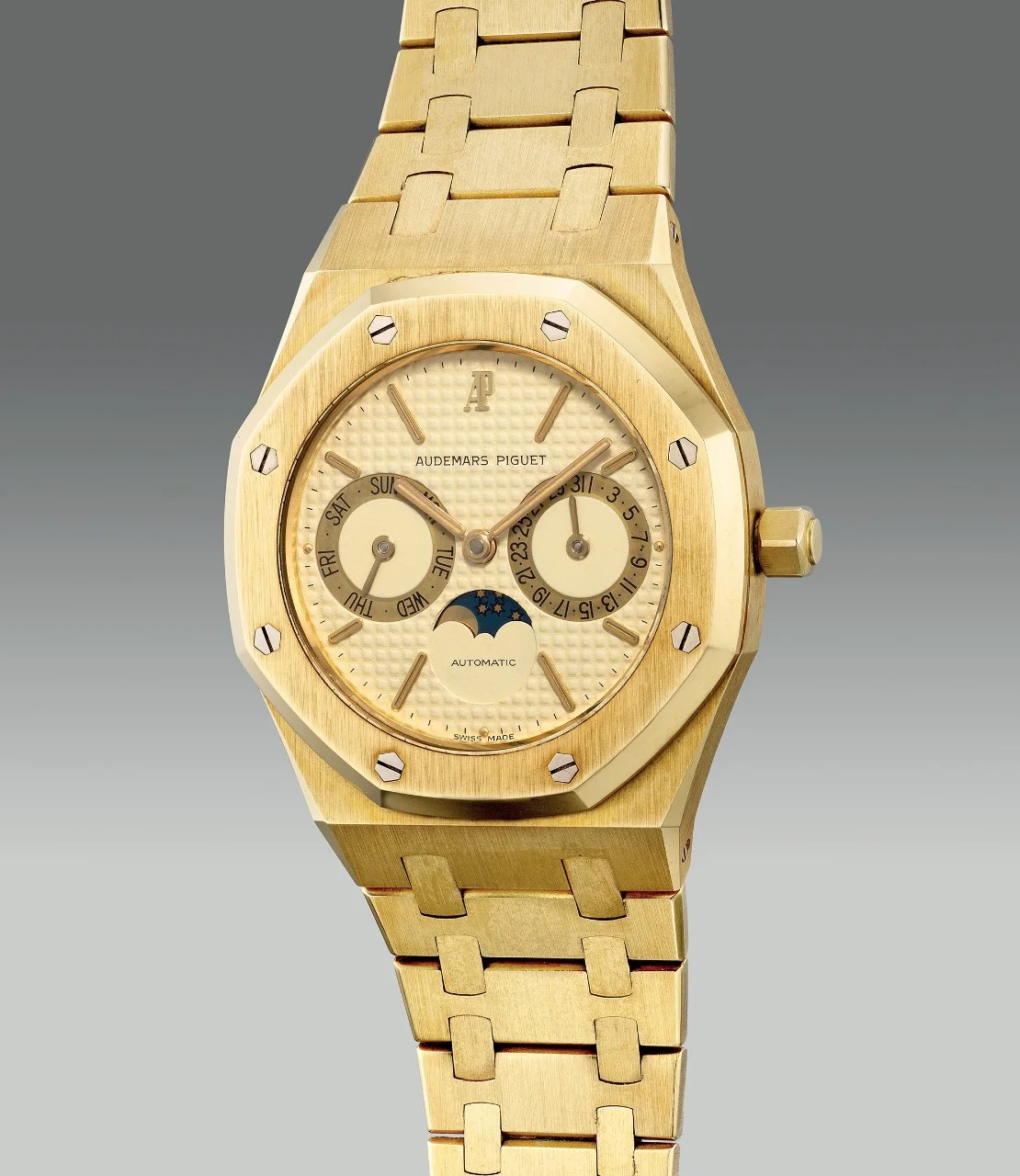
1986. Royal Oak Day Date Moon Phase 25594BA (1984), No. 879. Pointer-type day-date display. Moon phase. Calibre 2124/2825, movement 289721. Bracelet 477. Dial with T21 Tapisserie motif. 36 mm case no. C22495 in 18-carat yellow gold. Sold to a client in Hong Kong in April 1986. Auctioned by Phillips Hong Kong on November 26, 2021, lot 1050. © Phillips.
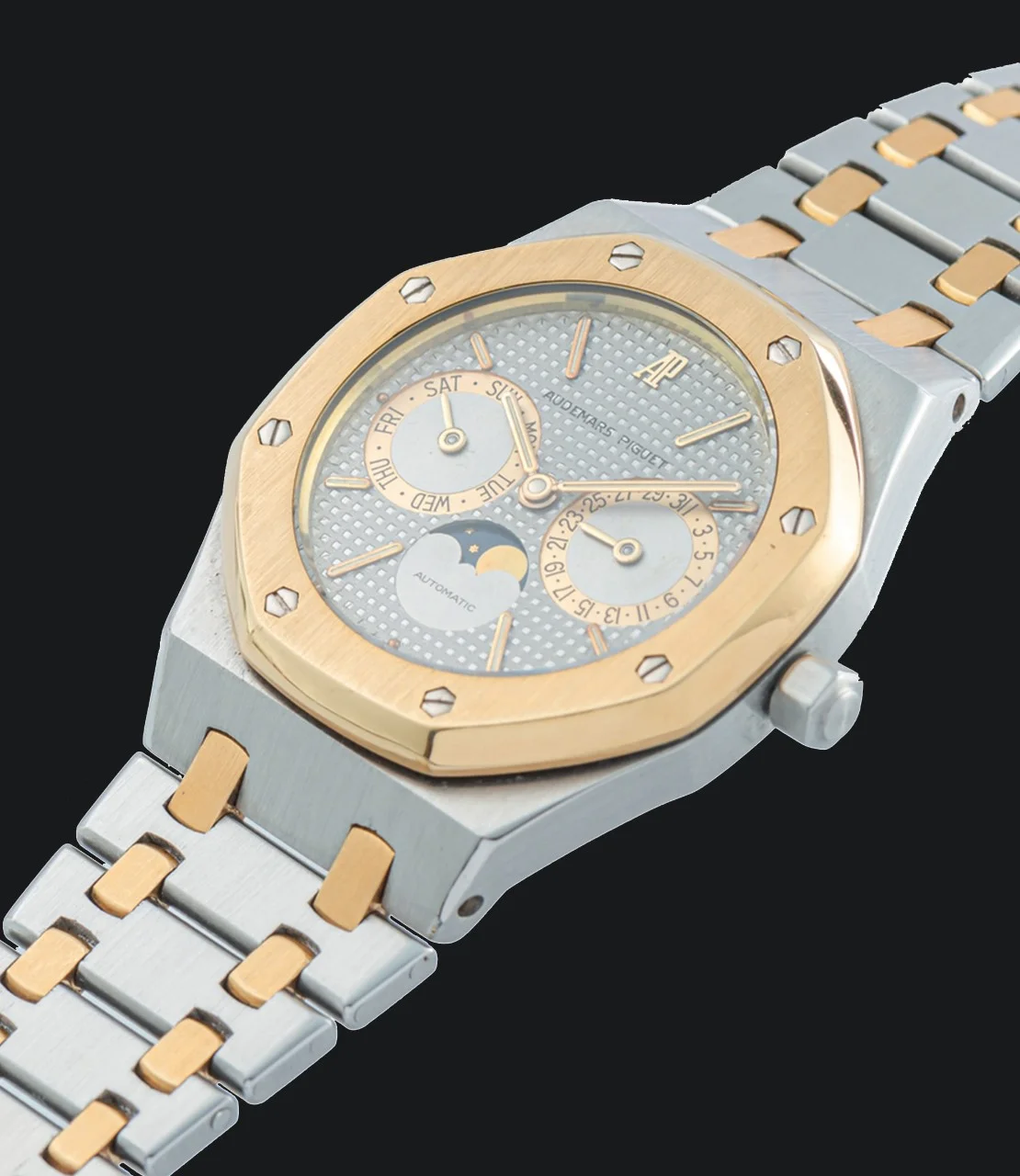
1991. Royal Oak Day Date Moon Phase 25594SA (1984), No. 1659. Pointer-type day-date display. Moon phase. Caibre 2124/2825, Movement 340811. Bracelet 477. Grey dial with T21 Tapisserie motif. Steel and 18-carat yellow gold case, 36 mm. Sold to a client in Singapore in July 1991. Auctioned by Antiquorum Hong Kong on December 5, 2021 (Lot 331). © Antiquorum.
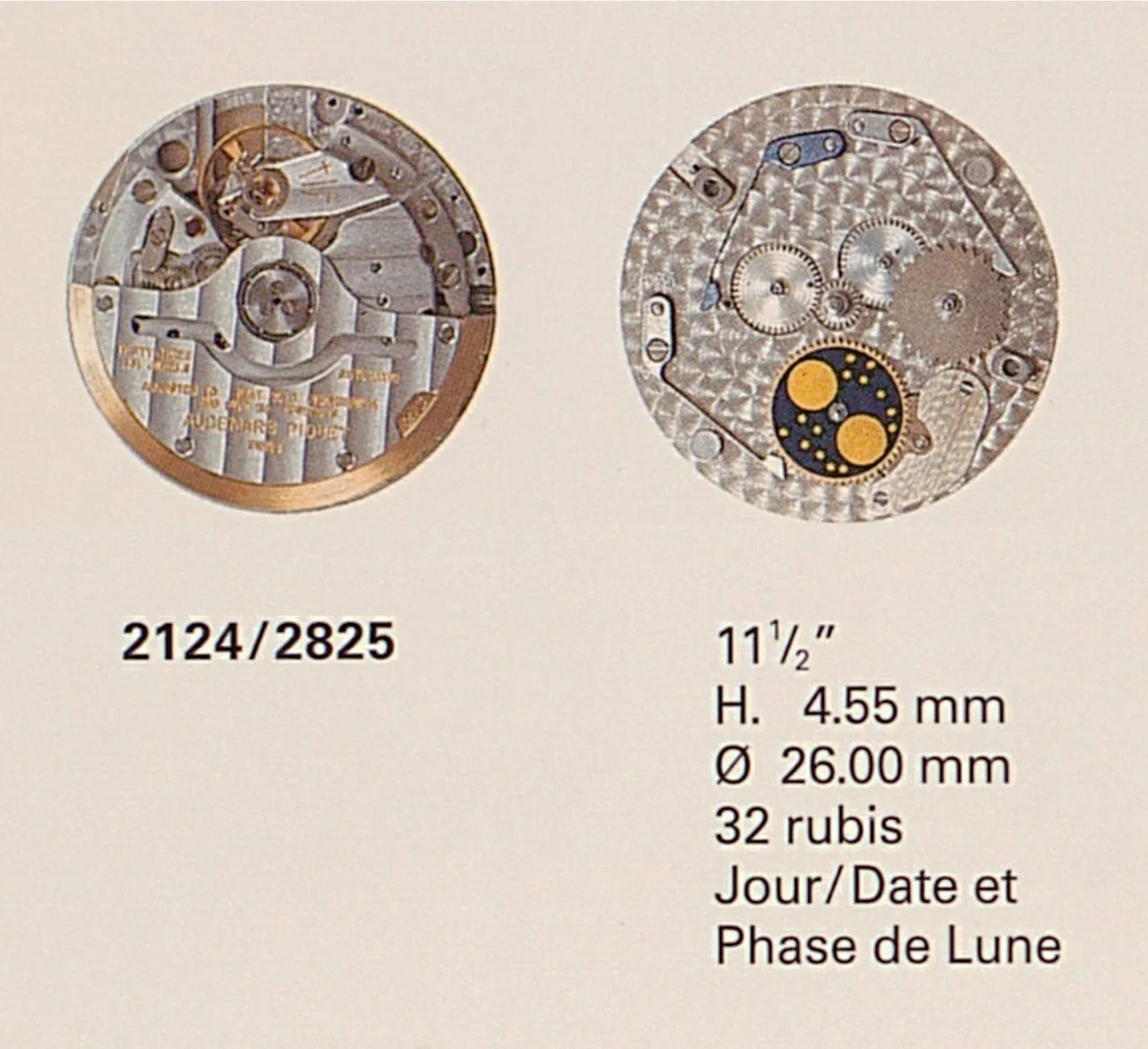
1990–91. Calibre 2124/2825. Audemars Piguet catalogue.
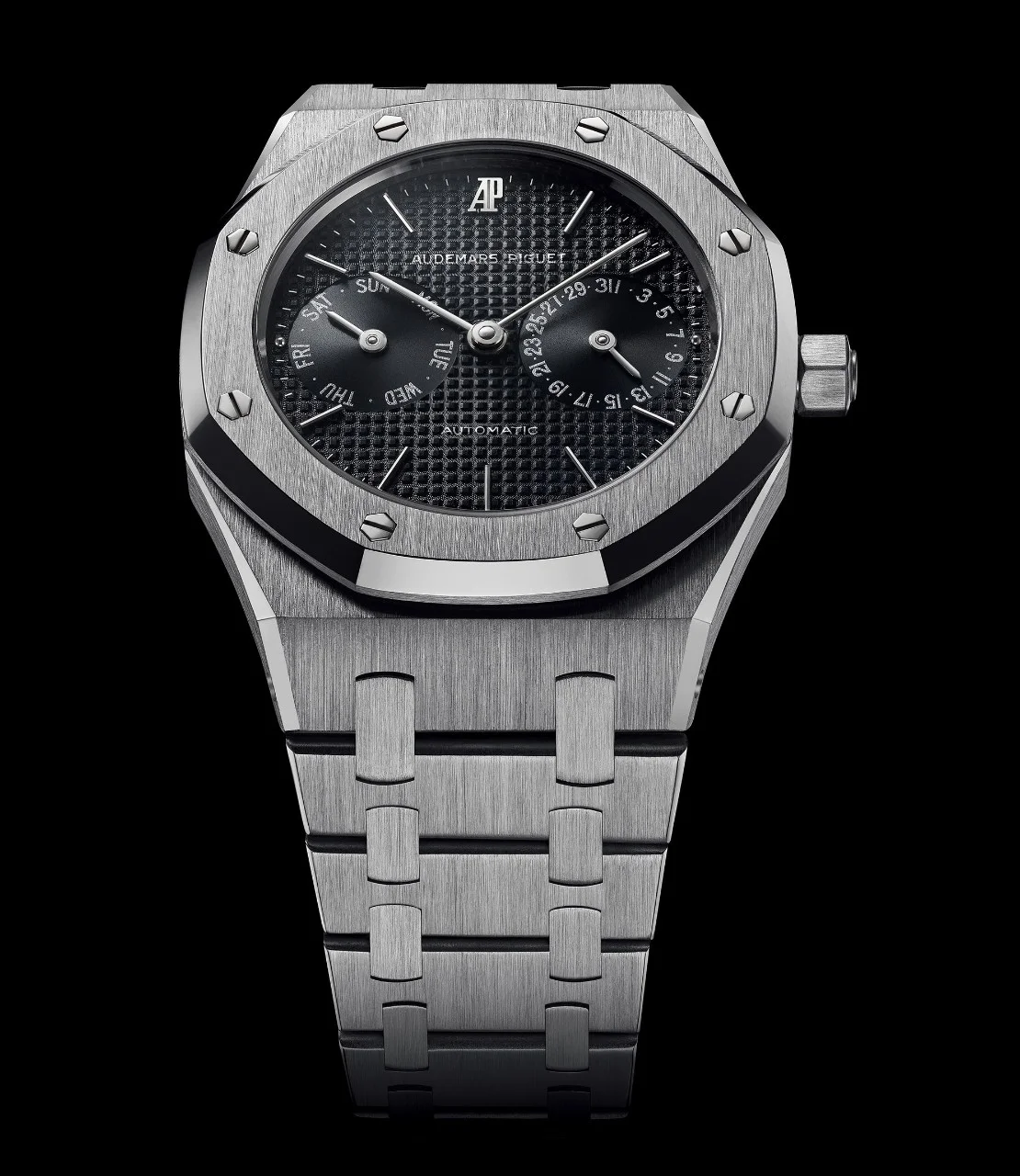
1986. Royal Oak Day Date 5572BC, N° 34. Pointer-type day-date display. T21 Petite Tapisserie dial. 36 mm case C7661. 18-carat white gold. Sold to Fintime in August 1986. Audemars Piguet Heritage, inv. 1228.
An idea born on the markets
In order to attract an international, refined clientele living in the world's greatest capitals, the watchmakers in Le Brassus have had to engage in and nurture ongoing dialogue with the world at large, enabling them to keep in step with – and sometimes ahead of – various trends.
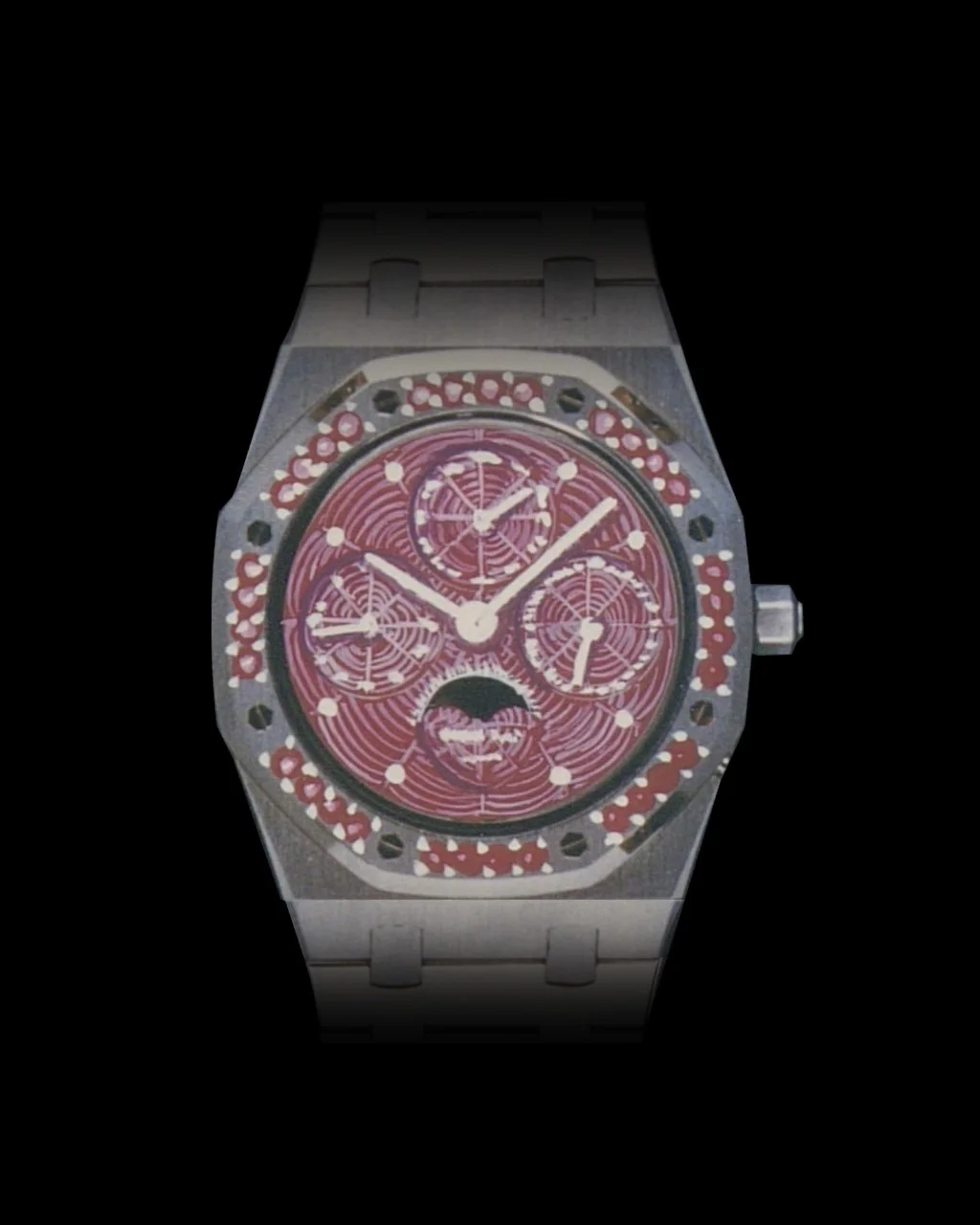
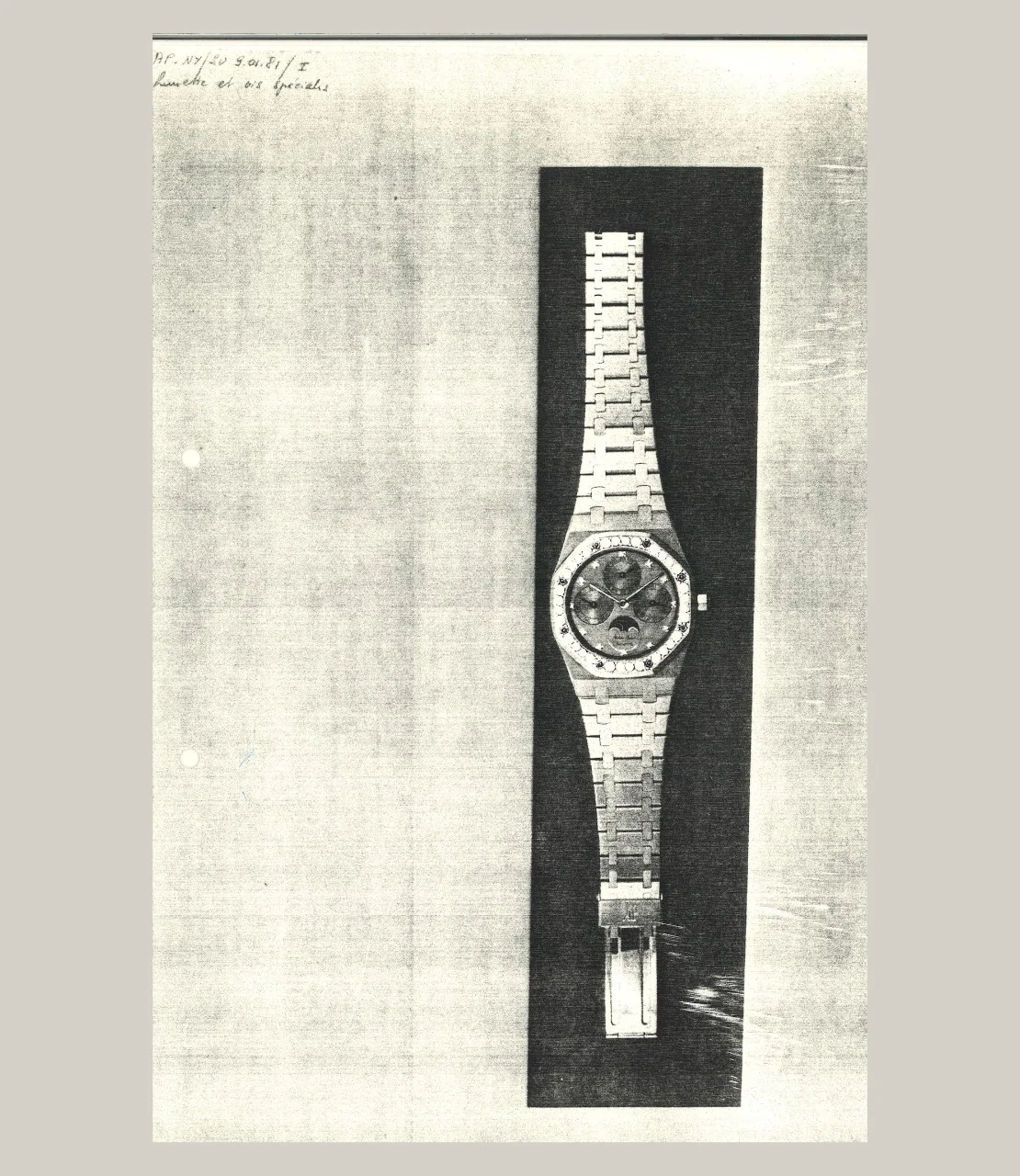
The Royal Oak Perpetual Calendar is no exception. It was born out of market demand. The first idea seems to have come from the United States. At least that's what one might deduce from a photocopy in the Audemars Piguet Archives bearing the annotation "AP. NY/SU", which probably means AP New York followed by the initials of Steven Urquhart, then Sales Director. Dated January 9, 1981, the document shows a sketch of a Royal Oak Perpetual Calendar with a gemset bezel, drawn on a photograph of Model 5402.
The idea was appealing and made its way into people’s mind. It was discussed with retailers and customers at watch shows, exhibitions and events. However, watchmakers in the workshops knew that such a project would be technically far more difficult than it appeared on paper...
An incongruous yet significant fact
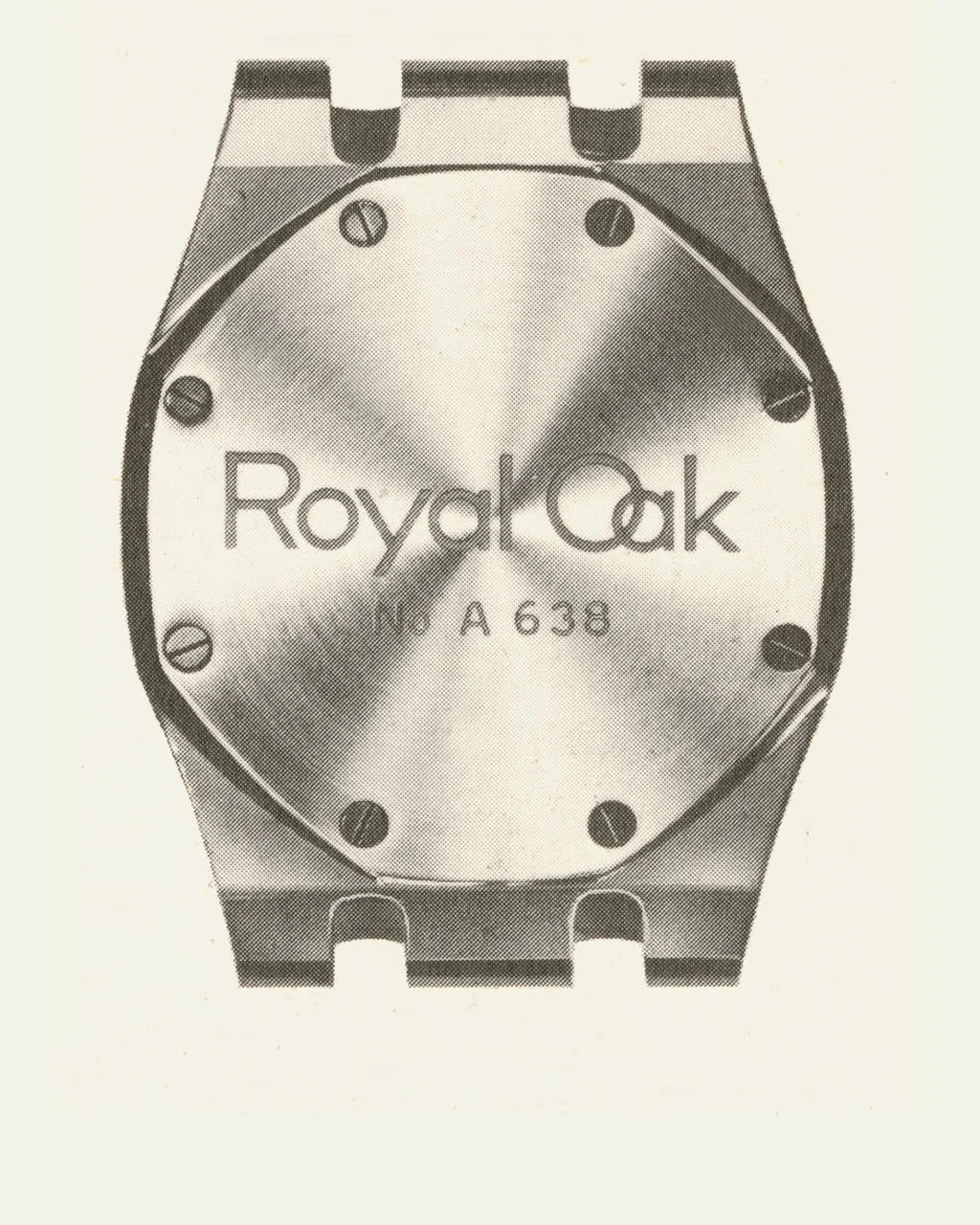
During the research preceding the writing of this article, an incongruous, seemingly innocuous fact kept the Audemars Piguet Heritage team on its toes. The Royal Oak 25554ST watches have three engraved case numbers whereas they should only have two (see article on Royal Oak numbering). While the large case number is hidden on the inside, the watch exterior bears the numbers of two different models: 25554 and 5402.
The reason is as simple as it is extraordinary. The first 25554 steel cases were intended to equip the latest Royal Oak 5402 series D, but were taken to be transformed into a perpetual calendar. Given that Model 5402 was developed to house the world’s thinnest selfwinding date calibre, one cannot help wondering how the watchmakers managed to integrate a selfwinding perpetual calendar within it!
Watchmaker Jean-Claude Ruchat, who worked in the Complications workshop from 1979 to 2022, recalls that it was initially just a trial run of three watches. Régis Meylan, who ran the workshop at the time, remembers the challenges of going from three to nearly 300 units in just a few years! Nevertheless, in August 1983, the Technical Office sketched the first case designs. The countdown was on: the model had to be ready for April 1984, less than a year later...
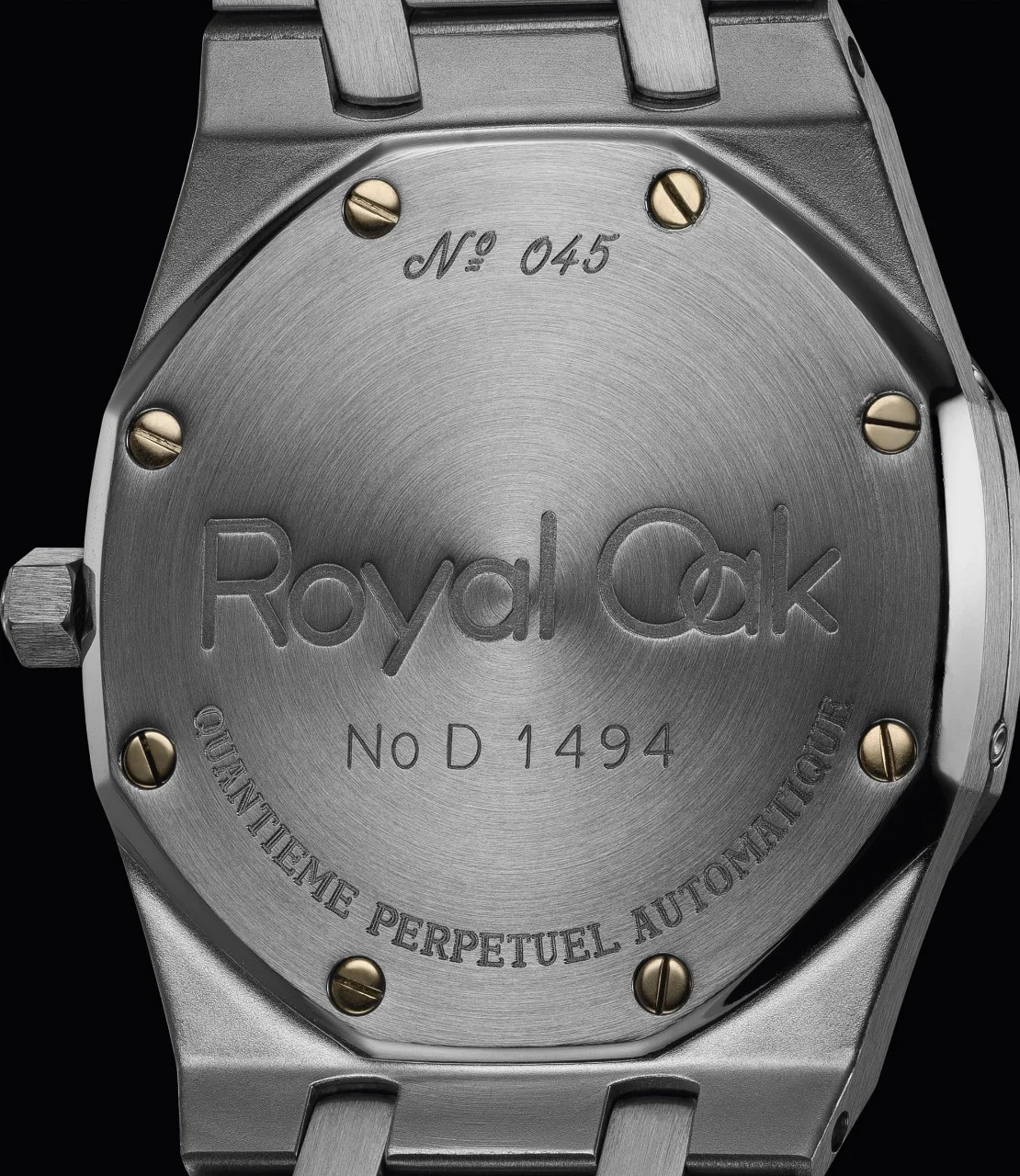
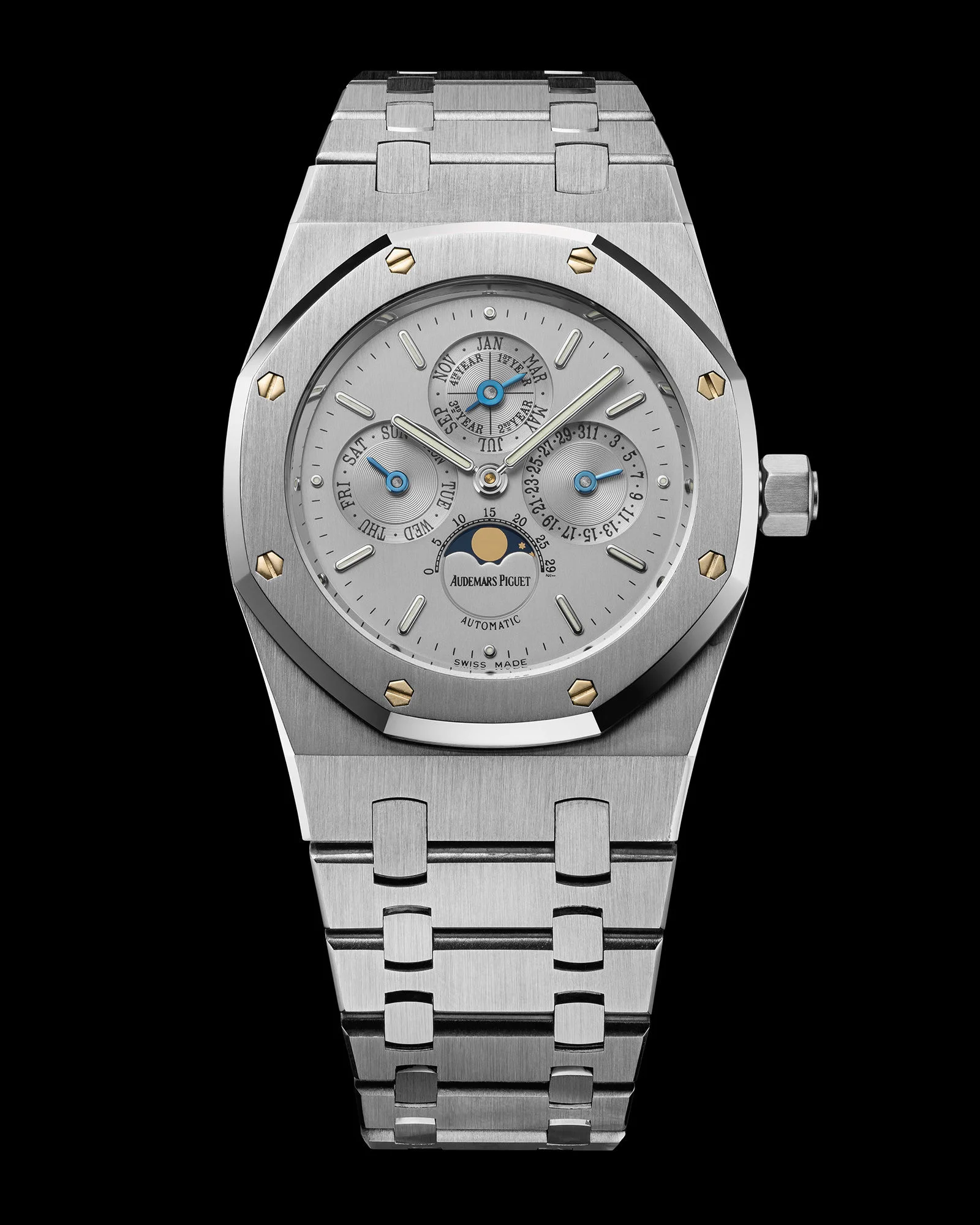
Circa 1984. Royal Oak Calendrier Perpétuel 25554ST. The case bears number D1494 drawn from Model 5402, as well as the number 45, from Model 25554. Perpetual Calendar: day, date, month and moon phases. Extra-thin Calibre 2120/2800 (3.95 mm), movement 273849. Bracelet 344. Silver-toned dial. 39 mm case. Audemars Piguet Heritage, inv. 2142.
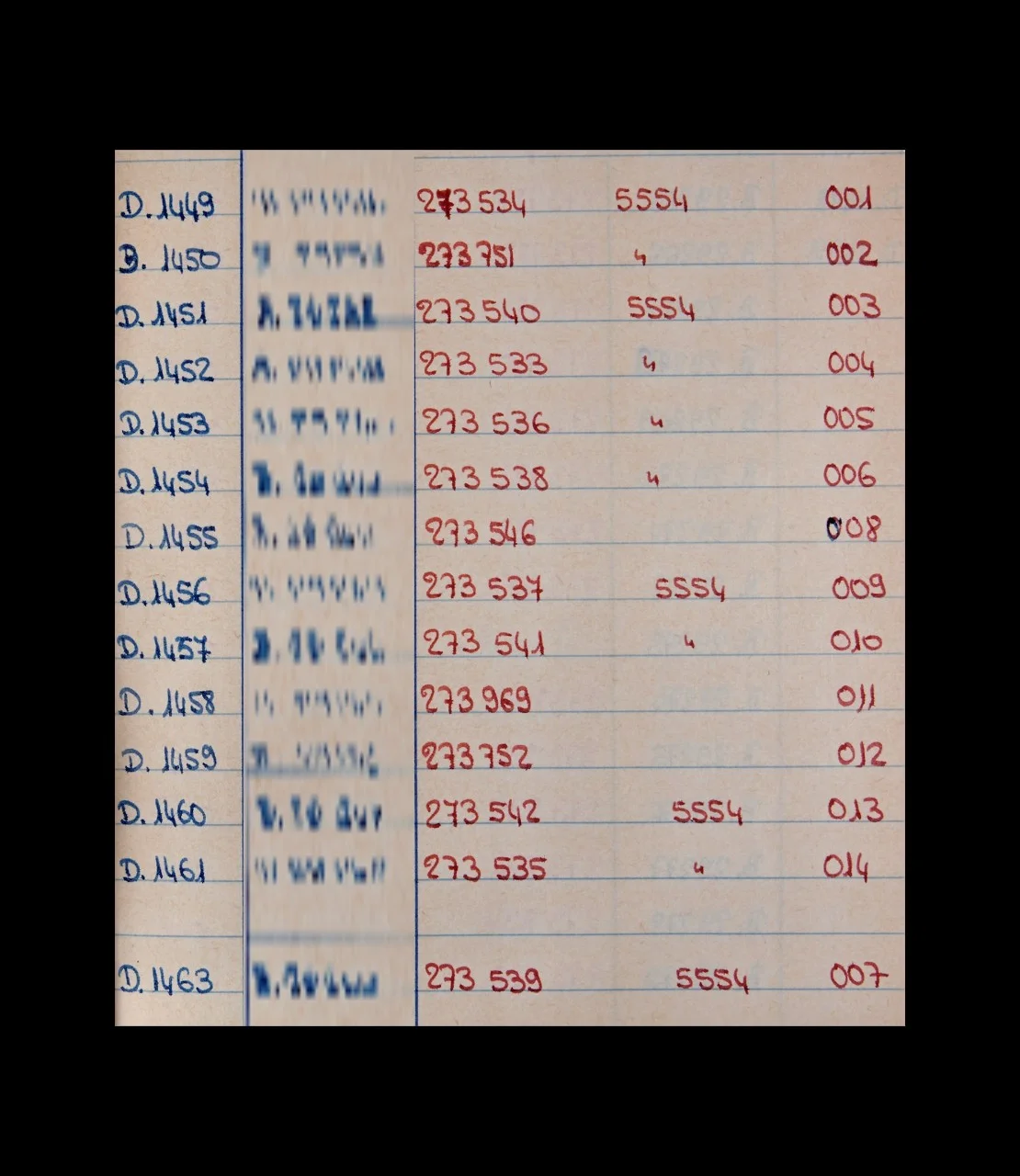
Circa 1984. List of Model 5402ST watches cased up as Royal Oak Perpetual Calendar 5554ST (or 25554). Audemars Piguet Archives
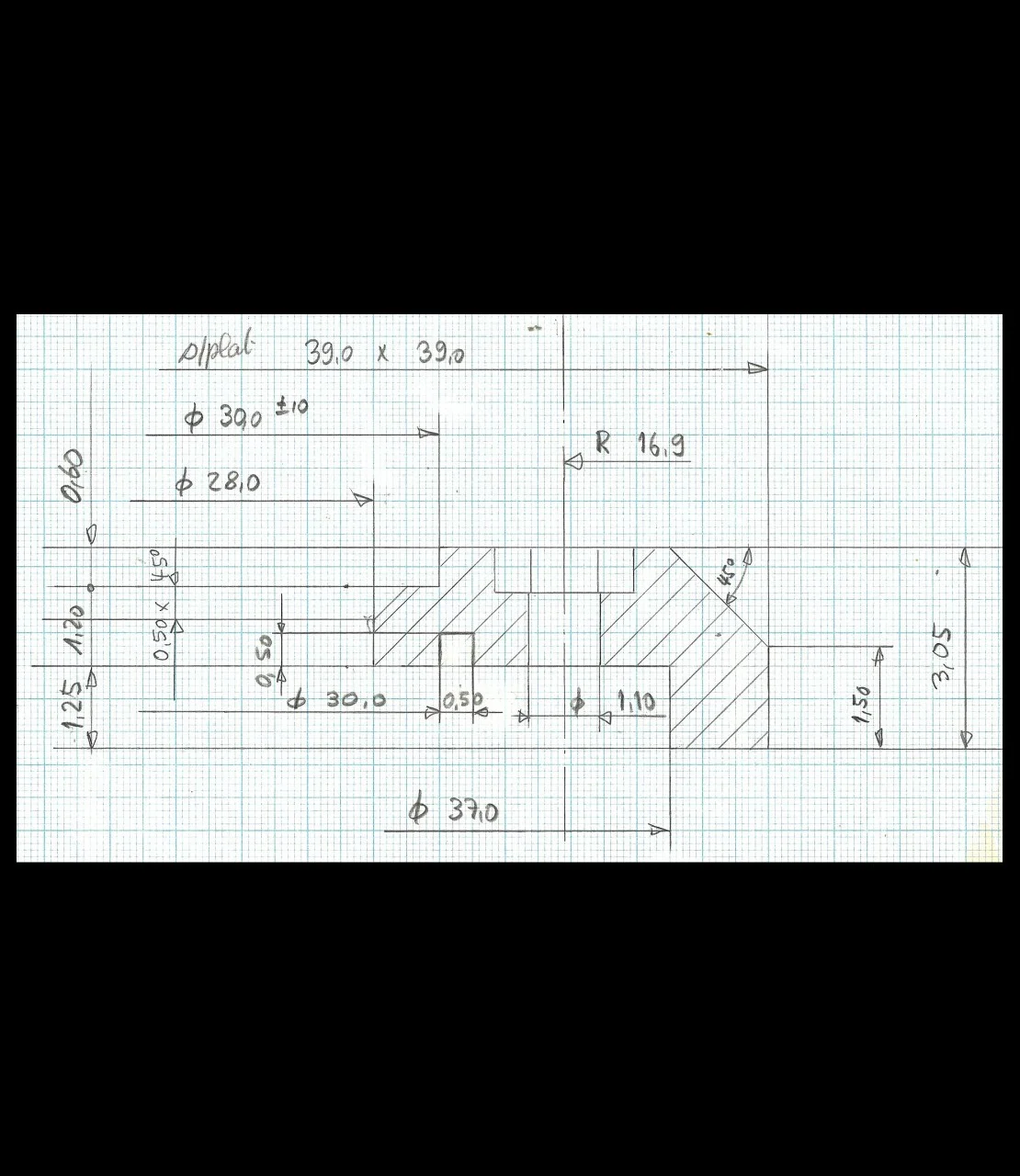
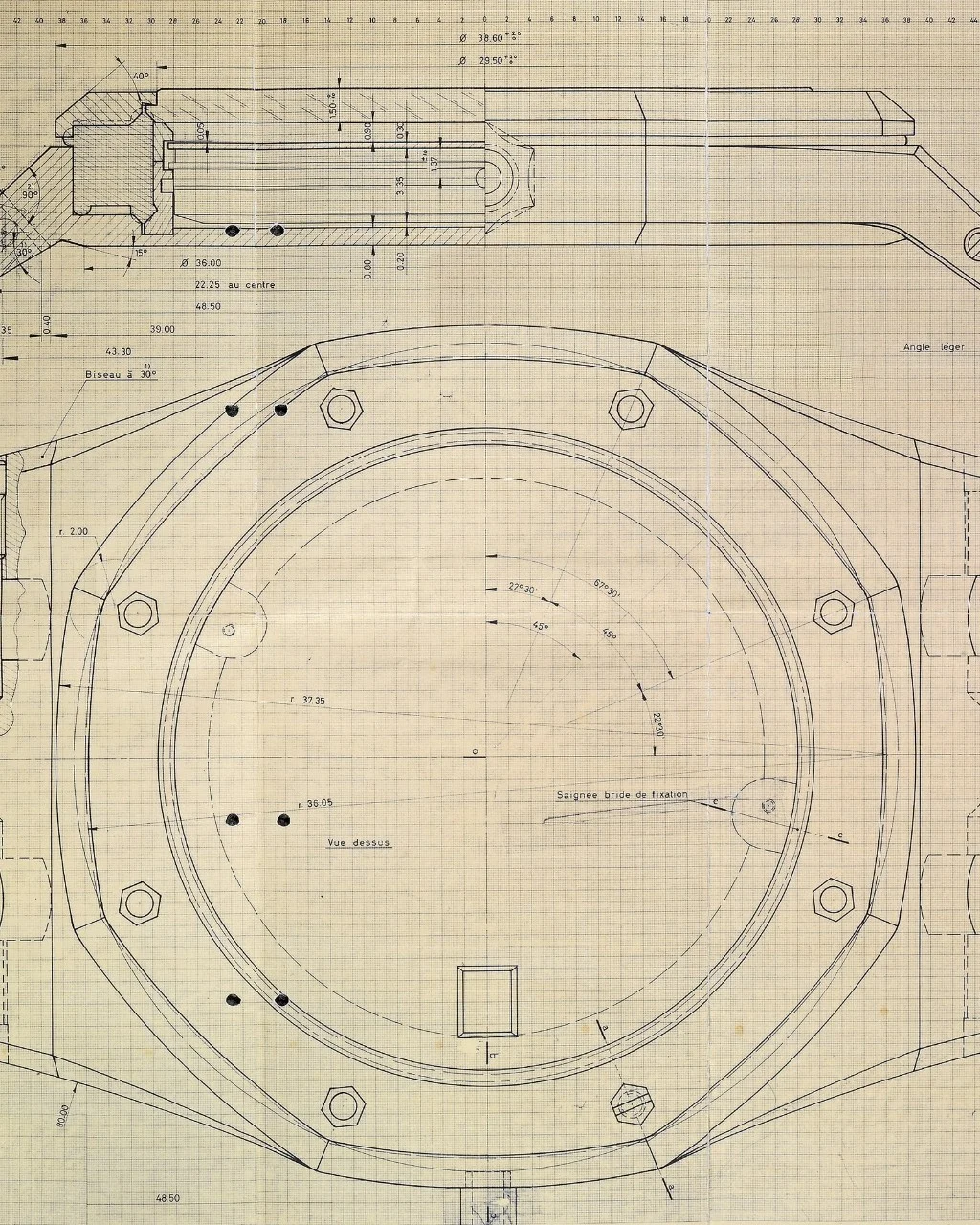
1983. Technical drawing of casing-ring 5554 (25554). Document dated August 24, 1983. Audemars Piguet Archives.
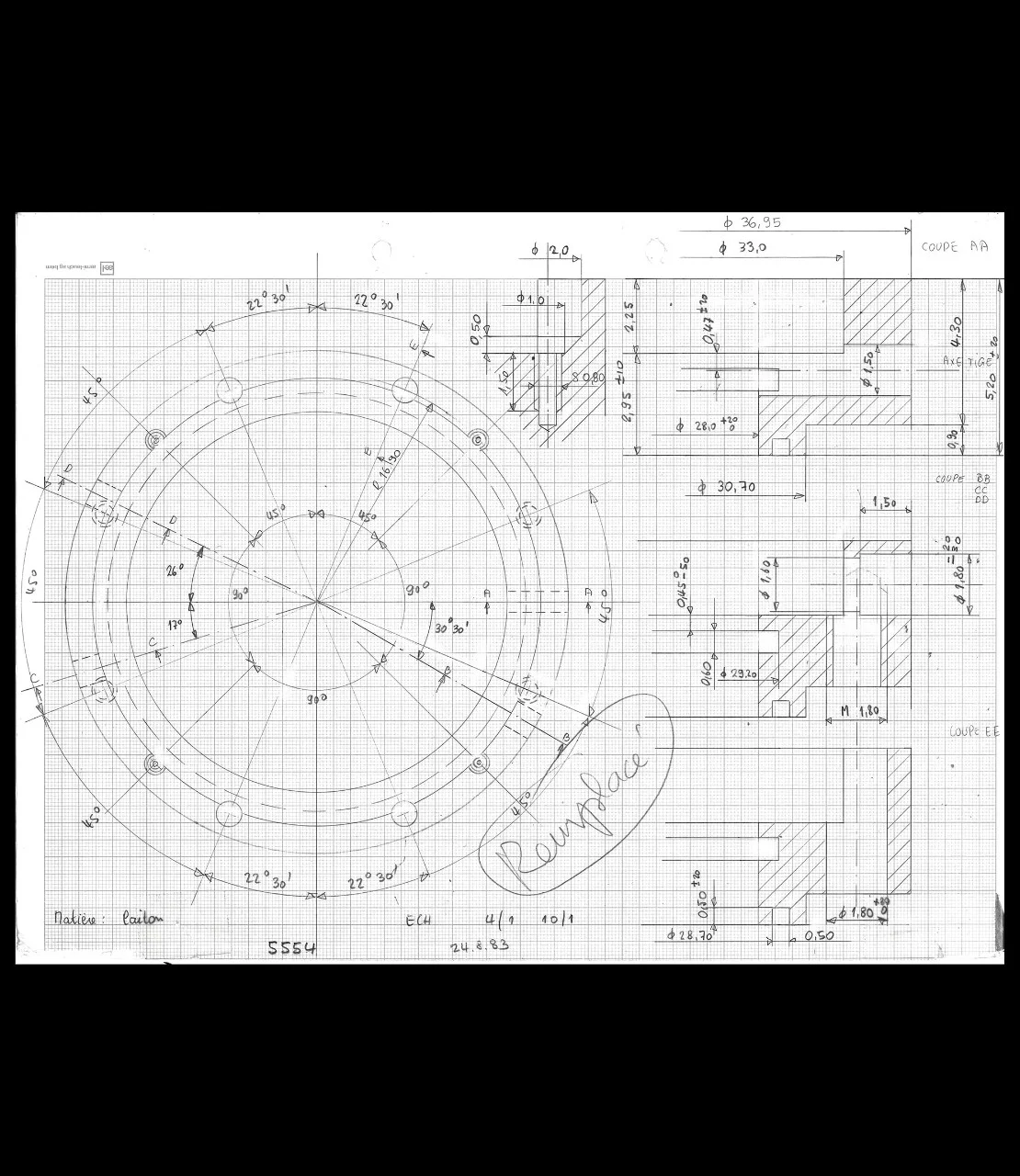
1983. Technical drawing of casing-ring 5554 (25554) dated August 24, 1983. The three correctors are either flush with the screws, or cross path with them. Archives Audemars Piguet.
Saving tenths of a millimetre
At 3.95 mm thick, selfwinding Calibre 2120/2800 with perpetual calendar may have been the world's thinnest in its category, yet it was still 0.9 mm thicker than Calibre 2121 (3.05 mm). Space was already very limited to accommodate the latter in the case of Model 5402, affording a total thickness of 7.1 mm. The design engineers and watchmakers therefore struggled to save every possible tenth of a millimetre.
The monocoque (monohull) case has been kept, a true masterpiece of finesse and geometry. The bezel has been raised by 0.6 mm, from 2.5 mm (including 0.5 mm of space for the rubber gasket) to 3.1 mm. The thickness of the sapphire crystal has been drastically reduced, from 2 mm to 0.9 mm, which required the replacement of its heel-type attachment system with a 45-degree domed bezel.
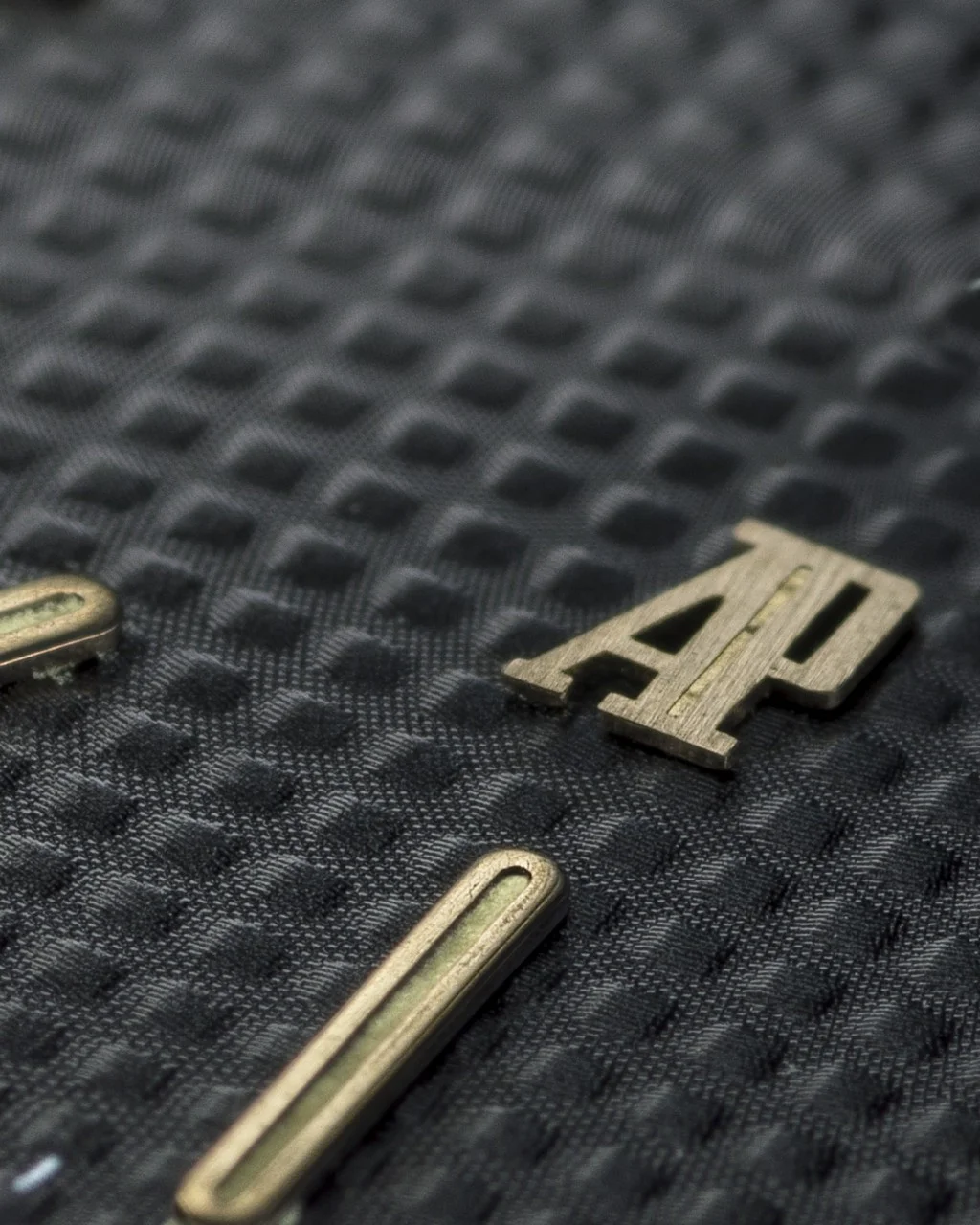
As for the dial, the watchmakers renounced the Tapisserie pattern for aesthetic reasons and chose to use the same baseplate as the one of Model 5548 (see above), manufactured by Stern. Its 0.3 mm thickness is identical to that of the dial of Model 5402, with the exception of the counters, hollowed out by 0.1 mm to leave room for the date, day and month hands. Connoisseurs will note the thinness of the hour-markers and the absence of the applied AP logo. The latter would have made the dial design too busy and above all would have added a few tenths of a millimetre to the overall thickness!
The result is striking: the Royal Oak Perpetual Calendar 25554 measures only 7.5 mm thick in all, i.e. barely 0.4 mm more than Model 5402.
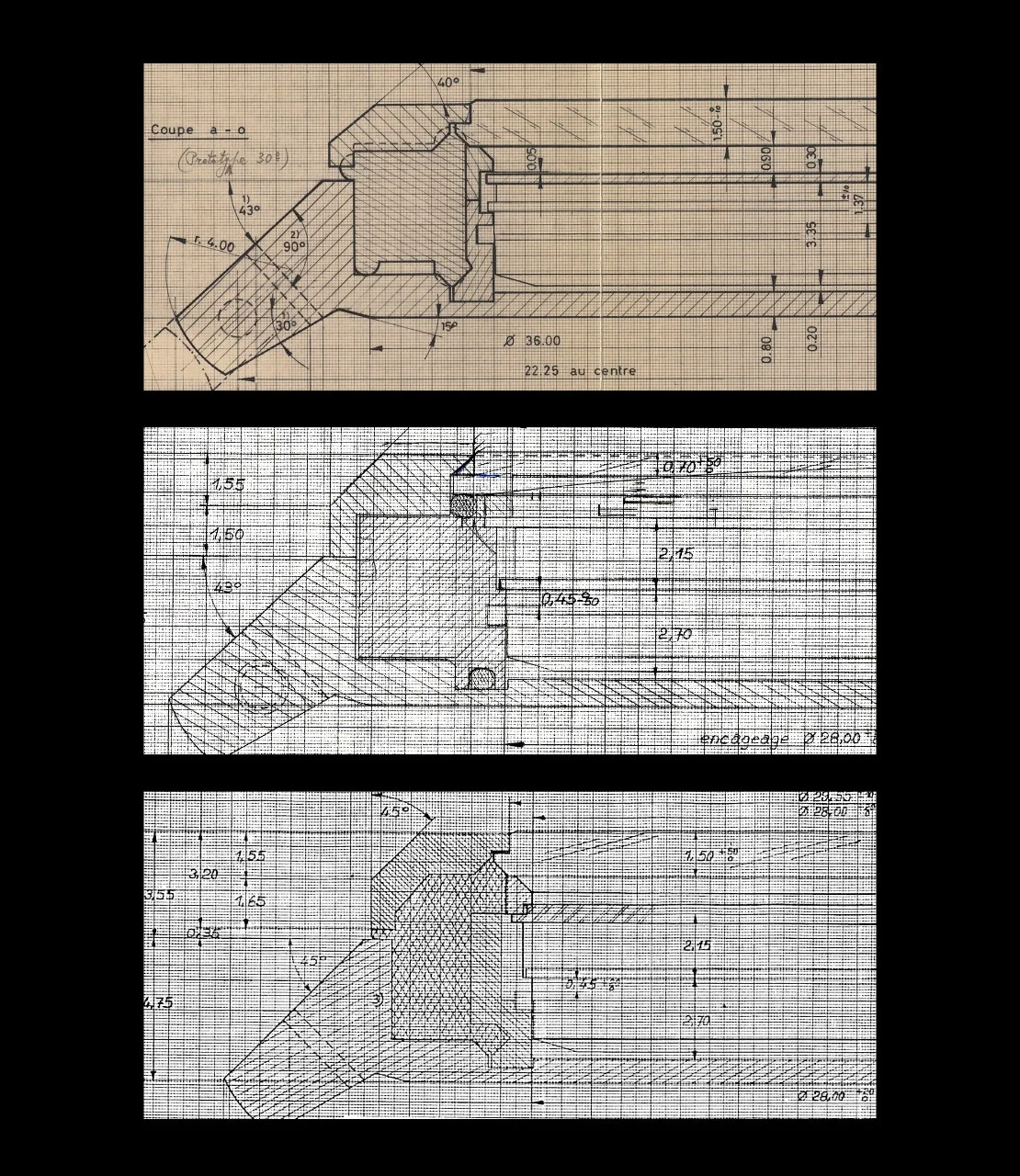
1972, 1984 and 1987. Cross-section views of Royal Oak Models 5402ST, 25554ST and 25654 Pictured at the top, Model 5402 is distinguished by its extreme thinness (7.1 mm). Shown in the middle, the 25554ST uses the same fused case middle and caseback, but its bezel is raised to accommodate a perpetual calendar (7.5 mm). The lowest-pictured Model 25654 (8.3 mm) boasts improved water-resistance. Audemars Piguet Archives.
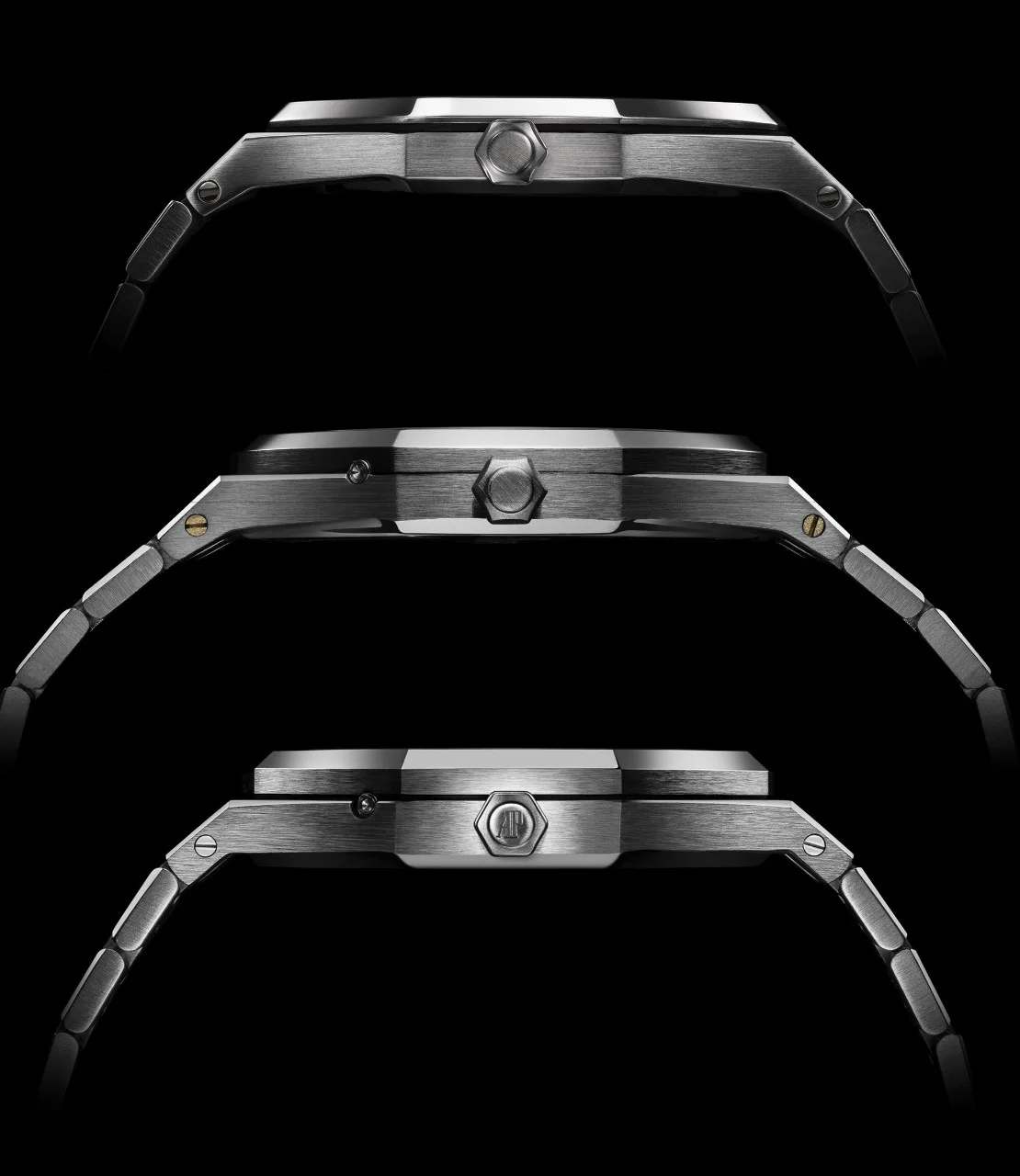
1972, 1984 and 1987. Profile view of Royal Oak Models 5402ST, 25554ST and 25654. Pictured at the top, Model 5402 is distinguished by its extreme thinness (7.1 mm). Shown in the middle, the 25554ST uses the same caseback, but its bezel is raised to accommodate a perpetual calendar (7.5 mm). The lowest-pictured Model 25654 boasts improved water-resistance and measures 8.3 mm. Audemars Piguet Heritage, inv. 365, 455 and 1608.
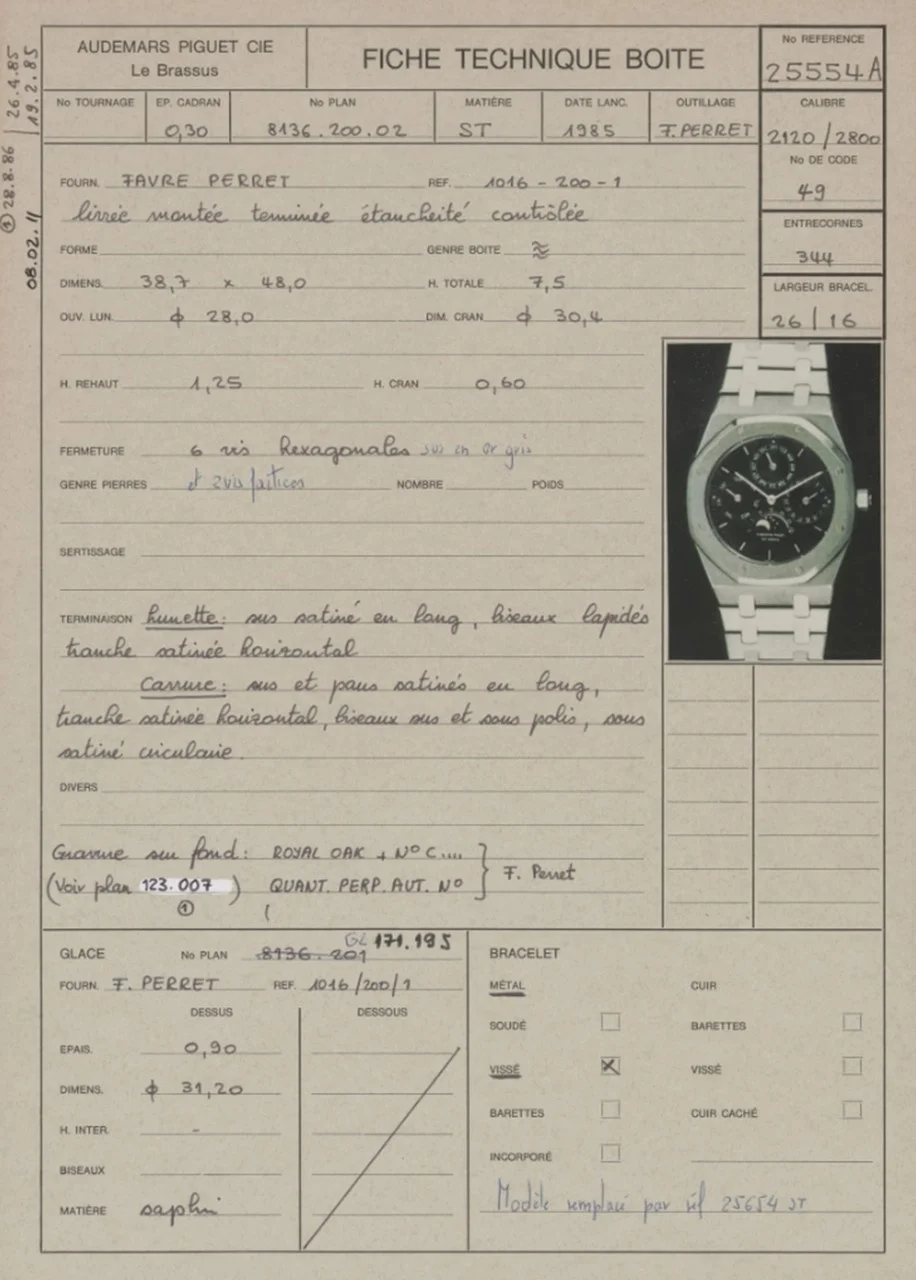
1985. Technical data for the case of Royal Oak Model 25554ST. Audemars Piguet Archives.
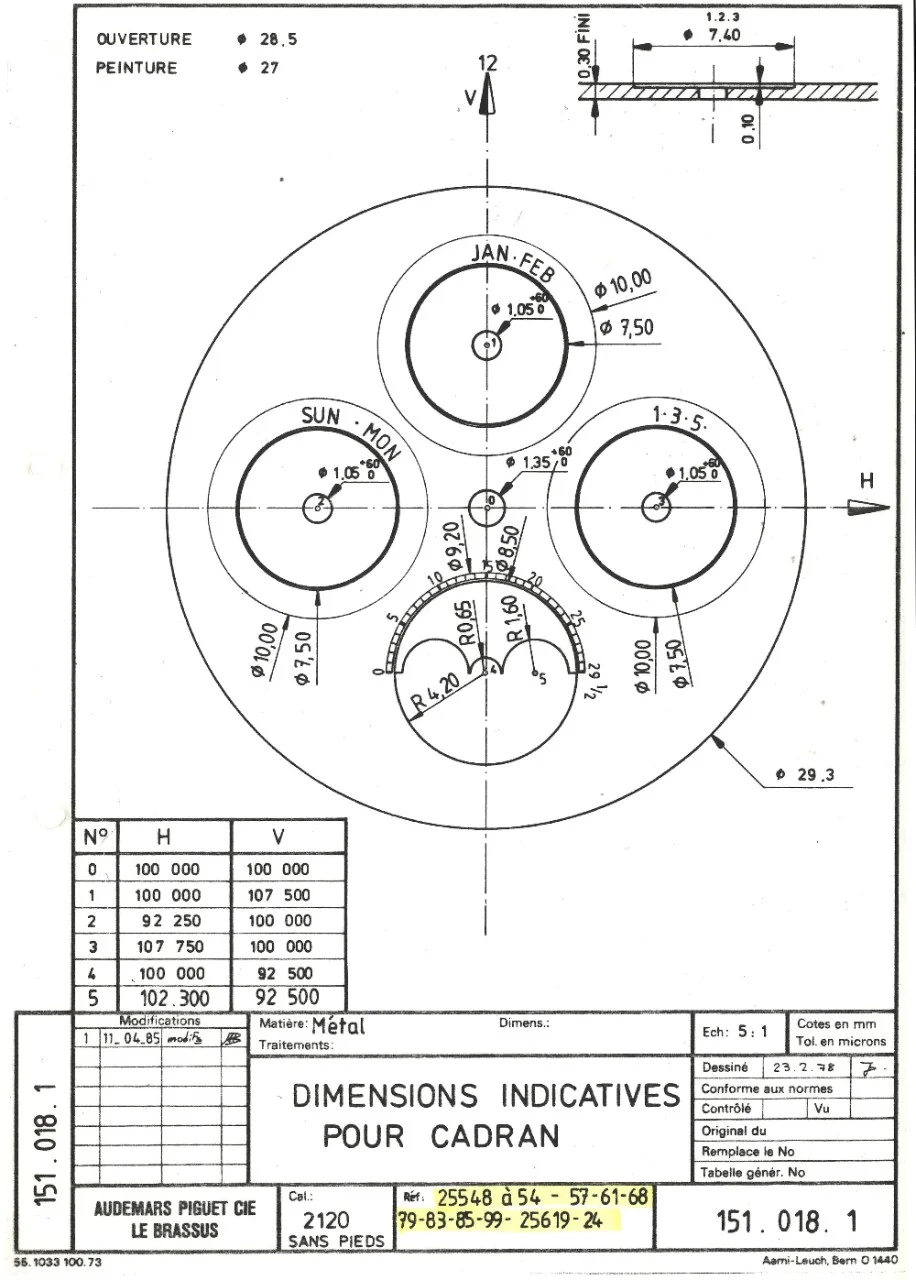
1978. Technical drawing of dial 5548. The plate is 0.3 mm thick and is hollowed out by 0.1 mm at the level of the counters to allow more room for the hands. This baseplate was used for many models after the 5548, in particular the Royal Oak 25554 in 1984. Audemars Piguet Archives.
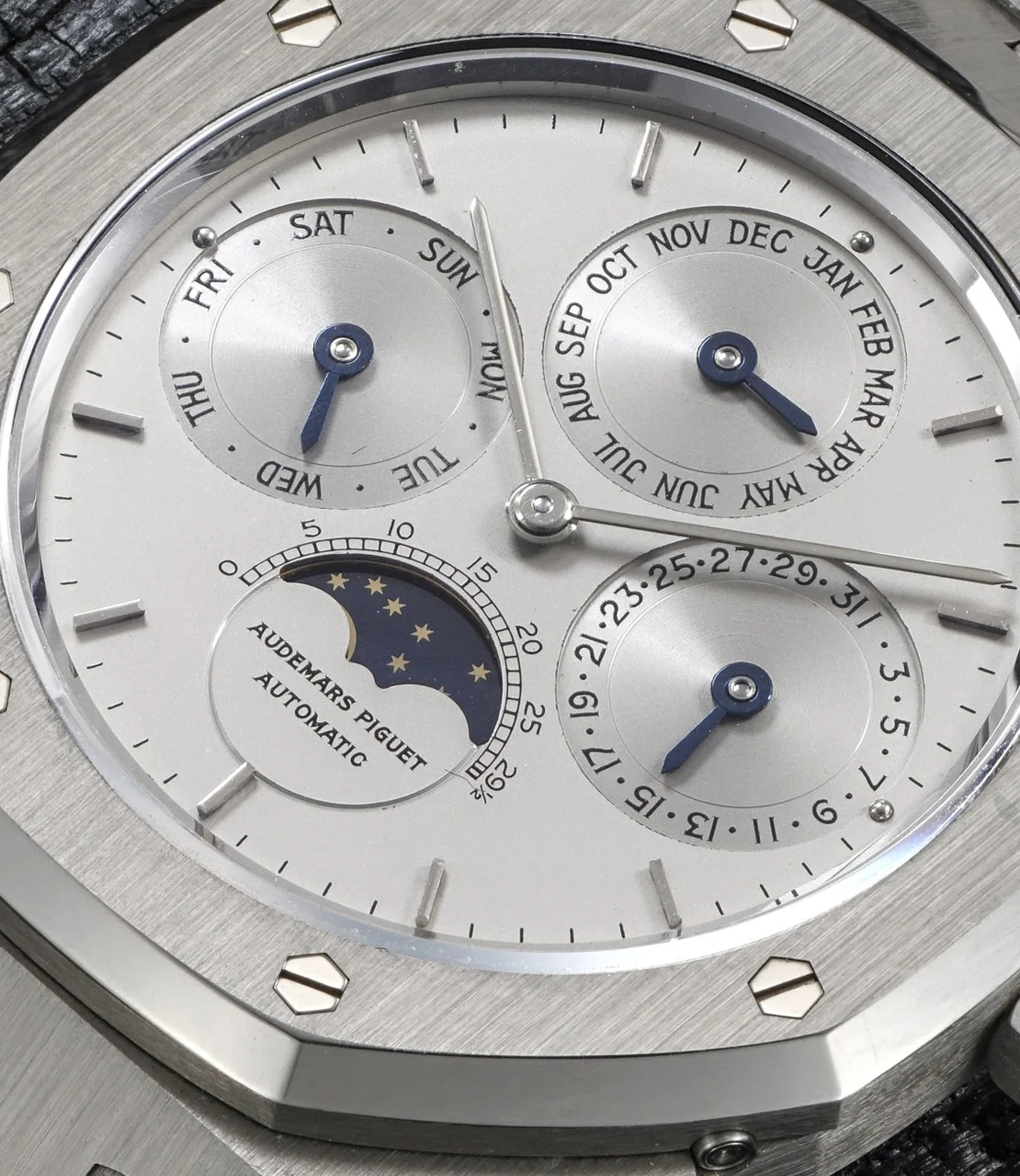
1985. Royal Oak Perpetual Calendar 25554ST. Perpetual calendar: day, date, month and moon phases. Calibre 2120/2800, extra-thin (3.95273841 mm), original movement. Bracelet 344. Silver-toned dial. 39 mm case B292282, D1495, no. 46. Sold to Fintime (Italy) in December 1985. Auctioned for CHF 680,400 by Phillips on May 6, 2022 in Geneva. Image © Phillips
Correcting the correctors?
A perpetual calendar mechanism is programmed to cover cycles of four years, or 1461 days. When the watch is not worn for a few weeks or even months, the user has to update the calendar, which can prove a tedious task. To avoid having to press the same pusher dozens of times, watchmakers have developed independent correctors, operated by small tools. In Calibre 2120/2800, the corrector placed at 10 o'clock enables the date and day to be set: the one at 8 o'clock to adjust the day alone and the 4 o'clock one to correct the moon phase.
These correctors are discreetly located on the perimeter of the watch’s case middle. However, when it comes to the Royal Oak, the path between the outside of the case and the movement is particularly long due to the case construction. In addition to its length, this path can be hindered by the hexagonal screws passing through the case from bezel to caseback. This highly distinctive configuration was one of the main stumbling blocks in the development of the Royal Oak Perpetual Calendar.
On the one hand, the enormous water-resistance seal of Model 5402 could not be retained as it would have crushed, or at least compressed, the correctors that would have passed through it. It was therefore replaced by a metal ring seal, surrounded by two traditional O-rings. As the correctors were pushed into the circle, the fit had to be perfect so that water would not seep in. Another challenge was that some of the correctors were colliding with the hexagonal screws passing through the case. Should the calibre constructions be modified or the design of the Royal Oak revised? A nicely balanced solution saved the integrity of both these aspects. The diameter of several hexagonal screws was reduced and two of them simply gave up the cross-through system, thus becoming purely decorative: at 10 o'clock to make room for the corrector; and at 4 o'clock to balance the tensions in the case.
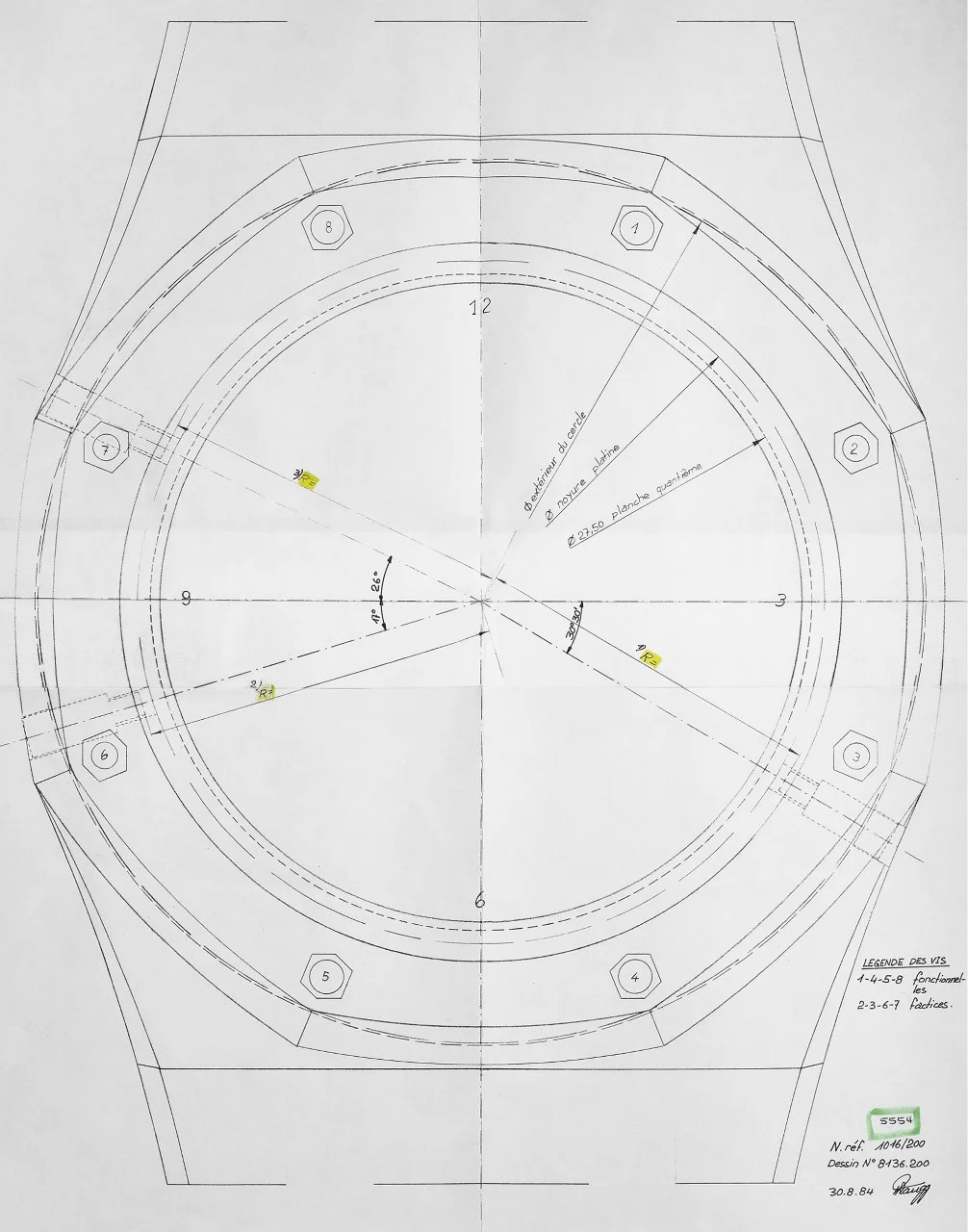
1984. Diagram of the correctors on Model 25554. In order not to affect the perpetual calendar correctors, the diameter of the screws has been reduced. Those at 4 and 10 o'clock became purely decorative. Audemars Piguet Archives.
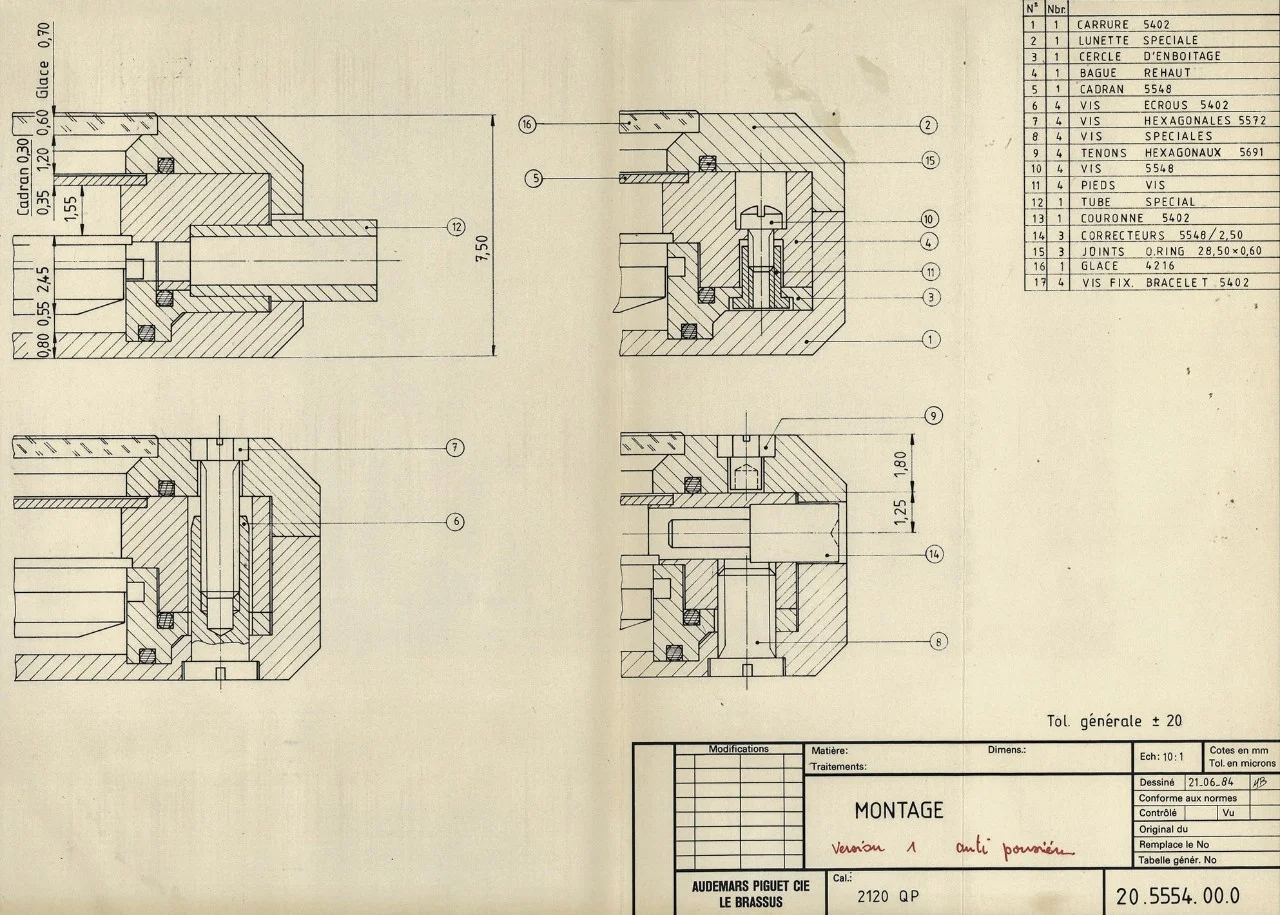
1984. Cross-section views of Model 25554. The diagrams illustrate the places where the case is passed through either by the hexagonal screws, by the driven-in correctors or by the crown. These are all tricky spots in terms of water-resistance. Audemars Piguet Archives.
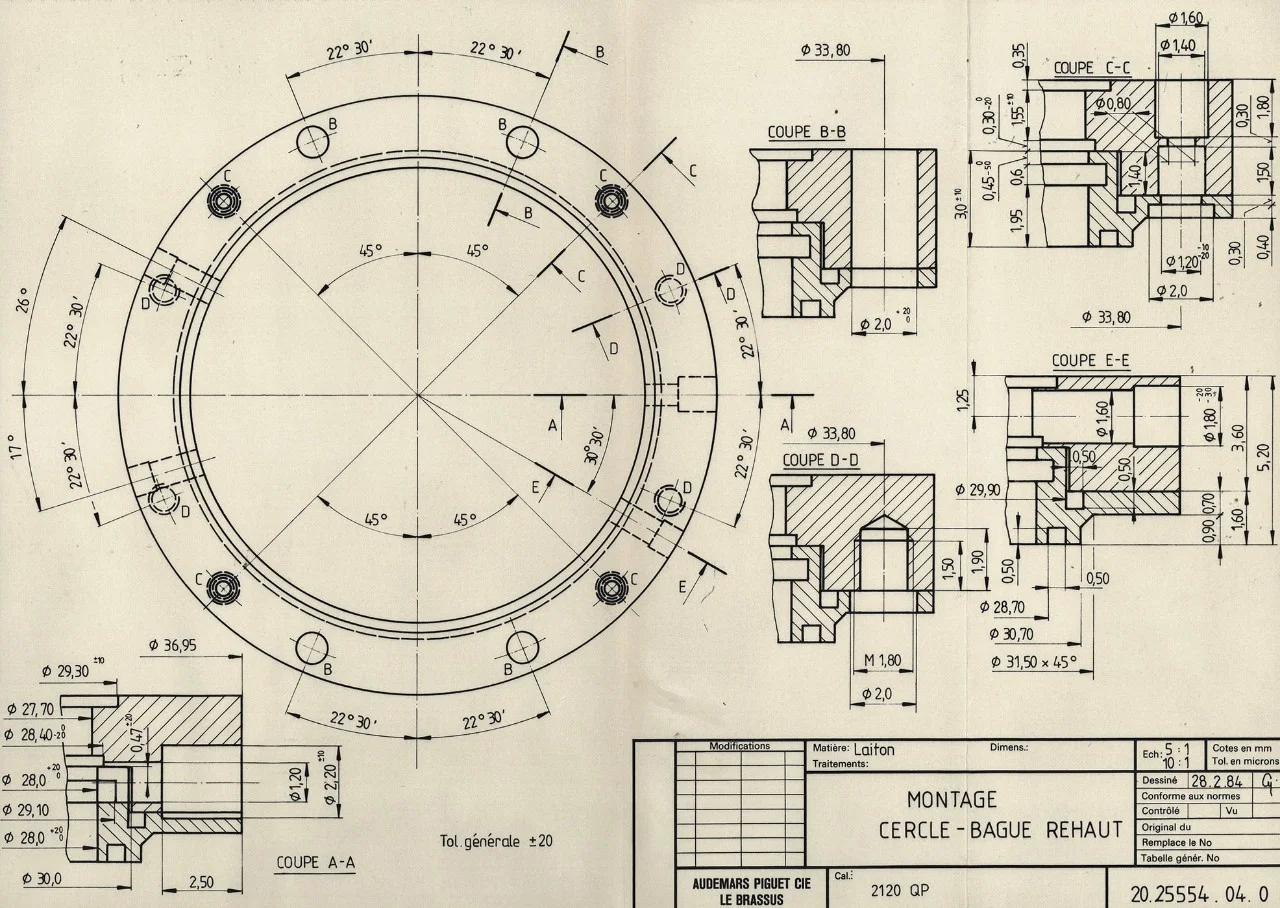
1984. Technical drawings of the casing-ring for Model 25554. The metal ring replaces the rubber gasket of Model 5402 to enable the addition of correctors at 4, 8 and 10 o'clock. Audemars Piguet Archives.
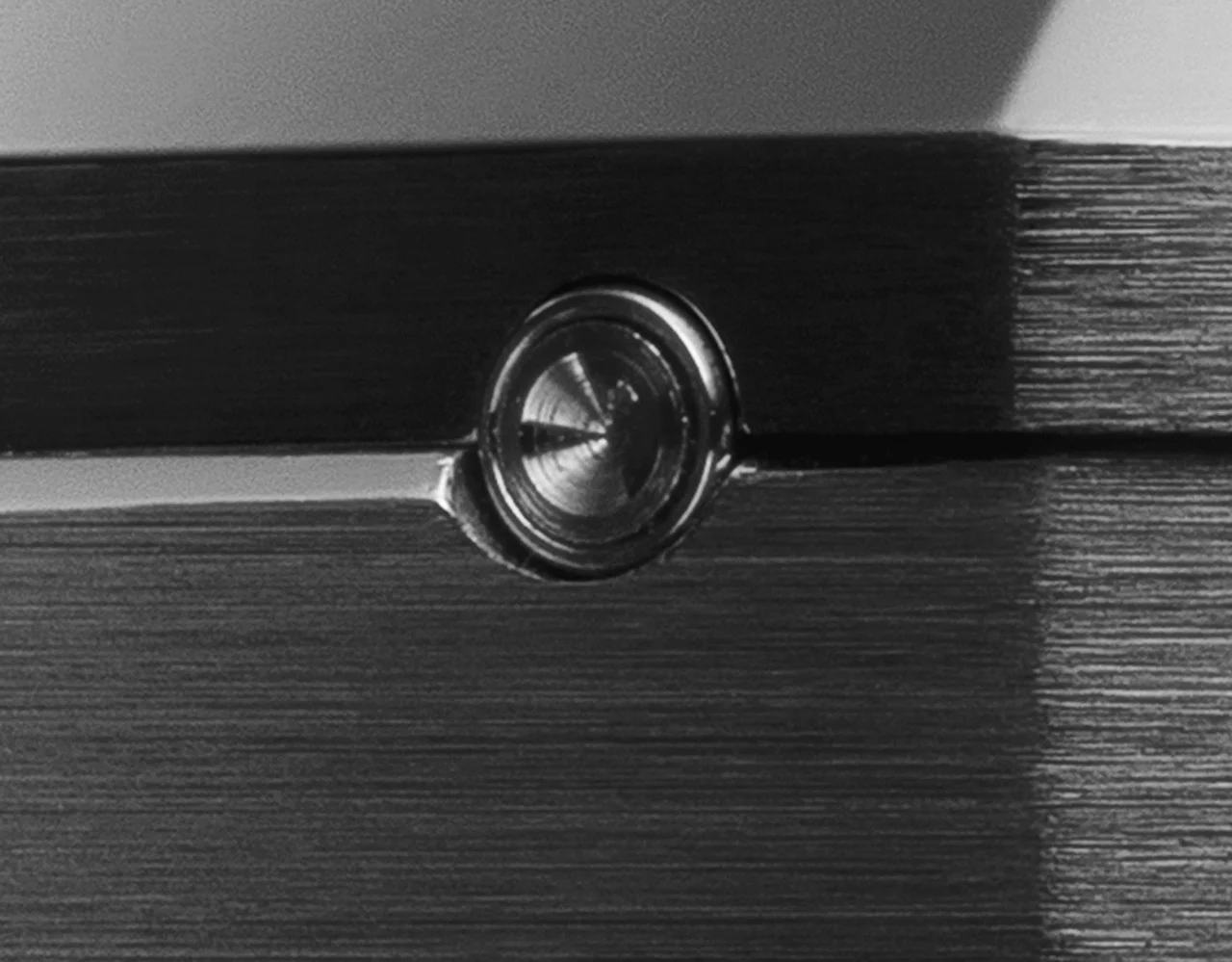
Correctors for Model 25554, detail. Discreetly placed on the side of the case, driven in between the bezel and the middle, these correctors are used to set the date and the day. Audemars Piguet Heritage, inv. 455.
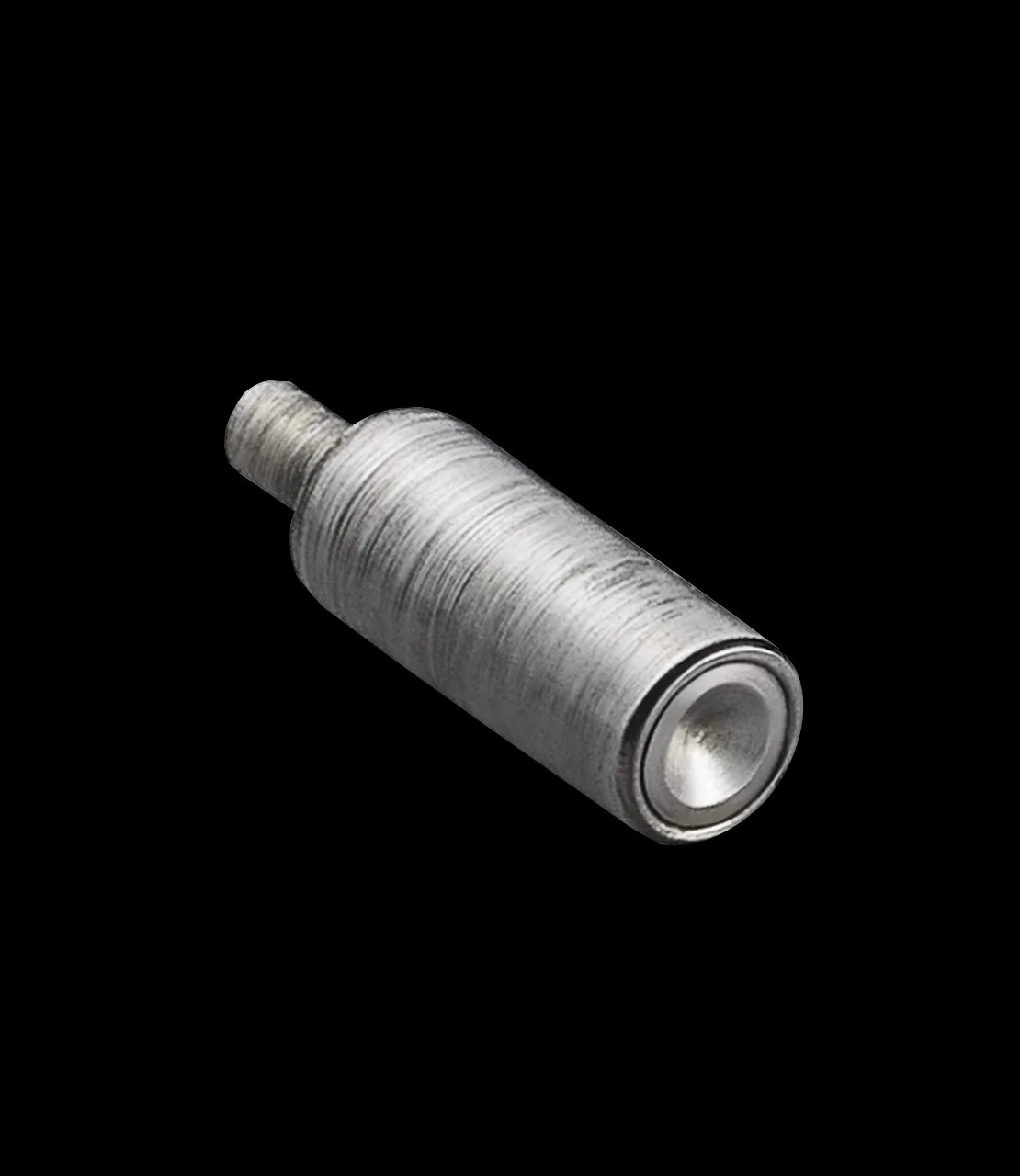
Correctors for Model 25554, detail In order to connect the outer part of the case to the movement, the correctors must pass through the casing-ring. Securing them proved to be one of the trickiest spots in terms of water resistance. Audemars Piguet Heritage .
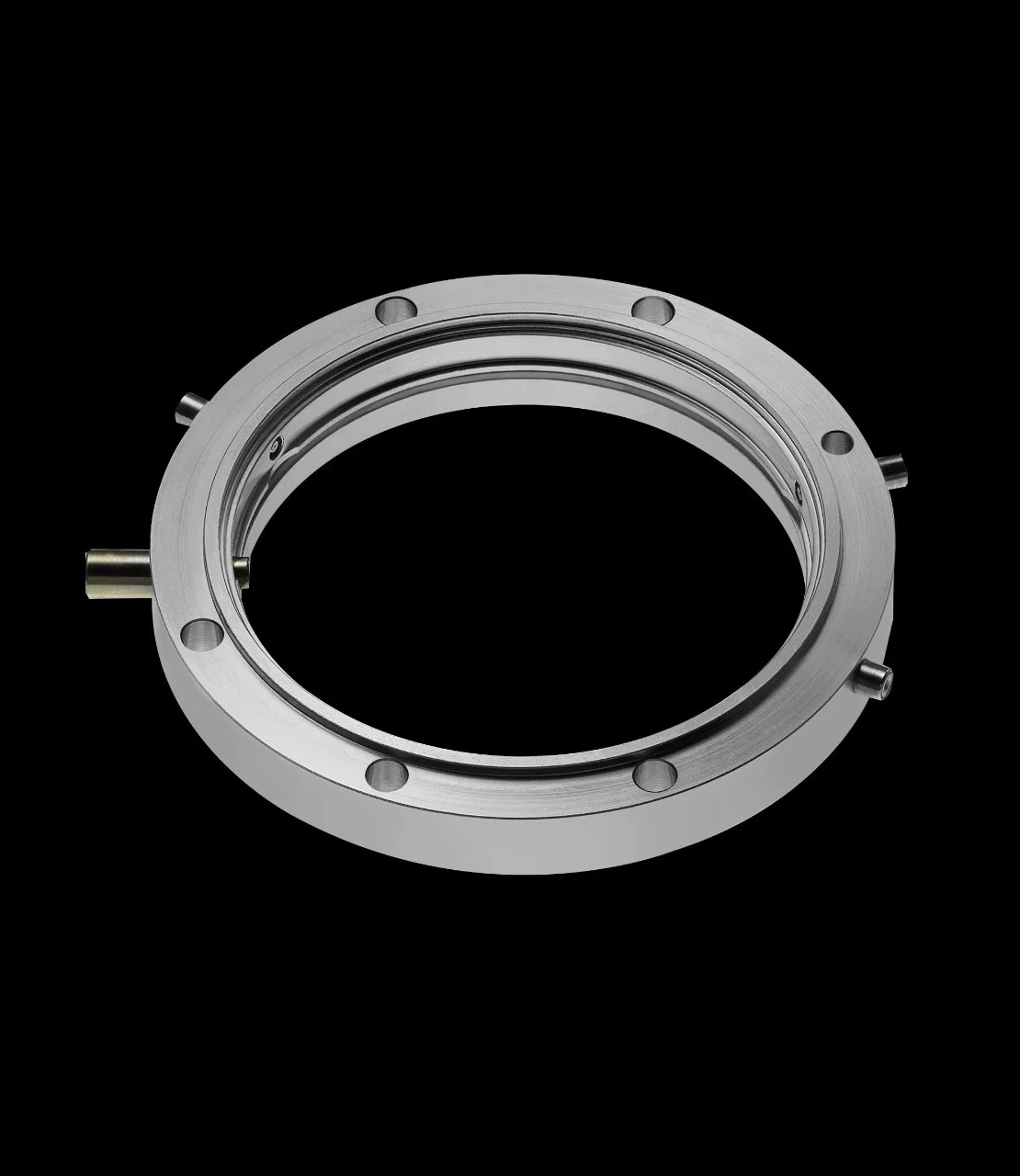
1984. Casing-ring for Model 25554 (caseback side). Only six holes allow the passage of the cross-through screws, one of which is narrower to avoid crossing a corrector. Two screws are not of the cross-through variety. Component of Royal Oak 25554ST no. 45. Audemars Piguet Heritage, inv. 2142.
A two-phase birth
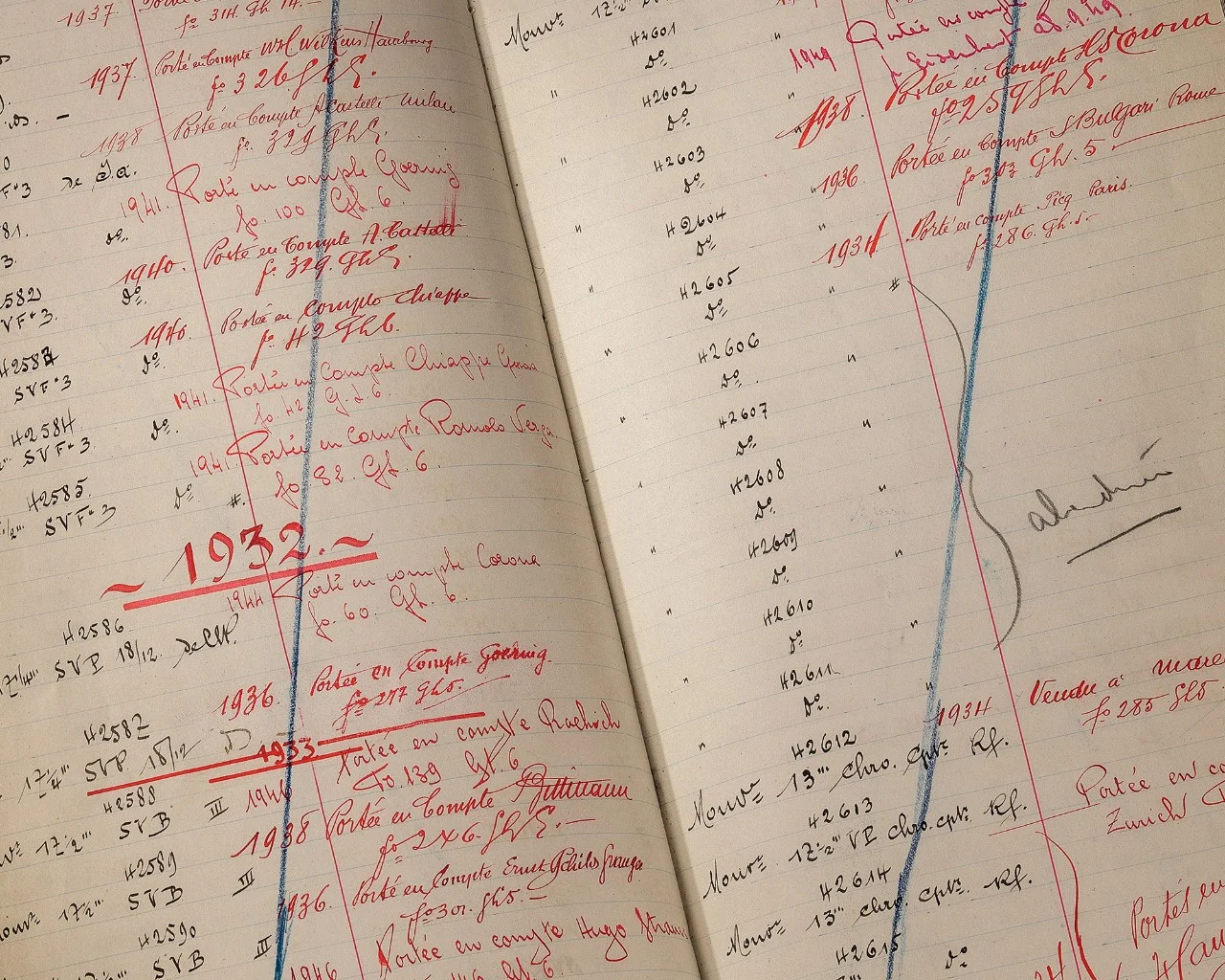
On April 5, 1984, the opening day of the Basel Fair, Audemars Piguet announced the launch of the first Royal Oak Perpetual Calendar, Model 25554. The press release was accompanied by a photograph of a steel model with a very refined dial, featuring shiny-rimmed day, date and month indicators. However, the examination of the Production Registers showed that only one 25554 watch was sold in 1984, in December, and that it was in yellow gold. For the historian, such discrepancies between an announcement and its effects stir tremendous curiosity. What happened?
First of all, it should be recalled that in the 1980s, new products were presented only once a year, at the Basel Fair in April. Audemars Piguet's distributors, agents and retailers evaluated the new models, commented on them, and expressed their customers' likely opinion. It was on the basis of the orders received at the show that the Manufacture fine-tuned its production strategy.
It often happened that the new models unveiled at Basel only existed in the form of prototypes, or even mock-ups. Some were never produced. There is good reason to believe that the water-resistance of the 25554 model still required some adjustments. Indeed, on May 23, 1984, Kurt Meis, the brand's German agent, sent an alarmed Telex to Le Brassus: "This watch is sporty and if it is not water-resistant, we can really 'drop it’.” Message received and approved. The case was reworked and the watchmakers did their utmost to solve the difficult equation of its water resistance, whose weak points remained the calendar correctors and the crown.
Meanwhile, Georges Golay was preparing the future of the brand in Italy.
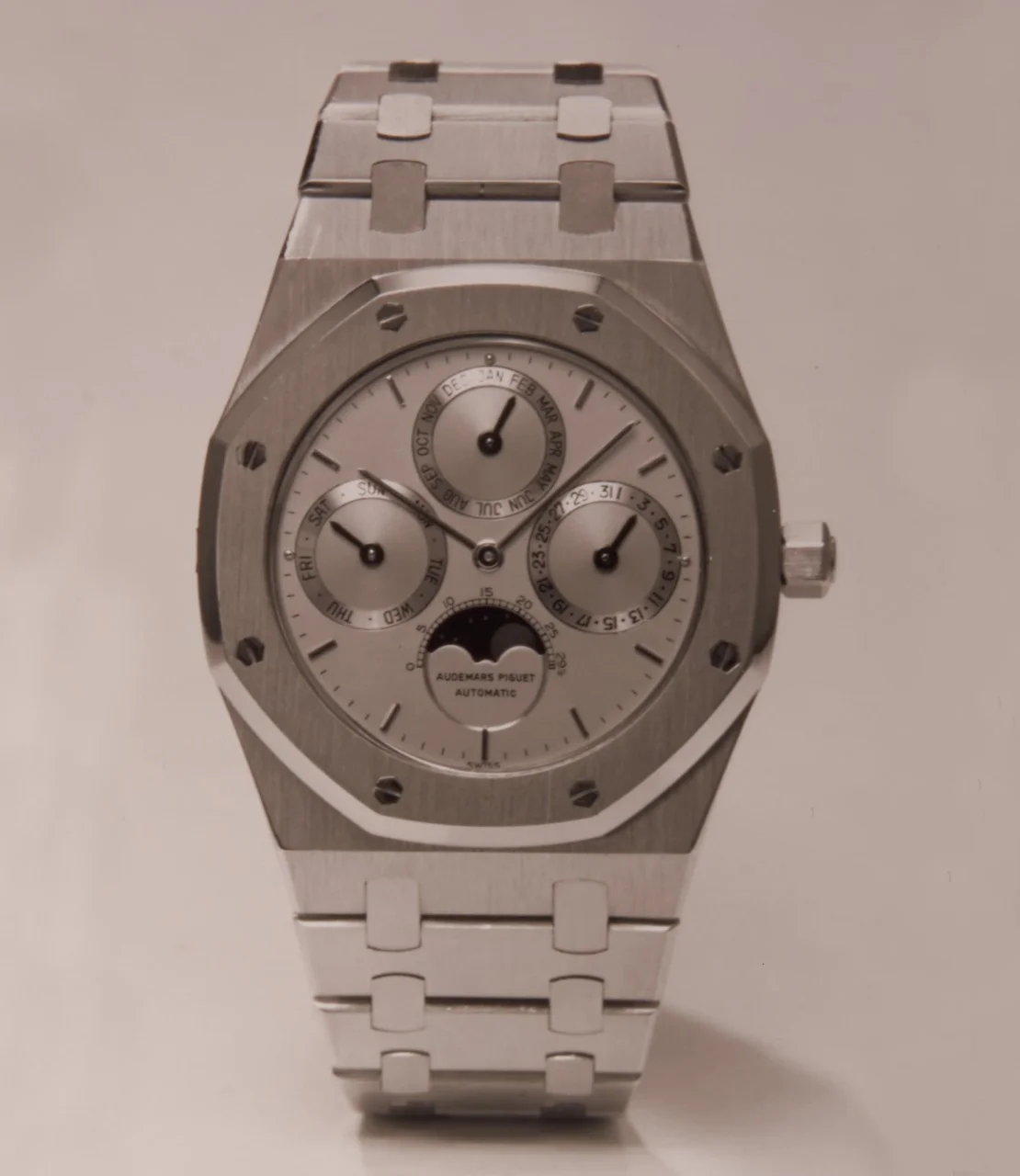
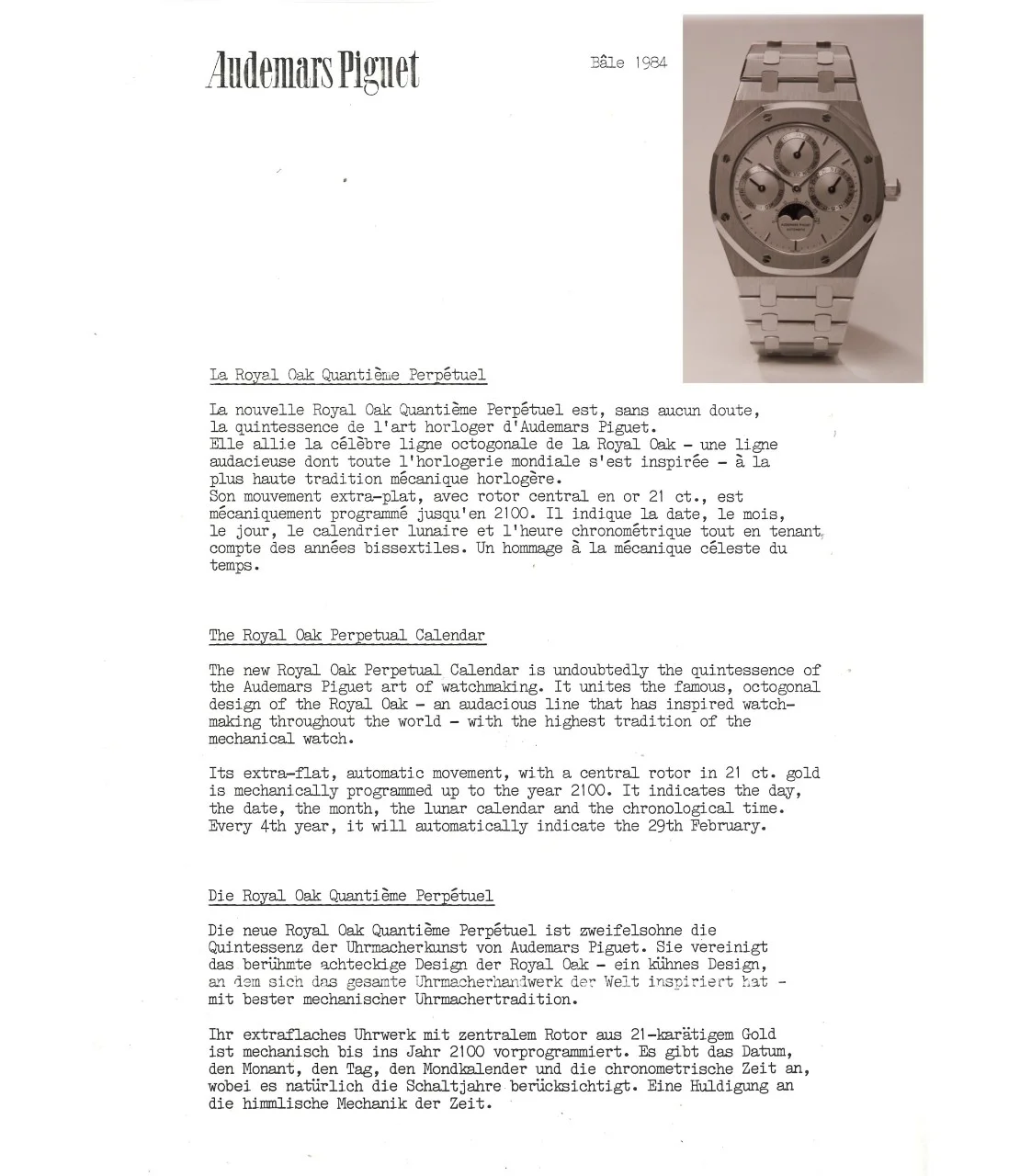
April 5, 1984. Press release for the Royal Oak Perpetual Calendar. The press release is accompanied by a photograph of the steel model. The first Royal Oak 25554 was delivered in December in gold, followed by the first steel models in February 1985.
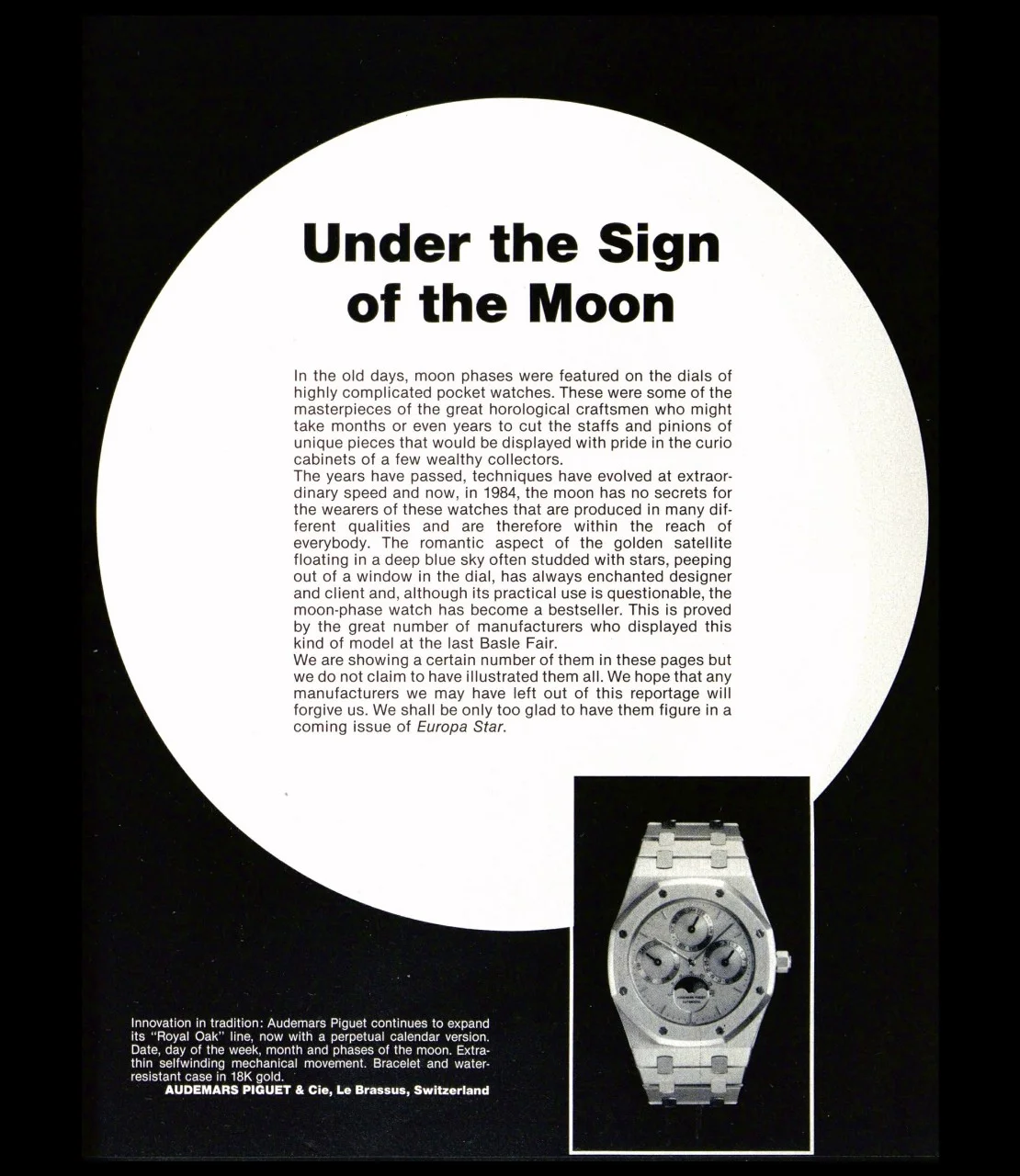
1984. First page of an article dedicated to perpetual calendars. The Royal Oak Perpetual Calendar 25554 illustrates the cover page of the article demonstrating the Swiss watch industry revival in the field of calendar watches, particularly by Genta, Chopard, Patek-Philippe, Blancpain, Ebel, and Universal. Europastar, Far East Autralasia, No. 200-3, 1984, p. 23.
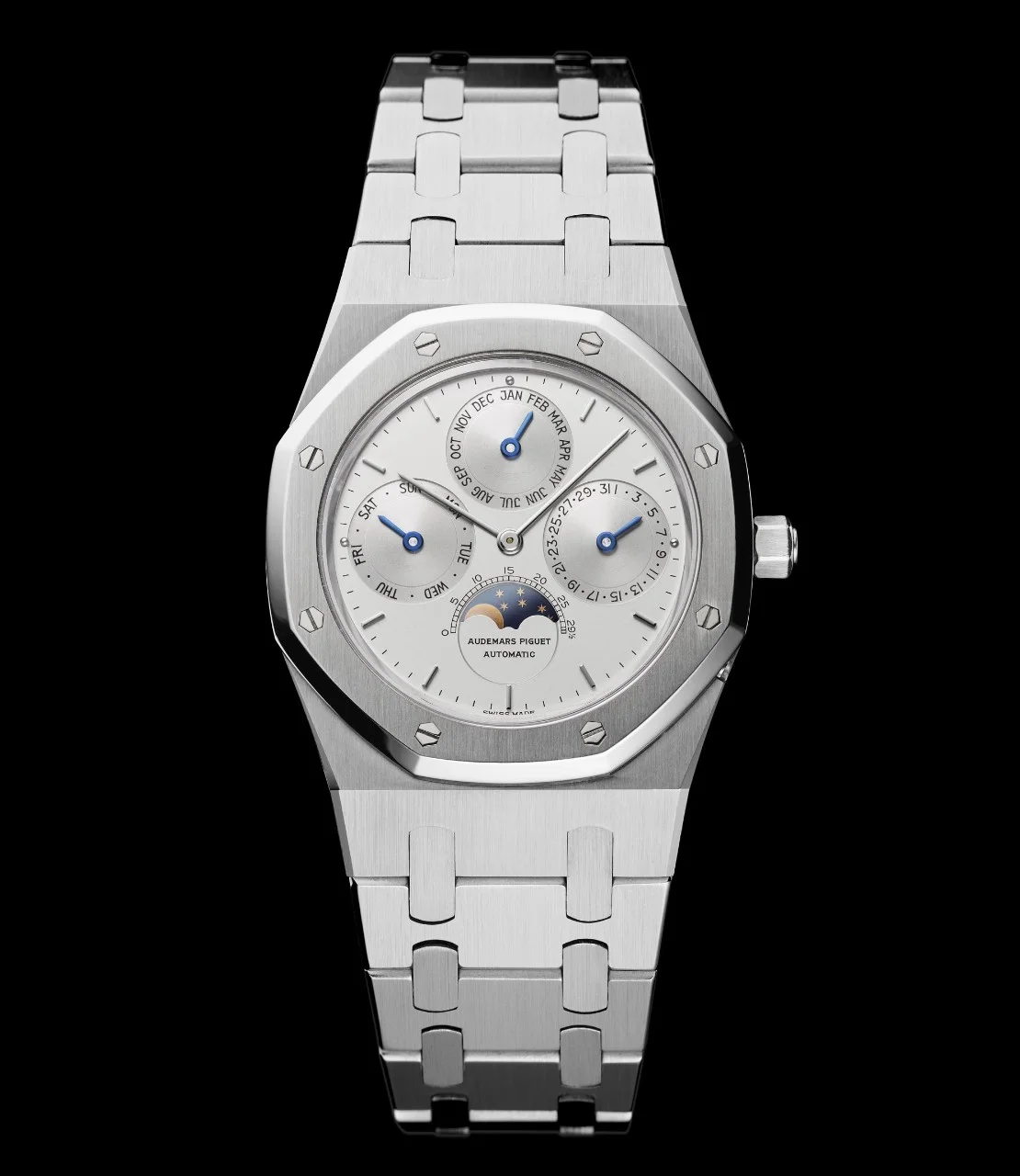
Circa 1984. Royal Oak Perpetual Calendar 25554ST. Perpetual calendar: day, date, month and moon phases. Calibre 2120/2800, extra-thin (3.95 mm). Bracelet 344. Silver-toned dial. 39 mm case D1486, no. 37 (the 50 25554ST cases were part of the D series, Model 5402ST). Prototype without movement probably presented at the launch of the model. Audemars Piguet Heritage, inv. 455.
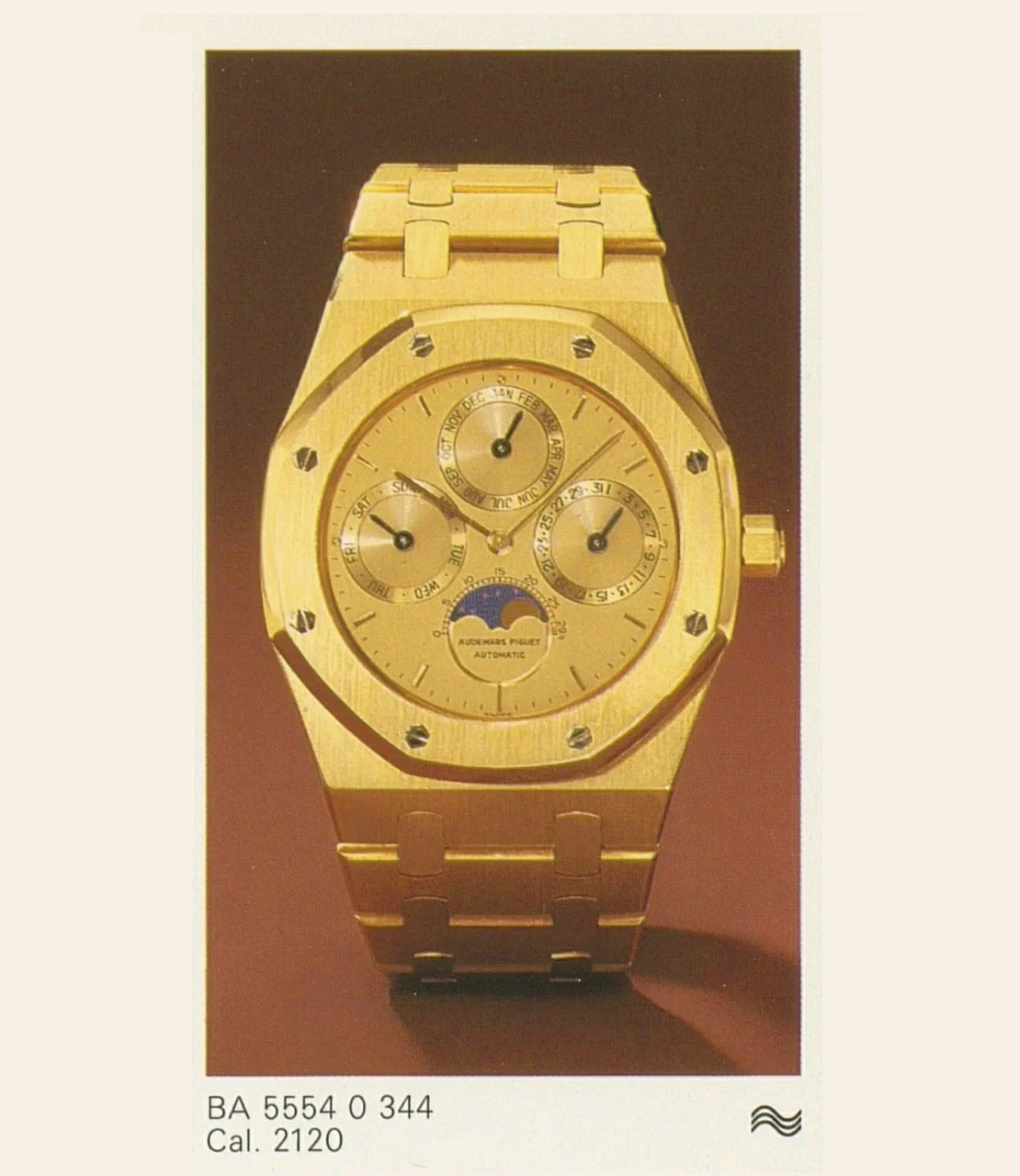
1985. Royal Oak Model 5554BA (or 25554BA), 39 mm. 1985 Audemars Piguet Catalogue. Audemars Piguet Archives.
Italy, as ever…
On June 6, 1984, an internal memo found in the Audemars Piguet archives attests to the desire to reserve certain Royal Oak Perpetual Calendar watches for Italy: “A decision has been taken to relaunch the Royal Oak in Italy with a series of 50 units, Model 5554 in steel, with a crystal grey dial" (NB: Model 5554 was soon to be renamed 25554 and in the remainder of this article, we will use the designation 25554).
Why Italy? In the early 1970s, Italy was the driving force behind the birth of the Royal Oak. After giving a reserved welcome to Model 5402, which was considered too large (39 mm), Italy enthusiastically adopted the smaller Royal Oak models, in particular the 8638 (29 mm) from 1976 and the 4100 (35 mm) from 1977. There is every reason to believe that in the early 1980s, large-diameter watches were increasingly in vogue in Italy. Indeed, the famous captain of industry and fashion pioneer Gianni Agnelli did not hesitate to wear a 49 mm Audemars Piguet 25555 pocket watch with an added strap on his wrist - and over his shirt.
The fact that the 25554ST series is reserved for Italy also reflects the evolution in the distribution of Audemars Piguet watches in that country. A brief historical reminder: since 1970, watches from Le Brassus were distributed there by a company belonging to the watchmaking conglomerate SSIH (see article on the birth of the Royal Oak), directed from Turin by Carlo de Marchi. However, in 1983, crushed by the quartz crisis, the SSIH group was on the verge of financial collapse. To save itself, it merged with the other Swiss watchmaking giant, ASUAG (Allgemeine Gesellschaft der Schweizerischen Uhrenindustrie AG) and became SMH (Société de Microéléctronique et d'Horlogerie), which was renamed Swatch Group in 1998. But in the immediate future, in order to cope with a disastrous situation, the strategy had to be refocused. The SSIH Group informed Audemars Piguet that it would henceforth focus all its energy on the distribution of its own brands, in particular Omega.
Georges Golay, Managing Director of Audemars Piguet, then began looking for a new agent for Italy. On January 1, 1985, Alessandro Villa took over exclusive distribution for the country. This choice was hardly coincidental. The third generation of a dynasty of Milanese jewellers, he founded in 1979 the Gérald Genta Villa (GGV) company, which introduced the Genta brand to Italy.
The decision to create a special series for Italy came two months after official presentation of the watch at the Basel Fair and at least six months before the change of distributor. There is no doubt that the special series must have been part of the negotiations. By obtaining these exclusive rights, Alessandro Villa demonstrated his flair. He would prove to be a valuable and very active partner, instigating a number of partnerships, exhibitions and events, all of which helped transform Italy into a major outlet for Audemars Piguet watches, particularly those with complications. Taken over by Franco Ziviani in the mid-1990s, his company was renamed Audemars Piguet Italia Spa, and became a subsidiary of the Audemars Piguet group in the 2000s.
Long before that, however, the very first success of the future subsidiary was the Royal Oak Perpetual Calendar in steel, 46 of which were delivered by Le Brassus between February and December 1985.

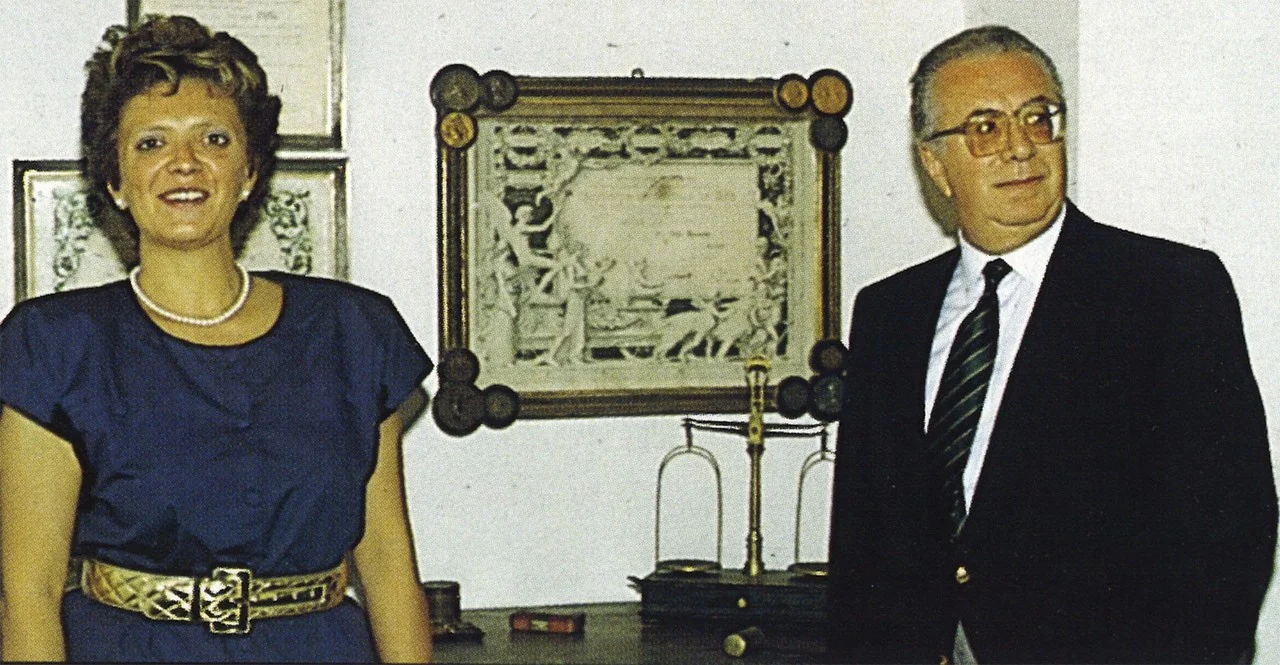
1990. Isotta and her father Alessandro Villa. Since 1985, the Italian company GGV, under the management of Alessandro Villa and his daughter Isotta, had been in charge of the distribution of Audemars Piguet watches in Italy. Prestige, October 1990. Audemars Piguet Archives.
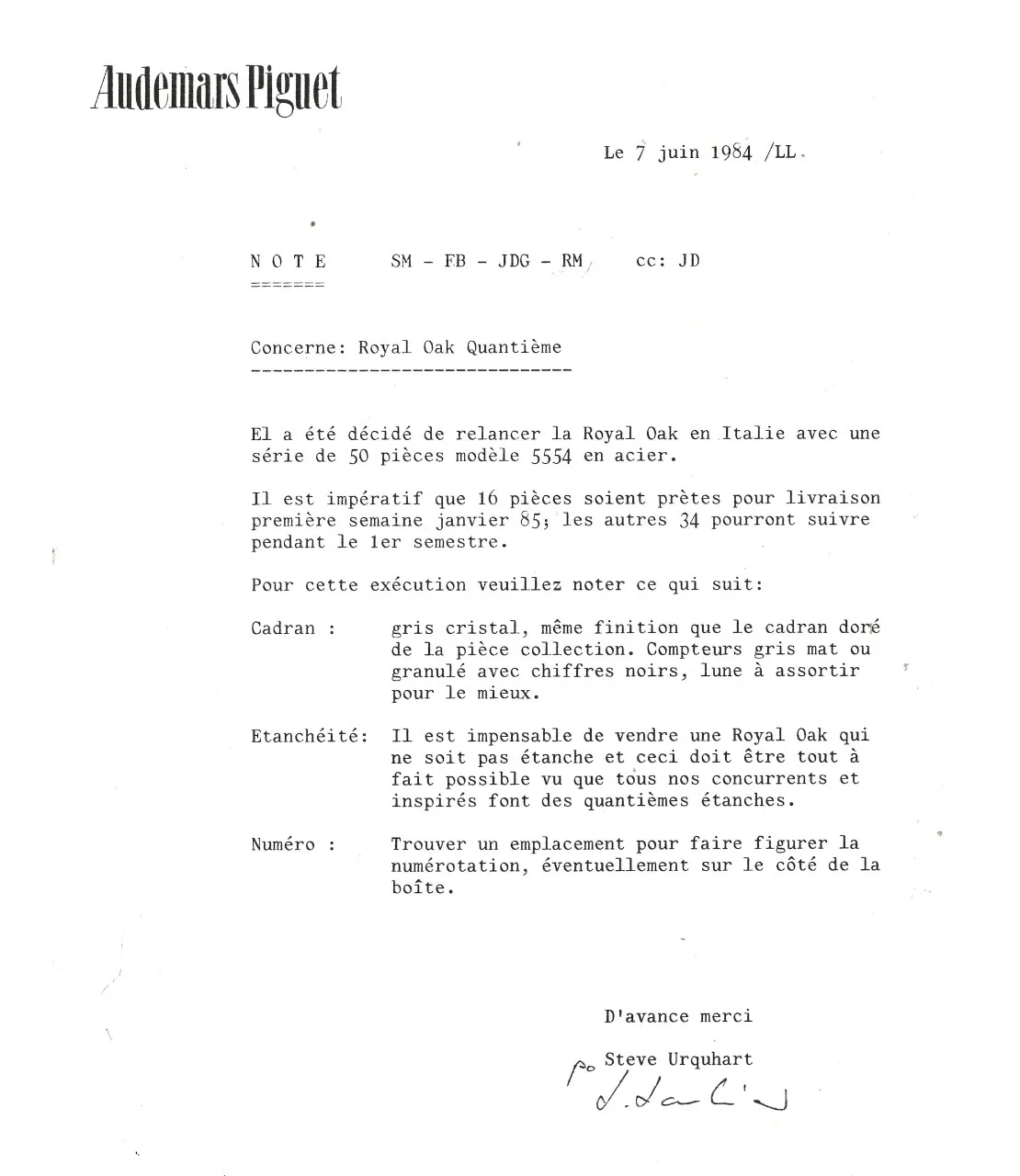
June 1984. Internal note relating to Model 5554 (25554). The document announces the decision to relaunch the Royal Oak in Italy and plans for 50 units of the first perpetual calendar model. A paragraph is devoted to the need to guarantee water resistance. Audemars Piguet Archives.
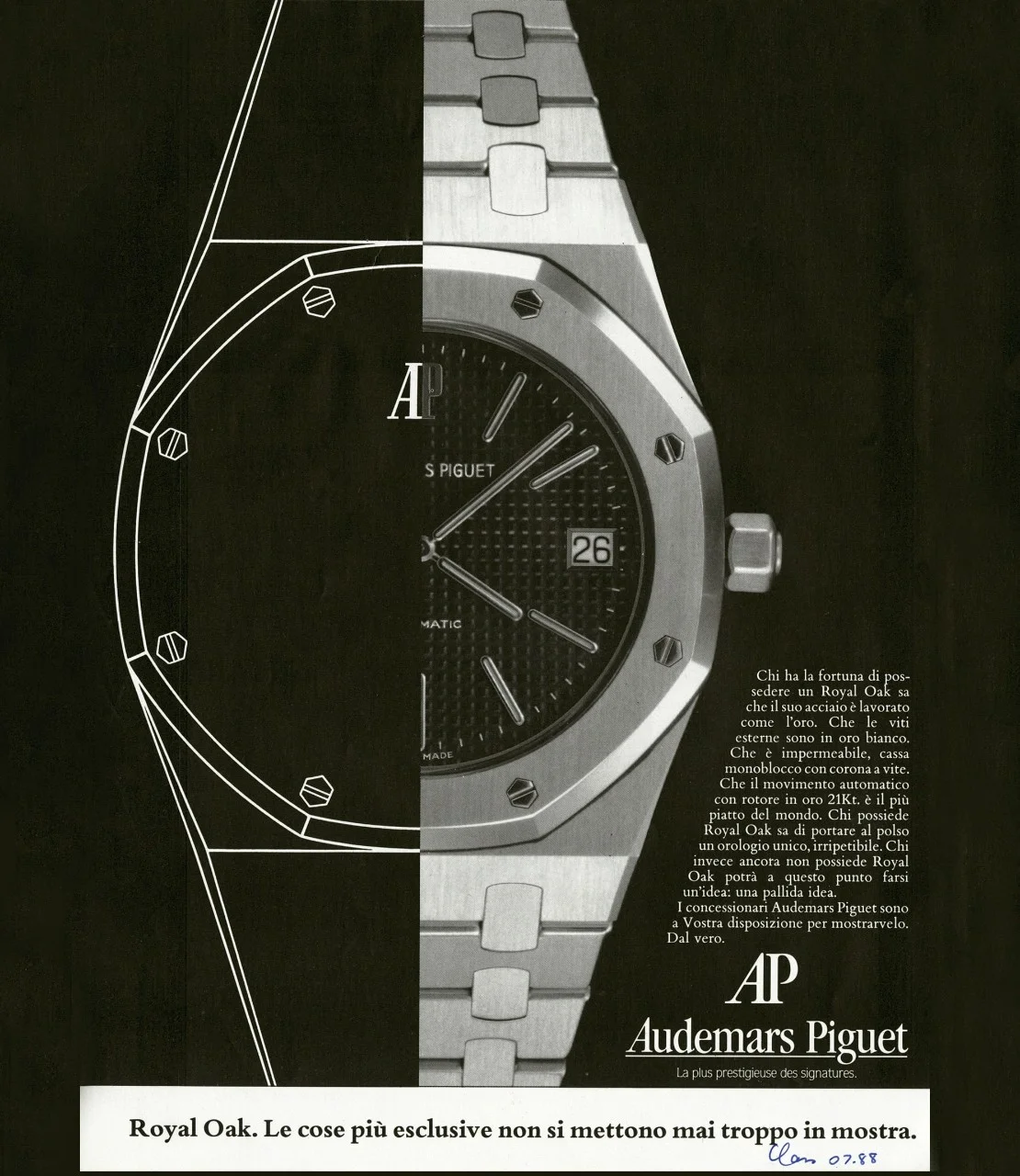
1988. Royal Oak advertisement. Advertisement made for (and probably by) the Italian market, at a time when the distribution of Audemars Piguet watches there was handled by the company named GGV (Gérald Genta Villa). Audemars Piguet Archives.
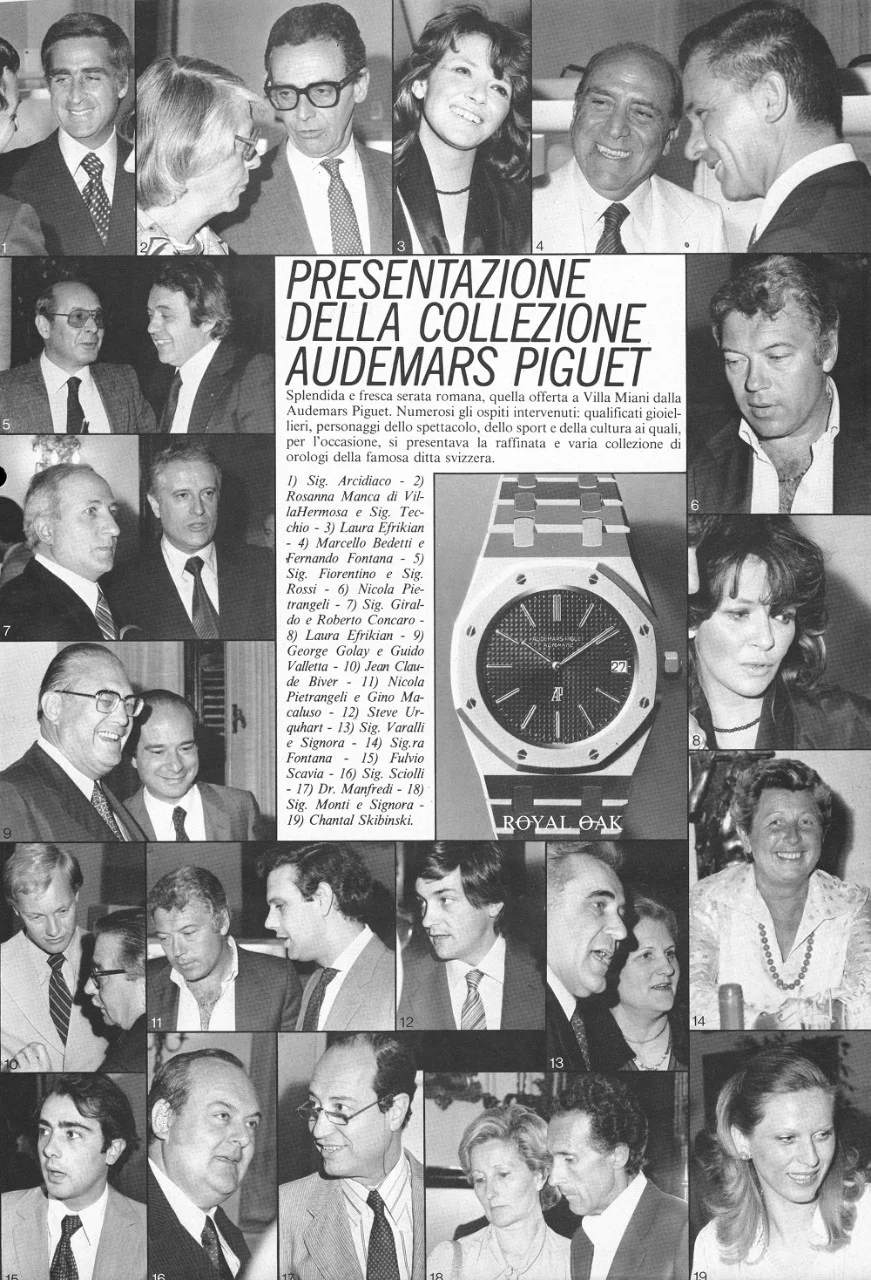
1979. Royal Oak advert for Italy. This page reflects Italian celebrities’ enthusiasm for the watch. © L’Uomo Vogue Italia
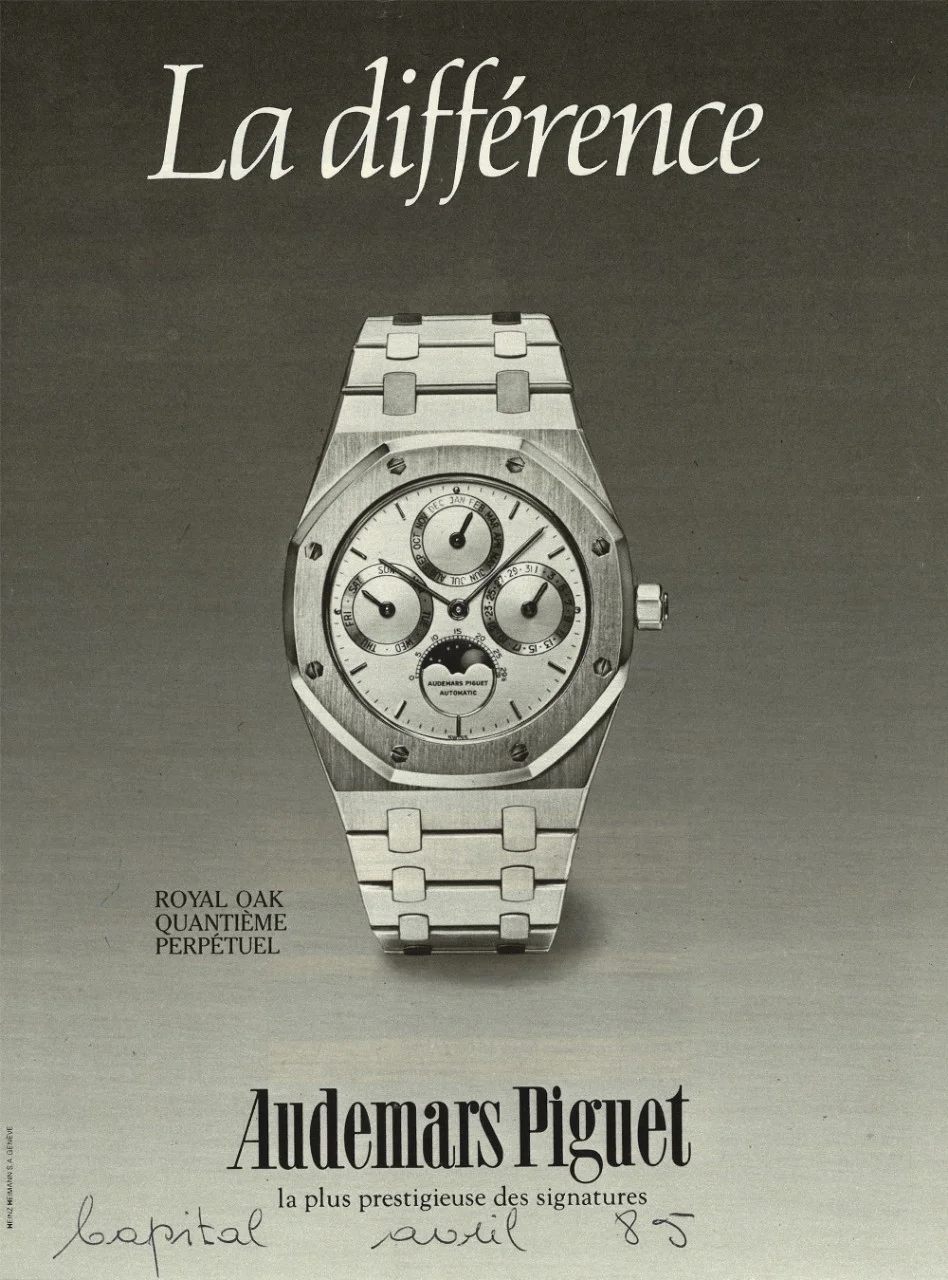
Avril 1985. Advert for the Royal Oak Model 25554. The advertisement is published in the Italian magazine Capital. Audemars Piguet Archives.
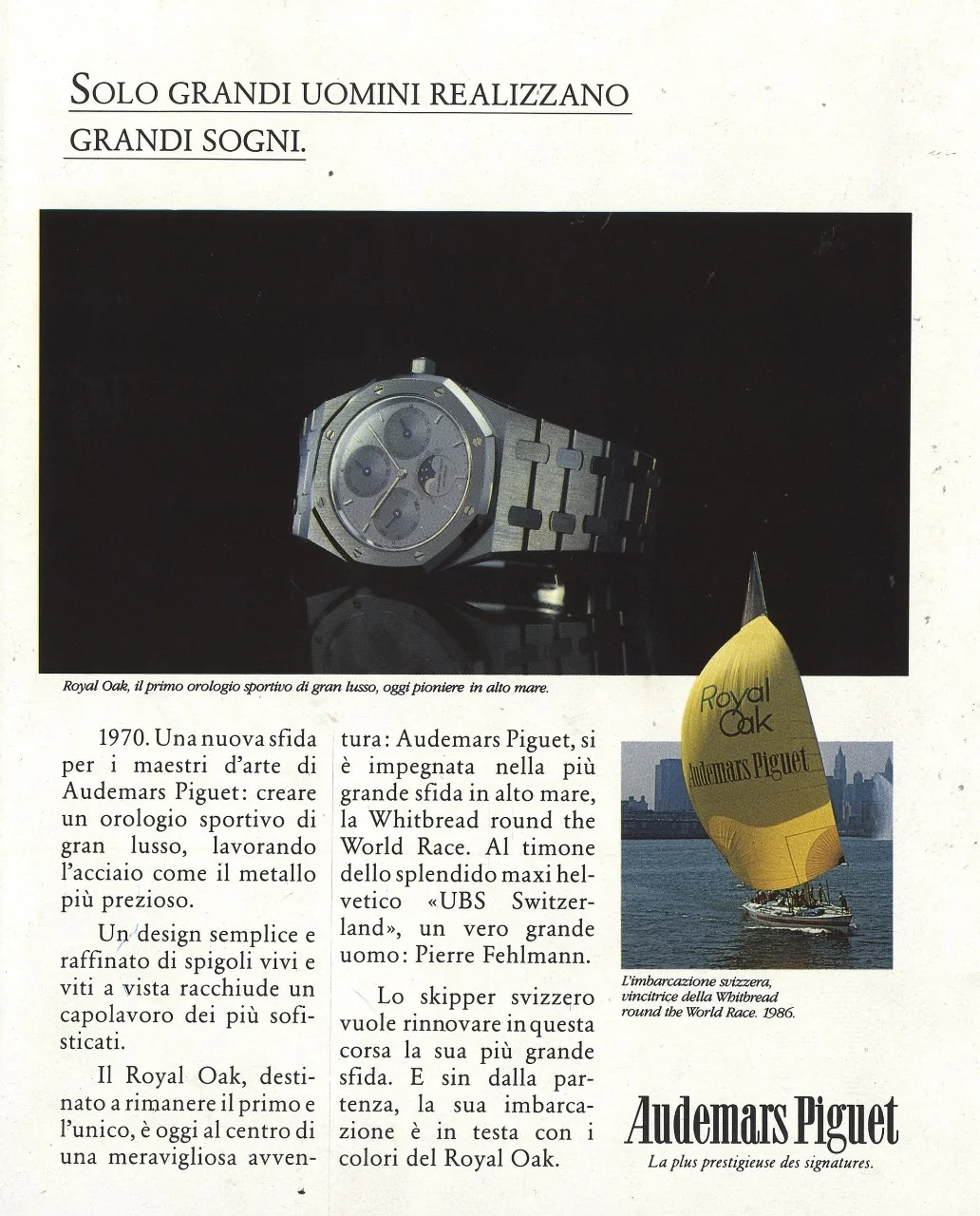
1987. Advert for the Royal Oak Perptual Calendar. Campaign created in the framework of the partnership with Pierre Fehlman's boat participating in the Whitbread Round the World Race. Advertisement published in the Italian magazine L'Altra Casa. Audemars Piguet Archives.
A refined masterpiece
As the steel variant of Model 25554 was reserved for the future Italian agent (whose contract began in January 1985), a yellow gold version was introduced in the Audemars Piguet catalogue in July 1984.
The illustration of the watch is accompanied by the following sentence: "At Audemars Piguet, we believe this represents the last word in watchmaking". Advertising executive Heinz Heimann was not wrong when he stated that the Royal Oak Perpetual Calendar embodies excellence in watchmaking miniaturisation, contemporary design, decoration and undoubtedly also elegance. Nonetheless, the future would show that this was clearly not the last word from the collection...
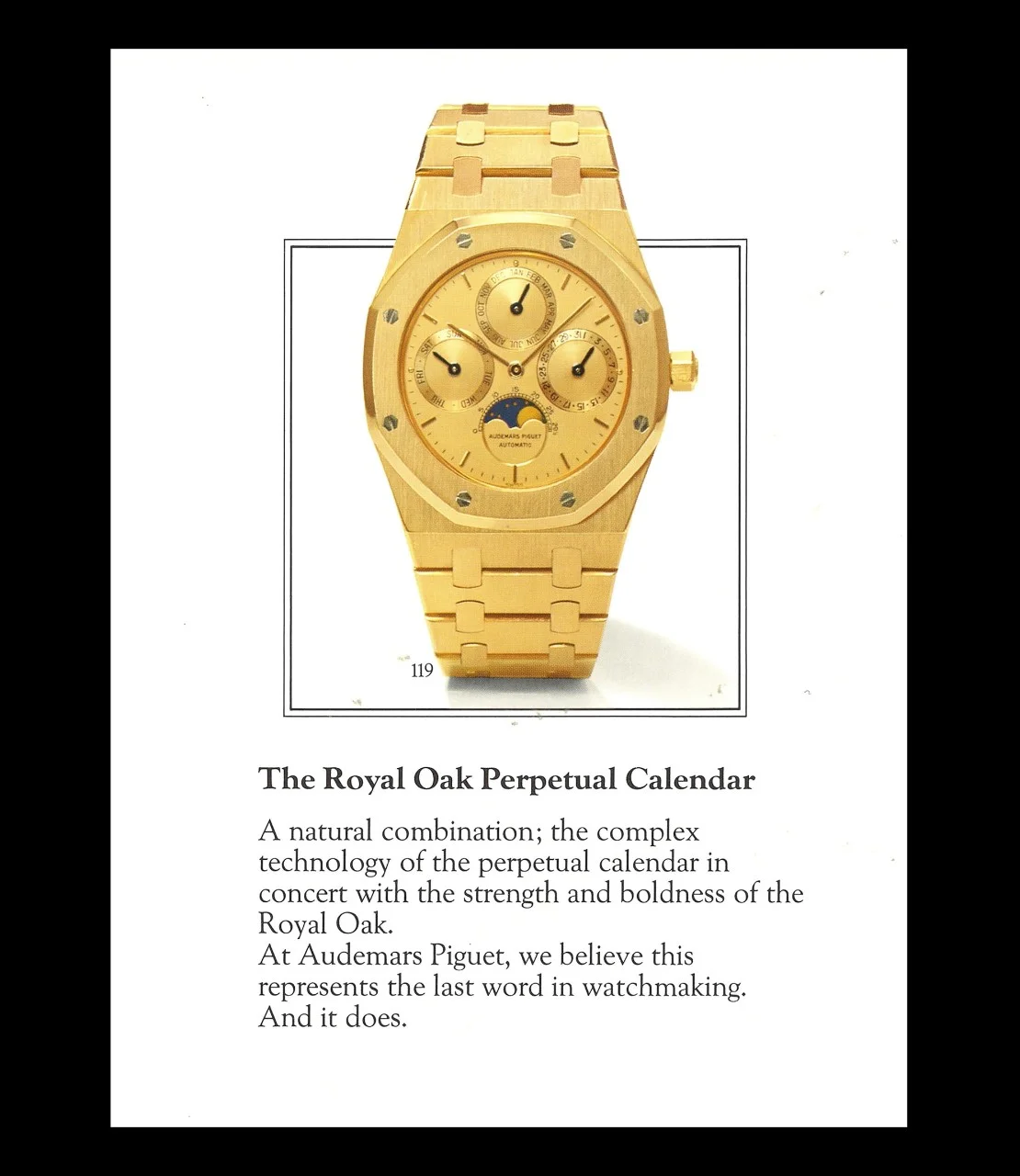
July 1984. Royal Oak 25554. The first occurrence of the 25554 model in an Audemars Piguet catalogue features a version in yellow gold. Intended for the American market, the price list indicates USD 27,000. Audemars Piguet Archives.
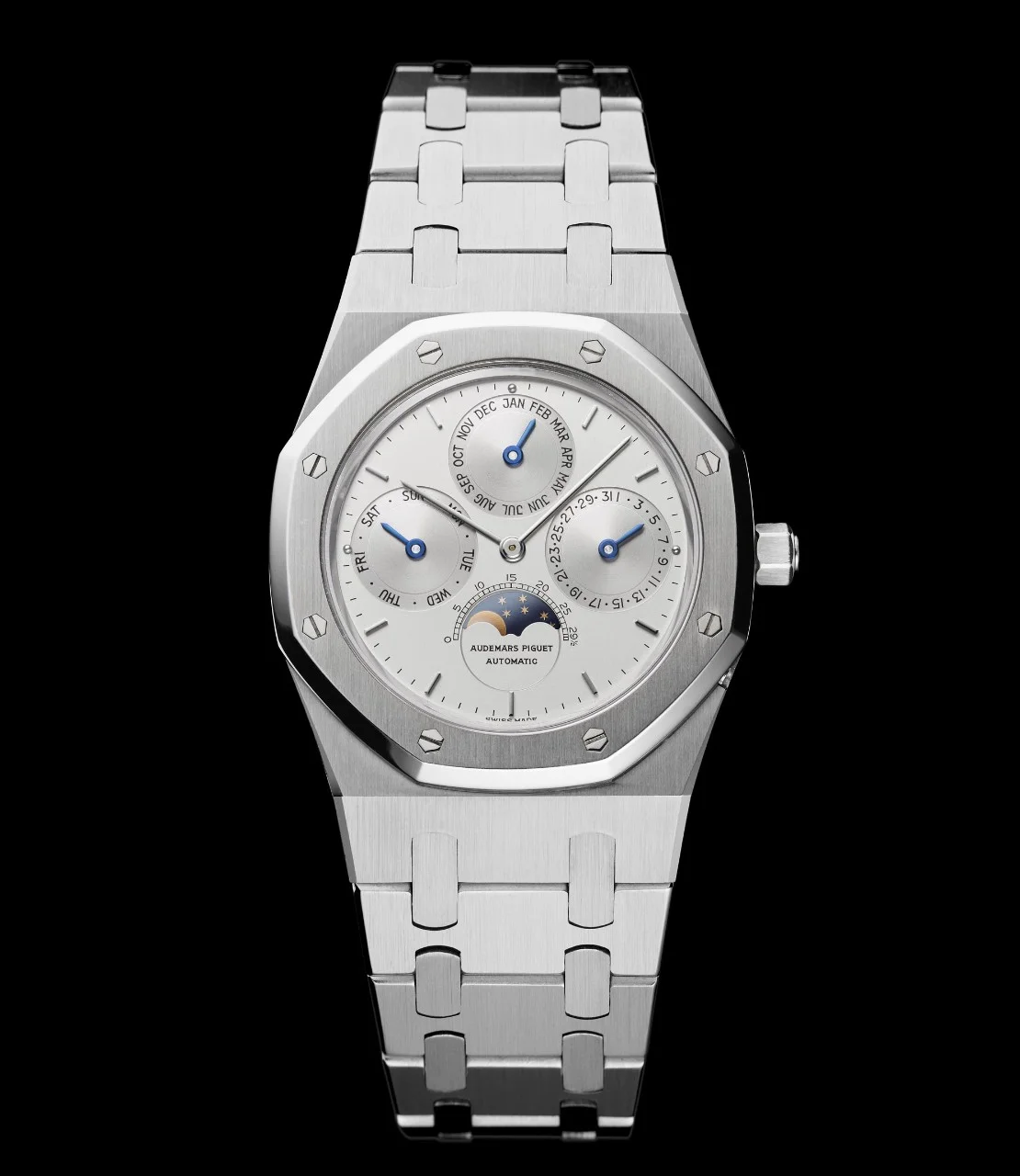
Circa 1984. Royal Oak Perpetual Calendar 25554ST. The case bears number D1494 drawn from Model 5402, as well as the number 45, from Model 25554. Perpetual Calendar: day, date, month and moon phases. Extra-thin Calibre 2120/2800 (3.95 mm), movement 273849. Bracelet 344. Silver-toned dial. 39 mm case. Audemars Piguet Heritage, inv. 2142.
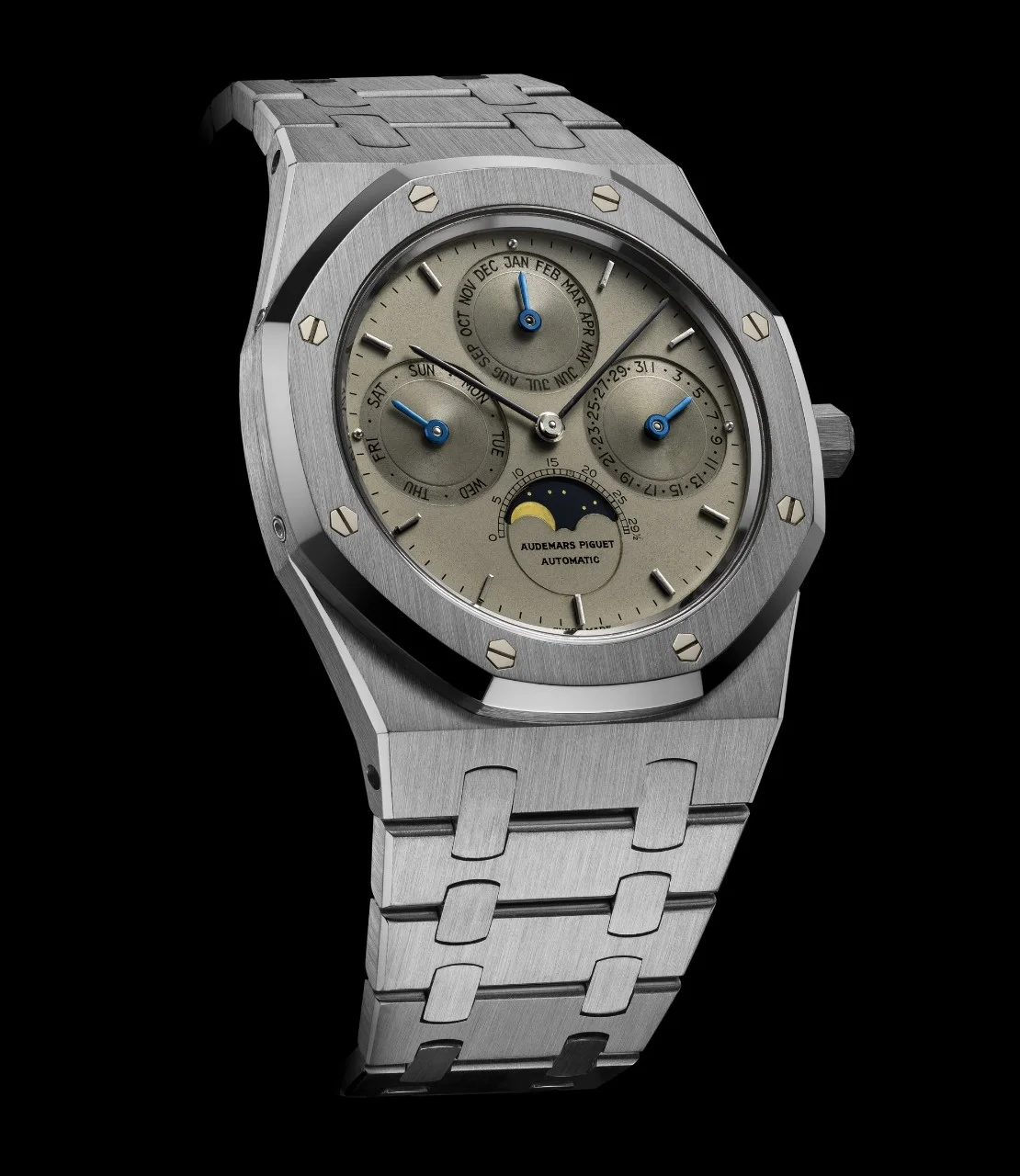
Circa 1984. Royal Oak Perpetual Calendar 25554ST. The case bears number D1494 drawn from Model 5402, as well as the number 45, from Model 25554. Perpetual Calendar: day, date, month and moon phases. Extra-thin Calibre 2120/2800 (3.95 mm), movement 273849. Bracelet 344. Silver-toned dial. 39 mm case. Audemars Piguet Heritage, inv. 2142.
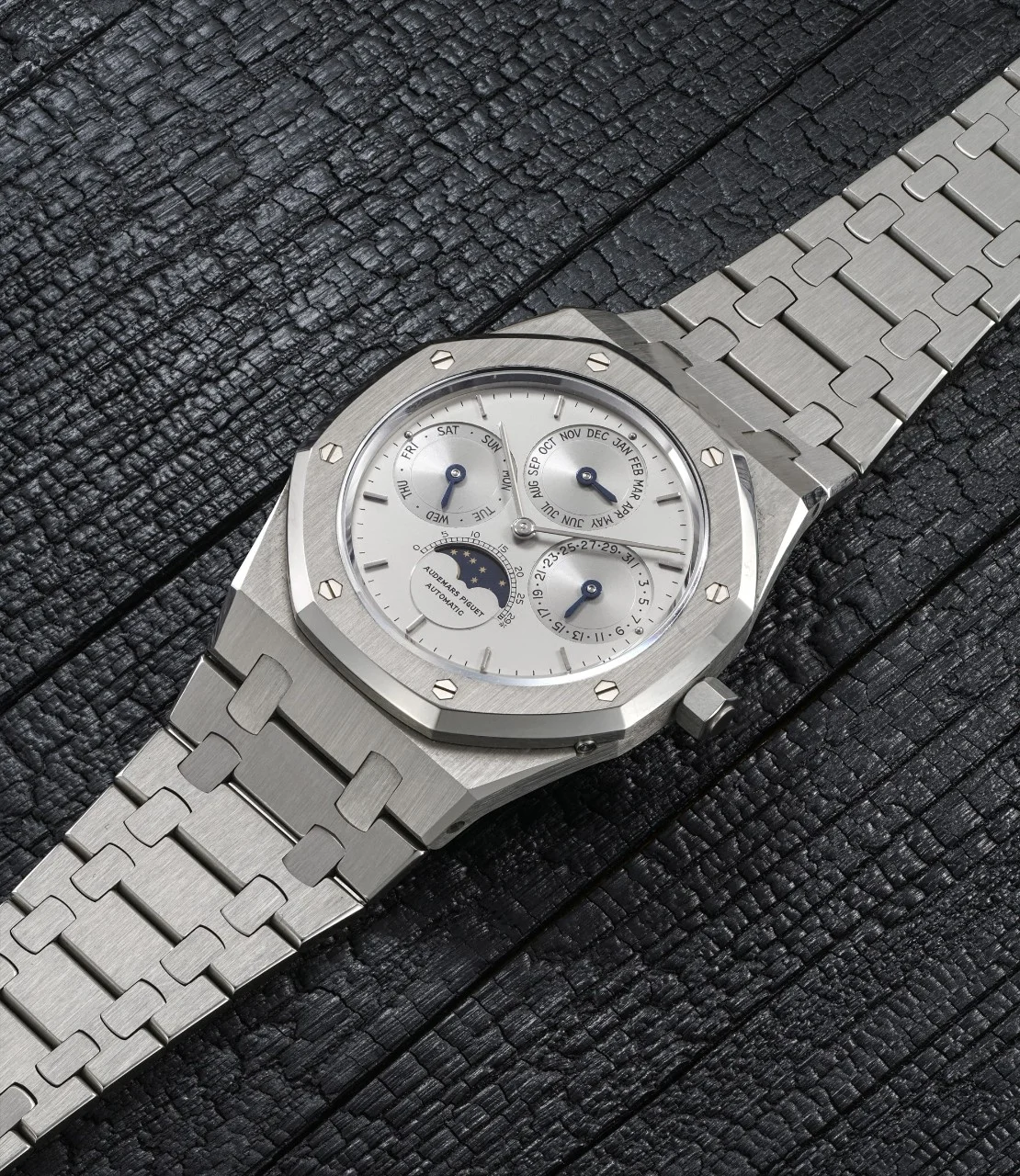
1985. Royal Oak Perpetual Calendar 25554ST. Perpetual calendar: day, date, month and moon phases. Calibre 2120/2800, extra-thin (3.95273841 mm), original movement. Bracelet 344. Silver-toned dial. 39 mm case B292282, D1495, no. 46. Sold to Fintime (Italy) in December 1985. Auctioned for CHF 680,400 by Phillips on May 6, 2022 in Geneva. Image © Phillips
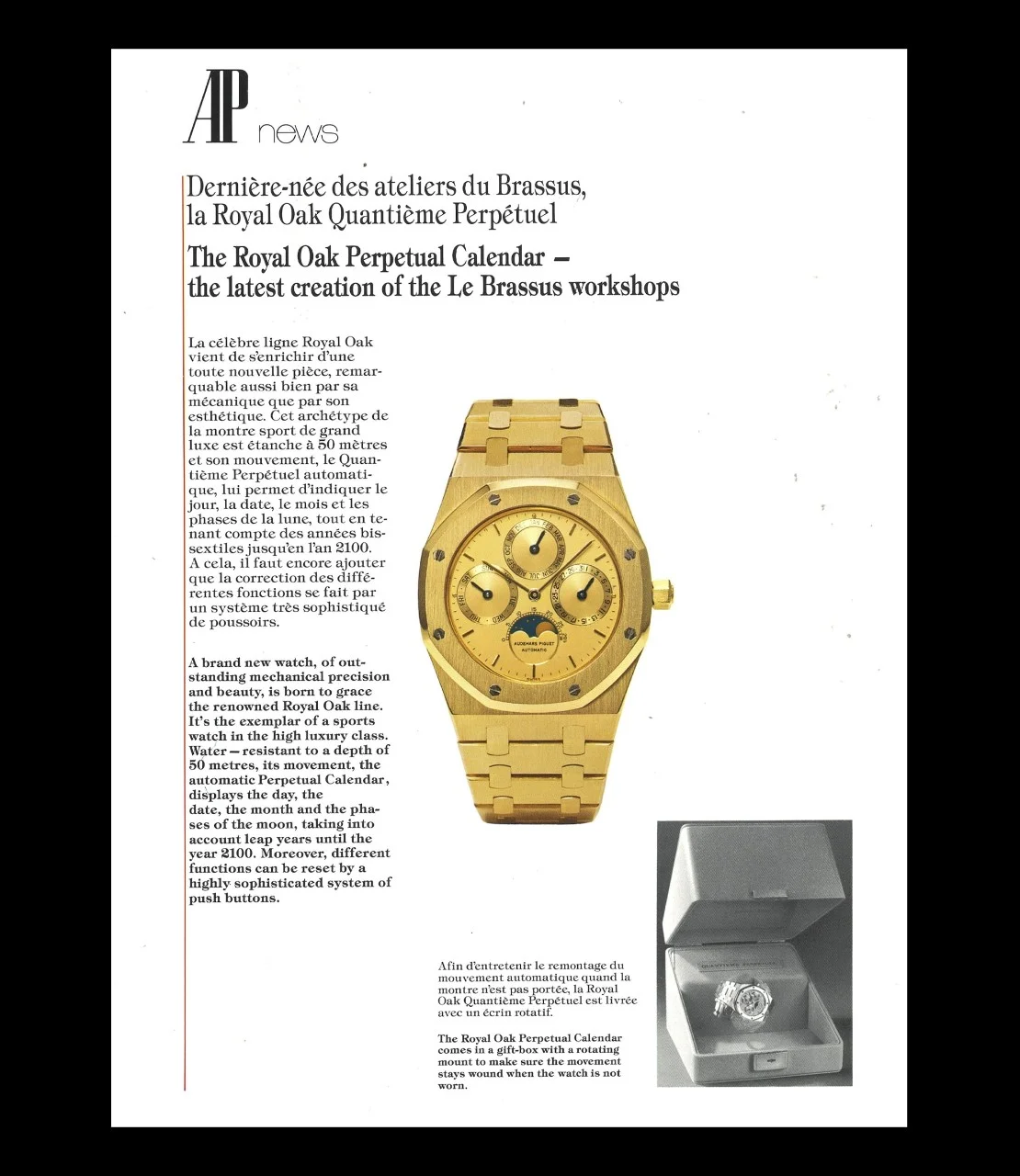
1985. Royal Oak Perpetual Calendar 25554BA. In March 1985, Audemars Piguet presented Model 25554BA in its brand-new in-house magazine titled AP News, intended for the brand's employees and retailers. Audemars Piguet Archives.
From Model 25554 to 25654
Produced in a run of 270 units between 1984 and 1992, the Royal Oak Perpetual Calendar 25554 enjoyed significant commercial success and began a crucial chapter in the history of the Royal Oak: that of classic complications.
This masterpiece also left a lasting impression on the Customer Service watchmakers who were responsible for its maintenance. Of the first 110 watches delivered, 16 were returned to Le Brassus for water-resistance issues within three years. Francisco Pasandin, watchmaker-restorer in charge of the Restoration workshop until 2023, recalls having to re-case some watches up to 10 times to obtain the expected water resistance. Together with a few workshop colleagues, he suggested several improvements, in particular the adoption of screw-lock correctors.
At the same time, the Technical Department rethought the water-resistance system. Presented in 1987, the Royal Oak Perpetual Calendar 25654 combines a large metal casing-ring with a large rubber seal (see illustration). Apart from its slightly thicker case (8.3 mm), nothing distinguishes this Royal Oak from Model 25554. Moreover, even today, few collectors are able to spot the difference between these two models. It must be said that this was no easy task, especially because in the years 1980–1990, many Model 25554 watches were transformed into 25654 variants when they returned to Le Brassus.
While the Royal Oak 25554 laid the groundwork, it was Model 25654 that established the success of the Royal Oak Perpetual Calendar. In 12 years, 851 examples left the Le Brassus workshops. The catalogues show only two variants, in steel and yellow gold, but there are many more special interpretations: gilded, silver-toned, white dials with Roman numerals, two-tone variations, as well as 38 in platinum, of which number 1 was sold in Geneva in May 2022 by Phillips for CHF 1,022,200.
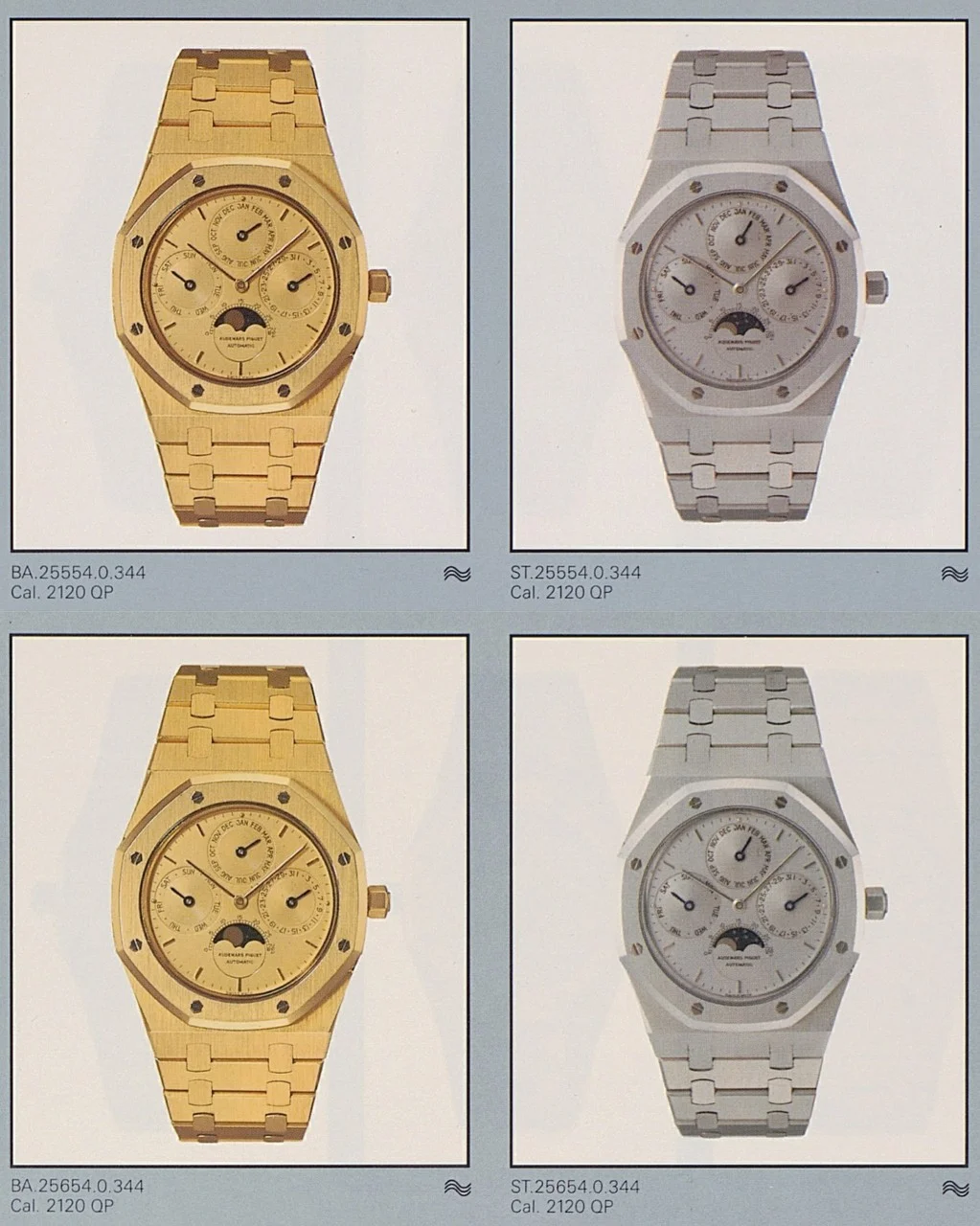
1986 et 1987. Models 25554 (above) and 25654 (below) in the catalogue. Appearing for the first and only time in the General Catalogue in 1986, Model 25554 was replaced the following year by 25654. Both are aesthetically so similar that the photographs are simply reproduced identically. Only the number was changed. 1986–87 and 1987–88 Audemars Piguet Catalogues. Audemars Piguet Archives.
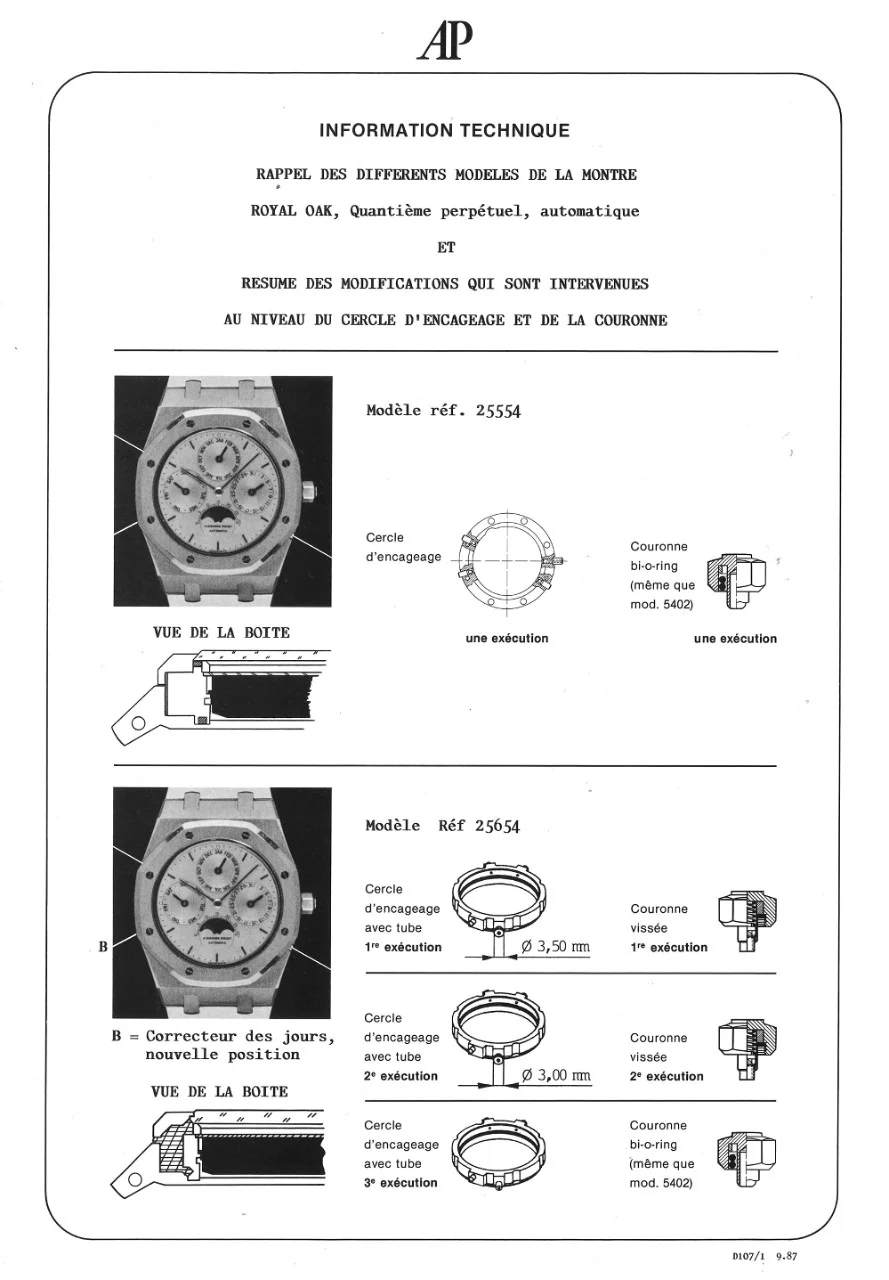
1987. Technical data for Models 25554 and 25654 . Produced for the watchmakers of the Audemars Piguet After-Sales Service, this document sets out the main differences in case construction between Models 25554 and 25654. Audemars Piguet Archives. .
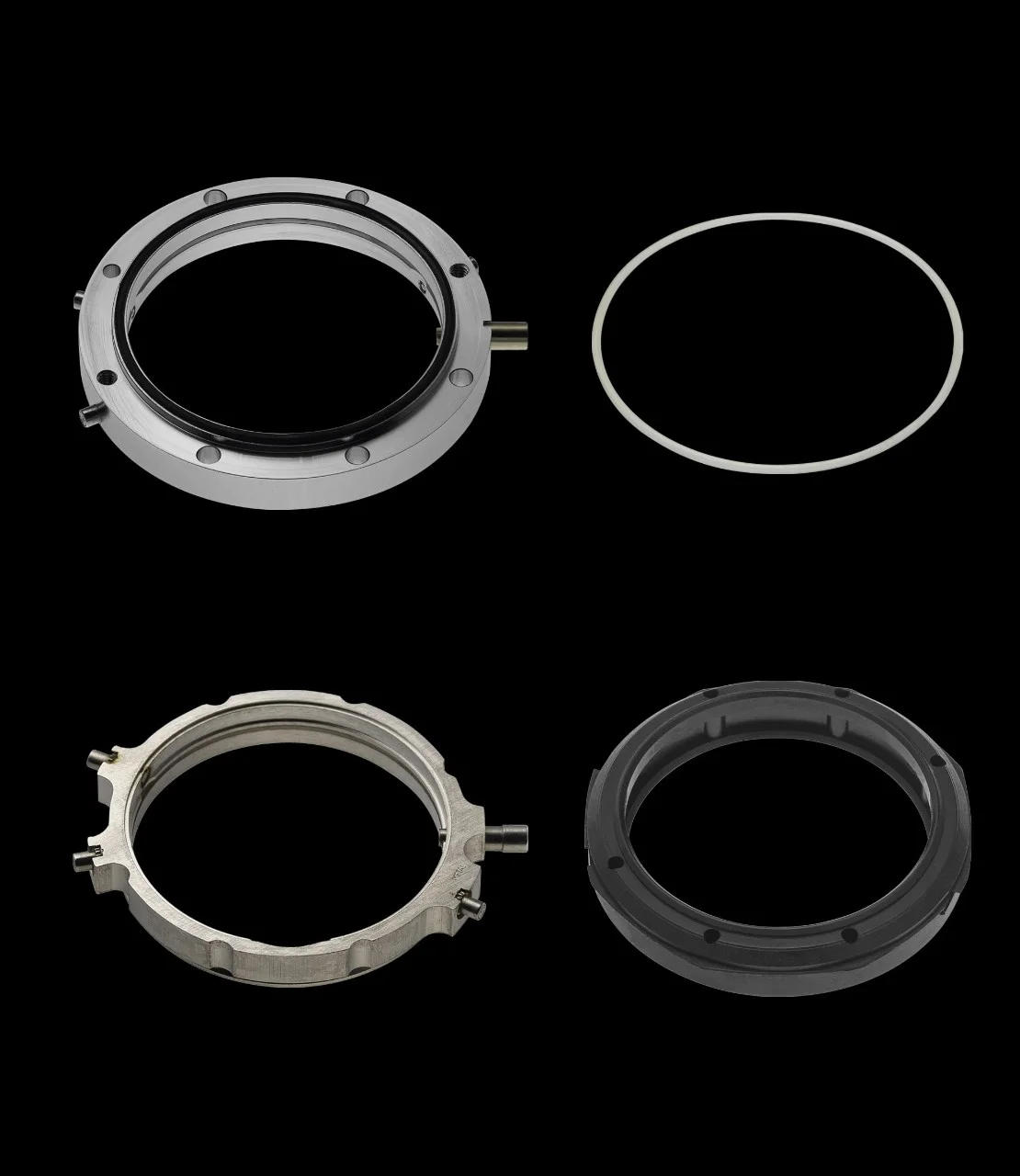
1984-1987. Inner construction of Cases 25554 and 25654. Model 25554 adopted a large steel inner casing-ring surrounded by very thin seals. Three years later, the 25654 model combined a large seal and a narrower casing-ring. Audemars Piguet Heritage, inv. 2145 and 1608
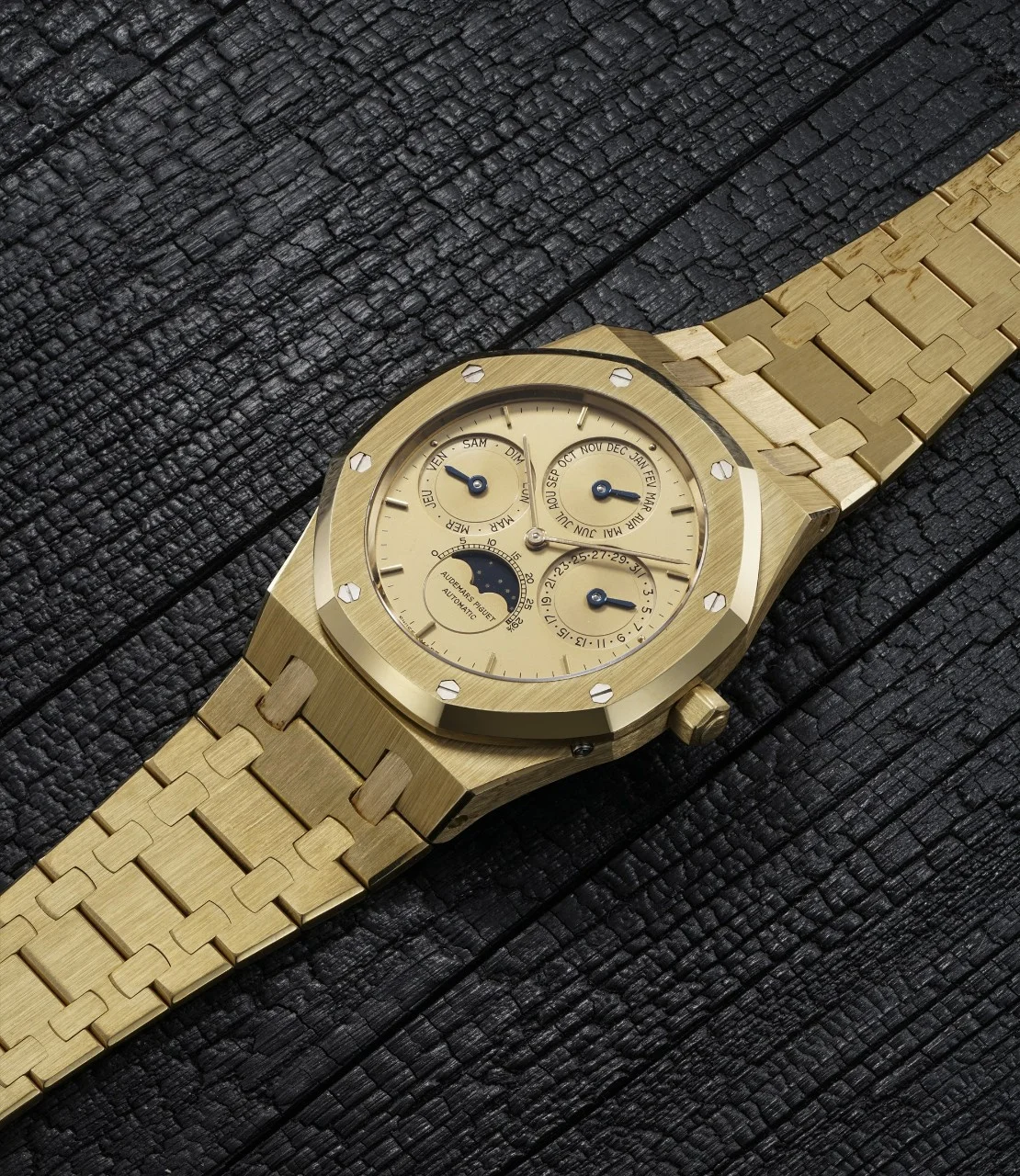
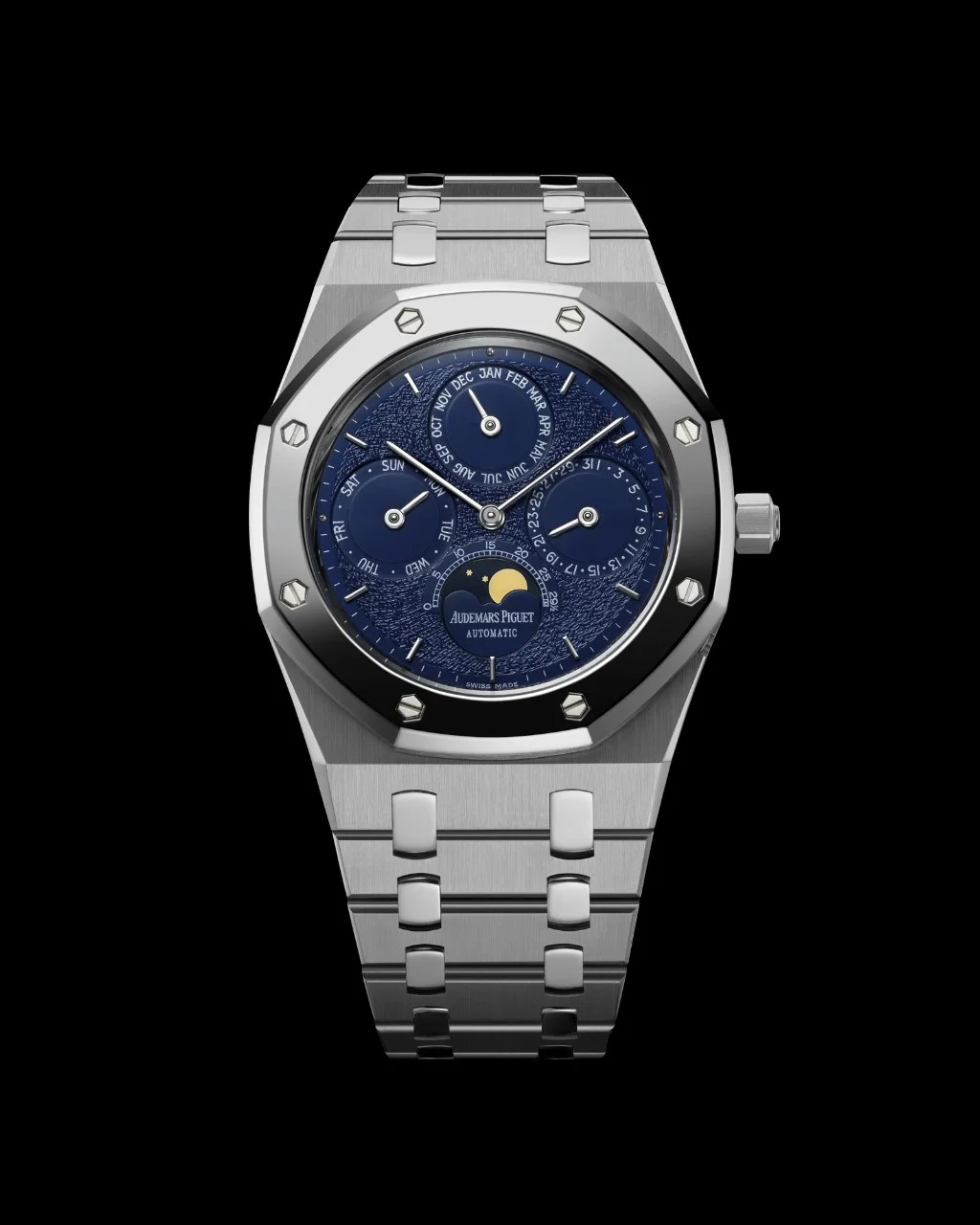
1989. Royal Oak Perpetual Calendar 25654BA, N° 606. Perpetual calendar: day, date, month, phase and age of the moon. Selfwinding Calibre 2120/2800, movement 294336. Bracelet 344. Gold dial. 39 mm case C61387. 18-carat yellow gold. Sold to A.P.S. in 1989. Sold by Phillips in Geneva on May 6, 2022, lot 7. Image © Phillips
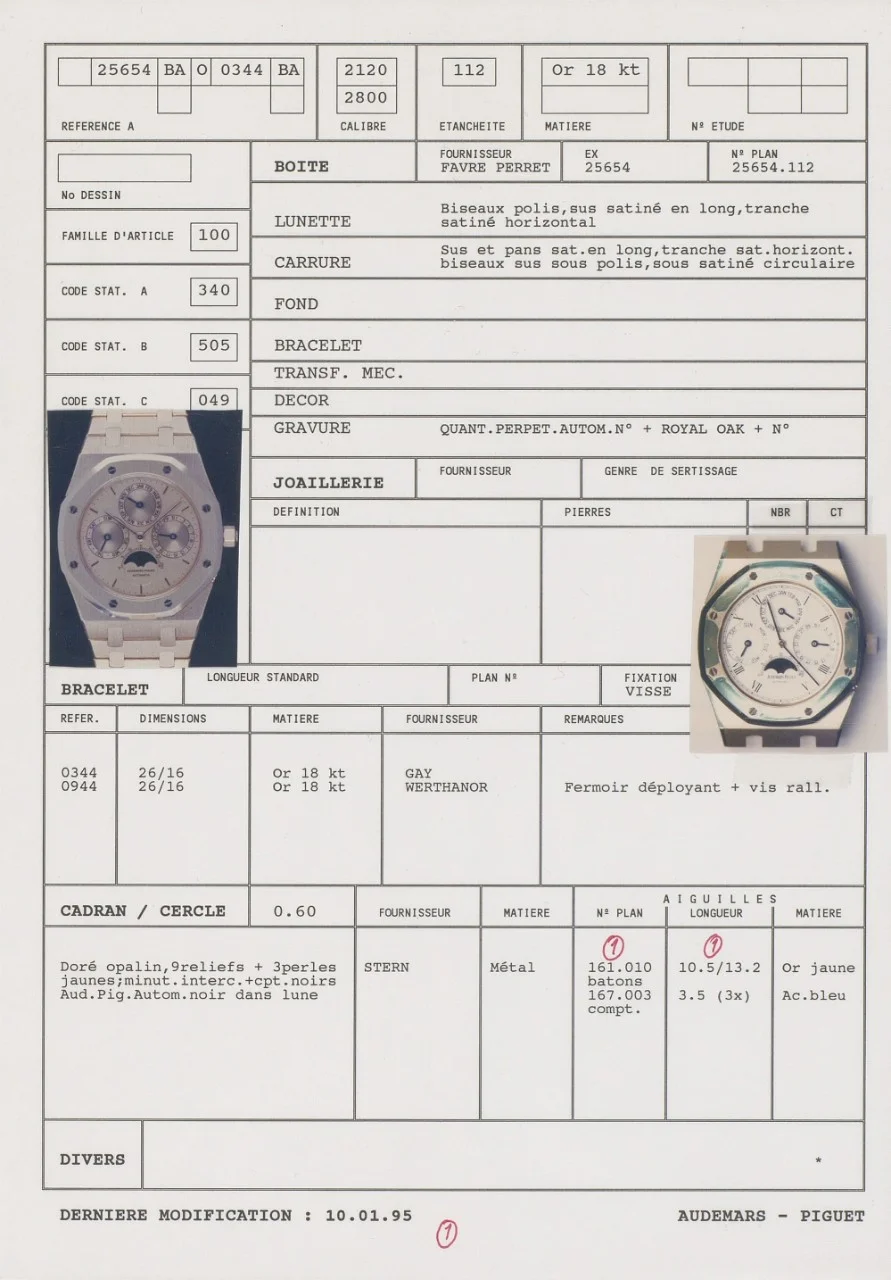
1995. Technical data for case 25654BA. Audemars Piguet Archives.
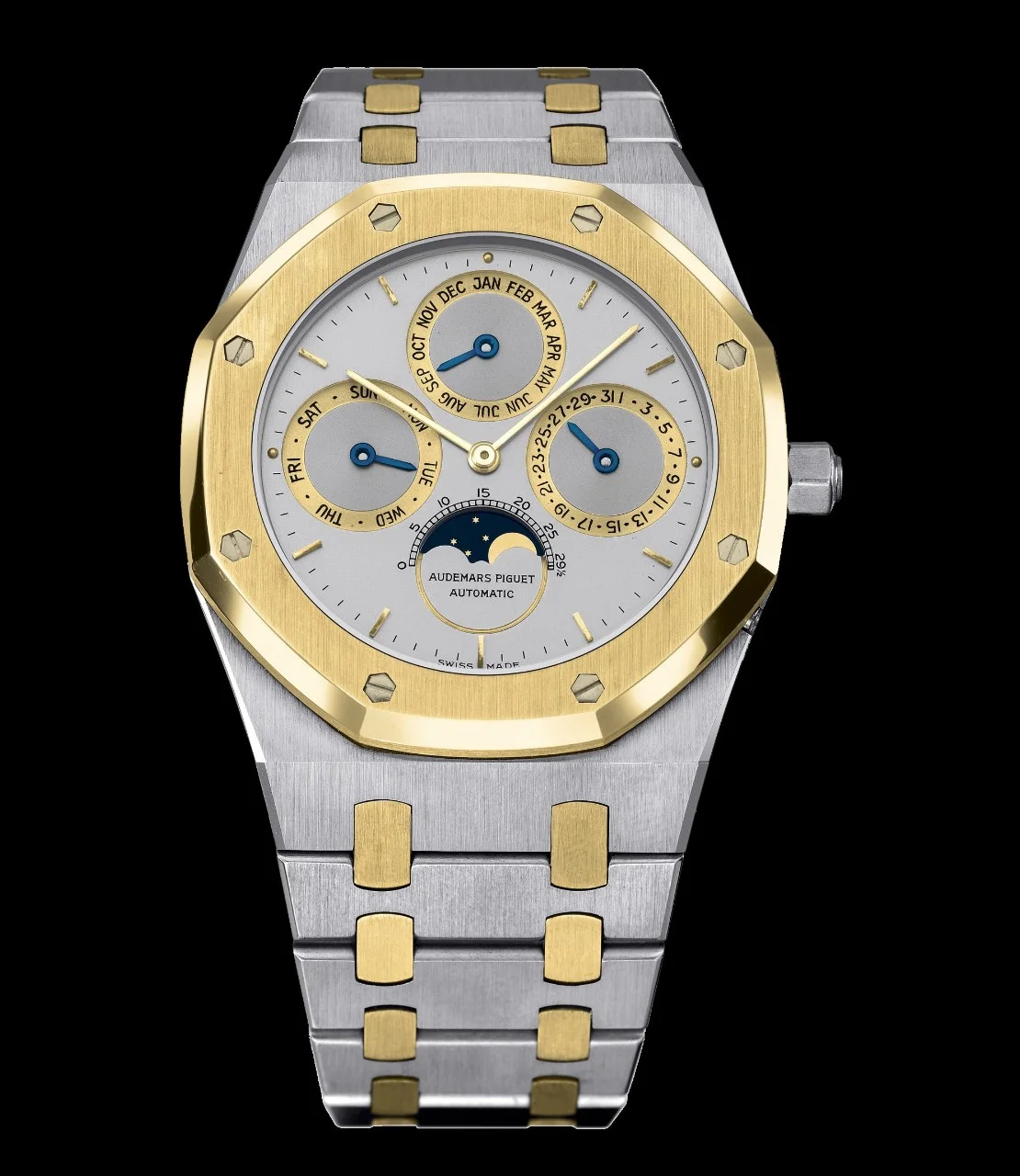
Circa 1987. Royal Oak Perpetual Calendar 25654SA, N° 505. Perpetual calendar: day, date, month, phase and age of the moon. Selfwinding Calibre 2120/2800. Bracelet 344. Two-tone dial. 39 mm case C49557. Steel. Prototype probably presented at the 1987 Basel Fair. Audemars Piguet Heritage, inv. 441.

1988. Royal Oak Perpetual Calendar 25654PT, N° 001. Perpetual calendar: day, date, month, phase and age of the moon. Selfwinding Calibre 2120/2800, movement 286619. Bracelet 344. Dial with Tapisserie motif. 39 mm case C54927 with Asprey engraving. 950 platinum. Sold to Elco (United Kingdom) in June 1988. Auctioned by Phillips in Geneva on May 6, 2022. Image © Phillips.
Model 25636, or the art of revealing
Following the emergence of wristwatches in the early 20th century, devotees of fine watchmaking had to come to terms with the fact that they could no longer admire the mechanical movements fitted inside their watches. Hidden under a dial, protected by a case that was increasingly water-resistant, these technical and decorative marvels could only be seen by the watchmakers who opened the watches.
However, with the arrival of quartz watches, the presentation of the mechanism became a major issue. Revealing the movement not only highlighted the intrinsic value of the watch, but also celebrated the work of the artisans and placed the timepiece firmly within the lineage of the grand watchmaking tradition. The article dedicated to the birth of Calibre 2120 tells how a few watchmakers decided to reintroduce the art of openworking at Audemars Piguet during the winter of 1972–1973.
It was not until 1986 that the very first Royal Oak with a fully openworked calibre appeared. Model 25636 with perpetual calendar then embodied the quintessence of traditional expertise. It combined openworking, engraving, the art of complications and miniaturisation with the contemporary design of the Royal Oak.
More than 200 hours were required for the finest artisans to openwork and engrave a Calibre 2120/2800. When one considers that no less than 313 Model 25636 watches were produced in ten years, alongside other openworked watches, it is easy to understand that Régis Meylan's workshop had plenty to keep it busy.
The enthusiast will particularly admire the extreme refinement of the oscillating weight, the openworking and engraving of the bridges, or the perfect chamfering of all the steel parts. To make these elements visible, the caseback is transparent for the first time and the dial is in sapphire. As for the hands, following the example of the other perpetual calendar models, they are mostly devoid of luminescent material and distinguish the calendar functions (blued steel) from those of the hours (polished gold).
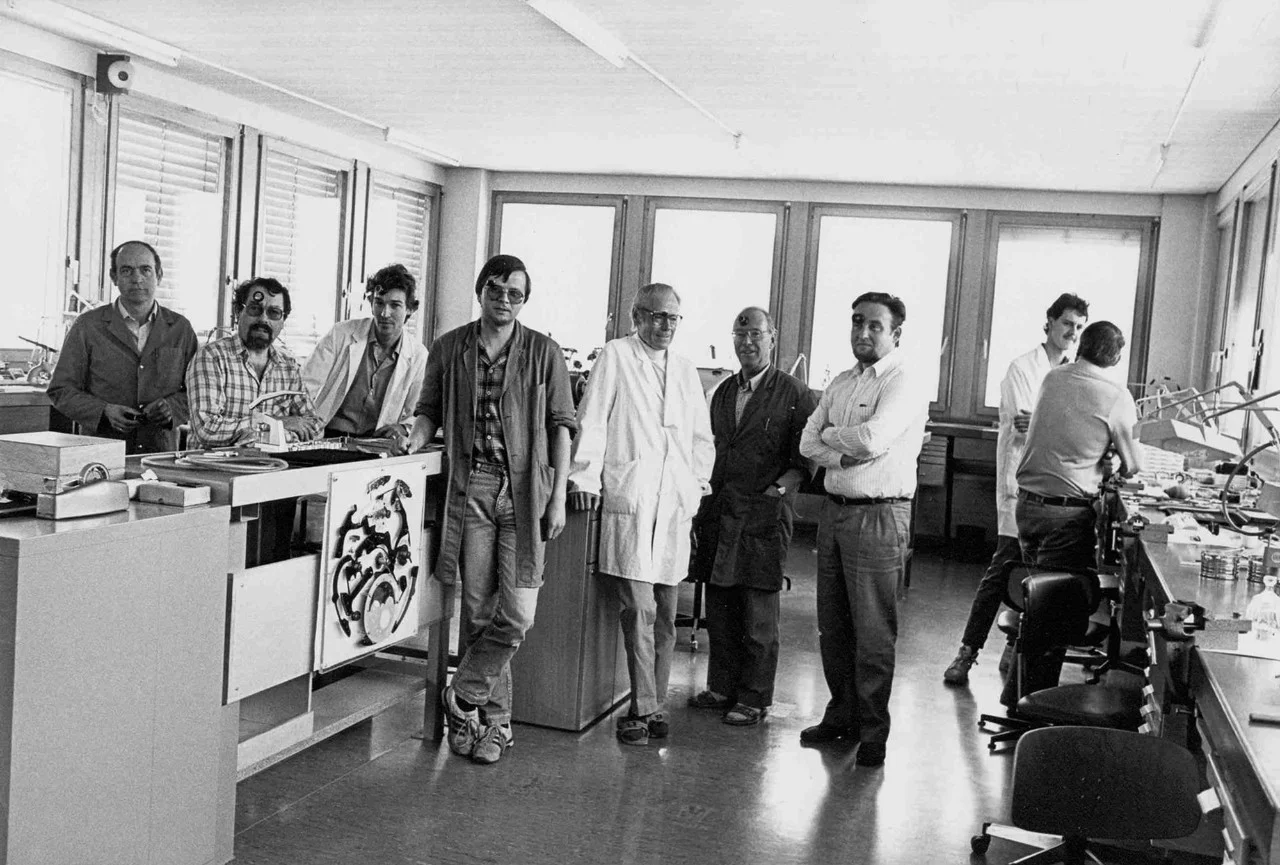
1984. Openworking workshop. To accompany the renewal of openworking, Audemars Piguet has created a workshop entirely dedicated to this art. Audemars Piguet Archives.
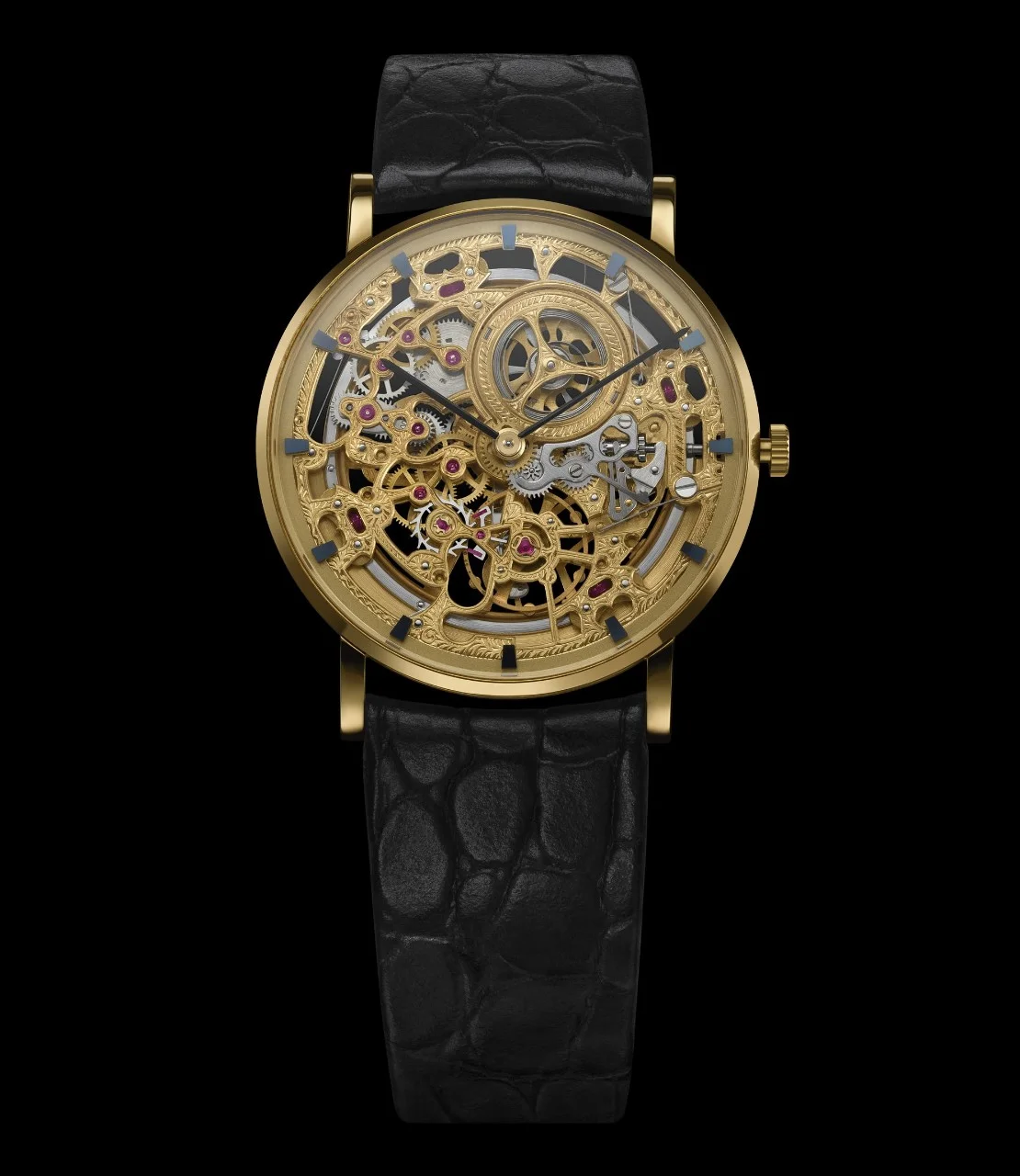
1976. Ultra-thin openworked wristwatch 5542BA (1972). Calibre 2120SQ, movement 136093 belonging to the first batch of 100 openworked movement "ébauches" for Calibre 2120. Case B4502. 18-carat yellow gold. Sold in Germany in 1976. Audemars Piguet Heritage, inv. 1123.
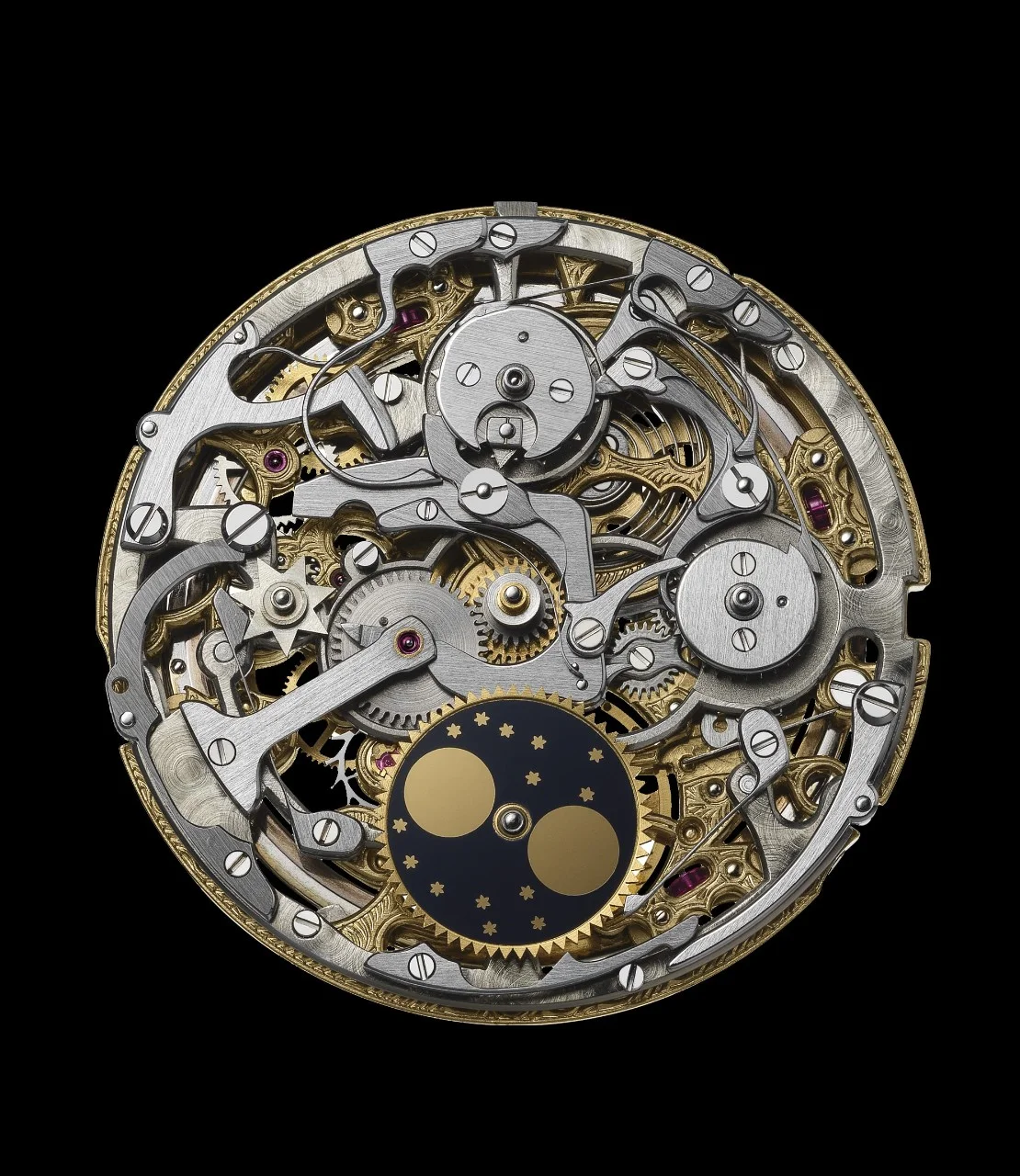
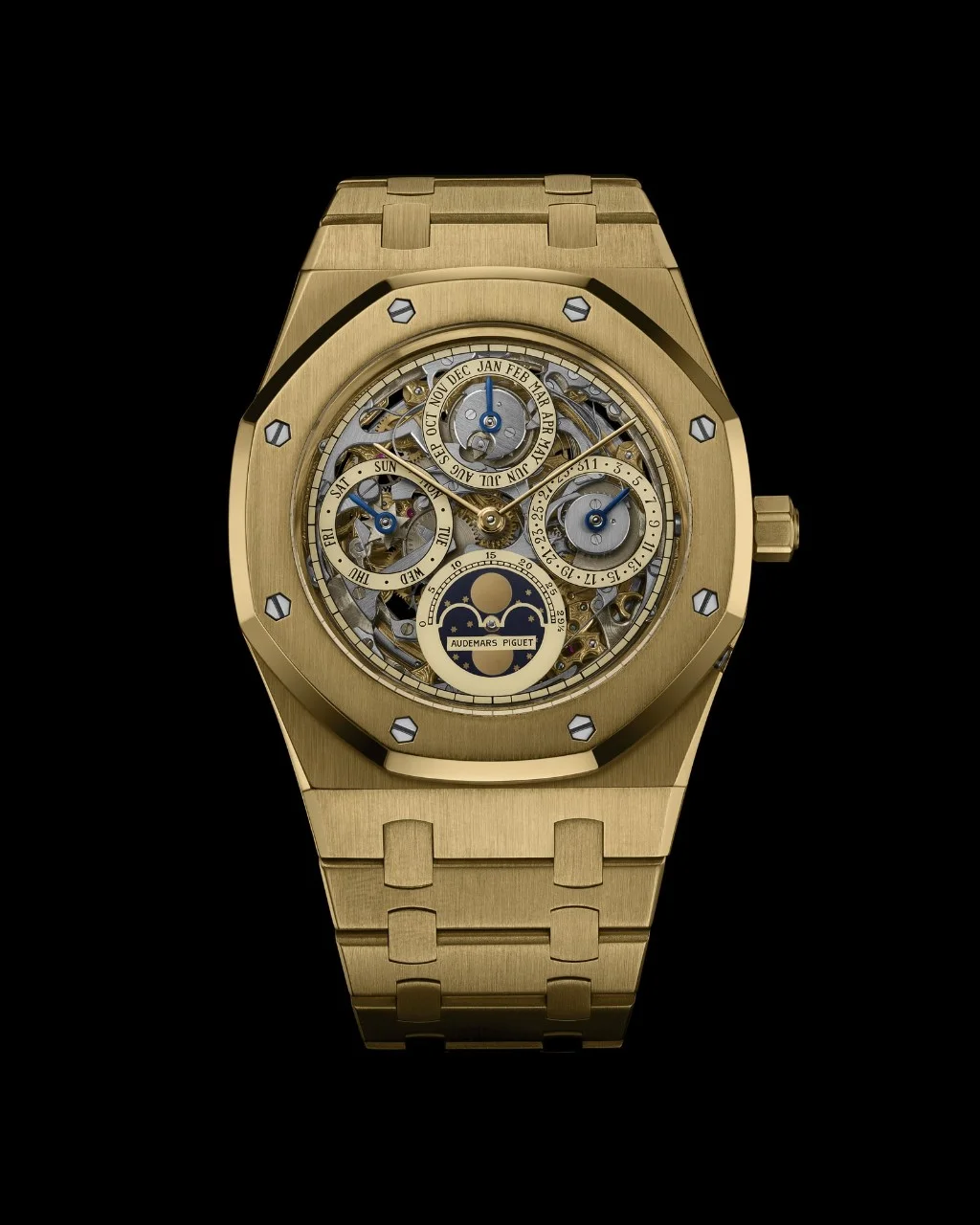
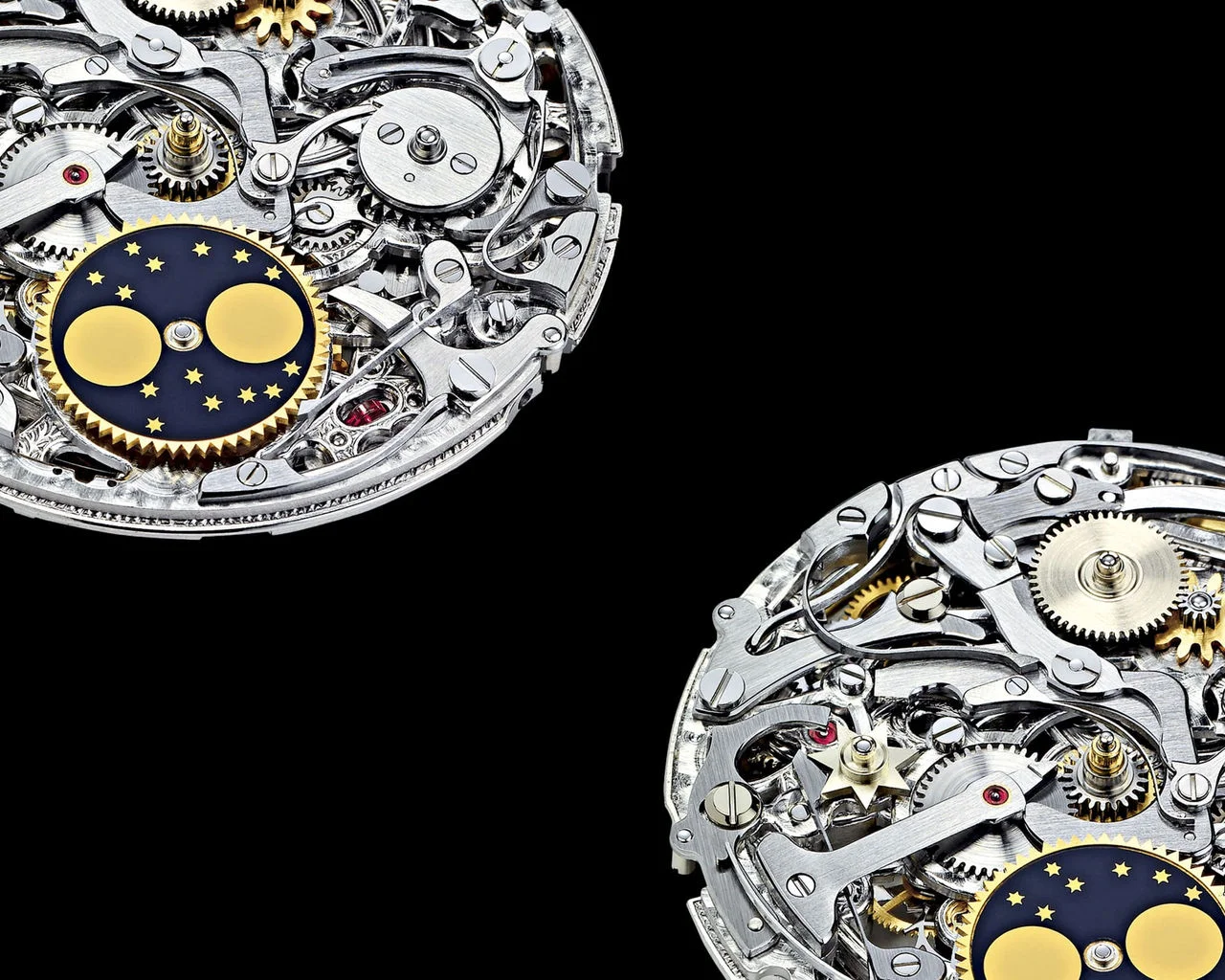
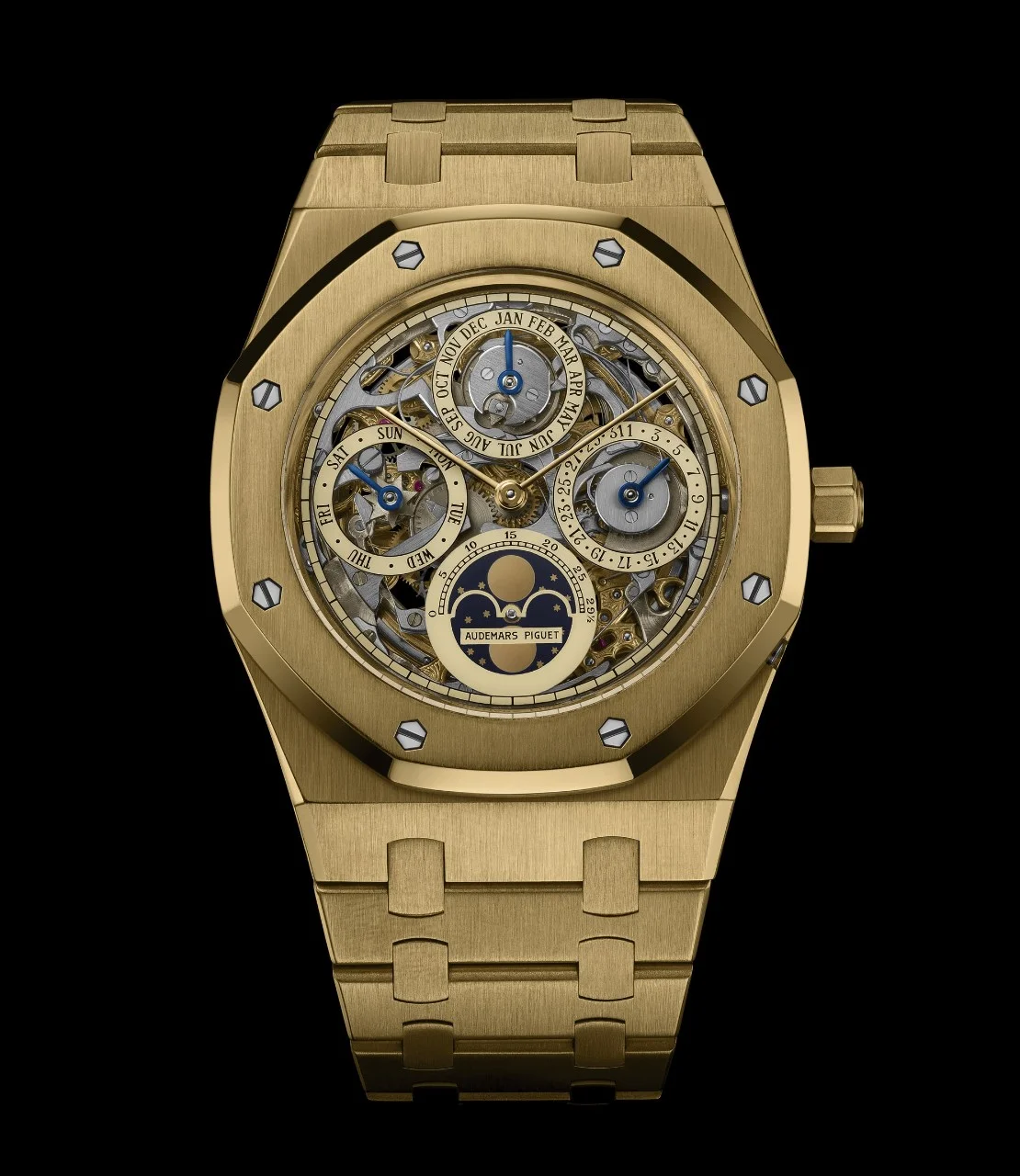
1982–1996. Calibre 2120/2800SQ, dial-side view. Thinnest openworked selfwinding perpetual calendar of its era (3.95 mm): day, date, month, moon phases. Movement 324301, produced in 1991. Audemars Piguet Heritage, inv. 723.
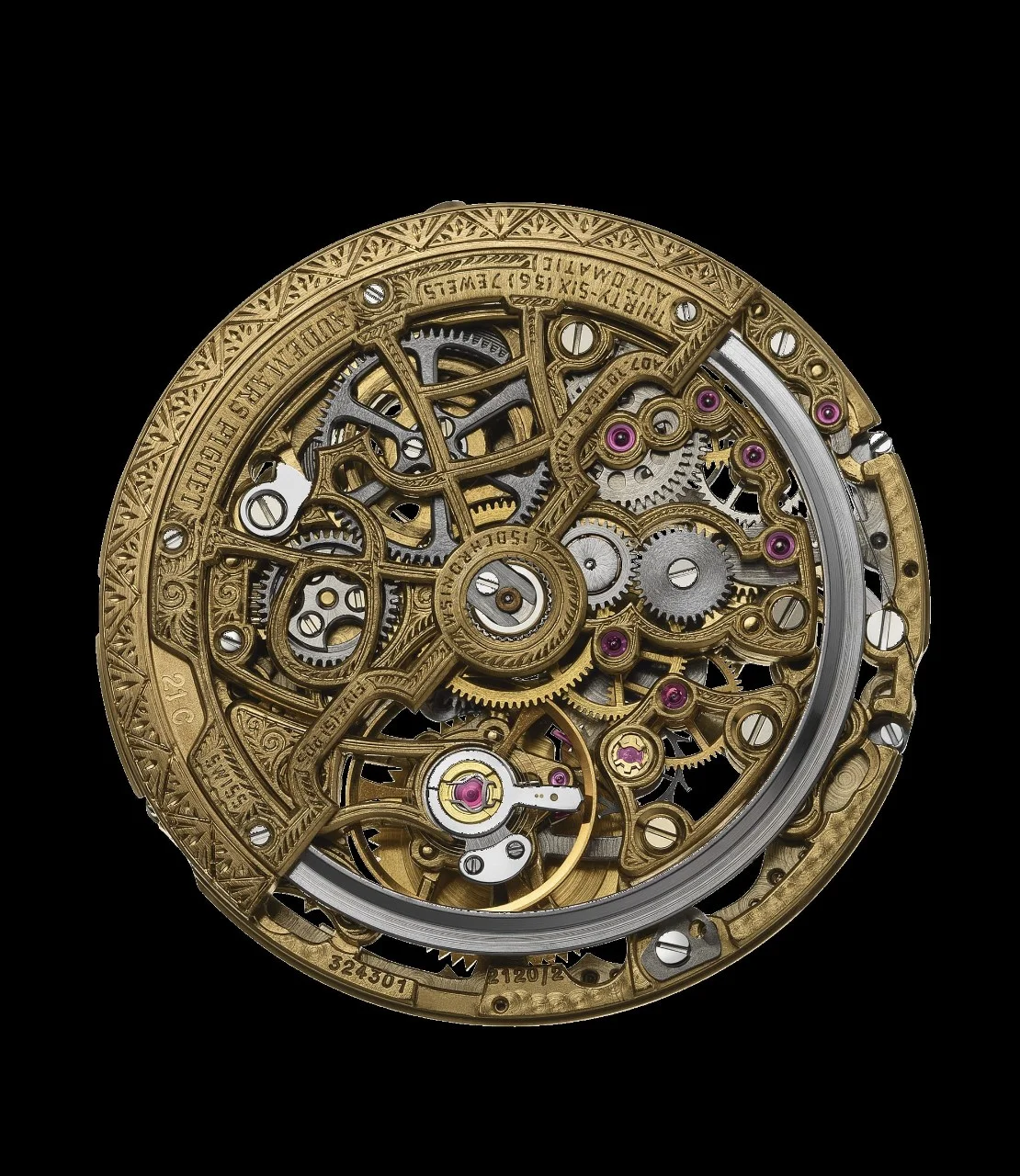
1982–1996. Calibre 2120/2800SQ, bridge-side view. Thinnest openworked selfwinding perpetual calendar of its era (3.95 mm): day, date, month, moon phases. Movement 324301, produced in 1991. Audemars Piguet Heritage, inv. 723.

1991. Royal Oak Perpetual Calendar 25636PT N° 24. Perpetual calendar: day, date, month, phase and age of the moon. Calibre 2120/2800 selfwinding, extra-thin (3.95 mm) and openworked, movement 324268. Bracelet 344. 39 mm case C84188. Platinum. Sold in Switzerland in March 1991. Auctioned by Phillips in Geneva on May 6, 2022, lot 15. © Phillips
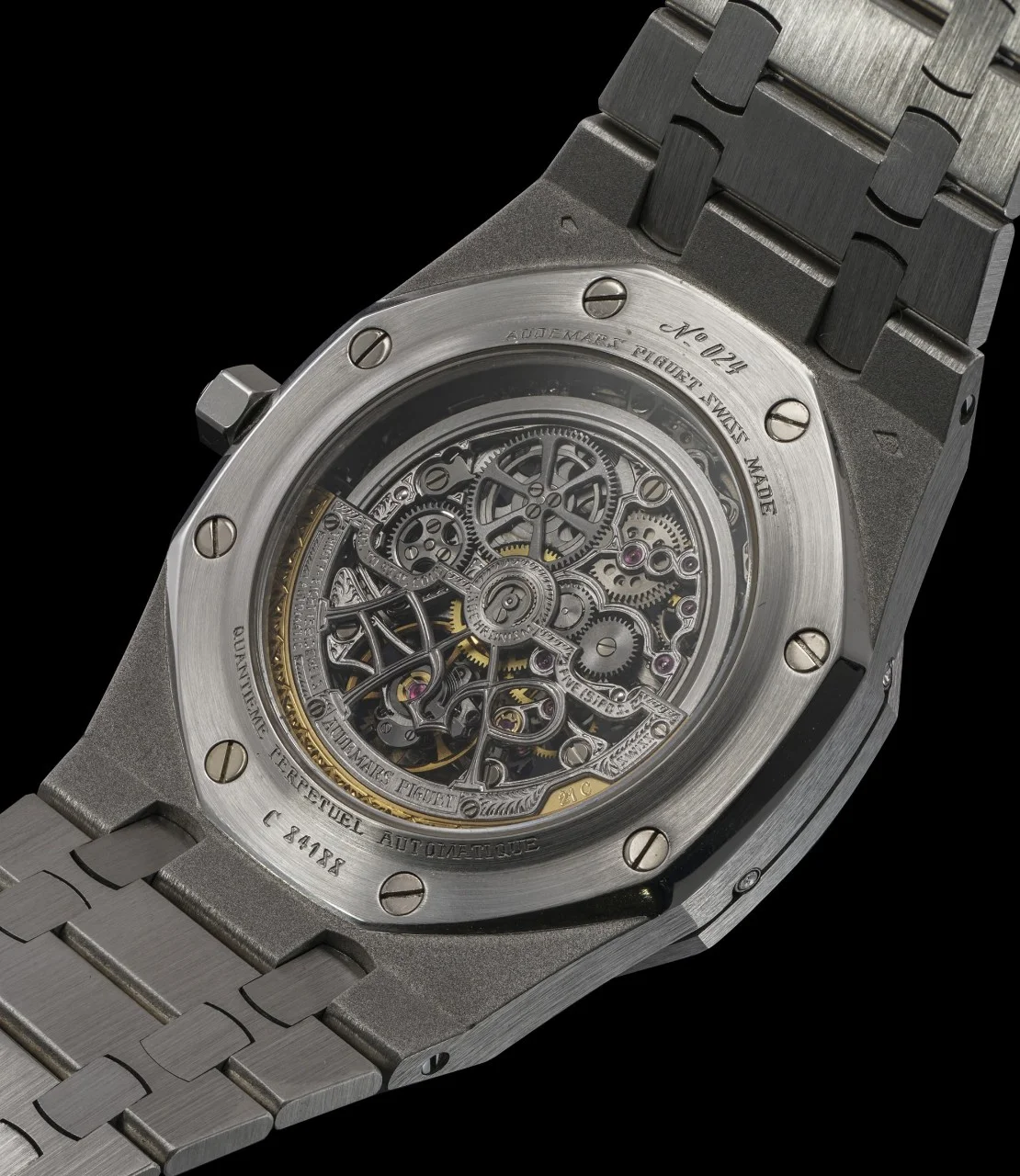
1991. Royal Oak Perpetual Calendar 25636PT N° 24. Perpetual calendar: day, date, month, phase and age of the moon. Calibre 2120/2800 selfwinding, extra-thin (3.95 mm) and openworked, movement 324268. Bracelet 344. 39 mm case C84188. Platinum. Sold to a client in Switzerland in March 1991. Auctioned by Phillips in Geneva on May 6, 2022, lot 15. © Phillips
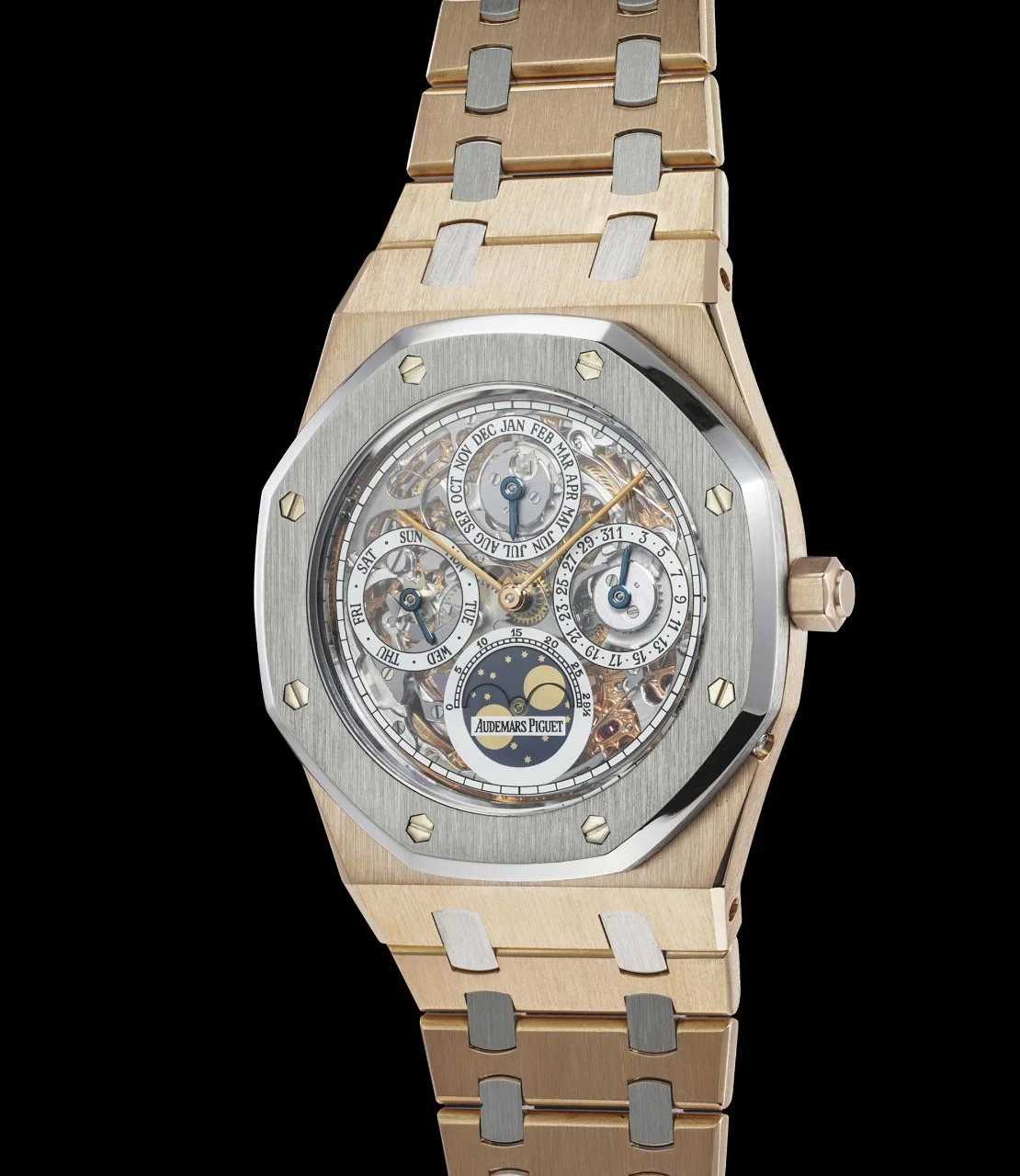
1993. Royal Oak Perpetual Calendar 25636RP N° 14/25. Perpetual calendar: day, date, month, phase and age of the moon. Calibre 2120/2800 selfwinding, extra-thin (3.95 mm) and openworked, movement 391004. Bracelet 944. 39 mm case D41939. Steel. Sold to a client in Switzerland in February 1996. Auctioned by Phillips in Geneva, May 8–9, 2021, lot 43. © Phillips
Variations of Model 25636
Introduced on the Royal Oak Perpetual Calendar 25636, the sapphire caseback required a slight increase in the thickness of the case, which now measured 8.8 mm, compared with 8.3 mm for Model 25654. Moreover, this evolution opened up a wide range of creative horizons, so much so that the case of Model 25636 gave rise to five models.
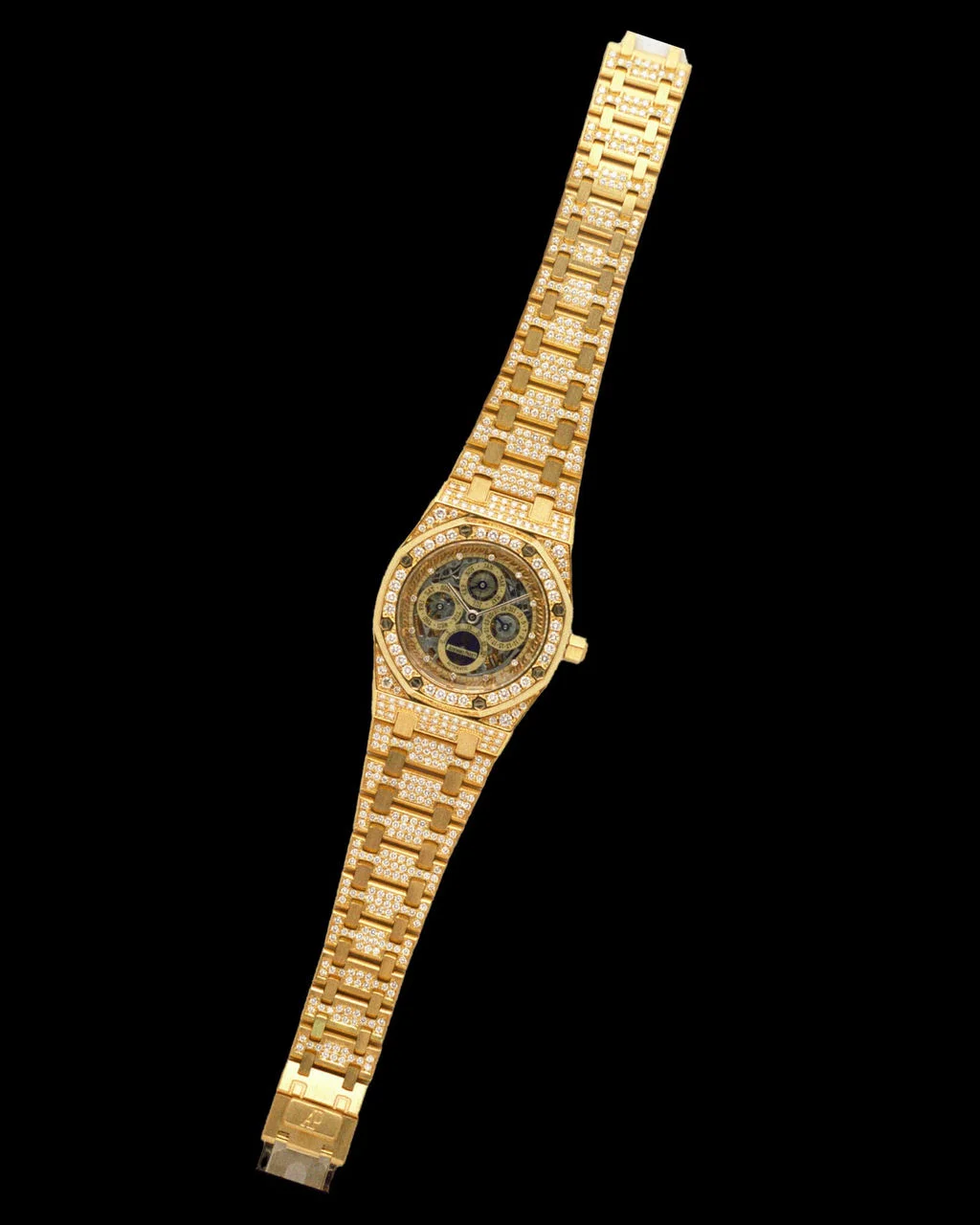
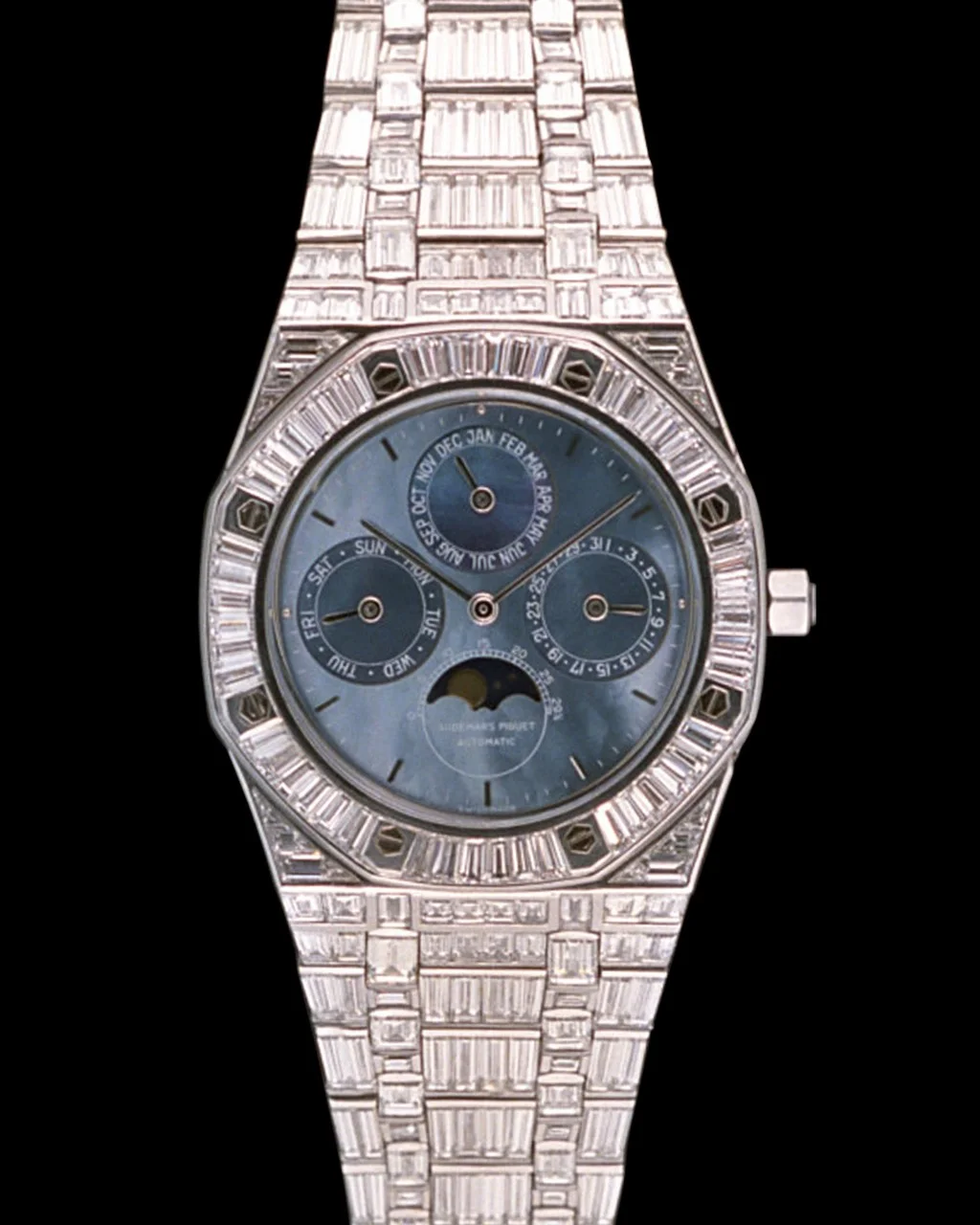
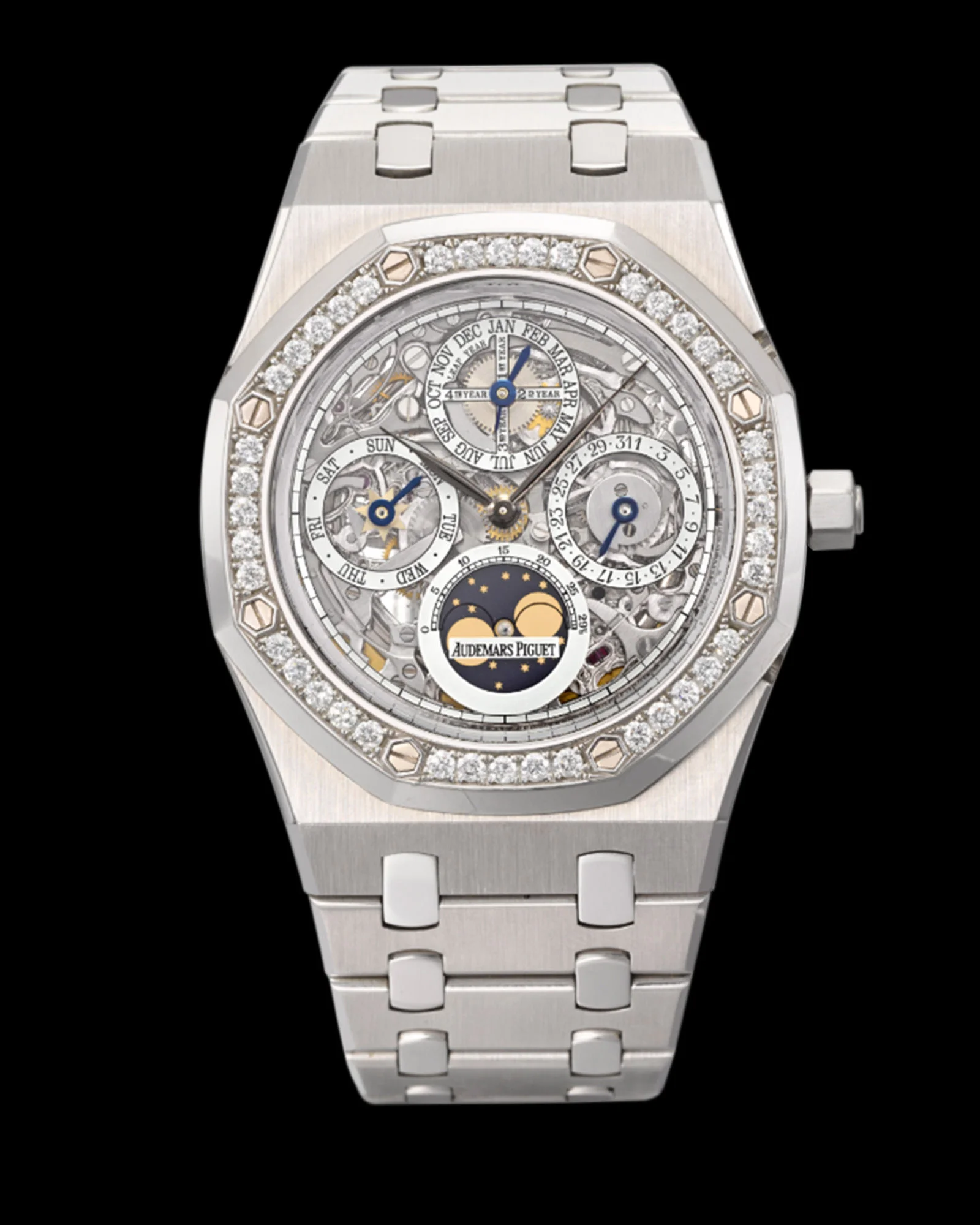
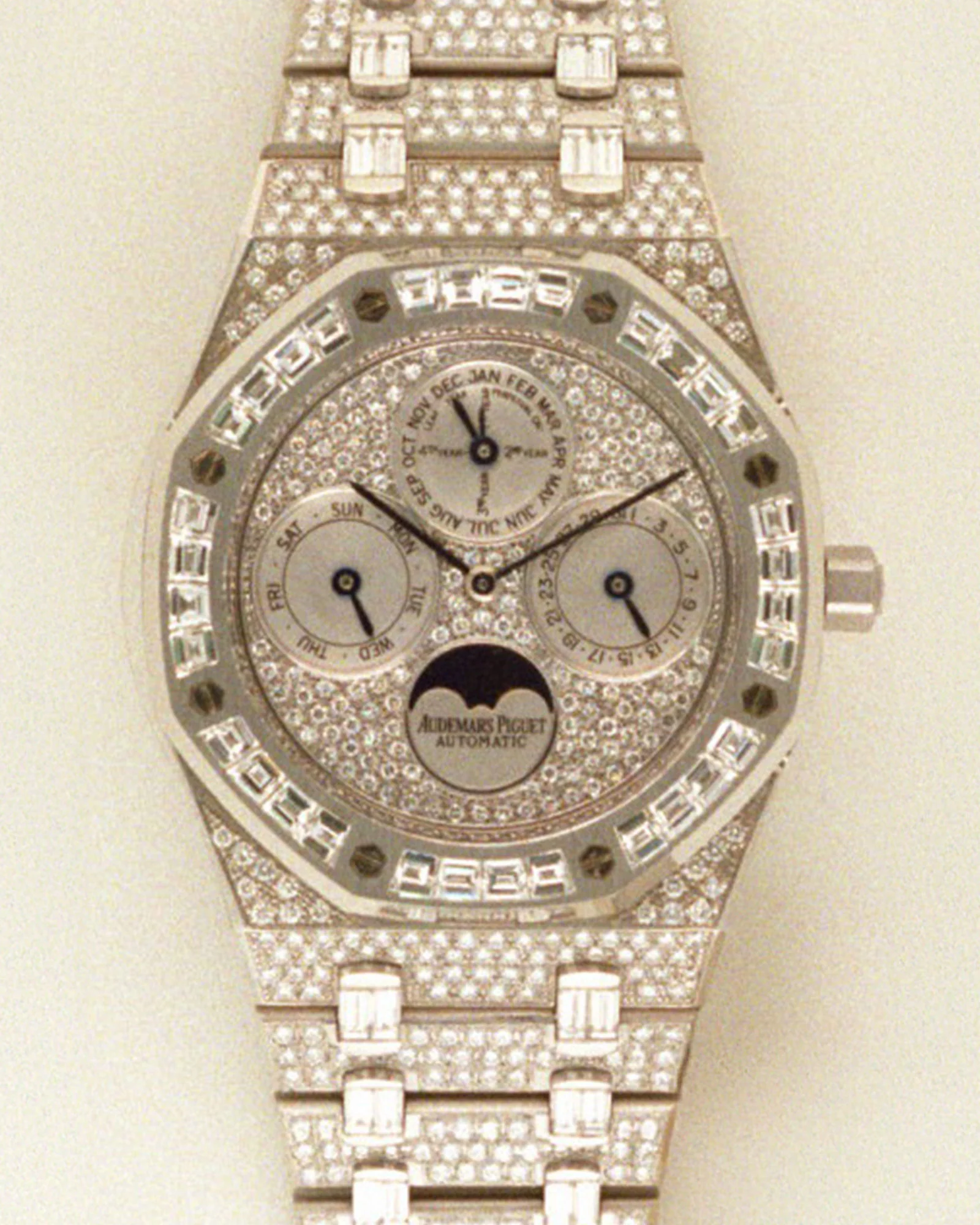
Four of them are one-of-a-kind creations. In 1986, Model 25651 featured a gemset daintily set around its bezel rim. In 1989, the Royal Oak Perpetual Calendar 25688 was entirely covered with baguette-cut diamonds. The following year, Model 25694 featured a bezel adorned with diamonds and blue sapphires, and in 1994, the 25775 offered an astonishing guilloché hobnail Clous de Paris bezel.
But the most important iteration of Model 25636 is none other than the Royal Oak Perpetual Calendar 25686. An openworked variant of its illustrious predecessor, this model is adorned with dials that are as diverse as they are refined: blue or pink mother-of-pearl, chiselled "Tuscany blue" dial, Petite Tapisserie motif, gilded, pink or two-tone dials, etc. A total of 299 units were delivered between 1989 and 1998.
It is perhaps in the field of materials that Model 25636 and its openworked version 25686 expressed the most variety through various interpretations. Between 1986 and 1997, these models were crafted in seven different materials. Yellow gold (BA), steel (ST) and platinum (PT) were introduced in the 1980s. In 1991, pink gold (OR) was added and simultaneously a combination of platinum and pink gold (PR), the reverse of which (RP) was introduced in 1997. In 1994, the SP variant juxtaposed brushed steel and mirror-polished platinum.
Another interesting detail: to this day, the Audemars Piguet Heritage team has not found the slightest trace of a 39 mm Royal Oak Perpetual Calendar in white gold.
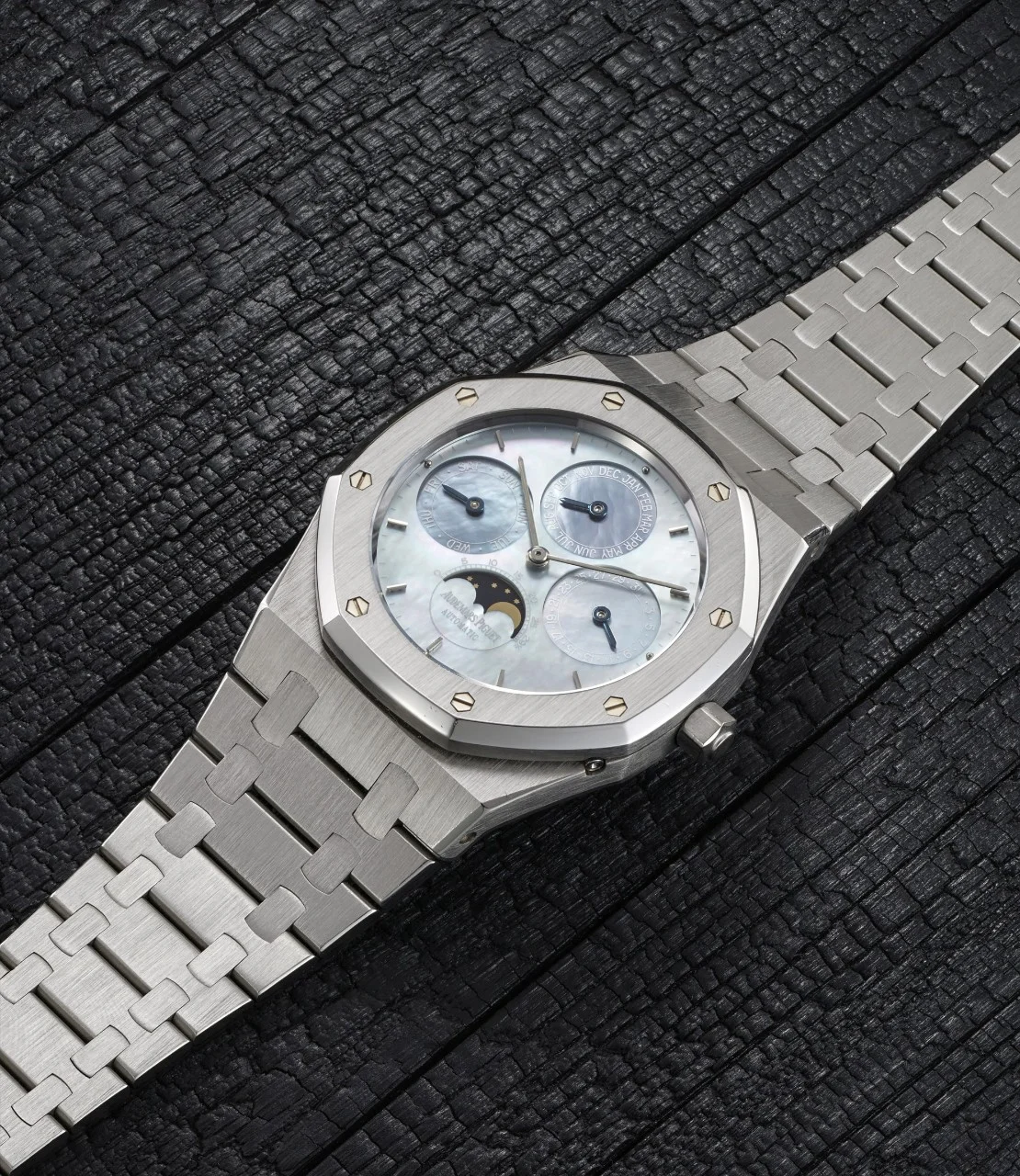
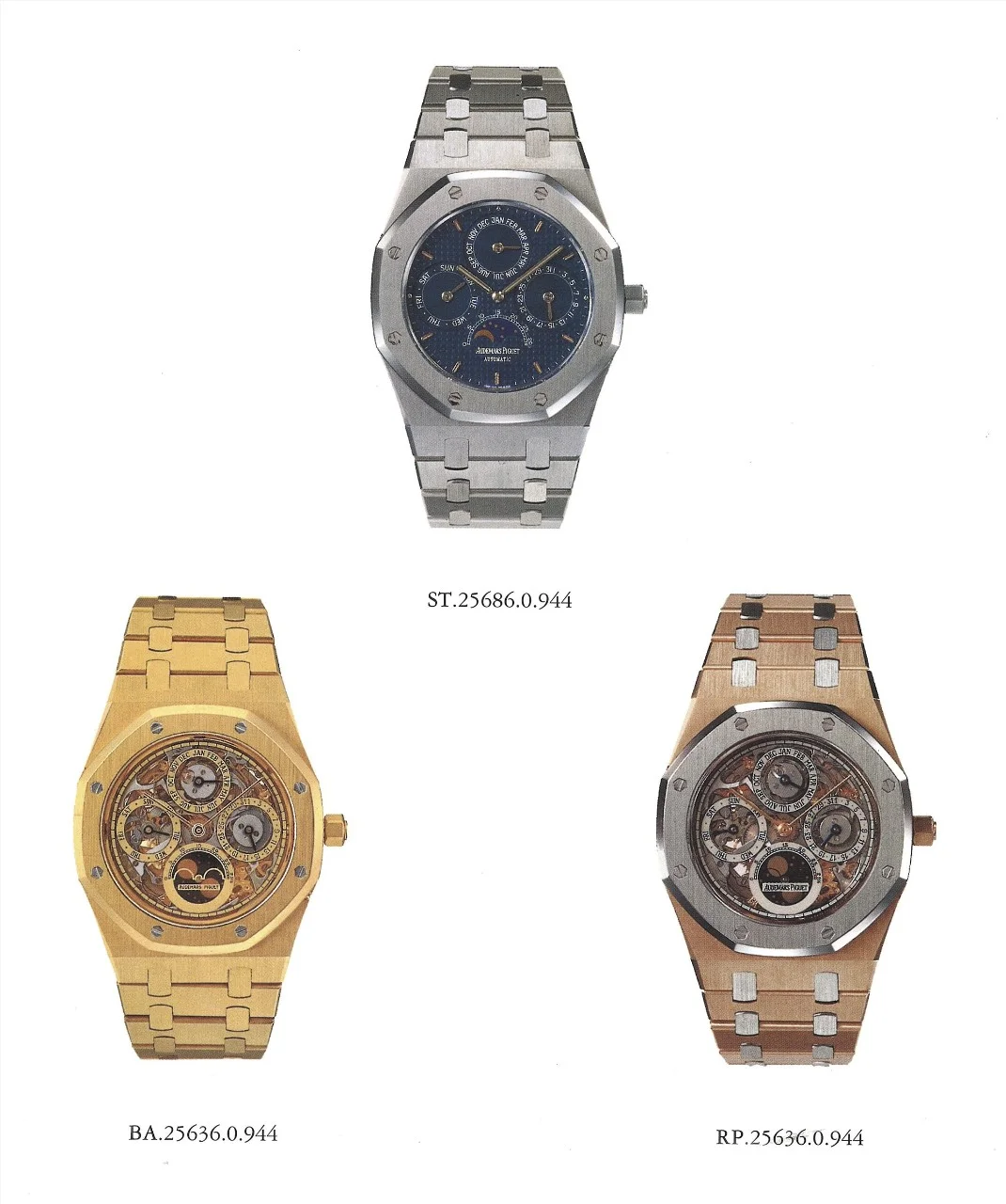
1994. Royal Oak Models 25636 and 25686. In 1986, Model 25636 introduced openworking and a sapphire caseback to the Royal Oak collection. Three years later, Model 25686 retained the exhibition back, but only the weight remained openworked. Promotional brochure. Audemars Piguet Archives.

1995. Royal Oak Perpetual Calendar 25686ST N° 65. Perpetual calendar: day, date, month, phase and age of the moon. Extra-thin selfwinding Calibre 2120/2800 (3.95 mm), movement 374192. Bracelet 944. Dial with Petite Tapisserie pattern. 38 mm case D42082 in steel. Sold in New York in March 1995. Auctioned by Sotheby's in New York on June 15, 2022, lot 21. © Sotheby’s.
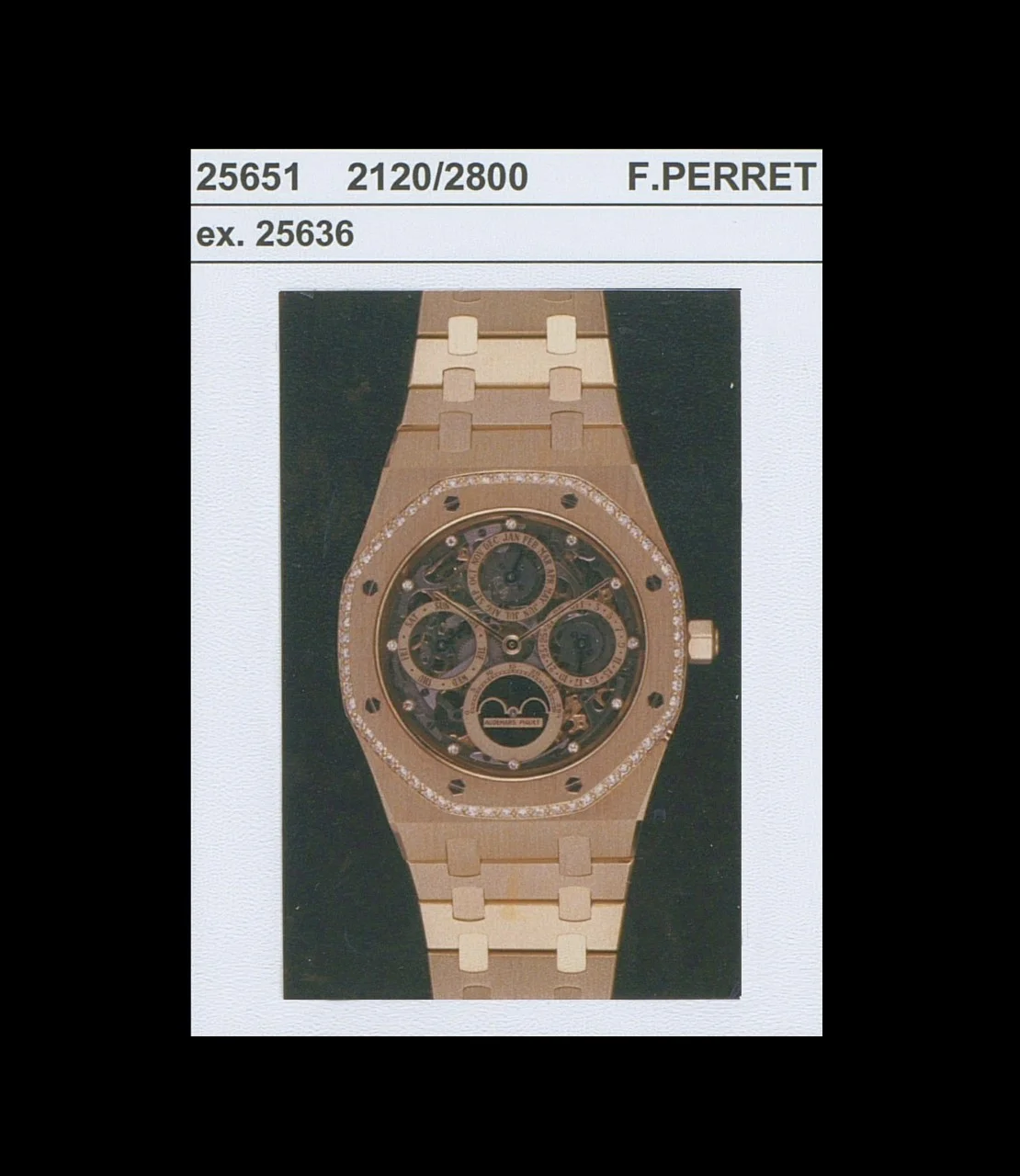
Circa 1986. Identification image of Model 25651PT. Audemars Piguet Archives.
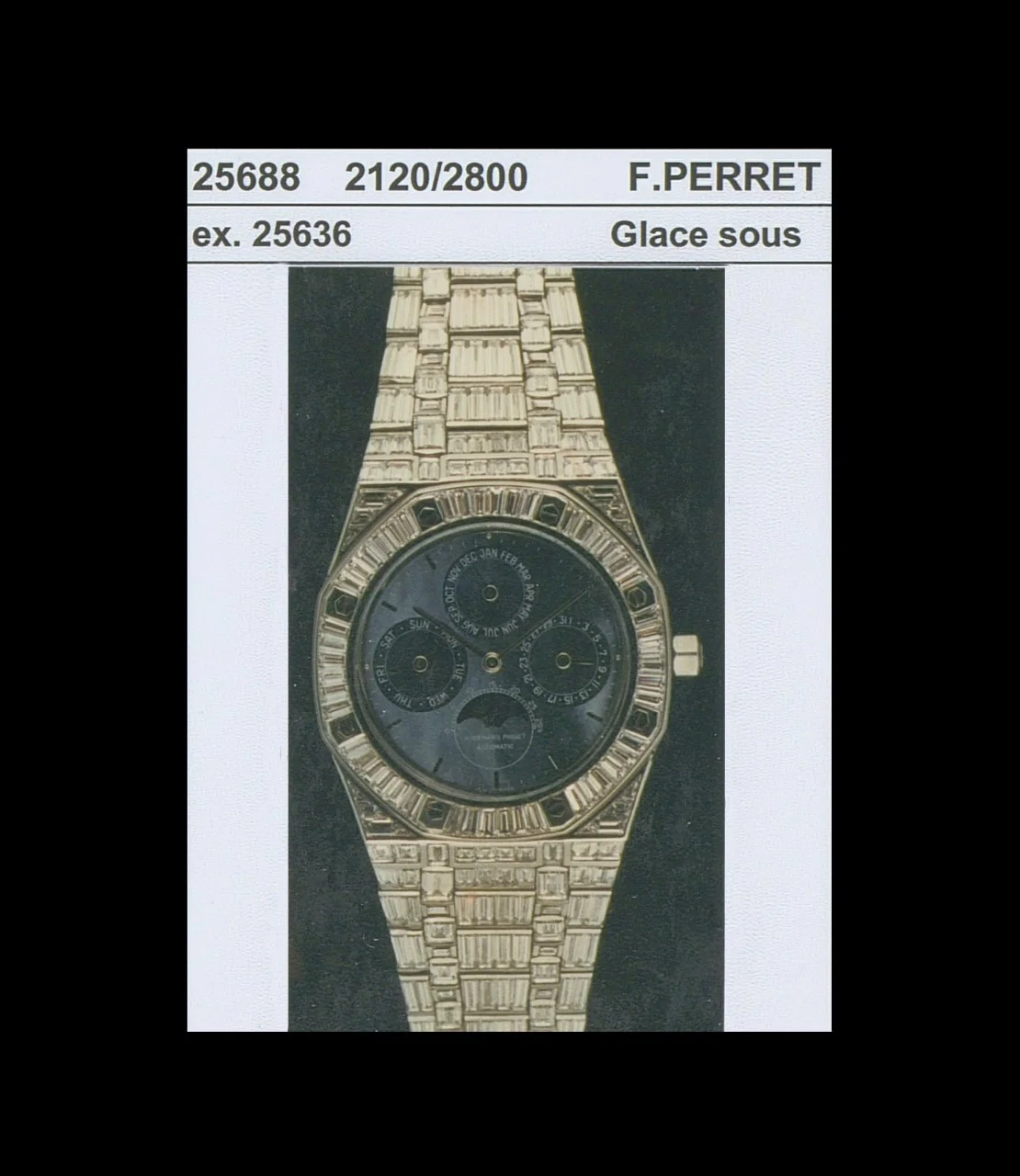
Circa 1989. Identification image of Model 25688PT. Audemars Piguet Archives.
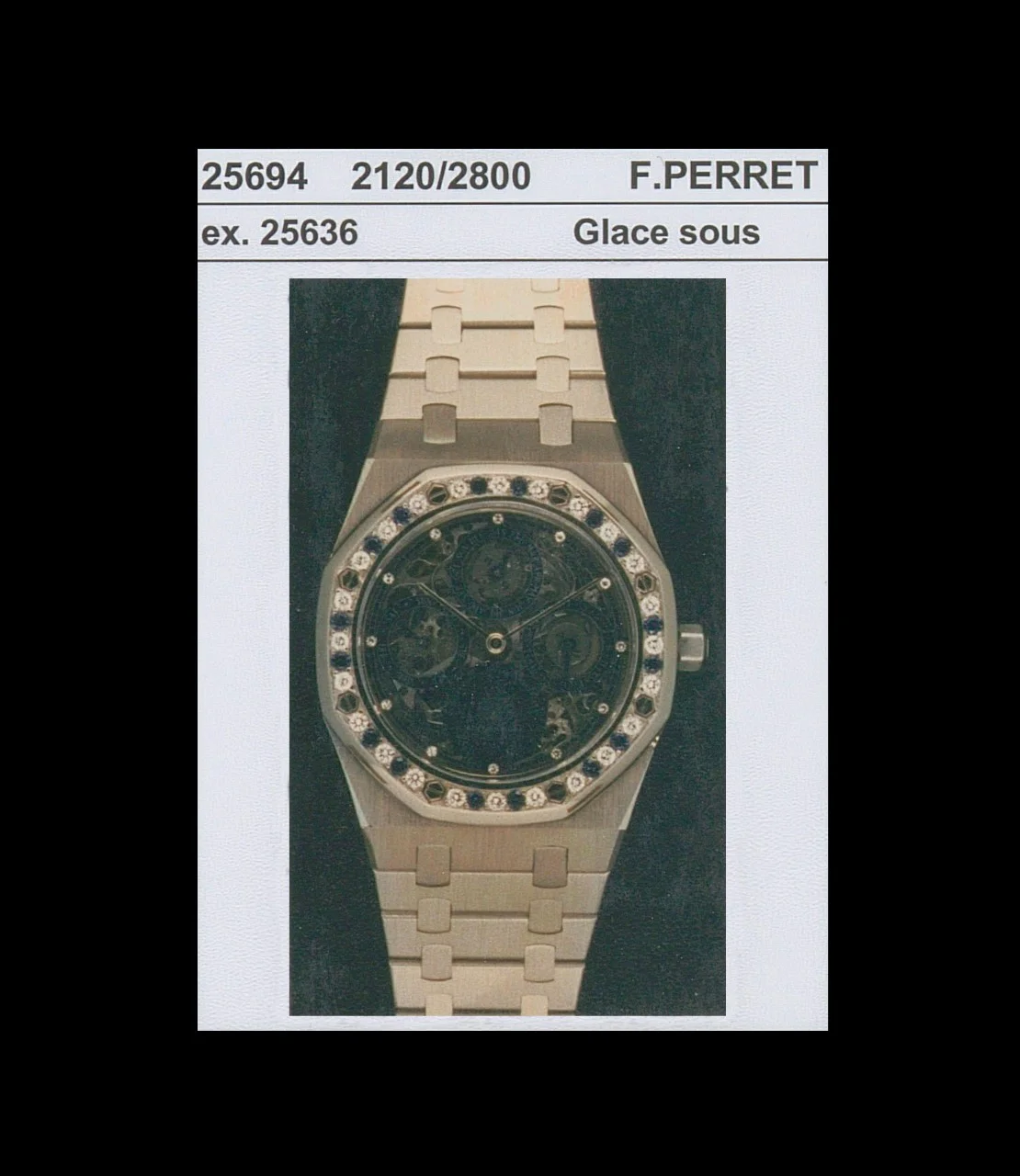
Circa 1990. Identification image of Model 25694PT. Audemars Piguet Archives.
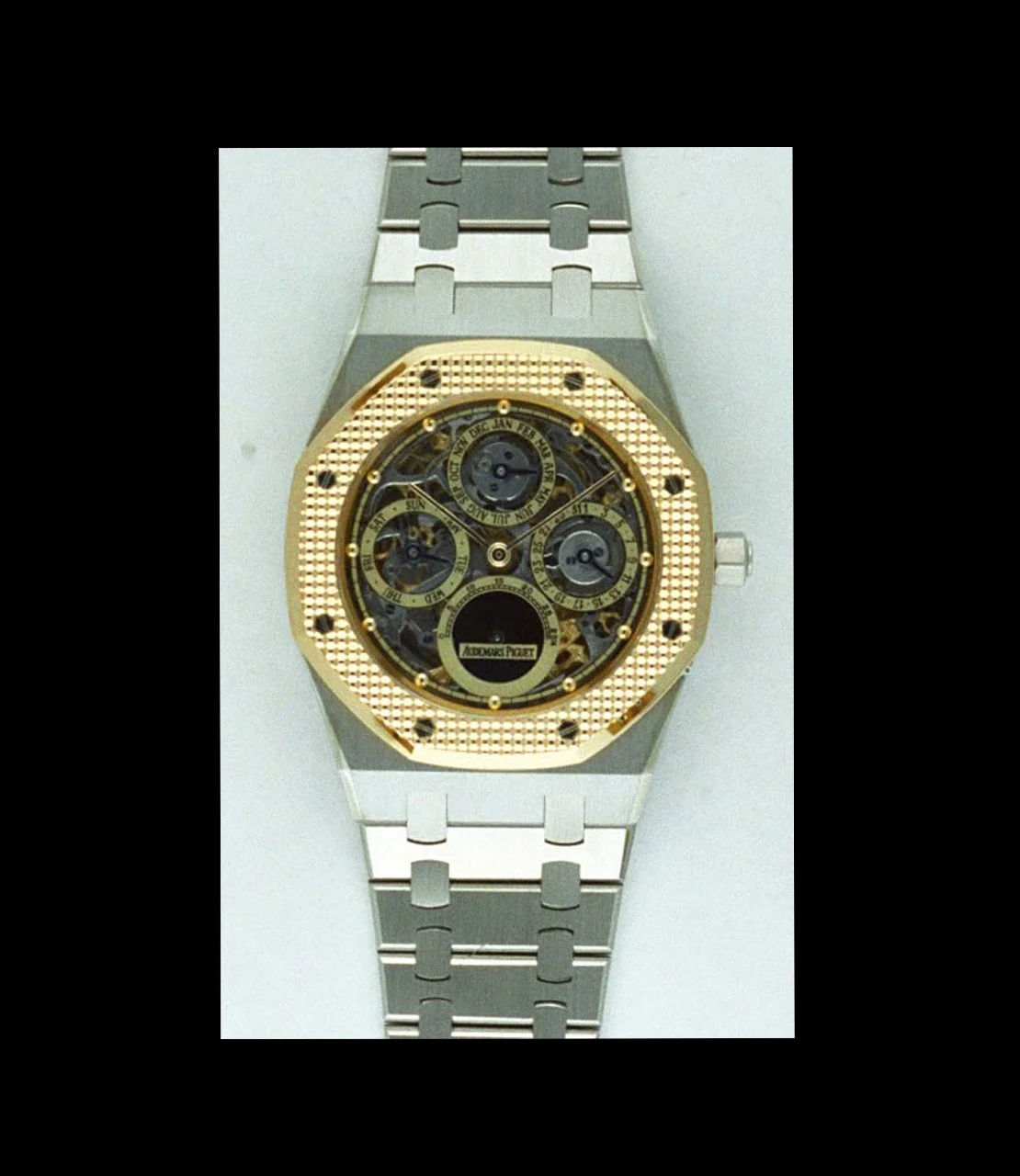
Circa 1989. Identification image of Model 25775SA. Audemars Piguet Archives.
A few words on dials
In the Audemars Piguet distribution archives, the description of the dial of each watch was gradually introduced from 1995 onwards and was definitively imposed in 2005. For earlier periods, it is sometimes difficult, if not impossible, to know for sure which dial equipped which watch on the day it left Le Brassus.
Royal Oak Perpetual Calendar watches offer fine examples of the artisanal practices of the time. The same dial plate could be finished in many different ways: colour, finishes, transfers... Moreover, the same dial reference could vary significantly according to the inspiration and skill of the artisan in charge. Moreover, a dial could be used on several different models, sometimes belonging to different collections. For example, the opaline gold dial can be found on the Royal Oak 25554BA, on the round watches 25550BA or 25557BA, as well as on the Royal Oak 25654BA and even 25686BA.
Let's take another example: the chased "Tuscany Blue" dial. To create this little masterpiece, the engraver finely chased a brass plate identical to the one used for many other models. With the help of scorpers and other dedicated tools, he hollowed out and pushed back the material to create a decoration which appears chaotic when viewed under a microscope, yet forms a refined and harmonious whole. The plate was then immersed in galvanic baths to coat the "Tuscany Blue", or "Blue No. 7".
“Tuscany Blue" chased dials for perpetual calendar models were produced from the early 1980s for round watches, including the 5561PT and 5568. It was not until the early 1990s that they were included in the Royal Oak collection, in Model 25654PT, then 25686SP in 1994. From 1995 onwards, certain platinum examples of the Royal Oak Jubilee 14802 were fitted with "Tuscany Blue" dials, but this time without the perpetual calendar.
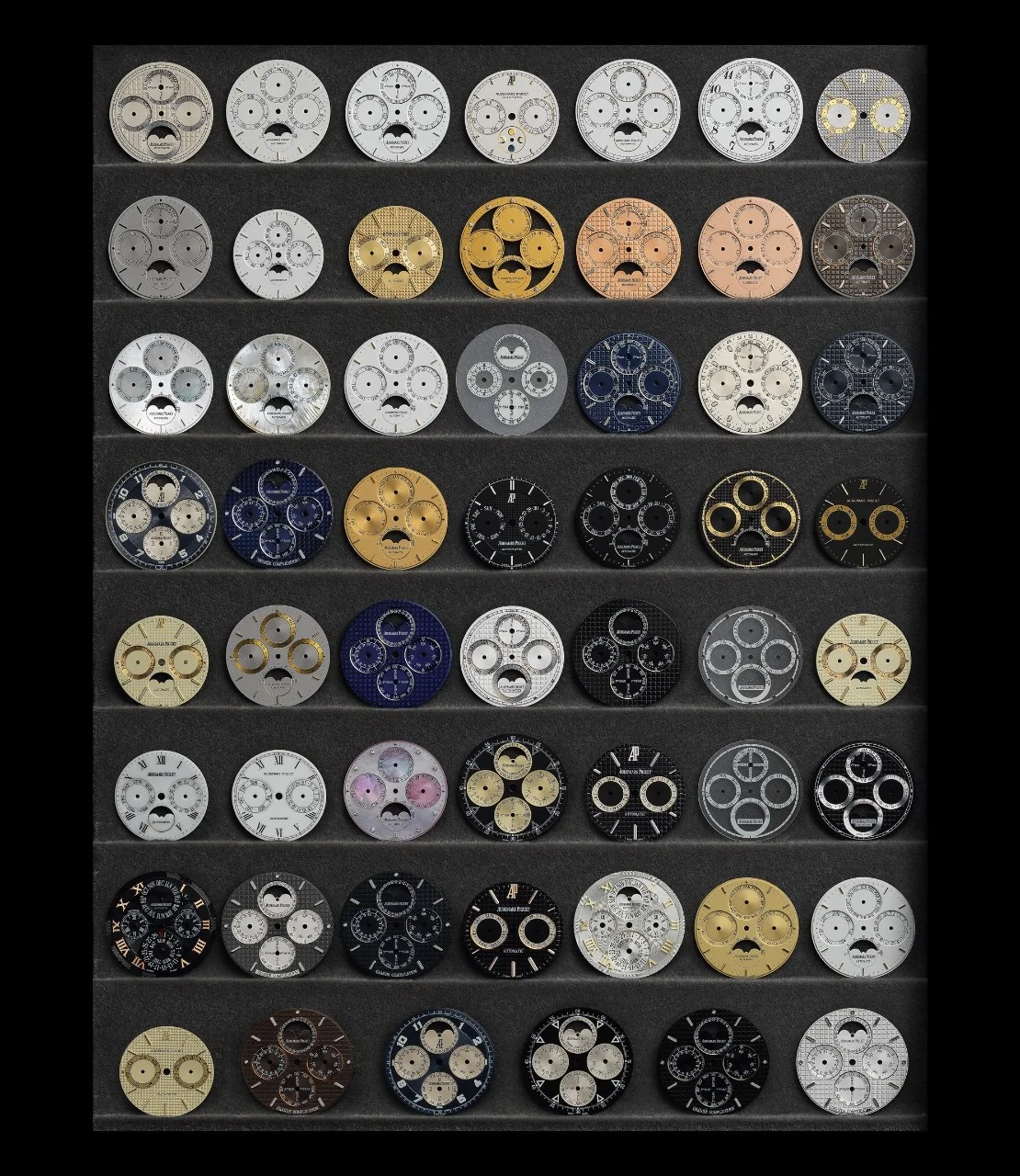
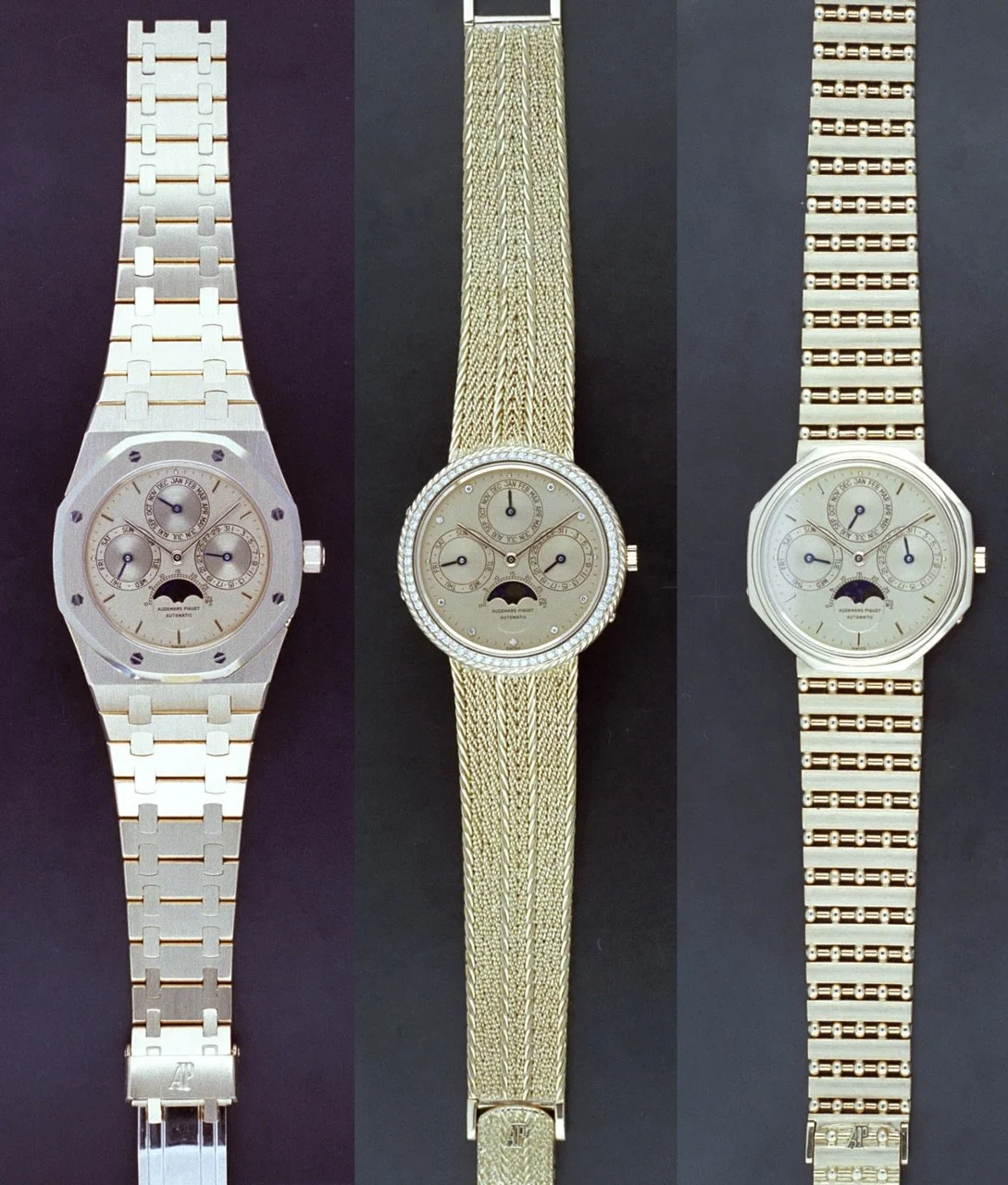
1980s–1990s. Perpetual calendar watches with a yellow gold-toned opaline dial. The same dial could be used on several different models. From left to right: Models 25554BA (dial also used in 25654BA and 25686BA), 25550BA and 25557BA. Audemars Piguet Archives.
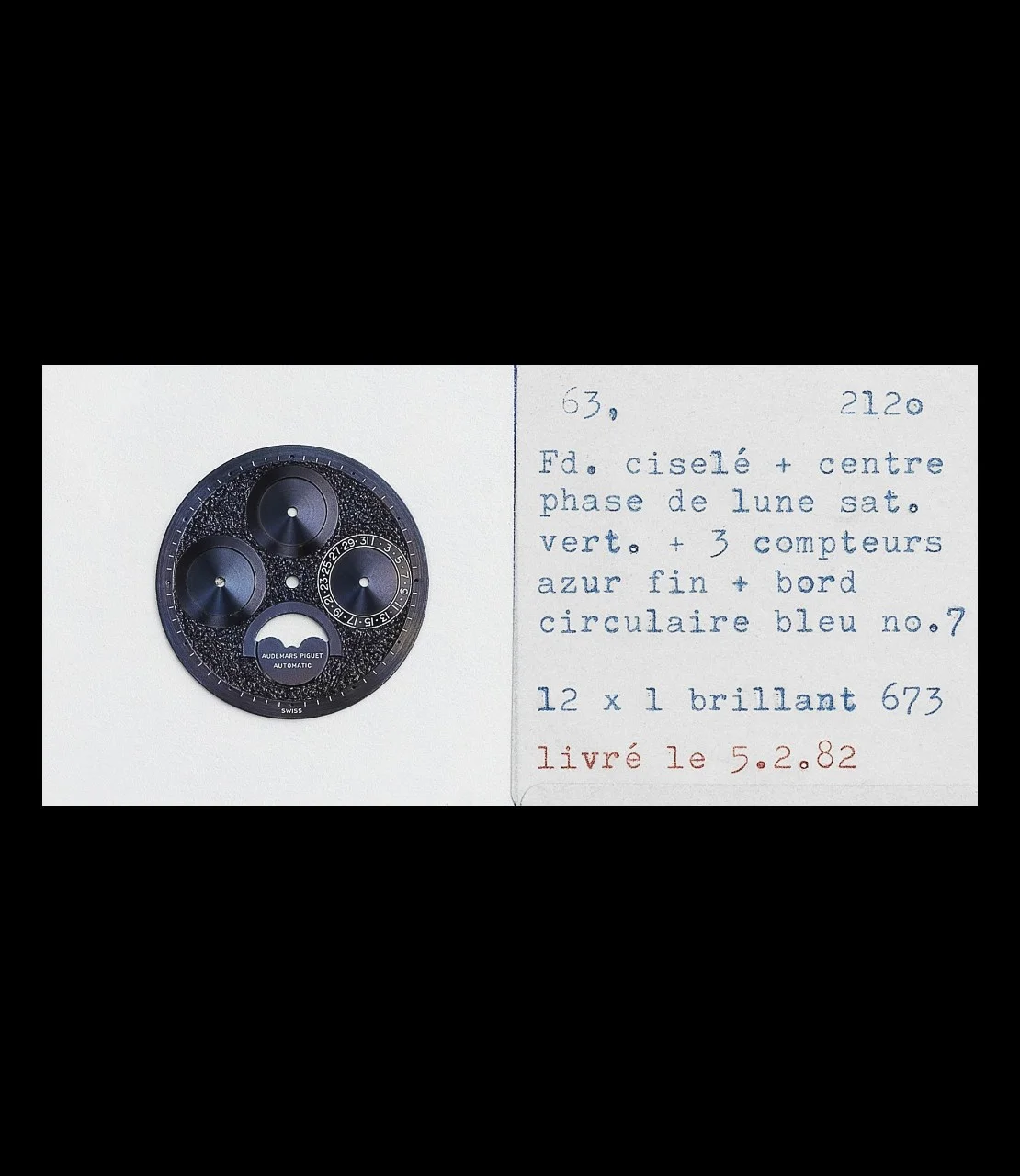
February 1982. Chased “Tuscany blue” dial blank N° 63. This variant was delivered in 1982 and was to have diamonds as hour-markers. Hand-chased dial. Dial-maker Stern's file. Audemars Piguet Archives.
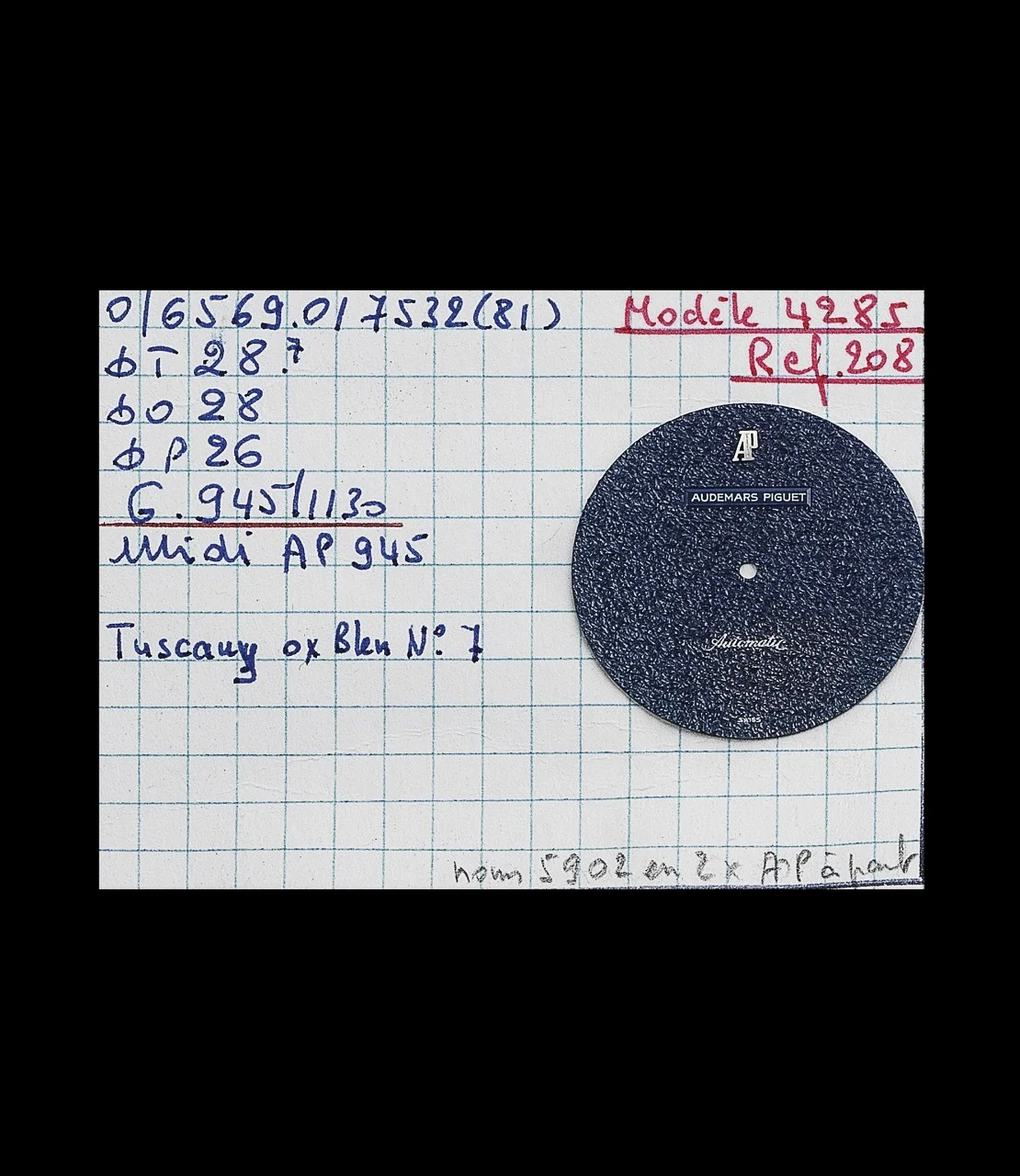
Circa 1982. Chased “Tuscany blue” dial N° 208. Intended for the 4285 model (Technical Data in 1982), this dial is entirely chased by hand and then coloured "Tuscany blue", or "Blue No. 7". Dial-maker Stern's file. Audemars Piguet Archives.
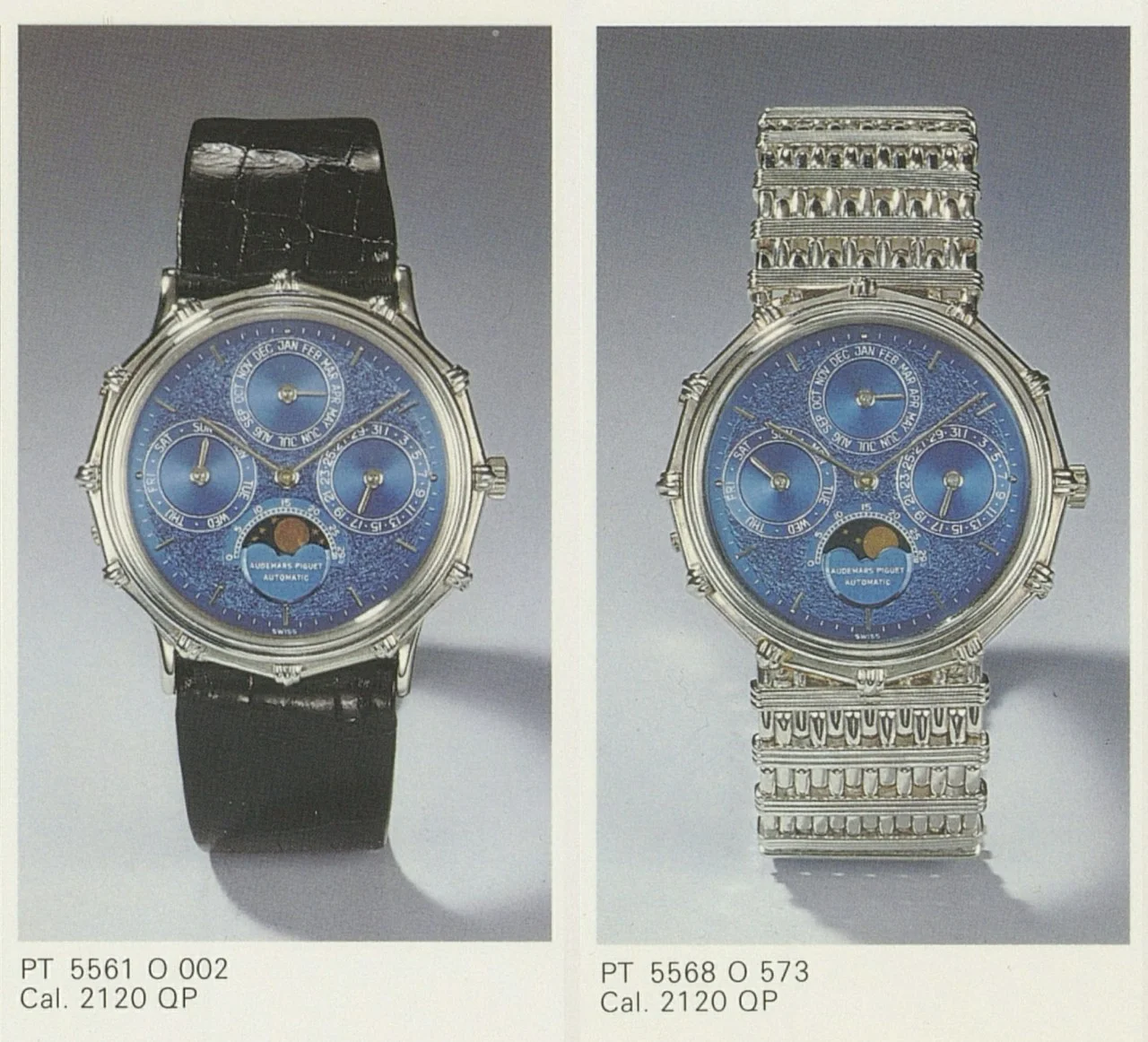
1985. Perpetual Calendar Models 5561 and 5568. Documented in 1981 and 1982, the 5561 and 5568 models are the first Audemars Piguet models with finely chased "Tuscany blue" dials. Audemars Piguet catalogue 1985. Audemars Piguet Archives.
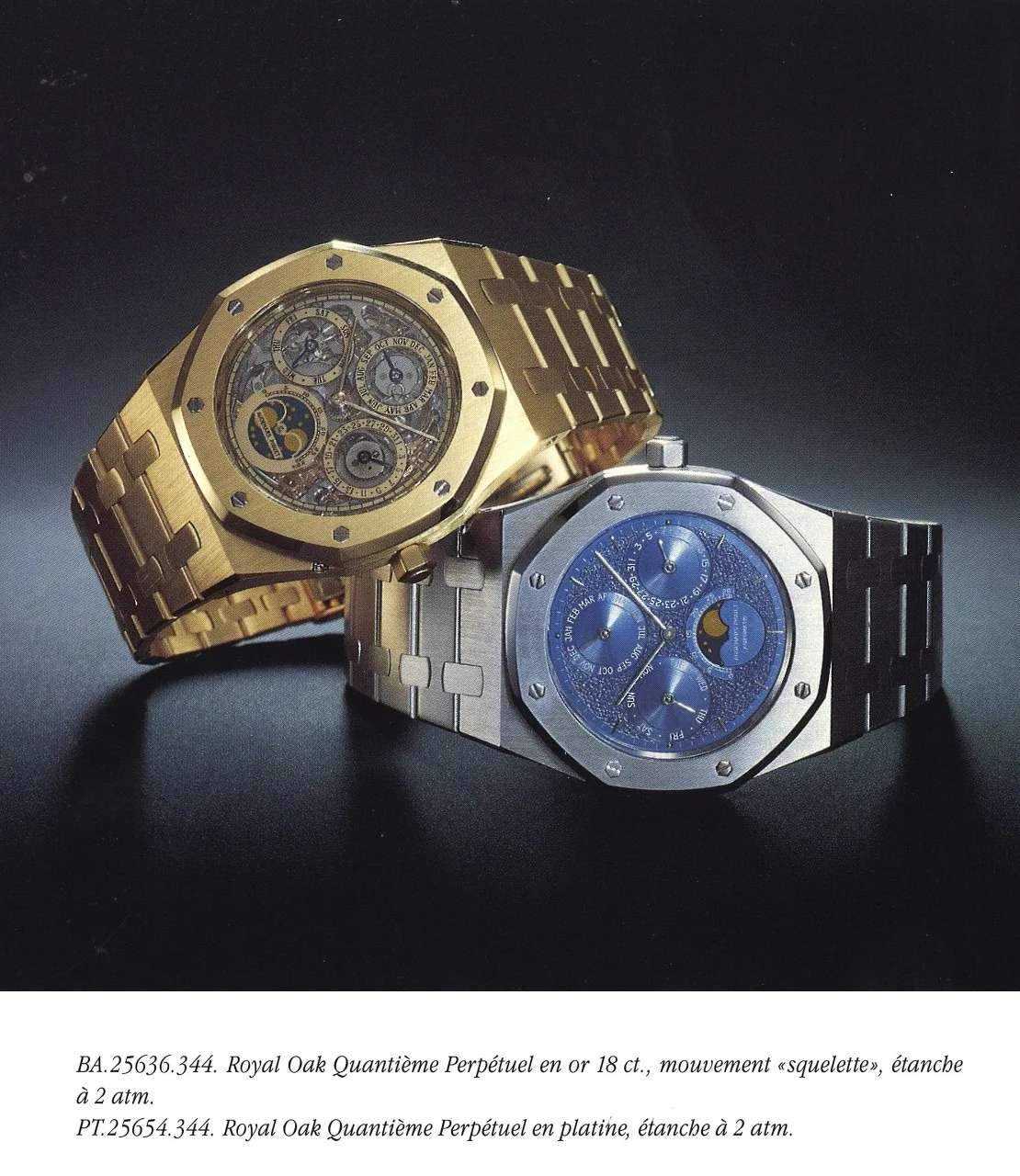
1991. Modèles 25636BA et 25654PT. Juxtaposed with the first Royal Oak Perpetual Calendar Openworked, Model 25654 in platinum features, probably for the first time in the collection, a finely chased "Tuscany Blue" dial. Audemars Piguet catalogue dated April 1991. Audemars Piguet Archives.
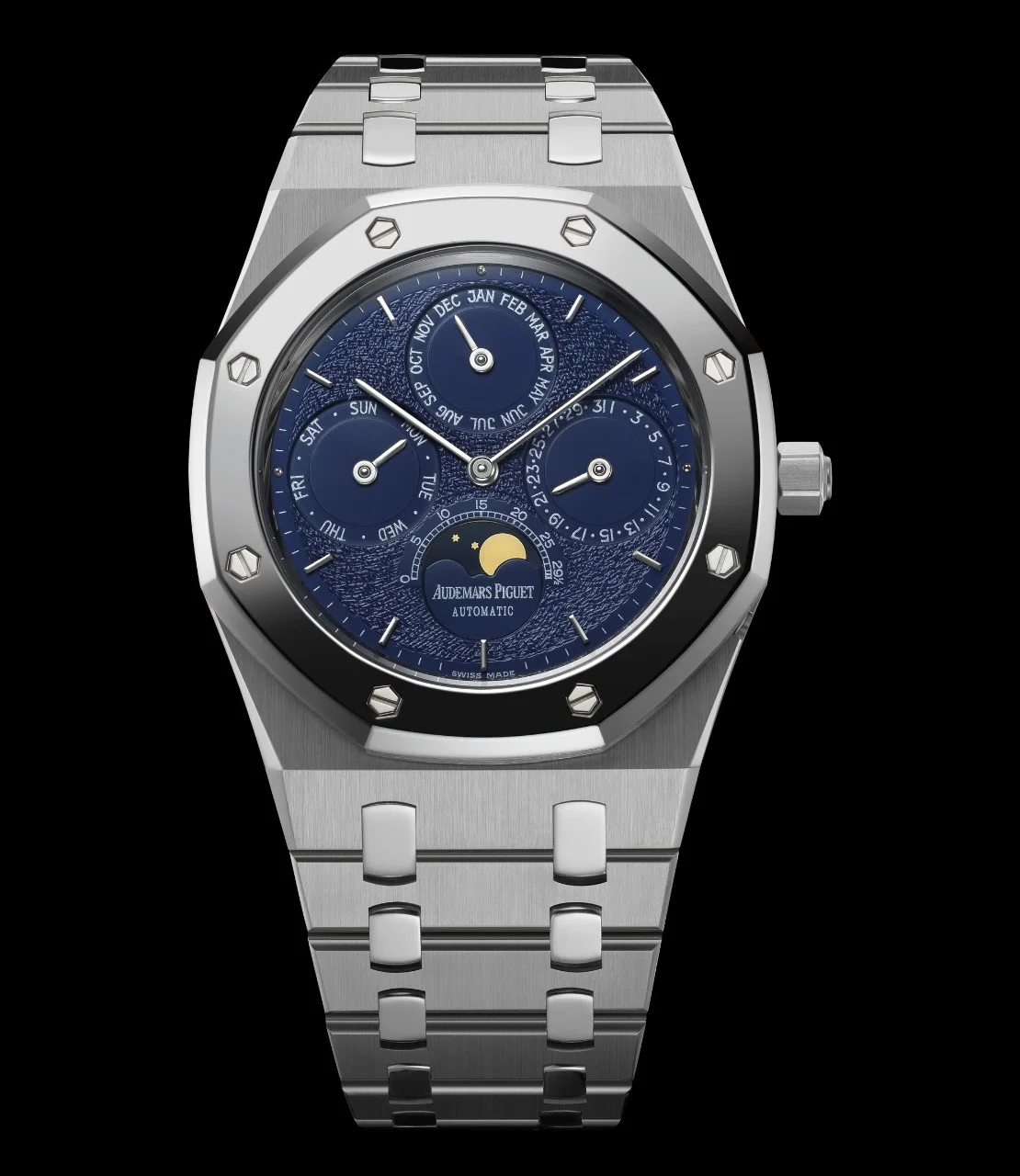
1994. Royal Oak Perpetual Calendar 25686SP N° 06/25. Perpetual calendar: day, date, month, phase and age of the moon. Extra-thin selfwinding Calibre 2120/2800 (3.95 mm), movement 374056. Bracelet 944. Finely chased “Tuscany blue" dial. 39 mm case D41976 in steel and platinum. Sold in Belgium in September 1994. Audemars Piguet Heritage, inv. 1046.
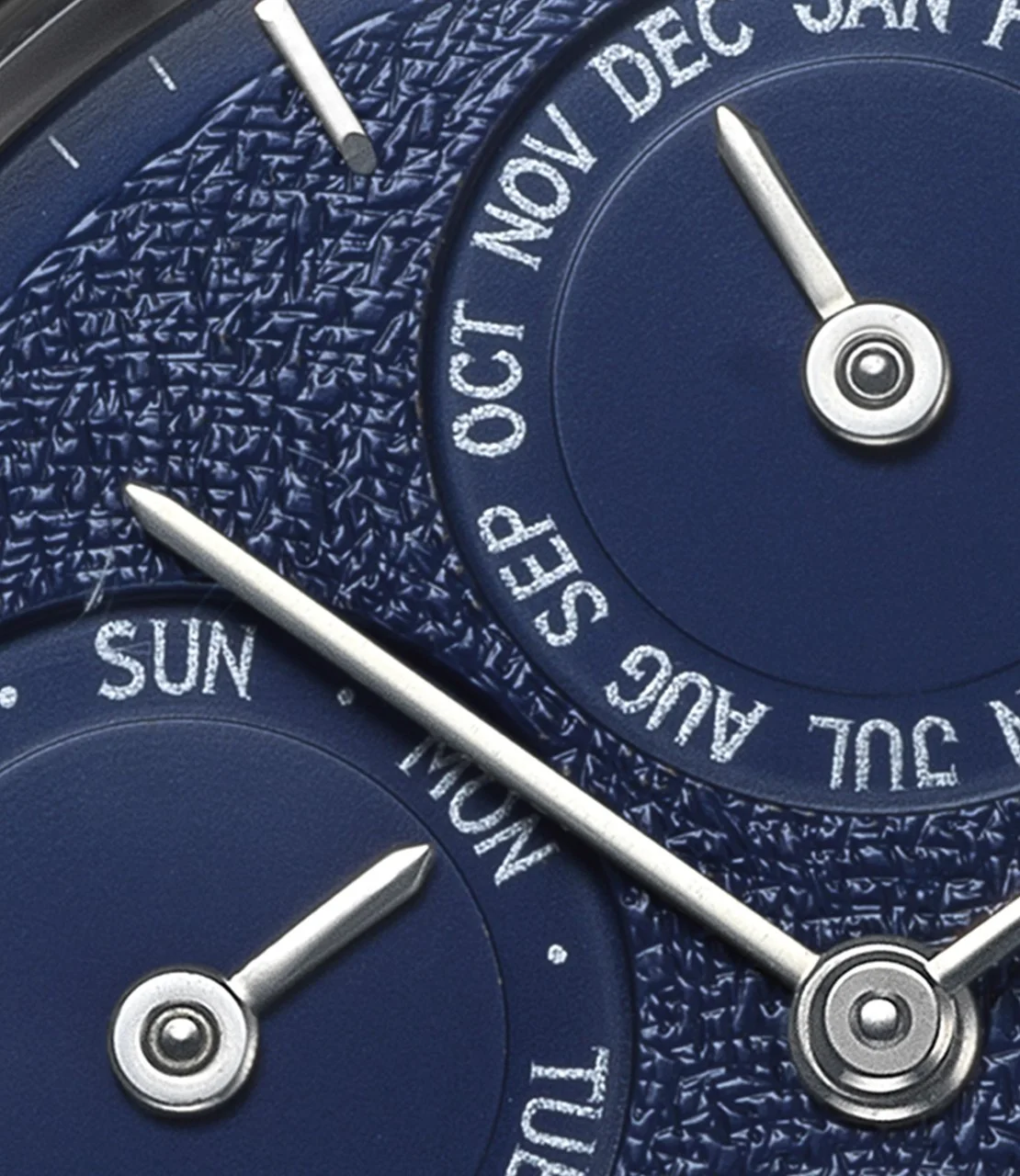
1994. Finely chased “Tuscany Blue” dial. Hand-crafted using several different tools, chasing creates a surface that is both very irregular and homogeneous. Detail of the Royal Oak 25686SP no. 06/25. Audemars Piguet Heritage, inv. 1046.
An extremely valuable watch
In 1972, the Royal Oak 5402 shocked the watchmaking world with its CHF 3,300 price tag, making it more expensive than some gold watches and earning it a reputation as the world’s most expensive steel watch. Few understood that this price was due to a superlative movement, an extremely refined dial and a highly complex casing whose decorative quality raised steel to the rank of a noble metal.
Just over a decade later, the Royal Oak Perpetual Calendar continued in the same vein. While the care lavished on its decoration is comparable to that of the first Royal Oak, Calibre 2120/2800 significantly increases its complexity and, consequently, its value. Thus, for example, a steel version of Model 25654 launched in 1988 was priced at CHF 24,900. This time, however, no one was bothered, as the watchmaking world had entered a new era in the wake of the quartz crisis. While the case material remained an undeniable value criterion, the most sought-after, greatly prized and highly valued quality was now based on expertise and innovation.
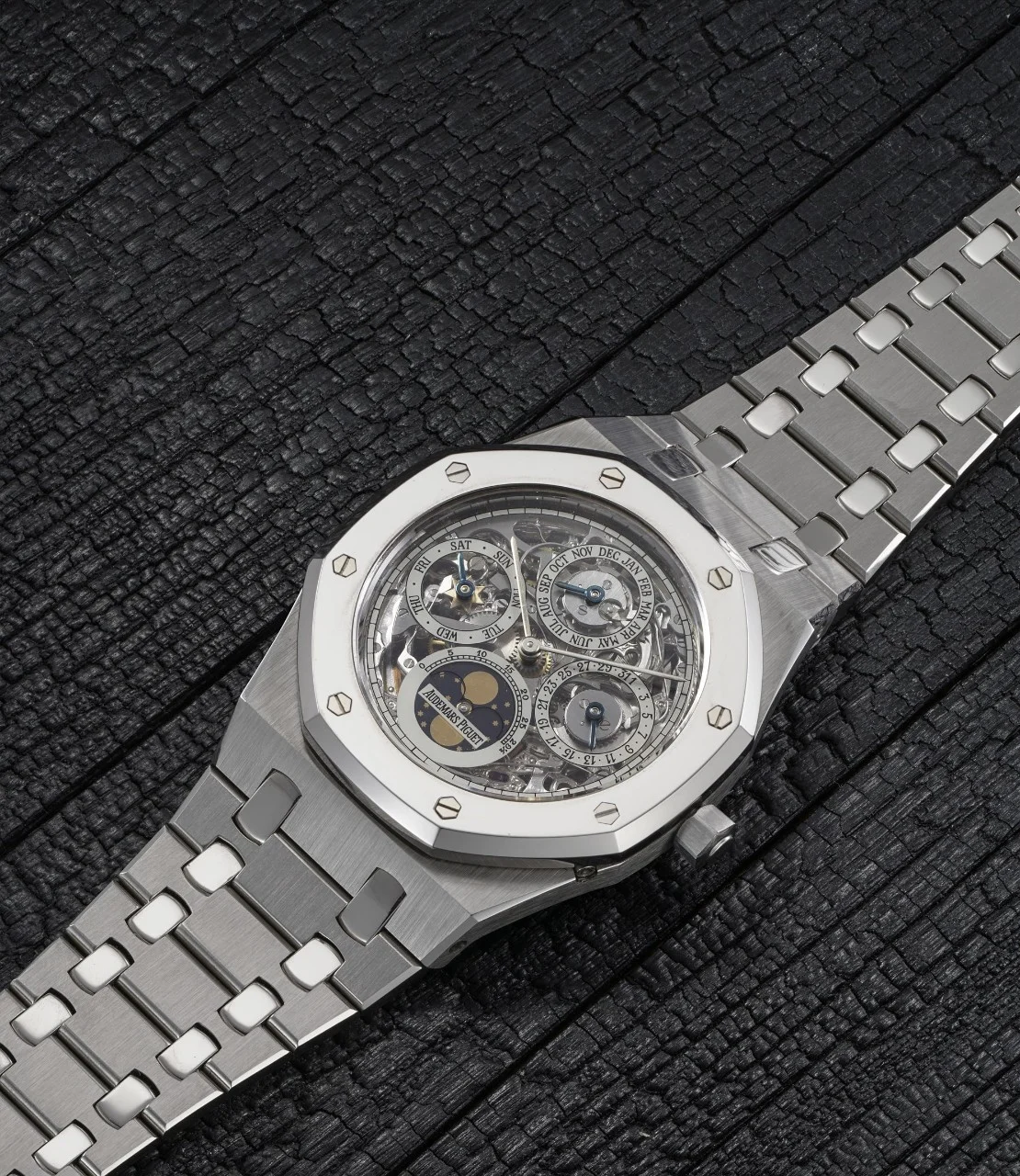
1994. Royal Oak Perpetual Calendar 25636SP N° 16/25. Perpetual calendar: day, date, month, phase and age of the moon. Calibre 2120/2800, selfwinding, extra-thin (3.95 mm) and openworked, movement 391011. Bracelet 944. 39 mm case D42001. Steel and platinum. Sold to a client in Belgium in October 1994. Auctioned by Phillips Geneva on May 6, 2022, lot 42. © Phillips
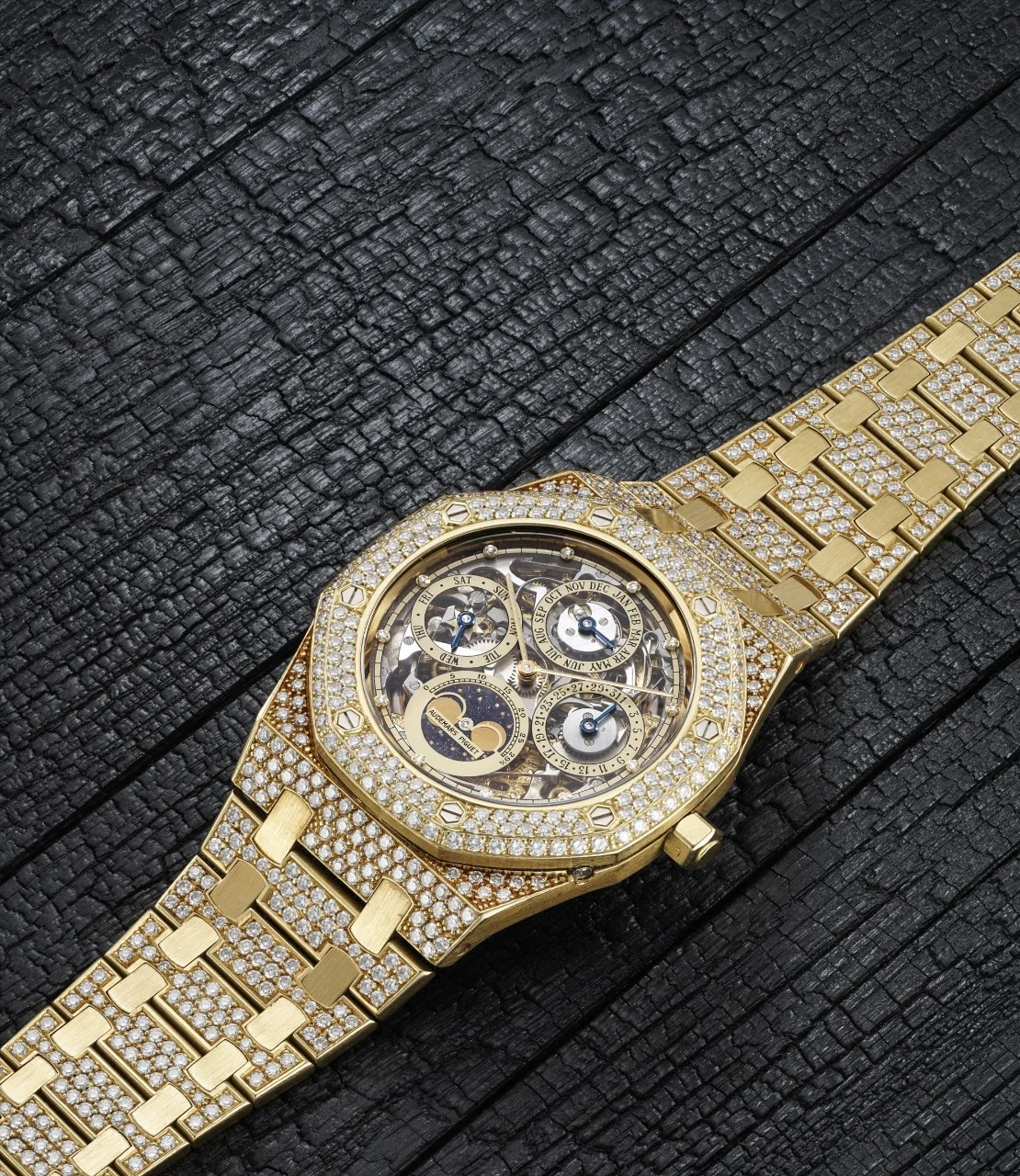
1988. Haute Joaillerie Royal Oak Perpetual Calendar Openworked 25659BA, N° 03, dial side. Perpetual Calendar: day, date, month, phase and age of the moon. Extra-thin (3.95 mm) and openworked selfwinding Calibre 2120/2800, movement 274089. Bracelet 344. 39 mm case C31040 in 18-carat yellow gold entirely set with brilliant-cut diamonds. Sold on December 15, 1988. Sold at auction by Phillips in Geneva on May 6, 2022, lot 72. Image © Phillips.
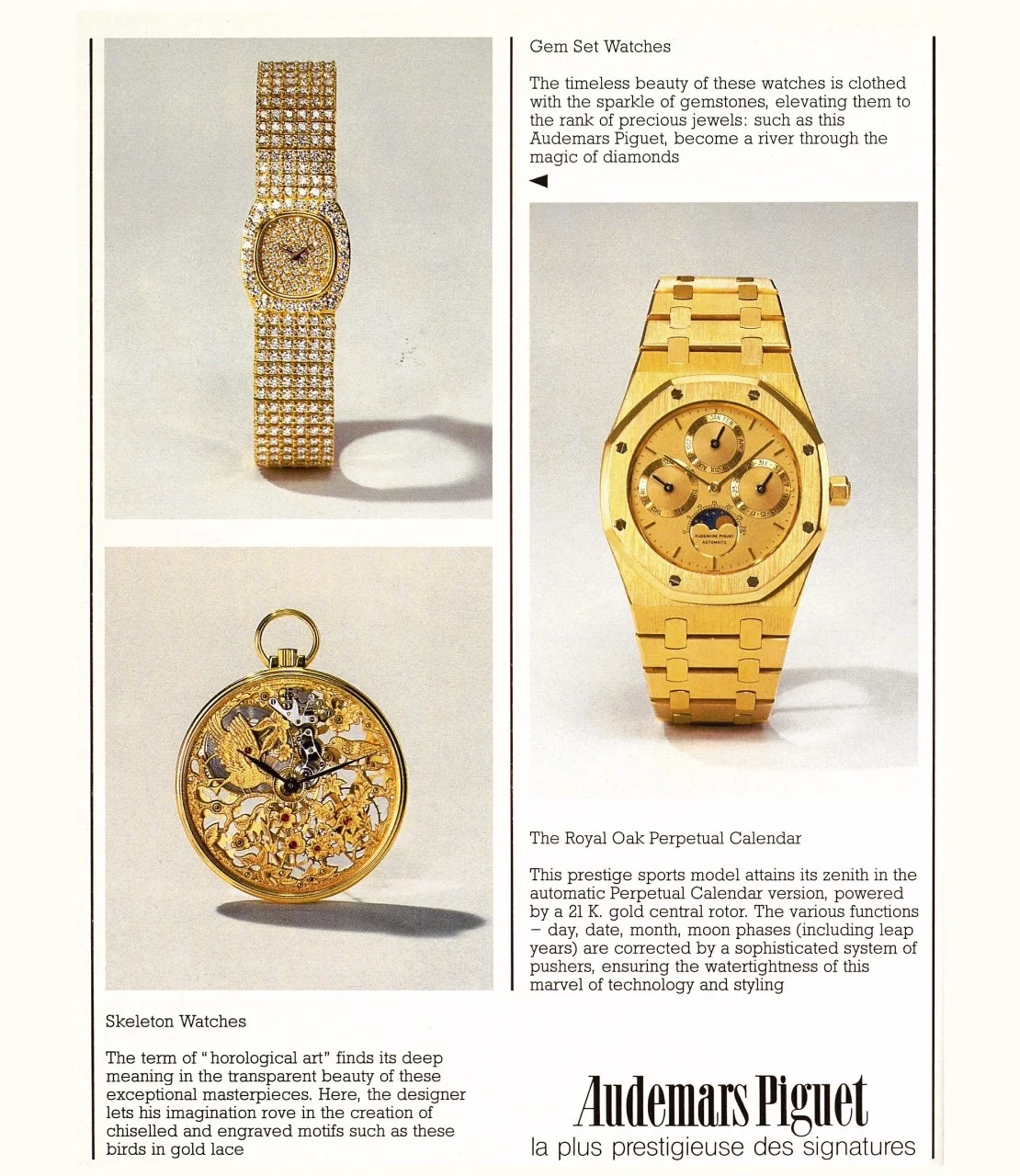
1985. Audemars Piguet advertisement. The advert presents three timepieces emblematic of traditional skills: gemsetting, openworking and horological complications. Europastar, Europe, n° 150-2, 1985, p. 6.
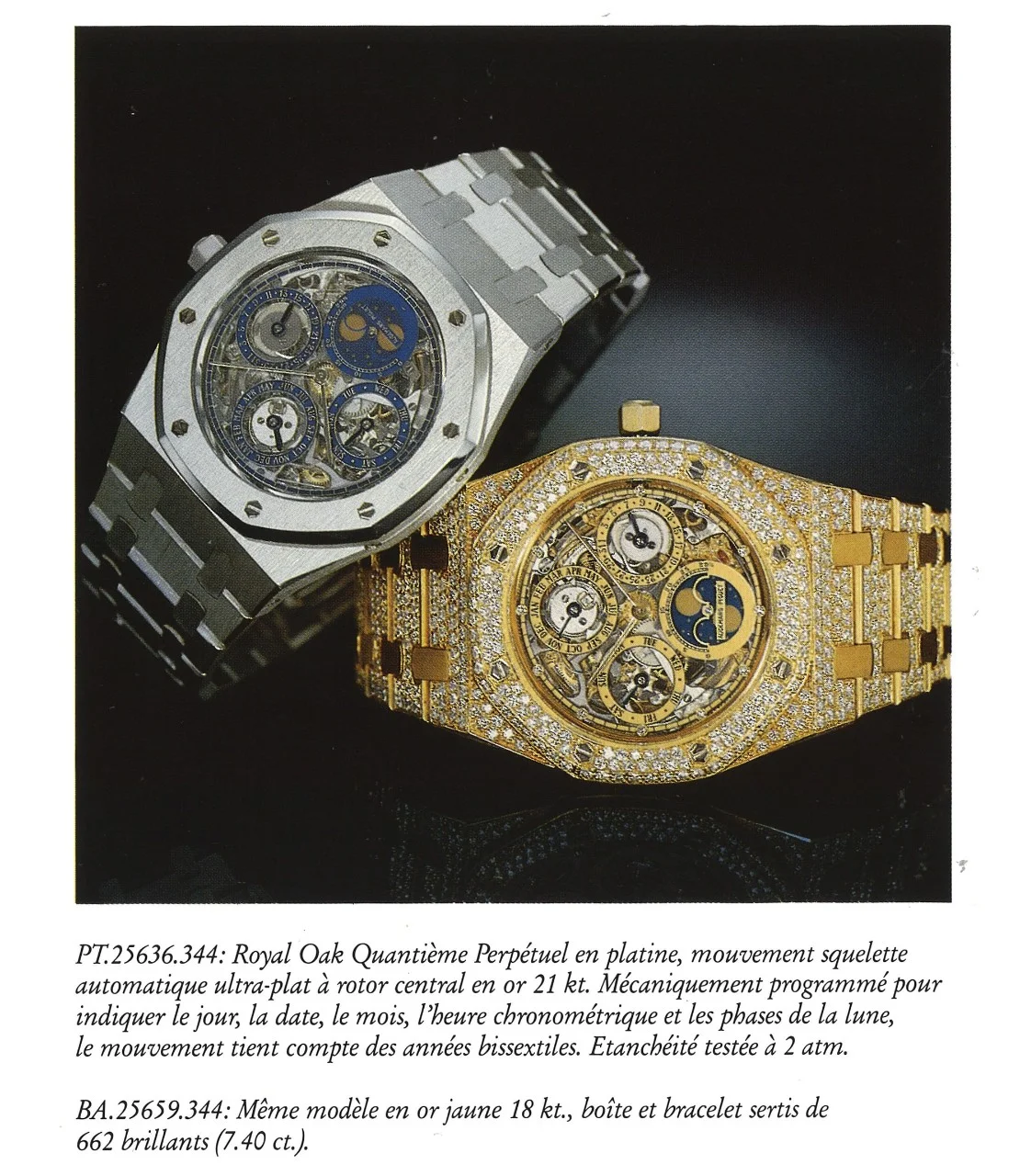
1988. Royal Oak Perptual Calendar Openworked 25636PT and 25659BA. A promotional leaflet pictures two side-by-side Royal Oak Perpetual Calendar Openworked models, one in platinum, the other in fully set yellow gold. Audemars Piguet Archives.
Subsequent generations
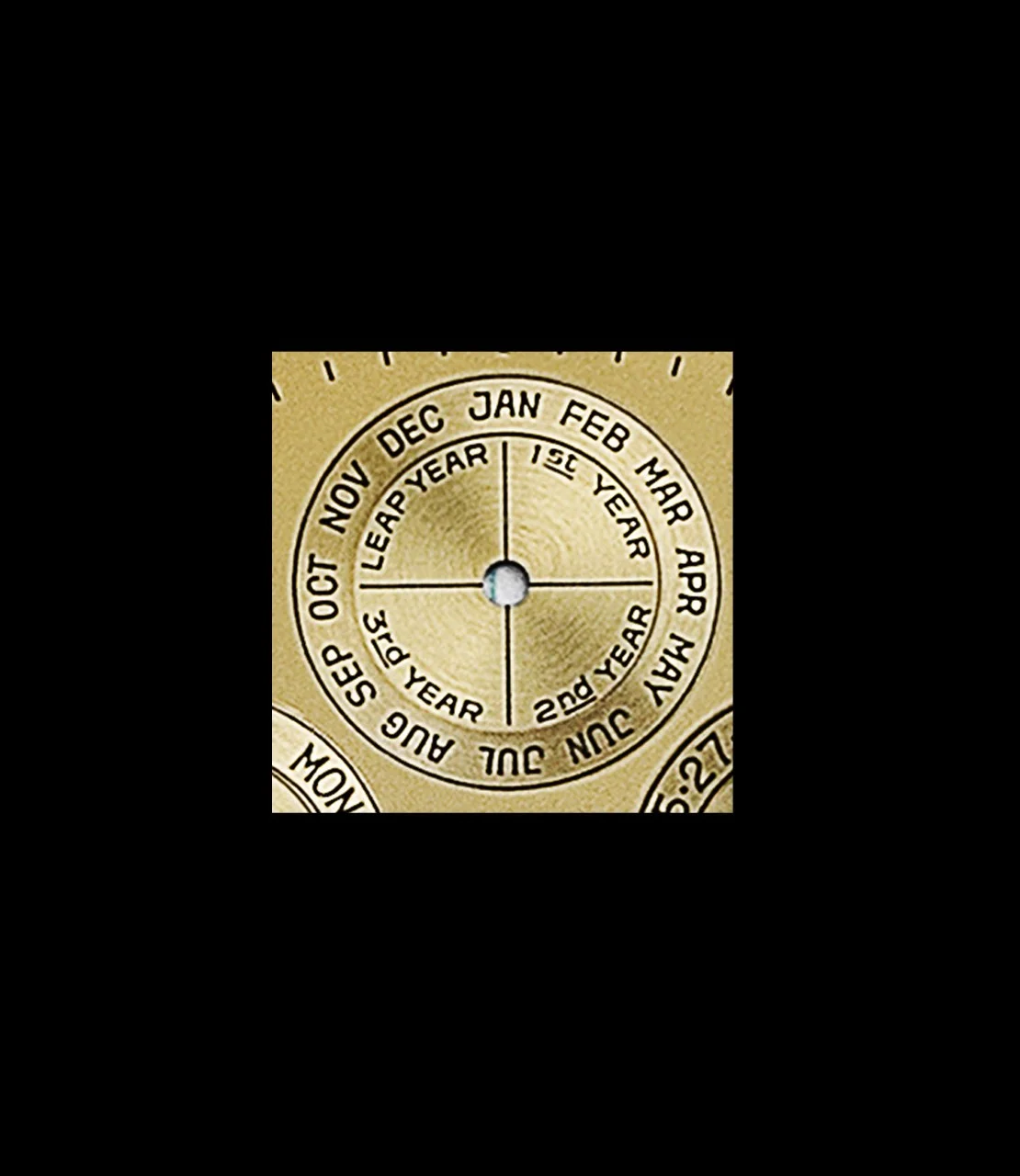
In 1978, in order to reduce the thickness of the mechanism, the designers of Calibre 2120/2800 chose not to equip it with a leap-year indicator, even though Audemars Piguet had played a pioneering role in this field in 1955. Gradually, however, the need for an annual marker to set the watch became more pressing. Audemars Piguet took the plunge in 1996 with Calibre 2120/2802. The story written since 1996 is a substantial field of interest that will require further lengthy and fascinating research. However, to give you a taste of it, let us recall a few milestones that have marked this eventful history.
Two models dominate the first period: the Royal Oak 25820 and its openworked variant Model 25829, of which more than 2,000 were produced and sold between 1996 and 2013. Other creations deserve a mention, notably the Royal Oak Jubilee 20th Anniversary 25810OR and its peripheral 52-week indication; the ladies’ Royal Oak Perpetual Calendar 33 mm Model 25800 (1996), then Model 25932. Other specialities include the annual calendar introduced in 1999 (25920), and the equation of time in 2010 in the Royal Oak Model 26603.
Despite this creativity and the last-minute rescue of Calibre 2120 at the dawn of the new millennium, customer interest in Royal Oak calendar watches was slowly waning. In the course of 2012, the Royal Oak’s 40th anniversary year, only 13 openworked Model 25829 timepieces were sold. No openworked Model 25820 variant had left Le Brassus for three years! The Royal Oak Perpetual Calendar was running out of steam. The teams remember with nostalgia the heyday during which Audemars Piguet 500 perpetual calendars per year! For many, the page had been definitively turned.
Nonetheless, François-Henry Bennahmias, who took the reins of the company in 2012, strongly believed that it still had a future. In 2015, the watchmakers presented a new-generation calibre, still based on the 2120, named 5134. It was used to equip the Royal Oak 26574, which featured a revisited, dynamic aesthetic. The markets were abuzz and to mark this launch, a brochure entitled Audemars Piguet Calendar Watches told the story of the brand's calendars. It was followed in 2018 by the book titled Audemars Piguet 20th Century Complicated Wristwatches. While these publications fuelled collectors’ interest, the highlight of this revival took place in 2017, with the launch of the Royal Oak Perpetual Calendar 26579CE in black ceramic. From then on, there could be no doubt that the renaissance was going to happen – and its success would surpass anything previous.
At the same time, the perpetual calendar mechanism was thoroughly revisited, leading in 2018 to the Royal Oak Selfwinding Perpetual Ultra-Thin RD#2 (6.3 mm). At just 2.89 mm thick, its Calibre 5133 broke the thinness record previously held for 40 years by Calibre 2120/2800 (3.95 mm). This was more than just a record and revealed a newly emerging approach to mechanical architecture.
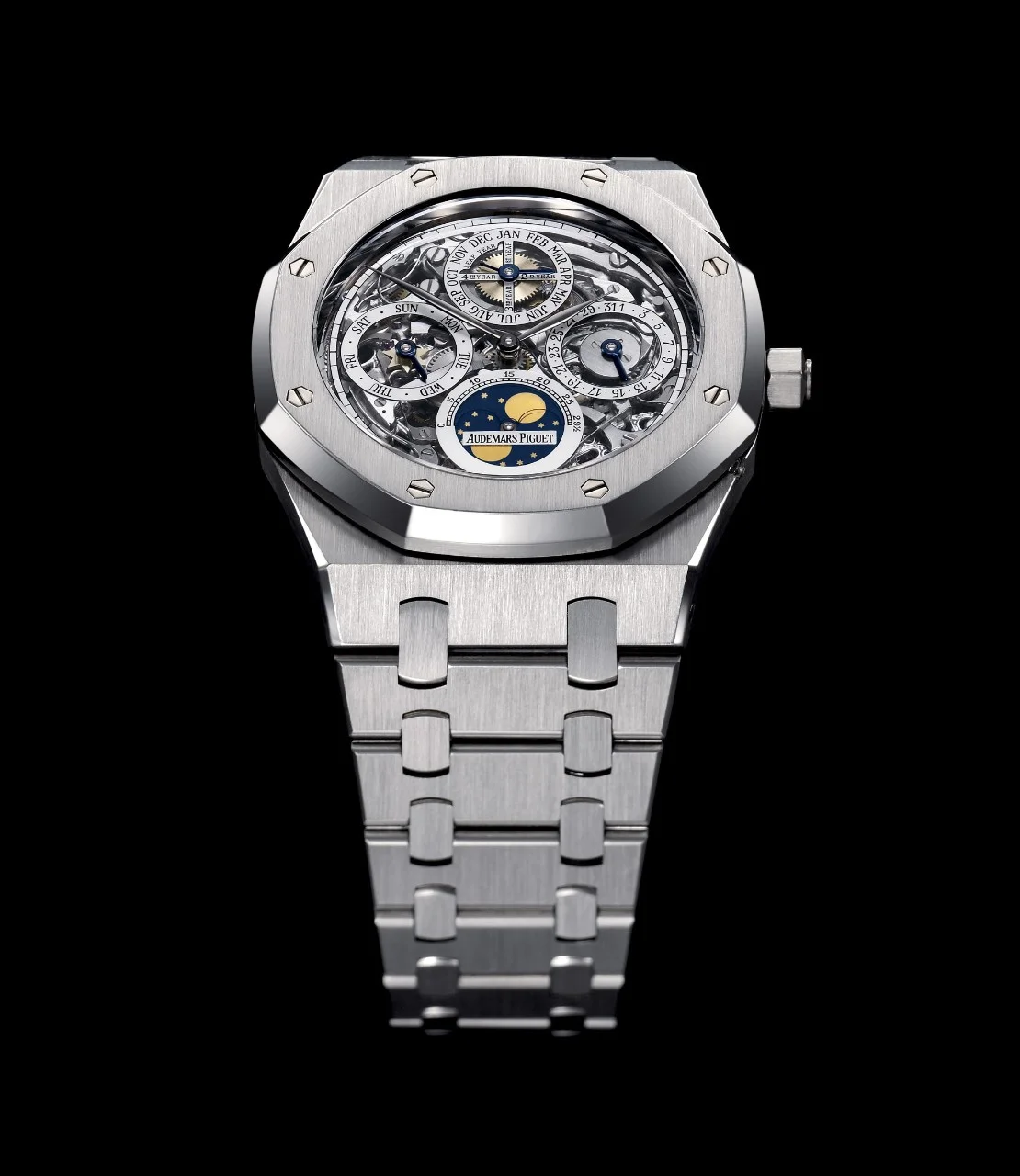
~2010. Royal Oak 25829. Perpetual calendar: day, date, month, phase and age of the moon. Calibre 2120/2802SQ selfwinding, ultra-thin (3.95 mm) and openworked. Image produced for the 2010 Catalogue. Audemars Piguet Archives.

~2005. Royal Oak Perpetual Calendar 25820SP. Perpetual calendar: day, date, month, leap year, phase and age of the moon. Selfwinding extra-thin Calibre 2120/2802SQ (3.95 mm). Photograph taken circa 2005. Audemars Piguet Archives.
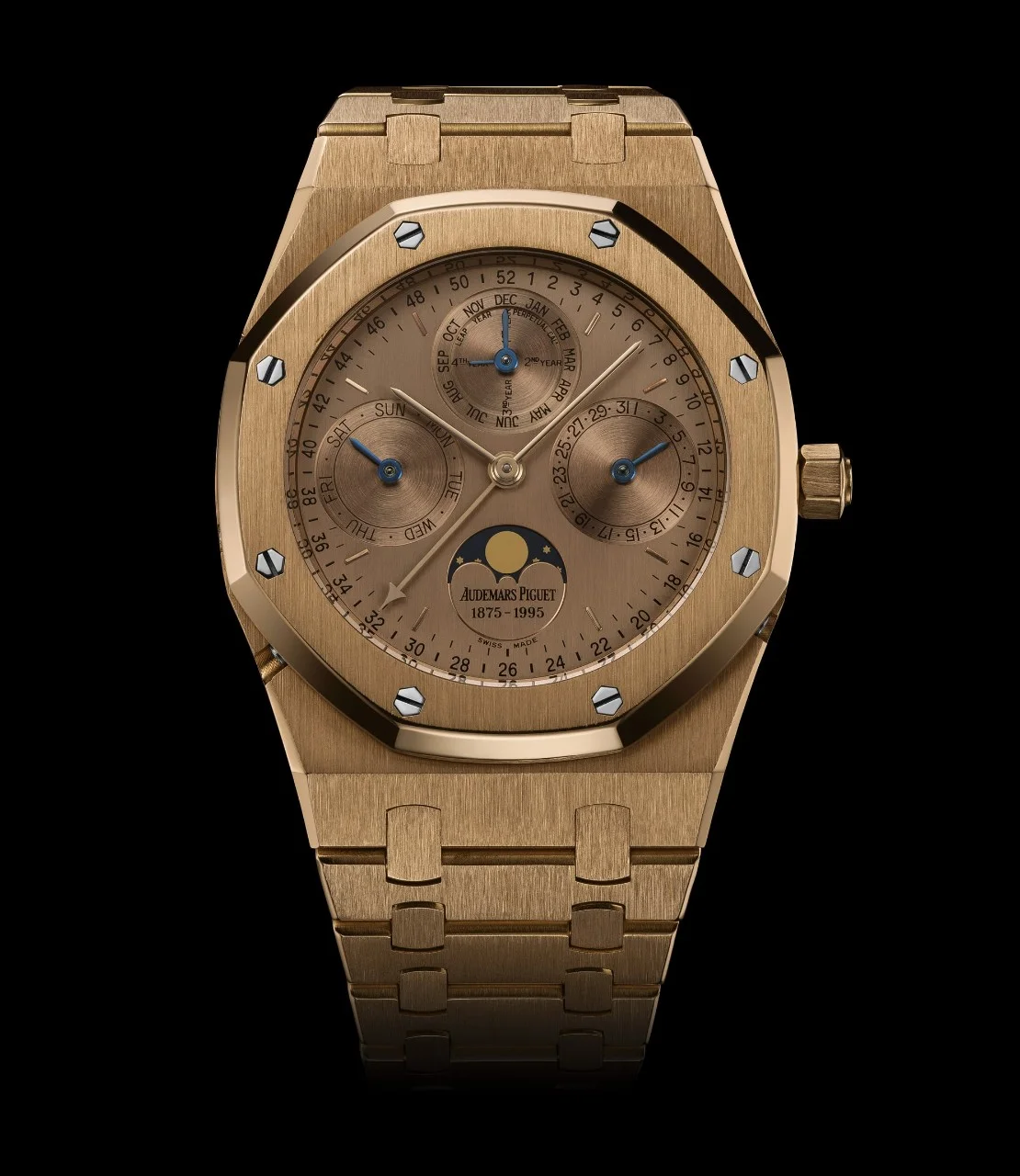
1995. Royal Oak Perpetual Calendar Jubilee 25810OR. Perpetual calendar: day, date, week, month, leap year, phase and age of the moon. Selfwinding, extra-thin Calibre 2120/2801, Movement 438015. Bracelet 944. 39 mm case 68785 in 18-carat pink gold. 120-piece limited edition. Sold in Germany in November 1995. Audemars Piguet Heritge, inv. 1460.
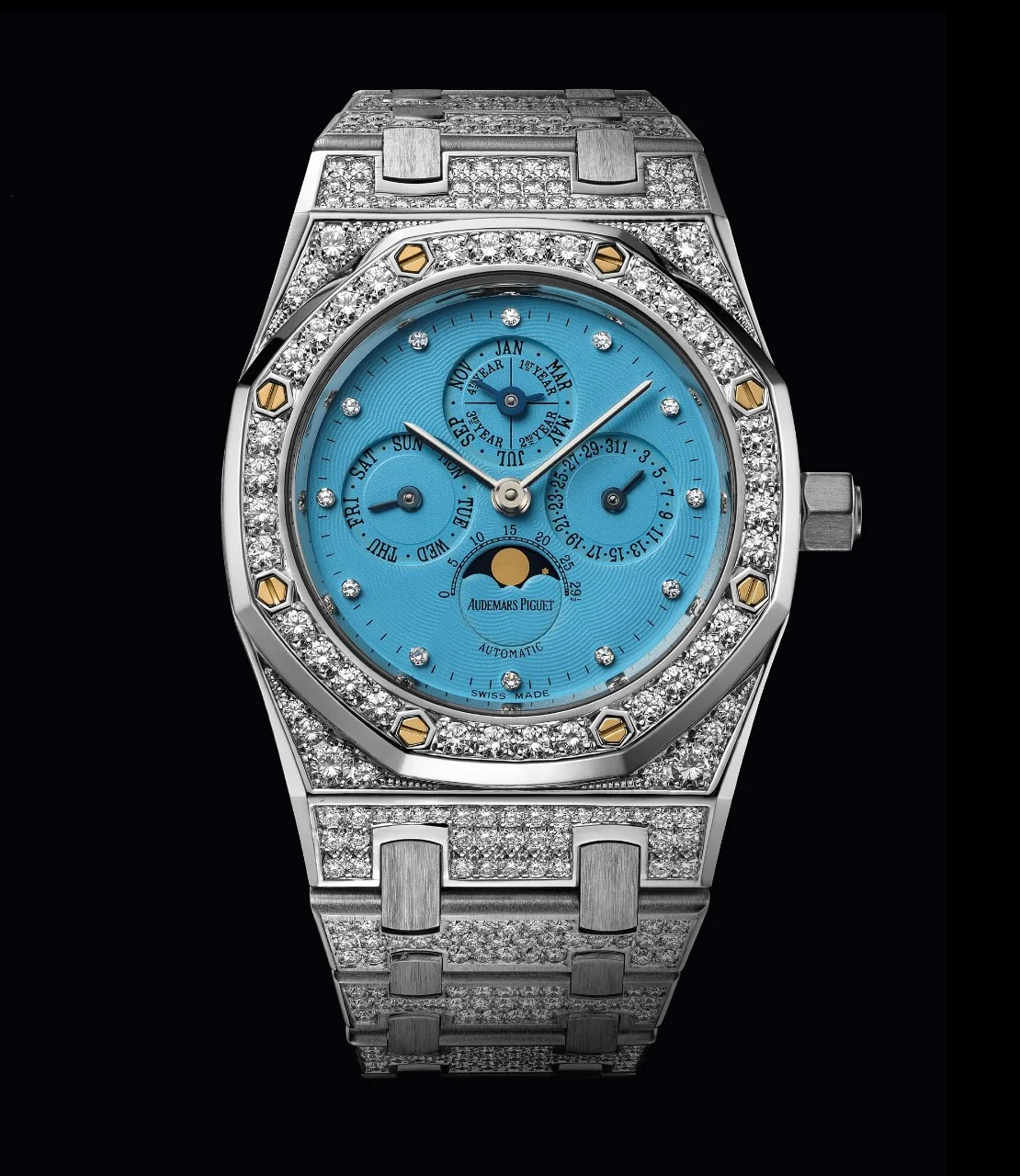
1999. Royal Oak Perpetual Calendar 25932BC. Perpetual calendar; day, date, week, month, leap year, phase and age of the moon. Selfwinding Calibre 2141/2806, Movement 442916. Bracelet 789. 33 mm case D80708 in white gold set with 540 diamonds. Sold in Germany in May 199. Audemars Piguet Heritage, inv. 1834.
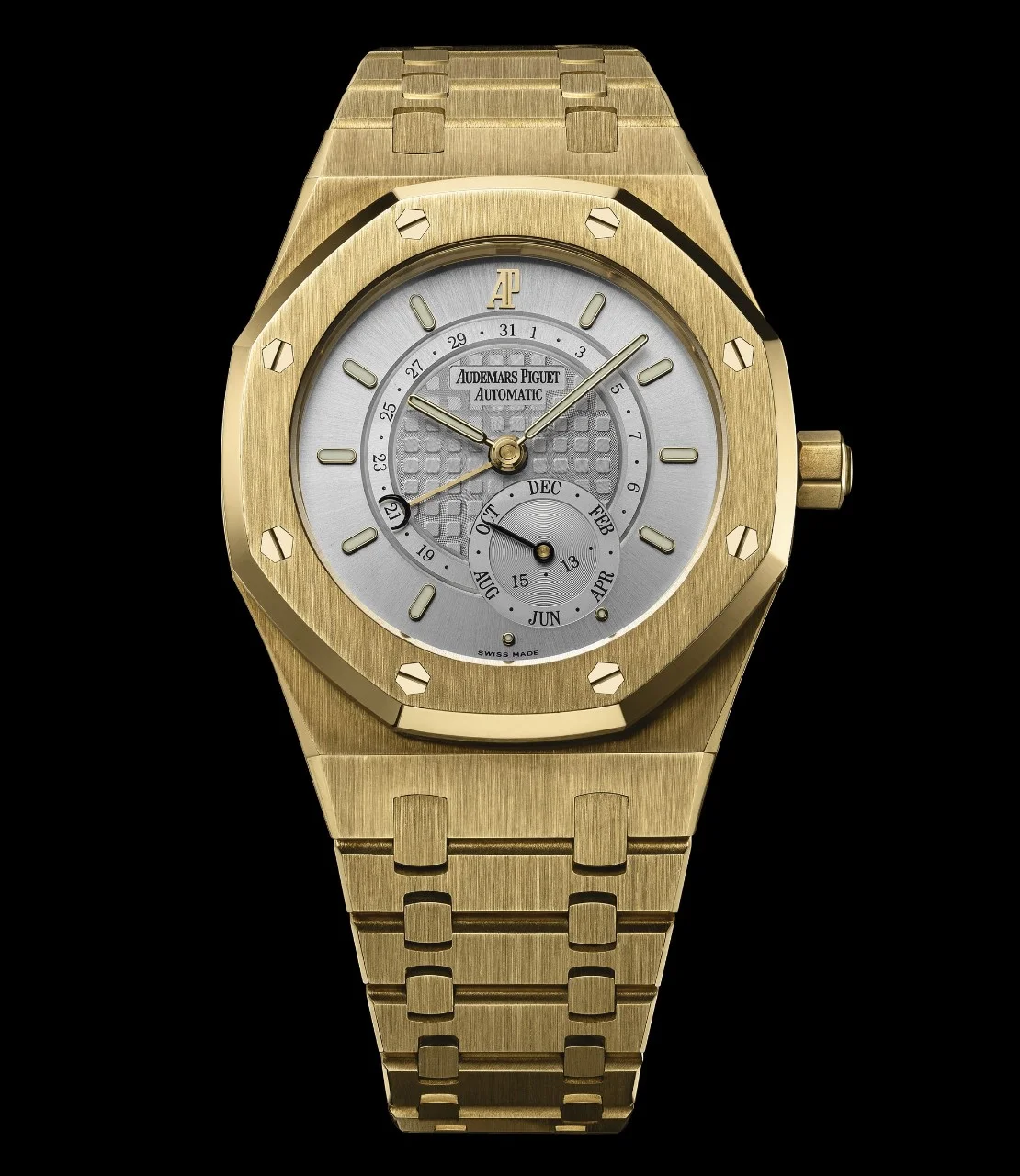
~1999. Royal Oak Annual Calendar 25920BA No. 182. Prototype with no movement probably presented at the Basel Fair in 1999. Date. Calibre 2224/2814. 36 mm case E20336 in 18-carat yellow gold. Audemars Piguet Heritage, inv. 609.
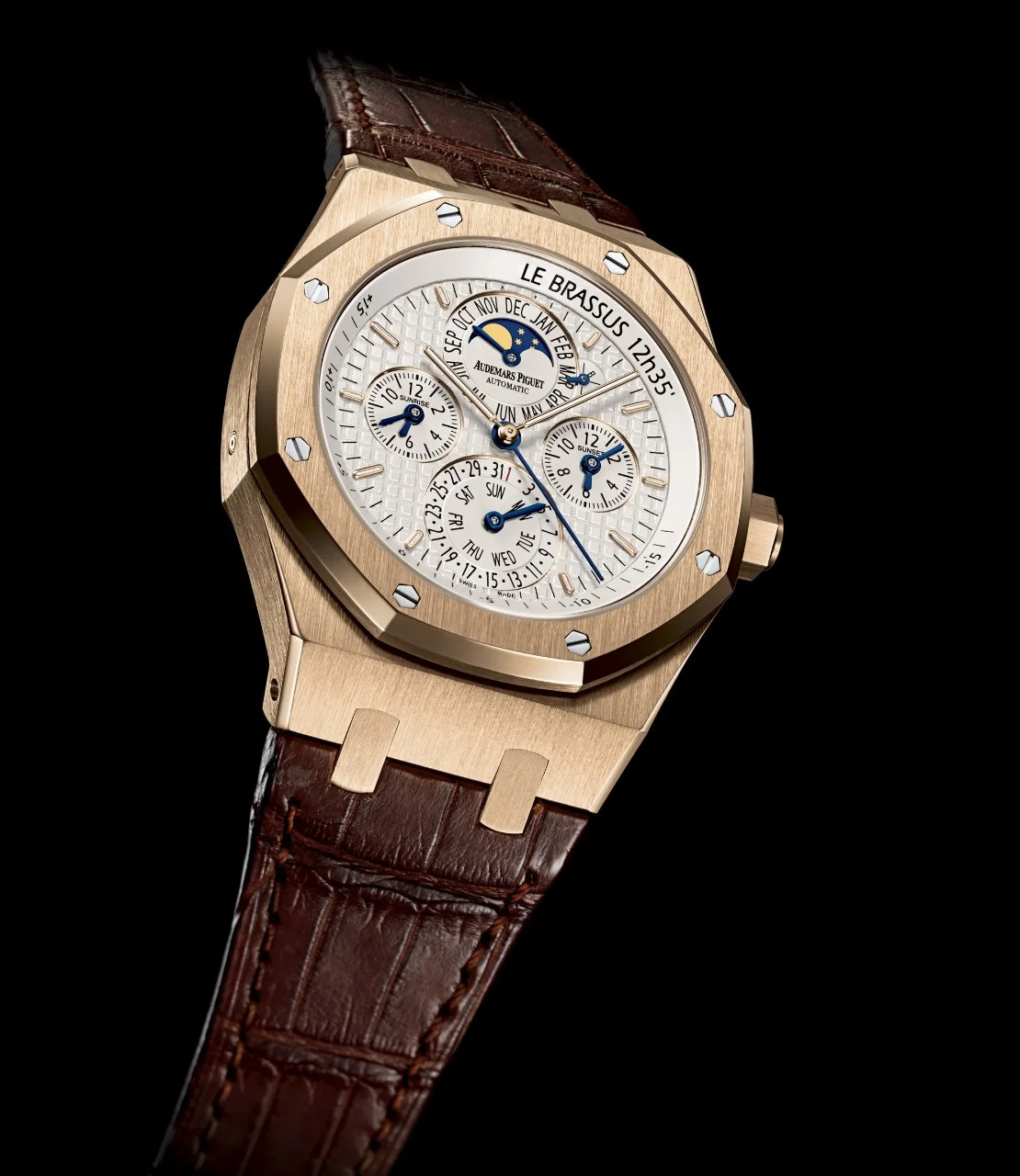
~2010. Royal Oak Equation of Time 26606. Perpetual calendar: sunrise and sunset times, equation of time (solar time). Selfwinding Calibre 2120/2808. Photograph taken circa 2010. Audemars Piguet Archives.
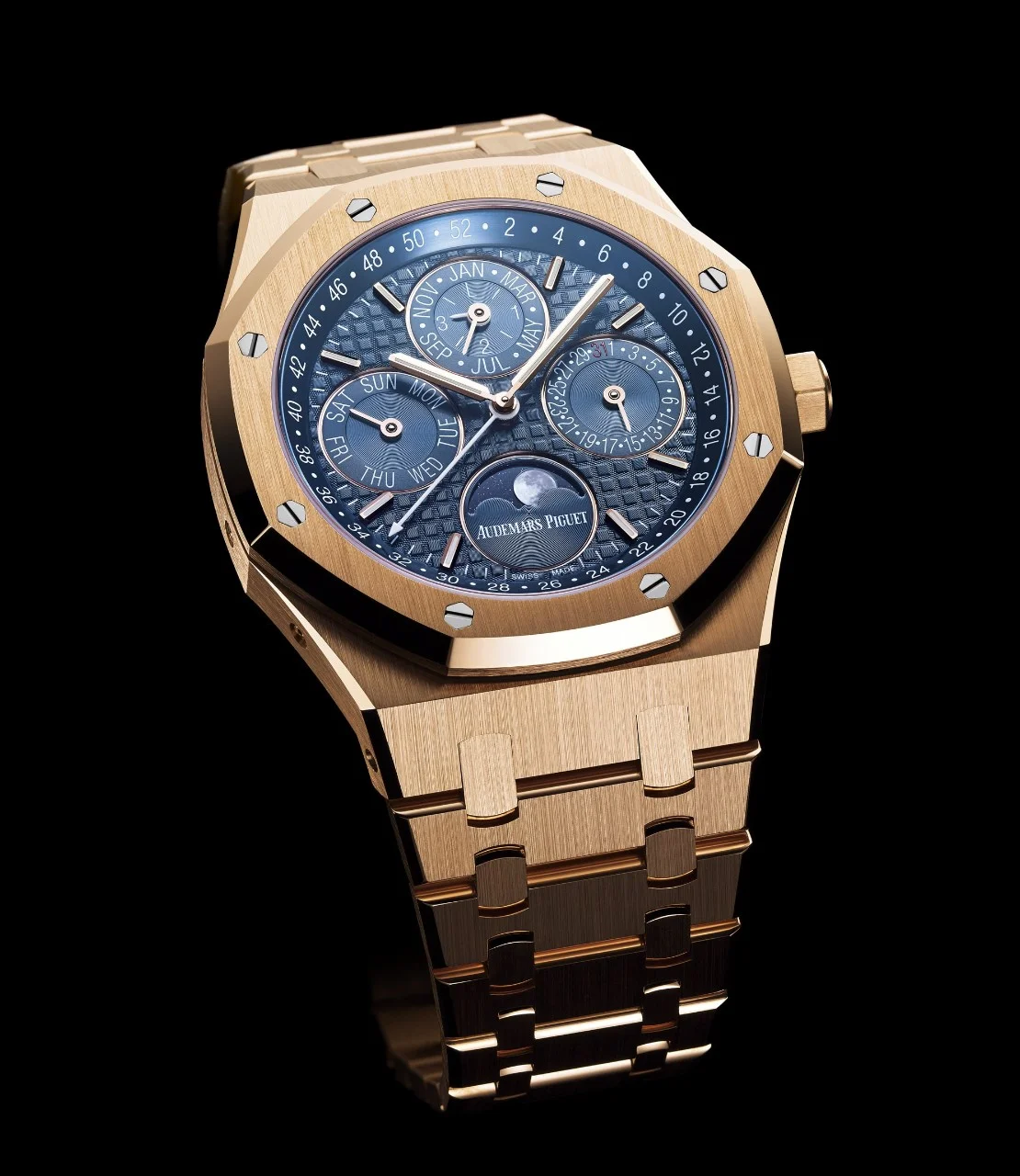
~2015. Royal Oak Perpetual Calendar 26574OR. Perpetual calendar: day, date, week, leap year, precise moon phase. Selfwinding Calibre 5134. Photograph taken circa 2015. Audemars Piguet Archives.

2017. Royal Oak Perpetual Calendar 26579CE Perpetual calendar: day, date, moon phase. Extra-thin selfwinding Calibre 5134 (4.31 mm), movement 961120. Bracelet 1225 and 41 mm case J37062 in black ceramic. Watch that joined the Audemars Piguet Heritage Collection in 2019, inv. 1913.
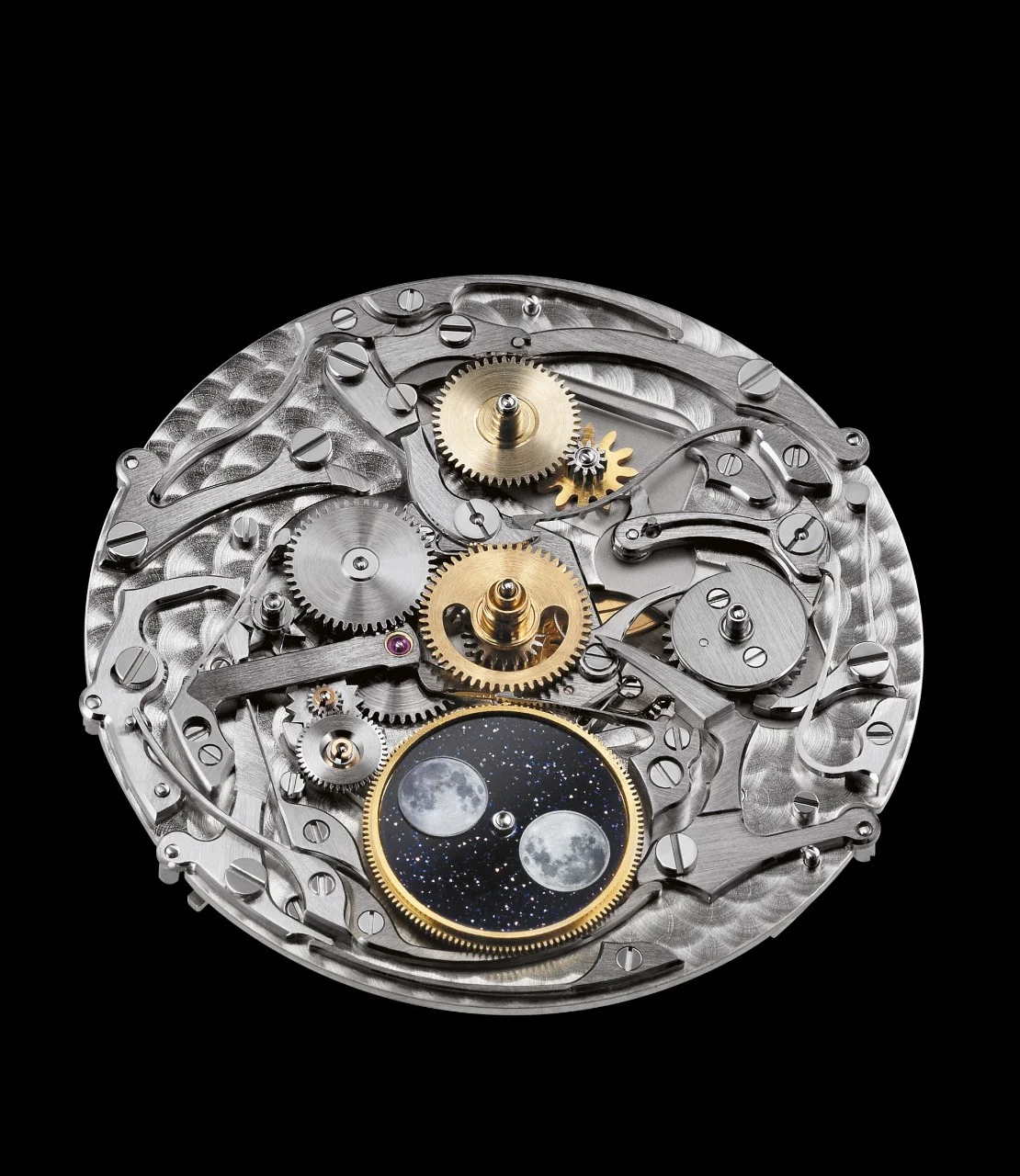
2015. Calibre 5134. Perpetual calendar: day, date, week, moon phase and leap year. Bidirectional selfwinding. 29 mm x 4.32 mm. 19,800 vph, 38 jewels, 40h power reserve, 374 components. Photographed in 2015. Archives Audemars Piguet.

2019. Royal Oak Perpetual Calendar Ultra-Thin 26586IP. Perpetual calendar: day, date, month, moon phase, leap year. Selfwinding ultra-thin Calibre 5133 (2.89 mm), Movement AM3317. Bracelet 240. 41 mm case K27520 in platinum and titanium. Audemars Piguet Heritage, inv. 2057.
Summing up
Royal Oak calendar watches belong to the grand tradition of complication watches. They perpetuate the age-old art of astronomical timepieces, whose origins date back thousands of years to the history of calendars and the emergence of civilisations.
The first Royal Oak with a calendar was presented in 1983. It indicated the day and date in large counters, which led to it being nicknamed “the owl". Its Model 5594 (25594) variation with moon phase at 6 o'clock remained in the catalogue for more than 20 years, setting a record. In 1984, the Royal Oak took a new step by adopting a classic complication for the first time: the perpetual calendar. Born of a somewhat crazy attempt to fit Calibre 2120/2800 inside a Royal Oak 5402 (7.1 mm thick), Model 25554 experienced a complicated birth. Only the perseverance and talent of the Le Brassus watchmakers enabled it to begin writing a new and promising chapter in history.
Between 1984 and 1994, 12 models were created, of which 1,746 units were produced. Devoid of the leap-year indication, this first generation had three types of case. The first one measured 7.5 mm thick, a feat unequalled to this day. At 8.3 mm, the second offered greater water-resistance. As for the third, its 8.8 mm thickness enabled it to be fitted with a transparent caseback highlighting the beauty of the mechanism, which was sometimes openworked.
In 1996, when Calibre 2120/2800 gave way to Calibre 2120/2802, the story was only just beginning...
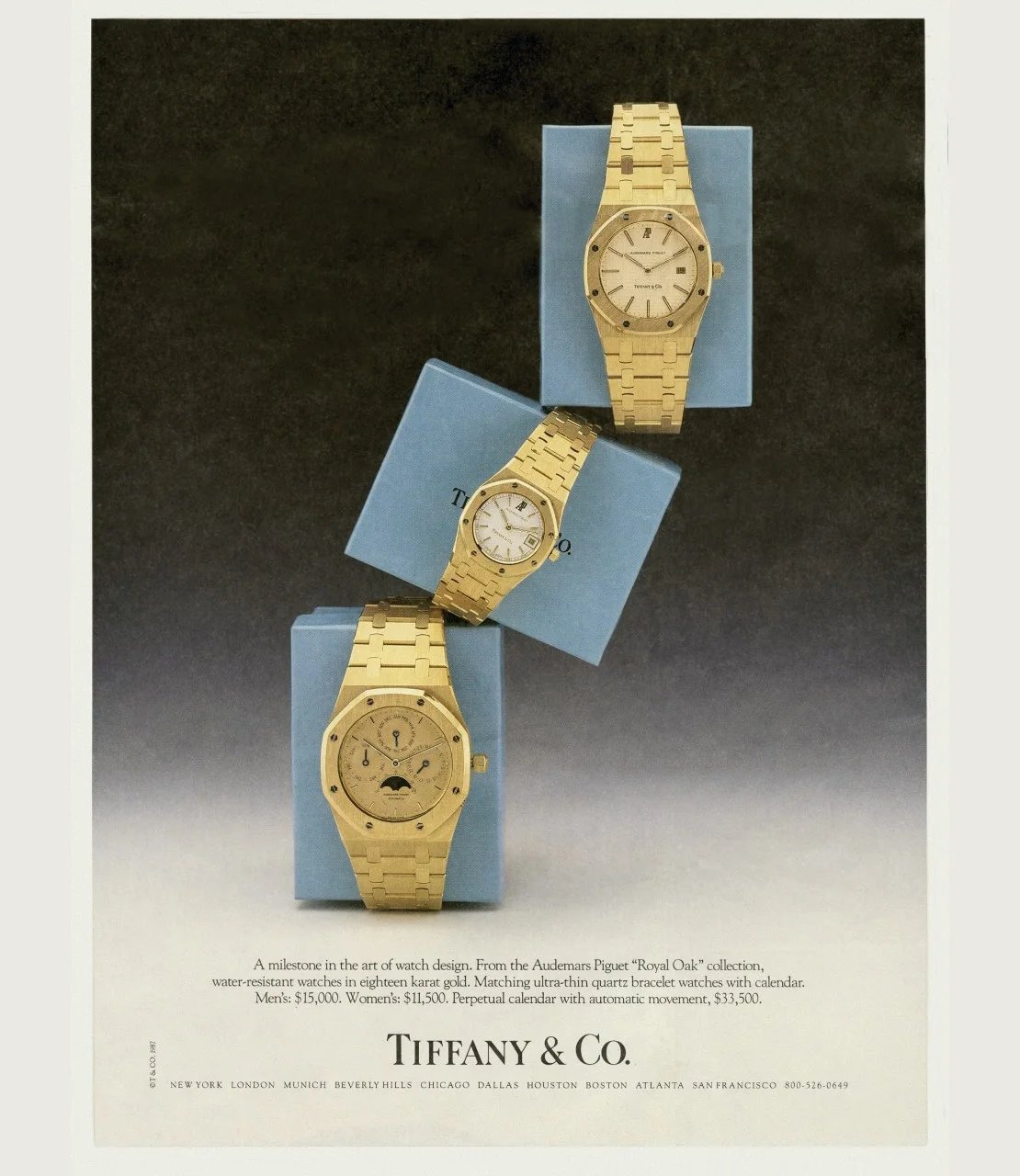
1987 Advert for a Royal Oak co-signed by Tiffany & Co. Until the 1980s, some major retailers ran their own promotional campaigns. They even sometimes co-signed Audemars Piguet watches. Audemars Piguet Archives.
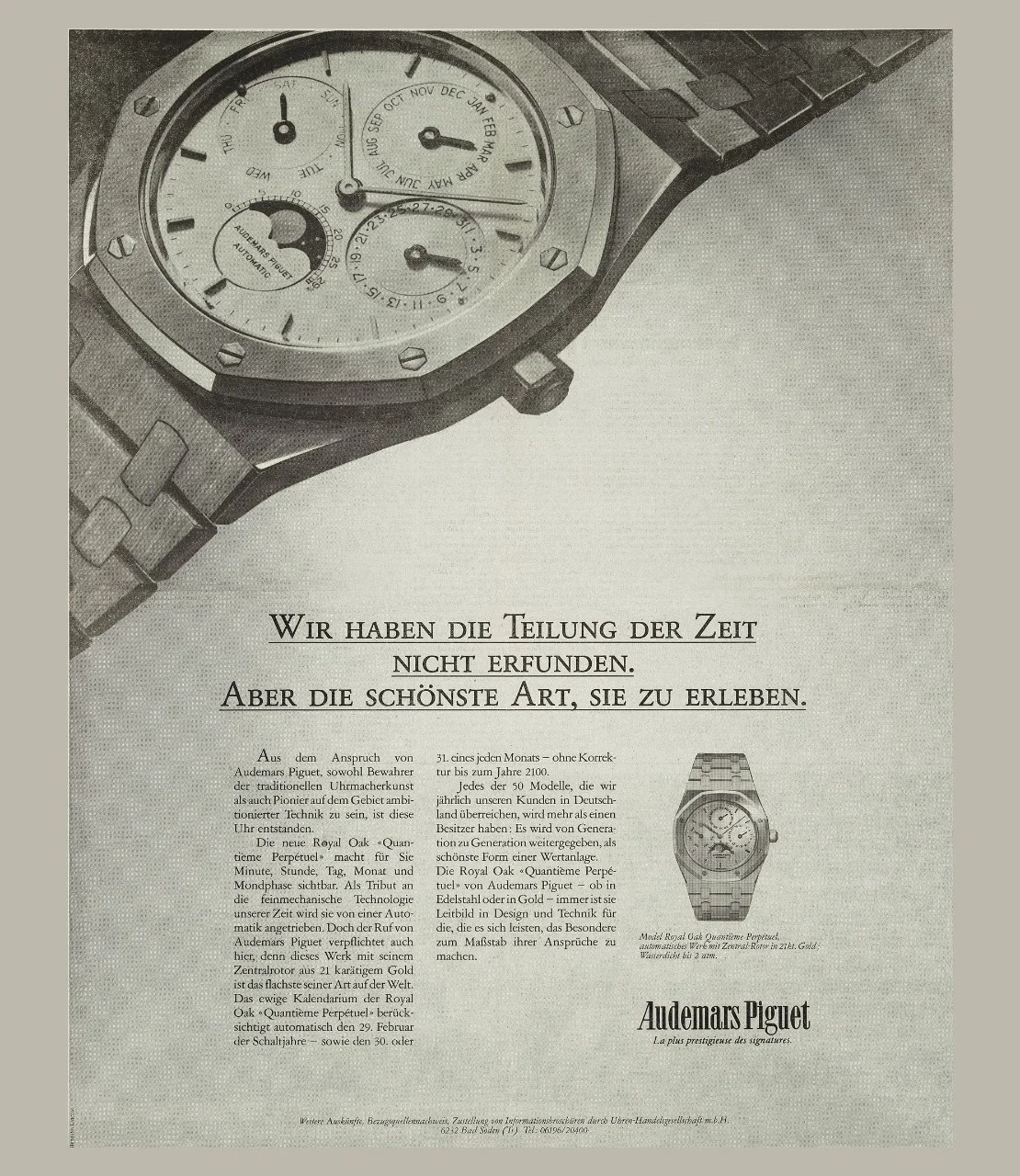
April 1987. Royal Oak Perpetual Calendar advertisement. This advert informed readers that from 1987 onwards, at least 50 Royal Oak Perpetual Calendar watches would be reserved for the German market. Audemars Piguet Archives.
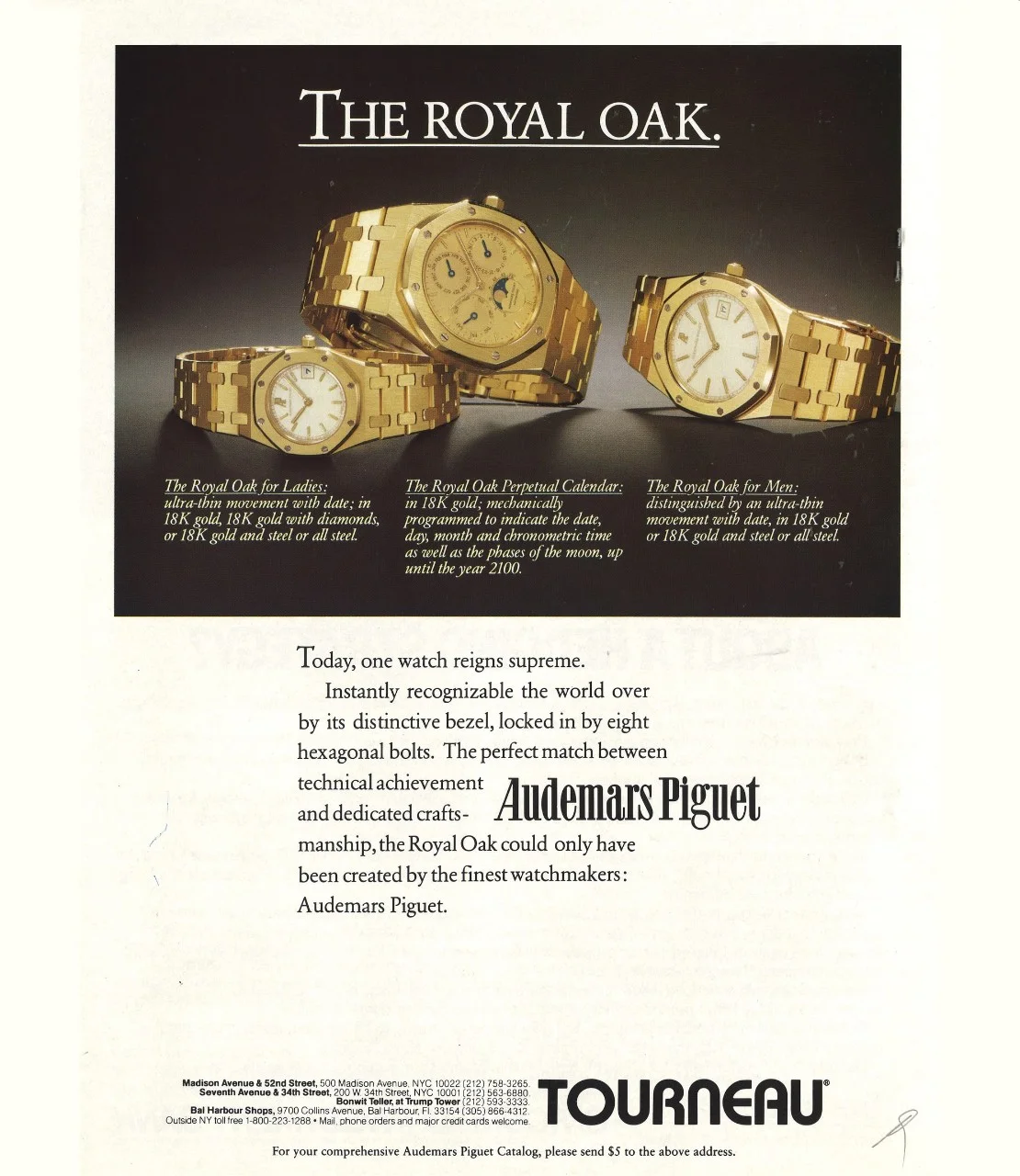
1987. Royal Oak advertisement. The Royal Oak collection is embodied here by a 33 mm ladies' model, a 36 mm men's variant and the Royal Oak Perpetual Calendar, which at that time was the only one with a 39 mm diameter. Advertisement published in Forbes magazine on November 2, 1987. Audemars Piguet Archives.
| ROYAL OAK PERPETUAL CALENDAR 2120/2800 | SALES | |||||||||||
Launch or first commercia- -lisation |
Model | Materials |
Model derived from | TOTAL | ST | BA | SA | PT | OR | RP | PR | SP |
| TOTAL | 1'746 | 514 | 885 | 70 | 116 | 24 | 61 | 25 | 51 | |||
| 1984 | 25554 | BA (1984), ST (1985), PT (1986) | base | 270 | 46 | 223 | 1 | |||||
| 1985 | 25624 | BA (1985) | 25554 | 1 | 1 | |||||||
| 1986 | 25636 | BA (1986), PT (1987), ST (1988), OR (1991), RP (1994), PR (prob 1994), SP (1994) | base | 313 | 61 | 156 | 41 | 6 | 24 | 25 | ||
| 1986 | 25651 | BA (1986) | 25636 | 1 | 1 | |||||||
| 1987 | 25654 | ST (1987), BA (1987), SA (1987), PT (1988) | base | 851 | 315 | 430 | 68 | 38 | ||||
| 1988 | 25659 | BA (1988), PT (1995) | 25636 | 4 | 3 | 1 | ||||||
| 1989 | 25687 | BA (1989); PT (1994) | 25654 | 3 | 1 | 2 | ||||||
| 1989 | 25688 | PT (1989) | 25636 | 1 | 1 | |||||||
| 1989 | 25686 | BA (1989), PT (1989), ST (1990), RP (1991), OR (1993), SP (1994), PR (1997), | 25636 | 299 | 92 | 70 | 0 | 31 | 18 | 37 | 25 | 26 |
| 1990 | 25694 | PT (1990) | 25636 | 1 | 1 | |||||||
| 1994 | 25775 | SA (prob 1994) | 25636 | 1 | 1 | |||||||
| 1994 | 25773 | SA (prob 1994) | 25654 | 1 | 1 | |||||||