Royal Oak Numbering
Summary
Numbers for the Ages
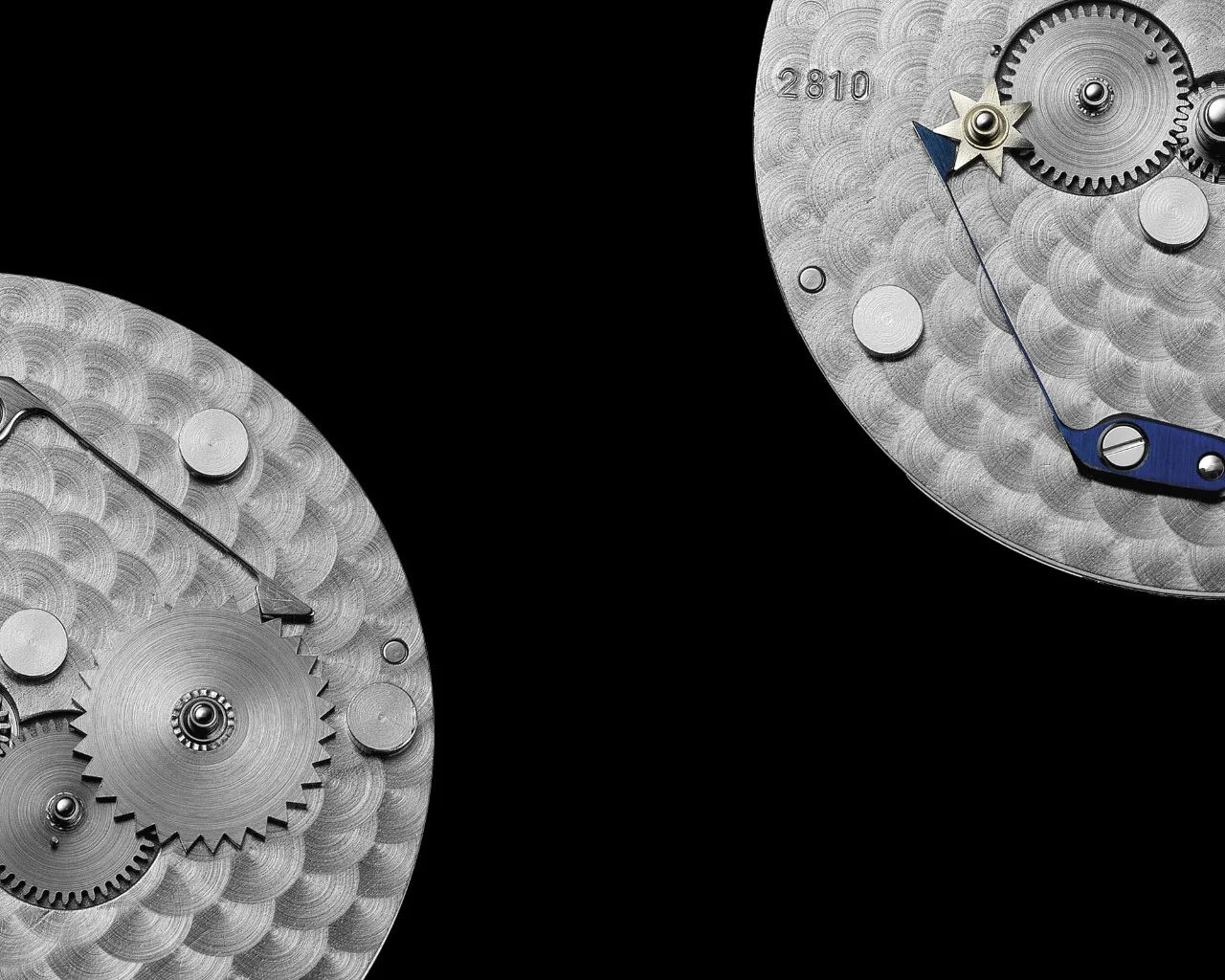
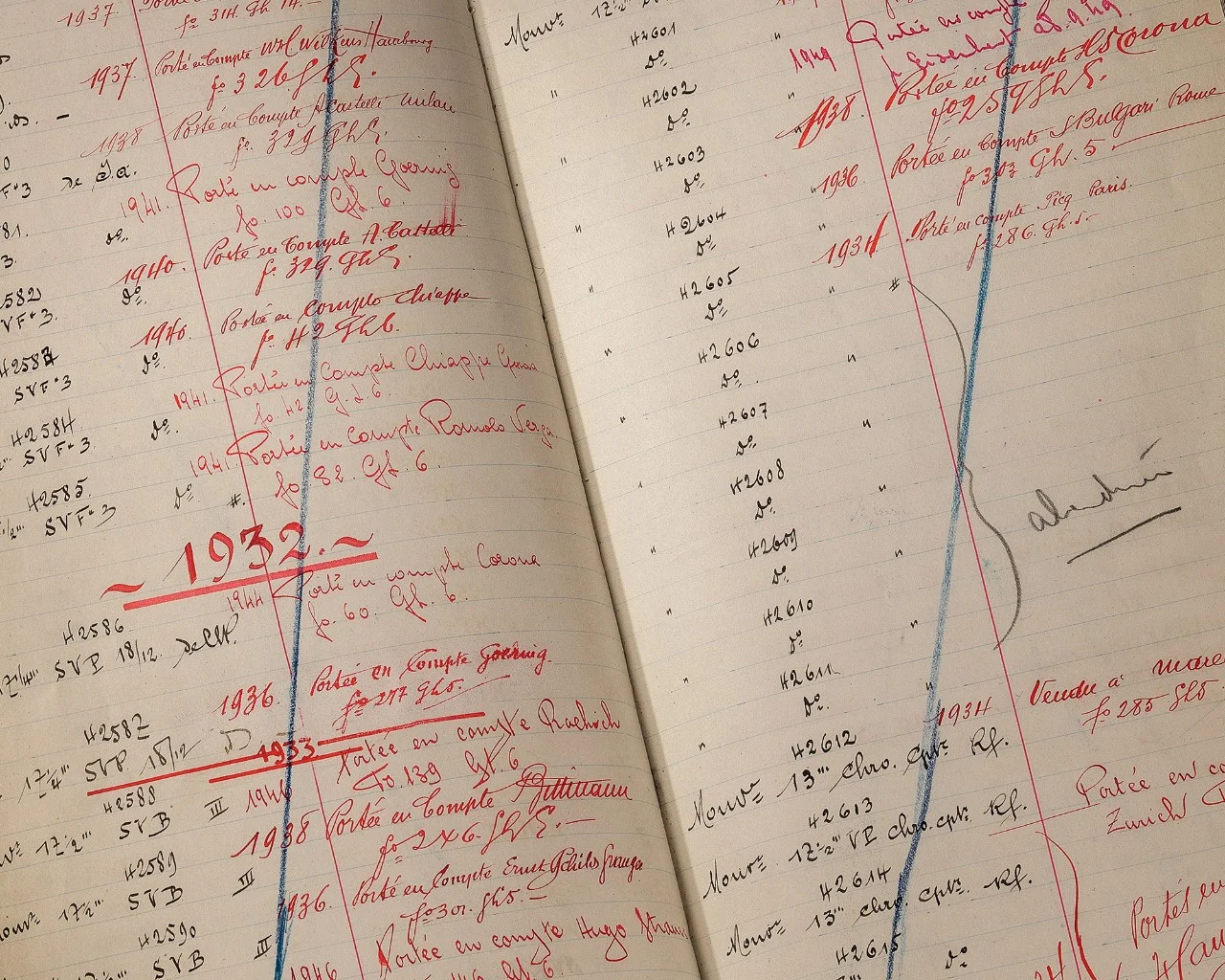
Since the 19th century, each Audemars Piguet watch has had one or more individual numbers carefully engraved on its movement and case, and then recorded by hand in production registers. This practice has an essential objective: to guarantee the long-term authenticity of each watch and enable restoration to its original condition. Mechanical watches are among the very few technical objects that are destined to function for decades or even centuries.
Readers will discover the history of the numbering system of Audemars Piguet watches since 1875 in the article dedicated to this subject. To understand the contribution of the Royal Oak to this system, let's start by recalling the practices in force in the early 1970s:
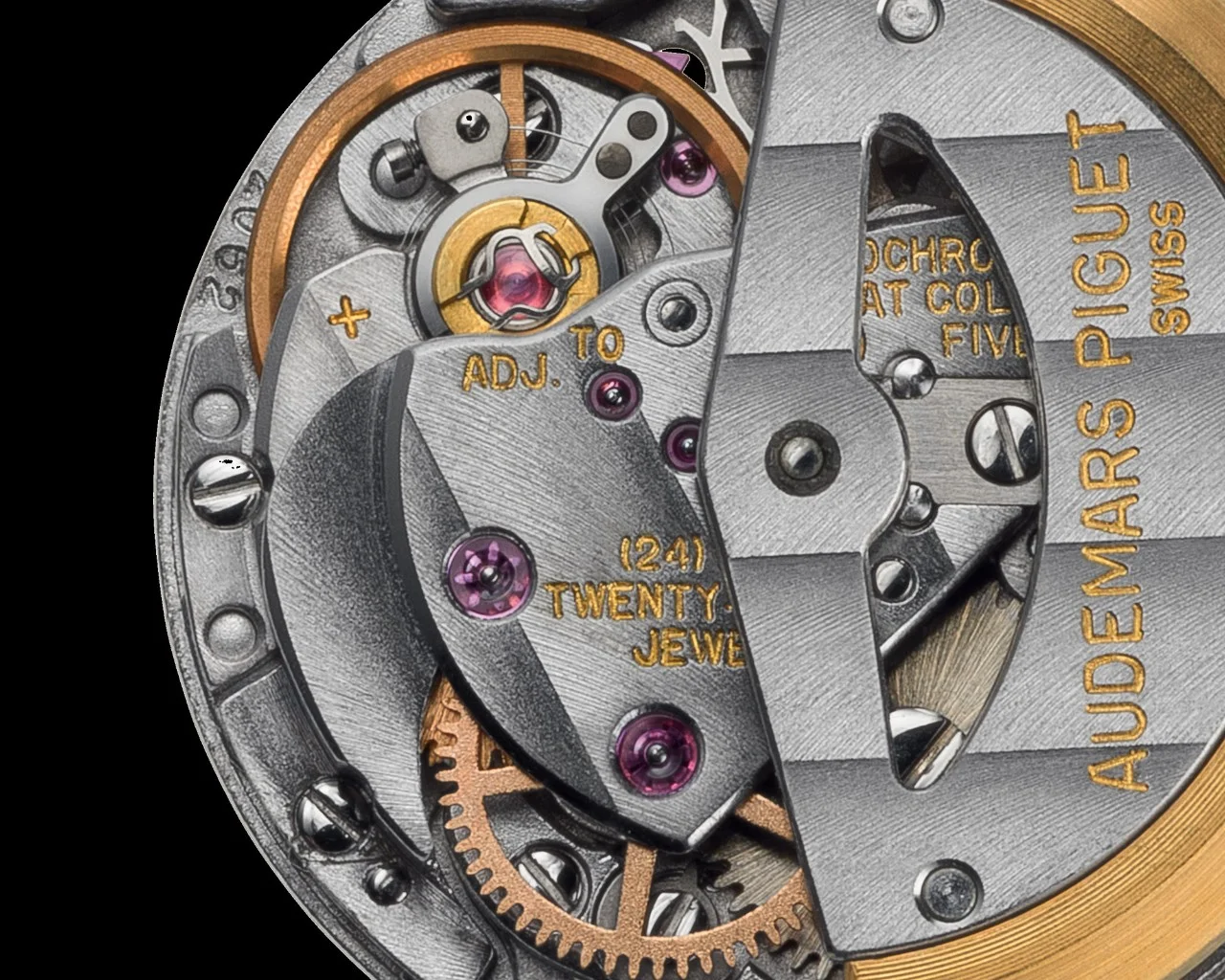
- Each movement has a unique number engraved on it, called the "movement number", which has been assigned consecutively since the 19th century and reached approximately 115,000 in 1970. Only watchmakers have access to it because it can only be seen by opening the case and examining the mechanism on which the number is engraved.
- Each watch case also bears a unique engraved number, generally visible on the back of the watch. Assigned consecutively since 1951 (n° 1), the "big case numbers" reached about 60,000 in 1970. After the 100,000 mark in 1975, the series started again at B1 until B99999 (around 1986) then C1 to C99999, etc.
In addition, since 1951, each watch has had a model number (or model reference) and contains a mechanism which itself has a calibre number (movement model). Intended for watchmakers or retailers, all these numbers have long remained hidden from watch owners. They only make sense when compared with the corresponding archives and registers.
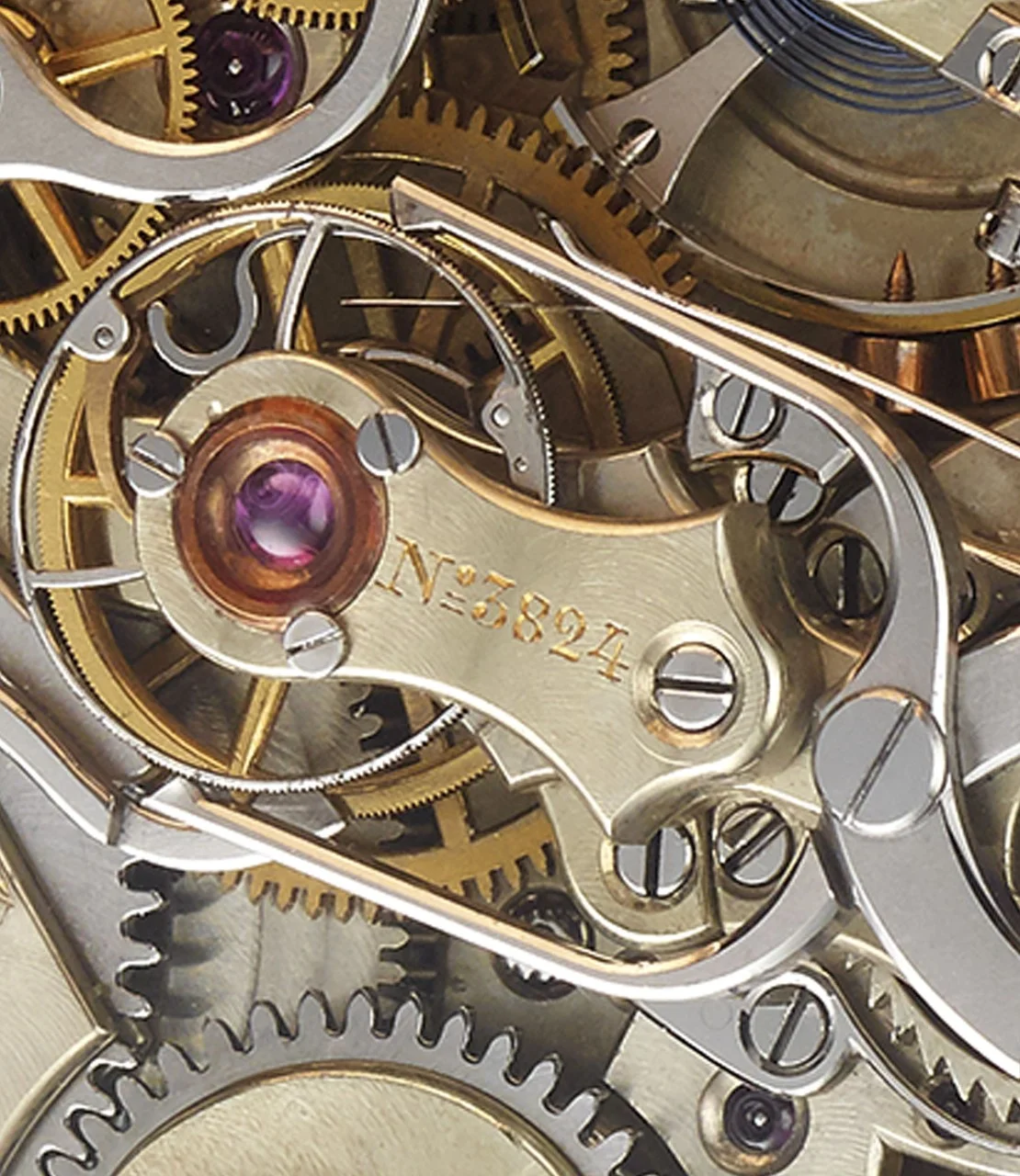
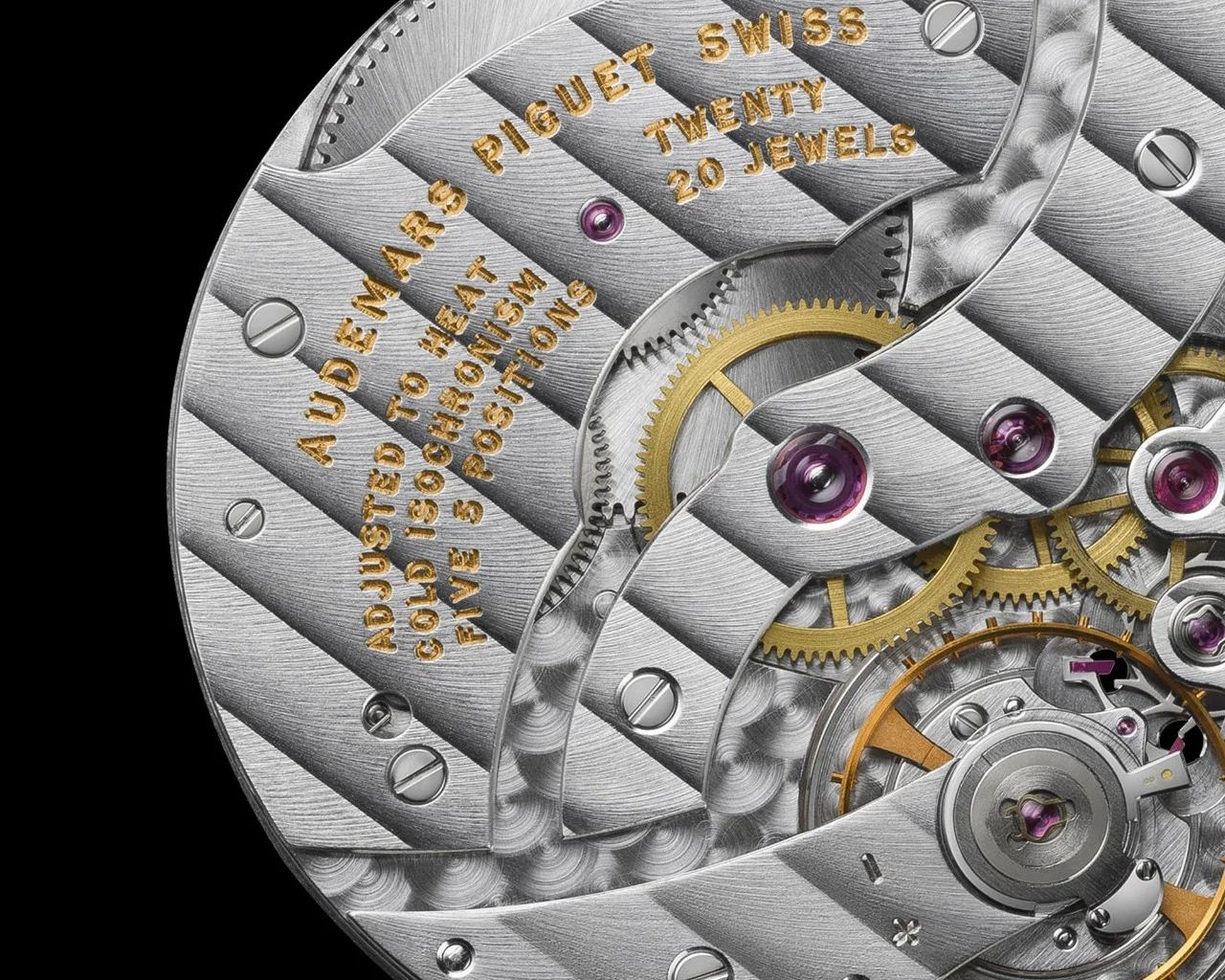
1890. Close-up on pocket watch with double complication. The number of the movement is engraved in gold on the split-seconds bridge. Watchmakers will note the extreme thinness of the split-seconds wheel teeth and the quality of the finishing: screwed studs, polished and bevelled steel, wide Côtes de Genève motif, nickel, etc. Audemars Piguet Heritage, inv. 25.
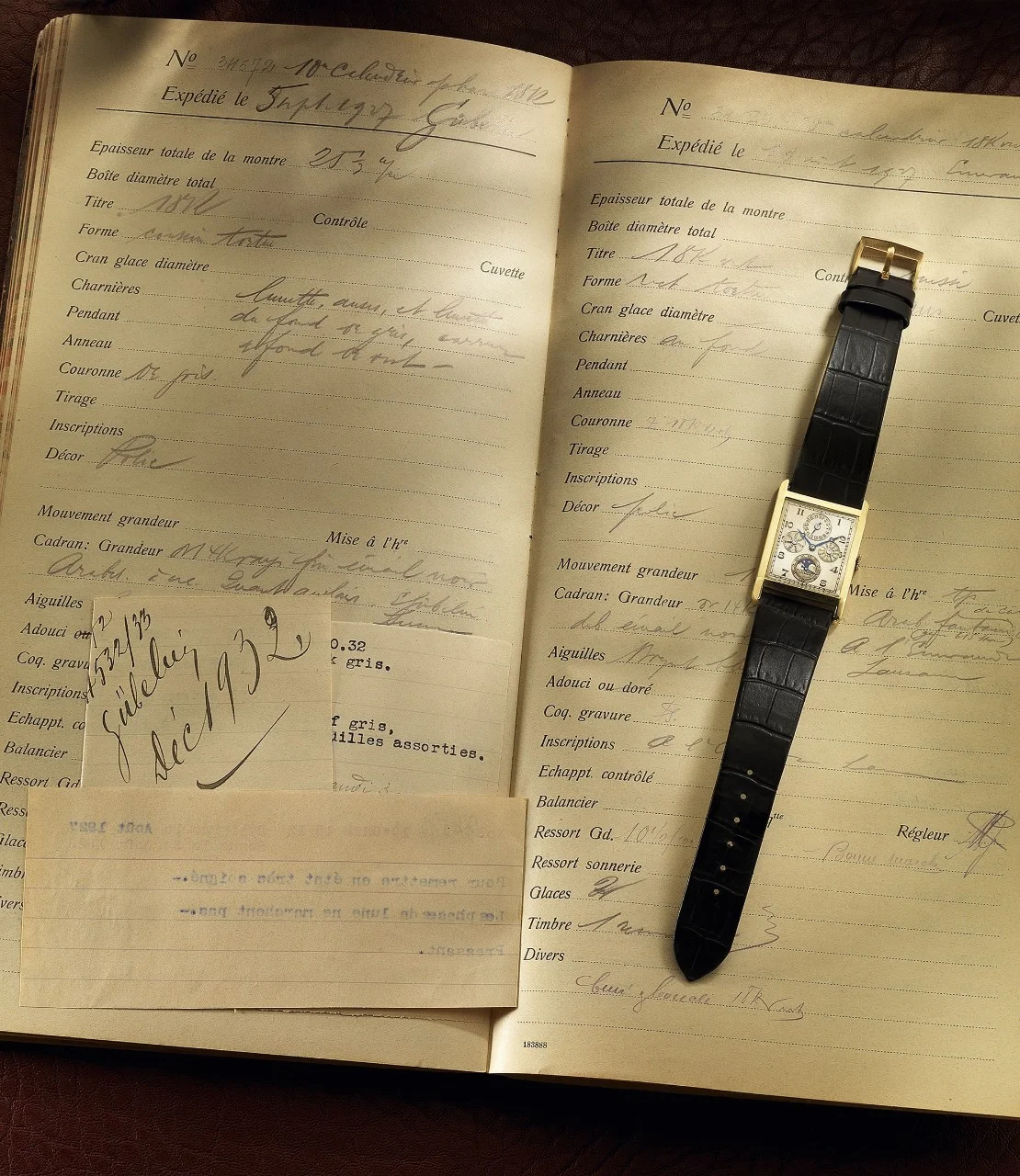
1928. Wristwatch with complete calendar on its original description. Placed on the archive page that describes it, this wristwatch with a complete calendar, movement and case no. 3457, contains Calibre 10GHSM. The document describes its "green gold" case, its "blue Breguet" hands. Its 14-carat gold dial is signed À L'ÉMERAUDE LAUSANNE. Pre-Model 180. Audemars Piguet Heritage, inv. 159.
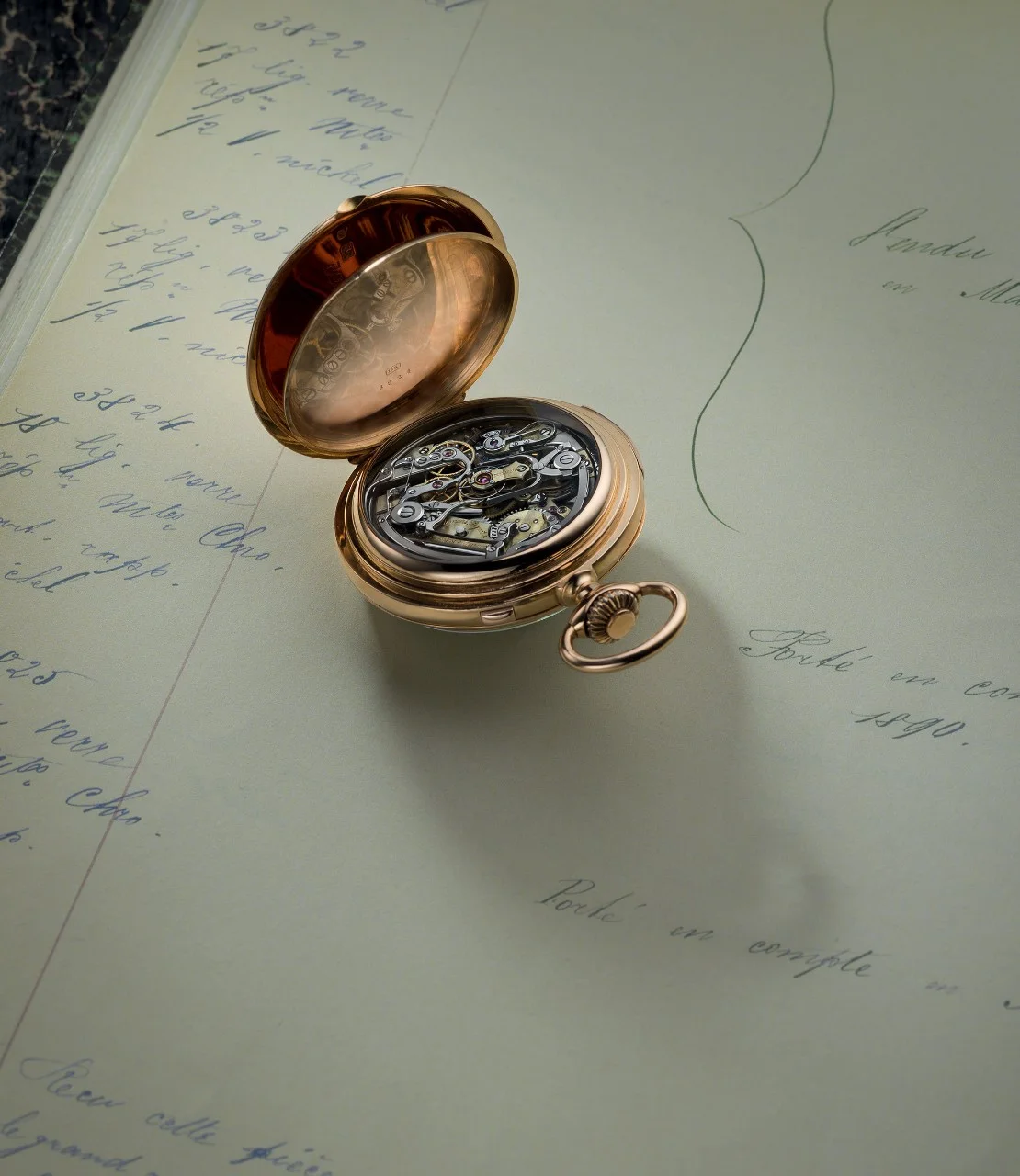
Double complication pocket watch No. 3824, on the Production Register. In the 19th century, before the introduction of calibre numbers, each movement was different from one another, so that the mechanism was described only by its major characteristics. In this instance, its diameter (18 lignes, or 40.6 mm), its functions (minute repeater, chronograph) and its material (nickel here means nickel silver) are listed. Sold in 1890, the watch joined the Audemars Piguet Heritage Collection a century later (inv. 25).
A Small Number for Owners
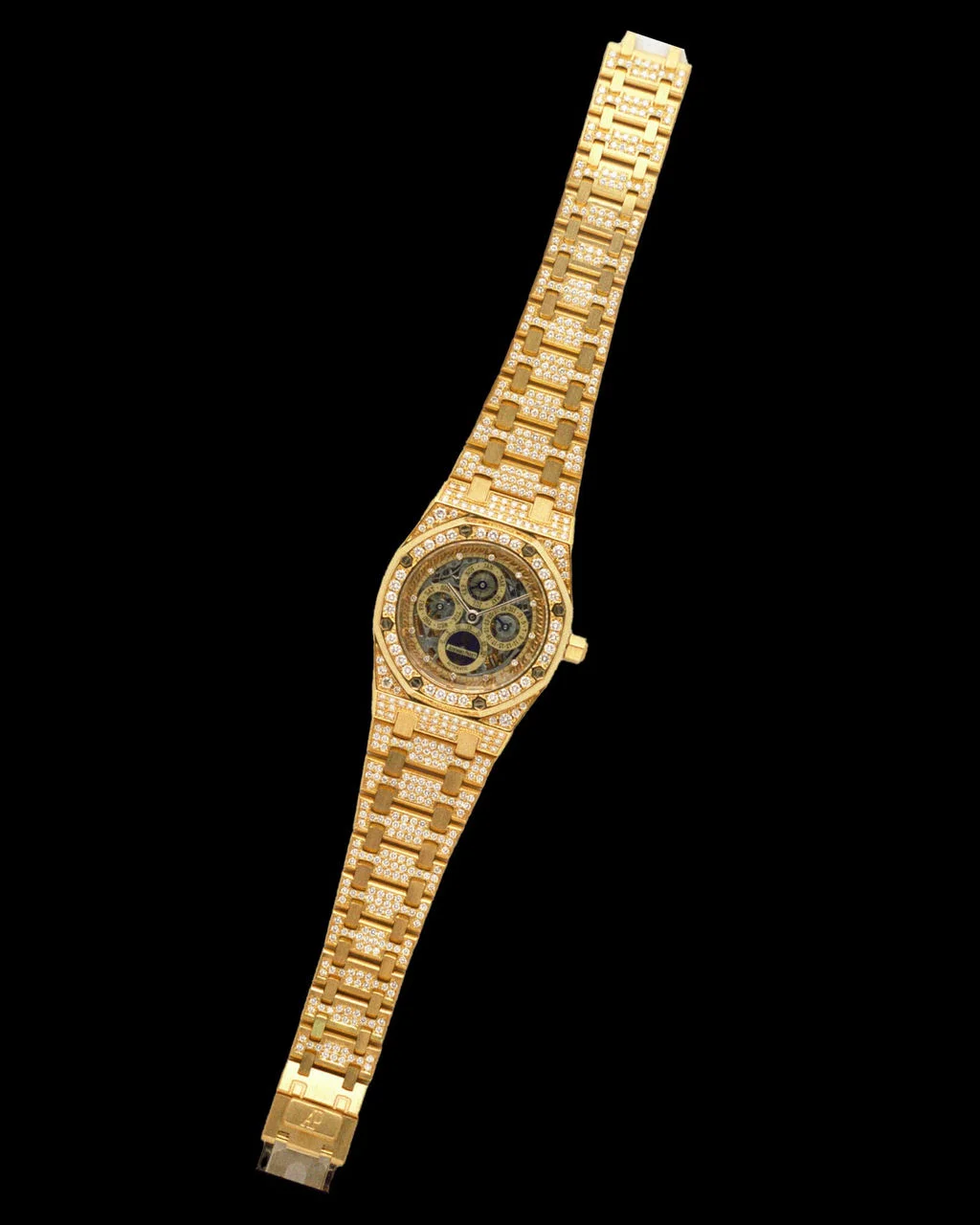
In 1972, the launch of the first Royal Oak raised important questions about the perceived value of these new timepieces. The original plan was to produce 1,000 identical models. This "large-scale" production was unprecedented at Le Brassus and came at a time when Audemars Piguet customers were accustomed to one-off models or series of a few dozen at most. So how could a sense of rarity be maintained with a production of a thousand identical watches? The question was all the trickier in that the Royal Oak was made of steel – a material perceived as cheap – yet its case was so complex that it cost as much as gold. Within this context it is worth recalling that at the time other steel watches such as the Oyster, Seamaster or Speedmaster were often produced by the tens of thousands or even more – and sold for four to five times less.
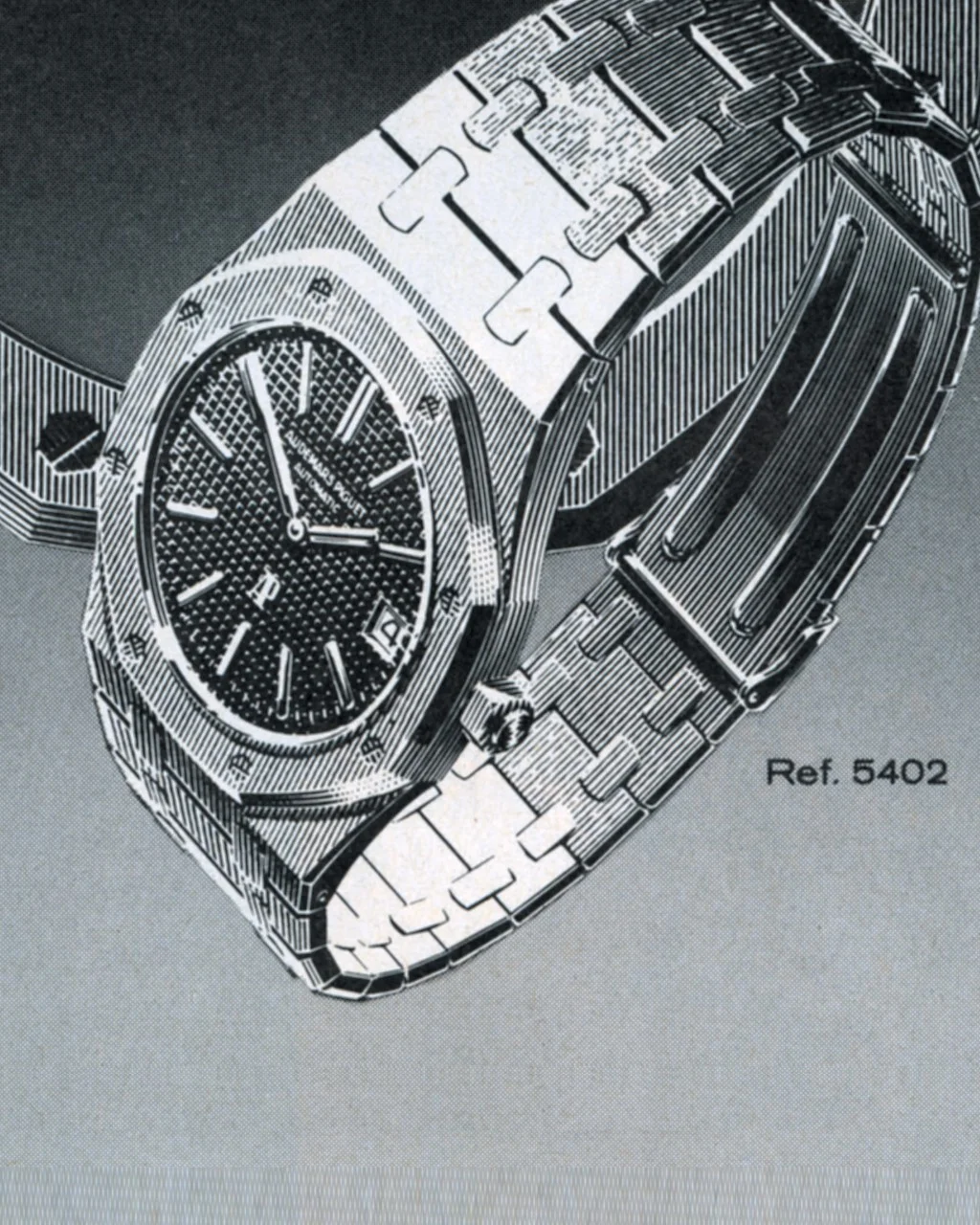
Georges Golay, who was running the company at the time, proposed a simple and brilliant solution. He relegated the "big case number" (see above) to the inside of the watch – as it was of interest to the watchmaker – and in its place had a serial number engraved in large letters on the back of each Royal Oak 5402, starting with number 1 and increasing incrementally. Thanks to this number, the watch owner could be sure that his or her timepiece was unique and that the production of the model was limited. This marked the birth of the "small case number", also known as the "Royal Oak number".
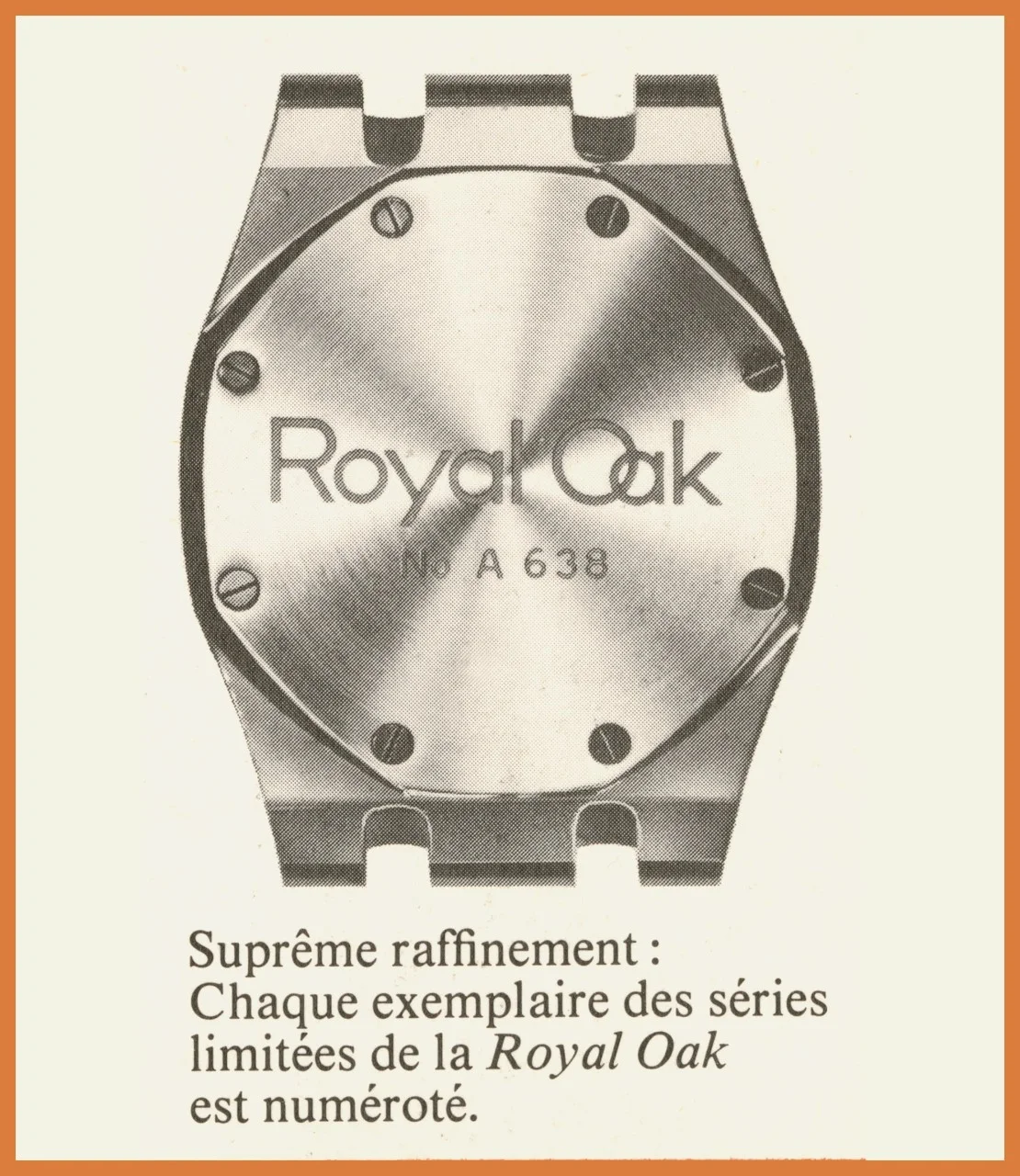
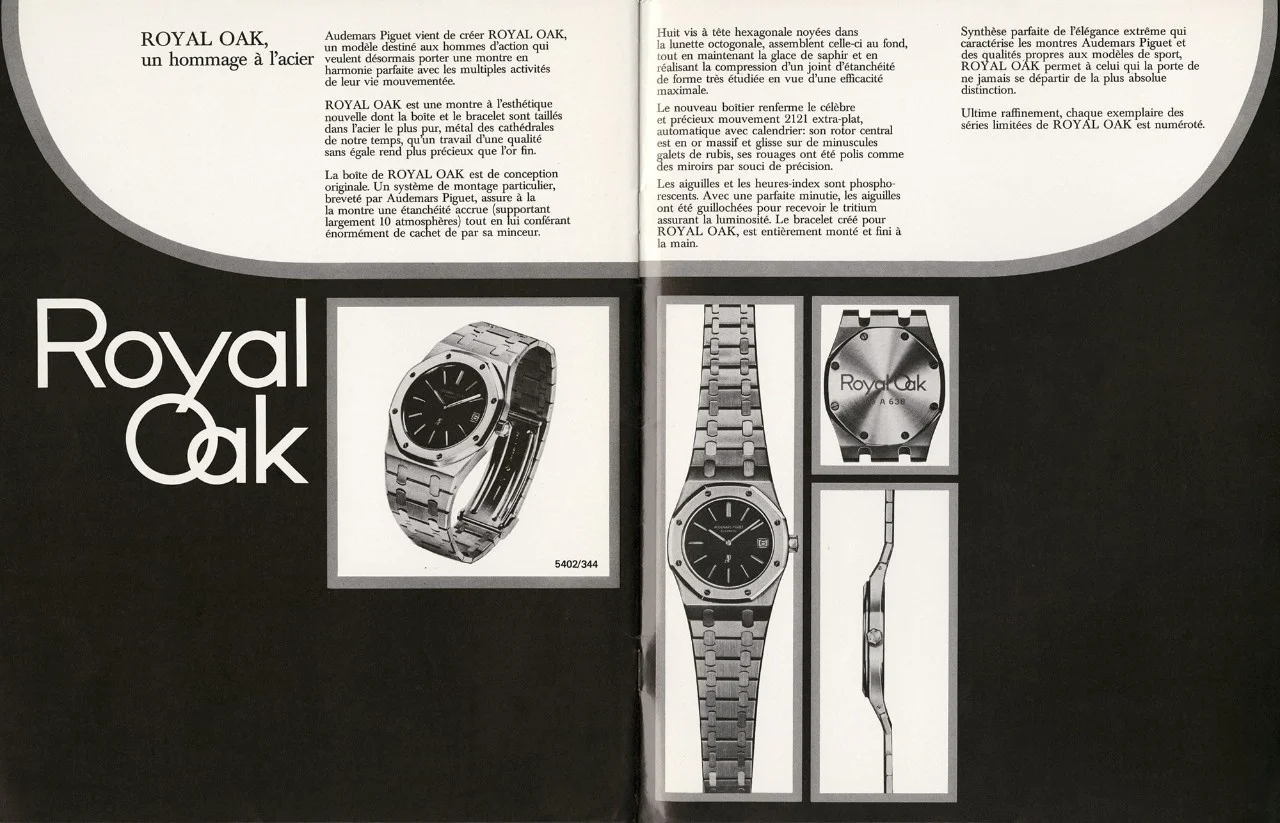
1973. Royal Oak borchure (extract). The Royal Oak's promotional leaflet edited in 1973 underlines the interest of the new numbering system. Audemars Piguet Archives.
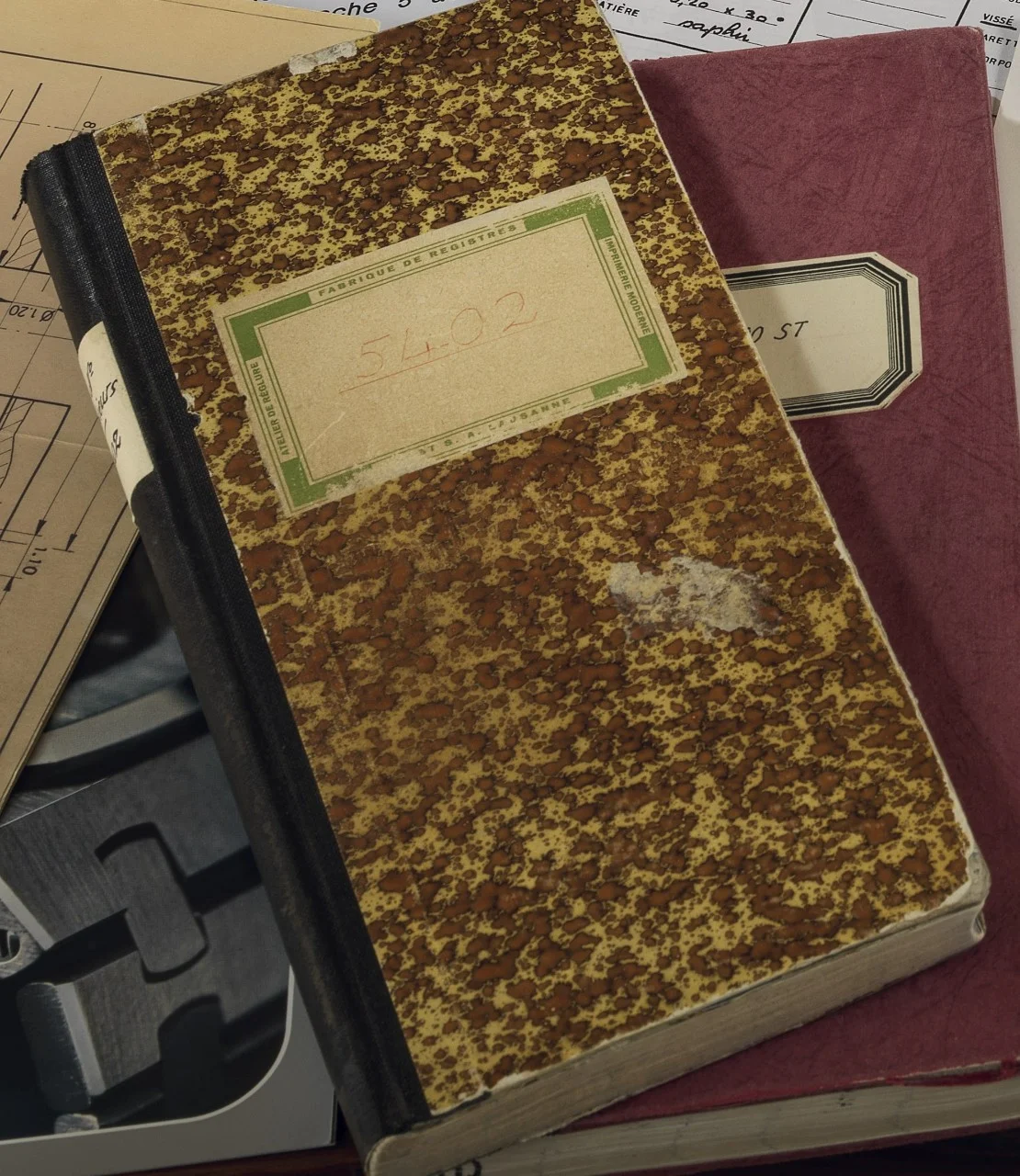
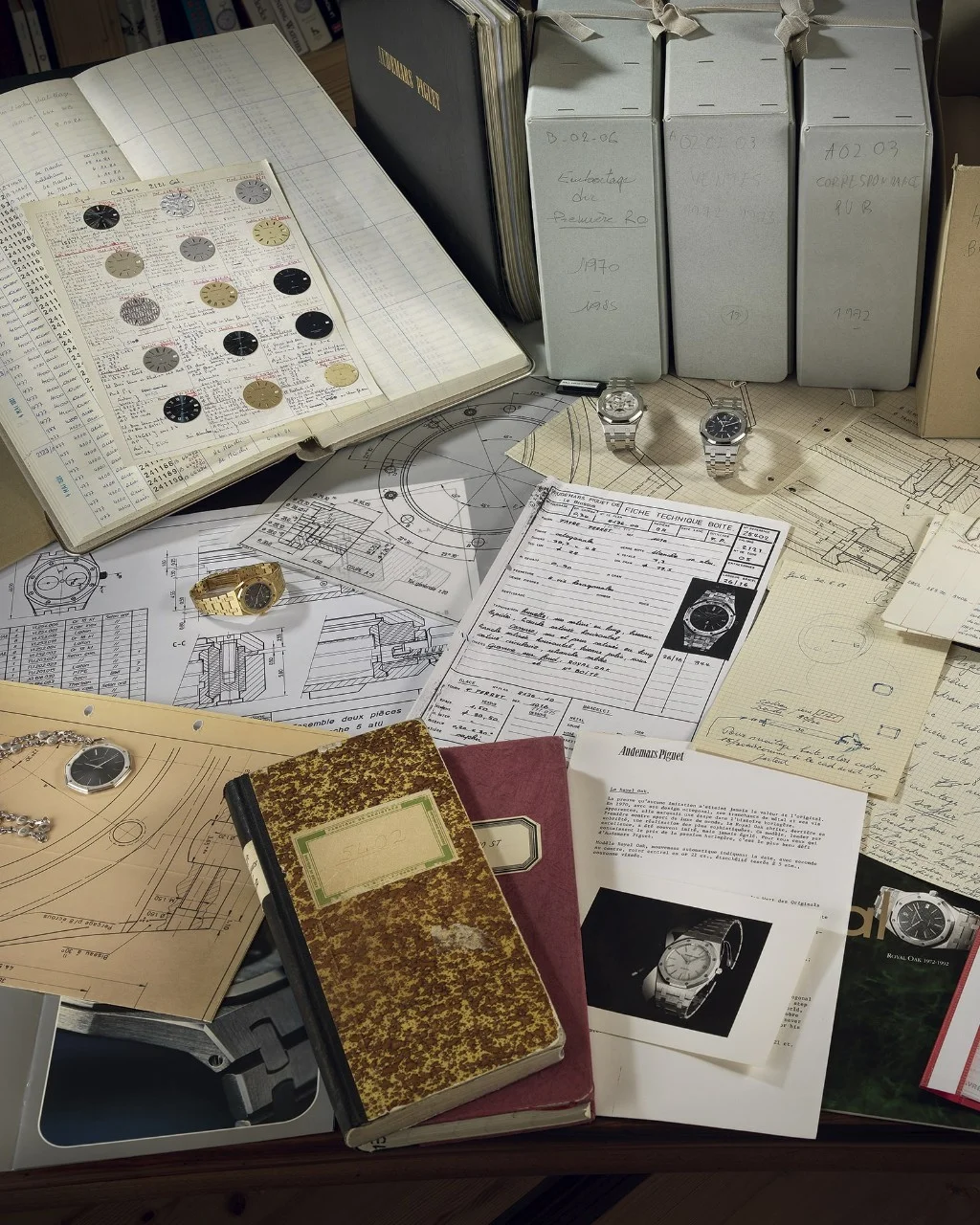
Register for the Royal Oak Model 5402. This bound register lists the Royal Oak 5402 in steel and in precious materials. Established in 1972 onwards, it links the small case number, the big case number and the movement number. Audemars Piguet Archives.
A Limited Edition… with no Limits
Since the 1990s, the practice of limited editions has developed in the watch industry based on an almost invariable model: a brand chooses to produce a predefined quantity of identical watches (for example five, 25 or even 500 units) and undertakes to market only the announced quantity. The number engraved on the watch is often a reminder of the edition’s assigned limitation, e.g. X/5, XX/25 or XXX/500.
However, the 1972 Royal Oak did not strictly meet this definition and the 1972 Basel Fair press release stated: "In an ultimate touch of refinement, each Royal Oak limited series is numbered.” This sentence is a little masterpiece of semantic acrobatics. On the one hand, the rarity and value of the watches are underlined by the special numbering of "each timepiece", and the text announces that their number will be limited. On the other hand, it does not indicate any limitation of quantity. Above all, it suggests that several limited series may be produced.
If Audemars Piguet had announced in 1972 that it would only be produced in a single 1,000-piece limited edition – as was originally imagined – would the Royal Oak have been able to establish itself in the watchmaking world? Would it have had time to change the perception of steel? Would it have given birth to a collection?
No one could predict the success or failure of the Royal Oak, but what is certain is that Georges Golay as an experienced card player kept a few tricks up his sleeve in case things went well. By prefixing the "small number" of the first Royal Oak with the letter A, he kept open the possibility of creating series B, C, etc.
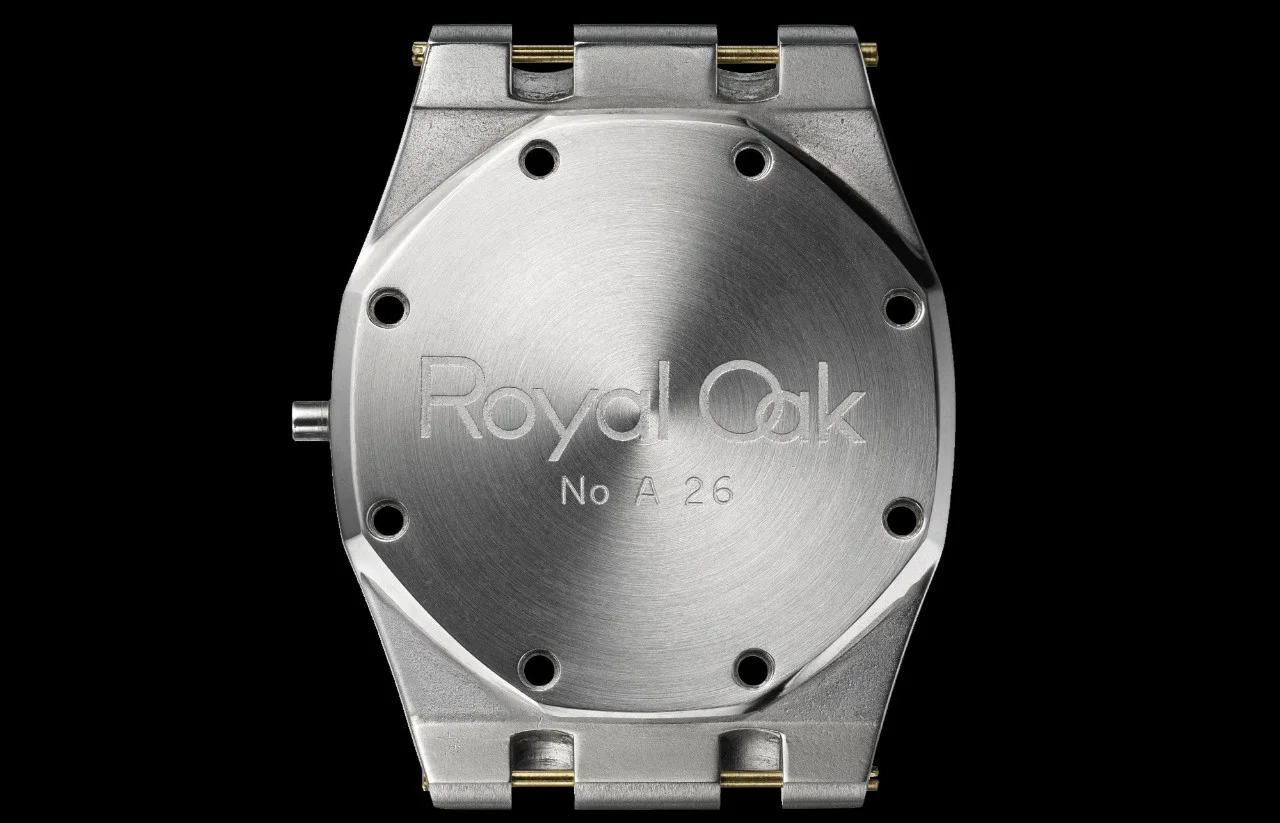
5402ST A, B, C, D Series and Special Variants
Despite its price, its material and its oversized case, the first Royal Oak was an unexpected success. After a little more than a year, almost 1,000 of these watches had been sold, prompting Georges Golay to extend the production run to 2,000 units. Just as with the large case and movement numbers (see the article on this subject), certain numbers were not used, meaning that the A series finally reached 1,937 Royal Oak watches sold between 1972 and 1989.
At the end of 1974, the question of the Royal Oak’s future was raised. What should be done with the ‘wild child’? While awaiting a final decision, 129 Royal Oak 5402ST watches were produced and distributed – this time without the "small number" – and 90% of them were sold between January and September 1975. In parallel, Audemars Piguet decided to launch the B series and to use the numbers B1000 to B2000. Sources do not reveal the reasons why the numbers from 1 to 1,000 are not used, but it is probable that Georges Golay wanted the A series to be the only one equipped with numbers lower than 1,000. On March 21, 1975, the first timepiece in the B series left Le Brassus, No. B1044, bound for the tiny island of Guam in the middle of the Pacific Ocean. A total of 845 B-series watches were sold between 1975 and 1993.
On December 1, 1976, the first C series Royal Oak emerged from the workshop, followed by 952 others, numbered from C1000 to C2000 and sold until 1987. Then came the D series, with 404 examples distributed between 1977 and 1989. The last variant proved an extremely rare one: between 1988 and 1990, just 21 Royal Oak 5402ST watches with a "small number" (continuing the 5402SA numbers (sic) but without a letter) set the final touch to the numbering history of the first steel Royal Oak.
| - | 5402ST A Series |
5402ST No small number |
5402ST B Series |
5402ST C Series |
5402ST D Series |
5402ST No letter |
TOTAL STEEL |
5402SA | 5402BA | 5402BC | TOTAL GOLD |
TOTAL 5402 |
|---|---|---|---|---|---|---|---|---|---|---|---|---|
| TOTAL | 1937 | 129 | 845 | 952 | 404 | 21 | 4288 | 876 | 736 | 150 | 1762 | 6050 |
| 1972 | 490 | 490 | 1 | 1 | 491 | |||||||
| 1973 | 543 | 543 | 543 | |||||||||
| 1974 | 614 | 2 | 616 | 616 | ||||||||
| 1975 | 243 | 120 | 228 | 591 | 591 | |||||||
| 1976 | 7 | 569 | 10 | 586 | 586 | |||||||
| 1977 | 13 | 5 | 23 | 459 | 500 | 92 | 95 | 1 | 188 | 688 | ||
| 1978 | 4 | 3 | 234 | 1 | 242 | 299 | 231 | 50 | 580 | 822 | ||
| 1979 | 6 | 7 | 223 | 15 | 251 | 180 | 122 | 45 | 347 | 598 | ||
| 1980 | 10 | 7 | 15 | 129 | 161 | 92 | 135 | 37 | 264 | 425 | ||
| 1981 | 2 | 4 | 5 | 87 | 98 | 126 | 51 | 5 | 182 | 280 | ||
| 1982 | 2 | 4 | 70 | 76 | 39 | 22 | 3 | 64 | 140 | |||
| 1983 | 1 | 53 | 54 | 9 | 19 | 2 | 30 | 84 | ||||
| 1984 | 1 | 1 | 20 | 22 | 6 | 23 | 29 | 51 | ||||
| 1985 | 10 | 10 | 6 | 9 | 2 | 17 | 27 | |||||
| 1986 | 1 | 6 | 7 | 6 | 13 | 19 | 26 | |||||
| 1987 | 1 | 1 | 5 | 7 | 10 | 3 | 13 | 20 | ||||
| 1988 | 7 | 5 | 12 | 2 | 8 | 2 | 12 | 24 | ||||
| 1989 | 1 | 1 | 1 | 10 | 13 | 4 | 3 | 1 | 8 | 21 | ||
| 1990 | 6 | 6 | 3 | 2 | 5 | 11 | ||||||
| 1991 | 1 | 1 | 1 | |||||||||
| 1992 | 1 | 1 | 1 | |||||||||
| 1993 | 1 | 1 | 1 | 1 | 2 | |||||||
| 1994 | 1 | 1 | 1 | |||||||||
| 2002 | 1 | 1 | 1 |
Can One Date Model 5402 by its Small Number?
It is tempting for a collector, an auction house or just a curious individual to deduce a sale date from a small case number. Unfortunately, just as with movement numbers and large case numbers, small case numbers do not allow one to date a watch exactly, as the watches were not always distributed in numerical order. For example, the Royal Oak 5402ST A859 was sold two years after the A860.
However, with a few exceptions, a study of the registers shows that – for the majority of watches – the small number can at least help define a period (see table).
| Model | Small case number | From | To approx. |
|---|---|---|---|
| 5402ST | A1 - A500 | 1972 | 1973 |
| A500- A1000 | 1972 | 1974 | |
| A1000- A1500 | 1973 | 1975 | |
| A1500- A2000 | 1974 | 1976 | |
| No number | 1974 | 1976 | |
| B1000- B1500 | 1975 | 1977 | |
| B1500- B2000 | 1975 | 1977 | |
| C1000- C1500 | 1976 | 1978 | |
| C1500- C2000 | 1978 | 1980 | |
| D1000- D1500 | 1979 | 1985 | |
| 5402BA | 1-500 | 1977 | 1980 |
| 500-1000 | 1980 | 1986 | |
| 5402SA | 1- 500 | 1977 | 1980 |
| 500- 1000 | 1979 | 1983 | |
| 5402BC | 1- 150 | 1977 | 1981 |
Favourite Numbers and Correspondences
Numbers sometimes carry symbolic value. Thus, when the small numbers on the outside were introduced in the 1900s and beyond, many customers requested the possibility of acquiring watches bearing a number corresponding to a significant year in their lives: date of birth, founding of a company, etc...
It is rumoured that the very first Royal Oak 5402ST watches were distributed according to the following principle: the Italian agent Carlo de Marchi was given the even numbers, while the Swiss agent Charles Bauty was given the odd ones. The archives confirm this distribution, while also indicating that it was not systematic and did not exceed the number A100.
There are several legends surrounding the Royal Oak 5401ST n°A1. Some say it was delivered to Emmanuel of Savoy, but the archives mention the surname Fradkoff, which most probably corresponds to Serge Fradkoff of Harry Winston. As for the Shah of Iran, the archives show that he acquired the first white gold Royal Oak and that it bore the number 101.
Another interesting fact that some collectors have noted is that last three digits of the large case number are often identical to the small number in most of the A, B and C series. A study of the registers confirms this observation.
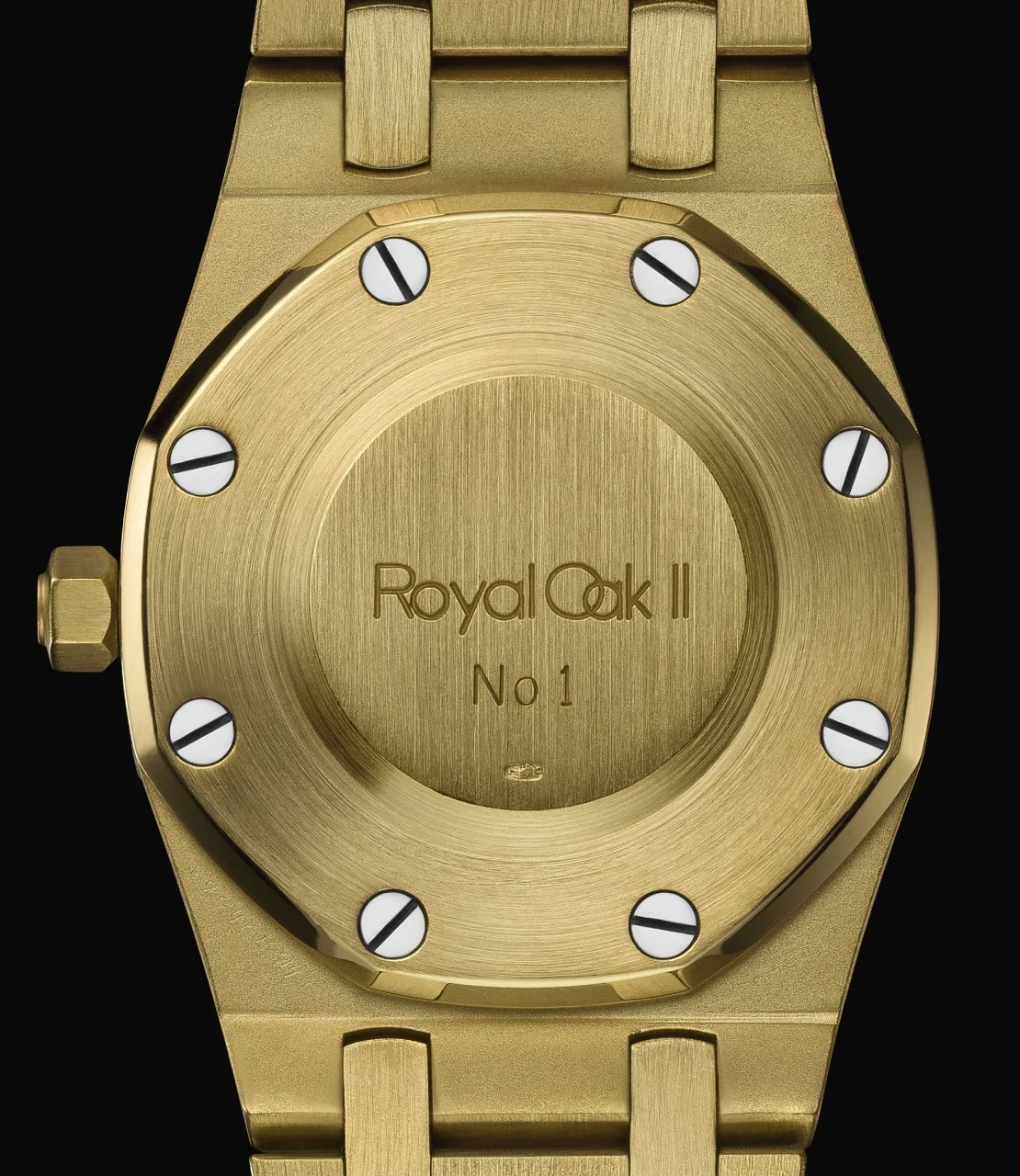
1977. Royal Oak 8638BA, No. 1, caseback view. Date. Calibre 2062, movement 176166. Bracelet 424. T21 Tapisserie dial. Case B14001, 29 mm. 18-carat yellow gold. Sold to Darcal (Swiss market) on May 4, 1977. Audemars Piguet Heritage, inv. 1873.
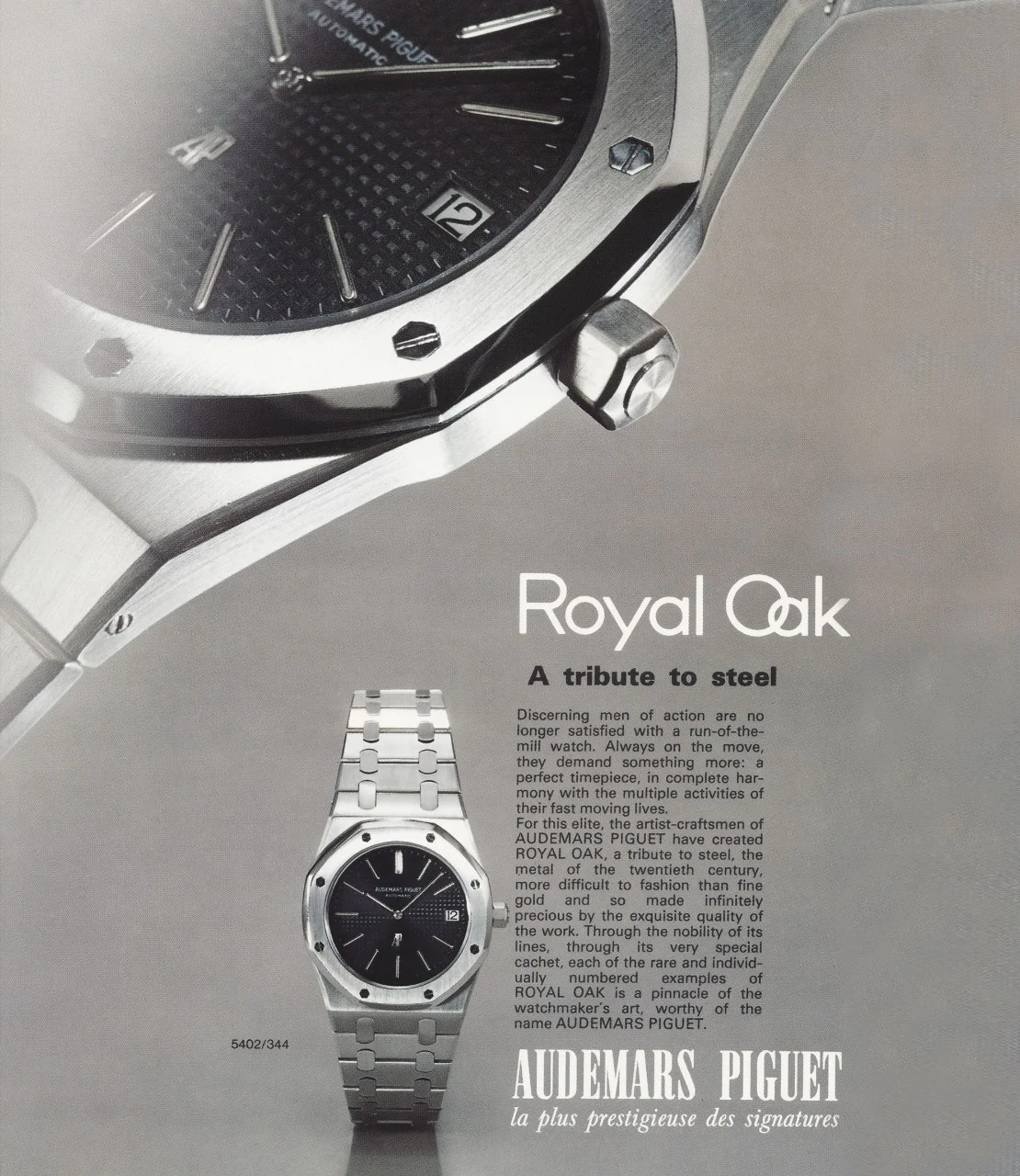
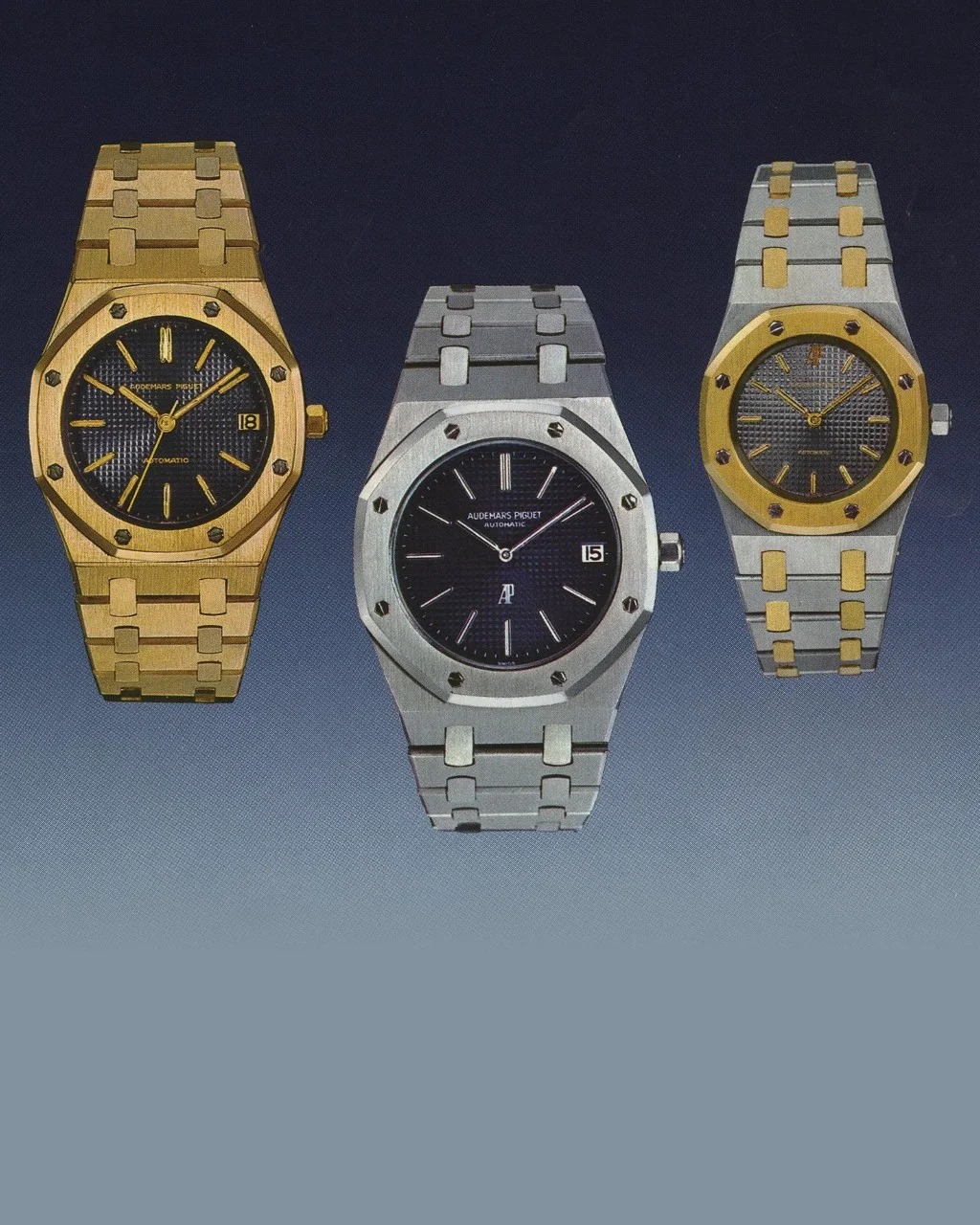
1972. Royal Oak advertisement. On top of the watch's front shot, a close-up highlights the finishing on the case, the bezel's octagonal shape as well as the refined dial. Audemars Piguet Archives.
End of the Alphanumeric System
In 1976, when Audemars Piguet introduced the first ladies’ Royal Oak, Model 8638, the question of the numbering system was again raised. While it initially fulfilled its commercial role, the alphanumeric method used for Model 5402ST also revealed its limits. Why start the B series at 1,000? Why make only 500 timepieces in the D series? Up until which letter does the system make sense? Not to mention the confusion between the B in the large number and the B in the small number (see section below).
To simplify the system, the letter was dropped. From then on, all new Royal Oak models would carry a small number starting with 1, increasing incrementally for each different material and continuing for as long as the model was produced. Thus, for example, Model 4100 released in 1977 had three No. 1s: one steel, one gold and one two-tone.
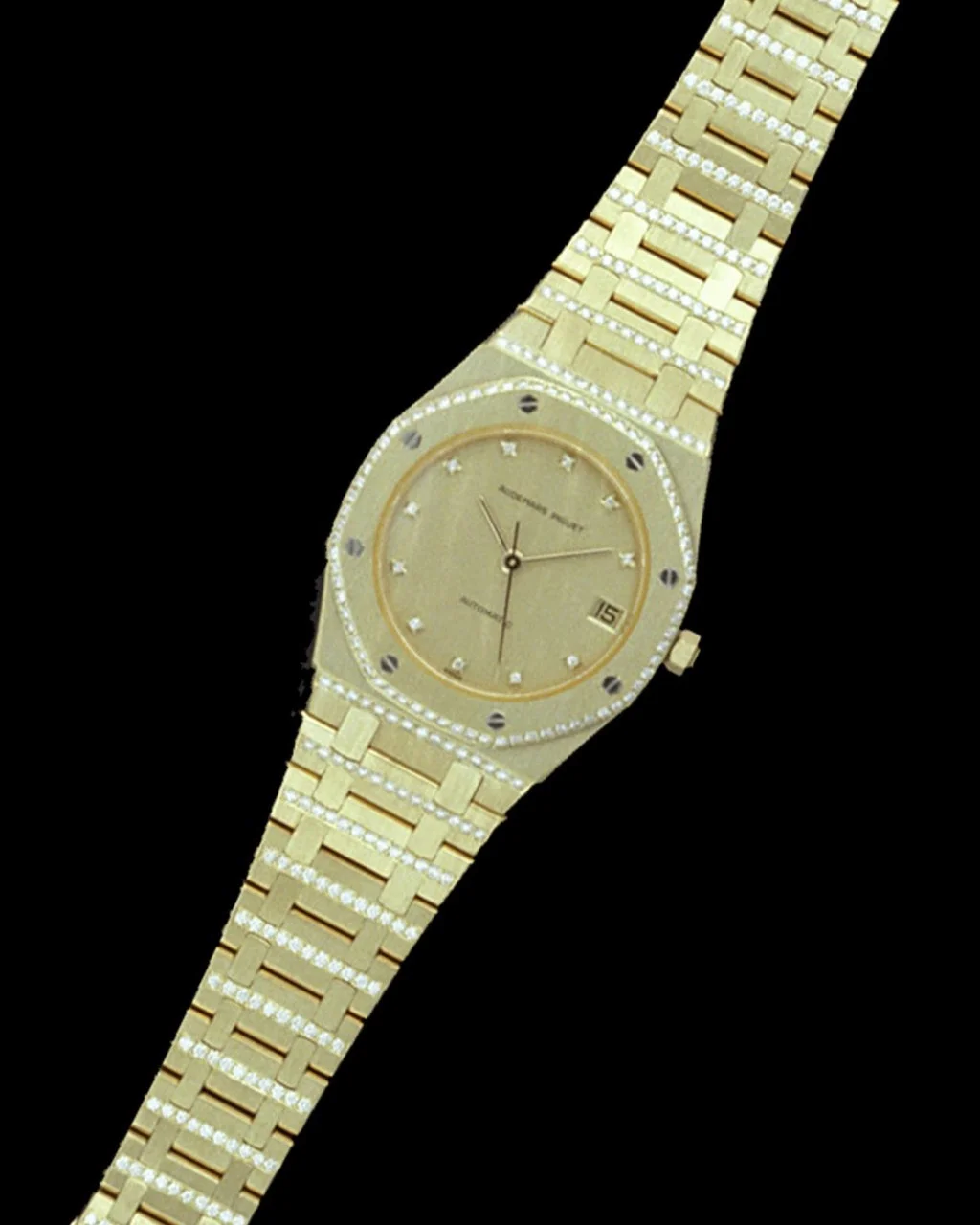
The new system was also applied to Model 5402 in 1977 when Audemars Piguet decided to add gold variants. On June 8, 1977, the first yellow gold 5402BA – bearing the small number 4 and large number B12753 – was flown from Switzerland to Japan. The BA variation was sold to the tune of 736 units between 1977 and 1990, covering numbers running from 1 to 745. The steel and gold 5402SA variation was produced in a run of 876 units (No. 1 to 951) and the rarest version in white gold used all the numbers in the series, from 1 to 150 – an unusual occurrence.
1972–1993. Sales of gold and two-tone Royal Oak 5402 versions. Before 1977, only one Royal Oak in gold was commercialised for the Shah of Iran. The 5402 yellow gold (BA), two-tone (SA combining steel and yellow gold) and white gold (BC) variants were introduced almost simultaneously. Their production slowed down at the beginning of the 1980s, coinciding with the strong increase of smaller models: 8638 (29 mm), 4100 (35 mm), followed by 4332 (36 mm), etc.
| - | 5402BA | 5402SA | 5402BC | TOTAL |
|---|---|---|---|---|
| 1972 | 1 | 1 | ||
| 1977 | 95 | 92 | 1 | 188 |
| 1978 | 231 | 299 | 50 | 580 |
| 1979 | 122 | 180 | 45 | 347 |
| 1980 | 135 | 92 | 37 | 264 |
| 1981 | 51 | 126 | 5 | 182 |
| 1982 | 22 | 39 | 3 | 64 |
| 1983 | 19 | 9 | 2 | 30 |
| 1984 | 23 | 6 | 29 | |
| 1985 | 9 | 6 | 2 | 17 |
| 1986 | 13 | 6 | 19 | |
| 1987 | 3 | 10 | 13 | |
| 1988 | 8 | 2 | 2 | 12 |
| 1989 | 3 | 4 | 1 | 8 |
| 1990 | 2 | 3 | 5 | |
| 1991 | 1 | 1 | ||
| 1993 | 1 | 1 | ||
| TOTAL | 736 | 875 | 150 | 1761 |
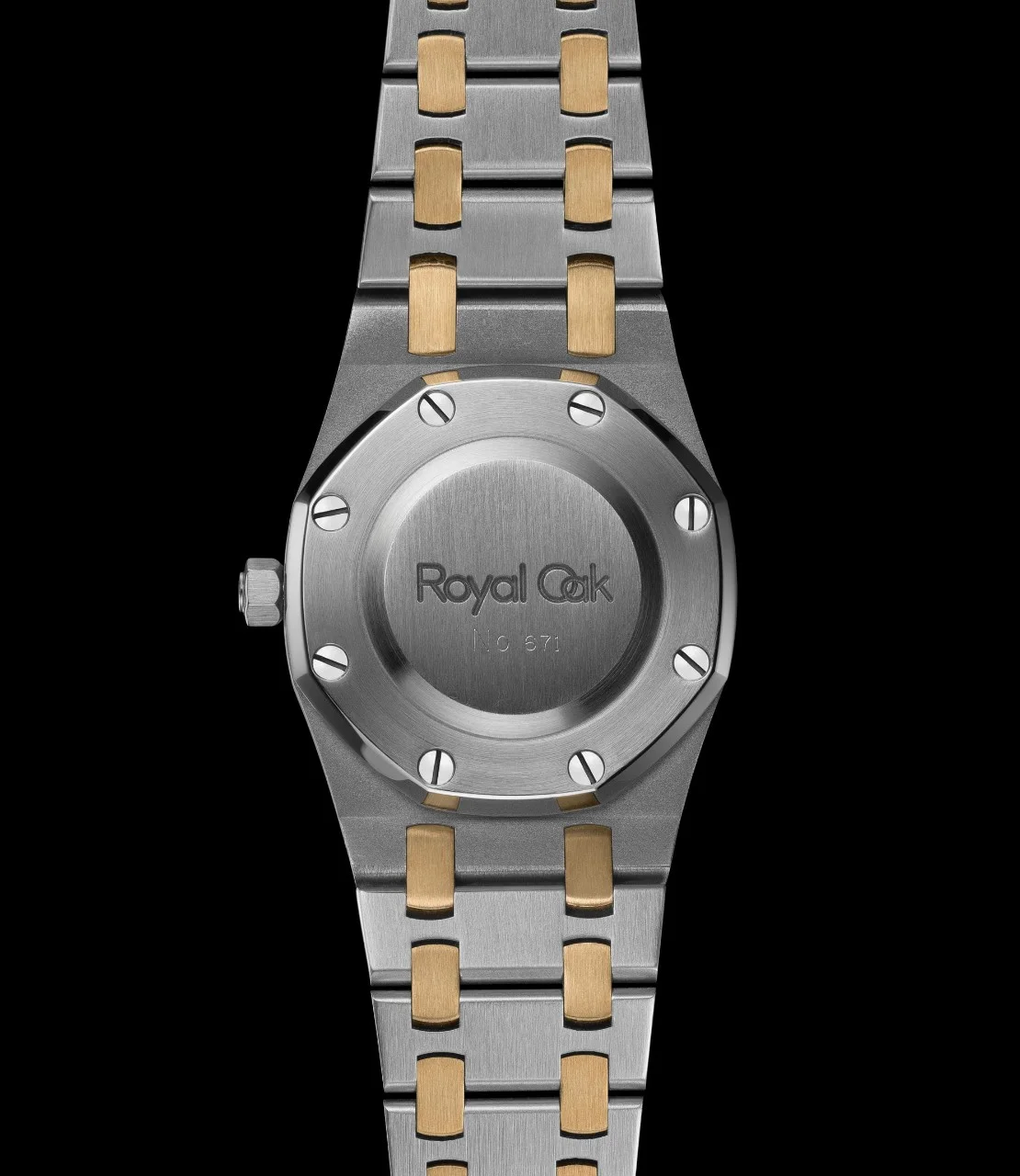
1979. Royal Oak 8638SA (1977), No. 671, caseback view. Date. Calibre 2062, movement 192912. Bracelet 424. T21 Tapisserie dial. 29 mm case. 18-carat yellow gold. Sold in 1979, then gifted to the AP Museum in December 1983. Audemars Piguet Heritage, inv. 381.
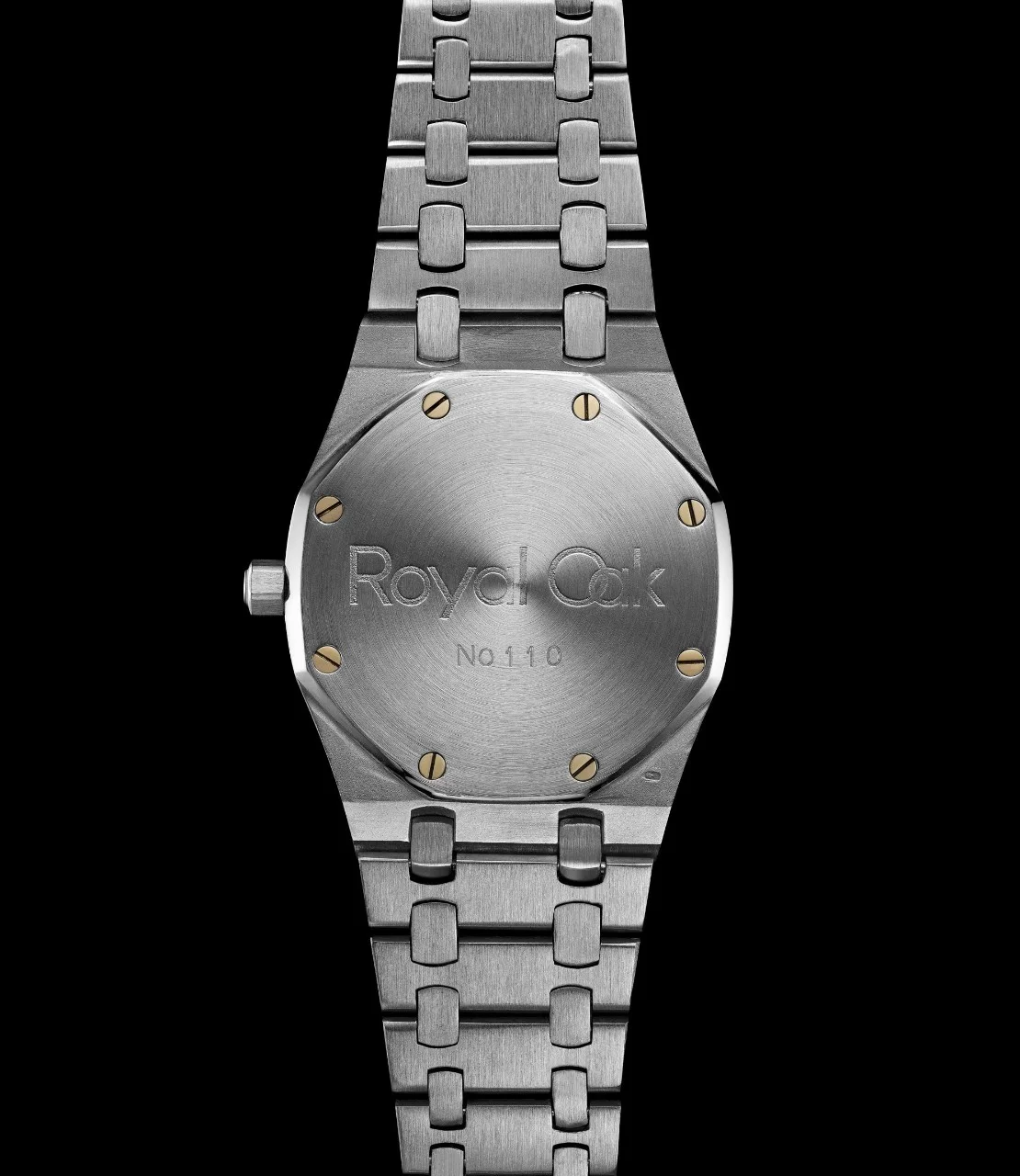
1980. Royal Oak 5042BC No. 110, caseback view. Calibre 2121. Movement 211839. Case 39 mm B43447. 18-carat white gold. Sold in Germany in 1980. Audemars Piguet Heritage, inv. 1835.
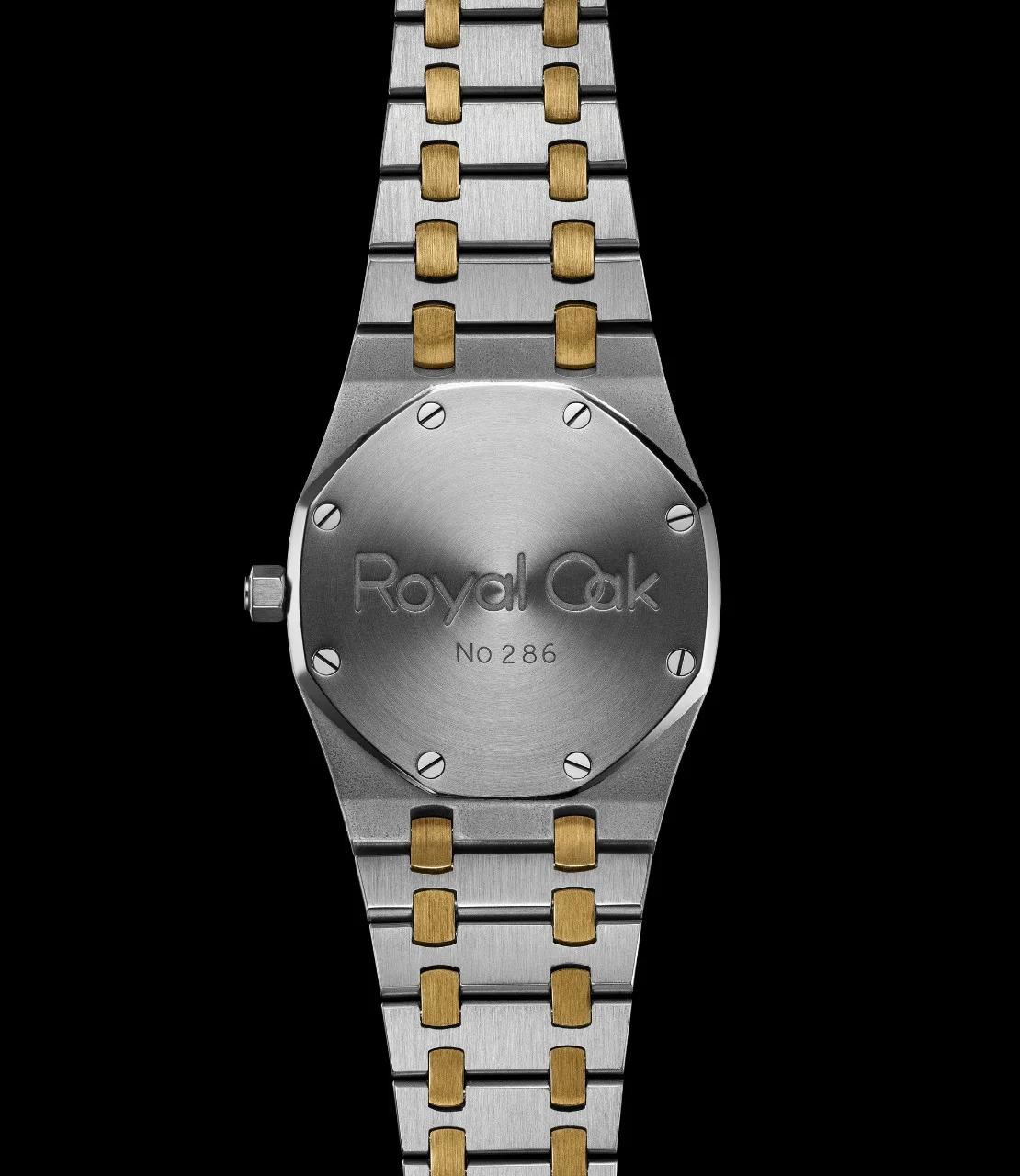
1978. Royal Oak 5042SA No. 286, caseback view. Calibre 2121, movement 175031. Case 39 mm B20804. Steel and 18-carat yellow gold. Sold in Hong Kong in 1978. Audemars Piguet Heritage, inv. 1446.
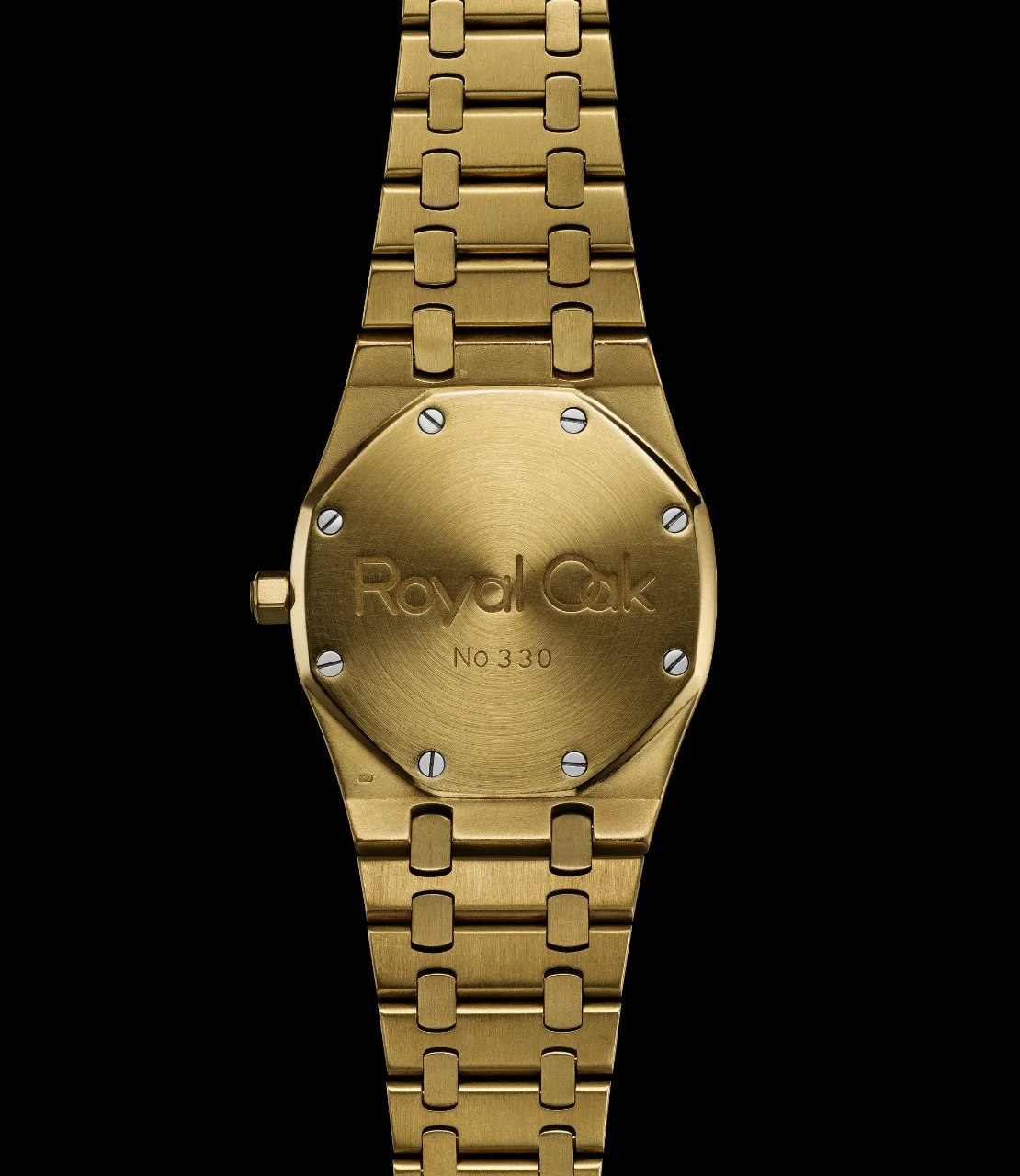
1978. Royal Oak 5402BA No. 330, caseback view. Date. Calibre 2121, movement 196615. Bracelet 344. T21 Tapisserie dial. 39 mm case B28716, no. 39 in 18-carat yellow gold. Sold in Mexico in November 1978. Audemars Piguet Heritage, inv. 1134.
B-Series Fans Take Note!
The first cases bearing a large number starting with B were introduced in 1976–1977, almost at the same time as the first Royal Oak B series. This coincidence in the registers may have caused a certain amount of confusion in the world of collectors, as there are "B series" and "B series”, so let’s clarify the situation here.
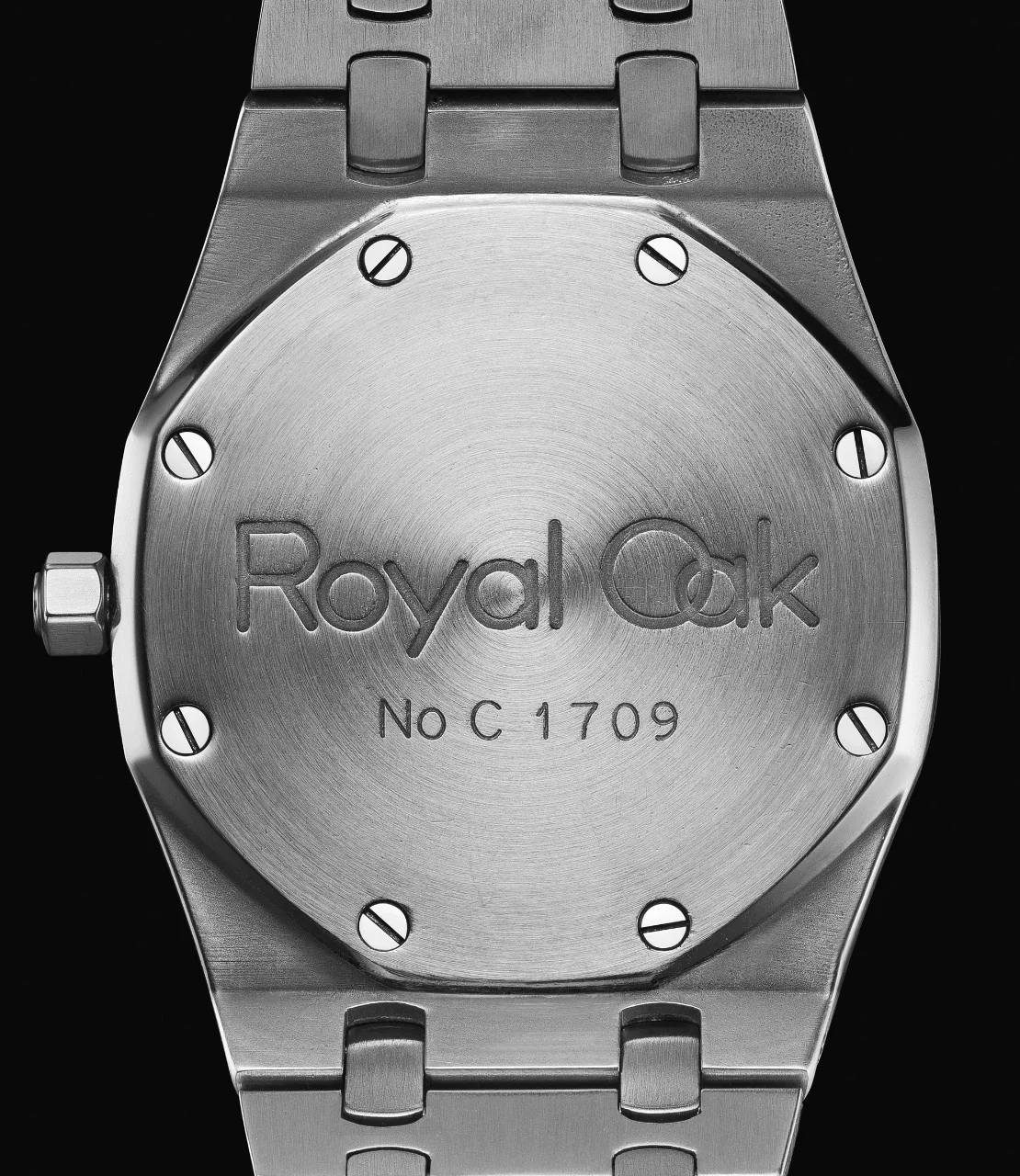
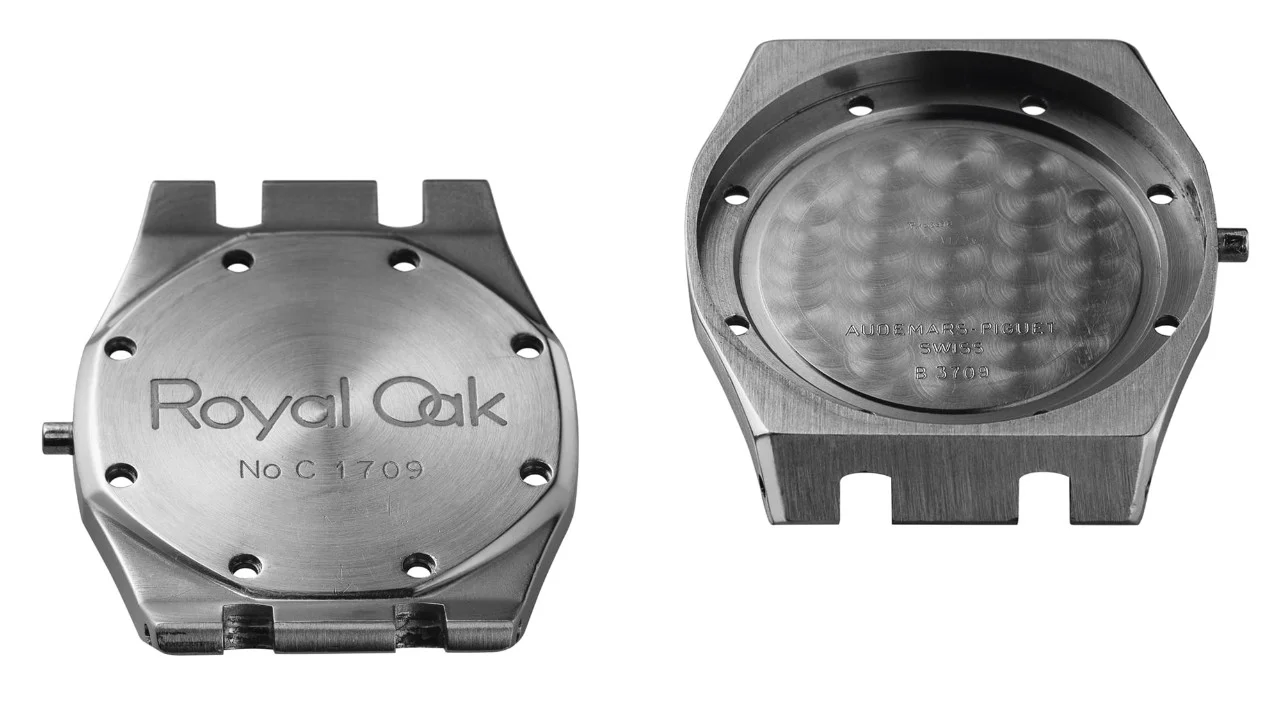
When we talk about a B series of Model 5402ST, we are referring to an original Royal Oak in steel with a small external number engraved beneath the Royal Oak inscription and located between B1000 and B2000. It would be wrong to consider a watch with a large case number (on the inside) starting with a B as a B-series model. For example, Model 5402ST, which belongs to the Audemars Piguet Heritage Collection, bears the small number C1709. Sold in 1979, its large case number is B3709, yet it belongs to the C series.
This confusion has sometimes misled collectors of yellow gold models. Most of the 5402BA watches have large case numbers starting with B. However, strictly speaking and according to the standard recognised by the world of museums and collectors, these are not B-series watches. The small numbers of the precious material variants are in fact never accompanied by a letter. Take the example of Royal Oak 5402BA No. 27, sold in June 1977. Despite the fact that its case is engraved (on the inside) with B14661, it is not a B-series model, but in fact 5402BA no. 27 – simply because the letters of the small number had been abolished before the creation of the first Model 5402 in gold.
How the System Evolved
Born in 1972, the small case number – or small Royal Oak number – met a need to enhance the value of the new model. It accompanied an increase in production, resulting in the manufacture of several hundred or even several thousand identical watches. It worked like a limited-series number, but with no maximum limit, based on the principle that the production volumes of Audemars Piguet watches are by definition very small. It also served as a limited-edition number from the 1990s onwards, simply by adding the quantity of the series (e.g. XX/75 for a 75-piece edition).
In 1976, the alphanumeric system (reserved for the 5402ST) was abandoned in favour of a simpler numbering system. While perfectly suitable at the time the Royal Oak collection was born, the latter also reached its limits with the multiplication of Royal Oak variations in the 1980s. It became almost impossible to identify them without opening the case to check the large number, thereby forcing the system to evolve once again. Around 1990, the large case number returned to its place on the outside of the watch case, next to the small number. With the advent of open casebacks, the small outer number migrated to the top of the caseback.
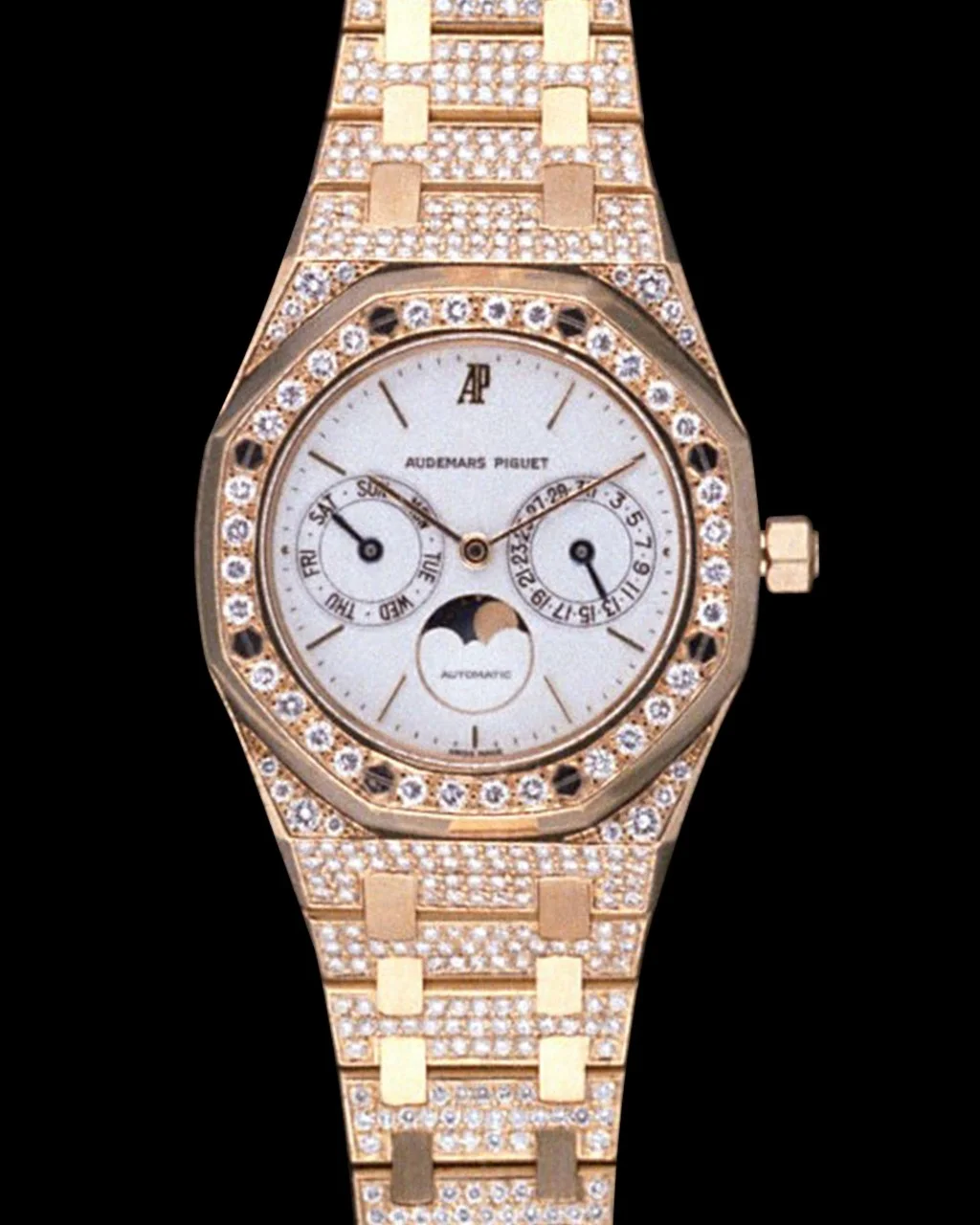
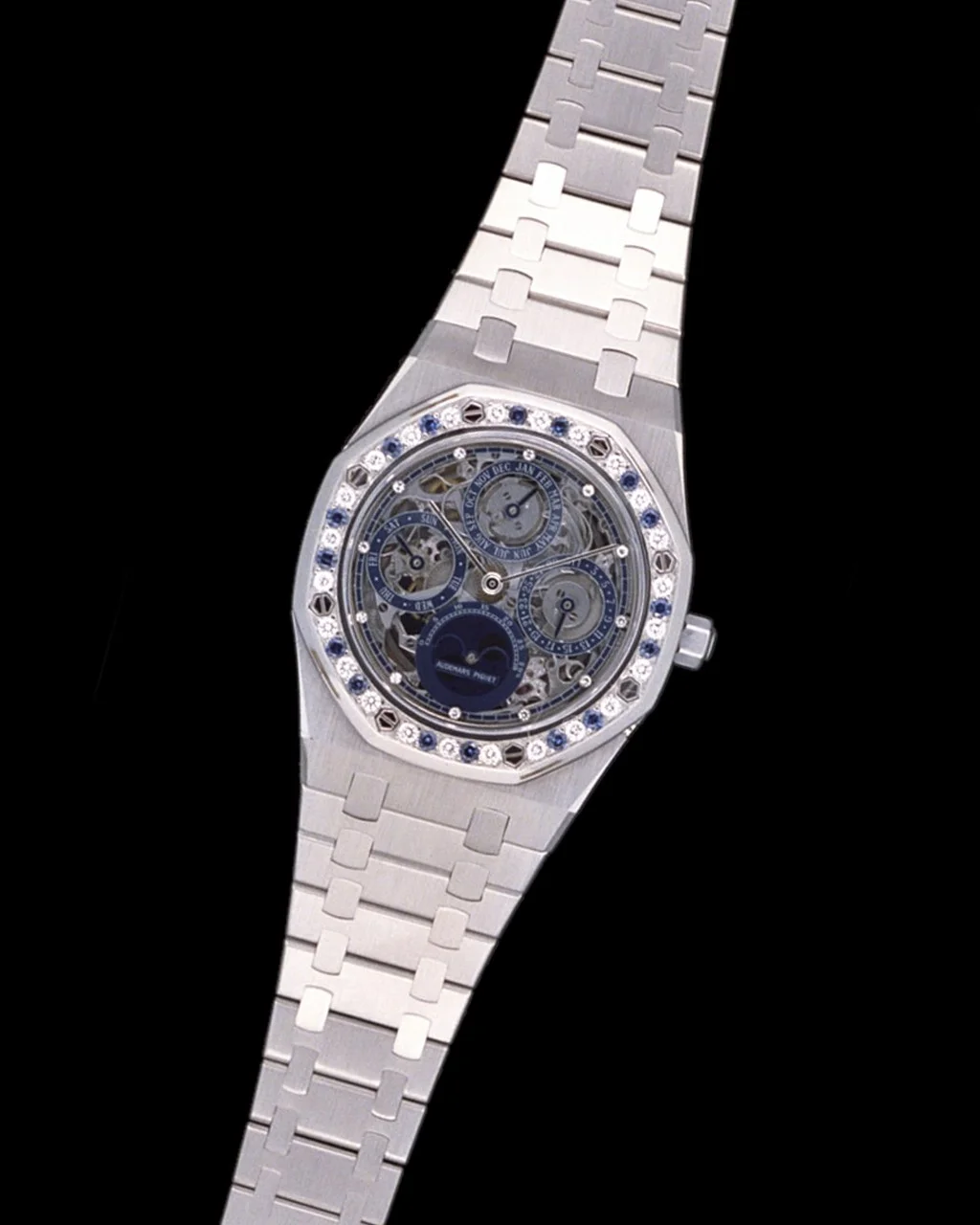
Another fact might be of interest to collectors. There are certain exceptions to the rule stipulating that the small case number of each model honed from a different material starts with 1. Indeed, to create a very small gemset Royal Oak series, adapted from a core collection model produced in several hundred units, watchmakers often took one of the existing numbered cases produced for the original core series. As a result, some timepieces have a small Royal Oak number that exceeds the model’s total production. This is the case of Model 5402BA that was produced in 736 units and whose cases were used for the gemset Royal Oak 4187BA. Indeed, some 4187BA cases are engraved with no. 420, 519 or even 637, while only 9 pieces of this gemset variation are documented in the Audemars Piguet archives. Another notable example is that of the gemset 25595BC Royal Oak Day Date Moon Phase, whose two produced models are respectively engraved with no. 22 and no. 26. The same practice is found for other non-gemset variations. For instance, the Manufacture used 5402ST cases to create the first fifty 5554 Royal Oak units, engraved with numbers starting from D1449. These cases had to be adapted to welcome the perpetual calendar Calibre 2120/2800.
In the second half of the 2010s, the entire system was thoroughly rethought. The small Royal Oak number vanished and the movement numbers along with the large case numbers became randomly generated and alphanumeric. This system strips the numbers of their temporal or quantitative significance, the aim being to reduce the risk of falsification and copying. It requires the use of sophisticated computer tools to access authentication information, thereby relegating the handwritten registers to their symbolic function and opening a new chapter in the history of Audemars Piguet.
Editorial board: Audemars Piguet Heritage team, Le Brassus
First publication: 19 April 2022
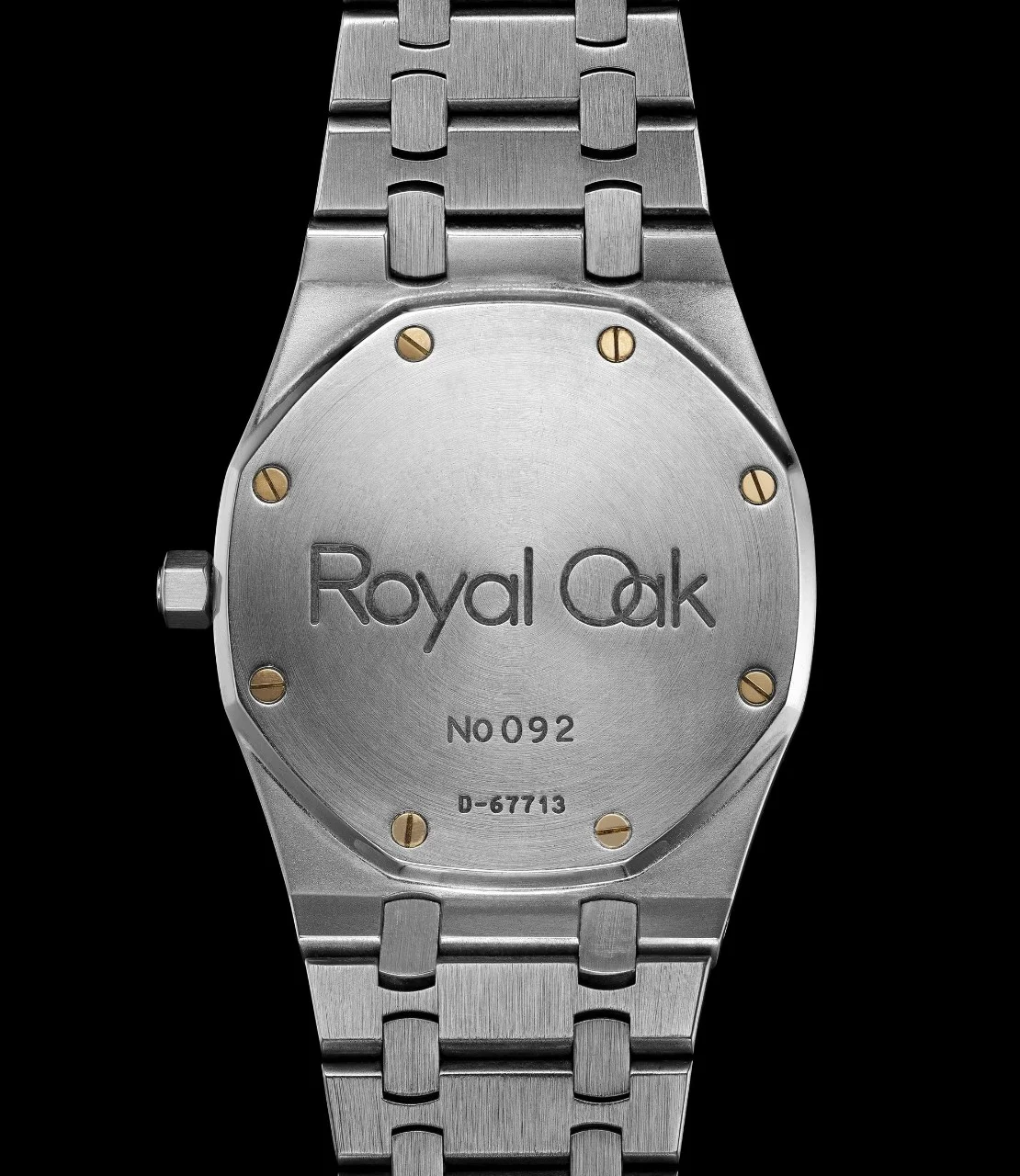
1996. Royal Oak 15002ST, No. 92, caseback view. Date. Calibre 2121, movement 405930. Bracelet 944. T21 Tapisserie dial. Case D67713, 39 mm. Steel. Sold in 1996 to AP Fintime (Italy). Audemars Piguet Heritage, inv. 1964.
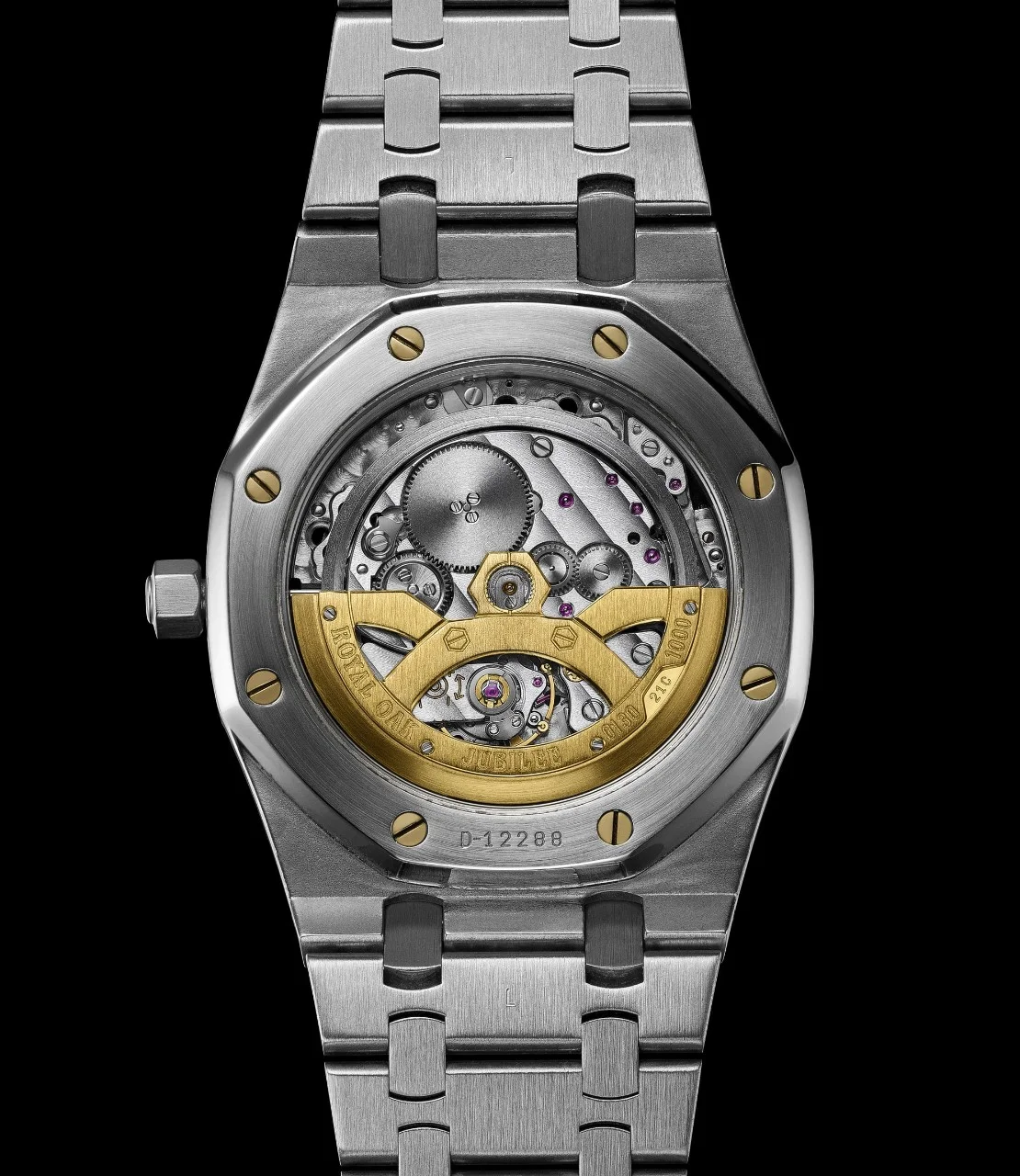
1993. Royal Oak 14802ST (1992), No. 130, caseback view. Date. Calibre 2121, movement 374378. Bracelet 944. T21 Tapisserie dial. Steel. Sold in 1993 to Elco (United Kingdom). Audemars Piguet Heritage, inv. 1051.
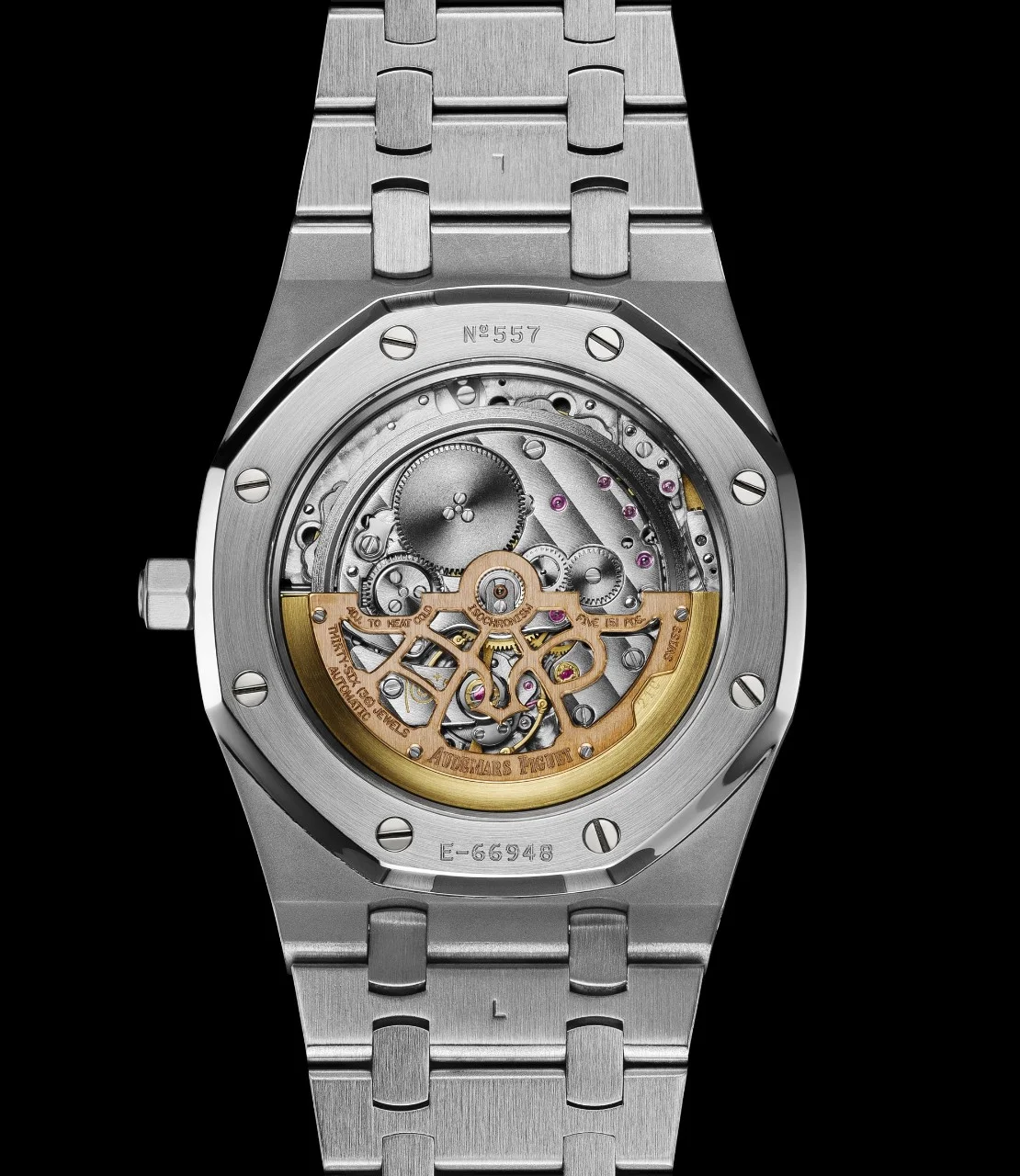
2002. Royal Oak 15202ST (2000), No. 557, caseback view. Date. Calibre 2121, movement 506507. Bracelet 944. Grande Tapisseriedial. Case E66948, 39 mm. Steel. Sold in 2002 to AP Germany. Audemars Piguet Heritage, inv. 738.
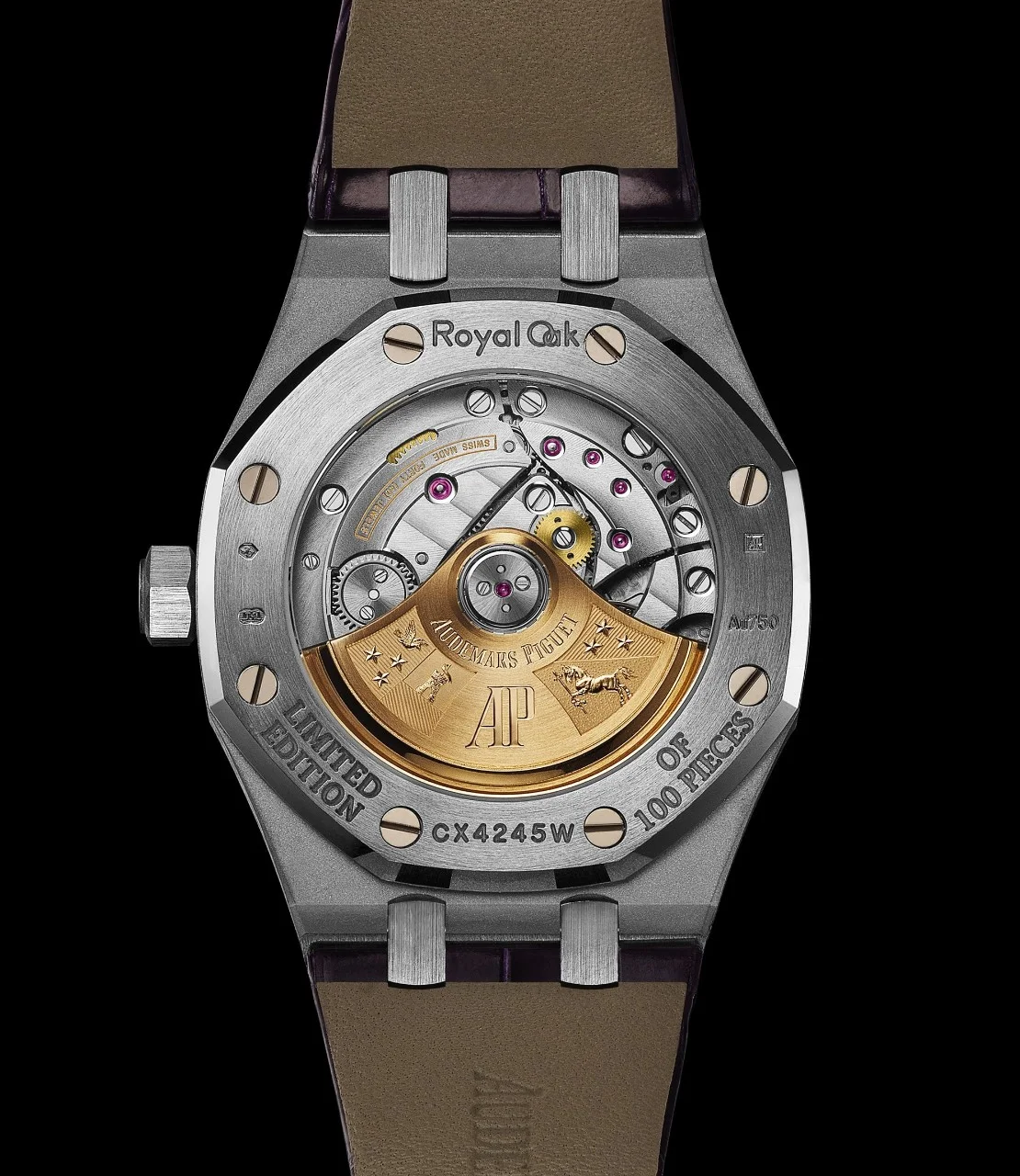
2021. Royal Oak 15452BC, caseback side. Set with 40 sapphires in graded hues ranging from pink to blue as well as with 124 brilliant-cut diamonds. Date. Selfwinding Calibre 3120, movement AV9394. 37 mm case CX4245W in 18-carat white gold. Limited edition of 100 pieces. Audemars Piguet Heritage, inv. 2099.
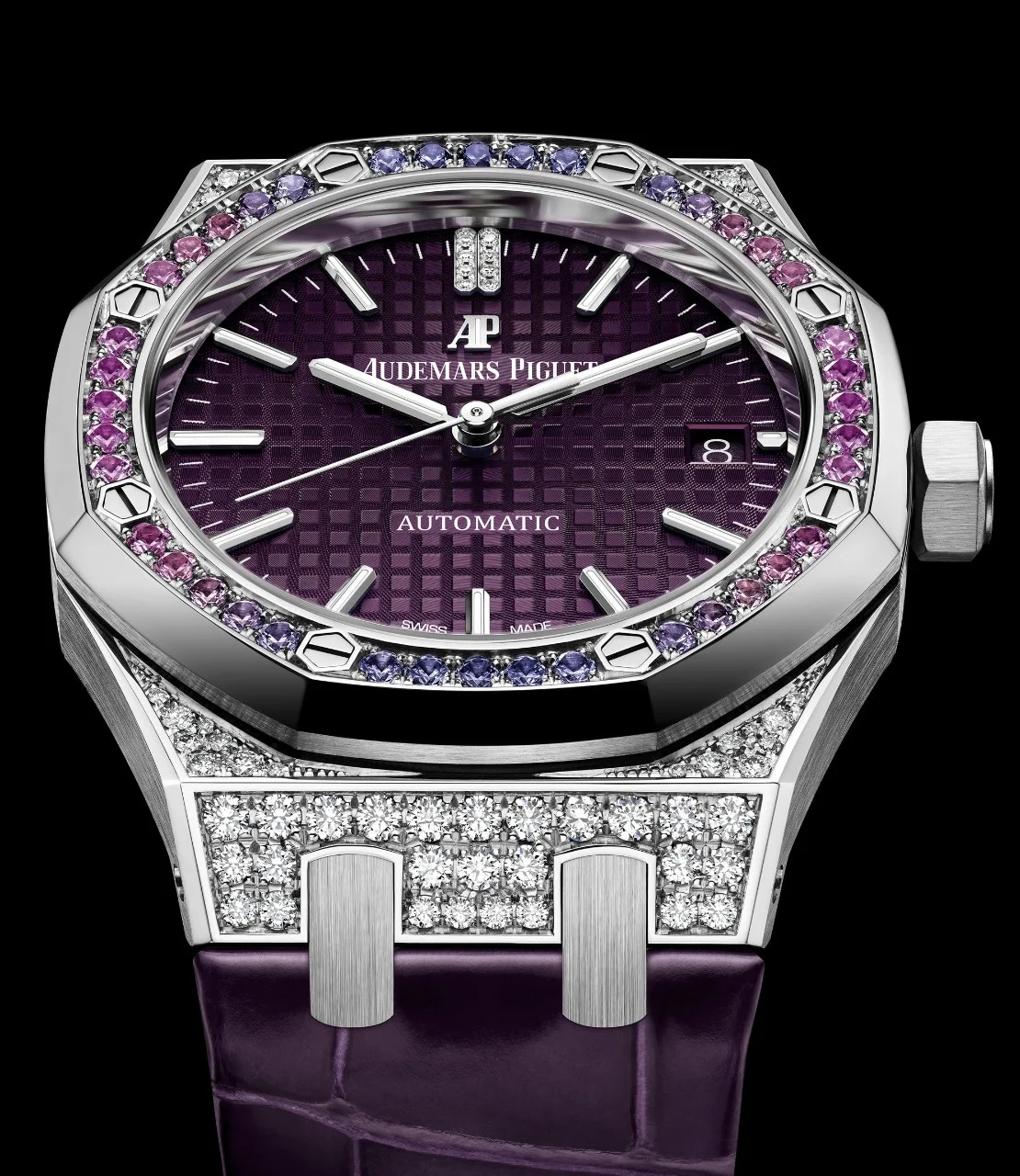
2021. Royal Oak 15452BC. Set with 40 sapphires in graded hues ranging from pink to blue as well as with 124 brilliant-cut diamonds. Date. Selfwinding Calibre 3120, movement AV9394. 37 mm case CX4245W in 18-carat white gold. Limited edition of 100 pieces. Audemars Piguet Heritage, inv. 2099.