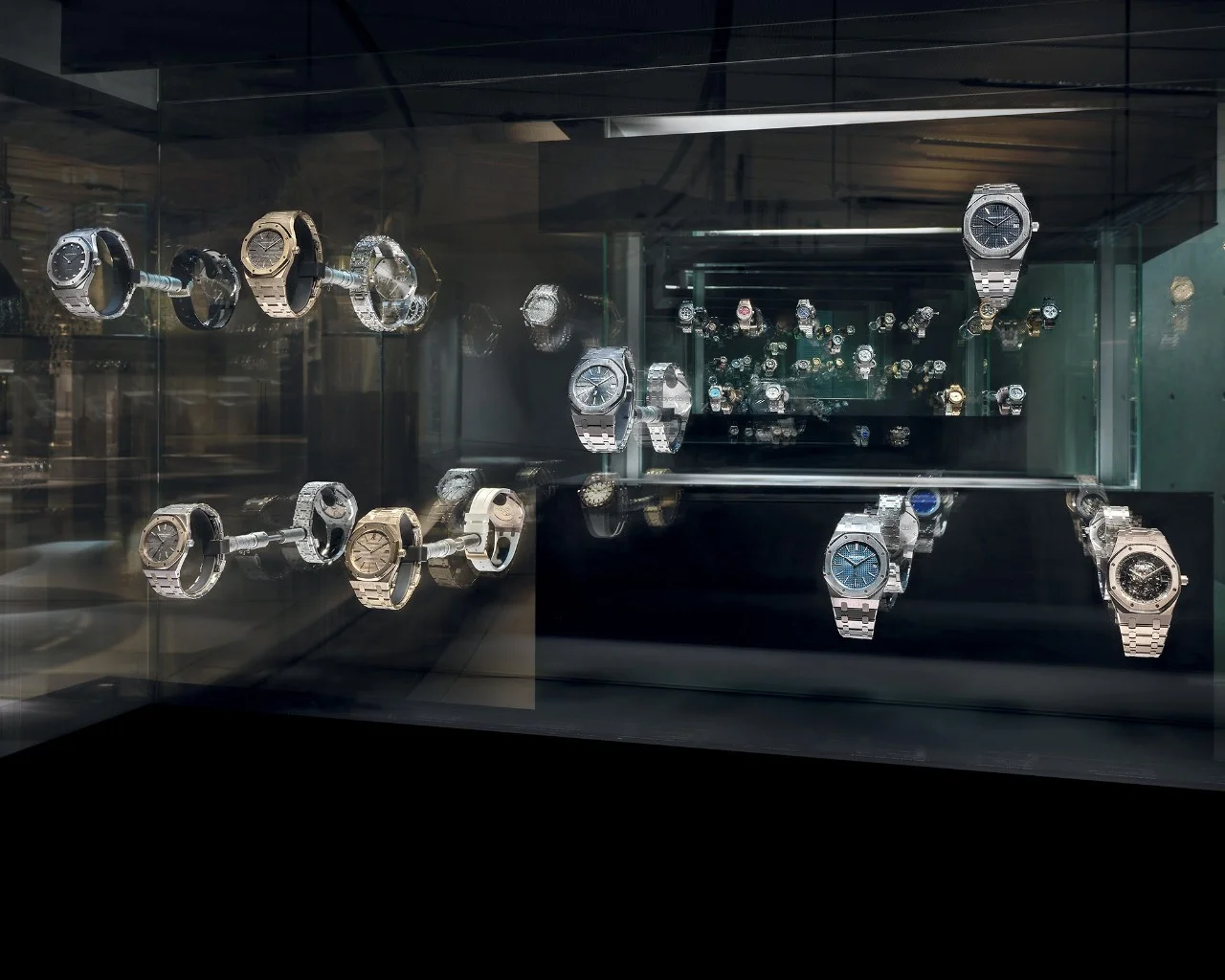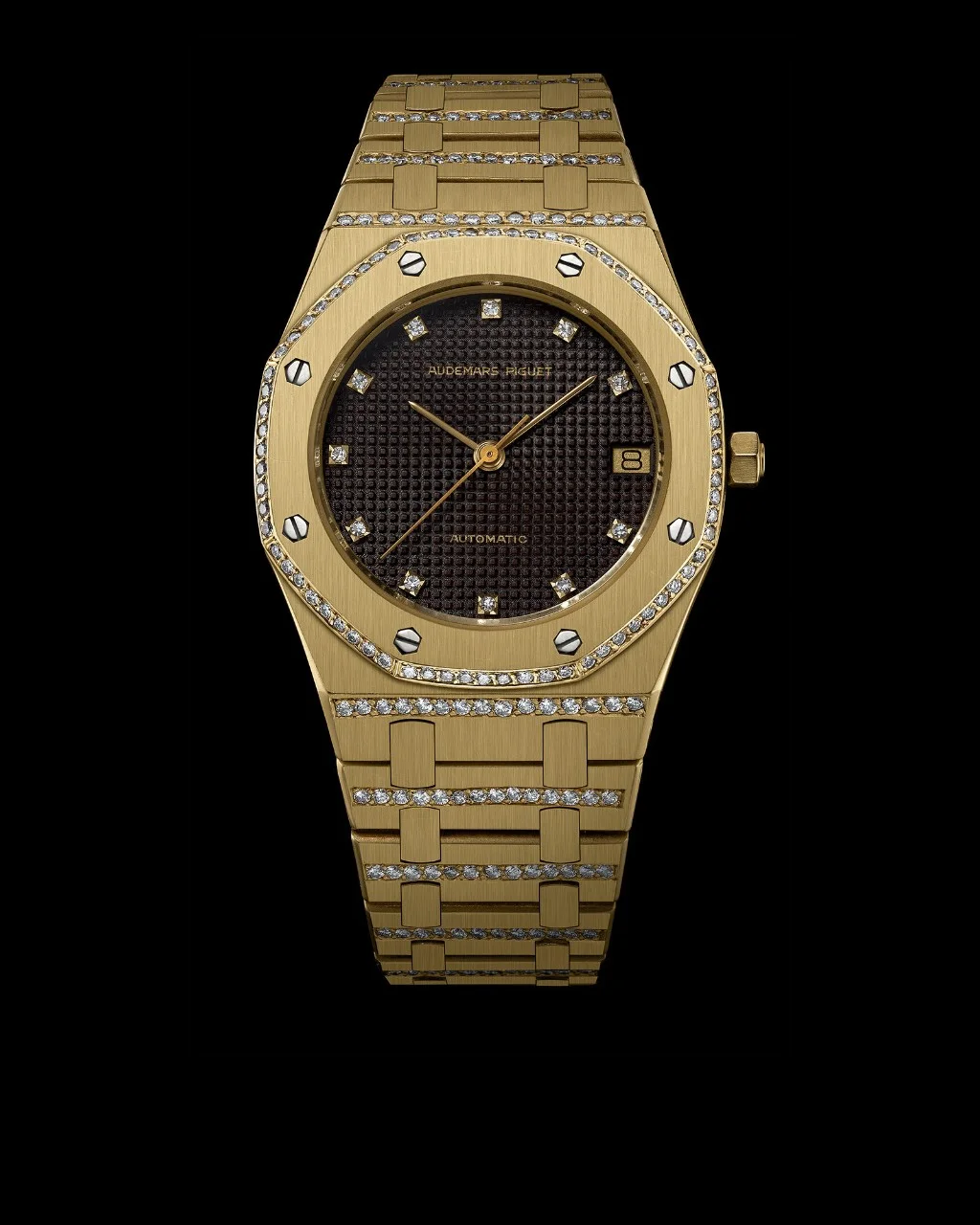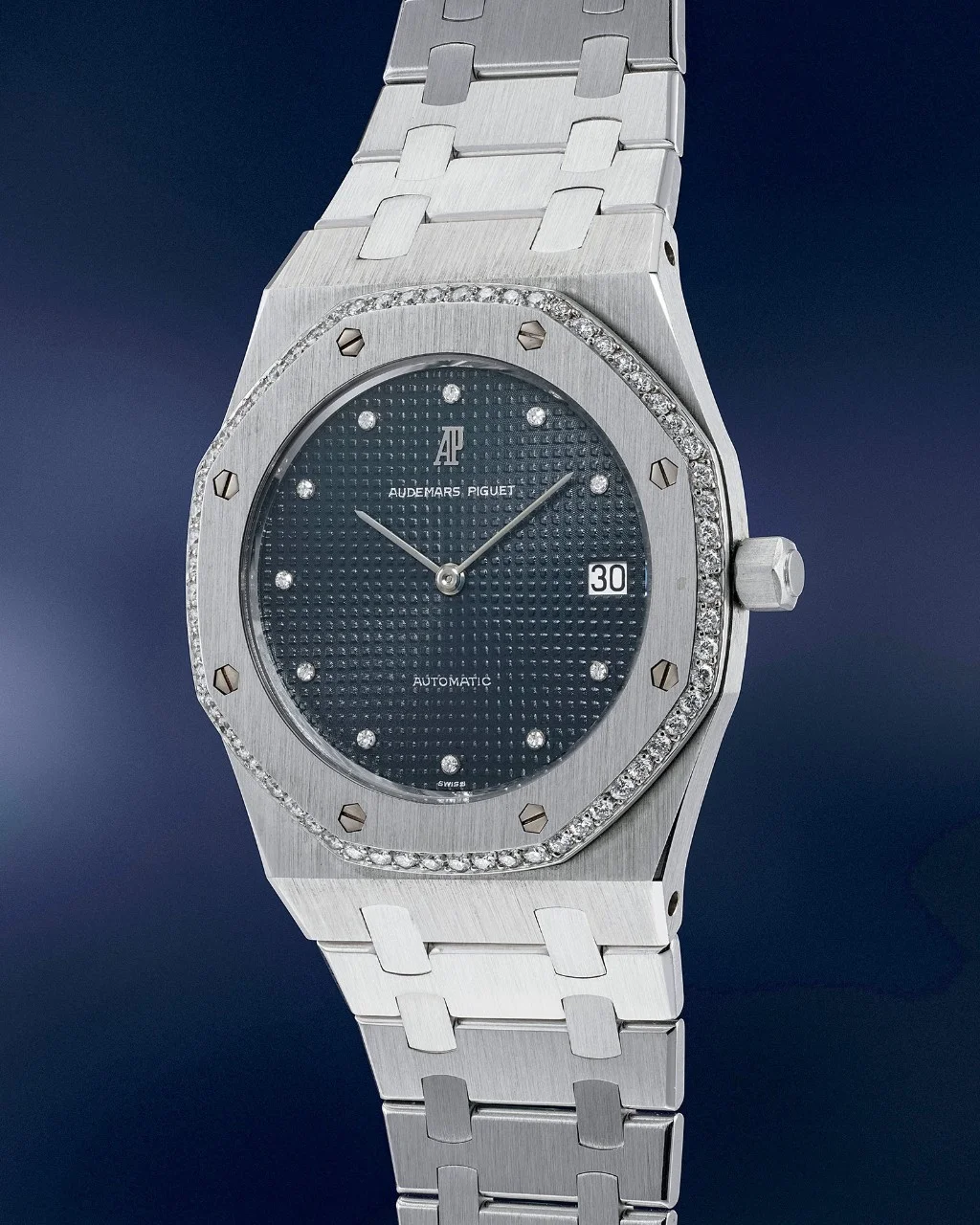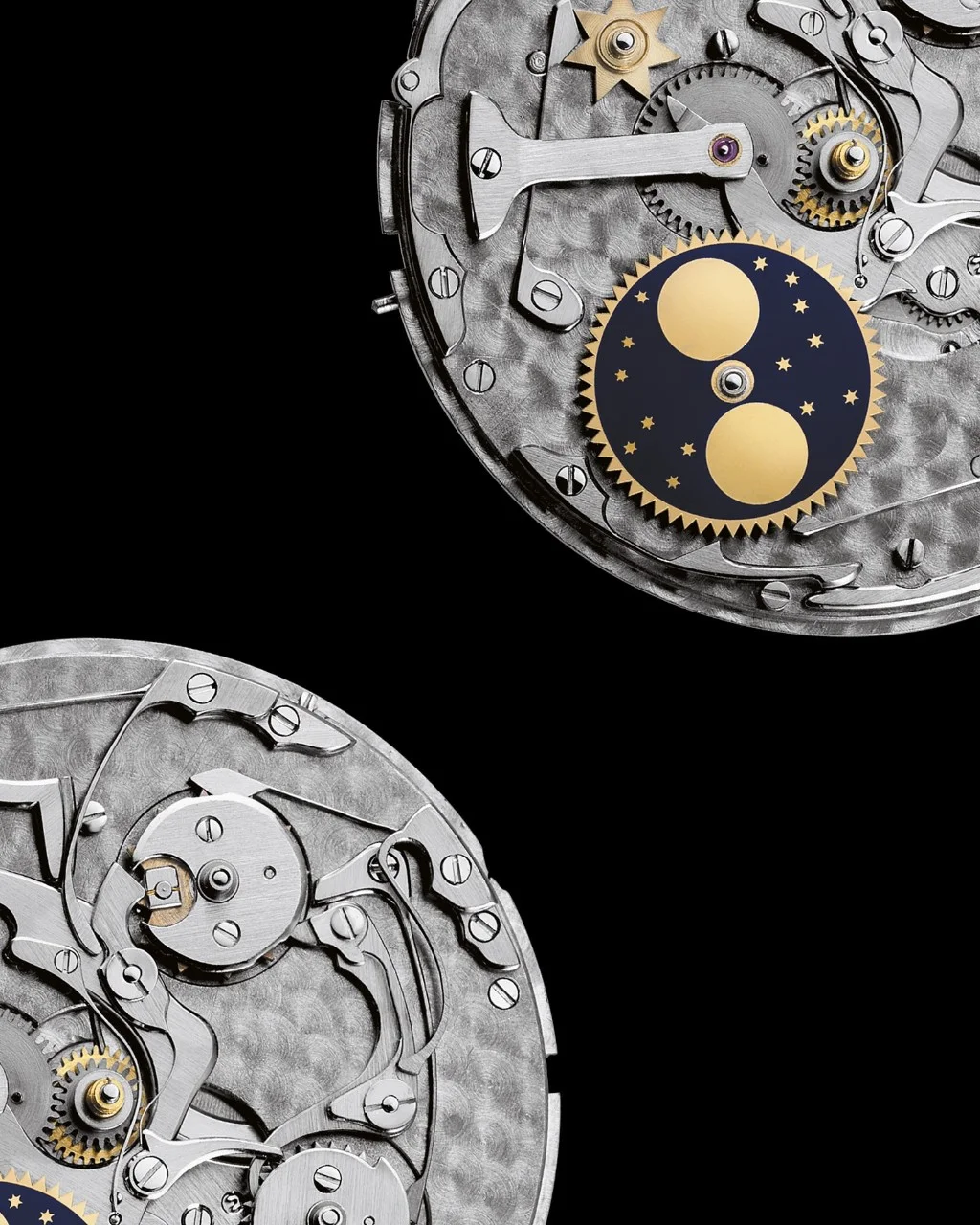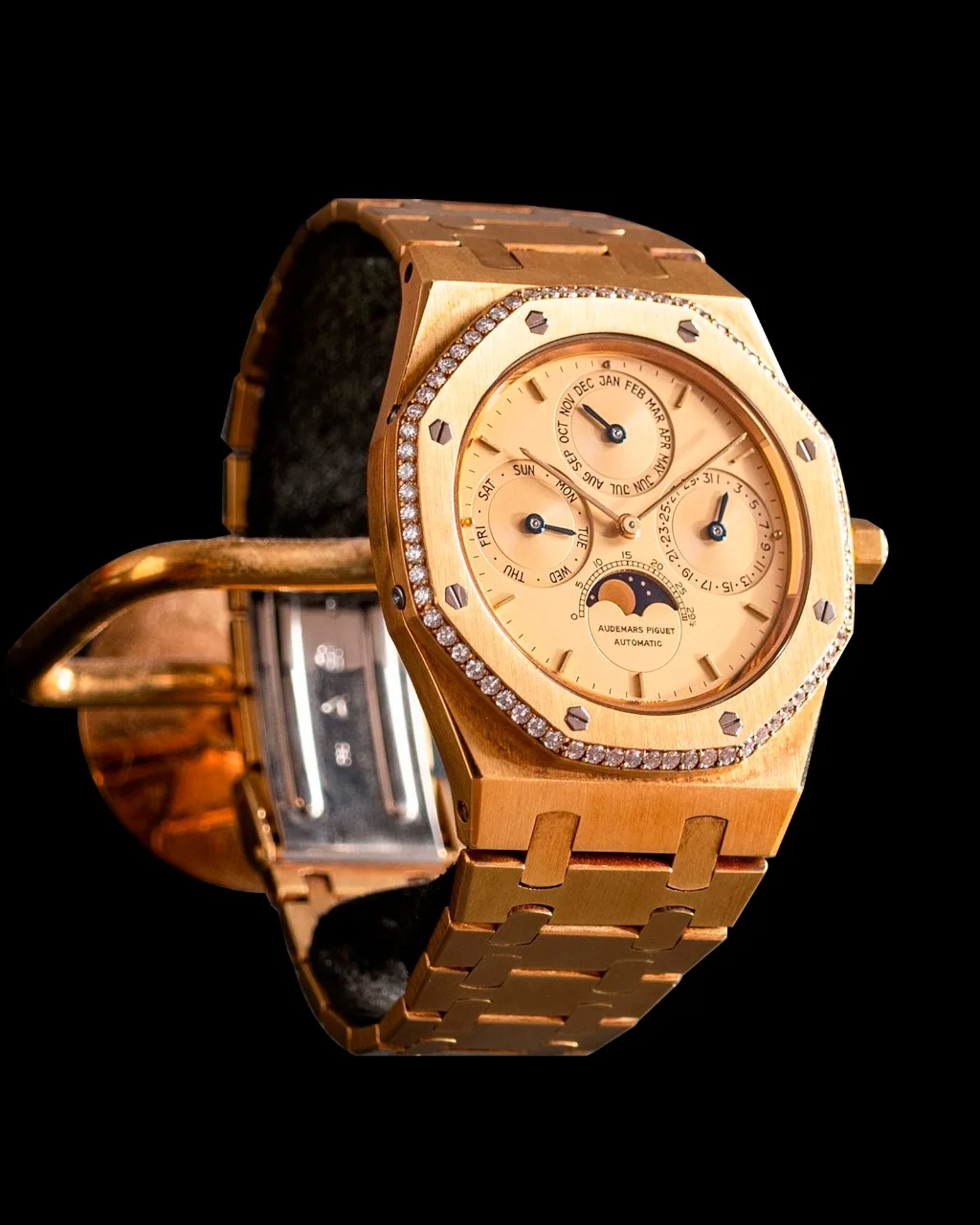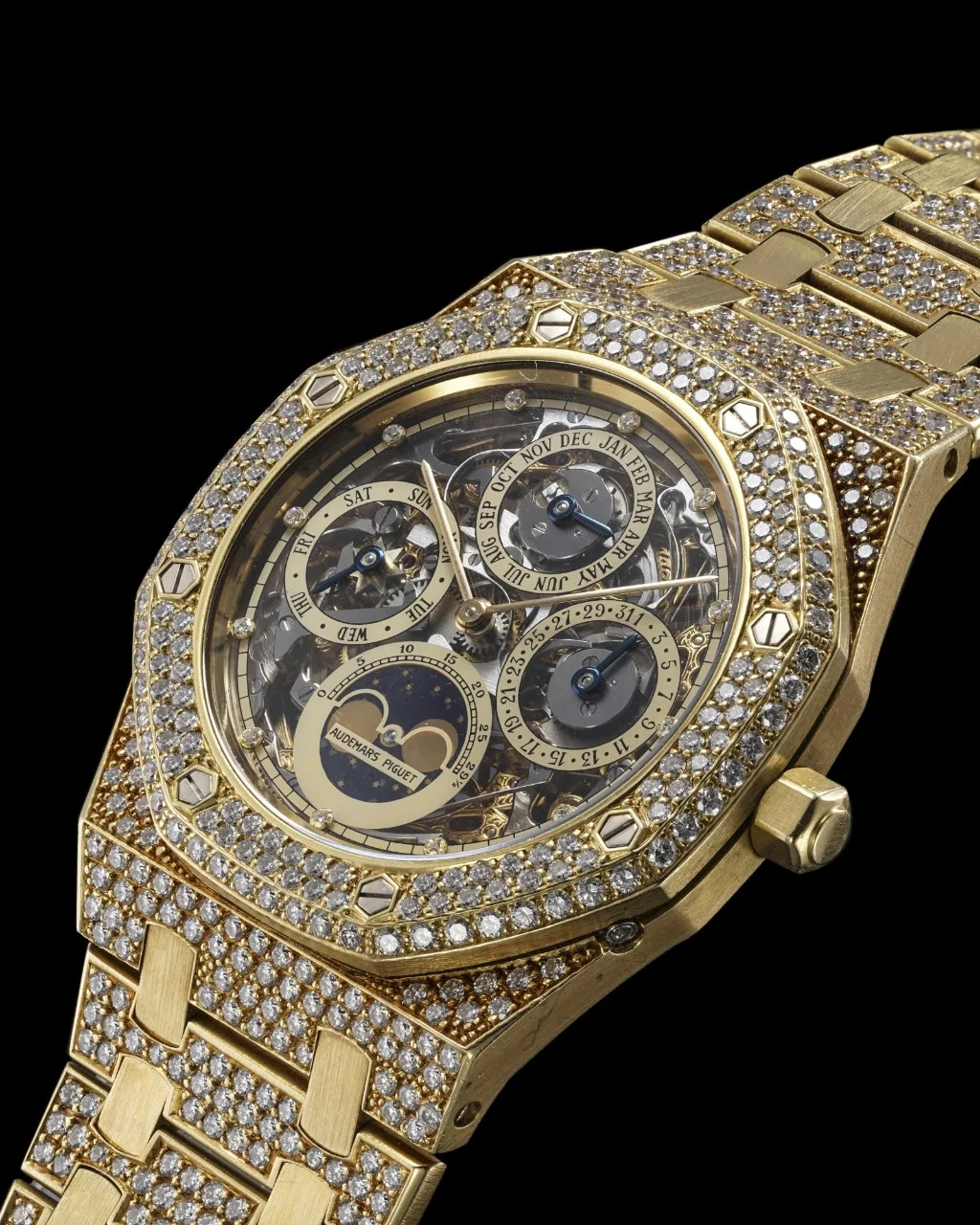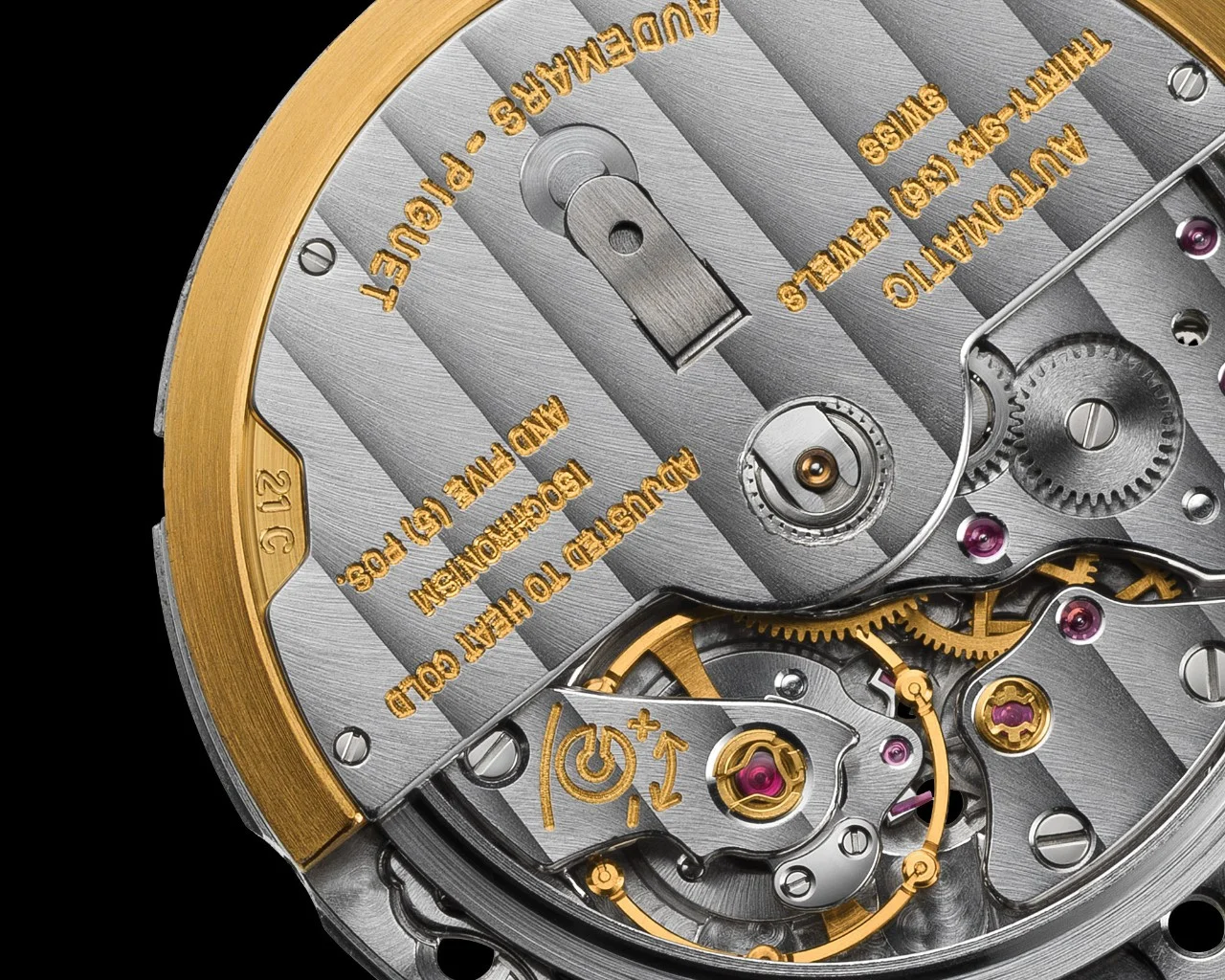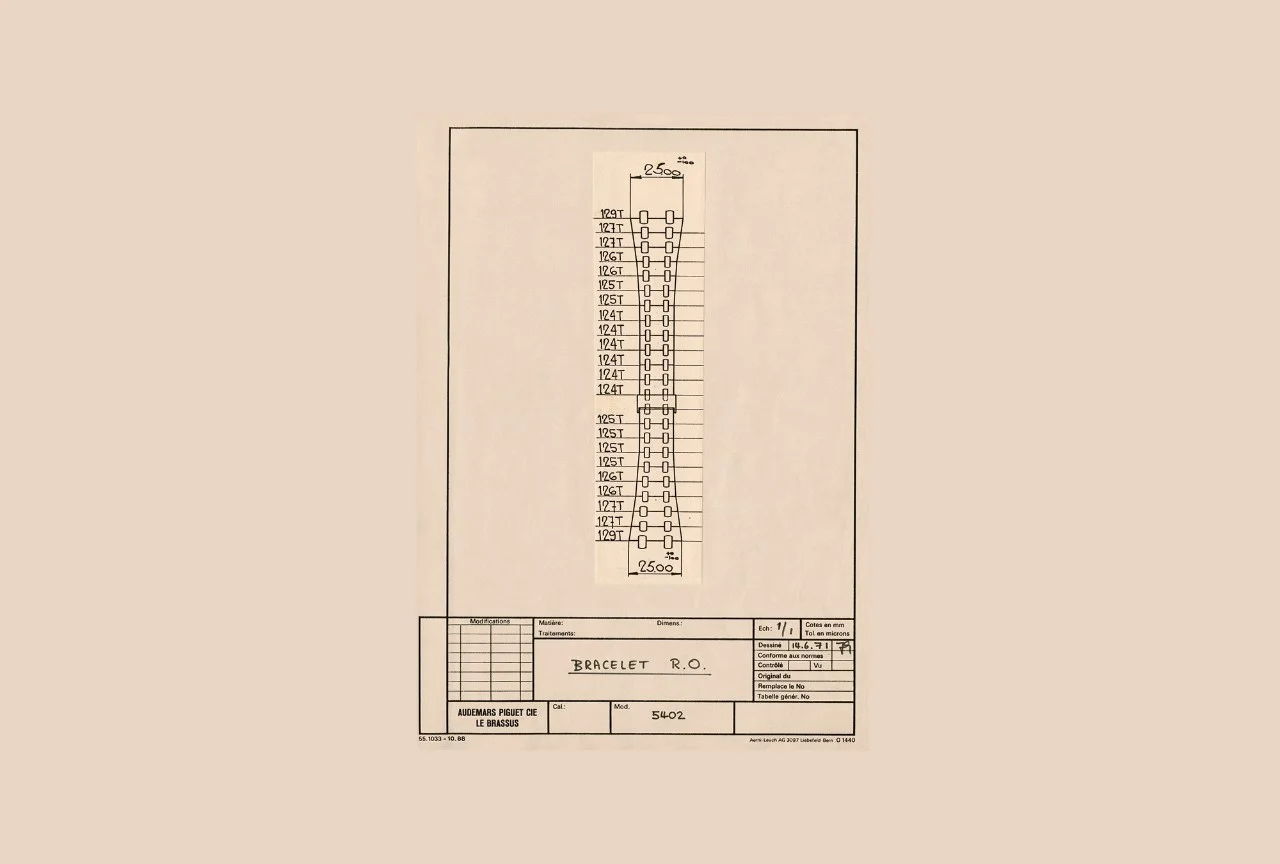
Royal Oak Bracelets
Summary
Origins of the Metal Bracelet
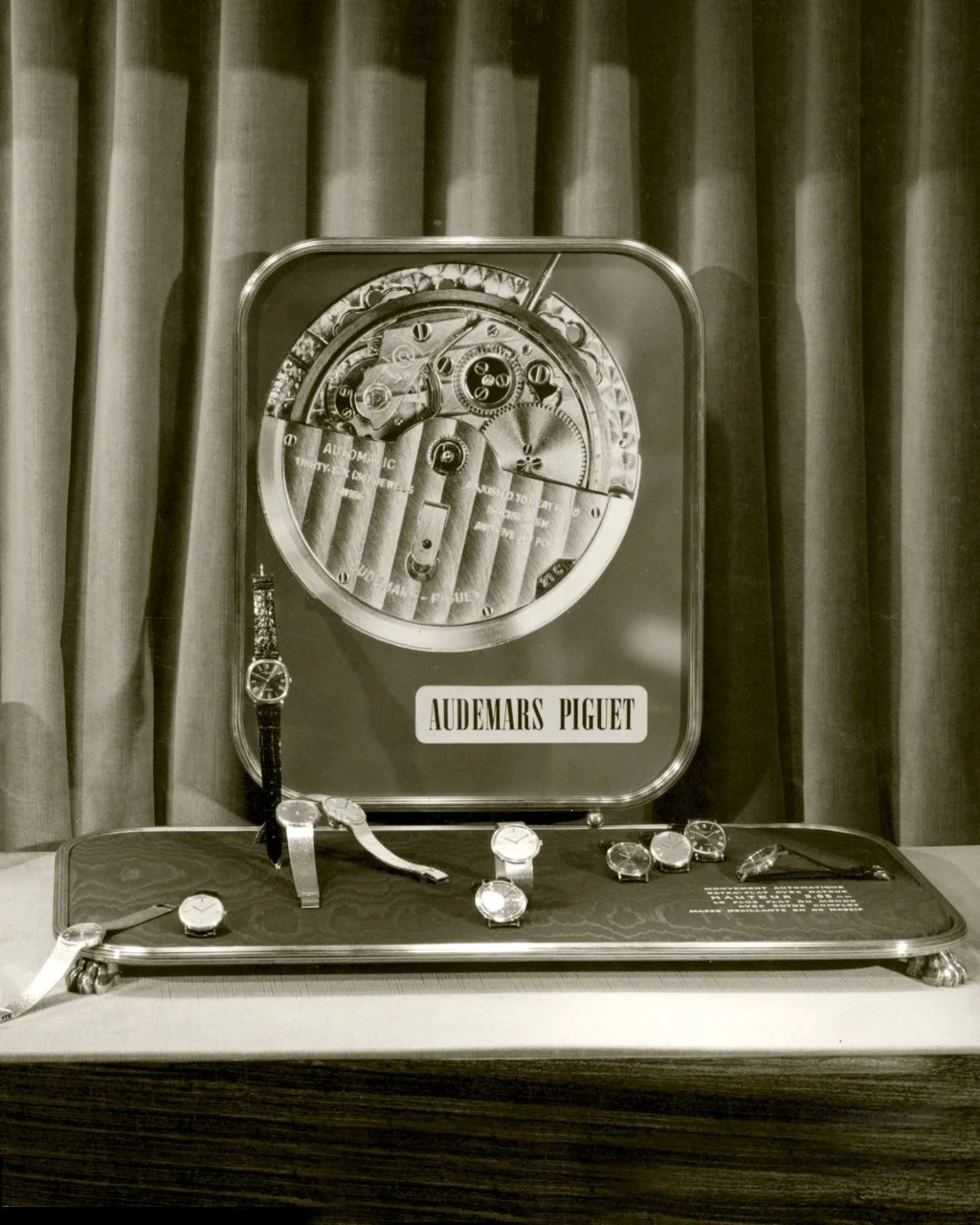
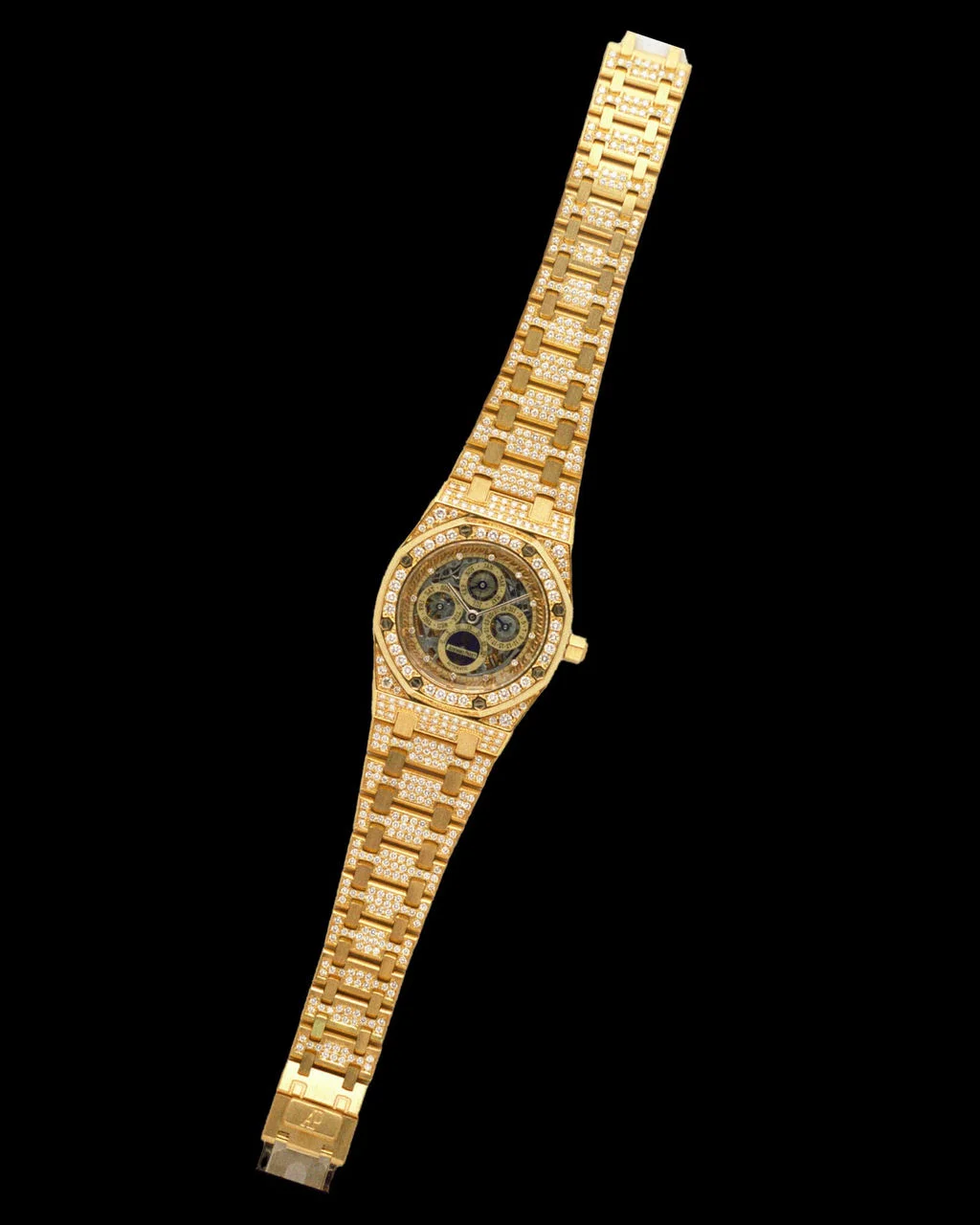
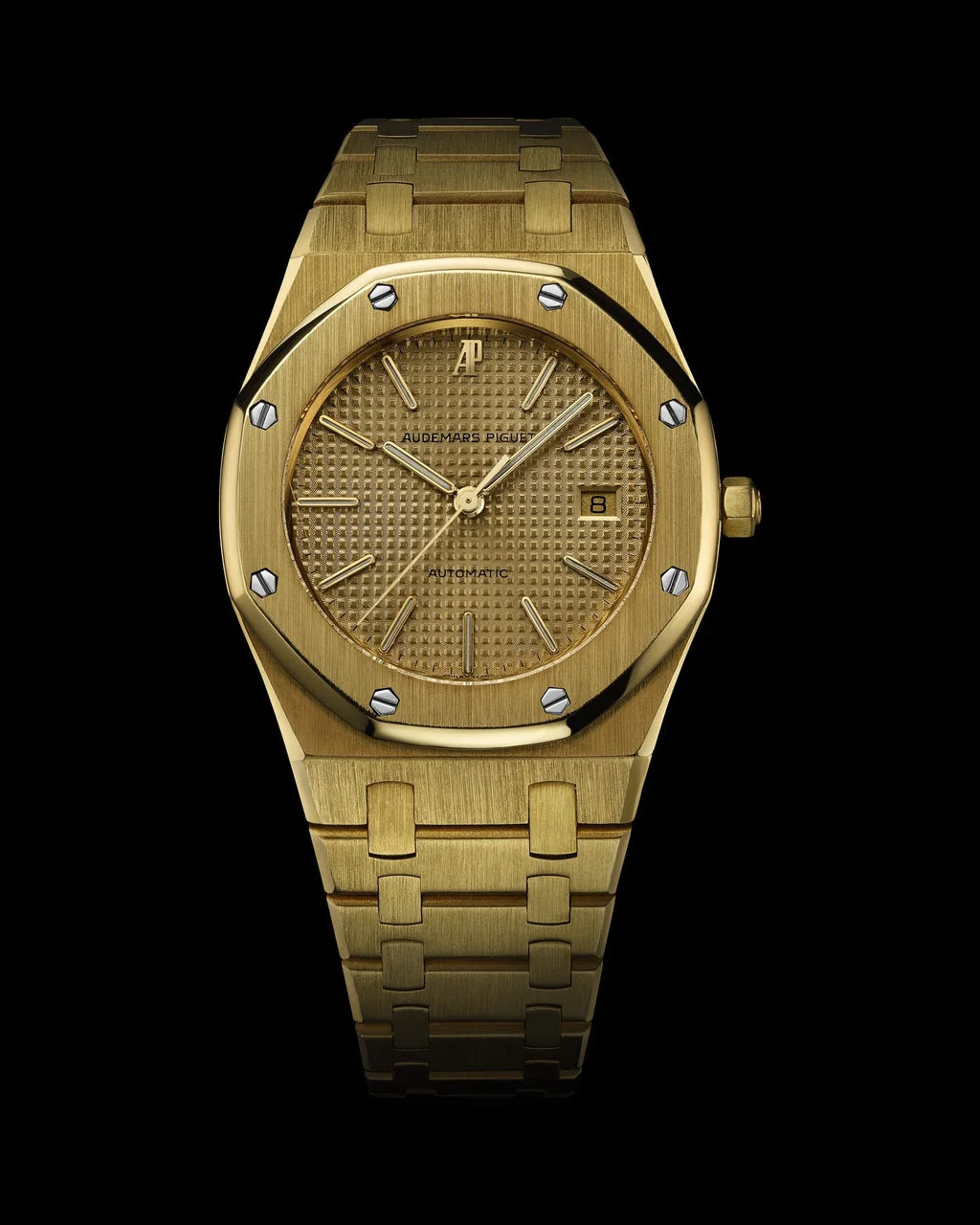
The first wristwatches were created for women. In the 18th and 19th centuries, timepieces’ role as jewellery was often given priority over displaying the time – so much so that their dials were frequently hidden beneath a gemset cover. During that period, they tended to be referred to in French as bracelets-montres (watch bracelets) rather than montres-bracelets (wristwatches). This tradition continued in the 20th century despite the considerable improvements in the accuracy of miniature movements – and particularly so at Audemars Piguet through watches with very elaborate bracelets, often gemset and almost always in gold or platinum, crafted by the best jewellery artisans.
The history of men's wristwatches is different. It was not until the 20th century that men gradually adopted the idea of wearing a watch on their wrist. The experience of trench warfare in World War I helped them understand that being able to check the time by glancing at a wrist-worn timepiece was far more efficient than resorting to pocket watches when it came to synchronising military operations. However, contrary to the tendency with ladies’ watches, the timekeeping function took precedence over all others. This is probably why men adopted leather straps on both inexpensive and luxury watches, which doubtless contributed to ensuring that these models stood out from women's timepieces. For several decades and with only a few exceptions (e.g. Pre-Model 1530), men's wristwatches at Audemars Piguet were fitted with calfskin, pigskin, suede and even tapir leather straps.
Despite being both flexible and ergonomic, leather straps are not resistant to sports activities, especially aquatic ones. What is the point of a watch with a water-resistant case if its strap cannot withstand water? To make men's sports watches sturdier, certain brands such as Rolex, Omega and Breitling popularised steel bracelets in the 1940s and 1950s.
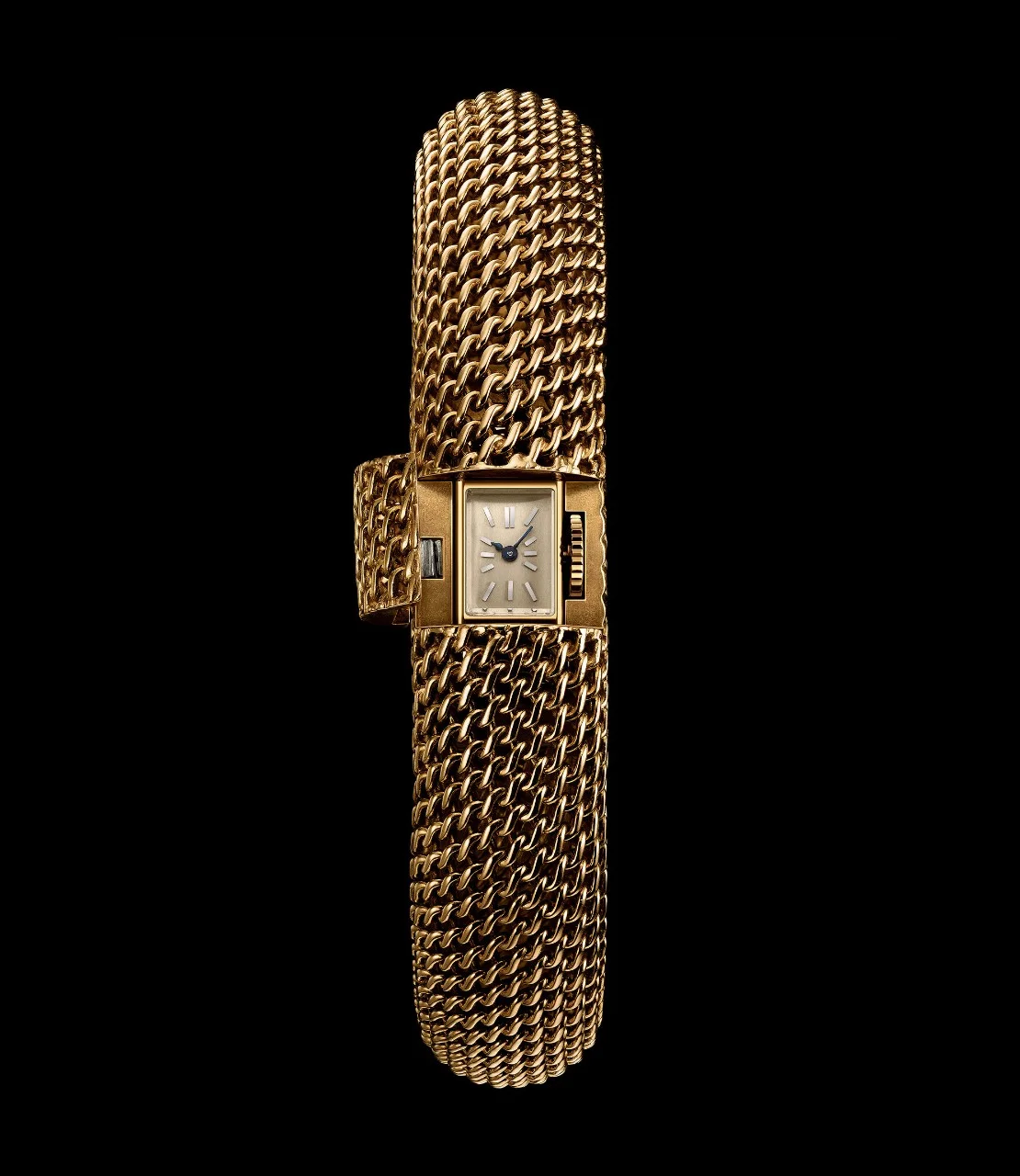
1950. ‘Secret’ wristwatch with cover 5949BA. When the cover is closed, the watch becomes a pure Milanese mesh bracelet. Calibre 5/7SB, the smallest in the world. Movement and case 41790. 18-carat yellow gold. Sold in Caracas in 1950. Audemars Piguet Heritage, inv. 1814.
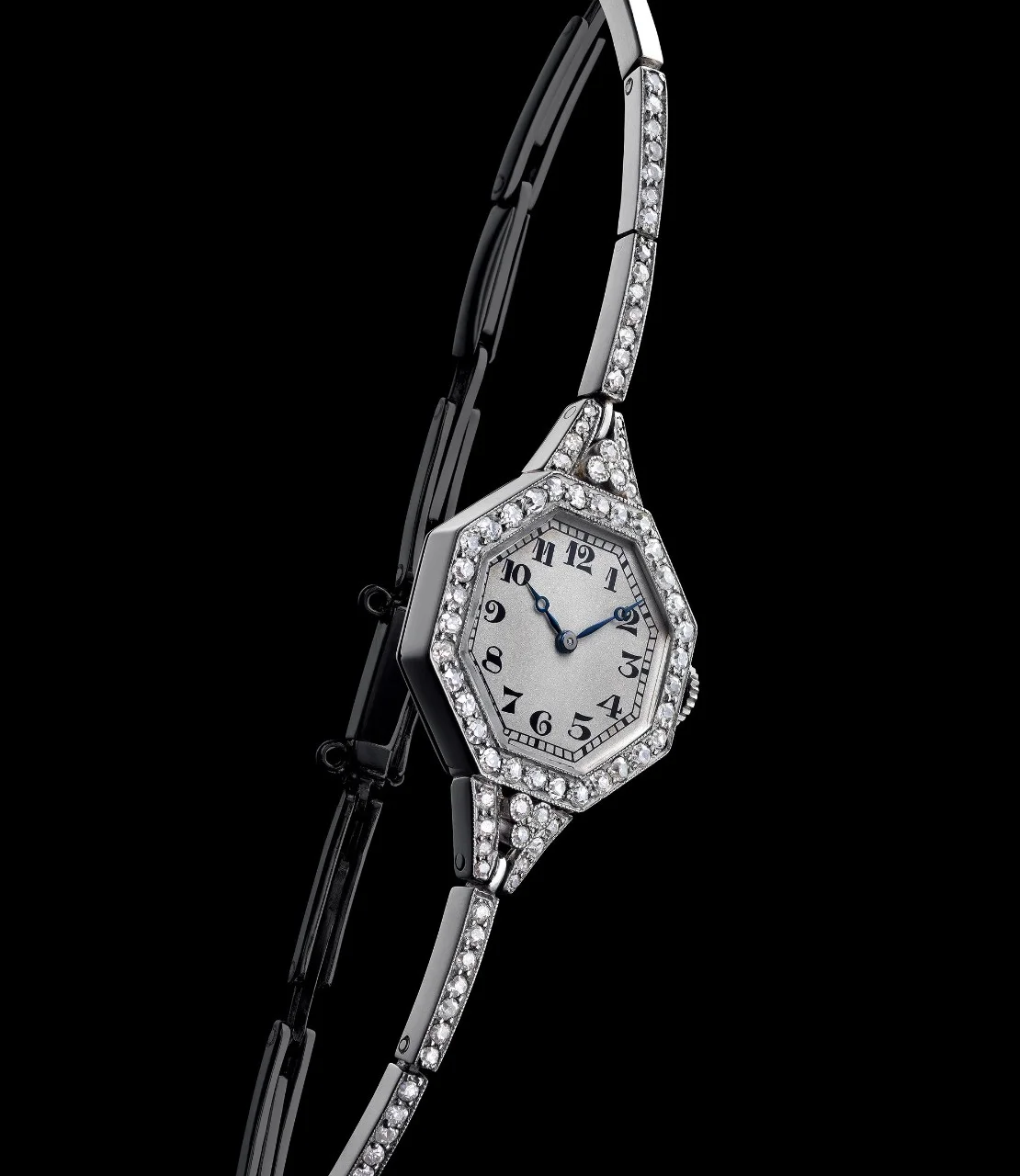
1917. Octagonal wristwatch. The aesthetics of the extendable bracelet are in line with the two horizontal sides of the octagon, as would be the case with the Royal Oak half a century later. 7-ligne calibre. Movement and case no. 18897. White gold set with 82 brilliant-cut diamonds. Sold in Copenhagen in September 2017. Audemars Piguet Heritage, inv. 1838.
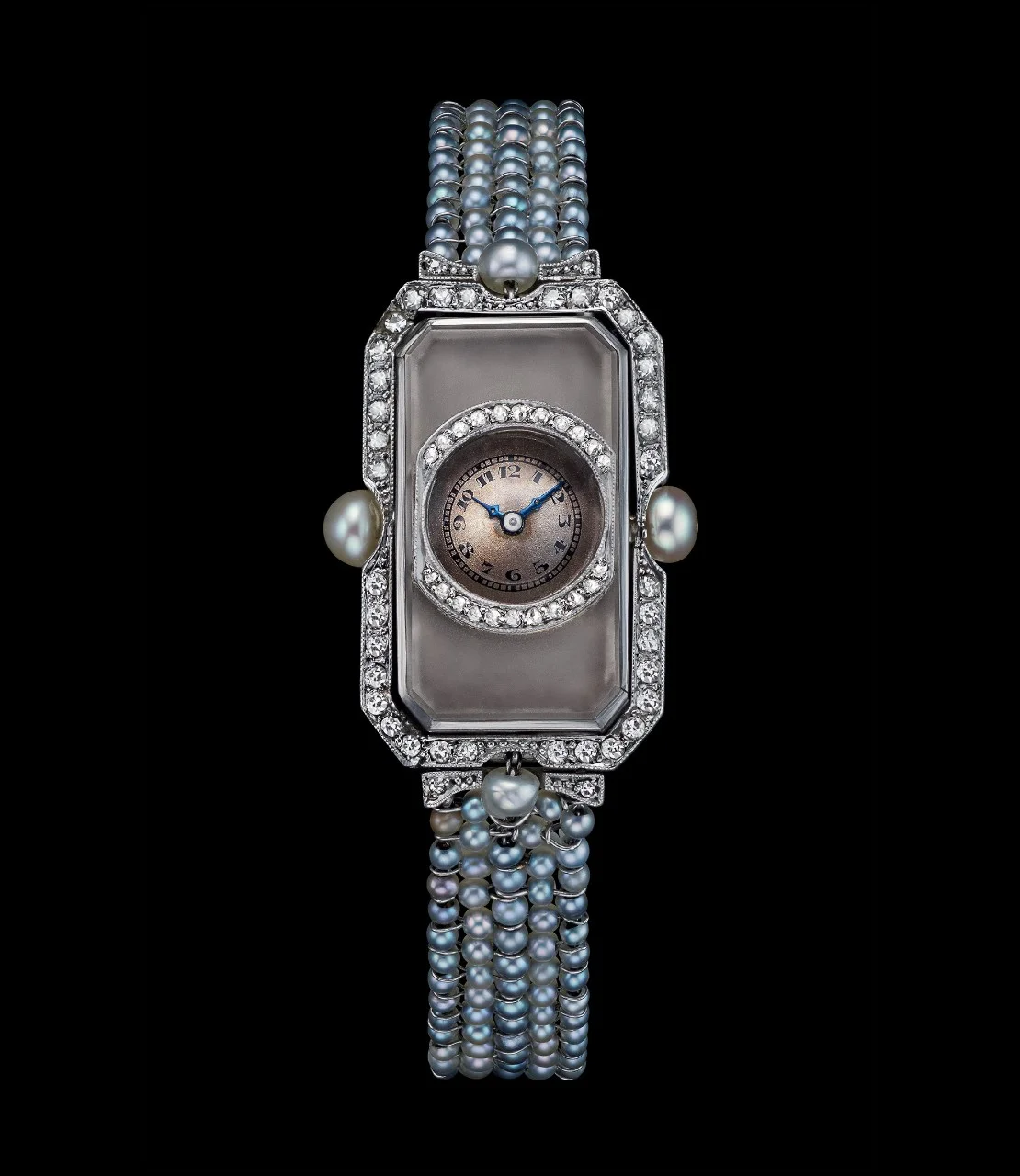
1918. Art Deco wristwatch. The adornment combines pearls, diamonds, rock crystal and platinum. Calibre 8RLB. Movement and case 21585. Sold in Switzerland in September 1918. Audemars Piguet Heritage, Inv. 1071.
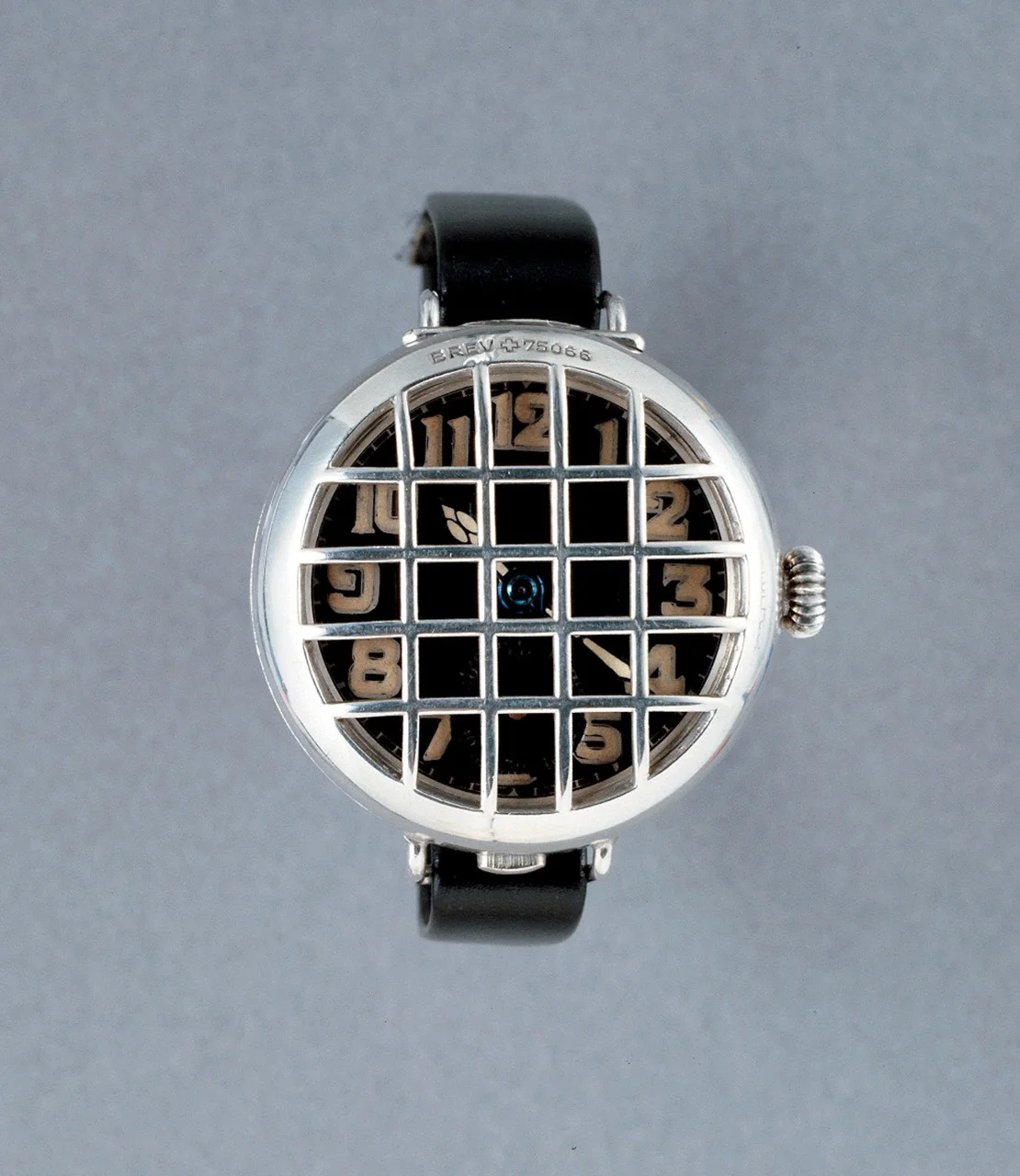
Vers 1917. Montre militaire. Le grillage protège le verre des explosions sur le champs de bataille. Réhaussé de radium, les chiffres et les aiguilles brillent dans la nuit. Boite et cadran non signés. Argent. Collection du Musée International d’Horlogerie de La Chaux-de-Fonds, Inv. I-660
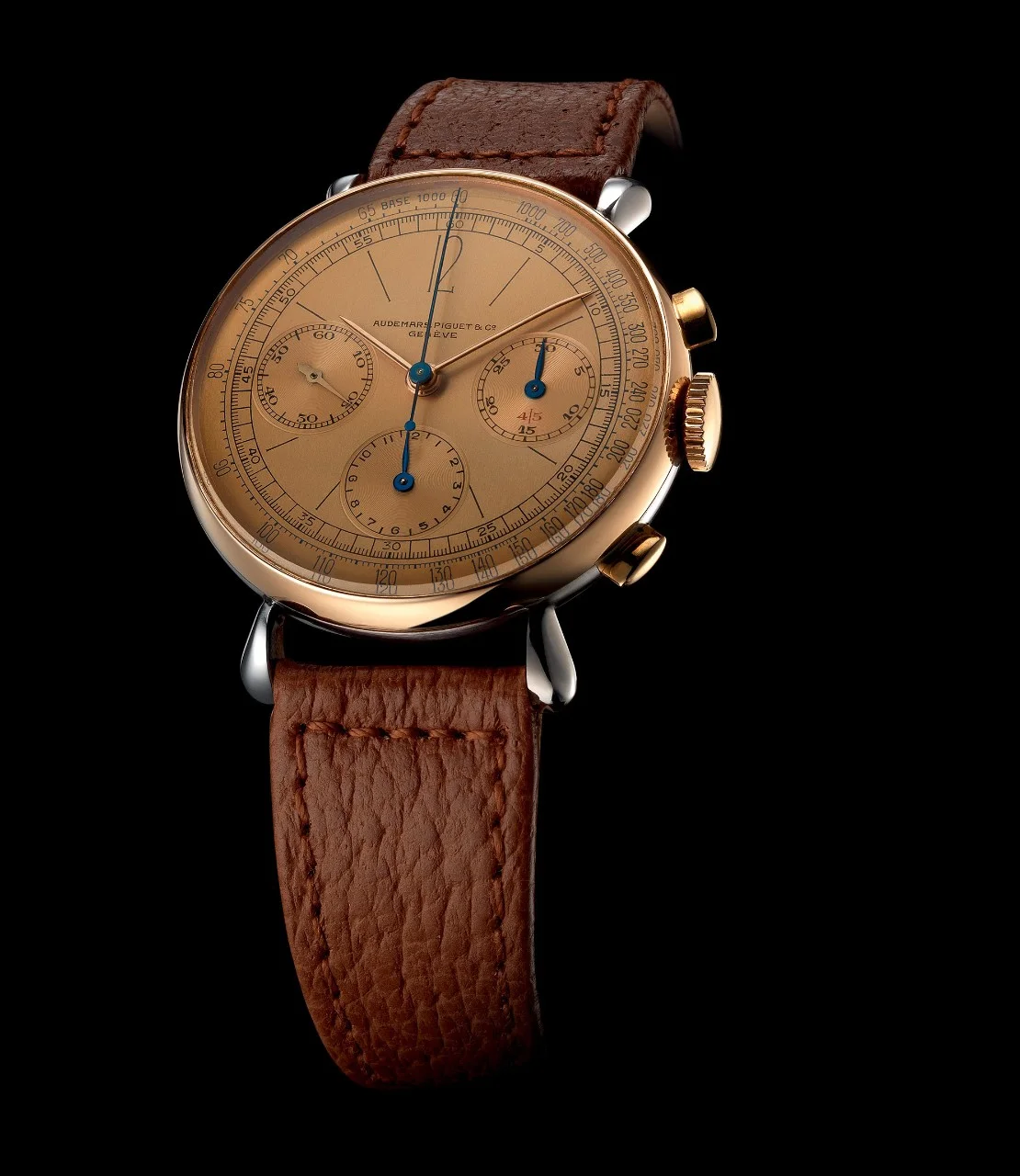
1943. Chronograph wristwatch. Pre-Model 1533 Calibre 13VZAH. Movement and case no. 45603. Pink-gold-toned dial. Steel and 18-carat pink gold case. Sold to Casanova (Bologna) in 1943. Audemars Piguet Heritage, inv. 1660.
The 1960s
At Audemars Piguet, the 1960s ushered in the first golden age of watches with metal bracelets for both men and women. These gold or platinum bracelets were adjusted, finished and attached to their cases in the workshops of Le Brassus, having first been crafted by the best independent chainmakers and jewellers. These included Italian firms such as Masella, Antonioli, Guiseppe Villa, Ponti, Hafner and Galanti; Parisian companies like Cristofol and Georges Lenfant; as well as Geneva-based artisans such as Jean-Pierre Ecoffey, renowned for his bracelets produced for Patek Philippe. These were braided and woven into Milanese, Polish and sometimes even double-Polish mesh patterns. Some were engraved, composed of tiles or triangles, in some cases combining asymmetrical elements and sculpting surfaces graced with a wealth of depth effects.
These bracelets spoke the language of craftsmanship and struck a pleasing contrast with the steel bracelets of sports watches such as the Oyster by Rolex and the Constellation by Omega – a company that patented an integrated bracelet as early as 1964 (CH405170). The two worlds nonetheless merged under the impetus of Audemars Piguet's general agents in Italy, France and Switzerland. In this respect, the Royal Oak bracelet embodied a seemingly absurd paradox: combining steel with hand finishing and sport with the refinement of jewellery bracelets.
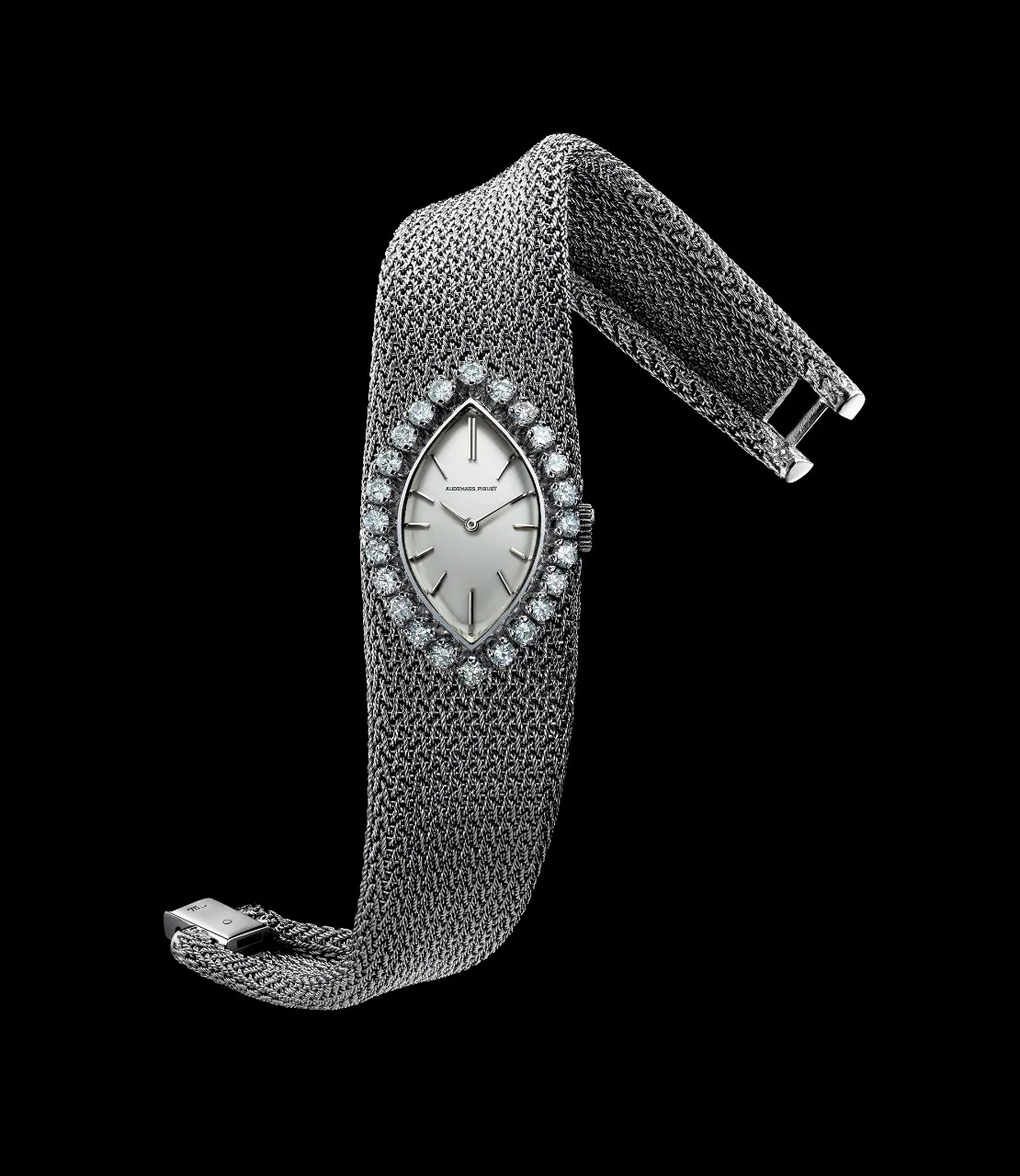
1963. Almond-shaped Wristwatch, 8055BC. Surrounded by diamonds, the almond-shaped case appears to slide along a supple braided bracelet. Calibre 2050, movement 88937. Case 30775. 18-carat white gold. Sold in Eastern Europe in 1963. Audemars Piguet Heritage, inv. 542.
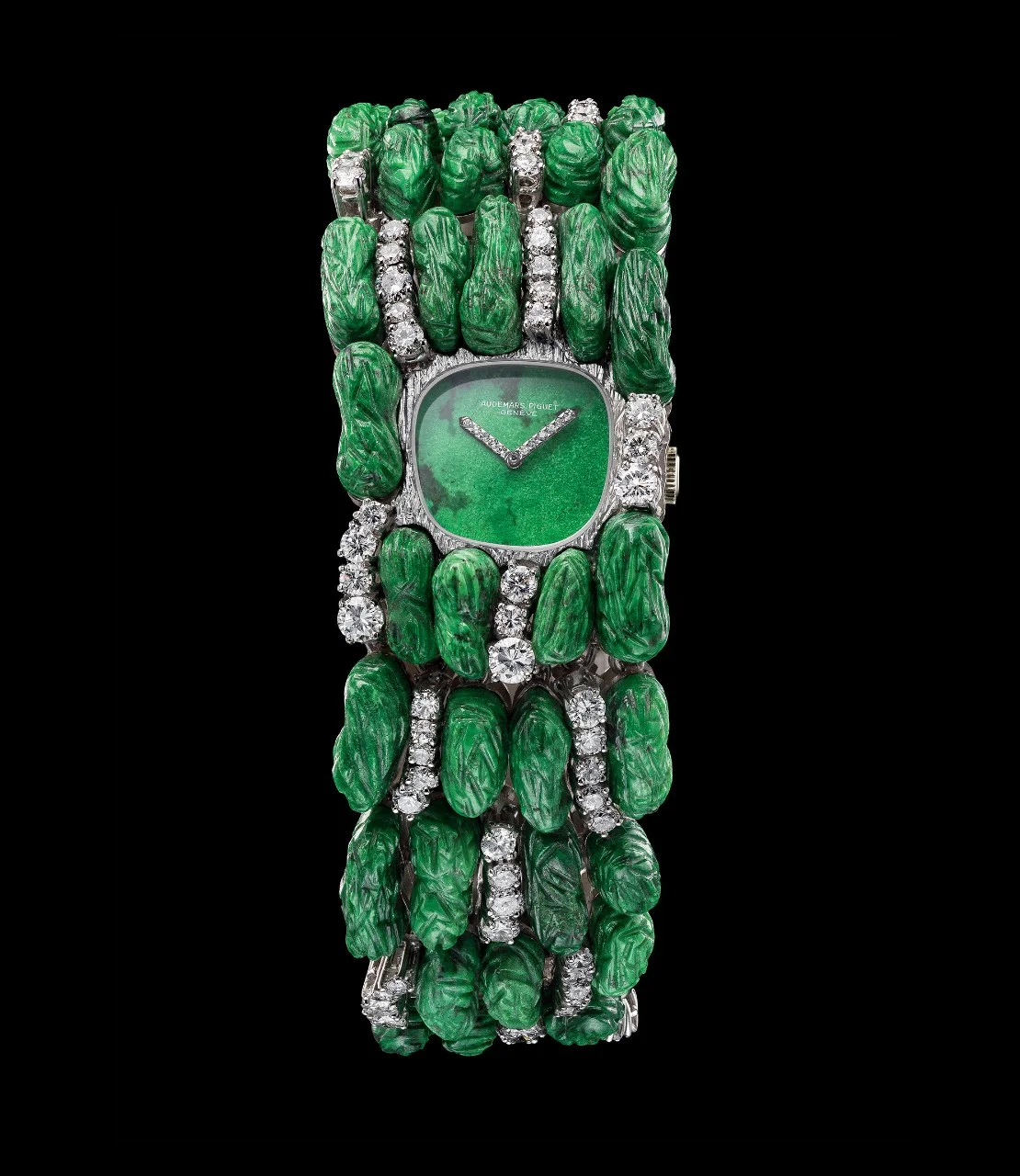
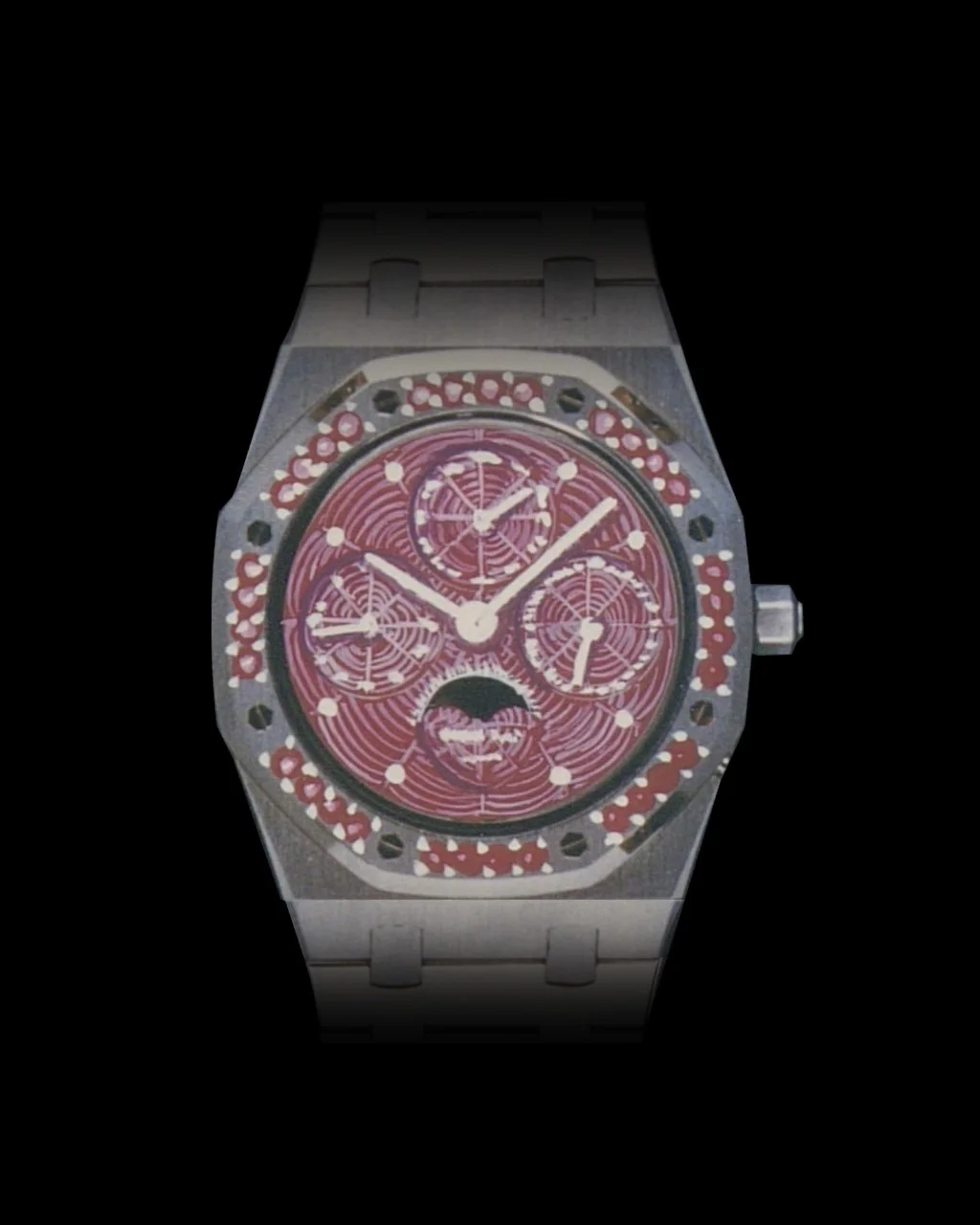
1971. Brilliant hours wristwatch 8513. One-of-a-kind piece that won the Golden Rose of Baden-Baden Award in 1971. Calibre 2050, movement 117945. Case 66765. White gold set with diamonds and large grossular garnets. Sold in Germany in December 1971. Audemars Piguet Heritage, inv. 1120.
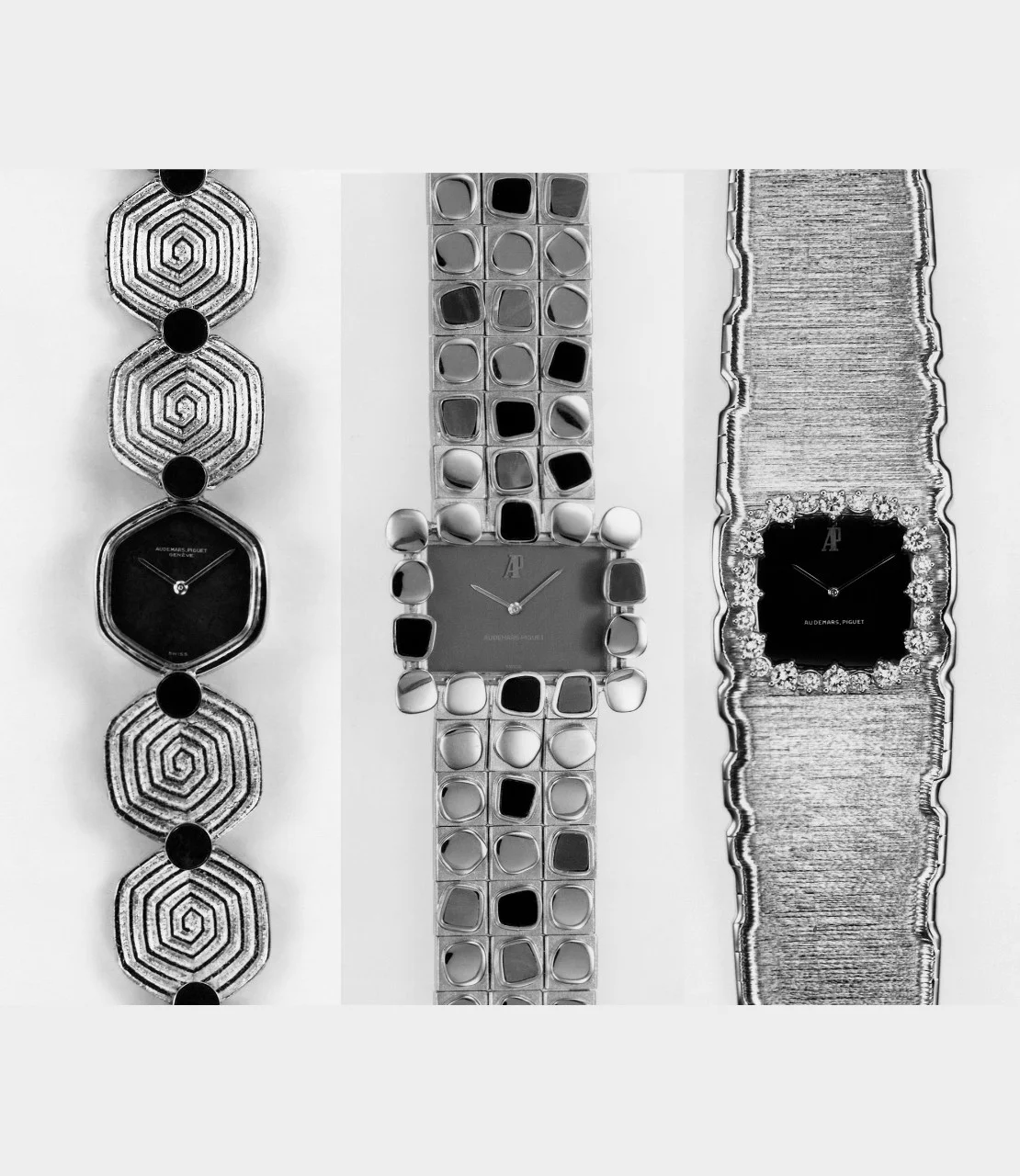
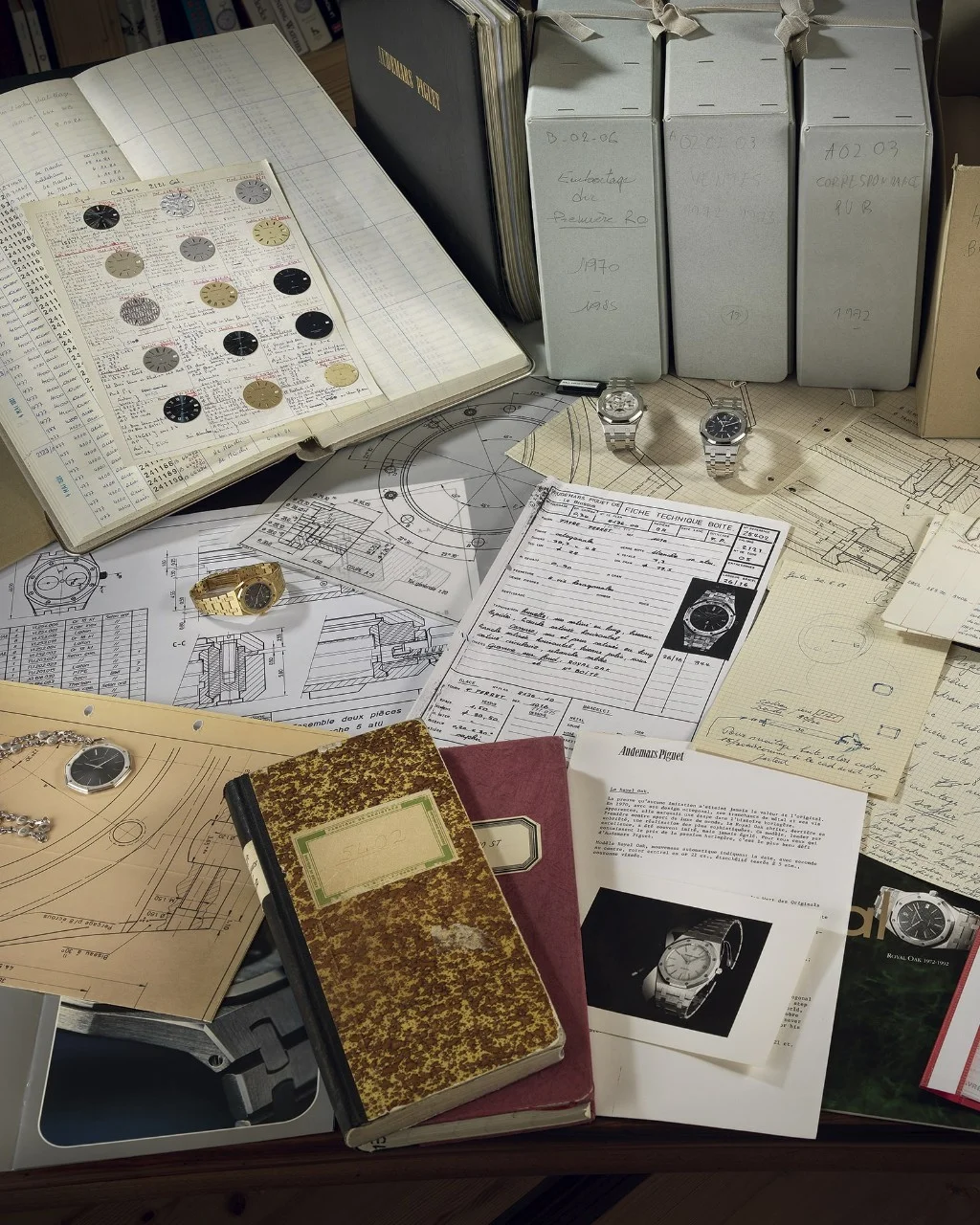
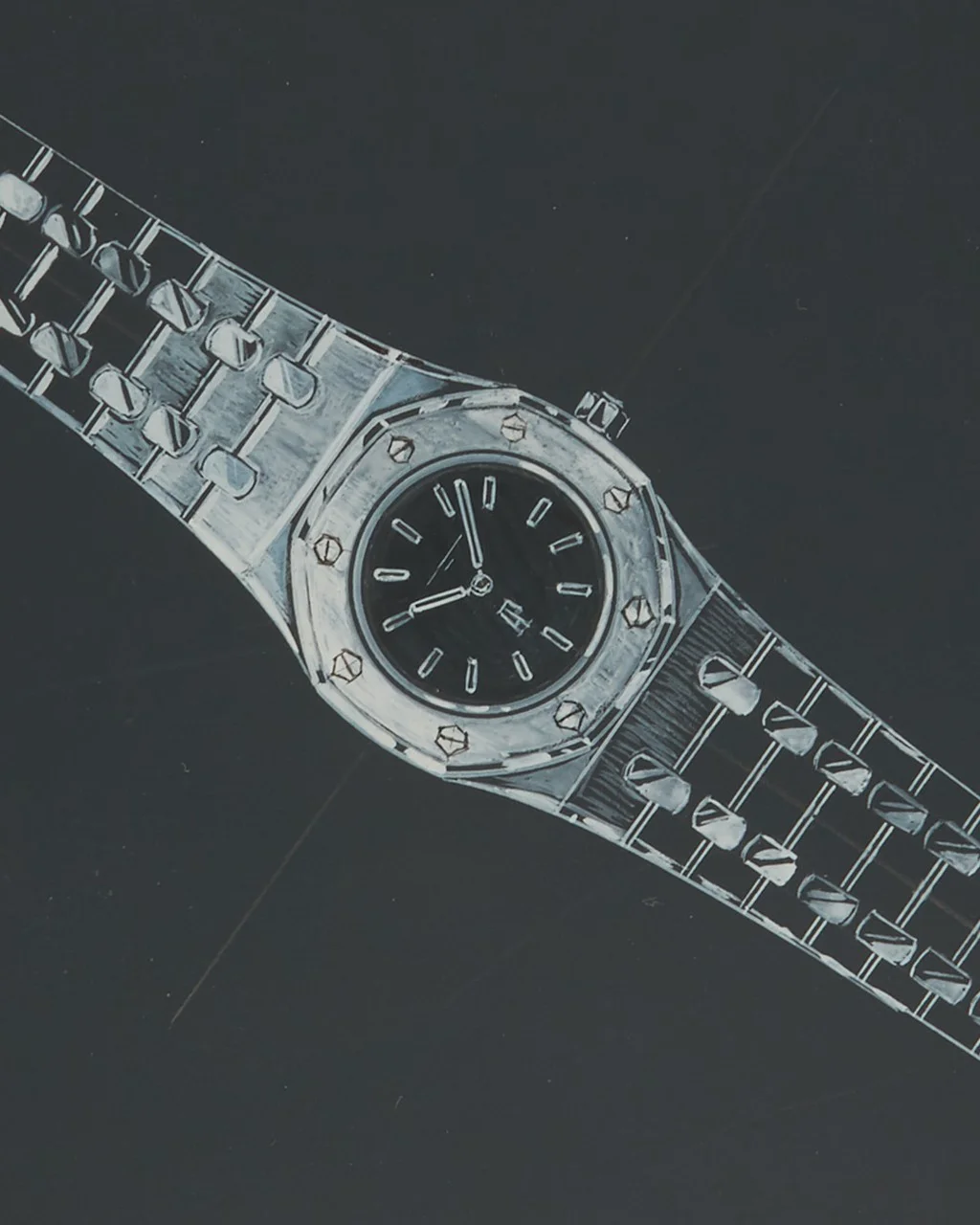
Circa 1965–1975. Audemars Piguet models. Models 8512, 8622 and 8554. Identification photographs. Audemars Piguet Archives.
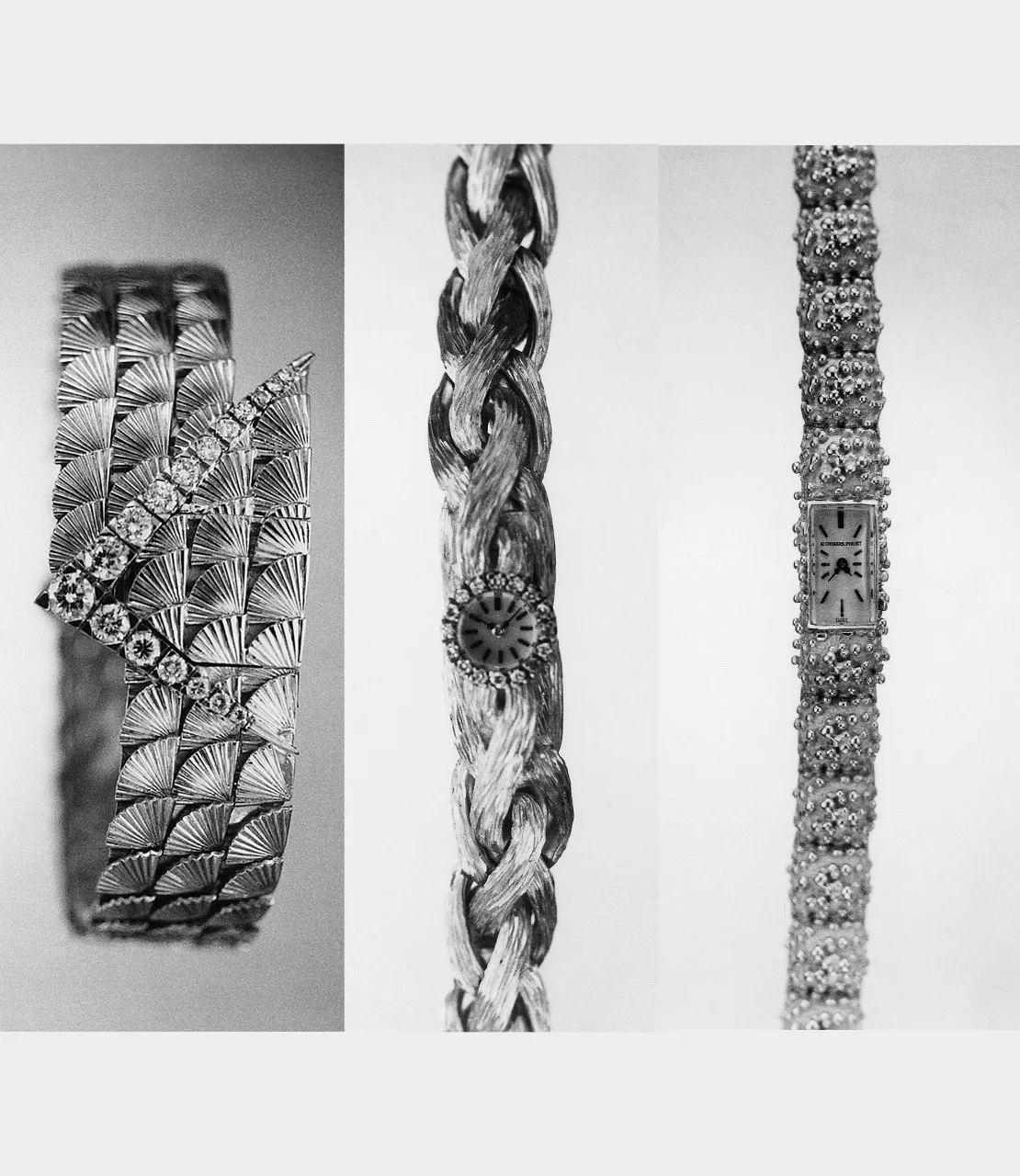
Circa 1965–1975. Audemars Piguet models. Models 8067, 8157 and 8196. Identification photographs. Audemars Piguet Archives.
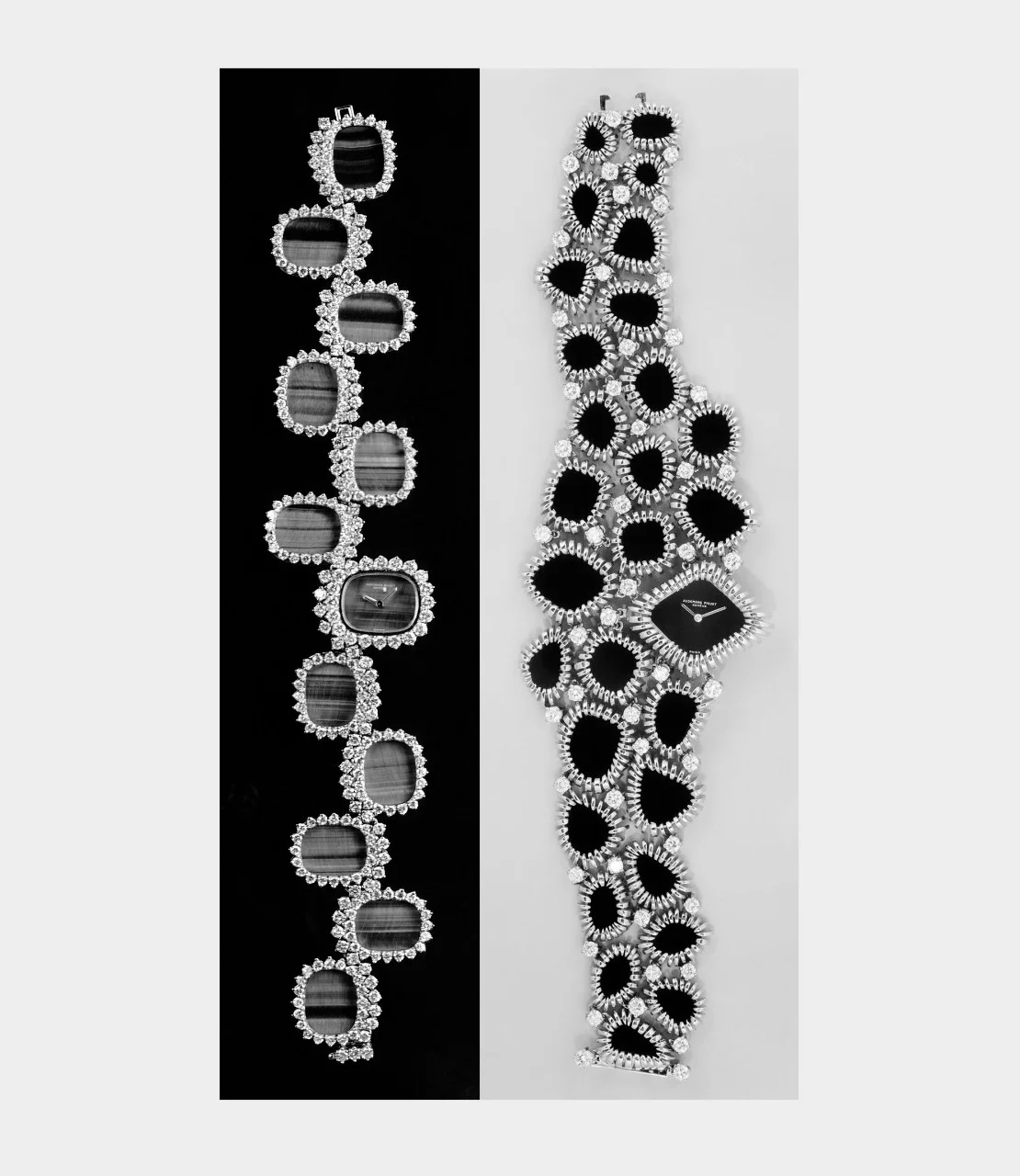
Circa 1965–1975. Audemars Piguet models. Models 8514 and 8545. Identification photographs. Audemars Piguet Archives.

1972. Audemars Piguet brochure (cover). A woman is smoking a cigar. She wears on her wrist the so-called "Arabella" Haute Joaillerie watch, Model 8545. Audemars Piguet Archives.
"Light Sings on the Bracelet"
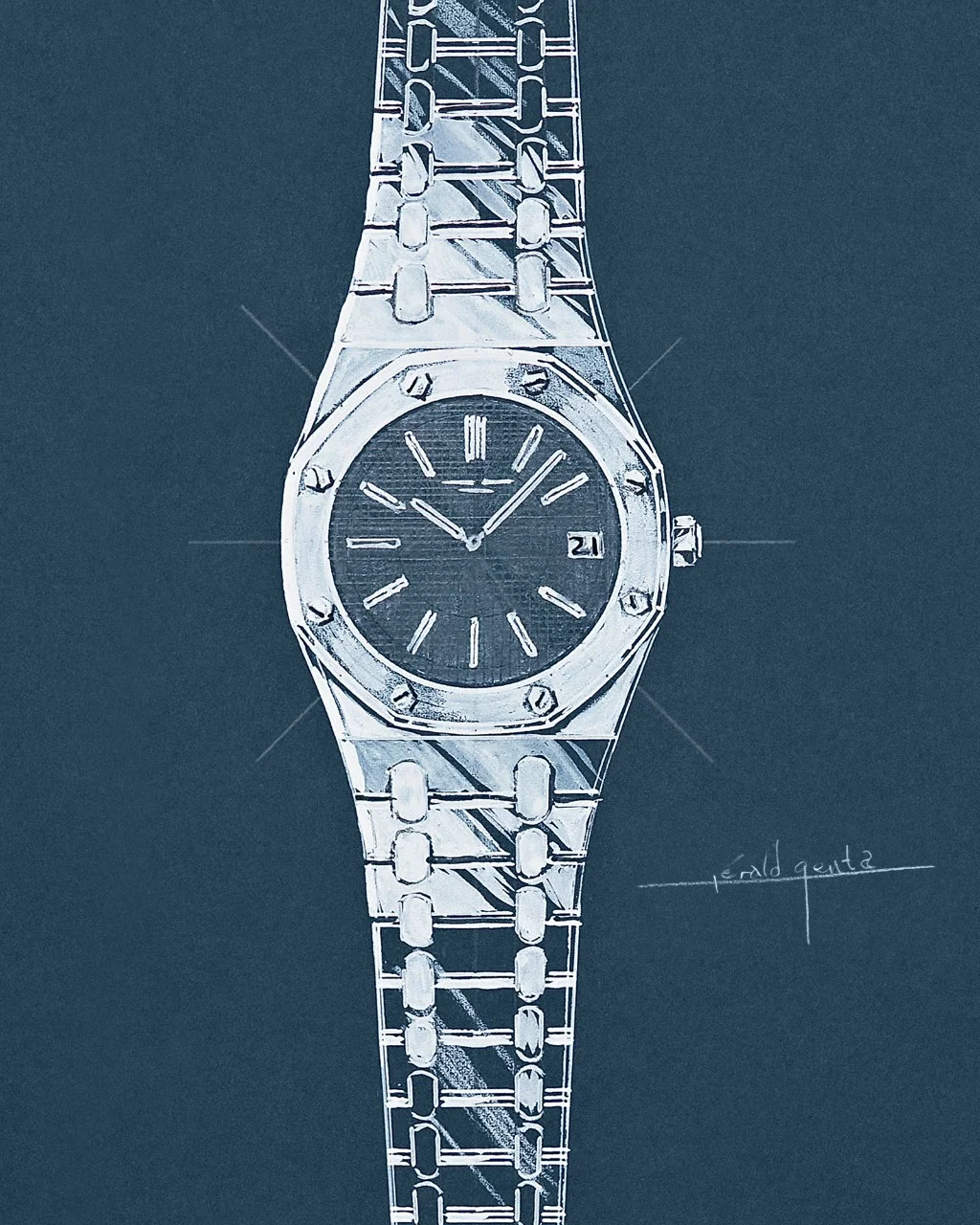
In an interview granted to Audemars Piguet in 2011, designer Gérald Genta recalled the importance of the bracelet as an identifying factor for a watch: "Seeing just a few centimetres or even a few millimetres is enough to get the picture and you don’t need to see everything, which confirms how important it is!” He added that as far as the Royal Oak was concerned "The whole point was to make a steel selfwinding watch equipped with an expensive movement. The bracelet had to be extremely flat, thin, supple and aesthetically pleasing, playing with light thanks to the flat satin finish. When you see the watch on your wrist, the light sings on the bracelet!"
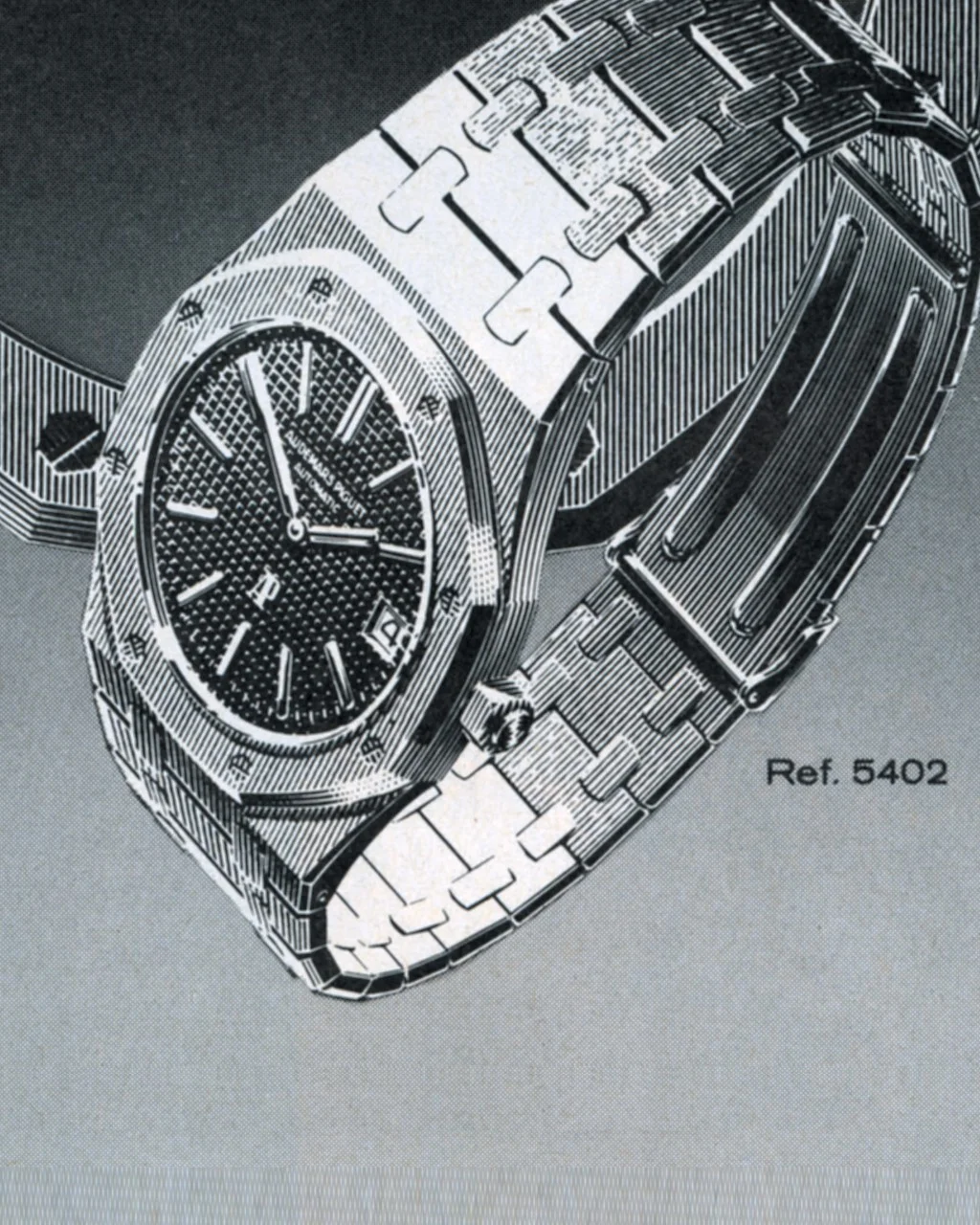
The design of the Royal Oak bracelet was inextricably bound up with that of the case. Genta said that its shape came about naturally: "It was entirely logical when viewed from the drawing board!” The article devoted to the birth of the Royal Oak 5402 deals with the creation of the Royal Oak bracelet by Geneva-based firm Gay Frères. Here, we will examine its major technical characteristics such as the studs, screws, attachments, folding clasp, as well as its main evolutions.
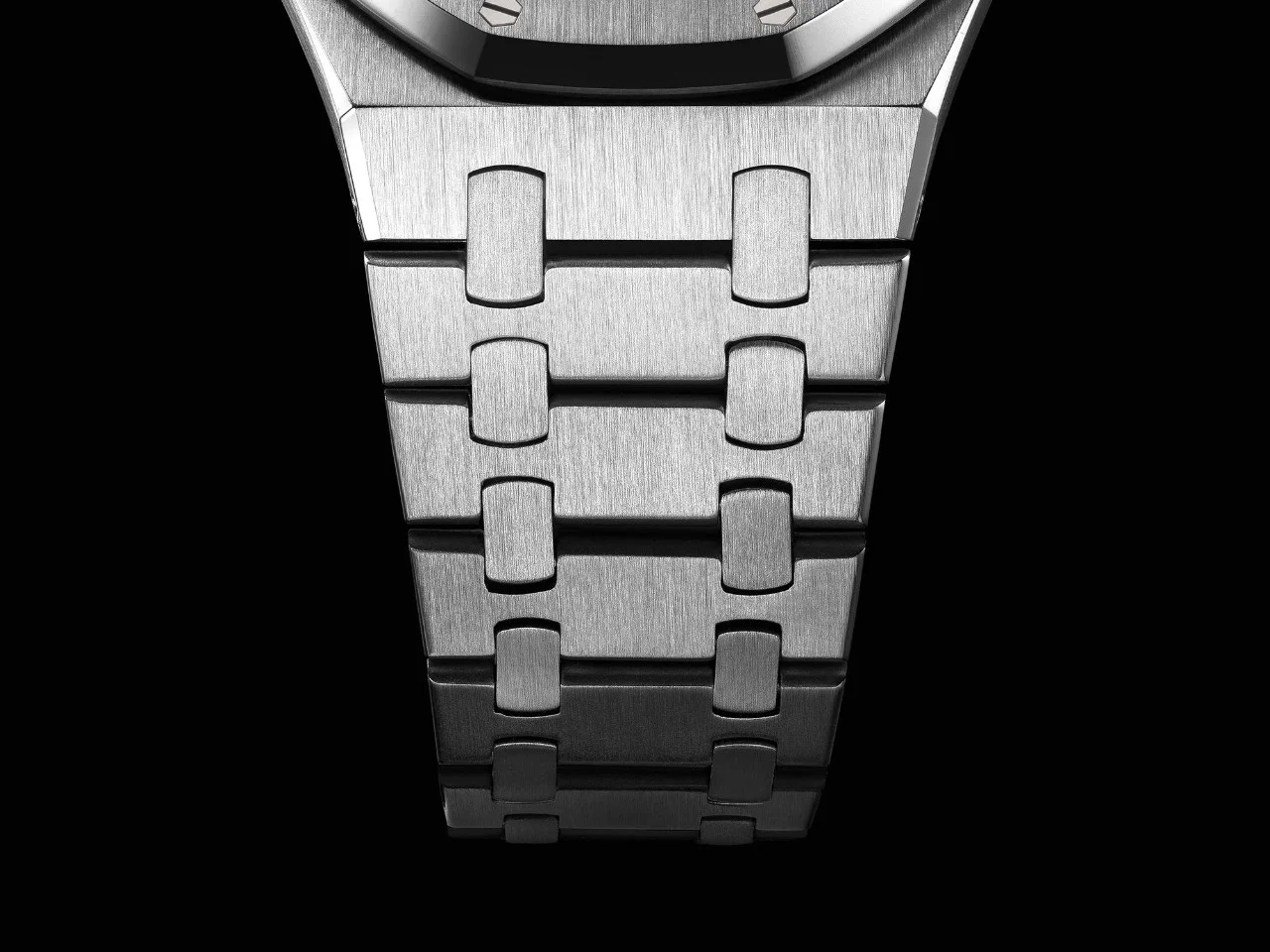
What Exactly Is an “Integrated Bracelet”?
One commonly accepted fact about the Royal Oak is that it has an “integrated bracelet”. But what does that involve? And what exactly is the meaning of this term, which is not clearly defined in watchmaking literature?
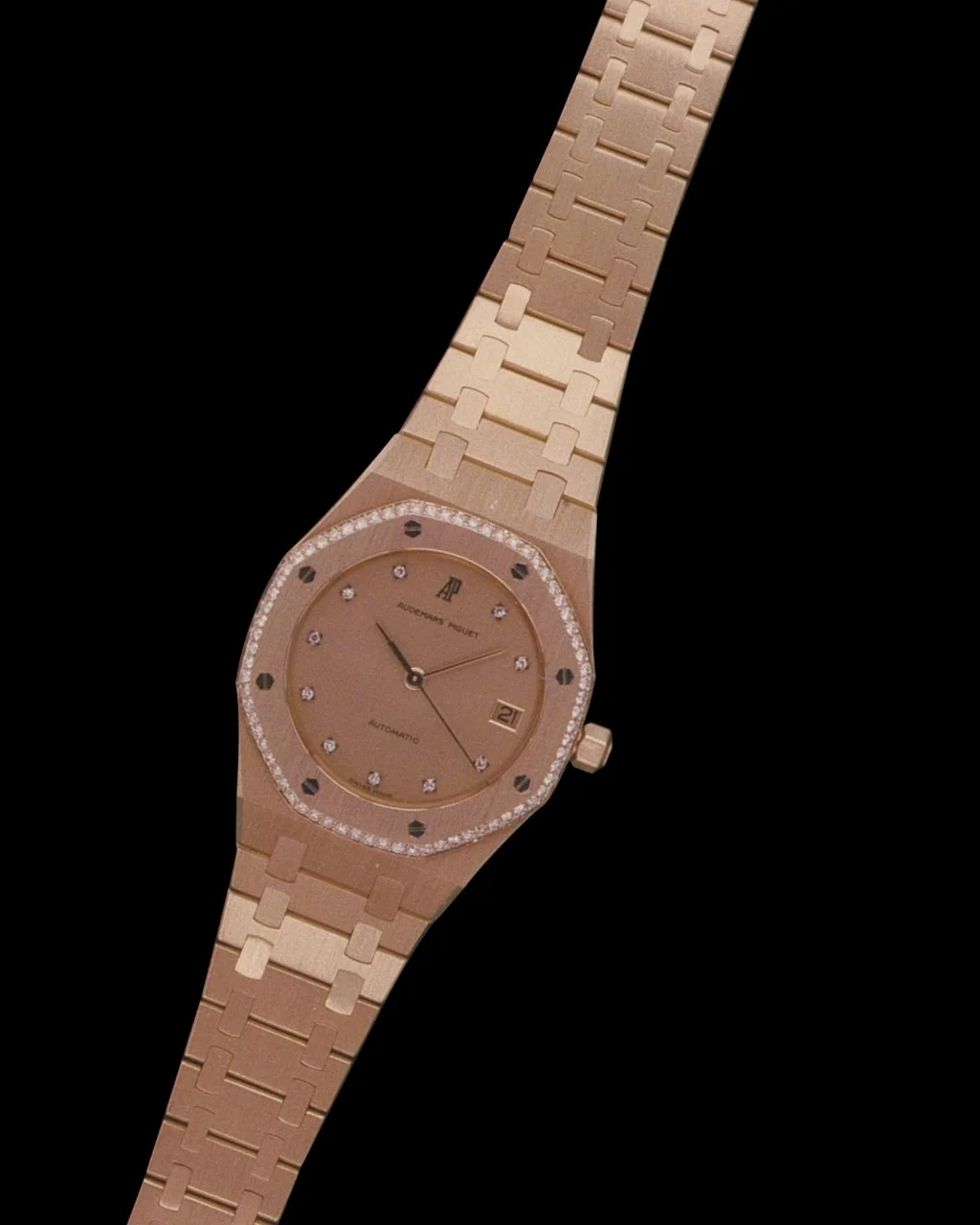
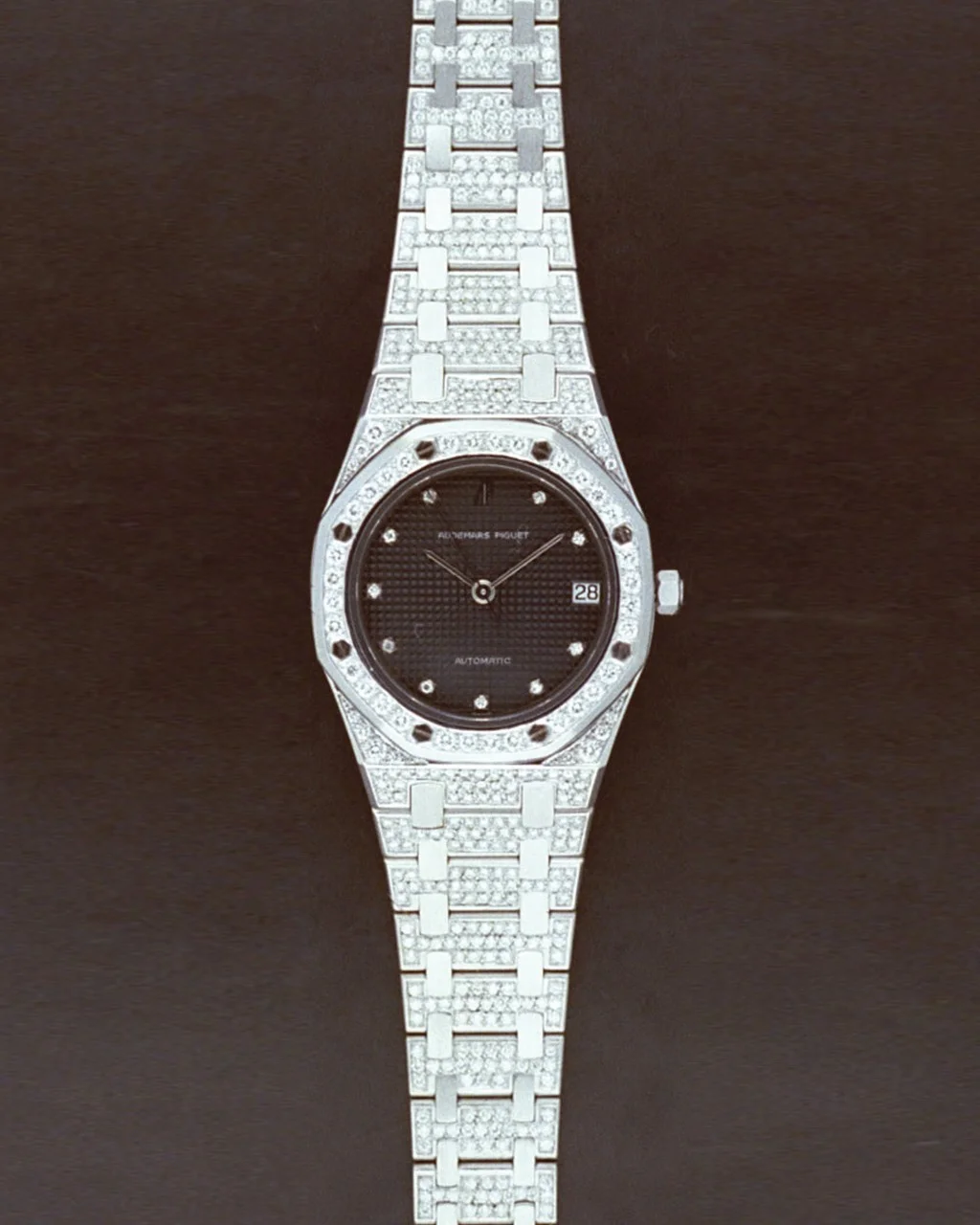
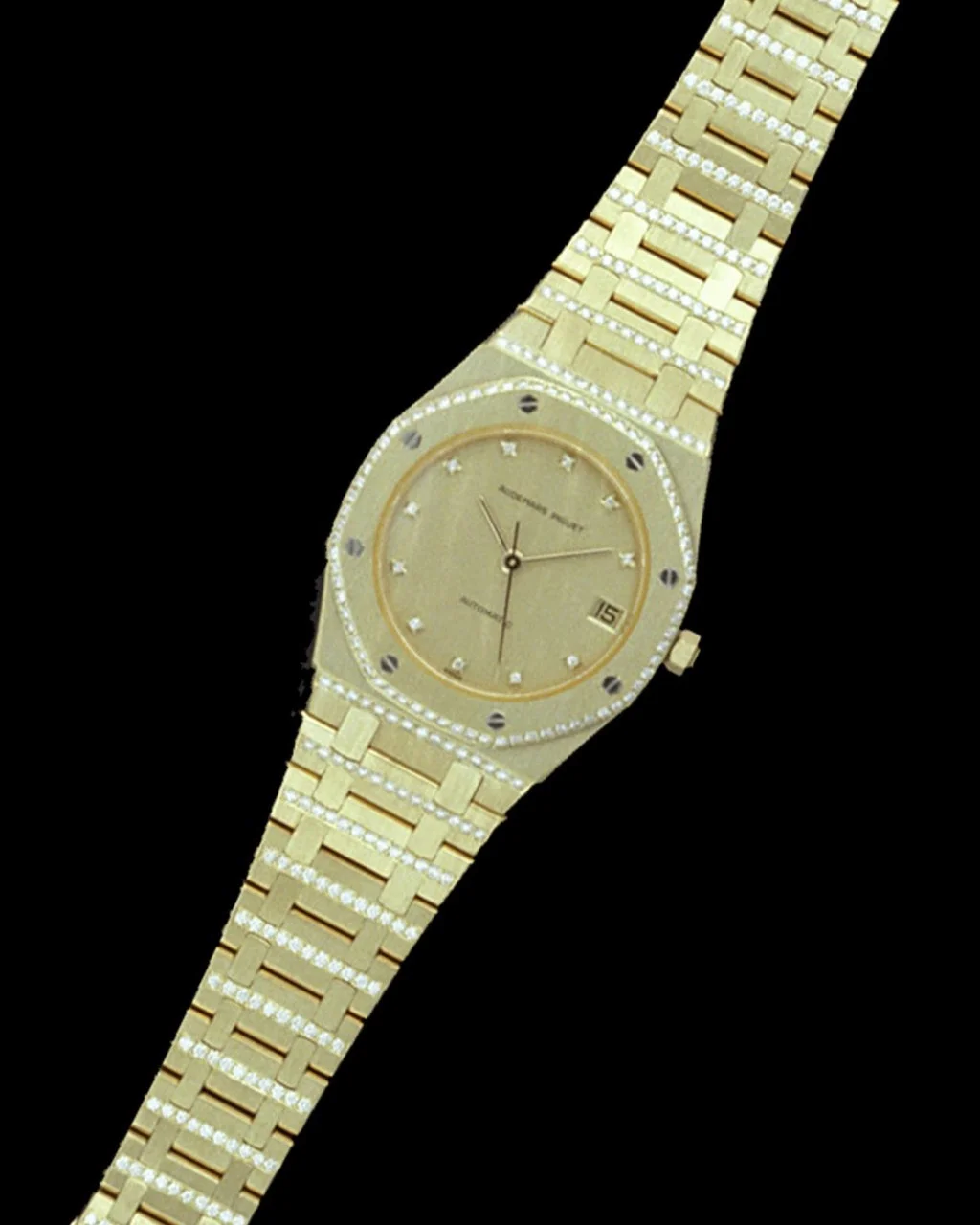
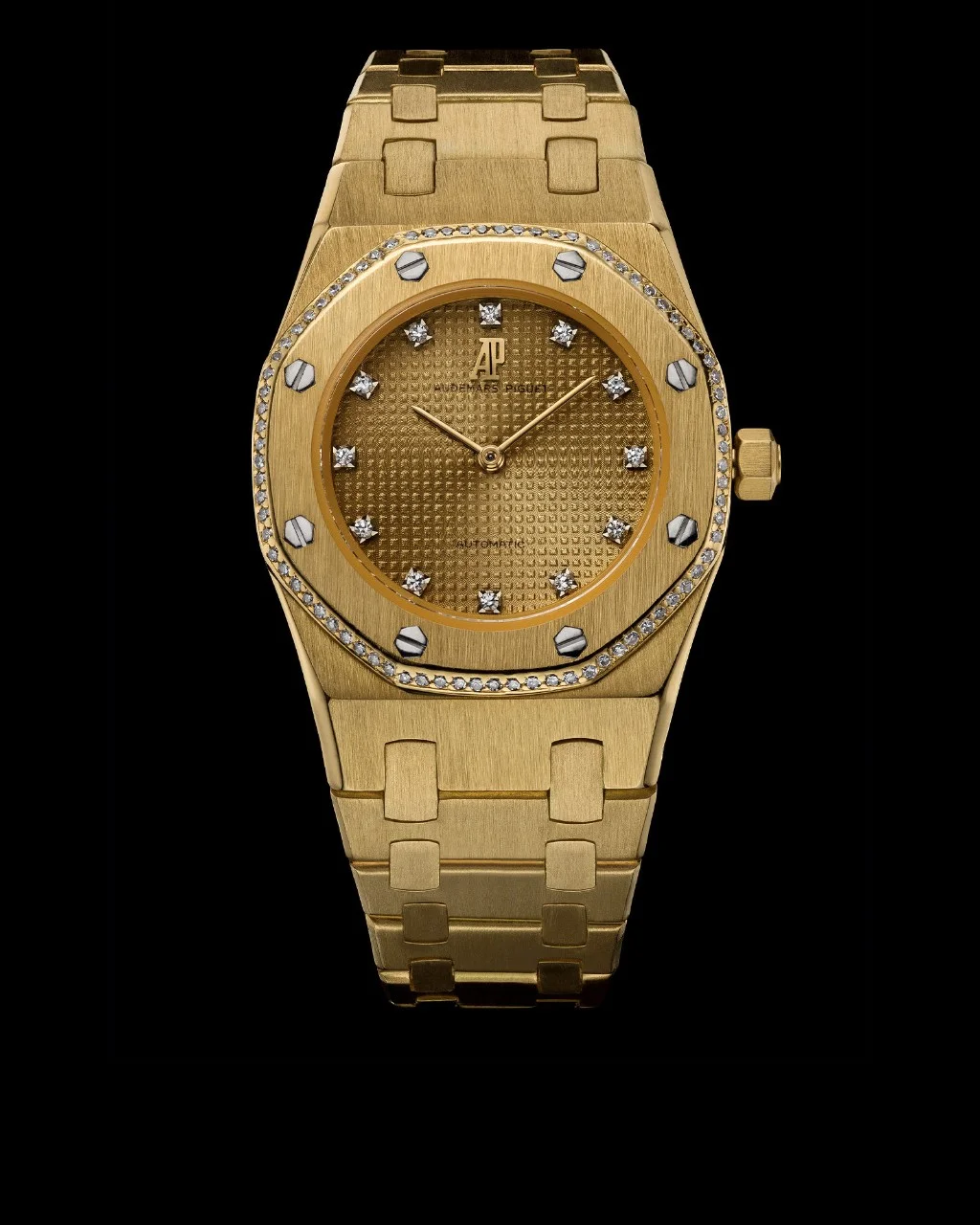
Whereas the manual titled The Theory of Horology published in 1998 does not use this term, it describes a similar concept under the category of “bracelets hard-soldered to the case”. This means that the case and bracelet are immovable, interlocking and designed as a single entity. They certainly correspond to the definition of an "integrated bracelet". Many Audemars Piguet ladies’ watches from the 1960s–1990s were fitted with bracelets belonging to this category. One of the most significant was Model 5403, introduced in 1971. Its designer Gérald Genta described it as "magnificent" and was delighted with its "perfect integration": the bracelet composed of ten very thick Polish-mesh links gradually widened to embrace the dial. The tradition of soldered (or integrated) bracelets continued until the 1990s. Jeweller Ywan Kunzle remembers that when he first joined Audemars Piguet in 1989, adjusting bracelets and attaching them to their cases by brazing represented the main task of five to seven craftspeople.
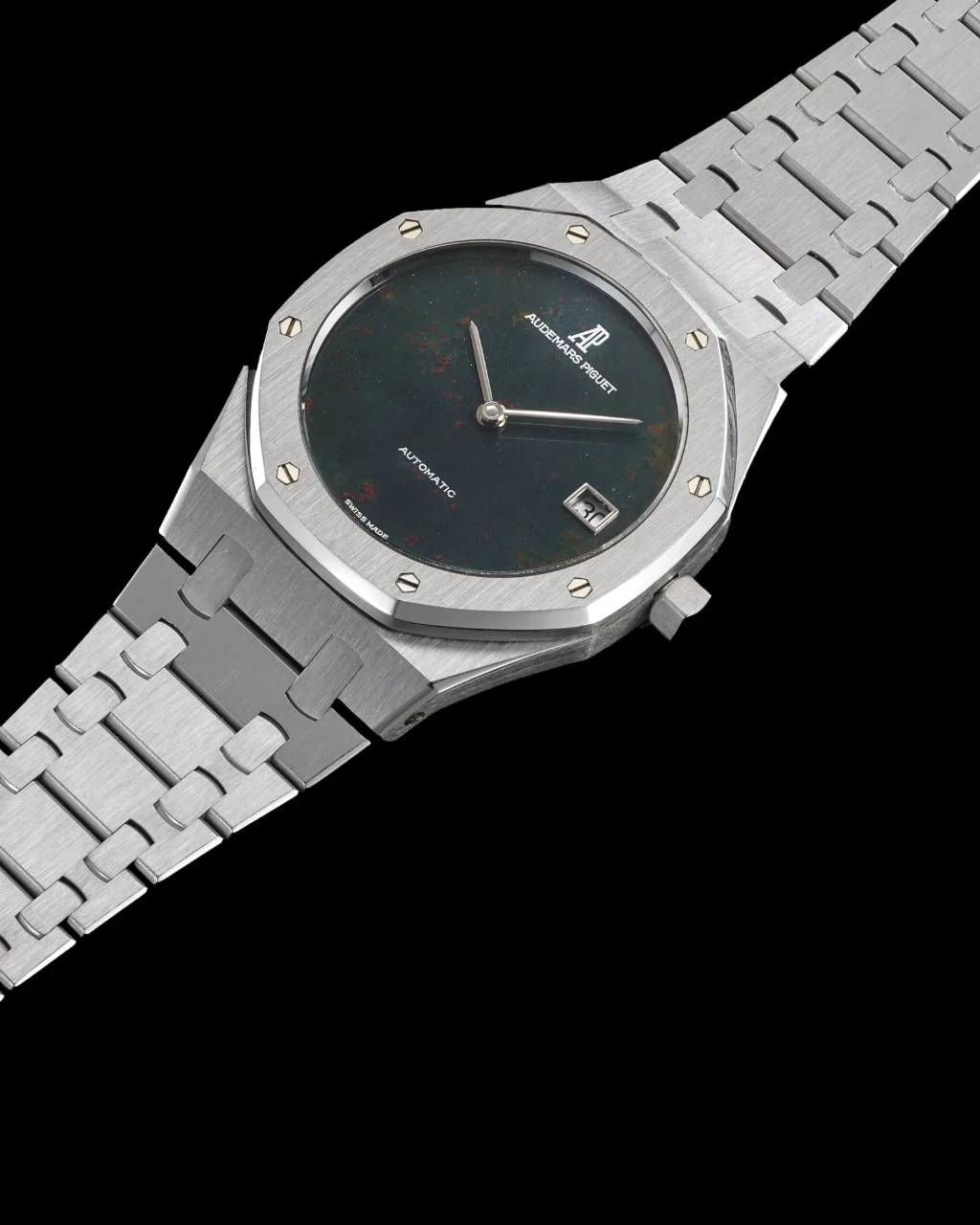
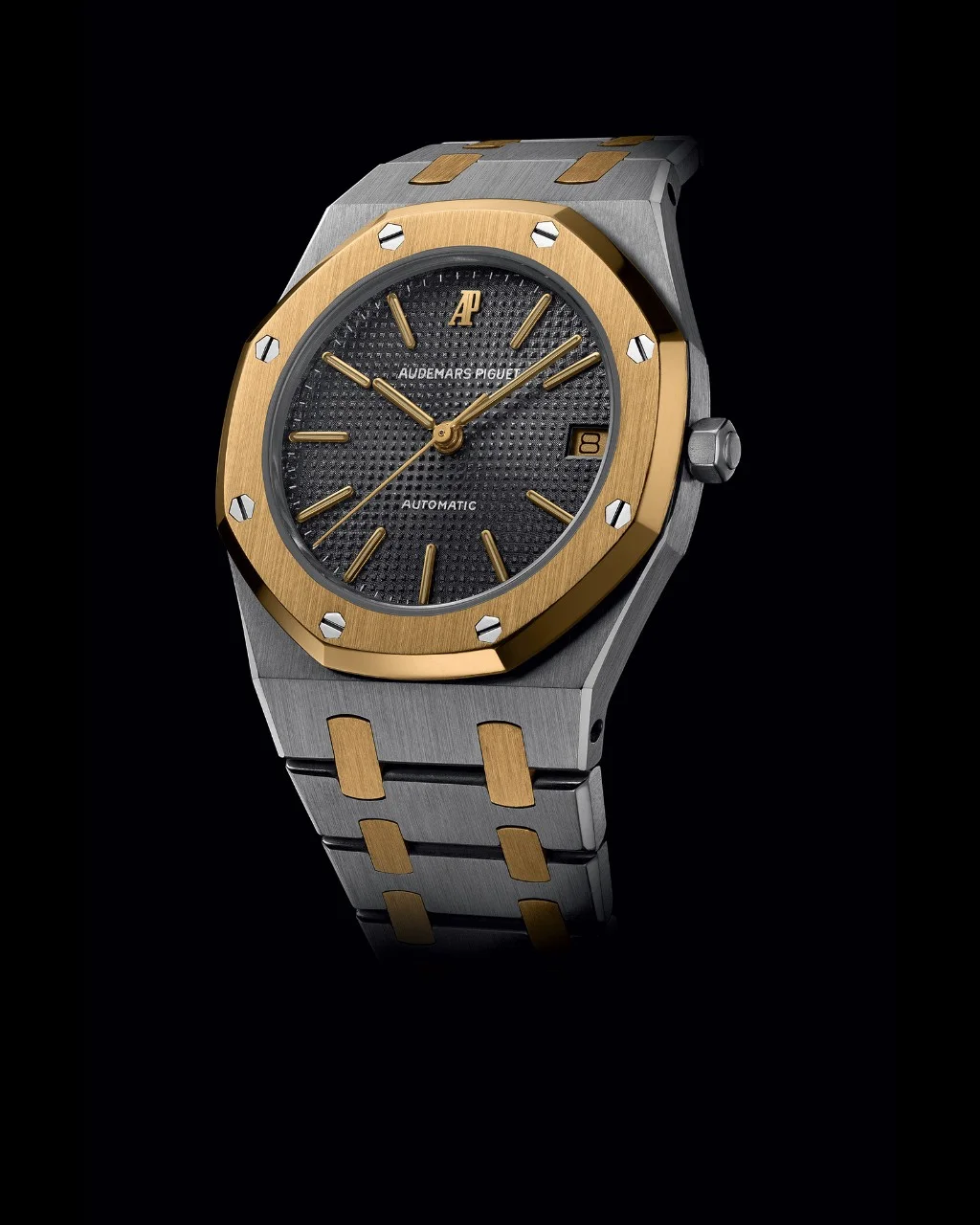
That is however not the way the Royal Oak is built and a watchmaker can easily separate the bracelet from the case by means of four lateral screws. So why did Gérald Genta – along with a large proportion of the watchmaking community – refer to this bracelet as “integrated”? The answer lies in the geometry of the watch. From a strictly aesthetic standpoint, the first bracelet link is an integral part of the case, with two studs attached to the bevelled part of the case middle and connecting it to the first mobile link of the bracelet. While some may dispute this interpretation – including watchmakers who may claim that “a case is a case!” – it provides a vivid reminder of the Royal Oak’s ability to blur the boundaries between conventional categories.
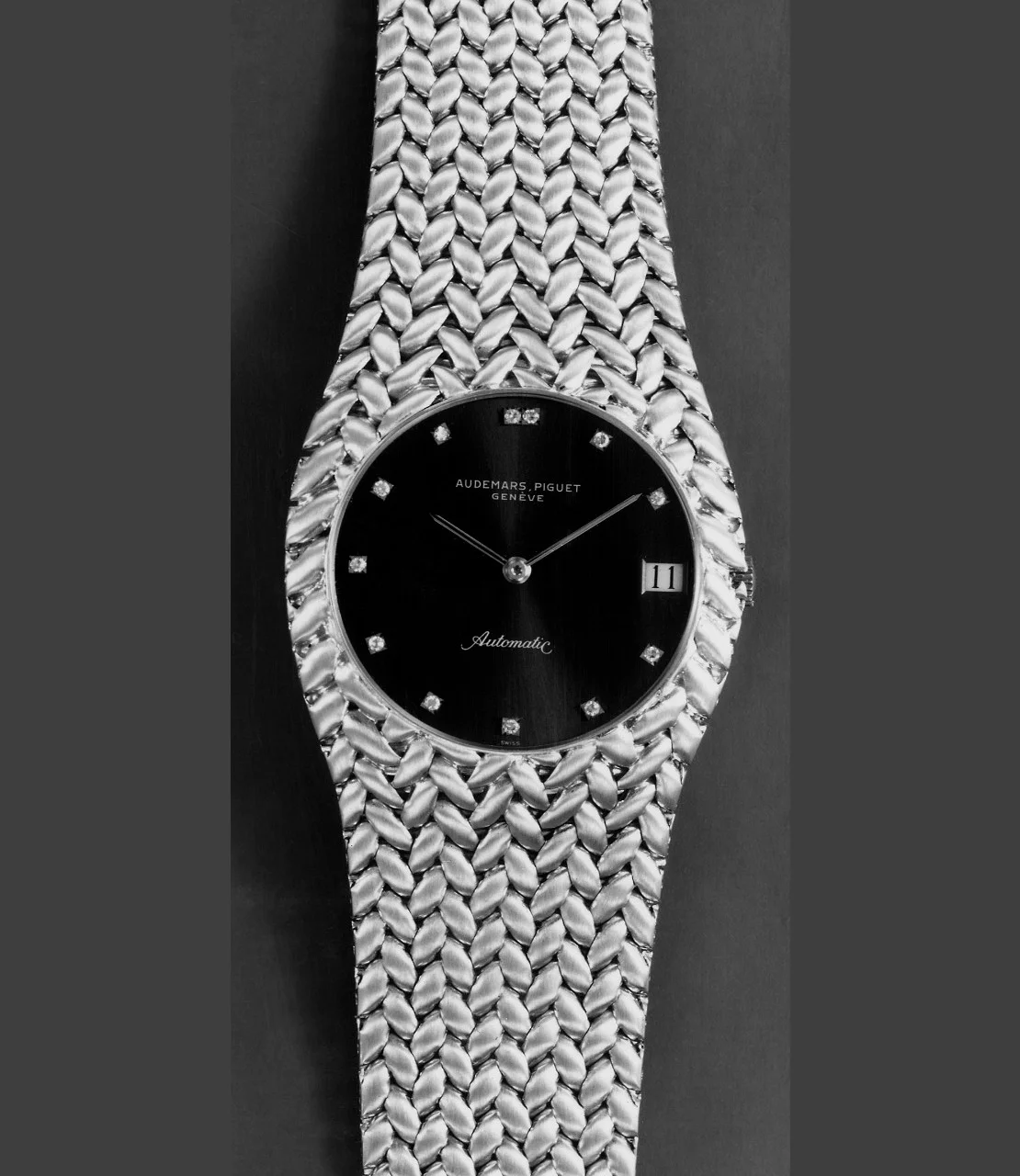
1971. Model 5403. Polish mesh integrated bracelet. Calibre 2121. Identification photograph. Audemars Piguet Archives.
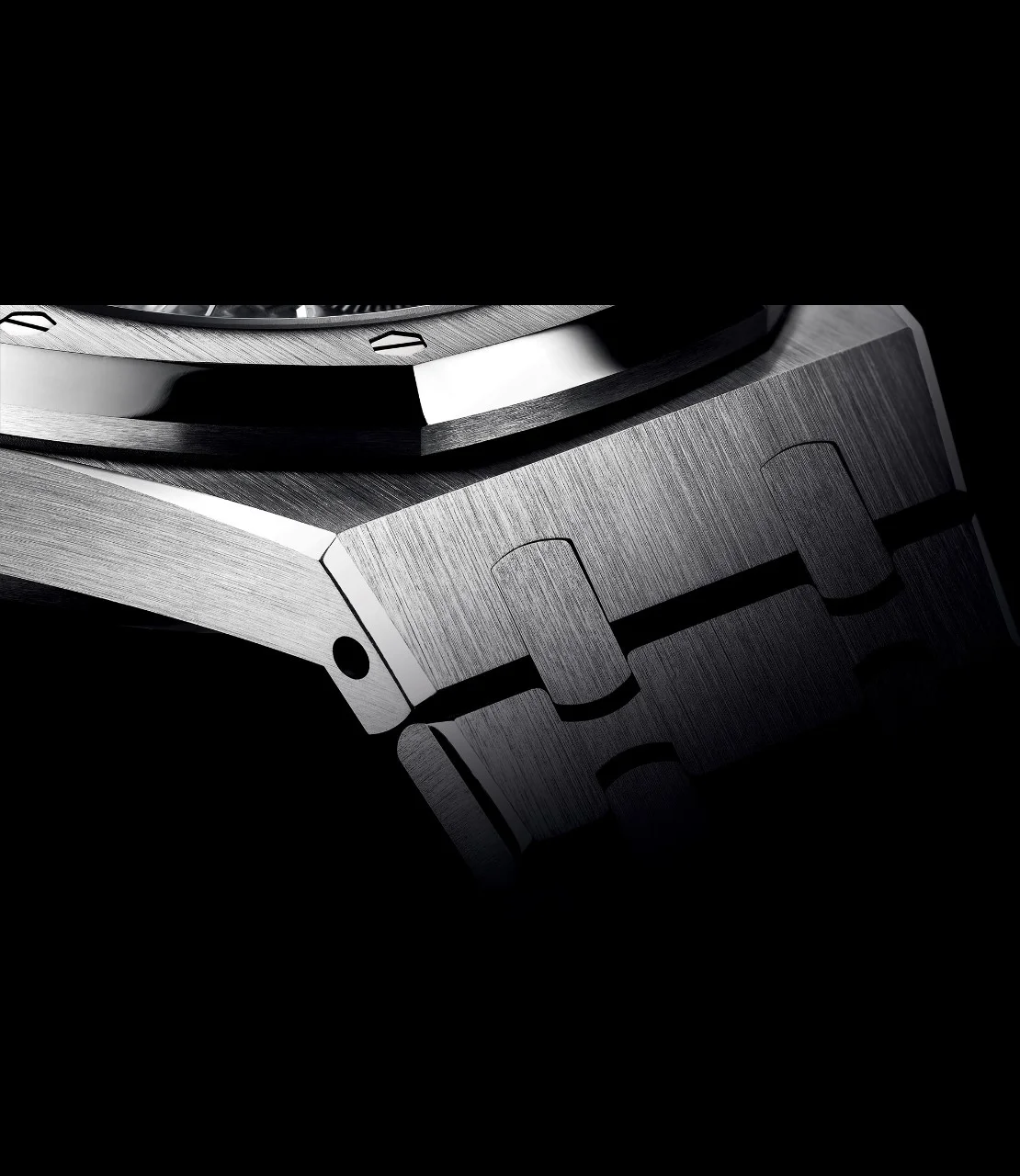
Royal Oak 26320ST, detail. Although the bracelet can be detached from the case, aesthetically, the first link is an integral part of the case. This explains the name "integrated bracelet". Picture taken during the presentation of the 26320ST model in 2016. Audemars Archives Piguet.
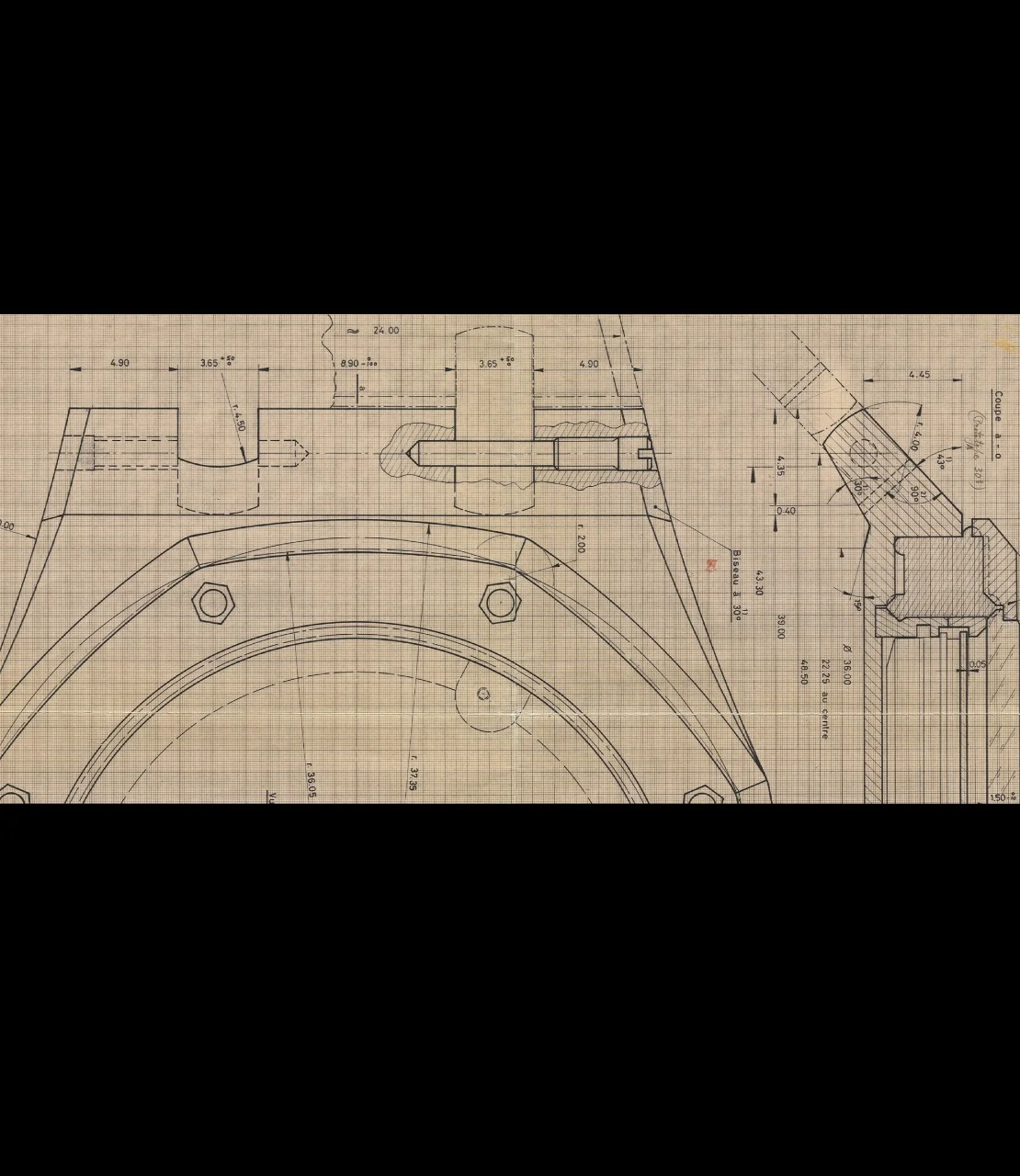
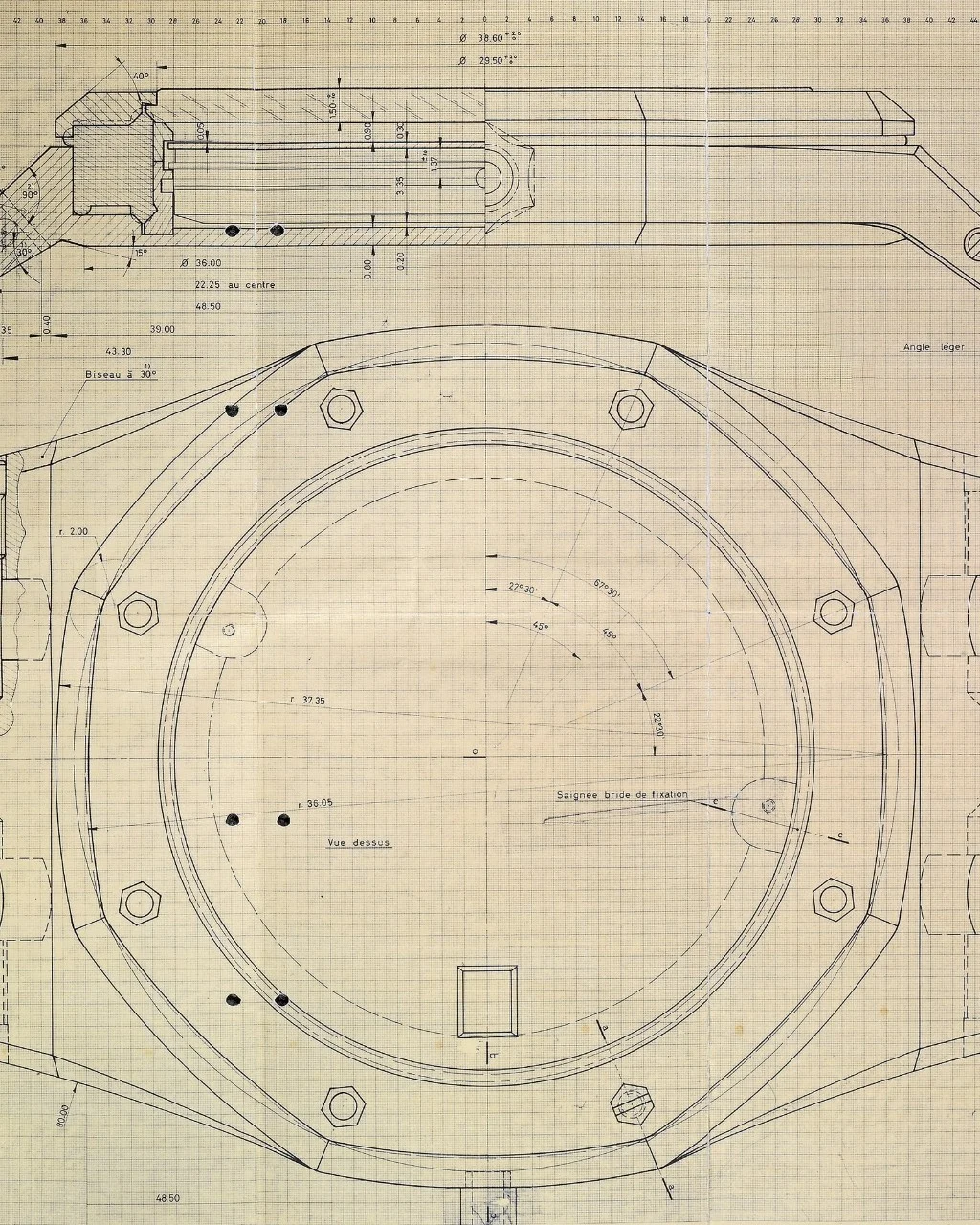
1971. Articulation between bracelet and case 5402. At its extremities, the case middle forms a 43° angle to open onto the bracelet. Two holes enable to screw the first studs. Detailed plan. Audemars Piguet Archives.
The Royal Oak Bracelet Taper
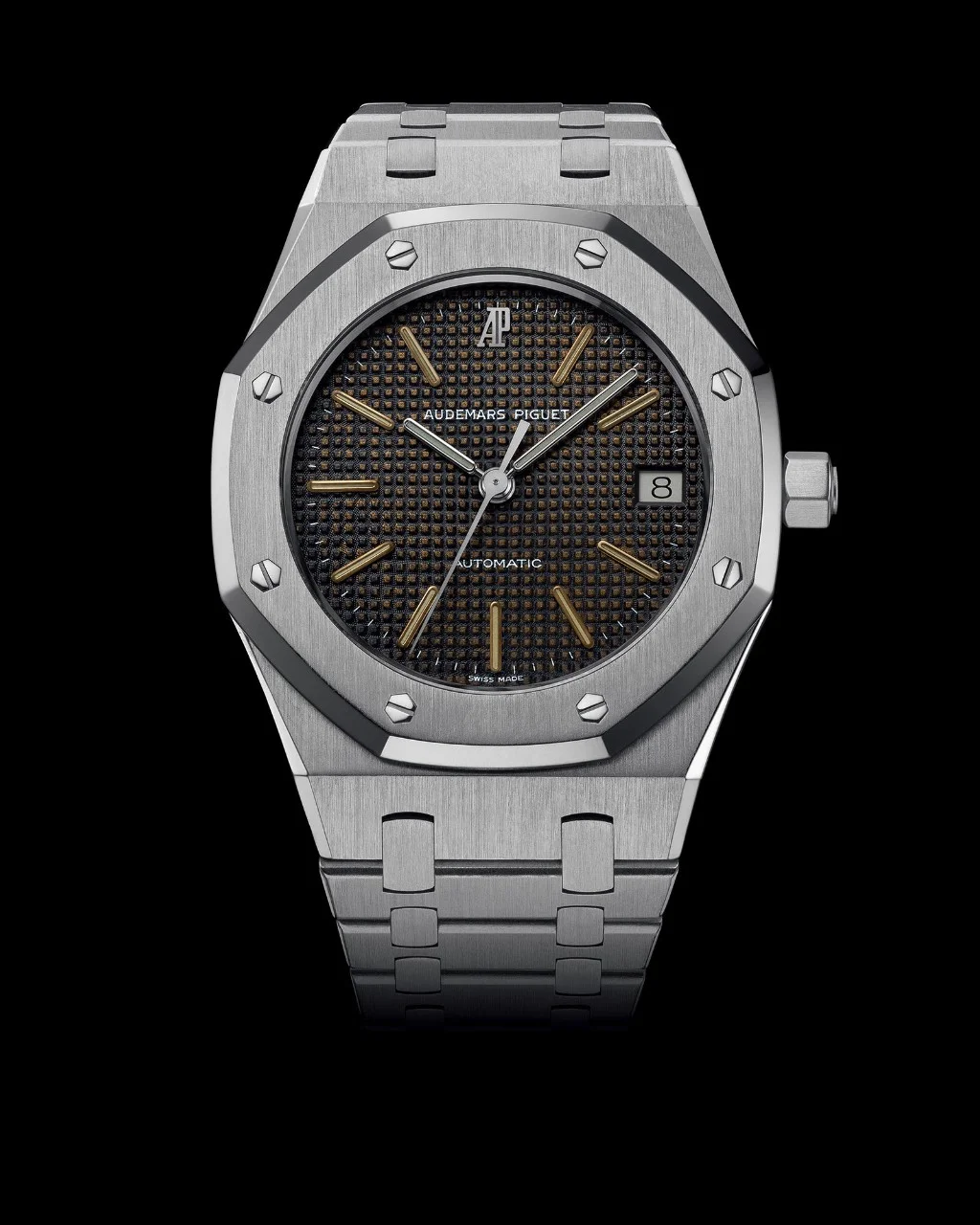
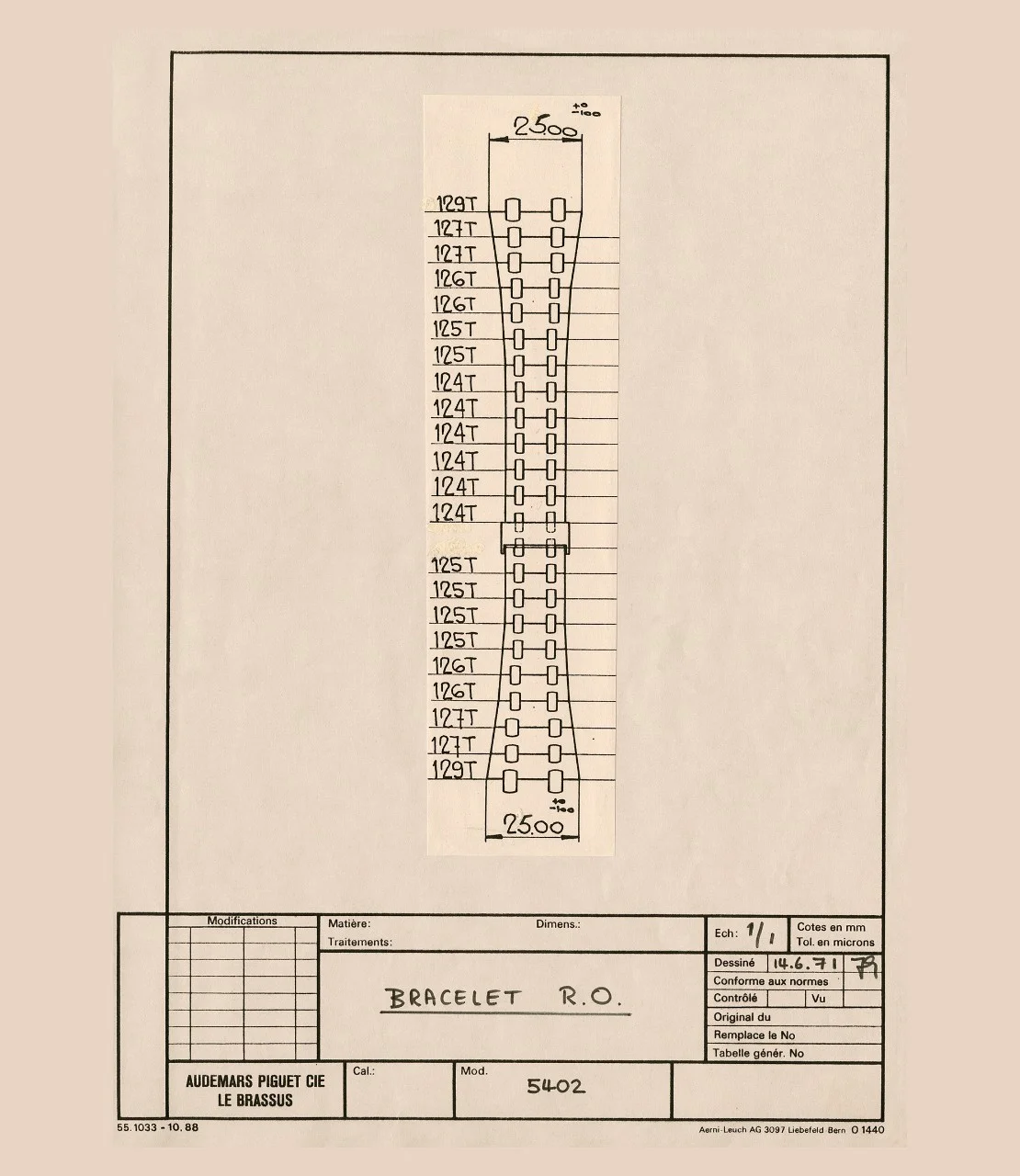
The Royal Oak bracelet is composed of large tapering links connected by pairs of small rectangular studs. The bracelet fitted to the first Royal Oak, Model 5402, bears no. 344. The widest link is attached to the case middle and measures 25.9 mm, while the narrowest link measures a mere 15.9 mm, corresponding to the width of the folding clasp to which it is attached. The difference in width between the two attachment links is significant, with one almost double that of the other.
The magic lies in the fact that these two sizes are connected by a flowing, perfectly designed line: the famous bracelet taper. To be sure of this, a watchmaker (or collector) must be able to run their finger along the entire length of the bracelet sides in one seamlessly smooth move – a test that can also be performed on the top of the bracelet, where all the elements must be flush.
To create this continuity effect, bracelet no. 344 is composed of 17 to 20 links (depending on its length), produced in 12 different sizes. Visually, the "decrescendo" effect might have been reduced if the studs connecting the links had been aligned and of identical size. A trained eye will discover that this is not the case. As the bracelet narrows, the width of the links slowly decreases from 3.6 mm to 2 mm. To maintain harmonious proportions, the distance between the studs also gradually decreases from 8.9 mm to 7.1 mm. The studs follow the outer curve of the bracelet. To achieve this, they are produced in nine different sizes for each bracelet strand! Back in 1972, this was a world-first feature for an integrated steel bracelet.
1971. Sketch of the studs on the first Royal Oak bracelet. This drawing highlights the fact that the studs that attach the tapered links are themselves of different sizes. Audemars Piguet Archives.
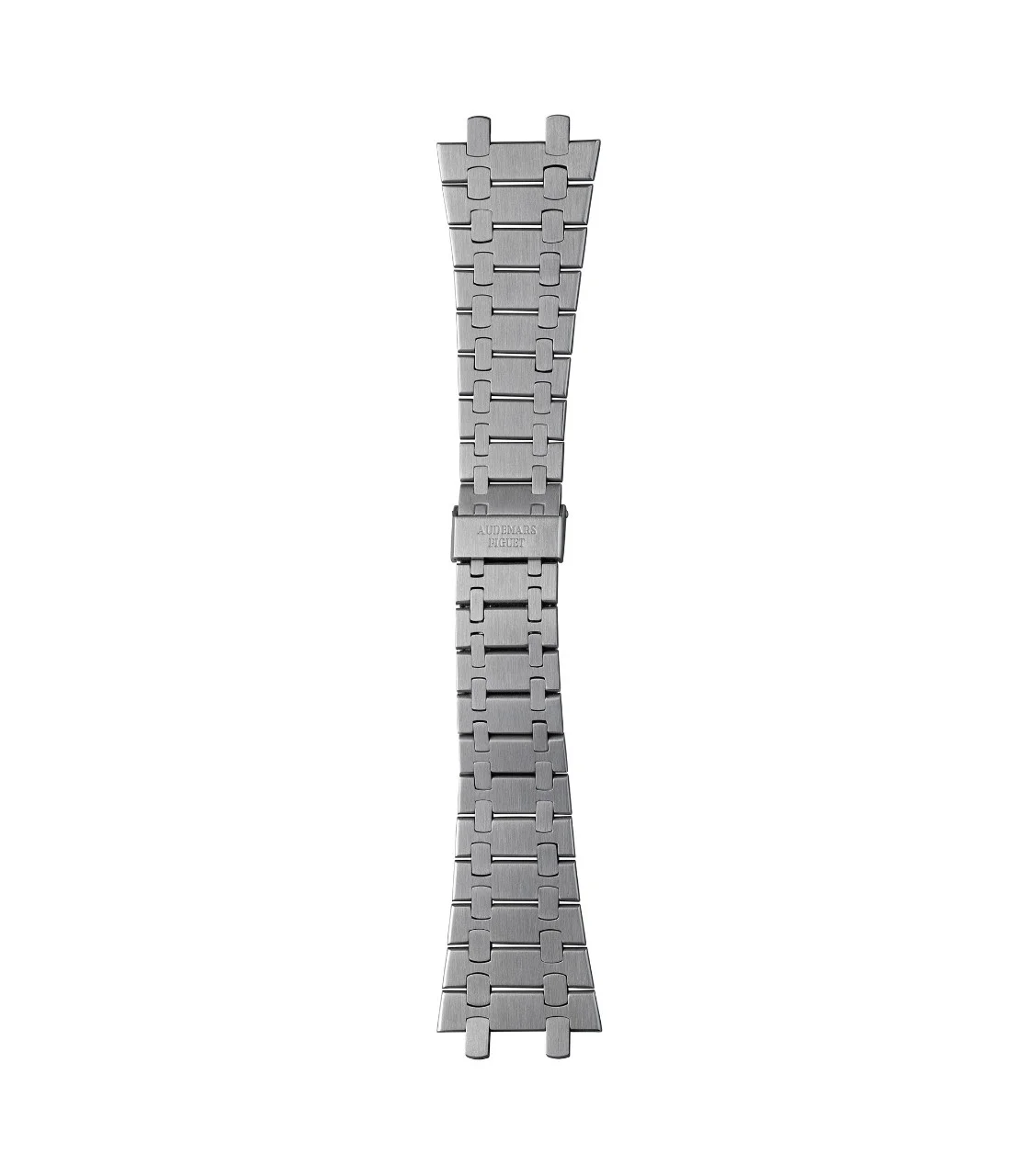
1972. First Royal Oak bracelet. This bracelet 344 adorns the Royal Oak 5402ST A26 series, case 67026, movement 127059, delivered by Audemars Piguet to the Swiss market (Gameo Lausanne) on June 16, 1972. Audemars Piguet Heritage, inv. 365
A Highly Complex Production Process
Gérald Genta was not mistaken when he said that the tapering bracelet involved "a highly complex production process". Bracelet no. 344 (with extension links) has 154 components, including 20 links, 44 studs, 75 pins and 8 screws (including the screws for securing it to the case middle). In all, it consists of 34 variously shaped elements that are adjusted, decorated and assembled by hand.
Each stud is secured by two grooved pins, "hard-driven" into the link, then gently filed so that their heads disappear into the side of the bracelet. These pins are the keystone of the bracelet's flexibility, which must be "neither too soft nor too stiff". They are subject to constant friction and wear out over time, which explains why some 1970s bracelets have become very supple 50 years later. In addition to the pins, the top and bottom edges of the links and studs are slightly rounded to accommodate their rotational movements, giving them a certain suppleness.
The surfaces of the bracelet are finely satin-finished, with the same grain as those of the case middle and bezel, so as to reflect the light smoothly and create an effect of continuity that reinforces the impression of an "integrated bracelet". The lateral edges are bevelled and worked on with a lapping machine or grinding wheel in such a way that the light bounces off them as brightly as the movement's bevelled steel parts. They continue along the ridges of the case, while the facets separating the links are sandblasted to accentuate the gleam of the other components.
To ensure an even more seamless taper, the bevels on the first link pick up the lateral bevels on the case middle. However, the closer the links are to the buckle or clasp, the narrower the bevels. Creating these “degressive bevels”, a procedure done by hand once the bracelet is assembled, is a tricky operation.
These refined details explain why – despite its original masculinity based on its visible screws, its oversized steel case and its taut lines – the Royal Oak had always been in touch with its feminine side since 1972 and could thus be interpreted as early as 1976 in a women’s version (see the article on the birth of the first women’s model).
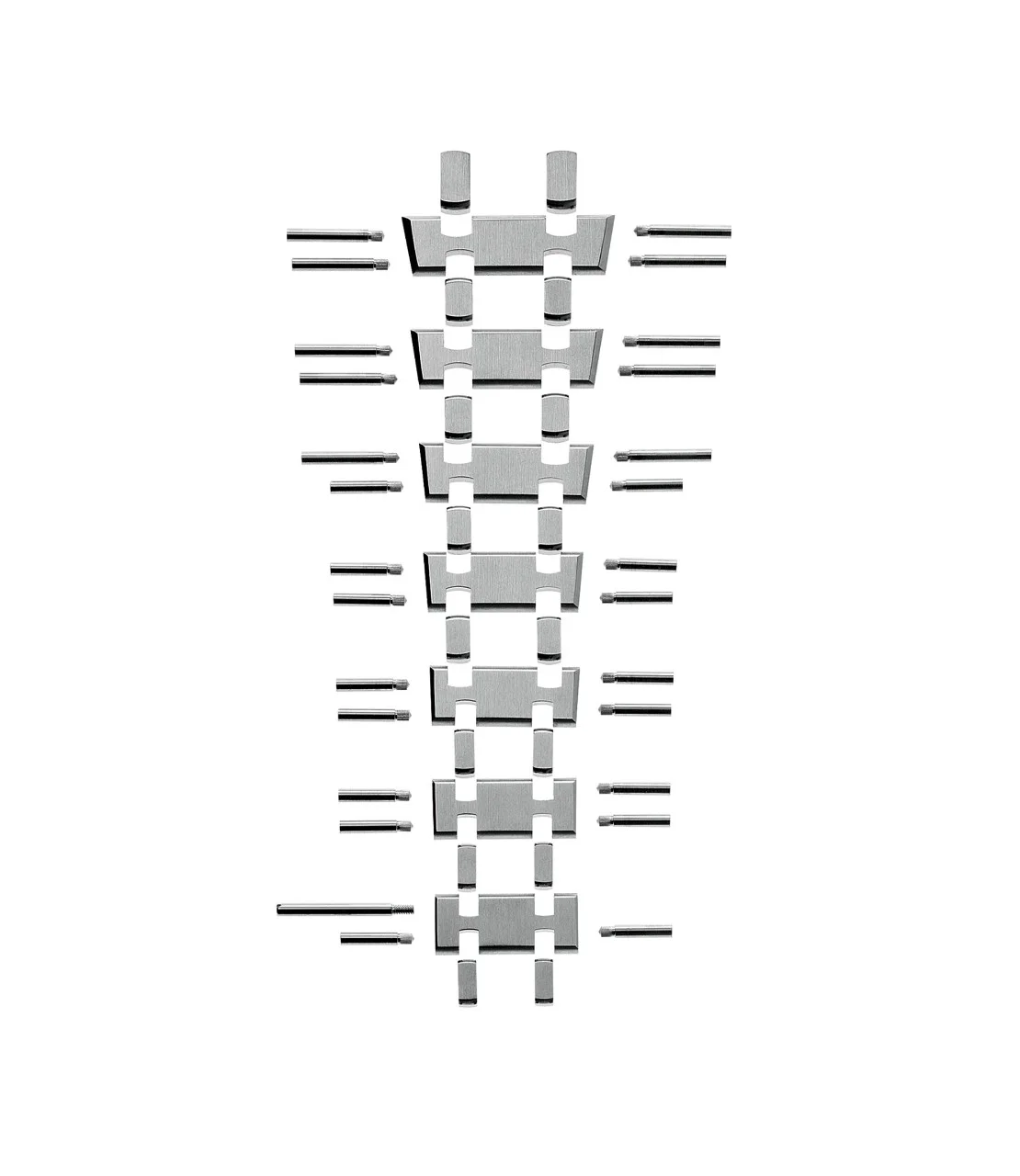
Partial exploded view of half of a Royal Oak bracelet. The fluted pins that fix the studs to the links are driven in the material and cannot be removed contrary to the screws that fix the bracelet to the case and to the buckle. Picture realised in 2012. Audemars Piguet Archives.
Each Bracelet No. 344 is Unique
Although Model 5402 shattered all Audemars Piguet records in terms of quantity, with more than 6,000 units produced in a decade, the Royal Oak was a quintessentially hand-crafted watch at the time of its birth.
Watchmaker Fredy Capt, who assembled the first Royal Oak watches in 1972, recalls that "the bracelet makers and case makers were not accurate enough.” Watchmakers had to adjust each bracelet using a file: "Each one was customised to fit the case and was thus not suitable for any other model.” This meant that when the watches were returned to Customer Service for servicing or repair, the watchmakers who dismantled them would often discreetly engrave the last two case numbers on both the bracelet and the bezel, so as to ensure that they were correctly matched when they returned from the refurbishment workshops.
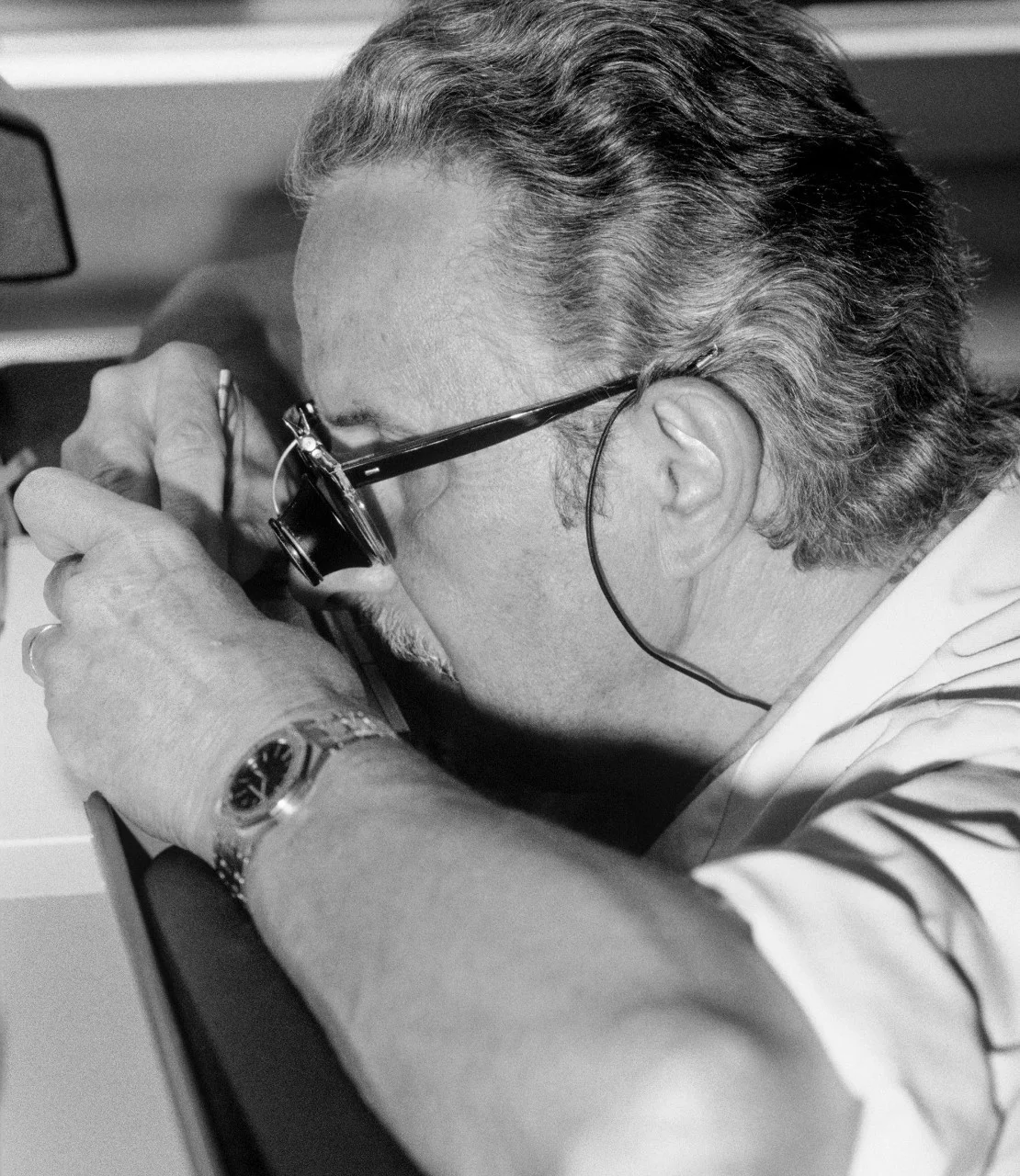
Circa 1975. Watchmaker at the workbench. At the Royal Oak's birth, watchmakers not only finished, adjusted and assembled Calibre 2121. They also touched up each metallic bracelet. Audemars Piguet Archives.
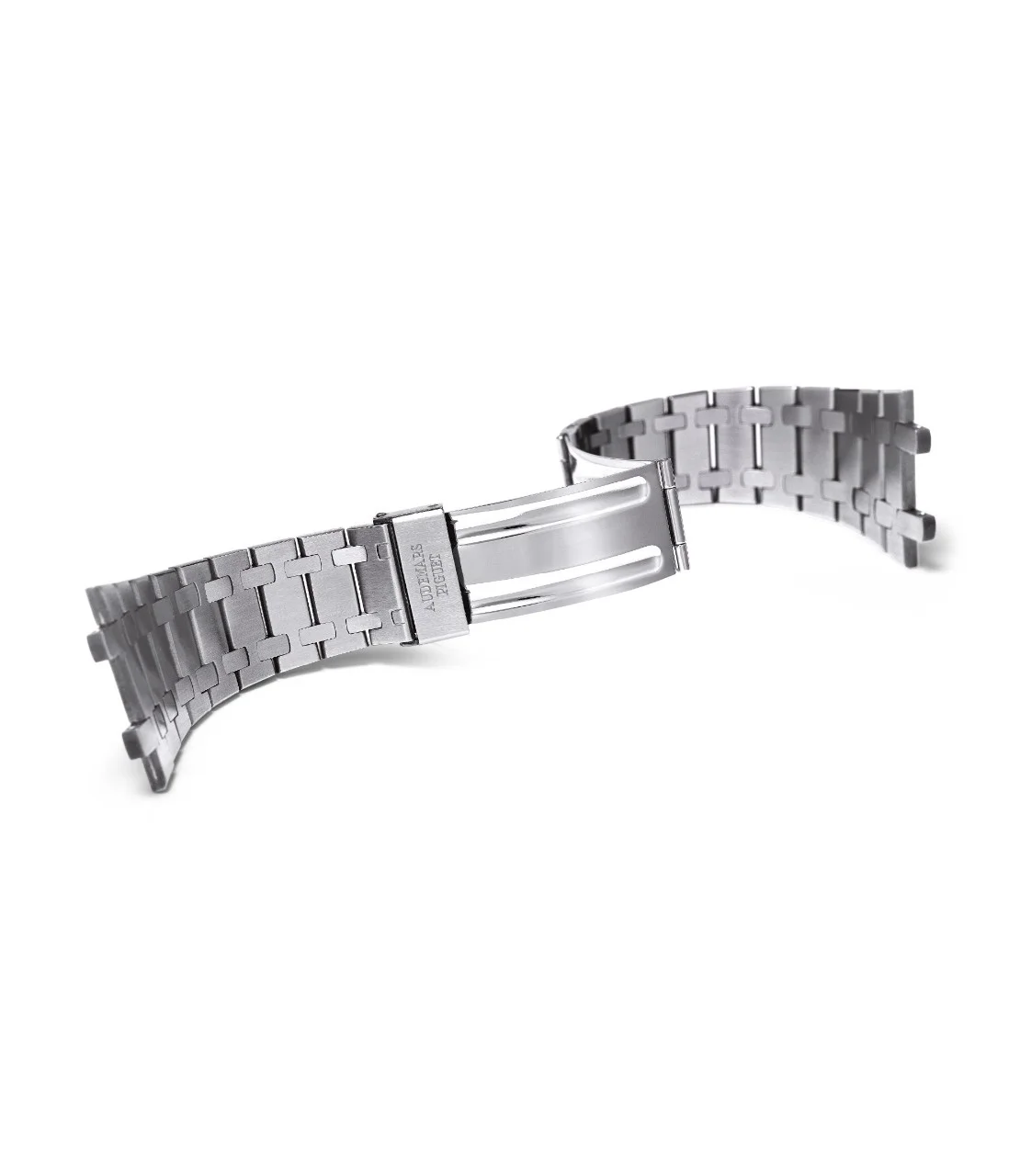
1972. Bracelet 344. Created for the Royal Oak 5402ST, bracelet no. 344 counts amongst the most complex of its time. It is composed of 154 parts, all assembled, decorated and adjusted by hand. Photograph taken in 2012 for the Royal Oak's 40th anniversary. Audemars Piguet Archives.
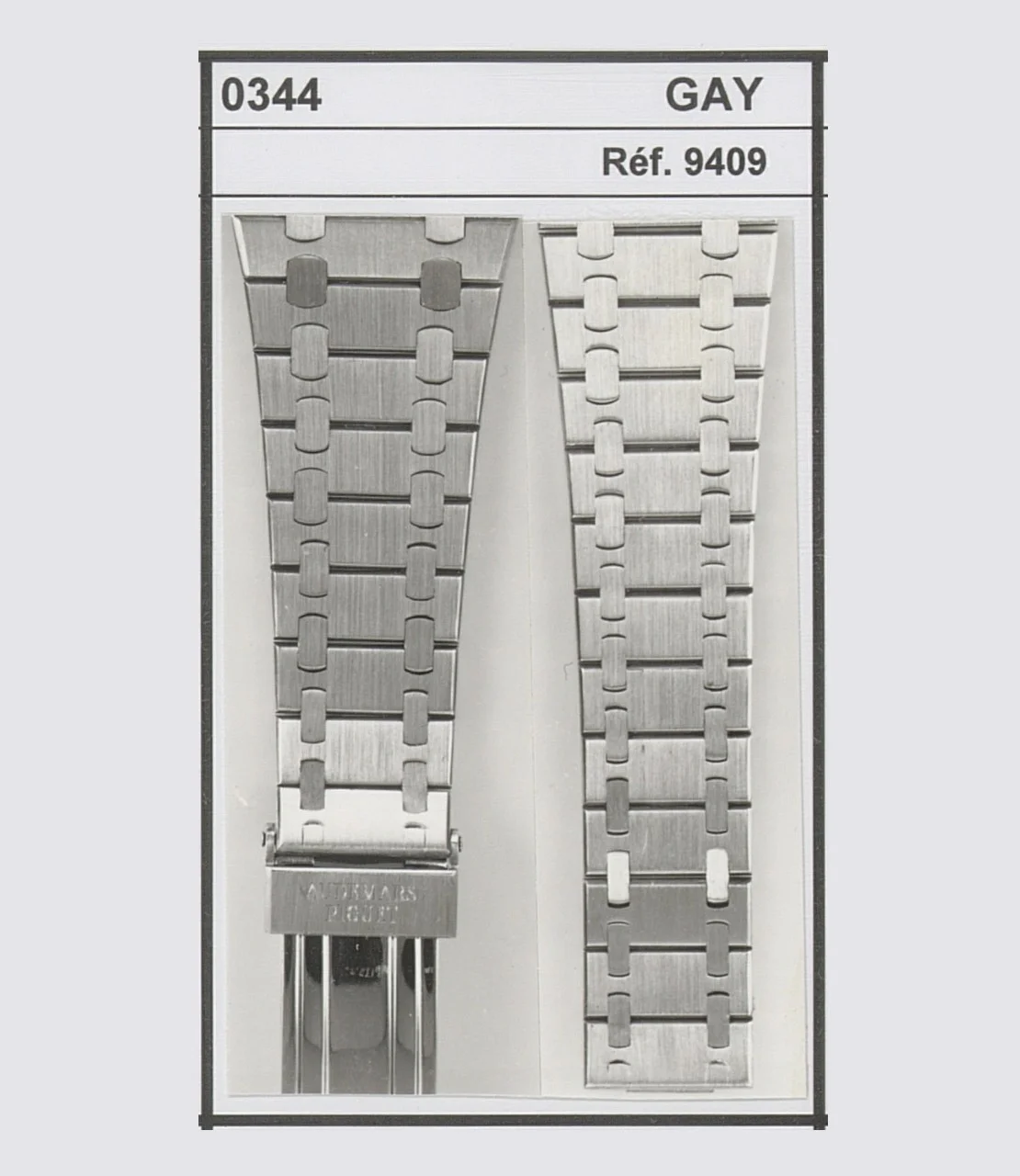
1972. Bracelet 344. Manufactured by the Geneva-based firm Gay Frères, bracelet no. 344 was used on the first-generation Royal Oak 39mm ultra-thin watches. From the end of the 1980s, it was gradually replaced by bracelet no. 944. Bracelet directory. Audemars Piguet Archives.
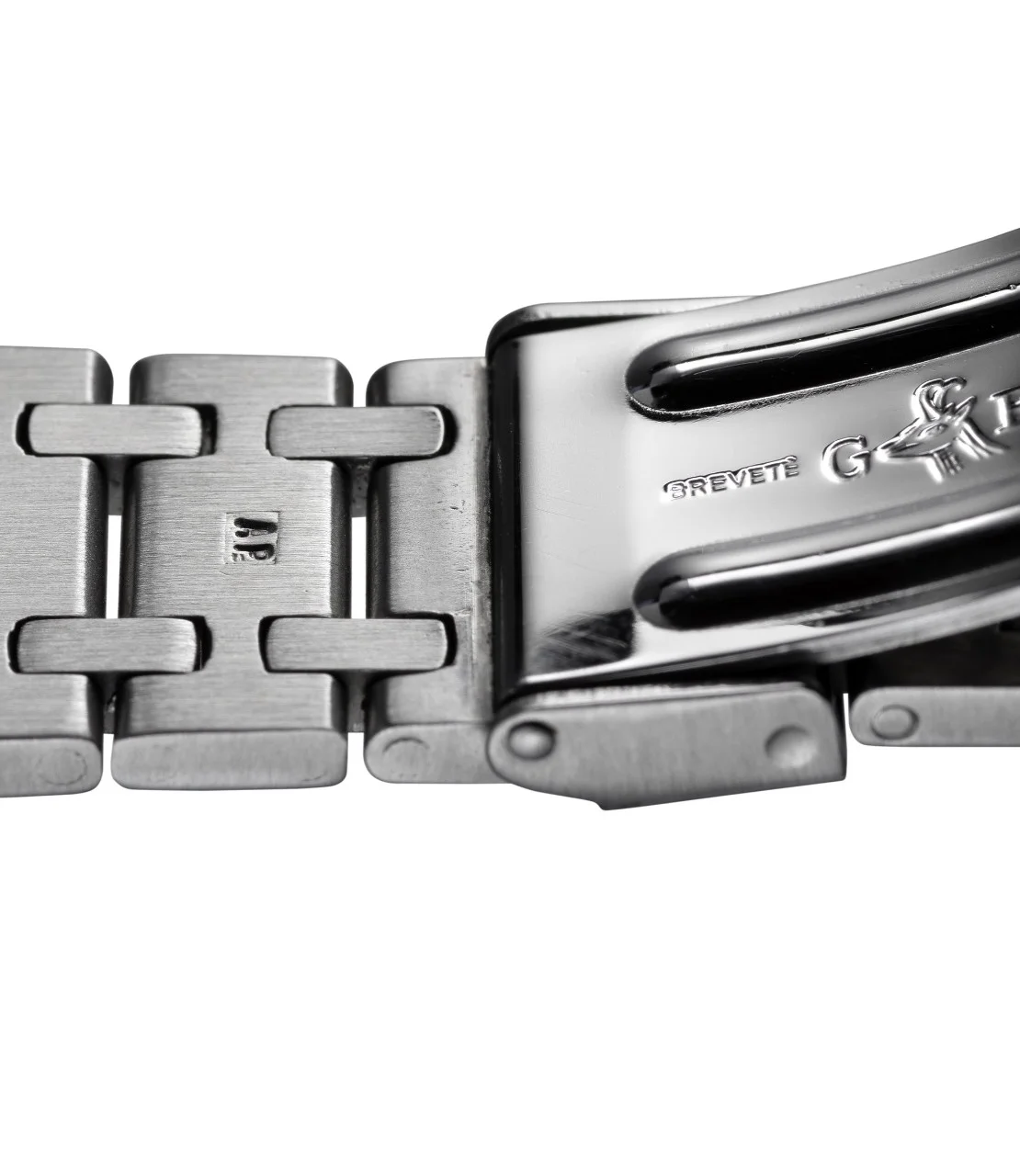
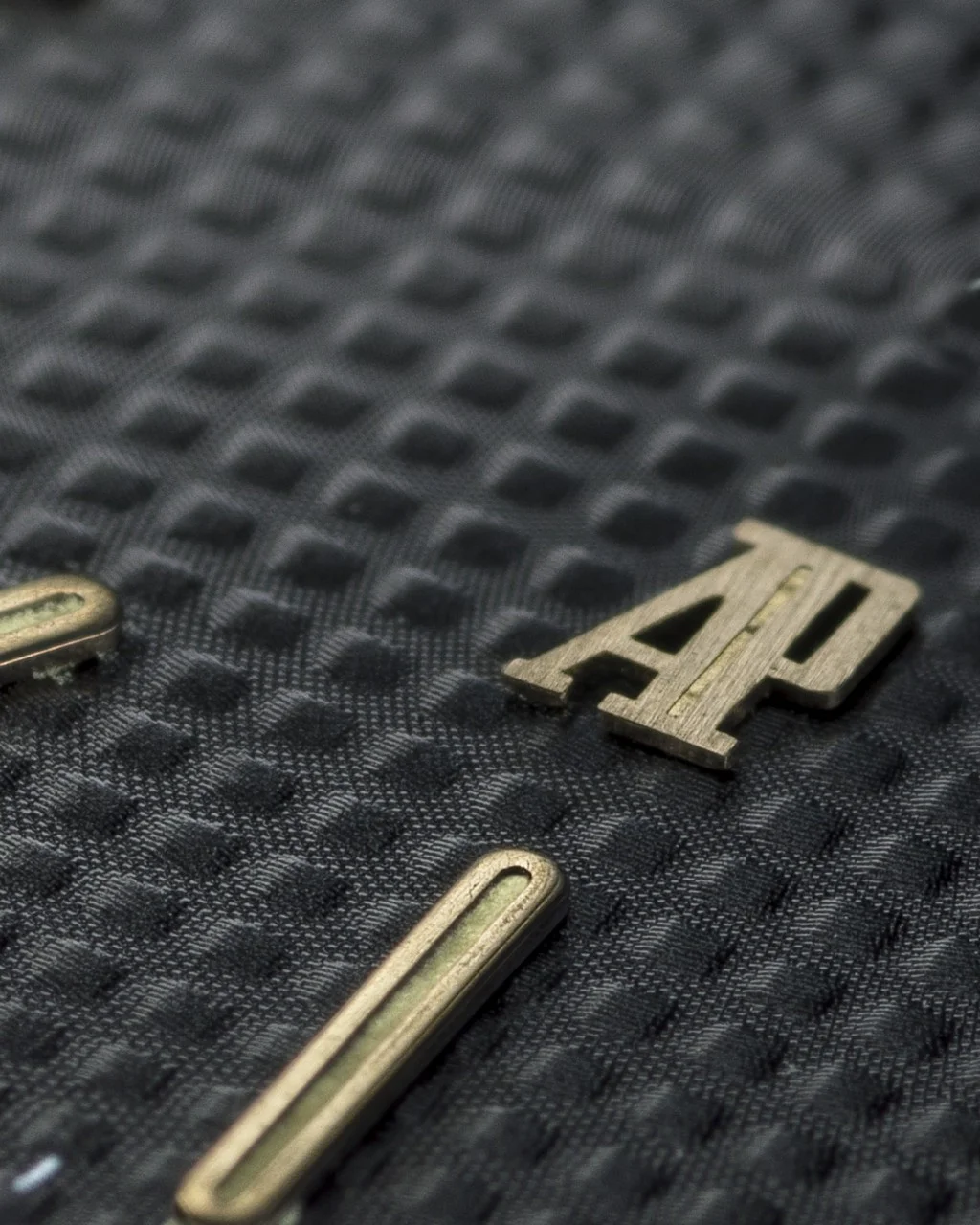
Close-up on bracelet 344. Finished by hand, the first bracelets of the Royal Oak 5402 differ from one another due to a myriad of details. Some have numbers matching with the case for which they have been adjusted. Others have an engraved AP monogram on the link. Audemars Piguet Heritage, inv. 365.
Evolution of the Attachment Points
Bracelet no. 344 from the first Royal Oak has undergone several evolutions, punctuating a steady process of continuous improvement.
The Royal Oak’s early years witnessed three distinct evolutions of the attachment between the bracelet and the case middle. In its first version, the screw was placed at the outer end of the case middle and at the inner end of the studs (see "Version no. 1” diagram). This position soon proved to be problematic, as the watch owner could easily rotate the studs through a 90-degree angle, thereby jeopardising the aesthetic flow of the bracelet.
To remedy the situation, the Customer Service department welded small plates under the first link (also shown on the “Version no. 1” diagram) so that the latter could no longer rotate as much. This solution was applied for several years on watches returned to Le Brassus for servicing. In parallel, the Technical department modified the position of the screws on the studs and on the case ("Version no. 2"). The plans indicate that the latter variant was implemented in August 1974, which corresponds to the last examples of the A series. It is however possible that the modification was applied gradually.
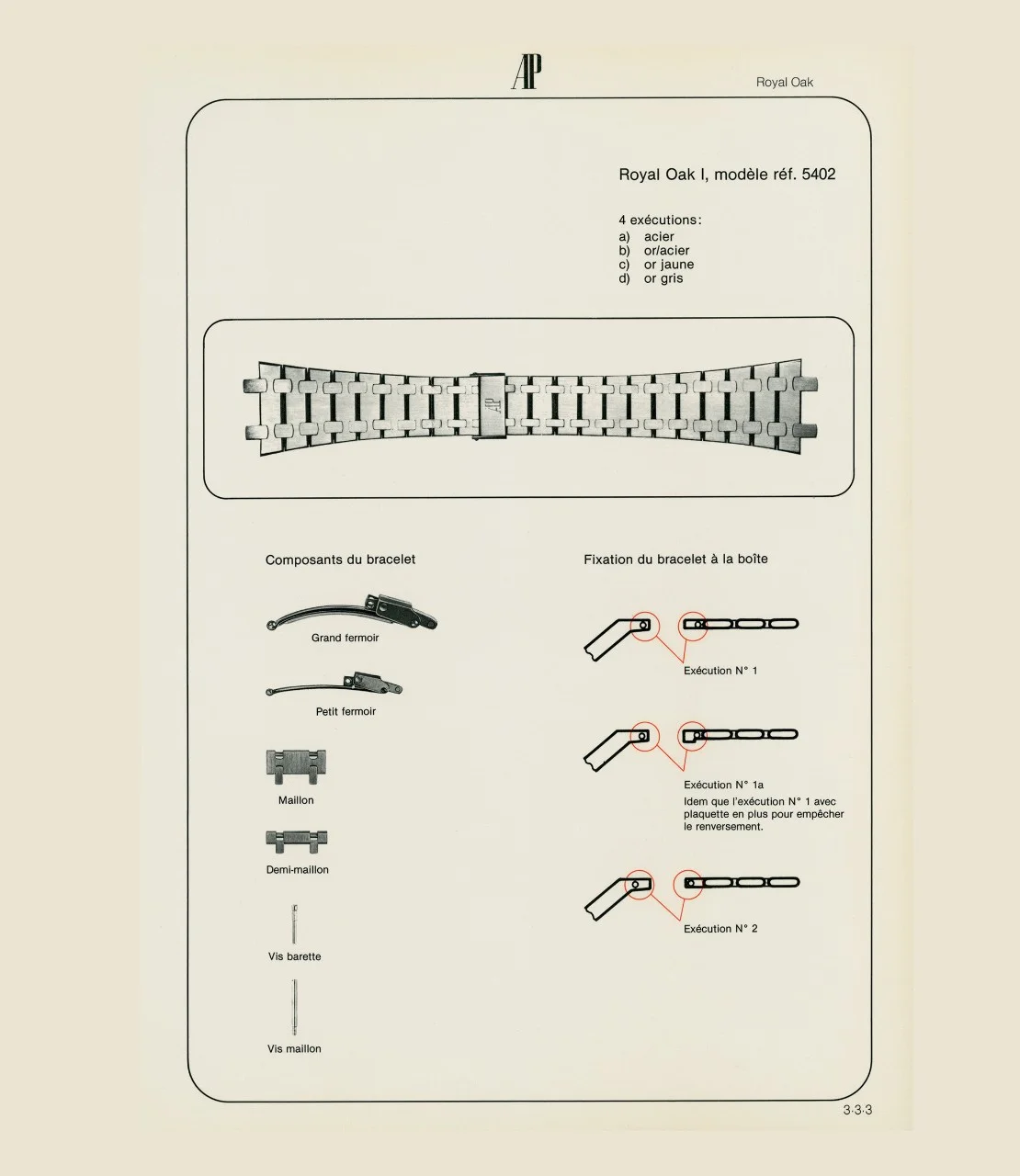
1981. Bracelet 344 evolutions on Model 5402. In 1981, Audemars Piguet informed its retailers of the introduction of a new sizing system made of half links to better adjust the bracelet's length to smaller wrists. A smaller folding clasp is also introduced. AP News 1981. Archives Audemars Piguet.
Folding Clasps
The folding clasp is a bracelet-securing device, first patented in 1909 by the Jaeger company in Paris, which prevents the watch from slipping off the wrist if the bracelet is inadvertently opened. This type of clasp became widely used in sports watches – especially those with steel bracelets – after World War II. The blades were usually closed by a large cap pierced with holes on the sides to adjust the length. However, Audemars Piguet introduced the folding clasp at a later date. Although gold and platinum bracelets were common from the 1960s onwards, they were most often fitted with traditional jewellery-watch fastening systems.
The Royal Oak’s sporty vocation made it the first Audemars Piguet watch to feature a folding clasp. While its function is essential, its design is all about ensuring it merges into the background. When the watch is on the wrist, the two blades are so well hidden under the bracelet that it is almost impossible to know they are there. A small cap spanning the width of a link swings open to secure the bracelet, as well as to conceal and strengthen its attachment system. This discretion is one of the signature codes of the Royal Oak bracelet. Although the shape and number of blades of the folding clasps have undergone numerous variations since 1972 (double blade, triple blade, cut-out blades, others bearing the AP monogram, etc.), Audemars Piguet has always kept them hidden beneath the bracelet links in order to highlight the latter.
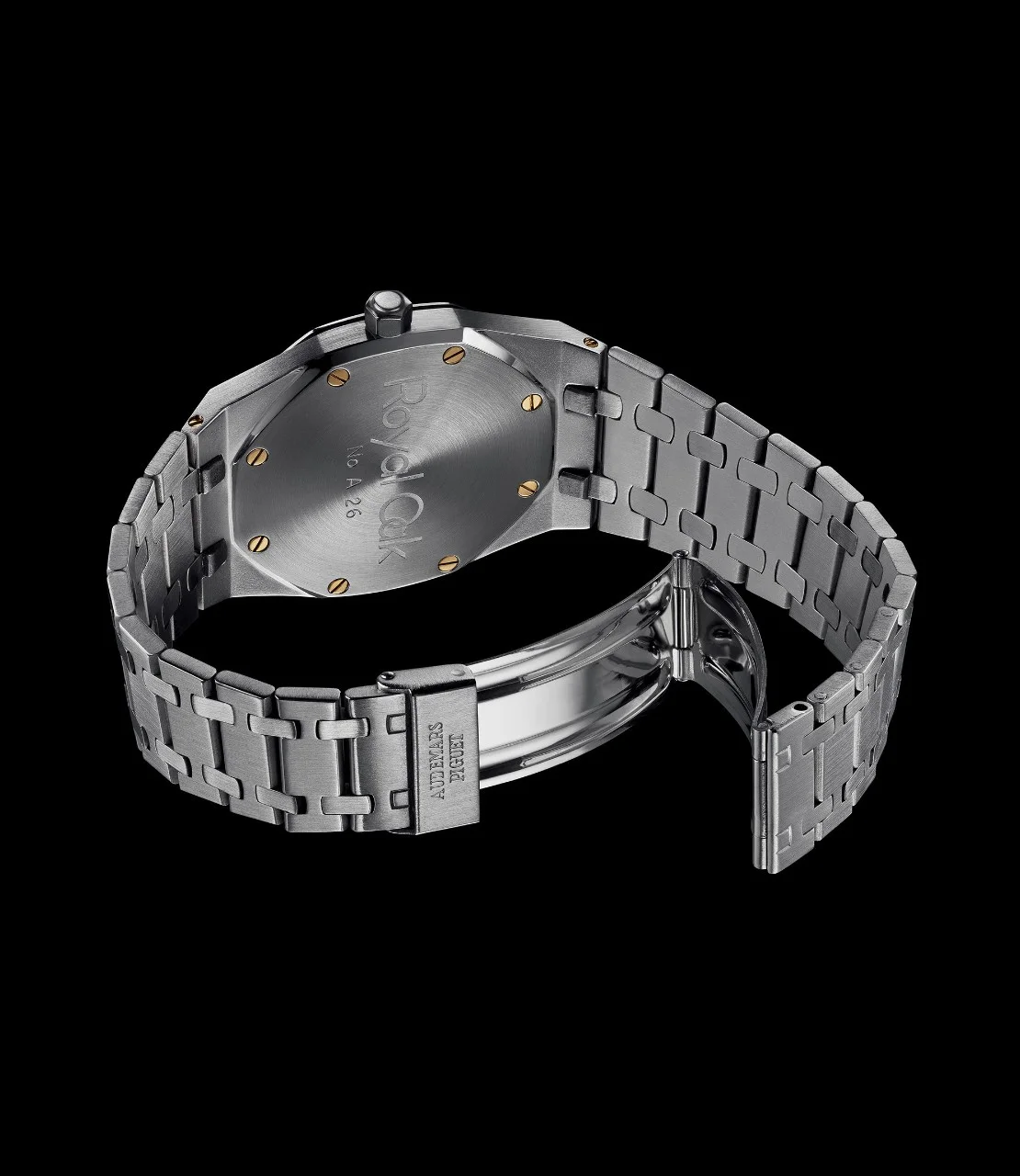
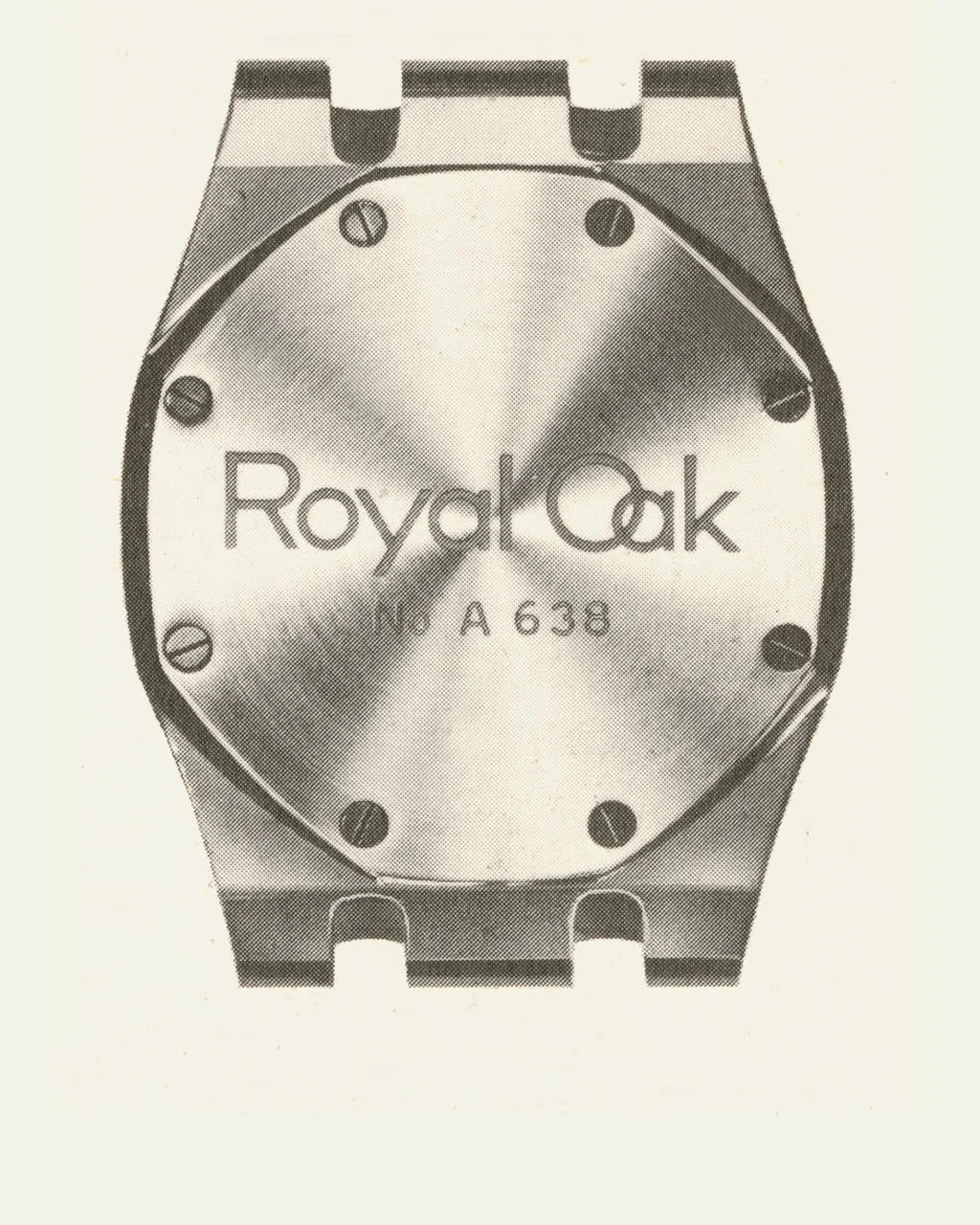
1972. Royal Oak 5402ST No. A26, caseback view. Calibre 2121, movement 127059. Bracelet 344, T21 Tapisserie dial. 39 mm case 67026 in steel. Sold to Gameo in 1972. Audemars Piguet Heritage, inv. 365.
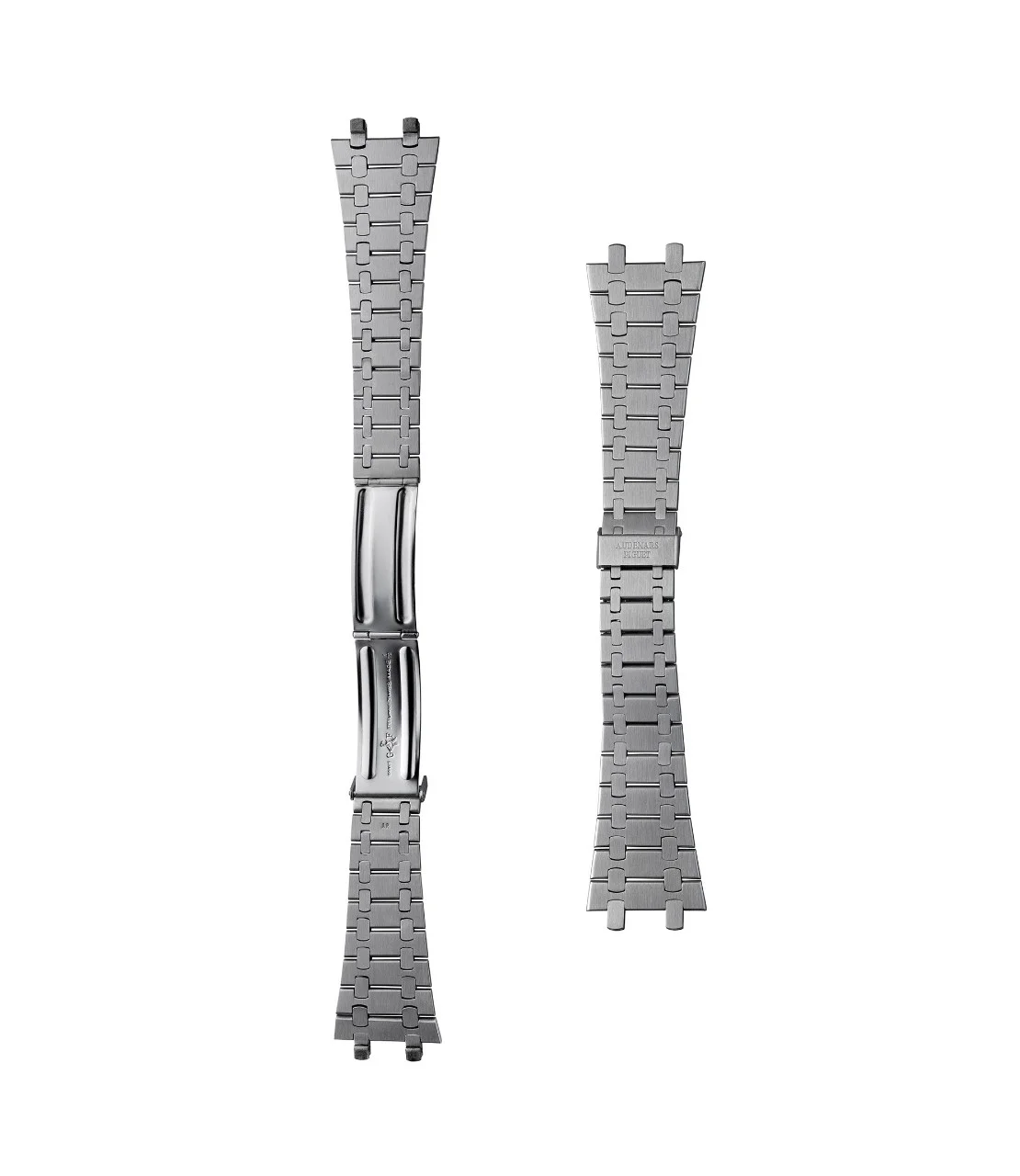
1972. Bracelet 344 for Royal Oak 5402BA A26. Open and closed folding clasp. Audemars Piguet Heritage, inv. 365.
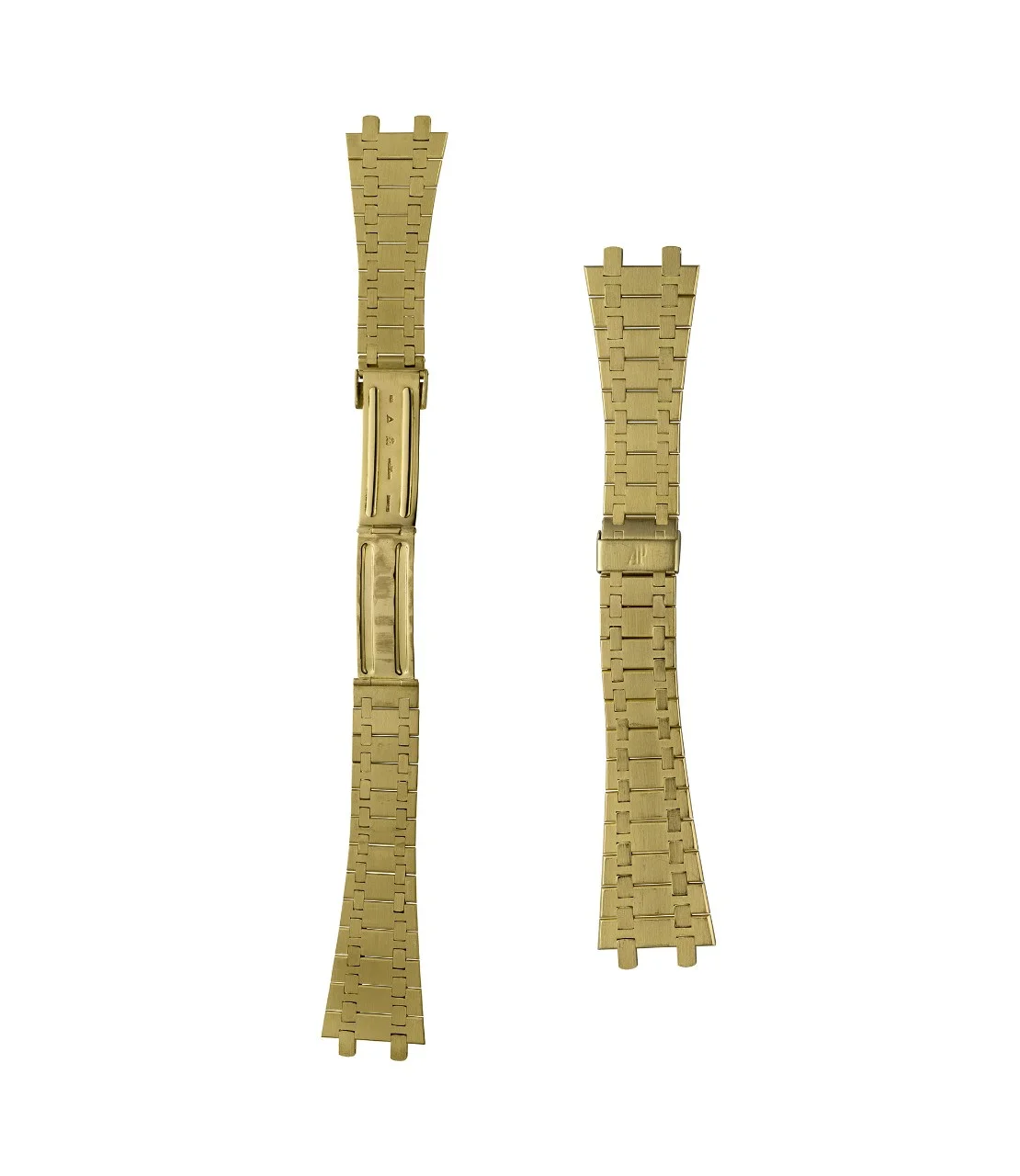
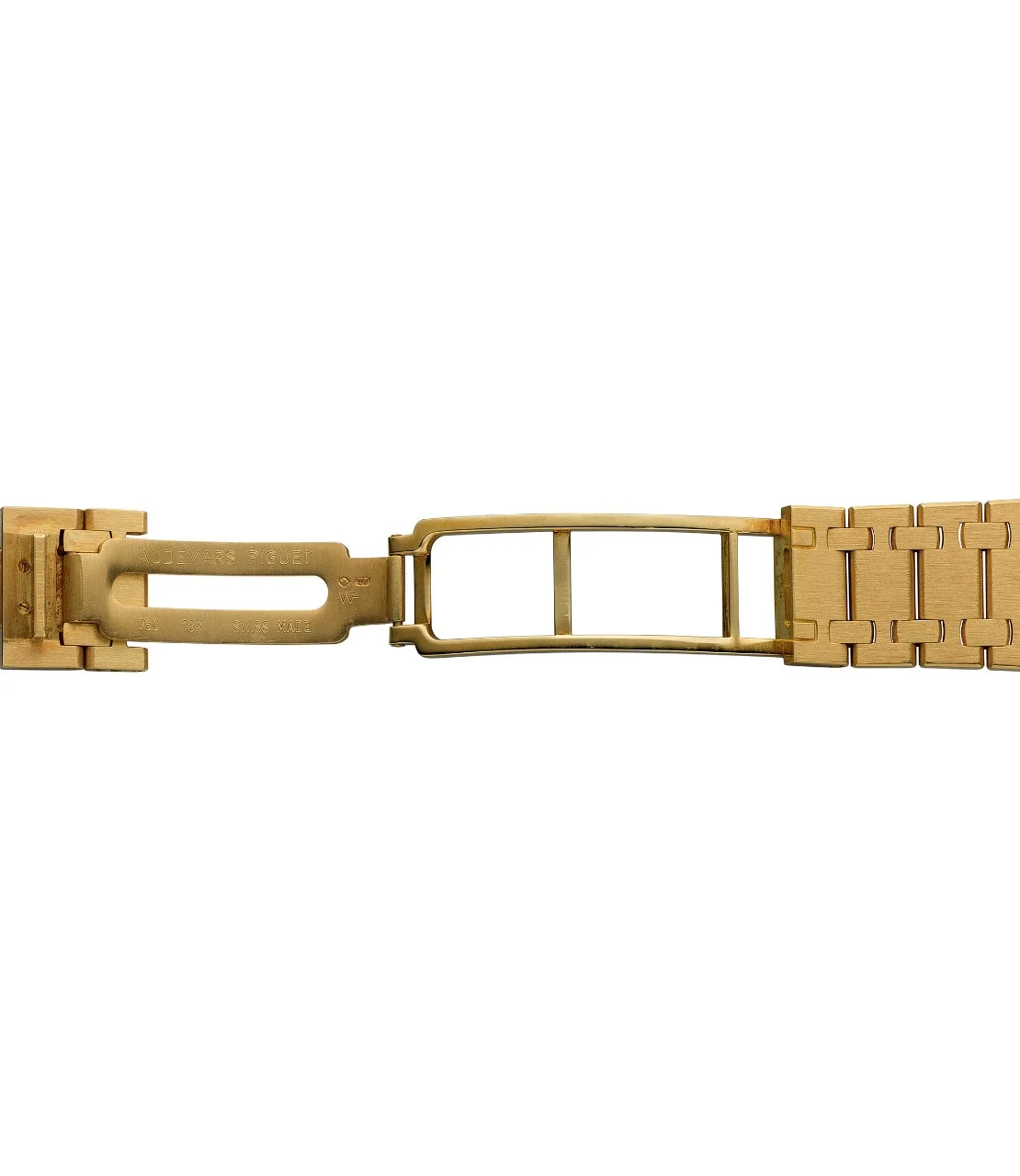
1977. Bracelet 344 for Royal Oak 5402BA. Open and closed folding clasp. Private collection.
1997. Folding clasp, Royal Oak 14814BA openworked. Audemars Piguet Heritage, inv. 1216.
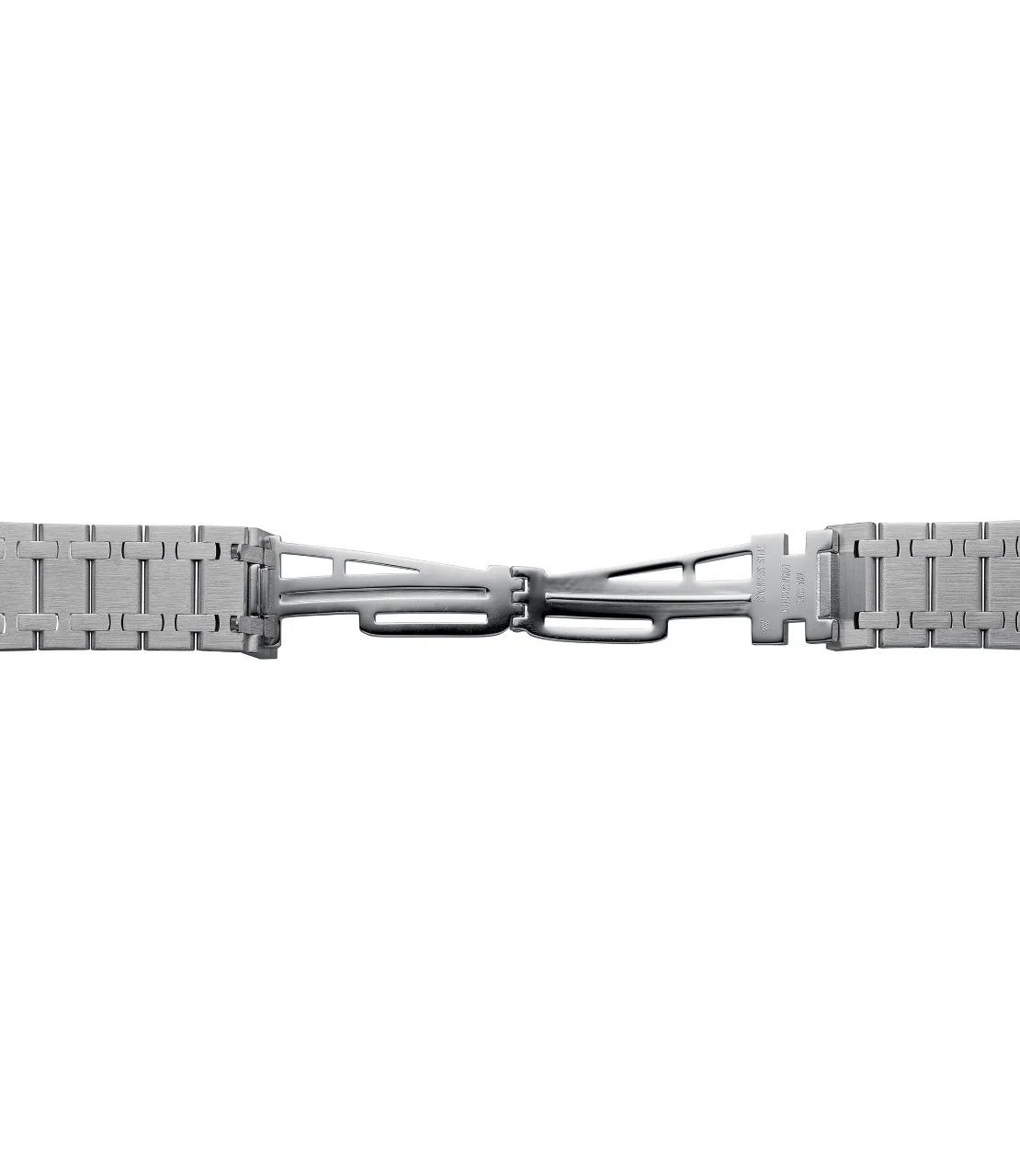
2002. Folding clasp, Royal Oak 15202ST (2000), No. 557. Audemars Piguet Heritage, inv. 738.
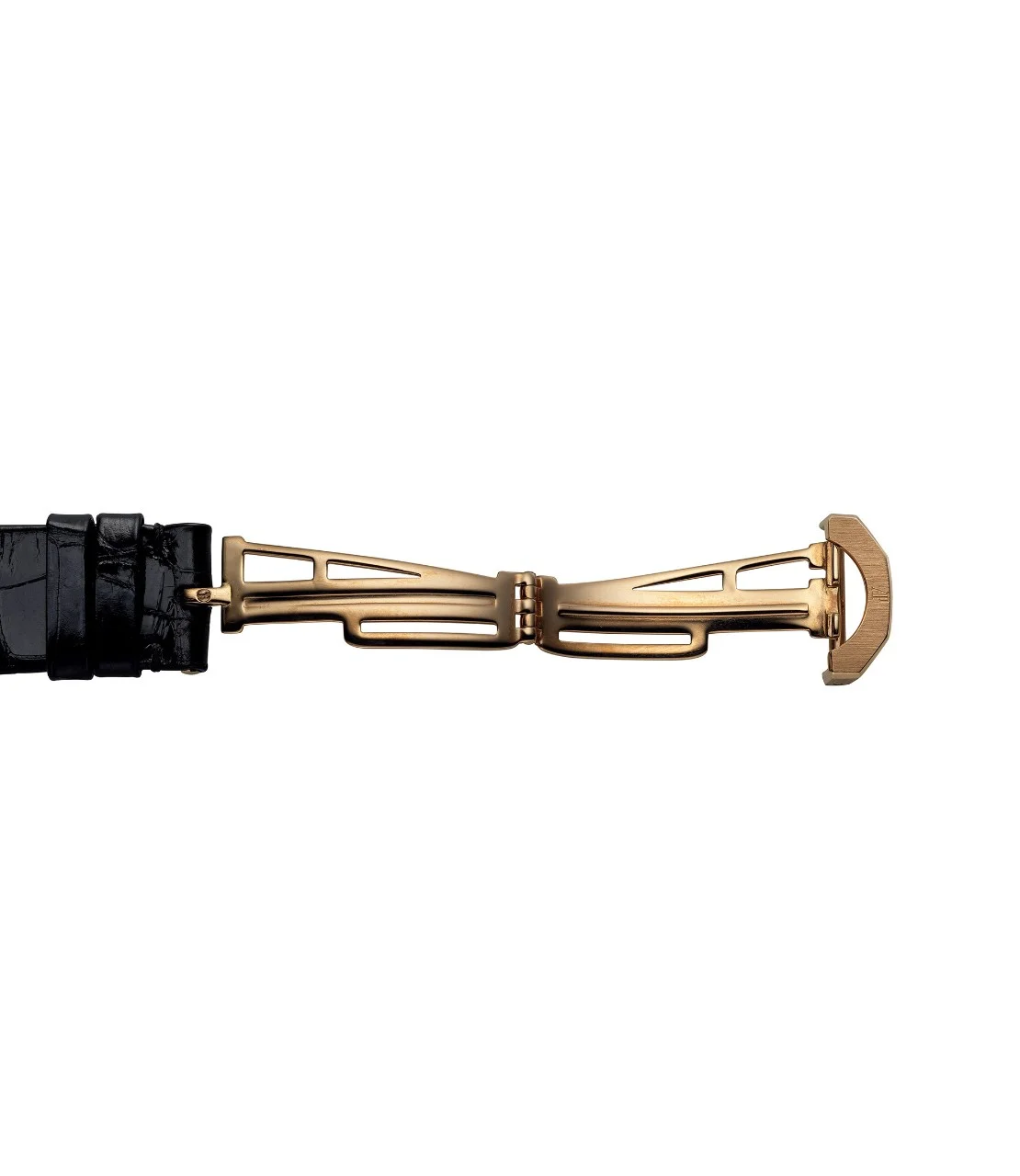
2004. Buckle of the Royal Oak 14800TR No. 199. Audemars Piguet Heritage, inv. 829.
Blade Variants 5402
Collectors are aware that the first blades of bracelet no. 344 bear the design of a chamois head framed by the letters G and F, the trademark of the famous Geneva manufacturer Gay Frères. To the right of this signature are indications of the material ("STAINLESS STEEL") and origin ("SWISS MADE"), as well as the batch and production year (1 – 72 in the first example shown here).
To the left of the signature sits the "PATENTED" inscription, which probably refers to patent CH344538 filed by Gay Frères in 1958, relating to a double-blade clasp with a small cap. One should nonetheless note that the exact object of this patent does not specifically cover the system of the 344 bracelet, which perhaps explains the fact that the mention "PATENTED" vanished in the mid-1970s, before reappearing in the early 1980s, probably after the filing of patent CH633697 in 1979.
It is impossible to ascertain from existing sources just how many examples of the Royal Oak 5402 were equipped with Gay Frères blades. This inscription was replaced by an Audemars Piguet signature in 1975 or even earlier, probably at the request of other suppliers who also wished to sign their part... It is worth recalling that maker’s marks were applied to the gold cases, and that Stern engraved its star on the back of the Royal Oak dials. It is rare to find other signatures, except for those of retailers such as Bulgari, Tiffany or Gübelin which sometimes appear on the dials.
Another interesting detail for collectors: in 1977, the first examples of Model 5402BA were equipped with yellow gold blades. However, as this material quickly proved to be too soft, the following models were equipped with stiffer white gold blades.
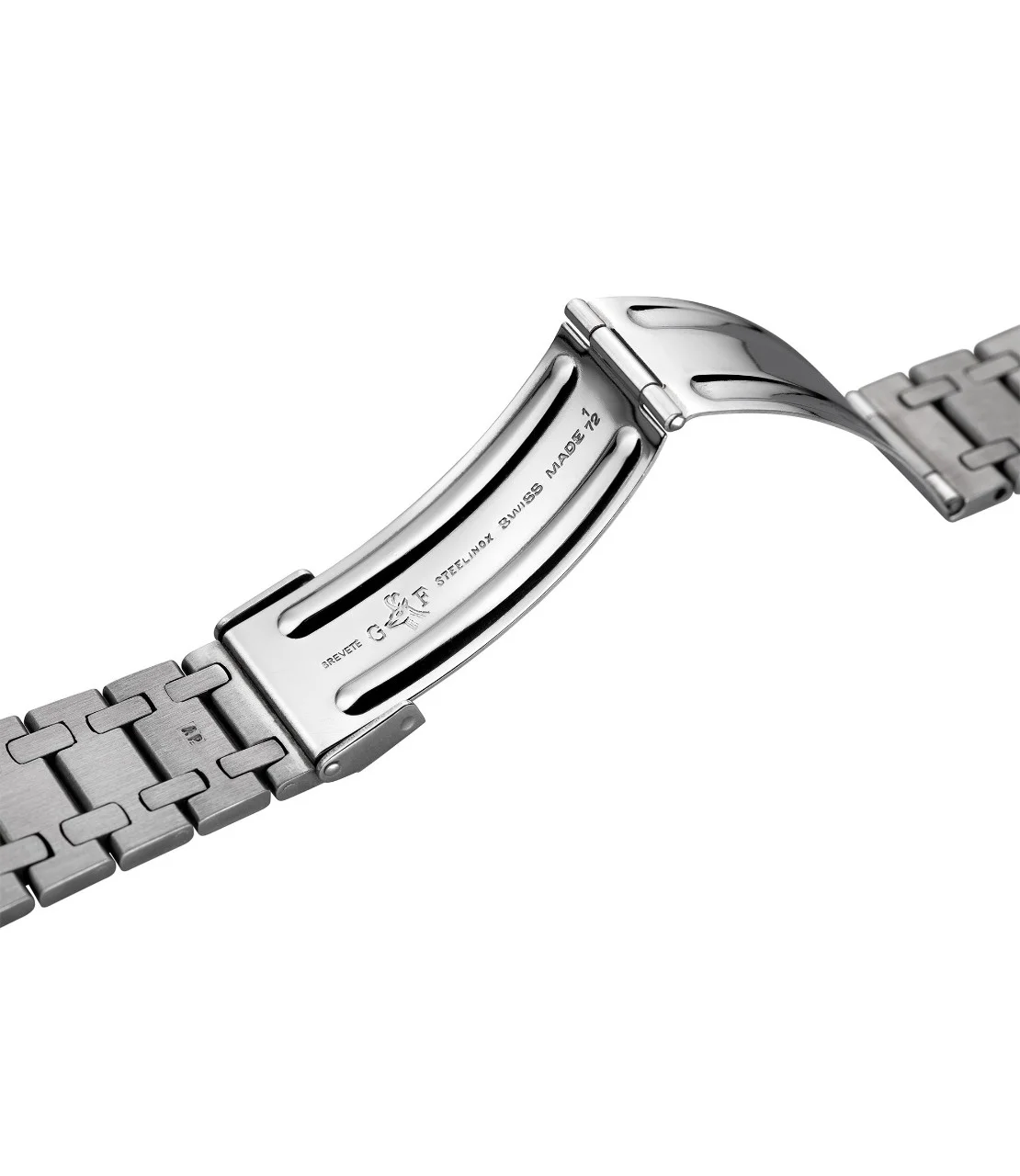
1972. Folding clasp, Royal Oak 5402ST A26. Gay Frères signature. First batch "1–72". Audemars Piguet Heritage, inv. 365.
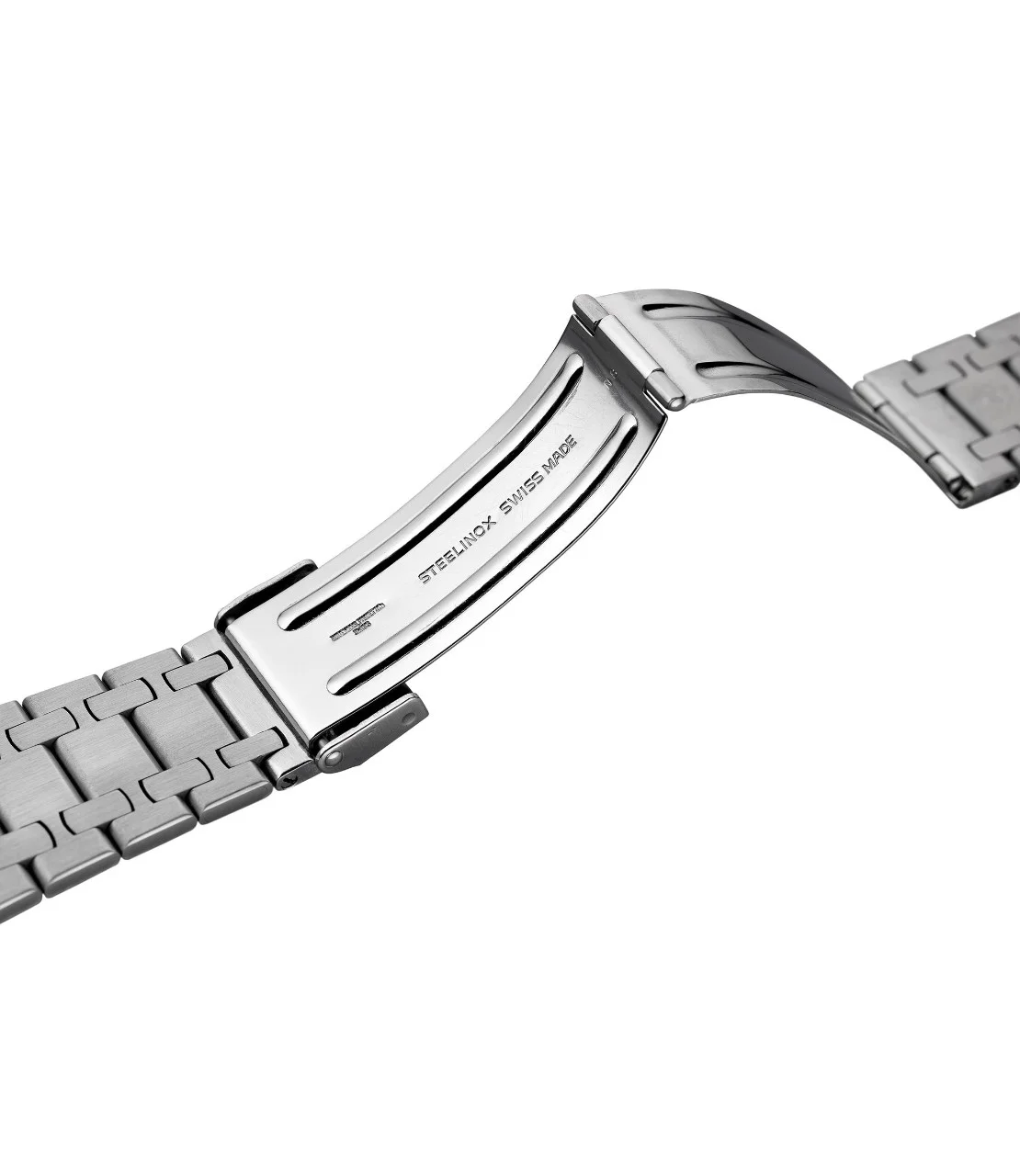
1975. Folding Clasp of Royal Oak 5402ST No. B1303. Audemars Piguet Heritage, inv. 1222.
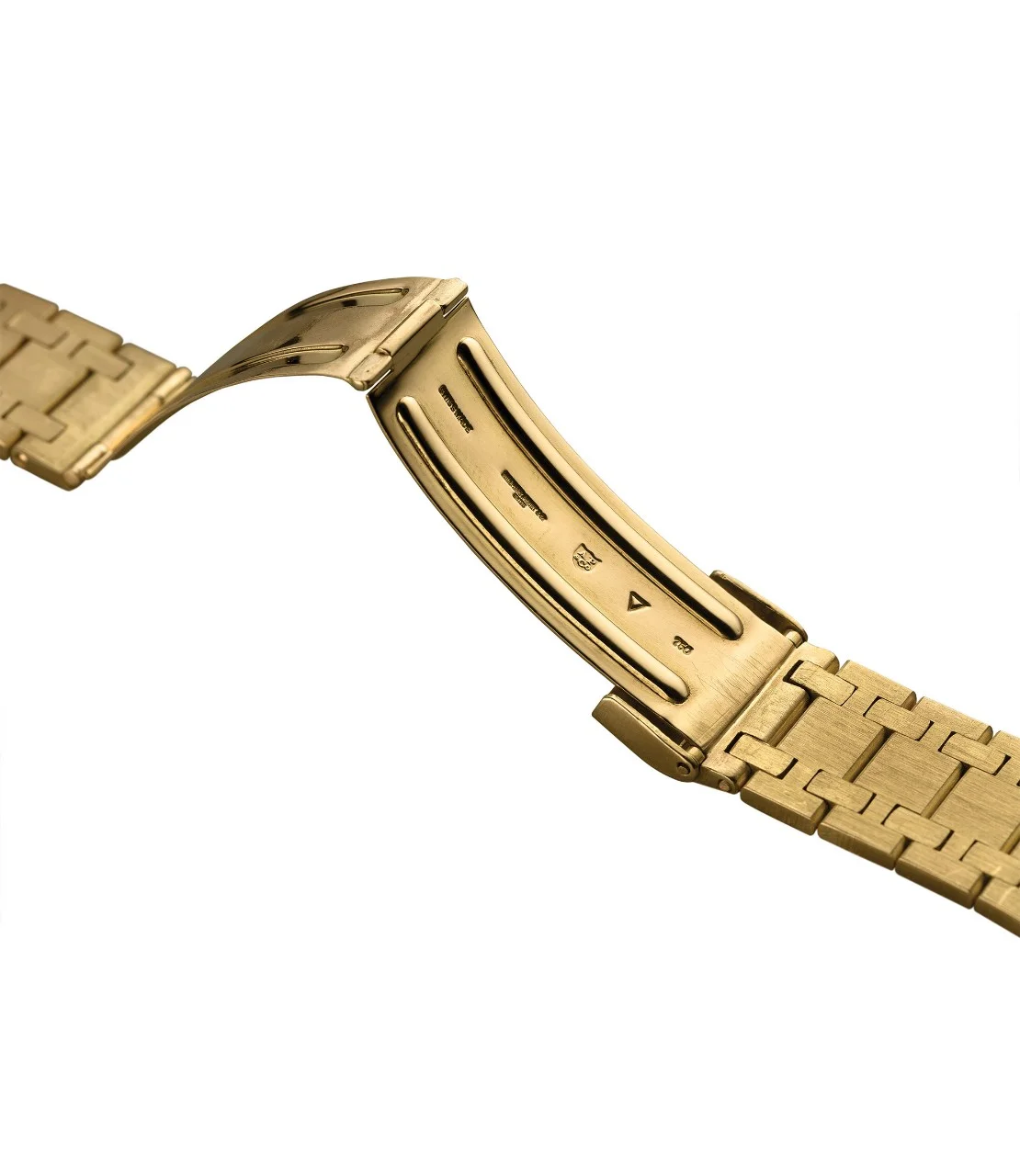
1977. Royal Oak 5402BA's folding clasp. The yellow gold folding clasp of the first examples quickly gave way to a new more rigid white gold variant.
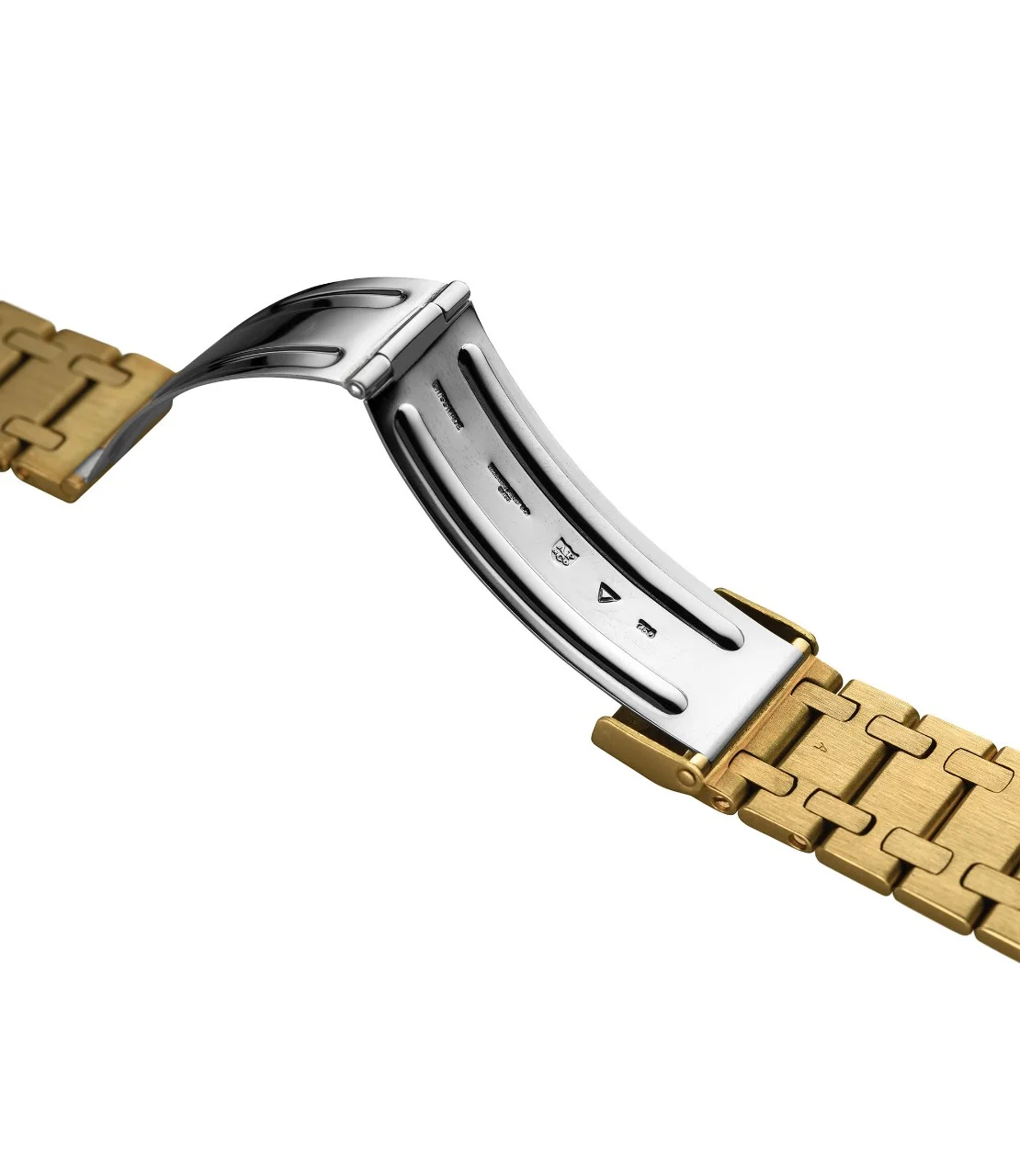
1978. Folding clasp of the Royal Oak 5402BA No. 192. The yellow gold folding clasp of the first examples quickly gave way to a white gold variant. Audemars Piguet Heritage, inv. 1073.
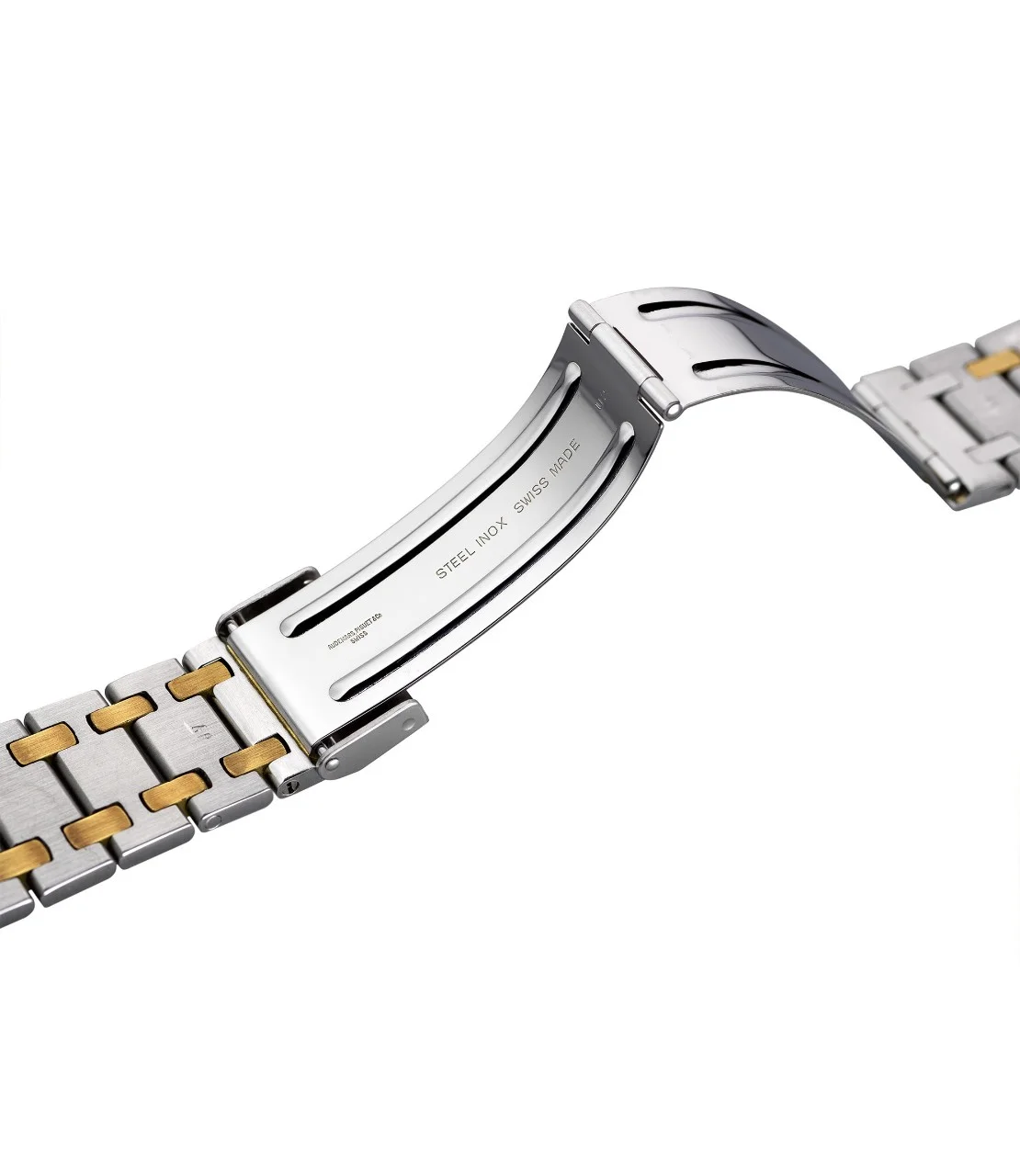
1978. Folding clasp of the Royal Oak 5402SA No. 286. Audemars Piguet Heritage, inv. 1446.
Cap Variants 5402
In addition to hiding the blade-locking system, the small cap plays a safety role. So as to keep it closed, two small catches slot into grooves located where the link pins are. This means that the blades cannot open so long as the cap remains closed.
The caps of Model 5402 have also evolved. Originally, the first ones were engraved with the name AUDEMARS PIGUET spelled out in full before being replaced a few years later by the AP monogram. The archives do not reveal the date of this change, but the watchmakers in the Customer Service department agree that the caps with the full name were gradually abandoned during the period when the 5402 series B was marketed, i.e. between 1975 and 1976.
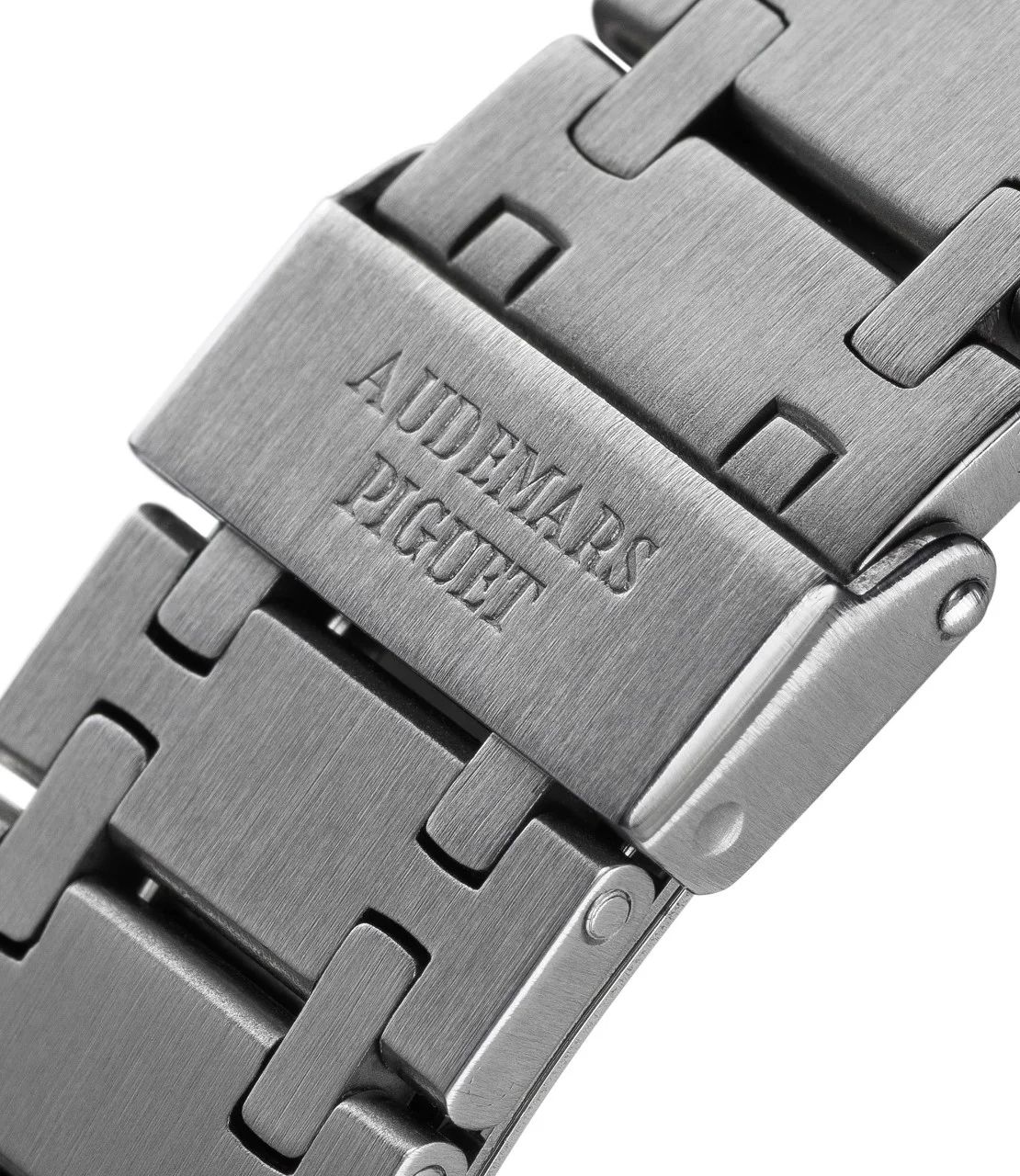
1972. Bracelet 344 cover, Royal Oak 5402ST A26. Audemars Piguet Heritage, inv. 365.
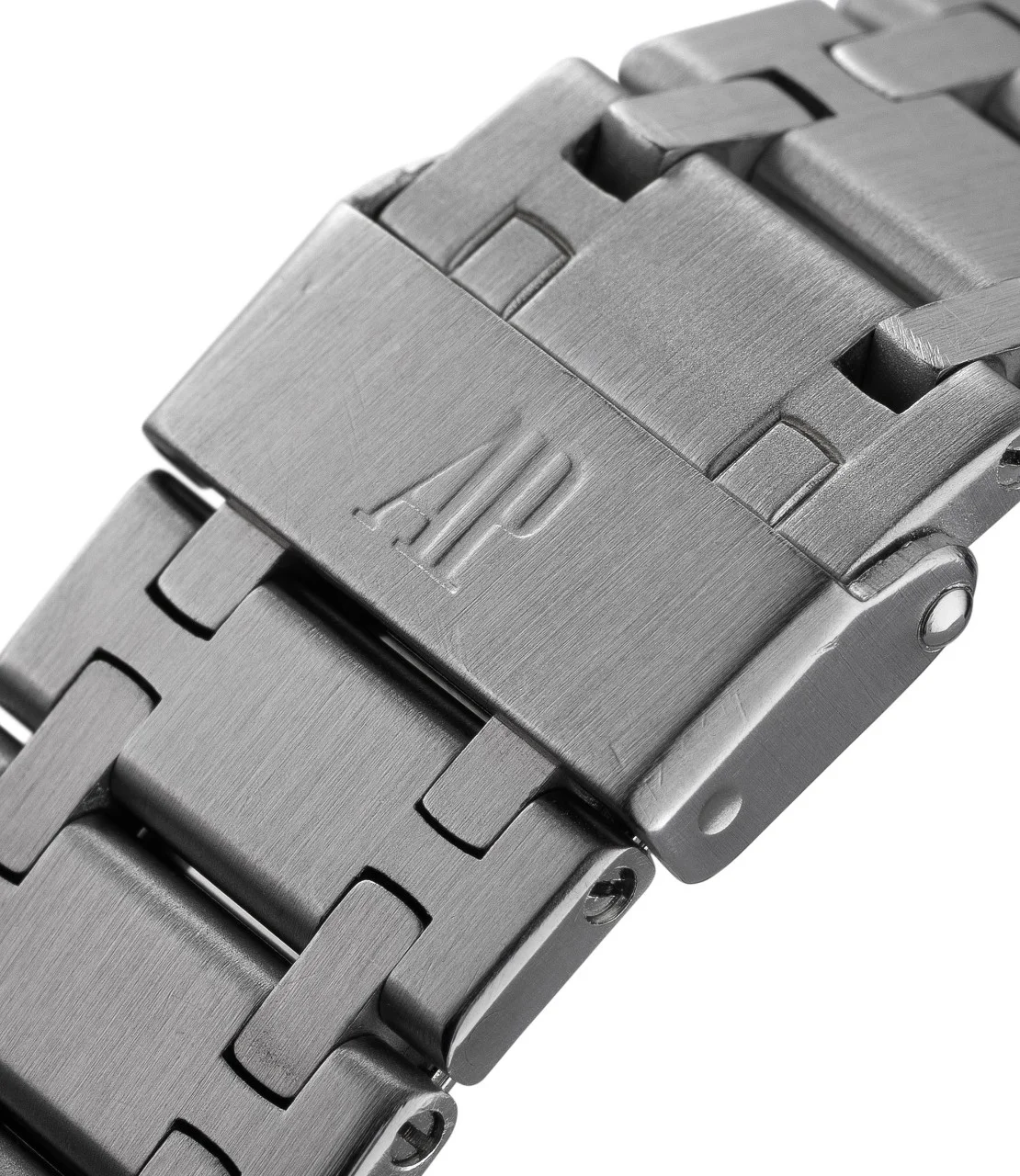
1975. Cover of bracelet 344, Royal Oak 5402ST No. B1303. Audemars Piguet Heritage, inv. 1222.
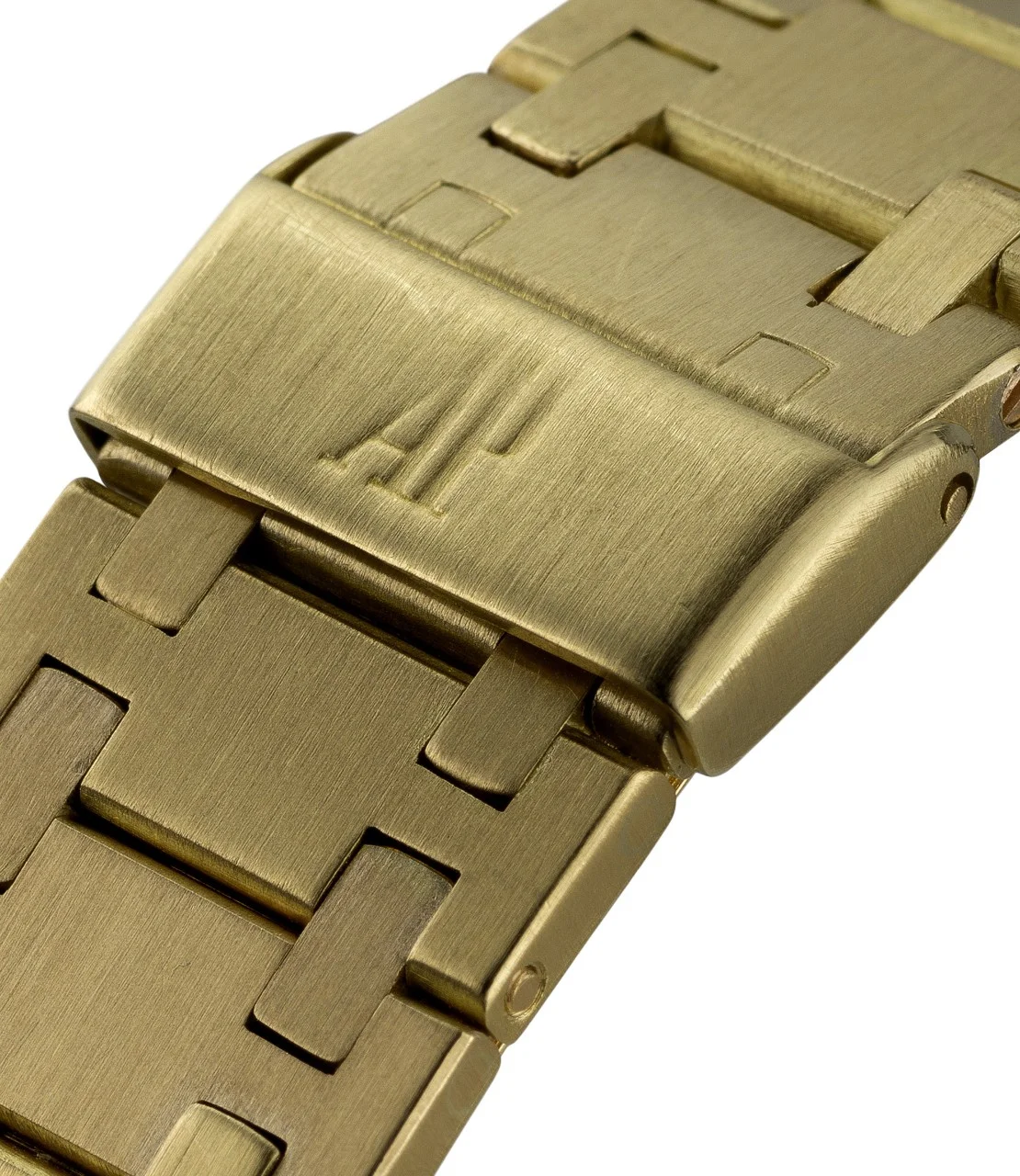
1977. Cover of bracelet 5402BA. Private collection.

1978. Cover of bracelet 344, Royal Oak 5402SA No. 286. Audemars Piguet Heritage, inv. 1446.
Successors of Bracelet No. 344
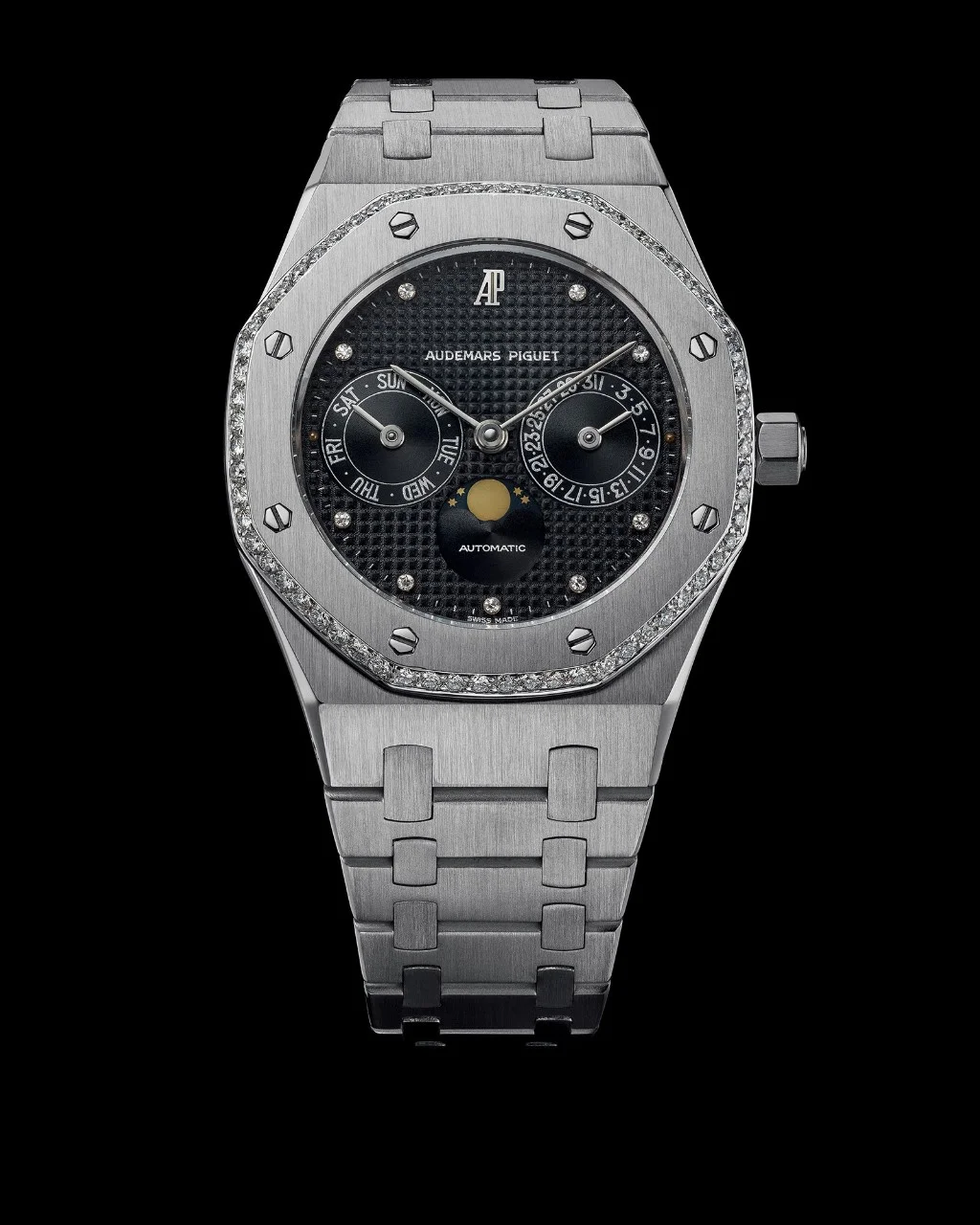
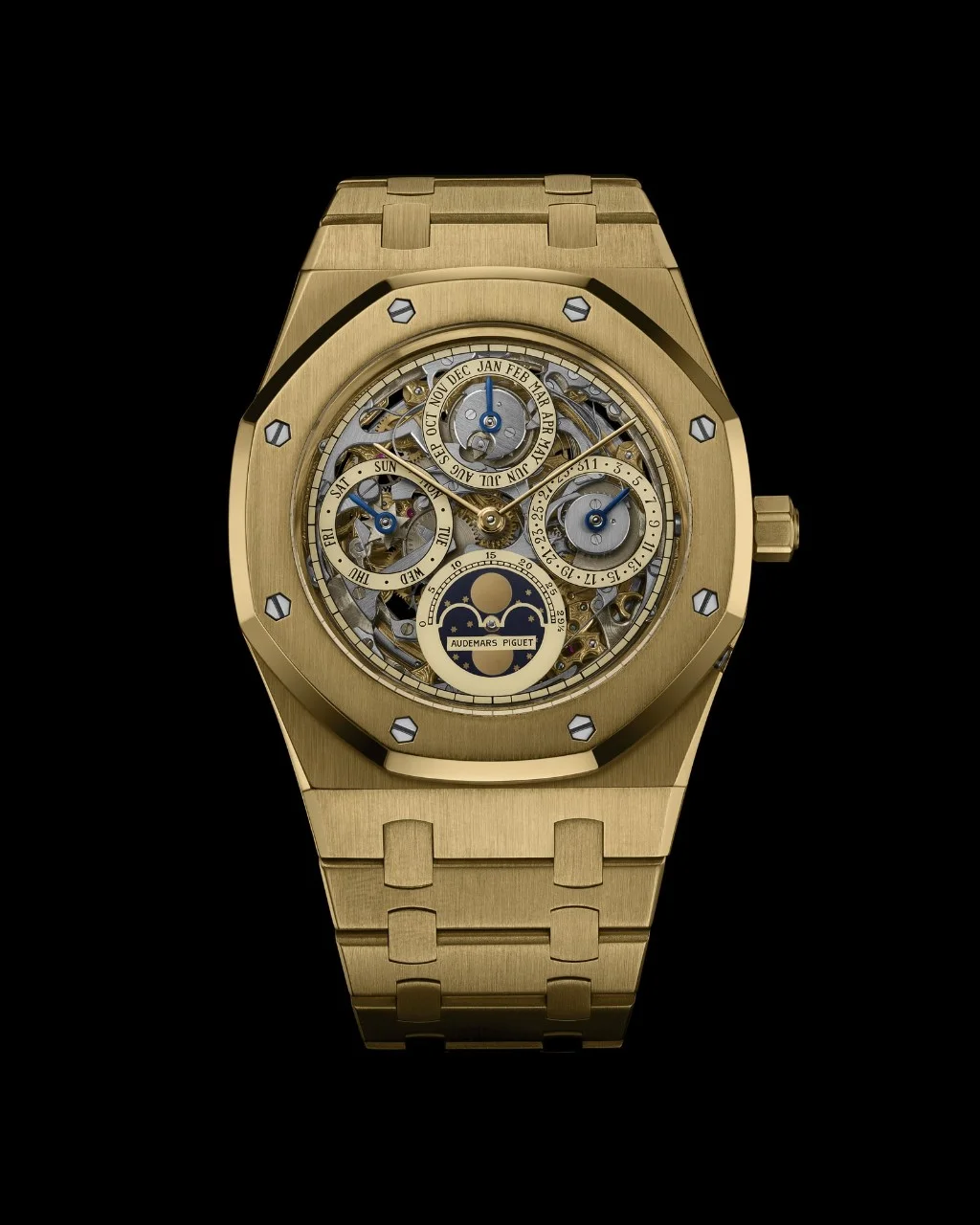
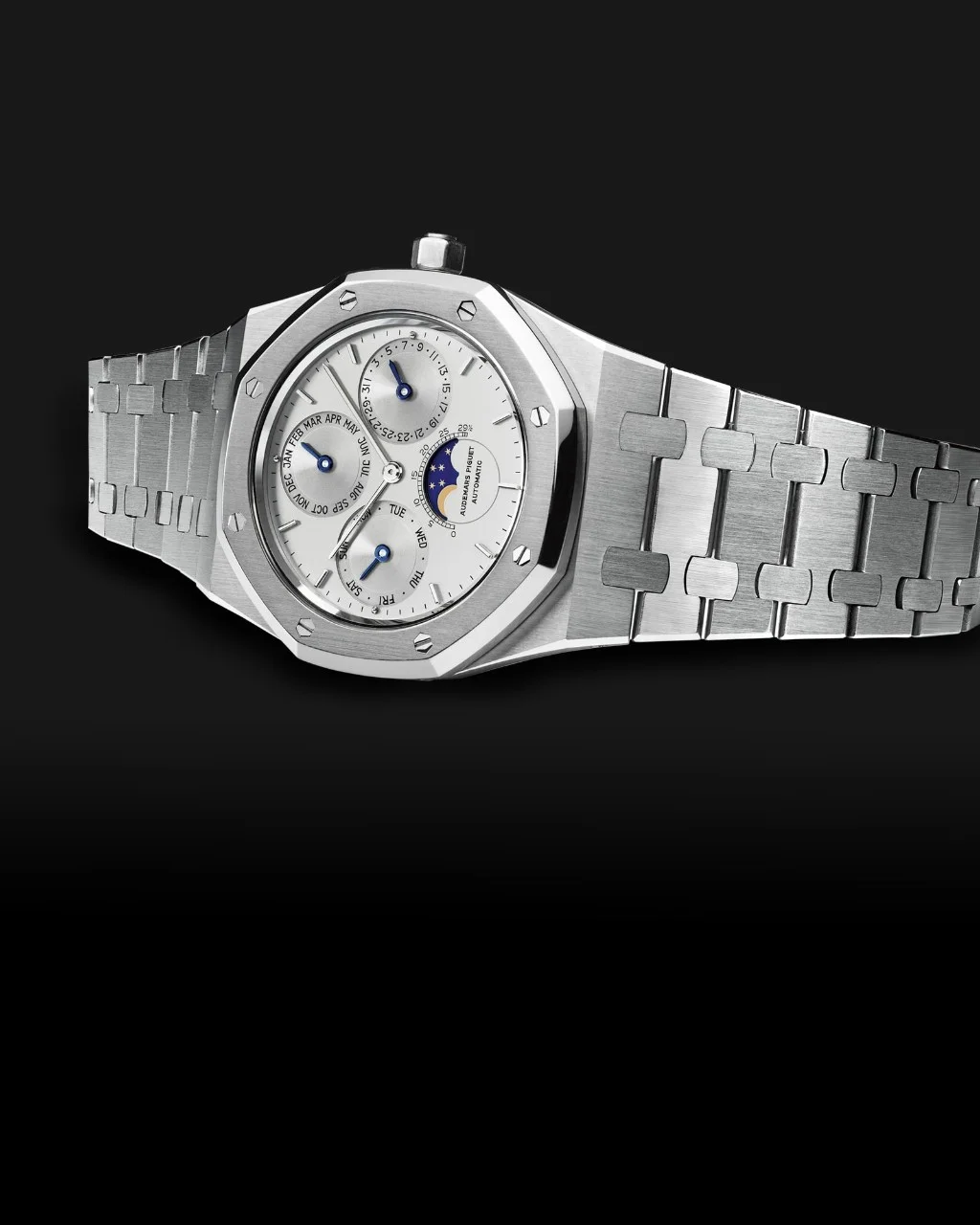
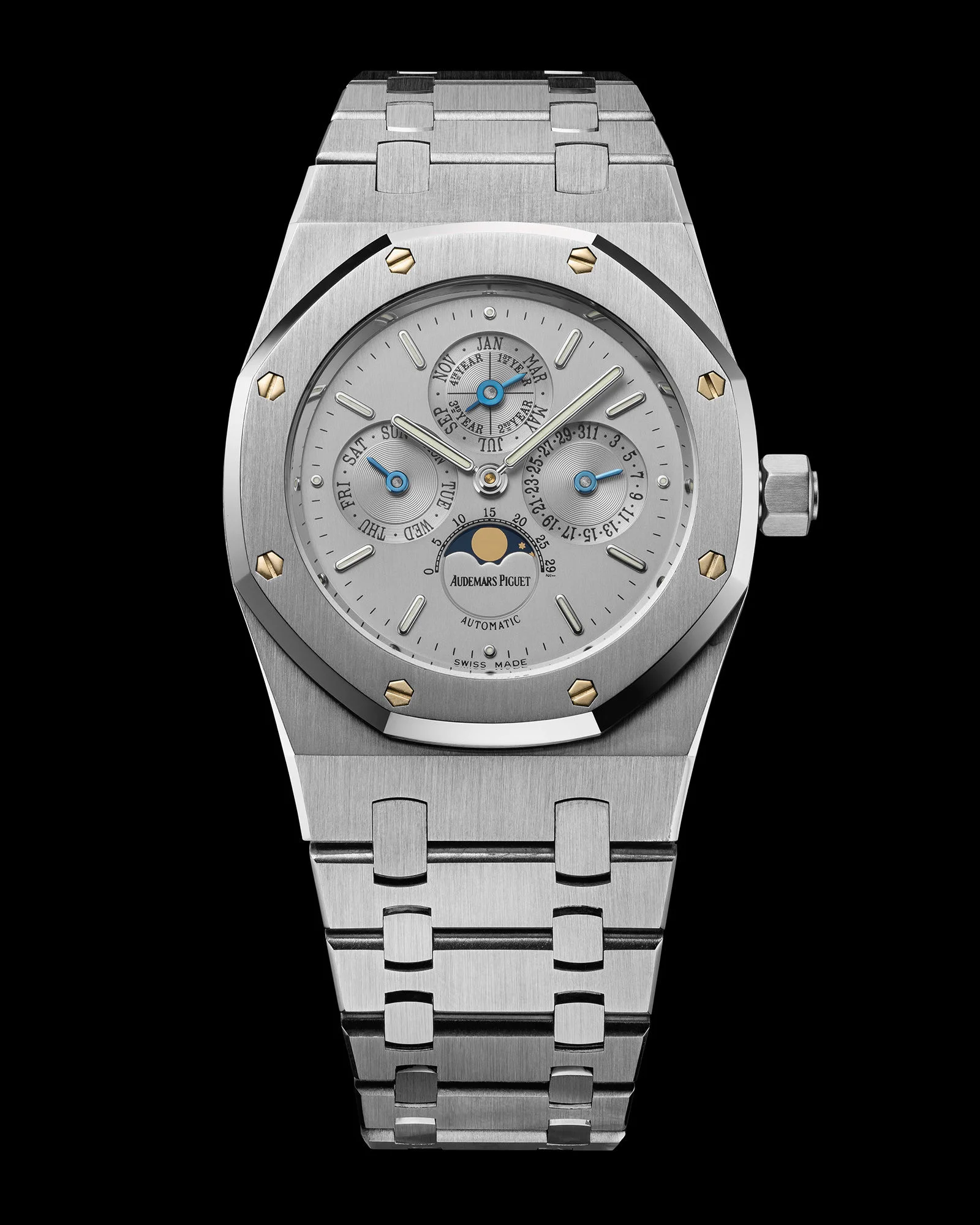
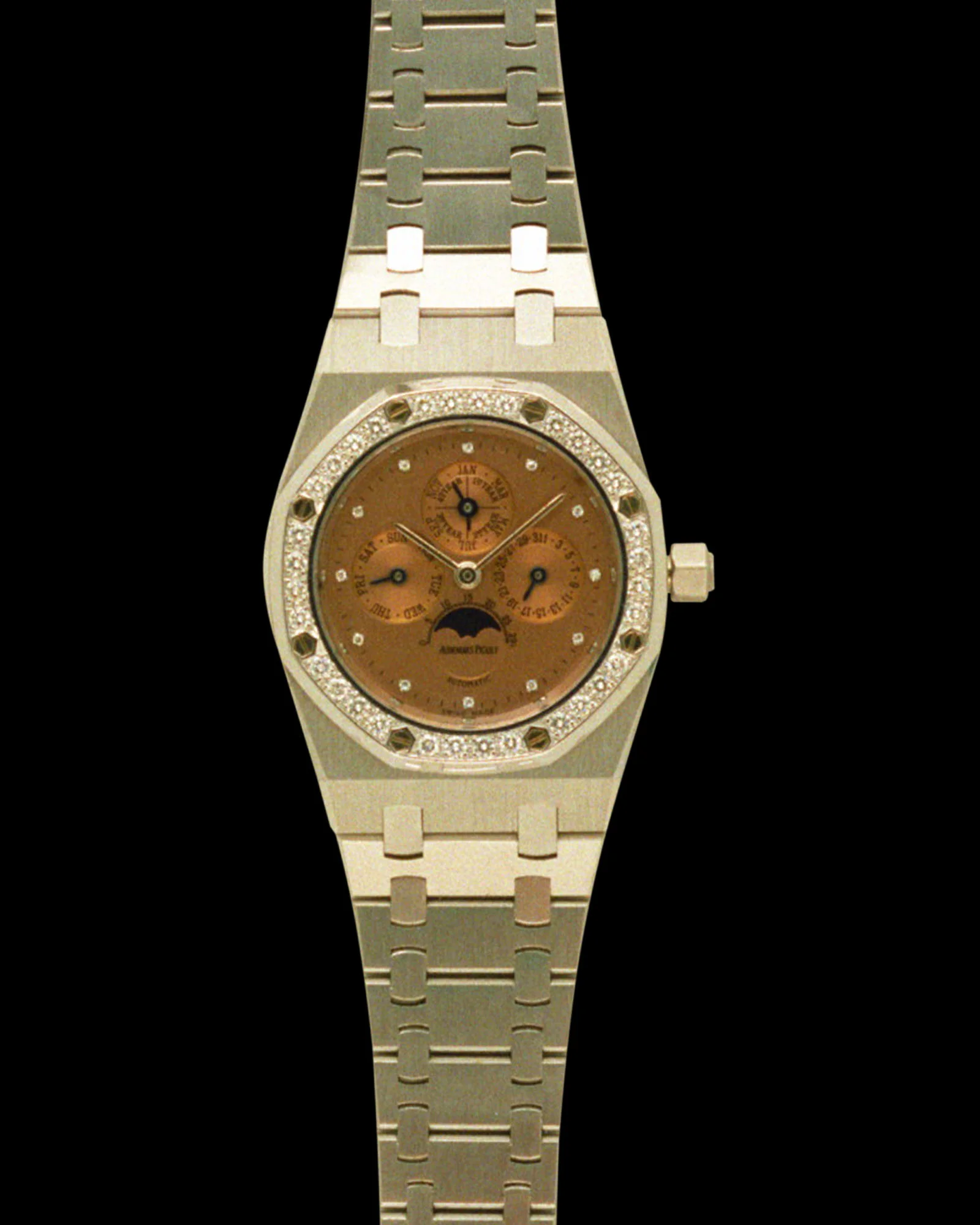
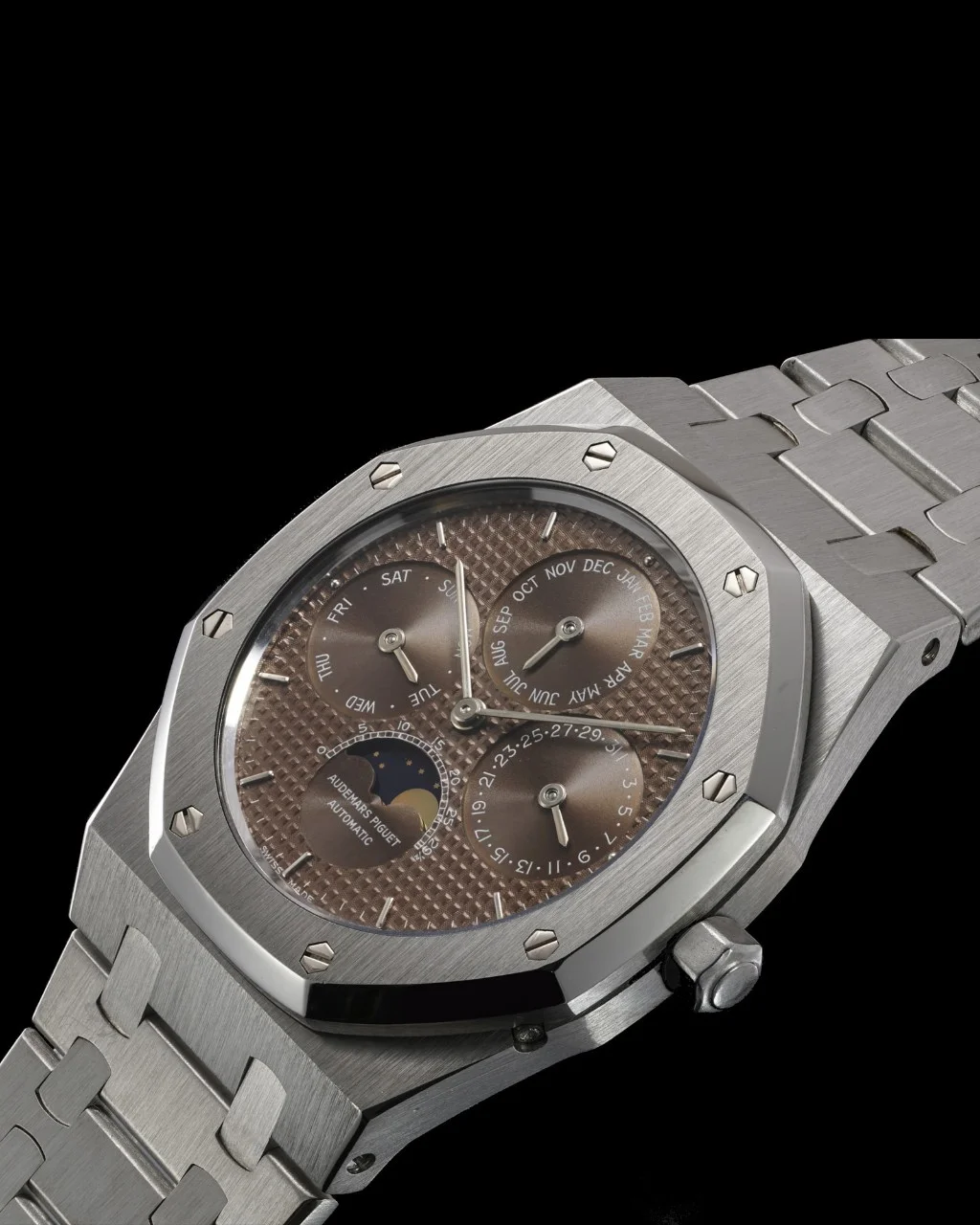
After Model 5402, bracelet no. 344 was used on several Royal Oak "Jumbo" models, in particular the 4187 (1979), as well as the first ultra-thin Royal Oak Perpetual Calendar, Model 5554 (1984) and its subsequent versions such as the 25624 (1985), 25654 (1986), 25636 (1986) and others.
In 1981, this bracelet underwent a final evolution: at the request of the markets and Customer Service, Audemars Piguet proposed a smaller variant with a folding clasp for slender wrists and introduced "half-links" with welded studs to ensure finer length adjustments. These two improvements were rarely used because the system was particularly fragile. It was replaced by the "link and a half" in subsequent generations (a link that was 50% larger, thus enabling easier adjustment of bracelet sizes).
Towards the end of the 1980s, bracelet no. 344 manufactured by Gay Frères was replaced by no. 944, produced by the Werthanor company in the small watchmaking town of Le Locle. A new closing system was introduced, consisting of a sliding stud that replaced the cap. Bracelet no. 944 was very similar in size to its predecessor, meaning that certain Royal Oak models with a Perpetual Calendar, such as the above-mentioned Models 25654 or 25636, as well as 25686 (1989), 25687 (1989) and 25694 (1990), were successively equipped with bracelet no. 344, then no. 944.
Just as the AP monogram migrated from 6 o'clock to 12 o'clock on the 5402 dial, the transition was gradual and probably took several years. Nevertheless, some models were exclusively equipped with bracelet no. 944 right from the time of their creation. This was notably the case for the Royal Oak "Jumbo" Jubilee Edition 14802 (1992). The same went for its successor 15002 (1996), for the 15202 model from the year 2000 onwards and its 15201 variants (2011).
In 2012, a new generation of bracelets appeared on the occasion of the collection’s 40th anniversary. The 15202 was equipped from then onwards with the bracelet no. 1240, as were its successors, such as the 15205 (2015). Notably produced by Maspoli in Villeneuve, its ergonomic system involving a double folding clasp opening by means of two opposing pushers has equipped timepieces including Model 15300 since 2005 (bracelet 1220, Werthanor).
Given that bracelets nos. 344 and 944 could easily be substituted for one another (with the necessary manual adjustments), the Customer Service department has sometimes replaced badly damaged bracelets no. 344 with 944s. This practice evolved in 2020 thanks to the Classic Parts programme, serving to reconstitute bracelets as closely as possible to the original 344.
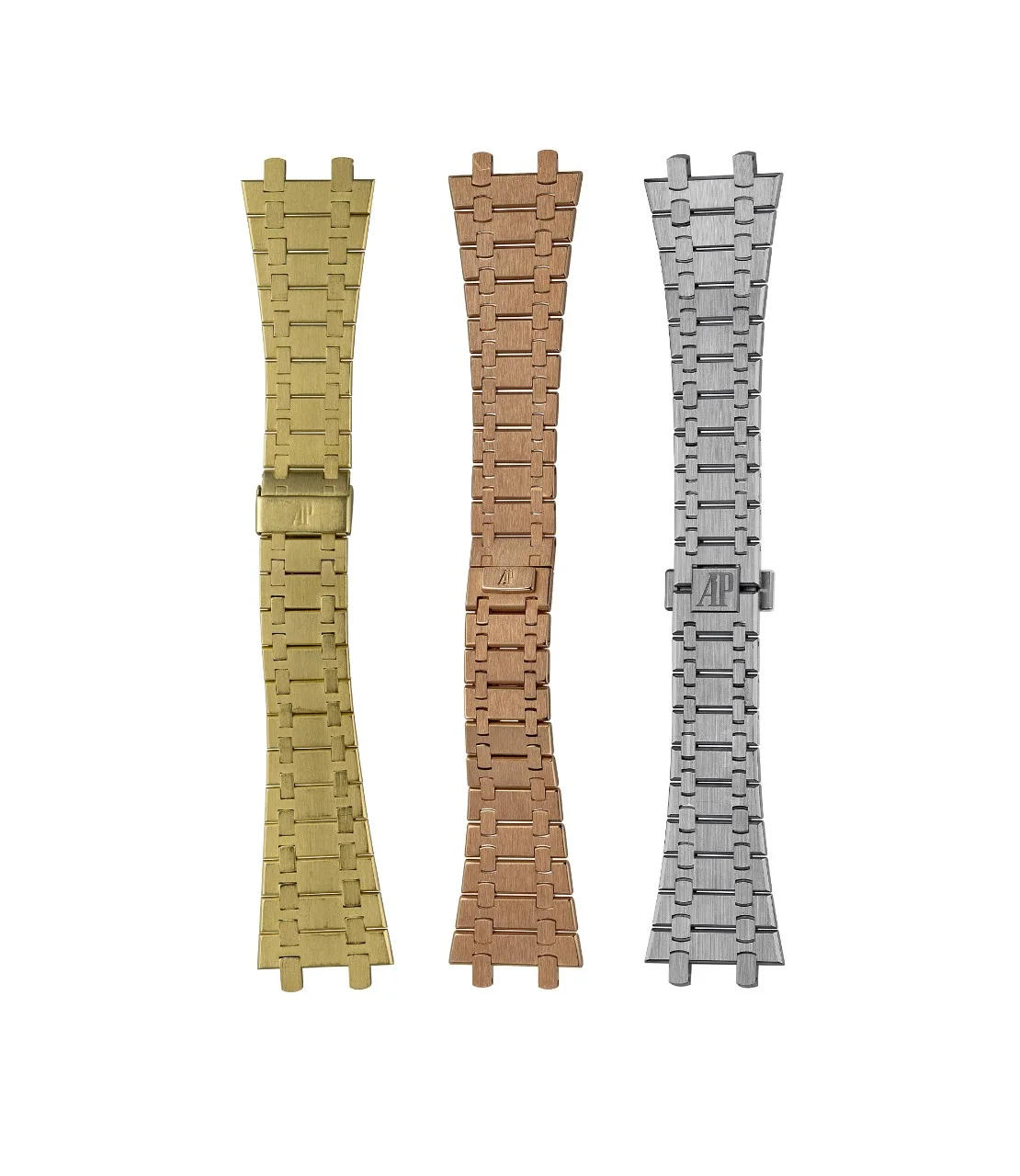
Royal Oak Jumbo bracelets 344, 944 and 1240. The three successive bracelet generations are principally differentiated by their opening system (covers and folding clasps). From left to right: bracelet 344 adorning the Royal Oak 5402BA no. 192 sold in 1978; bracelet 944 equipping the Royal Oak Perpetual Calendar 25810OR (pink gold) no. 358 produced and sold in 1995; bracelet 1240 for the Royal Oak 15202BC (white gold) no. K3912, manufactured in 2020. Audemars Piguet Heritage, inv. 1073, 1213 and 2071.
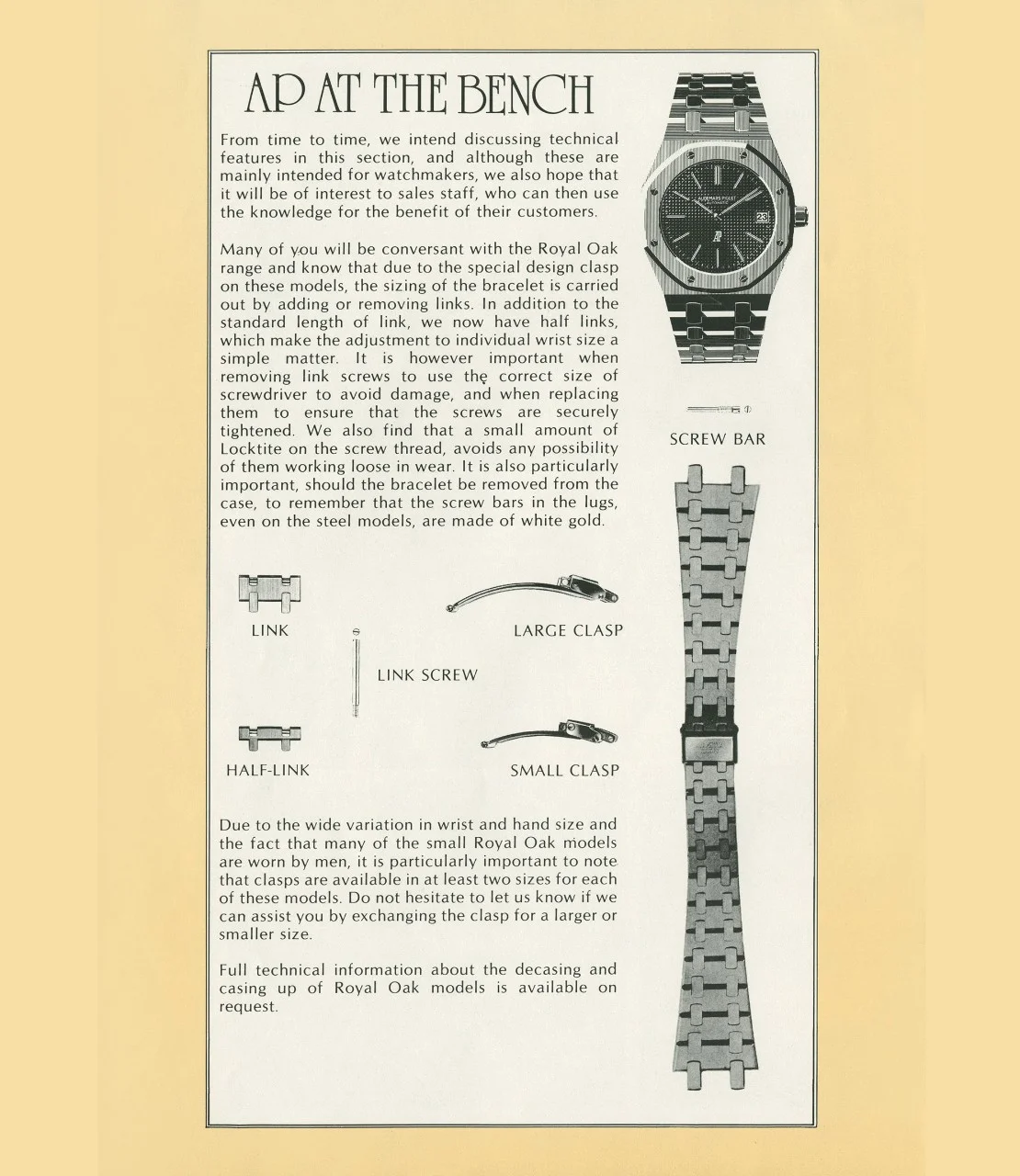
1981. Bracelet 344 evolutions on Model 5402. In 1981, Audemars Piguet informed its retailers of the introduction of a new sizing system made of half links to better adjust the bracelet's length to smaller wrists. A smaller folding clasp is also introduced. AP News 1981. Archives Audemars Piguet.
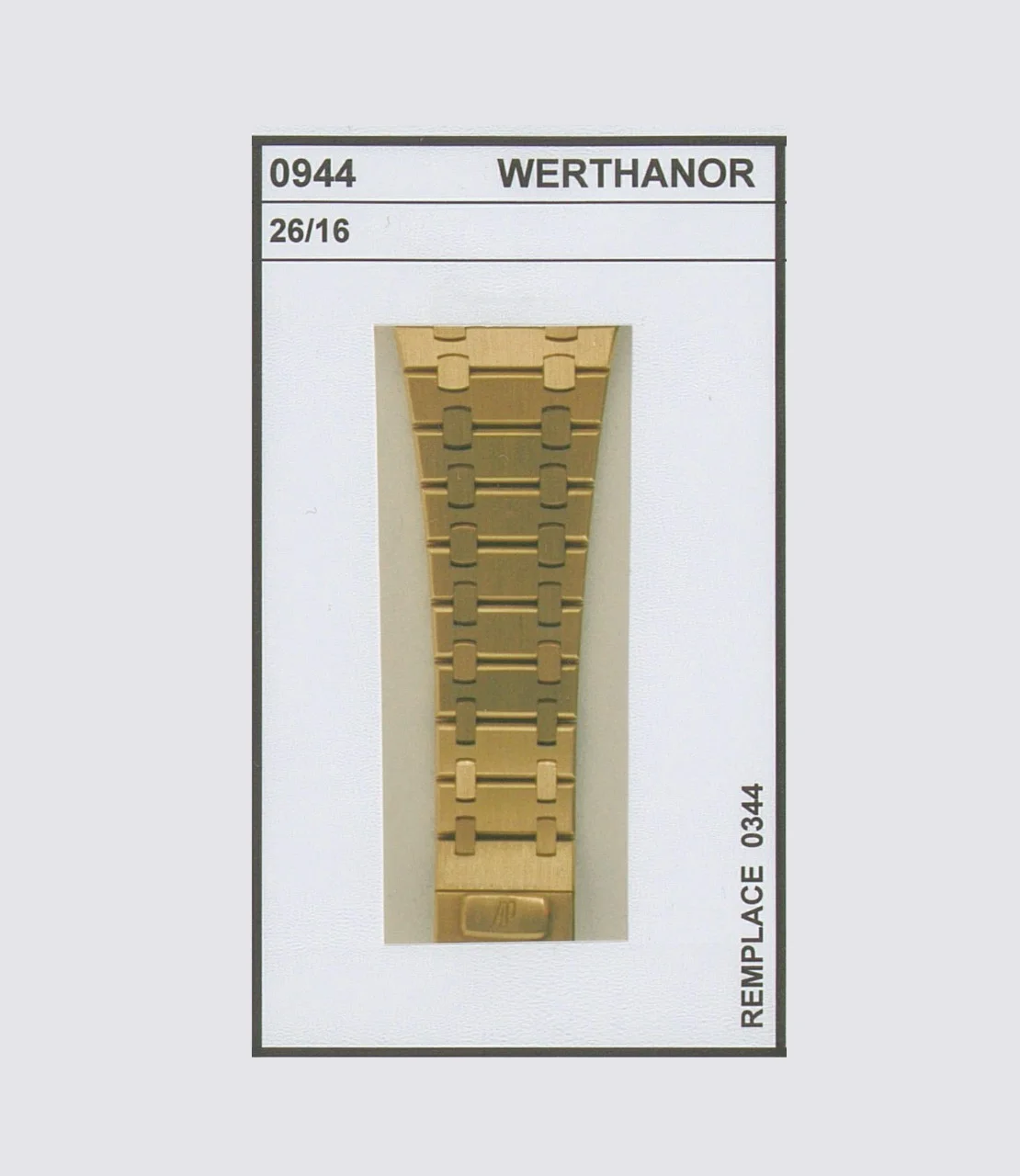
Circa 1990. Bracelet 944. In the late 1990s, bracelet 944 started to progressively take over from bracelet 344 manufactured by Gay Frères Genève. The new bracelet was notably manufactured by Werthanor in Le Locle. Bracelet register. Audemars Piguet Archives.
Multiple Variations, or when Bracelets Get the Upper Hand
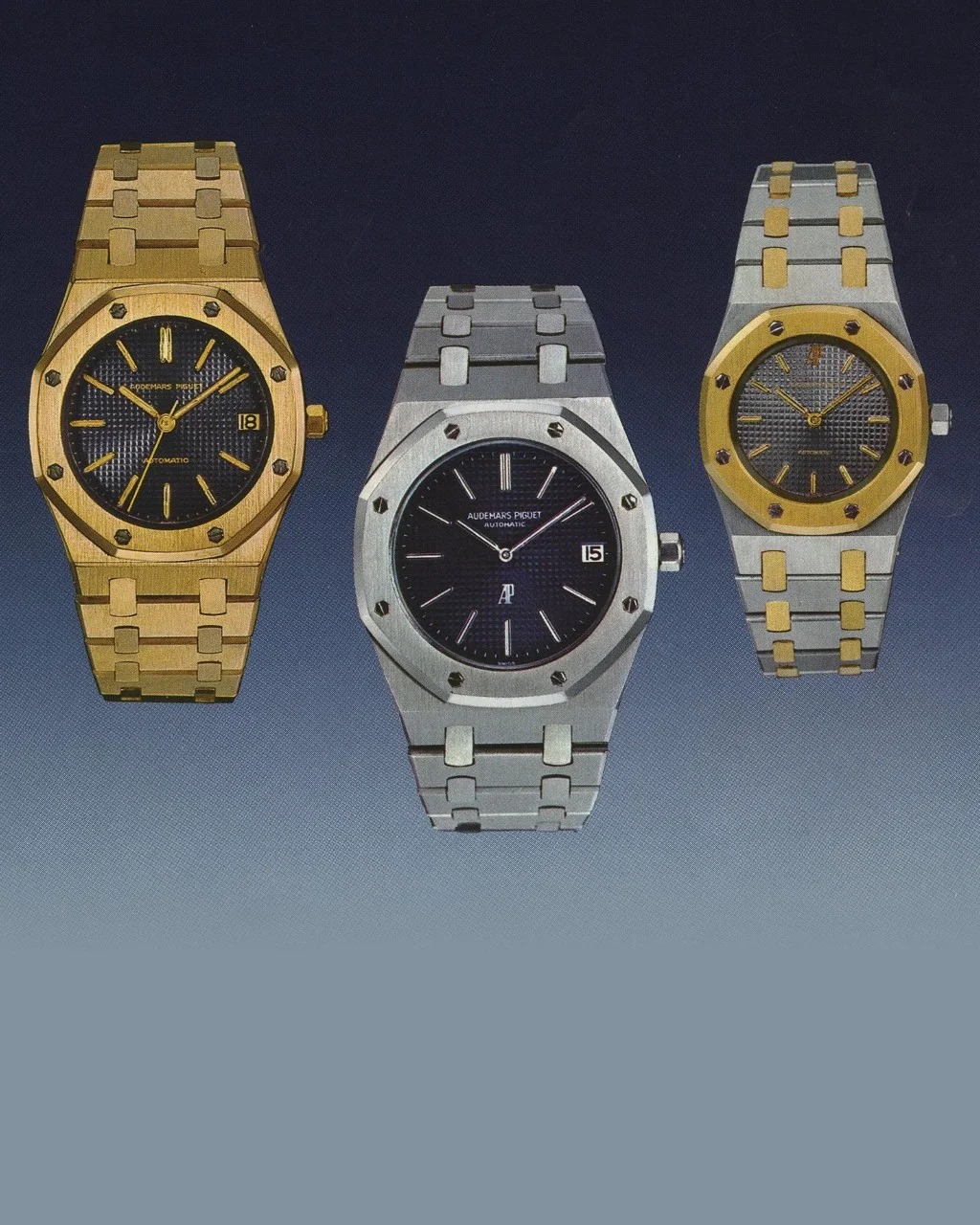
While respecting its original shape, the Royal Oak bracelet has evolved as the collection has grown, leading to combinations of materials, gemset versions and above all changes in size. A new 29 mm diameter was created in 1976, followed by 35 mm versions the following year, then 26 mm and 30 mm in 1980, 36 mm in 1983, 33 mm in 1984, 40 mm in 1997, 37 mm and 41 mm in 2012, 38 mm in 2019 and 34 mm in 2020.
These variations have been accompanied by the creation of new bracelets. As early as 1976, the Gay Frères bracelet no. 424 was introduced to equip the small women’s models including the 29 mm 8638 and 6009, as well as the 30 mm 6008, 6013, 6020, 6033 and 6035.
Produced in a run of more than 10,000 units, bracelet no. 477 (and its successor no. 789) is one of the most important in the Royal Oak’s history. As early as 1977, it was fitted to 35 mm timepieces: 4100, 4120, 4153, 4275, 4331, 6023, 6036, 6037, 6038, 6039, 6040, 14486. From 1983, it found its place on the Royal Oak 36 mm: 4332, 5572, 5581, 5584, 5658, 5595, 56123, 56124, 5594, etc. As of 1985, 33 mm variants such as the Royal Oak 56255 were also equipped with this bracelet, before it was replaced in the 1990s by no. 789 (by Gay Frères and later by GTF), featuring a size and mode of operation comparable to those of its predecessor. Bracelet no. 789 was also used for the 14700 line, including the 14790 (36 mm), as well as for the small 15000 (33 mm) or the 25800 Model (33 mm). It should also be noted that bracelet no. 789 introduced mirror-polished studs, featuring a subtle aesthetic requiring manual work on no less than 125 angles per bracelet!
This tedious enumeration highlights the little-known yet surprising fact that Audemars Piguet has equipped watches of different diameters (33 mm, 35 mm and 36 mm) with the same bracelet. Why and how can components of such different dimensions be adjusted? This practice is explained by the bracelet’s extreme complexity. For watchmakers in the 1980s and 1990s, it seemed more judicious to adjust the taper of the case lugs rather than the width of the bracelet. For the historian and collector, this demonstrates the astonishing reality that the case shape was designed for the bracelet and not the other way around!
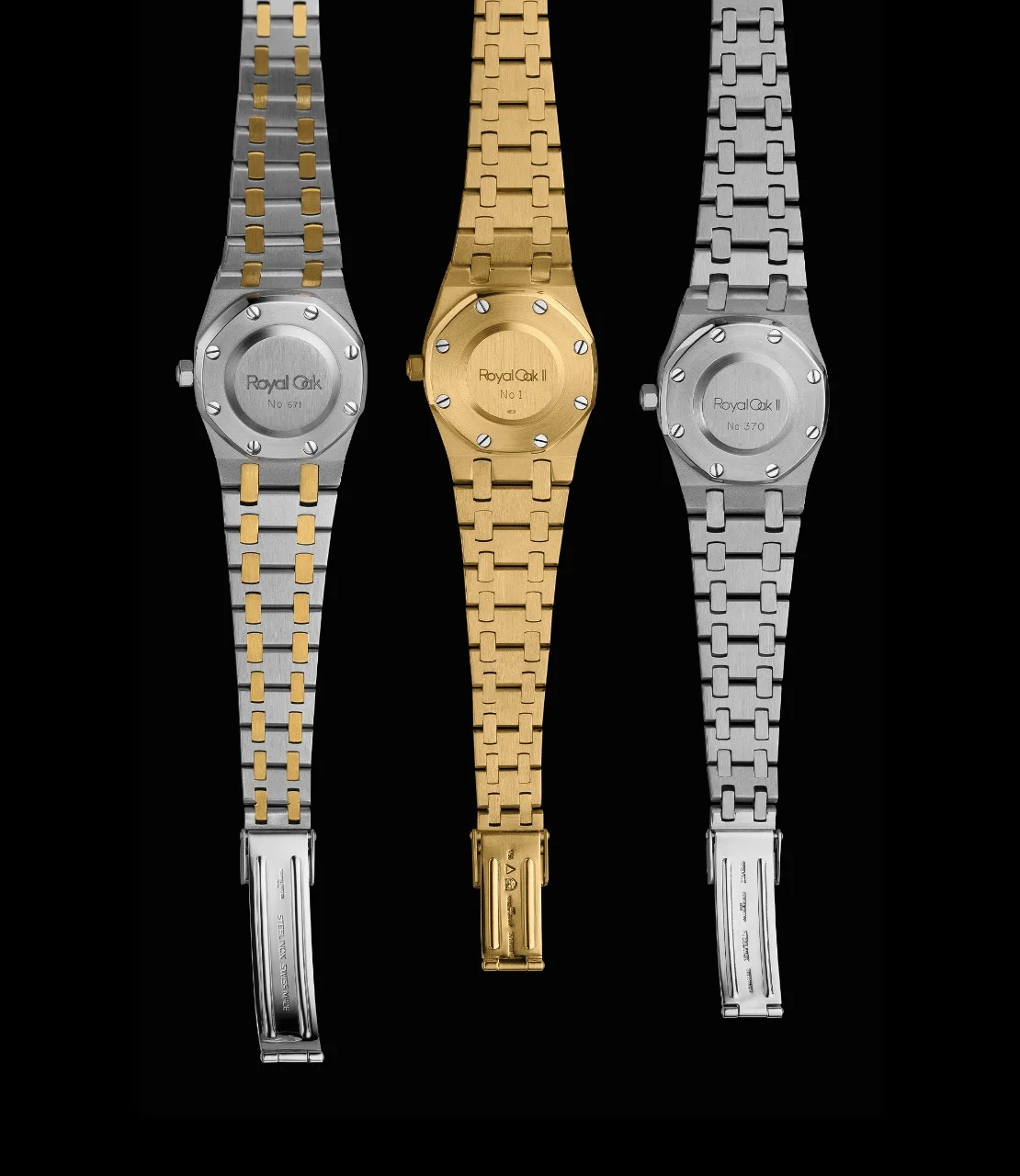
1977–1979. Royal Oak 8638 clasp variations. At least three variants of folding clasp were developed for Model 8638, in order to adapt to the slimness of women's wrists. From left to right: Royal Oak 8638SA no. 671 (1979); Royal Oak 8638BA no. 1 (1977); Royal Oak 8638ST no. 370 (1977). Audemars Piguet Heritage, inv. 381; 1873 and 1871.
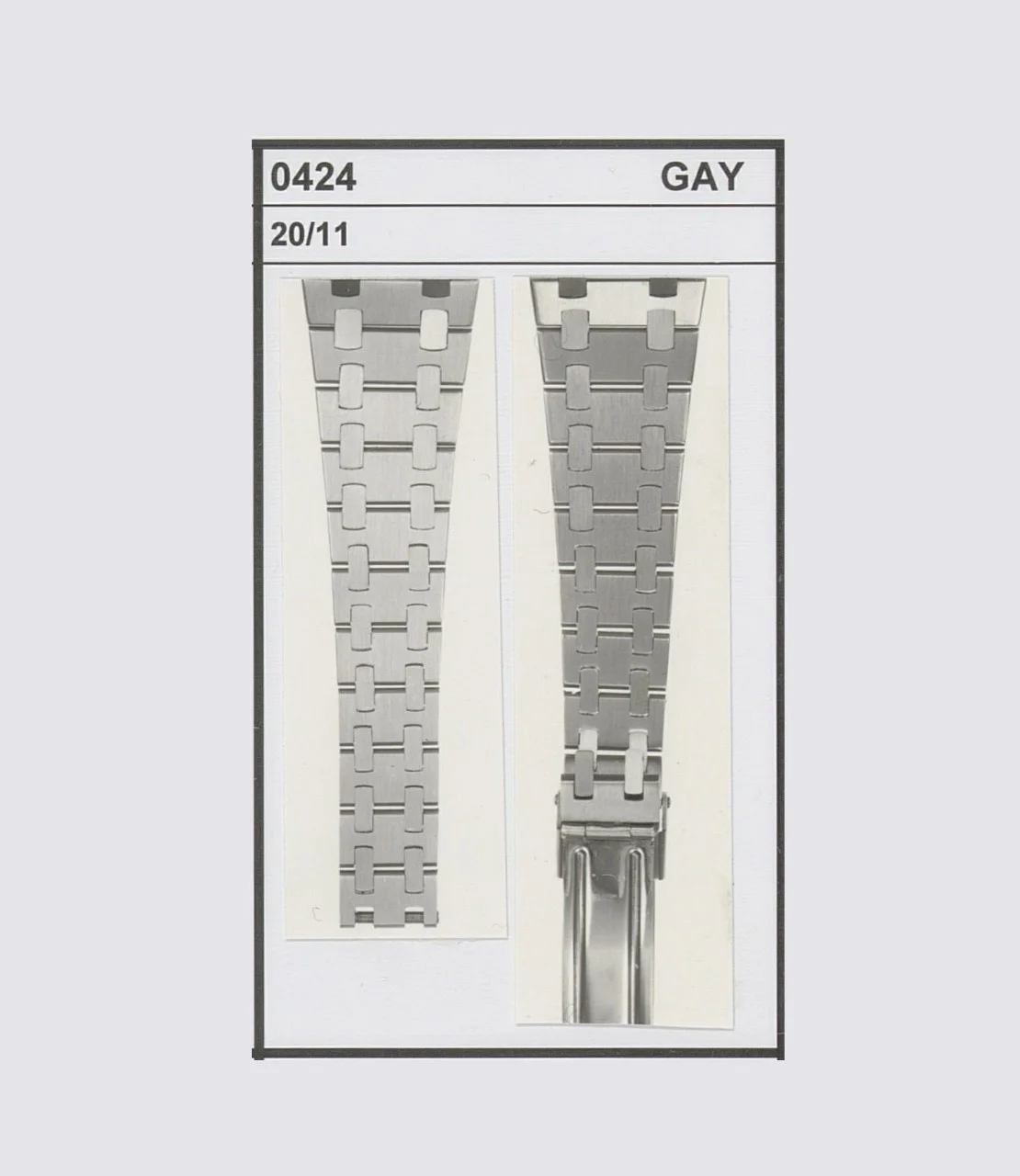
Circa 1976. Identification sheet for bracelet No. 424. Created for the 8638 model, the bracelet no. 424 reinterpreted the codes of its 344 predecessor, but in a much narrower format. Audemars Piguet Archives.
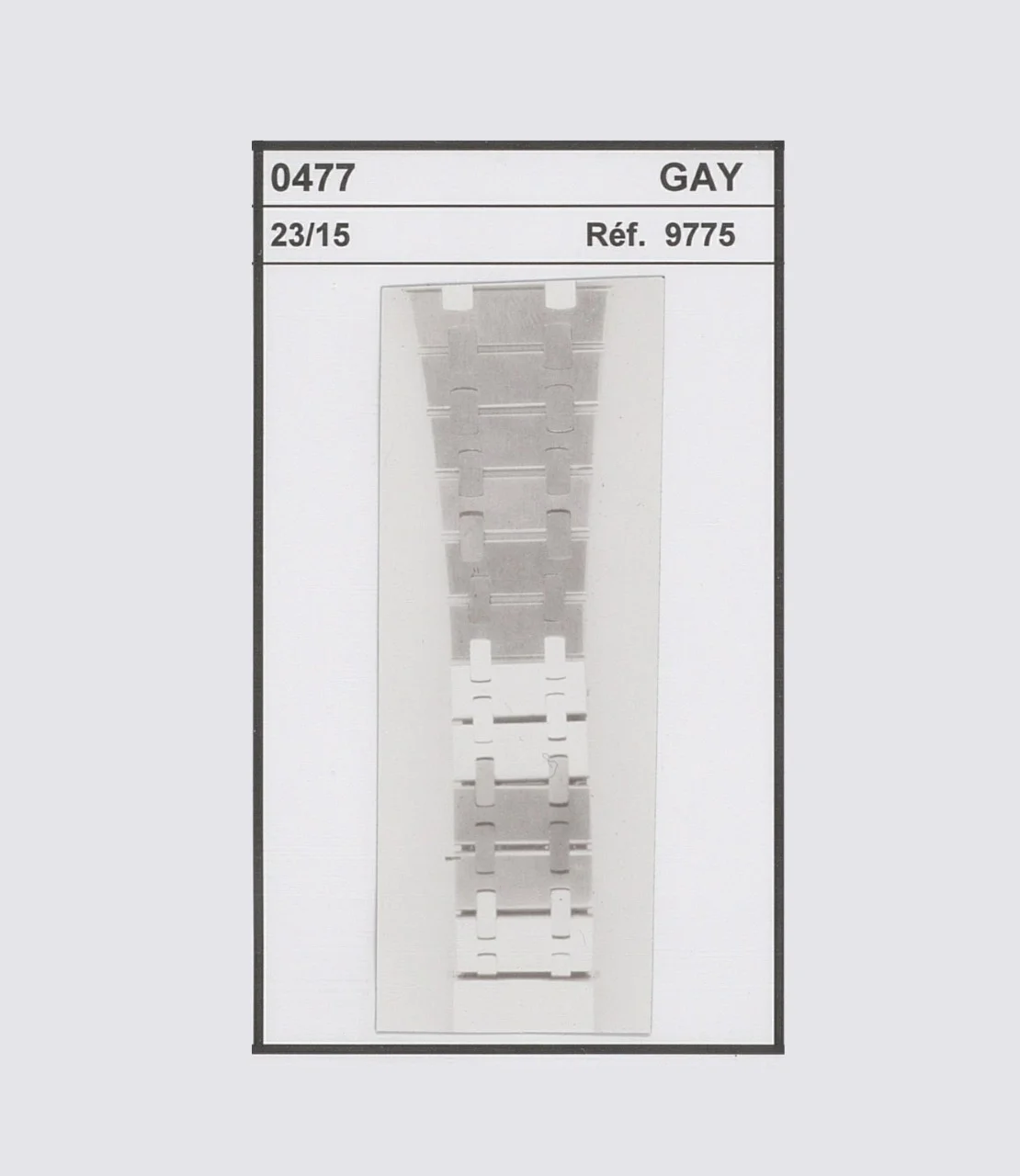
Circa 1977. Bracelet 477 identification sheet. Conceived for Model 4100, bracelet 477 was used on Royal Oak in 35, 36 and 33 mm. It was replaced by bracelet 789 in the 1990s. Audemars Piguet Archives.
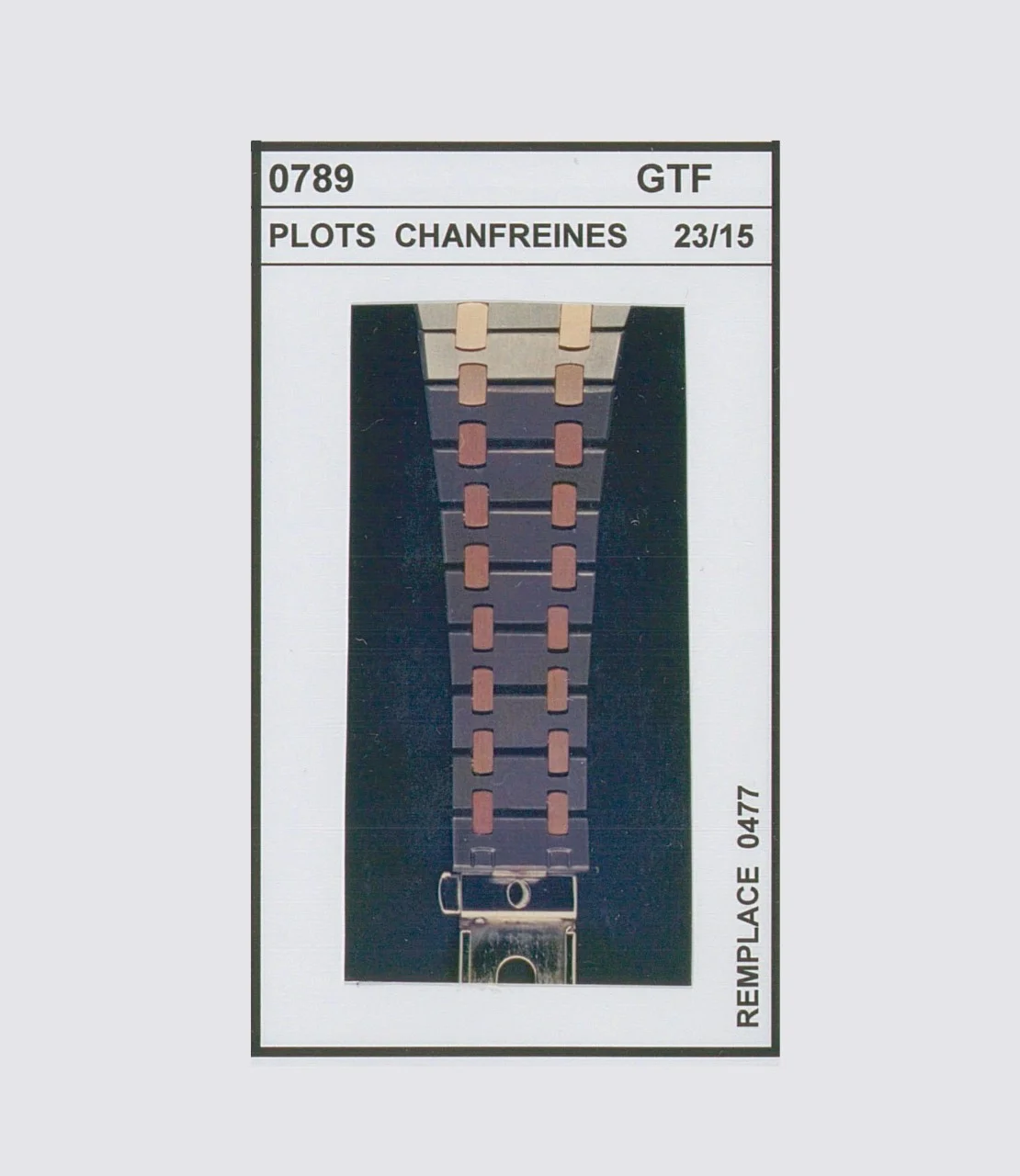
Circa 1990. Bracelet 789 identification sheet. Bracelet 789 replaced bracelet 477 in the 1990s. Until the beginning of the 2000s, it adorned dozens of Royal Oak models, ranging from 33 to 36 mm in diameter. Audemars Piguet Archives.
From Gay Frères to GTF and then Centror
In the late 1970s and 1980s, in response to the Royal Oak’s growing success, Audemars Piguet decided to expand its supply of bracelets. The co-founder’s grandson, Jacques-Louis Audemars, turned to the workshops of the Lascor company, located in the small town of Sesto Calende, on the Italian side of Lake Maggiore. Founded in 1921, Lascor was run by its founder Pietro Fontana and his son Fernando. Like Audemars Piguet, it was a family business devoted to ancestral know-how. Fernando Fontana had moreover created another eponymous company which had been manufacturing the case of the Royal Oak 8638 since 1976.
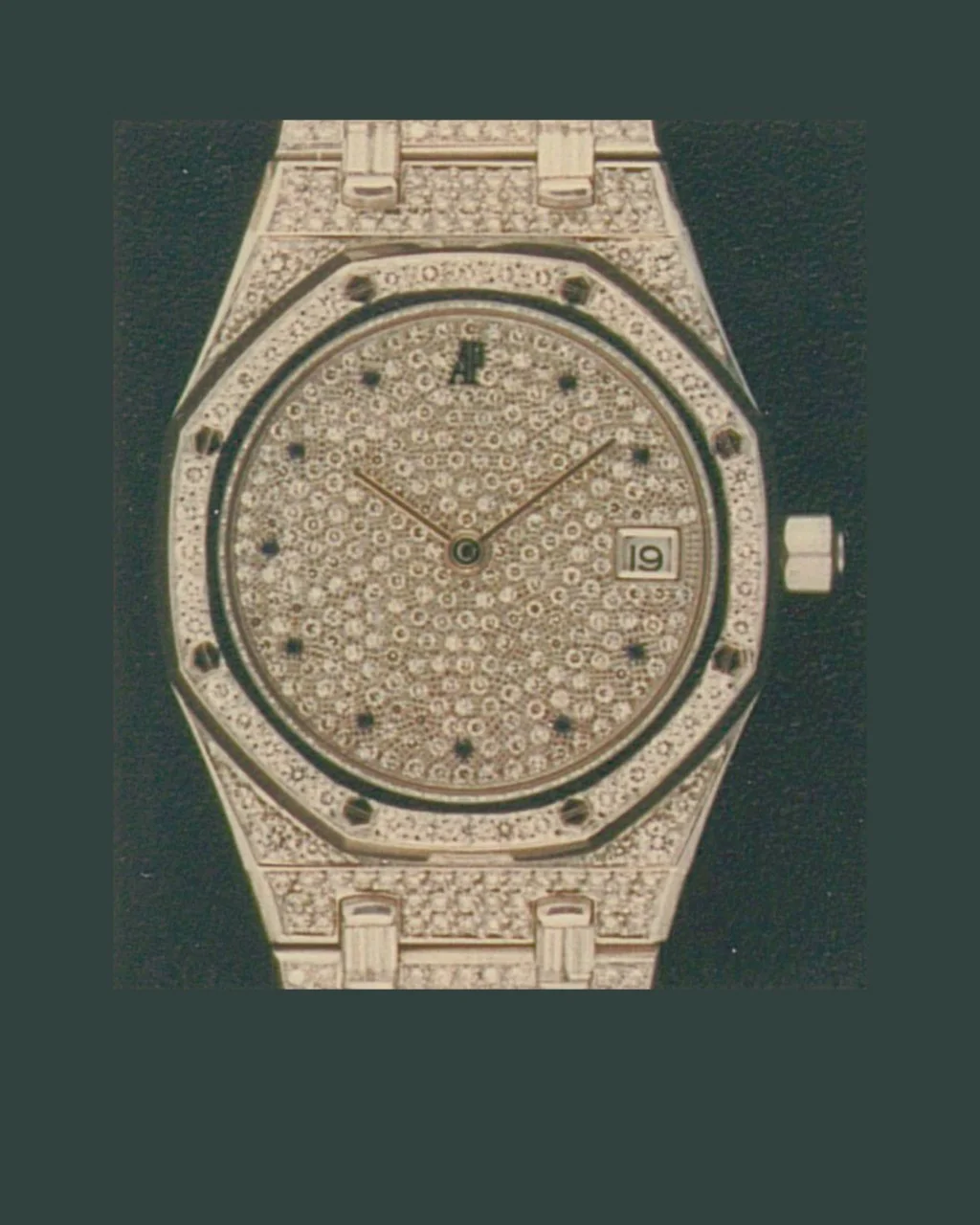
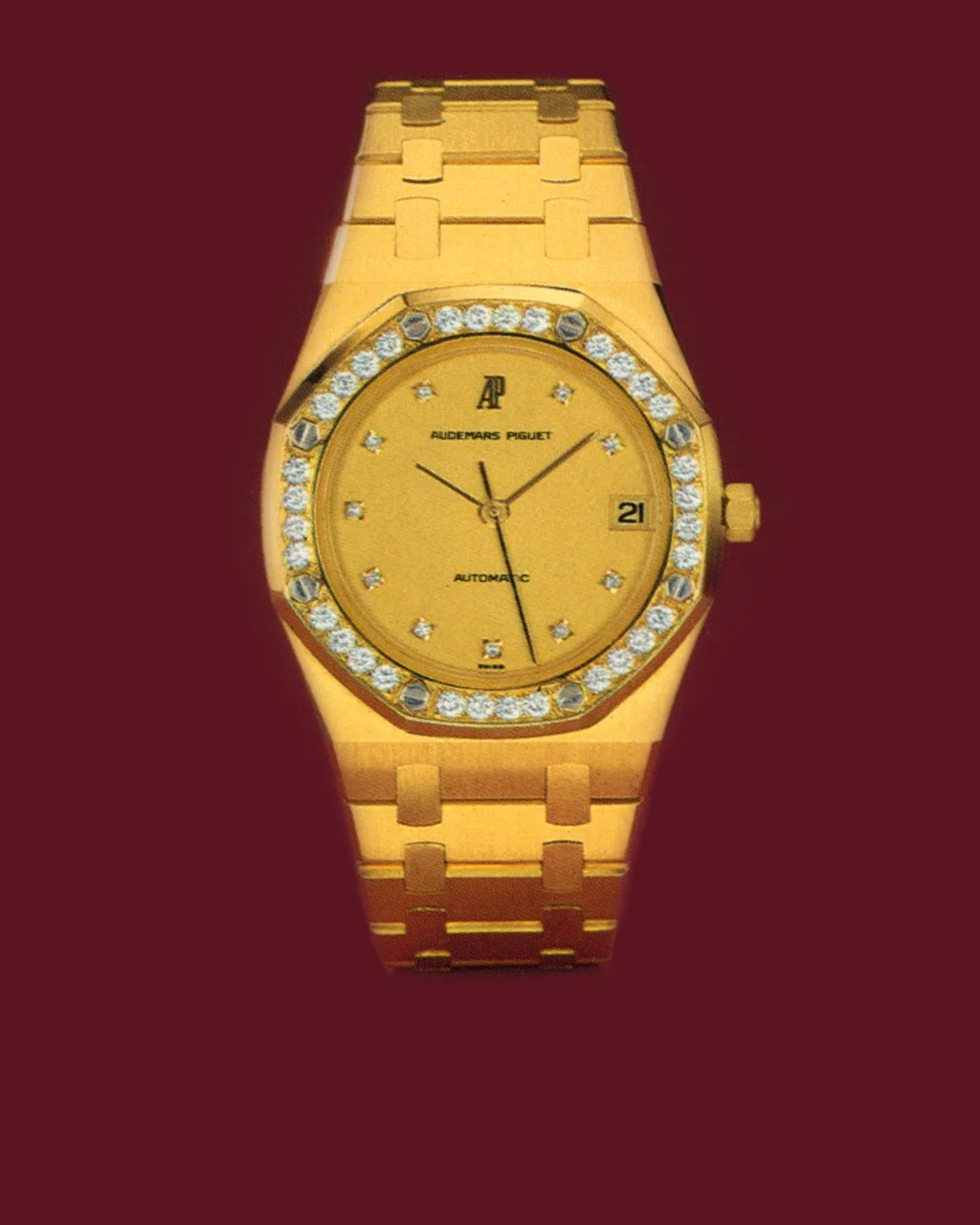
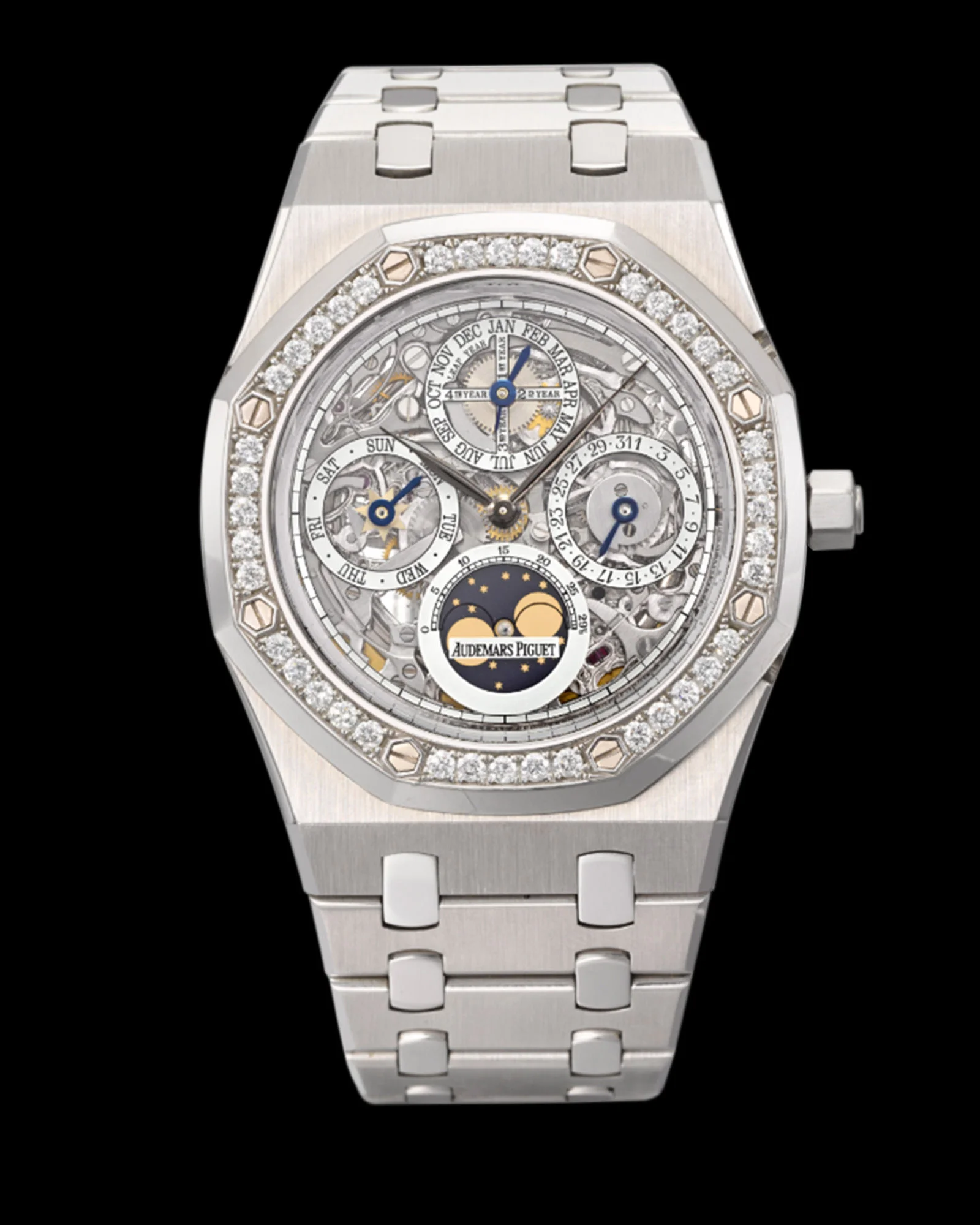
From 1980 onwards, Lascor manufactured bracelet no. 516 for the miniature Royal Oak versions (26 mm), followed by Models 6007, 6010, 6012, 6019, 6027, etc. This was followed by the even smaller bracelet no. 677 and the 696 for the 33 mm Royal Oak (e.g. Model 56143). There was an increasing number of gemset variants from 1985 onwards, notably with Model 56199 (33 mm, bracelet no. 715 entirely paved with brilliant-cut diamonds), bracelet no. 593 (set with sapphires and diamonds) as well as nos. 726, 727, 821, etc.
In 1986, Lascor was renamed GTF. Little by little, it became the main producer of Royal Oak bracelets, supplying not only the classic variants (996, 1105, 1110, 1111, 1120, 1185, 1197, 1205, 1220, 1424, 1516), but also versions with studs that were lacquered (725–727), polished (963, 1004), gemset (1007, 1114, 1115, 1190, 1208), miniature (1100), and even rounded for the first Royal Oak Offshore.
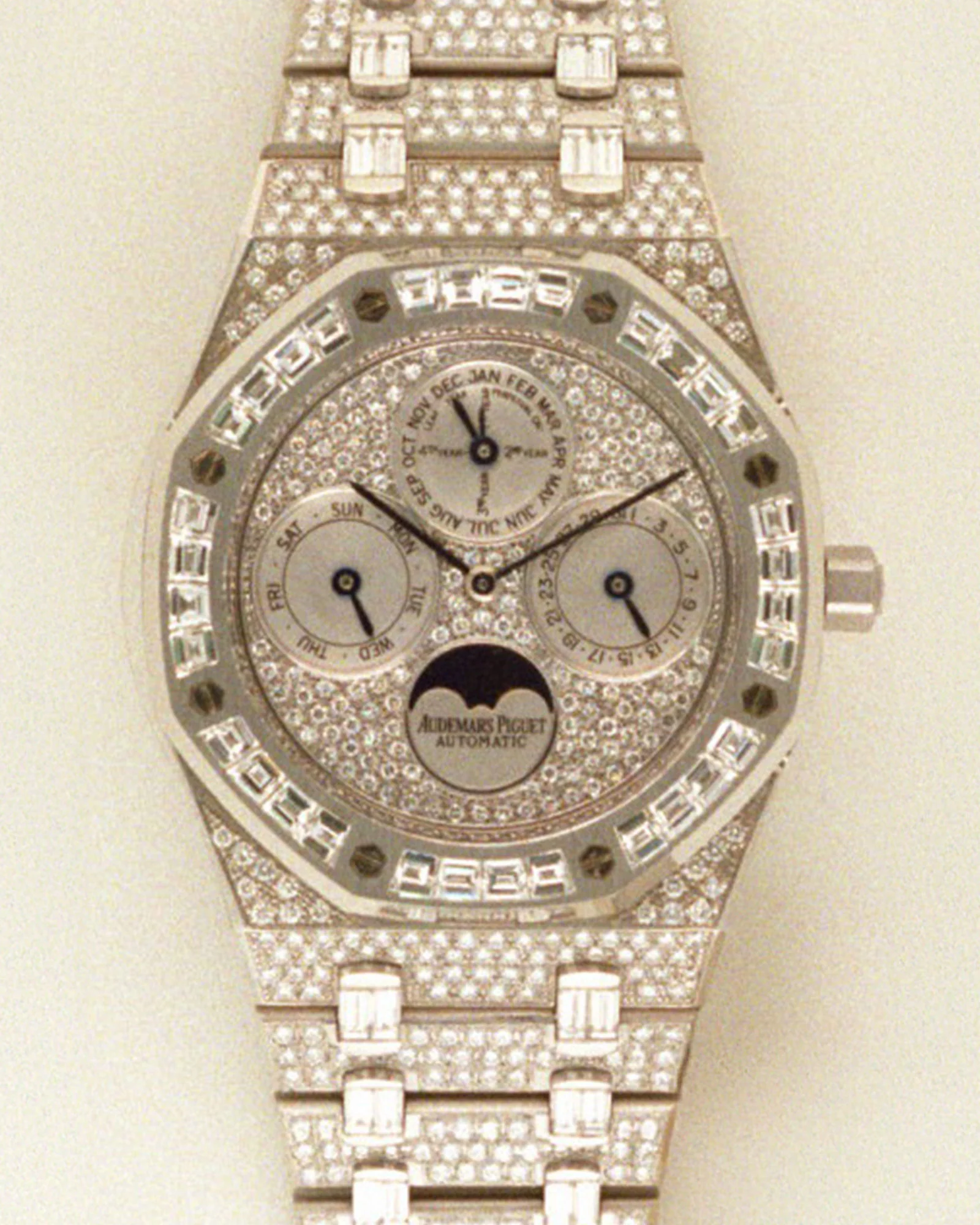
Parallel to this increased collaboration with Lascor, cooperation with Gay Frères gradually dwindled. A few Royal Oak bracelets were still created in the 1980s and 1990s (692, 708, 994, 995), notably for bracelets entirely set with baguette-cut gems (861), before the Geneva company was bought out in 1998 by Rolex, its main historical customer. In addition, Audemars Piguet occasionally worked with a Swiss jeweller from French-speaking Switzerland, Vidoudez, which created Haute Joaillerie bracelets combining diamonds, emeralds and rubies for the Royal Oak (8054, 8027, 8081, 8083, 9031, 9042). Little by little, however, Audemars Piguet's Métiers d’Art workshop took over these tasks for most jewellery watches (8042, 9179, etc.)
From the 2020s onwards, the Geneva-based firm Centror, which joined the Audemars Piguet group in 1991 after taking on the production of Royal Oak cases in precious materials, gradually began producing gold bracelets and acquiring the expertise required to manufacture the steel variants, even though most of them were still made by specialist workshops, including Orolux in the village of Noirmont.
It should also be noted that the triple-blade clasp was introduced in the mid-1990s to improve the fit on the wrist of the first Royal Oak Offshore, Model 25721, of which around 300 to 500 featured the classic system. This innovation then progressively spread to the other collections, in particular the Royal Oak at the turn of the millennium.
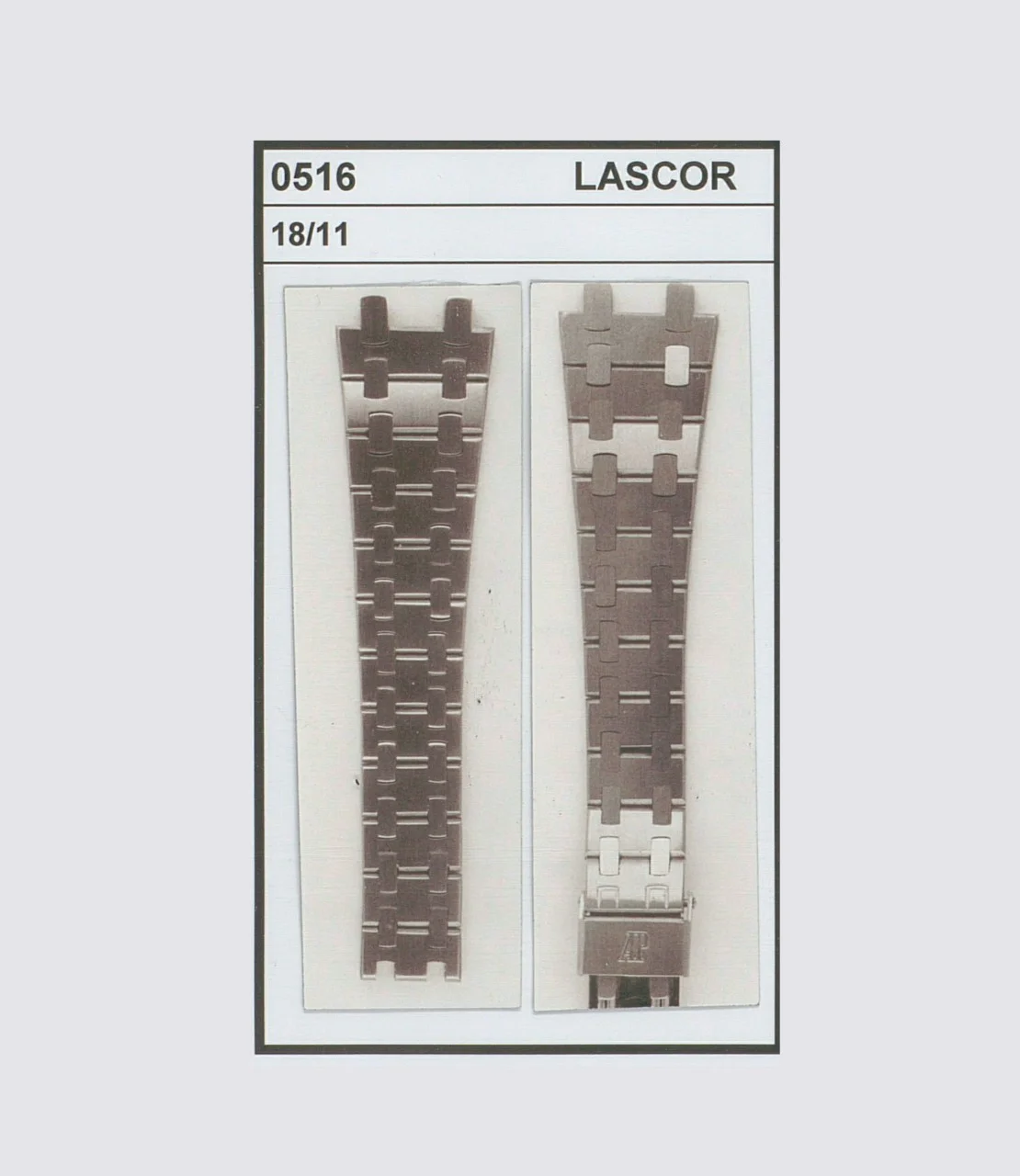
Circa 1980. Identification sheet, bracelet 516. Bracelet destined to 26 mm Royal Oak. Audemars Piguet Archives.
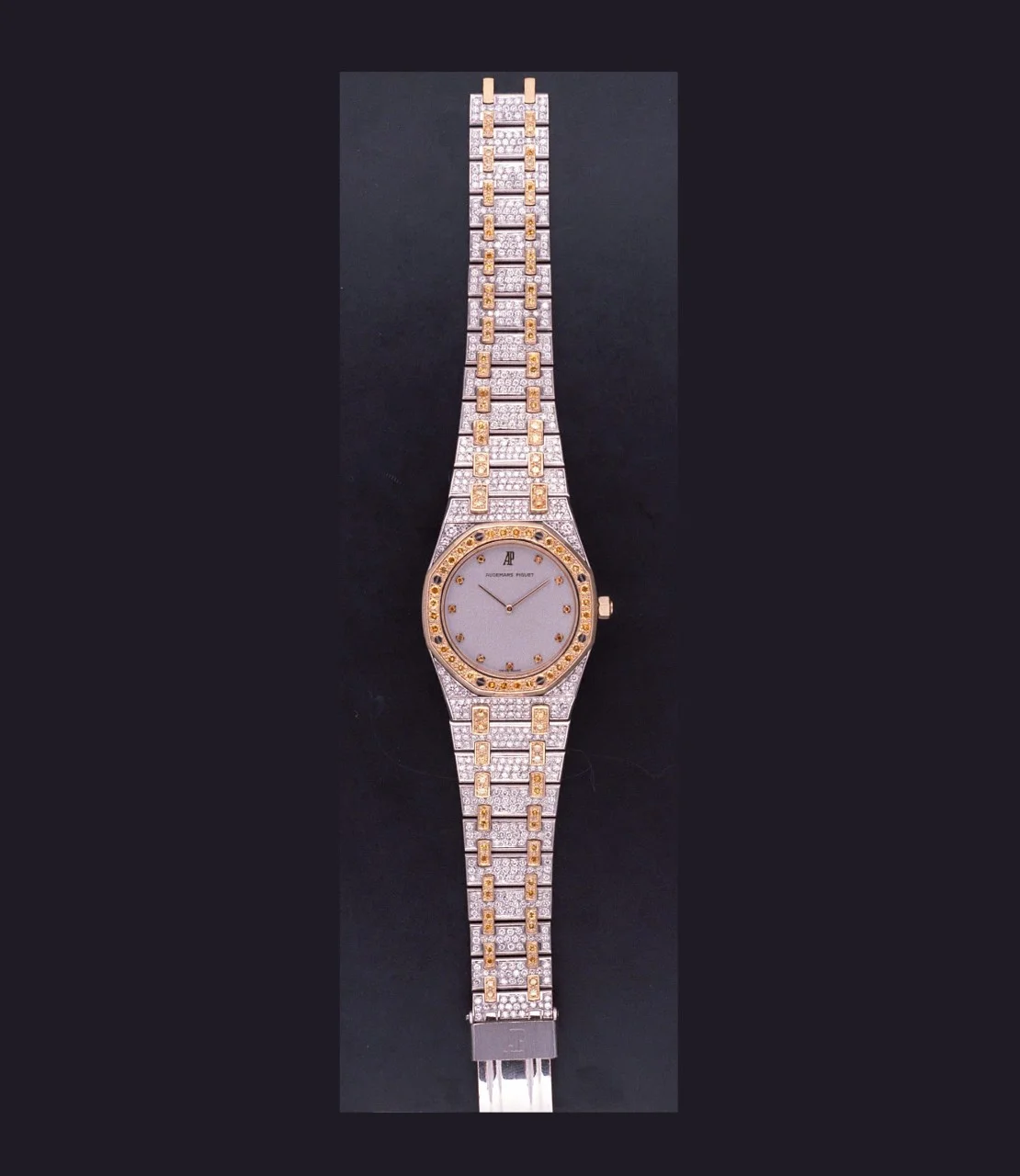
1985. Royal Oak 56199CA. 33 mm. 715 brilliant-cut diamonds. Identification photograph. Audemars Piguet Archives.
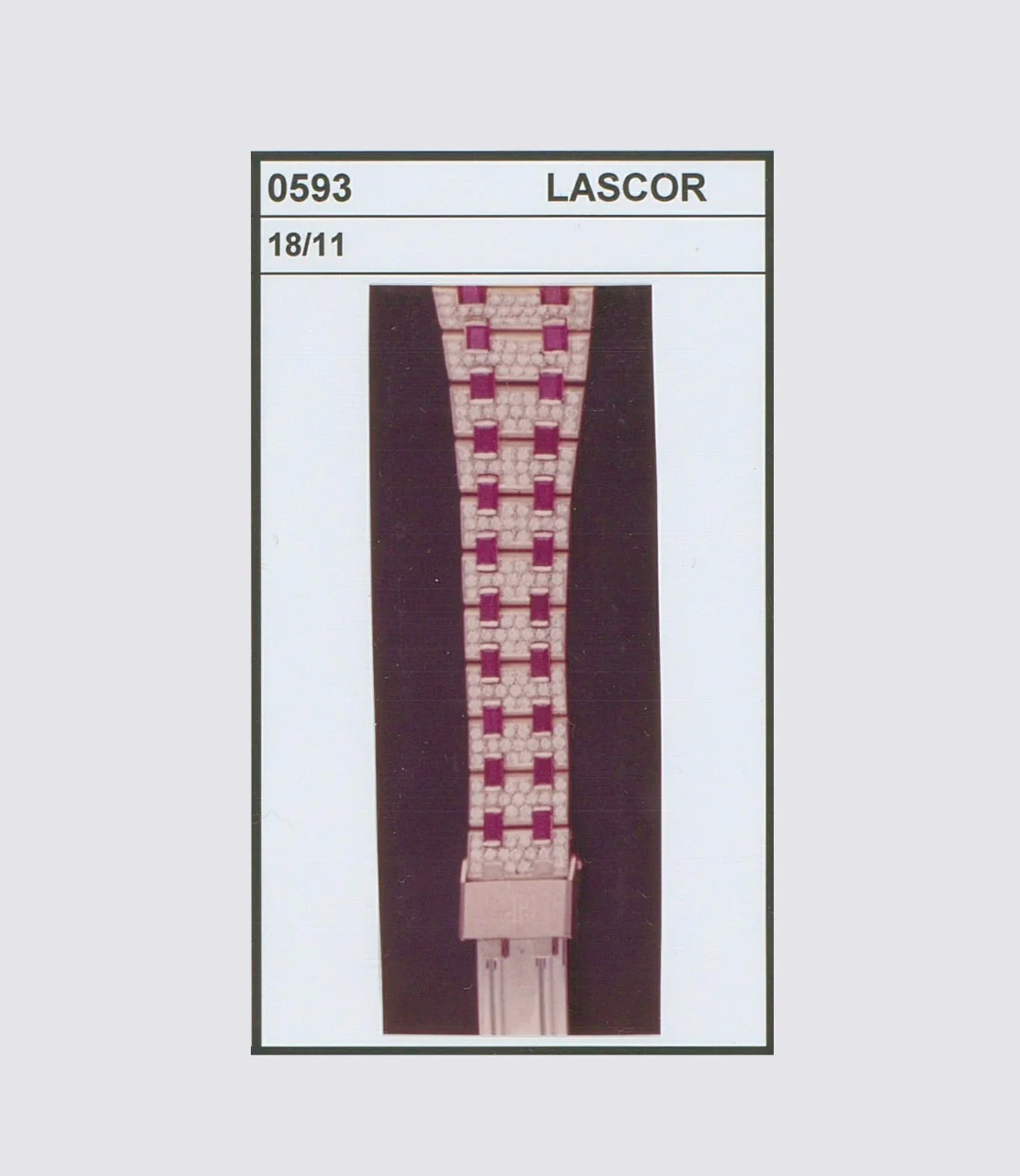
Circa 1985. Bracelet 593 identification sheet. Sapphires and diamonds. Audemars Piguet Archives.
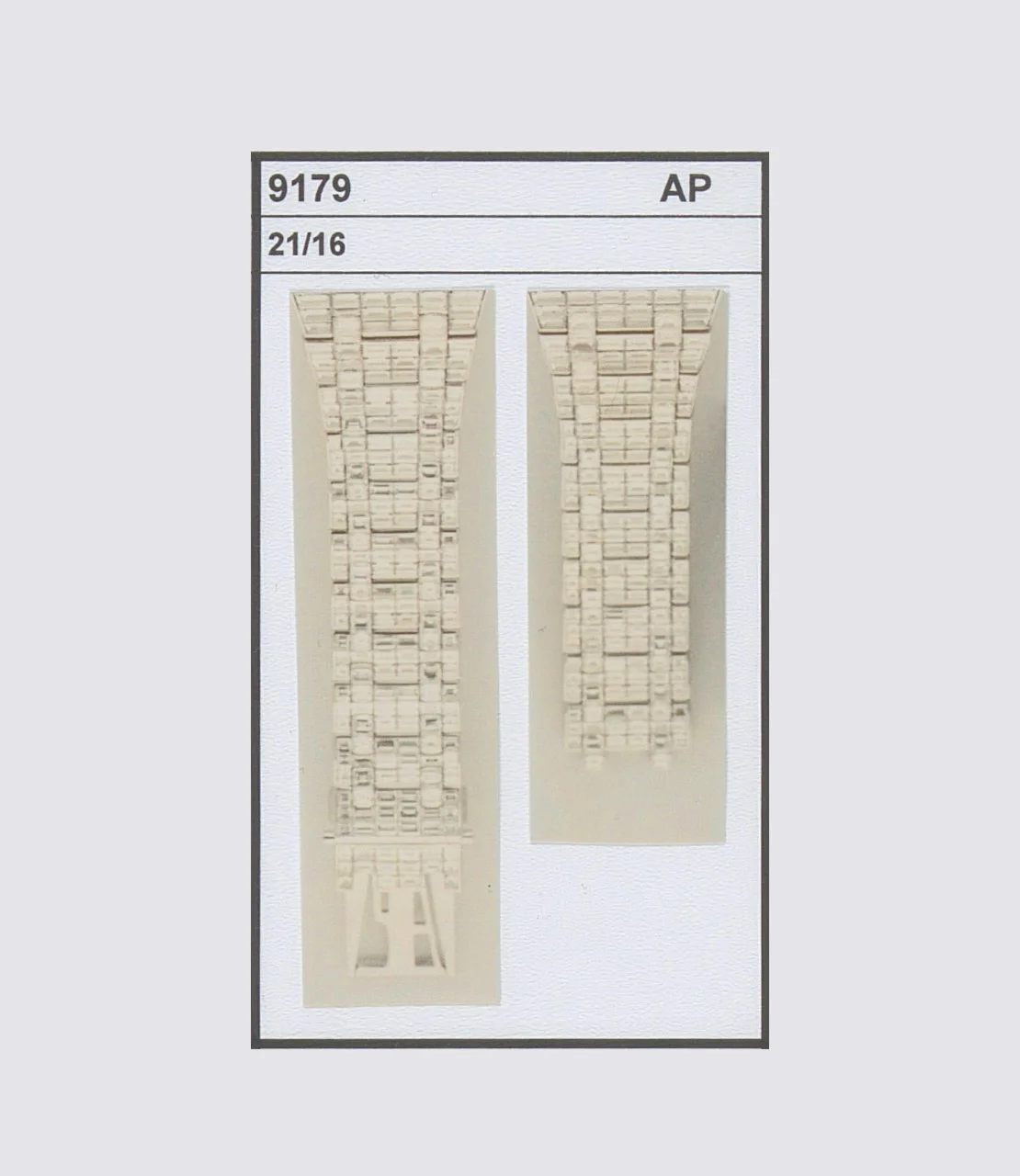
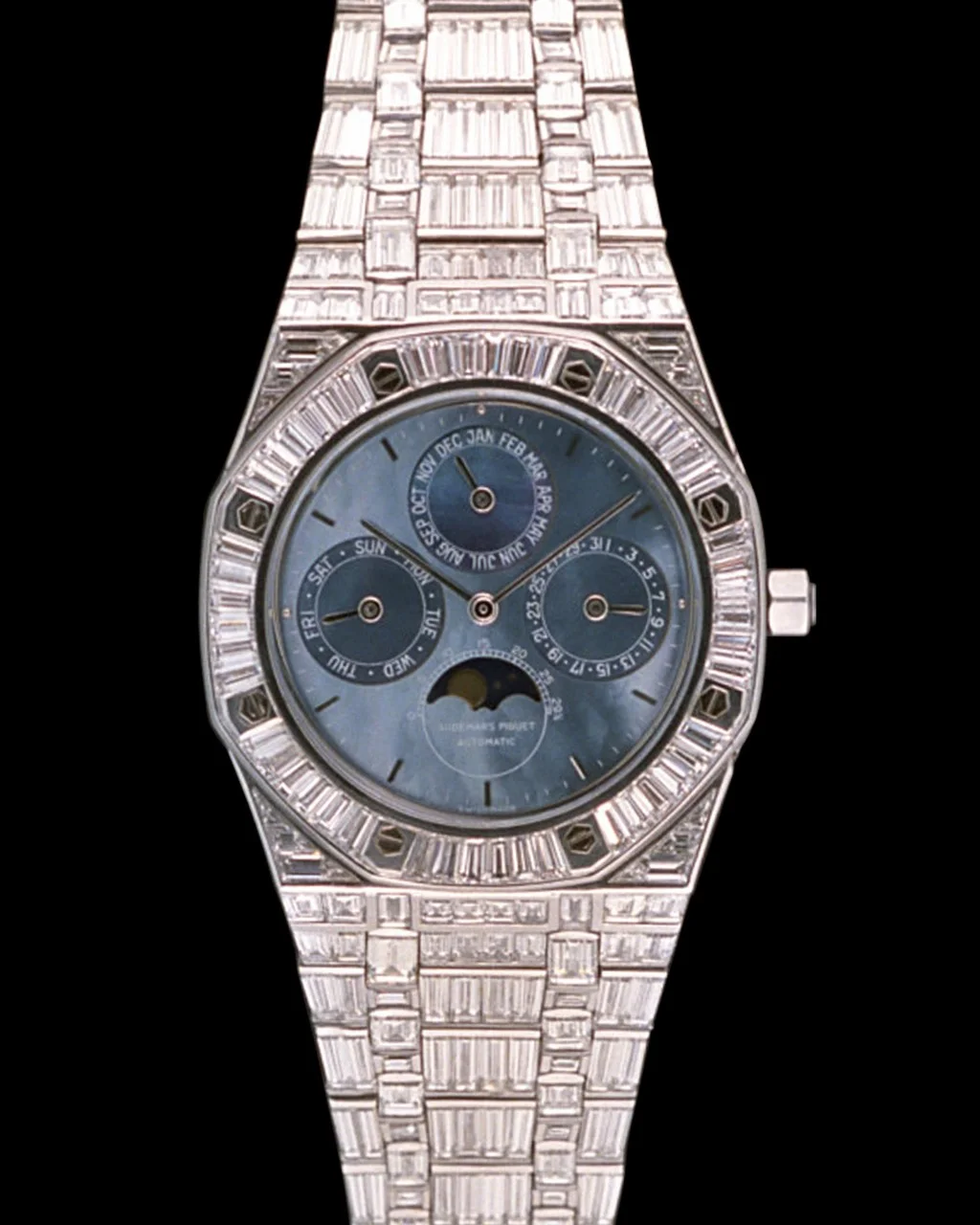
Circa 2005. Bracelet 9179 identification sheet. The bracelet is entirely paved with baguette-cut diamonds. Audemars Piguet Archives.
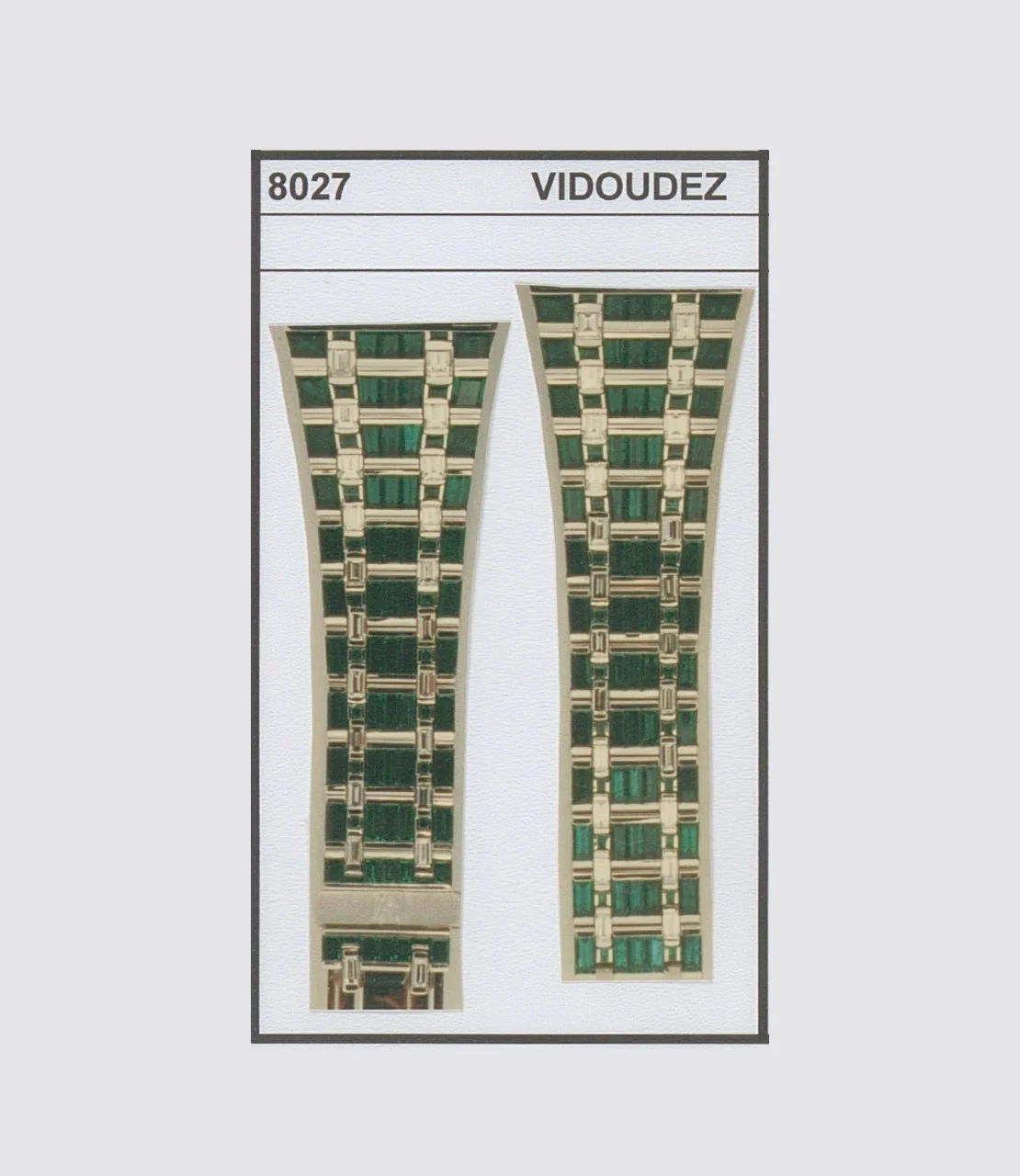
Circa 2005. Bracelet 8027 identification sheet. Emeralds and diamonds. Audemars Piguet Archives.
Six Times Harder than Steel – Ceramic
At the same time, Audemars Piguet began introducing Royal Oak ceramic bracelets. In 2007, the Manufacture in Le Brassus joined forces with the Swiss family-owned company Bangerter Mikrotechnik AG – based in the small village of Aaberg, between the cities of Biel and Bern – which had already produced ceramic Royal Oak bezels and cases. Until then, however, the complexity of the bracelet as well as its slimness and delicacy seemed incompatible with the extreme hardness of this material. A simplified method of comparison shows that ceramic (approx. 1300 Vickers) is some 6.5 times harder than steel (approx. 200 Vickers). It is worth recalling that machining steel was already a technical challenge in itself for the Royal Oak bracelet, even though it is only 30% harder than 18-carat gold! The objective was nevertheless achieved in 2017, with the presentation of the Royal Oak Perpetual Calendar 26579CE.
It was an instant success, followed in 2017 by an openworked version 26585CE, a white ceramic interpretation 26579CB (approximately 9.25 times harder than steel!), as well as other complicated models such as the tourbillon 26522CE; the double balance wheel 15416CE, and the double-complication tourbillon chronograph 26343CE.
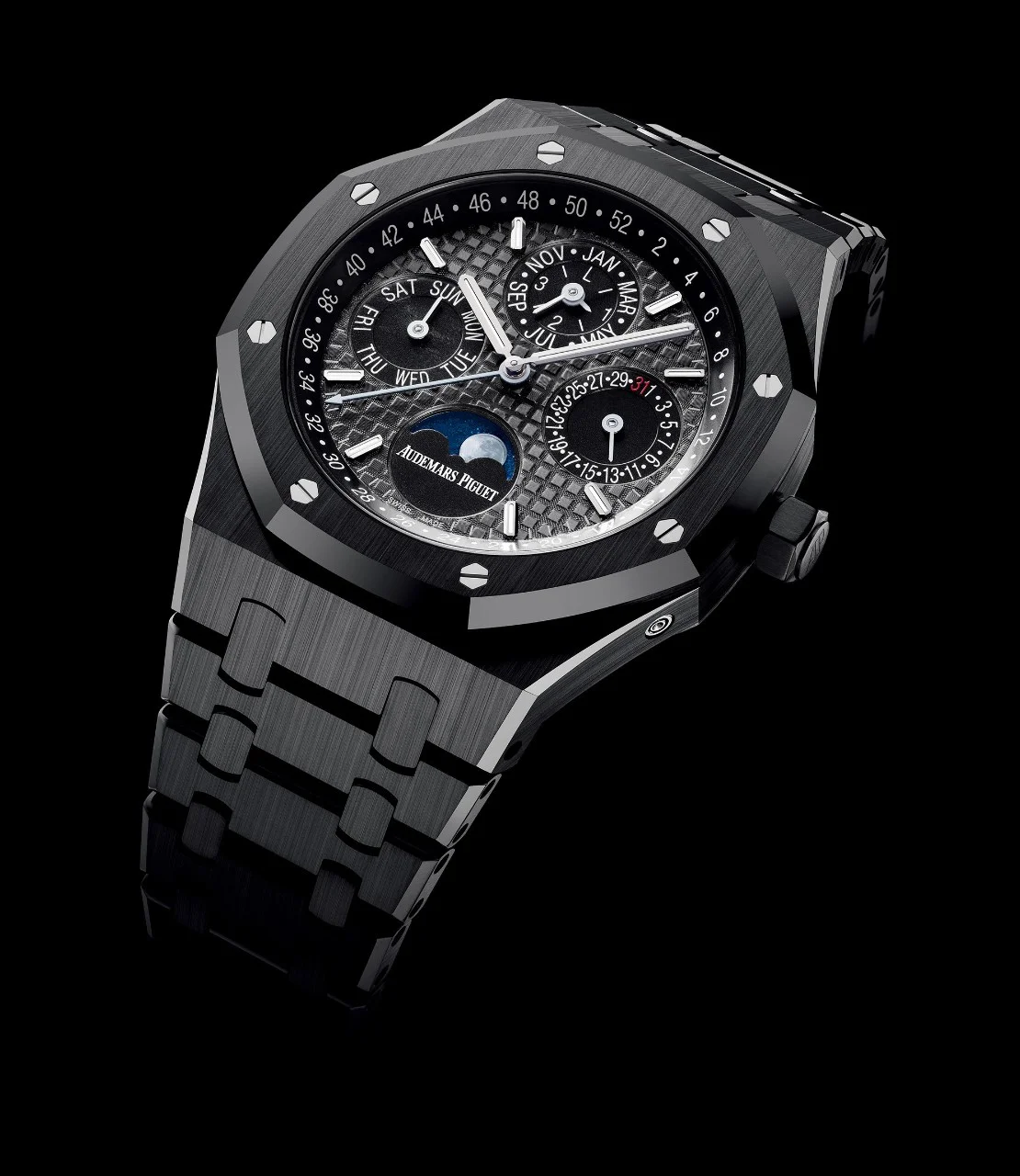
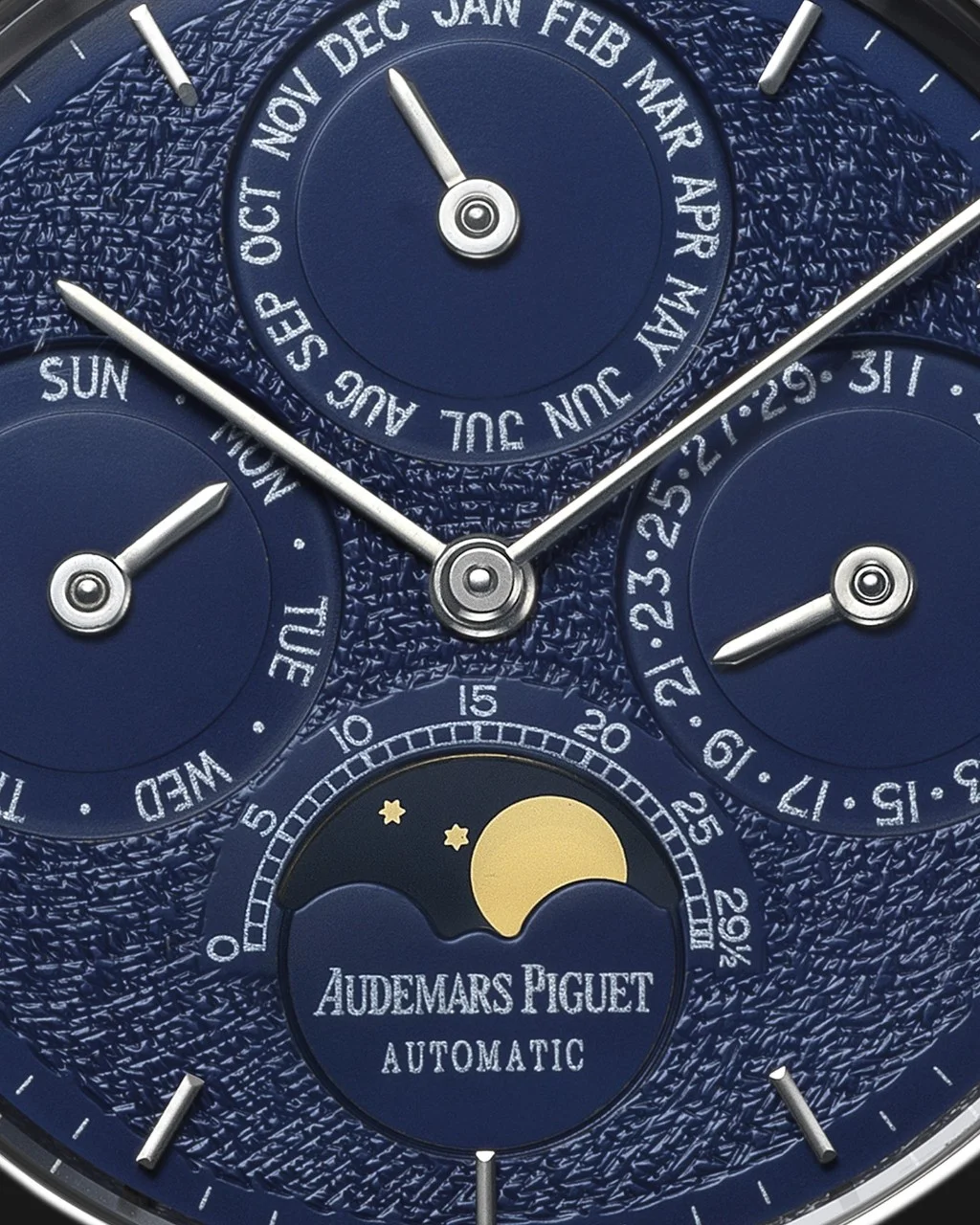
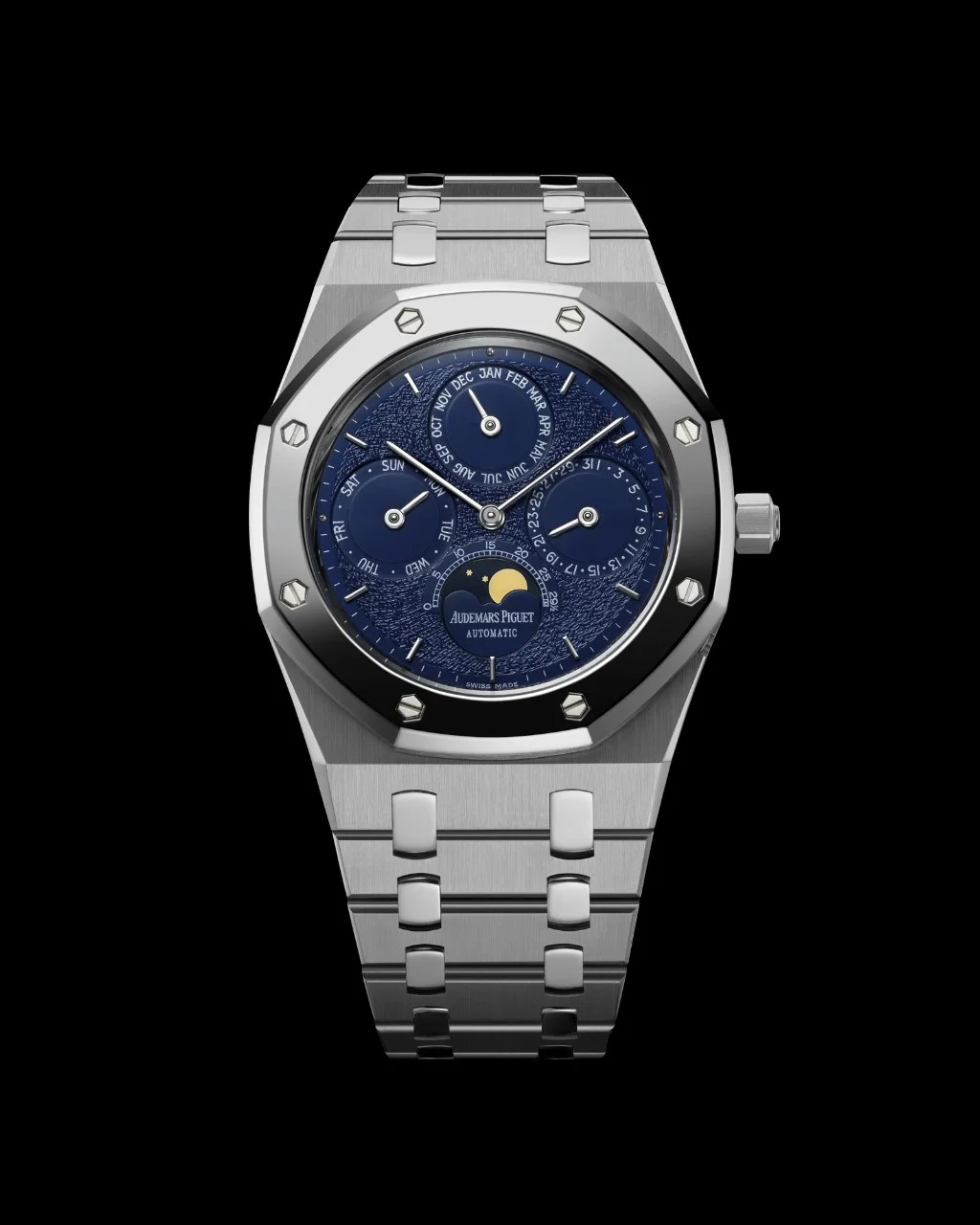
2017. Royal Oak Perpetual Calendar 26579CE. Perpetual calendar: day, date, month, moon phases. Ultra-thin, selfwinding Calibre 5134 (4.31 mm), movement 961120. Black ceramic bracelet 1225. Black ceramic 41mm case J37062. This watch entered the Audemars Piguet Heritage Collection in 2019 (inv. 1913).
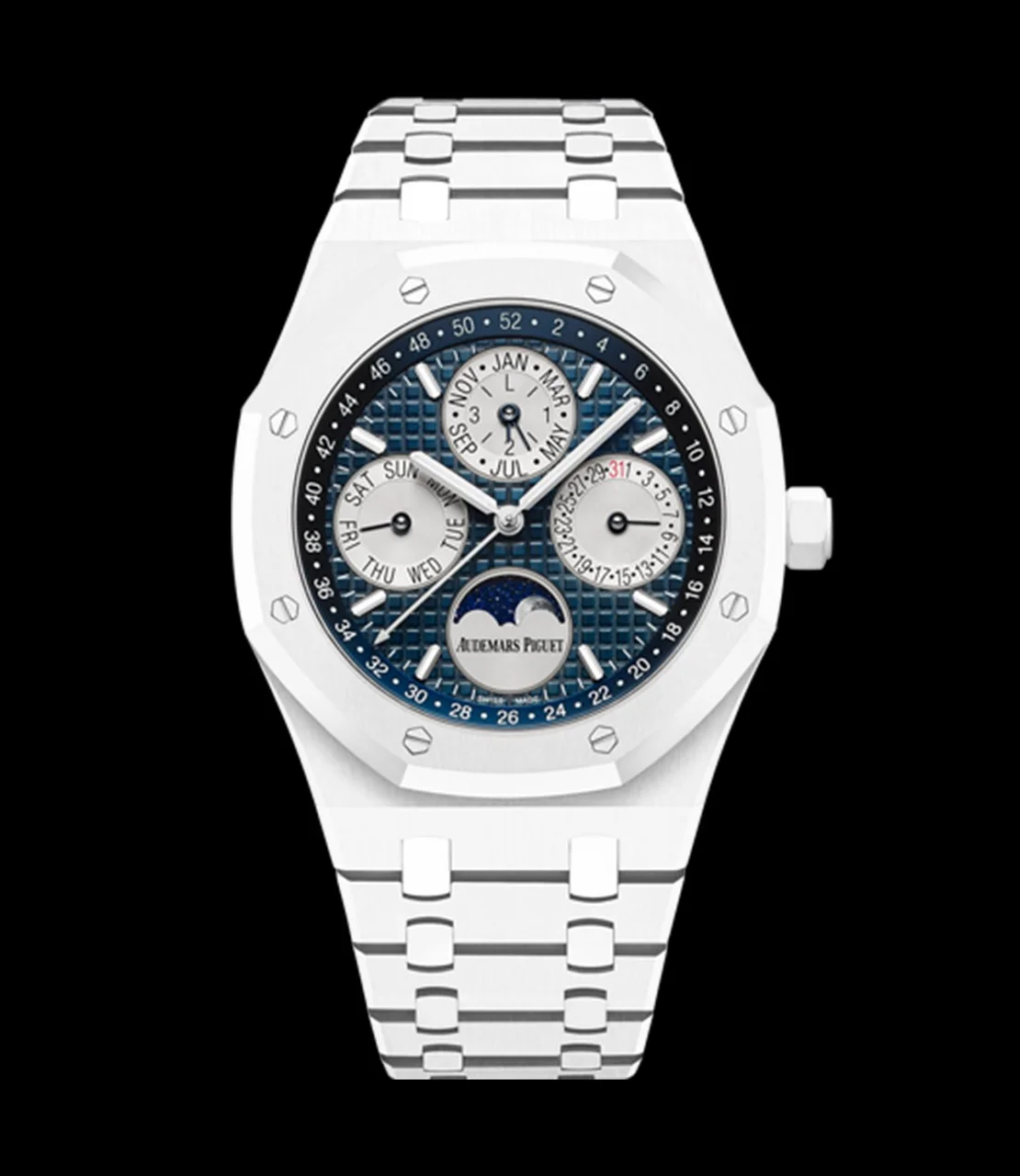
2018. Royal Oak Perpetual Calendar 26579CE. Perpetual calendar: day, date, month, moon phases. Ultra-thin selfwinding Calibre 5134 (4.31 mm). White ceramic bracelet 1225. 41 mm white ceramic case J37062. Image taken at the launch of the watch in 2018.
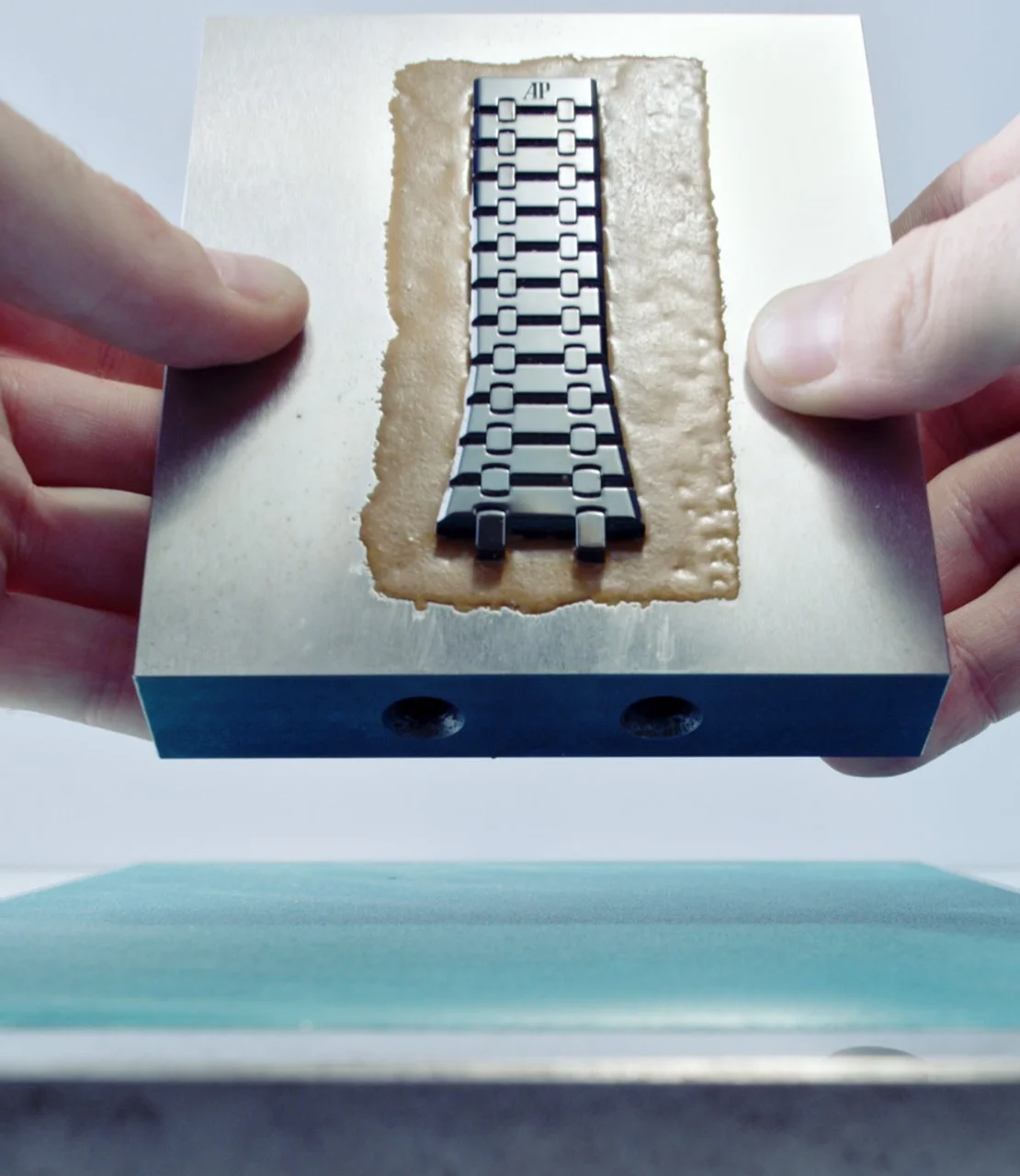
2018. Satin-brushing of ceramic bracelet no. 1225. Fixed to a flat stainless steel plate with engraver's wax, the bracelet is meticulously satin-brushed with an abrasive paper. The hardness of black ceramic makes this manual operation particularly painstaking. Audemars Piguet Archives.
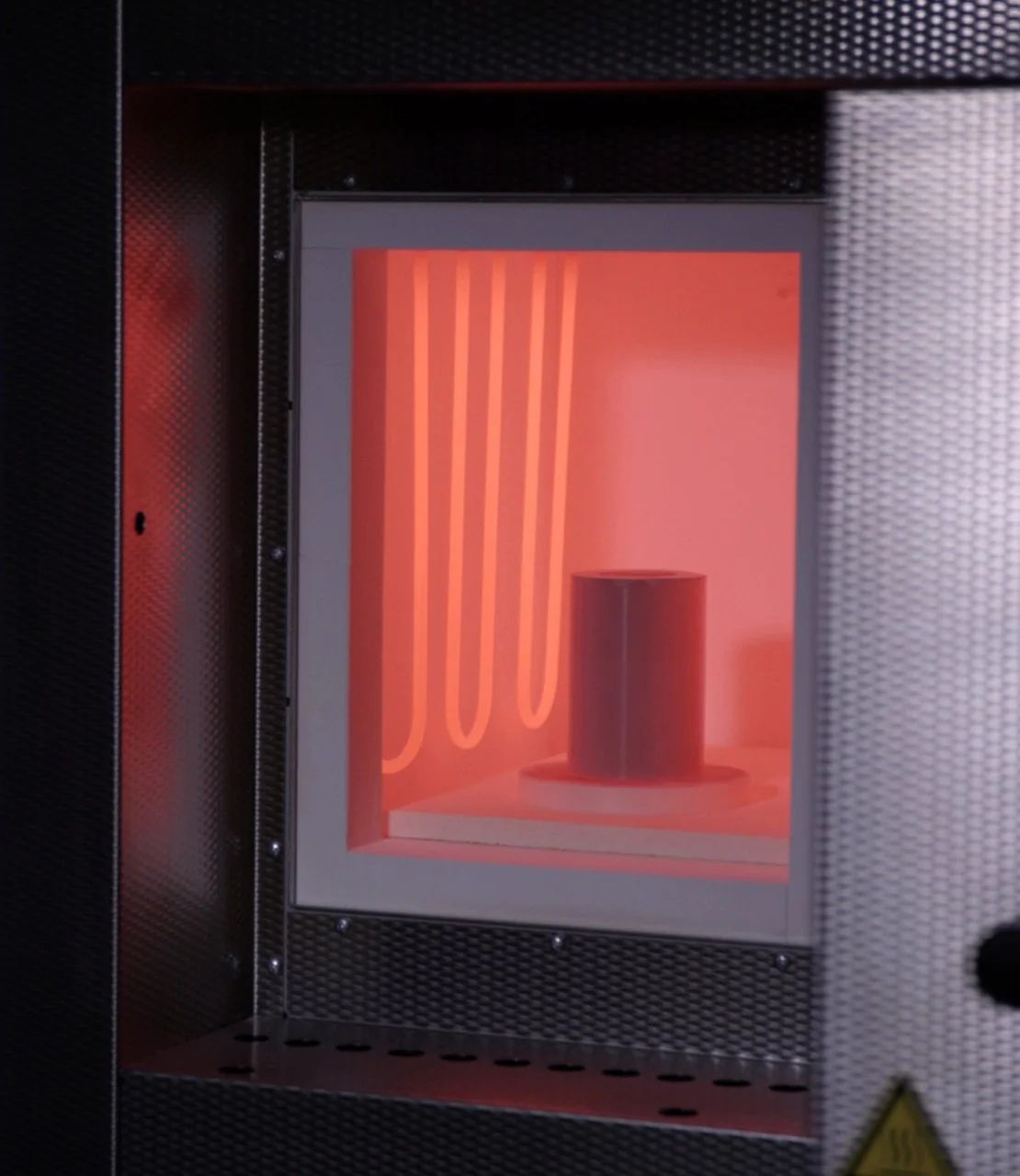
2018. Oven for ceramic components. Ceramic powder is heated at a very high temperature. It melts before solidifying when cooling off. It is then machined and decorated with tools covered with diamond powder. Bangerter workshop. Audemars Piguet Archives.
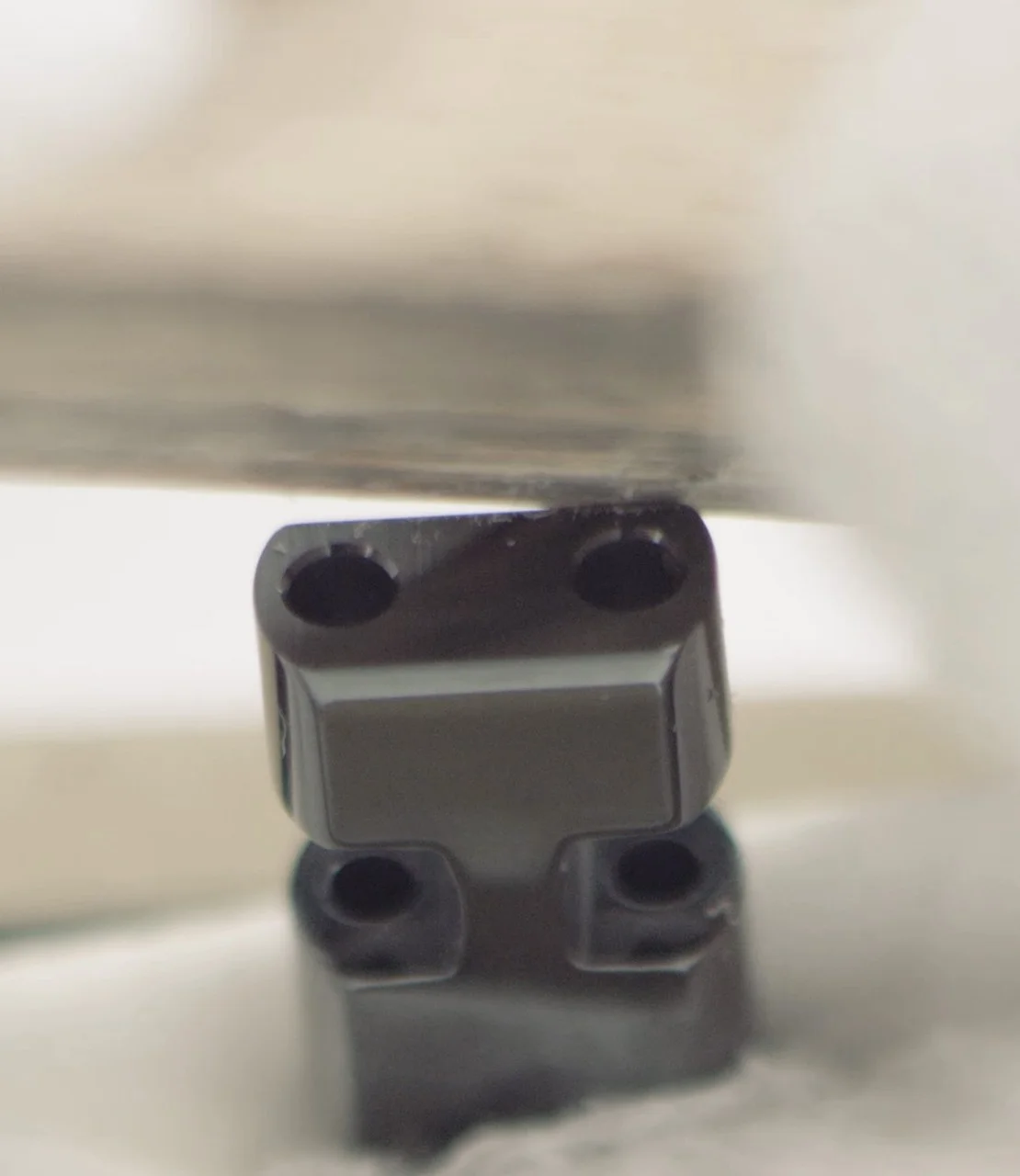
2018. Manufacturing of ceramic bracelet studs. Each of the numerous operations necessary to the manufacturing of the components of the ceramic bracelet requires precision and dexterity. Bangerter workshop. Audemars Piguet Archives.
First Leather Straps
While their role may seem less obvious at first glance, leather straps have nevertheless played a significant role in the Royal Oak’s history. For the first 20 years, the famous octagonal watch exclusively sported metal bracelets. In this field as in many others, purists considered this attribute untouchable, even sacred. For the record, in 1978, the first Royal Oak quartz watches gave up the octagonal bezel and its mechanical movement, while retaining the tapering metal bracelet.
In 1992, the Royal Oak was nevertheless fitted with its first leather strap. Model 14800 was so controversial that Steven Urquhart and Georges-Henri Meylan, who were jointly helming the company at the time, had it developed "extra-muros" by independent Swiss designer Jörg Hysek. Interpreted in nearly 20 material and dial variants, this atypical Royal Oak takes great liberties in playing with its original codes, as much in terms of the dial as the hands and lugs. The bevel of the case is hollowed out in the centre, surrounded by a kind of lugs, which suggests that the strap is attached by means of mobile pivot bars. The careful observer will notice that the bracelet is clamped between the underside of the case middle and a long screw-down plate.
This configuration is found on several later models, such as the Royal Oak 14890 (circa 1994), 14891, 14916 and 66800 (made during the mid-1990s). Some Royal Oak Offshore models retained this aesthetic, but by securing the strap to traditional bars, like the complete calendar 25808 (around 1996), Models 25807 (circa 1996), 25770 (around 1997) or the oversized models created in partnership with Arnold Schwarzenegger (End of Days 25770SN in 1999; T3 25863 in 2003; and The Legacy 26378 in 2010).
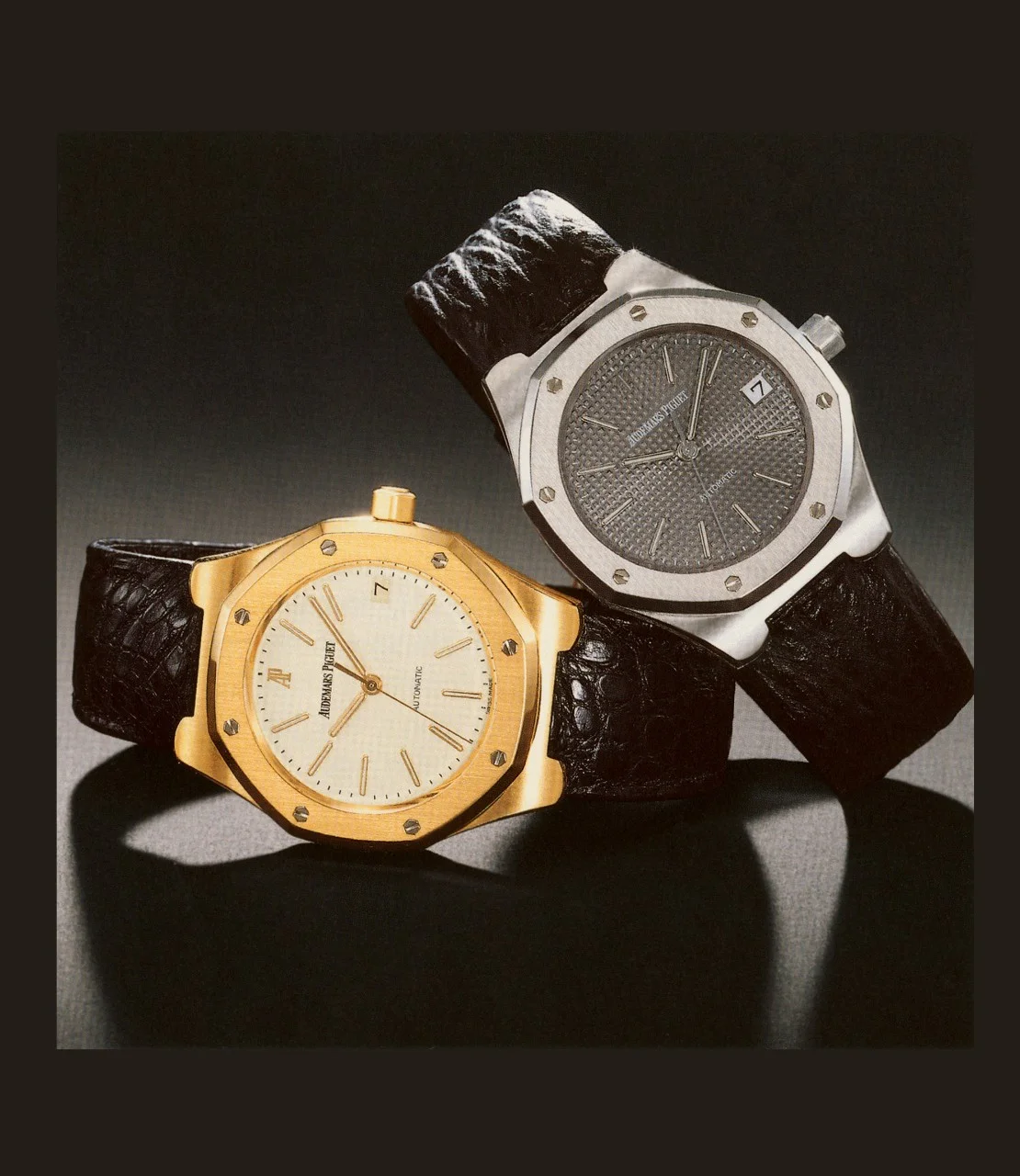
1992. First Royal Oak fitted on leather. Designed by Jorg Hysek, Model 14800 introduces the leather strap into the Royal Oak collection. The case is curved and evokes the shape of the lugs, even though the bracelet is attached thanks to plates situated at the back of the case. Image taken from a promotional brochure dating from September 1972. Audemars Piguet Archives.
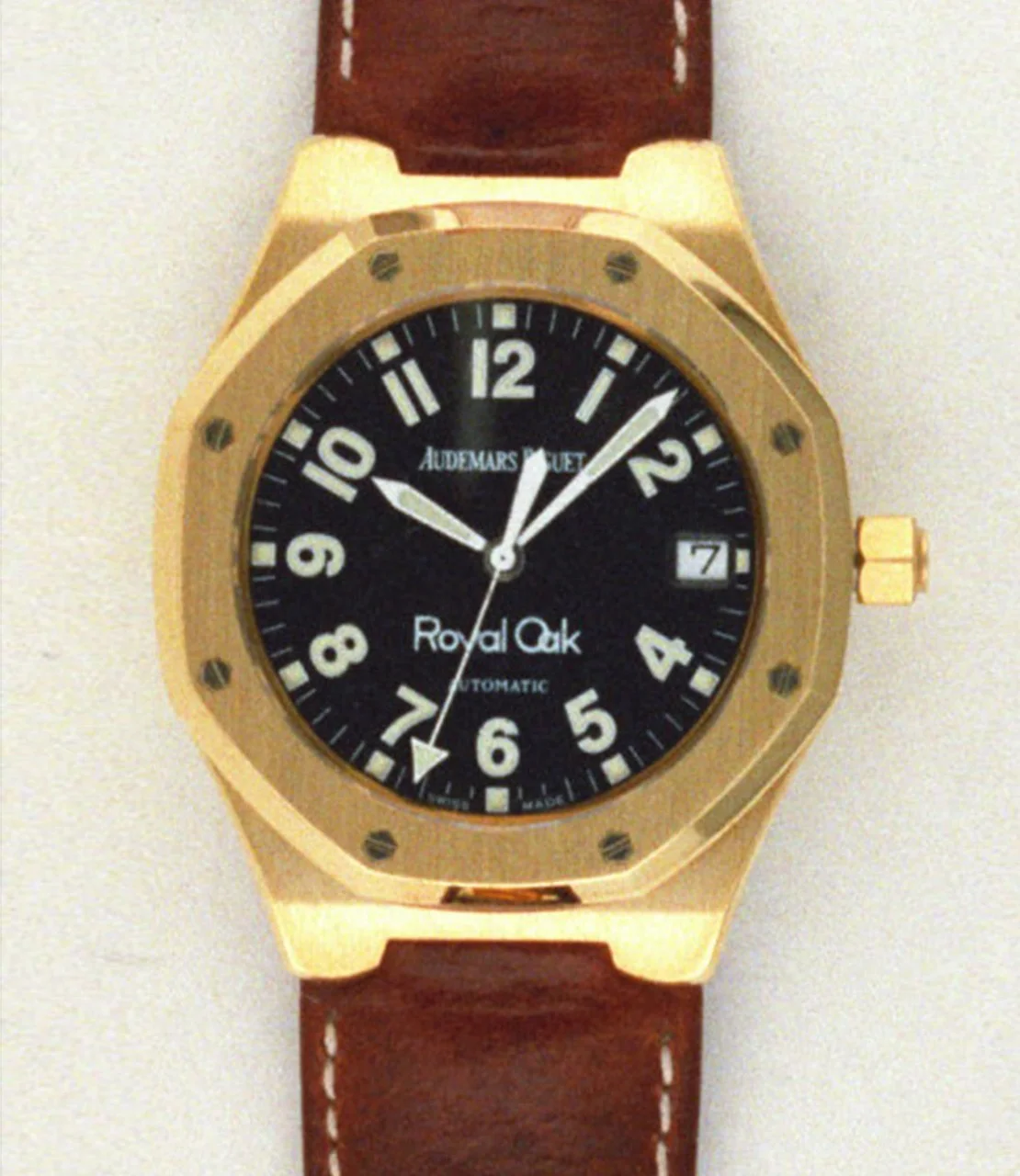
Circa 1995. Royal Oak 14800BA. First Royal Oak fitted on leather strap. Model 14800 was reinterpreted in more than 10 variants, including some which reinterpreted the collection's codes with great freedom. Audemars Piguet Archives.
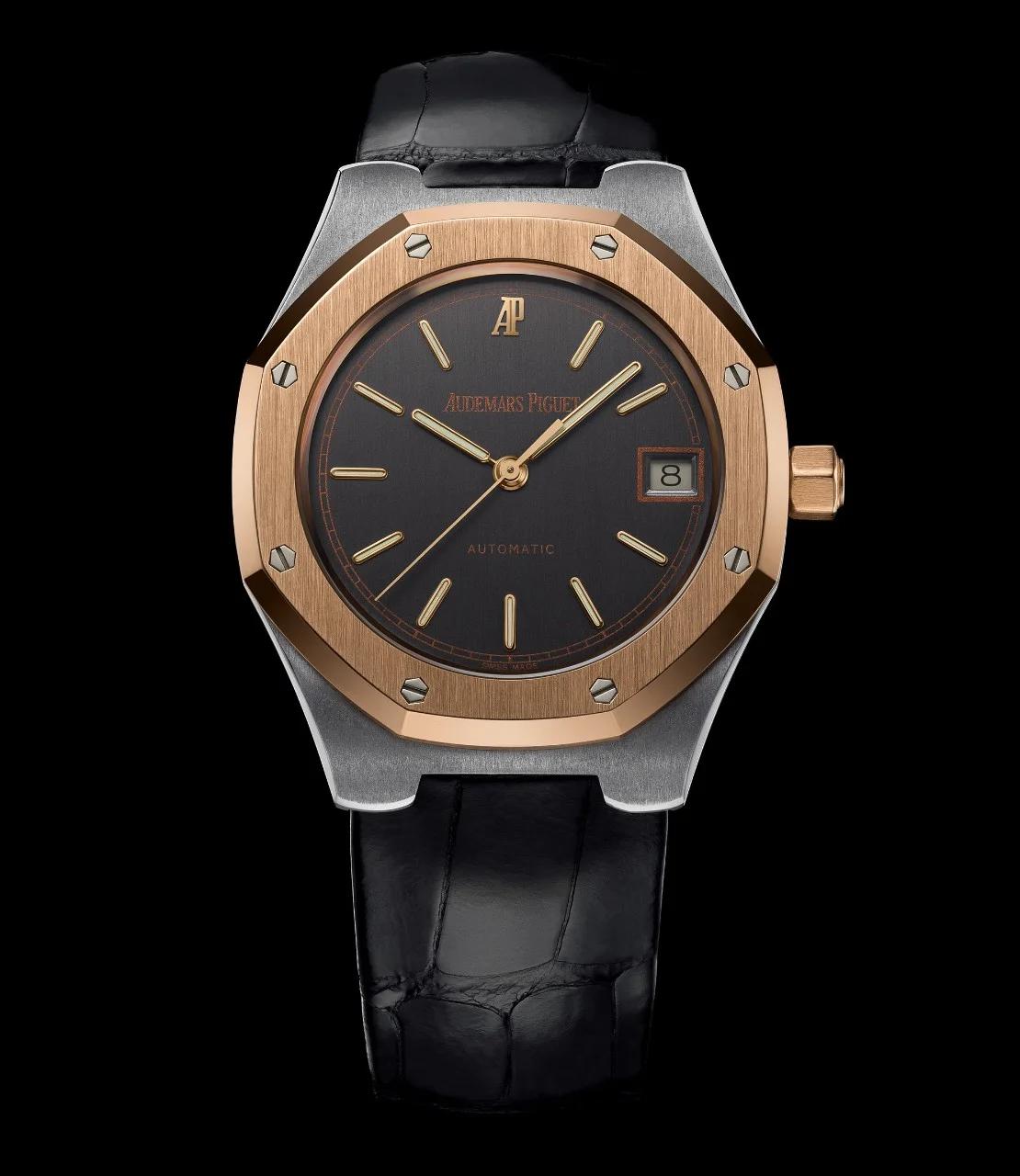
2004. Royal Oak 14800TR, No. 199. Launched in 1992 and produced for over 10 years, the Royal Oak 14800 is the first with a leather strap. Date. Selfwinding Calibre 2225, movement 557692. 36 mm case D40087 in 18-carat pink gold and tantalum. Sold in Switzerland in 2004. Audemars Piguet Heritage, inv. 829.
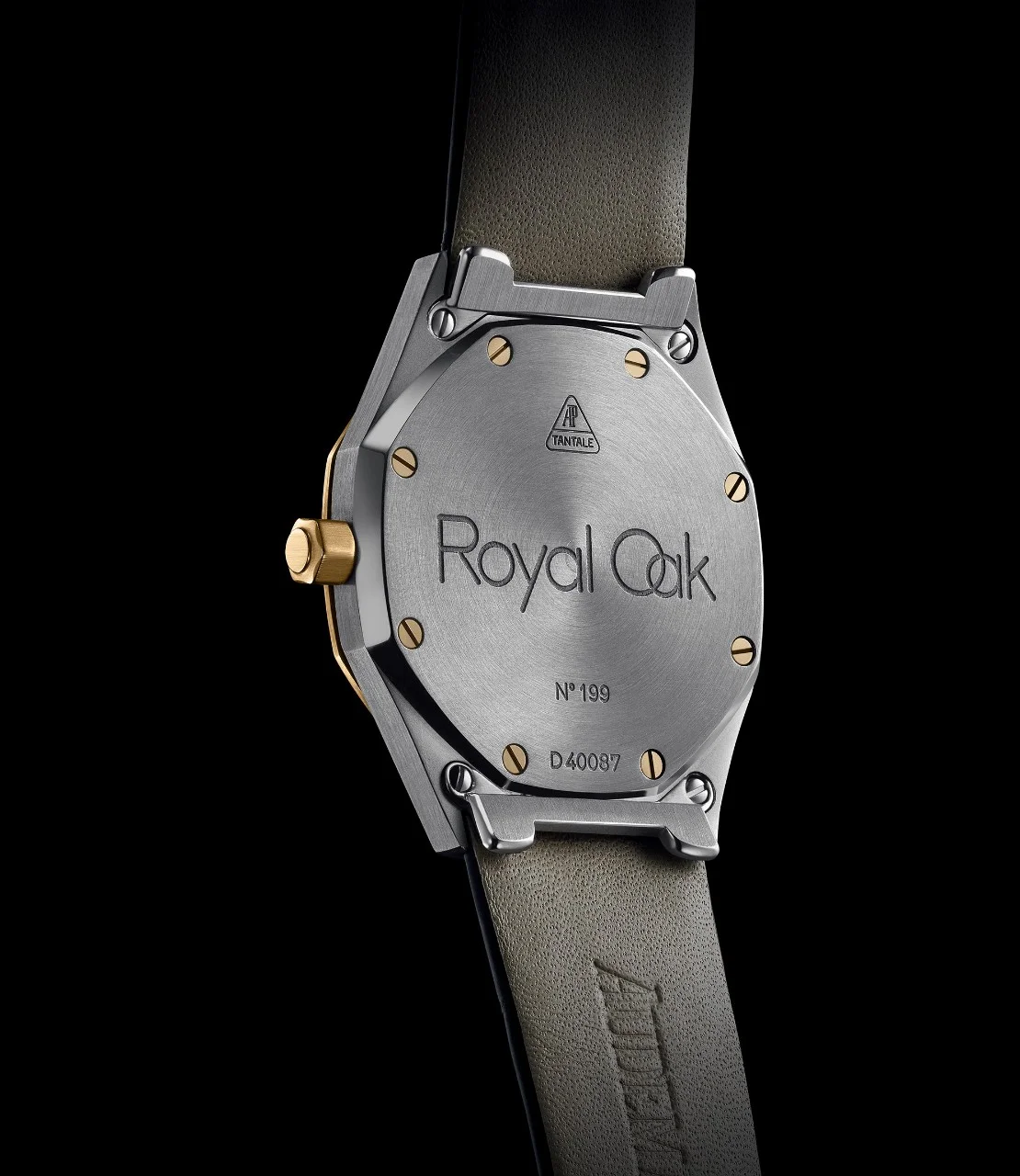
2004. Royal Oak 14800TR No. 199, caseback side. Two metal plates are screwed on the caseback to fix the bracelet. Audemars Piguet Heritage, inv. 829.
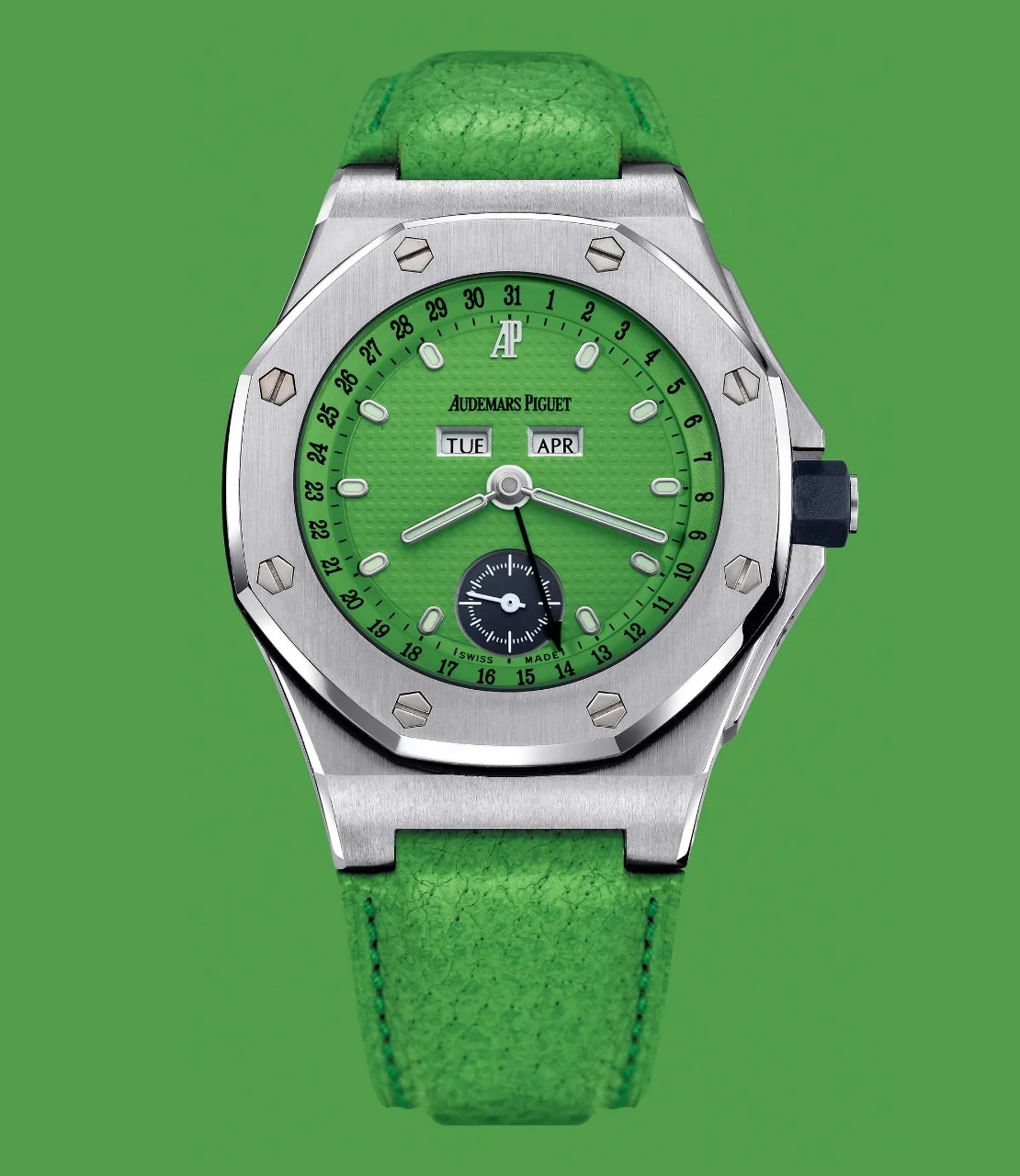
1996. Royal Oak Offshore 25808ST No. 94. Complete calendar: aperture-type day and month displays, date hand. Calibre 2127/2827. Green Petite Tapisserie dial. 38 mm case no. D75395. Prototype presented at the launch of the model. Audemars Piguet Heritage, inv. 613.
Leather Straps with Double Studs
At the turn of the millennium, Dierk Wettengel, who was in charge of distribution in Germany, suggested that the system for attaching the wristband be reviewed and pencilled a sketch. In Le Brassus, designer Claude Emmenegger had taken over since 1999 from Jacqueline Dimier and Emmanuel Gueit. The fastening system he developed on the basis of the German agent's design is more faithful to the Royal Oak’s original aesthetic, yet also more complex. The leather was cut to accommodate the first two metal studs of the strap and attached to them by means of two long interlocking screws. This solution replaced the lugs (or fake lugs) of the previous variants. More importantly, it did not affect the case middle, which remains identical for both leather and metal models. From then on, a watchmaker could therefore replace a leather strap with a metal version and vice-versa.
This configuration was first introduced in 2001 on the Royal Oak Offshore 25940SK (rubber strap and bezel). The following year, the limited-edition Royal Oak City of Sails 25979 with a rubber strap heralded flexible straps with double studs in the Royal Oak collection. Presented in 2003 on the occasion of the opening of the Audemars Piguet boutique in New York, the limited edition 26014 is both the first Royal Oak to be blackened (using black PVD treatment), and the first to feature a leather strap with two studs. It was born at the instigation of François-Henry Bennahmias, who had just given a strong boost to the American distribution subsidiary. When he became CEO of the AP Group in 2012, leather straps were introduced throughout the Royal Oak collection.
In 2004, the Royal Oak Chronograph 26022 was the first non-limited series to offer a leather alternative. The following year, when the Royal Oak 15300 replaced the old classic Model 14790 which had never sported a leather strap, it was offered with both metal bracelet and leather strap variants – and its successors 15400 (2012 and its derivatives) and 15500 (2019 and its derivatives) would continue this tradition. Soon, almost all the Royal Oak variations were equipped with this option, starting with chronographs (26068 from 2006; 26557 from 2011; 26320 and 26128 from 2012; 26331 from 2017; 26239 from 2021, etc). In 2006, a leather strap was introduced on the Dual Time (26120) and the double tourbillon chronograph complications (25977 then 26116 from 2007; 26377 and 26039 from 2010, etc.). It was not until 2008 that perpetual calendar models were equipped with them (26252). In 2010, the Equation of Time (26603) and the Royal Oak Day Date (26330) also adopted leather straps, as did the new openworked variant 15305. In 2012, even the Grand Complication succumbed to the trend (25990, 26065).
For models in the current collection, a leather strap remains an alternative to metal. On the other hand, the limited editions are sometimes exclusively available with leather (or rubber) straps, such as the Royal Oak Sachin Tendulkar Chronograph 26161OR (2008), QEII Cup 2009 26277, the Royal Oak Tuxedo 15154 and 77220 in 2010; the Leo Messi edition 26325OL (2013), and the QEII Cup 2015 series, Model 26327TI, etc.
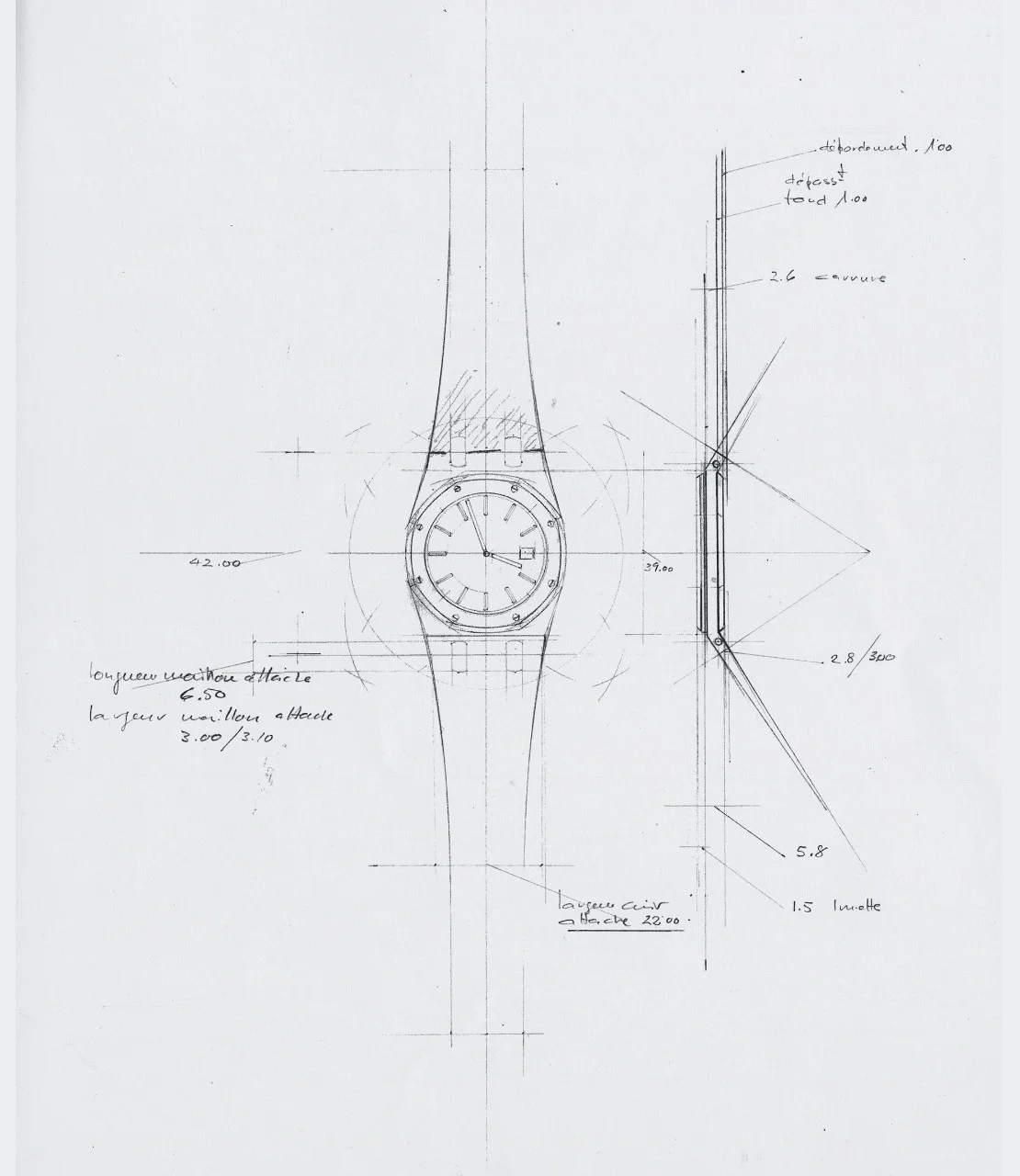
Circa 1990. Sketch of the first Royal Oak on leather with two studs. According to Dierk Wettengel, who was in charge of Audemars Piguet distribution back then, this sketch was realised by Luigi Vignando at his request to create a new generation of Royal Oak on leather. Sketch given to Audemars Piguet by Dierk Wettengel. Audemars Piguet Archives.
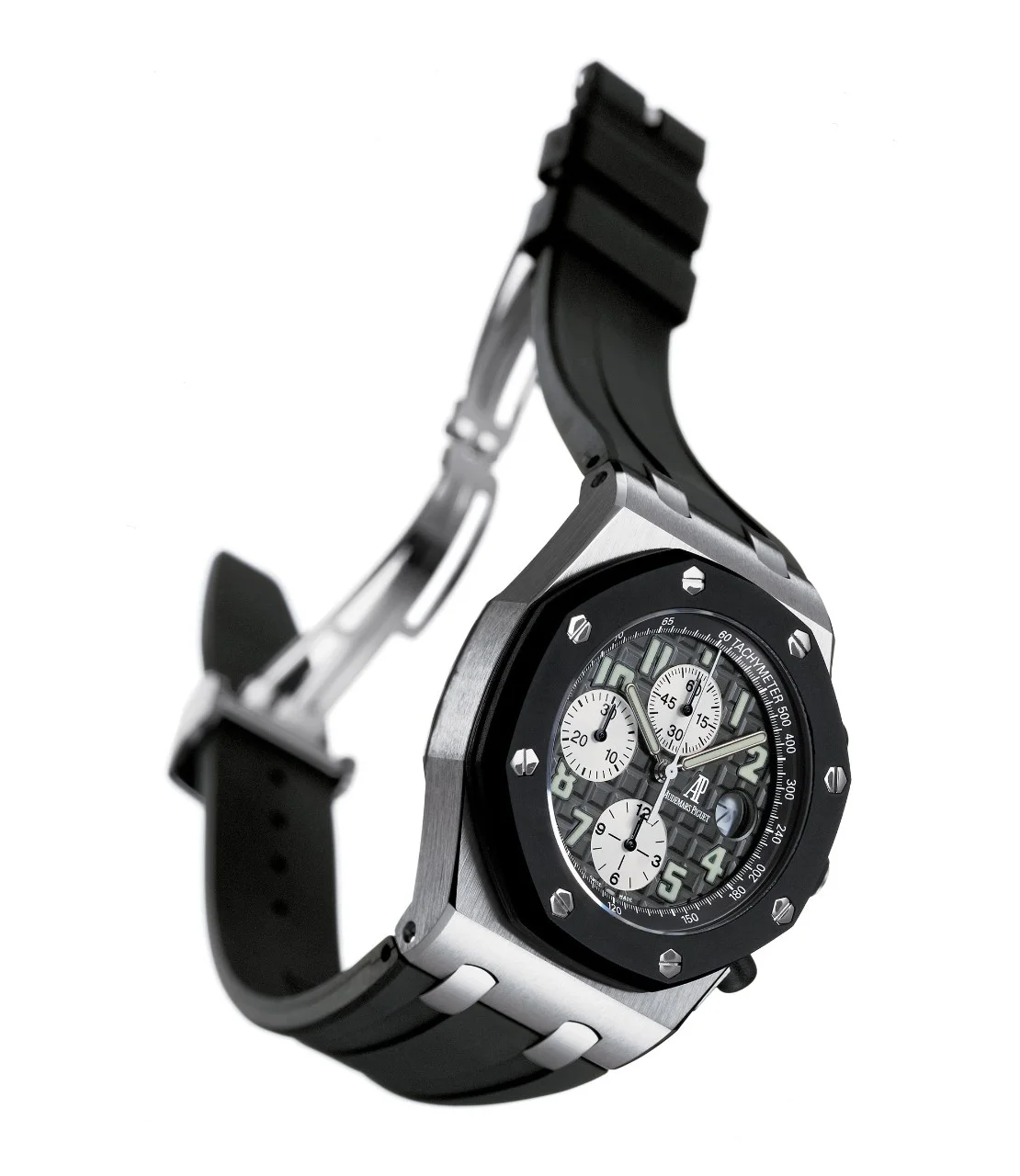
2001. Royal Oak Offshore 25940SK. First Royal Oak Offshore on rubber strap attached with two studs. First model with Méga Tapisserie (or Extra-Grande Tapisserie)dial. Chronograph, date. Calibre 2326/2840. 42 mm prototype E39521, no. 2250 in steel and rubber, without movement, probably presented at the SIHH (Salon de la Haute Horlogerie de Genève) in 2001. Audemars Piguet Heritage, inv. 1152.
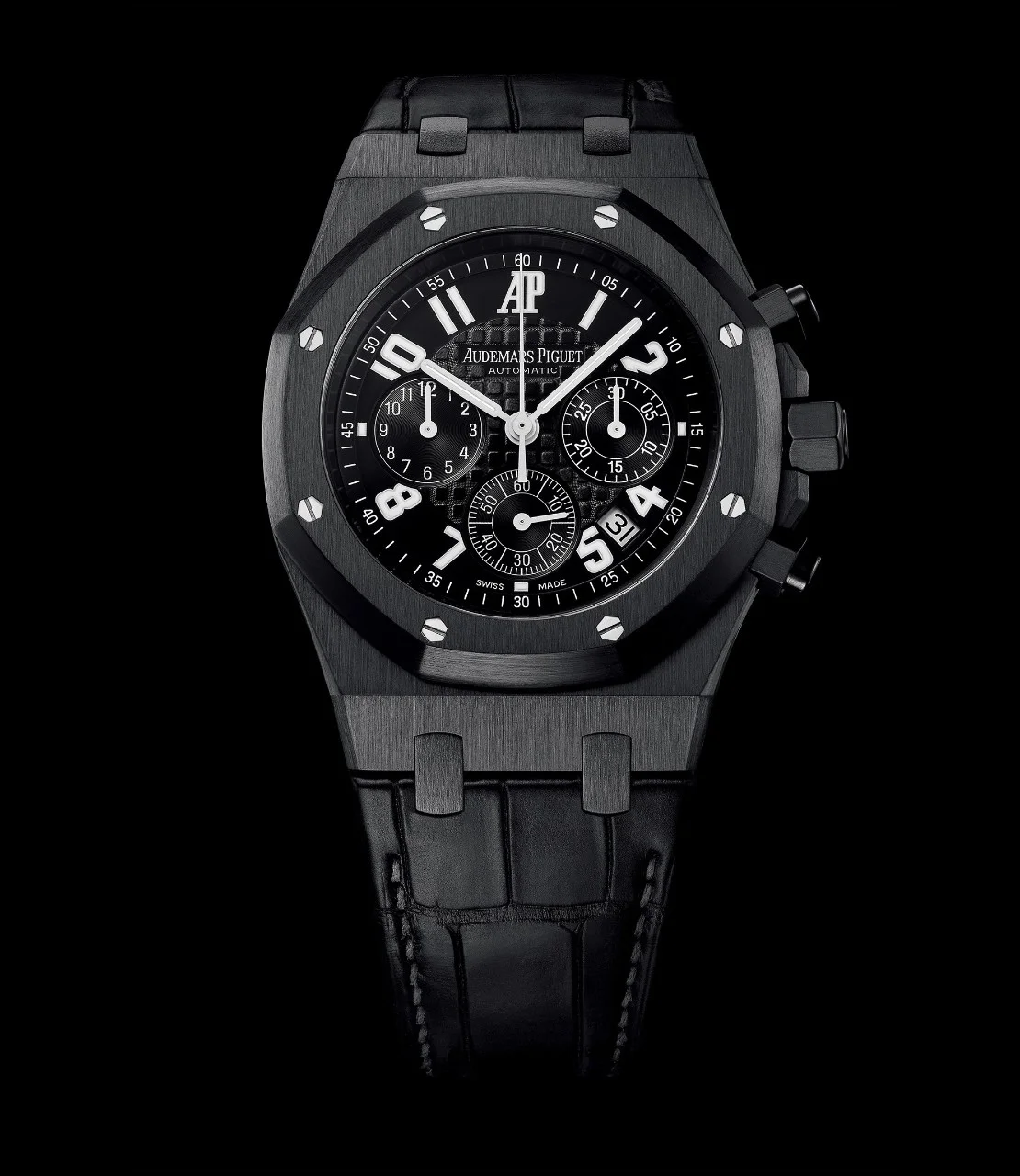
2003. Royal Oak La Boutique 26014SN. First Royal Oak with a leather strap attached to two studs and first PVD-blackened Royal Oak. Chronograph. Calibre 2385, movement 568307. Blackened steel case F02726. Sold in New York in May 2003. Limited edition. Audemars Piguet Heritage, inv. 2101.
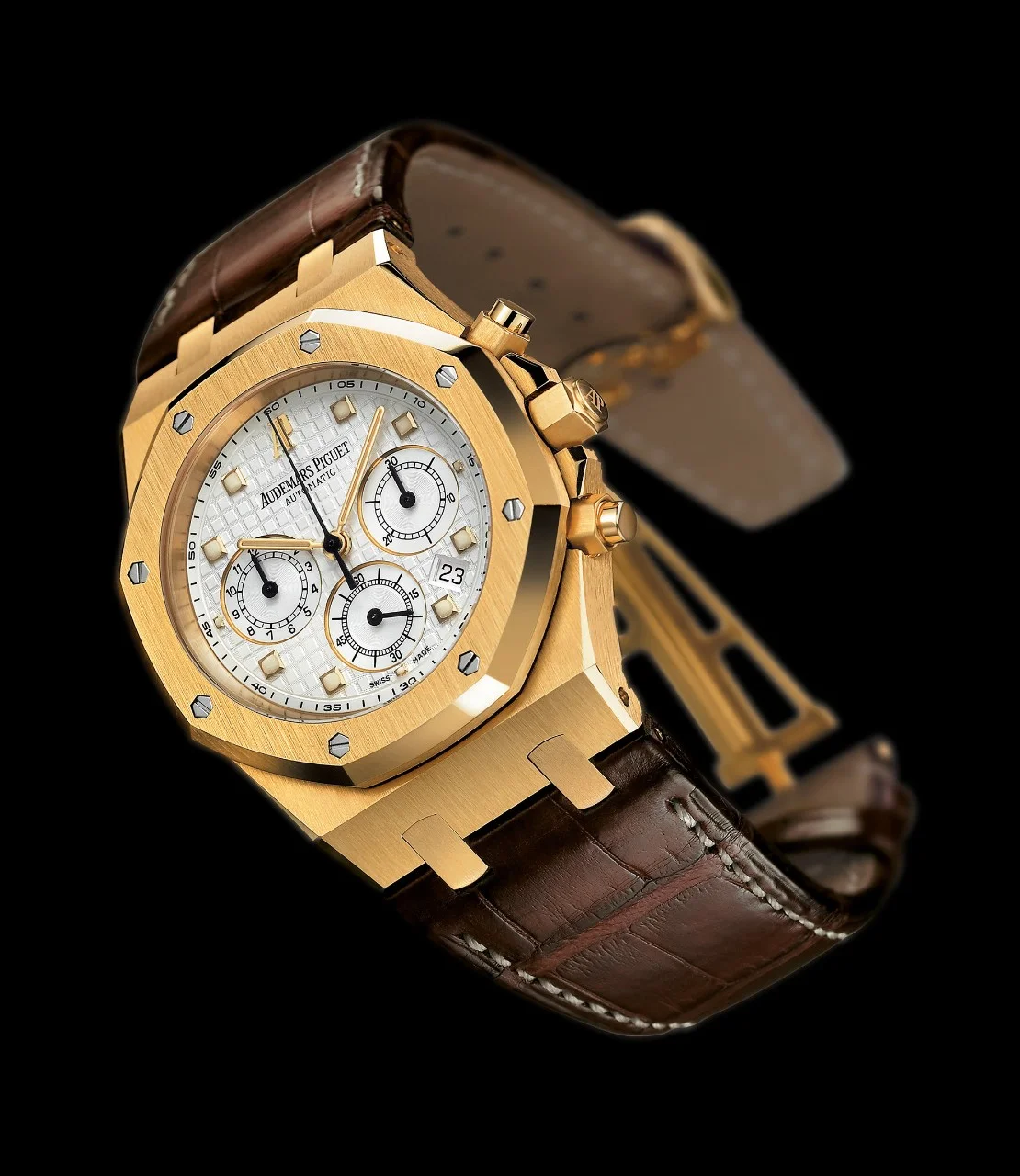
2005. Royal Oak Chronograph 26022BA (2004). First Royal Oak in a non-limited series offered with a leather strap. Chronograph, date. Calibre 2385. 39 mm case in 18-carat yellow gold. Picture taken in 2004 when the model was launched. Audemars Piguet Archives.
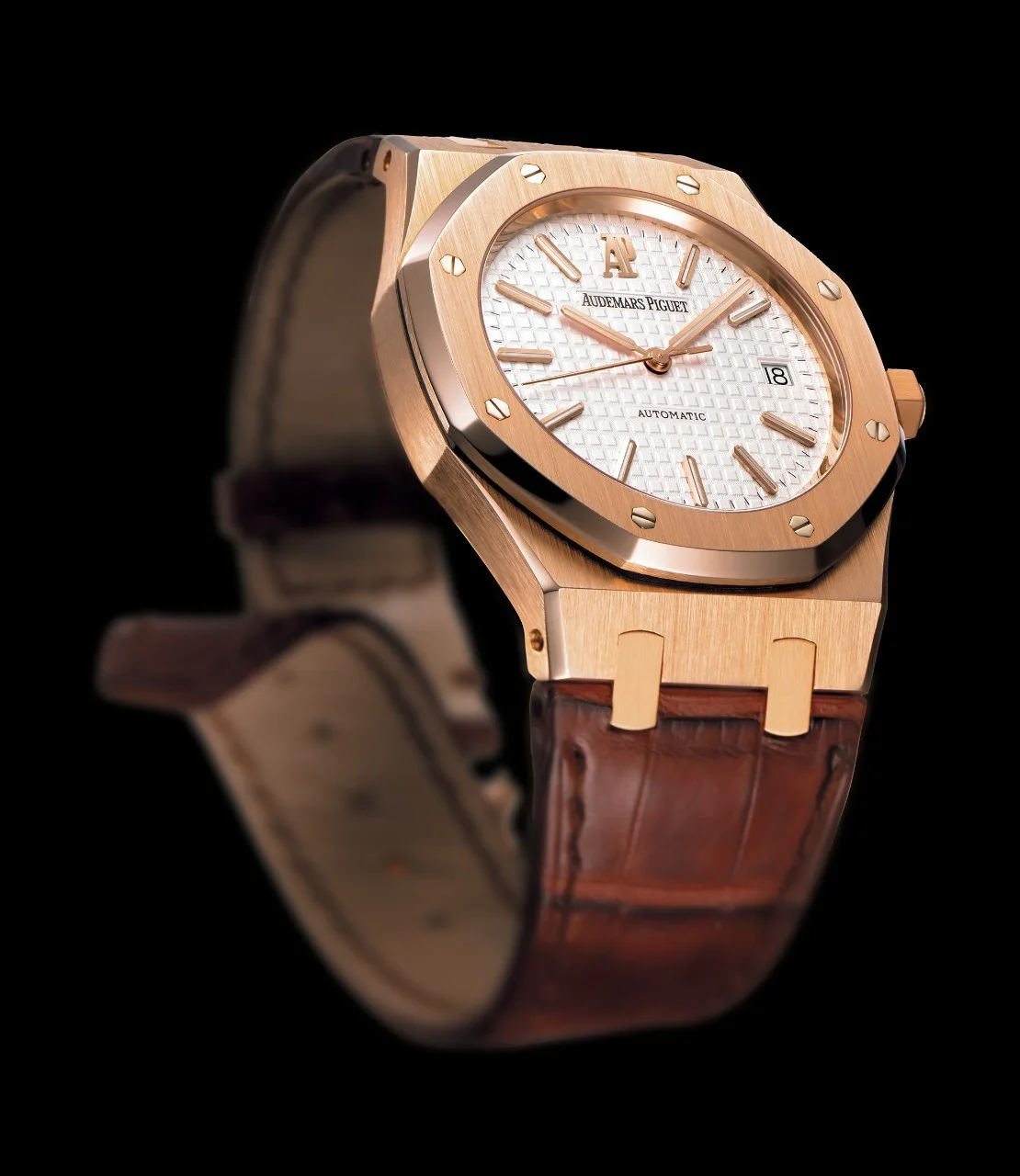
2005. Royal Oak 15300OR. Right from its launch, the Royal Oak 15300 was available with a metal bracelet or leather strap. Date. Selfwinding Calibre 3120. 39mm case in 18-carat pink gold. Picture taken in 2005 at the launch of the model. Audemars Piguet Archives.
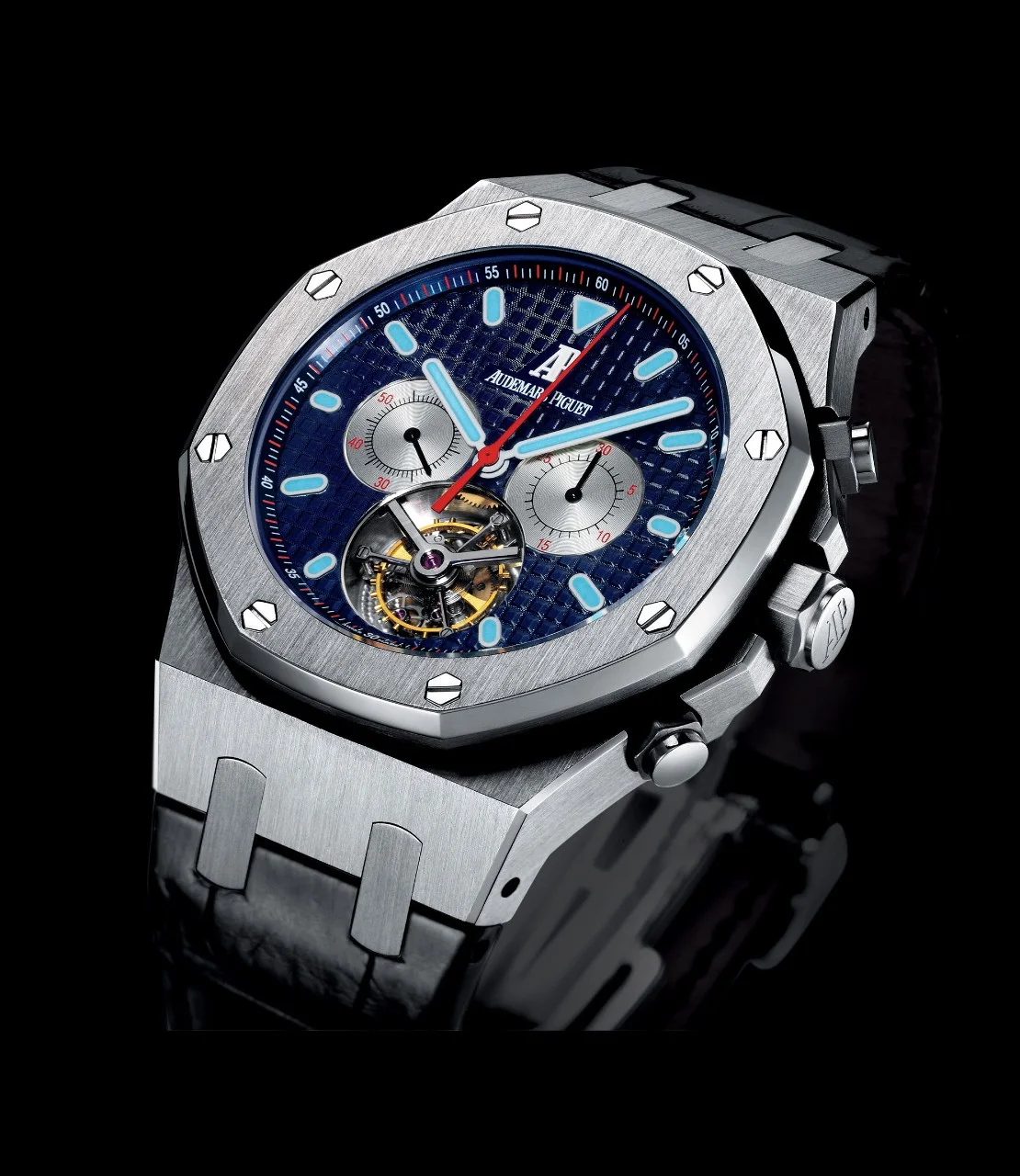
2004. Royal Oak Tourbillon Chronograph 25977ST. While fitted on a metal bracelet in 2004, this watch welcomed a leather strap two years later. Calibre 2889, movement 570746. 44 mm case no. F03631 in steel. Sold in Brazil in 2004. Audemars Piguet Heritage, inv. 737.
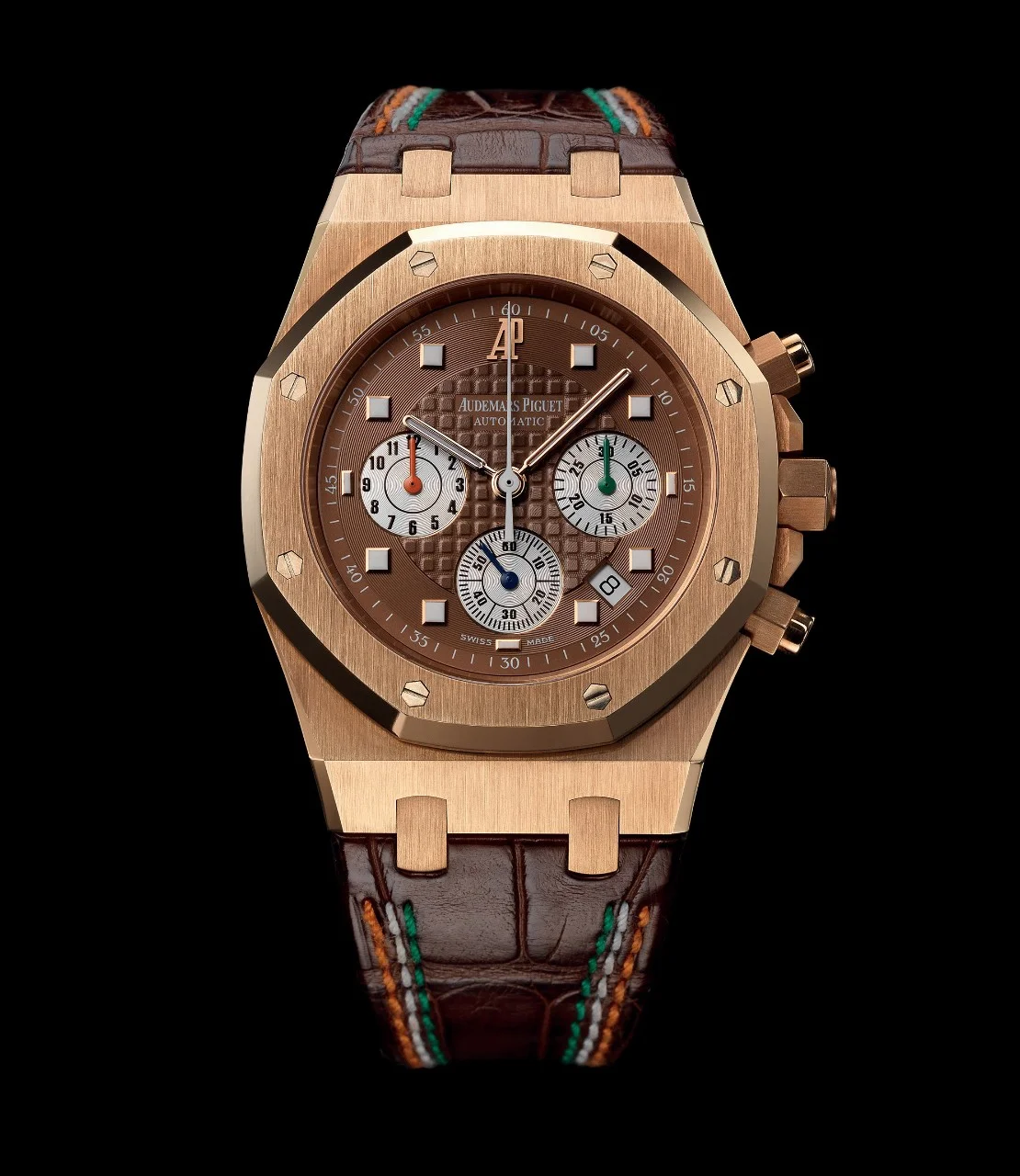
2008. Royal Oak Chronograph Sachin Tendulkar 16161OR. Watch in the colours of the Indian flag, in tribute to the greatest cricketer of his time. Chronograph, date. Calibre 2385. 39 mm case in 18-carat pink gold. Watch without movement presented at the launch of the limited edition. Audemars Piguet Heritage, inv. 1335.
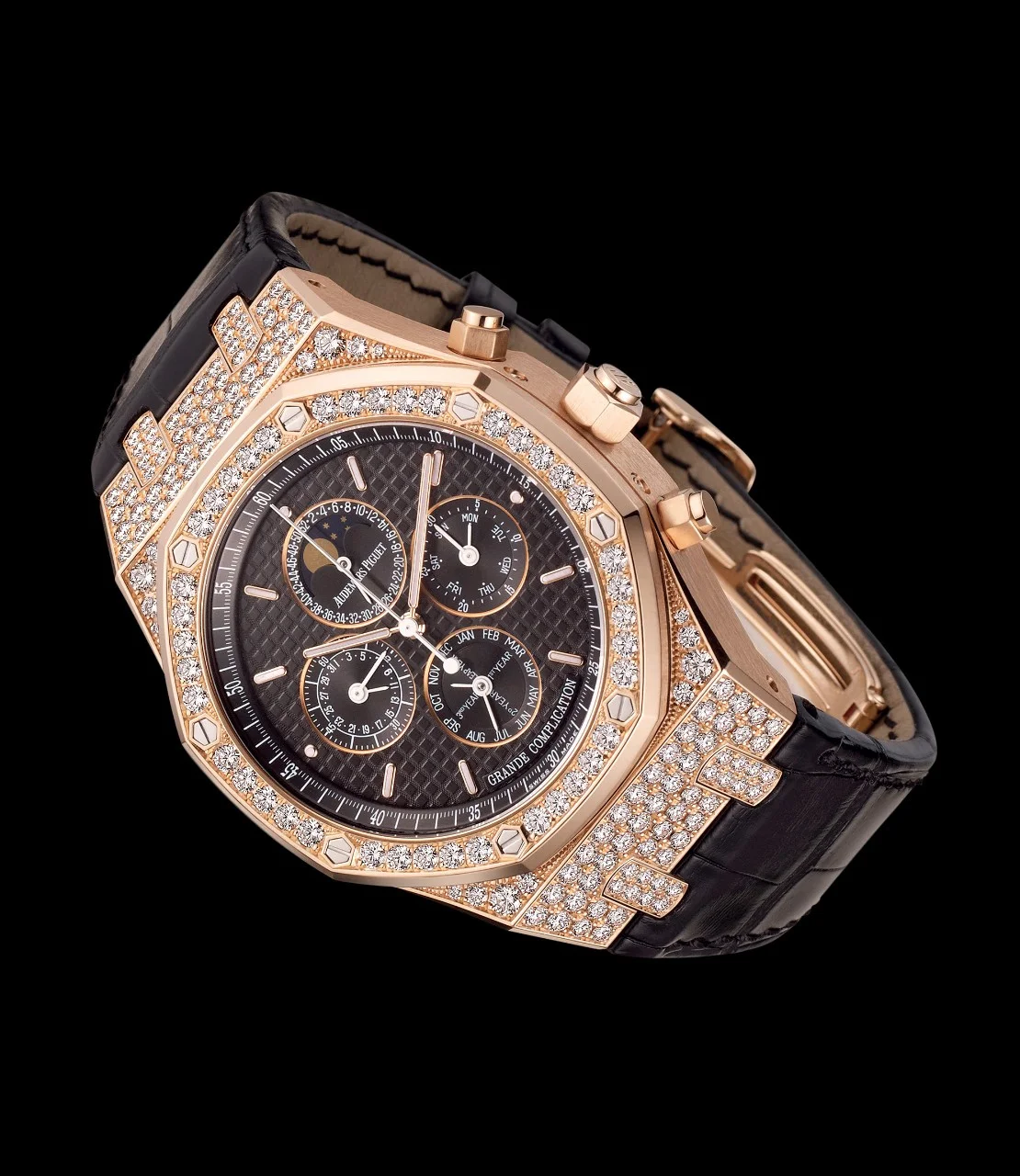
2012. Royal Oak Grande Complication 25990OR. This variant is one of the first Royal Oak Grande Complication models on leather strap. Calibre 2885. Perpetual calendar, minute repeater, split-seconds chronograph. Gemset 44 mm case in 18-carat pink gold. Image taken in 2012 at the launch of the model. Audemars Piguet Archives.
Conclusion
In 1972, the Royal Oak bracelet no. 344 for the first time united two hitherto opposite worlds: hand-crafted jewellery bracelets whose history dates back to the origins of jewellery; and steel sports bracelets, which came into being with water-resistant men's wristwatches and were produced on an industrial scale.
This integrated bracelet is one of the Royal Oak’s most recognisable features. Its wide, tapering links, punctuated by progressively smaller studs, are adorned with the same care as the case whose design they echo. Its development and production proved so complex that in the 1980s and 1990s, it was the Royal Oak cases that were adapted to the bracelet and not the other way round.
Interpreted in dozens of variants, materials and sizes, the wristband has taken liberties over the decades, adopting leather from the 1990s, including an embroidered version in 2008 (67607), then rubber, platinum, titanium as well as ceramic. With an eye to the future, Audemars Piguet also presented in November 2021 its first Royal Oak bracelet combining sandblasted titanium (links) with polished Bulk Metallic Glass (studs) for the unique Royal Oak “Jumbo” Extra-Thin timepiece dedicated to the Only Watch charity auction. Notably used in micro-electronics, this new palladium-based alloy – used for the first time at Audemars Piguet – shares several characteristics with other glasses when cooled rapidly, including amorphicity and high strength, making it particularly resistant to wear and corrosion. This unique piece ushers in a new generation of Royal Oak bracelets requiring the development of new manufacturing techniques and tools.
In 2022, on the occasion of the Royal Oak’s 50th anniversary, Audemars Piguet is adding a new subtlety: the bracelet taper that had previously been applied to the width alone for our metal bracelets is now reflected in the decreasing thickness of the first links.
Editorial board: Audemars Piguet Heritage team, Le Brassus
First publication: 10 May 2022
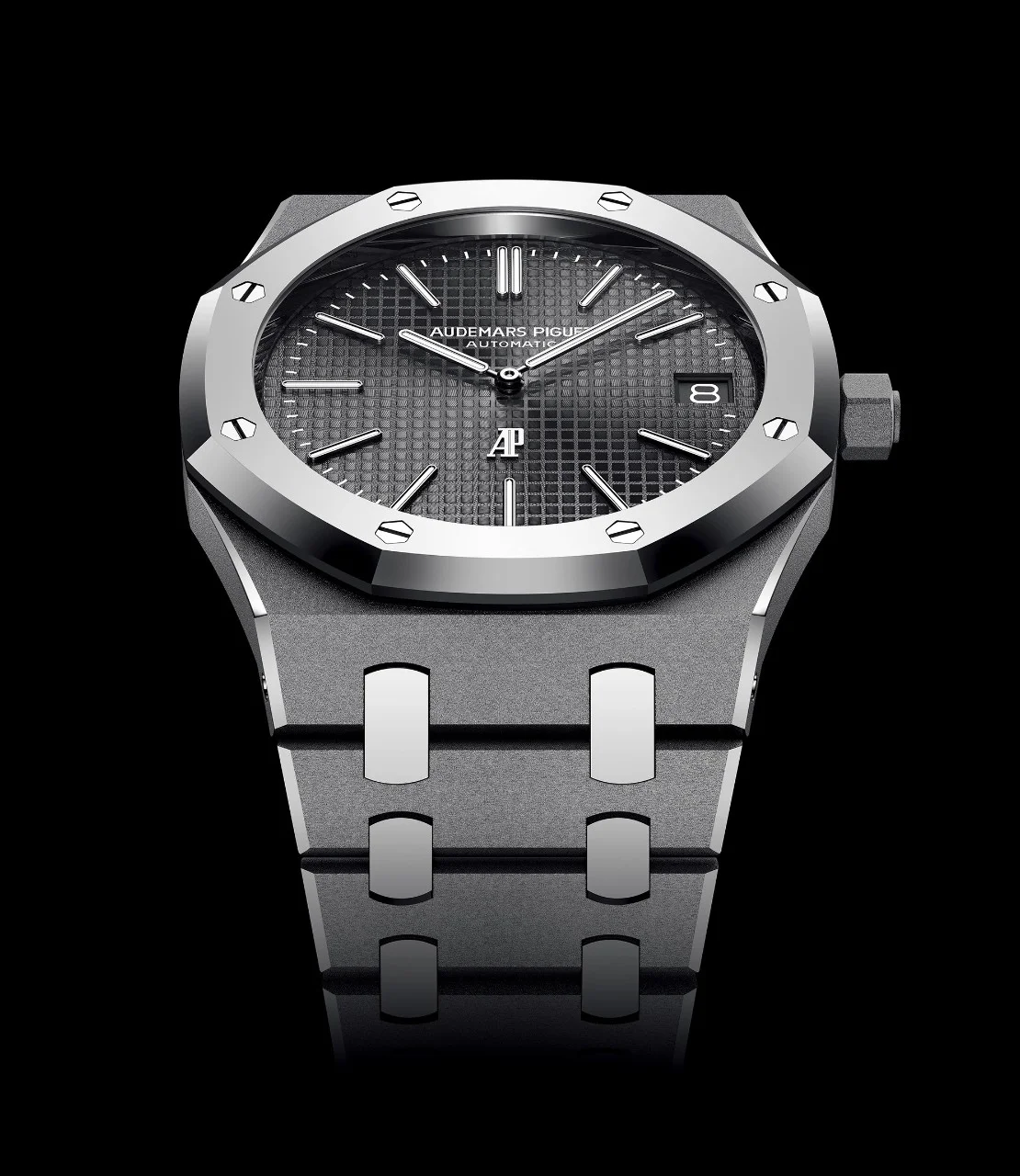
2021. Royal Oak 15202XT. One-of-a-kind model, the first to combine sandblasted titanium and bulk metallic glass (BMG), a new and particularly resistant material. Date. Calibre 2121. 39 mm case. Watch gifted to and auctioned at the Only Watch 2021 charity auction. Picture taken during the presentation of the watch. Audemars Piguet Archives.
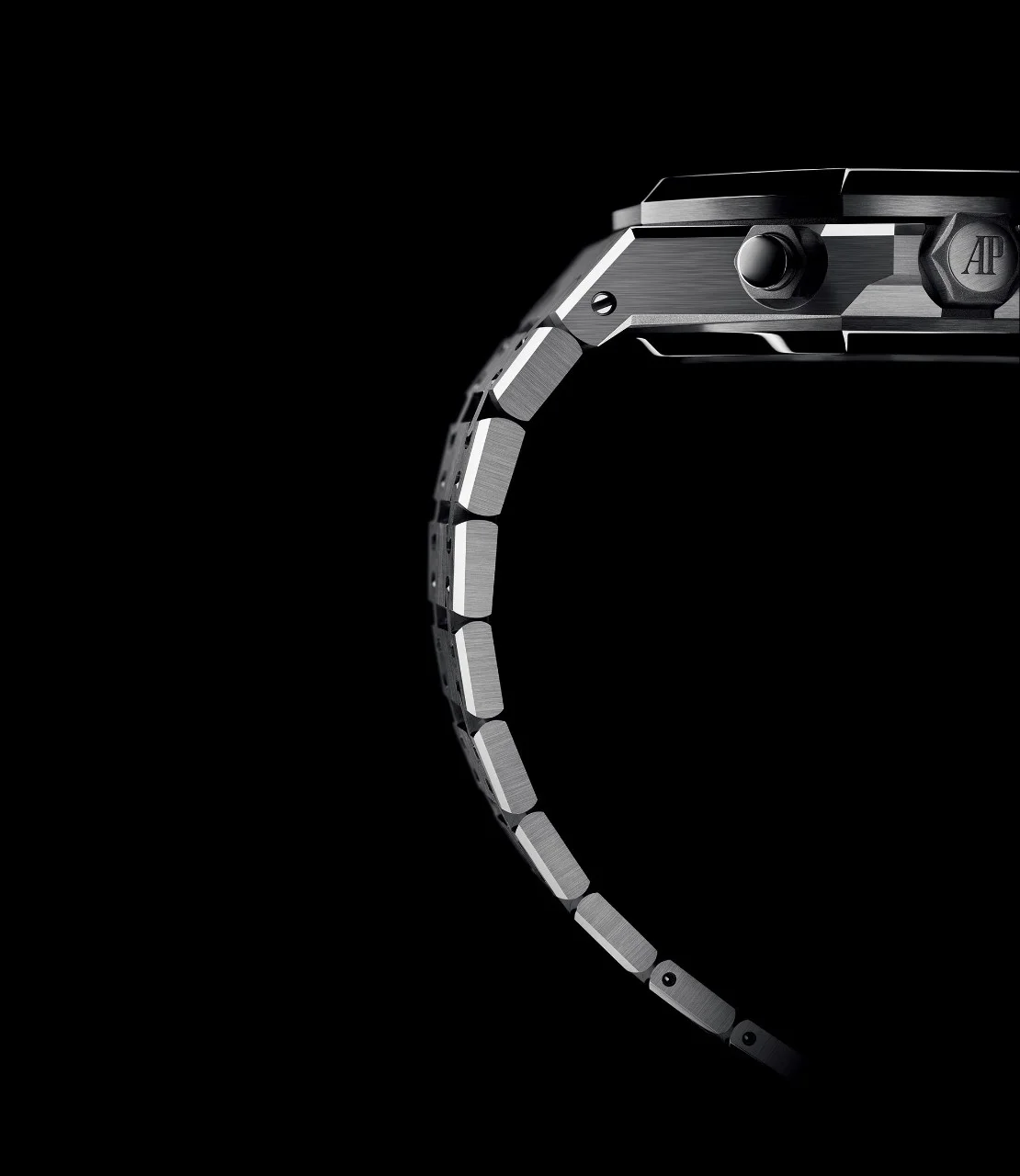
2022. Bracelet's decreasing thickness. On the occasion of the Royal Oak's 50th anniversary, Audemars Piguet has improved the ergonomics of several of its models' metal bracelets, including the 26240ST illustrated here. Integrated to the case, the first link adopts a trapezoid shape, also found on the following links, the thickness of which progressively decreases. Picture taken in 2022, for the launch of Model 26240.