Royal Oak: From Enfant Terrible to Full-Fledged Collection
Summary
The First Royal Oak, Enfant Terrible or Child Prodigy?
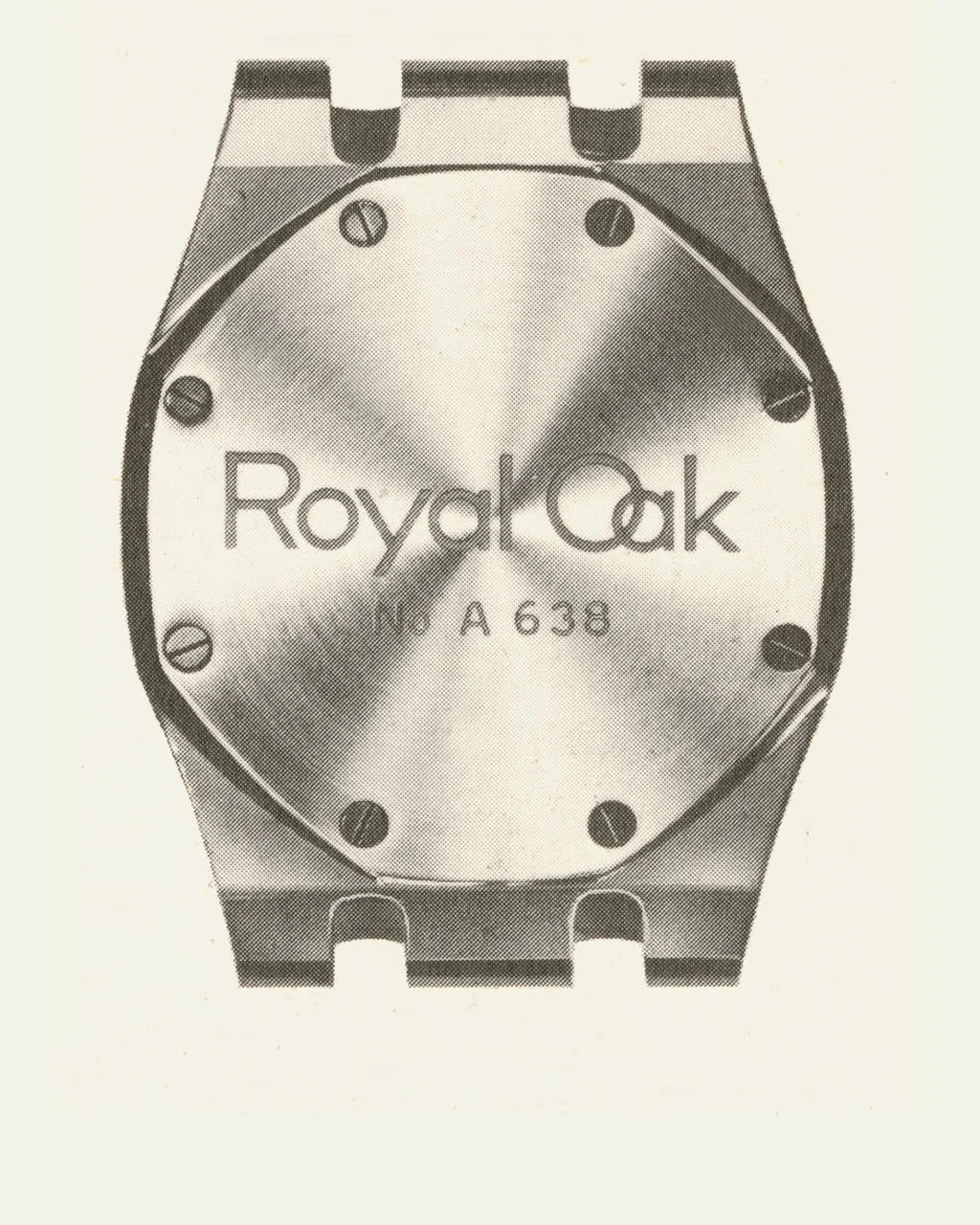
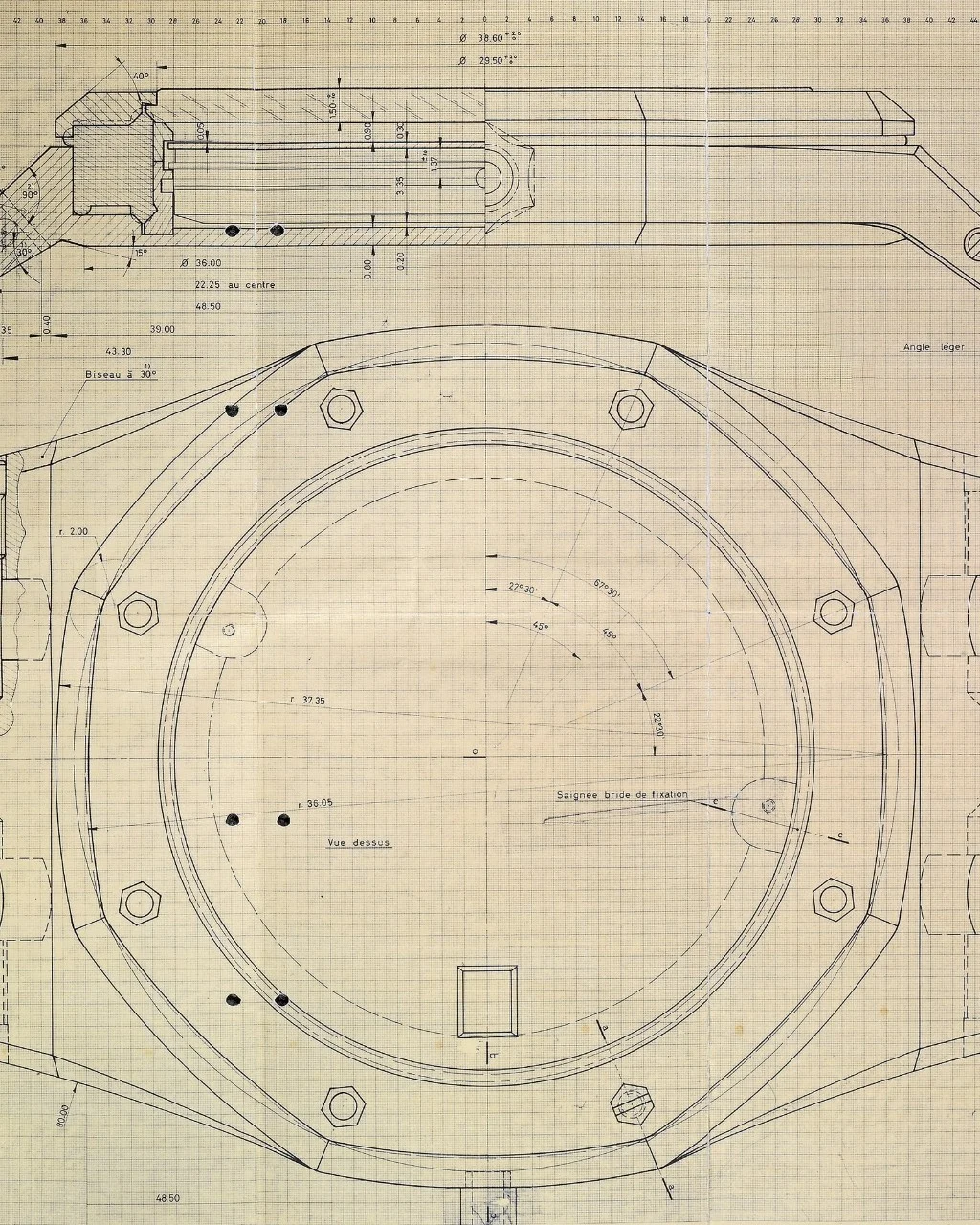
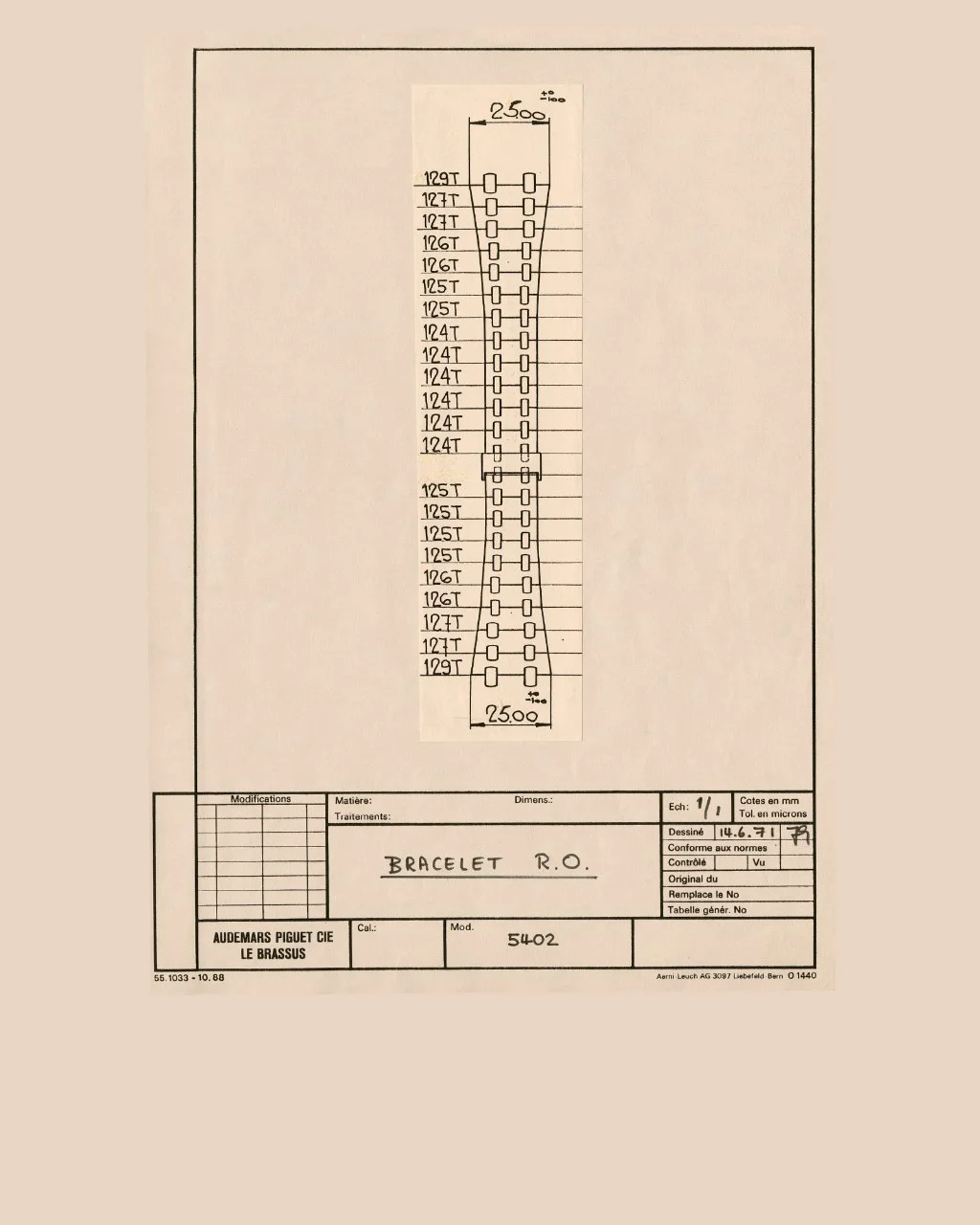
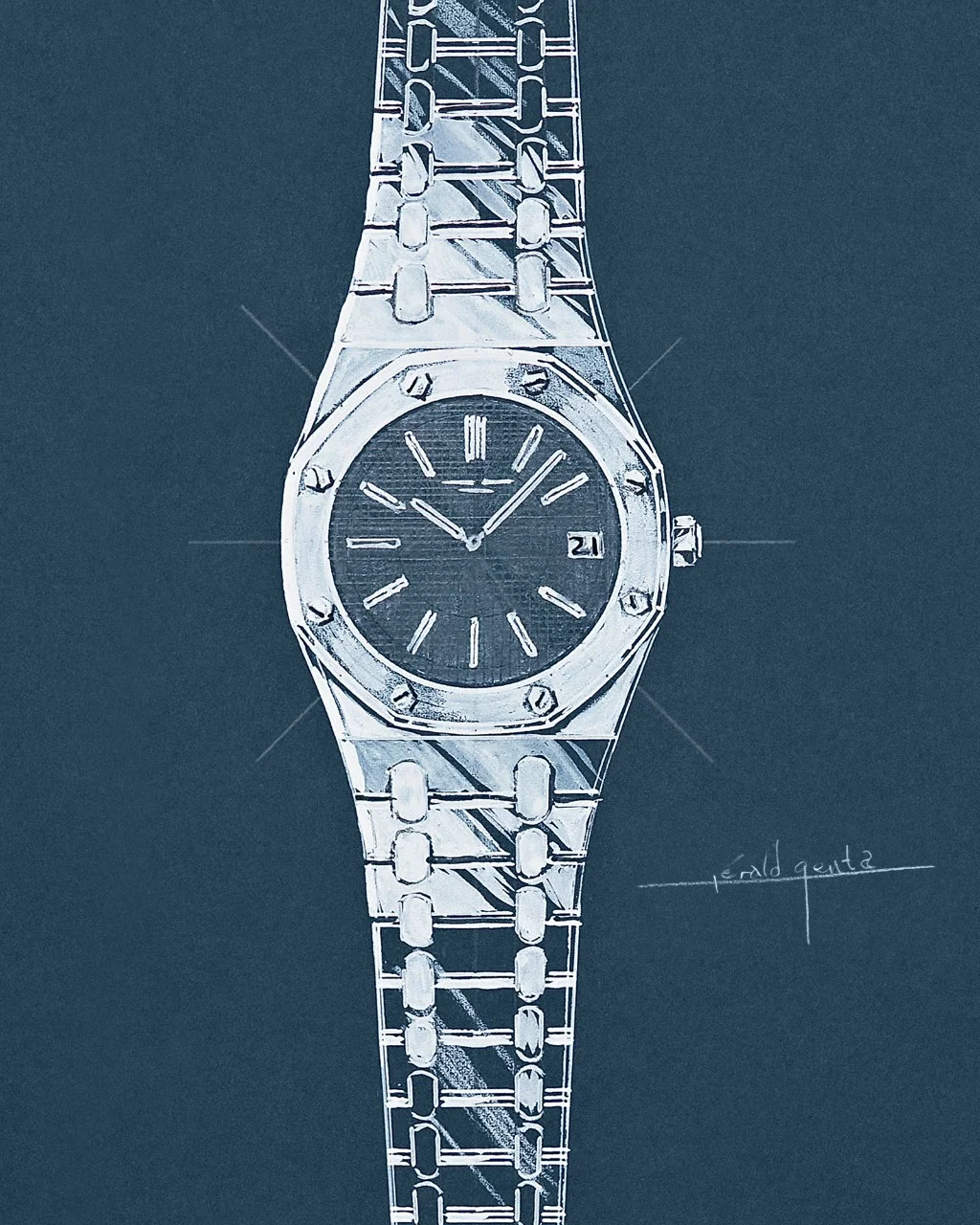
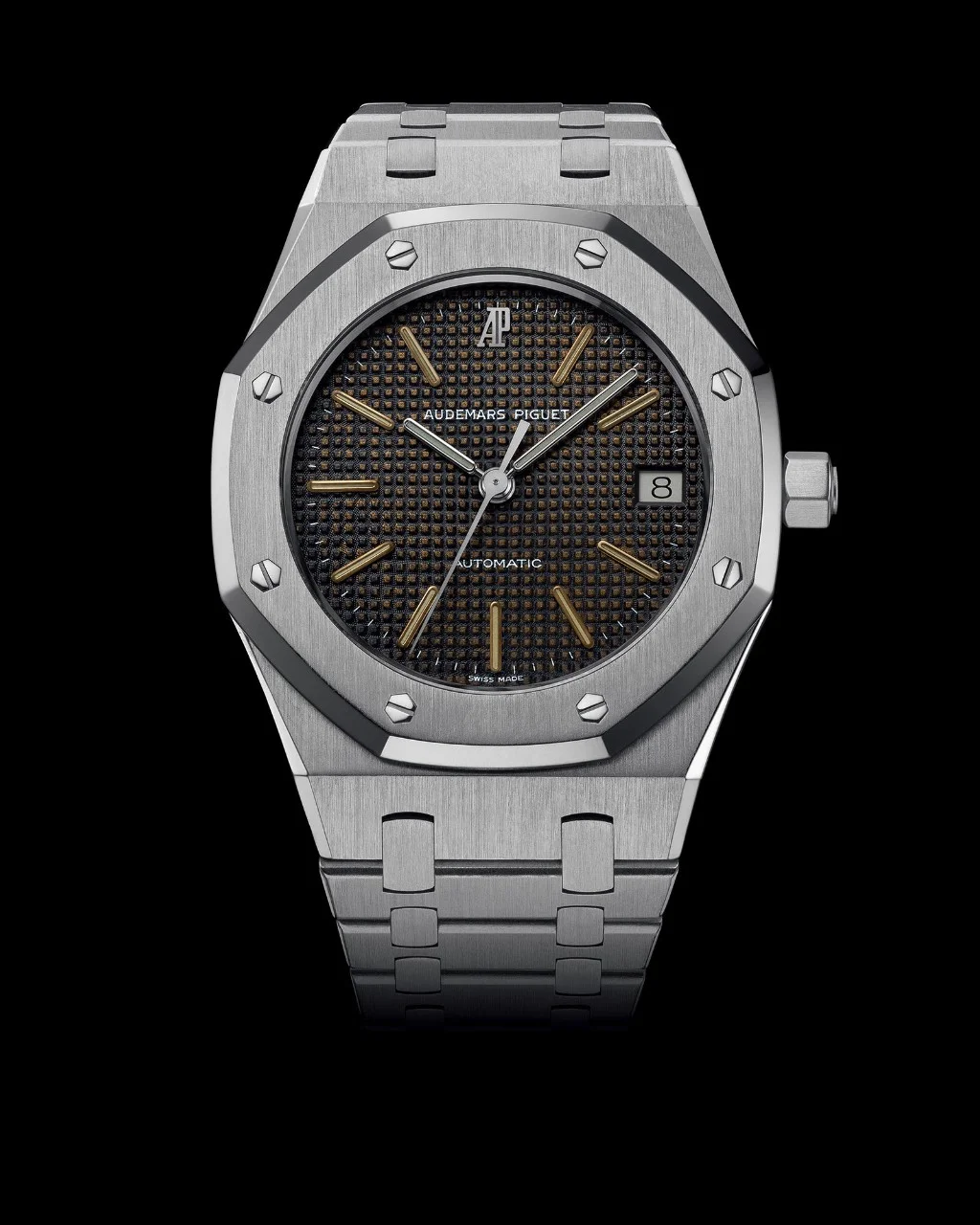
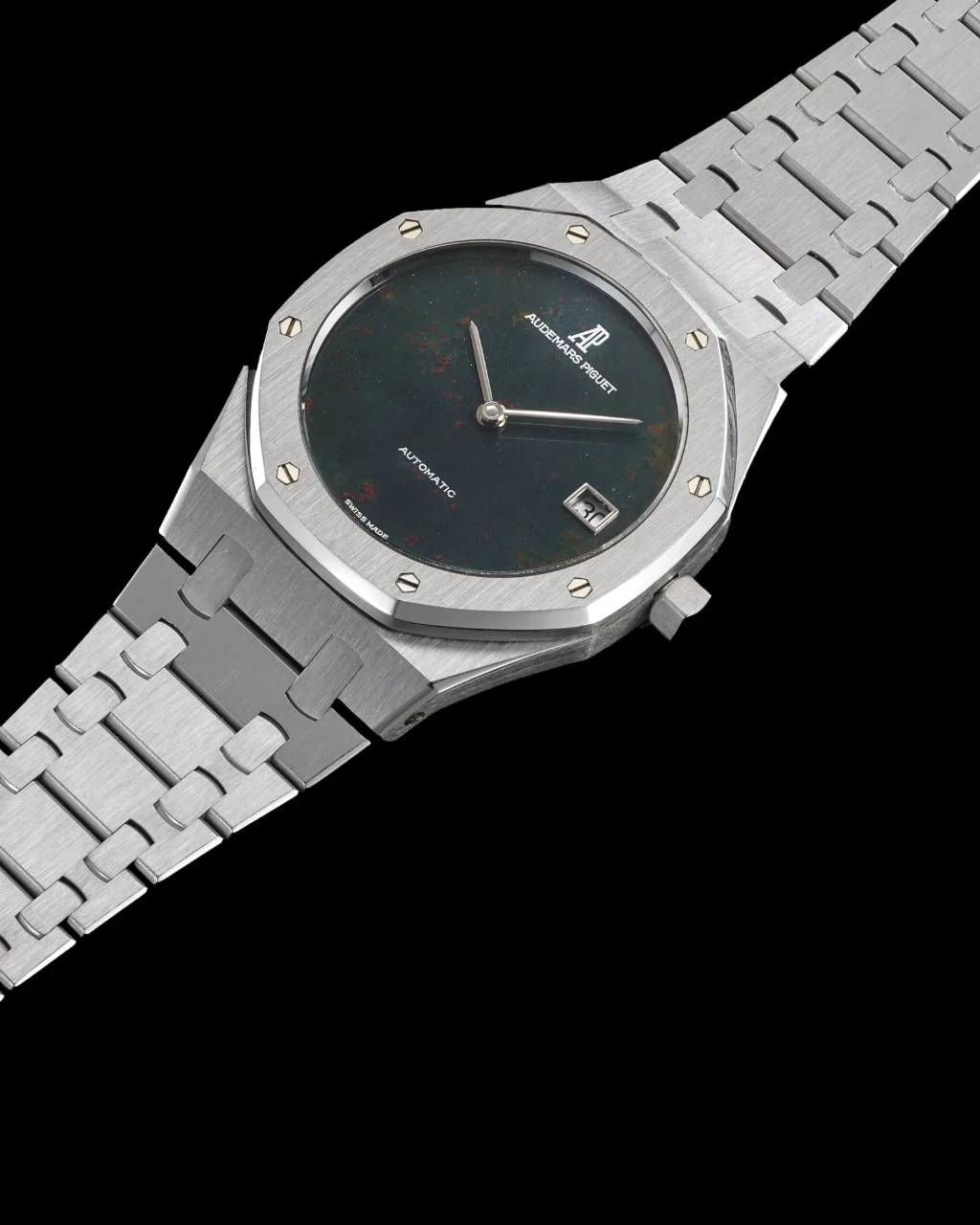
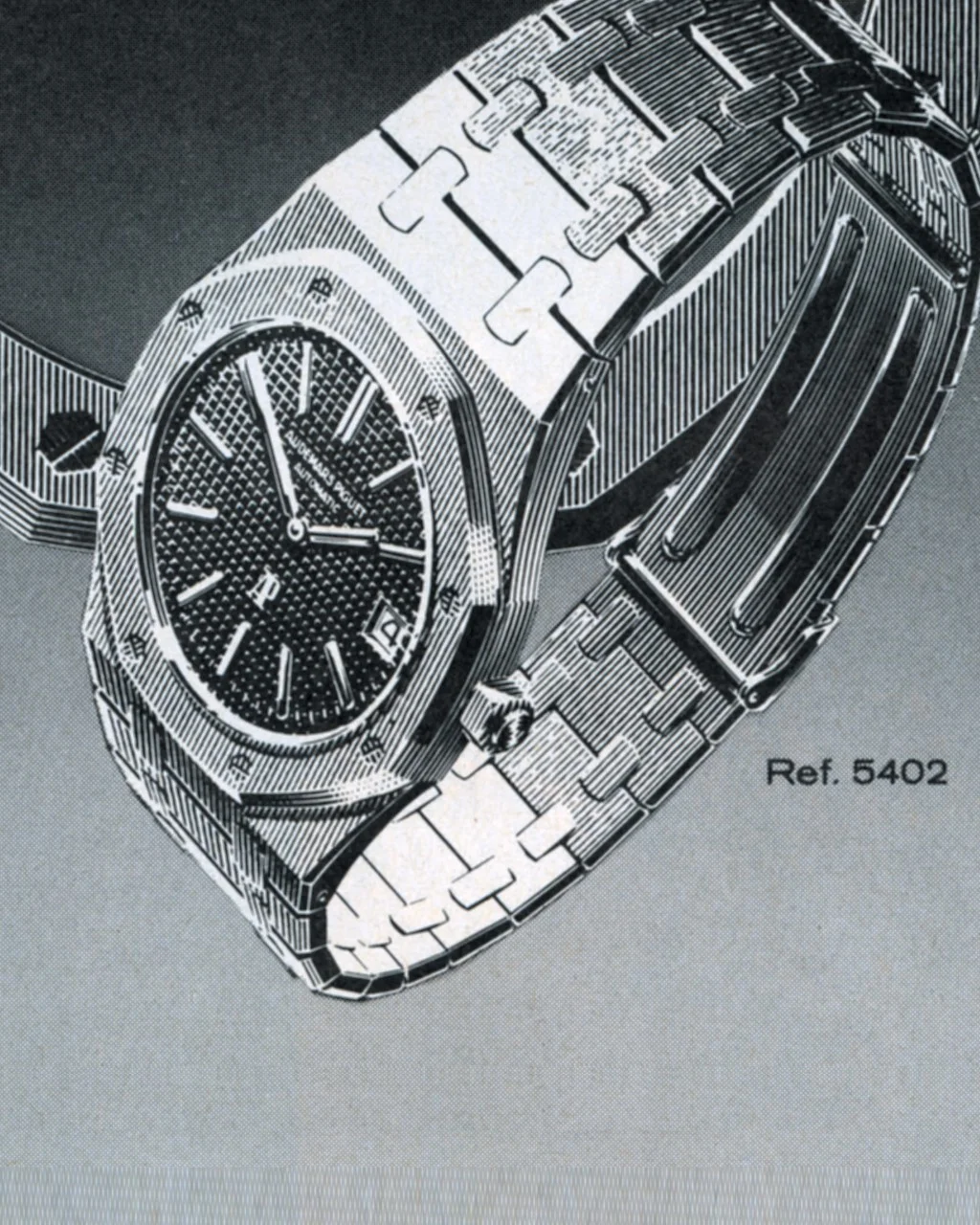
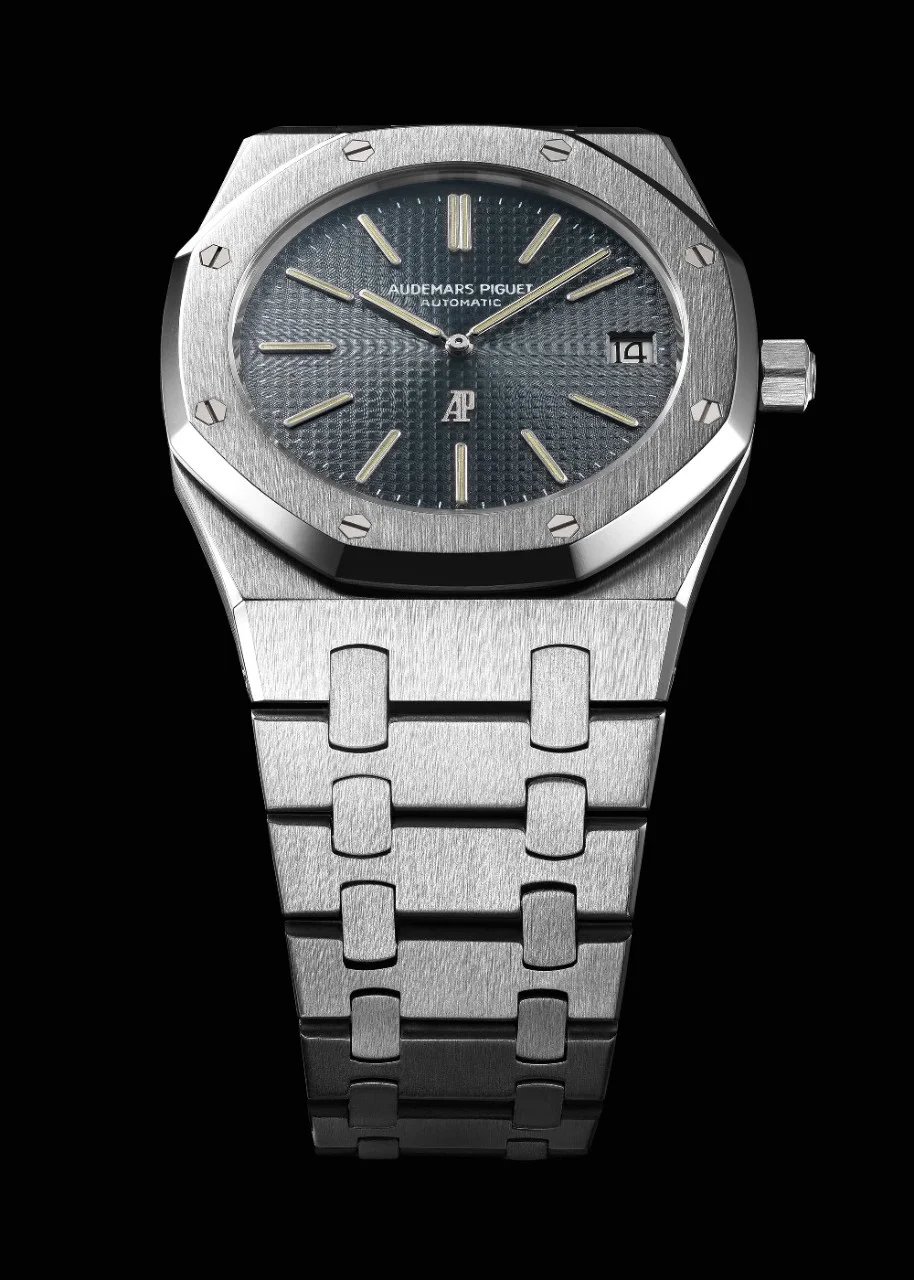
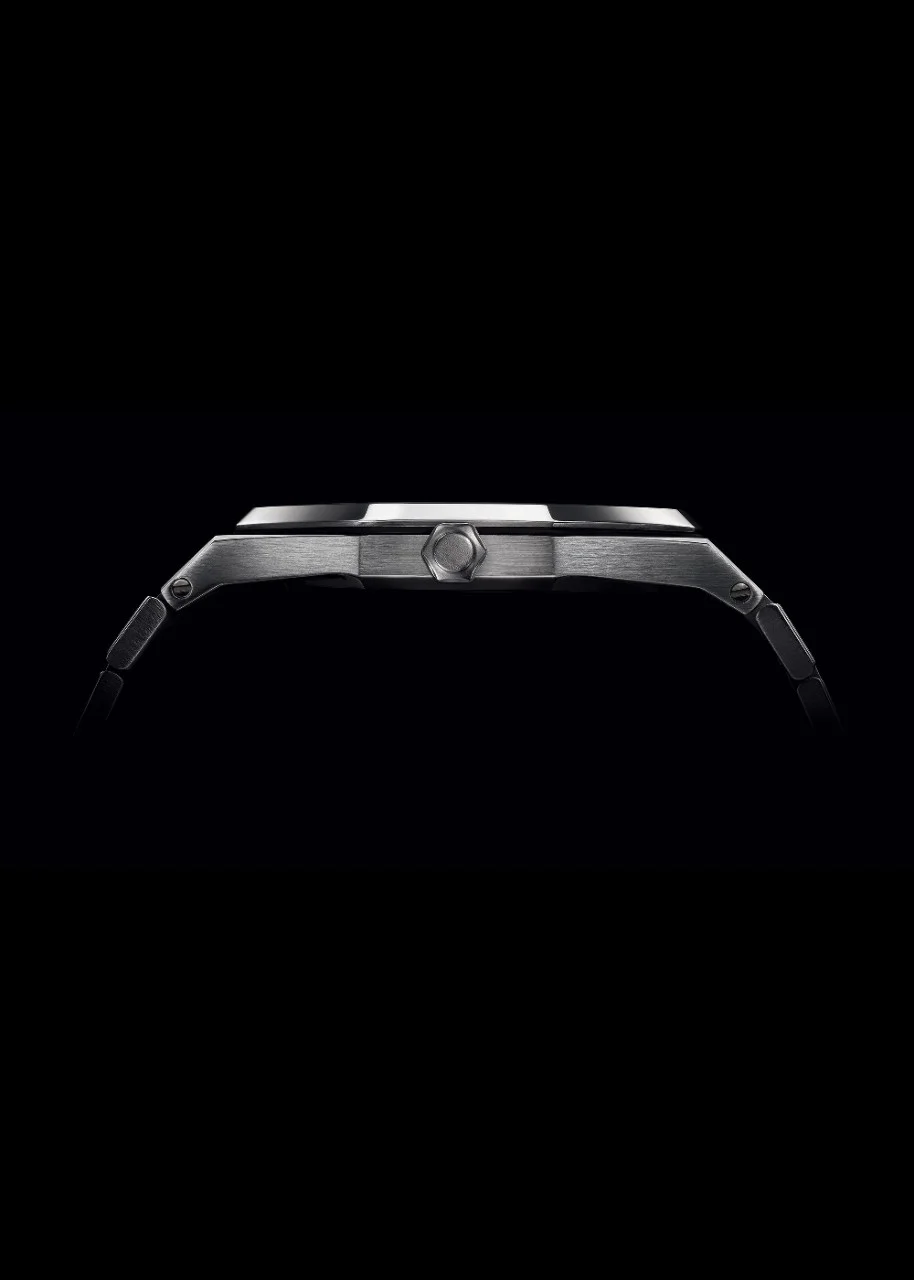
In 1972, the first Royal Oak made headlines. Its unprecedented concept sent shock waves through the traditionally muted world of luxury watchmaking. Designed by Gérald Genta, its exterior raised steel to a status equalling that of gold. The eight hexagonal screws displayed on the octagonal bezel – attributes previously unimaginable in the realm of Haute Horlogerie – expressed the robustness of a case containing a mechanical masterpiece: Calibre 2121, the world’s thinnest selfwinding movement with a central rotor. Extremely difficult to produce and decorate, the first Royal Oak was sold at the same price as the gold watches of its time.
Against all odds, it met with an enthusiastic response as soon as it was launched on April 15, 1972. At the end of the same year, it was already Audemars Piguet’s most successful single model since the company founding in 1875, with 490 timepieces sold in less than eight months. It is worth recalling that the company in Le Brassus employed less than 100 people at the time to produce a few thousand watches, most of which were issued in very small series averaging 25 units, or even as one-offs.
Little by little, the Royal Oak won over a number of active clients who invented faster, more dynamic and versatile lifestyles, combining sportiness with elegance. Although sales grew steadily over the next four years, the Royal Oak remained a kind of UFO at Audemars Piguet, a free spirit, an enfant terrible or a child prodigy... correspondingly difficult to handle.
Giving the Royal Oak Its Place without Losing the Brand Identity
Then at the helm of Audemars Piguet, Georges Golay understood that the Royal Oak could well change the company’s destiny and strongly influence the brand image. While actively supporting the Royal Oak, he expressed his doubts while the model was being designed by Gérald Genta. The latter often told others about these doubts, which he interpreted as resistance. In 1982, the magazine Business & Finance questioned Georges Golay regarding the impact of the Royal Oak on brand image, as this watch featured an unconventional aesthetic, in sharp contrast to the Audemars Piguet collections of the time. Although he was delighted with the contribution of the Royal Oak, he pointed out: "We do not want our name to be projected to the public only through this star model.”
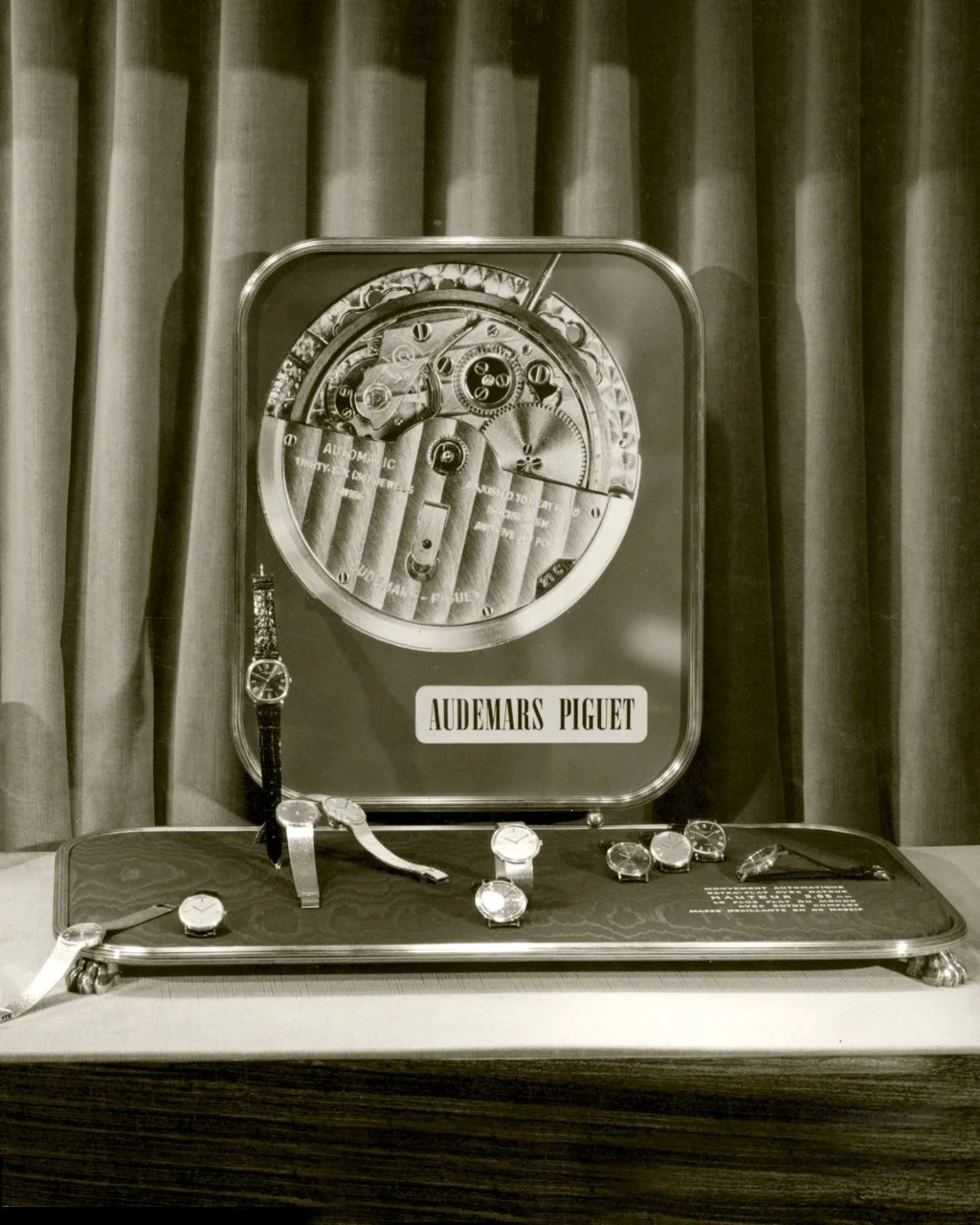
Is this the reason why variations of the Royal Oak did not appear until 1976? While there is no such specific indication in the sources, the figures show that Audemars Piguet was careful not to bet everything on the new model. Between 1972 and 1976, the Royal Oak never accounted for more than 7% of the watches produced by the company, nor 6% of the turnover. This is perhaps why some stakeholders of the period perceived it as a commercial failure. As for the advertising campaigns, most of them continued to highlight models that were skeletonised, feminine, oval-shaped or gemset, to name a few.

1972. Audemars Piguet brochure (cover) A woman is smoking a cigar. She wears on her wrist the so-called "Arabella" Haute Joaillerie watch, Model 8545. Audemars Piguet Archives.
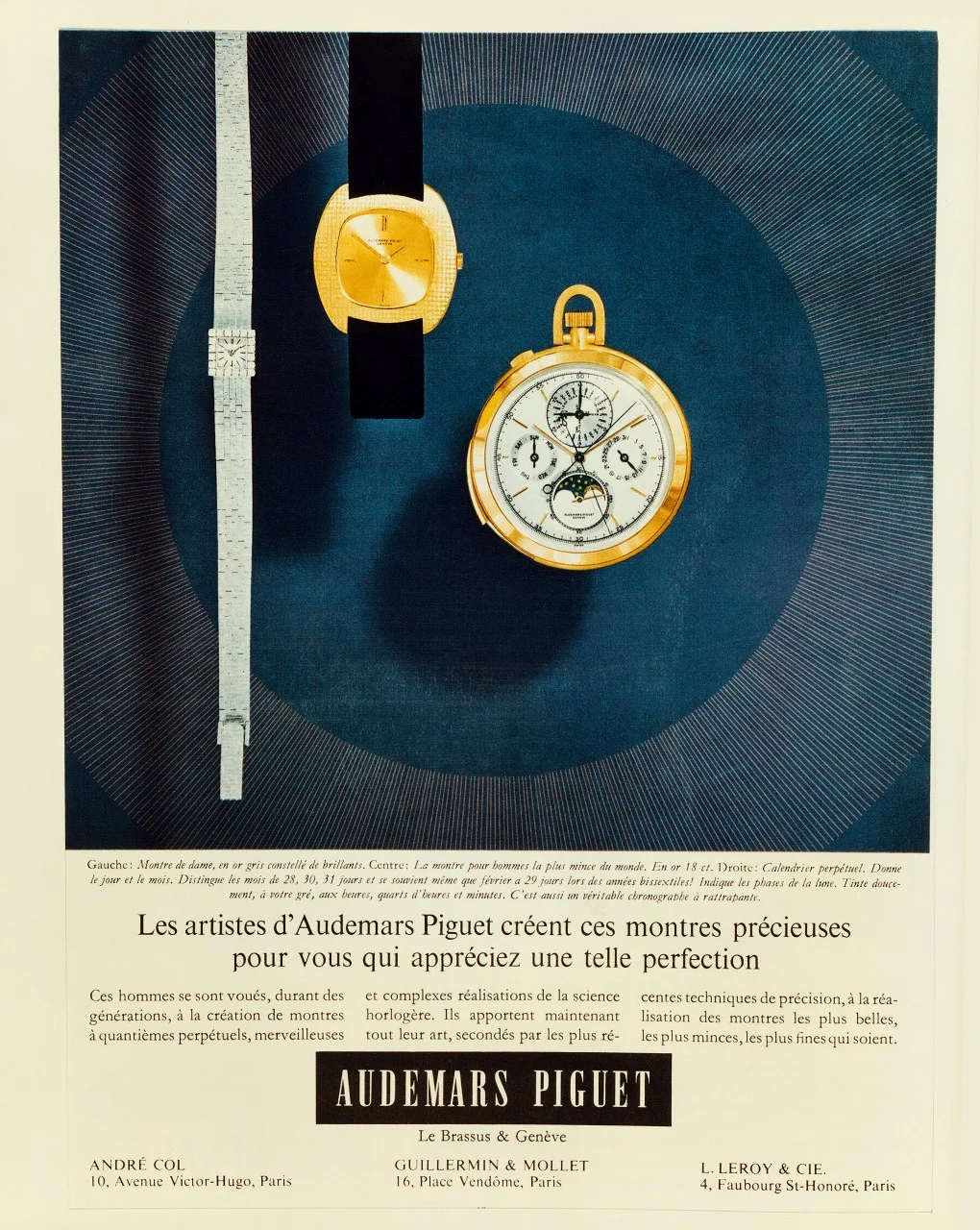
1966. Audemars Piguet advertisement This ad presents three of the brand's main specialties: the extreme miniaturisation of women's watches (left), ultra-thin watches (middle) and classic Grande Complication pocket watches (right). Audemars Piguet Archives.
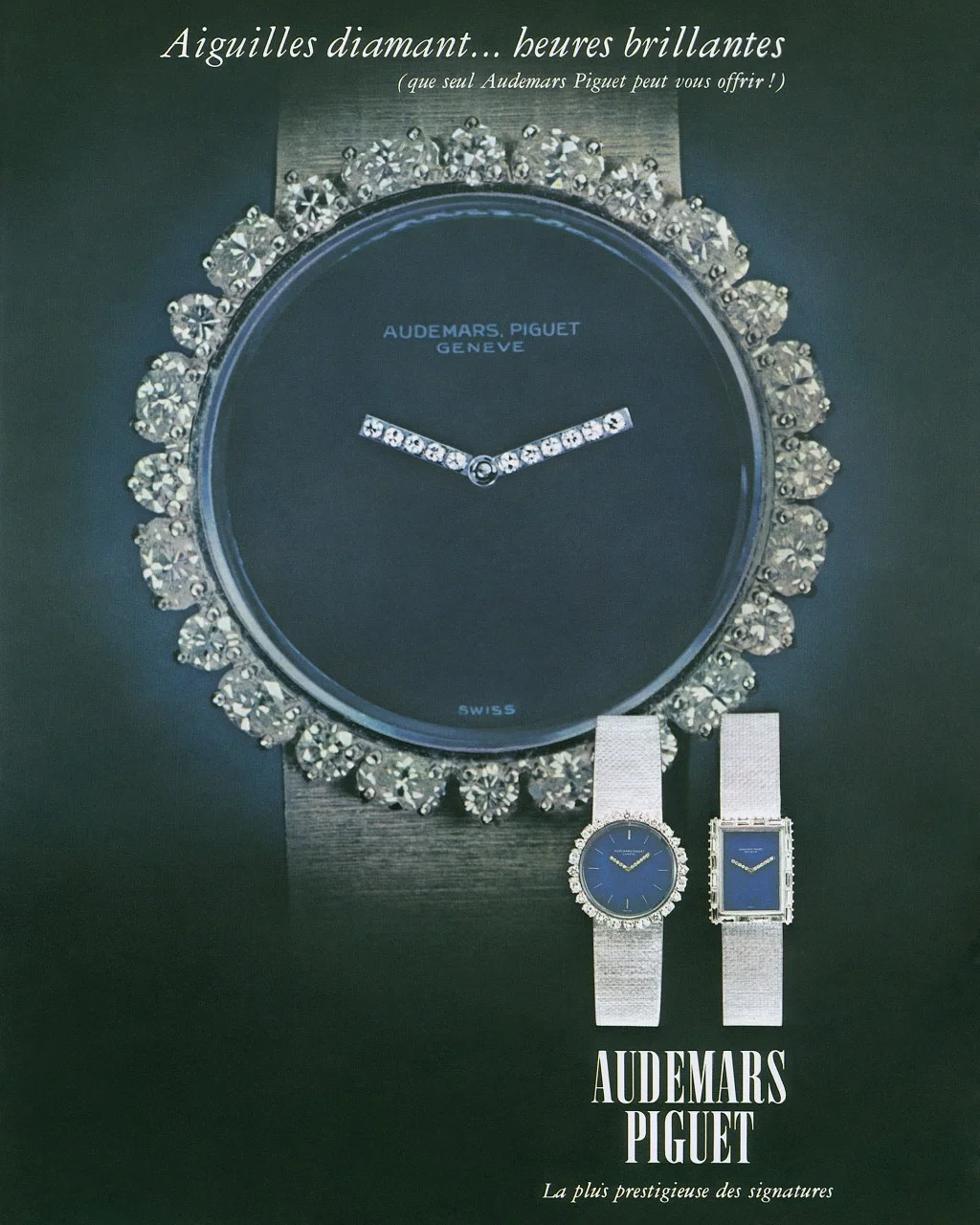
1970. Audemars Piguet advertisement In the 1970s–1980s, the gemset hands were part of the recognisable codes exclusive to Audemars Piguet. Audemars Piguet Archives.
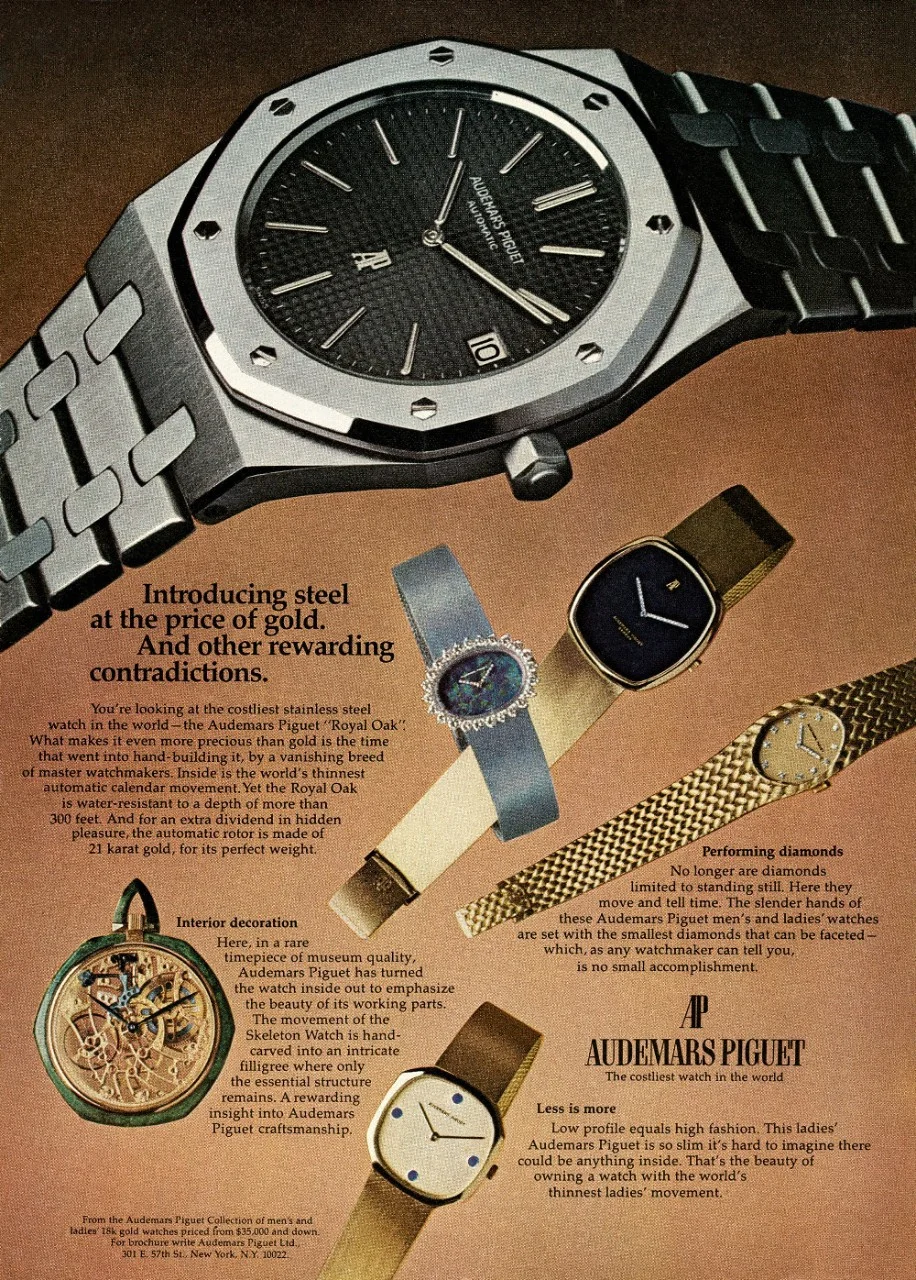
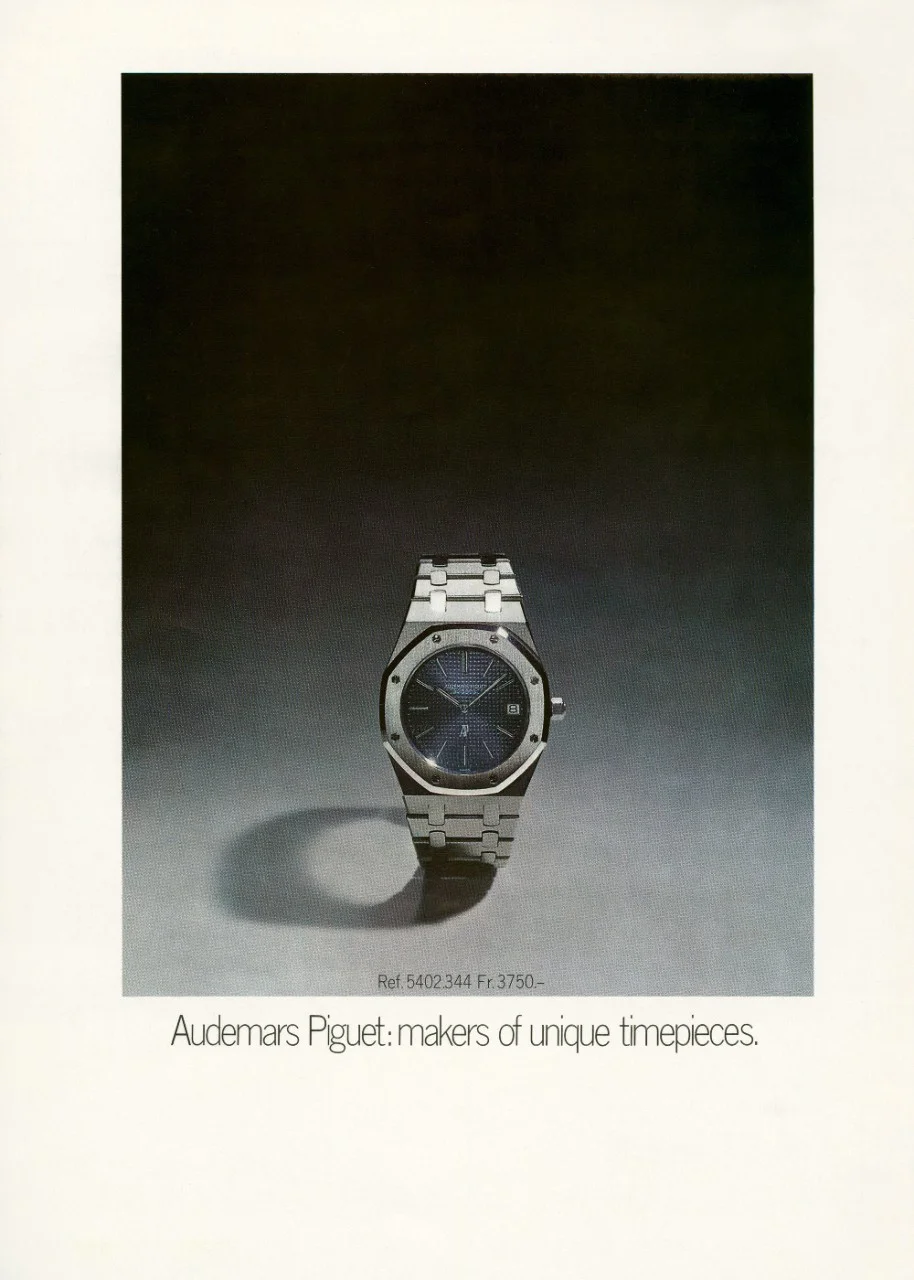
Circa 1974. Advertisement for multiple products By its scale and position, the Royal Oak dominates over the other watches presented in this ad. The text plays on this steel watch's high price to valorise it. Audemars Piguet Archives.
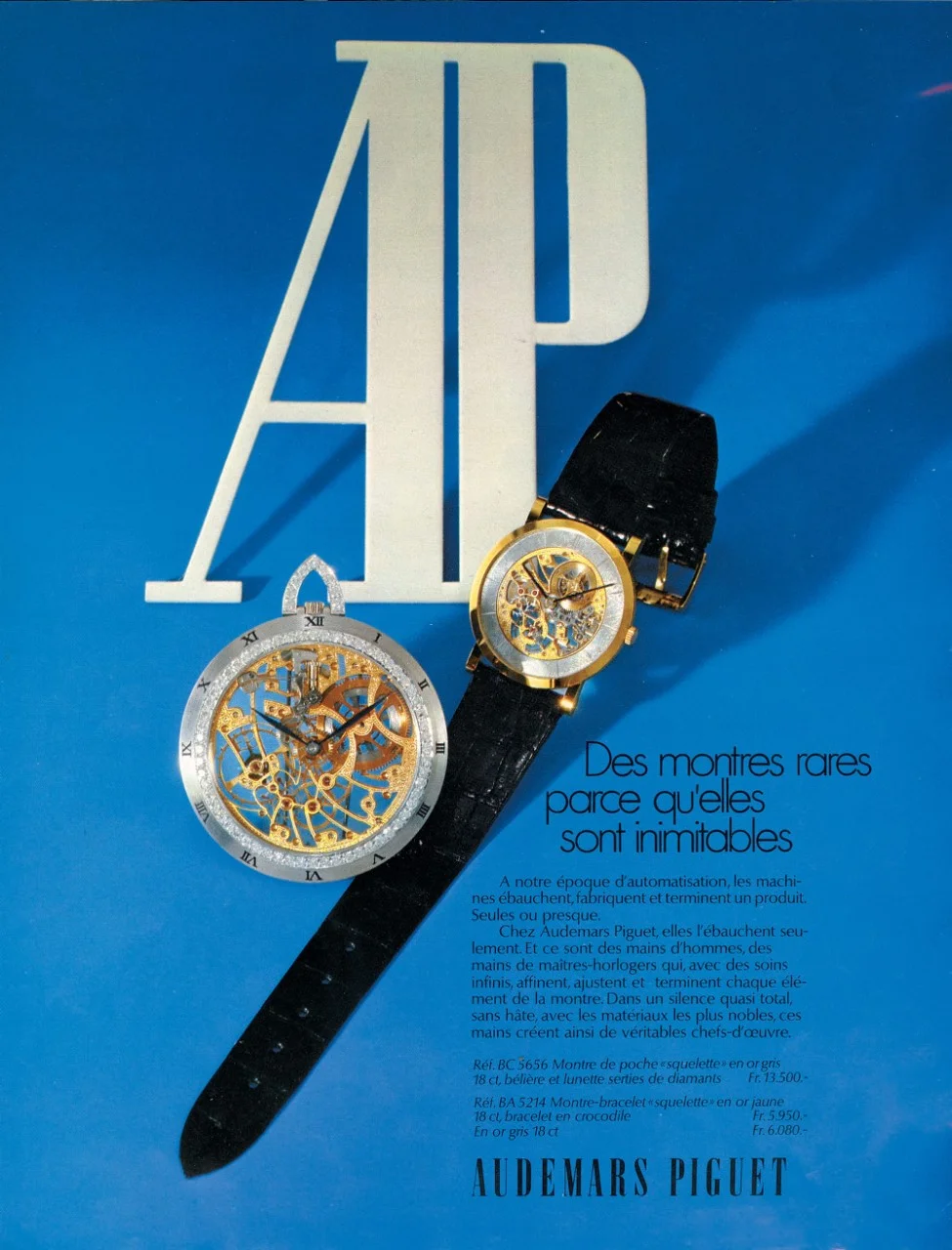
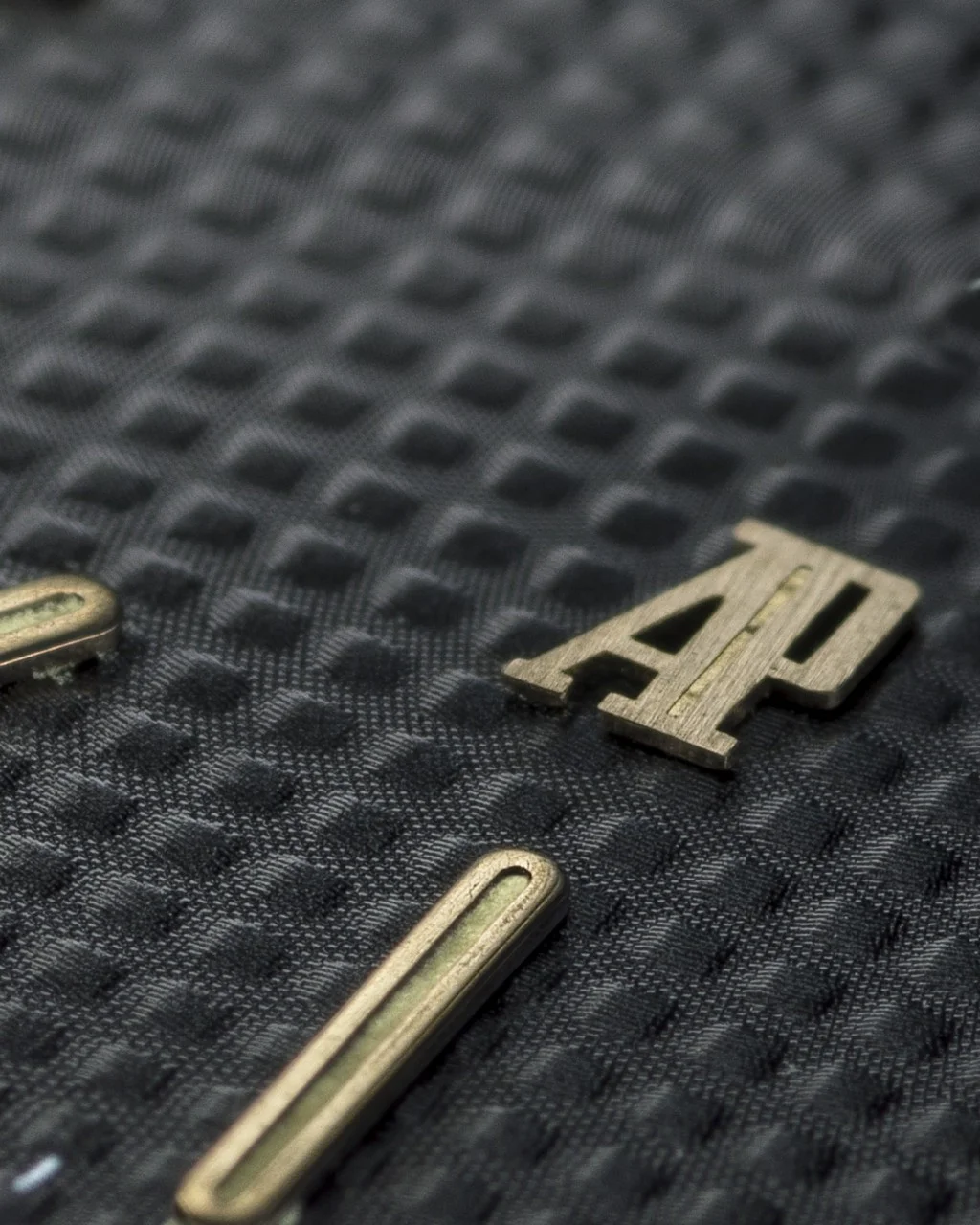
Circa 1975. Advertisement for openworked watches The eye is drawn to the vivid blue and to the oversized AP monogram. It then perceives the finesse of the openworked movement, the hand manufacturing of which is described in the text. Audemars Piguet Archives.
1976: The Royal Oak II Opens a Pandora's Box
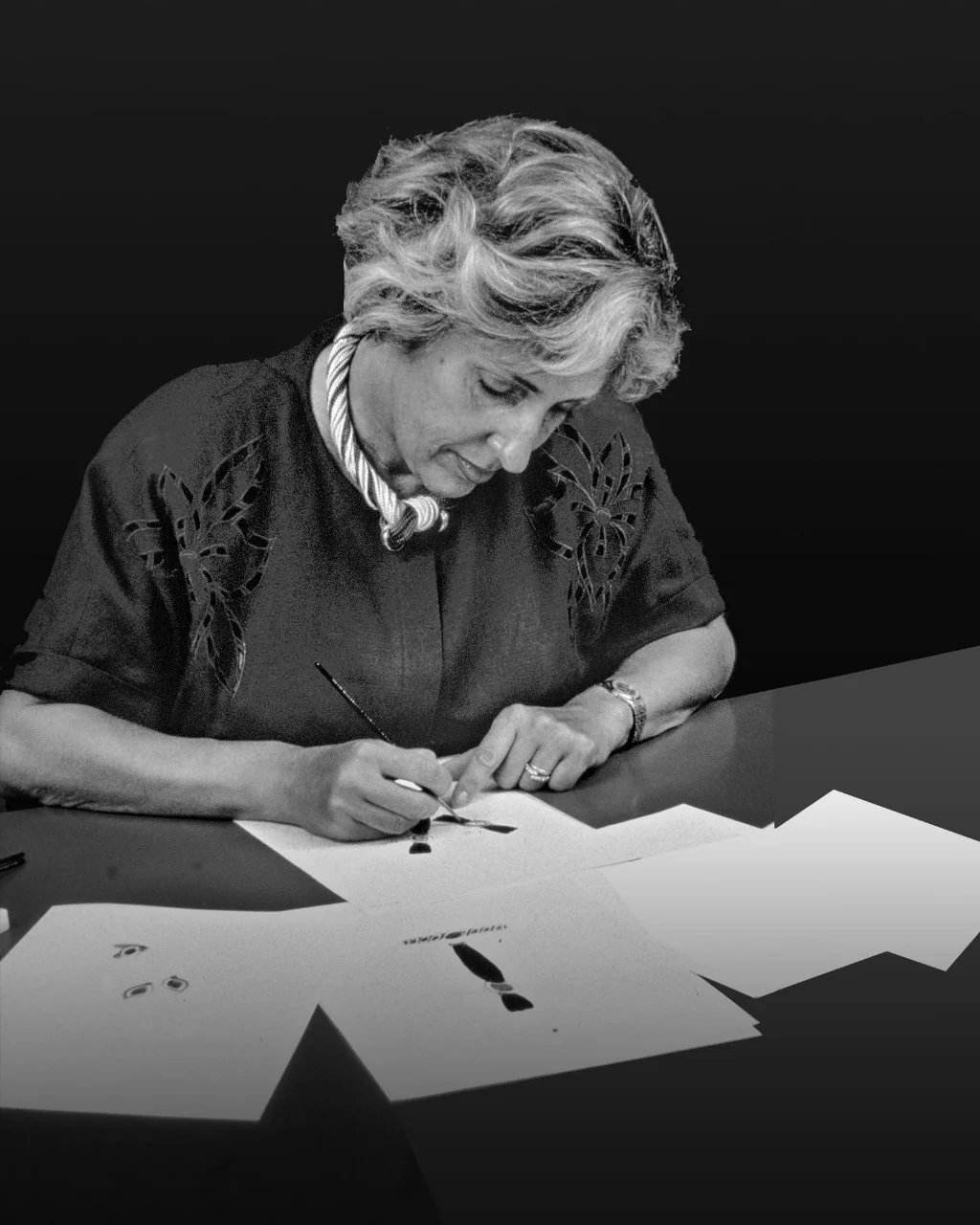
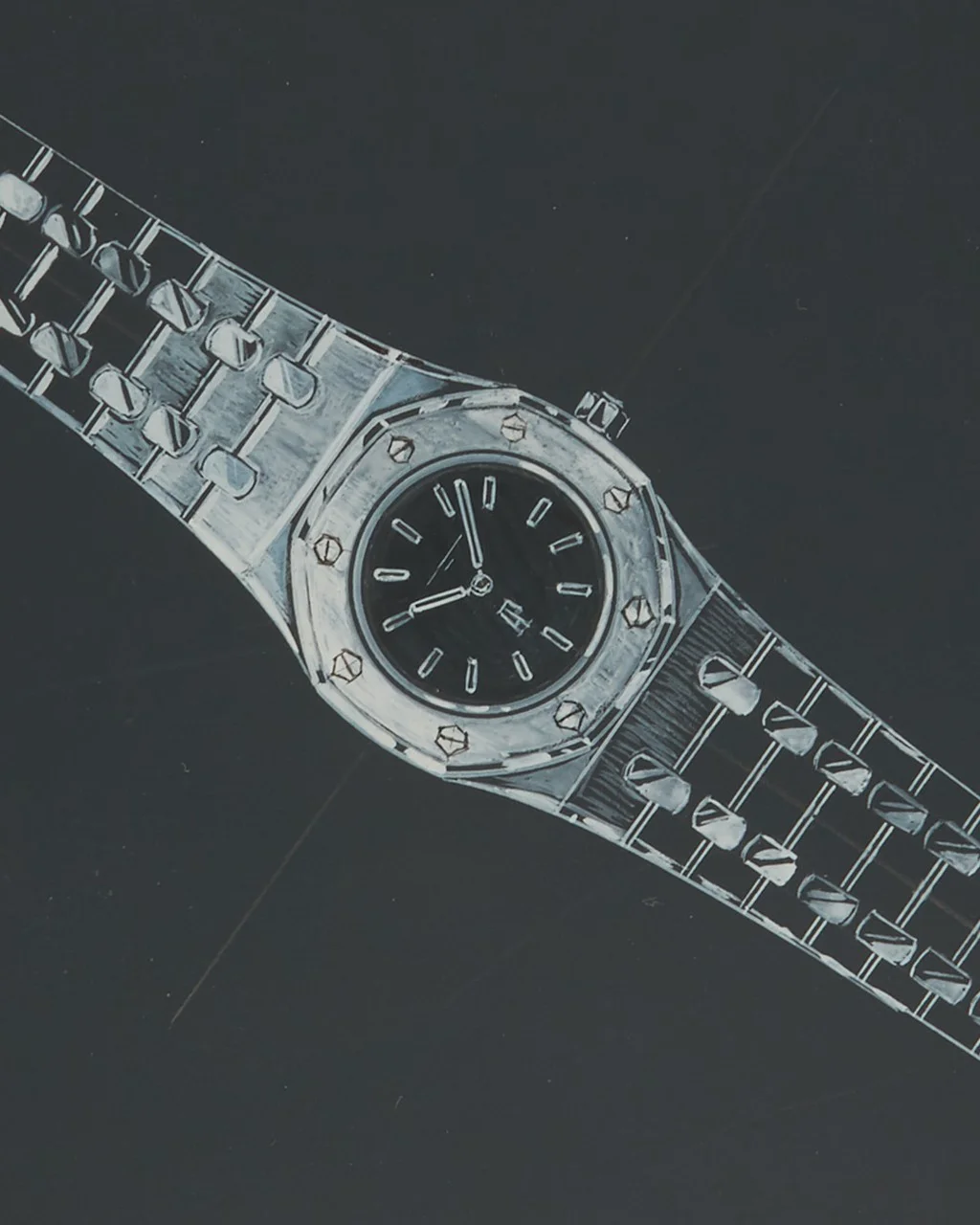
Records and testimonies do not reveal who, when or how the idea for the first ladies’ Royal Oak, Model 8638, originally named "Royal Oak II", came about. What is certain is that the origins of the project date back to well before its introduction. A sketch dated 1973 reveals a first version, followed in 1974 by the first production plans. It was not until the arrival of Audemars Piguet’s first female designer, Jacqueline Dimier, that the project was completed in 1976.
As radical, if not more so than the 1972 Model 5402, the 1976 Model 8638 was also made of steel, with visible screws and a miniature selfwinding mechanism. While the narrowing of its diameter from 39 mm to 29 mm made it even more difficult to produce, the model was a success right from the time of its launch. In 1976, 423 examples were sold; the following year, 756 left Le Brassus and the figure rose to almost 1,000 units in 1978 and exceeded this threshold in 1979.
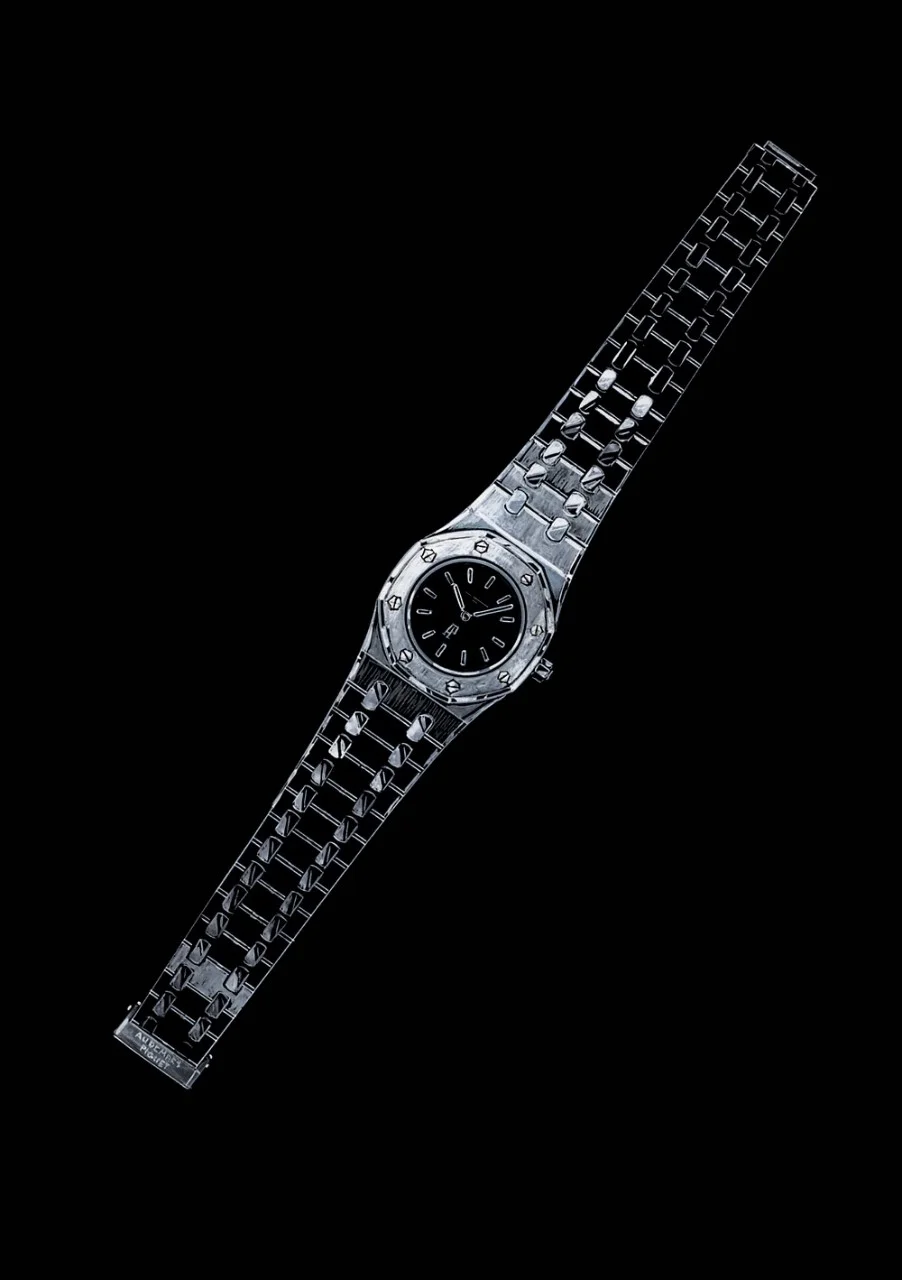
Circa 1973. First sketch of the Royal Oak II The first sketch of the second generation Royal Oak is perfectly in line with Model 5402. Only the diameter of the case and the proportions of the bezel differ. Audemars Piguet Archives.
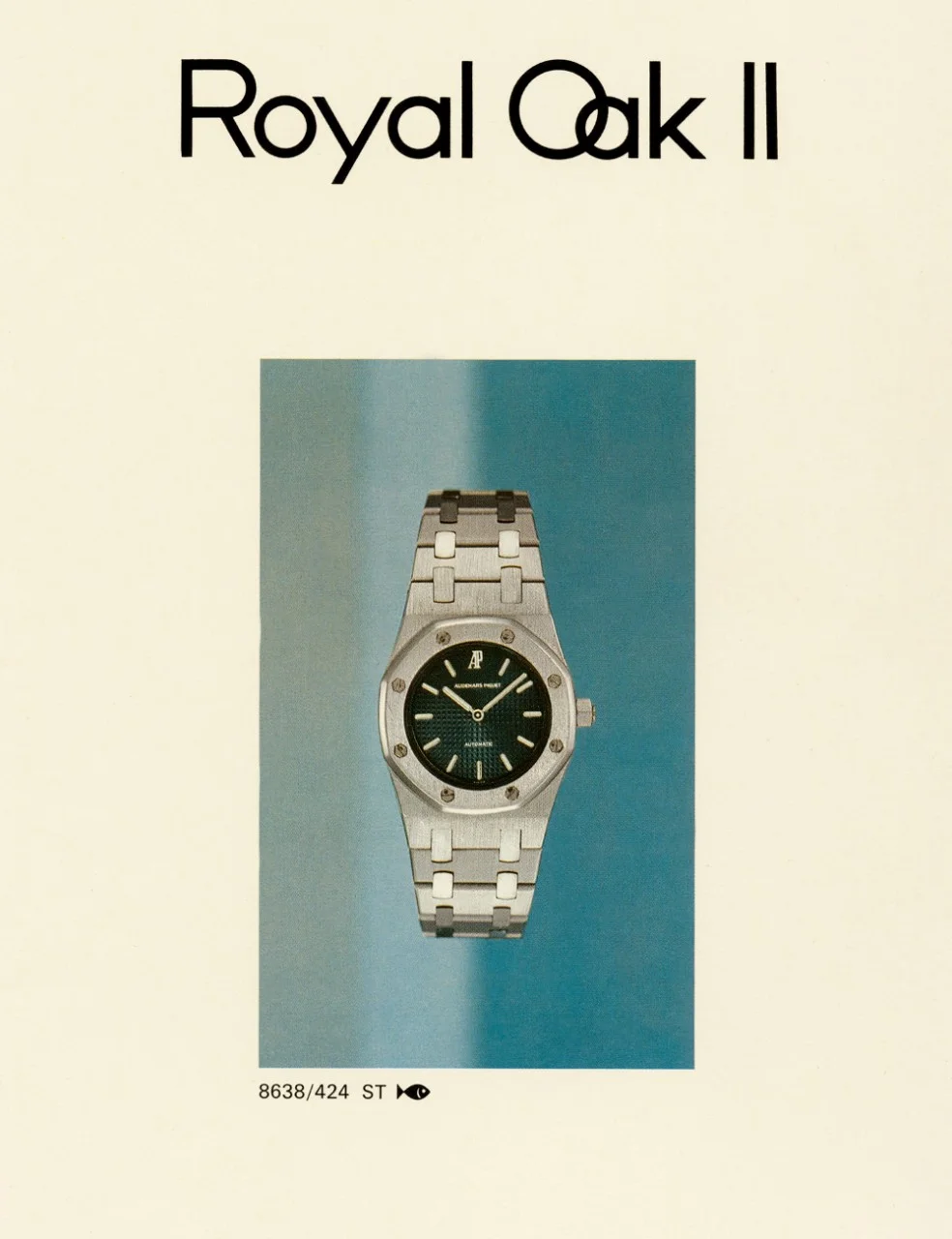
1976. Audemars Piguet catalogue Destined to retailers worldwide, the 1976 catalogue dedicated a full page to the introduction of the second Royal Oak. Audemars Piguet Archives.
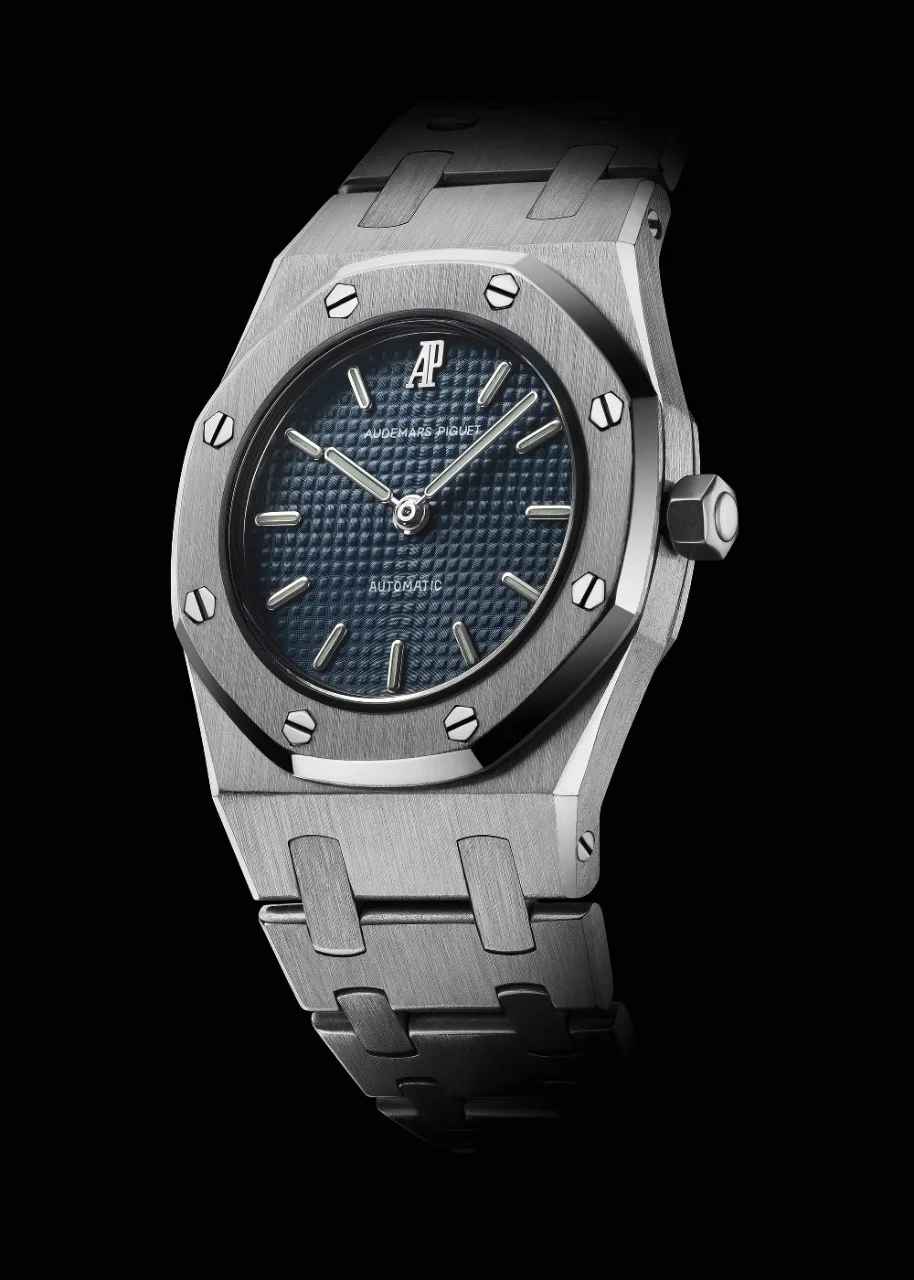
1977. Royal Oak 8638ST (1976), No. 370. Calibre 2062, movement 224714 (originally 176679). Bracelet 424. T21 Tapisserie dial. 29 mm case. Steel. Sold to Italomega in 1977. Audemars Piguet Heritage, inv. 1871.
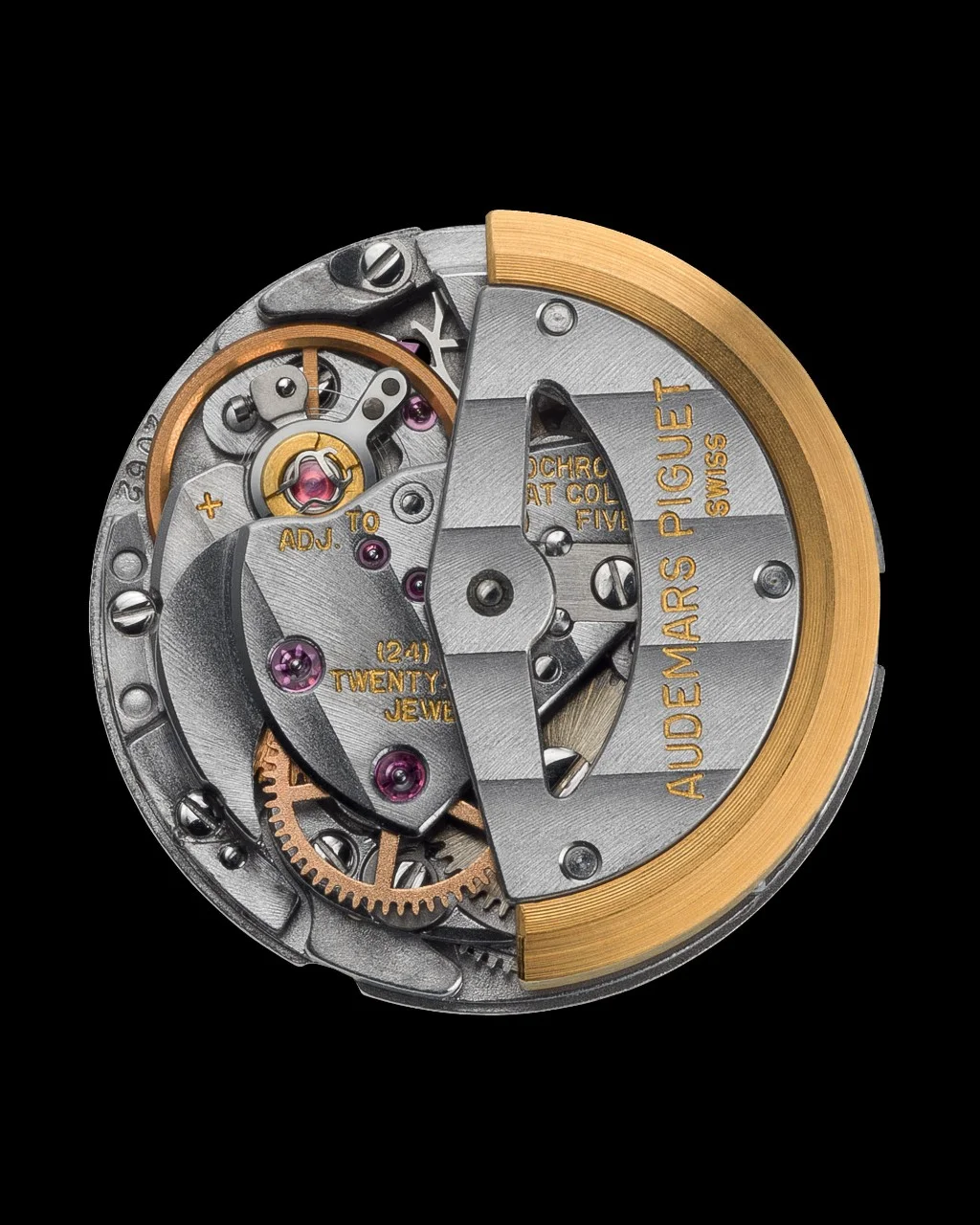
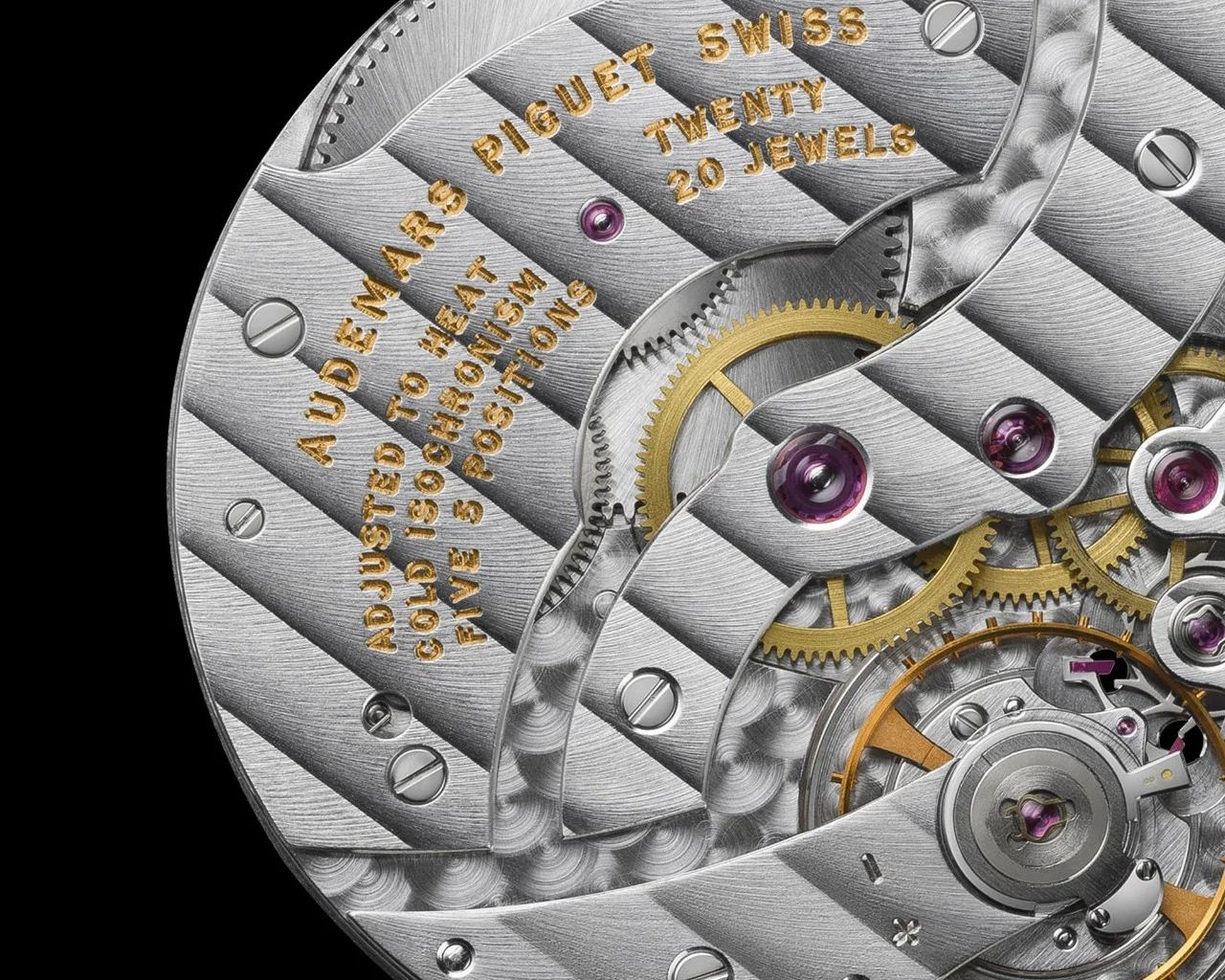
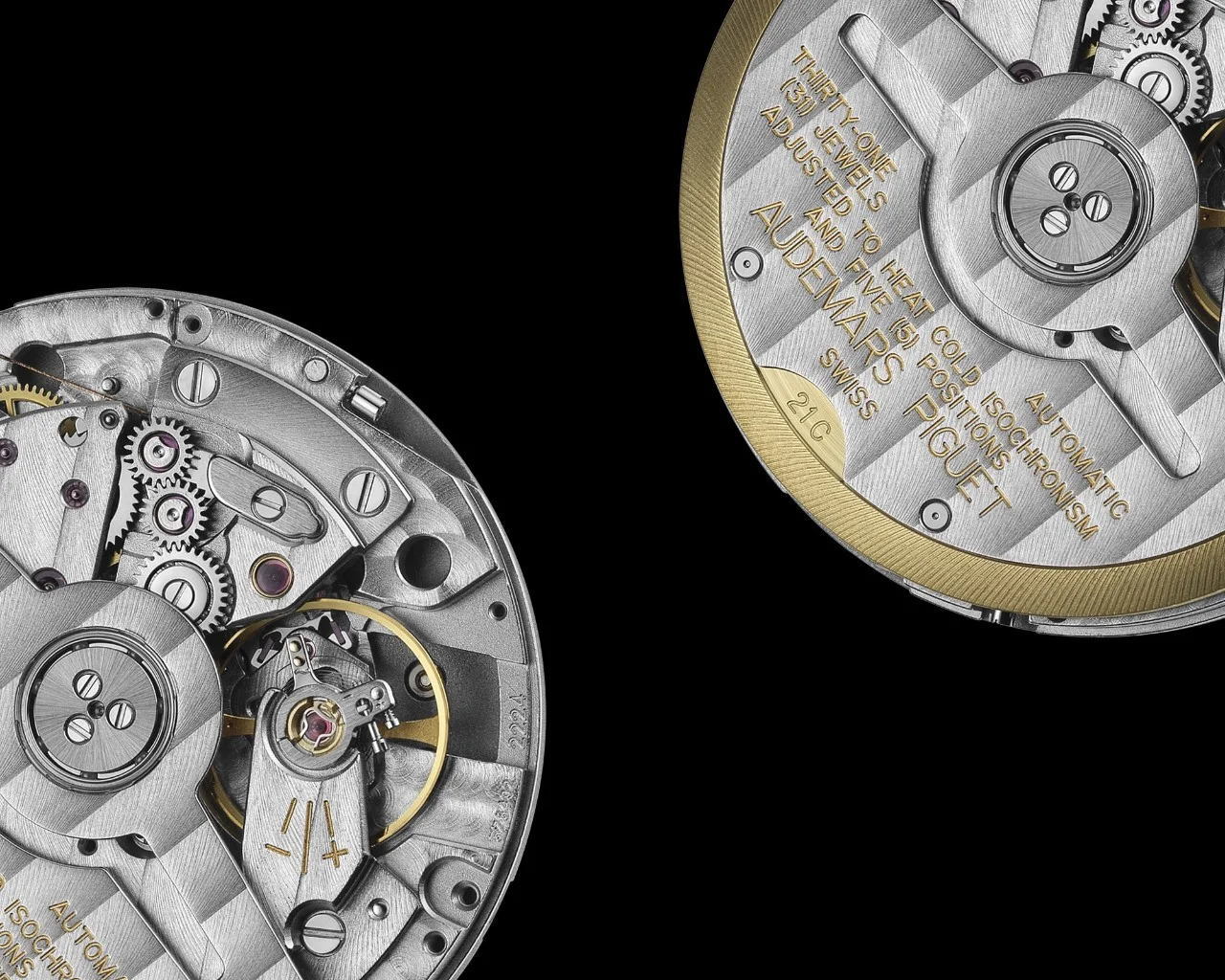
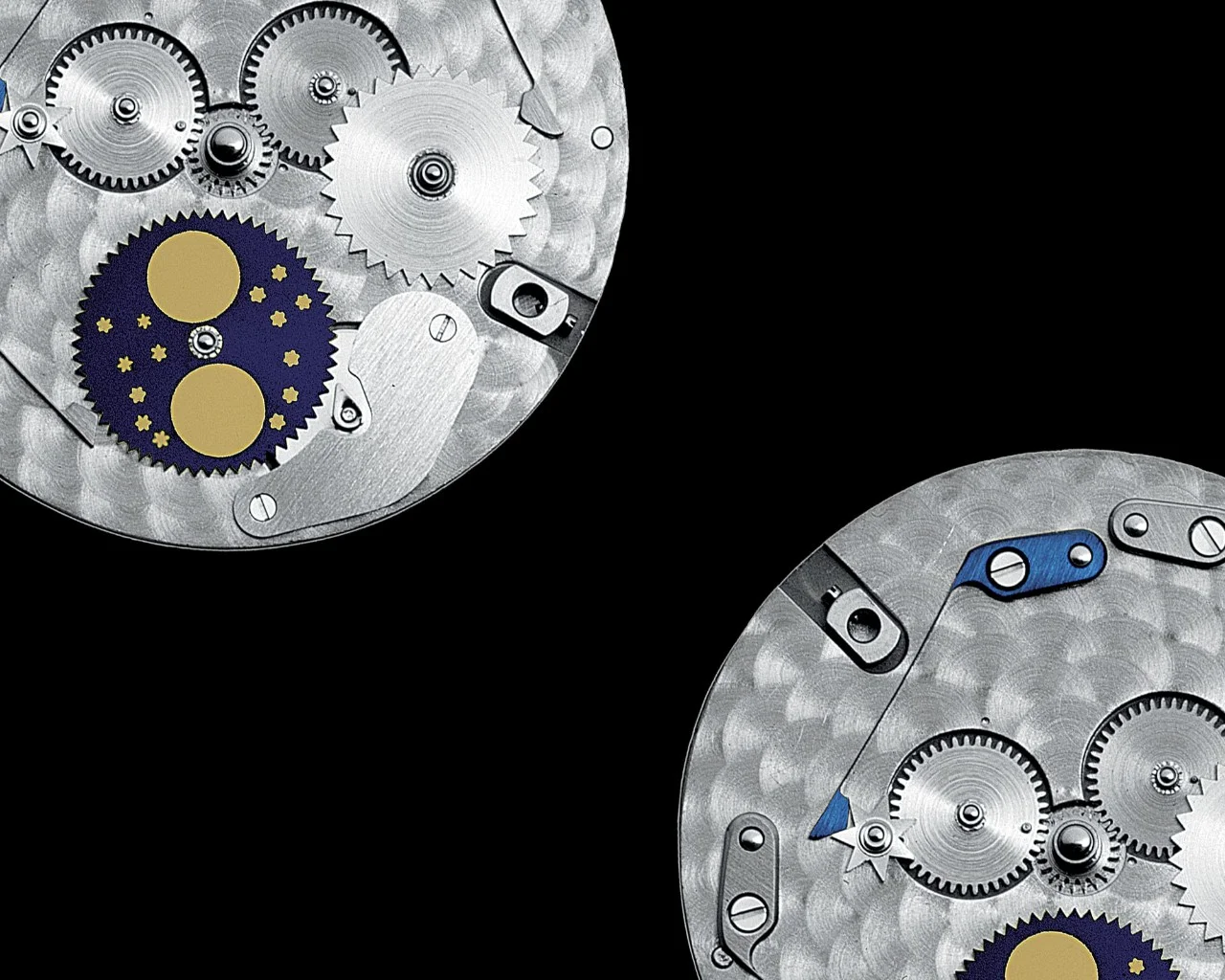
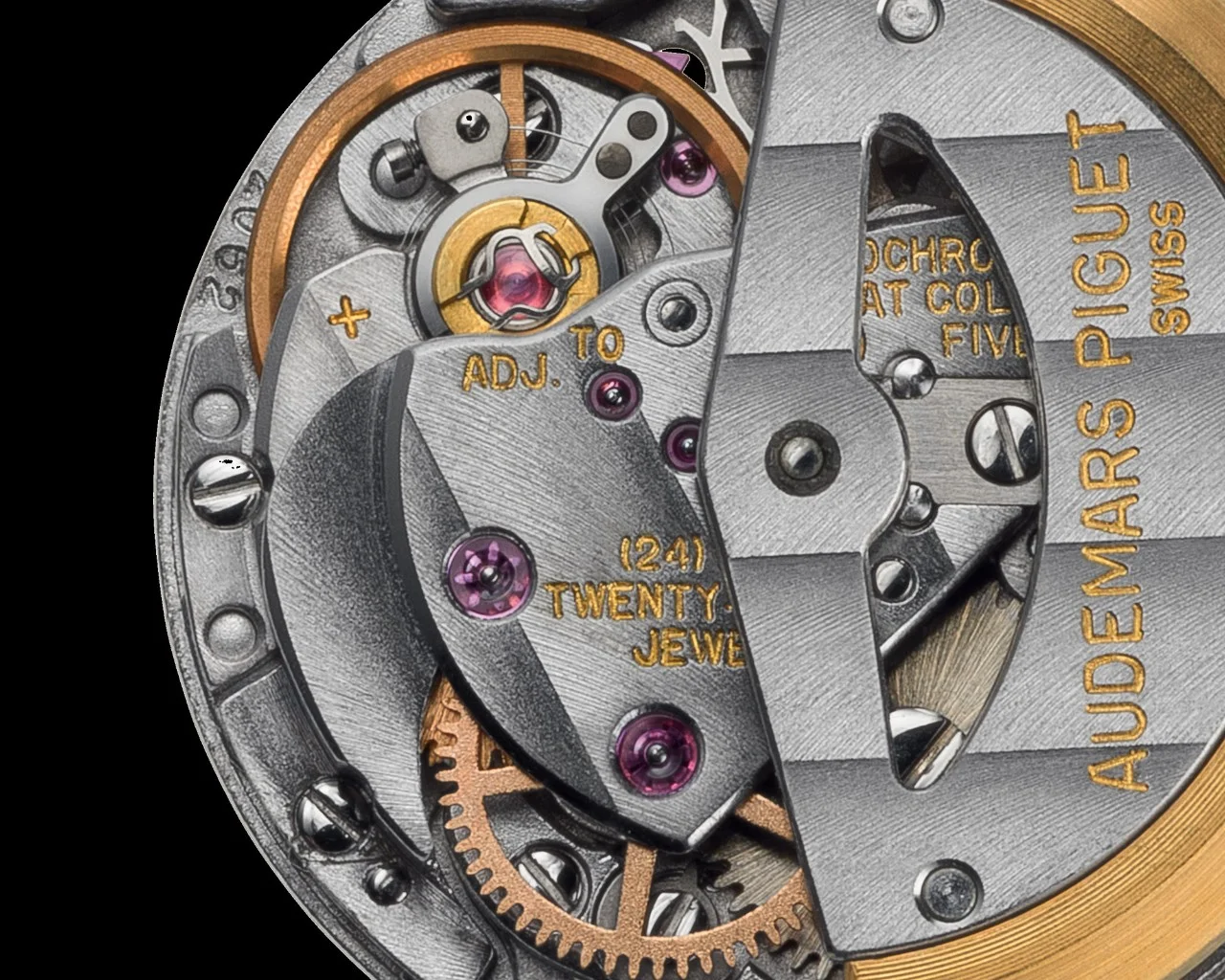
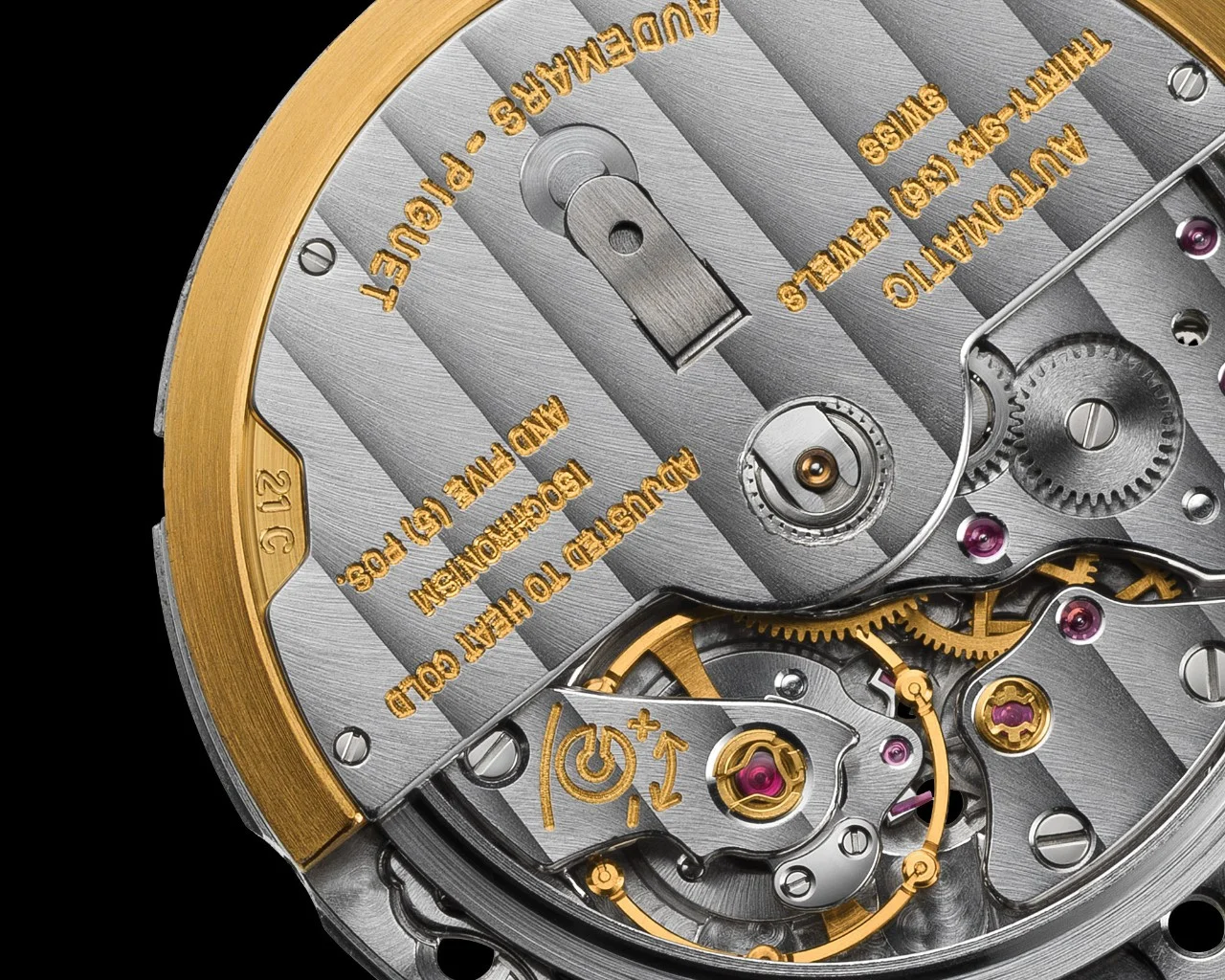
1976–1980. Calibre 2062, caseback side Diameter of 15 mm (6¾ lignes). Hours, minutes, selfwinding, 24 jewels. Movement 192611. Audemars Piguet Heritage.
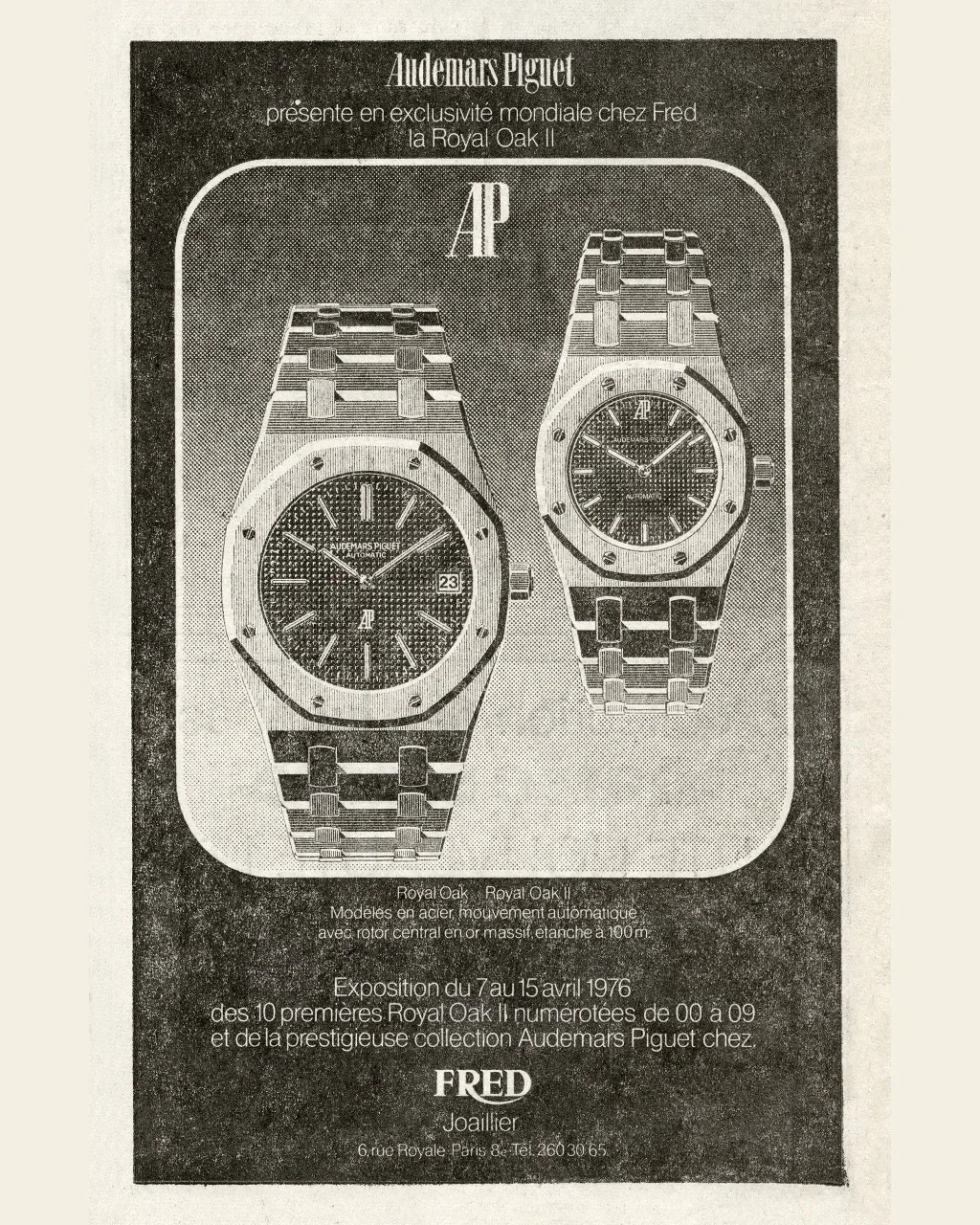
1976. Royal Oak I and II advertisement Published in the German magazine Der Spiegel in October 1976, this ad presents the two models that constituted the full Royal Oak collection back then: 5402 (as early as 1972) and 8638 (1976) – both available only in steel. Audemars Piguet Archives.
1977: Royal Oak Breaks Its Own Rules
While the Royal Oak broke the rules of fine watchmaking in 1972, its 1976 feminine variant demonstrated that it was capable of breaking its own codes. From then on, designers’ imagination would be given increasingly freer rein.
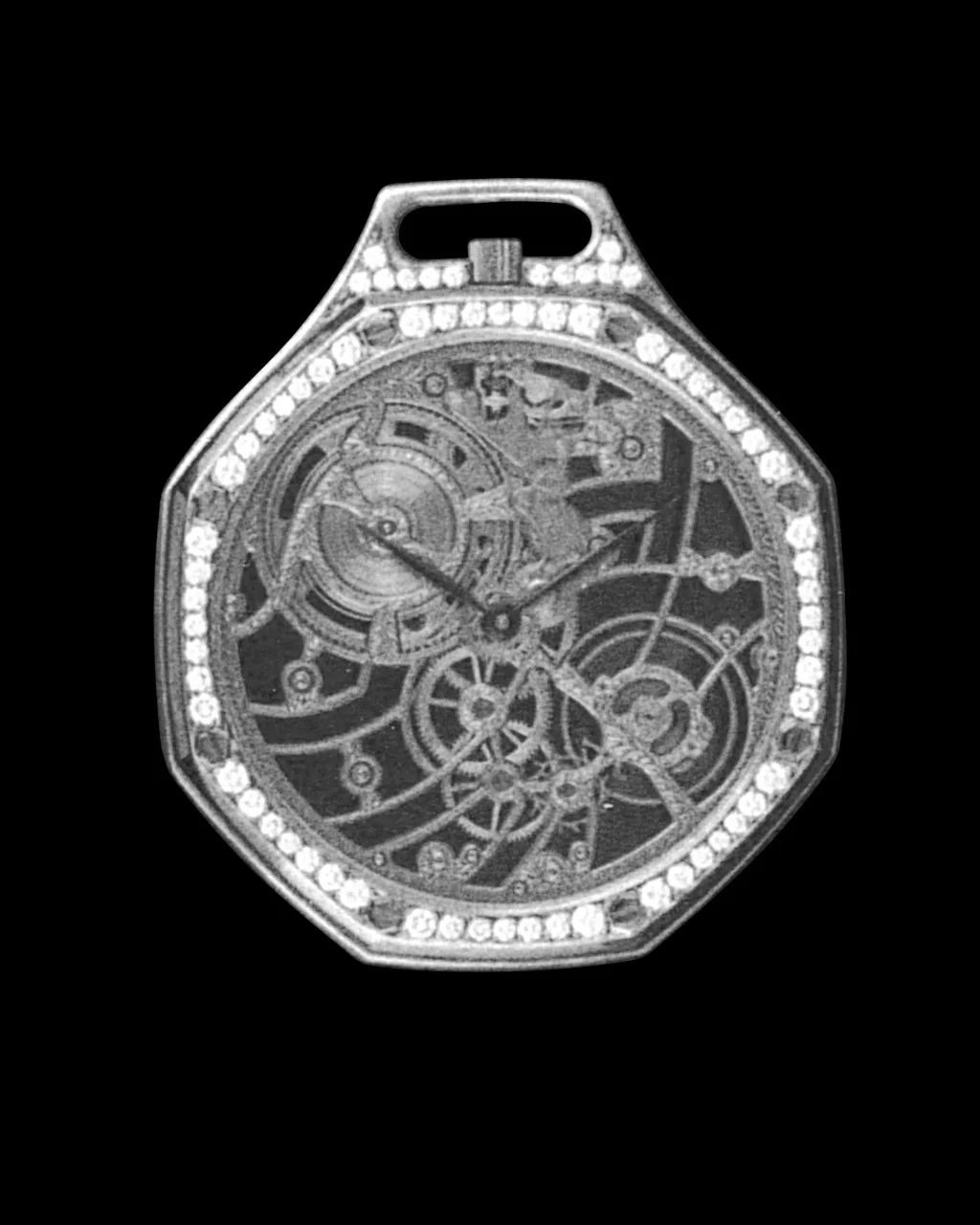
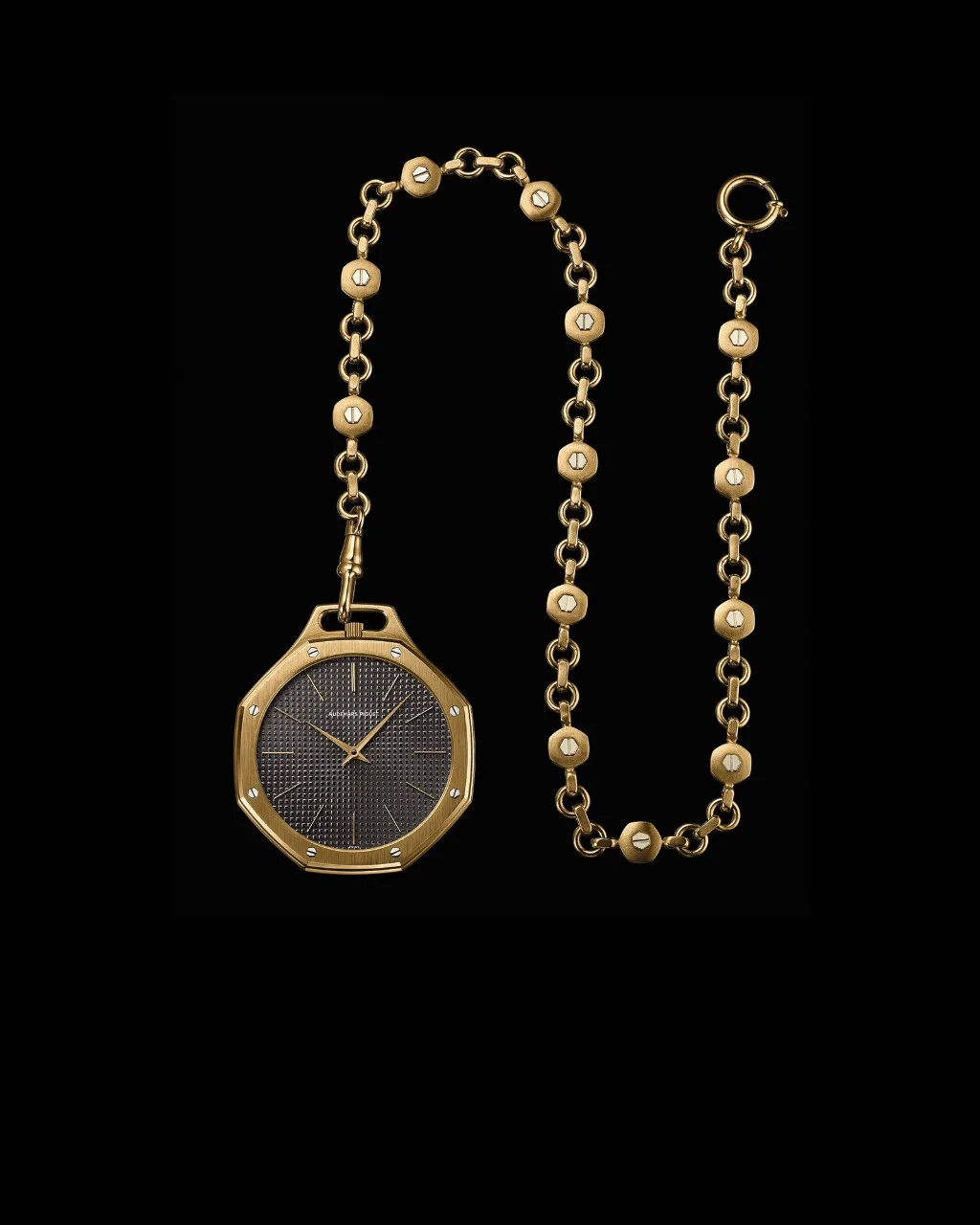
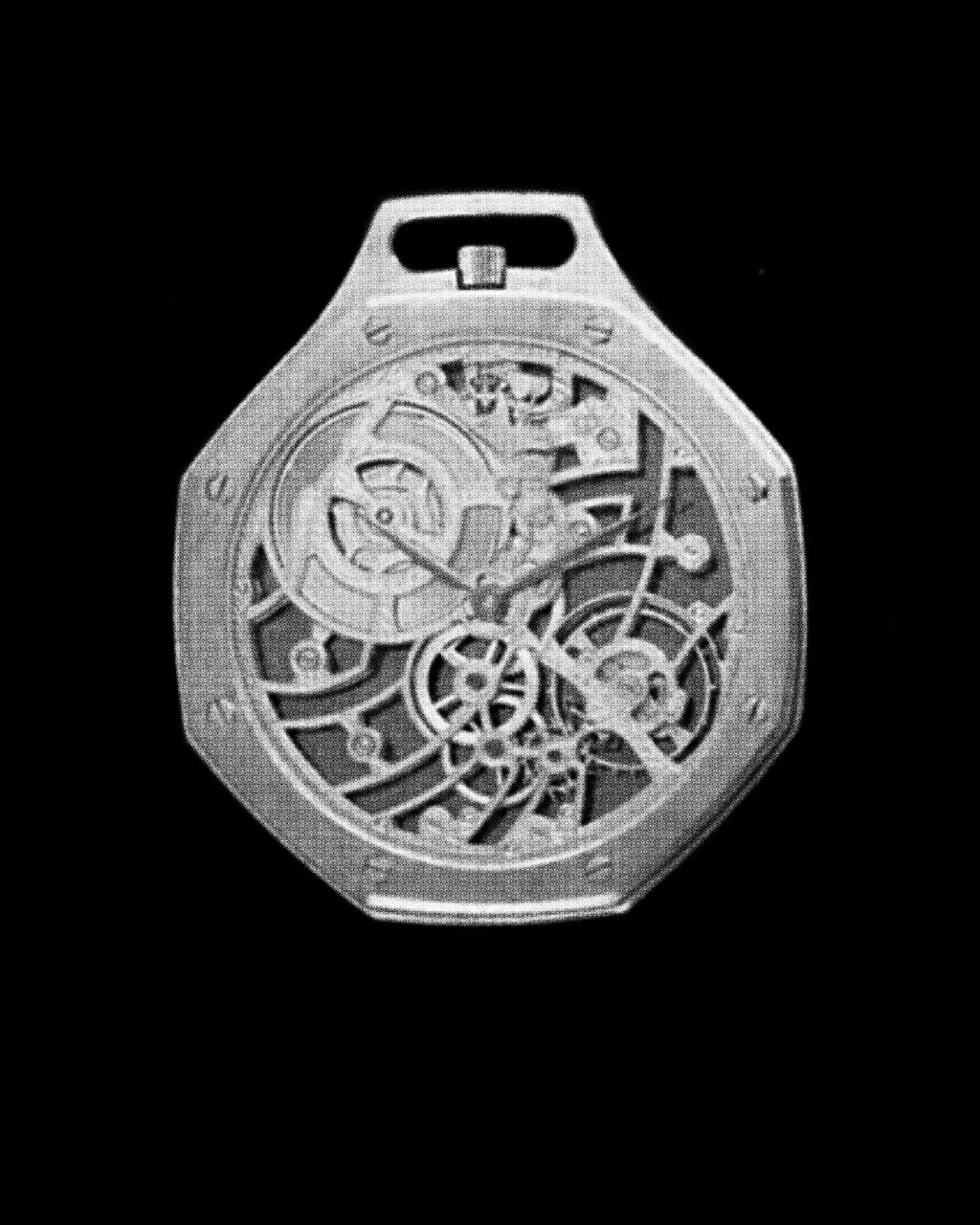
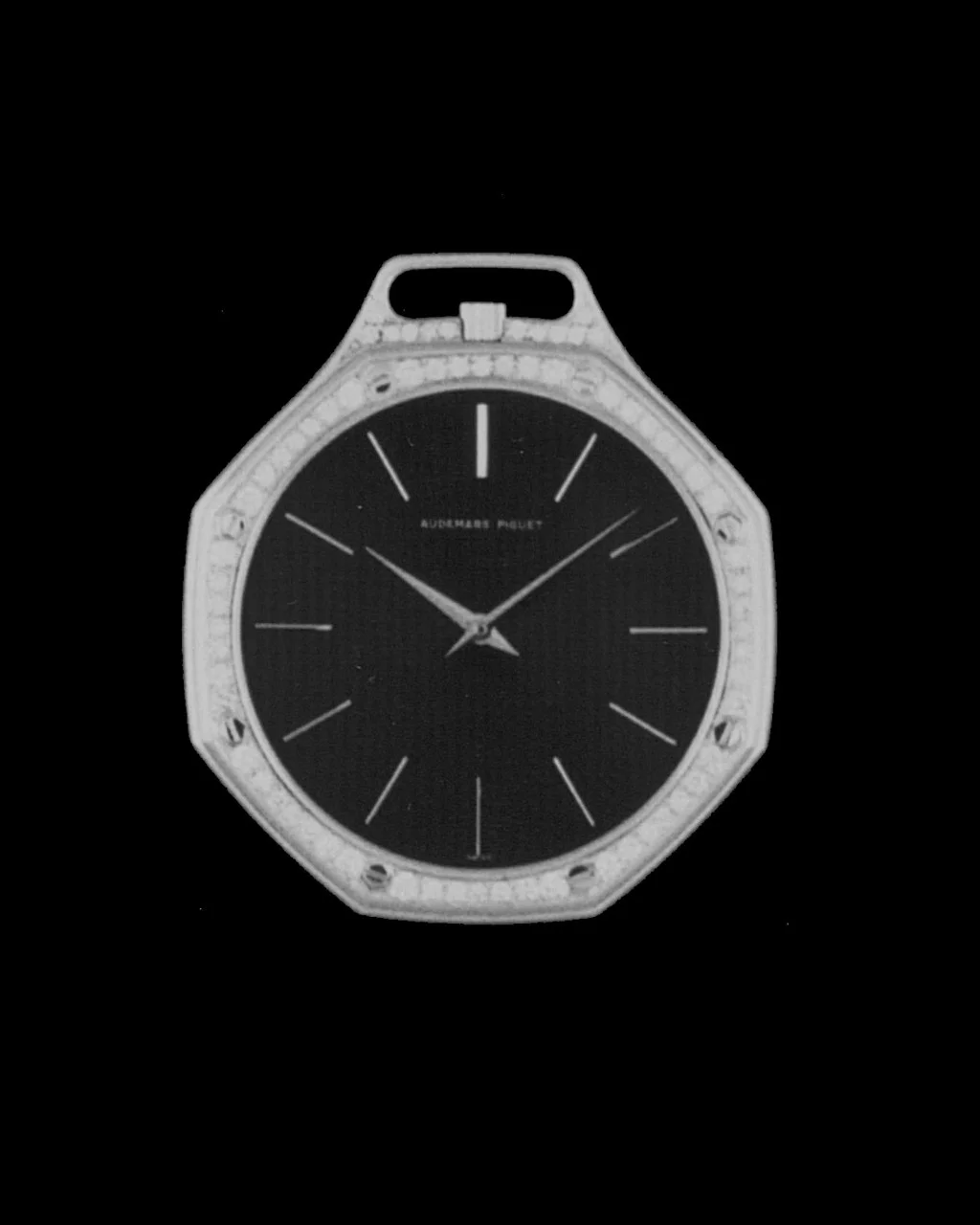
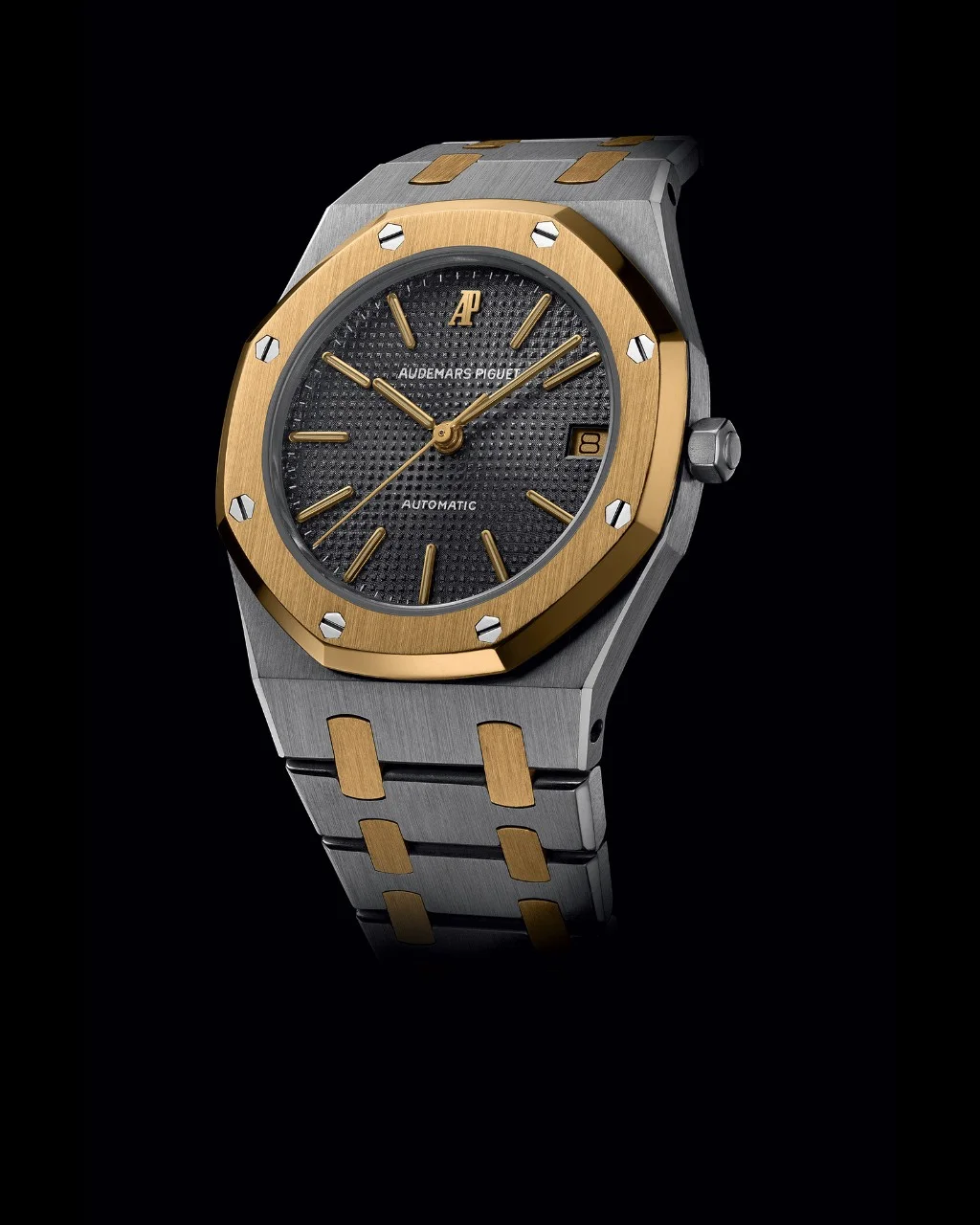
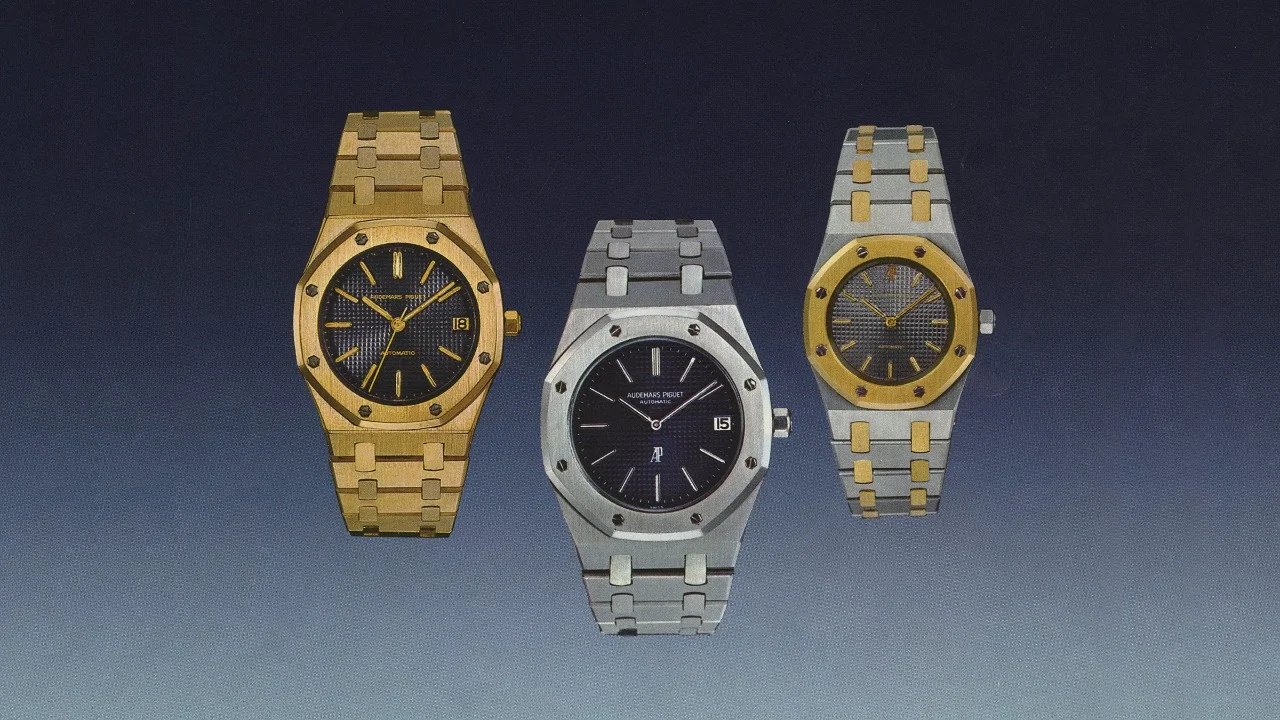
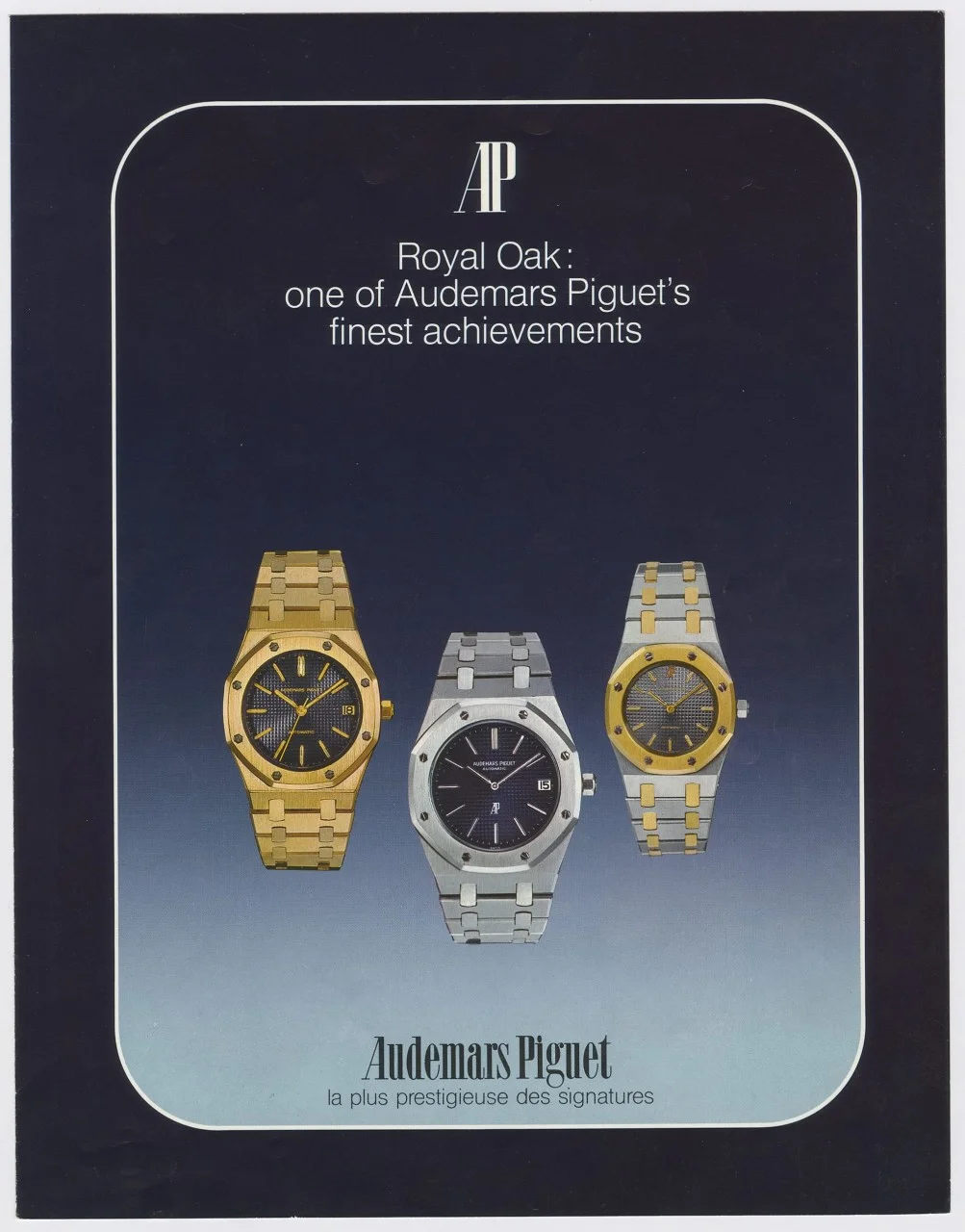
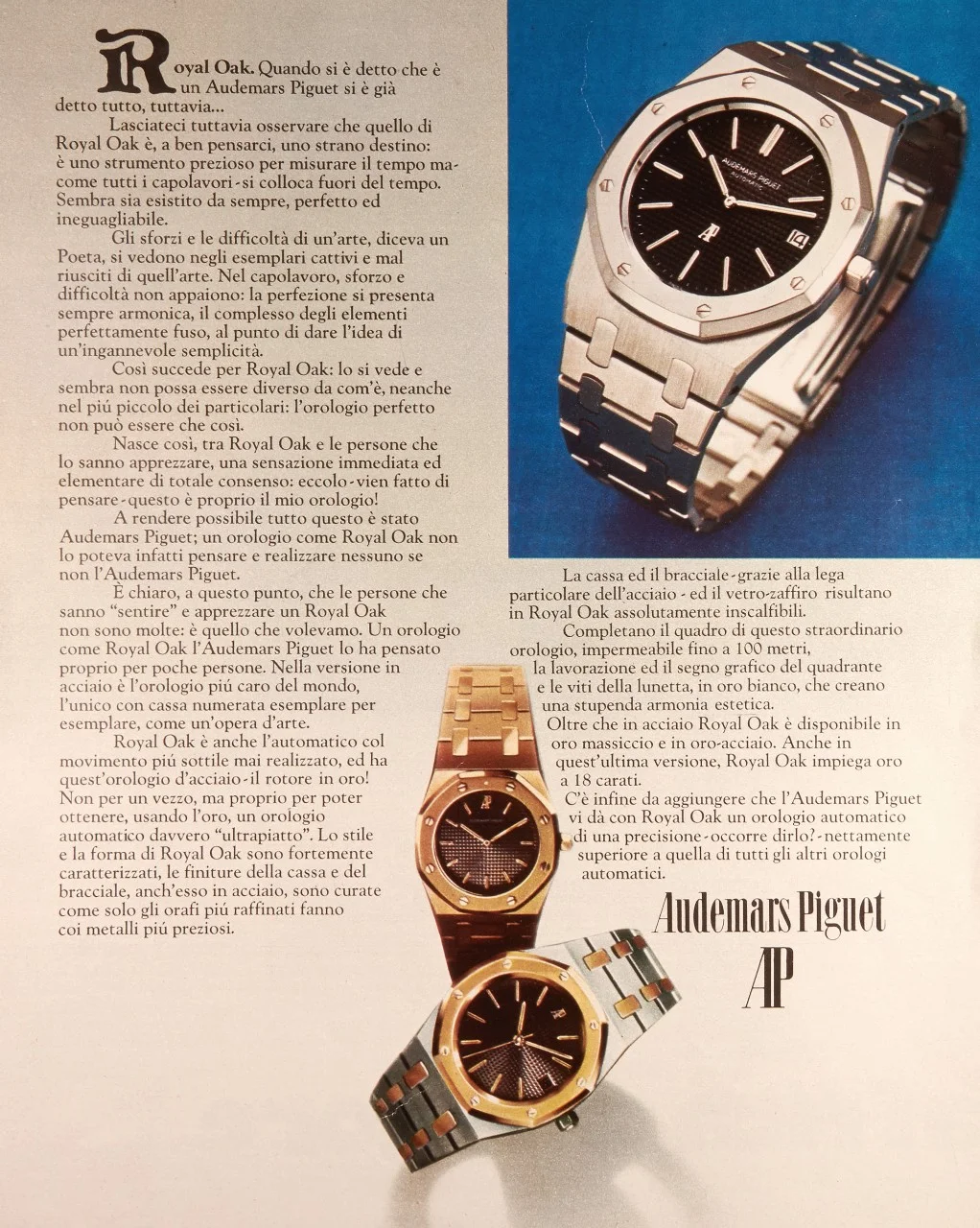
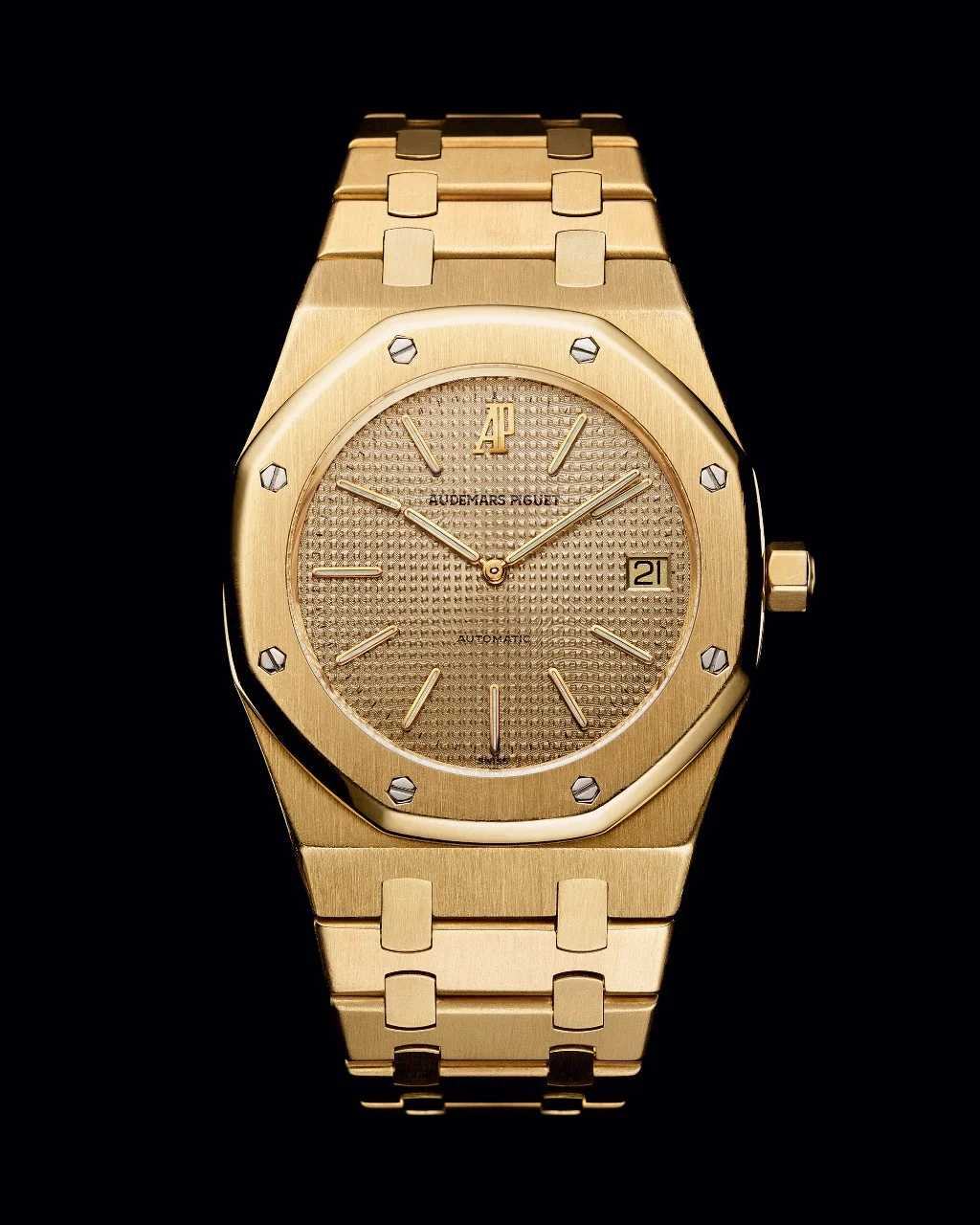
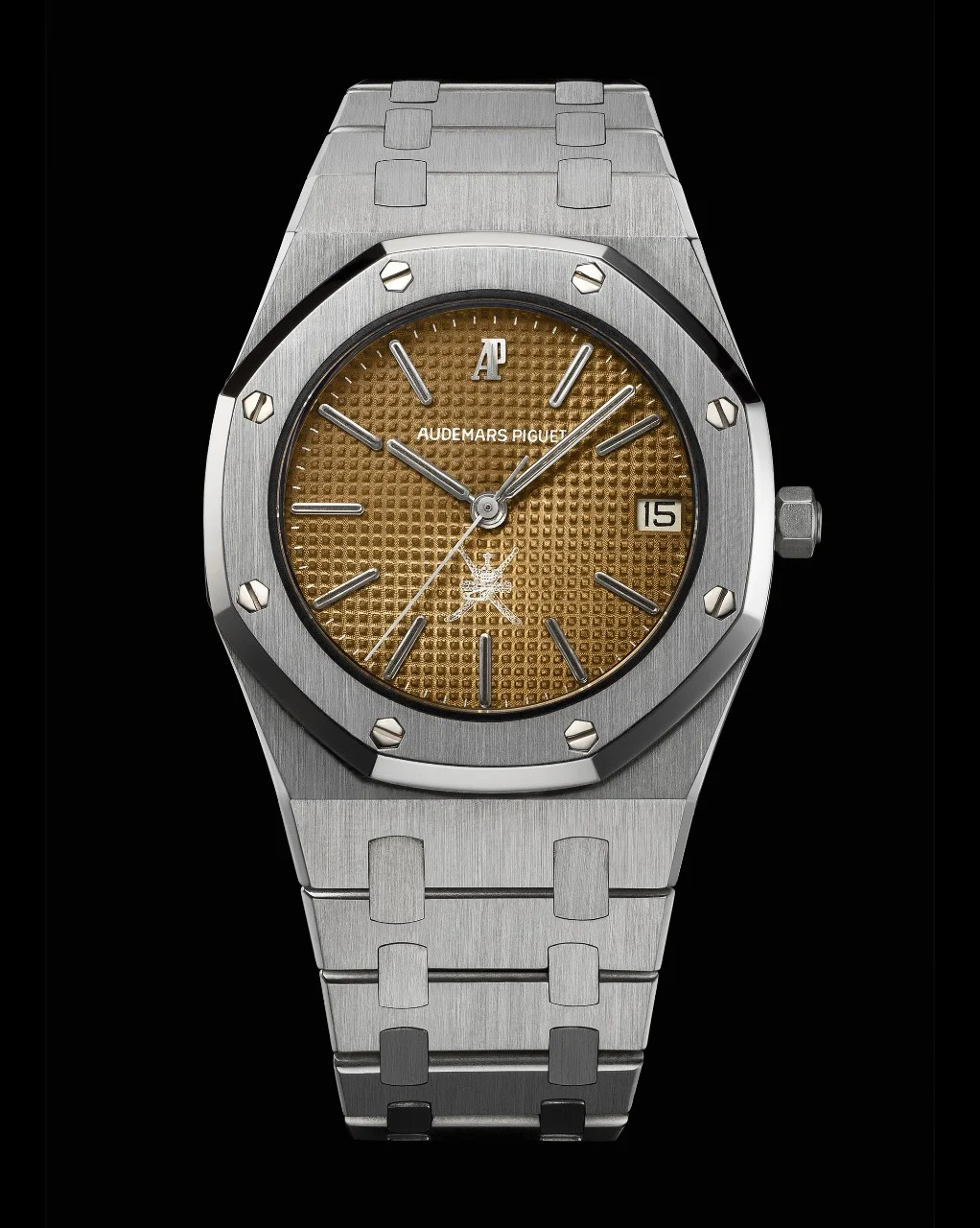
The real turning point came in 1977. Audemars Piguet simultaneously introduced the 5402 and 8638 models in yellow gold, white gold and a combination of steel and yellow gold. At the same time, the brand added a 35 mm intermediate size, Model 4100. From then on, and in barely five years (1977–1981), 27 new Royal Oak references were created. Available in numerous sizes, for men and women, they were gemset, equipped with a variety of dials, sometimes without the Tapisserie motif, and powered by seven different movements, some of which were quartz. Some references even reinterpreted the Royal Oak in the form of pocket watches!
Birth of Model 4100, the Royal Oak III
Designed by Jacqueline Dimier, Model 4100 sometimes appears in the sources under the name "Royal Oak III”. This model responds to growing demand in certain markets where the first 39 mm Royal Oak had not proved very popular. It should be remembered that although Audemars Piguet's Italian agent, Carlo de Marchi, was one of the Royal Oak instigators in 1970, Italy did not welcome this model with the expected enthusiasm. Its designer Gérald Genta explained in an interview with Audemars Piguet in 2012: "The big cause of drama was the size of the watch, which was elephant-like compared to what people were wearing at that time, with Italian men favouring the Ladymatic. We came along with something so huge that it was simply not possible!”
It should be remembered that this 39 mm diameter, which earned it the nickname Royal Oak “Jumbo”, was probably not part of Genta's specifications. It results from the architecture of the Royal Oak case, and more particularly from its eight visible screws framing its Calibre 2121, with its 12 ½-ligne (28 mm) diameter. A smaller movement was needed in order to reduce this diameter.
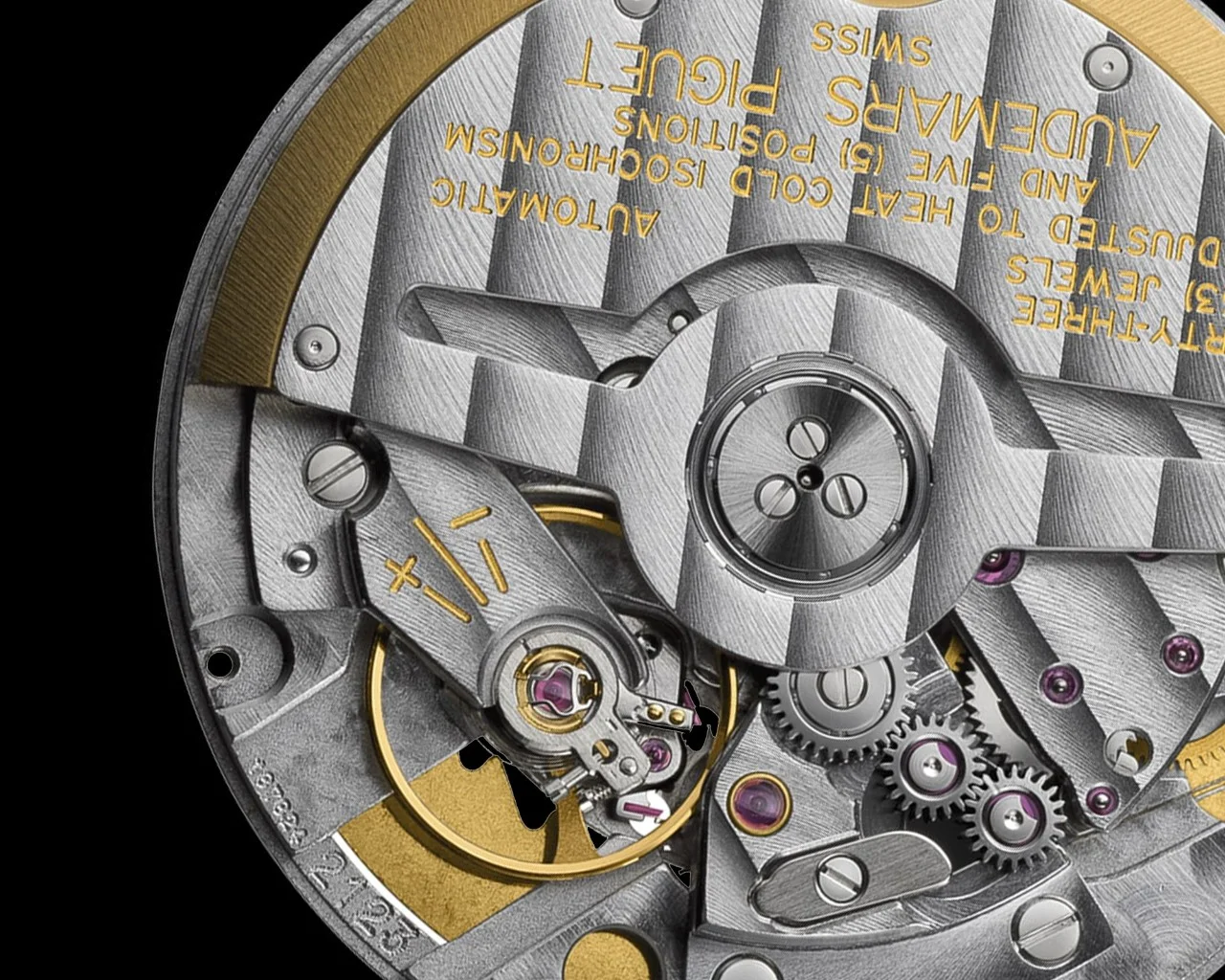
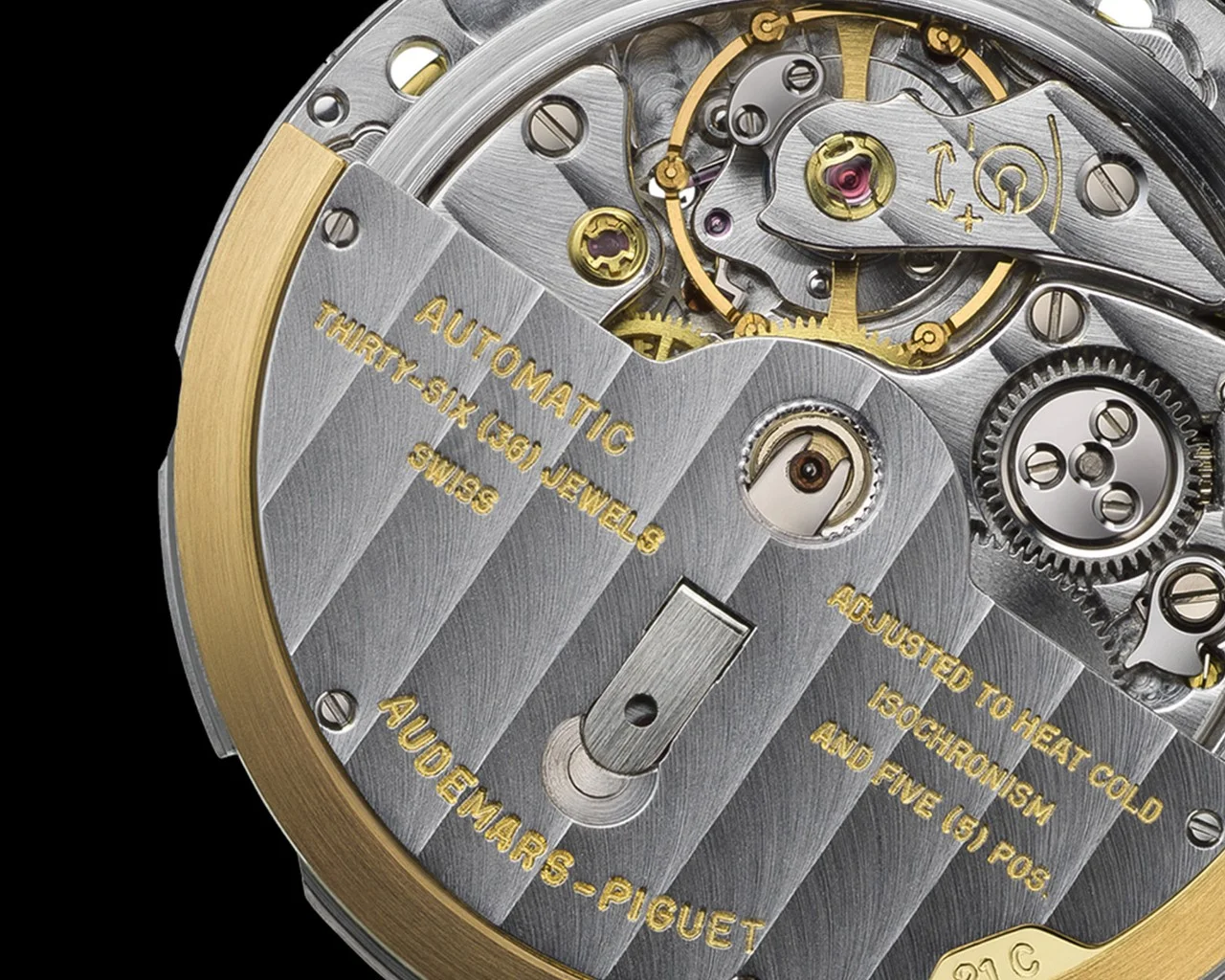
Launched in 1977 under Reference 900, Calibre 2123 was manufactured at the time by LeCoultre & Cie, a factory located a stone's throw from Le Brassus, and with which Audemars Piguet had forged decades-long commercial, technical, friendly and even family ties. This movement differed from its cousin and predecessor 2121 by its smaller diameter (11½ lignes, i.e. 26 mm); its larger thickness (3.25 mm rather than 3.05 mm) enabling the addition of a central seconds hand; and its high frequency (28,800 vph as opposed to 19,800 vph) ensuring enhanced accuracy. The case was redesigned and structured in three parts to maximise the use of the interior space, unlike the "monocoque" system of Model 5402. The space previously taken up by Model 5402's huge gasket was occupied by a bezel featuring a redesigned structure. These transformations enabled watchmakers to reduce the case size by 4 mm, despite the movement being only 2 mm smaller in diameter! The new Royal Oak therefore measured only 35 mm.
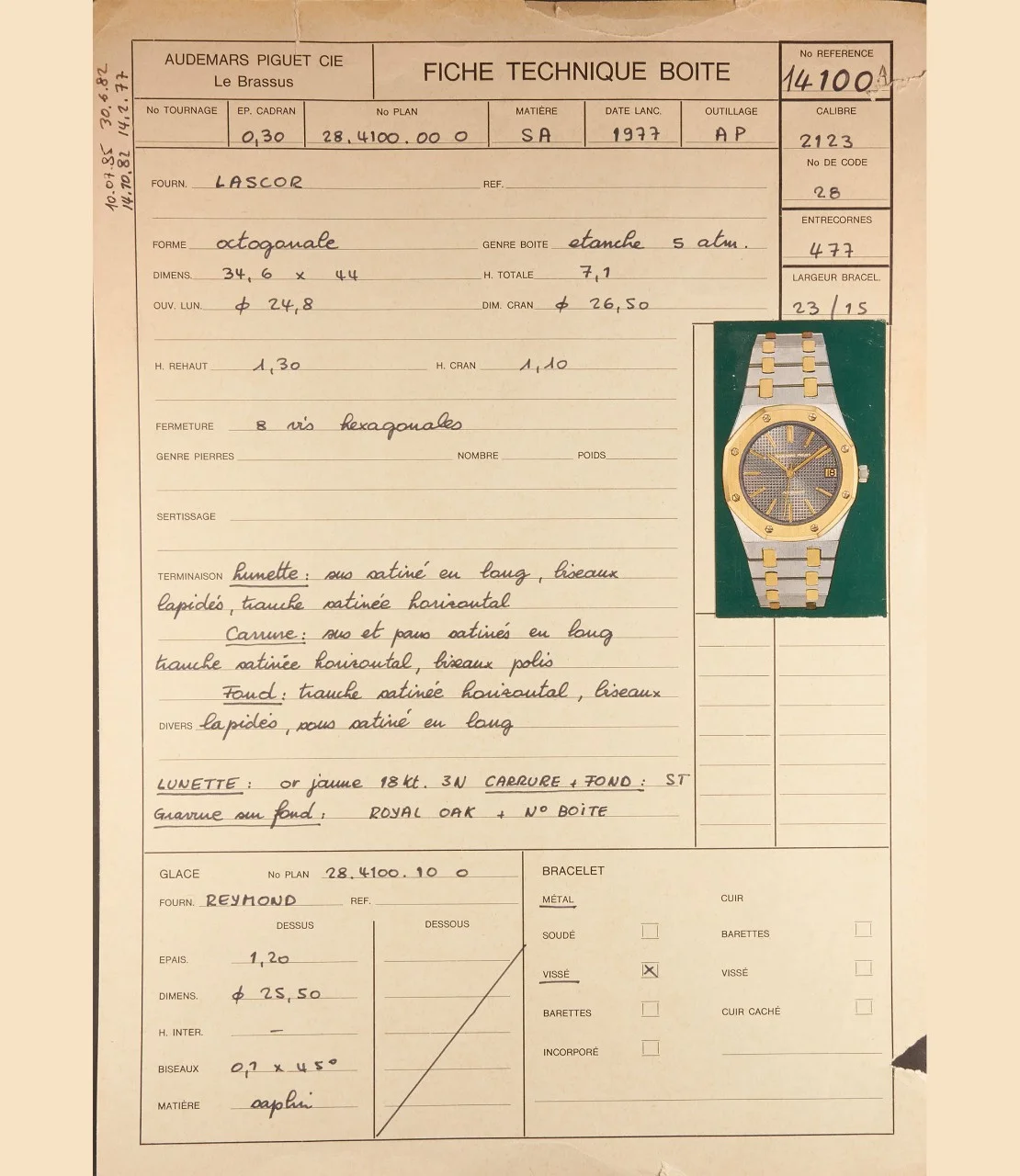
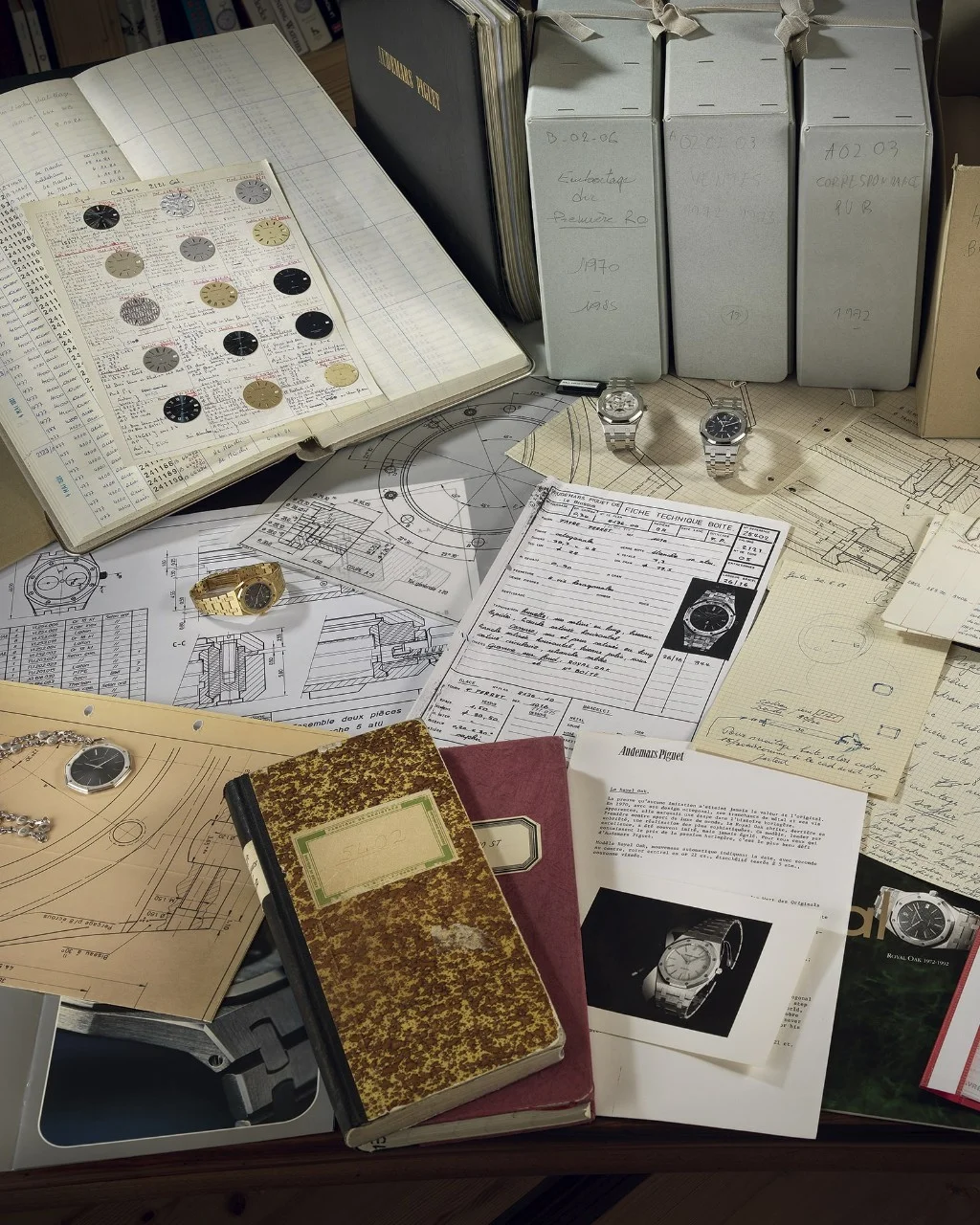
1977. Case Technical Data Sheet of Royal Oak Model 4100SA. Audemars Piguet Archives.
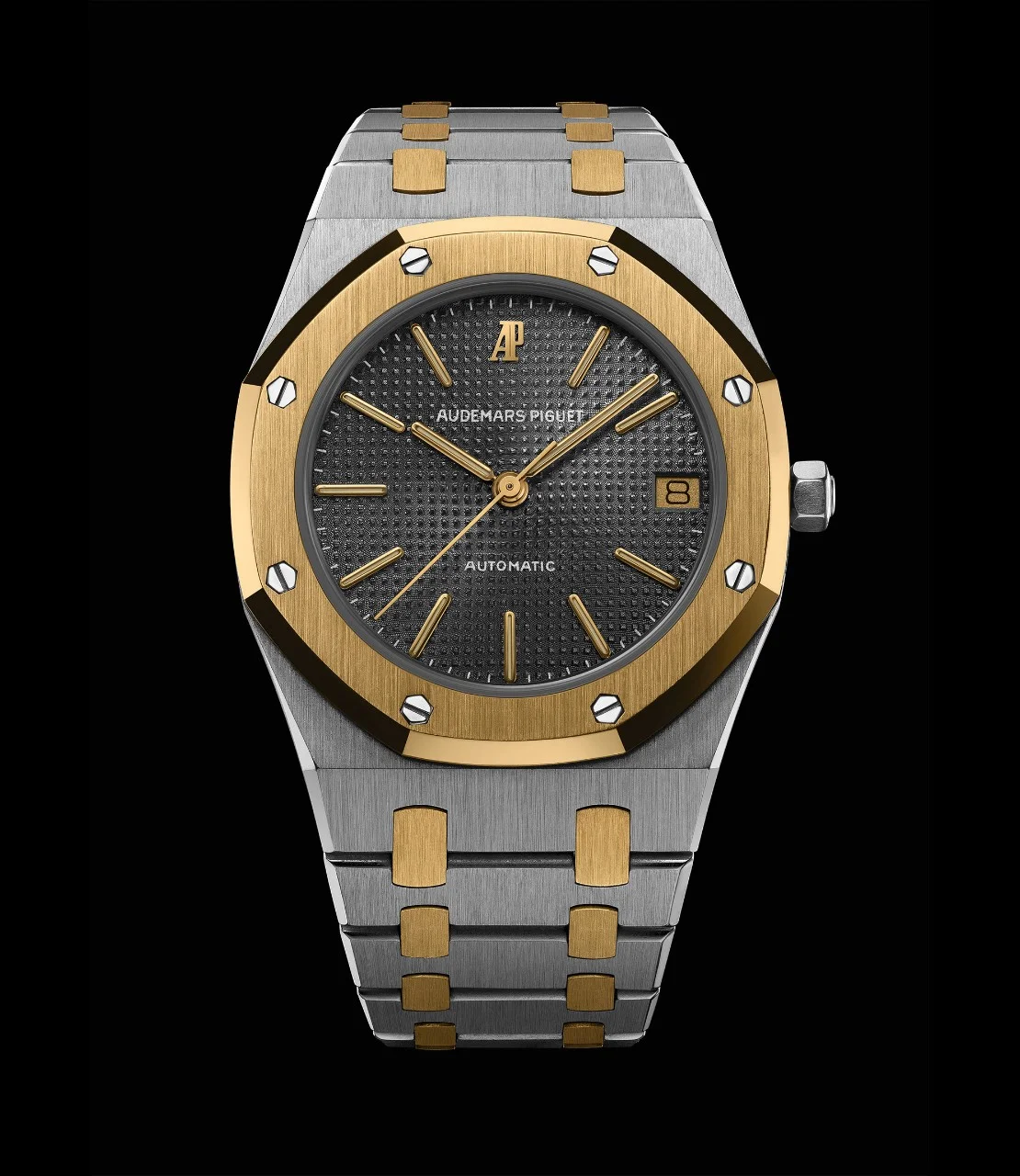
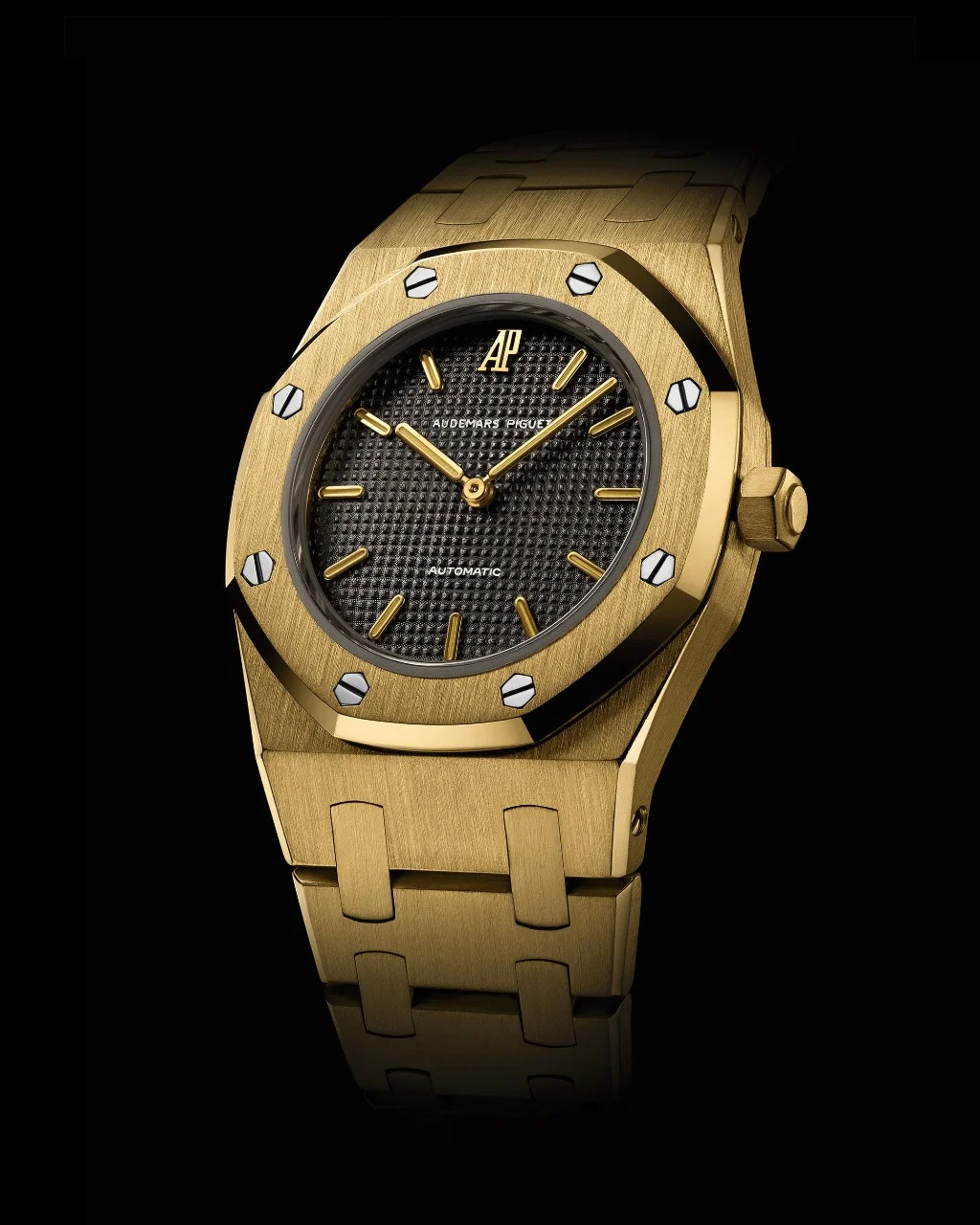
1979. Royal Oak 4100SA (1977), No. 1097 Date. Calibre 2123, movement 205297. Bracelet 477. Slate-grey T21 Tapisserie dial. Movement 205297. Case B30783, 36 mm. Steel and 18-carat yellow gold. Sold to Desco in 1979. Audemars Piguet Heritage, inv. 1163.
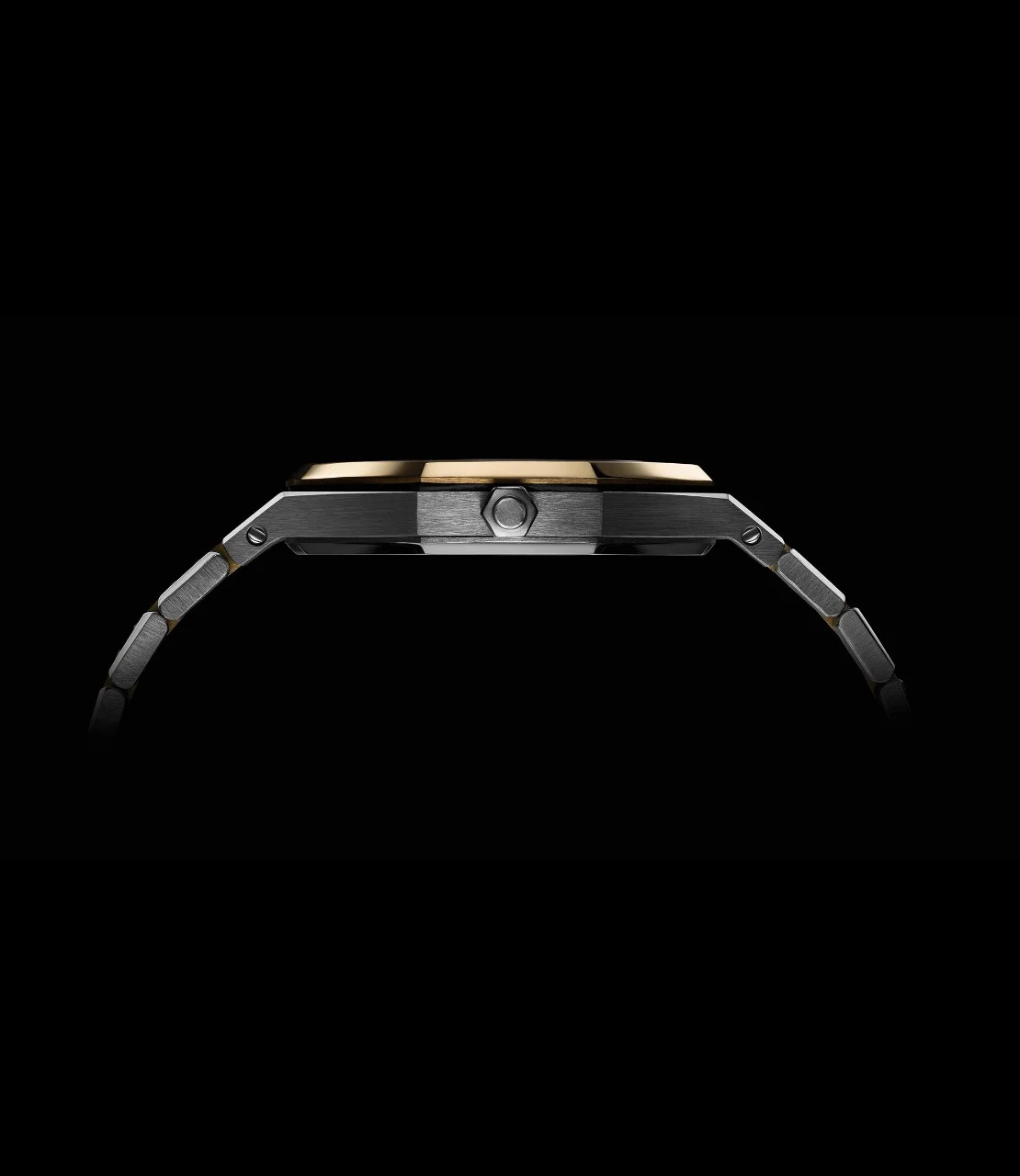
1979. Royal Oak 4100SA (1977), No. 1097, side view Date. Calibre 2123, movement 205297. Bracelet 477. Slate-grey T21 Tapisserie dial. Movement 205297. Case B30783, 36 mm. Steel and 18-carat yellow gold. Sold to Desco in 1979. Audemars Piguet Heritage, inv. 1163.
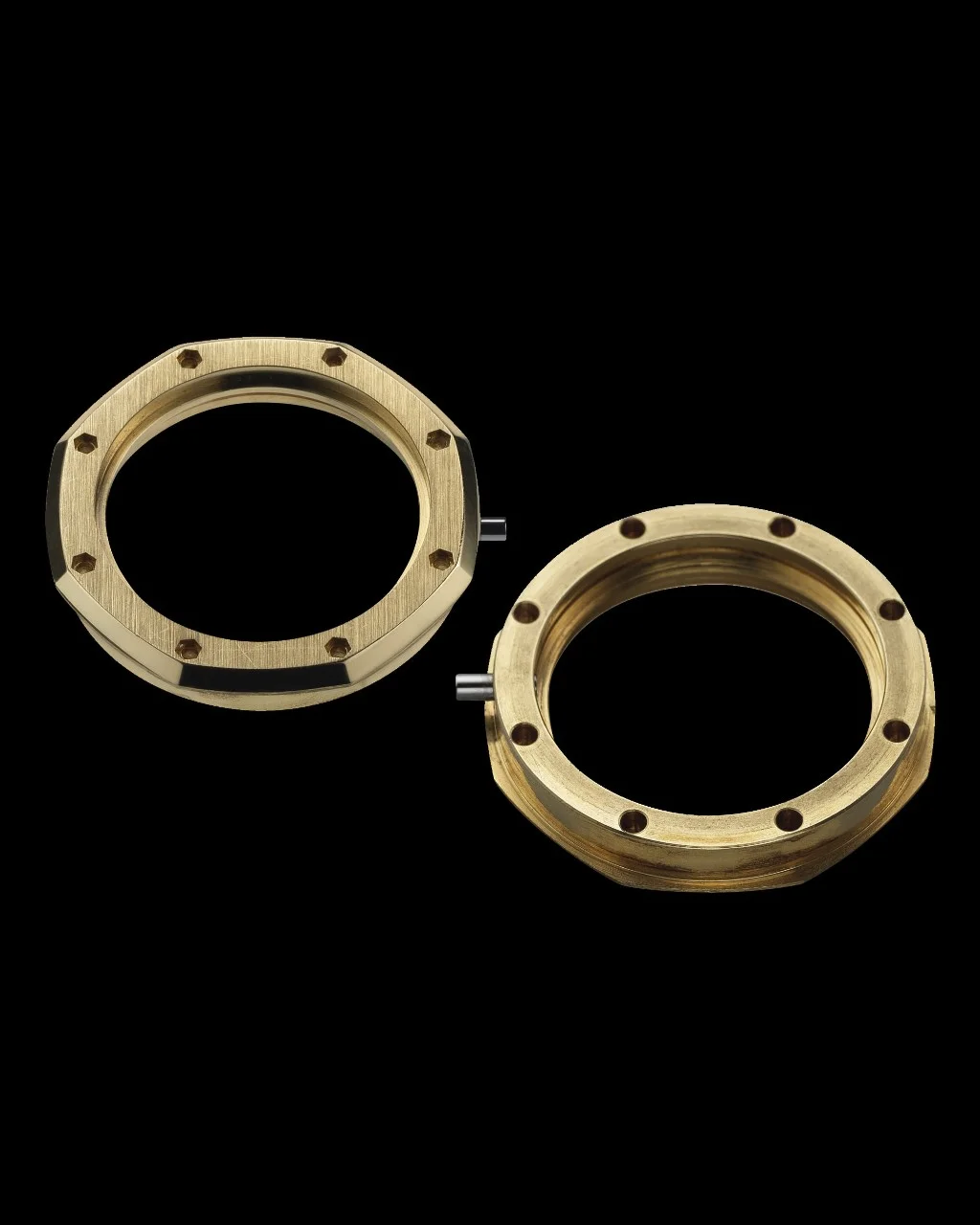
1977. 4100SA bezel, front and back sides The bezel and the large casing ring form a single component, which considerably reduces the size of the water-resistance gaskets and which enables to reduce the watch's diameter. Audemars Piguet Heritage, inv. 1163.
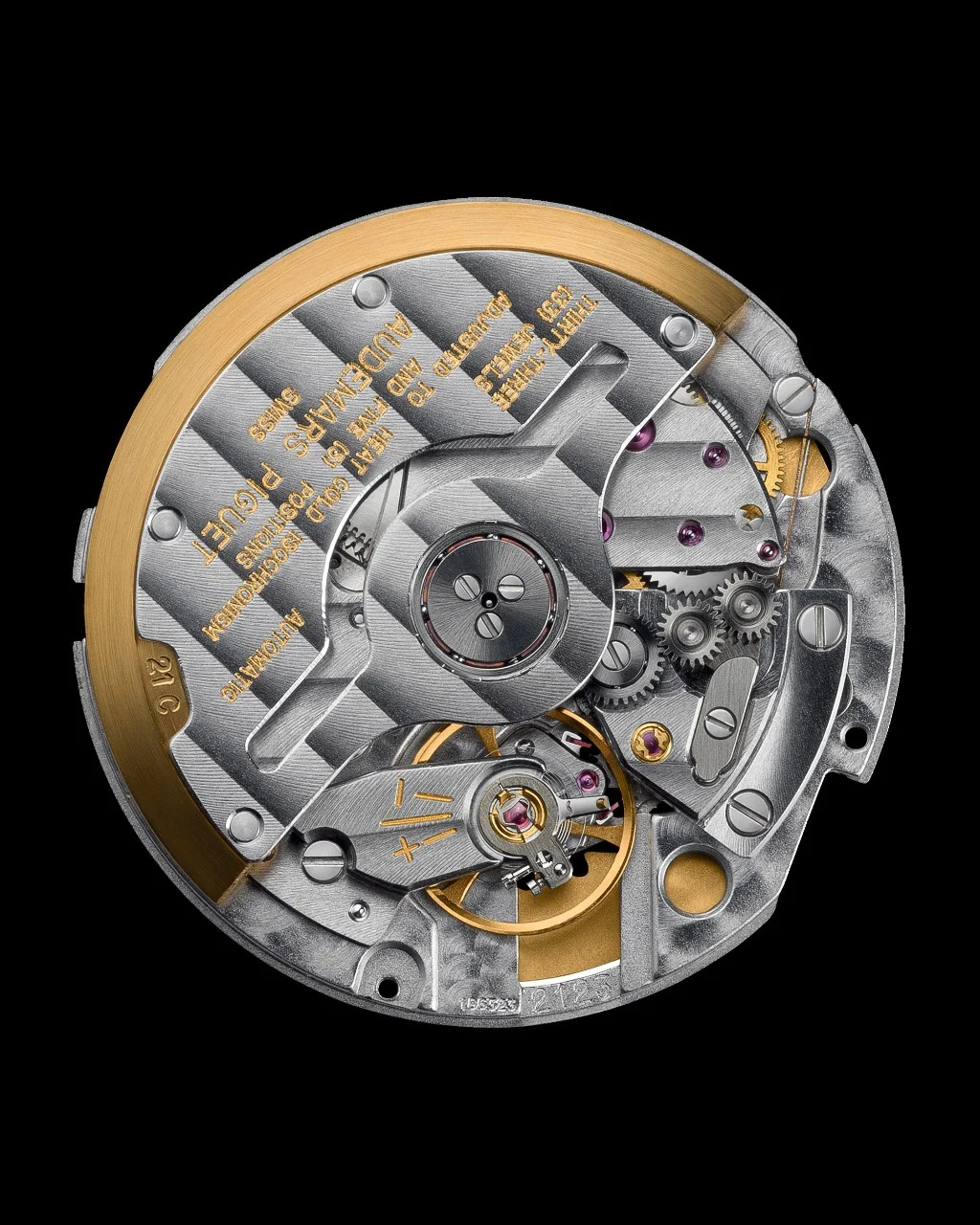
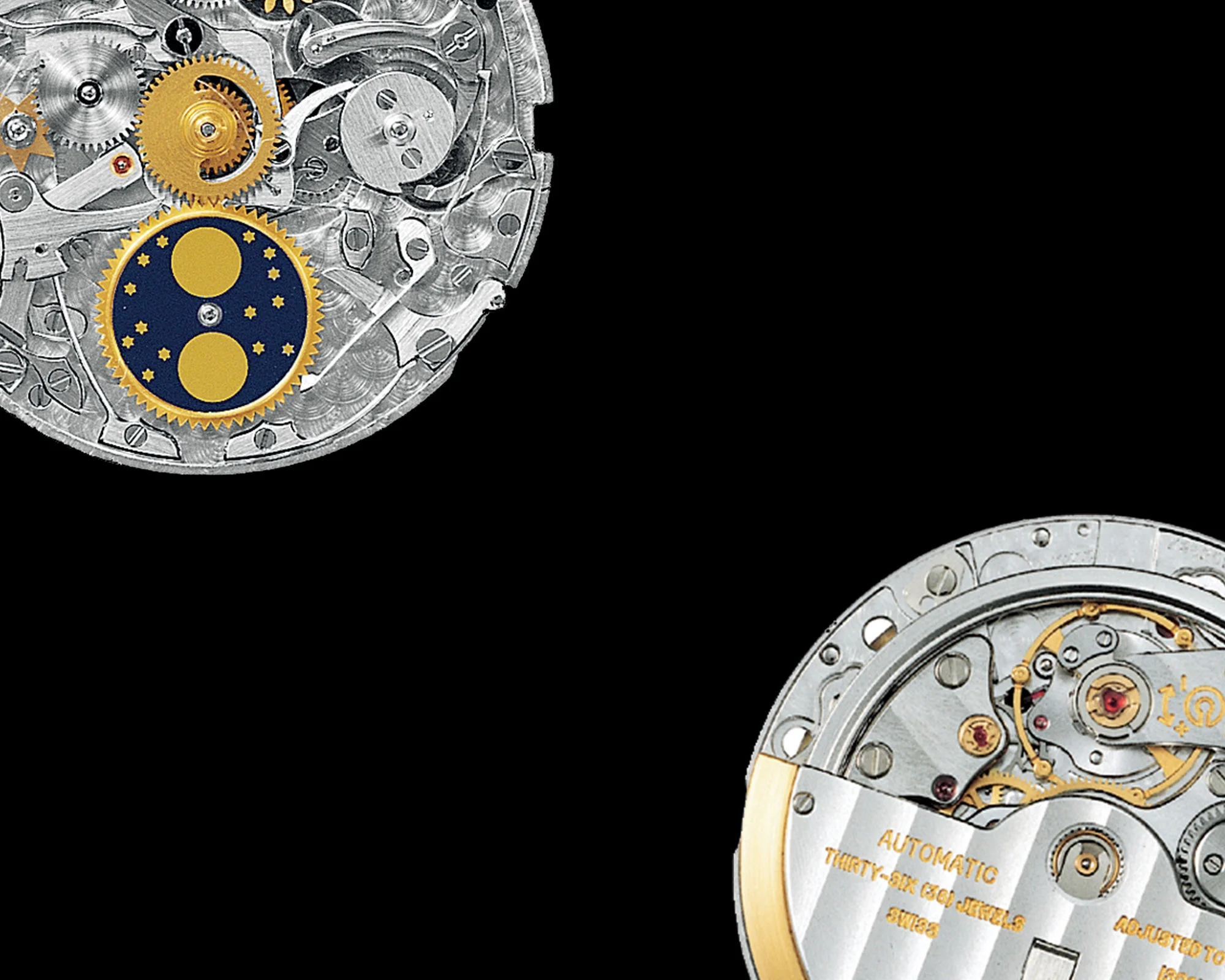
1977. Calibre 2123, caseback side Diameter of 26 mm (11½ lignes). Hours, minutes, date, selfwinding, 33 jewels. Movement 186323. Audemars Piguet Heritage.
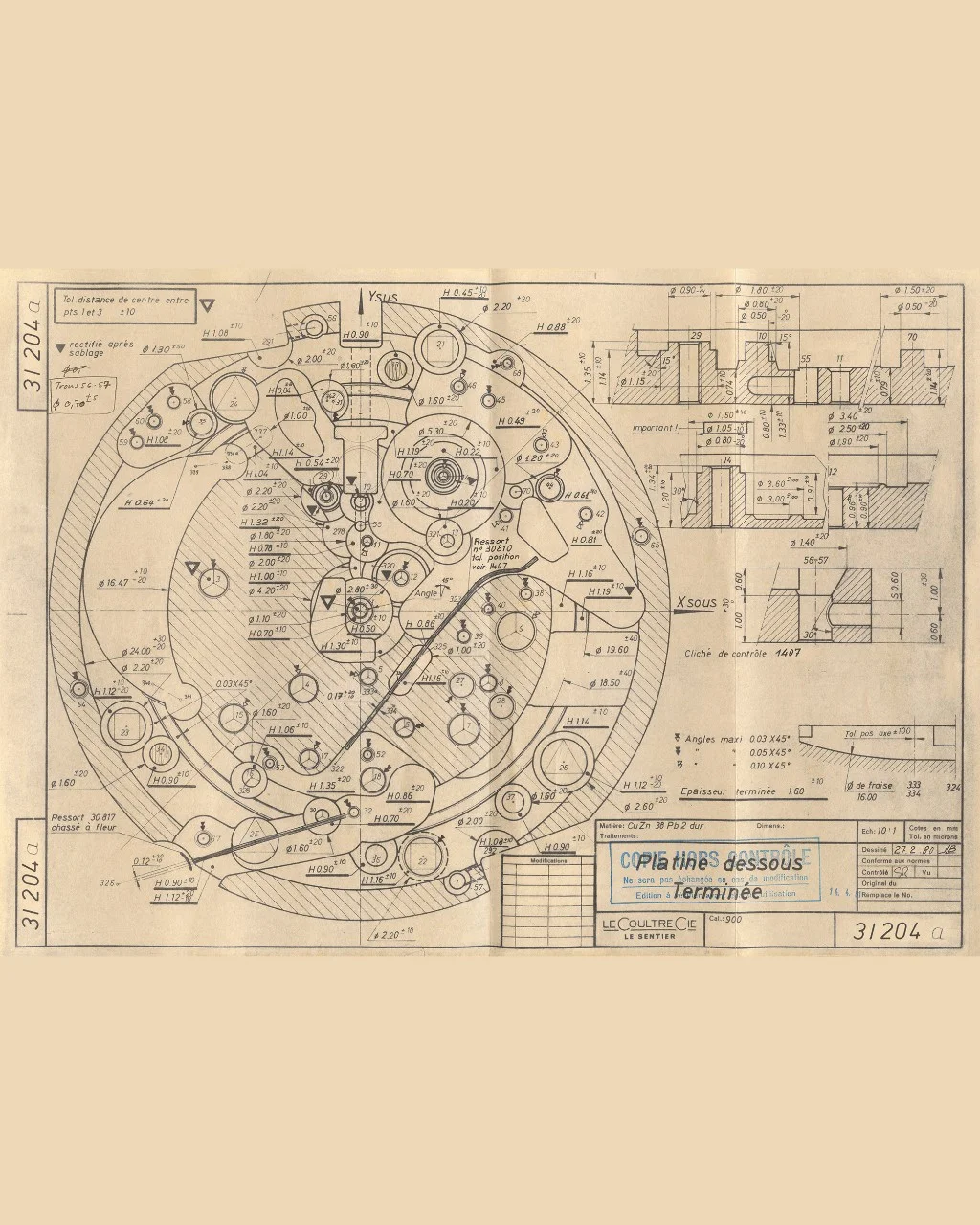
1980. Plan of the Calibre 2123 baseplate Copy of LeCoultre & Cie Plan no. 31204a. Audemars Piguet Archives.
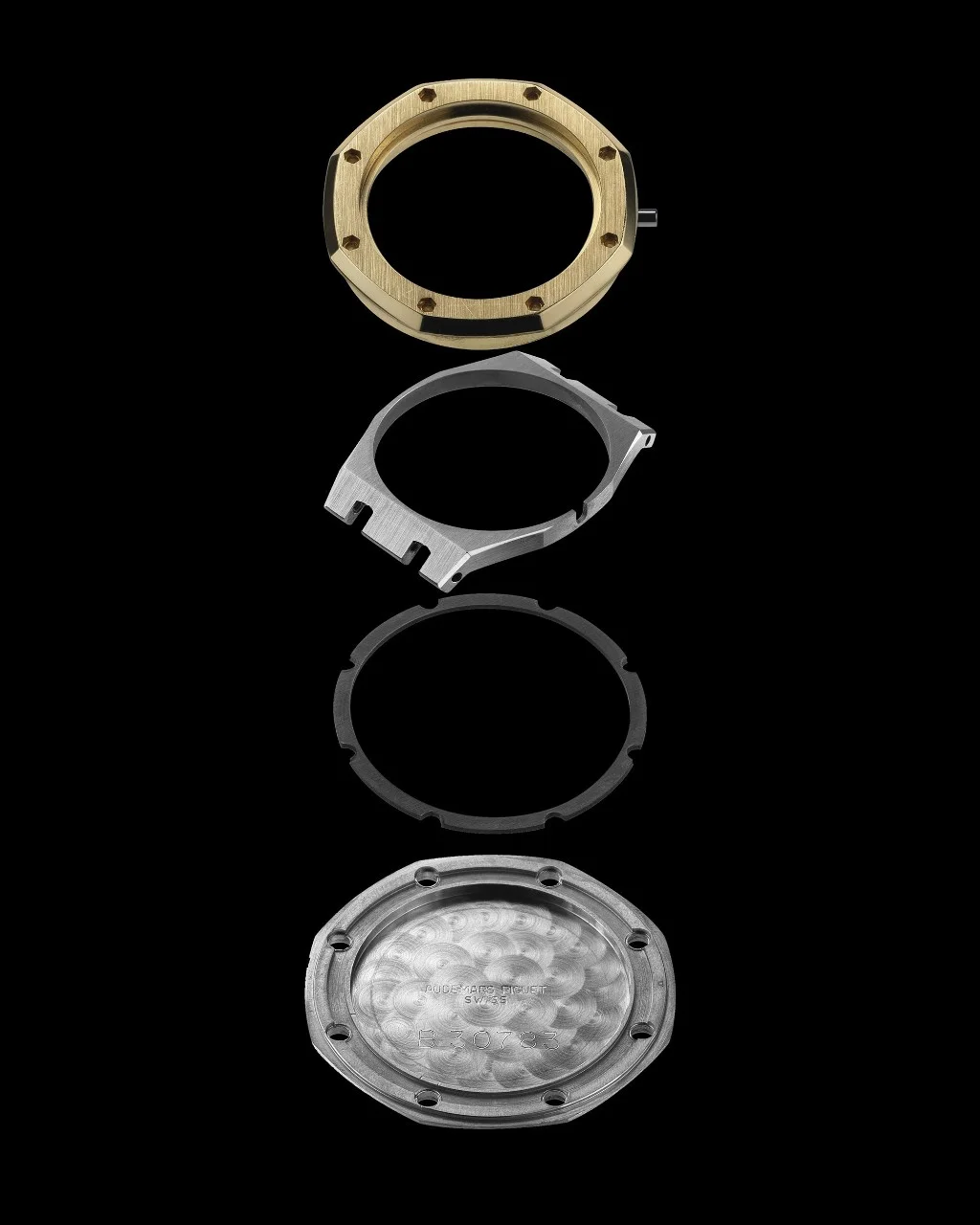
1977. Case components, Model 4100SA The case architecture of Model 4100 is quite distinctive from those of its 5402 (1972) and 8638 (1976) predecessors. Components of the Royal Oak 4100SA no. 1097 sold in 1979. Audemars Piguet Heritage, inv. 1163.
Italy Finally Adopts the Royal Oak
Audemars Piguet turned to its best partners to produce this model. Italian company Fontana drew up the case plans in November 1976. Later renamed Lascor, this specialised manufacturer was based near Lake Maggiore, in Sesto Calende. Gay Frères supplied bracelet numbered 477 and the Geneva specialist Stern Frères was responsible for the dials adorned with the T21 Tapisserie motif, just as it had been for the previous Royal Oak models.
In 1977, Audemars Piguet launched the production of just over 1,000 Royal Oak 4100 watches. Supported by a beautiful advertising campaign, the model found its audience as 472 watches were sold during the launch year. 1978 saw a tidal wave with 1,597 watches sold, followed by 1737 in 1979. In all, no less than 5,720 Model 4100 watches were sold, taking the Royal Oak into a new dimension.
Even more than Model 8638, the Royal Oak 4100 demonstrated that the enfant terrible was capable of evolving, mellowing and being transformed. More than 75% of these watches contain gold; all of them measure 35 mm in diameter and feature the “AP” monogram at 12 o'clock; none are ultra-thin. Thanks to these new codes, Italy finally began to adopt the Royal Oak. While only 4% of Model 5402 had been distributed there, this country absorbed 1,379 watches numbered 4100 and 8638, i.e. more than 15% of the total production. Raymond Bornand – who was in charge of the Royal Oak distribution in Switzerland at the time – loves to point out that many Italian men opted to wear the 29 mm Model 8638. In the end, two thirds of the models were made entirely or partially of gold. The future of the Royal Oak was to be built on these new aesthetic codes.
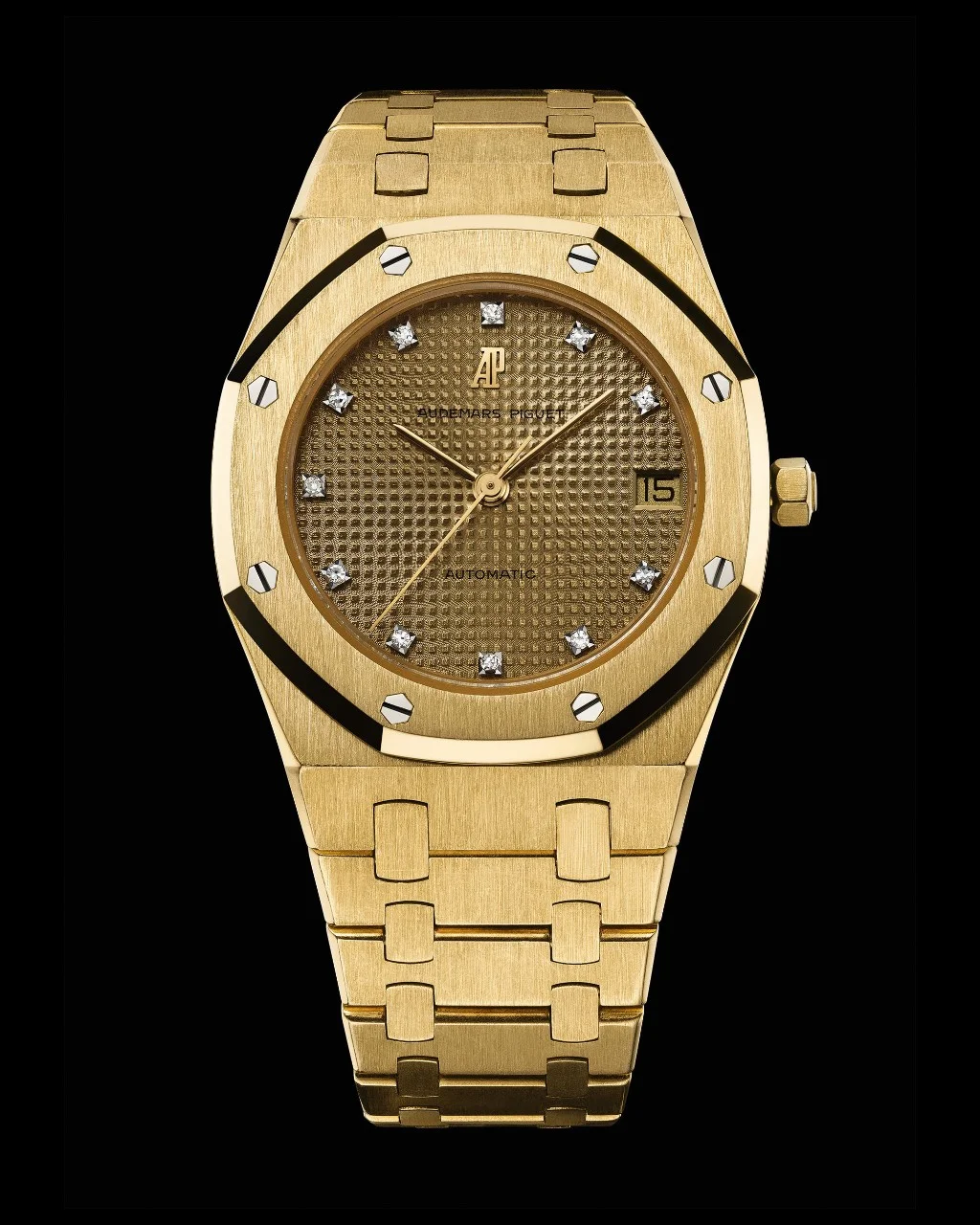
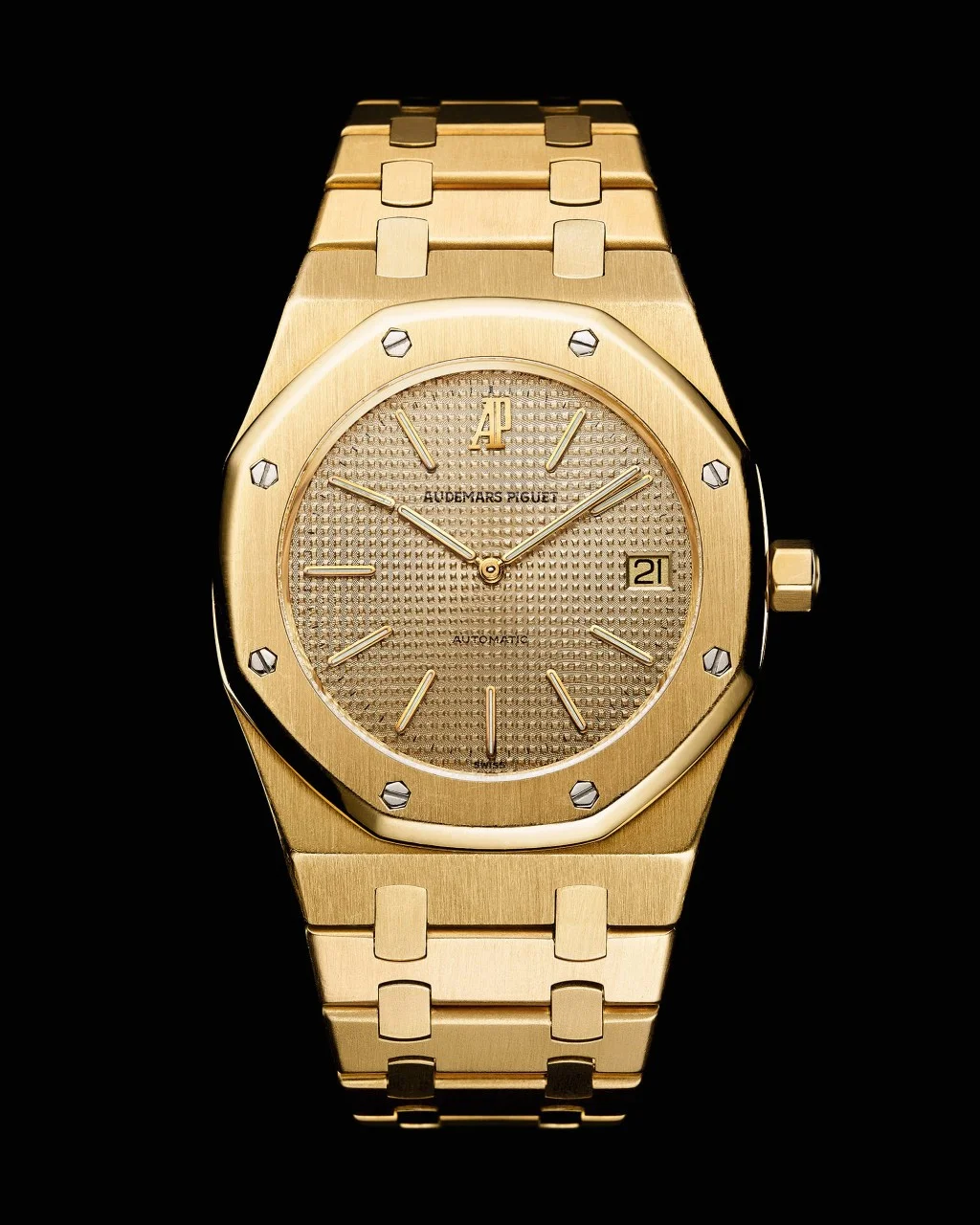
1978 – 1982: Moving Towards a New 35 mm and Then 36 mm Classic
Model 4100 is referred to in the archives as "Royal Oak III." No "IV" version exists due to the increasing number of variations from that point on. While there were many different sizes, the 35 mm diameter asserted itself as the new benchmark for men’s watches.
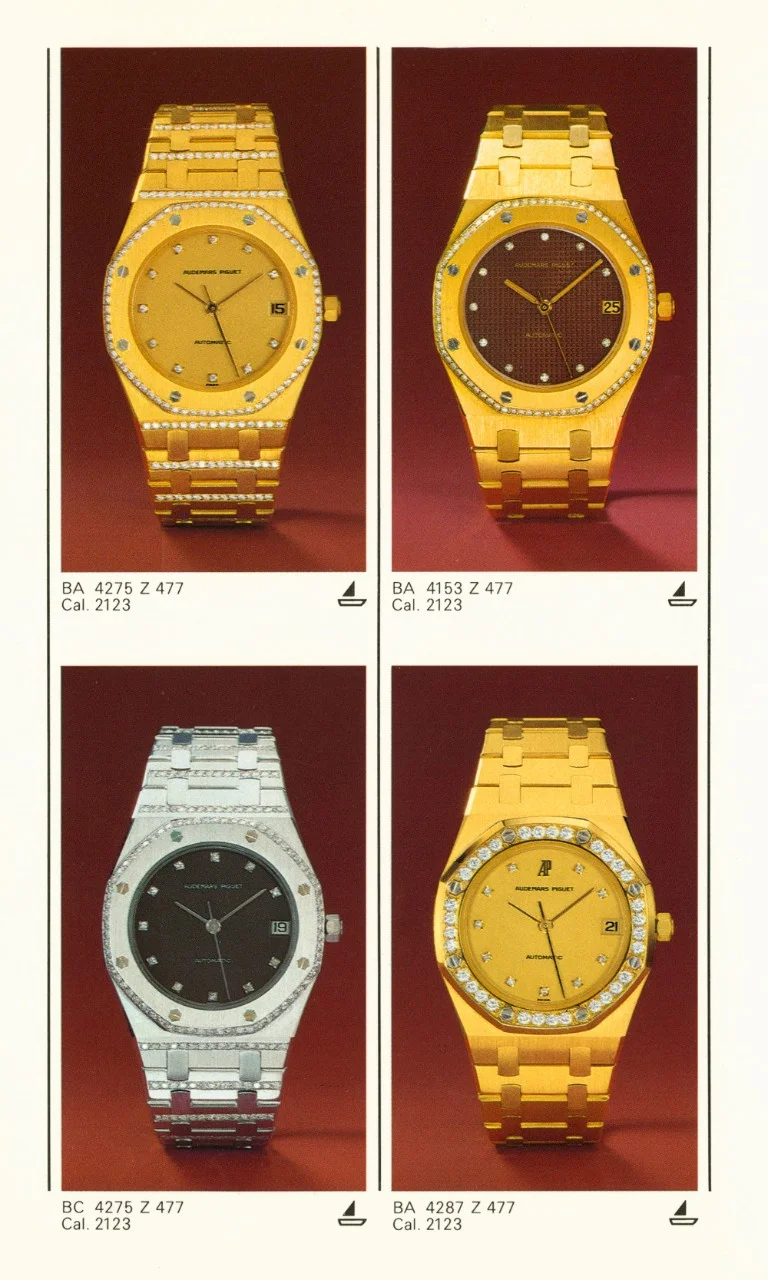
From 1978 to 1982, several variants of Model 4100 were created using Calibre 2123 (26 mm in diameter, 3.25 thick), notably to accommodate precious stones: 4153 (1978); 4275 (1981); 4287; (1981); 4331 (1982). From 1986–87, the 35 mm models were equipped with a smaller mechanism, Calibre 2131 (23.3 mm in diameter, 3.2 mm thick, Frédéric Piguet "ébauche"), notably Models 14544 (1987); 14486 (1990); 14575 (1990) and 14674 (1990).
From 1983 onwards, there were further shifts. The majority of models were upsized to 36 mm, starting with the Royal Oak 4332 (calendar models 5572, 5581, 5658, 5577, 5595, 25594...) and then the 14700 line from 1990. Over the next two decades, more than 50 Royal Oak models with a 36 mm diameter were produced. Most were equipped with Calibre 2125 and its derivatives including Calibre 2225, a family of selfwinding movements created in the 1970s by LeCoultre & Cie. These veritable tracteurs (tractors) – a term used by watchmakers to designate a robust movement capable of accommodating complications – equipped countless models until the 21st century.
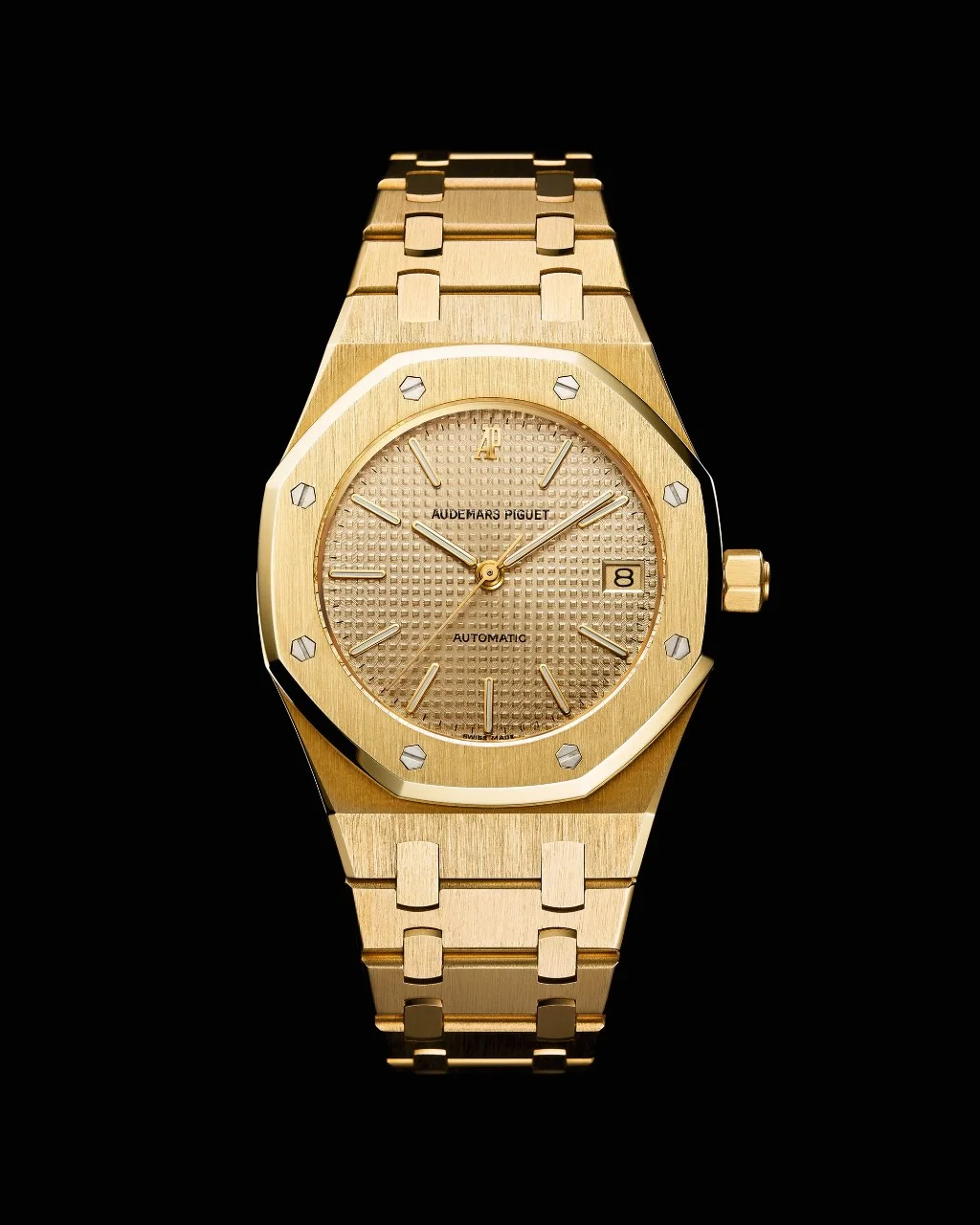
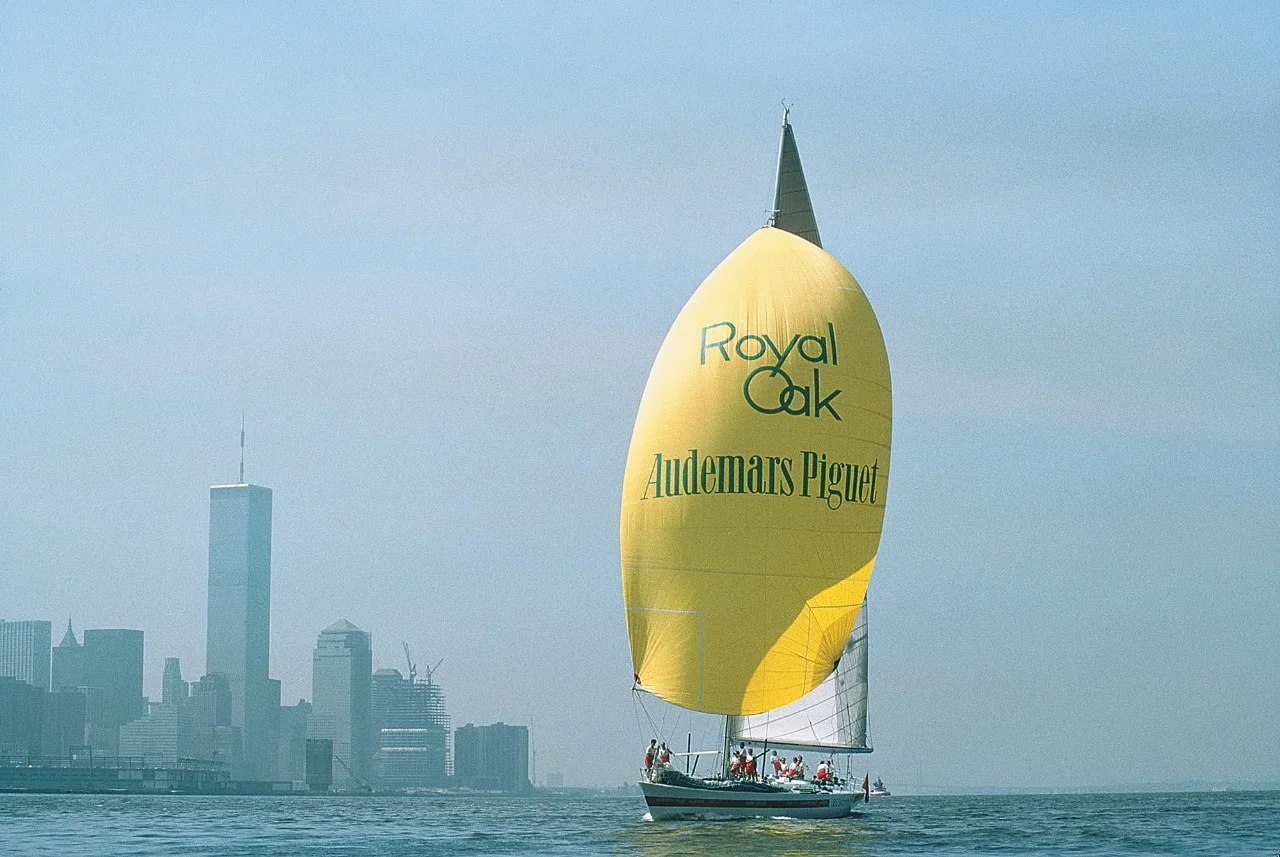
From 1983 Onwards: 36 mm Versions with Calendar and Time-Zone Indications
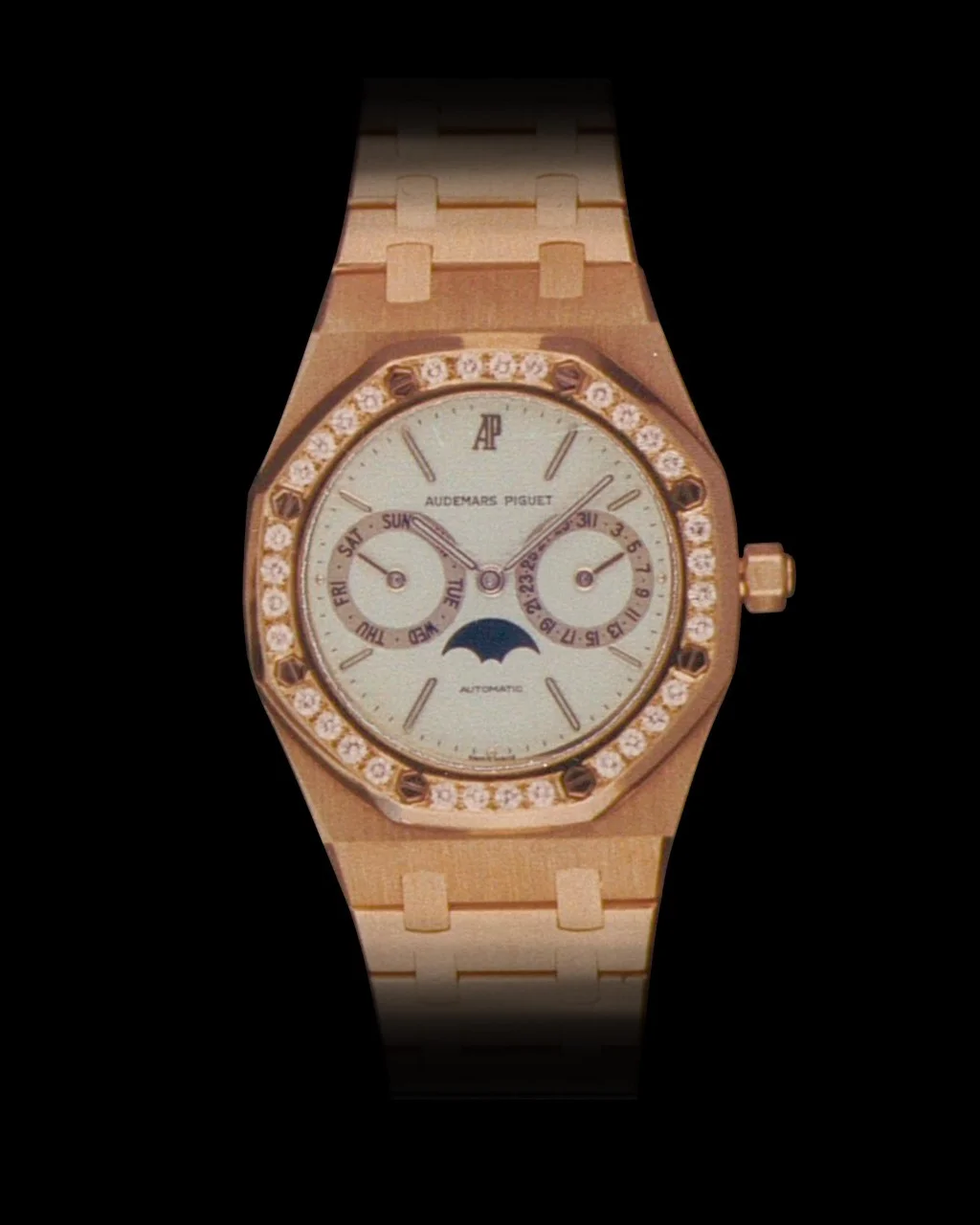
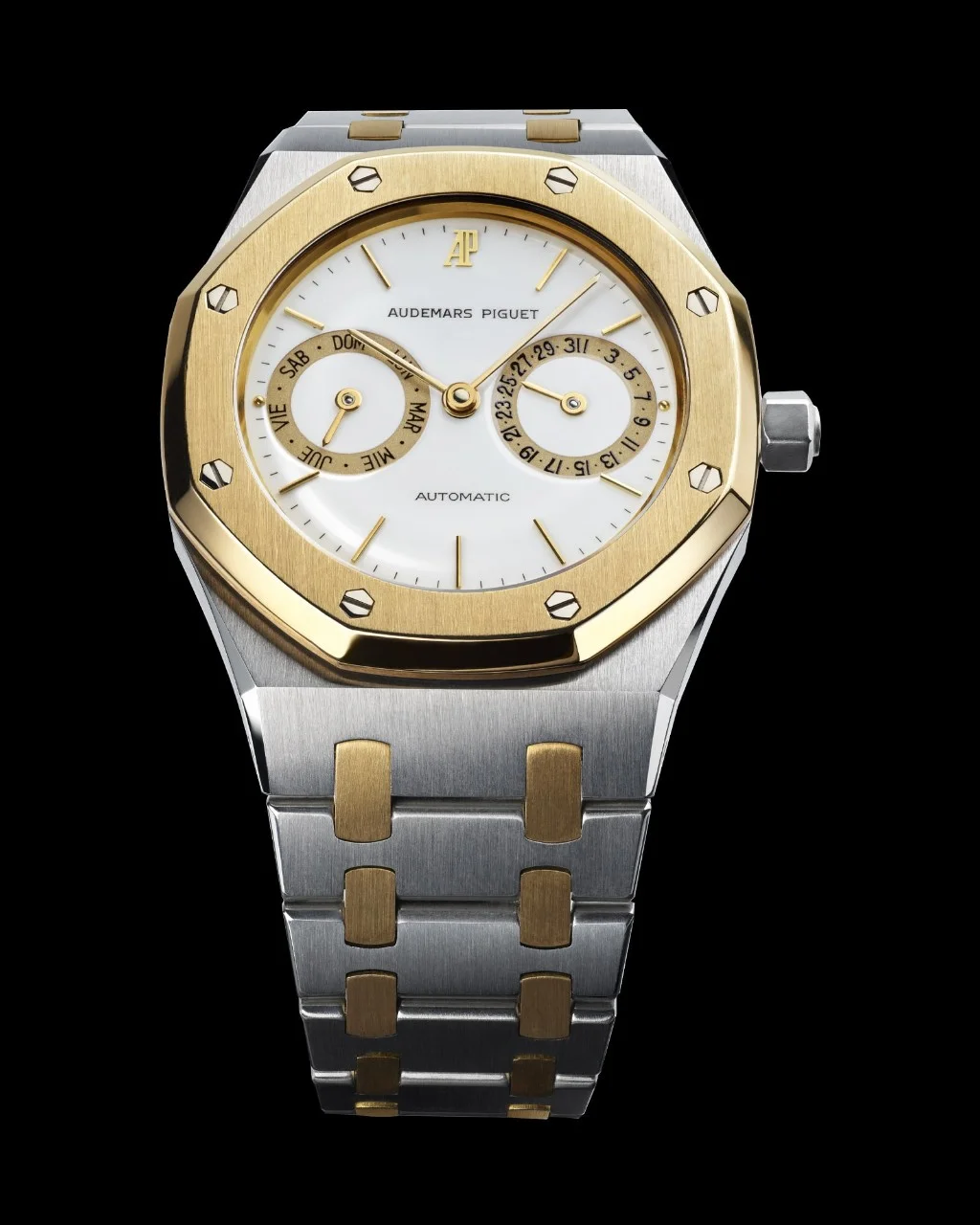
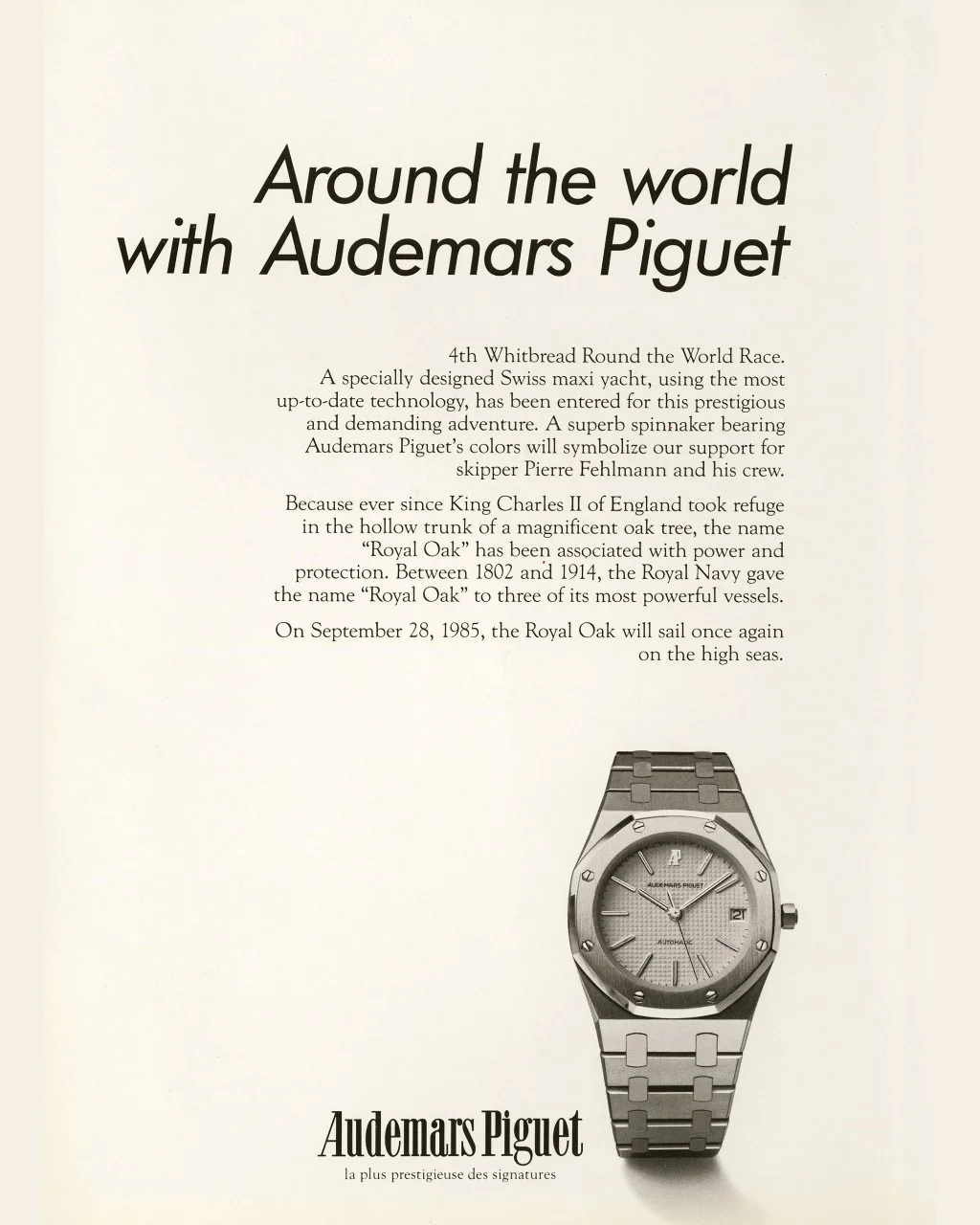
The first Royal Oak watches with complications appeared in 1983. Their 36 mm diameter confirmed the new sizing standard.
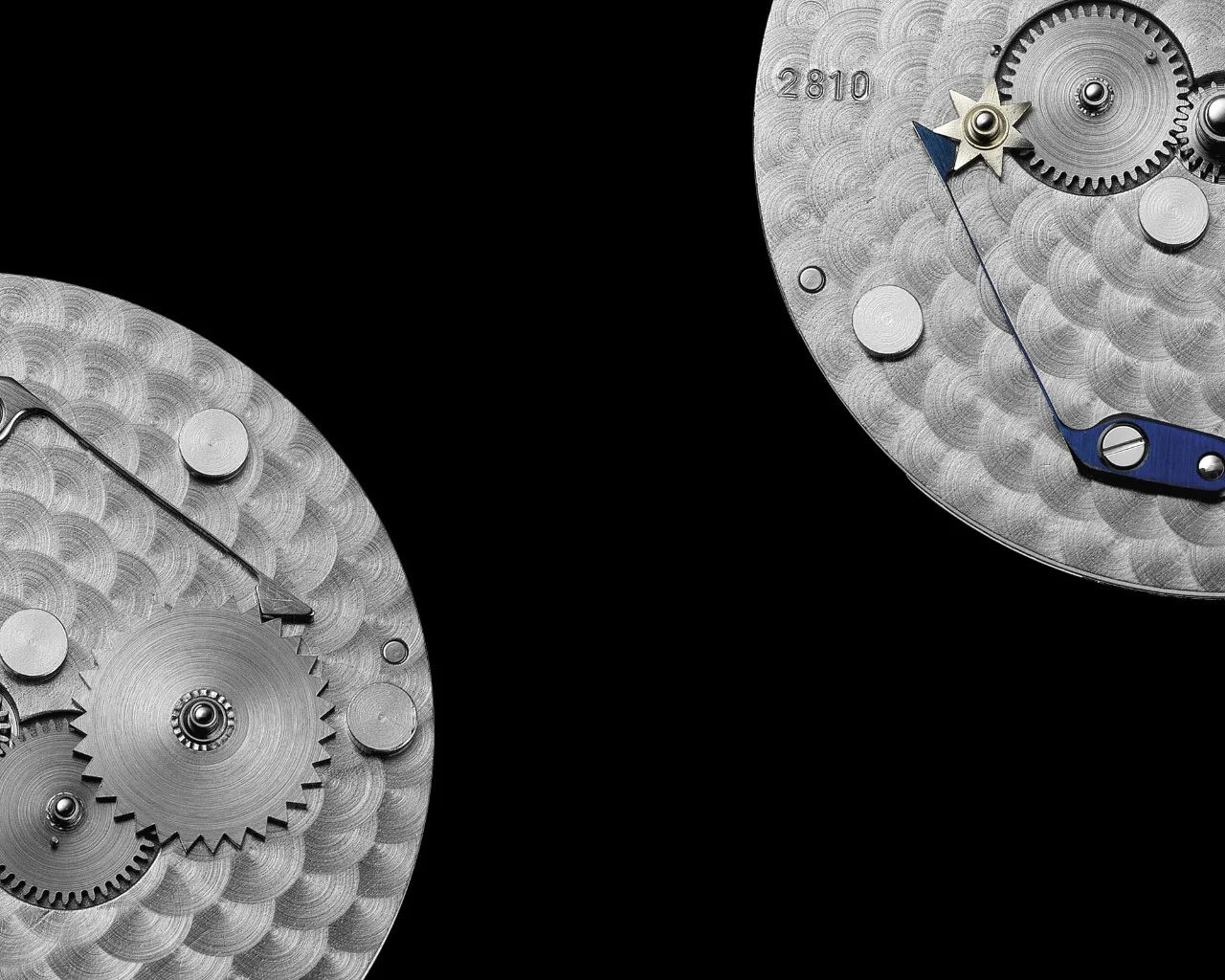
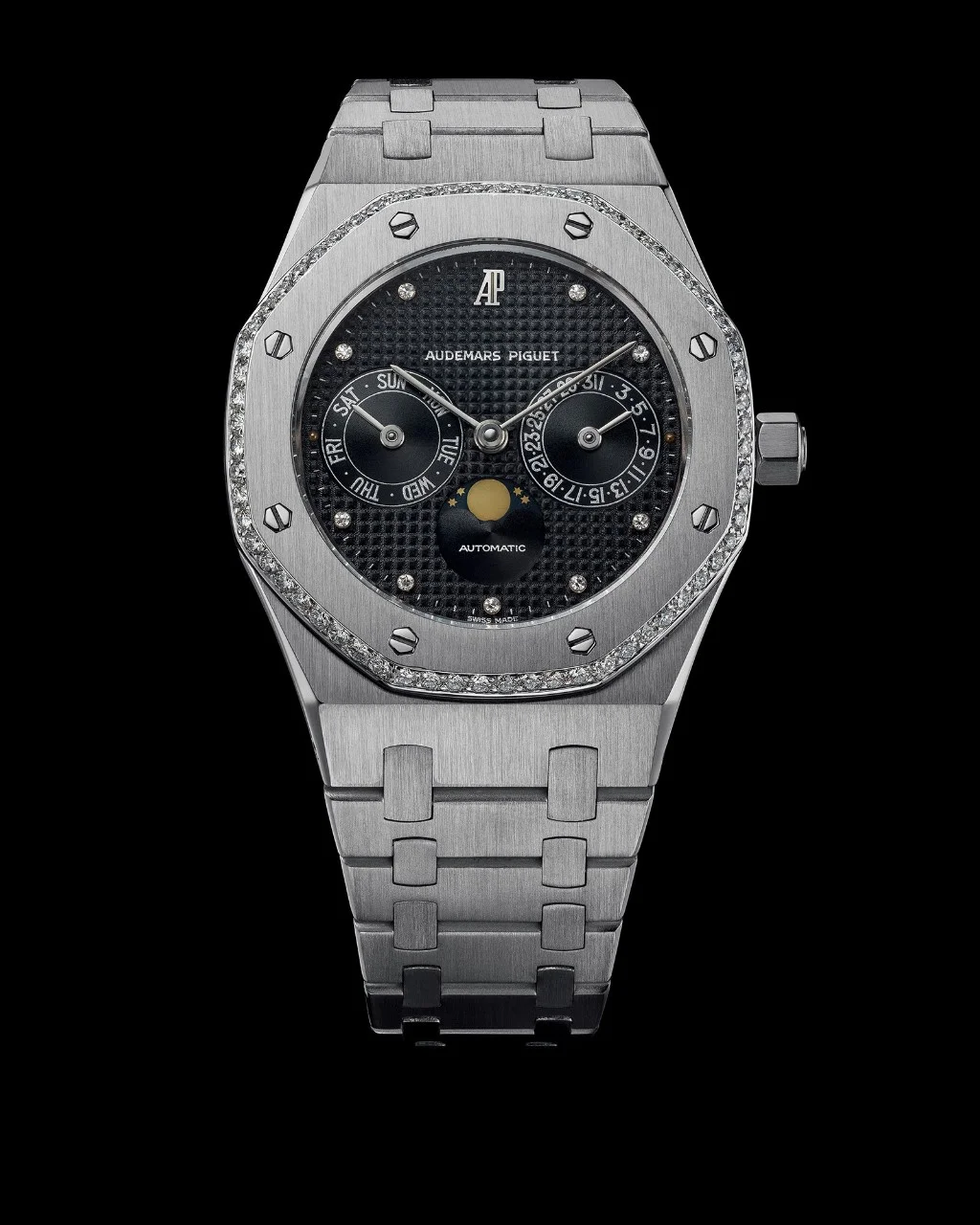
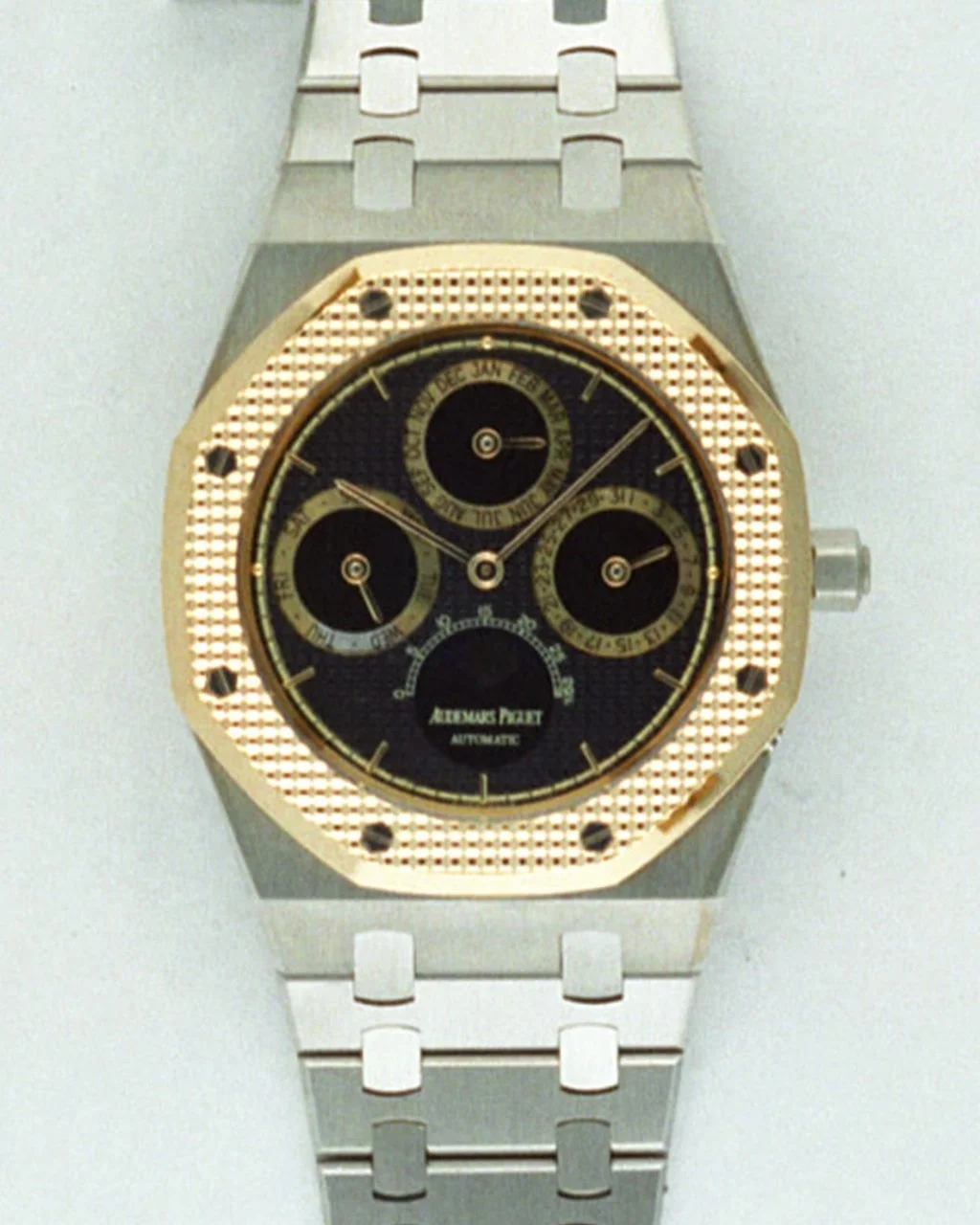
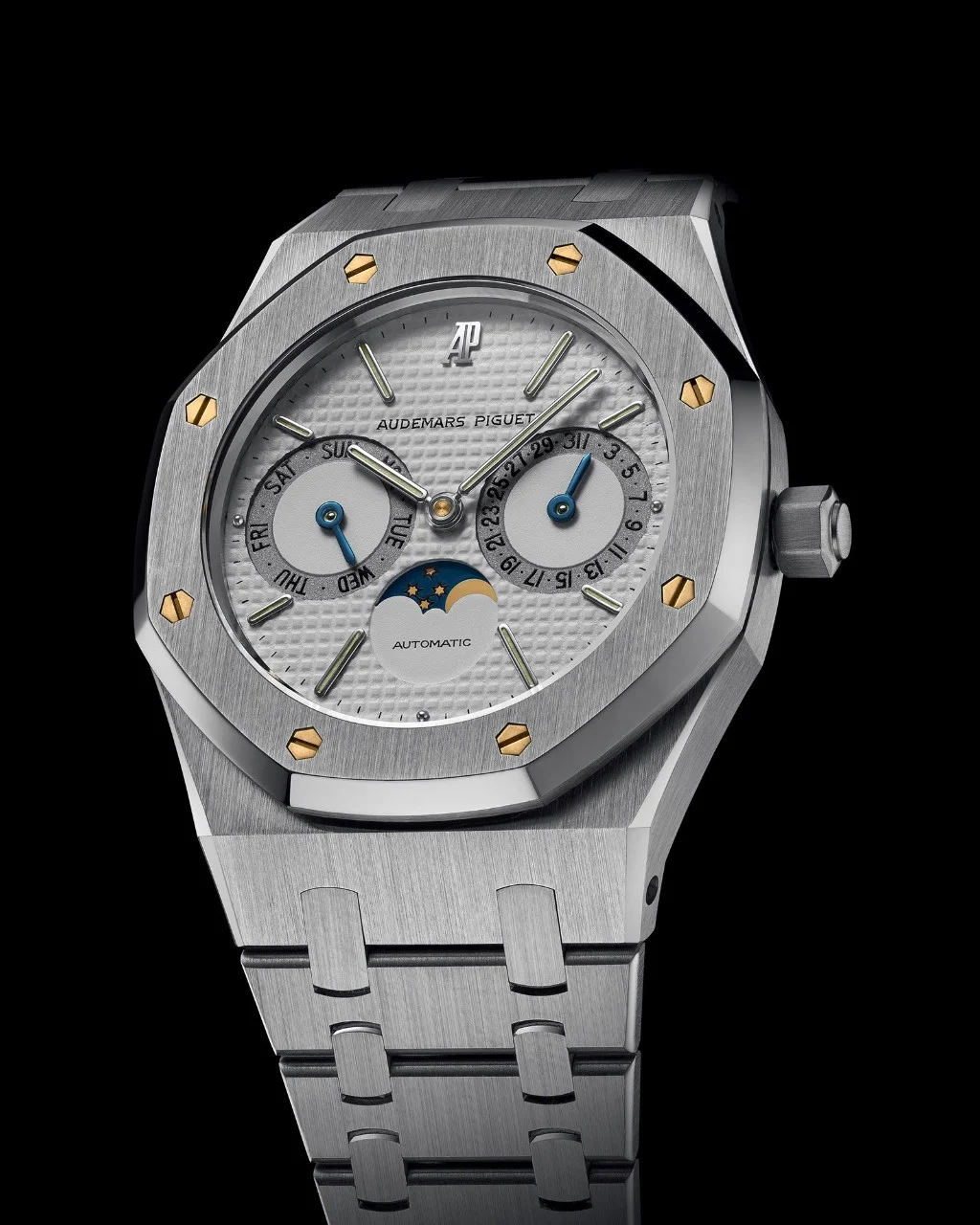
Audemars Piguet first presented the Royal Oak Day Date, Model 5572, equipped with Calibre 2124/2810 (26 mm in diameter, 4.55 mm thick), followed by several derivatives numbered 5577, 5581 and 5584. The base movement "ébauche" was produced by Jaeger-LeCoultre, while the calendar plate was manufactured by Dubois Dépraz in the small village of Le Lieu in the Vallée de Joux. The development was carried out in Audemars Piguet's brand-new Technical Department, as evidenced by plans dating from 1982. The same applies to the Royal Oak triple calendar models equipped with Calibre 2124/2825, housed in a case identical to the first Day Date model. They were also available in several variants featuring a moon phase from 1983 onwards: 5658, 5595, 25594 and 25627.
This 36 mm diameter was used again ten years later for the first Royal Oak Dual Time, whose time-zone system was based on Audemars Piguet patent CH673196A. Equipped with Calibre 2129/2845 (26 mm in diameter, 4.85 mm thick), the first variations bore model numbers 25744, 25762, 25772 and 25730. They were followed by Models 25757 and 25929, both powered by Calibre 2229/2845. Finally, the Royal Oak with annual calendar (Model 25920, Calibre 2224/2814) adopted the same size in 1999.
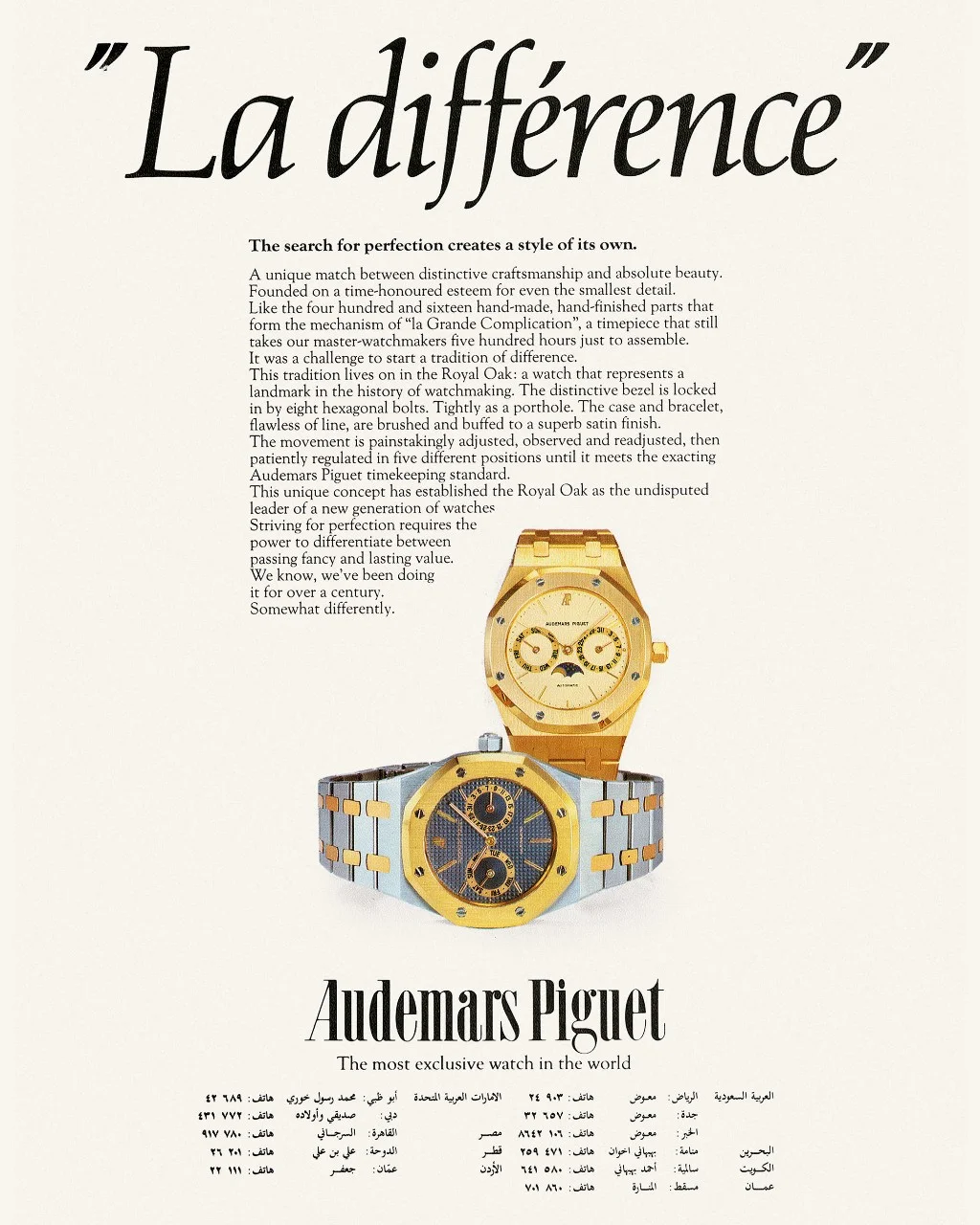
Circa 1983. Audemars Piguet advertisement for the Middle East This ad presents two variations of the first Royal Oak endowed with additional functions, Model 25572. The title is in French, the text in English and the list of points of sale in Arabic. Audemars Piguet Archives.
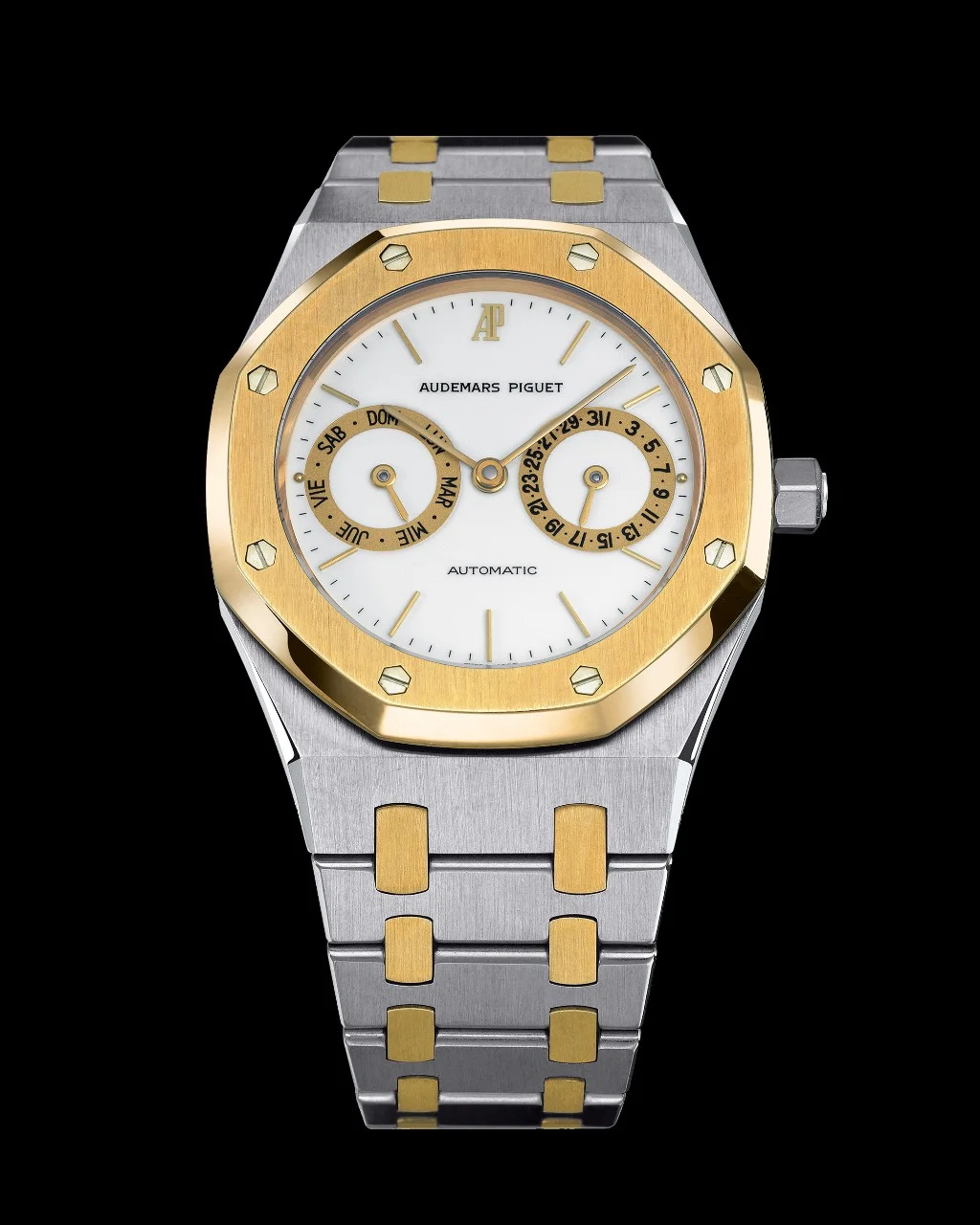
1983. Royal Oak Day Date 25572SA No. 88 Day and pointer-type date. Calibre 2124/2810, movement 267558. Bracelet 477. White enamel dial. Case B87959, 36 mm. Steel and 18-carat yellow gold. Sold to Darcal (Switzerland) in August 1983. Audemars Piguet Heritage, inv. 391.
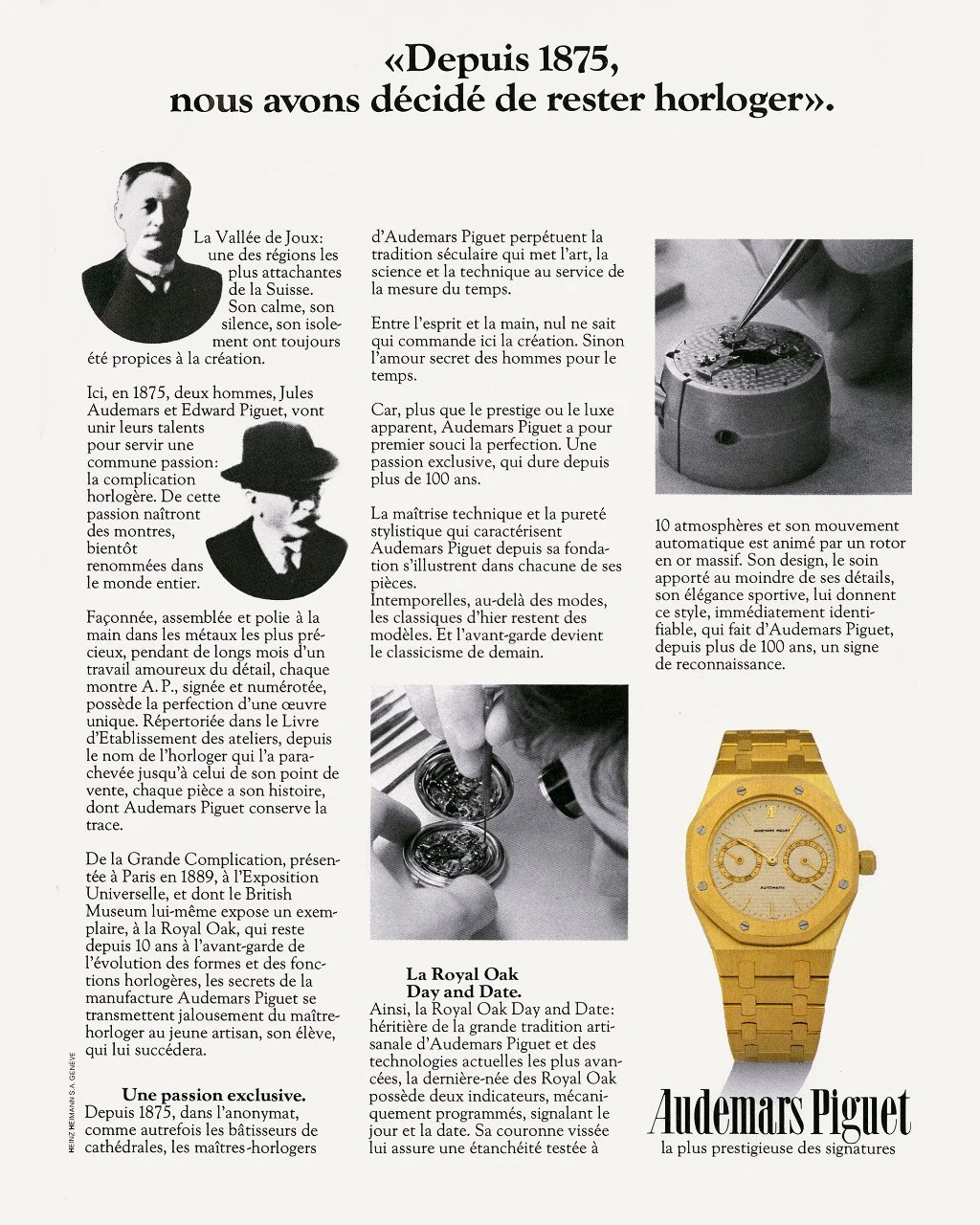
1984. Royal Oak advertisement The ad tells about the history of Audemars Piguet, its natural environment in the Vallée de Joux and the age-old savoir-faire of its watchmakers before introducing Model 25572, the first Royal Oak endowed with additional functions. Audemars Piguet Archives.
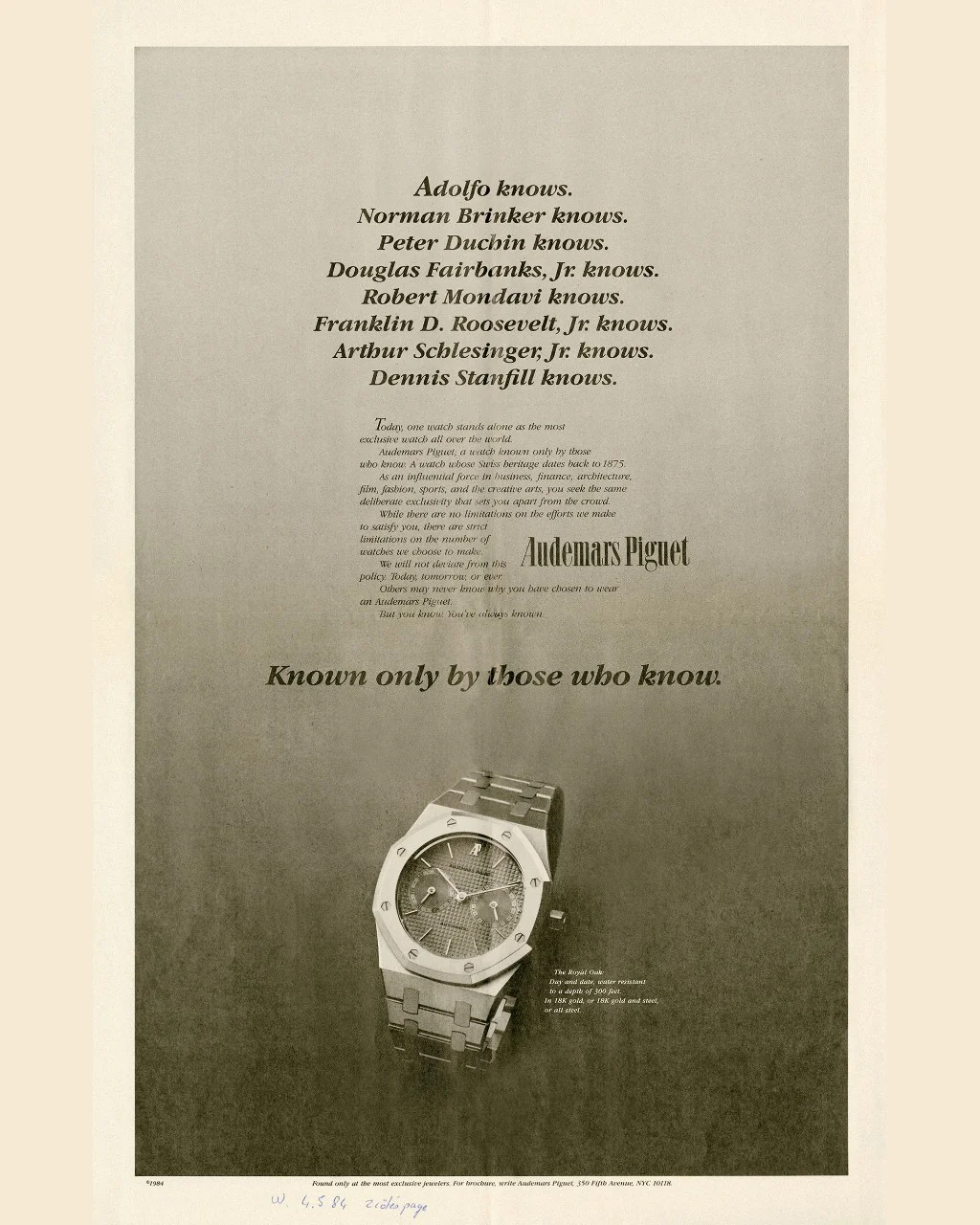
1984. Royal Oak "Known only by those who know" ad Created for the American market, this ad for the first complicated Royal Oak leans on public reputation, exclusivity and knowledge. Audemars Piguet Archives.
When Gems Join the Dance and Dials Break Free
Whether in music, art, cuisine or design, a great classic is a celebrated, well-known, admired and respected work that can be endlessly reinterpreted. Unchanging, yet constantly renewed, the Royal Oak began to meet this definition in the 1980s.
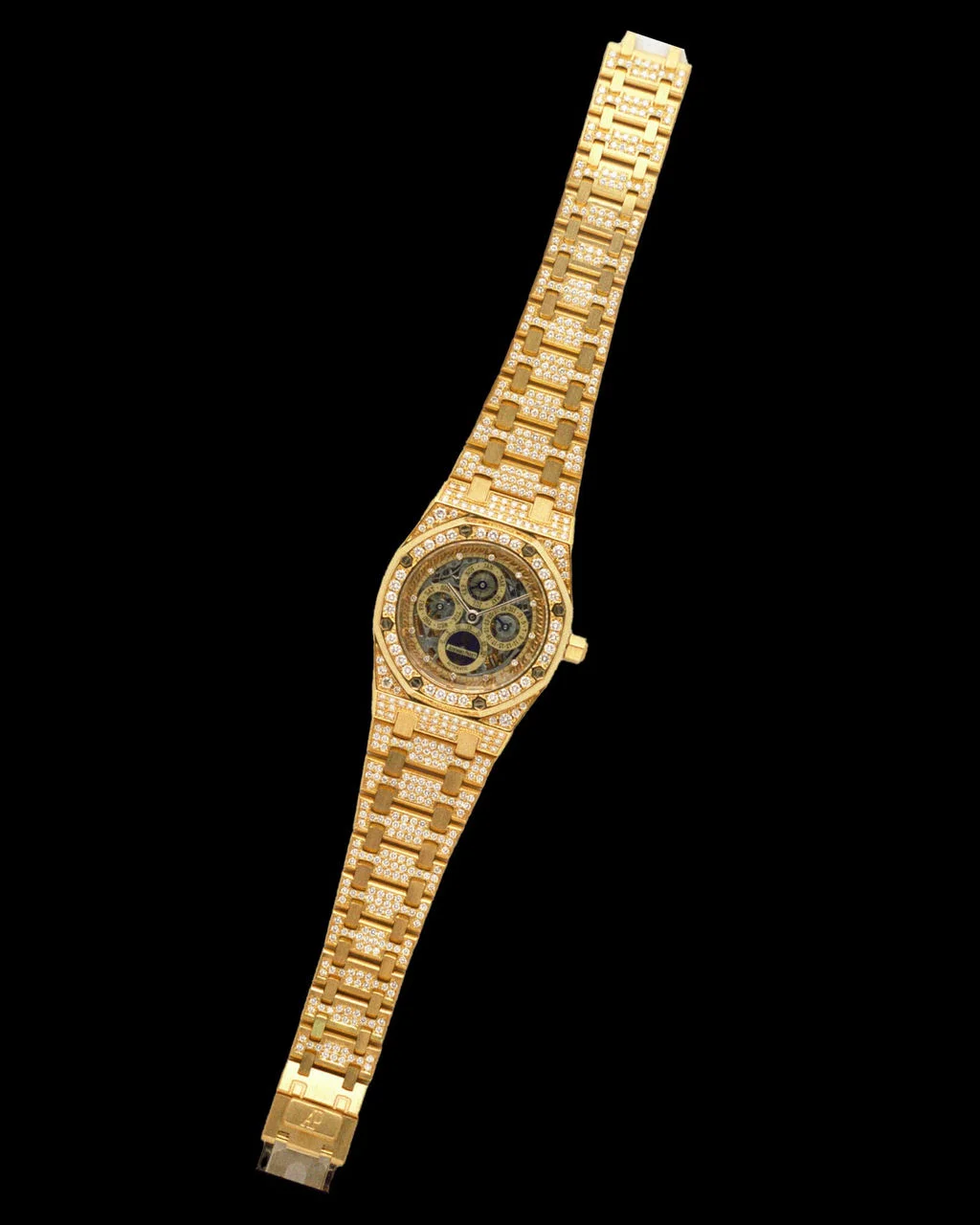
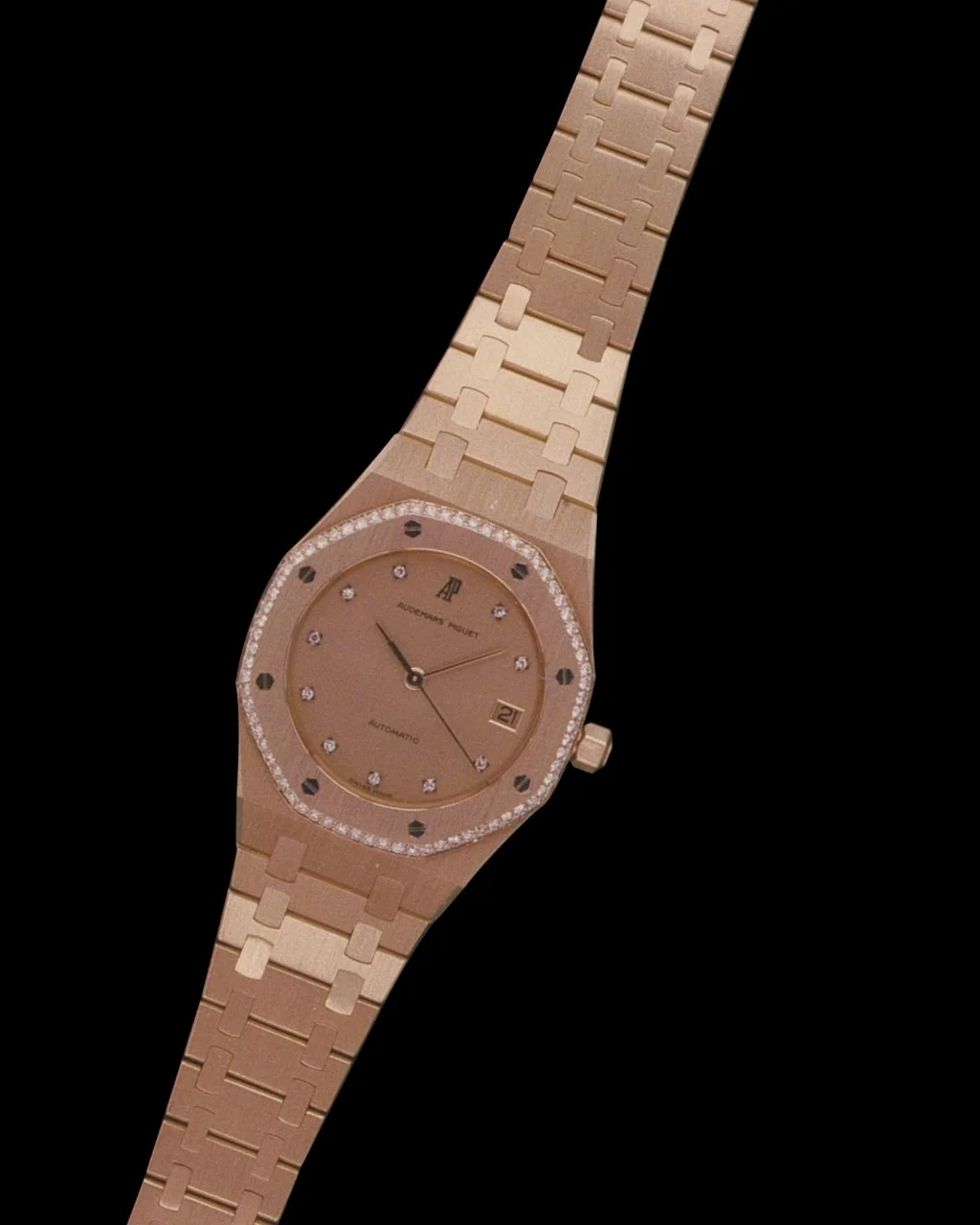
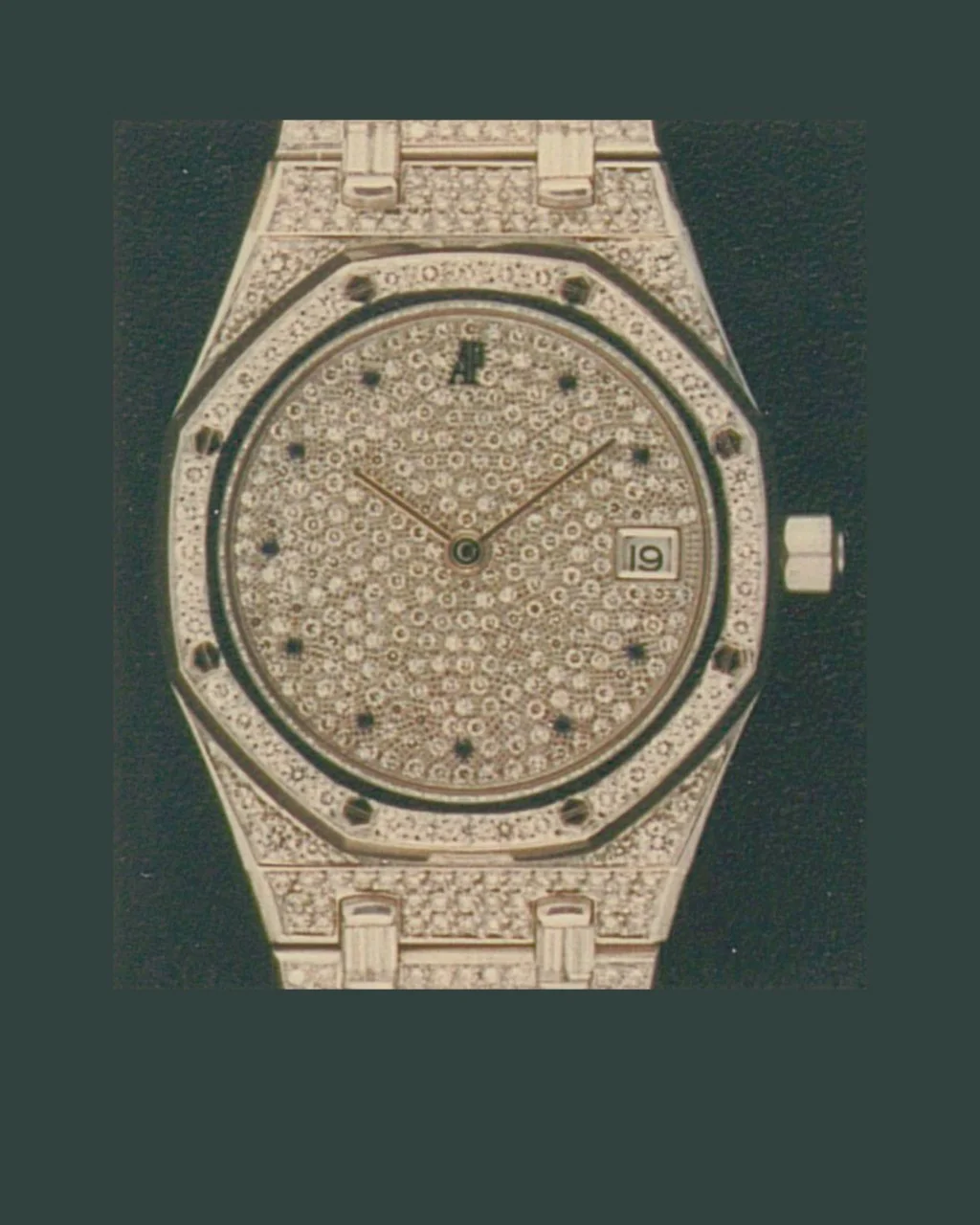
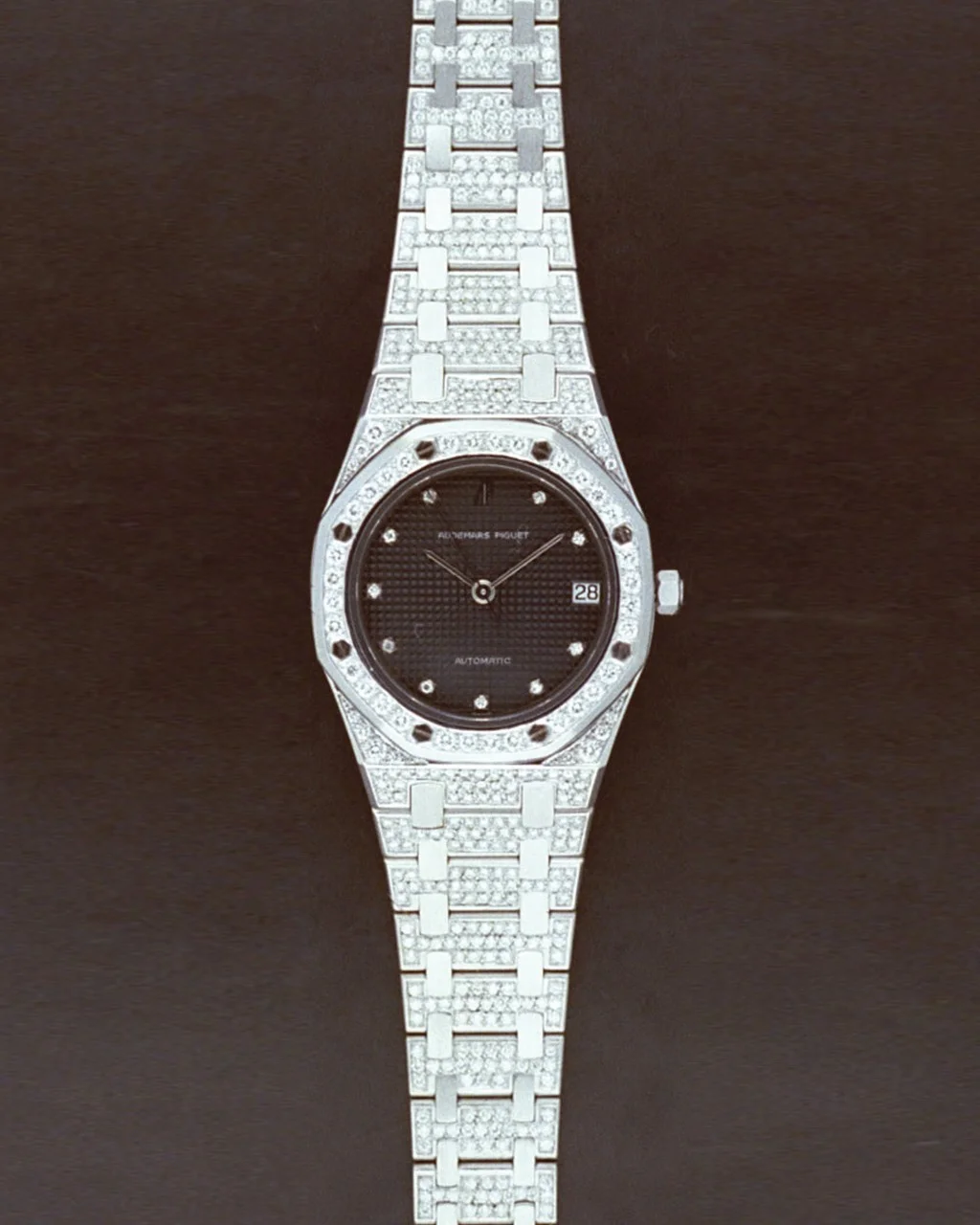
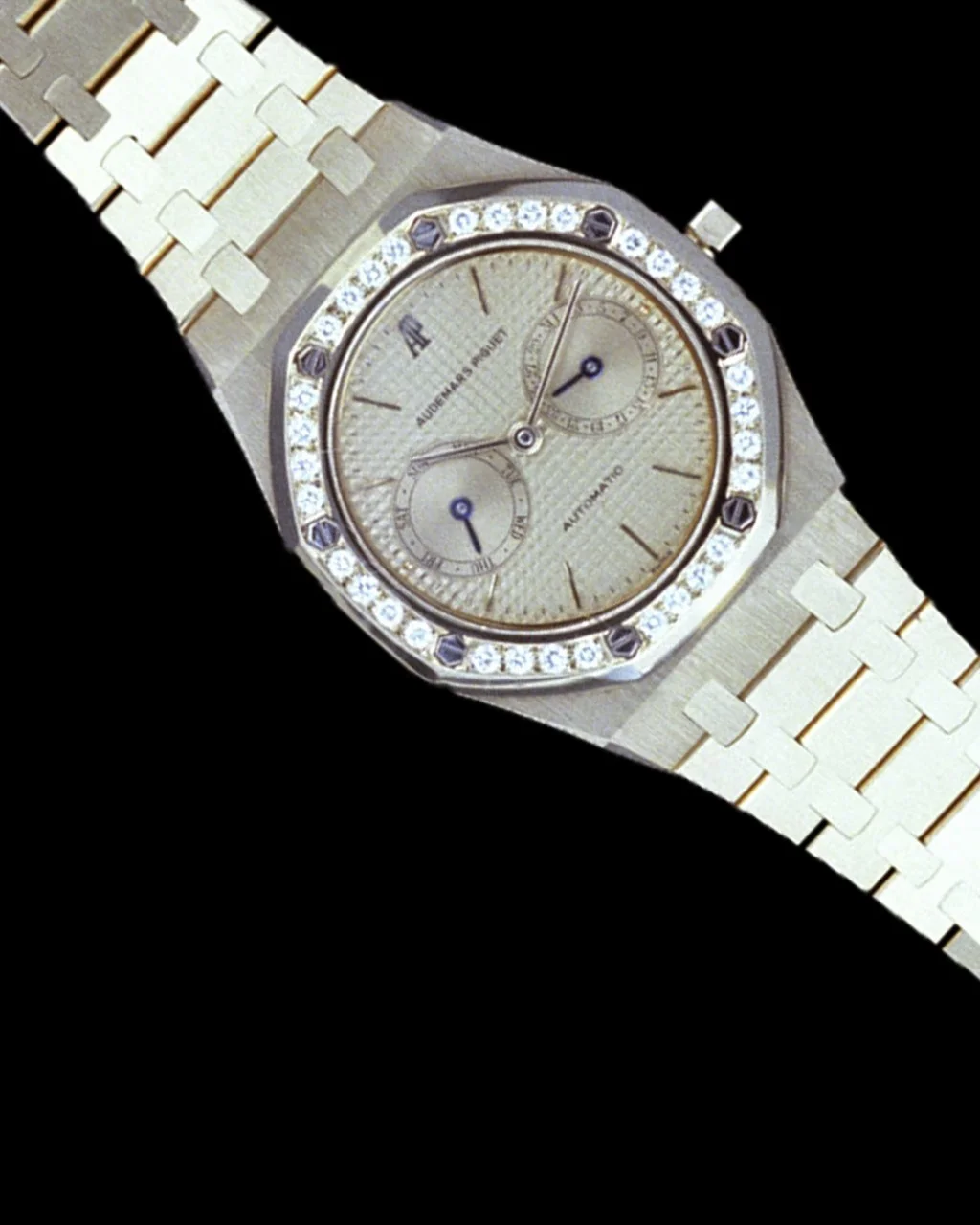
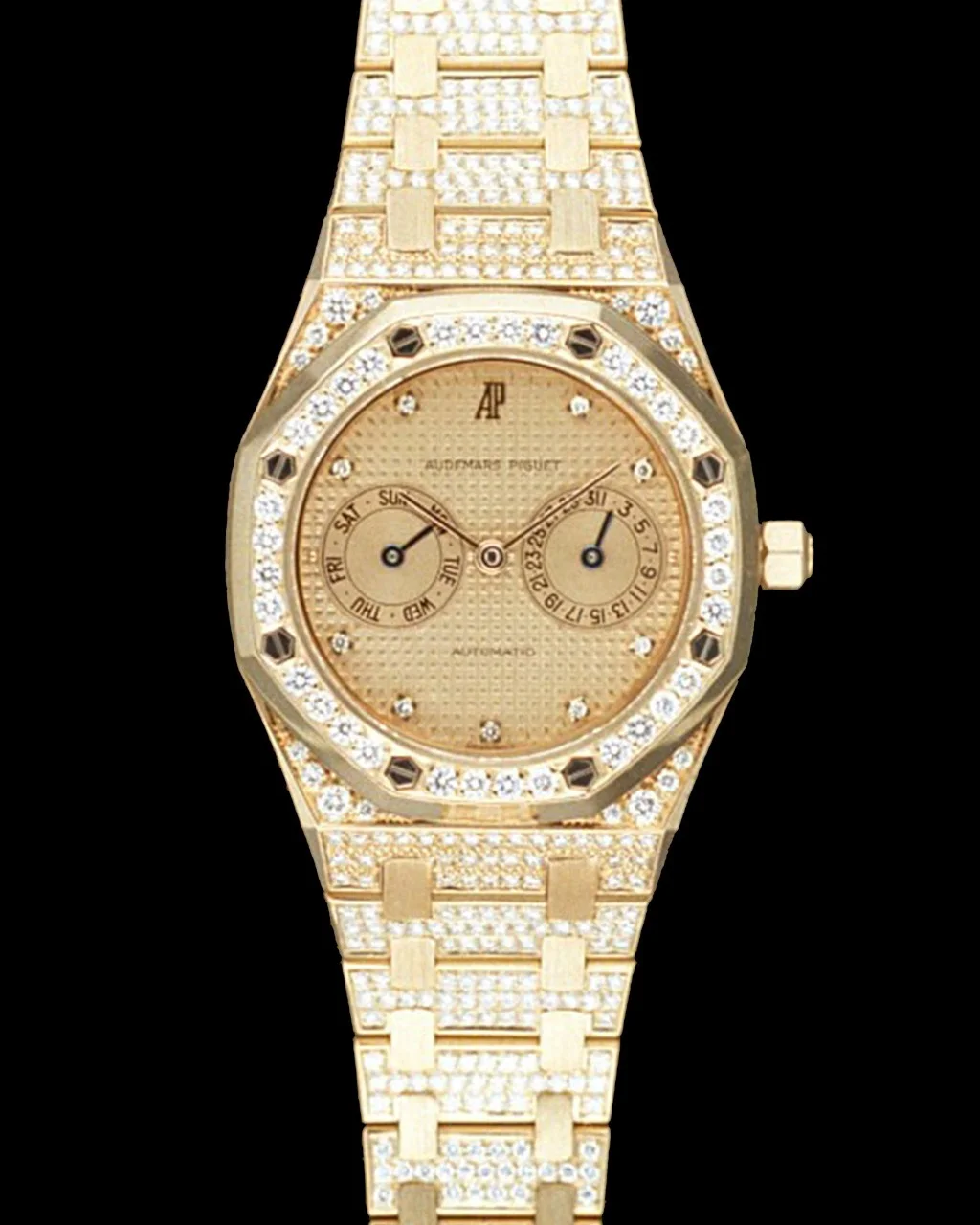
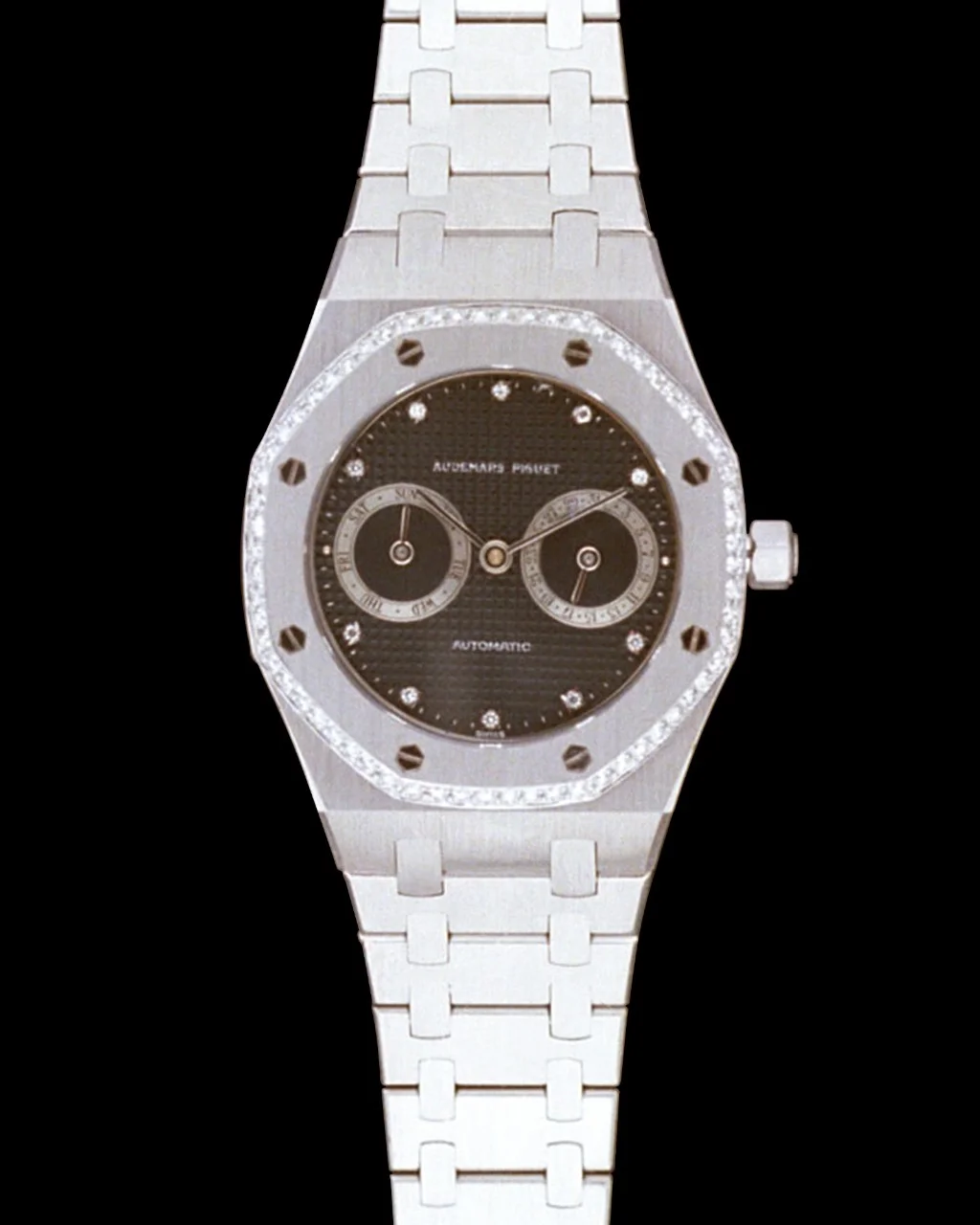
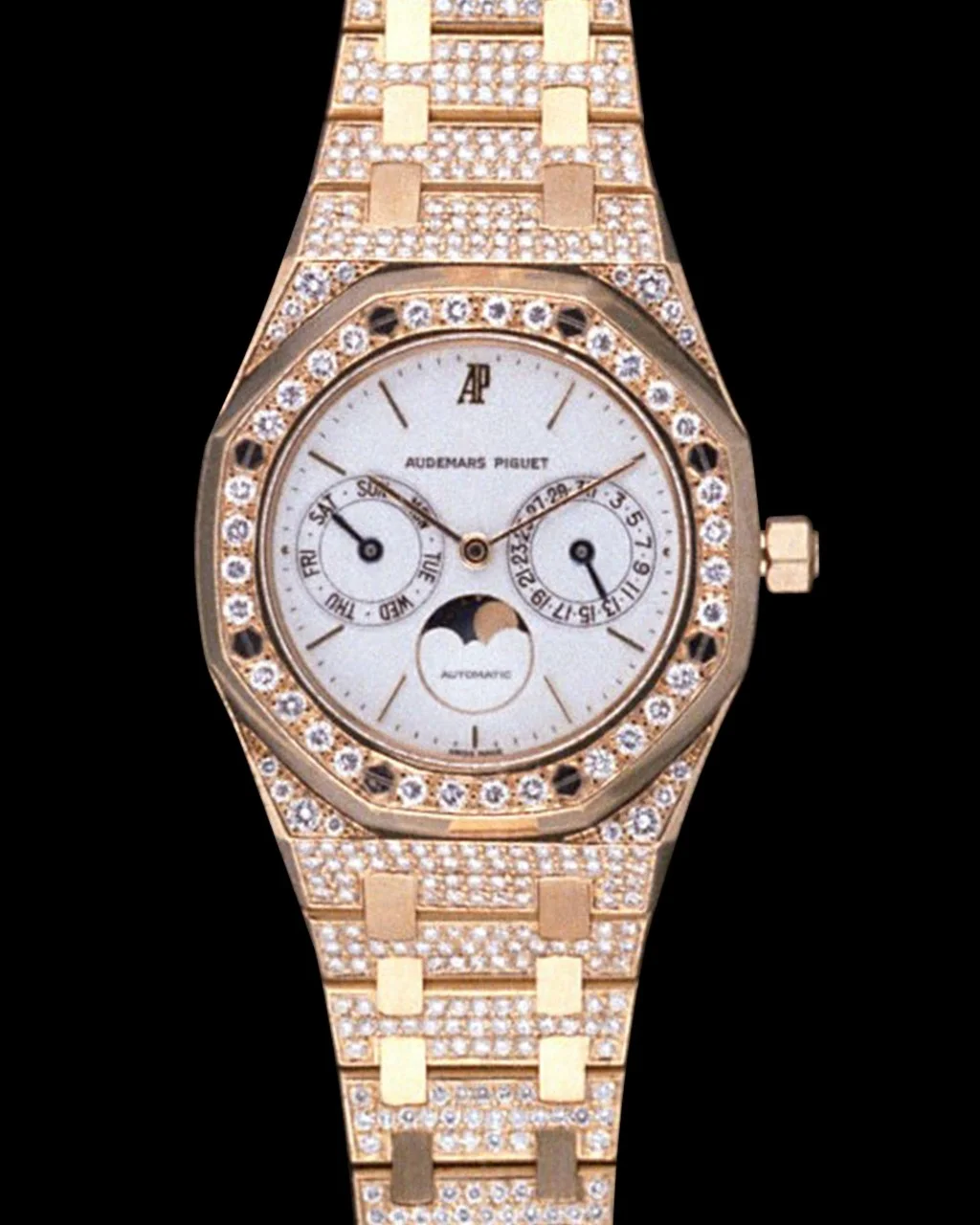
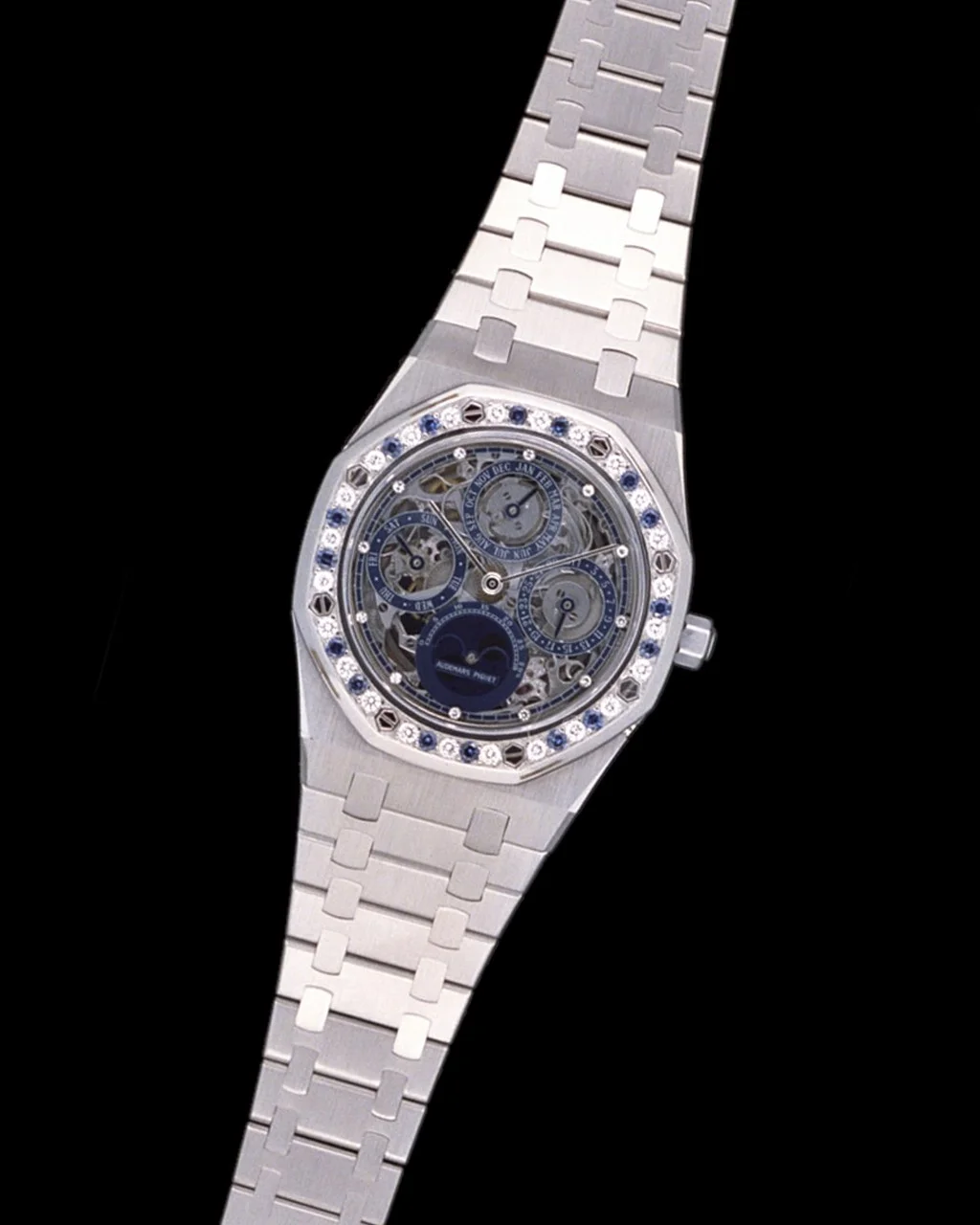
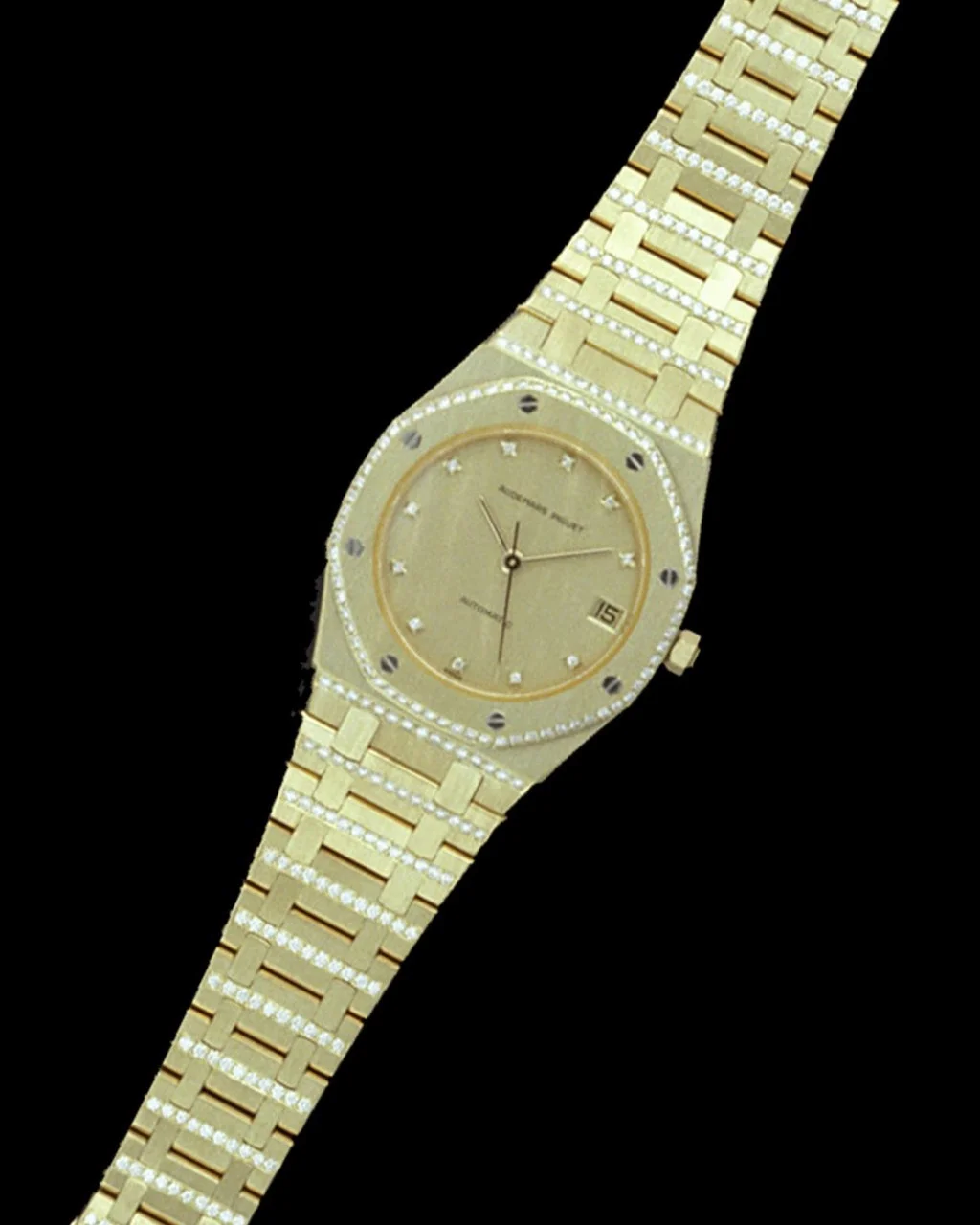
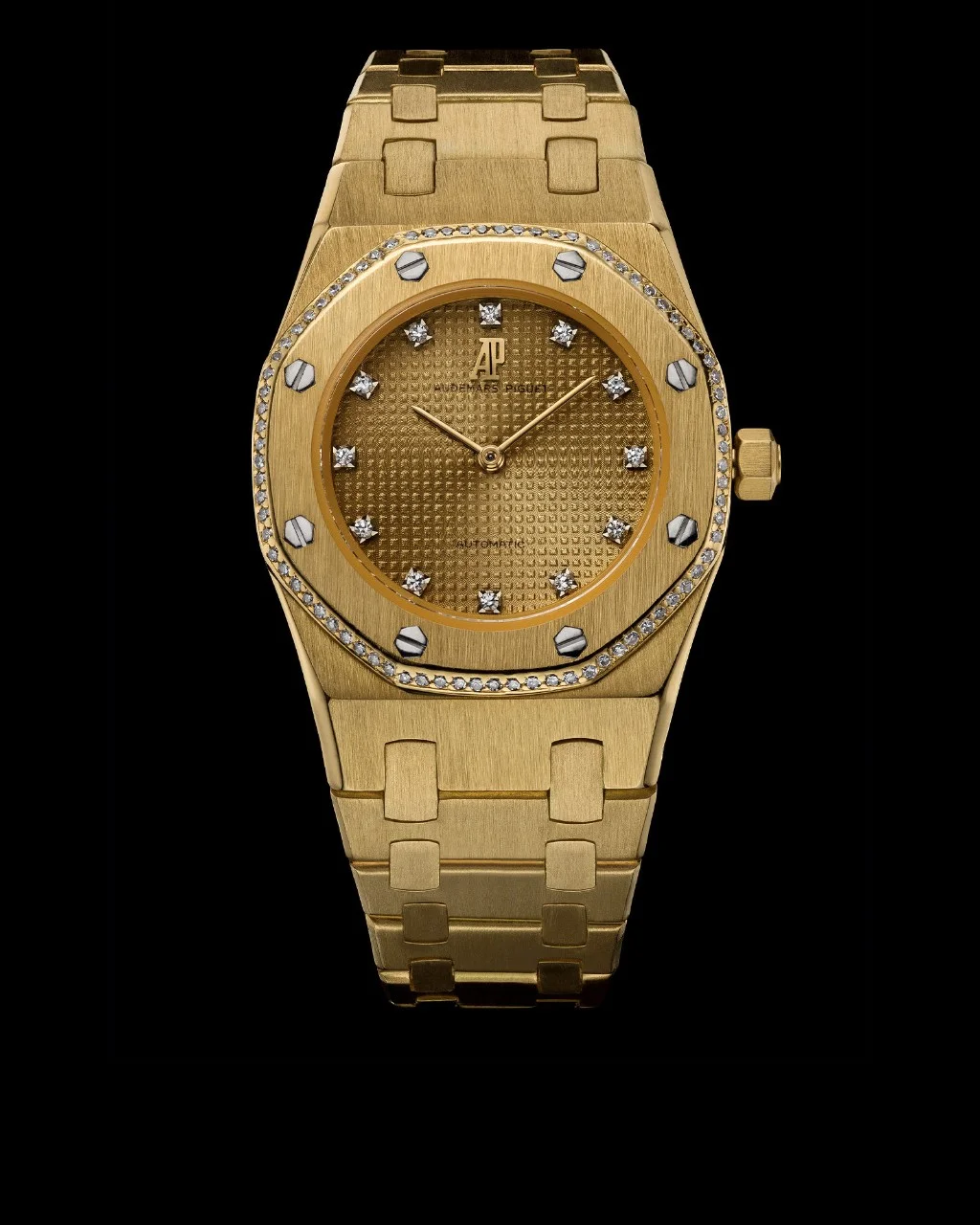
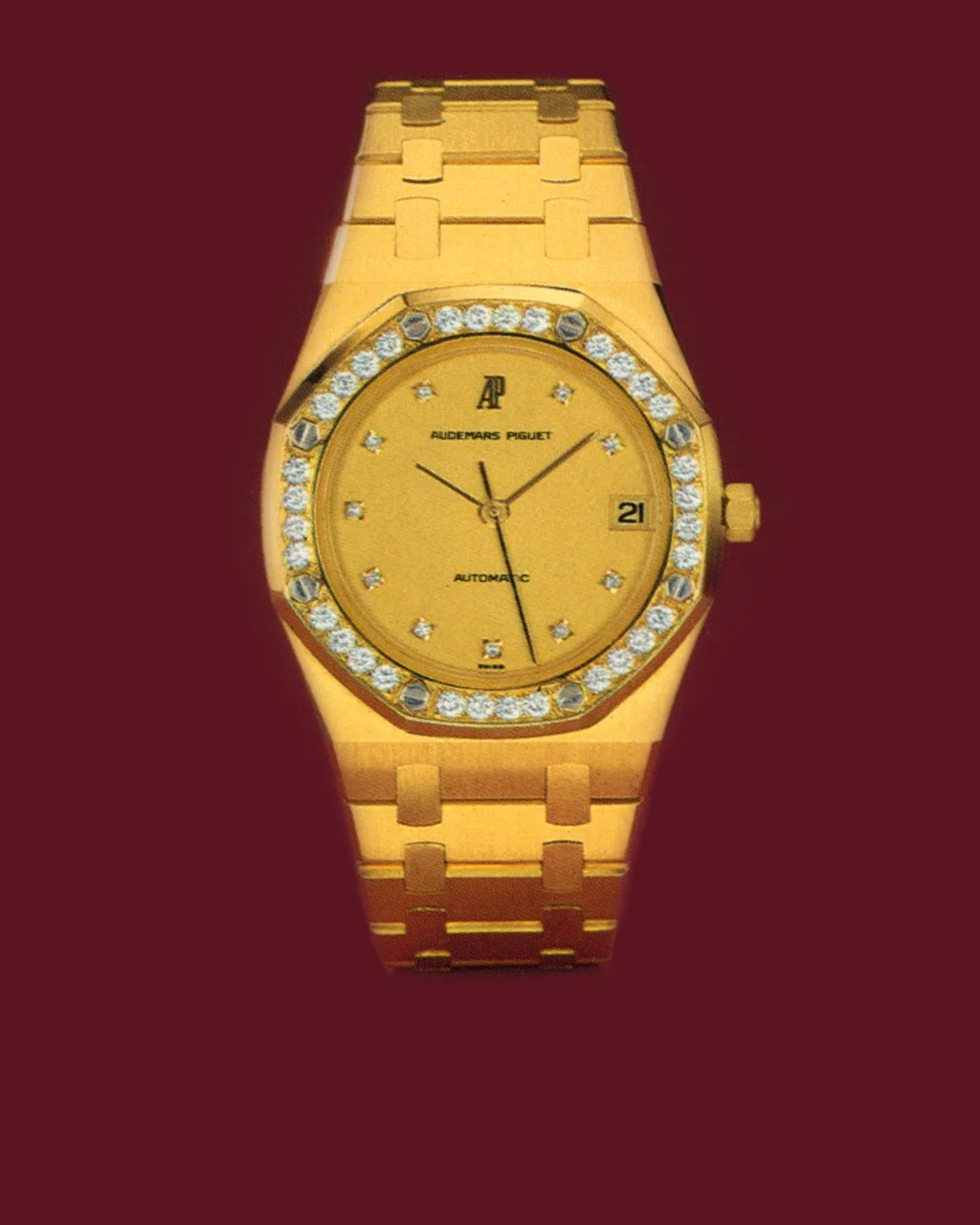
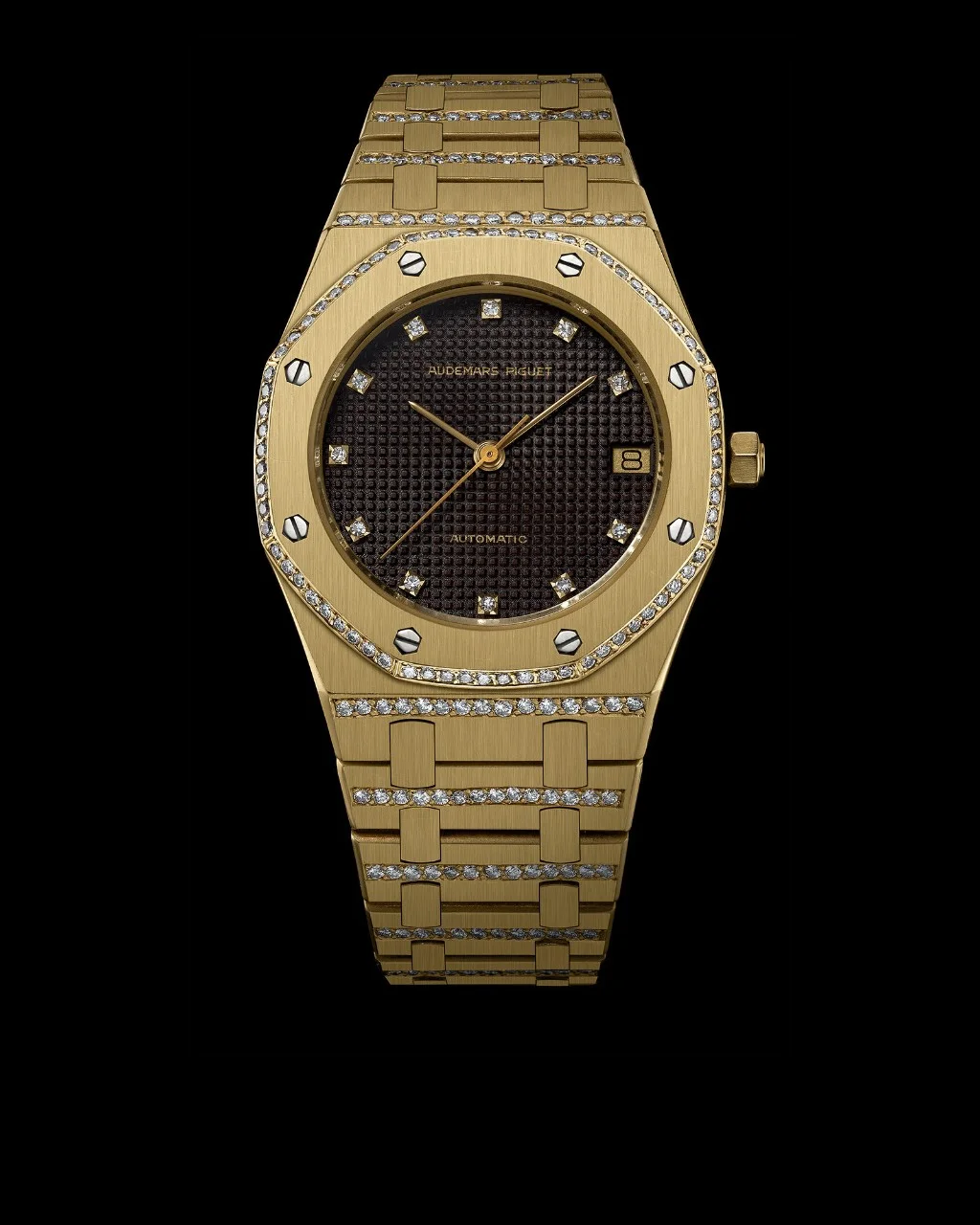
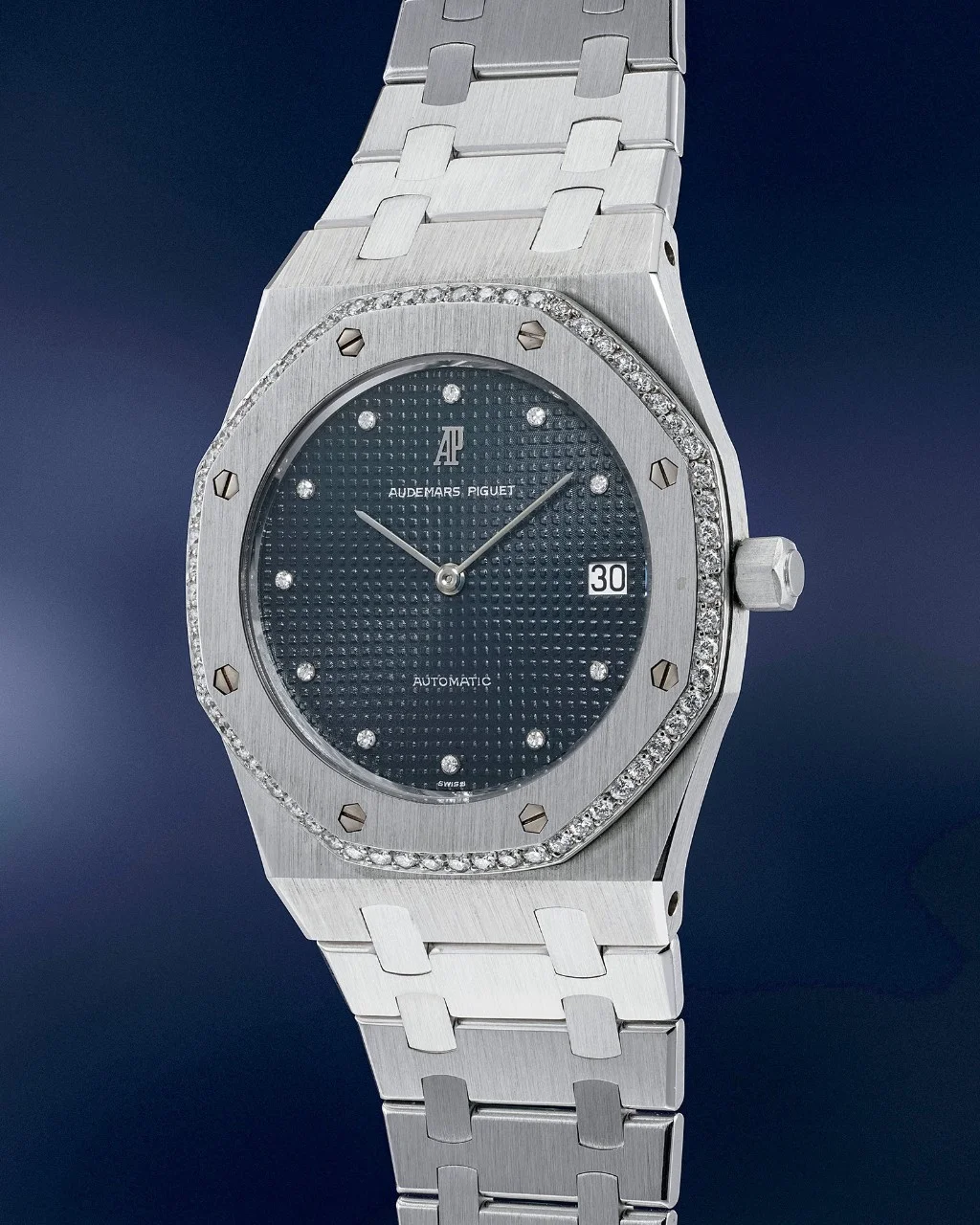
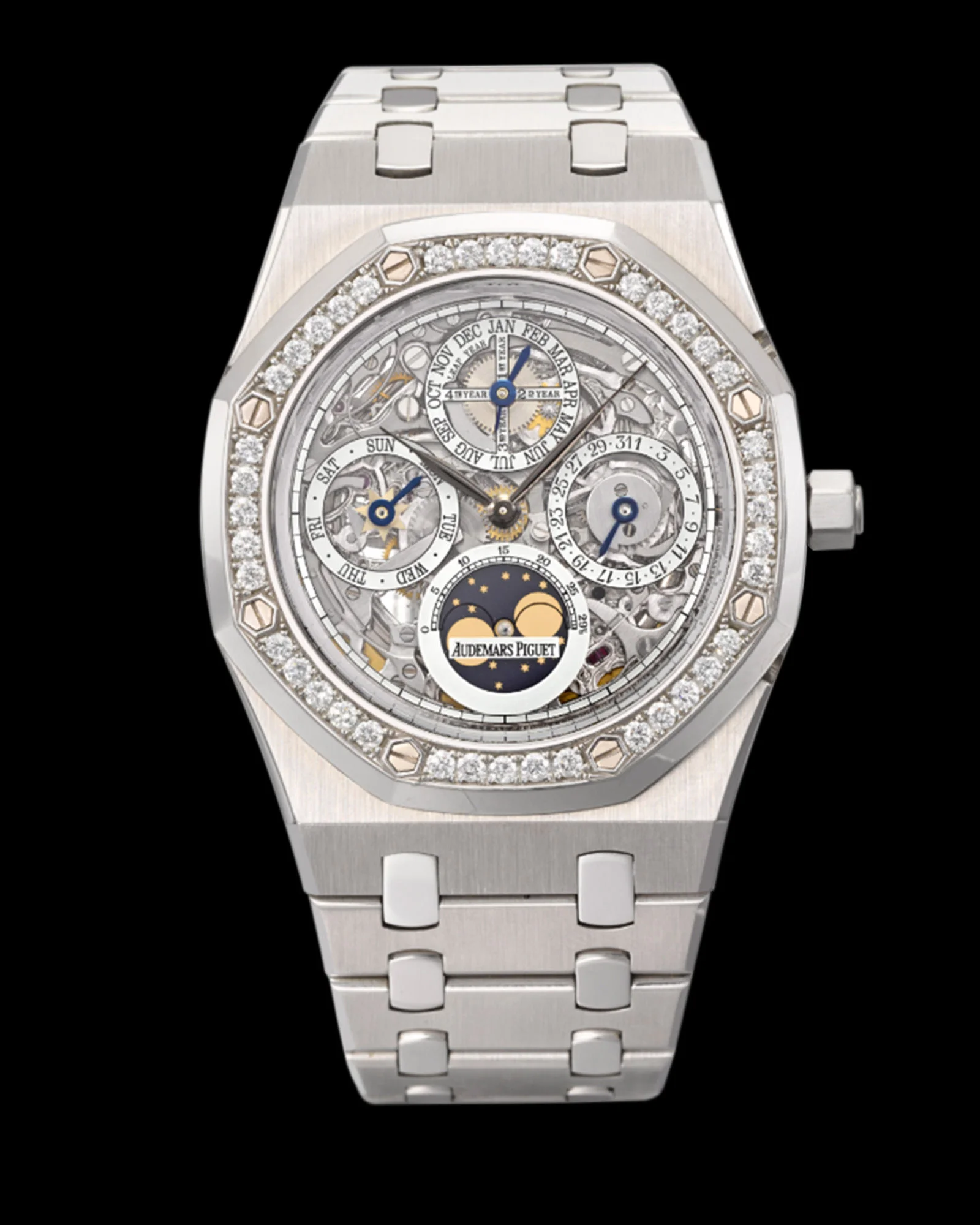
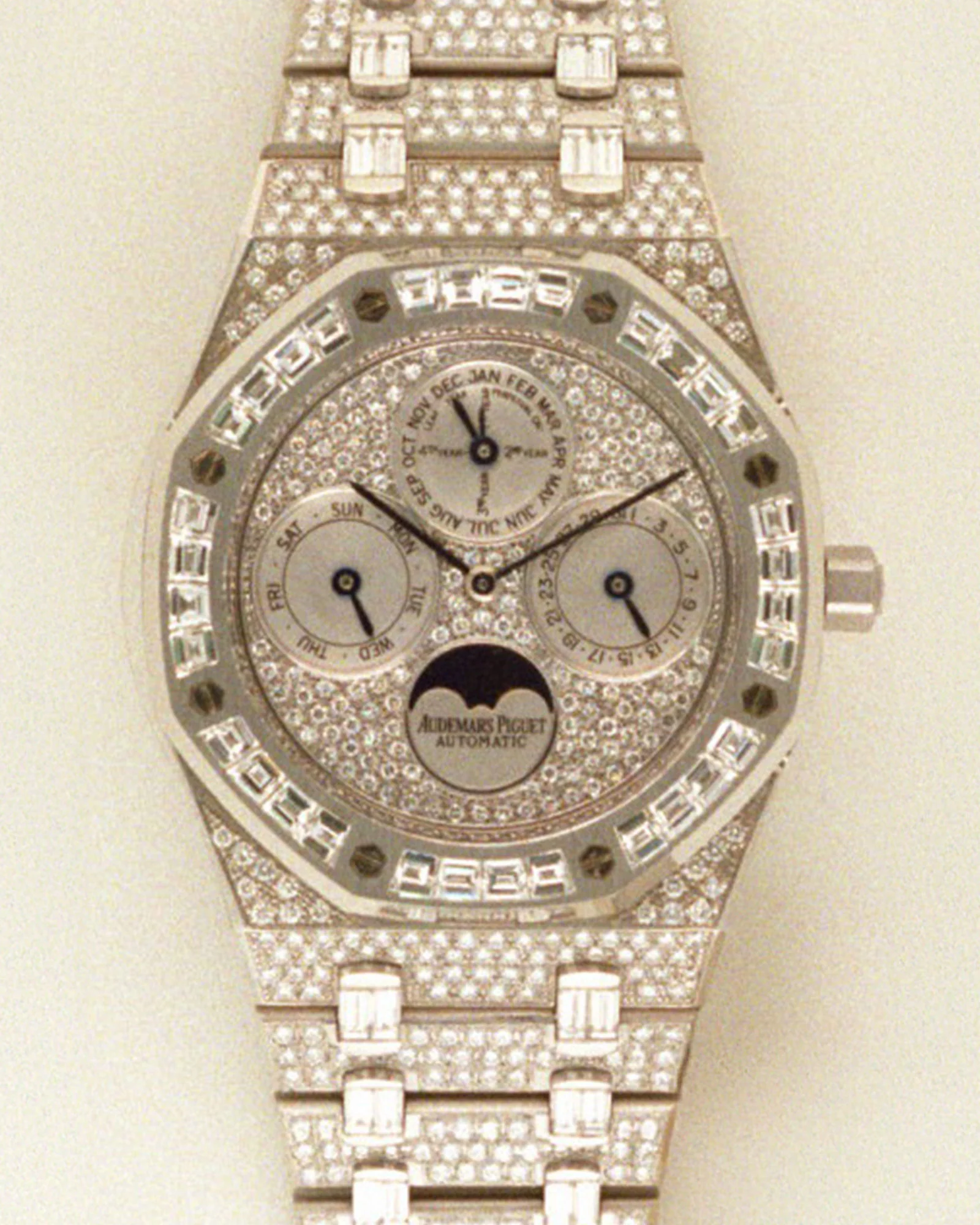
Certain elements remained immutable: the octagonal bezel punctuated by eight screws, the tonneau-shaped case with two bevels, the tapering metal bracelet. But from then on, sizes became increasingly varied and materials more diverse. In 1979, the Royal Oak welcomed its first diamonds. The discerning eye will note that the stones are set around the rim of the bezel, creating a refined sparkling effect that does not compete with the screws. Above and beyond aesthetic considerations, the reason behind this was technical. The bezels of ultra-thin Model 5402 are hollowed out to better hold the oversized gasket. They were therefore too thin to be gemset on top. In an interview given in 2020, Raymond Bornand, who was in charge of Audemars Piguet’s distribution in Switzerland between 1973 and the 2000s, tells of having the first Royal Oak set at an independent jeweller. He then presented it to the workshops in Le Brassus, which adopted the gemsetting and endlessly reinterpreted it thereafter.
More and more liberties were taken with the dial from 1977 onwards. Colours were varied to match those of the gold case, while the Tapisserie motif sometimes vanished, whether on Model 4100 versions or on the ladies' variants.
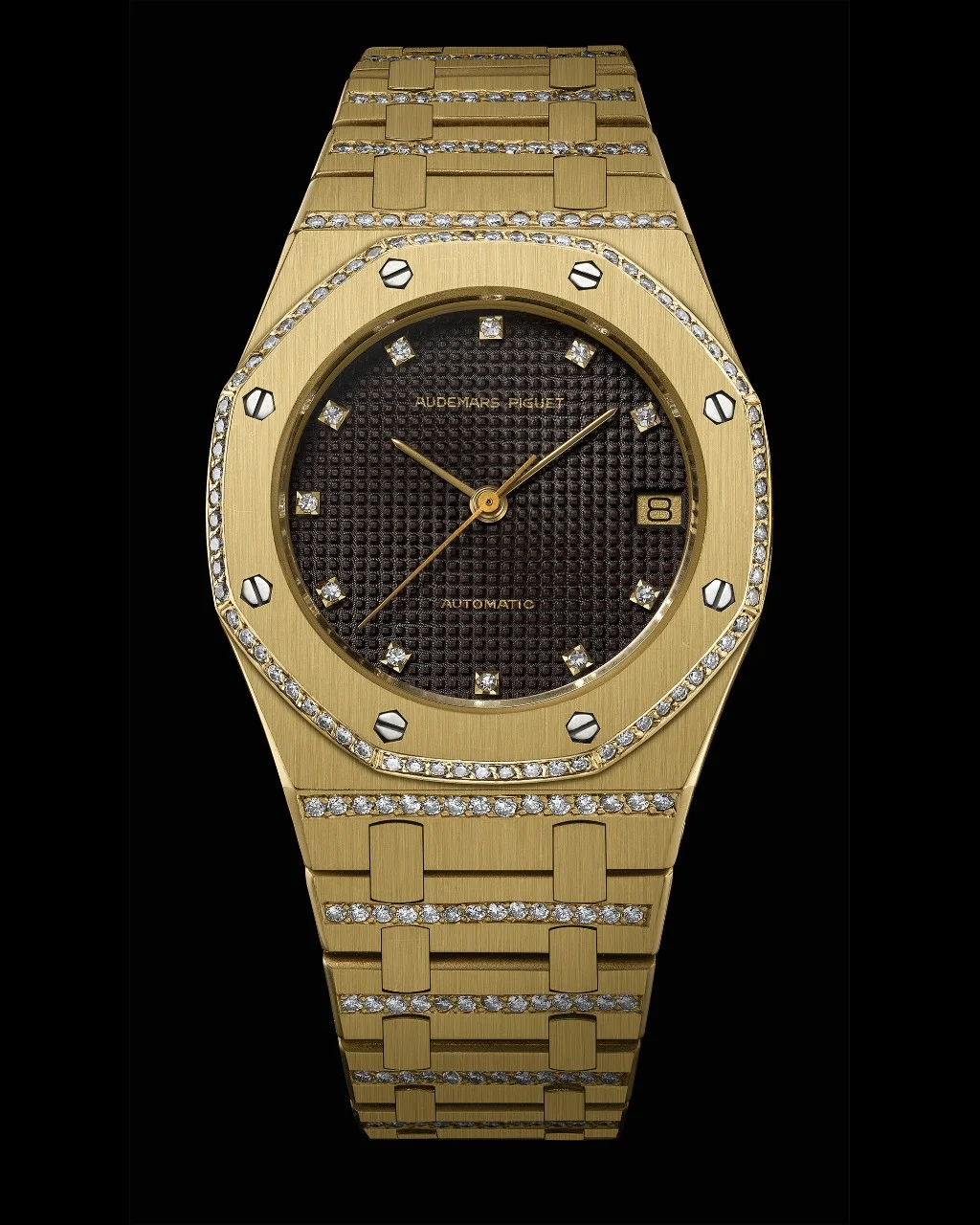
1981. Royal Oak 4153BA (1978), No. 1631 Date. Calibre 2123, movement 228568. Bracelet 477. T21 Tapisserie with Bleu Nuit, Nuage 50 (Night Blue, Cloud 50) colour. Case B57948, 35 mm. 18-carat yellow gold set with brilliant-cut diamonds. Sold to the American market in 1981. Note: the records indicate Model 4153, but the line-set bracelet corresponds to Model 4275 (1982). It is possible that following the creation of this watch, Audemars Piguet decided to create a special reference for the line-set bracelet versions. Audemars Piguet Heritage, inv. 2085.
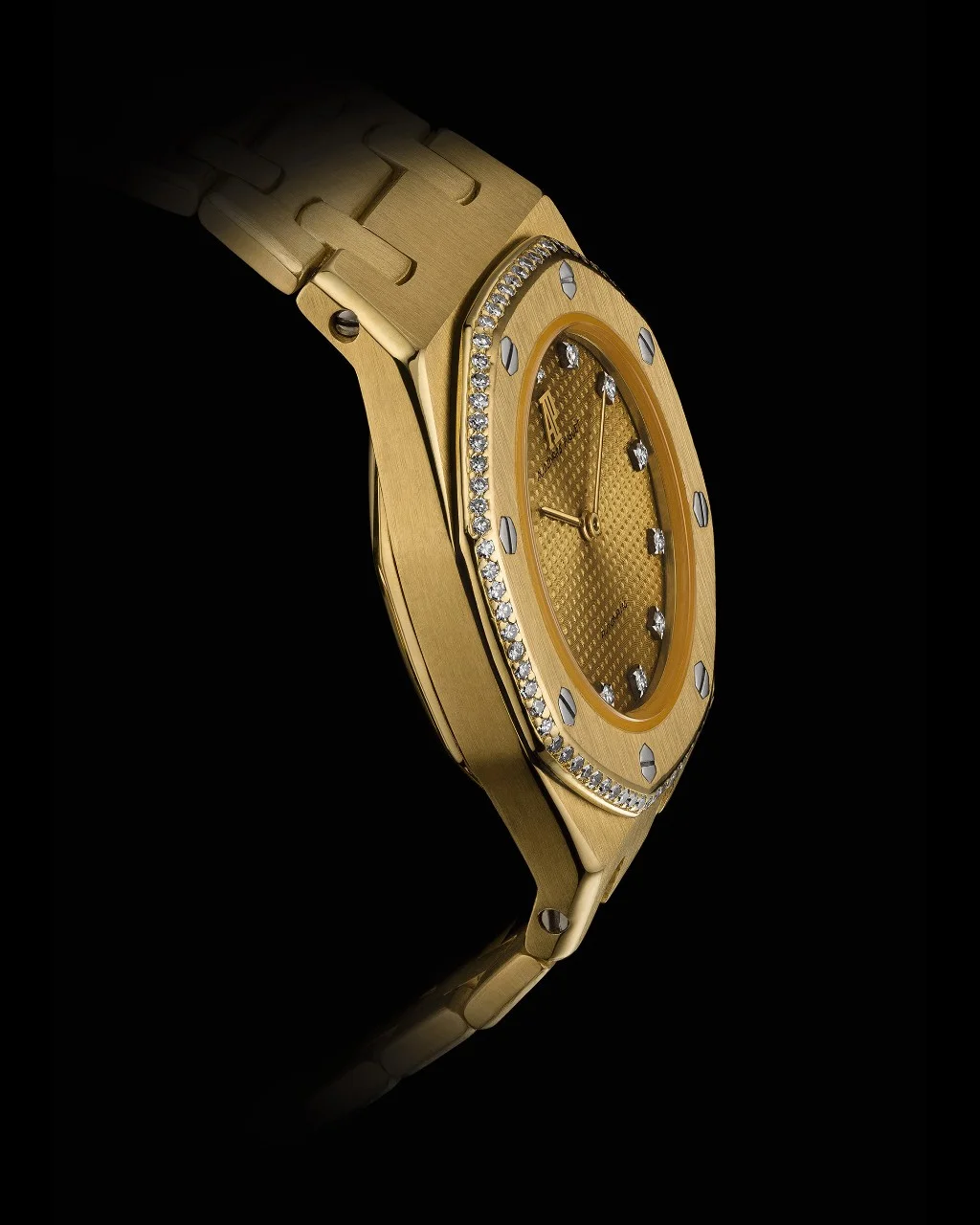
1980. Royal Oak 8756BA No. 816, side view Calibre 2062, movement 224874. T21 Tapisserie dial. Bracelet 424. 29 mm case B45152 no. 816 (consecutive model number 8638) in 18-carat yellow gold. Gemset bezel and dial. Sold to UHG (German market) in April 1980. Audemars Piguet Heritage, inv. 2100.
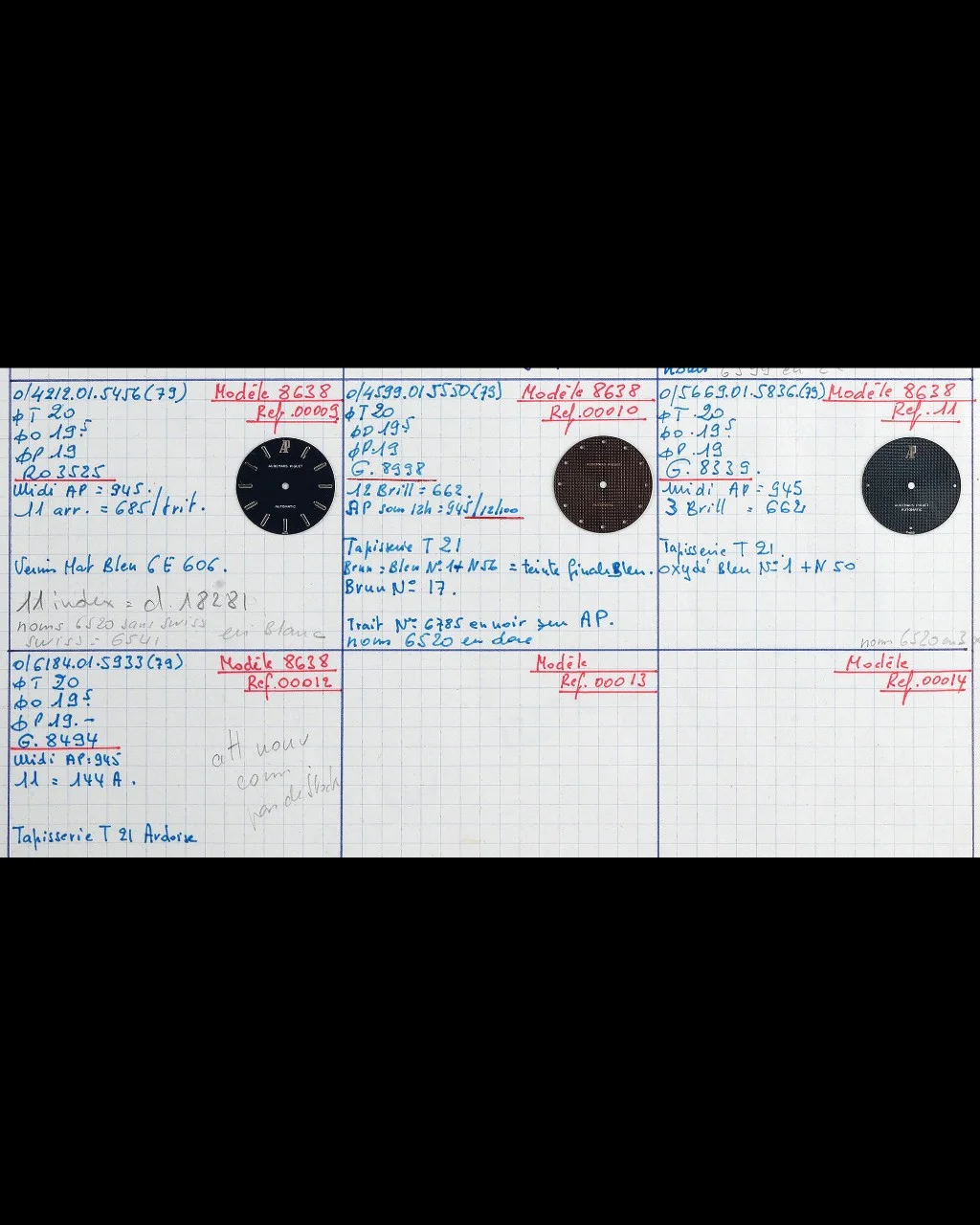
Circa 1977–1978. Dial 8638 variants In parallel to the first 8638 variants in precious materials, the dials multiply and appear sometimes without the guilloché Tapisserie. Audemars Piguet Archives.
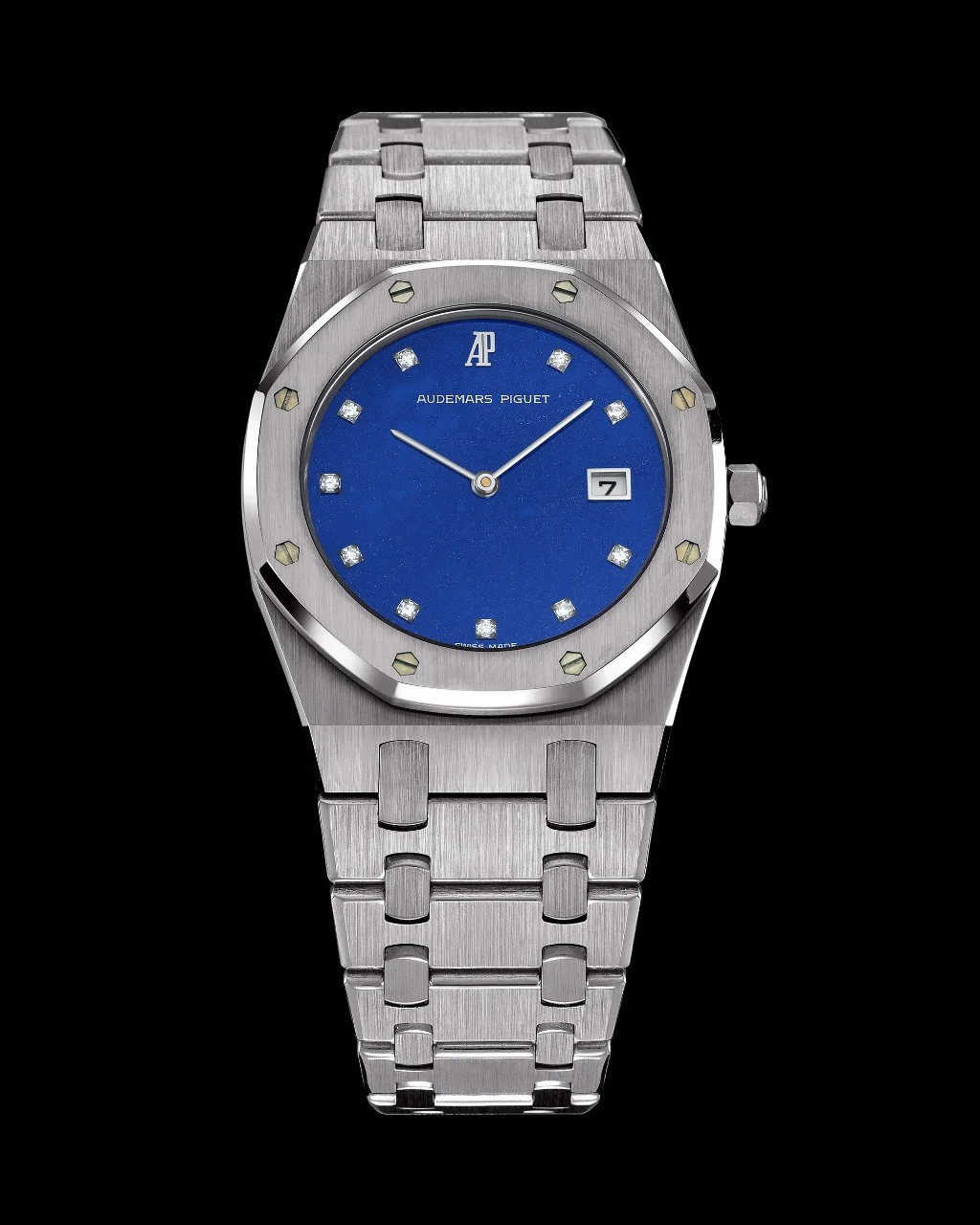
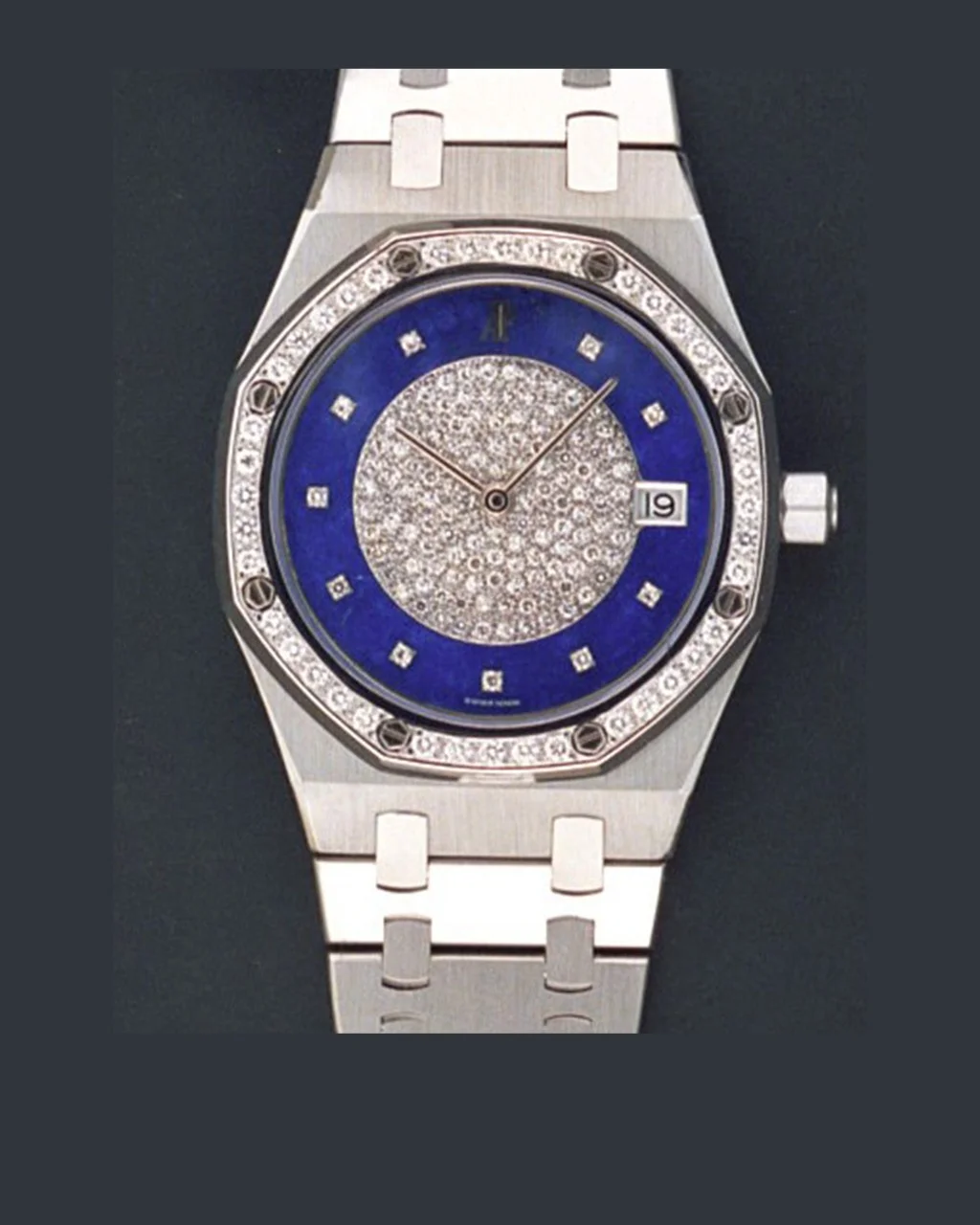
1988. Royal Oak 56346PT No. 70 Model 56346 is one of the first Royal Oak adorning a natural stone dial. Date. Quartz Calibre 2612. Bracelet 477. Lapis lazuli dial set with 10 diamonds. 33 mm case D4123, no. 70 in platinum. Watch probably presented at the Basel Fair in 1988. Audemars Piguet Heritage, inv. 464.
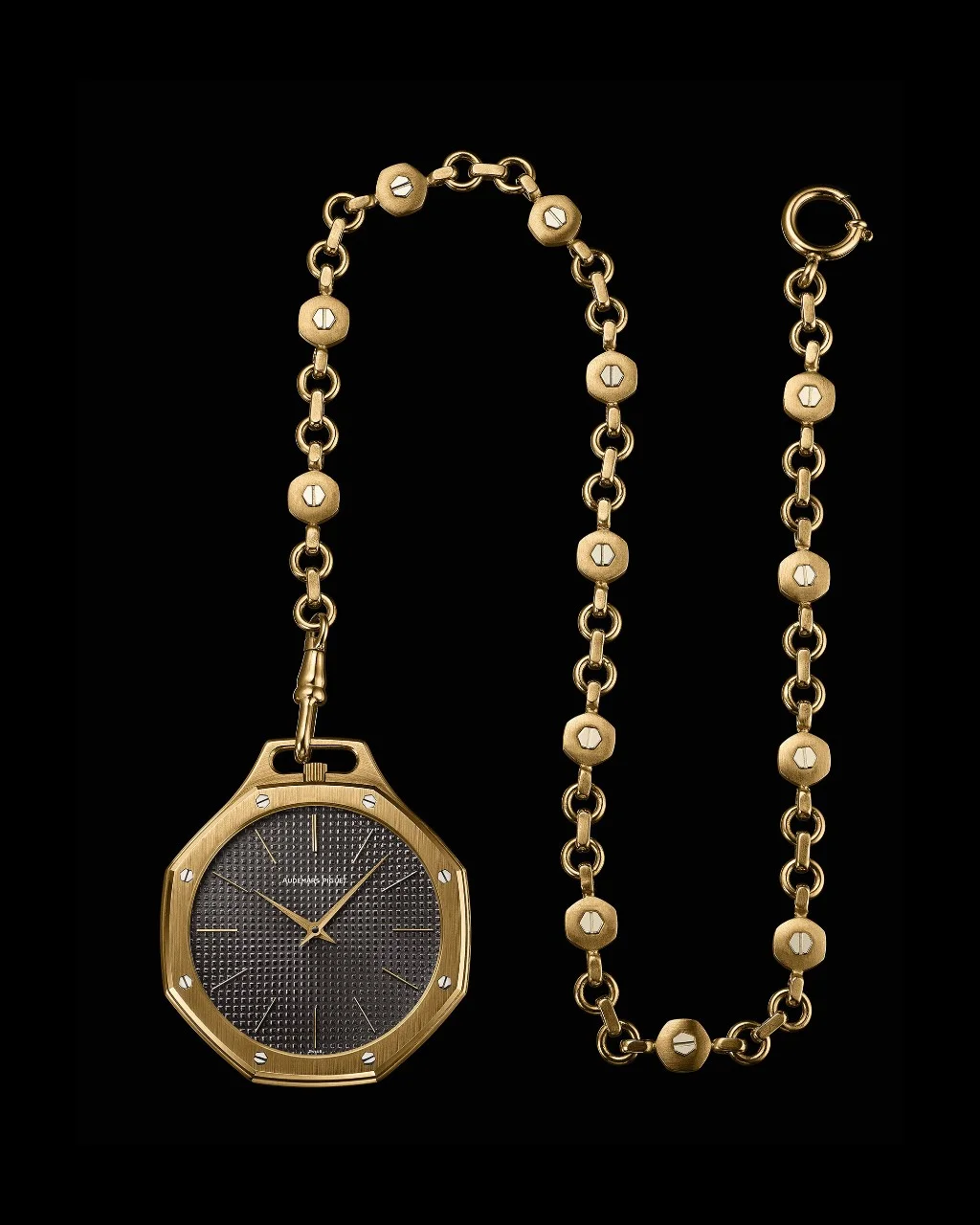
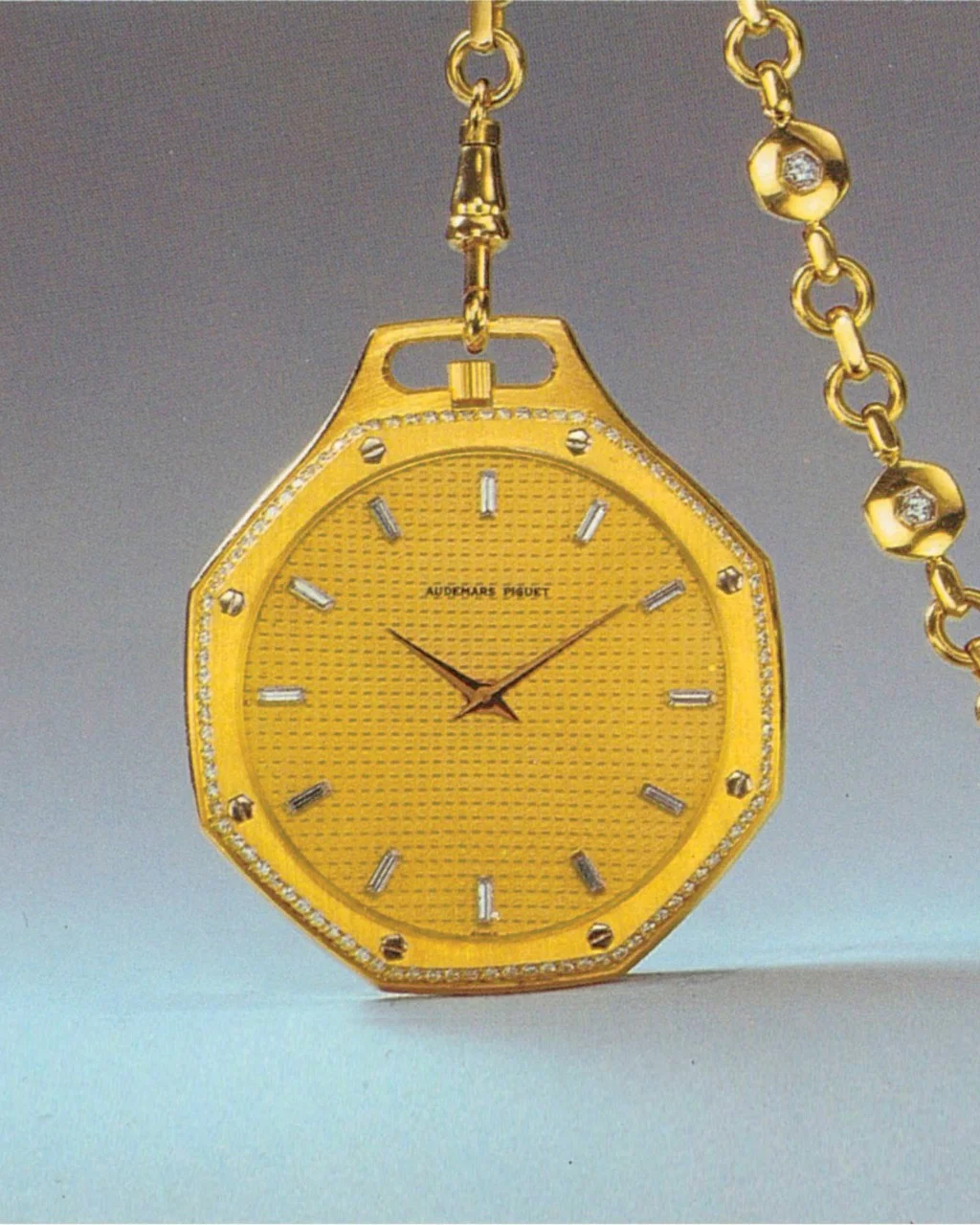
1980. Royal Oak 5691BA pocket watch First Royal Oak model without a bracelet. Calibre 5020, movement 227380. Royal Oak chain. T21 Tapisserie dial. Case B45238, 44 mm. 18-carat yellow gold. Sold to Darcal (Switzerland) in 1980. Audemars Piguet Heritage, inv. 894.
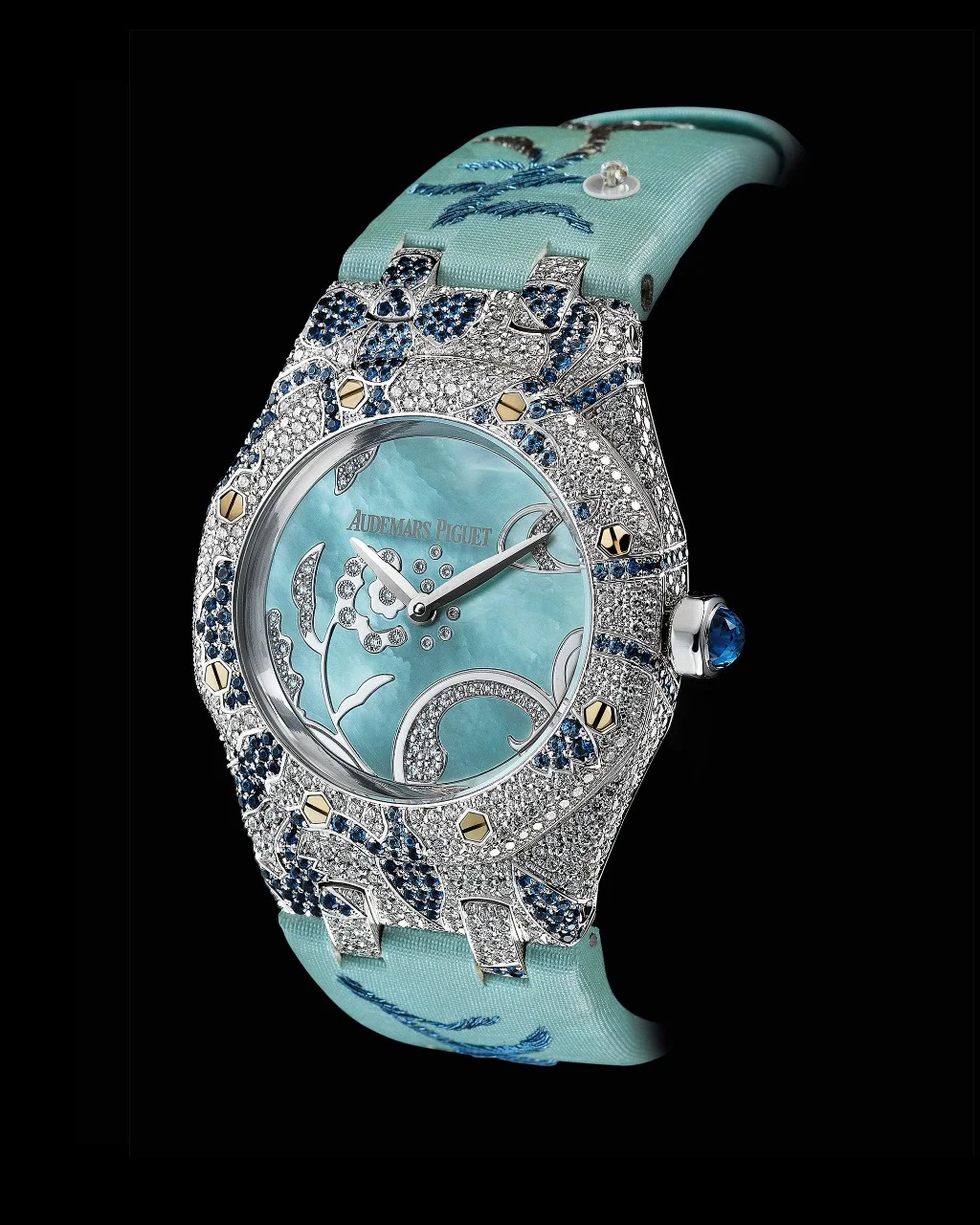
2005. Lady Royal Oak Leaves 67608BC Model created in collaboration with actress and producer Michelle Yeoh. Calibre 2712, movement 616167. Embroidered strap. Blue mother-of-pearl dial. 33 mm case F62645, no. 17 in 18-carat white gold. Edition limited to 100 copies. Audemars Piguet Heritage Collection, inv. 1686
The Advent of Quartz Technology
Jacques-Louis Audemars and Georges Golay hesitated for a long time before bringing the Royal Oak into the quartz era. While they finally took this step in 1978, they did so in a cautious manner typical of the Vallée de Joux mindset, as this topic was extremely sensitive and explosive at the time.
Coupled with a decade of global economic, financial and oil crises, the flood of Japanese, American and then Chinese quartz watches severely affected Swiss watchmaking, plunging the entire sector into the most serious crisis in its history since 1974, and almost wiping out the entire industry.
Like all watchmakers, Audemars Piguet had to make choices. On the one hand, its history, its highly qualified watchmakers, its deep-rooted identity and its convictions naturally inclined it to defend traditional expertise against all odds. On the other hand, its curiosity about the present and the future, its attachment to innovation and its perception of the danger of missing its chance dictated that it should adopt new technology – or at least try its hand in this field
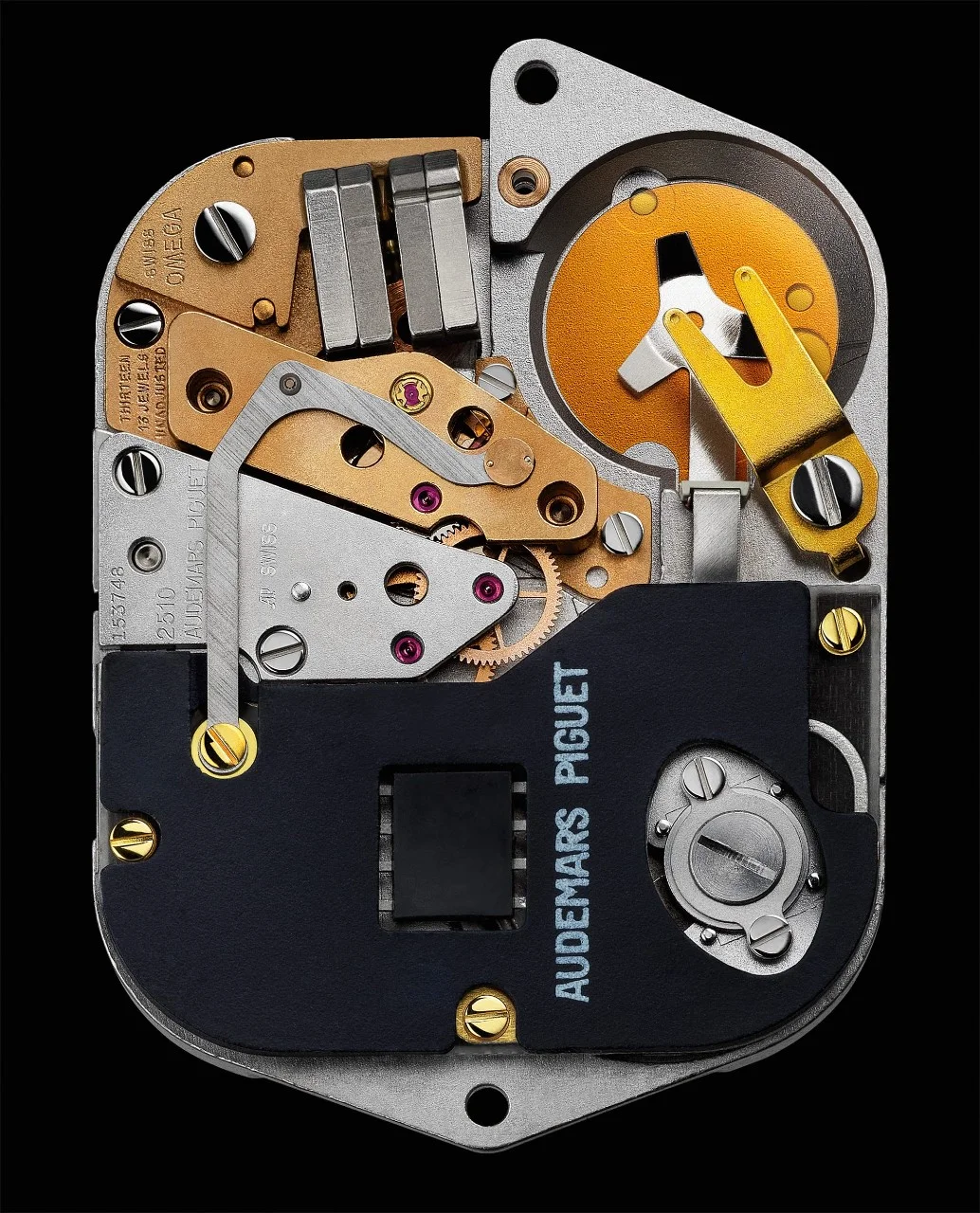
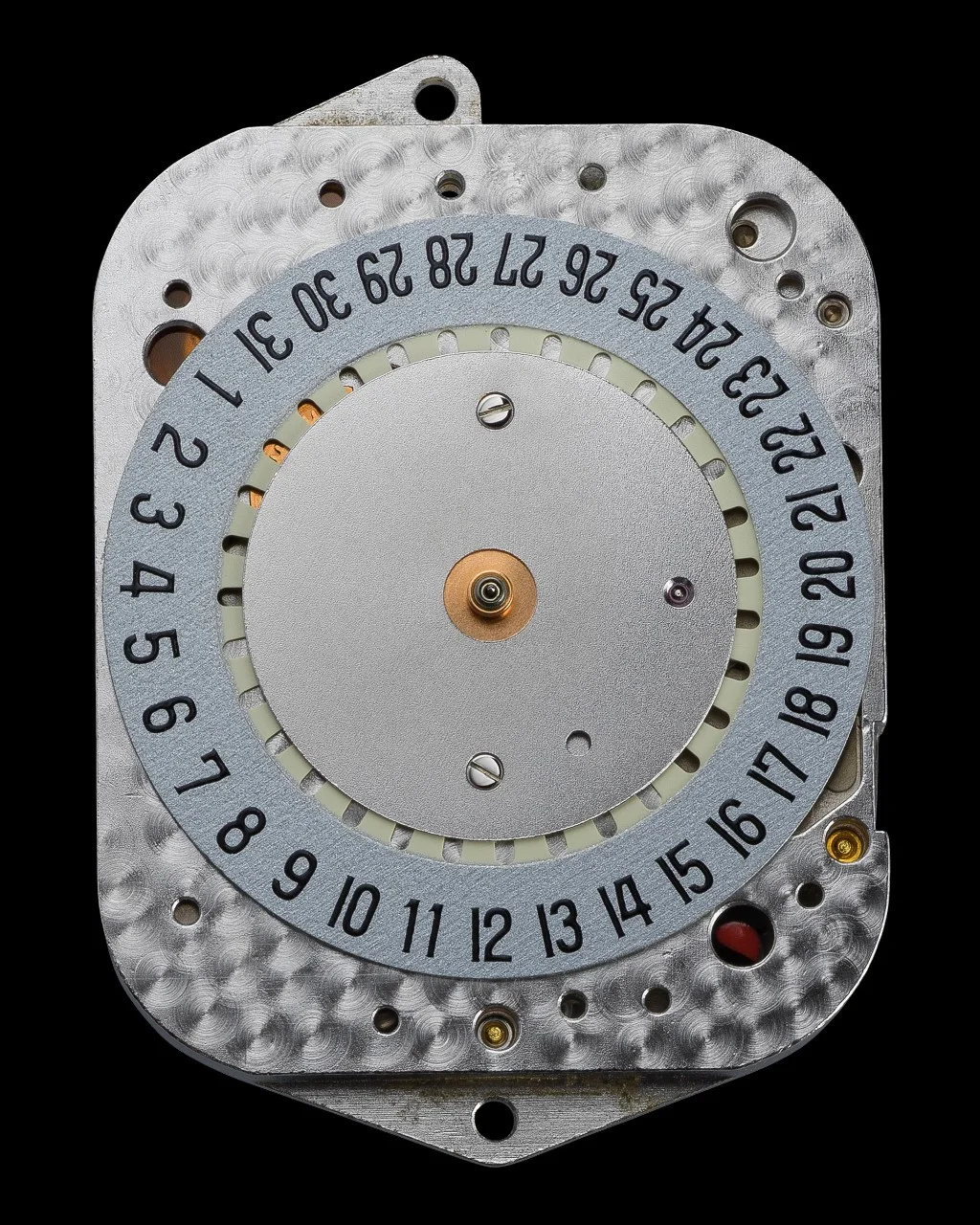
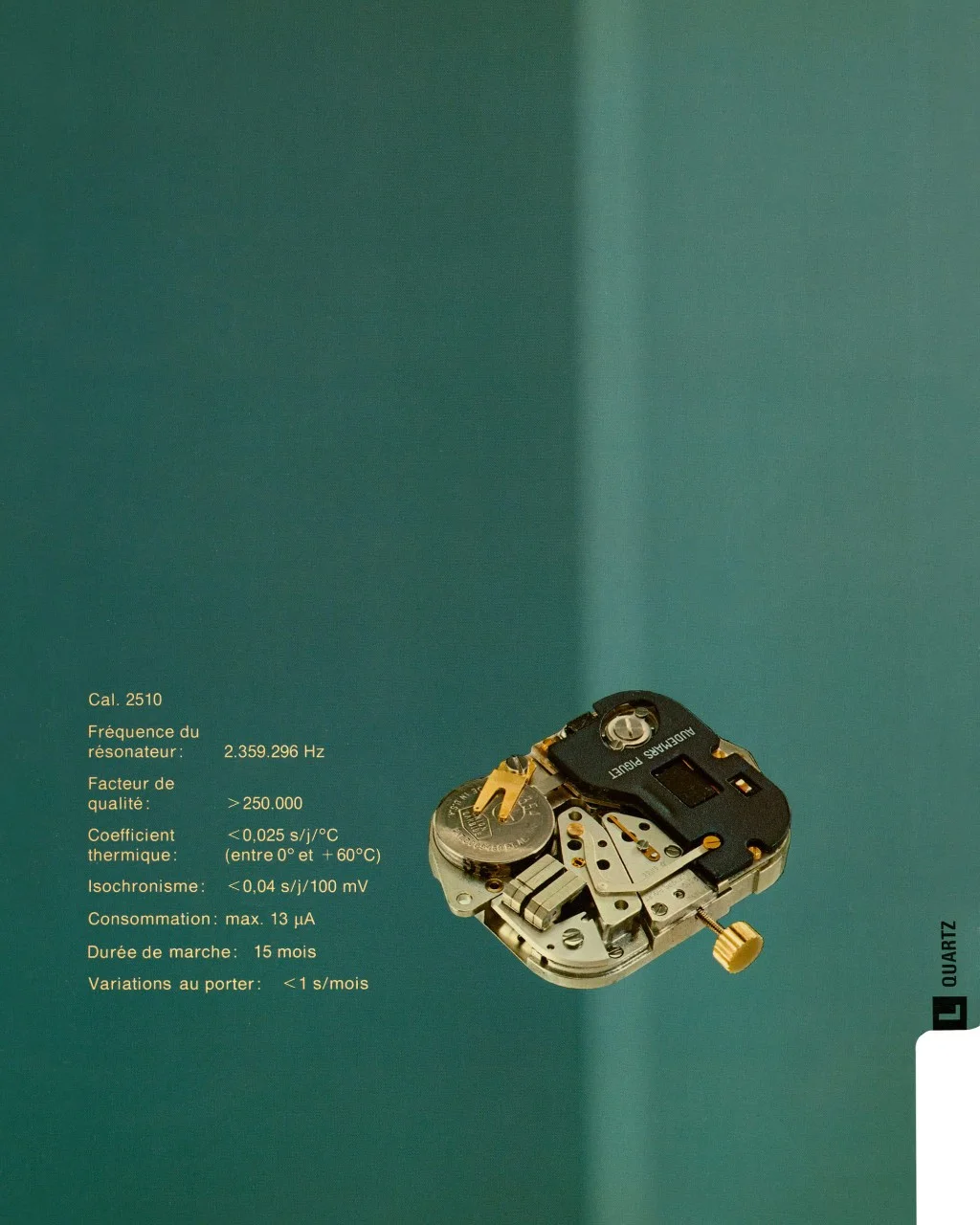
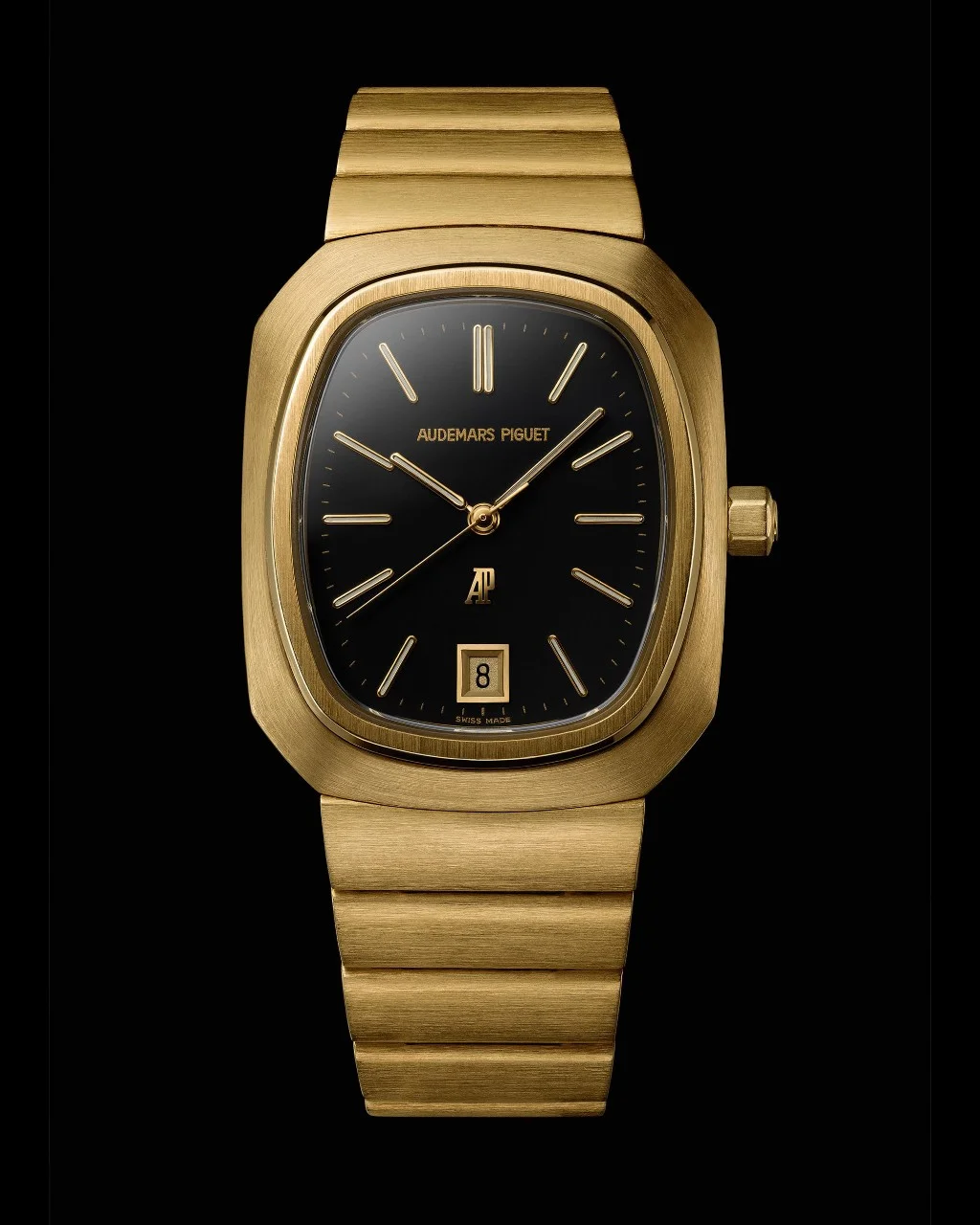
The Manufacture therefore took an early interest in quartz. In 1969, it signed an agreement with the SSIH, primarily aimed at promoting the distribution of Audemars Piguet watches. In actual fact, however, the brand also began working discreetly with the Swiss watchmaking giant on a quartz watch project. Five years of development were necessary before Model 6001, designed by Jean-Fred Meylan, was presented in 1974. Its generously sized case housed the voluminous Calibre 2510 (31x25 mm in diameter, 6 mm thick). This distillation of high-tech sophistication named "megaquartz" boasted extraordinary precision with a tolerance standard of only one second per month. Its resonator vibrated at a rate of 2,359,296 times per second, compared to four times for a high-frequency mechanical watch. The movement equipped just over 350 Audemars Piguet watches between 1974 (59 that year) and 1978.
Despite this amazing performance, it was clear even during the 1970s that the long-term durability of these “mechanisms” was not guaranteed. Not only was technology evolving at high speed, making systems, components, batteries and other printed circuits obsolete after a few years, but electronics was very different from traditional mechanical horology in terms of production methods, components, materials, skills, expertise, etc. Watchmakers meticulously decorated each part with the utmost care, but should they become electronic engineers?
1978: A “Close Relative” Who Must not Be Named
Could the Royal Oak speak the language of quartz? Should it? This revolutionary model had in its own way offered an alternative to quartz: a watch whose radically futuristic design and transgressive spirit were dedicated to serving traditional expertise (hand finishing of steel, the world's thinnest selfwinding movement, etc).
In a memoir written in 2006, Jacqueline Dimier explained: "The temptation to introduce quartz in the Royal Oak line was great, but the management was opposed to it and instead created a related line, ref. 6005, that was rectangular with bevelled edge. It had the same bracelet and suitable finishing, but to set itself apart, the screws were replaced by four studs.”
The solution chosen by Jacques-Louis Audemars and Georges Golay represents the quintessential balancing act. The two men had set themselves the objective of sparing the so-called "classic" collections – round or oval, including many variations equipped with ultra-thin Calibre 2003 – from quartz for as long as possible. While they also wanted to preserve their brand-new Royal Oak icon, they sensed that its transgressive character lent itself better to the irruption of disruptive technology. By creating a "related line," they achieved a successful compromise – at least for the time being.
The technical specifications for the case of the first Royal Oak quartz men's watch indicate that Model 6005 (1978) was equipped with Calibre 2511, developed from 1972 onwards. With a diameter of 23.2 mm, it was much smaller than its predecessor, Calibre 2510, yet its 3.5 mm thickness was still fairly substantial. At that point in time, quartz was already no longer perceived as the height of technology and the future of luxury. It was therefore necessary to dispel any doubts regarding the value of the mechanism. A historical "Notice du rhabilleur AP" (note from the AP repairer) deemed it necessary to indicate: "Quartz movement finished by the master-watchmakers of Audemars Piguet and Cie in the finest Haute Horlogerie tradition". This argument also appeared in the advertising campaigns supporting the launch of the watch: "It is a quartz, no doubt, but it is above all an Audemars Piguet (...) And only Audemars Piguet, thanks to its total mastery of watchmaking forms and techniques, was able to give its letters of nobility to electronics." In 1980, another advertisement introduced this watch as "The acceptable face of innovation."
But is this watch a Royal Oak? Its bezel is neither octagonal nor punctuated by eight hexagonal screws. Printed sources provide the answer to this question. In the catalogues dated 1978 – 1979 and beyond, Model 6005 is never called a Royal Oak, but simply "Quartz." In 1981, the range was extended with seven models of the same nature (6005, 6009, 6010, 6015, 6014, 6026 and 6028) through 14 variants, ten of which were equipped with Calibre 2502 (17.5 x 13.5 x 1.98 mm). Once again, the name Royal Oak does not appear. These watches were referred to as the "AP Quartz Line," which continued until at least 1985. They were therefore not Royal Oak watches, but "close relatives," to use Jacqueline Dimier's expression.
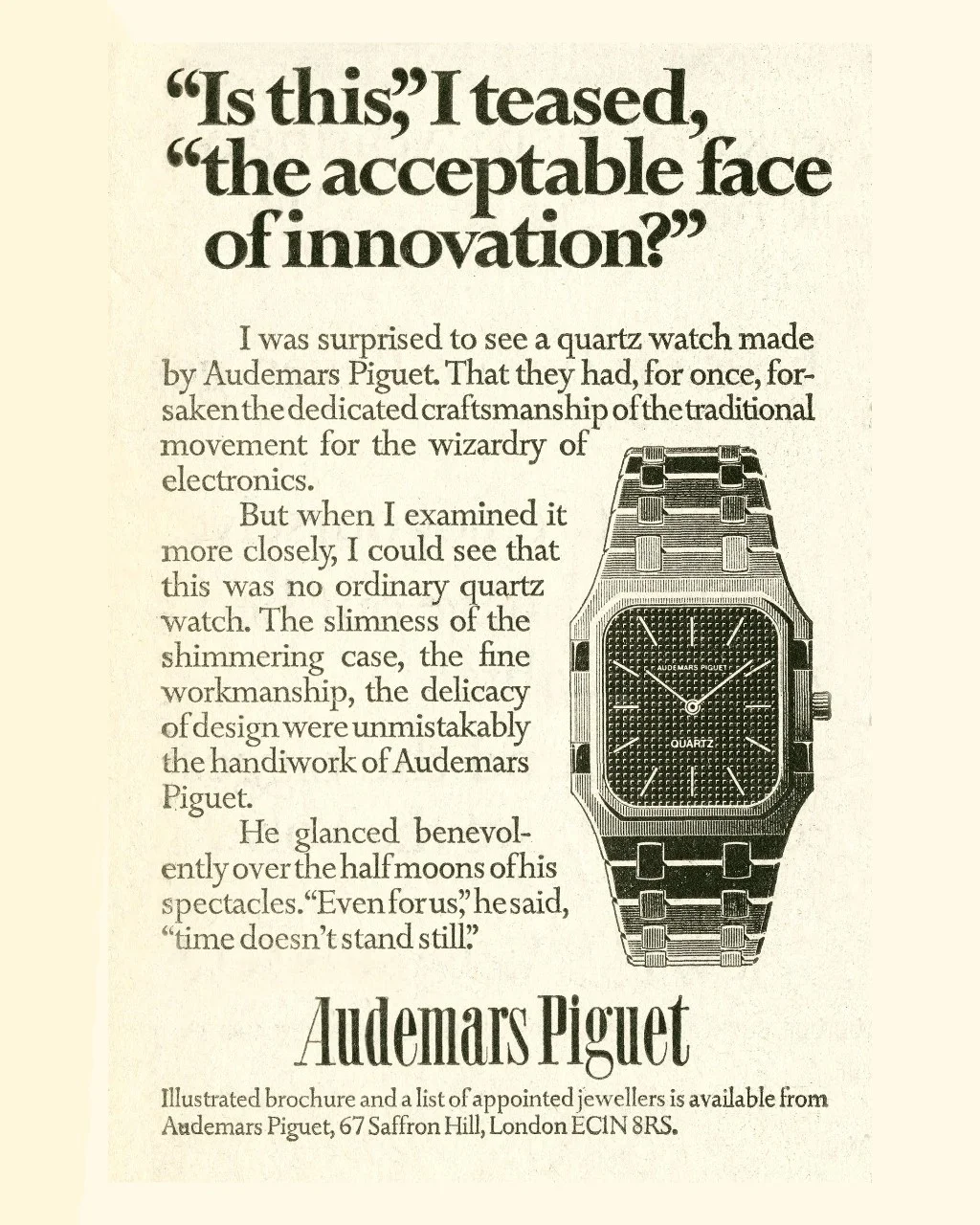
1980. Audemars Piguet Model 6005 advertisement. The advertisement thematises the sensitive relation between traditional watchmaking values and the rise of quartz technology. Audemars Piguet Archives.
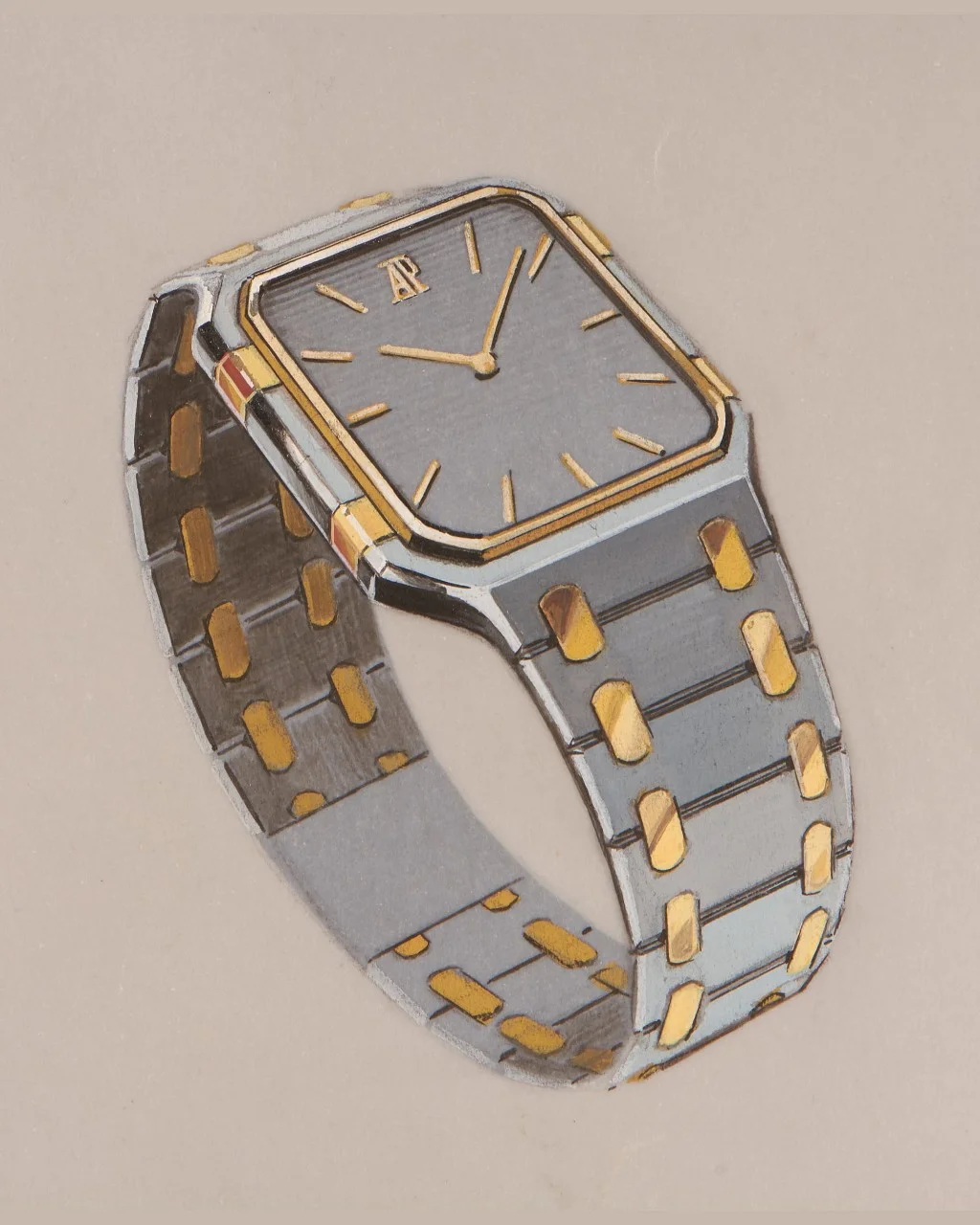
Circa 1978. Gouache quartz collection. Introduced in 1978, the "quartz" collection borrowed several elements from the aesthetic codes of the Royal Oak, but did not use its name. Audemars Piguet Archives.
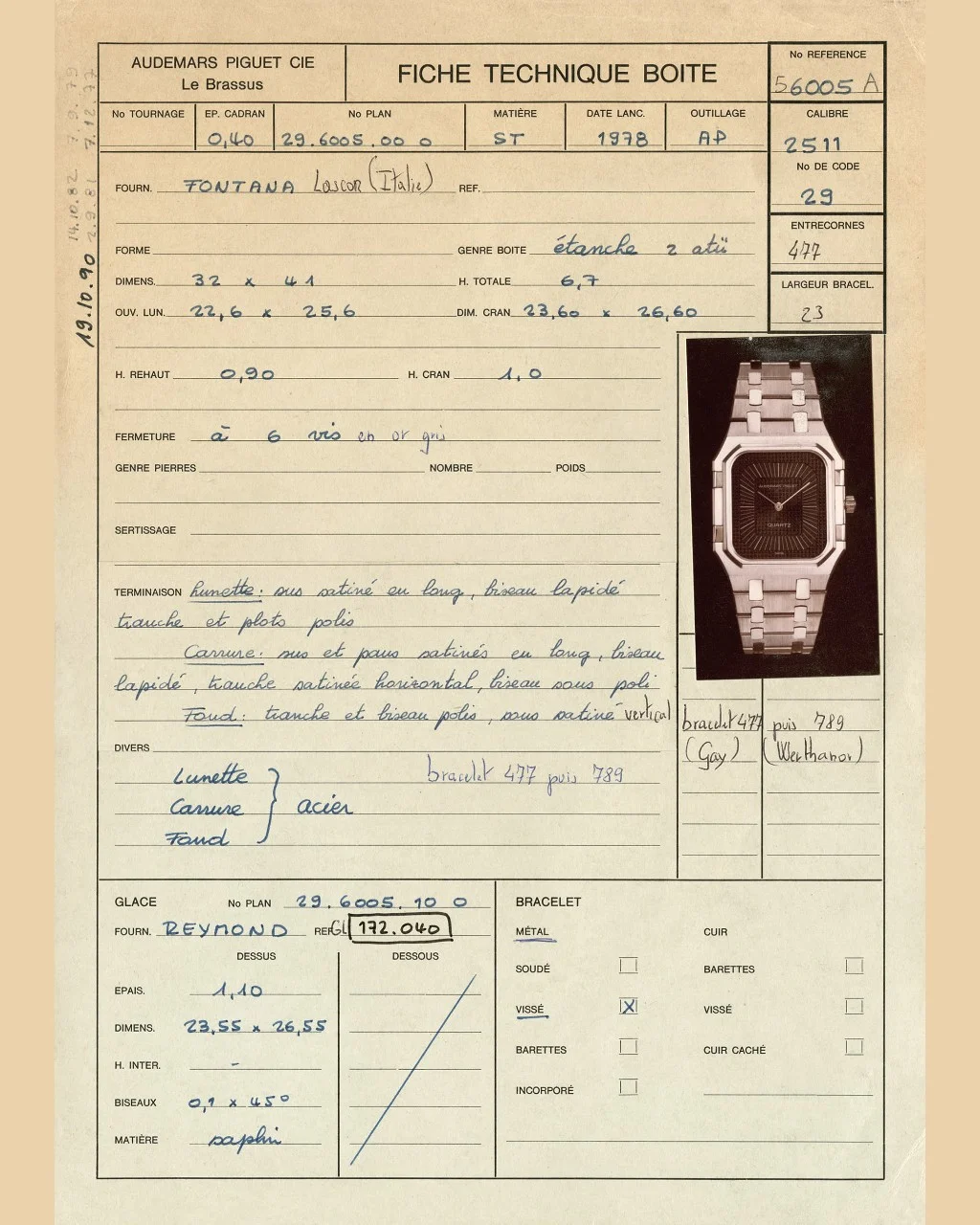
1978. Technical Data Sheet for the case of Model 6005ST. Audemars Piguet Archives.
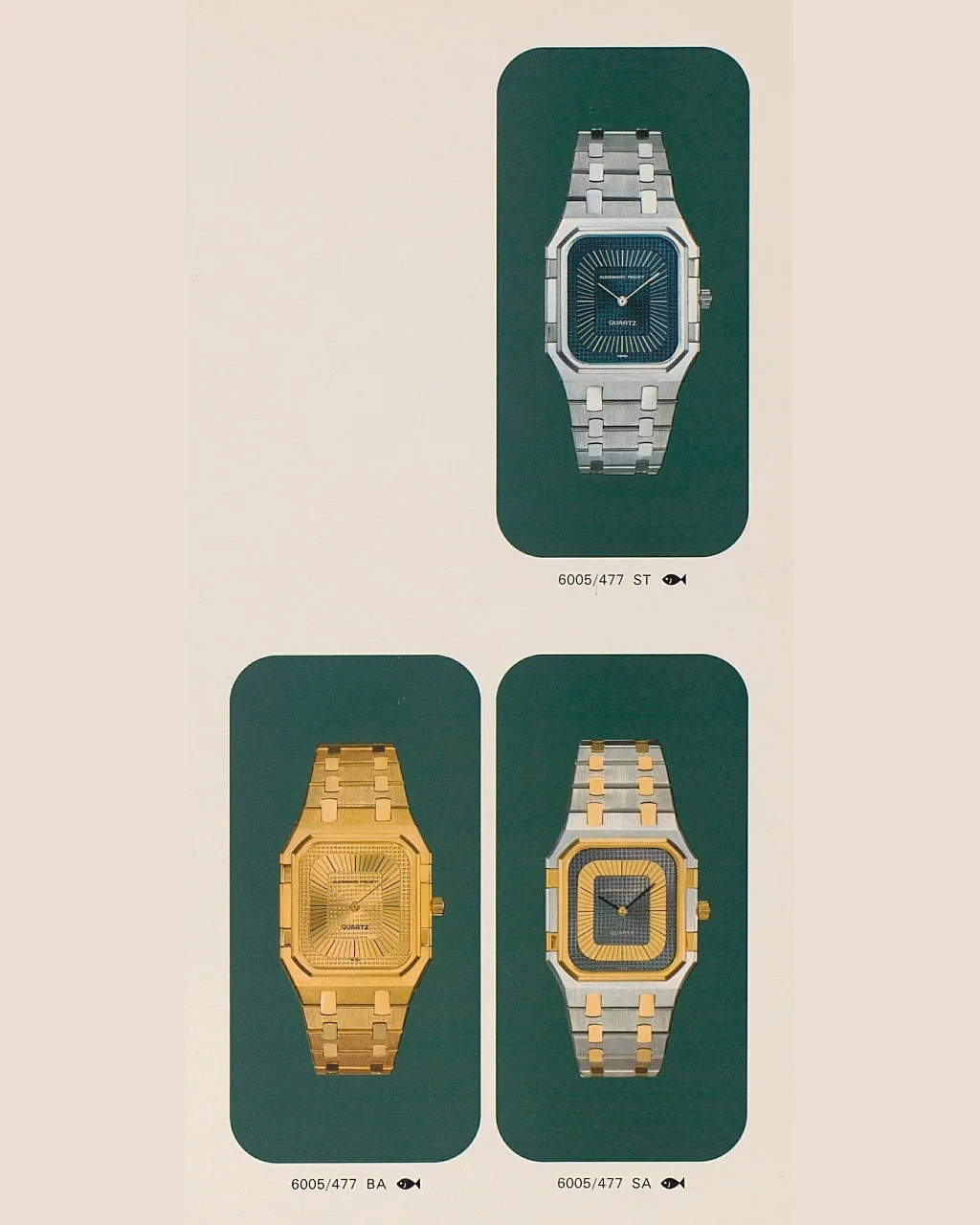
1979. Variations of 6005 Model (32 x 41 mm), Calibre 2511. Audemars Piguet 1979–1980 catalogue. Audemars Piguet Archives.
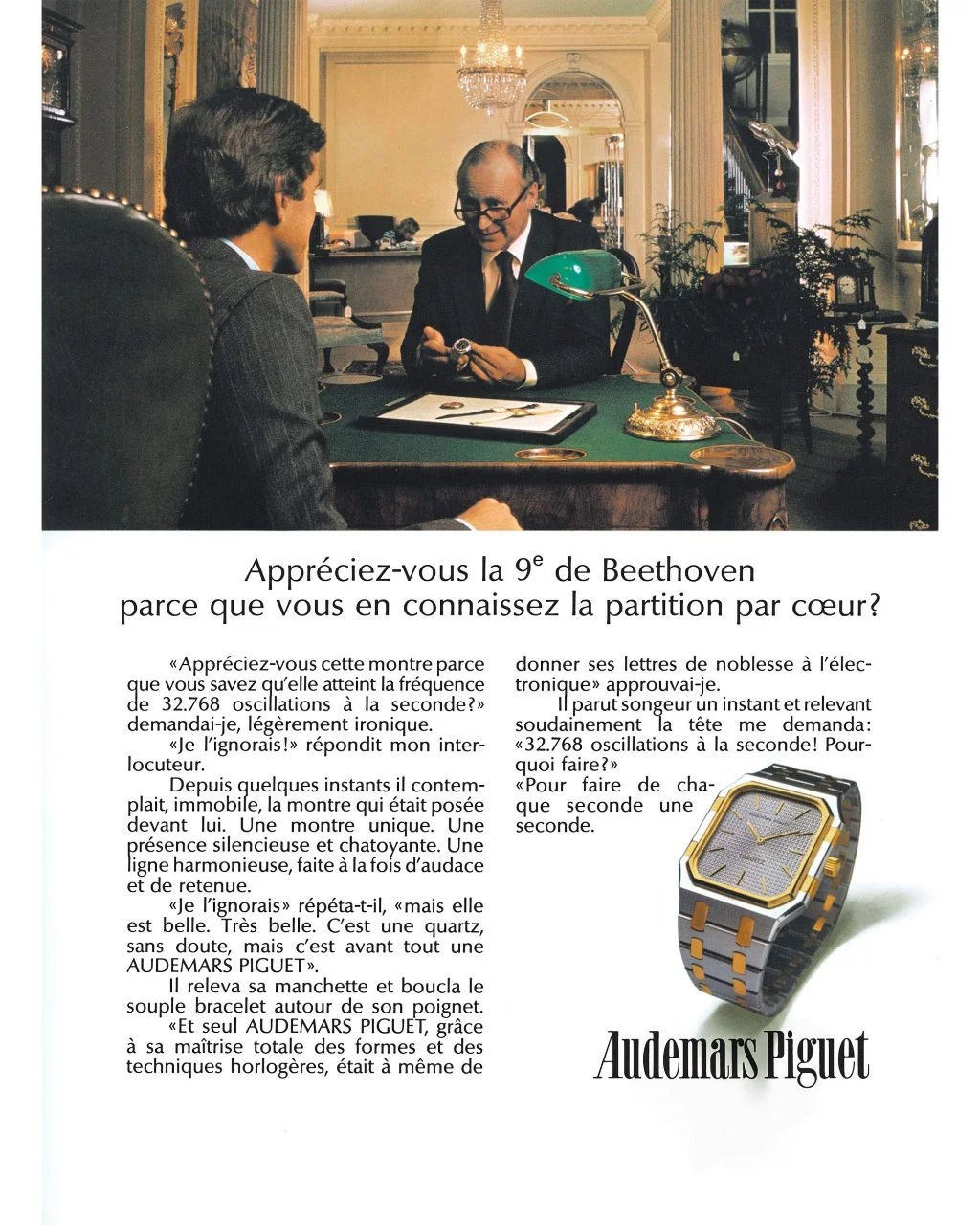
1979. Audemars Piguet Model 6005SA advertisement. The image and the text stage a dialogue between a retailer and a client around Model 6005SA, equipped with the quartz Calibre 2511. Audemars Piguet Archives.
1982: When Mechanics and Quartz Cross Paths
It was thus with great reluctance that Audemars Piguet brought quartz into the history of the Royal Oak. After the above-mentioned trial run, the company decided to take a further step in response to pressing market demand. In 1980, three "real" Royal Oak models were fitted with quartz Calibre 2502. This microelectronic marvel developed by Jaeger-LeCoultre was distinguished by its modest 17.2 x 13.5 x 1.98 mm measurements making it possible to introduce two new sizes.
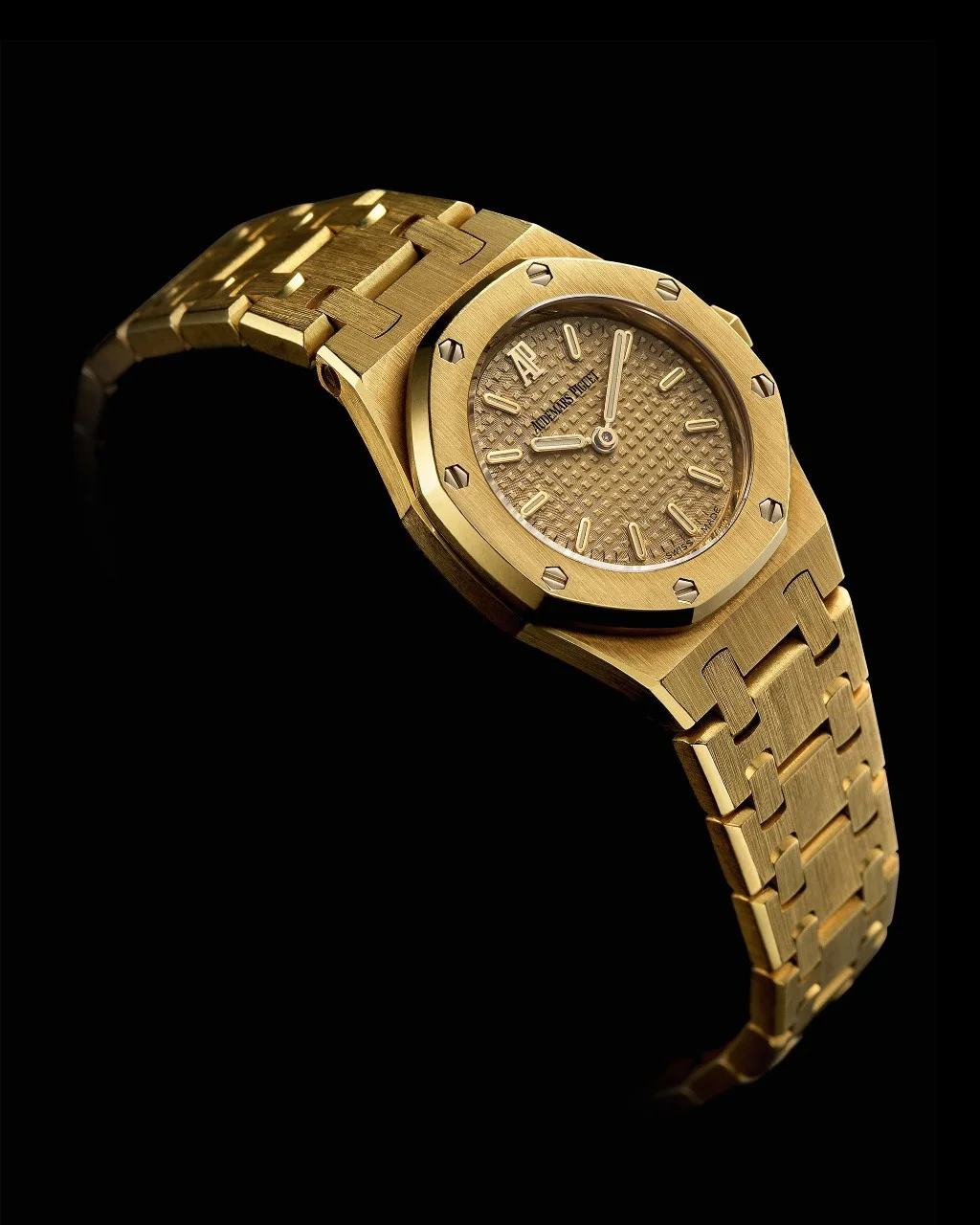
In three years, the Royal Oak 30 mm was produced as five different models (6008 and 6013 in 1980, 6020 in 1981, 6033 and 6035 in 1982). The even smaller Royal Oak 26 mm heralded the “Mini Royal Oak” chapter, the first models of which (6012 in 1980; 6007 and 6019 in 1981 and 6027 and 6034 in 1982) prefigured the 20 mm Royal Oak introduced in 1997 (Model 67075). These variations were all dedicated to women. From then on, most of ladies’ Royal Oak watches were equipped with a quartz movement.
Between 1982 and 1985, the number of quartz movements and the variations in size increased. The 26 mm Royal Oak watches were now equipped with the even thinner Calibre 2508 (17.2 x 13.5 mm x 1.6 mm) and welcomed the new Model 6131. The 31 mm variants housed the new Calibre 2711 (17.2 mm in diameter, 2.5 mm thick, Girard Perregaux "ébauche"). More importantly, a new, more generous size of 35 mm in diameter appeared, which for the first time was identical to that of certain mechanical models.
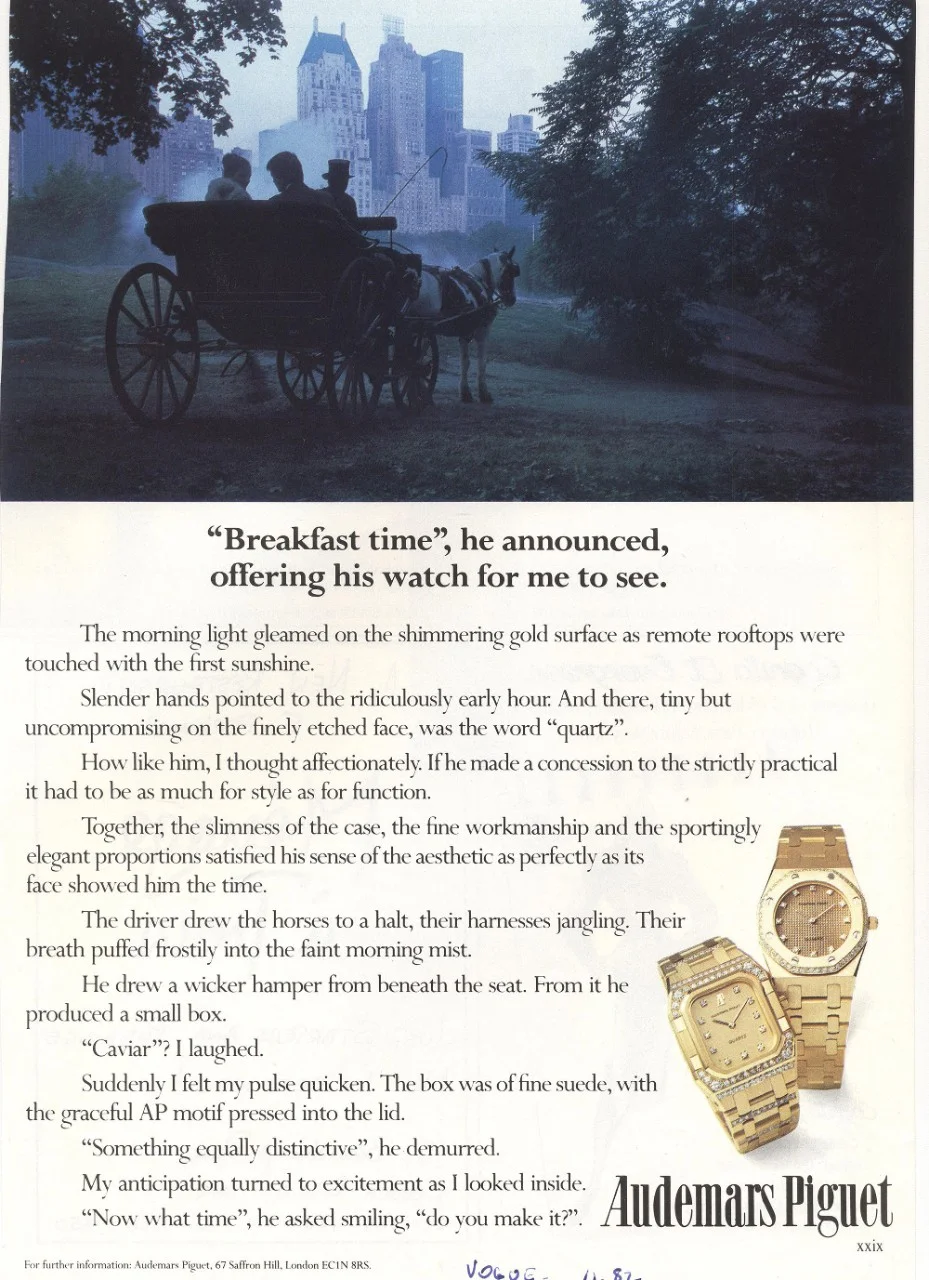
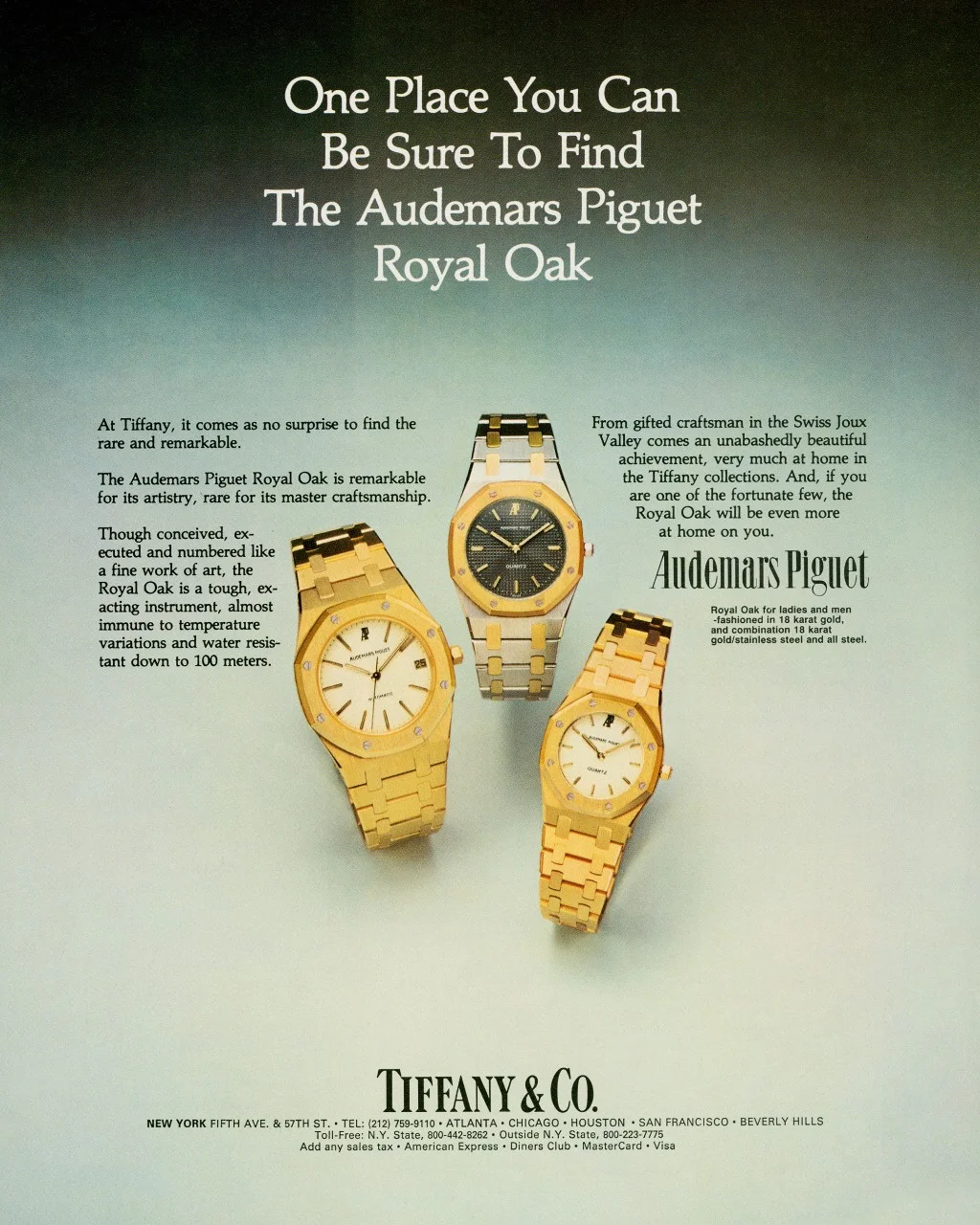
In 1982, Calibre 2506 was already fitted in several 35 mm models (56023, 56036, 56037, 56038, 56039, 56040), as quartz and mechanics crossed paths. For the first time, customers could choose between almost identical watches, some of which were quartz and others mechanical. The first electronic variants often bore the indication "quartz" on their dials, and Audemars Piguet watchmakers made a point of adorning the metal components with the same care as the mechanical movements.
New Technologies and the Revival of Complications
An overview of 1980s production records makes it clear that the first generations of Royal Oak quartz watches made up a significant part of Audemars Piguet production in the 1980s. In ten years, at least 59 models were created, equipped with six different quartz movements: 2502, 2505 (26 mm in diameter, 3.15 mm thick), 2506 (26 mm in diameter, 3.15 mm thick), 2508, ultra-thin 2610 (16.2 mm in diameter, 1.9 mm thick) and 2711. Of these, 44 were set with precious stones, whether on the case, the dial, or both. More generally, the proportion of Audemars Piguet quartz watches rose from 7% in 1979 to 30% the following year. In 1986, it reached an all-time high: half of all watches were equipped with quartz movements. From then on, this proportion decreased regularly. Ten years later, only 20% of watches were quartz-driven.
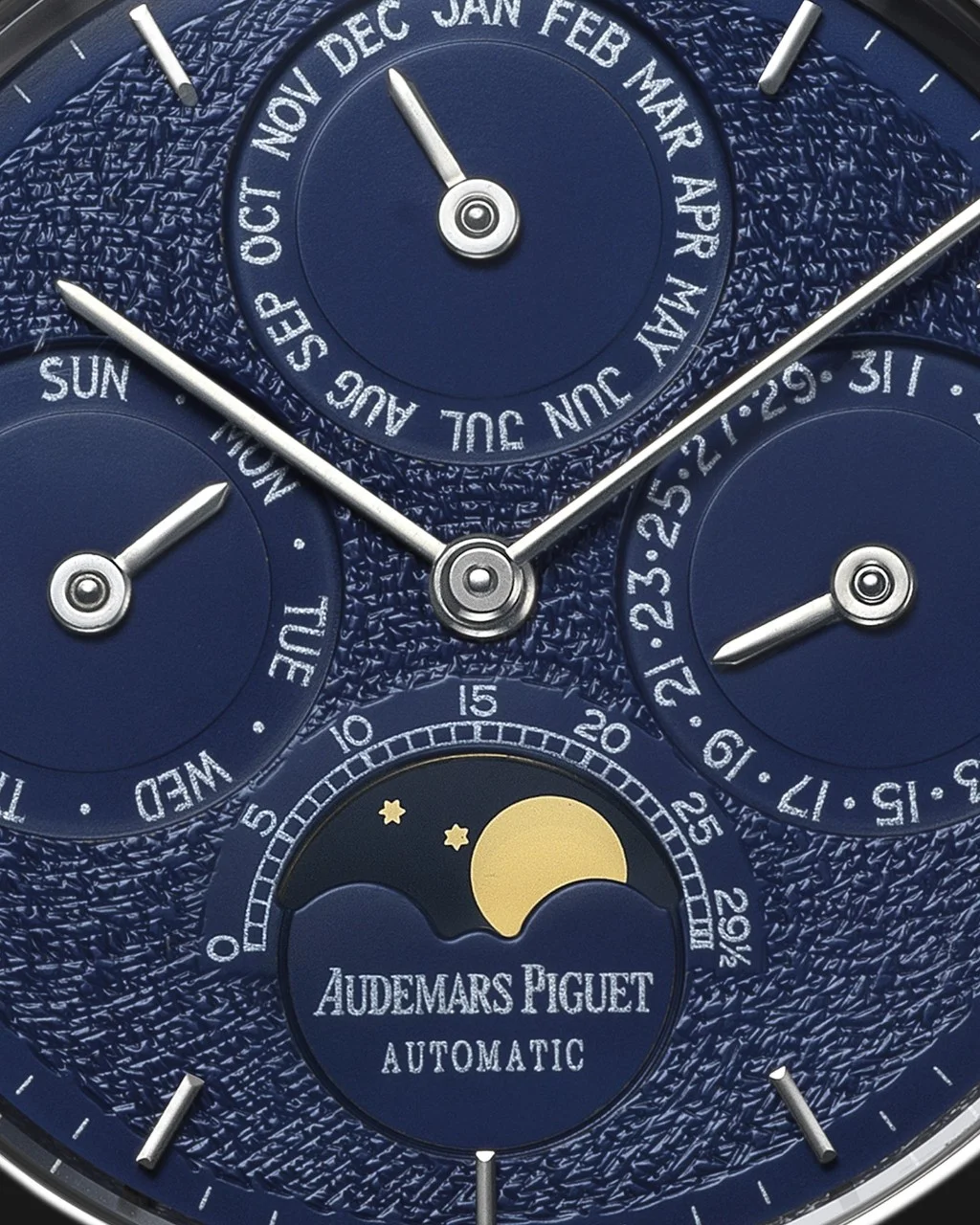
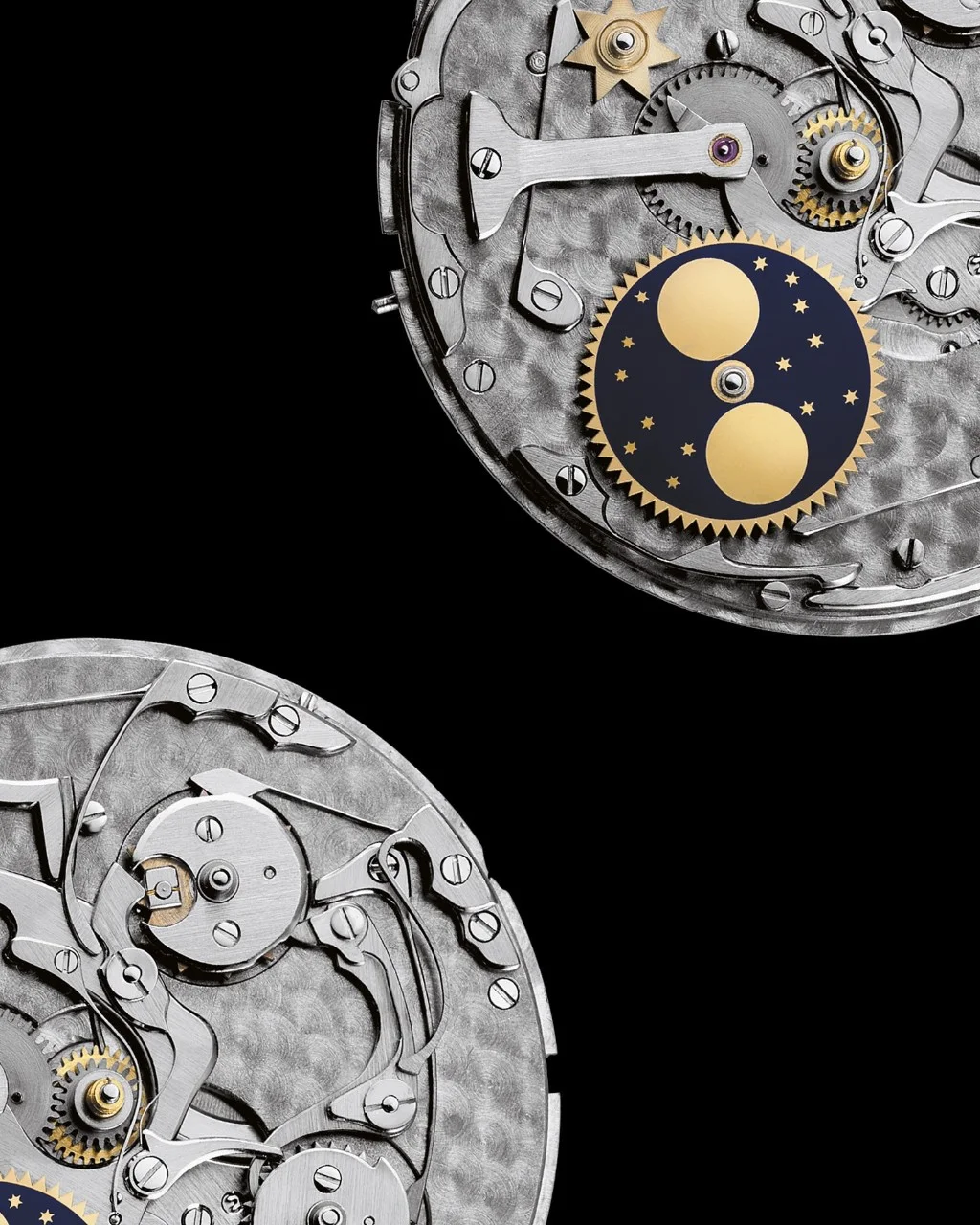
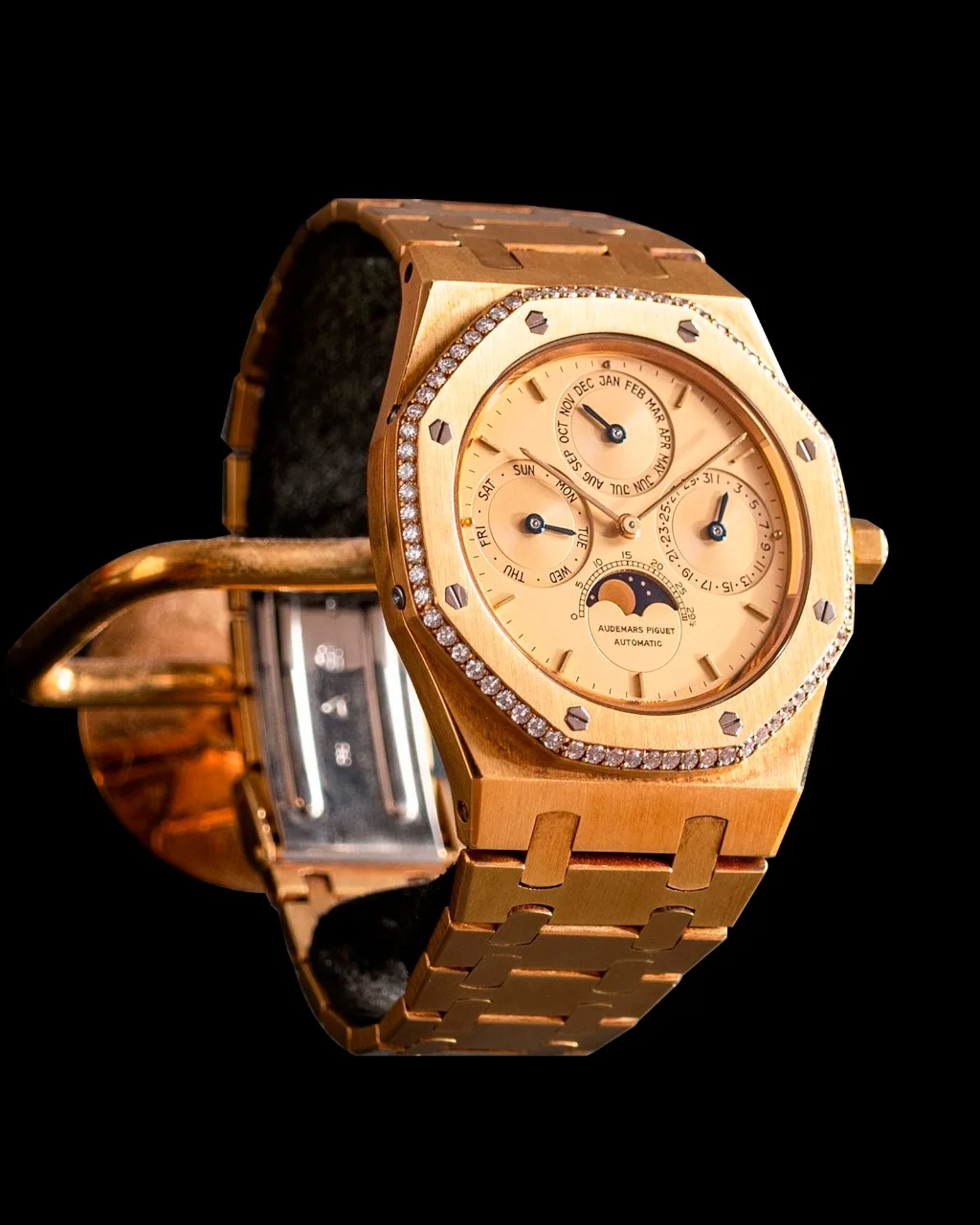
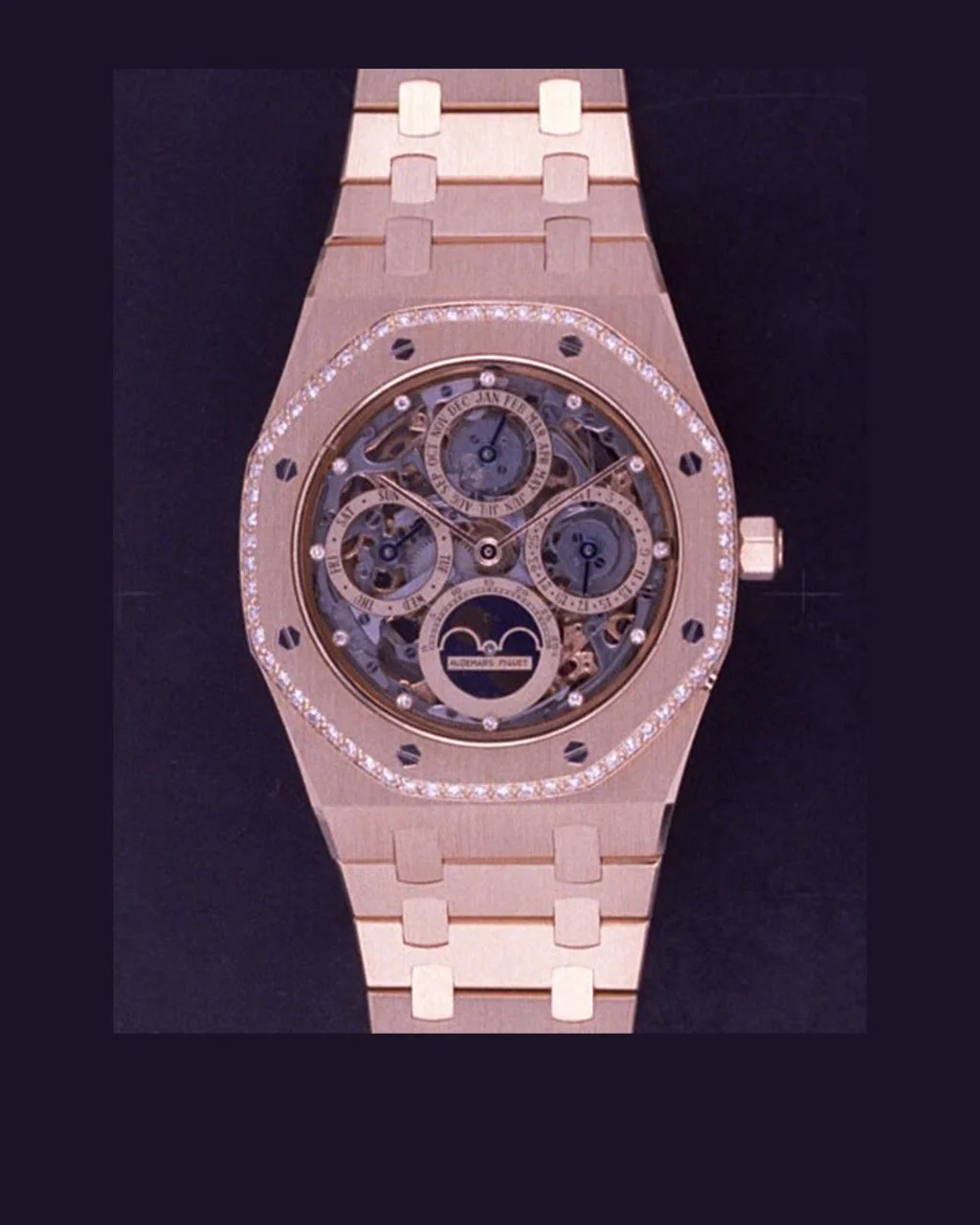
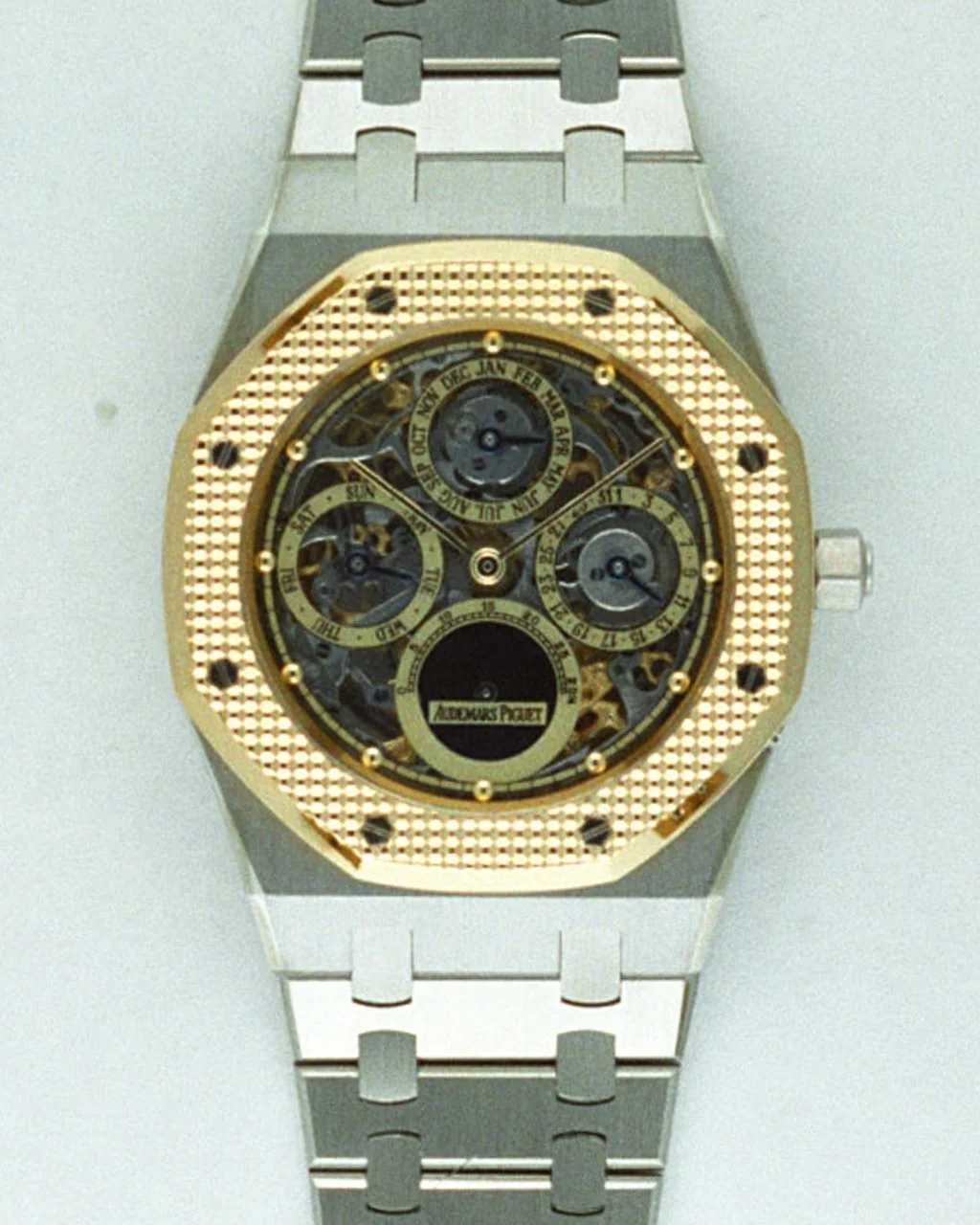
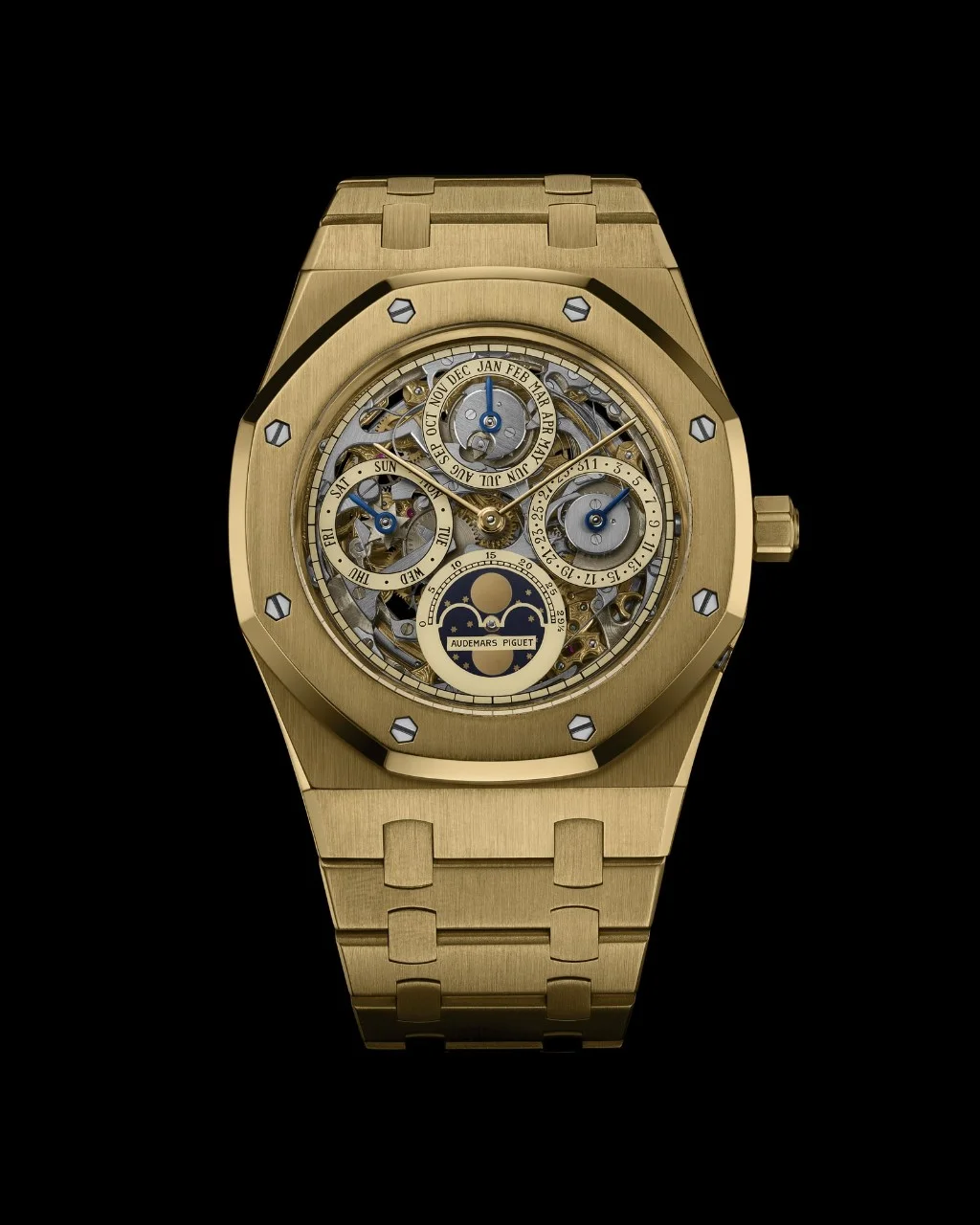
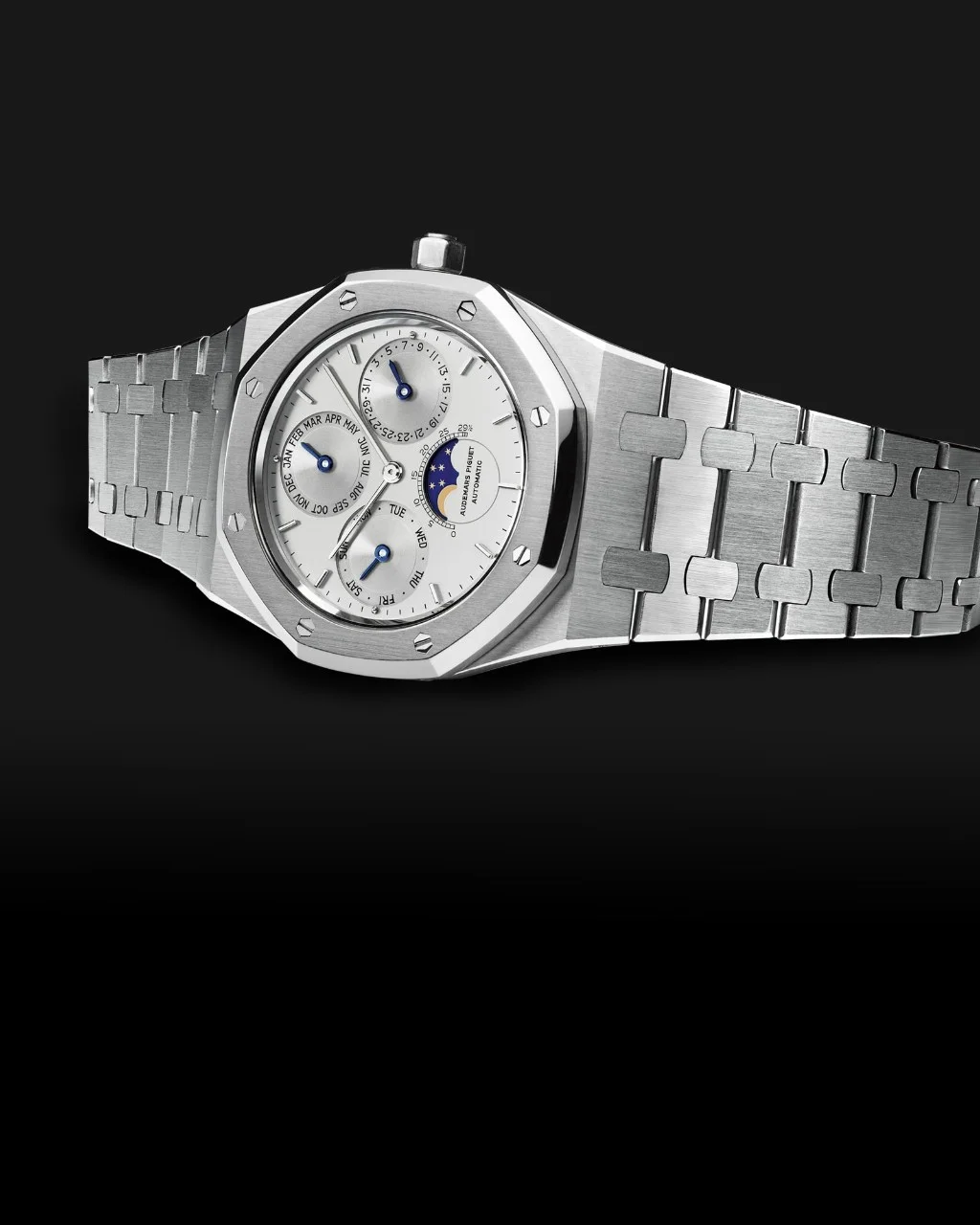
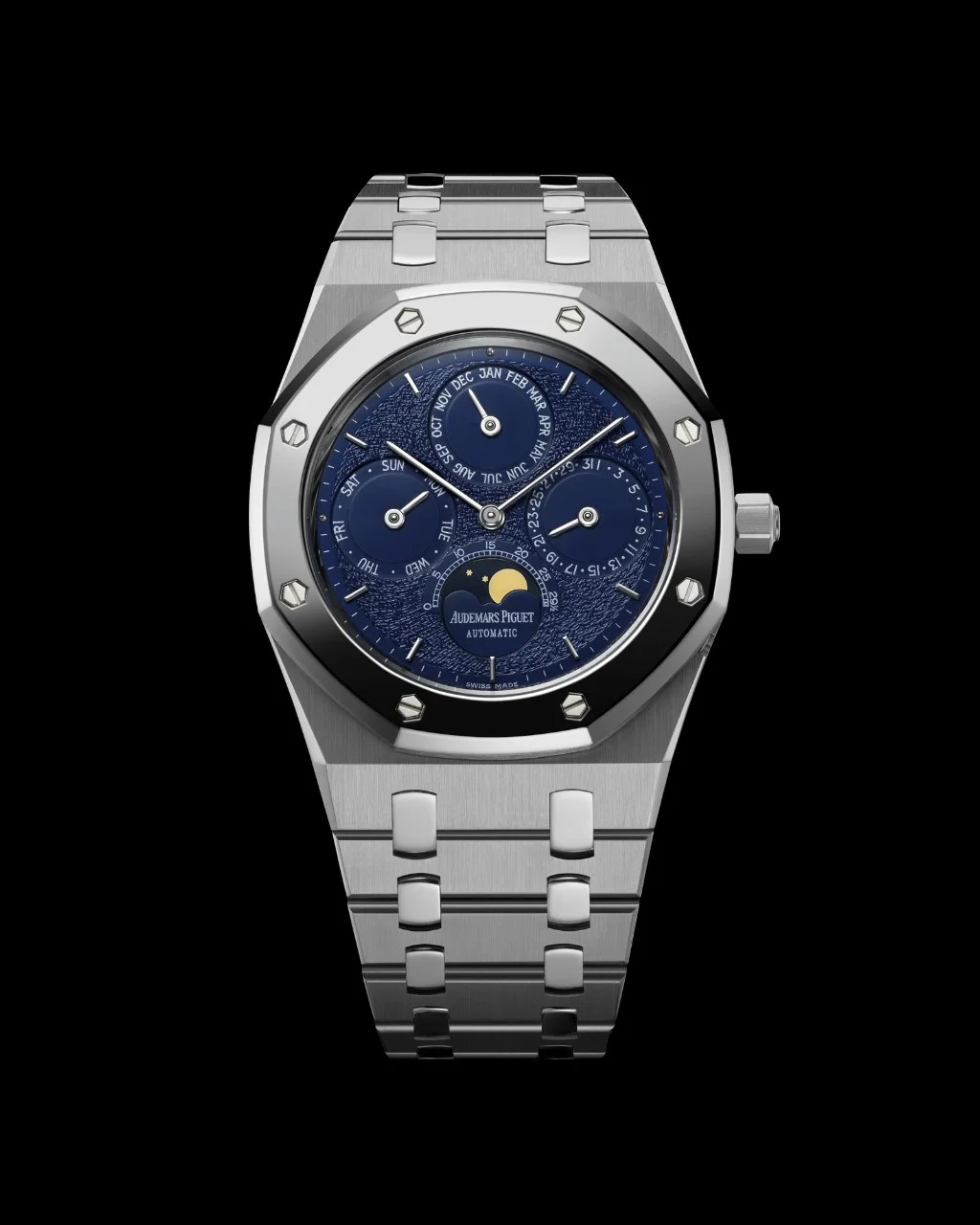
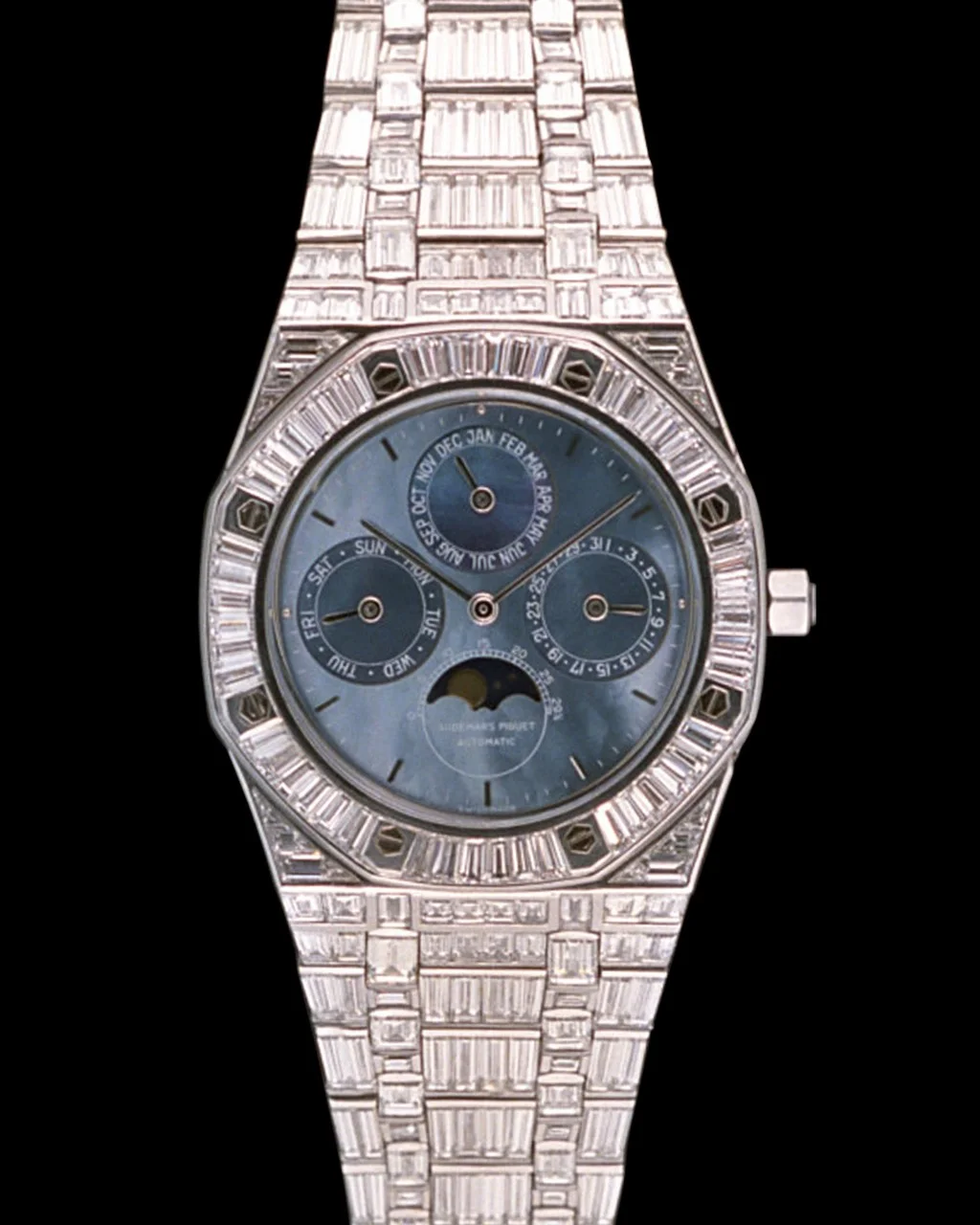
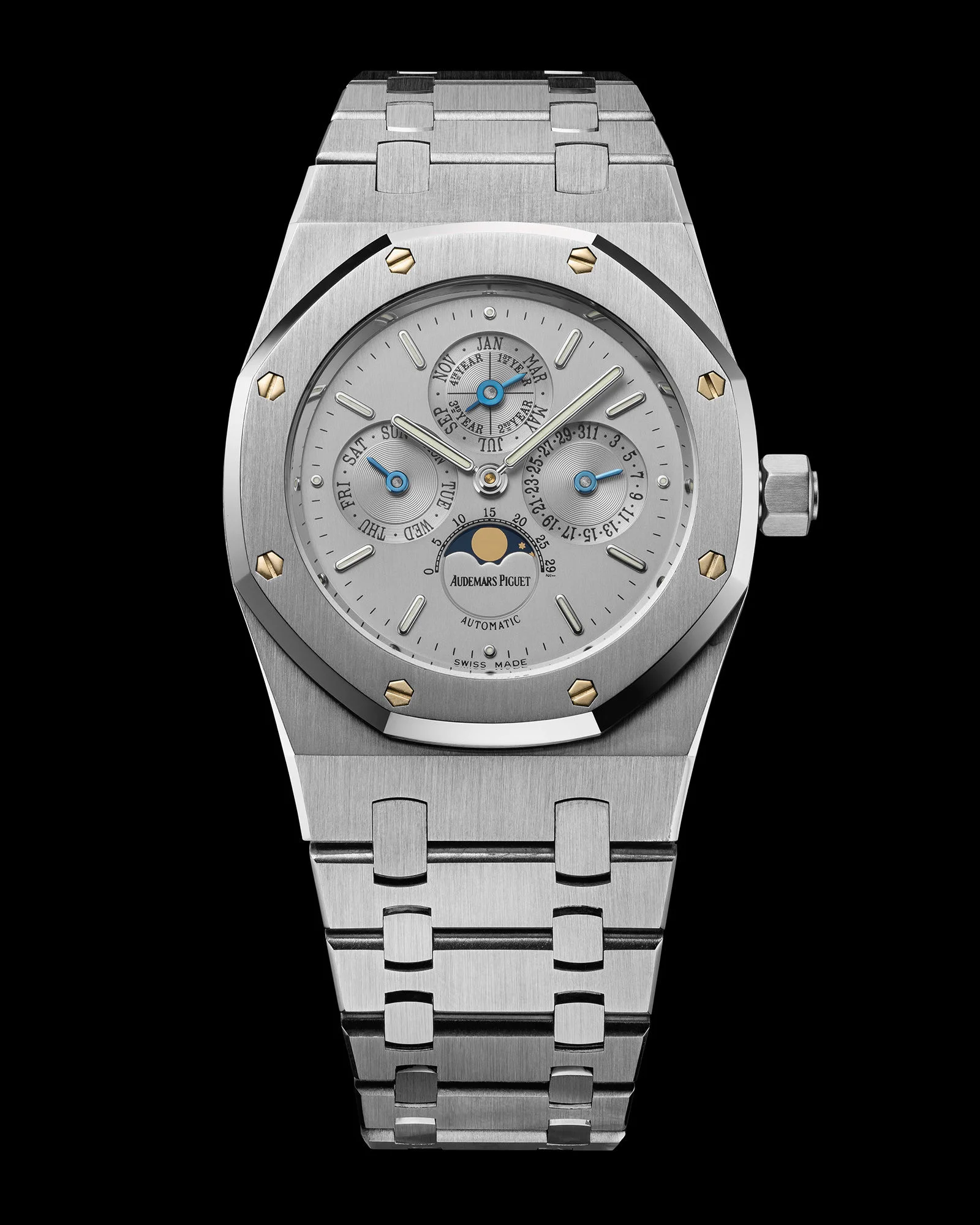
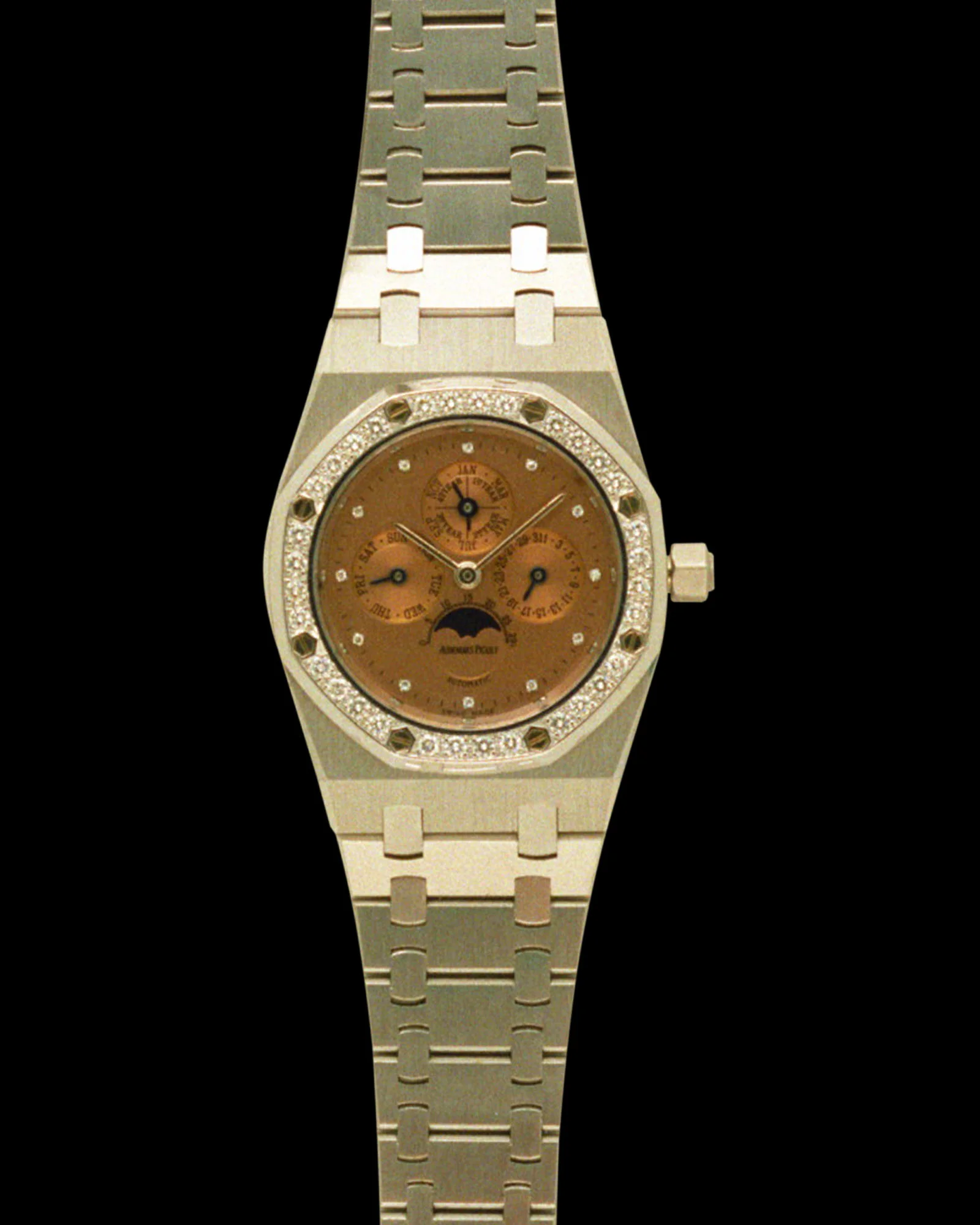
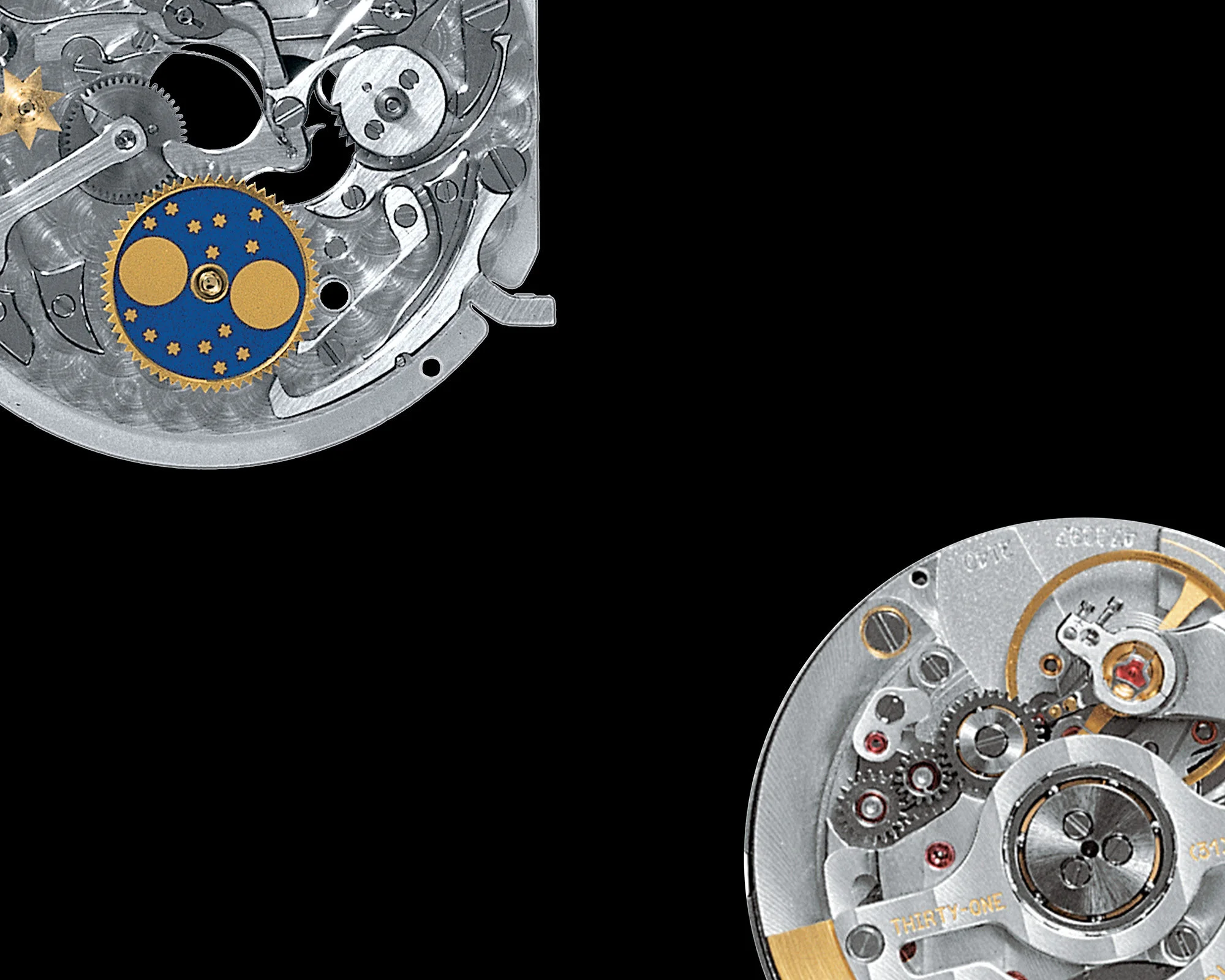
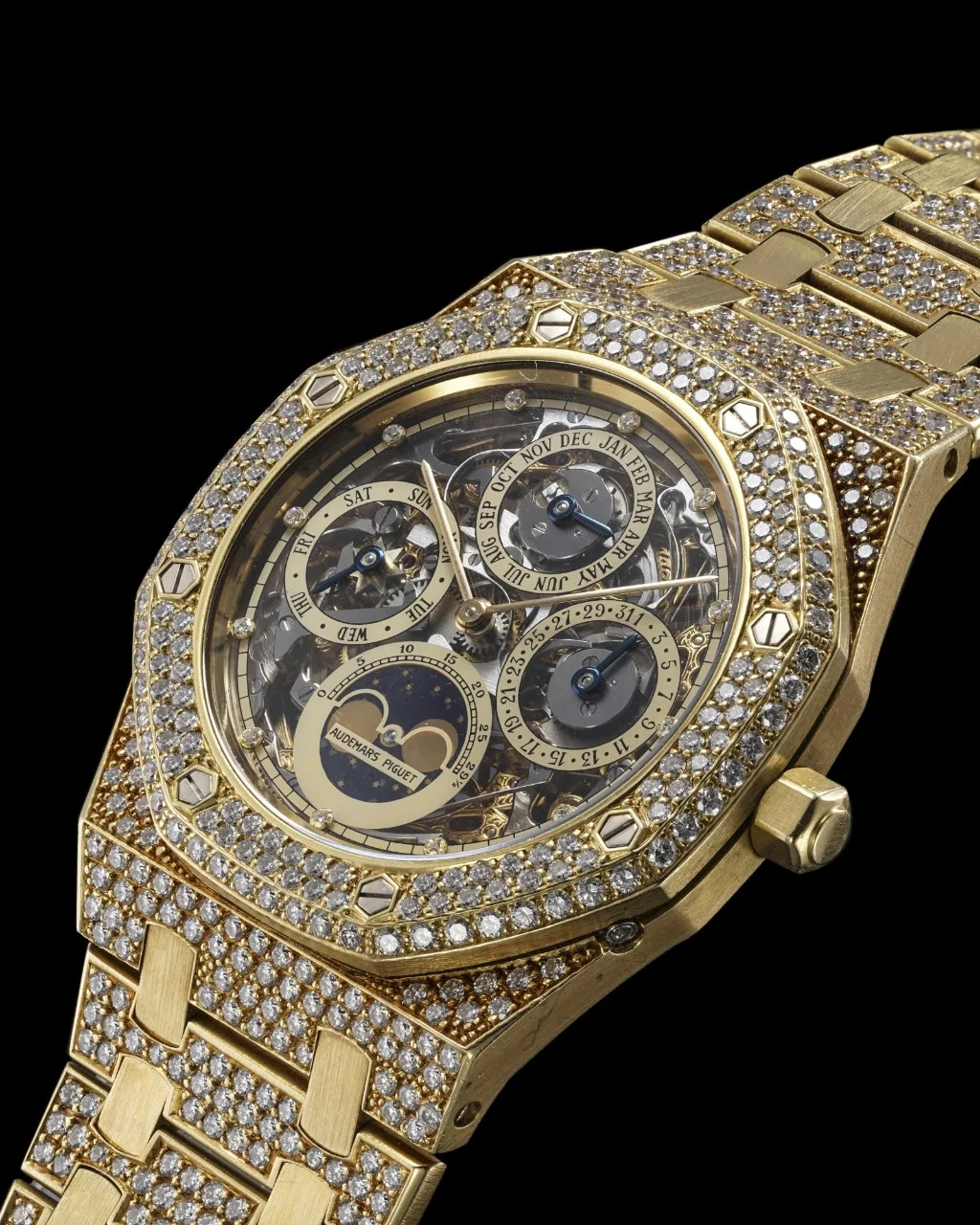
This quartz boom met strong demand from markets keen on novelty. It should not however obscure the fact that, at the same time, Audemars Piguet played a central role in the revival of classic complications, which were fitted not only on round and pocket watches, but also on the Royal Oak collection. The perpetual calendar was introduced in the Royal Oak collection (Model 5554, followed by 25636 in 1986, 25654 in 1987, 25729 in 1992, etc.) as early as 1984. In 1997, for its 25th anniversary, the octagonal watch adopted the chronograph (Calibre 2385, Models 25850 and 25865, then Model 26320 in 2012, etc.), but also the tourbillon (Model 25831, Calibre 2875; then Model 26355, Calibre 2886 in 2010; Model 26510, Calibre 2924 in 2012, etc.) and even the Grande Complication (Calibre 2885, models 25865 in 1997, then 25953 in 2001, etc.) In the 2000s, the equation of time was introduced (Calibre 2121/2808, Model 26603 from 2008), shortly after the double tourbillon-chronograph complications (Tradition d'Excellence Model 25969, Calibre 2893; Model 25977, Calibre 2889 in 2003; Model 26039 in 2004; Model 26355, Calibre 2886 in 2010, etc.).
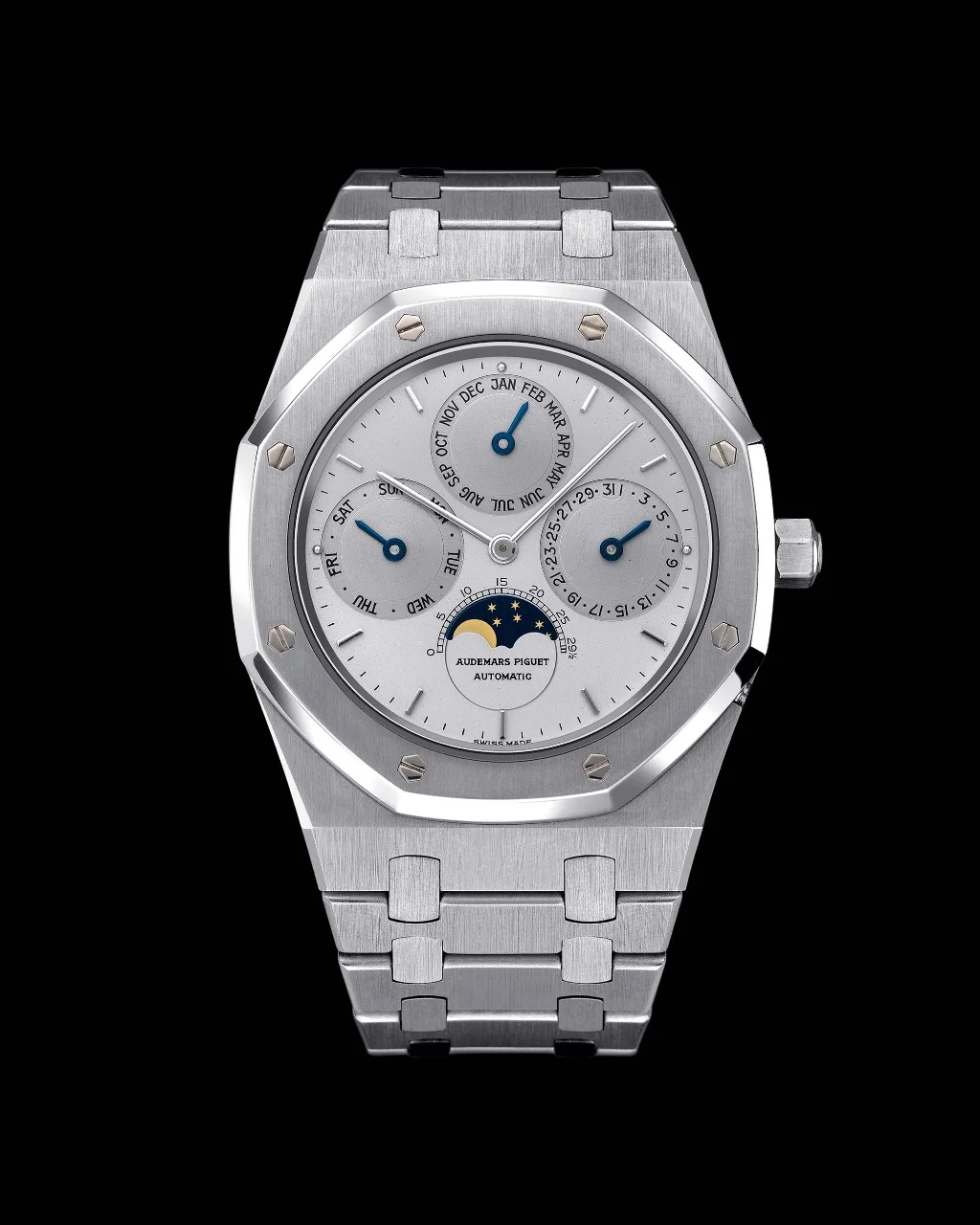
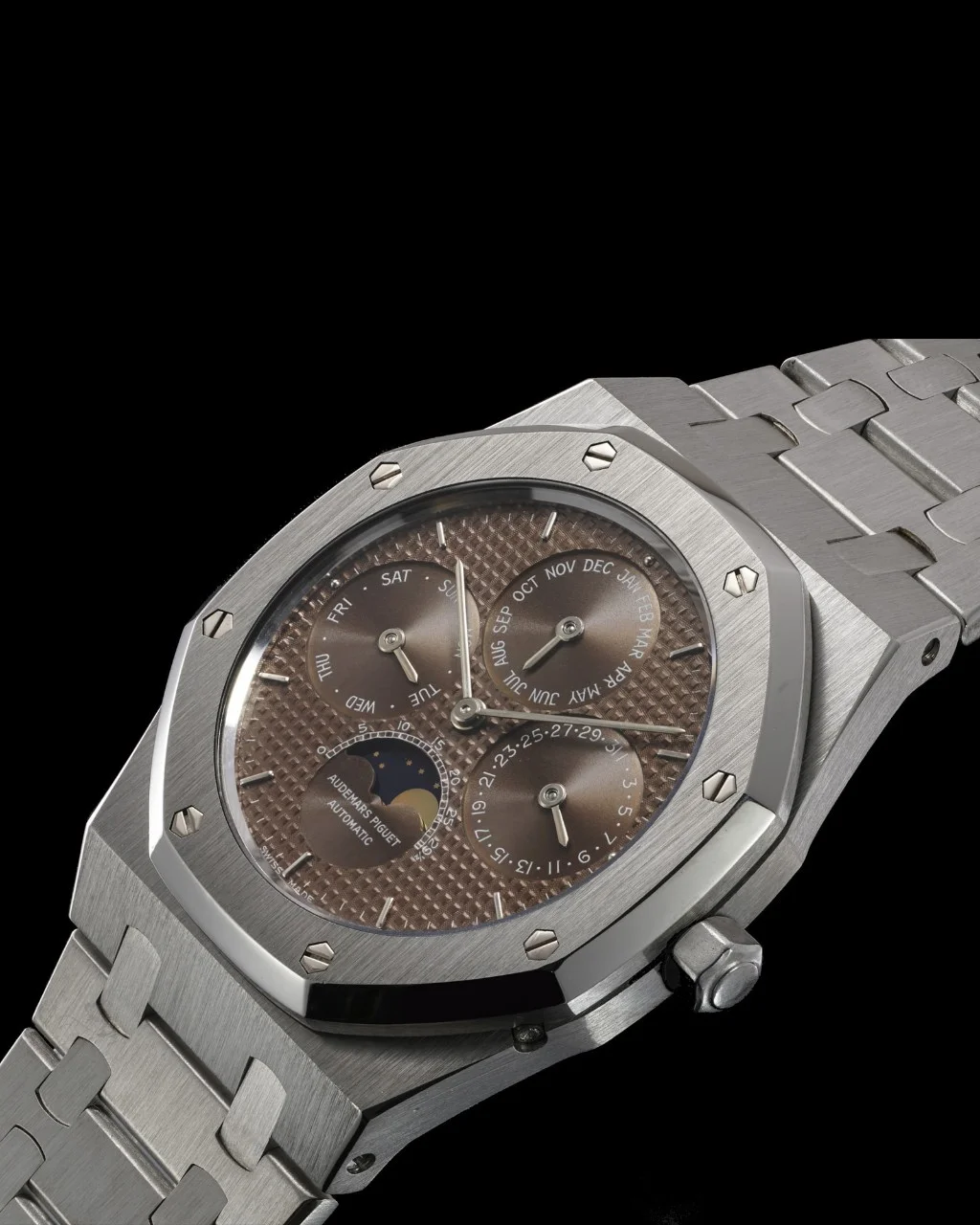
Circa 1984. Royal Oak Perpetual Calendar 5554ST Perpetual calendar: day, date, month and moon phases. Calibre 2120/2800 Ultra-thin (3.95 mm). Bracelet 344. Silver-toned dial. Case D148, 39 mm, no. 37 (the first 50 cases 5554ST were derived from the D series, model 5402ST). Prototype without movement presented at the model's launch. Audemars Piguet Heritage, inv. 455.
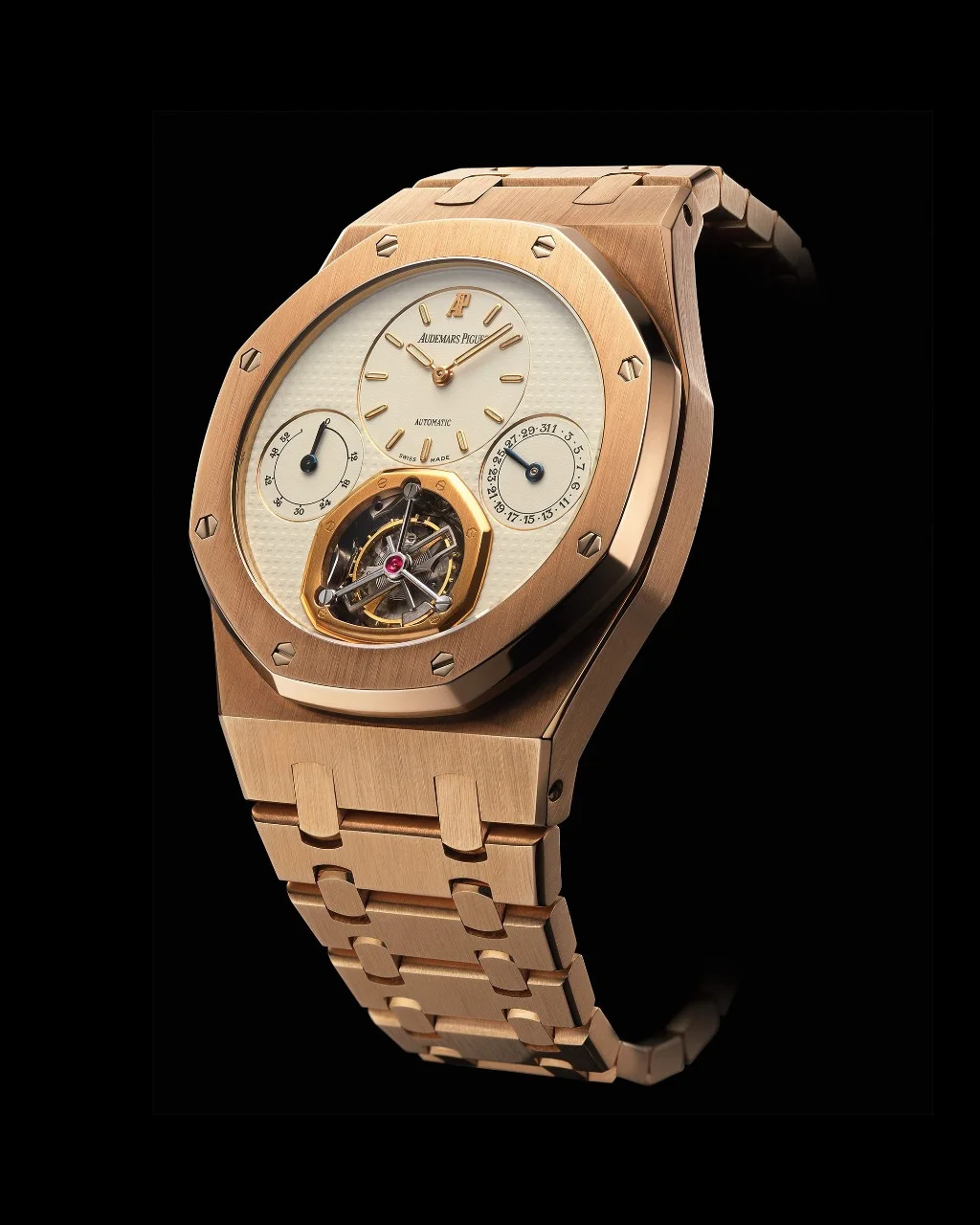
1998. Royal Oak Tourbillon 25831OR (1998), No. 1 Power reserve, date, tourbillon, automatic winding, crown under the case. Calibre 2875. Bracelet 1110. Movement 386194. Ivory dial. 40 mm case D99406, no. 1 in pink gold. Anniversary edition limited to 5 pieces. Sold in the United Kingdom in 1998. Audemars Piguet Heritage, inv. 910.
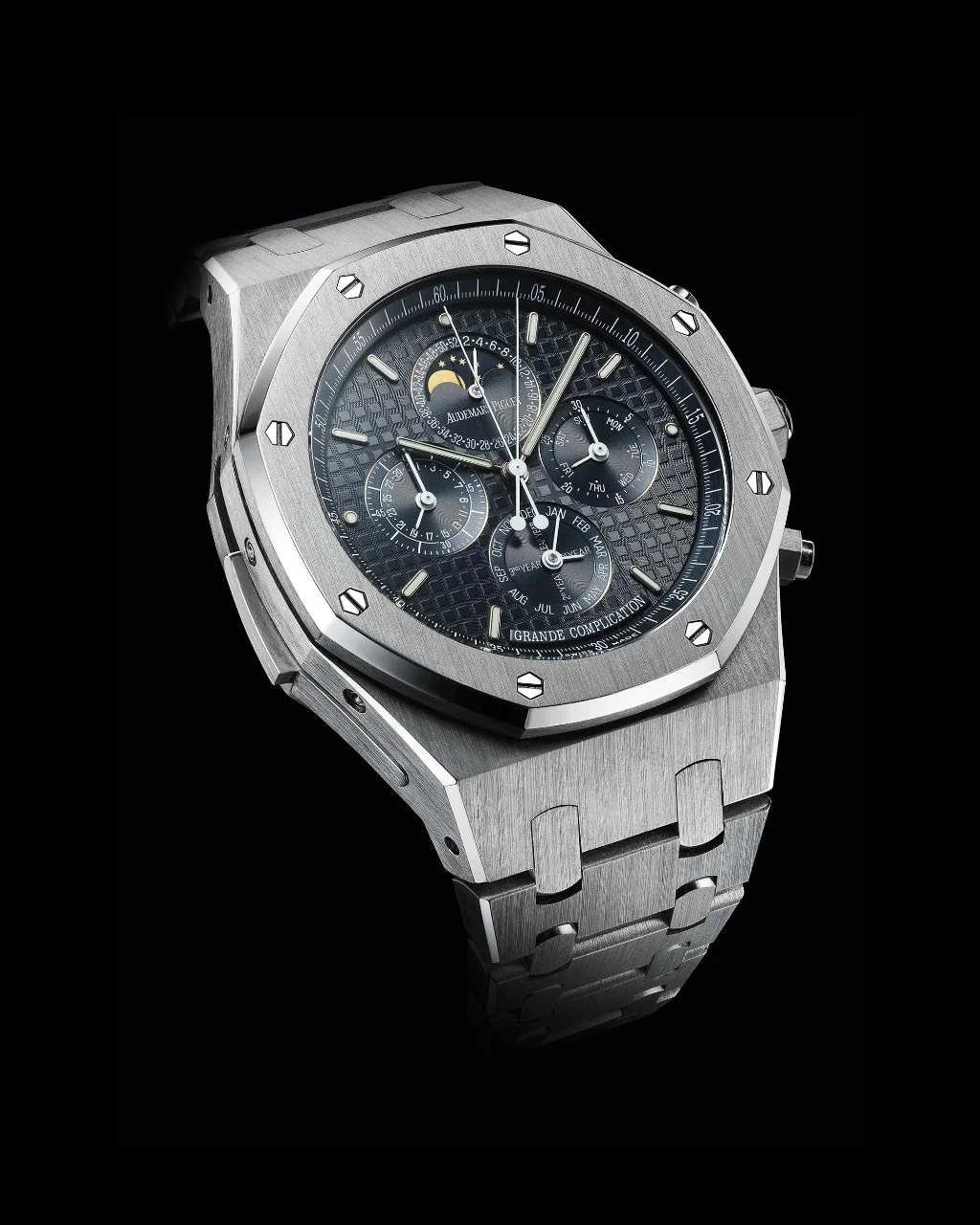
1997. Royal Oak Grande Complication 25865ST Perpetual calendar: day, date, month, moon phase, minute repeater, split-seconds chronograph. Calibre 2885. Bracelet 1105. Petite Tapisserie dial. Steel case, prototype P00039, 44 mm. Presented at the SIHH (Salon International de la Haute Horlogerie, Geneva) when the model was launched. Audemars Piguet Heritage, inv. 617.
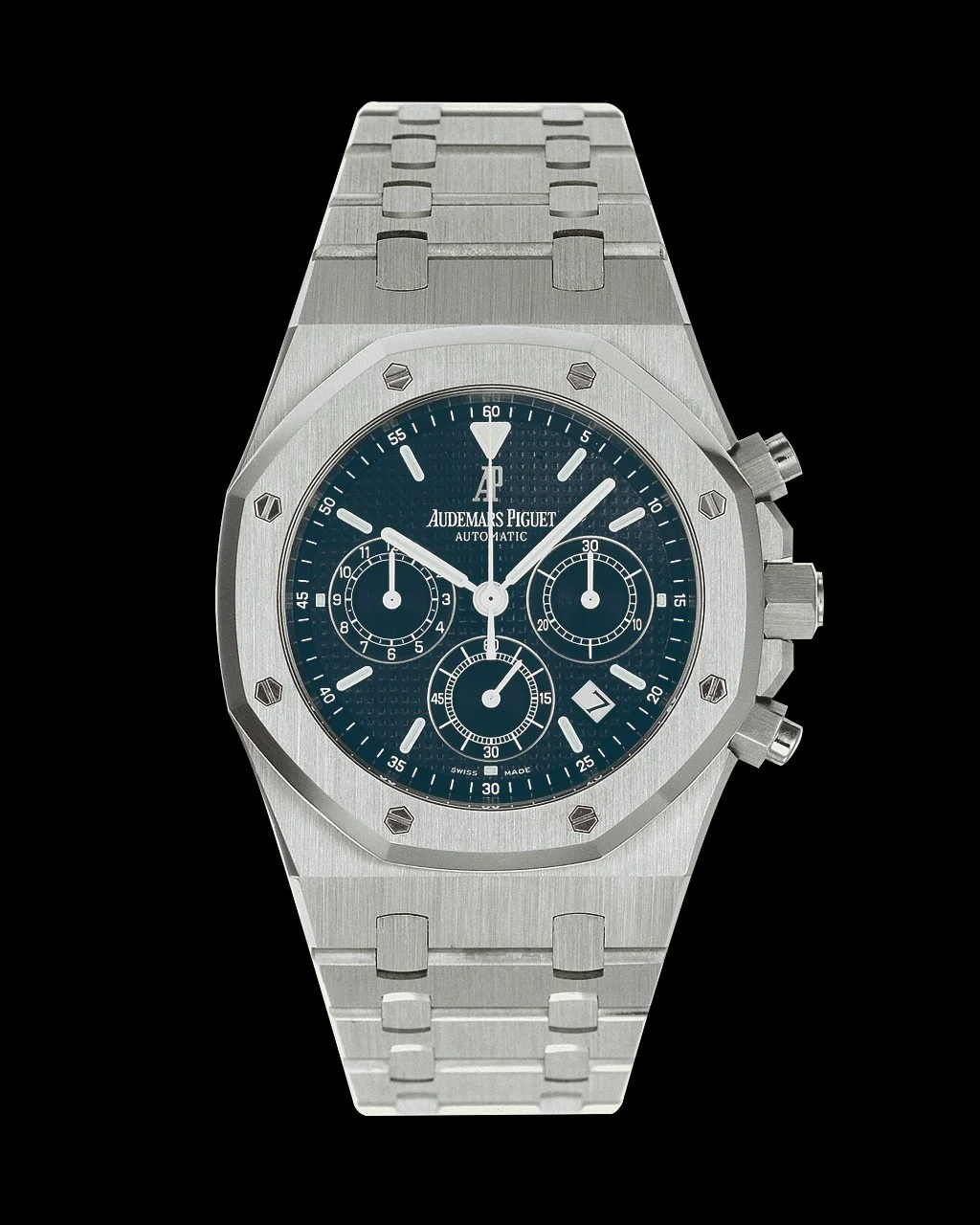
1999. First Royal Oak equipped with a chronograph (Calibre 2385), Model 25860ST. Picture from the 1999 Audemars Piguet Catalogue. Audemars Piguet Archives.
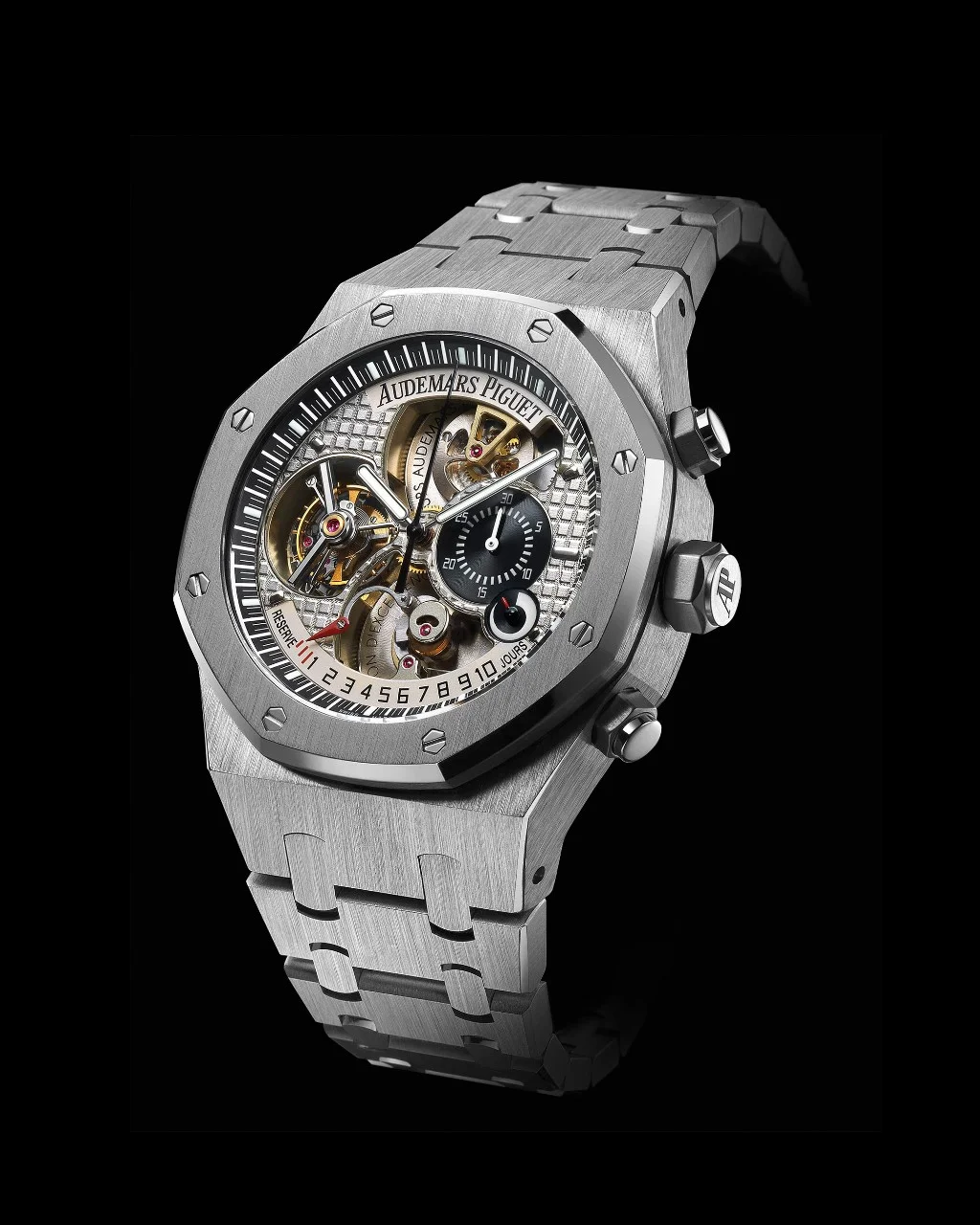
2004. Tradition d’Excellence No. 4, Royal Oak collection, Model 25969PT Tourbillon, chronograph, power-reserve indication, 10 days of autonomy. Calibre 2893, movement 571249. Bracelet 1105. 44 mm case E88362 in platinum. Limited edition of 20 pieces, plus one for the Musée Atelier Audemars Piguet. Audemars Piguet Heritage, inv. 636.
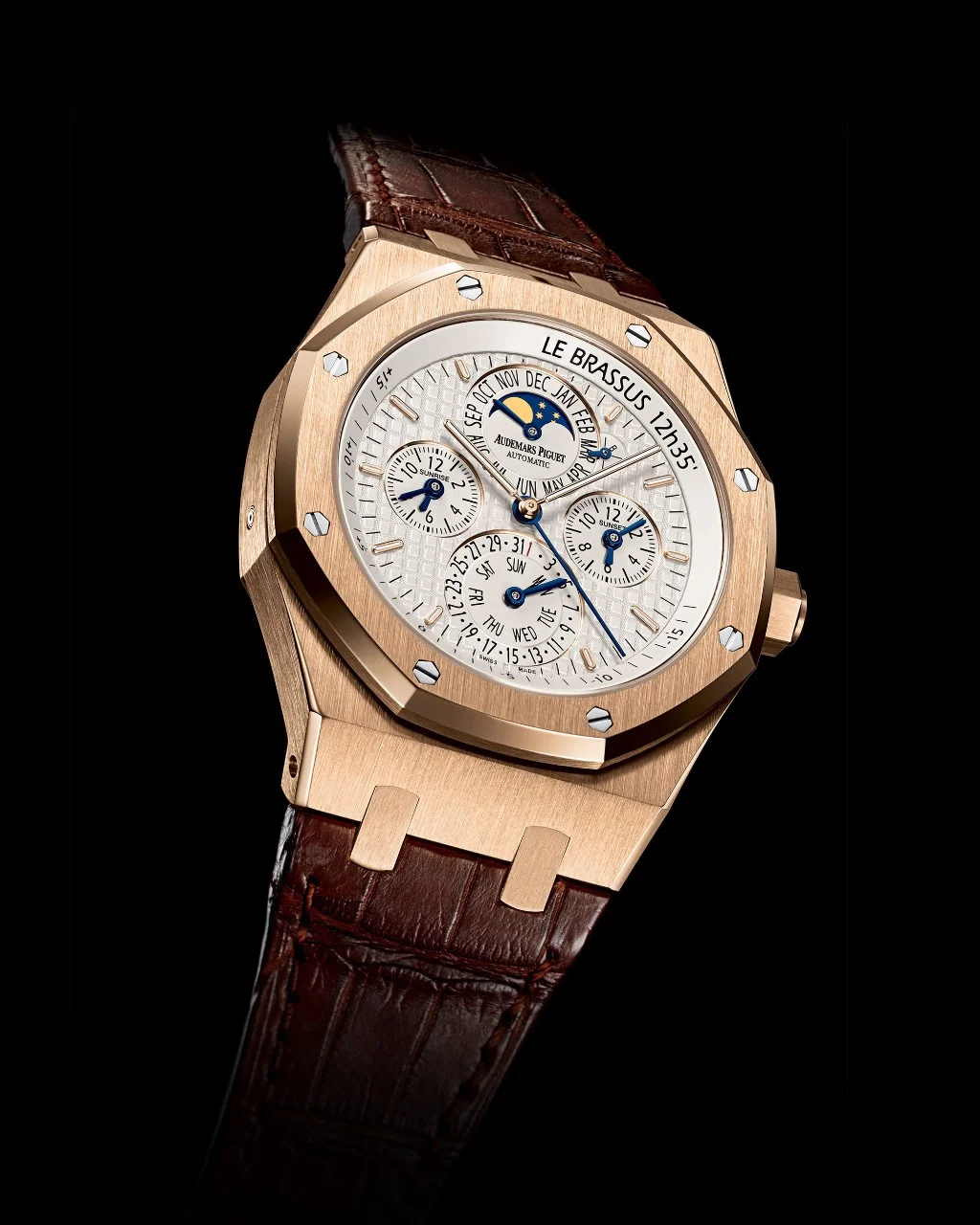
2010. Royal Oak Equation of Time 26603OR Equation of time, perpetual calendar, sunrise and sunset times, selfwinding. Calibre 2120/2808. 42 mm case. 18-carat pink gold. Picture taken during the presentation of the watch. Audemars Piguet Archives.
From Iconoclast to Icon
The radical concept of Model 5402 from 1972, left untouched for four years, could never have led us to guess the fate of the Royal Oak. By opening up to women and then to precious materials, new dimensions, gemsetting, complications and quartz movements, the Royal Oak revealed an adaptability that was as unexpected as it was extraordinary.
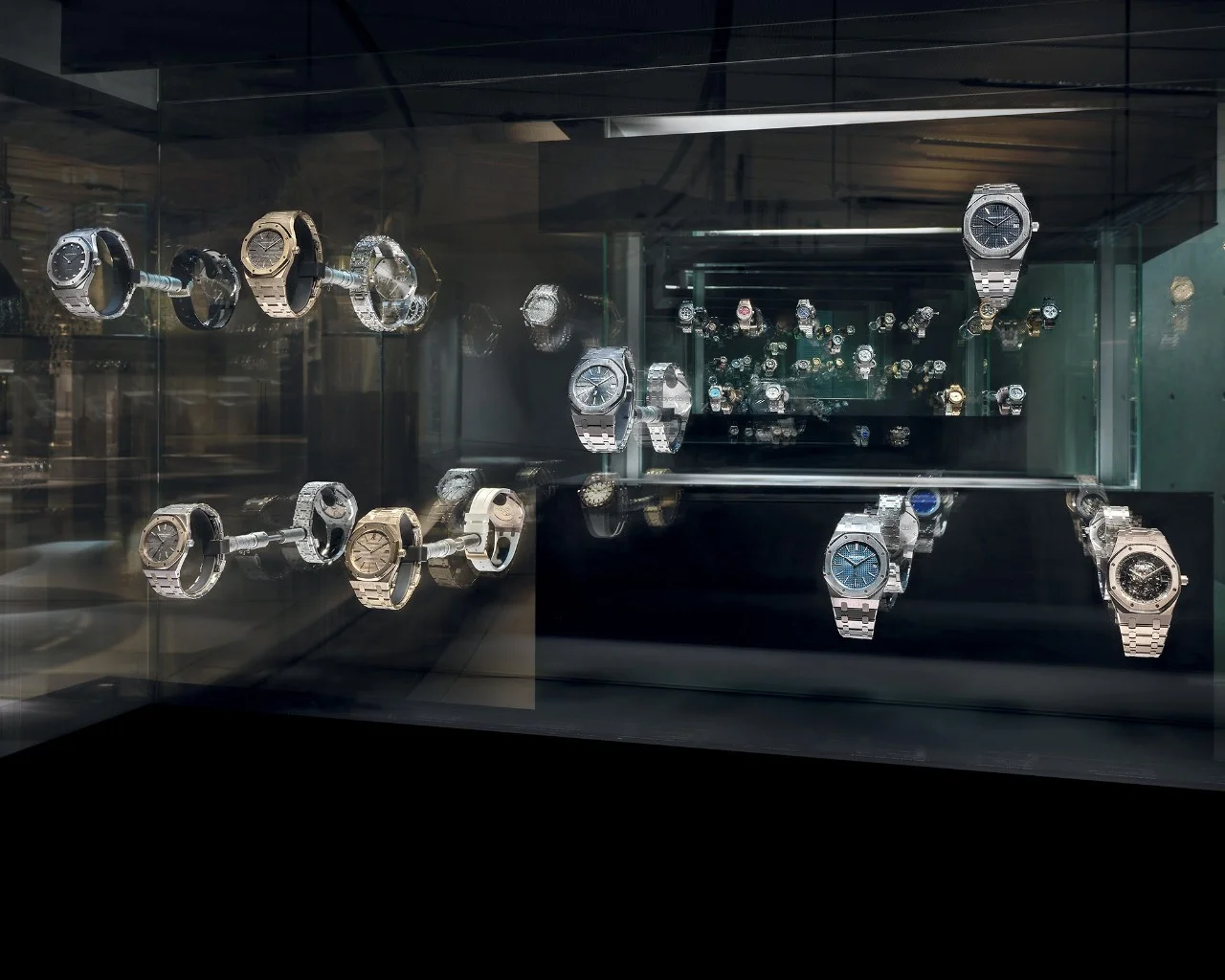
The aesthetics designed by Genta have been constantly reinterpreted since 1976, giving rise not only to a rich and lively collection, but also to two additional collections, each with its own strong identity: the Royal Oak Offshore from 1993 and the Royal Oak Concept from 2002. In 2022, the Royal Oak alone accounts for more than 550 different models, most of which have been produced in multiple variants. If we add the two related collections, this figure amounts to almost 850 models!
Editorial board: Audemars Piguet Heritage team, Le Brassus
First publication: 24 January 2022