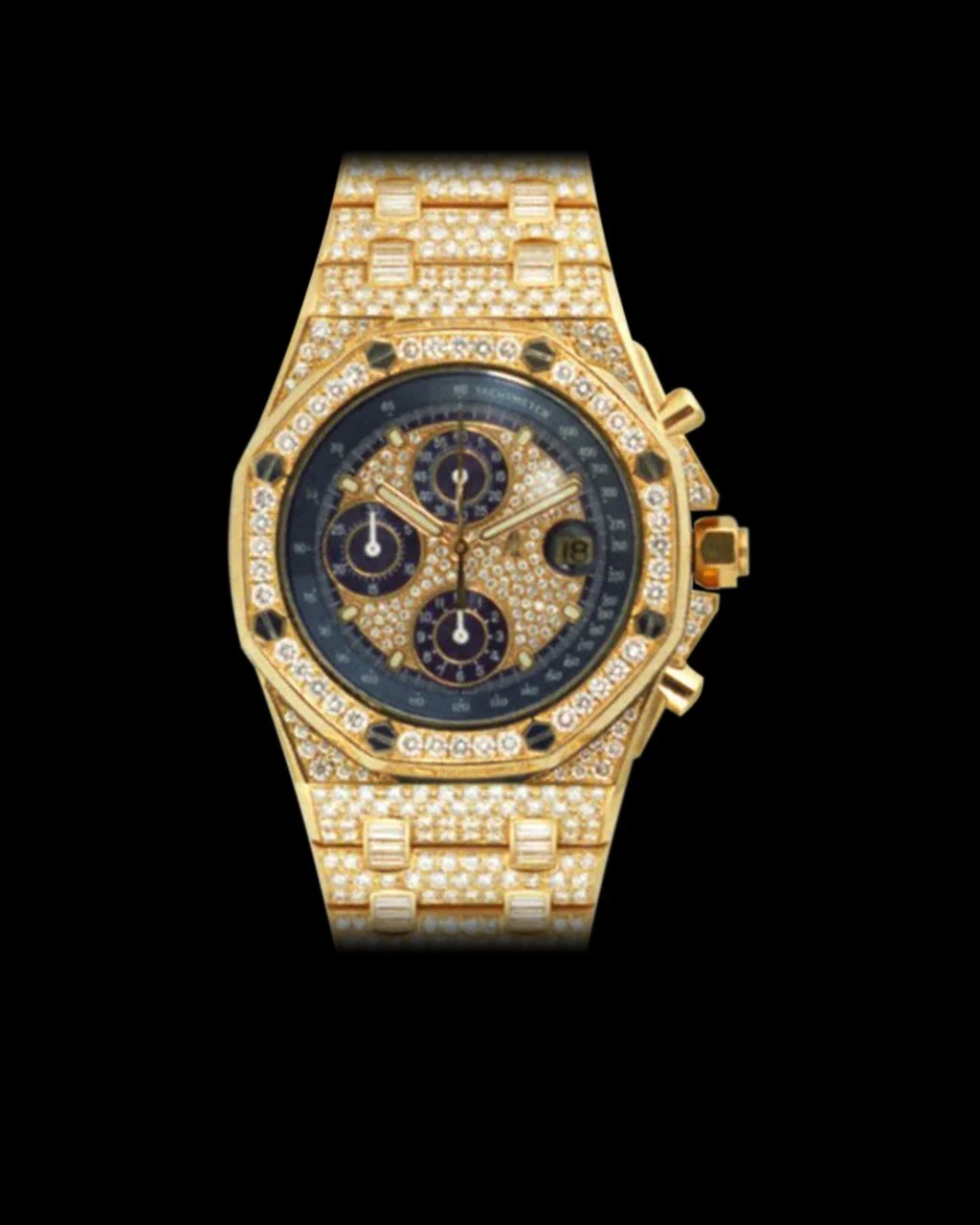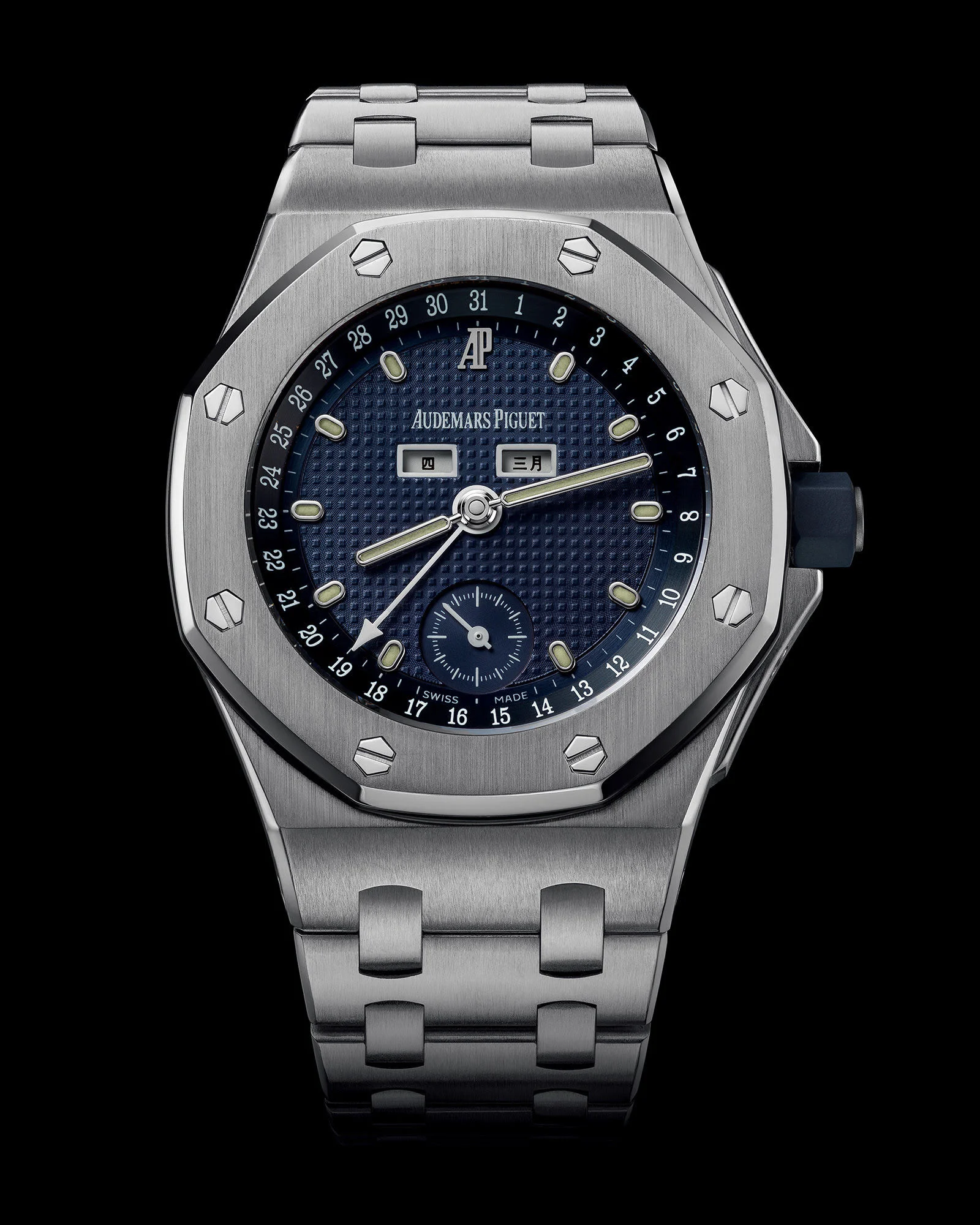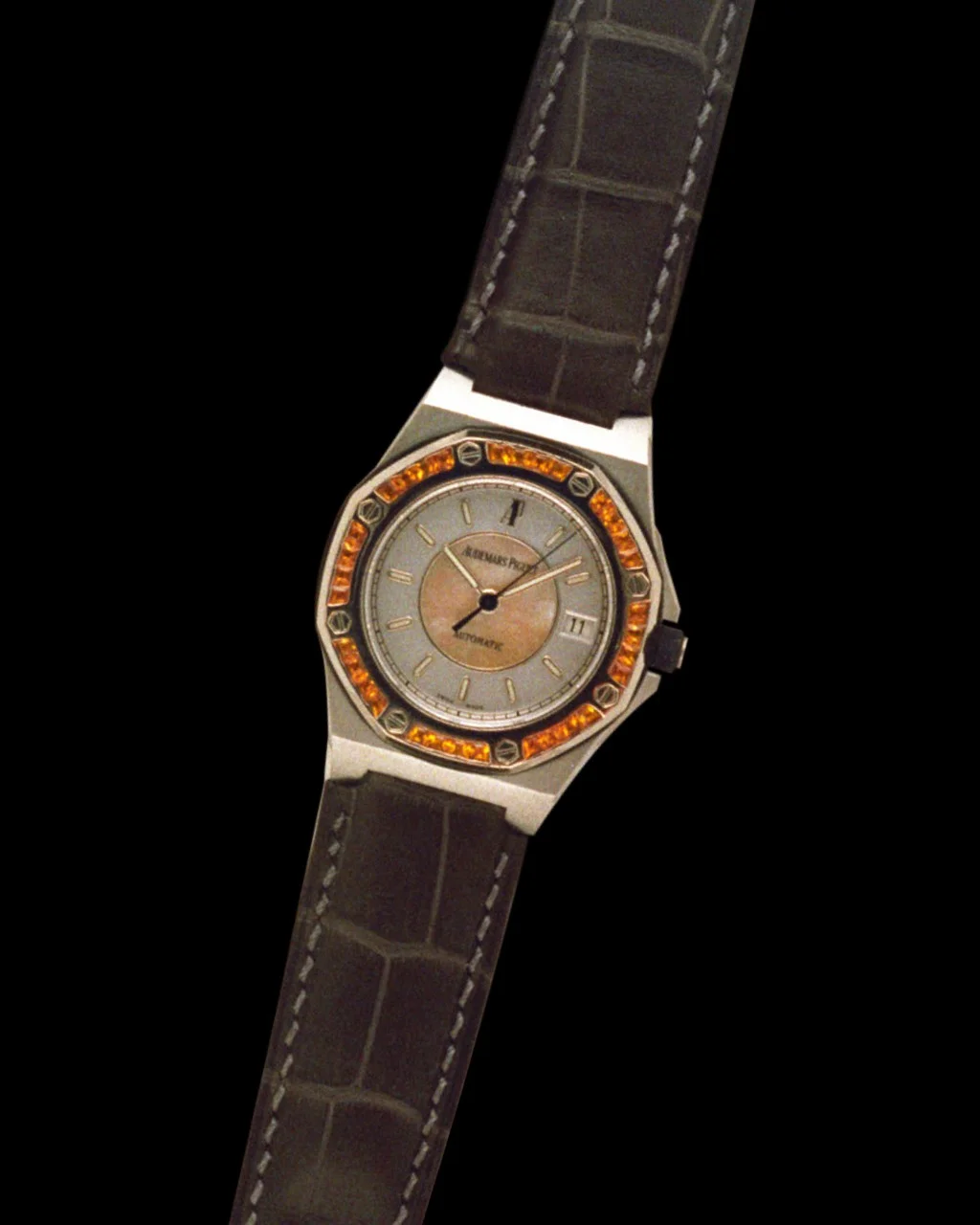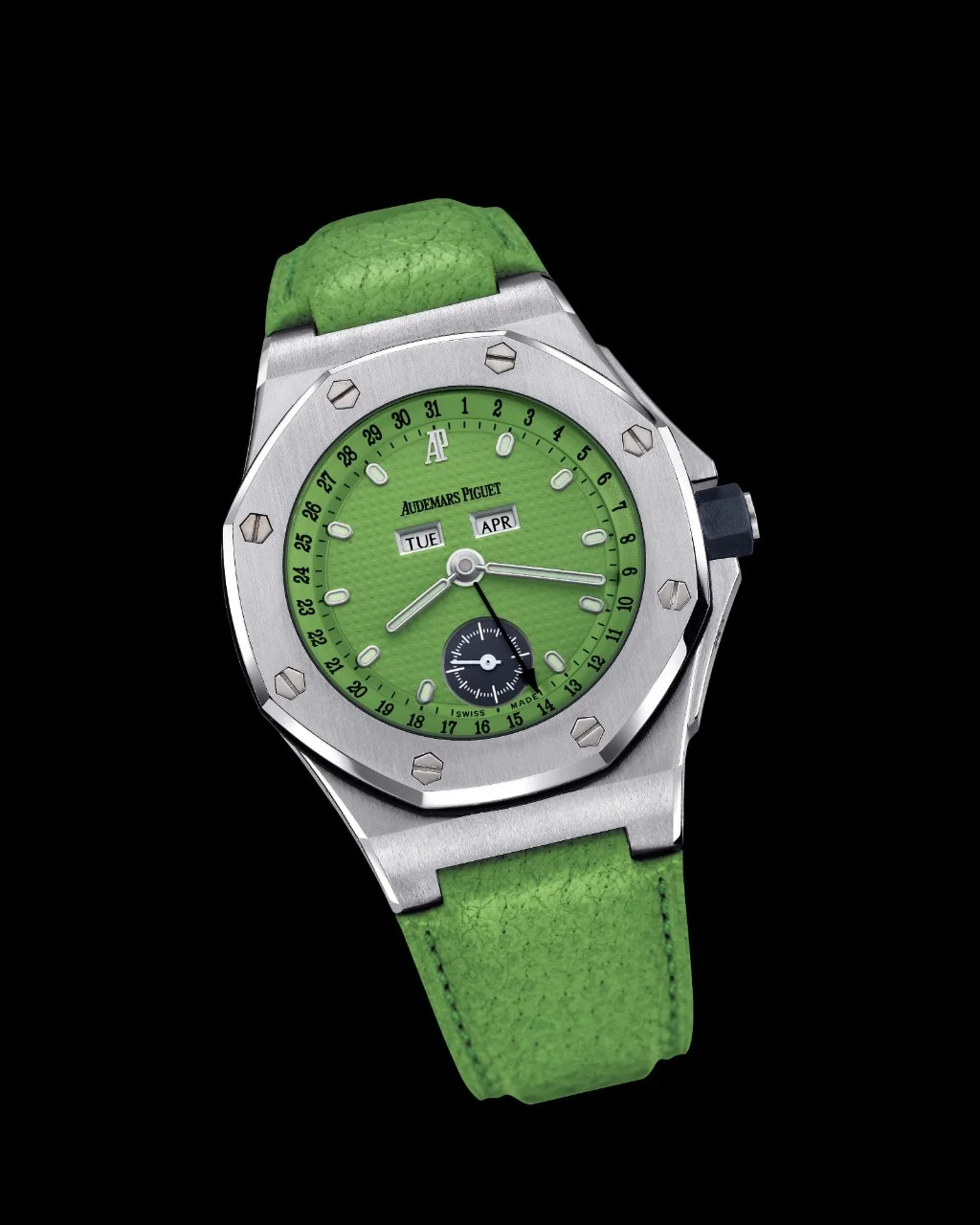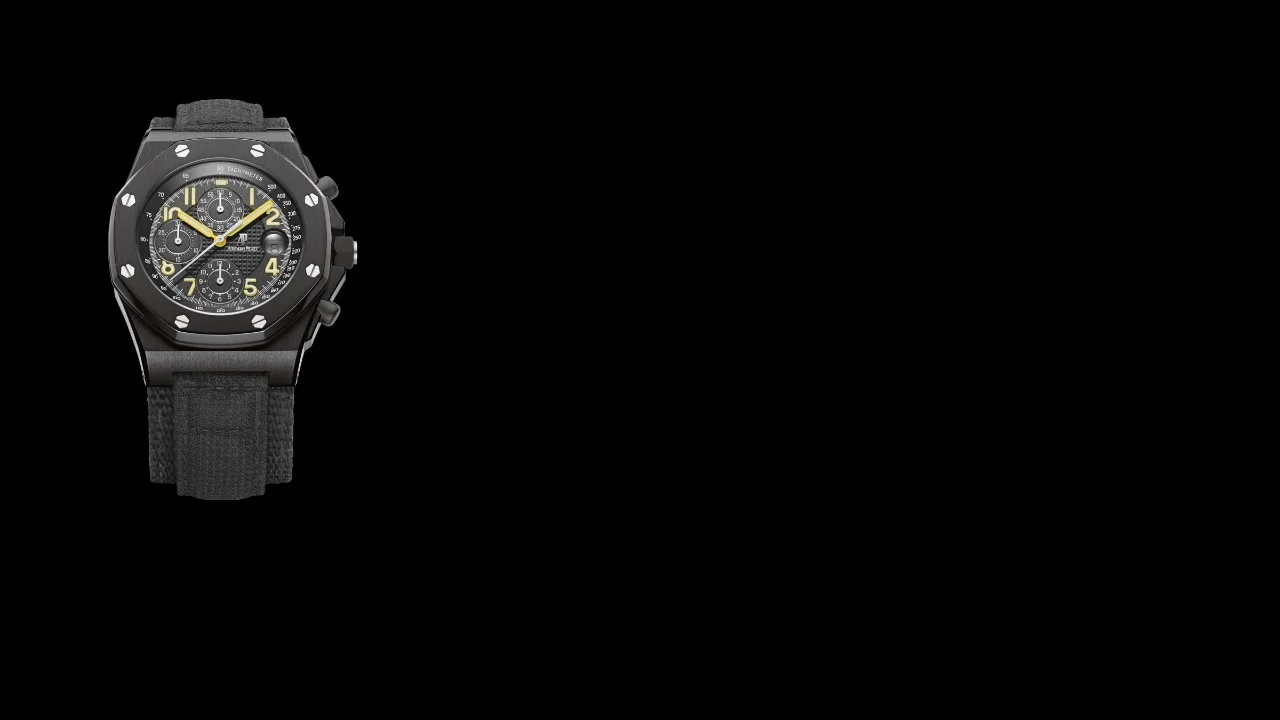
25770, First Royal Oak Offshore 42 mm Chronograph with leather strap
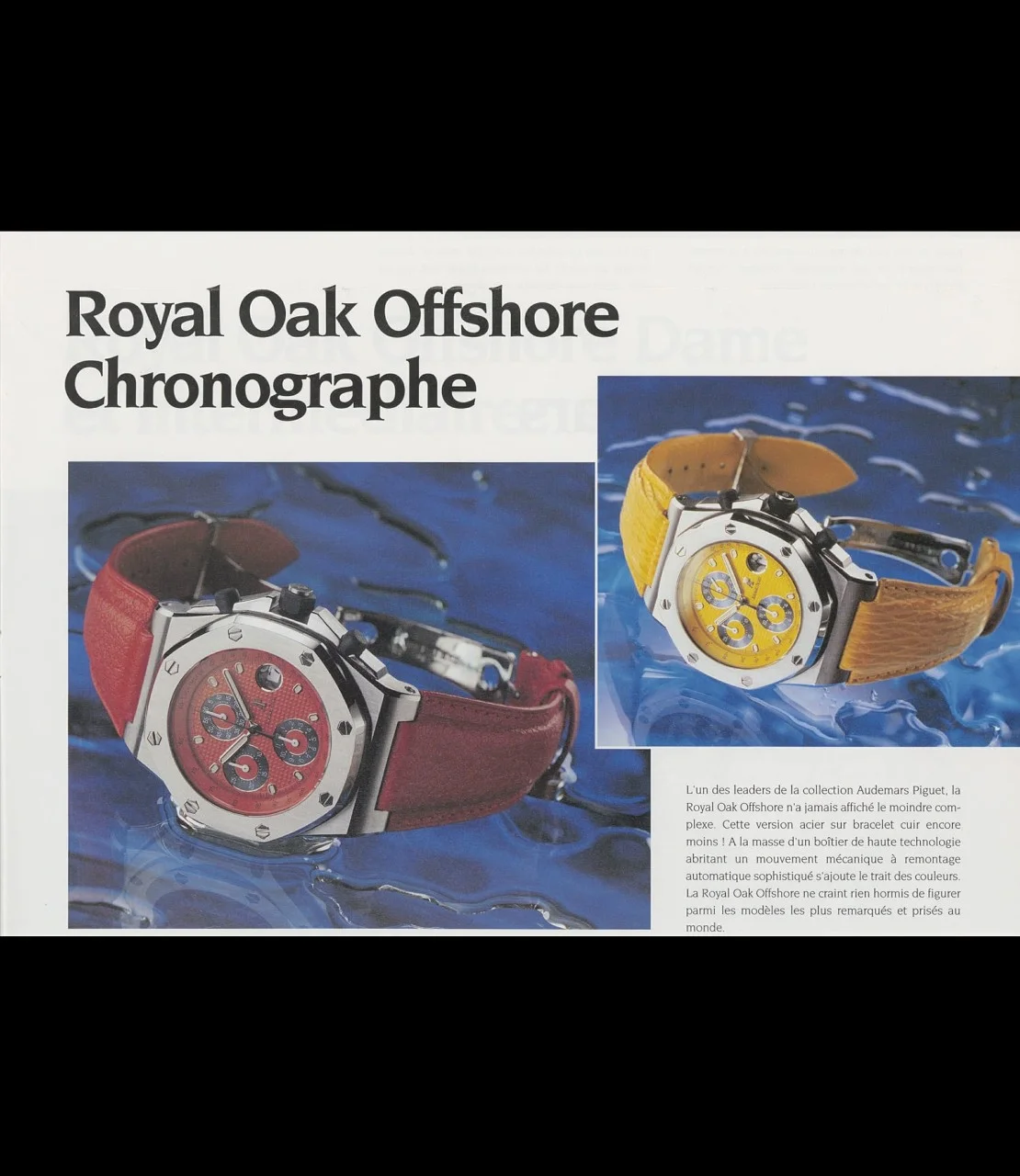
1997. Royal Oak Offshore Chronograph 25770ST. These two colourful variations of Model 15770ST model are featured in Audemars Piguet's 1997 in-house magazine. AP News, Audemars Piguet Archives.

1992. First Royal Oak with leather strap. Designed by Jörg Hysek, Model 14800 introduced the leather strap to the Royal Oak collection. The case middle is curved and evokes the shape of the lugs, even though the strap is attached by means of plates from the caseback. Picture from a promotional brochure dated September 1992. Audemars Piguet Archives.

2004. Royal Oak 14800TR, No. 199, caseback side. The strap is secured by two metal plates secured to the caseback. Audemars Piguet Heritage, inv. 829.

1991. Royal Oak Offshore sketch. The first variation on a leather strap was designed in November 1991 by Emmanuel Gueit. Audemars Piguet Archives.
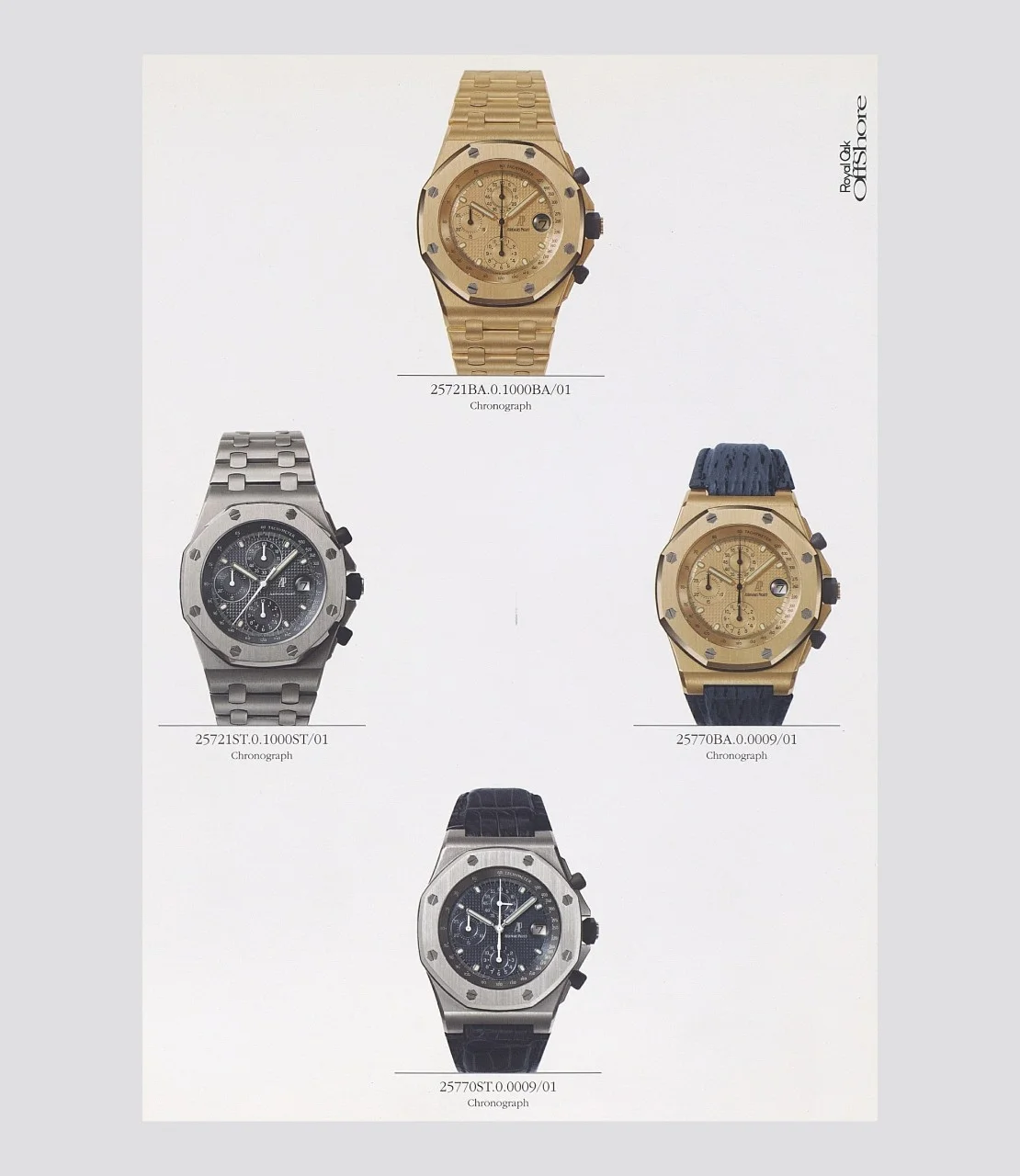
1996. Royal Oak Offshore Models 21721 and 25770. The two models featuring identical dials are distinguished by their case and bracelet/strap. Audemars Piguet catalogue 1996-97, Audemars Piguet Archives

1997. Royal Oak Offshore brochure. Four years after its launch, the Royal Oak Offshore existed in many variations: versions with metal bracelets or leather straps; diameters of 30 mm, 38 mm and 42 mm; models equipped with chronograph, full calendar or date-only indications; cases in steel or yellow gold; dials in blue, gold-toned or yellow colours, etc. Audemars Piguet Archives.

1999. Royal Oak Offshore End of Days advertisement. Press release for the launch of Model 25770SN. Audemars Piguet Archives.
In 1992, Audemars Piguet entrusted Jörk Hysek with the task of equipping the Royal Oak with leather straps. The independent designer had then reworked the case middle of the watch, extending it with two false curved lugs (see dedicated article). This same aesthetic was picked up in the first Royal Oak Offshore models to appear on a leather strap in 1996: Models 77151 (30 mm); 25808 (38 mm) and 25770 (42 mm). Moreover, the straps were no longer held between a plate and the case middle, but instead secured by bars screwed between the lugs.
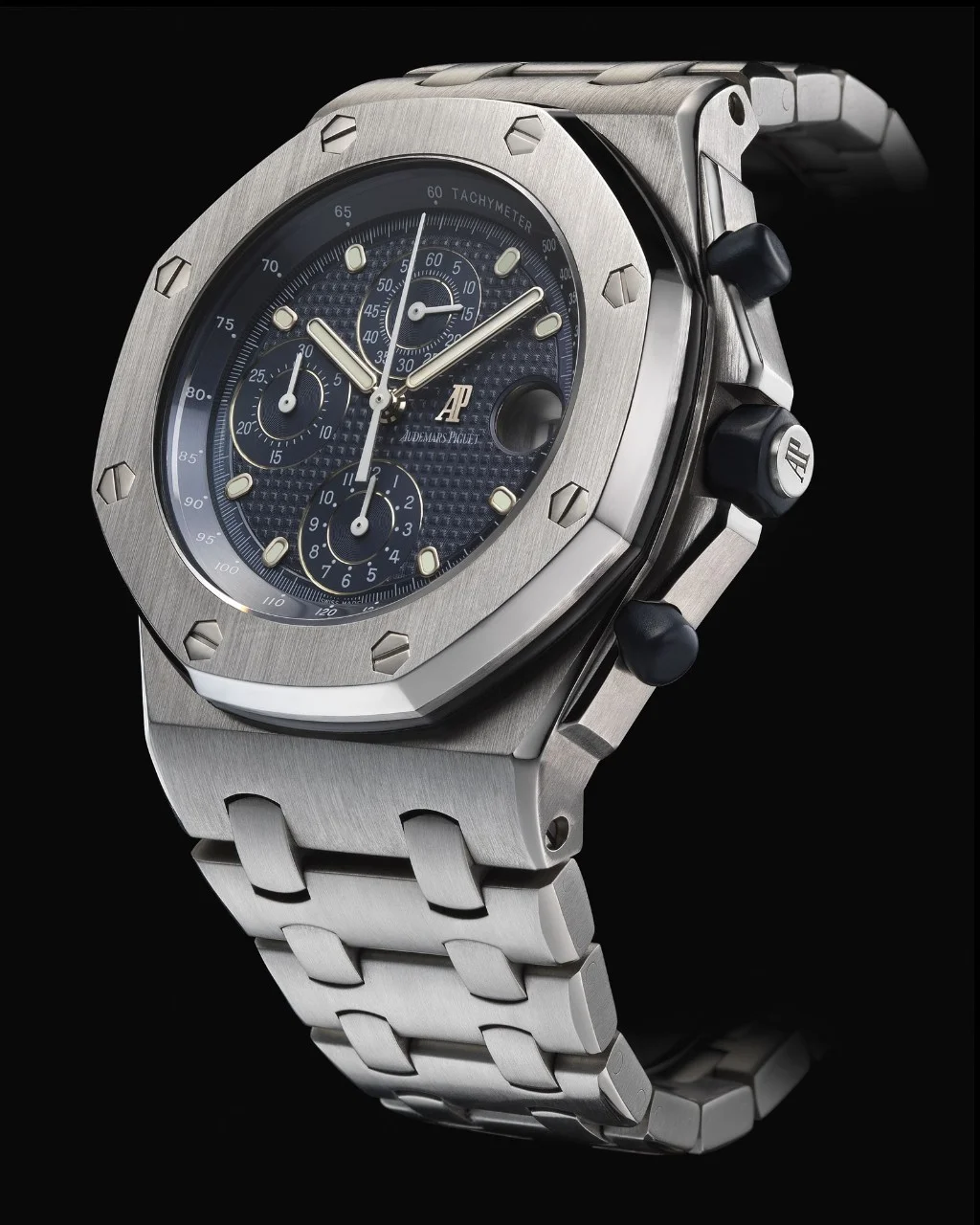
Model 25770 with its 42 mm diameter was marketed for almost two decades, winning over a clientele keen on manly oversized watches, but for whom the Royal Oak Offshore 25721 could sometimes seem a little heavy on the wrist. The leather strap version was moreover less expensive: in 1998, for example, the 25721ST version was marketed in Germany at 24,400DM, whereas its coloured variant 25770ST was offered at 18,500DM.
Model 25770 remained in the Audemars Piguet catalogue from 1996 to 2004, although some examples were marketed until 2016. Total production amounted to 3,033 units. From 1997 onwards, the model was attired in bright and contrasting colours. In 1999, it was chosen for the 500-piece End of Days limited edition with Arnold Schwarzenegger, of which the story is told here. This watch was one of the first to be entirely black, including the dial. It is also one of the first with a Kevlar strap.
Model 25770 disappeared from the catalogue in 2005, giving way to the Royal Oak Offshore Chronograph 25940 (2001), 26020 (2004) then 26170 (on a metal bracelet or leather strap), featuring a system of securing the leather or rubber strap that involved studs rather than lugs. From that point onwards, only a few examples of Model 25770 were marketed – and then only very occasionally - until 2016.
In 1992, Audemars Piguet entrusted Jörk Hysek with the task of equipping the Royal Oak with leather straps. The independent designer had then reworked the case middle of the watch, extending it with two false curved lugs (see dedicated article). This same aesthetic was picked up in the first Royal Oak Offshore models to appear on a leather strap in 1996: Models 77151 (30 mm); 25808 (38 mm) and 25770 (42 mm). Moreover, the straps were no longer held between a plate and the case middle, but instead secured by bars screwed between the lugs.
Model 25770 with its 42 mm diameter was marketed for almost two decades, winning over a clientele keen on manly oversized watches, but for whom the Royal Oak Offshore 25721 could sometimes seem a little heavy on the wrist. The leather strap version was moreover less expensive: in 1998, for example, the 25721ST version was marketed in Germany at 24,400DM, whereas its coloured variant 25770ST was offered at 18,500DM.
Model 25770 remained in the Audemars Piguet catalogue from 1996 to 2004, although some examples were marketed until 2016. Total production amounted to 3,033 units. From 1997 onwards, the model was attired in bright and contrasting colours. In 1999, it was chosen for the 500-piece End of Days limited edition with Arnold Schwarzenegger, of which the story is told here. This watch was one of the first to be entirely black, including the dial. It is also one of the first with a Kevlar strap.
Model 25770 disappeared from the catalogue in 2005, giving way to the Royal Oak Offshore Chronograph 25940 (2001), 26020 (2004) then 26170 (on a metal bracelet or leather strap), featuring a system of securing the leather or rubber strap that involved studs rather than lugs. From that point onwards, only a few examples of Model 25770 were marketed – and then only very occasionally - until 2016.
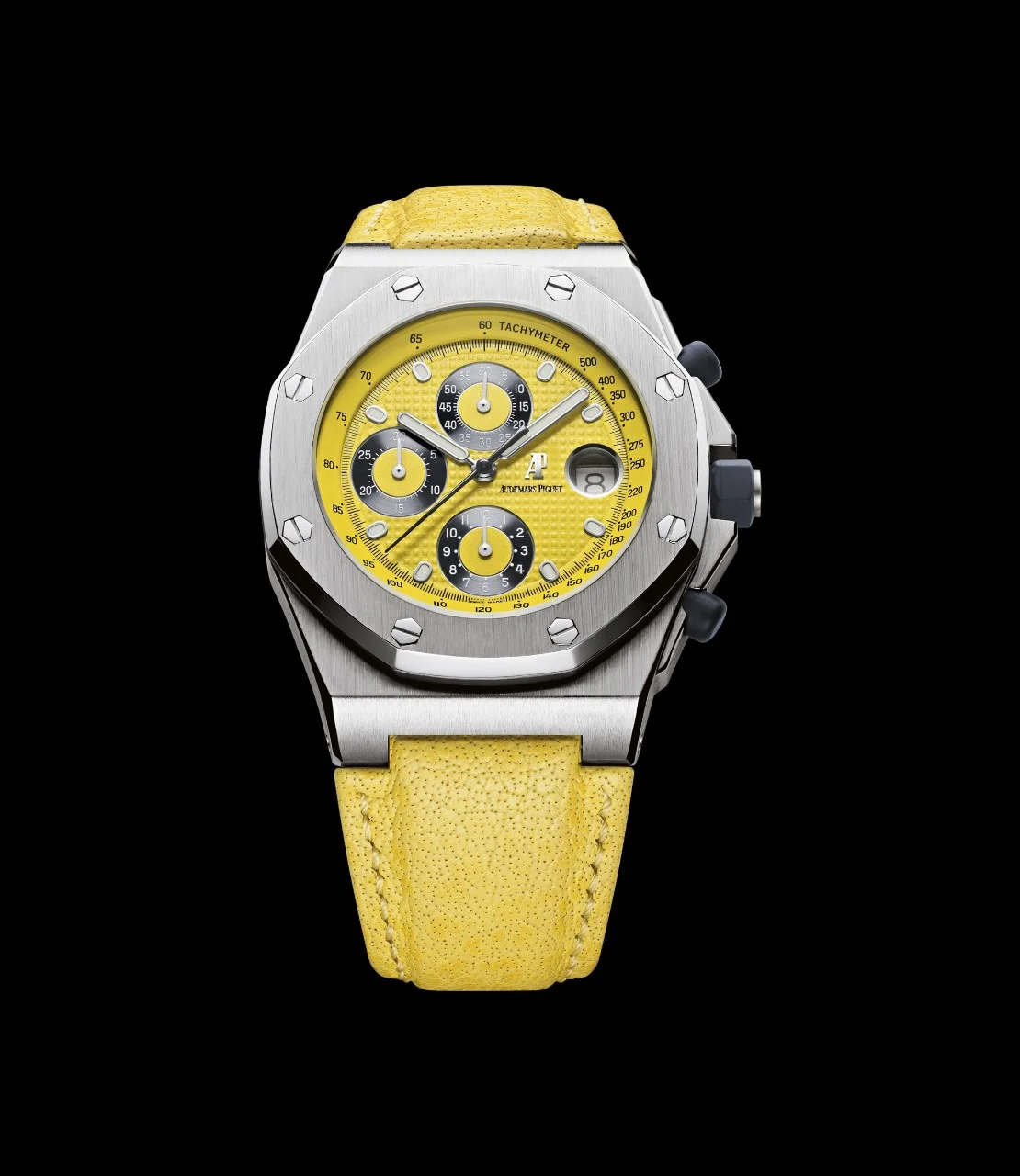
2000. Royal Oak Offshore Chronograph 25770ST, No. 984 Yellow dial. Selfwinding Calibre 2126/2840, Movement 482478. Steel Case E18818. Yellow buffalo strap. Variant in the Audemars Piguet catalogue from 1998 to 2002. Audemars Piguet Heritage, inv. 1337.
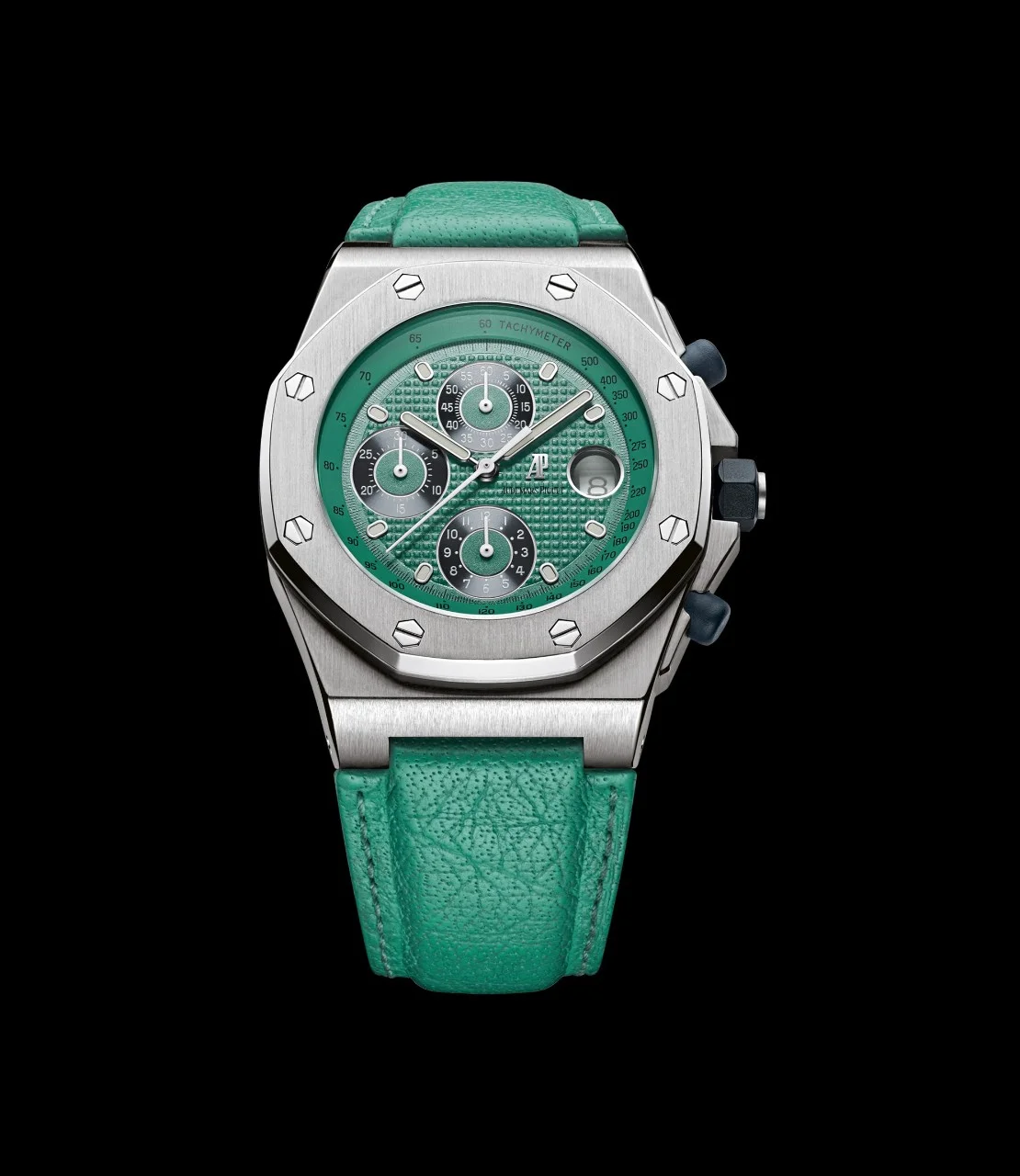
2000. Royal Oak Offshore Chronograph 25770ST, No. 762. Turquoise dial and strap. Selfwinding Calibre 2126/2840, Movement 480172. 42 mm steel Case E16125. Audemars Piguet Heritage, inv. 1306.
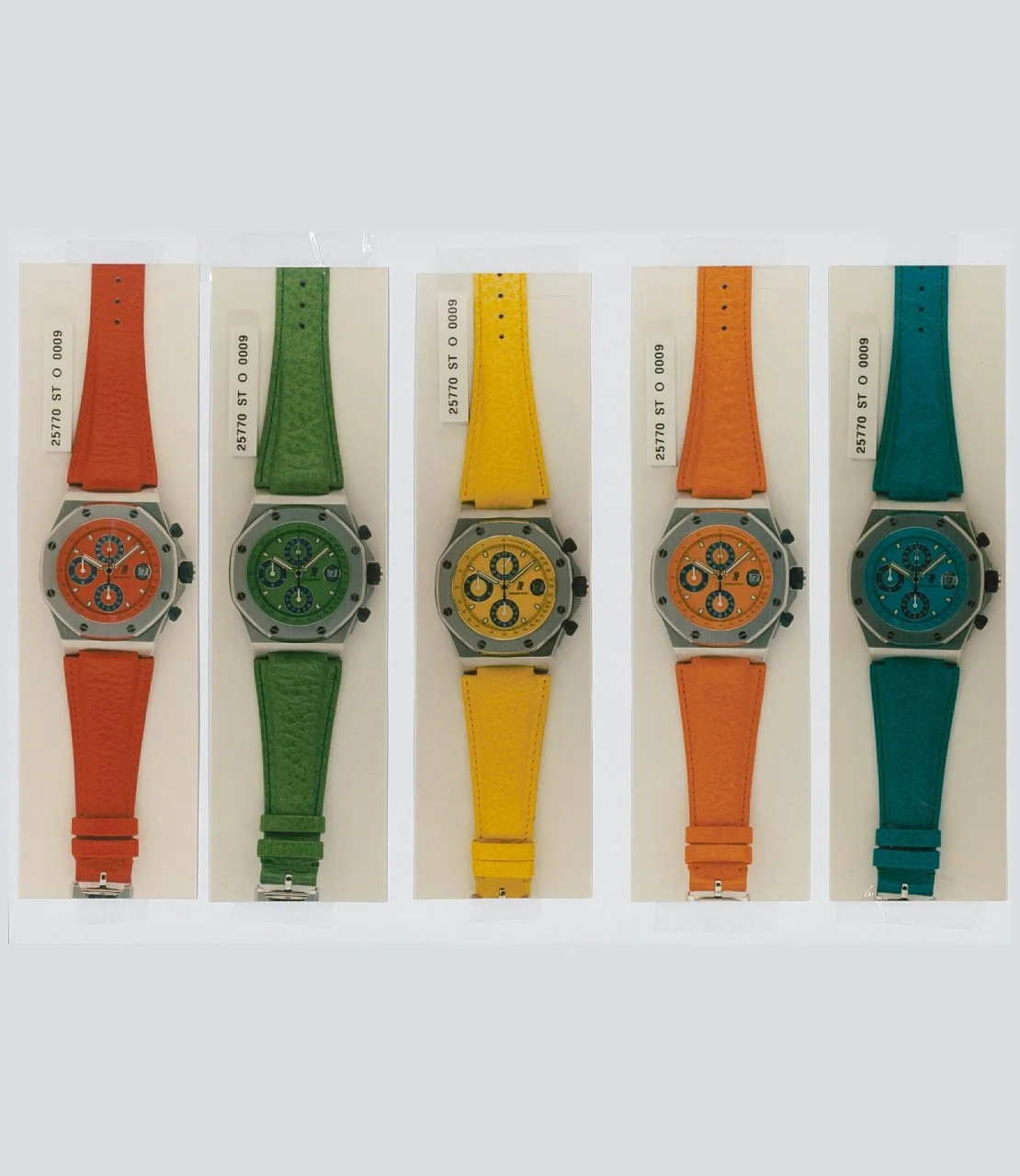
Circa 1997. Colour variations of Model 25770ST. Identification images. Audemars Piguet Archives

Circa 1997. Dials and coloured straps for Model 25770. Dials and straps were developed simultaneously to ensure perfect colour matching. Document by the dial-maker Stern kept in the Audemars Piguet Archives.
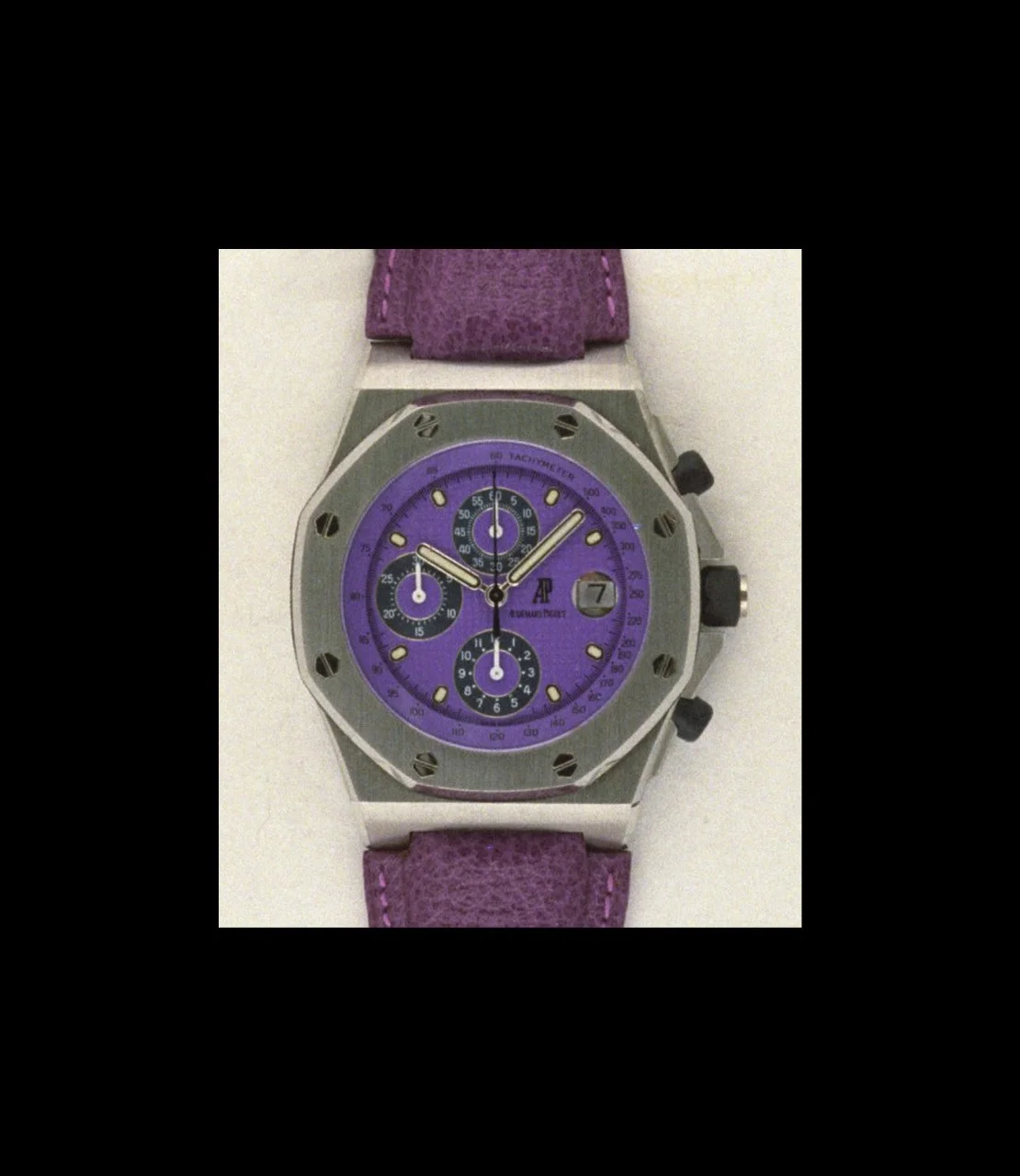
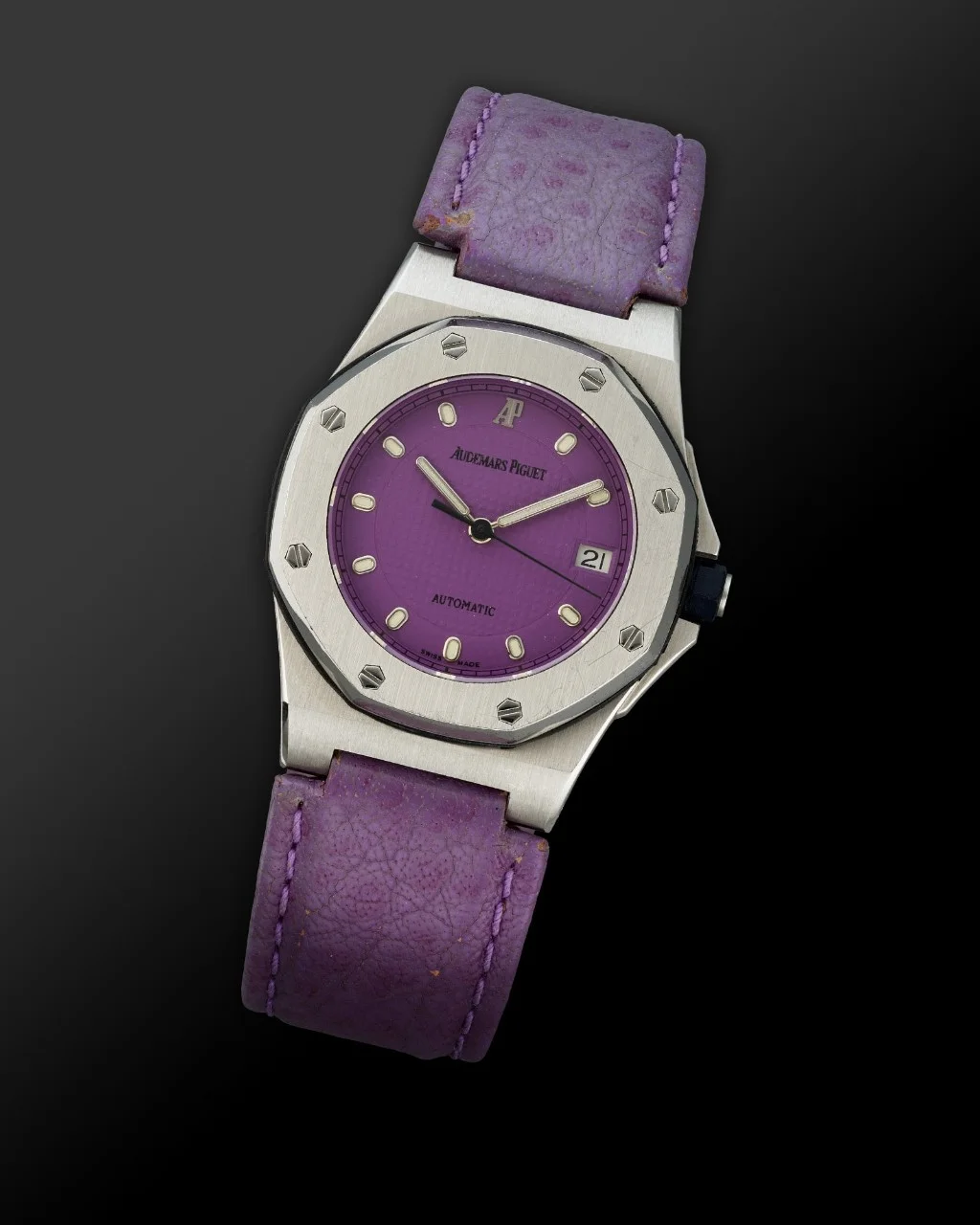
Circa 1997. Royal Oak Offshore Chronograph 25770ST. . Purple dial and strap. Identification image. Audemars Piguet Archives.
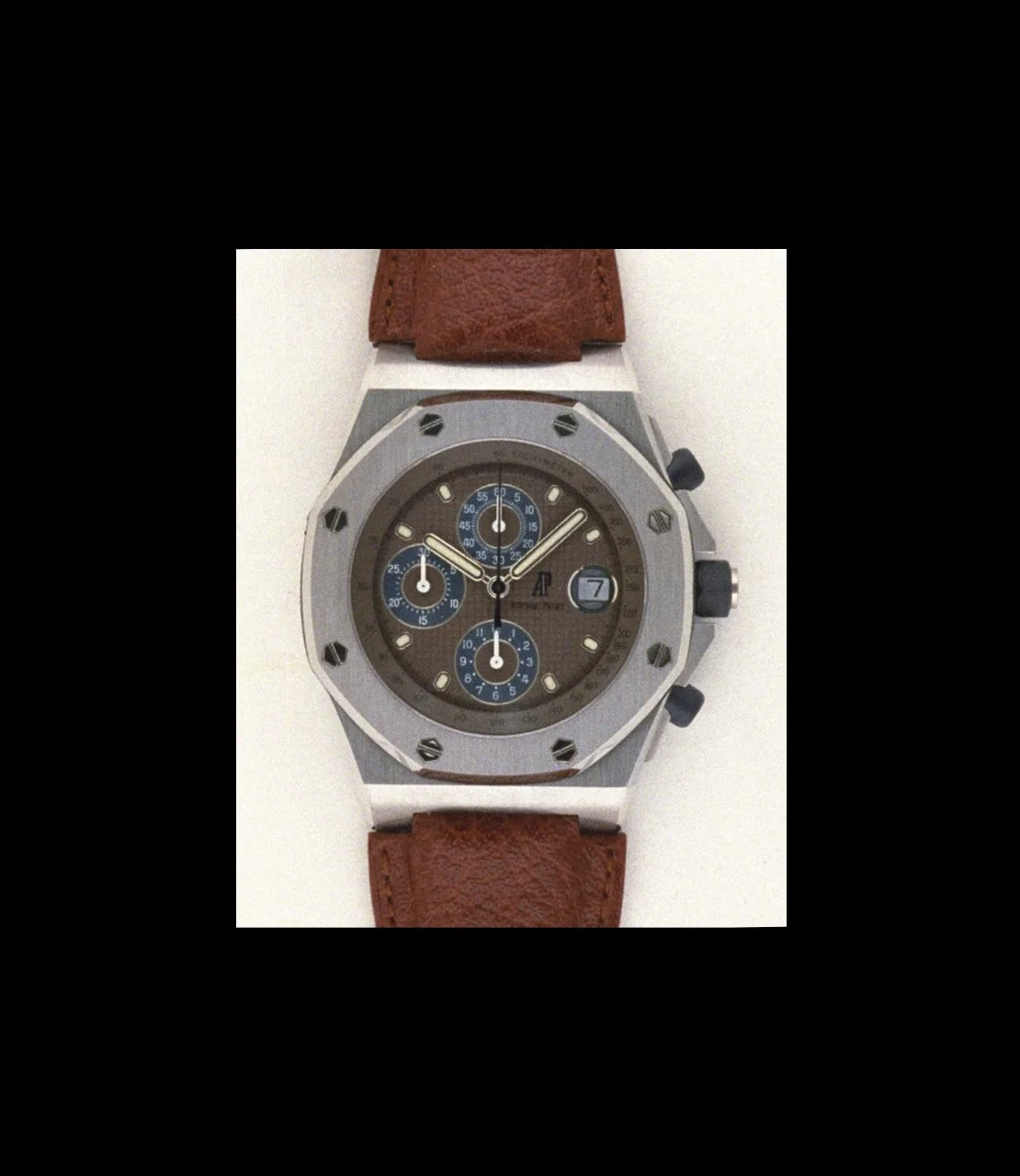
Circa 1997. Royal Oak Offshore Chronograph 25770ST. Brown dial and strap. Identification image. Audemars Piguet Archives.

1997. Technical data for the the Royal Oak Offshore Model 25770ST. Audemars Piguet Archives
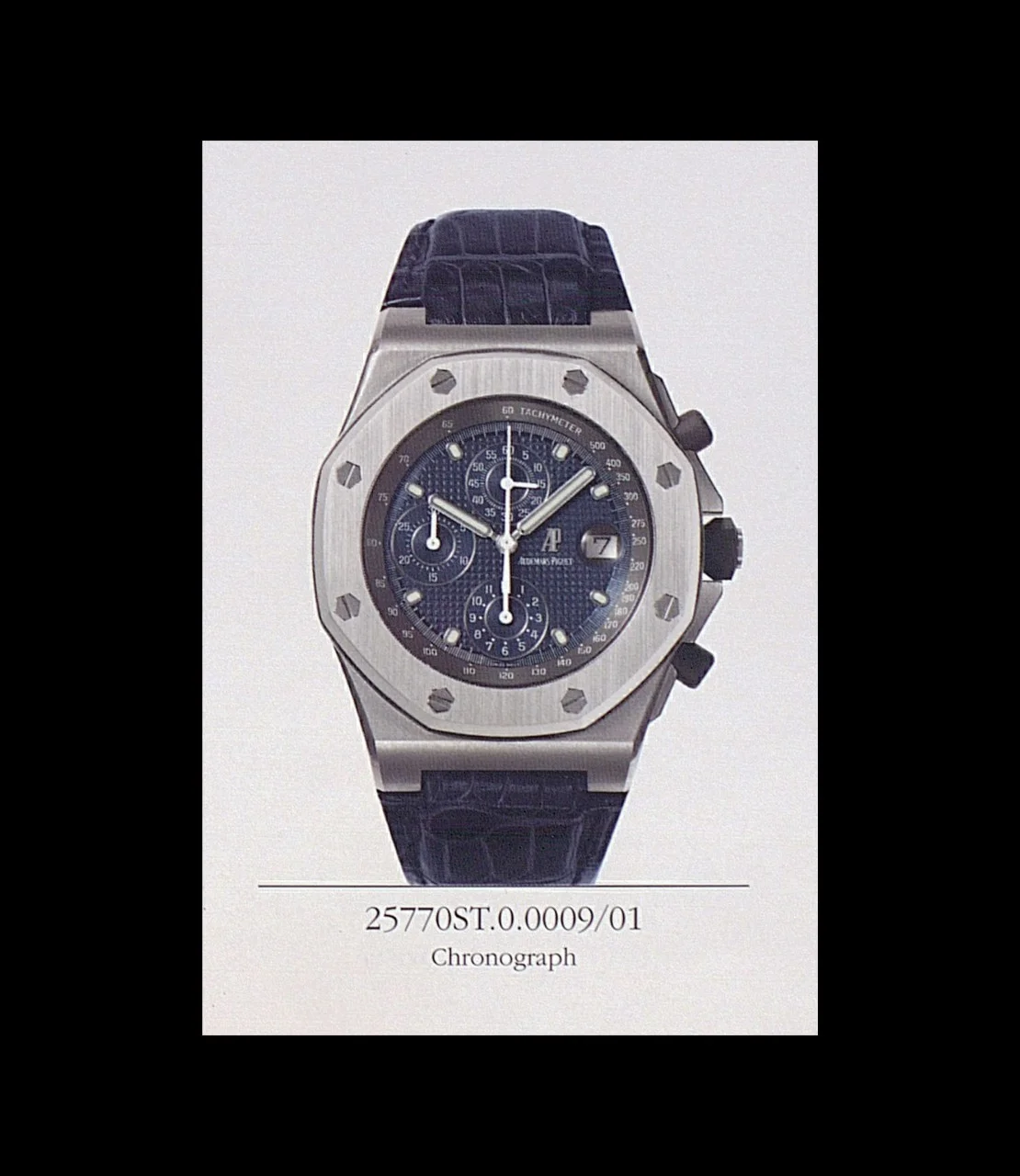
1996. Royal Oak Offshore Chronograph 25770ST. Calibre 2226/2840. Petite Tapisserie dial. Variant in the catalogue from 1996 to 2004. Audemars Piguet Archives.
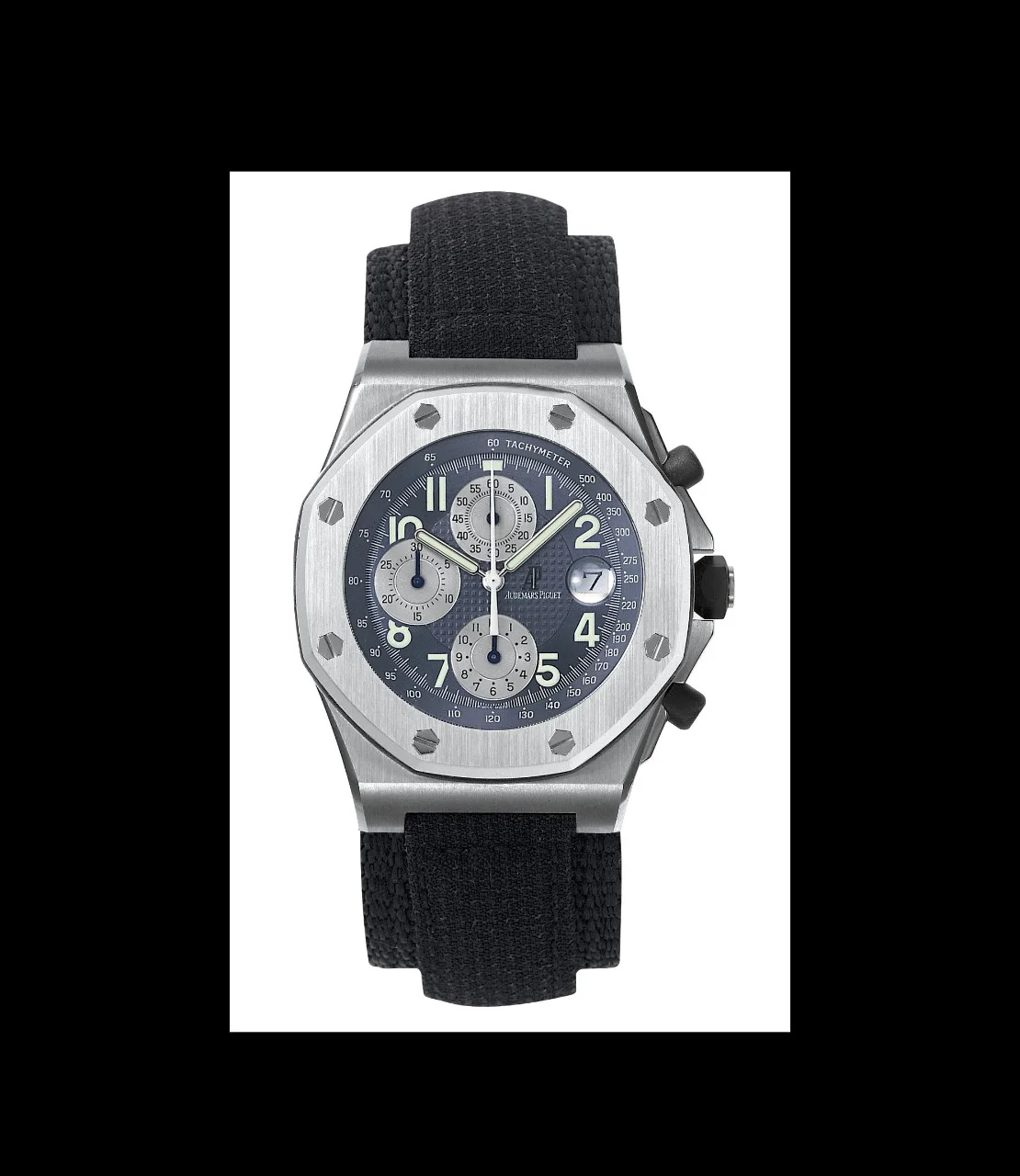
1998. Royal Oak Offshore Chronograph 25770ST. Calibre 2226/2840. Petite Tapisserie dial. Kevlar strap. Variant in the Audemars Piguet catalogue from 1998 to 2004. Audemars Piguet Archives.

Circa 2001. Royal Oak Offshore Chronograph 25770ST. Identification image. Audemars Piguet Archives.
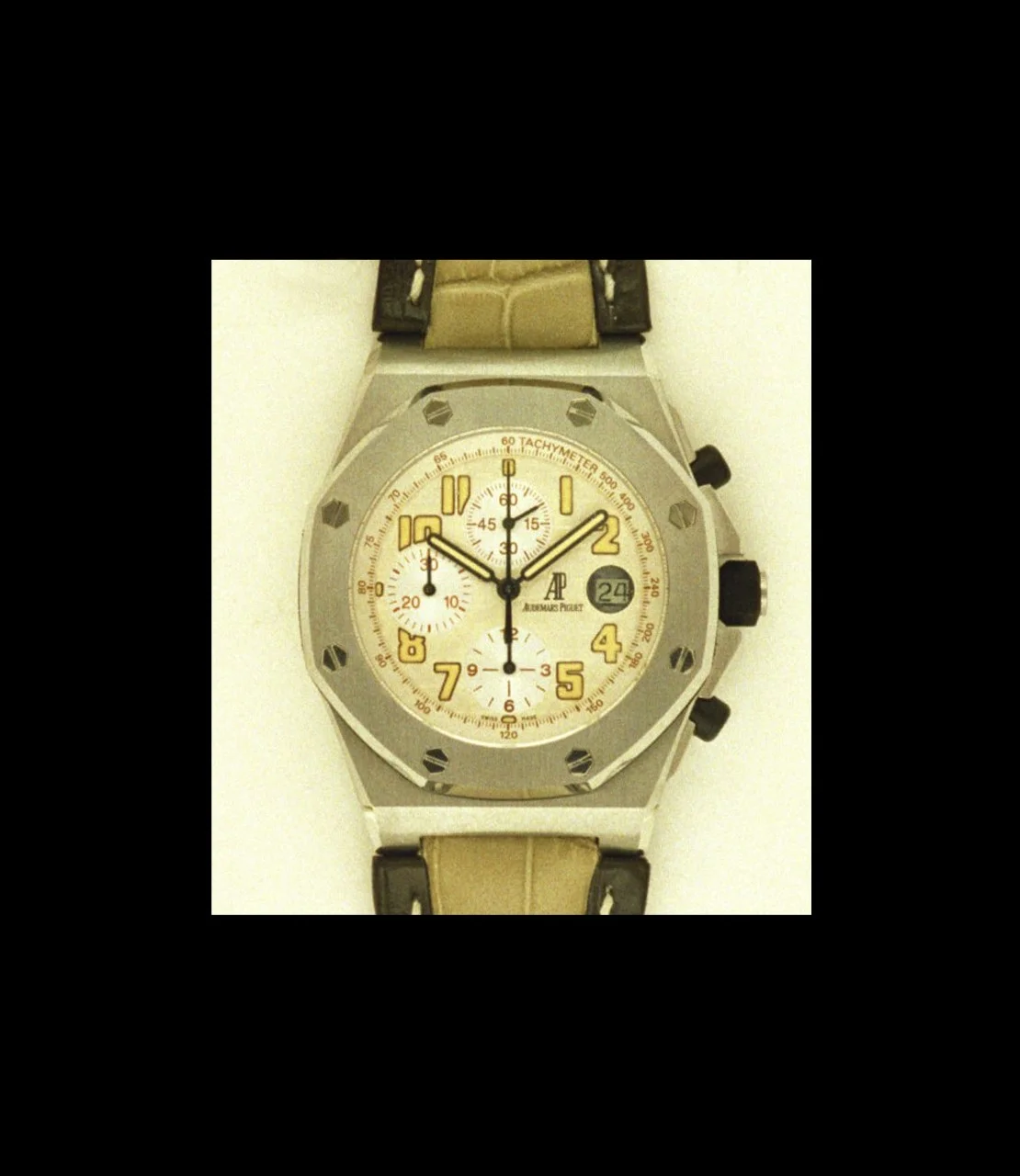
Circa 2001. Royal Oak Offshore Chronograph 25770ST. Identification image. Audemars Piguet Archives.
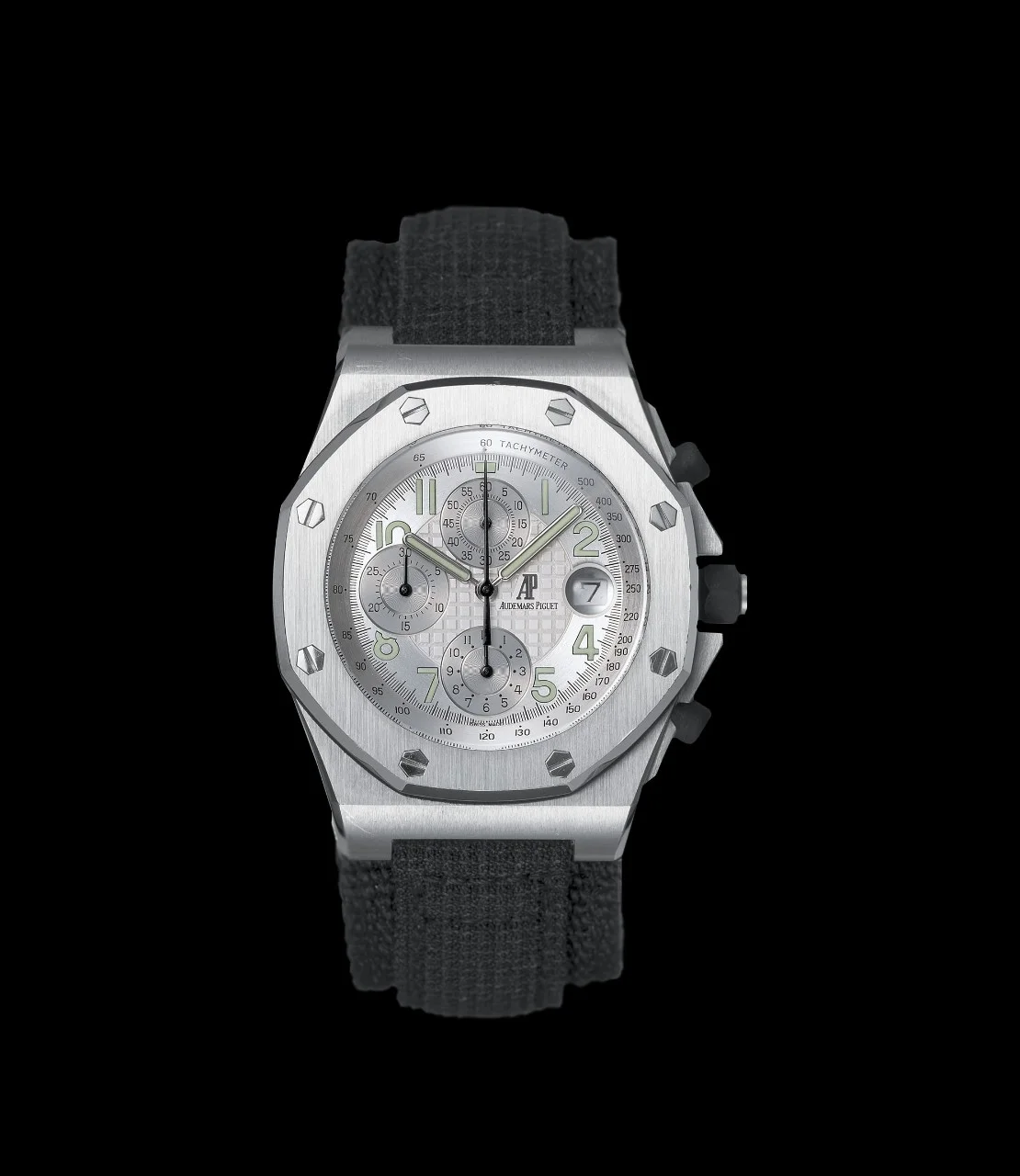
2002. Royal Oak Offshore Chronograph 25770ST. Calibre 2226/2840. Grande Tapisserie dial. Kevlar strap. Variant in the Audemars Piguet catalogue from 2002 to 2004. Audemars Piguet Archives.
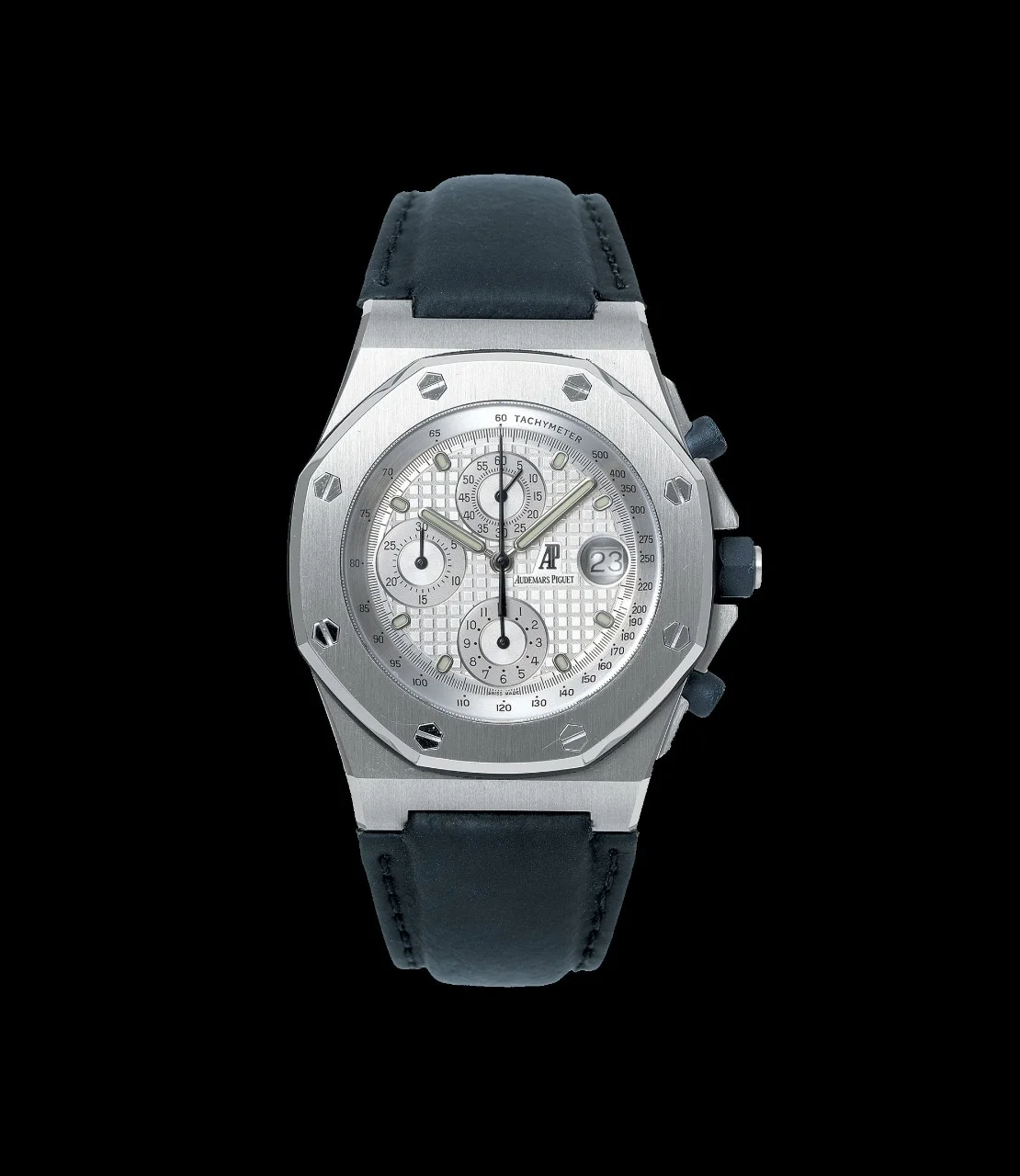
2002. Royal Oak Offshore Chronograph 25770ST. Calibre 2226/2840. Grande Tapisserie dial. Variant in the catalogue from 2002 to 2004. Audemars Piguet Archives.
The steel version accounts for 80% of the total production of Model 25770 model (excluding blackened PVD-treated steel). While the first year’s results were modest with just 73 watches sold, deliveries then increased regularly to reach an annual average of 303 watches between 1998 and 2004.
The archives do not permit us to determine the number of watches produced in colour, but they document seven variants: yellow, orange, brown, red, green, violet and turquoise. Oral sources tell us that they were created as one-offs to adorn a showcase celebrating the 25th anniversary of the Royal Oak (1997) and that they were so successful that Audemars Piguet decided to launch them into series production. Two of them were even published in the brand's catalogue:, the red variant in 1998 and the yellow from 1998 to 2002.
Sales from 1996 to 2016: a total of 2394 units, of which 73 (1996), 186 (1997), 319 (1998), 367 (1999), 289 (2000), 305 (2001), 199 (2002), 375 (2003), 272 (2004), 5 (2005) 3 (2012) and 1 (2016).
The steel version accounts for 80% of the total production of Model 25770 model (excluding blackened PVD-treated steel). While the first year’s results were modest with just 73 watches sold, deliveries then increased regularly to reach an annual average of 303 watches between 1998 and 2004.
The archives do not permit us to determine the number of watches produced in colour, but they document seven variants: yellow, orange, brown, red, green, violet and turquoise. Oral sources tell us that they were created as one-offs to adorn a showcase celebrating the 25th anniversary of the Royal Oak (1997) and that they were so successful that Audemars Piguet decided to launch them into series production. Two of them were even published in the brand's catalogue:, the red variant in 1998 and the yellow from 1998 to 2002.
Sales from 1996 to 2016: a total of 2394 units, of which 73 (1996), 186 (1997), 319 (1998), 367 (1999), 289 (2000), 305 (2001), 199 (2002), 375 (2003), 272 (2004), 5 (2005) 3 (2012) and 1 (2016).
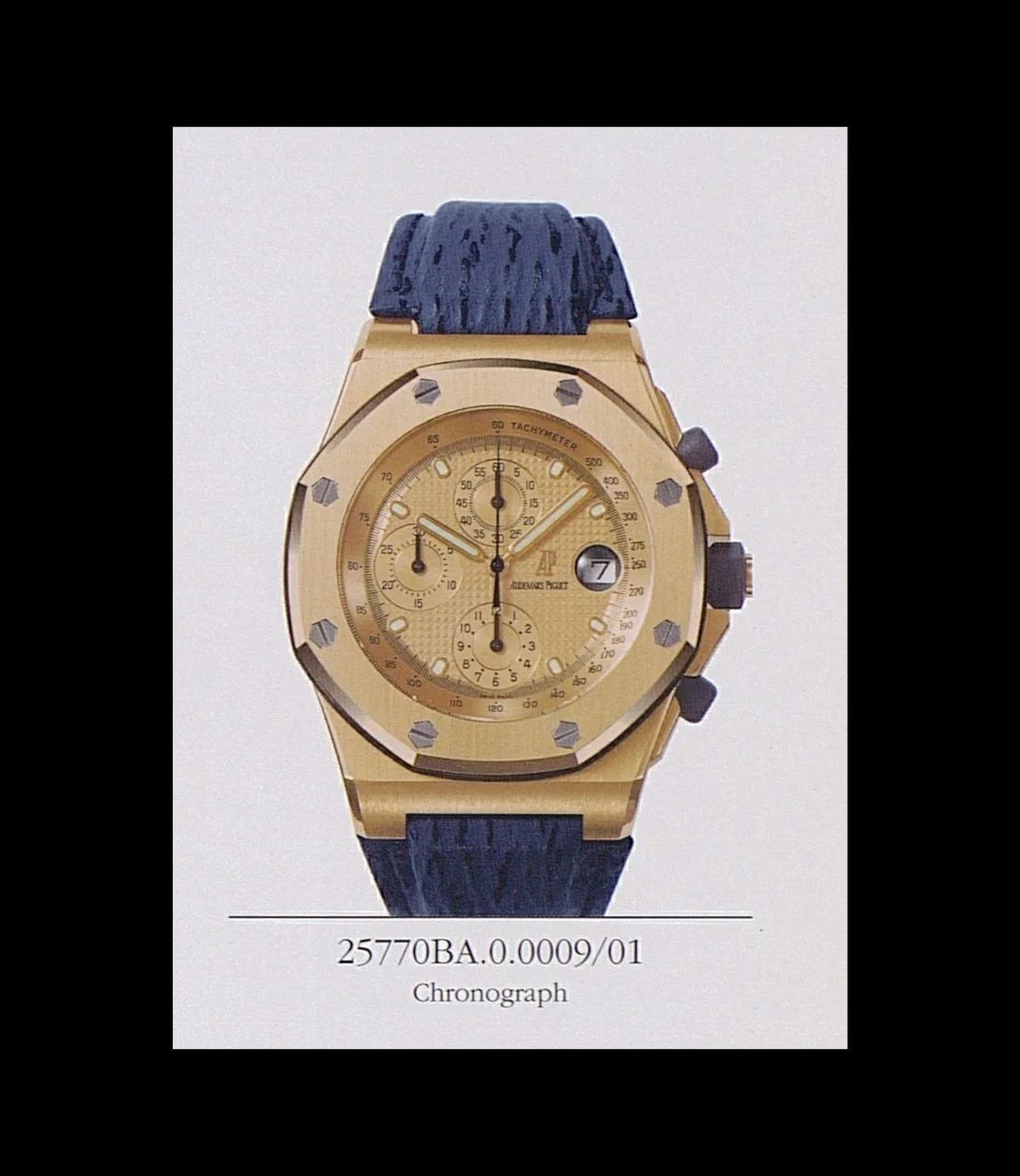
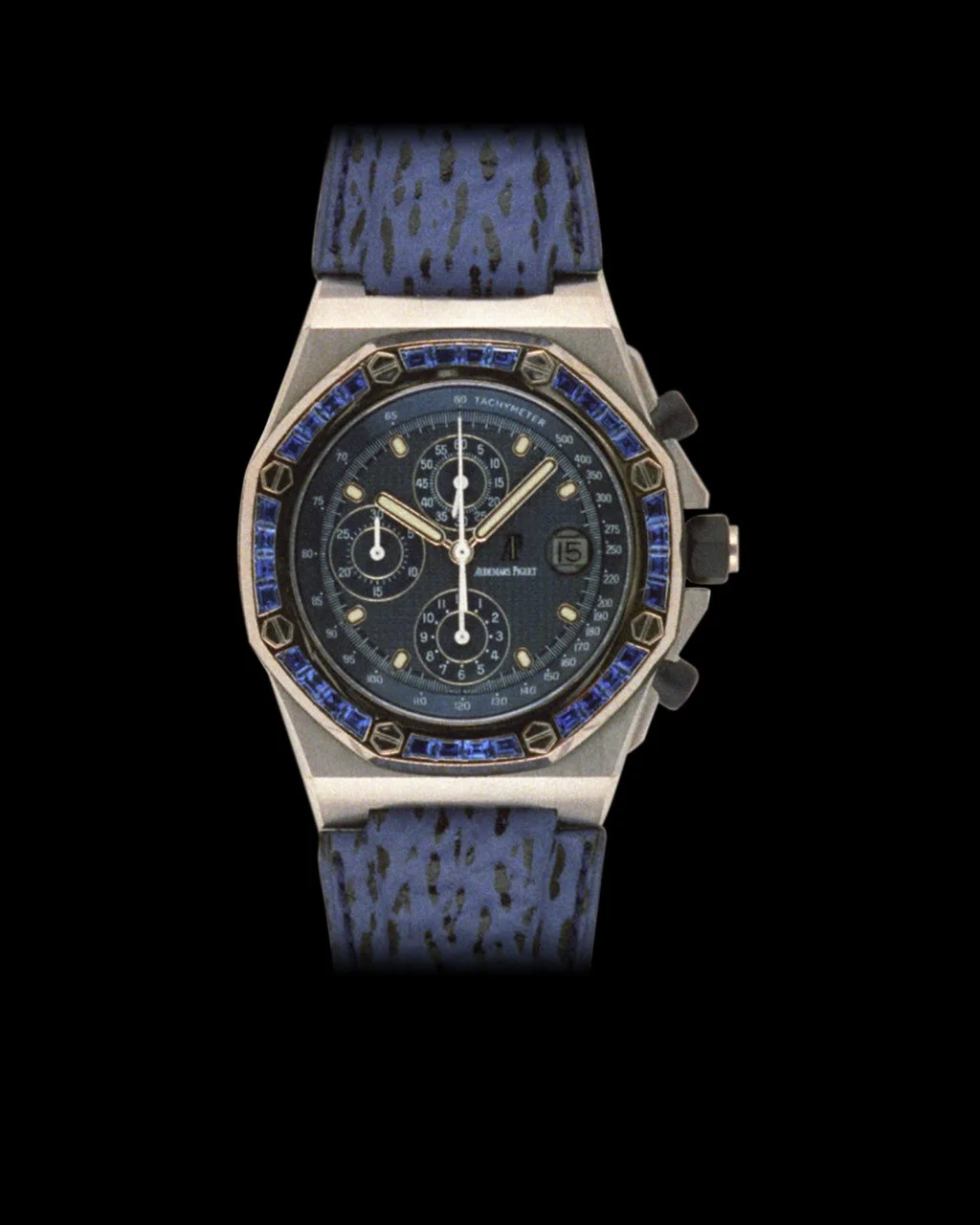
1996. Royal Oak Offshore Chronograph 25770BA. Variant published in the Audemars Piguet Catalogue from 1996 to 1998. Audemars Piguet Archives.
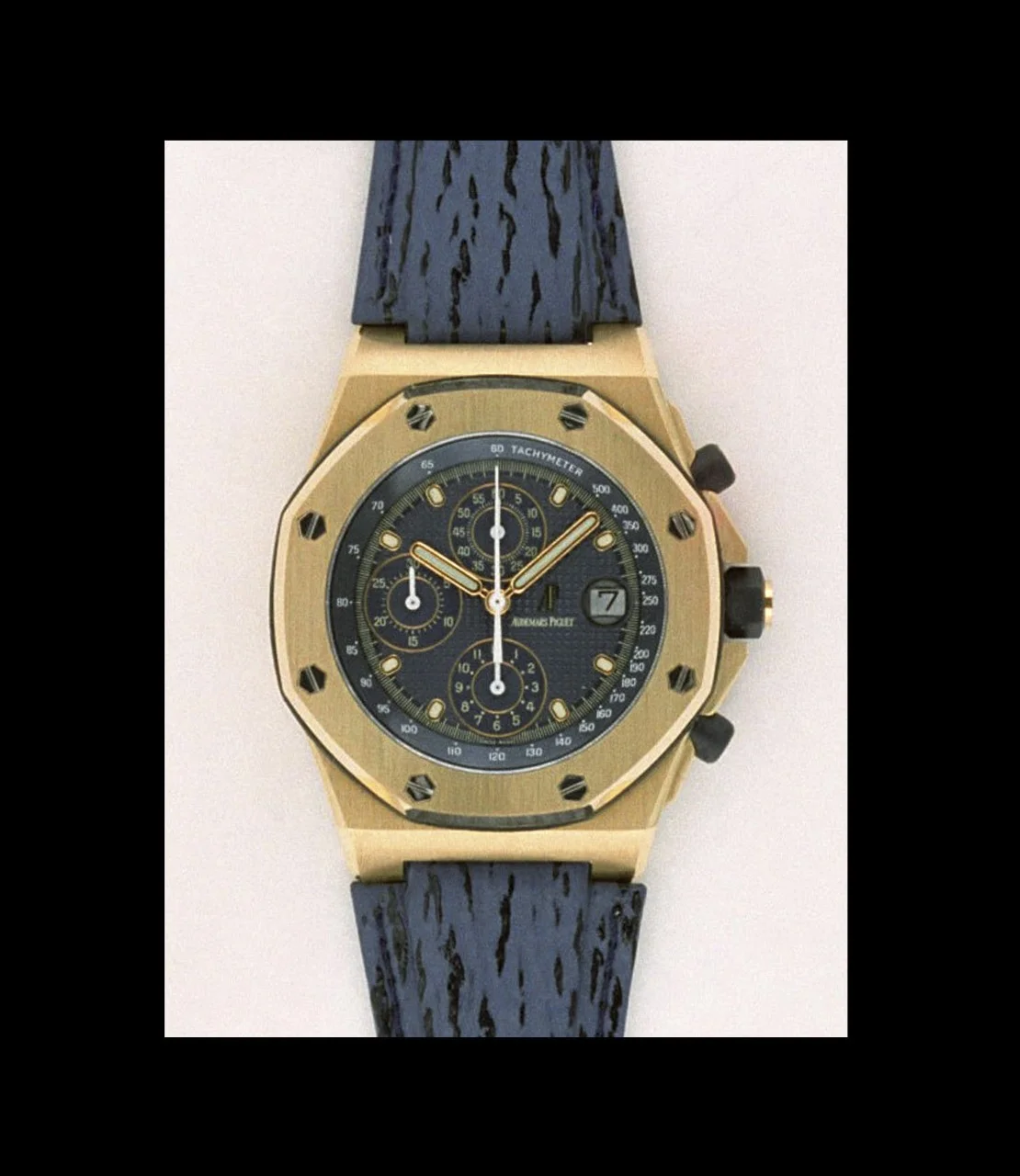
Circa 1996. Royal Oak Offshore Chronograph 25770BA. Purple dial and strap. Identification image. Audemars Piguet Archives.

1996. Technical data for the Royal Oak Offshore Model 25770BA. Audemars Piguet Archives.
The first examples of Model 25770BA are always shown on a sharkskin strap, an expression of strength and virility. Two dial variants are documented: one in a golden tone that picks up the colour of the case; and the other blue with a matching strap.
Sales from 1996 to 1999: a total of 95 units, of which 22 (1996), 29 (1997), 30 (1998), 13 (1999), and 1 (2000).
The first examples of Model 25770BA are always shown on a sharkskin strap, an expression of strength and virility. Two dial variants are documented: one in a golden tone that picks up the colour of the case; and the other blue with a matching strap.
Sales from 1996 to 1999: a total of 95 units, of which 22 (1996), 29 (1997), 30 (1998), 13 (1999), and 1 (2000).
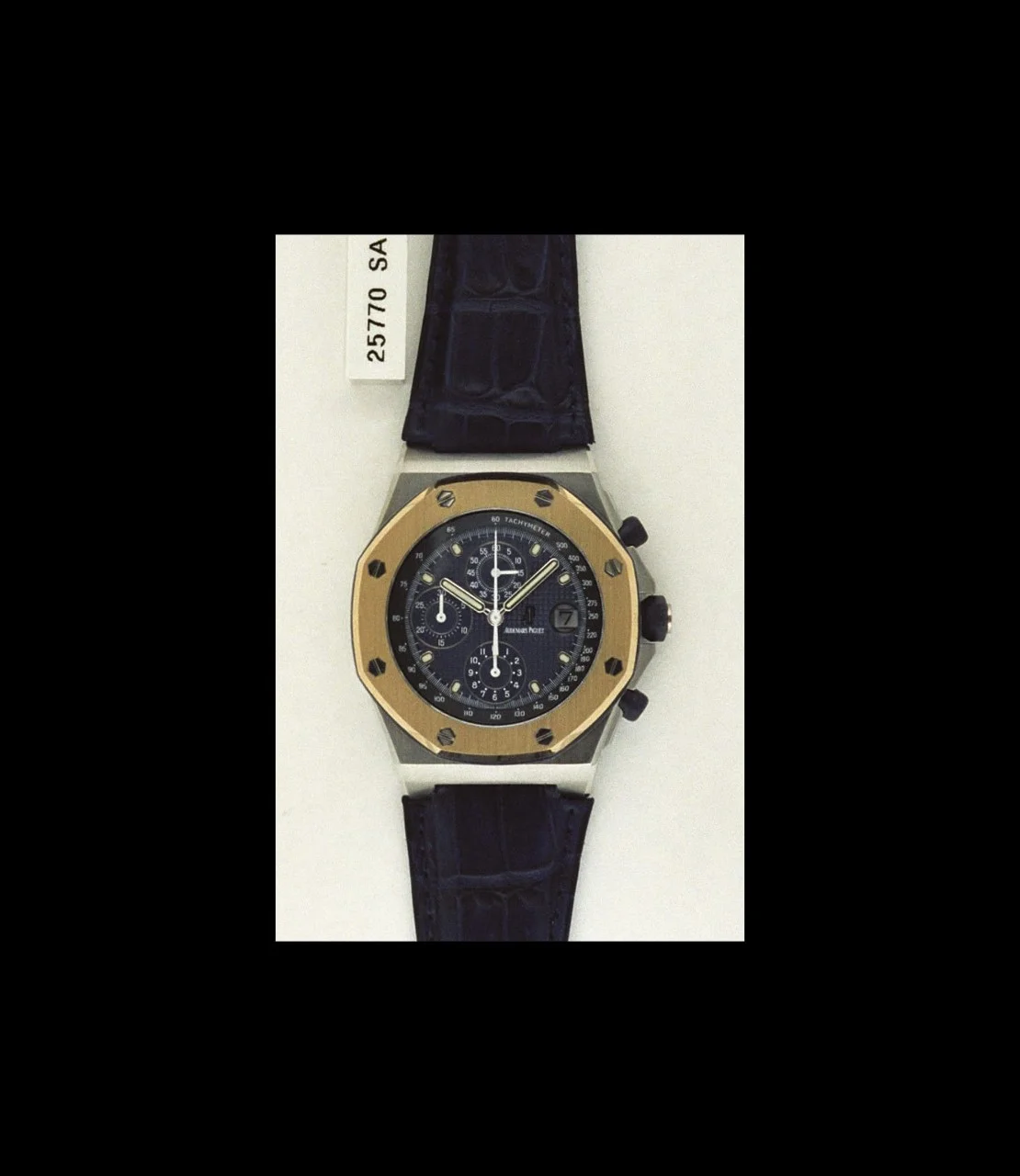
Circa 1996. Identification image for the Royal Oak Offshore Model 25770SA. Audemars Piguet Archives.

Circa 1996. Identification image for the Royal Oak Offshore Model 25770SA. Audemars Piguet Archives.
While the two-tone variant of the 25770 model is documented in the Audemars Piguet iconographic archives, no examples were found in the production and sales records.
While the two-tone variant of the 25770 model is documented in the Audemars Piguet iconographic archives, no examples were found in the production and sales records.
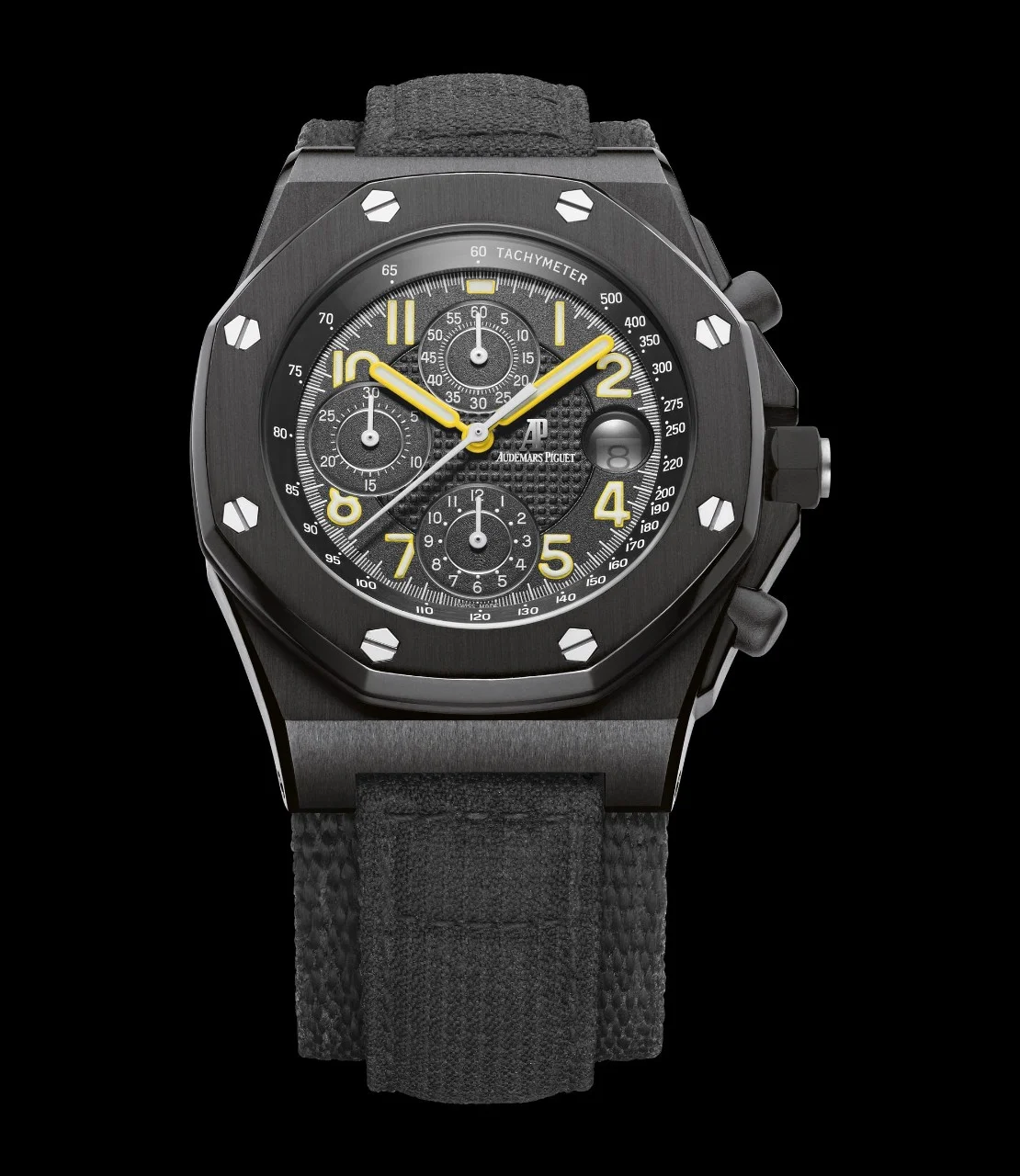
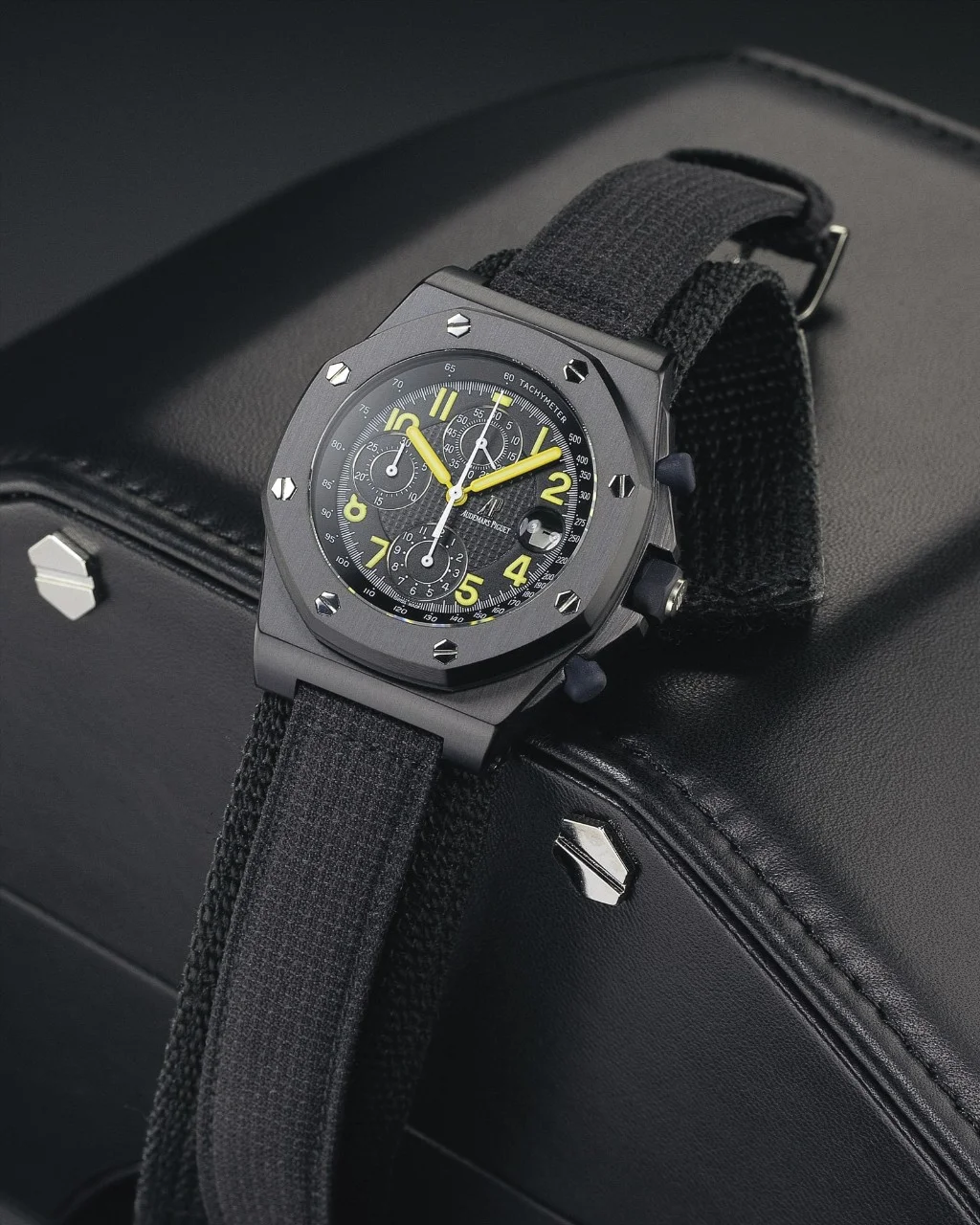
1999. Royal Oak Offshore End of Days 25770SN 114/500. Selfwinding chronograph. Calibre 2126/1840, Movement 482070. PVD blackened steel case, No. E21648. 500-piece limited edition created in partnership with Arnold Schwarzenegger for the launch of the film End of Days. Audemars Piguet Heritage, inv. 1338.

1998. Technical data for the Royal Oak Offshore Model 25770SN. Audemars Piguet Archives

1999. Arnold Schwarzenegger and François-Henry Bennahmias. Following the grand premiere of the film End of Days, Arnold Schwarzenegger and François-Henry Bennahmias are pictured auctioning off several examples of the Royal Oak End of Days 25770SN for the actor's Inner City Games Foundation. Audemars Piguet Archives.

1999. Royal Oak Offshore End of Days advertisement. Press release for the launch of Model 25770SN. Audemars Piguet Archives.

1999. Royal Oak Offshore End of Days 25770SN 42 mm resting on its presentation box. Created in collaboration with Arnold Schwarzenegger for the film End of Days, Model 25770SN ushered in the era of Offshore limited editions. Image from the 1999 press release. Audemars Piguet Archives.
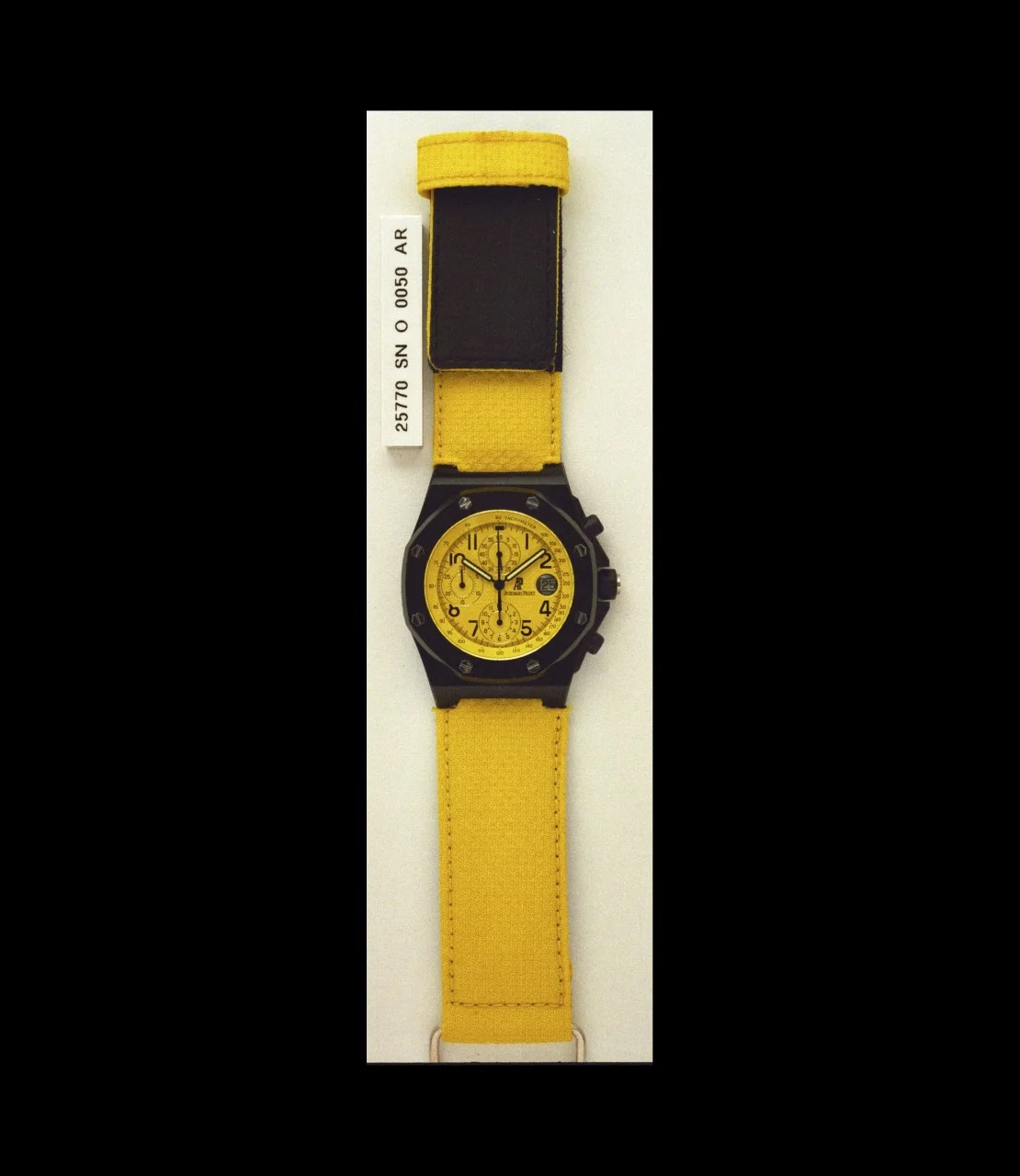
Circa 1999. Royal Oak Offshore Chronograph 25770SN. Dial and yellow strap with Velcro© fastening. Identification photograph. Audemars Piguet Archives.

Circa 1999. Royal Oak Offshore Chronograph 25770SN. Dial and yellow strap with Velcro© fastening. Identification image. Audemars Piguet Archives.
The most famous variant of Model 25770 was created in 1999 as part of a partnership with the American star Arnold Schwarzenegger. The Royal Oak Offshore End of Days appeared on the actor’s wrist in eponymous movie. Auctioned at an event in New York following the film's premiere, the first timepieces in this 500-piece limited edition marked an important milestone in the international success of the Offshore collection.
The Royal Oak Offshore End of Days began the grand saga of limited editions introduced across the following decade. The history of the model is developed in the article dedicated to the origins of the collection.
In contrast, the 25770SN variants featuring a yellow dial and a yellow strap with velcro fasteners and an orange dial are among the least known and rarest, with only 14 examples documented in the archives.
Sales from 1998 to 2001: a total of 514 units, of which 5 (1998), 251 (1999), 257 (2000), 1 (2001).
The most famous variant of Model 25770 was created in 1999 as part of a partnership with the American star Arnold Schwarzenegger. The Royal Oak Offshore End of Days appeared on the actor’s wrist in eponymous movie. Auctioned at an event in New York following the film's premiere, the first timepieces in this 500-piece limited edition marked an important milestone in the international success of the Offshore collection.
The Royal Oak Offshore End of Days began the grand saga of limited editions introduced across the following decade. The history of the model is developed in the article dedicated to the origins of the collection.
In contrast, the 25770SN variants featuring a yellow dial and a yellow strap with velcro fasteners and an orange dial are among the least known and rarest, with only 14 examples documented in the archives.
Sales from 1998 to 2001: a total of 514 units, of which 5 (1998), 251 (1999), 257 (2000), 1 (2001).