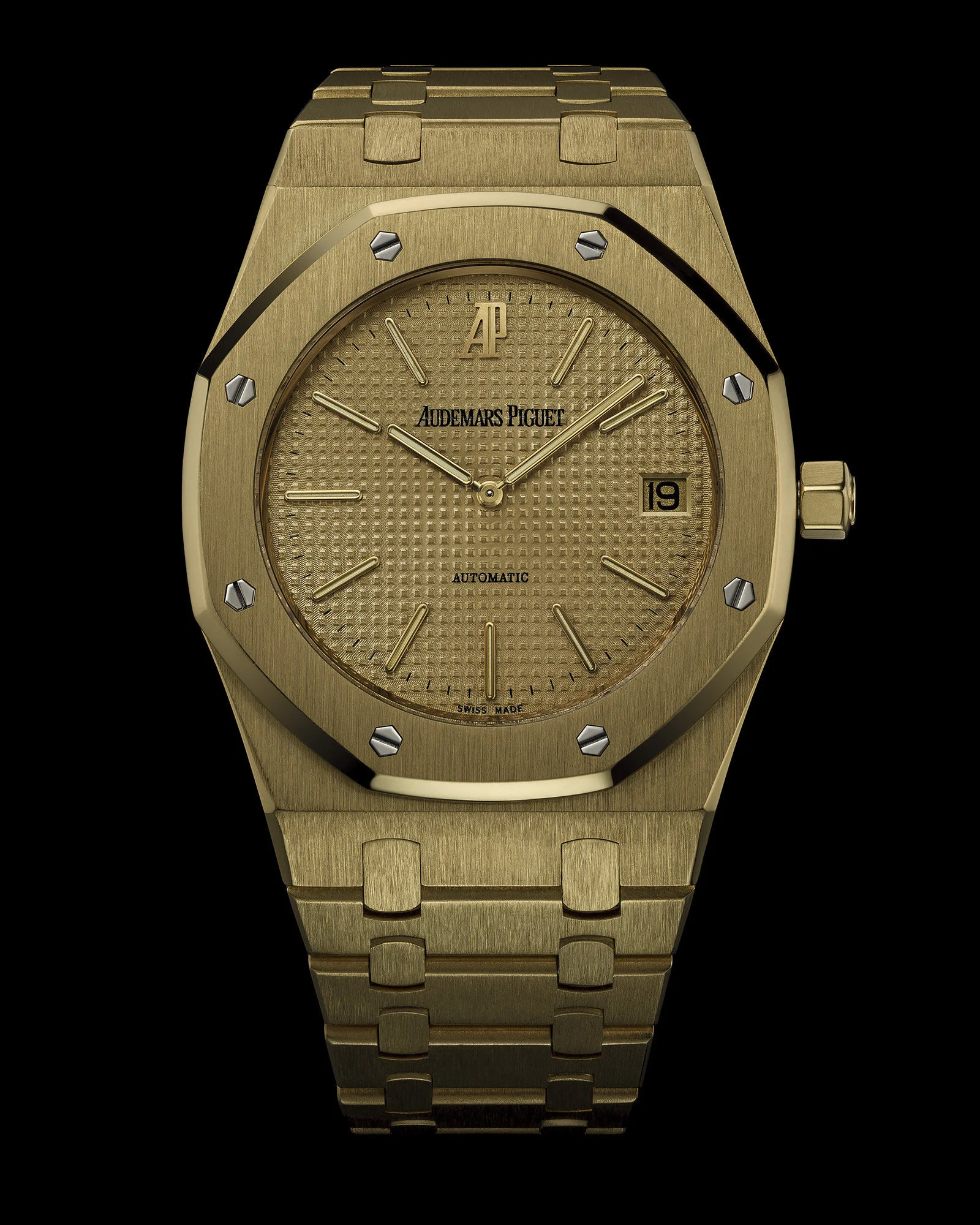
14802, Royal OakJubilee
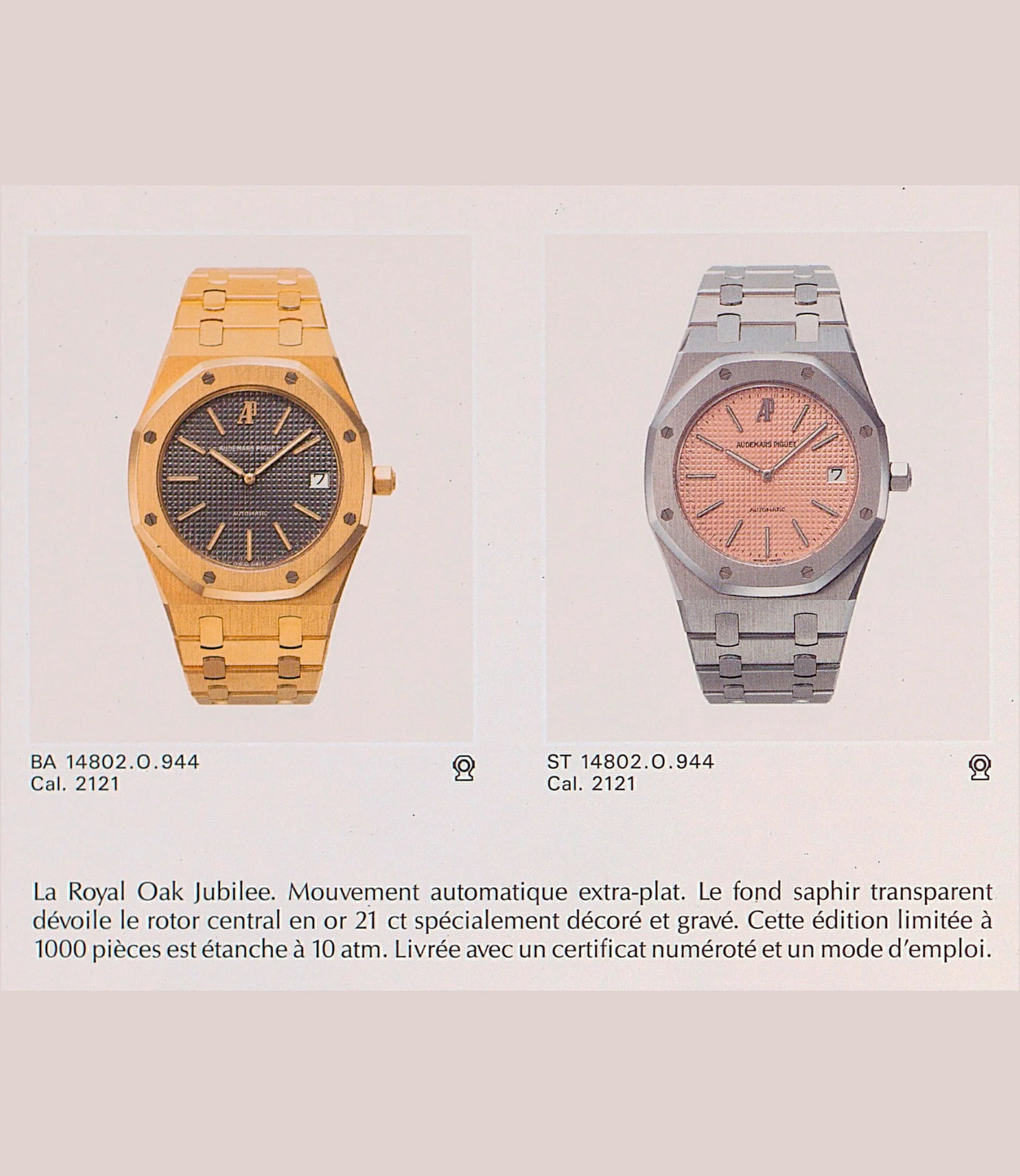
1993. Royal Oak Jubilee 14802. 1993–94 Audemars Piguet catalogue. Audemars Piguet Archives.
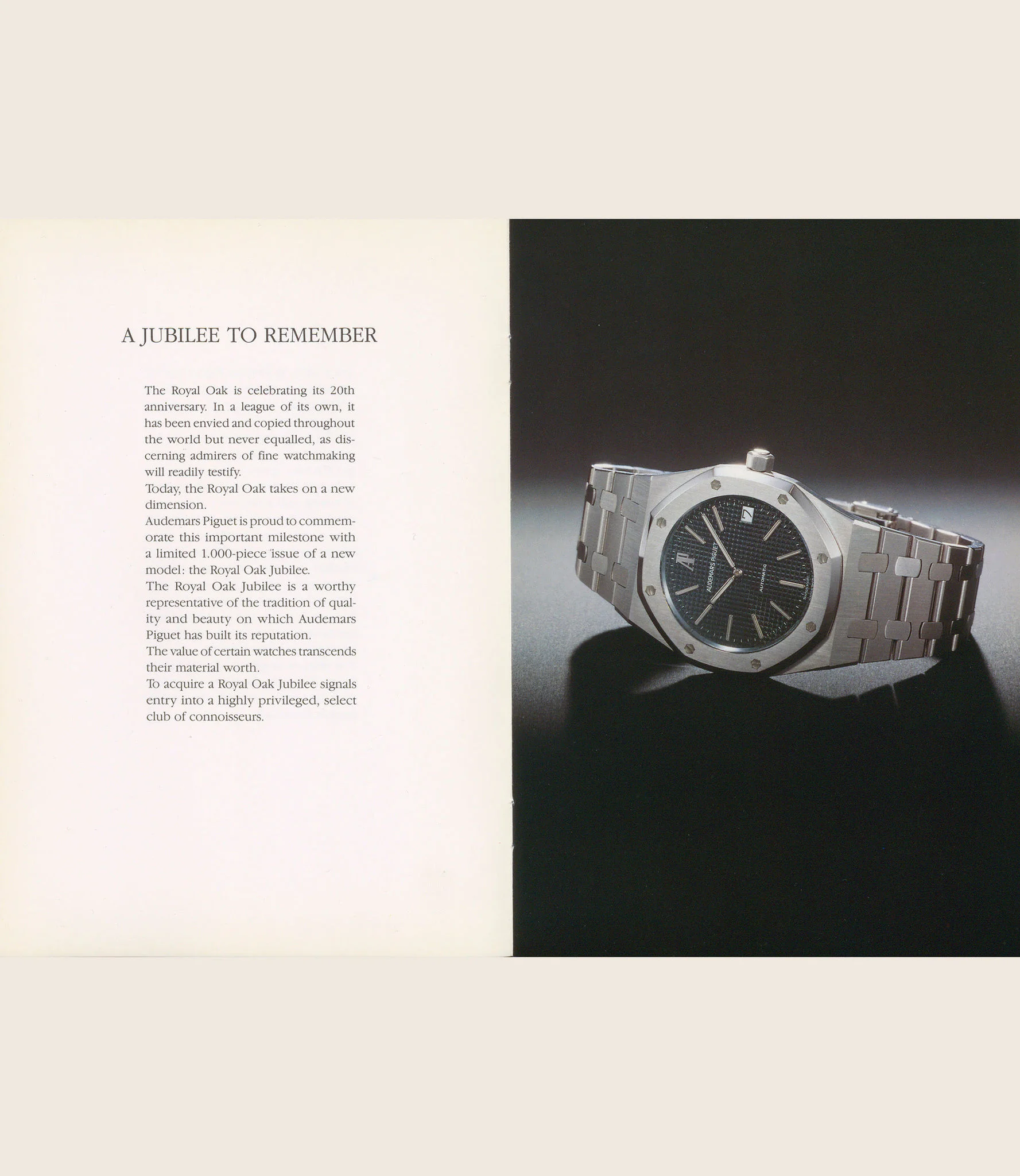
1992. Royal Oak Jubilee press kit. Audemars Piguet Archives.
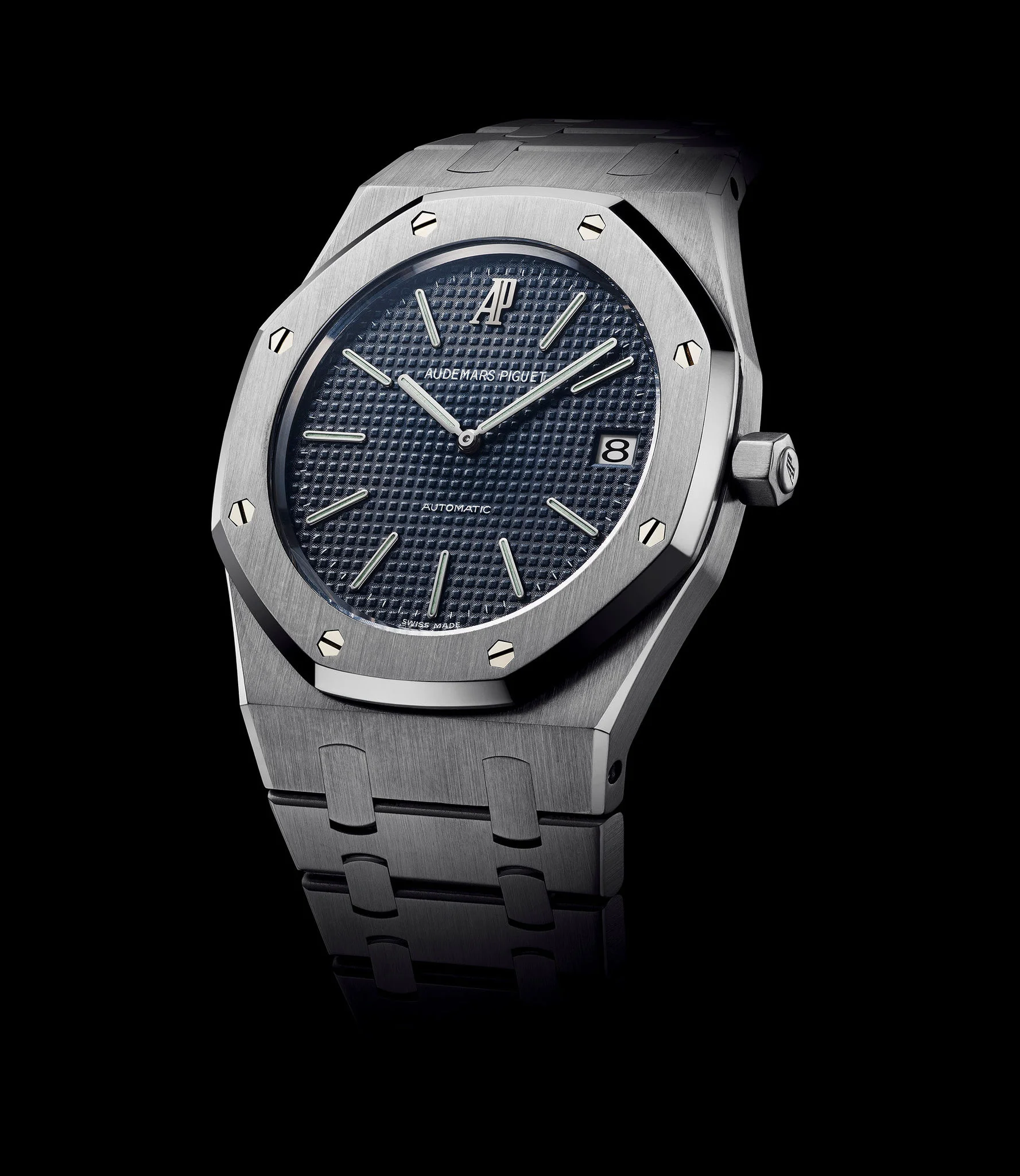
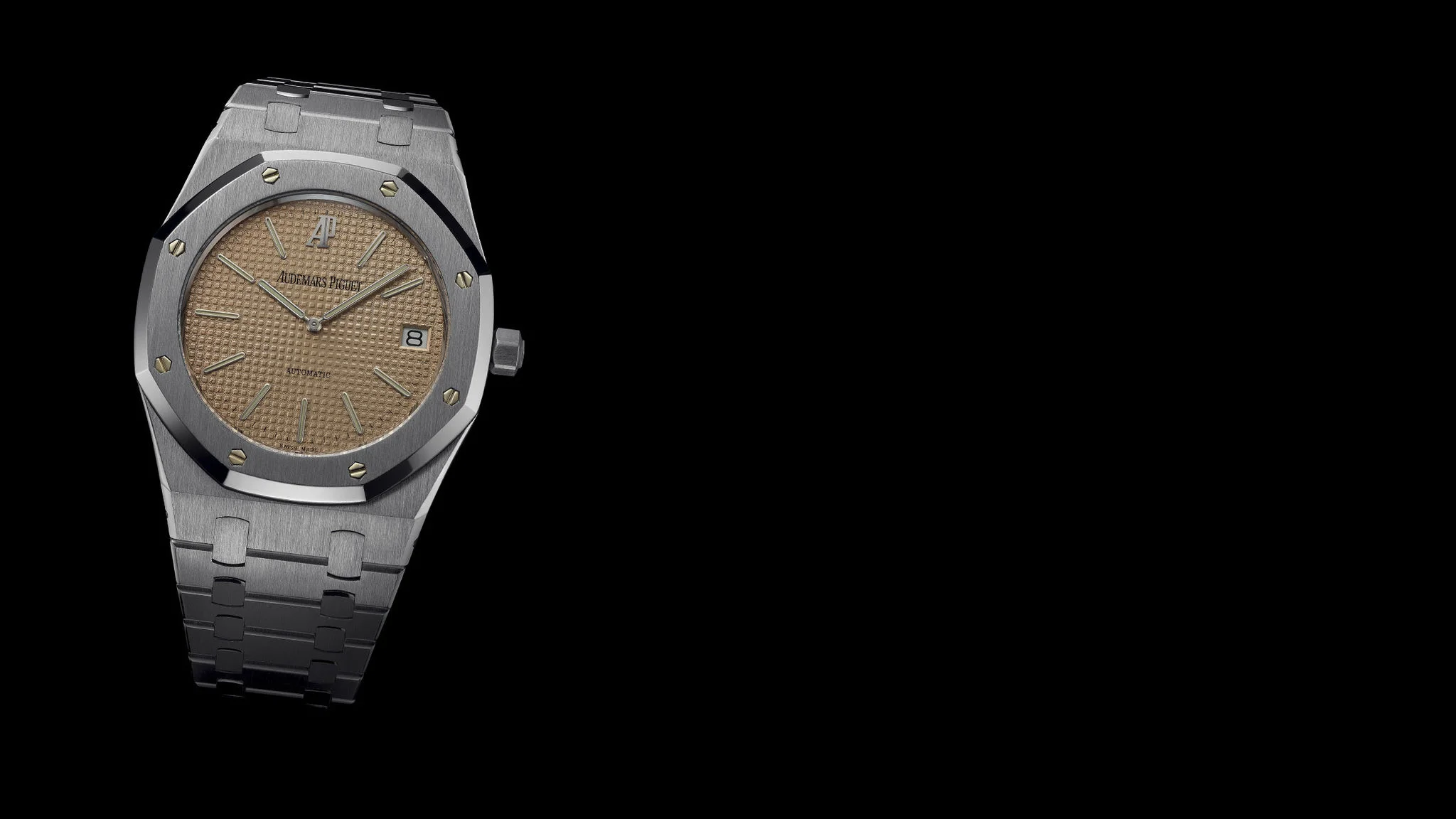
1993. Royal Oak 14802ST (1992), No. 130. Date. Calibre 2121, movement 374378. Bracelet 944. Dial with T21 Tapisserie pattern. Steel. Sold in 1993 to Elco (United Kingdom). Audemars Piguet Heritage, inv. 1051.
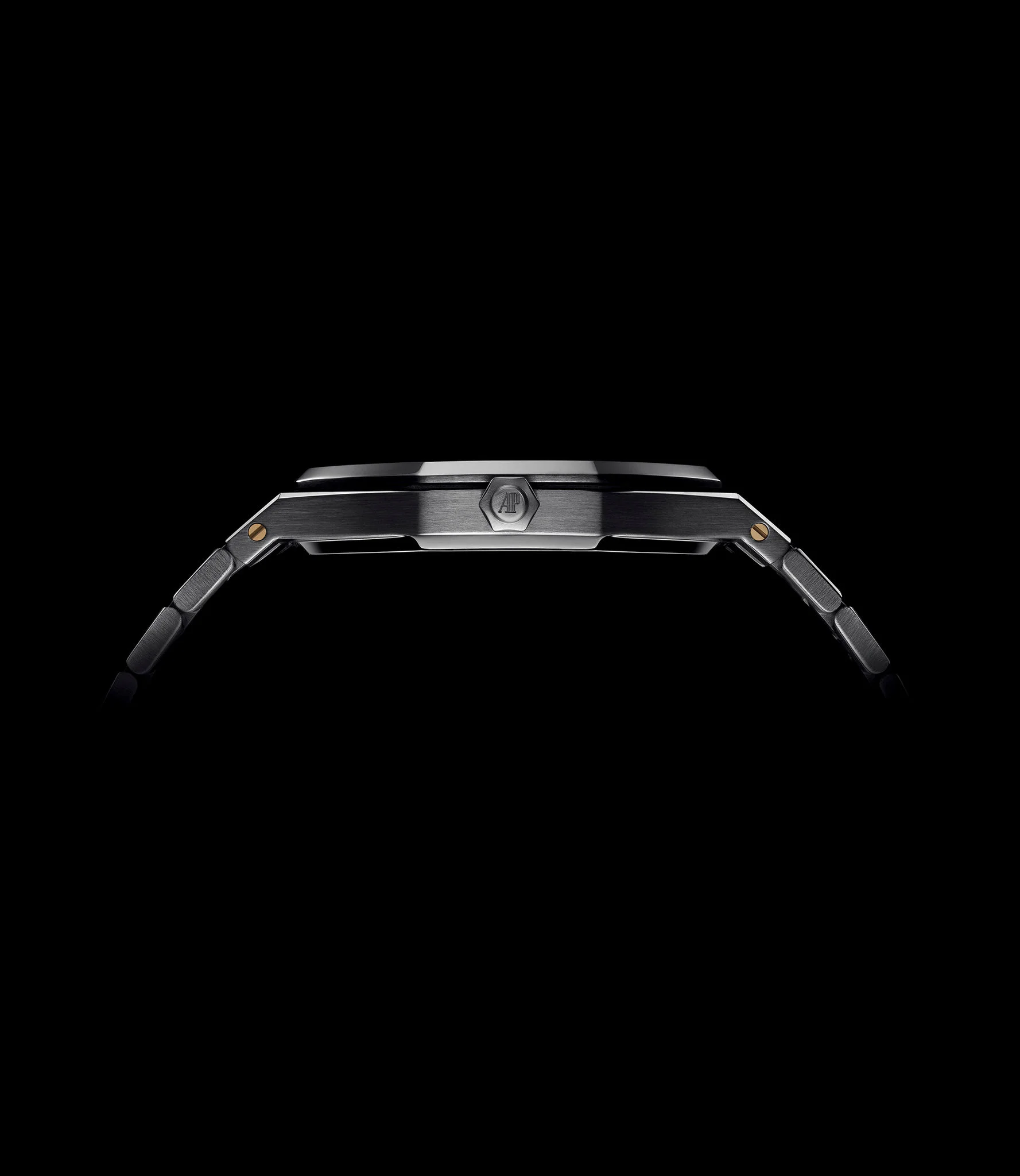
1993. Royal Oak 14802ST (1992), No. 130, viewed from the side. Date. Calibre 2121, movement 374378. Bracelet 944. Dial with T21 Tapisserie pattern. Steel case D12288 in 3 mm. Sold in 1993 to Elco (United Kingdom). Audemars Piguet Heritage, inv. 1051.
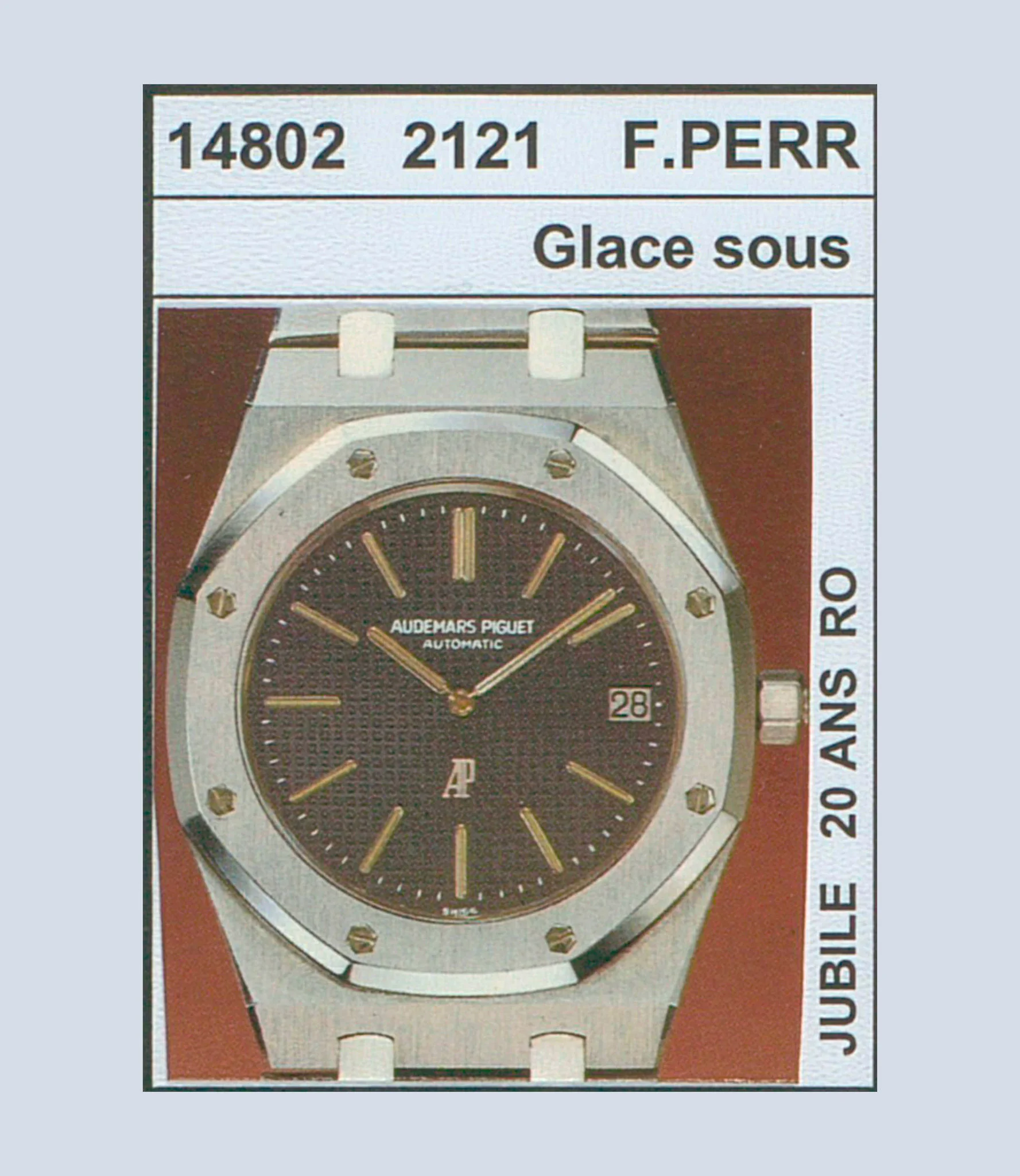
Circa 1992. Identification photograph of Model 14802, Audemars Piguet Archives.
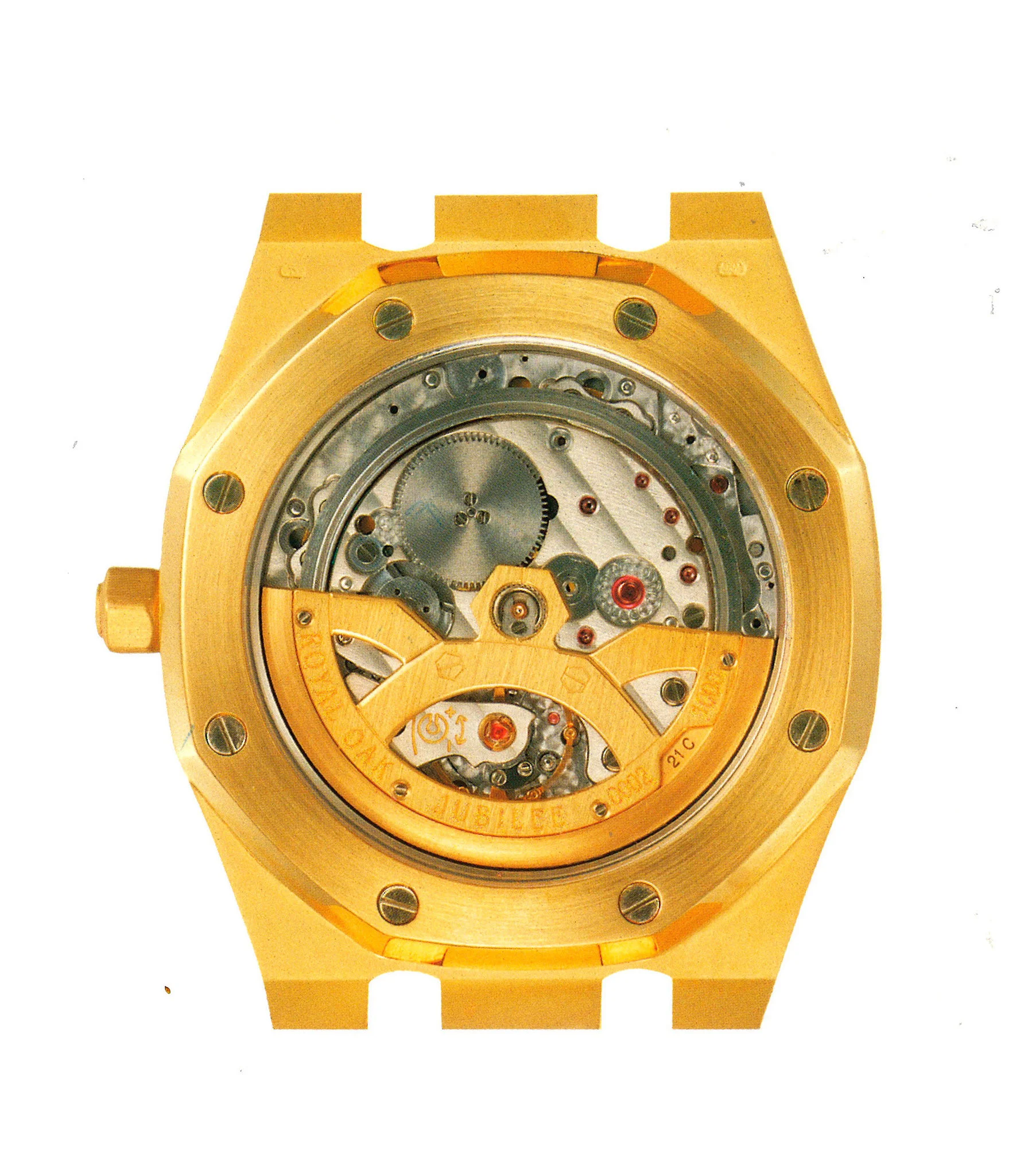
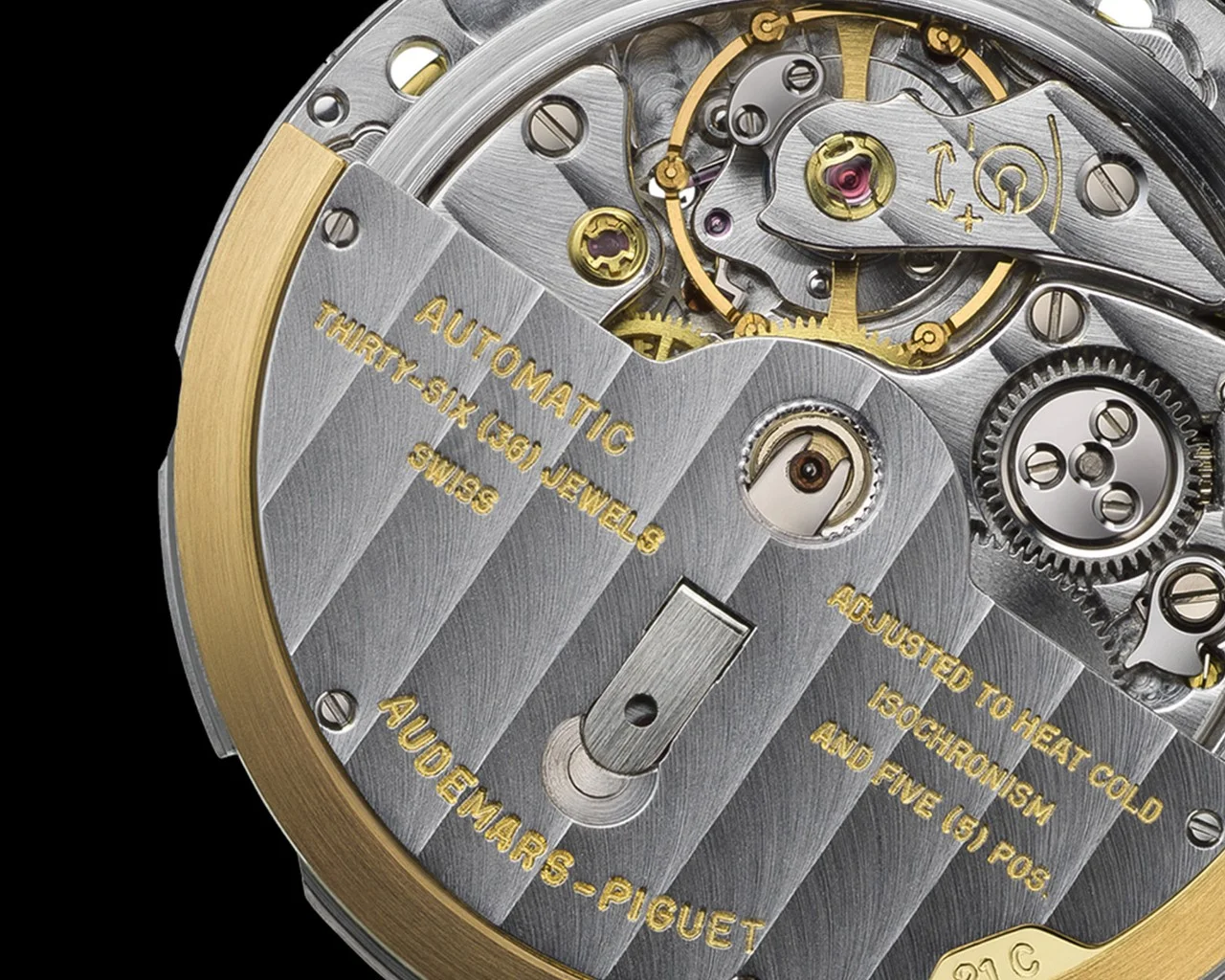
1993. Photograph of the Royal Oak Jubilee 14802BA viewed from the back, published in a brochure dedicated to this model on the occasion of its launch. Audemars Piguet Archives.

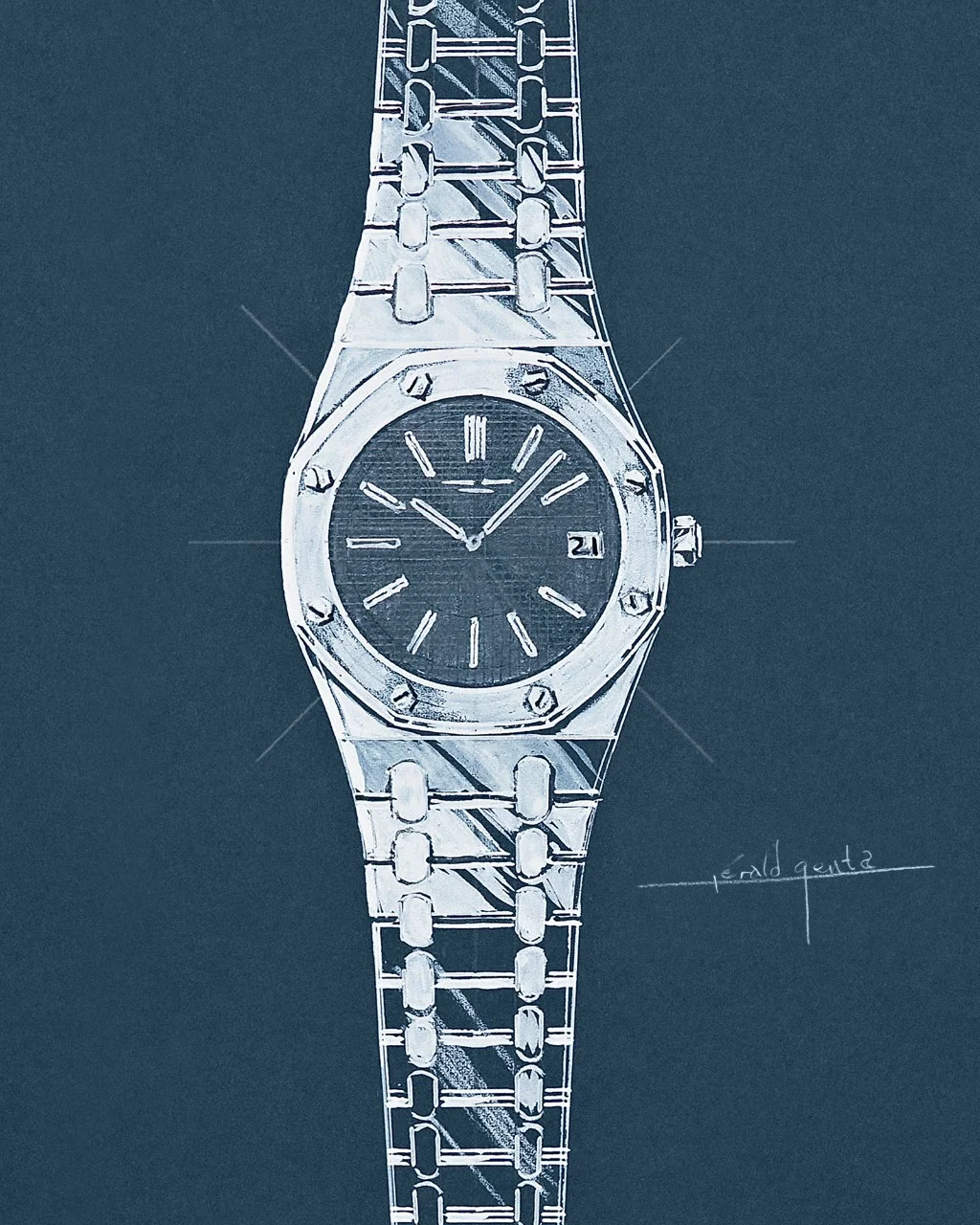
Circa 1990. Anniversary oscillating weight sketches for the Royal Oak 14802. Gouache drawings on translucent paper. Audemars Piguet Archives.
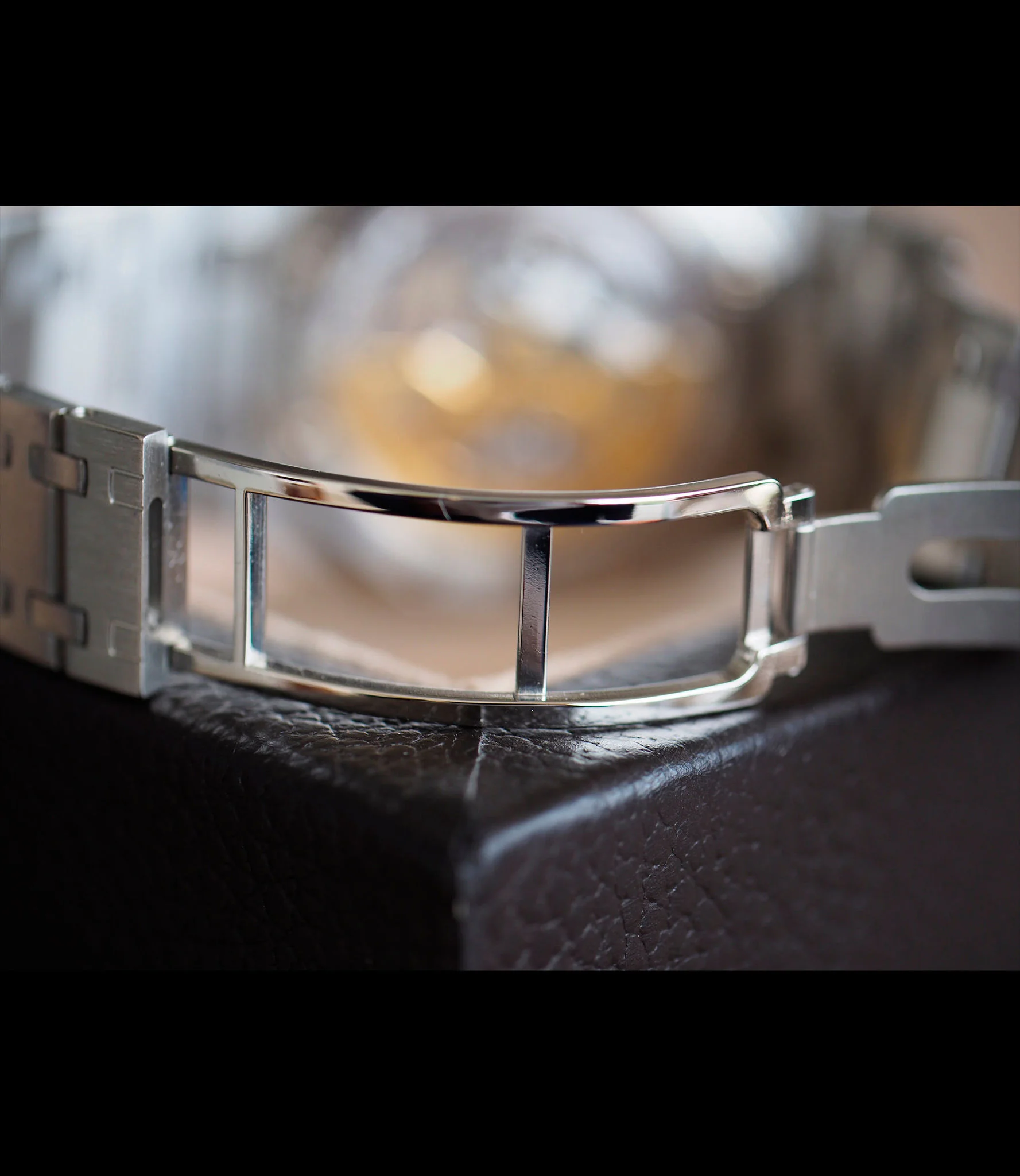
1992. Photograph of the folding clasp on Bracelet 944 for the Royal Oak 14802, Audemars Piguet Archives.
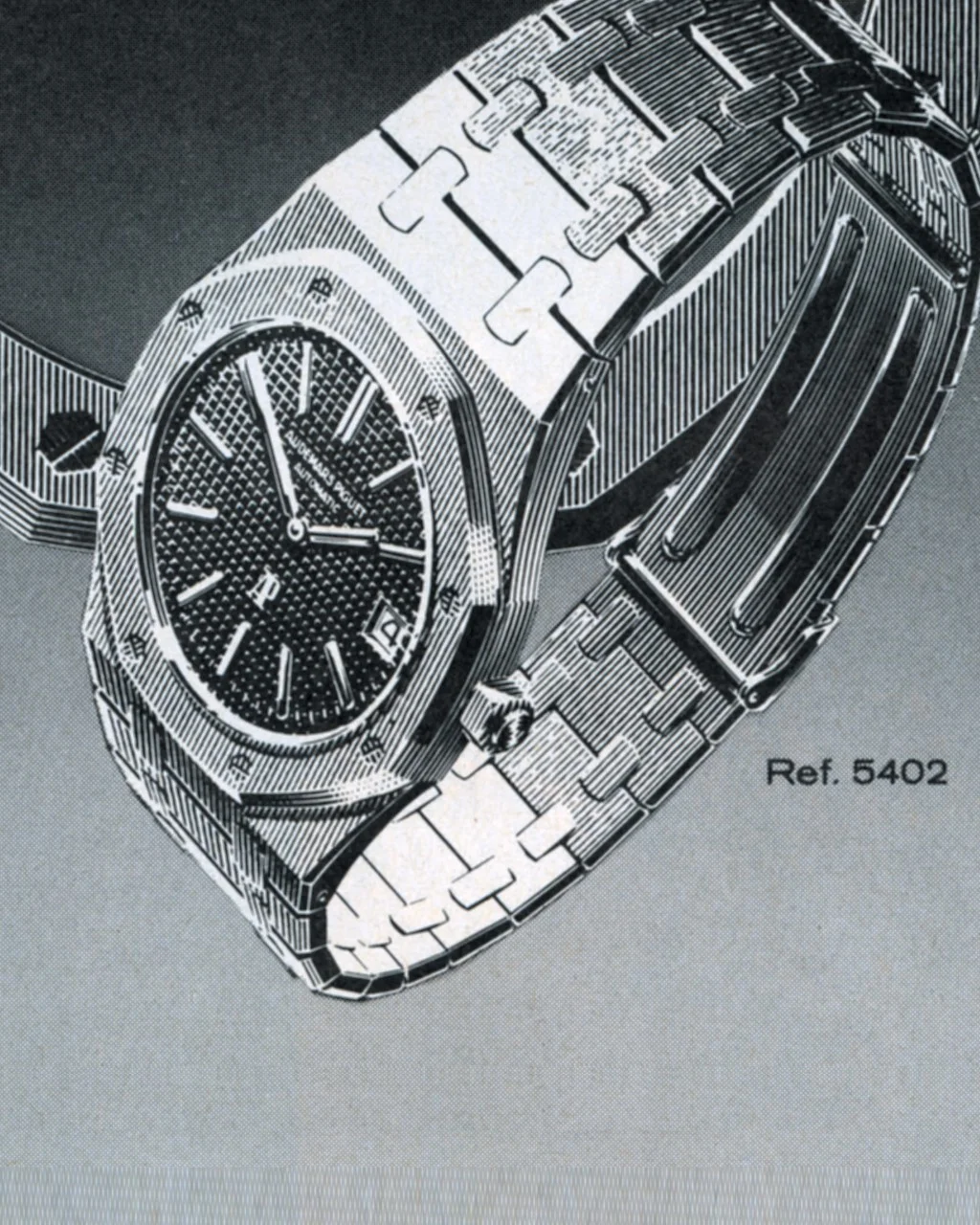
In 1992, Audemars Piguet celebrated the 20th anniversary of the Royal Oak. Since 1972, the collection has grown to include some 150 models equipped with nearly 30 different calibres and available in steel, gold, platinum or set with gemstones. However, as the article dedicated to the history of the Royal Oak “Jumbo” recounts, for 20 years, Model 5402 remained the only 39 mm ultra-thin model.
The Royal Oak Jubilee 14802 was therefore the second "Jumbo" in the history of the collection. It stood out from its illustrious predecessor by its three-part case, enabling a transparent caseback revealing a special oscillating weight especially created for the jubilee. Equipped with a new folding clasp, Bracelet 944 replaced Bracelet 344 of Model 5402. In addition, some steel models feature a salmon pink or a "Tuscany blue" dial.
Audemars Piguet decided to produce 1,000 units: 700 in steel, 280 in yellow gold and 20 in platinum. Production took several years and the sales period lasted almost a decade. In 1992, 401 watches were produced, but only 89 were completed and sold. The following year, 506 watches left Le Brassus, followed by 303 in 1994. The last 100 examples (including the 20 in platinum) were all sold more than two years after the Royal Oak's anniversary, the last one being completed in 2002, the year of the collection’s 30th anniversary!
This extremely long lifespan explains why some of the last examples were marketed without the jubilee oscillating weight, which no longer made sense...
998 units sold between 1992 and 2002, of which 89 (1992), 506 (1993), 303 (1994), 79 (1995), 5 (1996), 3 (1997), 7 (1998), 2 (1999), 3 (2000) and 1 (2002).
Derived from Model 5402 (1972).
In 1992, Audemars Piguet celebrated the 20th anniversary of the Royal Oak. Since 1972, the collection has grown to include some 150 models equipped with nearly 30 different calibres and available in steel, gold, platinum or set with gemstones. However, as the article dedicated to the history of the Royal Oak “Jumbo” recounts, for 20 years, Model 5402 remained the only 39 mm ultra-thin model.
The Royal Oak Jubilee 14802 was therefore the second "Jumbo" in the history of the collection. It stood out from its illustrious predecessor by its three-part case, enabling a transparent caseback revealing a special oscillating weight especially created for the jubilee. Equipped with a new folding clasp, Bracelet 944 replaced Bracelet 344 of Model 5402. In addition, some steel models feature a salmon pink or a "Tuscany blue" dial.
Audemars Piguet decided to produce 1,000 units: 700 in steel, 280 in yellow gold and 20 in platinum. Production took several years and the sales period lasted almost a decade. In 1992, 401 watches were produced, but only 89 were completed and sold. The following year, 506 watches left Le Brassus, followed by 303 in 1994. The last 100 examples (including the 20 in platinum) were all sold more than two years after the Royal Oak's anniversary, the last one being completed in 2002, the year of the collection’s 30th anniversary!
This extremely long lifespan explains why some of the last examples were marketed without the jubilee oscillating weight, which no longer made sense...
998 units sold between 1992 and 2002, of which 89 (1992), 506 (1993), 303 (1994), 79 (1995), 5 (1996), 3 (1997), 7 (1998), 2 (1999), 3 (2000) and 1 (2002).
Derived from Model 5402 (1972).
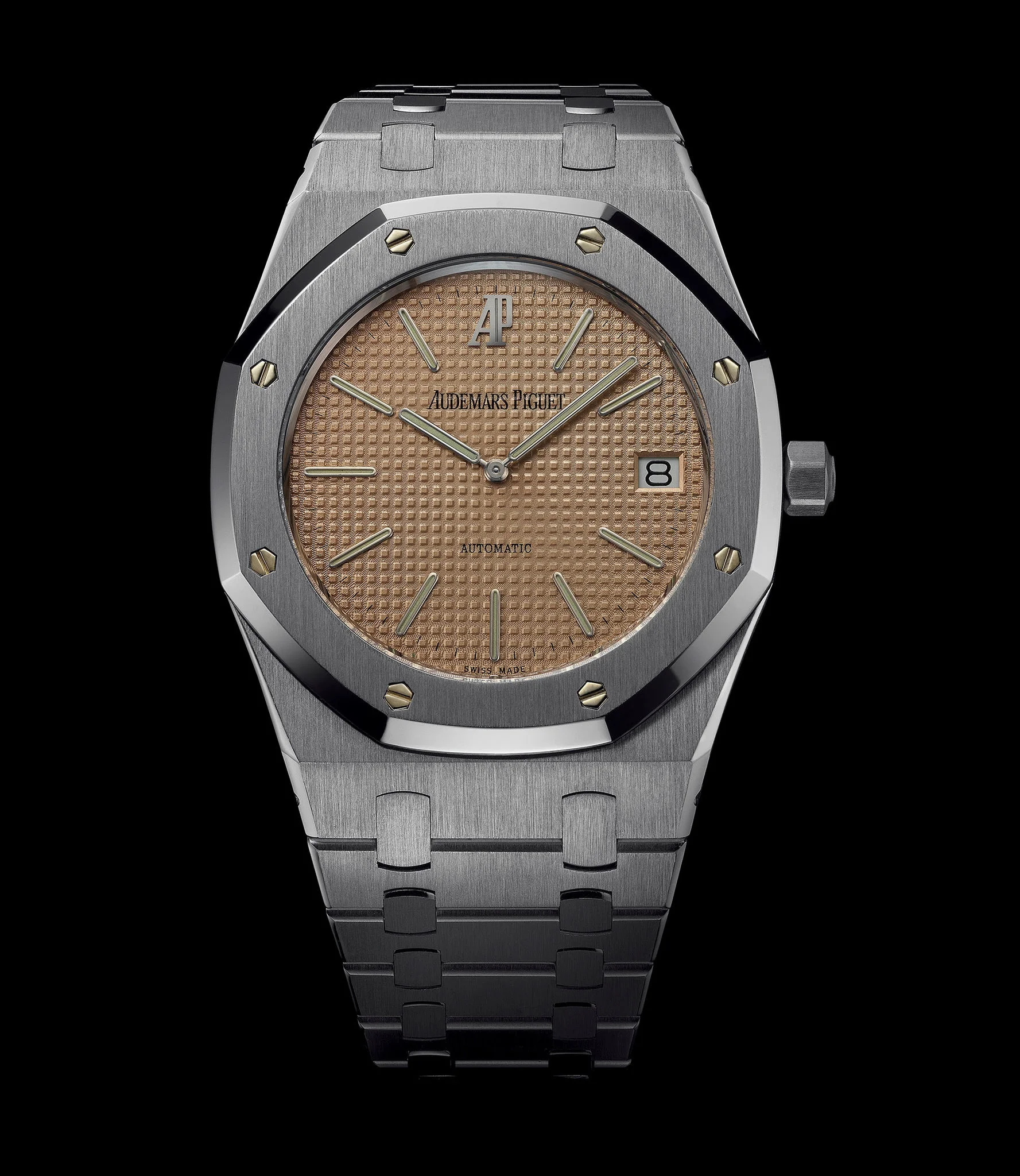
1993. Royal Oak 14802ST, No. 122. Date. Calibre 2121, movement 405798. Bracelet 944. “4N gold” salmon pink dial with T21 Tapisserie pattern. Steel. Sold in 1993 in the United States. Audemars Piguet Heritage, inv. 2121.
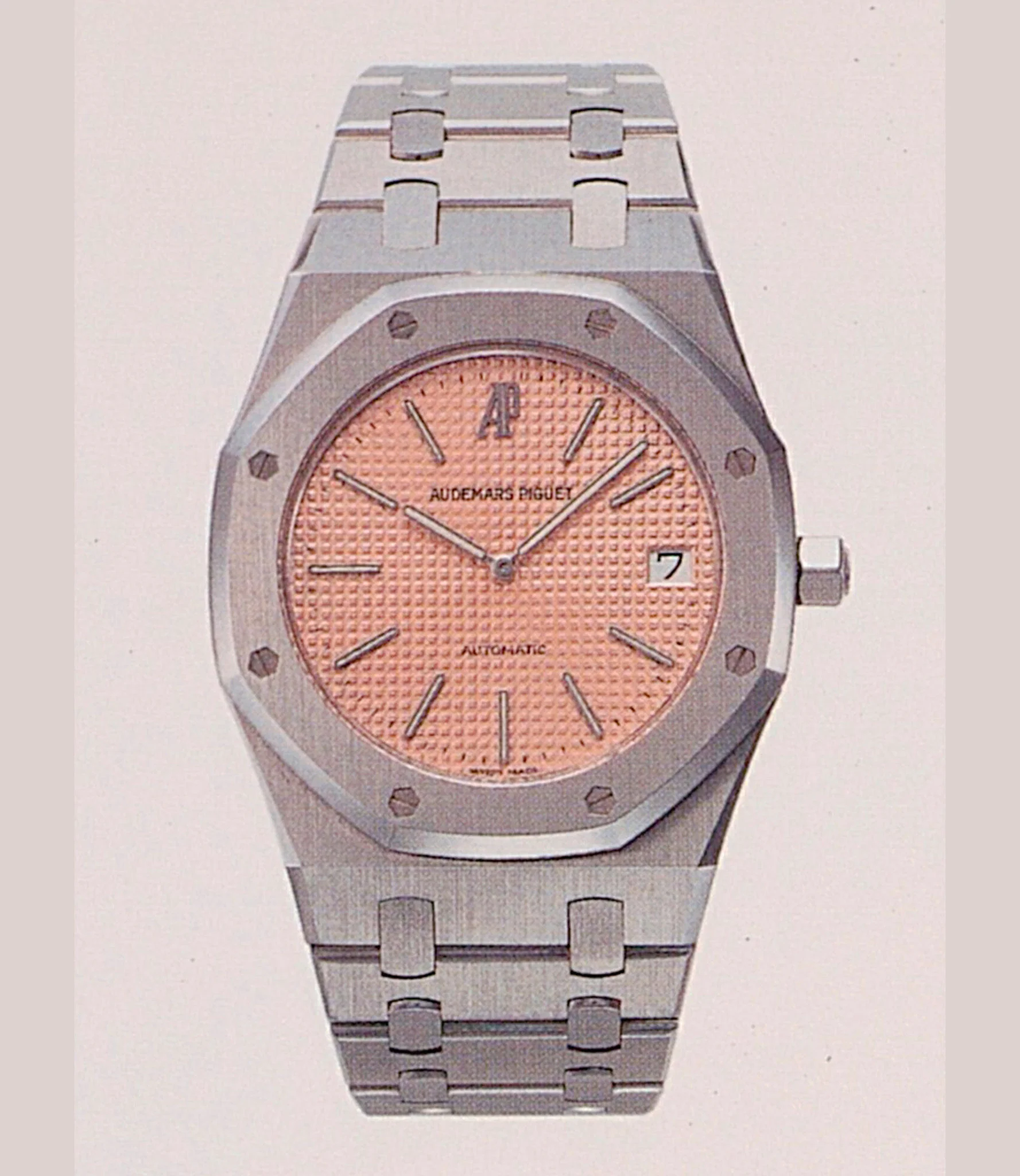
1992. Photograph of model 14802ST, salmon pink dial. 1992 advertising leaflet and 1993–1994 catalogue. Audemars Piguet Archives.
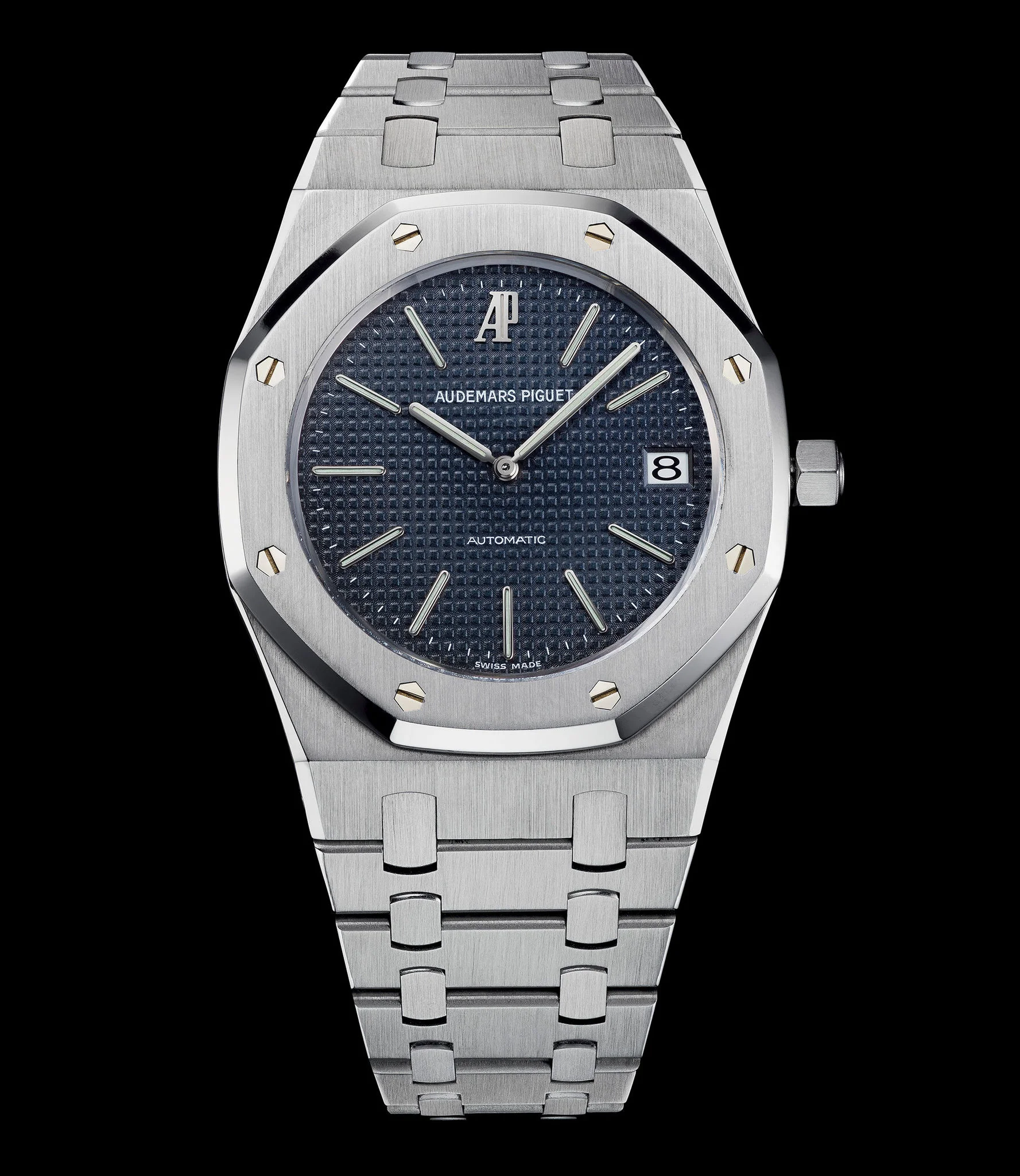
1993. Royal Oak 14802ST (1992), No. 130. Date. Calibre 2121, movement 374378. Bracelet 944. T21 Tapisserie dial. Steel. Sold in 1993 to Elco (United Kingdom). Audemars Piguet Heritage, inv. 1051.
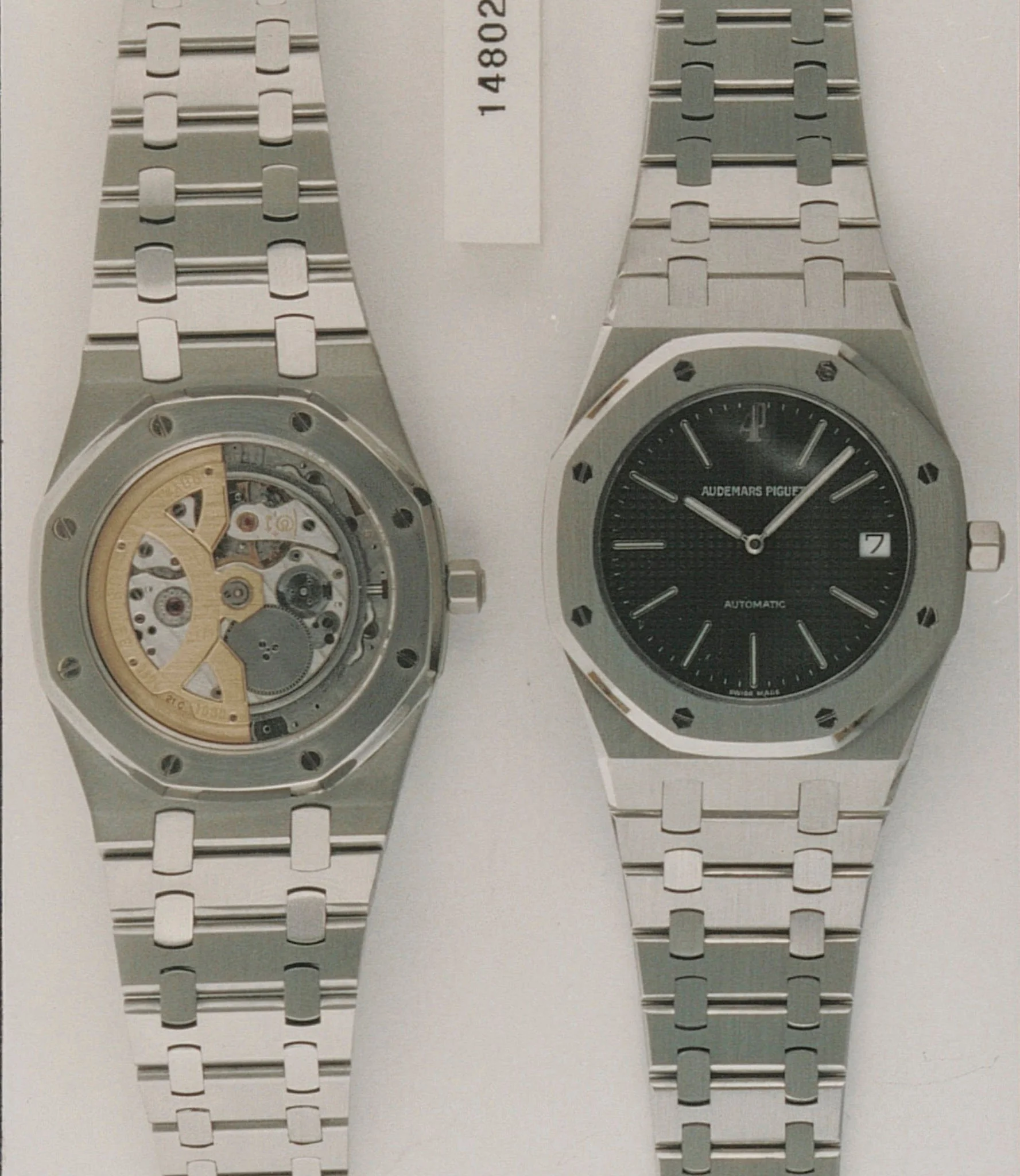
Circa 1992. Identification photographs of the Royal Oak Jubilee 14802ST. Audemars Piguet Archives.
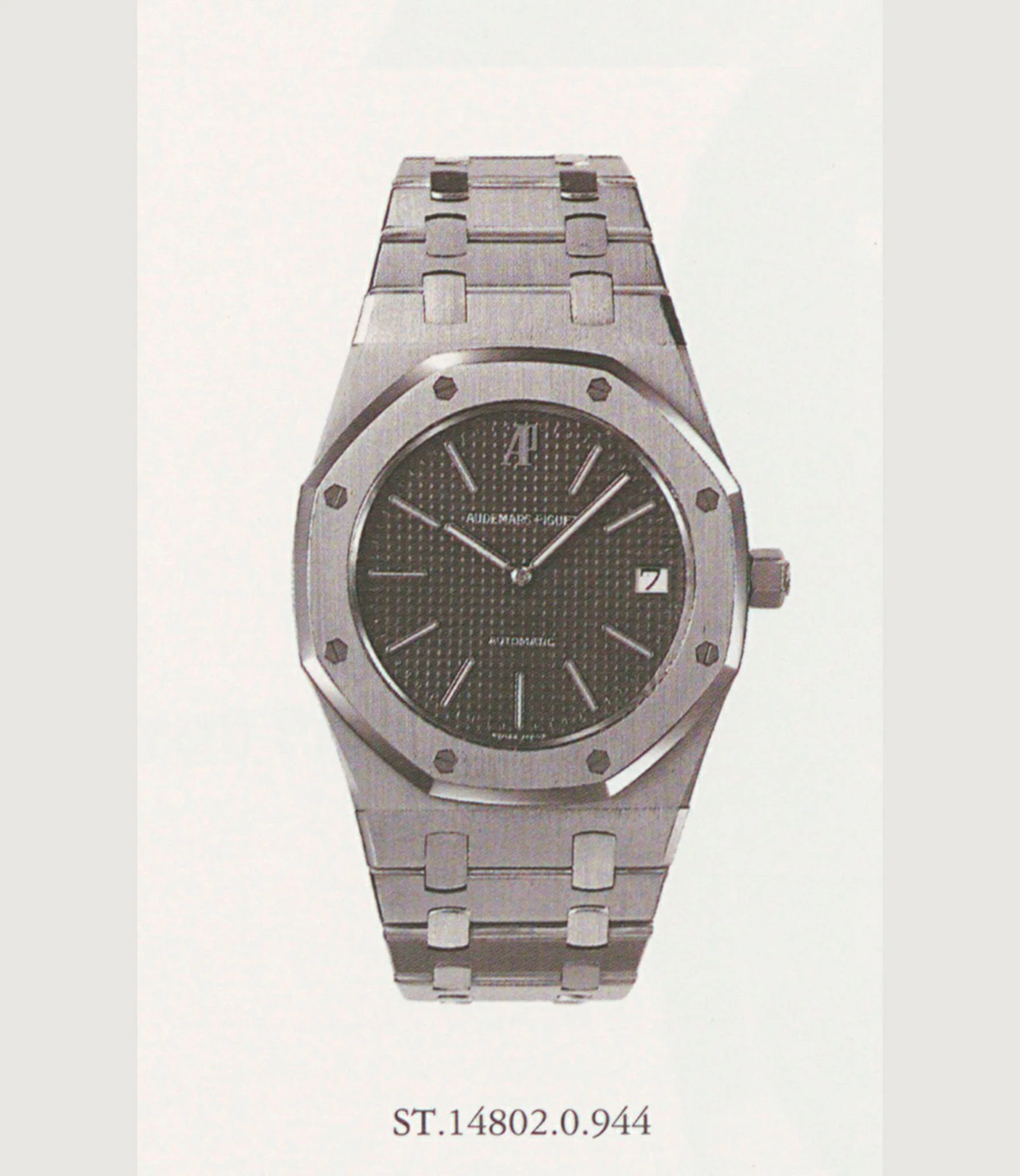
1994. Photograph of Model 14802ST. Promotional brochure. Audemars Piguet Archives.
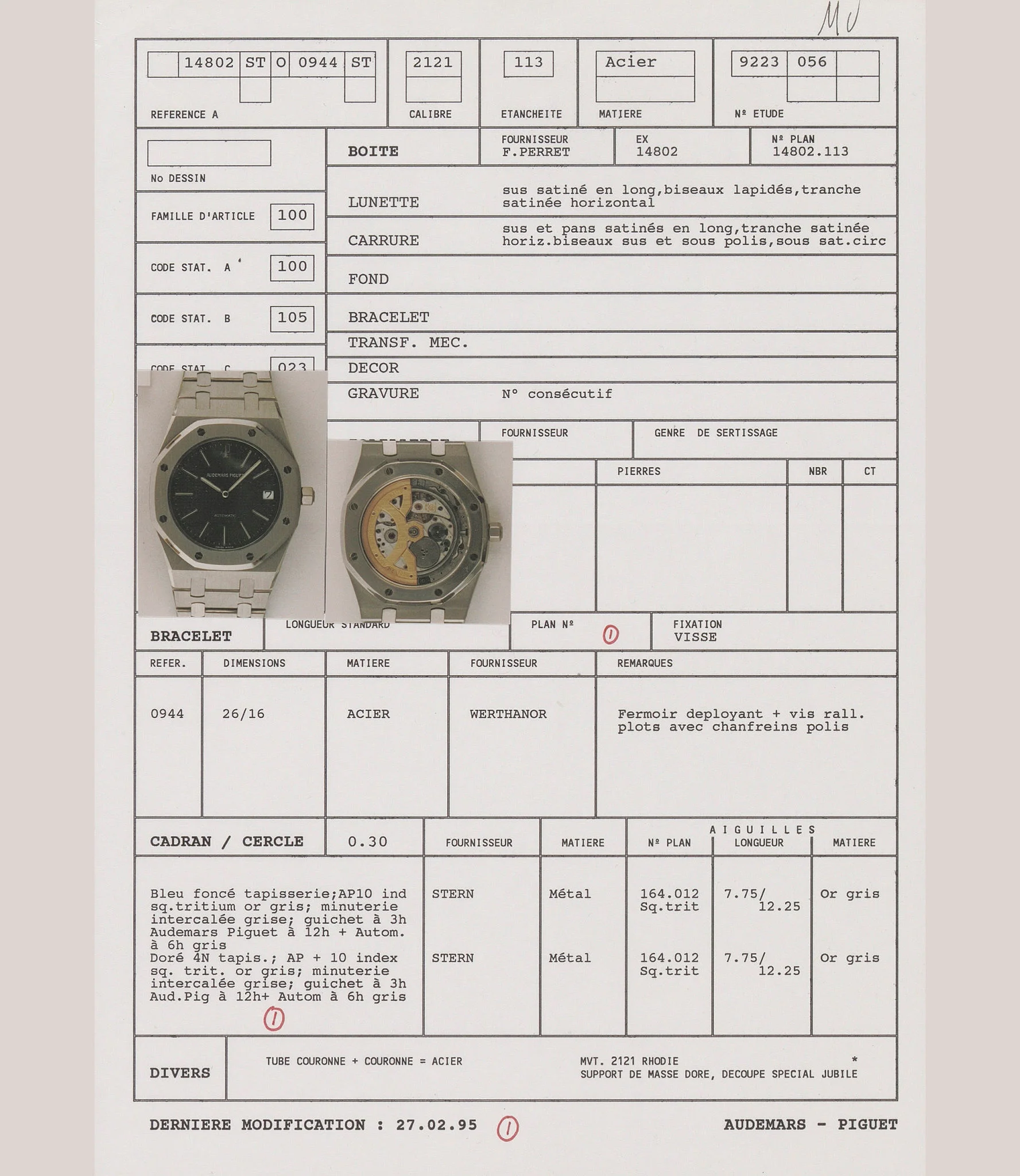
1995. Technical data for Model 14802ST. Audemars Piguet Archives.
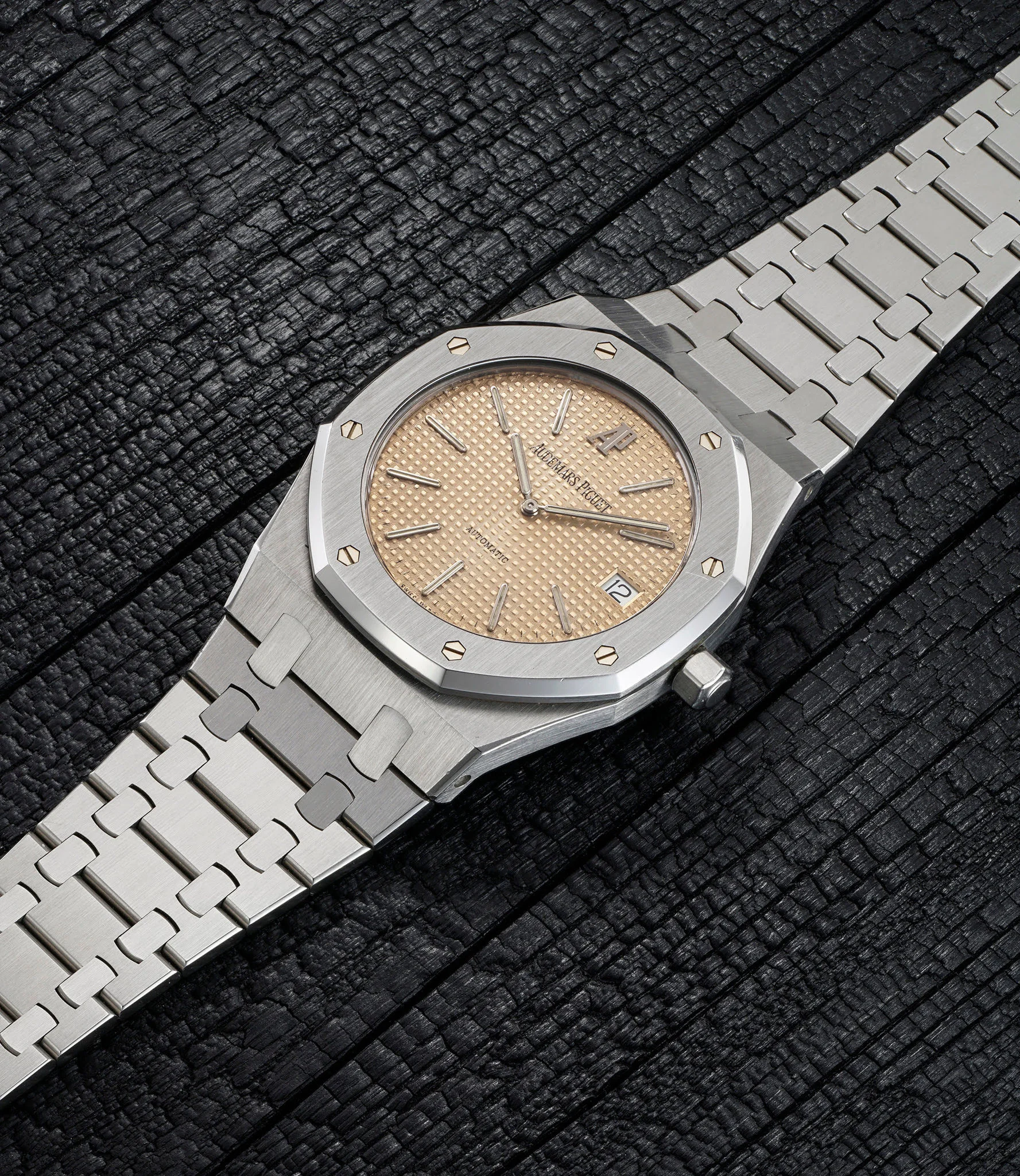
1994. Royal Oak 14802ST, No. 836. Date. Selfwinding Calibre 2121, movement 399876. Bracelet 944. Salmon pink T21 Tapisserie dial. Steel. Auctioned by Phillips Genève on May 6, 2022, lot 22 © Phillips.
Of the 700 watches initially planned for 1992, a total of 692 left the Le Brassus workshops between 1992 and 2002.
The Model 14802ST’s technical data describes two dial variants, both with a guilloché Tapisserie pattern coloured by galvanic treatment and topped by an AP logo applied at 12 o'clock. The difference lies in their colour. The first is described as "dark blue", very close to the "Bleu Nuit, Nuage 50“ hue of Model 5402. The second is described as "golden 4N", which corresponds to the classic pink gold colour, but connoisseurs dubbed it "salmon pink".
The salmon pink dial appeared in Audemars Piguet communications as early as 1992. The archives do not reveal the number of salmon pink dials fitted on Model 14802ST, but the proportion of watches in private collections suggests that there are far fewer of these than blue dials. For a long time, this rarity meant that they went unnoticed.
However, in 2019, following the Audemars Piguet Heritage team’s recommendation to reintroduce this very rare colour, the brand presented a new Royal Oak “Jumbo” 15202BC with a salmon pink dial. Its success exceeded all expectations. By the same token, the old salmon pink 14802STs soon became more desirable. Their auction value soared and in May 2022, one of them was sold for CHF 252,000 at the Royal Oak anniversary auction organised by Phillips in Geneva.
Sales from 1992 to 2002: a total of 692 units, of which 50 (1992), 337 (1993), 239 (1994), 64 (1995), 1 (1998) and 1 (2002).
Of the 700 watches initially planned for 1992, a total of 692 left the Le Brassus workshops between 1992 and 2002.
The Model 14802ST’s technical data describes two dial variants, both with a guilloché Tapisserie pattern coloured by galvanic treatment and topped by an AP logo applied at 12 o'clock. The difference lies in their colour. The first is described as "dark blue", very close to the "Bleu Nuit, Nuage 50“ hue of Model 5402. The second is described as "golden 4N", which corresponds to the classic pink gold colour, but connoisseurs dubbed it "salmon pink".
The salmon pink dial appeared in Audemars Piguet communications as early as 1992. The archives do not reveal the number of salmon pink dials fitted on Model 14802ST, but the proportion of watches in private collections suggests that there are far fewer of these than blue dials. For a long time, this rarity meant that they went unnoticed.
However, in 2019, following the Audemars Piguet Heritage team’s recommendation to reintroduce this very rare colour, the brand presented a new Royal Oak “Jumbo” 15202BC with a salmon pink dial. Its success exceeded all expectations. By the same token, the old salmon pink 14802STs soon became more desirable. Their auction value soared and in May 2022, one of them was sold for CHF 252,000 at the Royal Oak anniversary auction organised by Phillips in Geneva.
Sales from 1992 to 2002: a total of 692 units, of which 50 (1992), 337 (1993), 239 (1994), 64 (1995), 1 (1998) and 1 (2002).
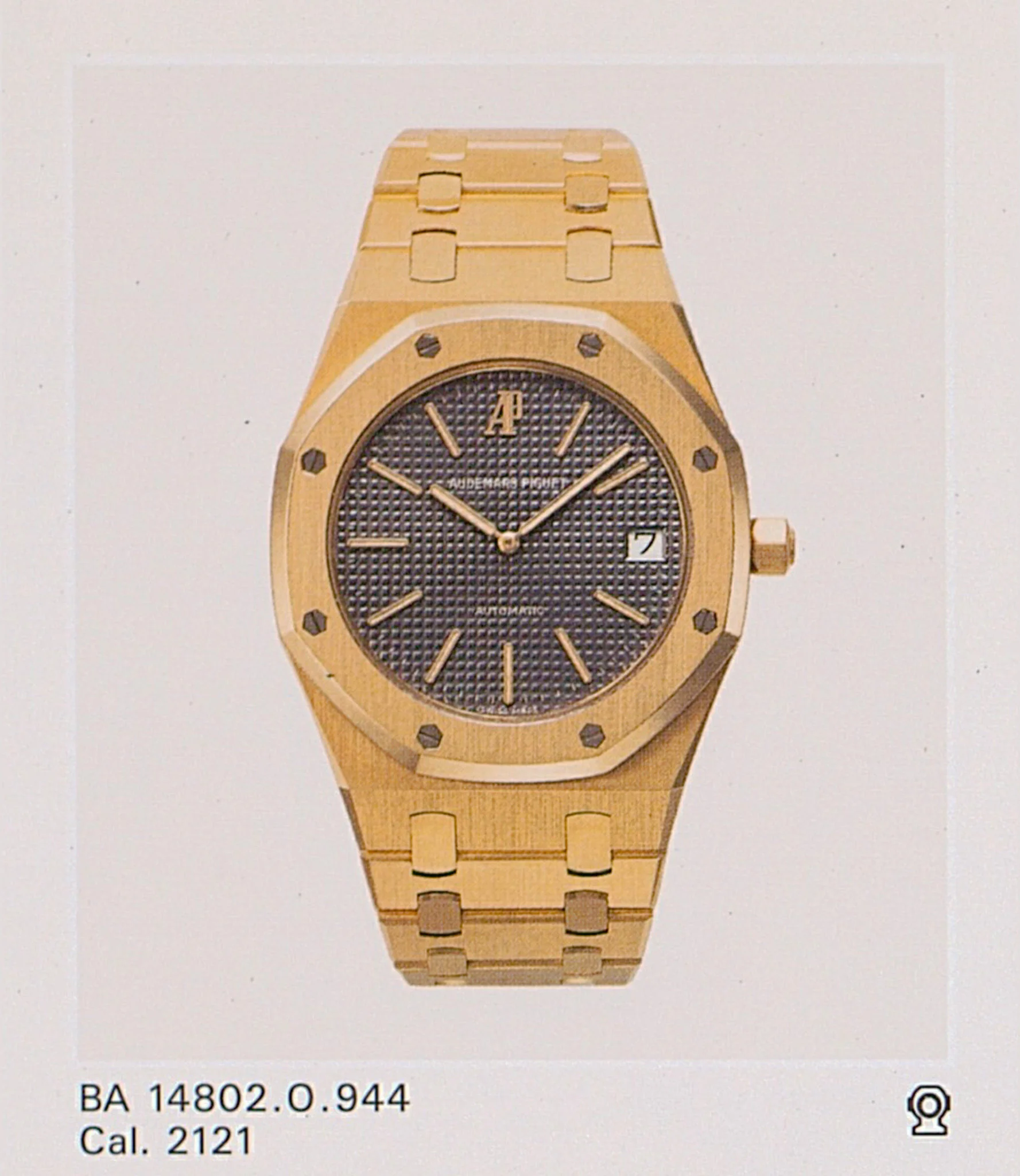
1993. Photograph of Model 14802BA. 1993–1994 catalogue. Audemars Piguet Archives.
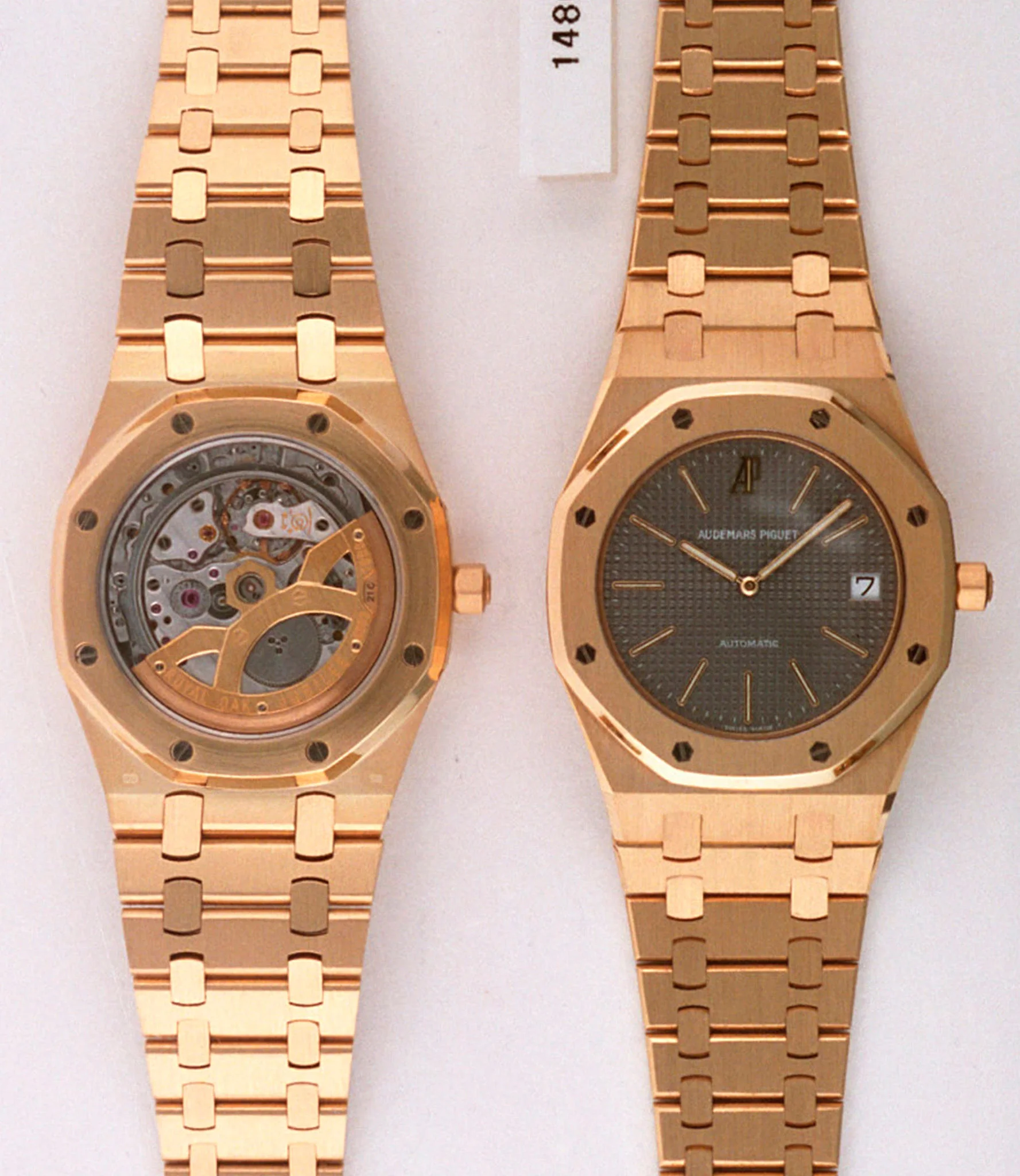
Circa 1992. Identification photograph of Model 14802BA. Slate grey dial. Audemars Piguet Archives.
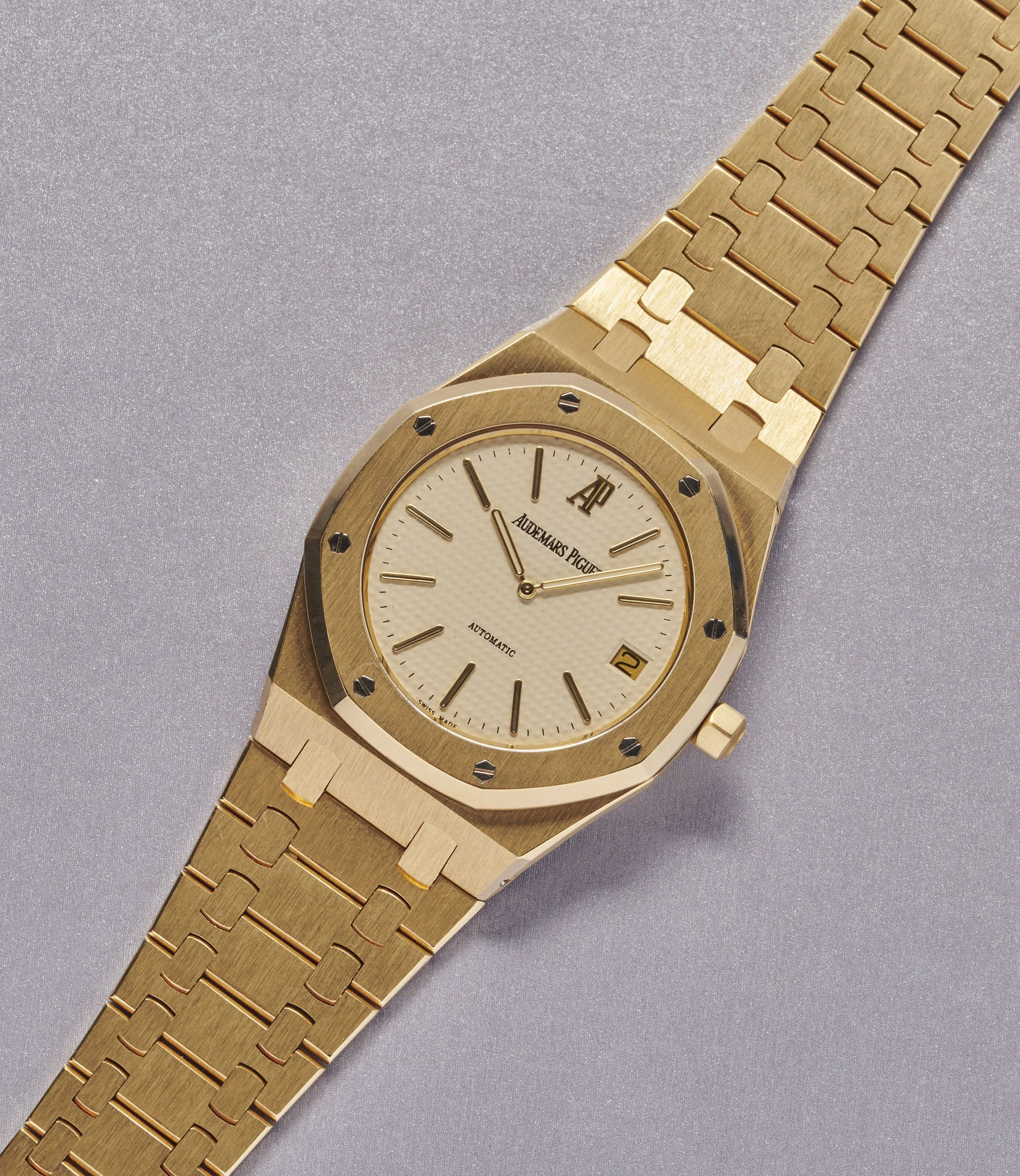
1993. Royal Oak 14802BA, No. 252. Date. Calibre 2121, movement 391401. Bracelet 944. Ivory-coloured T21 Tapisserie dial. Case D35513 in 18-carat yellow gold. Delivered in 1993 in Italy and sold in the Netherlands in 2000. Auctioned by Ineichen Zurich, 20.11.2021, lot 5 © Ineichen.
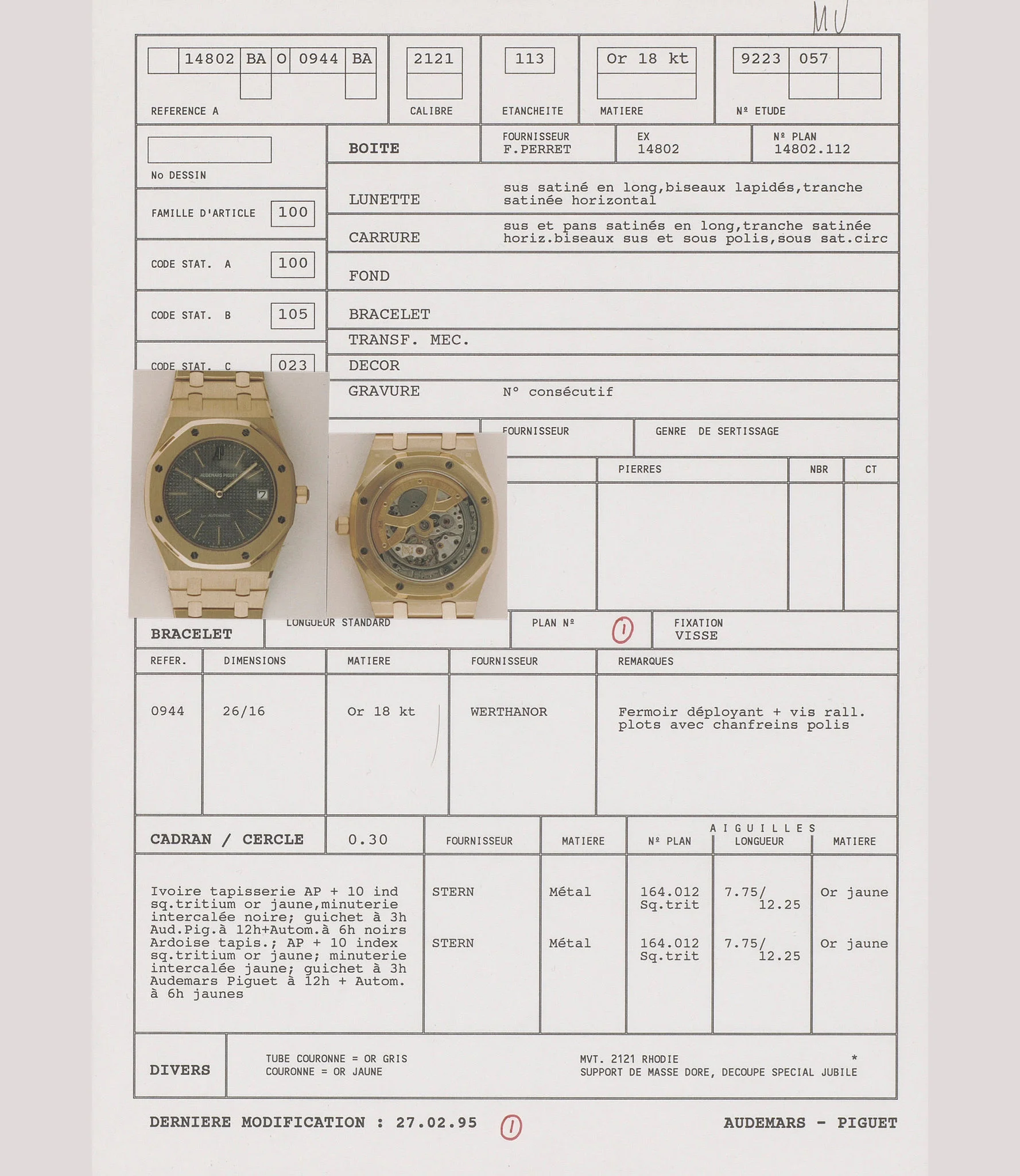
1995. Technical data for Model 14802BA. Audemars Piguet Archives.

1995. Technical data for Model 14802BA. Detail of the dial. Audemars Piguet Archives.
Like for the steel version, technical data for Model 14802 in yellow gold (BA) describes two Tapisserie dials with applied hour-markers and the AP monogram at 12 o'clock. The first is ivory coloured and the second slate grey. Some later models may have been fitted with gold or white dials.
In 1992, records show that 280 examples of the Royal Oak 14802 were planned. In a rare occurrence, six more were produced and distributed until 1998. This small extra number was offset by the fact that eight fewer examples of the steel version were produced than originally planned. As a result, the total anticipated production run of 1,000 examples was met.
Sales from 1992 to 1998: a total of 286 units, of which 39 (1992), 169 (1993), 64 (1994), 12 (1995), 1 (1996) and 1 (1998).
Like for the steel version, technical data for Model 14802 in yellow gold (BA) describes two Tapisserie dials with applied hour-markers and the AP monogram at 12 o'clock. The first is ivory coloured and the second slate grey. Some later models may have been fitted with gold or white dials.
In 1992, records show that 280 examples of the Royal Oak 14802 were planned. In a rare occurrence, six more were produced and distributed until 1998. This small extra number was offset by the fact that eight fewer examples of the steel version were produced than originally planned. As a result, the total anticipated production run of 1,000 examples was met.
Sales from 1992 to 1998: a total of 286 units, of which 39 (1992), 169 (1993), 64 (1994), 12 (1995), 1 (1996) and 1 (1998).
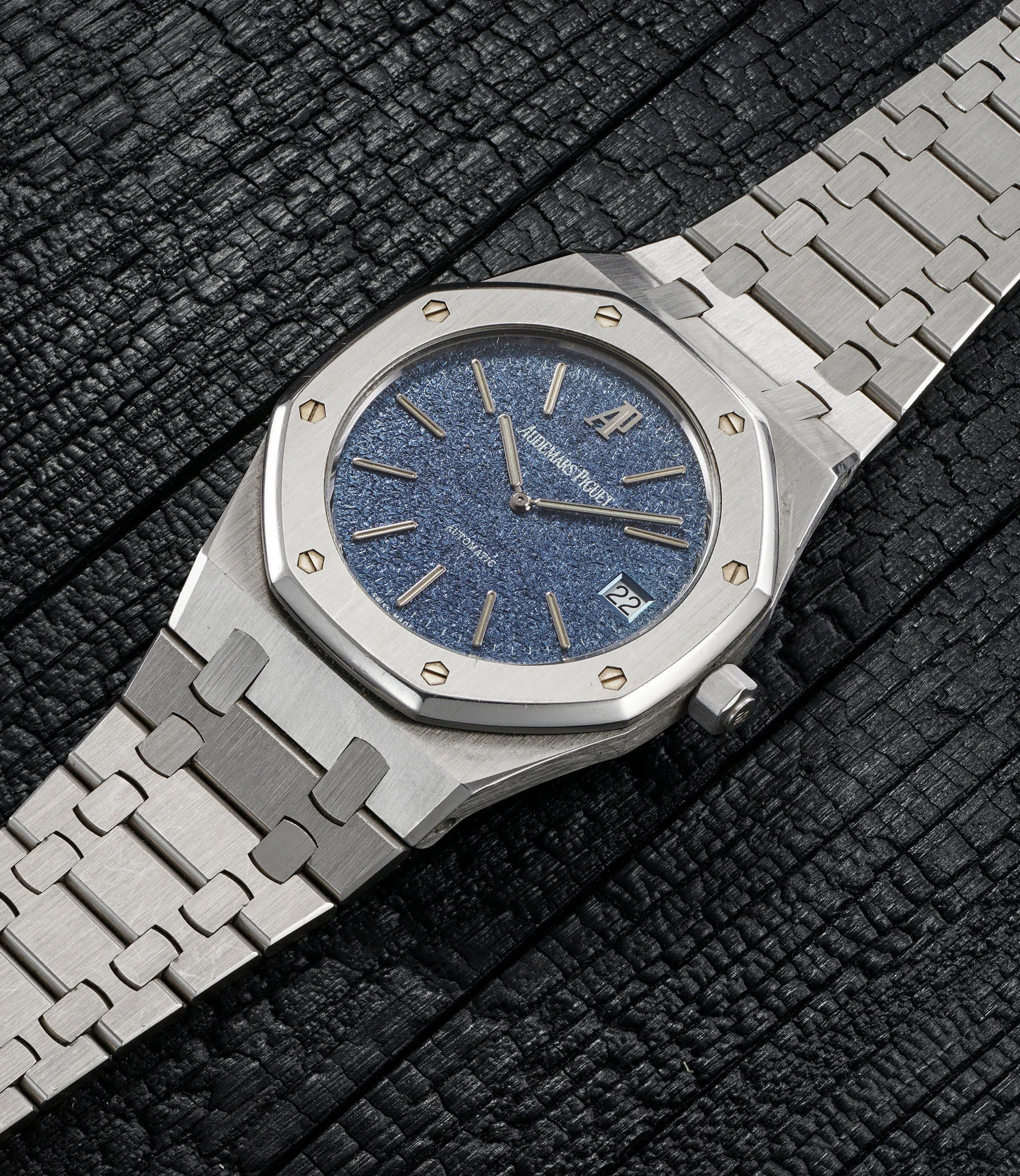
2000. Royal Oak Jubilee 14802PT. Ultra-thin selfwinding Calibre 2121, movement 414767. 39 mm Platinum case D13791. Finely chased “Tuscany blue” dial. This is the last watch delivered in the series. Sold on May 6, 2022 by Phillips Genève, lot no. 10, for CHF 804,400. © Phillips in association with Bacs & Russo.
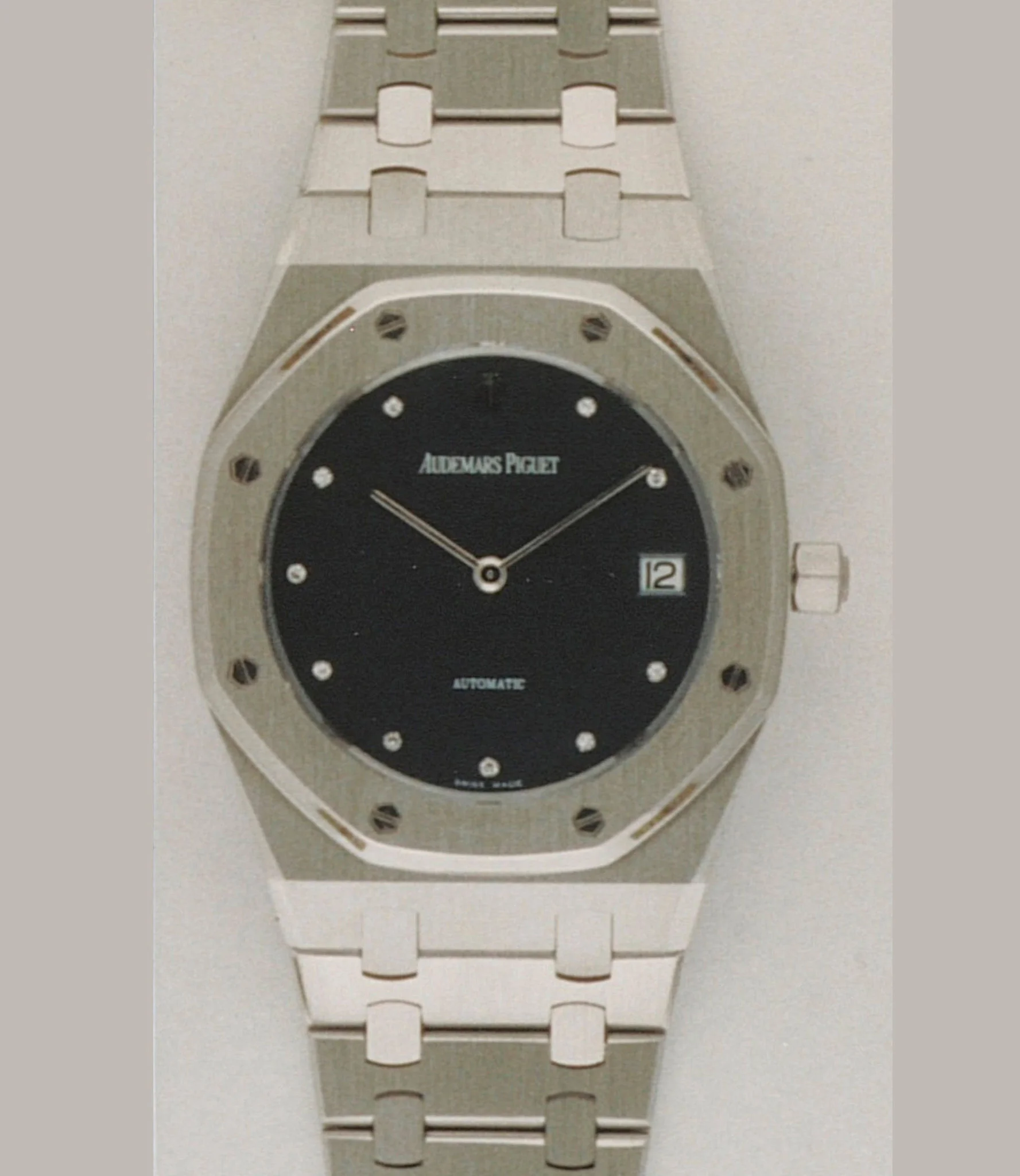
Circa 1992. Identification photograph of Moel 14802PT. Dark blue dial. Audemars Piguet Archives.

1995. Technical data for Model 14802PT. Audemars Piguet Archives.

1995. Technical data for Model 14802PT model. Audemars Piguet archives.
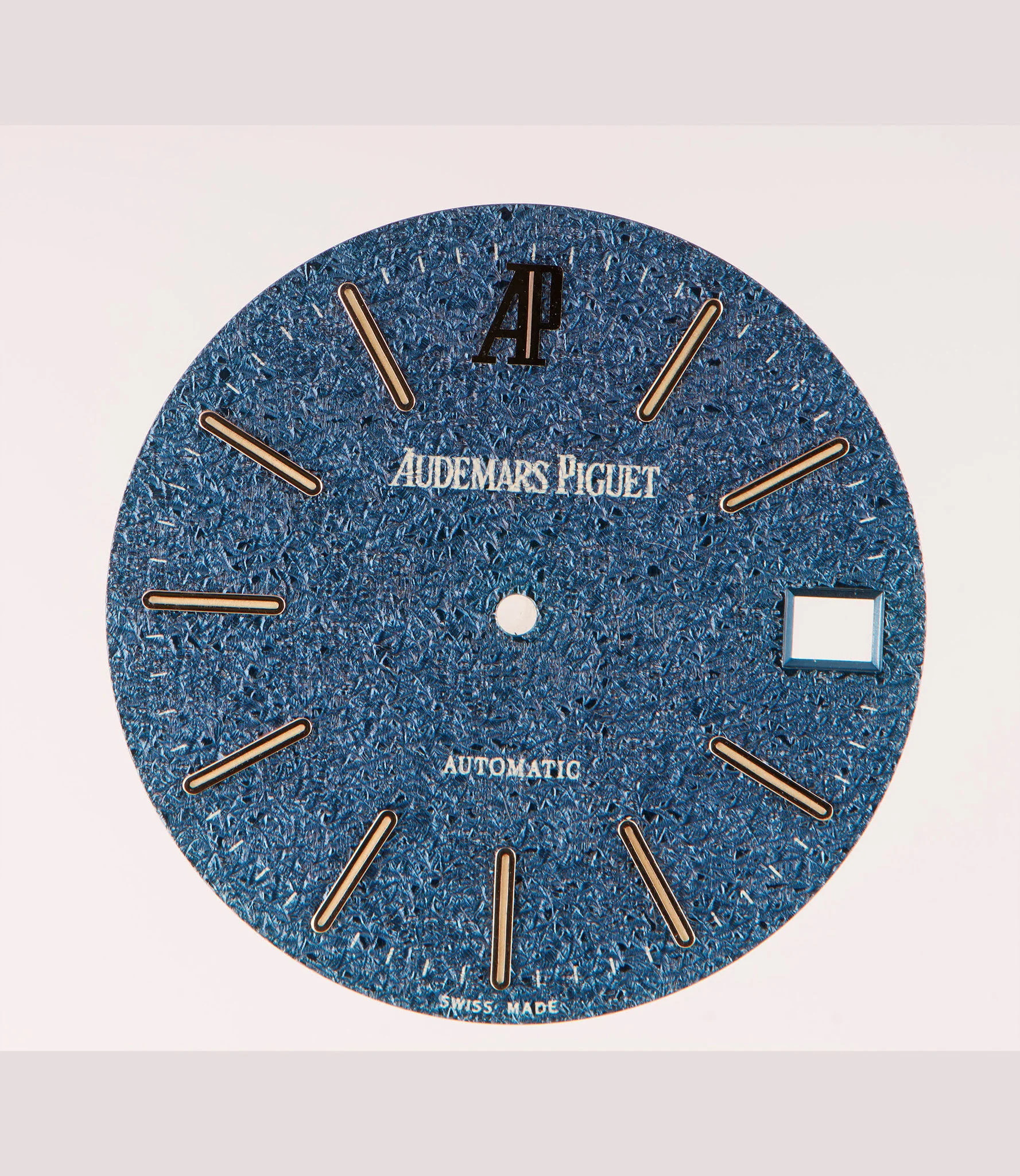
Circa 1995. Identification photograph of a “Tuscany blue” dial 14802PT.

1995. Stern's manufacturing process for a "Tuscany blue" dial. Audemars Piguet Archives.
The platinum version of the Royal Oak Jubilee appeared for the first time three years after the steel and gold versions. The 20 timepieces were sold over a period of five years. The distance in time from the Royal Oak anniversary explains why some examples do not bear the jubilee oscillating weight created in 1992.
The archives mention two dials. Finely chased and bearing the colour blue No. 7, the first is called "Tuscany blue", a name that appeared at Audemars Piguet in the 1980s on round platinum watches (5561PT, 5568) and then from the early 1990s on several Royal Oak models, in particular on Model 25654PT and then 25686PT (see article on Perpetual Calendars).
The second dial is also blue, a colour very often associated with platinum, but here it has a fine satin-brushed finish and diamond hour-markers mounted on studs riveted into the dial plate.
It is not known from the sources how these two dials were distributed among the 20 existing examples.
Sales from 1995 to 2000: a total of 20 units, of which 3 (1995), 4 (1996), 3 (1997), 5 (1998), 2 (1999) and 3 (2000).
The platinum version of the Royal Oak Jubilee appeared for the first time three years after the steel and gold versions. The 20 timepieces were sold over a period of five years. The distance in time from the Royal Oak anniversary explains why some examples do not bear the jubilee oscillating weight created in 1992.
The archives mention two dials. Finely chased and bearing the colour blue No. 7, the first is called "Tuscany blue", a name that appeared at Audemars Piguet in the 1980s on round platinum watches (5561PT, 5568) and then from the early 1990s on several Royal Oak models, in particular on Model 25654PT and then 25686PT (see article on Perpetual Calendars).
The second dial is also blue, a colour very often associated with platinum, but here it has a fine satin-brushed finish and diamond hour-markers mounted on studs riveted into the dial plate.
It is not known from the sources how these two dials were distributed among the 20 existing examples.
Sales from 1995 to 2000: a total of 20 units, of which 3 (1995), 4 (1996), 3 (1997), 5 (1998), 2 (1999) and 3 (2000).