


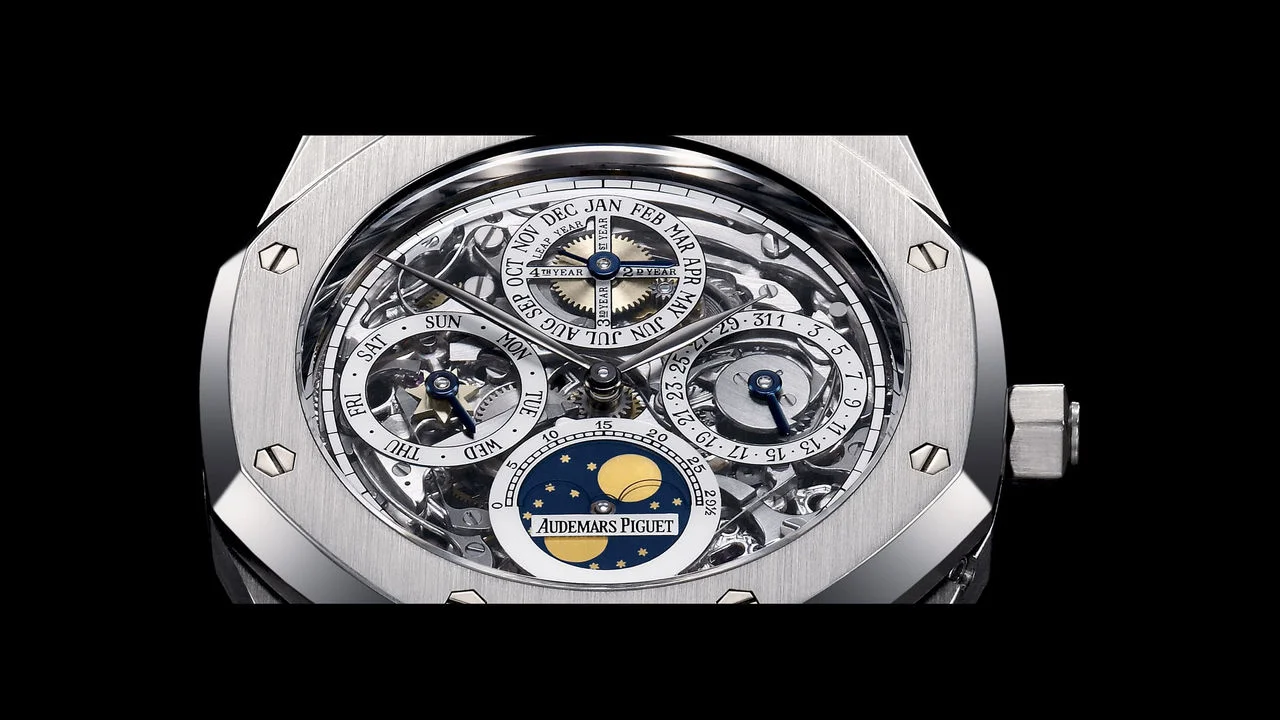
25829, ROYAL OAK PERPETUAL CALENDAR OPENWORKED

Royal Oak Perpetual Calendar Openworked 25829ST. Promotional image taken circa 2010. Audemars Piguet Archives.

2003. Image from the As Time Goes By brochure showing the 25829ST and 25920BA models. Audemars Piguet Archives.

Plan and section of the case of the Royal Oak Perpetual Calendar Openworked 25829. Audemars Piguet Archives.

1996. Image from the 1996-1997 General Catalogue showing the references 25820 in steel and yellow gold, as well as the 25829 in yellow gold and platinum. Audemars Piguet Archives.

2000. Image from the 2000-2001 general catalogue representing the reference 25829 in steel, yellow gold and platinum. Audemars Piguet Archives.

2001. Image from the 2001-2002 general catalogue representing the reference 25829 in steel, yellow gold and platinum. Audemars Piguet Archives.

2002. Image from the 2002-2003 general catalogue representing the reference 25829 in steel, yellow gold, platinum and pink gold. Audemars Piguet Archives.

2003. Image from the 2003-2004 general catalogue representing the reference 25829 in steel, yellow gold, platinum and pink gold. Audemars Piguet Archives.

2011. Image from the 2011 General Catalogue representing the reference 25829 in steel and platinum. Audemars Piguet Archives.

2011. Image from the 2011 General Catalogue representing the reference 25829 in steel and platinum. Audemars Piguet Archives.

2013. Image from the 2013 general catalogue representing the reference 25829 in steel, platinum, yellow gold and pink gold. Audemars Piguet Archives.
In 1996, Audemars Piguet introduced the selfwinding perpetual calendar calibre 2120/2802, an evolution of the 2120/2800, now enhanced with a leap year indication. From its inception, this movement was manufactured in two distinct variations: a classic version for the 25820 model, and an openworked varient debuting with the Royal Oak Perpetual Calendar 25829.
The openworking reveals the intricate architechture of the movement, staging its mechanical complexity, while celebrating the artistry of traditional watchmaking.
From its earliest years, reference 25829 was offered in a variety of materials and issued in several limited editions. Its middle case also serves as the basis for the solid-dial counterpart, reference 25820. Both models feature a sapphire caseback, offering a view of the calibre’s complexity.
Derived models: 25820 (1996); 25930 (1999); 25917 (2001); 26017 (2003).
Sales breakdown (1996–2011):
Total: 1,241 pieces
1996: 11 | 1997: 56 | 1998: 43 | 1999: 122 | 2000: 120 | 2001: 120 | 2002: 81 | 2003: 110 | 2004: 124 | 2005: 131 | 2006: 82 | 2007: 154 | 2008: 56 | 2009: 26 | 2010: 4 | 2011: 1
In 1996, Audemars Piguet introduced the selfwinding perpetual calendar calibre 2120/2802, an evolution of the 2120/2800, now enhanced with a leap year indication. From its inception, this movement was manufactured in two distinct variations: a classic version for the 25820 model, and an openworked varient debuting with the Royal Oak Perpetual Calendar 25829.
The openworking reveals the intricate architechture of the movement, staging its mechanical complexity, while celebrating the artistry of traditional watchmaking.
From its earliest years, reference 25829 was offered in a variety of materials and issued in several limited editions. Its middle case also serves as the basis for the solid-dial counterpart, reference 25820. Both models feature a sapphire caseback, offering a view of the calibre’s complexity.
Derived models: 25820 (1996); 25930 (1999); 25917 (2001); 26017 (2003).
Sales breakdown (1996–2011):
Total: 1,241 pieces
1996: 11 | 1997: 56 | 1998: 43 | 1999: 122 | 2000: 120 | 2001: 120 | 2002: 81 | 2003: 110 | 2004: 124 | 2005: 131 | 2006: 82 | 2007: 154 | 2008: 56 | 2009: 26 | 2010: 4 | 2011: 1

1997. Royal Oak Perpetual Calendar 25829PT, No. 8. Perpetual calendar: day, date, month, leap year cycle, phases and ages of the Moon. Calibre 2120/2802SQ selfwinding openworked, 425221 movement. Bracelet 944. Sapphire dial. 39 mm platinum case D80699. Sold in Switzerland in 1997. Offered for sale by Christie's Hong Kong on 29 May 2025, lot 2619. Image © Christie’s

1997. Royal Oak Perpetual Calendar 25829PT, No. 8. Perpetual calendar: day, date, month, leap year cycle, phases and ages of the Moon. Calibre 2120/2802SQ selfwinding openworked, 425221 movement. Bracelet 944. Sapphire dial. 39 mm platinum case D80699. Sold in Switzerland in 1997. Offered for sale by Christie's Hong Kong on 29 May 2025, lot 2619. Image © Christie’s

1996. Identification photograph 25829PT. Audemars Piguet Archives.

1995. Technical Sheet 25829PT. Audemars Piguet Archives.

2000-2013. The platinum variant of the 25829 model remains unchanged in the AP General Catalogues from 2000 to 2013. Audemars Piguet Archives.
In 1996, the very first example of reference 25829 was crafted in platinum—a noble and enduring material in the realm of prestige watchmaking, distinguished by its exceptional density.
As with all openworked iterations, the timepiece features a sapphire dial that reveals the movement’s architecture from multiple angles, offering a captivating stage for its mechanical artistry. The white counter rings, paired with blackened yellow gold and blued steel hands, ensure clarity and contrast, enhancing legibility across the perpetual calendar indications.
Sales breakdown (1996–2013)
Total: 156 pieces
1996: 4 | 1997: 5 | 1998: 3 | 1999: 7 | 2000: 5 | 2001: 5 | 2002: 10 | 2003: 7 | 2004: 14 | 2005: 10 | 2006: 18 | 2007: 26 | 2008: 21 | 2009: 9 | 2010: 2 | 2011: 4 | 2012: 1 | 2013: 5
In 1996, the very first example of reference 25829 was crafted in platinum—a noble and enduring material in the realm of prestige watchmaking, distinguished by its exceptional density.
As with all openworked iterations, the timepiece features a sapphire dial that reveals the movement’s architecture from multiple angles, offering a captivating stage for its mechanical artistry. The white counter rings, paired with blackened yellow gold and blued steel hands, ensure clarity and contrast, enhancing legibility across the perpetual calendar indications.
Sales breakdown (1996–2013)
Total: 156 pieces
1996: 4 | 1997: 5 | 1998: 3 | 1999: 7 | 2000: 5 | 2001: 5 | 2002: 10 | 2003: 7 | 2004: 14 | 2005: 10 | 2006: 18 | 2007: 26 | 2008: 21 | 2009: 9 | 2010: 2 | 2011: 4 | 2012: 1 | 2013: 5

1995. Technical Sheet 25829BA. Audemars Piguet Archives.

1997. Identification photograph 25829BA with beige perimeter encircling the counters. Audemars Piguet Archives.

1996-2004. The 25829BA model in yellow gold with beige counters was featured in the AP General Catalogue from 1996 until at least 2004. Audemars Piguet Archives.

2005-2013. From the AP 2005 General Catalogue, the counters of the 25829BA model are white. Audemars Piguet Archives.

Around 2005. Catalogue image showing a Royal Oak Perpetual Calendar ref 25829BA with white dial surrounding. Audemars Piguet Archives.
Yellow gold stands as one of the earliest materials chosen for this reference, particularly throughout the first decade of its history.
Initially, the model featured a sapphire crystal dial with beige counters, echoing the warm tones of yellow gold. An alternate model was also offered, equipped with a white perimeter encircling the counters. The indications were elegantly conveyed by leaf-shaped hands in blackened yellow gold, while the calendar functions were marks by hands in blued steel.
Sales breakdown (1997–2009)
Total: 101 pieces
1997: 3 | 1998: 8 | 1999: 3 | 2000: 7 | 2001: 5 | 2002: 6 | 2003: 7 | 2004: 11 | 2005: 11 | 2006: 16 | 2007: 14 | 2008: 5 | 2009: 5
Yellow gold stands as one of the earliest materials chosen for this reference, particularly throughout the first decade of its history.
Initially, the model featured a sapphire crystal dial with beige counters, echoing the warm tones of yellow gold. An alternate model was also offered, equipped with a white perimeter encircling the counters. The indications were elegantly conveyed by leaf-shaped hands in blackened yellow gold, while the calendar functions were marks by hands in blued steel.
Sales breakdown (1997–2009)
Total: 101 pieces
1997: 3 | 1998: 8 | 1999: 3 | 2000: 7 | 2001: 5 | 2002: 6 | 2003: 7 | 2004: 11 | 2005: 11 | 2006: 16 | 2007: 14 | 2008: 5 | 2009: 5

1996. Royal Oak Perpetual Calendar 25829ST, No. 145. Perpetual calendar: day, date, month, leap year cycle, phase and age of the Moon. openworked selfwinding calibre 2120/2802. Bracelet 944. Sapphire dial. 39 mm E33613 steel case. Prototype presented at the launch of the model in 1996. Audemars Piguet Heritage, Inv. 601.

1997. Identification photograph 25829ST with blue counters. Audemars Piguet Archives.

1996-2013. The variant with a sapphire dial and white counters was published in the AP General Catalogue from 1996 until 2013. Audemars Piguet Archives.

1996. 25829ST Data Sheet. Audemars Piguet Archives.
The steel version of the 25829 model is the most produced, and remained in production for the longest period.
The sapphire crystal dial offers a clear view of the movement, with two variations available: one There are two versions: one with white counter circumfrance, the other blue. Blackened yellow gold leaf hands indicate the hours and minutes, while the calendar indications are defined by blued steel hands.
Sales breakdown (1997–2013)
Total: 371 pieces
1997: 6 | 1998: 7 | 1999: 8 | 2000: 11 | 2001: 5 | 2002: 10 | 2003: 29 | 2004: 27 | 2005: 15 | 2006: 30 | 2007: 57 | 2008: 67 | 2009: 52 | 2010: 2 | 2011: 20 | 2012: 4 | 2013: 21
The steel version of the 25829 model is the most produced, and remained in production for the longest period.
The sapphire crystal dial offers a clear view of the movement, with two variations available: one There are two versions: one with white counter circumfrance, the other blue. Blackened yellow gold leaf hands indicate the hours and minutes, while the calendar indications are defined by blued steel hands.
Sales breakdown (1997–2013)
Total: 371 pieces
1997: 6 | 1998: 7 | 1999: 8 | 2000: 11 | 2001: 5 | 2002: 10 | 2003: 29 | 2004: 27 | 2005: 15 | 2006: 30 | 2007: 57 | 2008: 67 | 2009: 52 | 2010: 2 | 2011: 20 | 2012: 4 | 2013: 21

2006. Royal Oak Perpetual Calendar 25829SP No. 279, 1/1. Perpetual calendar: day, date, month, leap year cycle, phases and ages of the Moon. Calibre 2120/2802SQ selfwinding openworked, 405668 movement. Bracelet 944. Sapphire dial. 39 mm F45254 case in steel and platinum. Unique piece made for the English retailer Marcus Margulies. Offered for sale by Phillips Genève on May 6, 2022, lot 21. Image © Phillips

2006. Royal Oak Perpetual Calendar 25829SP No. 279, 1/1. Perpetual calendar: day, date, month, leap year cycle, phases and ages of the Moon. Calibre 2120/2802SQ selfwinding openworked, 405668 movement. Bracelet 944. Sapphire dial. 39 mm F45254 case in steel and platinum. Unique piece made for the English retailer Marcus Margulies. Offered for sale by Phillips Genève on May 6, 2022, lot 21. Image © Phillips

1995. 25829ST Technical Sheet. Audemars Piguet Archives.
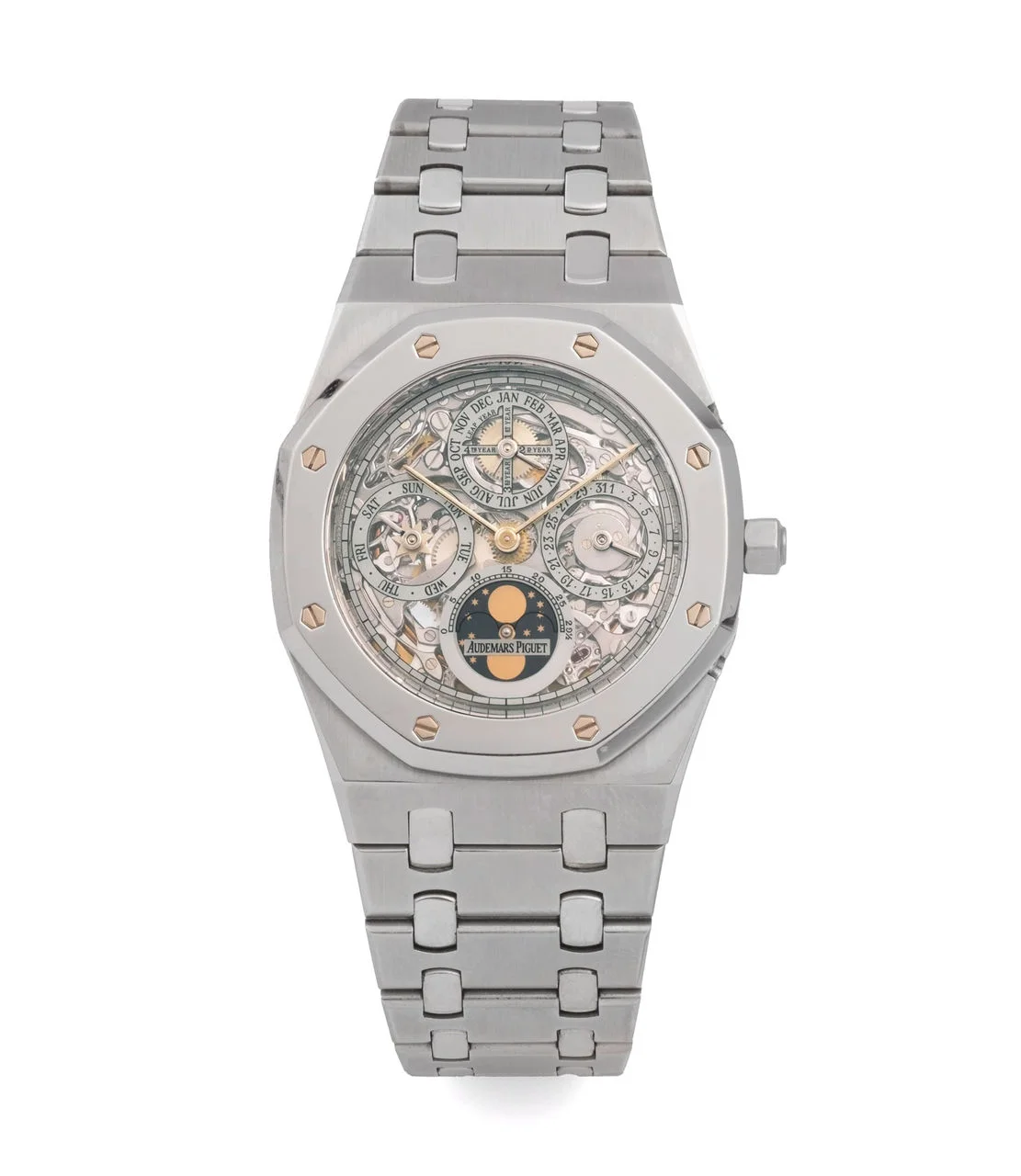
1998. Royal Oak Perpetual Calendar 25829SP, No. 18/25. Perpetual calendar: day, date, month, leap year cycle, phases and ages of the Moon. Calibre 2120/2802SQ selfwinding openworked, 405593 movement. Bracelet 944. Sapphire dial. 39 mm D86962 case in steel and platinum. Sold in Germany in 1998. Offered for sale by Antiquorum Geneva, on May 10, 2025, lot 577. Image © Antiquorum

1998. Royal Oak Perpetual Calendar 25829SP, No. 18/25. Perpetual calendar: day, date, month, leap year cycle, phases and ages of the Moon. Calibre 2120/2802SQ selfwinding openworked, 405593 movement. Bracelet 944. Sapphire dial. 39 mm D86962 case in steel and platinum. Sold in Germany in 1998. Offered for sale by Antiquorum Geneva, on May 10, 2025, lot 577. Image © Antiquorum
The combination of steel and platinum is particularly refined. Both metals share a grey hue, yet their subtle differences in tone and reflection create a captivating contrast.
This reference was produced with a sapphire dial and grey dial circumfrances, enhancing the harmony of its metallic palette.
The history of this distinctive variant begins with a limited edition of 25 pieces, presented in 1997 to mark the occasion of the 25th anniversary of the Royal Oak.
Two examples were later created based on the 25820SP model, each bearing small box numbers. One is numbered 61, while the other, 279, features the engravings "1/1" and "Marcus“, making it a unique piece crafted for the English retailer Marcus Margulies.
Sales breakdown (1997–2006)
Total: 27 pieces
1997: 15 | 1998: 10 | 2000: 1 | 2006: 1
The combination of steel and platinum is particularly refined. Both metals share a grey hue, yet their subtle differences in tone and reflection create a captivating contrast.
This reference was produced with a sapphire dial and grey dial circumfrances, enhancing the harmony of its metallic palette.
The history of this distinctive variant begins with a limited edition of 25 pieces, presented in 1997 to mark the occasion of the 25th anniversary of the Royal Oak.
Two examples were later created based on the 25820SP model, each bearing small box numbers. One is numbered 61, while the other, 279, features the engravings "1/1" and "Marcus“, making it a unique piece crafted for the English retailer Marcus Margulies.
Sales breakdown (1997–2006)
Total: 27 pieces
1997: 15 | 1998: 10 | 2000: 1 | 2006: 1

1997. Royal Oak Perpetual Calendar 25829TA, No. 28. Perpetual calendar: day, date, month, leap year cycle, phases and ages of the Moon. Calibre 2120/2802SQ selfwinding openworked, 425274 movement. Bracelet 944. Sapphire dial. 39 mm D82705 case in tantalum and yellow gold. Offered for sale by Christie's New York, on 10 June 2021, lot 330. Image © Christie’s

1997. Royal Oak Perpetual Calendar 25829TA, No. 28. Perpetual calendar: day, date, month, leap year cycle, phases and ages of the Moon. Calibre 2120/2802SQ selfwinding openworked, 425274 movement. Bracelet 944. Sapphire dial. 39 mm D82705 case in tantalum and yellow gold. Offered for sale by Christie's New York, on 10 June 2021, lot 330. Image © Christie’s

1995. Data sheet 25829TA. Audemars Piguet Archives.

1997. Identification photograph 25829TA. Audemars Piguet Archives.
Tantalum made its first appearance in an Audemars Piguet timepiece in 1986. This rare metal has since been used sparingly, always in combination with other materials to accentuate its deep, dark hue through contrast.
Naturally acid-resistant and hypoallergenic, tantalum is neutral to the skin. Its color is intrinsic to the metal and remains unchanged over time.
Three versions of reference 25829 were created using tantalum, each in extremely limited numbers. The first featured a blend of yellow gold and tantalum.
A total of 15 pieces were sold in 1997.
Tantalum made its first appearance in an Audemars Piguet timepiece in 1986. This rare metal has since been used sparingly, always in combination with other materials to accentuate its deep, dark hue through contrast.
Naturally acid-resistant and hypoallergenic, tantalum is neutral to the skin. Its color is intrinsic to the metal and remains unchanged over time.
Three versions of reference 25829 were created using tantalum, each in extremely limited numbers. The first featured a blend of yellow gold and tantalum.
A total of 15 pieces were sold in 1997.

1997. Royal Oak Perpetual Calendar 25829TP, No. 25. Perpetual calendar: day, date, month, leap year cycle, phases and ages of the Moon. Calibre 2120/2802SQ selfwinding openworked, movement 425280. Bracelet 944. Sapphire dial. 39 mm D80626 tantalum and platinum case. Sold in Great Britain in 1997. Offered for sale by Phillips Genève on May 6, 2022, lot 33. Image © Phillips

1997. Royal Oak Perpetual Calendar 25829TP, No. 25. Perpetual calendar: day, date, month, leap year cycle, phases and ages of the Moon. Calibre 2120/2802SQ selfwinding openworked, movement 425280. Bracelet 944. Sapphire dial. 39 mm D80626 tantalum and platinum case. Sold in Great Britain in 1997. Offered for sale by Phillips Genève on May 6, 2022, lot 33. Image © Phillips

1995. Datasheet 25829TP. Audemars Piguet Archives.

1997. Identification photograph 25829TP. Audemars Piguet Archives.
A rare combination, tantalum and platinum play with shades of grey.
Dark and understated, the middle and the links form the backdrop of the exterior, subtly enhancing the brilliance of platinum through contrast.
A total of 16 examples of reference 25829TP were produced and sold in 1997.
A rare combination, tantalum and platinum play with shades of grey.
Dark and understated, the middle and the links form the backdrop of the exterior, subtly enhancing the brilliance of platinum through contrast.
A total of 16 examples of reference 25829TP were produced and sold in 1997.

1997. Royal Oak Perpetual Calendar 25829TR, No. 1. Perpetual calendar: day, date, month, leap year cycle, phases and ages of the Moon. Calibre 2120/2802SQ selfwinding openworked, 425246 movement. Bracelet 944. Sapphire dial. 39 mm E60652 case in tantalum and rose gold. Sold in France in 1997. On sale by Sotheby's Hong Kong, June 15, 2022. Image © Sotheby’s

1997. Royal Oak Perpetual Calendar 25829TR, No. 1. Perpetual calendar: day, date, month, leap year cycle, phases and ages of the Moon. Calibre 2120/2802SQ selfwinding openworked, 425246 movement. Bracelet 944. Sapphire dial. 39 mm E60652 case in tantalum and rose gold. Sold in France in 1997. On sale by Sotheby's Hong Kong, June 15, 2022. Image © Sotheby’s

1995. 25829TR Data Sheet. Audemars Piguet Archives.

1997. Identification photograph 25829TR. Audemars Piguet Archives.
The warmth of rose gold engages in a subtle dialogue with the dark reflections of tantalum.
The sapphire dial is accented by counters with pink gold surrounds, perfectly echoing the bezel, crown, and studs – a composition of rich contrast and harmony.
Sales breakdown (1997–2000)
Total: 16 pieces
1997: 10 | 1999: 3 | 2000: 2
The warmth of rose gold engages in a subtle dialogue with the dark reflections of tantalum.
The sapphire dial is accented by counters with pink gold surrounds, perfectly echoing the bezel, crown, and studs – a composition of rich contrast and harmony.
Sales breakdown (1997–2000)
Total: 16 pieces
1997: 10 | 1999: 3 | 2000: 2

2007. Royal Oak Perpetual Calendar 25829OR, No. 297. Perpetual calendar: day, date, month, leap year cycle, phases and ages of the Moon. Calibre 2120/2802SQ selfwinding openworked, movement 719572. Bracelet 944. Sapphire dial. 39 mm pink gold case G71986. Offered for sale by Phillips Hong Kong, June 6, 2021, lot 807. Image © Phillips

2007. Royal Oak Perpetual Calendar 25829OR, No. 297. Perpetual calendar: day, date, month, leap year cycle, phases and ages of the Moon. Calibre 2120/2802SQ selfwinding openworked, movement 719572. Bracelet 944. Sapphire dial. 39 mm pink gold case G71986. Offered for sale by Phillips Hong Kong, June 6, 2021, lot 807. Image © Phillips

2003. Technical sheet 25829OR. Audemars Piguet Archives.

Around 2005. Image of model 25829OR from the AP General Catalogue. Audemars Piguet Archives.

Around 2005. Identification photograph 25829OR. Audemars Piguet Archives.

2002-2004. The rose gold variant of the 25829 model appears in the AP general catalogues from 2002 to 2004 with pink counters. Audemars Piguet Archives.

2005-2013. As early as 2005, the AP general catalogues presented the 25829OR model with white counters, without changing the dial number. Audemars Piguet Archives.
It was not until 1999 that 18-carat rose gold made its appearance in the 25829 model. This alloy offers a distinctive contrast between the cool tones of the movement’s steel components and the warm radiance of gold.
This version features a single dial configuration: sapphire crystal with white counters. Time is indicated by blackened yellow gold leaf hands for the hours and minutes, while the calendar functions are marked by blued steel hands.
Sales breakdown (1999–2015)
Total: 174 pieces
1999: 1 | 2002: 4 | 2003: 2 | 2004: 14 | 2005: 20 | 2006: 22 | 2007: 29 | 2008: 25 | 2009: 32 | 2010: 5 | 2011: 6 | 2012: 8 | 2013: 4 | 2014: 1 | 2015: 1
It was not until 1999 that 18-carat rose gold made its appearance in the 25829 model. This alloy offers a distinctive contrast between the cool tones of the movement’s steel components and the warm radiance of gold.
This version features a single dial configuration: sapphire crystal with white counters. Time is indicated by blackened yellow gold leaf hands for the hours and minutes, while the calendar functions are marked by blued steel hands.
Sales breakdown (1999–2015)
Total: 174 pieces
1999: 1 | 2002: 4 | 2003: 2 | 2004: 14 | 2005: 20 | 2006: 22 | 2007: 29 | 2008: 25 | 2009: 32 | 2010: 5 | 2011: 6 | 2012: 8 | 2013: 4 | 2014: 1 | 2015: 1