


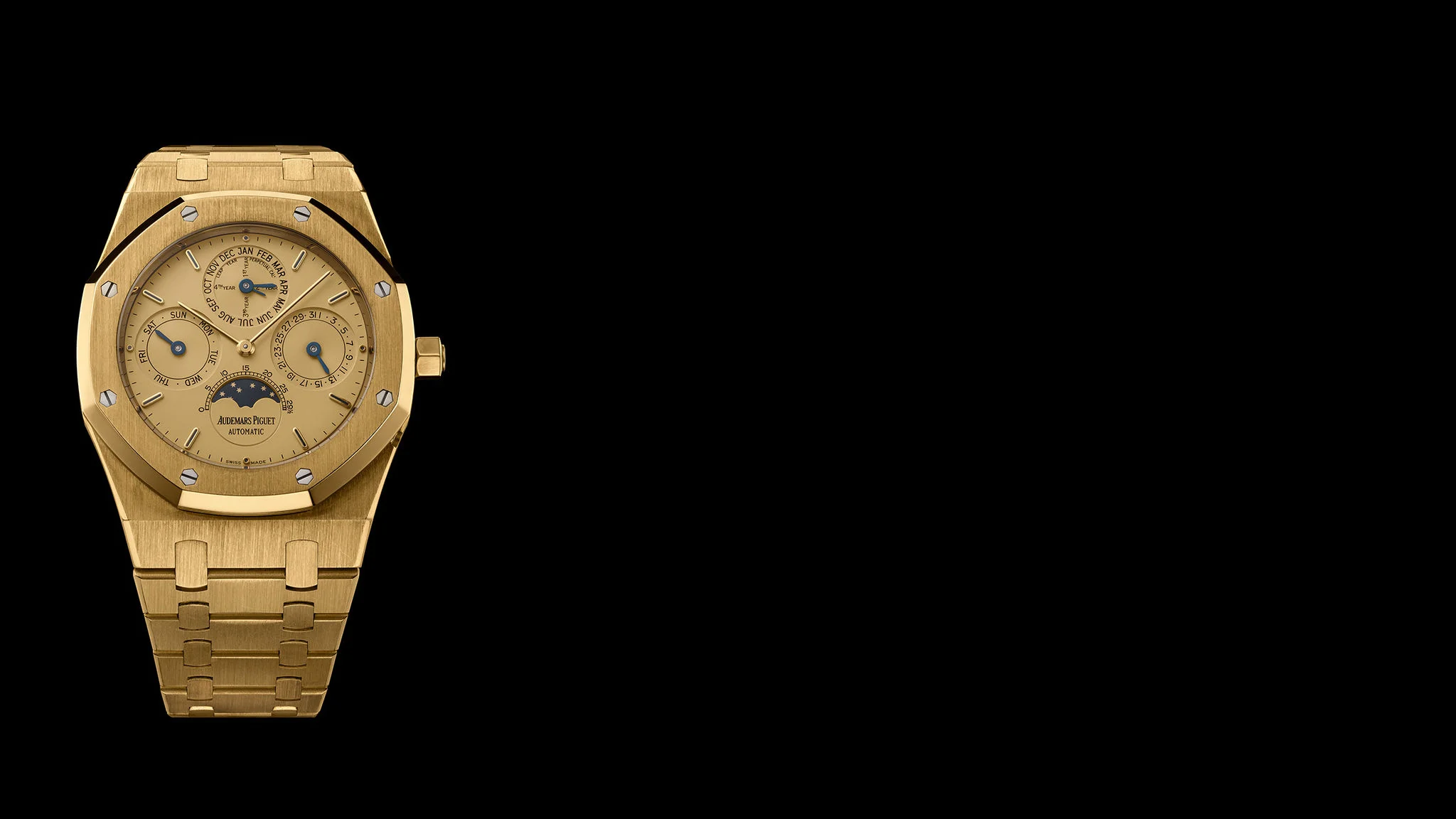
25820, ROYAL OAK

1998. Royal Oak Perpetual Calendar 25820TP, No. 20. Perpetual calendar: day, date, month, leap year cycle, phase and age of the Moon. Calibre 2120/2802 selfwinding, 425243 movement. Bracelet 944. 39 mm case D80592. Tantalum and platinum. Sold in France in 1998. Audemars Piguet Heritage Collection, Inv. 875.

1996. General catalogue AP. This page presents the first two variants of the Royal Oak perpetual calendar with leap year indication, models 25820 and 25829. Audemars Piguet Archives.

2005. Royal Oak Perpetual Calendar in steel and platinum. Calibre 2120/2802. Image by Audemars Piguet in 2005. Audemars Piguet Archives.

1996. Technical data sheet presenting the yellow gold variant of the 25820 model. Audemars Piguet Archives.

1995. Plan of the 25829 case, which also equips the Royal Oak Perpetual Calendar 25820. Audemars Piguet Archives
The saga of the Royal Oak perpetual calendar began in 1984, following a long and complex development process. Over time, the collection expanded and gained increasing acclaim. The idea of incorporating a leap year indicator gradually took hold, and in 1996, the Calibre 2120/2800 was updated to meet this demand – reborn as the Calibre 2120/2802.
This evolution introduced a small hand at 12 o’clock that completes a full rotation every four years, tracking the leap year cycle from one 29 February to the next. It is layered over the 12-month hand, which completes its own annual revolution.
Produced in 1,241 pieces between 1996 and 2010, reference 25820 became the most widely manufactured Royal Oak perpetual calendar equipped with the Calibre 2120/2802. It surpassed the openworked version 25829 (876 pieces), the gem-set variants (25930, 25917, and 26017), and the later reference 25252 (2008–2013).
Although the 25820 remained in the Audemars Piguet catalogueue for nearly two decades, sales began to decline sharply after 2008, with production ceasing entirely four years later.
The Royal Oak Perpetual Calendar would not return to centre stage until 2015, with the launch of the 41 mm reference 26574, powered by the new Calibre 5134.
Note: The 25820 is derived from the 25829 model.
Sales breakdown (1996–2011):
Total: 1,241 pieces
1996: 11 | 1997: 56 | 1998: 43 | 1999: 122 | 2000: 120 | 2001: 120 | 2002: 81 | 2003: 110 | 2004: 124 | 2005: 131 | 2006: 82 | 2007: 154 | 2008: 56 | 2009: 26 | 2010: 4 | 2011: 1
The saga of the Royal Oak perpetual calendar began in 1984, following a long and complex development process. Over time, the collection expanded and gained increasing acclaim. The idea of incorporating a leap year indicator gradually took hold, and in 1996, the Calibre 2120/2800 was updated to meet this demand – reborn as the Calibre 2120/2802.
This evolution introduced a small hand at 12 o’clock that completes a full rotation every four years, tracking the leap year cycle from one 29 February to the next. It is layered over the 12-month hand, which completes its own annual revolution.
Produced in 1,241 pieces between 1996 and 2010, reference 25820 became the most widely manufactured Royal Oak perpetual calendar equipped with the Calibre 2120/2802. It surpassed the openworked version 25829 (876 pieces), the gem-set variants (25930, 25917, and 26017), and the later reference 25252 (2008–2013).
Although the 25820 remained in the Audemars Piguet catalogueue for nearly two decades, sales began to decline sharply after 2008, with production ceasing entirely four years later.
The Royal Oak Perpetual Calendar would not return to centre stage until 2015, with the launch of the 41 mm reference 26574, powered by the new Calibre 5134.
Note: The 25820 is derived from the 25829 model.
Sales breakdown (1996–2011):
Total: 1,241 pieces
1996: 11 | 1997: 56 | 1998: 43 | 1999: 122 | 2000: 120 | 2001: 120 | 2002: 81 | 2003: 110 | 2004: 124 | 2005: 131 | 2006: 82 | 2007: 154 | 2008: 56 | 2009: 26 | 2010: 4 | 2011: 1
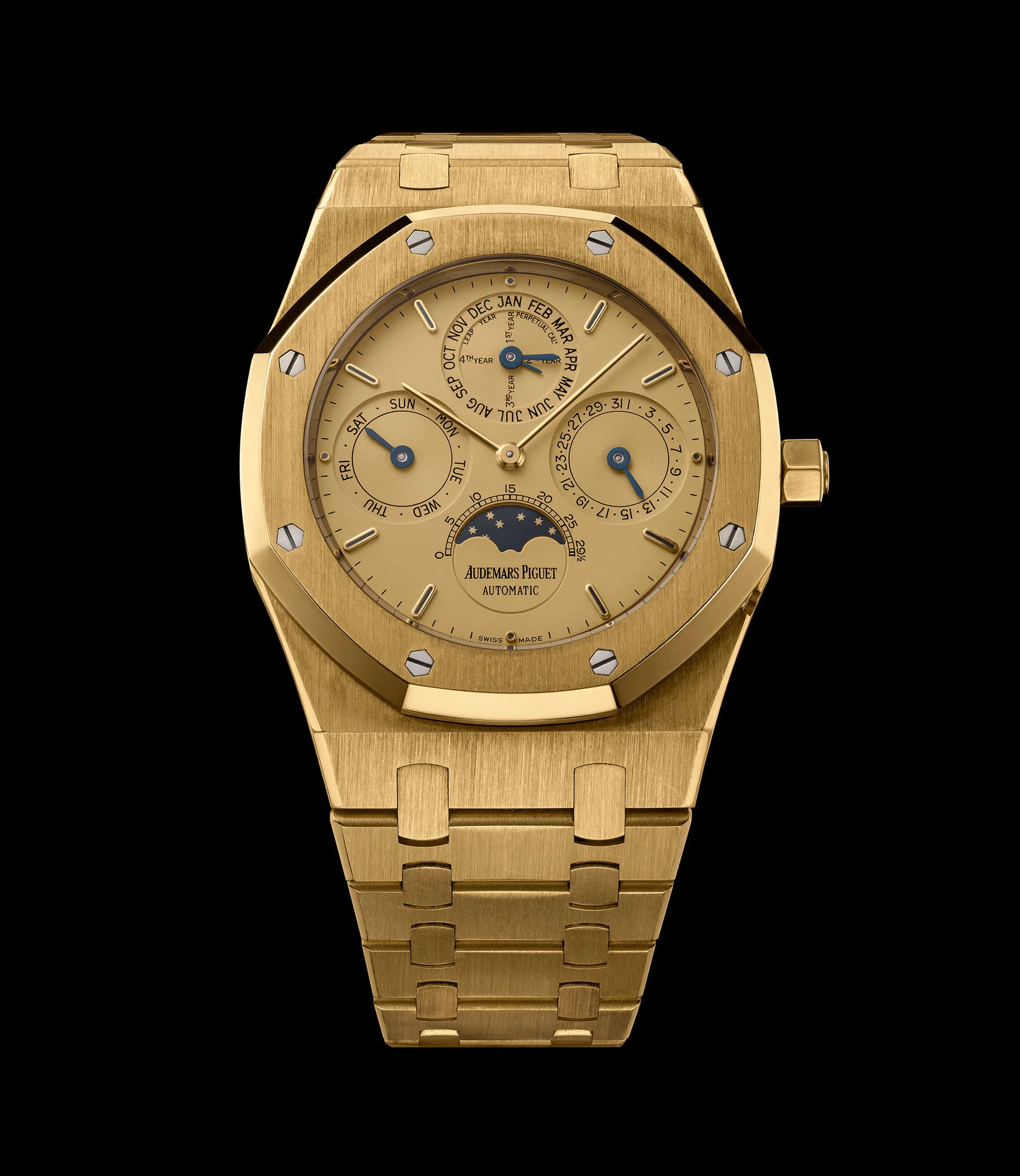
2003. Royal Oak Perpetual Calendar 25820BA, No. 100. Perpetual calendar: day, date, month, leap year cycle, phase and age of the Moon. Calibre 2120/2802 selfwinding, 548784 movement. Bracelet 944. White Grande Tapisserie dial. 39 mm case E73342. Yellow gold. Sold in New York in 2003. Audemars Piguet Heritage Collection, Inv. 1661.

2003. Royal Oak Perpetual Calendar 25820BA, No. 88. Perpetual calendar: day, date, month, leap year cycle, phase and age of the Moon. Calibre 2120/2802 selfwinding, 548325 movement. Bracelet 944. Gold-tone dial. 39 mm case F73330. Yellow gold. Sold in New York in 2003. Auctioned by Christie's Dubai, 27 October 2021, lot 48. Image © Antiquorum.

2003. Royal Oak Perpetual Calendar 25820BA, No. 88. Perpetual calendar: day, date, month, leap year cycle, phase and age of the Moon. Calibre 2120/2802 selfwinding, 548325 movement. Bracelet 944. Gold-tone dial. 39 mm case F73330. Yellow gold. Sold in New York in 2003. Auctioned by Christie's Dubai, 27 October 2021, lot 48. Image © Antiquorum.

The identification photograph in the Audemars Piguet reference bible indicates that model 25820 has a case made by Favre Perret, and that it is a variation of the skeletonized model 25829. Audemars Piguet Archives.
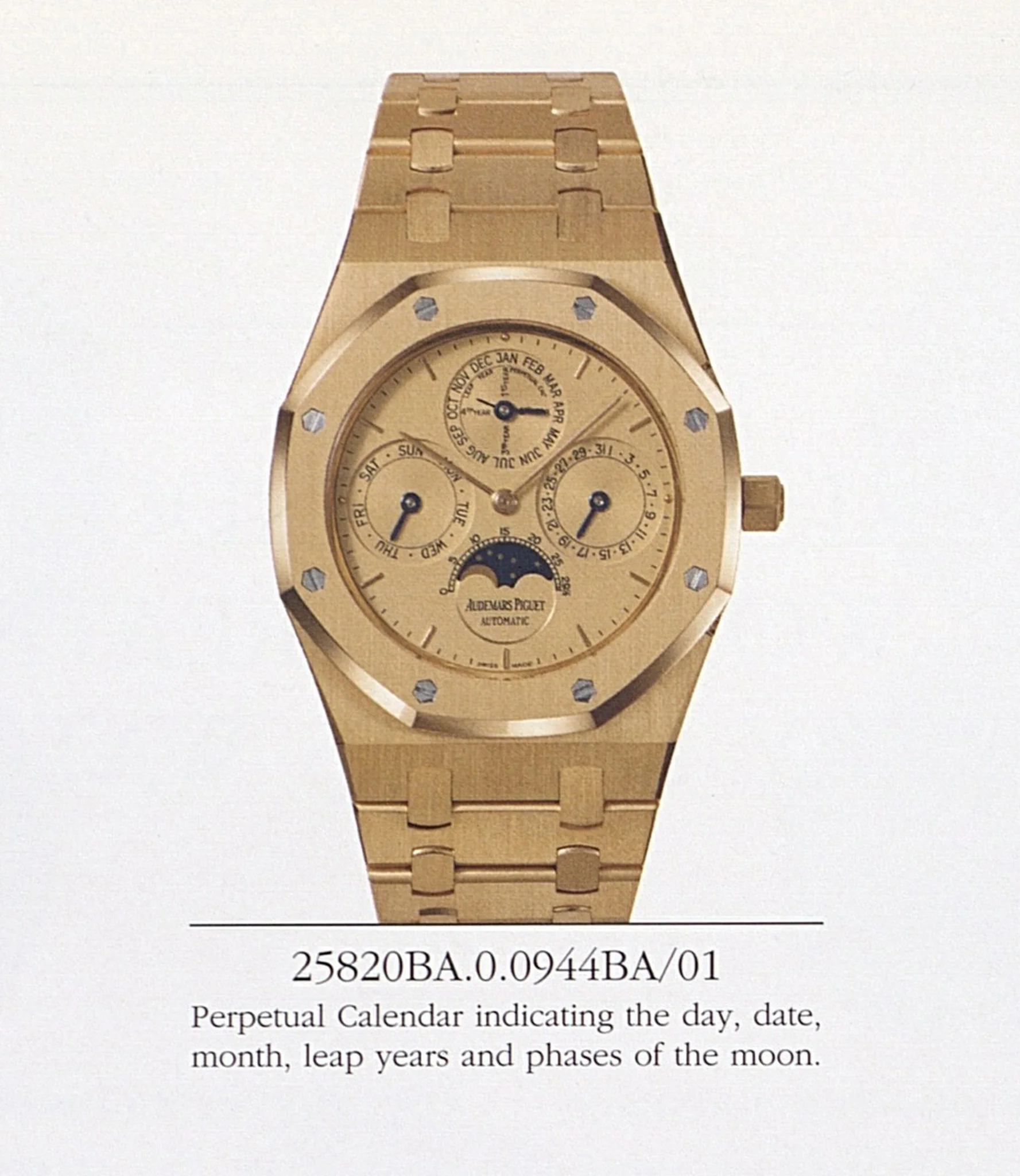
1996 – 2002. The monochrome yellow version ("satin gilt" dial) is the first to appear in the brand's catalogueues. Model published from 1996 to 2001. Audemars Piguet Archives.
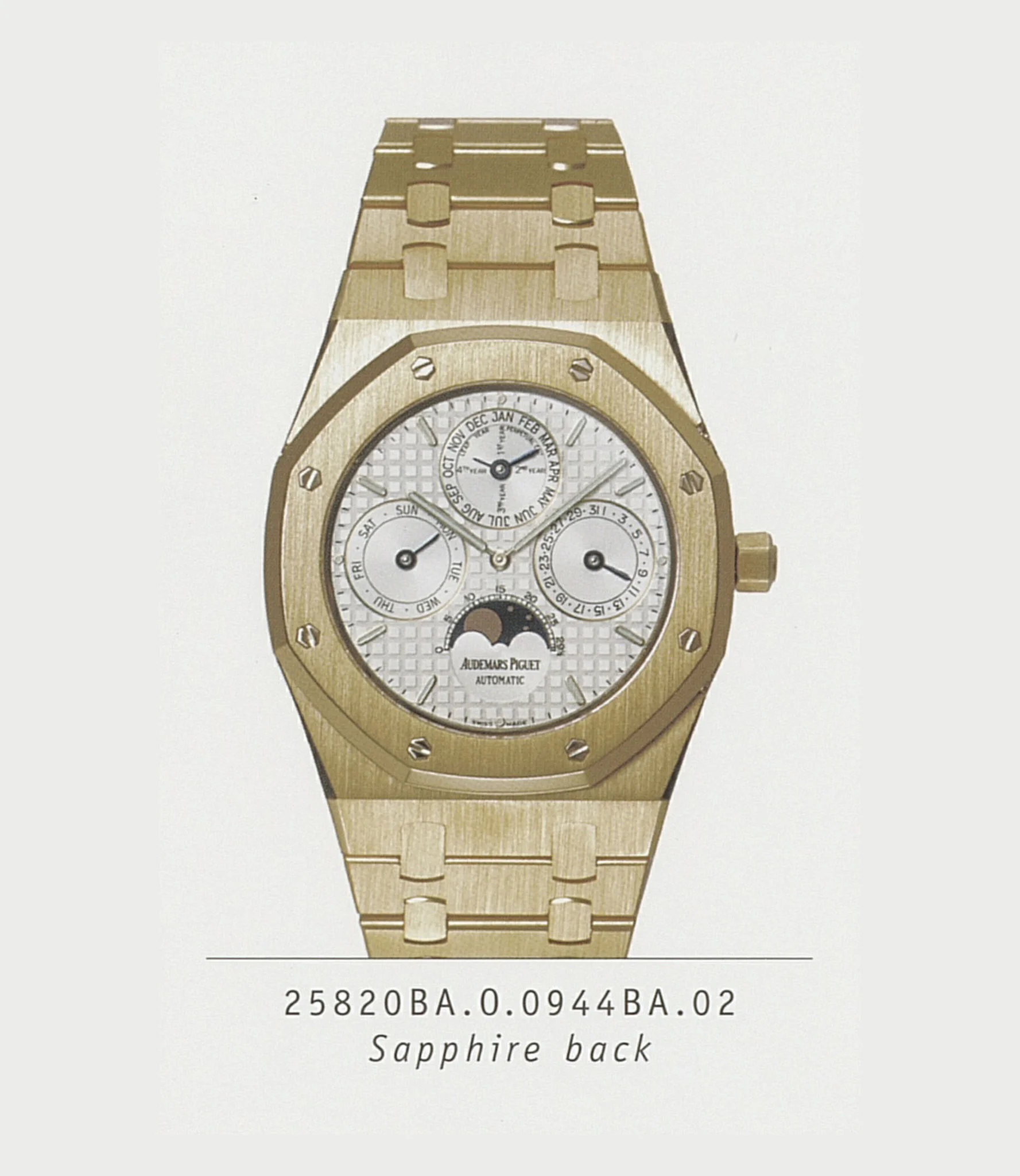
2002-2013. Tapisserie is introduced on the yellow gold model 25820 in 2002. Model published in the AP catalogueue from 2002 until at least 2013. Audemars Piguet Archives.

2002. Royal Oak Perpetual Calendar 25820BA, No. 88. Perpetual calendar: day, date, month, leap year cycle, phase and age of the Moon. Calibre 2120/2802 selfwinding, 396841 movement. Bracelet 944. White Grande Tapisserie dial. 39 mm case P00026. Yellow gold. Prototype made for the launch of the model. Audemars Piguet Heritage, Inv. 842
The story of the 25820 model begins with its yellow gold version – the only one offered at launch in 1996, and remarkably, still featured in the catalogueue 17 years later.
Its first iteration showcased a golden dial, creating a striking monochrome aesthetic. The slender yellow hour markers and hands, free of any luminescent material, enhanced the sense of visual purity. Presented in 2002, the second iteration embraced contrast, pairing a silver-toned dial with the signature Grande Tapisserie motif for added texture.
Sales breakdown (1996–2008):
Total: 108 pieces
1996: 1 | 1997: 5 | 1998: 15 | 1999: 6 | 2000: 3 | 2001: 11 | 2002: 3 | 2003: 14 | 2004: 7 | 2005: 12 | 2006: 13 | 2007: 13 | 2008: 5
The story of the 25820 model begins with its yellow gold version – the only one offered at launch in 1996, and remarkably, still featured in the catalogueue 17 years later.
Its first iteration showcased a golden dial, creating a striking monochrome aesthetic. The slender yellow hour markers and hands, free of any luminescent material, enhanced the sense of visual purity. Presented in 2002, the second iteration embraced contrast, pairing a silver-toned dial with the signature Grande Tapisserie motif for added texture.
Sales breakdown (1996–2008):
Total: 108 pieces
1996: 1 | 1997: 5 | 1998: 15 | 1999: 6 | 2000: 3 | 2001: 11 | 2002: 3 | 2003: 14 | 2004: 7 | 2005: 12 | 2006: 13 | 2007: 13 | 2008: 5
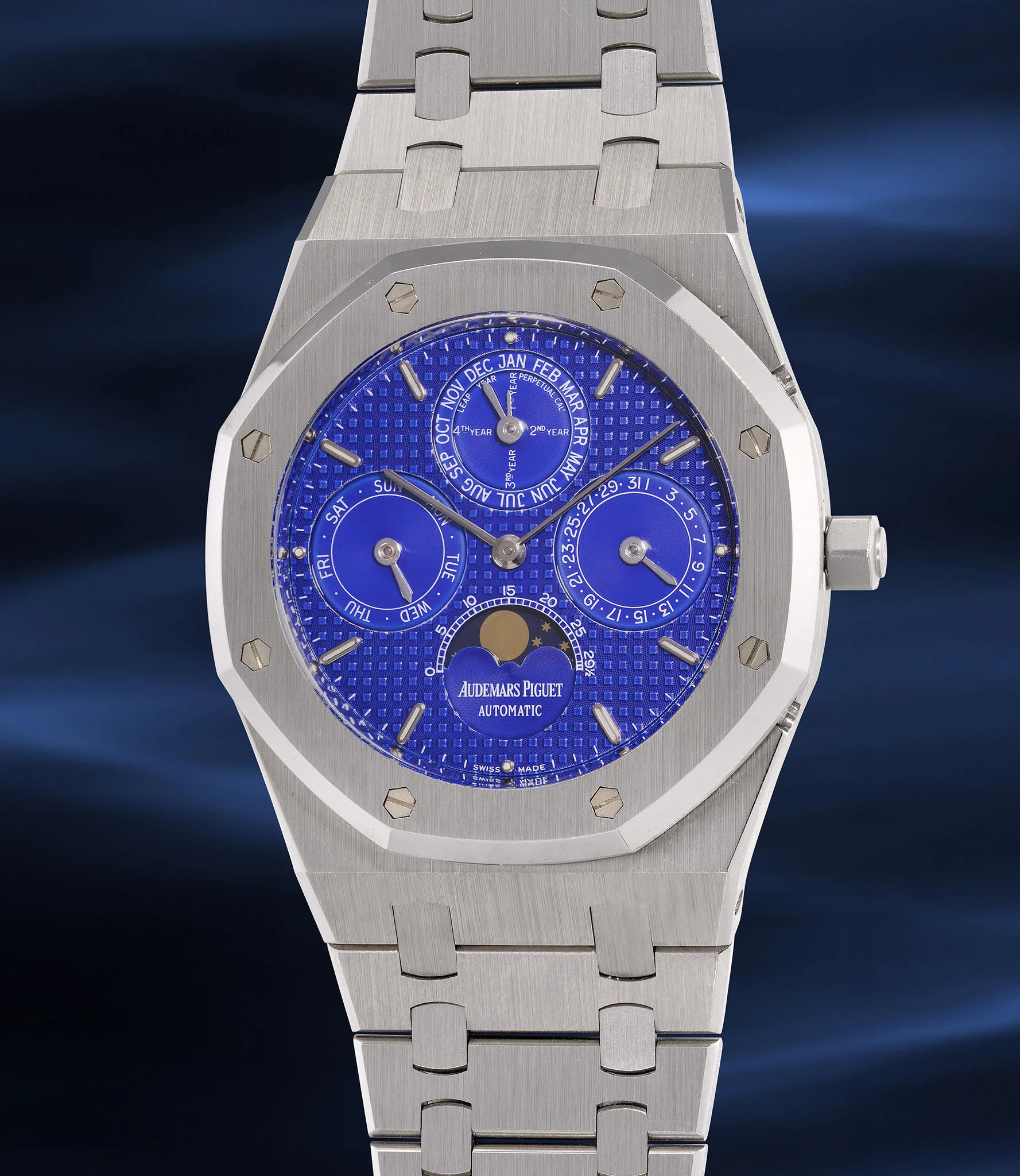
2001. Royal Oak Perpetual Calendar 25820ST, No. 188. Perpetual calendar: day, date, month, leap year cycle, phase and age of the Moon. Calibre 2120/2802 selfwinding, 439204 movement. Bracelet 944. "Sapphire blue" dial, nicknamed "Yves Klein blue" by collectors. 39 mm case E33654. Steel. Sold in Italy in 2001. Sold by Phillips in Geneva on 24 November 2024, lot 841. Image ©Phillips.

1996 – 2002. The monochrome grey version ("satin silver" dial) is the first to appear in the brand's catalogueues. Model published from 1996 to 2001. Audemars Piguet Archives.
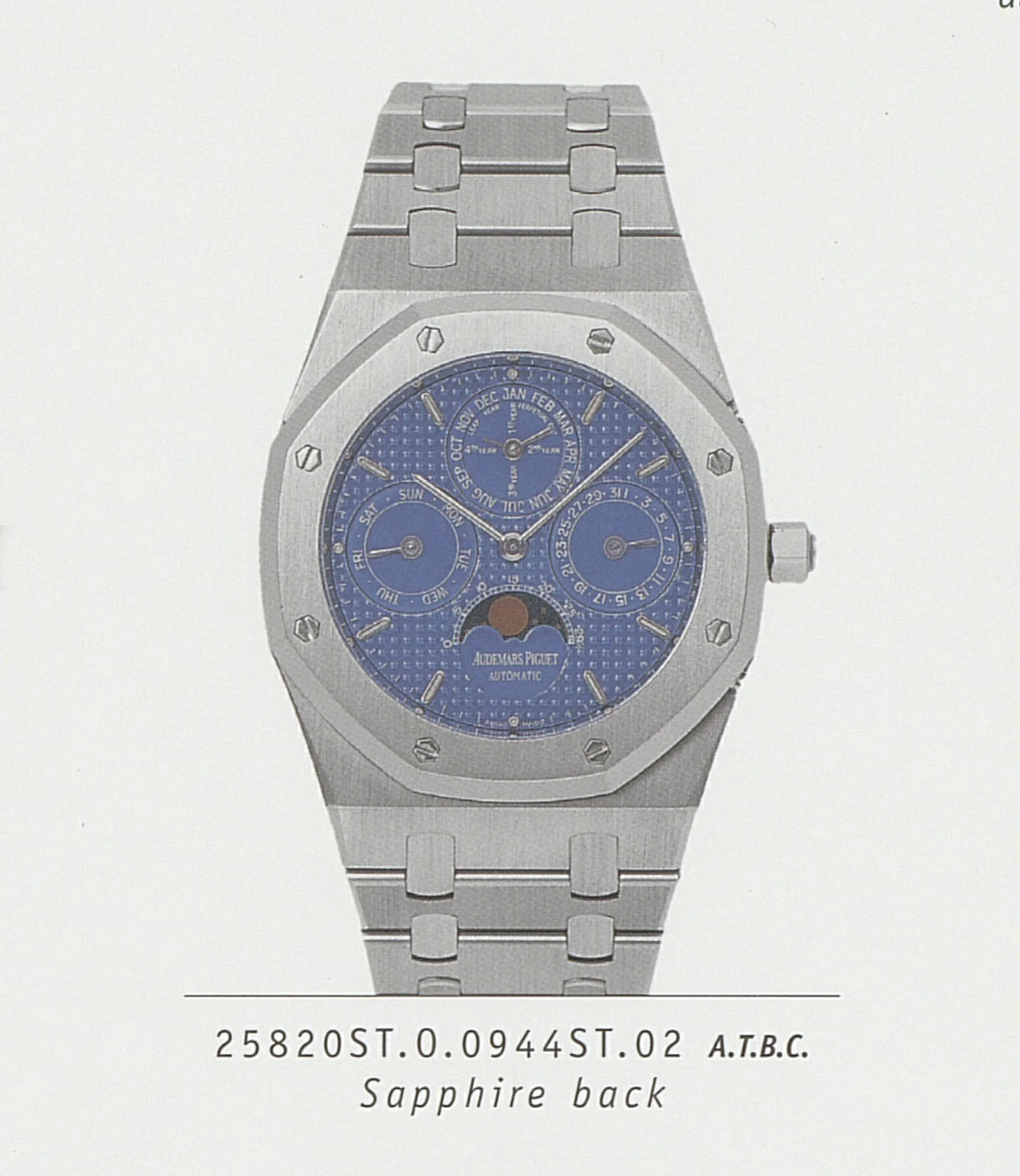
2000-2002. Introduced in the AP catalogueue in 2000-2001, published until 2002, its dial is described as "blue saphire", nicknamed "Yves Klein Blue" by collectors. Audemars Piguet Archives.

2001. General catalogueue AP. Five years after its launch, the 25820 model is available in 5 variants, 4 of which are in steel and one combining steel and platinum. Audemars Piguet Archives.

2001-2013. The Grande Tapisserie appears in the AP catalogueue 2001-2002 in white ("silver biq") and blue ("cosmos blue"). Model published until at least 2013. Audemars Piguet Archives.
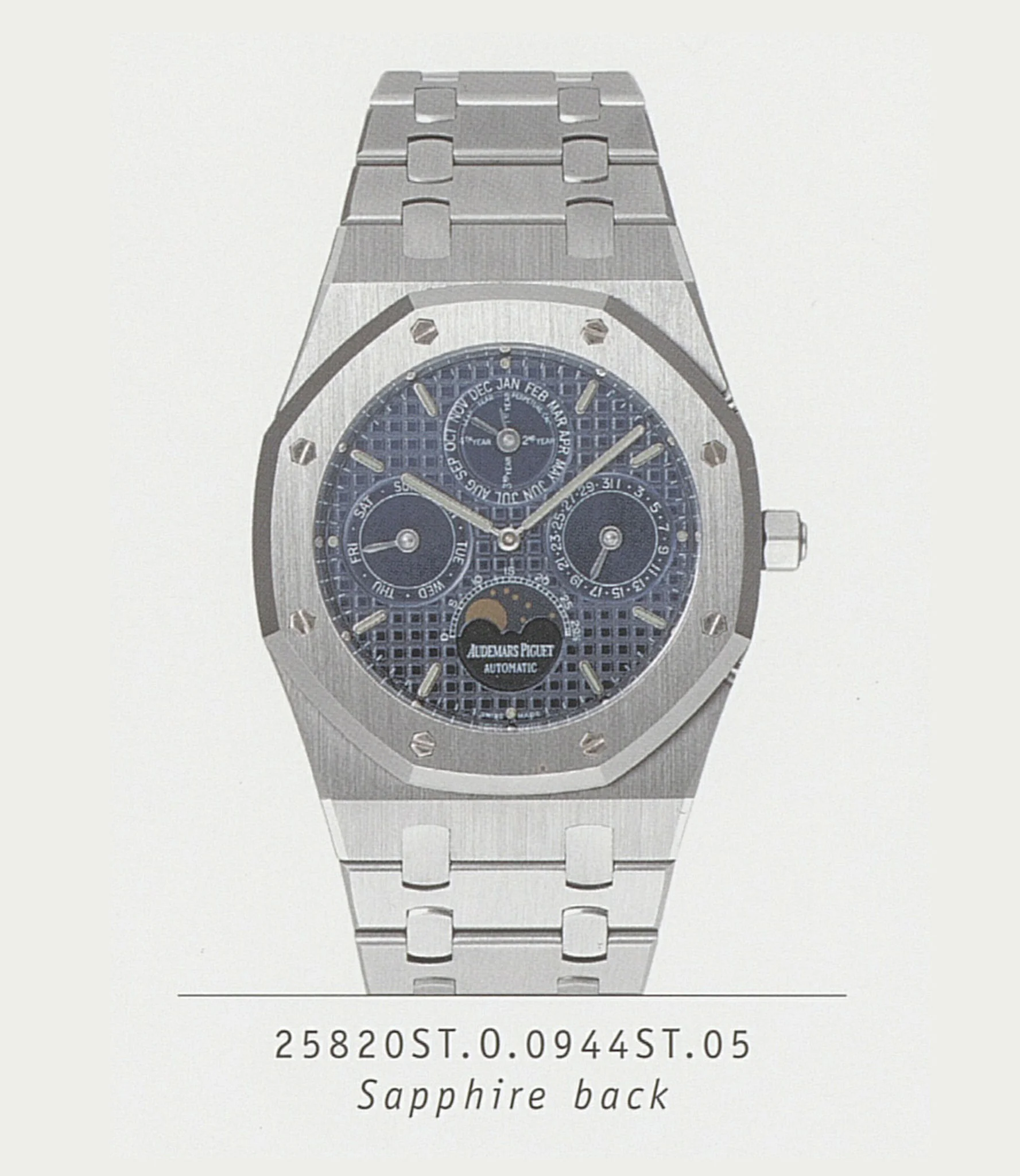
2001-2013. The Grande Tapisserie appears in the AP catalogueue 2001-2002 in white ("silver biq") and blue ("cosmos blue"). Model published until at least 2013. Audemars Piguet Archives.

2001-2013. Appearing in the 2001-2002 catalogueue, this Petite Tapisserie variant was then called "dark blue", then "grey-blue". Model offered until at least 2013. Audemars Piguet Archives.

2005. Royal Oak Perpetual Calendar 25820ST, No. 624. Perpetual calendar: day, date, month, leap year cycle, phase and age of the Moon. Calibre 2120/2802 selfwinding, 549571 movement. Bracelet 944. "Dark blue" dial. 39 mm box F45294. Steel. Sold in New York in 2006. Auctioned by Antiquorum Genève on 10 November 2024, lot 557. Image © Antiquorum.

2005. Royal Oak Perpetual Calendar 25820ST, No. 624. Perpetual calendar: day, date, month, leap year cycle, phase and age of the Moon. Calibre 2120/2802 selfwinding, 549571 movement. Bracelet 944. "Dark blue" dial. 39 mm box F45294. Steel. Sold in New York in 2006. Auctioned by Antiquorum Genève on 10 November 2024, lot 557. Image © Antiquorum.
The steel variant of the 25820 model appeared in the 1996 catalogueue, but wasn’t until the following year that it officially went on sale, with just six units. Since then, sales have gradually increased, fluctuating between 20 and 80 watches annually, peaking at 92 units in 2007 before declining and disappearing entirely in 2012.
With over 600 pieces sold in 14 years, the steel varient is the most widely produced version of this reference, having been offered in six different dial configurations.
The earliest dial was also the only one without the Tapisserie motif, featuring a grey tone that harmonised with the steel case. Introduced in 2000, the second dial featured a Petite Tapisserie motif. While the catalogueue describes its colour as "sapphire blue“, collectors have affectionately dubbed it "Yves Klein blue“, due to its resemblance to the iconic International Klein Blue (IKB) developed by French artist Yves Klein (1928-1962).
Tapisserie dials became more prevalent in the 2000s, offered in various shades of blue and white. Also of note is the introduction of luminescent hour markers and hands in the 21st century.
Sales breakdown (1997–2011):
Total: 629 pieces
1997: 6 | 1998: 23 | 1999: 53 | 2000: 52 | 2001: 43 | 2002: 32 | 2003: 58 | 2004: 81 | 2005: 84 | 2006: 49 | 2007: 92 | 2008: 29 | 2009: 23 | 2010: 3 | 2011: 1
The steel variant of the 25820 model appeared in the 1996 catalogueue, but wasn’t until the following year that it officially went on sale, with just six units. Since then, sales have gradually increased, fluctuating between 20 and 80 watches annually, peaking at 92 units in 2007 before declining and disappearing entirely in 2012.
With over 600 pieces sold in 14 years, the steel varient is the most widely produced version of this reference, having been offered in six different dial configurations.
The earliest dial was also the only one without the Tapisserie motif, featuring a grey tone that harmonised with the steel case. Introduced in 2000, the second dial featured a Petite Tapisserie motif. While the catalogueue describes its colour as "sapphire blue“, collectors have affectionately dubbed it "Yves Klein blue“, due to its resemblance to the iconic International Klein Blue (IKB) developed by French artist Yves Klein (1928-1962).
Tapisserie dials became more prevalent in the 2000s, offered in various shades of blue and white. Also of note is the introduction of luminescent hour markers and hands in the 21st century.
Sales breakdown (1997–2011):
Total: 629 pieces
1997: 6 | 1998: 23 | 1999: 53 | 2000: 52 | 2001: 43 | 2002: 32 | 2003: 58 | 2004: 81 | 2005: 84 | 2006: 49 | 2007: 92 | 2008: 29 | 2009: 23 | 2010: 3 | 2011: 1
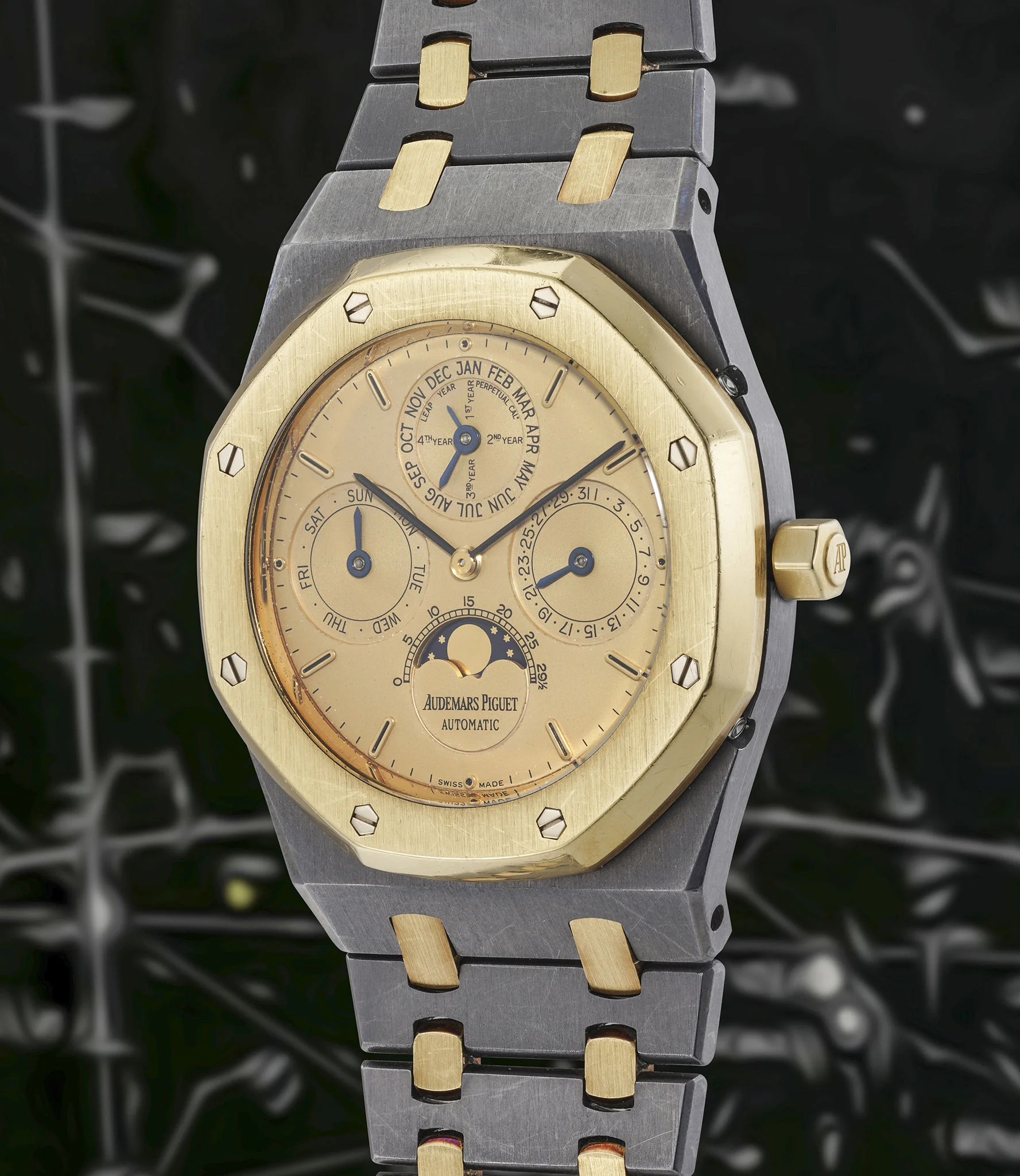
1999. Royal Oak Perpetual Calendar 25820PT, No. 8. Perpetual calendar: day, date, month, leap year cycle, phase and age of the Moon. Calibre 2120/2802 selfwinding, 396958 movement. Bracelet 944. Gold dial. 39 mm box D80584. Yellow gold and tantalum. Sold in Great Britain 1996. Auctioned by Phillips New York on May 11, 2025, lot 33. Image © Phillips

1999. Royal Oak Perpetual Calendar 25820PT, No. 8. Perpetual calendar: day, date, month, leap year cycle, phase and age of the Moon. Calibre 2120/2802 selfwinding, 396958 movement. Bracelet 944. Gold dial. 39 mm box D80584. Yellow gold and tantalum. Sold in Great Britain 1996. Auctioned by Phillips New York on May 11, 2025, lot 33. Image © Phillips

1996. Model 25820TA technical sheet. Audemars Piguet Archives.

Circa 1996. ID image for the 25820TA watch. Audemars Piguet Archives.
In 1996, Audemars Piguet launched production of three limited editions of 15 two-tone pieces featuring tantalum cases and centre links, paired with studs and bezels in either yellow gold, pink gold, or platinum.
Tantalum, a dark-toned, hypoallergenic, and exceptionally rare metal, was introduced into watchmaking by Audemars Piguet in the 1980s at the request of several monarchs who desired a black watch. Though notoriously difficult to work with, its unique properties and aesthetic appeal made it a compelling choice.
The TA variant is distinguished by its gold-plated dial and blackened yellow gold hands and hour markers, creating a bold contrast of tones and textures.
Sales breakdown (1996–1999):
Total: 15 pieces
1996: 10 | 1997: 3 | 1999: 2
In 1996, Audemars Piguet launched production of three limited editions of 15 two-tone pieces featuring tantalum cases and centre links, paired with studs and bezels in either yellow gold, pink gold, or platinum.
Tantalum, a dark-toned, hypoallergenic, and exceptionally rare metal, was introduced into watchmaking by Audemars Piguet in the 1980s at the request of several monarchs who desired a black watch. Though notoriously difficult to work with, its unique properties and aesthetic appeal made it a compelling choice.
The TA variant is distinguished by its gold-plated dial and blackened yellow gold hands and hour markers, creating a bold contrast of tones and textures.
Sales breakdown (1996–1999):
Total: 15 pieces
1996: 10 | 1997: 3 | 1999: 2
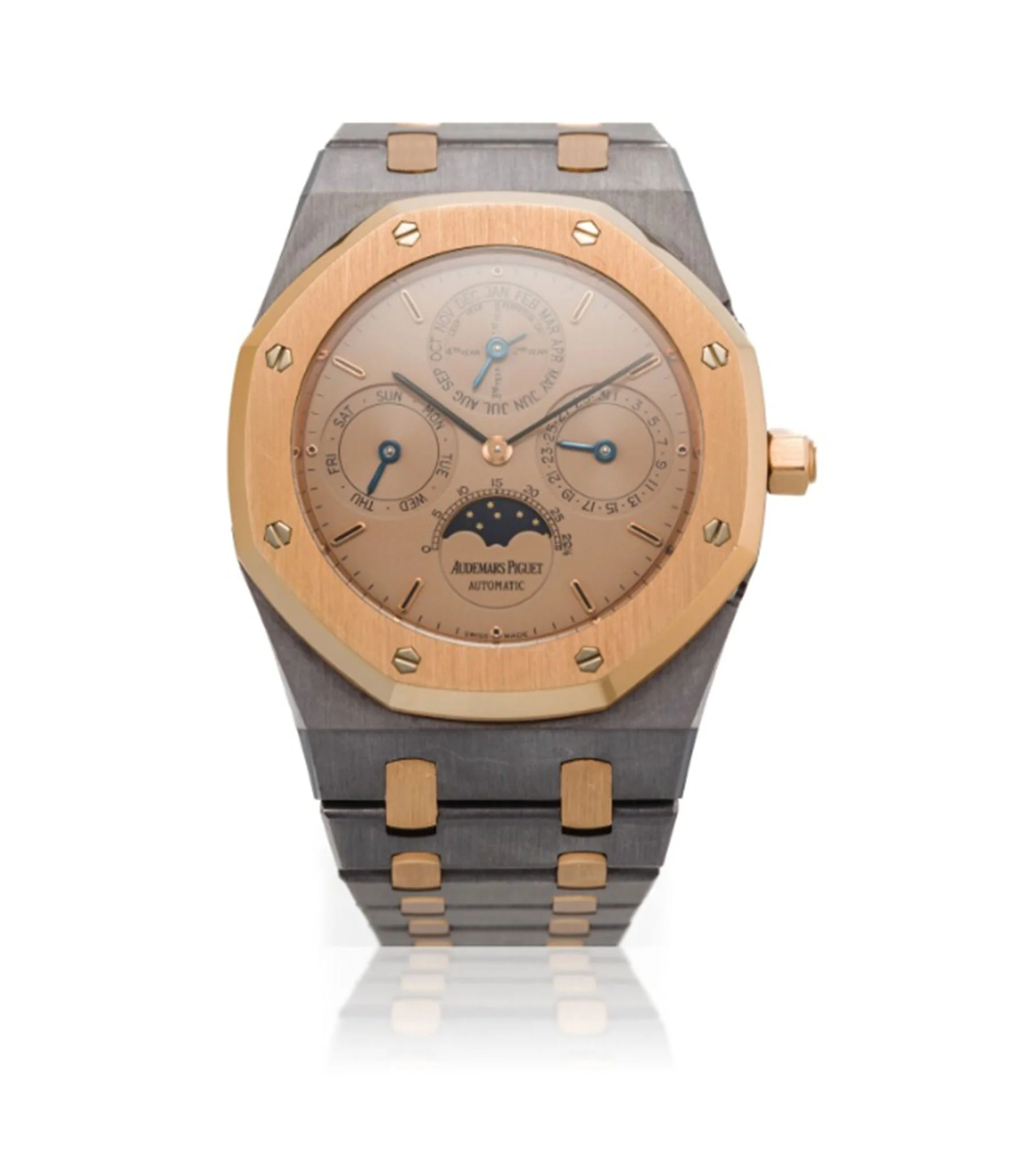
1997. Royal Oak Perpetual Calendar 25820TR, No. 2. Perpetual calendar: day, date, month, leap year cycle, phase and age of the Moon. Calibre 2120/2802 selfwinding, 396998 movement. Bracelet 944. 39 mm box D80633. Tantalum and rose gold. Sold in Great Britain in 1997. Auctioned by Sotheby's New York, June 15, 2022, lot 22. Image © Sotheby’s

1997. Royal Oak Perpetual Calendar 25820TR, No. 2. Perpetual calendar: day, date, month, leap year cycle, phase and age of the Moon. Calibre 2120/2802 selfwinding, 396998 movement. Bracelet 944. 39 mm box D80633. Tantalum and rose gold. Sold in Great Britain in 1997. Auctioned by Sotheby's New York, June 15, 2022, lot 22. Image © Sotheby’s

1997. Royal Oak Perpetual Calendar 25820TR, No. 2. Perpetual calendar: day, date, month, leap year cycle, phase and age of the Moon. Calibre 2120/2802 selfwinding, 396998 movement. Bracelet 944. 39 mm box D80633. Tantalum and rose gold. Sold in Great Britain in 1997. Auctioned by Sotheby's New York, June 15, 2022, lot 22. Image © Sotheby’s

1996. Data sheet reference 25820TR. Audemars Piguet Archives.
Only 13 examples of the Royal Oak Perpetual Calendar 25820 were produced combining pink gold and tantalum. The colour of the dial and hour markers echoes that of the bezel and studs, creating a harmonious and distinctive aesthetic.
Sales breakdown (1997–1999):
Total: 13 pieces
1997: 8 | 1999: 5
Only 13 examples of the Royal Oak Perpetual Calendar 25820 were produced combining pink gold and tantalum. The colour of the dial and hour markers echoes that of the bezel and studs, creating a harmonious and distinctive aesthetic.
Sales breakdown (1997–1999):
Total: 13 pieces
1997: 8 | 1999: 5
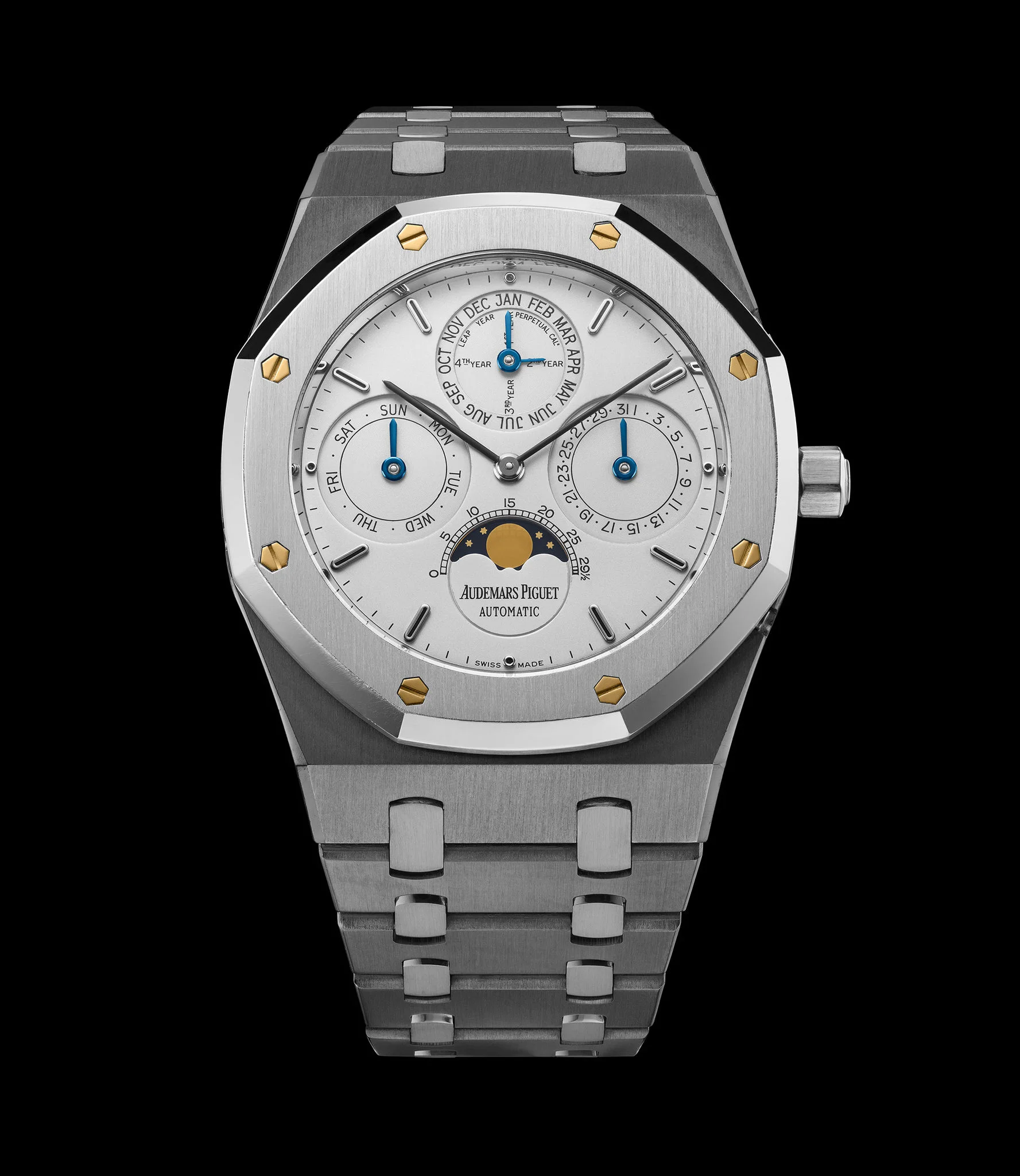
1998. Royal Oak Perpetual Calendar 25820TP, No. 20. Perpetual calendar: day, date, month, leap year cycle, phase and age of the Moon. Calibre 2120/2802 selfwinding, 425243 movement. Bracelet 944. 39 mm case D80592. Tantalum and platinum. Sold in France in 1998. Audemars Piguet Heritage, Inv. 875

1996. Reference 25820TP Technical sheet. Audemars Piguet Archives.

Identification photo of model 25820TP. Audemars Piguet Archives.

1997. Royal Oak Perpetual Calendar 25820TP, No. 10. Perpetual calendar: day, date, month, leap year cycle, phase and age of the Moon. Calibre 2120/2802 selfwinding, movement 396907. Bracelet 944. 39 mm box D80621. Tantalum and platinum. Sold in Great Britain in 1997. Auctioned by Christies Hong Kong on 26 May 2023, lot 2529. Image © Christie’s

1997. Royal Oak Perpetual Calendar 25820TP, No. 20. Perpetual calendar: day, date, month, leap year cycle, phase and age of the Moon. Calibre 2120/2802 selfwinding, movement 396907. Bracelet 944. 39 mm box D80621. Tantalum and platinum. Sold in Great Britain in 1997. Auctioned by Christies Hong Kong on 26 May 2023, lot 2529. Image © Christie’s
Planned as an limited edition of 15 pieces, the variant combining tantalum and platinum was ultimately released in just 9 examples, one of which is now preserved in the Audemars Piguet Heritage Collection.
This rare model features an opaline grey dial paired with blackened white gold hands and hour markers, offering a refined and understated contrast.
Sales breakdown (1997):
Total: 9 pieces
1997: 9
Planned as an limited edition of 15 pieces, the variant combining tantalum and platinum was ultimately released in just 9 examples, one of which is now preserved in the Audemars Piguet Heritage Collection.
This rare model features an opaline grey dial paired with blackened white gold hands and hour markers, offering a refined and understated contrast.
Sales breakdown (1997):
Total: 9 pieces
1997: 9

1997. Royal Oak Perpetual Calendar 25820SP, n°9. Perpetual calendar: day, date, month, leap year cycle, phase and age of the Moon. Calibre 2120/2802 selfwinding, movement 425049. Bracelet 944. 39 mm box D86978. Platinum and steel. Limited edition of 25 pieces. Sold in Germany in 1997. Auctioned by Phillips Geneva on November 6, 2020, lot 9. Image © Phillips

1999. Royal Oak Perpetual Calendar 25820SP, n°9. Perpetual calendar: day, date, month, leap year cycle, phase and age of the Moon. Calibre 2120/2802 selfwinding, movement 425049. Bracelet 944. 39 mm box D86978. Platinum and steel. Limited edition of 25 pieces. Sold in Italy in 1999. Auctioned by Phillips Hong Kong on May 25, 2024, lot 1064. Image © Phillips

1999. Royal Oak Perpetual Calendar 25820SP, n°9. Perpetual calendar: day, date, month, leap year cycle, phase and age of the Moon. Calibre 2120/2802 selfwinding, movement 425049. Bracelet 944. 39 mm box D86978. Platinum and steel. Limited edition of 25 pieces. Sold in Italy in 1999. Auctioned by Phillips Hong Kong on May 25, 2024, lot 1064. Image © Phillips

2000-2013. This variant was introduced in the AP 2000-2001 catalogueue. Model published until at least 2013. Audemars Piguet Archives.

2002. Model 25820SP Data Sheet. Audemars Piguet Archives.

2002 – 2013. Model 25820SP, "silver-plated" dial, Grande Tapisserie published until at least 2013. Audemars Piguet Archives.
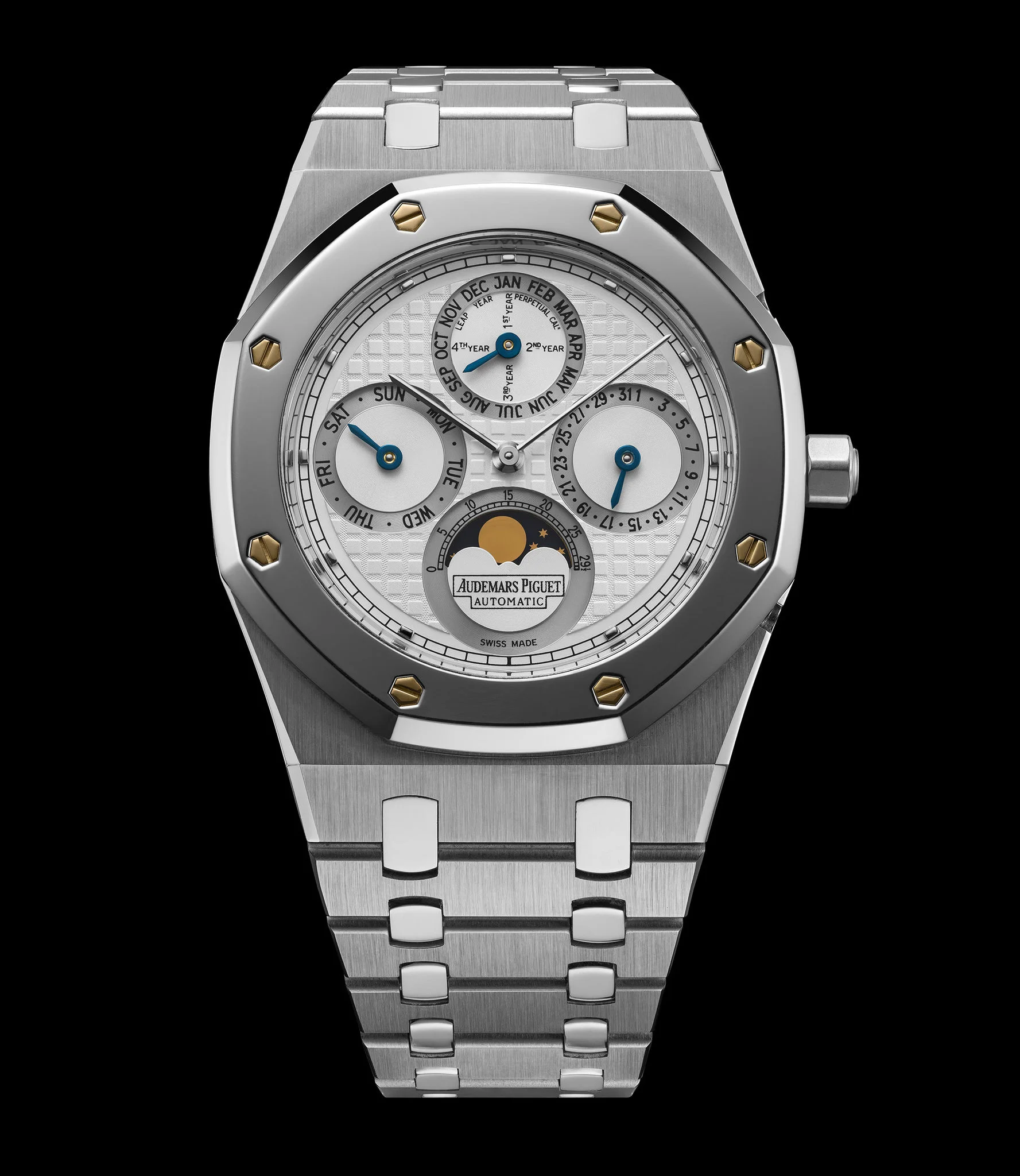
2002. Royal Oak Perpetual Calendar 25820SP, No. 004. . Perpetual calendar: day, date, month, leap year cycle, phase and age of the Moon. Calibre 2120/2802 selfwinding, movement 452578. Bracelet 944. Two-tone dial. 39 mm E25229 case, mirror-polished bezel and studs. Steel and platinum. Prototype made at the launch of the model. Audemars Piguet Heritage, Inv. 993

2002. Royal Oak Perpetual Calendar 25820SP, No. 004. Perpetual calendar: day, date, month, leap year cycle, phase and age of the Moon. Calibre 2120/2802 selfwinding, movement 452578. Bracelet 944. Two-tone dial. 39 mm E25229 case, mirror-polished bezel and studs. Steel and platinum. Prototype made at the launch of the model. Audemars Piguet Heritage, Inv. 993
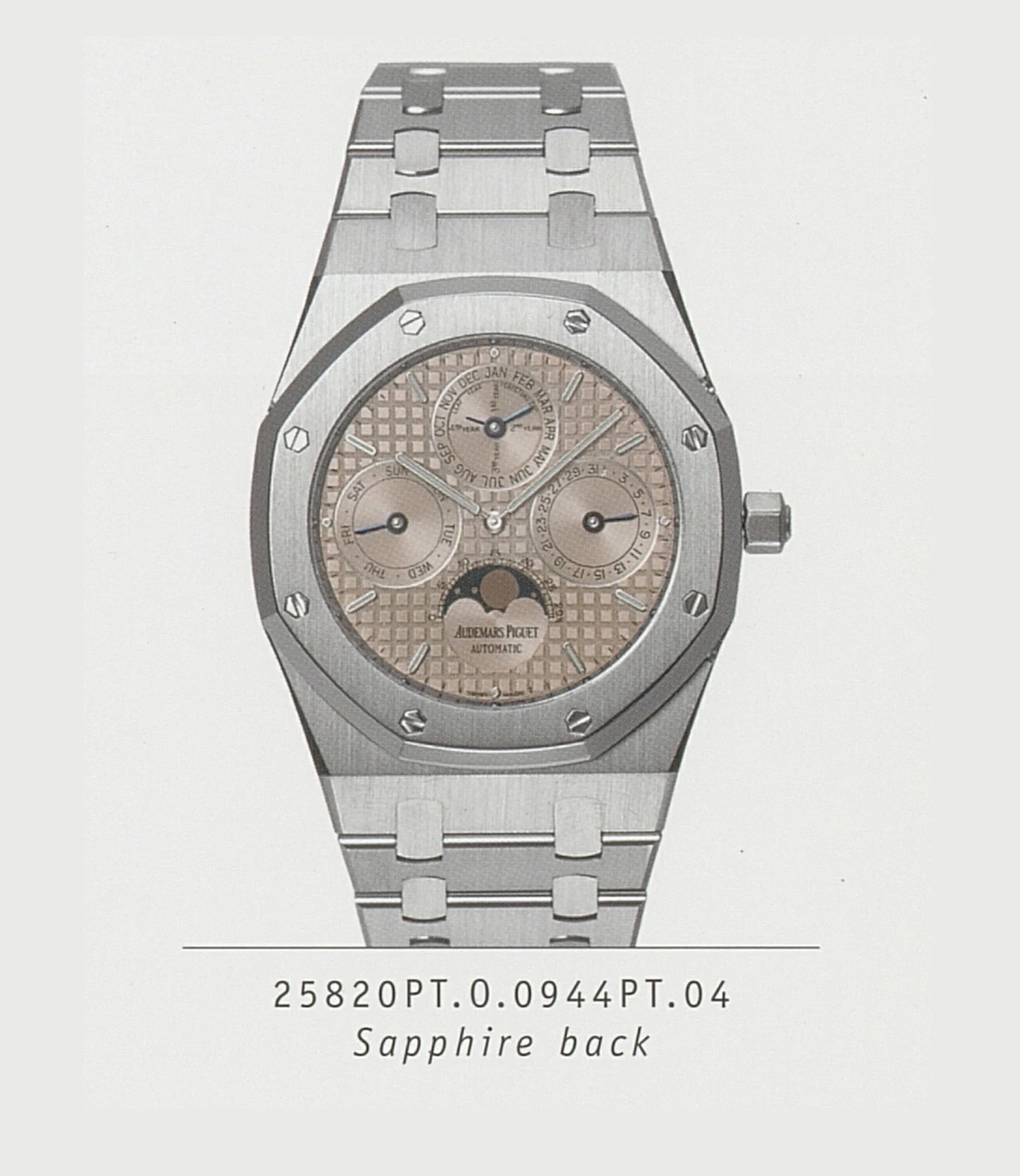
2002 – 2006. Model 25820SP Grande Tapisserie dial produced until at least 2008. Audemars Piguet Archives.
The combination of steel and platinum offers a particularly refined aesthetic. Though both metals are grey in colour, they reflect light differently, creating subtle and unsuspected contrasts. To emphasize this interplay, watchmakers often apply contrasting finishes. Here, the bezel and platinum studs are mirror-polished, while the links and middle case are satin-brushed.
Reference 25820SP remained in the catalogueue for over a decade. It was offered in several two-tone dial variations – on black or silver backgrounds – and even a pink version.
One of the rarest configurations is a 25-piece edition featuring a Tuscany blue dial with white gold hands and hour markers.
Additionally, some examples of this model are fitted with a special black oscillating weight, inspired by the design of the Royal Oak Jubilee 14802.
Sales breakdown (1997–2010):
Total: 382 pieces
1997: 25 | 1999: 49 | 2000: 61 | 2001: 56 | 2002: 33 | 2003: 26 | 2004: 23 | 2005: 23 | 2006: 11 | 2007: 49 | 2008: 22 | 2009: 3 | 2010: 1
The combination of steel and platinum offers a particularly refined aesthetic. Though both metals are grey in colour, they reflect light differently, creating subtle and unsuspected contrasts. To emphasize this interplay, watchmakers often apply contrasting finishes. Here, the bezel and platinum studs are mirror-polished, while the links and middle case are satin-brushed.
Reference 25820SP remained in the catalogueue for over a decade. It was offered in several two-tone dial variations – on black or silver backgrounds – and even a pink version.
One of the rarest configurations is a 25-piece edition featuring a Tuscany blue dial with white gold hands and hour markers.
Additionally, some examples of this model are fitted with a special black oscillating weight, inspired by the design of the Royal Oak Jubilee 14802.
Sales breakdown (1997–2010):
Total: 382 pieces
1997: 25 | 1999: 49 | 2000: 61 | 2001: 56 | 2002: 33 | 2003: 26 | 2004: 23 | 2005: 23 | 2006: 11 | 2007: 49 | 2008: 22 | 2009: 3 | 2010: 1
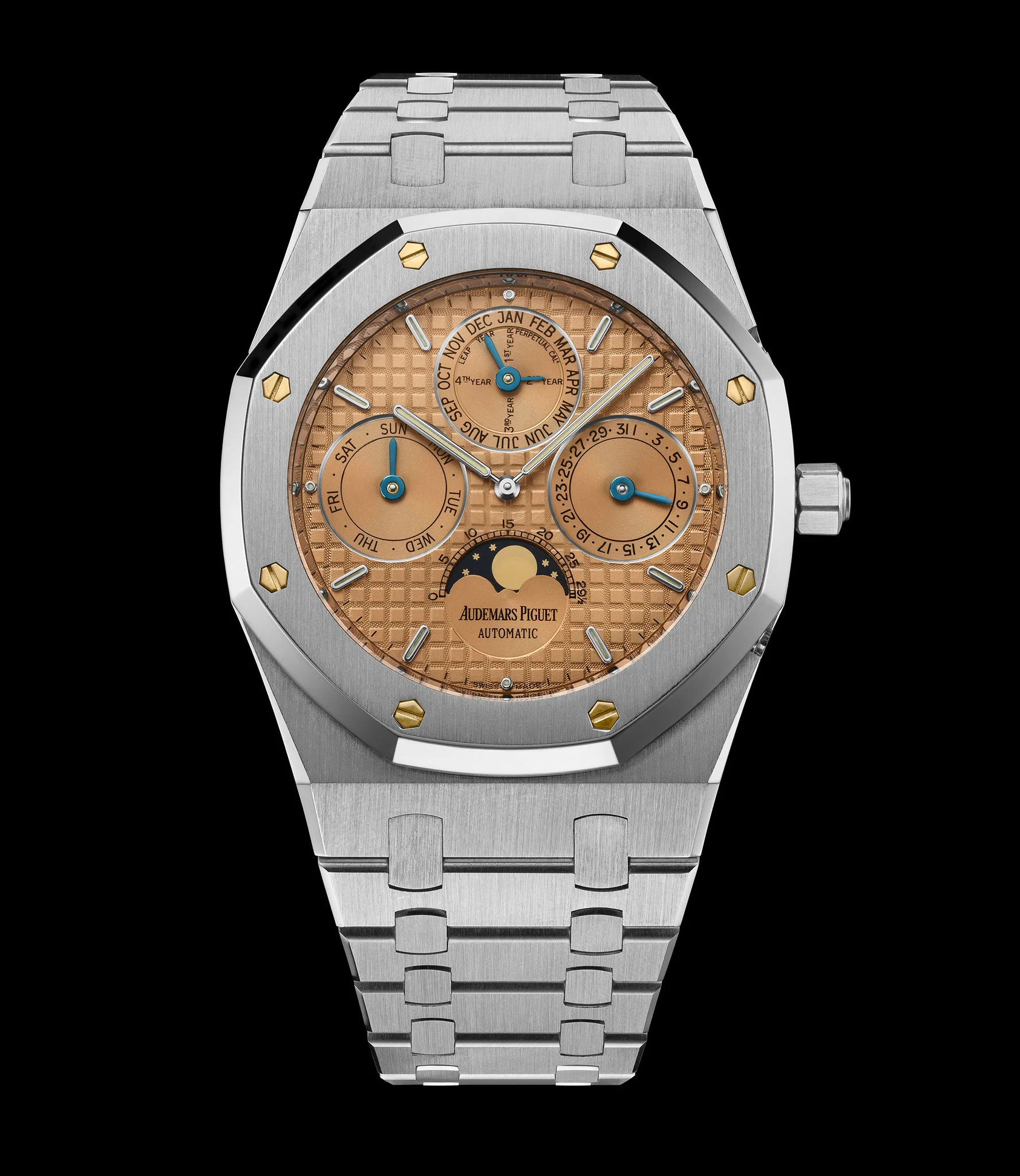
2006. Royal Oak Perpetual Calendar 25820PT. Perpetual calendar: day, date, month, leap year cycle, phase and age of the Moon. Calibre 2120/2802 selfwinding, 396843 movement. Bracelet 944. 39 mm case P00027. Platinum. "Old pink" dial. Prototype made when the model was launched. Audemars Piguet Heritage, Inv. 843

1999. Royal Oak Perpetual Calendar 25820PT, No. 40. Perpetual calendar: day, date, month, leap year cycle, phase and age of the Moon. Calibre 2120/2802 selfwinding, movement 424940. Bracelet 944. Tuscany blue dial. 39 mm case E23647. Platinum. Sold in Italy in 1999. Auctioned by Phillips New York on December 11, 2022, lot 175. Image © Phillips

Circa 1999. Identification photograph, model 25820PT, Tuscany blue dial. Archives Audemars Piguet
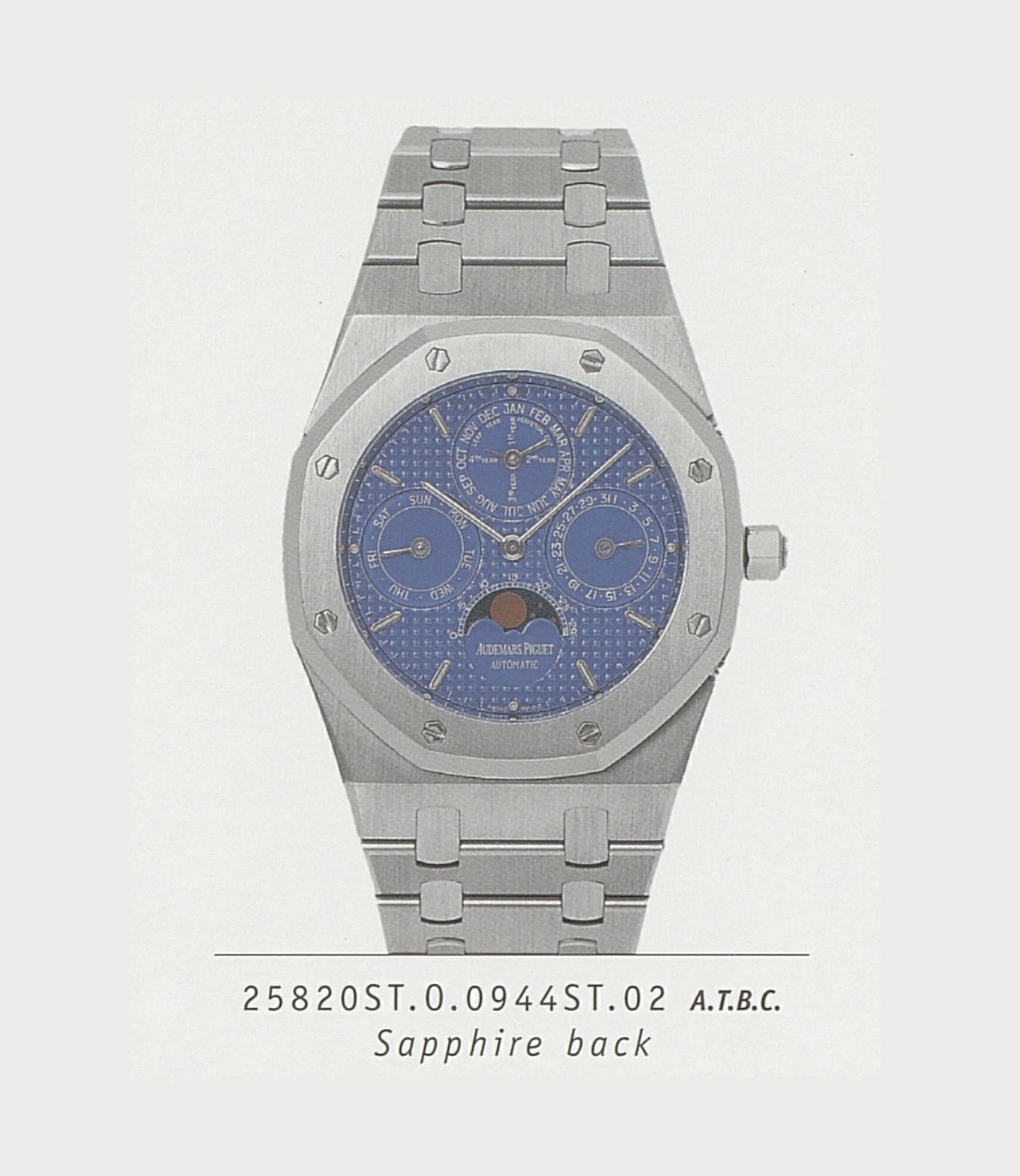
In 2001, this Petite Tapisserie variant appeared in the AP catalogueue. The color of its dial reads: "Tuscany blue". Audemars Piguet Archives.

2006. Royal Oak Perpetual Calendar 25820PT, n°160. Perpetual calendar: day, date, month, leap year cycle, phase and age of the Moon. Calibre 2120/2802 selfwinding, movement 549480. Bracelet 944. 39 mm case F45245. Platinum. Sold in New York in 2006. Sold for CHF 554,400 by Phillips Genève on 6 May 2022, lot 83. Image © Phillips

2006. Royal Oak Perpetual Calendar 25820PT, n°160. Perpetual calendar: day, date, month, leap year cycle, phase and age of the Moon. Calibre 2120/2802 selfwinding, movement 549480. Bracelet 944. 39 mm case F45245. Platinum. Sold in New York in 2006. Sold for CHF 554,400 by Phillips Genève on 6 May 2022, lot 83. Image © Phillips
Like all platinum watches with a metal bracelet, this variant of the Royal Oak Perpetual Calendar 25820 is distinguished by its substantial weight and rarity. Just over 70 units were manufactured and sold between 1998 and 2006.
The Audemars Piguet archives record four dial variations for this reference, though the number of pieces per dial is not specified. It’s even possible that some of these dials were never actually fitted to this model:
•Tuscany Blue Dial, Petite Tapisserie
•Tuscany Blue Dial, Engraved
•“Old Pink” Dial, Grande Tapisserie
•Blue Mother-of-Pearl Dial (no image available in the archives)
Sales breakdown (1998–2006):
Total: 74 pieces
1998: 4 | 1999: 7 | 2000: 4 | 2001: 10 | 2002: 8 | 2003: 12 | 2004: 8 | 2005: 12 | 2006: 9
Like all platinum watches with a metal bracelet, this variant of the Royal Oak Perpetual Calendar 25820 is distinguished by its substantial weight and rarity. Just over 70 units were manufactured and sold between 1998 and 2006.
The Audemars Piguet archives record four dial variations for this reference, though the number of pieces per dial is not specified. It’s even possible that some of these dials were never actually fitted to this model:
•Tuscany Blue Dial, Petite Tapisserie
•Tuscany Blue Dial, Engraved
•“Old Pink” Dial, Grande Tapisserie
•Blue Mother-of-Pearl Dial (no image available in the archives)
Sales breakdown (1998–2006):
Total: 74 pieces
1998: 4 | 1999: 7 | 2000: 4 | 2001: 10 | 2002: 8 | 2003: 12 | 2004: 8 | 2005: 12 | 2006: 9

1996. Data sheet ref 25820OR. Archives Audemars Piguet

1996. Data sheet ref 25820OR. Extract. Archives Audemars Piguet
With only 11 examples produced, the pink gold version of the Royal Oak Perpetual Calendar 25820 is the second rarest, following the tantalum-platinum variant.
This model features a blued mother-of-pearl dial, which beautifully offsets the warm tones of the pink gold hands and hour markers.
After a long period of relative discretion from the 1990s through the 2010s, pink gold has gradually returned to the spotlight – most notably with the launch of the Royal Oak Perpetual Calendar 26574OR in 2015.
Sales breakdown (1998–2004):
Total: 11 pieces
1998: 1 | 2002: 5 | 2004: 5
With only 11 examples produced, the pink gold version of the Royal Oak Perpetual Calendar 25820 is the second rarest, following the tantalum-platinum variant.
This model features a blued mother-of-pearl dial, which beautifully offsets the warm tones of the pink gold hands and hour markers.
After a long period of relative discretion from the 1990s through the 2010s, pink gold has gradually returned to the spotlight – most notably with the launch of the Royal Oak Perpetual Calendar 26574OR in 2015.
Sales breakdown (1998–2004):
Total: 11 pieces
1998: 1 | 2002: 5 | 2004: 5